
Education Search Authority Maturity Model
The Education Search Authority Maturity Model is a five-level framework developed by CGO Media to help universities, colleges, training providers, online education organisations and EdTech companies evaluate how effectively they build, organise and maintain authority across modern search and AI-assisted discovery environments.
Education visibility is no longer determined only by rankings for individual keywords. Search engines, AI assistants and generative recommendation systems increasingly operate across wider information environments containing institutions, programmes, qualifications, faculty expertise, research, accreditation, learner outcomes, citations, external references and structured entity relationships.
The Education Search Authority Maturity Model provides a structured method for assessing how developed that wider authority system has become.
1. Why Education Organisations Need a Search Authority Maturity Model
Education organisations frequently invest in SEO without having a clear method for determining whether their overall search authority is becoming stronger.
2. Traditional SEO Reporting Can Measure Individual Outcomes
Common measures include:
- Organic traffic
- Keyword rankings
- Conversions
- Backlinks
- Indexed pages
3. These Measures Do Not Fully Describe Search Authority
They do not necessarily reveal whether search engines and AI systems clearly understand:
- The education provider
- Its programmes
- Its qualifications
- Its academic expertise
- Its institutional trust
- Its relationship with external sources
4. Search Authority Is a System-Level Capability
Strong education search authority emerges when multiple signals reinforce one another.
5. These Signals Can Include
- Technical accessibility
- Programme information quality
- Topical authority
- Entity clarity
- Trust evidence
- External authority
- AI visibility
6. The Education Search Authority Maturity Model Evaluates Organisational Development
It asks:
How mature is the organisation’s overall ability to build and maintain authority across search engines, generative systems and learner-discovery environments?
7. The Model Uses Five Maturity Levels
- Fragmented
- Foundation
- Structured Authority
- Integrated Search Authority
- Adaptive Search Authority
8. Level 1 — Fragmented
Search activity exists, but information, ownership and authority signals are disconnected.
9. Level 2 — Foundation
Core technical, programme and institutional foundations are being established.
10. Level 3 — Structured Authority
The organisation deliberately develops topical, entity, trust and external authority.
11. Level 4 — Integrated Search Authority
SEO, content, entities, research, citations and AI visibility operate as an integrated system.
12. Level 5 — Adaptive Search Authority
The organisation continuously measures, learns and adapts as search behaviour, AI systems and education markets change.
13. Search Authority Maturity Is Not Simply a Ranking Scale
Moving from one level to another requires organisational capability as well as technical improvement.
14. Education Search Authority Has Multiple Dimensions
The model evaluates maturity across six principal dimensions:
- Technical & Information Architecture
- Content & Topical Authority
- Entity & Knowledge Architecture
- Trust & Evidence
- External & Citation Authority
- AI Search Visibility & Governance
15. Dimension One — Technical & Information Architecture
This dimension examines whether education information can be accessed, understood and navigated effectively.
16. Technical Maturity Can Include
- Crawlability
- Indexability
- Site architecture
- Internal linking
- Structured data
- International architecture
17. Education Websites Can Be Structurally Complex
Large providers may contain:
- Faculties
- Schools
- Departments
- Courses
- Research centres
- Multiple campuses
18. Complexity Can Reduce Search Clarity
Important programme and institutional information can become fragmented across different systems.
19. Fragmentation Can Include
- Main websites
- Course catalogues
- Admissions portals
- Research repositories
- Student systems
- Partner websites
20. Mature Technical Architecture Connects These Environments
Search engines and users should be able to understand how important education information relates.
21. Dimension Two — Content & Topical Authority
This dimension examines how comprehensively the provider demonstrates expertise around relevant educational subjects.
22. Topical Authority Is Broader Than Course Pages
It can include:
- Subject guides
- Career information
- Academic research
- Faculty expertise
- Industry analysis
- Learner guidance
23. Programme Pages Establish Commercial Education Relevance
They explain what learners can study.
24. Supporting Content Establishes Subject Depth
It can explain:
- Why the subject matters
- How the discipline works
- Career applications
- Research developments
- Industry context
25. Mature Education Content Connects Learning and Expertise
A strong relationship can be represented as:
Subject Expertise → Educational Content → Programme Relevance → Learner Discovery
26. Dimension Three — Entity & Knowledge Architecture
This dimension examines whether important organisations, people, programmes and relationships are represented clearly.
27. Important Education Entities Can Include
- Institution
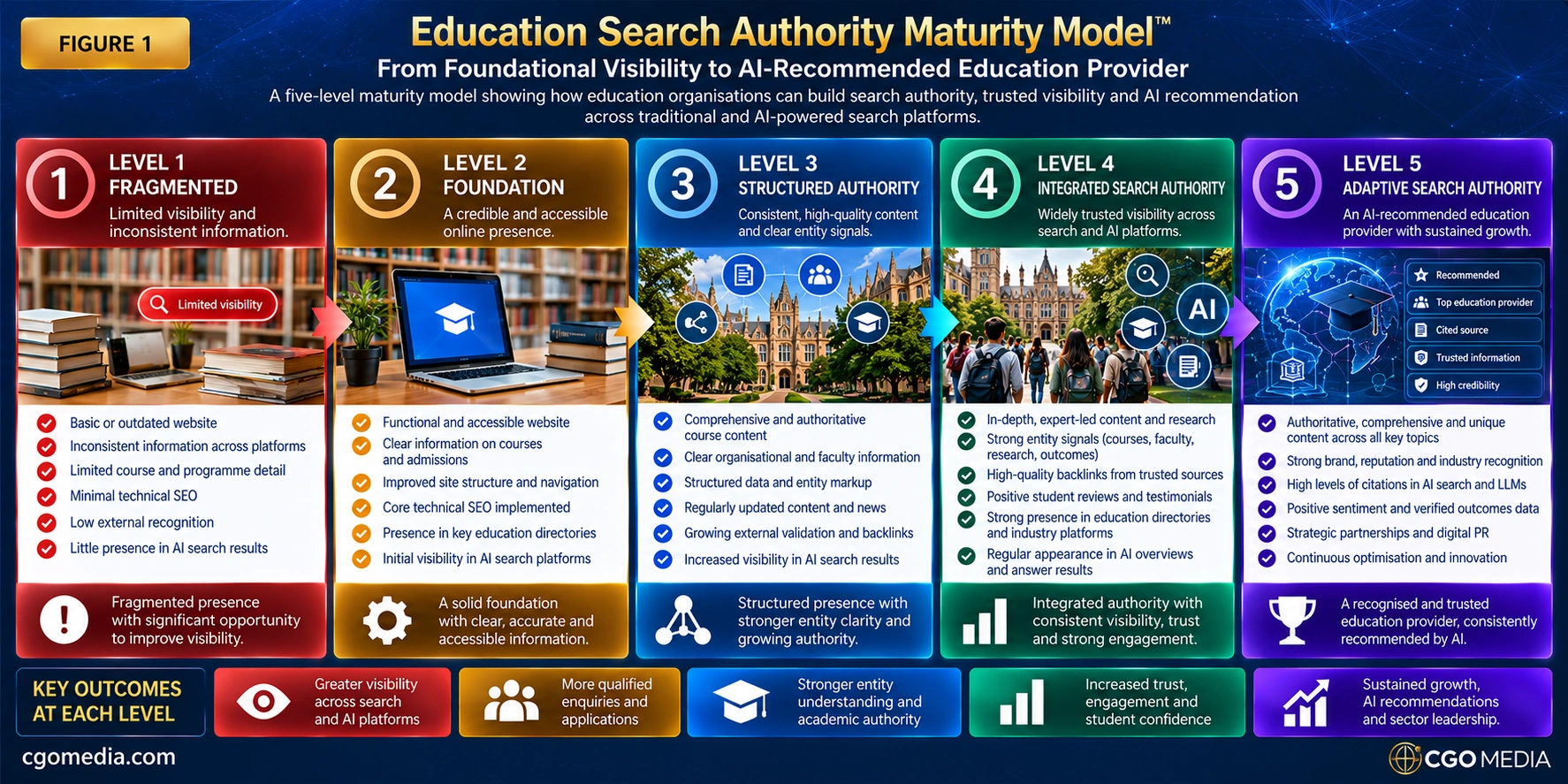
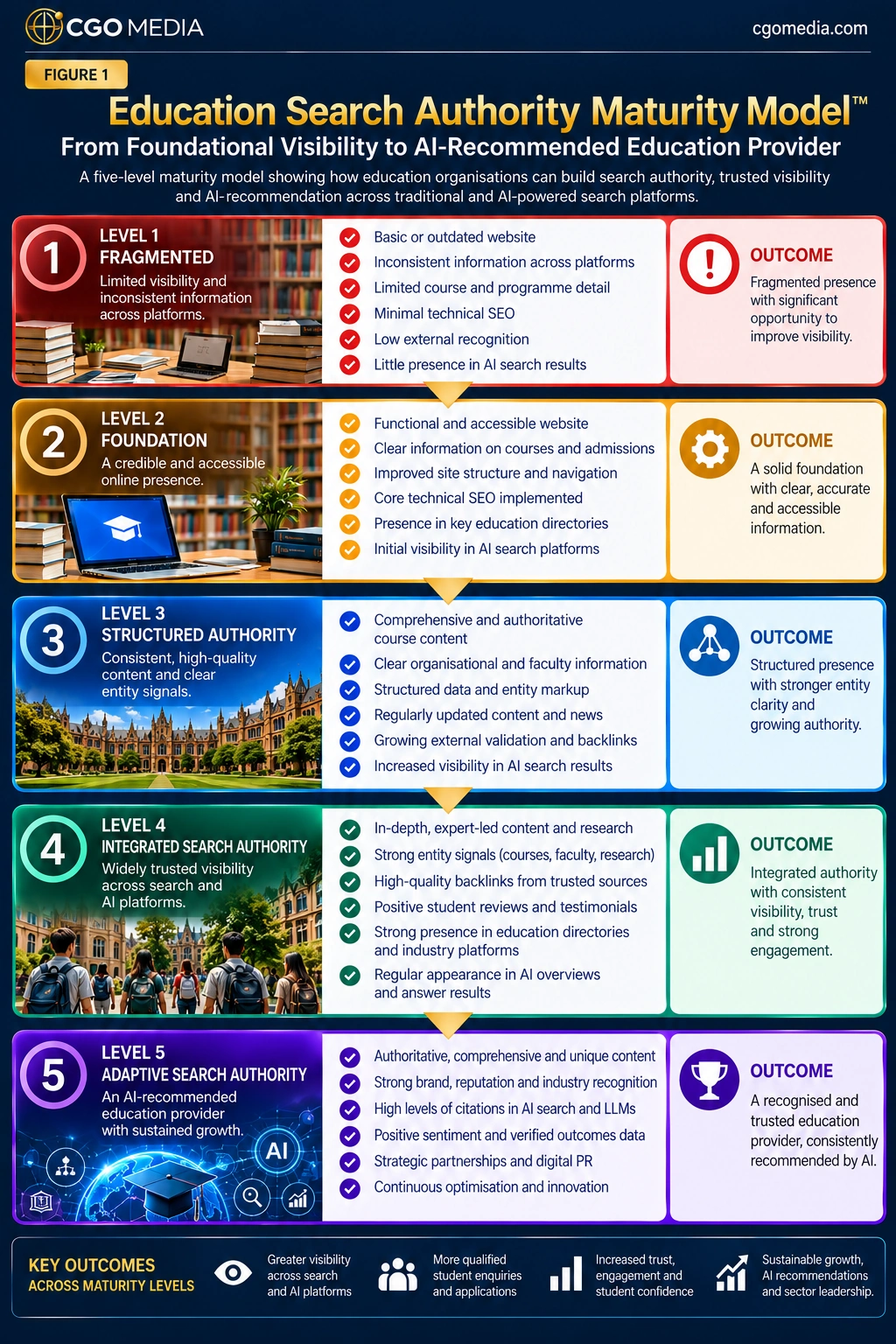
- Faculty
- Department
- Programme
- Qualification
- Academic
28. EdTech Entities Can Include
- Organisation
- Platform
- Product
- Feature
- Learning function
- User group
29. Mature Entity Architecture Makes Relationships Explicit
For an education provider:
Institution → Faculty → Department → Programme → Qualification → Academic Expertise
30. Clear Entity Relationships Support Search Understanding
They can reduce ambiguity around:
- Programme ownership
- Academic expertise
- Campus relationships
- Qualification responsibility
- Research affiliation
31. Dimension Four — Trust & Evidence
Education decisions can involve significant financial, professional and personal consequences.
32. Search Authority Therefore Requires Evidence
Important educational claims should be supported.
33. Trust Evidence Can Include
- Accreditation
- Recognition
- Outcome data
- Research evidence
- Institutional transparency
- Student experience evidence
34. Accreditation Is One Form of Trust Evidence
It can provide external validation of institutional or programme standards.
35. Outcome Evidence Is Another Form
Relevant measures can include:
- Completion
- Progression
- Graduate employment
- Professional outcomes
- Learner satisfaction
36. Evidence Quality Matters
Strong evidence should explain:
- What was measured
- Who was measured
- When it was measured
- How it was measured
37. Dimension Five — External & Citation Authority
Education authority is not created entirely through the organisation’s own website.
38. External Authority Can Include
- Academic citations
- Government references
- Professional organisations
- Education media
- Industry organisations
- Research repositories
39. External Authority Reinforces Institutional Claims
Independent sources can validate:
- Expertise
- Recognition
- Research
- Professional relevance
- Institutional standing
40. Citation Authority Is Particularly Important in AI Search
Generative systems can explicitly cite sources when constructing answers.
41. Education Providers Can Become Citable Sources
Useful citation assets can include:
- Primary research
- Education statistics
- Definitions
- Outcome studies
- Original frameworks
42. Dimension Six — AI Search Visibility & Governance
This dimension examines how effectively the organisation monitors and governs its representation within generative environments.
43. AI Search Visibility Can Include
- Source visibility
- Citation visibility
- Entity representation
- Provider comparison visibility
- Recommendation visibility
44. AI Visibility Requires More Than Monitoring Mentions
Organisations should assess whether information is:
- Accurate
- Relevant
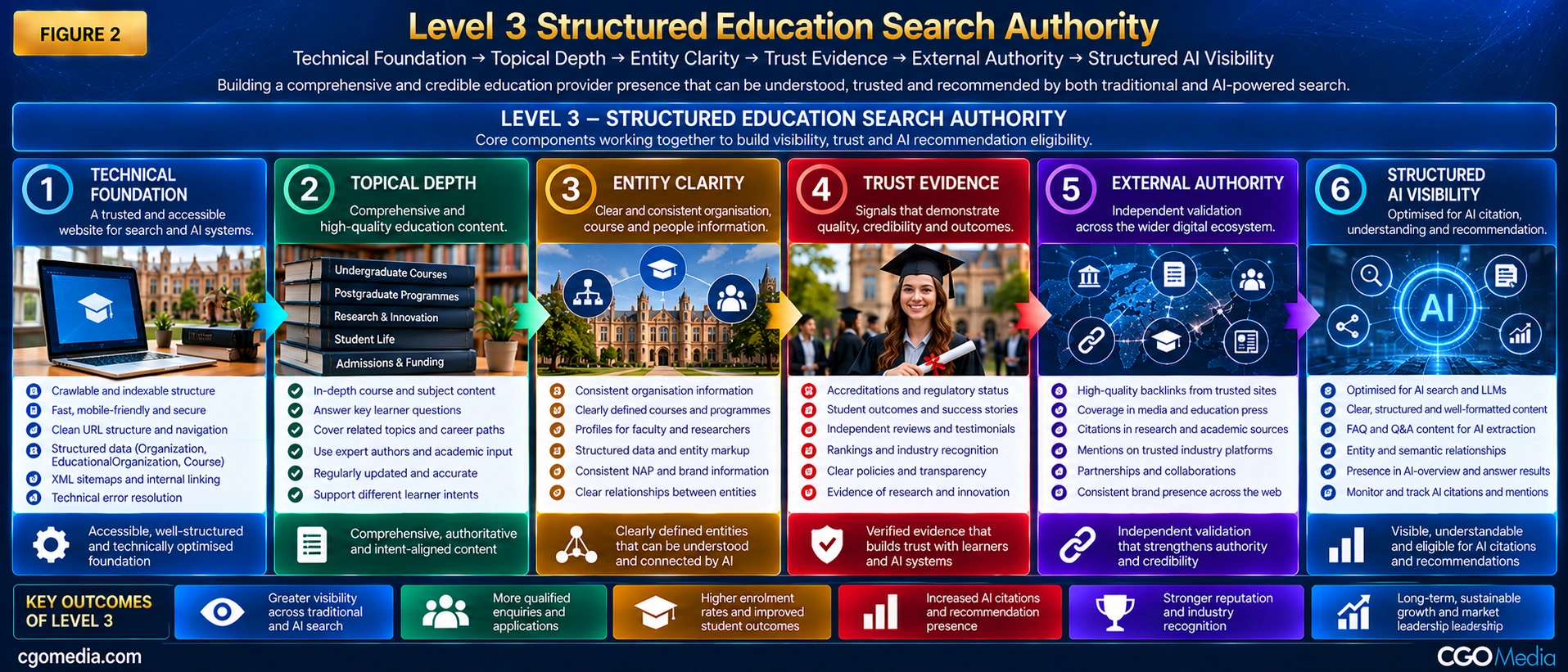
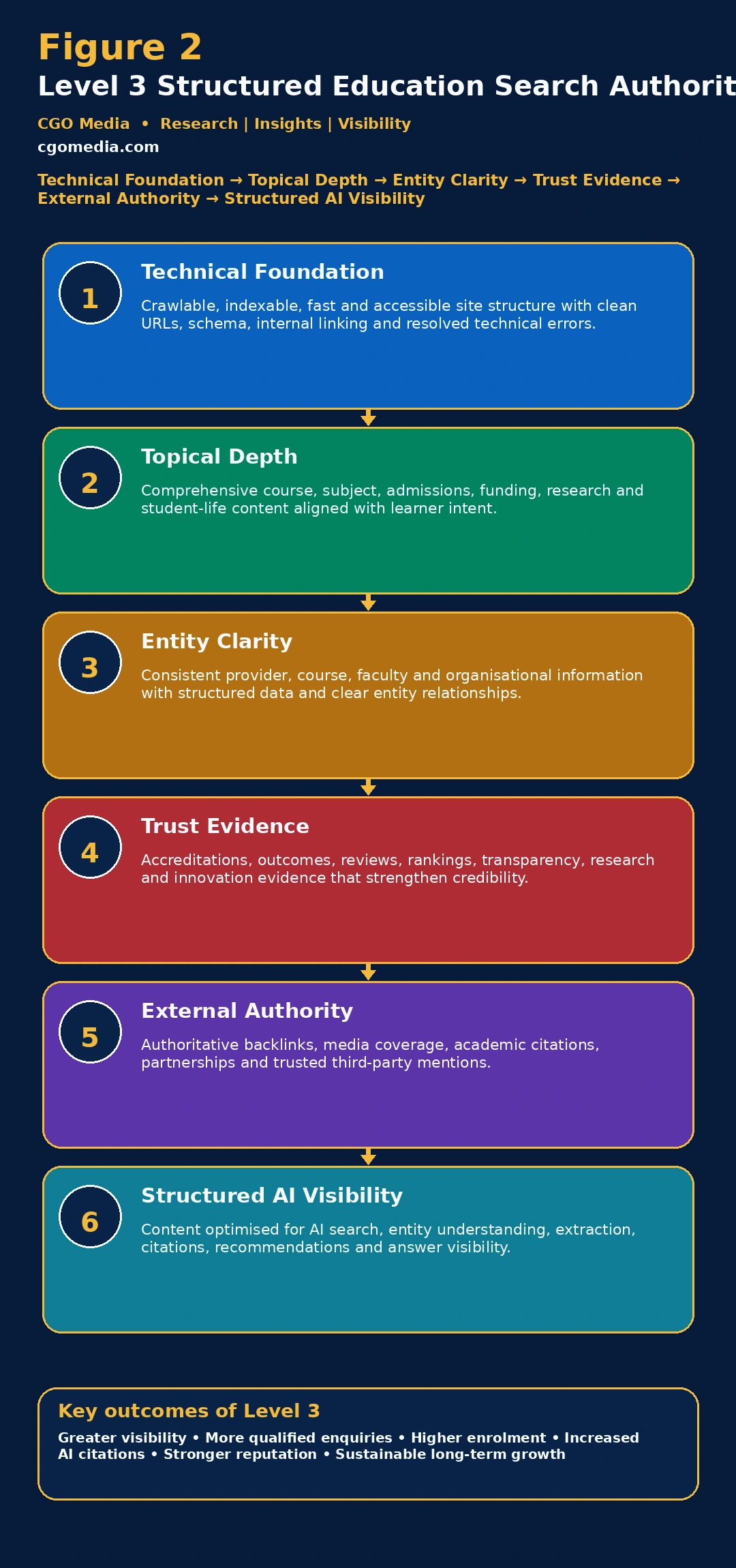
- Evidence-supported
- Appropriately contextualised
45. Governance Determines Whether AI Visibility Can Be Managed
Search authority maturity therefore depends partly on organisational ownership.
46. Education Search Authority Should Be Evaluated Across All Six Dimensions
A provider may be mature in one dimension but weak in another.
47. Strong Technical SEO Does Not Automatically Create Strong Authority
A technically excellent website can still have:
- Weak content
- Weak trust evidence
- Weak entities
- Weak external authority
48. Strong Content Does Not Automatically Create Strong Authority
Content can remain under-supported by external evidence or institutional trust.
49. Strong Brand Awareness Does Not Automatically Create Structured Search Authority
Well-known institutions can still suffer from:
- Programme ambiguity
- Technical fragmentation
- Entity confusion
- Outdated learner information
50. Maturity Therefore Depends on Integration
Search authority strengthens when these dimensions reinforce one another.
51. A Simplified Education Search Authority Relationship Is
Technical Accessibility + Topical Authority + Entity Clarity + Trust Evidence + External Authority + AI Governance
52. Level 1 — Fragmented Search Authority
Level 1 organisations have some digital visibility but lack coordinated search authority.
53. Level 1 Technical Characteristics
Common characteristics can include:
- Indexing problems
- Duplicate content
- Weak site architecture
- Poor internal linking
- Disconnected systems
54. Level 1 Content Characteristics
Content can be dominated by:
- Basic programme descriptions
- Marketing copy
- News updates
- Unstructured blog activity
55. Level 1 Entity Characteristics
Relationships between institutions, faculties, programmes and experts may be unclear.
56. Level 1 Trust Characteristics
Evidence may be:
- Limited
- Outdated
- Scattered
- Poorly contextualised
57. Level 1 External Authority Characteristics
External visibility may depend mainly on:
- Historical reputation
- Directories
- Uncoordinated media mentions
- Existing institutional links
58. Level 1 AI Visibility Characteristics
The organisation may have little understanding of:
- How AI systems describe it
- Which programmes are recommended
- Which sources are cited
- Which competitors appear
59. Level 1 Search Activity Is Usually Reactive
Teams respond to:
- Ranking declines
- Traffic drops
- Technical problems
- Individual programme requests
60. Search Ownership Can Be Fragmented
Different functions may separately control:
- Programme pages
- Admissions
- Research
- Technical infrastructure
- PR
61. Level 1 Organisations Often Lack a Shared Search Model
SEO may be viewed primarily as:
- Keywords
- Page optimisation
- Technical fixes
- Backlink acquisition
62. Level 1 Search Authority Can Be Accidental
The organisation may rank well for some queries because of historic reputation rather than deliberate authority architecture.
63. Historic Authority Can Conceal Structural Weakness
Strong domains can continue to perform despite:
- Weak information architecture
- Outdated course content
- Entity ambiguity
- Limited AI monitoring
64. Level 1 Risk Increases as Search Changes
Historical domain strength may become less protective as discovery increasingly includes:
- Generated answers
- AI recommendations
- Entity-based retrieval
- Source selection
65. The Level 1 Strategic Priority Is Visibility Stabilisation
The organisation should first identify major technical, programme-information and entity problems.
66. Level 1 Priorities Can Include
- Technical audit
- Programme inventory
- Entity audit
- Trust evidence audit
- AI visibility baseline
67. Level 1 Should Establish a Search Authority Baseline
The baseline should identify current strengths, weaknesses and critical risks.
68. Level 1 Should Prioritise Critical Learner Information
Important facts can include:
- Programme availability
- Qualification level
- Entry requirements
- Fees
- Accreditation
69. Level 1 Should Reduce Information Conflict
Conflicting institutional and programme information weakens trust.
70. Level 1 Should Establish Ownership
Every major search authority dimension should have a responsible function.
71. Moving from Level 1 to Level 2 Requires Foundation Building
The organisation must move from reactive search activity toward repeatable standards.
72. Level 2 — Search Authority Foundation
Level 2 organisations have begun establishing consistent technical, content, entity and trust foundations.
73. Level 2 Technical Characteristics
Core SEO controls are increasingly standardised.
74. Level 2 Technical Controls Can Include
- Crawl management
- Indexation controls
- Canonicalisation
- XML sitemaps
- Internal-linking standards
75. Level 2 Information Architecture Becomes More Structured
The organisation begins establishing clear relationships between:
- Subjects
- Programmes
- Qualifications
- Faculties
- Admissions information
76. Level 2 Programme Templates Become More Consistent
Core programme information can follow standardised fields.
77. Level 2 Programme Information Can Include
- Programme overview
- Qualification
- Duration
- Study mode
- Entry requirements
- Outcomes
78. Level 2 Content Begins Moving Beyond Programme Pages
Supporting content starts addressing:
- Subject questions
- Career questions
- Learner concerns
- Admissions questions
79. Level 2 Entity Work Begins
The organisation starts documenting key entities and relationships.
80. Level 2 Entity Priorities Can Include
- Organisation identity
- Faculty relationships
- Programme ownership
- Academic profiles
- Campus information
81. Level 2 Structured Data Becomes More Deliberate
Structured data should reflect real organisational and content relationships rather than being implemented merely as a technical checklist.
82. Level 2 Trust Evidence Becomes More Visible
Providers begin organising:
- Accreditation information
- Outcome evidence
- Recognition
- Institutional policies
83. Level 2 External Authority Becomes More Intentional
The organisation begins connecting:
- PR
- Research
- Professional relationships
- External references
84. Level 2 AI Search Monitoring Begins
Teams start recording:
- Provider mentions
- Programme recommendations
- Citations
- Competitor appearances
85. Level 2 Monitoring Is Often Manual
This is acceptable while the organisation develops the initial methodology.
86. Level 2 Should Establish Learner Scenario Libraries
Monitoring should be based on realistic education decisions rather than arbitrary prompts.
87. Level 2 Learner Scenario Dimensions Can Include
- Subject
- Qualification level
- Study mode
- Geography
- Career goal
88. Level 2 Search Reporting Starts Expanding
The organisation can move beyond rankings and traffic to include:
- Programme visibility
- Subject visibility
- Technical quality
- Entity accuracy
- AI observations
89. Level 2 Governance Is Still Developing
Processes may exist but remain dependent on individual teams or specialists.
90. Level 2 Search Authority Is Repeatable but Not Yet Fully Integrated
The organisation has foundations but authority dimensions may still operate separately.
91. Level 2 Should Establish Content Standards
Programme, subject and research content should have defined minimum requirements.
92. Level 2 Should Establish Evidence Standards
Important claims should require appropriate supporting evidence.
93. Level 2 Should Establish Entity Standards
Naming, relationships and institutional identity should remain consistent.
94. Level 2 Should Establish Freshness Standards
High-change information should have review responsibilities and schedules.
95. Level 2 Should Establish Search Governance
Relevant teams can include:
- SEO
- Admissions
- Academic teams
- Marketing
- Research
- Quality assurance
96. Moving from Level 2 to Level 3 Requires Authority Development
The organisation must begin deliberately strengthening subject, entity, trust and external authority rather than only maintaining foundations.
97. Search Authority Maturity Is Cumulative
Higher levels depend on capabilities established earlier.
98. Level 3 Cannot Compensate for Broken Level 1 Foundations
Advanced research, AI monitoring or Digital PR cannot fully compensate for inaccessible or contradictory programme information.
99. Search Authority Development Therefore Requires Sequencing
A useful progression is:
Stabilise → Standardise → Build Authority → Integrate → Adapt
100. Stabilise
Resolve major technical, content and information conflicts.
101. Standardise
Create repeatable technical, programme, entity and evidence standards.
102. Build Authority
Strengthen topical depth, trust, research and external recognition.
103. Integrate
Connect search, research, PR, entity management and AI visibility.
104. Adapt
Continuously respond to changing search environments and learner behaviour.
105. The Maturity Model Should Not Be Used as a Marketing Badge
Its purpose is diagnostic.
106. Organisations Can Mature at Different Speeds Across Dimensions
For example, an institution may have:
- Level 4 technical maturity
- Level 3 content maturity
- Level 2 entity maturity
- Level 1 AI governance maturity
107. Dimension-Level Assessment Is Therefore Important
A single organisation-wide score can conceal specific constraints.
108. The Weakest Strategic Dimension Can Limit Overall Authority
A useful principle is:
Overall Search Authority ≠ Highest Individual Capability
109. Balanced Maturity Is More Durable
Education providers should strengthen authority across technical, content, entity, trust, external and AI-search dimensions rather than relying excessively on one historical advantage.
110. The First Education Search Authority Principle
Education search authority should be evaluated as a multi-dimensional organisational capability rather than as a collection of rankings because technical accessibility, topical depth, entity clarity, trust evidence, external authority and AI visibility collectively shape modern learner discovery.
111. The Second Education Search Authority Principle
Search authority maturity should be assessed by dimension as well as organisation-wide because education providers can operate at substantially different levels of maturity across technical SEO, content, entities, trust, citations and AI governance.
112. The Third Education Search Authority Principle
Higher maturity should build cumulatively on stable foundations, progressing from technical and information stabilisation through standardisation, authority development, integration and adaptive search governance.
113. The Fourth Education Search Authority Principle
The Education Search Authority Maturity Model should be used as a diagnostic and planning framework rather than a promotional rating, with the objective of identifying which authority constraints most significantly limit qualified learner discovery and long-term institutional visibility.
114. The Education Search Authority Maturity Model
The five-level progression can be summarised as:
Level 1 Fragmented → Level 2 Foundation → Level 3 Structured Authority → Level 4 Integrated Search Authority → Level 5 Adaptive Search Authority
115. The Strategic Implication
Universities, colleges, training providers and EdTech organisations should assess search maturity across the complete education authority system rather than judging performance through rankings alone, using the five maturity levels to identify where technical foundations, programme information, topical depth, entity structure, trust evidence, external authority and AI governance require further development.
116. Level 3 — Structured Authority
Level 3 education organisations move beyond basic SEO foundations and begin deliberately building authority across subjects, programmes, entities, evidence and external references.
117. Level 3 Represents a Strategic Shift
Search activity becomes less reactive and more intentional.
118. The Organisation Begins to Ask Different Questions
Instead of asking only:
- Which keywords do we rank for?
- How much traffic did we gain?
- Which pages need optimisation?
it also asks:
- Which subjects do we want to be authoritative for?
- Which programme areas need deeper evidence?
- Which entities need clearer representation?
- Which external sources reinforce our authority?
119. Level 3 Technical Architecture Supports Authority Building
Technical SEO is no longer treated primarily as issue resolution.
120. Technical Architecture Becomes Deliberate
The organisation begins designing information structures around:
- Subjects
- Programmes
- Qualifications
- Faculties
- Research areas
- Learner journeys
121. Internal Linking Becomes Strategic
Internal links increasingly reinforce meaningful relationships between:
- Subject hubs
- Programme pages
- Academic profiles
- Research content
- Career information
122. Search Architecture Begins to Reflect Academic Architecture
Digital structure increasingly mirrors the real education ecosystem.
123. Programme Pages Become Authority Assets
They do more than describe a course.
124. Mature Level 3 Programme Pages Can Include
- Clear qualification information
- Entry requirements
- Curriculum detail
- Faculty expertise
- Career outcomes
- Accreditation evidence
125. Programme Pages Begin Connecting to Subject Ecosystems
The programme is positioned within a wider body of subject expertise.
126. Subject Hubs Become More Important at Level 3
A subject hub can connect:
- Programmes
- Research
- Academic experts
- Career pathways
- Industry insight
127. Subject Hubs Strengthen Topical Authority
They help demonstrate that the provider has sustained expertise rather than isolated course pages.
128. Level 3 Content Strategy Becomes Cluster-Based
The organisation develops structured content ecosystems around priority subjects and learner needs.
129. A Level 3 Education Content Cluster Can Include
- Subject overview
- Programme pages
- Career guides
- Research articles
- Expert commentary
- Learner FAQs
130. Content Clusters Should Reflect Real Education Questions
They should be based on:
- Learner demand
- Admissions questions
- Career interests
- Academic expertise
- Market need
131. Level 3 Content Begins Moving from Volume to Coverage
The objective is not simply to publish more pages.
132. The Objective Is Structured Subject Coverage
The organisation seeks to answer the most important questions within its areas of expertise.
133. Coverage Should Include Decision-Making Information
Useful areas include:
- Programme comparison
- Career pathways
- Qualification differences
- Entry requirements
- Study options
134. Coverage Should Also Include Expertise Information
Useful areas include:
- Research
- Industry developments
- Subject definitions
- Academic commentary
- Professional practice
135. Level 3 Entity Architecture Becomes Systematic
The organisation begins maintaining defined relationships between important education entities.
136. Core Entity Relationships Can Include
Institution → Faculty → Department → Programme → Qualification → Academic → Research Area
137. Entity Architecture Should Reflect Real Organisational Relationships
It should not be created solely for search engines.
138. Academic Profiles Become Search Authority Assets
They can demonstrate:
- Subject expertise
- Research activity
- Professional experience
- Publications
- External recognition
139. Academic Profiles Should Connect to Relevant Programmes
This strengthens the relationship between educational delivery and expertise.
140. Academic Profiles Should Also Connect to Research
This strengthens subject and citation authority.
141. Level 3 EdTech Entity Architecture Can Include
Organisation → Platform → Product → Feature → Learning Function → User Group → Use Case
142. Product and Feature Relationships Should Be Explicit
This reduces category ambiguity.
143. Level 3 Trust Architecture Becomes Deliberate
Trust evidence is organised rather than scattered.
144. Trust Evidence Can Be Structured Around
- Accreditation
- Outcomes
- Recognition
- Research
- Student experience
- Governance
145. Accreditation Evidence Should Be Easy to Verify
Users and search systems should be able to understand:
- Who accredits the programme
- What the accreditation covers
- Whether it is current
- Which programme or institution it applies to
146. Outcome Evidence Should Become More Specific
Level 3 organisations begin moving away from vague outcome claims.
147. Outcome Evidence Can Include
- Graduate employment
- Further-study progression
- Completion rates
- Professional progression
- Learner satisfaction
148. Outcome Evidence Should Include Context
Strong reporting explains:
- Population
- Time period
- Methodology
- Programme scope
149. Level 3 Research Authority Begins to Develop
The institution increasingly publishes useful evidence rather than only promotional content.
150. Research Authority Can Include
- Academic studies
- Institutional research
- Learner surveys
- Education trend reports
- Original datasets
151. Original Research Creates External Reference Opportunities
Other organisations can cite information that exists uniquely or primarily within the provider’s research.
152. Research Should Be Designed for Utility
Useful research should contain:
- Clear methodology
- Explicit findings
- Publication date
- Named authors
- Limitations
153. Level 3 Citation Authority Becomes Measurable
The organisation begins tracking who references its information.
154. Citation Sources Can Include
- Academic publications
- Government organisations
- Professional bodies
- Education media
- Industry organisations
155. Citation Quality Matters More Than Citation Volume
A relevant reference from a credible education source can be more valuable than many weak mentions.
156. Level 3 External Authority Becomes More Targeted
PR and outreach increasingly support specific authority objectives.
157. External Authority Campaigns Can Focus on
- Research findings
- Subject expertise
- Academic commentary
- Graduate outcomes
- Education innovation
158. Level 3 Digital PR Should Be Evidence-Led
The strongest campaigns distribute useful information rather than generic institutional promotion.
159. Education Journalists and Researchers Need Citable Material
Useful assets should make it easy to identify:
- Key finding
- Supporting number
- Method
- Source
- Date
160. Level 3 AI Search Monitoring Becomes More Structured
The organisation starts moving beyond occasional testing.
161. AI Monitoring Can Include
- Provider mentions
- Programme mentions
- Source citations
- Competitor co-occurrence
- Recommendation visibility
162. Level 3 AI Monitoring Should Use Defined Learner Scenarios
Prompts should reflect real learner decisions.
163. Scenario Categories Can Include
- Programme discovery
- Provider comparison
- Career-related education
- Online learning
- EdTech product selection
164. Level 3 AI Monitoring Begins Measuring Accuracy
The organisation checks whether generated answers correctly represent:
- Programmes
- Entry requirements
- Accreditation
- Delivery modes
- Institutional relationships
165. Accuracy Becomes More Important Than Raw Mention Count
Being mentioned frequently is not valuable if the information is wrong.
166. Level 3 Should Track Provider Co-Occurrence
This can reveal which organisations appear repeatedly in the same learner decisions.
167. Co-Occurrence Can Reveal Effective Competition
The real search and AI competitor set may differ from traditional institutional competitors.
168. Level 3 Should Track Comparative Framing
The organisation should observe how it is described relative to alternatives.
169. Comparative Framing Can Include
- Research-led
- Career-focused
- Flexible
- Affordable
- Specialist
- Premium
170. Comparative Framing Can Reinforce Positioning
Repeated association with a genuine strength can strengthen search and AI authority.
171. Misaligned Framing Can Reveal Information Problems
The organisation should investigate when generated positioning differs significantly from strategic or operational reality.
172. Level 3 Governance Becomes Cross-Functional
Search authority increasingly depends on coordination between:
- SEO
- Admissions
- Academic teams
- Research
- Marketing
- Quality assurance
173. Cross-Functional Governance Reduces Information Conflict
Different teams become more accountable for maintaining authoritative information.
174. Level 3 Should Establish Content Ownership
Important content areas should have clear owners.
175. Level 3 Should Establish Evidence Ownership
Accreditation, outcomes and other trust signals should have responsible teams.
176. Level 3 Should Establish Entity Ownership
Institutional, programme, academic and product relationships should be maintained consistently.
177. Level 3 Should Establish AI Visibility Ownership
Someone should be responsible for monitoring generative representation and escalating material errors.
178. Level 3 Measurement Expands Beyond SEO
Relevant measures can include:
- Topical coverage
- Entity accuracy
- Trust-evidence coverage
- External citation strength
- AI visibility
179. Topical Coverage Measures Subject Depth
It evaluates whether priority education topics are supported by sufficiently comprehensive content.
180. Entity Accuracy Measures Representation Quality
It evaluates whether important institutional and programme relationships are clear.
181. Trust-Evidence Coverage Measures Decision Support
It evaluates whether important claims have sufficient supporting evidence.
182. External Citation Strength Measures Independent Authority
It evaluates whether relevant external organisations reinforce provider expertise.
183. AI Visibility Measures Generated Representation
It evaluates source, citation, comparison and recommendation presence.
184. Level 3 Should Begin Connecting These Measures
The objective is to understand how authority dimensions reinforce one another.
185. A Level 3 Authority Relationship Can Be Represented as
Topical Depth + Entity Clarity + Trust Evidence + External Validation + AI Visibility
186. Level 3 Search Authority Becomes More Defensible
The organisation relies less on historic domain strength and more on structured evidence and expertise.
187. Level 3 Search Authority Is Still Not Fully Integrated
Different authority systems may remain partially separate.
188. Common Level 3 Gaps Can Include
- Research not connected to programmes
- PR not connected to SEO
- Academic expertise not connected to content
- AI monitoring not connected to governance
189. Level 3 Organisations Can Also Experience Measurement Fragmentation
Different teams may monitor:
- SEO
- PR
- Research
- Admissions
- AI visibility
without a shared authority model.
190. Moving from Level 3 to Level 4 Requires Integration
The organisation must connect technical, content, entity, trust, citation and AI systems.
191. Integration Requires Shared Objectives
Teams need common definitions of:
- Authority
- Visibility
- Trust
- Evidence
- Learner relevance
192. Integration Requires Shared Data
Search, content, citation, admissions and AI observations should increasingly inform one another.
193. Integration Requires Shared Governance
Authority management becomes an organisational discipline rather than a collection of separate marketing activities.
194. Level 3 Should Build the Foundations for Integration
This includes:
- Common standards
- Shared taxonomies
- Entity maps
- Evidence inventories
- Authority reporting
195. The Fifth Education Search Authority Principle
Structured Education Search Authority should be built through deliberate subject coverage, programme architecture, entity relationships, trust evidence, original research and external validation rather than relying primarily on historical domain reputation or isolated SEO improvements.
196. The Sixth Education Search Authority Principle
Education providers should connect programmes to wider subject, research, academic and career ecosystems so search engines and AI systems encounter consistent evidence of genuine educational and institutional expertise.
197. The Seventh Education Search Authority Principle
External authority at Level 3 should be evidence-led, with research, outcomes, expert commentary and institutional expertise creating credible reasons for academic, professional, governmental and media sources to reference the organisation.
198. The Eighth Education Search Authority Principle
Level 3 organisations should begin governing AI visibility systematically, measuring accuracy, provider co-occurrence, comparative framing and recommendation presence while connecting those observations to the underlying education authority system.
199. The Level 3 Structured Authority Model
The conceptual relationship can be summarised as:
Technical Foundation → Topical Depth → Entity Clarity → Trust Evidence → External Authority → Structured AI Visibility
200. The Strategic Implication
Education providers reaching Level 3 should shift from maintaining SEO foundations to deliberately constructing a coherent authority system around priority subjects, programmes, academic expertise, institutional evidence, research, citations and AI representation, creating the structural foundation required for Level 4 integrated search authority.
201. Level 4 — Integrated Search Authority
Level 4 education organisations connect the authority systems developed at Level 3 into a coordinated operating model.
202. Integration Is the Defining Characteristic of Level 4
SEO, content, research, entities, trust evidence, Digital PR and AI visibility no longer operate as largely separate disciplines.
203. Level 4 Search Authority Becomes Organisational
Search authority is increasingly treated as a shared institutional capability.
204. Shared Institutional Capability Requires Common Objectives
Relevant teams align around outcomes such as:
- Subject authority
- Programme visibility
- Research visibility
- Provider trust
- AI recommendation visibility
205. Level 4 Requires an Integrated Authority Architecture
A useful conceptual relationship is:
Technical SEO + Content Authority + Entity Architecture + Trust Evidence + Citation Authority + AI Visibility
206. Technical SEO Becomes an Enabling Layer
The technical function supports the whole authority system.
207. Technical Infrastructure Supports Content Discoverability
Priority subject and programme content should be accessible and indexable.
208. Technical Infrastructure Supports Entity Clarity
Structured data, internal links and page relationships reinforce important institutional entities.
209. Technical Infrastructure Supports Research Visibility
Research pages, author profiles, reports and datasets should be discoverable and connected.
210. Information Architecture Becomes Authority Architecture
Site structure reflects the relationships the organisation wants search engines and AI systems to understand.
211. A Level 4 Education Authority Architecture Can Connect
Subject → Programme → Academic → Research → Outcome Evidence → External Authority
212. Content Strategy Becomes Integrated with Academic Expertise
Subject content is increasingly informed by real institutional expertise.
213. Academic Experts Contribute to Search Authority
They can support:
- Research content
- Definitions
- Expert commentary
- Subject guides
- Industry analysis
214. Academic Expertise Should Connect to Programme Discovery
Learners should be able to see the relationship between:
- Who teaches
- What they research
- What the programme covers
- Where that expertise applies
215. Research Strategy Becomes Integrated with Search Strategy
Research is no longer treated only as an academic or institutional output.
216. Research Can Support Multiple Search Authority Objectives
- Topical authority
- Citation authority
- Digital PR
- AI source visibility
- Institutional differentiation
217. Level 4 Research Planning Should Identify Citation Opportunity
Research programmes can consider:
- Which questions lack reliable data
- Which sectors need updated evidence
- Which learner behaviours are poorly understood
- Which policy areas need independent analysis
218. Original Research Creates Authority Assets
These can include:
- Research papers
- Statistics pages
- Benchmark reports
- Longitudinal studies
- Original frameworks
219. Level 4 Digital PR Is Connected to Research
PR activity increasingly distributes useful evidence rather than relying on generic announcements.
220. Research-Led Digital PR Can Strengthen Citation Authority
Relevant external coverage can create:
- Links
- Citations
- Expert references
- Subject association
- Brand authority
221. PR Activity Should Support Strategic Subjects
The organisation should prioritise external authority around areas where it wants to be recognised.
222. Level 4 Entity Architecture Becomes More Comprehensive
The institution systematically manages the relationships between important entities.
223. Entity Architecture Can Include
- Institution
- Campus
- Faculty
- Department
- Programme
- Qualification
- Academic
- Research centre
224. Relationships Between Entities Should Be Consistent Across Systems
Relevant information should align across:
- Website content
- Structured data
- Research repositories
- Partner pages
- External profiles
225. Level 4 Knowledge Architecture Becomes Deliberate
The organisation begins modelling how concepts, subjects, programmes and experts relate.
226. Knowledge Architecture Can Improve Search Understanding
It can make it easier to interpret:
- Subject expertise
- Programme relevance
- Research themes
- Academic relationships
- Professional pathways
227. Trust Evidence Becomes Integrated with Programme and Subject Content
Important claims should be supported at the point of decision.
228. Programme Trust Can Be Reinforced by
- Accreditation
- Outcomes
- Academic expertise
- Research
- Professional recognition
229. Trust Evidence Should Not Be Isolated on One Corporate Page
Relevant evidence should connect naturally to the content where the claim matters.
230. Level 4 Accreditation Management Becomes More Structured
The organisation maintains clarity around:
- Accrediting body
- Programme scope
- Current status
- Professional relevance
231. Level 4 Outcome Evidence Becomes More Governed
Claims about graduate or learner outcomes should have:
- Source
- Methodology
- Time period
- Owner
- Review date
232. Trust Governance Reduces Unsupported Claims
The organisation becomes less dependent on vague marketing language.
233. Level 4 Citation Authority Becomes an Explicit Objective
The institution deliberately builds material that others can reference.
234. Citation Assets Can Include
- Original research
- Statistics
- Definitions
- Policy analysis
- Frameworks
- Subject commentary
235. Citation Authority Is Measured by Quality
Relevant dimensions can include:
- Source credibility
- Subject relevance
- Context
- Diversity
- Persistence
236. Level 4 External Authority Analysis Becomes Competitive
The organisation compares its external authority environment with other providers.
237. Competitive External Authority Analysis Can Include
- Who cites competitors
- Which research is referenced
- Which subject experts appear
- Which publications dominate
- Which associations reinforce trust
238. Level 4 Search Authority Is Not Dependent on One Channel
Authority is distributed across:
- Search
- Research
- PR
- Academic networks
- AI environments
239. This Distribution Creates Greater Resilience
A change in one channel is less likely to collapse the entire visibility system.
240. Level 4 AI Search Monitoring Becomes Integrated
AI visibility observations are connected to other authority data.
241. AI Monitoring Can Connect to SEO Data
Teams can examine whether high-performing search topics also generate strong AI visibility.
242. AI Monitoring Can Connect to Citation Data
Teams can examine which external references appear within generated answers.
243. AI Monitoring Can Connect to Research Data
Teams can assess whether original institutional research is being surfaced or cited.
244. AI Monitoring Can Connect to Admissions Data
Teams can compare recommendation visibility with real learner enquiries and application patterns.
245. AI Monitoring Can Connect to Entity Data
The organisation can identify whether generated descriptions align with intended institutional relationships.
246. Level 4 Measures AI Visibility Across Multiple Layers
These can include:
- Source visibility
- Citation visibility
- Entity accuracy
- Comparison visibility
- Recommendation visibility
247. Level 4 Moves Beyond Mention Monitoring
The organisation increasingly evaluates whether visibility is qualified.
248. Qualified Education Visibility Can Be Represented as
Relevant Presence + Accurate Representation + Strong Evidence + Appropriate Recommendation
249. Recommendation Quality Becomes a Strategic Measure
The institution should not aim to appear in every learner scenario.
250. Appropriate Inclusion Matters More Than Universal Inclusion
Providers should appear where programme and learner fit are genuine.
251. Appropriate Exclusion Can Also Be Positive
An institution should not be recommended where:
- The programme does not exist
- The learner is ineligible
- The delivery mode does not fit
- The qualification is unsuitable
252. Level 4 Should Monitor Recommendation Quality
Useful categories can include:
- Relevant inclusion
- Irrelevant inclusion
- Relevant exclusion
- Appropriate exclusion
253. Level 4 Provider Co-Occurrence Becomes a Competitive Intelligence Tool
Repeated co-occurrence can reveal who the organisation actually competes with in AI-assisted discovery.
254. Effective Competitor Sets Can Vary by Scenario
Different competitors may appear for:
- Undergraduate study
- Postgraduate study
- Professional education
- Online learning
- EdTech selection
255. Level 4 Should Monitor Competitive Framing
The organisation should record how it and competitors are described.
256. Competitive Framing Can Reveal Strategic Positioning
Examples include:
- Research-intensive
- Career-focused
- Flexible
- Affordable
- Specialist
- Premium
257. Level 4 Should Compare Intended and Observed Positioning
Differences can reveal:
- Content gaps
- Brand gaps
- Evidence gaps
- External authority gaps
258. Level 4 Governance Becomes Formal
Search authority should have documented:
- Roles
- Responsibilities
- Review processes
- Escalation procedures
- Reporting standards
259. A Level 4 Governance Group Can Include
SEO + Admissions + Academic Teams + Research + Marketing + Quality Assurance + Digital PR
260. Governance Should Define Ownership by Authority Dimension
For example:
- Technical SEO owner
- Programme content owner
- Entity owner
- Trust-evidence owner
- Research owner
- AI monitoring owner
261. Governance Should Define Escalation Criteria
Material misinformation should be escalated according to:
- Learner impact
- Institutional risk
- Persistence
- Reputational importance
262. Level 4 Reporting Becomes Integrated
Search authority reporting connects multiple dimensions rather than presenting isolated channel metrics.
263. Integrated Reporting Can Include
- Technical health
- Topical authority
- Entity accuracy
- Trust coverage
- Citation authority
- AI visibility
264. Executive Reporting Should Focus on Constraints
The key question becomes:
Which authority weakness is currently limiting qualified education discovery?
265. Constraint-Based Reporting Is More Actionable Than Vanity Metrics
It identifies where investment should be directed.
266. Level 4 Should Use Leading Indicators
Leading indicators can include:
- Entity accuracy
- Topical depth
- Trust-evidence coverage
- Citation growth
- AI comparison presence
267. Level 4 Should Also Use Lagging Indicators
Lagging indicators can include:
- Qualified enquiries
- Applications
- Enrolment quality
- Learner outcomes
- Institutional visibility
268. Level 4 Should Connect Authority to Learner Outcomes Carefully
Correlation can be studied without assuming direct causation.
269. Search Authority Attribution Remains Complex
Learner decisions can involve:
- Search engines
- AI assistants
- Directories
- Open days
- Recommendations
- Offline influence
270. Level 4 Measurement Should Therefore Use Assisted Influence
Useful evidence can include:
- CRM notes
- Learner surveys
- Application forms
- Attribution data
- Admissions feedback
271. Level 4 Search Authority Should Support Better Learner Matching
The objective is not just greater visibility.
272. Better Learner Matching Can Improve
- Application relevance
- Enrolment fit
- Retention
- Completion
273. Learner Outcomes Can Reinforce Search Authority
Positive outcomes can generate:
- Case studies
- Outcome evidence
- Media coverage
- External references
- Research material
274. Level 4 Can Therefore Create an Authority Reinforcement Loop
A useful relationship is:
Integrated Authority → Better Discovery → Better Learner Fit → Stronger Outcomes → Better Evidence → Greater Authority
275. Level 4 International Search Authority Becomes More Structured
Global providers need consistency across:
- Markets
- Languages
- Campuses
- Qualification systems
- Recognition environments
276. International Authority Requires Entity Consistency
The same institution should not be represented differently across markets without reason.
277. International Authority Also Requires Local Evidence
Different markets may require:
- Local accreditation
- Entry-equivalence guidance
- Local career outcomes
- Local case studies
278. International Search Authority Should Balance Consistency and Localisation
Core institutional truth should remain stable while local learner context is adapted.
279. Level 4 Multi-Campus Governance Becomes Important
Large institutions should ensure campus-level clarity.
280. Campus-Level Authority Can Include
- Programme availability
- Facilities
- Local expertise
- Research
- Student experience
281. Level 4 EdTech Organisations Require Product-Level Integration
Search authority may need to connect:
- Corporate brand
- Platform
- Product
- Feature
- Use case
- Customer evidence
282. EdTech Authority Should Connect Product Evidence with Learning Evidence
Strong product visibility alone does not prove educational value.
283. Learning Effectiveness Should Be Supported Where Relevant
Useful evidence can include:
- Learning studies
- Institutional case studies
- Assessment outcomes
- User engagement evidence
284. Level 4 Requires Search Authority Documentation
Key systems should no longer depend entirely on individual knowledge.
285. Documentation Can Include
- Authority maps
- Entity maps
- Evidence inventories
- Scenario libraries
- Research inventories
- Governance playbooks
286. Documentation Creates Institutional Memory
This reduces repeated mistakes and improves continuity.
287. Level 4 Should Maintain an Authority Opportunity Backlog
Potential improvements can be prioritised by:
- Search opportunity
- Learner importance
- Authority gap
- Strategic value
288. Level 4 Should Maintain an Authority Risk Register
Risks can include:
- Incorrect accreditation
- Programme misinformation
- Entity confusion
- External reputation weakness
- AI recommendation errors
289. Opportunity and Risk Should Be Managed Together
A mature authority programme seeks growth while protecting institutional trust.
290. Level 4 Search Authority Becomes Repeatable Across Business Units
Successful approaches can be applied across:
- Faculties
- Schools
- Campuses
- Markets
- Products
291. Repeatability Enables Scale
The organisation no longer rebuilds search strategy from scratch for every programme or department.
292. Standardised Frameworks Can Support Scale
These can include:
- Programme templates
- Research templates
- Entity standards
- Evidence standards
- AI monitoring standards
293. Level 4 Still Requires Human Judgement
Integration does not mean complete automation.
294. Human Oversight Is Particularly Important for
- Academic claims
- Accreditation
- Learner outcomes
- Reputational risk
- Recommendation suitability
295. Automation Should Support Governance Rather Than Replace It
Automation can help with:
- Monitoring
- Detection
- Reporting
- Prioritisation
296. Level 4 Should Begin Preparing for Adaptive Authority
The next maturity stage requires the organisation to learn systematically from observed change.
297. Moving from Level 4 to Level 5 Requires Continuous Learning
Integrated systems must become adaptive.
298. Adaptive Capability Requires Feedback Loops
Search and AI observations should influence:
- Content
- Research
- Entity architecture
- PR
- Governance
299. Adaptive Capability Requires Experimentation
The organisation should test interventions rather than relying entirely on assumptions.
300. Adaptive Capability Requires Organisational Memory
Lessons should be preserved and reused.
301. Adaptive Capability Requires Change Detection
Teams should be able to identify meaningful shifts in:
- Search demand
- AI visibility
- Competitive sets
- Learner behaviour
- External authority
302. Level 4 Is Therefore the Integration Stage
It connects authority assets that previously operated separately.
303. The Ninth Education Search Authority Principle
Integrated Education Search Authority should connect technical SEO, content, entity architecture, trust evidence, research, citation authority and AI visibility into one coordinated operating model rather than allowing each discipline to pursue independent objectives.
304. The Tenth Education Search Authority Principle
Search authority integration should connect academic expertise and original research with programme discovery, Digital PR and citation strategy so genuine institutional knowledge becomes a reusable authority asset across search and AI environments.
305. The Eleventh Education Search Authority Principle
Level 4 organisations should evaluate qualified visibility rather than raw presence, distinguishing between source visibility, citation visibility, accurate entity representation, relevant comparison inclusion and appropriate provider recommendation.
306. The Twelfth Education Search Authority Principle
Integrated search authority should be governed through shared ownership, evidence standards, authority reporting, risk management and cross-functional collaboration so institutional visibility can scale without sacrificing accuracy or trust.
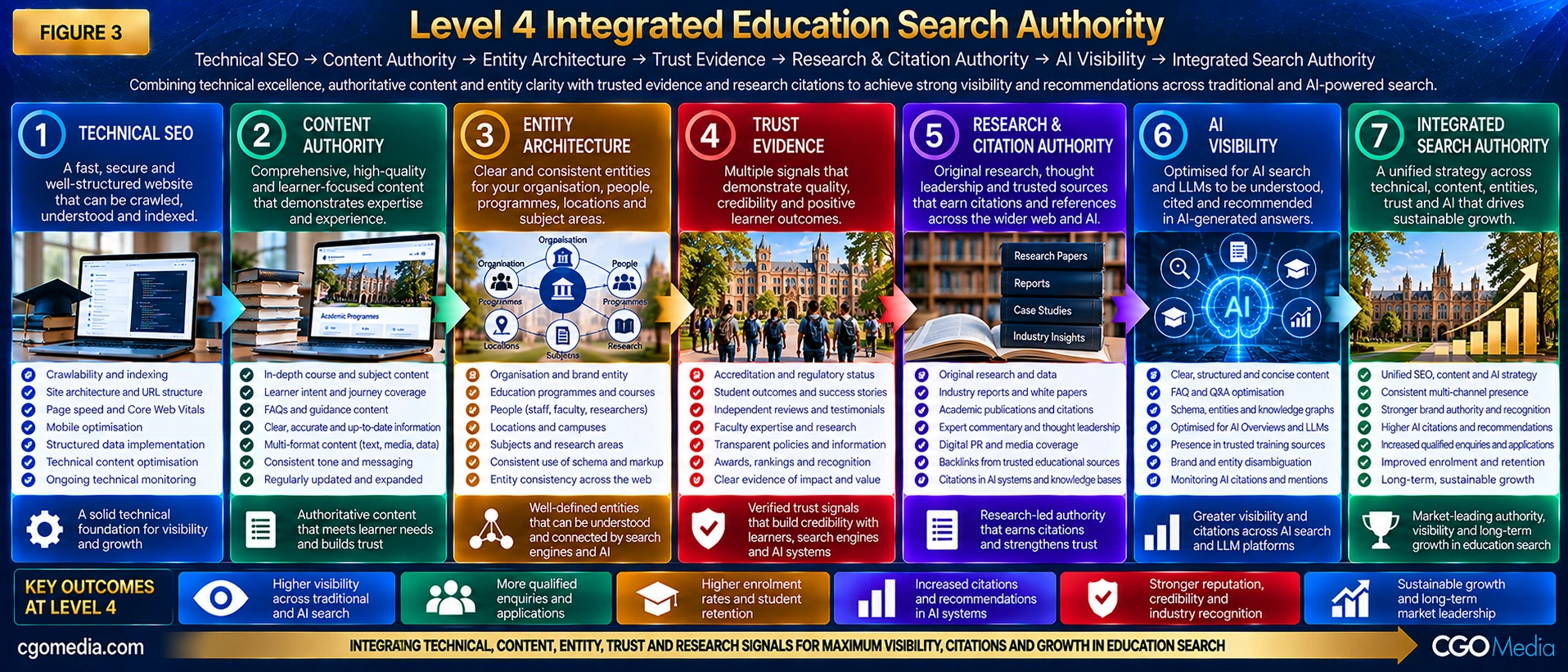
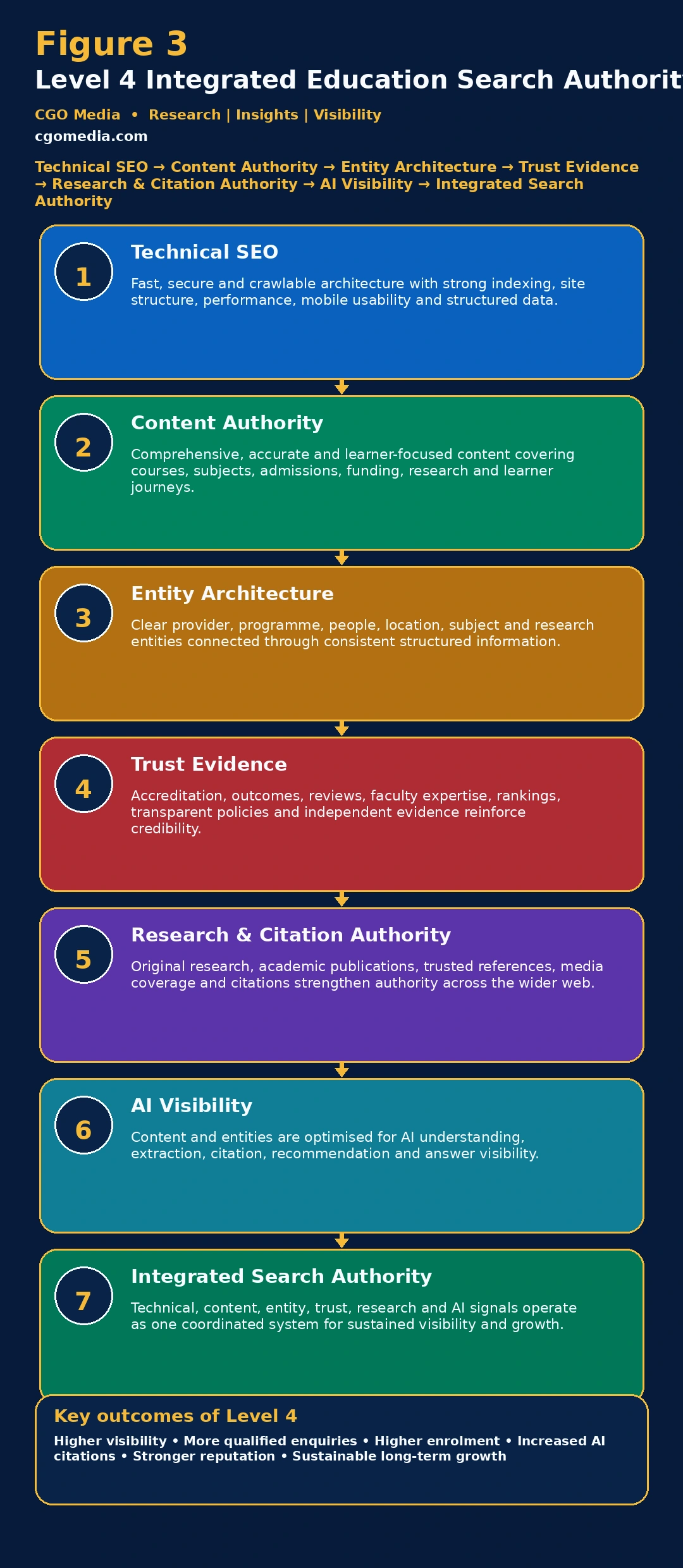
307. The Level 4 Integrated Search Authority Model
The conceptual relationship can be summarised as:
Technical SEO → Content Authority → Entity Architecture → Trust Evidence → Research & Citation Authority → AI Visibility → Integrated Search Authority
308. The Strategic Implication
Education providers reaching Level 4 should connect previously separate SEO, academic, research, PR, entity, trust and AI visibility activities into a coordinated authority system, using shared governance and measurement to strengthen qualified learner discovery while building the feedback loops required for Level 5 adaptive search authority.
309. Level 5 — Adaptive Search Authority
Level 5 represents the most mature stage of the Education Search Authority Maturity Model, where the organisation continuously observes, learns and adapts as search behaviour, learner expectations, AI systems, competitive environments and institutional priorities change.
310. Adaptive Search Authority Is Not Static Excellence
It is the capability to maintain authority under changing conditions.
311. Level 5 Builds on Level 4 Integration
The organisation already has connected systems for:
- Technical SEO
- Content authority
- Entity architecture
- Trust evidence
- Citation authority
- AI visibility
312. Level 5 Adds Continuous Learning
The organisation uses observed outcomes to improve its authority system repeatedly.
313. A Level 5 Adaptive Cycle Can Be Represented as
Observe → Diagnose → Prioritise → Experiment → Strengthen → Validate → Learn → Adapt
314. Observation Is the First Adaptive Capability
The organisation monitors meaningful changes across search and learner-discovery environments.
315. Observation Can Include
- Search demand
- Programme visibility
- Entity representation
- Citation visibility
- AI recommendation patterns
- Competitive movement
316. Observation Should Be Structured
The organisation should use consistent:
- Scenario libraries
- Measurement definitions
- Review periods
- Authority dimensions
317. Level 5 Distinguishes Signal from Noise
Not every ranking fluctuation, AI response change or competitor appearance requires action.
318. Adaptive Authority Requires Change Detection
Teams should identify changes that are:
- Persistent
- Strategically important
- Learner-relevant
- Authority-relevant
319. Change Detection Can Apply to Search Demand
Learners may begin using new terminology or asking different questions.
320. Search-Demand Change Can Reveal
- New subjects
- Changing career interests
- New qualification terminology
- New delivery expectations
- Emerging learner concerns
321. Change Detection Can Apply to AI Visibility
The organisation can identify changes in:
- Source inclusion
- Citation frequency
- Provider comparisons
- Recommendation visibility
- Generated positioning
322. Change Detection Can Apply to Competitive Sets
New providers can enter learner comparisons and recommendation environments.
323. Emerging Competitors May Not Resemble Traditional Competitors
For example, universities may increasingly compete with:
- Online providers
- Professional academies
- Microcredential platforms
- EdTech companies
324. Level 5 Competitive Intelligence Is Dynamic
Competitor sets are updated according to observed learner and AI behaviour.
325. Level 5 Diagnoses Authority Change
Observed change should lead to structured diagnosis.
326. Diagnosis Should Identify the Authority Dimension Involved
The issue may concern:
- Technical accessibility
- Topical coverage
- Entity clarity
- Trust evidence
- External authority
- AI visibility
327. Diagnosis Should Identify Root Cause
The organisation should avoid reacting only to surface symptoms.
328. Root Causes Can Be Technical
Examples include:
- Indexation problems
- Template failures
- Internal-linking problems
- Site migrations
329. Root Causes Can Be Content-Related
Examples include:
- Weak subject coverage
- Outdated programme information
- Poor learner guidance
- Content duplication
330. Root Causes Can Be Entity-Related
Examples include:
- Programme ambiguity
- Campus confusion
- Academic-profile inconsistency
- Product-category confusion
331. Root Causes Can Be Trust-Related
Examples include:
- Outdated accreditation
- Weak outcome evidence
- Unsupported claims
- Missing methodology
332. Root Causes Can Be External
Examples include:
- Competitor citation growth
- Reduced media authority
- Weak research distribution
- Outdated external listings
333. Level 5 Prioritises Change by Strategic Importance
Not every weakness deserves equal investment.
334. A Level 5 Priority Model Can Use
Authority Impact + Learner Impact + Persistence + Strategic Importance + Risk
335. Authority Impact
Measures whether the issue affects the organisation’s ability to be discovered, understood, trusted, cited or recommended.
336. Learner Impact
Measures whether the issue affects:
- Discovery
- Comparison
- Application
- Enrolment
337. Persistence
Measures whether the issue is recurring.
338. Strategic Importance
Measures whether the issue affects priority:
- Subjects
- Programmes
- Markets
- Learner groups
339. Risk
Measures the consequence of leaving the issue unresolved.
340. Level 5 Uses Experimentation
Adaptive organisations test changes rather than assuming every intervention will work.
341. Search Authority Experiments Should Begin with a Hypothesis
For example:
Connecting academic research, expert profiles and career evidence more explicitly to a priority programme should improve subject authority and qualified provider visibility.
342. Experiments Should Establish a Baseline
The organisation should record the starting position.
343. Experiments Should Define the Intervention
Examples can include:
- New subject architecture
- Improved programme templates
- Research integration
- Entity improvements
- Digital PR campaigns
344. Experiments Should Define Success Criteria
Success can include:
- Improved topical visibility
- Greater citation authority
- Improved entity accuracy
- Better AI comparison presence
- Improved qualified recommendations
345. Experiments Need an Observation Window
Search authority effects may take time to emerge.
346. Experiments Should Record Confounding Factors
Examples can include:
- Algorithm changes
- AI model changes
- Competitor activity
- Seasonality
- Admissions cycles
347. Negative Results Should Be Preserved
They prevent repeated ineffective interventions.
348. Successful Experiments Should Become Standards
Validated methods can become part of:
- Content standards
- Programme templates
- Entity standards
- Research processes
- AI monitoring playbooks
349. Level 5 Uses Feedback Loops
Search and AI observations should influence future strategy.
350. A Search Authority Feedback Loop Can Be Represented as
Visibility Observation → Authority Diagnosis → Intervention → Outcome Measurement → Institutional Learning
351. Feedback Loops Connect Search Intelligence to Content Strategy
Observed gaps can influence:
- New content
- Subject depth
- Programme information
- Learner guidance
352. Feedback Loops Connect Search Intelligence to Research Strategy
Citation gaps can reveal where original evidence may be valuable.
353. Feedback Loops Connect Search Intelligence to Digital PR
External authority gaps can shape outreach and research-distribution priorities.
354. Feedback Loops Connect AI Visibility to Entity Management
Repeated representation errors can trigger entity or architecture improvements.
355. Feedback Loops Connect Learner Outcomes to Authority Strategy
Successful learner outcomes can strengthen:
- Trust evidence
- Programme positioning
- Case studies
- Research
356. Level 5 Uses Scenario Intelligence
Learner scenario libraries become dynamic rather than static.
357. Scenario Libraries Should Evolve with Learner Behaviour
New scenarios can emerge from:
- Search queries
- Admissions enquiries
- AI prompts
- Career trends
- Market change
358. Scenario Libraries Should Include Multiple Journey Stages
These can include:
- Discovery
- Evaluation
- Comparison
- Application
- Selection
359. Scenario Intelligence Can Reveal Search Opportunity
The organisation may discover unmet learner-information needs.
360. Scenario Intelligence Can Reveal Authority Risk
Persistent absence from relevant learner scenarios may indicate an authority weakness.
361. Scenario Intelligence Can Reveal Recommendation Error
The provider may appear where it is not genuinely suitable.
362. Level 5 Evaluates Inclusion and Exclusion Quality
It distinguishes:
- Relevant inclusion
- Irrelevant inclusion
- Relevant exclusion
- Appropriate exclusion
363. Relevant Inclusion Represents Qualified Visibility
The provider appears where educational fit is genuine.
364. Irrelevant Inclusion Represents Visibility Waste
The organisation appears where learner fit is poor.
365. Relevant Exclusion Represents Opportunity
The provider should reasonably appear but does not.
366. Appropriate Exclusion Represents Accurate Matching
The provider is correctly omitted from unsuitable learner scenarios.
367. Level 5 AI Visibility Becomes Quality-Oriented
The organisation no longer judges success mainly through mention count.
368. Level 5 Qualified AI Visibility Can Be Represented as
Relevant Presence + Accurate Representation + Strong Evidence + Appropriate Recommendation
369. Level 5 Monitors Citation Quality
Citation analysis includes:
- Source quality
- Context
- Subject relevance
- Freshness
- Persistence
370. Citation Quality Can Reveal Subject Authority
Repeated references around a priority discipline can strengthen institutional subject association.
371. Level 5 Monitors Entity Drift
Entity representation can change as public information evolves.
372. Entity Drift Can Include
- Outdated institutional names
- Incorrect programme ownership
- Campus confusion
- Misclassified EdTech products
373. Entity Drift Should Trigger Review
Persistent errors can indicate conflicting information in the wider public environment.
374. Level 5 Monitors Topical Drift
The institution may become associated with subjects that are no longer strategic.
375. Topical Drift Can Also Reveal New Opportunity
Unexpected subject association may reflect:
- Emerging research strength
- New learner interest
- New programme opportunity
- Industry demand
376. Level 5 Monitors Competitive Drift
The organisations appearing alongside the provider can change.
377. Competitive Drift Can Reveal Market Convergence
Traditional institutional categories may become less distinct.
378. Education and EdTech Markets Can Converge
Learners may compare:
- Universities
- Online programmes
- Bootcamps
- Professional certifications
- EdTech platforms
379. Level 5 Should Monitor Category Convergence
This helps the organisation understand how learner choice is changing.
380. Level 5 Governance Becomes Adaptive
Governance processes evolve in response to new search and AI risks.
381. Adaptive Governance Requires Clear Ownership
Relevant authority dimensions should have accountable owners.
382. Adaptive Governance Requires Escalation
High-risk misinformation should move quickly to the appropriate team.
383. Adaptive Governance Requires Review Cadence
Information should be reviewed according to volatility and learner impact.
384. A Useful Review Principle Is
Rate of Change + Learner Impact + Authority Risk → Review Frequency
385. High-Change Education Information Requires Frequent Review
Examples include:
- Entry requirements
- Fees
- Deadlines
- Programme availability
- Delivery mode
386. Lower-Change Information May Require Less Frequent Review
Examples can include:
- Historical research
- Established institutional history
- Foundational academic theory
387. Level 5 Governance Should Include Search Authority Risk
Risks can be prioritised according to:
- Severity
- Persistence
- Learner impact
- Institutional importance
388. Level 5 Maintains an Authority Risk Register
Important risks can include:
- Programme misinformation
- Accreditation errors
- Entity confusion
- Research misrepresentation
- Recommendation errors
389. Level 5 Also Maintains an Authority Opportunity Register
Opportunities can include:
- Emerging subjects
- New research areas
- New citation opportunities
- New learner segments
- New AI discovery patterns
390. Risk and Opportunity Should Be Considered Together
Adaptive search authority protects existing trust while creating new visibility.
391. Level 5 Develops Institutional Memory
Lessons should survive changes in staff, systems and agencies.
392. Institutional Memory Can Be Preserved Through
- Authority maps
- Experiment logs
- Scenario libraries
- Issue registers
- Governance playbooks
- Research inventories
393. Institutional Memory Reduces Repeated Failure
Teams should not repeatedly solve the same information, entity or authority problem.
394. Level 5 Search Authority Becomes Scalable
Validated systems can be reused across:
- Faculties
- Programmes
- Campuses
- Markets
- Products
395. Scaling Should Preserve Quality
Standardisation should not eliminate necessary subject or market nuance.
396. Level 5 International Authority Is Adaptive
The organisation adjusts to local:
- Search behaviour
- Qualification systems
- Learner expectations
- Accreditation environments
- AI recommendation patterns
397. International Adaptation Should Preserve Core Institutional Truth
Organisation, programme and qualification relationships should remain coherent.
398. Local Adaptation Should Reflect Genuine Differences
Markets may require different:
- Entry-equivalence information
- Fee structures
- Recognition evidence
- Career outcomes
- Source ecosystems
399. Level 5 Multi-Campus Authority Is Adaptive
Campus-level monitoring can identify:
- Programme confusion
- Location errors
- Facility ambiguity
- Local authority gaps
400. Level 5 EdTech Authority Is Also Adaptive
EdTech organisations should monitor changing:
- Product categories
- User needs
- Learning models
- Feature expectations
- Competitive sets
401. EdTech Category Change Can Be Rapid
AI-assisted learning, tutoring, assessment and content-generation technologies can quickly alter category boundaries.
402. Level 5 Should Monitor Category Language
The terminology learners, institutions and AI systems use may evolve faster than internal product language.
403. Adaptive Authority Should Respond to Language Change
Content and entity architecture may need to evolve when market terminology changes materially.
404. Level 5 Search Authority Supports Strategic Intelligence
Search and AI observations can contribute to wider institutional decision-making.
405. Search Intelligence Can Reveal Learner Demand
Changing query patterns can indicate emerging interests.
406. AI Intelligence Can Reveal Provider Positioning
Generated comparisons can show how the organisation is being interpreted externally.
407. Citation Intelligence Can Reveal Knowledge Influence
External references can show where the institution is becoming a recognised authority.
408. Competitive Intelligence Can Reveal Market Change
Provider co-occurrence can identify emerging alternatives.
409. Level 5 Therefore Extends Beyond Marketing
Search authority intelligence can inform:
- Programme strategy
- Research strategy
- Market strategy
- Brand strategy
- Admissions strategy
410. Level 5 Search Authority Should Support Better Decisions
The purpose of maturity is not simply to produce more dashboards.
411. Mature Reporting Should Answer Three Questions
- What changed?
- Why does it matter?
- What should we do next?
412. Executive Reporting Should Focus on Authority Constraints
The primary constraint may be:
- Technical
- Topical
- Entity-related
- Trust-related
- External
- AI-related
413. Executive Reporting Should Also Highlight Opportunity
Growth opportunities can include:
- New subjects
- New citation areas
- New markets
- New learner scenarios
- New research opportunities
414. Level 5 Should Use Leading and Lagging Indicators
Leading indicators reveal authority development before commercial outcomes are fully visible.
415. Level 5 Leading Indicators Can Include
- Topical depth
- Entity accuracy
- Trust-evidence coverage
- Citation authority
- Qualified AI visibility
416. Level 5 Lagging Indicators Can Include
- Qualified enquiries
- Applications
- Enrolment fit
- Learner outcomes
- Institutional reputation
417. Level 5 Does Not Assume Simple Causation
Search authority is one influence within a complex learner decision journey.
418. Attribution Should Therefore Be Probabilistic and Evidence-Led
The organisation should avoid overstating direct causal effects.
419. Level 5 Search Authority Should Be Resilient
Resilience means the organisation can maintain meaningful authority despite:
- Search algorithm changes
- AI platform changes
- Market disruption
- Competitive change
- Learner behaviour change
420. Resilience Comes from Diversified Authority
The organisation should not depend entirely on:
- One ranking
- One traffic source
- One publication
- One AI platform
- One content format
421. Level 5 Authority Is Distributed Across an Ecosystem
A mature authority ecosystem includes:
- Search visibility
- Research authority
- Entity clarity
- Citation authority
- Institutional trust
- AI visibility
422. Distributed Authority Is Harder to Displace
It is reinforced across multiple independent information environments.
423. Level 5 Search Authority Is Continuous
There is no final point at which authority is permanently complete.
424. Mature Organisations Continue to Re-Evaluate
They repeatedly assess:
- What learners need
- What search systems understand
- What AI systems recommend
- What external sources reinforce
- What evidence remains current
425. Level 5 Is Therefore Adaptive Rather Than Finished
The institution’s capability lies in its ability to respond intelligently to change.
426. The Thirteenth Education Search Authority Principle
Adaptive Education Search Authority should be built around continuous observation, diagnosis, experimentation, validation and learning so institutions can respond to meaningful changes in search behaviour, AI visibility, competitive sets and learner expectations without reacting indiscriminately to short-term noise.
427. The Fourteenth Education Search Authority Principle
Level 5 organisations should maintain dynamic learner scenario, authority risk and opportunity systems so search and AI intelligence can inform programme, research, admissions, brand and market strategy as well as digital visibility.
428. The Fifteenth Education Search Authority Principle
Adaptive authority should preserve institutional memory through documented standards, experiment records, authority maps, scenario libraries and governance processes so successful approaches can scale and recurring failures are not repeatedly rediscovered.
429. The Sixteenth Education Search Authority Principle
The highest maturity state is not maximum visibility but resilient, qualified and adaptive authority: an organisational capability that keeps education information accurate, evidence-rich, externally reinforced and appropriately discoverable as search and AI environments change.
430. The Level 5 Adaptive Search Authority Model
The conceptual relationship can be summarised as:
Observe → Diagnose → Prioritise → Experiment → Strengthen → Validate → Learn → Adapt
431. The Long-Term Authority Loop
A mature education authority system can reinforce itself through:
Strong Authority → Better Discovery → Better Learner Fit → Stronger Outcomes → Better Evidence → Greater External Authority → Stronger Future Discovery
432. The Strategic Implication
Education providers reaching Level 5 should operate search authority as a permanent institutional capability, continuously integrating search intelligence, learner behaviour, research evidence, external authority and AI visibility into adaptive governance systems that protect trust, identify opportunity and strengthen qualified learner discovery over time.
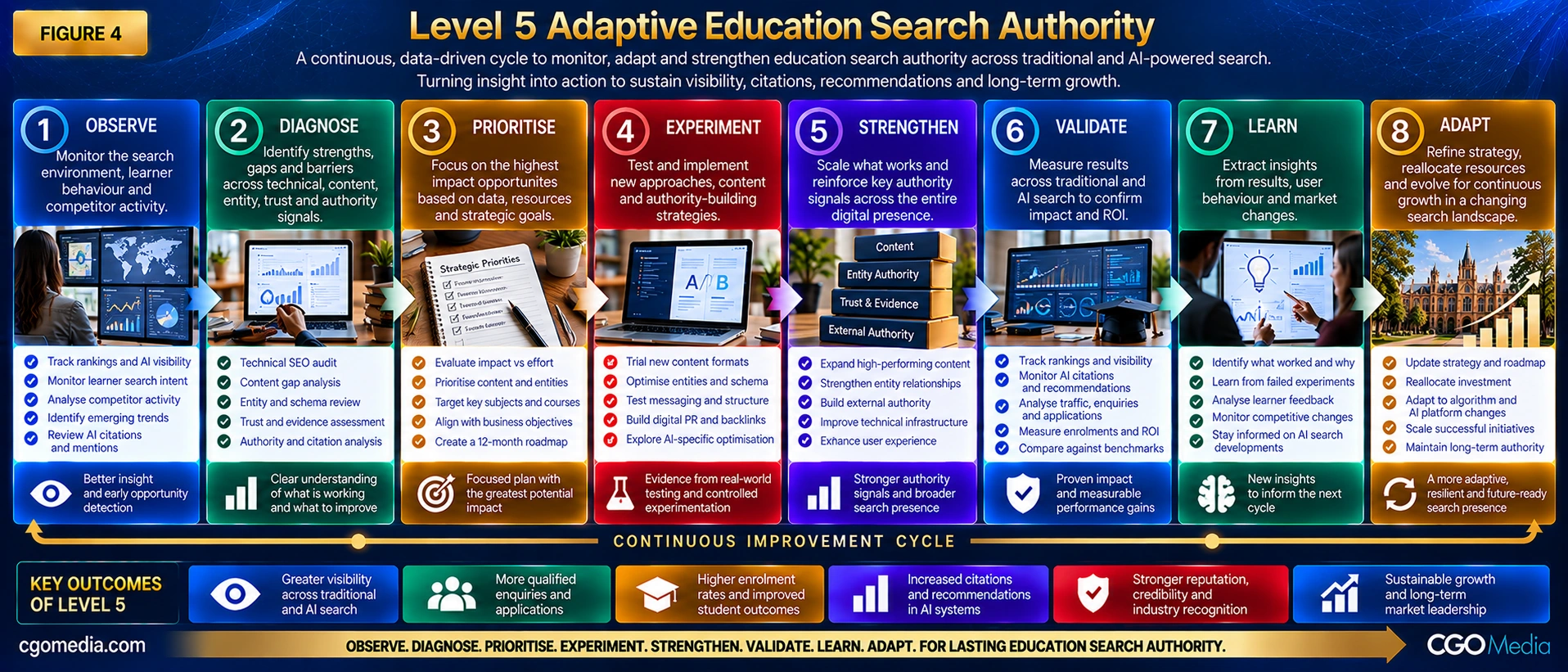
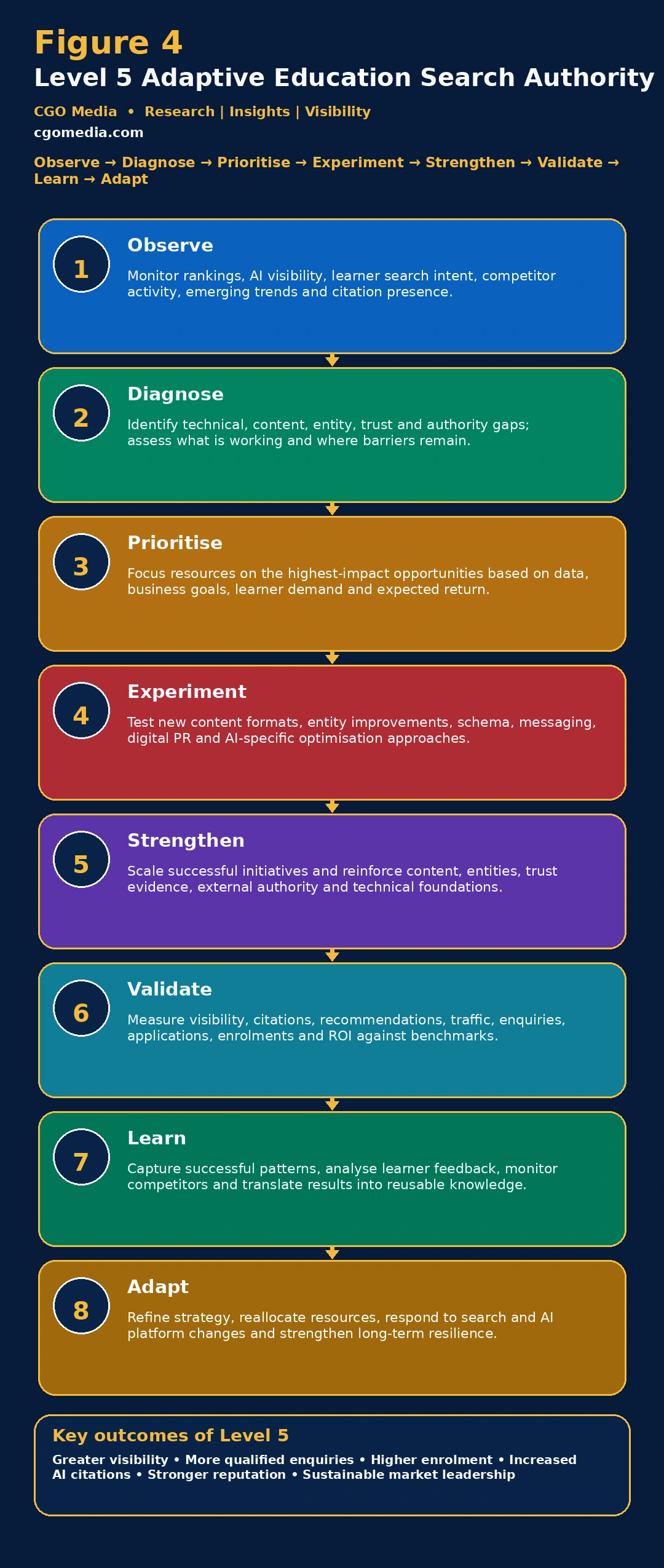
433. The Education Search Authority Maturity Model Should Be Measurable
A maturity model becomes more useful when organisations can translate qualitative observations into a structured assessment.
434. Assessment Should Support Diagnosis Rather Than Produce a Vanity Score
The purpose of scoring is to identify:
- Authority strengths
- Authority weaknesses
- Structural gaps
- Priority interventions
- Progress over time
435. The Assessment Should Use the Six Core Authority Dimensions
- Technical & Information Architecture
- Content & Topical Authority
- Entity & Knowledge Architecture
- Trust & Evidence
- External & Citation Authority
- AI Search Visibility & Governance
436. Each Dimension Can Be Evaluated Against the Five Maturity Levels
A practical scoring scale can be:
- 1 — Fragmented
- 2 — Foundation
- 3 — Structured Authority
- 4 — Integrated Search Authority
- 5 — Adaptive Search Authority
437. Scores Should Be Evidence-Based
Organisations should avoid assigning maturity levels based only on internal perception.
438. Evidence Can Include
- Technical audit findings
- Content inventories
- Entity maps
- Accreditation records
- Citation analysis
- AI visibility observations
439. The Assessment Should Record Evidence Alongside the Score
A useful format is:
Dimension → Score → Evidence → Constraint → Recommended Action
440. Technical & Information Architecture Assessment
This dimension evaluates whether the organisation has a stable, scalable and understandable technical foundation.
441. Technical Assessment Areas Can Include
- Crawlability
- Indexation
- Canonicalisation
- Site architecture
- Internal linking
- International structure
442. A Level 1 Technical Score Can Indicate
- Persistent indexation problems
- Disconnected systems
- Weak architecture
- Inconsistent templates
443. A Level 2 Technical Score Can Indicate
- Core SEO controls in place
- Basic templates standardised
- Improved internal linking
- Reduced technical conflict
444. A Level 3 Technical Score Can Indicate
- Subject architecture
- Programme architecture
- Entity-aware internal linking
- Structured support for authority building
445. A Level 4 Technical Score Can Indicate
- Integrated information architecture
- Connected research and programme systems
- Strong entity relationships
- Scalable authority infrastructure
446. A Level 5 Technical Score Can Indicate
- Continuous monitoring
- Automated issue detection
- Adaptive templates
- Search intelligence feeding architecture decisions
447. Content & Topical Authority Assessment
This dimension evaluates how comprehensively the organisation demonstrates subject expertise.
448. Content Assessment Areas Can Include
- Programme depth
- Subject coverage
- Career guidance
- Academic expertise
- Research integration
- Learner-question coverage
449. A Level 1 Content Score Can Indicate
- Thin programme descriptions
- Unstructured blog activity
- Heavy promotional language
- Limited learner guidance
450. A Level 2 Content Score Can Indicate
- Standardised programme content
- Basic subject support content
- Admissions FAQs
- Defined editorial standards
451. A Level 3 Content Score Can Indicate
- Subject hubs
- Content clusters
- Academic participation
- Structured learner-decision content
452. A Level 4 Content Score Can Indicate
- Integrated research and programme content
- Content connected to authority objectives
- Evidence-led Digital PR
- Cross-functional editorial planning
453. A Level 5 Content Score Can Indicate
- Content strategy informed by live search intelligence
- Continuous gap detection
- Experimentation
- Adaptive topic prioritisation
454. Entity & Knowledge Architecture Assessment
This dimension evaluates whether the education organisation’s entities and relationships are consistently represented.
455. Entity Assessment Areas Can Include
- Institution identity
- Faculty relationships
- Programme ownership
- Qualification relationships
- Academic profiles
- Research relationships
456. A Level 1 Entity Score Can Indicate
- Unclear relationships
- Inconsistent naming
- Weak academic profiles
- Programme ambiguity
457. A Level 2 Entity Score Can Indicate
- Core entities identified
- Naming standards introduced
- Basic structured data
- Improved programme ownership clarity
458. A Level 3 Entity Score Can Indicate
- Formal entity maps
- Connected academic profiles
- Programme-research relationships
- Deliberate entity architecture
459. A Level 4 Entity Score Can Indicate
- Entity relationships integrated across systems
- Consistent knowledge architecture
- Research, programme and expert relationships aligned
- Shared entity governance
460. A Level 5 Entity Score Can Indicate
- Continuous entity monitoring
- Entity-drift detection
- Adaptive relationship management
- Entity intelligence supporting strategy
461. Trust & Evidence Assessment
This dimension evaluates whether important education claims are supported by appropriate evidence.
462. Trust Assessment Areas Can Include
- Accreditation
- Recognition
- Graduate outcomes
- Completion data
- Research evidence
- Institutional transparency
463. A Level 1 Trust Score Can Indicate
- Vague claims
- Outdated accreditation
- Weak outcome evidence
- Scattered trust information
464. A Level 2 Trust Score Can Indicate
- Core evidence documented
- Accreditation pages maintained
- Outcome information improved
- Basic evidence ownership
465. A Level 3 Trust Score Can Indicate
- Evidence mapped to claims
- Methodological context
- Trust integrated with programme pages
- External validation increasing
466. A Level 4 Trust Score Can Indicate
- Formal evidence governance
- Trust evidence integrated across channels
- Outcome methodology standardised
- Accreditation and recognition centrally managed
467. A Level 5 Trust Score Can Indicate
- Continuous evidence review
- Risk-based freshness management
- Rapid misinformation correction
- Evidence gaps informing research priorities
468. External & Citation Authority Assessment
This dimension evaluates whether external organisations reinforce the provider’s expertise, legitimacy and knowledge contribution.
469. External Authority Assessment Areas Can Include
- Academic citations
- Government references
- Professional-body references
- Education media
- Research visibility
- Digital PR
470. A Level 1 External Authority Score Can Indicate
- Uncoordinated backlinks
- Directory dependence
- Limited research visibility
- Few strategic citations
471. A Level 2 External Authority Score Can Indicate
- Basic PR activity
- Professional references
- Research distribution beginning
- External authority tracked inconsistently
472. A Level 3 External Authority Score Can Indicate
- Research-led PR
- Subject-specific external references
- Citation monitoring
- Deliberate authority building
473. A Level 4 External Authority Score Can Indicate
- Citation strategy integrated with research
- Competitive citation analysis
- External authority mapped by subject
- Digital PR aligned with search authority
474. A Level 5 External Authority Score Can Indicate
- Continuous citation intelligence
- Adaptive research planning
- Authority-gap detection
- External influence informing institutional strategy
475. AI Search Visibility & Governance Assessment
This dimension evaluates how systematically the organisation manages visibility within generative and AI-assisted discovery environments.
476. AI Search Assessment Areas Can Include
- Source visibility
- Citation visibility
- Entity accuracy
- Comparison visibility
- Recommendation visibility
- Governance
477. A Level 1 AI Search Score Can Indicate
- No structured monitoring
- Occasional anecdotal testing
- No scenario library
- No ownership
478. A Level 2 AI Search Score Can Indicate
- Manual monitoring
- Basic scenario testing
- Initial competitor tracking
- Initial error logging
479. A Level 3 AI Search Score Can Indicate
- Structured scenario libraries
- Accuracy measurement
- Provider co-occurrence monitoring
- Defined visibility ownership
480. A Level 4 AI Search Score Can Indicate
- AI visibility integrated with SEO and research data
- Qualified inclusion measurement
- Formal governance
- Recommendation-quality analysis
481. A Level 5 AI Search Score Can Indicate
- Continuous monitoring
- Adaptive scenario design
- Change detection
- Experimentation
- Institutional learning
482. The Six Dimension Scores Create an Education Search Authority Profile
The profile is more informative than one composite number.
483. A Search Authority Profile Can Reveal Imbalance
For example:
- Technical: 4
- Content: 4
- Entity: 2
- Trust: 3
- External Authority: 2
- AI Governance: 1
484. This Example Would Not Represent Level 4 Overall Maturity
Strong technical and content capabilities are constrained by weak entity, external-authority and AI-governance maturity.
485. Overall Maturity Should Therefore Reflect the Authority System
It should not simply use the highest score.
486. An Average Score Can Be Useful but Should Be Interpreted Carefully
A simple arithmetic mean can conceal critical weaknesses.
487. A Provider with Scores of 5, 5, 5, 5, 5 and 1 Has a Serious Constraint
The average may look strong while AI-search governance remains immature.
488. Minimum-Dimension Analysis Can Add Context
The organisation should identify its lowest maturity dimensions.
489. Critical-Dimension Analysis Can Add Further Context
Some dimensions may be especially important to current strategy.
490. A Mature Assessment Can Therefore Use Three Views
- Average Maturity
- Lowest Dimension
- Strategic Constraint
491. Average Maturity Provides a Broad View
It indicates the organisation’s general development.
492. Lowest Dimension Reveals Structural Weakness
It highlights where authority maturity is most underdeveloped.
493. Strategic Constraint Identifies the Most Important Limiting Factor
The lowest score is not always the most strategically significant issue.
494. Weighting Can Be Used Where Necessary
Different education organisations may assign greater importance to different dimensions.
495. A Research-Intensive University May Weight Citation Authority More Heavily
Research visibility can be central to institutional strategy.
496. A Large Online Education Provider May Weight Technical and AI Visibility More Heavily
Digital discovery may be central to enrolment.
497. A Professional Training Provider May Weight Trust and Recognition More Heavily
Accreditation and career relevance can dominate learner decision-making.
498. Weighting Should Be Transparent
Organisations should document:
- Why a dimension is weighted
- How much weight it receives
- How the weighting affects interpretation
499. Weighting Should Not Be Used to Hide Weakness
A strategically inconvenient low score should not simply be given less importance.
500. Evidence Confidence Can Also Be Recorded
Not every score is supported by equally strong evidence.
501. Evidence Confidence Can Be Classified as
- High
- Medium
- Low
502. High Evidence Confidence
The score is supported by strong, current and repeatable evidence.
503. Medium Evidence Confidence
The score is supported by partial or incomplete evidence.
504. Low Evidence Confidence
The score relies heavily on assumption, anecdote or incomplete observation.
505. Low Confidence Should Trigger Measurement Improvement
The organisation may need better data before investing heavily in intervention.
506. Search Authority Assessment Should Include Gap Analysis
The difference between current and desired maturity can be examined for each dimension.
507. A Simple Authority Gap Can Be Represented as
Target Maturity Level − Current Maturity Level = Authority Gap
508. Not Every Dimension Needs to Reach Level 5 Immediately
Target maturity should reflect strategic need and organisational capacity.
509. A Level 3 Target May Be Appropriate for Some Functions
Especially where further investment would create limited learner or institutional value.
510. Priority Should Depend on Gap and Strategic Impact
A useful relationship is:
Authority Gap + Strategic Importance + Learner Impact + Risk = Priority
511. Authority Gap Measures Development Need
It shows how far the organisation is from its target state.
512. Strategic Importance Measures Organisational Value
It reflects the importance of the dimension to current priorities.
513. Learner Impact Measures Decision Consequence
It reflects whether the issue affects:
- Discovery
- Comparison
- Application
- Enrolment
514. Risk Measures Potential Harm
It reflects the consequence of leaving the gap unresolved.
515. Priority Analysis Can Prevent Random SEO Activity
The organisation can focus resources on the authority constraints that matter most.
516. Search Authority Improvement Should Be Sequenced
Dependencies matter.
517. Technical Problems May Need to Be Resolved Before Content Scale
Publishing more content on unstable infrastructure can compound complexity.
518. Programme Information Problems May Need Resolution Before AI Recommendation Optimisation
AI monitoring cannot compensate for inaccurate source information.
519. Entity Problems May Need Resolution Before Knowledge Architecture Expansion
Advanced relationships depend on stable identity.
520. Trust-Evidence Problems May Need Resolution Before Large PR Campaigns
External visibility can amplify weak or unsupported claims.
521. Improvement Roadmaps Should Therefore Respect Dependencies
A typical sequence can be:
Technical Stability → Information Clarity → Entity Structure → Trust Evidence → External Authority → AI Governance
522. This Sequence Is Not Completely Linear
Some workstreams can progress in parallel.
523. Parallel Work Is Appropriate Where Dependencies Are Limited
For example:
- Technical fixes can run alongside research planning
- Entity mapping can run alongside content auditing
- AI baselining can run alongside trust-evidence review
524. The Scorecard Should Include Current State
Each authority dimension should record its current maturity level.
525. The Scorecard Should Include Target State
The organisation should define a realistic desired level.
526. The Scorecard Should Include Evidence
Teams should record why the current score was assigned.
527. The Scorecard Should Include the Primary Constraint
The biggest issue within each dimension should be explicit.
528. The Scorecard Should Include the Next Action
Every important gap should connect to a concrete intervention.
529. The Scorecard Should Include Ownership
The team or function responsible for the improvement should be identified.
530. The Scorecard Should Include Review Date
Maturity assessment should not become a static annual exercise.
531. A Practical Education Search Authority Scorecard Can Include
- Dimension
- Current Level
- Target Level
- Evidence
- Primary Constraint
- Priority Action
- Owner
- Review Date
532. Search Authority Maturity Should Be Reassessed Periodically
Review frequency can depend on:
- Rate of change
- Institutional priority
- Risk
- Recent interventions
533. High-Change Dimensions May Require More Frequent Review
AI visibility and learner search behaviour can evolve relatively quickly.
534. Slow-Change Dimensions May Require Less Frequent Review
Some institutional entity relationships or long-established authority structures may change less often.
535. Maturity Movement Should Be Evidence-Based
An organisation should not move from Level 3 to Level 4 simply because a project has been completed.
536. Level Advancement Requires Demonstrated Capability
Evidence should show that the new process is:
- Repeatable
- Governed
- Measured
- Sustainable
537. Temporary Performance Improvement Is Not the Same as Maturity
A short-term ranking increase does not prove stronger organisational capability.
538. Maturity Represents the Ability to Reproduce Performance
A mature system can repeatedly build, protect and improve authority.
539. Level Advancement Should Consider Organisational Dependency
If a capability disappears when one employee or agency leaves, maturity may be lower than assumed.
540. Institutionalised Capability Is More Mature
It is documented, owned and transferable.
541. Executive Interpretation Should Focus on Direction
Leadership should understand whether authority is:
- Strengthening
- Stable
- Constrained
- Deteriorating
542. Executive Reporting Should Highlight the Largest Gaps
Leadership does not need every technical detail.
543. Executive Reporting Should Highlight Strategic Risk
Examples can include:
- Critical programme misinformation
- Weak accreditation visibility
- Loss of subject authority
- Declining citation authority
- Poor AI recommendation fit
544. Executive Reporting Should Highlight Strategic Opportunity
Examples can include:
- Emerging subject demand
- New research authority
- New citation opportunities
- New learner segments
- New AI recommendation visibility
545. Search Authority Maturity Can Support Budget Prioritisation
Investment can be directed toward the authority dimensions with the strongest combination of:
- Strategic importance
- Maturity gap
- Learner impact
- Risk
546. Maturity Assessment Can Support Agency and Supplier Management
External partners can be evaluated against defined authority objectives rather than isolated deliverables.
547. Maturity Assessment Can Support Internal Team Alignment
Different teams can share one model of what improved search authority means.
548. Maturity Assessment Can Support Institutional Strategy
Search intelligence can contribute to decisions about:
- Programmes
- Markets
- Research
- Brand
- Learner recruitment
549. The Seventeenth Education Search Authority Principle
Education Search Authority maturity should be assessed through evidence-backed dimension scores rather than subjective organisational confidence, with technical, content, entity, trust, external authority and AI governance evaluated independently before an overall maturity judgement is made.
550. The Eighteenth Education Search Authority Principle
Overall maturity should not conceal structural weakness, so organisations should interpret average maturity alongside the lowest-performing dimension, evidence confidence and the authority constraint with the greatest strategic and learner impact.
551. The Nineteenth Education Search Authority Principle
Authority gaps should be prioritised according to strategic importance, learner impact, risk and dependency rather than simply by numerical distance from Level 5, ensuring improvement roadmaps remain commercially and institutionally relevant.
552. The Twentieth Education Search Authority Principle
Maturity advancement should require demonstrated, repeatable and governed organisational capability rather than temporary ranking, traffic, citation or AI-visibility improvements, because sustainable authority depends on systems that survive individual campaigns, employees and technologies.
553. The Education Search Authority Assessment Scorecard
A practical assessment can be summarised as:
Assess Six Dimensions → Score Current Maturity → Record Evidence → Identify Authority Gaps → Prioritise Constraints → Assign Ownership → Reassess
554. The Strategic Implication
Education providers should use the Education Search Authority Maturity Model as an evidence-based diagnostic and planning system, creating dimension-level scorecards that reveal the specific technical, content, entity, trust, citation and AI-governance constraints limiting qualified learner discovery and then sequencing improvement according to institutional importance, learner impact, risk and dependency.
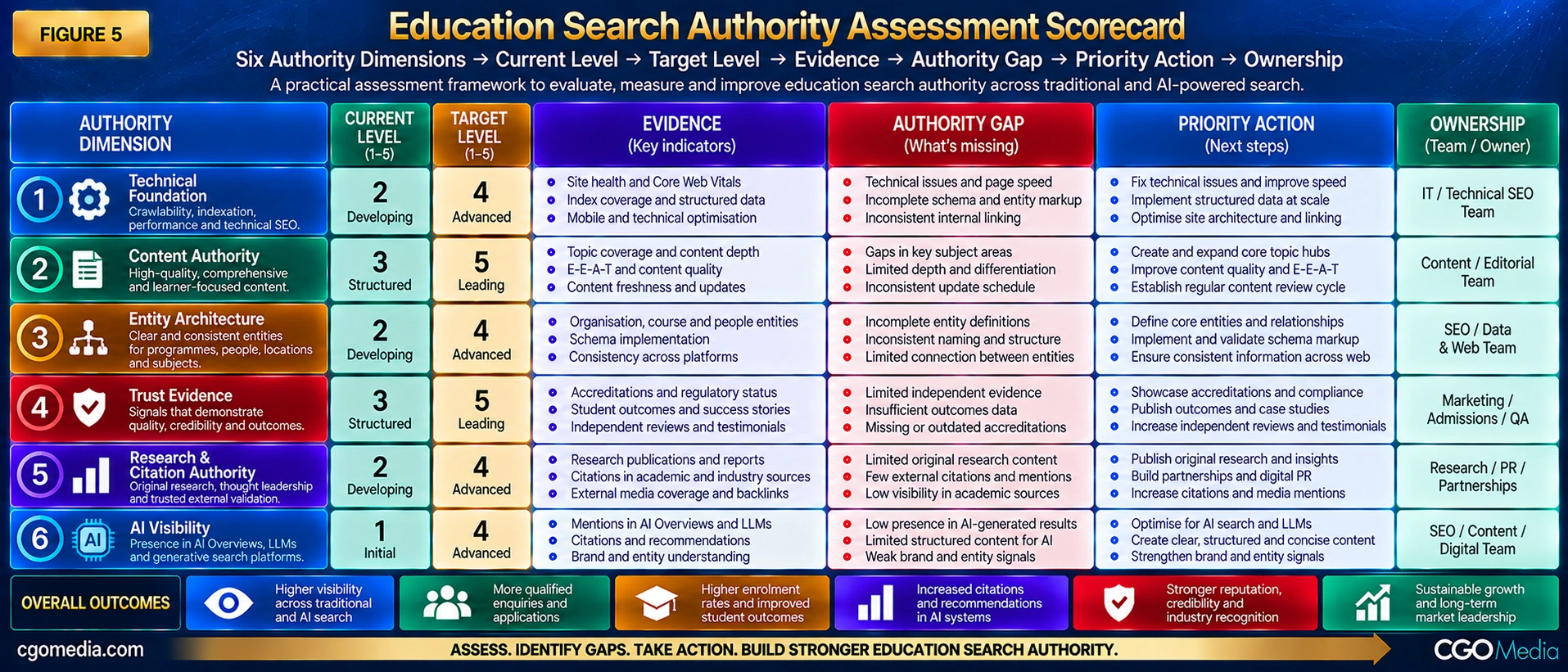
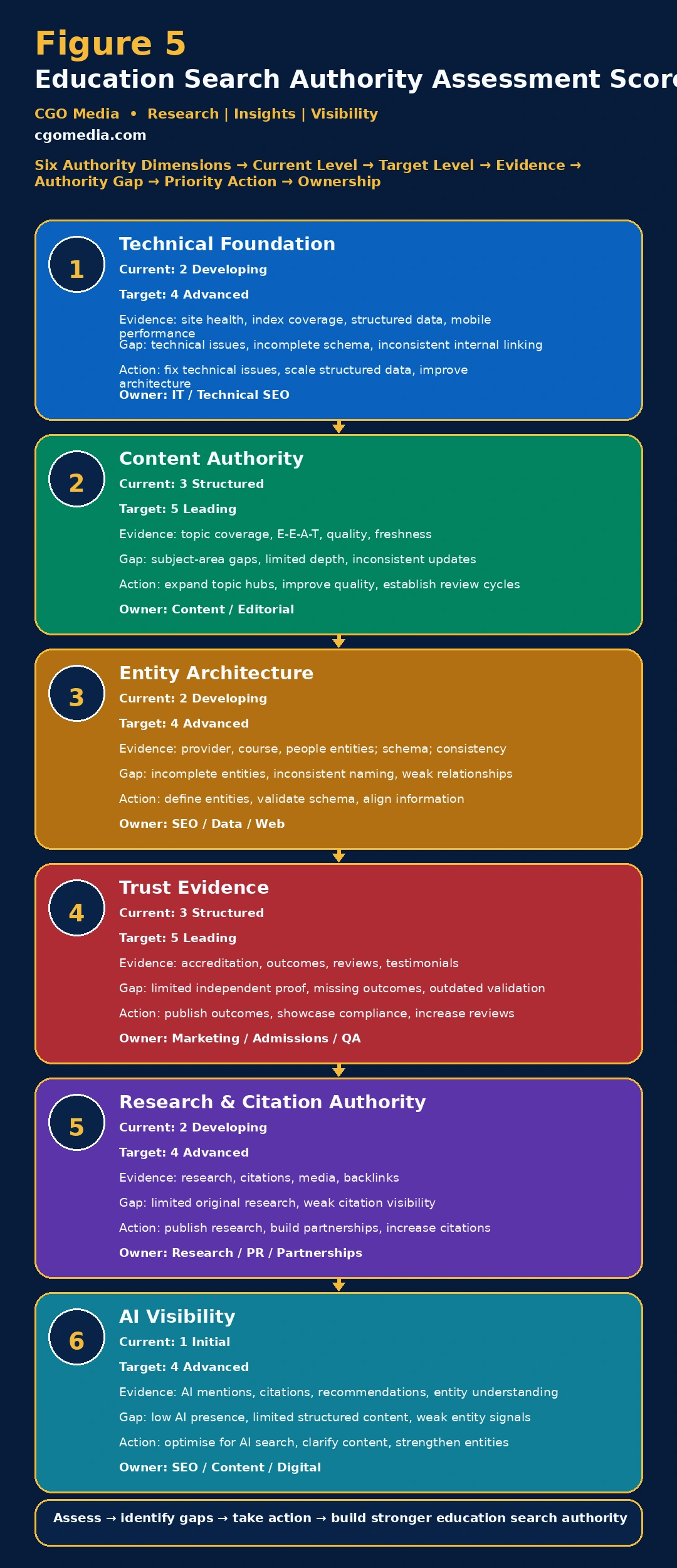
555. Maturity Assessment Should Lead to Continuous Improvement
A search authority maturity assessment has limited value if it ends with a static scorecard.
556. The Assessment Should Trigger an Improvement Cycle
A useful operating model is:
Assess → Diagnose → Prioritise → Implement → Validate → Learn → Reassess
557. Assess
Measure current maturity across the six authority dimensions.
558. Diagnose
Identify the structural reasons behind weak performance.
559. Prioritise
Focus on the gaps with the greatest strategic, learner and risk impact.
560. Implement
Carry out the required technical, content, entity, evidence, authority or governance improvements.
561. Validate
Determine whether the intervention improved the underlying authority capability.
562. Learn
Record what worked, what failed and why.
563. Reassess
Update the maturity profile using current evidence.
564. Continuous Reassessment Creates a More Realistic Maturity Model
Education search authority can strengthen or weaken over time.
565. Maturity Can Decline
An organisation can move backwards when:
- Technical debt increases
- Programme information becomes outdated
- Key staff leave
- Governance weakens
- External authority deteriorates
566. Maturity Should Therefore Not Be Treated as Permanent
Level 4 capability today does not guarantee Level 4 capability in the future.
567. Maturity Requires Maintenance
Higher levels require continuous:
- Monitoring
- Governance
- Evidence review
- Authority development
- Organisational learning
568. Search Authority Improvement Should Be Managed as a Portfolio
Large education organisations may have many simultaneous authority initiatives.
569. An Authority Improvement Portfolio Can Include
- Technical remediation
- Programme-content improvement
- Entity architecture
- Research programmes
- Digital PR
- AI visibility governance
570. Portfolio Management Helps Prevent Fragmentation
Different projects should contribute to the same authority objectives.
571. Authority Initiatives Should Have Clear Objectives
Each initiative should explain whether it primarily supports:
- Discoverability
- Understanding
- Trust
- Citation
- Comparison visibility
- Recommendation visibility
572. Authority Initiatives Should Have Success Criteria
Success should be defined before implementation.
573. Success Criteria Can Include
- Improved indexation
- Improved topical coverage
- Improved entity accuracy
- Greater citation authority
- Improved AI visibility
- Reduced misinformation
574. Search Authority Improvement Should Respect Dependencies
Some improvements rely on others being completed first.
575. A Dependency Model Can Be Represented as
Technical Stability → Information Clarity → Entity Structure → Trust Evidence → External Authority → AI Governance
576. Technical Stability Supports Everything Above It
Broken technical foundations can weaken later authority work.
577. Information Clarity Supports Entity Understanding
Unclear programmes and qualifications make entity relationships harder to interpret.
578. Entity Structure Supports Trust Interpretation
Evidence is more useful when it is clearly connected to the correct institution, programme, academic or product.
579. Trust Evidence Supports External Authority
Journalists, professional bodies and other external sources are more likely to reference credible, evidence-backed information.
580. External Authority Supports AI Visibility
Independent references can strengthen the wider information environment around the education provider.
581. Dependencies Should Influence Sequencing
The organisation should avoid investing heavily in advanced authority tactics while foundational constraints remain unresolved.
582. Search Authority Improvement Should Also Allow Parallel Work
Not every workstream needs to wait for another to finish.
583. Parallel Improvement Can Include
- Technical remediation alongside research planning
- Entity mapping alongside content auditing
- AI monitoring alongside evidence review
- Digital PR planning alongside citation analysis
584. The Best Sequence Depends on Constraint and Opportunity
Maturity improvement should remain context-specific.
585. Benchmarking Can Strengthen Maturity Assessment
An internal maturity score is more useful when supported by external context.
586. Benchmarking Can Compare
- Institutions
- Programmes
- Subjects
- Markets
- Provider categories
587. Benchmarking Should Compare Like with Like
A specialist training provider should not automatically be benchmarked against a large research university.
588. Appropriate Benchmarking Can Consider
- Institution type
- Scale
- Subject area
- Geography
- Delivery model
589. Technical Benchmarking Can Reveal Infrastructure Gaps
The organisation can compare:
- Architecture
- Indexation
- Site speed
- Structured data
- Internal linking
590. Content Benchmarking Can Reveal Topical Gaps
Competitors may provide stronger:
- Subject coverage
- Learner guidance
- Career information
- Research integration
591. Entity Benchmarking Can Reveal Knowledge Gaps
Other providers may have clearer relationships between:
- Programmes
- Academics
- Research
- Qualifications
- Campuses
592. Trust Benchmarking Can Reveal Evidence Gaps
Competitors may provide stronger:
- Outcome evidence
- Accreditation clarity
- Recognition evidence
- Methodology
593. External Authority Benchmarking Can Reveal Citation Gaps
The organisation can compare:
- Academic citations
- Media references
- Professional references
- Research visibility
594. AI Search Benchmarking Can Reveal Visibility Gaps
Relevant comparisons can include:
- Source visibility
- Citation visibility
- Provider co-occurrence
- Recommendation share
- Representation accuracy
595. Benchmarking Should Not Become Blind Competitor Imitation
The purpose is to identify relative strengths and weaknesses.
596. Authority Development Should Remain Institution-Specific
Search strategy should reflect genuine:
- Academic strengths
- Programme portfolio
- Research expertise
- Market position
- Learner needs
597. Maturity Improvement Should Include Recovery Capability
Higher maturity includes the ability to recover from authority failures.
598. Authority Failures Can Include
- Technical incidents
- Programme misinformation
- Accreditation errors
- Entity confusion
- AI recommendation errors
599. A Search Authority Recovery Cycle Can Be Represented as
Detect → Verify → Diagnose → Correct → Validate → Learn
600. Detect
Identify the authority problem quickly.
601. Verify
Confirm whether the issue is genuine and persistent.
602. Diagnose
Identify the underlying cause.
603. Correct
Improve the source, architecture, evidence or governance system.
604. Validate
Determine whether the issue has been resolved.
605. Learn
Use the incident to improve future authority processes.
606. Recovery Capability Is a Maturity Indicator
The ability to detect and correct problems efficiently distinguishes more mature organisations.
607. Recovery Speed Can Be Measured
Useful measures can include:
- Time to detect
- Time to verify
- Time to correct
- Time to validate
608. Search Authority Governance Should Include Incident Escalation
High-risk misinformation should move quickly to the appropriate team.
609. Escalation Can Depend on
- Learner impact
- Regulatory or accreditation risk
- Institutional reputation
- Persistence
- Strategic importance
610. Governance Should Also Include Opportunity Escalation
Not every important finding is a problem.
611. Opportunity Escalation Can Include
- Emerging subject demand
- New research visibility
- New citation opportunities
- New learner segments
- New recommendation patterns
612. Search Authority Improvement Should Connect to Organisational Learning
Repeated assessment should strengthen institutional knowledge.
613. Organisational Learning Can Be Preserved Through
- Assessment records
- Experiment logs
- Issue registers
- Authority maps
- Governance playbooks
- Case studies
614. Assessment Records Preserve Historical Maturity Evidence
They show how authority capability changed over time.
615. Experiment Logs Preserve What Was Tested
They reduce repeated failed interventions.
616. Issue Registers Preserve Recurring Risk Knowledge
They help teams recognise familiar problems earlier.
617. Authority Maps Preserve Organisational Understanding
They document relationships between:
- Subjects
- Programmes
- Entities
- Evidence
- External sources
618. Governance Playbooks Preserve Operating Standards
They reduce dependence on individual employees or agencies.
619. Case Studies Preserve Successful Authority Patterns
Validated approaches can be reused across other programmes and markets.
620. Maturity Improvement Should Become Scalable
Higher-maturity organisations should be able to apply proven systems repeatedly.
621. Scalable Authority Systems Can Be Applied Across
- Faculties
- Schools
- Programmes
- Campuses
- International markets
- EdTech products
622. Scale Requires Standardisation
Relevant standards can include:
- Programme templates
- Entity conventions
- Evidence standards
- Research templates
- AI monitoring methods
623. Scale Also Requires Local Flexibility
Not every subject, market or learner segment should use identical tactics.
624. Standardisation Should Protect Core Authority Principles
These can include:
- Accuracy
- Evidence
- Entity clarity
- Learner relevance
- External validation
625. Local Adaptation Should Reflect Genuine Differences
Examples can include:
- Qualification systems
- Language
- Accreditation
- Career markets
- Learner behaviour
626. Education Search Authority Should Be Reviewed at Multiple Levels
A mature organisation can assess:
- Organisation-wide maturity
- Faculty maturity
- Programme maturity
- Market maturity
- Product maturity
627. Organisation-Wide Assessment Provides Strategic Context
It identifies overall authority capability.
628. Faculty-Level Assessment Can Reveal Internal Variation
Some schools or faculties may be substantially more mature than others.
629. Programme-Level Assessment Can Reveal Commercial Constraints
High-priority programmes may need targeted intervention.
630. Market-Level Assessment Can Reveal International Gaps
Authority can vary significantly between countries and languages.
631. Product-Level Assessment Can Be Useful for EdTech
Different platforms or products may have different authority maturity.
632. Multi-Level Assessment Helps Prevent Over-Generalisation
A strong institutional domain does not guarantee that every programme has strong authority.
633. Authority Maturity Can Be Visualised
Useful formats can include:
- Radar charts
- Heatmaps
- Maturity matrices
- Trend lines
- Executive scorecards
634. Visualisation Should Support Interpretation
It should make weaknesses and imbalances easier to identify.
635. Heatmaps Can Reveal Uneven Maturity
They can compare:
- Dimensions
- Faculties
- Markets
- Programmes
636. Trend Lines Can Reveal Direction of Travel
They can show whether a dimension is:
- Improving
- Stable
- Deteriorating
637. Executive Scorecards Can Highlight Constraints
They can summarise:
- Current maturity
- Target maturity
- Largest gaps
- Strategic risks
- Priority actions
638. The Maturity Model Should Support Conversation
Its purpose is partly to create a shared language across teams.
639. SEO Teams Can Use the Model to Explain Technical and Search Constraints
This can help connect specialist work to institutional priorities.
640. Academic Teams Can Use the Model to Understand the Role of Expertise
Research and academic output become part of the wider search authority system.
641. Admissions Teams Can Use the Model to Understand Learner-Information Quality
Programme and eligibility clarity can influence search and AI visibility.
642. Research Teams Can Use the Model to Understand Citation Authority
Original research can contribute to institutional discoverability and external authority.
643. PR Teams Can Use the Model to Understand Authority Contribution
External references can be assessed by subject relevance and citation value rather than link volume alone.
644. Leadership Can Use the Model to Prioritise Investment
The framework can connect digital visibility with:
- Institutional reputation
- Learner recruitment
- Research visibility
- Strategic growth
645. The Twenty-First Education Search Authority Principle
Education Search Authority maturity should operate as a continuous improvement cycle in which assessment leads to diagnosis, prioritisation, implementation, validation, organisational learning and reassessment rather than ending with a static score.
646. The Twenty-Second Education Search Authority Principle
Authority development should respect structural dependencies, strengthening technical stability, information clarity, entity architecture, trust evidence and external authority in an appropriate sequence while allowing parallel work where dependencies are limited.
647. The Twenty-Third Education Search Authority Principle
Higher maturity should include recovery capability, benchmarking and institutional memory so organisations can detect authority failure, learn from interventions, compare performance appropriately and preserve knowledge across teams, agencies and leadership changes.
648. The Twenty-Fourth Education Search Authority Principle
The strongest Education Search Authority systems should be scalable without becoming generic, using shared standards to protect accuracy, evidence, entity clarity and learner relevance while allowing programme, market and subject-specific adaptation where genuine differences exist.
649. The Continuous Education Search Authority Improvement Cycle
The operating model can be summarised as:
Assess → Diagnose → Prioritise → Implement → Validate → Learn → Reassess
650. The Complete Education Search Authority Maturity Progression
The full progression can be summarised as:
Fragmented → Foundation → Structured Authority → Integrated Search Authority → Adaptive Search Authority → Continuous Improvement
651. The Strategic Implication
Education providers should use the Education Search Authority Maturity Model as a permanent governance and improvement framework, repeatedly reassessing maturity, benchmarking performance, addressing structural dependencies, recovering from authority failures and converting successful interventions into scalable institutional standards that strengthen qualified learner discovery, research visibility, citation authority and AI representation over time.
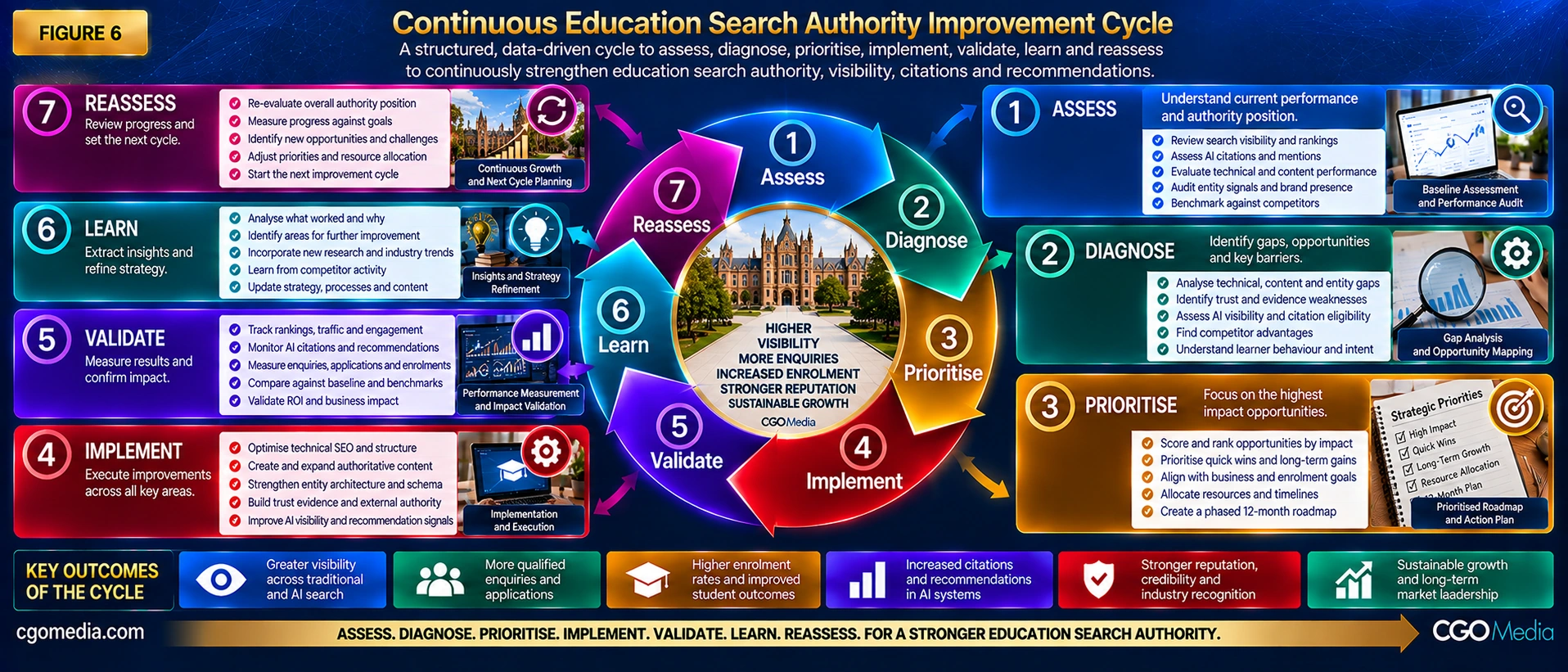
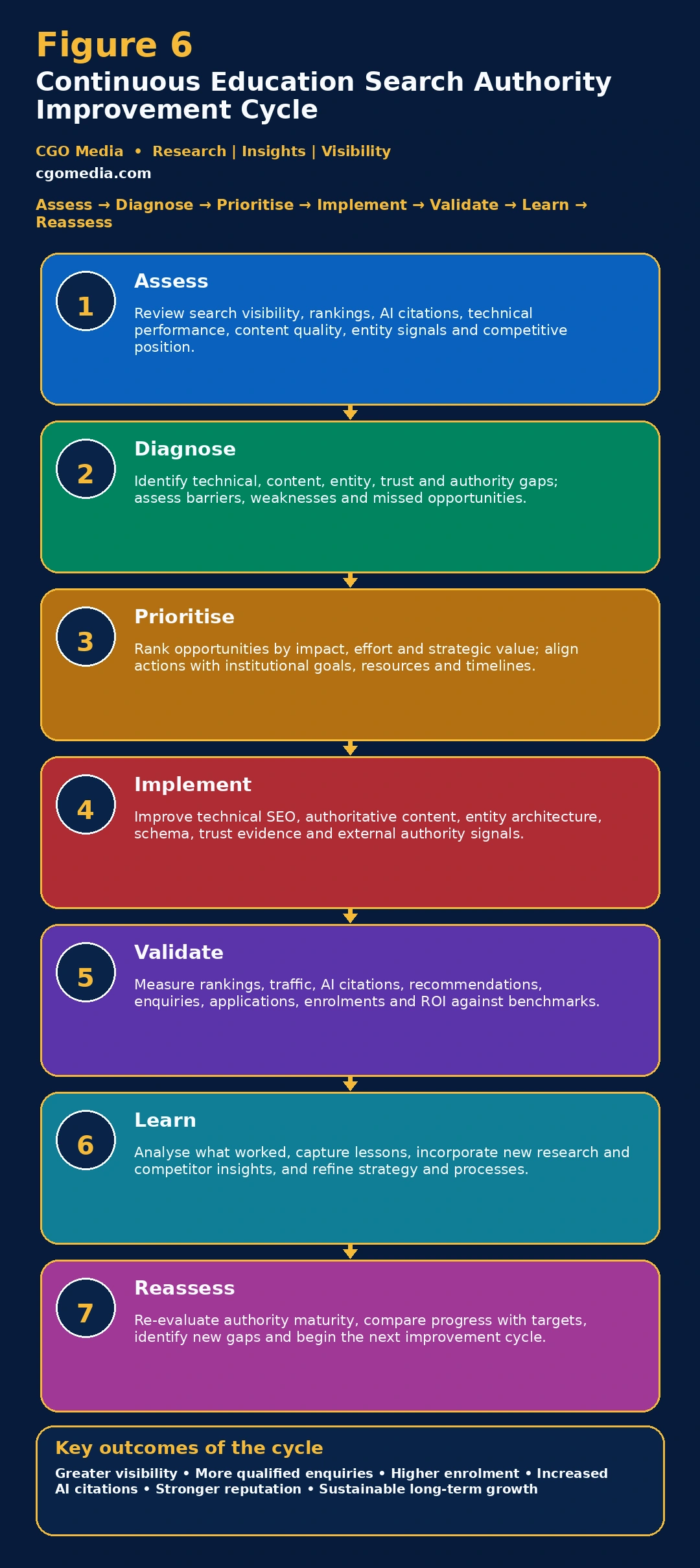
652. Methodology
The Education Search Authority Maturity Model is a conceptual diagnostic framework developed by CGO Media to help universities, colleges, training providers, online education organisations and EdTech companies evaluate the maturity of their search, authority, entity, trust, citation and AI-visibility systems.
653. Research Purpose
The framework addresses a central question:
How mature is an education organisation’s ability to build, integrate, govern and adapt search authority across traditional search and AI-assisted discovery environments?
654. Framework Scope
The model can be applied to:
- Universities
- Colleges
- Professional training providers
- Online education providers
- EdTech companies
- Course platforms
- Corporate learning providers
- Specialist academies
655. The Model Uses Five Maturity Levels
- Fragmented
- Foundation
- Structured Authority
- Integrated Search Authority
- Adaptive Search Authority
656. The Five-Level Progression
The maturity sequence is:
Fragmented → Foundation → Structured Authority → Integrated Search Authority → Adaptive Search Authority
657. The Model Uses Six Authority Dimensions
- Technical & Information Architecture
- Content & Topical Authority
- Entity & Knowledge Architecture
- Trust & Evidence
- External & Citation Authority
- AI Search Visibility & Governance
658. Technical & Information Architecture Method
This dimension can be assessed through:
- Crawlability
- Indexability
- Canonicalisation
- Site architecture
- Internal linking
- International architecture
659. Content & Topical Authority Method
This dimension can be assessed through:
- Programme depth
- Subject coverage
- Career guidance
- Academic expertise
- Research integration
- Learner-question coverage
660. Entity & Knowledge Architecture Method
This dimension can assess whether relationships are represented clearly across:
- Institution
- Faculty
- Department
- Programme
- Qualification
- Academic
- Research area
661. Trust & Evidence Method
This dimension can assess:
- Accreditation
- Recognition
- Outcome evidence
- Research evidence
- Student experience evidence
- Institutional transparency
662. External & Citation Authority Method
This dimension can assess:
- Academic references
- Government references
- Professional-body references
- Education media
- Research visibility
- Digital PR
663. AI Search Visibility & Governance Method
This dimension can assess:
- Source visibility
- Citation visibility
- Entity accuracy
- Comparison visibility
- Recommendation visibility
- Governance
664. Dimension Scoring Method
Each dimension can be scored from one to five:
- 1 — Fragmented
- 2 — Foundation
- 3 — Structured Authority
- 4 — Integrated Search Authority
- 5 — Adaptive Search Authority
665. Scores Should Be Evidence-Based
Evidence can include:
- Technical audits
- Content inventories
- Entity maps
- Trust-evidence inventories
- Citation analysis
- AI visibility observations
666. Evidence Confidence Can Also Be Recorded
A score can be classified as:
- High confidence
- Medium confidence
- Low confidence
667. Current-State and Target-State Assessment
A practical maturity assessment can record:
Current Level → Target Level → Evidence → Authority Gap → Priority Action
668. Authority Gap Method
A simple gap calculation is:
Target Maturity Level − Current Maturity Level = Authority Gap
669. Gap Size Should Not Determine Priority Alone
Priority should also reflect:
- Strategic importance
- Learner impact
- Risk
- Dependency
670. Priority Method
A useful conceptual relationship is:
Authority Gap + Strategic Importance + Learner Impact + Risk = Priority
671. Overall Maturity Method
Overall maturity should not be based solely on the highest-performing dimension.
672. Three Complementary Views Can Be Used
- Average Maturity
- Lowest Dimension
- Strategic Constraint
673. Average Maturity
Provides a broad view of organisational development.
674. Lowest Dimension
Reveals structural weakness.
675. Strategic Constraint
Identifies the dimension currently limiting the most important institutional or learner outcome.
676. Maturity Advancement Method
Movement between maturity levels should require evidence of capability that is:
- Repeatable
- Governed
- Measured
- Sustainable
677. Temporary Performance Improvement Is Not Maturity
A short-term ranking, traffic, citation or AI-visibility increase does not by itself demonstrate higher organisational maturity.
678. Integrated Authority Method
Level 4 maturity is conceptualised through:
Technical SEO → Content Authority → Entity Architecture → Trust Evidence → Research & Citation Authority → AI Visibility → Integrated Search Authority
679. Adaptive Authority Method
Level 5 maturity is conceptualised through:
Observe → Diagnose → Prioritise → Experiment → Strengthen → Validate → Learn → Adapt
680. Continuous Improvement Method
The operating maturity cycle is:
Assess → Diagnose → Prioritise → Implement → Validate → Learn → Reassess
681. Recovery Method
Authority failures can be managed through:
Detect → Verify → Diagnose → Correct → Validate → Learn
682. Benchmarking Method
Education providers can compare maturity across:
- Institutions
- Programmes
- Subjects
- Markets
- Provider categories
683. Benchmarking Should Compare Like with Like
Relevant context can include:
- Institution type
- Scale
- Subject area
- Geography
- Delivery model
684. Multi-Level Assessment Method
Maturity can be assessed at:
- Organisation level
- Faculty level
- Programme level
- Market level
- EdTech product level
685. Multi-Level Assessment Reduces Over-Generalisation
A strong institutional domain does not mean that every programme or product has equally strong search authority.
686. Governance Method
Relevant governance functions can include:
SEO + Admissions + Academic Teams + Research + Marketing + Quality Assurance + Digital PR
687. Governance Should Define
- Ownership
- Review cadence
- Evidence standards
- Escalation procedures
- Reporting standards
688. Limitations
The Education Search Authority Maturity Model is a conceptual diagnostic framework. It does not represent the proprietary ranking, retrieval, source-selection, recommendation or generative systems used by Google, Microsoft, OpenAI, Anthropic, Perplexity or any other search or AI provider.
689. Search Systems Are Only Partially Observable
External organisations cannot directly observe every internal:
- Ranking process
- Retrieval process
- Source-selection process
- Recommendation process
690. Maturity Scores Are Diagnostic Rather Than Absolute
They depend on:
- Available evidence
- Assessment scope
- Organisational context
- Strategic priorities
691. Different Assessors May Reach Different Scores
Clear scoring criteria and supporting evidence can reduce, but not eliminate, judgement differences.
692. Maturity Is Not a Guarantee of Search Performance
Higher maturity can strengthen organisational capability without guaranteeing:
- Specific rankings
- Specific citations
- Specific AI recommendations
- Specific enrolment outcomes
693. External Factors Can Affect Visibility
These can include:
- Algorithm changes
- AI model changes
- Competitive activity
- Market demand
- Search behaviour
694. Maturity Can Vary by Subject
An institution may have high authority in one discipline and much weaker authority in another.
695. Maturity Can Vary by Market
International authority can differ across:
- Countries
- Languages
- Qualification systems
- Education markets
696. Maturity Can Vary by Programme
Institutional reputation does not guarantee strong visibility for every programme.
697. Maturity Can Decline
Higher levels require maintenance and governance.
698. The Model Should Not Be Used as a Certification
The framework is intended for diagnosis, planning and improvement rather than as an externally verified accreditation or institutional quality rating.
699. Search Authority Is Not the Same as Academic Quality
The framework evaluates digital search and authority systems, not the academic quality of an institution or programme.
700. Search Authority Is Not the Same as Institutional Reputation
Reputation can contribute to authority, but mature search authority requires organised technical, content, entity, evidence, citation and governance systems.
701. Search Authority Is Not the Same as Popularity
High brand recognition does not necessarily indicate high maturity.
702. SEO and Search Authority Overlap but Are Not Identical
Traditional SEO remains a major foundation of search authority.
703. Search Authority Extends SEO
It adds explicit consideration of:
- Entity systems
- Trust evidence
- Citation authority
- Research authority
- AI visibility
- Governance
704. AI Visibility Is Only One Dimension of Search Authority
Organisations should not ignore technical, content, entity or trust foundations while pursuing generative visibility.
705. Conclusion
The Education Search Authority Maturity Model provides universities, colleges, training providers and EdTech organisations with a structured way to evaluate how developed their search authority systems have become.
706. Level 1 Represents Fragmentation
Search activity exists, but technical, programme, entity, evidence and governance systems remain disconnected.
707. Level 2 Establishes Foundations
Core technical standards, programme structures, entity definitions and evidence processes become repeatable.
708. Level 3 Builds Structured Authority
The organisation deliberately strengthens:
- Topical depth
- Entity clarity
- Trust evidence
- Research authority
- External citations
709. Level 4 Integrates Authority
SEO, research, Digital PR, entities, trust and AI visibility begin operating as one coordinated system.
710. Level 5 Makes Authority Adaptive
The organisation continuously observes, experiments, learns and adapts as search and learner-discovery environments change.
711. The Full Education Search Authority Progression
The maturity relationship is:
Fragmented → Foundation → Structured Authority → Integrated Search Authority → Adaptive Search Authority
712. The Model Shows That Search Authority Is Cumulative
Higher maturity depends on capabilities established at earlier levels.
713. Technical Foundations Remain Important at Every Level
Advanced authority cannot compensate completely for inaccessible or unstable information.
714. Programme and Content Clarity Remain Important at Every Level
Search engines, AI systems and learners need accurate educational information.
715. Entity Clarity Becomes Increasingly Important
Large education organisations require clear relationships between:
- Institutions
- Faculties
- Programmes
- Qualifications
- Academics
- Research
716. Trust Evidence Makes Authority Defensible
Accreditation, outcomes, research and external validation strengthen important educational claims.
717. Citation Authority Extends Institutional Influence
Education providers can become recognised sources of useful evidence as well as providers of programmes.
718. AI Visibility Extends Search Authority into Generative Discovery
Providers increasingly need to understand whether they are:
- Used as sources
- Cited
- Represented accurately
- Compared
- Recommended
719. Qualified Visibility Matters More Than Maximum Visibility
The objective is not to appear in every search or AI recommendation.
720. Qualified Education Search Authority Can Be Represented as
Relevant Discovery + Accurate Representation + Strong Evidence + Trusted Authority + Appropriate Recommendation
721. Higher Maturity Supports Resilience
Organisations with diversified authority are less dependent on:
- One ranking
- One traffic channel
- One publication
- One AI platform
722. Higher Maturity Supports Better Organisational Learning
Search, research, learner and AI intelligence can increasingly inform wider institutional strategy.
723. Higher Maturity Supports Better Governance
Information accuracy, evidence quality and authority risks have clear ownership.
724. Higher Maturity Supports Better Scaling
Validated systems can be extended across:
- Programmes
- Faculties
- Campuses
- Markets
- EdTech products
725. Continuous Improvement Prevents Maturity from Becoming Static
The final operating cycle remains:
Assess → Diagnose → Prioritise → Implement → Validate → Learn → Reassess
726. The Strategic Objective
The strategic objective is not simply to achieve Level 5.
727. The Strategic Objective Is to Build a Durable Authority Capability
That capability should allow the organisation to:
- Build authority
- Protect trust
- Detect change
- Recover from problems
- Adapt intelligently
728. The Education Search Authority Maturity Model as an Operating Framework
The model can therefore be used for:
- Search audits
- Strategic planning
- Budget prioritisation
- Governance design
- Competitive benchmarking
- AI-readiness assessment
729. Final Strategic Position
Education providers should treat search authority as a permanent organisational capability rather than a collection of isolated SEO campaigns.
The strongest organisations build technical, content, entity, evidence, citation and AI-governance systems that reinforce one another and can be measured, governed and improved over time.
The Education Search Authority Maturity Model provides a structured method for identifying where those systems are fragmented, where foundations exist, where authority has become structured, where integration has occurred and where the organisation has developed the adaptive capability required to remain discoverable, trusted and appropriately represented as search and AI environments continue to evolve.
References
External Academic, Technical and Search Sources
- Google Search Central. SEO Starter Guide.
- Google Search Central. Crawling and indexing overview.
- Google Search Central. Understand how structured data works.
- Google Search Central. Tell Google about localised versions of your page.
- Schema.org. EducationalOrganization.
- Schema.org. Course.
- Schema.org. Person.
- Hogan, A. et al. (2021). Knowledge Graphs. ACM Computing Surveys, 54(4).
- Metzger, M.J. (2007). Making Sense of Credibility on the Web: Models for Evaluating Online Information and Recommendations for Future Research. Journal of the American Society for Information Science and Technology, 58(13), 2078–2091.
- Ji, Z. et al. (2023). Survey of Hallucination in Natural Language Generation. ACM Computing Surveys, 55(12).
CGO Media Education & EdTech Research and Frameworks
- Wilkinson, R. (2026). Education & EdTech SEO in an AI Search Environment. CGO Media.
- Wilkinson, R. (2026). Education & EdTech AI Trust and Visibility Framework. CGO Media.
- Wilkinson, R. (2026). Education Discovery and Provider Selection Model. CGO Media.
- Wilkinson, R. (2026). Education & EdTech SEO and AI Implementation Roadmap. CGO Media.
- Wilkinson, R. (2026). Education GEO: Generative Engine Optimisation for AI Search and Provider Recommendation Systems. CGO Media.
- Wilkinson, R. (2026). CGO AI Search Readiness Framework. CGO Media.
- Wilkinson, R. (2026). CGO Entity Authority Framework. CGO Media.
- Wilkinson, R. (2026). CGO Content Authority Framework. CGO Media.
- Wilkinson, R. (2026). CGO AI Citation Framework. CGO Media.
CGO Media Research Ecosystem
CGO Media Research Library |
CGO Media Framework Library |
CGO Media Research Architecture |
CGO Media Research Observations Library |
CGO Media Statistics Library
About Roger Wilkinson
Roger Wilkinson is an independent researcher, SEO practitioner and founder of CGO Media with more than 25 years of experience in search, digital visibility and business growth.
His research focuses on how artificial intelligence is reshaping search engines, recommendation systems, entity representation, digital authority and organisational visibility.
Roger is the creator of the CGO Framework Series, a collection of research-led methodologies designed to help organisations measure, improve and govern Search Visibility, AI Visibility, GEO and Digital Authority.
His work examines the relationship between Technical SEO, Generative Engine Optimisation, Entity Authority, Content Authority, Citation Authority, Brand Signals, Knowledge Architecture and AI Search Readiness.
View Roger Wilkinson’s researcher profile →
Related Education & EdTech Research
Education & EdTech SEO in an AI Search Environment |
Education & EdTech AI Trust and Visibility Framework |
Education Discovery and Provider Selection Model |
Education & EdTech SEO and AI Implementation Roadmap |
Education GEO: Generative Engine Optimisation
Together, these assets form an Education & EdTech research family covering SEO, AI trust, learner discovery, provider selection, search authority maturity, implementation and Generative Engine Optimisation.
Research Usage & Citation
CGO Media encourages universities, education providers, EdTech organisations, researchers, academics, journalists, consultants and digital teams to reference this framework where it contributes to analysis of education SEO, search authority, AI visibility, entity systems, citation authority or digital governance.
Reasonable quotations, summaries, figures and excerpts may be used in articles, reports, presentations, academic work and other publications provided appropriate acknowledgement is given to Roger Wilkinson and CGO Media.
Cite This Research / Embed Citation
The Education Search Authority Maturity Model by Roger Wilkinson at CGO Media is a five-level framework for evaluating how education providers develop from fragmented search activity through foundational, structured, integrated and adaptive search authority across technical SEO, content, entities, trust evidence, citations and AI visibility.
APA Citation
APA Citation: Wilkinson, R. (2026). Education Search Authority Maturity Model. CGO Media.
Author: Roger Wilkinson |
Published by: CGO Media
For permissions relating to substantial reproduction, commercial licensing or republication of significant portions of this framework, please contact CGO Media directly.