
Education & EdTech AI Trust and Visibility Framework
 The Education & EdTech AI Trust and Visibility Framework defines the evidence areas that influence whether a university, college, training provider, online education platform or EdTech organisation can be discovered, understood, validated, compared and recommended across traditional search engines, education platforms and AI-assisted discovery systems.
The framework treats education visibility as a distributed authority problem rather than a conventional ranking problem. Provider identity, course clarity, curriculum evidence, accreditation, learner outcomes, external validation and AI readiness interact to determine how confidently an organisation can be interpreted by prospective learners and machine-mediated discovery systems.
This framework forms part of the wider CGO Media Education & EdTech research architecture and should be read alongside Education & EdTech SEO in an AI Search Environment, the Education Discovery and Provider Selection Model, the Education Search Authority Maturity Model and the Education & EdTech SEO and AI Implementation Roadmap.
1. Why Education Trust and Visibility Need a Framework
Education discovery increasingly takes place across multiple environments rather than through a single institution website.
2. Learners Use Distributed Discovery
A prospective learner may encounter an education provider through:
- Google Search
- AI assistants
- Course marketplaces
- Comparison platforms
- Professional bodies
- Accreditation organisations
- Review platforms
- Employer recommendations
- Research publications
3. Each Discovery Environment Provides Different Evidence
Search engines may surface course pages, while professional bodies may validate accreditation and review platforms may reveal learner experience.
4. The Education Website Is Only One Part of the Evidence System
The provider website remains important, but it is increasingly one source within a broader education discovery ecosystem.
5. Visibility Alone Is Insufficient
A provider can achieve strong rankings while still failing to give learners enough evidence to make a confident decision.
6. Visibility Without Educational Evidence Is Fragile
This can occur when:
- Course content is vague
- Entry requirements are unclear
- Fees are difficult to find
- Accreditation is poorly explained
- Faculty expertise is hidden
- Outcomes are unsupported
7. Traffic Does Not Automatically Create Provider Authority
High visitor volume can coexist with weak:
- Trust
- Programme understanding
- Qualification confidence
- Enrolment intent
8. Educational Quality Without Visibility Is Also Limited
The reverse problem also occurs.
9. Strong Institutions Can Remain Digitally Underrepresented
A university, college or specialist provider may offer excellent teaching and recognised qualifications while remaining difficult to discover online.
10. Educational Authority Must Be Represented Digitally
The strategic objective is to connect:
Discoverability + Programme Clarity + Independent Validation + Learner Relevance
11. The Framework Uses Six Core Dimensions
- Provider and Entity Clarity
- Subject, Qualification and Course Authority
- Programme Evidence and Information Quality
- Accreditation, Learner Trust and External Validation
- Outcome, Employer and Market Authority
- AI Search and Provider Recommendation Readiness
12. The Six Dimensions Form One Evidence System
These dimensions should not be treated as isolated SEO categories.
13. Provider Clarity Supports Understanding
Learners first need to understand who the organisation is and what it provides.
14. Programme Authority Supports Relevance
Learners then need evidence that the provider genuinely teaches or supports the subject area they are considering.
15. Programme Evidence Supports Evaluation
Course information must be sufficiently complete for learners to determine whether the programme fits their needs.
16. Accreditation and External Validation Support Trust
Independent evidence can help confirm whether provider claims have external support.
17. Outcomes Support Value Evaluation
Learners may want evidence that programmes can support realistic educational, professional or employment progression.
18. AI Readiness Connects the Evidence System
AI-assisted discovery increasingly depends on whether these underlying evidence layers can be interpreted coherently.
19. Dimension One — Provider and Entity Clarity
Provider and Entity Clarity concerns whether the organisation can be identified consistently across the education ecosystem.
20. Provider Identity Should Be Explicit
The organisation should make clear:
- Who it is
- What type of provider it is
- Where it operates
- What programmes it offers
- Which qualifications it awards
21. Provider Type Matters
Learners may need to distinguish between:
- University
- College
- Training provider
- Online academy
- Course marketplace
- EdTech platform
22. Institutional Structure Can Be Complex
A single education group may contain:
- Parent institution
- Schools
- Faculties
- Online learning brands
- Training subsidiaries
- Regional campuses
23. Institutional Relationships Should Be Understandable
Where relevant, the relationship between these entities should be made explicit.
24. A Useful Education Entity Architecture
A practical model is:
Provider → School / Faculty → Subject Area → Qualification → Programme → Campus / Delivery Environment
25. Qualification-Awarding Relationships Matter
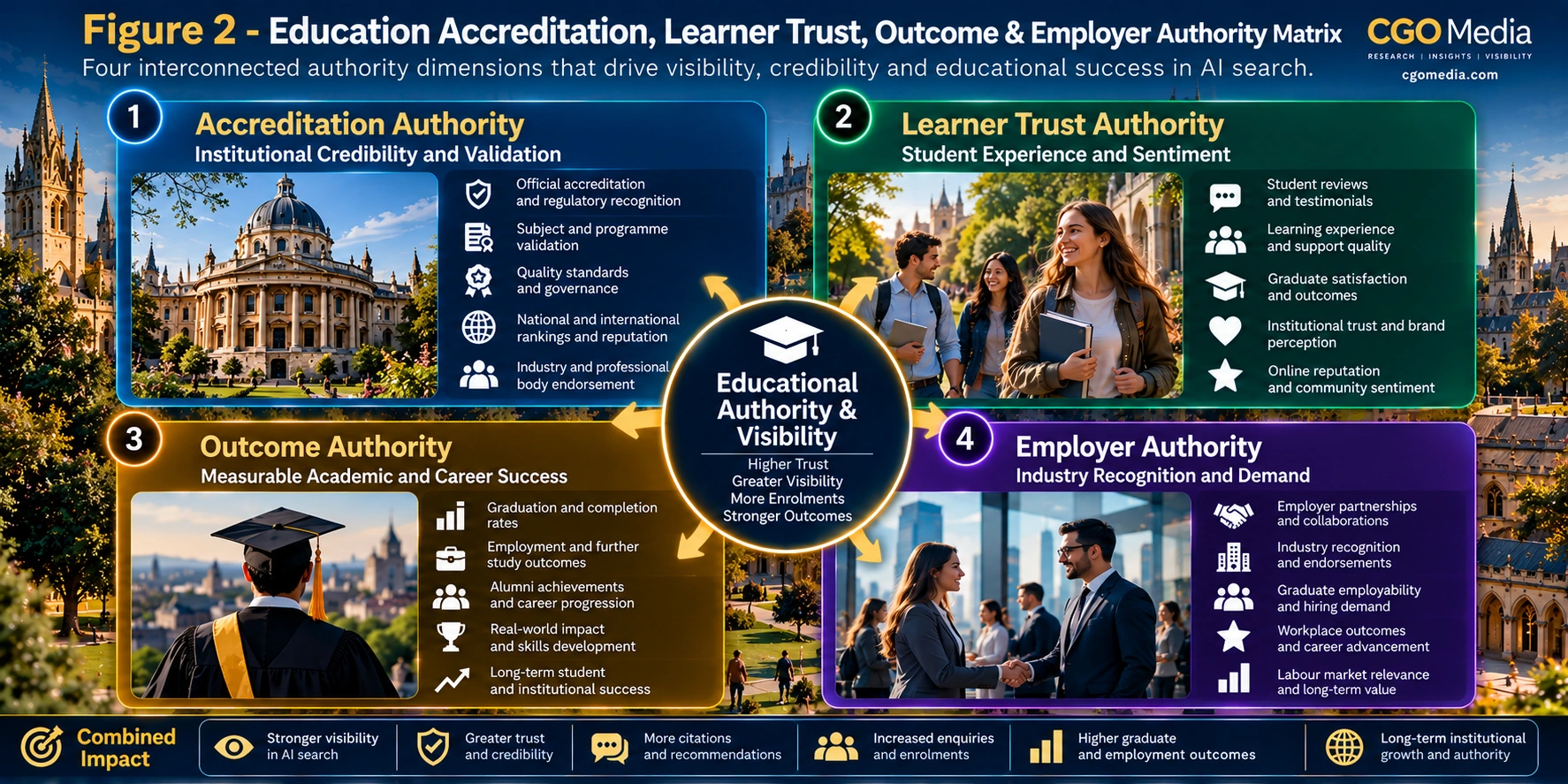
Learners should understand whether the institution:
- Awards the qualification directly
- Delivers it on behalf of another body
- Provides preparation for an external qualification
26. Delivery Relationships Matter
Programmes may be:
- Delivered directly
- Delivered through partners
- Delivered online
- Franchised
- Blended across multiple organisations
27. Campus and Delivery Entity Clarity Matter
Different campuses may offer different programmes, facilities and support.
28. Campus Information Should Identify
- Location
- Courses available
- Facilities
- Delivery model
- Student services
- Relevant accreditation
29. Online Delivery Should Also Be Treated as an Entity Relationship
An online programme may have different:
- Support
- Technology
- Assessment
- Study requirements
30. Provider Naming Consistency Matters
Institutional naming should remain sufficiently consistent across:
- Provider website
- Course marketplaces
- Comparison platforms
- Professional bodies
- Accreditation sources
- Review platforms
31. Rebrands Can Create Education Entity Confusion
Historic institution names may remain visible after a merger or brand change.
32. Mergers Can Create Education Entity Confusion
Learners may encounter conflicting names for:
- Institutions
- Schools
- Qualifications
- Campuses
33. Legacy Names Should Be Connected Where Relevant
Clear transition information can reduce uncertainty.
34. Provider Clarity Supports Search Visibility
Consistent entity information can make it easier for search systems to interpret institutional relationships.
35. Provider Clarity Supports Learner Trust
Learners may be more confident when they understand exactly who delivers and awards the programme.
36. Provider Clarity Supports AI Representation
AI systems may otherwise confuse:
- Parent institutions
- Faculties
- Online brands
- Campuses
- Partner organisations
37. Provider Clarity Diagnostic Questions
An education provider should be able to answer:
- Who are we?
- What type of provider are we?
- Which programmes do we deliver?
- Which qualifications do we award?
- Where are programmes delivered?
- Which brands, campuses or schools belong to us?
38. Provider Clarity Failure Signals
Potential warning signs include:
- Conflicting institution names
- Unclear awarding relationships
- Incorrect campus associations
- Legacy branding
- Duplicate provider profiles
39. Dimension Two — Subject, Qualification and Course Authority
The second dimension concerns whether the provider demonstrates genuine authority in the subjects and qualifications it offers.
40. Subject Authority
Subject authority reflects the depth and coherence of an organisation’s expertise within a defined educational field.
41. Subject Authority Can Be Demonstrated Through
- Course portfolios
- Faculty expertise
- Research
- Learning resources
- Professional engagement
- Employer relationships
42. Subject Authority Should Be Thematic
A provider should demonstrate meaningful coverage of a subject rather than publishing unrelated content solely for search visibility.
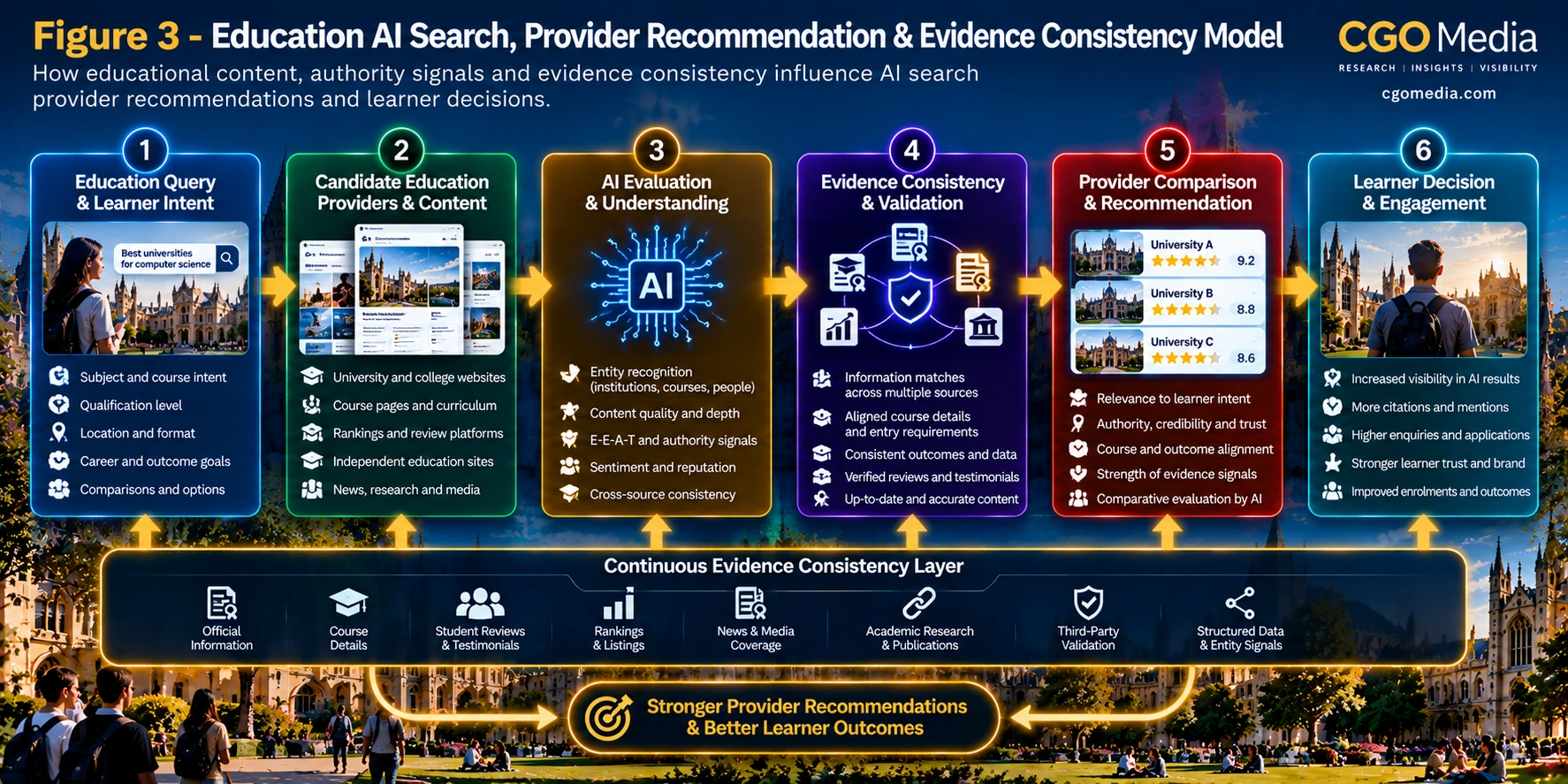
43. Subject Authority Can Be Broad or Specialist
A university may build authority across many disciplines, while a specialist training organisation may focus deeply on one field.
44. Specialist Authority Can Be Highly Valuable
Smaller providers may compete effectively when they demonstrate clear expertise in a tightly defined subject area.
45. Qualification Authority
Qualification authority concerns whether the provider’s relationship with a qualification is sufficiently clear.
46. Qualification Authority Should Explain
- Qualification level
- Awarding organisation
- Recognition
- Progression pathways
- Professional relevance
47. Qualification Names Should Be Precise
Closely related qualifications can have different academic or professional implications.
48. Qualification Level Should Be Explicit
Learners should not have to infer whether a programme is:
- Introductory
- Undergraduate
- Postgraduate
- Professional
- Vocational
- Continuing education
49. Course Authority
Course authority concerns whether an individual programme is supported by sufficiently detailed and credible evidence.
50. Course Authority Begins with Clear Scope
A programme should make clear:
- What will be studied
- Who it is for
- What level it operates at
- What outcome it supports
51. Course Authority Requires Curriculum Evidence
A course title alone provides limited evidence of programme substance.
52. Curriculum Authority
Curriculum evidence can include:
- Modules
- Learning outcomes
- Projects
- Assessments
- Practical work
- Electives
53. Curriculum Depth Supports Learner Comparison
Detailed programme information helps learners distinguish between superficially similar courses.
54. Curriculum Depth Supports Search Interpretation
Clear subject relationships can help search systems understand what the programme actually covers.
55. Curriculum Depth Supports AI Recommendation Context
A programme can be matched more appropriately when its academic content is explicit.
56. Faculty and Instructor Authority
Teaching expertise can provide important evidence of programme credibility.
57. Faculty Evidence Can Include
- Academic credentials
- Professional qualifications
- Research expertise
- Industry experience
- Teaching experience
58. Faculty Profiles Should Connect to Relevant Programmes
A general staff directory is weaker than explicit relationships between:
Faculty Member → Subject Area → Programme → Modules / Research
59. Faculty Authority Should Be Genuine
Instructor profiles should not imply experience or expertise that cannot be substantiated.
60. Faculty Authority Is Context-Dependent
The evidence expected for:
- Academic degrees
- Professional training
- Vocational programmes
- Technology bootcamps
may differ significantly.
61. EdTech Course Authority Has Additional Requirements
Online learning organisations must often demonstrate both educational and product credibility.
62. EdTech Programme Authority May Include
- Instructor expertise
- Course structure
- Assessment quality
- Learning technology
- Platform functionality
- Learner support
63. Programme Authority Should Be Learner-Specific
Different programmes may be designed for:
- School leavers
- Career changers
- Working professionals
- International learners
- Enterprise teams
64. Learner Context Improves Recommendation Relevance
A course should not be treated as universally appropriate because it performs strongly for one learner segment.
65. Programme Authority Diagnostic Questions
Assess whether the learner can determine:
- What is taught?
- At what level?
- By whom?
- For which audience?
- Toward which qualification or outcome?
66. Programme Authority Failure Signals
Potential warning signs include:
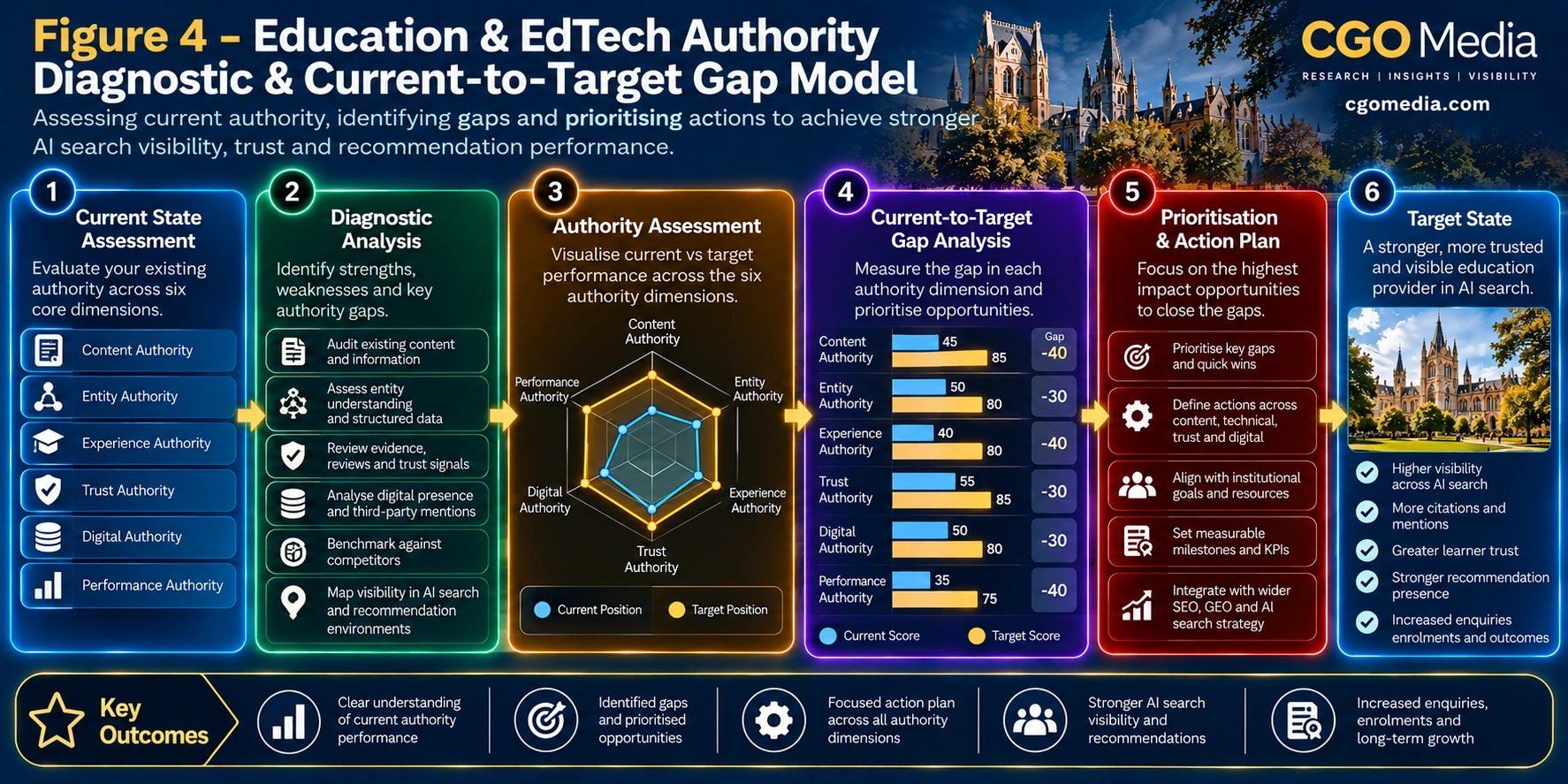
- Generic course descriptions
- Missing module information
- Unclear qualification relationships
- Hidden instructors
- Unsupported expertise claims
67. Dimension Three — Programme Evidence and Information Quality
The third dimension concerns the factual information learners need to evaluate a programme properly.
68. Programme Information Completeness Matters
A learner may discover an attractive course but still be unable to determine whether it is practical or appropriate.
69. Core Programme Evidence Can Include
- Curriculum
- Entry requirements
- Fees
- Duration
- Delivery format
- Assessment
- Faculty
- Learner support
70. Entry Requirement Clarity
Entry requirements should be explicit and sufficiently current.
71. Entry Evidence Can Include
- Academic prerequisites
- Professional experience
- Language requirements
- Portfolio requirements
- Technical requirements
- Alternative entry routes
72. Entry Requirements Affect Learner Fit
Clear requirements can prevent unsuitable learners from investing time in programmes for which they do not qualify.
73. Fee Clarity
Education pricing should be sufficiently transparent for learners to evaluate affordability.
74. Fee Information Can Include
- Tuition
- Registration fees
- Additional materials
- Examination costs
- Technology costs
75. Funding Clarity
Where relevant, providers should explain:
- Scholarships
- Funding
- Loans
- Payment plans
- Employer funding
76. Funding Information Should Avoid Overstatement
Eligibility for scholarships, grants or financial support should not be implied where it depends on separate assessment.
77. Delivery Format Clarity
Providers should state whether programmes are:
- Online
- In person
- Hybrid
- Self-paced
- Instructor-led
- Full time
- Part time
78. Delivery Mode Can Be a Hard Selection Criterion
A suitable programme may still be impractical if the delivery format does not fit the learner’s circumstances.
79. Programme Duration Should Be Explicit
Learners should be able to estimate the time commitment before applying.
80. Study Commitment Should Be Explained
Where relevant, useful information can include:
- Teaching hours
- Independent study
- Practical work
- Assessment periods
81. Assessment Information Supports Programme Understanding
Learners may want to know whether assessment involves:
- Examinations
- Coursework
- Projects
- Practical assessment
- Portfolio work
82. Learner Support Is Part of Programme Evidence
Support may include:
- Academic support
- Technical support
- Career support
- Accessibility support
- Student services
83. Information Freshness Is Essential
Education information changes regularly.
84. High-Change Education Information
Potential high-change fields include:
- Fees
- Start dates
- Entry requirements
- Course availability
- Faculty
85. Medium-Change Education Information
Potential medium-change fields include:
- Curriculum
- Assessment
- Delivery format
- Accreditation
86. Stale Programme Information Creates Learner Risk
Outdated information can create:
- Incorrect expectations
- Wasted applications
- Trust loss
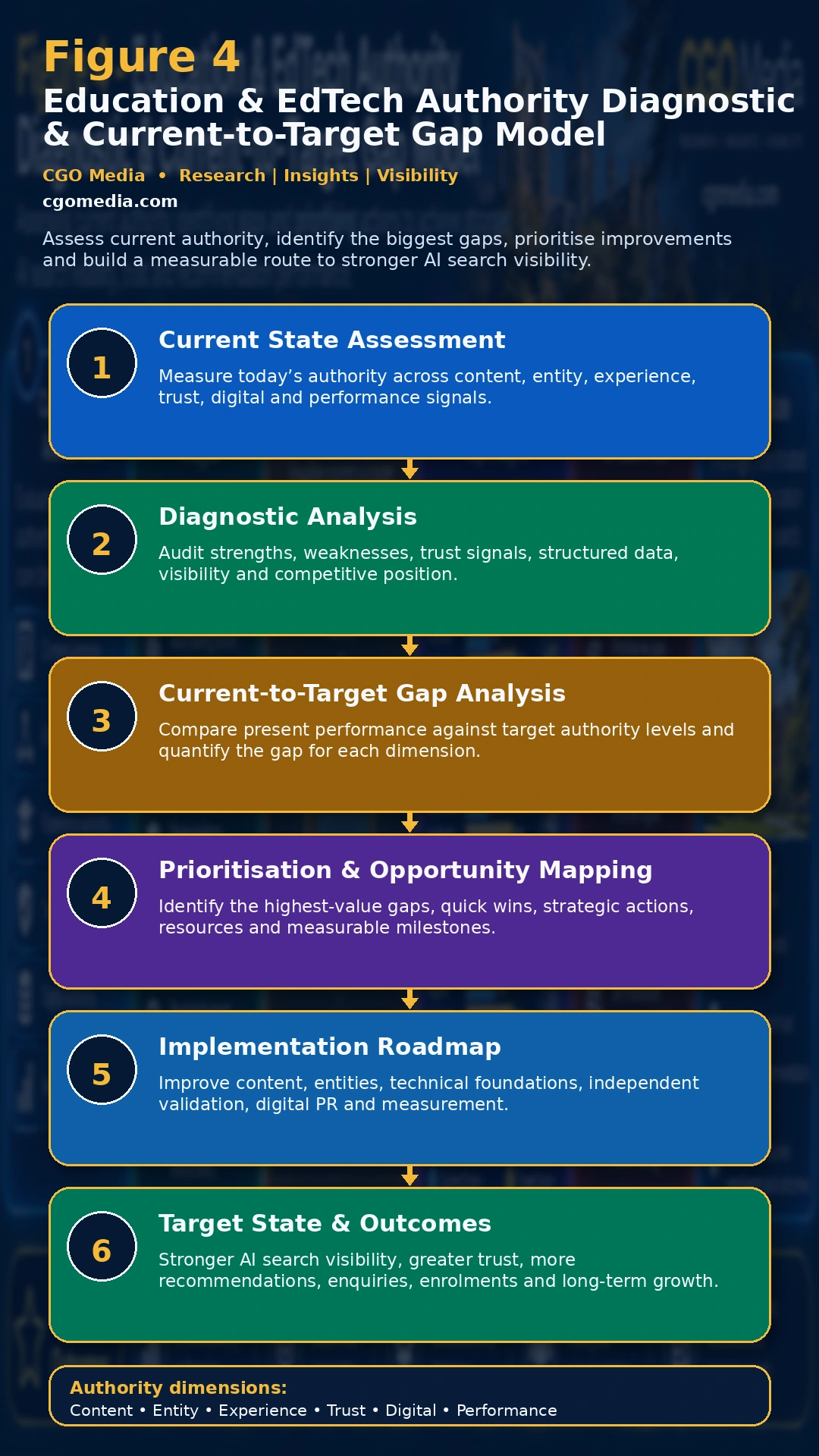
- AI representation errors
87. Review Dates Can Support Transparency
Where appropriate, important programme information should have defined review ownership.
88. Programme Information Should Have a Source of Truth
Core fields should not be maintained independently across unrelated systems without governance.
89. Programme Evidence Should Be Consistent Across Channels
Important information should align sufficiently across:
- Provider website
- Course marketplaces
- Comparison platforms
- Accreditation sources
- Recruitment materials
90. Material Consistency Is More Important Than Identical Wording
Different platforms can describe a programme differently while remaining factually compatible.
91. Programme Evidence Diagnostic Questions
Assess whether a learner can determine:
- Am I eligible?
- What will I study?
- How much will it cost?
- How will I study?
- How long will it take?
- What support will I receive?
92. Programme Evidence Failure Signals
Potential warning signs include:
- Missing fees
- Unclear entry requirements
- Outdated start dates
- Conflicting delivery formats
- Incomplete curriculum information
93. The First Three Dimensions Establish Educational Evidence
The framework now combines:
Provider Clarity + Programme Authority + Programme Evidence
94. These Dimensions Answer Three Fundamental Learner Questions
- Who is the provider?
- What does the provider genuinely teach?
- Is the programme information complete enough to evaluate?
95. Education Trust Remains Incomplete Without External Validation
The next section examines accreditation, professional recognition, learner evidence, outcomes, employer authority and the external sources that support provider trust.


96. Dimension Four — Accreditation, Learner Trust and External Validation
The fourth dimension concerns whether the provider’s claims can be supported by relevant independent evidence.
97. Accreditation Can Be an Important Trust Signal
Where applicable, learners may want to know whether a programme or provider is recognised by:
- Professional bodies
- Awarding organisations
- Sector regulators
- Academic quality bodies
- Industry associations
98. Accreditation Should Be Specific
Providers should explain:
- Which programme is accredited
- Which organisation provides the accreditation
- What the accreditation covers
- Whether it is current
99. Accreditation Should Not Be Overgeneralised
Recognition of one programme should not imply that every programme offered by the organisation has the same status.
100. Institutional Recognition and Programme Accreditation Are Different
Learners should be able to distinguish between:
- Recognition of the provider
- Recognition of a qualification
- Accreditation of an individual programme
101. Professional Recognition Can Affect Career Relevance
Some learners may prioritise programmes that support entry into:
- Regulated professions
- Professional membership
- Industry certification
- Further study
102. Professional Recognition Should Be Current
Historic accreditation should not remain represented as active where it is no longer valid.
103. Accreditation Evidence Should Be Independently Verifiable
Where possible, learners should be able to verify relevant claims through an external authoritative source.
104. External Verification Reduces Reliance on First-Party Claims
Independent confirmation can help learners assess whether a provider’s claims have external support.
105. Learner Trust Extends Beyond Accreditation
Prospective learners may also seek evidence about:
- Teaching experience
- Learner support
- Student satisfaction
- Online learning quality
- Assessment fairness
106. Learner Reviews Can Contribute to Trust
Reviews can reveal recurring experiences around:
- Teaching
- Support
- Course organisation
- Technology
- Administration
107. Review Scores Alone Are Incomplete
A stronger analysis considers:
- Recency
- Theme
- Severity
- Persistence
108. Review Recency Matters
Older reviews may describe an earlier version of a programme or platform.
109. Review Themes Matter
Recurring comments may reveal structural strengths or weaknesses.
110. Review Severity Matters
A smaller number of serious complaints may matter more than a large number of minor comments.
111. Review Persistence Matters
Repeated themes over time can indicate unresolved operational issues.
112. Reviews Are Experience Evidence, Not Academic Validation
Learner feedback can describe experience but does not independently prove academic quality.
113. Reviews Are Not Qualification Recognition Evidence
Positive learner sentiment should not be treated as proof of accreditation or formal recognition.
114. External Rankings Can Influence Learner Trust
University, college and course rankings may affect provider consideration.
115. Rankings Have Methodological Limits
Different ranking systems may use different criteria, datasets and weighting.
116. Rankings Should Be Interpreted in Context
A strong overall institutional ranking does not necessarily establish that every programme is equally strong.
117. Subject Rankings Can Provide More Relevant Context
Where available, subject-level evidence may be more useful than institution-wide ranking alone.
118. Rankings Should Not Replace Programme Evaluation
Learners should still examine:
- Curriculum
- Faculty
- Outcomes
- Costs
- Delivery format
119. Education Media Can Contribute External Validation
Independent coverage can provide context around:
- Research
- Innovation
- Teaching initiatives
- Industry partnerships
- Institutional development
120. Specialist Publications Can Be Highly Relevant
A niche academic or professional publication may provide stronger subject validation than broad general media.
121. Research Citations Can Strengthen Academic Authority
Research produced by the institution may be referenced by:
- Academic researchers
- Professional bodies
- Industry publications
- Policy organisations
- Journalists
122. Citation Authority Is Different from Promotional Visibility
A research citation provides contextual evidence that may be more meaningful than a simple promotional mention.
123. Citable Research Should Be Easy to Attribute
Research assets should identify:
- Author
- Institution
- Date
- Methodology
- References
- Citation format
124. Employer Partnerships Can Contribute External Validation
Relevant employer relationships can provide evidence of industry engagement.
125. Employer Partnerships Should Be Specific
Providers should avoid vague statements such as “industry connected” where stronger evidence can be provided.
126. Partnership Evidence Can Include
- Placement opportunities
- Employer projects
- Advisory boards
- Guest lecturers
- Recruitment relationships
127. Partnership Claims Should Be Current
Historic partnerships should not be presented as active if they no longer exist.
128. External Validation Should Be Relevant to the Programme
Institutional prestige is useful, but programme-level relevance often matters more to learner decision-making.
129. External Validation Should Be Market-Specific
The sources learners trust may differ across:
- Countries
- Professional sectors
- Education levels
- Learner types
130. External Validation Diagnostic Questions
Assess whether learners can determine:
- Is the provider or programme independently recognised?
- Is the accreditation current?
- Do external sources support the provider’s claims?
- What do learners say about the experience?
- Are there relevant employer or industry relationships?
131. External Validation Failure Signals
Potential warning signs include:
- Expired accreditation
- Unsupported partnership claims
- Outdated ranking claims
- Persistent negative learner themes
- Weak independent corroboration
132. Dimension Five — Outcome, Employer and Market Authority
The fifth dimension concerns whether the provider can support claims about progression, employment, professional development and educational outcomes with credible evidence.
133. Learners Increasingly Evaluate Education Through Outcomes
Many prospective learners consider not only what they will study, but what the programme may help them achieve afterwards.
134. Outcome Authority Should Be Evidence-Based
Claims around:
- Employment
- Salary
- Career progression
- Further study
- Professional entry
should be supported where possible.
135. Graduate Outcome Evidence Can Include
- Employment rates
- Graduate destinations
- Further study
- Professional progression
- Portfolio development
136. Outcome Data Should Explain Its Scope
Users should understand:
- Which cohort is measured
- Which period is covered
- How outcomes are defined
- How data was collected
137. Outcome Claims Should Avoid False Precision
Small samples should not be presented as universal evidence of programme performance.
138. Salary Claims Require Context
Earnings can vary according to:
- Market
- Experience
- Role
- Industry
- Location
139. Employment Claims Require Context
A programme can support employability without guaranteeing employment.
140. Educational Outcomes Are Multi-Dimensional
Relevant outcomes may include:
- Knowledge gain
- Skills development
- Qualification attainment
- Professional progression
- Employment
- Further education
141. Employer Authority Supports Labour-Market Relevance
Providers can strengthen programme relevance when employers recognise the skills being taught.
142. Employer Authority Can Be Demonstrated Through
- Advisory boards
- Industry-designed modules
- Live projects
- Placements
- Employer testimonials
- Graduate recruitment
143. Employer Testimonials Should Be Genuine
Employer statements should be attributable and relevant to the programme where possible.
144. Employer Recognition Should Not Be Overstated
A relationship with one employer should not imply industry-wide preference.
145. Market Authority Requires Relevance to Current Demand
Courses should connect meaningfully with the knowledge and skills required in the target market.
146. Market Authority Can Be Supported by Labour-Market Evidence
Potential evidence may include:
- Job demand
- Skills shortages
- Industry growth
- Professional requirements
- Technology adoption
147. Labour-Market Evidence Should Be Current
Fast-changing sectors can make historical skills-demand claims obsolete.
148. Labour-Market Evidence Should Be Geographically Relevant
Employment demand can differ significantly across regions and countries.
149. Programme Design Can Reflect Market Evidence
Curriculum updates may respond to:
- New technologies
- New professional standards
- Employer needs
- Emerging roles
150. Market Relevance Should Not Become Short-Term Trend Chasing
Strong programmes may need to balance:
- Foundational knowledge
- Current skills
- Long-term adaptability
151. Outcome Authority Is Especially Important for Career-Focused EdTech
Bootcamps, professional training platforms and career-transition providers often compete heavily on employability claims.
152. Career Outcome Claims Need Strong Methodology
Where outcomes are published, providers should explain:
- Who was included
- Who was excluded
- How outcomes were verified
- How long after completion they were measured
153. Placement Claims Need Context
A placement rate may mean different things depending on whether it measures:
- Any employment
- Relevant employment
- Full-time employment
- Freelance work
- Further study
154. Outcome Authority Can Influence AI Recommendations
AI systems may summarise provider quality using visible outcome evidence.
155. Weak Outcome Claims Can Create AI Misrepresentation Risk
Unsupported headline statistics may be repeated without adequate context.
156. Outcome Evidence Should Be Structured for Interpretation
Relevant information should clearly distinguish:
- Observed outcome
- Methodology
- Time period
- Sample
- Limitations
157. Outcome Authority Diagnostic Questions
Assess whether learners can determine:
- What outcomes does the programme support?
- What evidence supports those claims?
- How current is the evidence?
- What employer relationships exist?
- How relevant is the programme to the target market?
158. Outcome Authority Failure Signals
Potential warning signs include:
- Unsupported employment guarantees
- Unclear outcome methodology
- Outdated labour-market claims
- Vague employer relationships
- Unverifiable salary statistics
159. EdTech Product Authority Adds Another Layer
Education technology organisations must often prove both educational value and product capability.
160. EdTech Product Authority Can Include
- Learning platform quality
- Assessment technology
- Progress tracking
- Personalisation
- Collaboration tools
- Accessibility
161. Platform Functionality Should Support Learning Claims
Technical features should connect clearly with the learner outcomes they are intended to support.
162. EdTech Feature Lists Are Not Educational Evidence by Themselves
A platform may contain many features without demonstrating whether they improve learning.
163. Educational Product Evidence Can Include
- Pedagogical methodology
- Learner-engagement data
- Completion data
- Assessment design
- Learning research
164. AI-Powered EdTech Requires Additional Transparency
Where AI is used for:
- Tutoring
- Assessment
- Content generation
- Personalisation
- Feedback
providers should explain the role of the technology clearly enough for learners and institutional buyers to understand it.
165. AI Feature Claims Should Be Specific
Terms such as “AI-powered learning” provide limited evidence unless the actual function is explained.
166. AI Features Should Not Be Presented as Human Expertise Where They Are Not
Learners should be able to distinguish between:
- Human instruction
- Automated feedback
- AI-generated assistance
- Peer support
167. EdTech Data Practices Can Influence Trust
Learners and institutional buyers may consider how educational data is collected, used and protected.
168. Accessibility Contributes to EdTech Trust
Learning technology should account for the needs of users with different accessibility requirements.
169. Platform Reliability Contributes to EdTech Trust
Technical disruption can directly affect the learning experience.
170. Support Quality Contributes to EdTech Trust
Learners may need help with:
- Account access
- Technical problems
- Course navigation
- Assessment issues
171. EdTech Trust Is Therefore Dual
The organisation must often demonstrate:
Educational Authority + Product Authority
172. Education and EdTech Trust Should Be Evaluated Differently Where Necessary
The same framework can apply across both sectors, but evidence weighting may differ.
173. Traditional Institution Emphasis
Universities and colleges may place greater weight on:
- Academic recognition
- Faculty
- Research
- Qualifications
- Student outcomes
174. EdTech Provider Emphasis
EdTech organisations may place greater weight on:
- Platform functionality
- Learner engagement
- Scalability
- Skills outcomes
- Employer relevance
175. Neither Evidence Profile Is Universal
Specialist providers may combine elements of both models.
176. Dimensions Four and Five Extend the Evidence System Externally
The framework now combines:
Accreditation + Learner Evidence + External Validation + Outcomes + Employer Authority
177. These Dimensions Help Answer Two Additional Learner Questions
- Can the provider’s claims be independently validated?
- What evidence exists that the programme can support meaningful outcomes?
178. The Sixth Dimension Addresses AI-Assisted Discovery
The next section examines how AI systems may interpret providers, courses, accreditation, outcomes and external evidence when constructing education recommendations.
179. Dimension Six — AI Search and Provider Recommendation Readiness
The sixth dimension examines whether education and EdTech providers are represented accurately, relevantly and consistently within AI-assisted discovery environments.
180. AI Search Compresses Multiple Education Questions
A learner may ask one prompt that combines:
- Programme discovery
- Provider comparison
- Accreditation
- Fees
- Entry requirements
- Career outcomes
181. AI Compression Changes the Discovery Journey
Instead of completing multiple separate searches, a learner may receive a consolidated answer that summarises several providers at once.
182. AI Search Readiness Depends on the Underlying Evidence System
Generated visibility becomes more defensible when provider, programme, accreditation and outcome information is already clear across the wider digital ecosystem.
183. AI Recommendation Readiness Is Not a Separate Shortcut
The organisation should not treat AI visibility as independent from:
- Entity clarity
- Programme evidence
- External validation
- Outcome authority
- Technical accessibility
184. AI Systems May Encounter Multiple Education Sources
The evidence environment may include:
- Provider websites
- Course marketplaces
- Accreditation organisations
- Professional bodies
- Review platforms
- Education media
- Research publications
- Employer sources
185. Source Consistency Reduces Interpretation Risk
Material disagreements between these sources can increase uncertainty around:
- Programme availability
- Qualification status
- Fees
- Entry requirements
- Accreditation
- Outcomes
186. AI Provider Identity Accuracy Matters
Generated systems should ideally distinguish between:
- Institution
- School
- Faculty
- Online brand
- Delivery partner
- Awarding organisation
187. Entity Confusion Can Produce Provider Errors
Potential AI errors include:
- Attributing a course to the wrong institution
- Confusing a faculty with a separate provider
- Misidentifying an awarding organisation
- Associating an outdated brand with a current programme
188. AI Course Matching Depends on Clear Programme Evidence
A system can make stronger programme matches when it can identify:
- Subject
- Level
- Audience
- Delivery format
- Entry requirements
- Outcome
189. Course Matching Should Be Learner-Specific
A programme that fits one learner may be unsuitable for another.
190. Learner Context Can Include
- Academic background
- Career objective
- Location
- Budget
- Study mode
- Experience level
191. AI Recommendations Should Not Be Treated as Universal Rankings
Different prompts and systems can produce different provider sets.
192. Recommendation Order Is Not Stable
Provider order may vary by:
- Prompt wording
- Model
- Location
- Time
- Available evidence
193. Recommendation Inclusion Is Not Academic Endorsement
Appearance in an AI-generated answer does not independently establish:
- Academic quality
- Accreditation
- Programme suitability
- Employment outcomes
194. Recommendation Inclusion Is Not Admission Eligibility
A learner should still verify entry requirements and application criteria.
195. Recommendation Inclusion Is Not Funding Eligibility
Scholarships, loans or other support may require separate assessment.
196. Recommendation Inclusion Is Not Employment Guarantee
Career-focused programmes should not be represented as guaranteeing employment where they do not.
197. AI Programme Accuracy Matters
Generated systems may summarise:
- Course content
- Duration
- Fees
- Delivery format
- Entry requirements
198. Programme Information Can Become Stale
Old course details may remain visible after a programme changes.
199. Fee Accuracy Requires Particular Attention
Education fees can change between cohorts, academic years or markets.
200. Generated Fee Information Should Be Verified
Users should not be encouraged to rely on generated pricing alone where current provider information is available.
201. Entry Requirement Accuracy Matters
Incorrect admission requirements can create wasted applications or false expectations.
202. Delivery Format Accuracy Matters
A programme may change between:
- Online
- On-campus
- Hybrid
- Full-time
- Part-time
203. Start-Date Accuracy Matters
AI-generated answers may surface historic cohort dates if public evidence is not well maintained.
204. Accreditation Accuracy Matters
Generated systems may repeat outdated or overly broad accreditation claims.
205. Accreditation Errors Can Be Material
Potential errors include:
- Expired accreditation represented as current
- Institutional recognition applied incorrectly to one programme
- Professional recognition misrepresented
- Wrong awarding organisation
206. Outcome Accuracy Matters
Employment and salary claims can be especially sensitive to context.
207. AI Outcome Summaries Should Preserve Methodological Context
Generated claims are stronger when underlying sources explain:
- Sample
- Period
- Method
- Outcome definition
- Limitations
208. AI Can Strip Away Important Context
A headline statistic may be repeated without the caveats that made the original claim accurate.
209. This Creates a Source-Design Challenge
Education providers should make important contextual information difficult to miss.
210. AI Source Selection Should Be Monitored
Where sources are visible, providers can observe which source categories appear repeatedly.
211. Visible Source Categories May Include
- Provider source
- Course marketplace
- Accreditation source
- Review source
- Education media
- Employer source
212. Visible Sources Should Be Logged
Useful fields include:
- Source domain
- Source type
- Topic
- Freshness
- Potential conflict
213. Visible Sources Are Partial Evidence
Displayed citations do not necessarily reveal every input involved in answer generation.
214. Source Appearance Does Not Establish Full Causation
A visible citation should not automatically be treated as the sole reason a provider was recommended.
215. Source Patterns Are More Useful Than Isolated Citations
Repeated source classes across many observations can provide stronger strategic insight.
216. AI Search Monitoring Should Use Repeatable Prompt Groups
A practical structure may include:
- Provider prompts
- Course prompts
- Accreditation prompts
- Career-outcome prompts
- Comparison prompts
- Market prompts
217. Provider Prompt Group
These may test:
- Institution identity
- Provider type
- Subject specialisms
- Delivery markets
218. Course Prompt Group
These may test:
- Programme relevance
- Level
- Entry requirements
- Fees
- Delivery format
219. Accreditation Prompt Group
These may test whether the system represents:
- Recognition
- Awarding relationships
- Professional accreditation
- Current status
220. Career-Outcome Prompt Group
These may test:
- Graduate outcomes
- Employer relevance
- Professional progression
- Skills alignment
221. Comparison Prompt Group
These may test how the provider is represented alongside relevant alternatives.
222. Market Prompt Group
These may test:
- Country availability
- Campus availability
- Online access
- Regional recognition
223. Record Prompt Context
Each AI observation should ideally record:
- Prompt
- Model
- Date
- Market
- Learner type
- Observed answer
224. Record Provider Presence
Presence indicates whether the provider appears in the relevant answer set.
225. Record Relevance
Relevance indicates whether the provider is genuinely suitable to the learner context expressed in the prompt.
226. Record Accuracy
Accuracy assesses whether material programme and provider facts are correct.
227. Record Trust Context
Trust context examines whether important evidence such as accreditation or outcome methodology is represented appropriately.
228. A Practical Education AI Measurement Model
Use:
Presence + Relevance + Accuracy + Trust Context
229. AI Error Severity Should Be Classified
A practical scale is:
- Critical
- High
- Medium
- Low
230. Critical AI Error Examples
Potential examples include:
- Wrong awarding organisation
- False accreditation claim
- Programme represented as available when withdrawn
- Materially incorrect qualification status
231. High-Severity AI Error Examples
Potential examples include:
- Wrong entry requirements
- Incorrect fees
- Wrong delivery format
- Significant outcome misrepresentation
232. Medium-Severity AI Error Examples
These may include incomplete programme descriptions that materially reduce understanding without changing fundamental eligibility or recognition.
233. Low-Severity AI Error Examples
These may include minor descriptive variation with limited impact on learner understanding.
234. Error Persistence Should Be Measured
A practical classification is:
- One-off
- Occasional
- Recurring
- Persistent
235. Persistent Errors Deserve Greater Attention
Repeated material inaccuracies may indicate deeper public-evidence conflicts.
236. AI Error Priority Should Combine Multiple Factors
A practical model is:
Priority = Severity + Persistence + Learner Impact + Evidence Confidence
237. AI Errors Should Be Verified Before Correction
Providers should distinguish genuine errors from reasonable wording differences.
238. AI Error Diagnosis Should Trace the Evidence Environment
Potential root causes may include:
- Old programme pages
- Outdated marketplace profiles
- Historic accreditation pages
- Old media articles
- Conflicting institutional records
239. AI Correction Should Target Underlying Evidence
The objective should not be to manipulate one isolated response.
240. A Practical AI Correction Workflow
Use:
Observe → Verify → Trace → Correct → Validate → Reobserve
241. Observe
Identify a potentially material representation problem.
242. Verify
Confirm whether the answer is genuinely inaccurate.
243. Trace
Investigate which sources may be contributing to the issue.
244. Correct
Update the underlying evidence where appropriate and possible.
245. Validate
Confirm that controlled sources now contain the correct information.
246. Reobserve
Monitor future outputs rather than expecting immediate deterministic change.
247. AI Recommendation Readiness Should Be Product-Specific
Different programmes may have different visibility and evidence strength.
248. AI Recommendation Readiness Should Be Subject-Specific
An institution may have strong authority in one discipline and limited authority in another.
249. AI Recommendation Readiness Should Be Market-Specific
Programme recognition and availability may vary by geography.
250. AI Recommendation Readiness Should Be Learner-Specific
Different audiences may have different:
- Entry requirements
- Study needs
- Career objectives
- Budget constraints
251. AI Recommendation Readiness Should Be Delivery-Specific
Online, campus and hybrid programmes should be represented accurately.
252. AI Readiness Requires Cross-Platform Consistency
Material programme facts should remain sufficiently aligned across influential environments.
253. Cross-Platform Consistency Does Not Mean Identical Text
The objective is factual compatibility rather than duplicated wording.
254. AI Readiness Requires Evidence Confidence
Not every observation supports the same level of certainty.
255. High-Confidence AI Findings
These may be supported by:
- Repeated observations
- Authoritative programme data
- Multiple corroborating sources
256. Medium-Confidence AI Findings
These may involve partial source evidence or moderate variability.
257. Low-Confidence AI Findings
These may involve:
- One-off outputs
- Unclear source context
- Minor wording differences
258. AI Search Monitoring Should Avoid False Precision
A small prompt sample should not be represented as definitive evidence of whole-market AI visibility.
259. Published AI Research Should Explain Sampling
Where AI visibility data is published, methodology should explain:
- Prompt classes
- Models
- Markets
- Observation period
- Limitations
260. AI Recommendation Monitoring Should Be Longitudinal
Repeated observations are more useful than one-time screenshots.
261. Cross-Model Observation Can Add Context
Where strategically important, multiple systems can be compared to distinguish:
- Model-specific behaviour
- Cross-model patterns
- Persistent public-evidence problems
262. AI Monitoring Should Support Learner Trust
The strategic objective is not simply to increase mentions.
263. The AI Visibility Objective
A stronger objective is:
Relevant Discovery + Accurate Representation + Appropriate Trust Context
264. Dimension Six Connects the Entire Framework
AI systems can expose strengths or weaknesses across all five earlier dimensions.
265. Provider Clarity Influences AI Entity Interpretation
Clear institutional relationships reduce the risk of provider confusion.
266. Programme Authority Influences AI Relevance
Clear subject and curriculum evidence can improve course matching.
267. Programme Evidence Influences AI Accuracy
Current fees, entry requirements and delivery information support more reliable summaries.
268. External Validation Influences AI Trust Context
Accreditation, reviews and independent sources can provide corroborating evidence.
269. Outcome Authority Influences AI Recommendation Context
Clear methodology can reduce the risk of unsupported career and employment claims.
270. The Complete Six-Dimension Model
The framework can now be expressed as:
Provider Clarity + Programme Authority + Programme Evidence + External Validation + Outcome Authority + AI Recommendation Readiness
271. The Next Stage Is Education Trust and Visibility Diagnostics
The next section converts the six framework dimensions into a practical scoring, evidence-confidence and current-versus-target diagnostic model.
272. Education Trust and Visibility Diagnostic Framework
The six dimensions can be converted into a practical diagnostic model for assessing current authority strength, identifying weaknesses and defining improvement priorities.
273. Each Dimension Should Be Assessed Independently
An education provider may be strong in one area and weak in another.
274. Six Diagnostic Dimensions
- Provider and Entity Clarity
- Subject, Qualification and Course Authority
- Programme Evidence and Information Quality
- Accreditation, Learner Trust and External Validation
- Outcome, Employer and Market Authority
- AI Search and Provider Recommendation Readiness
275. Use a Five-Level Diagnostic Scale
A practical model is:
- Weak
- Emerging
- Established
- Strong
- Resilient
276. Level One — Weak
Evidence is fragmented, incomplete, inconsistent or difficult to verify.
277. Level Two — Emerging
Some important authority signals are present, but coverage and governance remain inconsistent.
278. Level Three — Established
Core provider, programme and trust evidence is generally available and reasonably current.
279. Level Four — Strong
Authority evidence is integrated across priority programmes, external sources and discovery journeys.
280. Level Five — Resilient
Authority is governed continuously, supported by strong evidence and capable of adapting to programme, market and AI-search change.
281. Avoid Collapsing the Six Dimensions Too Early
A single average can conceal important weaknesses.
282. Example Diagnostic Profile
A provider may record:
- Provider Clarity — 4
- Programme Authority — 4
- Programme Evidence — 3
- External Validation — 2
- Outcome Authority — 2
- AI Readiness — 2
283. Uneven Education Authority Is Common
Established institutions may have strong academic authority but weaker AI visibility or programme-data governance.
284. EdTech Providers May Show the Opposite Pattern
A digital-first organisation may have strong technical visibility but weaker external validation or recognised qualification authority.
285. Critical Weaknesses Should Override the Average
Certain issues deserve prominence regardless of the total score.
286. Potential Critical Override Areas
- False or expired accreditation
- Wrong awarding organisation
- Materially incorrect fees
- Programme represented as available when withdrawn
- Serious learner-data or security concern
287. Dimension One Diagnostic — Provider and Entity Clarity
Assess whether the organisation and its institutional relationships are sufficiently clear.
288. Provider Clarity Questions
- Is the institution named consistently?
- Are parent and subsidiary relationships clear?
- Are campuses represented correctly?
- Are awarding relationships explicit?
- Are online and partner-delivery relationships clear?
289. Provider Clarity Weakness Indicators
- Conflicting provider names
- Legacy branding
- Duplicate institutional profiles
- Wrong campus associations
- Unclear awarding relationships
290. Provider Clarity Evidence Sources
Potential evidence may include:
- Provider website
- Institutional profiles
- Professional bodies
- Accreditation sources
- Course marketplaces
291. Dimension Two Diagnostic — Subject, Qualification and Course Authority
Assess whether the organisation demonstrates real depth and relevance in the subjects it teaches.
292. Programme Authority Questions
- Is curriculum depth visible?
- Are learning outcomes clear?
- Are faculty relationships explicit?
- Is the qualification level clear?
- Is the audience fit understandable?
293. Programme Authority Weakness Indicators
- Thin programme descriptions
- Missing module detail
- Unclear faculty expertise
- Vague qualification status
- Weak subject clustering
294. Programme Authority Evidence Sources
Potential evidence may include:
- Programme pages
- Module pages
- Faculty profiles
- Research
- Professional engagement
295. Dimension Three Diagnostic — Programme Evidence and Information Quality
Assess whether programme information is complete enough for learners to make practical decisions.
296. Programme Evidence Questions
- Are fees clear?
- Are entry requirements current?
- Is delivery format clear?
- Are start dates current?
- Is assessment explained?
- Is learner support described?
297. Programme Evidence Weakness Indicators
- Missing fees
- Outdated entry requirements
- Conflicting delivery information
- Missing start dates
- Incomplete assessment information
298. Programme Evidence Sources
Potential evidence may include:
- Course pages
- Admissions information
- Fee schedules
- Academic handbooks
- Student-support documentation
299. Dimension Four Diagnostic — Accreditation, Learner Trust and External Validation
Assess whether programme and provider claims are supported independently.
300. External Validation Questions
- Is accreditation current?
- Can it be verified externally?
- Are learner reviews recent?
- Are ranking claims contextualised?
- Are employer partnerships genuine?
301. External Validation Weakness Indicators
- Expired accreditation
- Unsupported partner claims
- Persistent negative review themes
- Old ranking claims
- Weak independent corroboration
302. External Validation Evidence Sources
Potential evidence may include:
- Accreditation bodies
- Professional organisations
- Review platforms
- Education media
- Employer sources
303. Dimension Five Diagnostic — Outcome, Employer and Market Authority
Assess whether the organisation can support claims about progression and employability.
304. Outcome Authority Questions
- Are graduate outcomes published?
- Is the methodology clear?
- Are employment claims contextualised?
- Are employer relationships current?
- Is labour-market relevance demonstrated?
305. Outcome Authority Weakness Indicators
- Unsupported employment claims
- Unclear outcome methodology
- Old salary data
- Vague employer relationships
- Weak market evidence
306. Outcome Authority Evidence Sources
Potential evidence may include:
- Graduate outcome studies
- Employer partnerships
- Labour-market data
- Alumni evidence
- Professional progression data
307. Dimension Six Diagnostic — AI Search and Recommendation Readiness
Assess whether AI systems represent the provider and programmes accurately enough across important recommendation contexts.
308. AI Readiness Questions
- Is provider identity represented correctly?
- Are programmes matched to the right learner?
- Are fees and entry requirements accurate?
- Is accreditation represented correctly?
- Are material errors persistent?
309. AI Readiness Weakness Indicators
- Wrong provider identity
- Incorrect course matching
- Outdated programme information
- False accreditation context
- Persistent outcome misrepresentation
310. AI Readiness Evidence Sources
Potential evidence may include:
- Repeatable prompt observations
- Visible citations
- Provider source data
- Marketplace data
- Accreditation data
311. Add Evidence Confidence to Every Diagnostic Score
The strength of the evidence should be recorded alongside the score itself.
312. High Confidence
High confidence may be supported by:
- Authoritative sources
- Current programme data
- Repeated observations
- Multiple corroborating sources
313. Medium Confidence
Medium confidence may involve:
- Partial evidence
- Sampled observations
- Some external uncertainty
314. Low Confidence
Low confidence may involve:
- One-off observations
- Outdated programme data
- Unverified assumptions
- Weak source coverage
315. Low Confidence Is Itself an Authority Signal
If a provider cannot verify important claims confidently, that evidence gap deserves attention.
316. Add Coverage to the Diagnostic
A strong process for one programme should not be mistaken for provider-wide maturity.
317. Programme Coverage
Assess whether authority standards apply across:
- Flagship programmes
- Secondary programmes
- New programmes
- Legacy programmes
318. Subject Coverage
Assess whether authority is strong across all strategic disciplines or concentrated in only one.
319. Market Coverage
Assess whether programme evidence and recognition remain consistent across countries and regions.
320. Audience Coverage
Assess whether authority supports:
- School leavers
- Working professionals
- Career changers
- International learners
- Enterprise buyers
321. Channel Coverage
Assess whether the provider is represented coherently across:
- Website
- Search
- Course marketplaces
- Reviews
- AI systems
322. Add Trend to the Diagnostic
Current strength should be accompanied by direction of travel.
323. Suggested Trend Categories
- Improving
- Stable
- At Risk
- Deteriorating
324. Improving
Evidence indicates meaningful progress.
325. Stable
Authority remains broadly consistent.
326. At Risk
Signals suggest that deterioration may occur without intervention.
327. Deteriorating
The dimension has materially weakened.
328. High Current Authority Can Still Be Deteriorating
An institution may retain strong reputation while programme information becomes increasingly stale.
329. Low Current Authority Can Still Be Improving
A newer EdTech provider may remain relatively weak overall while progressing rapidly.
330. Define Current and Target State
Each dimension should record:
- Current level
- Target level
- Target rationale
331. Not Every Dimension Requires the Same Target
Targets should reflect:
- Programme importance
- Learner risk
- Market complexity
- Competitive intensity
- Institution type
332. Calculate the Authority Gap
A simple model is:
Target Level − Current Level = Authority Gap
333. Gap Size Is Not the Same as Priority
A smaller accreditation gap may deserve more attention than a larger low-risk content gap.
334. Add Learner Impact to Prioritisation
A practical model is:
Priority = Authority Gap + Risk + Learner Impact + Strategic Importance + Evidence Confidence
335. Identify Failure Points Across the Learner Journey
The Education Discovery and Provider Selection Model can be used to identify where trust and visibility break down.
336. Discovery-Stage Failure
The provider may fail to enter consideration because subject relevance or entity clarity is weak.
337. Information-Stage Failure
Learners may leave because course content, fees or entry requirements are incomplete.
338. Validation-Stage Failure
Learners may be unable to verify:
- Accreditation
- Recognition
- Provider legitimacy
- External reputation
339. Comparison-Stage Failure
The provider may remain credible but lose because programme differences are unclear.
340. Selection-Stage Failure
Learners may abandon because:
- Application requirements are unexpected
- Fees are unclear
- Funding information is incomplete
- Support is weak
341. Post-Enrolment Failure
Poor delivery or learner support can create future reputation damage.
342. Post-Completion Failure
Weak outcome support may affect:
- Reviews
- Alumni advocacy
- Employer reputation
- Future provider selection
343. Education Authority Is Circular
A useful model is:
Discovery → Evaluation → Selection → Learning Experience → Outcome → Reputation → Future Discovery
344. Build an Authority Gap Register
Each significant issue should record:
- Dimension
- Issue
- Severity
- Confidence
- Owner
- Required action
345. Severity Should Be Standardised
A practical scale is:
- Critical
- High
- Medium
- Low
346. Critical Authority Gap Examples
- False accreditation claim
- Wrong awarding organisation
- Materially incorrect fees
- Programme represented as active when withdrawn
347. High Authority Gap Examples
- Persistent negative learner experience themes
- Major entry-requirement confusion
- Significant external provider conflicts
- Persistent high-impact AI inaccuracies
348. Medium Authority Gap Examples
These may include incomplete programme evidence that creates moderate learner uncertainty.
349. Low Authority Gap Examples
These may include minor wording differences with limited decision impact.
350. Assign Ownership by Dimension
Different authority gaps may require different organisational owners.
351. Provider Clarity Ownership
Potential owners may include:
- Digital governance
- SEO
- Marketing
- Corporate communications
352. Programme Authority Ownership
Potential owners may include:
- Academic departments
- Curriculum teams
- Programme leadership
- Content teams
353. Programme Evidence Ownership
Potential owners may include:
- Admissions
- Programme management
- Student services
- Marketing operations
354. External Validation Ownership
Potential owners may include:
- Quality teams
- Accreditation teams
- Communications
- Digital PR
355. Outcome Authority Ownership
Potential owners may include:
- Careers services
- Alumni teams
- Employer engagement
- Research teams
356. AI Readiness Ownership
Potential owners may include:
- SEO
- AI visibility teams
- Data
- Programme owners
- Quality governance
357. Build an Education Authority Diagnostic Scorecard
A practical scorecard can include:
- Current Level
- Target Level
- Confidence
- Coverage
- Trend
- Priority
358. Example Education & EdTech Authority Diagnostic
| Authority Dimension | Current | Target | Confidence | Trend | Priority |
|---|---|---|---|---|---|
| Provider & Entity Clarity | 1–5 | 1–5 | Low / Medium / High | Improving / Stable / At Risk / Deteriorating | Critical / High / Medium / Low |
| Subject, Qualification & Course Authority | 1–5 | 1–5 | Low / Medium / High | Improving / Stable / At Risk / Deteriorating | Critical / High / Medium / Low |
| Programme Evidence & Information Quality | 1–5 | 1–5 | Low / Medium / High | Improving / Stable / At Risk / Deteriorating | Critical / High / Medium / Low |
| Accreditation, Learner Trust & External Validation | 1–5 | 1–5 | Low / Medium / High | Improving / Stable / At Risk / Deteriorating | Critical / High / Medium / Low |
| Outcome, Employer & Market Authority | 1–5 | 1–5 | Low / Medium / High | Improving / Stable / At Risk / Deteriorating | Critical / High / Medium / Low |
| AI Search & Recommendation Readiness | 1–5 | 1–5 | Low / Medium / High | Improving / Stable / At Risk / Deteriorating | Critical / High / Medium / Low |
359. Diagnostics Should Lead to Action
The purpose of the scorecard is not to produce a favourable number.
360. Authority Improvements Should Be Grouped
A practical improvement portfolio may include:
- Critical corrections
- Programme evidence improvements
- External validation improvements
- Outcome evidence improvements
- AI evidence improvements
361. Critical Corrections
These may include:
- Correcting accreditation
- Correcting awarding relationships
- Correcting fees
- Removing withdrawn programmes
362. Programme Evidence Improvements
These may include:
- Better module detail
- Clearer entry requirements
- Improved fee information
- Better delivery descriptions
363. External Validation Improvements
These may include:
- Updating accreditation references
- Improving review governance
- Strengthening media authority
- Clarifying employer partnerships
364. Outcome Evidence Improvements
These may include:
- Publishing methodology
- Refreshing graduate data
- Adding employer evidence
- Improving labour-market context
365. AI Evidence Improvements
These may include:
- Provider entity clarification
- Programme-data correction
- Marketplace reconciliation
- Repeatable monitoring
366. Improvement Should Follow Dependency
Advanced AI visibility work should not be prioritised ahead of basic provider and programme accuracy.
367. Provider Clarity Before Recommendation Expansion
AI visibility is weaker where the provider itself is difficult to identify.
368. Programme Accuracy Before Promotion
Greater visibility can amplify outdated or misleading course information.
369. External Validation Before Strong Outcome Claims
Programme promises should be supported by credible evidence.
370. Governance Before Scale
Authority systems should be maintainable before they are expanded across large programme portfolios.
371. The Complete Diagnostic Sequence
A practical process is:
Assess Dimension → Establish Current State → Define Target → Measure Gap → Apply Confidence → Prioritise Improvement
372. The Next Stage Is Measurement and Governance
The next section translates these diagnostics into KPIs, executive reporting, ownership, review cycles and ongoing management of education and EdTech authority.
373. Education Trust and Visibility Must Be Measurable
A framework becomes operational only when organisations can observe whether authority, learner trust and AI representation are improving over time.
374. Measurement Should Cover the Entire Authority System
A strong measurement model should include:
- Provider clarity
- Programme authority
- Programme information quality
- External validation
- Outcome authority
- AI recommendation readiness
375. Avoid Reducing Performance to Traffic Alone
Website traffic remains useful, but it does not reveal whether learners understand, trust or select the provider.
376. Avoid Reducing Performance to Enrolment Alone
Enrolment volume can conceal:
- Poor learner fit
- High withdrawal
- Weak completion
- Poor learner experience
377. Education Measurement Should Follow the Learner Journey
A useful sequence is:
Discovery → Understanding → Validation → Comparison → Application → Enrolment → Learning → Outcome
378. Measure Discovery
Discovery metrics can indicate whether learners encounter the provider in relevant contexts.
379. Discovery Metrics Can Include
- Organic search visibility
- Branded search demand
- Course marketplace visibility
- Referral visibility
- AI provider presence
380. Measure Understanding
Understanding metrics assess whether learners can interpret programme information efficiently.
381. Understanding Metrics Can Include
- Programme-page engagement
- Curriculum interaction
- Entry-requirement engagement
- Fee-information interaction
- Support-content usage
382. Measure Validation
Validation metrics assess whether learners seek or reach trust evidence.
383. Validation Metrics Can Include
- Accreditation-page visits
- Faculty-profile visits
- Outcome-page visits
- Review-source referrals
- External verification behaviour
384. Measure Comparison
Comparison metrics can indicate whether learners remain engaged while evaluating alternatives.
385. Comparison Metrics Can Include
- Programme comparison interactions
- Repeated branded visits
- Provider-versus-provider search demand
- Course marketplace referrals
386. Measure Application Progression
Application should be analysed as a sequence rather than a single endpoint.
387. Application Metrics Can Include
- Application starts
- Application completion
- Eligibility abandonment
- Technical abandonment
- Document-submission completion
388. Measure Enrolment Quality
Enrolment quality is more useful than raw enrolment volume alone.
389. Enrolment Quality Metrics Can Include
- Offer acceptance
- Registration completion
- Early attendance
- Early withdrawal
- Programme-transfer rate
390. Measure Learning Experience
Education authority should connect with the actual learner experience.
391. Learning Experience Metrics Can Include
- Learner satisfaction
- Support usage
- Platform reliability
- Completion progression
- Assessment engagement
392. Measure Outcomes
Where appropriate, outcome metrics may include:
- Completion
- Qualification attainment
- Further study
- Employment
- Professional progression
- Employer engagement
393. Outcome Metrics Should Preserve Context
Outcome reporting should distinguish between:
- Observed result
- Sample
- Period
- Methodology
- Limitations
394. Measure Provider and Entity Clarity
Potential indicators include:
- Institution-name consistency
- Awarding-body accuracy
- Campus accuracy
- Partner-delivery accuracy
- Duplicate profile reduction
395. Measure Programme Authority
Potential indicators include:
- Curriculum completeness
- Faculty linkage
- Qualification clarity
- Subject coverage
- Audience clarity
396. Measure Programme Evidence Quality
Potential indicators include:
- Fee accuracy
- Entry-requirement freshness
- Start-date accuracy
- Delivery-mode accuracy
- Programme-review compliance
397. Measure External Validation
Potential indicators include:
- Accreditation accuracy
- Professional-body validation
- Review trends
- Relevant media references
- Employer evidence
398. Measure Outcome Authority
Potential indicators include:
- Outcome-data freshness
- Methodology transparency
- Employer relevance
- Career-data coverage
- Claim verification
399. Measure AI Recommendation Readiness
A practical model should examine:
- Presence
- Relevance
- Accuracy
- Trust context
400. AI Presence
Presence records whether the provider or programme appears in relevant AI-assisted discovery.
401. AI Relevance
Relevance records whether the provider genuinely fits the learner context expressed in the prompt.
402. AI Accuracy
Accuracy assesses whether material facts are represented correctly.
403. AI Trust Context
Trust context assesses whether accreditation, outcomes, recognition and provider relationships are represented appropriately.
404. AI Accuracy Should Be Segmented
Track separately:
- Provider identity
- Programme
- Fees
- Entry requirements
- Accreditation
- Outcomes
405. Measure AI Error Severity
Use:
- Critical
- High
- Medium
- Low
406. Measure AI Error Persistence
Use:
- One-off
- Occasional
- Recurring
- Persistent
407. Measure AI Evidence Confidence
Use:
- Low
- Medium
- High
408. AI Monitoring Should Use Consistent Sampling
Prompt sets should remain sufficiently stable to support longitudinal comparison.
409. Monitor by Subject
An institution may have strong AI visibility in one academic field and weak visibility in another.
410. Monitor by Qualification
Undergraduate, postgraduate, vocational and professional programmes may perform differently.
411. Monitor by Audience
Different learner groups may produce different recommendation sets.
412. Monitor by Market
Programme availability, recognition and provider visibility can vary by geography.
413. Monitor by Delivery Mode
Online, hybrid and campus-based offerings should be analysed separately where relevant.
414. Build an Executive Education Authority Scorecard
Leadership reporting should summarise the six dimensions while keeping material risks visible.
415. Recommended Executive Scorecard Dimensions
- Provider & Entity Clarity
- Subject, Qualification & Course Authority
- Programme Evidence & Information Quality
- Accreditation, Learner Trust & External Validation
- Outcome, Employer & Market Authority
- AI Search & Recommendation Readiness
416. Record Current Level
Each dimension should have a current 1–5 status.
417. Record Target Level
The institution should define the capability level it intends to achieve.
418. Record Confidence
Use:
- Low
- Medium
- High
419. Record Trend
Use:
- Improving
- Stable
- At Risk
- Deteriorating
420. Record Priority
Use:
- Critical
- High
- Medium
- Low
421. Example Executive Education & EdTech Authority Scorecard
| Authority Dimension | Current | Target | Confidence | Trend | Priority |
|---|---|---|---|---|---|
| Provider & Entity Clarity | 1–5 | 1–5 | Low / Medium / High | Improving / Stable / At Risk / Deteriorating | Critical / High / Medium / Low |
| Subject, Qualification & Course Authority | 1–5 | 1–5 | Low / Medium / High | Improving / Stable / At Risk / Deteriorating | Critical / High / Medium / Low |
| Programme Evidence & Information Quality | 1–5 | 1–5 | Low / Medium / High | Improving / Stable / At Risk / Deteriorating | Critical / High / Medium / Low |
| Accreditation, Learner Trust & External Validation | 1–5 | 1–5 | Low / Medium / High | Improving / Stable / At Risk / Deteriorating | Critical / High / Medium / Low |
| Outcome, Employer & Market Authority | 1–5 | 1–5 | Low / Medium / High | Improving / Stable / At Risk / Deteriorating | Critical / High / Medium / Low |
| AI Search & Recommendation Readiness | 1–5 | 1–5 | Low / Medium / High | Improving / Stable / At Risk / Deteriorating | Critical / High / Medium / Low |
422. Critical Issues Should Sit Outside the Average Score
An overall authority score should never conceal material learner-risk issues.
423. Examples of Critical Executive Exceptions
- False accreditation representation
- Wrong awarding organisation
- Material fee errors
- Programme withdrawal not reflected publicly
- Persistent high-impact AI misinformation
424. Executive Reporting Should Separate Risk and Growth
Leadership should be able to distinguish:
- Critical correction
- Foundational improvement
- Growth opportunity
- Long-term resilience
425. Measurement Should Include Coverage
Strong scores from a small programme sample should not be presented as institution-wide performance.
426. Report Programme Coverage
For example:
- Percentage of priority programmes assessed
- Percentage with current fees
- Percentage with verified accreditation
- Percentage with updated outcome evidence
427. Report Subject Coverage
This helps reveal whether authority is concentrated within only a few disciplines.
428. Report Market Coverage
International institutions should distinguish between domestic and overseas representation.
429. Report AI Prompt Coverage
Published AI visibility observations should explain how many:
- Prompts
- Subjects
- Programmes
- Markets
- Models
were included.
430. Measurement Should Include Change Over Time
A baseline allows later improvements or deterioration to be observed.
431. Use Before-and-After Comparison
Important interventions should be compared against a documented previous state.
432. Avoid Overinterpreting Short-Term Variation
Temporary search or AI fluctuations do not automatically indicate structural improvement or decline.
433. Longitudinal Data Is More Valuable
Repeated measurement can reveal:
- Persistent weaknesses
- Improving coverage
- Authority decay
- Recurring AI errors
434. Measurement Should Feed Governance
Metrics should trigger action rather than exist only for reporting.
435. Define Authority Ownership
Each framework dimension should have a clearly identified owner or coordinating function.
436. Provider and Entity Ownership
Potential owners may include:
- Digital governance
- SEO
- Corporate communications
- Institutional marketing
437. Programme Authority Ownership
Potential owners may include:
- Academic departments
- Curriculum teams
- Programme directors
- Content teams
438. Programme Evidence Ownership
Potential owners may include:
- Admissions
- Programme operations
- Student services
- Marketing operations
439. Accreditation and External Validation Ownership
Potential owners may include:
- Quality assurance
- Accreditation teams
- Communications
- Digital PR
440. Outcome Authority Ownership
Potential owners may include:
- Careers teams
- Alumni teams
- Employer engagement
- Institutional research
441. AI Search Readiness Ownership
Potential owners may include:
- SEO
- Search intelligence
- AI visibility teams
- Data
- Programme owners
442. Ownership Should Not Become Siloed
The framework works best when authority issues can move across organisational boundaries.
443. Cross-Functional Coordination Is Essential
A mature education authority system may connect:
SEO + Academic Teams + Admissions + Quality + Careers + Communications + Data + Technology
444. Define Review Cycles
Different evidence classes require different review frequencies.
445. High-Change Information
Potential high-change fields include:
- Fees
- Entry requirements
- Start dates
- Programme availability
- Faculty
446. Medium-Change Information
Potential medium-change fields include:
- Curriculum
- Assessment
- Delivery format
- Accreditation
- Employer relationships
447. Strategic Evidence
Potential strategic fields include:
- Provider entity architecture
- Outcome methodologies
- AI representation
- Authority maturity
448. Define Event-Driven Review Triggers
Scheduled review alone is not sufficient.
449. New Programme Trigger
A new programme should initiate review of:
- Entity relationships
- Curriculum information
- Fees
- Entry requirements
- Accreditation
- AI monitoring
450. Programme Change Trigger
Major changes should propagate across controlled and relevant external environments.
451. Programme Withdrawal Trigger
Withdrawn programmes should be reviewed across:
- Website
- Course marketplaces
- Search indexation
- Structured data
- AI observations
452. Accreditation Change Trigger
Changes to recognition should prompt immediate review of affected programme information.
453. Fee Change Trigger
Material price changes should be reflected promptly across important channels.
454. Campus Change Trigger
Changes to delivery location should propagate through provider, marketplace and local-discovery environments.
455. Employer Partnership Change Trigger
Expired or materially changed partnerships should be reviewed.
456. Outcome Data Refresh Trigger
New graduate or employment data should replace outdated evidence where appropriate.
457. Persistent AI Error Trigger
Repeated high-severity inaccuracies should initiate evidence diagnosis.
458. Define Escalation Rules
Not every authority issue requires senior intervention.
459. Critical Escalation
Potential triggers include:
- False accreditation
- Wrong awarding organisation
- Major fee misinformation
- Serious programme-availability error
460. High Escalation
Potential triggers include:
- Persistent admission-information errors
- Significant external profile conflicts
- Major learner-trust issues
- Recurring high-impact AI inaccuracies
461. Medium Escalation
These may involve important but contained programme-information weaknesses.
462. Low Escalation
These may involve minor descriptive variation with low learner impact.
463. Governance Should Include Evidence Versioning
The organisation should be able to identify which version of programme information is current.
464. Governance Should Include Change Logs
Important changes can record:
- What changed
- When it changed
- Why it changed
- Who approved it
465. Governance Should Include Source-of-Truth Mapping
Core programme and provider fields should have identifiable authoritative systems.
466. Programme Data Source of Truth
This may include:
- Programme title
- Fees
- Entry requirements
- Duration
- Availability
467. Provider Data Source of Truth
This may include:
- Institution name
- Campus relationships
- Awarding organisation
- Partner relationships
- Delivery markets
468. Accreditation Data Source of Truth
Recognition and accreditation information should be maintained through appropriate quality and academic-governance processes.
469. Outcome Data Source of Truth
Published outcomes should trace back to defined institutional research or reporting processes.
470. AI Monitoring Should Consume Governed Evidence
Generated answers should be checked against current authoritative information rather than informal assumptions.
471. Governance Should Support Scale
Large education organisations may manage hundreds or thousands of programme pages.
472. Automation Can Support Scale
Appropriate automation may help identify:
- Stale fees
- Missing review dates
- Broken programme links
- Structured data errors
- Cross-channel inconsistencies
473. Automation Can Also Amplify Errors
Incorrect source data can spread quickly when distribution is automated.
474. High-Risk Changes Need Human Validation
Particular care may be appropriate for:
- Accreditation
- Awarding status
- Fees
- Admission requirements
- Outcome claims
475. Governance Should Protect Learner Understanding
The objective is not simply operational control.
476. Governance Should Preserve Clarity
Complex institutional processes should not make essential learner information unnecessarily difficult to understand.
477. Governance Should Preserve Accuracy
Marketing simplification should not distort material programme facts.
478. Governance Should Preserve Evidence
Important claims should remain traceable to credible sources.
479. Governance Should Preserve Accountability
Authority issues should have identifiable owners and escalation pathways.
480. A Practical Education Authority Governance Cycle
Use:
Measure → Review → Prioritise → Correct → Validate → Monitor → Reassess
481. Measurement Feeds Prioritisation
The most material gaps should move first.
482. Prioritisation Feeds Correction
Interventions should target the underlying cause rather than the visible symptom alone.
483. Correction Feeds Validation
The organisation should confirm that material information is now accurate.
484. Validation Feeds Monitoring
Important areas should continue to be observed after correction.
485. Monitoring Feeds Reassessment
Repeated evidence should update the organisation’s maturity picture.
486. Measurement Should Connect with the Maturity Model
The Education Search Authority Maturity Model can be used to assess whether organisational capability is becoming more structured and resilient.
487. Measurement Should Connect with the Provider Selection Model
The Education Discovery and Provider Selection Model can help identify where learners encounter friction or trust gaps.
488. Governance Should Connect with Implementation
The Education & EdTech SEO and AI Implementation Roadmap can translate diagnostic findings into structured workstreams.
489. The Measurement Principle
Education trust and visibility should be measured as a system of authority, learner understanding, external validation and AI representation rather than through traffic or enrolment volume alone.
490. The Next Stage Is Continuous Improvement and Resilience
The next section examines how education and EdTech organisations can protect authority over time through continuous improvement, evidence maintenance, institutional learning and an annual operating cycle.
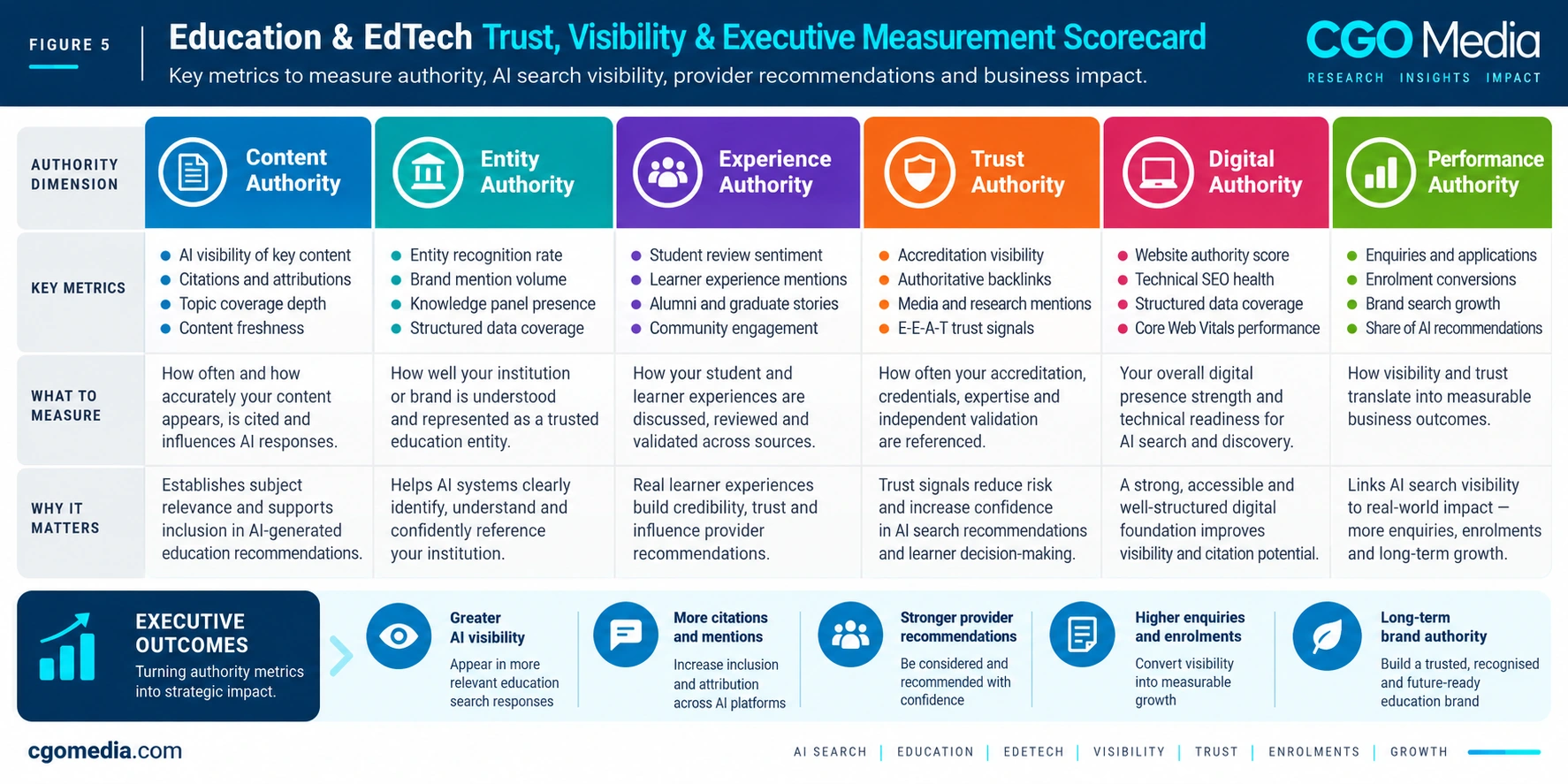
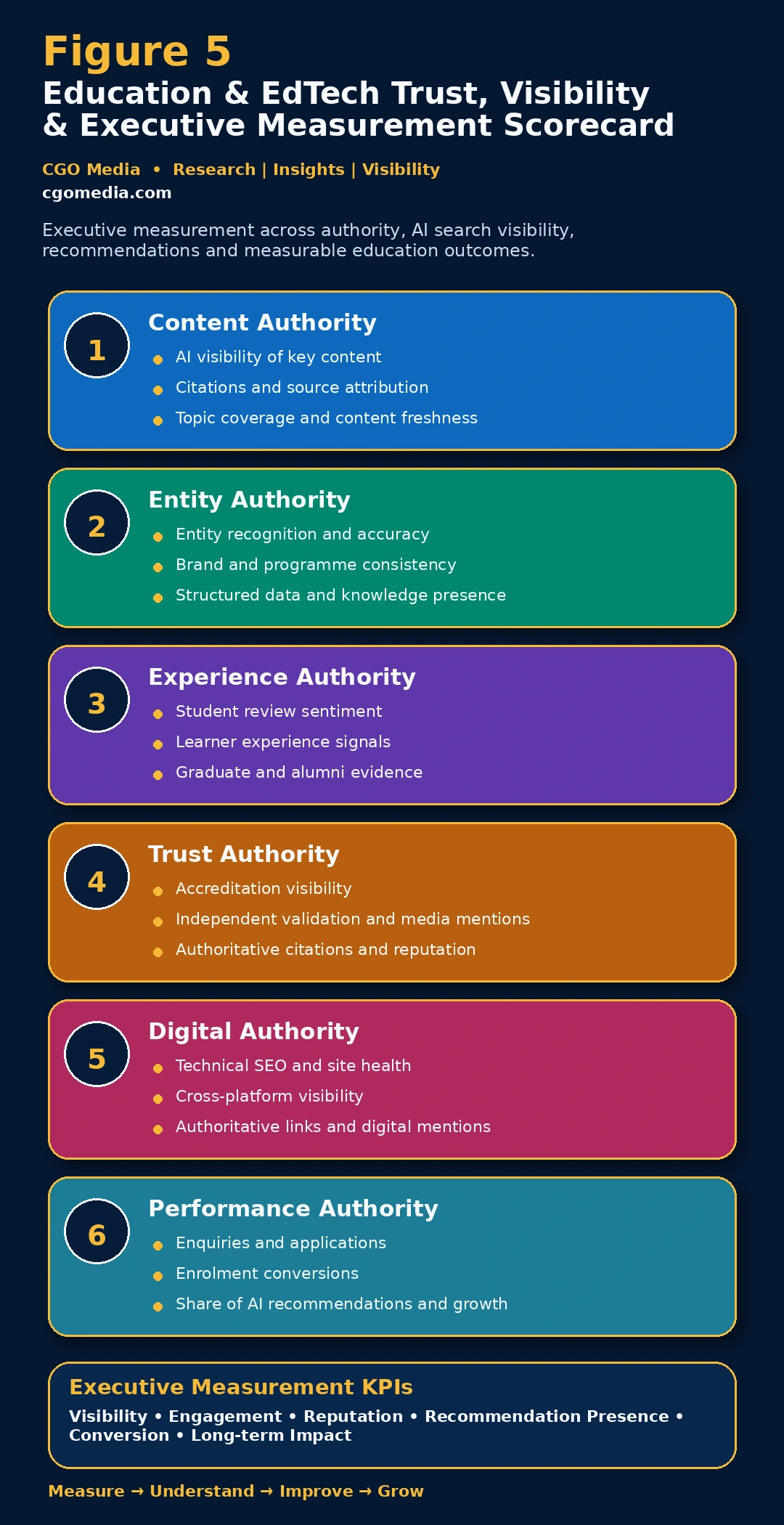
491. Education Authority Requires Continuous Improvement
Education and EdTech authority should not be treated as a one-time implementation project.
Programmes change, fees change, accreditation changes, faculty changes, learner expectations evolve and AI-assisted discovery systems continue to develop.
492. Continuous Improvement Should Follow a Repeatable Cycle
A practical model is:
Observe → Verify → Diagnose → Prioritise → Improve → Validate → Measure → Learn → Reassess
493. Observe
Monitor:
- Programme information
- Provider profiles
- Accreditation
- Reviews
- Outcome evidence
- AI representation
494. Verify
Confirm whether an apparent weakness is genuine before acting.
495. Diagnose
Determine whether the problem is primarily related to:
- Provider identity
- Programme authority
- Information quality
- External validation
- Outcome evidence
- AI interpretation
496. Prioritise
Use:
Authority Gap + Risk + Learner Impact + Strategic Importance + Evidence Confidence
497. Improve
Address the underlying evidence weakness rather than simply rewriting visible copy.
498. Validate
Confirm that the corrected information is accurate and present across the appropriate controlled systems.
499. Measure
Compare the updated state with the previous baseline.
500. Learn
Use recurring issues to improve:
- Standards
- Templates
- Workflows
- Governance
501. Reassess
Update the provider’s authority profile periodically.
502. Authority Decay Should Be Expected
Even strong providers can lose clarity, trust and visibility over time.
503. Provider Entity Authority Can Decay
Potential causes include:
- Rebrands
- Mergers
- New campuses
- New online brands
- Legacy provider profiles
504. Programme Authority Can Decay
Potential causes include:
- Outdated curriculum
- Missing faculty updates
- Weak subject coverage
- Programme restructuring
505. Programme Information Quality Can Decay
Potential causes include:
- Old fees
- Historic entry requirements
- Expired start dates
- Changed delivery formats
506. External Validation Can Decay
Potential causes include:
- Expired accreditation
- Outdated ranking claims
- Old employer partnerships
- Unmaintained external profiles
507. Outcome Authority Can Decay
Potential causes include:
- Old graduate data
- Historic salary claims
- Outdated labour-market evidence
- Unsupported employer statements
508. AI Recommendation Authority Can Decay
Potential causes include:
- Stale programme summaries
- Persistent entity confusion
- Old marketplace data
- Outdated accreditation information
509. Authority Decay Should Be Monitored by Dimension
A strong overall provider reputation can conceal declining programme-level evidence.
510. Build an Authority Health Register
A practical register can include:
- Authority dimension
- Current level
- Trend
- Risk
- Owner
- Next action
511. Build a Programme Health Register
Priority programmes can be monitored for:
- Information freshness
- Accreditation status
- Faculty accuracy
- Outcome evidence
- AI representation
512. Build an External Evidence Register
Record important external sources such as:
- Accreditation bodies
- Course marketplaces
- Review platforms
- Employer references
- Education media
513. Build an AI Representation Register
Record material observations around:
- Provider identity
- Course matching
- Fees
- Entry requirements
- Accreditation
- Outcomes
514. Education Authority Should Be Resilient to Organisational Change
The authority system should survive changes in:
- Branding
- Programme portfolio
- Academic structure
- Technology
- Markets
515. Resilient Provider Architecture
Institutional relationships should remain clear even when the organisation changes.
516. Resilient Programme Architecture
Programmes should remain connected logically to:
- Subject areas
- Qualifications
- Faculty
- Campuses
- Delivery formats
517. Resilient Accreditation Architecture
Accreditation information should remain traceable and current.
518. Resilient Outcome Architecture
Outcome evidence should preserve methodology, cohort and time-period context.
519. Resilient External Authority
The provider should not depend on one marketplace, ranking platform or external source for all discovery.
520. Resilient AI Visibility
The provider should focus on strong public evidence rather than dependence on one model or interface.
521. Resilience Requires Source Diversity
Relevant evidence can exist across:
- First-party sources
- Accreditation sources
- Professional sources
- Employer sources
- Learner sources
- AI interfaces
522. Source Diversity Should Not Become Artificial Citation Building
The objective is credible corroboration rather than manufactured mention volume.
523. Resilience Requires Data Portability
Core programme data should be maintained in ways that can support multiple digital environments.
524. Resilience Requires Review Ownership
Each high-risk information class should have an accountable owner.
525. Resilience Requires Institutional Memory
Important changes should be documented so future teams understand:
- What changed
- Why it changed
- When it changed
- What systems were affected
526. Institutional Learning Should Feed Future Programme Design
Search and learner behaviour can reveal:
- Recurring information gaps
- Common eligibility confusion
- High-interest subjects
- Delivery preferences
- Career concerns
527. AI Search Intelligence Can Reveal New Learner Questions
Repeated prompts may expose emerging expectations not yet reflected in existing programme content.
528. Review Intelligence Can Reveal Operational Weakness
Recurring feedback can expose problems with:
- Support
- Assessment
- Technology
- Communication
- Administration
529. Employer Intelligence Can Reveal Curriculum Gaps
Employer feedback may identify:
- Emerging skills
- Missing capabilities
- Industry changes
- New role requirements
530. Outcome Intelligence Can Reveal Programme Fit
Graduate progression can provide evidence about how well programmes align with learner objectives.
531. Search Authority Can Become a Strategic Intelligence Function
The discipline can contribute to:
- Programme development
- Admissions
- Marketing
- Careers
- Student experience
- Institutional strategy
532. Education Authority Should Operate on Multiple Time Horizons
A mature programme combines:
- Immediate correction
- Quarterly improvement
- Annual strategic development
533. Immediate Horizon — Correct Material Risk
Priority issues may include:
- False accreditation
- Incorrect fees
- Wrong awarding organisation
- Withdrawn programmes still promoted
- High-impact AI misinformation
534. Quarterly Horizon — Improve Authority
Quarterly work may include:
- Programme evidence improvement
- Subject-cluster development
- External validation
- Outcome updates
- AI monitoring
535. Annual Horizon — Build Resilience
Annual strategy may include:
- Authority maturity reassessment
- Programme portfolio review
- Data architecture
- Governance
- Market expansion
536. A 12-Month Education Authority Cycle
A practical annual sequence is:
Q1: Diagnose and Correct
Q2: Structure and Strengthen
Q3: Scale and Measure
Q4: Govern and Reassess
537. Quarter One — Diagnose and Correct
Focus on:
- Provider entity audit
- Programme-data audit
- Accreditation audit
- Outcome evidence audit
- AI baseline
538. Quarter Two — Structure and Strengthen
Focus on:
- Subject architecture
- Curriculum depth
- Faculty relationships
- Trust evidence
- External validation
539. Quarter Three — Scale and Measure
Focus on:
- Additional programmes
- Additional markets
- Employer evidence
- Outcome measurement
- AI monitoring
540. Quarter Four — Govern and Reassess
Focus on:
- Authority maturity
- Review-cycle performance
- Authority decay
- Next-year priorities
541. The Annual Cycle Should Remain Flexible
Material learner-risk issues should be addressed when they arise.
542. Strategic Recommendation One — Clarify the Provider Entity
Make institutional, campus, partner, online-brand and awarding relationships clear.
543. Strategic Recommendation Two — Build Subject Authority Deliberately
Connect:
- Programmes
- Faculty
- Research
- Learning resources
- Professional relevance
544. Strategic Recommendation Three — Strengthen Programme Evidence
Every priority programme should provide sufficient information for informed comparison.
545. Strategic Recommendation Four — Govern High-Change Information
Particular attention should be paid to:
- Fees
- Entry requirements
- Start dates
- Programme availability
546. Strategic Recommendation Five — Make Accreditation Verifiable
Where accreditation is relevant, explain it precisely and link it to appropriate programme context.
547. Strategic Recommendation Six — Strengthen Learner Trust
Use:
- Clear support information
- Authentic learner feedback
- Transparent programme evidence
- Independent validation
548. Strategic Recommendation Seven — Build Outcome Authority
Publish defensible outcome evidence with:
- Methodology
- Sample
- Time period
- Limitations
549. Strategic Recommendation Eight — Strengthen Employer Authority
Demonstrate genuine links between curriculum, professional practice and labour-market relevance.
550. Strategic Recommendation Nine — Avoid Unsupported Employment Claims
Career-focused messaging should distinguish between:
- Skills development
- Employability support
- Observed outcomes
- Guaranteed outcomes
551. Strategic Recommendation Ten — Strengthen EdTech Product Evidence
Technology claims should explain how product features support learning rather than rely on feature lists alone.
552. Strategic Recommendation Eleven — Monitor AI Representation
Track:
- Presence
- Relevance
- Accuracy
- Trust context
553. Strategic Recommendation Twelve — Prioritise Material AI Errors
Focus on inaccuracies that affect:
- Eligibility
- Fees
- Accreditation
- Programme availability
- Outcome claims
554. Strategic Recommendation Thirteen — Avoid Prompt Chasing
Improve the underlying evidence system rather than optimising repeatedly for one generated answer.
555. Strategic Recommendation Fourteen — Use Cross-Functional Governance
The strongest system connects:
SEO + Academic Teams + Admissions + Quality + Careers + Communications + Data + Technology
556. Strategic Recommendation Fifteen — Measure Qualified Learner Progression
Do not evaluate success through traffic or application volume alone.
557. Strategic Recommendation Sixteen — Connect Search with Learner Experience
Post-enrolment experience influences:
- Reviews
- Reputation
- Alumni advocacy
- Future provider selection
558. Strategic Recommendation Seventeen — Reassess Authority Regularly
Use the Education Search Authority Maturity Model to track whether organisational capabilities are progressing.
559. Strategic Recommendation Eighteen — Connect Trust with Provider Selection
Use the Education Discovery and Provider Selection Model to understand how authority affects learner progression.
560. Strategic Recommendation Nineteen — Translate Gaps into Implementation
Use the Education & EdTech SEO and AI Implementation Roadmap to convert diagnostic findings into structured workstreams.
561. Strategic Recommendation Twenty — Integrate the Parent Research
The broader Education & EdTech SEO in an AI Search Environment research paper provides the wider strategic context for the framework.
562. The Education Trust and Visibility Equation
The framework can be summarised as:
Provider Clarity + Programme Authority + Programme Evidence + External Validation + Outcome Authority + AI Recommendation Readiness
563. The Operational Equation
Continuous authority improvement can be summarised as:
Observe → Verify → Diagnose → Prioritise → Improve → Validate → Measure → Learn → Reassess
564. The Learner Outcome
The strategic objective is to support:
Relevant Discovery → Clear Understanding → Verifiable Trust → Informed Comparison → Appropriate Selection
565. The Institutional Outcome
The objective is not simply to maximise rankings or AI mentions.
It is to build a sufficiently clear, trusted and resilient education authority system that can remain useful as search, recommendation and learner-discovery behaviours evolve.
566. The Continuous Improvement Principle
Education and EdTech authority should be treated as a governed evidence system that is continually maintained, measured and improved rather than as a static collection of webpages.
567. The Next Stage Is Final Research Integration
The final section consolidates the framework’s strategic implications, methodology, limitations, conclusion, references, author information and research citation guidance.
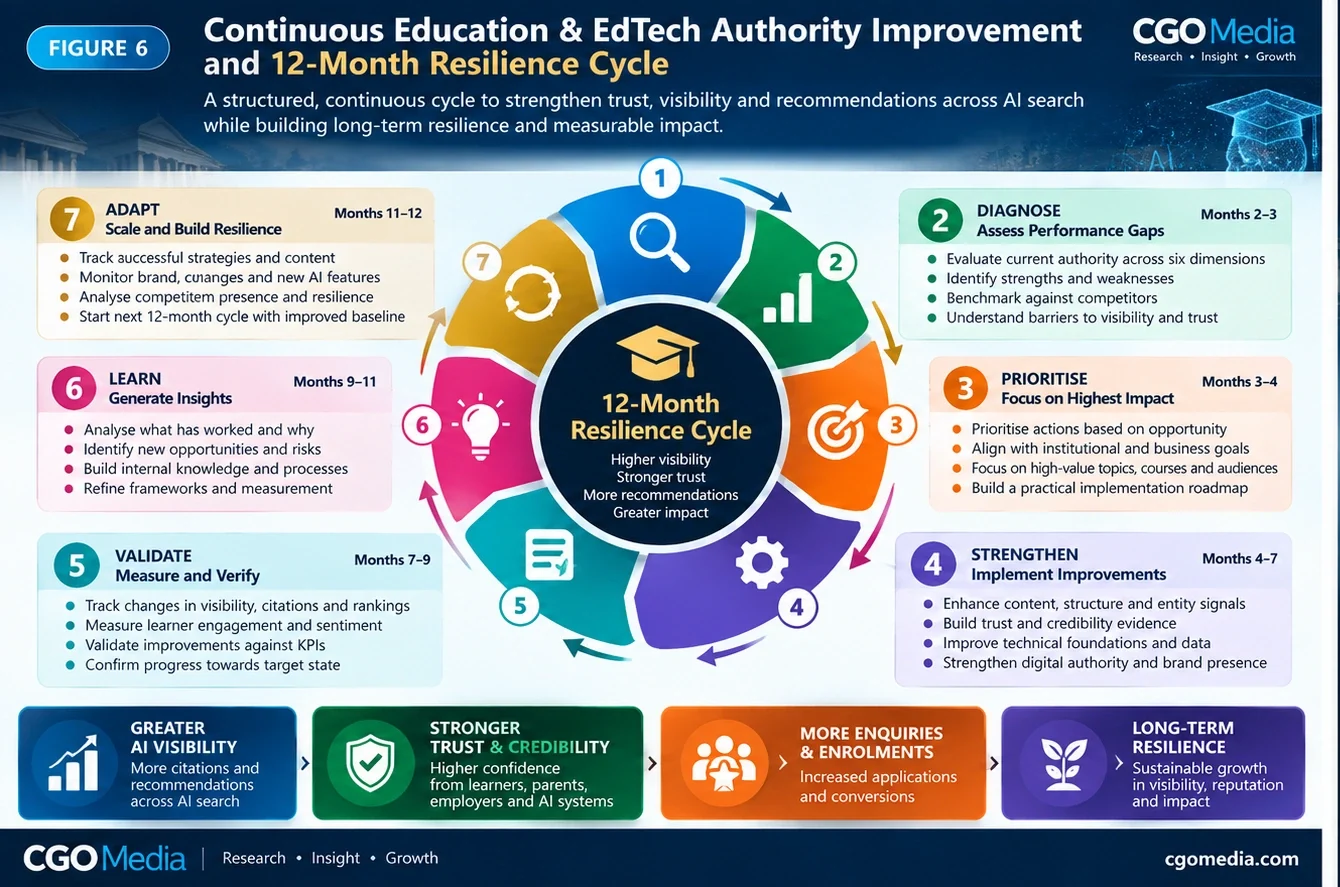

568. Strategic Implications
Education and EdTech visibility is increasingly shaped by the quality, clarity and consistency of the evidence surrounding the provider rather than by rankings alone.
The strongest organisations are likely to be those that connect institutional identity, subject authority, programme evidence, accreditation, learner trust, outcomes, employer relevance and AI-assisted discovery into one governed authority system.
569. Provider Clarity Is Foundational
Learners and machine-mediated systems need to understand:
- Who the provider is
- What type of provider it is
- Which programmes it delivers
- Which qualifications it awards
- Where and how learning takes place
570. Programme Authority Should Be Demonstrated, Not Assumed
A programme title alone provides limited evidence of educational depth.
Authority is strengthened through curriculum, faculty, subject expertise, learning outcomes, delivery information and qualification clarity.
571. Programme Information Quality Directly Affects Learner Trust
Fees, entry requirements, start dates, delivery mode and programme status should remain sufficiently current for learners to make informed decisions.
572. Accreditation Requires Precision
Providers should distinguish between:
- Institutional recognition
- Qualification recognition
- Programme accreditation
- Professional recognition
573. External Validation Strengthens Provider Evidence
Relevant independent evidence can include:
- Accreditation bodies
- Professional organisations
- Education media
- Employer relationships
- Learner reviews
- Research citations
574. Outcomes Should Be Evidenced Carefully
Employment, salary, progression and completion claims should preserve enough methodological context to avoid creating unrealistic expectations.
575. Employer Authority Is Different from Promotional Partnership Language
The strongest employer evidence demonstrates meaningful relationships between:
- Curriculum
- Skills
- Professional practice
- Placements
- Recruitment
576. EdTech Requires Dual Authority
Many EdTech organisations must establish both:
Educational Authority + Product Authority
577. Product Features Alone Do Not Establish Learning Quality
Technology claims are stronger when they connect platform capability with demonstrable learning processes and outcomes.
578. AI Search Should Be Treated as an Evidence Environment
AI-assisted systems can expose strengths and weaknesses across the wider public evidence ecosystem.
579. AI Presence Is Not the Same as Authority
A provider can appear frequently while being represented inaccurately or irrelevantly.
580. AI Recommendation Readiness Should Be Measured Through Multiple Dimensions
A practical model is:
Presence + Relevance + Accuracy + Trust Context
581. AI Recommendation Inclusion Is Not Academic Endorsement
Generated inclusion does not prove programme quality, accreditation, admission eligibility or employment outcomes.
582. AI Recommendation Order Should Not Be Treated as a Stable Ranking
Provider order can change according to prompt, system, geography and available evidence.
583. Education Trust Should Be Learner-Centred
The strategic objective is not simply to make the provider visible.
It is to help the right learner understand whether the programme is appropriate.
584. Education Authority Should Be Measured Across the Learner Journey
A useful progression is:
Discovery → Understanding → Validation → Comparison → Application → Enrolment → Learning → Outcome
585. Qualified Progression Is More Meaningful Than Raw Volume
Traffic and application growth should be interpreted alongside suitability, completion, learner experience and longer-term outcomes.
586. Governance Protects Long-Term Authority
Provider and programme authority can deteriorate through:
- Stale information
- Programme change
- Rebrands
- Expired accreditation
- Outdated outcome evidence
- AI representation drift
587. Authority Should Be Managed as an Ongoing System
The operational cycle is:
Observe → Verify → Diagnose → Prioritise → Improve → Validate → Measure → Learn → Reassess
588. The Framework Should Support Cross-Functional Governance
A mature education authority system may connect:
SEO + Academic Teams + Admissions + Quality + Careers + Communications + Data + Technology
589. The Framework Should Support Institutional Learning
Search behaviour, reviews, employer feedback and AI observations can contribute to wider understanding of:
- Learner needs
- Programme gaps
- Trust concerns
- Career expectations
- Market changes
590. Relationship with the Education & EdTech Research Family
This framework forms one part of the wider CGO Media Education & EdTech research architecture.
Education & EdTech SEO in an AI Search Environment | Education Discovery and Provider Selection Model | Education Search Authority Maturity Model | Education & EdTech SEO and AI Implementation Roadmap
591. Relationship with the Parent Research Paper
The Education & EdTech SEO in an AI Search Environment paper provides the wider strategic context for education search authority, provider discovery, AI-assisted search and institutional visibility.
592. Relationship with the Provider Selection Model
The Education Discovery and Provider Selection Model explains how learners progress from need recognition through provider discovery, evaluation, validation and selection.
593. Relationship with the Maturity Model
The Education Search Authority Maturity Model provides a structured way to assess organisational search-authority capability over time.
594. Relationship with the Implementation Roadmap
The Education & EdTech SEO and AI Implementation Roadmap translates authority gaps into structured workstreams, priorities and governance actions.
595. Methodology
The Education & EdTech AI Trust and Visibility Framework is a conceptual research framework developed by CGO Media to examine the evidence structures that influence provider discovery, learner trust and AI-assisted recommendation in modern education search environments.
596. Research Scope
The framework is designed to apply across:
- Universities
- Colleges
- Training providers
- Online academies
- Professional education providers
- EdTech platforms
- Career-transition programmes
597. Six-Dimension Method
The research organises education authority into six connected dimensions:
- Provider and Entity Clarity
- Subject, Qualification and Course Authority
- Programme Evidence and Information Quality
- Accreditation, Learner Trust and External Validation
- Outcome, Employer and Market Authority
- AI Search and Provider Recommendation Readiness
598. Provider and Entity Method
This dimension evaluates whether institutional relationships can be interpreted accurately across:
- Brands
- Campuses
- Faculties
- Partners
- Awarding organisations
- Delivery environments
599. Programme Authority Method
This dimension considers:
- Subject depth
- Curriculum
- Qualification level
- Faculty
- Audience fit
600. Programme Evidence Method
This dimension assesses:
- Fees
- Entry requirements
- Duration
- Delivery
- Assessment
- Support
601. External Validation Method
This dimension evaluates independent evidence from:
- Accreditation bodies
- Professional organisations
- Reviews
- Education media
- Employer relationships
602. Outcome Authority Method
This dimension considers:
- Graduate outcomes
- Employment
- Progression
- Employer relevance
- Labour-market context
603. AI Readiness Method
This dimension assesses:
- Provider presence
- Recommendation relevance
- Material accuracy
- Trust context
- Error persistence
604. Diagnostic Method
Each dimension can be assessed using a five-level scale:
- Weak
- Emerging
- Established
- Strong
- Resilient
605. Evidence Confidence Method
Findings can be classified as:
- Low confidence
- Medium confidence
- High confidence
606. Trend Method
Direction of travel can be classified as:
- Improving
- Stable
- At Risk
- Deteriorating
607. Gap Method
A simple current-versus-target model is:
Target Level − Current Level = Authority Gap
608. Priority Method
The framework proposes:
Priority = Authority Gap + Risk + Learner Impact + Strategic Importance + Evidence Confidence
609. AI Observation Method
AI monitoring should use repeatable prompt groups and record relevant context such as:
- Prompt
- Model
- Date
- Market
- Learner type
- Observed answer
610. Governance Method
The framework treats authority as an ongoing system requiring:
- Ownership
- Review cycles
- Change triggers
- Escalation
- Continuous reassessment
611. Limitations
This framework is a strategic and conceptual research model. It is not an accreditation audit, legal opinion, regulatory assessment, guarantee of educational quality or substitute for formal institutional quality-assurance processes.
612. Education Systems Differ
Qualification structures, accreditation systems, funding models and learner expectations vary between countries and sectors.
613. Provider Types Differ
The evidence required from a university may differ from that required from a vocational provider, online academy or EdTech platform.
614. Programme Types Differ
Academic degrees, professional qualifications, bootcamps and short courses may require different evidence weighting.
615. Accreditation Is Context-Dependent
Not every programme or provider operates under the same accreditation or professional-recognition system.
616. Learner Reviews Are Incomplete Evidence
Review platforms may overrepresent particularly positive or negative experiences.
617. Ranking Systems Have Methodological Limits
Different ranking organisations use different datasets, methodologies and weighting systems.
618. Outcome Data Has Limitations
Employment and progression outcomes can be affected by:
- Economic conditions
- Labour markets
- Learner background
- Location
- Industry
619. Employment Outcomes Are Not Guaranteed
Participation in a programme does not guarantee employment, promotion, salary level or career progression.
620. AI Systems Are Variable
Generated responses may change according to:
- Model
- Prompt
- Location
- Time
- Available evidence
621. AI Source Visibility Is Partial
Displayed citations do not necessarily represent every source or process involved in answer construction.
622. Visible Citations Do Not Establish Full Causation
A displayed source should not automatically be treated as the sole reason a provider was included or recommended.
623. AI Recommendation Inclusion Is Not Independent Certification
AI-generated inclusion does not independently establish:
- Programme quality
- Provider legitimacy
- Accreditation
- Suitability
- Employment outcomes
624. AI Rankings Are Not Stable
Provider order can vary between prompts, sessions and systems.
625. Search Visibility Is Not Guaranteed
No framework can guarantee particular organic rankings.
626. AI Visibility Is Not Guaranteed
No methodology can guarantee recommendation, citation or inclusion within a specific AI system.
627. Learner Selection Is Not Guaranteed
Provider selection can be affected by:
- Fees
- Location
- Entry requirements
- Reputation
- Delivery mode
- Personal circumstances
628. Correlation Should Not Be Presented as Causation
Changes in AI mentions, search visibility, applications or enrolments should not automatically be attributed to one intervention without sufficient evidence.
629. Conclusion
Education and EdTech search visibility is increasingly determined by a broader evidence system rather than by conventional SEO factors alone.
Learners now discover and evaluate providers across search engines, course marketplaces, review platforms, accreditation sources, professional bodies, employer networks and AI-assisted systems.
This changes the strategic question from:
“How do we rank this course page?”
to:
“How do we build an education authority system that can be discovered, understood, verified and trusted across multiple environments?”
The framework proposes six connected dimensions:
Provider Clarity + Programme Authority + Programme Evidence + External Validation + Outcome Authority + AI Recommendation Readiness
Together, these dimensions create a structured model for assessing whether an education provider can support relevant discovery, learner understanding, external validation and accurate AI-assisted representation.
The long-term operating cycle is:
Observe → Verify → Diagnose → Prioritise → Improve → Validate → Measure → Learn → Reassess
The objective is not maximum traffic or maximum AI mention volume.
It is to build a resilient education authority system capable of supporting:
Relevant Discovery → Clear Understanding → Verifiable Trust → Informed Comparison → Appropriate Selection
References
External Academic, Technical and Search Sources
- Google Search Central. SEO Starter Guide.
- Google Search Central. Understand how structured data works.
- Schema.org. EducationalOrganization.
- Schema.org. Course.
- Schema.org. Organization.
- Hogan, A. et al. (2021). Knowledge Graphs. ACM Computing Surveys, 54(4).
- Metzger, M.J. (2007). Making Sense of Credibility on the Web: Models for Evaluating Online Information and Recommendations for Future Research. Journal of the American Society for Information Science and Technology, 58(13), 2078–2091.
- Ji, Z. et al. (2023). Survey of Hallucination in Natural Language Generation. ACM Computing Surveys, 55(12).
CGO Media Education & EdTech Research and Frameworks
- Wilkinson, R. (2026). Education & EdTech SEO in an AI Search Environment. CGO Media.
- Wilkinson, R. (2026). Education Discovery and Provider Selection Model. CGO Media.
- Wilkinson, R. (2026). Education Search Authority Maturity Model. CGO Media.
- Wilkinson, R. (2026). Education & EdTech SEO and AI Implementation Roadmap. CGO Media.
CGO Media Research Ecosystem
CGO Media Research Library | CGO Media Framework Library | CGO Media Research Architecture
About Roger Wilkinson
Roger Wilkinson is an independent researcher, SEO practitioner and founder of CGO Media with more than 25 years of experience in search, digital visibility and business growth.
His research focuses on how artificial intelligence is reshaping search engines, recommendation systems, entity representation, digital authority and organisational visibility.
Roger is the creator of the CGO Framework Series, a collection of research-led methodologies designed to help organisations measure, improve and govern Search Visibility, AI Visibility and Digital Authority.
His work examines the relationship between Technical SEO, Entity Authority, Content Authority, Citation Authority, Brand Signals, Knowledge Architecture and AI Search Readiness.
View Roger Wilkinson’s researcher profile →
Related Education & EdTech Research and Frameworks
Education & EdTech SEO in an AI Search Environment |
Education Discovery and Provider Selection Model |
Education Search Authority Maturity Model |
Education & EdTech SEO and AI Implementation Roadmap |
Education GEO: Generative Engine Optimisation
Research Usage & Citation
CGO Media encourages researchers, journalists, universities, colleges, training providers, EdTech companies, employers and education-sector organisations to reference this framework where it contributes to wider discussion of education discovery, provider authority, learner trust, AI search and digital visibility.
Reasonable quotations, summaries, figures and excerpts may be used in articles, reports, presentations, academic work and other publications provided appropriate acknowledgement is given to Roger Wilkinson and CGO Media.
Cite This Research Framework / Embed Citation
The Education & EdTech AI Trust and Visibility Framework by Roger Wilkinson at CGO Media defines six connected dimensions of provider authority: provider clarity, programme authority, programme evidence, external validation, outcome authority and AI recommendation readiness.
APA Citation
APA Citation: Wilkinson, R. (2026). Education & EdTech AI Trust and Visibility Framework. CGO Media. https://cgomedia.com/education-edtech-ai-trust-visibility-framework/
Author: Roger Wilkinson | Published by: CGO Media
For permissions relating to extensive reproduction, commercial licensing or republication of substantial portions of this framework, please contact CGO Media directly.