
Education & EdTech SEO and AI Implementation Roadmap
 The Education & EdTech SEO and AI Implementation Roadmap provides a structured implementation sequence for universities, colleges, training providers, professional education organisations, online course companies and EdTech platforms seeking to strengthen search visibility, programme authority, provider trust, learner discovery and AI-assisted recommendation readiness.
The roadmap translates education search strategy into an operational progression designed to move organisations from fragmented SEO activity toward a governed authority system connecting technical search performance, provider identity, subject expertise, programme evidence, accreditation, learner trust, employer relevance, outcomes and AI visibility.
It forms part of the wider CGO Media Education & EdTech research system and should be read alongside Education & EdTech SEO in an AI Search Environment, the Education & EdTech AI Trust and Visibility Framework, the Education Discovery and Provider Selection Model and the Education Search Authority Maturity Model.
1. Why Education Search Needs an Implementation Roadmap
Education organisations often possess substantial academic expertise, recognised qualifications, specialist programmes, experienced faculty and strong learner outcomes while representing these assets inconsistently across the digital environment.
2. Education Authority Is Frequently Fragmented
Common weaknesses include:
- Fragmented programme architecture
- Outdated course information
- Unclear accreditation
- Weak provider entity relationships
- Limited outcome evidence
- Inconsistent external profiles
- Little or no systematic AI monitoring
3. Fragmentation Creates Learner Friction
Prospective learners may struggle to answer basic questions such as:
- Who provides the course?
- What qualification does it lead to?
- What does it cost?
- Am I eligible?
- Is it recognised?
- What outcomes can it support?
4. Fragmentation Also Creates Search Interpretation Risk
Search engines and AI-assisted systems can encounter conflicting or incomplete information across:
- Institution websites
- Course marketplaces
- Accreditation sources
- Review platforms
- Education media
- Employer sources
5. Implementation Order Matters
Education organisations should not scale content, Digital PR or AI visibility activity while core programme information remains inaccurate or difficult to interpret.
6. Visibility Can Amplify Weak Information
Greater discovery is not automatically beneficial if users encounter:
- Incorrect fees
- Expired accreditation
- Outdated entry requirements
- Withdrawn programmes
- Conflicting provider information
7. The Roadmap Therefore Prioritises Dependency
Foundational weaknesses should be corrected before advanced authority expansion.
8. From Isolated SEO Activity to Education Authority
The implementation objective is not simply to optimise more course pages.
9. The Objective Is a Connected Education Authority System
This system should connect:
- Provider identity
- Subjects
- Qualifications
- Courses
- Curriculum
- Faculty
- Accreditation
- Learner outcomes
- External validation
- AI visibility
10. The Strategic Progression
The roadmap can be summarised as:
Fix → Clarify → Structure → Strengthen → Validate → Integrate → Evolve
11. Fix
Correct material technical, programme and provider information problems.
12. Clarify
Ensure that users can understand:
- Who the provider is
- What programmes are offered
- What qualifications mean
- Where and how learning takes place
13. Structure
Build relationships between:
- Providers
- Subjects
- Qualifications
- Courses
- Faculty
- Accreditation
- Outcomes
14. Strengthen
Improve the depth and usefulness of educational evidence.
15. Validate
Strengthen independent corroboration through:
- Accreditation
- Professional recognition
- Learner evidence
- Employer evidence
- Research
- Education media
16. Integrate
Connect SEO with academic, admissions, careers, quality, product, data and communications teams.
17. Evolve
Move from implementation into continuous monitoring, governance and institutional learning.
18. The Seven Phases of the Roadmap
- Assess
- Stabilise
- Structure
- Strengthen
- Validate
- Integrate
- Evolve
19. Phase One — Assess
The first phase establishes the current state of education search authority.
20. Assessment Should Be Evidence-Led
The objective is to establish what is genuinely strong, weak, missing, inconsistent or unverified.
21. Assessment Should Cover Multiple Systems
The audit should extend beyond the provider website.
22. Core Assessment Areas
- Technical search performance
- Provider and entity clarity
- Subject and qualification coverage
- Course and curriculum evidence
- Accreditation and trust evidence
- External platform visibility
- AI search visibility
- Enrolment and commercial outcomes
23. Establish a Technical Search Baseline
Determine whether important programme and provider pages can be discovered reliably.
24. Technical Baseline — Crawlability
Priority programme information should be accessible to search systems.
25. Technical Baseline — Indexation
Important pages should be indexed intentionally rather than accidentally excluded or duplicated.
26. Technical Baseline — Site Architecture
The organisation should evaluate relationships between:
Provider → Subject → Qualification → Programme → Supporting Evidence
27. Technical Baseline — Internal Linking
Internal links should support both learner navigation and subject relationships.
28. Technical Baseline — Canonicalisation
Duplicate or overlapping programme URLs can create ambiguity around the preferred source.
29. Technical Baseline — Redirects
Historic courses, renamed programmes and structural migrations should be reviewed for redirect accuracy.
30. Technical Baseline — Performance
Page performance affects accessibility and learner experience, particularly on programme and application journeys.
31. Technical Baseline — Mobile Usability
Prospective learners may research extensively through mobile devices.
32. Technical Baseline — Accessibility
Education information should be usable by learners with different accessibility needs.
33. Technical Issues Should Be Prioritised by Educational Impact
A minor issue on an old news article should not receive the same priority as a major problem affecting core programme pages.
34. Assess Provider and Entity Clarity
The organisation should determine whether its institutional identity is represented consistently.
35. Provider Assessment Should Cover
- Institution or company name
- Schools and faculties
- Campuses
- Sub-brands
- Online learning brands
- Awarding relationships
- External profiles
36. Assess Parent and Sub-Entity Relationships
Larger education groups may contain multiple schools, faculties or brands that need explicit relationships.
37. Assess Awarding Relationships
Determine whether users can understand who:
- Delivers the programme
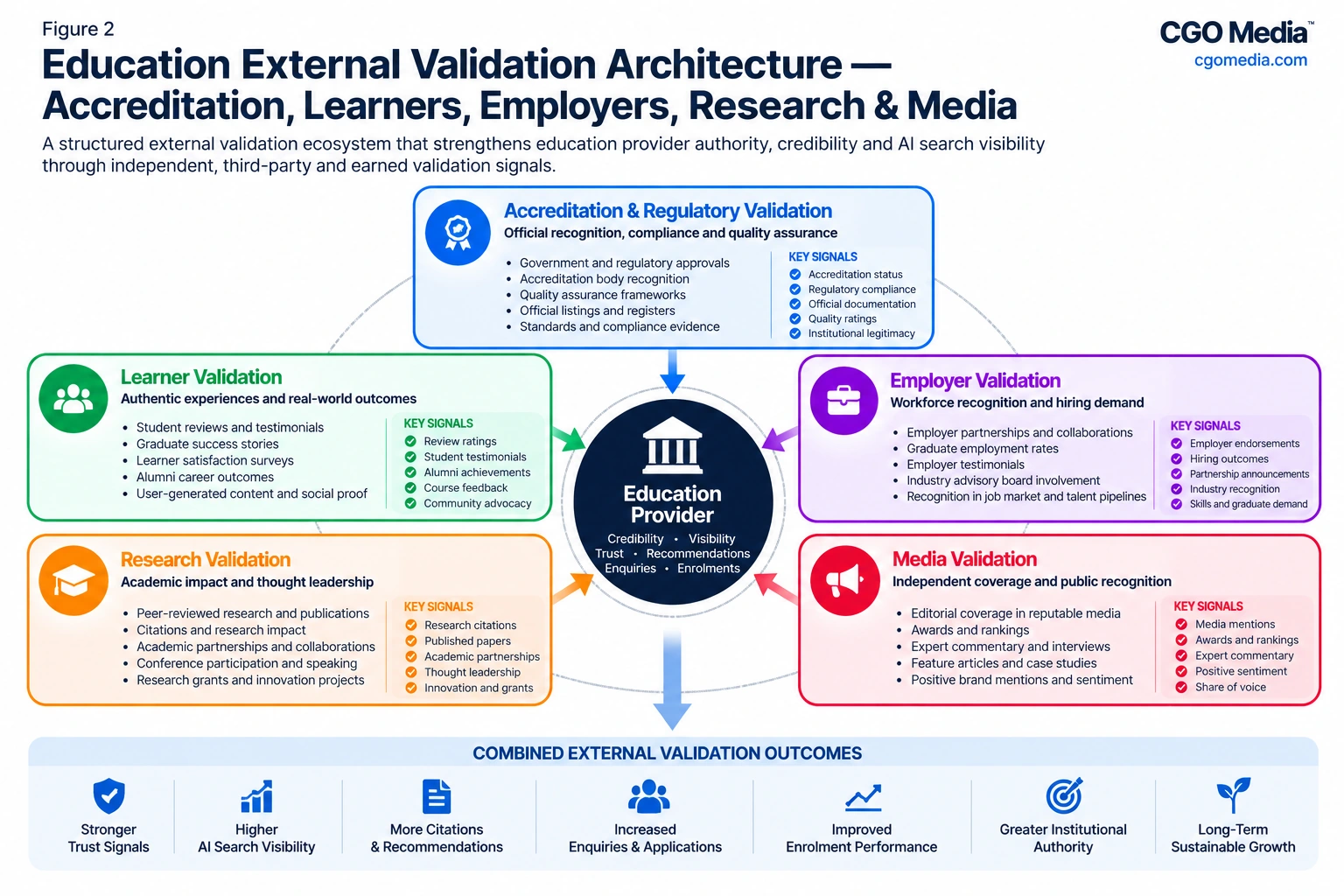
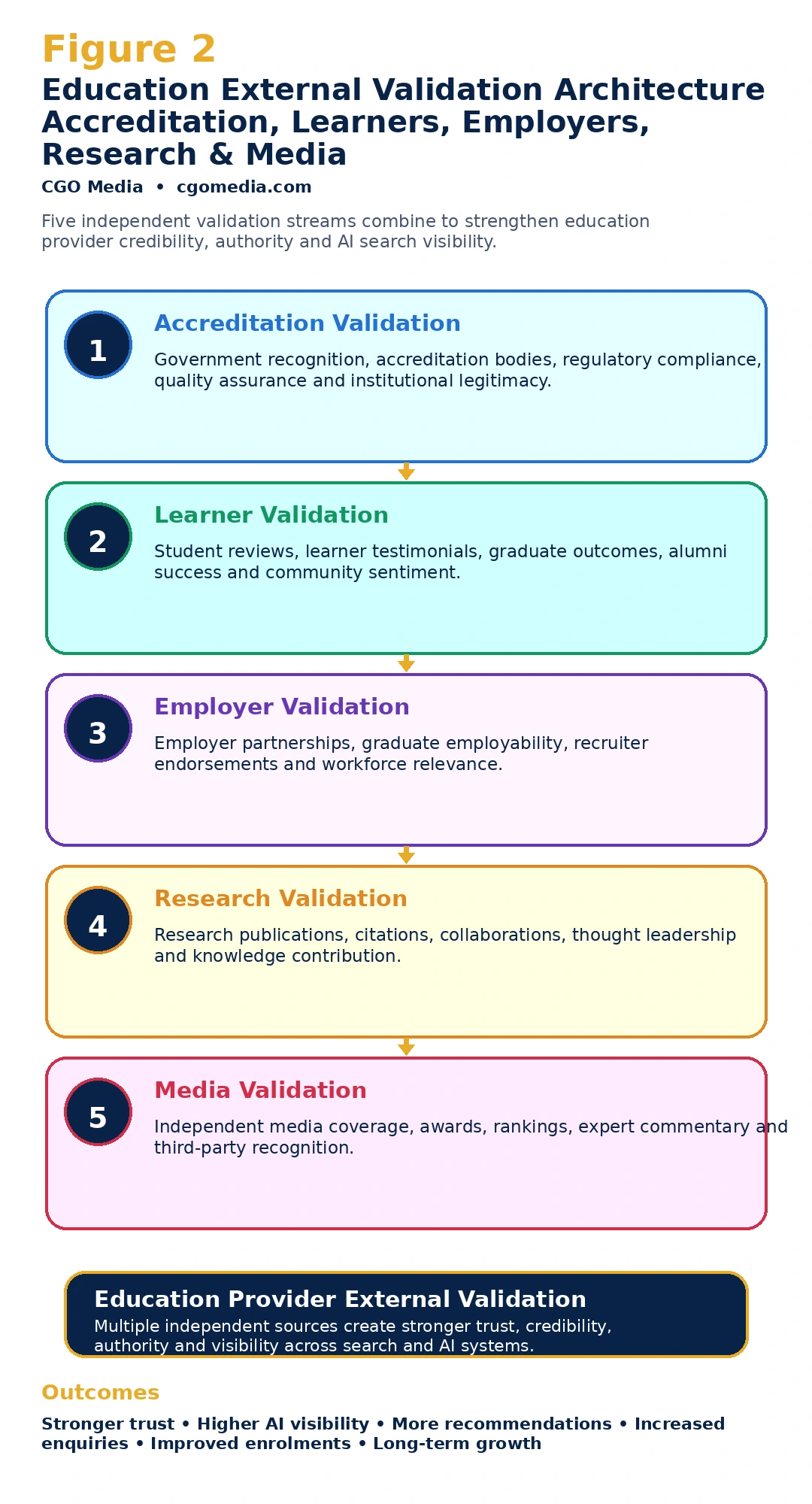
- Awards the qualification
- Provides accreditation
38. Assess Partner Delivery
Partnership programmes should make delivery and awarding responsibilities sufficiently clear.
39. Assess Historic Institution Names
Rebrands and mergers can leave legacy entity references across the web.
40. Assess External Entity Consistency
Compare provider information across:
- Search profiles
- Course marketplaces
- Professional bodies
- Education directories
- Review platforms
41. Assess Campus and Location Authority
Physical education providers should evaluate each campus independently where programme availability differs.
42. Campus Assessment Should Include
- Accurate location information
- Course availability
- Facilities
- Transport information
- Student services
- External listings
43. Campus Pages Should Reflect Actual Availability
A programme should not be associated with a campus where it is not offered.
44. Assess Local Search Representation
Institutions with physical locations should examine how campuses appear across local discovery environments.
45. Assess Subject Authority
The organisation should identify whether priority subject areas demonstrate sufficient educational depth.
46. Subject Authority Evidence Can Include
- Subject hubs
- Course portfolios
- Faculty expertise
- Research
- Career pathways
- External citations
47. Assess Subject Depth
A subject area with one thin course page may not demonstrate the same authority as a coherent body of programmes, faculty and supporting research.
48. Assess Subject Coverage
Identify strategic disciplines where:
- Content is strong
- Content is fragmented
- Evidence is missing
49. Assess Qualification Authority
Qualification relationships should be evaluated for clarity and recognition.
50. Qualification Assessment Should Include
- Qualification type
- Academic or professional level
- Awarding organisation
- Accreditation
- Recognition
- Progression opportunities
51. Assess Qualification Naming Consistency
Qualifications should be represented consistently enough to avoid learner confusion.
52. Assess Qualification Level Clarity
Learners should not have to infer whether a programme is:
- Undergraduate
- Postgraduate
- Vocational
- Professional
- Short-course
53. Assess Course Authority
Each priority programme should be evaluated for completeness and decision usefulness.
54. Course Authority Assessment Should Include
- Course purpose
- Target learner
- Curriculum
- Entry requirements
- Delivery format
- Duration
- Fees
- Accreditation
- Faculty
- Outcomes
55. Assess Course Purpose
The learner should be able to understand what the programme is designed to achieve.
56. Assess Audience Fit
The organisation should clarify whether the programme is intended for:
- School leavers
- Graduates
- Working professionals
- Career changers
- Enterprise learners
57. Assess Curriculum Evidence
Programme depth should be supported by more than a headline course description.
58. Curriculum Assessment Can Include
- Modules
- Learning outcomes
- Projects
- Assessments
- Practical work
- Electives
59. Assess Curriculum Freshness
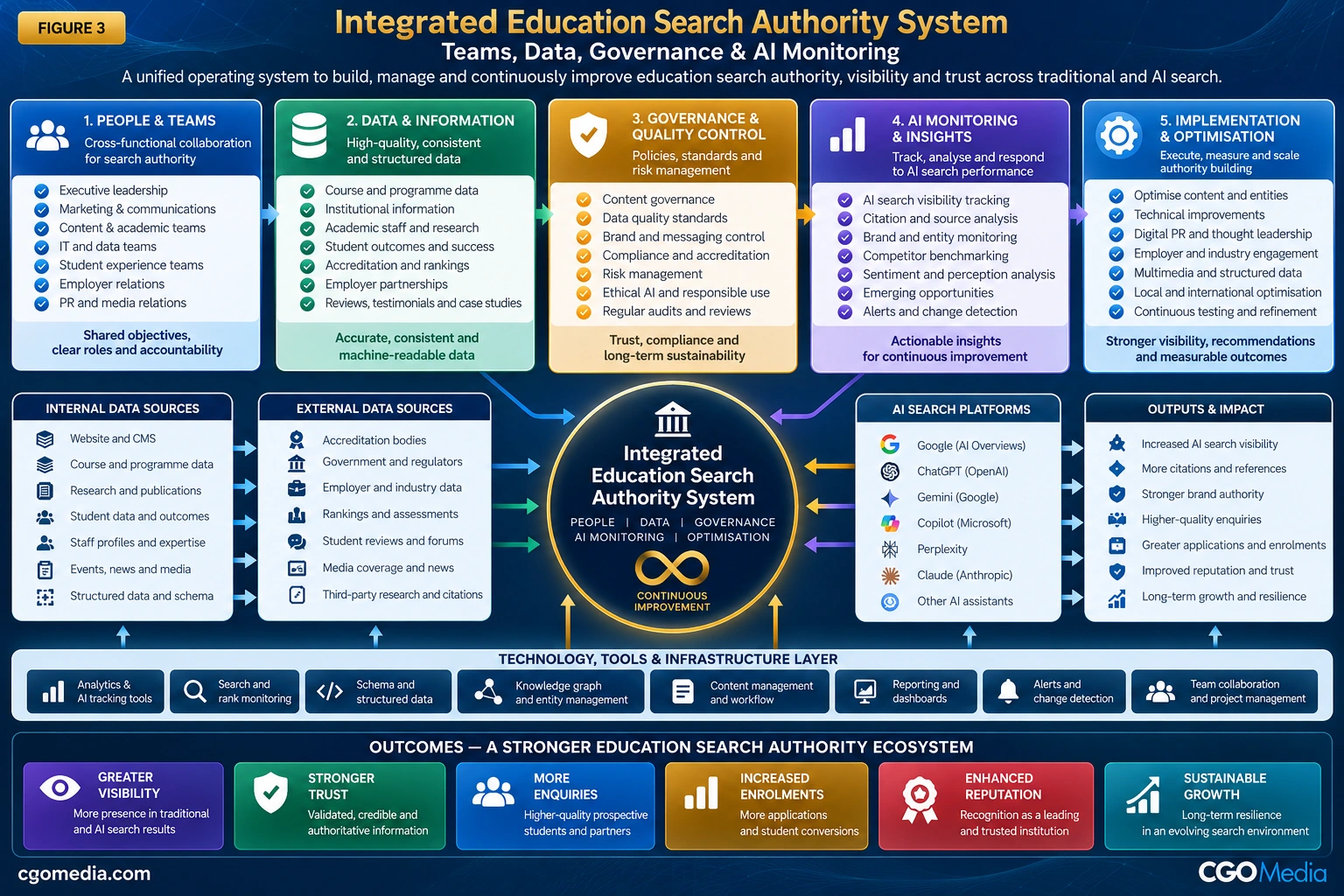
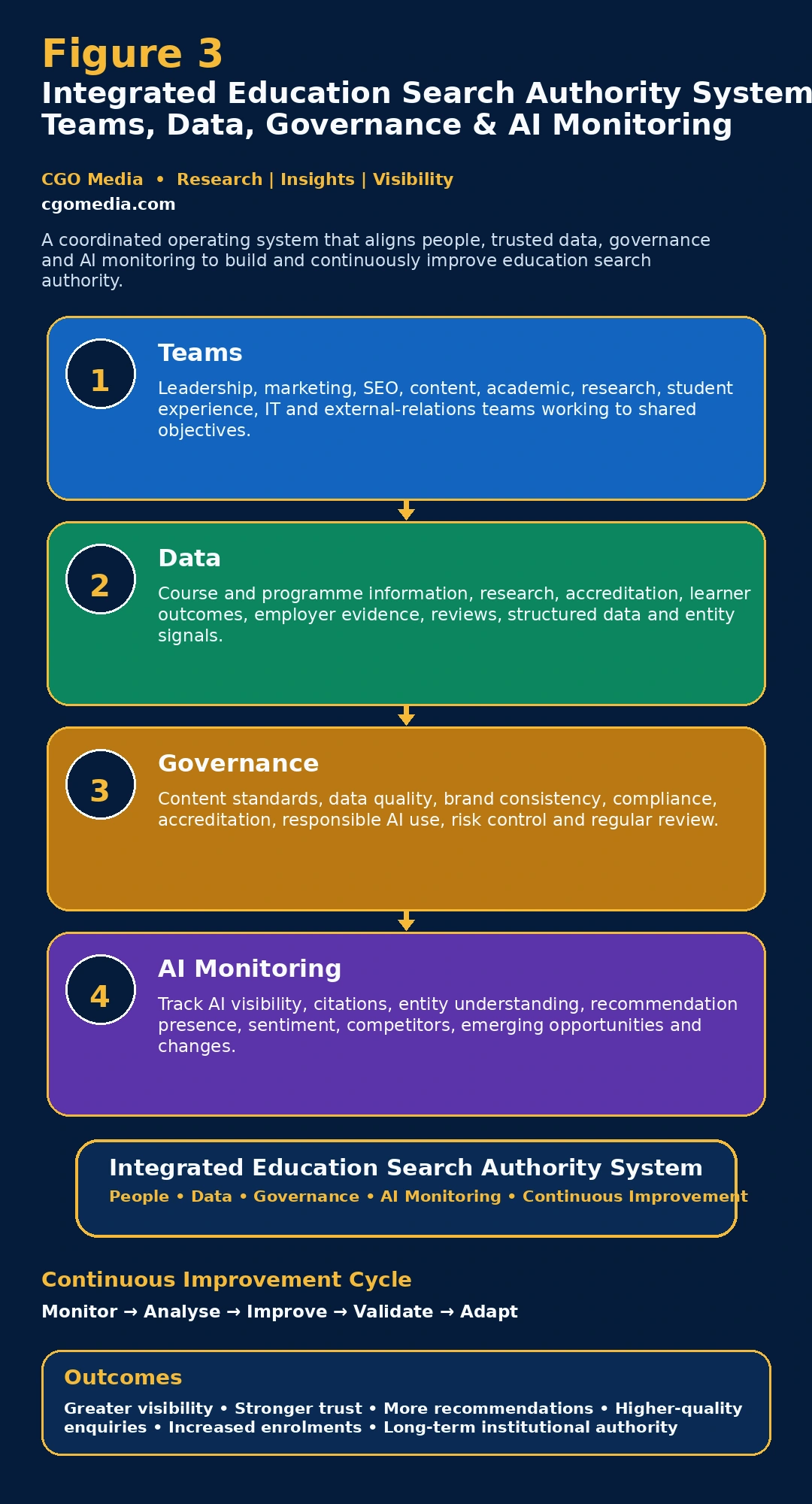
Fast-moving disciplines may require more frequent curriculum review.
60. Assess Faculty and Instructor Authority
Determine whether relevant educators are connected clearly to:
- Subjects
- Programmes
- Modules
- Research
61. Faculty Assessment Should Consider
- Academic expertise
- Professional qualifications
- Research
- Industry experience
- Teaching relevance
62. Faculty Profiles Should Be Current
Departed staff, changed responsibilities or historic expertise can create outdated programme evidence.
63. Assess Programme Information Quality
High-change learner information deserves particular attention.
64. Programme Information Assessment Should Include
- Fees
- Start dates
- Entry requirements
- Duration
- Delivery mode
- Availability
65. Assess Fee Accuracy
Determine whether published fees are current for the relevant:
- Cohort
- Market
- Study mode
66. Assess Entry Requirement Accuracy
Entry requirements should reflect current admissions policy.
67. Assess Delivery Information
Determine whether programmes are accurately described as:
- Campus-based
- Online
- Hybrid
- Full-time
- Part-time
68. Assess Programme Availability
Withdrawn or paused programmes should not remain promoted as available.
69. Assess Accreditation and Professional Recognition
Relevant recognition should be evaluated for accuracy and current status.
70. Accreditation Assessment Should Distinguish Between
- Institutional recognition
- Qualification recognition
- Programme accreditation
- Professional recognition
71. Assess Accreditation Verification
Determine whether relevant claims can be confirmed through authoritative external sources.
72. Assess Learner Trust
Review evidence around:
- Learner experience
- Support
- Communication
- Assessment
- Technology
73. Assess Review Patterns
Review data should be analysed for:
- Recency
- Theme
- Severity
- Persistence
74. Assess Outcome Authority
Determine whether claims around progression and employability are supported adequately.
75. Outcome Assessment Can Include
- Completion
- Qualification attainment
- Graduate destinations
- Employment
- Further study
- Professional progression
76. Assess Outcome Methodology
Published outcomes should explain, where relevant:
- Sample
- Period
- Data source
- Outcome definition
- Limitations
77. Assess Employer and Market Authority
Determine whether the programme demonstrates meaningful relationships with the professional or employment environment it claims to support.
78. Employer Authority Assessment Can Include
- Employer partnerships
- Advisory boards
- Placements
- Live projects
- Graduate recruitment
- Professional engagement
79. Assess Market Relevance
Programme evidence should be compared with relevant:
- Skills demand
- Professional standards
- Technology change
- Labour-market developments
80. Assess External Education Platforms
Provider authority increasingly extends beyond the main website.
81. External Platform Assessment Should Include
- Course marketplaces
- Comparison platforms
- Review platforms
- Education directories
- Professional-body profiles
82. Assess External Information Accuracy
Compare material programme information across major third-party sources.
83. Assess External Information Freshness
Outdated third-party programme data can continue to influence learner discovery.
84. Assess AI Search Baseline
Establish the provider’s current representation across strategically relevant AI-assisted discovery environments.
85. AI Baseline Should Measure Presence
Record whether the provider or programme appears for relevant queries.
86. AI Baseline Should Measure Relevance
Determine whether the provider is genuinely appropriate for the learner context.
87. AI Baseline Should Measure Accuracy
Check material information such as:
- Programme identity
- Fees
- Entry requirements
- Accreditation
- Delivery format
- Outcomes
88. AI Baseline Should Measure Trust Context
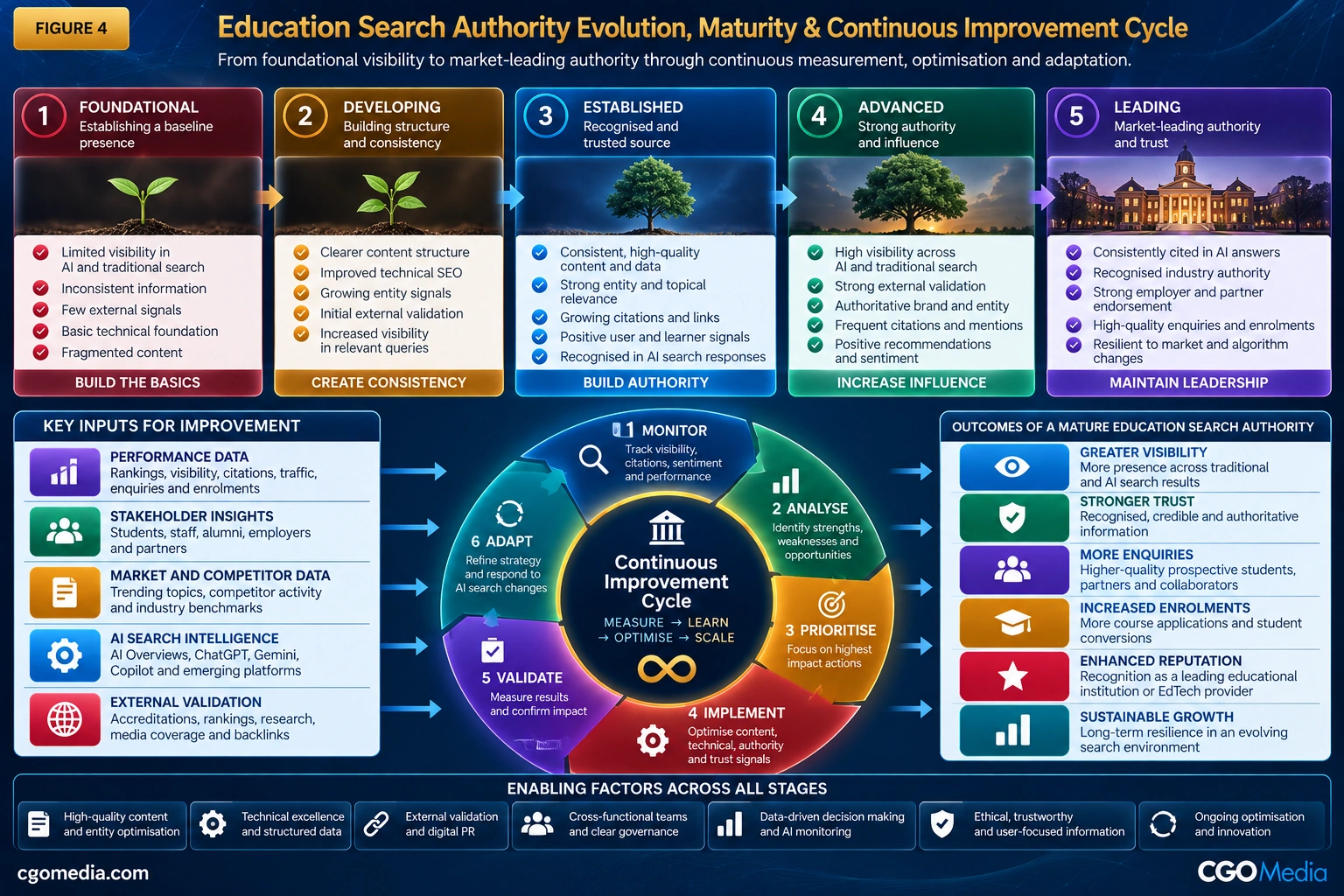
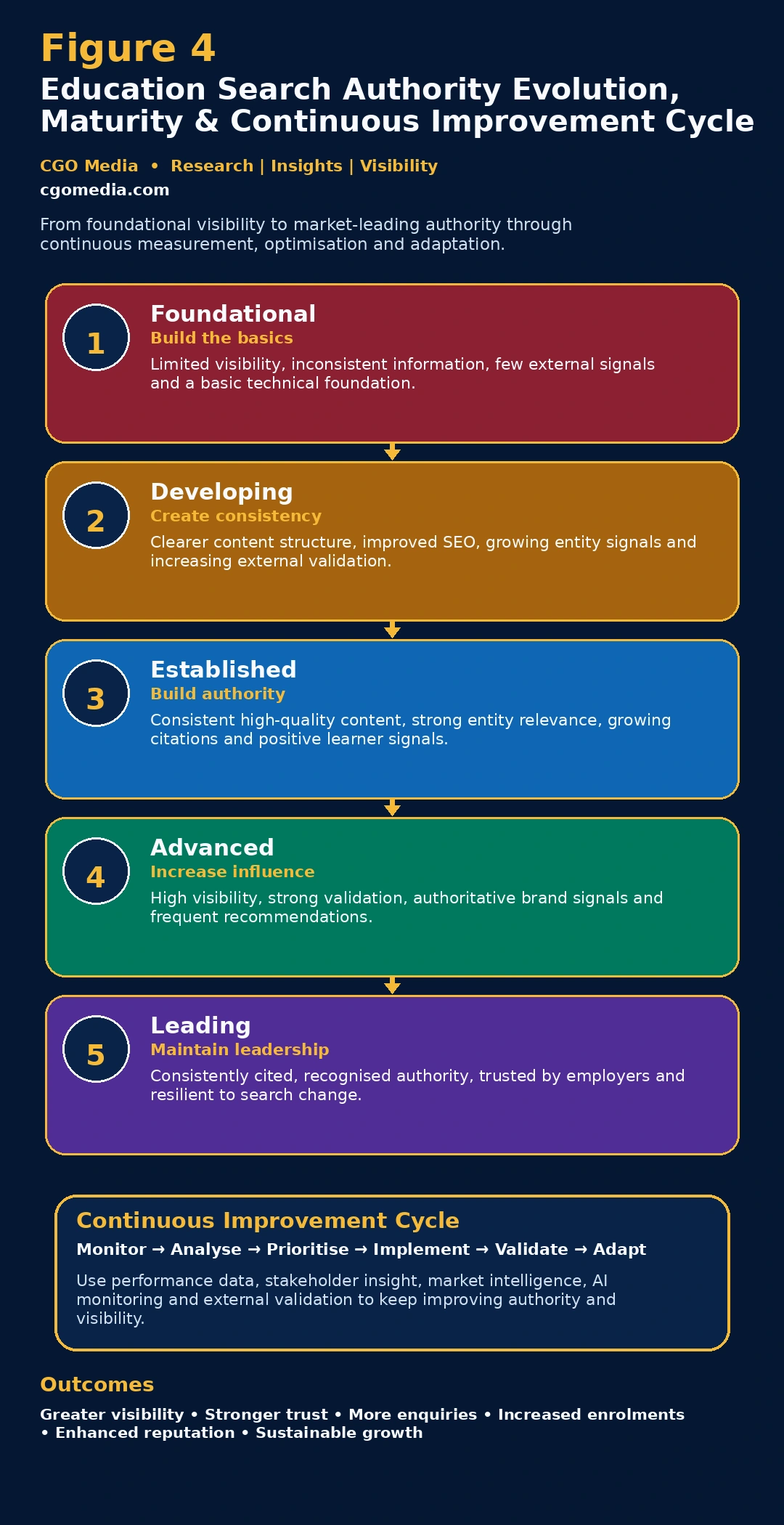
Assess whether important evidence is represented with enough context to avoid misunderstanding.
89. The Core AI Baseline Model
Use:
Presence + Relevance + Accuracy + Trust Context
90. Assess AI Error Severity
A practical classification is:
- Critical
- High
- Medium
- Low
91. Assess AI Error Persistence
Classify issues as:
- One-off
- Occasional
- Recurring
- Persistent
92. Assess Competitor Authority
The organisation should understand why alternative providers may be stronger in particular discovery environments.
93. Competitor Mapping Should Go Beyond Rankings
Compare:
- Programme evidence
- Subject authority
- Accreditation evidence
- Outcomes
- External authority
- AI representation
94. Assess the Learner and Enrolment Journey
The technical and authority audit should connect with the real decision journey.
95. Learner Journey Assessment
A useful sequence is:
Discovery → Understanding → Validation → Comparison → Application → Enrolment
96. Assess Discovery Friction
Determine whether suitable learners can find the provider and relevant programme.
97. Assess Understanding Friction
Determine whether programme information answers important learner questions.
98. Assess Validation Friction
Determine whether learners can verify:
- Recognition
- Accreditation
- Provider legitimacy
- Outcome evidence
99. Assess Comparison Friction
Determine whether programme differences are sufficiently clear for meaningful comparison.
100. Assess Application Friction
Determine whether learners encounter:
- Unexpected requirements
- Unclear documentation
- Broken forms
- Technical problems
101. Assess Enrolment Friction
Determine whether accepted learners can move successfully into registration and programme start.
102. Build the Initial Authority Gap Register
Each significant issue should record:
- Area
- Issue
- Severity
- Evidence
- Owner
- Required action
103. Assessment Should Produce Priorities, Not Just Findings
The audit should translate evidence into a sequenced implementation programme.
104. Phase Two — Stabilise
The second phase corrects high-impact weaknesses before authority expansion begins.
105. Stabilisation Is About Reliability
The organisation should reduce the risk of amplifying incorrect or contradictory programme information.
106. Stabilise Technical Foundations
Priority technical work may include:
- Indexation correction
- Canonical correction
- Redirect repair
- Broken internal links
- Performance improvements
107. Stabilise Provider Identity
Resolve material inconsistencies involving:
- Institution names
- Campus relationships
- Sub-brands
- Awarding bodies
- Delivery partners
108. Stabilise Course Information
Correct high-risk programme fields first.
109. Priority Programme Corrections
These commonly include:
- Fees
- Entry requirements
- Start dates
- Duration
- Delivery format
- Availability
110. Stabilise Accreditation Information
Expired or unsupported accreditation claims should be corrected promptly.
111. Stabilise External Education Profiles
Material third-party inconsistencies should be reconciled where possible.
112. Stabilisation Should Address Withdrawn Programmes
Old programmes should be handled through an intentional combination of:
- Archiving
- Redirecting
- Updating
- De-indexing where appropriate
113. Stabilisation Should Address Duplicate Programme Pages
Multiple competing pages for the same programme can weaken clarity.
114. Stabilisation Should Address Historic Cohort Information
Old cohort pages should not compete with current programme information unnecessarily.
115. Phase Three — Structure
Once critical information is reliable, the organisation can build a stronger education knowledge architecture.
116. Structure Provider Entity Architecture
A practical model is:
Provider → School / Faculty → Subject → Qualification → Programme → Campus / Delivery Mode
117. Structure Subject Architecture
Priority disciplines should have coherent relationships between:
- Subject hubs
- Courses
- Faculty
- Research
- Career information
118. Structure Qualification Architecture
Qualifications should connect logically with:
- Levels
- Programme types
- Awarding organisations
- Progression routes
119. Structure Course Architecture
Programme pages should sit within meaningful subject and qualification hierarchies.
120. Structure Faculty Architecture
Faculty profiles should connect with the programmes and subjects they genuinely support.
121. Structure Accreditation Relationships
Relevant accreditation should connect explicitly with the correct programme or qualification.
122. Structure Outcome Architecture
Outcome evidence should connect with:
- Programme
- Cohort
- Subject
- Time period
- Methodology
123. Structure Career and Employer Architecture
Career content should connect programmes with realistic:
- Roles
- Skills
- Industries
- Employers
- Professional pathways
124. Structure Learner Evidence
Learner stories and reviews should be associated with relevant:
- Programmes
- Study modes
- Campuses
- Learner types
125. Structure Internal Linking
Internal links should reinforce meaningful relationships rather than merely distribute authority mechanically.
126. Example Subject-Level Internal Architecture
A useful structure may be:
Subject → Qualification → Course → Curriculum → Faculty → Careers → Outcomes
127. Example Programme-Level Architecture
A programme page may connect to:
- Modules
- Entry requirements
- Faculty
- Accreditation
- Career pathways
- Outcomes
128. Implement Structured Data Carefully
Structured data can help express relationships already supported by visible content.
129. Structured Data Should Not Invent Educational Facts
Markup should reflect current, validated information.
130. Potential Entity Types May Include
- EducationalOrganization
- Organization
- Course
- Person
- Place
131. Structured Data Should Support Entity Relationships
Its purpose is to reinforce clear public evidence, not compensate for poor programme architecture.
132. Phase Four — Strengthen
The fourth phase deepens the educational evidence required for meaningful discovery and comparison.
133. Strengthen Subject Evidence
Priority disciplines should demonstrate depth through:
- Programme portfolios
- Faculty expertise
- Research
- Learning resources
- Career pathways
134. Strengthen Course Evidence
Programme pages should move beyond basic marketing descriptions.
135. Strong Course Evidence Can Include
- Curriculum
- Learning outcomes
- Projects
- Assessments
- Delivery detail
- Faculty
- Career relevance
136. Strengthen Faculty Evidence
Relevant educators should have profiles that demonstrate genuine expertise.
137. Faculty Evidence Can Include
- Academic qualifications
- Professional credentials
- Research
- Industry experience
- Teaching responsibilities
138. Strengthen Learner Decision Content
Learners often need information beyond the core course page.
139. Learner Decision Content Can Address
- Is this course right for me?
- What are the entry requirements?
- How much will it cost?
- Can I study online?
- What can I do afterwards?
- Is the qualification recognised?
140. Decision Content Should Support, Not Duplicate, Programme Pages
Supporting content should clarify important learner questions while keeping the programme page as the authoritative source for core programme facts.
141. Strengthen International Learner Information Where Relevant
International learners may require additional clarity around:
- Entry equivalence
- Language requirements
- Fees
- Study location
- Recognition
142. Strengthen Online Learning Information Where Relevant
Online programmes should explain:
- Teaching format
- Live versus asynchronous learning
- Technology requirements
- Assessment
- Support
143. Strengthen EdTech Product Evidence Where Relevant
Technology providers should connect product capability with educational function.
144. EdTech Product Evidence Can Include
- Learning methodology
- Assessment design
- Progress tracking
- Personalisation
- Accessibility
- Learner support
145. Strengthening Should Follow Learner Need
Content expansion should begin with important unanswered questions rather than arbitrary publishing volume.
146. Strengthening Should Follow Strategic Subjects
The organisation should prioritise areas where educational expertise and growth objectives overlap.
147. Strengthening Should Follow Evidence Gaps
New content is most useful when it closes a real learner or authority gap.
148. Strengthening Should Not Create Unsupported Claims
Greater content depth should preserve accuracy around:
- Recognition
- Outcomes
- Employment
- Funding
- Eligibility
149. The First Four Phases Create the Education Search Foundation
The roadmap has now progressed through:
Assess → Stabilise → Structure → Strengthen
150. The Foundation Must Exist Before Large-Scale External Authority Expansion
The next phase moves beyond first-party educational evidence and focuses on accreditation, reviews, employer validation, education media, Digital PR, research citations and external platform authority.


151. Phase Five — Validate
The fifth phase strengthens the provider’s authority through independent corroboration.
152. Validation Extends Beyond First-Party Claims
Education providers should not rely only on their own website to establish:
- Recognition
- Quality
- Relevance
- Learner trust
- Market authority
153. External Validation Reduces Dependence on Promotional Messaging
Independent evidence can help learners assess whether the provider’s claims are supported elsewhere.
154. Validation Should Be Relevant to the Programme
Institutional reputation is useful, but programme-level corroboration is often more directly relevant to selection.
155. Validation Should Be Current
Historic awards, expired accreditation and old partnerships should not be presented as current evidence.
156. Start with Accreditation Validation
Where applicable, the organisation should confirm the status of:
- Institutional recognition
- Qualification recognition
- Programme accreditation
- Professional recognition
157. Accreditation Claims Should Be Precise
The provider should explain:
- Which body provides recognition
- Which programme or qualification is covered
- What the recognition means
- Whether the status is current
158. Accreditation Should Be Independently Verifiable
Where possible, learners should be able to confirm relevant claims through authoritative external sources.
159. Avoid Accreditation Overgeneralisation
Recognition of one programme should not imply recognition of every course offered by the organisation.
160. Validate Awarding Relationships
Where a provider delivers a qualification awarded by another organisation, that relationship should be clear.
161. Validate Professional Recognition
Professional recognition can influence learner decisions where programmes support entry into regulated or specialist careers.
162. Professional Recognition Should Be Contextual
The provider should distinguish between:
- Professional body membership
- Programme accreditation
- Qualification recognition
- Graduate eligibility
163. Validate Learner Reviews
Learner feedback can contribute useful experience evidence when interpreted carefully.
164. Review Analysis Should Include
- Recency
- Theme
- Severity
- Persistence
165. Review Recency Matters
Older reviews may describe a historic programme, platform or support model.
166. Review Themes Matter
Recurring themes may reveal:
- Teaching strengths
- Support weaknesses
- Administrative friction
- Platform problems
- Assessment concerns
167. Review Severity Matters
A small number of serious complaints may deserve more attention than a large number of minor comments.
168. Review Persistence Matters
Repeated issues over time can indicate structural problems.
169. Reviews Are Experience Evidence, Not Accreditation Evidence
Positive learner sentiment does not independently prove recognition or academic quality.
170. Validate Learner Testimonials
Testimonials should be genuine, attributable where appropriate and representative enough to avoid misleading impressions.
171. Validate Outcome Claims
Employment, completion and progression claims should be supported by clear evidence.
172. Outcome Validation Should Examine Methodology
Relevant questions include:
- Which cohort was measured?
- What time period was used?
- How was employment defined?
- How was the data collected?
- What limitations apply?
173. Validate Employment Claims
Claims about employability should distinguish between:
- Skills development
- Career support
- Observed employment outcomes
- Employment guarantees
174. Employment Should Not Be Implied Where It Is Not Guaranteed
Career-focused programmes should avoid creating unrealistic expectations.
175. Validate Salary Claims
Salary data should preserve enough context around:
- Role
- Market
- Experience
- Location
- Time period
176. Validate Graduate Progression
Progression evidence can include:
- Further study
- Professional qualification
- Employment
- Promotion
- Career transition
177. Validate Completion and Achievement Data
Where published, completion and attainment should be interpreted within the appropriate cohort and programme context.
178. Employer Validation Can Strengthen Programme Authority
Relevant employer evidence can support the relationship between:
- Curriculum
- Skills
- Professional practice
- Career relevance
179. Validate Employer Partnerships
Partnership evidence should be current and specific.
180. Employer Partnership Evidence Can Include
- Advisory-board participation
- Placements
- Live projects
- Guest teaching
- Graduate recruitment
181. Avoid Vague Employer Authority Claims
Statements such as “industry connected” should be supported by tangible evidence where possible.
182. Validate Employer Testimonials
Employer statements should be relevant to the programme or skill area they discuss.
183. Validate Labour-Market Relevance
Programme positioning may be supported by current evidence around:
- Skills demand
- Professional standards
- Industry growth
- Emerging roles
- Technology adoption
184. Labour-Market Evidence Should Be Current
Fast-moving sectors can make older skills-demand claims obsolete.
185. Labour-Market Evidence Should Be Geographically Relevant
Job demand can vary significantly by region and country.
186. Strengthen Education Media Authority
Relevant editorial coverage can increase external understanding of:
- Research
- Teaching innovation
- Programme development
- Industry partnerships
- Institutional expertise
187. Education Media Should Be Topic-Relevant
Specialist education or sector publications may provide stronger contextual authority than broad unrelated media.
188. Strengthen Digital PR
Digital PR can support visibility when it is built around useful, evidence-led assets.
189. Education Digital PR Can Use
- Original research
- Skills studies
- Graduate-outcome analysis
- Employer research
- Subject expertise
- Education trend analysis
190. Digital PR Should Avoid Unsupported Claims
Press activity should not overstate:
- Employment outcomes
- Salary uplift
- Accreditation
- Market leadership
191. Research Can Become an Education Authority Asset
Original research can strengthen:
- Media relevance
- Academic credibility
- Industry authority
- External citations
- AI source visibility
192. Research Should Be Methodologically Defensible
Useful research should explain:
- Sample
- Method
- Time period
- Data source
- Limitations
193. Research Should Be Easy to Cite
Each research asset should identify:
- Author
- Publisher
- Date
- References
- Citation format
194. Research Figures Can Support External Reuse
Useful figures, charts and tables can help journalists, researchers and educators reference findings accurately.
195. Citation Authority Is Different from Link Volume
A citation can contribute authority and context even when it does not behave like a conventional SEO backlink.
196. Links Still Matter
Relevant links can continue to support:
- Discovery
- Authority
- Referral traffic
- Source connectivity
197. Link Context Matters
A relevant link from an education, academic, professional or industry source may be more meaningful than an unrelated high-authority domain.
198. Strengthen Course Marketplace Authority
Course marketplaces can influence programme discovery before users visit the provider directly.
199. Marketplace Profiles Should Be Accurate
Material fields may include:
- Course title
- Fees
- Duration
- Entry requirements
- Delivery format
- Provider identity
200. Marketplace Data Should Be Reconciled Regularly
Old marketplace information can continue to influence search and AI discovery.
201. Comparison Platforms Can Shape Provider Consideration
Learners may use comparison tools to narrow a large provider set.
202. Comparison Data Should Be Evaluated for Accuracy
Inaccurate or incomplete comparison data can affect:
- Provider visibility
- Learner understanding
- Trust
- AI evidence consistency
203. Comparison Inclusion Is Not Independent Endorsement
A platform’s inclusion of a programme does not establish universal quality or suitability.
204. Rankings and Awards Can Support External Authority
Relevant rankings and awards may contribute to provider perception.
205. Ranking Claims Should Preserve Context
Providers should state:
- Ranking organisation
- Year
- Category
- Scope
206. Ranking Claims Should Not Be Generalised Improperly
A subject-level ranking should not automatically be presented as institution-wide superiority.
207. Awards Should Be Current and Verifiable
Historic awards can remain useful as archive evidence but should not be represented as current where this would mislead.
208. Validate Professional and Industry Associations
Memberships and professional relationships can support context where relevant.
209. Association Membership Should Not Be Misrepresented
Membership alone should not be presented as equivalent to programme accreditation unless it genuinely is.
210. Build an External Evidence Map
The organisation should identify which independent sources support:
- Provider identity
- Programme recognition
- Learner experience
- Employer relevance
- Outcomes
211. Classify External Evidence by Source Type
A practical classification may include:
- Official
- Academic
- Professional
- Editorial
- Commercial
- Learner-generated
212. Official Sources
These may include:
- Accreditation bodies
- Awarding organisations
- Regulators
- Public education authorities
213. Academic Sources
These may include:
- Research publications
- Academic repositories
- Conference publications
- Institutional research
214. Professional Sources
These may include:
- Professional bodies
- Industry associations
- Employer organisations
215. Editorial Sources
These may include:
- Education media
- Industry publications
- News organisations
216. Commercial Sources
These may include:
- Course marketplaces
- Comparison platforms
- Education directories
217. Learner-Generated Sources
These may include:
- Reviews
- Testimonials
- Alumni discussions
218. Evidence Strength Should Be Evaluated by Relevance
Not every external mention contributes equally to programme authority.
219. Evidence Strength Should Be Evaluated by Freshness
Outdated evidence may no longer reflect the current programme.
220. Evidence Strength Should Be Evaluated by Independence
Independent corroboration can strengthen trust where claims originate with the provider.
221. Evidence Strength Should Be Evaluated by Specificity
Programme-specific evidence can be stronger than broad institutional claims.
222. Build an External Validation Register
A practical register may include:
- Source
- Source type
- Programme or institution
- Claim supported
- Freshness
- Owner
223. Validate External Information Against Source-of-Truth Data
Important programme and provider facts should be reconciled against current authoritative internal information.
224. Prioritise Material External Conflicts
High-priority conflicts may involve:
- Accreditation
- Provider identity
- Programme availability
- Fees
- Awarding status
225. Not Every External Difference Requires Correction
Minor wording variation may be acceptable where the underlying facts remain compatible.
226. The Objective Is Material Consistency
Important facts should agree across the sources learners and AI systems are likely to encounter.
227. Validation Should Strengthen AI Readiness
A broader and more consistent external evidence network can support more reliable provider interpretation.
228. Validation Should Strengthen Learner Confidence
The learner should be able to move from:
Provider Claim → External Verification → Greater Confidence
229. Validation Should Strengthen Comparison
Independent evidence can help learners distinguish between superficially similar programmes.
230. Validation Should Strengthen Reputation Resilience
Authority supported by multiple credible sources is less dependent on one marketing channel.
231. The Phase Five Validation Formula
A useful model is:
Accreditation + Learner Evidence + Employer Evidence + Research + Media + Marketplace Accuracy = Stronger External Education Authority
232. Validation Should Be Programme-Specific
External authority should be assessed at the level at which learners make decisions.
233. Validation Should Be Subject-Specific
An institution may possess strong external authority in one discipline but limited recognition in another.
234. Validation Should Be Market-Specific
Recognition and employer relevance can vary by geography.
235. Validation Should Be Audience-Specific
Professional learners, undergraduate applicants and enterprise buyers may rely on different external sources.
236. Build a Validation Priority Matrix
Potential criteria include:
- Programme value
- Learner risk
- Current evidence weakness
- Competitive intensity
- Strategic growth importance
237. High-Priority Validation Programmes
These may include:
- Flagship programmes
- High-enrolment courses
- High-value professional programmes
- New market-entry programmes
238. Medium-Priority Validation Programmes
These may include established programmes with moderate growth potential or evidence gaps.
239. Lower-Priority Validation Programmes
These may include legacy or low-volume programmes with limited strategic importance.
240. Validate Before Scaling External Promotion
A programme should not be heavily promoted externally while important evidence remains inaccurate or unsupported.
241. Phase Five Creates the External Authority Layer
At this stage, the roadmap combines:
Internal Educational Evidence + Independent External Validation
242. The Next Phase Is Integration
The next section examines how SEO, academic teams, admissions, quality, careers, communications, data, technology and AI monitoring can be connected into one coordinated education search operating model.
243. Phase Six — Integrate
The sixth phase connects search authority with the organisational systems and teams that control the underlying education evidence.
244. Integration Is Essential Because SEO Does Not Own Programme Truth
Critical programme information is usually controlled by multiple functions.
245. Relevant Organisational Functions May Include
- Academic teams
- Admissions
- Quality assurance
- Student services
- Careers
- Marketing
- SEO
- Communications
- Data
- Technology
246. The Integration Objective
The objective is to create:
Central Standards + Distributed Ownership + Shared Evidence
247. Central Standards
Central governance should define:
- Data standards
- Publishing standards
- Review rules
- Escalation rules
- Measurement standards
248. Distributed Ownership
The team closest to the underlying truth should remain accountable for it.
249. Shared Evidence
Approved information should flow consistently into the systems that depend on it.
250. Define Provider Data Ownership
Institutional identity data may include:
- Provider name
- Legal entity
- Campuses
- Schools
- Faculties
- Partner relationships
251. Define Programme Data Ownership
Programme owners should remain accountable for validated information such as:
- Course title
- Duration
- Delivery format
- Availability
- Curriculum
252. Define Admissions Data Ownership
Admissions teams may own or validate:
- Entry requirements
- Application criteria
- Language requirements
- Alternative pathways
253. Define Fee Data Ownership
Pricing information should have a clear authoritative source.
254. Define Accreditation Data Ownership
Quality or academic-governance teams should control recognised accreditation information.
255. Define Outcome Data Ownership
Graduate and learner outcome evidence should trace back to a defined reporting function.
256. Define Employer Relationship Ownership
Employer-engagement teams may maintain:
- Partnerships
- Placements
- Advisory boards
- Recruitment relationships
257. Define Search Authority Ownership
SEO should coordinate how approved evidence is represented across search environments.
258. Define AI Visibility Ownership
A named function should coordinate:
- Prompt monitoring
- Error classification
- Source diagnosis
- Escalation
259. Build a Source-of-Truth Architecture
Each high-risk information class should have an authoritative system.
260. Provider Source of Truth
This may contain:
- Institution name
- Campus relationships
- School relationships
- Partner relationships
261. Programme Source of Truth
This may contain:
- Programme name
- Status
- Duration
- Delivery mode
- Start dates
262. Admissions Source of Truth
This may contain:
- Entry requirements
- Language requirements
- Application deadlines
- Required documents
263. Fee Source of Truth
This may contain:
- Tuition
- Additional fees
- Market-specific pricing
- Payment information
264. Accreditation Source of Truth
This may contain:
- Accrediting body
- Programme covered
- Status
- Validity period
265. Outcome Source of Truth
This may contain:
- Completion data
- Employment data
- Further-study data
- Methodology
- Reporting period
266. Connect Source-of-Truth Systems with Publishing Systems
Where practical, approved data should flow into:
- Website pages
- Structured data
- Course feeds
- Internal search
- Marketplace feeds
267. Reduce Manual Duplication
Repeated manual entry increases the risk of inconsistent programme information.
268. Use Automation Carefully
Automation can improve:
- Consistency
- Scale
- Update speed
- Monitoring
269. Automation Can Also Amplify Errors
Incorrect source data can spread rapidly across multiple channels.
270. High-Risk Fields Require Validation
Particular attention may be required for:
- Fees
- Entry requirements
- Accreditation
- Awarding status
- Outcome claims
271. Build a Programme Change Workflow
Every material programme change should trigger an intentional update sequence.
272. Example Programme Change Workflow
Use:
Change Identified → Owner Validates → Systems Updated → Website Updated → External Sources Reviewed → AI Monitoring Triggered
273. New Programme Workflow
A new programme may require:
- Entity mapping
- Programme architecture
- Admissions data
- Fee data
- Accreditation data
- Structured data
- Internal linking
- AI baseline monitoring
274. Programme Update Workflow
Material changes should propagate through relevant systems.
275. Programme Withdrawal Workflow
Withdrawal may require:
- Status update
- Archive decision
- Redirect decision
- Marketplace reconciliation
- Structured data update
- AI follow-up
276. Fee Change Workflow
Pricing changes should update:
- Programme pages
- Fee pages
- Structured data where relevant
- Marketplace feeds
277. Entry Requirement Change Workflow
Admission changes should propagate to all relevant programme and recruitment environments.
278. Accreditation Change Workflow
Recognition changes should trigger immediate review of affected programme evidence.
279. Campus Change Workflow
Location changes should update:
- Programme availability
- Campus pages
- Local profiles
- Marketplace listings
280. Faculty Change Workflow
Staff changes may require updates to:
- Faculty profiles
- Programme relationships
- Research links
- Module ownership
281. Outcome Refresh Workflow
New outcome data should replace or contextualise older evidence.
282. Integrate SEO into Programme Governance
SEO should be represented in relevant programme-change processes early enough to prevent downstream visibility problems.
283. Integrate Search into New Programme Development
Search insight can contribute to understanding:
- Learner language
- Subject demand
- Comparison criteria
- Market interest
284. Search Demand Should Not Dictate Academic Quality
Search data should inform programme communication and discovery, not replace academic judgement.
285. Integrate SEO with Admissions
Admissions teams can help validate:
- Entry requirements
- Application processes
- Deadlines
- Eligibility language
286. Integrate SEO with Quality Assurance
Quality teams can help validate:
- Accreditation
- Recognition
- Awarding relationships
- Programme status
287. Integrate SEO with Careers Teams
Careers teams can help validate:
- Career pathways
- Employer relationships
- Graduate outcomes
- Professional progression
288. Integrate SEO with Communications
Communications teams can support:
- Education media
- Research promotion
- Digital PR
- External corrections
289. Integrate SEO with Data Teams
Data teams can help maintain reliable:
- Programme feeds
- Entity data
- Outcome data
- Analytics
290. Integrate SEO with Technology Teams
Technology teams support:
- Technical SEO
- Performance
- Structured data
- Automation
- Monitoring
291. Integrate SEO with Student Experience
Post-enrolment feedback can reveal whether pre-enrolment content sets realistic expectations.
292. Search Promises Should Match Learner Experience
A strong acquisition message can damage trust if the delivered experience differs materially.
293. Integrate Reviews with Operational Improvement
Recurring review themes should be routed to teams able to address underlying causes.
294. Integrate AI Monitoring with Existing Governance
AI observations should not sit in an isolated marketing report.
295. AI Monitoring Should Feed Programme Governance
A repeated course-information error may indicate a broader source inconsistency.
296. AI Monitoring Should Feed Entity Governance
Repeated provider confusion may indicate unclear institutional relationships.
297. AI Monitoring Should Feed Accreditation Governance
Persistent accreditation errors may reveal outdated public evidence.
298. AI Monitoring Should Feed Outcome Governance
Repeated career or employment misrepresentation may reveal poorly contextualised source material.
299. AI Monitoring Should Use an Escalation Matrix
Issues should be classified according to:
- Severity
- Persistence
- Learner impact
- Evidence confidence
300. Critical AI Escalation
Potential examples include:
- False accreditation
- Wrong awarding organisation
- Programme represented as available when withdrawn
- Major fee misinformation
301. High AI Escalation
Potential examples include:
- Wrong entry requirements
- Incorrect delivery mode
- Major outcome misrepresentation
302. Medium AI Escalation
These may involve important but contained information gaps.
303. Low AI Escalation
These may involve minor descriptive differences with limited learner impact.
304. Build a Cross-Functional Search Governance Group
Larger organisations may benefit from a recurring governance group representing:
- SEO
- Academic teams
- Admissions
- Quality
- Careers
- Communications
- Data
- Technology
305. Governance Group Responsibilities
The group may oversee:
- Critical authority risks
- Programme-data quality
- AI representation
- External evidence
- Strategic priorities
306. Governance Meetings Should Be Evidence-Led
Discussion should focus on:
- Material changes
- Persistent issues
- Priority programmes
- Current risks
- Required decisions
307. Define Decision Rights
The organisation should know who can:
- Approve programme information
- Change fee information
- Update accreditation claims
- Retire programmes
- Escalate AI errors
308. Define Review Frequencies
Not every evidence type requires the same review schedule.
309. High-Frequency Review Fields
Potential examples include:
- Fees
- Start dates
- Entry requirements
- Programme availability
310. Medium-Frequency Review Fields
Potential examples include:
- Curriculum
- Faculty
- Accreditation
- Employer relationships
311. Strategic Review Fields
Potential examples include:
- Provider entity architecture
- Subject authority
- Outcome methodology
- AI visibility
- Search maturity
312. Build a Change Log
Important changes should record:
- What changed
- Why it changed
- When it changed
- Who approved it
- Which systems were affected
313. Change Logs Support Auditability
They help explain why information changed and which downstream systems require review.
314. Build a Programme Data Dictionary
A data dictionary can define important fields consistently.
315. Example Programme Data Dictionary Fields
- Programme name
- Programme code
- Qualification
- Academic level
- Delivery mode
- Campus
- Duration
- Fee
- Start date
- Status
316. Standard Definitions Reduce Cross-System Conflict
Teams should use compatible meanings for core fields.
317. Define Programme Status Consistently
For example:
- Active
- Recruiting
- Paused
- Closed
- Archived
318. Define Delivery Mode Consistently
For example:
- On-campus
- Online
- Hybrid
- Blended
319. Define Qualification Relationships Consistently
This reduces ambiguity between:
- Programme
- Qualification
- Awarding organisation
- Accreditation
320. Integrate Structured Data with Governance
Structured data should consume approved information wherever practical.
321. Structured Data Should Not Become a Separate Truth Layer
Markup should not contain materially different information from visible programme content.
322. Integrate Internal Search with Governed Data
Internal site search should return current programmes and valid programme statuses.
323. Integrate Marketplace Feeds with Governed Data
Where feeds are used, they should draw from current authoritative fields.
324. Integrate Analytics with Programme Architecture
Measurement should distinguish:
- Subject
- Qualification
- Programme
- Audience
- Market
325. Integrate CRM Data with Search Analysis
Where appropriate, search performance can be connected with:
- Application quality
- Offer acceptance
- Enrolment
- Retention
326. Integration Improves Attribution
A stronger measurement model can connect:
Discovery → Programme Engagement → Application → Enrolment
327. Attribution Should Remain Cautious
Education journeys often contain multiple search, referral, social, offline and AI-assisted touchpoints.
328. Integrate Search with Learner Research
Search data can complement:
- Applicant surveys
- Open-day feedback
- Student interviews
- Enrolment research
329. Integrate AI Discovery Questions with Content Planning
Repeated learner prompts can reveal gaps in existing programme explanations.
330. Integrate Review Themes with Content Planning
Recurring misunderstandings may indicate that pre-enrolment information needs improvement.
331. Integrate Employer Feedback with Subject Strategy
Employer evidence can help identify:
- Emerging skills
- Professional expectations
- Curriculum opportunities
332. Integration Creates an Education Search Intelligence System
Search becomes more useful when it informs the organisation rather than operating as a reporting silo.
333. Search Intelligence Can Support Programme Development
It may reveal:
- New learner questions
- Emerging subject demand
- Comparison criteria
- Delivery preferences
334. Search Intelligence Can Support Admissions
It may reveal recurring eligibility or application confusion.
335. Search Intelligence Can Support Careers
It may reveal growing interest in particular roles or professional pathways.
336. Search Intelligence Can Support International Strategy
It may reveal differences in:
- Demand
- Terminology
- Recognition concerns
- Delivery preferences
337. Search Intelligence Should Not Be Used Without Context
Search demand can reflect curiosity as well as genuine enrolment intent.
338. Integration Should Produce a Single Operating View
A mature organisation should be able to see:
- Authority gaps
- Programme-data risk
- External evidence
- AI representation
- Learner progression
339. Build an Integrated Search Authority Dashboard
A dashboard may combine:
- Technical health
- Programme evidence
- Accreditation status
- External authority
- AI accuracy
- Application performance
340. Dashboards Should Distinguish Risk and Opportunity
Leadership should be able to separate:
- Critical correction
- Foundational work
- Growth opportunity
- Long-term resilience
341. Integration Should Be Scalable
Large organisations may manage hundreds or thousands of programme variants.
342. Use Prioritisation Rather Than Attempting Everything at Once
A useful implementation order may focus on:
- Flagship programmes
- Highest-risk programmes
- Highest-value subjects
- Strategic growth markets
343. Integration Should Be Tested Before Full Rollout
Pilot workflows can reveal:
- Ownership gaps
- Data conflicts
- Process bottlenecks
- Automation errors
344. Successful Pilots Can Then Be Standardised
The organisation can convert working processes into:
- Templates
- Checklists
- Data standards
- Review rules
345. Phase Six Outcome — Coordinated Education Search Governance
At this stage, SEO is no longer operating independently from the systems that control educational truth.
346. The Integrated Education Search Model
The operating system can be summarised as:
Academic Evidence + Programme Data + Admissions + Quality + Careers + SEO + External Authority + AI Monitoring
347. Integration Prepares the Organisation for Continuous Improvement
Once ownership, data and workflows are connected, the organisation can move from implementation toward continuous optimisation and resilience.
348. The Next Phase Is Evolve
The next section examines maturity progression, continuous improvement, authority decay, 30/60/90-day execution, executive measurement and the long-term education search operating cycle.
349. Phase Seven — Evolve
The seventh phase moves the organisation from structured implementation into continuous improvement, maturity progression and long-term search resilience.
350. Education Search Authority Is Not Static
Programmes, markets, technologies, learner expectations and discovery systems continue to change.
351. The Organisation Should Expect Authority Decay
Without ongoing governance, strong search and trust signals can weaken over time.
352. Technical Authority Can Decay
Potential causes include:
- Site migrations
- Broken internal links
- Indexation drift
- Performance degradation
- Template changes
353. Programme Authority Can Decay
Potential causes include:
- Outdated curriculum
- Changed faculty
- Legacy course pages
- Weak subject architecture
354. Programme Information Quality Can Decay
Potential causes include:
- Old fees
- Historic entry requirements
- Expired start dates
- Changed delivery modes
- Withdrawn programmes
355. External Validation Can Decay
Potential causes include:
- Expired accreditation
- Old ranking claims
- Historic employer relationships
- Unmaintained marketplace profiles
356. Outcome Authority Can Decay
Potential causes include:
- Old graduate data
- Historic salary claims
- Outdated labour-market evidence
- Weak methodology
357. AI Representation Can Decay
Potential causes include:
- Stale source material
- Entity confusion
- Marketplace conflicts
- Changing retrieval patterns
358. Evolve Means Detecting Decay Early
The organisation should monitor deterioration before it becomes a larger learner-trust or visibility problem.
359. Build an Authority Health Register
A practical register can include:
- Authority area
- Current state
- Trend
- Risk
- Owner
- Next action
360. Build a Programme Health Register
Priority programmes can be monitored for:
- Information freshness
- Accreditation status
- Faculty accuracy
- Outcome evidence
- AI representation
361. Build a Subject Authority Register
Strategic subject areas can be monitored for:
- Course depth
- Faculty authority
- Research
- External citations
- Career relevance
362. Build an AI Representation Register
Record material observations around:
- Provider identity
- Programme matching
- Fees
- Entry requirements
- Accreditation
- Outcomes
363. Continuous Improvement Should Use a Repeatable Cycle
A practical model is:
Observe → Verify → Diagnose → Prioritise → Improve → Validate → Measure → Learn → Reassess
364. Observe
Monitor changes across:
- Search performance
- Programme data
- External sources
- Reviews
- AI representation
365. Verify
Confirm whether an apparent problem is genuine and materially relevant.
366. Diagnose
Determine whether the issue is primarily:
- Technical
- Informational
- Entity-related
- Accreditation-related
- Outcome-related
- External
- AI-related
367. Prioritise
A practical model is:
Priority = Gap + Risk + Learner Impact + Strategic Importance + Evidence Confidence
368. Improve
Apply the intervention that addresses the underlying cause.
369. Validate
Confirm that the correction is accurate and present in the appropriate systems.
370. Measure
Compare the updated state with the previous baseline.
371. Learn
Use recurring patterns to improve:
- Governance
- Templates
- Review cycles
- Data standards
- Team responsibilities
372. Reassess
Update the organisation’s authority and maturity profile.
373. Reassessment Should Be Periodic
The Education Search Authority Maturity Model can support recurring reassessment.
374. Maturity Should Be Measured by Capability
The organisation should evaluate whether it has stronger:
- Processes
- Ownership
- Evidence
- Measurement
- Governance
375. Maturity Should Not Be Measured by Content Volume Alone
Publishing more pages does not automatically indicate a more mature search system.
376. Maturity Should Not Be Measured by Traffic Alone
Traffic can rise while authority, trust or learner fit remains weak.
377. Maturity Should Not Be Measured by AI Mentions Alone
Frequent AI inclusion can coexist with poor accuracy.
378. The Stronger Maturity Model Combines
Process + Evidence + Governance + Measurement + Resilience
379. Evolution Should Be Programme-Specific
Different programmes may sit at different maturity levels.
380. Evolution Should Be Subject-Specific
An institution may be mature in one discipline and underdeveloped in another.
381. Evolution Should Be Market-Specific
International expansion can create different:
- Search demand
- Recognition requirements
- Language needs
- Competitive conditions
382. Evolution Should Be Audience-Specific
Different learner segments may require different evidence and discovery journeys.
383. Evolution Should Be Delivery-Specific
Online, campus and hybrid programmes may require different visibility and trust strategies.
384. Scale Only What Is Governed
Processes should be repeatable before they are expanded across large programme portfolios.
385. Pilot Before Full Rollout
A pilot programme can test:
- Data workflows
- Ownership
- Structured data
- AI monitoring
- External reconciliation
386. Standardise Successful Pilots
Working approaches can be converted into:
- Templates
- Checklists
- Data models
- Governance rules
387. Scale by Programme Priority
A practical order may focus on:
- Flagship programmes
- High-enrolment courses
- Strategic growth subjects
- High-risk programmes
388. Scale by Market Priority
International expansion should focus first on markets with:
- Clear demand
- Operational readiness
- Appropriate recognition
- Strong programme fit
389. Scale External Authority Deliberately
Digital PR and research activity should support strategic subjects rather than generate disconnected mentions.
390. Scale AI Monitoring Deliberately
Prompt monitoring should expand by:
- Subject
- Programme
- Learner type
- Market
- Model
391. AI Monitoring Should Remain Methodologically Consistent
Changing prompt sets too frequently can make trend analysis less reliable.
392. Evolution Requires Longitudinal Measurement
Repeated observations can reveal:
- Authority improvement
- Authority decay
- Persistent AI errors
- Changing learner behaviour
393. Build a Search Authority Baseline
The baseline should capture the current state before major implementation.
394. Build Quarterly Comparison Points
Quarterly reviews can compare:
- Technical health
- Programme evidence
- External authority
- AI accuracy
- Learner progression
395. Build an Annual Strategic Review
The annual review should assess:
- Maturity
- Authority gaps
- Governance
- Resilience
- Next-year priorities
396. The 30-Day Evolution Horizon
The first 30 days should focus on material risk and baseline control.
397. First 30-Day Priorities
- Confirm critical ownership
- Resolve material programme errors
- Establish AI baseline
- Create authority gap register
- Identify priority programmes
398. The 60-Day Evolution Horizon
Days 31–60 should focus on structured improvement.
399. 60-Day Priorities
- Improve programme architecture
- Strengthen subject evidence
- Reconcile external profiles
- Improve accreditation evidence
- Launch reporting dashboard
400. The 90-Day Evolution Horizon
Days 61–90 should focus on integration and repeatability.
401. 90-Day Priorities
- Formalise governance
- Standardise workflows
- Expand AI monitoring
- Connect CRM and search measurement
- Prepare next programme cohort
402. The First 90 Days Should Create Operating Discipline
The objective is not to complete every improvement.
403. The Objective Is to Establish a Repeatable System
A successful first 90 days should produce:
- Clear ownership
- Current baselines
- Defined priorities
- Repeatable workflows
- Measurement
404. The 12-Month Education Search Operating Cycle
A practical annual sequence is:
Q1: Diagnose and Correct
Q2: Structure and Strengthen
Q3: Validate, Integrate and Scale
Q4: Govern, Measure and Reassess
405. Quarter One — Diagnose and Correct
Focus on:
- Technical audit
- Provider audit
- Programme-data audit
- Accreditation audit
- AI baseline
406. Quarter Two — Structure and Strengthen
Focus on:
- Subject architecture
- Course depth
- Faculty authority
- Career pathways
- Internal linking
407. Quarter Three — Validate, Integrate and Scale
Focus on:
- External validation
- Digital PR
- Employer evidence
- Cross-functional workflows
- Additional priority programmes
408. Quarter Four — Govern, Measure and Reassess
Focus on:
- Maturity reassessment
- Authority decay
- AI accuracy trends
- Governance refinement
- Next-year priorities
409. The Annual Cycle Should Remain Flexible
Critical learner-risk or accreditation issues should be addressed when they arise rather than waiting for the scheduled quarter.
410. Evolution Requires Executive Visibility
Leadership should understand the current state of:
- Authority
- Risk
- Learner experience
- AI representation
- Strategic opportunity
411. Build an Executive Education Search Scorecard
A concise scorecard may include:
- Technical authority
- Provider clarity
- Programme authority
- External validation
- Outcome authority
- AI search authority
412. Executive Reporting Should Include Current and Target State
Each dimension should show:
- Current level
- Target level
- Confidence
- Trend
- Priority
413. Critical Exceptions Should Be Reported Separately
Material issues should not disappear inside an average score.
414. Examples of Critical Exceptions
- False accreditation
- Wrong awarding organisation
- Material fee error
- Withdrawn programme still promoted
- Persistent major AI misinformation
415. Executive Reporting Should Separate Risk and Growth
Leadership should distinguish:
- Critical correction
- Foundational improvement
- Growth opportunity
- Long-term resilience
416. Evolution Requires Learner-Journey Measurement
Search authority should connect with:
Discovery → Understanding → Validation → Comparison → Application → Enrolment
417. Measure Discovery
Determine whether suitable learners can find relevant programmes.
418. Measure Understanding
Determine whether learners can interpret programme information.
419. Measure Validation
Determine whether learners can verify:
- Recognition
- Accreditation
- Provider authority
- Outcome evidence
420. Measure Comparison
Determine whether programme differences are sufficiently clear for meaningful evaluation.
421. Measure Application
Track:
- Application starts
- Completion
- Eligibility exits
- Technical abandonment
422. Measure Enrolment
Track:
- Offer acceptance
- Registration
- Early attendance
- Early withdrawal
423. Evolution Should Connect Search with Learner Experience
Poor post-enrolment experience can eventually weaken future search authority through:
- Reviews
- Reputation
- Alumni advocacy
- External commentary
424. Search Authority Is Circular
A useful model is:
Discovery → Selection → Learning Experience → Outcome → Reputation → Future Discovery
425. Evolution Requires Institutional Learning
Search intelligence should feed the wider organisation.
426. Search Intelligence Can Reveal Emerging Learner Needs
Repeated queries may expose:
- New subjects
- New delivery preferences
- New eligibility questions
- New career concerns
427. AI Intelligence Can Reveal Missing Explanations
Repeated AI-generated questions can highlight gaps in programme content.
428. Review Intelligence Can Reveal Experience Problems
Recurring feedback can identify weaknesses in:
- Support
- Communication
- Assessment
- Technology
- Administration
429. Employer Intelligence Can Reveal Skills Gaps
Employer feedback can identify:
- Emerging capabilities
- New professional requirements
- Technology changes
- Curriculum opportunities
430. Outcome Intelligence Can Reveal Programme Fit
Graduate progression can provide evidence around how well programmes support stated learner objectives.
431. Evolution Should Influence Future Programme Strategy
Search, learner, employer and outcome evidence can contribute to programme development decisions.
432. Search Demand Should Not Replace Academic Judgement
Strategic intelligence should inform programme planning without reducing education to keyword demand.
433. Evolution Should Improve Resilience
The organisation should reduce dependence on:
- One search engine
- One marketplace
- One ranking platform
- One AI system
434. Resilience Requires Source Diversity
Authority can be supported across:
- First-party content
- Accreditation sources
- Professional sources
- Education media
- Employer evidence
- Learner evidence
435. Resilience Requires Strong First-Party Evidence
External authority is most useful when the provider’s own programme information is accurate and complete.
436. Resilience Requires Strong Entity Architecture
Institutional relationships should remain clear during:
- Rebrands
- Mergers
- Programme restructuring
- International expansion
437. Resilience Requires Data Portability
Core programme information should be maintainable across multiple digital environments.
438. Resilience Requires Governance
Review ownership should survive changes in staff, platforms and technology.
439. Resilience Requires Documentation
Important processes should be recorded rather than depending entirely on individual knowledge.
440. Evolution Requires a Search Operating Model
The long-term system should connect:
Search + Academic Evidence + Programme Data + Quality + Careers + External Authority + AI Monitoring + Governance
441. Search Should Become an Organisational Capability
The objective is to move beyond individual campaigns toward a persistent system of discovery and authority.
442. The Evolution Principle
Education search maturity is achieved when the organisation can detect change, correct evidence, strengthen authority and learn continuously without rebuilding the system from the beginning each time.
443. Phase Seven Completes the Seven-Phase Roadmap
The complete sequence is:
Assess → Stabilise → Structure → Strengthen → Validate → Integrate → Evolve
444. The Roadmap Is Cyclical Rather Than Linear
After Evolve, the organisation returns to reassessment as new programmes, markets, technologies and learner behaviours emerge.
445. The Next Stage Is Implementation Measurement
The next section converts the seven phases into an executive implementation scorecard, milestone architecture, performance model and delivery framework.
446. Implementation Requires a Measurable Delivery Model
The seven-phase roadmap becomes operational when the organisation can define priorities, owners, milestones, evidence and measurable outcomes.
447. Build an Implementation Scorecard
A practical implementation scorecard should connect:
- Roadmap phase
- Workstream
- Current state
- Target state
- Owner
- Milestone
- Evidence
- Status
448. Scorecard Design Should Support Decision-Making
The purpose is not merely to document activity.
449. Scorecards Should Reveal Delivery Risk
Leadership should be able to identify:
- Blocked work
- Missing ownership
- Data dependency
- High-risk programme issues
- Delayed milestones
450. Scorecards Should Reveal Strategic Progress
The organisation should be able to determine whether implementation is improving:
- Technical stability
- Programme clarity
- External validation
- AI accuracy
- Governance
451. Use Clear Implementation Status Categories
A practical status model is:
- Not Started
- Planned
- In Progress
- Blocked
- Completed
- Monitoring
452. Use Priority Categories
A practical priority scale is:
- Critical
- High
- Medium
- Low
453. Use Evidence Confidence
Each major diagnostic or implementation decision can be supported by:
- Low confidence
- Medium confidence
- High confidence
454. Use Current and Target State
A simple capability scale can use:
- Weak
- Emerging
- Established
- Strong
- Resilient
455. Implementation Should Be Organised into Workstreams
A mature programme may include:
- Technical SEO
- Provider entity architecture
- Programme data
- Subject authority
- Accreditation
- External validation
- Outcome evidence
- AI monitoring
- Governance
- Measurement
456. Technical SEO Workstream
Potential milestones include:
- Priority crawl issues resolved
- Canonical conflicts reduced
- Redirect errors corrected
- Programme templates improved
- Structured data validated
457. Provider Entity Workstream
Potential milestones include:
- Provider entity map completed
- Campus relationships verified
- Awarding relationships documented
- Legacy naming reconciled
- External profiles reviewed
458. Programme Data Workstream
Potential milestones include:
- Source-of-truth system identified
- High-risk fields defined
- Programme status taxonomy implemented
- Review ownership assigned
- Priority programme records validated
459. Subject Authority Workstream
Potential milestones include:
- Priority subject clusters mapped
- Content gaps identified
- Faculty relationships improved
- Research assets connected
- Career pathways added
460. Accreditation Workstream
Potential milestones include:
- Accreditation inventory completed
- Expired claims removed
- Verification links updated
- Programme relationships corrected
- Review process established
461. External Validation Workstream
Potential milestones include:
- Marketplace profiles reconciled
- Review themes assessed
- Employer evidence documented
- Priority Digital PR assets created
- Research citation opportunities identified
462. Outcome Authority Workstream
Potential milestones include:
- Outcome methodology documented
- Priority graduate data refreshed
- Career claims reviewed
- Employer evidence linked
- Historic claims archived or updated
463. AI Monitoring Workstream
Potential milestones include:
- Prompt set defined
- Baseline completed
- Error severity taxonomy adopted
- Persistent errors logged
- Escalation workflow established
464. Governance Workstream
Potential milestones include:
- Owners assigned
- Review frequencies defined
- Decision rights documented
- Change logs implemented
- Governance meetings scheduled
465. Measurement Workstream
Potential milestones include:
- Baseline established
- Executive scorecard created
- Programme-level reporting added
- AI metrics integrated
- Learner progression connected
466. Build Milestones Around Evidence, Not Activity
“Publish ten pages” is an activity.
467. A Stronger Milestone Describes an Outcome
For example:
“All priority postgraduate programmes have current fees, verified entry requirements and named review owners.”
468. Another Evidence-Based Milestone
For example:
“All professionally accredited priority programmes have current accreditation status and independent verification paths.”
469. Another Evidence-Based Milestone
For example:
“AI monitoring covers the highest-value programme groups with documented baseline accuracy and error severity.”
470. Define Leading Indicators
Leading indicators show whether implementation is progressing before final enrolment or commercial outcomes appear.
471. Technical Leading Indicators
These may include:
- Critical errors resolved
- Programme template compliance
- Structured data validity
- Indexation health
472. Programme Evidence Leading Indicators
These may include:
- Percentage with current fees
- Percentage with reviewed entry requirements
- Percentage with complete curriculum detail
- Percentage with current delivery information
473. External Validation Leading Indicators
These may include:
- Accreditation verification coverage
- Marketplace reconciliation coverage
- Employer-evidence coverage
- Review-theme monitoring coverage
474. AI Leading Indicators
These may include:
- Prompt coverage
- Material error count
- Persistent error count
- Accuracy trend
475. Define Lagging Indicators
Lagging indicators show whether stronger authority contributes to meaningful outcomes over time.
476. Learner Journey Lagging Indicators
These may include:
- Application quality
- Offer acceptance
- Enrolment
- Early retention
- Programme completion
477. Search Lagging Indicators
These may include:
- Organic visibility
- Qualified programme traffic
- Branded search demand
- Referral traffic
478. Trust Lagging Indicators
These may include:
- Review improvement
- Reduced information complaints
- Improved programme clarity
- Fewer external-profile conflicts
479. AI Lagging Indicators
These may include:
- Improved material accuracy
- Reduced error persistence
- Improved provider relevance
- Stronger trust context
480. Search Visibility Should Be Segmented
Reporting should distinguish performance by:
- Subject
- Programme
- Qualification
- Audience
- Market
- Delivery mode
481. Programme-Level Reporting Is Important
Institution-wide averages can hide major differences between strategic courses.
482. Subject-Level Reporting Is Important
An institution may dominate one discipline while remaining weak in another.
483. Audience-Level Reporting Is Important
Different outcomes may exist for:
- Undergraduate learners
- Postgraduate learners
- Professionals
- International applicants
- Enterprise buyers
484. Market-Level Reporting Is Important
International programmes should separate visibility and authority between relevant geographies.
485. Delivery-Mode Reporting Is Important
Online and campus-based variants should be assessed separately where their learner journeys differ.
486. Build a 30-Day Delivery Plan
The first 30 days should focus on control, ownership and material correction.
487. Days 1–10 — Establish Control
Priority actions may include:
- Confirm executive sponsor
- Confirm workstream owners
- Define priority programmes
- Establish baseline reporting
- Create issue register
488. Days 11–20 — Correct Critical Issues
Priority actions may include:
- Correct programme status
- Correct material fee errors
- Correct accreditation errors
- Resolve major provider-identity conflicts
- Address critical technical problems
489. Days 21–30 — Establish Repeatability
Priority actions may include:
- Define review cycles
- Implement change logs
- Document source-of-truth systems
- Establish AI baseline
- Agree reporting cadence
490. 30-Day Success Criteria
By the end of the first month, the organisation should ideally know:
- What is most important
- What is wrong
- Who owns it
- What must change first
- How progress will be measured
491. Build a 60-Day Delivery Plan
Days 31–60 should focus on architecture, evidence depth and external consistency.
492. Days 31–40 — Strengthen Architecture
Priority actions may include:
- Improve programme hierarchy
- Improve subject hubs
- Improve faculty relationships
- Improve internal linking
- Improve entity relationships
493. Days 41–50 — Strengthen Programme Evidence
Priority actions may include:
- Expand curriculum evidence
- Clarify entry requirements
- Improve delivery information
- Improve learner support information
- Improve career pathways
494. Days 51–60 — Strengthen External Validation
Priority actions may include:
- Reconcile marketplaces
- Verify accreditation
- Improve employer evidence
- Review outcome claims
- Prioritise Digital PR opportunities
495. 60-Day Success Criteria
By day 60, the organisation should ideally have:
- Stronger priority programme architecture
- Better learner evidence
- More consistent external data
- Clearer authority gaps
- Established delivery momentum
496. Build a 90-Day Delivery Plan
Days 61–90 should focus on integration, measurement and scale.
497. Days 61–70 — Integrate Teams and Data
Priority actions may include:
- Formalise governance group
- Connect programme data workflows
- Define escalation procedures
- Improve reporting integration
498. Days 71–80 — Expand AI Monitoring
Priority actions may include:
- Expand prompt coverage
- Track material accuracy
- Classify persistent errors
- Review source patterns
- Escalate high-risk issues
499. Days 81–90 — Prepare Scale
Priority actions may include:
- Document successful workflows
- Create templates
- Create programme checklists
- Select next programme cohort
- Set quarterly objectives
500. 90-Day Success Criteria
By the end of 90 days, the organisation should ideally have:
- Clear governance
- Repeatable workflows
- Current priority programme evidence
- AI baseline and monitoring
- Executive reporting
- A defined scaling plan
501. The First 90 Days Should Establish Operating Discipline
The objective is not to finish every programme.
502. The First 90 Days Should Create a Repeatable System
A mature implementation should become easier to extend to additional programmes and markets.
503. Build an Executive Implementation Scorecard
Leadership needs a concise view of implementation health.
504. Recommended Executive Dimensions
- Technical Foundation
- Programme Data & Evidence
- Entity & Subject Architecture
- External Validation
- AI Readiness
- Governance & Measurement
505. Record Current Status
Each executive dimension should show the current implementation state.
506. Record Target State
Leadership should know the capability the organisation is trying to achieve.
507. Record Trend
Use:
- Improving
- Stable
- At Risk
- Deteriorating
508. Record Confidence
Use:
- Low
- Medium
- High
509. Record Delivery Status
Use:
- On Track
- Watch
- At Risk
- Blocked
510. Record Executive Priority
Use:
- Critical
- High
- Medium
- Low
511. Example Executive Education SEO & AI Implementation Scorecard
| Implementation Dimension | Current | Target | Trend | Confidence | Delivery | Priority |
|---|---|---|---|---|---|---|
| Technical Foundation | 1–5 | 1–5 | Improving / Stable / At Risk / Deteriorating | Low / Medium / High | On Track / Watch / At Risk / Blocked | Critical / High / Medium / Low |
| Programme Data & Evidence | 1–5 | 1–5 | Improving / Stable / At Risk / Deteriorating | Low / Medium / High | On Track / Watch / At Risk / Blocked | Critical / High / Medium / Low |
| Entity & Subject Architecture | 1–5 | 1–5 | Improving / Stable / At Risk / Deteriorating | Low / Medium / High | On Track / Watch / At Risk / Blocked | Critical / High / Medium / Low |
| External Validation | 1–5 | 1–5 | Improving / Stable / At Risk / Deteriorating | Low / Medium / High | On Track / Watch / At Risk / Blocked | Critical / High / Medium / Low |
| AI Readiness | 1–5 | 1–5 | Improving / Stable / At Risk / Deteriorating | Low / Medium / High | On Track / Watch / At Risk / Blocked | Critical / High / Medium / Low |
| Governance & Measurement | 1–5 | 1–5 | Improving / Stable / At Risk / Deteriorating | Low / Medium / High | On Track / Watch / At Risk / Blocked | Critical / High / Medium / Low |
512. Critical Exceptions Should Sit Outside the Scorecard Average
Leadership should see material learner-risk issues separately.
513. Potential Critical Exceptions
- False accreditation representation
- Wrong awarding organisation
- Materially incorrect fees
- Withdrawn programme still promoted
- Persistent high-impact AI misinformation
514. Executive Reporting Should Include Dependencies
Delivery delays may result from:
- Data systems
- Academic approval
- Compliance or quality review
- Technology backlog
- External platform limitations
515. Executive Reporting Should Include Ownership
Every critical workstream should have a named accountable function.
516. Executive Reporting Should Include Next Action
Each major issue should show the next required decision or intervention.
517. Avoid Reporting Activity Without Impact
Metrics such as:
- Pages published
- Keywords tracked
- Links acquired
should be connected with authority, learner understanding or business outcomes.
518. Implementation Measurement Should Connect with the Trust Framework
The Education & EdTech AI Trust and Visibility Framework can identify which authority dimensions are strengthening or weakening.
519. Implementation Measurement Should Connect with the Provider Selection Model
The Education Discovery and Provider Selection Model can show where implementation affects learner progression.
520. Implementation Measurement Should Connect with the Maturity Model
The Education Search Authority Maturity Model can assess whether the organisation is developing stronger long-term capability.
521. The Implementation Measurement Principle
Education SEO and AI implementation should be measured through evidence quality, learner progression, governance and authority improvement rather than through activity volume alone.
522. The Next Stage Is the Long-Term Operating Cycle
The next section develops the 12-month implementation cycle, scaling architecture, strategic recommendations and resilience model required to sustain the roadmap beyond the initial 90-day programme.
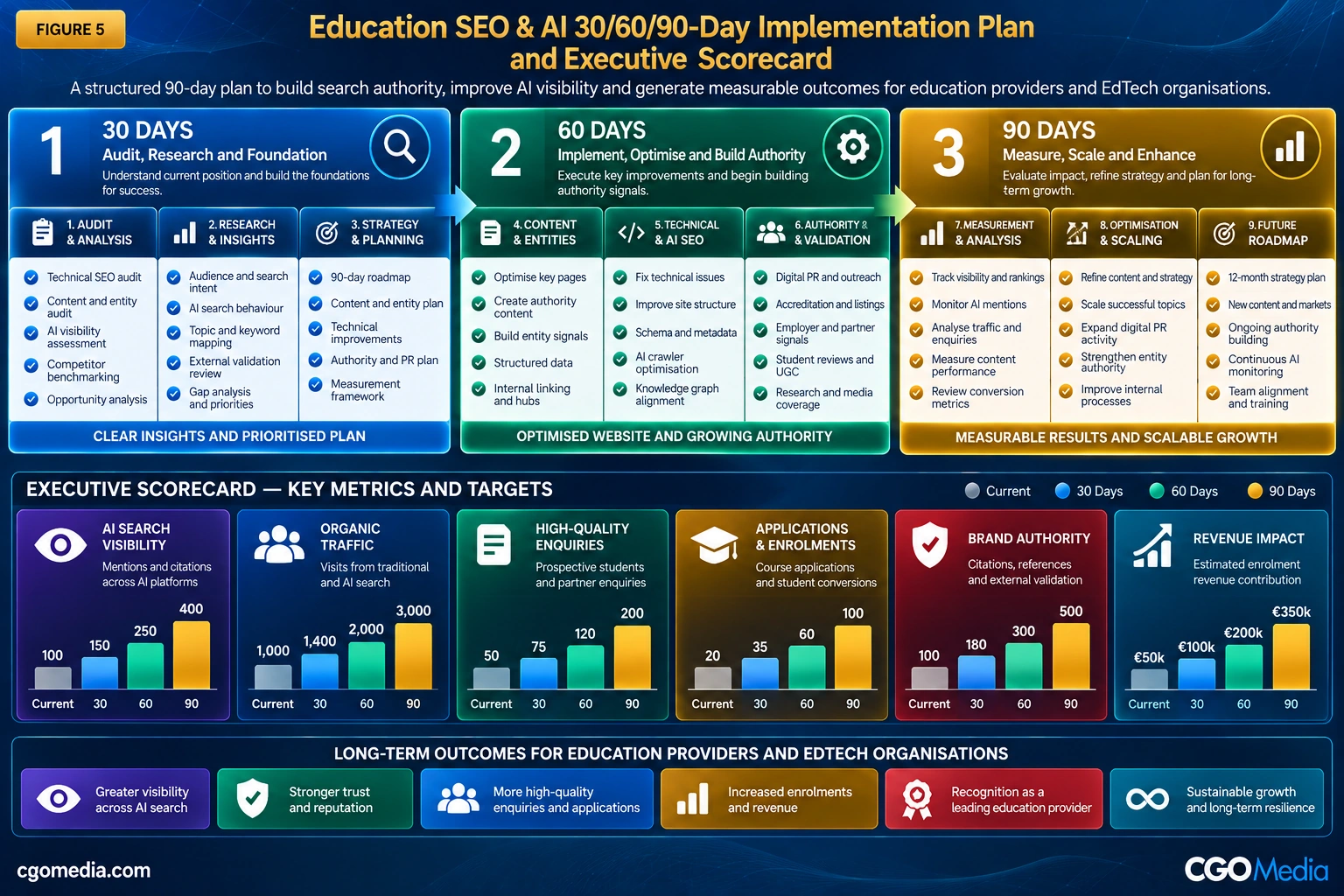
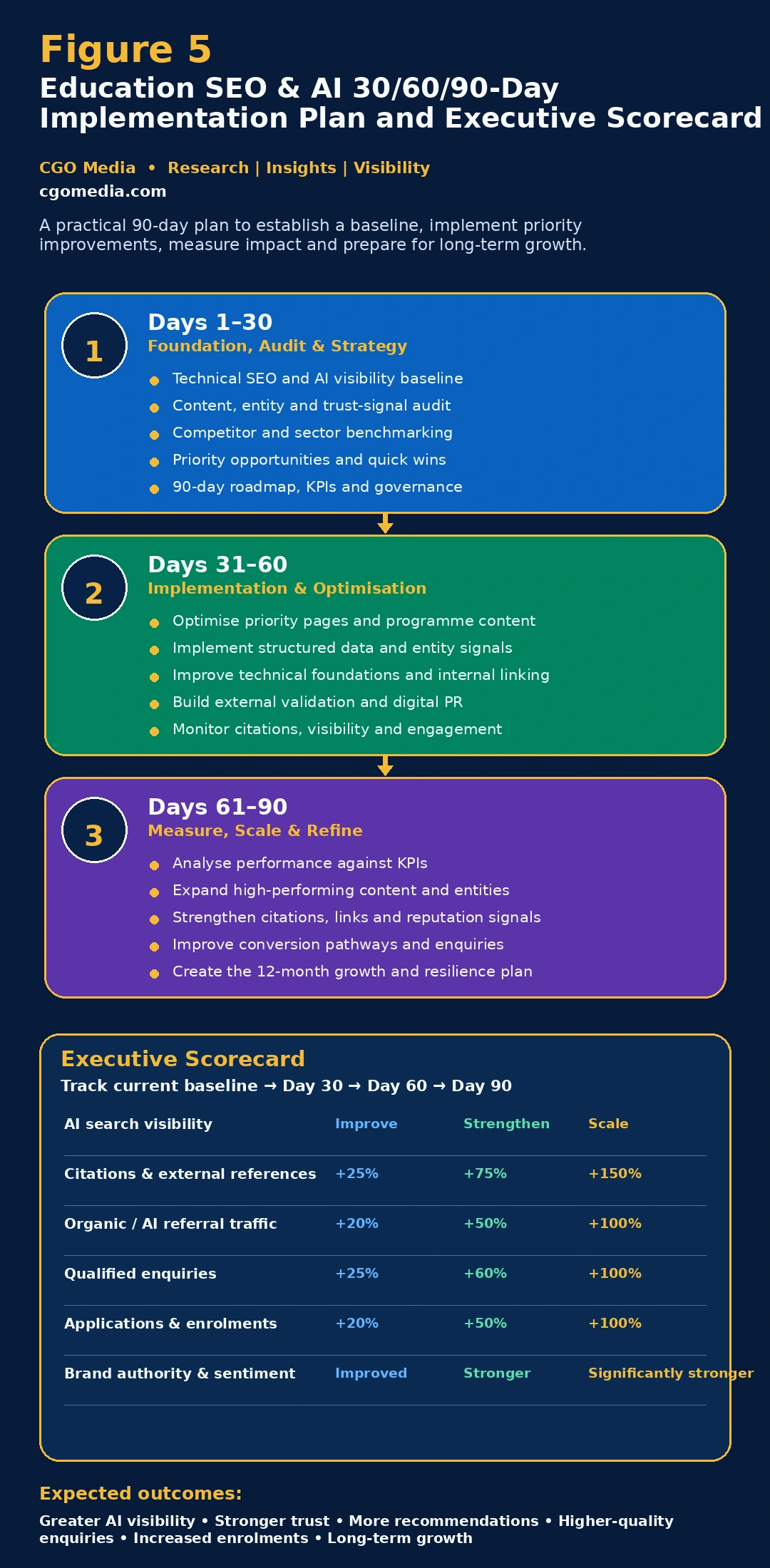
523. The 12-Month Implementation Cycle
The initial 90-day programme establishes control, governance and priority workflows. The following 12 months should convert those foundations into a durable search-authority operating system.
524. Quarter One — Diagnose and Correct
The first quarter should establish a reliable baseline and correct material weaknesses.
525. Quarter One Priorities
- Technical audit
- Provider entity audit
- Programme-data audit
- Accreditation audit
- Outcome evidence audit
- AI baseline
526. Quarter One Outcome
By the end of the quarter, the organisation should have a clearer view of:
- Critical risks
- Priority programmes
- Authority gaps
- Ownership
- Required interventions
527. Quarter Two — Structure and Strengthen
The second quarter should focus on education knowledge architecture and evidence depth.
528. Quarter Two Priorities
- Subject architecture
- Qualification architecture
- Course depth
- Faculty relationships
- Internal linking
- Learner decision content
529. Quarter Two Outcome
Priority subjects and programmes should become easier to understand, navigate and evaluate.
530. Quarter Three — Validate, Integrate and Scale
The third quarter should strengthen external authority and expand the operating model.
531. Quarter Three Priorities
- Accreditation validation
- Employer evidence
- Digital PR
- Research citations
- Marketplace reconciliation
- AI monitoring expansion
532. Quarter Three Outcome
The organisation should have stronger corroborating evidence across external discovery environments.
533. Quarter Four — Govern, Measure and Reassess
The fourth quarter should review whether implementation has become a sustainable organisational capability.
534. Quarter Four Priorities
- Maturity reassessment
- Authority decay review
- AI accuracy review
- Governance refinement
- Programme portfolio review
- Next-year planning
535. Quarter Four Outcome
The organisation should enter the next annual cycle with clearer priorities and stronger institutional learning.
536. The Annual Cycle Should Remain Flexible
Critical learner-risk issues should be addressed immediately rather than waiting for a scheduled quarter.
537. Scaling Should Follow Proven Workflows
Search authority should be expanded only after pilot processes demonstrate that the organisation can maintain:
- Data accuracy
- Ownership
- Review cycles
- Measurement
- Governance
538. Scale by Programme Priority
A practical sequence may focus on:
- Flagship programmes
- High-enrolment programmes
- High-value professional programmes
- Strategic growth programmes
- High-risk programmes
539. Scale by Subject Priority
Subject expansion should reflect a combination of:
- Institutional strength
- Learner demand
- Competitive opportunity
- Faculty expertise
- Market relevance
540. Scale by Market Priority
International growth should consider:
- Demand
- Recognition
- Language
- Fees
- Operational readiness
- Delivery capability
541. Scale by Learner Segment
Different audience groups may require different information and trust architecture.
542. Undergraduate Scaling
Undergraduate discovery may require stronger emphasis on:
- Campus
- Student experience
- Entry requirements
- Career pathways
- Funding
543. Postgraduate Scaling
Postgraduate discovery may require stronger emphasis on:
- Subject expertise
- Faculty
- Research
- Professional outcomes
- Flexible study
544. Professional Education Scaling
Professional learners may place greater weight on:
- Accreditation
- Industry relevance
- Career advancement
- Delivery flexibility
- Employer recognition
545. International Learner Scaling
International audiences may require additional clarity around:
- Recognition
- Entry equivalence
- Language requirements
- Fees
- Location
- Study format
546. Enterprise Learning Scaling
Institutional and employer buyers may evaluate:
- Scalability
- Reporting
- Customisation
- Skills alignment
- Platform integration
547. Scaling Should Preserve Programme Accuracy
Growth should not create fragmented or inconsistent programme information.
548. Scaling Should Preserve Entity Clarity
New schools, brands, partnerships and markets should be incorporated into a consistent provider architecture.
549. Scaling Should Preserve Accreditation Accuracy
Recognition should remain programme-specific and market-aware.
550. Scaling Should Preserve Outcome Context
Employment and progression claims should retain appropriate methodological context across markets and audiences.
551. Scaling Should Preserve AI Accuracy
New programmes and markets should enter AI monitoring deliberately rather than being assumed to inherit existing visibility.
552. Build a Scaling Playbook
A practical playbook may include:
- Programme launch checklist
- Entity mapping template
- Accreditation checklist
- Structured data template
- External-profile checklist
- AI baseline template
553. Build a Programme Launch Standard
Every new strategic programme should pass through a consistent launch process.
554. Programme Launch Standard — Discovery
Confirm relevant:
- Learner language
- Search demand
- Comparison criteria
- Market context
555. Programme Launch Standard — Evidence
Confirm:
- Curriculum
- Faculty
- Fees
- Entry requirements
- Delivery mode
- Outcomes
556. Programme Launch Standard — Trust
Confirm:
- Accreditation
- Awarding relationships
- External validation
- Support information
557. Programme Launch Standard — Technical
Confirm:
- Indexation
- Internal linking
- Canonicalisation
- Structured data
- Performance
558. Programme Launch Standard — External
Review:
- Course marketplaces
- Directories
- Professional sources
- Partner sources
559. Programme Launch Standard — AI
Create a baseline for:
- Provider identity
- Course matching
- Fees
- Accreditation
- Outcomes
560. Strategic Recommendation One — Fix Before Scaling
Correct material technical, programme and provider weaknesses before expanding visibility.
561. Strategic Recommendation Two — Clarify the Provider
Make institutional, campus, partner, online-brand and awarding relationships explicit.
562. Strategic Recommendation Three — Structure the Education Knowledge Graph
Connect:
Provider → Subject → Qualification → Programme → Faculty → Accreditation → Outcome
563. Strategic Recommendation Four — Strengthen Programme Evidence
Priority programmes should provide enough information for informed learner comparison.
564. Strategic Recommendation Five — Govern High-Change Data
Particular attention should be paid to:
- Fees
- Entry requirements
- Start dates
- Programme availability
565. Strategic Recommendation Six — Validate Accreditation
Recognition should be current, programme-specific and independently verifiable where appropriate.
566. Strategic Recommendation Seven — Strengthen Employer Authority
Use genuine evidence connecting programmes with professional practice and labour-market relevance.
567. Strategic Recommendation Eight — Publish Defensible Outcomes
Outcome claims should preserve:
- Sample
- Methodology
- Time period
- Limitations
568. Strategic Recommendation Nine — Build External Education Authority
Strengthen relevant:
- Education media
- Professional sources
- Research citations
- Course marketplaces
- Review platforms
569. Strategic Recommendation Ten — Use Digital PR Strategically
Prioritise evidence-led assets rather than disconnected publicity.
570. Strategic Recommendation Eleven — Integrate Search with Academic Governance
SEO should participate in programme information workflows early enough to prevent downstream errors.
571. Strategic Recommendation Twelve — Integrate Search with Admissions
Entry requirements, eligibility and application information should remain current.
572. Strategic Recommendation Thirteen — Integrate Search with Careers
Career and employer evidence should connect with real programme outcomes.
573. Strategic Recommendation Fourteen — Integrate Search with Data
Programme data should flow from governed sources wherever practical.
574. Strategic Recommendation Fifteen — Integrate Search with Technology
Technical systems should support:
- Structured data
- Automation
- Feeds
- Performance
- Monitoring
575. Strategic Recommendation Sixteen — Monitor AI Representation
Track:
- Presence
- Relevance
- Accuracy
- Trust context
576. Strategic Recommendation Seventeen — Prioritise Material AI Errors
Focus on persistent inaccuracies affecting:
- Fees
- Eligibility
- Programme availability
- Accreditation
- Outcomes
577. Strategic Recommendation Eighteen — Avoid Prompt Chasing
Improve the evidence system rather than repeatedly rewriting content for one isolated AI response.
578. Strategic Recommendation Nineteen — Measure Learner Progression
Connect search visibility with:
Discovery → Understanding → Validation → Comparison → Application → Enrolment
579. Strategic Recommendation Twenty — Measure Quality, Not Just Volume
Track:
- Qualified applications
- Offer acceptance
- Enrolment
- Early retention
- Programme fit
580. Strategic Recommendation Twenty-One — Reassess Maturity Regularly
Use the Education Search Authority Maturity Model to evaluate whether implementation is creating stronger organisational capability.
581. Strategic Recommendation Twenty-Two — Connect Trust with Implementation
Use the Education & EdTech AI Trust and Visibility Framework to identify which evidence areas require improvement.
582. Strategic Recommendation Twenty-Three — Connect Search with Provider Selection
Use the Education Discovery and Provider Selection Model to understand where learner progression breaks down.
583. Strategic Recommendation Twenty-Four — Integrate the Parent Research
The broader Education & EdTech SEO in an AI Search Environment research paper provides the wider strategic context for this roadmap.
584. Long-Term Resilience Requires More Than Search Rankings
A resilient education search system should remain useful even as discovery interfaces change.
585. Resilient Technical Architecture
Maintain:
- Crawlability
- Indexation control
- Performance
- Structured relationships
586. Resilient Programme Architecture
Maintain clear relationships between:
- Subjects
- Qualifications
- Courses
- Faculty
- Outcomes
587. Resilient Data Architecture
Maintain governed sources for critical programme information.
588. Resilient Trust Architecture
Maintain verifiable:
- Accreditation
- Employer evidence
- Outcome evidence
- Learner support information
589. Resilient External Authority
Avoid dependence on one:
- Marketplace
- Ranking provider
- Media source
- Review platform
590. Resilient AI Visibility
Focus on strong evidence across multiple public sources rather than optimisation for one interface.
591. Resilient Governance
Ownership and review processes should survive:
- Staff changes
- Platform changes
- Programme restructuring
- Market expansion
592. Resilient Measurement
Measurement should combine:
- Search visibility
- Programme authority
- External validation
- AI accuracy
- Learner progression
593. Long-Term Resilience Requires Institutional Learning
Repeated observations should improve:
- Programme standards
- Governance
- Content architecture
- Data quality
- Search strategy
594. The Continuous Education Search Operating Cycle
The long-term model is:
Assess → Stabilise → Structure → Strengthen → Validate → Integrate → Evolve → Reassess
595. The Roadmap Is Designed to Repeat
New programmes, new markets, new AI systems and new learner behaviours return the organisation to assessment.
596. The Strategic Outcome Is Not Maximum Traffic
The objective is not to attract every possible learner.
597. The Strategic Outcome Is Relevant Discovery
Suitable learners should be able to discover appropriate programmes.
598. The Strategic Outcome Is Clear Understanding
Learners should be able to understand:
- Programme scope
- Eligibility
- Cost
- Delivery
- Recognition
599. The Strategic Outcome Is Verifiable Trust
Important institutional and programme claims should be supported by credible evidence.
600. The Strategic Outcome Is Appropriate Selection
Learners should be able to compare providers and choose programmes that fit their circumstances and goals.
601. The Strategic Outcome Is Organisational Resilience
Search authority should remain strong as programmes, markets and discovery systems evolve.
602. The Implementation Equation
The roadmap can be summarised as:
Technical Stability + Entity Clarity + Programme Evidence + External Validation + AI Readiness + Governance + Measurement
603. The Operating Equation
The long-term cycle is:
Observe → Verify → Diagnose → Prioritise → Improve → Validate → Measure → Learn → Reassess
604. The Roadmap Principle
Education SEO and AI implementation becomes sustainable when search authority is embedded into the systems, teams and evidence processes that govern the learner journey.
605. The Next Stage Is Final Research Integration
The final section consolidates the roadmap’s strategic implications, methodology, limitations, conclusion, references, author information and research citation guidance.
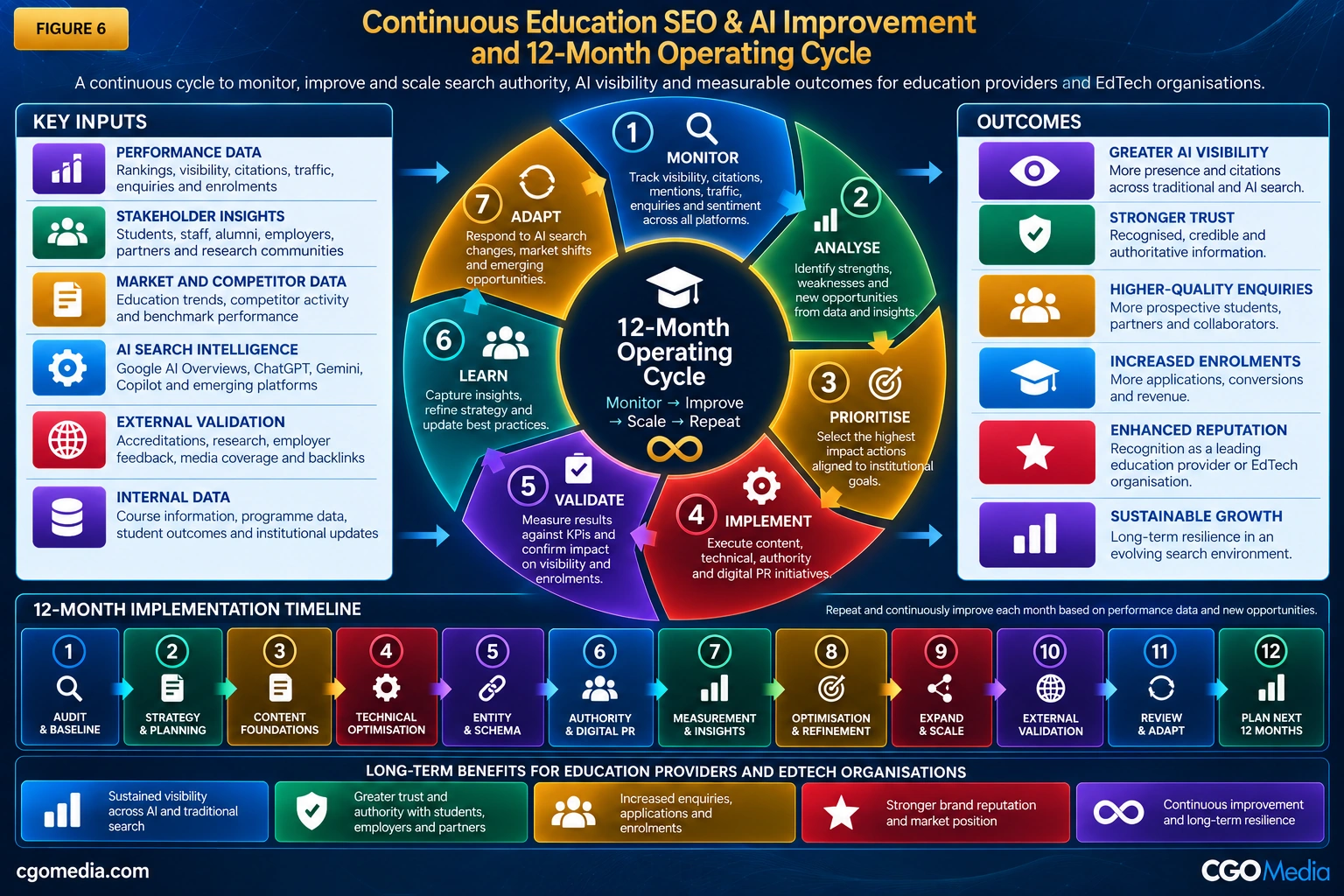
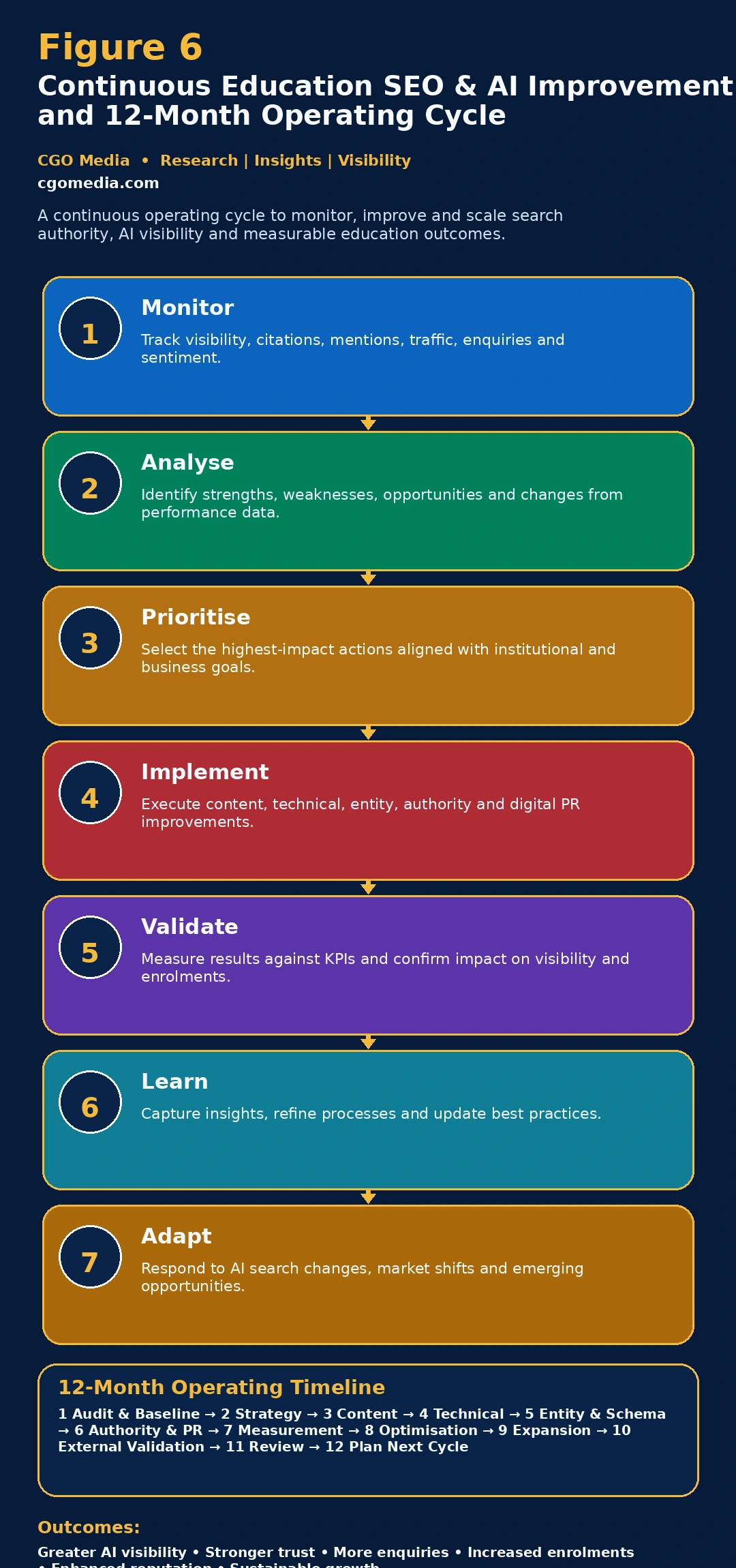
606. Strategic Implications
Education SEO implementation is becoming a broader organisational capability that extends beyond technical optimisation, content production and keyword visibility.
Universities, colleges, training providers and EdTech organisations increasingly need to coordinate technical search performance, programme evidence, institutional identity, accreditation, learner trust, external authority and AI-assisted discovery within one governed operating model.
607. Implementation Order Matters
The roadmap is deliberately sequenced:
Assess → Stabilise → Structure → Strengthen → Validate → Integrate → Evolve
This order reduces the risk of scaling visibility before the underlying educational evidence is sufficiently accurate and governed.
608. Assessment Should Precede Expansion
Organisations should establish a reliable baseline before investing heavily in new content, Digital PR, international expansion or AI-search initiatives.
609. Stabilisation Should Precede Growth
Material errors involving fees, entry requirements, programme availability, provider identity or accreditation should be corrected before those pages receive greater visibility.
610. Structure Creates Long-Term Search Value
Strong education search architecture connects:
Provider → Subject → Qualification → Programme → Faculty → Accreditation → Outcome
611. Strengthening Should Close Real Learner Gaps
Content expansion should focus on questions learners genuinely need answered rather than on publishing volume alone.
612. External Validation Should Support First-Party Evidence
Accreditation sources, employer relationships, education media, research citations, reviews and course marketplaces can strengthen trust when they remain relevant and current.
613. Integration Is Essential for Scale
SEO cannot maintain programme truth independently because important information is distributed across academic, admissions, quality, careers, technology and data teams.
614. Governance Converts Implementation into Capability
Ownership, review cycles, escalation rules and source-of-truth systems allow improvements to survive staff, platform and programme changes.
615. AI Search Readiness Should Be Treated as an Evidence Outcome
AI visibility becomes more defensible when the underlying provider, programme and external evidence system is already strong.
616. AI Presence Should Not Be the Primary Objective
Frequent inclusion is less valuable when programme information is inaccurate, irrelevant or poorly contextualised.
617. AI Monitoring Should Focus on Four Areas
A practical model is:
Presence + Relevance + Accuracy + Trust Context
618. Learner Progression Should Guide Measurement
Search implementation should ultimately support:
Discovery → Understanding → Validation → Comparison → Application → Enrolment
619. Qualified Progression Is More Valuable Than Raw Traffic
Large traffic increases may create limited educational or commercial value if they attract poorly matched learners.
620. Application Volume Is Also Incomplete
Higher application volume can coexist with:
- Poor eligibility
- Low offer acceptance
- Weak enrolment
- Early withdrawal
621. The Stronger Measurement Model Connects Search with Learner Quality
Relevant measures may include:
- Qualified programme traffic
- Application quality
- Offer acceptance
- Enrolment
- Early retention
622. Search Intelligence Should Feed the Institution
Search data can contribute insight around:
- Learner questions
- Subject demand
- Eligibility confusion
- Career interests
- Delivery preferences
623. Search Demand Should Not Replace Academic Judgement
Demand data can inform discovery strategy without reducing programme design to search volume.
624. The Roadmap Supports Institutional Resilience
A mature search system should continue to function as:
- Programmes change
- Markets expand
- Brands change
- AI systems evolve
- Learner behaviour changes
625. The Long-Term Objective Is a Governed Education Search System
The roadmap ultimately seeks to create:
Technical Stability + Entity Clarity + Programme Evidence + External Validation + AI Readiness + Governance + Measurement
626. Relationship with the Education & EdTech Research Family
This implementation roadmap forms one part of the wider CGO Media Education & EdTech research architecture.
Education & EdTech SEO in an AI Search Environment | Education & EdTech AI Trust and Visibility Framework | Education Discovery and Provider Selection Model | Education Search Authority Maturity Model
627. Relationship with the Parent Research Paper
The Education & EdTech SEO in an AI Search Environment research paper provides the broader strategic context for provider discovery, AI-assisted search, entity authority, programme information and learner selection.
628. Relationship with the AI Trust and Visibility Framework
The Education & EdTech AI Trust and Visibility Framework defines the evidence dimensions that the roadmap seeks to improve operationally.
629. Relationship with the Provider Selection Model
The Education Discovery and Provider Selection Model explains how learners progress through discovery, evaluation, validation and selection.
630. Relationship with the Maturity Model
The Education Search Authority Maturity Model provides the long-term capability model used to reassess organisational progress.
631. Methodology
The Education & EdTech SEO and AI Implementation Roadmap is a conceptual implementation framework developed by CGO Media to translate education search-authority principles into a structured operational sequence.
632. Research Scope
The roadmap is designed to support:
- Universities
- Colleges
- Training providers
- Professional education organisations
- Online course providers
- EdTech platforms
- Career-transition providers
633. Seven-Phase Method
The framework organises implementation into seven phases:
- Assess
- Stabilise
- Structure
- Strengthen
- Validate
- Integrate
- Evolve
634. Assess Method
The assessment stage evaluates:
- Technical health
- Provider identity
- Programme data
- Subject authority
- Accreditation
- External evidence
- AI representation
635. Stabilise Method
The stabilisation stage prioritises material inaccuracies and technical weaknesses that could undermine learner trust or search interpretation.
636. Structure Method
The structure stage develops relationships between:
- Provider
- Subject
- Qualification
- Programme
- Faculty
- Accreditation
- Outcomes
637. Strengthen Method
The strengthening stage improves the depth and usefulness of educational evidence across priority programme journeys.
638. Validate Method
The validation stage examines relevant external corroboration from:
- Accreditation bodies
- Professional organisations
- Learners
- Employers
- Education media
- Research sources
- Course marketplaces
639. Integrate Method
The integration stage connects SEO with the teams and systems responsible for educational truth.
640. Evolve Method
The evolution stage introduces continuous improvement, maturity reassessment, scaling and long-term resilience.
641. Prioritisation Method
The roadmap proposes that implementation priority should consider:
Gap + Risk + Learner Impact + Strategic Importance + Evidence Confidence
642. Measurement Method
Implementation is assessed through a combination of:
- Technical indicators
- Programme evidence indicators
- External validation indicators
- AI accuracy indicators
- Learner progression
- Governance maturity
643. AI Observation Method
AI monitoring should use repeatable prompts and record:
- Prompt
- Model
- Date
- Market
- Learner type
- Observed output
644. AI Evaluation Method
A practical AI evaluation model is:
Presence + Relevance + Accuracy + Trust Context
645. 30/60/90-Day Method
The roadmap uses the first 90 days to establish:
- Control
- Ownership
- Material correction
- Architecture
- External consistency
- AI monitoring
- Repeatable governance
646. Annual Operating Method
The 12-month cycle is structured around:
Q1: Diagnose and Correct → Q2: Structure and Strengthen → Q3: Validate, Integrate and Scale → Q4: Govern, Measure and Reassess
647. Governance Method
The roadmap treats search authority as an ongoing capability requiring:
- Named ownership
- Review cycles
- Source-of-truth systems
- Change triggers
- Escalation
- Documentation
648. Limitations
This roadmap is a strategic implementation framework. It is not an accreditation audit, quality-assurance certification, legal opinion, regulatory assessment or guarantee of search, enrolment or AI visibility outcomes.
649. Education Systems Differ
Qualification, accreditation and funding structures vary significantly between jurisdictions.
650. Provider Types Differ
Universities, colleges, bootcamps, professional training providers and EdTech businesses may require different implementation emphasis.
651. Programme Portfolios Differ
An organisation with ten programmes may require a different governance model from one managing thousands of course variants.
652. Search Demand Is Dynamic
Learner terminology, subject interest and discovery behaviour can change over time.
653. Search Engines Change
Ranking systems, indexing behaviour and search interfaces continue to evolve.
654. AI Systems Change
Models, source-selection methods, interfaces and recommendation behaviour can change.
655. AI Outputs Are Variable
Generated responses may differ according to:
- Prompt
- Model
- Location
- Time
- Available evidence
656. Visible AI Citations Are Partial Evidence
Displayed sources do not necessarily represent every source or process involved in answer construction.
657. Visible Source Appearance Does Not Establish Full Causation
A visible citation should not automatically be treated as the sole reason a programme or provider was included.
658. AI Recommendation Inclusion Is Not Independent Endorsement
Generated inclusion does not prove:
- Academic quality
- Accreditation
- Programme suitability
- Employment outcomes
659. AI Recommendation Order Is Not a Stable Ranking
Provider order may vary between prompts, sessions and systems.
660. Search Attribution Is Incomplete
Learners often interact with multiple:
- Search results
- AI tools
- Social platforms
- Course marketplaces
- Offline sources
661. AI Attribution Is Particularly Difficult
Closed interfaces and inconsistent referral tracking can limit precise attribution.
662. Correlation Should Not Be Presented as Causation
Changes in search visibility, AI mentions, applications or enrolments should not automatically be attributed to one intervention without sufficient evidence.
663. Search Rankings Are Not Guaranteed
No implementation roadmap can guarantee particular organic search positions.
664. AI Visibility Is Not Guaranteed
No methodology can guarantee recommendation, citation or inclusion by a particular AI system.
665. Application Growth Is Not Guaranteed
Application behaviour can be influenced by:
- Fees
- Market demand
- Entry requirements
- Competition
- Economic conditions
666. Enrolment Growth Is Not Guaranteed
Search visibility does not independently determine enrolment outcomes.
667. Employment Outcomes Are Not Guaranteed
Participation in an education programme does not guarantee employment, salary, promotion or career progression.
668. Conclusion
Education and EdTech SEO implementation now requires a broader operational model than conventional page optimisation.
Provider visibility depends increasingly on the interaction between technical accessibility, institutional identity, programme evidence, accreditation, external validation, outcomes, AI representation and organisational governance.
This changes the implementation question from:
“What SEO activity should we do next?”
to:
“What authority capability must we build next, and what evidence or governance dependency must exist first?”
The Education & EdTech SEO and AI Implementation Roadmap answers that question through seven phases:
Assess → Stabilise → Structure → Strengthen → Validate → Integrate → Evolve
These phases are deliberately sequential but ultimately cyclical.
Once the organisation reaches Evolve, new programmes, new markets, new technologies and new learner behaviours return the system to reassessment.
The long-term implementation cycle therefore becomes:
Assess → Stabilise → Structure → Strengthen → Validate → Integrate → Evolve → Reassess
The objective is not simply more pages, more traffic or more AI mentions.
It is to build an education search system capable of supporting:
Relevant Discovery → Clear Understanding → Verifiable Trust → Appropriate Selection → Sustainable Institutional Learning
References
External Academic, Technical and Search Sources
- Google Search Central. SEO Starter Guide.
- Google Search Central. Understand how structured data works.
- Schema.org. EducationalOrganization.
- Schema.org. Course.
- Schema.org. Person.
- W3C. Web Content Accessibility Guidelines (WCAG) 2.2.
- Hogan, A. et al. (2021). Knowledge Graphs. ACM Computing Surveys, 54(4).
- Metzger, M.J. (2007). Making Sense of Credibility on the Web: Models for Evaluating Online Information and Recommendations for Future Research. Journal of the American Society for Information Science and Technology, 58(13), 2078–2091.
- Ji, Z. et al. (2023). Survey of Hallucination in Natural Language Generation. ACM Computing Surveys, 55(12).
CGO Media Education & EdTech Research and Frameworks
- Wilkinson, R. (2026). Education & EdTech SEO in an AI Search Environment. CGO Media.
- Wilkinson, R. (2026). Education & EdTech AI Trust and Visibility Framework. CGO Media.
- Wilkinson, R. (2026). Education Discovery and Provider Selection Model. CGO Media.
- Wilkinson, R. (2026). Education Search Authority Maturity Model. CGO Media.
CGO Media Research Ecosystem
CGO Media Research Library | CGO Media Framework Library | CGO Media Research Architecture
About Roger Wilkinson
Roger Wilkinson is an independent researcher, SEO practitioner and founder of CGO Media with more than 25 years of experience in search, digital visibility and business growth.
His research focuses on how artificial intelligence is reshaping search engines, recommendation systems, entity representation, digital authority and organisational visibility.
Roger is the creator of the CGO Framework Series, a collection of research-led methodologies designed to help organisations measure, improve and govern Search Visibility, AI Visibility and Digital Authority.
His work examines the relationship between Technical SEO, Entity Authority, Content Authority, Citation Authority, Brand Signals, Knowledge Architecture and AI Search Readiness.
View Roger Wilkinson’s researcher profile →
Related Education & EdTech Research and Frameworks
Education & EdTech SEO in an AI Search Environment |
Education & EdTech AI Trust and Visibility Framework |
Education Discovery and Provider Selection Model |
Education Search Authority Maturity Model |
Education GEO: Generative Engine Optimisation
Research Usage & Citation
CGO Media encourages researchers, journalists, universities, colleges, training providers, EdTech organisations, professional bodies and education-sector organisations to reference this roadmap where it contributes to wider discussion of education SEO, learner discovery, AI search, programme authority and digital governance.
Reasonable quotations, summaries, figures and excerpts may be used in articles, reports, presentations, academic work and other publications provided appropriate acknowledgement is given to Roger Wilkinson and CGO Media.
Cite This Research Framework / Embed Citation
The Education & EdTech SEO and AI Implementation Roadmap by Roger Wilkinson at CGO Media provides a seven-phase implementation model for building technical stability, programme authority, external validation, AI readiness and governance across modern education search environments.
APA Citation
APA Citation: Wilkinson, R. (2026). Education & EdTech SEO and AI Implementation Roadmap. CGO Media. https://cgomedia.com/education-edtech-seo-ai-implementation-roadmap/
Author: Roger Wilkinson | Published by: CGO Media
For permissions relating to extensive reproduction, commercial licensing or republication of substantial portions of this roadmap, please contact CGO Media directly.
Your Content Goes Here