
Education Discovery and Provider Selection Model
 The Education Discovery and Provider Selection Model explains how learners move from an initial academic, career or skills objective through subject exploration, qualification research, provider discovery, programme evaluation, trust validation, comparison, application and enrolment.
The model is designed for universities, colleges, professional training organisations, online course providers and EdTech platforms seeking to understand how modern education decisions are increasingly distributed across search engines, AI assistants, accreditation bodies, comparison platforms, course marketplaces, employer evidence, reviews and provider-owned content.
It forms part of the wider CGO Media Education & EdTech research architecture and should be read alongside Education & EdTech SEO in an AI Search Environment, the Education & EdTech AI Trust and Visibility Framework, the Education Search Authority Maturity Model and the Education & EdTech SEO and AI Implementation Roadmap.
1. Why Education Provider Selection Needs a Model
Education decisions rarely begin with a fully formed preference for one institution or one course.
2. Learners Often Begin with a Problem or Goal
A prospective learner may begin with:
- A career objective
- A subject interest
- A need for a recognised qualification
- A requirement to retrain
- A need for flexible study
- An employer training requirement
3. Provider Selection Happens Later
The eventual education provider is usually selected only after several layers of discovery, filtering, validation and comparison.
4. Provider Selection Is Therefore a Process
It should not be reduced to:
Search → Course Page → Application
5. A More Realistic Model Is
Goal → Pathway → Requirements → Provider Discovery → Programme Understanding → Trust Validation → Comparison → Commitment
6. Education Selection Is a High-Consideration Decision
Many learners are evaluating:
- Time
- Money
- Career opportunity
- Academic progression
- Personal risk
7. The Cost of a Poor Education Decision Can Be Significant
A poorly matched programme can create:
- Financial loss
- Lost time
- Delayed career progression
- Non-completion
- Reduced confidence
8. Learners Therefore Need More Than Visibility
They need enough evidence to determine whether a provider and programme are appropriate.
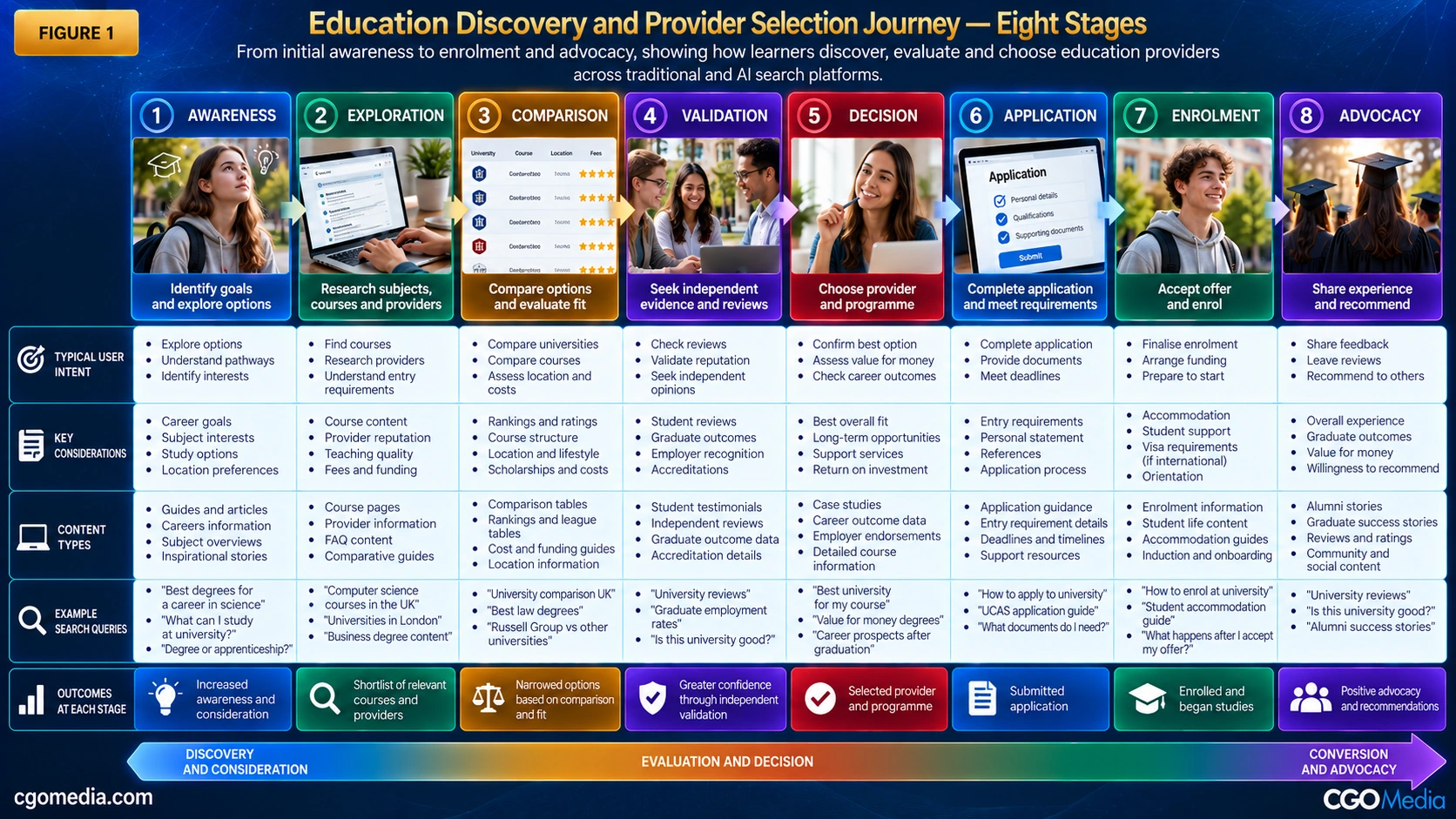
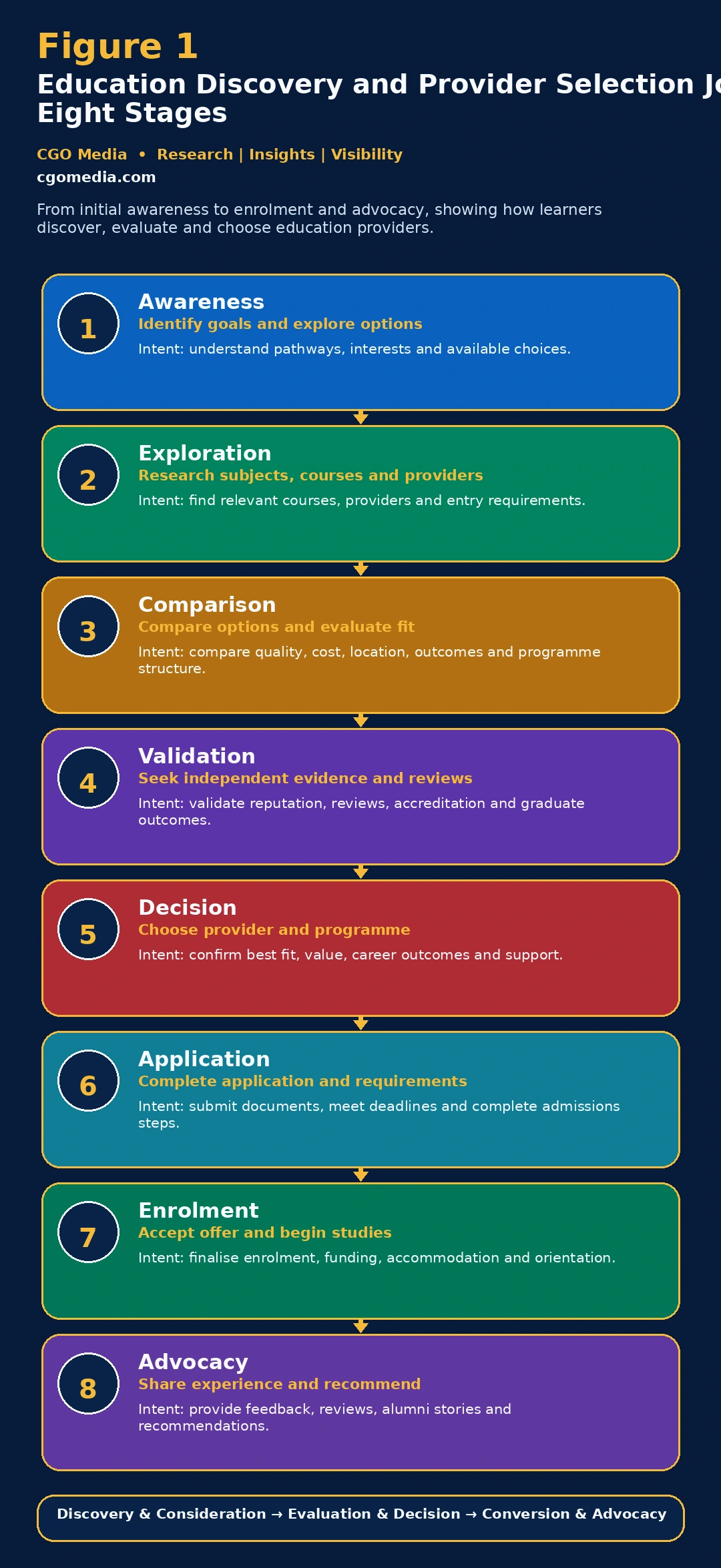
9. The Eight Stages of Education Discovery and Provider Selection
- Learner Goal Recognition
- Subject and Pathway Discovery
- Qualification Requirement Definition
- Provider and Course Discovery
- Programme Understanding
- Trust and Accreditation Validation
- Comparison and Shortlisting
- Application, Enrolment and Commitment
10. The Eight Stages Are Connected
A weakness at one stage can prevent progression to the next.
11. Stage One — Learner Goal Recognition
The learner journey frequently begins with a desired outcome rather than a known programme.
12. Common Learner Goals
- Entering a profession
- Changing career
- Developing a technical skill
- Obtaining promotion
- Meeting a professional requirement
- Preparing for further study
- Pursuing personal development
13. Goal Recognition Can Be Career-Led
Examples include:
- Become a data analyst
- Move into cybersecurity
- Progress into management
- Qualify for teaching
14. Goal Recognition Can Be Skills-Led
Examples include:
- Learn Python
- Improve leadership skills
- Develop digital marketing expertise
- Learn project management
15. Goal Recognition Can Be Qualification-Led
The learner may know that a formal credential is required but not yet know which provider or format is appropriate.
16. Goal Recognition Can Be Employer-Led
An employer may require:
- Certification
- Continuing professional development
- Compliance training
- Management development
- Technical upskilling
17. Goal-Led Search Behaviour
Goal-led discovery often uses natural questions rather than exact course names.
18. Example Goal-Led Searches
- How do I become a cybersecurity analyst?
- What qualification do I need for project management?
- How can I move into data science?
- What course should I take to work in digital marketing?
19. Goal-Led Discovery Creates Early Provider Opportunity
Providers that answer these questions can enter the learner journey before a specific course category has been chosen.
20. Early-Stage Content Should Educate Rather Than Force Selection
Useful content should explain realistic pathways, requirements, alternatives and limitations.
21. Stage Two — Subject and Pathway Discovery
Once the learner understands the goal, the next stage is identifying possible routes.
22. Pathway Discovery Can Include Different Education Types
- University degrees
- Professional qualifications
- Vocational courses
- Bootcamps
- Online certificates
- Apprenticeships
- Short courses
23. One Goal Can Have Several Viable Pathways
For example, a learner seeking to enter software development might consider:
- A computer science degree
- A coding bootcamp
- A professional certificate
- A structured online programme
- Portfolio-led self-study
24. Pathway Comparison Happens Before Provider Comparison
The learner may need to decide what type of education is appropriate before deciding who should provide it.
25. Pathway Authority
Providers can support early discovery by explaining the strengths, limitations and suitability of different educational routes.
26. Pathway Content Can Compare Time Commitment
Different options may require:
- Weeks
- Months
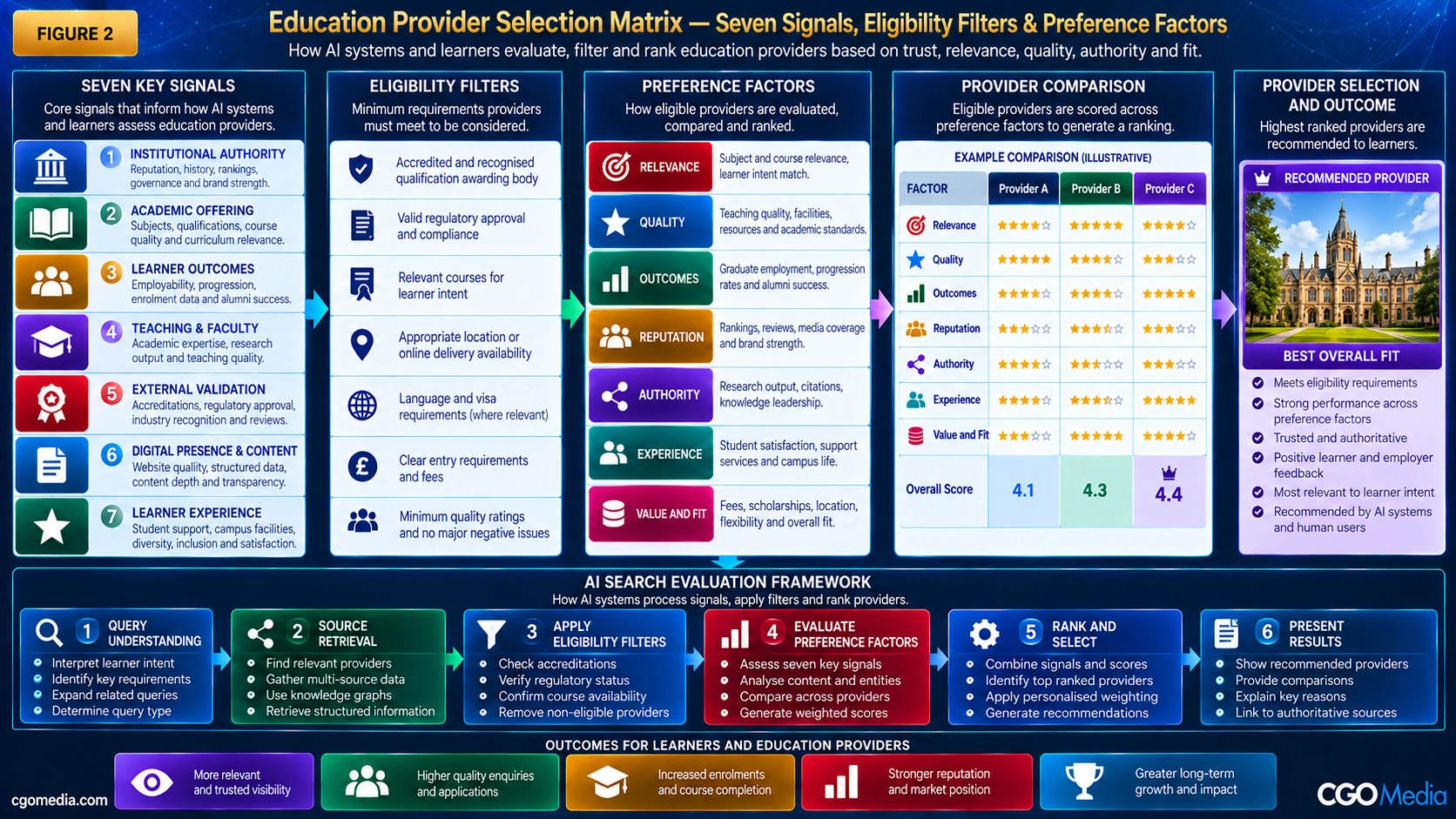
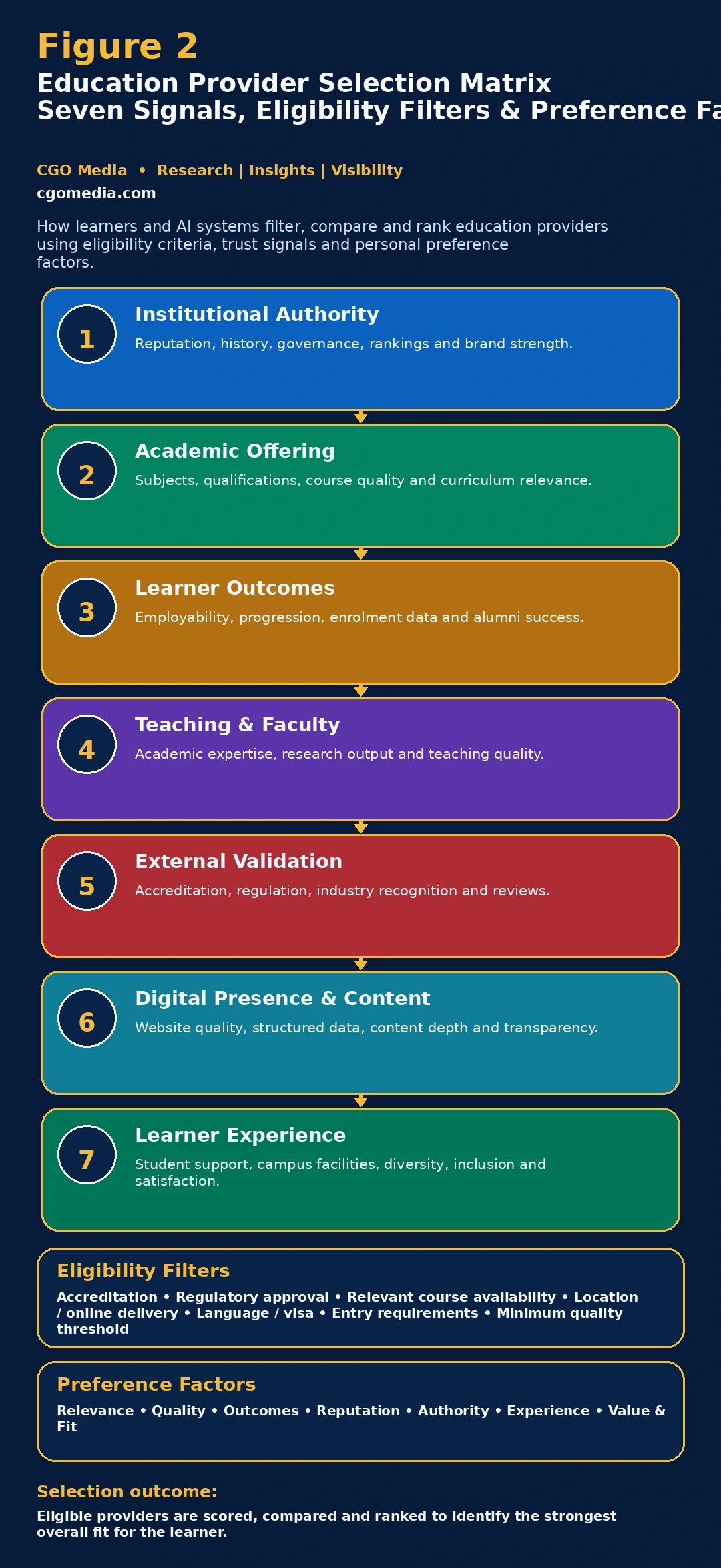
- Several years
27. Pathway Content Can Compare Qualification Level
Learners should understand whether the route produces:
- A degree
- A professional qualification
- A certificate
- A non-accredited completion credential
28. Pathway Content Can Compare Career Relevance
Different routes may support different professional objectives.
29. Pathway Content Can Compare Entry Requirements
One pathway may require prior academic qualifications while another may be accessible through professional experience.
30. Pathway Content Can Compare Cost
The learner may weigh tuition against:
- Duration
- Career objective
- Qualification value
- Opportunity cost
31. Pathway Content Can Compare Delivery Format
Relevant distinctions include:
- Campus
- Online
- Hybrid
- Self-paced
- Instructor-led
32. Pathway Content Can Compare Progression Opportunities
Some qualifications support:
- Further study
- Professional registration
- Certification progression
- Career advancement
33. Pathway Authority Should Avoid False Universality
No single educational route is automatically best for every learner.
34. Stage Three — Qualification Requirement Definition
As the learner becomes more informed, the search becomes more constrained by explicit requirements.
35. Qualification Requirements Can Include
- Qualification type
- Academic level
- Professional recognition
- Accreditation
- Entry requirements
- Duration
- Delivery
- Budget
36. The Education Requirement Stack
A useful model is:
Goal → Subject → Qualification → Delivery → Entry Requirements → Duration → Cost → Accreditation → Outcome
37. Each Requirement Narrows the Eligible Provider Set
The more specific the learner becomes, the fewer programmes remain genuinely suitable.
38. Hard Requirements
Hard requirements determine whether a programme remains eligible.
39. Hard Requirement — Mandatory Accreditation
A programme without the required recognition may be eliminated immediately.
40. Hard Requirement — Qualification Level
A learner needing postgraduate study should not be matched to an introductory short course.
41. Hard Requirement — Delivery Format
A learner unable to attend campus may require fully online delivery.
42. Hard Requirement — Maximum Budget
A programme outside the learner’s realistic financial range may be excluded.
43. Hard Requirement — Location
Location can determine eligibility where physical attendance is required.
44. Hard Requirement — Academic Prerequisites
A learner who does not meet entry criteria may need an alternative route.
45. Hard Requirement — Completion Timeframe
Some learners require a qualification within a specific period.
46. Soft Requirements
Soft requirements influence preference after basic eligibility has been established.
47. Soft Requirement — Institution Reputation
A stronger brand may increase confidence between otherwise comparable options.
48. Soft Requirement — Faculty Profile
Faculty authority may influence advanced or specialist learners.
49. Soft Requirement — Learner Support
Support may be particularly important for:
- Online learners
- International learners
- Career changers
- Learners returning to education
50. Soft Requirement — Platform Quality
For EdTech and online providers, platform usability can influence preference.
51. Soft Requirement — Career Services
Career support may help differentiate programmes with similar academic content.
52. Soft Requirement — Community
Learners may value:
- Peer networks
- Alumni networks
- Professional communities
- Campus life
53. Requirements Can Shift During Research
A soft preference may become a hard requirement once the learner understands its importance.
54. Requirements Can Also Relax
A learner may widen the search if the original combination produces too few viable options.
55. AI-Assisted Search Can Compress Requirement Definition
A single prompt may contain:
- Career goal
- Budget
- Delivery preference
- Location
- Qualification requirement
- Time constraint
56. Stage Four — Provider and Course Discovery
Once requirements are sufficiently clear, the learner begins identifying specific providers and programmes.
57. Provider Discovery Is Multi-Channel
Discovery can occur through:
- Search engines
- AI assistants
- Comparison platforms
- Course marketplaces
- Professional bodies
- Employer recommendations
- Social platforms
- Personal referrals
58. Search Engine Discovery
Search engines remain an important route into education research.
59. Search Queries Often Combine Several Criteria
Examples include:
- Subject
- Qualification
- Location
- Delivery
- Price
- Career goal
60. Strong Education SEO Should Support Multiple Intent Stages
Providers should be visible not only for course names, but also for:
- Career goals
- Subjects
- Qualifications
- Delivery requirements
- Outcome questions
61. AI-Assisted Provider Discovery
AI systems can combine several learner requirements into a single provider-discovery request.
62. Example Contextual AI Request
A learner might ask:
“Recommend recognised online project management qualifications for someone working full time who needs flexible study and wants to spend less than £3,000.”
63. This Requires Contextual Matching
The system must consider:
- Recognition
- Delivery
- Audience
- Price
- Schedule
- Outcome relevance
64. Comparison Platform Discovery
Comparison platforms may help learners filter large provider markets using structured criteria.
65. Common Comparison Filters
- Subject
- Qualification
- Location
- Fees
- Duration
- Delivery
- Reviews
66. Course Marketplace Discovery
For online learning and professional training, marketplaces may become the first provider-discovery environment.
67. Marketplace Discovery Can Precede Brand Awareness
The learner may evaluate the programme before knowing the provider.
68. Professional Body Discovery
Professional organisations can influence which qualifications and providers enter consideration.
69. Professional Discovery Can Include
- Recognised qualifications
- Accredited programmes
- Membership routes
- Exemption pathways
- Continuing professional development
70. Employer-Led Discovery
Employers can shape education selection through:
- Recommended qualifications
- Training partnerships
- Internal learning programmes
- Apprenticeships
- Professional-development budgets
71. Personal Recommendation Remains Influential
Learners may also rely on:
- Colleagues
- Friends
- Family
- Alumni
- Professional networks
72. Stage Five — Programme Understanding
Discovery creates a candidate provider list, but the learner must then determine whether each programme actually fits.
73. Programme Understanding Requires Detailed Evidence
This stage moves from visibility into interpretation.
74. Curriculum Evaluation
Learners may examine:
- Modules
- Learning outcomes
- Projects
- Assessments
- Electives
- Practical components
75. Curriculum Clarity Supports Comparison
Similar programme titles can conceal significant differences in teaching depth and focus.
76. Delivery Evaluation
The learner may need to determine whether study is:
- Online
- Campus-based
- Hybrid
- Full-time
- Part-time
- Self-paced
- Instructor-led
77. Delivery Fit Can Eliminate Strong Programmes
A programme may be academically suitable but impractical for the learner’s circumstances.
78. Entry Requirement Evaluation
Programme eligibility depends on clear prerequisites.
79. Entry Requirements Can Include
- Academic qualifications
- Professional experience
- Language ability
- Portfolio requirements
- Technical prerequisites
80. Fee and Funding Evaluation
Learners may compare:
- Tuition
- Additional costs
- Scholarships
- Payment plans
- Employer funding
- Public funding where relevant
81. Price Is Usually Evaluated Relative to Perceived Value
Learners may compare cost against:
- Qualification status
- Duration
- Teaching quality
- Career relevance
- Flexibility
82. Faculty Evaluation
Faculty can become a significant selection factor for specialist or advanced programmes.
83. Faculty Evidence Can Include
- Academic expertise
- Industry experience
- Professional qualifications
- Research
- Teaching experience
84. Learning Experience Evaluation
For online and EdTech providers, learners may also assess:
- Learning platform
- Live interaction
- Tutor access
- Peer community
- Mobile access
- Progress tracking
85. Stage Six — Trust and Accreditation Validation
Once a programme appears suitable, the learner needs confidence that the provider and qualification are credible.
86. This Stage Often Determines Serious Consideration
A programme may appear relevant but fail to reach the shortlist if trust evidence is weak.
87. Accreditation Validation
Learners may verify:
- Accrediting organisation
- Programme accreditation
- Institutional recognition
- Professional recognition
- Awarding relationships
88. Accreditation Evidence Should Be Specific
Recognition should be tied to the correct programme or qualification.
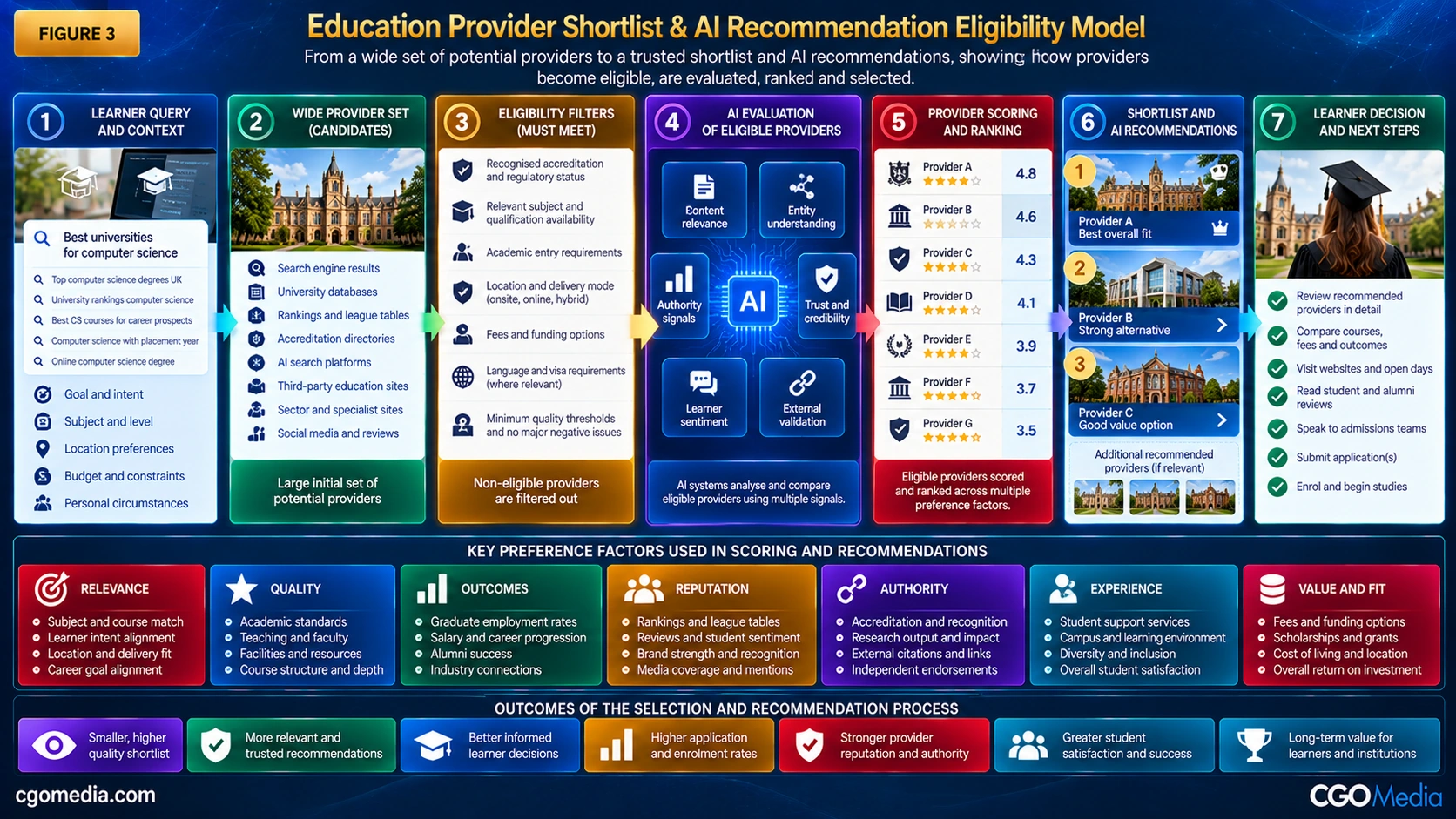
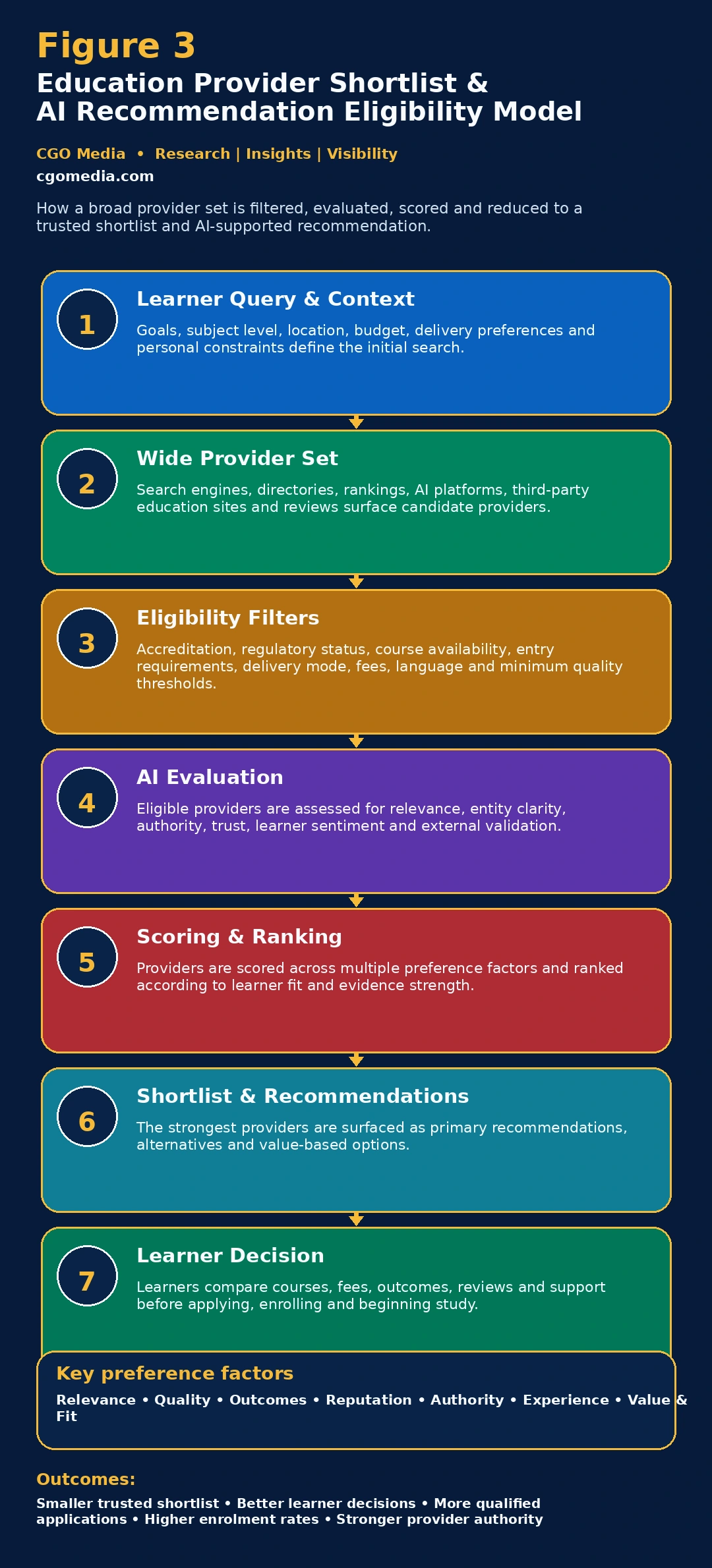
89. Accreditation Evidence Should Be Current
Historic recognition should not be presented as active.
90. Provider Reputation Validation
Provider reputation may be investigated through:
- Independent reviews
- Rankings
- Media coverage
- Institutional history
- Alumni evidence
- Professional recognition
91. Learner Review Validation
Reviews can reveal patterns around:
- Teaching quality
- Support
- Administration
- Course difficulty
- Value
- Platform quality
92. Review Patterns Matter More Than Isolated Comments
Learners may pay attention to repeated themes, especially where they affect programme delivery or support.
93. Outcome Validation
Learners may seek evidence that the programme can support realistic progression.
94. Outcome Evidence Can Include
- Employment outcomes
- Completion rates
- Professional progression
- Certification pass rates
- Further study
- Graduate case studies
95. Outcome Claims Should Be Contextualised
Where possible, evidence should preserve:
- Sample
- Period
- Method
- Limitations
96. Employer Validation
Employer evidence can strengthen confidence in career-oriented programmes.
97. Employer Evidence Can Include
- Graduate recruitment
- Placements
- Industry projects
- Employer-sponsored learning
- Advisory boards
98. Stage Seven — Comparison and Shortlisting
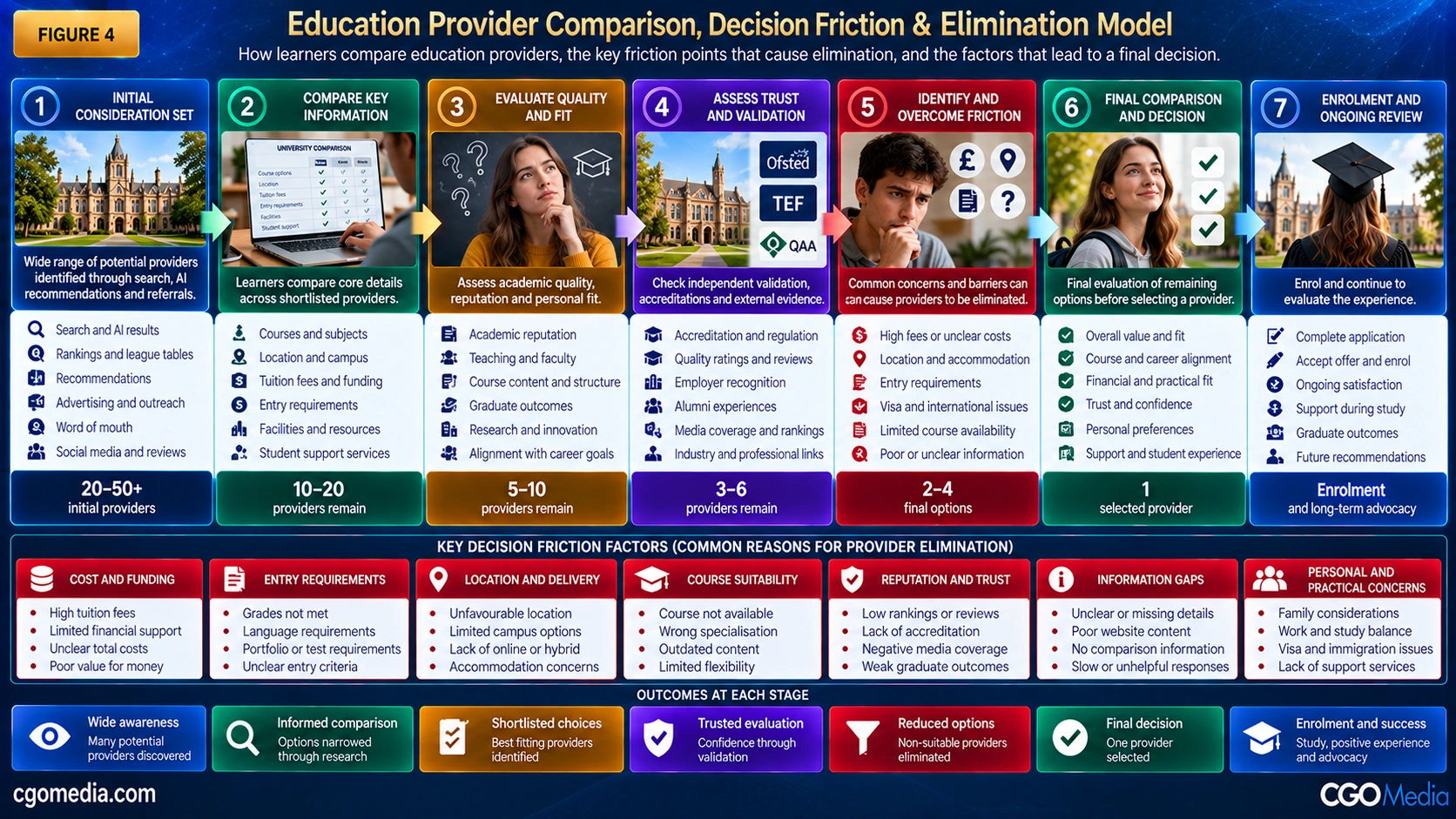
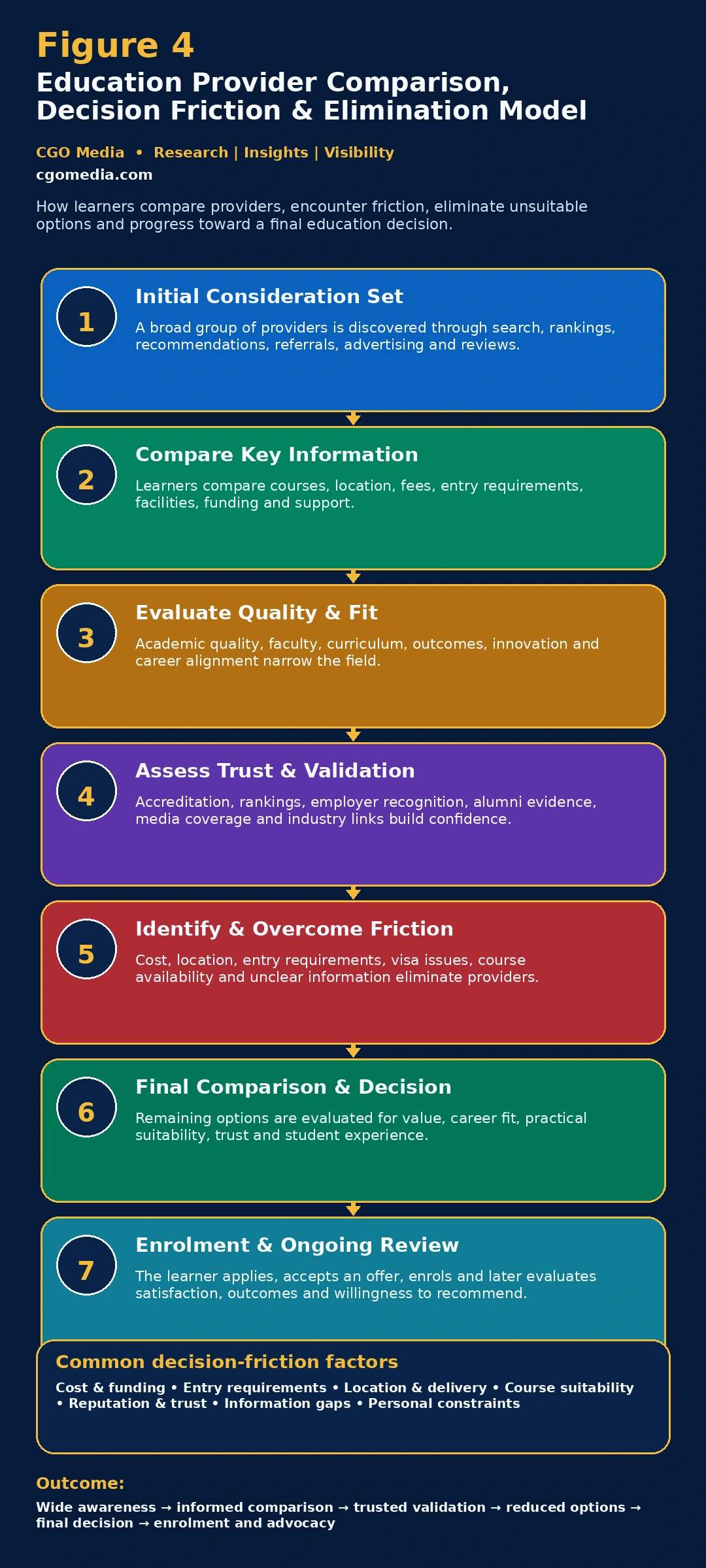
At this stage, the learner has moved from broad discovery toward a smaller consideration set.
99. Comparison Becomes Explicit
The learner may begin comparing providers across multiple recurring selection signals.
100. The Seven Provider Selection Signals
- Subject and Programme Fit
- Qualification and Accreditation Fit
- Delivery and Accessibility Fit
- Price and Value
- Teaching and Learner Experience
- Outcome and Career Relevance
- Provider Confidence
101. Stage Eight — Application, Enrolment and Commitment
The final stage converts preference into action.
102. Application Readiness
The learner should understand:
- Eligibility
- Application steps
- Required documents
- Deadlines
- Fees
- What happens next
103. Application Friction Can Reverse Earlier Trust
A confusing or unreliable application process can undermine confidence built during discovery and evaluation.
104. Enrolment Is a Distinct Stage
Application does not automatically become enrolment.
105. Post-Application Steps Can Include
- Offer
- Acceptance
- Payment
- Registration
- Onboarding
106. Commitment Can Still Fail Late
Learners may withdraw because of:
- Cost
- Timing
- Alternative offers
- Personal circumstances
- Loss of confidence
107. The Eight-Stage Journey Is Not Strictly Linear
Learners can move backwards when new evidence changes the decision.
108. A Learner May Return to Pathway Discovery
A chosen qualification may prove inappropriate.
109. A Learner May Return to Provider Discovery
A shortlisted provider may fail accreditation or delivery requirements.
110. A Learner May Return to Comparison
New fee, outcome or review information may alter the shortlist.
111. AI Can Compress Several Stages
A single AI interaction may combine:
- Goal recognition
- Pathway discovery
- Requirement definition
- Provider discovery
- Comparison
112. AI Compression Does Not Remove the Need for Evidence
It increases the importance of accurate evidence because more stages can be influenced before the learner visits the provider.
113. Provider Selection Is Therefore an Evidence Journey
A useful model is:
Need → Eligibility → Discovery → Understanding → Trust → Comparison → Commitment
114. The First Model Principle
Education provider selection should be understood as a progressive filtering process in which learner requirements, programme evidence and external trust signals continually narrow the viable provider set.
115. The Seven Provider Selection Signals
Once a learner moves into serious comparison, provider choice is increasingly shaped by a group of recurring selection signals.
116. The Seven Signals
- Subject and Programme Fit
- Qualification and Accreditation Fit
- Delivery and Accessibility Fit
- Price and Value
- Teaching and Learner Experience
- Outcome and Career Relevance
- Provider Confidence
117. Selection Signals Work Together
A provider rarely wins because of one factor alone.
118. Strong Performance in One Signal May Not Compensate for Failure in Another
For example:
- Strong teaching cannot compensate for missing required accreditation
- Low price cannot compensate for an unsuitable qualification
- Strong reputation cannot compensate for an impossible delivery format
119. Signal One — Subject and Programme Fit
The first question is whether the provider genuinely offers the right educational fit.
120. Subject Fit
The provider should demonstrate meaningful expertise in the learner’s area of interest.
121. Subject Fit Evidence Can Include
- Programme range
- Faculty expertise
- Research
- Learning resources
- Employer engagement
122. Programme Fit Is More Specific Than Subject Fit
A provider may be strong in a subject while offering a programme that does not suit the learner’s needs.
123. Programme Fit Can Depend on Curriculum
Learners may compare:
- Modules
- Specialisms
- Practical work
- Assessments
- Projects
124. Programme Fit Can Depend on Level
A learner may require:
- Introductory study
- Undergraduate study
- Postgraduate study
- Professional-level study
125. Programme Fit Can Depend on Audience
Some programmes are designed primarily for:
- School leavers
- Graduates
- Working professionals
- Career changers
- Enterprise learners
126. Programme Fit Can Depend on Prior Knowledge
A course that assumes substantial prior experience may be unsuitable for a beginner.
127. Programme Fit Can Depend on Specialisation
Two courses with similar titles may differ significantly in focus.
128. Programme Fit Should Be Evaluated Against the Learner Goal
The key question is:
Does this programme plausibly support the learner’s intended progression?
129. Programme Fit Should Not Be Inferred from the Title Alone
Curriculum and outcome evidence should support the match.
130. AI-Assisted Selection Can Increase the Importance of Explicit Fit
If curriculum, audience and qualification level are ambiguous, contextual course matching becomes weaker.
131. Signal Two — Qualification and Accreditation Fit
The second signal concerns whether the programme provides the credential and recognition the learner actually requires.
132. Qualification Fit
Learners may require a specific:
- Degree
- Diploma
- Certificate
- Professional qualification
- Licence-related credential
133. Qualification Level Matters
A course may be relevant in subject terms but inappropriate in academic level.
134. Awarding Organisation Matters
Learners may need to know:
- Who delivers the programme
- Who awards the qualification
- Whether those organisations differ
135. Accreditation Fit
Some learners require recognition by:
- Professional bodies
- Accreditation organisations
- Regulatory bodies
- Employers
136. Accreditation Can Be a Hard Filter
If recognition is mandatory for the learner’s goal, a non-accredited programme may be excluded regardless of its other strengths.
137. Accreditation Should Be Programme-Specific
Institution-level recognition should not be assumed to apply identically to every course.
138. Accreditation Should Be Current
Expired or unclear recognition can undermine shortlist confidence.
139. Professional Recognition Can Affect Career Progression
It may influence:
- Professional registration
- Membership
- Exemptions
- Employment eligibility
140. Qualification Recognition Can Affect Further Study
Learners may need to know whether the qualification supports progression to another programme.
141. Recognition Can Be Market-Specific
A qualification recognised in one jurisdiction may not have identical standing elsewhere.
142. Accreditation Evidence Should Be Independently Verifiable Where Appropriate
Verification reduces dependence on provider claims alone.
143. Qualification and Accreditation Fit Can Be Modelled as
Correct Credential + Correct Level + Correct Awarding Relationship + Required Recognition
144. Signal Three — Delivery and Accessibility Fit
A suitable programme can still be rejected if the learner cannot practically participate.
145. Delivery Fit Includes Study Mode
Learners may need:
- Online
- Campus-based
- Hybrid
- Blended
146. Delivery Fit Includes Study Intensity
The learner may require:
- Full-time
- Part-time
- Accelerated
- Self-paced
147. Delivery Fit Includes Schedule
Relevant factors include:
- Daytime teaching
- Evening teaching
- Weekend teaching
- Flexible asynchronous study
148. Delivery Fit Includes Start Date
Timing can become a hard selection criterion.
149. Delivery Fit Includes Location
For campus-based study, learners may evaluate:
- Travel
- Relocation
- Accommodation
- Transport
- Local cost of living
150. Accessibility Fit Extends Beyond Geography
It also concerns whether the learning environment is usable by the learner.
151. Digital Accessibility Can Influence Online Selection
Relevant evidence may include:
- Captions
- Screen-reader compatibility
- Keyboard navigation
- Accessible learning materials
152. Accessibility Can Include Learning Support
Learners may assess:
- Disability support
- Study support
- Tutor access
- Pastoral support
153. International Learners May Have Additional Accessibility Requirements
These may include:
- Time-zone compatibility
- Language support
- Remote access
- Country-specific eligibility information
154. Delivery Clarity Should Be Explicit
Terms such as “flexible” should be explained through real schedule and attendance requirements.
155. Delivery and Accessibility Fit Can Be Modelled as
Mode + Schedule + Location + Support + Practical Participation
156. Signal Four — Price and Value
Cost is rarely evaluated in isolation.
157. Learners Evaluate Total Cost
Potential cost components include:
- Tuition
- Registration
- Assessment
- Learning materials
- Technology
- Travel
- Accommodation
158. Opportunity Cost Also Matters
Learners may consider:
- Time away from work
- Reduced working hours
- Travel time
- Childcare
- Relocation
159. Price Can Function as a Hard Filter
A programme outside the learner’s realistic budget may never reach the shortlist.
160. Value Is More Complex Than Price
Learners may evaluate whether the programme appears worth the investment.
161. Perceived Value Can Depend on Qualification
Formal recognition may increase perceived value for some learners.
162. Perceived Value Can Depend on Programme Depth
Curriculum, projects and support can affect the learner’s assessment.
163. Perceived Value Can Depend on Faculty
Access to recognised experts may increase perceived value.
164. Perceived Value Can Depend on Career Relevance
Learners may assess whether the programme supports a credible career or progression pathway.
165. Perceived Value Can Depend on Flexibility
A more expensive programme may still be preferable if it allows the learner to remain employed.
166. Funding Can Change the Value Equation
Relevant options may include:
- Scholarships
- Loans
- Payment plans
- Employer sponsorship
- Grants
167. Funding Availability Does Not Guarantee Eligibility
Providers should avoid implying that every learner qualifies.
168. Discounts Should Be Clear
Promotional pricing should explain:
- Eligibility
- Deadline
- Programme covered
- Terms
169. Price Comparison Requires Like-for-Like Interpretation
A cheaper short course should not automatically be compared directly with a multi-year formal qualification.
170. Price and Value Fit Can Be Modelled as
Total Cost + Opportunity Cost + Recognition + Programme Depth + Expected Utility
171. Signal Five — Teaching and Learner Experience
Learners often want evidence about what studying with the provider will actually feel like.
172. Teaching Experience Can Include
- Teaching format
- Class size
- Interaction
- Feedback
- Assessment
- Practical learning
173. Faculty Quality Can Influence Teaching Confidence
Relevant evidence may include:
- Academic expertise
- Professional experience
- Industry experience
- Teaching responsibilities
174. Teaching Authority Should Connect to the Actual Programme
A strong institution-wide faculty reputation may provide limited evidence if the learner cannot identify who teaches the programme.
175. Learner Support Is Part of the Educational Experience
Relevant support may include:
- Academic support
- Technical support
- Pastoral support
- Career support
- Accessibility support
176. Online Learner Experience Includes Platform Quality
Learners may evaluate:
- Reliability
- Ease of use
- Mobile access
- Content organisation
- Progress tracking
177. Community Can Influence Learner Experience
Relevant elements include:
- Peer interaction
- Discussion
- Networking
- Alumni access
178. Learner Reviews Can Reveal Experience Patterns
Repeated themes may influence shortlist confidence.
179. Review Recency Matters
Older feedback may not reflect current teaching, support or technology.
180. Review Specificity Matters
Programme-level feedback can be more useful than a broad institution-wide rating.
181. Experience Evidence Should Not Be Confused with Formal Quality Assurance
Positive reviews do not independently prove accreditation or academic standards.
182. Teaching and Learner Experience Fit Can Be Modelled as
Teaching Quality + Support + Platform / Campus Experience + Feedback + Community
183. Signal Six — Outcome and Career Relevance
Many learners evaluate a programme partly according to what it may help them achieve afterwards.
184. Career Relevance Can Be Role-Specific
Learners may ask:
- What jobs can this lead to?
- Is this recognised by employers?
- Can it help me change career?
- Does it support promotion?
185. Career Relevance Can Be Skills-Specific
Learners may compare whether the curriculum develops the capabilities required in the target role.
186. Career Relevance Can Be Profession-Specific
Some pathways depend on:
- Registration
- Licensing
- Professional membership
- Accredited qualifications
187. Outcome Evidence Can Include Employment
Employment data may contribute to selection when it is sufficiently contextualised.
188. Outcome Evidence Can Include Further Study
Academic progression may be more relevant than immediate employment for some programmes.
189. Outcome Evidence Can Include Professional Progression
For working learners, promotion or expanded responsibility may be relevant outcomes.
190. Outcome Evidence Can Include Portfolio Development
Practical programmes may help learners develop demonstrable work.
191. Outcome Evidence Should Explain Methodology
Relevant context may include:
- Cohort
- Sample
- Period
- Definition
- Limitations
192. Employment Claims Should Not Be Presented as Guarantees
Education can support employability without guaranteeing a specific employment result.
193. Salary Claims Require Additional Caution
Salary varies according to:
- Role
- Experience
- Location
- Industry
- Economic conditions
194. Employer Relationships Can Support Outcome Confidence
Relevant evidence may include:
- Placements
- Live projects
- Advisory boards
- Recruitment
- Employer-sponsored study
195. Employer Logos Alone Are Weak Outcome Evidence
The relationship should be explained where possible.
196. Outcome and Career Relevance Fit Can Be Modelled as
Skill Relevance + Recognition + Employer Evidence + Observed Outcomes + Career Alignment
197. Signal Seven — Provider Confidence
Provider Confidence captures the learner’s overall willingness to trust the organisation enough to commit.
198. Provider Confidence Is Composite
It can be influenced by:
- Brand familiarity
- Institutional history
- Accreditation
- Reviews
- Faculty
- Transparency
- Communication
199. Institutional Clarity Supports Confidence
The learner should understand:
- Who the provider is
- Who awards the qualification
- Who delivers the programme
- Where study takes place
200. Transparency Supports Confidence
Important information should be easy to find rather than hidden until late in the journey.
201. Fee Transparency Supports Confidence
Unexpected costs can weaken trust rapidly.
202. Entry Requirement Transparency Supports Confidence
Learners should not discover major eligibility barriers only after beginning an application.
203. Accreditation Transparency Supports Confidence
Recognition should be represented precisely.
204. Outcome Transparency Supports Confidence
Career claims should distinguish observed outcomes from guarantees.
205. Communication Quality Supports Confidence
The learner may judge the provider through:
- Enquiry responses
- Application guidance
- Admissions communication
- Follow-up
206. Website Quality Can Influence Provider Confidence
Broken pages, conflicting information or outdated content can create concern beyond the immediate technical issue.
207. External Consistency Supports Confidence
Learners may compare provider information with:
- Accreditation sources
- Marketplaces
- Reviews
- Professional bodies
- AI-generated summaries
208. Conflicting External Evidence Can Reduce Confidence
Material disagreement around fees, accreditation or programme availability can delay or prevent selection.
209. Provider Confidence Can Be Strengthened by Evidence Redundancy
Important claims are more resilient when corroborated across several credible environments.
210. Provider Confidence Should Not Depend on Brand Size Alone
A smaller specialist provider may build strong confidence through:
- Clear expertise
- Precise programme evidence
- Relevant accreditation
- Strong learner support
- Credible outcomes
211. Provider Confidence Is Particularly Important Before Commitment
As the learner approaches payment or enrolment, perceived risk becomes more important.
212. Provider Confidence Can Be Modelled as
Clarity + Transparency + Validation + Consistency + Reputation
213. The Seven Signals Can Be Split into Eligibility and Preference
Some signals determine whether the provider remains viable at all.
214. Eligibility Signals
Common hard filters include:
- Qualification level
- Accreditation
- Entry requirements
- Delivery mode
- Location
- Budget
215. Preference Signals
Once eligibility is established, preference may be influenced by:
- Faculty
- Reputation
- Reviews
- Support
- Community
- Career evidence
216. This Creates a Two-Stage Selection Logic
A practical model is:
Eligibility Filtering → Preference Ranking
217. Eligibility Filtering Removes Unsuitable Options
The learner first asks:
Can this programme meet my non-negotiable requirements?
218. Preference Ranking Separates Viable Options
The learner then asks:
Which of the eligible options do I prefer?
219. AI Recommendation Systems May Perform Similar Filtering
A contextual recommendation can implicitly apply several hard and soft requirements at once.
220. Poor Public Evidence Can Affect Eligibility Interpretation
If delivery, fees or accreditation are unclear, a suitable provider may be incorrectly excluded from consideration.
221. Incorrect Evidence Can Cause False Eligibility
A programme may be recommended even though it fails a critical learner requirement.
222. Accurate Evidence Therefore Supports Better Matching
This benefits both:
- The learner
- The provider
223. Provider Selection Is Multi-Criteria Rather Than Single-Factor
A useful conceptual equation is:
Selection Suitability = Programme Fit + Recognition Fit + Practical Fit + Value + Experience + Outcome Relevance + Provider Confidence
224. Selection Weights Differ by Learner
A learner seeking a regulated professional pathway may weight accreditation heavily.
225. Another Learner May Prioritise Flexibility
A working parent may place delivery and schedule above institutional prestige.
226. Another Learner May Prioritise Cost
Budget constraints may dominate the decision.
227. Another Learner May Prioritise Outcome Evidence
A career changer may focus strongly on employer relevance and practical skills.
228. Provider Selection Models Should Therefore Avoid Universal Weightings
There is no defensible single percentage weighting for every learner and every education market.
229. Use Segment-Specific Weighting Instead
Providers can examine likely priorities for:
- Undergraduates
- Postgraduates
- Professionals
- Career changers
- International learners
- Enterprise buyers
230. Undergraduate Selection Signals
Potential priorities may include:
- Subject fit
- Campus experience
- Reputation
- Student support
- Career options
231. Postgraduate Selection Signals
Potential priorities may include:
- Subject specialisation
- Faculty
- Research
- Career relevance
- Flexibility
232. Professional Learner Selection Signals
Potential priorities may include:
- Recognition
- Schedule
- Employer relevance
- Career progression
- Return on investment
233. Career Changer Selection Signals
Potential priorities may include:
- Entry accessibility
- Practical curriculum
- Employer relevance
- Career support
- Outcomes
234. International Learner Selection Signals
Potential priorities may include:
- Recognition
- Language requirements
- Fees
- Location
- Support
- Delivery
235. Enterprise Buyer Selection Signals
Potential priorities may include:
- Scale
- Customisation
- Reporting
- Integration
- Business relevance
236. Selection Signals Also Differ by Programme Type
Different factors may dominate:
- Degrees
- Professional qualifications
- Bootcamps
- Short courses
- EdTech subscriptions
237. Degree Selection
May place greater emphasis on:
- Institutional reputation
- Subject authority
- Student experience
- Outcomes
- Campus or online delivery
238. Professional Qualification Selection
May place greater emphasis on:
- Accreditation
- Professional recognition
- Employer acceptance
- Flexible delivery
239. Bootcamp Selection
May place greater emphasis on:
- Curriculum relevance
- Practical projects
- Career support
- Employer evidence
- Price
240. Short Course Selection
May place greater emphasis on:
- Immediate skill relevance
- Duration
- Flexibility
- Price
- Instructor authority
241. EdTech Subscription Selection
May place greater emphasis on:
- Platform quality
- Content breadth
- Personalisation
- Progress tracking
- Price
242. The Seven Signals Should Be Evaluated by Confidence
A provider may appear strong in an area while the available evidence remains weak.
243. High-Confidence Selection Evidence
Examples can include:
- Current verified accreditation
- Detailed programme information
- Documented outcome methodology
- Current delivery information
244. Medium-Confidence Selection Evidence
Examples can include relevant but incomplete corroboration.
245. Low-Confidence Selection Evidence
Examples can include:
- Vague marketing statements
- Old testimonials
- Unexplained employer logos
- Outdated marketplace information
246. Evidence Confidence Can Change the Shortlist
Two otherwise similar providers may be separated by the quality of evidence supporting their claims.
247. The Seven Signals Should Also Be Evaluated by Risk
Some decisions carry more learner risk than others.
248. High-Risk Selection Areas
These can include:
- Accreditation
- Qualification recognition
- Fees
- Entry eligibility
- Career claims
249. Medium-Risk Selection Areas
These can include:
- Faculty information
- Support provision
- Platform functionality
- Programme comparison details
250. Lower-Risk Selection Areas
These may include minor stylistic or descriptive differences that do not materially affect suitability.
251. The Provider Selection Matrix
A useful evaluation matrix can combine:
Signal Strength + Evidence Confidence + Learner Importance + Risk
252. This Matrix Should Not Be Reduced to False Precision
The purpose is structured comparison rather than pretending that every educational decision can be represented by an exact universal score.
253. The Second Model Principle
Education provider selection is best understood as multi-criteria filtering in which learner-specific hard requirements establish eligibility and softer trust, experience, value and outcome signals determine preference among viable options.
254. Provider Selection Begins with a Consideration Set
Before a learner can compare providers, a smaller set of viable options must emerge from the wider education market.
255. The Consideration Set Is Not the Final Shortlist
It is the initial group of providers or programmes judged sufficiently relevant to investigate further.
256. Consideration Sets Can Be Built Through Search
Search engines may surface providers through:
- Subject queries
- Qualification queries
- Location queries
- Delivery queries
- Career-goal queries
257. Consideration Sets Can Be Built Through AI Assistants
AI systems can combine several learner criteria into a single provider recommendation set.
258. Consideration Sets Can Be Built Through Marketplaces
Course marketplaces can reduce a large provider market through structured filters.
259. Consideration Sets Can Be Built Through Professional Sources
Professional bodies may narrow the field to:
- Recognised providers
- Accredited programmes
- Approved qualifications
260. Consideration Sets Can Be Built Through Personal Recommendation
Friends, colleagues, employers and alumni may introduce providers before formal research begins.
261. Consideration Set Construction Is an Eligibility Problem
A provider must first satisfy enough hard requirements to remain under consideration.
262. Common Eligibility Filters
- Relevant subject
- Correct qualification level
- Required accreditation
- Appropriate delivery mode
- Acceptable location
- Entry compatibility
- Budget compatibility
263. One Failed Hard Requirement Can Remove a Provider
A highly reputable provider may still be unsuitable if it fails a non-negotiable learner requirement.
264. Eligibility Filtering Should Precede Preference Ranking
A useful selection sequence is:
Broad Market → Eligible Providers → Consideration Set → Shortlist → Preferred Provider
265. Broad Market
The broad market includes every potentially relevant provider.
266. Eligible Providers
Eligibility removes options that fail hard requirements.
267. Consideration Set
The learner retains providers that appear relevant enough to research further.
268. Shortlist
The shortlist contains providers that have survived deeper evaluation and trust validation.
269. Preferred Provider
The final preference emerges after the learner weighs relative strengths, weaknesses and practical fit.
270. Shortlist Size Varies by Decision
A low-cost short course may require limited comparison, while an expensive degree may involve extensive research.
271. Shortlist Construction Is Usually Progressive
Learners often remove options as new information becomes available.
272. Programme Information Can Narrow the Set
A programme may be removed because of:
- Wrong curriculum
- Wrong level
- Wrong duration
- Incompatible entry requirements
273. Delivery Information Can Narrow the Set
Providers can be removed because of:
- Mandatory campus attendance
- Incompatible timetable
- No part-time option
- Unacceptable location
274. Fee Information Can Narrow the Set
A programme may be excluded when total cost exceeds the learner’s realistic budget.
275. Accreditation Information Can Narrow the Set
A programme can be removed if required recognition is absent or unclear.
276. Trust Evidence Can Narrow the Set
Weak or contradictory provider evidence may reduce confidence enough for the learner to remove an option.
277. Outcome Evidence Can Narrow the Set
Weak career or progression relevance can reduce preference even when the programme remains technically eligible.
278. AI-Assisted Recommendation Can Compress Shortlist Construction
An AI system may present only a small number of providers immediately.
279. This Changes the Visibility Challenge
The provider may need to be eligible for recommendation before the learner visits the provider website.
280. Recommendation Eligibility
Recommendation eligibility describes whether available evidence supports inclusion in a relevant provider set.
281. Recommendation Eligibility Is Not Universal
A provider may be eligible for one learner scenario but not another.
282. Recommendation Eligibility Is Learner-Specific
Relevant variables may include:
- Academic background
- Career objective
- Location
- Budget
- Study mode
- Experience
283. Recommendation Eligibility Is Programme-Specific
A strong institution does not make every programme a strong recommendation.
284. Recommendation Eligibility Is Market-Specific
Recognition, fees and delivery can differ by geography.
285. Recommendation Eligibility Is Time-Sensitive
Programme availability, fees and start dates can change.
286. AI Recommendation Requires Evidence Compatibility
The stronger the recommendation, the more evidence layers typically need to agree.
287. A Useful Recommendation Eligibility Model
Subject Fit + Qualification Fit + Delivery Fit + Entry Fit + Price Fit + Trust + Outcome Relevance
288. Subject Fit
The programme should genuinely align with the requested discipline.
289. Qualification Fit
The credential should match the learner’s required level or professional pathway.
290. Delivery Fit
The study format should match practical learner constraints.
291. Entry Fit
The learner should plausibly satisfy current eligibility requirements.
292. Price Fit
The programme should remain within realistic budget constraints.
293. Trust Fit
Provider and programme claims should be sufficiently credible.
294. Outcome Fit
The programme should plausibly support the learner’s stated goal.
295. Recommendation Eligibility Should Not Be Confused with Endorsement
Inclusion in an AI-generated list does not independently establish educational quality.
296. Recommendation Eligibility Should Not Be Confused with Admission Eligibility
A programme may be suitable in principle while the learner still fails formal entry requirements.
297. Recommendation Eligibility Should Not Be Confused with Funding Eligibility
Availability of funding does not mean every learner qualifies.
298. Recommendation Eligibility Should Not Be Confused with Career Guarantee
A course can support a career objective without guaranteeing an employment result.
299. AI Recommendation Systems Depend on Source Evidence
Publicly available evidence may come from:
- Provider websites
- Accreditation sources
- Marketplaces
- Comparison platforms
- Reviews
- Education media
- Professional bodies
- Employer sources
300. First-Party Sources Provide Core Programme Facts
These may include:
- Curriculum
- Fees
- Entry requirements
- Delivery mode
- Faculty
301. Accreditation Sources Provide Recognition Evidence
These can help verify:
- Programme accreditation
- Professional recognition
- Awarding relationships
302. Marketplaces Provide Structured Comparison Data
These may expose:
- Course title
- Price
- Duration
- Delivery format
- Reviews
303. Review Platforms Provide Experience Evidence
They may reveal:
- Support quality
- Teaching experience
- Platform usability
- Recurring complaints
304. Employer Sources Can Support Career Relevance
They may provide evidence around:
- Recruitment
- Partnerships
- Placements
- Skills relevance
305. Education Media Can Support Provider Authority
Editorial coverage may contribute context around:
- Research
- Teaching innovation
- Institutional expertise
- Programme development
306. Source Agreement Supports Recommendation Confidence
When several credible sources agree, the provider can become easier to evaluate.
307. Source Conflict Can Reduce Recommendation Confidence
Conflicting information can create uncertainty around:
- Fees
- Accreditation
- Programme status
- Delivery
- Qualification
308. AI Recommendation Errors Can Begin with Source Conflict
Incorrect outputs are not always caused by one bad webpage.
309. Source Conflict Can Be Distributed
One source may show a current programme while another still shows an older version.
310. Stale Marketplaces Can Create Recommendation Errors
Old fee, duration or delivery data may continue to appear after the provider has updated its own site.
311. Historic Accreditation Data Can Create Recommendation Errors
Old recognition status may remain visible externally.
312. Legacy Entity Names Can Create Recommendation Errors
Rebrands and mergers can confuse provider identity.
313. Outcome Claims Can Be Misinterpreted
Broad employability language can be transformed into stronger claims than the provider intended.
314. AI Provider Comparison Should Be Evaluated for Accuracy
A useful comparison audit should check:
- Which providers were included
- Whether they were relevant
- Whether material facts were correct
- Whether trust context was preserved
315. Presence Alone Is Not Enough
A provider can appear in a recommendation while being a poor fit.
316. Relevance Matters
Inclusion should make sense for the learner scenario.
317. Accuracy Matters
Material facts should be correct.
318. Trust Context Matters
Important caveats around accreditation, outcomes and eligibility should not be stripped away.
319. A Practical AI Provider Selection Measurement Model
Presence + Relevance + Accuracy + Trust Context
320. Presence
Measures whether the provider appears in the recommendation set.
321. Relevance
Measures whether the provider actually fits the learner’s need.
322. Accuracy
Measures whether programme facts are represented correctly.
323. Trust Context
Measures whether important limitations and verification context remain visible.
324. Provider-Selection Errors Should Be Classified by Severity
A useful scale is:
- Critical
- High
- Medium
- Low
325. Critical Provider-Selection Errors
Potential examples include:
- False accreditation
- Wrong awarding organisation
- Withdrawn course presented as active
- Major fee misinformation
326. High-Severity Provider-Selection Errors
Potential examples include:
- Wrong entry requirements
- Wrong delivery mode
- Material career-outcome misrepresentation
327. Medium-Severity Errors
These may involve meaningful but contained inaccuracies.
328. Low-Severity Errors
These may involve minor descriptive differences with limited selection impact.
329. Errors Should Also Be Classified by Persistence
A practical scale is:
- One-off
- Occasional
- Recurring
- Persistent
330. Persistent Errors Matter More
A recurring high-impact error indicates a more serious evidence-system problem.
331. Provider-Selection Risk Can Be Prioritised Through
Severity + Persistence + Learner Impact + Evidence Confidence
332. Build a Provider Selection Observation Register
A useful register can include:
- Prompt or query
- Provider set
- Relevant provider
- Accuracy issue
- Severity
- Persistence
- Source evidence
333. Provider Selection Should Be Monitored by Prompt Family
Relevant groups can include:
- Goal prompts
- Subject prompts
- Qualification prompts
- Provider prompts
- Delivery prompts
- Outcome prompts
- Comparison prompts
334. Goal Prompts Test Early-Stage Recommendation
They reveal whether the provider enters consideration before the learner knows the programme name.
335. Subject Prompts Test Subject Authority
They reveal whether the provider appears for strategic disciplines.
336. Qualification Prompts Test Credential Matching
They reveal whether the provider is associated with the correct qualification level.
337. Provider Prompts Test Brand Recommendation Authority
They reveal whether the organisation enters the serious consideration set.
338. Delivery Prompts Test Practical Matching
They reveal whether online, campus, hybrid or part-time suitability is represented accurately.
339. Outcome Prompts Test Career Matching
They reveal how programmes are connected to future roles or progression.
340. Comparison Prompts Test Relative Provider Representation
They reveal how competing programmes are distinguished.
341. Shortlist Construction Should Be Monitored Over Time
One snapshot provides limited evidence.
342. Longitudinal Observation Is More Useful
Repeated monitoring can reveal:
- Stable inclusion
- Emerging inclusion
- Declining inclusion
- Persistent errors
343. Shortlist Inclusion Should Be Segmented
A provider may perform differently by:
- Subject
- Qualification
- Market
- Learner type
- Delivery mode
344. Subject-Level Shortlist Performance
Measures whether the provider appears for the disciplines it considers strategically important.
345. Qualification-Level Shortlist Performance
Measures whether the provider appears for relevant credential types.
346. Market-Level Shortlist Performance
Measures whether recommendations remain appropriate across different geographies.
347. Learner-Segment Shortlist Performance
Measures suitability for:
- School leavers
- Graduates
- Professionals
- Career changers
- International learners
348. Delivery-Level Shortlist Performance
Measures whether practical study options are represented correctly.
349. Provider Selection Should Be Compared with Organic Search Visibility
A provider may have:
- Strong organic visibility and strong recommendation inclusion
- Strong organic visibility and weak AI inclusion
- Weak organic visibility and strong AI inclusion
- Weak visibility in both
350. Strong Search but Weak Recommendation Inclusion
This may indicate that the provider ranks well but lacks distributed corroborating evidence.
351. Weak Search but Strong Recommendation Inclusion
This may indicate that external evidence is supporting discovery beyond the provider website.
352. Strong Performance in Both
This may indicate a more complete authority system.
353. Weak Performance in Both
This may indicate foundational discovery and authority gaps.
354. Provider Selection Should Be Connected to the Learner Journey
Shortlist inclusion is valuable only if it supports meaningful progression.
355. Measure Progression from Shortlist to Provider Visit
Where observable, track whether discovery leads to further research.
356. Measure Progression from Provider Visit to Programme Engagement
Determine whether learners explore relevant programme evidence.
357. Measure Progression from Programme Engagement to Application
Determine whether suitable learners continue toward action.
358. Measure Progression from Application to Enrolment
A provider may generate interest while still losing learners later in the process.
359. AI Attribution Should Remain Cautious
A learner may discover a provider through an AI assistant and later return through:
- Branded search
- Direct navigation
- Marketplace
- Referral
360. Direct Referral Data Captures Only Part of AI Influence
Survey and CRM data may provide additional evidence.
361. Ask Learners How They Discovered the Provider
Useful options can include:
- Search engine
- AI assistant
- Marketplace
- Recommendation
- Employer
- Social media
362. Ask Learners What Influenced Their Shortlist
This can reveal the importance of:
- Accreditation
- Price
- Reviews
- Faculty
- Employer relevance
- AI recommendations
363. Ask Learners What Eliminated Other Providers
This can reveal hard filters and friction points.
364. Provider Selection Research Should Avoid False Precision
Observed shortlist frequency should not be presented as a universal ranking without appropriate methodology.
365. Recommendation Order Is Not a Stable Ranking
Provider position can change according to:
- Prompt
- Learner profile
- Market
- Model
- Time
366. Provider Selection Should Be Treated as Contextual Matching
A stronger question is:
For which learner, programme, market and requirement set is this provider a suitable option?
367. The Third Model Principle
Modern provider discovery is increasingly shaped by contextual eligibility and evidence compatibility, meaning that search and AI systems may influence the shortlist before the learner reaches the provider’s own website.
368. Shortlisting Converts Discovery into Active Comparison
Once the learner has reduced the market to a smaller set of viable providers, the decision becomes more comparative and evidence-sensitive.
369. The Shortlist Is a Dynamic Decision Set
Providers can move into or out of the shortlist as new information appears.
370. Shortlist Construction Depends on Both Fit and Confidence
A provider may appear suitable but fail to progress if the learner lacks confidence in the evidence.
371. A Useful Shortlist Model
Eligibility + Evidence Strength + Trust + Practical Fit + Relative Preference
372. Eligibility Keeps a Provider in Consideration
The provider must continue to satisfy hard requirements.
373. Evidence Strength Supports Comparison
The learner needs sufficient information to evaluate one provider against another.
374. Trust Supports Commitment
The learner must believe that material claims are reliable.
375. Practical Fit Supports Feasibility
The programme must remain workable in terms of:
- Time
- Location
- Delivery
- Budget
- Entry requirements
376. Relative Preference Separates Similar Providers
Once several providers remain eligible, softer factors can become decisive.
377. Comparison Matrices Can Support Structured Evaluation
Learners may compare providers using recurring decision criteria.
378. Typical Comparison Criteria
- Programme fit
- Qualification
- Accreditation
- Delivery
- Fees
- Faculty
- Learner experience
- Outcomes
- Provider reputation
379. Comparison Should Separate Hard Filters from Preference Factors
A useful model is:
Pass / Fail Requirements → Comparative Preference Factors
380. Pass / Fail Requirements
These may include:
- Required qualification level
- Mandatory accreditation
- Maximum budget
- Required delivery mode
- Location
- Entry eligibility
381. Comparative Preference Factors
These may include:
- Faculty expertise
- Reputation
- Support
- Community
- Career services
- Platform quality
382. Information Completeness Affects Comparison Quality
A learner cannot compare two providers fairly when one provides detailed evidence and the other provides only promotional summaries.
383. Missing Information Creates Decision Friction
Common gaps include:
- Unclear fees
- Missing entry requirements
- Vague accreditation
- Limited curriculum detail
- No outcome evidence
384. Decision Friction Can Delay Selection
The learner may postpone action while searching for missing information.
385. Decision Friction Can Cause Provider Elimination
If another provider answers the same question more clearly, the learner may remove the less transparent option.
386. Decision Friction Can Increase Perceived Risk
Missing or contradictory information may create concern beyond the immediate information gap.
387. Confidence Thresholds Matter
A learner may require enough confidence before progressing from consideration to application.
388. The Confidence Threshold Is Learner-Specific
A low-cost short course may require less validation than a multi-year degree or expensive professional programme.
389. High-Commitment Decisions Require Stronger Confidence
Confidence demands can increase with:
- Higher fees
- Longer study duration
- Career dependency
- Relocation
- Professional recognition requirements
390. Confidence Can Be Built Through Evidence Redundancy
Important claims are stronger when they are supported by several compatible sources.
391. Confidence Can Be Weakened by Contradiction
Material disagreements across sources can create selection risk.
392. Common Contradiction Types
- Different fees
- Different programme duration
- Different start dates
- Conflicting accreditation status
- Conflicting delivery format
393. Contradiction Risk Is Highest for Decision-Critical Facts
The most serious conflicts usually involve:
- Eligibility
- Recognition
- Cost
- Availability
- Qualification
394. Build a Contradiction Risk Register
A practical register can include:
- Fact
- Provider source
- External source
- Conflict
- Severity
- Owner
395. Contradiction Severity Can Be Classified
Use:
- Critical
- High
- Medium
- Low
396. Critical Contradictions
Potential examples include:
- False accreditation
- Wrong awarding organisation
- Programme marked active when withdrawn
- Major fee conflict
397. High-Severity Contradictions
Potential examples include:
- Wrong entry requirements
- Wrong delivery mode
- Incorrect location
398. Medium-Severity Contradictions
These may involve important but contained differences.
399. Low-Severity Contradictions
These may involve minor wording differences with little decision impact.
400. Comparison Friction Can Also Be Caused by Over-Complexity
Too much unstructured information can make the decision harder rather than easier.
401. Programme Pages Should Prioritise Decision-Relevant Information
Important evidence should be easy to find.
402. Comparison Should Not Require Excessive Interpretation
Learners should not need to infer:
- What qualification they receive
- Whether the course is accredited
- How much it costs
- How it is delivered
403. Comparison Friction Can Be Caused by Internal Inconsistency
Different provider pages may present different versions of the same programme fact.
404. Internal Inconsistency Can Signal Weak Governance
It may indicate that programme information lacks a reliable source of truth.
405. Comparison Friction Can Be Caused by External Inconsistency
Third-party marketplaces, reviews or professional sources may show conflicting information.
406. External Conflict Can Be Especially Important in AI-Assisted Comparison
Generated summaries may combine incompatible facts from multiple sources.
407. AI Comparison Can Accelerate Elimination
A learner may see a generated comparison before ever visiting the provider website.
408. AI Comparison Can Surface Decision Criteria Explicitly
Generated comparisons may highlight:
- Fees
- Delivery
- Accreditation
- Reputation
- Outcomes
409. AI Comparison Can Also Oversimplify
Important context may be lost when complex programmes are reduced to short summaries.
410. AI Comparison Can Create False Equivalence
Two programmes may appear comparable even though they differ in:
- Qualification level
- Recognition
- Duration
- Audience
- Outcome
411. AI Comparison Should Therefore Be Audited
A useful audit can examine:
- Provider inclusion
- Relevant criteria
- Material accuracy
- Missing caveats
412. Provider Elimination Can Occur at Several Stages
A programme can leave the consideration set because of:
- Eligibility failure
- Trust failure
- Value failure
- Practical-fit failure
- Experience concerns
- Outcome concerns
413. Eligibility Failure
The programme does not meet a hard requirement.
414. Trust Failure
The learner cannot verify or believe important claims.
415. Value Failure
The learner judges the price too high relative to perceived benefit.
416. Practical-Fit Failure
The learner cannot realistically participate.
417. Experience Failure
Reviews or support evidence reduce confidence in the learner experience.
418. Outcome Failure
The programme appears insufficiently aligned with the learner’s future objective.
419. Provider Elimination Should Be Studied, Not Just Conversion
Understanding why a provider was rejected can be as useful as understanding why another provider was selected.
420. Rejection Research Can Reveal Hidden Barriers
Potential insights include:
- Price sensitivity
- Recognition concerns
- Delivery incompatibility
- Trust gaps
- Application friction
421. Ask Learners Why They Removed a Provider
Useful research can include:
- Applicant surveys
- CRM feedback
- Abandonment surveys
- User interviews
422. Shortlist Drop-Off Should Be Measured
Where possible, providers can examine progression from:
Discovery → Programme View → Comparison → Application Start → Application Completion
423. Programme Page Exit Is Not Automatically Failure
A learner may leave in order to:
- Verify accreditation
- Read reviews
- Compare another provider
- Check funding
424. Off-Site Validation Is Part of the Journey
Providers should expect learners to leave the site and return later.
425. Return Visits Can Indicate Active Consideration
Repeated branded or programme visits may reflect comparison behaviour.
426. Branded Search Can Be a Mid-Journey Signal
A learner may first discover the provider through:
- AI
- Marketplace
- Recommendation
- Comparison platform
and later return via branded search.
427. Attribution Should Therefore Be Multi-Touch
Last-click reporting can understate earlier discovery influence.
428. Decision Abandonment Is Different from Provider Elimination
The learner may abandon the entire education decision rather than choose another provider.
429. Common Causes of Decision Abandonment
- Cost
- Time commitment
- Unclear career value
- Complex application process
- Personal circumstances
430. High Decision Friction Can Increase Abandonment
If the learner must resolve too many unanswered questions, the process may stop entirely.
431. Providers Should Reduce Unnecessary Friction
Important decision information should be available before application.
432. Some Friction Is Appropriate
Education selection should not always be reduced to the fastest possible conversion.
433. Appropriate Friction Can Protect Fit
Examples include:
- Eligibility checks
- Portfolio review
- Academic prerequisites
- Professional-experience requirements
434. The Objective Is Not Zero Friction
The objective is:
Remove Unnecessary Friction while Preserving Necessary Selection
435. Application Friction Becomes Critical Near Commitment
The learner has already invested significant effort in the decision.
436. Application Friction Can Include
- Broken forms
- Unclear deadlines
- Unexpected document requirements
- Poor mobile usability
- Repeated data entry
437. Application Friction Can Reduce Trust
A poor application experience may create doubts about the provider’s wider operational quality.
438. Application Guidance Should Be Programme-Specific
Generic admissions pages should not contradict individual programme requirements.
439. Application Cost Transparency Matters
Learners should understand any:
- Deposits
- Application fees
- Registration fees
- Payment deadlines
440. Offer-Stage Friction Matters
After application, confidence can still decline through:
- Slow decisions
- Unclear offer conditions
- Poor communication
- Unexpected fees
441. Acceptance-Stage Friction Matters
The learner should understand clearly how to accept and what happens next.
442. Registration-Stage Friction Matters
Complex registration can reduce enrolment completion.
443. Onboarding Begins Before Teaching
Early communication can reinforce the learner’s decision.
444. Poor Onboarding Can Create Immediate Doubt
A strong search and application experience can still be undermined after commitment.
445. Provider Selection Continues After Payment
Learners may still reconsider before programme start.
446. Early Withdrawal Should Be Studied as a Selection Signal
It may indicate:
- Poor fit
- Unrealistic expectations
- Weak onboarding
- Programme mismatch
447. Pre-Enrolment Content Should Match the Delivered Experience
Overpromising creates downstream trust problems.
448. The Selection Journey Is Circular
A useful long-term model is:
Discovery → Selection → Learning Experience → Outcome → Reputation → Future Discovery
449. Learner Experience Affects Future Provider Selection
Current students become future:
- Reviewers
- Alumni
- Referrers
- Employer contacts
450. Outcomes Affect Future Provider Selection
Graduate progression can influence future learner confidence.
451. Reputation Feeds Back into Discovery
Reviews, alumni advocacy, employer relationships and external commentary can shape the next learner cohort.
452. Shortlist Optimisation Should Therefore Extend Beyond Marketing
A provider cannot sustainably improve selection merely by changing page copy.
453. Shortlist Performance Depends on Organisational Reality
Relevant factors include:
- Programme quality
- Support
- Delivery
- Outcomes
- Operational reliability
454. Search Intelligence Can Reveal Comparison Weaknesses
Repeated learner questions may indicate missing decision information.
455. Review Intelligence Can Reveal Experience Weaknesses
Recurring complaints can reveal reasons future learners may eliminate the provider.
456. Admissions Intelligence Can Reveal Application Weaknesses
Abandonment patterns can identify unnecessary process friction.
457. AI Intelligence Can Reveal Comparison Weaknesses
Generated summaries can expose:
- Missing information
- Conflicting information
- Weak provider differentiation
458. Build a Provider Selection Friction Register
A practical register can include:
- Journey stage
- Friction point
- Learner impact
- Severity
- Owner
- Required action
459. Friction Should Be Prioritised by Learner Impact
A useful model is:
Severity + Frequency + Learner Impact + Strategic Importance
460. High-Priority Friction
Potential examples include:
- False accreditation
- Application failure
- Material fee ambiguity
- Incorrect entry requirements
461. Medium-Priority Friction
Potential examples include:
- Weak curriculum detail
- Unclear career evidence
- Inconsistent review information
462. Lower-Priority Friction
These may include minor usability issues that do not materially alter eligibility or trust.
463. The Provider Comparison Equation
A useful model is:
Eligibility + Evidence Completeness + Evidence Consistency + Trust + Value + Practical Fit
464. The Decision-Friction Equation
A useful model is:
Missing Information + Contradiction + Complexity + Process Friction + Perceived Risk
465. The Fourth Model Principle
Provider selection becomes more likely when eligible programmes are easy to compare, important claims are consistent and verifiable, and unnecessary friction is removed without weakening appropriate admissions and suitability checks.
466. Provider Selection Should Be Measured as a Journey
Traditional conversion reporting often concentrates on the final application or enrolment event.
The provider-selection model requires measurement across the earlier stages that influence whether the learner ever reaches that point.
467. The Measurement Journey
A useful sequence is:
Discovery → Consideration → Understanding → Validation → Comparison → Application → Enrolment → Experience → Outcome
468. Each Stage Requires Different Evidence
A provider may perform strongly at one stage and weakly at another.
469. Discovery Measurement
Discovery asks:
Can relevant learners find the provider and programme?
470. Discovery Metrics Can Include
- Organic visibility
- AI recommendation presence
- Marketplace visibility
- Branded search demand
- Referral discovery
471. Discovery Quality Matters More Than Raw Reach
Large visibility among irrelevant learners may create little value.
472. Consideration Measurement
Consideration asks:
Does the learner treat the provider as a plausible option?
473. Consideration Metrics Can Include
- Programme-page visits
- Repeat visits
- Branded searches
- Course comparisons
- Saved or shortlisted programmes where observable
474. Consideration Is Often Multi-Touch
The learner may return several times before making progress.
475. Understanding Measurement
Understanding asks:
Can the learner interpret the programme correctly?
476. Understanding Metrics Can Include
- Curriculum engagement
- Entry-requirement engagement
- Fee-content engagement
- Delivery-content engagement
- FAQ interaction
477. Understanding Can Also Be Assessed Qualitatively
Useful evidence may come from:
- Learner interviews
- Admissions questions
- Site-search queries
- Support enquiries
478. Repeated Questions Can Signal Information Gaps
If learners repeatedly ask questions already supposedly answered on the website, the information may be unclear, poorly located or incomplete.
479. Validation Measurement
Validation asks:
Can the learner verify the provider’s important claims?
480. Validation Metrics Can Include
- Accreditation-page engagement
- Review interaction
- Outcome-page engagement
- Faculty-profile engagement
- External referral patterns
481. External Verification Behaviour Should Be Expected
A learner leaving the website to check accreditation or reviews is not necessarily a failed session.
482. Comparison Measurement
Comparison asks:
How effectively can the learner evaluate this provider against alternatives?
483. Comparison Metrics Can Include
- Return visits
- Programme-detail engagement
- Fee comparisons
- Outcome-content engagement
- Application-start delay
484. Comparison Can Be Inferred but Not Perfectly Observed
Providers should avoid pretending that all comparison behaviour can be measured directly.
485. Application Measurement
Application asks:
Does an interested and suitable learner begin and complete the application process?
486. Application Metrics Can Include
- Application starts
- Application completion
- Form abandonment
- Eligibility exits
- Document-upload failures
487. Application Start Rate Requires Context
A high rate may reflect strong intent, but it may also reflect an application process opened too early in the journey.
488. Application Completion Rate Requires Context
Low completion can reveal:
- Technical problems
- Unexpected requirements
- Weak fit
- Cost concerns
- Decision change
489. Qualified Application Rate Is More Useful Than Application Volume Alone
A useful provider-selection system should attract learners who are genuinely suitable.
490. Enrolment Measurement
Enrolment asks:
Does the selected learner convert commitment into actual participation?
491. Enrolment Metrics Can Include
- Offer acceptance
- Deposit payment
- Registration completion
- Programme start
- Early attendance
492. Offer Acceptance Can Reveal Competitive Position
A learner receiving several offers may still select another provider.
493. Offer Decline Research Can Be Highly Valuable
Reasons may include:
- Price
- Provider preference
- Location
- Funding
- Programme fit
- Alternative offer
494. Enrolment Failure Should Be Separated from Application Failure
Different issues may be responsible.
495. Experience Measurement
Provider selection should not stop being measured once the learner enrols.
496. Post-Enrolment Experience Tests Selection Accuracy
The learner’s actual experience can reveal whether pre-enrolment expectations were realistic.
497. Early Experience Metrics Can Include
- Onboarding completion
- Early attendance
- Support enquiries
- Early satisfaction
- Early withdrawal
498. Early Withdrawal Is an Important Selection Signal
It may indicate:
- Programme mismatch
- Unrealistic expectations
- Financial pressure
- Weak onboarding
- Delivery problems
499. Experience Feedback Should Feed Future Selection Strategy
Learner experience can influence:
- Reviews
- Testimonials
- Word of mouth
- Alumni advocacy
500. Outcome Measurement
Longer-term outcomes test whether the provider-selection promise aligns with reality.
501. Outcome Metrics Can Include
- Completion
- Qualification attainment
- Employment
- Further study
- Professional progression
- Learner satisfaction
502. Outcome Metrics Should Be Programme-Specific Where Possible
Institution-wide averages can conceal large differences between programmes.
503. Outcome Metrics Should Preserve Methodology
Relevant context may include:
- Cohort
- Sample
- Time period
- Definition
- Limitations
504. The Selection Journey Is Circular
The full cycle can be represented as:
Discovery → Selection → Learning Experience → Outcome → Reputation → Future Discovery
505. Current Learners Influence Future Discovery
They can become:
- Reviewers
- Referrers
- Alumni
- Employer contacts
- Community advocates
506. Outcomes Influence Future Trust
Graduate progression can strengthen or weaken future learner confidence.
507. Reputation Influences Future Shortlisting
The experience of previous learners feeds back into later provider-selection cycles.
508. Shortlist Performance Should Be Measured Explicitly
Providers should distinguish between:
- Visibility
- Consideration
- Shortlisting
- Preference
- Commitment
509. Visibility
Measures whether the provider appears.
510. Consideration
Measures whether the provider receives meaningful investigation.
511. Shortlisting
Measures whether the provider survives initial filtering and validation.
512. Preference
Measures whether the provider becomes comparatively favoured.
513. Commitment
Measures whether preference converts into application, acceptance or enrolment.
514. Shortlist Performance Can Be Segmented
Relevant dimensions include:
- Subject
- Qualification
- Market
- Learner type
- Delivery mode
515. Subject-Level Shortlist Performance
A provider may be strongly considered for one discipline and rarely considered for another.
516. Qualification-Level Shortlist Performance
A provider may be strong for short professional courses but weak for postgraduate programmes.
517. Market-Level Shortlist Performance
International perception can differ from domestic perception.
518. Learner-Segment Shortlist Performance
Different evidence may matter for:
- Undergraduates
- Postgraduates
- Professionals
- Career changers
- Enterprise buyers
519. Delivery-Level Shortlist Performance
A provider may be highly competitive in online delivery but weaker in campus-based consideration.
520. AI Shortlist Performance Should Be Measured Separately
AI-assisted recommendation creates a distinct discovery environment.
521. AI Shortlist Metrics Can Include
- Presence
- Relevance
- Accuracy
- Trust context
- Error severity
- Error persistence
522. AI Presence Alone Should Not Be Treated as Success
A provider can appear for the wrong learner or with incorrect information.
523. AI Relevance Matters
The provider should make sense within the stated learner context.
524. AI Accuracy Matters
Material facts should be correct.
525. AI Trust Context Matters
Important limitations should not disappear from generated summaries.
526. Build a Shortlist Performance Dashboard
A useful dashboard can include:
- Discovery visibility
- Provider consideration
- Application starts
- Qualified applications
- Offer acceptance
- Enrolment
527. Build a Trust Progression Dashboard
A useful model can track learner movement from:
Awareness → Understanding → Verification → Confidence → Commitment
528. Awareness
Measures whether the learner knows the provider exists.
529. Understanding
Measures whether the learner understands the programme and provider sufficiently.
530. Verification
Measures whether important claims can be checked.
531. Confidence
Measures whether the learner perceives enough evidence to continue.
532. Commitment
Measures whether confidence converts into action.
533. Trust Progression Can Fail at Any Stage
A learner can know the provider yet remain unconvinced.
534. Understanding Failure
May result from:
- Weak course information
- Confusing qualification language
- Unclear delivery
535. Verification Failure
May result from:
- Unclear accreditation
- Weak external evidence
- Contradictory sources
536. Confidence Failure
May result from:
- Poor reviews
- Weak outcomes
- Fee uncertainty
- Low transparency
537. Commitment Failure
May result from:
- Application friction
- Unexpected cost
- Timing
- Alternative offers
538. Measure Provider Elimination Reasons
Providers should collect evidence about why learners choose another option.
539. Elimination Categories Can Include
- Programme fit
- Qualification mismatch
- Price
- Delivery
- Accreditation
- Reputation
- Outcome confidence
540. Measure Decision Abandonment Separately
Some learners stop the entire education journey rather than select a competitor.
541. Abandonment Categories Can Include
- Financial pressure
- Time constraints
- Uncertain career value
- Complexity
- Personal circumstances
542. Conversion Rate Alone Can Hide Selection Problems
A provider can have a strong application conversion rate while attracting too few suitable learners at earlier stages.
543. Traffic Growth Alone Can Hide Selection Problems
More visitors do not necessarily create stronger provider consideration.
544. Application Growth Alone Can Hide Fit Problems
Higher application volume may create:
- More ineligible applicants
- Lower offer rates
- Lower enrolment
- Greater admissions workload
545. Qualified Progression Is a Stronger Measure
The provider should focus on whether suitable learners move successfully through the journey.
546. A Qualified Progression Model
Relevant Discovery → Suitable Consideration → Qualified Application → Accepted Offer → Enrolment → Appropriate Experience
547. Executive Provider-Selection Reporting Should Be Concise
Senior leadership should be able to understand the current state without reviewing hundreds of tactical metrics.
548. Recommended Executive Dimensions
- Discovery
- Programme Fit
- Trust & Validation
- Comparison & Value
- Application Experience
- Enrolment & Outcome
- AI Representation
549. Record Current State
Each dimension can be assessed using a simple maturity scale.
550. A Five-Level Selection Scale
- Weak
- Emerging
- Established
- Strong
- Resilient
551. Record Target State
The provider should define the level appropriate to its strategic goals.
552. Record Trend
Use:
- Improving
- Stable
- At Risk
- Deteriorating
553. Record Evidence Confidence
Use:
- Low
- Medium
- High
554. Record Strategic Priority
Use:
- Critical
- High
- Medium
- Low
555. Example Executive Provider Selection Scorecard
| Selection Dimension | Current | Target | Trend | Confidence | Priority |
|---|---|---|---|---|---|
| Discovery | 1–5 | 1–5 | Improving / Stable / At Risk / Deteriorating | Low / Medium / High | Critical / High / Medium / Low |
| Programme Fit | 1–5 | 1–5 | Improving / Stable / At Risk / Deteriorating | Low / Medium / High | Critical / High / Medium / Low |
| Trust & Validation | 1–5 | 1–5 | Improving / Stable / At Risk / Deteriorating | Low / Medium / High | Critical / High / Medium / Low |
| Comparison & Value | 1–5 | 1–5 | Improving / Stable / At Risk / Deteriorating | Low / Medium / High | Critical / High / Medium / Low |
| Application Experience | 1–5 | 1–5 | Improving / Stable / At Risk / Deteriorating | Low / Medium / High | Critical / High / Medium / Low |
| Enrolment & Outcome | 1–5 | 1–5 | Improving / Stable / At Risk / Deteriorating | Low / Medium / High | Critical / High / Medium / Low |
| AI Representation | 1–5 | 1–5 | Improving / Stable / At Risk / Deteriorating | Low / Medium / High | Critical / High / Medium / Low |
556. Critical Selection Risks Should Sit Outside the Average
Material issues should not disappear inside an overall score.
557. Critical Provider-Selection Risks
Potential examples include:
- False accreditation
- Major fee error
- Wrong awarding organisation
- Broken application process
- Persistent high-impact AI misinformation
558. Executive Reporting Should Separate Risk and Opportunity
Leadership should distinguish:
- Critical correction
- Trust improvement
- Conversion improvement
- Growth opportunity
- Long-term resilience
559. Provider Selection Should Have Clear Ownership
Responsibility is distributed across:
- SEO
- Marketing
- Admissions
- Academic teams
- Quality
- Careers
- Student experience
- Technology
560. Discovery Ownership
May involve:
- SEO
- Marketing
- Communications
561. Programme Fit Ownership
May involve:
- Academic teams
- Product teams
- Programme leadership
562. Trust Ownership
May involve:
- Quality
- Accreditation teams
- Communications
563. Application Ownership
May involve:
- Admissions
- Technology
- CRM teams
564. Enrolment Ownership
May involve:
- Admissions
- Student services
- Finance
565. Outcome Ownership
May involve:
- Careers
- Academic teams
- Data teams
- Alumni teams
566. AI Representation Ownership
May involve:
- SEO
- Data
- Communications
- Technology
567. Cross-Functional Governance Is Required
No single team controls every stage of provider selection.
568. Provider Selection Governance Should Review Journey Breakpoints
Recurring reviews can examine:
- Discovery gaps
- Trust failures
- Comparison friction
- Application abandonment
- Offer decline
- Early withdrawal
569. Review Cycles Should Use Multiple Evidence Sources
Useful inputs can include:
- Analytics
- CRM data
- Applicant surveys
- Review analysis
- AI monitoring
- Outcome data
570. Measurement Should Be Longitudinal
Short-term changes can be misleading.
571. Establish a Baseline
Capture the current state before major interventions.
572. Compare Quarterly
Quarterly comparisons can reveal:
- Trust improvement
- Friction reduction
- AI accuracy change
- Application-quality change
573. Reassess Annually
Annual review can examine whether the provider-selection system has become more resilient.
574. Provider Selection Should Be Linked to the Trust Framework
The Education & EdTech AI Trust and Visibility Framework can help identify the evidence weaknesses causing trust or shortlist problems.
575. Provider Selection Should Be Linked to the Maturity Model
The Education Search Authority Maturity Model can assess whether provider-selection capabilities are becoming more systematic.
576. Provider Selection Should Be Linked to Implementation
The Education & EdTech SEO and AI Implementation Roadmap can translate selection gaps into operational workstreams.
577. Provider Selection Should Be Linked to the Parent Research
The broader Education & EdTech SEO in an AI Search Environment paper provides the wider search and AI context for this model.
578. The Fifth Model Principle
Education provider-selection performance should be measured across the entire learner journey, with greater emphasis on qualified progression, trust, shortlist strength, enrolment quality and post-enrolment experience than on traffic or application volume alone.
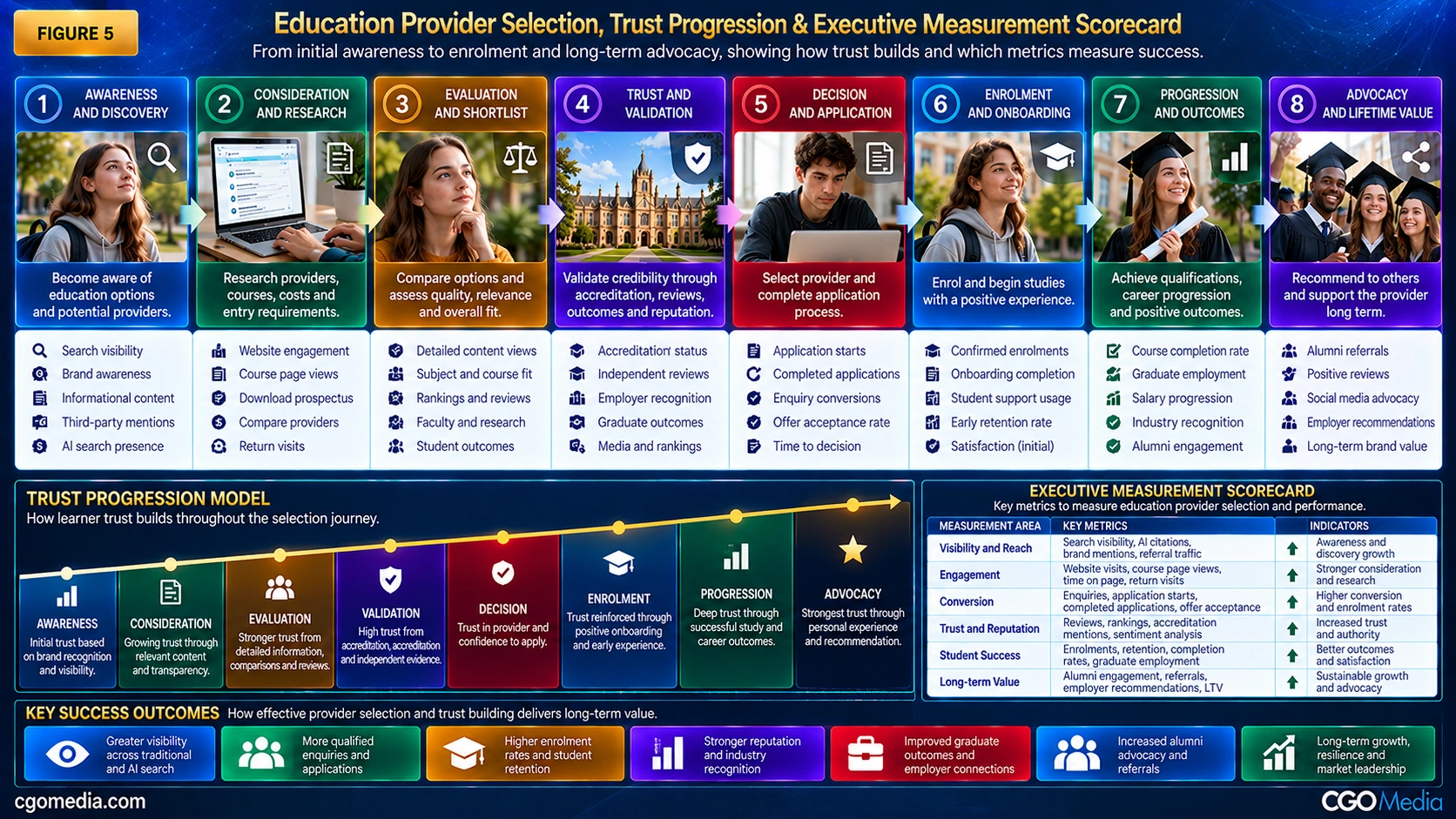
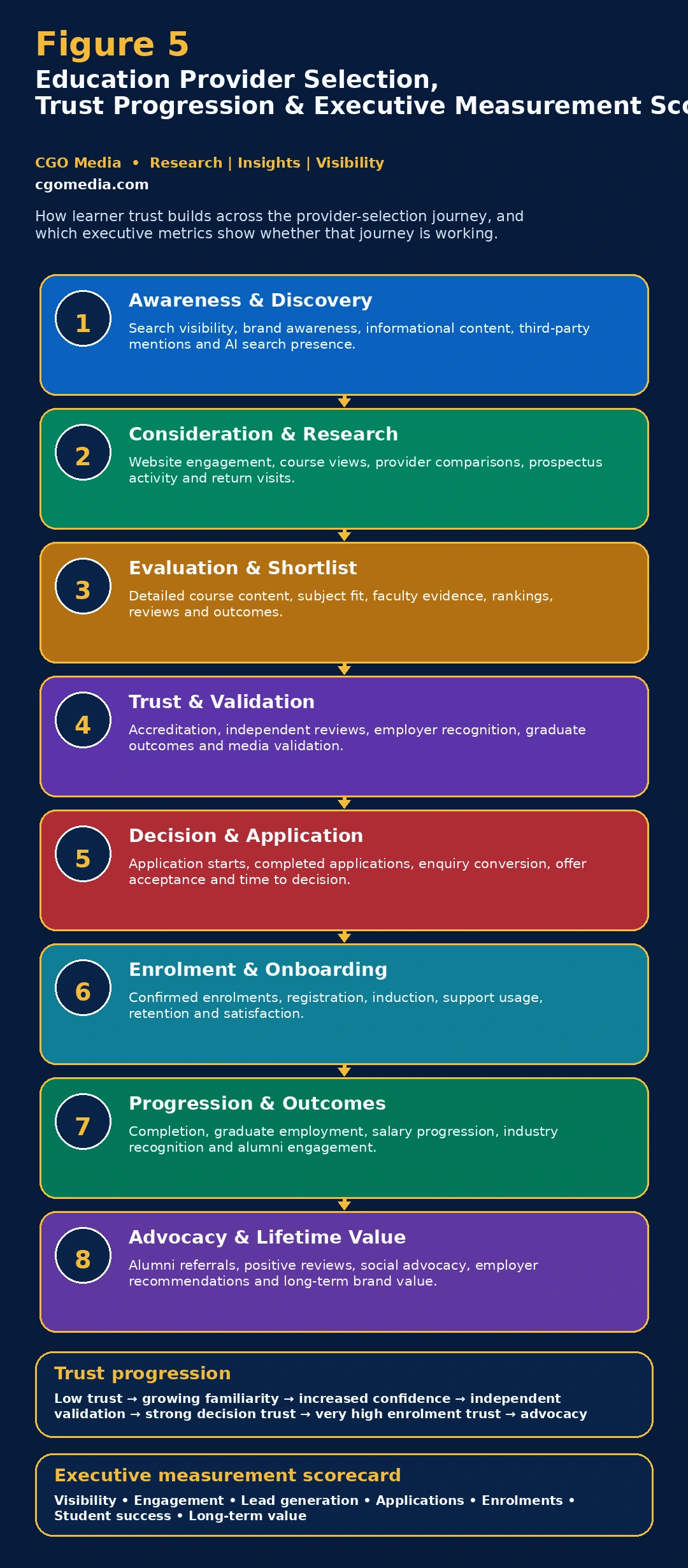
579. Provider Selection Performance Can Decay
A strong learner journey can weaken over time when programme information, trust evidence, application processes and external representations are not maintained.
580. Selection Decay Should Be Expected
Education markets change continually.
581. Programme Information Can Decay
Common causes include:
- Outdated curriculum
- Changed entry requirements
- Old fees
- Historic start dates
- Changed delivery modes
582. Qualification Information Can Decay
Awarding relationships, qualification structures or progression rules may change.
583. Accreditation Information Can Decay
Recognition can expire, change or become more narrowly defined.
584. Faculty Evidence Can Decay
Profiles may remain live after teaching responsibilities change.
585. Outcome Evidence Can Decay
Employment and progression data becomes less useful when:
- Cohorts change
- Labour markets change
- Methodology changes
- Data becomes old
586. Review Evidence Can Decay
Historic review patterns may no longer describe the current learner experience.
587. Marketplace Information Can Decay
Third-party platforms may continue displaying old:
- Fees
- Programme titles
- Delivery information
- Start dates
588. AI Representation Can Decay
Generated answers can become less accurate as:
- Source information changes
- Retrieval systems change
- Models change
- External evidence conflicts
589. Application Experience Can Decay
Form changes, technology issues or policy updates can introduce new friction.
590. Selection Resilience Requires Maintenance
The learner journey should be treated as an operational system rather than a static marketing funnel.
591. Build a Selection Health Register
A practical register can include:
- Journey stage
- Current condition
- Known issues
- Risk level
- Owner
- Next review
592. Build a Programme Accuracy Register
Priority facts can include:
- Programme status
- Qualification
- Fees
- Entry requirements
- Delivery
- Accreditation
593. Build an External Consistency Register
Monitor whether important third-party sources remain compatible with current provider information.
594. Build an Application Friction Register
Track:
- Form errors
- Abandonment
- Document issues
- Mobile problems
- Unexpected requirements
595. Build an AI Selection Register
Track:
- Prompt
- Provider inclusion
- Relevance
- Accuracy
- Error severity
- Persistence
596. Selection Improvement Should Follow a Repeatable Cycle
A practical model is:
Observe → Diagnose → Prioritise → Correct → Validate → Measure → Learn → Repeat
597. Observe
Monitor:
- Discovery patterns
- Programme engagement
- Trust behaviour
- Application behaviour
- AI recommendations
598. Diagnose
Determine whether the issue is primarily:
- Visibility
- Fit
- Trust
- Comparison
- Application
- Experience
599. Prioritise
A practical model is:
Severity + Frequency + Learner Impact + Strategic Importance
600. Correct
Fix the underlying source of the problem rather than only the visible symptom.
601. Validate
Confirm that the corrected information is now accurate across relevant environments.
602. Measure
Compare the updated state with the previous baseline.
603. Learn
Use recurring issues to improve:
- Templates
- Processes
- Governance
- Data standards
- Team ownership
604. Repeat
Provider selection should be reviewed continuously as markets and learner expectations change.
605. Resilience Requires Strong Programme Truth
The provider should maintain clear and authoritative information about:
- What the programme is
- Who it is for
- What it costs
- How it is delivered
- What it leads to
606. Resilience Requires Strong Qualification Truth
Learners should understand exactly what credential is awarded.
607. Resilience Requires Strong Accreditation Truth
Recognition should be:
- Current
- Specific
- Verifiable
608. Resilience Requires Strong Provider Identity
Institutional, campus, partner and awarding relationships should be understandable.
609. Resilience Requires Strong Experience Evidence
Learner reviews and support evidence should reflect the current experience.
610. Resilience Requires Strong Outcome Evidence
Career and progression claims should remain methodologically defensible.
611. Resilience Requires Strong External Consistency
Third-party platforms should not materially contradict authoritative provider information.
612. Resilience Requires Strong AI Monitoring
Provider selection should be observed in AI-assisted discovery as well as conventional search.
613. Governance Is a Cross-Functional Requirement
Provider selection spans multiple teams.
614. A Mature Governance Structure Can Include
SEO + Marketing + Admissions + Academic Teams + Quality + Careers + Student Experience + Data + Technology
615. SEO Supports Discovery and Representation
SEO can help govern:
- Search visibility
- Information architecture
- Entity clarity
- AI monitoring
616. Marketing Supports Positioning and Communication
Marketing should communicate programme value without overstating evidence.
617. Academic Teams Support Programme Truth
They can validate:
- Curriculum
- Learning outcomes
- Faculty
- Academic level
618. Quality Teams Support Recognition Truth
They can validate:
- Accreditation
- Awarding relationships
- Quality-assurance status
619. Admissions Supports Entry and Application Truth
Admissions can validate:
- Eligibility
- Deadlines
- Required documents
- Application process
620. Careers Supports Outcome Truth
Careers teams can help validate:
- Employer relationships
- Career pathways
- Outcome evidence
- Graduate progression
621. Student Experience Supports Delivery Truth
Student-service teams can provide insight into:
- Support
- Onboarding
- Common learner problems
- Early withdrawal
622. Data Teams Support Measurement Truth
Data teams can help maintain:
- Application data
- Enrolment data
- Outcome data
- Dashboard consistency
623. Technology Supports Journey Reliability
Technology teams can support:
- Website reliability
- Application systems
- Data feeds
- Tracking
- Automation
624. Governance Should Define a Source of Truth
Important programme facts should have an agreed authoritative source.
625. High-Risk Facts Need Strong Governance
These include:
- Fees
- Entry requirements
- Accreditation
- Programme status
- Awarding organisation
626. Governance Should Define Update Ownership
Each important information class should have a responsible owner.
627. Governance Should Define Review Frequency
Different facts require different update cycles.
628. High-Frequency Review Areas
These may include:
- Start dates
- Fees
- Availability
- Application deadlines
629. Medium-Frequency Review Areas
These may include:
- Curriculum
- Faculty
- Accreditation
- Employer evidence
630. Strategic Review Areas
These may include:
- Provider positioning
- Subject authority
- Outcome methodology
- Selection behaviour
631. Governance Should Include Event-Driven Review
Immediate review may be triggered by:
- Programme launch
- Programme withdrawal
- Accreditation change
- Fee change
- Delivery change
632. Governance Should Include Change Logs
Important changes should record:
- What changed
- Why
- When
- Who approved it
- Which systems were affected
633. Governance Should Include Escalation
Critical learner-risk issues should have an agreed escalation path.
634. Critical Selection Risks Can Include
- False accreditation
- Wrong qualification
- Major fee error
- Broken application journey
- Persistent high-impact AI misinformation
635. Provider Selection Should Operate Across Multiple Time Horizons
A mature model combines:
- Immediate correction
- Quarterly improvement
- Annual strategic review
636. Immediate Horizon
Correct material learner-risk issues.
637. Quarterly Horizon
Strengthen:
- Programme clarity
- Trust evidence
- Comparison usability
- Application experience
638. Annual Horizon
Reassess:
- Selection performance
- Provider positioning
- Journey resilience
- Governance maturity
639. A 12-Month Provider Selection Operating Cycle
A practical model is:
Q1: Diagnose and Correct
Q2: Clarify and Strengthen
Q3: Validate and Optimise
Q4: Measure and Reassess
640. Quarter One — Diagnose and Correct
Focus on:
- Programme accuracy
- Accreditation accuracy
- Application reliability
- AI selection baseline
641. Quarter Two — Clarify and Strengthen
Focus on:
- Programme comparison
- Value communication
- Faculty evidence
- Support evidence
642. Quarter Three — Validate and Optimise
Focus on:
- External corroboration
- Review intelligence
- Employer evidence
- Application-friction reduction
643. Quarter Four — Measure and Reassess
Focus on:
- Shortlist performance
- Offer acceptance
- Enrolment
- Early experience
- AI representation
644. Strategic Recommendation One — Start with Learner Goals
Design discovery around the problems learners are trying to solve rather than only around programme names.
645. Strategic Recommendation Two — Define Hard Eligibility Filters Clearly
Make qualification, accreditation, entry, delivery and pricing constraints explicit.
646. Strategic Recommendation Three — Treat Programme Pages as Decision Assets
They should support:
- Understanding
- Comparison
- Validation
- Application
647. Strategic Recommendation Four — Make Accreditation Verifiable
Recognition should be easy to confirm.
648. Strategic Recommendation Five — Explain Total Cost
Learners should understand the realistic financial commitment.
649. Strategic Recommendation Six — Explain Delivery Precisely
Avoid vague descriptions of flexibility.
650. Strategic Recommendation Seven — Publish Strong Faculty Evidence
Connect teaching expertise to the programmes learners are evaluating.
651. Strategic Recommendation Eight — Publish Defensible Outcomes
Preserve methodology and limitations.
652. Strategic Recommendation Nine — Use Review Intelligence
Repeated learner concerns should feed programme and support improvement.
653. Strategic Recommendation Ten — Map External Evidence
Monitor:
- Accreditation sources
- Marketplaces
- Reviews
- Professional bodies
- Employer sources
654. Strategic Recommendation Eleven — Audit AI Shortlisting
Test whether the provider appears for relevant learner scenarios and whether the representation is accurate.
655. Strategic Recommendation Twelve — Reduce Unnecessary Friction
Remove avoidable confusion while preserving necessary suitability and admissions controls.
656. Strategic Recommendation Thirteen — Measure Rejection
Study why learners choose other providers.
657. Strategic Recommendation Fourteen — Measure Abandonment
Study why learners stop the education decision entirely.
658. Strategic Recommendation Fifteen — Measure Qualified Progression
Focus on:
Relevant Discovery → Suitable Consideration → Qualified Application → Enrolment → Appropriate Experience
659. Strategic Recommendation Sixteen — Connect Selection with Learner Experience
The post-enrolment experience should inform future provider-selection strategy.
660. Strategic Recommendation Seventeen — Maintain Source-of-Truth Governance
Critical programme facts should not depend on uncontrolled duplication.
661. Strategic Recommendation Eighteen — Integrate Selection with Trust
Use the Education & EdTech AI Trust and Visibility Framework to diagnose evidence weaknesses.
662. Strategic Recommendation Nineteen — Integrate Selection with Authority Maturity
Use the Education Search Authority Maturity Model to assess organisational capability.
663. Strategic Recommendation Twenty — Integrate Selection with Implementation
Use the Education & EdTech SEO and AI Implementation Roadmap to turn identified gaps into managed workstreams.
664. The Provider Selection Equation
The model can be summarised as:
Eligibility + Programme Fit + Trust + Value + Practical Fit + Outcome Relevance + Confidence
665. The Selection Resilience Equation
Long-term resilience depends on:
Accurate Programme Truth + External Consistency + Strong Governance + Measurement + Continuous Improvement
666. The Learner Objective
The goal is:
Appropriate Discovery → Informed Comparison → Confident Selection → Successful Commitment
667. The Provider Objective
The goal is to help suitable learners select with sufficient evidence while reducing avoidable friction and misleading mismatches.
668. The Sixth Model Principle
Education provider selection should be governed as a continuous evidence and experience system in which programme truth, external validation, learner fit, application usability and post-enrolment outcomes continually reinforce or weaken future selection performance.
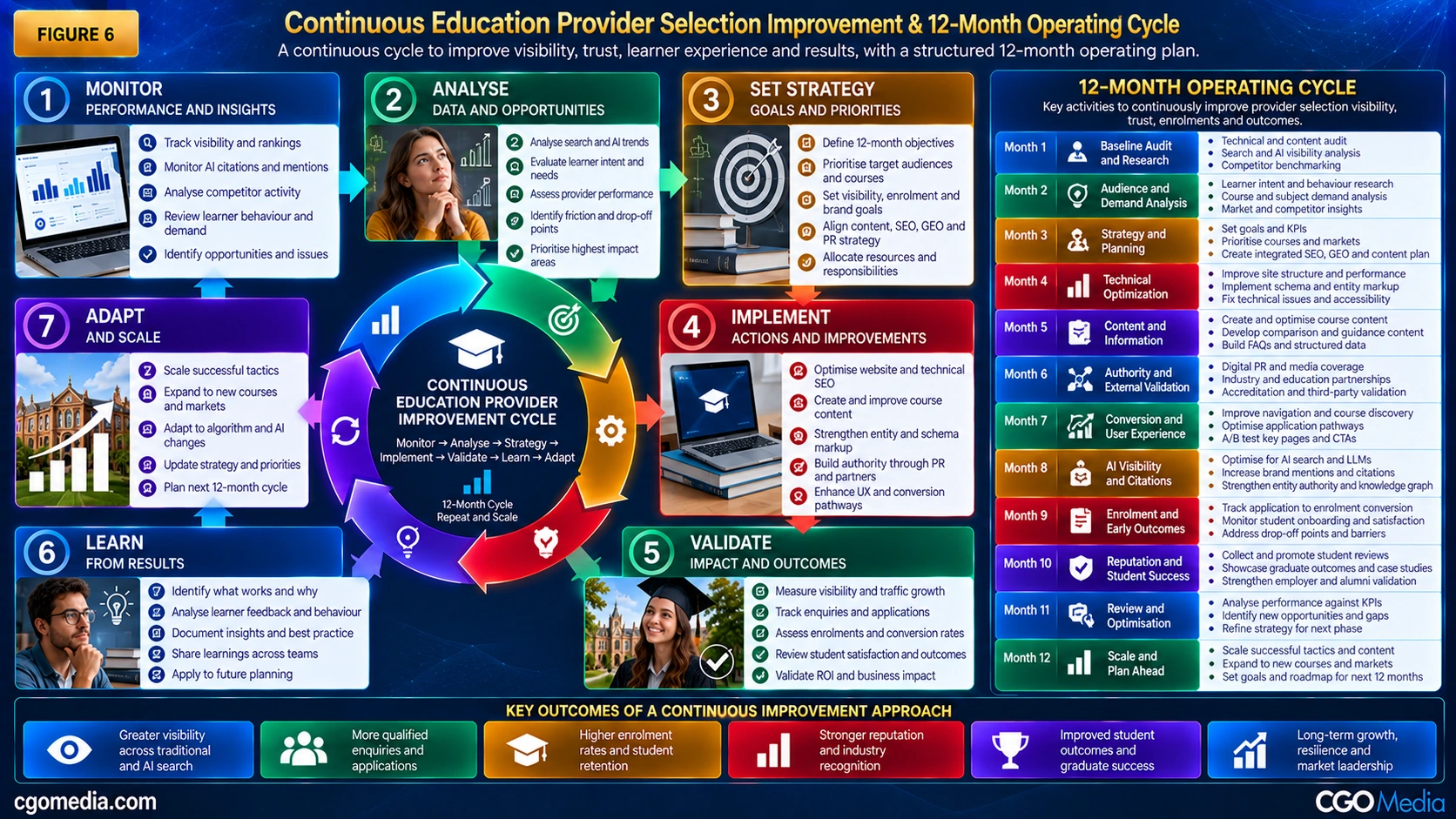
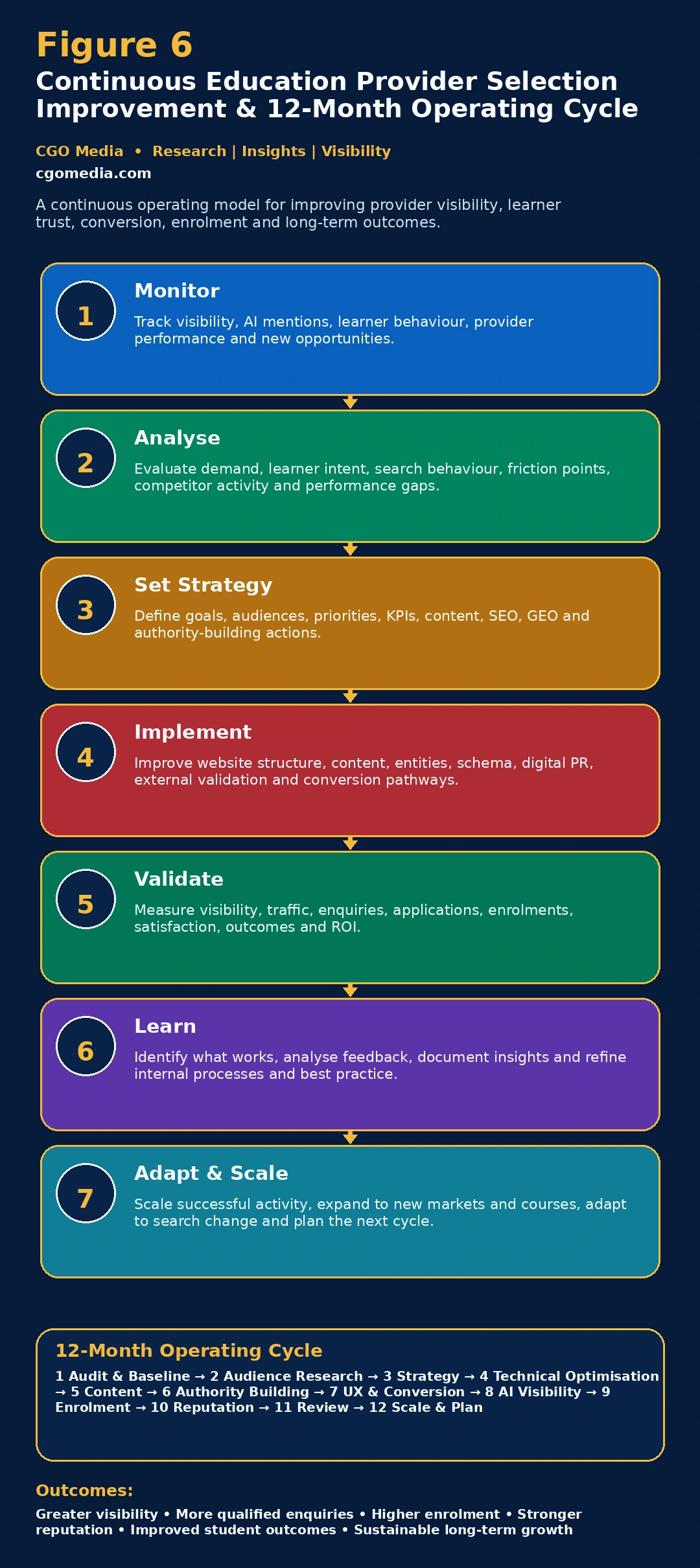
669. Methodology
The Education Discovery and Provider Selection Model is a conceptual research framework developed by CGO Media to examine how learners discover, evaluate, compare and select education providers across increasingly fragmented search, AI, marketplace, accreditation, review and institutional environments.
670. Research Scope
The model is designed to support analysis across:
- Universities
- Colleges
- Professional training providers
- Online education providers
- EdTech platforms
- Bootcamps
- Vocational education organisations
- Executive education providers
671. Core Research Question
The central question is:
What evidence, signals and constraints influence whether a learner discovers, trusts, shortlists and ultimately selects an education provider or programme?
672. Learner-Journey Method
The model examines provider selection through eight stages:
- Learner Goal Recognition
- Subject and Pathway Discovery
- Qualification Requirement Definition
- Provider and Course Discovery
- Programme Understanding
- Trust and Accreditation Validation
- Comparison and Shortlisting
- Application, Enrolment and Commitment
673. Selection-Signal Method
The model evaluates seven recurring provider-selection signals:
- Subject and Programme Fit
- Qualification and Accreditation Fit
- Delivery and Accessibility Fit
- Price and Value
- Teaching and Learner Experience
- Outcome and Career Relevance
- Provider Confidence
674. Eligibility and Preference Method
Selection is divided conceptually into two stages:
Eligibility Filtering → Preference Ranking
Hard requirements determine whether a programme remains viable, while softer preference factors help distinguish between viable alternatives.
675. Hard-Filter Analysis
Potential hard requirements include:
- Qualification level
- Accreditation
- Entry requirements
- Delivery mode
- Location
- Budget
- Completion timeframe
676. Preference-Factor Analysis
Potential preference factors include:
- Faculty
- Reputation
- Learner support
- Community
- Career services
- Platform quality
- Outcome evidence
677. Evidence-Confidence Method
Provider-selection evidence can be evaluated as:
- High confidence
- Medium confidence
- Low confidence
678. Evidence Confidence Is Not the Same as Provider Quality
The confidence classification describes the strength of publicly available evidence supporting a claim rather than constituting an independent academic or institutional quality judgement.
679. Comparison Method
Provider comparison is examined through:
Eligibility + Evidence Completeness + Evidence Consistency + Trust + Value + Practical Fit
680. Decision-Friction Method
Potential friction is examined through:
Missing Information + Contradiction + Complexity + Process Friction + Perceived Risk
681. Provider-Elimination Method
The model distinguishes between:
- Eligibility failure
- Trust failure
- Value failure
- Practical-fit failure
- Experience concerns
- Outcome concerns
682. Decision-Abandonment Method
The research also distinguishes provider elimination from complete abandonment of the education decision.
683. Provider Shortlist Method
A conceptual shortlist sequence is:
Broad Market → Eligible Providers → Consideration Set → Shortlist → Preferred Provider
684. AI Recommendation Method
AI-assisted provider discovery is examined using the recommendation eligibility model:
Subject Fit + Qualification Fit + Delivery Fit + Entry Fit + Price Fit + Trust + Outcome Relevance
685. AI Representation Measurement
AI-assisted provider representation can be evaluated through:
Presence + Relevance + Accuracy + Trust Context
686. AI Error Method
Observed errors can be classified by:
- Severity
- Persistence
- Learner impact
- Evidence confidence
687. Provider Selection Measurement Method
The wider measurement journey is:
Discovery → Consideration → Understanding → Validation → Comparison → Application → Enrolment → Experience → Outcome
688. Qualified Progression Method
Rather than relying on raw traffic or application volume alone, the model emphasises:
Relevant Discovery → Suitable Consideration → Qualified Application → Accepted Offer → Enrolment → Appropriate Experience
689. Post-Enrolment Feedback Method
The model treats learner experience and outcome as part of the future discovery cycle:
Discovery → Selection → Learning Experience → Outcome → Reputation → Future Discovery
690. Continuous Improvement Method
Ongoing provider-selection management follows:
Observe → Diagnose → Prioritise → Correct → Validate → Measure → Learn → Repeat
691. Limitations
The Education Discovery and Provider Selection Model is a conceptual strategic framework. It is not an independent institutional assessment, accreditation audit, regulatory judgement, academic-quality review, financial recommendation or guarantee of learner, search, application, enrolment or employment outcomes.
692. Education Markets Differ
Provider-selection behaviour varies by:
- Country
- Education system
- Qualification framework
- Funding environment
- Labour market
693. Provider Types Differ
Universities, colleges, bootcamps, professional training providers and EdTech platforms should not be assumed to follow identical selection patterns.
694. Programme Types Differ
Selection factors may vary substantially between:
- Degrees
- Diplomas
- Professional qualifications
- Short courses
- Certificates
- Subscriptions
695. Learner Segments Differ
Different priorities may apply to:
- School leavers
- Undergraduates
- Postgraduates
- Working professionals
- Career changers
- International learners
- Enterprise buyers
696. Selection Weightings Are Not Universal
The model intentionally avoids assigning fixed percentage weights to each selection factor because learner priorities differ by context.
697. Accreditation Is Context-Dependent
Accreditation, professional recognition and institutional status vary by programme, profession and jurisdiction.
698. Reviews Are Incomplete Evidence
Review platforms may overrepresent particularly positive or negative experiences and may not reflect the full learner population.
699. Rankings Are Methodologically Different
Different ranking systems use different datasets, criteria and weightings.
700. Outcome Evidence Has Limitations
Employment and progression outcomes may be influenced by:
- Prior experience
- Location
- Economic conditions
- Industry
- Learner background
701. Career Outcomes Are Not Guaranteed
Selection of a provider or completion of a programme does not guarantee:
- Employment
- Salary
- Promotion
- Career change
- Professional registration
702. Search Visibility Is Dynamic
Organic rankings, search features and discovery interfaces can change over time.
703. AI Systems Are Dynamic
AI models, source-selection behaviour, retrieval systems and interfaces can change.
704. AI Recommendations Are Variable
Results may differ according to:
- Prompt wording
- Model
- Market
- Date
- Available sources
705. AI Recommendation Inclusion Is Not Independent Endorsement
Appearance in an AI-generated provider list does not independently establish:
- Quality
- Accreditation
- Suitability
- Outcome
706. AI Recommendation Order Is Not a Stable Ranking
A provider appearing first in one generated answer should not automatically be described as the leading provider in that market.
707. Visible AI Citations Provide Partial Evidence
Displayed sources can be useful for analysis but should not be assumed to represent every source or internal process involved in answer construction.
708. Attribution Is Incomplete
Learners may interact with search engines, AI systems, marketplaces, social platforms, professional sources and offline recommendations before selecting a provider.
709. Correlation Is Not Causation
Changes in applications or enrolment should not automatically be attributed to one visibility or provider-selection intervention.
710. Search Visibility Is Not Guaranteed
No framework can guarantee specific organic rankings.
711. AI Visibility Is Not Guaranteed
No framework can guarantee citation, recommendation or inclusion by a particular AI system.
712. Provider Selection Is Not Guaranteed
A learner may choose another provider because of factors outside the organisation’s control.
713. Conclusion
Education provider selection is increasingly a distributed evidence and decision process rather than a simple progression from search result to course page to application.
Learners can now discover providers through search engines, AI assistants, course marketplaces, professional bodies, employer recommendations, rankings, reviews and personal networks before visiting an institution directly.
The model therefore separates provider selection into eight connected stages:
Learner Goal Recognition → Subject and Pathway Discovery → Qualification Requirement Definition → Provider and Course Discovery → Programme Understanding → Trust and Accreditation Validation → Comparison and Shortlisting → Application, Enrolment and Commitment
Within those stages, seven recurring selection signals influence provider preference:
Programme Fit + Qualification and Accreditation Fit + Delivery and Accessibility Fit + Price and Value + Teaching and Learner Experience + Outcome and Career Relevance + Provider Confidence
A central finding of the model is that provider selection contains two distinct mechanisms:
Eligibility Filtering → Preference Ranking
Hard requirements such as accreditation, qualification level, entry criteria, delivery mode, location and budget can eliminate a programme before softer factors such as reputation, faculty, community or learner experience become decisive.
AI-assisted discovery increases the importance of this distinction because several requirements can now be combined within a single recommendation prompt before the learner reaches a provider-owned website.
The provider-selection challenge therefore becomes:
Can the provider supply enough accurate, current and verifiable evidence to be discovered, remain eligible, enter the consideration set and survive detailed comparison?
The strongest provider-selection systems connect search visibility with programme truth, external validation, learner experience, outcomes and operational reliability.
The objective is not merely to maximise applications.
It is to improve:
Appropriate Discovery → Informed Comparison → Confident Selection → Successful Commitment
This makes provider selection a continuous organisational capability rather than a one-time marketing activity.
References
External Academic, Technical and Search Sources
- Google Search Central. SEO Starter Guide.
- Google Search Central. Understand how structured data works.
- Schema.org. EducationalOrganization.
- Schema.org. Course.
- Schema.org. Person.
- W3C. Web Content Accessibility Guidelines (WCAG) 2.2.
- Hogan, A. et al. (2021). Knowledge Graphs. ACM Computing Surveys, 54(4).
- Metzger, M.J. (2007). Making Sense of Credibility on the Web: Models for Evaluating Online Information and Recommendations for Future Research. Journal of the American Society for Information Science and Technology, 58(13), 2078–2091.
- Ji, Z. et al. (2023). Survey of Hallucination in Natural Language Generation. ACM Computing Surveys, 55(12).
CGO Media Education & EdTech Research and Frameworks
- Wilkinson, R. (2026). Education & EdTech SEO in an AI Search Environment. CGO Media.
- Wilkinson, R. (2026). Education & EdTech AI Trust and Visibility Framework. CGO Media.
- Wilkinson, R. (2026). Education Search Authority Maturity Model. CGO Media.
- Wilkinson, R. (2026). Education & EdTech SEO and AI Implementation Roadmap. CGO Media.
CGO Media Research Ecosystem
CGO Media Research Library |
CGO Media Framework Library |
CGO Media Research Architecture
About Roger Wilkinson
Roger Wilkinson is an independent researcher, SEO practitioner and founder of CGO Media with more than 25 years of experience in search, digital visibility and business growth.
His research focuses on how artificial intelligence is reshaping search engines, recommendation systems, entity representation, digital authority and organisational visibility.
Roger is the creator of the CGO Framework Series, a collection of research-led methodologies designed to help organisations measure, improve and govern Search Visibility, AI Visibility and Digital Authority.
His work examines the relationship between Technical SEO, Entity Authority, Content Authority, Citation Authority, Brand Signals, Knowledge Architecture and AI Search Readiness.
View Roger Wilkinson’s researcher profile →
Related Education & EdTech Research
Education & EdTech SEO in an AI Search Environment |
Education & EdTech AI Trust and Visibility Framework |
Education Search Authority Maturity Model |
Education & EdTech SEO and AI Implementation Roadmap |
Education GEO: Generative Engine Optimisation
Research Usage & Citation
CGO Media encourages researchers, journalists, education institutions, EdTech organisations, training providers, professional bodies and industry organisations to reference the Education Discovery and Provider Selection Model where it contributes to wider analysis of education search, learner behaviour, provider discovery, comparison, trust and AI-assisted recommendation.
Reasonable quotations, summaries, figures and excerpts may be used in articles, reports, presentations, academic work and other publications provided appropriate acknowledgement is given to Roger Wilkinson and CGO Media.
Cite This Research / Embed Citation
The Education Discovery and Provider Selection Model by Roger Wilkinson at CGO Media explains how learners progress from goal recognition and provider discovery through programme evaluation, trust validation, comparison, application and enrolment across traditional search and AI-assisted discovery environments.
APA Citation
APA Citation: Wilkinson, R. (2026). Education Discovery and Provider Selection Model. CGO Media. https://cgomedia.com/education-discovery-provider-selection-model/
Author: Roger Wilkinson | Published by: CGO Media
For permissions relating to extensive reproduction, commercial licensing or republication of substantial portions of this framework, please contact CGO Media directly.