
Education & EdTech SEO in an AI Search Environment
 Education & EdTech SEO in an AI Search Environment examines how universities, colleges, training providers, professional education organisations, online course platforms, certification providers and EdTech companies can build the authority, clarity and evidence required to remain discoverable as learner search moves beyond conventional search engines into AI-assisted discovery, comparison and recommendation.
The research treats education search as a provider-selection and evidence problem rather than a keyword-ranking problem alone. Learners increasingly evaluate subjects, qualifications, programmes, institutions, delivery formats, accreditation, cost, career relevance and outcomes across multiple digital environments before deciding whether to enquire, apply, enrol or purchase.
This paper forms the parent research study for the Education & EdTech AI Trust and Visibility Framework, the Education Discovery and Provider Selection Model, the Education Search Authority Maturity Model and the Education & EdTech SEO and AI Implementation Roadmap.
1. Executive Summary
Education discovery is becoming increasingly distributed across search engines, AI assistants, course marketplaces, comparison platforms, professional bodies, accreditation sources, review environments, employer networks and institutional websites.
2. Education Search Is No Longer a Single-Channel Journey
A prospective learner may encounter a provider through several different systems before visiting the institution directly.
3. A Traditional Education Discovery Journey
A conventional journey may resemble:
Search → Course Page → Provider Website → Reviews → Accreditation Check → Comparison → Application
4. An AI-Assisted Education Discovery Journey
A newer journey may resemble:
AI Question → Provider Shortlist → Course Comparison → Source Verification → Provider Website → Application
5. Search Remains Important
Traditional organic search continues to influence:
- Subject discovery
- Qualification research
- Course discovery
- Provider comparison
- Application journeys
6. AI Adds a New Discovery Layer
AI-assisted systems can combine several education requirements within a single interaction.
7. One Prompt Can Replace Multiple Searches
A learner may ask for a programme that is:
- In a specific subject
- At a defined qualification level
- Available online
- Affordable within a budget
- Recognised professionally
- Suitable for a career goal
8. Education Search Is Therefore Becoming a Fit-Matching Problem
The central question is increasingly:
Which provider and programme best fit this learner’s specific requirements?
9. Fit Requires Structured Evidence
A provider may need to demonstrate relevance across:
- Subject
- Qualification
- Entry requirements
- Delivery format
- Location
- Duration
- Price
- Accreditation
- Outcome
10. Ranking Does Not Equal Provider Selection
A course can rank highly while still failing to provide enough evidence for a learner to select it.
11. Visibility Does Not Equal Suitability
A visible programme may be unsuitable because of:
- Entry requirements
- Delivery format
- Location
- Cost
- Qualification level
12. Suitability Does Not Equal Trust
A course can fit the learner’s requirements while still lacking sufficient evidence around:
- Provider credibility
- Accreditation
- Faculty
- Learner experience
- Outcomes
13. Trust Does Not Equal Enrolment
A trusted provider may still lose the learner because of:
- Price
- Availability
- Application friction
- Timing
- Personal circumstances
14. Education SEO Should Therefore Support the Complete Decision Journey
The strategic sequence is:
Discovery → Understanding → Validation → Comparison → Selection → Application → Enrolment
15. From Keyword Visibility to Provider Eligibility
Traditional education SEO frequently concentrates on ranking for searches such as:
- Online MBA
- Cybersecurity course
- University in London
- Digital marketing qualification
- Data science bootcamp
16. These Searches Remain Valuable
However, modern discovery introduces an additional strategic question.
17. Is the Provider Eligible for Consideration?
Provider-selection eligibility concerns whether sufficient evidence exists for a learner or discovery system to treat the organisation as a credible option for a defined need.
18. Provider Eligibility Depends on Relevance
The organisation must genuinely offer a suitable programme.
19. Provider Eligibility Depends on Clarity
Programme and provider relationships must be understandable.
20. Provider Eligibility Depends on Trust
Important claims should be supported by credible evidence.
21. Provider Eligibility Depends on Availability
A programme should be available in the market, format and period implied.
22. Education Search Intent Is Multi-Layered
Learners rarely move directly from a broad query to enrolment.
23. The Education Search Intent Hierarchy
- Goal Intent
- Subject Intent
- Qualification Intent
- Course Intent
- Provider Intent
- Delivery Intent
- Outcome Intent
- Enrolment Intent
24. Goal Intent
The learner begins with a desired outcome.
25. Goal Intent Examples
- How to become a data analyst
- How to retrain for cybersecurity
- Best qualification for project management
- How to move into teaching
26. Goal-Led Discovery Is Strategically Important
It allows providers to participate before the learner has selected a course or institution.
27. Subject Intent
The learner begins exploring a field of study.
28. Subject Intent May Include
- Business
- Engineering
- Computer science
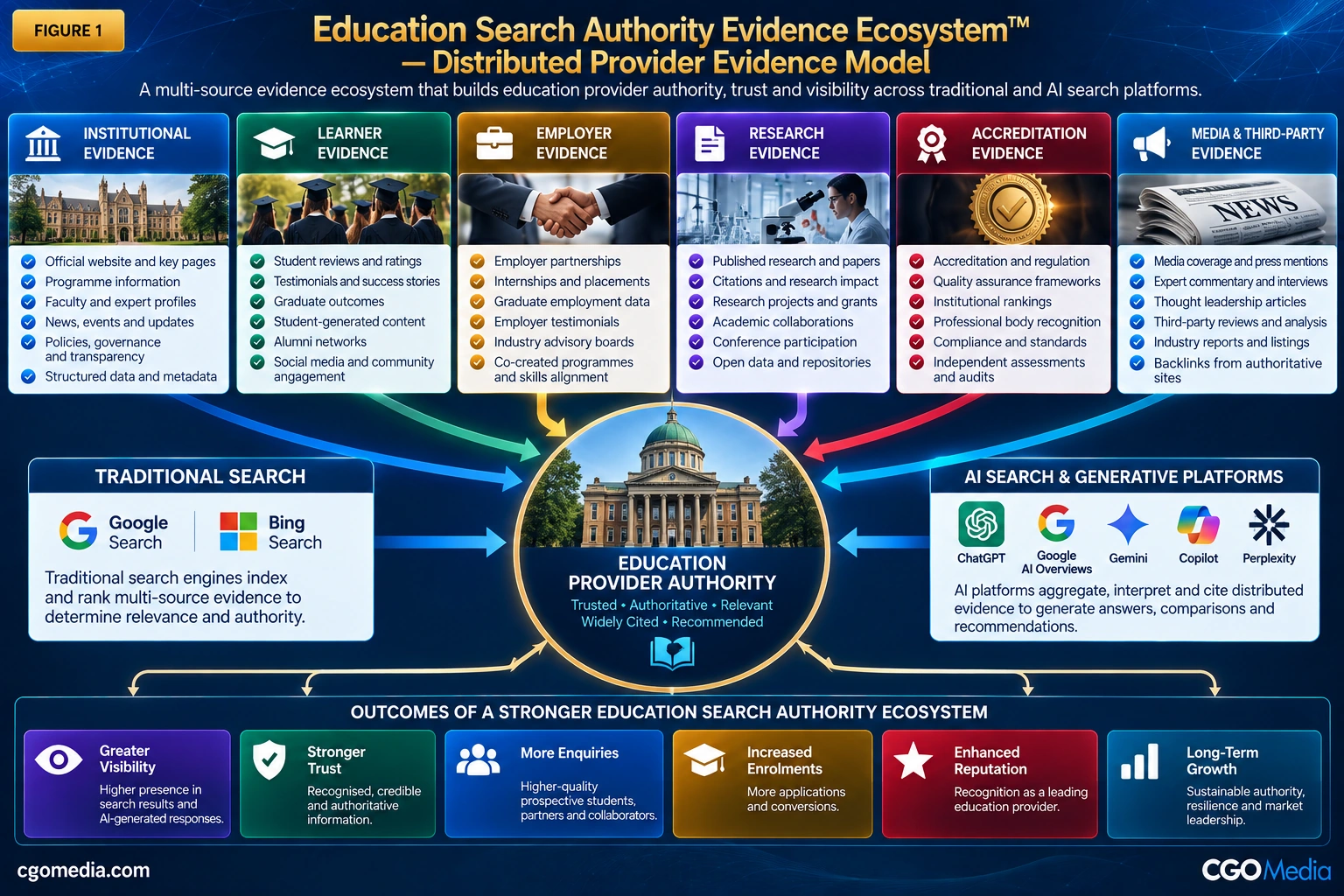
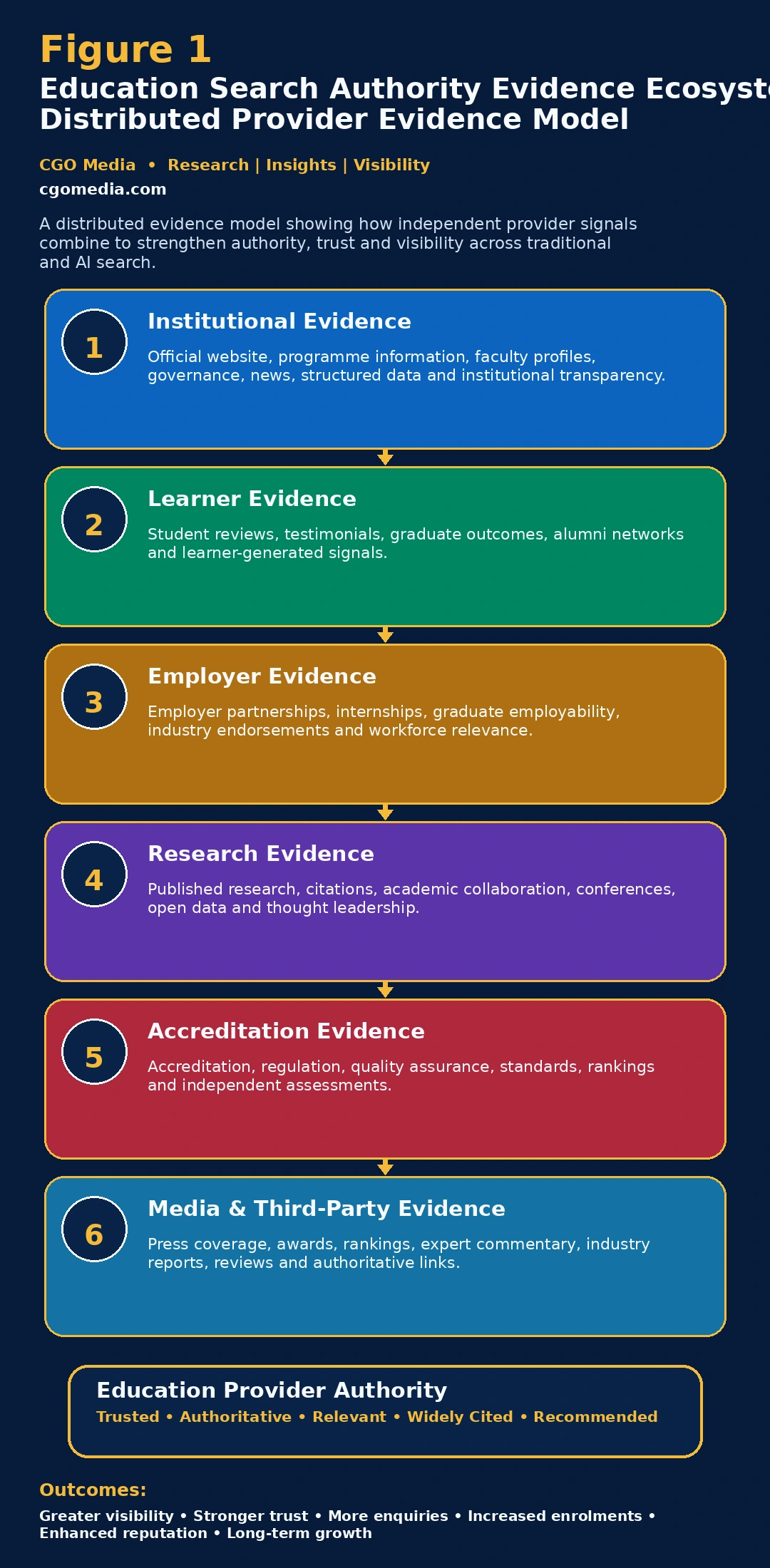
- Healthcare
- Law
- Finance
- Artificial intelligence
29. Subject Authority Should Be Real
A provider should demonstrate genuine depth in subjects it claims to specialise in.
30. Subject Authority Can Be Supported by
- Programme portfolios
- Faculty expertise
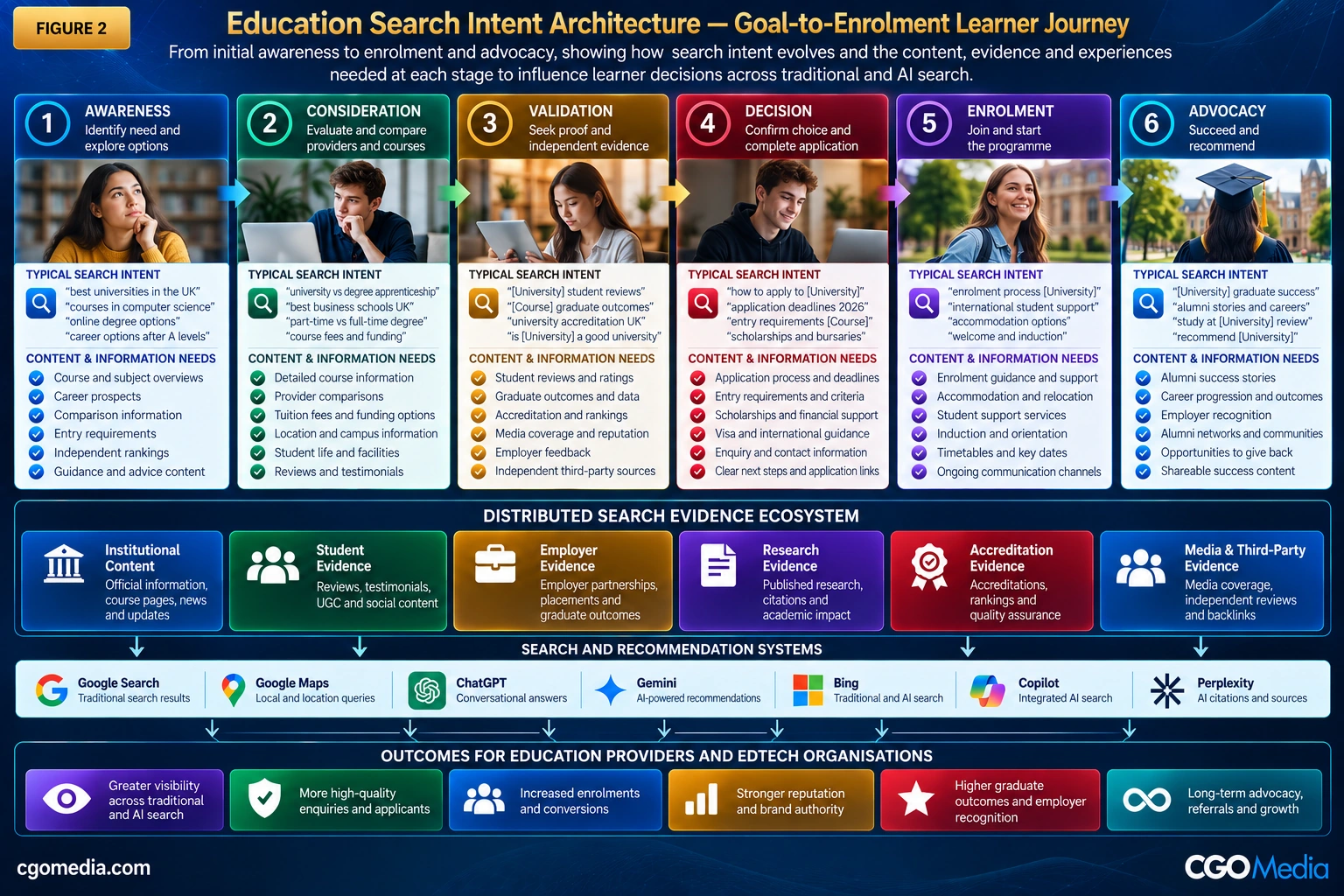
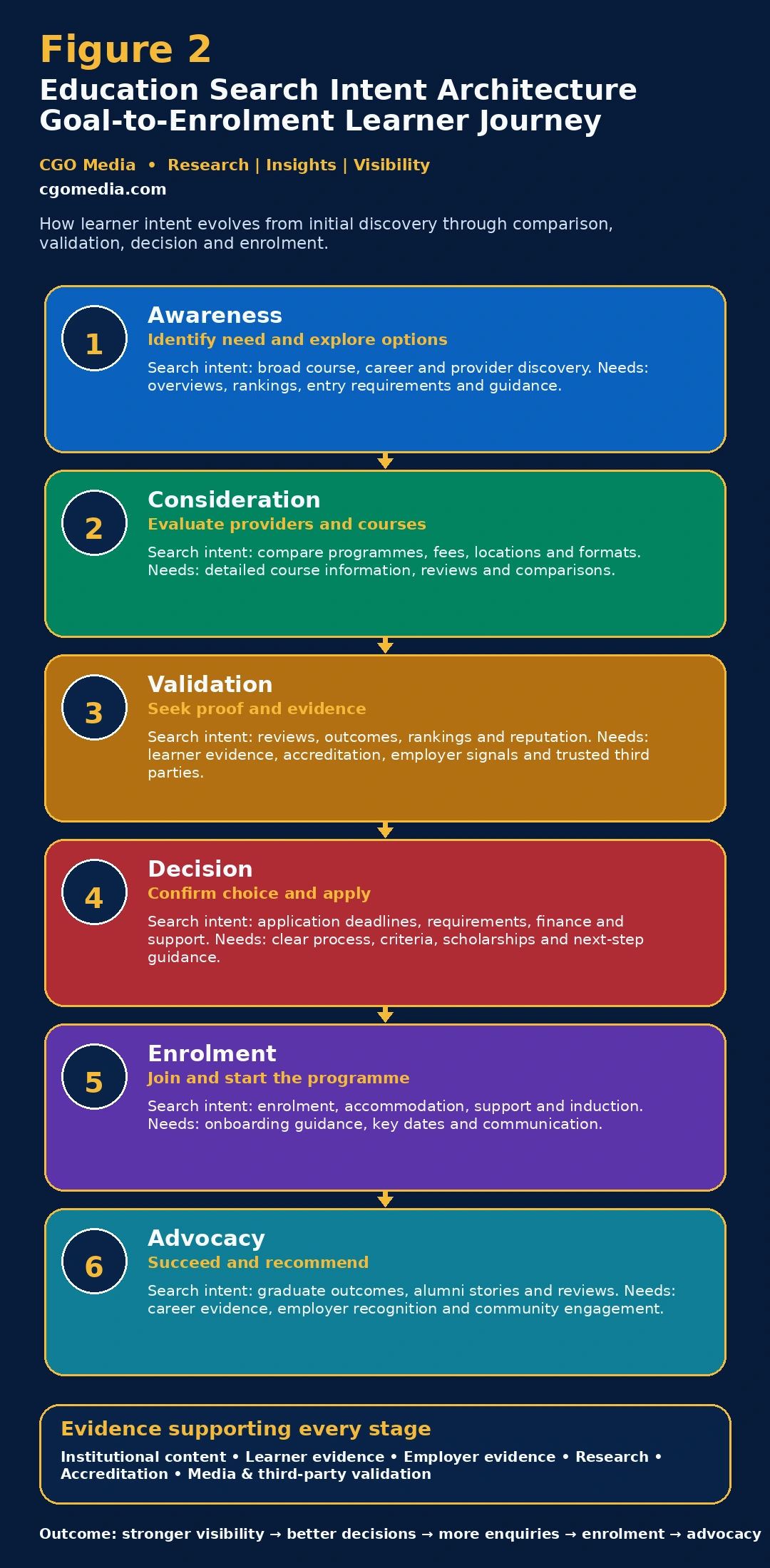
- Research
- Learning resources
- Professional engagement
- Employer relationships
31. Subject Authority Should Not Be Built Through Unrelated Content Volume
Publishing broadly around a topic without genuine educational depth can create superficial visibility without strong provider relevance.
32. Qualification Intent
The learner identifies the type or level of credential required.
33. Qualification Types Can Include
- Degrees
- Diplomas
- Certificates
- Professional qualifications
- Bootcamps
- Short courses
- Microcredentials
34. Qualification Authority Requires Clarity
Learners should be able to determine:
- What the qualification is
- What level it represents
- Who awards it
- How it is recognised
- What progression it supports
35. Qualification Labels Matter
Closely related credentials can have significantly different academic or professional meaning.
36. Course Intent
The learner begins comparing specific programmes.
37. Course Authority Requires More Than a Title
The programme should explain:
- What is taught
- Who it is for
- What prerequisites apply
- How it is delivered
- What qualification is awarded
- What outcomes it may support
38. Curriculum Authority Is Central to Course Relevance
Curriculum information can provide one of the strongest forms of programme evidence.
39. Curriculum Evidence Can Include
- Modules
- Topics
- Learning outcomes
- Assessment
- Projects
- Practical components
40. Curriculum Depth Helps Learners Compare
Two courses with similar titles may differ substantially in content and emphasis.
41. Curriculum Depth Helps Search Interpretation
Clear topic relationships make programme scope easier to understand.
42. Curriculum Depth Helps AI Course Matching
AI-assisted systems can make stronger comparisons when programme content is explicit.
43. Faculty and Instructor Authority
The people delivering education can contribute materially to provider trust and subject authority.
44. Faculty Evidence Can Include
- Academic qualifications
- Professional experience
- Research expertise
- Industry credentials
- Teaching experience
45. Faculty Profiles Should Connect with Programmes
A stronger model is:
Faculty Member → Subject → Programme → Module / Research
46. Faculty Authority Should Be Relevant
Expertise should be connected to the subject areas the individual genuinely teaches or researches.
47. Provider Intent
At this stage the learner moves from programme discovery toward evaluating institutions or platforms.
48. Provider Entity Authority
Provider Entity Authority concerns whether the institution is represented clearly across the digital ecosystem.
49. Core Provider Entity Information
Relevant elements may include:
- Organisation name
- Institution type
- Campus or location
- Programme portfolio
- Accreditation status
- Delivery model
50. Education Entity Architecture Can Be Complex
A single organisation may contain:
- Parent institution
- Schools
- Faculties
- Campuses
- Online brands
- Partner providers
51. Entity Relationships Should Be Explicit
A useful structure is:
Provider → School / Faculty → Subject → Qualification → Programme → Campus / Delivery Environment
52. Awarding Relationships Matter
Learners should understand whether the organisation:
- Awards the qualification
- Delivers it for another body
- Prepares learners for an external award
53. Partner Delivery Relationships Matter
Franchised, validated or jointly delivered programmes should make organisational roles sufficiently clear.
54. Campus and Location Authority
Location can materially influence education provider selection.
55. Campus Information Can Include
- Address
- Transport access
- Accommodation
- Facilities
- Student support
- Programme availability
56. Programme Availability Should Match Campus Reality
A programme should not be associated with a campus where it is not offered.
57. Local Authority Can Affect Institutional Discovery
Physical institutions may need strong relationships between:
- Provider
- Campus
- City
- Programme
58. Delivery Intent
Delivery mode can be a hard selection criterion.
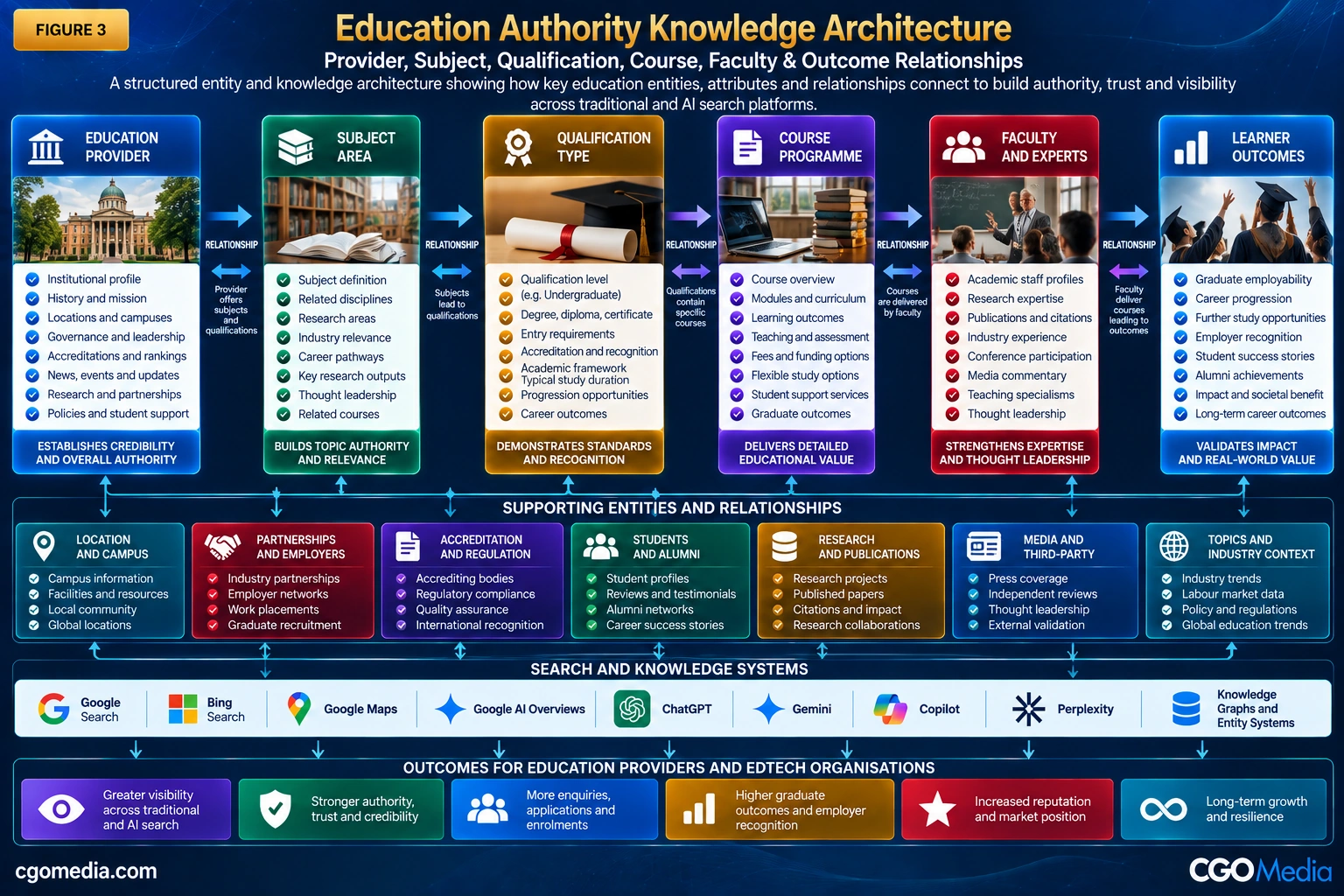
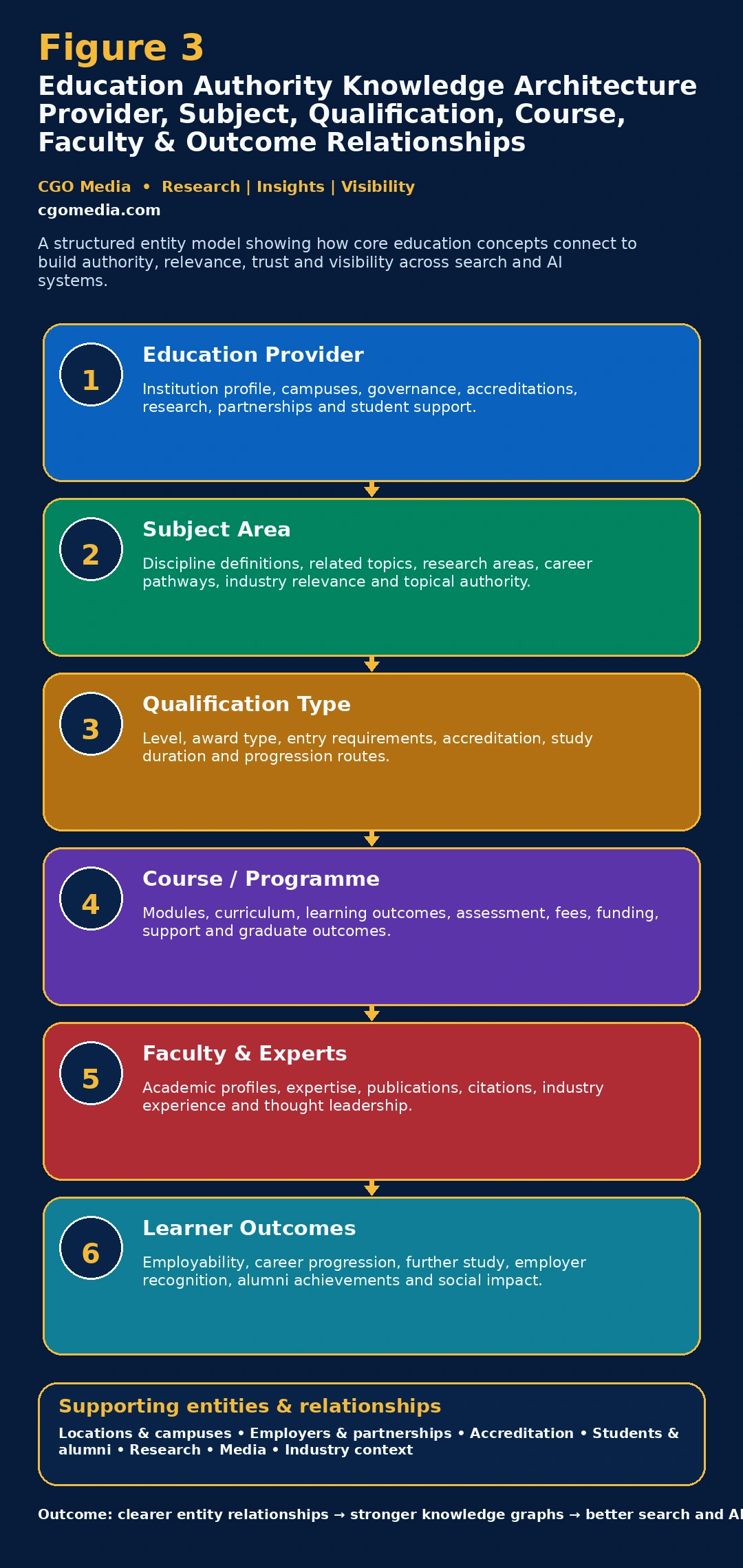
59. Online Delivery Authority
For online education providers, the delivery environment becomes part of the educational product.
60. Online Learners May Need to Understand
- Live versus recorded teaching
- Self-paced versus scheduled study
- Tutor support
- Assessment format
- Platform accessibility
- Community features
61. Flexibility Can Influence Provider Selection
Relevant factors can include:
- Part-time study
- Evening study
- Online access
- Self-paced learning
- Multiple start dates
- Modular study
62. Flexibility Should Be Represented Precisely
Terms such as “flexible learning” are less useful when the underlying schedule and study requirements remain unclear.
63. Entry Requirement Authority
Entry requirements are one of the most important learner-fit signals.
64. Entry Requirements May Include
- Academic prerequisites
- Professional experience
- Language requirements
- Age requirements
- Portfolio requirements
- Technical prerequisites
65. Entry Requirements Should Be Current
Historic admissions information can create wasted applications and false expectations.
66. Entry Requirements Should Be Interpretable
Learners should not need to decode institutional language before understanding whether they are likely to qualify.
67. Alternative Entry Routes Should Be Explained Where Relevant
Professional experience, prior learning or equivalent qualifications may provide alternative pathways for some programmes.
68. Pricing and Fee Transparency
Cost is frequently central to education provider selection.
69. Fee Information Can Include
- Tuition
- Registration fees
- Materials
- Assessment costs
- Technology costs
- Additional charges
70. Fee Transparency Should Be Cohort-Specific Where Necessary
Pricing may differ by:
- Academic year
- Market
- Study mode
- Learner status
71. Funding Information Can Support Decision-Making
Where applicable, useful information may include:
- Scholarships
- Loans
- Payment plans
- Employer funding
- Grants
72. Funding Information Should Not Imply Eligibility Where Assessment Is Required
The availability of financial support does not mean every learner will qualify.
73. Accreditation Authority
Accreditation can function as a major verification and selection signal.
74. Accreditation Questions Learners May Ask
- Who accredits the provider or programme?
- Which course does the accreditation apply to?
- Is the qualification recognised?
- Does professional progression depend on it?
75. Accreditation Evidence Should Be Specific
The provider should explain:
- Accrediting organisation
- Programme covered
- Scope
- Relevant limitations
76. Accreditation Evidence Should Be Current
Expired recognition should not remain represented as active.
77. Accreditation Evidence Should Be Verifiable
Where possible, relevant claims should be independently confirmable.
78. Institutional Trust
Some education providers operate within formal recognition or quality-assurance systems.
79. Institutional Trust Evidence Can Include
- Regulatory status
- Degree-awarding powers
- Quality-assurance relationships
- Professional recognition
80. Institutional Trust Should Not Be Generalised Improperly
Recognition at one organisational level does not automatically establish the status of every programme.
81. Outcome Intent
Learners increasingly evaluate education according to what the programme may help them achieve.
82. Learner Outcome Authority
Potential outcome evidence can include:
- Completion
- Employment
- Career progression
- Certification pass rates
- Further study
- Portfolio development
83. Outcome Claims Should Be Specific
Broad claims such as “excellent career prospects” provide limited evidence without supporting context.
84. Outcome Evidence Should Explain Methodology
Useful information may include:
- Sample
- Time period
- Data source
- Outcome definition
- Limitations
85. Employment Outcomes Should Not Be Presented as Guarantees
A course can support employability without guaranteeing a job, salary or promotion.
86. Learner Reviews and Social Proof
Reviews can reveal recurring patterns around:
- Teaching
- Support
- Course difficulty
- Platform usability
- Value
- Career relevance
87. Review Themes Can Matter More Than Headline Ratings
Repeated strengths or weaknesses may provide more useful evidence than the average score alone.
88. Testimonials and Independent Reviews Serve Different Roles
Provider-controlled testimonials show selected experiences, while independent platforms may provide broader external feedback.
89. Learner Case Studies Can Add Decision Context
Stronger learner stories may explain:
- Starting point
- Reason for study
- Programme selected
- Learning experience
- Outcome
90. Employer Evidence
For career-oriented programmes, employer relationships can strengthen market relevance.
91. Employer Evidence Can Include
- Partnerships
- Apprenticeships
- Placements
- Industry projects
- Graduate recruitment
- Qualification recognition
92. Professional Association Authority
Professional bodies can provide important context for vocational, regulated or certification-led programmes.
93. Professional Evidence Can Include
- Accreditation
- Recognition
- Membership pathways
- Continuing professional development
- Qualification exemptions
94. Rankings and Comparison Platforms
Learners may use comparison environments to reduce a large provider market into a smaller shortlist.
95. Comparison Environments May Organise Providers by
- Subject
- Location
- Fees
- Entry requirements
- Rankings
- Reviews
- Outcomes
96. External Representation Should Be Accurate
Incorrect marketplace or comparison information can influence provider selection before the learner reaches the institution’s own website.
97. Course Aggregators and Marketplaces
Online courses and professional training may be discovered primarily through third-party platforms.
98. Marketplace Evidence Can Reinforce
- Course identity
- Provider identity
- Subject relevance
- Pricing
- Reviews
- Learner demand
99. Content Authority in Education
Education providers possess significant opportunities to build subject authority through useful educational information.
100. Education Content Authority Can Include
- Research
- Guides
- Lectures
- Faculty commentary
- Career resources
- Learning materials
101. Content Should Reflect Genuine Educational Expertise
The objective should not be to produce large volumes of generic search content.
102. Research Authority
Universities and research-led organisations may already possess substantial authority through:
- Academic publications
- Research centres
- Institutional repositories
- Conferences
- Policy contributions
- Expert commentary
103. Research Authority Should Connect to the Institutional Entity
Research, authors and subject areas should be linked clearly enough to strengthen understanding of institutional expertise.
104. Digital PR in Education
Education Digital PR can reinforce genuine authority when it is built around defensible evidence.
105. Useful Digital PR Themes Can Include
- Research findings
- Skills trends
- Employment trends
- Learner behaviour
- Technology adoption
- Education access
- Industry demand
106. Digital PR Should Support the Knowledge Architecture
The strongest campaigns reinforce strategic subjects, programmes and research areas rather than generating disconnected publicity.
107. AI Search Adds a New Decision Layer
AI systems can combine programme discovery, provider evaluation, accreditation, pricing, delivery and outcome evidence within a single answer.
108. AI Provider Recommendation Eligibility
Recommendation eligibility can be understood as the degree to which public evidence supports inclusion within a relevant learner consideration set.
109. Recommendation Eligibility Requires Subject Fit
The provider must genuinely offer relevant educational expertise.
110. Recommendation Eligibility Requires Qualification Fit
The programme must offer the appropriate level and type of credential.
111. Recommendation Eligibility Requires Delivery Fit
The programme should match the learner’s location, schedule and preferred learning mode.
112. Recommendation Eligibility Requires Trust
Provider and programme claims should be sufficiently validated.
113. Recommendation Eligibility Requires Value Context
Fees and other commitments influence whether the programme fits the learner.
114. Recommendation Eligibility Requires Outcome Relevance
Career or progression claims should align with the learner’s actual objective.
115. Recommendation Eligibility Requires Current Evidence
Stale programme data can undermine otherwise strong authority.
116. Education Search Authority Is Distributed
No single webpage or platform carries the entire authority burden.
117. First-Party Evidence Provides Core Programme Truth
The provider controls information about:
- Curriculum
- Fees
- Entry requirements
- Faculty
- Delivery
118. Accreditation Sources Provide Independent Recognition Evidence
These sources can corroborate programme or provider status.
119. Learner Sources Provide Experience Evidence
Reviews and testimonials can reveal how the programme is experienced.
120. Employer Sources Provide Market Evidence
Employer relationships can contribute context around professional relevance.
121. Research Sources Provide Subject Authority
Academic and institutional research can strengthen wider understanding of provider expertise.
122. Comparison Platforms Provide Selection Context
They help learners evaluate alternatives across common criteria.
123. AI Systems Combine Multiple Evidence Layers
AI-assisted discovery can surface, summarise and compare information from across the wider evidence ecosystem.
124. The First Research Principle
Education search authority is strongest when provider identity, programme evidence, trust, outcomes and external validation reinforce one another across the wider discovery environment.
125. Education Search Intent Is a Layered Decision System
Learner search behaviour is rarely limited to one keyword or one stage.
A learner can move backwards and forwards between goals, subjects, qualifications, providers, delivery options and outcomes before reaching an application decision.
126. The Education Search Intent Architecture
A useful model is:
Goal → Subject → Qualification → Course → Provider → Delivery → Outcome → Enrolment
127. Each Layer Answers a Different Question
The sequence can be interpreted as:
- What do I want to achieve?
- What should I study?
- What qualification do I need?
- Which course fits?
- Which provider should I trust?
- How can I study?
- What can this lead to?
- How do I enrol?
128. Goal Intent Sits Above Conventional Course Search
Many education journeys begin before the learner knows the name of the required qualification.
129. Goal Intent Can Be Career-Led
Examples include:
- How to become a cybersecurity analyst
- How to move into HR
- How to become a project manager
- How to retrain as a data scientist
130. Goal Intent Can Be Skill-Led
Examples include:
- Learn Python
- Improve leadership skills
- Learn digital marketing
- Develop accounting skills
131. Goal Intent Can Be Qualification-Led
Examples include:
- Get an MBA
- Gain a teaching qualification
- Earn a cybersecurity certification
- Complete a postgraduate degree
132. Goal Intent Can Be Progression-Led
Examples include:
- Prepare for promotion
- Change career
- Qualify for university
- Progress to postgraduate study
133. Goal Intent Creates Early Discovery Opportunity
Providers that answer goal-led questions can enter the learner journey before a shortlist has been created.
134. Goal Intent Requires Educational Guidance
Strong content should help the learner understand:
- Potential pathways
- Required qualifications
- Likely timescales
- Alternative routes
- Relevant limitations
135. Goal-Led Content Should Not Manufacture Demand
The purpose is to help learners understand realistic routes, not to force every career question toward a provider’s own programme.
136. Subject Intent Represents Broader Academic or Skills Exploration
At this stage, the learner has identified an area of interest but may not yet know the appropriate qualification or provider.
137. Subject Intent Can Be Broad
Examples include:
- Business
- Law
- Artificial intelligence
- Healthcare
- Psychology
- Engineering
138. Subject Intent Can Be Specialist
Examples include:
- Machine learning
- Employment law
- Digital forensics
- Renewable energy engineering
- Behavioural psychology
139. Subject Intent Requires Subject Architecture
The provider should make it easy to understand:
- Which subjects it teaches
- Which programmes belong to each subject
- Which faculty support the subject
- Which research or expertise exists
140. Subject Hubs Can Support Discovery
A well-structured subject hub can connect:
Subject Overview → Qualifications → Courses → Faculty → Research → Careers
141. Subject Hubs Should Not Be Thin Category Pages
They should provide enough context to help learners understand the discipline and available pathways.
142. Subject Authority Can Influence Provider Shortlisting
A learner may prefer a provider with visible depth in a particular subject over a generalist provider with limited supporting evidence.
143. Qualification Intent Narrows the Decision
Once the learner understands the subject, the next question often becomes:
What type of qualification should I take?
144. Qualification Intent Is Highly Contextual
The correct credential may depend on:
- Career objective
- Existing education
- Professional requirements
- Time available
- Budget
145. Qualification Comparisons Can Reduce Confusion
Useful comparisons may explain differences between:
- Degree and diploma
- Certificate and professional qualification
- Bootcamp and postgraduate course
- Short course and formal award
146. Qualification Content Should Explain Recognition
Learners should be able to understand:
- Who awards the qualification
- What level it represents
- Whether it is professionally recognised
- What progression it supports
147. Qualification Authority Can Affect AI Course Matching
AI systems may struggle to compare programmes when qualification level or awarding status is ambiguous.
148. Course Intent Represents a More Concrete Evaluation Stage
The learner now begins evaluating individual programmes.
149. Course Intent Often Includes Multiple Constraints
A learner may search for:
- Subject
- Qualification
- Location
- Delivery mode
- Duration
- Fees
- Start date
150. Course Pages Should Function as Decision Assets
They should do more than describe the programme attractively.
151. A Strong Course Page Should Answer Core Questions
- What will I learn?
- Who is this for?
- What are the requirements?
- How is it delivered?
- What does it cost?
- What qualification do I receive?
- What can it lead to?
152. Course Pages Should Support Comparison
Information should be sufficiently structured for the learner to compare alternatives.
153. Course Pages Should Support Verification
Important trust claims should connect to credible evidence.
154. Course Pages Should Support AI Interpretation
Clear programme facts can improve the chance that AI-generated comparisons represent the course accurately.
155. Course Intent Can Become Brand Intent
Once a learner identifies a suitable programme, the next question is often:
Which provider should I choose?
156. Provider Intent Is a Trust and Differentiation Stage
At this stage the learner evaluates:
- Reputation
- Recognition
- Faculty
- Student experience
- Outcomes
- Support
157. Provider Intent Can Be Explicit
Examples include:
- Best university for data science
- Best online MBA provider
- Best cybersecurity bootcamp
- Top business school for executives
158. Provider Intent Can Be Implicit
AI-assisted systems may shortlist providers even when the learner has not named one.
159. Provider Shortlisting Depends on Evidence
Potential evidence includes:
- Programme relevance
- Subject authority
- Accreditation
- Reviews
- Outcomes
- Employer relationships
160. Brand Awareness Can Influence Shortlisting
A familiar provider may receive more consideration because the learner already recognises the name.
161. Brand Awareness Should Not Substitute for Programme Fit
A well-known institution can still offer a programme that is unsuitable for a specific learner.
162. Provider Comparison Should Be Programme-Aware
Institution-wide reputation should be interpreted alongside subject and programme evidence.
163. Delivery Intent Can Eliminate Otherwise Suitable Providers
A learner may reject a strong programme because the delivery format does not fit their circumstances.
164. Delivery Intent Can Include Location
Examples include:
- University in Manchester
- Course near Birmingham
- Study in London
165. Delivery Intent Can Include Study Mode
Examples include:
- Online
- Hybrid
- Campus-based
- Part-time
- Full-time
166. Delivery Intent Can Include Schedule
Examples include:
- Evening course
- Weekend course
- Self-paced course
- Intensive bootcamp
167. Delivery Intent Can Include Start Date
Some learners need:
- Immediate start
- January intake
- September intake
- Rolling enrolment
168. Delivery Information Should Be Explicit
Vague wording can create avoidable learner uncertainty.
169. Online Education Requires Additional Delivery Evidence
Learners may need to understand:
- Live teaching
- Recorded content
- Tutor access
- Assessment
- Community
- Technical requirements
170. EdTech Platform Delivery Is Part of the Product
Platform usability, reliability and accessibility can influence provider selection.
171. Outcome Intent Becomes More Important as the Learner Approaches Selection
The learner begins asking:
What is this programme likely to help me achieve?
172. Outcome Intent Can Be Career-Led
Examples include:
- What jobs can I get?
- Can this help me change career?
- Will employers recognise this qualification?
173. Outcome Intent Can Be Academic
Examples include:
- Can I progress to a master’s degree?
- Does this qualify me for further study?
- Will these credits transfer?
174. Outcome Intent Can Be Professional
Examples include:
- Does this support professional registration?
- Does this qualification provide exemptions?
- Does it count toward continuing professional development?
175. Outcome Content Should Distinguish Possibility from Guarantee
A course can support progression without guaranteeing:
- Employment
- Salary
- Promotion
- Admission to another programme
176. Outcome Evidence Should Be Programme-Relevant
Institution-wide graduate statistics may provide limited insight into one specific course.
177. Outcome Evidence Should Be Current
Older outcome data may no longer reflect current curriculum, labour markets or learner cohorts.
178. Employer Evidence Can Reinforce Outcome Intent
Useful employer signals may include:
- Placements
- Live projects
- Advisory boards
- Graduate recruitment
- Industry recognition
179. Outcome Intent Frequently Interacts with Price
Learners may evaluate education as an investment.
180. Return-on-Investment Questions Can Include
- Is the course worth the cost?
- What career opportunities may follow?
- How long will the programme take?
- Can I continue working while studying?
181. ROI Claims Require Caution
The financial value of education varies according to learner circumstances, market conditions and outcomes.
182. Enrolment Intent Represents the Final Operational Stage
The learner has moved from evaluation toward action.
183. Enrolment Intent Can Include
- How to apply
- Application deadline
- Required documents
- How to enrol
- How to pay
- What happens after acceptance
184. Application Friction Can Destroy Earlier Search Success
A provider may perform strongly across discovery and trust but lose the learner because the application process is confusing or unreliable.
185. Common Application Friction Includes
- Unclear deadlines
- Unexpected document requirements
- Broken forms
- Duplicate information requests
- Poor mobile usability
186. Application Guidance Should Be Clear
The learner should understand:
- Eligibility
- Steps
- Documents
- Deadlines
- Decision process
187. Enrolment Intent Extends Beyond the Application Form
The journey may continue through:
- Offer
- Acceptance
- Payment
- Registration
- Onboarding
188. Post-Application Communication Influences Trust
Slow or unclear communication can undermine confidence developed earlier in the journey.
189. Search Experience and Enrolment Experience Should Align
The expectations created during search should match the reality of the application and learning journey.
190. Education Search Intent Is Not Strictly Linear
Learners may move backwards after discovering new information.
191. A Learner May Return from Course Intent to Qualification Intent
For example, they may discover that a different qualification level is required.
192. A Learner May Return from Provider Intent to Subject Intent
For example, a preferred provider may not offer the specialist subject required.
193. A Learner May Return from Outcome Intent to Course Comparison
Career evidence can cause the shortlist to change.
194. AI Systems Can Compress Several Intent Layers
A single prompt may contain:
- Career goal
- Subject
- Qualification
- Location
- Budget
- Delivery preference
195. Example Compressed Intent Prompt
A learner might ask:
“Which part-time online postgraduate cybersecurity programmes are suitable for someone working full-time and looking to move into a security analyst role?”
196. This Prompt Requires Multiple Evidence Layers
A useful response requires understanding:
- Qualification level
- Subject relevance
- Delivery format
- Audience fit
- Career relevance
- Provider credibility
197. AI Search Therefore Increases the Importance of Structured Programme Evidence
The provider should not assume that one optimised landing page can answer every relevant dimension.
198. Search Architecture Should Map to Learner Intent Architecture
A mature site may provide distinct but connected assets for:
- Goals
- Subjects
- Qualifications
- Courses
- Providers
- Delivery options
- Outcomes
- Applications
199. Goal Content Should Connect to Subject and Qualification Content
Career-oriented discovery should lead naturally toward appropriate educational pathways.
200. Subject Content Should Connect to Qualifications and Courses
The learner should be able to move from broad exploration toward specific options.
201. Qualification Content Should Connect to Relevant Courses
A learner should not need to search the site again to find programmes matching the credential.
202. Course Content Should Connect to Provider Trust
Relevant evidence may include:
- Faculty
- Accreditation
- Reviews
- Outcomes
- Employer evidence
203. Provider Content Should Connect Back to Programme Fit
Institutional storytelling should help the learner make a programme decision rather than functioning only as corporate branding.
204. Delivery Content Should Connect to Real Programme Availability
A generic online-learning page should not imply that every programme is available online.
205. Outcome Content Should Connect to Specific Programmes Where Possible
This increases decision usefulness.
206. Application Content Should Connect Directly with Current Programme Requirements
Generic application information should not contradict programme-specific requirements.
207. Internal Linking Can Reinforce Intent Progression
A useful model is:
Goal → Subject → Qualification → Course → Trust Evidence → Application
208. Internal Linking Should Support Learner Progression
Links should be designed around useful next questions rather than only around SEO authority distribution.
209. Search Intent Should Be Measured by Stage
Different content types should be judged using different metrics.
210. Goal-Stage Metrics
Potential measures include:
- Qualified discovery
- Engagement with pathway content
- Progression to subject pages
211. Subject-Stage Metrics
Potential measures include:
- Subject visibility
- Programme exploration
- Faculty engagement
- Career-content engagement
212. Qualification-Stage Metrics
Potential measures include:
- Qualification comparison engagement
- Course progression
- Recognition-content engagement
213. Course-Stage Metrics
Potential measures include:
- Programme engagement
- Application starts
- Enquiry
- Comparison behaviour
214. Provider-Stage Metrics
Potential measures include:
- Branded search
- Trust-content engagement
- Review interaction
- Return visits
215. Delivery-Stage Metrics
Potential measures include:
- Online-programme filtering
- Location engagement
- Mode-of-study interaction
216. Outcome-Stage Metrics
Potential measures include:
- Career-content engagement
- Outcome-evidence interaction
- Employer-evidence interaction
217. Enrolment-Stage Metrics
Potential measures include:
- Application starts
- Application completion
- Offer acceptance
- Enrolment
218. Intent Measurement Should Focus on Progression
A content asset should be evaluated partly by whether it helps the learner move intelligently toward the next stage.
219. Intent Architecture Supports AI Monitoring
AI prompt sets can be grouped around:
- Goal prompts
- Subject prompts
- Qualification prompts
- Course prompts
- Provider prompts
- Delivery prompts
- Outcome prompts
220. Goal Prompts Test Early Discovery
They reveal whether the provider appears before the learner has selected a qualification.
221. Subject Prompts Test Topical Authority
They reveal whether the organisation is associated with strategic disciplines.
222. Qualification Prompts Test Credential Relevance
They reveal whether programmes are matched to the correct qualification level.
223. Course Prompts Test Programme Relevance
They reveal whether specific programmes are surfaced for relevant requirements.
224. Provider Prompts Test Recommendation Authority
They reveal whether the institution enters the consideration set.
225. Delivery Prompts Test Practical Fit
They reveal whether online, campus, hybrid or part-time options are represented accurately.
226. Outcome Prompts Test Career and Progression Representation
They reveal how AI systems describe likely learner outcomes.
227. Intent-Level AI Monitoring Can Reveal Different Weaknesses
A provider may perform well for branded course prompts but poorly for goal-led or subject-led discovery.
228. This Difference Matters Strategically
Strong branded visibility may indicate demand capture, while weak non-branded inclusion may indicate limited discovery authority.
229. The Intent Architecture Creates a More Complete Search Model
The provider can move beyond:
Keyword → Ranking → Click
toward:
Learner Need → Intent Stage → Evidence → Evaluation → Progression
230. Intent Architecture Also Supports Content Governance
Each content asset can have a defined role in the learner journey.
231. This Reduces Content Duplication
Pages are less likely to compete unnecessarily when their purpose is defined clearly.
232. This Improves Internal Search Architecture
Navigation can reflect real learner questions instead of internal organisational structure alone.
233. This Improves AI Readiness
Clear relationships between goals, subjects, qualifications and programmes can create a more interpretable evidence system.
234. The Second Research Principle
Education search strategy should map the full learner-intent architecture rather than optimise isolated course keywords.
235. The Intent Model
The complete sequence is:
Goal → Subject → Qualification → Course → Provider → Delivery → Outcome → Enrolment
236. The Strategic Objective
The objective is to help the learner move from an uncertain educational need toward an informed and appropriate provider decision.
237. Education Authority Requires a Structured Knowledge Architecture
A modern education provider should be understandable not only as a brand, but as a network of connected educational entities.
238. The Core Education Authority Structure
A practical model is:
Provider → School / Faculty → Subject → Qualification → Programme → Curriculum → Faculty → Accreditation → Outcome
239. Each Layer Contributes Different Evidence
The strength of the overall system depends on whether these relationships are explicit, current and internally consistent.
240. Provider Entity Authority Comes First
The provider should be represented clearly enough for users and machines to understand:
- Who it is
- What type of organisation it is
- What it offers
- Where it operates
- How its sub-entities relate to it
241. Provider Entity Complexity Can Create Search Ambiguity
Education organisations may contain:
- Parent institutions
- Schools
- Faculties
- Campuses
- Subsidiaries
- Online brands
- Partner providers
242. Entity Relationships Should Be Explicit
A learner should not have to infer whether two names refer to:
- The same provider
- A parent organisation
- A delivery partner
- An awarding body
- A separate institution
243. Historic Names Can Create Residual Confusion
Rebrands, mergers and acquisitions can leave conflicting references across:
- Search results
- Directories
- Accreditation sources
- Course marketplaces
- AI-generated answers
244. Historic Entity Relationships Should Be Managed Deliberately
Where appropriate, the organisation should explain:
- Former names
- Merger relationships
- Current legal identity
- Current brand identity
245. Entity Consistency Does Not Mean Identical Wording Everywhere
It means that material facts should remain compatible across the public evidence environment.
246. Subject Authority Sits Beneath Provider Authority
A provider can be well known overall while having limited authority in a specific discipline.
247. Subject Authority Should Be Measured Independently
Relevant evidence may include:
- Programme depth
- Faculty expertise
- Research
- Learning resources
- Employer relevance
- External citations
248. Subject Authority Requires Coherence
A stronger subject architecture links:
Subject → Qualification → Courses → Faculty → Research → Careers
249. Subject Pages Should Function as Knowledge Hubs
They should help learners understand:
- What the subject covers
- Which study pathways exist
- Which programmes are available
- Which careers may follow
250. Subject Pages Should Not Simply List Courses
A thin list provides limited evidence of educational depth.
251. Qualification Authority Adds Credential Context
The qualification layer helps users understand what type of educational award a programme leads to.
252. Qualification Relationships Should Be Explicit
A useful model is:
Qualification Type → Level → Awarding Organisation → Programme → Recognition
253. Qualification Authority Should Explain Level
The learner should understand whether the programme is:
- Introductory
- Undergraduate
- Postgraduate
- Professional
- Vocational
- Advanced specialist
254. Qualification Authority Should Explain Awarding Status
Providers should make clear whether they:
- Award the qualification directly
- Deliver it for another body
- Prepare learners for an external award
- Issue a non-regulated certificate
255. Qualification Authority Should Explain Recognition
Where relevant, recognition may relate to:
- Academic progression
- Professional entry
- Regulated practice
- Employer recognition
256. Course Authority Is the Central Decision Layer
The programme or course is where most learner-selection evidence converges.
257. Course Authority Should Combine Multiple Evidence Types
These may include:
- Curriculum
- Entry requirements
- Delivery
- Fees
- Faculty
- Accreditation
- Outcomes
- Reviews
258. Course Authority Should Be Specific
Generic institutional claims should not replace programme-level evidence.
259. Course Authority Should Be Current
Outdated programme information can weaken both learner trust and AI interpretation.
260. Curriculum Authority Demonstrates What Is Actually Taught
Curriculum evidence can help distinguish one programme from another.
261. Strong Curriculum Evidence Can Include
- Modules
- Topics
- Learning outcomes
- Assessment methods
- Projects
- Practical work
- Electives
262. Curriculum Depth Should Reflect the Programme
A short course may require a different level of detail from a multi-year degree.
263. Curriculum Should Be Current
Fast-moving subjects may require more frequent updates.
264. Curriculum Authority Helps Learners Compare Similar Titles
Two programmes with the same headline title can differ substantially in:
- Technical depth
- Practical emphasis
- Assessment
- Specialisation
265. Curriculum Authority Helps AI Matching
Explicit topic coverage can improve the likelihood that a programme is matched to the right learner need.
266. Faculty Authority Supports Subject and Programme Trust
The people delivering education provide important evidence of institutional expertise.
267. Faculty Authority Should Be Connected to Teaching Reality
Profiles should reflect the subjects and programmes an educator genuinely supports.
268. Faculty Evidence Can Include
- Academic qualifications
- Research
- Industry experience
- Professional credentials
- Teaching responsibilities
269. Faculty Research Can Strengthen Subject Authority
Relevant publications and research activity can reinforce the provider’s expertise in a discipline.
270. Faculty Profiles Should Not Become Isolated Biography Pages
They should connect with:
- Subjects
- Courses
- Research
- Modules
271. Faculty Freshness Matters
Departed academics or outdated responsibilities can create contradictory evidence.
272. Research Authority Can Reinforce Education Authority
Research-led organisations may have significant expertise that is weakly connected to learner-facing programme content.
273. Research Should Connect with Strategic Subjects
A stronger architecture links:
Research → Researcher → Subject → Faculty → Programme
274. Institutional Repositories Can Support Knowledge Authority
Research repositories can provide durable evidence of:
- Publications
- Authors
- Research topics
- Institutional expertise
275. Research Authority Should Not Be Artificially Redirected into Marketing
Its value comes from genuine expertise and evidence.
276. Campus Authority Is a Distinct Entity Layer
For multi-campus providers, each location may have different:
- Programmes
- Facilities
- Services
- Entry routes
- Learner experiences
277. Campus Relationships Should Be Explicit
A useful model is:
Provider → Campus → Programmes → Facilities → Local Context
278. Campus Pages Should Support Real Learner Decisions
Useful evidence may include:
- Programme availability
- Transport
- Facilities
- Accommodation
- Student services
- Local environment
279. Campus Pages Should Not Duplicate Generic Institutional Copy
Location-specific information should reflect real differences.
280. Local Search Can Influence Campus Discovery
Physical providers may be discovered through:
- Local queries
- Maps
- Regional comparison searches
- AI location-based recommendations
281. Campus Data Should Be Current
Incorrect programme availability at a campus can create significant learner frustration.
282. Online Delivery Requires Its Own Authority Architecture
Online education should not be treated simply as a delivery label.
283. Online Programme Evidence Should Explain the Learning Experience
Learners may need to understand:
- Live teaching
- Recorded content
- Self-paced components
- Tutor access
- Assessment
- Peer interaction
284. Online Delivery Authority Includes Technology
Platform reliability and usability can affect the educational experience.
285. Online Delivery Authority Includes Accessibility
Learners may rely on:
- Captions
- Keyboard navigation
- Screen-reader compatibility
- Accessible documents
286. Online Delivery Authority Includes Time-Zone Practicality
International learners may need clarity around:
- Live-session times
- Recorded alternatives
- Tutor availability
- Assessment windows
287. Online Delivery Authority Includes Technical Requirements
Relevant information may include:
- Device requirements
- Internet requirements
- Software
- Browser compatibility
288. Hybrid Delivery Creates Additional Complexity
Hybrid programmes should explain which activities are:
- Online
- On campus
- Synchronous
- Asynchronous
289. Delivery Architecture Should Connect with Programme Availability
Not every programme should inherit generic online or hybrid labels.
290. EdTech Product Authority Is Closely Connected with Education Authority
For EdTech businesses, the learning platform itself may influence trust and selection.
291. EdTech Product Authority Can Include
- Platform reliability
- Assessment functionality
- Progress tracking
- Personalisation
- Accessibility
- Support
292. EdTech Feature Lists Are Not the Same as Educational Evidence
Features become more meaningful when they are linked to learning processes and user outcomes.
293. AI-Powered EdTech Requires Additional Clarity
Providers may need to explain the role of:
- Automated feedback
- AI tutoring
- Adaptive learning
- Human instruction
- Peer interaction
294. AI Features Should Not Be Presented as Human Teaching Where They Are Not
Clear differentiation supports learner trust.
295. Structured Data Can Reinforce Existing Authority Relationships
Structured data can help express information already supported by visible content.
296. Structured Data Should Reflect Reality
Markup should not invent:
- Accreditation
- Qualifications
- Faculty relationships
- Course availability
297. Relevant Structured Entity Types May Include
- EducationalOrganization
- Organization
- Course
- Person
- Place
298. Structured Data Is Not a Substitute for Information Architecture
Markup is most useful when it reinforces an already coherent public evidence system.
299. Internal Linking Should Reinforce Knowledge Relationships
Links can help express relationships between:
- Subjects
- Qualifications
- Courses
- Faculty
- Research
- Careers
300. Internal Linking Should Also Support Learner Progression
The next link should often answer the learner’s next likely question.
301. Programme Architecture Should Avoid Unnecessary Fragmentation
Splitting core programme information across too many disconnected pages can make comparison more difficult.
302. Programme Architecture Should Avoid Unnecessary Duplication
Duplicated course pages can create conflicts around:
- Fees
- Entry requirements
- Curriculum
- Availability
303. Programme Variants Should Be Modelled Deliberately
Variants may differ by:
- Campus
- Study mode
- Duration
- Market
- Start date
304. Variant Architecture Should Preserve a Clear Canonical Programme Concept
The provider should distinguish the core programme from its delivery variants.
305. Awarding Organisation Relationships Should Be Explicit
Where delivery and awarding organisations differ, the relationship should be unambiguous.
306. Accreditation Relationships Should Be Explicit
Accreditation should connect to the correct:
- Provider
- Qualification
- Programme
307. Outcome Relationships Should Be Explicit
Outcome evidence should identify the programme, cohort or subject to which it applies.
308. Employer Relationships Should Be Explicit
An employer partnership should explain whether it relates to:
- Placement
- Advisory activity
- Recruitment
- Curriculum
- Research
309. Review Evidence Should Be Contextualised
Where possible, learner feedback should be associated with the correct programme, campus or delivery format.
310. Education Knowledge Architecture Improves Evidence Consistency
A stronger structure reduces the risk that different pages present conflicting versions of the same educational fact.
311. Knowledge Architecture Improves Search Interpretation
Clear entity relationships make the provider easier to understand across multiple search environments.
312. Knowledge Architecture Improves AI Interpretation
AI-assisted systems are more likely to construct useful comparisons when evidence relationships are explicit.
313. Knowledge Architecture Improves Governance
Each information class can be assigned:
- An owner
- A source of truth
- A review cycle
- A change process
314. Knowledge Architecture Improves Scaling
New programmes can inherit standards without inheriting uncontrolled duplication.
315. Education Authority Should Be Evaluated as a Network
One strong course page cannot compensate indefinitely for weak:
- Provider identity
- Subject depth
- Accreditation evidence
- Outcome evidence
316. Authority Strength Emerges from Reinforcement
The strongest systems connect:
Provider Identity + Subject Expertise + Programme Evidence + External Validation + Outcomes
317. Authority Weakness Can Also Propagate
Incorrect information at one layer can affect several downstream environments.
318. Example — Incorrect Awarding Information
A single error may propagate across:
- Course pages
- Marketplaces
- Comparison platforms
- AI-generated answers
319. Example — Incorrect Delivery Information
An online programme incorrectly represented as campus-based can create poor matching and learner frustration.
320. Example — Outdated Faculty Evidence
An old academic profile may create a misleading impression of current programme expertise.
321. Authority Architecture Should Therefore Be Maintained
The work is not complete when the initial structure is published.
322. High-Change Relationships Require More Frequent Review
Examples include:
- Programme availability
- Fees
- Faculty
- Start dates
- Delivery mode
323. Medium-Change Relationships Require Periodic Review
Examples include:
- Curriculum
- Accreditation
- Employer relationships
- Outcome evidence
324. Lower-Change Relationships Still Require Governance
Examples include:
- Institution identity
- Qualification definitions
- Subject architecture
325. Education Authority Architecture Should Support the Entire Research Family
The architecture described here provides the structural foundation for the Education & EdTech AI Trust and Visibility Framework.
326. It Also Supports Provider Selection
The Education Discovery and Provider Selection Model depends on the learner being able to move through clear provider, programme and trust evidence.
327. It Also Supports Authority Maturity
The Education Search Authority Maturity Model assesses whether these relationships become increasingly governed and resilient.
328. It Also Supports Implementation
The Education & EdTech SEO and AI Implementation Roadmap translates these structural principles into operational workstreams.
329. The Third Research Principle
Education search authority becomes stronger when providers organise their public evidence as a connected knowledge architecture rather than as a collection of isolated pages.
330. Education Trust Requires More Than First-Party Claims
A provider can describe its own programmes, expertise and outcomes, but learners often seek evidence that extends beyond the organisation’s own marketing environment.
331. External Validation Strengthens Decision Confidence
Relevant external evidence can help learners assess whether institutional claims are supported independently.
332. External Validation Is Distributed
Potential sources include:
- Accreditation bodies
- Professional organisations
- Learner reviews
- Employers
- Education media
- Research publications
- Course marketplaces
- Comparison platforms
333. Not All External Evidence Carries the Same Weight
The relevance, independence, freshness and specificity of the source all matter.
334. Accreditation Is One of the Strongest Formal Trust Signals
Where accreditation applies, it can help verify whether a programme or provider meets defined external requirements.
335. Accreditation Evidence Should Be Specific
The provider should clarify:
- Which body provides recognition
- Which programme or qualification is covered
- What the status means
- Whether the recognition is current
336. Accreditation Should Not Be Overgeneralised
Accreditation of one programme should not be represented as accreditation of every course offered by the organisation.
337. Institutional Recognition and Programme Accreditation Are Different
A provider may be institutionally recognised while individual programmes have different professional or regulatory status.
338. Professional Recognition Can Influence Career-Oriented Selection
For certain programmes, recognition by a professional body may affect:
- Professional entry
- Registration
- Exemptions
- Continuing professional development
339. Recognition Relationships Should Be Verifiable
Where appropriate, learners should be able to confirm claims through authoritative external sources.
340. Learner Reviews Provide Experience Evidence
Reviews can reveal patterns around:
- Teaching
- Support
- Communication
- Assessment
- Platform quality
- Value
341. Review Recency Matters
Older reviews may describe a programme or platform that has changed significantly.
342. Review Themes Matter
Repeated themes can reveal stronger signals than isolated comments.
343. Review Severity Matters
A small number of serious complaints may deserve more attention than many minor concerns.
344. Review Persistence Matters
A recurring issue across several periods may indicate a structural problem.
345. Reviews Are Not Equivalent to Accreditation
Positive learner feedback can support experience-based trust, but it does not independently establish formal recognition or academic quality.
346. Testimonials and Independent Reviews Should Be Distinguished
Provider-selected testimonials are different from uncontrolled third-party review environments.
347. Learner Case Studies Can Add Context
A useful case study can explain:
- Learner background
- Reason for study
- Programme experience
- Outcome
- Limitations
348. Outcome Authority Is a Major Trust Layer
Prospective learners increasingly want evidence about what happened to previous participants.
349. Outcome Evidence Can Include
- Completion
- Attainment
- Employment
- Further study
- Career transition
- Professional progression
350. Outcome Evidence Should Be Methodologically Transparent
Useful context may include:
- Cohort
- Sample size
- Time period
- Data source
- Outcome definition
- Limitations
351. Outcome Evidence Should Be Programme-Specific Where Possible
Institution-wide graduate statistics may not describe one individual programme accurately.
352. Outcome Evidence Should Be Current
Employment markets, course design and learner cohorts can change over time.
353. Employment Claims Require Care
A programme can support employability without guaranteeing:
- Employment
- Salary
- Promotion
- Career change
354. Salary Claims Require Context
Relevant variables may include:
- Role
- Location
- Experience
- Industry
- Time period
355. Completion Rates Should Also Be Interpreted Carefully
Completion can be influenced by:
- Programme difficulty
- Learner selection
- Support
- Personal circumstances
- Delivery mode
356. Employer Authority Can Strengthen Market Relevance
For career-oriented programmes, employer relationships can provide external evidence that the curriculum is connected to professional practice.
357. Employer Evidence Can Include
- Placements
- Apprenticeships
- Advisory boards
- Live projects
- Guest teaching
- Graduate recruitment
358. Employer Relationships Should Be Specific
Statements such as “industry connected” are stronger when the underlying relationship is explained.
359. Employer Logos Alone Provide Limited Evidence
A logo does not explain whether the relationship concerns:
- Recruitment
- Sponsorship
- Curriculum
- Placements
- Research
360. Employer Testimonials Can Add Context
They are more useful when they relate to specific skills, programmes or outcomes.
361. Labour-Market Evidence Can Support Programme Relevance
Relevant evidence may include:
- Skills demand
- Occupational trends
- Professional standards
- Emerging technologies
362. Labour-Market Evidence Should Be Current
Fast-moving sectors can make older demand claims obsolete.
363. Labour-Market Evidence Should Be Geographically Relevant
Skills demand can differ substantially between markets.
364. Rankings Can Influence Provider Perception
Learners may use rankings to simplify complex provider comparisons.
365. Ranking Methodology Matters
Different rankings may measure:
- Research
- Teaching
- Reputation
- Outcomes
- Student satisfaction
- Internationalisation
366. Ranking Context Should Be Preserved
Providers should identify:
- Ranking organisation
- Year
- Category
- Scope
367. Subject Rankings and Institution Rankings Are Different
Strong performance in one subject should not automatically be generalised across the entire institution.
368. Rankings Are Comparative, Not Absolute
A high ranking does not establish universal suitability for every learner.
369. Awards Can Contribute to Trust
Relevant awards may support authority when they are:
- Specific
- Current
- Verifiable
- Relevant
370. Historic Awards Should Be Labelled Honestly
Older recognition can remain useful as historical evidence but should not be implied to be current.
371. Research Authority Can Provide Strong Independent Context
Research output can demonstrate genuine expertise in a field.
372. Research Authority Is Particularly Relevant for Universities
Research-led institutions may possess strong subject authority through:
- Academic publications
- Research centres
- Conference participation
- Policy work
- External citations
373. Research Authority Can Also Support EdTech
EdTech organisations can strengthen credibility through:
- Learning research
- Product studies
- Skills research
- Usage studies
- Methodological transparency
374. Research Should Be Easy to Attribute
A research asset should identify:
- Author
- Publisher
- Date
- Methodology
- References
375. Research Should Be Easy to Cite
Clear citation information can improve reuse by:
- Journalists
- Researchers
- Educators
- Professional organisations
376. Research Figures Can Improve Reusability
Charts, models and diagrams can make complex findings easier to reference.
377. Citation Authority Extends Beyond Conventional Backlinks
External attribution can strengthen source recognition even when the citation does not behave like a conventional link.
378. Links Still Remain Useful
Relevant links can support:
- Discovery
- Referral traffic
- Source connectivity
- Authority
379. Link Relevance Matters
A relevant citation or link from an education, academic, professional or employer source can provide stronger context than an unrelated mention.
380. Digital PR Can Extend Research Authority
Evidence-led stories can translate institutional expertise into wider public visibility.
381. Education Digital PR Can Use Original Data
Potential themes include:
- Learner behaviour
- Skills shortages
- Career trends
- Education access
- Technology adoption
382. Digital PR Can Use Faculty Expertise
Academic or practitioner commentary can contribute useful external context.
383. Digital PR Can Use Research Findings
Original studies can create opportunities for:
- Media coverage
- External citations
- Professional discussion
- AI source discovery
384. Digital PR Should Reinforce Strategic Subjects
The strongest campaigns strengthen areas where the organisation already possesses genuine expertise.
385. Digital PR Should Not Manufacture Authority
Publicity cannot replace weak programme evidence or unsupported claims.
386. Course Marketplaces Are Important External Evidence Environments
In some sectors, learners discover programmes first through third-party platforms.
387. Marketplace Information Can Influence Selection Before Website Visits
Material fields may include:
- Course title
- Subject
- Duration
- Delivery format
- Fees
- Reviews
388. Marketplace Accuracy Matters
Outdated information can create conflicts around:
- Programme availability
- Price
- Entry requirements
- Delivery format
389. Comparison Platforms Can Shape the Consideration Set
They can reduce hundreds of options to a smaller group based on structured criteria.
390. Comparison Criteria May Include
- Location
- Subject
- Qualification
- Price
- Entry requirements
- Rankings
- Reviews
391. Comparison Inclusion Is Not Independent Certification
Presence on a platform does not establish universal educational quality.
392. External Directory Authority Should Be Evaluated Carefully
Directories differ substantially in:
- Editorial standards
- Data quality
- Commercial relationships
- Update frequency
393. Professional Bodies Can Provide High-Value Corroboration
For relevant courses, professional sources can verify:
- Accreditation
- Exemptions
- Professional pathways
- Recognition
394. Public Education Sources Can Provide Additional Verification
Government or official education sources may help establish:
- Provider status
- Qualification frameworks
- Regulated provision
- Public outcome data
395. External Evidence Should Be Mapped by Claim
A useful model is:
Claim → First-Party Evidence → Independent Corroboration → Learner Interpretation
396. Provider Identity Claims
Potential corroboration may come from:
- Official education sources
- Accreditation bodies
- Professional organisations
397. Programme Recognition Claims
Potential corroboration may come from:
- Accrediting organisations
- Awarding organisations
- Professional bodies
398. Learner Experience Claims
Potential corroboration may come from:
- Reviews
- Learner surveys
- Independent case studies
399. Career Relevance Claims
Potential corroboration may come from:
- Employer relationships
- Professional bodies
- Labour-market research
400. Outcome Claims
Potential corroboration may come from:
- Graduate surveys
- Independent datasets
- Employer evidence
- Published methodology
401. Source Independence Matters
A provider-controlled source cannot always serve as independent verification of the provider’s own claim.
402. Source Specificity Matters
A programme-specific source may provide stronger evidence than a general institutional mention.
403. Source Freshness Matters
Outdated information can undermine current programme accuracy.
404. Source Authority Matters
The credibility of the source should be appropriate to the claim being verified.
405. Source Diversity Can Increase Resilience
A provider whose authority is supported across several credible environments is less dependent on one platform.
406. Source Diversity Should Not Become Artificial Mention Building
The objective is genuine corroboration rather than manufactured volume.
407. External Evidence Should Be Reconciled with Internal Truth
Third-party information should be compared with current authoritative provider data.
408. Material External Conflicts Should Be Prioritised
Examples include:
- Wrong programme status
- Wrong fee
- Wrong awarding organisation
- Wrong accreditation
- Wrong delivery format
409. Minor Wording Differences May Be Acceptable
The strategic goal is factual compatibility rather than identical wording.
410. AI Systems Can Expose External Evidence Conflicts
Generated answers may combine:
- Provider content
- Marketplace data
- Review content
- Accreditation sources
- Editorial sources
411. AI Conflict Is Often an Evidence-System Problem
A wrong answer may result from inconsistent public information rather than one defective page.
412. AI Monitoring Can Therefore Function as an Audit Layer
Persistent inaccuracies can reveal:
- Entity confusion
- Outdated third-party data
- Weak programme descriptions
- Conflicting accreditation evidence
413. AI Source Visibility Should Be Interpreted Carefully
Displayed sources provide useful clues but may represent only part of the underlying answer-construction process.
414. Citation Appearance Does Not Establish Full Causation
A visible citation should not automatically be treated as the sole reason a provider was recommended.
415. AI Recommendation Inclusion Does Not Equal Endorsement
Generated inclusion does not independently establish:
- Academic quality
- Recognition
- Suitability
- Career outcomes
416. Trust Should Be Layered Rather Than Simplified
A useful model is:
Institutional Trust + Programme Trust + External Validation + Learner Evidence + Outcome Evidence
417. Institutional Trust
Answers:
Can I trust this provider?
418. Programme Trust
Answers:
Can I trust this specific course and qualification?
419. External Validation
Answers:
Do independent sources support the claims?
420. Learner Evidence
Answers:
What do previous learners report about the experience?
421. Outcome Evidence
Answers:
What happened after learners completed the programme?
422. These Layers Should Reinforce One Another
Strong authority emerges when the different evidence types remain mutually compatible.
423. Trust Weakness at One Layer Can Affect the Entire Decision
For example:
- Strong reviews cannot compensate for false accreditation
- Strong rankings cannot compensate for unclear entry requirements
- Strong employer logos cannot compensate for unsupported outcome claims
424. External Evidence Should Support the Learner Journey
Different evidence types matter at different stages.
425. Discovery-Stage Evidence
May include:
- Media
- Marketplaces
- Rankings
- Research
426. Validation-Stage Evidence
May include:
- Accreditation
- Professional recognition
- Official sources
- Reviews
427. Comparison-Stage Evidence
May include:
- Fees
- Outcomes
- Rankings
- Employer relationships
- Learner evidence
428. Selection-Stage Evidence
May include:
- Programme detail
- Delivery fit
- Application information
- Support evidence
429. External Authority Should Be Measured Systematically
A useful register may record:
- Source
- Source type
- Claim supported
- Programme or institution
- Freshness
- Confidence
- Owner
430. External Evidence Can Be Classified by Type
A practical classification is:
- Official
- Academic
- Professional
- Editorial
- Commercial
- Learner-generated
431. Official Evidence
Can include:
- Regulators
- Public education authorities
- Accreditation bodies
- Awarding organisations
432. Academic Evidence
Can include:
- Research publications
- Repositories
- Conference outputs
- Institutional research
433. Professional Evidence
Can include:
- Professional bodies
- Industry associations
- Employer organisations
434. Editorial Evidence
Can include:
- Education media
- Industry publications
- News organisations
435. Commercial Evidence
Can include:
- Course marketplaces
- Comparison platforms
- Directories
436. Learner-Generated Evidence
Can include:
- Reviews
- Testimonials
- Alumni discussion
437. Trust Evaluation Should Consider Evidence Confidence
Not every source should be treated as equally reliable.
438. High-Confidence Evidence
May include current authoritative confirmation directly relevant to the claim.
439. Medium-Confidence Evidence
May include relevant but incomplete or indirect corroboration.
440. Low-Confidence Evidence
May include:
- Old information
- Ambiguous sources
- Unverified commentary
- Weakly attributed claims
441. Low Confidence Is Itself an Authority Signal
If important claims cannot be verified confidently, the evidence architecture requires improvement.
442. External Validation Should Also Be Monitored for Decay
Authority can weaken when:
- Accreditation expires
- Partnerships end
- Reviews deteriorate
- Outcome data becomes stale
- Marketplace information falls out of date
443. External Authority Is Therefore a Maintained Asset
It should be reviewed rather than acquired once and forgotten.
444. The Fourth Research Principle
Education trust is strongest when important provider and programme claims are supported by a current, relevant and diverse network of independent evidence.
445. The Distributed Corroboration Model
The model can be summarised as:
Provider Evidence + Accreditation + Learner Evidence + Employer Evidence + Research + Media + Marketplace Accuracy
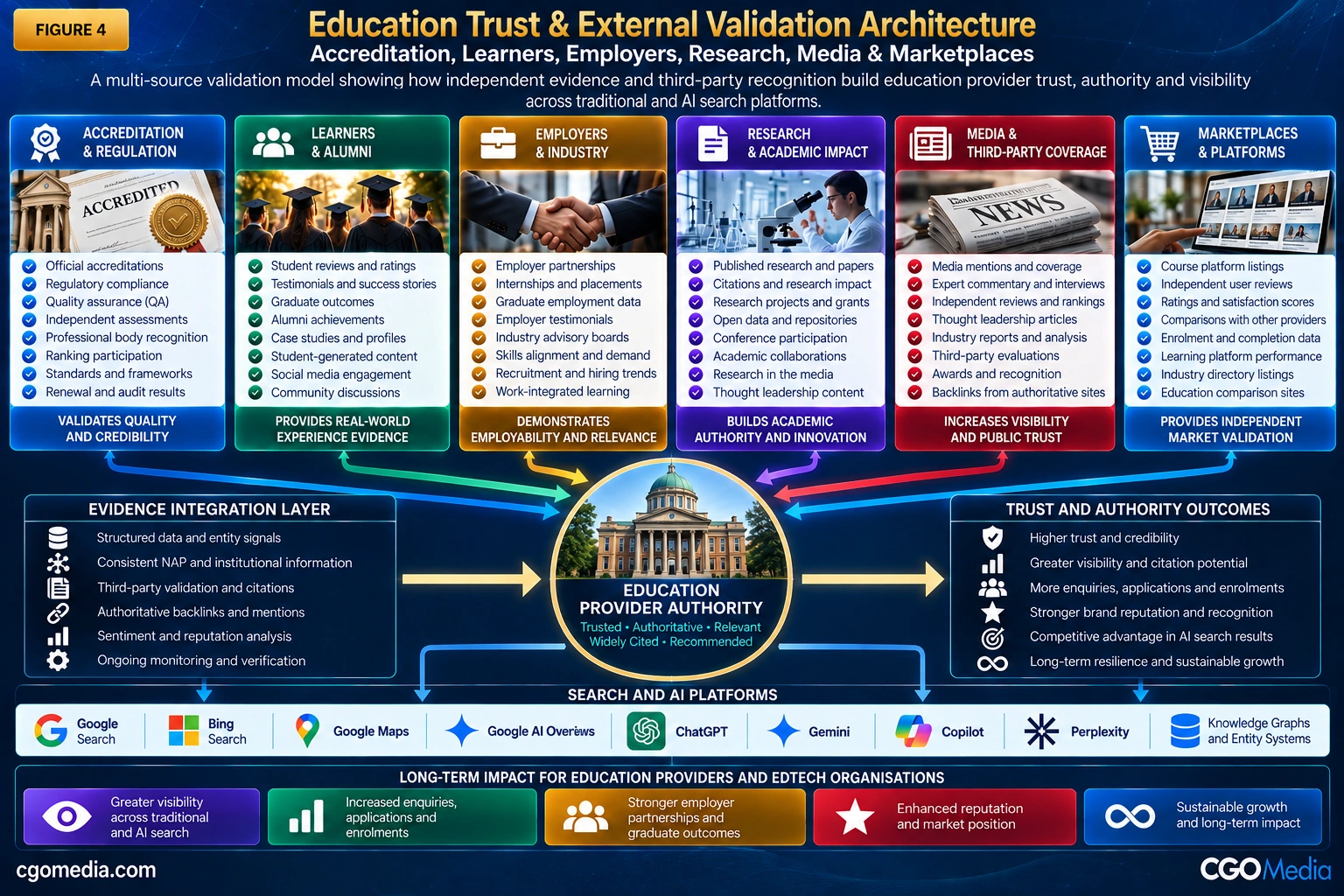
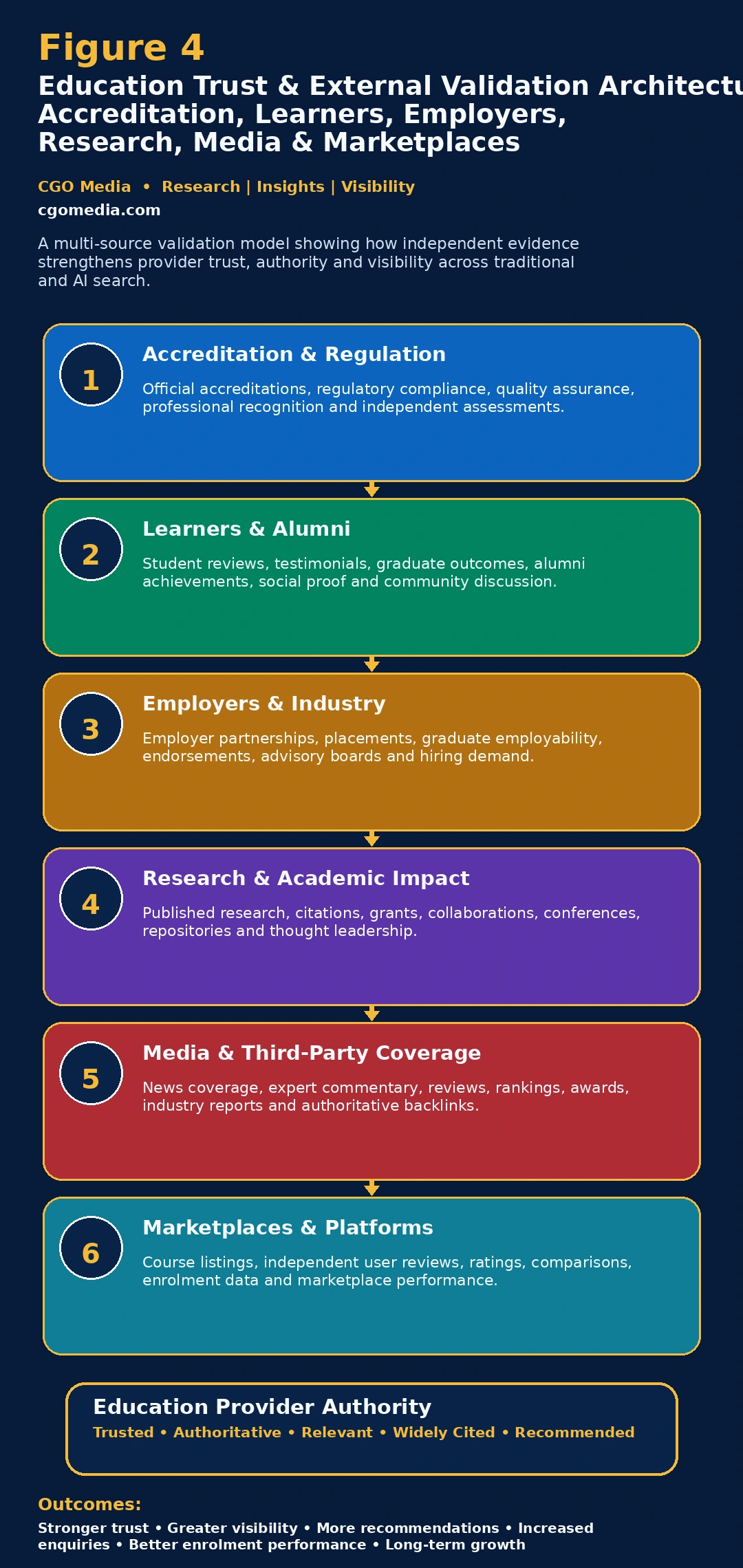
446. AI Search Changes the Education Discovery Interface
AI-assisted systems can compress several stages of the learner journey into one generated answer.
447. AI Can Combine Discovery, Comparison and Recommendation
A single prompt may ask:
- Which subject to study
- Which qualification is appropriate
- Which provider is suitable
- Which delivery mode fits
- Which programme supports a career goal
448. This Creates a New Education Search Challenge
The provider must be not only discoverable, but also sufficiently understandable and verifiable to enter a relevant recommendation set.
449. Recommendation Eligibility Is a Useful Strategic Concept
Recommendation eligibility describes whether enough public evidence exists for a provider or programme to be considered a credible option for a particular learner need.
450. Recommendation Eligibility Is Contextual
A provider may be eligible for one learner scenario but not another.
451. Recommendation Eligibility Can Depend on Subject Fit
The provider should have genuine authority in the requested discipline.
452. Recommendation Eligibility Can Depend on Qualification Fit
The programme should offer the correct academic or professional level.
453. Recommendation Eligibility Can Depend on Delivery Fit
The programme should match practical requirements such as:
- Online delivery
- Part-time study
- Location
- Start date
454. Recommendation Eligibility Can Depend on Entry Fit
A programme may be unsuitable if the learner does not meet its current admissions requirements.
455. Recommendation Eligibility Can Depend on Budget Fit
Fees and funding options can affect whether a programme is practically viable.
456. Recommendation Eligibility Can Depend on Accreditation Fit
Some learners require formal professional or academic recognition.
457. Recommendation Eligibility Can Depend on Outcome Fit
The course should align plausibly with the learner’s progression objective.
458. AI Search Therefore Rewards Evidence Compatibility
A strong recommendation candidate typically requires several evidence layers to agree.
459. The Recommendation Eligibility Model
A practical model is:
Subject Fit + Qualification Fit + Delivery Fit + Entry Fit + Trust + Outcome Relevance
460. Recommendation Eligibility Does Not Mean Guaranteed Inclusion
Strong evidence can improve readiness, but no provider can guarantee appearance in a specific AI-generated answer.
461. AI Search Should Be Monitored by Prompt Family
A useful monitoring framework can group prompts by:
- Goal
- Subject
- Qualification
- Course
- Provider
- Delivery
- Outcome
- Comparison
462. Goal Prompts
Goal prompts test whether a provider appears before the learner has selected a programme.
463. Example Goal Prompts
- Best route into cybersecurity
- How to become a data analyst
- Courses for moving into HR
464. Subject Prompts
Subject prompts test topical and institutional authority.
465. Example Subject Prompts
- Best places to study AI
- Top online business courses
- Good universities for psychology
466. Qualification Prompts
Qualification prompts test whether programmes are matched to the correct credential level.
467. Example Qualification Prompts
- Best online MBA programmes
- Postgraduate cybersecurity courses
- Professional project-management qualifications
468. Course Prompts
Course prompts test programme-specific relevance.
469. Example Course Prompts
- Part-time data science master’s
- Online digital marketing diploma
- Weekend accounting course
470. Provider Prompts
Provider prompts test whether an institution enters the learner’s consideration set.
471. Example Provider Prompts
- Best universities for engineering
- Good online learning providers
- Best business schools for executives
472. Delivery Prompts
Delivery prompts test practical programme fit.
473. Example Delivery Prompts
- Online law courses
- Part-time MBA in the UK
- Hybrid master’s programmes
474. Outcome Prompts
Outcome prompts test career and progression relevance.
475. Example Outcome Prompts
- Best courses for becoming a product manager
- Courses that help move into fintech
- Qualifications for progressing into leadership
476. Comparison Prompts
Comparison prompts test how competing providers or programmes are represented relative to each other.
477. Example Comparison Prompts
- Which is better for online MBA study?
- Compare these cybersecurity programmes
- Which provider offers better part-time flexibility?
478. Prompt Monitoring Should Be Repeatable
One-off observations provide limited evidence.
479. Prompt Sets Should Be Stable Enough to Support Trend Analysis
Frequently changing prompts can make longitudinal interpretation difficult.
480. Prompt Monitoring Should Record Context
Relevant fields can include:
- Prompt
- Model or system
- Date
- Market
- Language
- Learner type
- Observed answer
481. Market Context Matters
A provider may be appropriate in one country and unsuitable in another.
482. Learner Context Matters
Recommendation suitability can vary according to:
- Academic background
- Experience
- Career goal
- Budget
- Location
483. Model Context Matters
Different systems may produce different provider sets or source patterns.
484. Time Context Matters
Generated answers can change as:
- Programme data changes
- External sources change
- Models change
- Retrieval behaviour changes
485. AI Search Measurement Should Go Beyond Presence
Simply recording whether a provider appears is insufficient.
486. The Core AI Measurement Model
A useful model is:
Presence + Relevance + Accuracy + Trust Context
487. Presence
Measures whether the provider or programme is included at all.
488. Relevance
Measures whether inclusion makes sense for the specific learner need.
489. Accuracy
Measures whether important facts are represented correctly.
490. Trust Context
Measures whether claims are presented with sufficient evidence and qualification.
491. Presence Without Relevance Can Be Misleading
A provider may appear for a query despite being a weak fit.
492. Relevance Without Accuracy Can Be Harmful
A well-matched course can still be represented incorrectly.
493. Accuracy Without Trust Context Can Still Create Risk
A factual answer can omit important caveats around accreditation, eligibility or outcomes.
494. AI Accuracy Should Be Measured by Information Class
Different facts carry different levels of learner risk.
495. Provider Identity Accuracy
Check:
- Institution name
- Parent organisation
- Campus
- Delivery partner
496. Programme Identity Accuracy
Check:
- Course title
- Qualification
- Status
- Subject
497. Fee Accuracy
Check whether pricing is current for the relevant learner and cohort.
498. Entry Requirement Accuracy
Check whether admissions criteria are current and appropriately contextualised.
499. Delivery Accuracy
Check:
- Online status
- Campus location
- Part-time availability
- Schedule
500. Accreditation Accuracy
Check:
- Accrediting body
- Programme covered
- Recognition status
- Relevant limitations
501. Outcome Accuracy
Check whether employment, salary or progression claims are supported and contextualised.
502. AI Errors Should Be Classified by Severity
A practical scale is:
- Critical
- High
- Medium
- Low
503. Critical Errors
Potential examples include:
- False accreditation
- Wrong awarding organisation
- Withdrawn programme represented as active
- Major fee misinformation
504. High-Severity Errors
Potential examples include:
- Incorrect entry requirements
- Incorrect delivery format
- Material outcome misrepresentation
505. Medium-Severity Errors
These may involve important but contained factual gaps.
506. Low-Severity Errors
These may involve minor descriptive differences with limited learner impact.
507. AI Errors Should Also Be Classified by Persistence
A useful scale is:
- One-off
- Occasional
- Recurring
- Persistent
508. Error Severity and Persistence Should Be Combined
A recurring high-severity error should receive greater priority than an isolated low-severity wording issue.
509. Add Evidence Confidence
Each observation should also record how confidently the underlying cause is understood.
510. AI Priority Can Be Modelled as
Severity + Persistence + Learner Impact + Evidence Confidence
511. AI Error Investigation Should Follow a Workflow
A useful sequence is:
Observe → Verify → Trace → Correct → Validate → Reobserve
512. Observe
Record the generated answer and relevant context.
513. Verify
Confirm whether the answer is materially wrong.
514. Trace
Look for conflicting or outdated evidence across:
- Provider pages
- Marketplaces
- Accreditation sources
- Directories
- Editorial sources
515. Correct
Fix authoritative sources that are inaccurate or ambiguous.
516. Validate
Confirm that the underlying evidence system now reflects the correct information.
517. Reobserve
Monitor whether generated representation changes over time.
518. AI Monitoring Should Not Become Prompt Chasing
The objective is not to rewrite pages every time one answer changes.
519. The Better Objective Is Evidence Improvement
The organisation should improve the underlying information system so multiple discovery environments can interpret it more reliably.
520. Source Selection Is an Important Research Area
AI systems may draw from different source types when constructing education answers.
521. Potential Source Categories Include
- Provider websites
- Course marketplaces
- Accreditation sources
- Comparison platforms
- Review platforms
- Education media
- Research sources
- Employer sources
522. Source Patterns Should Be Monitored by Topic
Different source types may dominate different questions.
523. Accreditation Queries May Favour Formal Sources
Questions about recognition may rely more heavily on:
- Professional bodies
- Accreditation organisations
- Official education sources
524. Experience Queries May Favour Learner Sources
Questions about satisfaction or platform experience may rely more on:
- Reviews
- Forums
- Independent commentary
525. Course Comparison Queries May Combine Several Source Types
These may include:
- Provider pages
- Marketplaces
- Rankings
- Reviews
- Editorial comparisons
526. Outcome Queries May Require Additional Caution
Employment or salary answers may be assembled from incomplete or differently defined data.
527. Visible Citations Can Help Reveal Source Patterns
They can provide useful evidence about which sources appear in generated responses.
528. Visible Citations Are Not a Complete Source Map
Displayed citations should not be assumed to represent every source involved.
529. Citation Frequency Should Not Be Interpreted as Causation
A frequently cited source may be important, but observation alone does not prove why a provider was recommended.
530. Source Selection Research Should Be Longitudinal
Patterns should be observed across:
- Multiple prompts
- Multiple dates
- Multiple learner scenarios
- Multiple systems
531. Source Selection Research Should Preserve Methodology
Published findings should explain:
- Prompt set
- Models
- Markets
- Observation period
- Limitations
532. Avoid False Precision in AI Research
Small observations should not be presented as universal rules.
533. Provider Recommendation Order Is Not a Stable Ranking
A provider appearing first in one answer should not automatically be described as “ranked number one in AI”.
534. Recommendation Order May Change by Prompt
Changing one requirement can change the shortlist substantially.
535. Recommendation Order May Change by Learner Profile
Different backgrounds can produce different suitable providers.
536. Recommendation Order May Change by Market
Geography can alter:
- Provider eligibility
- Recognition
- Price
- Availability
537. Recommendation Order May Change by System
Different AI products can produce different provider sets.
538. Education AI Visibility Should Therefore Be Segmented
Useful dimensions include:
- Subject
- Qualification
- Programme
- Learner segment
- Market
- Delivery mode
539. Subject-Level AI Visibility
Tests whether the provider is associated with strategic disciplines.
540. Qualification-Level AI Visibility
Tests whether the provider appears for relevant credential types.
541. Programme-Level AI Visibility
Tests specific course recommendation relevance.
542. Learner-Segment AI Visibility
Tests suitability for:
- School leavers
- Graduates
- Professionals
- Career changers
- Enterprise learners
543. Market-Level AI Visibility
Tests whether recommendations remain appropriate in different countries or regions.
544. Delivery-Level AI Visibility
Tests online, campus, hybrid and part-time representation.
545. Build an AI Visibility Scorecard
A useful scorecard can include:
- Prompt family
- Presence
- Relevance
- Accuracy
- Trust context
- Severity
- Persistence
- Confidence
546. AI Visibility Should Be Tracked Over Time
Trend matters more than isolated screenshots.
547. AI Visibility Should Be Compared with Search Visibility
A provider may have:
- Strong organic visibility but weak AI presence
- Weak organic visibility but strong AI mention patterns
- Strong visibility in both
- Weak visibility in both
548. These Differences Can Reveal Different Authority Problems
For example, strong search rankings with weak AI inclusion may indicate limited distributed corroboration.
549. Strong AI Presence with Weak Website Authority Should Also Be Investigated
The provider may be benefiting from external sources that it does not control.
550. AI Search Measurement Should Connect to Learner Outcomes
Visibility alone does not demonstrate business or educational value.
551. AI-Referred Traffic Can Be Useful Where Observable
It may provide evidence of direct AI-assisted discovery.
552. AI Attribution Is Often Incomplete
Learners may move between:
- AI systems
- Search engines
- Direct visits
- Marketplaces
- Offline research
553. AI Influence Can Exist Without Direct Referral
A learner may discover a provider through an AI system and visit the site later through branded search.
554. Survey and CRM Evidence May Help
Providers can ask learners how they first discovered or evaluated the organisation.
555. Attribution Should Remain Cautious
Observed application or enrolment changes should not automatically be attributed to AI visibility.
556. AI Search Should Be Integrated with Provider Selection Measurement
The Education Discovery and Provider Selection Model can help identify where AI-assisted discovery contributes to learner progression.
557. AI Search Should Be Integrated with Trust Measurement
The Education & EdTech AI Trust and Visibility Framework can be used to evaluate the evidence supporting AI representation.
558. AI Search Should Be Integrated with Maturity Measurement
The Education Search Authority Maturity Model can assess whether AI monitoring has become a repeatable organisational capability.
559. AI Search Should Be Integrated with Implementation
The Education & EdTech SEO and AI Implementation Roadmap provides the operational sequence for correcting evidence gaps and scaling AI-readiness work.
560. The Fifth Research Principle
Education AI visibility should be treated as a measured evidence outcome rather than as a standalone optimisation channel.
561. The AI Education Visibility Model
The model can be summarised as:
Recommendation Eligibility + Evidence Consistency + Source Diversity + Presence + Relevance + Accuracy + Trust Context
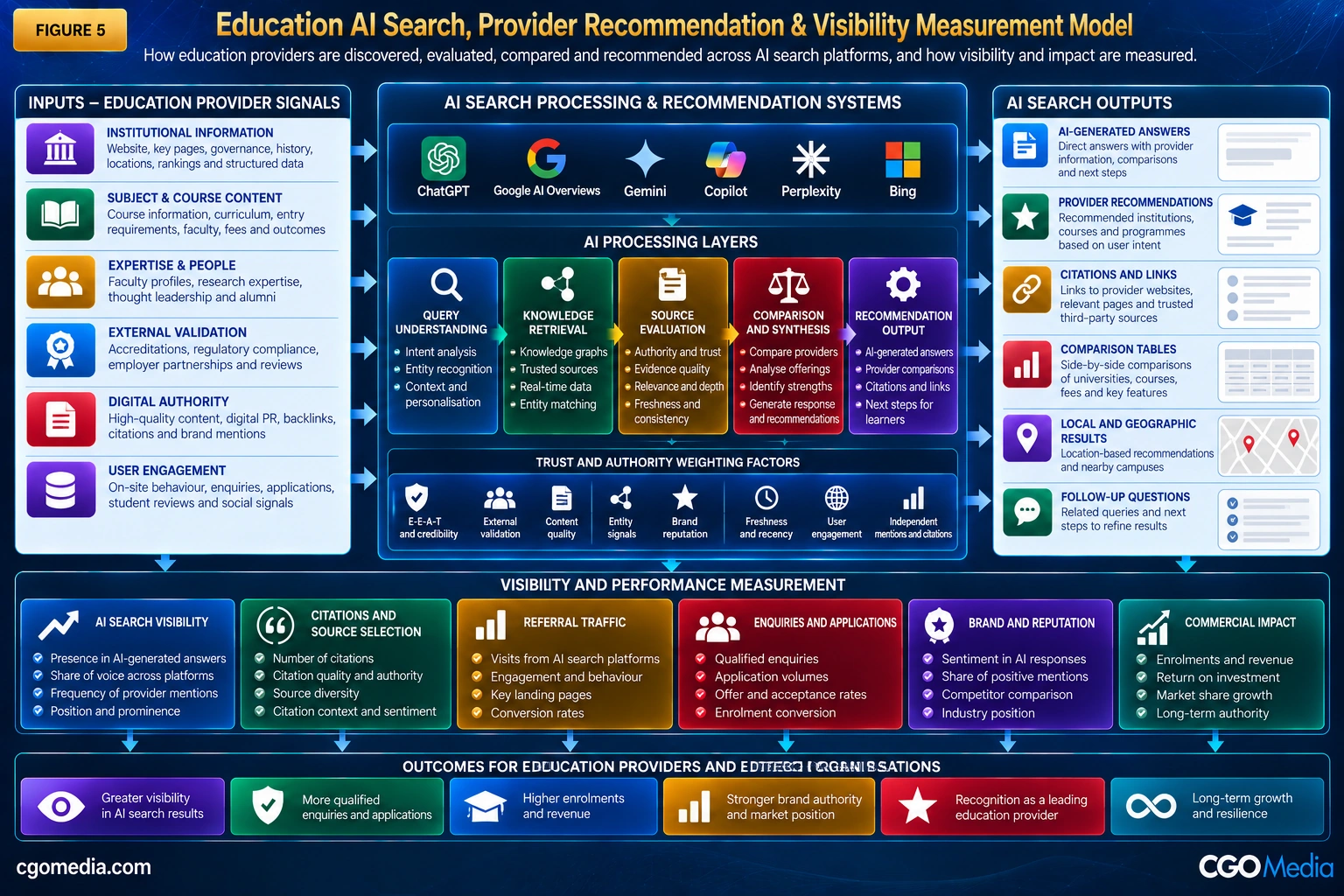
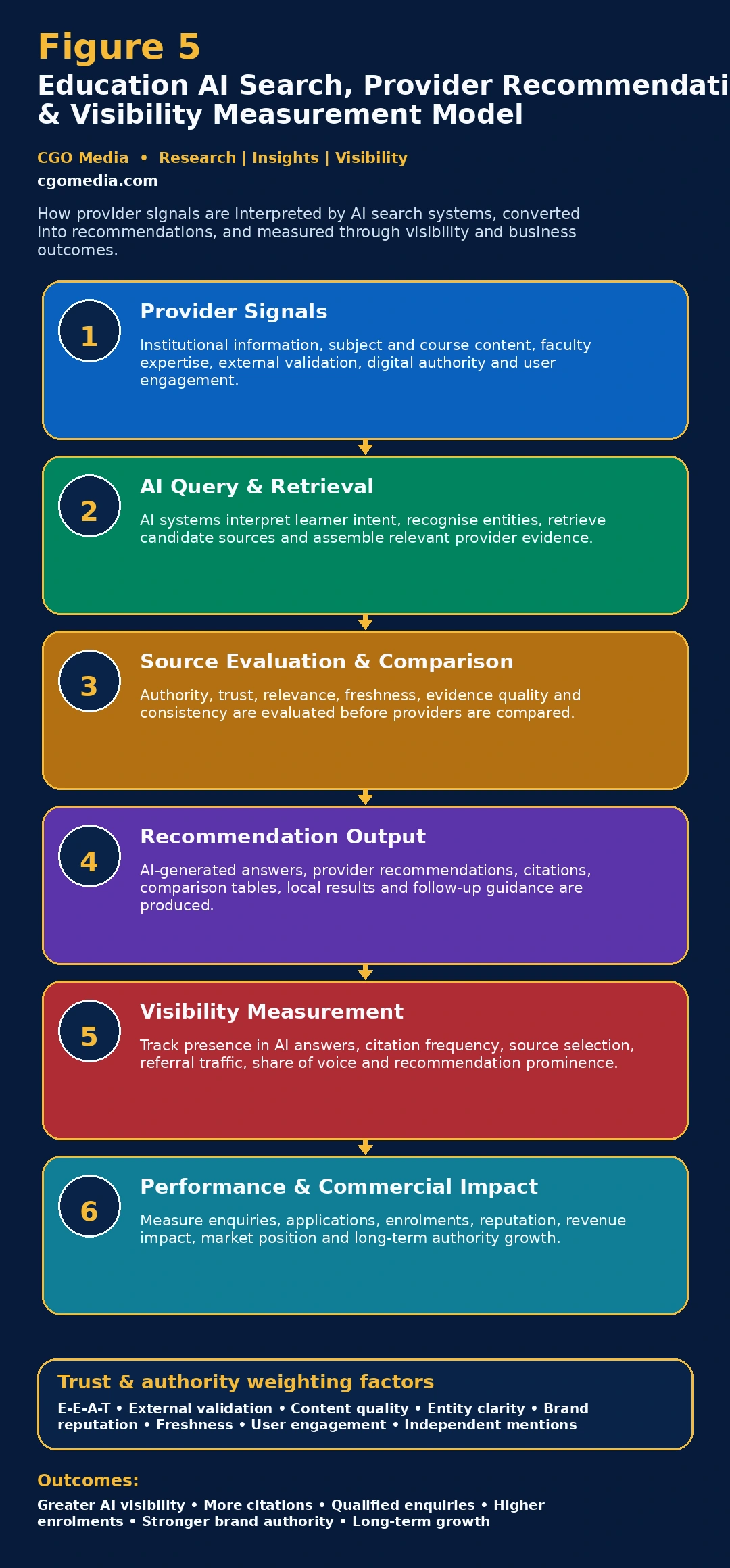
562. Education Search Authority Requires Continuous Management
Education visibility is not a one-time optimisation project.
Programme portfolios change, faculty move, accreditation evolves, fees change, delivery models shift and AI-assisted discovery systems continue to develop.
563. Authority Decay Should Be Expected
Even strong providers can lose clarity and trust over time if important evidence is not maintained.
564. Provider Identity Can Decay
Potential causes include:
- Rebrands
- Mergers
- New schools or faculties
- New campuses
- Legacy external profiles
565. Subject Authority Can Decay
Potential causes include:
- Reduced programme depth
- Departed faculty
- Outdated research links
- Weak content maintenance
566. Programme Authority Can Decay
Potential causes include:
- Outdated curriculum
- Changed programme structure
- Old course descriptions
- Broken supporting evidence
567. Programme Information Quality Can Decay
Potential causes include:
- Old fees
- Historic entry requirements
- Expired start dates
- Changed delivery modes
- Withdrawn programmes remaining live
568. Accreditation Authority Can Decay
Potential causes include:
- Expired recognition
- Changed professional-body relationships
- Unmaintained verification links
- Old external profiles
569. Learner Trust Can Decay
Recurring weaknesses in:
- Support
- Communication
- Assessment
- Technology
- Administration
can gradually weaken reputation and future discovery.
570. Outcome Authority Can Decay
Potential causes include:
- Old graduate data
- Historic salary claims
- Outdated labour-market evidence
- Weak methodology
571. Employer Authority Can Decay
Partnerships may end, advisory boards may change and old employer logos may remain visible after the underlying relationship has weakened.
572. External Marketplace Authority Can Decay
Third-party course information can fall out of date even when the provider website remains current.
573. AI Representation Can Decay
Potential causes include:
- Stale source material
- Entity confusion
- External data conflicts
- Changed retrieval behaviour
- New models
574. Stable Search Rankings Do Not Guarantee Stable Authority
A provider can retain organic visibility while its external evidence or AI representation deteriorates.
575. Build an Authority Health Register
A practical register can include:
- Authority dimension
- Current state
- Trend
- Risk
- Owner
- Next action
576. Build a Programme Health Register
Priority programmes can be monitored for:
- Programme status
- Fees
- Entry requirements
- Accreditation
- Faculty
- Outcomes
- AI representation
577. Build an External Evidence Register
Track:
- Accreditation sources
- Professional sources
- Marketplaces
- Reviews
- Employer evidence
- Media coverage
578. Build an AI Representation Register
Record:
- Prompt family
- Observed answer
- Accuracy
- Severity
- Persistence
- Confidence
579. Continuous Improvement Should Use a Repeatable Cycle
A practical model is:
Observe → Verify → Diagnose → Prioritise → Improve → Validate → Measure → Learn → Reassess
580. Observe
Monitor:
- Search visibility
- Programme information
- External evidence
- Reviews
- AI representation
581. Verify
Confirm whether an apparent problem is genuine and material.
582. Diagnose
Determine whether the issue is:
- Technical
- Entity-related
- Programme-related
- Trust-related
- External
- AI-related
583. Prioritise
A practical priority model is:
Gap + Risk + Learner Impact + Strategic Importance + Evidence Confidence
584. Improve
Address the underlying evidence weakness rather than applying superficial corrections.
585. Validate
Confirm that the updated information is accurate and reflected in the appropriate systems.
586. Measure
Compare the updated state with the previous baseline.
587. Learn
Use recurring issues to improve:
- Governance
- Templates
- Data standards
- Review cycles
- Team responsibilities
588. Reassess
Return to the authority model and evaluate whether capability has improved.
589. Resilience Requires Strong Provider Architecture
Institutional relationships should remain understandable through:
- Rebrands
- Mergers
- Expansion
- Partnership changes
590. Resilience Requires Strong Programme Architecture
Courses should remain connected to:
- Subjects
- Qualifications
- Faculty
- Accreditation
- Outcomes
591. Resilience Requires Strong Data Architecture
Critical programme information should have governed sources of truth.
592. Resilience Requires External Source Diversity
The provider should avoid depending entirely on one:
- Marketplace
- Ranking platform
- Review site
- Media source
- AI system
593. Resilience Requires Research and Citation Authority
Durable research assets can support:
- Subject expertise
- External citations
- Media visibility
- AI source discovery
594. Resilience Requires Accurate Outcome Evidence
Graduate and career claims should remain:
- Current
- Specific
- Methodologically transparent
595. Resilience Requires Strong AI Monitoring
AI search should be monitored as part of the broader evidence system rather than as a separate channel.
596. Resilience Requires Cross-Functional Governance
A mature operating model connects:
SEO + Academic Teams + Admissions + Quality + Careers + Communications + Data + Technology
597. SEO Should Not Own Educational Truth Alone
The function should coordinate representation while the appropriate teams remain accountable for the underlying facts.
598. Academic Teams May Own Curriculum and Faculty Truth
They can validate:
- Programme structure
- Modules
- Faculty
- Learning outcomes
599. Admissions May Own Entry Requirement Truth
They can validate:
- Eligibility
- Application criteria
- Language requirements
- Deadlines
600. Quality Teams May Own Accreditation Truth
They can validate:
- Recognition
- Accreditation status
- Awarding relationships
601. Careers Teams May Own Outcome and Employer Evidence
They can help validate:
- Career pathways
- Employer relationships
- Graduate outcomes
602. Communications Can Support External Authority
Communications teams can help develop:
- Education media
- Digital PR
- Research promotion
- External correction workflows
603. Data Teams Can Support Evidence Consistency
Data systems can help maintain:
- Programme records
- Outcome data
- Feeds
- Measurement
604. Technology Teams Can Support Technical Resilience
They can support:
- Performance
- Structured data
- Automation
- Monitoring
- Technical SEO
605. Governance Should Define Review Frequency
Different evidence types require different review cycles.
606. High-Frequency Review Areas
These may include:
- Fees
- Start dates
- Entry requirements
- Programme availability
607. Medium-Frequency Review Areas
These may include:
- Faculty
- Curriculum
- Accreditation
- Employer evidence
608. Strategic Review Areas
These may include:
- Provider architecture
- Subject authority
- Outcome methodology
- AI visibility
- Search maturity
609. Event-Driven Review Is Also Necessary
Immediate review may be triggered by:
- New programme launch
- Programme withdrawal
- Fee change
- Accreditation change
- Campus change
- Major AI error
610. Build Change Logs
Important changes should record:
- What changed
- Why
- When
- Who approved it
- Which systems were affected
611. Change Logs Improve Auditability
They help teams understand why information differs between periods and which downstream sources require review.
612. Governance Should Include Escalation
Critical learner-risk issues should be routed quickly to the appropriate owner.
613. Critical Issues Can Include
- False accreditation
- Wrong awarding organisation
- Material fee errors
- Withdrawn programme represented as active
- Persistent high-impact AI misinformation
614. Education Search Should Operate on Multiple Time Horizons
A mature model combines:
- Immediate correction
- Quarterly improvement
- Annual strategic development
615. Immediate Horizon — Correct Material Risk
Urgent work should focus on issues capable of misleading learners or weakening trust.
616. Quarterly Horizon — Strengthen Authority
Quarterly work may include:
- Programme evidence
- Subject development
- External validation
- AI monitoring
- Outcome updates
617. Annual Horizon — Build Resilience
Annual planning may include:
- Authority maturity reassessment
- Programme portfolio review
- Data architecture
- Market expansion
- Governance
618. A 12-Month Education Search Operating Cycle
A practical sequence is:
Q1: Diagnose and Correct
Q2: Structure and Strengthen
Q3: Validate, Integrate and Scale
Q4: Govern, Measure and Reassess
619. Quarter One — Diagnose and Correct
Focus on:
- Technical audit
- Provider audit
- Programme-data audit
- Accreditation audit
- AI baseline
620. Quarter Two — Structure and Strengthen
Focus on:
- Subject architecture
- Programme depth
- Faculty authority
- Internal linking
- Learner decision content
621. Quarter Three — Validate, Integrate and Scale
Focus on:
- External validation
- Employer evidence
- Digital PR
- Research citations
- AI monitoring expansion
622. Quarter Four — Govern, Measure and Reassess
Focus on:
- Maturity reassessment
- Authority decay
- AI accuracy
- Governance refinement
- Next-year priorities
623. The Annual Cycle Should Remain Flexible
Critical issues should be addressed when they arise rather than waiting for the relevant quarter.
624. Strategic Recommendation One — Build Provider Clarity First
Make institutional, campus, sub-brand, partner and awarding relationships explicit.
625. Strategic Recommendation Two — Build Subject Authority Deliberately
Connect:
- Programmes
- Faculty
- Research
- Careers
- External evidence
626. Strategic Recommendation Three — Treat Programme Pages as Decision Assets
They should support understanding, comparison, validation and action.
627. Strategic Recommendation Four — Govern High-Change Information
Prioritise:
- Fees
- Entry requirements
- Start dates
- Programme availability
628. Strategic Recommendation Five — Make Accreditation Verifiable
Recognition should be current, specific and independently confirmable where appropriate.
629. Strategic Recommendation Six — Strengthen Faculty Connections
Educator expertise should connect clearly with subjects, programmes and research.
630. Strategic Recommendation Seven — Publish Defensible Outcomes
Outcome evidence should preserve:
- Sample
- Time period
- Methodology
- Limitations
631. Strategic Recommendation Eight — Strengthen Employer Authority
Use genuine evidence connecting programmes with professional practice and labour-market relevance.
632. Strategic Recommendation Nine — Build Research Citation Authority
Research should be:
- Methodologically transparent
- Easy to attribute
- Easy to cite
- Connected to strategic subjects
633. Strategic Recommendation Ten — Use Digital PR Strategically
Promote evidence-led assets that reinforce genuine educational authority.
634. Strategic Recommendation Eleven — Reconcile External Platforms
Important marketplace and comparison data should remain compatible with current provider information.
635. Strategic Recommendation Twelve — Monitor AI Representation
Track:
- Presence
- Relevance
- Accuracy
- Trust context
636. Strategic Recommendation Thirteen — Prioritise Material AI Errors
Focus on inaccuracies affecting:
- Fees
- Eligibility
- Accreditation
- Availability
- Outcomes
637. Strategic Recommendation Fourteen — Avoid Prompt Chasing
Improve the evidence architecture rather than optimising repeatedly for isolated answers.
638. Strategic Recommendation Fifteen — Measure Qualified Progression
Connect search activity with:
Discovery → Understanding → Validation → Comparison → Application → Enrolment
639. Strategic Recommendation Sixteen — Measure Beyond Traffic
Relevant measures can include:
- Qualified applications
- Offer acceptance
- Enrolment
- Early retention
- Learner fit
640. Strategic Recommendation Seventeen — Use the Trust Framework
The Education & EdTech AI Trust and Visibility Framework can help identify which evidence dimensions require strengthening.
641. Strategic Recommendation Eighteen — Use the Provider Selection Model
The Education Discovery and Provider Selection Model can help diagnose where learners encounter friction or lose confidence.
642. Strategic Recommendation Nineteen — Use the Maturity Model
The Education Search Authority Maturity Model can support recurring capability assessment.
643. Strategic Recommendation Twenty — Use the Implementation Roadmap
The Education & EdTech SEO and AI Implementation Roadmap can translate research findings into structured workstreams and priorities.
644. The Education Search Authority Equation
The research can be summarised as:
Provider Clarity + Subject Authority + Qualification Authority + Programme Evidence + External Validation + Outcome Authority + AI Recommendation Readiness
645. The Operating Equation
Long-term authority management can be summarised as:
Observe → Verify → Diagnose → Prioritise → Improve → Validate → Measure → Learn → Reassess
646. The Learner Outcome
The strategic objective is:
Relevant Discovery → Clear Understanding → Verifiable Trust → Informed Comparison → Appropriate Selection
647. The Institutional Outcome
The objective is to build an education authority system that remains understandable and resilient as search interfaces, AI systems, programmes and learner behaviour evolve.
648. The Sixth Research Principle
Education search success should be treated as a maintained authority system rather than as a collection of rankings, pages or campaign outputs.
649. The Next Stage Is Final Research Integration
The final section consolidates the paper’s strategic implications, methodology, limitations, conclusion, references, author information and research citation guidance.
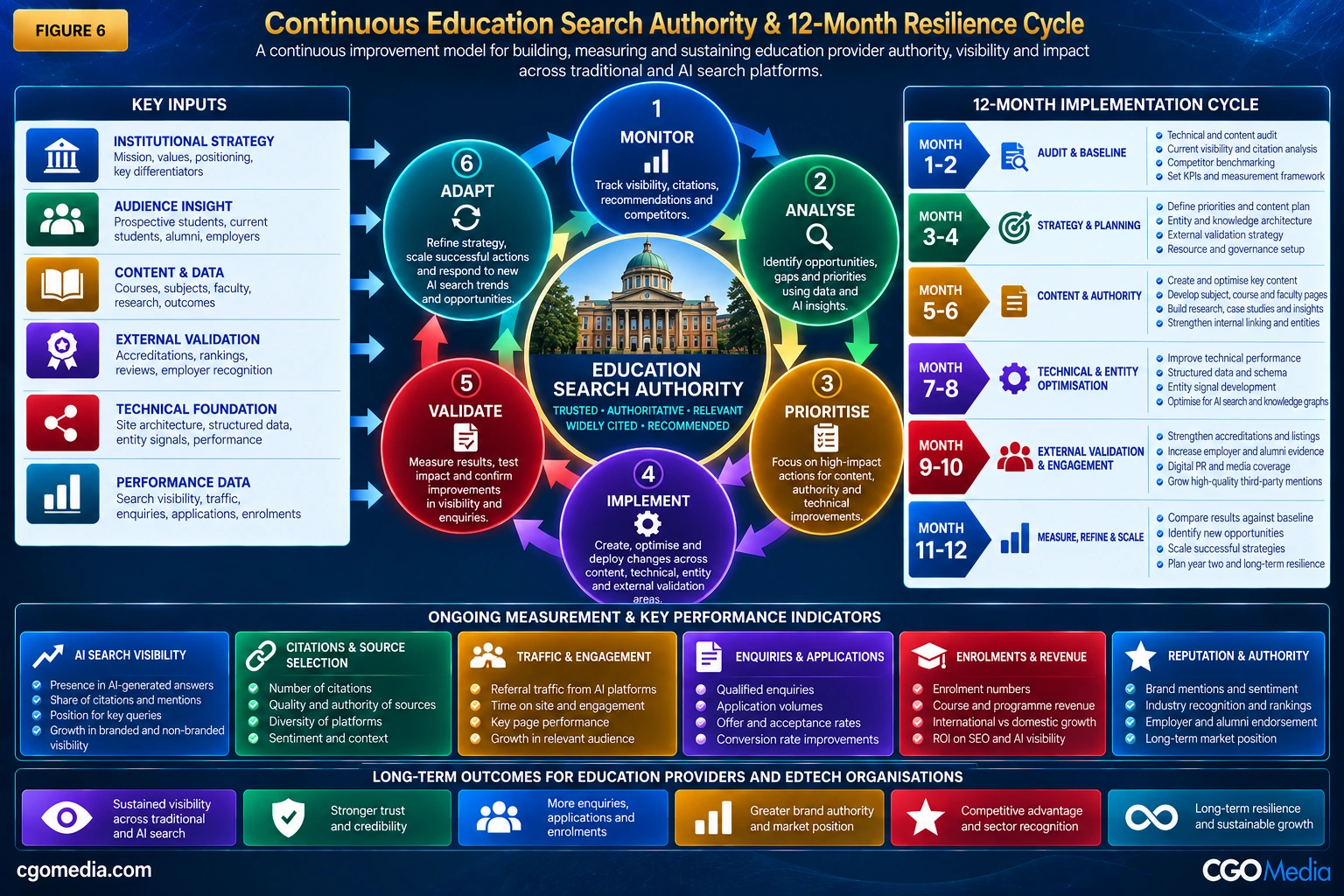
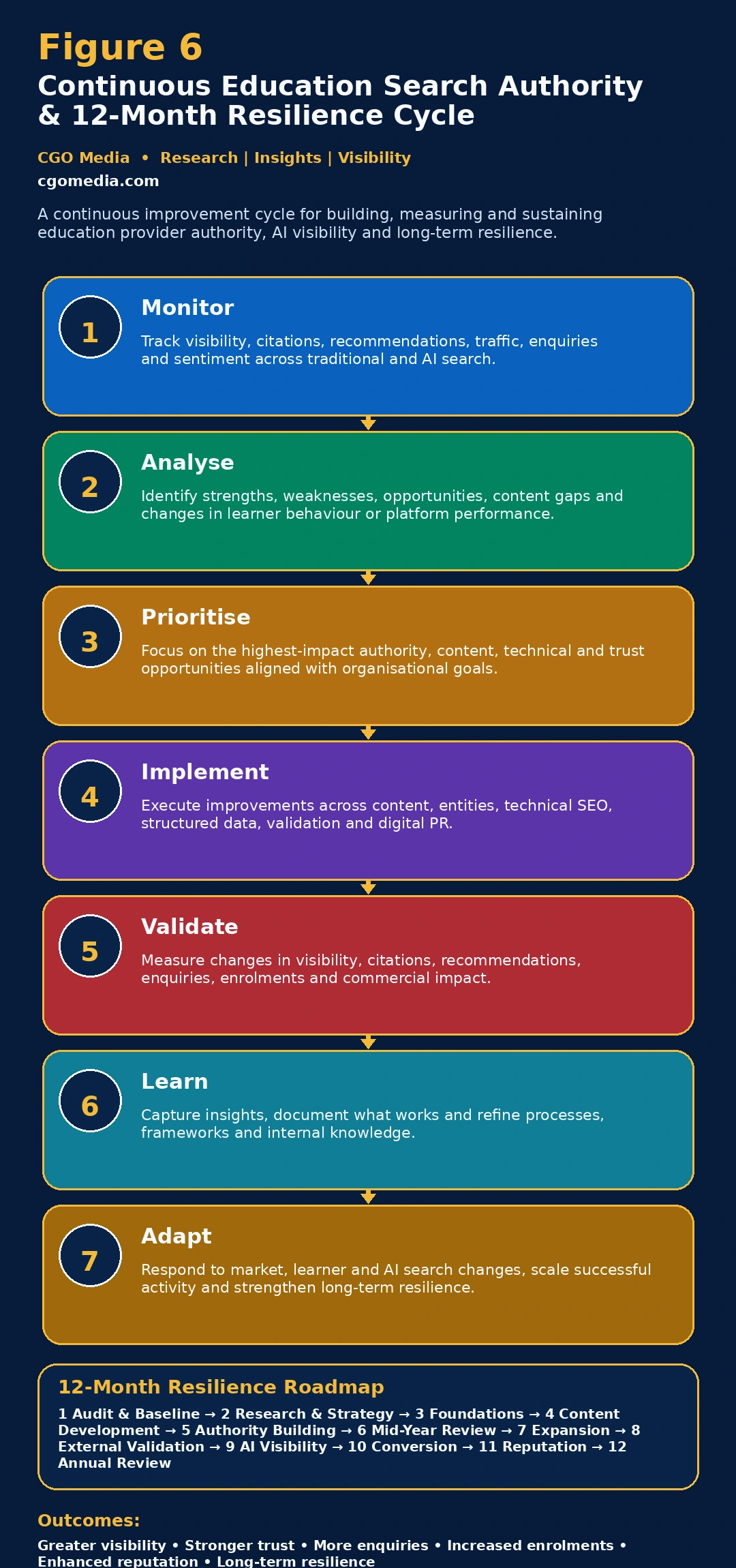
650. Methodology
Education & EdTech SEO in an AI Search Environment is a conceptual research paper developed by CGO Media to examine how education discovery, provider authority, programme evidence, learner trust and AI-assisted recommendation increasingly interact across modern search environments.
651. Research Scope
The paper is intended to support analysis across:
- Universities
- Colleges
- Training providers
- Professional education organisations
- Online course providers
- EdTech platforms
- Career-transition providers
652. Research Focus
The study examines the relationship between:
- Traditional search visibility
- Provider and entity clarity
- Subject authority
- Qualification authority
- Programme evidence
- External validation
- Learner outcomes
- AI-assisted discovery
653. Learner-Journey Method
The research models education discovery through the sequence:
Goal → Subject → Qualification → Course → Provider → Delivery → Outcome → Enrolment
654. Authority Architecture Method
The study models education authority through connected relationships between:
Provider → School / Faculty → Subject → Qualification → Programme → Curriculum → Faculty → Accreditation → Outcome
655. Trust and Validation Method
The research evaluates distributed evidence from:
- Provider sources
- Accreditation sources
- Professional bodies
- Learner reviews
- Employer evidence
- Research publications
- Education media
- Marketplaces
656. AI Search Method
AI-assisted discovery is examined through:
- Recommendation eligibility
- Prompt families
- Source patterns
- Representation accuracy
- Error severity
- Error persistence
657. AI Measurement Method
A practical evaluation model is:
Presence + Relevance + Accuracy + Trust Context
658. Prompt-Family Method
AI observations can be grouped into:
- Goal prompts
- Subject prompts
- Qualification prompts
- Course prompts
- Provider prompts
- Delivery prompts
- Outcome prompts
- Comparison prompts
659. AI Observation Context
Repeatable monitoring should record:
- Prompt
- Model or system
- Date
- Market
- Language
- Learner type
- Observed output
660. AI Error Method
Observed issues can be classified by:
- Severity
- Persistence
- Learner impact
- Evidence confidence
661. Source-Selection Method
The research recognises that AI-assisted systems may draw from several source categories, including:
- Provider websites
- Course marketplaces
- Accreditation bodies
- Comparison platforms
- Review platforms
- Education media
- Research sources
- Employer sources
662. External Evidence Method
External sources can be classified as:
- Official
- Academic
- Professional
- Editorial
- Commercial
- Learner-generated
663. Evidence Quality Method
External evidence should be considered according to:
- Relevance
- Specificity
- Freshness
- Independence
- Authority
664. Evidence Confidence Method
Findings can be classified as:
- Low confidence
- Medium confidence
- High confidence
665. Continuous Improvement Method
Long-term authority management follows:
Observe → Verify → Diagnose → Prioritise → Improve → Validate → Measure → Learn → Reassess
666. Strategic Prioritisation Method
A practical priority model is:
Gap + Risk + Learner Impact + Strategic Importance + Evidence Confidence
667. Limitations
This paper is a conceptual and strategic research model. It is not an accreditation audit, legal opinion, regulatory assessment, institutional quality review or guarantee of search, AI, application or enrolment outcomes.
668. Education Systems Differ
Qualification frameworks, accreditation systems, funding structures and regulatory environments vary considerably between countries.
669. Provider Types Differ
Universities, colleges, professional training organisations, bootcamps and EdTech platforms may require different evidence and governance structures.
670. Programme Types Differ
Degrees, diplomas, certificates, professional qualifications, short courses and microcredentials should not be treated as equivalent.
671. Accreditation Is Context-Dependent
Not every programme or provider operates within the same accreditation or professional-recognition environment.
672. Rankings Have Methodological Limits
Different rankings use different datasets, criteria and weighting systems.
673. Reviews Are Incomplete Evidence
Review platforms may overrepresent particularly positive or negative experiences and may not describe the full learner population.
674. Outcome Data Has Limitations
Employment, progression and salary outcomes may be influenced by:
- Economic conditions
- Location
- Learner background
- Industry
- Prior experience
675. Employment Outcomes Are Not Guaranteed
Participation in an education programme does not guarantee employment, promotion, salary level or career progression.
676. Search Visibility Is Dynamic
Search rankings and interfaces can change over time.
677. AI Systems Are Dynamic
AI models, interfaces, retrieval systems and source-selection behaviour can change.
678. AI Outputs Are Variable
Generated responses may change according to:
- Prompt
- Model
- Market
- Time
- Available evidence
679. Visible AI Citations Are Partial Evidence
Displayed sources do not necessarily represent every source or process involved in answer construction.
680. Citation Appearance Does Not Prove Full Causation
A displayed citation should not automatically be treated as the sole reason a provider was included or recommended.
681. AI Recommendation Inclusion Is Not Independent Endorsement
Generated inclusion does not independently establish:
- Programme quality
- Accreditation
- Suitability
- Employment outcomes
682. AI Recommendation Order Is Not a Stable Ranking
Provider order can vary between prompts, users, markets, sessions and systems.
683. Search Attribution Is Incomplete
Learners may interact with several channels before applying, including:
- Search engines
- AI systems
- Social platforms
- Marketplaces
- Offline sources
684. AI Attribution Is Particularly Difficult
AI influence may occur even when no direct referral is visible.
685. Correlation Should Not Be Presented as Causation
Changes in visibility, AI mentions, applications or enrolment should not automatically be attributed to one intervention without sufficient evidence.
686. Search Rankings Are Not Guaranteed
No methodology can guarantee particular organic positions.
687. AI Visibility Is Not Guaranteed
No methodology can guarantee citation, recommendation or inclusion by a particular AI system.
688. Provider Selection Is Not Guaranteed
Learner decisions can be influenced by:
- Fees
- Location
- Entry requirements
- Reputation
- Personal circumstances
- Timing
689. Conclusion
Education and EdTech search is moving from a relatively linear keyword-and-ranking model toward a distributed discovery and evidence environment.
Learners can now move between search engines, AI assistants, provider websites, course marketplaces, accreditation sources, review platforms, research, employer evidence and comparison tools before deciding which programme deserves further consideration.
This changes the central strategic question from:
“How do we rank this course?”
to:
“How do we build enough relevant, accurate and verifiable evidence for the right learner to discover, understand, compare and trust this programme?”
The research identifies several connected authority layers:
Provider Clarity + Subject Authority + Qualification Authority + Programme Evidence + External Validation + Outcome Authority + AI Recommendation Readiness
These layers support a broader learner progression:
Relevant Discovery → Clear Understanding → Verifiable Trust → Informed Comparison → Appropriate Selection
The paper also argues that education authority should be treated as a maintained system rather than as a one-time SEO campaign.
Its long-term operating cycle is:
Observe → Verify → Diagnose → Prioritise → Improve → Validate → Measure → Learn → Reassess
The strategic objective is not simply maximum traffic, maximum rankings or maximum AI mention volume.
It is to build an education authority system capable of remaining useful, interpretable and resilient as programmes, learners, markets, search interfaces and AI systems continue to evolve.
References
External Academic, Technical and Search Sources
- Google Search Central. SEO Starter Guide.
- Google Search Central. Understand how structured data works.
- Schema.org. EducationalOrganization.
- Schema.org. Course.
- Schema.org. Person.
- W3C. Web Content Accessibility Guidelines (WCAG) 2.2.
- Hogan, A. et al. (2021). Knowledge Graphs. ACM Computing Surveys, 54(4).
- Metzger, M.J. (2007). Making Sense of Credibility on the Web: Models for Evaluating Online Information and Recommendations for Future Research. Journal of the American Society for Information Science and Technology, 58(13), 2078–2091.
- Ji, Z. et al. (2023). Survey of Hallucination in Natural Language Generation. ACM Computing Surveys, 55(12).
CGO Media Education & EdTech Research and Frameworks
- Wilkinson, R. (2026). Education & EdTech AI Trust and Visibility Framework. CGO Media.
- Wilkinson, R. (2026). Education Discovery and Provider Selection Model. CGO Media.
- Wilkinson, R. (2026). Education Search Authority Maturity Model. CGO Media.
- Wilkinson, R. (2026). Education & EdTech SEO and AI Implementation Roadmap. CGO Media.
CGO Media Research Ecosystem
CGO Media Research Library | CGO Media Framework Library | CGO Media Research Architecture
About Roger Wilkinson
Roger Wilkinson is an independent researcher, SEO practitioner and founder of CGO Media with more than 25 years of experience in search, digital visibility and business growth.
His research focuses on how artificial intelligence is reshaping search engines, recommendation systems, entity representation, digital authority and organisational visibility.
Roger is the creator of the CGO Framework Series, a collection of research-led methodologies designed to help organisations measure, improve and govern Search Visibility, AI Visibility and Digital Authority.
His work examines the relationship between Technical SEO, Entity Authority, Content Authority, Citation Authority, Brand Signals, Knowledge Architecture and AI Search Readiness.
View Roger Wilkinson’s researcher profile →
Related Education & EdTech Research and Frameworks
Education & EdTech AI Trust and Visibility Framework |
Education Discovery and Provider Selection Model |
Education Search Authority Maturity Model |
Education & EdTech SEO and AI Implementation Roadmap |
Education GEO: Generative Engine Optimisation
Research Usage & Citation
CGO Media encourages researchers, journalists, universities, colleges, training providers, EdTech organisations, professional bodies, employers and education-sector organisations to reference this paper where it contributes to wider discussion of education SEO, learner discovery, provider authority, AI search and digital visibility.
Reasonable quotations, summaries, figures and excerpts may be used in articles, reports, presentations, academic work and other publications provided appropriate acknowledgement is given to Roger Wilkinson and CGO Media.
Cite This Research Paper / Embed Citation
Education & EdTech SEO in an AI Search Environment by Roger Wilkinson at CGO Media examines how provider clarity, programme authority, external validation, learner outcomes and AI recommendation readiness interact across the modern education discovery ecosystem.
APA Citation
APA Citation: Wilkinson, R. (2026). Education & EdTech SEO in an AI Search Environment. CGO Media. https://cgomedia.com/education-edtech-seo-in-an-ai-search-environment/
Author: Roger Wilkinson | Published by: CGO Media
For permissions relating to extensive reproduction, commercial licensing or republication of substantial portions of this research paper, please contact CGO Media directly.