
Ecommerce Search Authority Maturity Model™
 The Ecommerce Search Authority Maturity Model provides a five-level framework for assessing how advanced an ecommerce retailer, consumer brand, marketplace or omnichannel merchant has become in managing product discovery, catalogue authority, merchant trust, external validation and AI-assisted recommendation visibility.
The model is designed for ecommerce organisations that need to understand not simply how much SEO, merchandising, marketplace or content activity they perform, but how effectively those activities operate together as a coordinated Search Authority capability.
It builds on the parent research paper Ecommerce & Retail SEO in an AI Search Environment, alongside the Ecommerce & Retail AI Trust and Visibility Framework and the Product Discovery and Retailer Selection Model.
The objective is not to measure how much ecommerce activity an organisation performs.
A retailer can maintain:
- large product catalogues;
- high organic traffic;
- shopping feeds;
- marketplace listings;
- paid media;
- affiliate distribution;
- product reviews;
- and sophisticated analytics;
while still operating with weak underlying Search Authority.
The more important question is whether the organisation has developed the connected systems required to maintain:
- technical search reliability;
- catalogue structure;
- product information quality;
- merchant identity;
- customer trust;
- external validation;
- commercial-data consistency;
- and AI recommendation visibility.
The maturity model therefore evaluates organisational capability rather than activity volume.
It asks whether ecommerce search is being managed reactively, optimised in isolated channels, structured around connected commercial entities, integrated across teams and systems, or governed as an adaptive authority environment.
The five maturity levels are:
- Functional
- Optimised
- Structured
- Integrated
- Adaptive Authority
These levels should not be interpreted as search-engine certifications or fixed commercial benchmarks.
They provide a strategic way to assess how ecommerce capability develops as products, categories, brands, offers, merchant evidence, external signals and AI-assisted discovery become progressively more connected.
Author: Roger Wilkinson
Published by: CGO Media
Published: September 2026
Last reviewed: September 2026
Research category: Ecommerce & Retail · Ecommerce SEO · AI Search · GEO · Product Discovery · Merchant Trust · Product Authority · Search Authority · Recommendation Systems
1. Why Ecommerce Search Needs a Maturity Model
Ecommerce organisations can appear digitally sophisticated while still possessing significant structural weaknesses.
A large retailer may operate thousands or millions of product URLs.
It may rank for substantial numbers of commercial queries.
It may maintain:
- Google Shopping feeds;
- marketplace listings;
- retailer reviews;
- product-review systems;
- brand campaigns;
- paid-search campaigns;
- affiliate relationships;
- and complex merchandising operations.
These activities demonstrate commercial scale.
They do not necessarily demonstrate maturity.
The underlying environment may still contain:
- duplicate catalogue structures;
- weak variant handling;
- inconsistent product identifiers;
- price mismatches;
- stock inaccuracies;
- weak category architecture;
- incomplete specifications;
- poor merchant identity consistency;
- fragmented review systems;
- and limited AI visibility monitoring.
These weaknesses matter because ecommerce discovery increasingly occurs across multiple connected systems rather than through traditional organic rankings alone.
A product can now be encountered through:
- organic search;
- shopping results;
- marketplaces;
- review sites;
- publisher recommendations;
- comparison platforms;
- social commerce;
- affiliate content;
- and generative AI systems.
Each environment may encounter a different representation of the same product.
One source may display the correct price.
Another may display an old price.
One marketplace may use the correct variant.
Another may merge products incorrectly.
The retailer’s own site may contain comprehensive specifications while distributed feeds contain incomplete attributes.
An AI assistant may then synthesise several of these sources when responding to a consumer question.
Search Authority maturity therefore depends increasingly on the organisation’s ability to maintain consistent commercial evidence across a distributed discovery ecosystem.
Activity Does Not Equal Capability
A retailer can perform many optimisation activities without possessing a mature operating model.
Teams may individually improve:
- Technical SEO;
- merchandising;
- product feeds;
- reviews;
- marketplace listings;
- content;
- Digital PR;
- and analytics.
However, if those functions operate independently, the organisation may still lack a coherent Ecommerce Search Authority system.
The maturity model therefore distinguishes between:
Doing Ecommerce Search Activities
and:
Building an Organisational Capability for Ecommerce Search Authority
Maturity Is About Reliability
A mature ecommerce search environment should make important commercial information increasingly reliable.
That includes:
- product identity;
- brand;
- category relationships;
- variant relationships;
- price;
- availability;
- specifications;
- reviews;
- delivery;
- returns;
- merchant identity;
- and offer information.
The objective is not perfection.
Large ecommerce environments change constantly.
Products launch.
Products are discontinued.
Prices change.
Inventory fluctuates.
New categories appear.
Seasonal collections replace older ranges.
Marketplace policies change.
AI discovery systems evolve.
Maturity therefore reflects how effectively the organisation detects and manages these changes.
2. From Ecommerce SEO Activity to Search Authority Capability
Ecommerce maturity develops when individual optimisation activities become progressively connected.
A simple progression can be expressed as:
Publishing Products → Optimising Products → Structuring Catalogue Relationships → Integrating Merchant Trust and External Authority → Monitoring AI Recommendation Visibility
At the beginning of this progression, the organisation is focused mainly on making products available online.
Products have:
- URLs;
- titles;
- prices;
- descriptions;
- images;
- and checkout functionality.
This is commercially essential, but it represents only the minimum level of capability.
As maturity increases, the organisation begins optimising:
- technical indexation;
- category pages;
- product content;
- shopping feeds;
- marketplaces;
- reviews;
- and buying guides.
The next transition is structural.
The retailer begins organising its digital environment around explicit relationships between:
Retailer → Category → Brand → Product → Variant → Offer
At this point, Ecommerce SEO begins changing from page optimisation into authority architecture.
The retailer is no longer asking only:
“How do we optimise this product page?”
It begins asking:
“How does this product relate to its category, brand, variants, reviews, offers, buying guidance and wider commercial evidence?”
This change is critical because modern product discovery increasingly depends on relationships.
Search engines, marketplaces, shopping systems and AI assistants need to determine:
- what the product is;
- which brand created it;
- which variant is relevant;
- what it costs;
- whether it is available;
- which merchant sells it;
- what customers think of it;
- and how it compares with alternatives.
A mature retailer therefore manages an interconnected commercial evidence environment rather than a collection of isolated product pages.
The Shift from Page Optimisation to Product Evidence
Traditional Ecommerce SEO often concentrated heavily on:
- titles;
- headings;
- descriptions;
- internal links;
- crawlability;
- and rankings.
These remain important.
However, product discovery increasingly requires richer evidence.
Relevant evidence can include:
- GTIN;
- MPN;
- brand;
- model;
- size;
- colour;
- technical specifications;
- compatibility;
- customer reviews;
- seller ratings;
- availability;
- returns information;
- shipping information;
- and external product coverage.
The maturity model therefore evaluates whether the organisation is progressing from page optimisation toward managed Product Authority.
The Shift from Channel Management to Shared Evidence
A retailer may distribute products through several channels.
These can include:
- the retailer’s own website;
- Google Merchant Center;
- major marketplaces;
- affiliate networks;
- comparison engines;
- social platforms;
- and third-party retail partners.
At lower maturity levels, these channels may be managed separately.
At higher maturity levels, they increasingly draw from governed product evidence.
This reduces the risk of:
- price disagreement;
- availability disagreement;
- incorrect variants;
- missing identifiers;
- inconsistent titles;
- and incomplete specifications.
The move toward shared evidence is one of the clearest signs of ecommerce maturity.
3. The Five Levels of Ecommerce Search Authority Maturity
The model defines five maturity levels:
- Functional
- Optimised
- Structured
- Integrated
- Adaptive Authority
Each level reflects increasing organisational capability.
Level One — Functional
The retailer possesses the basic infrastructure required to operate ecommerce and participate in search.
Products can be discovered.
Categories exist.
Transactions work.
Feeds may operate.
Analytics exist.
However, management is largely reactive.
Level Two — Optimised
The organisation begins systematically improving individual ecommerce channels.
Technical SEO becomes more deliberate.
Category and product pages improve.
Feed quality is monitored.
Reviews are managed more actively.
However, optimisation remains fragmented between teams and systems.
Level Three — Structured
The organisation begins organising search around explicit commercial entities and relationships.
Catalogue Architecture becomes intentional.
Products are connected with:
- brands;
- categories;
- variants;
- reviews;
- offers;
- and buying guidance.
This is the transition from optimisation activity into authority architecture.
Level Four — Integrated
Search, merchandising, product data, merchant trust, external authority, feeds and AI visibility increasingly operate as one coordinated organisational capability.
Shared standards become stronger.
Teams use common product and merchant evidence.
Authority becomes measurable across several discovery environments.
Level Five — Adaptive Authority
The organisation continuously monitors and adapts its Ecommerce Search Authority environment.
Product information, merchant evidence, customer feedback, external validation and AI visibility are treated as dynamic intelligence systems.
The organisation can identify changes in:
- consumer demand;
- catalogue performance;
- product evidence;
- competitive authority;
- AI recommendation patterns;
- and commercial trust.
The purpose of the model is not to achieve a badge labelled Level Five.
The purpose is to identify the capability gap currently limiting Ecommerce Search Authority.
An organisation may also operate at different maturity levels across different functions.
Technical SEO may be Integrated while merchant trust remains Optimised.
Product data may be Structured while AI monitoring remains Functional.
The effective maturity of the organisation therefore depends on the wider system rather than its strongest individual capability.
4. Level One — Functional
At the Functional level, the organisation has the basic technical and commercial infrastructure required to participate in ecommerce search.
Typical characteristics include:
- an operational ecommerce website;
- a searchable product catalogue;
- basic category structure;
- checkout functionality;
- basic product feeds;
- basic merchant information;
- product or retailer reviews;
- and basic analytics.
The retailer can sell.
Search engines can usually discover at least part of the catalogue.
Products can often be distributed into shopping or marketplace environments.
However, the environment is primarily operational rather than strategically governed.
Teams are often focused on immediate commercial problems.
Typical priorities may include:
- getting products live;
- fixing broken checkout journeys;
- resolving feed disapprovals;
- publishing seasonal collections;
- maintaining prices;
- and responding to stock changes.
Search Authority issues are often addressed after they become visible.
For example:
- duplicate pages are fixed after indexation problems emerge;
- product identifiers are corrected after feed disapprovals;
- price mismatches are investigated after platform warnings;
- review problems are addressed after ratings decline;
- and expired products are reviewed only after organic performance deteriorates.
The Functional retailer is therefore reactive rather than systematically preventative.
5. Functional Technical Foundations
The website can generally be crawled and indexed, but technical management may remain inconsistent or reactive.
Typical challenges include:
- faceted navigation;
- duplicate URLs;
- canonicalisation;
- pagination;
- product variants;
- expired products;
- redirect chains;
- internal-search pages;
- filter URLs;
- JavaScript rendering;
- and slow page performance.
Faceted Navigation
Filters may generate large numbers of crawlable URLs.
Retailers may not yet have clear rules determining:
- which facets should be indexable;
- which combinations should remain crawlable;
- which filters require canonicalisation;
- and which filtered experiences deserve standalone landing pages.
This can create crawl inefficiency and duplicate search environments.
Variant Handling
Products may have separate URLs for:
- size;
- colour;
- capacity;
- pack quantity;
- material;
- or model variation.
At Functional maturity, variant decisions may be driven primarily by ecommerce-platform defaults rather than deliberate search architecture.
This can create duplicate or thin pages and unclear product identity.
Expired Products
Discontinued or unavailable products may be handled inconsistently.
Some are removed immediately.
Others return errors.
Others remain accessible indefinitely without explaining whether the item will return.
This can weaken both search visibility and customer experience.
Performance
Large images, third-party scripts, personalisation systems, recommendation engines and analytics tools can create significant performance pressure.
At this maturity level, performance work is often project-based rather than governed continuously.
The technical environment works, but it is not yet managed as a strategic Search Authority foundation.
6. Functional Catalogue Structure
Products are grouped into categories, but catalogue structure may reflect internal merchandising logic more strongly than customer discovery behaviour.
Basic relationships may exist across:
- departments;
- categories;
- subcategories;
- brands;
- product types;
- variants;
- and seasonal collections.
However, these relationships may not yet form a deliberate authority architecture.
Common weaknesses can include:
- overlapping categories;
- duplicate category intent;
- inconsistent product assignment;
- weak brand relationships;
- poor variant grouping;
- limited use-case architecture;
- and shallow internal linking.
For example, the same product may appear across several overlapping categories without a clear primary context.
A customer may view the product as one type of item while the retailer classifies it differently.
Brands may exist only as filters rather than as meaningful discovery entities.
Use-case pages may be absent even where users frequently search according to:
- activity;
- recipient;
- budget;
- compatibility;
- problem;
- or application.
At Functional maturity, the catalogue exists primarily because commerce requires classification.
At later levels, Catalogue Architecture becomes a strategic Search Authority system.
7. Functional Product Information
Product pages contain the minimum information required to support a commercial transaction.
This commonly includes:
- product name;
- price;
- description;
- image;
- availability;
- and purchase controls.
However, specification depth and information consistency may be uneven.
Some products may contain detailed descriptions.
Others may rely on short manufacturer copy.
Some may contain complete identifiers.
Others may lack:
- GTIN;
- MPN;
- model numbers;
- material information;
- compatibility information;
- dimensions;
- technical attributes;
- or variant relationships.
Product Evidence Is Incomplete
At this maturity level, product pages are usually treated primarily as sales pages.
They may not yet be treated as structured evidence environments.
The retailer may therefore omit information required for:
- comparison;
- shopping feeds;
- marketplace classification;
- review interpretation;
- or AI-assisted recommendation.
Manufacturer Content Dependency
Retailers may rely heavily on manufacturer-provided descriptions.
This creates efficiency but can also result in:
- duplicate wording across many sellers;
- weak retailer differentiation;
- limited buying guidance;
- and missing customer-specific context.
The Functional retailer is therefore capable of presenting products for sale but may not yet possess strong Product Authority.
8. Functional Merchant Identity
The retailer is identifiable, but business information may not yet be governed consistently across the wider commerce ecosystem.
Merchant identity can appear across:
- the retailer’s website;
- shopping feeds;
- merchant profiles;
- marketplaces;
- review platforms;
- social profiles;
- business directories;
- and publisher references.
At Functional maturity, these representations may develop independently.
Potential inconsistencies can involve:
- business name;
- brand name;
- company information;
- customer-service details;
- returns information;
- delivery information;
- contact details;
- or marketplace seller identity.
This can become more complex for organisations operating:
- multiple brands;
- regional storefronts;
- marketplace seller accounts;
- physical stores;
- or different trading names.
Merchant identity matters because consumers and machine systems may need to determine:
- who is selling the product;
- whether the seller is legitimate;
- what service policies apply;
- and whether the merchant representation is consistent across channels.
At Functional maturity, merchant identity exists but is not yet treated as a governed authority asset.
9. Functional Review Presence
The organisation may receive product and retailer reviews, but review development and analysis are not yet managed systematically.
Reviews can exist across:
- product pages;
- merchant-review platforms;
- marketplaces;
- Google profiles;
- specialist review sites;
- publishers;
- and social platforms.
At Functional maturity, review activity may be largely passive.
Customers leave reviews.
Teams respond to serious complaints.
Ratings may be displayed on product pages.
However, the organisation may not yet analyse reviews systematically for:
- product-quality issues;
- delivery problems;
- returns friction;
- specification inaccuracies;
- sizing problems;
- compatibility issues;
- and recurring customer questions.
Product Reviews and Merchant Reviews Are Different
Product reviews help customers understand the item.
Merchant reviews help customers understand the seller.
At low maturity, these trust layers may be treated as one general reputation metric.
A retailer can sell a highly rated product while providing poor service.
Conversely, a trusted merchant may sell a product receiving weak customer feedback.
More advanced maturity requires these signals to be analysed separately and then integrated into the wider trust environment.
10. Functional Shopping Feed Management
Product feeds may be operational but are largely treated as technical distribution channels rather than strategic product evidence systems.
The primary objective may be to ensure products can be accepted into shopping platforms and advertising systems.
Common feed fields include:
- product title;
- description;
- price;
- availability;
- brand;
- GTIN;
- MPN;
- image;
- product category;
- and landing-page URL.
At Functional maturity, feeds may contain enough information to operate without containing the strongest possible evidence.
Typical weaknesses can include:
- weak titles;
- missing identifiers;
- incorrect product types;
- incomplete attributes;
- price mismatches;
- availability mismatches;
- poor variant grouping;
- and low-quality images.
Issues are often discovered through platform errors rather than internal data-quality monitoring.
This makes feed management reactive.
The Feed Is Not Yet Treated as Product Evidence
A mature organisation understands that product feeds are one of the primary structured representations of the catalogue.
At Functional maturity, however, they may be viewed mainly as advertising infrastructure.
This can create separation between:
Website Product Information
and:
Distributed Product Information
Later maturity levels reduce this separation through stronger product-data governance.
11. Functional Measurement
Reporting at the Functional level tends to concentrate on broad commercial and search outcomes.
Common metrics include:
- traffic;
- rankings;
- revenue;
- orders;
- conversion rate;
- average order value;
- and paid-media return.
These metrics are commercially important.
However, they provide limited visibility into the underlying authority system.
For example, overall organic revenue does not reveal whether:
- product identifiers are complete;
- variant architecture is reliable;
- category authority is balanced;
- merchant trust is improving;
- external product reviews are growing;
- AI recommendations are accurate;
- or product information remains consistent across channels.
At Functional maturity, reporting answers:
“How much commercial performance did search generate?”
It does not yet answer:
“How healthy is the authority system producing that performance?”
Performance Can Hide Structural Weakness
A successful ecommerce organisation can continue generating strong revenue while accumulating structural problems.
These can include:
- catalogue duplication;
- weak product data;
- review decline;
- feed errors;
- brand fragmentation;
- or poor AI visibility.
Strong historical brand demand may temporarily mask these weaknesses.
The maturity model therefore encourages organisations to measure capability before weaknesses become commercially visible.
12. Limitations of Level One
The Functional organisation is commercially operational but largely reactive.
Its principal limitation is that ecommerce components exist without yet functioning as one coordinated authority system.
Technical infrastructure may operate separately from merchandising.
Product feeds may operate separately from product-content governance.
Reviews may operate separately from customer-experience intelligence.
Marketplaces may operate separately from retailer-entity governance.
SEO reporting may operate separately from product-data quality.
This fragmentation creates several recurring weaknesses.
1. Technical Problems Are Discovered Late
The organisation often responds after indexation, crawling or performance problems have already affected visibility.
2. Catalogue Structure Is Primarily Operational
Categories exist to organise products but may not yet function as deliberate authority hubs.
3. Product Evidence Is Uneven
Some products contain strong descriptions and specifications while others contain only minimal information.
4. Product Data Is Fragmented
Website, feed and marketplace representations may disagree.
5. Merchant Trust Is Passive
Reviews, service policies and merchant identity exist but are not yet managed as one trust system.
6. External Authority Is Accidental
Publisher reviews, comparison visibility and brand coverage may occur without coordinated authority development.
7. AI Visibility Is Largely Unmeasured
The organisation may have little understanding of how its products, brands or merchant identity are represented within generative discovery.
8. Measurement Is Outcome Heavy
Reporting focuses on traffic, sales and rankings while providing limited visibility into the health of the underlying Search Authority system.
The Functional level therefore provides the commercial foundation upon which maturity can develop.
It should not be interpreted as failure.
Many successful ecommerce organisations operate significant parts of their environment at this level.
The important distinction is that capability remains reactive and fragmented.
Progression to higher maturity requires a shift toward:
Standardisation → Governance → Structured Relationships → Cross-Channel Integration → Continuous Adaptation
The complete five-level maturity progression provides the strategic view of that development.
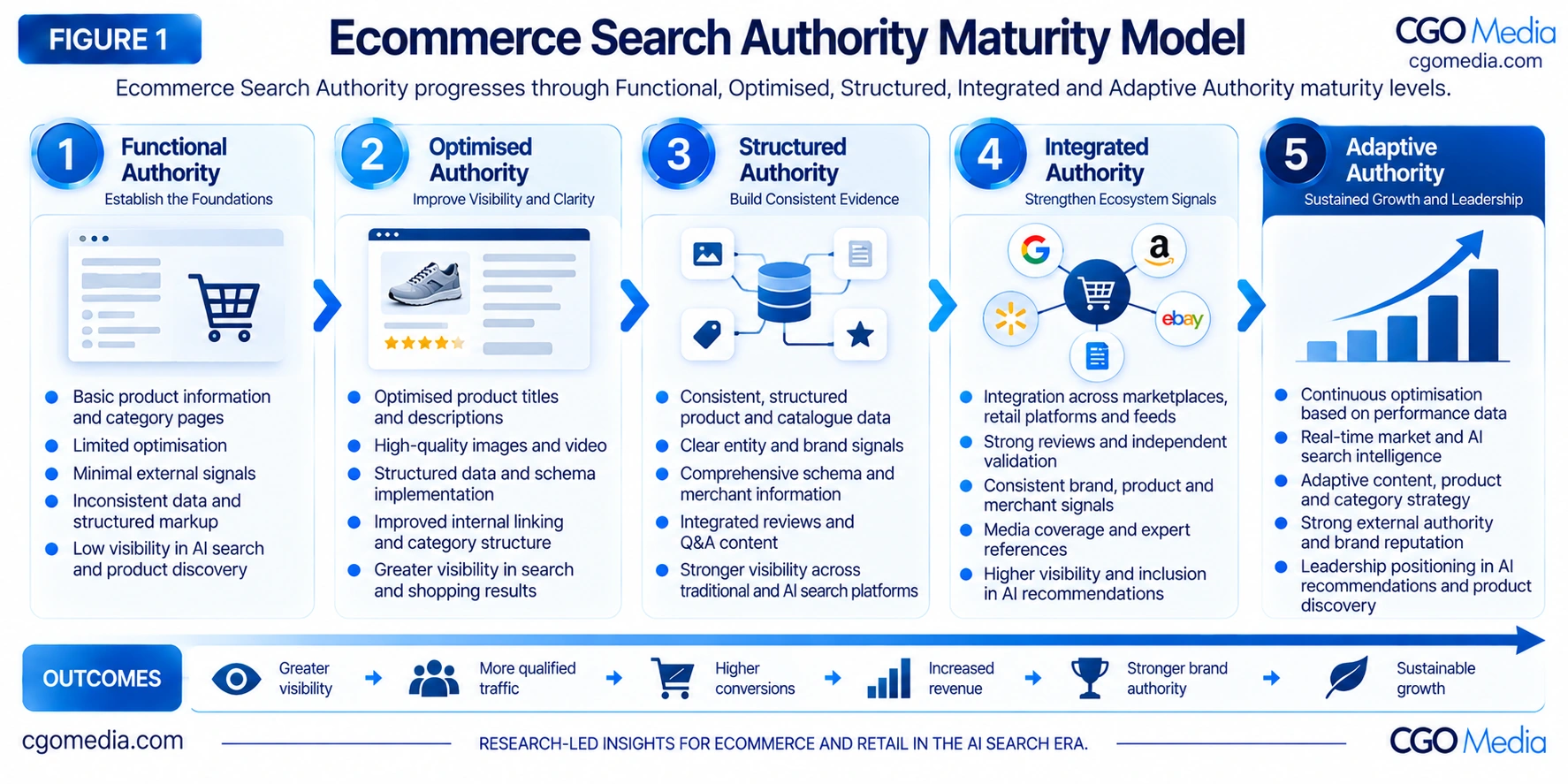
The Ecommerce Search Authority Maturity Model presents the five levels through which retailers, ecommerce brands and marketplaces can progress as basic commercial search activity develops into a structured, integrated and continuously adaptive authority capability.
Level 1 — Functional
The organisation possesses basic ecommerce, catalogue, feed, review and measurement infrastructure, but search and authority management remain largely reactive and fragmented.
Level 2 — Optimised
Technical SEO, product pages, category pages, shopping feeds, reviews and marketplaces are improved deliberately, but individual teams and systems may still operate independently.
Level 3 — Structured
Retailer, category, brand, product, variant, offer, review and external-authority relationships are organised into a deliberate Ecommerce Search Authority architecture.
Level 4 — Integrated
Search, merchandising, product data, merchant trust, external authority, shopping distribution, marketplaces and AI visibility operate as coordinated organisational capabilities.
Level 5 — Adaptive Authority
The organisation continuously monitors product evidence, merchant trust, competitive authority, customer behaviour and AI-assisted recommendation visibility and adapts its systems accordingly.
Maturity principle: Ecommerce Search Authority does not mature simply because the catalogue grows, traffic increases or more channels are added. Maturity develops when technical infrastructure, product evidence, catalogue relationships, merchant trust, external authority and AI visibility become increasingly governed and connected.
Capability principle: Organisations may operate at different maturity levels across different functions. Effective maturity is therefore constrained by weaknesses within the wider Ecommerce Search Authority system rather than defined by the strongest individual capability.
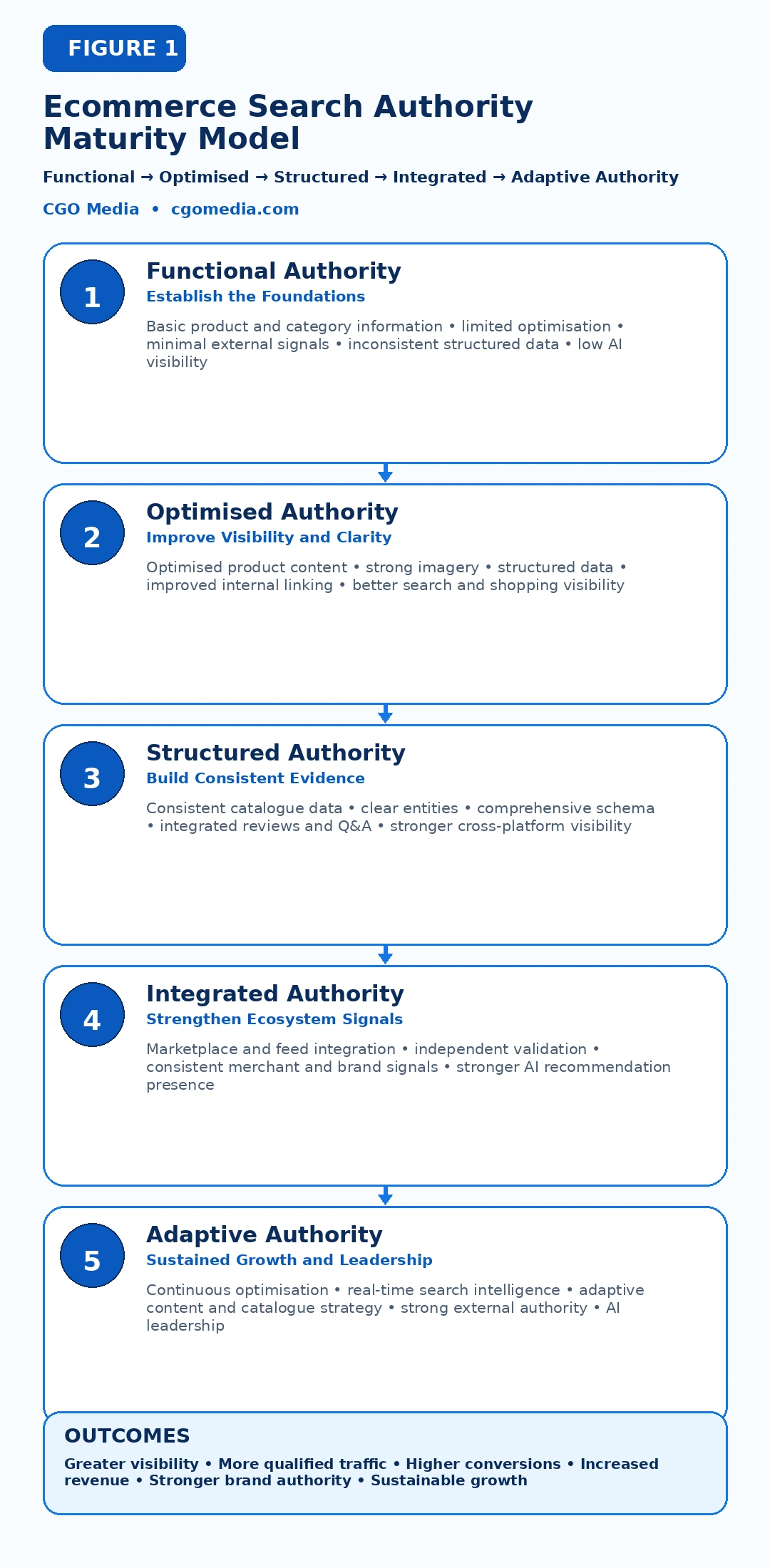
Figure 1. Ecommerce Search Authority progresses through Functional, Optimised, Structured, Integrated and Adaptive Authority maturity levels.
13. Level Two — Optimised
At the Optimised level, the organisation begins systematically improving individual ecommerce search and commercial channels.
Execution becomes more deliberate.
Teams begin to work with clearer targets, repeatable processes and stronger quality controls.
The organisation is no longer relying entirely on reactive fixes.
Instead, it begins identifying priority areas for improvement across:
- Technical SEO;
- category pages;
- product pages;
- shopping feeds;
- marketplaces;
- reviews;
- merchant trust;
- brand pages;
- buying guides;
- and commercial measurement.
This is an important maturity step because basic operational activity becomes more intentional.
However, the organisation may still optimise these areas independently.
Technical teams may improve crawlability.
Merchandising teams may improve categories.
Product teams may improve descriptions.
Feed teams may improve merchant-platform performance.
Marketplace teams may improve listings.
Customer-experience teams may improve reviews.
Content teams may publish buying guides.
Each improvement can produce real value.
The limitation is that these improvements may not yet be governed through one connected ecommerce authority model.
Level Two can therefore be described as:
Better Execution Without Full Structural Integration
The retailer is learning how to optimise individual components effectively.
The next maturity challenge is to connect those components.
14. Optimised Technical SEO
Technical SEO becomes more deliberate at Level Two.
The organisation begins identifying recurring technical constraints rather than waiting for major performance decline.
Common improvements may include:
- improved crawl management;
- better indexation controls;
- canonical management;
- site-speed improvements;
- mobile optimisation;
- structured data improvements;
- redirect governance;
- XML sitemap management;
- faceted-navigation controls;
- and improved handling of discontinued products.
Crawl Management
Large ecommerce websites can create enormous numbers of URLs through filters, parameters, internal search, sort options, pagination and campaign tracking.
At the Optimised level, teams begin distinguishing more carefully between:
- important commercial URLs;
- supporting crawl paths;
- duplicate combinations;
- and low-value generated pages.
This helps search engines spend more attention on the catalogue areas the organisation actually wants discovered.
Indexation Controls
The retailer begins managing which URLs should appear in search rather than allowing platform defaults to determine indexation automatically.
This may include stronger rules for:
- filters;
- internal search;
- sorting;
- duplicate categories;
- campaign pages;
- and temporary merchandising URLs.
Canonical Management
Canonicalisation becomes more deliberate where multiple URLs can represent similar products or category experiences.
The organisation increasingly understands that canonical tags should reflect genuine preferred-resource logic rather than being applied mechanically.
Site Speed and Mobile Experience
Performance receives more systematic attention because ecommerce pages often contain:
- large product images;
- review widgets;
- recommendation engines;
- personalisation;
- third-party scripts;
- analytics;
- and promotional overlays.
The organisation begins measuring how these systems affect both customer experience and search performance.
Structured Data
Product, offer, review and merchant-related structured data become more consistent.
The retailer starts recognising markup as part of product representation rather than a one-off Technical SEO task.
Nevertheless, at Level Two, structured data may still be improved independently from the underlying product-data governance.
15. Optimised Category Pages
Priority category pages begin receiving more deliberate optimisation.
The organisation increasingly recognises that category pages are not simply product grids.
They are major commercial discovery environments.
Improvements may include:
- stronger titles;
- clearer headings;
- useful category descriptions;
- better filtering;
- improved internal linking;
- better merchandising;
- buying guidance;
- and clearer relationships with subcategories and brands.
Better Category Intent Alignment
The retailer begins aligning categories more closely with the way customers search and shop.
This can involve identifying when users search according to:
- product type;
- brand;
- use case;
- feature;
- audience;
- price point;
- or compatibility.
Priority landing pages can then be strengthened where genuine customer demand exists.
Better Category Content
Category copy becomes more useful and less formulaic.
Instead of adding generic text purely for keyword coverage, teams may explain:
- how products differ;
- which features matter;
- which subcategories are relevant;
- what customers should consider;
- and where related buying guidance exists.
Internal Linking
Category pages become stronger navigation hubs.
They connect more deliberately with:
- subcategories;
- brands;
- popular products;
- buying guides;
- and related commercial destinations.
At this stage, however, category improvement may still be prioritised page by page rather than governed through a complete Catalogue Authority architecture.
16. Optimised Product Pages
Product pages begin to contain stronger decision evidence.
The retailer moves beyond basic descriptions toward information that helps customers evaluate whether the product is right for them.
Improvements can include:
- more useful descriptions;
- more detailed specifications;
- better images;
- review integration;
- related products;
- delivery information;
- returns information;
- compatibility guidance;
- and clearer variant selection.
Description Quality
Descriptions begin reflecting real buying questions.
Instead of repeating manufacturer wording, the retailer may explain:
- who the product is for;
- how it differs from alternatives;
- which use cases it suits;
- and what limitations customers should understand.
Specification Depth
Technical or commercial attributes become more complete.
Depending on the product category, these can include:
- dimensions;
- weight;
- materials;
- capacity;
- compatibility;
- power requirements;
- model information;
- warranty;
- and product identifiers.
Visual Evidence
Images begin supporting product understanding rather than functioning only as catalogue thumbnails.
Retailers may add:
- multiple angles;
- detail images;
- scale context;
- lifestyle photography;
- and product-in-use images.
Related Products
Recommendation modules become more useful when relationships reflect genuine alternatives, accessories or complementary products.
The organisation begins improving customer decision support.
However, these recommendations may still be driven mainly by merchandising or algorithmic logic rather than a governed product relationship model.
17. Optimised Shopping Feeds
Shopping-feed quality becomes actively monitored.
The organisation begins treating feed performance as a recurring operational responsibility rather than responding only when major disapprovals occur.
Monitoring may focus on:
- product disapprovals;
- price mismatches;
- availability mismatches;
- missing identifiers;
- weak titles;
- incorrect categories;
- variant relationships;
- image quality;
- and incomplete attributes.
Feed Titles
Titles become more structured according to product attributes that genuinely help identify the item.
Depending on the category, these can include:
- brand;
- product type;
- model;
- colour;
- size;
- capacity;
- or other differentiating characteristics.
Identifiers
GTIN, MPN, brand and model information receive greater attention.
The retailer increasingly understands that product identifiers help distributed systems match equivalent items.
Price and Availability
Feed monitoring becomes more systematic because discrepancies can damage both platform eligibility and customer trust.
However, at Level Two, the retailer may still treat feed problems as channel-specific issues rather than symptoms of wider product-data governance weaknesses.
18. Optimised Marketplace Listings
Products distributed through marketplaces receive more systematic attention.
The organisation begins optimising:
- titles;
- images;
- specifications;
- seller ratings;
- price competitiveness;
- availability;
- and product descriptions.
Marketplace Content Quality
Listings increasingly contain the information required by marketplace users rather than simply mirroring the retailer’s own site.
This may require different:
- title formats;
- attribute structures;
- image requirements;
- and merchandising conventions.
Seller Evidence
The retailer begins monitoring merchant-level signals such as:
- seller ratings;
- delivery performance;
- returns;
- response quality;
- and marketplace service metrics.
This introduces a stronger understanding that product visibility and merchant credibility are connected.
Channel Fragmentation Remains
Despite better listing quality, marketplace optimisation may still operate independently from owned-site Product Authority.
The same product can therefore still be represented differently across channels.
Level Three addresses this problem by introducing stronger entity and catalogue relationships.
19. Optimised Review Strategy
The retailer begins developing more systematic review collection and monitoring.
Review strategy may include:
- post-purchase review requests;
- product-review moderation;
- merchant-review monitoring;
- response processes;
- rating analysis;
- and review-platform management.
Review Volume and Coverage
The organisation begins identifying products with:
- strong review volume;
- weak review coverage;
- poor ratings;
- or limited recent feedback.
This helps improve trust on important product pages.
Review Freshness
Older reviews can remain useful, but current feedback often provides stronger evidence about:
- product quality;
- current delivery experience;
- packaging;
- returns;
- and service.
Review Themes
The retailer may begin identifying common customer themes manually or through basic analysis.
However, review intelligence is not yet fully integrated with:
- product-data improvement;
- merchandising;
- returns analysis;
- customer service;
- or AI recommendation monitoring.
20. Optimised Merchant Trust
Commercial confidence is strengthened through clearer and more accessible merchant information.
This can include:
- delivery information;
- returns policies;
- customer service;
- payment options;
- warranty information;
- contact details;
- and retailer reviews.
These elements help reduce uncertainty during purchase.
Delivery Clarity
Customers should be able to understand:
- delivery times;
- delivery costs;
- geographic limitations;
- collection options;
- and tracking arrangements.
Returns Clarity
Returns information becomes easier to locate and understand.
This can influence retailer selection where competing merchants sell identical products.
Customer Service
Clear customer-service routes increase merchant confidence.
The retailer begins recognising that customer trust is part of commercial search performance rather than something that begins only after purchase.
Nevertheless, merchant trust is still often treated as a customer-experience function rather than as one dimension of Ecommerce Search Authority.
21. Optimised Brand Pages
Brand pages begin operating as meaningful shopping and discovery destinations rather than simple product grids.
They can connect:
- brand information;
- major product ranges;
- relevant categories;
- new releases;
- buying guides;
- and current offers.
Brand Context
Customers may need to understand:
- what the brand specialises in;
- which product families it offers;
- how ranges differ;
- and which products suit particular needs.
A stronger brand page can answer these questions while supporting discovery.
Retailer Brand Authority
For multi-brand retailers, brand pages can demonstrate depth of catalogue and expertise.
For direct-to-consumer brands, brand authority may connect more closely with:
- company identity;
- product innovation;
- research;
- press coverage;
- and customer trust.
At Level Two, brand pages improve individually.
At Level Three, brands become explicit entities within the catalogue architecture.
22. Optimised Buying Guides
Buying guides are developed around recurring customer decision needs.
Common guide themes can include:
- product selection;
- use cases;
- features;
- comparison;
- budget;
- compatibility;
- size;
- and technical requirements.
Buying guides can bridge informational and commercial discovery.
A customer may begin with:
“What type of product do I need?”
and progress toward:
“Which specific product should I buy?”
Decision Support
Effective guides explain meaningful differences between options.
They should not exist only as long-form keyword pages.
Useful guidance can explain:
- selection criteria;
- feature trade-offs;
- budget implications;
- common mistakes;
- and which products suit different scenarios.
Commercial Relationships
Buying guides should connect clearly with relevant:
- categories;
- brands;
- products;
- and complementary guides.
At Level Two, these relationships may be created manually.
At Level Three, they become part of the structured authority architecture.
23. Optimised Measurement
Reporting expands beyond total traffic and revenue.
The organisation begins measuring individual ecommerce discovery components.
Relevant reporting can include:
- category performance;
- product performance;
- shopping-feed performance;
- marketplace performance;
- add-to-cart behaviour;
- checkout conversion;
- review performance;
- and product-level revenue.
Category-Level Measurement
Teams can identify:
- strong categories;
- declining categories;
- seasonal categories;
- and categories with high traffic but weak conversion.
Product-Level Measurement
The organisation begins understanding which products drive:
- discovery;
- engagement;
- revenue;
- and repeat demand.
Feed and Marketplace Measurement
Distributed-channel performance becomes more visible.
However, measurement still tends to follow channel ownership.
SEO dashboards measure SEO.
Feed dashboards measure shopping feeds.
Marketplace dashboards measure marketplaces.
Customer teams measure reviews.
The organisation has more data but has not yet connected those signals into one authority model.
24. Limitations of Level Two
The main limitation of the Optimised level is fragmentation.
Technical SEO, merchandising, product feeds, marketplaces, reviews and content may all improve independently without forming a coherent Ecommerce Search Authority architecture.
The retailer becomes better at optimisation but not yet fully better at coordination.
Technical Improvement Is Not Catalogue Governance
Technical SEO may become sophisticated while product relationships remain unclear.
Product Page Improvement Is Not Product Authority
Individual pages may become stronger while product identity remains inconsistent across feeds and marketplaces.
Feed Optimisation Is Not Product Data Governance
A feed team may fix missing attributes without correcting the underlying catalogue source.
Review Management Is Not Merchant Trust Governance
Ratings may improve without customer feedback being systematically used to improve product information or service.
Content Production Is Not Knowledge Architecture
Buying guides may grow without clear relationships with categories, products and brands.
Measurement Is Still Siloed
Each function understands its own performance while the organisation lacks a unified view of search authority health.
The progression to Level Three therefore requires a structural shift.
The organisation must begin managing relationships between entities rather than simply improving individual assets.
The maturity transition becomes:
Optimised Assets → Structured Relationships
25. Level Three — Structured
At the Structured level, the organisation begins organising its ecommerce environment around explicit relationships between commercial entities.
This represents a major maturity transition.
The retailer is no longer focused only on:
- optimising category pages;
- improving product descriptions;
- fixing feeds;
- and collecting reviews.
It begins building a model of how those components relate.
A core structural relationship is:
Retailer → Store or Channel → Department → Category → Brand → Product → Variant → Offer
Additional evidence can then connect around those commercial entities:
- reviews;
- buying guides;
- publisher references;
- comparison content;
- merchant policies;
- and AI visibility.
This changes the strategic question.
Instead of asking:
“How do we optimise more pages?”
the organisation begins asking:
“How should our catalogue, product evidence, merchant trust and external authority connect?”
This is the beginning of Ecommerce Authority Architecture.
26. Structured Retailer Entity Architecture
The organisation defines clearer relationships between the retailer and the commercial entities it controls or represents.
A simplified relationship may be:
Retailer → Store or Channel → Department → Category → Brand → Product → Offer
For more complex organisations, the structure may also include:
- regional stores;
- physical locations;
- marketplace seller profiles;
- private-label brands;
- subsidiary brands;
- and local trading entities.
Retailer Identity
The organisation defines which information represents the merchant consistently.
This can include:
- business name;
- trading name;
- brand;
- customer-service identity;
- returns information;
- and marketplace seller identity.
Channel Relationships
The retailer increasingly understands how:
- owned ecommerce;
- marketplaces;
- shopping feeds;
- physical stores;
- and third-party distribution
relate to the same underlying merchant.
This reduces ambiguity across distributed commerce environments.
27. Structured Catalogue Architecture
Catalogue structure becomes more intentional.
The organisation defines stronger relationships across:
- departments;
- categories;
- subcategories;
- brands;
- product types;
- variants;
- use cases;
- and offers.
The architecture begins balancing:
- customer discovery;
- merchandising needs;
- search demand;
- product attributes;
- and catalogue maintainability.
Category Definition
Categories are created around meaningful commercial groupings rather than simply accumulated over time.
The organisation begins reducing:
- overlapping intent;
- duplicate categories;
- orphaned pages;
- and confusing hierarchical relationships.
Product Assignment
Products are assigned more consistently according to governed classification rules.
This helps both users and machine systems understand where each product belongs.
Use-Case Architecture
Where customer demand supports it, the catalogue can also connect products according to:
- application;
- activity;
- compatibility;
- audience;
- problem;
- or purchasing objective.
Catalogue Architecture therefore begins reflecting real decision behaviour rather than only inventory organisation.
28. Structured Category Authority
Category pages become information and discovery hubs.
They connect:
- subcategories;
- products;
- brands;
- buying guides;
- selection criteria;
- and relevant offers.
The strongest category environments help users answer:
- What products exist?
- How do they differ?
- Which brands matter?
- What should I consider?
- Which products fit my needs?
Category Authority Is More Than Ranking
A category can rank strongly yet remain weak as a decision environment.
Structured Category Authority considers:
- breadth of relevant products;
- quality of filtering;
- buying guidance;
- internal relationships;
- and ability to support comparison.
The category becomes a node in the retailer’s Knowledge Architecture rather than simply a landing page.
29. Structured Product Authority
Products are connected explicitly with:
- brand;
- category;
- variants;
- specifications;
- reviews;
- offers;
- related products;
- and relevant buying guidance.
This creates a richer product evidence environment.
Product Identity
The organisation aims to maintain consistent identity through:
- product name;
- brand;
- model;
- GTIN;
- MPN;
- variant attributes;
- and category relationships.
Decision Evidence
The product page increasingly answers:
- What is it?
- Who made it?
- Which version is this?
- What are the important features?
- Who is it suitable for?
- How does it compare?
- What do customers think?
- How much does it cost?
- Is it available?
Product Authority therefore develops through evidence completeness and connected context.
30. Structured Variant Architecture
Variants are managed as explicit relationships rather than uncontrolled duplicate products.
Variant dimensions can include:
- size;
- colour;
- capacity;
- material;
- pack quantity;
- style;
- configuration;
- or technical specification.
The retailer determines when variants should:
- share a primary product experience;
- have separate discoverable URLs;
- use distinct identifiers;
- or be represented as offers or child products.
Variant Clarity
Customers should be able to understand exactly which variant they are viewing.
Search engines and commerce platforms should also be able to distinguish related versions where structured data and product feeds support that relationship.
Variant Governance
A governed approach reduces:
- duplicate content;
- incorrect prices;
- misleading availability;
- and fragmented review signals.
Variant Architecture is therefore both a Technical SEO and product-evidence issue.
31. Structured Brand Authority
Brand environments connect:
- brand information;
- product ranges;
- relevant categories;
- buying guides;
- and current offers.
For multi-brand retailers, this allows users to understand the brand within the context of the retailer’s catalogue.
For owned or private-label brands, Brand Authority can also connect with:
- company information;
- product development;
- research;
- media coverage;
- and external recognition.
Brand as a Commercial Entity
The organisation begins treating the brand as more than a filter.
It becomes a structured entity connected with:
Brand → Product Range → Category → Buying Guidance → External Authority
This helps both customer understanding and machine interpretation.
32. Structured Product Evidence
Specifications, images, identifiers and other product evidence are governed according to clearer standards.
The organisation begins defining which information should exist for each product type.
Evidence standards can include:
- required identifiers;
- mandatory specifications;
- image standards;
- description requirements;
- compatibility fields;
- variant attributes;
- delivery information;
- and warranty data.
Category-Specific Evidence Standards
Different product categories require different decision evidence.
For example, electronics may require:
- technical specifications;
- compatibility;
- power information;
- and connectivity.
Apparel may require:
- size;
- material;
- fit;
- colour;
- and care information.
Furniture may require:
- dimensions;
- materials;
- assembly requirements;
- delivery constraints;
- and room suitability.
Structured Product Evidence therefore becomes category aware rather than generic.
Completeness Becomes Measurable
The organisation can begin measuring whether priority products contain the expected evidence.
This creates a data-quality foundation for later integration.
33. Structured Shopping Feed Governance
Product feeds become integrated with catalogue-quality processes rather than treated only as advertising inputs.
Feed issues increasingly lead back to the underlying product-data source.
For example:
- a missing GTIN becomes a catalogue-data issue;
- a price mismatch becomes a synchronisation issue;
- an incorrect variant becomes a relationship issue;
- and a weak title may reveal poor attribute structure.
Source-of-Truth Thinking
The organisation begins identifying which systems own important product facts.
These can include:
- PIM;
- ERP;
- ecommerce platform;
- inventory systems;
- pricing systems;
- and feed-management platforms.
The objective is not necessarily to use one system for everything.
It is to define which source is authoritative for which information.
This is a major step toward distributed commercial consistency.
34. Structured Merchant Trust
Retailer reviews, policies and service evidence become integrated into a broader commercial trust strategy.
The organisation begins treating Merchant Trust as a structured capability.
Relevant trust evidence can include:
- retailer ratings;
- delivery performance;
- returns policies;
- customer service;
- payment security;
- physical-store information;
- company information;
- warranty support;
- and independent merchant references.
Merchant Trust and Product Trust
The organisation distinguishes between:
Is this a good product?
and:
Is this a good retailer to buy it from?
These are different decision questions.
Structured maturity ensures both have appropriate evidence.
Policy Consistency
Delivery, returns and customer-service information should remain consistent across:
- product pages;
- help pages;
- marketplaces;
- and other important customer-facing environments.
Merchant Trust begins functioning as part of retailer authority rather than as a set of isolated policies.
35. Structured External Authority
The organisation begins deliberately developing credible independent authority around products, brands and retail expertise.
Relevant sources can include:
- independent product reviews;
- publisher mentions;
- brand coverage;
- comparison visibility;
- research citations;
- specialist media;
- industry publications;
- and expert commentary.
External Product Authority
Independent reviews can validate:
- product quality;
- specific features;
- comparative strengths;
- and suitability for particular users.
Retailer Authority
External sources can also reinforce the retailer itself through:
- retail expertise;
- research;
- industry commentary;
- consumer guidance;
- and recognised specialist knowledge.
Authority Should Follow Real Expertise
The objective is not generic mention generation.
External authority should develop around areas where the retailer or brand possesses substantive commercial or product knowledge.
This creates stronger evidence for both human selection and AI-assisted recommendation environments.
36. Structured AI Monitoring
AI visibility begins to be assessed through repeatable prompt groups rather than occasional manual testing.
The organisation may create prompt sets around:
- product recommendations;
- category recommendations;
- brand comparisons;
- retailer recommendations;
- use cases;
- budget-led discovery;
- feature-led discovery;
- and merchant comparisons.
Repeatability
Prompt groups are documented so that observations can be compared over time.
The organisation records:
- whether products appear;
- whether the retailer appears;
- which competitors appear;
- which sources are referenced;
- and whether important facts are accurate.
Representation Accuracy
Monitoring should identify inaccuracies involving:
- price;
- availability;
- product features;
- merchant policies;
- brand identity;
- and product suitability.
At Level Three, AI monitoring becomes systematic enough to generate useful diagnostic information.
However, it may still operate as a specialist activity rather than being integrated fully into commercial governance.
37. Structured Measurement
Measurement begins evaluating connected authority areas rather than isolated channels.
The retailer can start combining signals across:
- technical health;
- category visibility;
- product completeness;
- feed quality;
- review coverage;
- merchant trust;
- external authority;
- and AI visibility.
Capability Measures
The organisation may track:
- percentage of products with complete identifiers;
- percentage of priority products with complete specifications;
- category coverage;
- variant consistency;
- feed error rates;
- review coverage;
- external citation growth;
- and AI representation accuracy.
Commercial Measures Remain Important
Revenue, conversion, traffic and orders remain essential.
The difference is that the retailer begins connecting commercial outcomes with the quality of the authority system supporting them.
This allows teams to move from:
“Performance changed.”
to:
“Which underlying authority capability may have contributed to that change?”
38. The Shift from Optimisation to Ecommerce Authority Architecture
Level Three represents an important transition in ecommerce maturity.
The organisation begins asking:
“How are our products, categories, brands, merchant evidence and external authority connected?”
rather than simply:
“Which product pages should we optimise next?”
This changes the role of Ecommerce SEO.
Search becomes increasingly connected with:
- catalogue governance;
- product information;
- merchant identity;
- reviews;
- brand authority;
- content;
- shopping feeds;
- marketplaces;
- and AI visibility.
The ecommerce environment begins to resemble a network of commercial entities and evidence.
A simplified authority chain can be expressed as:
Retailer → Category → Brand → Product → Variant → Offer → Review → External Evidence
Each layer can reinforce the others.
A strong category can help customers discover relevant products.
A strong brand environment can provide context around product families.
Complete product evidence improves comparison.
Reviews provide customer validation.
External product coverage provides independent authority.
Merchant evidence provides confidence in the seller.
Together, these relationships create stronger conditions for:
- organic discovery;
- shopping visibility;
- marketplace discovery;
- product comparison;
- merchant selection;
- and AI-assisted recommendation.
The transition can therefore be summarised as:
Level Two — Optimise Individual Assets
Level Three — Structure the Relationships Between Assets
This structural maturity provides the foundation required for Level Four, where those capabilities become integrated across organisational teams and systems.
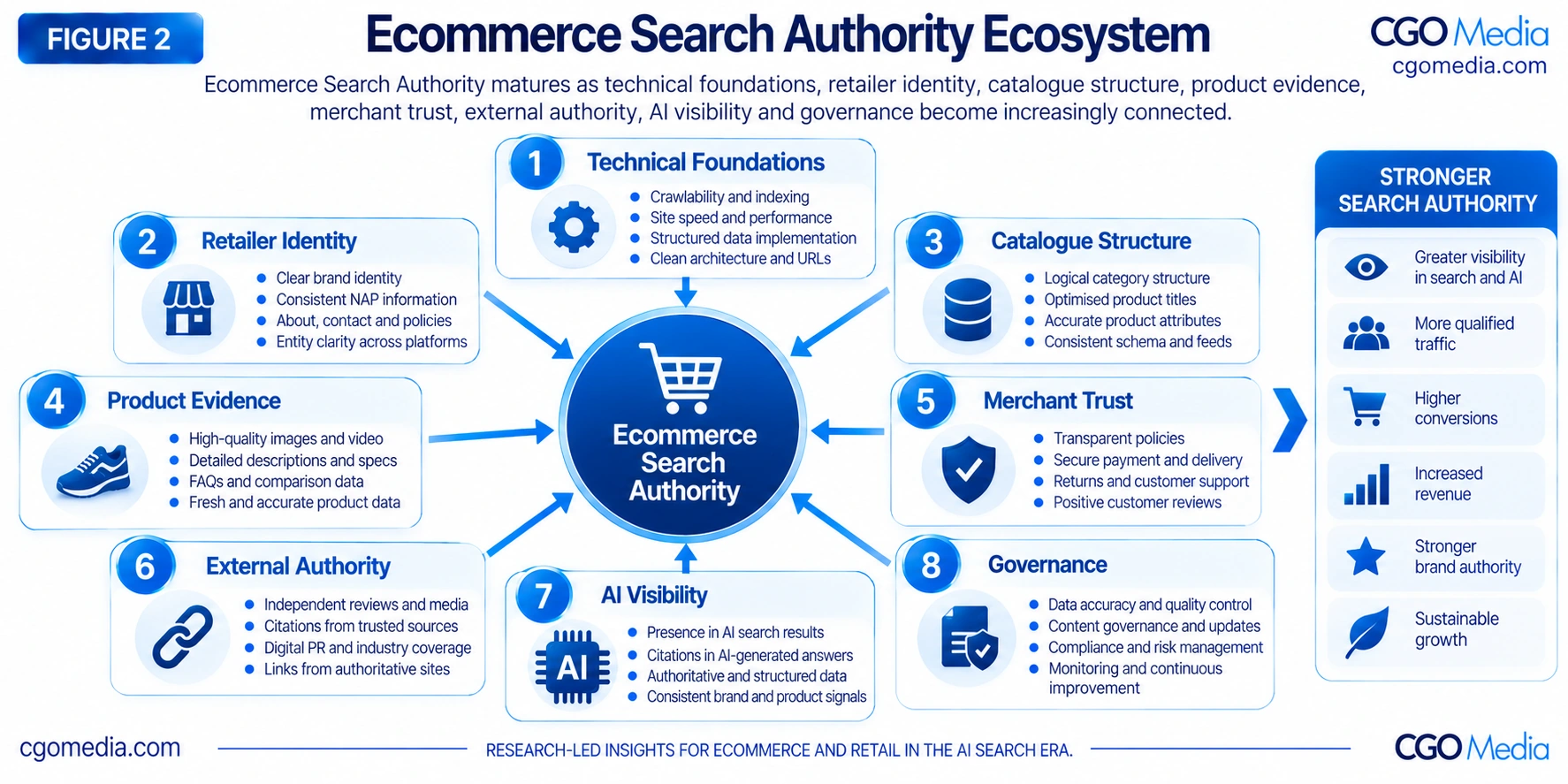
The Ecommerce Search Authority Capability Progression shows how maturity develops across connected organisational capabilities rather than through rankings, traffic, advertising spend or catalogue size alone.
Technical Search Foundations
Crawlability, indexation, canonicalisation, performance, structured data, product lifecycle management and other technical systems become progressively more governed.
Retailer & Merchant Entity Authority
Retailer identity, trading names, store relationships, marketplace seller profiles and customer-facing policies become clearer and more consistent.
Catalogue & Category Authority
Departments, categories, subcategories, brands, product types and use cases are organised into deliberate commercial discovery relationships.
Product & Variant Authority
Products are connected with identifiers, specifications, brands, variants, reviews, offers, alternatives and relevant decision guidance.
Product Evidence Quality
Identifiers, specifications, images, commercial attributes, price, availability and other decision evidence become increasingly complete and governed.
Merchant Trust
Retailer reviews, delivery, returns, customer service, payment information and merchant identity become part of a coordinated trust environment.
External Authority
Independent reviews, publisher coverage, brand mentions, comparisons, research citations and expert references reinforce owned commercial evidence.
AI Visibility & Governance
Product recommendations, retailer comparisons, source selection and representation accuracy become measurable and increasingly integrated with wider ecommerce governance.
Capability-progression principle: Ecommerce Search Authority matures when technical foundations, retailer identity, catalogue structure, product evidence, merchant trust, external authority and AI visibility become progressively more connected and governed.
Structural principle: Level Three marks the point at which the organisation begins moving from isolated optimisation toward a deliberate Ecommerce Authority Architecture built around relationships between commercial entities and evidence.
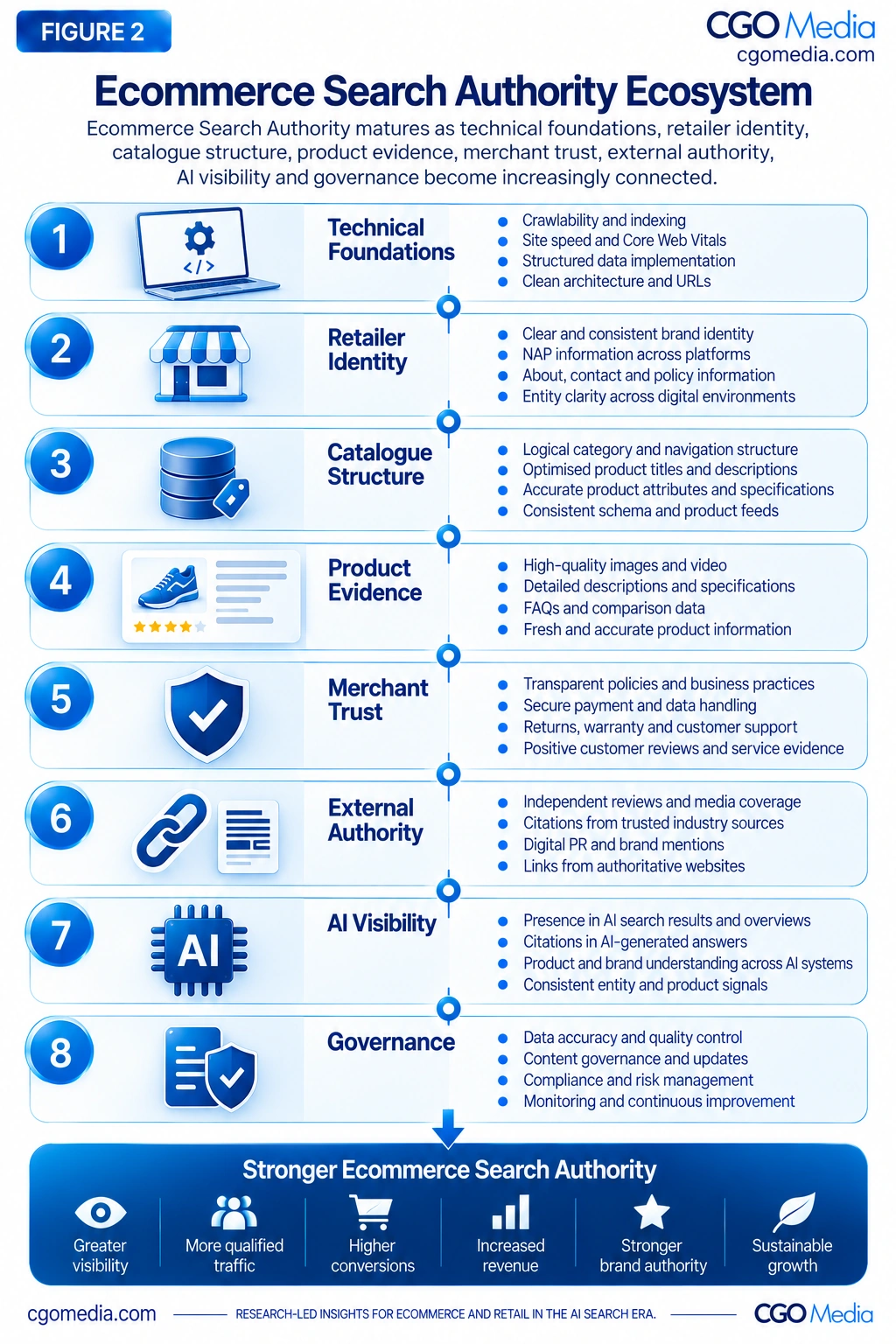
Figure 2. Ecommerce Search Authority matures as technical foundations, retailer identity, catalogue structure, product evidence, merchant trust, external authority, AI visibility and governance become increasingly connected.
39. The Eight Ecommerce Search Authority Capabilities
The maturity model evaluates ecommerce capability across eight connected areas rather than attempting to classify the organisation according to one headline metric.
The eight capabilities are:
- Technical Search and Commerce Foundations
- Retailer, Brand and Merchant Entity Authority
- Catalogue, Category and Product Authority
- Product Evidence and Commercial Data Quality
- Reviews, Merchant Trust and Customer Confidence
- Brand, Publisher and External Authority
- AI Search and Product Recommendation Visibility
- Measurement and Governance
These capabilities are deliberately broader than conventional Ecommerce SEO.
Technical search remains essential, but reliable modern ecommerce discovery also depends on the quality of product data, merchant identity, reviews, external evidence and distributed commercial information.
The capabilities should therefore be understood as one authority system.
For example:
Technical Infrastructure determines whether product and category resources can be discovered reliably.
Entity Authority helps identify the retailer, brand, product and seller correctly.
Catalogue Authority explains how products relate to categories, brands, variants and use cases.
Product Evidence provides the information required for evaluation and comparison.
Merchant Trust helps customers determine whether the retailer is credible.
External Authority adds independent validation.
AI Visibility reveals how that evidence is being interpreted in generative environments.
Measurement and Governance determine whether the entire system can be maintained as products, prices, inventory and discovery systems change.
Maturity therefore emerges from the strength and coordination of all eight capabilities.
40. Capability One — Technical Search and Commerce Foundations
Technical Search and Commerce Foundations assess whether the retailer’s digital infrastructure can support reliable discovery across a large, frequently changing and commercially complex catalogue.
Relevant areas include:
- crawlability;
- indexation;
- canonicalisation;
- site performance;
- mobile usability;
- faceted navigation;
- product lifecycle handling;
- structured data;
- XML sitemaps;
- redirects;
- internal linking;
- and rendering.
At lower maturity levels, these issues are usually managed individually.
At higher maturity levels, technical architecture reflects the structure and behaviour of the catalogue itself.
For example, product lifecycle states may be defined explicitly as:
- available;
- temporarily unavailable;
- seasonal;
- superseded;
- discontinued;
- or permanently removed.
Each state can then have an appropriate search, feed and user-experience response.
The technical capability also needs to support frequent change.
Large ecommerce environments may update:
- thousands of prices;
- inventory positions;
- new products;
- seasonal collections;
- and promotional offers
within short periods.
A mature technical environment should therefore be resilient enough to handle commercial change without creating uncontrolled search debt.
41. Capability Two — Retailer, Brand and Merchant Entity Authority
This capability evaluates whether the retailer, brands, stores and sellers are represented clearly and consistently across owned and distributed commerce environments.
Relevant entity relationships can include:
- retailer;
- parent company;
- trading name;
- owned brand;
- third-party brand;
- physical store;
- online store;
- marketplace seller account;
- and regional ecommerce entities.
Entity ambiguity can create both customer and machine confusion.
For example, a retailer may use:
- one legal name;
- a different trading name;
- several store brands;
- multiple marketplace seller names;
- and country-specific storefront identities.
At low maturity, these representations may evolve independently.
At higher maturity, important relationships are governed intentionally.
This includes maintaining consistency around:
- business name;
- brand identity;
- contact information;
- customer-service channels;
- delivery policies;
- returns policies;
- and seller profiles.
Merchant Entity Authority becomes increasingly important in environments where multiple retailers sell the same underlying product.
The product may be identical.
The differentiator then becomes:
Which merchant is most credible, convenient and appropriate to buy from?
42. Capability Three — Catalogue, Category and Product Authority
This capability evaluates the depth, clarity and connectivity of the commercial catalogue.
A mature catalogue should express meaningful relationships between:
- departments;
- categories;
- subcategories;
- brands;
- product types;
- individual products;
- variants;
- offers;
- and use cases.
The catalogue should support both browsing and search-led discovery.
Customers may enter according to:
- product type;
- brand;
- feature;
- activity;
- compatibility;
- budget;
- recipient;
- or problem.
A mature Catalogue Architecture accommodates these legitimate discovery routes without producing uncontrolled duplication.
Category Authority also depends on whether categories provide useful decision context.
A strong category can connect:
- product ranges;
- subcategories;
- buying criteria;
- popular brands;
- relevant guides;
- and important offers.
Product Authority then provides more specific evidence around the individual item.
The result is a connected decision environment rather than a flat collection of URLs.
43. Capability Four — Product Evidence and Commercial Data Quality
Product Evidence and Commercial Data Quality evaluates whether product information is sufficiently:
- accurate;
- complete;
- fresh;
- consistent;
- and comparable.
Relevant evidence can include:
- product name;
- brand;
- GTIN;
- MPN;
- model;
- technical specifications;
- dimensions;
- materials;
- compatibility;
- images;
- videos;
- price;
- availability;
- warranty;
- delivery;
- and returns information.
Accuracy
Important commercial facts should be correct.
Incorrect specifications can increase:
- returns;
- customer complaints;
- comparison errors;
- and AI misrepresentation.
Completeness
Products should contain the evidence required for their category.
A missing specification may prevent comparison even where the product itself is suitable.
Freshness
Price, stock, promotions and product lifecycle information may change rapidly.
Freshness therefore becomes a core commercial-data capability.
Consistency
The same product should not present materially conflicting information across:
- owned ecommerce;
- feeds;
- marketplaces;
- and comparison platforms.
Comparability
Attributes should be structured consistently enough for customers and machine systems to compare similar products meaningfully.
44. Capability Five — Reviews, Merchant Trust and Customer Confidence
This capability evaluates whether sufficient evidence exists for customers to trust both the product and the retailer.
Relevant trust signals can include:
- product reviews;
- merchant reviews;
- review freshness;
- review volume;
- delivery performance;
- returns clarity;
- customer service;
- payment security;
- warranty information;
- and physical-store presence where relevant.
Product Trust and Merchant Trust should be analysed separately.
A product may have excellent reviews while the seller receives repeated complaints about delivery.
Likewise, a trusted merchant may sell a product receiving consistently weak product feedback.
At higher maturity levels, review evidence also becomes a source of operational intelligence.
Review themes can reveal:
- incorrect sizing;
- specification gaps;
- quality problems;
- delivery issues;
- packaging concerns;
- compatibility confusion;
- and recurring customer questions.
A mature organisation does not merely collect reviews.
It learns from them.
45. Capability Six — Brand, Publisher and External Authority
External Authority evaluates whether products, brands and retailers receive credible independent recognition beyond owned ecommerce channels.
Relevant sources can include:
- independent product reviews;
- specialist publishers;
- consumer media;
- industry publications;
- comparison sites;
- professional reviewers;
- research;
- and expert commentary.
External evidence can support several forms of authority.
A product review can strengthen Product Authority.
A specialist article can strengthen Brand Authority.
An industry study can strengthen retailer expertise.
A comparison article can expose the product within a competitive decision environment.
External Authority should therefore develop around genuine strengths.
For example:
- original product expertise;
- specialist category knowledge;
- research;
- new product launches;
- consumer trends;
- or market data.
Maturity increases when external authority is aligned with strategically important commercial categories rather than accumulating randomly.
46. Capability Seven — AI Search and Product Recommendation Visibility
This capability evaluates whether the organisation systematically observes how products, brands, categories and retailers appear within AI-assisted discovery.
Relevant monitoring can include:
- product recommendations;
- category recommendations;
- brand comparisons;
- retailer recommendations;
- use-case prompts;
- price-sensitive prompts;
- feature-led searches;
- AI citations;
- source patterns;
- and representation accuracy.
The purpose is not to treat AI systems as fixed ranking platforms.
Generated outputs can vary considerably.
The useful information lies in recurring patterns.
For example, monitoring can identify:
- which products appear repeatedly;
- which retailers are recommended;
- which publisher sources are influential;
- which competitors dominate comparisons;
- and which product facts are represented inaccurately.
At higher maturity levels, these observations become part of broader ecommerce intelligence rather than a separate experimental reporting exercise.
47. Capability Eight — Measurement and Governance
Measurement and Governance determine whether the organisation can maintain the wider Ecommerce Search Authority system consistently.
Governance should define ownership for:
- technical SEO;
- catalogue structure;
- product data;
- pricing;
- availability;
- shopping feeds;
- marketplace listings;
- reviews;
- merchant trust;
- external authority;
- and AI monitoring.
Without ownership, important commercial information can deteriorate quickly.
For example:
- who owns GTIN completeness?
- who determines category structure?
- who owns discontinued-product handling?
- who resolves price mismatches?
- who monitors marketplace identity?
- who owns review-response standards?
- who investigates recurring AI inaccuracies?
Measurement should also extend beyond commercial outcomes.
The organisation needs indicators that explain the health of the authority system producing those outcomes.
This can include:
- product-data completeness;
- feed-error rates;
- category coverage;
- review coverage;
- merchant-rating trends;
- external citation growth;
- and AI representation accuracy.
48. Ecommerce Search Maturity Is Multi-Dimensional
An organisation can be highly advanced in one capability while remaining relatively weak in another.
For example, a large retailer may possess sophisticated:
- Technical SEO;
- catalogue infrastructure;
- and product feeds;
while providing weak:
- merchant trust evidence;
- external authority;
- or AI monitoring.
A specialist retailer may show the opposite pattern.
It may have:
- excellent product expertise;
- strong reviews;
- high customer trust;
- and significant publisher recognition;
while operating on weaker technical infrastructure.
Neither organisation can be understood accurately through one maturity label without examining the capability profile underneath it.
The maturity model should therefore be applied as a multi-dimensional assessment.
Each capability can be evaluated independently before an overall organisational picture is formed.
49. Overall Maturity Depends on the System
The effective maturity of the organisation is constrained by weaknesses within the wider Ecommerce Search Authority environment.
This is because the capabilities are interconnected.
Strong Technical SEO cannot compensate fully for inaccurate prices.
Excellent Product Authority cannot compensate fully for poor merchant trust.
Strong publisher coverage cannot compensate fully for incorrect product information.
Sophisticated AI monitoring creates limited value when product data remains unreliable.
The organisation therefore needs a sufficiently balanced system.
The objective is not to make every capability identical.
Some businesses will naturally emphasise certain areas more heavily.
However, severe weaknesses in a core capability can create a bottleneck for the whole authority environment.
A useful principle is:
Overall Ecommerce Search Authority Is Limited by the Capability Most Likely to Break Product Discovery, Trust, Comparison or Purchase Confidence.
50. Level Four — Integrated
At the Integrated level, Ecommerce Search Authority becomes a coordinated organisational capability rather than a collection of separate optimisation activities.
Technical SEO, catalogue management, product data, shopping feeds, marketplaces, reviews, Digital PR, customer experience and AI visibility increasingly operate within one connected system.
The organisation begins sharing:
- standards;
- data;
- definitions;
- governance;
- and measurement
across functions.
This reduces the separation between:
- search;
- merchandising;
- product information;
- commercial operations;
- customer trust;
- and external authority.
Level Four therefore represents a shift from structured architecture into operational integration.
The organisation is no longer asking only whether the architecture is correct.
It is asking whether the entire system remains synchronised during everyday commercial change.
51. Integrated Technical and Catalogue Architecture
Technical infrastructure is designed around the realities of large and frequently changing ecommerce catalogues.
Coordinated management may include:
- crawl paths;
- faceted navigation;
- indexation;
- canonicalisation;
- product lifecycle states;
- internal linking;
- feed relationships;
- category changes;
- and product migration.
Technical Rules Reflect Catalogue Rules
Technical behaviour is increasingly derived from product and catalogue logic.
For example:
- a discontinued product may have a defined lifecycle treatment;
- a new category may follow a repeatable launch process;
- a variant relationship may have explicit canonical and structured-data rules;
- and faceted navigation may follow commercial-demand criteria.
This reduces the need to solve similar technical problems repeatedly.
Catalogue Changes Are Assessed for Search Impact
Merchandising changes can affect:
- URLs;
- internal linking;
- indexation;
- category authority;
- and product discovery.
At the Integrated level, major catalogue changes therefore involve both commercial and search consideration.
52. Integrated Retailer Entity Management
Retailer identity is maintained consistently across the primary ecommerce site and important external commerce environments.
Relationships are governed between:
- retailer;
- stores;
- brands;
- marketplace seller profiles;
- regional storefronts;
- and commercial policies.
The organisation can distinguish:
- corporate identity;
- trading identity;
- merchant identity;
- and individual product-brand identity.
This becomes particularly important for:
- multinational retailers;
- multi-brand groups;
- marketplace sellers;
- franchised stores;
- and retailers operating country-specific domains.
Integrated entity management helps reduce confusion around who is selling the product and which policies apply.
53. Integrated Catalogue Authority
Catalogue Architecture connects:
- departments;
- categories;
- subcategories;
- brands;
- products;
- variants;
- offers;
- and use cases.
These relationships are reflected consistently across:
- site navigation;
- internal linking;
- structured data;
- shopping feeds;
- and merchandising systems where possible.
Category Authority Becomes Systemic
Categories are maintained according to defined standards.
Important category relationships can be generated and updated more consistently.
This helps reduce:
- orphan categories;
- duplicate landing pages;
- unstructured brand filters;
- and weak internal product relationships.
Catalogue Governance Becomes Shared
SEO, merchandising and product teams increasingly work from common classification principles rather than independent structures.
54. Integrated Product Evidence
Product information is managed as one commercial evidence system across:
- the retailer website;
- shopping feeds;
- marketplaces;
- comparison platforms;
- and other relevant commerce channels.
The organisation increasingly works toward one governed product record from which appropriate channel representations can be generated.
This does not mean every channel must display identical text.
Different platforms may require different:
- title lengths;
- attributes;
- images;
- or description formats.
The underlying product facts, however, should remain aligned.
Integrated Product Evidence therefore separates:
Core Product Truth
from:
Channel-Specific Presentation
This distinction becomes fundamental for distributed ecommerce consistency.
55. Integrated Price and Availability Management
Price and stock changes are coordinated across distributed commerce environments as reliably as operational systems allow.
Relevant environments can include:
- owned ecommerce;
- shopping feeds;
- marketplaces;
- comparison platforms;
- affiliate feeds;
- and regional storefronts.
Price and availability are especially sensitive because they can change frequently.
Inconsistency can create:
- merchant-platform disapprovals;
- customer frustration;
- comparison errors;
- and inaccurate AI-generated recommendations.
Integrated maturity therefore requires both system coordination and discrepancy monitoring.
The goal is not necessarily perfect real-time synchronisation across every external environment.
It is reliable enough data flow and monitoring to detect material divergence quickly.
56. Integrated Shopping Feed Strategy
Shopping feeds are treated as part of catalogue governance rather than simply advertising infrastructure.
Feed quality becomes a shared concern involving:
- product data;
- merchandising;
- commercial teams;
- search;
- and paid-media functions.
Feed issues are increasingly resolved at source.
For example:
- missing identifiers are corrected in product records;
- availability mismatches trigger inventory investigation;
- weak attributes lead to catalogue-data improvement;
- and incorrect variant groups lead to relationship correction.
This improves not only shopping visibility but the wider product evidence system.
57. Integrated Marketplace Strategy
Marketplace performance is coordinated with owned ecommerce authority.
The organisation understands which platforms contribute to:
- product discovery;
- revenue;
- brand visibility;
- merchant validation;
- and customer acquisition.
Marketplace activity is no longer considered entirely separate from wider search strategy.
The retailer can analyse:
- where customers first discover products;
- which channels influence brand recognition;
- which marketplaces generate reviews;
- and where merchant reputation is strongest or weakest.
The objective is not necessarily to force customers toward one channel.
It is to understand how distributed commerce contributes to overall Product and Merchant Authority.
58. Integrated Review Strategy
Product and retailer reviews are analysed together with commercial and customer-experience data.
The organisation can identify recurring themes involving:
- product quality;
- delivery;
- returns;
- packaging;
- customer service;
- fit;
- compatibility;
- and product expectations.
Reviews Become Operational Intelligence
Feedback can influence:
- product descriptions;
- specifications;
- size guidance;
- returns information;
- supplier decisions;
- and merchandising.
Reviews Become Search Intelligence
Customer language can reveal:
- features users value;
- use cases;
- comparison criteria;
- and recurring purchase concerns.
This makes review analysis useful beyond reputation management.
59. Integrated Brand and External Authority
Brand, product and retailer PR reinforce strategically important categories and product expertise.
External authority development can be coordinated around:
- major product launches;
- priority categories;
- original research;
- expert commentary;
- consumer trends;
- and specialist retail knowledge.
The organisation increasingly asks:
Which external evidence would genuinely reinforce our strongest commercial authority areas?
This creates a closer relationship between:
- Digital PR;
- category strategy;
- product expertise;
- brand authority;
- and AI source visibility.
Independent authority becomes part of ecommerce strategy rather than an isolated communications function.
60. Integrated Research and Content Strategy
Research, buying guidance and editorial content are connected with:
- priority categories;
- customer demand;
- product expertise;
- media outreach;
- and commercial inventory.
The organisation moves away from producing disconnected informational content simply to attract traffic.
Instead, content supports real customer decisions.
For example, original research might examine:
- consumer buying trends;
- product adoption;
- category demand;
- sustainability preferences;
- or technical product behaviour.
Buying guides may explain:
- how to select products;
- how features compare;
- which specifications matter;
- and which products suit different use cases.
Research and content therefore become part of Category and Brand Authority.
61. Integrated AI Visibility Monitoring
AI monitoring becomes systematic.
Prompt groups may include:
- product recommendations;
- category recommendations;
- brand comparisons;
- retailer comparisons;
- use-case searches;
- price-sensitive searches;
- feature-led prompts;
- and alternative-product queries.
The organisation monitors:
- whether products appear;
- whether the retailer appears;
- which competitors appear;
- which sources are cited;
- which attributes are emphasised;
- and whether commercial information is accurate.
The purpose is not merely to report mention frequency.
The organisation uses AI observations to identify underlying evidence gaps.
For example, inaccurate price information may lead to investigation of outdated distributed sources.
Weak retailer visibility may lead to examination of Merchant Authority.
Poor product differentiation may lead to stronger specification or external-review evidence.
62. Integrated AI Source Analysis
The organisation identifies which sources repeatedly influence AI-generated product and retailer recommendations.
These can include:
- retailer websites;
- manufacturer sites;
- marketplaces;
- specialist publishers;
- review sites;
- comparison platforms;
- forums;
- and consumer media.
Source analysis helps the retailer understand the evidence environment surrounding product recommendation.
For example, one category may be influenced heavily by specialist review publishers.
Another may rely on manufacturer specifications.
Another may feature marketplace or user-generated evidence.
This can help the organisation determine where credible external authority development is most relevant.
63. Integrated Customer Intelligence
Search, site-search, review, sales and returns data are increasingly combined to reveal:
- changing product demand;
- feature preferences;
- price sensitivity;
- product weaknesses;
- customer-service issues;
- emerging categories;
- and new use cases.
Each data source provides a different perspective.
Search data can reveal what customers want.
Site search can reveal what they expect the retailer to stock.
Sales data reveals what they buy.
Reviews reveal what they think.
Returns data reveals where expectations fail.
AI prompts can reveal how users frame product comparison and recommendation questions.
Integrated Customer Intelligence therefore becomes a strategic retail asset.
64. Integrated Commercial Measurement
Search-authority reporting connects visibility with:
- product views;
- add-to-cart activity;
- checkout;
- orders;
- revenue;
- repeat purchase;
- and customer lifetime value where appropriate.
At the same time, the organisation measures underlying capability health.
Examples can include:
- product-data completeness;
- feed-error rates;
- merchant-rating trends;
- review coverage;
- category-authority coverage;
- external-review growth;
- and AI recommendation accuracy.
This allows commercial outcomes to be interpreted alongside the evidence system generating them.
The organisation therefore moves from reporting:
What happened?
toward understanding:
Why might it have happened, and which capability should improve next?
65. Level Four Strategic Characteristic
At Level Four, the organisation no longer asks whether individual channels perform well in isolation.
It begins asking whether the entire ecommerce discovery, evidence and commercial authority system operates coherently.
This is the defining characteristic of integration.
SEO is connected with merchandising.
Merchandising is connected with product data.
Product data is connected with feeds and marketplaces.
Customer reviews are connected with product improvement.
External authority is connected with strategic categories.
AI monitoring is connected with evidence diagnosis.
Measurement is connected with governance.
A simplified Integrated model is:
Technical Architecture + Catalogue Structure + Product Evidence + Merchant Trust + External Authority + AI Intelligence + Governance
The organisation can now manage Ecommerce Search Authority as a coordinated capability.
The next stage is to make that capability adaptive.
66. Level Five — Adaptive Authority
Adaptive Authority represents the most advanced level of the maturity model.
At this stage, Ecommerce Search Authority becomes a continuously learning organisational capability.
The retailer does not assume that:
- catalogue structures;
- product evidence;
- customer preferences;
- merchant trust;
- competitor positioning;
- or AI discovery behaviour
will remain stable.
Instead, it continuously monitors change and adapts its evidence systems accordingly.
Adaptive maturity is therefore not about completing optimisation.
It is about building the ability to respond intelligently to ongoing change.
67. Adaptive Technical Architecture
Technical systems evolve as:
- catalogues expand;
- categories change;
- products are launched or discontinued;
- commerce platforms change;
- search behaviour evolves;
- and new discovery environments emerge.
The organisation monitors technical health continuously rather than relying only on periodic audits.
Automated monitoring may identify:
- indexation anomalies;
- crawl changes;
- broken internal links;
- redirect problems;
- structured-data failures;
- performance degradation;
- and unexpected URL growth.
Technical Architecture becomes adaptive because change is expected rather than treated as exceptional.
68. Adaptive Catalogue Governance
Catalogue structures are continuously refined as product ranges, attributes and customer demand evolve.
The organisation may identify:
- new categories;
- declining categories;
- emerging use cases;
- new brand relationships;
- redundant category structures;
- and changing customer terminology.
Catalogue governance therefore becomes responsive to both commercial and discovery intelligence.
A new category should not be created solely because a merchandising team requests it.
Nor should it be created solely because search volume exists.
The organisation considers:
- inventory depth;
- customer demand;
- commercial importance;
- information architecture;
- and long-term maintainability.
This produces a more resilient catalogue.
69. Adaptive Product Information Management
Product evidence is continuously monitored for changes involving:
- price;
- availability;
- specifications;
- variants;
- promotions;
- product lifecycle;
- and channel consistency.
The organisation can identify product-data degradation quickly.
Examples may include:
- a supplier changing specifications;
- a model being replaced;
- a variant being discontinued;
- a price changing unexpectedly;
- or stock becoming permanently unavailable.
Adaptive maturity also uses customer evidence to improve product information.
Repeated customer questions can identify missing content.
Review themes can identify incorrect expectations.
Returns data can expose weak descriptions or sizing guidance.
Product Information Management therefore becomes a learning process.
70. Adaptive Merchant Trust
Merchant Trust strategy evolves according to:
- new review themes;
- delivery performance;
- returns behaviour;
- customer-service feedback;
- emerging trust concerns;
- and changes in customer expectations.
The organisation can identify shifts before they become severe reputation problems.
For example:
- delivery complaints may rise in one region;
- returns may increase within one product category;
- customers may become confused by a new warranty policy;
- or service ratings may decline on one marketplace.
Adaptive Merchant Trust connects this intelligence back into:
- operations;
- customer service;
- product content;
- delivery communication;
- and retailer reputation management.
Trust is therefore maintained dynamically rather than measured retrospectively.
71. Adaptive Brand and External Authority
External authority development responds to:
- new product launches;
- changing consumer trends;
- category developments;
- research opportunities;
- media demand;
- and shifting publisher interest.
The retailer identifies where its expertise can contribute legitimately to external conversations.
For example:
- a new product category may create demand for buying guidance;
- consumer behaviour may generate media interest;
- original sales data may support trend research;
- or specialist expertise may support journalist commentary.
External Authority becomes adaptive because it follows real changes in:
- products;
- markets;
- consumer demand;
- and information needs.
72. Adaptive AI Monitoring
AI visibility monitoring evolves as:
- new assistants appear;
- recommendation interfaces change;
- source patterns evolve;
- product-comparison behaviour changes;
- and generative shopping capabilities develop.
Prompt libraries are therefore reviewed rather than remaining fixed permanently.
The organisation may add new prompts reflecting:
- emerging customer terminology;
- new product categories;
- new price bands;
- new use cases;
- and changing competitive sets.
Monitoring also distinguishes between:
- product visibility;
- retailer visibility;
- source visibility;
- citation visibility;
- and recommendation accuracy.
Adaptive AI monitoring therefore becomes part of wider commercial intelligence rather than a novelty metric.
73. Adaptive Competitor Intelligence
The organisation continuously evaluates competitor changes involving:
- product range;
- price;
- category coverage;
- reviews;
- marketplace presence;
- publisher coverage;
- and AI recommendation visibility.
Competitor Intelligence should not be reduced to ranking comparison.
A retailer can lose strategic ground because a competitor develops stronger:
- product evidence;
- merchant trust;
- specialist content;
- external reviews;
- or catalogue depth.
The organisation therefore examines capability differences as well as performance differences.
This can reveal:
- new category opportunities;
- trust weaknesses;
- product-evidence gaps;
- and emerging external-authority competitors.
Competitor Intelligence becomes most useful when it helps the retailer identify its own structural priorities.
74. Adaptive Commercial Intelligence
Search and AI data become sources of strategic retail intelligence.
They can help identify:
- emerging categories;
- feature demand;
- brand shifts;
- new use cases;
- changing price sensitivity;
- and evolving customer language.
The retailer can combine this with:
- sales data;
- site-search data;
- review themes;
- returns;
- inventory;
- and customer-service data.
This creates a broader commercial intelligence system.
For example, rising search demand for a product feature combined with increasing on-site searches and strong conversion can identify a genuine commercial opportunity.
Conversely, high search demand combined with poor conversion and high returns may indicate weak product fit or inaccurate expectations.
Adaptive maturity therefore allows search information to inform retail strategy rather than remaining confined to SEO reporting.
75. Adaptive Governance
Governance is built around continuous review rather than periodic optimisation projects.
Ownership is defined for:
- Technical SEO;
- Catalogue Architecture;
- Product Information Management;
- pricing;
- inventory;
- shopping feeds;
- marketplaces;
- reviews;
- merchant trust;
- external authority;
- AI monitoring;
- and measurement.
Review cycles are matched to the volatility of the information.
For example:
- price and inventory may require near-continuous monitoring;
- technical indexation may require frequent automated checks;
- catalogue structure may be reviewed around range changes;
- merchant trust may be monitored through review trends;
- external authority may be reviewed monthly or quarterly;
- and AI visibility may be monitored through repeatable prompt cycles.
Adaptive Governance also defines escalation.
Teams should know what happens when:
- price mismatches increase;
- structured data fails;
- review sentiment deteriorates;
- a major product becomes unavailable;
- marketplace identity is incorrect;
- or AI systems repeatedly represent a high-value product inaccurately.
This prevents important authority issues from remaining unowned.
The organisation also learns from outcomes.
Successful product launches inform future launch processes.
Recurring data-quality failures improve product standards.
Customer feedback improves content.
Publisher response improves Digital PR strategy.
AI observations improve distributed evidence.
Adaptive Authority can therefore be summarised as:
Observe → Diagnose → Improve → Validate → Learn → Adapt
This capability does not imply permanent superiority or complete control over the ecommerce discovery environment.
It means the organisation has built the systems required to detect meaningful change and respond systematically.
The Ecommerce Search Authority Maturity Progression illustrates how ecommerce organisations develop from basic commercial search functionality toward a continuously adaptive authority system in which technical infrastructure, catalogue structure, product evidence, merchant trust, external authority, AI visibility and governance operate as increasingly connected capabilities.
Level 1 — Functional
Products can be sold and discovered, but technical search, catalogue management, product evidence and merchant trust are managed largely reactively.
Level 2 — Optimised
Individual channels and assets are improved systematically, including Technical SEO, category pages, products, feeds, marketplaces, reviews and buying guidance.
Level 3 — Structured
The organisation builds explicit relationships between retailer, category, brand, product, variant, offer, reviews, trust evidence and external authority.
Level 4 — Integrated
Search, merchandising, product data, feeds, marketplaces, reviews, external authority, customer intelligence and AI monitoring operate as coordinated organisational capabilities.
Level 5 — Adaptive Authority
The organisation continuously learns from search, product, customer, competitor, review and AI evidence and adapts its authority environment as commercial conditions change.
Maturity-progression principle: Ecommerce Search Authority develops from reactive commercial functionality toward structured relationships, cross-functional integration and continuous evidence-led adaptation.
Adaptive-authority principle: The most mature organisation is not the one with the largest catalogue or highest traffic. It is the organisation most capable of maintaining accurate product evidence, strong merchant trust, coherent catalogue relationships and reliable discovery as products, customers and search environments change.
Figure 3. Ecommerce Search Authority develops through Functional, Optimised, Structured, Integrated and Adaptive Authority stages as separate search and commerce activities evolve into connected organisational capabilities.
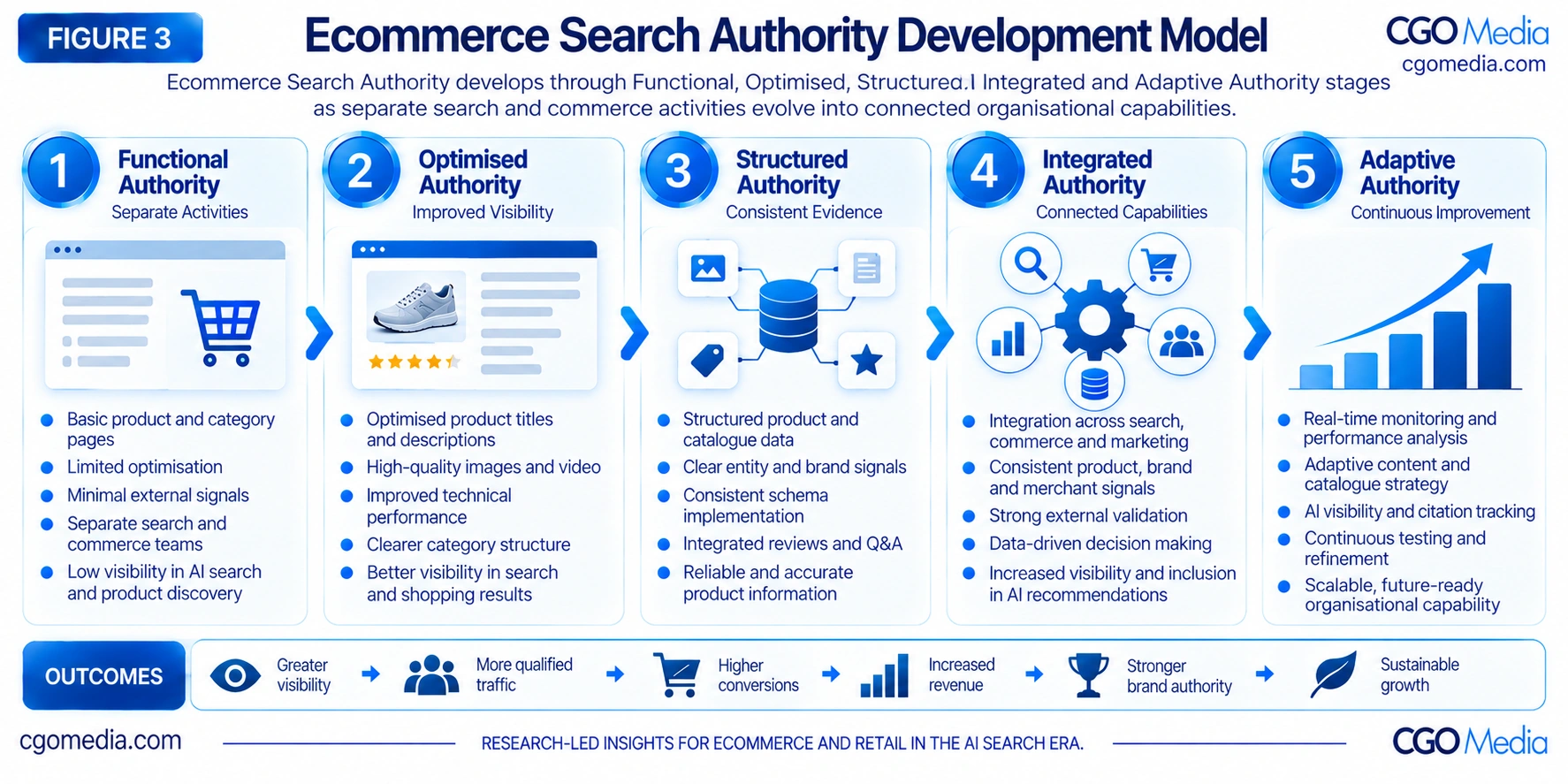
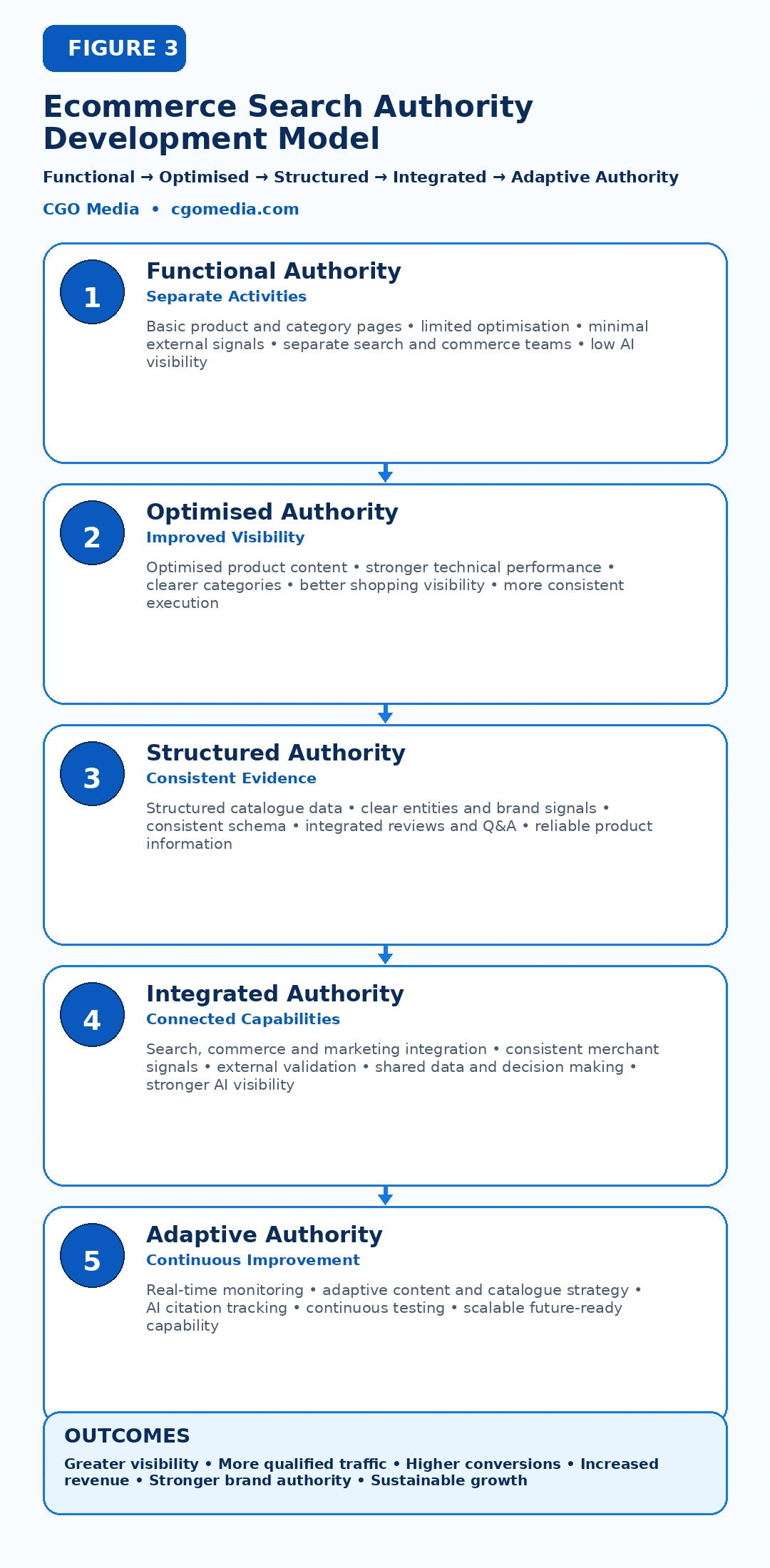
76. Capability Progression Across the Five Levels
Each of the eight Ecommerce Search Authority capabilities develops differently as the organisation progresses through the maturity model.
A retailer does not necessarily move every capability forward at the same speed.
Technical infrastructure may become highly advanced while merchant trust remains weak.
Product data may become well governed while external authority remains limited.
AI monitoring may be sophisticated while catalogue relationships remain inconsistent.
The purpose of capability progression is therefore to identify how each area evolves independently before understanding the overall organisational position.
The five levels can be interpreted as:
Functional → Optimised → Structured → Integrated → Adaptive
At each level, the organisation becomes progressively more capable of:
- maintaining accurate product information;
- governing catalogue relationships;
- strengthening merchant trust;
- developing external authority;
- monitoring AI representation;
- and responding to change.
Capability progression should therefore be assessed according to organisational behaviour rather than isolated outcomes.
A retailer may temporarily achieve excellent performance because:
- a major product becomes popular;
- a brand campaign succeeds;
- a marketplace generates large demand;
- or seasonal search increases.
These outcomes can be commercially valuable without demonstrating mature underlying capability.
The stronger question is:
Can the organisation reproduce, maintain and adapt that performance reliably as products, markets and discovery systems change?
77. Technical Search and Commerce Foundations — Functional
At the Functional level, the ecommerce website is broadly accessible but technical management remains reactive.
The organisation can usually support:
- product crawling;
- category indexation;
- basic ecommerce navigation;
- checkout;
- and fundamental search-engine discovery.
However, technical decisions may still be determined largely by platform defaults.
Common characteristics include:
- uncontrolled faceted URLs;
- reactive canonical fixes;
- inconsistent discontinued-product handling;
- limited structured-data governance;
- performance problems discovered after release;
- and weak technical monitoring.
The retailer can operate in search, but technical reliability depends heavily on manual intervention.
Search debt accumulates gradually as:
- new products launch;
- categories change;
- campaign pages multiply;
- filters expand;
- and old URLs remain accessible.
The defining characteristic is therefore:
Technical Search Exists, but It Is Not Yet Governed Systematically.
78. Technical Search and Commerce Foundations — Optimised
At the Optimised level, crawlability, performance, indexation and structured data are actively improved.
Technical teams begin monitoring:
- crawl behaviour;
- index coverage;
- Core Web Vitals and performance;
- canonical consistency;
- structured-data errors;
- redirects;
- and XML sitemap quality.
The organisation establishes more deliberate rules around:
- filters;
- sort parameters;
- internal search;
- campaign pages;
- and low-value generated URLs.
Product lifecycle handling also improves.
Instead of removing products inconsistently, the organisation may define more reliable treatment for:
- temporarily unavailable items;
- discontinued products;
- superseded models;
- and seasonal inventory.
Technical SEO therefore becomes proactive.
The limitation is that technical optimisation may still operate separately from:
- catalogue governance;
- merchandising;
- product-data systems;
- and marketplace operations.
79. Technical Search and Commerce Foundations — Structured
At the Structured level, technical systems support explicit relationships between categories, brands, products, variants and offers.
Search architecture begins reflecting catalogue logic directly.
This can include deliberate rules for:
- category hierarchy;
- brand pages;
- variant canonicalisation;
- product grouping;
- offer representation;
- faceted navigation;
- and structured data.
The retailer begins treating technical SEO as part of its commercial Knowledge Architecture.
For example:
A product’s variant relationship is no longer only a URL issue.
It also becomes a:
- catalogue issue;
- structured-data issue;
- feed issue;
- marketplace issue;
- and customer-experience issue.
This structural thinking reduces repeated local fixes.
Technical systems become increasingly aligned with the underlying product model.
80. Technical Search and Commerce Foundations — Integrated
At the Integrated level, Technical SEO is coordinated with catalogue systems, shopping feeds, marketplaces and commercial data.
Major changes involving:
- catalogue structure;
- new category creation;
- product migrations;
- international launches;
- variant changes;
- or platform releases
are assessed for their effect on search and distributed product evidence.
Technical teams no longer work independently from commercial systems.
For example, a catalogue migration can be planned across:
- URL architecture;
- redirects;
- category relationships;
- feeds;
- structured data;
- and marketplace continuity.
The organisation therefore manages technical search as one component of a wider commerce infrastructure.
Failures can be diagnosed across systems rather than only within the website.
81. Technical Search and Commerce Foundations — Adaptive
At the Adaptive level, technical systems continuously respond to catalogue, platform and discovery-environment changes.
The organisation expects change.
It therefore monitors for:
- unexpected URL growth;
- indexation shifts;
- performance degradation;
- schema failures;
- broken product relationships;
- feed inconsistencies;
- and platform changes.
Automated alerts can identify deviations from expected behaviour.
The organisation can then diagnose whether the cause sits within:
- the ecommerce platform;
- catalogue management;
- PIM;
- inventory;
- pricing;
- or distributed commerce systems.
Technical maturity therefore becomes adaptive because monitoring, ownership and correction form a continuous loop.
82. Retailer, Brand and Merchant Entity Authority Progression
Entity Authority develops from basic retailer identification toward continuous governance of retailers, stores, brands and merchant relationships across distributed commerce environments.
Functional
The retailer can be identified, but names, profiles, policies and external representations may be inconsistent.
Optimised
Important business profiles, marketplace identities and customer-facing information are reviewed and improved individually.
Structured
Explicit relationships are established between:
- retailer;
- parent organisation;
- brands;
- stores;
- regional storefronts;
- and marketplace seller profiles.
Integrated
Entity information is coordinated across ecommerce, merchant platforms, marketplaces, reviews and important external sources.
Adaptive
The organisation monitors entity consistency continuously as:
- new markets launch;
- brands are acquired;
- stores open or close;
- seller accounts change;
- and customer-service policies evolve.
Entity Authority therefore develops from:
Identity → Consistency → Structured Relationships → Cross-Channel Governance → Continuous Entity Maintenance
83. Catalogue, Category and Product Authority Progression
This capability develops from basic product grouping toward a connected ecommerce Knowledge Architecture.
Functional
Products are organised into operational categories so customers can browse the store.
Relationships may reflect ecommerce-platform or merchandising defaults.
Optimised
Priority categories and products are improved according to customer demand and commercial importance.
Internal linking and buying guidance become stronger.
Structured
The organisation defines explicit relationships across:
Department → Category → Brand → Product → Variant → Offer
Use cases and buying guidance can be connected to that structure where relevant.
Integrated
The same core catalogue relationships are reflected across:
- navigation;
- internal linking;
- product systems;
- structured data;
- feeds;
- and marketplaces.
Adaptive
Catalogue Architecture evolves according to:
- new products;
- changing customer terminology;
- new use cases;
- inventory changes;
- market changes;
- and commercial demand.
The progression is therefore:
Product Grouping → Category Optimisation → Catalogue Architecture → Integrated Product Relationships → Adaptive Commercial Knowledge Architecture
84. Product Evidence and Commercial Data Quality Progression
Information quality develops from basic product completeness toward systematic management of freshness, consistency, comparability and accuracy across multiple platforms.
Functional
Products contain enough information to support basic purchasing.
Evidence quality varies significantly between products.
Optimised
Priority products receive:
- better descriptions;
- stronger specifications;
- improved images;
- and more complete identifiers.
Structured
Product evidence standards are defined according to product category.
The organisation begins measuring completeness for:
- GTIN;
- MPN;
- brand;
- model;
- specifications;
- images;
- compatibility;
- and other important attributes.
Integrated
Core product facts are governed across:
- owned ecommerce;
- feeds;
- marketplaces;
- comparison platforms;
- and affiliate systems.
Channel-specific presentation can vary while underlying product truth remains aligned.
Adaptive
The organisation monitors commercial evidence continuously and uses:
- customer questions;
- returns;
- reviews;
- platform warnings;
- and AI inaccuracies
to identify product-data gaps.
The capability therefore progresses from:
Basic Information → Better Product Content → Governed Evidence → Distributed Consistency → Continuous Product Intelligence
85. Reviews, Merchant Trust and Customer Confidence Progression
Trust develops from passive review collection toward integrated review intelligence, delivery evidence, returns confidence and customer-experience improvement.
Functional
Product or retailer reviews exist, but activity is largely passive.
Policies may be available without being treated as strategic trust evidence.
Optimised
Review collection improves.
Delivery, returns and customer-service information become clearer.
Teams monitor ratings more actively.
Structured
The organisation distinguishes systematically between:
- Product Trust;
- Merchant Trust;
- delivery confidence;
- returns confidence;
- and customer-service confidence.
Integrated
Review themes are connected with:
- product information;
- returns;
- customer service;
- merchandising;
- and operational improvement.
Adaptive
The retailer monitors emerging trust concerns and responds before problems become systemic.
The progression can therefore be expressed as:
Reviews Exist → Reviews Are Managed → Trust Signals Are Structured → Trust Data Improves Operations → Trust Becomes Adaptive Intelligence
86. Brand, Publisher and External Authority Progression
External Authority develops from occasional product mentions toward strategic publisher relationships, independent reviews, original research and continuously evolving market authority.
Functional
Products or brands may receive media and publisher mentions without coordinated strategy.
Optimised
The organisation begins seeking more deliberate coverage around:
- priority products;
- brands;
- launches;
- and commercial categories.
Structured
External authority is connected with:
- Category Authority;
- Brand Authority;
- Product Authority;
- research;
- and recognised retail expertise.
Integrated
Digital PR, publishing, product launches, research and commercial strategy are coordinated around strategically important authority areas.
Adaptive
External Authority responds to:
- new categories;
- consumer trends;
- journalist demand;
- research opportunities;
- product launches;
- and evolving information needs.
The retailer therefore progresses from accidental recognition toward a continuously managed independent authority environment.
87. AI Search and Product Recommendation Visibility Progression
AI capability may progress through:
Occasional Testing → Repeatable Monitoring → Structured Prompt Sets → Source and Competitor Analysis → Adaptive AI Intelligence
Functional
Teams occasionally test AI assistants manually.
Observations are anecdotal.
Optimised
The retailer repeats selected prompts and begins recording whether products, brands and competitors appear.
Structured
Prompt sets are organised around:
- categories;
- products;
- features;
- budgets;
- use cases;
- brands;
- and retailer comparisons.
Integrated
The organisation analyses:
- recommendation visibility;
- citation patterns;
- source selection;
- competitor presence;
- and representation accuracy.
Findings are connected with product data, external authority and merchant trust.
Adaptive
Prompt sets and monitoring evolve as:
- AI platforms change;
- shopping interfaces develop;
- consumer language changes;
- and new product categories emerge.
The organisation increasingly uses AI visibility as commercial intelligence rather than as a novelty reporting channel.
88. Measurement and Governance Progression
Measurement progresses from basic traffic and revenue reporting toward integrated authority, selection and commercial intelligence.
Functional
Reporting concentrates on:
- traffic;
- orders;
- revenue;
- conversion;
- and ranking performance.
Ownership may remain informal.
Optimised
Category, product, feed, marketplace and review reporting become more detailed.
Teams develop clearer responsibilities within their own areas.
Structured
Capability measures emerge.
These can include:
- product-data completeness;
- category coverage;
- feed quality;
- review coverage;
- merchant consistency;
- external-authority development;
- and AI visibility.
Integrated
Authority metrics are connected with commercial outcomes.
Governance spans:
- SEO;
- merchandising;
- product data;
- customer experience;
- marketplaces;
- PR;
- and commercial leadership.
Adaptive
Measurement becomes an ongoing learning system.
Changes in:
- customer demand;
- product evidence;
- reviews;
- external authority;
- competitor behaviour;
- and AI discovery
inform future priorities.
Governance therefore develops from operational ownership toward continuous organisational adaptation.
89. Maturity Is Not Determined by Catalogue Size
A retailer with hundreds of thousands of products is not automatically more mature than a specialist merchant with a smaller catalogue.
Scale and maturity are different concepts.
A very large retailer may possess:
- extensive inventory;
- strong brand recognition;
- significant search traffic;
- and substantial revenue;
while still maintaining:
- weak product specifications;
- inconsistent identifiers;
- poor variant relationships;
- fragmented marketplace profiles;
- or weak review intelligence.
A specialist retailer with several thousand products may operate with:
- excellent catalogue governance;
- complete product evidence;
- strong category expertise;
- trusted merchant reviews;
- and sophisticated AI monitoring.
The smaller organisation could therefore demonstrate higher Search Authority maturity.
The maturity question is:
How effectively is the catalogue governed?
not:
How large is the catalogue?
90. Maturity Is Not Determined by Revenue Alone
High revenue can be generated through paid media, marketplaces or established brand demand without demonstrating advanced Search Authority capability.
Commercial success can arise from:
- brand recognition;
- offline reputation;
- paid acquisition;
- marketplace dominance;
- exclusive distribution;
- or strong pricing.
These strengths can produce excellent financial outcomes.
However, they do not necessarily indicate mature:
- Catalogue Authority;
- Product Evidence;
- Merchant Trust;
- External Authority;
- or AI readiness.
Revenue should therefore remain a core business metric without being used as a maturity proxy.
A mature organisation should be capable of explaining whether its commercial performance is supported by robust underlying authority systems.
91. Maturity Is Not Determined by Traffic Alone
Large organic traffic volumes do not necessarily indicate strong product evidence, merchant trust or AI recommendation readiness.
Traffic can be generated through:
- high-volume category queries;
- brand demand;
- informational content;
- legacy rankings;
- or broad product coverage.
The retailer may therefore attract significant visits while still experiencing:
- weak conversion;
- poor product comparison;
- high returns;
- low merchant trust;
- or inaccurate AI representation.
Traffic indicates discovery.
Maturity describes the organisation’s ability to support discovery with reliable commercial evidence.
The two concepts should therefore be measured separately.
92. Maturity Is About Organisational Capability
The central question is whether the organisation can repeatedly:
- maintain accurate product information;
- manage catalogue relationships;
- strengthen merchant trust;
- develop external validation;
- monitor AI representation;
- use commercial intelligence;
- and govern continuous improvement.
The word repeatedly is important.
A retailer may successfully optimise one major product launch.
Maturity asks whether the same quality can be reproduced across:
- future launches;
- new categories;
- new markets;
- new channels;
- and changing customer behaviour.
An organisation may conduct one excellent technical migration.
Maturity asks whether migration standards are documented and repeatable.
It may create one excellent buying guide.
Maturity asks whether guidance is integrated systematically into Category Authority.
It may perform one AI visibility study.
Maturity asks whether AI representation is monitored and acted upon continuously.
Search Authority maturity is therefore primarily an operating-model question.
93. Maturity Can Vary by Category
A retailer may have sophisticated authority in its core categories while newer or lower-priority categories remain less developed.
For example, one category may contain:
- complete product specifications;
- extensive buying guidance;
- strong product reviews;
- publisher recognition;
- and clear AI recommendation visibility.
Another category may contain:
- thin manufacturer descriptions;
- limited specifications;
- few reviews;
- weak internal linking;
- and little external authority.
Category-level maturity can therefore vary significantly within the same domain.
This is especially common where retailers:
- expand into new verticals;
- acquire new ranges;
- or have historically invested much more heavily in certain departments.
A mature assessment should therefore identify category differences rather than averaging them away.
This allows investment to follow the commercial and authority gap that matters most.
94. Maturity Can Vary by Market
International retailers may operate at different maturity levels across countries because catalogue quality, trust evidence and external authority differ by market.
One country may have:
- a complete local catalogue;
- excellent language localisation;
- strong merchant ratings;
- reliable delivery information;
- and substantial publisher coverage.
Another market may have:
- partial inventory;
- weak localisation;
- limited reviews;
- inconsistent pricing;
- and poor local authority.
The parent organisation may therefore be Integrated overall while one regional storefront remains Optimised or Functional.
International maturity should therefore be assessed at both:
Global Organisational Level
and:
Priority Market Level
This prevents strong headquarters capability from concealing local weaknesses.
95. Maturity Can Vary by Channel
An organisation may be highly mature in owned ecommerce while remaining dependent or weak within marketplace, shopping or AI discovery channels.
Owned ecommerce may provide:
- excellent catalogue structure;
- strong product information;
- complete reviews;
- and clear merchant trust.
Marketplace listings may still contain:
- weak specifications;
- inconsistent images;
- incorrect variant relationships;
- or poor seller information.
Likewise, the retailer may perform strongly within shopping feeds while being largely absent from AI-assisted product recommendation.
Channel maturity should therefore consider:
- owned search;
- shopping;
- marketplaces;
- publisher discovery;
- comparison platforms;
- and generative discovery.
The objective is not identical performance across channels.
It is sufficient authority and consistency within the channels that materially influence customer discovery and retailer selection.
96. Capability Imbalance
An organisation may possess:
- strong Technical SEO but weak reviews;
- strong catalogue depth but poor product freshness;
- strong marketplace visibility but weak owned authority;
- strong brand recognition but limited AI visibility;
- strong Product Authority but poor merchant service;
- or strong external media coverage but inconsistent product data.
These imbalances can restrict overall maturity.
A capability imbalance matters when the weaker area becomes a bottleneck within the product-discovery or purchase journey.
For example:
Technical Strength with Weak Product Evidence
The retailer may rank well while customers cannot compare products effectively because specifications are incomplete.
Strong Product Evidence with Weak Merchant Trust
Customers may understand the product completely but select another retailer because delivery, returns or merchant reviews create uncertainty.
Strong Marketplace Authority with Weak Owned Ecommerce
The retailer may depend heavily on a third-party marketplace for discovery and customer trust while possessing limited authority on its own domain.
Strong Brand Recognition with Weak AI Representation
Consumers may know the retailer well, while AI systems repeatedly omit it from relevant category recommendations or describe products inaccurately.
Strong External Authority with Weak Commercial Accuracy
Publishers may recommend the product while current price, availability or specifications remain inconsistent across channels.
Capability imbalance is therefore one of the most useful diagnostic outcomes of the maturity model.
The objective is not simply to raise every capability to the same level.
It is to identify which imbalance currently creates the greatest strategic constraint.
That analysis can be represented through the Ecommerce Search Capability Maturity Matrix.
The Ecommerce Search Capability Maturity Matrix maps the eight Ecommerce Search Authority capabilities across the five maturity levels, allowing retailers, brands and marketplaces to identify where different parts of the commerce authority system are developing at different speeds.
| Capability | Functional | Optimised | Structured | Integrated | Adaptive Authority |
|---|---|---|---|---|---|
| Technical Search & Commerce Foundations | Broadly accessible ecommerce infrastructure with reactive technical management. | Crawlability, performance, indexation, canonicalisation and structured data are actively improved. | Technical systems support deliberate category, product, variant and offer relationships. | Technical SEO is coordinated with catalogue systems, feeds, marketplaces and commercial data. | Automated monitoring and governance continuously respond to catalogue, platform and discovery changes. |
| Retailer, Brand & Merchant Entity Authority | Retailer identity exists but may vary across channels. | Important profiles, merchant information and external representations are improved individually. | Relationships between retailer, stores, brands, regional sites and marketplace sellers are explicitly defined. | Entity information is governed consistently across owned and distributed commerce environments. | Entity relationships are monitored and updated continuously as brands, stores, markets and channels change. |
| Catalogue, Category & Product Authority | Products are grouped into operational categories. | Priority categories and products are optimised individually. | Catalogue relationships are deliberately structured around categories, brands, products, variants, offers and use cases. | Catalogue relationships are reflected consistently across navigation, internal linking, data systems, feeds and commerce channels. | Catalogue Architecture evolves continuously according to inventory, demand, terminology, use cases and market changes. |
| Product Evidence & Commercial Data Quality | Products contain basic information needed for purchase. | Priority products receive stronger descriptions, specifications, images and identifiers. | Category-specific evidence standards and completeness requirements are governed. | Core product facts remain aligned across website, feeds, marketplaces and comparison environments. | Product information improves continuously through reviews, returns, customer questions, platform errors and discovery intelligence. |
| Reviews, Merchant Trust & Customer Confidence | Reviews and commercial policies exist but are managed largely reactively. | Review collection, merchant ratings, delivery, returns and customer-service information are improved. | Product Trust, Merchant Trust, delivery confidence and service evidence are managed as distinct but connected trust layers. | Review and trust data are connected with product, customer-service and operational improvement. | Emerging trust problems are detected early and used to adapt customer experience and product information continuously. |
| Brand, Publisher & External Authority | Independent product or retailer mentions occur without coordinated authority strategy. | External coverage is developed around priority products, brands and launches. | External authority is connected deliberately with category, product, brand and retail expertise. | Digital PR, publishing, research, commercial strategy and priority categories are coordinated. | External authority adapts continuously to product launches, consumer trends, publisher demand and changing market topics. |
| AI Search & Product Recommendation Visibility | Occasional manual testing with anecdotal observations. | Repeatable testing begins for selected product and retailer prompts. | Structured prompt groups monitor product, category, feature, use-case, brand and retailer visibility. | Source selection, competitor appearance, citations and representation accuracy are analysed systematically. | AI visibility becomes adaptive commercial intelligence as platforms, prompts, products and customer behaviour evolve. |
| Measurement & Governance | Reporting centres on traffic, rankings, revenue and conversion with limited authority ownership. | Channel-level reporting and ownership improve. | Capability measures such as data completeness, feed quality, review coverage and AI visibility are introduced. | Authority metrics are integrated with commercial reporting and cross-functional governance. | Continuous measurement, ownership, escalation and learning guide recurring authority improvement. |
Maturity-matrix principle: Ecommerce Search Authority should be assessed across multiple capabilities rather than through one overall traffic, revenue or ranking metric. Different parts of the same organisation can operate at materially different maturity levels.
Bottleneck principle: The most important maturity gap is often the weaker capability that restricts product discovery, comparison, merchant trust or commercial confidence despite stronger performance elsewhere.
Figure 4. The Ecommerce Search Capability Maturity Matrix assesses Technical Foundations, Entity Authority, Catalogue Authority, Product Evidence, Merchant Trust, External Authority, AI Visibility and Governance across the five maturity levels.
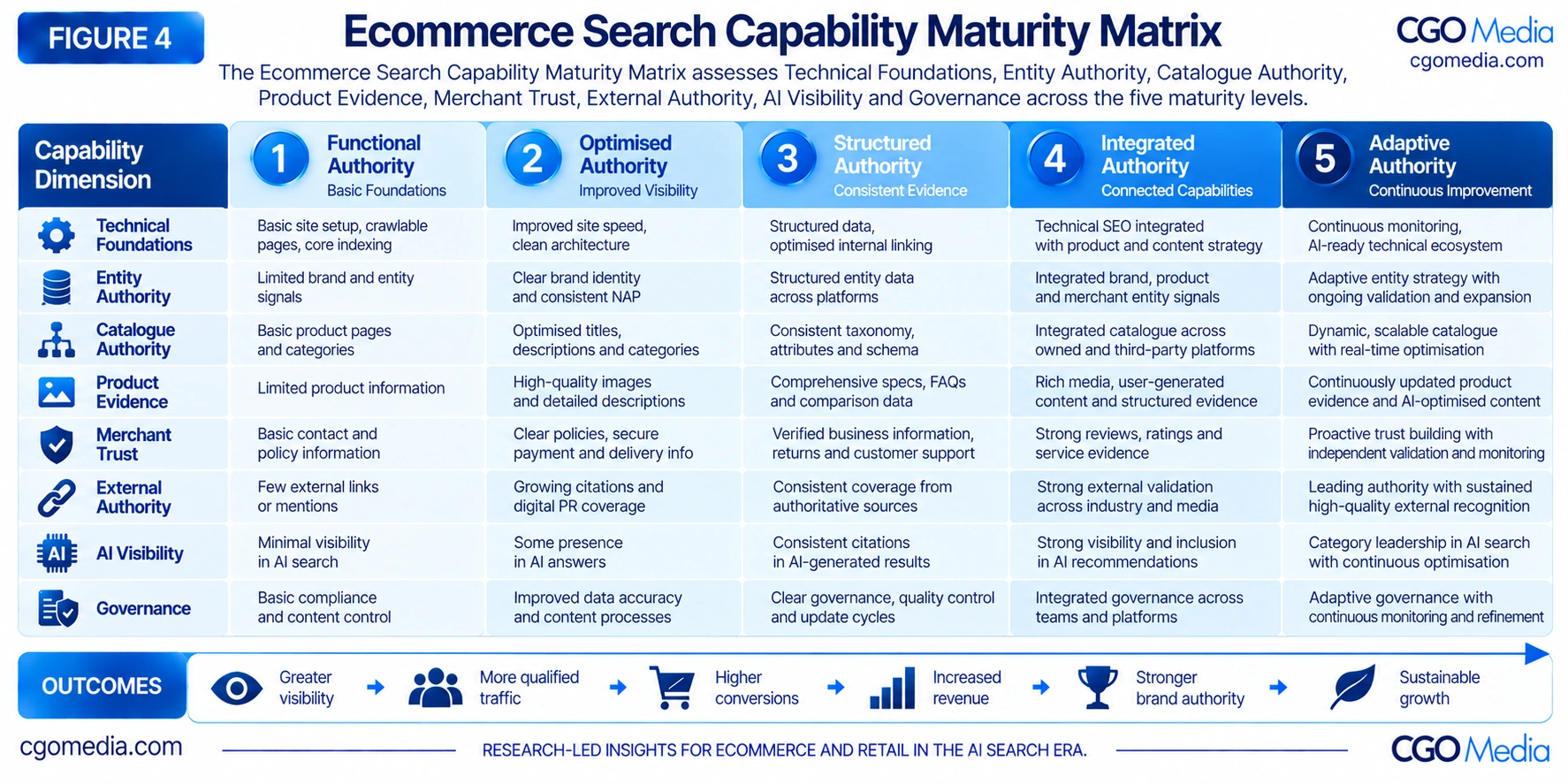
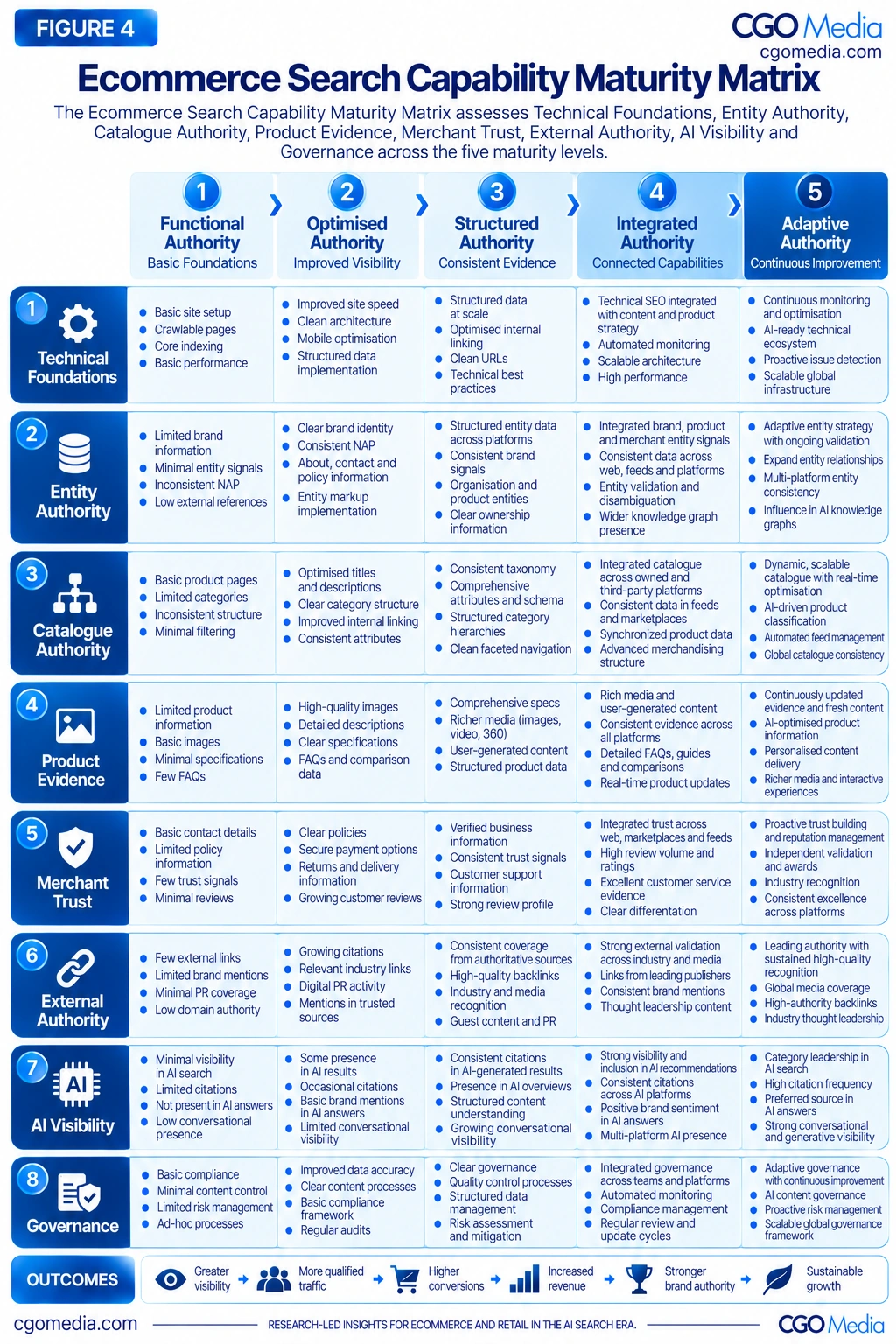
97. Identifying the Current Maturity Level
Organisations should evaluate each of the eight Ecommerce Search Authority capabilities independently before determining an overall maturity position.
This is important because ecommerce organisations rarely develop evenly.
One retailer may possess highly advanced technical search infrastructure while maintaining weak review governance.
Another may have excellent Product Authority but fragmented marketplace data.
Another may have strong brand visibility and external coverage but limited AI recommendation monitoring.
A useful maturity assessment should therefore begin with eight separate questions:
- How mature are our Technical Search and Commerce Foundations?
- How mature is our Retailer, Brand and Merchant Entity Authority?
- How mature is our Catalogue, Category and Product Authority?
- How mature is our Product Evidence and Commercial Data Quality?
- How mature are our Reviews, Merchant Trust and Customer Confidence systems?
- How mature is our Brand, Publisher and External Authority?
- How mature is our AI Search and Product Recommendation Visibility capability?
- How mature are our Measurement and Governance processes?
Each capability can then be positioned against the five levels:
Functional → Optimised → Structured → Integrated → Adaptive Authority
The assessment should examine how the organisation actually operates rather than how mature individual teams believe their work to be.
Evidence should therefore come from:
- documented processes;
- product data;
- technical systems;
- catalogue architecture;
- review systems;
- feed quality;
- marketplace performance;
- external authority;
- AI monitoring;
- and governance ownership.
Avoid Self-Classification by Reputation
Large and well-known retailers may assume that scale implies advanced maturity.
This can obscure important weaknesses.
A nationally recognised retailer may still operate with:
- poor variant governance;
- incomplete product identifiers;
- weak merchant-review analysis;
- fragmented marketplace data;
- or no structured AI monitoring.
Likewise, a smaller specialist retailer may operate with highly disciplined product data, strong external authority and excellent trust systems.
Maturity should therefore be evidenced rather than assumed.
98. The Lowest Capability Can Create a Bottleneck
A significant weakness in one capability can restrict the value created by stronger areas.
This is one of the most important principles within the maturity model.
For example, sophisticated AI monitoring provides limited strategic value if product price and availability data are frequently inaccurate.
Likewise:
- strong Product Authority can be undermined by weak merchant trust;
- excellent Catalogue Architecture can be weakened by poor technical indexation;
- strong publisher authority can be weakened by incomplete product specifications;
- and highly optimised shopping feeds can be weakened by inconsistent underlying product data.
The lowest capability therefore becomes strategically important when it interrupts:
- product discovery;
- product comparison;
- merchant trust;
- purchase confidence;
- or reliable AI representation.
Bottlenecks Are Contextual
The weakest capability is not always the most urgent capability.
A weakness becomes strategically important when it constrains a priority business objective.
For example:
- weak marketplace governance matters more to a marketplace-dependent retailer;
- weak local merchant trust matters more to an omnichannel retailer expanding geographically;
- weak product evidence matters more to a retailer competing heavily on comparison;
- and weak AI visibility may matter more where generative discovery is becoming an important customer pathway.
The maturity assessment should therefore identify not only:
Which capability is weakest?
but also:
Which weakness currently limits the most important commercial or discovery outcome?
99. Capability Imbalance as a Diagnostic Signal
Uneven maturity provides useful evidence about where the next investment may create the greatest improvement.
Capability imbalance should therefore be treated as a diagnostic signal rather than simply as a weakness.
For example, if the retailer has:
- Integrated Technical SEO;
- Structured Catalogue Authority;
- Functional Product Evidence;
- Optimised Merchant Trust;
- and Functional AI Monitoring;
the immediate priority is unlikely to be further technical sophistication.
The organisation may gain more from improving:
- product-data completeness;
- merchant evidence;
- or AI visibility governance.
Likewise, if product information and feeds are already mature but external authority remains weak, the next progression may involve:
- publisher relationships;
- independent product reviews;
- original research;
- or specialist category commentary.
Imbalance Can Reveal Organisational Silos
A strongly uneven maturity profile can also reveal where teams operate independently.
For example:
- SEO may be Integrated while product data remains Functional;
- marketplace teams may be Optimised while merchant entity governance remains weak;
- customer service may understand review themes while product teams never receive that intelligence;
- Digital PR may generate strong media authority without connecting it to priority categories.
Capability imbalance therefore often reflects organisational structure as much as technical capability.
100. Priority Should Follow the Strategic Constraint
The next maturity improvement should normally address the capability that most strongly constrains product discovery, trust, comparison or commercial performance.
This principle prevents the organisation from investing simply in whichever capability appears most fashionable or easiest to demonstrate.
A retailer should not automatically prioritise AI monitoring when basic product data remains unreliable.
It should not prioritise publisher outreach when:
- merchant reviews are deteriorating;
- price accuracy is poor;
- or category architecture is weak.
Likewise, a retailer with strong operational foundations may not need another major Technical SEO project if the real constraint is weak external authority.
A practical prioritisation model can consider:
- Commercial Importance — how strongly the capability affects revenue, conversion or strategic categories;
- Discovery Impact — whether the weakness limits search, shopping, marketplace or AI visibility;
- Trust Impact — whether the weakness reduces customer confidence;
- Data Risk — whether incorrect product information can create commercial or reputational problems;
- Implementation Dependency — whether other improvements depend on this capability being corrected first;
- Operational Effort — the resources required to progress the capability.
Priority can therefore be expressed conceptually as:
Strategic Constraint + Commercial Importance + Dependency + Feasibility = Maturity Priority
101. Progression Is Not Necessarily Linear
Organisations may temporarily move backwards in particular capabilities.
This can occur following:
- ecommerce platform migrations;
- large catalogue imports;
- acquisitions;
- international expansion;
- marketplace changes;
- product-data system changes;
- or rapid catalogue growth.
Platform Migration
A retailer may move from an Integrated technical environment to an Optimised or even Functional state during a major migration if:
- redirect mapping is incomplete;
- faceted navigation changes;
- structured data breaks;
- product relationships are lost;
- or feed integration changes.
Catalogue Acquisition
An acquired brand or product range may enter the business with:
- weak identifiers;
- different category logic;
- incomplete specifications;
- and separate review systems.
The organisation’s effective product-data maturity can therefore decline temporarily.
International Expansion
Launching a new market may introduce:
- different pricing;
- different stock;
- local-language requirements;
- new merchant entities;
- and unfamiliar review environments.
The new market may begin at a lower maturity level than the parent organisation.
Maturity should therefore be understood as dynamic.
Progression means developing the capability to recover and re-establish authority quickly after significant organisational change.
102. Maturity Requires Continuous Reassessment
Because products, prices, catalogues, customers and discovery systems change continuously, maturity should be reassessed periodically rather than treated as a permanent classification.
An organisation assessed as Integrated today may become less mature if:
- product data deteriorates;
- new markets are launched poorly;
- review quality declines;
- catalogue governance fragments;
- or new discovery environments emerge without ownership.
Likewise, an organisation can improve rapidly where:
- catalogue governance is strengthened;
- product standards are introduced;
- review intelligence is integrated;
- merchant identity is clarified;
- or AI monitoring becomes systematic.
A practical reassessment cycle may therefore include:
- regular operational monitoring;
- quarterly capability review;
- six-monthly maturity reassessment;
- and annual strategic benchmarking.
The objective is not bureaucratic scoring.
It is to ensure that maturity assumptions remain aligned with the organisation’s current operating reality.
103. Measuring Ecommerce Search Authority Maturity
Ecommerce Search Authority maturity should be measured across the eight capabilities rather than through a single ranking, traffic or revenue metric.
The objective is to understand whether the organisation is becoming more capable of maintaining accurate product information, managing catalogue relationships, strengthening merchant trust, developing external authority and adapting to AI-assisted discovery.
Measurement should therefore include both:
Performance Outcomes
and:
Capability Health
Performance Outcomes can include:
- traffic;
- orders;
- revenue;
- conversion;
- shopping performance;
- marketplace sales;
- and product visibility.
Capability Health can include:
- indexation quality;
- catalogue consistency;
- product-data completeness;
- merchant trust;
- external authority;
- AI representation accuracy;
- and governance quality.
The combination helps the organisation distinguish between:
Strong results supported by strong systems
and:
Strong results being generated despite weak systems.
This distinction is essential for long-term resilience.
104. Assessing Technical Search and Commerce Foundations
Technical maturity can be assessed through:
- crawlability;
- indexation quality;
- site performance;
- mobile usability;
- canonical management;
- faceted-navigation control;
- product lifecycle handling;
- and structured data quality.
Crawlability
Can important category and product resources be discovered efficiently without excessive low-value crawl paths?
Indexation Quality
Are important pages indexed consistently while duplicate, internal-search and low-value filter URLs remain controlled?
Site Performance
Can key commercial pages support a strong customer experience despite:
- large imagery;
- recommendation widgets;
- reviews;
- tracking;
- and personalisation?
Canonical Management
Do canonical rules reflect the actual preferred relationships between products, variants, categories and duplicate URLs?
Faceted Navigation
Does the retailer distinguish between:
- valuable search landing pages;
- useful crawl paths;
- and low-value generated filter combinations?
Product Lifecycle Handling
Are temporary stock issues, discontinued products, seasonal products and superseded models handled consistently?
Structured Data Quality
Does structured data accurately reflect the underlying product, offer, review and merchant evidence?
Technical maturity increases as these areas move from reactive issue fixing toward governed and monitored infrastructure.
105. Assessing Retailer, Brand and Merchant Entity Authority
Entity maturity can be evaluated through:
- retailer naming consistency;
- store information accuracy;
- brand relationship clarity;
- marketplace seller identity;
- external profile consistency;
- and customer-facing policy alignment.
Retailer Naming Consistency
Does the same retailer appear consistently across:
- owned ecommerce;
- business profiles;
- shopping environments;
- marketplaces;
- review platforms;
- and important external references?
Store Information Accuracy
For omnichannel retailers, are:
- store names;
- addresses;
- hours;
- contact details;
- and local services
represented accurately?
Brand Relationship Clarity
Can users and machine systems understand:
- which brands are owned;
- which brands are retailed;
- which brands are private label;
- and how brands relate to the retailer?
Marketplace Seller Identity
Are seller profiles recognisably connected to the same retail organisation where appropriate?
External Profile Consistency
Do major external profiles describe the retailer consistently enough to avoid identity fragmentation?
106. Assessing Catalogue, Category and Product Authority
This capability can be measured through:
- Catalogue Architecture;
- category depth;
- Brand Architecture;
- product relationships;
- variant clarity;
- internal linking;
- and use-case coverage.
Catalogue Architecture
Does the hierarchy make sense across:
Department → Category → Subcategory → Brand → Product → Variant
where appropriate?
Category Depth
Do strategically important categories contain enough:
- product breadth;
- decision guidance;
- brand context;
- and supporting content
to function as meaningful discovery hubs?
Brand Architecture
Are brands treated consistently as commercial entities rather than appearing only through filters or duplicate landing pages?
Product Relationships
Are customers given useful relationships between:
- alternatives;
- accessories;
- compatible products;
- and related categories?
Variant Clarity
Are different sizes, colours, models or configurations represented clearly?
Internal Linking
Does the internal linking environment reinforce meaningful catalogue relationships?
Catalogue maturity increases as these relationships become deliberate, consistent and maintainable.
107. Assessing Product Evidence and Commercial Data Quality
Relevant indicators include:
- price accuracy;
- availability accuracy;
- specification completeness;
- identifier consistency;
- image quality;
- product freshness;
- and cross-channel consistency.
Price Accuracy
Do website, feed, marketplace and major distributed representations show materially consistent pricing?
Availability Accuracy
Are customers and external systems given reliable information about whether products are:
- in stock;
- temporarily unavailable;
- pre-order;
- or discontinued?
Specification Completeness
Do products contain the attributes customers need to:
- evaluate;
- compare;
- check compatibility;
- and make informed purchase decisions?
Identifier Consistency
Are GTIN, MPN, model and brand attributes maintained correctly where applicable?
Image Quality
Do product images provide enough visual evidence to support confident purchase?
Product Freshness
Are:
- specifications;
- product status;
- offers;
- and commercial claims
updated as the product changes?
Product Evidence maturity is therefore not simply a content-quality question.
It is a commercial data-quality capability.
108. Assessing Reviews, Merchant Trust and Customer Confidence
Trust maturity can be evaluated through:
- retailer review authority;
- product review quality;
- delivery transparency;
- returns transparency;
- payment clarity;
- customer-service visibility;
- and complaint-resolution evidence.
Retailer Review Authority
Does the merchant possess sufficient current external review evidence to support customer confidence?
Product Review Quality
Do strategically important products have:
- recent feedback;
- sufficient review depth;
- and useful customer commentary?
Delivery Transparency
Are:
- delivery options;
- timescales;
- costs;
- and geographic limitations
clear before purchase?
Returns Transparency
Can customers understand:
- return periods;
- costs;
- conditions;
- and refund processes?
Payment Clarity
Are available payment options and relevant purchasing conditions represented accurately?
Customer-Service Visibility
Can customers identify a legitimate and appropriate support route easily?
Trust maturity rises as these areas become both reliable and integrated with wider customer-experience governance.
109. Assessing Brand, Publisher and External Authority
External Authority can be assessed through:
- independent reviews;
- publisher mentions;
- product comparisons;
- brand media coverage;
- industry recognition;
- research citations;
- and specialist references.
Independent Reviews
Do credible external reviewers evaluate strategically important products or categories?
Publisher Mentions
Is the retailer or brand referenced by publications relevant to its strongest commercial areas?
Product Comparisons
Do products appear within independent comparison environments where customers evaluate alternatives?
Brand Media Coverage
Does coverage reinforce real brand capabilities rather than simply mention the brand name?
Industry Recognition
Is the retailer recognised within relevant:
- trade publications;
- industry organisations;
- awards;
- or specialist communities?
Research Citations
Where the organisation produces original research, data or consumer insight, is that evidence being reused externally?
External Authority maturity should therefore consider relevance and quality as well as citation quantity.
110. Assessing AI Search and Product Recommendation Visibility
AI maturity can be evaluated through:
- product recommendation visibility;
- category visibility;
- brand comparison visibility;
- retailer recommendation visibility;
- AI citation visibility;
- representation accuracy;
- and competitor presence.
Product Recommendation Visibility
Do relevant products appear in prompts based on:
- use case;
- feature;
- budget;
- brand;
- or problem?
Category Visibility
Does the retailer appear in broader category-level shopping or recommendation questions where it is genuinely relevant?
Brand Comparison Visibility
Are owned or strategically important brands represented accurately when users compare alternatives?
Retailer Recommendation Visibility
Does the merchant appear when consumers ask where to buy particular products or categories?
AI Citation Visibility
Are first-party or credible external sources associated with the retailer’s products being surfaced or cited?
Representation Accuracy
Are important facts such as:
- price;
- availability;
- specifications;
- returns;
- and merchant identity
represented accurately?
AI maturity increases as monitoring moves from anecdotal observation toward systematic source analysis and evidence improvement.
111. Assessing Measurement and Governance
Governance maturity can be evaluated through:
- defined ownership;
- review cycles;
- documented standards;
- cross-team coordination;
- executive reporting;
- and continuous improvement processes.
Defined Ownership
Is responsibility explicit for:
- Technical SEO;
- catalogue structure;
- product data;
- pricing;
- availability;
- reviews;
- merchant policies;
- external authority;
- and AI monitoring?
Review Cycles
Are important capabilities reviewed according to the speed at which they can change?
Documented Standards
Are standards available for:
- product information;
- category creation;
- variant handling;
- structured data;
- reviews;
- and merchant information?
Cross-Team Coordination
Do SEO, merchandising, technology, customer experience, product-data and PR teams share enough information to manage Ecommerce Search Authority coherently?
Executive Reporting
Can leadership understand which authority capabilities are creating strategic risk or opportunity?
Continuous Improvement
Are maturity findings translated into:
- ownership;
- priorities;
- implementation;
- measurement;
- and reassessment?
112. Building the Ecommerce Search Authority Maturity Scorecard
A practical scorecard can assess each capability against the five maturity levels.
The purpose is not to generate an arbitrary overall score.
It is to identify:
- current maturity;
- capability imbalance;
- bottlenecks;
- priority progression questions;
- and organisational ownership.
Each capability should be assessed according to:
- current operating behaviour;
- available evidence;
- documented standards;
- degree of integration;
- measurement quality;
- and ability to adapt.
The core progression questions are:
Technical Search and Commerce Foundations
Can the technical environment support a changing ecommerce catalogue reliably?
Retailer, Brand and Merchant Entity Authority
Are retailer, brand, store and merchant relationships represented consistently?
Catalogue, Category and Product Authority
Does the organisation maintain a coherent ecommerce Knowledge Architecture?
Product Evidence and Commercial Data Quality
Is product information accurate, complete, current and comparable?
Reviews, Merchant Trust and Customer Confidence
Can customers transact with sufficient confidence?
Brand, Publisher and External Authority
Do credible external sources reinforce products, brands and retailer authority?
AI Search and Product Recommendation Visibility
Is AI representation monitored, understood and improved systematically?
Measurement and Governance
Is Ecommerce Search Authority embedded into ongoing operations?
The scorecard should be used comparatively over time.
A retailer may initially assess:
- Technical Foundations as Integrated;
- Catalogue Authority as Structured;
- Product Evidence as Optimised;
- Merchant Trust as Structured;
- External Authority as Optimised;
- AI Visibility as Functional;
- and Governance as Structured.
The value of the scorecard is not the label itself.
The value lies in exposing the capability profile.
That profile can then guide:
- budget;
- technology;
- staffing;
- data-quality work;
- content;
- Digital PR;
- and AI visibility development.
The scorecard therefore converts the maturity model into a practical management tool.
The Ecommerce Search Authority Maturity Scorecard translates the eight Ecommerce Search Authority capabilities into a repeatable assessment framework that can be used to identify bottlenecks, capability imbalances and priority areas for progression.
| Capability | Current Level | Key Progression Question |
|---|---|---|
| Technical Search & Commerce Foundations | Functional → Adaptive | Can the technical environment support a changing ecommerce catalogue reliably? |
| Retailer, Brand & Merchant Entity Authority | Functional → Adaptive | Are retailer, brand, store and merchant relationships represented consistently? |
| Catalogue, Category & Product Authority | Functional → Adaptive | Does the organisation maintain a coherent ecommerce Knowledge Architecture? |
| Product Evidence & Commercial Data Quality | Functional → Adaptive | Is product information accurate, complete, current and comparable? |
| Reviews, Merchant Trust & Customer Confidence | Functional → Adaptive | Can customers transact with sufficient confidence? |
| Brand, Publisher & External Authority | Functional → Adaptive | Do credible external sources reinforce products, brands and retailer authority? |
| AI Search & Product Recommendation Visibility | Functional → Adaptive | Is AI representation monitored, understood and improved systematically? |
| Measurement & Governance | Functional → Adaptive | Is Ecommerce Search Authority embedded into ongoing operations? |
Scorecard principle: The eight capabilities should be assessed independently before any overall maturity conclusion is formed. The objective is to identify the capability profile, not to produce an arbitrary headline score.
Progression principle: The highest-priority maturity improvement should normally address the capability currently creating the greatest constraint on discovery, Product Authority, Merchant Trust, comparison, AI representation or commercial performance.
Figure 5. The Ecommerce Search Authority Maturity Scorecard evaluates eight connected capabilities across Functional, Optimised, Structured, Integrated and Adaptive Authority levels.
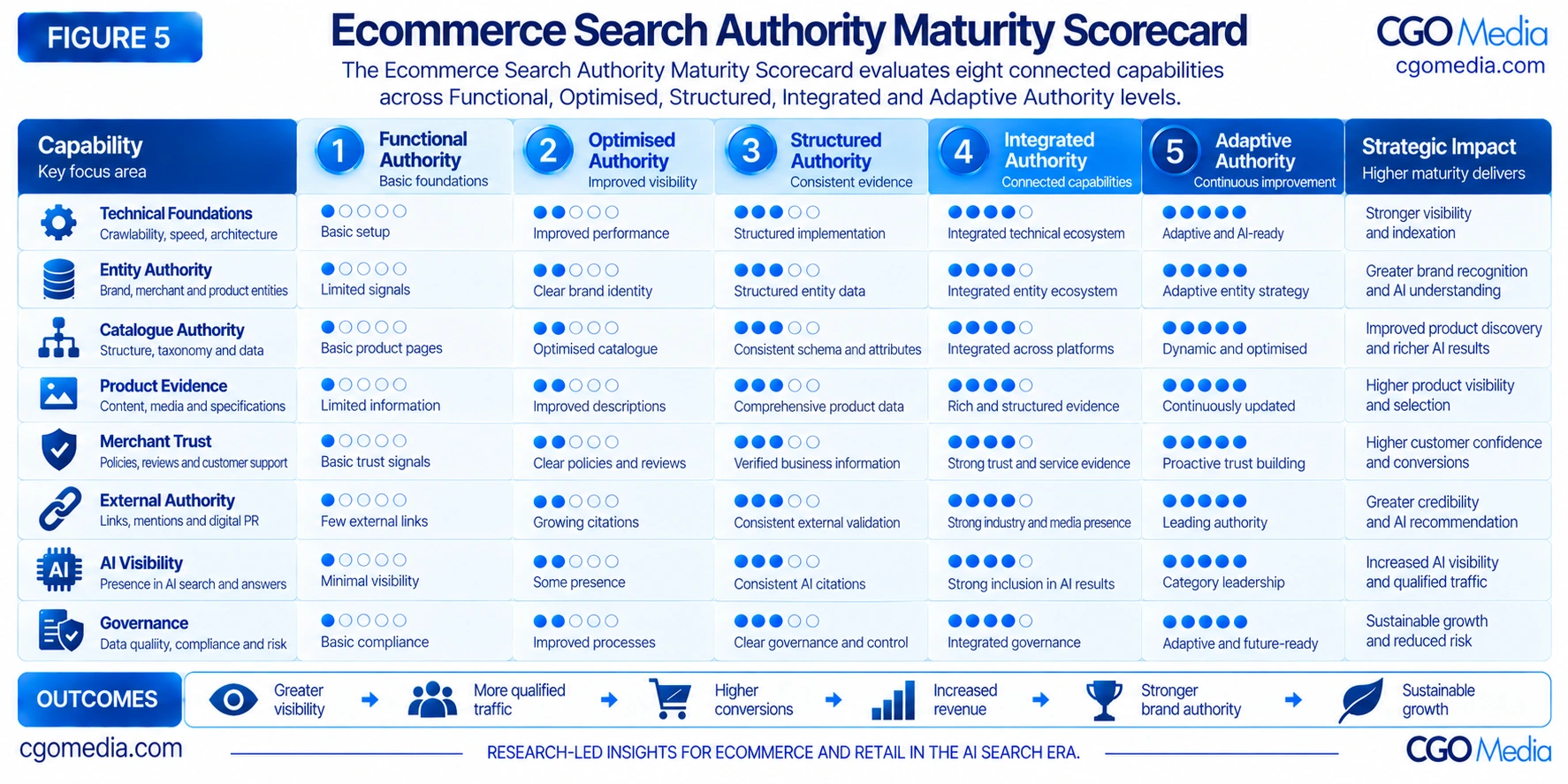
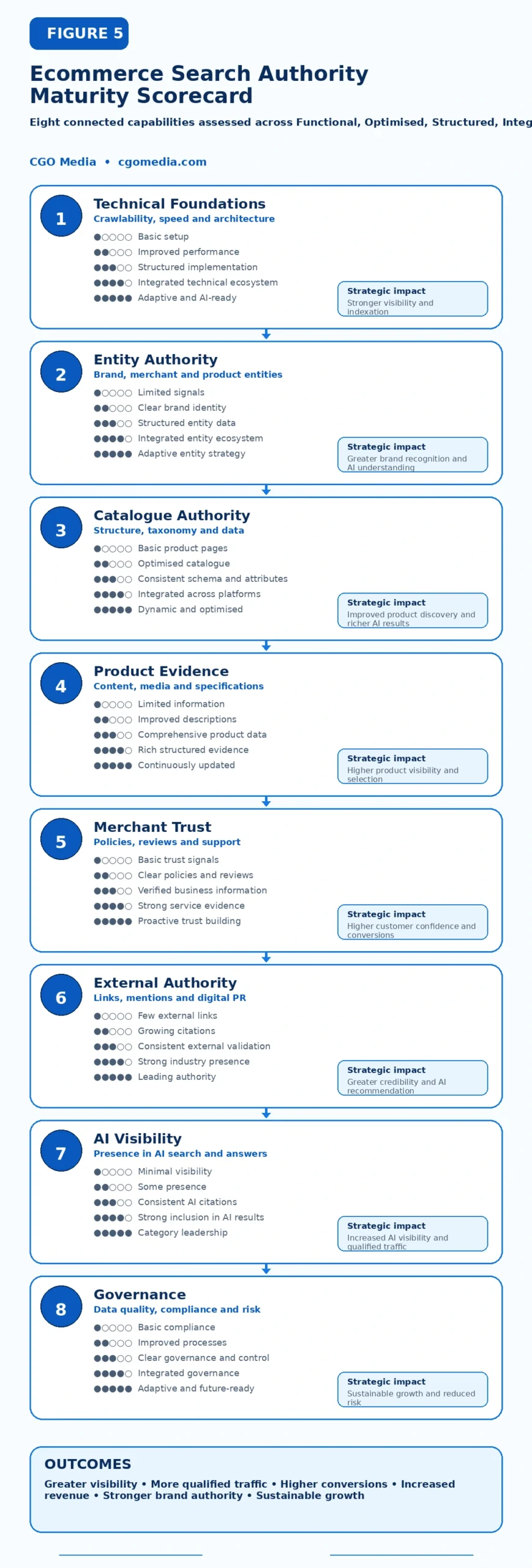
113. Maturity Benchmarking
Benchmarking can help ecommerce organisations determine whether maturity weaknesses are isolated, systemic or concentrated within particular categories, markets, channels or commercial functions.
The purpose of benchmarking is not to create a league table.
It is to create context.
A retailer may know that Product Evidence is weak overall.
Benchmarking helps answer:
- Is the weakness concentrated within one category?
- Does one market perform significantly better than another?
- Are owned ecommerce channels more mature than marketplaces?
- Do some brands maintain much stronger product information than others?
- Are particular stores or regions managing merchant trust more effectively?
Benchmarking can therefore reveal where stronger internal practices already exist.
Instead of designing every improvement from the beginning, the organisation may be able to identify:
- successful category structures;
- better product-data standards;
- stronger review processes;
- more mature market operations;
- or superior channel governance
within its own business.
These stronger areas can then provide internal models for wider maturity progression.
Benchmark Capability, Not Only Performance
Performance comparisons remain useful.
However, maturity benchmarking should examine underlying capability.
For example, two categories may generate similar revenue while operating with very different authority systems.
One may rely on:
- strong Product Authority;
- complete specifications;
- excellent reviews;
- and robust external validation.
Another may depend mainly on:
- brand demand;
- paid acquisition;
- or aggressive pricing.
Commercial performance alone would make the categories appear similar.
Capability benchmarking would reveal a significant maturity difference.
Benchmarking should therefore help the organisation understand:
Which parts of the business possess repeatable authority capability, and which depend on favourable commercial conditions?
114. Internal Benchmarking
Internal benchmarking compares different parts of the organisation using the same maturity framework.
Relevant comparison units can include:
- categories;
- brands;
- markets;
- stores;
- channels;
- product families;
- or operating teams.
This can reveal substantial differences that are hidden inside organisation-wide averages.
For example, one department may maintain:
- high product-data completeness;
- strong buying guidance;
- excellent review coverage;
- and strong external publisher authority.
Another department may operate with:
- manufacturer copy;
- weak specifications;
- limited review evidence;
- and inconsistent category structure.
An organisation-level average could conceal this difference.
Internal Benchmarking Supports Replication
One of the strongest uses of internal benchmarking is identifying practices that can be reproduced elsewhere.
The organisation can ask:
- Why does one category maintain better product completeness?
- Why does one country generate stronger merchant reviews?
- Why does one brand receive more publisher coverage?
- Why does one marketplace team experience fewer product-data errors?
- Why does one store network maintain stronger local authority?
The answers may reveal:
- better ownership;
- better technology;
- stronger standards;
- more experienced teams;
- or clearer review processes.
Internal benchmarking therefore transforms maturity assessment into organisational learning.
115. Category Benchmarking
A retailer may operate at an Integrated level within its strongest categories while newer or less-developed categories remain Functional or Optimised.
Category benchmarking can compare:
- technical health;
- category structure;
- product-data completeness;
- review coverage;
- buying guidance;
- publisher visibility;
- and AI recommendation presence.
This creates a category authority profile.
Category Depth
One category may contain:
- strong product breadth;
- clear subcategory structure;
- brand relationships;
- buying guides;
- and extensive customer reviews.
Another may contain a shallow collection of products with limited supporting evidence.
Product Evidence
Category benchmarking can identify whether specification completeness differs significantly between product groups.
For example, electronics may maintain detailed technical attributes while homeware products contain only minimal information.
External Authority
Some categories may receive extensive independent coverage while others remain almost entirely dependent on first-party evidence.
AI Visibility
AI recommendation visibility may also differ by category.
The retailer may appear frequently within one specialist product area while remaining largely absent from another strategically important category.
Category benchmarking therefore helps determine where maturity investment should be concentrated.
116. Market Benchmarking
International retailers may compare maturity across countries according to:
- Catalogue Quality;
- Local Trust;
- Publisher Authority;
- Shopping Visibility;
- and AI Visibility.
Different markets can operate with materially different authority conditions.
One country may have:
- complete localisation;
- accurate local pricing;
- strong reviews;
- excellent inventory integration;
- and substantial publisher recognition.
Another country may have:
- partial catalogue coverage;
- weak translation;
- poor merchant reviews;
- limited local availability information;
- and little external authority.
Local Merchant Trust
Merchant reputation may vary significantly by country because:
- delivery providers differ;
- returns processes differ;
- customer-service capability differs;
- and local review ecosystems differ.
Local Catalogue Quality
Not every country receives the same:
- product range;
- specification depth;
- local-language content;
- or inventory accuracy.
Local Publisher Authority
A retailer may possess substantial English-language external authority while receiving very limited recognition from publishers within another market.
AI Visibility by Market
AI-generated recommendations can also differ because local sources, local retailers and language environments change.
Market benchmarking therefore helps prevent strong global performance from masking weaker local authority.
117. Channel Benchmarking
Organisations can compare owned ecommerce, shopping feeds, marketplaces and physical stores to identify where authority is strongest and weakest.
A channel comparison might examine:
- product-data completeness;
- price consistency;
- availability accuracy;
- review strength;
- merchant identity;
- conversion;
- and customer confidence.
Owned Ecommerce
The organisation has the greatest control over:
- product information;
- category structure;
- merchant policies;
- and content.
Weaknesses within owned ecommerce therefore often reflect internal governance problems directly.
Shopping Feeds
Feed maturity can reveal how effectively product truth is distributed to external commerce platforms.
Marketplaces
Marketplace maturity may depend on:
- listing quality;
- seller identity;
- reviews;
- price competitiveness;
- availability;
- and fulfilment.
Physical Stores
For omnichannel retailers, store authority can include:
- local inventory;
- store profiles;
- opening hours;
- local reviews;
- and click-and-collect availability.
Channel benchmarking therefore helps determine whether the same retailer provides a consistently credible commercial experience across discovery environments.
118. Competitor Benchmarking
Competitor maturity cannot normally be observed perfectly from outside the organisation.
Internal systems, governance processes and data quality may not be visible publicly.
External benchmarking should therefore be treated as approximate.
However, visible evidence can still provide useful context.
Relevant comparison areas may include:
- technical performance;
- catalogue depth;
- product information quality;
- reviews;
- marketplace visibility;
- publisher authority;
- and AI recommendation presence.
Technical Performance
Observable differences may include:
- page performance;
- indexation quality;
- category architecture;
- and structured-data implementation.
Catalogue Depth
Competitor analysis can identify:
- category breadth;
- brand coverage;
- product range;
- and use-case architecture.
Product Information Quality
A competitor may provide significantly stronger:
- specifications;
- images;
- comparison tools;
- or buying guidance.
Reviews and Merchant Trust
Customer ratings and service evidence can reveal whether a competing retailer possesses stronger merchant confidence.
Publisher Authority
External reviews and media coverage can indicate where competitors have developed independent validation.
AI Recommendation Presence
Repeated AI testing may identify which competitors appear more frequently and which sources appear to support their visibility.
The purpose of competitor benchmarking is not to imitate every visible tactic.
It is to identify material authority gaps that affect competitive product discovery and retailer selection.
119. Maturity Governance
Progression requires coordinated ownership across:
- SEO;
- merchandising;
- product data;
- pricing;
- customer service;
- technology;
- Digital PR;
- and commercial leadership.
No single function can manage the complete Ecommerce Search Authority system.
SEO can improve:
- crawlability;
- indexation;
- search architecture;
- and visibility.
Merchandising influences:
- categories;
- product relationships;
- offers;
- and commercial priorities.
Product-data teams maintain:
- identifiers;
- specifications;
- attributes;
- and product relationships.
Pricing and inventory systems maintain highly volatile commercial facts.
Customer-service teams understand:
- complaints;
- delivery problems;
- returns;
- and recurring customer confusion.
Digital PR and communications develop:
- publisher relationships;
- external reviews;
- brand authority;
- and media recognition.
Commercial leadership determines:
- strategic categories;
- priority markets;
- investment;
- and risk tolerance.
Maturity governance therefore requires coordination rather than ownership by one specialist team.
120. Technical Ownership
Technical teams or responsible suppliers should maintain:
- crawlability;
- indexation;
- site performance;
- faceted navigation;
- structured data;
- and platform architecture.
Ownership should extend beyond issue fixing.
Technical governance should define standards for:
- URL creation;
- filter behaviour;
- canonical logic;
- redirect handling;
- product lifecycle states;
- rendering;
- XML sitemaps;
- and structured-data implementation.
Technical Ownership Requires Change Awareness
Technical teams should also understand which commercial changes can create search risk.
Examples include:
- category restructures;
- platform releases;
- new filter systems;
- product migrations;
- international expansion;
- and new personalisation tools.
A mature ownership model therefore connects Technical SEO with ecommerce product and merchandising roadmaps.
121. Catalogue Ownership
Catalogue ownership should define standards for:
- categories;
- brands;
- product types;
- variants;
- and product relationships.
Without clear ownership, catalogue structures can expand inconsistently.
Merchandising teams may create new categories.
SEO teams may create search landing pages.
Brand teams may request dedicated brand environments.
Product teams may introduce new classifications.
Over time, these changes can create:
- duplicate intent;
- unclear hierarchy;
- inconsistent product assignment;
- and weak internal linking.
Catalogue Standards
Governance should define:
- when a new category is justified;
- how products should be assigned;
- how brands are represented;
- how variants are grouped;
- how category retirement works;
- and which relationships require manual or automated linking.
Catalogue ownership therefore protects the integrity of the retailer’s commercial Knowledge Architecture.
122. Product Information Ownership
Responsibility should be clear for:
- price;
- availability;
- specifications;
- identifiers;
- images;
- and lifecycle status.
Different systems may own different fields.
For example:
- ERP may own stock;
- pricing platforms may own price;
- PIM may own specifications;
- the ecommerce platform may own presentation;
- and digital asset systems may own images.
Mature governance does not require one database to control everything.
It requires clear source-of-truth rules.
For each important product field, the organisation should know:
- which system owns it;
- who can change it;
- how frequently it updates;
- which channels receive it;
- and how discrepancies are detected.
This becomes particularly important for:
- price;
- availability;
- GTIN;
- MPN;
- model information;
- and product lifecycle.
Product Information Ownership therefore provides the foundation for reliable distributed commercial evidence.
123. Merchant Trust Ownership
Ownership should be defined for:
- reviews;
- delivery information;
- returns policies;
- customer service;
- and payment information.
These trust signals may sit across several teams.
Customer-service teams may manage complaints.
Operations may control delivery.
Legal or commercial teams may define returns.
Payments teams may manage transaction options.
Marketing teams may display review evidence.
Without coordination, customer-facing trust information can become inconsistent.
Review Ownership
The organisation should define:
- which review platforms matter;
- who responds;
- how serious issues are escalated;
- and how recurring themes reach operational teams.
Policy Ownership
Delivery and returns information should remain aligned across:
- product pages;
- help environments;
- checkout;
- marketplaces;
- and shopping platforms where applicable.
Merchant Trust Ownership therefore connects reputation with operational truth.
124. External Authority Ownership
Digital PR, brand and communications teams can coordinate:
- publisher outreach;
- product reviews;
- research;
- media commentary;
- and industry recognition.
External Authority should not be isolated from commercial strategy.
The organisation should identify:
- priority categories;
- priority products;
- specialist expertise;
- research opportunities;
- and areas where independent evidence would materially strengthen authority.
Product Review Strategy
Relevant independent reviewers can provide stronger authority than generic brand mentions where product recommendation is the objective.
Research and Data
Retailers with access to original customer or market data may create research capable of generating:
- journalist coverage;
- industry references;
- publisher links;
- and wider brand authority.
Expert Commentary
Category specialists can become useful external authorities where the retailer possesses genuine subject expertise.
External Authority Ownership therefore connects brand communication with the evidence required for search and AI discovery.
125. AI Monitoring Ownership
Responsibility should be defined for:
- prompt-set management;
- AI product recommendation tracking;
- AI retailer recommendation tracking;
- source analysis;
- representation accuracy;
- and competitor monitoring.
Without ownership, AI monitoring often becomes an occasional exercise performed by whichever team happens to be interested.
That creates inconsistent observations and little organisational learning.
Prompt-Set Management
The organisation should maintain documented prompt groups around:
- priority products;
- categories;
- use cases;
- budgets;
- features;
- brands;
- and retailer selection.
Recommendation Tracking
Monitoring should distinguish between:
- product appearance;
- brand appearance;
- retailer appearance;
- and explicit recommendation.
Source Analysis
Teams should record which:
- publisher;
- merchant;
- manufacturer;
- marketplace;
- or comparison sources
appear repeatedly.
Representation Accuracy
Material inaccuracies involving:
- price;
- stock;
- specifications;
- returns;
- or product identity
should be investigated through the underlying evidence environment.
AI Monitoring Ownership therefore ensures that observations lead to diagnosis rather than remaining anecdotal.
126. Maturity Review Cadence
A practical review cycle may include:
- weekly or monthly product-data monitoring;
- monthly operational reviews;
- quarterly capability reviews;
- six-monthly maturity reassessment;
- and annual strategic benchmarking.
Weekly or Monthly Product-Data Monitoring
High-volatility areas can include:
- price;
- stock;
- feed errors;
- marketplace discrepancies;
- and structured-data failures.
These may require frequent monitoring.
Monthly Operational Reviews
Monthly review can cover:
- technical health;
- product completeness;
- merchant reviews;
- feed quality;
- and significant AI representation issues.
Quarterly Capability Reviews
Quarterly analysis can assess whether:
- ownership is functioning;
- standards are being maintained;
- and strategic categories are progressing.
Six-Monthly Maturity Reassessment
The full maturity model can be reapplied to determine whether capability levels have changed materially.
Annual Strategic Benchmarking
Annual review can compare:
- markets;
- categories;
- channels;
- competitors;
- and commercial priorities.
The cadence should be proportionate to business volatility.
A rapidly changing marketplace retailer may require more frequent review than a specialist merchant with a stable catalogue.
127. Common Maturity Risks
Several recurring mistakes can prevent meaningful maturity progression.
These risks matter because organisations can invest heavily in ecommerce technology, SEO or AI while leaving foundational authority problems unresolved.
The most common risks include:
- attempting to jump maturity levels;
- mistaking catalogue scale for capability;
- investing in AI without reliable product data;
- fragmented ownership;
- overdependence on marketplaces;
- and treating maturity assessment as static.
Each risk reflects the same underlying problem:
advanced activity being layered onto insufficient organisational capability.
The maturity model can therefore be used as a sequencing framework.
Before investing heavily in a new capability, the organisation should determine whether the underlying dependencies are sufficiently mature.
128. Risk One — Attempting to Jump Levels
An organisation may invest in advanced AI monitoring while basic product information, Catalogue Architecture or Merchant Trust remains weak.
This creates the appearance of maturity without the underlying authority foundation.
For example, the retailer may invest in:
- AI recommendation tracking;
- large prompt libraries;
- advanced dashboards;
- or specialist GEO consultancy;
while many products still contain:
- missing identifiers;
- weak descriptions;
- incorrect availability;
- poor variant relationships;
- or limited merchant evidence.
The AI monitoring may accurately reveal weak visibility.
However, the organisation may lack the foundational evidence required to improve that visibility meaningfully.
Progression should therefore respect dependencies.
A typical sequence is:
Reliable Technical Foundations → Structured Catalogue → Strong Product Evidence → Merchant Trust → External Authority → Advanced AI Monitoring
The sequence does not need to be perfectly linear, but foundational weaknesses should not be ignored.
129. Risk Two — Mistaking Catalogue Size for Maturity
Publishing more products does not automatically create a more mature ecommerce authority system.
Catalogue growth can actually increase authority risk if governance does not scale with it.
Rapid expansion can create:
- duplicate categories;
- missing identifiers;
- thin product information;
- poor variant management;
- weak internal linking;
- feed errors;
- and inconsistent images.
The organisation may therefore increase inventory while reducing average evidence quality.
A mature catalogue should scale standards alongside assortment.
Relevant questions include:
- Can new products be onboarded with complete data?
- Can categories expand without creating duplication?
- Can variants be governed consistently?
- Can inventory and price remain synchronised?
- Can product lifecycle states be managed at scale?
Catalogue size is a commercial characteristic.
Catalogue maturity is an organisational capability.
130. Risk Three — AI Investment Without Reliable Product Data
Advanced recommendation monitoring provides limited value if price, stock and specifications are frequently inaccurate.
Generative systems may draw on distributed commercial evidence.
Where that evidence is inconsistent, inaccurate representation becomes more likely.
Common underlying weaknesses include:
- stale prices;
- outdated marketplace listings;
- incomplete specifications;
- incorrect variant information;
- missing product identifiers;
- and archived product pages remaining highly visible.
The organisation may be tempted to treat inaccurate AI output as purely an AI problem.
In many cases, the stronger first question is:
What evidence exists publicly that could have produced this interpretation?
The organisation can then investigate:
- first-party pages;
- feeds;
- marketplaces;
- publisher reviews;
- comparison sites;
- and historical sources.
Reliable product data therefore remains a prerequisite for advanced AI visibility work.
131. Risk Four — Fragmented Ownership
Authority weakens when SEO, merchandising, product data, reviews, marketplaces and customer experience operate without common standards.
Fragmented ownership can produce:
- conflicting category structures;
- inconsistent product attributes;
- different merchant policies across channels;
- duplicated content work;
- unclear escalation;
- and weak accountability.
For example:
SEO may identify a category opportunity.
Merchandising may already maintain a similar category under another name.
Product teams may assign products differently.
Marketplace teams may use yet another classification.
Without shared governance, each team can make a locally reasonable decision that weakens the overall authority architecture.
The corrective principle is:
Distributed Ownership + Shared Standards + Clear Source of Truth
Not every function needs to sit in one team.
The organisation does need common rules where evidence overlaps.
132. Risk Five — Overdependence on Marketplaces
Strong marketplace performance can conceal weak first-party brand and retailer authority.
A retailer may generate substantial revenue through:
- Amazon;
- eBay;
- specialist marketplaces;
- or regional ecommerce platforms.
This can be commercially successful.
However, heavy dependence can create strategic weaknesses.
The retailer may possess limited:
- owned search visibility;
- direct customer relationships;
- first-party review evidence;
- brand authority;
- or control over product presentation.
Marketplace policy changes can also affect:
- visibility;
- fees;
- seller eligibility;
- fulfilment;
- and customer access.
The maturity model does not imply that marketplace dependence is inherently poor.
For many businesses, marketplaces are strategically important.
The risk occurs when marketplace authority substitutes completely for first-party Product and Merchant Authority.
A more resilient model builds:
Marketplace Authority + Owned Brand Authority + Reliable Product Evidence
133. Risk Six — Static Maturity Assessment
A maturity classification quickly becomes less useful if it is never reassessed.
Ecommerce environments change continuously.
The organisation may:
- launch new categories;
- change ecommerce platforms;
- expand internationally;
- acquire brands;
- change fulfilment providers;
- introduce new review systems;
- or enter new marketplaces.
Search and AI environments also change.
A maturity assessment completed one year earlier may therefore no longer describe the organisation accurately.
Maturity Can Decline
Capability can deteriorate when:
- ownership changes;
- standards are not maintained;
- product data grows faster than governance;
- or technology migrations introduce new weaknesses.
Maturity Can Advance Rapidly
Likewise, targeted improvements can move capabilities forward quickly where:
- standards are documented;
- ownership is clarified;
- systems are integrated;
- and monitoring becomes reliable.
Maturity assessment should therefore operate as a recurring management process rather than a one-time workshop.
134. Application for Pure-Play Ecommerce Retailers
Pure-play retailers can use the model to assess progression across:
- Technical Commerce;
- Catalogue Architecture;
- Product Evidence;
- Merchant Trust;
- Shopping Feeds;
- and AI Recommendation Visibility.
Pure-play organisations often rely heavily on digital discovery.
Their maturity profile may therefore place significant emphasis on:
- technical resilience;
- category structure;
- product-data completeness;
- online reviews;
- and distributed shopping visibility.
Technical Dependence
Because the website is the primary store, technical failures can directly affect:
- discovery;
- customer experience;
- and revenue.
Merchant Trust
Pure-play retailers may need particularly strong evidence around:
- delivery;
- returns;
- payment security;
- reviews;
- and customer service.
Customers cannot always rely on physical-store familiarity.
AI Recommendation Visibility
As product discovery becomes more distributed, pure-play retailers should understand whether AI systems identify both their products and the retailer itself in relevant recommendation scenarios.
135. Application for Omnichannel Retailers
Omnichannel organisations may additionally assess:
- Store Entity Authority;
- local inventory;
- click and collect;
- store reviews;
- and online and offline integration.
Store Entity Authority
Each physical store may require accurate:
- name;
- address;
- opening hours;
- contact information;
- services;
- and local merchant evidence.
Local Inventory
Customers may need to know whether a product is available:
- online;
- in a nearby store;
- for collection;
- or for local delivery.
Click and Collect
Click-and-collect capability connects:
- product availability;
- store entities;
- inventory;
- and customer fulfilment.
Store Reviews
Local store reputation may differ from national retailer reputation.
A mature omnichannel model therefore manages both:
Retailer-Level Trust
and:
Store-Level Trust
Online and Offline Integration
The highest maturity emerges when customers can move reliably between:
- search;
- product discovery;
- local inventory;
- store selection;
- purchase;
- collection;
- returns;
- and reviews.
136. Application for Consumer Brands
Consumer brands can assess maturity across:
- Brand Entity Clarity;
- Product Authority;
- retail distribution;
- independent validation;
- research;
- and AI brand visibility.
Brands that sell directly and through retailers operate within a particularly distributed evidence environment.
A product may appear through:
- the brand website;
- retailer sites;
- marketplaces;
- publisher reviews;
- comparison sites;
- and social platforms.
Brand Entity Clarity
The organisation should make relationships clear between:
- parent company;
- brand;
- product families;
- individual products;
- and authorised retail channels.
Product Authority
Brand-owned evidence should provide:
- accurate specifications;
- model relationships;
- product support;
- compatibility;
- and lifecycle information.
Independent Validation
Publisher reviews, customer feedback and expert coverage can provide evidence beyond brand claims.
AI Brand Visibility
Brands can monitor whether:
- products are recommended;
- brand comparisons are accurate;
- and authorised product evidence is reflected correctly.
137. Application for Marketplaces
Marketplaces may place particular emphasis on:
- catalogue scale;
- seller identity;
- product quality;
- review systems;
- comparison architecture;
- and transactional trust.
Catalogue Scale
Large marketplaces may contain millions of listings.
Maturity depends on controlling:
- duplicate products;
- seller listings;
- variants;
- category assignments;
- and identifiers.
Seller Identity
The marketplace must distinguish clearly between:
- product;
- brand;
- seller;
- and fulfilment provider.
Product Quality
Marketplace Product Authority depends partly on enforcing minimum evidence standards for sellers.
Review Systems
Marketplaces may maintain both:
- product reviews;
- and seller ratings.
These should remain conceptually distinct.
Comparison Architecture
The platform should allow customers to compare equivalent products and offers without confusing separate items or variants.
Transactional Trust
Payment, fulfilment, returns, fraud prevention and seller accountability become central authority capabilities.
138. Application for Fashion Retail
Fashion retailers may prioritise:
- variant architecture;
- size and fit data;
- visual evidence;
- returns confidence;
- and seasonal catalogue management.
Variant Architecture
Fashion products often contain many combinations of:
- size;
- colour;
- fit;
- length;
- and style.
Weak variant management can create:
- duplicate URLs;
- incorrect stock information;
- fragmented reviews;
- and confusing product selection.
Size and Fit Data
Customers may depend heavily on:
- size guides;
- fit descriptions;
- model information;
- and review feedback.
Visual Evidence
Images and video can become central Product Authority signals because appearance, fit and styling strongly affect purchase.
Returns Confidence
Returns policies may influence retailer selection significantly within fashion because fit uncertainty remains high.
Seasonal Catalogue Management
Collections change rapidly.
Mature retailers need reliable processes for:
- launching new ranges;
- retiring seasonal pages;
- handling unavailable variants;
- and preserving useful category authority.
139. Application for Consumer Electronics
Electronics retailers may place greater emphasis on:
- specification accuracy;
- model identity;
- compatibility;
- comparison authority;
- and product lifecycle management.
Specification Accuracy
Technical attributes can determine whether a product is suitable.
Incorrect information can create:
- poor purchase decisions;
- returns;
- support issues;
- and inaccurate product comparisons.
Model Identity
Electronics frequently contain:
- similar model names;
- generation changes;
- regional variants;
- and manufacturer codes.
Clear model identity is therefore essential.
Compatibility
Customers may need explicit information regarding:
- devices;
- operating systems;
- connectors;
- standards;
- or accessories.
Comparison Authority
Electronics discovery frequently involves direct feature comparison.
Product evidence should therefore be sufficiently structured and consistent to support meaningful comparison.
Product Lifecycle Management
Models can be replaced rapidly.
Mature retailers should distinguish clearly between:
- current models;
- previous generations;
- refurbished products;
- and discontinued products.
140. Application for International Ecommerce
International retailers may additionally assess:
- multilingual Catalogue Architecture;
- regional pricing;
- regional inventory;
- local Merchant Trust;
- cross-border delivery;
- and market-specific AI visibility.
Multilingual Catalogue Architecture
Products, categories and attributes should be localised without fragmenting the underlying product identity unnecessarily.
The organisation may need to manage:
- different terminology;
- different category expectations;
- different measurement systems;
- and different regulatory information.
Regional Pricing
Prices may vary because of:
- currency;
- tax;
- market strategy;
- promotions;
- or local distribution.
Regional price evidence should remain clear and internally consistent.
Regional Inventory
A product available in one country may be unavailable in another.
Search, shopping and AI environments should therefore not assume global availability.
Local Merchant Trust
Customer trust can depend on:
- local delivery;
- local returns;
- local customer service;
- local reviews;
- and familiar payment methods.
Cross-Border Delivery
Where products ship internationally, customers may need clear evidence around:
- delivery times;
- customs;
- duties;
- returns;
- and warranty support.
Market-Specific AI Visibility
AI recommendation behaviour may differ by:
- language;
- country;
- local sources;
- and available retailers.
International maturity therefore requires both global product consistency and local commercial relevance.
141. Continuous Ecommerce Search Maturity Development
The maturity model should ultimately operate as a continuous improvement system.
A practical cycle is:
Assess → Identify Capability Gaps → Prioritise Improvements → Implement → Measure → Reassess
Assess
Evaluate the eight Ecommerce Search Authority capabilities against the five maturity levels.
Assessment should use evidence from:
- technical systems;
- catalogue structures;
- product data;
- merchant reviews;
- external authority;
- AI monitoring;
- and governance processes.
Identify Capability Gaps
Determine where authority progression is being restricted.
Common gaps may involve:
- technical debt;
- weak category structure;
- incomplete product evidence;
- poor Merchant Trust;
- limited external validation;
- weak AI monitoring;
- or fragmented ownership.
Prioritise Improvements
Not every gap should be addressed simultaneously.
Priorities should reflect:
- commercial importance;
- strategic dependency;
- customer impact;
- search impact;
- risk;
- and implementation feasibility.
The organisation should focus first on the capability most likely to unlock broader progression.
Implement
Improvements can involve:
- technical changes;
- catalogue restructuring;
- PIM improvements;
- review processes;
- merchant-policy updates;
- Digital PR;
- AI monitoring;
- or governance changes.
Implementation should include ownership and measurable outcomes.
Measure
Evaluate whether the intervention improved:
- capability health;
- discovery;
- customer confidence;
- commercial performance;
- or representation accuracy.
Measurement should include both:
Authority Improvement
and:
Commercial Outcome
where appropriate.
Reassess
The organisation then reapplies the maturity framework.
Some gaps may have improved.
Others may have become more important.
New technologies, markets, products or competitors may create entirely new constraints.
The cycle therefore begins again.
Continuous maturity development can be represented as:
Current Capability → Identified Constraint → Targeted Improvement → Measured Outcome → New Capability Position
This prevents maturity from becoming a static label.
Instead, it becomes a practical operating system for strengthening Ecommerce Search Authority over time.
The Ecommerce Search Authority Maturity Improvement Cycle presents maturity development as a continuous process in which ecommerce organisations assess current capability, identify the most important authority gaps, prioritise improvements, implement change, measure outcomes and reassess their position.
1. Assess
Evaluate Technical Foundations, Entity Authority, Catalogue Authority, Product Evidence, Merchant Trust, External Authority, AI Visibility and Governance against the five maturity levels.
2. Identify Capability Gaps
Determine which authority weaknesses are limiting product discovery, comparison, Merchant Trust, distributed commercial accuracy, AI representation or commercial performance.
3. Prioritise Improvements
Rank capability gaps according to commercial importance, customer impact, dependency, risk and implementation feasibility.
4. Implement
Apply targeted improvements across technical systems, Catalogue Architecture, product data, trust evidence, external authority, AI monitoring or organisational governance.
5. Measure
Assess changes in authority health, discovery, data quality, customer confidence, external validation, AI representation and relevant commercial outcomes.
6. Reassess
Reapply the maturity framework to establish the new capability profile, identify remaining bottlenecks and redefine the next improvement priority.
Continuous-maturity principle: Ecommerce Search Authority maturity is not a permanent status. Product ranges, markets, technology, customer expectations and AI-powered discovery systems change continuously, requiring repeated assessment and adaptation.
Improvement principle: The strongest maturity progression normally occurs when organisations identify the specific capability constraining discovery, Product Authority, Merchant Trust or commercial confidence and improve that capability before moving to the next bottleneck.
Figure 6. Ecommerce Search Authority maturity develops through continuous assessment, capability-gap identification, prioritisation, implementation, measurement and reassessment.
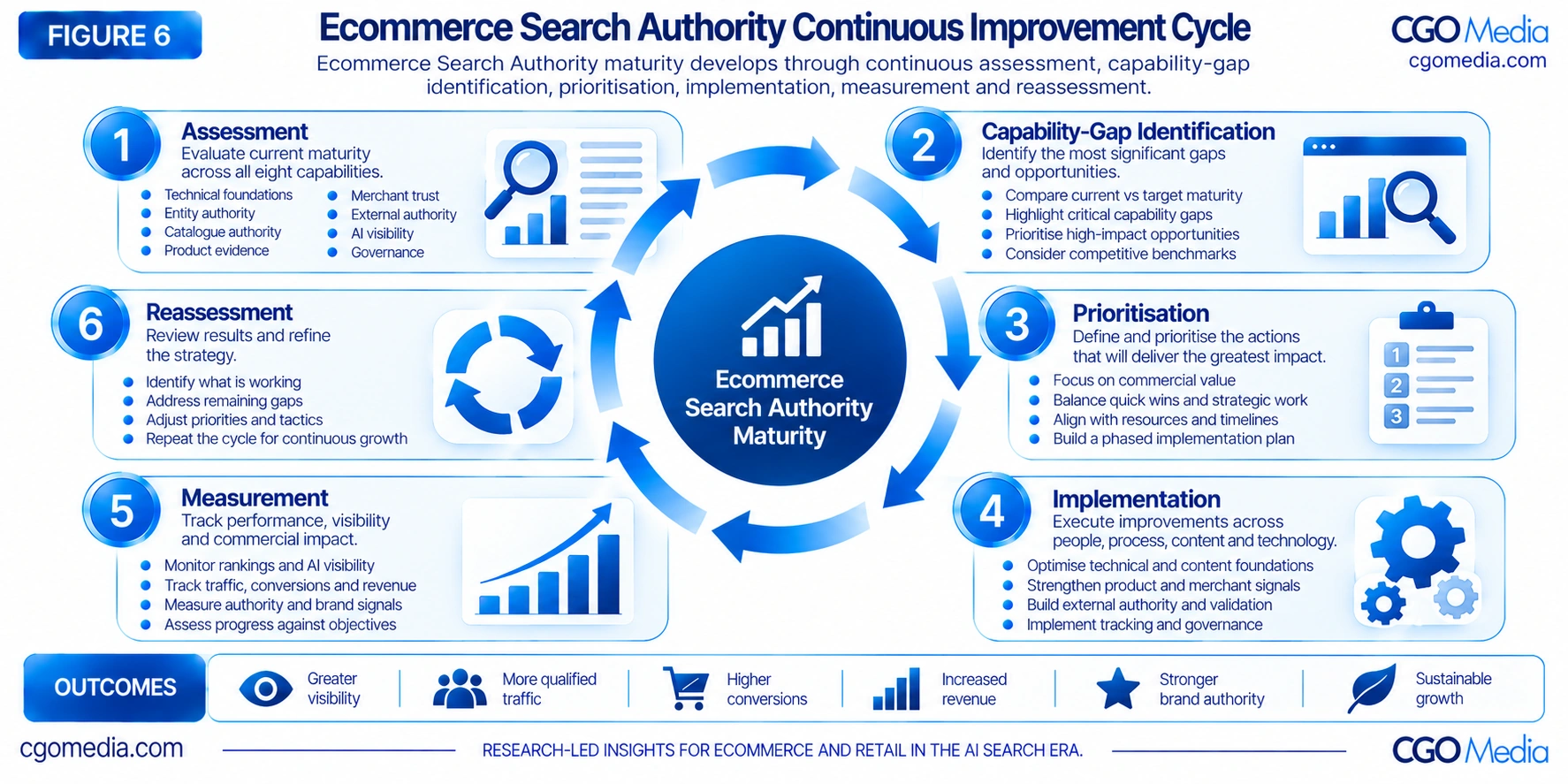
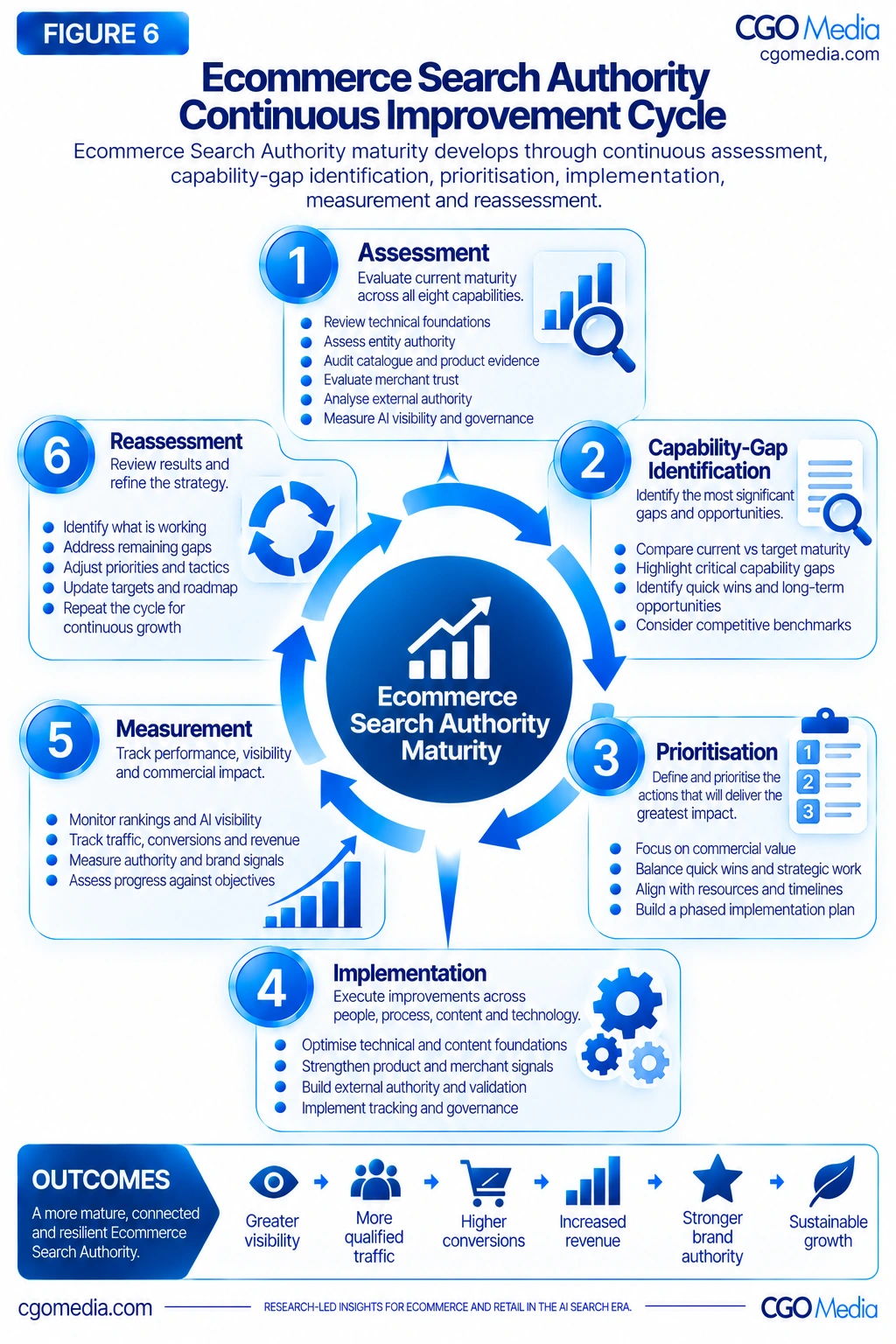
142. Relationship with the Ecommerce & Retail AI Trust and Visibility Framework™
The
Ecommerce & Retail AI Trust and Visibility Framework
defines the evidence conditions that strengthen product, retailer, merchant and recommendation authority.
The Ecommerce Search Authority Maturity Model evaluates how advanced an organisation has become in building, connecting, maintaining and governing those conditions.
The relationship between the two resources can therefore be expressed as:
Trust and Visibility Framework → Defines the Evidence Required
Maturity Model → Evaluates How Capably the Organisation Produces and Governs That Evidence
The Trust and Visibility Framework examines areas such as:
- retailer and merchant entity clarity;
- Product and Catalogue Authority;
- product evidence quality;
- reviews and commercial confidence;
- Brand and External Authority;
- and AI recommendation readiness.
Those areas map directly into the maturity capabilities developed within this model.
Entity Clarity Becomes an Organisational Capability
The Trust and Visibility Framework asks whether retailers, brands, products and merchants are represented clearly enough to be understood.
The Maturity Model asks whether the organisation has developed repeatable processes for maintaining that clarity.
At low maturity, merchant identity may be corrected manually when inconsistencies become visible.
At higher maturity, relationships between:
- corporate entity;
- retailer;
- store;
- brand;
- marketplace seller;
- and regional storefront
are governed systematically.
Product Authority Becomes a Data-Governance Capability
The Trust and Visibility Framework defines the evidence needed to understand and evaluate products.
The maturity model assesses whether the organisation can maintain that evidence consistently across large catalogues.
This includes:
- identifiers;
- specifications;
- variants;
- images;
- price;
- availability;
- reviews;
- and related-product relationships.
The difference between the two perspectives is important.
One describes what trustworthy product evidence looks like.
The other evaluates whether the retailer possesses the organisational capability required to maintain it at scale.
Merchant Trust Becomes an Operating System
The Trust and Visibility Framework identifies:
- reviews;
- delivery;
- returns;
- customer service;
- payment clarity;
- and independent merchant evidence
as important components of commercial confidence.
The maturity model then asks whether these signals are:
- reactively maintained;
- individually optimised;
- structurally governed;
- integrated across functions;
- or used as adaptive customer intelligence.
External Authority Becomes Strategically Governed
Independent reviews, publisher coverage, product comparisons, expert commentary and research can reinforce owned commercial evidence.
At lower maturity, these signals may emerge inconsistently.
At higher maturity, external authority development is coordinated around:
- priority categories;
- important product launches;
- brand expertise;
- original retail research;
- and genuine consumer information needs.
AI Readiness Becomes Measurable
The Trust and Visibility Framework explains the evidence conditions that may improve recommendation readiness.
The maturity model evaluates whether AI visibility is being:
- observed;
- measured;
- diagnosed;
- connected with source evidence;
- and incorporated into continuous governance.
The two resources therefore operate together.
The Trust and Visibility Framework asks:
"Does sufficient commercial evidence exist?"
The Maturity Model asks:
"How reliably can the organisation create, govern, measure and improve that evidence?"
143. Relationship with the Product Discovery and Retailer Selection Model™
The
Product Discovery and Retailer Selection Model
explains how consumers move from need recognition through product discovery, evaluation, merchant validation, comparison and purchase.
The Ecommerce Search Authority Maturity Model evaluates whether the organisation possesses the capabilities required to support that journey consistently.
The relationship can therefore be represented as:
Discovery and Selection Model → Describes the Consumer Decision Journey
Maturity Model → Assesses the Organisation's Capability to Support That Journey
Need and Category Discovery Require Catalogue Authority
Consumers may begin with:
- a problem;
- a use case;
- a category;
- a feature requirement;
- or a budget.
Supporting these discovery behaviours requires mature:
- Category Architecture;
- use-case relationships;
- buying guidance;
- and product classification.
A retailer with weak Catalogue Authority may possess suitable inventory while remaining difficult to discover for the customer's actual requirement.
Product Evaluation Requires Product Evidence
As consumers move into evaluation, they need evidence around:
- features;
- specifications;
- compatibility;
- variants;
- price;
- availability;
- and reviews.
The maturity model assesses how systematically the retailer can supply and maintain that evidence.
Retailer Validation Requires Merchant Trust
Consumers selecting between sellers may investigate:
- merchant reviews;
- delivery;
- returns;
- customer service;
- payment options;
- and overall reputation.
The maturity model therefore treats Merchant Trust as an organisational capability rather than a peripheral conversion activity.
Comparison Requires Consistent Product Data
Meaningful comparison becomes difficult when equivalent products contain inconsistent attributes.
Retailers operating at higher maturity levels are better positioned to maintain:
- normalised specifications;
- clear variants;
- consistent identifiers;
- and comparable product evidence.
AI Can Compress the Consumer Journey
AI systems can combine:
- discovery;
- evaluation;
- comparison;
- merchant assessment;
- and preliminary recommendation
within a single interaction.
This increases the importance of organisational maturity because several evidence layers may be interpreted simultaneously.
An organisation that performs well only at one stage may therefore still be disadvantaged.
Strong maturity supports the complete progression:
Need → Product Discovery → Evaluation → Merchant Validation → Comparison → Purchase
The selection model shows where evidence affects the customer.
The maturity model shows whether the retailer can supply that evidence reliably.
144. Relationship with the Ecommerce & Retail SEO and AI Implementation Roadmap™
The
Ecommerce & Retail SEO and AI Implementation Roadmap
provides the practical implementation sequence for progressing from the current maturity position toward a stronger Ecommerce Search Authority system.
The Maturity Model identifies:
- where the organisation currently sits;
- which capabilities are strongest;
- which capabilities are weakest;
- and which bottlenecks restrict progression.
The roadmap then converts that diagnosis into implementation.
The relationship can therefore be represented as:
Maturity Assessment → Capability Gap → Implementation Priority → Operational Improvement → Reassessment
Maturity Determines Sequence
A Functional retailer does not necessarily need the same roadmap as an Integrated retailer.
A Functional environment may need to prioritise:
- crawlability;
- basic Catalogue Architecture;
- product information;
- merchant identity;
- and measurement.
An Optimised retailer may need to connect:
- SEO;
- feeds;
- marketplaces;
- reviews;
- and product data.
A Structured retailer may need stronger:
- integration;
- cross-team governance;
- external authority;
- and AI monitoring.
An Integrated retailer may need to concentrate increasingly on:
- continuous intelligence;
- automated monitoring;
- adaptive governance;
- and faster organisational learning.
Bottlenecks Inform Roadmap Priorities
The organisation should not automatically implement every possible improvement simultaneously.
The maturity model helps identify which intervention is most likely to unlock wider authority improvement.
For example:
- weak Product Evidence may need to be solved before advanced AI monitoring;
- poor Catalogue Architecture may need correction before large-scale content expansion;
- weak merchant reputation may deserve priority before additional product-acquisition investment;
- and fragmented ownership may need correction before deploying further technology.
Implementation Should Improve Capability
The objective of the roadmap is not merely to complete tasks.
Implementation should leave the organisation with stronger repeatable capability.
For example, correcting 5,000 missing GTINs solves a problem.
Creating a process that prevents future identifier incompleteness improves maturity.
Fixing one category hierarchy solves a local issue.
Creating category-governance standards improves organisational capability.
Testing AI recommendations once provides an observation.
Creating repeatable monitoring and escalation improves maturity.
The roadmap therefore transforms maturity diagnosis into sustainable operating capability.
145. Relationship with the Parent Research
This model forms part of the research architecture established in
Ecommerce & Retail SEO in an AI Search Environment.
The parent research examines how ecommerce discovery is becoming distributed across:
- traditional search;
- shopping environments;
- product feeds;
- marketplaces;
- brand websites;
- retailer websites;
- reviews;
- comparison environments;
- publishers;
- and generative AI systems.
It establishes the wider strategic argument that Ecommerce SEO increasingly depends on connected evidence around:
- retailer identity;
- Product and Category Authority;
- price and availability;
- product specifications;
- reviews;
- Merchant Trust;
- external validation;
- and AI recommendation readiness.
The Maturity Model takes those concepts and turns them into an organisational capability framework.
The parent research asks:
"How is ecommerce discovery changing?"
The
Ecommerce & Retail AI Trust and Visibility Framework
asks:
"What evidence supports product, retailer and recommendation trust?"
The
Product Discovery and Retailer Selection Model
asks:
"How do consumers use that evidence during discovery and purchase?"
The Ecommerce Search Authority Maturity Model asks:
"How advanced is the organisation's ability to create and govern that evidence?"
The
Ecommerce & Retail SEO and AI Implementation Roadmap
asks:
"What should the organisation improve next?"
Together, these resources create the core ecommerce research progression:
Research Environment → Trust and Visibility → Product and Retailer Selection → Organisational Maturity → Implementation
The maturity model therefore acts as the bridge between strategic ecommerce research and practical organisational change.
146. Methodological Position
The Ecommerce Search Authority Maturity Model is a conceptual and strategic maturity framework developed by CGO Media.
It organises observable ecommerce capabilities into five maturity levels and eight capability areas to support:
- assessment;
- diagnosis;
- prioritisation;
- benchmarking;
- governance;
- and continuous improvement.
The five levels are:
- Functional
- Optimised
- Structured
- Integrated
- Adaptive Authority
The eight capability areas are:
- Technical Search and Commerce Foundations
- Retailer, Brand and Merchant Entity Authority
- Catalogue, Category and Product Authority
- Product Evidence and Commercial Data Quality
- Reviews, Merchant Trust and Customer Confidence
- Brand, Publisher and External Authority
- AI Search and Product Recommendation Visibility
- Measurement and Governance
These levels are not presented as:
- search-engine certifications;
- Google Merchant Center thresholds;
- marketplace eligibility criteria;
- confirmed ranking factors;
- or proprietary AI recommendation criteria.
They provide an analytical structure for understanding organisational capability.
Different Retailers Can Mature Differently
The model does not assume that every ecommerce organisation should develop identically.
Maturity can vary according to:
- catalogue scale;
- retail model;
- product type;
- technology;
- geography;
- channel mix;
- organisational structure;
- and commercial strategy.
A marketplace with millions of seller listings faces different governance problems from a direct-to-consumer brand with fifty products.
A fashion retailer faces different variant and returns challenges from a specialist electronics merchant.
An omnichannel retailer requires store-entity and local-inventory capabilities that may be irrelevant to a pure-play ecommerce business.
The framework should therefore be adapted to context rather than applied mechanically.
The Levels Are Descriptive, Not Prescriptive Scores
An organisation does not need to assign numerical scores to every capability.
The primary value comes from understanding operating characteristics.
For example:
- Is product data corrected reactively?
- Are category standards documented?
- Do teams share commercial evidence?
- Is Merchant Trust used as operational intelligence?
- Is AI visibility monitored systematically?
- Can the organisation adapt when discovery systems change?
These questions provide more useful management insight than a superficial maturity percentage.
External Competitor Assessment Is Approximate
The model can be used to assess competitors only where sufficient public evidence exists.
Internal:
- governance;
- technology;
- data quality;
- ownership;
- and review processes
cannot normally be observed fully from outside.
External benchmarking should therefore be described as indicative rather than definitive.
AI Observations Require Caution
AI systems can produce different responses according to:
- prompt wording;
- system;
- date;
- context;
- available sources;
- and product availability.
Repeated monitoring can reveal patterns, but the model does not claim that those patterns expose proprietary AI system logic.
The maturity question is whether the organisation has built an appropriate capability for observing and responding to those environments.
Maturity Is Dynamic
An organisation can progress or regress.
Changes such as:
- platform migrations;
- catalogue acquisitions;
- new-country launches;
- rapid inventory growth;
- or organisational restructuring
can materially change maturity.
For this reason, the model should be used as a recurring management framework rather than a permanent organisational label.
147. Strategic Implications
The Ecommerce Search Authority Maturity Model changes the central strategic question from:
"How much Ecommerce SEO activity are we doing?"
to:
"How advanced is our capability to maintain product evidence, structure catalogue authority, strengthen merchant trust and adapt to changing search and AI discovery systems?"
This distinction has several important implications.
1. Ecommerce SEO Becomes an Organisational Capability
Search performance increasingly depends on systems controlled by:
- technology;
- merchandising;
- product data;
- pricing;
- inventory;
- customer experience;
- PR;
- and commercial leadership.
SEO cannot therefore mature fully while remaining isolated from these functions.
The strategic task becomes one of coordination.
2. Product Data Becomes Search Infrastructure
Product attributes are no longer simply back-office ecommerce information.
They support:
- search;
- shopping feeds;
- marketplaces;
- comparison;
- structured data;
- and AI-assisted product discovery.
Product-data quality should therefore be treated as part of Ecommerce Search Authority.
3. Catalogue Architecture Becomes Knowledge Architecture
Categories, brands, products, variants and offers form relationships that help users and machine systems understand the retailer's commercial domain.
A mature catalogue should therefore support:
- browsing;
- search demand;
- product comparison;
- internal linking;
- and distributed machine interpretation.
4. Merchant Trust Becomes a Search Capability
The retailer is not selected only because it has the desired product.
Customers also evaluate:
- reviews;
- delivery;
- returns;
- customer support;
- price;
- and retailer reputation.
Merchant Trust should therefore be integrated with discovery and conversion strategy.
5. External Authority Becomes Commercial Evidence
Independent product reviews, publisher coverage, research, expert commentary and credible comparison environments can strengthen Product and Brand Authority.
This means Digital PR and publisher strategy should connect with:
- priority categories;
- products;
- brand expertise;
- and consumer decision needs.
6. AI Monitoring Should Diagnose the Evidence Environment
The strategic value of AI monitoring is not simply knowing whether the retailer was mentioned.
Its greater value lies in diagnosing:
- which products are visible;
- which competitors appear;
- which sources influence recommendation;
- which product attributes are emphasised;
- and where inaccuracies occur.
This information can reveal weaknesses in the wider Ecommerce Search Authority system.
7. Capability Should Be Built Before Complexity
Organisations should resist layering advanced technology onto weak foundations.
Advanced AI monitoring, automation or personalisation will not compensate reliably for:
- poor product data;
- weak Catalogue Architecture;
- incorrect availability;
- or poor Merchant Trust.
Strategic sequencing therefore matters.
8. The Objective Is Resilience
The most mature ecommerce organisation is not necessarily the one with the greatest visibility at one moment.
It is the organisation capable of preserving strong discovery and commercial evidence as:
- products change;
- markets change;
- technology changes;
- platforms change;
- customer behaviour changes;
- and AI discovery systems evolve.
Maturity is therefore fundamentally about resilience and adaptability.
148. Conclusion
Ecommerce Search Authority develops progressively.
The Ecommerce Search Authority Maturity Model defines five levels:
- Functional
- Optimised
- Structured
- Integrated
- Adaptive Authority
These levels describe the progression from basic ecommerce search participation toward a continuously governed and adaptive authority system.
The model evaluates progression across eight connected capabilities:
- Technical Search and Commerce Foundations
- Retailer, Brand and Merchant Entity Authority
- Catalogue, Category and Product Authority
- Product Evidence and Commercial Data Quality
- Reviews, Merchant Trust and Customer Confidence
- Brand, Publisher and External Authority
- AI Search and Product Recommendation Visibility
- Measurement and Governance
The strongest ecommerce organisations do not simply:
- publish more products;
- generate more traffic;
- rank for more keywords;
- expand to more marketplaces;
- or invest in more technology.
They develop a connected authority system in which:
- technical infrastructure supports product discovery;
- Catalogue Architecture supports understanding;
- product evidence supports comparison;
- Merchant Trust supports retailer selection;
- external validation reinforces commercial claims;
- AI monitoring reveals changing recommendation environments;
- and governance maintains the system as commerce changes.
The maturity journey can therefore be understood as:
Functional Commerce → Optimised Assets → Structured Commercial Relationships → Integrated Authority → Adaptive Intelligence
The objective is not to reach a permanent final state.
No ecommerce authority system remains complete indefinitely.
Products change.
Prices change.
Inventory changes.
Customer expectations change.
Competitors change.
Publisher environments change.
Marketplaces change.
Search engines change.
AI-powered discovery systems change.
The strongest maturity therefore lies in the ability to respond to change without repeatedly rebuilding the entire authority environment from the beginning.
That capability depends on:
- clear standards;
- defined ownership;
- reliable product evidence;
- shared commercial architecture;
- continuous measurement;
- and organisational learning.
The continuous maturity cycle is:
Assess → Identify Capability Gaps → Prioritise Improvements → Implement → Measure → Reassess
Each cycle should leave the retailer with stronger capability rather than merely a completed list of optimisation tasks.
A retailer that operates this way is better positioned to remain:
- discoverable;
- understandable;
- comparable;
- trusted;
- and commercially relevant
across traditional search, shopping platforms, marketplaces, publisher environments and AI-assisted product discovery.
Ecommerce Search Authority maturity should therefore be understood not as a measure of how advanced a retailer appears, but as a measure of how reliably the organisation can create, govern and adapt the commercial evidence required for modern digital discovery.
References
External Academic, Technical and Industry Sources
- 1. Google. Product Structured Data. Google Search Central.
- 2. Google. Product Data Specification. Google Merchant Center.
- 3. Schema.org. Product. Schema.org.
- 4. Schema.org. Offer. Schema.org.
- 5. Schema.org. Organization. Schema.org.
- 6. Schema.org. AggregateRating. Schema.org.
- 7. Schema.org. Review. Schema.org.
- 8. World Wide Web Consortium. Web Content Accessibility Guidelines (WCAG) 2.2. W3C.
- 9. Metzger, M. J. (2007). Making Sense of Credibility on the Web: Models for Evaluating Online Information and Recommendations for Future Research. Journal of the American Society for Information Science and Technology, 58(13), 2078–2091.
- 10. Hogan, A. et al. (2021). Knowledge Graphs. ACM Computing Surveys, 54(4).
- 11. Ji, Z. et al. (2023). Survey of Hallucination in Natural Language Generation. ACM Computing Surveys, 55(12).
CGO Media Research Frameworks
- 12. Wilkinson, R. (2026). CGO AI Authority Model. CGO Media.
- 13. Wilkinson, R. (2026). CGO Media Entity Authority Framework. CGO Media.
- 14. Wilkinson, R. (2026). CGO Media Content Authority Framework. CGO Media.
- 15. Wilkinson, R. (2026). CGO Media Brand Signal Framework. CGO Media.
- 16. Wilkinson, R. (2026). CGO Media AI Citation Framework. CGO Media.
- 17. Wilkinson, R. (2026). CGO Media AI Search Readiness Framework. CGO Media.
- 18. Wilkinson, R. (2026). CGO Media Knowledge Architecture Map. CGO Media.
- 19. Wilkinson, R. (2026). CGO Media Search Ecosystem Model. CGO Media.
These sources provide supporting context around product representation, merchant data, structured entities, online credibility, Knowledge Graphs, accessibility and generative-system reliability.
The five maturity levels and eight Ecommerce Search Authority capabilities remain a CGO Media strategic research model rather than a description of proprietary search-engine, marketplace or AI recommendation algorithms.
CGO Media Research Ecosystem
The Ecommerce Search Authority Maturity Model forms part of the
CGO Media Framework Library
and the wider CGO Media research programme examining Ecommerce SEO, AI Search, product discovery, Merchant Trust, Product Authority, external validation and recommendation visibility.
The wider research ecosystem can be explored through:
- CGO Media Research Library
- CGO Media Framework Library
- CGO Media Research Observations Library
- CGO Media Statistics Library
- CGO Media Research Architecture
- CGO Media Knowledge Architecture Map
Together, these resources connect research papers, frameworks, observations, statistics and sector-specific analysis within the wider CGO Media Knowledge Architecture.
The Ecommerce & Retail research programme focuses specifically on how:
- retailers;
- consumer brands;
- marketplaces;
- and omnichannel merchants
can become more discoverable, understandable, trusted and recommendation-ready across modern search and AI-assisted commerce environments.
About Roger Wilkinson
Roger Wilkinson is an independent Search and AI researcher, SEO practitioner and founder of CGO Media with more than 25 years of experience in search, online visibility and digital strategy.
His current research examines how artificial intelligence is reshaping:
- search engines;
- recommendation systems;
- digital authority;
- product discovery;
- source selection;
- and organisation visibility.
Through independent research papers and strategic frameworks, Roger examines the relationships between:
- Technical SEO;
- Entity Authority;
- Content Authority;
- Brand Signals;
- AI Visibility;
- Citation Authority;
- Knowledge Architecture;
- GEO;
- and Search Visibility.
The ecommerce research programme applies these wider concepts to commercial environments where products, retailers, brands, reviews, prices, inventory and external recommendation evidence interact across multiple platforms.
Roger's work focuses on creating practical frameworks that help organisations distinguish between:
- observable search behaviour;
- strategic interpretation;
- and claims that would require stronger empirical evidence.
View Roger Wilkinson's researcher profile →
Author: Roger Wilkinson
Published by: CGO Media
Published: September 2026
Last reviewed: September 2026
Related Ecommerce & Retail Research and Frameworks
This maturity model sits within the connected Ecommerce & Retail research family.
- Ecommerce & Retail SEO in an AI Search Environment
- Ecommerce & Retail AI Trust and Visibility Framework
- Product Discovery and Retailer Selection Model
- Ecommerce & Retail SEO and AI Implementation Roadmap
Supporting CGO Media research resources include:
Together, the Ecommerce & Retail research resources move from the wider discovery environment through commercial trust, consumer selection, organisational capability and practical implementation.
Research Usage & Citation
CGO Media encourages researchers, journalists, retailers, brands, marketplaces, ecommerce professionals and practitioners to reference this model where it contributes to broader understanding of Ecommerce SEO, organisational search maturity, AI visibility, product discovery and digital commerce authority.
Reasonable quotations, summaries, figures and excerpts may be used in:
- articles;
- reports;
- presentations;
- academic work;
- industry analysis;
- and professional research
provided appropriate acknowledgement is given to Roger Wilkinson and CGO Media.
Cite This Model / Embed Citation
The Ecommerce Search Authority Maturity Model, developed by Roger Wilkinson at CGO Media, defines five maturity levels — Functional, Optimised, Structured, Integrated and Adaptive Authority — across eight connected capabilities for building and governing Ecommerce Search Authority and AI recommendation readiness.
APA Citation
Wilkinson, R. (2026). Ecommerce Search Authority Maturity Model. CGO Media. https://cgomedia.com/ecommerce-search-authority-maturity-model/
BibTeX Citation
@article
Research Paper
This model is supported by the parent research paper:
Ecommerce & Retail SEO in an AI Search Environment.
Author: Roger Wilkinson
Published by: CGO Media
Published: September 2026
Last reviewed: September 2026
For permissions relating to extensive reproduction, commercial licensing or republication of substantial portions of this model, please contact CGO Media directly.