
Ecommerce & Retail AI Trust and Visibility Framework
 The Ecommerce & Retail AI Trust and Visibility Framework provides a structured model for evaluating whether retailers, brands, marketplaces and product-led organisations possess the clarity, evidence and trust signals required to remain visible across search engines, shopping environments and AI-powered recommendation systems.
The framework builds on the parent research paper Ecommerce & Retail SEO in an AI Search Environment.
Its purpose is to move beyond page-level Ecommerce SEO and evaluate the wider evidence environment surrounding:
retailers → brands → products →categories → marketplaces → merchants → customer reviews → commercial information → external validation → and AI-assisted recommendations.
Modern ecommerce visibility increasingly depends on whether digital systems can understand not only that a product exists, but also:
- what the product is;
- who manufactures it;
- which retailer or merchant sells it;
- which category it belongs to;
- how it differs from alternatives;
- whether its price and availability are current;
- whether customers trust the merchant;
- and whether independent evidence supports the surrounding claims.
The framework therefore treats ecommerce visibility as an evidence problem as well as a ranking problem.
A useful progression is:
Entity Clarity → Product Understanding → Commercial Accuracy → Merchant Trust → External Validation → Recommendation Readiness
Traditional Ecommerce SEO remains essential throughout this model.
Retailers still require:
- crawlable websites;
- indexable commercial pages;
- strong internal linking;
- useful category architecture;
- high-quality Product Information;
- appropriate structured data;
- and reliable site performance.
The framework extends those foundations into the broader environments where products, brands and retailers may now be evaluated.
These can include:
- organic search;
- shopping results;
- marketplaces;
- comparison platforms;
- publisher reviews;
- consumer review environments;
- social and creator platforms;
- local search;
- and generative AI systems.
The strategic question is therefore no longer only:
“Can this product or retailer rank?”
It is also:
“Is there enough reliable, current and independently supported evidence for this product, brand or retailer to be understood, compared, trusted and appropriately recommended?”
1. Why Ecommerce Needs a Trust and Visibility Framework
Retail visibility increasingly depends on more than whether a product page can rank.
Search, shopping and AI-assisted systems may need to understand several connected commercial entities before they can represent a product or retailer accurately.
Relevant questions can include:
- Who is the retailer?
- Which brands does it sell?
- Which categories is it associated with?
- Which merchant is responsible for the transaction?
- Is the Product Information accurate?
- Are price and stock data current?
- Can the customer identify delivery and returns conditions?
- Do independent sources support the retailer or brand?
- Are products appearing in relevant AI-assisted recommendations?
Ecommerce Visibility Is Distributed
A shopper may encounter one product across several environments before purchasing.
For example:
Search Result → Category Page → Publisher Review → AI Comparison → Shopping Result → Retailer Validation → Purchase
Each environment can provide a different part of the evidence needed to make a decision.
The retailer website may provide:
- Product Information;
- price;
- availability;
- delivery;
- and returns.
A manufacturer may provide:
- official specifications;
- model identity;
- compatibility;
- and warranty information.
A specialist publisher may provide:
- independent testing;
- comparison;
- use-case guidance;
- and expert interpretation.
Customer reviews may provide:
- real-world product experience;
- delivery evidence;
- service evidence;
- and post-purchase confidence.
AI systems may then synthesise parts of that distributed evidence when responding to a shopper’s question.
Trust and Visibility Should Be Evaluated Together
Visibility creates the opportunity to enter consideration.
Trust determines whether that consideration can progress.
A useful relationship is:
Visibility + Reliable Evidence + Commercial Trust → Stronger Consideration Potential
The framework therefore evaluates whether digital visibility is reinforced by enough evidence to support:
- Product Understanding;
- Product Comparison;
- Merchant Validation;
- Retailer Selection;
- and Recommendation Confidence.
The Framework Is Not an Algorithmic Model
The six dimensions should not be interpreted as confirmed search-engine or AI recommendation factors with fixed weighting.
They are an analytical framework for evaluating observable evidence conditions surrounding ecommerce organisations.
The aim is to give retailers and brands a practical way to diagnose weaknesses across their wider search and recommendation environment.
2. Visibility Without Trust
A retailer may achieve strong organic or shopping visibility while still creating uncertainty around:
- Delivery
- Returns
- Customer service
- Stock accuracy
- Product authenticity
- Merchant reputation
This creates an important distinction between:
being visible
and:
being sufficiently trusted to support a transaction.
High Rankings Do Not Resolve Merchant Risk
A product page can rank strongly while the customer remains uncertain about:
- whether the retailer is legitimate;
- how quickly the product will arrive;
- what happens if it needs to be returned;
- or whether customer support will respond if something goes wrong.
These uncertainties become particularly important for:
- high-value purchases;
- unfamiliar retailers;
- international transactions;
- complex products;
- and products with high return risk.
Shopping Visibility Can Expose Weak Commercial Evidence
Shopping environments can make:
- price;
- retailer;
- image;
- rating;
- and availability
visible before a shopper visits the website.
This means inaccurate or weak commercial information can affect trust at the discovery stage itself.
For example, a retailer may lose consideration because:
- the price appears inconsistent;
- stock information is outdated;
- the merchant has weak review evidence;
- or the offer is difficult to interpret.
Product Visibility Does Not Guarantee Product Confidence
A visible product may still lack:
- complete specifications;
- compatibility information;
- variant clarity;
- quality imagery;
- reviews;
- or independent validation.
The shopper may therefore discover the product but remain unable to determine whether it is suitable.
AI Visibility Can Also Exist Without Trust
A brand or product may appear in AI-assisted results while the surrounding evidence remains incomplete or outdated.
This creates a distinction between:
AI Mention Visibility
and:
AI Recommendation Readiness.
Recommendation readiness requires a stronger convergence of:
- Product Fit;
- accurate Product Information;
- current commercial data;
- Merchant Trust;
- and credible external evidence.
3. Trust Without Visibility
A highly trusted retailer may still receive limited search and AI exposure if its products, categories, brand relationships and commercial evidence are poorly represented.
The retailer may possess:
- excellent customer reviews;
- reliable delivery;
- strong returns;
- good customer service;
- and a long trading history
while still having weak Search Visibility.
Trust Cannot Compensate for Weak Discoverability
A retailer cannot enter a shopper’s consideration set if relevant products and categories remain difficult to discover.
Typical causes can include:
- weak technical SEO;
- poor category architecture;
- thin Product Information;
- limited shopping-feed coverage;
- weak internal linking;
- or poor marketplace representation.
Strong Service Does Not Automatically Create Product Authority
A retailer can have excellent Merchant Trust while providing insufficient evidence around:
- what products do;
- how variants differ;
- which specifications matter;
- which alternatives exist;
- and who each product is suitable for.
The customer may trust the merchant but still be unable to select confidently from its catalogue.
Brand Trust Does Not Guarantee AI Representation
A recognised brand may still be poorly represented if:
- Product Information is fragmented;
- Product Relationships are unclear;
- external sources describe products inconsistently;
- or current models are difficult to distinguish from older products.
The framework therefore treats trust and visibility as complementary conditions.
The stronger strategic position is:
High Visibility + High Evidence Quality + Strong Merchant Trust
rather than maximising any one dimension independently.
4. The Six Dimensions of Ecommerce AI Trust and Visibility
The framework is organised around six connected dimensions:
- Brand, Retailer and Merchant Entity Clarity
- Product, Category and Catalogue Authority
- Product Evidence and Information Quality
- Reviews, Merchant Trust and Commercial Confidence
- Brand, Market and External Authority
- AI Search and Product Recommendation Readiness
The dimensions are designed to operate together.
A retailer can be strong in one dimension while remaining weak overall because another important evidence layer is missing.
Dimension One — Brand, Retailer and Merchant Entity Clarity
The first dimension evaluates whether the organisations involved in the commercial relationship are represented clearly.
It considers whether digital systems and customers can distinguish between:
- retailer;
- brand;
- manufacturer;
- merchant;
- seller;
- marketplace;
- and physical store.
Clear entity representation reduces ambiguity around who:
- manufactures the product;
- sells the product;
- fulfils the order;
- provides customer service;
- and accepts returns.
Dimension Two — Product, Category and Catalogue Authority
The second dimension evaluates whether products exist inside a coherent commercial Knowledge Architecture.
This includes relationships such as:
Department → Category → Subcategory → Brand → Product → Variant
Strong Catalogue Authority helps users and digital systems understand:
- where products belong;
- how they relate;
- which alternatives exist;
- and which categories or use cases they serve.
Dimension Three — Product Evidence and Information Quality
The third dimension evaluates whether Product Information is sufficiently:
- accurate;
- complete;
- current;
- clear;
- and useful for comparison.
Important evidence can include:
- price;
- availability;
- specifications;
- descriptions;
- images;
- video;
- identifiers;
- and lifecycle status.
Product Information Quality directly affects whether a product can be understood and compared correctly.
Dimension Four — Reviews, Merchant Trust and Commercial Confidence
The fourth dimension evaluates whether the customer has enough evidence to trust the transaction.
Relevant signals can include:
- retailer reviews;
- Product Reviews;
- delivery information;
- returns;
- payment;
- customer service;
- and problem-resolution evidence.
This dimension recognises that a strong product does not automatically create a strong purchase route.
Dimension Five — Brand, Market and External Authority
The fifth dimension evaluates whether independent sources reinforce first-party product, brand and retailer claims.
External authority may develop through:
- specialist publishers;
- consumer media;
- product reviews;
- comparison platforms;
- industry media;
- creator evidence;
- research;
- and credible customer feedback.
The objective is evidence convergence rather than mention volume alone.
Dimension Six — AI Search and Product Recommendation Readiness
The sixth dimension evaluates whether the wider evidence environment is sufficiently clear and reliable to support participation in AI-assisted product and retailer discovery.
Relevant areas can include:
- AI Product Visibility;
- AI Category Visibility;
- AI Retailer Visibility;
- AI Brand Visibility;
- source visibility;
- citation visibility;
- recommendation visibility;
- and representation accuracy.
This dimension should not be treated as an isolated optimisation layer.
AI Recommendation Readiness is better understood as the cumulative outcome of the preceding evidence dimensions.
The complete framework can therefore be represented as:
Entity Clarity → Catalogue Authority → Product Evidence → Merchant Trust → External Authority → AI Recommendation Readiness
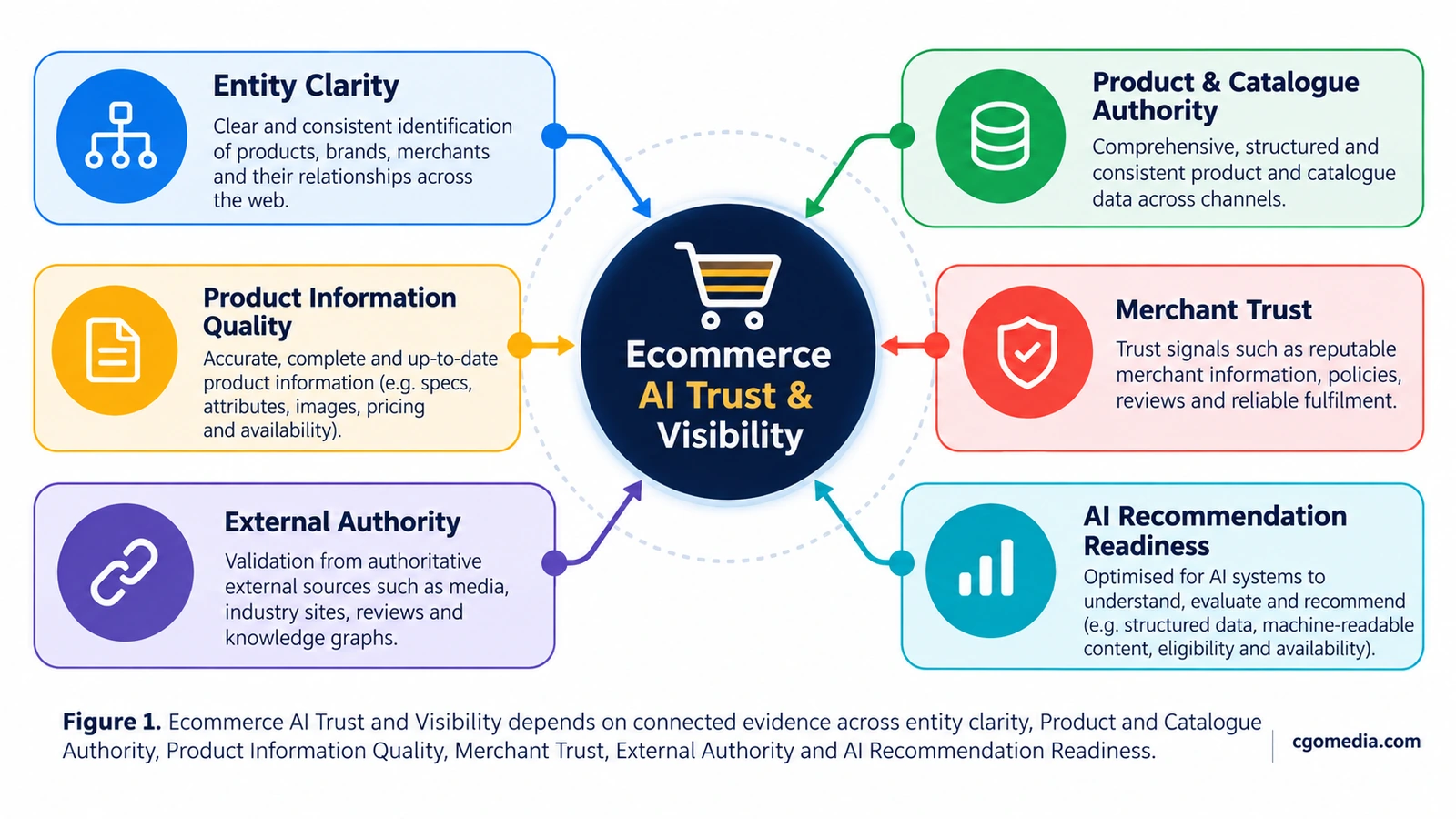
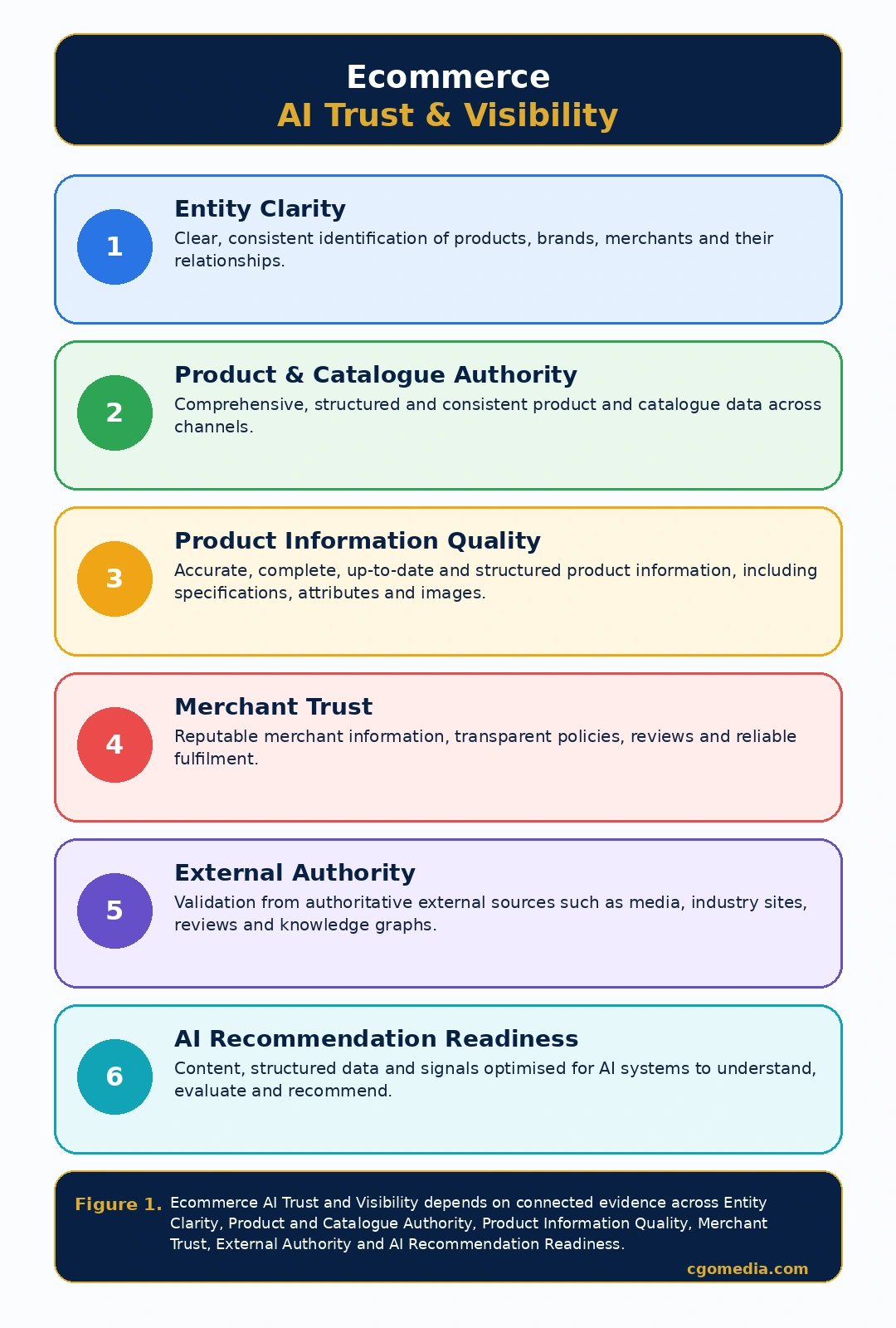
The Ecommerce & Retail AI Trust and Visibility Framework presents six connected dimensions that influence whether ecommerce organisations are sufficiently clear, current, credible and evidence-rich to support search visibility and AI-assisted product recommendation.
1. Brand, Retailer & Merchant Entity Clarity
Establish clear identities and relationships between retailers, brands, manufacturers, merchants, marketplace sellers, stores and the entities responsible for commercial transactions.
2. Product, Category & Catalogue Authority
Create a coherent commercial Knowledge Architecture connecting departments, categories, brands, Product Types, products, variants and related inventory.
3. Product Evidence & Information Quality
Maintain accurate, complete and current price, availability, specifications, descriptions, imagery, identifiers, variants and product-lifecycle information.
4. Reviews, Merchant Trust & Commercial Confidence
Provide credible evidence around Product Experience, delivery, returns, payments, customer service, seller performance and transaction reliability.
5. Brand, Market & External Authority
Strengthen independent validation through product publishers, consumer media, comparison sources, reviews, industry recognition, creator evidence and original research.
6. AI Search & Product Recommendation Readiness
Monitor whether products, brands and retailers are accurately represented within relevant AI-assisted discovery, comparison, citation and recommendation environments.
Entity principle: Search and AI systems require sufficient clarity around who manufactures, sells, fulfils and supports products before commercial evidence can be interpreted reliably.
Product principle: Catalogue Authority and Product Information Quality determine whether products can be understood, differentiated and compared within relevant shopper contexts.
Trust principle: Reviews, delivery, returns, payment and customer-service evidence influence whether Product Visibility can progress into Retailer Confidence and purchase consideration.
External-authority principle: Independent publishers, comparison sources, customer evidence, media and research can reinforce first-party claims and strengthen credibility.
AI-readiness principle: AI Product and Retailer Recommendation Readiness is cumulative. It emerges from the wider evidence environment rather than from one isolated optimisation tactic.
Figure 1. Ecommerce AI Trust and Visibility depends on connected evidence across entity clarity, Product and Catalogue Authority, Product Information Quality, Merchant Trust, External Authority and AI Recommendation Readiness.
5. Dimension One — Brand, Retailer and Merchant Entity Clarity
The first dimension evaluates whether the organisations participating in the commercial relationship are represented clearly enough for shoppers, search engines, marketplaces and AI systems to distinguish their respective roles.
An ecommerce transaction can involve several related but different entities:
- the manufacturer;
- the consumer brand;
- the retailer;
- the marketplace;
- the individual seller;
- the fulfilment provider;
- and, in omnichannel retail, the physical store.
These entities should not be treated as interchangeable.
A shopper may trust a marketplace but remain uncertain about a third-party seller. A retailer may sell products from a recognised manufacturer while remaining responsible for delivery, returns and customer service. A physical store may belong to a national retailer but have its own local reputation and stock position.
Entity Clarity therefore helps answer:
- Who manufactures the product?
- Who sells it?
- Who fulfils it?
- Who provides support?
- Who accepts the return?
- Which business owns the customer relationship?
Weak Entity Clarity can create confusion across Product Discovery, Merchant Trust and AI-generated recommendations.
The objective is:
Clear Organisation Identity → Clear Commercial Responsibility → Stronger Transaction Confidence
6. Retailer Naming Consistency
The retailer’s core business identity should be represented consistently across:
- Website
- Shopping platforms
- Marketplaces
- Review profiles
- Business listings
- Social profiles
Minor presentation differences may be unavoidable, but the underlying organisation should remain recognisable.
Website Identity
The retailer website should provide a clear business name and sufficient organisational information to establish who operates the ecommerce service.
Shopping Platforms
Merchant names used in shopping environments should connect clearly with the retailer that customers encounter after clicking through.
Marketplaces
Marketplace storefront or seller naming should avoid unnecessary ambiguity where the same organisation trades under multiple account names.
Review Profiles
Review environments should refer to the correct business, market and trading entity.
This becomes particularly important where companies operate:
- multiple countries;
- multiple brands;
- or several retail businesses with similar names.
Business Listings and Social Profiles
Consistent naming helps reinforce that official profiles belong to the same organisation.
The strategic principle is:
One recognisable Retailer Entity across multiple discovery environments.
7. Brand Entity Clarity
Brands should be represented clearly through:
- Official naming
- Manufacturer identity
- Product ranges
- Brand websites
- Retailer relationships
Brand Entity Clarity becomes important where:
- a manufacturer owns several brands;
- a retailer carries private-label products;
- different brands share similar product names;
- or legacy brands remain visible after corporate ownership changes.
Official Naming
The same brand should not be represented through unnecessary variations that create uncertainty around whether separate names refer to the same entity.
Manufacturer Identity
Where relevant, the relationship between:
Manufacturer → Brand → Product
should be understandable.
Product Ranges
Brand architecture should make clear which Product Families and models belong to the brand.
Brand Websites
Official brand sources can establish primary evidence around:
- Product Identity;
- specifications;
- warranty;
- compatibility;
- and model lifecycle.
Retailer Relationships
Retailer pages should make it clear when products are officially stocked and how they relate to the brand’s current catalogue.
8. Merchant Identity
Where multiple sellers offer the same product, Merchant Identity becomes increasingly important.
Relevant information can include:
- Seller name
- Business location
- Customer service
- Returns
- Ratings
- Marketplace history
Seller Name
The seller responsible for the transaction should be identifiable before purchase where possible.
Business Location
Location can influence:
- delivery;
- returns;
- tax;
- warranty;
- and cross-border purchasing.
Customer Service
Shoppers should understand whether support is provided by:
- the retailer;
- the marketplace;
- the manufacturer;
- or the individual seller.
Returns
Return responsibility should be clear enough to avoid uncertainty after purchase.
Ratings and Marketplace History
Seller ratings and transaction history can provide evidence of how reliably the merchant performs.
Merchant Identity therefore supports:
Seller Recognition → Responsibility Clarity → Transaction Confidence
9. Store Entity Clarity
Omnichannel retailers should represent physical stores clearly where those locations contribute to:
- Local discovery
- Click and collect
- Returns
- Product availability
- Customer service
Local Discovery
Store information should help customers identify the correct:
- location;
- opening hours;
- contact details;
- and available services.
Click and Collect
The relationship between:
Online Product → Store Inventory → Collection Location
should be sufficiently clear to support confident fulfilment.
Returns
Retailers should clarify whether online purchases can be returned to:
- any store;
- selected stores;
- or only through online channels.
Product Availability
Local stock should refer to the correct store and Product Variant rather than imply nationwide availability.
Customer Service
Store-level reputation can also influence Merchant Trust where customers rely on physical support after purchase.
10. Retailer-to-Brand Relationships
Retailer websites should make it clear which brands are officially stocked and how those products relate to relevant categories.
Useful relationships include:
Retailer → Brand → Product Range → Category → Product
These relationships help reinforce:
- Brand Discovery;
- Product Discovery;
- retailer assortment;
- and commercial relevance.
Strong Retailer-to-Brand relationships can also help customers understand:
- which models are currently sold;
- which brands are specialist strengths for the retailer;
- and whether alternatives are available.
The objective is not merely to display a Brand Logo.
It is to establish a meaningful relationship between the retailer’s commercial identity and the products it actually carries.
11. Dimension Two — Product, Category and Catalogue Authority
The second dimension evaluates whether the organisation has a coherent Product Knowledge Architecture.
Products should not exist as disconnected pages.
They should sit inside understandable relationships involving:
- departments;
- categories;
- Product Types;
- brands;
- Product Families;
- variants;
- and related products.
A coherent catalogue helps users and digital systems understand:
- what a product is;
- where it belongs;
- what alternatives exist;
- and which attributes distinguish it.
The core progression is:
Catalogue Structure → Product Understanding → Comparison → Product Selection
12. Product Authority
Each important product should have sufficient information to support understanding and comparison.
Useful evidence includes:
- Product name
- Brand
- Model
- Price
- Availability
- Specifications
- Variants
Product Name
The name should identify the product without unnecessary ambiguity.
Brand and Model
Brand and model information should help distinguish the product from:
- similar products;
- earlier generations;
- and alternative configurations.
Price and Availability
Commercial information should be sufficiently current to support realistic comparison.
Specifications
Important category-specific attributes should allow users to evaluate Product Fit.
Variants
Different configurations should be represented clearly where they affect:
- price;
- stock;
- features;
- or suitability.
Product Authority therefore depends on both identity and evidence quality.
13. Category Authority
Category pages should help users understand:
- What belongs in the category
- What important subcategories exist
- Which product attributes matter
- How products differ
- Which use cases are relevant
Category Definition
The category should provide enough context for shoppers to understand the type of products being considered.
Subcategory Structure
Subcategories can narrow broad demand into more useful commercial groupings.
Important Attributes
Different categories require different comparison criteria.
Useful category content should highlight the attributes that genuinely influence Product Fit.
Product Differences
Category guidance can explain:
- performance differences;
- price tiers;
- feature differences;
- and different Product Types.
Use Cases
The strongest Category Authority connects the catalogue with the situations in which customers actually use products.
14. Catalogue Structure
Large catalogues require clear relationships between:
Department → Category → Subcategory → Brand → Product → Variant
The exact hierarchy will vary between retailers, but the relationships should remain coherent.
Catalogue Structure supports:
- navigation;
- internal linking;
- Product Discovery;
- faceted filtering;
- and machine interpretation.
Poor structure can create:
- duplicate categories;
- orphaned products;
- unclear Product Relationships;
- and excessive reliance on internal search.
The objective is not maximum taxonomy complexity.
It is:
Clear Product Relationships at the level shoppers actually need.
15. Product-Type Authority
Retailers should be able to demonstrate depth within strategically important Product Types rather than merely publishing large numbers of products.
Product-Type Authority can develop through:
- broad but relevant assortment;
- clear Product Information;
- useful filtering;
- Buying Guides;
- comparison content;
- and specialist Product Knowledge.
A retailer with 500 poorly described products may provide less useful authority than a specialist merchant with 100 well-structured, well-evidenced products.
Depth should therefore be evaluated through:
Range + Evidence + Expertise + Commercial Relevance
rather than SKU volume alone.
16. Brand Architecture
Brand pages can act as authority hubs connecting:
- Brand information
- Product ranges
- Categories
- Buying guidance
- Current inventory
A useful Brand Architecture allows users to move between:
Brand → Product Family → Category → Individual Product
Brand pages can also clarify:
- brand positioning;
- current Product Ranges;
- important technologies;
- and relevant selection guidance.
The page should remain commercially useful rather than becoming a generic corporate biography disconnected from inventory.
17. Variant Architecture
Variants should be represented in ways that avoid unnecessary confusion around:
- Size
- Colour
- Capacity
- Material
- Configuration
The Product Family relationship should remain clear while commercially meaningful differences are preserved.
Variant Identity
Users should understand which exact configuration they are viewing.
Variant-Specific Price
Different sizes, capacities or configurations may have different prices.
Variant-Specific Availability
The selected Product Variant should carry its own relevant stock information.
Variant Imagery
Images should reflect the chosen colour, material or configuration where visual differences matter.
Strong Variant Architecture reduces:
- Product Confusion;
- incorrect orders;
- and unnecessary returns.
18. Product Relationships
Useful Product Relationships may include:
- Accessories
- Compatible products
- Alternative products
- Upgrades
- Bundles
Accessories
Accessory relationships can help customers understand which additional products support or extend the primary purchase.
Compatible Products
Compatibility relationships are especially important where products depend on:
- devices;
- standards;
- connections;
- or existing systems.
Alternative Products
Alternatives help users continue Product Discovery when the original product:
- is unavailable;
- falls outside budget;
- or lacks a required feature.
Upgrades
Upgrade relationships can explain how a premium model differs from the current option.
Bundles
Bundles can connect products that are commonly purchased together where the combination provides genuine customer value.
These relationships strengthen the wider Product Knowledge Architecture.
19. Dimension Three — Product Evidence and Information Quality
The third dimension assesses whether commercial Product Data is sufficiently accurate, complete and current.
This dimension is particularly important because Ecommerce Search Authority can deteriorate quickly when:
- prices change;
- stock changes;
- variants change;
- new models launch;
- or old models are discontinued.
Product Information Quality should therefore be evaluated across:
- accuracy;
- completeness;
- freshness;
- consistency;
- and decision usefulness.
The objective is:
Reliable Product Evidence → Better Comparison → Stronger Product Fit → Greater Recommendation Confidence
20. Price Accuracy
Price should be represented consistently across the retailer website and important distributed commercial environments wherever operationally possible.
Relevant environments can include:
- the Product Page;
- shopping feeds;
- marketplaces;
- comparison platforms;
- and promotional landing pages.
Different sellers may legitimately charge different prices.
The trust problem arises when the same retailer exposes conflicting or expired prices for the same offer.
Promotional Price
Promotions should have clear timing and conditions.
Total Cost
Where material, users should also be able to understand costs such as:
- delivery;
- mandatory fees;
- or required accessories.
Price Accuracy directly affects both Product Value and Merchant Trust.
21. Availability Accuracy
Stock information should distinguish between relevant commercial states such as:
- In stock
- Low stock
- Pre-order
- Back order
- Out of stock
- Discontinued
These states have different implications for Product Discovery and purchase.
In Stock
The customer should be able to purchase the stated Product Variant through the relevant channel.
Low Stock
Low-stock messaging should reflect real inventory status rather than artificial urgency.
Pre-Order
Customers should understand expected release and fulfilment timing.
Back Order
The expected delay should be communicated where possible.
Out of Stock
The page may still provide value through:
- restock information;
- Product Alternatives;
- or related products.
Discontinued
Discontinued status should be distinguished clearly from temporary unavailability.
Availability Accuracy therefore protects:
Discovery Accuracy → Purchase Feasibility → Customer Trust
22. Specification Quality
Products should contain enough structured and visible specification data to support meaningful comparison.
Required specifications vary by Product Category.
They may include:
- dimensions;
- weight;
- capacity;
- materials;
- performance;
- compatibility;
- technical standards;
- and warranty.
Specification Quality should be evaluated against:
- completeness;
- accuracy;
- consistency;
- and relevance to Product Selection.
The aim is not to publish every available technical field.
It is to expose the attributes that help customers determine:
“Is this the right product for my requirement?”
23. Product Description Quality
Product descriptions should explain the item clearly rather than merely repeat manufacturer language without context.
Useful descriptions can address:
- what the product is;
- what it does;
- who it is designed for;
- which features matter;
- and which important limitations apply.
Retailers can add decision value by translating technical Product Information into practical customer language.
A strong description should complement rather than duplicate:
- specification tables;
- manufacturer copy;
- or marketing slogans.
The objective is:
Product Facts → Practical Meaning → Product Fit
24. Image Quality
Product imagery should support decision-making through:
- Multiple angles
- Detail views
- Scale context
- Variants
- Real-world usage
Multiple Angles
Users should be able to inspect important physical characteristics that cannot be understood from one hero image.
Detail Views
Close-up imagery can show:
- materials;
- controls;
- connections;
- finish;
- or construction.
Scale Context
Real-world context helps reduce uncertainty around Product Size.
Variants
The imagery should correspond with the selected Product Variant where appearance differs.
Real-World Usage
Contextual images can help users understand:
- fit;
- placement;
- proportion;
- or likely use.
Strong imagery can therefore reduce Product Uncertainty before purchase.
25. Video and Demonstration Quality
Video can strengthen understanding where Product Use, scale, installation or performance are difficult to communicate through static imagery.
Useful video evidence may demonstrate:
- setup;
- assembly;
- interface;
- movement;
- sound;
- fit;
- or real-world performance.
Video is especially valuable where shoppers need to understand:
how the product behaves
rather than simply:
what the product looks like.
Demonstration content should remain representative rather than create unrealistic expectations through highly controlled presentation.
26. Product Identifier Quality
Reliable Product Identifiers can improve consistency across catalogues, feeds and external commerce environments.
Depending on the category and market, identifiers may include:
- GTIN;
- EAN;
- UPC;
- MPN;
- SKU;
- or manufacturer-specific model codes.
Identifier Quality helps distinguish:
- similar models;
- different generations;
- different configurations;
- and separate Product Variants.
Incorrect identifiers can create more harm than missing identifiers because they can associate the wrong Product Data with the wrong item.
The objective is:
Stable Product Identity across distributed commerce environments.
27. Information Freshness
Freshness is particularly important in ecommerce because commercially important data can change rapidly.
Priority fields may include:
- Price
- Availability
- Promotion
- Variant status
- Delivery
- Model lifecycle
Not every field requires the same update frequency.
Stable fields such as:
- dimensions;
- core materials;
- and Product Identity
may change rarely.
By contrast:
- price;
- stock;
- promotion;
- and delivery timing
may change daily or even more frequently.
A useful rule is:
Commercial Volatility + Purchase Impact → Required Information Freshness
The closer information sits to the final purchase decision, the more damaging stale data can become.
28. Duplicate and Conflicting Product Information
Conflicting data across retailer pages, feeds, marketplaces or comparison platforms can weaken trust and create poor customer experiences.
Common conflicts include:
- different Product Titles;
- different specifications;
- different prices;
- different availability states;
- different Product Images;
- and unclear model status.
Some Variation Is Legitimate
Different retailers can legitimately have:
- different prices;
- different stock;
- different delivery;
- and different return policies.
The more serious problem occurs when the same organisation provides conflicting information about the same Product or Offer.
Duplicate Content Is Not the Only Issue
The larger concern is whether duplicated information causes ambiguity around:
- Product Identity;
- current specifications;
- variant relationships;
- or commercial conditions.
Conflicting Information Can Undermine AI Representation
Where multiple sources describe the same product differently, generated systems may reproduce:
- old specifications;
- old pricing;
- incorrect variants;
- or outdated Product Status.
Retailers and brands should therefore aim for:
Consistent Product Truth + Current Commercial Data + Clear Channel Context
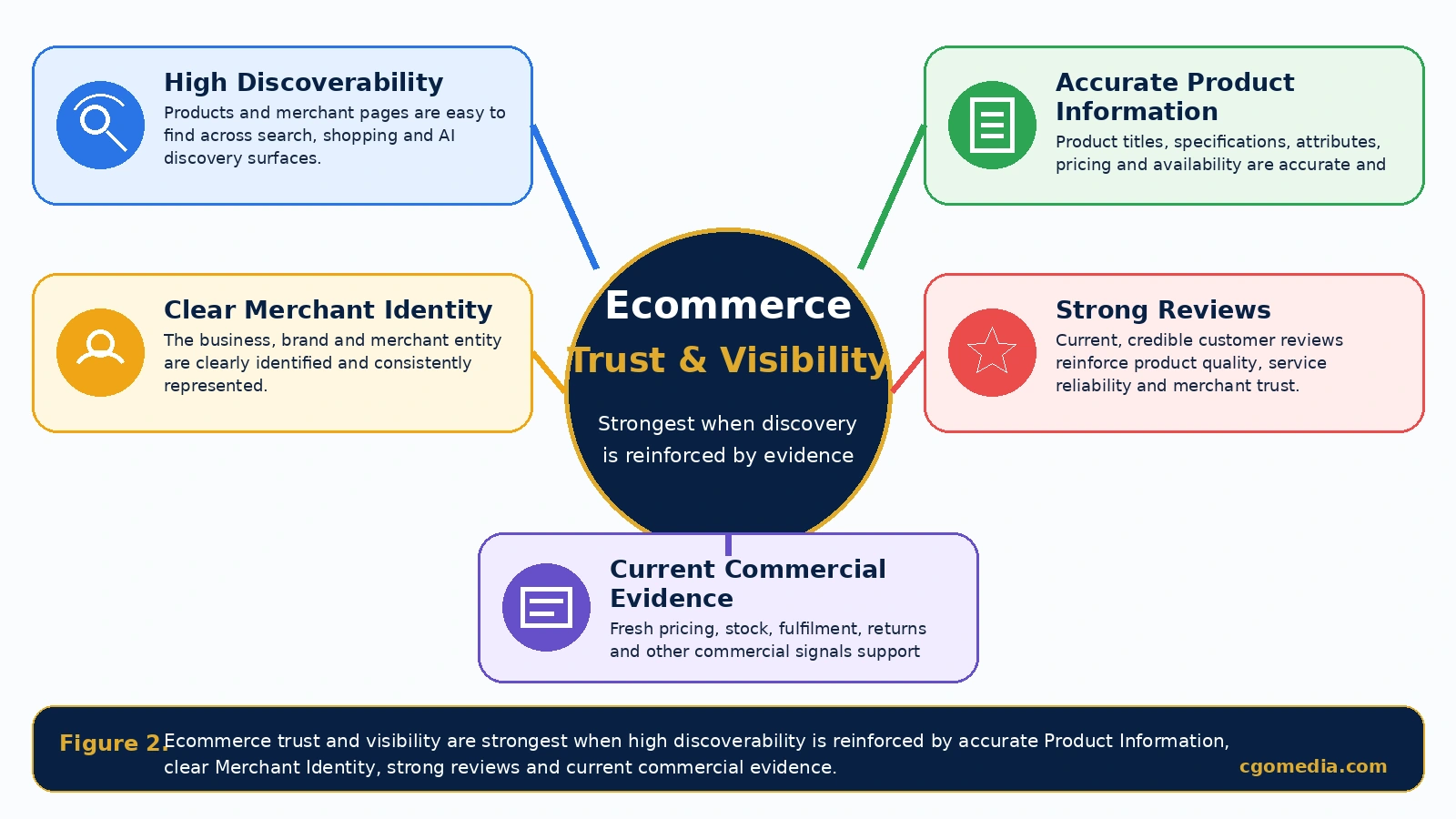
The Ecommerce Trust and Visibility Matrix maps ecommerce organisations according to two connected dimensions: Digital Visibility and Product & Merchant Evidence Quality.
High Visibility + High Evidence Quality
Products and retailers are easy to discover and supported by accurate Product Information, current commercial data, clear Merchant Identity, strong reviews and credible supporting evidence. This represents the strongest trust and recommendation position.
High Visibility + Low Evidence Quality
The organisation attracts significant search or shopping exposure, but incomplete Product Data, weak Merchant Trust or stale commercial information creates uncertainty during evaluation and purchase.
Low Visibility + High Evidence Quality
The organisation possesses strong Product Evidence and Merchant Trust but remains underrepresented across search, shopping, marketplaces, publishers or AI-assisted discovery environments.
Low Visibility + Low Evidence Quality
Weak discoverability combines with incomplete Product Information, limited Merchant Trust and poor external representation, creating the weakest overall Ecommerce Trust and Visibility position.
Visibility principle: Search, shopping, marketplace and AI exposure create opportunities to enter the consideration set, but visibility alone does not establish Product or Merchant Trust.
Evidence principle: Accurate Product Identity, specifications, price, availability, imagery and Variant Information determine whether visible products can be understood and compared reliably.
Merchant principle: Clear seller identity, reviews, delivery, returns and customer-service evidence determine whether Product Visibility can progress into Transaction Confidence.
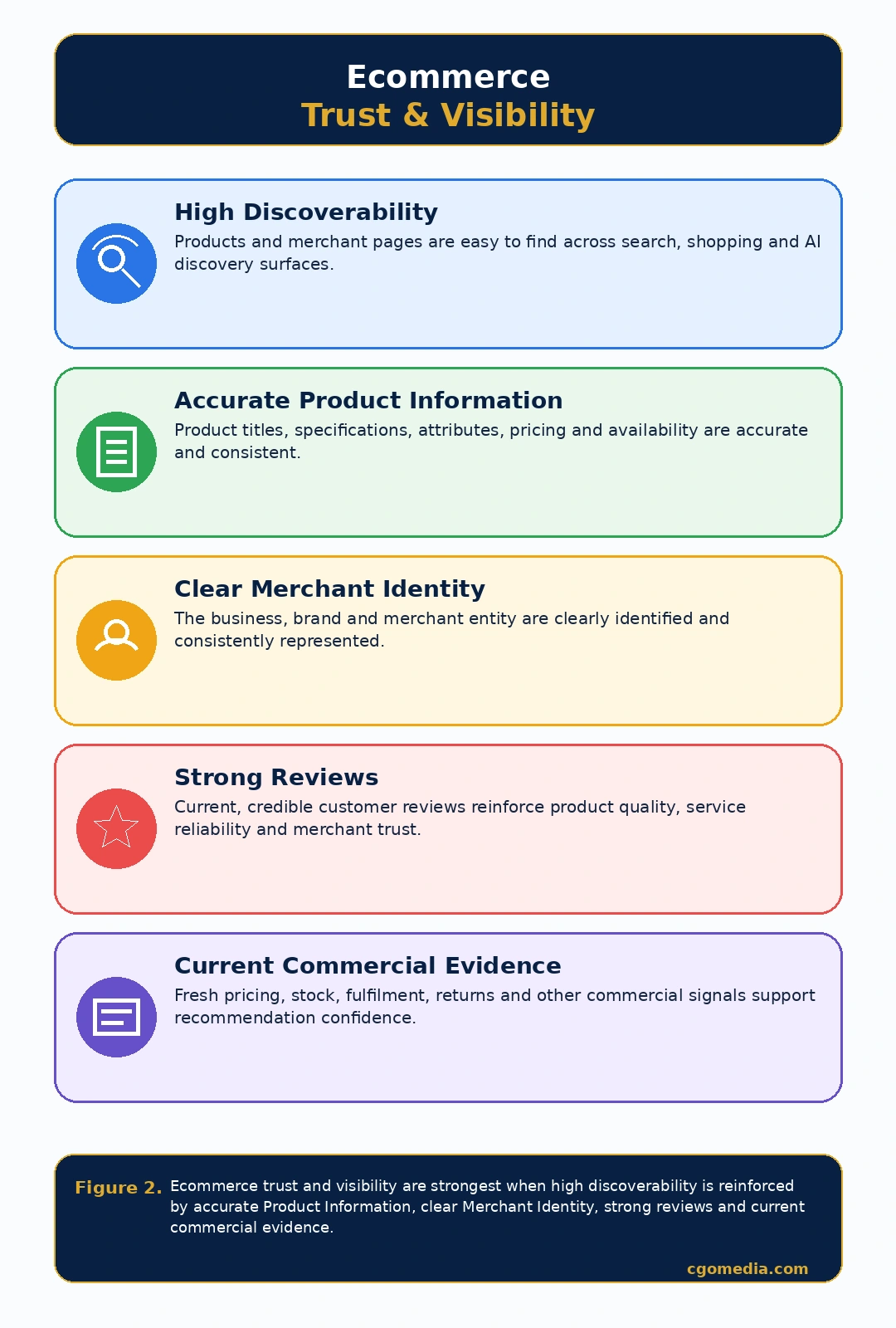
Recommendation principle: Ecommerce recommendation readiness is strongest when high discoverability is reinforced by strong Product Evidence, current Commercial Information and credible Merchant Trust.
Figure 2. Ecommerce trust and visibility are strongest when high discoverability is reinforced by accurate Product Information, clear Merchant Identity, strong reviews and current commercial evidence.
29. Dimension Four — Reviews, Merchant Trust and Commercial Confidence
The fourth dimension evaluates whether customers have sufficient confidence to transact with the retailer or seller.
Product suitability alone does not guarantee purchase.
The shopper may still need evidence that:
- the merchant is legitimate;
- delivery is reliable;
- returns are practical;
- payments are secure;
- and customer support is available if something goes wrong.
Merchant Trust therefore sits between Product Selection and Transaction Completion.
A useful relationship is:
Product Confidence + Merchant Confidence + Commercial Clarity → Transaction Readiness
30. Retailer Review Authority
Retailer reviews can provide evidence around:
- Delivery
- Customer service
- Returns
- Refunds
- Packaging
- Problem resolution
These reviews help shoppers evaluate the merchant rather than the product itself.
Review Authority should therefore consider:
- volume;
- recency;
- rating;
- and recurring service themes.
A retailer with consistently strong fulfilment and support evidence can reduce uncertainty at the final purchase stage.
31. Product Review Authority
Product reviews help users evaluate:
- Quality
- Performance
- Durability
- Fit
- Ease of use
- Value
These reviews can reveal strengths and limitations that are difficult to understand from specifications alone.
The strongest Product Review Authority develops when review evidence is:
- relevant;
- recent;
- sufficiently detailed;
- and connected with the exact Product or Variant being evaluated.
32. Review Recency
Recent reviews can provide more relevant evidence where products, fulfilment operations or service standards change over time.
Recency is particularly important when:
- a product has been updated;
- firmware has changed;
- a retailer has changed its delivery partner;
- or customer-service processes have improved or deteriorated.
Older reviews may remain useful, but current evidence should normally receive greater attention where operating conditions are volatile.
33. Review Authenticity and Context
Review systems should provide sufficient context to help users distinguish meaningful feedback from low-information commentary.
Useful context may include:
- verified purchase status;
- date;
- Product Variant;
- review depth;
- and recurring themes across multiple customers.
Authenticity does not mean every review must be positive.
A credible review environment normally includes a realistic mix of:
- strengths;
- limitations;
- and customer-specific experience.
34. Delivery Confidence
Delivery trust can be strengthened through clear information about:
- Costs
- Timescales
- Tracking
- Collection
- International delivery
Customers should understand the likely fulfilment conditions before purchase.
Where delivery varies by:
- postcode;
- country;
- Product Type;
- or seller,
those differences should be made clear.
Delivery Confidence depends on alignment between:
Delivery Promise ↔ Actual Fulfilment Experience
35. Returns Confidence
Returns information should be easy to locate and understand before purchase.
Relevant details can include:
- return window;
- return cost;
- condition requirements;
- exchange options;
- refund timing;
- and exclusions.
Returns Confidence is particularly important where Product Fit cannot be established completely before purchase.
Clear returns information can therefore reduce perceived transaction risk.
36. Payment Confidence
Customers should understand which payment methods are available and whether finance or instalment options apply.
Relevant information can include:
- accepted cards;
- digital wallets;
- Buy Now Pay Later;
- bank payment;
- finance;
- and business-payment options.
Payment information should be sufficiently clear before the user reaches the final transaction stage.
37. Customer Service Visibility
Retailers should make support channels clear where customers may need assistance before or after purchase.
Support evidence can include:
- telephone;
- email;
- live chat;
- technical support;
- returns support;
- and order assistance.
Customer Service Visibility helps answer:
“If something goes wrong, can I identify who will help me and how?”
38. Dimension Five — Brand, Market and External Authority
The fifth dimension evaluates whether independent sources reinforce the retailer, brand and product environment.
First-party information remains essential, but external evidence can provide additional validation around:
- Product Quality;
- Brand Authority;
- Merchant Reputation;
- market expertise;
- and Customer Experience.
External Authority can develop through:
- specialist publishers;
- consumer media;
- comparison platforms;
- creators;
- research;
- and independent reviews.
The objective is credible evidence convergence rather than mention volume alone.
39. Brand Authority
Brand authority may be reinforced by:
- Independent reviews
- Retailer representation
- Media coverage
- Product awards
- Industry recognition
These signals can help validate whether the brand’s stated positioning is visible across the wider market.
Brand Authority is strongest when:
Brand Claims + Product Experience + External Recognition
remain broadly aligned.
40. Retailer Authority
Retailer authority may be reinforced through:
- Business coverage
- Industry recognition
- Independent reviews
- Consumer publications
- Market visibility
External coverage can strengthen understanding of the retailer’s:
- commercial identity;
- market position;
- specialist expertise;
- and customer reputation.
Retailer Authority should be relevant to the categories and markets in which the organisation actually competes.
41. Product Media Authority
Specialist product publications can influence discovery and validation through reviews, comparisons and buying guides.
They may provide:
- hands-on testing;
- technical interpretation;
- Product Comparisons;
- use-case recommendations;
- and discussion of weaknesses.
Product Media Authority is particularly important in categories where shoppers rely heavily on specialist expertise before purchase.
42. Comparison Authority
Comparison sites can provide independent evidence around:
- Price
- Specification
- Availability
- Retailer choice
They can help customers identify:
- alternative products;
- different sellers;
- price differences;
- and Product Feature differences.
Comparison Authority is strongest where data remains current and comparable rather than mixing outdated or non-equivalent offers.
43. Creator and Social Authority
Creators and social platforms may contribute to awareness and product validation, particularly in categories where demonstrations and visual evidence are important.
This may include:
- fashion;
- beauty;
- technology;
- fitness;
- home products;
- and lifestyle retail.
Creator evidence can demonstrate:
- appearance;
- scale;
- fit;
- setup;
- and real-world use.
Its value should still be interpreted in the context of expertise, independence and commercial relationships.
44. Research and Market Authority
Retailers and brands can strengthen external authority through original research into:
- Consumer demand
- Product trends
- Pricing
- Category behaviour
- Shopping habits
Original data can create value beyond the organisation’s own ecommerce pages.
Useful research may support:
- journalists;
- industry analysts;
- publishers;
- researchers;
- and wider market commentary.
Research Authority is strongest where methodology, limitations and evidence sources are transparent.
45. Dimension Six — AI Search and Product Recommendation Readiness
The sixth dimension evaluates whether the organisation is sufficiently well represented to participate effectively in AI-assisted product and retailer discovery.
AI Search Readiness should be treated as the outcome of the wider evidence system.
It depends on:
- clear entities;
- strong Catalogue Architecture;
- accurate Product Information;
- Merchant Trust;
- External Authority;
- and reliable representation.
The objective is not universal recommendation.
It is stronger representation where genuine Product Fit and Retailer Fit exist.
46. AI Product Visibility
The organisation can monitor whether its products appear in relevant recommendation prompts.
Monitoring should focus on real shopper scenarios involving:
- use case;
- budget;
- features;
- compatibility;
- and Product Type.
Useful analysis should record:
- which products appear;
- which competitors appear;
- and why each product is recommended.
47. AI Category Visibility
Retailers and brands can assess whether they appear in category-level recommendation environments.
Category monitoring can test whether the organisation is associated with:
- appropriate Product Types;
- relevant shopper needs;
- the correct market position;
- and important use cases.
The key question is not only whether the organisation appears, but whether it appears in the correct category context.
48. AI Retailer Visibility
The organisation can monitor whether AI systems recommend it as a suitable retailer for relevant products or categories.
Retailer recommendation contexts can involve:
- price;
- delivery;
- returns;
- availability;
- service;
- or Merchant Trust.
Retailer Visibility should therefore be interpreted alongside the reasons the merchant is selected.
49. AI Brand Visibility
Brands can assess whether AI systems include them in relevant:
- Product recommendations
- Brand comparisons
- Category explanations
Brand monitoring should identify whether:
- the correct Product Range is represented;
- current strengths are described accurately;
- outdated products dominate representation;
- or competitor positioning is stronger.
This helps distinguish simple mention frequency from useful Brand Representation.
50. AI Source Visibility
Source analysis can identify which websites, publishers, marketplaces and review environments repeatedly contribute to AI-generated answers.
Relevant source types may include:
- manufacturer websites;
- retailer websites;
- product publishers;
- marketplaces;
- comparison sites;
- review platforms;
- and communities.
The objective is to identify recurring source patterns rather than assume one fixed source hierarchy.
51. AI Citation Visibility
Retailers and brands can monitor whether their owned research, Product Information or other authoritative content is cited where citation interfaces are available.
Useful monitoring may include:
- which pages are cited;
- which topics trigger citations;
- which competitors receive citations;
- and whether cited information remains current.
Citation Visibility should be treated as one evidence signal rather than the sole measure of AI Search success.
52. AI Recommendation Visibility
Recommendation monitoring should focus on realistic user contexts rather than generic brand-name prompts.
Examples can combine:
- budget;
- features;
- use case;
- brand preference;
- delivery;
- and retailer requirements.
This creates a stronger test of whether the organisation enters appropriate recommendation environments.
The useful metric is:
Relevant Recommendation Visibility
rather than total AI mention volume.
53. AI Representation Accuracy
Generated answers should be checked for material inaccuracies involving:
- Product specifications
- Price
- Availability
- Brand relationships
- Retailer policies
Accuracy is particularly important close to purchase.
Incorrect Product Information can lead to:
- wrong Product Selection;
- failed compatibility;
- incorrect price expectations;
- or unusable retailer recommendations.
AI monitoring should therefore measure:
Visibility + Relevance + Accuracy + Freshness
54. Recommendation Readiness Is Cumulative
AI recommendation readiness should not be treated as a separate optimisation tactic.
It is the cumulative result of:
- Clear entity representation
- Strong catalogue architecture
- Accurate product information
- Merchant trust
- External validation
- Reliable AI representation
Weakness in one area can reduce the value created elsewhere.
For example, strong Product Authority can be undermined by stale stock, while excellent Merchant Trust can be undermined by weak Product Information.
Recommendation readiness therefore emerges from the full evidence environment.
55. How the Six Dimensions Interact
The six dimensions of the Ecommerce & Retail AI Trust and Visibility Framework are designed to operate as one connected evidence system.
Weakness in one area can reduce the value created by stronger areas elsewhere.
The interaction can be summarised as:
Entity Clarity → Catalogue Understanding → Product Evidence → Merchant Trust → External Credibility → AI Readiness
This sequence does not imply that every customer journey follows the same order.
It demonstrates how each evidence layer supports the next.
56. Entity Clarity Supports Commercial Interpretation
Clear retailer, brand, merchant and store identities help search and AI systems understand who is responsible for products, transactions and Customer Experience.
Entity Clarity supports accurate interpretation of:
- manufacturer relationships;
- seller relationships;
- retailer reputation;
- store reputation;
- and marketplace offers.
Without that clarity, evidence from one entity can be incorrectly attributed to another.
57. Catalogue Authority Supports Product Understanding
A coherent Catalogue Structure helps products appear within meaningful relationships involving:
- Departments
- Categories
- Subcategories
- Brands
- Product types
- Variants
These relationships provide context for Product Discovery and comparison.
The catalogue becomes easier to interpret when:
Product Identity + Category Context + Brand Context + Variant Context
are all sufficiently clear.
58. Product Evidence Supports Trust
Accurate price, availability, specifications, images and identifiers reduce uncertainty and support meaningful comparison.
Strong Product Evidence helps answer:
- What is this product?
- What does it cost?
- Is it available?
- What are its important features?
- Which exact variant am I viewing?
- Is it suitable for my requirement?
Product Trust therefore begins with reliable Product Information.
59. Merchant Trust Supports Commercial Confidence
Retailer reviews, delivery information, returns policies, payment options and customer service evidence help users evaluate whether the transaction itself appears sufficiently reliable.
Merchant Trust answers questions that Product Evidence cannot.
For example:
- Will the order arrive?
- Can I return it?
- Can I obtain help?
- Will I receive a refund if necessary?
This layer helps convert Product Selection into Purchase Confidence.
60. External Authority Supports Independent Credibility
Retailers and brands become more credible when relevant independent sources repeatedly confirm their products, reputation and market expertise.
Independent credibility can emerge from:
- specialist reviews;
- publisher coverage;
- customer evidence;
- comparison environments;
- industry recognition;
- and research citations.
The strongest External Authority supports genuine strengths already visible within the Product and Merchant environment.
61. AI Readiness Reflects the Entire Evidence Environment
AI recommendation visibility is not created by one isolated signal.
It reflects the wider evidence available around:
- Product relevance
- Brand clarity
- Price
- Availability
- Merchant trust
- Independent validation
An AI recommendation may therefore depend on the interaction between Product Fit and Commercial Trust rather than on a single content asset.
The strongest readiness state is:
Clear + Current + Verifiable + Comparable + Trusted
62. Ecommerce Evidence Thresholds
The framework uses an evidence-threshold concept to describe the progression from basic discoverability toward stronger recommendation readiness.
The threshold is:
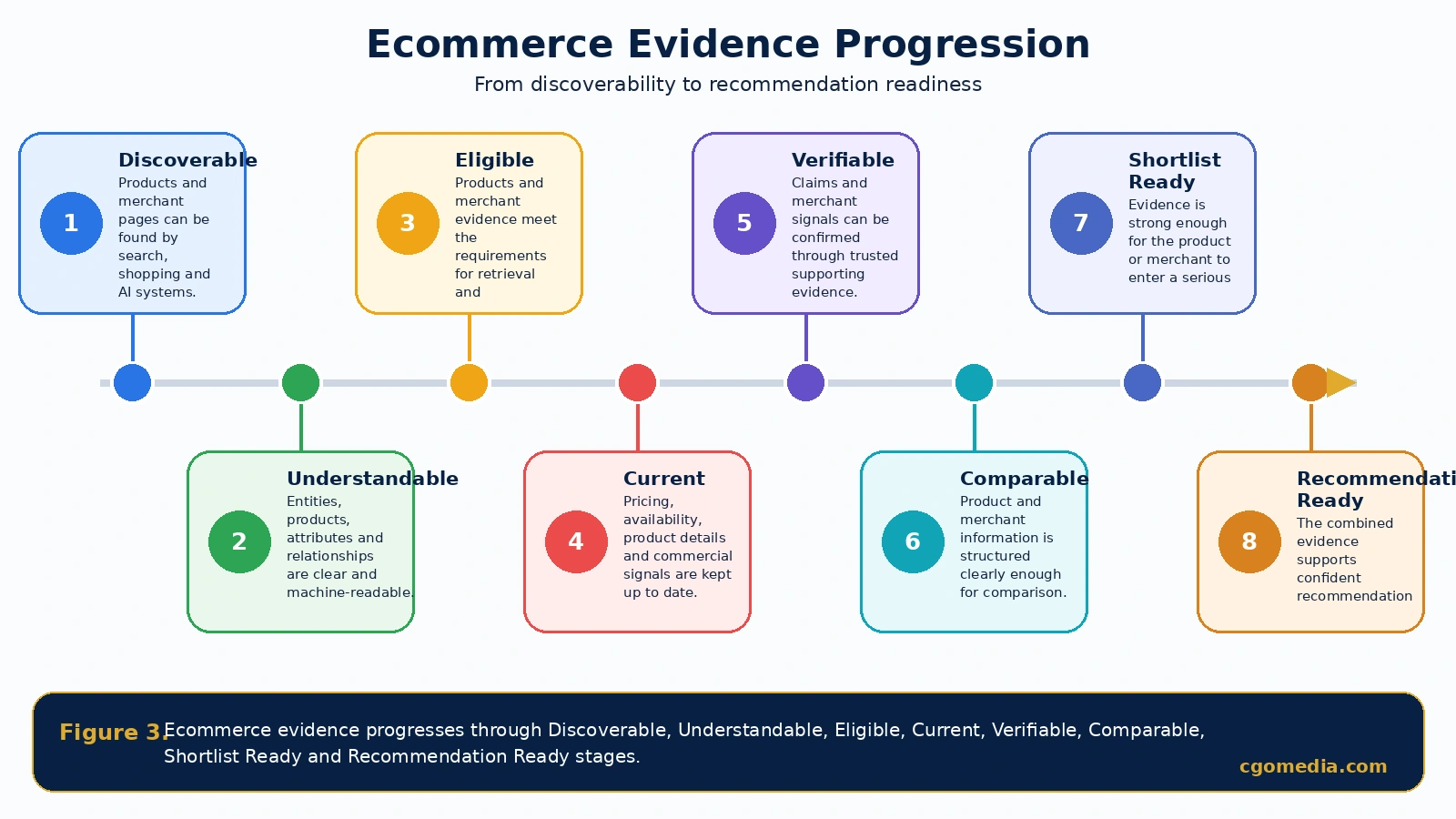
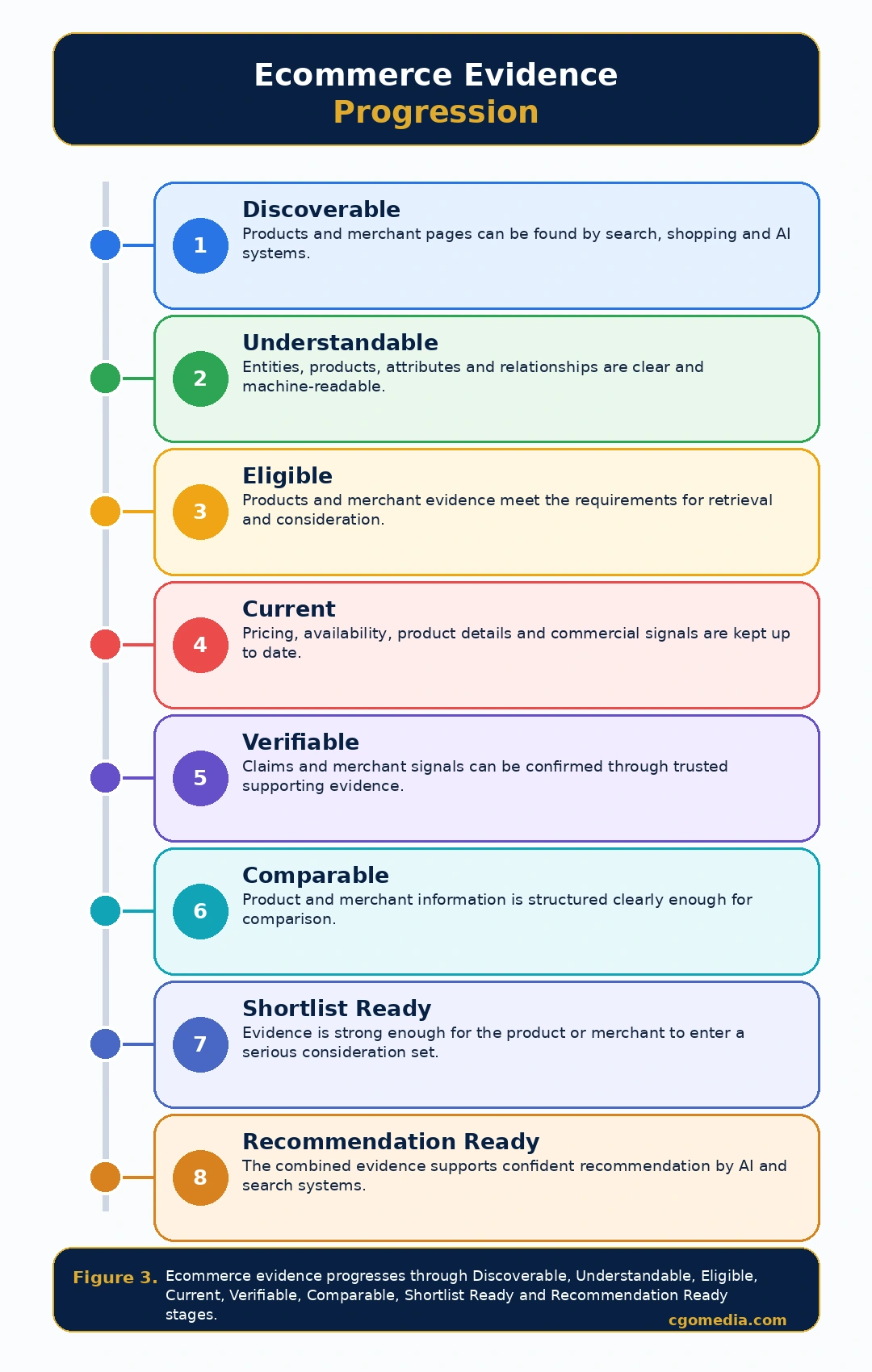
Discoverable → Understandable → Eligible → Current → Verifiable → Comparable → Shortlist Ready → Recommendation Ready
Each stage represents a higher level of evidence quality and decision usefulness.
The model is analytical rather than algorithmic.
It helps organisations determine where weak evidence may prevent products or retailers from progressing through the commercial decision journey.
63. Discoverable
At the Discoverable stage, the product, brand or retailer can be found by search or shopping systems.
Discovery may occur through:
- organic search;
- shopping results;
- marketplaces;
- publishers;
- social environments;
- or AI-assisted discovery.
Discoverability creates an opportunity for consideration but provides no guarantee of Product Fit or Merchant Trust.
64. Understandable
At the Understandable stage, systems can identify important attributes such as:
- Product type
- Brand
- Price
- Availability
- Retailer
Understanding may also require:
- model;
- variant;
- specifications;
- and Product Category.
A product cannot be evaluated reliably if its identity or important attributes remain ambiguous.
65. Eligible
At the Eligible stage, available evidence suggests that the product can satisfy the user’s core requirement.
Eligibility may depend on:
- budget;
- compatibility;
- performance;
- size;
- Product Type;
- or availability.
Eligibility should be established before softer preference signals are used to distinguish otherwise suitable products.
66. Current
The Current stage is especially important in ecommerce.
Commercial information such as price, stock and Product Status should be sufficiently fresh to support a useful recommendation.
A product may be suitable in principle but commercially irrelevant if:
- the required variant is sold out;
- the price has changed;
- or the model has been discontinued.
Current evidence therefore protects Recommendation Accuracy.
67. Verifiable
At the Verifiable stage, important claims can be checked against credible sources.
This may include:
- Manufacturer information
- Retailer data
- Independent reviews
- Comparison sources
- Marketplace information
Verification can support:
- Product specifications;
- Brand Relationships;
- Product Quality;
- and Merchant Reputation.
Evidence convergence increases confidence that important claims are not isolated or unsupported.
68. Comparable
At the Comparable stage, sufficient structured and descriptive information exists to compare the product meaningfully with alternatives.
Relevant comparison fields can include:
- price;
- specifications;
- features;
- reviews;
- warranty;
- availability;
- and Product Use Case.
Comparability requires equivalent data.
Different Product Variants, bundles or conditions should not be presented as though they were identical offers.
69. Shortlist Ready
At this stage, the product or retailer possesses enough evidence to remain within a reduced consideration set.
Shortlist readiness generally implies that the option has:
- passed key eligibility requirements;
- demonstrated sufficient Product Fit;
- provided adequate evidence;
- and remained credible relative to competitors.
The shortlist stage converts broad discovery into active consideration.
70. Recommendation Ready
Recommendation Ready describes an evidence state in which Product Relevance, commercial information, Merchant Trust and External Validation are sufficiently strong to support confident inclusion within a recommendation context.
The state may require convergence across:
- Product Fit;
- current price;
- availability;
- reliable Product Information;
- Merchant Trust;
- and independent evidence.
This remains a strategic concept rather than a confirmed algorithmic threshold.
Its value is diagnostic.
It helps organisations identify whether they have progressed from:
being visible
to:
being sufficiently evidenced for qualified recommendation.
The Ecommerce Evidence Threshold illustrates the progressive evidence conditions that can move a product, brand or retailer from basic discovery toward stronger comparison, shortlisting and recommendation readiness.
1. Discoverable
The product, brand or retailer can be found within relevant search, shopping, marketplace, publisher or AI-assisted discovery environments.
2. Understandable
Core identity and attributes such as Product Type, brand, model, price, availability and retailer can be interpreted with sufficient clarity.
3. Eligible
Available evidence indicates that the product or retailer satisfies the shopper’s essential requirements and remains suitable for further evaluation.
4. Current
Price, stock, Product Status and other time-sensitive commercial information remain sufficiently fresh to support a useful decision.
5. Verifiable
Important Product, Brand and Merchant claims can be checked against credible first-party and independent sources.
6. Comparable
Enough structured and descriptive evidence exists to compare the option meaningfully with relevant alternatives.
7. Shortlist Ready
The option has passed essential eligibility, evidence and trust requirements strongly enough to remain in a reduced consideration set.
8. Recommendation Ready
Product Relevance, current commercial information, Merchant Trust and independent validation collectively support qualified inclusion within a recommendation context.
Discovery principle: Visibility is only the first threshold. A product that can be found still needs sufficient identity, Product Fit and commercial evidence to progress.
Freshness principle: Ecommerce introduces a distinct Current threshold because price, stock, promotions and Product Status can change quickly enough to invalidate otherwise strong recommendations.
Verification principle: First-party Product Information becomes more robust when important claims can be checked against credible manufacturer, retailer, review, comparison or marketplace sources.
Recommendation principle: Recommendation readiness is cumulative and scenario-specific. It emerges when Product Fit, current commercial data, Merchant Trust and External Validation converge strongly enough to support a qualified recommendation.
Figure 3. Ecommerce evidence progresses through Discoverable, Understandable, Eligible, Current, Verifiable, Comparable, Shortlist Ready and Recommendation Ready stages.
71. Product Information Quality as a Trust Layer
Product Information Quality should be treated as a commercial trust layer rather than only a merchandising concern.
Customers rely on Product Information to determine:
- what the product is;
- whether it fits their requirements;
- how it differs from alternatives;
- what it costs;
- whether it is available;
- and which conditions apply to the purchase.
When that information is incomplete, inconsistent or outdated, trust can deteriorate before the customer ever reaches checkout.
A useful relationship is:
Information Quality → Product Understanding → Decision Confidence → Commercial Trust
The more important the information is to Product Fit or transaction feasibility, the greater the potential impact of inaccuracy.
72. Product Transparency
Product pages should communicate important characteristics clearly enough for users to understand what they are purchasing.
Useful transparency can include:
- Product Identity
- Key specifications
- Variants
- Compatibility
- Included accessories
- Limitations
- Warranty
The objective is not to remove all commercial persuasion.
It is to ensure promotional messaging does not obscure information needed to make a qualified decision.
Product Transparency becomes especially important for:
- technical products;
- products with complex compatibility;
- high-value purchases;
- and products with significant return risk.
73. Price Transparency
The price displayed should make clear what the customer is expected to pay before optional additions or delivery costs where relevant.
Price Transparency can include:
- current selling price;
- promotional price;
- mandatory fees;
- subscription requirements;
- finance conditions;
- and delivery charges where applicable.
The strongest commercial representation helps customers distinguish between:
Headline Price
and:
Realistic Transaction Cost.
Clear pricing also improves comparison quality across retailers and shopping environments.
74. Availability Transparency
Retailers should avoid creating false urgency or misleading availability impressions.
Availability should reflect the actual:
- product;
- variant;
- seller;
- market;
- and fulfilment channel.
Relevant states may include:
- in stock;
- low stock;
- pre-order;
- back order;
- temporarily unavailable;
- and discontinued.
Availability Transparency matters because a product can appear highly relevant while being commercially unusable for the customer if the required variant or delivery route is unavailable.
75. Delivery Transparency
Users should understand:
- Delivery cost
- Likely timescale
- Collection options
- Geographic restrictions
Where delivery conditions vary, the distinction should be visible enough to prevent late-stage surprises.
Delivery Cost
Customers should understand whether delivery is:
- free;
- fixed-price;
- calculated by location;
- or dependent on Product Type.
Likely Timescale
Estimated times should reflect realistic fulfilment conditions rather than idealised marketing claims.
Collection Options
Omnichannel retailers should clarify:
- which stores participate;
- when the product will be ready;
- and whether local stock is confirmed.
Geographic Restrictions
International, island, remote-region or restricted Product Categories may require different delivery rules.
76. Returns Transparency
Return conditions should be accessible before purchase rather than becoming apparent only after a transaction.
Important information can include:
- return window;
- return cost;
- condition requirements;
- excluded products;
- exchange options;
- and refund timing.
Returns Transparency is particularly important in categories where Product Fit remains uncertain until the product is:
- tried on;
- installed;
- tested;
- or inspected physically.
Clear returns information can therefore strengthen Retailer Fit before purchase.
77. Promotion Transparency
Promotional pricing should be represented clearly so users can understand the nature and duration of an offer where applicable.
Relevant information may include:
- promotion start date;
- end date;
- qualifying products;
- minimum spend;
- member-only conditions;
- and bundle requirements.
Promotional messages should not create an impression of permanent scarcity or discount where that interpretation would be misleading.
Promotion Transparency protects both:
Commercial Clarity
and:
Merchant Trust.
78. Product Knowledge Architecture
The organisation should develop an explicit knowledge architecture connecting products, brands, categories, variants and supporting evidence.
A useful high-level relationship is:
Retailer → Department → Category → Brand → Product Family → Product → Variant → Offer
Supporting evidence can then connect through:
- buying guides;
- reviews;
- comparison content;
- Product Questions;
- and external validation.
Knowledge Architecture matters because Product Trust becomes easier to establish when information sits inside understandable relationships rather than isolated pages.
The objective is:
Connected Product Meaning rather than disconnected Product URLs.
79. Retailer Architecture
A retailer architecture can connect:
Retailer → Store or Channel → Department → Category → Product → Offer
This structure helps distinguish:
- the organisation;
- the sales channel;
- the commercial hierarchy;
- the product;
- and the actual purchasing conditions.
For omnichannel retailers, Store or Channel may also connect with:
- local stock;
- click and collect;
- store reviews;
- and local Customer Experience.
Retailer Architecture should therefore support both digital and physical commerce where relevant.
80. Category Architecture
Category architecture should reflect meaningful user and product relationships rather than arbitrary merchandising divisions.
Strong category structure can connect:
- shopper need;
- Product Type;
- important attributes;
- subcategory;
- and individual products.
Useful category architecture should help customers move from:
Broad Need → Relevant Category → Appropriate Product Set
rather than requiring shoppers to interpret internal retail terminology.
Category relationships should therefore be informed by:
- search behaviour;
- Product Relationships;
- customer language;
- and commercial logic.
81. Brand Architecture
Brand pages can connect:
- Brand identity
- Product families
- Relevant categories
- Buying guidance
- Current inventory
Strong Brand Architecture helps users understand where a brand sits within the retailer’s wider product environment.
The relationship can be represented as:
Brand → Product Family → Category → Current Product → Retail Offer
The brand page should therefore provide more value than a simple collection of Product Listings.
It can help explain:
- brand positioning;
- Product Range;
- specialist technologies;
- and appropriate use cases.
82. Product Architecture
Product pages should connect appropriately with:
- Brand
- Category
- Variants
- Specifications
- Reviews
- Offers
- Related products
These relationships turn the Product Page into part of a wider decision system.
The product should be understandable in terms of:
- where it belongs;
- what alternatives exist;
- which configuration is being viewed;
- what customers report;
- and where it can be purchased.
Product Architecture therefore supports both Product Understanding and Product Comparison.
83. Variant Architecture
Variants should maintain clear relationships with the parent product while exposing the attributes that differentiate them.
Relevant differentiators may include:
- Size
- Colour
- Capacity
- Material
- Configuration
Each variant should connect accurately with its:
- price;
- availability;
- image;
- identifier;
- and relevant specifications.
Poor Variant Architecture can create confusion around what the customer is actually buying.
Strong Variant Architecture creates:
Parent Product Clarity + Variant Difference + Accurate Commercial Data
84. Offer Architecture
Where multiple commercial offers exist, relevant differences may include:
- Price
- Seller
- Availability
- Delivery
- Condition
Offer Architecture is especially important within:
- marketplaces;
- multi-seller retailers;
- used-product environments;
- and refurbished commerce.
A single Product may have several valid offers.
The customer therefore needs to distinguish:
Product Identity
from:
Purchase Conditions.
This distinction helps preserve accurate comparison.
85. Review Architecture
Review evidence should distinguish between product-level experience and retailer-level service experience.
Product reviews primarily provide evidence around:
- quality;
- performance;
- fit;
- durability;
- and usability.
Retailer reviews primarily provide evidence around:
- delivery;
- returns;
- service;
- refunds;
- and Merchant Trust.
Marketplace environments may introduce a third layer:
- seller reviews.
Review Architecture should therefore preserve:
Product Experience ≠ Retailer Experience ≠ Seller Experience
even though all three can influence the final purchase decision.
86. Buying Guide Architecture
Buying guides can connect user needs with:
- Categories
- Selection criteria
- Product comparisons
- Current products
A strong buying guide can help move the shopper through:
Need → Decision Criteria → Category → Comparison → Product Shortlist
Buying guides should therefore connect directly with current inventory rather than exist as isolated editorial content.
Useful guide architecture can include:
- links to relevant categories;
- links to current products;
- links to comparison resources;
- and explanations of important Product Attributes.
87. Internal Linking as Ecommerce Knowledge Infrastructure
Internal linking should reinforce real relationships within the catalogue.
Priority connections may include:
- Category to subcategory
- Category to product
- Brand to product
- Buying guide to category
- Buying guide to product
- Product to related product
Internal links help users and search systems understand:
- hierarchy;
- relationship;
- alternative options;
- and commercial relevance.
The objective is not to maximise internal link volume.
It is to create a meaningful Product Knowledge network.
88. Structured Data and Machine-Readable Commerce Evidence
Structured data can help reinforce visible relationships where it accurately reflects page content.
Relevant types may include:
- Organization
- Product
- Offer
- AggregateRating
- Review
- BreadcrumbList
Machine-readable evidence can reinforce:
- organisation identity;
- Product Identity;
- commercial offers;
- reviews;
- ratings;
- and hierarchy.
Its value depends on the accuracy of the underlying visible and commercial data.
89. Structured Data Does Not Replace Visible Evidence
Machine-readable markup should represent information already available to users rather than compensate for weak or missing visible content.
For example, Product markup cannot solve a page that lacks:
- clear Product Identity;
- useful specifications;
- accurate price;
- current availability;
- or understandable Offer Information.
Likewise, review markup should not be treated as a substitute for a meaningful review environment.
The principle is:
Visible Evidence First → Machine-Readable Reinforcement Second
90. Shopping Feeds as Distributed Product Evidence
Shopping feeds extend product data into external commercial environments.
Feed governance should therefore be treated as part of the wider ecommerce evidence system.
Important feed fields may include:
- Product Title;
- Brand;
- Identifiers;
- Price;
- Availability;
- Image;
- and category information.
These fields influence how products are represented before the customer reaches the retailer’s own site.
Strong feed governance therefore supports:
Product Identity + Commercial Accuracy + Distributed Discoverability
91. Marketplace Listings as Distributed Evidence
Marketplace listings can reinforce or contradict the retailer’s primary product information.
Marketplace evidence can include:
- Product Titles;
- specifications;
- images;
- reviews;
- seller information;
- price;
- availability;
- and delivery.
Where marketplace data conflicts with current Product Truth, customers and digital systems may encounter inconsistent evidence.
Marketplace governance should therefore monitor:
- Product Accuracy;
- seller identity;
- commercial freshness;
- and customer evidence.
92. Product Identifier Consistency
Consistent identifiers can help reduce ambiguity when the same product appears across multiple platforms.
Relevant identifiers may include:
- GTIN;
- EAN;
- UPC;
- MPN;
- SKU;
- and model number.
Identifier consistency can help connect:
- manufacturer information;
- retailer listings;
- shopping feeds;
- marketplace listings;
- and comparison platforms.
The strongest outcome is:
One Product Identity represented consistently across multiple commercial environments.
93. The Ecommerce Digital Evidence Ecosystem
Product and retailer authority is distributed across a wider ecosystem containing:
- Retailer website
- Brand website
- Shopping feeds
- Marketplaces
- Review platforms
- Comparison sites
- Publishers
- Social platforms
- AI systems
Each environment can contribute a different form of evidence.
Retailer Website
The retailer site provides core commercial evidence around:
- Product Information;
- price;
- stock;
- delivery;
- returns;
- and Merchant Trust.
Brand Website
The brand or manufacturer can provide authoritative evidence around:
- Product Identity;
- specifications;
- compatibility;
- and lifecycle.
Shopping Feeds
Feeds distribute Product Data into external commercial search environments.
Marketplaces
Marketplaces can contribute:
- seller evidence;
- reviews;
- price comparison;
- and fulfilment information.
Review Platforms
Review environments provide independent customer evidence around:
- Product Experience;
- Retailer Experience;
- and seller performance.
Comparison Sites
Comparison platforms can provide structured context around:
- Product Features;
- price;
- availability;
- and retailer options.
Publishers
Publishers can provide:
- independent testing;
- Product Comparisons;
- buying guides;
- and expert interpretation.
Social Platforms
Social and creator environments can contribute:
- demonstration;
- awareness;
- experience evidence;
- and branded demand.
AI Systems
AI systems may synthesise evidence from multiple parts of the ecosystem when producing:
- Product Recommendations;
- Brand Comparisons;
- Retailer Recommendations;
- and commercial explanations.
The strategic challenge is that these environments can either:
reinforce one another
or:
contradict one another.
The strongest Ecommerce Trust and Visibility position therefore exists when the wider evidence ecosystem remains sufficiently:
- consistent;
- current;
- credible;
- and commercially accurate.
The Ecommerce Digital Evidence Ecosystem illustrates how retailer-owned Product Information interacts with brand sources, shopping feeds, marketplaces, reviews, comparison platforms, publishers, social environments and AI systems to create a distributed commercial evidence network.
Retailer Website
Provides Product Information, price, stock, delivery, returns, Merchant Trust and the primary transaction environment.
Brand & Manufacturer Sources
Provide authoritative Product Identity, technical specifications, model relationships, compatibility and product-lifecycle evidence.
Shopping Feeds
Distribute structured Product Data such as title, brand, identifiers, price, stock and imagery into external shopping environments.
Marketplaces
Provide seller evidence, Product Reviews, price comparison, fulfilment information and alternative purchase routes.
Review Platforms
Provide independent evidence around Product Experience, Retailer Service, delivery, returns and customer satisfaction.
Comparison Platforms
Expose differences in Product Specifications, pricing, availability, merchant options and competing alternatives.
Publishers & Specialist Media
Provide independent testing, comparisons, buying guidance, expert interpretation and Product Validation.
Social & Creator Environments
Provide demonstration, real-world use, discovery, awareness and additional experience evidence.
AI Systems
Can synthesise distributed evidence into Product Discovery, Brand Comparison, retailer selection and recommendation outputs.
Distribution principle: Ecommerce authority does not exist only on the retailer website. Product and Merchant Evidence is distributed across multiple commercial, editorial and customer environments.
Consistency principle: Trust becomes stronger when Product Identity, specifications, price, stock and merchant information remain sufficiently consistent across the wider ecosystem.
Validation principle: Independent reviews, publishers, comparison environments and customer evidence can reinforce first-party Product and Retailer claims.
AI principle: AI systems can draw from multiple evidence environments, making distributed Product Accuracy and External Authority increasingly important to Recommendation Readiness.
Figure 4. Ecommerce trust and visibility are shaped by a distributed evidence ecosystem in which owned Product Data, brand sources, shopping feeds, marketplaces, reviews, publishers, comparison environments, social platforms and AI systems reinforce or contradict one another.
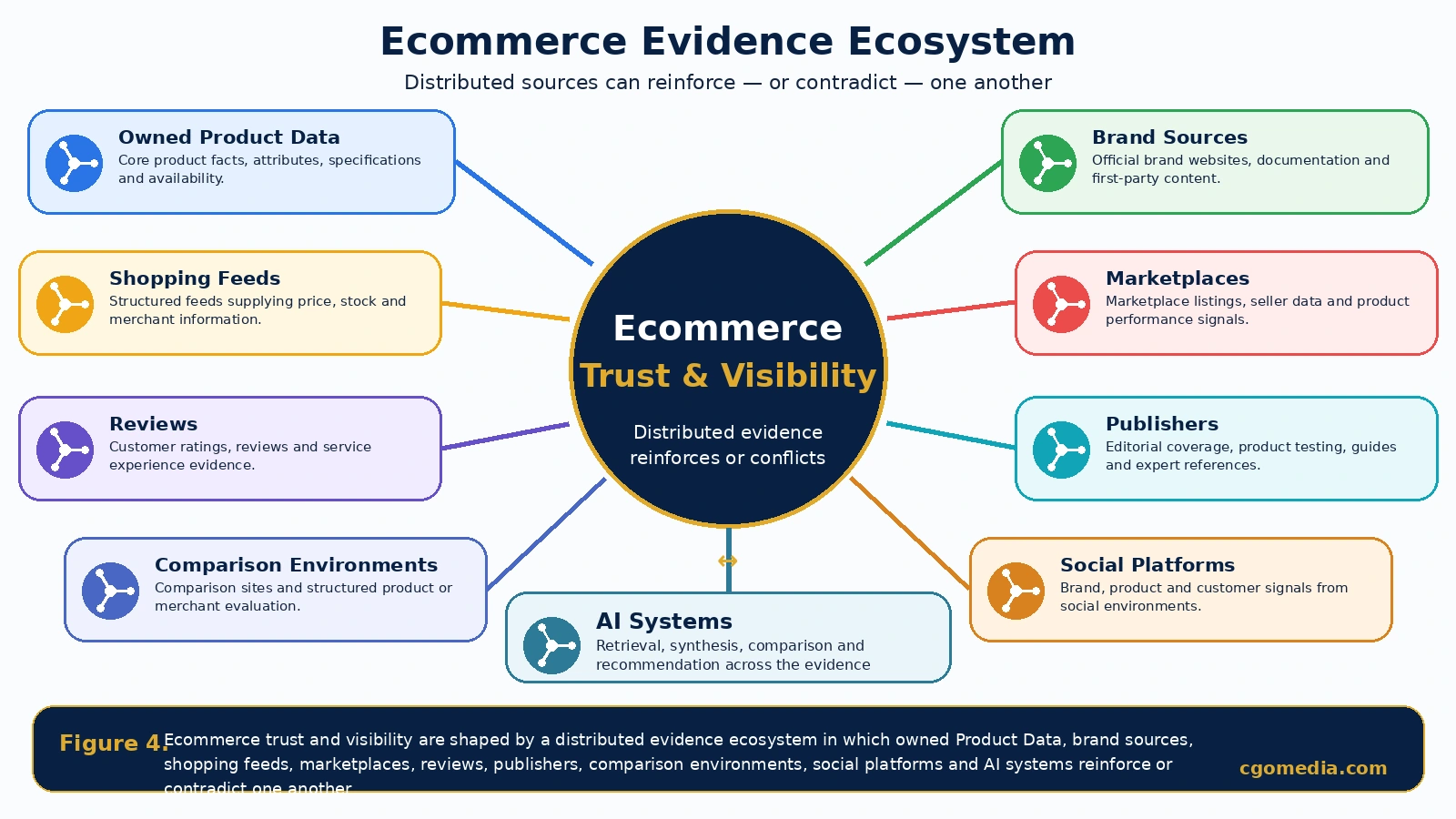
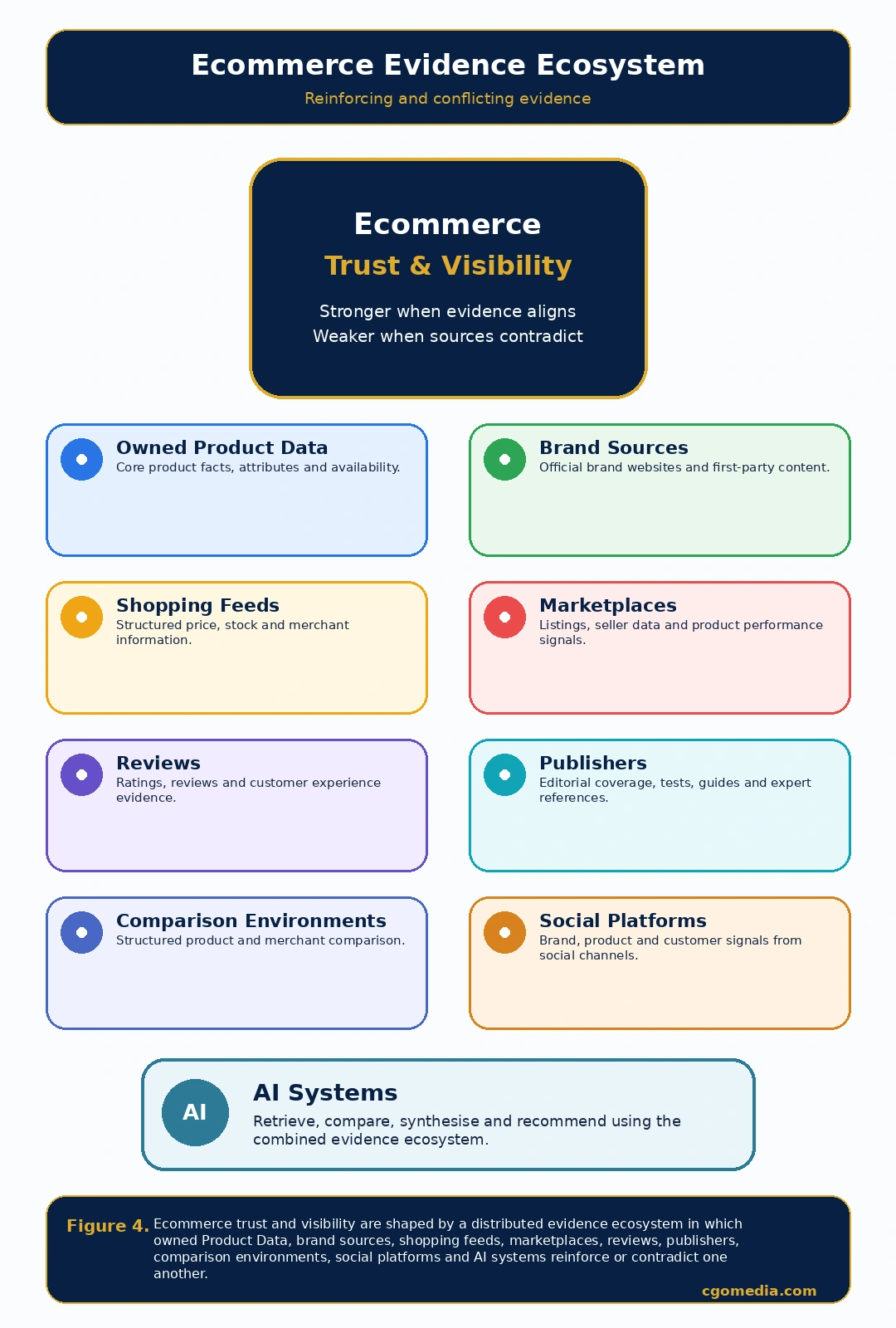
94. AI Source Monitoring
Retailers and brands should monitor which sources repeatedly appear to influence AI-generated answers relevant to their products, categories and commercial positioning.
Potential source types include:
- Manufacturer websites
- Retailer websites
- Marketplaces
- Review publications
- Comparison platforms
- Community sources
The objective is not to assume that one source type always carries the greatest influence.
Instead, organisations should look for recurring patterns across realistic shopper scenarios.
Manufacturer Websites
Manufacturer sources can provide authoritative evidence around:
- Product Identity;
- specifications;
- compatibility;
- warranty;
- and lifecycle status.
Retailer Websites
Retailer sources can provide current commercial evidence around:
- price;
- availability;
- delivery;
- returns;
- and active offers.
Marketplaces
Marketplaces can contribute:
- seller information;
- review volume;
- ratings;
- price comparison;
- and fulfilment evidence.
Review Publications
Specialist reviewers may influence recommendation reasoning by providing:
- testing;
- comparisons;
- strengths;
- limitations;
- and use-case analysis.
Comparison Platforms
Comparison sources can expose structured differences involving:
- price;
- specifications;
- retailer options;
- and Product Alternatives.
Community Sources
Forums and other communities may contribute practical experience around:
- compatibility;
- long-term ownership;
- specialist use;
- and recurring problems.
Source Monitoring should therefore ask:
“Which evidence environments repeatedly support the products, brands and retailers that appear in relevant AI-assisted answers?”
95. AI Citation Monitoring
Where AI interfaces expose citations, organisations can monitor whether their own Product Information, research or buying guidance appears among cited sources.
Useful monitoring fields can include:
- Page cited
- Topic
- Prompt type
- Date
- Competitor citations
- Information represented
Citation Visibility can provide evidence that a particular asset is being used as supporting information.
However, citation presence should not automatically be interpreted as overall AI Search Authority.
A page may receive citations while the brand or retailer remains weak within:
- Product Recommendations;
- Brand Comparisons;
- or Retailer Selection.
The stronger measurement principle is:
Citation Visibility + Representation Accuracy + Recommendation Relevance
96. AI Recommendation Monitoring
Recommendation tracking should use realistic prompts that include meaningful selection criteria such as:
- Budget
- Use case
- Features
- Brand preference
- Delivery requirements
- Retailer trust
Generic prompts can provide useful baseline observations, but stronger analysis usually comes from more specific scenarios.
For example, Product Selection may change when the shopper adds:
- a strict budget;
- a compatibility requirement;
- a delivery deadline;
- or a preferred brand.
Recommendation Monitoring Should Record Context
Useful fields may include:
- prompt;
- product recommended;
- brand recommended;
- retailer recommended;
- competitors;
- reasoning;
- and date.
Monitoring Should Focus on Qualified Inclusion
The goal is not to maximise inclusion across every possible recommendation.
The stronger objective is to appear where:
- Product Fit exists;
- Retailer Fit exists;
- commercial data is current;
- and available evidence supports the recommendation.
97. AI Representation Gap Analysis
An AI representation gap exists when important products, brands or retailer attributes are absent, inaccurate or weaker than competitor representation.
Common representation gaps may include:
- Priority products not appearing
- Old products appearing instead of current models
- Incorrect specifications
- Weak retailer representation
- Missing category association
- Competitor strengths represented more clearly
Absence Is Only One Type of Gap
A brand may appear frequently while still being represented poorly.
Examples include:
- wrong price positioning;
- outdated Product Range;
- weak recognition of specialist strengths;
- or inaccurate Retailer Information.
Gap Analysis Should Lead to Evidence Improvement
The strongest diagnostic question is:
“What evidence is missing, weak or inconsistent compared with the organisations being represented more effectively?”
Potential responses may include:
- improving Product Data;
- strengthening Category Authority;
- developing external validation;
- or correcting distributed commercial information.
98. Competitor Trust Mapping
Competitor analysis can compare:
- Entity clarity
- Category depth
- Product evidence
- Review authority
- External coverage
- AI visibility
Competitor Trust Mapping helps explain why one retailer or brand may appear stronger within search and AI-assisted discovery.
Entity Clarity
Compare how clearly competitors represent:
- retailer identity;
- Brand Relationships;
- merchant identity;
- and store networks.
Category Depth
Assess whether competitors provide stronger:
- category structure;
- subcategories;
- buying guidance;
- and Product-Type coverage.
Product Evidence
Compare:
- specifications;
- images;
- video;
- variants;
- reviews;
- and Product Freshness.
Review Authority
Compare:
- volume;
- recency;
- rating;
- and recurring themes.
External Coverage
Evaluate whether competitors receive:
- publisher reviews;
- comparison inclusion;
- media coverage;
- or research citations.
AI Visibility
Monitor whether competitors appear more consistently across:
- Product Recommendations;
- Brand Comparisons;
- Retailer Recommendations;
- and category-level discovery.
99. Identifying Ecommerce Trust Gaps
Common trust gaps may include:
- Unclear retailer identity
- Incomplete product specifications
- Outdated prices
- Weak returns information
- Limited reviews
- Inconsistent marketplace data
- Weak external validation
Trust-gap analysis should distinguish between different types of weakness.
Identity Gaps
These create uncertainty around:
- who sells;
- who manufactures;
- who fulfils;
- and who supports the transaction.
Product Evidence Gaps
Missing:
- specifications;
- images;
- compatibility;
- or Variant Information
can weaken Product Fit.
Commercial Gaps
Outdated:
- price;
- stock;
- delivery;
- or promotion information
can reduce transaction confidence immediately.
Merchant Trust Gaps
Weak:
- returns;
- support;
- reviews;
- or payment transparency
can undermine an otherwise strong Product Environment.
External Authority Gaps
A retailer may have strong first-party evidence but limited independent validation.
The purpose of the gap analysis is to identify:
which missing evidence layer most restricts confidence or Recommendation Readiness.
100. Prioritising Trust Improvements
Improvements should normally be prioritised according to:
- Commercial importance
- Information risk
- Scale of affected catalogue
- Customer decision impact
- Implementation effort
Not every trust weakness requires the same urgency.
A missing secondary image may matter less than an incorrect price or compatibility error.
Commercial Importance
Priority should increase where weaknesses affect:
- high-revenue products;
- strategic categories;
- new launches;
- or major customer journeys.
Information Risk
Errors that can cause:
- wrong purchase;
- financial misunderstanding;
- failed compatibility;
- or failed fulfilment
should generally receive greater priority.
Catalogue Scale
A systemic problem affecting thousands of products may require earlier intervention than a minor issue affecting one SKU.
Customer Decision Impact
Information used directly in Product Selection or Merchant Selection should carry greater weight.
Implementation Effort
Effort should be considered, but high effort should not automatically postpone high-risk weaknesses indefinitely.
101. High-Risk Product Information First
Errors involving price, stock, compatibility, Product Identity or delivery should generally take priority over lower-impact content enhancements.
These fields can directly affect:
- Product Eligibility;
- Product Fit;
- Retailer Selection;
- and Transaction Completion.
A useful prioritisation principle is:
Accuracy Before Enrichment.
For example, expanding Product Copy has limited value if:
- the wrong Product Variant is represented;
- the price is outdated;
- or the item is no longer available.
102. Priority Categories First
Where resources are constrained, organisations can initially strengthen the categories and Product Groups with the greatest commercial importance.
Priority may reflect:
- Revenue
- Margin
- Growth opportunity
- Search demand
- Competitive pressure
- Strategic importance
A category-led approach allows organisations to improve:
- Catalogue Authority;
- Product Evidence;
- Merchant Trust;
- and External Authority
within a manageable scope before scaling the model across the wider catalogue.
103. Evidence Quality Before Volume
Publishing more Product or Category Pages should not take priority over correcting major weaknesses in existing Product Data and Merchant Trust.
Large-scale content expansion can magnify:
- duplicate information;
- incomplete specifications;
- variant confusion;
- weak Product Relationships;
- and stale commercial data.
The stronger principle is:
Improve Evidence Standards → Apply Them Consistently → Scale Coverage
This reduces the risk that catalogue growth creates more discoverable but poorly trusted inventory.
104. Measuring Ecommerce Trust and Visibility
The Ecommerce & Retail AI Trust and Visibility Framework should be measured across the six dimensions rather than through a single traffic, ranking or revenue metric.
The objective is to understand whether the organisation is becoming:
- easier to discover;
- easier to understand;
- more reliable;
- more trusted;
- more externally validated;
- and more recommendation-ready.
Measurement should therefore combine:
Visibility Metrics + Evidence Metrics + Trust Metrics + Authority Metrics + AI Representation Metrics
The framework should also be measured over time so improvement can be distinguished from one-off fluctuations.
105. Measuring Brand, Retailer and Merchant Entity Clarity
Relevant indicators can include:
- Retailer naming consistency
- Brand relationship clarity
- Store profile accuracy
- Merchant identity consistency
- External profile alignment
Useful questions include:
- Is the same retailer represented consistently across major platforms?
- Are brands connected accurately with current Product Ranges?
- Are store details correct?
- Can shoppers distinguish retailer from marketplace seller?
- Do external profiles refer to the correct organisation?
Improvement should reduce ambiguity around commercial responsibility.
106. Measuring Product, Category and Catalogue Authority
This dimension can be assessed through:
- Category architecture
- Subcategory depth
- Product coverage
- Brand architecture
- Variant clarity
- Internal linking quality
Useful measurement should consider not only how many pages exist, but whether relationships between pages are commercially meaningful.
A strong catalogue should make it easier to understand:
- where Product Types belong;
- which brands are represented;
- how variants differ;
- and which Product Alternatives exist.
107. Measuring Product Evidence and Information Quality
Relevant indicators include:
- Price accuracy
- Availability accuracy
- Specification completeness
- Image quality
- Identifier consistency
- Product freshness
Measurement can be applied to:
- the complete catalogue;
- priority categories;
- strategic products;
- or selected audit samples.
A Product Information Quality review should distinguish:
- missing evidence;
- incorrect evidence;
- stale evidence;
- and inconsistent evidence.
The strongest objective is:
Accurate + Complete + Current + Comparable Product Information
108. Measuring Reviews, Merchant Trust and Commercial Confidence
This dimension can be assessed through:
- Retailer review authority
- Product review quality
- Delivery transparency
- Returns transparency
- Payment clarity
- Customer service visibility
Retailer Review Authority
Measure:
- volume;
- recency;
- rating;
- and recurring service themes.
Product Review Quality
Assess whether reviews provide useful evidence around:
- Product Fit;
- performance;
- quality;
- and limitations.
Delivery and Returns Transparency
Evaluate whether customers can understand material fulfilment and returns conditions before purchase.
Payment and Customer Service Visibility
Assess whether important transaction and support information is sufficiently accessible.
109. Measuring Brand, Market and External Authority
Relevant indicators may include:
- Publisher mentions
- Independent product reviews
- Comparison visibility
- Industry recognition
- Research citations
- Brand media coverage
External Authority should be evaluated qualitatively as well as quantitatively.
The organisation should consider:
- relevance of the source;
- credibility;
- recency;
- context;
- and connection with strategic products or categories.
Ten relevant specialist references may provide greater decision value than a much larger number of unrelated mentions.
110. Measuring AI Search and Product Recommendation Readiness
AI readiness can be assessed through:
- Product recommendation visibility
- Category recommendation visibility
- Brand comparison visibility
- Retailer recommendation visibility
- AI citation visibility
- Representation accuracy
Measurement should use repeatable prompt families and record changes over time.
Product Recommendation Visibility
Assess whether relevant products appear for suitable use cases and shopper requirements.
Category Recommendation Visibility
Monitor whether the brand or retailer appears within important category contexts.
Brand Comparison Visibility
Evaluate whether brand strengths, weaknesses and positioning are represented accurately.
Retailer Recommendation Visibility
Assess whether the retailer appears where:
- price;
- delivery;
- returns;
- or Merchant Trust
make it genuinely relevant.
AI Citation Visibility
Monitor whether owned Product Information, research or buying guidance is cited where citations are visible.
Representation Accuracy
Validate important facts involving:
- price;
- availability;
- specifications;
- Product Lifecycle;
- and Retailer Information.
111. Ecommerce Trust and Visibility Scorecard
A practical scorecard can evaluate the six dimensions using a repeatable assessment structure.
| Dimension | Primary Question | Evidence of Strength |
|---|---|---|
| Brand, Retailer and Merchant Entity Clarity | Are the commercial entities represented consistently and clearly? | Consistent business, brand, store and Merchant Identity across relevant environments. |
| Product, Category and Catalogue Authority | Is the catalogue organised into meaningful Product Relationships? | Strong Category Architecture, Product Depth, Brand Relationships and internal connections. |
| Product Evidence and Information Quality | Is commercial Product Information accurate, complete and current? | Reliable price, availability, specifications, imagery, identifiers and Variant Information. |
| Reviews, Merchant Trust and Commercial Confidence | Can customers transact with sufficient confidence? | Strong reviews, clear delivery and returns, reliable Customer Service and transparent transaction conditions. |
| Brand, Market and External Authority | Do credible external sources validate the brand and retailer? | Independent reviews, publisher coverage, comparison visibility, media references and research citations. |
| AI Search and Product Recommendation Readiness | Is the organisation represented accurately in AI-assisted discovery? | Relevant Product, Brand and Retailer Recommendation Visibility supported by accurate and current representation. |
The scorecard should not be reduced to one universal numerical score without context.
A retailer may be strong in:
- Merchant Trust
while remaining weaker in:
- Catalogue Authority;
- External Authority;
- or AI Recommendation Readiness.
The more useful output is a dimensional profile showing:
- where evidence is strong;
- where material gaps remain;
- which gaps carry the greatest commercial risk;
- and which improvements should be prioritised.
A practical review can therefore ask:
“Which dimension most limits the organisation’s ability to move from discovery into trusted, qualified recommendation?”
The Ecommerce Trust and Visibility Scorecard converts the six dimensions of the framework into a practical assessment model for identifying entity, catalogue, Product Information, Merchant Trust, External Authority and AI Recommendation Readiness gaps.
1. Entity Clarity
Assess whether retailers, brands, stores, manufacturers and marketplace merchants are represented consistently enough to establish clear commercial responsibility.
2. Catalogue Authority
Evaluate whether departments, categories, brands, Product Types, products and variants form a coherent and navigable Product Knowledge Architecture.
3. Product Information Quality
Measure price accuracy, stock accuracy, specification completeness, imagery, identifiers, Variant Clarity and Product Freshness.
4. Merchant Trust
Assess Product and Retailer Reviews, delivery, returns, payments, Customer Service and overall Transaction Confidence.
5. External Authority
Evaluate independent publisher coverage, Product Reviews, comparison visibility, industry recognition, research citations and Brand Media Authority.
6. AI Recommendation Readiness
Measure Product, Category, Brand and Retailer Recommendation Visibility alongside AI citations, source patterns and Representation Accuracy.
Scorecard principle: Ecommerce Trust and Visibility should be assessed across multiple evidence dimensions rather than reduced to traffic, rankings or a single authority metric.
Gap principle: The purpose of the scorecard is to identify which evidence layer most restricts Product Understanding, Merchant Confidence or Recommendation Readiness.
Prioritisation principle: High-risk errors involving Product Identity, price, stock, compatibility, delivery or Merchant Trust should generally be corrected before lower-impact expansion activity.
Measurement principle: Each dimension should be reviewed longitudinally so the organisation can determine whether improvements in Product Data, Trust Evidence, External Authority and AI representation are becoming durable.
Figure 5. The Ecommerce Trust and Visibility Scorecard evaluates Entity Clarity, Catalogue Authority, Product Information Quality, Merchant Trust, External Authority and AI Recommendation Readiness as one connected evidence system.
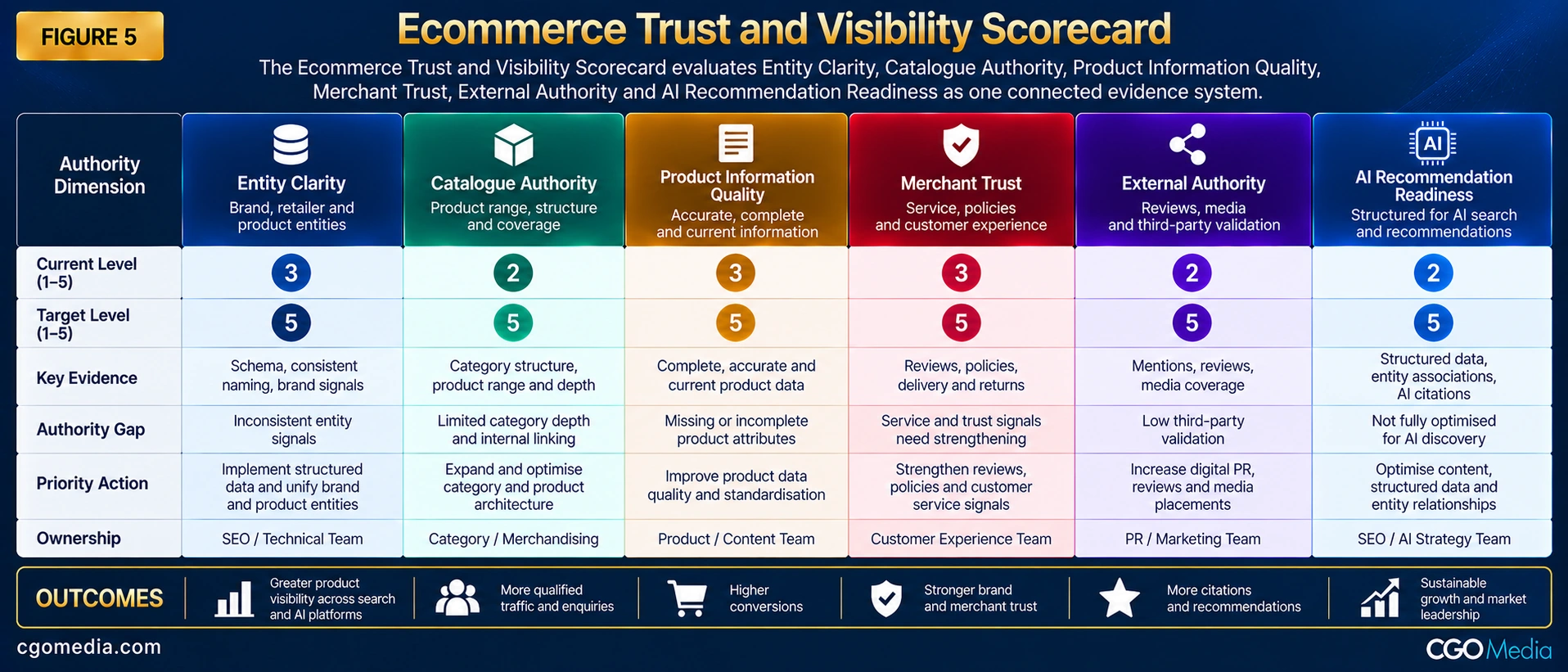
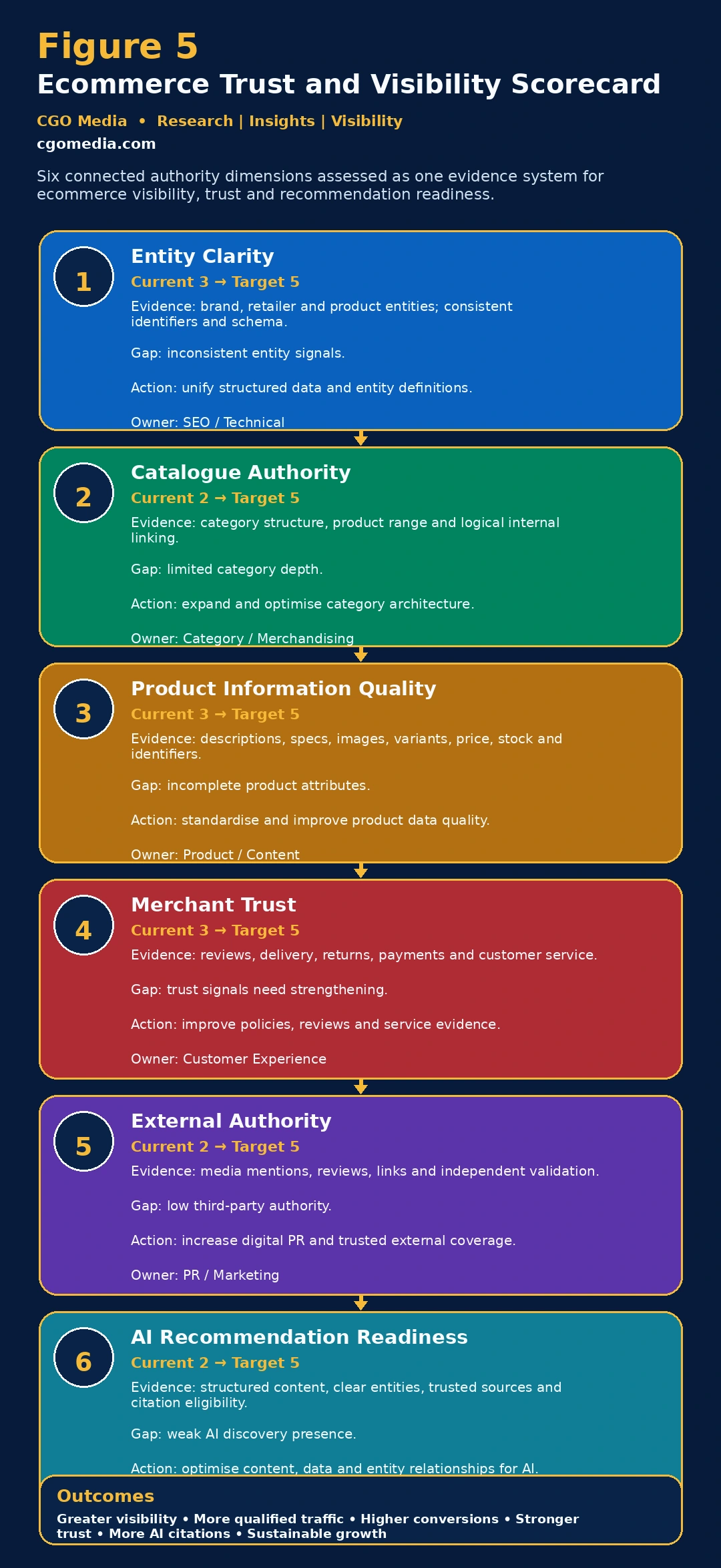
112. Longitudinal Measurement
Trust and visibility should be measured over time rather than through one-off audits.
A single assessment can identify the current position, but longitudinal monitoring is required to understand whether improvements are becoming durable.
Useful areas to monitor repeatedly include:
- Product Data completeness
- Price and stock accuracy
- Review strength
- External Authority
- AI representation
- Merchant Trust
Longitudinal measurement can reveal whether an improvement is:
- temporary;
- seasonal;
- isolated to one category;
- or becoming embedded across the wider ecommerce system.
The stronger objective is:
Baseline → Improvement → Validation → Sustained Performance
113. Governance of Ecommerce Trust and Visibility
Strong ecommerce authority requires coordinated ownership across merchandising, SEO, Product Data, customer service, technology, Digital PR and commercial teams.
Many trust problems occur because important information is distributed across separate systems and organisational functions.
Effective governance should therefore define:
- who owns each evidence layer;
- how often it is reviewed;
- which standards apply;
- and how significant errors are escalated.
Governance should connect:
Ownership + Standards + Monitoring + Escalation
rather than leaving Product and Merchant Trust to informal coordination.
114. Retailer Entity Ownership
Responsibility should be defined for maintaining:
- Retailer naming
- Store details
- Business profiles
- Marketplace seller information
- External retailer profiles
Ownership should ensure that material identity changes are reflected consistently across relevant environments.
This may include:
- rebrands;
- store openings or closures;
- changes in trading entities;
- market expansion;
- or marketplace account changes.
The objective is to preserve clear Retailer Identity wherever customers or digital systems encounter the business.
115. Catalogue Ownership
Catalogue governance should define responsibility for:
- Product names
- Categories
- Brands
- Variants
- Identifiers
- Product relationships
These fields should follow clear standards so Catalogue Authority does not deteriorate as inventory expands.
Catalogue ownership should also address:
- new Product Creation;
- category reassignment;
- variant consolidation;
- Product Retirement;
- and relationship maintenance.
Strong Catalogue Governance supports:
Consistent Product Identity + Coherent Category Structure + Reliable Product Relationships
116. Product Information Ownership
Commercial teams should clearly own:
- Price
- Availability
- Specifications
- Images
- Promotions
- Product status
Different information types may require different owners and update frequencies.
For example:
- pricing may sit with commercial teams;
- inventory with operations;
- specifications with Product Data teams;
- and imagery with merchandising or brand teams.
The important requirement is that ownership remains explicit.
Product Information should not become inaccurate because every team assumes another function is maintaining it.
117. Merchant Trust Ownership
Ownership should be defined for:
- Delivery policies
- Returns policies
- Customer service information
- Payment information
- Review monitoring
Merchant Trust spans several operational functions, so ownership may need to be shared across:
- operations;
- customer service;
- legal;
- payments;
- and ecommerce management.
The organisation should ensure that customer-facing trust information reflects current operational reality.
This is especially important where delivery, returns or payment policies change frequently.
118. External Authority Ownership
Digital PR and communications teams can coordinate:
- Product-review outreach
- Brand coverage
- Retail research
- Industry commentary
- Publisher relationships
External Authority development should be aligned with the products, categories and expertise the organisation wants to strengthen.
Useful coordination can include:
- launch planning;
- research publication;
- expert commentary;
- journalist outreach;
- and Product Review programmes.
The objective is not publicity for its own sake.
It is relevant independent evidence that strengthens:
- Brand Authority;
- Product Authority;
- Category Expertise;
- and Merchant Credibility.
119. AI Visibility Ownership
Responsibility should be defined for:
- Prompt-set monitoring
- Product recommendation analysis
- Retailer recommendation analysis
- AI citation monitoring
- Representation accuracy
- Competitor comparison
AI monitoring can sit within SEO, research, analytics or a dedicated AI Search function depending on organisational structure.
The key requirement is that findings are translated into operational action.
For example, AI monitoring may reveal:
- outdated Product Information;
- weak External Authority;
- poor Brand Association;
- or inaccurate Retailer Representation.
Those findings should then feed into the teams responsible for correcting the underlying evidence.
120. Common Ecommerce Trust Failure Modes
Several recurring weaknesses can reduce the value of otherwise strong ecommerce visibility.
These problems often arise because one capability becomes strong while another remains underdeveloped.
Typical patterns include:
- strong rankings but weak Product Data;
- strong Product Pages but weak Merchant Trust;
- strong reviews but weak Catalogue Architecture;
- strong marketplace sales but weak owned authority;
- strong brand recognition but poor Retailer Representation;
- complete Product Data that is no longer fresh;
- and AI monitoring without corrective action.
The framework should therefore be evaluated as one connected system rather than as isolated strengths.
121. Strong Rankings with Weak Product Data
A retailer can rank well while still presenting incomplete or unreliable Product Information.
Weaknesses may include:
- missing specifications;
- incorrect variants;
- outdated prices;
- poor Product Imagery;
- or weak compatibility information.
In this situation, strong Search Visibility generates discovery but does not necessarily create Product Confidence.
The failure pattern is:
High Visibility → Weak Product Understanding → Reduced Selection Confidence
122. Strong Product Pages with Weak Merchant Trust
Good Product Presentation may not convert effectively if users remain uncertain about:
- Delivery
- Returns
- Customer service
- Retailer reputation
A product may be highly suitable while the merchant remains an unattractive purchase option.
The organisation should therefore distinguish:
Product Fit
from:
Retailer Fit.
Both need to be sufficiently strong for a transaction to progress confidently.
123. Strong Reviews with Weak Catalogue Architecture
Retailer reputation alone cannot compensate for poor category organisation or weak Product Discoverability.
A retailer may have excellent service reviews while customers struggle to:
- find relevant categories;
- compare products;
- understand variants;
- or identify suitable alternatives.
Merchant Trust therefore needs to operate alongside a strong Product Knowledge Architecture.
124. Strong Marketplace Presence with Weak Owned Authority
Marketplace success can generate revenue while leaving the retailer dependent on third-party discovery environments.
Potential weaknesses can include:
- limited direct Brand Visibility;
- weak owned Search Authority;
- limited customer relationships;
- and dependence on marketplace ranking systems.
Marketplaces can remain valuable channels, but retailers should understand the difference between:
Marketplace Authority
and:
Owned Retail Authority.
A balanced authority model develops both where commercially appropriate.
125. Strong Brand Authority with Weak Retailer Representation
A well-known brand may still perform poorly through a particular retailer if Product Availability, Pricing and Service Evidence are weak.
Brand strength can attract initial interest, but Retailer Selection may still depend on:
- current stock;
- competitive price;
- delivery;
- returns;
- and Merchant Reviews.
This reinforces the distinction between:
Brand Trust
and:
Retailer Trust.
126. Product Data Without Freshness
Complete Product Information can quickly lose value if price, availability or status is no longer current.
A product may have:
- excellent descriptions;
- complete specifications;
- high-quality images;
- and strong reviews
while still becoming commercially misleading because:
- the price has changed;
- the required variant is unavailable;
- or the model has been discontinued.
The stronger evidence model is:
Completeness + Accuracy + Freshness
rather than completeness alone.
127. AI Monitoring Without Evidence Improvement
Tracking Recommendation Visibility creates limited value unless weak Product Data, trust signals and source representation are actively improved.
Monitoring should therefore lead to a diagnostic question:
“What underlying evidence difference may explain the observed representation?”
Potential actions can include:
- correcting Product Information;
- improving Category Authority;
- strengthening external validation;
- updating Merchant Trust information;
- or correcting inaccurate distributed data.
The preferred cycle is:
Observe → Diagnose → Improve Evidence → Re-Test
128. Application for Pure-Play Ecommerce Retailers
Pure-play ecommerce businesses can use the framework to coordinate:
- Catalogue Authority
- Product Data
- Merchant reviews
- Shopping feeds
- External Authority
- AI recommendation visibility
Because the entire customer journey is digital, particular emphasis may be placed on:
- Product Information Quality;
- delivery clarity;
- returns;
- online reputation;
- and transaction confidence.
The framework can help identify where strong Digital Discovery is being undermined by weak Product or Merchant Evidence.
129. Application for Omnichannel Retailers
Omnichannel retailers can additionally connect:
- Stores
- Local inventory
- Click and collect
- Store reviews
- Online and offline customer journeys
Trust and visibility should remain coherent across both digital and physical channels.
For example:
Online Product Discovery → Local Stock → Store Collection → In-Store Experience
should operate as one understandable commercial journey.
Store-level evidence can therefore become part of wider Retailer Authority.
130. Application for Consumer Brands
Consumer brands can use the framework to assess:
- Brand Entity Clarity
- Product knowledge
- Retail distribution
- Independent reviews
- Publisher authority
- AI brand visibility
Brands should monitor not only their own website but also how products are represented by:
- retailers;
- marketplaces;
- publishers;
- comparison platforms;
- and AI systems.
This is particularly important where third-party Product Information influences how customers understand the brand.
131. Application for Marketplaces
Marketplaces can focus on:
- Seller identity
- Product Information Quality
- Review systems
- Commercial transparency
- Marketplace trust
- AI Product Discovery
Marketplace environments introduce an additional trust relationship:
Marketplace → Seller → Offer → Product
The platform may be trusted while individual sellers differ significantly in:
- fulfilment;
- returns;
- reviews;
- and Product Accuracy.
Seller-level evidence should therefore remain distinguishable from marketplace-level trust.
132. Application for Fashion Retail
Fashion retailers may place particular emphasis on:
- Size accuracy
- Fit guidance
- Colour representation
- Visual evidence
- Returns confidence
- Seasonal freshness
Trust can be weakened when imagery, size information or Product Description fails to set accurate expectations.
Returns data can provide valuable feedback around:
- fit;
- sizing;
- colour;
- material;
- and Product Presentation.
Fashion retailers should therefore treat returns intelligence as part of Product Evidence development.
133. Application for Consumer Electronics
Electronics retailers may place greater weight on:
- Specifications
- Compatibility
- Model identity
- Warranty
- Product comparison
- Lifecycle status
Technical Product Categories require precise differentiation between:
- generations;
- regional models;
- memory configurations;
- connectivity options;
- and compatible accessories.
Outdated lifecycle information can be especially damaging where an older Product continues appearing as though it were the current model.
134. Application for Beauty and Personal Care
Beauty retailers may require particularly strong evidence around:
- Ingredients
- Suitability
- Product claims
- Use instructions
- Reviews
- Brand trust
Product Information should distinguish clearly between:
- factual characteristics;
- usage guidance;
- customer experience;
- and promotional claims.
Strong Brand and Product Trust becomes particularly important where users evaluate formulation, suitability and Product Safety.
135. Application for International Ecommerce
International retailers should also evaluate:
- Local currency
- Language
- Regional availability
- International delivery
- Taxes and duties
- Regional returns
- Local merchant trust
Trust conditions can vary significantly between markets.
The same product may have different:
- prices;
- stock;
- delivery options;
- returns conditions;
- and Retailer Reputation
across different countries.
International ecommerce should therefore preserve:
Global Product Identity + Local Commercial Accuracy + Local Merchant Trust
136. Continuous Ecommerce Trust and Visibility Development
The framework should ultimately operate as a continuous improvement system.
A practical cycle is:
Measure → Identify Trust Gaps → Improve Product Evidence → Strengthen Merchant Confidence → Validate Externally → Monitor AI Representation → Refine
Measure
Assess current performance across:
- Entity Clarity;
- Catalogue Authority;
- Product Information Quality;
- Merchant Trust;
- External Authority;
- and AI Recommendation Readiness.
Identify Trust Gaps
Determine where weak or conflicting evidence limits:
- Product Understanding;
- Merchant Confidence;
- External Credibility;
- or Recommendation Readiness.
Improve Product Evidence
Correct Product Identity, specifications, price, stock, imagery, variants and other decision-critical information.
Strengthen Merchant Confidence
Improve:
- reviews;
- delivery;
- returns;
- payments;
- and Customer Service Visibility.
Validate Externally
Develop stronger supporting evidence through:
- publishers;
- reviews;
- comparison platforms;
- research;
- and industry media.
Monitor AI Representation
Track:
- Product Recommendations;
- Brand Visibility;
- Retailer Recommendations;
- citations;
- sources;
- and Representation Accuracy.
Refine
Use the combined evidence to determine the next highest-priority improvement.
The cycle should continue as:
- products change;
- prices change;
- reviews accumulate;
- competitors strengthen;
- and AI-assisted discovery systems evolve.
The long-term objective is:
Continuously Improving Ecommerce Trust, Evidence Quality and Recommendation Readiness.
The Ecommerce Trust and Visibility Improvement Cycle shows how organisations can continuously measure current performance, identify evidence gaps, strengthen Product Information and Merchant Confidence, develop independent validation, monitor AI representation and refine the wider ecommerce evidence system.
1. Measure
Assess Entity Clarity, Catalogue Authority, Product Information Quality, Merchant Trust, External Authority and AI Recommendation Readiness.
2. Identify Trust Gaps
Find the Product, Merchant, Catalogue, External Authority or AI Representation weaknesses most likely to reduce decision confidence.
3. Improve Product Evidence
Strengthen Product Identity, specifications, price, availability, imagery, variants and other decision-critical commercial information.
4. Strengthen Merchant Confidence
Improve reviews, delivery clarity, returns transparency, payment information, Customer Service Visibility and transaction trust.
5. Validate Externally
Develop credible independent reinforcement through publishers, Product Reviews, comparison environments, research and industry media.
6. Monitor AI Representation
Track Product, Brand and Retailer Recommendations, citation patterns, source visibility, competitor representation and factual accuracy.
7. Refine
Use observed evidence to prioritise the next trust, information-quality, authority or AI-readiness improvement.
Measurement principle: Ecommerce Trust and Visibility should be evaluated continuously across the six framework dimensions rather than through occasional one-off audits.
Evidence principle: Improvements should begin with the most material gaps in Product Accuracy, Merchant Trust, Entity Clarity or Catalogue Understanding.
Validation principle: First-party improvements become stronger when credible independent sources reinforce important Product, Brand and Merchant claims.
AI principle: AI monitoring should lead back into evidence improvement, creating a repeating cycle of observation, diagnosis, correction and validation.
Figure 6. Ecommerce Trust and Visibility improves through a repeating cycle of measurement, trust-gap identification, Product Evidence development, Merchant Confidence strengthening, external validation, AI monitoring and refinement.
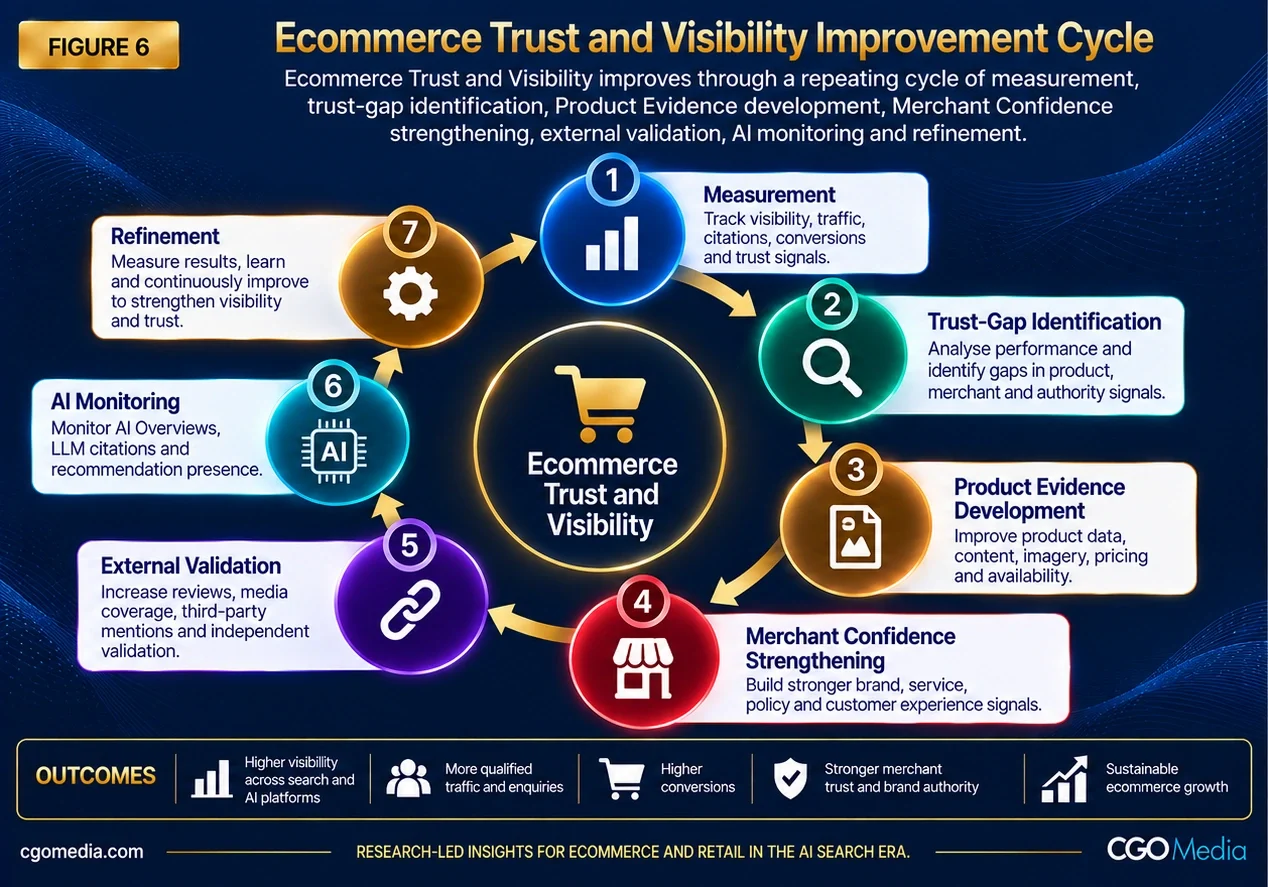
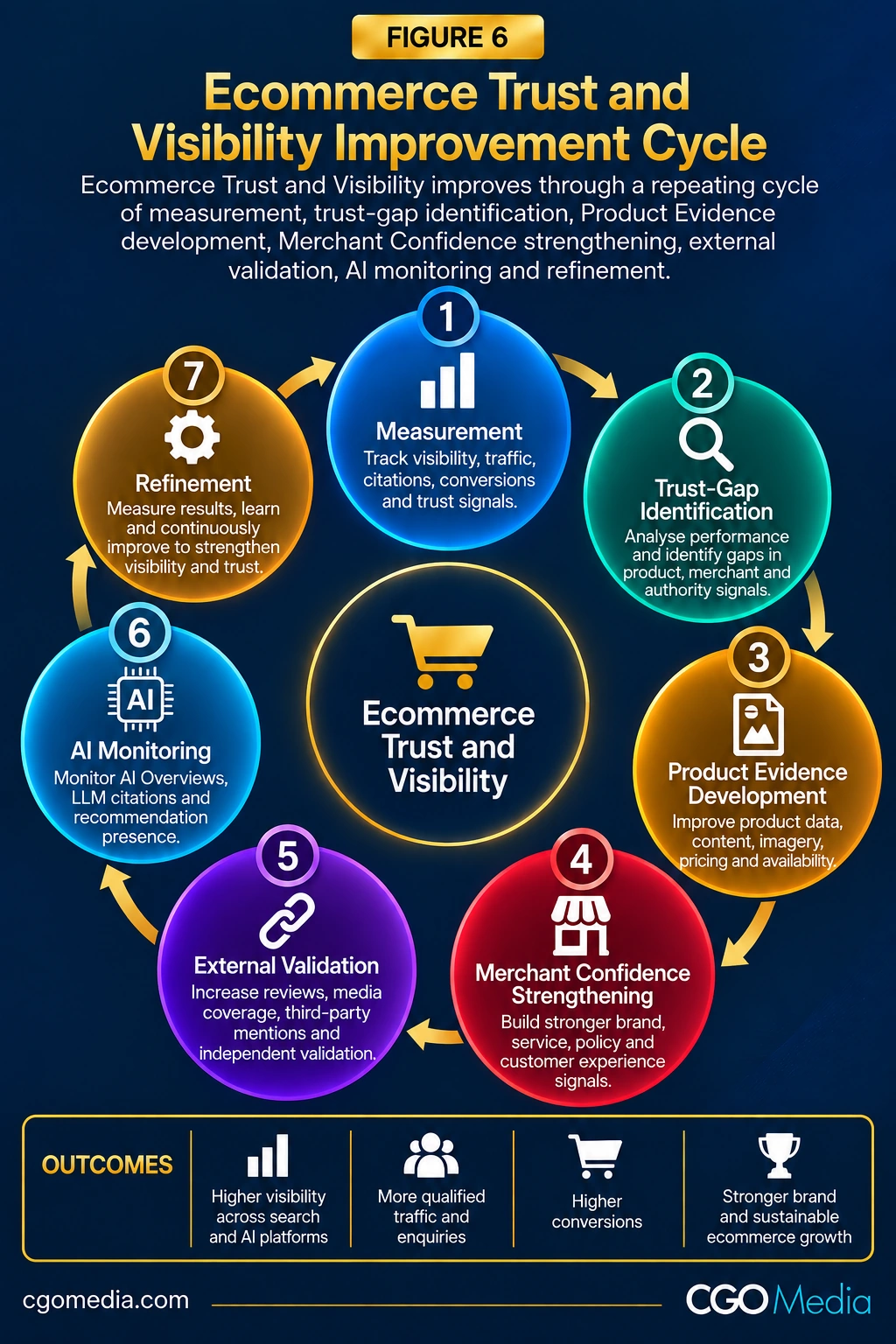
137. Relationship with the Product Discovery and Retailer Selection Model
The Product Discovery and Retailer Selection Model explains how consumers progress from an initial need through Product Discovery, evaluation, Merchant Validation, comparison, shortlisting and purchase.
The Ecommerce & Retail AI Trust and Visibility Framework defines the evidence conditions that can strengthen confidence throughout that journey.
The relationship between the two models can be understood as:
Shopper Decision Stage → Required Evidence → Trust Threshold → Selection Confidence
For example, during early Product Discovery, users primarily need enough information to understand:
- which Product Categories may solve the problem;
- which brands operate within the category;
- and which products satisfy basic requirements.
As the user moves toward Product Evaluation, additional evidence becomes important, including:
- specifications;
- features;
- compatibility;
- Product Reviews;
- price;
- and alternative products.
During Retailer and Merchant Validation, the evidence requirement changes again.
The customer may now evaluate:
- retailer reputation;
- delivery;
- returns;
- payment options;
- customer service;
- and seller reliability.
The Product Discovery and Retailer Selection Model therefore explains how the decision journey progresses, while the Trust and Visibility Framework explains what evidence needs to be sufficiently strong during that journey.
Together they provide a connected model:
Need → Discovery → Product Understanding → Product Validation → Merchant Trust → Comparison → Shortlist → Purchase
This connection is particularly important in AI-assisted discovery because generative systems can compress several stages of the traditional journey into one interaction.
A user may ask an AI system to identify:
- the most appropriate Product Type;
- three suitable products;
- their differences;
- current prices;
- and reputable retailers
within a single request.
For ecommerce organisations, this means Product Evidence and Merchant Trust increasingly need to operate as one connected evidence environment.
138. Relationship with the Ecommerce Search Authority Maturity Model
The Ecommerce Search Authority Maturity Model assesses how advanced an organisation has become in managing many of the capabilities defined within this framework.
The Trust and Visibility Framework identifies the evidence dimensions that matter.
The maturity model assesses how systematically those dimensions are being managed.
The relationship can be represented as:
Evidence Requirement → Organisational Capability → Search Authority Maturity
For example, a retailer may understand that Product Information Quality is important but still operate with:
- incomplete specifications;
- manual Product Data correction;
- weak ownership;
- inconsistent marketplace data;
- and limited monitoring.
That organisation recognises the trust requirement but has not yet developed the operational maturity required to manage it consistently.
A more mature organisation may instead have:
- defined Product Data standards;
- clear ownership;
- automated validation;
- feed governance;
- catalogue monitoring;
- and regular evidence-quality reporting.
The same distinction applies across:
- Entity Clarity;
- Catalogue Authority;
- Merchant Trust;
- External Authority;
- and AI Recommendation Readiness.
The framework therefore answers:
“What evidence conditions should we strengthen?”
while the maturity model answers:
“How advanced are we at managing those conditions systematically?”
139. Relationship with the Ecommerce & Retail SEO and AI Implementation Roadmap
The Ecommerce & Retail SEO and AI Implementation Roadmap provides the practical sequence for improving Product Evidence, Merchant Trust, External Authority and AI Recommendation Readiness.
The Trust and Visibility Framework establishes the dimensions to evaluate.
The implementation roadmap explains how organisations can improve those dimensions through:
Assess → Stabilise → Structure → Strengthen → Validate → Integrate → Evolve
The relationship is therefore:
Framework Diagnosis → Evidence Gap → Implementation Priority → Operational Improvement
Assess
The organisation evaluates current weaknesses across the six Trust and Visibility dimensions.
Stabilise
Critical problems involving:
- Product Identity;
- price;
- availability;
- technical accessibility;
- and Merchant Information
are corrected before larger authority-building programmes expand.
Structure
The retailer creates stronger relationships across:
- Retailer;
- Category;
- Brand;
- Product;
- Variant;
- and Offer.
Strengthen
Product Evidence, reviews, Category Authority, buying guidance and Commercial Transparency are improved.
Validate
Independent sources strengthen Product, Brand and Merchant credibility.
Integrate
SEO, Product Data, Merchandising, Reviews, Customer Experience, Digital PR and AI monitoring begin operating as connected capabilities.
Evolve
Trust and visibility become continuously monitored and improved as products, markets, competitors and discovery systems change.
The framework and roadmap should therefore be used together:
Understand the Weakness → Prioritise the Weakness → Improve the Evidence → Measure the Result
140. Relationship with the Parent Research
This framework forms part of the research architecture established in Ecommerce & Retail SEO in an AI Search Environment.
The parent research examines the wider transformation of Ecommerce SEO as Product Discovery becomes distributed across:
- traditional search engines;
- shopping systems;
- marketplaces;
- comparison platforms;
- publisher ecosystems;
- review environments;
- social platforms;
- and AI-assisted recommendation systems.
Within that environment, Product Visibility increasingly depends on more than indexability or page relevance.
Products and retailers may also need sufficiently strong evidence around:
- Entity Identity;
- Catalogue Relationships;
- Product Information;
- Commercial Accuracy;
- Merchant Trust;
- External Validation;
- and Recommendation Readiness.
The parent research establishes that broader environment.
This framework converts it into six practical evidence dimensions that can be assessed and improved.
The wider research progression is:
Ecommerce Search Environment → Trust & Visibility Framework → Discovery & Selection Model → Maturity Assessment → Implementation Roadmap
Together, these resources provide a connected research architecture for understanding how ecommerce organisations can build authority across both conventional and AI-assisted discovery.
141. Methodological Position
The Ecommerce & Retail AI Trust and Visibility Framework is a conceptual and strategic framework for evaluating observable digital evidence surrounding ecommerce organisations, brands, products and merchants.
It does not claim that the six dimensions correspond directly to proprietary:
- search-engine ranking algorithms;
- shopping-platform algorithms;
- marketplace ranking systems;
- large-language-model retrieval systems;
- or AI recommendation algorithms.
Those systems are proprietary, continuously evolving and may use different information sources, ranking mechanisms and recommendation logic.
The framework instead provides a structured method for assessing whether the evidence environment surrounding an ecommerce organisation is sufficiently:
- clear;
- complete;
- current;
- credible;
- comparable;
- and externally supported.
Observable Evidence Rather Than Algorithmic Assumption
The framework focuses on evidence that organisations can observe and improve.
This includes:
- Retailer Identity;
- Brand Relationships;
- Catalogue Structure;
- Product Information;
- price;
- availability;
- reviews;
- Merchant Policies;
- External Authority;
- and AI representation.
The framework therefore avoids claiming that any single signal guarantees:
- search rankings;
- shopping visibility;
- AI citation;
- shortlist inclusion;
- or recommendation.
Conceptual Evidence Thresholds
The evidence progression:
Discoverable → Understandable → Eligible → Current → Verifiable → Comparable → Shortlist Ready → Recommendation Ready
should be interpreted as a diagnostic model rather than a literal sequence used by any specific platform.
Its purpose is to help organisations identify where insufficient evidence may prevent a product or retailer from progressing through a decision journey.
Sector and Category Variation
The relative importance of individual evidence types varies significantly between Product Categories.
For example:
- fashion may place greater importance on size, fit, imagery and returns;
- consumer electronics may place greater importance on specifications, compatibility and Product Lifecycle;
- beauty may require stronger ingredient, suitability and claims evidence;
- marketplaces may require greater seller-level trust evidence;
- and international ecommerce may require market-specific delivery, currency, tax and Merchant Trust information.
The framework should therefore be adapted to category and commercial context rather than applied mechanically.
AI Observation Limitations
AI-generated results can vary according to:
- prompt wording;
- platform;
- model version;
- session context;
- location;
- language;
- and time of observation.
AI visibility monitoring should therefore use repeatable prompt families and longitudinal observation rather than relying on isolated outputs.
Commercial Measurement
Trust and Visibility improvements should ultimately be evaluated alongside commercial and customer outcomes where reliable data exists.
Relevant outcomes can include:
- Product Engagement;
- Add-to-Cart behaviour;
- checkout completion;
- conversion;
- returns;
- review sentiment;
- revenue;
- and repeat purchase.
This allows the framework to remain connected with real Ecommerce Performance rather than becoming a purely theoretical authority model.
142. Strategic Implications
The framework changes the central ecommerce visibility question from:
“Are our Product Pages ranking?”
to:
“Do users and digital systems have enough reliable evidence to understand our products, trust our business and include us within relevant recommendation sets?”
This shift has several strategic implications.
Ecommerce SEO Becomes an Evidence-System Discipline
Technical SEO and Product Page optimisation remain essential, but they increasingly operate inside a larger evidence environment.
That environment includes:
- Catalogue Architecture;
- Product Data;
- Merchant Trust;
- shopping feeds;
- marketplaces;
- reviews;
- publisher evidence;
- and AI representation.
Product Data Becomes Search Infrastructure
Product Data is no longer only a merchandising asset.
Accurate:
- Product Identity;
- specifications;
- price;
- stock;
- variants;
- and identifiers
can influence how products are represented across several discovery environments simultaneously.
Merchant Trust Becomes Part of Search Authority
The transaction itself is increasingly visible before the customer reaches checkout.
Shoppers can compare:
- ratings;
- delivery;
- returns;
- price;
- seller reputation;
- and retailer reputation
while they are still deciding which product or merchant to consider.
Merchant Trust should therefore be treated as part of the wider discovery environment.
External Authority Becomes a Validation Layer
First-party claims become stronger when relevant independent sources provide supporting evidence.
This can include:
- specialist reviewers;
- publishers;
- comparison sources;
- industry media;
- customer reviews;
- and original research.
AI Visibility Should Be Evaluated Through Recommendation Quality
The strategic objective should not be maximum AI mention volume.
Organisations should instead evaluate whether they appear:
- for relevant Product Needs;
- within appropriate Category Contexts;
- with accurate Product Information;
- and where sufficient Merchant Trust exists.
The better objective is:
Qualified Recommendation Visibility.
Trust Must Be Managed Continuously
Ecommerce evidence changes continuously.
Prices move.
Stock changes.
Products are replaced.
Reviews accumulate.
Competitors improve.
AI systems change.
The framework should therefore operate as an ongoing management capability rather than a one-time SEO audit.
143. Conclusion
Ecommerce Trust and Visibility depends on substantially more than Product Page optimisation.
Modern Product Discovery takes place across a distributed digital environment containing:
- search engines;
- shopping interfaces;
- marketplaces;
- comparison platforms;
- publishers;
- review environments;
- social platforms;
- retailer websites;
- brand websites;
- and AI-assisted recommendation systems.
The Ecommerce & Retail AI Trust and Visibility Framework identifies six connected dimensions for evaluating that environment:
- Brand, Retailer and Merchant Entity Clarity
- Product, Category and Catalogue Authority
- Product Evidence and Information Quality
- Reviews, Merchant Trust and Commercial Confidence
- Brand, Market and External Authority
- AI Search and Product Recommendation Readiness
These dimensions should not be developed independently.
Entity Clarity helps establish who manufactures, sells and supports the product.
Catalogue Authority establishes how products relate to categories, brands, variants and alternatives.
Product Information Quality provides the evidence needed to understand and compare products.
Merchant Trust establishes whether the retailer or seller represents a credible transaction route.
External Authority provides independent validation.
AI Recommendation Readiness reflects how effectively those signals combine within emerging discovery and recommendation environments.
The framework therefore progresses through:
Entity Clarity → Catalogue Authority → Product Evidence → Merchant Trust → External Validation → Recommendation Readiness
For ecommerce organisations, the strategic objective should not simply be to maximise visibility.
It should be to create an evidence environment that is sufficiently:
- clear;
- accurate;
- current;
- credible;
- comparable;
- and independently supported
to help customers and digital systems make better commercial decisions.
The strongest long-term position is therefore:
Trusted Ecommerce Visibility supported by continuously improving Product, Merchant and External Evidence.
References
External Academic, Technical and Industry Sources
- 1. Google. Product Structured Data. Google Search Central.
- 2. Google. Product Data Specification. Google Merchant Center.
- 3. Schema.org. Product. Schema.org.
- 4. Schema.org. Offer. Schema.org.
- 5. Schema.org. Organization. Schema.org.
- 6. Schema.org. AggregateRating. Schema.org.
- 7. Schema.org. Review. Schema.org.
- 8. World Wide Web Consortium. Web Content Accessibility Guidelines (WCAG) 2.2. W3C.
- 9. Metzger, M. J. (2007). Making Sense of Credibility on the Web: Models for Evaluating Online Information and Recommendations for Future Research. Journal of the American Society for Information Science and Technology, 58(13), 2078–2091.
- 10. Hogan, A. et al. (2021). Knowledge Graphs. ACM Computing Surveys, 54(4).
- 11. Ji, Z. et al. (2023). Survey of Hallucination in Natural Language Generation. ACM Computing Surveys, 55(12).
CGO Media Research Frameworks
- 12. Wilkinson, R. (2026). CGO AI Authority Model. CGO Media.
- 13. Wilkinson, R. (2026). CGO Media Entity Authority Framework. CGO Media.
- 14. Wilkinson, R. (2026). CGO Media Content Authority Framework. CGO Media.
- 15. Wilkinson, R. (2026). CGO Media Brand Signal Framework. CGO Media.
- 16. Wilkinson, R. (2026). CGO Media AI Citation Framework. CGO Media.
- 17. Wilkinson, R. (2026). CGO Media AI Search Readiness Framework. CGO Media.
- 18. Wilkinson, R. (2026). CGO Media Knowledge Architecture Map. CGO Media.
- 19. Wilkinson, R. (2026). CGO Media Search Ecosystem Model. CGO Media.
CGO Media Research Ecosystem
The Ecommerce & Retail AI Trust and Visibility Framework forms part of the CGO Media Framework Library and the wider CGO Media research programme examining Ecommerce SEO, AI Search, Product Discovery, Merchant Trust, Citation Authority and Recommendation Visibility.
The wider research ecosystem connects:
This research architecture allows sector-specific frameworks to connect with broader CGO Media work on:
- AI Search;
- Generative Engine Optimisation;
- Entity Authority;
- Knowledge Architecture;
- Content Authority;
- Brand Signals;
- Citation Authority;
- and Search Ecosystems.
The intention is to develop a connected body of research rather than isolated publications.
About Roger Wilkinson
Roger Wilkinson is an independent researcher, SEO practitioner and founder of CGO Media with more than 25 years of experience in search, online visibility and digital strategy.
His current research examines how artificial intelligence is reshaping:
- search engines;
- recommendation systems;
- digital authority;
- Entity Recognition;
- AI citations;
- Knowledge Graphs;
- and commercial discovery.
Through independent research papers and strategic frameworks, Roger examines the relationship between:
- Technical SEO;
- Entity Authority;
- Brand Signals;
- Content Authority;
- AI Visibility;
- Citation Authority;
- Knowledge Architecture;
- and Search Visibility.
He is the creator of the CGO Framework Series, a collection of research-led methodologies designed to help organisations measure, improve and govern digital visibility across conventional and AI-powered search environments.
Related Ecommerce & Retail Research and Frameworks
- Ecommerce & Retail SEO in an AI Search Environment
- Product Discovery and Retailer Selection Model
- Ecommerce Search Authority Maturity Model
- Ecommerce & Retail SEO and AI Implementation Roadmap
- CGO Media Research Library
- CGO Media Framework Library
- CGO Media Research Architecture
Together, the Ecommerce & Retail research family creates a connected progression:
Search Environment → Trust & Visibility → Product Discovery & Retailer Selection → Authority Maturity → Implementation
The purpose of this structure is to allow retailers, brands, researchers and practitioners to move from understanding the changing Ecommerce Search Environment into diagnosis, maturity assessment and practical implementation.
Research Usage & Citation
CGO Media encourages researchers, journalists, retailers, brands, marketplaces and practitioners to reference this framework where it contributes to broader understanding of Ecommerce SEO, AI Search, Product Authority, Merchant Trust and recommendation systems.
Reasonable quotations, summaries, figures and excerpts may be used in:
- articles;
- reports;
- presentations;
- academic work;
- industry publications;
- and professional analysis
provided appropriate acknowledgement is given to Roger Wilkinson and CGO Media.
Cite This Framework / Embed Citation
The Ecommerce & Retail AI Trust and Visibility Framework, developed by Roger Wilkinson at CGO Media, evaluates six connected dimensions of ecommerce evidence spanning entity clarity, Catalogue Authority, Product Information Quality, Merchant Trust, External Authority and AI Recommendation Readiness.
APA Citation
Wilkinson, R. (2026). Ecommerce & Retail AI Trust and Visibility Framework. CGO Media. https://cgomedia.com/ecommerce-retail-ai-trust-visibility-framework/
Research Paper
This framework is supported by the parent research paper:
Ecommerce & Retail SEO in an AI Search Environment.
Author: Roger Wilkinson
Published by: CGO Media
For permissions relating to extensive reproduction, commercial licensing or republication of substantial portions of this framework, please contact CGO Media directly.