
Ecommerce & Retail GEO: Generative Engine Optimisation
 Ecommerce GEO is the application of Generative Engine Optimisation to online retail, marketplaces, product-led brands and omnichannel commerce environments where AI systems increasingly influence how shoppers discover products, compare retailers, evaluate value and decide what to buy.
Retail discovery is becoming more complex because shoppers are no longer relying only on search engines, retailer category pages, marketplaces and review websites. They are increasingly asking AI assistants and generative search systems questions about products, suitability, features, price, alternatives, trust, availability and retailer choice.
This creates a new visibility challenge for ecommerce and retail organisations. Ranking for commercial keywords remains important, but brands increasingly need to be accurately understood as entities, have products represented clearly, supported by reliable merchant and trust evidence, cited by credible sources, included in relevant comparison sets and recommended only where shopper fit is genuine.
1. Ecommerce GEO Extends Traditional Ecommerce SEO
Traditional ecommerce SEO remains essential because technical accessibility, product architecture, category relevance, content quality and authority continue to influence digital discovery.
2. Ecommerce GEO Adds a Generative Shopping Layer
It adds explicit focus on:
- AI source selection
- Product citation visibility
- Brand representation
- Product representation
- Retailer comparison
- Product recommendation
3. Ecommerce GEO Is Not Simply About Appearing in AI Shopping Answers
The more important objective is to appear appropriately.
4. Qualified Ecommerce GEO Visibility Requires More Than Mentions
A useful relationship is:
Relevant Presence + Accurate Product Representation + Strong Trust Evidence + Appropriate Recommendation
5. Ecommerce Is a High-Competition Discovery Environment
Shoppers often face large numbers of:
- Brands
- Products
- Retailers
- Marketplaces
- Alternatives
- Price points
6. GEO Must Therefore Reduce Product and Merchant Ambiguity
AI systems should be able to understand:
- Who the brand is
- Which retailer sells the product
- What the product actually does
- Who the product is for
- Whether it is available
7. Ecommerce GEO Begins with Brand Clarity
AI systems should be able to distinguish:
- Brand
- Retailer
- Manufacturer
- Marketplace
- Product line
8. Brand Ambiguity Can Create Recommendation Error
Generative systems may confuse:
- Brand owners and resellers
- Original products and alternatives
- Retailer exclusives and standard models
- Current and discontinued product lines
9. Ecommerce Entity Relationships Should Be Explicit
A useful relationship is:
Brand → Product Line → Product → Variant → Retailer → Market
10. Product Clarity Is the Second Ecommerce GEO Foundation
AI systems need to understand what products actually are and how they differ.
11. Product Information Can Include
- Product name
- Category
- Features
- Specifications
- Variants
- Use cases
12. Product Representation Should Be Explicit
Important product information should not depend on vague marketing language.
13. Product Variant Clarity Is Especially Important
Retailers may sell multiple:
- Sizes
- Colours
- Capacities
- Configurations
- Bundles
14. Variant Ambiguity Can Distort AI Comparison
An AI system may compare the wrong product version if variant information is unclear.
15. Product Clarity Should Support Shopper Fit
A useful relationship is:
Shopper Need → Product Category → Product Features → Variant → Price → Shopper Fit
16. Merchant Clarity Is Another Core Ecommerce GEO Requirement
AI systems should understand who is actually selling the product.
17. Merchant Information Can Include
- Retailer identity
- Marketplace seller
- Official store status
- Shipping market
- Returns policy
- Customer service
18. Merchant Ambiguity Can Create Trust Problems
Shoppers may be directed toward:
- Unauthorised sellers
- Outdated listings
- Unavailable products
- Incorrect regional stores
19. Ecommerce GEO Should Distinguish Brand from Merchant
This is especially important where products are sold through:
- Marketplaces
- Retail partners
- Distributors
- Third-party sellers
20. Trust Evidence Is Central to Ecommerce GEO
Retail recommendation depends on more than product relevance.
21. Ecommerce Trust Evidence Can Include
- Customer reviews
- Ratings
- Returns policy
- Delivery information
- Warranty
- Merchant reputation
22. Product Trust and Merchant Trust Should Be Distinguished
A strong product can still create a poor buying experience through a weak seller.
23. Product Trust Can Include
- Review quality
- Independent testing
- Product awards
- Expert evaluation
- Performance evidence
24. Merchant Trust Can Include
- Delivery reliability
- Returns process
- Customer service
- Payment security
- Retail reputation
25. Trust Evidence Should Match the Claim
A useful relationship is:
Retail Claim → Appropriate Evidence → Independent Validation → Shopper Confidence
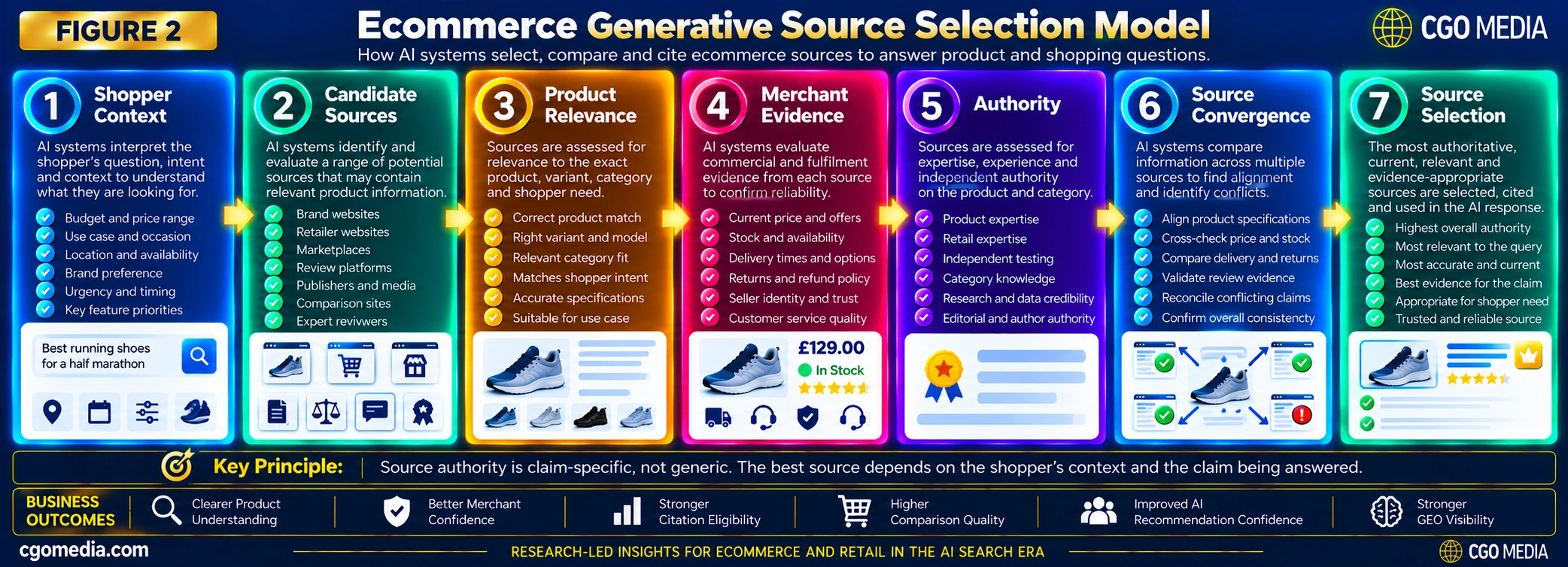
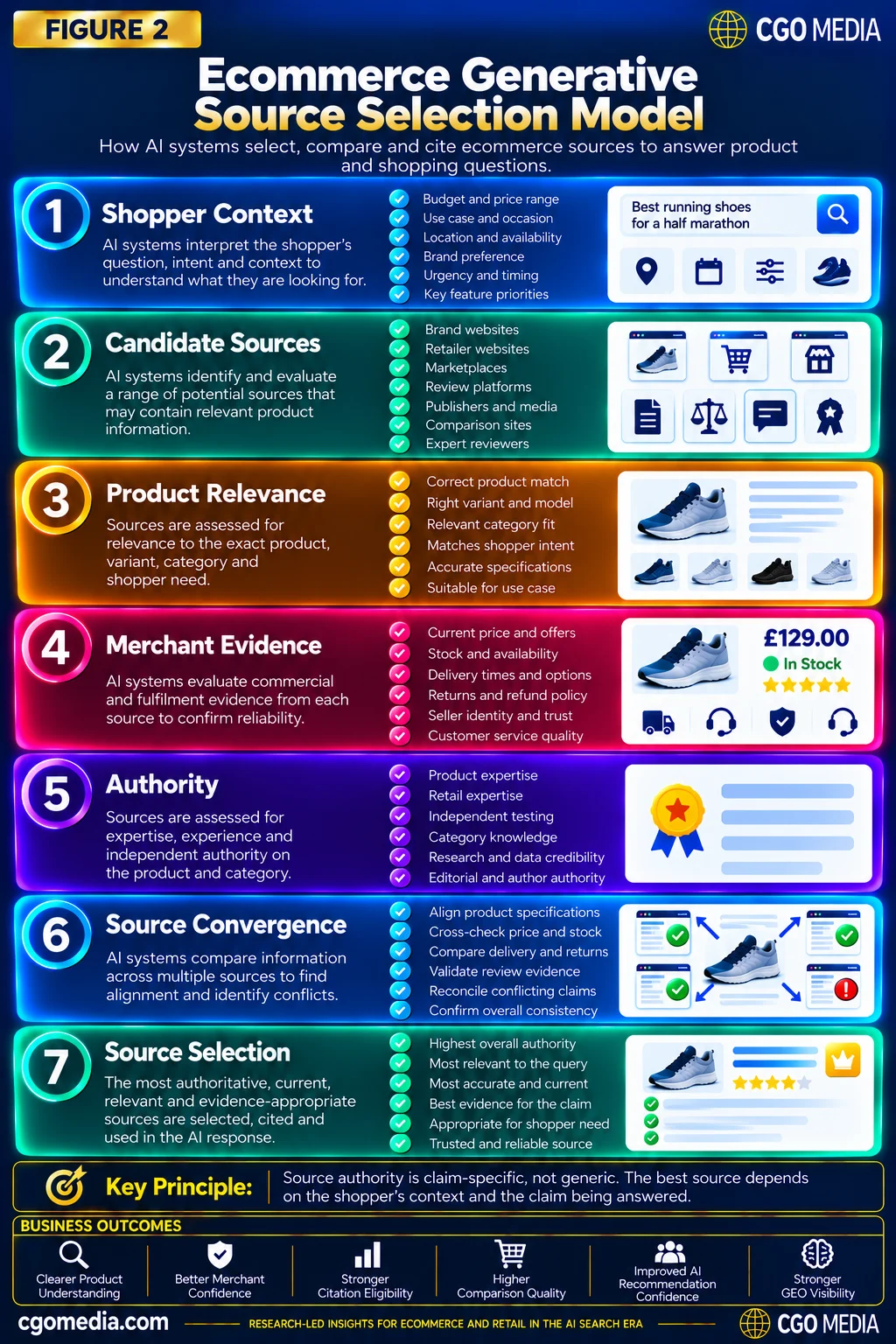
26. Ecommerce GEO Also Depends on Source Authority
Generative systems can draw from many types of retail information sources.
27. Potential Ecommerce Sources Can Include
- Brand websites
- Retailer websites
- Marketplaces
- Review platforms
- Publishers
- Comparison sites
- Expert reviewers
28. Different Shopping Questions Require Different Sources
A specification question may require different evidence from a retailer-recommendation question.
29. Brand-Owned Sources Are Strongest for Product Truth
These can include:
- Specifications
- Features
- Compatibility
- Product variants
- Warranty terms
30. Retailer-Owned Sources Are Strongest for Commercial Truth
These can include:
- Price
- Stock
- Delivery
- Returns
- Promotions
31. Independent Sources Can Strengthen Comparative Validation
External evidence can support:
- Product quality
- Performance
- Value
- Alternatives
- Retailer reputation
32. Ecommerce GEO Requires Source Convergence
Important facts should materially agree across credible sources.
33. A Useful Ecommerce Source Convergence Model Is
Brand Product Truth + Retailer Commercial Truth + Independent Review Evidence + Shopper Evidence
34. Source Conflict Can Create Shopping Risk
Conflicts can occur around:
- Price
- Availability
- Specifications
- Compatibility
- Delivery
35. Product Information Changes Frequently
Ecommerce environments are highly dynamic.
36. High-Change Retail Information Can Include
- Price
- Stock
- Promotions
- Delivery windows
- Product availability
37. Freshness Is Therefore a Core Ecommerce GEO Signal
Old retail information can become actively misleading.
38. Ecommerce GEO Should Prioritise Current Information
A useful relationship is:
Accuracy + Freshness + Product Clarity + Merchant Evidence → Reliable Retail Representation
39. Citation Eligibility Is Another Ecommerce GEO Layer
Retail content may be visible without being explicitly cited.
40. Citation Eligibility Depends on Multiple Factors
A useful conceptual model is:
Relevance + Product Clarity + Evidence + Authority + Freshness
41. Relevance
The source should directly address the shopping question being asked.
42. Product Clarity
The product should be identifiable and distinguishable from alternatives and variants.
43. Evidence
Claims should be supported by appropriate data, reviews or product documentation.
44. Authority
The source should have credible product, retail or subject expertise.
45. Freshness
Commercial and availability information should be current where time sensitivity matters.
46. Citation Visibility Is Not the Same as Recommendation Visibility
A product can be cited without being recommended.
47. Citation Authority Can Develop Through Repeated Reference
A useful relationship is:
Useful Product Evidence → Citation → Repeated Reference → Greater Retail Source Authority
48. Ecommerce Brands Can Create Citation Assets
These can include:
- Product testing
- Consumer research
- Retail statistics
- Buying guides
- Category studies
49. Original Ecommerce Research Can Strengthen GEO
Research can create evidence that journalists, reviewers and AI systems may reuse.
50. Ecommerce Research Should Be Methodologically Clear
Strong research can explain:
- Sample
- Method
- Measurement period
- Definitions
- Limitations
51. Ecommerce GEO Should Include Comparison Visibility
AI systems may construct product or retailer shortlists rather than simply return individual pages.
52. Product Comparison Visibility Means Entering the Relevant Decision Set
The product becomes one of the options evaluated for a specific shopper scenario.
53. Retailer Comparison Visibility Means Entering the Purchase Decision Set
The retailer becomes one of the merchants considered for the same or equivalent product.
54. Comparison Sets Are Contextual
Different products or retailers may appear depending on:
- Budget
- Use case
- Location
- Availability
- Preferred brand
55. Comparison Visibility Should Therefore Be Segmented
A retailer can be highly visible for one product category and weak in another.
56. Recommendation Visibility Is More Selective Than Comparison Visibility
Being compared does not mean being recommended.
57. Recommendation Requires Shopper Fit
A useful relationship is:
Shopper Scenario → Product Fit → Availability Fit → Trust Evidence → Commercial Fit → Recommendation
58. Shopper Scenario Is the Starting Point
A recommendation depends on who the shopper is and what they need.
59. Shopper Context Can Include
- Budget
- Use case
- Location
- Brand preference
- Delivery urgency
- Feature priorities
60. Product Fit Evaluates Functional Suitability
The product should solve the shopper’s actual need.
61. Availability Fit Evaluates Whether the Product Can Actually Be Purchased
Relevant factors can include:
- Stock
- Shipping market
- Variant availability
- Delivery time
- Retail channel
62. Merchant Fit Evaluates Whether the Retailer Is Appropriate
The merchant should be able to fulfil the transaction reliably.
63. Commercial Fit Evaluates Practical Suitability
Relevant factors can include:
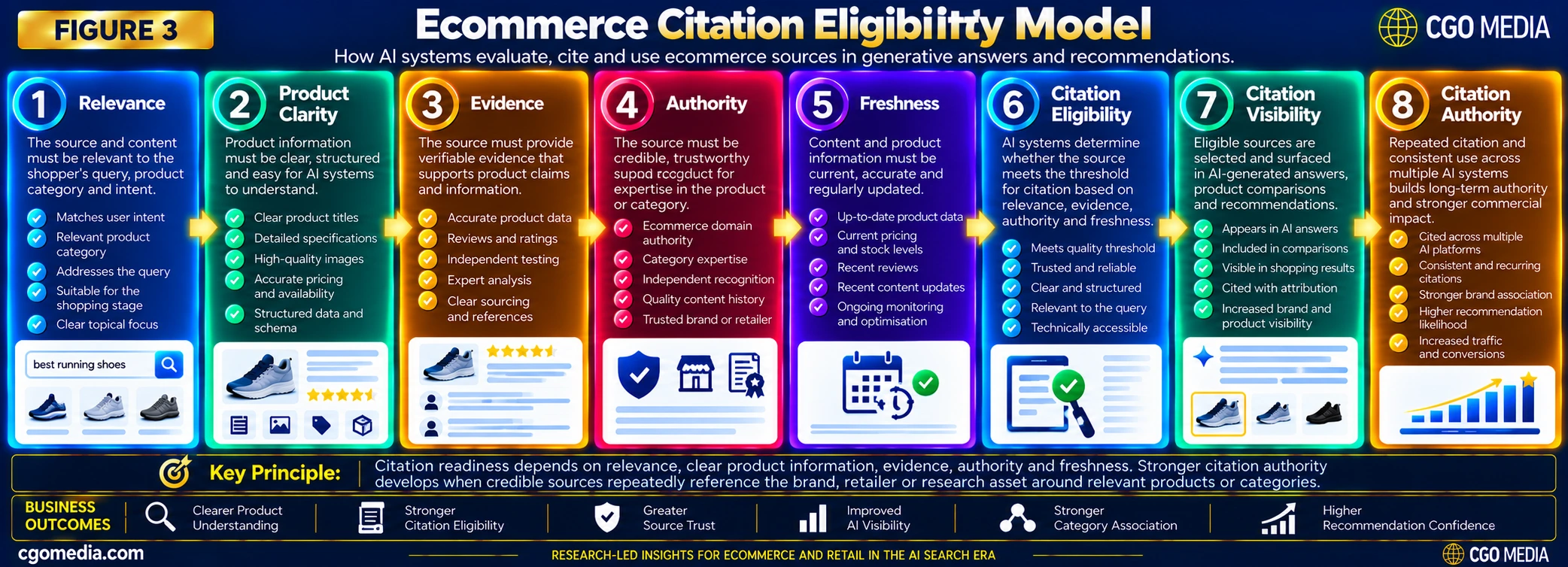
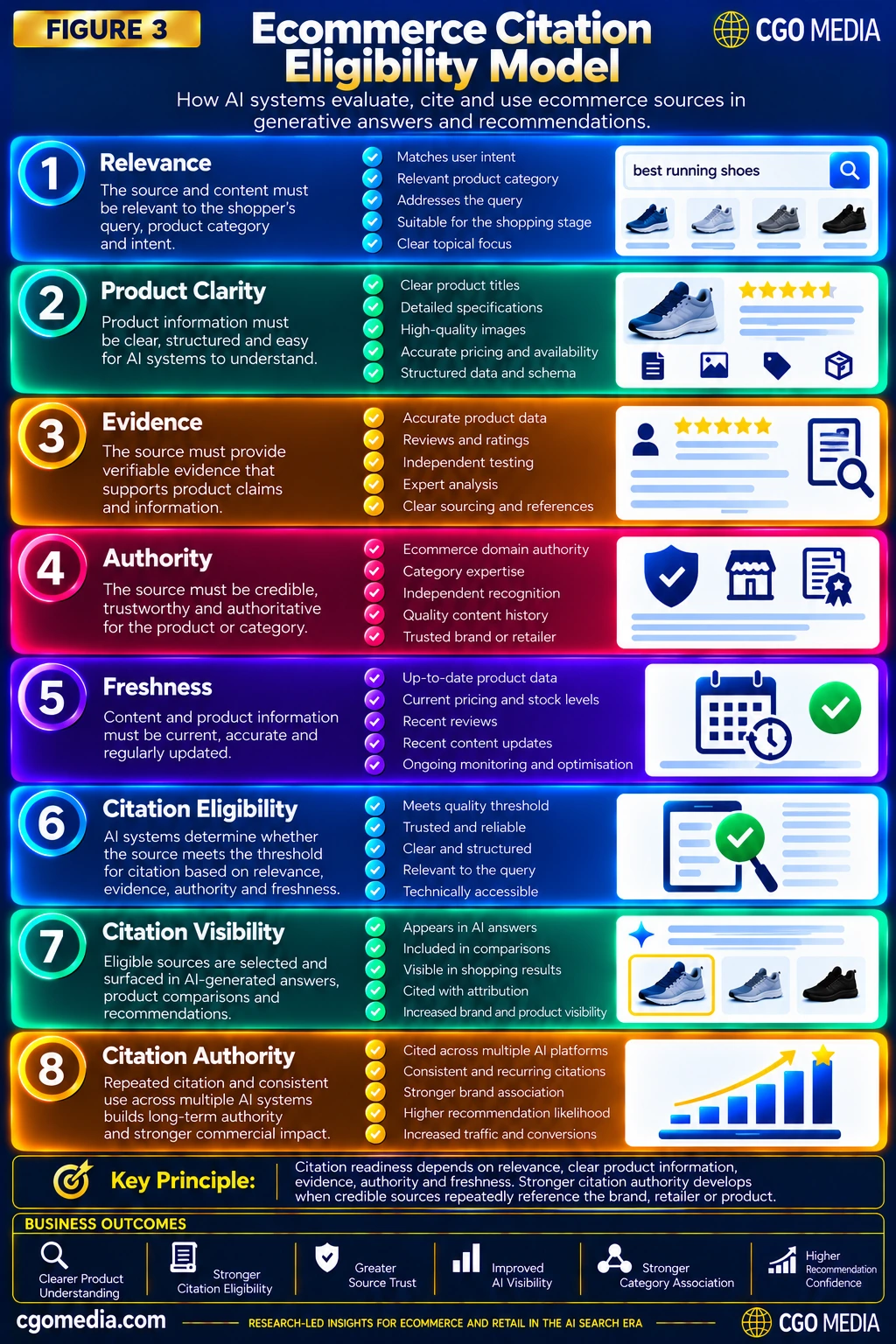
- Price
- Delivery cost
- Returns
- Warranty
- Promotions
64. Trust Fit Evaluates Purchase Confidence
Relevant evidence can include:
- Ratings
- Reviews
- Merchant reputation
- Independent testing
- Security
65. Recommendation Confidence Is Multi-Dimensional
A useful relationship is:
Shopper Relevance + Product Fit + Availability Fit + Merchant Trust + Commercial Fit + External Validation
66. Ecommerce GEO Should Not Aim for Universal Recommendation
A product should not appear in scenarios where it is unsuitable.
67. Appropriate Exclusion Can Be Positive
A product may correctly be omitted where:
- It exceeds the budget
- It lacks required features
- It is unavailable
- It is inappropriate for the use case
68. Qualified Recommendation Visibility Is the Better Objective
This can be represented as:
Relevant Inclusion + Accurate Product Representation + Strong Trust Evidence + Appropriate Shopper Fit
69. Ecommerce GEO Should Measure Multiple Visibility Layers
A useful model includes:
- Source Visibility
- Citation Visibility
- Brand & Product Accuracy
- Comparison Visibility
- Recommendation Visibility
70. Source Visibility
Measures whether brand, retailer or product information contributes to generated answers.
71. Citation Visibility
Measures whether brand, product, retailer or research sources are explicitly referenced.
72. Brand & Product Accuracy
Measures whether products, variants, specifications and merchant relationships are represented correctly.
73. Comparison Visibility
Measures whether the product or retailer enters relevant shopping consideration sets.
74. Recommendation Visibility
Measures whether the product or retailer is appropriately recommended within shopper scenarios.
75. These Measures Should Remain Separate
Strong citation visibility does not necessarily imply strong recommendation visibility.
76. Ecommerce GEO Should Begin with a Shopper Scenario Library
Monitoring should reflect real purchasing decisions.
77. Scenario Categories Can Include
- Product discovery
- Product comparison
- Retailer comparison
- Budget selection
- Use-case selection
- Purchase recommendation
78. Product Discovery Scenarios Can Include
- Best product for a use case
- Best product category
- Popular alternatives
- Feature-based discovery
79. Product Comparison Scenarios Can Include
- Product versus product
- Brand versus brand
- Feature comparison
- Value comparison
80. Retailer Comparison Scenarios Can Include
- Best place to buy
- Best retailer for delivery
- Best retailer for returns
- Best retailer for price
81. Budget Scenarios Can Include
- Best under a price threshold
- Best value option
- Premium recommendation
- Budget alternative
82. Use-Case Scenarios Can Include
- Home use
- Professional use
- Travel
- Gift purchase
- Specialist use
83. Purchase Recommendation Scenarios Can Include
- Which product should I buy?
- Which retailer is best?
- Which alternative offers better value?
- Which product fits my requirements?
84. Scenario Libraries Should Reflect Journey Stage
A useful sequence is:
Discovery → Education → Comparison → Selection → Purchase
85. Discovery Questions Are Broad
They can concern:
- Product categories
- Brands
- General options
86. Education Questions Seek Understanding
They can concern:
- Features
- Specifications
- Compatibility
- Use cases
- Product differences
87. Comparison Questions Create Product and Retailer Sets
These questions can have significant commercial importance.
88. Selection Questions Ask Which Product Fits Best
These are among the most recommendation-sensitive.
89. Purchase Questions Concern Transaction Readiness
Examples can include:
- Price
- Stock
- Delivery
- Returns
- Retailer choice
90. Ecommerce GEO Monitoring Should Include Accuracy
Accuracy should be assessed across:
- Brand
- Product
- Variant
- Price
- Availability
91. Product Specification Errors Should Receive High Priority
Incorrect specifications can directly distort shopper decision-making.
92. Availability Errors Can Also Be High-Risk
Examples include:
- Out-of-stock products presented as available
- Wrong country availability
- Wrong variant availability
- Discontinued products presented as current
93. Price Errors Can Distort Product and Retailer Comparison
Old pricing can make one product appear artificially better or worse.
94. Ecommerce GEO Risk Should therefore Be Weighted
A useful relationship is:
Severity + Persistence + Shopper Impact + Commercial Importance
95. Severity Measures Potential Harm
Some errors are materially more important than others.
96. Persistence Measures Repetition
A recurring error may indicate deeper product-data weakness.
97. Shopper Impact Measures Decision Consequence
Incorrect information can affect:
- Product choice
- Retailer choice
- Purchase timing
- Returns
98. Commercial Importance Measures Business Relevance
High-value products or strategic categories may require faster intervention.
99. Ecommerce GEO Should Be Cross-Functional
It should not sit solely within SEO.
100. Relevant Ecommerce GEO Functions Can Include
- SEO
- Merchandising
- Product
- Ecommerce
- Customer experience
- Digital PR
101. SEO Can Coordinate Discovery Intelligence
SEO can connect search demand, information architecture, product discovery and generative visibility.
102. Merchandising Can Validate Commercial Truth
Merchandising can confirm:
- Price
- Promotions
- Availability
- Category priorities
103. Product Teams Can Validate Product Truth
They can confirm:
- Specifications
- Variants
- Compatibility
- Use cases
104. Ecommerce Teams Can Validate Transactional Truth
They can confirm:
- Stock
- Delivery
- Returns
- Checkout availability
105. Customer Experience Teams Can Validate Shopper Friction
They can contribute:
- Common questions
- Return reasons
- Purchase objections
- Service complaints
106. Digital PR Can Strengthen External Authority
It can distribute:
- Research
- Product testing
- Retail statistics
- Expert commentary
107. Ecommerce GEO Should Be Governed
Critical product and merchant information should have:
- Owner
- Source
- Review frequency
- Escalation route
108. High-Change Retail Facts Need Frequent Review
Examples include:
- Price
- Stock
- Promotions
- Delivery
- Availability
109. Stable Product Facts May Require Less Frequent Review
Examples can include:
- Core specifications
- Product category
- Brand ownership
110. Ecommerce GEO Should Begin with Baseline Measurement
An organisation should understand its current:
- Source presence
- Citation visibility
- Brand accuracy
- Product accuracy
- Comparison visibility
- Recommendation visibility
111. Baseline Measurement Should Be Segmented
Ecommerce GEO should be assessed by:
- Category
- Product
- Retailer
- Market
- Shopper scenario
- AI environment
112. The First Ecommerce GEO Principle
Ecommerce GEO should begin with clear brand, product, variant and merchant relationships because generative systems cannot reliably compare or recommend products when ownership, specifications, availability and retailer relationships remain ambiguous.
113. The Second Ecommerce GEO Principle
Ecommerce GEO should be evidence-led, with important product and merchant claims supported by current specifications, pricing, availability, customer evidence and independent validation appropriate to the shopper decision being made.
114. The Third Ecommerce GEO Principle
Ecommerce GEO should optimise for qualified visibility rather than maximum mentions, distinguishing source presence, citation, accurate product representation, comparison inclusion and appropriate recommendation according to real shopper fit.
115. The Fourth Ecommerce GEO Principle
Ecommerce GEO should be governed cross-functionally because high-value retail information spans SEO, merchandising, product, ecommerce, customer experience and external authority, with high-change commercial facts requiring clear ownership, freshness controls and escalation.
116. The Ecommerce & Retail GEO Ecosystem
The core relationship can be summarised as:
Brand Clarity → Product Clarity → Merchant & Trust Evidence → Source Authority → Citation Eligibility → Shopper Fit → Recommendation Confidence → GEO Visibility
117. The Strategic Implication
Ecommerce and retail organisations should treat Generative Engine Optimisation as an extension of ecommerce SEO, product information management, merchandising, merchant trust, review authority and shopping discovery strategy, building an evidence-rich information environment that makes products and retailers easier to identify, verify, compare and recommend appropriately across AI-assisted shopping environments.
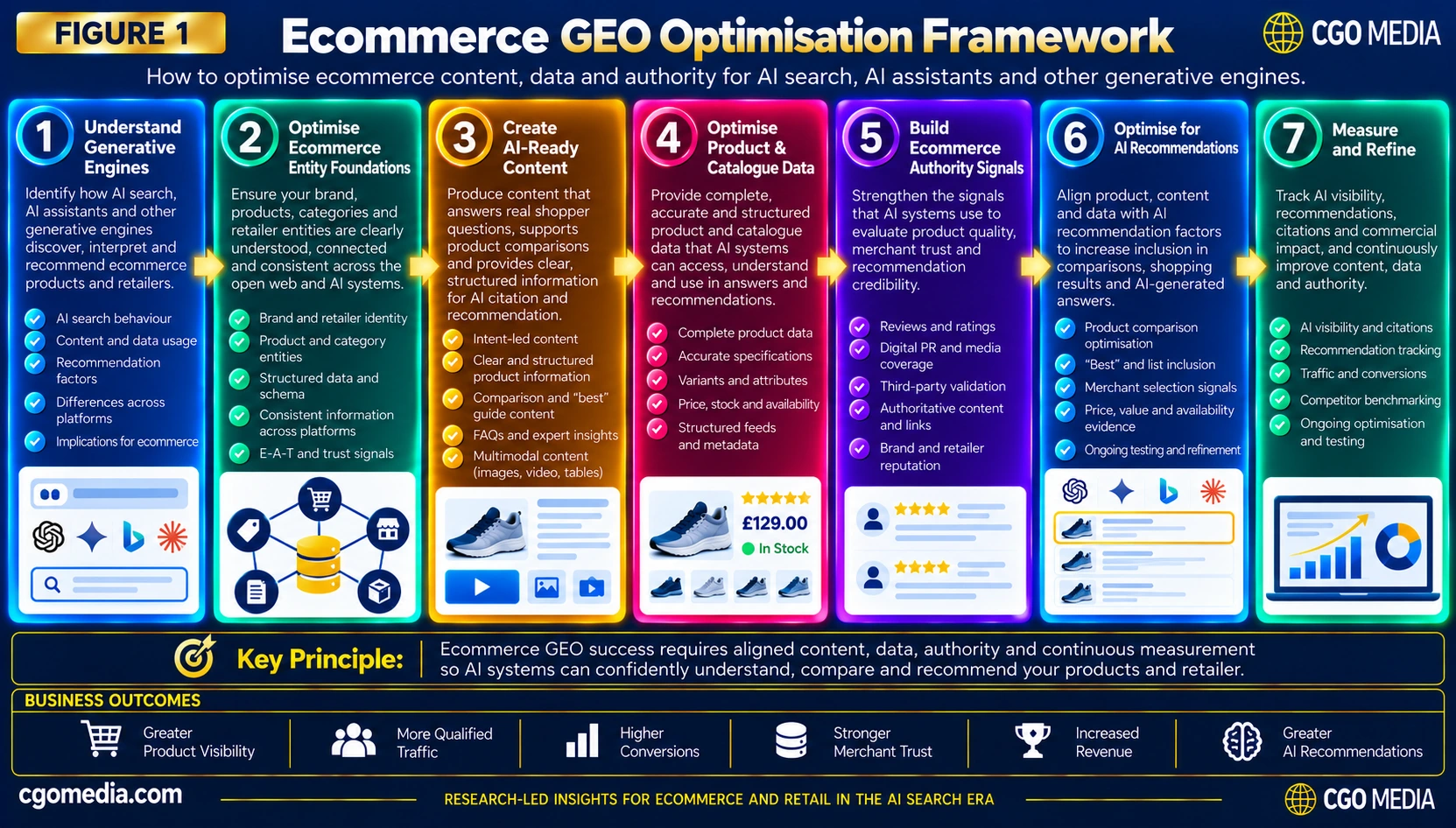
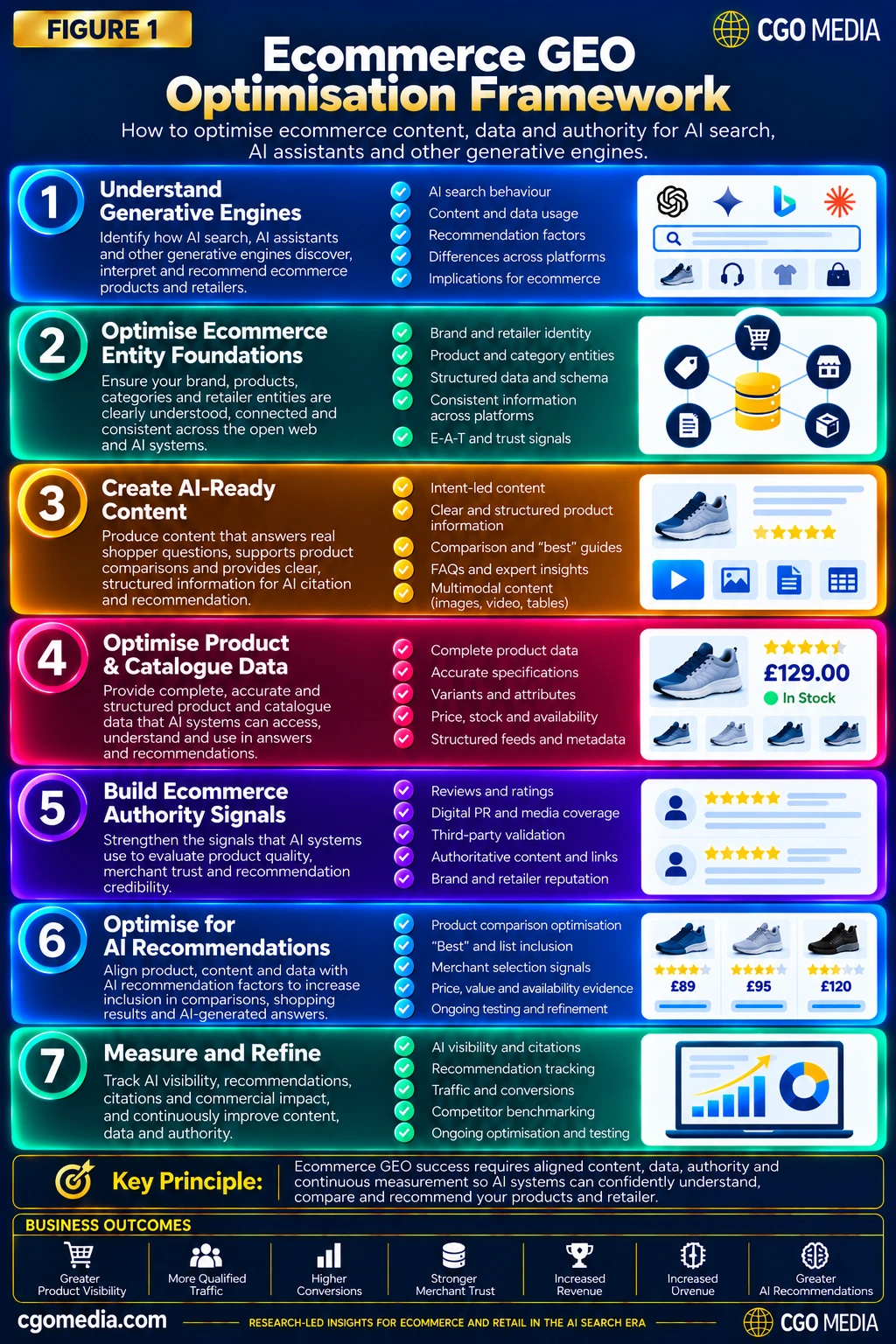
118. Ecommerce Generative Source Selection
Generative shopping systems may draw from many different sources when answering product questions, comparing retailers or recommending what a shopper should buy.
119. Ecommerce Source Selection Is Contextual
The most appropriate source depends on the shopper question being asked.
120. A Useful Ecommerce Source Selection Model Is
Shopper Context → Candidate Sources → Product Relevance → Merchant Evidence → Authority → Source Convergence → Source Selection
121. Shopper Context Comes First
A product question should be interpreted according to the shopper’s actual need.
122. Shopper Context Can Include
- Budget
- Use case
- Location
- Feature preference
- Brand preference
- Delivery requirement
123. Different Shopping Contexts Produce Different Source Needs
A technical specification question may require different sources from a question about the best retailer or cheapest place to buy.
124. Candidate Sources Form the Retail Information Pool
These are the sources potentially available to support a generated shopping answer.
125. Candidate Ecommerce Sources Can Include
- Brand websites
- Retailer websites
- Marketplaces
- Manufacturer documentation
- Review platforms
- Publishers
- Comparison sites
- Customer reviews
126. Brand Websites Are Important for Product Truth
They can provide authoritative information about:
- Specifications
- Features
- Variants
- Compatibility
- Warranty
127. Brand-Owned Information Has Limits
Brand sources cannot independently validate every quality, performance or comparative claim.
128. Retailer Websites Are Important for Commercial Truth
They can provide current information about:
- Price
- Stock
- Promotions
- Delivery
- Returns
129. Retailer-Owned Information Is Highly Volatile
Commercial facts can change quickly.
130. Marketplaces Can Provide Broad Product Coverage
They can expose:
- Multiple sellers
- Multiple prices
- Customer reviews
- Availability
- Product variants
131. Marketplace Sources Should Be Evaluated Carefully
Marketplace listings can contain:
- Seller-generated descriptions
- Duplicate listings
- Incorrect variants
- Outdated availability
132. Manufacturer Documentation Can Strengthen Technical Accuracy
It can be especially useful for:
- Specifications
- Compatibility
- Instructions
- Safety information
- Technical limitations
133. Independent Review Sources Can Strengthen Comparative Evidence
Reviewers can contribute:
- Performance testing
- Use-case evaluation
- Product comparisons
- Value assessment
134. Publisher Authority Should Be Evaluated by Category Expertise
A specialist publication may be more useful than a general publisher for a technical product question.
135. Comparison Sites Can Support Structured Product Evaluation
They may provide:
- Feature comparison
- Price comparison
- Retailer comparison
- Alternative products
136. Comparison Sites Should Be Evaluated for Coverage and Commercial Bias
Their usefulness can depend on:
- Product coverage
- Retailer coverage
- Affiliate relationships
- Update frequency
- Methodology
137. Customer Reviews Can Provide Experience Evidence
They can reveal:
- Product satisfaction
- Quality issues
- Delivery experience
- Returns experience
- Recurring defects
138. Customer Reviews Also Have Limitations
Reviews can be:
- Subjective
- Unverified
- Manipulated
- Unrepresentative
139. Product Relevance Filters Candidate Sources
A source may be authoritative but still irrelevant to the exact product or variant.
140. Product Relevance Should Be Specific
A category page may be less useful than a dedicated product page for a precise specification question.
141. Product-Level Relevance Can Include
- Exact product
- Exact model
- Exact variant
- Exact configuration
- Exact market
142. Model-Year and Generation Differences Can Matter
Products may change substantially between generations.
143. Source Selection Should Distinguish Current and Legacy Products
An old review should not automatically be treated as evidence for a new version.
144. Product Relevance Can Be Represented as
Shopper Need → Product Category → Product → Variant → Market → Relevant Source
145. Merchant Evidence Is Another Source Selection Layer
Retail recommendations require information about who is selling the product.
146. Merchant Evidence Can Include
- Seller identity
- Official retailer status
- Stock
- Delivery terms
- Returns policy
- Customer service
147. Merchant Evidence Should Be Market-Specific
A retailer may operate differently across countries.
148. International Retailers May Have Different Commercial Terms by Market
Differences can include:
- Price
- Shipping
- Returns
- Warranty handling
- Promotions
149. Seller Identity Matters on Marketplaces
The same product may be sold by:
- The brand
- An authorised retailer
- A marketplace seller
- An unknown third party
150. Source Selection Should Distinguish Product Authority from Merchant Authority
A brand can be authoritative about the product while a retailer is authoritative about current stock and price.
151. Claim-Specific Authority Is therefore Essential
The best source depends on the exact retail fact.
152. Brand Authority Is Strong for
- Specifications
- Product design
- Compatibility
- Official variants
- Warranty scope
153. Retailer Authority Is Strong for
- Price
- Stock
- Delivery
- Returns
- Promotions
154. Independent Authority Is Strong for
- Performance
- Quality comparison
- Value assessment
- Alternatives
155. Customer Evidence Is Strong for Experience Patterns
It can reveal recurring real-world strengths and weaknesses.
156. Ecommerce Source Selection Should Use Multiple Source Roles
A strong answer may depend on several complementary sources.
157. A Retail Source Role Model Can Include
- Brand for product truth
- Retailer for commercial truth
- Independent reviewer for comparative evidence
- Customer reviews for experience evidence
158. Source Convergence Strengthens Shopping Confidence
Confidence increases when multiple credible sources materially agree.
159. A Useful Ecommerce Source Convergence Model Is
Brand Product Truth + Retailer Commercial Truth + Independent Review Evidence + Shopper Evidence
160. Source Convergence Does Not Require Identical Language
Different sources can describe the same product differently.
161. Material Agreement Is More Important Than Exact Wording
Sources should agree on important facts such as:
- Specifications
- Availability
- Compatibility
- Product generation
- Core features
162. Source Conflict Should Trigger Investigation
Retail organisations should identify when public sources disagree materially.
163. Common Ecommerce Source Conflicts Can Include
- Different specifications
- Different product names
- Conflicting variant details
- Different prices
- Different availability
164. Legacy Product Information Is a Significant GEO Risk
Old product pages can remain discoverable after a product is replaced.
165. Legacy Product Pages Should Be Governed
Organisations should decide whether old product pages should be:
- Updated
- Redirected
- Archived clearly
- Retained as historical references
166. Discontinued Products Should Be Clearly Identified
Historic product information should not be confused with current availability.
167. Product Freshness Is Critical in Ecommerce Source Selection
Commercial retail data is highly dynamic.
168. High-Volatility Retail Information Includes
- Price
- Stock
- Promotion
- Delivery times
- Seller availability
169. Lower-Volatility Product Information Can Include
- Core specifications
- Product dimensions
- Compatibility
- Material composition
170. Freshness Should Be Matched to Information Volatility
A useful relationship is:
Rate of Change + Shopper Impact + Commercial Importance → Required Freshness
171. Price Requires High Freshness
Outdated pricing can distort value comparison.
172. Stock Requires High Freshness
A product recommendation has limited value if the item is unavailable.
173. Delivery Requires High Freshness
Delivery times can vary according to:
- Location
- Stock
- Retailer
- Shipping method
174. Promotion Information Requires High Freshness
Expired promotional terms should not influence current recommendations.
175. Freshness Signals Should Be Explicit Where Practical
Retail sources can benefit from current:
- Price
- Stock status
- Offer expiry
- Delivery estimate
- Last-updated information
176. Source Selection Should Consider Information Extractability
Important product facts should be easy to identify.
177. Critical Product Facts Should Not Be Buried
These can include:
- Model
- Size
- Compatibility
- Capacity
- Price
- Availability
178. Structured Product Information Improves Interpretability
Clear product data can help both shoppers and automated systems distinguish between products and variants.
179. Ecommerce Pages Should Use Explicit Product Statements
For example:
This model includes 256GB storage, is available in black and silver, and supports the stated accessory range.
180. Explicit Statements Reduce Inference Risk
Generative systems should not need to infer important specifications from promotional language.
181. Conditional Retail Claims Should Be Clearly Qualified
Retailers should distinguish:
- In stock
- Available to order
- Pre-order
- Limited availability
- Out of stock
182. Availability Language Can Materially Affect Recommendation
The difference between immediate availability and future availability can change the most appropriate retailer.
183. Ecommerce GEO Should therefore Use Commercial Claim Precision
Price, stock and delivery claims should be explicit and current.
184. Source Selection Can Be Weakened by Overly Promotional Product Content
Pages dominated by marketing language may provide limited factual evidence.
185. Product Pages Should Balance Persuasion and Product Truth
Strong pages should still provide:
- Specifications
- Compatibility
- Variants
- Limitations
- Commercial information
186. Source Selection Can Also Be Weakened by Thin Product Pages
A page may exist without enough information to support confident comparison.
187. Thin Product Pages Can Omit Important Decision Information
Examples include:
- No detailed specifications
- No dimensions
- No compatibility information
- No warranty detail
- No delivery information
188. Ecommerce GEO Should Identify Product Source Gaps
A source gap exists when an important shopper question lacks a clear authoritative answer.
189. Product Source Gap Analysis Can Begin with Shopper Questions
The organisation can map:
Shopper Question → Required Product Fact → Best Source → Existing Source → Gap
190. Common Product Source Gaps Can Include
- Compatibility
- Use-case guidance
- Product limitations
- Variant differences
- Warranty
191. Commercial Source Gaps Can Also Exist
Examples include missing:
- Stock information
- Delivery information
- Returns detail
- Regional availability
192. Source Gaps Can Increase Dependence on Third Parties
If brands or retailers do not explain products clearly, external sources may become dominant.
193. Third-Party Dependence Is Not Always Negative
Independent reviews and comparisons can strengthen trust.
194. Excessive Third-Party Dependence Can Reduce Brand Control
The organisation may struggle to correct inaccurate product or merchant information.
195. Ecommerce GEO Should therefore Build Strong First-Party Product Sources
Critical product facts should have authoritative owned pages.
196. First-Party Product Sources Should Be Reinforced Externally
The strongest information environment combines owned clarity with independent testing and customer evidence.
197. Source Selection Should Consider Product Testing Methodology
Performance claims should explain how testing was carried out where relevant.
198. Strong Product Testing Can Include
- Test conditions
- Products compared
- Measurement criteria
- Duration
- Limitations
199. Testing Transparency Improves Citation Utility
Reviewers, publishers and AI systems can assess the evidence more confidently.
200. Product Performance Claims Should Define Scope
A result should make clear whether it reflects:
- Laboratory testing
- Real-world use
- One variant
- One environment
- A specific time period
201. Unscoped Product Claims Can Be Misused
A narrow result may be generalised across an entire product line.
202. Ecommerce GEO Should therefore Encourage Product Data Precision
Useful product evidence should make its boundaries explicit.
203. Source Selection Should Include Independent Validation
Important product and merchant claims can become stronger when supported externally.
204. Independent Validation Can Include
- Expert reviews
- Publisher testing
- Customer ratings
- Industry awards
- Comparison data
205. Independent Validation Strengthens Source Convergence
It reduces dependence on brand or retailer claims alone.
206. Independent Review Authority Should Be Category-Specific
A specialist reviewer may provide stronger evidence for a technical product category.
207. Customer Evidence Should Be Interpreted at Scale
One customer review should not necessarily outweigh large-scale product evidence.
208. Review Patterns Are More Useful Than Isolated Reviews
Repeated themes can reveal:
- Durability problems
- Fit issues
- Delivery problems
- Product strengths
209. Ecommerce Source Selection Should Consider Source Recurrence
A source repeatedly appearing across related shopping questions may have stronger practical authority.
210. Source Recurrence Can Be Monitored
Retail organisations can track:
- Which sources recur
- For which categories
- For which products
- Across which AI environments
211. Recurring Competitor Sources Can Reveal Authority Gaps
If competitor product guides or research repeatedly appear where the brand does not, this can indicate a source-strength gap.
212. Ecommerce GEO Should Include Source Competitor Analysis
This differs from conventional product-ranking analysis.
213. Source Competitor Analysis Asks
- Which product sources are selected?
- Which retailers are cited?
- Which review sites recur?
- Which content formats dominate?
214. Source Competitors May Differ from Commercial Competitors
Shopping information can be supplied by:
- Publishers
- Review sites
- Marketplaces
- Comparison sites
- Community platforms
215. This Makes Ecommerce GEO a Source-Ecosystem Discipline
Brands and retailers compete for visibility within a wider retail information environment.
216. Ecommerce Source Authority Can Be Distributed
No single source type necessarily dominates every stage of shopping discovery.
217. Discovery May Favour Editorial and Category Sources
Early-stage shoppers may need:
- Buying guides
- Category education
- Product inspiration
- Best-of lists
218. Comparison May Favour Review and Structured Product Sources
Mid-stage shoppers may need:
- Side-by-side comparisons
- Feature analysis
- Performance testing
- Alternative recommendations
219. Purchase May Favour Retailer Sources
Late-stage shoppers may need:
- Price
- Stock
- Delivery
- Returns
220. Ecommerce GEO Should therefore Map Source Role by Journey Stage
A useful structure is:
Discovery Source → Education Source → Comparison Source → Validation Source → Purchase Source
221. Source Role Mapping Can Improve Product Content Strategy
Brands can identify where they need stronger product and educational assets.
222. Source Role Mapping Can Improve Retailer Content Strategy
Retailers can identify where commercial and service information is insufficient.
223. Source Role Mapping Can Improve Digital PR
Brands can target independent reviewers and publishers where external validation matters most.
224. Ecommerce GEO Should Maintain a Source Inventory
The inventory can record:
- Source
- Source type
- Product relevance
- Merchant relevance
- Freshness
- Authority role
- Risk
225. Source Inventories Help Identify Weakness
For example:
- No authoritative specification source
- No strong review evidence
- No current retailer stock source
- No clear warranty source
226. Source Inventories Also Help Identify Duplication
Multiple retailer or brand pages may provide conflicting versions of the same product fact.
227. Duplicate Product Facts Should Be Governed Carefully
Critical product information should have clear canonical ownership.
228. Canonical Product Fact Management Can Include
- Primary owner
- Primary product URL
- Product identifier
- Variant relationship
- Review cadence
- Dependent retailer pages
229. Canonical Product Fact Management Reduces Internal Conflict
This is particularly useful for large catalogues.
230. Commercial Fact Management Can Be Separate
Price, stock and delivery may require different ownership from product specifications.
231. Source Selection Should Be Tested Over Time
A source that appears today may not remain influential.
232. Longitudinal Source Monitoring Can Reveal
- Source persistence
- Source replacement
- New reviewer authority
- Marketplace growth
- Retailer movement
233. Source Persistence Can Indicate Durable Retail Authority
Repeated selection across time can be more meaningful than one isolated appearance.
234. Source Replacement Can Reveal Product or Market Change
A previously dominant source may lose visibility because:
- It became outdated
- A newer product launched
- A stronger reviewer emerged
- Retailer availability changed
235. Ecommerce GEO Should Distinguish Source Visibility from Source Dependence
A product can be visible without the brand or retailer being the principal source used to construct the answer.
236. Source Dependence Is Difficult to Observe Directly
Not all generative systems expose their full retrieval process.
237. Ecommerce GEO Should therefore Use Observable Evidence Carefully
Useful observations can include:
- Explicit citations
- Recurring source inclusion
- Product-detail alignment
- Retailer representation patterns
238. Source Analysis Should Avoid Overclaiming Causation
A source appearing alongside an answer does not prove that every statement came from that source.
239. Ecommerce GEO Should Focus on Source Eligibility and Authority
The practical objective is to make product and merchant information sufficiently clear, current and authoritative to be considered across relevant shopping scenarios.
240. Source Eligibility Can Be Strengthened Through
- Product relevance
- Merchant clarity
- Evidence
- Authority
- Freshness
241. Source Authority Can Be Strengthened Through
- Accurate product data
- Independent testing
- Strong reviews
- Consistent merchant information
- Original retail research
242. Source Convergence Can Be Strengthened Through Governance
Brand, retailer, review and customer information should materially align on important facts.
243. Ecommerce Teams Should Review High-Value Source Areas First
Priority source areas can include:
- Specifications
- Compatibility
- Price
- Stock
- Delivery
- Returns
244. Ecommerce Source Risk Should Be Prioritised
A useful model is:
Source Importance + Error Severity + Persistence + Shopper Impact + Commercial Importance
245. High-Risk Source Problems Should Trigger Escalation
These can require involvement from:
- Product
- Merchandising
- Ecommerce
- SEO
- Customer experience
246. Ecommerce Source Selection Should Be Treated as a Strategic Capability
It connects product information management, merchandising, reviews, external authority and shopping discovery.
247. The Fifth Ecommerce GEO Principle
Ecommerce generative source selection should be evaluated according to shopper context and claim type, recognising that brands are strongest for product truth, retailers for current commercial information, independent reviewers for comparative performance and customer reviews for experience patterns.
248. The Sixth Ecommerce GEO Principle
Ecommerce source authority should be claim-specific rather than generic, with the strongest source being the one most authoritative, product-relevant, current and evidentially appropriate for the exact shopping fact being presented.
249. The Seventh Ecommerce GEO Principle
Ecommerce GEO should strengthen source convergence by aligning brand product truth, retailer commercial truth, independent review evidence and shopper experience while actively identifying outdated, conflicting or ambiguous information that can reduce comparison and recommendation confidence.
250. The Eighth Ecommerce GEO Principle
Ecommerce and retail organisations should treat source selection as an ongoing retail information-ecosystem discipline, monitoring which brand, merchant, marketplace, review and publisher sources recur across shopping journeys and strengthening the source assets most important to qualified product discovery.
251. The Ecommerce Generative Source Selection Model
The complete model can be summarised as:
Shopper Context → Candidate Sources → Product Relevance → Merchant Evidence → Authority → Source Convergence → Source Selection
252. The Strategic Implication
Ecommerce and retail organisations should build a governed source environment in which product specifications, variants, stock, pricing, merchant information, reviews and independent evidence materially align, increasing the likelihood that generative shopping systems can identify the correct product, select current and trustworthy sources and distinguish between product truth, commercial truth and independent validation.
253. Ecommerce Citation Eligibility
A product, brand or retailer can be visible within generative shopping without being explicitly cited.
254. Citation Visibility Is a Distinct Ecommerce GEO Outcome
Citation occurs when a generative system explicitly references a source as supporting evidence for part of a shopping answer.
255. Citation Eligibility Describes the Conditions That Make a Retail Source More Suitable for Reference
A useful model is:
Relevance + Product Clarity + Evidence + Authority + Freshness → Citation Eligibility
256. Citation Eligibility Does Not Guarantee Citation
A strong source may still be omitted depending on model, query, shopper context, geography or product category.
257. Ecommerce Citation Relevance
The source should directly address the product, retailer or shopping question being asked.
258. Relevance Should Be Product-Specific
A broad category page may be less useful than a dedicated product page for a precise product question.
259. Relevance Should Also Be Variant-Specific Where Necessary
The correct source may depend on:
- Size
- Colour
- Capacity
- Configuration
- Generation
260. Ecommerce Citation Clarity
Important product facts should be explicit enough to extract and interpret confidently.
261. Clarity Can Include
- Clear product name
- Clear specifications
- Clear variant relationships
- Clear compatibility
- Clear availability
262. Ambiguous Product Language Reduces Citation Utility
A source should not force the reader or system to infer critical product facts from vague marketing copy.
263. Ecommerce Citation Evidence
Product and merchant claims should be supported by appropriate evidence.
264. Evidence Can Include
- Manufacturer specifications
- Independent testing
- Customer reviews
- Retail data
- Published methodology
265. Evidence Should Match the Claim
Different retail claims require different forms of proof.
266. Specification Claims Require Product Evidence
Claims about:
- Dimensions
- Capacity
- Materials
- Compatibility
- Performance
should be supported by suitable product documentation or testing.
267. Commercial Claims Require Retail Evidence
Claims about:
- Price
- Stock
- Delivery
- Promotions
- Returns
should be connected to current retailer information.
268. Quality Claims Require Independent Evidence Where Possible
Statements such as “best”, “most durable” or “highest performing” require stronger support than brand marketing alone.
269. Ecommerce Citation Authority
Authority reflects whether a source has credible product, retail or category expertise.
270. Authority Can Be Brand-Based
Brands can be authoritative for:
- Product specifications
- Official variants
- Warranty
- Compatibility
271. Authority Can Be Retailer-Based
Retailers can be authoritative for:
- Price
- Stock
- Delivery
- Returns
272. Authority Can Be Editorial
Specialist publishers can develop authority through:
- Testing
- Category expertise
- Editorial standards
- Comparative review
273. Authority Can Be Research-Based
Brands and retailers can build authority by publishing useful original retail and consumer evidence.
274. Ecommerce Citation Freshness
Freshness is especially important where shopping facts change quickly.
275. High-Freshness Citation Areas Can Include
- Price
- Stock
- Promotions
- Delivery
- Retailer availability
276. Lower-Freshness Citation Areas Can Include
- Core product specifications
- Product design history
- Foundational buying guidance
- Long-term category research
277. Citation Freshness Should Be Proportionate to Volatility
A useful principle is:
Information Volatility + Shopper Impact + Commercial Importance → Freshness Requirement
278. Ecommerce Citation Eligibility Should Be Evaluated at Page Level
Some product or research pages can be highly citable even where the wider brand has limited citation authority.
279. Page-Level Citation Eligibility Can Depend on
- Product relevance
- Evidence depth
- Clarity
- Authority
- Freshness
280. Brand-Level Citation Authority Is Broader
It can reflect repeated use of the brand as a source across multiple products and categories.
281. Retailer-Level Citation Authority Is Also Broader
It can reflect repeated use of the retailer as a source for:
- Price
- Availability
- Delivery
- Returns
282. Page-Level Eligibility and Brand-Level Authority Should Be Distinguished
A useful relationship is:
Citable Product Source → Repeated Citation → Wider Category Recognition → Citation Authority
283. First-Party Product Sources Have Important Citation Roles
Brands are normally strongest for their own:
- Specifications
- Product families
- Variants
- Compatibility
- Warranty
284. First-Party Product Sources Also Have Limits
They should not be treated as independent proof of every performance or comparative claim.
285. Retailer Sources Have Important Commercial Citation Roles
They can be authoritative for:
- Current price
- Stock
- Delivery
- Returns
- Promotion
286. Independent Retail Sources Can Provide External Validation
These can include:
- Specialist publishers
- Review sites
- Comparison platforms
- Consumer organisations
- Testing organisations
287. The Strongest Citation Environment Can Combine First-Party and Independent Evidence
A useful model is:
Brand Product Truth + Retailer Commercial Truth + Independent Testing + Shopper Evidence
288. Original Ecommerce Research Can Create Citation Opportunity
Retail and consumer research gives other organisations something specific to reference.
289. Useful Ecommerce Research Topics Can Include
- Consumer behaviour
- Shopping trends
- Category demand
- Returns behaviour
- Delivery expectations
- Price sensitivity
290. Ecommerce Research Should Answer Questions That Matter Externally
Research created only to promote products may have limited citation utility.
291. Citation-Oriented Retail Research Should Provide New Evidence
Useful outputs can include:
- New statistics
- Behaviour trends
- Category benchmarks
- Consumer preference data
- Retail comparisons
292. Ecommerce Research Methodology Should Be Transparent
A strong methodology can state:
- Research objective
- Sample size
- Sample definition
- Market
- Collection period
- Limitations
293. Methodological Transparency Supports Citation Confidence
Journalists, analysts, publishers and AI systems can evaluate the evidence more easily.
294. Findings Should Be Distinct from Interpretation
Retail research should distinguish:
- What the data shows
- What the organisation believes it means
295. Ecommerce Statistics Should Include Definitions
Terms such as:
- Active shopper
- Conversion
- Return rate
- Average order value
- Repeat purchase
should be defined where ambiguity is possible.
296. Ecommerce Data Should Include Time Context
Retail behaviour changes rapidly and can be highly seasonal.
297. Ecommerce Data Should Include Geographic Scope
Findings from one market should not automatically be generalised internationally.
298. Ecommerce Data Should Include Category Scope
Shopping behaviour can differ substantially between:
- Electronics
- Fashion
- Homeware
- Beauty
- Food
- Specialist retail
299. Clear Scope Improves Citation Precision
It reduces the risk that evidence is reused outside its intended context.
300. Ecommerce Research Assets Should Use Stable URLs
Persistent locations make long-term citation more reliable.
301. Versioning Can Be Useful for Updated Retail Research
Organisations can distinguish between:
- Original study
- Annual update
- Revised dataset
- Updated methodology
302. Versioning Should Preserve Historical Context
Old findings should not silently become new findings without explanation.
303. Ecommerce Citation Assets Can Include More Than Research Papers
Useful assets can include:
- Statistics pages
- Buying guides
- Product tests
- Category reports
- Glossaries
- Frameworks
304. Buying Guides Can Become Citation Assets
Strong buying guides can help users and AI systems understand:
- What matters in a category
- Which features differ
- Which products fit which use cases
305. Buying Guides Should Be Evidence-Led
They should not simply repeat product marketing.
306. Product Test Pages Can Become Citation Assets
Testing can create original performance evidence.
307. Product Tests Should Explain Methodology
Useful fields can include:
- Products tested
- Test conditions
- Metrics
- Duration
- Limitations
308. Category Reports Can Become Citation Assets
Brands and retailers can publish evidence around:
- Demand
- Pricing
- Consumer behaviour
- Product adoption
309. Ecommerce Definitions Can Also Become Citation Assets
Clear explanations can help with complex product, technical and retail terminology.
310. Definitions Should Be Category-Specific Where Necessary
The same term can have different meanings across product categories.
311. Frameworks Can Become Retail Citation Assets
Original models can help structure shopper, retail and product-selection problems.
312. Frameworks Should Explain Their Purpose and Limits
Conceptual models should not be presented as proven causal systems without evidence.
313. Expert Authority Can Strengthen Ecommerce Citation Eligibility
Named experts can increase transparency and category confidence.
314. Ecommerce Expert Profiles Can Include
- Role
- Category expertise
- Testing experience
- Research
- Professional background
315. Expert Authority Should Match the Product Category
A specialist in consumer electronics may be more relevant to device testing than to fashion quality analysis.
316. Expert Authority Should Be Verifiable
Relevant evidence can include:
- Published work
- Professional profiles
- External citations
- Testing history
- Industry participation
317. Ecommerce Citation Authority Can Be Strengthened Through Digital PR
Useful retail evidence should be distributed to relevant external audiences.
318. Digital PR Should Focus on Evidence, Not Only Product Promotion
Strong outreach can provide:
- Original retail data
- Consumer research
- Expert commentary
- Product testing
- Category trends
319. Retail Journalists Need Citable Material
Useful press assets should make it easy to identify:
- The finding
- The supporting number
- The methodology
- The expert
- The source URL
320. Research and Press Pages Can Improve Distribution
A dedicated environment can help journalists find:
- Retail studies
- Statistics
- Expert contacts
- Figures
- Methodologies
321. Ecommerce Digital PR Should Be Category-Specific
Coverage should reinforce the product categories where the organisation has genuine expertise or data.
322. Subject-Relevant References Can Strengthen Category Association
Repeated references around one category can reinforce a brand or retailer’s connection with that market.
323. Generic Publicity Has Different Value
A high-profile mention may improve awareness without substantially strengthening product citation authority.
324. Ecommerce Citation Monitoring Should Be Structured
Organisations should record where their sources are referenced.
325. Citation Monitoring Can Include
- AI citations
- Media citations
- Review citations
- Research citations
- Publisher references
326. Citation Monitoring Should Record Source Quality
Not every reference carries equal authority.
327. Citation Quality Can Be Evaluated Through
- Category relevance
- Credibility
- Context
- Independence
- Persistence
328. Citation Context Matters
A positive product reference, neutral specification citation and critical review should not automatically be treated as equivalent.
329. Ecommerce GEO Should Monitor Citation Accuracy
A product can be cited while being misrepresented.
330. Citation Accuracy Can Include
- Correct model
- Correct specification
- Correct variant
- Correct generation
- Correct conclusion
331. Citation Misrepresentation Should Be Investigated
The issue may originate from:
- Ambiguous product data
- Old product pages
- Third-party reinterpretation
- Generative error
332. Citation Diversity Is Another Useful Measure
An organisation can examine whether citations come from:
- Multiple publishers
- Multiple review platforms
- Multiple categories
- Multiple AI environments
333. Citation Diversity Can Reduce Dependence on One Retail Information Environment
Broader reference patterns can create more resilient authority.
334. Citation Recency Should Also Be Monitored
A product can have strong historical review coverage but limited current reference visibility.
335. Citation Persistence Can Indicate Durable Product Authority
Repeated reference over time may be more meaningful than short-lived launch coverage.
336. Citation Authority Can Be Category-Specific
A brand may have strong citation authority in one product category and limited authority in another.
337. Citation Authority Can Also Be Product-Specific
One flagship product may dominate references while the wider catalogue remains weakly cited.
338. Citation Monitoring Should therefore Be Segmented
Useful segments can include:
- Brand
- Category
- Product
- Market
- Audience
339. Ecommerce Citation Authority Should Not Be Confused with Backlink Volume
A backlink can exist without materially validating a product or retail claim.
340. Citation Authority Is More Contextual
It concerns whether the organisation, product or research asset is being used as evidence in relevant shopping environments.
341. Links Can Support Citation Authority
But the strategic objective should be broader than link acquisition.
342. Ecommerce GEO Should Track Which Assets Earn References
This can reveal what external audiences find useful.
343. High-Reference Assets Can Inform Future Product Content
Recurring citation patterns can identify:
- High-interest product questions
- Evidence gaps
- Useful formats
- Category opportunities
344. Low-Reference Assets Should Be Reviewed
The issue may concern:
- Weak evidence
- Poor distribution
- Low originality
- Weak category relevance
345. Ecommerce GEO Should Distinguish Owned Citation Assets from External Reinforcement
Owned citation assets create information worth referencing.
346. External Reinforcement Validates the Wider Product Authority Environment
A strong system combines both.
347. An Ecommerce Citation Authority System Can Be Represented as
Owned Product Evidence → External Reference → Repeated Citation → Greater Category Authority
348. Negative Evidence Can Also Influence Ecommerce Authority
External sources may highlight:
- Product defects
- Safety concerns
- Poor merchant service
- Returns problems
- Misleading claims
349. Negative Evidence Should Not Be Ignored
Ecommerce GEO should account for the complete public evidence environment.
350. Product Trust Recovery Can Become Necessary
A brand or retailer may need to rebuild confidence after a material product or service issue.
351. An Ecommerce Trust Recovery Cycle Can Be Represented as
Issue → Correction → Evidence → Communication → External Reassessment
352. Correction Comes First
Communications cannot substitute for fixing the underlying product or merchant problem.
353. Evidence Should Demonstrate the Correction
Useful evidence can include:
- Updated product specification
- Independent re-testing
- Improved returns policy
- Published remediation
- Customer evidence
354. Communication Should Be Clear and Proportionate
The organisation should explain what changed without overstating recovery.
355. External Reassessment May Take Time
Review, citation and recommendation authority may recover gradually.
356. Ecommerce Citation Eligibility Should Be Designed into Product Content
Citable product information should not be created as an afterthought.
357. Citation-Ready Product Pages Can Include
- Clear product name
- Model identifier
- Specifications
- Variant information
- Evidence
- Updated commercial information
358. Research and Testing Pages Can Also Include
- Methodology
- Definitions
- Limitations
- Figures
- Citation guidance
359. Citation Guidance Can Reduce Friction
Publishers, journalists and researchers can reference the work more accurately.
360. Ecommerce Citation Assets Should Remain Accessible
Important product research should not disappear behind unnecessary technical barriers.
361. Persistent Access Supports Long-Term Reference
Stable resources can continue earning citations after product launch.
362. Ecommerce GEO Should Develop a Citation Asset Inventory
The inventory can include:
- Product tests
- Buying guides
- Retail studies
- Statistics
- Frameworks
- Expert pages
363. Citation Asset Inventories Help Identify Category Gaps
The organisation can determine where it lacks useful external evidence.
364. Citation Asset Inventories Help Prioritise Distribution
High-value retail resources can receive stronger Digital PR support.
365. Ecommerce GEO Should Monitor Citation Competitors
The organisation should identify which external sources are repeatedly cited instead.
366. Citation Competitors Can Include
- Competing brands
- Retailers
- Marketplaces
- Publishers
- Review sites
- Comparison platforms
367. Citation Competitor Analysis Can Reveal Missing Evidence
Competitors may be earning citations because they provide:
- Better product data
- Clearer testing
- Stronger buying guides
- More current category research
368. Citation Competitor Analysis Can Reveal Format Advantage
Some sources may dominate because information is easier to extract and reuse.
369. Ecommerce Citation Authority Should Be Built Deliberately
It can become a strategic complement to ecommerce SEO, Digital PR and product information management.
370. Citation Authority Can Strengthen Brand Association
Repeated reference around a category can reinforce a brand’s connection with that product space.
371. Citation Authority Can Strengthen AI Source Visibility
A source with strong external recognition may have greater practical eligibility across generative shopping environments.
372. Citation Authority Can Strengthen Recommendation Confidence Indirectly
A well-evidenced product may be easier to validate during comparison and recommendation.
373. Citation Authority Is therefore Part of a Wider Ecommerce GEO System
It should connect with:
- Brand clarity
- Product clarity
- Merchant trust
- Comparison visibility
- Recommendation visibility
374. The Ninth Ecommerce GEO Principle
Ecommerce citation eligibility should be built around relevance, product clarity, evidence, authority and freshness, with citation readiness evaluated at page level while broader category authority develops through repeated use of the brand, retailer or research asset as a credible shopping source.
375. The Tenth Ecommerce GEO Principle
Ecommerce organisations should combine brand product truth and retailer commercial truth with independent testing, publisher analysis and shopper evidence, recognising that first-party sources are strongest for factual product and transaction information while external sources are essential for independent comparative authority.
376. The Eleventh Ecommerce GEO Principle
Original ecommerce research, buying guides and product testing should be designed as durable citation assets, with transparent methodology, clear product or category scope, stable URLs, defined limitations and evidence that journalists, publishers, reviewers and generative systems can interpret accurately.
377. The Twelfth Ecommerce GEO Principle
Ecommerce citation authority should be monitored as a quality and category signal rather than a simple backlink count, with attention to source credibility, citation accuracy, persistence, product relevance, category diversity and the wider positive or negative evidence environment around the brand and retailer.
378. The Ecommerce Citation Eligibility Model
The complete model can be summarised as:
Relevance + Product Clarity + Evidence + Authority + Freshness → Citation Eligibility → Citation Visibility → Citation Authority
379. The Strategic Implication
Ecommerce and retail organisations should build a portfolio of clear, evidence-rich and persistent citation assets supported by accurate product data, transparent testing, original retail research, named expertise, independent validation and active distribution, increasing the probability that their products, category knowledge and shopping evidence can become trusted references across publishers, review environments, search and generative shopping systems.
380. AI Product and Retailer Recommendation
Recommendation is one of the most commercially significant outcomes within generative shopping because AI systems may increasingly help shoppers decide which product to buy, which alternative to consider and which retailer to use.
381. Recommendation Is More Selective Than Visibility
A product can be visible, cited or compared without being the most appropriate recommendation.
382. Recommendation Should Begin with Shopper Context
A useful model is:
Shopper Scenario → Product Fit → Availability Fit → Trust Evidence → Commercial Fit → External Validation → Recommendation Confidence → Qualified Recommendation
383. Shopper Scenario Is the Starting Point
The correct product depends on who the shopper is, what they need and the constraints around the purchase.
384. Shopper Context Can Include
- Budget
- Use case
- Location
- Feature priorities
- Brand preference
- Delivery urgency
385. Recommendation Should Not Be Product-First
The correct starting question is not:
Which product is most popular?
It is:
Which product is most appropriate for this shopper, use case and purchasing context?
386. Product Fit Is the First Recommendation Filter
The product should genuinely meet the functional requirements of the shopper.
387. Product Fit Can Include
- Feature fit
- Performance fit
- Size or capacity fit
- Compatibility fit
- Use-case fit
388. Product Fit Should Be Specific
A product can be excellent overall while still being wrong for a particular shopper.
389. Recommendation Quality Requires Constraint Awareness
Constraints can include:
- Budget
- Space
- Compatibility
- Skill level
- Intended frequency of use
390. Availability Fit Is the Second Recommendation Filter
A product recommendation has limited practical value if the product cannot actually be purchased.
391. Availability Fit Can Include
- Stock
- Market availability
- Variant availability
- Delivery availability
- Retailer availability
392. Availability Should Be Market-Specific
A product may be available in one country but unavailable in another.
393. Availability Should Be Variant-Specific
The recommended:
- Size
- Colour
- Configuration
- Capacity
- Bundle
may not be available even where the wider product line is.
394. Delivery Availability Can Affect Product Recommendation
A shopper needing urgent delivery may require a different product or retailer.
395. Retailer Fit Is Also Important
The product and merchant recommendation should not automatically be treated as the same decision.
396. A Product Can Be Appropriate While One Retailer Is Not
Retailer suitability can depend on:
- Location
- Stock
- Delivery
- Returns
- Service
397. Merchant Trust Is a Core Recommendation Filter
Retail recommendation should consider whether the seller can fulfil the transaction reliably.
398. Merchant Trust Can Include
- Retail reputation
- Customer ratings
- Delivery reliability
- Returns performance
- Payment security
399. Marketplace Seller Trust Should Be Evaluated Separately
The marketplace itself may be trusted while individual sellers vary substantially.
400. Seller Identity Should therefore Be Explicit
The shopper should be able to distinguish:
- Brand-direct sale
- Authorised retailer
- Marketplace retailer
- Independent third-party seller
401. Trust Evidence Should Match the Purchase Risk
High-value or safety-sensitive products may require stronger evidence than low-risk commodity purchases.
402. Higher-Risk Purchases Can Require Stronger Validation
Relevant areas can include:
- Authenticity
- Warranty
- Returns
- Product safety
- After-sales support
403. Commercial Fit Is the Next Recommendation Filter
A suitable product may still be a poor purchase if commercial terms are unfavourable.
404. Commercial Fit Can Include
- Price
- Delivery cost
- Returns
- Warranty
- Finance options
- Promotions
405. Price Should Be Interpreted in Context
The cheapest product is not always the best recommendation.
406. Value Is Broader Than Price
Value can include:
- Product quality
- Longevity
- Included accessories
- Warranty
- Service
407. Commercial Fit Should therefore Consider Total Purchase Value
A useful relationship is:
Product Suitability + Price + Delivery + Returns + Warranty + Service → Commercial Fit
408. External Validation Is Another Recommendation Filter
Independent evidence can help confirm whether a product performs as claimed.
409. External Validation Can Include
- Expert reviews
- Independent testing
- Customer reviews
- Industry awards
- Publisher comparisons
410. External Validation Should Be Product-Specific
A strong brand reputation does not automatically validate every individual product.
411. External Validation Should Be Current
Old reviews may refer to:
- Previous generations
- Old firmware
- Different specifications
- Discontinued versions
412. Recommendation Confidence Should Rise When Evidence Converges
Confidence increases where:
- Product specifications are clear
- Availability is current
- Retailer information is reliable
- Independent reviews materially agree
413. Recommendation Confidence Should Fall When Sources Conflict
Conflicts can include:
- Different specifications
- Conflicting availability
- Different model generations
- Conflicting performance claims
414. Recommendation Confidence Should Fall When Important Information Is Missing
Missing information can include:
- Compatibility
- Warranty
- Returns
- Delivery
- Variant details
415. Recommendation Confidence Is therefore Multi-Dimensional
A useful relationship is:
Shopper Relevance + Product Fit + Availability Fit + Merchant Trust + Commercial Fit + External Validation
416. Ecommerce GEO Should Measure Relevant Inclusion
Relevant inclusion occurs when a suitable product or retailer appears within an appropriate shopper scenario.
417. Ecommerce GEO Should Measure Relevant Exclusion
Relevant exclusion occurs when:
A Product or Retailer Fits the Shopper Scenario but Is Not Included
418. Relevant Exclusion Can Reveal
- Weak source visibility
- Weak product authority
- Missing external validation
- Poor product clarity
- Retail availability gaps
419. Irrelevant Inclusion Should Also Be Monitored
A product may appear despite poor shopper fit.
420. Irrelevant Inclusion Can Create Shopping Friction
It can lead to:
- Poor product choice
- Returns
- Low satisfaction
- Wasted shopper time
421. Appropriate Exclusion Is a Positive Outcome
A product should be omitted where:
- It exceeds the budget
- It lacks required features
- It is unavailable
- It is unsuitable for the use case
422. Ecommerce GEO Should Measure Four Recommendation Outcomes
- Relevant Inclusion
- Irrelevant Inclusion
- Relevant Exclusion
- Appropriate Exclusion
423. Relevant Inclusion Represents Qualified Recommendation Visibility
The product or retailer appears where genuine shopper fit exists.
424. Irrelevant Inclusion Represents Recommendation Noise
Visibility exists without sufficient suitability.
425. Relevant Exclusion Represents Lost Commercial Opportunity
A suitable product is absent from the active decision set.
426. Appropriate Exclusion Represents Correct Filtering
The system avoids recommending an unsuitable product.
427. Ecommerce GEO Should Track Product Comparison Sets
Recommendation often emerges from a wider shortlist of alternatives.
428. Comparison Sets Can Reveal Effective Product Competitors
The products appearing together in AI answers may differ from traditional category competitors.
429. Effective Competitors Can Be Use-Case Specific
A product may be compared with different alternatives depending on whether the shopper values:
- Price
- Performance
- Portability
- Durability
- Premium features
430. Effective Competitors Can Cross Conventional Categories
AI systems may compare different product types where they solve the same shopper problem.
431. Ecommerce GEO Should Monitor Category Convergence
Generative shopping can reorganise markets around shopper outcomes rather than retailer taxonomy.
432. Category Convergence Can Reveal New Competitive Pressure
Products previously considered separate may increasingly compete within the same AI-generated shortlist.
433. Retailer Comparison Sets Should Also Be Monitored
The same product may be available from multiple merchants.
434. Retailer Comparison Can Be Influenced by
- Price
- Stock
- Delivery
- Returns
- Trust
- Service
435. The Cheapest Retailer Is Not Automatically the Best Recommendation
A slightly higher price may be justified by:
- Faster delivery
- Better returns
- Longer warranty
- Stronger trust
436. Marketplace Comparison Adds Another Layer
A product may be available through:
- Brand direct
- Specialist retailer
- General retailer
- Marketplace seller
437. Ecommerce GEO Should Monitor Retailer Co-Occurrence
Repeated co-occurrence can reveal which merchants are effectively competing for the same purchase.
438. Product Co-Occurrence Should Also Be Monitored
Repeated product pairing can reveal how AI systems frame competitive alternatives.
439. Product Co-Occurrence Can Reveal Positioning
A product may repeatedly be framed as:
- Budget
- Premium
- Best value
- Specialist
- Entry-level
- Professional
440. Repeated Comparative Framing Can Reinforce Product Association
Strong alignment can clarify what the product is known for.
441. Misaligned Comparative Framing Should Be Investigated
It may indicate:
- Outdated product information
- Weak positioning
- Third-party inaccuracies
- Ambiguous product descriptions
442. Ecommerce GEO Should Monitor Strength Attribution
AI systems may repeatedly associate products with particular strengths.
443. Strength Attribution Can Include
- Performance
- Value
- Design
- Durability
- Convenience
- Feature depth
444. Ecommerce GEO Should Also Monitor Weakness Attribution
Repeated weakness attribution can materially influence recommendation confidence.
445. Weakness Attribution Can Include
- High price
- Limited compatibility
- Weak durability
- Poor battery life
- Limited availability
- Poor support
446. Strength and Weakness Attribution Should Be Validated Against Reality
The objective is not to remove legitimate criticism.
447. Legitimate Product Limitations Can Improve Shopper Matching
Accurate weaknesses can help prevent unsuitable recommendations.
448. Recommendation Quality Depends on Honest Product Scope
Brands should communicate where products are and are not appropriate.
449. Honest Product Scope Can Improve Recommendation Precision
It can reduce:
- Irrelevant inclusion
- Poor shopper fit
- Returns
- Customer disappointment
450. Ecommerce GEO Should Segment Recommendation Monitoring by Product Category
One overall brand-level score can hide substantial category differences.
451. Recommendation Monitoring Should Be Segmented by Product
Individual products can perform very differently.
452. Recommendation Monitoring Should Be Segmented by Market
Price, stock, delivery and retailer availability can differ by geography.
453. Recommendation Monitoring Should Be Segmented by Shopper Type
Useful shopper segments can include:
- Budget shopper
- Premium shopper
- Professional user
- Beginner
- Gift buyer
- Specialist user
454. Recommendation Monitoring Should Be Segmented by Journey Stage
Discovery, comparison and purchase questions can produce different product sets.
455. Early-Stage Questions May Produce Broad Product Lists
These can focus on:
- Categories
- Popular brands
- General features
456. Mid-Stage Questions May Produce Comparison Sets
These can focus on:
- Performance
- Features
- Value
- Alternatives
457. Late-Stage Questions May Produce Stronger Purchase Recommendations
These can focus on:
- Price
- Stock
- Delivery
- Retailer trust
458. Ecommerce GEO Should Monitor Recommendation Stability
A product appearing once does not necessarily indicate durable recommendation visibility.
459. Recommendation Stability Can Include
- Appearance frequency
- Scenario consistency
- Reason consistency
- Retailer consistency
460. Stable Recommendation Can Indicate Stronger Product Association
Repeated appropriate inclusion may reflect durable product relevance.
461. Unstable Recommendation Can Indicate Weak Confidence
The product may appear inconsistently across similar shopper scenarios.
462. Ecommerce GEO Should Compare Recommendation Across AI Environments
Different systems may produce different shopping shortlists.
463. Cross-Environment Comparison Can Reveal Platform Dependence
A product may have strong recommendation visibility in one environment and weak visibility in another.
464. Ecommerce GEO Should Avoid Treating One AI Platform as the Entire Shopping Environment
AI-assisted shopping is increasingly distributed across multiple systems.
465. Recommendation Monitoring Should therefore Be Portfolio-Based
Brands and retailers can monitor representative generative search and shopping environments.
466. Recommendation Measurement Should Be Longitudinal
Repeated observation is more useful than isolated checks.
467. Longitudinal Monitoring Can Reveal
- Product emergence
- Product decline
- Retailer movement
- Positioning change
- Recommendation stability
468. Ecommerce GEO Should Track Recommendation Reasons
Understanding why a product is recommended can be as important as knowing whether it appears.
469. Recommendation Reasons Can Include
- Best value
- Best performance
- Best for beginners
- Best premium option
- Best availability
- Best retailer service
470. Recommendation Reasons Can Reveal Product Authority Strengths
Repeated positive reasoning may show where external systems recognise genuine product advantages.
471. Recommendation Reasons Can Reveal Information Gaps
Important strengths may be absent because they are poorly documented or weakly validated.
472. Ecommerce GEO Should Compare Observed Recommendation with Brand Positioning
The organisation can ask:
Are AI systems recommending our products for the shoppers, use cases and categories we actually want to serve?
473. Misalignment Can Reveal Positioning Problems
A product may be known for the wrong:
- Use case
- Audience
- Price position
- Strength
- Category
474. Ecommerce GEO Should Connect Recommendation Intelligence to Merchandising Strategy
Recurring shopping questions can reveal changing customer demand.
475. Recommendation Intelligence Can Reveal Emerging Shopper Needs
AI-assisted queries may highlight interest in:
- New features
- New product bundles
- New price points
- New use cases
476. Recommendation Intelligence Can Reveal Purchase Friction
Recurring questions can expose uncertainty around:
- Compatibility
- Size
- Delivery
- Returns
- Product differences
477. Ecommerce GEO Can therefore Contribute to Shopper Intelligence
Its value extends beyond search visibility.
478. Recommendation Monitoring Can Connect to Commerce Data
Where possible, organisations can compare GEO patterns with:
- Conversion
- Returns
- Basket value
- Product demand
- Customer support
479. Direct Causation Should Not Be Assumed
Shoppers often use multiple sources before making a purchase.
480. AI Influence Can Occur Before Website Engagement
A shopper may narrow product choices before visiting a retailer or brand website.
481. This Makes Traditional Ecommerce Attribution Incomplete
AI influence may not always produce a directly attributable click.
482. Ecommerce GEO Should therefore Use Assisted Attribution Carefully
Useful supporting evidence can include:
- Customer surveys
- On-site search data
- CRM data
- Support interactions
- AI visibility observations
483. Recommendation Quality Should Ultimately Connect to Shopper Outcome
A strong recommendation should increase the probability that the shopper selects a product genuinely suited to their needs.
484. Better Product Fit Can Reduce
- Returns
- Customer disappointment
- Support friction
- Unnecessary product switching
485. Better Product Fit Can Improve
- Satisfaction
- Conversion quality
- Retention
- Brand trust
486. Better Retailer Fit Can Reduce Transaction Friction
A shopper who selects a retailer with suitable delivery, returns and service terms may have a better purchasing experience.
487. Positive Shopper Outcomes Can Strengthen Future Authority
They can generate:
- Reviews
- Ratings
- Repeat purchases
- Independent references
488. This Can Create an Ecommerce GEO Reinforcement Loop
A useful relationship is:
Qualified Recommendation → Better Shopper Fit → Better Outcome → Stronger Evidence → Greater Authority → Better Future Recommendation Confidence
489. Ecommerce Recommendation Governance Is Essential
Product and retailer recommendation visibility touches product data, merchandising, stock, trust, customer experience and commercial strategy.
490. Recommendation Governance Can Include
- SEO
- Product
- Merchandising
- Ecommerce
- Customer experience
- Digital PR
491. Product Teams Should Validate Product Fit
They can confirm:
- Specifications
- Compatibility
- Use cases
- Product limitations
492. Merchandising Teams Should Validate Commercial Fit
They can confirm:
- Pricing
- Promotions
- Category positioning
- Availability priorities
493. Ecommerce Teams Should Validate Transaction Fit
They can confirm:
- Stock
- Delivery
- Returns
- Checkout availability
494. Customer Experience Teams Should Validate Shopper Friction
They can identify repeated problems around:
- Product misunderstanding
- Returns
- Delivery
- Expectations
495. Ecommerce GEO Recommendation Monitoring Should Include Escalation
Material product or merchant recommendation errors should not remain within ordinary SEO reporting.
496. High-Risk Recommendation Errors Can Include
- Wrong product compatibility
- Discontinued products presented as current
- Unavailable products strongly recommended
- Incorrect seller representation
- Materially wrong commercial information
497. Recommendation Risk Can Be Prioritised
A useful model is:
Severity + Persistence + Shopper Impact + Commercial Importance
498. The Thirteenth Ecommerce GEO Principle
AI product and retailer recommendation should begin with shopper context and product fit rather than popularity or brand prominence, because qualified shopping recommendation depends on whether the product genuinely satisfies the shopper’s functional, commercial, availability and trust requirements.
499. The Fourteenth Ecommerce GEO Principle
Ecommerce GEO should measure recommendation quality through relevant inclusion, irrelevant inclusion, relevant exclusion and appropriate exclusion, recognising that omission can be correct where product, availability, budget or use-case fit is weak and that universal recommendation is not the strategic objective.
500. The Fifteenth Ecommerce GEO Principle
Product and retailer recommendation should be monitored by category, product, shopper segment, market, journey stage and AI environment because comparison sets, commercial terms, stock and recommendation reasons can vary substantially across retail contexts.
501. The Sixteenth Ecommerce GEO Principle
The strongest ecommerce recommendation visibility should create a reinforcing cycle in which accurate product and retailer representation supports better shopper fit, successful purchases generate stronger customer and external evidence, and that stronger evidence improves future recommendation confidence.
502. The AI Product & Retailer Recommendation Model
The complete model can be summarised as:
Shopper Scenario → Product Fit → Availability Fit → Trust Evidence → Commercial Fit → External Validation → Recommendation Confidence → Qualified Recommendation
503. The Strategic Implication
Ecommerce and retail organisations should optimise for qualified product and retailer recommendation rather than maximum AI inclusion, ensuring product specifications, availability, seller identity, trust evidence, commercial terms and independent validation are strong enough for generative systems to distinguish where a product genuinely fits, which retailer is appropriate and where exclusion is the correct outcome.
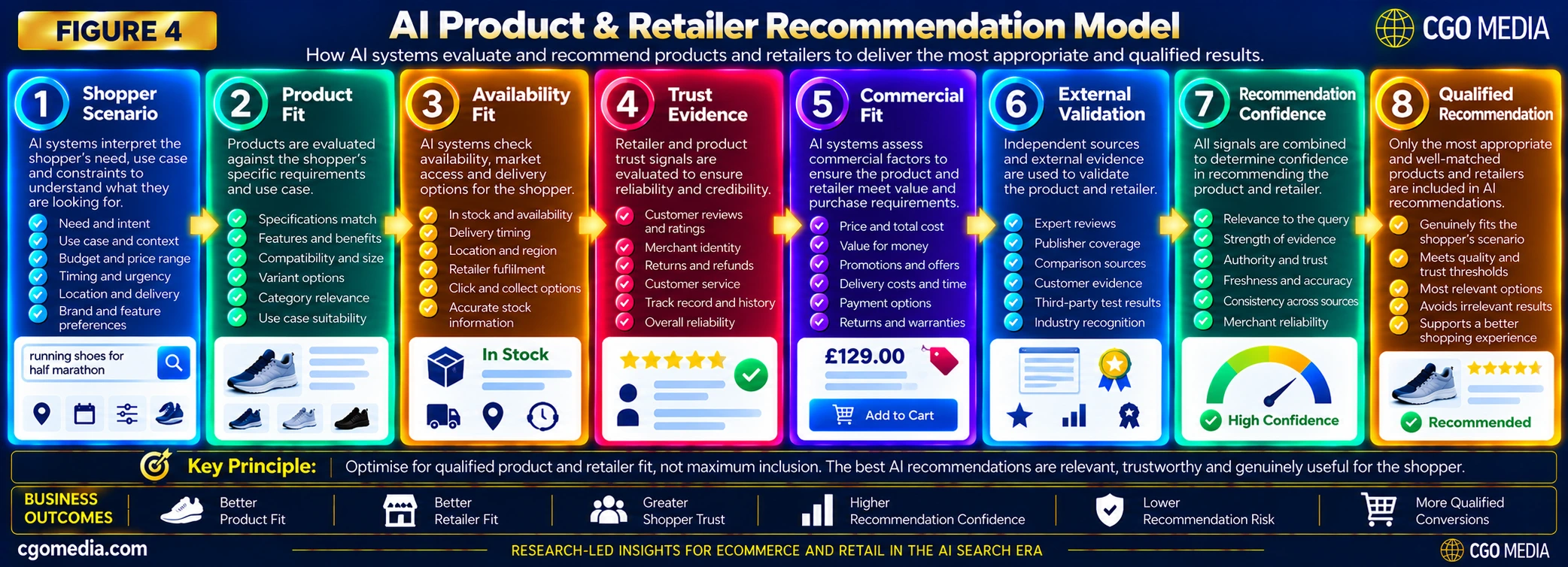
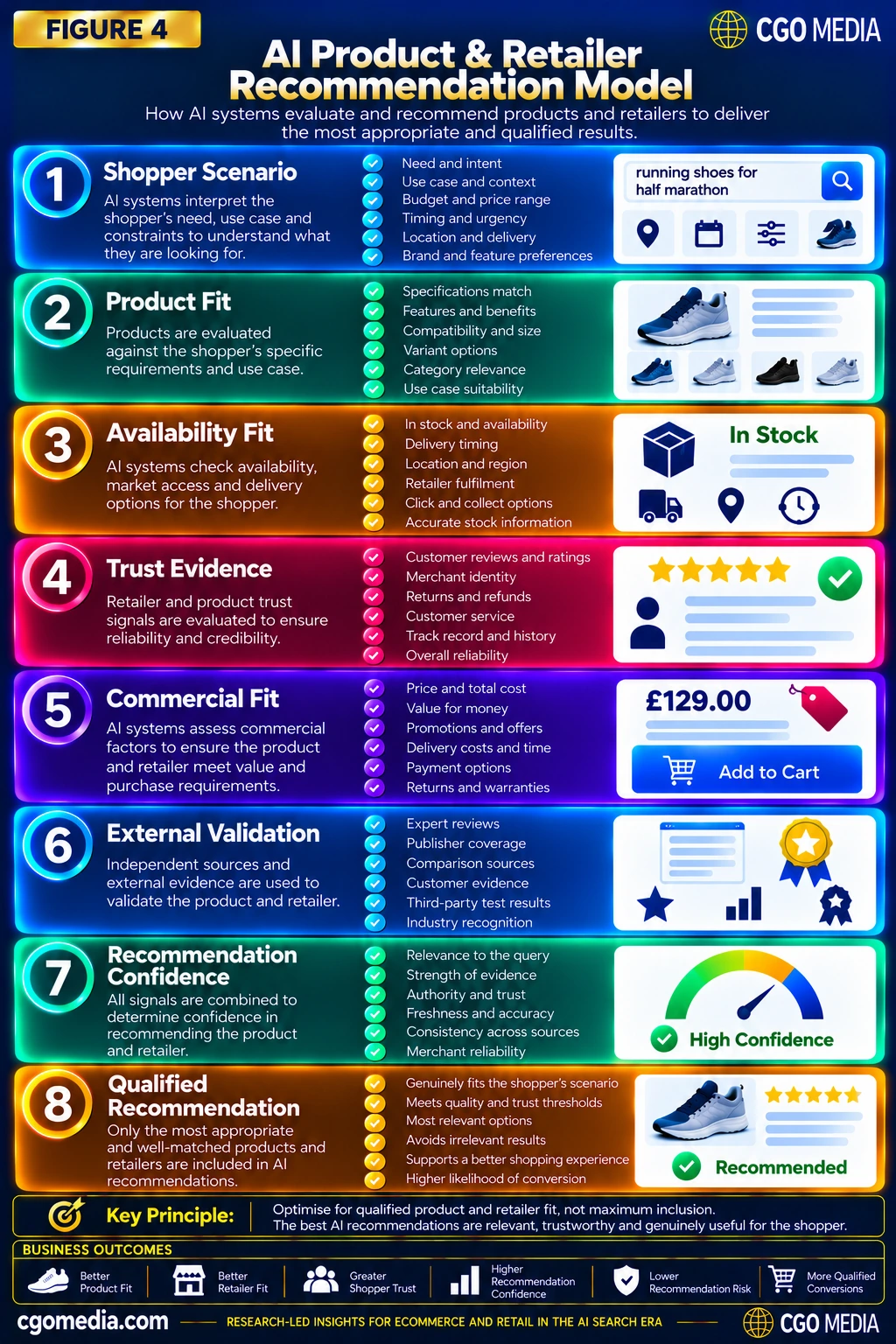
504. Ecommerce GEO Requires a Distinct Measurement Framework
Traditional ecommerce SEO metrics remain important, but they do not fully capture visibility across generative shopping, product comparison and AI-assisted recommendation environments.
505. Ecommerce GEO Measurement Should Separate Visibility Layers
A useful model includes:
- Source Visibility
- Citation Visibility
- Brand & Product Accuracy
- Comparison Visibility
- Recommendation Visibility
506. Qualified Ecommerce GEO Performance Connects These Layers
A useful relationship is:
Source Visibility → Citation Visibility → Brand & Product Accuracy → Comparison Visibility → Recommendation Visibility → Qualified Ecommerce GEO Performance
507. Source Visibility Measures Information Presence
It evaluates whether brand, retailer, product or research information appears to contribute to generated shopping answers.
508. Source Visibility Can Be Brand-Owned or External
The organisation may appear through:
- Brand websites
- Retailer websites
- Marketplaces
- Review publications
- Comparison platforms
- Research assets
509. Direct Source Visibility Should Be Distinguished from Indirect Source Visibility
A product may appear in an answer while the cited evidence comes from a review or retailer rather than the brand itself.
510. Direct Source Visibility Can Include
- Brand product pages
- Retailer product pages
- Brand buying guides
- Brand research
511. Indirect Source Visibility Can Include
- Reviews
- Publishers
- Comparison sites
- Marketplaces
- Customer communities
512. Source Visibility Should Be Measured by Product Category
A brand may have strong source visibility in one category and limited visibility in another.
513. Source Visibility Should Be Measured by Product
Individual products may perform very differently even within the same category.
514. Source Visibility Should Be Measured by Market
Retail source environments can vary substantially across countries.
515. Source Visibility Should Be Measured by Shopper Scenario
The same product may appear in one shopping context but not another.
516. Citation Visibility Is a Separate Measure
It evaluates whether product, retailer, research or review sources are explicitly referenced.
517. Citation Share Can Be Calculated
A simple measure is:
Citation Share = Relevant Citation Appearances ÷ Relevant Shopping Scenarios Tested
518. Citation Share Should Be Segmented
Useful segments can include:
- Brand
- Product category
- Product
- Market
- Shopper scenario
519. Citation Quality Should Be Recorded Alongside Citation Frequency
Useful dimensions include:
- Source credibility
- Product relevance
- Accuracy
- Independence
- Persistence
520. Citation Context Should Also Be Recorded
A citation can be:
- Positive
- Neutral
- Comparative
- Critical
521. Brand Accuracy Is a Core Ecommerce GEO Measure
It evaluates whether the brand itself is represented correctly.
522. Brand Accuracy Can Include
- Correct brand name
- Correct manufacturer relationship
- Correct product ownership
- Correct market presence
- Correct retailer relationship
523. Product Accuracy Is Even More Important
It evaluates whether specific products and variants are represented correctly.
524. Product Accuracy Can Include
- Correct model
- Correct specifications
- Correct variant
- Correct compatibility
- Correct product generation
525. Merchant Accuracy Should Be Assessed Separately
The seller or retailer should also be represented correctly.
526. Merchant Accuracy Can Include
- Correct seller identity
- Correct stock status
- Correct delivery terms
- Correct returns information
- Correct market availability
527. Commercial Accuracy Is Another Important Layer
It evaluates whether time-sensitive retail facts are represented correctly.
528. Commercial Accuracy Can Include
- Price
- Promotion
- Stock
- Delivery
- Availability
529. A Combined Ecommerce GEO Accuracy Model Can Include
Brand Accuracy + Product Accuracy + Merchant Accuracy + Commercial Accuracy
530. Accuracy Should Be Risk-Weighted
Not every product-data error has the same consequence.
531. Minor Description Variation May Be Low Risk
It may have limited effect on shopper decision-making.
532. Incorrect Compatibility Can Be High Risk
It can directly cause an unsuitable purchase.
533. Incorrect Stock Can Also Be High Risk
It can create wasted shopper time and poor retail experience.
534. Incorrect Price Can Distort Comparison
Old or inaccurate pricing can make one product appear artificially more or less attractive.
535. Ecommerce GEO Risk Can Be Represented as
Severity + Persistence + Shopper Impact + Commercial Importance
536. Severity Measures Potential Harm
The organisation should assess how serious the misinformation is.
537. Persistence Measures Recurrence
A recurring error can indicate deeper product-data or source problems.
538. Shopper Impact Measures Decision Consequence
The error may affect:
- Product choice
- Retailer choice
- Purchase timing
- Returns
539. Commercial Importance Measures Business Relevance
Errors affecting strategic categories or high-value products may warrant faster intervention.
540. Comparison Visibility Is Another Core Ecommerce GEO Measure
It evaluates whether a product or retailer enters the active shopping consideration set.
541. Product Comparison Share Can Be Calculated
A simple measure is:
Product Comparison Share = Relevant Product Comparison Appearances ÷ Relevant Product Comparison Scenarios Tested
542. Retailer Comparison Share Can Also Be Calculated
A simple measure is:
Retailer Comparison Share = Relevant Retailer Comparison Appearances ÷ Relevant Retailer Comparison Scenarios Tested
543. Comparison Share Should Be Segmented by Category
A product may have strong visibility in one category and weak visibility in another.
544. Comparison Share Should Be Segmented by Shopper Need
Useful segments can include:
- Best value
- Best premium option
- Best for beginners
- Best for professional use
- Best for a specialist use case
545. Comparison Visibility Should Be Interpreted Alongside Positioning
The organisation should ask whether the product is being compared for the right reasons.
546. Comparison Visibility Can Be High but Strategically Misaligned
A premium product may repeatedly appear only in budget-oriented scenarios.
547. Comparison Visibility Should therefore Include Positioning Accuracy
Useful checks can include:
- Price position
- Use-case position
- Performance position
- Audience position
- Category position
548. Recommendation Visibility Is the Most Selective Layer
It evaluates whether the product or retailer is appropriately recommended for specific shopper scenarios.
549. Recommendation Share Can Be Calculated
A simple measure is:
Recommendation Share = Relevant Recommendation Appearances ÷ Relevant Shopper Scenarios Tested
550. Recommendation Share Should Not Be Maximised Blindly
A product should not be recommended where fit is weak.
551. Recommendation Measurement Should Use Four Outcome Categories
- Relevant Inclusion
- Irrelevant Inclusion
- Relevant Exclusion
- Appropriate Exclusion
552. Relevant Inclusion Is the Preferred Outcome
The product appears where shopper fit is genuine.
553. Irrelevant Inclusion Can Represent Commercial Risk
It can increase:
- Poor product choice
- Returns
- Customer dissatisfaction
- Support friction
554. Relevant Exclusion Can Represent Lost Opportunity
A suitable product or retailer is absent from the decision set.
555. Appropriate Exclusion Represents Correct Filtering
The product is omitted because it genuinely does not fit the shopper scenario.
556. Qualified Ecommerce Recommendation Visibility Should Be the Main Measure
A useful definition is:
Relevant Shopper Scenario + Accurate Product Representation + Availability Fit + Trust + Appropriate Inclusion
557. Ecommerce GEO Measurement Should Begin with a Shopper Scenario Library
The quality of measurement depends heavily on the quality of scenarios tested.
558. Scenario Libraries Should Reflect Real Shopping Decisions
Useful inputs can include:
- Search demand
- On-site search
- Customer support questions
- Returns data
- Product research
- Merchandising data
559. Scenario Libraries Should Include Product Discovery Questions
These can identify whether products enter early-stage shopping discovery.
560. Scenario Libraries Should Include Product Education Questions
These can test how clearly products are understood.
561. Scenario Libraries Should Include Comparison Questions
These can identify relevant competitive sets.
562. Scenario Libraries Should Include Purchase Questions
These can test retailer, stock, delivery and commercial fit.
563. Scenario Libraries Should Include Recommendation Questions
These can test qualified product and retailer inclusion.
564. Scenario Libraries Should Be Segmented by Category
Shopping behaviour differs across retail verticals.
565. Scenario Libraries Should Be Segmented by Shopper Type
Useful segments can include:
- Budget
- Premium
- Professional
- Beginner
- Gift buyer
- Specialist
566. Scenario Libraries Should Be Segmented by Market
Price, availability, retail competition and shopper expectations can differ by geography.
567. Scenario Libraries Should Be Segmented by Journey Stage
A useful sequence is:
Discovery → Education → Comparison → Selection → Purchase
568. Ecommerce GEO Measurement Should Be Longitudinal
One isolated AI result is rarely sufficient.
569. Longitudinal Monitoring Can Reveal Stability
A useful concept is:
Presence Frequency + Representation Consistency + Comparison Consistency + Recommendation Consistency
570. Presence Frequency Measures How Often the Product Appears
This should only be assessed within relevant shopping scenarios.
571. Representation Consistency Measures Whether Product Facts Remain Stable
Repeated factual variation can indicate weak source convergence.
572. Comparison Consistency Measures Whether Similar Scenarios Produce Similar Product Sets
Large changes may indicate unstable category association.
573. Recommendation Consistency Measures Whether Similar Shopper Scenarios Produce Similar Fit Assessments
Large variation may indicate weak recommendation confidence.
574. Stability Should Not Be Confused with Accuracy
A consistently wrong specification remains a serious problem.
575. Ecommerce GEO Should Track Both Stability and Accuracy
A useful matrix includes:
- Stable and accurate
- Stable and inaccurate
- Unstable and accurate
- Unstable and inaccurate
576. Stable and Accurate Is the Strongest Outcome
The product is represented reliably and correctly.
577. Stable and Inaccurate Can Be a High-Priority Risk
Persistent misinformation may influence repeated purchase decisions.
578. Unstable but Accurate Requires Monitoring
Product information may be correct but inconsistently represented.
579. Unstable and Inaccurate Requires Immediate Investigation
This indicates both factual and consistency weakness.
580. Ecommerce GEO Should Maintain an Error Taxonomy
A structured error taxonomy can speed diagnosis.
581. Brand Errors Can Include
- Wrong brand attribution
- Wrong manufacturer
- Wrong retailer relationship
- Wrong market presence
582. Product Errors Can Include
- Wrong model
- Wrong specification
- Wrong variant
- Wrong compatibility
- Wrong product generation
583. Merchant Errors Can Include
- Wrong seller
- Wrong retail channel
- Wrong market
- Wrong returns information
584. Commercial Errors Can Include
- Wrong price
- Wrong stock status
- Wrong promotion
- Wrong delivery estimate
585. Recommendation Errors Can Include
- Irrelevant inclusion
- Relevant exclusion
- Wrong use-case fit
- Wrong price-position fit
- Wrong retailer fit
586. Error Taxonomies Support Root-Cause Analysis
Different error types often require different corrective actions.
587. Ecommerce GEO Should Diagnose the Likely Source of Error
A useful process is:
Observe → Classify → Compare → Diagnose → Prioritise → Improve → Re-Test
588. Observe
Record the generated product, retailer or recommendation output.
589. Classify
Identify whether the issue concerns:
- Brand
- Product
- Merchant
- Commercial information
- Recommendation
590. Compare
Compare the output with current authoritative product and merchant sources.
591. Diagnose
Identify likely data, authority, freshness or source-convergence gaps.
592. Prioritise
Use shopper impact and commercial importance.
593. Improve
Strengthen the underlying product and retail information environment.
594. Re-Test
Determine whether the observed pattern changes.
595. Ecommerce GEO Should Track Source Support
For each important generated product claim, the organisation can ask:
What brand, merchant, independent or customer evidence supports this representation?
596. Strong Product Source Support Can Include
- Manufacturer data
- Retailer data
- Independent tests
- Publisher reviews
- Customer evidence
597. Weak Source Support Can Explain Inaccuracy
Where authoritative evidence is missing, outdated or contradictory, product representation may become less reliable.
598. Source Support Should Be Measured by Type
Useful categories can include:
- Brand
- Retailer
- Marketplace
- Independent review
- Customer evidence
599. Ecommerce GEO Should Track Citation Share Separately from Comparison Share
A product may be widely cited without entering many relevant comparison sets.
600. Comparison Share Should Be Tracked Separately from Recommendation Share
A product may frequently be compared without being the preferred recommendation.
601. Keeping These Measures Separate Improves Diagnosis
For example:
- Strong citations + weak comparison share may indicate positioning weakness
- Strong comparison share + weak recommendation may indicate product-fit or trust weakness
- Strong recommendation + weak first-party citation may indicate dependence on external sources
602. Ecommerce GEO Should Monitor Competitive Movement
Product and retailer sets can change over time.
603. Competitive Movement Can Include
- New product emergence
- Product decline
- New retailer visibility
- Category convergence
- Price-position changes
604. Product Co-Occurrence Should Be Recorded
Repeated co-occurrence can reveal effective competitive sets.
605. Co-Occurrence Can Be Measured by Scenario Type
For example:
- Best value
- Premium
- Beginner
- Professional
- Specialist use
606. Retailer Co-Occurrence Should Also Be Recorded
This can reveal which merchants repeatedly compete for the same purchase.
607. Ecommerce GEO Should Track Strength Attribution
The organisation should record which product strengths are repeatedly associated with it.
608. Ecommerce GEO Should Track Weakness Attribution
Repeated negative framing can materially affect recommendation confidence.
609. Strength and Weakness Attribution Can Inform Product Strategy
It can show whether external representation aligns with desired product positioning.
610. Ecommerce GEO Measurement Should Connect to Traditional SEO Data
Useful SEO signals can include:
- Organic product visibility
- Category rankings
- Product-page traffic
- Search demand
- Landing-page engagement
611. SEO and GEO Data Should Not Be Combined Carelessly
They measure different parts of the product discovery environment.
612. Ecommerce GEO Measurement Should Connect to Merchandising Data
Relevant data can include:
- Product demand
- Stock
- Category performance
- Promotion performance
- Price competitiveness
613. Ecommerce GEO Measurement Should Connect to Customer Data
Relevant signals can include:
- Returns
- Reviews
- Customer service contacts
- Product questions
- Repeat purchase
614. Ecommerce GEO Measurement Should Connect to Conversion Data
Relevant measures can include:
- Conversion rate
- Basket value
- Product attachment
- Purchase completion
615. Attribution Should Remain Cautious
AI-assisted shopping can influence the buyer before a measurable website visit occurs.
616. Ecommerce GEO Should therefore Use Multiple Attribution Signals
These can include:
- Customer surveys
- On-site search behaviour
- CRM notes
- Support interactions
- AI visibility observations
617. Leading Indicators Can Support Ecommerce GEO Measurement
Leading indicators can reveal authority and recommendation development before commercial outcomes change.
618. Ecommerce GEO Leading Indicators Can Include
- Source visibility
- Citation share
- Product accuracy
- Comparison share
- Recommendation share
619. Lagging Indicators Can Include
- Qualified traffic
- Conversion
- Returns
- Customer satisfaction
- Repeat purchase
620. Leading and Lagging Indicators Should Be Interpreted Together
Higher visibility without better shopper fit may not represent meaningful performance.
621. Ecommerce GEO Should Include an Executive Scorecard
A practical scorecard can include:
- Source Visibility
- Citation Share
- Brand & Product Accuracy
- Comparison Share
- Recommendation Share
- Critical GEO Risk
622. Executive Scorecards Should Show Direction
Each measure can be classified as:
- Improving
- Stable
- At risk
- Deteriorating
623. Executive Scorecards Should Highlight the Primary Constraint
The most useful question is:
Which GEO weakness is currently limiting qualified product and retailer discovery?
624. The Primary Constraint May Be Source Visibility
The brand or product may lack sufficient information presence.
625. The Primary Constraint May Be Citation Authority
The product may be visible but weakly trusted as a source.
626. The Primary Constraint May Be Product Accuracy
Specifications, variants or merchant information may be represented inconsistently.
627. The Primary Constraint May Be Comparison Visibility
The product may not enter relevant consideration sets.
628. The Primary Constraint May Be Recommendation Fit
The product may appear but not be recommended appropriately.
629. Ecommerce GEO Reporting Should Avoid Vanity Metrics
Raw mention counts alone can be misleading.
630. High Mention Volume Can Coexist with Weak Ecommerce GEO
For example:
- Wrong specifications
- Outdated pricing
- Irrelevant inclusion
- Poor retailer representation
631. Qualified Ecommerce GEO Performance Is Therefore a Better Objective
A useful relationship is:
Relevant Shopper Presence + Accurate Product Representation + Strong Trust Evidence + Appropriate Recommendation
632. Ecommerce GEO Measurement Should Be Repeatable
The same core methodology should be usable across reporting periods.
633. Repeatability Requires Consistent Scenario Design
Major changes to the scenario set can make longitudinal comparison difficult.
634. Scenario Libraries Should Still Evolve
New products, categories, markets and shopper needs may require new scenarios.
635. The Best Approach Is Controlled Evolution
Core benchmark scenarios can remain stable while new scenarios are added separately.
636. Ecommerce GEO Should Document Measurement Changes
Changes to:
- Scenario design
- Product categories
- Markets
- AI platforms
- Scoring methods
- Risk weighting
should be recorded.
637. Measurement Transparency Improves Interpretation
Stakeholders can understand why apparent performance changes.
638. Ecommerce GEO Measurement Should Be Decision-Oriented
The objective is not simply to collect AI visibility data.
639. Each Measure Should Connect to a Potential Action
For example:
- Weak source visibility → strengthen product and category sources
- Weak citation share → improve evidence and Digital PR
- Product errors → improve product-data governance
- Weak comparison visibility → investigate positioning and competitive evidence
- Weak recommendation share → investigate shopper fit, trust and availability
640. The Seventeenth Ecommerce GEO Principle
Ecommerce GEO measurement should separate source visibility, citation visibility, brand and product accuracy, comparison visibility and recommendation visibility because each represents a different stage of AI-assisted shopping discovery and requires different diagnostic and improvement actions.
641. The Eighteenth Ecommerce GEO Principle
Ecommerce GEO accuracy should be risk-weighted, with incorrect specifications, compatibility, availability, seller identity, price and other high-impact shopping facts prioritised according to severity, persistence, shopper impact and commercial importance.
642. The Nineteenth Ecommerce GEO Principle
Ecommerce GEO monitoring should be longitudinal and scenario-based, using stable benchmark scenarios segmented by product category, shopper type, market and journey stage so durable product and retailer visibility patterns can be distinguished from temporary generative variation.
643. The Twentieth Ecommerce GEO Principle
Ecommerce GEO reporting should prioritise qualified product discovery and strategic constraints rather than raw mention volume, connecting source authority, citations, product accuracy, comparison presence and recommendation quality to the shopper scenarios and categories that matter most commercially.
644. The Ecommerce GEO Measurement Framework
The complete measurement relationship can be summarised as:
Source Visibility → Citation Visibility → Brand & Product Accuracy → Comparison Visibility → Recommendation Visibility → Qualified Ecommerce GEO Performance
645. The Strategic Implication
Ecommerce and retail organisations should measure Generative Engine Optimisation through a layered, product-specific and shopper-focused framework that distinguishes source presence, citations, factual product accuracy, comparison inclusion and qualified recommendation, using longitudinal scenario libraries and executive reporting to identify where product data, merchant trust, external authority or shopper fit is currently constraining AI-assisted discovery.
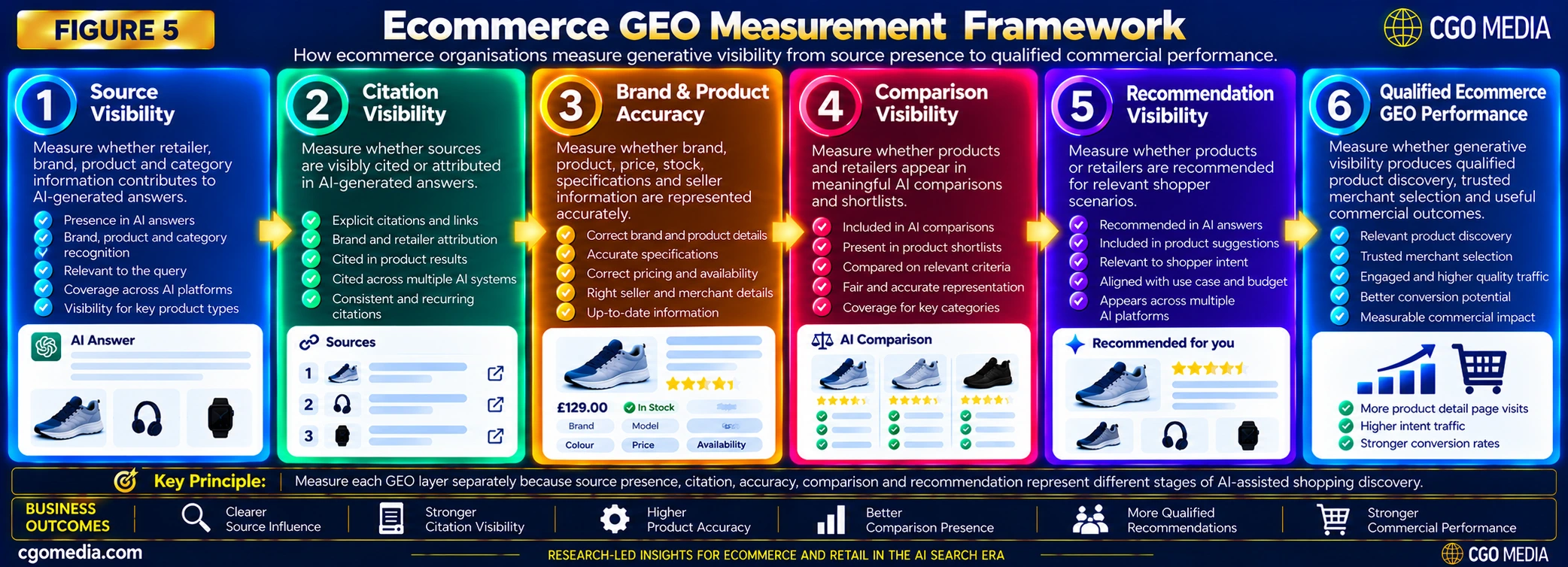
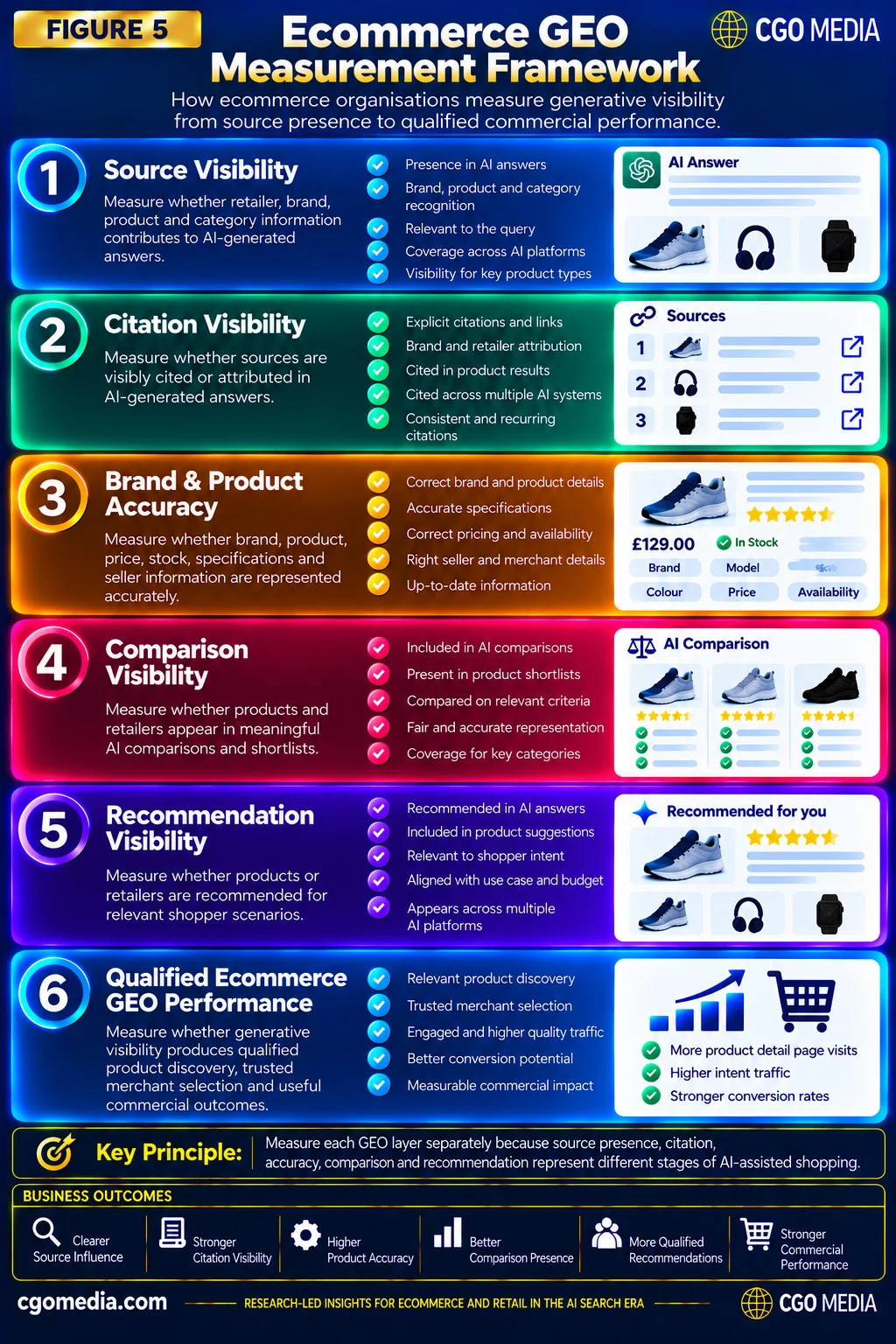
646. Ecommerce GEO Should Operate as a Continuous Improvement System
Ecommerce Generative Engine Optimisation should not be treated as a one-time product visibility project.
647. Retail Information Environments Change Continuously
Brands and retailers should expect change across:
- Products
- Variants
- Pricing
- Stock
- Promotions
- Customer demand
648. Continuous Ecommerce GEO Should Begin with Observation
Teams should repeatedly observe:
- Source visibility
- Citation visibility
- Product accuracy
- Comparison visibility
- Recommendation visibility
- Merchant representation
649. Observation Should Be Structured
Scenario libraries and measurement methods should remain sufficiently consistent to support meaningful comparison across time.
650. Ecommerce GEO Should Diagnose Change Before Reacting
A material visibility shift should trigger investigation rather than immediate tactical response.
651. Diagnosis Should Distinguish Temporary Variation from Structural Change
One unusual AI response may represent ordinary generative variation.
652. Persistent Change Can Indicate a Structural Ecommerce GEO Problem
Examples can include:
- Product-data weakness
- Outdated commercial information
- Weak review authority
- Competitive displacement
- Category repositioning
653. Ecommerce GEO Should Prioritise by Shopper and Commercial Impact
Not every visibility change has equal strategic significance.
654. A Useful Ecommerce GEO Priority Model Is
Shopper Impact + Commercial Importance + Persistence + Trust Risk
655. Shopper Impact
Measures whether the issue affects:
- Product understanding
- Product choice
- Retailer choice
- Purchase confidence
656. Commercial Importance
Measures whether the issue affects:
- Strategic categories
- High-value products
- Core revenue lines
- Priority markets
657. Persistence
Measures whether the issue recurs across time, shopper scenarios or AI environments.
658. Trust Risk
Measures whether the issue could reduce confidence in the product, retailer or brand.
659. Ecommerce GEO Should Improve the Underlying Retail Information System
Interventions can involve:
- Product pages
- Category pages
- Product feeds
- Review evidence
- Retailer information
- Research assets
660. GEO Improvement Should Target Root Causes
The objective should not be to manipulate individual AI outputs.
661. Root Causes Can Exist in Product Data
Examples include:
- Missing specifications
- Weak variant relationships
- Incorrect compatibility
- Legacy product information
662. Root Causes Can Exist in Commercial Data
Examples include:
- Outdated price
- Incorrect stock
- Expired promotions
- Wrong delivery information
663. Root Causes Can Exist in Merchant Information
Examples include:
- Unclear seller identity
- Weak returns information
- Missing warranty detail
- Poor customer-service evidence
664. Root Causes Can Exist in External Information
Examples include:
- Outdated reviews
- Incorrect comparison pages
- Legacy marketplace listings
- Weak publisher coverage
665. Ecommerce GEO Improvement Should Be Followed by Re-Testing
The organisation should determine whether the intervention changed the observed shopping-discovery pattern.
666. Re-Testing Should Preserve Scenario Consistency
Otherwise longitudinal comparison becomes difficult.
667. Continuous Ecommerce GEO Can Be Summarised as
Observe → Diagnose → Prioritise → Strengthen → Validate → Learn → Adapt
668. Governance Is Essential to Ecommerce GEO
Ecommerce GEO crosses multiple commercial and technical functions.
669. A Retail GEO Governance Model Can Include
SEO + Product + Merchandising + Ecommerce + Customer Experience + Digital PR + Data Governance
670. SEO Can Coordinate Discovery Intelligence
SEO can connect:
- Search demand
- AI visibility
- Product architecture
- Source analysis
671. Product Teams Can Validate Product Truth
They can confirm:
- Specifications
- Variants
- Compatibility
- Use cases
- Limitations
672. Merchandising Can Validate Commercial Positioning
Merchandising can support:
- Price positioning
- Category priorities
- Promotions
- Availability
- Product lifecycle
673. Ecommerce Teams Can Validate Transactional Truth
They can confirm:
- Stock
- Delivery
- Returns
- Checkout availability
- Market access
674. Customer Experience Teams Can Validate Shopper Reality
They can contribute:
- Common questions
- Return reasons
- Purchase friction
- Service complaints
- Review themes
675. Digital PR Can Strengthen External Retail Authority
It can support:
- Original research
- Product testing
- Category statistics
- Expert commentary
- Publisher relationships
676. Data Governance Can Coordinate Product Consistency
It can help maintain standards across:
- Product databases
- Product feeds
- Retailer feeds
- Marketplace listings
- Structured product information
677. Ecommerce GEO Governance Should Define Ownership
The organisation should know who owns:
- Product facts
- Commercial facts
- Merchant facts
- Review monitoring
- Escalation
678. Product and Commercial Ownership Should Be Distinct but Connected
Core product specifications may be stable while price, stock and promotions change continuously.
679. Ecommerce GEO Governance Should Define Review Cadence
Different retail facts require different review frequencies.
680. High-Change Ecommerce Information May Require Continuous or Frequent Review
Examples include:
- Price
- Stock
- Promotions
- Delivery estimates
- Seller availability
681. Stable Product Information May Require Less Frequent Review
Examples can include:
- Product dimensions
- Materials
- Core specifications
- Product category
682. Review Frequency Should Reflect Volatility and Shopper Impact
A useful relationship is:
Rate of Change + Shopper Impact + Commercial Importance → Review Frequency
683. Ecommerce GEO Governance Should Include Escalation
Critical product misinformation should not remain within ordinary SEO reporting.
684. Critical Ecommerce GEO Escalation Can Involve
- Product leadership
- Merchandising
- Ecommerce operations
- Customer experience
- Data governance
685. Ecommerce GEO Should Include Recovery Capability
Not every product or retailer misinformation event can be prevented.
686. An Ecommerce GEO Recovery Cycle Can Be Used
Detect → Verify → Diagnose → Correct → Re-Test → Learn
687. Detect
Identifies material product, commercial, merchant or recommendation errors.
688. Verify
Confirms whether the observation is genuine, material and persistent.
689. Diagnose
Identifies the likely product-data, merchant, freshness, authority or source-convergence problem.
690. Correct
Improves the underlying retail information environment.
691. Re-Test
Checks whether the observed generative pattern changes.
692. Learn
Improves future product standards, governance and monitoring.
693. Recovery Speed Can Be Measured
Useful measures can include:
- Time to detect
- Time to verify
- Time to correct
- Time to validate
694. Ecommerce GEO Should Also Include Experimentation
Some interventions should be tested rather than assumed to work.
695. Ecommerce GEO Experiments Should Begin with a Hypothesis
For example:
Improving product specifications, variant clarity, merchant evidence and independent review support should increase qualified comparison and recommendation visibility for relevant shopper scenarios.
696. Experiments Should Establish a Baseline
The organisation should record current visibility before changes are introduced.
697. Experiments Should Define the Intervention
Examples can include:
- Improved product pages
- New buying guides
- Better product data
- Original category research
- Improved review distribution
698. Experiments Should Define Success Criteria
Success can include:
- Improved source visibility
- Improved citation visibility
- Improved product accuracy
- Improved comparison share
- Improved recommendation fit
699. Experiments Should Use Observation Windows
Generative visibility may not change immediately after a retail intervention.
700. Confounding Factors Should Be Recorded
Examples can include:
- AI model changes
- Seasonality
- Competitor launches
- Price changes
- Stock changes
- Major review coverage
701. Negative Results Should Be Preserved
They help prevent repeated ineffective work.
702. Successful Experiments Should Become Standards
Validated approaches can be added to:
- Product templates
- Category templates
- Data standards
- Content standards
- GEO playbooks
703. Ecommerce GEO Should Integrate with Ecommerce SEO
The two disciplines overlap substantially.
704. Ecommerce SEO Supports GEO Through Technical Accessibility
Search engines and generative systems both benefit from accessible and clearly structured product information.
705. Ecommerce SEO Supports GEO Through Product Architecture
Clear relationships between:
- Categories
- Subcategories
- Products
- Variants
- Brands
can improve interpretation.
706. Ecommerce SEO Supports GEO Through Search-Relevant Product Coverage
Strong informational and commercial coverage can improve product understanding.
707. GEO Extends Ecommerce SEO Through Representation and Recommendation Analysis
Ecommerce GEO adds explicit focus on:
- Citation
- Product accuracy
- Merchant interpretation
- Comparison visibility
- Recommendation visibility
708. Ecommerce SEO and GEO Should Share Infrastructure
But they should not be treated as identical disciplines.
709. Ecommerce GEO Should Integrate with Product Information Management
Product-data quality is fundamental to accurate generative representation.
710. Product Information Management Can Strengthen GEO Through
- Canonical product facts
- Variant relationships
- Product identifiers
- Consistent specifications
- Lifecycle status
711. Ecommerce GEO Should Integrate with Merchandising Strategy
AI-assisted shopping can reveal how products are being compared and positioned externally.
712. GEO Intelligence Can Reveal Price-Position Drift
A product may increasingly be perceived as:
- Budget
- Mid-market
- Premium
- Luxury
- Best value
713. Position Drift Can Be Strategic or Problematic
It should be evaluated against intended merchandising position.
714. GEO Intelligence Can Reveal Use-Case Drift
Products may increasingly be recommended for uses the brand did not originally prioritise.
715. Use-Case Drift Can Reveal Opportunity
Emerging shopper behaviour may expose:
- New audiences
- New bundles
- New content needs
- New product-development opportunities
716. Use-Case Drift Can Also Reveal Risk
A product may be recommended for unsuitable or unsupported applications.
717. Ecommerce GEO Can Therefore Contribute to Merchandising Intelligence
Its value extends beyond digital visibility.
718. Ecommerce GEO Should Integrate with Customer Intelligence
AI shopping questions can reveal recurring customer needs and uncertainties.
719. Shopper Questions Can Reveal Information Gaps
Common uncertainty can concern:
- Compatibility
- Size
- Feature differences
- Returns
- Delivery
720. Shopper Questions Can Reveal Product Opportunities
Repeated demand may indicate:
- Missing features
- Missing sizes
- Missing bundles
- Missing price points
721. Ecommerce GEO Should Integrate with Review Intelligence
Reviews provide important evidence about real-world product and merchant performance.
722. Review Intelligence Can Reveal Recurring Product Strengths
These may reinforce:
- Performance
- Ease of use
- Durability
- Value
- Design
723. Review Intelligence Can Reveal Recurring Product Weaknesses
These can include:
- Compatibility problems
- Quality issues
- Delivery problems
- Returns friction
- Support issues
724. Ecommerce GEO Should Integrate with Digital PR
External authority can materially strengthen citation and recommendation confidence.
725. Digital PR Can Strengthen GEO Through
- Retail research
- Consumer statistics
- Product testing
- Category analysis
- Expert commentary
726. Ecommerce GEO Should Integrate with Retail Research
Original evidence can create valuable citation assets.
727. Retail Research Can Support GEO Through
- Consumer behaviour studies
- Category trend reports
- Pricing studies
- Returns research
- Delivery research
- Shopping-behaviour datasets
728. Ecommerce GEO Should Integrate with Retailer Strategy
Brands selling through multiple merchants should understand how retailer representation affects product recommendations.
729. Retailer Choice Can Affect Recommendation Confidence
The same product can create different purchase outcomes through different merchants.
730. Retailer GEO Can Therefore Be Analysed Separately from Product GEO
Retailer-level analysis can examine:
- Price competitiveness
- Stock reliability
- Delivery
- Returns
- Merchant trust
731. Marketplace GEO Adds Another Layer
Brands and retailers may need to understand how products are represented across third-party marketplaces.
732. Marketplace GEO Can Reveal Seller Confusion
Generative systems may struggle to distinguish:
- Official seller
- Authorised reseller
- Marketplace retailer
- Unknown seller
733. Marketplace Product Information Should Be Governed Where Possible
Brands should seek consistency in:
- Product naming
- Specifications
- Images
- Variant relationships
- Identifiers
734. Ecommerce GEO Scaling Should Be Strategic
Large product catalogues can make exhaustive monitoring impractical.
735. Scaling Should Begin with Priority Categories
Priority can reflect:
- Revenue
- Growth potential
- Margin
- Strategic importance
- AI shopping demand
736. Ecommerce GEO Scaling Should Then Extend to Priority Products
Useful starting points can include:
- Flagship products
- Best sellers
- High-margin products
- New launches
- High-return products
737. High-Return Products Can Be Especially Important
Poor product matching may contribute to unnecessary returns.
738. Ecommerce GEO Can Help Investigate Return Drivers
The organisation can compare:
- AI product descriptions
- Shopper expectations
- Actual product limitations
- Return reasons
739. Ecommerce GEO Scaling Should Include Priority Markets
Retail availability, price and competitor sets can differ substantially by country.
740. Market-Level GEO Can Reveal Regional Product Differences
These can include:
- Different models
- Different pricing
- Different retailers
- Different delivery terms
- Different shopper preferences
741. International Ecommerce GEO Should Preserve Product Identity
The same product should remain clearly identifiable across markets where appropriate.
742. International Ecommerce GEO Should Adapt Commercial Context
Market-specific information can include:
- Currency
- Price
- Stock
- Delivery
- Returns
- Retail partners
743. Ecommerce GEO Scaling Should Include Shopper Segments
Large brands may require separate scenario groups for:
- Budget shoppers
- Premium shoppers
- Professional users
- Beginners
- Specialist users
744. Segment-Level GEO Can Reveal Product-Fit Problems
A product may be heavily recommended to a shopper group it was not designed for.
745. Ecommerce GEO Scaling Should Include Product Lifecycle
Products move through:
Launch → Growth → Maturity → Replacement → Discontinuation
746. Launch-Stage GEO Has Distinct Requirements
New products may initially lack:
- Reviews
- External citations
- Customer evidence
- Long-term authority
747. Launch-Stage GEO Should Strengthen Product Truth and Early Evidence
Useful actions can include:
- Clear specification pages
- Reviewer outreach
- Testing
- Launch research
- Expert explanation
748. Mature-Product GEO Should Focus on Evidence Quality and Competitive Position
Mature products may have large external information environments that require monitoring.
749. Replacement-Stage GEO Requires Clear Product Relationships
The organisation should explain:
- What replaced the old product
- What changed
- Which users should upgrade
- Which legacy product remains supported
750. Discontinued-Product GEO Requires Clear Historical Status
Old products should not continue appearing as current recommendations without context.
751. Ecommerce GEO Should Include Organisational Learning
Repeated observations should improve:
- Product standards
- Content standards
- Data governance
- Merchandising
- Research
752. Organisational Memory Reduces Repeated GEO Failure
The organisation should not repeatedly rediscover the same product-data or recommendation problems.
753. Ecommerce GEO Learning Can Be Preserved Through
- Scenario libraries
- Issue logs
- Experiment records
- Product maps
- Source maps
- Recommendation logs
- GEO playbooks
754. Adaptive Ecommerce GEO Is the Long-Term Goal
The organisation should be able to respond as:
- AI systems change
- Products change
- Retailers change
- Prices change
- Shopper behaviour changes
755. Adaptive GEO Does Not Mean Constant Tactical Reaction
Stable principles should remain.
756. Stable Ecommerce GEO Principles Can Include
- Clear brand identity
- Clear product identity
- Accurate product data
- Current commercial information
- Strong trust evidence
- Relevant external authority
- Shopper fit
757. Tactics Can Change Around Stable Principles
This creates resilience without strategic confusion.
758. Adaptive Ecommerce GEO Should Be Evidence-Led
Changes should respond to observed patterns rather than speculation.
759. Adaptive Ecommerce GEO Should Be Risk-Aware
Critical compatibility, stock, product, seller or recommendation errors should receive priority over low-value visibility fluctuations.
760. Adaptive Ecommerce GEO Should Be Commercially Relevant
The programme should focus on categories, products, markets and shopper groups that matter most.
761. Adaptive Ecommerce GEO Should Be Integrated
It should connect:
Search Intelligence + AI Intelligence + Product Intelligence + Merchandising Intelligence + Customer Intelligence + Retail Research
762. Combined Intelligence Improves GEO Decisions
Teams can better determine:
- What to improve
- Which products to prioritise
- What to research
- Which shopper segments to target
- Which authority gaps to address
763. Strategic Recommendation One — Build a Defined Shopper Scenario Library
Focus monitoring on realistic product-discovery, comparison and purchase decisions.
764. Strategic Recommendation Two — Map Ecommerce Source Visibility
Identify which brand, retailer, marketplace, publisher and review sources appear around priority categories.
765. Strategic Recommendation Three — Strengthen Product Data Governance
Improve:
- Product identifiers
- Specifications
- Variant relationships
- Compatibility
- Lifecycle status
766. Strategic Recommendation Four — Strengthen Commercial Freshness
Maintain current:
- Price
- Stock
- Promotions
- Delivery
- Availability
767. Strategic Recommendation Five — Strengthen Merchant Trust Evidence
Make seller identity, delivery, returns, warranty and service information explicit.
768. Strategic Recommendation Six — Build Citation Assets
Create useful:
- Retail research
- Buying guides
- Product tests
- Category studies
- Statistics
769. Strategic Recommendation Seven — Strengthen External Validation
Develop credible review, publisher and customer evidence.
770. Strategic Recommendation Eight — Monitor Product Comparison Sets
Track which products repeatedly appear together and why.
771. Strategic Recommendation Nine — Monitor Retailer Comparison Sets
Track which merchants are repeatedly considered for the same purchase.
772. Strategic Recommendation Ten — Monitor Relevant Exclusion
Investigate repeated omission where product and shopper fit are genuine.
773. Strategic Recommendation Eleven — Monitor Irrelevant Inclusion
Identify recommendations likely to create poor shopper outcomes or returns.
774. Strategic Recommendation Twelve — Track Critical Ecommerce Misinformation
Escalate high-risk compatibility, availability, seller, pricing and product errors quickly.
775. Strategic Recommendation Thirteen — Build GEO Recovery Processes
Create clear detection, diagnosis, correction and re-testing procedures.
776. Strategic Recommendation Fourteen — Integrate GEO with Merchandising
Use comparison and recommendation intelligence to understand changing shopper positioning.
777. Strategic Recommendation Fifteen — Integrate GEO with Customer Experience
Use returns, reviews and support questions to improve shopper-fit information.
778. Strategic Recommendation Sixteen — Integrate GEO with Digital PR and Research
Build independent authority around useful evidence rather than product promotion alone.
779. Strategic Recommendation Seventeen — Scale by Category, Product and Market
Prioritise strategically rather than attempting exhaustive monitoring across the entire catalogue immediately.
780. Strategic Recommendation Eighteen — Build Adaptive Ecommerce GEO
Treat Generative Engine Optimisation as a permanent AI-assisted shopping capability rather than a temporary search tactic.
781. The Twenty-First Ecommerce GEO Principle
Ecommerce GEO should operate as a continuous improvement system because products, stock, prices, retailer relationships, customer evidence and AI recommendation patterns can all change rapidly.
782. The Twenty-Second Ecommerce GEO Principle
Ecommerce GEO governance should connect SEO, product, merchandising, ecommerce, customer experience, Digital PR and data governance so stable product truth and rapidly changing commercial truth remain coordinated across owned and external shopping environments.
783. The Twenty-Third Ecommerce GEO Principle
Ecommerce organisations should build recovery and experimentation capability so recurring product errors, stale commercial information, source conflicts, comparison gaps and recommendation failures can be diagnosed, corrected, re-tested and converted into organisational learning.
784. The Twenty-Fourth Ecommerce GEO Principle
The highest Ecommerce GEO capability is adaptive GEO, where stable principles around brand clarity, product truth, merchant trust, source authority and shopper fit are preserved while tactics evolve across changing products, retail markets, AI environments and shopping behaviour.
785. The Continuous Ecommerce GEO Cycle
The complete operational cycle can be summarised as:
Observe → Diagnose → Prioritise → Strengthen → Validate → Learn → Adapt
786. The Long-Term Ecommerce GEO System
The wider relationship can be summarised as:
Clear Brand → Clear Product → Strong Merchant & Trust Evidence → Source Authority → Citation Visibility → Product Comparison Visibility → Recommendation Confidence → Qualified Ecommerce GEO Visibility → Organisational Learning
787. The Strategic Implication
Ecommerce and retail organisations should operate Generative Engine Optimisation as a continuous, product-specific, commercially aware and cross-functional discipline, repeatedly monitoring how brands, products, variants, merchants, sources, citations, comparison sets and recommendations are represented, strengthening the underlying retail information and authority system, validating change and adapting as generative shopping environments, product catalogues, competitors, customer expectations and commercial conditions evolve.
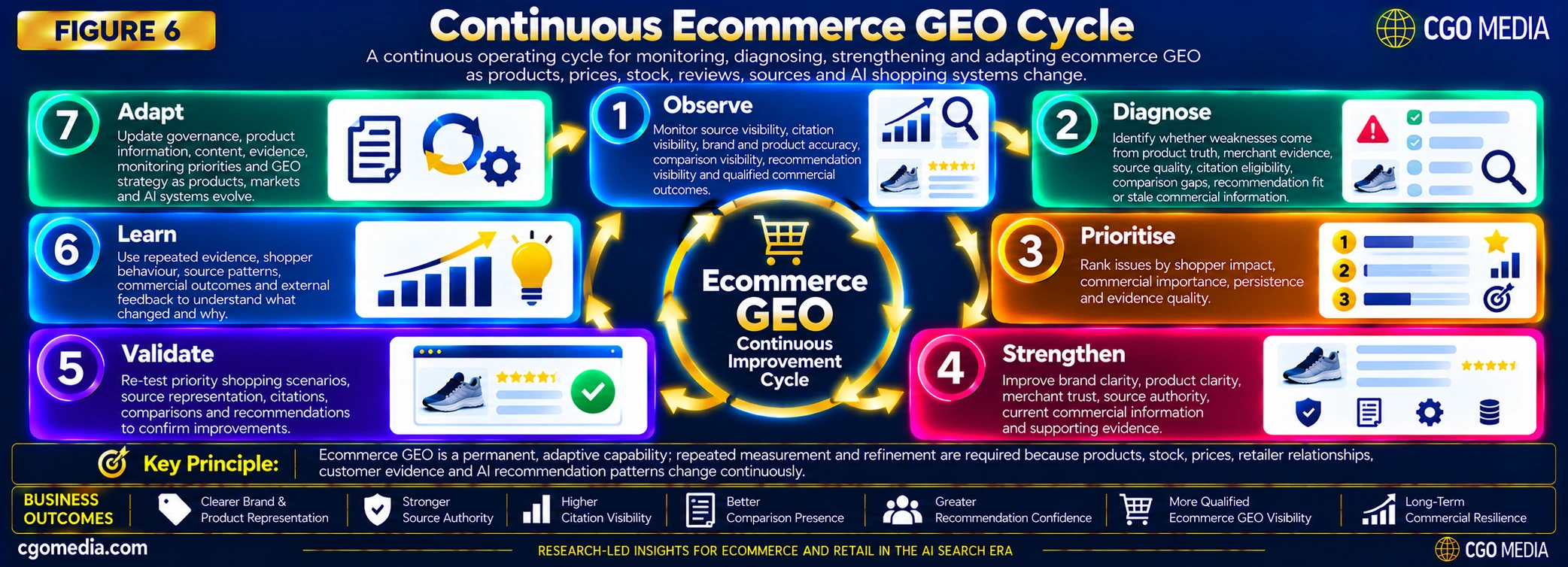
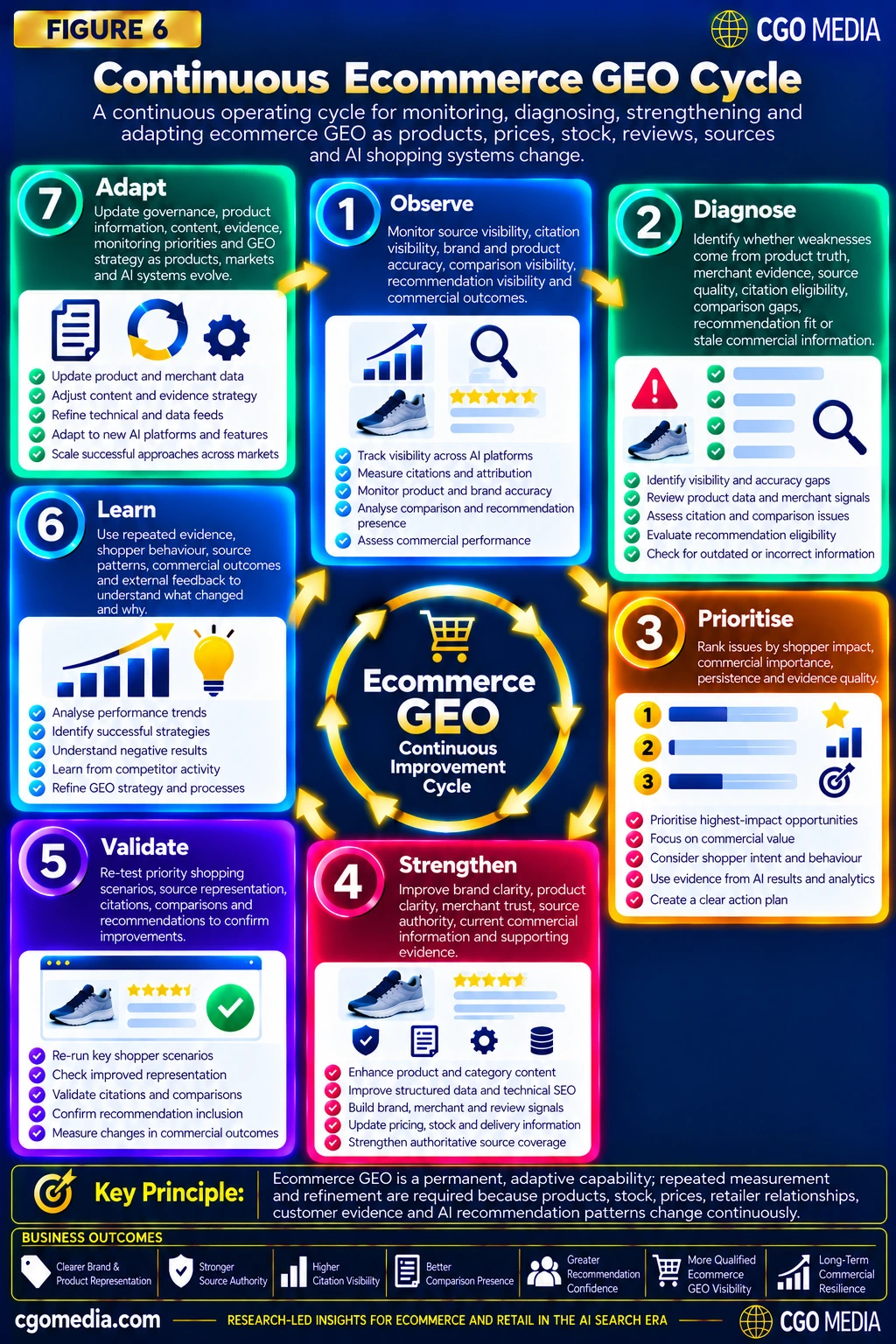
## Ecommerce & Retail GEO — Complete Closing Sections
**Replacement begins at Section 788.** I am consolidating the existing numbered material into substantial research sections, rather than repeating the original 102 short headings.
The revised structure is:
– **788. Methodology**
– **789. Strategic Implications**
– **790. Framework Limitations**
– **791. Frequently Asked Questions — 24 FAQs**
– **792. Conclusion**
– References, CGO Media Research Ecosystem, About Roger Wilkinson, Related Research, and Research Usage & Citation.
The HTML below is intended to replace the existing content from Section 788 onwards.
788. Methodology
Ecommerce & Retail GEO: Generative Engine Optimisation for AI Shopping, Product Discovery and Recommendation Systems is a conceptual research framework developed by CGO Media to help ecommerce brands, online retailers, marketplaces, omnichannel merchants and product-led organisations understand how their brands, products, merchants and supporting evidence are represented within generative shopping and AI-assisted retail discovery environments.
The methodology examines the relationship between brand identity, product information, merchant credibility, source authority, citation visibility, shopper relevance, product comparison and recommendation suitability.
Its purpose is to provide a transparent and repeatable analytical structure for investigating ecommerce visibility beyond conventional organic search rankings.
The framework does not claim access to proprietary AI retrieval, ranking, source-selection or recommendation mechanisms. Its models are research constructs designed to support observation, evidence assessment, strategic planning and continuous improvement.
788.1. Research Purpose and Central Question
The research addresses a central question:
How can ecommerce and retail organisations improve the quality, accuracy, authority, trust and shopper relevance of their visibility across generative product discovery, comparison and recommendation systems?
This question reflects an important distinction between conventional search visibility and AI-assisted commercial discovery.
In traditional ecommerce search, organisations commonly measure visibility through organic rankings, impressions, clicks, product-page traffic and conversion activity.
These measurements remain valuable. However, generative shopping environments introduce additional forms of representation in which customers may encounter product descriptions, comparisons, summaries, cited sources and purchasing recommendations before visiting a retailer's website.
Consequently, the research examines not only whether a product or retailer is visible, but whether the information presented is accurate, relevant, sufficiently evidenced and appropriate to the customer's purchasing requirements.
788.2. Research Scope and Organisational Applicability
The framework is designed for application across different ecommerce business models, including:
- Direct-to-consumer brands.
- Independent online retailers.
- Small and medium-sized ecommerce businesses.
- Omnichannel retailers.
- Large and enterprise retail organisations.
- Online marketplaces.
- Manufacturers selling directly to consumers.
- Specialist ecommerce companies.
- Multi-brand retailers.
- Subscription commerce businesses.
- International retail platforms.
Although these organisations differ in catalogue size, commercial structure and operational resources, they share a fundamental requirement: customers and discovery systems must be able to identify the products being offered, understand their characteristics, evaluate their suitability and distinguish the businesses responsible for selling them.
Implementation priorities should reflect organisational scale rather than assume that every retailer requires identical processes, technologies or monitoring programmes.
788.3. Ecommerce GEO as a Connected Authority System
The framework does not treat Generative Engine Optimisation as a collection of isolated AI prompts, content-formatting techniques or short-term visibility tactics.
Instead, it examines Ecommerce GEO as a connected system of product, merchant, source and shopper evidence.
The principal analytical dimensions are:
- Brand Clarity: accurate identification of brands, manufacturers and their commercial relationships.
- Product Clarity: understandable representation of products, models, variants and specifications.
- Merchant Clarity: identification of sellers, markets and purchasing conditions.
- Trust Evidence: relevant information supporting product and retailer credibility.
- Source Authority: the relevance and reliability of information sources.
- Citation Eligibility: the suitability of information for use as supporting evidence.
- Shopper Fit: alignment between product characteristics and customer requirements.
- Comparison Visibility: inclusion within relevant product or retailer comparisons.
- Recommendation Confidence: the degree to which available evidence supports an appropriate recommendation.
The conceptual progression is:
Brand Clarity → Product Clarity → Merchant & Trust Evidence → Source Authority → Citation Eligibility → Shopper Fit → Recommendation Confidence → GEO Visibility
This progression provides a diagnostic structure. It does not imply that proprietary generative systems process information through these stages in this order.
788.4. Brand Identity and Commercial Entity Analysis
Brand analysis examines whether publicly available information accurately describes the commercial identity and relationships of the organisation being studied.
Relevant evidence includes:
- Brand identity and official naming.
- Manufacturer relationships.
- Retailer relationships.
- Product families and product lines.
- Ownership relationships where relevant.
- Geographic markets served.
- Official websites and recognised commercial channels.
This analysis is particularly important where brands, manufacturers, distributors and retailers are different organisations.
For example, a manufacturer may provide authoritative information about technical specifications, while a retailer may provide the most current information about stock, delivery and commercial offers.
The methodology therefore distinguishes the identity of a product's manufacturer from the identity of the business offering that product for sale.
788.5. Product Entity Identification
Product entity analysis examines whether individual products can be distinguished accurately from related models, variants, generations and accessories.
The assessment may include:
- Official product name.
- Brand and manufacturer.
- Model number.
- Product identifiers.
- Variant identifiers.
- Product generation.
- Compatibility relationships.
- Lifecycle status.
The following conceptual relationship can support analysis:
Brand → Product Line → Product → Variant → Retailer → Market
This relationship is especially useful when a product exists in several configurations or when multiple retailers offer different versions of the same product.
Incorrect identification can lead to unsuitable comparisons, outdated recommendations or confusion between incompatible products.
788.6. Product Information and Functional Clarity
Product clarity concerns whether sufficient accurate information exists to explain what a product does, how it differs from alternatives and which customer requirements it can satisfy.
Relevant attributes include:
- Features.
- Specifications.
- Dimensions and capacity.
- Materials.
- Performance characteristics.
- Compatibility.
- Intended use cases.
- Limitations.
- Variants.
- Relevant support information.
Evidence requirements vary considerably between product categories.
Electronics may require detailed compatibility information. Clothing may require sizing and material guidance. Furniture may require dimensions and assembly details. Specialist equipment may require performance specifications and operating limitations.
The methodology therefore evaluates product information against the decisions customers actually need to make.
A useful conceptual relationship is:
Shopper Need → Product Category → Product Features → Variant → Commercial Terms → Shopper Fit
788.7. Merchant Identity and Commercial Information
Merchant analysis examines whether customers can identify the seller and understand the conditions under which a product can be purchased.
Relevant information includes:
- Seller identity.
- Retail channel.
- Geographic market.
- Product availability.
- Delivery options.
- Delivery costs.
- Returns and refunds.
- Warranty support.
- Customer service.
The methodology distinguishes product truth from merchant commercial truth.
Manufacturers may provide authoritative information about product design and specifications. Retailers may provide more current information about pricing, stock, promotions and fulfilment.
Both forms of information may be necessary to support an accurate purchasing recommendation.
788.8. Product Trust and Merchant Trust
Trust evidence is evaluated separately for products and merchants.
Product trust may involve independent testing, technical evidence, customer experience and verified product performance.
Merchant trust may involve seller reputation, returns policies, delivery reliability, warranty handling and customer support.
Relevant evidence sources include:
- Customer reviews.
- Ratings.
- Independent product testing.
- Specialist publisher evaluations.
- Returns policies.
- Warranty information.
- Merchant reputation.
- Documented customer-service arrangements.
The distinction is important because a suitable product can still produce an unsatisfactory purchasing experience when offered through an inappropriate merchant.
Similarly, a reputable retailer may sell products that are unsuitable for a particular customer's needs.
788.9. Source Estate Mapping
Source estate mapping identifies the information environments in which products, brands and merchants are represented.
These environments may include:
- Official brand websites.
- Manufacturer product documentation.
- Retailer websites.
- Marketplaces.
- Review publishers.
- Comparison platforms.
- Customer-review environments.
- Independent product-testing organisations.
- Research publications.
- Original commercial research assets.
The objective is to understand the available public evidence, identify inconsistencies and determine which sources are most relevant to particular commercial questions.
Source mapping does not establish that every identified source is used by a particular AI system.
788.10. Source Selection and Relevance
The framework uses the following conceptual source-selection model:
Shopper Context → Candidate Sources → Product Relevance → Merchant Evidence → Authority → Source Convergence → Source Selection
This model is intended to support structured assessment of source suitability.
It does not claim that proprietary AI systems follow this exact sequence.
Source relevance should be assessed according to the purchasing question being examined.
For example, a manufacturer may be the most appropriate source for a product's official specifications, while a retailer may be more appropriate for current stock and delivery information.
An independent testing organisation may provide useful evidence about comparative performance.
788.11. Source Convergence
Source convergence concerns the extent to which relevant information sources provide consistent evidence about a product or merchant.
The framework represents this concept as:
Brand Product Truth + Retailer Commercial Truth + Independent Review Evidence + Shopper Evidence
Agreement between sources may strengthen confidence in the underlying information.
However, apparent agreement does not guarantee correctness. Multiple sources may reproduce the same outdated or inaccurate information.
Source convergence should therefore be evaluated alongside source independence, freshness and evidential quality.
788.12. Source Conflict Identification
Source conflicts occur when relevant information environments provide materially different descriptions of the same product or commercial offer.
Examples include disagreements involving:
- Product specifications.
- Model generations.
- Variants.
- Compatibility.
- Pricing.
- Stock availability.
- Delivery conditions.
- Warranty coverage.
Material conflicts should be recorded and investigated.
The appropriate resolution depends on the information type and the authority of the source responsible for maintaining it.
788.13. Citation Eligibility
Citation Eligibility is a conceptual assessment of whether a source provides information that could reasonably support a generated commercial answer.
The framework expresses this through:
Relevance + Product Clarity + Evidence + Authority + Freshness
These dimensions describe useful source characteristics rather than confirmed platform-specific citation criteria.
A source may contain accurate information without being cited by a generative system.
Likewise, the appearance of a citation does not independently prove that the cited source was the only source influencing the answer.
788.14. Citation Authority
Ecommerce Citation Authority concerns the wider evidence supporting recognition of a brand, retailer or publication as a useful information source.
Relevant observations may include:
- Visible AI citations.
- Publisher references.
- Independent review references.
- Research citations.
- Comparison-platform references.
- Relevant industry references.
Citation frequency should not be evaluated without considering relevance and quality.
A small number of authoritative references directly related to a purchasing question may be more informative than a large number of unrelated mentions.
788.15. Original Ecommerce Research
Original research can provide information that is not otherwise readily available within a product category.
Potential research assets include:
- Consumer studies.
- Retail statistics.
- Product tests.
- Buying guides.
- Category reports.
- Original analytical frameworks.
- Market-specific product comparisons.
Where original research is published, its methodology should explain the research question, sample, geographic market, product category, collection period, definitions and limitations.
Unsupported claims should not be presented as original research findings.
Research publication does not guarantee citations, but transparent and useful evidence can contribute to the wider information environment.
788.16. Product and Retailer Recommendation Assessment
The methodology distinguishes product suitability from retailer suitability.
Its conceptual recommendation progression is:
Shopper Scenario → Product Fit → Availability Fit → Trust Evidence → Commercial Fit → External Validation → Recommendation Confidence → Qualified Recommendation
The purpose of this model is to examine whether a recommendation remains appropriate after relevant customer requirements and purchasing conditions are considered.
A product may satisfy the customer's technical requirements but be unavailable in the relevant market.
Alternatively, the product may be available but offered under unsuitable delivery or returns conditions.
Qualified recommendation assessment therefore requires more than product-name recognition.
788.17. Product Fit
Product Fit evaluates whether a product satisfies the functional requirements of a specific purchasing scenario.
Relevant dimensions may include:
- Feature fit.
- Performance fit.
- Compatibility fit.
- Size or capacity fit.
- Use-case fit.
- Budget fit.
Product Fit is contextual.
A product may be appropriate for one customer while being unsuitable for another customer with different requirements.
788.18. Availability Fit
Availability Fit examines whether the relevant product and variant can actually be purchased under the customer's circumstances.
Relevant factors include:
- Stock status.
- Market availability.
- Variant availability.
- Delivery availability.
- Retailer availability.
- Product lifecycle status.
Availability should be evaluated at the time of observation because commercial conditions can change quickly.
788.19. Commercial Fit
Commercial Fit concerns whether the purchasing conditions are suitable for the customer.
Relevant considerations include:
- Price.
- Delivery cost.
- Delivery timeframe.
- Returns.
- Warranty.
- Promotions.
- Customer service.
The lowest advertised price does not necessarily represent the most appropriate purchasing option when other commercial conditions differ materially.
788.20. Recommendation Confidence
Recommendation Confidence is used as a conceptual assessment of the evidence supporting a particular recommendation.
The framework expresses it as:
Shopper Relevance + Product Fit + Availability Fit + Merchant Trust + Commercial Fit + External Validation
This is not a numerical formula or a confirmed AI scoring system.
It provides a checklist of evidence dimensions that can be examined when evaluating recommendation quality.
788.21. Ecommerce GEO Measurement Architecture
The framework separates five visibility layers:
- Source Visibility: observable representation of relevant product, retailer or research information.
- Citation Visibility: explicit references to identifiable information sources.
- Brand & Product Accuracy: correct representation of commercial identities and product characteristics.
- Comparison Visibility: inclusion in relevant product or retailer comparisons.
- Recommendation Visibility: appropriate recommendation within a defined purchasing scenario.
These layers should be assessed separately.
For example, a retailer may be cited as a source without being recommended as the preferred seller.
A product may appear in a comparison but be rejected because it does not meet the customer's requirements.
The framework therefore distinguishes general visibility from qualified commercial relevance.
788.22. Qualified Ecommerce GEO Performance
The central performance concept is:
Relevant Shopper Presence + Accurate Product Representation + Strong Merchant & Trust Evidence + Appropriate Recommendation
This relationship reflects the view that meaningful Ecommerce GEO performance requires more than frequent brand mentions.
Accuracy, suitability and purchasing context are necessary considerations.
788.23. Shopper Scenario Library
Monitoring should use a documented library of realistic shopping scenarios.
Scenarios may be segmented by:
- Product category.
- Individual product.
- Shopper type.
- Geographic market.
- Budget.
- Purchasing requirements.
- Customer journey stage.
Examples may include product discovery, comparison, compatibility checking, retailer selection and purchase-condition evaluation.
Scenario documentation should preserve the exact question, platform, date, language, market and relevant constraints.
788.24. Longitudinal Observation
Repeated monitoring can help identify whether observations persist or change over time.
Relevant patterns may include:
- Persistent product inclusion.
- Relevant product exclusion.
- Recurring product misinformation.
- Changes in comparison sets.
- Changes in cited sources.
- Recommendation shifts.
Repeated observations can strengthen confidence that a pattern is not confined to one isolated response.
However, they cannot establish the complete internal mechanisms responsible for that pattern.
788.25. Ecommerce GEO Risk Assessment
Material errors should be prioritised according to their potential impact on customers and the business.
The framework uses the conceptual relationship:
Severity + Persistence + Shopper Impact + Commercial Importance
Potentially significant errors include:
- Incorrect compatibility.
- Incorrect specifications.
- Confusion between product generations.
- Incorrect stock information.
- Incorrect seller identity.
- Materially inaccurate pricing.
The highest-priority errors are generally those capable of producing unsuitable purchases, misleading comparisons or material customer harm.
788.26. Continuous Improvement
The operational improvement cycle is:
Observe → Diagnose → Prioritise → Strengthen → Validate → Learn → Adapt
This process begins with documented observations rather than assumptions about proprietary algorithms.
Where evidence gaps are identified, the organisation should determine whether the issue concerns its own product data, merchant information, external representation or another observable source.
Changes should then be evaluated through subsequent observation.
788.27. Error Recovery
Material representation errors can be managed through:
Detect → Verify → Diagnose → Correct → Re-Test → Learn
The recovery process should distinguish errors within information controlled by the retailer from errors originating elsewhere.
Correcting an owned source may improve information quality, but it does not guarantee that every AI platform will immediately reflect the correction.
788.28. Experimentation
Ecommerce GEO experiments should include:
- A defined hypothesis.
- A documented baseline.
- A specific intervention.
- An observation period.
- Success criteria.
- Recorded results.
- Relevant limitations.
Where practical, experiments should avoid making several major changes simultaneously if the purpose is to evaluate the effect of an individual intervention.
Results should distinguish observed changes from unverified causal explanations.
788.29. Cross-Functional Governance
Ecommerce GEO depends on information maintained by several organisational functions.
Relevant responsibilities may include:
SEO + Product + Merchandising + Ecommerce + Customer Experience + Digital PR + Data Governance
Engineering, analytics and marketplace operations may also play important roles.
Governance should establish clear ownership of product specifications, pricing, availability, commercial policies, external information and monitoring.
788.30. Category, Product and Market Prioritisation
Large catalogues do not require identical monitoring intensity across every product.
Priority categories may be selected according to revenue, growth potential, margin, strategic importance and relevant AI-shopping demand.
Priority products may include:
- Flagship products.
- Best sellers.
- High-margin products.
- New launches.
- Products with high return rates.
- Products with complex compatibility requirements.
International retailers may also prioritise markets according to revenue, growth, retail presence, customer demand and competitive intensity.
These prioritisation criteria should be applied transparently and reviewed as commercial conditions change.
788.31. Product Lifecycle Considerations
Ecommerce GEO requirements may change across the product lifecycle:
Launch → Growth → Maturity → Replacement → Discontinuation
New products may require clear identity and initial specification evidence.
Mature products may require updated comparisons and current commercial information.
Replacement and discontinued products may require particularly careful handling to avoid confusion between older and newer models.
788.32. Methodological Boundaries
The framework is based on externally observable information and conceptual analysis.
It does not establish proprietary platform ranking weights, source-selection formulas or recommendation algorithms.
It does not assume that citations reveal every source influencing an answer.
It does not treat isolated AI outputs as durable performance evidence.
It does not claim that improvements to product data, merchant evidence or external authority guarantee greater AI visibility.
Its contribution is a structured approach to understanding and improving the quality of the information environment surrounding ecommerce products and retailers.
789. Strategic Implications
The Ecommerce GEO framework identifies a significant development in digital retail strategy: commercial visibility increasingly extends beyond the ranking of individual product and category pages to include how products, brands, retailers and supporting evidence are represented within AI-assisted discovery and recommendation environments.
This development does not eliminate conventional Ecommerce SEO. Instead, it creates additional requirements for product information management, merchant credibility, source quality, commercial accuracy and customer relevance.
789.1. Ecommerce GEO Requires a Broader Definition of Visibility
Retail organisations have traditionally measured search visibility through rankings, impressions, clicks and organic traffic. These measures remain important, but they cannot fully describe a customer's interaction with generative shopping systems.
An AI-assisted shopping response may identify a product, compare alternatives, summarise specifications, reference a retailer or recommend a purchasing option without producing an immediate website visit.
Consequently, organisations should distinguish conventional search performance from source visibility, citation visibility, product accuracy, comparison inclusion and recommendation suitability.
789.2. Product Information Becomes a Strategic Commercial Asset
Accurate product information supports multiple functions simultaneously: customer understanding, catalogue navigation, shopping feeds, marketplace listings, product comparison and AI-assisted discovery.
Product information should therefore be managed as a shared commercial asset rather than content created exclusively for individual webpages.
Retailers should establish clear ownership of specifications, identifiers, variants, compatibility information and lifecycle status.
789.3. Brand and Product Identity Must Remain Consistent
Brands, manufacturers, product lines, individual products and variants should be represented consistently across relevant information environments.
Inconsistent naming can make it difficult to distinguish products, especially when different generations or configurations share similar commercial descriptions.
Retailers should prioritise accurate identification rather than attempting to maximise the number of alternative product names appearing online.
789.4. Manufacturer Authority and Retailer Authority Are Different
Manufacturers may be authoritative sources for product specifications, technical documentation and official compatibility information.
Retailers may provide more current information about pricing, availability, delivery and returns.
These responsibilities should be distinguished when evaluating information quality.
A strong Ecommerce GEO strategy should ensure that both forms of information are accurate and that material inconsistencies can be identified.
789.5. Merchant Trust Becomes Part of Recommendation Suitability
Product selection and retailer selection are related but distinct decisions.
A product may satisfy the customer's requirements while the retailer offering it provides unsuitable delivery arrangements, limited warranty support or unclear returns conditions.
Retail organisations should therefore treat transparent commercial policies and reliable merchant information as essential components of customer-facing product discovery.
789.6. Source Authority Must Be Evaluated by Evidence Quality
Independent product testing, specialist reviews, comparison publications and original research may contribute useful evidence to purchasing decisions.
However, not every external mention provides meaningful validation.
Retailers should assess whether external sources are relevant, accurate, independent where claimed, and sufficiently current to support the information being presented.
789.7. Citation Visibility and Recommendation Visibility Are Not Equivalent
A retailer may be cited as an information source without being recommended as a purchasing destination.
A product may appear within a comparison but not be selected as the most suitable option.
Measurement programmes should therefore avoid treating all citations, mentions and recommendations as equivalent outcomes.
789.8. Product Suitability Should Take Priority Over Mention Frequency
The commercial objective should not be to maximise AI-generated mentions regardless of context.
More meaningful visibility occurs when a product is represented accurately and included in situations where it genuinely satisfies customer requirements.
This approach can help organisations distinguish relevant discovery opportunities from visibility that is unlikely to support satisfactory purchases.
789.9. AI Shopping Accuracy Requires Continuous Monitoring
Generative systems may present incorrect specifications, outdated prices, unavailable products or confusion between product generations.
Retailers should monitor material inaccuracies using documented shopping scenarios and investigate whether their own information sources contribute to the problem.
Where corrections are necessary, they should be implemented in the appropriate source systems and reassessed over time.
789.10. Shopping Feeds and Product Pages Must Remain Aligned
Differences between product pages, shopping feeds and marketplace listings can create inconsistent commercial information.
Pricing, availability, identifiers and variant details should be maintained consistently wherever practical.
Retailers should also recognise that external systems may process updates at different times.
789.11. Category-Specific Evidence Is Essential
Different product categories require different information to support appropriate recommendations.
For example, compatibility may be critical for electronics, size and fit for clothing, dimensions for furniture and technical performance for specialist equipment.
Retailers should therefore avoid assuming that a single universal product-content template provides sufficient evidence for every category.
789.12. Original Research Can Strengthen Information Utility
Retailers and brands may possess valuable information about product performance, customer requirements, purchasing patterns and category developments.
Where this information can be published responsibly, original research may contribute useful evidence to the wider commercial information environment.
Research assets should include transparent methodologies, appropriate definitions and clear limitations.
Publication alone does not guarantee AI citations or recommendation visibility.
789.13. Digital PR Should Support Relevant External Evidence
Digital PR can help communicate original research, specialist expertise, product testing and other useful information to relevant publishers and audiences.
The objective should be to improve the quality and availability of externally accessible evidence rather than simply accumulate mentions.
Editorial relevance and source credibility should guide outreach priorities.
789.14. Small Retailers Can Prioritise Specialist Evidence
Smaller ecommerce businesses may not have the resources to monitor extensive product catalogues across numerous platforms.
They can nevertheless strengthen their information environment by prioritising accurate product descriptions, specialist buying guidance, clear merchant policies and relevant independent evidence.
Focused monitoring of commercially important products may provide a practical starting point.
789.15. Growing Retailers Need Formal Information Governance
As catalogues expand, informal processes may become insufficient to maintain consistent specifications, pricing, stock and product relationships.
Medium-sized retailers should consider documented responsibilities, repeatable quality checks and clear processes for correcting product information.
These capabilities support conventional ecommerce operations as well as AI-assisted discovery.
789.16. Enterprise Retailers Require Coordinated Systems
Large retailers may operate multiple brands, marketplaces, countries, languages and commerce platforms.
Maintaining consistent information across these environments can require coordination between product information management, engineering, merchandising, marketplace operations, SEO, analytics and customer experience teams.
Enterprise Ecommerce GEO should therefore be treated as an information-governance capability rather than a standalone marketing activity.
789.17. International Markets Require Local Commercial Accuracy
Product availability, pricing, currencies, delivery conditions, warranties and consumer requirements may differ between markets.
Monitoring should reflect the market and language relevant to the purchasing scenario.
A recommendation appropriate for one country may be unsuitable in another.
789.18. Product Lifecycle Management Affects AI Representation
New launches, replacement models and discontinued products create particular risks of inaccurate representation.
Retailers should maintain clear distinctions between current and historical products.
Where an older product has been replaced, the relationship should be explained accurately without implying that the replacement is automatically suitable for every previous use case.
789.19. Ecommerce GEO Requires Scenario-Based Measurement
Generic prompts cannot represent the full range of customer purchasing requirements.
Measurement should include realistic scenarios involving product features, budgets, compatibility, geographic markets and purchasing conditions.
Each observation should be recorded with enough contextual information to support meaningful comparison over time.
789.20. Longitudinal Evidence Is More Useful Than Isolated Results
A single generated answer may reflect temporary conditions, prompt wording or other variables.
Repeated observations can help identify persistent inaccuracies, changes in product comparisons and recurring recommendation patterns.
However, longitudinal observation should not be presented as proof of undisclosed algorithmic mechanisms.
789.21. Commercial Attribution Must Remain Cautious
AI-assisted discovery may influence customer decisions before a website visit, across several sessions or alongside traditional search and marketplaces.
This complicates direct attribution.
Retailers should evaluate relevant commercial outcomes while acknowledging that changes in revenue or conversion cannot automatically be attributed to Ecommerce GEO interventions.
789.22. Risk Management Should Prioritise Customer Impact
Incorrect product compatibility, materially inaccurate pricing and confusion about seller identity may create greater risks than minor wording inconsistencies.
Organisations should prioritise errors according to severity, persistence, customer impact and commercial importance.
This provides a more defensible approach than treating every AI-generated inaccuracy as equally significant.
789.23. Ecommerce SEO and GEO Should Operate Together
Many Ecommerce GEO capabilities depend on established technical SEO, product architecture, useful content, entity clarity and external authority.
GEO adds explicit attention to generative sources, citations, product representation, comparison inclusion and recommendation suitability.
The two disciplines should therefore operate as connected parts of a wider ecommerce discovery strategy.
789.24. Continuous Improvement Is the Long-Term Requirement
Generative shopping systems, products, prices, stock, competitors and customer requirements change continuously.
Retailers should maintain a repeatable cycle of observation, diagnosis, prioritisation, correction and reassessment.
The strategic objective is to develop a durable organisational capability for managing accurate commercial evidence rather than depend on isolated optimisation tactics.
789.25. The Strategic Transition
The wider progression can be summarised as:
Traditional Ecommerce SEO → Connected Product and Merchant Evidence → Source and Citation Authority → AI Comparison and Recommendation Visibility → Qualified Ecommerce GEO Performance
This model represents an expansion of ecommerce search strategy.
It does not establish a guaranteed path to visibility or commercial success.
790. Framework Limitations
Ecommerce & Retail GEO is a conceptual research framework. It is intended to support structured analysis of externally observable information and generated shopping responses.
It does not represent the proprietary retrieval, ranking, source-selection, shopping or recommendation systems used by AI providers, search engines or marketplaces.
790.1. Proprietary AI Systems Are Only Partially Observable
External researchers cannot directly observe every internal retrieval, ranking, source-selection, comparison or recommendation process.
790.2. Source Influence Cannot Always Be Verified
Not every generative system identifies every source contributing to a response. Visible citations may provide incomplete information about source influence.
790.3. Citation Visibility Is Platform-Dependent
Different systems present source references in different ways. Some provide explicit citations, while others offer limited attribution.
790.4. Generated Shopping Responses Can Vary
Outputs may vary according to model, prompt, conversation context, date, geographic market, language and customer requirements.
790.5. Product Availability Changes
Stock, variants, delivery availability and product lifecycle status can change after an observation is recorded.
790.6. Pricing and Promotions Are Time-Sensitive
Prices, discounts and promotional conditions may change rapidly, creating differences between information sources and generated responses.
790.7. Single Responses Are Insufficient for Durable Conclusions
One generated answer should not be treated as proof of a stable visibility pattern.
790.8. Longitudinal Testing Does Not Reveal Internal Algorithms
Repeated monitoring can identify patterns but cannot establish the proprietary mechanisms responsible for them.
790.9. Product Suitability Is Contextual
A product suitable for one customer may be inappropriate for another with different needs, preferences or constraints.
790.10. Retailer Suitability Is Also Contextual
The most appropriate retailer may differ according to location, stock, delivery, price, returns and customer requirements.
790.11. High Mention Volume Does Not Establish Strong GEO Performance
Frequent mentions may coexist with inaccurate specifications, outdated information or poor shopper relevance.
790.12. Citation Frequency Does Not Establish Product Authority
Citation relevance, evidence quality, product specificity and source credibility must also be considered.
790.13. Product Information Can Become Outdated
Specifications, variants, compatibility information and support arrangements may change during a product's lifecycle.
790.14. Merchant Information Can Become Outdated
Prices, stock, promotions, delivery conditions and seller arrangements may change independently of manufacturer information.
790.15. Customer Reviews Are Imperfect Evidence
Reviews may be subjective, unverified, manipulated or unrepresentative of the wider customer population.
790.16. Independent Testing Has Methodological Boundaries
Product-testing conclusions may depend on testing conditions, samples, measurement methods, use cases and product versions.
790.17. External Source Agreement Does Not Guarantee Accuracy
Multiple publications may reproduce the same incorrect or outdated information.
790.18. Sponsored Coverage May Affect Independence
Commercial relationships can influence external representations. Sponsored and affiliate-supported content should be evaluated with appropriate context.
790.19. Original Research Quality Varies
Published statistics, surveys and product studies should be assessed according to methodology, sample, definitions and limitations.
790.20. GEO Attribution Is Incomplete
AI-assisted discovery may influence purchases without producing identifiable referral traffic or a directly measurable website visit.
790.21. Revenue Causation Cannot Be Assumed
Changes in sales following an optimisation programme do not independently establish that the programme caused those changes.
790.22. Ecommerce SEO and GEO Overlap
Many GEO activities depend on established technical SEO, product content, catalogue architecture and external authority. The disciplines should not be represented as wholly independent.
790.23. GEO Is Not a Replacement for Conventional Search
Traditional search engines, product listings and marketplace discovery remain important components of ecommerce customer journeys.
790.24. GEO Terminology Continues to Evolve
Industry definitions, platform capabilities and measurement conventions may change as generative shopping develops.
790.25. The Framework Must Remain Adaptive
Stable principles such as accurate product identity, merchant transparency and relevant evidence may remain useful while specific platforms and measurement techniques evolve.
Research boundary: The framework supports evidence-based evaluation and improvement. It does not guarantee citations, recommendations, rankings, revenue growth or favourable treatment by any AI platform.
791. Frequently Asked Questions
1. What is Ecommerce GEO?
Ecommerce Generative Engine Optimisation (GEO) examines how brands, products, retailers and commercial information are represented within generative AI shopping, comparison and recommendation environments.
It extends conventional ecommerce search strategy by considering source evidence, citation visibility, product accuracy, merchant trust and recommendation suitability.
2. How does Ecommerce GEO differ from traditional Ecommerce SEO?
Traditional Ecommerce SEO focuses on technical accessibility, product and category visibility, organic search performance and relevant website traffic.
Ecommerce GEO adds explicit analysis of generative responses, cited sources, product comparisons and AI-assisted recommendations. The disciplines overlap substantially and should operate together.
3. Does Ecommerce GEO guarantee AI recommendations?
No. Retailers cannot guarantee that proprietary AI systems will recommend their products.
They can improve the quality, accuracy and availability of product and merchant information and evaluate how their products are represented within observable responses.
4. Why is brand clarity important for AI shopping?
Brand clarity helps distinguish manufacturers, product owners, retailers and commercial relationships.
Accurate identity information can reduce confusion between brands, sellers and products with similar names.
5. What is Product Clarity?
Product Clarity concerns the accuracy and completeness of information identifying a product and explaining its features, specifications, variants, compatibility, intended uses and limitations.
Its purpose is to support correct product understanding and comparison.
6. Why should product and merchant information be evaluated separately?
Manufacturers may provide authoritative technical information, while retailers may provide current prices, stock and delivery conditions.
A suitable product does not automatically mean that every retailer offering it is an appropriate purchasing choice.
7. What is Source Authority in Ecommerce GEO?
Source Authority concerns the relevance, reliability and evidential quality of information sources supporting product and merchant claims.
Relevant sources may include manufacturers, retailers, independent reviewers, comparison services and research publications.
8. What is Citation Eligibility?
Citation Eligibility is a conceptual assessment of whether information is sufficiently relevant, clear, evidenced, authoritative and current to serve as useful supporting material.
It is not a confirmed platform-specific metric and does not guarantee citation.
9. What is the difference between Citation Visibility and Recommendation Visibility?
Citation Visibility concerns whether an identifiable source is explicitly referenced in a generated response.
Recommendation Visibility concerns whether a product or retailer is presented as an appropriate choice for a particular purchasing scenario.
A source can be cited without its products being recommended.
10. What is Source Convergence?
Source Convergence describes the extent to which relevant manufacturer, retailer, independent review and customer evidence provides consistent information.
Agreement may support confidence, but it does not guarantee accuracy because multiple sources can reproduce the same mistake.
11. How should retailers handle conflicting product information?
Retailers should identify the specific conflict, determine which organisation is responsible for the information and verify the relevant facts.
For example, manufacturers may be best placed to confirm technical specifications, while retailers should verify current commercial offers.
12. What is Product Fit?
Product Fit assesses whether a product satisfies the functional requirements of a particular customer.
Relevant considerations may include features, performance, compatibility, size, capacity, intended use and budget.
13. What is Availability Fit?
Availability Fit examines whether the appropriate product and variant can actually be purchased in the customer's market.
It includes stock, delivery availability, retailer availability and product lifecycle status.
14. What is Commercial Fit?
Commercial Fit concerns whether the purchasing conditions are appropriate.
Relevant factors include price, delivery costs, delivery timeframe, returns, warranty, promotions and customer support.
15. What is Recommendation Confidence?
Recommendation Confidence is a conceptual assessment of the evidence supporting a product or retailer recommendation.
It considers shopper relevance, product suitability, availability, merchant trust, commercial conditions and external validation.
It should not be interpreted as an internal AI confidence score.
16. How should ecommerce businesses measure AI shopping visibility?
Businesses can establish realistic shopping scenarios and record how their products, brands and retailers are represented across selected generative systems.
Measurement should distinguish source visibility, citations, factual accuracy, comparison inclusion and recommendation suitability.
17. Why is repeated monitoring important?
Generative responses can vary according to prompts, platforms, dates, markets and commercial conditions.
Repeated observations can help identify persistent inaccuracies and changes in product representation, although they cannot reveal proprietary algorithmic mechanisms.
18. Can small ecommerce businesses benefit from GEO?
Yes. Smaller retailers can focus on accurate product descriptions, specialist buying guidance, clear merchant policies and relevant external evidence.
Monitoring a limited number of commercially important products may be more practical than attempting to analyse every possible shopping scenario.
19. What should medium-sized ecommerce retailers prioritise?
Growing retailers should strengthen product information governance, catalogue consistency, shopping feeds, commercial accuracy and repeatable monitoring.
Clear responsibilities across merchandising, SEO and ecommerce operations become increasingly important as product ranges expand.
20. How should enterprise retailers approach Ecommerce GEO?
Enterprise retailers should coordinate product data, technical systems, marketplace information, commercial policies and monitoring across relevant brands, departments and geographic markets.
Implementation should be governed as a cross-functional information capability rather than an isolated marketing initiative.
21. Can original ecommerce research improve citation visibility?
Original research can provide useful information for publishers, customers and other information users.
Transparent studies, product tests and category reports may strengthen the wider evidence environment, but publication does not guarantee AI citations.
22. What are the greatest risks in AI-generated product recommendations?
Potential risks include incorrect specifications, incompatible products, outdated pricing, unavailable variants, confusion between product generations and inaccurate seller information.
Risk prioritisation should consider severity, persistence, customer impact and commercial importance.
23. How does Ecommerce GEO connect with customer satisfaction?
Accurate product and merchant information can support more informed purchasing decisions.
Better product suitability and clearer commercial conditions may reduce avoidable purchasing confusion, although customer satisfaction also depends on product quality, fulfilment and service.
24. How does this GEO paper connect with the wider CGO Media Ecommerce & Retail research family?
This paper focuses specifically on generative product discovery, source selection, citations, comparisons and recommendation suitability.
The companion research examines conventional Ecommerce SEO, AI Trust and Visibility, Product Discovery and Retailer Selection, Search Authority Maturity and practical implementation.
All six papers are accessible through the Ecommerce & Retail AI GEO Search Research Library.
792. Conclusion
Ecommerce GEO introduces a broader understanding of retail visibility in which brands and retailers are evaluated not only through conventional organic search, marketplace placement and product listings, but also through their representation within generative product discovery, comparison and recommendation environments.
The central research position is that meaningful visibility requires more than repeated mentions.
Products must be represented accurately. Merchants must be identifiable. Commercial information must remain current. Supporting evidence must be relevant, and recommendations should reflect genuine customer requirements.
792.1. Brand Clarity Establishes Commercial Identity
Accurate brand representation helps distinguish manufacturers, product owners, retailers and their commercial relationships.
Organisations should maintain consistent identity information across relevant public sources.
792.2. Product Clarity Establishes Functional Understanding
Product descriptions should communicate specifications, features, variants, compatibility, intended uses and material limitations.
The objective is to support accurate comparison and informed product selection.
792.3. Merchant Clarity Establishes Purchasing Context
Product suitability alone does not establish retailer suitability.
Customers also need reliable information about sellers, pricing, availability, delivery, returns and warranty support.
792.4. Trust Evidence Supports Customer Confidence
Product and merchant claims should be supported by relevant and verifiable evidence wherever practical.
Independent testing, credible reviews and transparent commercial policies can contribute to informed customer evaluation.
792.5. Source Authority Supports Information Evaluation
Manufacturer documentation, retailer information, independent reviews, comparison services and research publications may provide different forms of useful evidence.
Source authority should be assessed according to relevance, reliability, independence where applicable and information currency.
792.6. Citation Eligibility Describes Reference Potential
The framework conceptualises citation readiness through:
Relevance + Product Clarity + Evidence + Authority + Freshness
These characteristics describe useful information qualities, not guaranteed citation criteria.
792.7. Citation Authority Can Contribute to Category Recognition
Relevant research, specialist testing, buying guidance and product analysis may strengthen an organisation's position within the wider information environment.
However, citation volume should not be confused with evidence quality or recommendation suitability.
792.8. Shopper Fit Determines Recommendation Relevance
A product recommendation is most meaningful when it reflects the customer's actual requirements.
Features, compatibility, performance, size, budget and intended use should be considered within the relevant purchasing scenario.
792.9. Comparison Visibility Establishes Consideration
Inclusion within a product comparison may indicate that a product is being considered as an alternative.
However, comparison inclusion does not establish that the product is the most suitable option.
792.10. Qualified Recommendation Visibility Supports Appropriate Selection
Qualified recommendation assessment considers product fit, availability, merchant trust, commercial conditions and relevant external evidence.
Its purpose is to distinguish appropriate recommendations from simple product mentions.
792.11. Ecommerce GEO Measurement Must Preserve Important Distinctions
Source Visibility, Citation Visibility, Brand and Product Accuracy, Comparison Visibility and Recommendation Visibility represent different analytical outcomes.
Organisations should avoid combining them into a single unqualified measure of AI visibility.
792.12. Qualified Ecommerce GEO Performance Is the Central Objective
The framework summarises qualified performance as:
Relevant Shopper Presence + Accurate Product Representation + Strong Merchant & Trust Evidence + Appropriate Recommendation
This conceptual relationship places relevance and information quality ahead of mention frequency alone.
792.13. Original Research Can Strengthen the Evidence Environment
Consumer studies, product tests, category reports and original frameworks can provide useful information where they are based on transparent and appropriate methodologies.
Such material may support wider industry understanding without guaranteeing citations or commercial outcomes.
792.14. Digital PR Can Support External Retail Authority
Relevant editorial coverage and independent references can contribute to the publicly accessible evidence surrounding products and brands.
Outreach should prioritise genuine informational value and appropriate publisher relevance.
792.15. Customer Outcomes Can Produce Additional Evidence
Purchasing experiences may generate customer reviews, ratings, independent commentary and repeat business.
These outcomes can provide additional information for future customers, although reviews and ratings require appropriate quality assessment.
792.16. Ecommerce GEO May Produce Reinforcing Information Relationships
The framework proposes the following conceptual relationship:
Useful Product Information → Strong Evidence → External Reference → Greater Product Authority → Better GEO Visibility → More Qualified Shopping Discovery → More Evidence
This is a strategic hypothesis describing a possible reinforcing relationship, not a guaranteed causal sequence.
792.17. Continuous Monitoring Is Necessary
AI systems, product catalogues, prices, availability, competitors and customer requirements evolve over time.
Retailers should therefore establish repeatable processes for identifying changes and reassessing the accuracy of important commercial information.
792.18. Continuous Improvement Supports Retail Resilience
The operational cycle is:
Observe → Diagnose → Prioritise → Strengthen → Validate → Learn → Adapt
This approach enables organisations to respond systematically to observable information weaknesses without relying on unsupported assumptions about proprietary AI algorithms.
792.19. Adaptive Ecommerce GEO Is a Long-Term Capability
Retailers should preserve stable principles of accurate identity, useful product information, current commercial data, credible evidence and customer relevance while adapting their monitoring practices as generative shopping systems evolve.
792.20. Stable Principles Remain More Important Than Individual Tactics
Durable principles include:
- Clear brand identity.
- Clear product identity.
- Accurate specifications and variants.
- Current merchant information.
- Relevant trust evidence.
- Credible external sources.
- Genuine shopper suitability.
These principles support both conventional ecommerce discovery and AI-assisted shopping environments.
792.21. Better Representation Supports Better Decisions
The strongest objective is not simply to increase the frequency with which AI systems mention a product.
It is to support accurate understanding of product features, compatibility, variants, price, availability and purchasing conditions.
792.22. Product Selection and Retailer Selection Must Be Considered Together
A product may satisfy the customer's functional requirements while a particular purchasing option remains unsuitable.
Appropriate recommendations should therefore consider both product characteristics and relevant merchant conditions.
792.23. Better Information May Support Better Customer Outcomes
Accurate product and retailer information can help customers avoid unsuitable purchases and misunderstandings.
Where supported by actual commercial evidence, improvements may be evaluated through customer satisfaction, returns, service enquiries and purchasing outcomes.
However, the framework does not assume that better information automatically produces measurable improvements in every commercial indicator.
792.24. Customer Outcomes May Reinforce Future Evidence
The framework identifies a possible long-term relationship:
Qualified Ecommerce GEO Visibility → Better Shopper Fit → Better Purchase Outcome → Stronger Evidence → Greater Authority → Better Future GEO Visibility
This relationship should be treated as a conceptual improvement model rather than an established algorithmic feedback mechanism.
792.25. The Complete Ecommerce GEO Model
The central strategic relationship is:
Clear Brand → Clear Product → Strong Merchant & Trust Evidence → Source Authority → Citation Visibility → Product Comparison Visibility → Recommendation Confidence → Qualified Ecommerce GEO Visibility
Each dimension describes a different aspect of the commercial evidence environment.
The sequence is intended to support organisational analysis and strategic planning.
792.26. Final Strategic Position
Ecommerce and retail organisations should treat Generative Engine Optimisation as a continuing extension of Ecommerce SEO, product information management, merchandising, customer experience, Digital PR and retail authority strategy.
The objective is not to manipulate individual AI-generated shopping answers.
It is to build and maintain an information environment in which brands, products and retailers can be accurately identified, understood, verified, compared and evaluated for relevant customer needs.
The strongest Ecommerce GEO programmes will combine technical foundations, reliable product data, transparent merchant information, credible external evidence and continuous observation.
These capabilities cannot guarantee rankings, citations, recommendations or commercial results. They can, however, provide a more disciplined foundation for evaluating and improving the quality of information available throughout modern retail discovery.
The long-term objective of Ecommerce GEO is qualified commercial visibility: accurate product representation, credible merchant evidence and appropriate recommendations that support informed purchasing decisions across conventional and AI-assisted shopping environments.
References
The following academic, technical and research sources provide supporting context for the Ecommerce GEO framework.
External references address established concepts relating to search, structured product information, merchant listings, entity representation, digital credibility and the limitations of generated information.
CGO Media research references provide the wider conceptual architecture connecting Ecommerce SEO, AI Search, Product Discovery, Merchant Trust, Citation Authority and Recommendation Visibility.
External Academic, Technical and Search Sources
- Google Search Central. SEO Starter Guide. Google.
- Google Search Central. Product Structured Data. Google.
- Google Search Central. Merchant Listing Structured Data. Google.
- Google Search Central. Review Snippet Structured Data. Google.
- Schema.org. Product. Schema.org.
- Schema.org. Offer. Schema.org.
- Schema.org. Organization. Schema.org.
- Hogan, A. et al. (2021). Knowledge Graphs. ACM Computing Surveys, 54(4).
- Metzger, M. J. (2007). Making Sense of Credibility on the Web: Models for Evaluating Online Information and Recommendations for Future Research. Journal of the American Society for Information Science and Technology, 58(13), 2078–2091.
- Ji, Z. et al. (2023). Survey of Hallucination in Natural Language Generation. ACM Computing Surveys, 55(12).
CGO Media Ecommerce & Retail Research and Frameworks
- Wilkinson, R. (2026). Ecommerce & Retail SEO in an AI Search Environment. CGO Media.
- Wilkinson, R. (2026). Ecommerce & Retail AI Trust and Visibility Framework. CGO Media.
- Wilkinson, R. (2026). Ecommerce Product Discovery and Retailer Selection Model. CGO Media.
- Wilkinson, R. (2026). Ecommerce Search Authority Maturity Model. CGO Media.
- Wilkinson, R. (2026). Ecommerce & Retail SEO and AI Implementation Roadmap. CGO Media.
- Wilkinson, R. (2026). CGO AI Search Readiness Framework. CGO Media.
- Wilkinson, R. (2026). CGO AI Citation Framework. CGO Media.
- Wilkinson, R. (2026). CGO Entity Authority Framework. CGO Media.
- Wilkinson, R. (2026). CGO Content Authority Framework. CGO Media.
The external sources provide technical and academic context. The CGO Media frameworks develop the paper's original conceptual models for commercial evidence, citation readiness and qualified recommendation visibility.
CGO Media Research Ecosystem
This paper forms part of the CGO Media research programme examining how artificial intelligence is changing search visibility, entity representation, digital authority, source selection, citations and recommendation systems.
The research ecosystem connects industry-specific papers with broader frameworks, observations, methodologies and strategic implementation models.
- CGO Media Research Library
- CGO Media Framework Library
- CGO Media Research Architecture
- CGO Media Research Observations Library
- CGO Media Statistics Library
The Ecommerce & Retail Research Position
Within this wider research architecture, Ecommerce & Retail GEO examines how products, brands and merchants are represented across AI-assisted shopping environments.
Its central research dimensions include:
- Brand and product identity.
- Product information quality.
- Merchant credibility.
- Source authority.
- Citation visibility.
- Product comparison.
- Recommendation suitability.
- Qualified commercial discovery.
These dimensions connect Ecommerce GEO with the wider CGO Media research into conventional SEO, Entity Authority, Knowledge Architecture, AI Search Readiness and digital evidence.
About Roger Wilkinson
Roger Wilkinson is an independent researcher, SEO practitioner and founder of CGO Media with more than 25 years of experience in search, digital visibility and business growth.
His research focuses on how artificial intelligence is reshaping search engines, recommendation systems, entity representation, digital authority and organisational visibility.
Roger is the creator of the CGO Framework Series, a collection of research-led methodologies designed to help organisations measure, improve and govern Search Visibility, AI Visibility, Generative Engine Optimisation and Digital Authority.
His work examines the relationship between Technical SEO, GEO, Entity Authority, Content Authority, Citation Authority, Brand Signals, Knowledge Architecture and AI Search Readiness.
Within Ecommerce & Retail, his research examines Product Discovery, Merchant Trust, Retailer Selection, Product Authority, AI-assisted shopping and Recommendation Visibility.
Related Ecommerce & Retail Research
This paper is one of six substantive research resources within the CGO Media Ecommerce & Retail research family.
The family is organised through a dedicated sector research landing page and includes five companion papers addressing the wider technical, strategic and operational requirements of ecommerce visibility.
Ecommerce & Retail Research Library
Ecommerce & Retail AI GEO Search Research — Sector Library
The sector library provides access to all six research papers and introduces the wider challenges facing ecommerce businesses as product discovery evolves across conventional search, shopping platforms and generative AI systems.
1. Ecommerce & Retail SEO in an AI Search Environment
Read Ecommerce & Retail SEO in an AI Search Environment →
This paper examines how conventional Ecommerce SEO must evolve as product discovery becomes distributed across search engines, shopping systems, marketplaces and AI-assisted environments.
It connects technical search foundations, catalogue architecture, product information, merchant trust and qualified commercial discovery.
2. Ecommerce & Retail AI Trust and Visibility Framework
Read Ecommerce & Retail AI Trust and Visibility Framework →
This framework examines the evidence required for ecommerce brands and retailers to establish clear commercial identities, reliable product information, merchant credibility and appropriate recommendation readiness.
3. Ecommerce Product Discovery and Retailer Selection Model
Read Ecommerce Product Discovery and Retailer Selection Model →
This model distinguishes product suitability from retailer suitability and examines how customers evaluate products, compare merchants and select appropriate purchasing options.
Its central conceptual progression is:
Shopper Need → Product Fit → Retailer Fit → Recommendation Confidence → Qualified Purchase Selection
4. Ecommerce Search Authority Maturity Model
Read Ecommerce Search Authority Maturity Model →
The maturity model provides a structured approach to assessing organisational capabilities across technical SEO, catalogue information, Product Authority, Merchant Trust, external evidence, AI visibility and governance.
5. Ecommerce & Retail SEO and AI Implementation Roadmap
Read Ecommerce & Retail SEO and AI Implementation Roadmap →
The implementation roadmap translates the wider research into a structured programme of assessment, technical improvement, information development, evidence strengthening, external validation and continuous reassessment.
Its seven-phase progression is:
Assess → Stabilise → Structure → Strengthen → Validate → Integrate → Evolve
How the Six Research Papers Connect
The six papers examine different but connected dimensions of Ecommerce Search Authority.
The SEO paper establishes the wider discovery environment. The GEO paper examines generative shopping representation and recommendations. The Trust and Visibility Framework evaluates evidence quality. The Product Discovery and Retailer Selection Model examines customer decision requirements. The Maturity Model evaluates organisational capabilities. The Implementation Roadmap provides a structured approach to improvement.
Together, these resources form a connected research architecture for Ecommerce SEO, GEO, AI Search, Product Discovery, Merchant Trust and qualified commercial visibility.
Research Usage & Citation
CGO Media encourages ecommerce organisations, retailers, brands, marketplaces, researchers, journalists, analysts, consultants and digital teams to reference this research where it contributes to the understanding of Generative Engine Optimisation, AI shopping, product discovery, citation authority, retail comparison and recommendation systems.
Reasonable quotations, summaries, figures and excerpts may be used in articles, reports, presentations, academic work and other publications, provided appropriate acknowledgement is given to Roger Wilkinson and CGO Media.
Cite This Research / Embed Citation
Ecommerce & Retail GEO: Generative Engine Optimisation for AI Shopping, Product Discovery and Recommendation Systems, by Roger Wilkinson at CGO Media, presents a conceptual research framework examining how ecommerce and retail organisations can improve brand clarity, product representation, merchant trust, source evidence, citation readiness, comparison visibility and qualified recommendation suitability across generative shopping environments.
APA Citation
Wilkinson, R. (2026). Ecommerce & Retail GEO: Generative Engine Optimisation for AI Shopping, Product Discovery and Recommendation Systems. CGO Media. https://cgomedia.com/ecommerce-retail-geo-generative-engine-optimisation/
BibTeX Citation
@misc
Author: Roger Wilkinson
Published by: CGO Media
Research category: Ecommerce · Retail · Generative Engine Optimisation · AI Search · Product Discovery · Merchant Trust · Citation Authority · Product Comparison · Recommendation Visibility
Research type: Conceptual Research Framework
For permissions relating to substantial reproduction, commercial licensing or republication of significant portions of this research, please contact CGO Media directly.