
Ecommerce Product Discovery and Retailer Selection Model
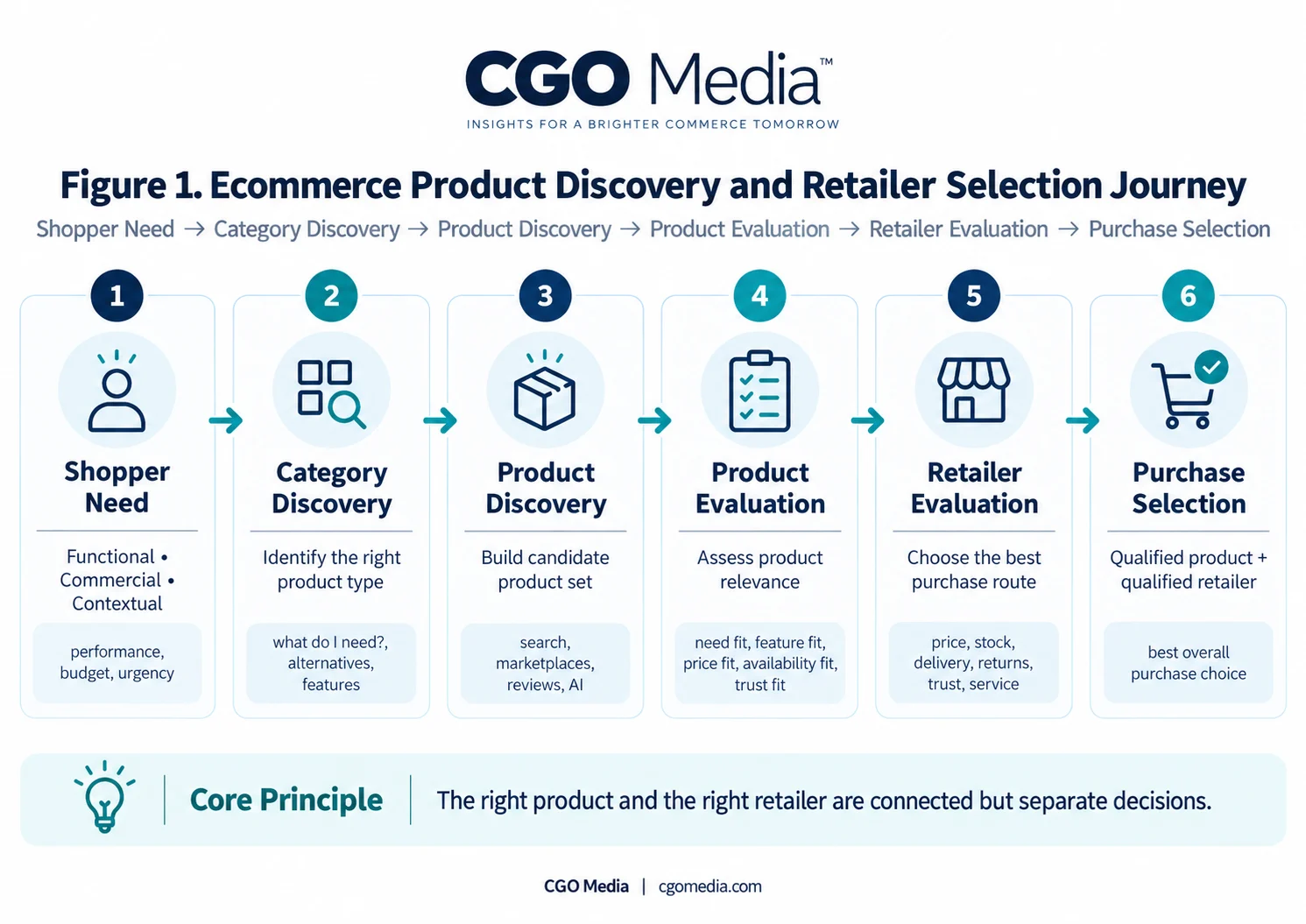
 The Ecommerce Product Discovery and Retailer Selection Model is a CGO Media framework for understanding how shoppers discover products, evaluate alternatives, compare retailers, assess trust and make final purchase decisions across search engines, marketplaces, ecommerce websites and AI-assisted shopping environments.
The model recognises that modern ecommerce discovery is no longer a simple progression from keyword search to product page to checkout. Shoppers increasingly move across search engines, generative AI systems, review platforms, marketplaces, retailer websites, product comparison environments and social proof before deciding what to buy and where to buy it.
The framework therefore separates two connected but distinct decisions:
Which product is most suitable?
Which retailer is most appropriate?
1. Ecommerce Discovery Begins with Shopper Need
The starting point is not the product.
It is the shopper’s need.
2. Shopper Need Can Be Functional
Functional needs can include:
- Performance
- Compatibility
- Size
- Capacity
- Durability
3. Shopper Need Can Be Commercial
Commercial needs can include:
- Budget
- Price
- Delivery
- Returns
- Warranty
4. Shopper Need Can Be Contextual
Context can include:
- Location
- Urgency
- Skill level
- Intended use
- Brand preference
5. Product Discovery Should therefore Begin with Need Interpretation
A useful relationship is:
Shopper Need → Product Category → Product Criteria → Candidate Products
6. Product Category Discovery Is the First Commercial Filter
Shoppers often need to identify the correct type of product before comparing individual models.
7. Category Discovery Can Be Influenced by Search and AI Systems
Shoppers may ask:
- What type of product do I need?
- What is the best category for this use?
- What alternatives exist?
- What features should I look for?
8. Category Misclassification Can Distort the Entire Journey
If the wrong product category is selected, later comparison becomes less useful.
9. Product Discovery Is the Next Stage
Once the category is understood, the shopper begins identifying relevant products.
10. Product Discovery Can Be Influenced by
- Search rankings
- Marketplaces
- AI recommendations
- Editorial buying guides
- Reviews
- Brand awareness
11. Product Discovery Is Not the Same as Product Selection
A product can enter the shopper’s consideration set without becoming the preferred choice.
12. Discovery Creates the Candidate Product Set
A useful relationship is:
Relevant Category → Candidate Products → Evidence → Comparison → Product Shortlist
13. Candidate Products Should Be Relevant to the Shopper Scenario
Product visibility alone is not sufficient.
14. Product Relevance Can Be Evaluated Through
- Need fit
- Feature fit
- Price fit
- Availability fit
- Trust fit
15. Need Fit Is the Core Product Filter
The product should solve the shopper’s actual problem.
16. Feature Fit Evaluates Functional Suitability
The product should contain the features required for the intended use.
17. Price Fit Evaluates Commercial Suitability
A technically suitable product may still be inappropriate if it exceeds the shopper’s budget.
18. Availability Fit Evaluates Purchase Practicality
A suitable product cannot become a practical recommendation if it is unavailable.
19. Trust Fit Evaluates Purchase Confidence
The shopper should have sufficient confidence in:
- Product quality
- Brand reputation
- Reviews
- Warranty
- Support
20. Product Discovery Should therefore Be Qualified
A useful model is:
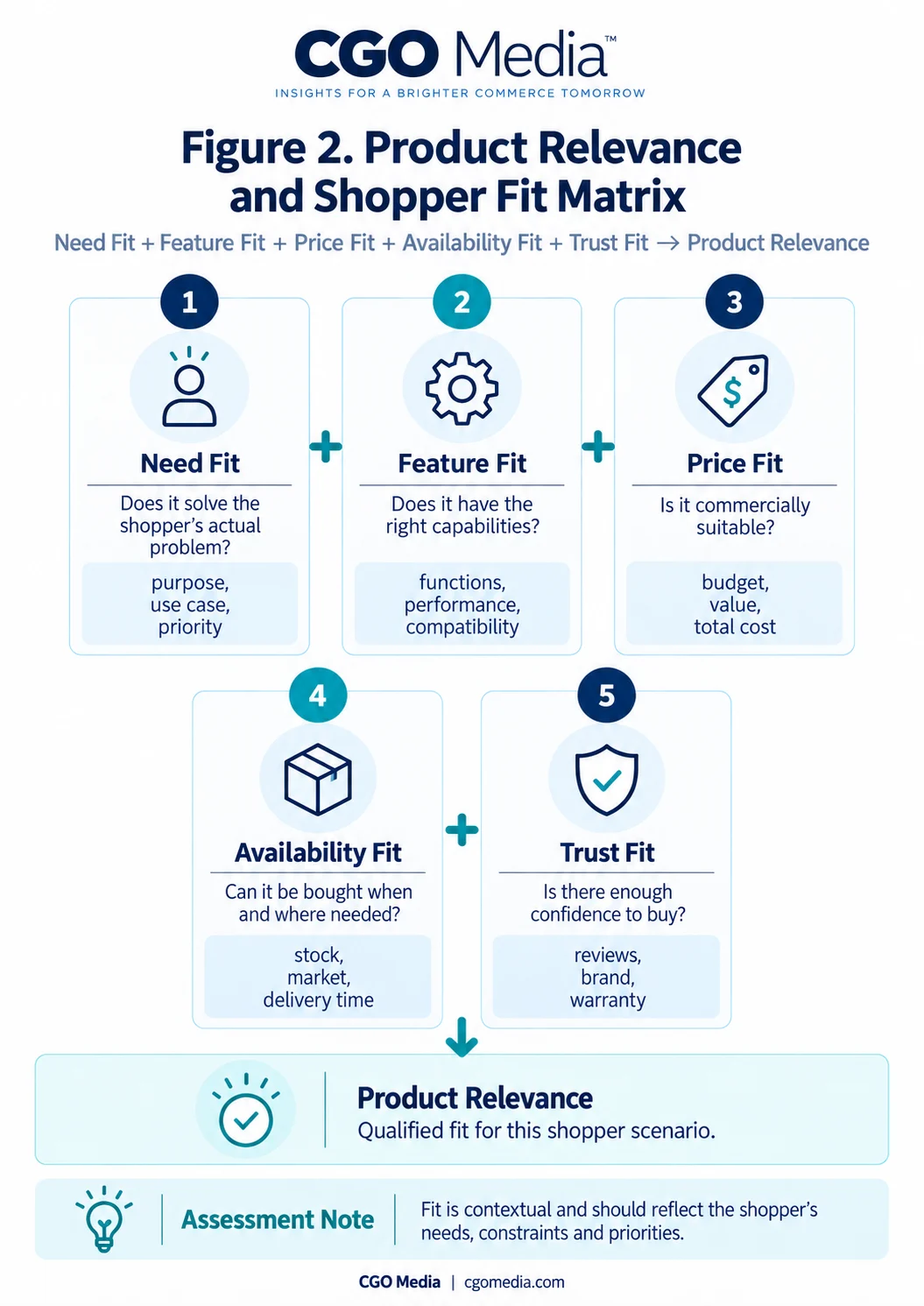
Need Fit + Feature Fit + Price Fit + Availability Fit + Trust Fit → Product Relevance
21. Product Relevance Is Contextual
The same product can be highly relevant for one shopper and inappropriate for another.
22. Shopper Segments Can Produce Different Product Sets
Useful segments can include:
- Budget shopper
- Premium shopper
- Professional user
- Beginner
- Specialist user
- Gift buyer
23. Product Discovery Should Account for Constraints
Constraints can include:
- Budget
- Space
- Compatibility
- Delivery deadline
- Technical requirements
24. Constraints Can Eliminate Otherwise Strong Products
A high-performing product may still be unsuitable if it fails one critical requirement.
25. Product Comparison Begins After Relevant Products Are Identified
Comparison should evaluate products against the shopper’s actual priorities.
26. Product Comparison Can Include
- Features
- Performance
- Price
- Quality
- Availability
- Reviews
27. Product Comparison Should Avoid Generic Ranking
The “best” product depends on the shopper scenario.
28. Product Comparison Should therefore Be Scenario-Specific
Examples can include:
- Best value
- Best premium option
- Best for beginners
- Best for professional use
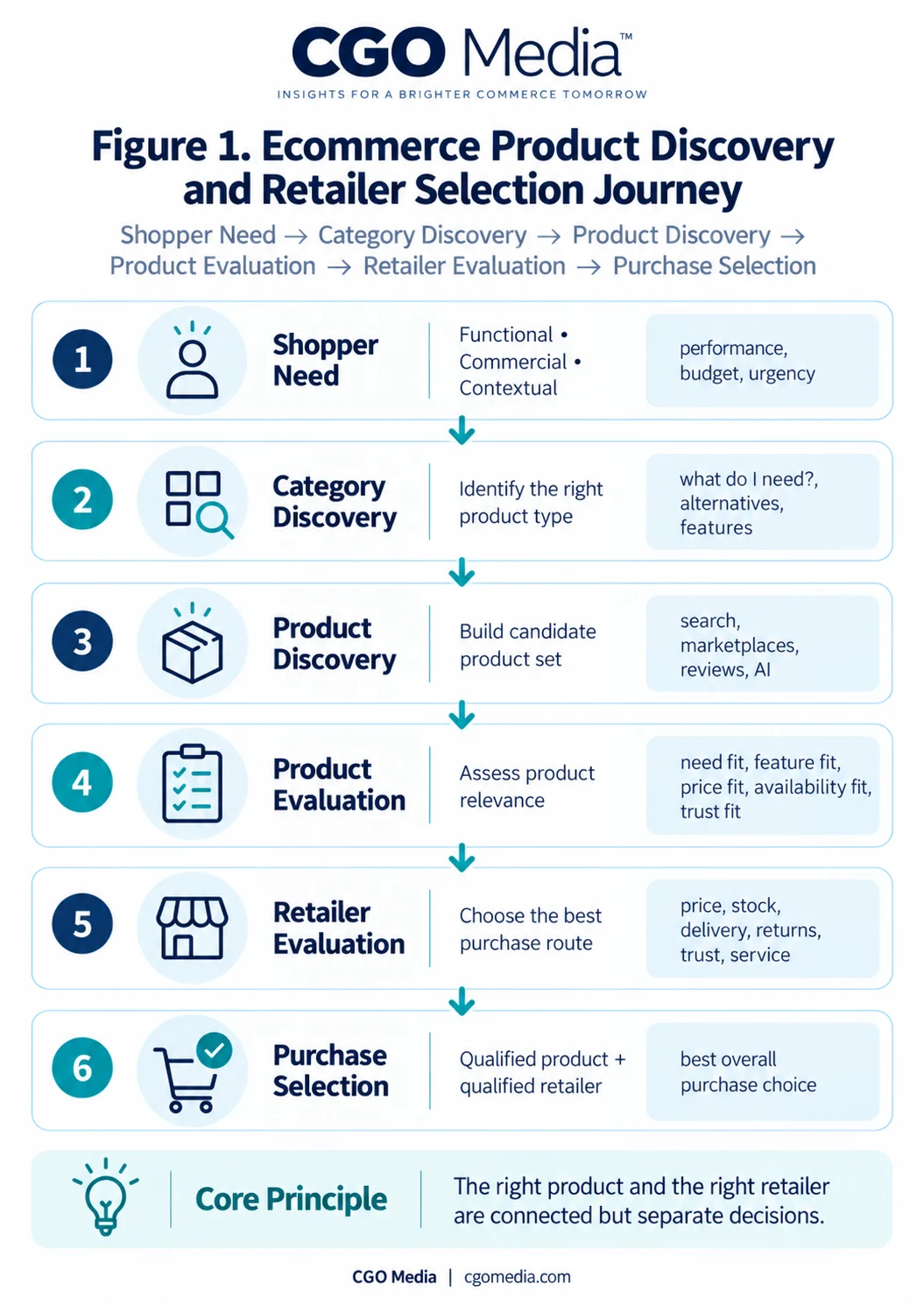
- Best for portability
29. Product Comparison Creates a Shortlist
The shortlist contains products that remain suitable after the main filters are applied.
30. Product Shortlists Should Be Evidence-Based
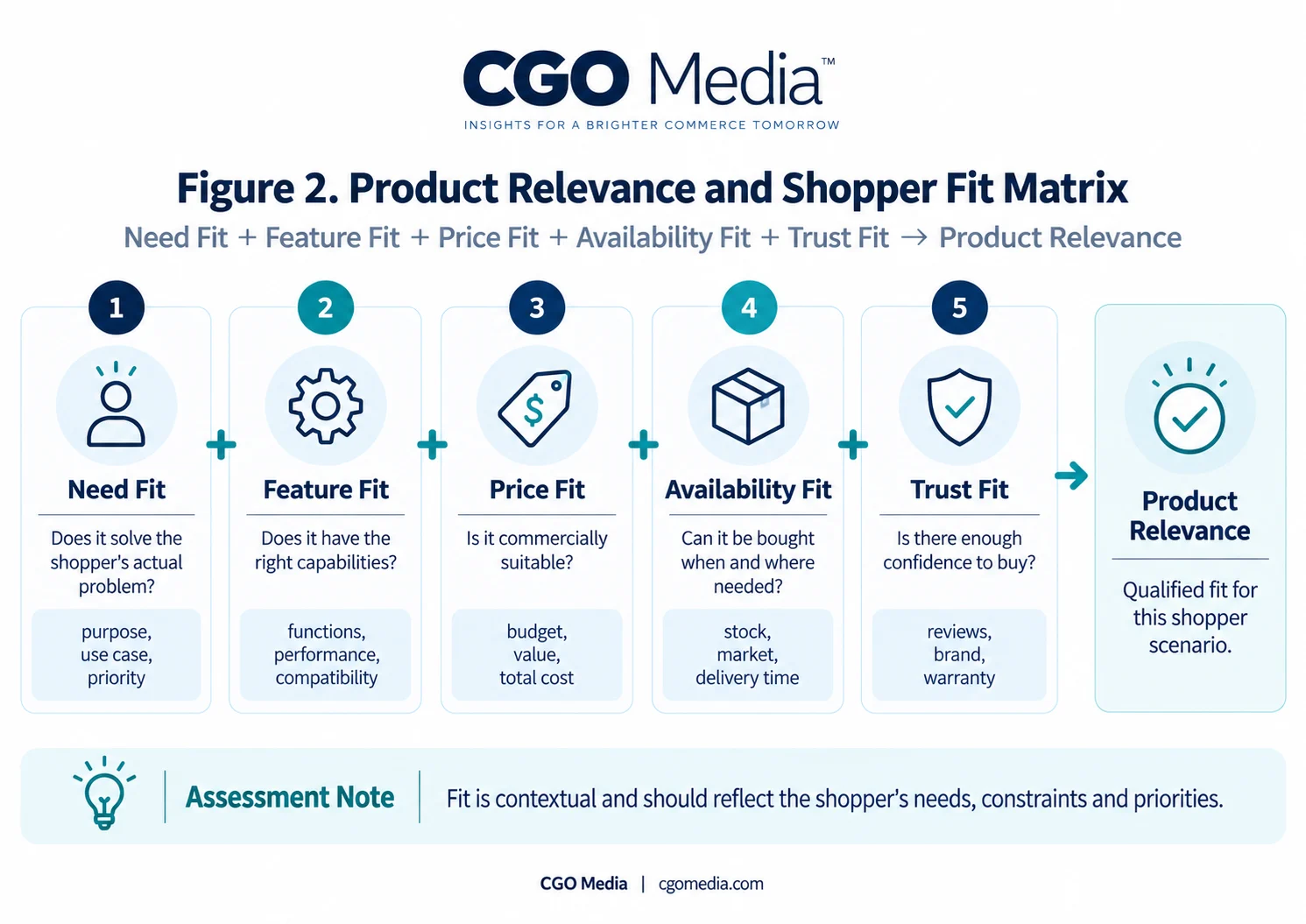
Strong evidence can include:
- Specifications
- Independent reviews
- Product testing
- Customer feedback
- Expert analysis
31. Product Evidence Should Be Current
Old reviews may refer to:
- Previous models
- Older generations
- Different firmware
- Discontinued products
32. Product Evidence Should Be Model-Specific
Evidence for one product variant should not automatically be applied to another.
33. Product Evidence Should Be Interpreted by Claim Type
Different claims require different evidence.
34. Specification Claims Require Technical Evidence
These can include:
- Dimensions
- Capacity
- Compatibility
- Materials
- Performance ratings
35. Quality Claims Require Independent Evidence
Claims about:
- Durability
- Performance
- Ease of use
- Value
benefit from external testing and user evidence.
36. Product Discovery Should Include Negative Evidence
Weaknesses are as important as strengths.
37. Product Weaknesses Can Include
- Poor compatibility
- Short battery life
- High price
- Weak durability
- Limited availability
38. Honest Weaknesses Improve Product Matching
A realistic understanding of limitations can reduce unsuitable recommendations.
39. Product Selection Should therefore Be Based on Fit, Not Popularity
Popularity can support discovery but should not automatically determine the final choice.
40. Retailer Selection Begins After Product Suitability Is Established
The best product and the best retailer are separate decisions.
41. Retailer Selection Can Be Influenced by
- Price
- Stock
- Delivery
- Returns
- Trust
- Service
42. Retailer Price Is an Important but Incomplete Signal
The lowest price is not always the best purchase outcome.
43. Retailer Stock Is a Core Practical Signal
A retailer cannot be selected if the required product or variant is unavailable.
44. Delivery Can Be a Decisive Retailer Factor
Shoppers may value:
- Speed
- Cost
- Tracking
- Delivery reliability
45. Returns Can Influence Retailer Suitability
A retailer with better return terms may be preferable even at a slightly higher price.
46. Retailer Trust Is a Core Selection Factor
Trust can include:
- Reputation
- Ratings
- Payment security
- Customer service
- Returns history
47. Retailer Service Can Influence Final Selection
Service can include:
- Pre-sale advice
- Support
- Warranty handling
- Returns assistance
48. Retailer Suitability Can Be Represented as
Price + Stock + Delivery + Returns + Trust + Service → Retailer Suitability
49. Retailer Selection Is Market-Specific
The same retailer may perform differently across countries.
50. Market Differences Can Include
- Price
- Stock
- Delivery
- Returns
- Customer support
51. Marketplace Retailer Selection Requires Additional Care
Marketplaces can contain multiple sellers for the same product.
52. Marketplace Seller Identity Should Be Explicit
Shoppers should be able to distinguish:
- Brand direct
- Marketplace direct
- Authorised retailer
- Independent seller
53. Seller Trust Should Be Evaluated Separately from Marketplace Trust
A trusted marketplace does not automatically guarantee an equally trusted third-party seller.
54. Retailer Selection Should Include Seller Authenticity
Authenticity may be especially important for:
- Premium goods
- Electronics
- Luxury products
- Collectibles
- High-risk purchases
55. Retailer Selection Should Include Warranty Validity
Warranty terms may differ according to seller and market.
56. Retailer Selection Should therefore Consider Total Purchase Value
A useful relationship is:
Product Price + Delivery + Returns + Warranty + Service + Trust → Total Purchase Value
57. Product Selection and Retailer Selection Should Be Connected
The final purchase requires both a suitable product and an appropriate merchant.
58. A Strong Product Can Be Undermined by a Weak Retailer
Poor merchant choice can lead to:
- Delivery problems
- Returns friction
- Warranty issues
- Customer dissatisfaction
59. A Strong Retailer Cannot Compensate for a Poor Product Fit
The shopper still needs a product appropriate to the intended use.
60. The Final Purchase Decision therefore Has Two Main Dimensions
Product Suitability + Retailer Suitability → Purchase Suitability
61. AI-Assisted Shopping Can Influence Both Dimensions
Generative systems may help shoppers:
- Discover products
- Compare features
- Evaluate brands
- Compare retailers
- Select where to buy
62. AI Product Discovery Can Compress the Traditional Shopping Journey
A shopper may move quickly from a broad question to a shortlist.
63. AI Retailer Selection Can Compress Merchant Comparison
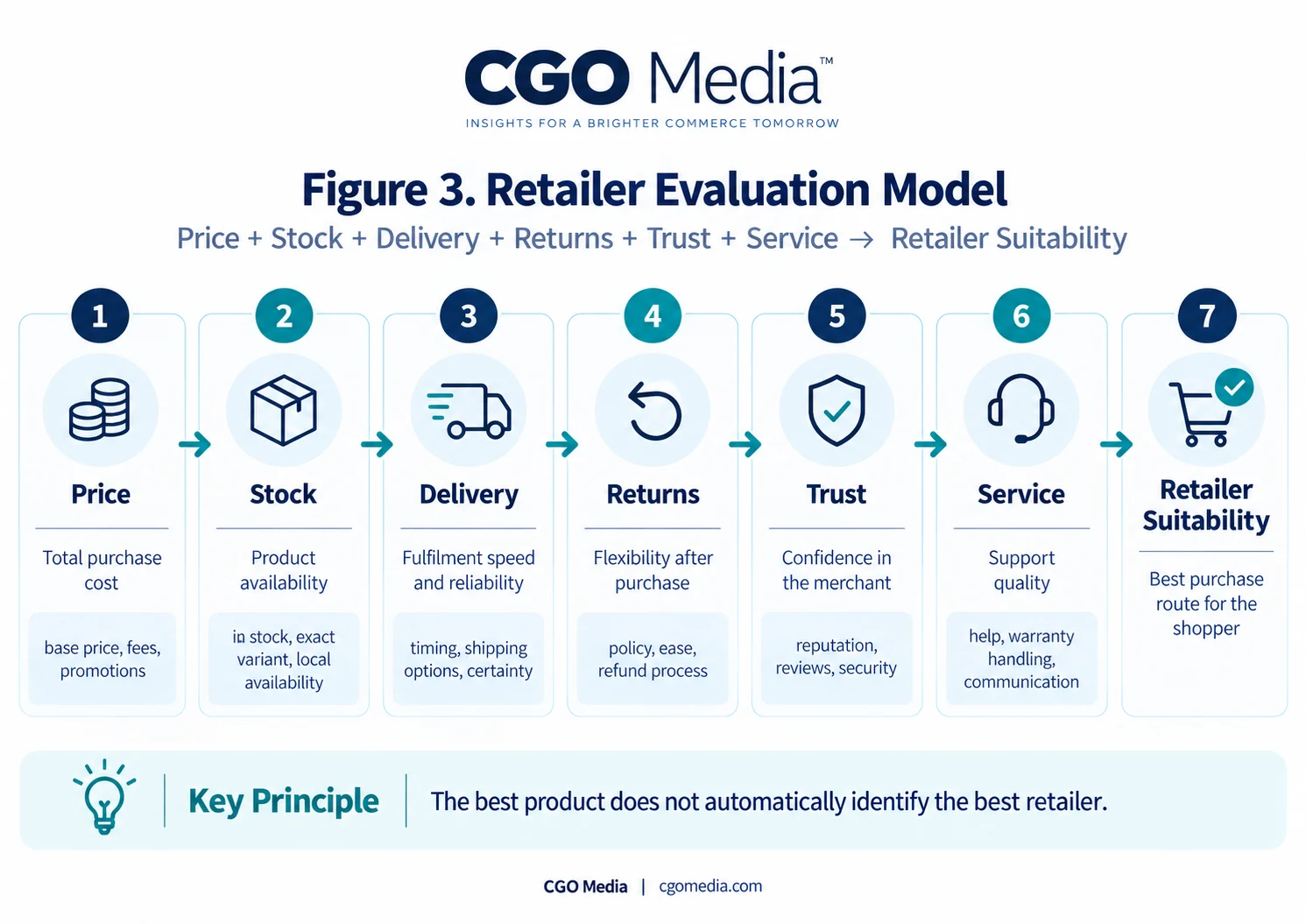
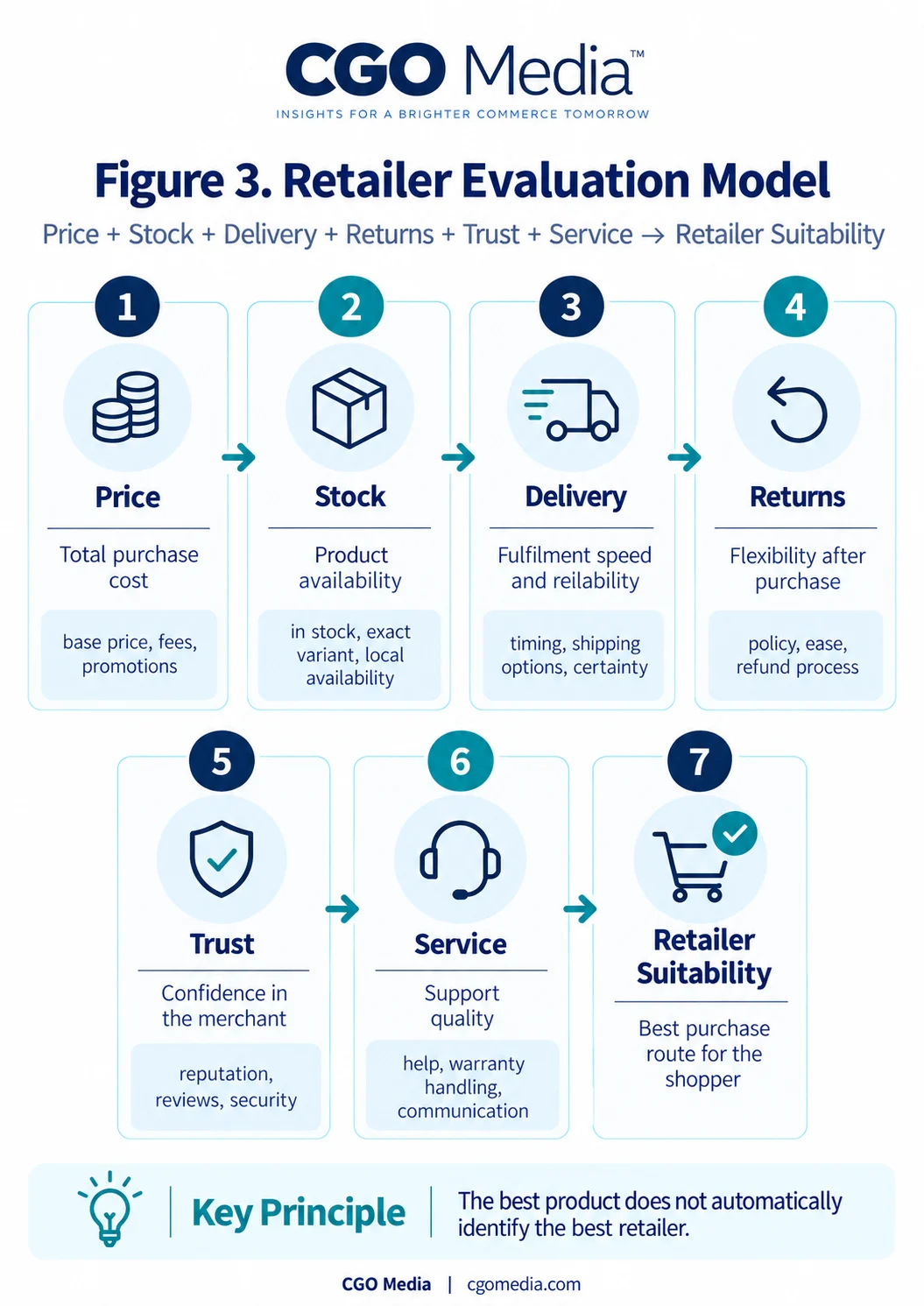
Generative systems may summarise:
- Price
- Delivery
- Returns
- Trust
- Availability
64. Compression Increases the Importance of Accurate Product Evidence
Incorrect product information can influence decisions earlier in the journey.
65. Compression Also Increases the Importance of Merchant Accuracy
Wrong stock, delivery or seller information can create poor purchase recommendations.
66. Product Discovery Should therefore Be Evidence-Led
Visibility without evidence can produce weak comparison quality.
67. Retailer Selection Should also Be Evidence-Led
Merchant recommendations should reflect current and verifiable commercial information.
68. Ecommerce Selection Should Be Qualified Rather Than Universal
No single product or retailer should be expected to fit every shopper.
69. Relevant Inclusion Is a Positive Outcome
A product or retailer appears because genuine fit exists.
70. Irrelevant Inclusion Is a Poor Outcome
The product or retailer appears despite weak fit.
71. Relevant Exclusion Is a Missed Opportunity
A suitable option is absent from the active shortlist.
72. Appropriate Exclusion Is a Correct Outcome
The product or retailer is omitted because it genuinely does not fit.
73. Ecommerce Selection Should therefore Measure Four Outcomes
- Relevant Inclusion
- Irrelevant Inclusion
- Relevant Exclusion
- Appropriate Exclusion
74. Product Discovery Should Be Monitored by Journey Stage
A useful sequence is:
Need Recognition → Category Discovery → Product Discovery → Product Evaluation → Product Shortlist
75. Retailer Selection Should Be Monitored Separately
A useful sequence is:
Product Shortlist → Retailer Discovery → Retailer Evaluation → Merchant Shortlist → Purchase Selection
76. The Complete Ecommerce Purchase Journey Can Be Combined
A useful relationship is:
Shopper Need → Category Discovery → Product Discovery → Product Evaluation → Retailer Evaluation → Purchase Selection
77. Ecommerce Product Discovery Should Be Monitored by Category
Different product categories create different discovery patterns.
78. Ecommerce Product Discovery Should Be Monitored by Shopper Segment
Different shoppers can produce different product shortlists.
79. Ecommerce Retailer Selection Should Be Monitored by Market
Retailer choice can change significantly by geography.
80. Ecommerce Retailer Selection Should Be Monitored by Purchase Urgency
A shopper needing next-day delivery may choose differently from a shopper willing to wait.
81. Product Discovery Should Include Comparison Competitors
Brands should understand which products repeatedly appear in the same consideration sets.
82. Product Competitors Can Differ by Shopper Scenario
A product may compete against one set of alternatives for budget shoppers and another for premium shoppers.
83. Retailer Competitors Can Also Differ by Scenario
A retailer may compete differently on:
- Price
- Delivery
- Service
- Returns
- Trust
84. Product Co-Occurrence Can Reveal Effective Competitive Sets
Repeated appearance together can show how AI systems and shoppers categorise alternatives.
85. Retailer Co-Occurrence Can Reveal Merchant Competitive Sets
Repeated retailer pairing can show which merchants are competing for the same purchase.
86. Product Strength Attribution Should Be Monitored
Products may repeatedly be associated with:
- Performance
- Value
- Design
- Durability
- Ease of use
87. Product Weakness Attribution Should Also Be Monitored
Products may repeatedly be associated with:
- High price
- Limited compatibility
- Poor durability
- Weak support
- Limited availability
88. Retailer Strength Attribution Should Be Monitored
Retailers may repeatedly be associated with:
- Low prices
- Fast delivery
- Easy returns
- Strong service
- High trust
89. Retailer Weakness Attribution Should Also Be Monitored
Retailers may repeatedly be associated with:
- Poor delivery
- Difficult returns
- Weak service
- Low trust
- Limited stock
90. Product and Retailer Evidence Should Be Evaluated Together
The shopper’s final decision depends on both.
91. Ecommerce Selection Can Be Represented as a Dual-Fit Model
Product Fit + Retailer Fit → Purchase Fit
92. Product Fit Can Be Strong While Retailer Fit Is Weak
The shopper may need to choose a different merchant.
93. Retailer Fit Can Be Strong While Product Fit Is Weak
The shopper may need to choose another product.
94. Purchase Fit Is Strongest When Both Are Strong
This creates the highest probability of a suitable purchasing outcome.
95. Ecommerce Discovery Should Include Trust Evidence
Trust reduces uncertainty during product and retailer evaluation.
96. Product Trust Evidence Can Include
- Reviews
- Testing
- Ratings
- Expert analysis
- Warranty
97. Retailer Trust Evidence Can Include
- Ratings
- Customer reviews
- Returns reputation
- Payment security
- Customer service
98. Independent Evidence Can Strengthen Selection Confidence
External validation can reduce dependence on brand or retailer claims alone.
99. Selection Confidence Should Increase When Evidence Converges
Confidence rises when:
- Product specifications agree
- Independent reviews support performance
- Retailer terms are clear
- Customer evidence is broadly positive
100. Selection Confidence Should Fall When Sources Conflict
Conflicts can include:
- Different specifications
- Different stock information
- Different seller identity
- Different warranty terms
- Conflicting review evidence
101. Selection Confidence Should Fall When Important Information Is Missing
Missing information can include:
- Compatibility
- Availability
- Returns
- Warranty
- Seller identity
102. Ecommerce Selection Confidence Is therefore Multi-Dimensional
A useful relationship is:
Product Fit + Retailer Fit + Trust Evidence + Commercial Fit + External Validation
103. Ecommerce Product Discovery Should Support Better Decisions
The objective should not simply be more product exposure.
104. Retailer Selection Should Support Better Purchase Outcomes
The objective should not simply be more merchant visibility.
105. Better Product Selection Can Reduce Returns
Poor product fit is a common source of dissatisfaction.
106. Better Retailer Selection Can Reduce Transaction Friction
Poor merchant choice can create:
- Delivery problems
- Returns friction
- Support issues
- Trust problems
107. Product and Retailer Selection Can therefore Influence Customer Experience
Discovery quality can affect outcomes after the purchase.
108. Strong Outcomes Can Reinforce Future Product Authority
Successful purchases can generate:
- Reviews
- Ratings
- Repeat purchases
- Independent references
109. This Creates a Selection Reinforcement Loop
A useful relationship is:
Better Discovery → Better Product Fit → Better Retailer Fit → Better Purchase Outcome → Stronger Evidence → Better Future Discovery
110. Ecommerce Product Discovery Should Be Cross-Functional
Relevant functions can include:
- SEO
- Product
- Merchandising
- Ecommerce
- Customer Experience
- Digital PR
111. Product Teams Can Validate Product Suitability
They can confirm:
- Specifications
- Compatibility
- Use cases
- Limitations
112. Merchandising Teams Can Validate Commercial Positioning
They can confirm:
- Price position
- Category position
- Promotion
- Availability
113. Ecommerce Teams Can Validate Merchant Reality
They can confirm:
- Stock
- Delivery
- Returns
- Checkout availability
114. Customer Experience Teams Can Validate Shopper Outcomes
They can contribute:
- Returns data
- Support questions
- Review themes
- Purchase friction
115. The First Ecommerce Product Discovery Principle
Ecommerce product discovery should begin with shopper need rather than product prominence, because the strongest discovery systems identify products according to functional, commercial, contextual and trust fit rather than popularity alone.
116. The Second Ecommerce Product Discovery Principle
Product discovery and retailer selection should be treated as connected but distinct decisions, recognising that the best product can be undermined by the wrong merchant and that a strong retailer cannot compensate for poor product fit.
117. The Third Ecommerce Product Discovery Principle
Selection confidence should increase when product evidence, merchant information, independent validation and customer evidence materially converge, while source conflict, stale commercial information and missing product facts should reduce confidence.
118. The Fourth Ecommerce Product Discovery Principle
The strategic objective should be qualified product and retailer selection, where relevant inclusion, appropriate exclusion and strong purchase fit improve shopper outcomes rather than maximising exposure for every product or merchant.
119. The Ecommerce Product Discovery and Retailer Selection Journey
The complete journey can be summarised as:
Shopper Need → Category Discovery → Product Discovery → Product Evaluation → Retailer Evaluation → Purchase Selection
120. The Strategic Implication
Ecommerce organisations should treat product discovery and retailer selection as a connected evidence and fit system in which shoppers first identify the correct category, then evaluate products according to need, feature, price, availability and trust, before separately assessing retailers through commercial terms, merchant reputation and service quality, creating a more reliable path from initial need to qualified purchase selection.
121. Product Relevance Is the Core of Ecommerce Discovery
A product should not be considered relevant simply because it ranks well, is widely reviewed or has strong brand recognition.
122. Product Relevance Should Be Shopper-Specific
The correct question is:
How well does this product fit the needs, constraints and priorities of this particular shopper?
123. Product Relevance Can Be Evaluated Through Five Core Dimensions
A useful model is:
Need Fit + Feature Fit + Price Fit + Availability Fit + Trust Fit → Product Relevance
124. Need Fit Is the Primary Dimension
The product should solve the underlying problem the shopper is trying to address.
125. Need Fit Should Be Defined Before Product Comparison Begins
Otherwise product evaluation can become driven by popularity, marketing or feature volume rather than actual suitability.
126. Shopper Needs Can Be Functional
Functional needs can include:
- Performance
- Capacity
- Compatibility
- Durability
- Portability
127. Shopper Needs Can Be Situational
Situational needs can include:
- Travel
- Professional use
- Home use
- Gift purchase
- Temporary use
128. Shopper Needs Can Be Experience-Based
Experience-related needs can include:
- Ease of use
- Simple setup
- Advanced controls
- Low maintenance
- Strong support
129. Need Fit Should Be Explicit
Products should be evaluated against the actual job the shopper needs the product to perform.
130. Feature Fit Is the Second Dimension
Feature fit assesses whether the product contains the functionality required to meet the shopper’s need.
131. Feature Fit Should Distinguish Essential and Optional Features
Not every feature has equal importance.
132. Essential Features Are Minimum Requirements
A product that fails an essential requirement may need to be excluded regardless of its other strengths.
133. Optional Features Can Improve Preference
They can strengthen a product’s position without determining basic suitability.
134. Product Feature Evaluation Can Use Three Classes
- Essential
- Preferred
- Optional
135. Essential Feature Failure Can Override Overall Product Quality
For example, a highly rated product may still be unsuitable if it lacks required compatibility.
136. Feature Volume Should Not Be Confused with Feature Fit
More features do not automatically make a product more suitable.
137. Feature Fit Should therefore Be Weighted
A useful relationship is:
Essential Requirements + Preferred Features + Optional Benefits → Feature Fit
138. Compatibility Is Often a Critical Feature Constraint
Compatibility can determine whether a product is usable at all.
139. Compatibility Can Include
- Device compatibility
- Software compatibility
- Size compatibility
- Accessory compatibility
- Infrastructure compatibility
140. Compatibility Errors Can Create High-Risk Product Recommendations
Incorrect compatibility information can directly lead to unsuitable purchases.
141. Price Fit Is the Third Dimension
The product should fit within the shopper’s realistic commercial range.
142. Price Fit Should Consider More Than Headline Price
The full cost can include:
- Delivery
- Accessories
- Installation
- Subscriptions
- Maintenance
143. Total Cost Can Change Product Suitability
A product that appears inexpensive initially may become less attractive once required extras are included.
144. Price Fit Can Be Represented as
Purchase Price + Required Extras + Delivery + Ongoing Cost → Total Cost Fit
145. Budget Should Be Treated as a Constraint, Not Always as a Preference
Where a shopper has a fixed budget, products above that limit may be irrelevant regardless of performance.
146. Budget Ranges Can Produce Different Product Shortlists
Useful segments can include:
- Entry-level
- Budget
- Mid-range
- Premium
- Luxury
147. Price Position Should Be Compared Within Relevant Product Sets
A premium product should not automatically be judged against entry-level products without context.
148. Value Fit Is Different from Price Fit
A higher-priced product can still offer stronger value where it provides:
- Better durability
- Better performance
- Longer warranty
- More useful features
- Lower long-term cost
149. Value Can Be Represented as
Product Benefit + Longevity + Service + Warranty − Total Cost → Perceived Value
150. Availability Fit Is the Fourth Dimension
A product should be realistically purchasable in the shopper’s market.
151. Availability Should Be Product-Specific
The overall product line may be available while the required model is not.
152. Availability Should Be Variant-Specific
The required:
- Size
- Colour
- Capacity
- Configuration
- Bundle
may have different stock status.
153. Availability Should Be Market-Specific
A product can be available in one country and unavailable in another.
154. Availability Should Be Time-Sensitive
Stock can change quickly.
155. Delivery Time Is Part of Availability Fit
A product may technically be available but still fail the shopper’s required timeframe.
156. Availability Fit Can Be Represented as
Product Stock + Variant Stock + Market Access + Delivery Timing → Availability Fit
157. Availability Should Influence Shortlisting Before Final Selection
There is little value in maintaining an unavailable product in a high-intent shortlist unless alternatives are limited.
158. Trust Fit Is the Fifth Dimension
Trust fit evaluates whether sufficient evidence exists for the shopper to feel confident selecting the product.
159. Product Trust Can Include
- Brand reputation
- Customer ratings
- Expert reviews
- Independent testing
- Warranty
160. Trust Requirements Can Vary by Product Risk
Low-cost commodity products may require less evidence than high-value, safety-sensitive or specialist purchases.
161. Higher-Risk Product Categories Require Stronger Evidence
This can include stronger:
- Technical documentation
- Independent testing
- Warranty information
- Safety information
- Support evidence
162. Trust Fit Should Include Evidence Quality
A high number of weak reviews should not automatically outweigh stronger expert or testing evidence.
163. Trust Evidence Can Be First-Party
First-party evidence can include:
- Specifications
- Warranty
- Product documentation
- Testing methodology
164. Trust Evidence Can Be Independent
Independent evidence can include:
- Editorial reviews
- Laboratory testing
- Industry awards
- Consumer organisations
- Customer reviews
165. Strong Product Trust Usually Requires Evidence Convergence
A useful relationship is:
Brand Evidence + Independent Validation + Customer Experience → Product Trust
166. Product Relevance Should Consider Hard Constraints
Some shopper requirements should function as pass-or-fail conditions.
167. Hard Constraints Can Include
- Maximum budget
- Required compatibility
- Required size
- Required availability
- Required delivery date
168. A Product Failing a Hard Constraint May Need Immediate Exclusion
This can prevent irrelevant recommendation.
169. Soft Preferences Should Be Treated Differently
Soft preferences can influence ranking without automatically eliminating the product.
170. Soft Preferences Can Include
- Preferred colour
- Preferred brand
- Design preference
- Optional features
- Minor price differences
171. Product Fit Should therefore Separate Constraints from Preferences
A useful relationship is:
Hard Constraints → Eligibility → Soft Preferences → Relative Fit
172. Eligibility Comes Before Ranking
Products that fail critical constraints should not be ranked simply because they perform strongly on less important features.
173. Ecommerce Discovery Should Distinguish Eligibility from Preference
This is especially important in AI-generated shortlists.
174. Shopper Profiles Can Improve Product-Fit Analysis
A product can be evaluated differently for different shopper profiles.
175. Budget Shopper Profile
This shopper may prioritise:
- Price
- Basic functionality
- Low delivery cost
- Value
176. Premium Shopper Profile
This shopper may prioritise:
- Performance
- Design
- Brand
- Service
- Warranty
177. Professional Shopper Profile
This shopper may prioritise:
- Reliability
- Performance
- Compatibility
- Support
- Long-term cost
178. Beginner Shopper Profile
This shopper may prioritise:
- Ease of use
- Simple setup
- Clear guidance
- Support
- Reasonable price
179. Specialist Shopper Profile
This shopper may prioritise:
- Advanced features
- Precision
- Compatibility
- Performance evidence
- Technical depth
180. Gift Buyer Profile
This shopper may prioritise:
- Broad suitability
- Presentation
- Easy returns
- Delivery reliability
- Brand confidence
181. Shopper Profiles Should Not Become Rigid Personas
They should guide scenario design rather than replace actual shopper context.
182. Product Fit Can Change Across Journey Stage
Early-stage shoppers may use broader criteria than late-stage shoppers.
183. Discovery-Stage Fit Can Be Broad
The shopper may only know:
- General need
- Approximate budget
- Basic category
184. Comparison-Stage Fit Becomes More Specific
The shopper may focus on:
- Features
- Performance
- Reviews
- Price
- Alternatives
185. Selection-Stage Fit Becomes Highly Specific
The shopper may focus on:
- Exact model
- Exact variant
- Availability
- Retailer
- Delivery
186. Product Fit Should therefore Be Dynamic
The criteria used to evaluate products can become more precise as the shopper progresses.
187. Product Discovery Should Include Evidence Confidence
Two products may appear similarly suitable but differ substantially in evidence quality.
188. Evidence Confidence Can Depend on
- Source quality
- Source independence
- Evidence freshness
- Evidence consistency
- Product specificity
189. Evidence Confidence Should Be Product-Specific
Strong evidence for one model should not automatically validate another.
190. Evidence Confidence Should Be Variant-Specific Where Necessary
Different configurations may perform differently.
191. Evidence Freshness Matters
Older evidence can become less useful where:
- Product generations change
- Firmware changes
- Specifications change
- Price position changes
192. Evidence Consistency Matters
Confidence rises where multiple credible sources materially agree.
193. Evidence Conflict Should Reduce Product Confidence
Conflicting reviews or specifications should trigger further investigation.
194. Evidence Conflict Does Not Automatically Mean One Source Is Wrong
Differences may arise because of:
- Different test conditions
- Different variants
- Different shopper expectations
- Different measurement methods
195. Ecommerce Product Discovery Should therefore Diagnose Evidence Conflict
The objective is to understand why conclusions differ.
196. Shopper Fit Should Include Product Limitations
Selection confidence improves when limitations are explicit.
197. Product Limitations Can Include
- Restricted compatibility
- Limited capacity
- Higher maintenance
- Reduced portability
- Limited support
198. Product Limitations Can Improve Shortlist Quality
A known limitation can remove the product from an unsuitable scenario before purchase.
199. Product Discovery Should Avoid Feature Bias
Retail environments often overemphasise visible features while underweighting:
- Reliability
- Durability
- Support
- Total cost
- Usability
200. Product Discovery Should Avoid Popularity Bias
High sales volume does not necessarily indicate the strongest fit for every shopper.
201. Product Discovery Should Avoid Brand Bias
Strong brand awareness should not automatically eliminate lesser-known but more suitable alternatives.
202. Product Discovery Should Avoid Price Bias
The cheapest or most expensive product is not automatically the strongest option.
203. Product Discovery Should Avoid Review-Volume Bias
Large review volume can provide useful evidence but should not replace relevance analysis.
204. Product Relevance Should therefore Use Balanced Evidence
A useful relationship is:
Shopper Need + Product Capability + Commercial Fit + Availability + Trust Evidence → Qualified Product Relevance
205. Product Shortlists Should Be Small Enough to Support Decision-Making
An excessively large shortlist can recreate the information overload the shopper is trying to avoid.
206. Shortlist Size Should Depend on Product Complexity
Simple product categories may require fewer options than high-consideration purchases.
207. Shortlists Should Include Meaningfully Different Options
Useful alternatives can include:
- Best overall fit
- Best value
- Premium option
- Alternative use-case fit
208. Shortlists Should Avoid Artificial Variety
Near-identical products should not be included merely to increase the number of recommendations.
209. Shortlist Explanations Should State Why Each Product Appears
Useful explanations can include:
- Best for a specific use
- Best within a budget
- Strongest performance
- Best availability
- Best trust evidence
210. Product Exclusion Should Also Be Explainable
A product may be excluded because of:
- Budget failure
- Compatibility failure
- Availability failure
- Weak trust evidence
- Poor use-case fit
211. Explainable Exclusion Improves Selection Transparency
It helps distinguish deliberate filtering from accidental omission.
212. Product Relevance Should Be Measured Longitudinally
The products most relevant to a shopper scenario can change over time.
213. Relevance Can Change Because of Product Launches
New products can alter competitive sets.
214. Relevance Can Change Because of Price Movement
A formerly premium product may enter a mid-range budget after discounting.
215. Relevance Can Change Because of Availability
A leading product may disappear from the shortlist when stock becomes limited.
216. Relevance Can Change Because of New Evidence
New testing, reviews or customer experience can change trust fit.
217. Relevance Can Change Because Shopper Needs Evolve
New use cases can create new product criteria.
218. Product-Fit Monitoring Can Reveal Emerging Competitors
New alternatives may enter relevant shopper scenarios before they become obvious through traditional market analysis.
219. Product-Fit Monitoring Can Reveal Declining Products
Products may gradually disappear because of:
- Weak availability
- Poor value
- Outdated features
- Stronger competitors
220. Product Relevance Should Be Connected to Merchandising Intelligence
Repeated fit patterns can help identify:
- Strong categories
- Weak categories
- Missing price points
- Emerging use cases
- Portfolio gaps
221. Product Relevance Should Be Connected to Customer Experience
Returns and support data can reveal whether apparent pre-purchase fit translates into real-world satisfaction.
222. High Returns Can Indicate Product-Fit Failure
Repeated returns may indicate:
- Misunderstood size
- Misunderstood compatibility
- Unrealistic expectations
- Poor use-case matching
223. High Satisfaction Can Validate Product-Fit Assumptions
Positive outcomes can strengthen confidence in future shortlist criteria.
224. Product Discovery Should therefore Include a Feedback Loop
A useful relationship is:
Discovery → Selection → Purchase → Experience → Evidence → Better Future Discovery
225. Product Relevance Is Not a Fixed Score
It is a contextual assessment that can change by:
- Shopper
- Market
- Time
- Price
- Availability
226. Product Relevance Models Should therefore Be Scenario-Based
A single universal product score can obscure important differences in fit.
227. Product-Fit Matrices Can Support Structured Evaluation
A matrix can compare candidate products across the dimensions that matter most.
228. A Product-Fit Matrix Can Include
- Need Fit
- Feature Fit
- Price Fit
- Availability Fit
- Trust Fit
229. Product-Fit Matrices Should Allow Weighting
Different shopper scenarios can assign different importance to each dimension.
230. A Professional Shopper May Weight Performance and Reliability More Heavily
Price may remain relevant but not dominant.
231. A Budget Shopper May Weight Price and Essential Functionality More Heavily
Premium features may have limited relevance.
232. A Gift Buyer May Weight Ease of Choice and Returns More Heavily
Technical optimisation may be less important than broad suitability and merchant flexibility.
233. Weighting Should Reflect Real Shopper Priorities
Otherwise the matrix can create false precision.
234. Product-Fit Scores Should Not Replace Judgment
Scoring can support comparison but should not hide important product limitations or hard constraints.
235. Hard Constraint Failure Should Override Weighted Scores Where Necessary
A product that fails a mandatory requirement should not win because of high scores elsewhere.
236. Product-Fit Matrices Should therefore Use Eligibility Gates
A useful sequence is:
Hard Constraint Check → Product Eligibility → Weighted Fit Assessment → Shortlist
237. Product-Fit Matrices Should Include Evidence Confidence
A high fit score supported by weak evidence should be treated cautiously.
238. Evidence Confidence Can Be Added as a Validation Layer
A useful model is:
Product Fit × Evidence Confidence → Selection Confidence
239. Strong Product Fit with Weak Evidence Requires Further Validation
The product may remain promising but not yet recommendation-ready.
240. Strong Evidence with Weak Product Fit Should Not Produce Recommendation
A well-documented product can still be unsuitable for the shopper.
241. The Best Product Shortlist Combines Fit and Evidence
The strongest candidates are both suitable and well supported.
242. Product Discovery Should therefore Produce a Qualified Shortlist
A qualified shortlist contains products that:
- Meet essential requirements
- Fit the shopper’s main priorities
- Remain commercially realistic
- Are available
- Have sufficient trust evidence
243. Qualified Shortlists Improve Retailer Selection
The retailer stage becomes more efficient when the product decision has already been narrowed appropriately.
244. Product Discovery and Retailer Selection Should therefore Remain Sequential
The shopper should first determine:
Which products fit?
Then:
Which retailer provides the best purchase route?
245. The Fifth Ecommerce Product Discovery Principle
Product relevance should be evaluated through need fit, feature fit, price fit, availability fit and trust fit, with hard shopper constraints determining eligibility before softer preferences are used to compare otherwise suitable products.
246. The Sixth Ecommerce Product Discovery Principle
Product-fit assessment should remain scenario-specific because shopper priorities vary by budget, expertise, intended use, urgency and market, meaning no single universal product ranking can accurately represent suitability across all ecommerce journeys.
247. The Seventh Ecommerce Product Discovery Principle
Product shortlists should combine suitability with evidence confidence, distinguishing between products that appear attractive because of marketing, popularity or review volume and products whose functional, commercial and trust fit is supported by sufficiently current and relevant evidence.
248. The Eighth Ecommerce Product Discovery Principle
Product discovery should incorporate post-purchase learning from returns, reviews, support interactions and satisfaction data so real customer outcomes continually improve future product-fit criteria and discovery quality.
249. The Product Relevance and Shopper Fit Matrix
The core relationship can be summarised as:
Need Fit + Feature Fit + Price Fit + Availability Fit + Trust Fit → Product Relevance → Qualified Product Shortlist
250. The Strategic Implication
Ecommerce organisations should evaluate product discovery through a shopper-fit matrix rather than simple product prominence, first applying hard eligibility constraints and then assessing relevant products across need, features, price, availability, trust and evidence confidence so that the final shortlist contains products genuinely capable of satisfying the shopper’s functional and commercial requirements.
251. Retailer Evaluation Begins After Product Fit Has Been Established
Once a shopper has identified suitable products, the next task is determining which retailer provides the strongest purchase route.
252. Retailer Selection Is a Separate Decision Layer
The best product does not automatically identify the best retailer.
253. Retailer Evaluation Can Be Structured Around Six Core Factors
A useful model is:
Price + Stock + Delivery + Returns + Trust + Service → Retailer Suitability
254. Price Is the First Retailer Evaluation Factor
Price remains important because shoppers frequently compare merchants offering the same or equivalent product.
255. Retailer Price Should Be Product-Specific
Comparisons should use the same:
- Model
- Variant
- Capacity
- Configuration
- Bundle
256. Apparent Price Differences Can Be Misleading
Retailers may display different configurations under superficially similar product names.
257. Retail Price Should Include Mandatory Costs
The true purchase cost can include:
- Product price
- Delivery
- Required accessories
- Installation
- Taxes or fees where applicable
258. Total Purchase Cost Is More Useful Than Headline Price
A useful relationship is:
Product Price + Mandatory Costs + Delivery → Effective Purchase Price
259. Promotions Can Affect Retailer Selection
Retailers may offer:
- Discounts
- Bundles
- Trade-in offers
- Loyalty benefits
- Finance incentives
260. Promotions Should Be Evaluated for Genuine Value
A discount is not automatically valuable if it requires unsuitable products, subscriptions or purchasing conditions.
261. Promotional Freshness Is Critical
Expired offers can distort retailer comparison.
262. Retailer Evaluation Should Record Promotion Validity
Relevant information can include:
- Start date
- End date
- Eligibility
- Stock limitations
- Market restrictions
263. Stock Is the Second Retailer Evaluation Factor
A retailer cannot provide a useful purchase route if the required product is unavailable.
264. Stock Should Be Model-Specific
General category availability is insufficient.
265. Stock Should Be Variant-Specific
Availability can differ by:
- Size
- Colour
- Capacity
- Configuration
- Bundle
266. Stock Should Be Market-Specific
A retailer may have inventory in one country or region but not another.
267. Stock Should Be Time-Sensitive
Inventory can change rapidly during:
- Launches
- Promotions
- Seasonal demand
- Supply shortages
- Clearance periods
268. Stock Status Should Be Explicit
Useful distinctions include:
- In stock
- Low stock
- Available to order
- Pre-order
- Back order
- Out of stock
269. Ambiguous Stock Language Can Reduce Selection Confidence
Statements such as “available soon” may be insufficient where timing matters.
270. Stock Confidence Should therefore Consider Specificity and Freshness
A useful relationship is:
Exact Variant + Current Status + Market Relevance → Stock Confidence
271. Delivery Is the Third Retailer Evaluation Factor
Delivery can materially change which retailer is most appropriate.
272. Delivery Evaluation Can Include
- Speed
- Cost
- Reliability
- Tracking
- Delivery area
273. Delivery Speed Can Be a Hard Constraint
For urgent purchases, a slower retailer may be unsuitable even if its price is lower.
274. Delivery Cost Can Change Total Purchase Value
A low product price may be offset by expensive shipping.
275. Delivery Reliability Can Matter More Than Nominal Speed
A retailer promising next-day delivery but frequently missing that target may offer weaker practical fit.
276. Delivery Evidence Can Include
- Retailer terms
- Tracking capability
- Customer reviews
- Historical service reputation
277. Delivery Fit Can Be Represented as
Required Timing + Delivery Cost + Geographic Coverage + Reliability → Delivery Fit
278. Returns Are the Fourth Retailer Evaluation Factor
Returns can materially affect purchase confidence, especially where product fit cannot be fully assessed before purchase.
279. Returns Evaluation Can Include
- Return window
- Return cost
- Condition requirements
- Refund timing
- Exchange options
280. Return Flexibility Can Be Especially Important in High-Uncertainty Categories
Examples can include:
- Fashion
- Footwear
- Furniture
- Gift purchases
- Compatibility-sensitive products
281. Returns Should Be Evaluated Before Purchase
A strong returns policy can reduce perceived shopping risk.
282. Returns Transparency Matters
Important terms should not be hidden in unclear policy language.
283. Retailers Should Distinguish Refunds, Exchanges and Store Credit
These outcomes are not equivalent.
284. Marketplace Returns Can Be More Complex
The return route may depend on:
- Marketplace policy
- Seller policy
- Product category
- Purchase location
285. Retailer Selection Should therefore Include Return-Risk Assessment
A useful relationship is:
Return Window + Return Cost + Process Simplicity + Refund Reliability → Return Fit
286. Trust Is the Fifth Retailer Evaluation Factor
A shopper should have confidence that the retailer will fulfil the transaction as promised.
287. Retailer Trust Can Include
- Reputation
- Customer ratings
- Payment security
- Authenticity
- Service history
288. Retailer Trust Should Be Merchant-Specific
Trust in a marketplace platform should not automatically transfer to every third-party seller operating within it.
289. Seller Identity Is therefore Critical
The shopper should know whether the product is sold by:
- The brand
- The retailer directly
- An authorised reseller
- A third-party marketplace seller
290. Seller Identity Can Affect
- Authenticity
- Warranty
- Returns
- Customer support
- Delivery responsibility
291. Retailer Trust Can Include Payment Security
Shoppers may consider:
- Secure payment processing
- Recognised payment methods
- Fraud protection
- Data handling
292. Retailer Trust Can Include Authenticity Confidence
Authenticity can be especially important for:
- Luxury goods
- Electronics
- Collectibles
- Branded accessories
- High-value goods
293. Retailer Trust Should Include Warranty Confidence
The shopper should understand whether manufacturer and merchant warranty protections apply.
294. Trust Evidence Can Be First-Party
Retailers can provide:
- Returns policies
- Warranty terms
- Delivery commitments
- Security information
- Customer-service routes
295. Trust Evidence Can Be Independent
Independent evidence can include:
- Customer reviews
- Consumer organisations
- Press coverage
- Retail ratings
- Industry accreditation
296. Trust Should Be Evaluated Through Evidence Convergence
A useful relationship is:
Merchant Claims + Customer Evidence + Independent Validation → Retailer Trust
297. Service Is the Sixth Retailer Evaluation Factor
Retailer service can materially affect purchase and post-purchase experience.
298. Service Can Include
- Pre-purchase advice
- Technical support
- Order support
- Warranty handling
- Returns assistance
299. Service Value Can Differ by Product Complexity
Complex or specialist products may require significantly more support than commodity purchases.
300. Specialist Retailers May Compete Through Service Rather Than Price
They may offer:
- Expert advice
- Installation
- Configuration
- After-sales support
- Technical knowledge
301. Service Fit Should Match Shopper Needs
A technically experienced shopper may require less support than a first-time buyer.
302. Service Evidence Can Include Customer Experience
Review patterns can reveal recurring:
- Support strengths
- Response delays
- Warranty issues
- Returns friction
303. Retailer Suitability Should therefore Be Shopper-Specific
The best retailer can differ depending on shopper priorities.
304. A Price-Sensitive Shopper May Prioritise
- Low total cost
- Free delivery
- Discounts
- Basic trust
305. An Urgent Shopper May Prioritise
- Immediate stock
- Fast delivery
- Reliable fulfilment
- Local availability
306. A Risk-Averse Shopper May Prioritise
- Trust
- Easy returns
- Strong warranty
- Customer service
307. A Professional Shopper May Prioritise
- Reliable fulfilment
- Technical support
- Warranty handling
- Business service
308. Retailer Evaluation Should therefore Support Weighted Priorities
Different shopper scenarios can weight the six retailer dimensions differently.
309. Price Should Not Automatically Dominate the Retailer Score
A lower price may not compensate for:
- Poor delivery
- Weak returns
- Low trust
- Poor service
310. Retailer Evaluation Should Include Hard Constraints
Some merchant conditions should eliminate a retailer immediately.
311. Hard Retailer Constraints Can Include
- No stock
- No delivery to the shopper’s location
- Unacceptable delivery timing
- No valid warranty
- Unacceptable seller trust
312. Hard Constraint Failure Should Override Retailer Advantages Elsewhere
A retailer offering the lowest price should not remain the preferred option if it cannot fulfil the purchase appropriately.
313. Retailer Eligibility Should therefore Come Before Retailer Ranking
A useful sequence is:
Merchant Eligibility → Commercial Evaluation → Trust Evaluation → Retailer Ranking
314. Retailer Evaluation Should Include Evidence Confidence
The quality of available merchant information affects selection confidence.
315. Evidence Confidence Can Depend on
- Freshness
- Specificity
- Consistency
- Independent support
- Seller identity clarity
316. Retailer Information Freshness Is Especially Important
Commercial conditions can change quickly.
317. High-Volatility Retailer Information Includes
- Price
- Stock
- Promotions
- Delivery estimates
- Seller availability
318. Lower-Volatility Retailer Information Can Include
- Company identity
- General service model
- Store locations
- Long-term support structure
319. Freshness Requirements Should Match Commercial Volatility
A useful relationship is:
Rate of Change + Purchase Impact + Shopper Urgency → Required Freshness
320. Retailer Evidence Should Be Specific to the Actual Purchase Route
A national retailer may have different terms across:
- Online store
- Physical stores
- Marketplace storefront
- Partner channels
321. Channel Differences Can Affect Retailer Suitability
Price, stock, returns and service may differ by sales channel.
322. Retailer Selection Should therefore Identify the Transaction Channel
The recommendation should clarify where and how the shopper should purchase.
323. Marketplace Sellers Require Additional Verification
The same product page can contain offers from multiple sellers with different risk profiles.
324. Marketplace Seller Evaluation Can Include
- Seller rating
- Number of transactions
- Returns policy
- Delivery performance
- Authenticity confidence
325. Marketplace Seller Evaluation Should Avoid Platform-Level Generalisation
Strong trust in the marketplace itself does not prove equal seller quality.
326. Authorised Retailer Status Can Increase Confidence
Authorisation may support:
- Product authenticity
- Warranty validity
- Brand support
- Service quality
327. Authorised Status Should Be Verifiable
Retailer claims should ideally be supported by manufacturer or brand information where appropriate.
328. Retailer Selection Should Account for Geographic Fit
A retailer may be strong overall but inappropriate for a specific country or region.
329. Geographic Fit Can Include
- Delivery coverage
- Local stock
- Currency
- Tax treatment
- Returns logistics
330. Cross-Border Retail Can Introduce Additional Friction
Potential issues can include:
- Longer delivery
- Import duties
- Different warranties
- Complex returns
- Currency conversion
331. Cross-Border Price Comparisons Should therefore Use Total Landed Cost
A low listed price may not remain competitive after:
- Shipping
- Duties
- Taxes
- Currency conversion
332. Total Landed Cost Can Be Represented as
Product Price + Shipping + Duties + Taxes + Transaction Costs → Total Landed Cost
333. Retailer Selection Should Account for Return Geography
Cross-border returns may involve significantly higher cost or complexity.
334. Retailer Selection Should Account for Warranty Geography
Warranty coverage may vary by:
- Country
- Seller type
- Distribution channel
- Product origin
335. Local Retailer Fit Can Sometimes Outweigh Lower Cross-Border Pricing
Local support, easier returns and faster delivery can create stronger overall purchase value.
336. Retailer Evaluation Should Include Reputation Context
Overall reputation can be misleading if category or market performance differs.
337. Category-Specific Retailer Reputation Can Matter
A retailer may perform strongly in one category and poorly in another.
338. Market-Specific Retailer Reputation Can Matter
Service performance may differ by country, warehouse or logistics network.
339. Retailer Review Patterns Should Be Evaluated
Patterns are usually more useful than isolated reviews.
340. Useful Retailer Review Themes Can Include
- Delivery reliability
- Product condition
- Returns handling
- Customer support
- Refund speed
341. Review Recency Matters
A retailer’s operational performance can improve or deteriorate over time.
342. Review Volume Matters but Should Not Dominate
Large review counts do not automatically prove strong fit for every category or market.
343. Retailer Evaluation Should Distinguish Reputation from Suitability
A highly reputable retailer may still be unsuitable because of:
- Price
- Stock
- Delivery
- Returns
344. Retailer Suitability Is therefore Contextual
A useful model is:
Merchant Eligibility + Price Fit + Stock Fit + Delivery Fit + Return Fit + Trust Fit + Service Fit
345. Retailer Shortlists Should Be Evidence-Based
The objective is to identify realistic purchase routes rather than list every merchant selling the product.
346. Retailer Shortlists Can Include Distinct Roles
Examples can include:
- Best overall retailer
- Best price
- Best delivery
- Best returns
- Best specialist service
347. Retailer Shortlists Should Avoid Redundant Options
Multiple retailers with effectively identical offers may provide limited additional decision value.
348. Retailer Shortlist Explanations Should State Why Each Merchant Appears
Useful reasoning can include:
- Lowest total cost
- Fastest reliable delivery
- Strongest returns
- Highest trust
- Best specialist support
349. Retailer Exclusion Should Also Be Explainable
A retailer can be excluded because of:
- No stock
- Poor delivery fit
- Weak trust
- Unfavourable return terms
- Unsupported geography
350. Explainable Retailer Exclusion Improves Transparency
It helps distinguish deliberate filtering from accidental omission.
351. Retailer Evaluation Should Be Longitudinal
Merchant suitability can change rapidly.
352. Retailer Suitability Can Change Because of Price
A retailer can move from expensive to competitive after a promotion.
353. Retailer Suitability Can Change Because of Stock
A previously suitable merchant can become irrelevant when inventory disappears.
354. Retailer Suitability Can Change Because of Delivery
Operational disruption can affect fulfilment.
355. Retailer Suitability Can Change Because of Trust
Repeated service or authenticity problems can reduce confidence.
356. Retailer Suitability Can Change Because of Policy
Changes to:
- Returns
- Warranty
- Delivery
- Finance
can materially change purchase fit.
357. Retailer Monitoring Can Reveal Emerging Merchants
New retailers may become relevant through:
- Better pricing
- Better stock
- Improved service
- Stronger category expertise
358. Retailer Monitoring Can Reveal Declining Merchants
Retailers may lose suitability through:
- Poor service
- Weak availability
- High pricing
- Delivery problems
359. Retailer Comparison Can Reveal Strategic Merchant Positioning
Retailers may repeatedly be associated with:
- Budget
- Premium
- Fast delivery
- Specialist support
- Broad selection
360. Retailer Positioning Should Be Validated Against Reality
Persistent external framing can expose strengths or weaknesses not obvious from internal marketing.
361. Retailer Evaluation Can Contribute to Channel Strategy
Brands can identify which merchants provide the strongest purchase routes for specific products and shopper segments.
362. Retailer Evaluation Can Contribute to Marketplace Strategy
Brands can identify:
- Strong sellers
- Problem sellers
- Pricing conflicts
- Authenticity risks
- Service gaps
363. Retailer Evaluation Can Contribute to Customer Experience Strategy
Merchant choice can materially affect post-purchase satisfaction.
364. Retailer Evaluation Can Contribute to Commercial Strategy
Repeated merchant-selection patterns can reveal which purchase factors shoppers value most.
365. Retailer Fit Should Be Connected to Product Fit
The final purchase decision requires both layers to remain strong.
366. Product Fit Alone Is Not Sufficient
A suitable product sold through an unsuitable merchant can still lead to a poor outcome.
367. Retailer Fit Alone Is Not Sufficient
An excellent merchant cannot turn an unsuitable product into the correct purchase.
368. Purchase Suitability Should therefore Combine Both Dimensions
A useful relationship is:
Qualified Product Fit + Qualified Retailer Fit → Qualified Purchase Route
369. Purchase Route Confidence Should Include Evidence Confidence
Strong fit supported by weak or stale evidence should be treated cautiously.
370. A Useful Purchase Route Model Is
Product Fit × Retailer Fit × Evidence Confidence → Purchase Selection Confidence
371. Strong Product Fit with Weak Retailer Fit Requires Another Merchant
The product can remain on the shortlist while the purchase route changes.
372. Strong Retailer Fit with Weak Product Fit Requires Another Product
The merchant can remain relevant while the shopper selects a different item.
373. Strong Product Fit and Strong Retailer Fit Produce the Best Selection Conditions
This does not guarantee satisfaction, but it improves the quality of the purchase decision.
374. Retailer Selection Should Include Post-Purchase Learning
Actual outcomes can validate or challenge pre-purchase assumptions.
375. Post-Purchase Retailer Evidence Can Include
- Delivery outcome
- Returns experience
- Support quality
- Refund experience
- Warranty handling
376. Poor Post-Purchase Outcomes Should Feed Back into Retailer Evaluation
A merchant that appears suitable before purchase may perform poorly in practice.
377. Positive Post-Purchase Outcomes Can Strengthen Merchant Confidence
Repeated reliable fulfilment can reinforce future retailer selection.
378. Retailer Evaluation Should therefore Include a Feedback Loop
A useful relationship is:
Retailer Selection → Transaction → Delivery → Service Outcome → Evidence → Better Future Retailer Selection
379. The Ninth Ecommerce Product Discovery Principle
Retailer evaluation should begin only after product suitability has been established, because product selection and merchant selection are distinct decisions and the most appropriate retailer depends on the exact product, variant, market, shopper constraints and intended purchase route.
380. The Tenth Ecommerce Product Discovery Principle
Retailer suitability should be evaluated through price, stock, delivery, returns, trust and service, with hard merchant constraints such as unavailable stock, unsupported geography, invalid warranty or unacceptable seller trust determining eligibility before softer commercial preferences are compared.
381. The Eleventh Ecommerce Product Discovery Principle
Retailer evaluation should use current, channel-specific and merchant-specific evidence because price, stock, delivery terms, seller identity, promotional conditions and returns policies can change rapidly and may differ substantially between brand-direct, retailer, marketplace and cross-border purchase routes.
382. The Twelfth Ecommerce Product Discovery Principle
Retailer selection should incorporate post-purchase evidence so delivery performance, returns experience, customer support and warranty handling continually improve future merchant evaluation rather than relying only on pre-purchase commercial claims.
383. The Retailer Evaluation Model
The core relationship can be summarised as:
Price + Stock + Delivery + Returns + Trust + Service → Retailer Suitability → Qualified Purchase Route
384. The Strategic Implication
Ecommerce organisations should evaluate retailer suitability as a separate evidence and fulfilment layer after product fit has been established, first applying hard merchant eligibility conditions and then comparing viable retailers across total purchase cost, exact stock, delivery performance, returns flexibility, seller trust and service quality so the shopper is guided not only toward the right product but toward the most appropriate route for purchasing it.
385. Product and Retailer Comparison Should Be Structured
Once suitable products and eligible retailers have been identified, shoppers need a systematic way to compare the remaining options.
386. Comparison Should Combine Product and Retailer Evidence
The strongest purchase decision depends on both what is being bought and where it is being bought.
387. A Useful Comparison System Is
Candidate Products → Candidate Retailers → Evidence Comparison → Fit Assessment → Shortlist
388. Candidate Product Construction Comes First
Products should enter the comparison set only if they satisfy the shopper’s core requirements.
389. Candidate Products Should Pass Eligibility Gates
These can include:
- Required compatibility
- Required use case
- Maximum budget
- Minimum performance
- Market availability
390. Ineligible Products Should Be Removed Before Detailed Comparison
This prevents unsuitable products from gaining artificial advantage through strengths in unrelated dimensions.
391. Candidate Retailers Should Also Pass Eligibility Gates
Retailer eligibility can depend on:
- Exact product availability
- Supported delivery area
- Acceptable seller trust
- Valid warranty
- Acceptable fulfilment timing
392. Product and Retailer Eligibility Should Be Assessed Separately
A product may remain valid even when one seller is removed.
393. Comparison Should therefore Use a Two-Stage Candidate System
A useful sequence is:
Product Eligibility → Retailer Eligibility → Comparative Evaluation
394. Product Comparison Should Use Shopper-Relevant Criteria
Useful criteria can include:
- Need fit
- Feature fit
- Price fit
- Availability fit
- Trust fit
395. Retailer Comparison Should Use Purchase-Relevant Criteria
Useful criteria can include:
- Total cost
- Stock
- Delivery
- Returns
- Trust
- Service
396. Comparison Criteria Should Be Weighted
Different shoppers value different attributes.
397. Weighting Should Reflect Actual Shopper Priorities
Otherwise a comparison can create false objectivity.
398. Product Weighting Can Differ by Shopper Type
For example:
- Budget shoppers may weight price more heavily
- Professionals may weight performance more heavily
- Beginners may weight ease of use more heavily
- Specialists may weight technical capability more heavily
399. Retailer Weighting Can Also Differ by Shopper Type
For example:
- Urgent shoppers may weight delivery more heavily
- Risk-averse shoppers may weight returns and trust more heavily
- Price-sensitive shoppers may weight total cost more heavily
400. Weighted Comparison Should Not Override Hard Constraints
A product that fails a mandatory requirement should remain excluded.
401. Evidence Quality Should Be Considered Alongside Fit
A high-scoring product supported by weak evidence should be treated more cautiously.
402. Evidence Confidence Can Be Scored Separately
Useful dimensions can include:
- Source credibility
- Freshness
- Product specificity
- Independence
- Consistency
403. Evidence Confidence Can Modify Product Comparison
A useful relationship is:
Product Fit × Evidence Confidence → Product Selection Confidence
404. Evidence Confidence Can Modify Retailer Comparison
A useful relationship is:
Retailer Fit × Evidence Confidence → Retailer Selection Confidence
405. Combined Purchase Confidence Can Then Be Assessed
A useful relationship is:
Product Selection Confidence + Retailer Selection Confidence → Purchase Confidence
406. Comparison Should Distinguish Facts from Opinions
Examples of factual dimensions include:
- Price
- Specifications
- Stock
- Delivery terms
- Warranty
407. Comparative Opinions Should Be Supported
Claims such as:
- Best value
- Most durable
- Easiest to use
- Best retailer
should be grounded in transparent criteria.
408. Product Comparisons Should Use Like-for-Like Data
The same:
- Product generation
- Variant
- Configuration
- Market
- Measurement basis
should be used where possible.
409. Unlike-for-Like Comparison Can Create False Conclusions
A lower-cost variant should not automatically be compared directly with a premium configuration as though they are equivalent.
410. Retailer Comparisons Should Also Use Like-for-Like Offers
The comparison should consider the same:
- Product
- Variant
- Condition
- Warranty level
- Delivery destination
411. Bundles Should Be Evaluated Separately
A retailer bundle can offer stronger value but should not be confused with the standard product offer.
412. Product Condition Should Be Explicit
Comparisons should distinguish:
- New
- Refurbished
- Open-box
- Used
413. Product Condition Can Materially Affect Price and Warranty
This should be reflected in the evaluation.
414. Comparison Systems Should Surface Trade-Offs
The purpose is not always to identify one universally superior option.
415. Product Trade-Offs Can Include
- Performance versus price
- Portability versus capacity
- Durability versus weight
- Ease of use versus advanced features
416. Retailer Trade-Offs Can Include
- Price versus service
- Delivery speed versus delivery cost
- Returns flexibility versus discount level
- Specialist support versus broad availability
417. Trade-Off Transparency Improves Decision Quality
Shoppers can choose according to their own priorities rather than following a generic ranking.
418. Comparison Should Identify Dominated Options
A dominated product or retailer is worse across most important dimensions without a meaningful compensating advantage.
419. Dominated Products Can Be Removed from the Shortlist
This can simplify decision-making.
420. Dominated Retailers Can Also Be Removed
For example, a merchant may have:
- Higher price
- Slower delivery
- Worse returns
- No stronger trust advantage
421. Comparison Should Preserve Meaningfully Different Alternatives
Useful shortlists can include options serving different priorities.
422. A Product Shortlist Can Include
- Best overall fit
- Best value
- Premium option
- Specialist option
423. A Retailer Shortlist Can Include
- Best overall merchant
- Lowest total cost
- Fastest reliable delivery
- Best returns
- Best specialist service
424. Product and Retailer Shortlists Should Be Connected
The best purchase route can differ for each product.
425. A Strong Comparison System Can therefore Produce Product-Retailer Pairs
For example:
Product A + Retailer X
may be stronger than:
Product A + Retailer Y
426. Product-Retailer Pairing Is More Useful Than Product Ranking Alone
It reflects the real-world purchase decision.
427. Product-Retailer Pairing Can Be Represented as
Qualified Product + Qualified Merchant → Qualified Purchase Option
428. Purchase Options Should Be Compared at Pair Level
Each pair can be evaluated across:
- Product fit
- Retailer fit
- Total cost
- Availability
- Trust
- Evidence confidence
429. Pair-Level Comparison Can Reveal Hidden Advantages
A slightly weaker product may become the better purchase if the retailer offer is significantly stronger.
430. Pair-Level Comparison Can Reveal Hidden Disadvantages
A strong product may become less attractive if only poor merchant options are available.
431. Product and Retailer Comparison Should Include Market Context
Purchase options can differ substantially across geographies.
432. Market Context Can Affect Product Choice
Differences can include:
- Available models
- Local pricing
- Brand support
- Compatibility
- Warranty
433. Market Context Can Affect Retailer Choice
Differences can include:
- Retailer presence
- Local stock
- Shipping
- Returns
- Payment options
434. International Comparison Should Avoid Importing Assumptions from Another Market
A product-retailer combination that is strong in one country may be poor in another.
435. Local Purchase Conditions Should therefore Be Part of the Comparison System
A useful relationship is:
Product Fit + Retailer Fit + Market Fit → Purchase Fit
436. Comparison Systems Should Consider Timing
The preferred option can change rapidly.
437. Timing Can Affect Product Comparison
Examples include:
- New product launches
- Discontinued products
- Seasonal use
- New reviews
438. Timing Can Affect Retailer Comparison
Examples include:
- Promotions
- Stock changes
- Delivery disruption
- Temporary offers
439. Comparison Freshness Should Match Purchase Volatility
A high-intent purchase decision should rely on current commercial information.
440. Product Data Can Be Moderately Stable
Core specifications may remain unchanged across the product lifecycle.
441. Retailer Data Can Be Highly Volatile
Price, stock and delivery can change within short periods.
442. Comparison Systems Should therefore Timestamp Commercial Evidence
This can improve decision confidence.
443. Comparison Should Include Source Diversity
Strong decisions should not rely entirely on one information source.
444. Product Evidence Can Come from
- Manufacturer sources
- Retailers
- Independent reviewers
- Customer reviews
- Testing organisations
445. Retailer Evidence Can Come from
- Retailer policies
- Marketplace data
- Customer reviews
- Independent rating services
- Consumer reporting
446. Source Diversity Can Reduce Single-Source Bias
It can also reveal information conflicts that require investigation.
447. Comparison Systems Should Record Source Conflict
A useful source-status model can include:
- Agreement
- Partial agreement
- Conflict
- Missing evidence
448. Agreement Increases Confidence
Materially consistent evidence strengthens the comparison.
449. Partial Agreement Requires Interpretation
Differences may be explained by:
- Different variants
- Different test conditions
- Different markets
- Different dates
450. Conflict Requires Investigation
Important contradictions should not be hidden inside an overall score.
451. Missing Evidence Should Reduce Confidence
A product or retailer may remain on the shortlist but with lower certainty.
452. Comparison Systems Should Avoid False Precision
A numerical score can imply more certainty than the evidence supports.
453. Scores Should therefore Be Accompanied by Explanations
The shopper should understand:
- Why an option scores strongly
- Where evidence is weak
- Which trade-offs exist
- Which constraints matter
454. Explainability Is Especially Important in AI-Assisted Comparison
Users should not be expected to accept a recommendation without understanding the principal reasons.
455. Comparison Systems Should Distinguish Certainty from Preference
An option can have strong evidence but still be a weaker personal preference.
456. Preference Should Remain Shopper-Specific
The system should support decision-making rather than remove shopper agency.
457. Comparison Should Identify Sensitivity to Weighting
The preferred option may change if shopper priorities change.
458. Weighting Sensitivity Can Reveal Close Decisions
If small changes in priorities produce a different winner, the comparison may be finely balanced.
459. Close Decisions Should Be Presented as Trade-Offs
They should not necessarily be framed as one clearly superior option.
460. Comparison Should Identify Robust Recommendations
A robust option remains strong across several reasonable weighting assumptions.
461. Robust Product Recommendations Can Indicate Broad Suitability
They may perform well across multiple shopper priorities.
462. Robust Retailer Recommendations Can Indicate Strong Purchase Reliability
They may perform well across price, delivery, returns, trust and service.
463. Comparison Systems Should Also Identify Specialist Winners
A product or retailer may be best only for a particular requirement.
464. Specialist Winners Should Be Labelled Clearly
Examples include:
- Best for professional users
- Best for low budget
- Best for fastest delivery
- Best for specialist support
465. Product Comparison Should Monitor Emerging Alternatives
New products may enter the consideration set over time.
466. Retailer Comparison Should Monitor Emerging Merchants
New sellers may become competitive through:
- Better prices
- Better stock
- Improved delivery
- Better service
467. Comparison Monitoring Should Also Detect Declining Options
Products or retailers may lose relevance.
468. Product Decline Can Be Caused by
- Outdated features
- Poor value
- Weak availability
- Stronger alternatives
469. Retailer Decline Can Be Caused by
- Higher prices
- Weak stock
- Delivery problems
- Poor customer service
470. Product Comparison Data Can Support Merchandising Strategy
Repeated comparison patterns can reveal:
- Emerging competitors
- Product gaps
- Value-position issues
- Feature expectations
471. Retailer Comparison Data Can Support Channel Strategy
Repeated merchant-selection patterns can reveal:
- Strong retail partners
- Weak retail partners
- Channel conflicts
- Service advantages
472. Comparison Intelligence Can Support Product Development
Recurring shopper trade-offs can reveal unmet needs.
473. Comparison Intelligence Can Support Customer Experience
The organisation can identify where product or merchant expectations fail after purchase.
474. Comparison Intelligence Can Support Pricing Strategy
Repeated value comparisons can reveal whether price positioning aligns with perceived benefit.
475. Comparison Intelligence Can Support AI Visibility Strategy
The organisation can understand which products and retailers are repeatedly included or excluded from AI-generated consideration sets.
476. Product and Retailer Comparison Should Be Longitudinal
The best option today may not remain the best option tomorrow.
477. Longitudinal Comparison Can Track
- Product-set changes
- Retailer-set changes
- Price movement
- Stock movement
- Trust movement
- Recommendation movement
478. Longitudinal Comparison Should Preserve Core Scenarios
Stable scenarios make change easier to interpret.
479. Scenario Libraries Should Still Evolve
New:
- Products
- Markets
- Use cases
- Shopper segments
may require additional comparison scenarios.
480. Comparison Systems Should Maintain an Evidence Trail
The organisation should be able to explain:
- Which sources were used
- When they were checked
- Which criteria were weighted
- Why options were included or excluded
481. Evidence Trails Improve Governance
They make product and retailer selection logic more auditable.
482. Evidence Trails Improve Learning
Past decisions can be reviewed against actual shopper outcomes.
483. Comparison Outcomes Should Connect to Post-Purchase Evidence
The system should learn whether selected product-retailer combinations actually produced strong outcomes.
484. Post-Purchase Evidence Can Include
- Returns
- Reviews
- Support contacts
- Delivery outcomes
- Repeat purchase
485. Product-Related Problems Should Update Product Fit
Repeated issues may indicate:
- Weak product matching
- Unclear limitations
- Incorrect use-case assumptions
486. Retailer-Related Problems Should Update Retailer Fit
Repeated:
- Delivery failures
- Returns problems
- Support complaints
- Warranty issues
should affect future merchant evaluation.
487. Product and Retailer Comparison Should therefore Become a Learning System
A useful relationship is:
Compare → Select → Purchase → Observe Outcome → Update Evidence → Improve Future Comparison
488. Comparison Quality Should Be Measured
Useful measures can include:
- Selection accuracy
- Return rate
- Customer satisfaction
- Merchant fulfilment quality
- Evidence consistency
489. Selection Accuracy Can Be Assessed Through Shopper Outcomes
A high-quality shortlist should lead to fewer obviously unsuitable purchases.
490. Return Rate Can Provide an Important Diagnostic Signal
However, returns should be interpreted by category and reason.
491. Customer Satisfaction Can Validate Comparison Quality
Strong outcomes can reinforce existing criteria.
492. Merchant Fulfilment Quality Can Validate Retailer Selection
Strong delivery and service outcomes can reinforce merchant confidence.
493. Evidence Consistency Can Validate Comparison Confidence
Repeated agreement between expected and actual outcomes can strengthen the framework.
494. Comparison Systems Should Avoid Optimising Solely for Conversion
A purchase is not automatically a successful selection.
495. Poor-Fit Purchases Can Increase Conversion but Damage Longer-Term Outcomes
They may increase:
- Returns
- Support costs
- Negative reviews
- Customer dissatisfaction
496. Better Comparison Should Optimise for Qualified Conversion
A useful relationship is:
Appropriate Product + Appropriate Retailer + Informed Shopper → Qualified Purchase
497. Qualified Purchase Is a Better Strategic Objective Than Raw Conversion
It connects ecommerce performance with customer outcome quality.
498. The Thirteenth Ecommerce Product Discovery Principle
Product and retailer comparison should begin with eligibility rather than ranking, removing products and merchants that fail hard shopper or fulfilment constraints before weighted comparative scoring is applied.
499. The Fourteenth Ecommerce Product Discovery Principle
Comparison systems should evaluate product fit, retailer fit and evidence confidence together, recognising that a strong product can become a weak purchase through the wrong merchant and that a strong retailer cannot compensate for poor product suitability.
500. The Fifteenth Ecommerce Product Discovery Principle
Product and retailer comparisons should surface trade-offs, uncertainty and source conflicts rather than hiding them within a single ranking, allowing shoppers to understand why one option is stronger for value, performance, service, delivery or another priority.
501. The Sixteenth Ecommerce Product Discovery Principle
Comparison should operate as a learning system in which post-purchase outcomes such as returns, satisfaction, delivery performance and service experience continually refine future product-fit, retailer-fit and evidence-confidence assessments.
502. The Product & Retailer Comparison System
The complete comparison relationship can be summarised as:
Candidate Products → Candidate Retailers → Evidence Comparison → Fit Assessment → Qualified Product-Retailer Shortlist
503. The Strategic Implication
Ecommerce organisations should structure comparison around eligible product-retailer combinations rather than isolated product rankings, using shopper-specific weighting, current market evidence, source confidence, transparent trade-offs and post-purchase learning to identify the small number of product and merchant combinations most likely to produce a genuinely suitable purchase outcome.
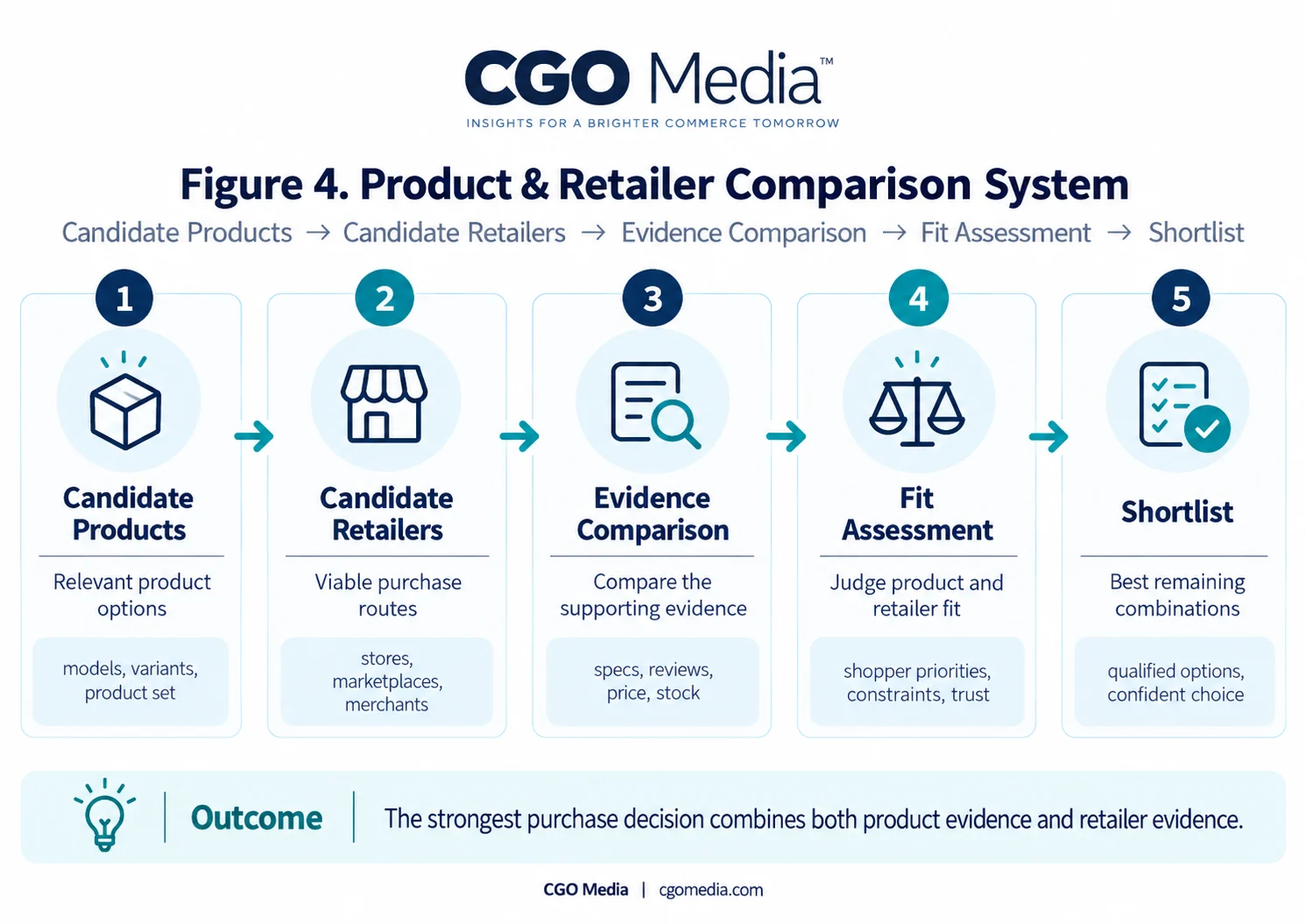
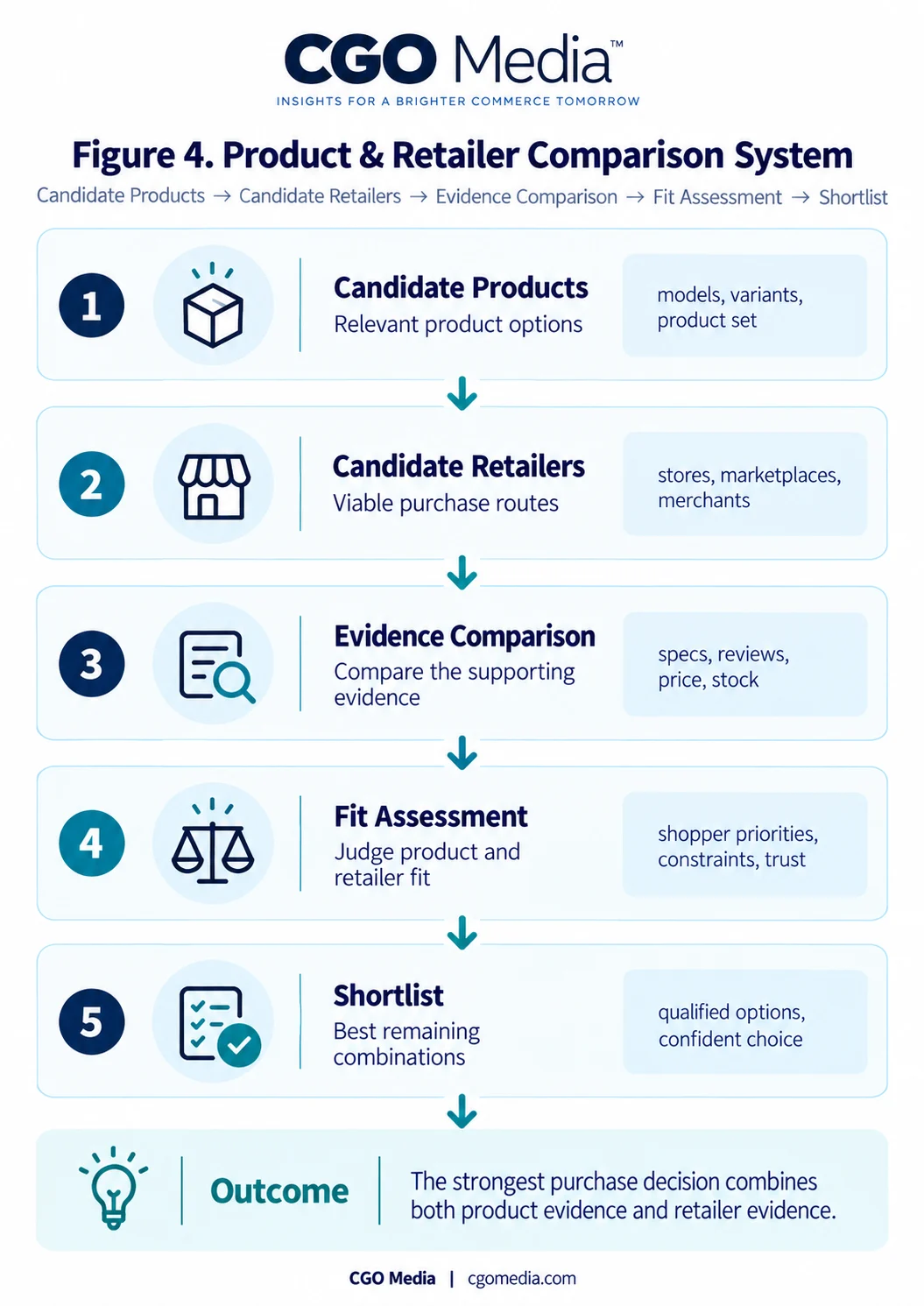
504. AI Recommendation Confidence Should Be Treated as a Distinct Decision Layer
Once products and retailers have been compared, the next question is whether there is enough evidence to support a recommendation confidently.
505. Recommendation Confidence Is Not the Same as Product Visibility
A product can appear frequently without being sufficiently suitable or well evidenced to justify strong recommendation.
506. Recommendation Confidence Is Not the Same as Retailer Visibility
A retailer can be prominent without being the best purchase route for a particular shopper.
507. AI Recommendation Confidence Can Be Modelled as
Product Fit + Merchant Fit + Trust Evidence + External Validation + Commercial Fit → Recommendation Confidence
508. Product Fit Is the First Confidence Layer
The recommended product should genuinely meet the shopper’s functional requirements.
509. Product Fit Can Include
- Need fit
- Feature fit
- Compatibility fit
- Performance fit
- Use-case fit
510. Weak Product Fit Should Limit Recommendation Confidence
Strong brand awareness or review volume should not overcome poor suitability.
511. Merchant Fit Is the Second Confidence Layer
The recommended retailer should provide a practical and trustworthy route to purchase.
512. Merchant Fit Can Include
- Exact stock
- Delivery fit
- Returns fit
- Warranty fit
- Service fit
513. Weak Merchant Fit Should Limit Recommendation Confidence
A suitable product should not automatically be recommended through an unsuitable seller.
514. Trust Evidence Is the Third Confidence Layer
Recommendation should be supported by sufficiently credible evidence.
515. Product Trust Evidence Can Include
- Manufacturer information
- Independent testing
- Expert reviews
- Customer reviews
- Warranty evidence
516. Merchant Trust Evidence Can Include
- Retailer reputation
- Customer ratings
- Returns performance
- Delivery reliability
- Service evidence
517. Trust Should Be Evaluated by Evidence Quality
Not all reviews, ratings or publisher references carry equal weight.
518. Trust Evidence Quality Can Depend on
- Source credibility
- Independence
- Freshness
- Product specificity
- Consistency
519. External Validation Is the Fourth Confidence Layer
Independent evidence can reduce dependence on brand or merchant claims alone.
520. External Validation Can Include
- Publisher testing
- Specialist reviews
- Consumer organisations
- Industry awards
- Independent comparisons
521. External Validation Should Be Relevant to the Exact Product
A strong brand reputation should not automatically validate every model or variant.
522. External Validation Should Be Relevant to the Shopper Scenario
Testing for professional use may not be the strongest evidence for a beginner use case.
523. External Validation Should Be Current Enough for the Product Lifecycle
Older reviews may refer to:
- Previous generations
- Old firmware
- Different specifications
- Discontinued versions
524. Commercial Fit Is the Fifth Confidence Layer
The recommendation should remain commercially realistic.
525. Commercial Fit Can Include
- Total cost
- Availability
- Delivery timing
- Returns
- Warranty
- Promotion
526. Commercial Fit Should Be Market-Specific
Price, stock and retailer terms can differ significantly by geography.
527. Commercial Fit Should Be Time-Sensitive
A strong recommendation can become weak quickly if:
- Stock disappears
- Price rises
- Promotion ends
- Delivery changes
528. Recommendation Confidence Should therefore Be Dynamic
It can change as product, merchant and commercial evidence changes.
529. Recommendation Confidence Should Consider Evidence Convergence
Confidence should rise when multiple credible sources materially agree.
530. Product Evidence Convergence Can Include
- Manufacturer specifications
- Independent testing
- Publisher reviews
- Customer experience
531. Merchant Evidence Convergence Can Include
- Retailer policies
- Customer reviews
- Delivery evidence
- Returns evidence
532. Evidence Convergence Can Be Represented as
First-Party Evidence + Independent Evidence + Customer Evidence → Confidence
533. Recommendation Confidence Should Fall When Evidence Conflicts
Material conflict can exist around:
- Product specifications
- Performance
- Availability
- Warranty
- Seller identity
534. Evidence Conflict Should Trigger Investigation
The system should not simply average contradictory evidence.
535. Some Evidence Conflict Can Be Explained
Differences may result from:
- Different variants
- Different markets
- Different test conditions
- Different dates
- Different shopper expectations
536. Unresolved Conflict Should Reduce Confidence
A recommendation can remain possible while being expressed more cautiously.
537. Recommendation Confidence Should Consider Missing Evidence
A product or retailer can appear attractive while important information remains unavailable.
538. Missing Product Evidence Can Include
- Compatibility
- Independent testing
- Product limitations
- Warranty
539. Missing Merchant Evidence Can Include
- Returns terms
- Seller identity
- Delivery reliability
- Warranty handling
540. Missing Evidence Should Reduce Recommendation Strength
Absence of evidence is not always evidence of poor quality, but it increases uncertainty.
541. Recommendation Confidence Should Distinguish Certainty Levels
A useful framework can use:
- High confidence
- Moderate confidence
- Low confidence
- Insufficient evidence
542. High Confidence Requires Strong Fit and Strong Evidence
A high-confidence recommendation should normally have:
- Strong product fit
- Strong merchant fit
- Strong trust evidence
- Strong external validation
- Strong commercial fit
543. Moderate Confidence Can Reflect Some Uncertainty
For example:
- Limited review evidence
- Minor retailer uncertainty
- New product status
- Limited long-term data
544. Low Confidence Should Be Communicated Clearly
The product may remain plausible but not recommendation-ready.
545. Insufficient Evidence Should Prevent Strong Recommendation
The appropriate outcome may be to request more information or present alternatives.
546. Recommendation Confidence Should Include Constraint Satisfaction
Hard shopper constraints should be satisfied before confidence scoring begins.
547. Constraint Satisfaction Can Include
- Budget
- Compatibility
- Availability
- Delivery deadline
- Market access
548. Constraint Failure Should Usually Override Recommendation Confidence
A product that cannot meet an essential requirement should not be strongly recommended.
549. Recommendation Confidence Should Include Product Limitation Awareness
Strong recommendations should explain relevant limitations rather than hide them.
550. Product Limitations Can Improve Recommendation Quality
They help shoppers understand whether the product remains suitable despite trade-offs.
551. Recommendation Confidence Should Include Retailer Limitation Awareness
Retailer limitations can include:
- Slower delivery
- Shorter return window
- Higher price
- Limited support
552. Trade-Offs Should Be Explicit
A recommendation can remain strong even where disadvantages exist, provided the shopper understands them.
553. Recommendation Confidence Should Not Require Perfection
The objective is the best fit among realistic alternatives, not an imaginary product with no weaknesses.
554. Recommendation Confidence Should Be Relative to Available Alternatives
A strong product in one comparison set may be weak in another.
555. Relative Confidence Should therefore Consider the Competitive Set
A useful relationship is:
Absolute Fit + Relative Advantage + Evidence Strength → Recommendation Confidence
556. Absolute Fit Asks Whether the Product Is Suitable
This should be established before competitor comparison.
557. Relative Advantage Asks Whether It Is Stronger Than the Alternatives
Relevant dimensions can include:
- Value
- Performance
- Availability
- Trust
- Service
558. Relative Advantage Should Not Override Poor Absolute Fit
The best unsuitable product is still unsuitable.
559. Recommendation Confidence Should Distinguish Product Recommendation from Purchase Recommendation
These are related but different.
560. Product Recommendation Identifies the Best Product Fit
It answers:
Which product should this shopper consider?
561. Purchase Recommendation Identifies the Best Product-Retailer Combination
It answers:
Which product should this shopper buy, and through which merchant?
562. Purchase Recommendation Requires an Additional Merchant Layer
A strong product recommendation can still require retailer comparison.
563. A Useful Purchase Recommendation Model Is
Product Recommendation Confidence + Retailer Selection Confidence → Purchase Recommendation Confidence
564. Recommendation Confidence Should Be Shopper-Specific
Different shoppers can legitimately receive different recommendations.
565. Budget Shoppers May Need Different Confidence Weighting
Price and value may matter more.
566. Premium Shoppers May Need Different Confidence Weighting
Performance, design, service and warranty may matter more.
567. Professional Shoppers May Need Different Confidence Weighting
Reliability, compatibility and support may dominate.
568. Beginner Shoppers May Need Different Confidence Weighting
Ease of use, guidance and support may dominate.
569. Urgent Shoppers May Need Different Confidence Weighting
Stock and delivery may override small product-quality differences.
570. Recommendation Confidence Should therefore Be Scenario-Specific
A universal recommendation score can hide important differences in shopper fit.
571. Recommendation Confidence Should Be Market-Specific
The same product can have different:
- Prices
- Retailers
- Availability
- Warranty terms
- Delivery options
572. Recommendation Confidence Should Be Channel-Specific
The same retailer can operate differently across:
- Own website
- Marketplace storefront
- Physical store
- Partner channel
573. Recommendation Confidence Should Be Product-Generation Specific
New and old models should not be treated interchangeably.
574. Recommendation Confidence Should Be Variant-Specific Where Necessary
Different variants may have materially different:
- Performance
- Price
- Availability
- Compatibility
575. Recommendation Confidence Should Be Time-Specific
The recommendation should reflect the current product and commercial environment.
576. Recommendation Confidence Should Be Tested Longitudinally
One generated recommendation should not be treated as durable evidence.
577. Longitudinal Monitoring Can Reveal Confidence Stability
Useful observations can include:
- Recommendation frequency
- Reason consistency
- Product consistency
- Retailer consistency
578. Stable Recommendation with Stable Reasoning Can Indicate Strong Association
For example, a product may repeatedly be recognised as the strongest value option.
579. Stable Recommendation with Inaccurate Reasoning Is a Risk
A recommendation may appear consistently for the wrong reasons.
580. Unstable Recommendation Can Indicate Weak Confidence
Similar shopper scenarios may produce inconsistent shortlists or winners.
581. Recommendation Confidence Should therefore Track Both Presence and Reasoning
The organisation should ask:
- Was the product recommended?
- Why was it recommended?
- Was that reasoning accurate?
- Was the retailer appropriate?
582. Recommendation Reasoning Should Be Evaluated Against Strategic Positioning
The organisation can assess whether products are recognised for the strengths they are intended to provide.
583. Misaligned Recommendation Reasoning Can Reveal Positioning Gaps
For example, a premium product may repeatedly be recommended only because of temporary discounting.
584. Recommendation Reasoning Can Reveal Emerging Strengths
A product may increasingly be associated with:
- Ease of use
- Durability
- Value
- Professional suitability
- Design
585. Recommendation Reasoning Can Reveal Emerging Weaknesses
Repeated concerns can include:
- Price
- Compatibility
- Reliability
- Availability
- Support
586. Recommendation Confidence Should Include Risk Awareness
Some products require stronger evidence before confident recommendation.
587. Higher-Risk Product Categories Can Require Higher Confidence Thresholds
Relevant factors can include:
- High purchase value
- Safety implications
- Complex compatibility
- Significant installation requirements
- Limited returns
588. Low-Risk Purchases Can Use Lower Evidence Thresholds
Simple, low-value commodity purchases may require less extensive validation.
589. Confidence Thresholds Should therefore Reflect Purchase Risk
A useful relationship is:
Purchase Risk + Shopper Impact + Evidence Uncertainty → Required Recommendation Confidence
590. Recommendation Confidence Should Be Explainable
A strong recommendation should state its principal reasons.
591. Explainable Product Recommendation Can State
- Why the product fits
- Which strengths matter
- Which trade-offs exist
- What evidence supports the recommendation
592. Explainable Retailer Recommendation Can State
- Why the merchant is suitable
- How price compares
- What delivery is available
- What return terms apply
593. Explainability Helps Preserve Shopper Agency
The shopper can decide whether the recommendation logic matches their own priorities.
594. Recommendation Confidence Should Avoid Unsupported Superlatives
Terms such as:
- Best
- Safest
- Most reliable
- Best value
should be supported by appropriate evidence and clearly defined criteria.
595. “Best” Should Be Scenario-Specific
A stronger formulation is:
Best for this shopper scenario under these defined criteria.
596. Recommendation Confidence Should Include Alternative Options
A single recommendation may not reflect legitimate trade-offs.
597. Useful Recommendation Sets Can Include
- Best overall fit
- Best value
- Best premium option
- Best specialist option
598. Alternatives Should Be Meaningfully Different
Near-identical options add limited decision value.
599. Recommendation Confidence Should Support Appropriate Exclusion
Not every candidate should remain in the final recommendation set.
600. Relevant Exclusion Should Be Investigated
A genuinely suitable product that repeatedly fails to appear may indicate:
- Weak product evidence
- Weak authority
- Weak availability
- Weak merchant representation
601. Irrelevant Inclusion Should Also Be Investigated
Repeated recommendation despite poor fit can produce poor shopper outcomes.
602. Appropriate Exclusion Is a Valid Outcome
A product may be excluded correctly because it fails:
- Budget
- Compatibility
- Availability
- Trust
- Use-case fit
603. Recommendation Confidence Should Be Connected to Post-Purchase Outcomes
The quality of the recommendation should ultimately be tested against what happens after purchase.
604. Useful Post-Purchase Signals Can Include
- Returns
- Satisfaction
- Reviews
- Support contacts
- Repeat purchase
605. High Return Rates Can Challenge Recommendation Confidence
Repeated returns may indicate poor:
- Product fit
- Expectation setting
- Compatibility guidance
- Retailer fulfilment
606. Strong Satisfaction Can Validate Recommendation Logic
Positive outcomes can reinforce the criteria used to make the recommendation.
607. Recommendation Confidence Should therefore Include a Learning Loop
A useful relationship is:
Recommend → Purchase → Experience → Validate Outcome → Update Evidence → Improve Future Recommendation
608. Recommendation Learning Should Separate Product and Retailer Problems
A poor outcome may result from:
- Wrong product
- Wrong retailer
- Both
609. Product-Related Problems Should Update Product-Fit Models
Examples include:
- Compatibility failures
- Performance dissatisfaction
- Product limitations
610. Retailer-Related Problems Should Update Merchant-Fit Models
Examples include:
- Delivery failure
- Returns friction
- Poor support
- Warranty issues
611. Recommendation Confidence Can Support Merchandising Intelligence
Repeated recommendations can reveal which product propositions have the strongest external fit.
612. Recommendation Confidence Can Support Product Strategy
Recurring low-confidence scenarios can reveal:
- Feature gaps
- Pricing gaps
- Availability gaps
- Evidence gaps
613. Recommendation Confidence Can Support Channel Strategy
Brands can identify which retail partners create the strongest purchase routes.
614. Recommendation Confidence Can Support Customer Experience Strategy
The organisation can compare pre-purchase recommendation assumptions with actual post-purchase outcomes.
615. Recommendation Confidence Can Support AI Visibility Strategy
Brands can understand not only whether they appear, but whether they are recommended for the right shoppers and the right reasons.
616. Recommendation Confidence Should Be Monitored Across AI Environments
Different systems can produce different:
- Candidate products
- Retailers
- Evidence
- Recommendation reasons
617. Cross-Environment Monitoring Can Reveal Platform Dependence
A product may have high recommendation confidence in one environment and low confidence in another.
618. Recommendation Confidence Should therefore Be Portfolio-Based
Monitoring should cover representative AI and generative shopping environments rather than relying on one platform.
619. Recommendation Confidence Should Be Monitored by Shopper Segment
This can reveal where the product has genuine fit.
620. Recommendation Confidence Should Be Monitored by Product Category
A brand can have strong authority in one category and weak authority in another.
621. Recommendation Confidence Should Be Monitored by Market
Retail conditions can differ substantially by geography.
622. Recommendation Confidence Should Be Monitored by Journey Stage
Early-stage discovery may require lower certainty than final purchase selection.
623. Purchase-Stage Recommendations Require the Highest Commercial Precision
At this stage, product, stock, seller, delivery and price information should be highly current.
624. Recommendation Confidence Should Be Measured as Quality, Not Only Frequency
A useful evaluation should consider:
- Relevance
- Accuracy
- Evidence strength
- Merchant suitability
- Outcome quality
625. Recommendation Frequency Alone Can Be Misleading
Frequent recommendation can coexist with poor fit or inaccurate reasoning.
626. Qualified Recommendation Is therefore the Better Objective
A useful relationship is:
Relevant Shopper + Suitable Product + Suitable Merchant + Strong Evidence + Appropriate Commercial Context → Qualified Recommendation
627. Qualified Recommendation Should Improve Decision Quality
The objective is to help shoppers make a better decision, not merely to increase product exposure.
628. Better Recommendation Quality Can Reduce Poor-Fit Purchases
This can support:
- Lower returns
- Higher satisfaction
- Reduced support friction
- Greater trust
629. Better Recommendation Quality Can Improve Commercial Quality
It can contribute to more appropriate conversion rather than conversion at any cost.
630. Qualified Conversion Is More Valuable Than Raw Conversion
A useful relationship is:
Qualified Recommendation → Qualified Purchase → Better Shopper Outcome
631. Recommendation Confidence Should therefore Be Treated as a Strategic Metric
It connects discovery, product fit, merchant selection, trust and customer outcome.
632. The Seventeenth Ecommerce Product Discovery Principle
AI recommendation confidence should depend on the combined strength of product fit, merchant fit, trust evidence, independent validation and commercial fit rather than product popularity, brand prominence or retailer visibility alone.
633. The Eighteenth Ecommerce Product Discovery Principle
Recommendation confidence should be reduced where important evidence is conflicting, missing, outdated or insufficiently specific, with stronger confidence thresholds applied where purchase value, compatibility, safety, limited returns or other shopper risks are higher.
634. The Nineteenth Ecommerce Product Discovery Principle
Product and purchase recommendations should remain shopper-specific, market-specific, variant-specific and time-sensitive because suitable products, merchants, pricing, availability and commercial conditions can differ materially across scenarios.
635. The Twentieth Ecommerce Product Discovery Principle
Recommendation confidence should operate as a learning system, using post-purchase returns, satisfaction, reviews, fulfilment performance and support evidence to validate whether product and merchant selection logic actually produced better shopper outcomes.
636. The AI Recommendation Confidence Model
The complete relationship can be summarised as:
Product Fit + Merchant Fit + Trust Evidence + External Validation + Commercial Fit → Recommendation Confidence → Qualified Recommendation
637. The Strategic Implication
Ecommerce organisations should treat AI recommendation confidence as the final validation layer between product discovery and purchase selection, ensuring that recommendations are supported by strong product suitability, appropriate retailer choice, current commercial conditions, credible trust evidence and sufficient independent validation, while uncertainty, conflicting information and post-purchase outcomes continually shape how strongly products and merchants should be recommended.
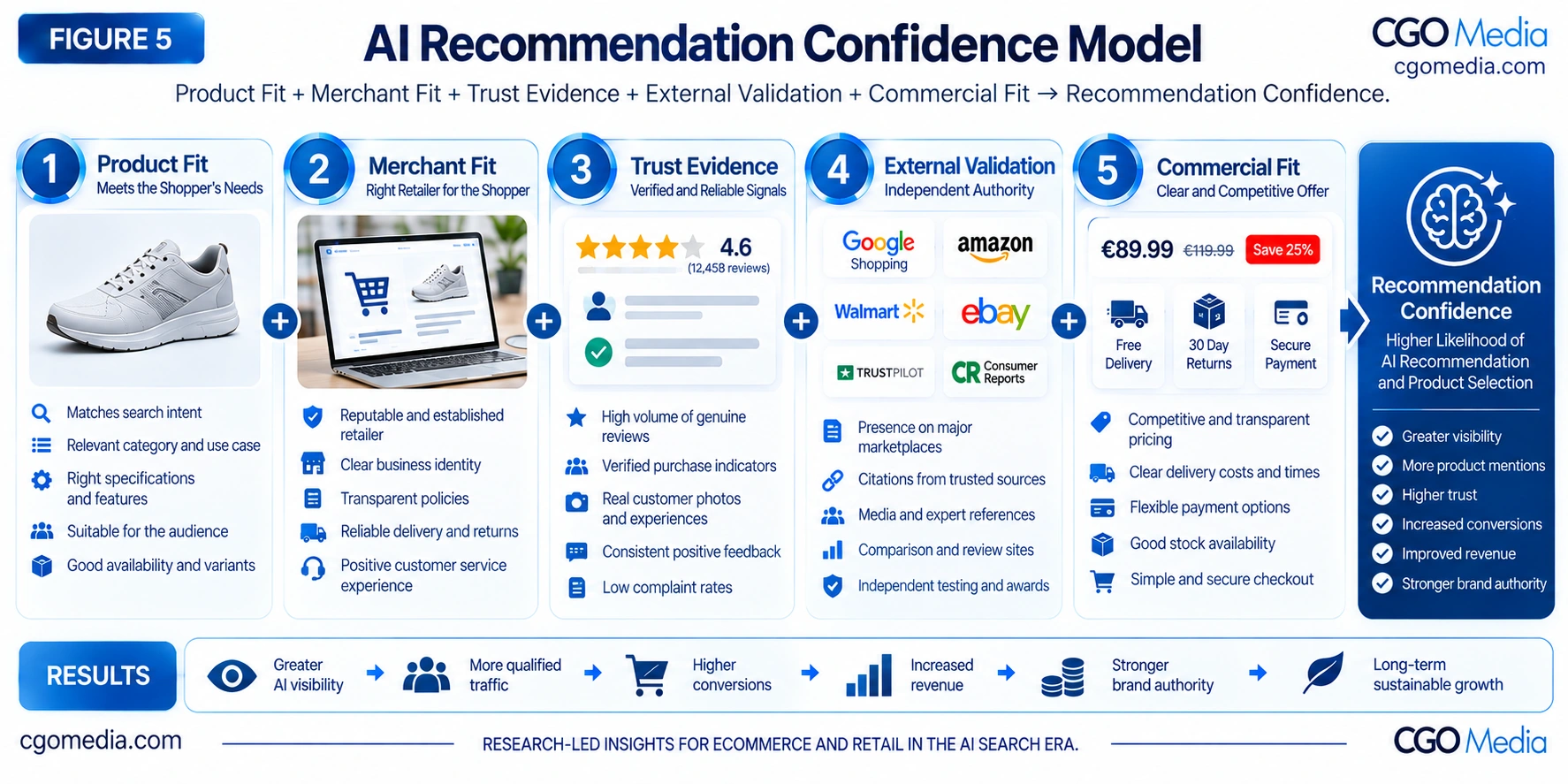
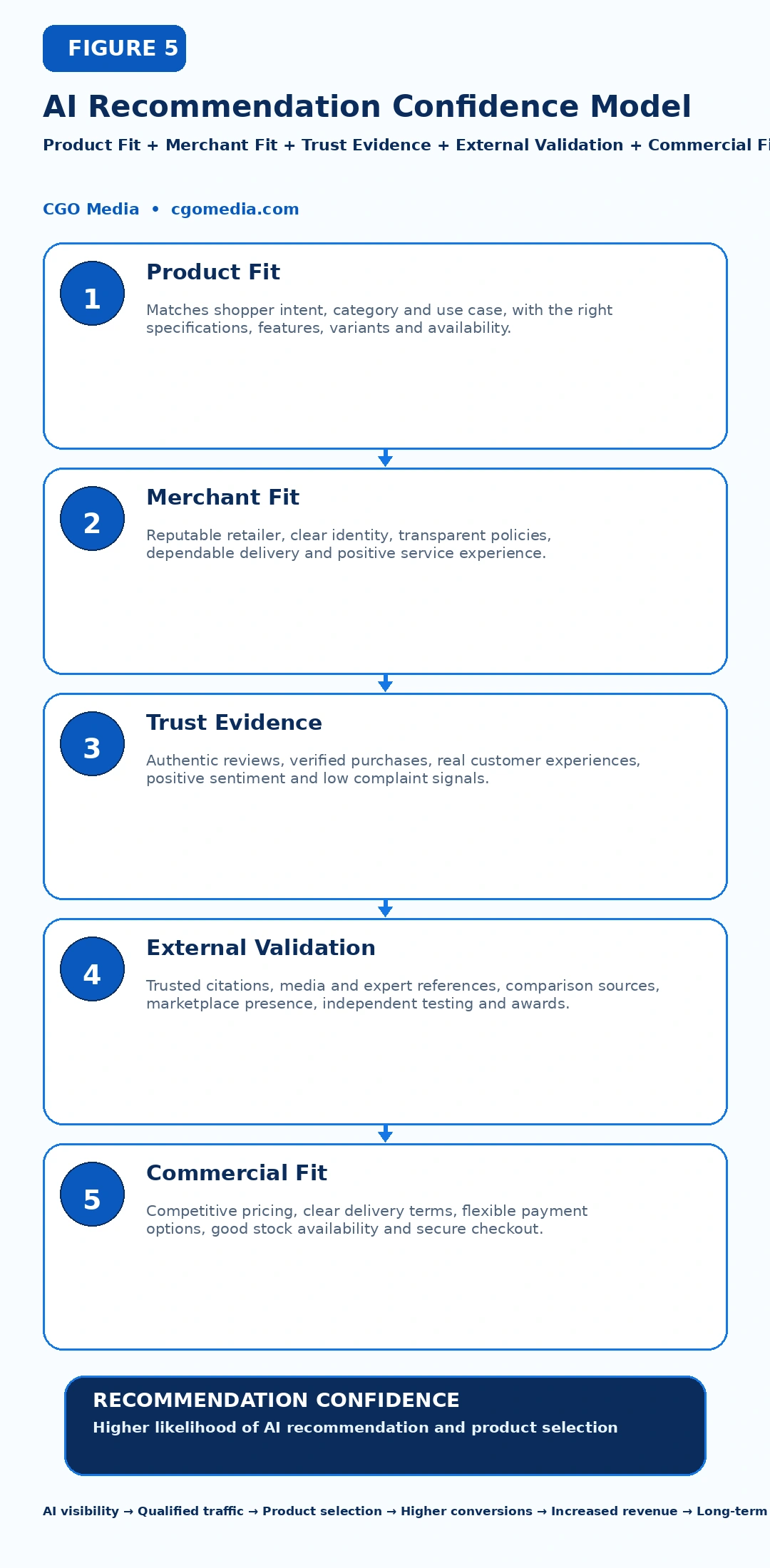
638. Ecommerce Discovery and Retailer Selection Should Operate as a Continuous Learning System
Product discovery and retailer selection should not be treated as fixed decision processes because products, merchants, prices, stock, customer expectations and market conditions can all change over time.
639. Continuous Improvement Should Begin with Observation
Teams should repeatedly observe:
- Product discovery patterns
- Shortlist composition
- Retailer inclusion
- Recommendation reasons
- Post-purchase outcomes
640. Observation Should Be Scenario-Based
Monitoring should use realistic shopper situations rather than isolated generic prompts.
641. Scenario Libraries Should Reflect Real Purchase Journeys
Useful scenario dimensions can include:
- Shopper type
- Budget
- Use case
- Market
- Urgency
- Journey stage
642. Continuous Monitoring Should Distinguish Variation from Persistent Change
One unusual product or retailer recommendation may represent temporary generative variation.
643. Persistent Change Can Indicate Structural Movement
Examples can include:
- New product competitors
- New retailer competitors
- Price-position change
- Availability change
- Trust movement
644. Discovery Change Should Be Diagnosed Before Action
The organisation should understand whether the root cause concerns:
- Product fit
- Product evidence
- Merchant fit
- Commercial conditions
- External authority
645. A Useful Diagnosis Cycle Is
Observe → Classify → Compare → Diagnose → Prioritise → Improve → Re-Test
646. Observe
Record the product discovery, shortlist, retailer and recommendation outcome.
647. Classify
Determine whether the issue concerns:
- Product
- Retailer
- Evidence
- Commercial fit
- Recommendation
648. Compare
Compare the observed output with current authoritative product and merchant information.
649. Diagnose
Identify the likely information, evidence, positioning or fulfilment weakness.
650. Prioritise
Focus first on issues with the greatest shopper and commercial impact.
651. Improve
Strengthen the underlying product, merchant or evidence environment.
652. Re-Test
Determine whether the observed pattern changes after intervention.
653. Discovery Issues Should Be Prioritised by Shopper Impact
Not every visibility or recommendation change matters equally.
654. A Useful Priority Model Is
Shopper Impact + Commercial Importance + Persistence + Trust Risk
655. Shopper Impact
Measures whether the issue affects:
- Product understanding
- Product choice
- Retailer choice
- Purchase confidence
656. Commercial Importance
Measures whether the issue affects:
- Strategic products
- High-value categories
- Priority markets
- Important retail partners
657. Persistence
Measures whether the issue recurs across:
- Time
- Similar scenarios
- AI systems
- Markets
658. Trust Risk
Measures whether the issue could materially reduce confidence in:
- Product quality
- Merchant reliability
- Brand credibility
- Purchase safety
659. Continuous Improvement Should Target Root Causes
The objective should be to strengthen the decision environment rather than manipulate individual outputs.
660. Product Root Causes Can Include
- Weak specifications
- Unclear compatibility
- Missing limitations
- Outdated product information
661. Retailer Root Causes Can Include
- Unclear seller identity
- Outdated stock
- Weak delivery information
- Poor returns transparency
662. Evidence Root Causes Can Include
- Weak independent validation
- Old reviews
- Conflicting product evidence
- Insufficient customer evidence
663. Commercial Root Causes Can Include
- Price disadvantage
- Poor promotion value
- Weak delivery fit
- Unfavourable warranty terms
664. Recommendation Root Causes Can Include
- Weak shopper fit
- Misaligned positioning
- Irrelevant inclusion
- Relevant exclusion
665. Continuous Improvement Should Be Cross-Functional
Product discovery and retailer selection span multiple teams.
666. A Governance Model Can Include
SEO + Product + Merchandising + Ecommerce + Customer Experience + Digital PR + Data Governance
667. SEO Can Coordinate Discovery Intelligence
SEO can connect:
- Search demand
- AI visibility
- Product architecture
- Competitive discovery
668. Product Teams Can Validate Product Truth
They can confirm:
- Specifications
- Compatibility
- Variants
- Use cases
- Limitations
669. Merchandising Can Validate Commercial Positioning
It can confirm:
- Price position
- Category role
- Promotion
- Assortment
- Product lifecycle
670. Ecommerce Teams Can Validate Transaction Reality
They can confirm:
- Stock
- Delivery
- Returns
- Checkout availability
- Retail channels
671. Customer Experience Teams Can Validate Real Shopper Outcomes
They can contribute:
- Return reasons
- Support questions
- Reviews
- Complaint themes
- Satisfaction data
672. Digital PR Can Strengthen Independent Evidence
It can support:
- Product testing
- Retail research
- Expert commentary
- Publisher relationships
673. Data Governance Can Strengthen Product and Merchant Consistency
It can support standards across:
- Product databases
- Retailer feeds
- Marketplace listings
- Product identifiers
- Commercial data
674. Ownership Should Be Explicit
Organisations should know who owns:
- Product facts
- Commercial facts
- Merchant information
- Review monitoring
- Escalation
675. Stable and Volatile Information Should Have Different Owners and Cadences
Core product facts and rapidly changing commercial data often require different governance.
676. High-Volatility Retail Data May Require Frequent Review
Examples include:
- Price
- Stock
- Promotions
- Delivery
- Seller availability
677. Lower-Volatility Product Data May Require Less Frequent Review
Examples can include:
- Dimensions
- Materials
- Core specifications
- Product category
678. Review Frequency Should Match Decision Risk
A useful relationship is:
Information Volatility + Shopper Impact + Commercial Importance → Review Frequency
679. Continuous Discovery Systems Should Include Escalation
High-risk misinformation or recommendation errors should not remain within ordinary reporting.
680. High-Risk Issues Can Include
- Wrong compatibility
- Wrong seller identity
- Unavailable products recommended as available
- Material pricing errors
- Invalid warranty claims
681. Product Discovery Should Include Recovery Capability
Not every error can be prevented.
682. A Useful Recovery Cycle Is
Detect → Verify → Diagnose → Correct → Re-Test → Learn
683. Detect
Identify a material product, retailer or recommendation problem.
684. Verify
Confirm whether the issue is genuine and persistent.
685. Diagnose
Identify whether the root cause concerns:
- Product data
- Merchant data
- External evidence
- Commercial conditions
- AI interpretation
686. Correct
Improve the underlying information or operational condition.
687. Re-Test
Check whether discovery, comparison or recommendation behaviour changes.
688. Learn
Convert the finding into better standards and future monitoring.
689. Recovery Speed Can Be Measured
Useful measures can include:
- Time to detect
- Time to verify
- Time to correct
- Time to validate
690. Continuous Discovery Should Also Include Experimentation
Some improvements should be tested rather than assumed to work.
691. Experiments Should Begin with a Hypothesis
For example:
Improving compatibility information, product limitations, retailer trust evidence and delivery transparency should increase qualified product-retailer selection for relevant shopper scenarios.
692. Experiments Should Establish a Baseline
The organisation should record current discovery, shortlist and recommendation behaviour before making changes.
693. Experiments Should Define the Intervention
Examples can include:
- Improved product pages
- Better retailer information
- New buying guides
- Independent product testing
- Improved returns transparency
694. Experiments Should Define Success Criteria
Success can include:
- More relevant product inclusion
- Better retailer fit
- Higher recommendation confidence
- Lower misinformation
- Better post-purchase outcomes
695. Experiments Should Use Observation Windows
Decision patterns may not change immediately after an intervention.
696. Confounding Factors Should Be Recorded
Examples can include:
- New product launches
- Price changes
- Competitor promotions
- Stock disruption
- AI system updates
697. Negative Results Should Be Preserved
They help prevent repeated ineffective work.
698. Successful Experiments Should Become Standards
Validated approaches can be added to:
- Product templates
- Retailer standards
- Comparison frameworks
- Recommendation playbooks
- Data-governance rules
699. Product Discovery Should Integrate with Ecommerce SEO
Traditional search remains a major product-discovery channel.
700. Ecommerce SEO Supports Product Discovery Through
- Technical accessibility
- Product architecture
- Category relevance
- Internal linking
- Product content
701. Product Discovery Extends Ecommerce SEO
It adds explicit focus on:
- Candidate-set formation
- Product-fit evaluation
- Retailer selection
- Recommendation confidence
- Post-purchase learning
702. Product Discovery Should Integrate with Product Information Management
Strong selection depends on accurate product data.
703. Product Information Management Can Support
- Identifiers
- Specifications
- Variants
- Compatibility
- Lifecycle status
704. Product Discovery Should Integrate with Merchandising
Comparison patterns can reveal how products are positioned externally.
705. Merchandising Intelligence Can Reveal Price-Position Drift
A product may increasingly be perceived as:
- Budget
- Value
- Mid-range
- Premium
- Luxury
706. Merchandising Intelligence Can Reveal Use-Case Drift
Products may increasingly be selected for scenarios not originally prioritised.
707. Use-Case Drift Can Reveal Opportunity
It can expose:
- New customer segments
- New bundles
- New content needs
- New product-development opportunities
708. Use-Case Drift Can Also Reveal Risk
Products may be selected for unsuitable or unsupported applications.
709. Product Discovery Should Integrate with Customer Experience
Post-purchase evidence provides some of the strongest validation of discovery quality.
710. Customer Experience Data Can Include
- Returns
- Reviews
- Support contacts
- Complaints
- Satisfaction
711. Returns Should Be Analysed by Reason
A return caused by wrong product fit is different from a return caused by merchant failure.
712. Product-Fit Returns Can Indicate Discovery Weakness
Examples can include:
- Wrong size
- Wrong compatibility
- Wrong use case
- Unrealistic expectations
713. Merchant-Related Returns Can Indicate Retailer-Selection Weakness
Examples can include:
- Damaged delivery
- Wrong item shipped
- Poor returns process
- Warranty problems
714. Product Discovery Should Integrate with Review Intelligence
Reviews reveal real-world evidence around both products and merchants.
715. Product Review Intelligence Can Reveal
- Performance strengths
- Usability issues
- Durability issues
- Value perceptions
- Compatibility problems
716. Retailer Review Intelligence Can Reveal
- Delivery reliability
- Service quality
- Returns experience
- Refund reliability
- Trust concerns
717. Product Discovery Should Integrate with Digital PR and Research
Independent evidence can strengthen both discovery and recommendation confidence.
718. Research Can Support Product Discovery Through
- Consumer studies
- Product testing
- Category analysis
- Shopping statistics
- Retail benchmarks
719. Product Discovery Should Integrate with Channel Strategy
Brands should understand which retailers and marketplaces create the strongest purchase routes.
720. Retailer Performance Can Be Analysed by Product
The same merchant may perform differently across categories and product lines.
721. Retailer Performance Can Be Analysed by Market
Operational quality can differ by geography.
722. Retailer Performance Can Be Analysed by Shopper Segment
Different shoppers may value different merchant strengths.
723. Marketplace Selection Requires Additional Governance
Brands may need to monitor:
- Seller identity
- Authenticity
- Product accuracy
- Price consistency
- Returns quality
724. Product Discovery Should Scale Strategically
Large ecommerce catalogues can make exhaustive monitoring impractical.
725. Scaling Should Begin with Priority Categories
Priority can reflect:
- Revenue
- Growth
- Margin
- Strategic importance
- Search and AI demand
726. Scaling Should Then Extend to Priority Products
Useful product groups can include:
- Flagship products
- Best sellers
- New launches
- High-margin products
- High-return products
727. High-Return Products Deserve Particular Attention
High returns may indicate weak pre-purchase fit or expectation setting.
728. Scaling Should Include Priority Retailers
Brands can monitor strategic:
- Retail partners
- Marketplaces
- Authorised resellers
- Direct channels
729. Scaling Should Include Priority Markets
Product availability, pricing, retailers and shopper behaviour can differ significantly by country.
730. Scaling Should Include Priority Shopper Segments
Useful segments can include:
- Budget
- Premium
- Professional
- Beginner
- Specialist
731. Product Discovery Should Include Product Lifecycle
A useful lifecycle is:
Launch → Growth → Maturity → Replacement → Discontinuation
732. Launch-Stage Products Often Have Lower Evidence Depth
They may initially lack:
- Reviews
- Long-term testing
- Customer evidence
- Stable price history
733. Launch-Stage Selection Should therefore Use Appropriate Confidence
A new product may be promising while long-term evidence remains limited.
734. Growth-Stage Products Can Develop Stronger Evidence
More:
- Reviews
- Testing
- Customer outcomes
- Retail availability
can improve confidence.
735. Mature Products May Have Strong Evidence but Increasing Competitive Pressure
New alternatives can alter their relative fit.
736. Replacement-Stage Products Require Clear Successor Relationships
Shoppers should understand:
- What replaces the old model
- What changed
- Who should upgrade
- Whether the old model remains suitable
737. Discontinued Products Should Be Clearly Identified
They should not continue appearing as current purchase recommendations without context.
738. Product Discovery Should Build Organisational Learning
Repeated monitoring should improve:
- Product data
- Merchandising
- Retailer management
- Customer experience
- Research
739. Organisational Memory Reduces Repeated Selection Failure
Teams should not repeatedly rediscover the same:
- Compatibility problems
- Merchant weaknesses
- Evidence gaps
- Return drivers
740. Learning Can Be Preserved Through
- Scenario libraries
- Issue logs
- Comparison records
- Experiment records
- Product-fit matrices
- Retailer scorecards
- Selection playbooks
741. Adaptive Product Discovery Is the Long-Term Goal
The organisation should be able to respond as:
- Products change
- Retailers change
- Prices change
- Shopper behaviour changes
- AI systems change
742. Adaptive Discovery Does Not Mean Constant Tactical Reaction
Stable decision principles should remain.
743. Stable Discovery Principles Can Include
- Shopper need first
- Product eligibility before ranking
- Retailer eligibility before ranking
- Evidence-led comparison
- Transparent trade-offs
- Post-purchase learning
744. Tactics Can Change Around Stable Principles
This creates resilience without losing decision quality.
745. Adaptive Discovery Should Be Evidence-Led
Changes should respond to observed shopper, product and retailer patterns rather than speculation.
746. Adaptive Discovery Should Be Risk-Aware
Compatibility, seller identity, warranty and other high-impact errors should receive priority over minor ranking movement.
747. Adaptive Discovery Should Be Commercially Relevant
The programme should focus on products, retailers, categories and markets that matter most.
748. Adaptive Discovery Should Be Integrated
A useful intelligence model is:
Search Intelligence + AI Intelligence + Product Intelligence + Merchant Intelligence + Customer Intelligence + Commercial Intelligence
749. Combined Intelligence Improves Product and Retailer Selection
Teams can better determine:
- Which products fit
- Which merchants fit
- Which evidence is missing
- Which shopper segments matter
- Which weaknesses require action
750. Strategic Recommendation One — Build a Shopper Scenario Library
Use realistic discovery, comparison and purchase situations.
751. Strategic Recommendation Two — Define Product Eligibility Gates
Identify hard:
- Compatibility
- Budget
- Use-case
- Performance
- Availability
requirements before ranking products.
752. Strategic Recommendation Three — Define Retailer Eligibility Gates
Exclude merchants that fail critical:
- Stock
- Delivery
- Warranty
- Trust
- Geographic
requirements.
753. Strategic Recommendation Four — Build Product-Fit Matrices
Assess:
- Need fit
- Feature fit
- Price fit
- Availability fit
- Trust fit
754. Strategic Recommendation Five — Build Retailer Scorecards
Assess:
- Price
- Stock
- Delivery
- Returns
- Trust
- Service
755. Strategic Recommendation Six — Separate Product and Retailer Decisions
Avoid allowing strong merchant visibility to distort product fit or strong product visibility to hide weak merchant fit.
756. Strategic Recommendation Seven — Track Evidence Confidence
Record source quality, freshness, independence and consistency.
757. Strategic Recommendation Eight — Monitor Product Co-Occurrence
Identify which products repeatedly compete within the same shopper scenarios.
758. Strategic Recommendation Nine — Monitor Retailer Co-Occurrence
Identify which merchants repeatedly compete for the same purchase.
759. Strategic Recommendation Ten — Track Recommendation Reasons
Understand why products and retailers are being selected.
760. Strategic Recommendation Eleven — Monitor Relevant Exclusion
Investigate suitable products or retailers that are repeatedly absent.
761. Strategic Recommendation Twelve — Monitor Irrelevant Inclusion
Identify product or merchant recommendations likely to create poor shopper outcomes.
762. Strategic Recommendation Thirteen — Connect Selection to Returns
Use return reasons to improve future product and retailer fit.
763. Strategic Recommendation Fourteen — Connect Selection to Reviews
Use customer evidence to validate pre-purchase assumptions.
764. Strategic Recommendation Fifteen — Integrate Discovery with Merchandising
Use comparison patterns to identify changing product positioning and portfolio gaps.
765. Strategic Recommendation Sixteen — Integrate Retailer Selection with Channel Strategy
Use merchant evidence to identify the strongest routes to purchase.
766. Strategic Recommendation Seventeen — Experiment Systematically
Test product, retailer and information interventions against baseline scenarios.
767. Strategic Recommendation Eighteen — Build Adaptive Product Discovery
Treat product discovery and retailer selection as a permanent customer-decision capability rather than a one-time merchandising exercise.
768. The Twenty-First Ecommerce Product Discovery Principle
Product discovery and retailer selection should operate as a continuous learning system because products, merchants, commercial conditions, customer expectations and AI-assisted discovery patterns can all change over time.
769. The Twenty-Second Ecommerce Product Discovery Principle
Discovery governance should connect SEO, product, merchandising, ecommerce, customer experience, Digital PR and data governance so product truth, merchant truth, commercial truth and external evidence remain sufficiently current and coordinated.
770. The Twenty-Third Ecommerce Product Discovery Principle
Ecommerce organisations should build recovery and experimentation capability so recurring product-fit errors, retailer-selection failures, stale commercial data, weak evidence and recommendation problems can be diagnosed, corrected, re-tested and converted into organisational learning.
771. The Twenty-Fourth Ecommerce Product Discovery Principle
The highest product-discovery capability is adaptive selection, where stable principles around shopper need, eligibility, product fit, retailer fit, evidence quality and post-purchase learning remain constant while tactics evolve across changing products, merchants, markets and AI-assisted shopping environments.
772. The Continuous Ecommerce Discovery & Selection Cycle
The complete operational cycle can be summarised as:
Discover → Compare → Validate → Select → Purchase → Review → Learn
773. The Long-Term Product Discovery and Retailer Selection System
The wider relationship can be summarised as:
Shopper Need → Product Eligibility → Product Fit → Retailer Eligibility → Retailer Fit → Evidence Validation → Purchase Selection → Shopper Outcome → Organisational Learning
774. The Strategic Implication
Ecommerce organisations should operate product discovery and retailer selection as a continuous, evidence-led and cross-functional decision system, repeatedly observing which products and merchants enter shopper consideration sets, validating fit against current product and commercial evidence, connecting purchase decisions with post-purchase outcomes and adapting selection criteria as products, prices, retailers, customer expectations and AI-assisted shopping environments evolve.
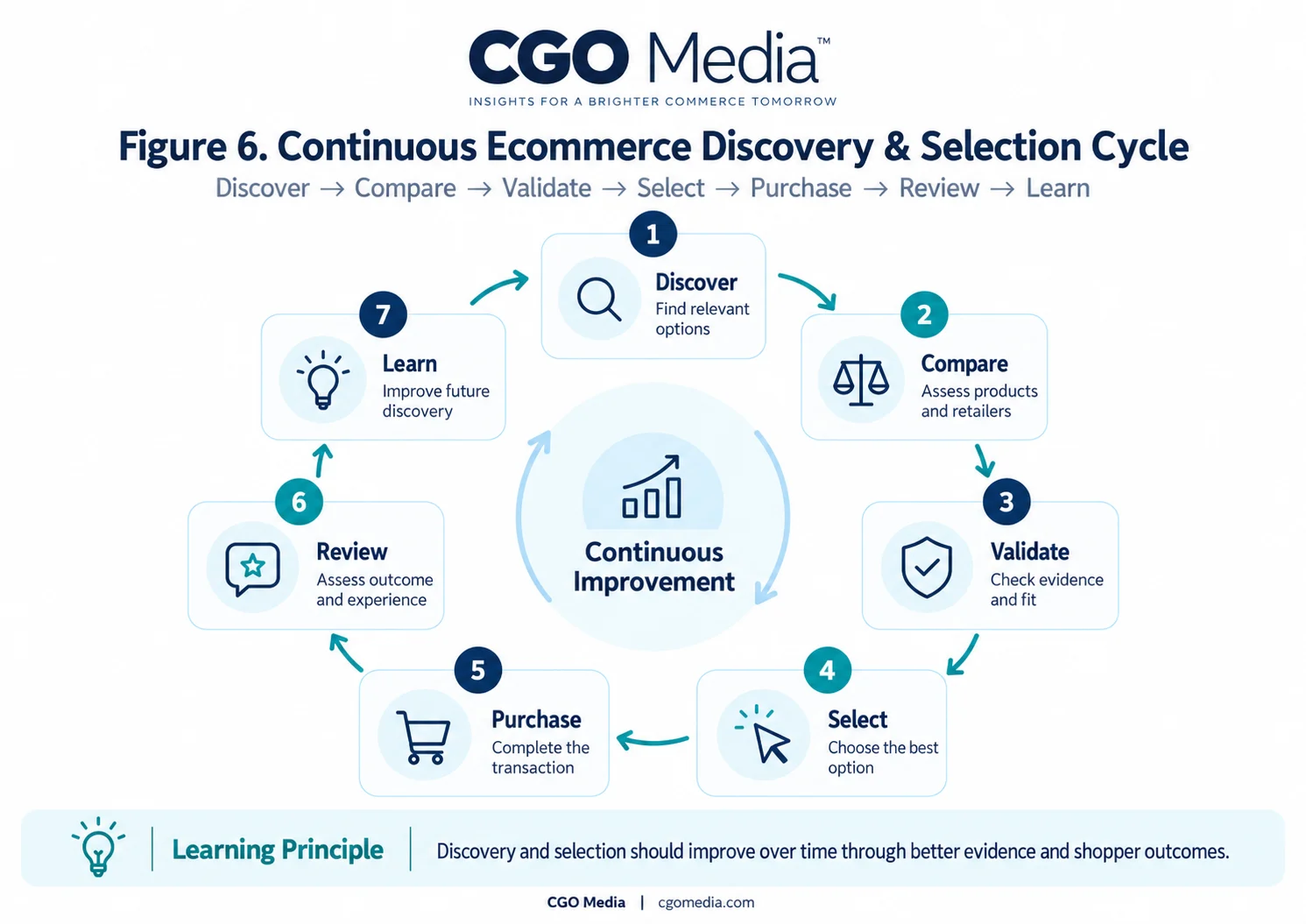
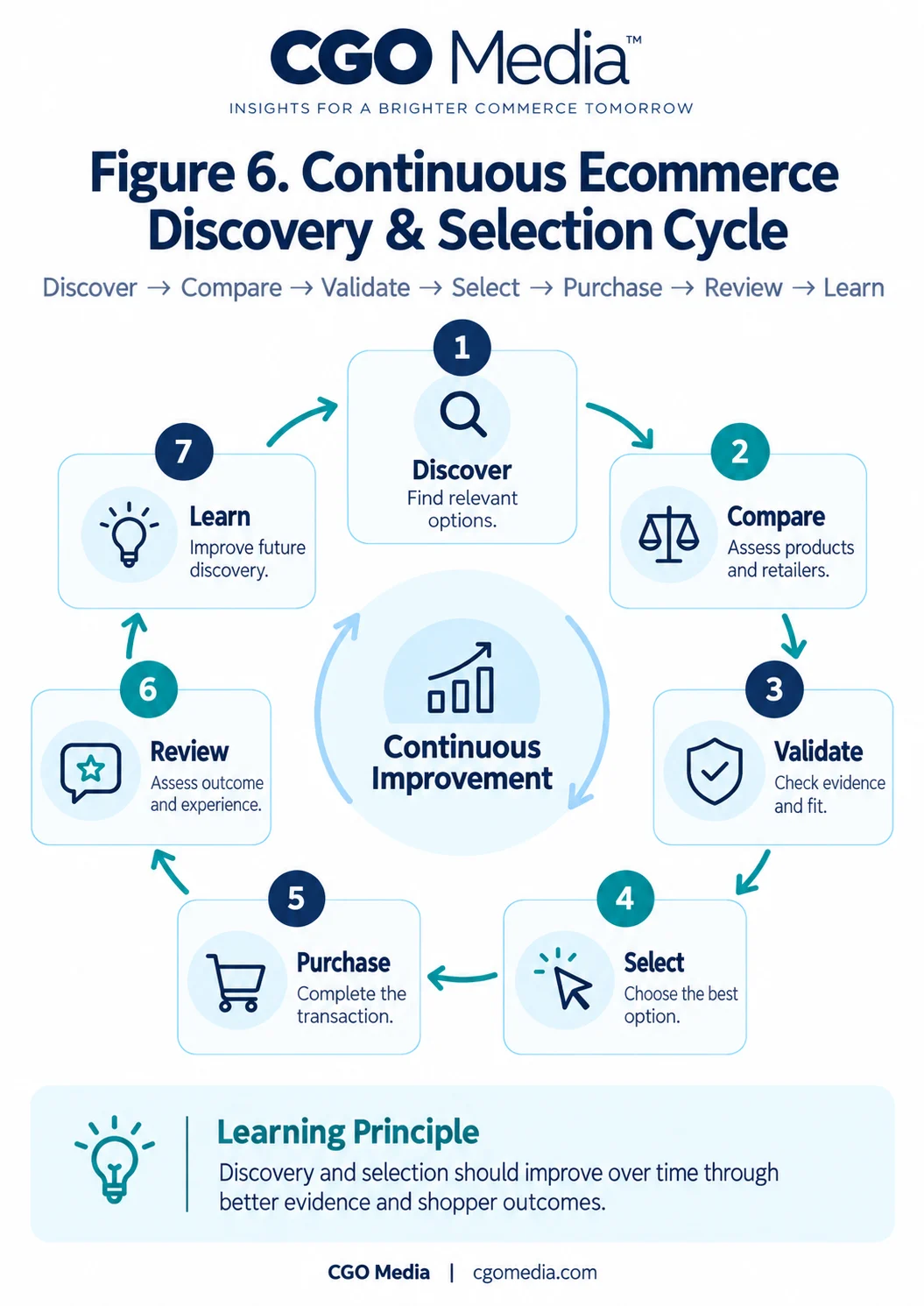
775. Methodology
The Ecommerce Product Discovery and Retailer Selection Model is a conceptual research framework developed by CGO Media to help ecommerce brands, retailers, marketplaces and product-led organisations understand how shoppers move from initial need recognition through product discovery, product comparison, retailer evaluation and final purchase selection across search engines, ecommerce websites, marketplaces, review environments and AI-assisted shopping systems.
776. Research Purpose
The framework addresses a central question:
How can ecommerce organisations improve the quality of product discovery and retailer selection so shoppers are more likely to identify suitable products, appropriate merchants and better purchase routes?
777. Framework Scope
The model can be applied to organisations including:
- Direct-to-consumer brands
- Online retailers
- Omnichannel retailers
- Marketplaces
- Manufacturers selling direct
- Specialist ecommerce businesses
- Multi-brand retailers
- Retail platforms
778. The Framework Separates Product Selection from Retailer Selection
This distinction is fundamental because the product most suited to the shopper and the retailer most suited to the purchase are separate decisions.
779. Core Product Discovery Progression
A useful relationship is:
Shopper Need → Category Discovery → Product Discovery → Product Evaluation → Product Shortlist
780. Core Retailer Selection Progression
A useful relationship is:
Product Shortlist → Retailer Discovery → Retailer Evaluation → Merchant Shortlist → Purchase Selection
781. Combined Ecommerce Selection Progression
The complete journey can be represented as:
Shopper Need → Category Discovery → Product Discovery → Product Evaluation → Retailer Evaluation → Purchase Selection
782. Shopper Need Method
The framework begins by identifying the functional, commercial and contextual requirements of the shopper.
783. Shopper Need Can Include
- Use case
- Budget
- Performance requirement
- Compatibility
- Location
- Purchase urgency
784. Product Eligibility Method
Candidate products should first be screened against hard constraints.
785. Product Eligibility Gates Can Include
- Maximum budget
- Required compatibility
- Required performance
- Required product type
- Market availability
786. Product-Fit Method
Eligible products can then be evaluated through:
Need Fit + Feature Fit + Price Fit + Availability Fit + Trust Fit → Product Relevance
787. Need Fit Method
Need fit evaluates whether the product solves the shopper’s actual problem.
788. Feature Fit Method
Feature fit evaluates whether the product provides the functionality required for the intended use.
789. Price Fit Method
Price fit evaluates whether the product remains commercially realistic within the shopper’s budget and total-cost expectations.
790. Availability Fit Method
Availability fit evaluates whether the required model and variant can realistically be purchased within the relevant market and timeframe.
791. Trust Fit Method
Trust fit evaluates whether sufficient product evidence exists to support confident selection.
792. Product Evidence Method
Product evidence can include:
- Manufacturer specifications
- Independent testing
- Expert reviews
- Customer reviews
- Warranty information
793. Product Shortlist Method
The shortlist should contain only products that satisfy essential requirements and remain competitive after evidence-led evaluation.
794. Retailer Eligibility Method
Retailers should also pass hard eligibility criteria before ranking.
795. Retailer Eligibility Gates Can Include
- Exact product stock
- Supported delivery area
- Acceptable seller trust
- Valid warranty
- Acceptable fulfilment timing
796. Retailer-Fit Method
Eligible retailers can be evaluated through:
Price + Stock + Delivery + Returns + Trust + Service → Retailer Suitability
797. Price Method
Price evaluation should consider total purchase cost rather than headline price alone.
798. Stock Method
Stock should be evaluated at the exact product and variant level.
799. Delivery Method
Delivery evaluation can include:
- Speed
- Cost
- Coverage
- Reliability
- Tracking
800. Returns Method
Returns evaluation can include:
- Return window
- Return cost
- Refund method
- Process simplicity
- Exchange availability
801. Retailer Trust Method
Merchant trust can be assessed through:
- Reputation
- Customer ratings
- Payment security
- Seller identity
- Warranty confidence
802. Retailer Service Method
Service can include:
- Pre-sale support
- Technical advice
- Order support
- Returns assistance
- Warranty handling
803. Product and Retailer Comparison Method
The framework combines product and retailer evaluation through:
Candidate Products → Candidate Retailers → Evidence Comparison → Fit Assessment → Qualified Product-Retailer Shortlist
804. Product-Retailer Pair Method
A real purchase decision can be evaluated at pair level:
Qualified Product + Qualified Merchant → Qualified Purchase Option
805. Comparison Evidence Method
Relevant evidence can be classified as:
- Agreement
- Partial agreement
- Conflict
- Missing evidence
806. Evidence Confidence Method
Evidence confidence can consider:
- Credibility
- Freshness
- Independence
- Specificity
- Consistency
807. Product Selection Confidence
A useful conceptual relationship is:
Product Fit × Evidence Confidence → Product Selection Confidence
808. Retailer Selection Confidence
A useful conceptual relationship is:
Retailer Fit × Evidence Confidence → Retailer Selection Confidence
809. Purchase Selection Confidence
A useful conceptual relationship is:
Product Selection Confidence + Retailer Selection Confidence → Purchase Selection Confidence
810. AI Recommendation Confidence Method
Recommendation confidence can be conceptualised through:
Product Fit + Merchant Fit + Trust Evidence + External Validation + Commercial Fit → Recommendation Confidence
811. Qualified Recommendation Method
A useful relationship is:
Relevant Shopper + Suitable Product + Suitable Merchant + Strong Evidence + Appropriate Commercial Context → Qualified Recommendation
812. Recommendation Outcome Method
The model distinguishes four recommendation outcomes:
- Relevant Inclusion
- Irrelevant Inclusion
- Relevant Exclusion
- Appropriate Exclusion
813. Relevant Inclusion
A suitable product or retailer appears within an appropriate shopper scenario.
814. Irrelevant Inclusion
A product or retailer appears despite weak fit.
815. Relevant Exclusion
A genuinely suitable option is omitted.
816. Appropriate Exclusion
An unsuitable option is correctly excluded.
817. Shopper Scenario Method
Monitoring should use realistic shopper scenarios segmented by:
- Budget
- Use case
- Market
- Shopper type
- Urgency
- Journey stage
818. Longitudinal Method
Repeated testing can help distinguish durable discovery patterns from temporary variation.
819. Continuous Improvement Method
A useful operational sequence is:
Observe → Classify → Compare → Diagnose → Prioritise → Improve → Re-Test
820. Recovery Method
Material discovery or selection errors can be managed through:
Detect → Verify → Diagnose → Correct → Re-Test → Learn
821. Continuous Selection Cycle
The broader learning cycle can be represented as:
Discover → Compare → Validate → Select → Purchase → Review → Learn
822. Experimentation Method
Experiments should include:
- Hypothesis
- Baseline
- Intervention
- Observation window
- Success criteria
- Result
823. Governance Method
Product discovery and retailer selection should be governed cross-functionally.
Relevant functions can include:
SEO + Product + Merchandising + Ecommerce + Customer Experience + Digital PR + Data Governance
824. Product-Priority Method
Large ecommerce organisations can prioritise:
- Flagship products
- Best sellers
- New launches
- High-margin products
- High-return products
825. Retailer-Priority Method
Priority merchants can include:
- Direct channels
- Strategic retail partners
- Marketplaces
- Authorised resellers
826. Market-Priority Method
Priority markets can be selected according to:
- Revenue
- Growth
- Product demand
- Retail competition
- Strategic importance
827. Product Lifecycle Method
The framework recognises:
Launch → Growth → Maturity → Replacement → Discontinuation
828. Post-Purchase Validation Method
Actual shopper outcomes can be used to validate pre-purchase product and retailer selection.
829. Post-Purchase Evidence Can Include
- Returns
- Reviews
- Customer satisfaction
- Delivery outcomes
- Support contacts
- Repeat purchase
830. Product-Fit Failure Should Be Distinguished from Retailer-Fit Failure
This improves diagnosis and prevents the wrong part of the decision system from being changed.
831. Limitations
The Ecommerce Product Discovery and Retailer Selection Model is a conceptual research framework. It does not represent the proprietary internal product-ranking, recommendation, shopping, retrieval or retailer-selection systems used by Google, OpenAI, Microsoft, Anthropic, Perplexity, Amazon, marketplaces, review platforms or ecommerce providers.
832. Product Discovery Systems Are Only Partially Observable
External organisations cannot directly observe every internal:
- Retrieval process
- Candidate-generation process
- Ranking process
- Comparison process
- Recommendation process
833. AI Shopping Outputs Can Vary
Variation can occur according to:
- Model
- Prompt wording
- Conversation context
- Date
- Market
- Shopper constraints
834. Product Data Can Change
Important changes can include:
- New variants
- Product updates
- Firmware changes
- Replacement models
- Discontinuation
835. Retailer Data Can Change Rapidly
Important changes can include:
- Price
- Stock
- Promotions
- Delivery
- Returns
836. Recommendations Are Contextual
A product or retailer suitable for one shopper may be inappropriate for another.
837. Shopper Preferences Cannot Be Reduced Perfectly to Scores
Personal priorities, risk tolerance and subjective preferences remain important.
838. Weighted Matrices Can Create False Precision
Scores should therefore support judgment rather than replace it.
839. Hard Constraints Should Override Scores Where Appropriate
A product that fails essential compatibility should not be recommended because of strengths elsewhere.
840. Review Evidence Is Imperfect
Reviews can be:
- Subjective
- Manipulated
- Unverified
- Unrepresentative
841. Product Testing Is Also Contextual
Results can vary according to:
- Test conditions
- Product version
- Measurement methodology
- Use case
842. Price Does Not Equal Value
The lowest-priced option is not automatically the strongest product or retailer selection.
843. Popularity Does Not Equal Suitability
A widely purchased product may still be unsuitable for a specific shopper.
844. Visibility Does Not Equal Recommendation Quality
A highly visible product can still have poor:
- Need fit
- Compatibility
- Availability
- Merchant fit
845. Recommendation Frequency Should Not Be Interpreted as Causation
Repeated AI inclusion does not prove why a system selected the product or retailer.
846. Post-Purchase Attribution Is Also Incomplete
Returns, satisfaction or repeat purchase can be influenced by many factors beyond product discovery.
847. Traditional Ecommerce SEO Remains Important
The model does not replace:
- Technical SEO
- Category optimisation
- Product-page optimisation
- Structured product information
- Digital authority
848. Product Discovery Extends Ecommerce SEO
It adds explicit focus on:
- Shopper-fit evaluation
- Candidate-set formation
- Retailer selection
- Recommendation confidence
- Post-purchase learning
849. The Model Should Remain Adaptive
Stable decision principles can remain useful while product, retailer, AI and shopping environments evolve.
850. Conclusion
The Ecommerce Product Discovery and Retailer Selection Model introduces a decision framework in which ecommerce visibility is evaluated not simply by whether products appear, but by whether the right products enter the right shopper consideration sets, whether the right retailers remain available as practical purchase routes and whether the resulting product-retailer combinations are supported by sufficient evidence to justify selection.
851. Shopper Need Establishes the Starting Point
Product discovery should begin with the shopper’s actual problem, constraints and priorities.
852. Category Discovery Establishes the Search Space
Selecting the correct product category prevents irrelevant products from entering later comparison.
853. Product Eligibility Establishes Basic Suitability
Hard constraints should be satisfied before products are ranked.
854. Product Fit Establishes Relative Suitability
Products should be evaluated through:
- Need fit
- Feature fit
- Price fit
- Availability fit
- Trust fit
855. Product Evidence Establishes Selection Confidence
Stronger decisions require current, product-specific and credible evidence.
856. Retailer Eligibility Establishes Purchase Feasibility
A retailer should only enter the comparison set where it can genuinely fulfil the required purchase.
857. Retailer Fit Establishes Merchant Suitability
Retailers should be evaluated through:
- Price
- Stock
- Delivery
- Returns
- Trust
- Service
858. Product-Retailer Pairing Establishes the Actual Purchase Option
The strongest purchase is not simply the best product or the best retailer in isolation.
859. Qualified Purchase Selection Requires Both
A useful relationship is:
Qualified Product Fit + Qualified Retailer Fit → Qualified Purchase Route
860. Evidence Confidence Establishes Recommendation Strength
Product and merchant fit should be interpreted alongside the quality, freshness and consistency of supporting evidence.
861. Recommendation Confidence Establishes Decision Readiness
A useful relationship is:
Product Fit + Merchant Fit + Trust Evidence + External Validation + Commercial Fit → Recommendation Confidence
862. Qualified Recommendation Is Preferable to Maximum Inclusion
The objective is not to make every product appear in every shortlist.
863. Appropriate Exclusion Improves Decision Quality
Unsuitable products and merchants should be removed where fit is weak.
864. Relevant Exclusion Represents Lost Opportunity
Suitable products or retailers that are repeatedly absent should be investigated.
865. Product Comparison Should Surface Trade-Offs
Shoppers should understand where products differ in:
- Performance
- Price
- Usability
- Availability
- Trust
866. Retailer Comparison Should Surface Trade-Offs
Shoppers should understand differences in:
- Total cost
- Delivery
- Returns
- Trust
- Service
867. Product and Retailer Selection Should Be Explainable
Recommendation quality improves when shoppers understand why an option appears and which limitations remain.
868. Post-Purchase Evidence Should Validate Pre-Purchase Selection
Actual outcomes should feed back into future product and retailer assessment.
869. Returns Can Reveal Product-Fit Failure
Repeated returns can indicate:
- Poor compatibility
- Poor expectation setting
- Weak size or variant guidance
- Incorrect use-case matching
870. Service Problems Can Reveal Retailer-Fit Failure
Repeated:
- Delivery problems
- Returns friction
- Support failures
- Warranty issues
can weaken future merchant confidence.
871. Successful Purchases Can Strengthen Future Evidence
Positive outcomes can generate:
- Reviews
- Ratings
- Repeat purchase
- Independent recommendations
872. Ecommerce Selection Can therefore Become Self-Reinforcing
A useful relationship is:
Better Discovery → Better Product Fit → Better Retailer Fit → Better Purchase Outcome → Stronger Evidence → Better Future Discovery
873. Continuous Learning Is therefore Essential
Products, retailers, prices, customer expectations and AI-assisted discovery environments all change.
874. The Continuous Discovery and Selection Cycle Is
Discover → Compare → Validate → Select → Purchase → Review → Learn
875. Adaptive Selection Is the Long-Term Capability
Ecommerce organisations should preserve stable principles while adapting product, retailer and evidence strategies as market conditions change.
876. Stable Product Discovery Principles Include
- Shopper need first
- Eligibility before ranking
- Evidence-led comparison
- Separate product and retailer evaluation
- Transparent trade-offs
- Post-purchase learning
877. The Complete Ecommerce Product Discovery and Retailer Selection Model
The strategic relationship can be summarised as:
Shopper Need → Category Discovery → Product Eligibility → Product Fit → Retailer Eligibility → Retailer Fit → Evidence Validation → Recommendation Confidence → Purchase Selection → Shopper Outcome → Learning
878. Final Strategic Position
Ecommerce organisations should treat product discovery and retailer selection as a structured customer-decision system rather than as isolated product-ranking or merchandising activities.
The strongest systems first understand shopper need, filter products using hard eligibility requirements, assess product relevance through functional, commercial, availability and trust criteria, evaluate retailers separately through fulfilment and merchant-quality factors and then combine product fit, retailer fit and evidence confidence into a qualified purchase recommendation.
The objective is not simply to increase product exposure or merchant visibility. It is to improve the probability that shoppers discover suitable products, purchase through appropriate retailers and experience outcomes that validate and strengthen future discovery, comparison and selection.
References
External Academic, Technical and Search Sources
- Google Search Central. SEO Starter Guide.
- Google Search Central. Product structured data.
- Google Search Central. Merchant listing structured data.
- Google Search Central. Review snippet structured data.
- Schema.org. Product.
- Schema.org. Offer.
- Schema.org. Organization.
- Hogan, A. et al. (2021). Knowledge Graphs. ACM Computing Surveys, 54(4).
- Metzger, M.J. (2007). Making Sense of Credibility on the Web: Models for Evaluating Online Information and Recommendations for Future Research. Journal of the American Society for Information Science and Technology, 58(13), 2078–2091.
- Ji, Z. et al. (2023). Survey of Hallucination in Natural Language Generation. ACM Computing Surveys, 55(12).
CGO Media Ecommerce & Retail Research and Frameworks
- Wilkinson, R. (2026). Ecommerce & Retail SEO in an AI Search Environment. CGO Media.
- Wilkinson, R. (2026). Ecommerce & Retail AI Trust & Visibility Framework. CGO Media.
- Wilkinson, R. (2026). Ecommerce Search Authority Maturity Model. CGO Media.
- Wilkinson, R. (2026). Ecommerce & Retail SEO & AI Implementation Roadmap. CGO Media.
- Wilkinson, R. (2026). Ecommerce & Retail GEO: Generative Engine Optimisation for AI Shopping, Product Discovery and Recommendation Systems. CGO Media.
CGO Media Research Ecosystem
CGO Media Research Library |
CGO Media Framework Library |
CGO Media Research Architecture |
CGO Media Research Observations Library |
CGO Media Statistics Library
About Roger Wilkinson
Roger Wilkinson is an independent researcher, SEO practitioner and founder of CGO Media with more than 25 years of experience in search, digital visibility and business growth.
His research focuses on how artificial intelligence is reshaping search engines, recommendation systems, product discovery, entity representation, digital authority and organisational visibility.
Roger is the creator of the CGO Framework Series, a collection of research-led methodologies designed to help organisations measure, improve and govern Search Visibility, AI Visibility, GEO and Digital Authority.
His work examines the relationship between Technical SEO, Generative Engine Optimisation, Entity Authority, Content Authority, Citation Authority, Brand Signals, Knowledge Architecture and AI Search Readiness.
View Roger Wilkinson’s researcher profile →
Related Ecommerce & Retail Research
Ecommerce & Retail SEO in an AI Search Environment |
Ecommerce & Retail AI Trust & Visibility Framework |
Ecommerce Search Authority Maturity Model |
Ecommerce & Retail SEO & AI Implementation Roadmap |
Ecommerce & Retail GEO: Generative Engine Optimisation
Together, these assets form a six-part Ecommerce & Retail research family covering SEO in AI search, AI trust and visibility, product discovery and retailer selection, search authority maturity, implementation and Generative Engine Optimisation.
Research Usage & Citation
CGO Media encourages ecommerce brands, retailers, marketplaces, researchers, journalists, analysts, consultants and digital teams to reference this framework where it contributes to analysis of product discovery, retailer comparison, AI shopping, recommendation systems, product selection or ecommerce decision-making.
Reasonable quotations, summaries, figures and excerpts may be used in articles, reports, presentations, academic work and other publications provided appropriate acknowledgement is given to Roger Wilkinson and CGO Media.
Cite This Framework / Embed Citation
The Ecommerce Product Discovery and Retailer Selection Model by Roger Wilkinson at CGO Media presents a structured framework for understanding how shoppers move from need recognition and product discovery through evidence-led product evaluation, retailer selection, recommendation confidence and qualified purchase selection.
APA Citation
APA Citation: Wilkinson, R. (2026). Ecommerce Product Discovery and Retailer Selection Model. CGO Media.
Author: Roger Wilkinson |
Published by: CGO Media
For permissions relating to substantial reproduction, commercial licensing or republication of significant portions of this framework, please contact CGO Media directly.