
Ecommerce & Retail SEO and AI Implementation Roadmap
 The Ecommerce & Retail SEO and AI Implementation Roadmap provides a structured implementation sequence for ecommerce retailers, omnichannel merchants, consumer brands, marketplaces and product-led organisations seeking to improve search visibility, catalogue quality, product evidence, Merchant Trust, External Authority and AI-assisted recommendation readiness.
The roadmap is designed around a central operational reality:
Ecommerce Search Authority is distributed.
It does not exist only inside:
organic rankings;
category pages;
product pages;
or the retailer website.
Modern product discovery and retailer selection can be influenced by:
- search engines;
- shopping feeds;
- marketplaces;
- comparison platforms;
- product publishers;
- review environments;
- physical stores;
- local search;
- social platforms;
- brand websites;
- and generative AI systems.
Each environment can contribute different evidence.
A shopper may discover a category through Google, shortlist products through an AI assistant, validate a specific model through an independent review, compare prices through shopping results, check retailer reputation through external reviews and then purchase through either:
- a direct ecommerce website;
- a marketplace;
- or an omnichannel retailer.
The implementation challenge is therefore broader than optimising individual landing pages.
Retailers need a connected system capable of improving:
- Technical SEO;
- Catalogue Architecture;
- Category Authority;
- Product Information Quality;
- Product Evidence;
- brand and retailer entity clarity;
- commercial accuracy;
- shopping-feed quality;
- marketplace representation;
- Review Authority;
- Merchant Trust;
- External Authority;
- AI Search Visibility;
- Recommendation Readiness;
- and commercial measurement.
The roadmap therefore focuses heavily on sequence.
Advanced AI visibility, publisher authority and recommendation monitoring should not be treated as substitutes for weak:
- indexation;
- Product Data;
- catalogue relationships;
- price accuracy;
- stock accuracy;
- or Merchant Trust.
The stronger progression is:
Assess → Stabilise → Structure → Strengthen → Validate → Integrate → Evolve
This sequence moves the organisation from understanding its current position toward operating Ecommerce Search Authority as an ongoing commercial capability.
The roadmap builds on the connected CGO Media Ecommerce & Retail research family:
- Ecommerce & Retail SEO in an AI Search Environment
- Ecommerce & Retail AI Trust and Visibility Framework
- Ecommerce Product Discovery and Retailer Selection Model
- Ecommerce Search Authority Maturity Model
Together, these resources define:
Research Environment → Trust & Visibility → Product & Retailer Selection → Maturity Assessment → Implementation
1. Why Ecommerce Search Needs an Implementation Roadmap
Ecommerce organisations rarely face one isolated search problem.
The more common situation is that several technical, catalogue, commercial and authority weaknesses exist at the same time.
These can include:
- Technical SEO problems;
- large catalogue complexity;
- weak category architecture;
- incomplete Product Information;
- price inconsistencies;
- availability inconsistencies;
- shopping-feed disapprovals;
- weak Merchant Trust;
- limited External Authority;
- and minimal AI Visibility monitoring.
This creates an implementation problem as much as an SEO problem.
The organisation may know that improvements are required across dozens of areas but remain uncertain about:
- what should happen first;
- what can happen in parallel;
- which dependencies exist;
- and which problems carry the greatest commercial risk.
Doing Everything Simultaneously Can Fragment Implementation
A retailer may attempt to:
- rewrite category pages;
- improve Product schema;
- launch Digital PR;
- fix shopping feeds;
- create AI monitoring;
- rebuild navigation;
- and improve reviews
at the same time.
Without sequencing, these initiatives can compete for:
- developer time;
- Product Data resources;
- merchandising attention;
- content production;
- commercial ownership;
- and management support.
The result can be:
- partial implementation;
- duplicate work;
- conflicting standards;
- and weak measurement.
Implementation Should Follow Dependency
Some capabilities depend on others.
For example:
It is difficult to build reliable AI Product Recommendation monitoring if:
- the Product Data is inconsistent;
- the product lifecycle is unclear;
- prices are unreliable;
- or inventory changes are not tracked properly.
Likewise, it is difficult to create useful comparison content if:
- specifications are incomplete;
- variant relationships are ambiguous;
- or category attributes are not standardised.
The roadmap therefore treats Ecommerce Search Authority as a dependency system.
The Roadmap Creates a Controlled Progression
The sequence is designed to move the organisation from:
Unknown Weaknesses → Reliable Foundations → Structured Commercial Evidence → Stronger Authority → Integrated Search Intelligence → Continuous Improvement
The objective is not merely to complete more SEO tasks.
It is to create an operating system capable of supporting:
- qualified product discovery;
- accurate Product Comparison;
- stronger Merchant Trust;
- better AI representation;
- and more qualified commercial outcomes.
2. From Ecommerce SEO Activity to Ecommerce Authority
Traditional Ecommerce SEO frequently separates work into individual activity streams such as:
- Technical SEO;
- category optimisation;
- product optimisation;
- shopping feeds;
- content production;
- and link building.
Each activity remains important.
The limitation appears when they are managed independently even though they influence the same customer-discovery system.
Technical SEO Creates Access
Technical SEO helps search systems discover, crawl, understand and index:
- departments;
- categories;
- products;
- brands;
- buying guides;
- and supporting content.
Without reliable technical foundations, later authority-building activity can lose value.
Category Optimisation Creates Market Structure
Category Architecture helps explain:
- which product types exist;
- how products relate;
- which attributes matter;
- and which shopper needs each part of the catalogue serves.
Product Optimisation Creates Product Evidence
Product pages should establish:
- identity;
- specifications;
- variants;
- price;
- availability;
- reviews;
- compatibility;
- and practical use.
Shopping Feeds Distribute Commercial Data
Feeds extend product information into shopping environments where the shopper may encounter:
- price;
- image;
- brand;
- merchant;
- stock;
- and product identity
before reaching the retailer website.
Content Production Supports Decision-Making
Useful content can connect:
- shopper needs;
- categories;
- products;
- features;
- comparisons;
- and purchase considerations.
Link Building Contributes External Authority
Relevant external references can support:
- Brand Authority;
- category credibility;
- research visibility;
- and product expertise.
The Roadmap Connects These Activities
The implementation model adds:
- Retailer and Brand Identity;
- Catalogue Architecture;
- Product Evidence;
- Merchant Reviews;
- Commercial Transparency;
- External Validation;
- and AI Recommendation Visibility.
The strategic shift is therefore:
Individual SEO Activities → Connected Ecommerce Authority System
This broader model allows technical, content, commercial and authority work to support the same final objective:
making the right products easier to discover, understand, validate and purchase.
3. The Seven Ecommerce Implementation Phases
The roadmap uses seven implementation phases:
- Assess
- Stabilise
- Structure
- Strengthen
- Validate
- Integrate
- Evolve
The phases may overlap operationally.
Their sequence nevertheless reflects an important principle:
Advanced authority, AI visibility and recommendation activity should be built on reliable technical, catalogue, Product Data and commercial foundations.
Assess
Understand the current Ecommerce Search Authority position.
Assessment identifies:
- strengths;
- gaps;
- commercial risks;
- dependencies;
- and implementation priorities.
Stabilise
Correct technical, Product Data and commercial weaknesses capable of undermining everything built later.
Structure
Create explicit relationships between:
- retailer;
- channel;
- department;
- category;
- brand;
- product;
- variant;
- and offer.
Strengthen
Improve the depth and usefulness of:
- Product Evidence;
- Category Evidence;
- Brand Evidence;
- merchant evidence;
- reviews;
- and commercial transparency.
Validate
Extend authority beyond first-party claims through:
- publishers;
- product reviews;
- customer evidence;
- industry media;
- marketplaces;
- research;
- and other credible external sources.
Integrate
Connect:
- SEO;
- Merchandising;
- Product Data;
- Pricing;
- Reviews;
- Digital PR;
- marketplaces;
- AI monitoring;
- and commercial reporting.
Evolve
Operate Ecommerce Search Authority as a continuous capability that adapts as:
- products;
- search demand;
- competitors;
- commercial conditions;
- and AI-assisted discovery environments
change.
The complete sequence is:
Assess Reality → Stabilise Foundations → Structure Relationships → Strengthen Evidence → Validate Externally → Integrate Intelligence → Evolve Continuously
4. Phase One — Assess
The first phase establishes the organisation’s current Ecommerce Search Authority position.
The objective is not simply to produce another SEO audit.
Phase One should create a cross-functional view of:
- Technical Search capability;
- Catalogue Architecture;
- Category Authority;
- Product Information Quality;
- Retailer Entity Clarity;
- Brand Authority;
- shopping-feed performance;
- marketplace representation;
- Review Authority;
- Merchant Trust;
- External Authority;
- AI Search Visibility;
- and commercial outcomes.
The Assessment Should Identify Dependencies
For example:
- weak Product Data can undermine shopping feeds;
- weak category architecture can undermine internal linking;
- weak Merchant Trust can undermine final retailer selection;
- weak External Authority can reduce independent validation;
- and poor tracking can prevent reliable performance measurement.
The Assessment Should Be Commercially Prioritised
Not every gap carries equal value or risk.
Assessment should distinguish:
- strategic categories;
- high-revenue products;
- priority brands;
- high-growth markets;
- high-return products;
- and important customer journeys.
The objective is to understand not merely:
what is broken
but:
what matters most.
5. Technical Baseline Assessment
The technical assessment should review:
- Crawlability
- Indexation
- Canonicalisation
- Faceted navigation
- Pagination
- Site performance
- Mobile usability
- Internal linking
- Structured data
The objective is to determine whether Technical SEO is capable of supporting the current and future catalogue.
Crawlability
Priority commercial pages should be accessible to search crawlers where indexing is intended.
Assessment should identify:
- blocked categories;
- orphaned products;
- JavaScript-dependent discovery problems;
- broken links;
- and unnecessary crawl traps.
Indexation
The organisation should understand which:
- categories;
- products;
- faceted pages;
- brand pages;
- and content pages
are indexed and whether that reflects the intended search architecture.
Canonicalisation
Canonical logic should help consolidate duplicate or near-duplicate URLs without hiding genuinely distinct commercial pages.
Typical complexity can arise from:
- tracking parameters;
- filters;
- sorting;
- variants;
- and duplicated catalogue paths.
Faceted Navigation
Faceted systems should be evaluated for:
- crawl expansion;
- duplicate URLs;
- indexation value;
- search demand;
- and shopper utility.
The objective is not to index every combination.
It is to determine which combinations represent meaningful commercial search destinations.
Pagination
Pagination should support discovery of products throughout large categories without creating unnecessary technical complexity.
Site Performance
Performance assessment should consider:
- loading speed;
- interaction;
- visual stability;
- and performance under real mobile conditions.
Mobile Usability
Category browsing, filtering, Product Evaluation and checkout should remain practical on mobile devices.
Internal Linking
Internal links should reinforce:
- department relationships;
- category relationships;
- brand relationships;
- Product Relationships;
- and buying-guide relationships.
Structured Data
Where appropriate, machine-readable evidence can reinforce visible:
- Organisation;
- Product;
- Offer;
- Review;
- Aggregate Rating;
- and breadcrumb relationships.
Structured data should reflect visible and accurate page information rather than attempt to compensate for weak content or Product Data.
6. Catalogue Assessment
The catalogue should be evaluated for:
- Department structure
- Category structure
- Subcategories
- Brand relationships
- Product types
- Variants
- Duplicate products
Catalogue Assessment establishes whether the organisation’s commercial inventory is organised in a way that supports:
- search discovery;
- shopper navigation;
- Product Comparison;
- and machine interpretation.
Department Structure
Departments should represent meaningful commercial groupings rather than purely internal operational labels.
Category Structure
Categories should reflect:
- shopper language;
- product relationships;
- commercial importance;
- and real decision behaviour.
Subcategories
Subcategories should narrow broad markets into useful product groups without unnecessary fragmentation.
Brand Relationships
The organisation should understand:
- which brands belong to which categories;
- which Product Ranges belong to each brand;
- and whether brand pages connect meaningfully with current inventory.
Product Types
Different product types within one category may require different:
- attributes;
- filters;
- comparison criteria;
- and buying guidance.
Variants
The assessment should determine whether:
- parent products;
- child variants;
- and commercially distinct configurations
are represented consistently.
Duplicate Products
Duplicate products can arise through:
- supplier feeds;
- regional catalogues;
- variant handling;
- or historic catalogue processes.
Duplicate-product assessment should distinguish:
genuine commercial differences
from:
unnecessary duplication.
7. Product Information Assessment
Priority products should be evaluated for:
- Title quality
- Description quality
- Specifications
- Identifiers
- Images
- Variants
- Price
- Availability
Product Information Assessment should answer:
“Does the organisation provide enough accurate evidence for a shopper or digital system to identify, evaluate and compare this product?”
Title Quality
Titles should preserve:
- brand;
- product type;
- model;
- and important variant information.
Description Quality
Descriptions should help explain:
- what the product is;
- what it does;
- who it is for;
- and which limitations matter.
Specifications
Priority category attributes should be sufficiently complete to support Product Fit and comparison.
Identifiers
Relevant Product Identifiers should be:
- present;
- accurate;
- and consistent across systems.
Images
Product imagery should provide:
- clear appearance;
- multiple relevant angles;
- variant accuracy;
- and real decision value.
Variants
Users should be able to understand which:
- size;
- colour;
- capacity;
- material;
- or configuration
they are evaluating.
Price
Price should be sufficiently current and consistent with other major commerce channels.
Availability
Stock status should reflect the actual:
- product;
- variant;
- market;
- and channel.
8. Price Accuracy Assessment
The organisation should identify price inconsistencies across:
- Retailer website
- Shopping feeds
- Marketplaces
- Comparison environments
Price Accuracy Assessment is important because price can determine whether a product remains:
- within budget;
- competitive;
- or commercially attractive.
Website Price
The primary website should reflect the current selling price and relevant promotional conditions.
Shopping Feed Price
Feed pricing should remain aligned closely enough with the landing-page price to avoid misleading product discovery.
Marketplace Price
Marketplace pricing may legitimately differ.
The organisation should nevertheless understand:
- why it differs;
- which seller controls it;
- and whether it creates Brand Positioning or retailer-channel problems.
Comparison Environment Price
Comparison systems should not be allowed to rely indefinitely on:
- expired pricing;
- old promotional values;
- or inaccurate merchant feeds.
Price Assessment Should Consider Total Purchase Cost
Where commercially relevant, analysis should also consider:
- delivery;
- mandatory fees;
- and required accessories.
The objective is to understand the realistic commercial position of the offer.
9. Availability Assessment
The audit should identify inconsistencies involving:
- In-stock products
- Low-stock products
- Out-of-stock products
- Pre-orders
- Discontinued products
Availability can change Product Discovery Eligibility immediately.
In-Stock Products
Products marked as available should be genuinely purchasable through the stated channel.
Low-Stock Products
Low-stock states may influence:
- merchandising;
- promotion;
- and customer urgency.
They should not be used misleadingly.
Out-of-Stock Products
The organisation should determine whether out-of-stock pages:
- remain useful;
- offer alternatives;
- provide restock information;
- or should transition elsewhere.
Pre-Orders
Pre-order products should clearly communicate:
- release timing;
- expected fulfilment;
- payment terms;
- and relevant uncertainty.
Discontinued Products
Discontinued products should be clearly distinguished from temporary stock loss.
The shopper may need:
- a successor model;
- support documentation;
- or an alternative product.
Availability Assessment Should Be Variant-Specific
A parent product can be available while the required:
- size;
- colour;
- capacity;
- or configuration
is unavailable.
10. Retailer Entity Assessment
The organisation should review whether its business identity is represented consistently across:
- Website
- Business profiles
- Shopping environments
- Marketplaces
- Review platforms
- Social profiles
Retailer Entity Assessment establishes whether external systems can identify:
- who the merchant is;
- where it operates;
- which channels belong to it;
- and which reputation signals refer to the same business.
Website Identity
The site should provide clear:
- business name;
- contact information;
- company information;
- service information;
- and relevant location details.
Business Profiles
Profiles should reflect consistent:
- name;
- website;
- location;
- contact details;
- and trading status.
Shopping Environments
Users should be able to identify which merchant is supplying the product.
Marketplaces
Marketplace seller profiles should be connected sufficiently with the real business where appropriate.
Review Platforms
Reviews should relate to the correct entity rather than:
- a similarly named business;
- another country operation;
- or an unrelated seller.
Social Profiles
Official social accounts can reinforce entity recognition where branding and business identity remain consistent.
11. Brand Authority Assessment
Where the organisation owns or distributes brands, assessment should consider:
- Brand naming consistency
- Official brand pages
- Product relationships
- Publisher mentions
- Independent reviews
- AI brand visibility
Brand Naming Consistency
Brand names should remain sufficiently consistent across:
- website;
- products;
- marketplaces;
- social profiles;
- publishers;
- and external databases.
Official Brand Pages
Brand pages should clarify:
- brand identity;
- relevant categories;
- current Product Ranges;
- and associated products.
Product Relationships
The assessment should determine whether digital systems can connect:
Brand → Product Family → Product → Variant
Publisher Mentions
Relevant external coverage can reveal how the brand is positioned within:
- categories;
- price tiers;
- use cases;
- and competitive environments.
Independent Reviews
Product reviews provide external evidence around the brand’s:
- quality;
- innovation;
- value;
- and reliability.
AI Brand Visibility
Monitoring should assess whether the brand is:
- recognised;
- associated with the correct categories;
- represented accurately;
- and included in relevant recommendation contexts.
12. Shopping Feed Assessment
Feed audits should review:
- Product disapprovals
- Price mismatches
- Availability mismatches
- Identifier quality
- Title quality
- Image quality
- Category assignment
Product Disapprovals
The audit should determine:
- how many products are affected;
- why they are affected;
- which strategic products are affected;
- and how long issues remain unresolved.
Price Mismatches
Repeated mismatch can indicate:
- slow feed updates;
- promotion synchronisation problems;
- or poor source-of-truth governance.
Availability Mismatches
Products shown as available when they cannot be purchased create immediate commercial friction.
Identifier Quality
Missing or incorrect identifiers can weaken Product Reconciliation across shopping environments.
Title Quality
Titles should preserve:
- brand;
- product type;
- model;
- and important variant information.
Image Quality
Images should:
- represent the correct product;
- meet required technical standards;
- and remain consistent with the selected variant.
Category Assignment
Products should be mapped into the appropriate commerce taxonomy where required.
Feed assessment should therefore identify both:
technical eligibility problems
and:
commercial evidence problems.
13. Marketplace Assessment
Marketplace analysis should consider:
- Product coverage
- Listing quality
- Seller identity
- Ratings
- Price consistency
- Availability
- Fulfilment performance
Product Coverage
The organisation should determine whether priority products and variants are represented.
Listing Quality
Listings should contain enough:
- identity;
- Product Information;
- imagery;
- and commercial detail
for confident evaluation.
Seller Identity
The audit should distinguish:
- brand-owned stores;
- retailer-operated stores;
- authorised resellers;
- and third-party sellers.
Ratings
Both:
- Product Ratings;
- and Seller Ratings
should be assessed separately where possible.
Price Consistency
Marketplace pricing may differ legitimately, but material variation should be understood.
Availability
Stock should be assessed by:
- seller;
- variant;
- and market.
Fulfilment Performance
Relevant evidence can include:
- delivery;
- order accuracy;
- returns;
- and customer-service outcomes.
14. Review Authority Assessment
Review analysis should distinguish between:
- Product reviews
- Retailer reviews
- Marketplace seller reviews
- Store reviews
Each review type provides evidence about a different part of the commercial system.
Product Reviews
Product reviews can reveal:
- quality;
- performance;
- durability;
- usability;
- compatibility;
- and Product Fit.
Retailer Reviews
Retailer reviews can reveal:
- delivery performance;
- returns;
- refunds;
- customer service;
- and overall Merchant Trust.
Marketplace Seller Reviews
Seller-level reviews help distinguish the merchant from the platform itself.
Store Reviews
Omnichannel retailers should also assess:
- local-store reputation;
- staff experience;
- collection;
- and local service.
The Assessment Should Look Beyond Average Ratings
Useful dimensions include:
- review volume;
- recency;
- theme consistency;
- recurring strengths;
- and recurring weaknesses.
15. Merchant Trust Assessment
The organisation should evaluate the visibility and clarity of:
- Delivery information
- Returns policies
- Payment methods
- Customer service
- Warranty information
Merchant Trust Assessment asks whether a shopper can determine confidently what will happen after selecting the product.
Delivery Information
Users should be able to understand:
- cost;
- timing;
- coverage;
- tracking;
- and collection options.
Returns Policies
Important information can include:
- return window;
- return cost;
- conditions;
- exchange;
- and refund timing.
Payment Methods
Available payment routes should be:
- clear;
- secure;
- and appropriate to customer needs.
Customer Service
Support routes should be visible enough for shoppers to understand:
- how to obtain help;
- when support is available;
- and what type of support is offered.
Warranty Information
The customer should be able to understand:
- warranty duration;
- who provides it;
- and how claims are handled.
Weak visibility of these conditions can create Retailer Fit friction even where the retailer performs well operationally.
16. External Authority Assessment
The organisation should review relevant evidence across:
- Product publishers
- Industry publications
- Comparison websites
- Review publications
- Business media
- Research citations
External Authority Assessment establishes whether independent sources reinforce the organisation’s:
- products;
- brands;
- categories;
- research;
- and merchant reputation.
Product Publishers
Specialist publishers can provide:
- reviews;
- tests;
- comparisons;
- and buying guides.
Industry Publications
Industry media can reinforce:
- retail expertise;
- commercial innovation;
- technology capability;
- and sector authority.
Comparison Websites
Comparison platforms can influence:
- price discovery;
- Product Comparison;
- and retailer choice.
Review Publications
Independent reviewers can provide specialist Product Evidence beyond manufacturer or retailer claims.
Business Media
Business coverage can reinforce:
- corporate identity;
- market position;
- growth;
- and organisational credibility.
Research Citations
Original data and research can develop Citation Authority where external sources reference the organisation’s:
- findings;
- datasets;
- statistics;
- or analysis.
17. AI Visibility Assessment
A baseline AI assessment should use realistic prompts covering:
- Product recommendations
- Category recommendations
- Brand comparisons
- Retailer recommendations
- Use-case searches
- Budget-sensitive searches
The assessment should not rely on one generic prompt.
Different queries test different parts of Ecommerce Search Authority.
Product Recommendations
Assess whether priority products appear for relevant shopper requirements.
Category Recommendations
Determine whether the retailer or brand is associated with the appropriate category environment.
Brand Comparisons
Review:
- which competitors appear;
- how the brand is positioned;
- and whether strengths or weaknesses are represented accurately.
Retailer Recommendations
Assess whether the merchant appears for scenarios involving:
- price;
- delivery;
- returns;
- service;
- or trust.
Use-Case Searches
These can reveal whether products are associated with:
- the right customers;
- the right environments;
- and the right practical needs.
Budget-Sensitive Searches
These can reveal whether products are represented accurately within relevant price bands.
The Baseline Should Record More Than Presence
Useful fields include:
- recommendation;
- competitor set;
- reasoning;
- source references where visible;
- accuracy;
- and commercial freshness.
18. Competitor Authority Assessment
Competitors can be compared across:
- Catalogue structure
- Category depth
- Product evidence
- Price positioning
- Review authority
- Marketplace presence
- Publisher authority
- AI recommendation visibility
Competitor Assessment should identify why competing organisations are stronger within important shopper journeys.
Catalogue Structure
Compare whether competitors organise products more clearly across:
- departments;
- categories;
- subcategories;
- product types;
- and variants.
Category Depth
Assess whether competitors provide stronger:
- selection criteria;
- buying guidance;
- filters;
- and use-case coverage.
Product Evidence
Compare:
- specifications;
- images;
- video;
- reviews;
- compatibility;
- and comparison content.
Price Positioning
Determine whether competitors are generally:
- cheaper;
- more expensive;
- or stronger value
within important product groups.
Review Authority
Compare:
- volume;
- recency;
- ratings;
- and recurring customer themes.
Marketplace Presence
Assess:
- coverage;
- seller strength;
- review volume;
- and fulfilment performance.
Publisher Authority
Identify which competitors receive:
- product reviews;
- comparison inclusion;
- buying-guide visibility;
- and expert recommendations.
AI Recommendation Visibility
Monitor:
- which competitors recur;
- why they recur;
- which source types support them;
- and whether those advantages are genuine.
The output should identify:
Competitor Evidence Advantages
rather than simply:
Competitor Ranking Advantages.
19. Commercial Journey Assessment
The organisation should understand how users move through:
Need → Discovery → Evaluation → Retailer Validation → Comparison → Cart → Checkout → Purchase → Repeat Purchase
Each stage can reveal a different Search Authority problem.
Need
The customer begins with:
- a problem;
- a requirement;
- a desired outcome;
- or a commercial constraint.
Discovery
Products, brands and retailers enter the consideration environment through:
- search;
- shopping;
- marketplaces;
- publishers;
- social;
- or AI-assisted discovery.
Evaluation
The shopper assesses:
- Product Fit;
- specifications;
- price;
- reviews;
- and alternatives.
Retailer Validation
The shopper evaluates:
- Merchant Trust;
- delivery;
- returns;
- warranty;
- and service.
Comparison
The shopper compares:
- products;
- brands;
- variants;
- retailers;
- and purchase routes.
Cart
Add to Cart indicates stronger purchase intent.
Checkout
The shopper encounters final:
- delivery;
- payment;
- tax;
- finance;
- and transaction conditions.
Purchase
The transaction confirms that Product Fit, Merchant Fit and commercial conditions were strong enough to produce action.
Repeat Purchase
Repeat behaviour provides a longer-term signal around:
- product satisfaction;
- Merchant Trust;
- and Customer Experience.
Assessment Should Identify Journey Leakage
Examples include:
- high search visibility with low Product Views;
- high Product Views with low Add to Cart;
- high cart activity with weak checkout;
- strong acquisition with high returns;
- or strong first purchase with weak repeat behaviour.
These patterns help determine whether the primary weakness concerns:
- visibility;
- Product Fit;
- Merchant Trust;
- commercial friction;
- or post-purchase experience.
20. Phase One Output
The Assess phase should produce a prioritised:
Ecommerce Search Authority Gap Register.
The register converts a broad audit into an implementation decision system.
Each identified gap should record:
- Capability affected
- Commercial importance
- Evidence missing
- Operational risk
- Implementation difficulty
- Priority
Capability Affected
The organisation should identify whether the gap relates primarily to:
- Technical SEO;
- Catalogue Architecture;
- Product Information;
- pricing;
- inventory;
- shopping feeds;
- marketplaces;
- Merchant Trust;
- External Authority;
- AI Visibility;
- or measurement.
Commercial Importance
The register should consider whether the issue affects:
- high-revenue categories;
- priority products;
- high-margin products;
- new launches;
- important markets;
- or strategically important customer journeys.
Evidence Missing
The assessment should state clearly what is missing.
Examples can include:
- specifications;
- identifiers;
- independent reviews;
- Merchant Trust evidence;
- marketplace coverage;
- or AI representation data.
Operational Risk
Issues capable of causing:
- incorrect product selection;
- wrong price;
- wrong availability;
- poor Merchant Trust;
- or large-scale feed failure
should receive greater risk weighting.
Implementation Difficulty
The organisation should estimate whether resolution requires:
- content changes;
- developer work;
- Product Data restructuring;
- third-party platform changes;
- commercial policy;
- or cross-functional coordination.
Priority
Priority should reflect the interaction between:
Commercial Importance + Customer Impact + Authority Impact + Operational Risk + Implementation Dependency
The Phase One output should therefore not be:
a long list of SEO recommendations.
It should be:
a sequenced evidence and authority improvement programme.
This Gap Register becomes the input for the next six implementation phases.
The Ecommerce & Retail SEO and AI Implementation Roadmap presents seven connected phases that move an organisation from baseline diagnosis toward an integrated and continuously improving Search Authority, Product Evidence, Merchant Trust and AI Recommendation capability.
1. Assess
Establish the current position across Technical SEO, Catalogue Architecture, Product Information, retailer and Brand Entities, feeds, marketplaces, reviews, External Authority, AI Visibility and commercial performance.
2. Stabilise
Correct technical, Product Data, price, stock, feed, marketplace and Merchant Trust weaknesses capable of undermining later authority development.
3. Structure
Create explicit relationships between retailer, channel, department, category, brand, product, variant, offer and supporting buying-guide evidence.
4. Strengthen
Deepen Product Evidence, Category Evidence, Brand Authority, reviews, Merchant Trust, Commercial Transparency and original retail research.
5. Validate
Build credible independent evidence through publishers, specialist reviews, comparison sources, customer experience, industry media, marketplaces and research citations.
6. Integrate
Connect SEO, merchandising, Product Data, Pricing Intelligence, reviews, returns, feeds, marketplaces, Digital PR, AI monitoring and commercial measurement.
7. Evolve
Operate Ecommerce Search Authority as a continuous capability that adapts to changing products, markets, customer demand, competitors, commercial conditions and AI-assisted discovery environments.
Sequence principle: Advanced AI Search, Digital PR and recommendation activity should not be built on weak technical, Catalogue, Product Data or commercial foundations.
Assessment principle: Implementation should begin with a prioritised Ecommerce Search Authority Gap Register rather than an unsequenced list of SEO tasks.
Commercial principle: Priority should reflect Customer Impact, Commercial Importance, Authority Impact, Operational Risk and implementation dependency.
Authority principle: The roadmap progresses from reliable foundations toward structured Product Evidence, independent validation, integrated intelligence and continuous Search Authority improvement.
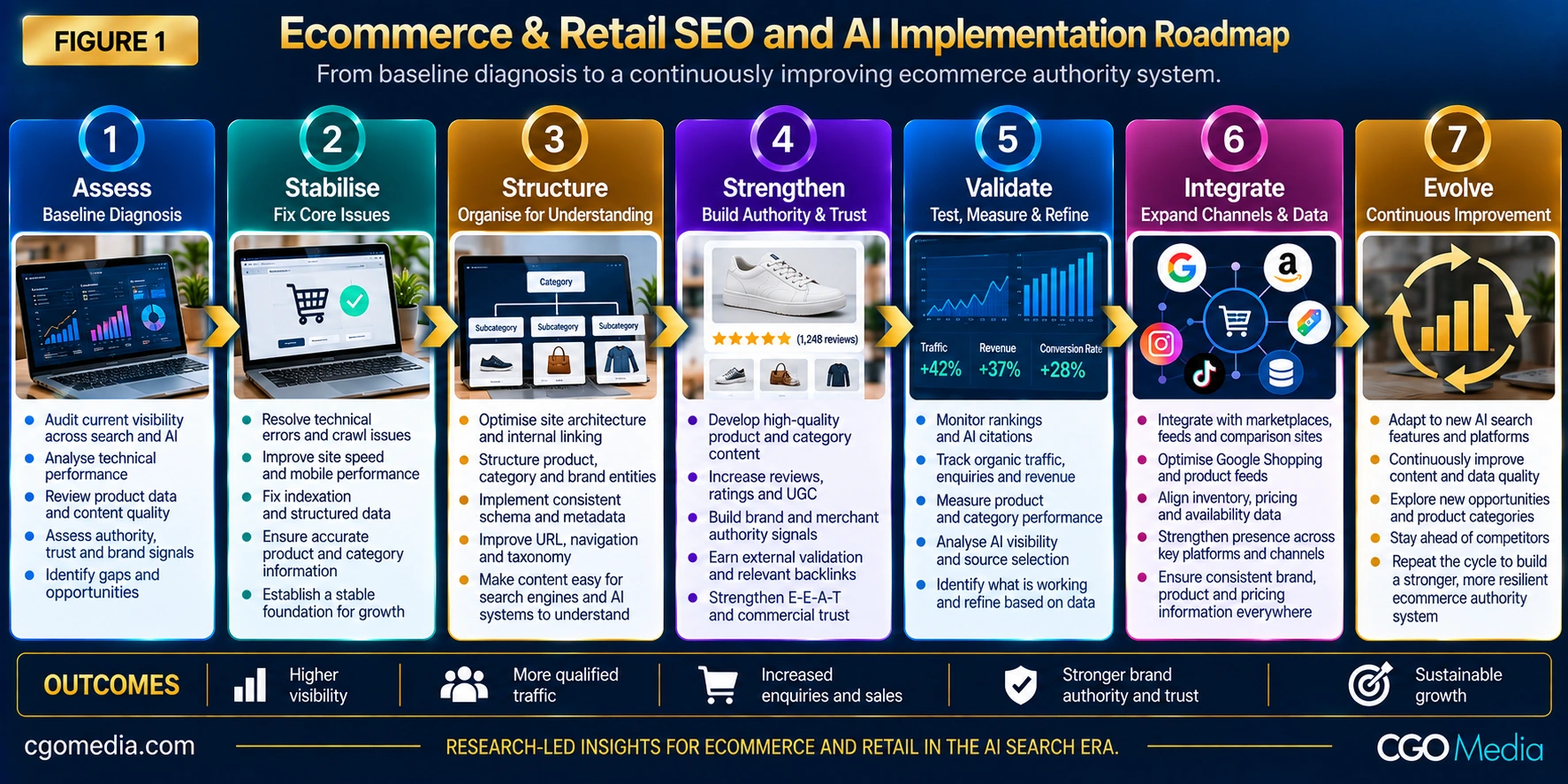
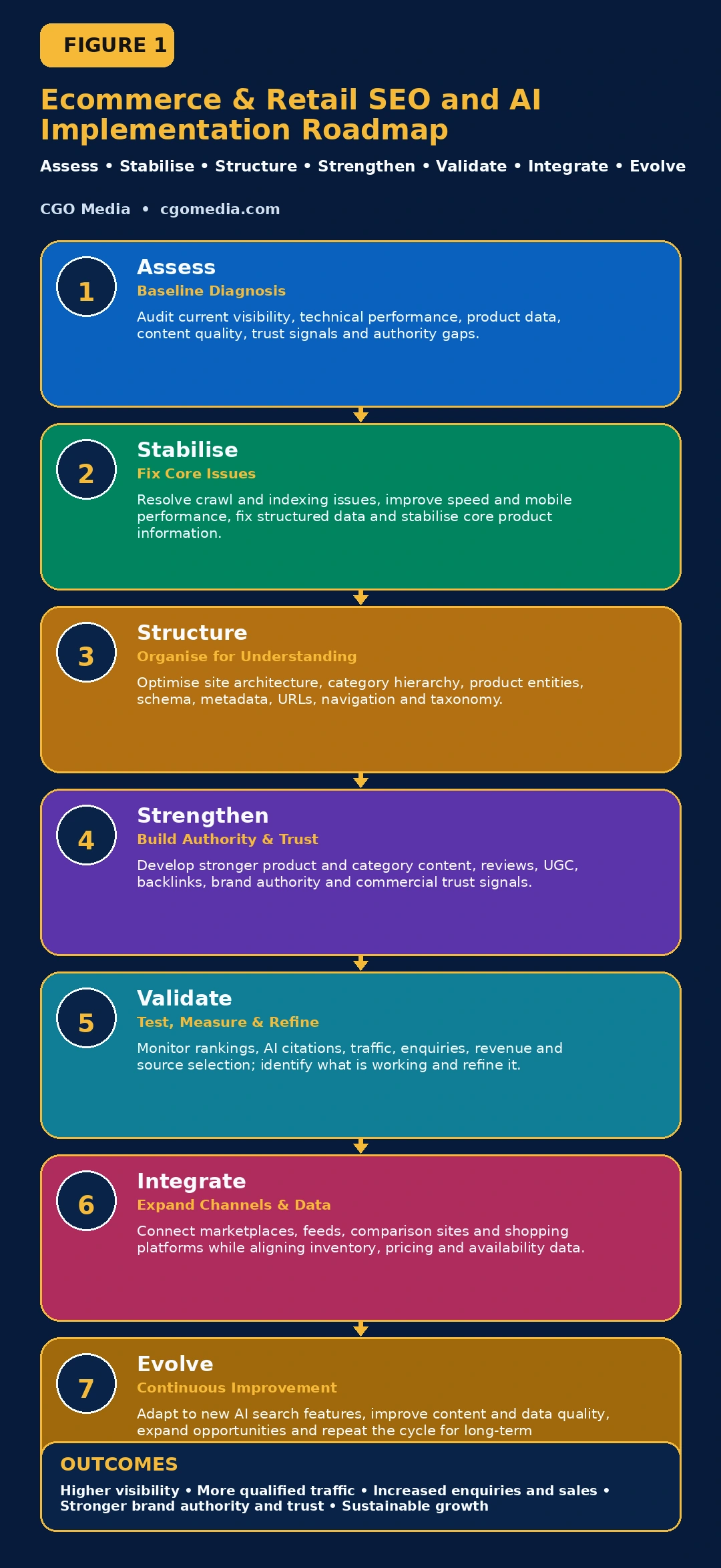
Figure 1. The Ecommerce & Retail SEO and AI Implementation Roadmap progresses through Assess, Stabilise, Structure, Strengthen, Validate, Integrate and Evolve, moving from baseline diagnosis toward a continuously improving ecommerce authority system.
21. Phase Two — Stabilise
The Stabilise phase addresses weaknesses capable of undermining every later stage of Ecommerce Search Authority development.
The priority is reliability. Before investing heavily in richer content, Digital PR or AI visibility, the organisation should ensure that search systems and shoppers can access dependable technical, product, commercial and merchant information.
The core objective is:
Reduce uncertainty before expanding authority.
22. Stabilise Technical Foundations
Priority technical problems may include:
- Indexation failures
- Broken canonicalisation
- Faceted-navigation problems
- Duplicate URLs
- Slow page performance
- Broken internal links
- Structured data errors
These issues should be prioritised according to their impact on strategically important categories and products rather than treated as an undifferentiated technical backlog.
Technical stabilisation should make the commercial architecture easier to crawl, index, interpret and maintain.
23. Stabilise Product Lifecycle Handling
The organisation should establish reliable processes for:
- New products
- Temporarily unavailable products
- Discontinued products
- Replacement models
- Seasonal products
Lifecycle status should be explicit because each state requires different search, merchandising and customer-experience treatment.
A temporarily unavailable product may justify retaining the page and offering restock information, while a discontinued product may need clear successor relationships and relevant alternatives.
24. Stabilise Price Information
Price inconsistencies should be corrected across important commercial environments.
Priority comparison points include:
- the retailer website;
- shopping feeds;
- marketplaces;
- promotional systems;
- and major comparison environments.
The organisation should identify an authoritative price source and minimise unnecessary delay between source changes and downstream commercial representation.
Stable price governance improves both shopper confidence and Product Comparison accuracy.
25. Stabilise Availability Information
Stock status should be synchronised as reliably as operational systems allow across:
- Website
- Shopping feeds
- Marketplaces
- Store inventory where applicable
Availability should be specific to the actual:
- product;
- variant;
- market;
- seller;
- and fulfilment route.
Persistent availability mismatch can turn otherwise strong Product Discovery into an unusable purchase journey.
26. Stabilise Product Specifications
Priority products should contain reliable specifications for the attributes consumers use during evaluation and comparison.
Specifications should be defined by category rather than through one generic template.
Relevant fields can include:
- dimensions;
- weight;
- capacity;
- materials;
- performance;
- compatibility;
- technical standards;
- and warranty.
Stable specification data improves filtering, comparison, feed quality and Product Fit assessment.
27. Stabilise Product Identifiers
Product identifiers should be reviewed for missing, inconsistent or incorrectly assigned values.
Reliable identifiers help reconcile the same product across:
- manufacturer systems;
- retailer catalogues;
- shopping feeds;
- marketplaces;
- and comparison platforms.
Identifier governance is especially important in large catalogues where similar models, variants and generations can otherwise become difficult to distinguish.
28. Stabilise Retailer Identity
Core retailer information should be corrected across important external platforms.
The business should be represented consistently through:
- name;
- website;
- business identity;
- locations;
- contact details;
- and official profiles.
Retailer Entity Clarity helps search, review, shopping and AI systems distinguish the merchant from brands, marketplace sellers and similarly named organisations.
29. Stabilise Brand Information
Brand naming and Product Relationships should be corrected where inconsistent.
A useful relationship is:
Brand → Product Family → Product → Variant
Brand pages, marketplace listings, manufacturer information and retailer Product Data should describe those relationships coherently enough to minimise ambiguity.
This creates a stronger foundation for Brand Authority and product recommendation later in the roadmap.
30. Stabilise Shopping Feeds
Priority feed problems should be corrected, including:
- Disapproved products
- Price mismatches
- Availability mismatches
- Image errors
- Identifier problems
The first objective is dependable participation in commercial discovery rather than feed optimisation for its own sake.
Priority products, strategic categories and high-revenue inventory should receive particular attention where feed errors affect substantial commercial visibility.
31. Stabilise Marketplace Listings
Marketplace data should be corrected where product, seller, price or availability information conflicts with the organisation’s current commercial position.
The assessment should verify:
- correct Product Identity;
- correct seller;
- current images;
- current variants;
- current price;
- current stock;
- and relevant fulfilment conditions.
Marketplace accuracy matters because shoppers may encounter the marketplace representation before visiting an owned brand or retailer website.
32. Stabilise Merchant Trust Information
Customers should be able to find current:
- Delivery information
- Returns information
- Payment information
- Customer-service details
Warranty responsibilities should also be clear where relevant.
This stage does not yet require extensive trust-building campaigns. It requires basic transaction information to be visible, accurate and understandable.
The merchant should answer:
“What happens if I buy from you?”
without unnecessary uncertainty.
33. Stabilise Measurement
Reliable tracking should exist for:
- Product views
- Add-to-cart events
- Checkout initiation
- Orders
- Revenue
- Shopping performance
- Marketplace performance
Where possible, the organisation should also preserve enough segmentation to connect commercial outcomes with:
- category;
- product;
- market;
- channel;
- and acquisition source.
Without dependable measurement, later implementation phases become harder to evaluate.
34. Phase Two Output
At the end of Stabilise, the organisation should possess a more reliable technical, catalogue, Product Data and merchant-information foundation.
The expected position is:
- priority commercial pages can be discovered and indexed appropriately;
- important Product Data is more reliable;
- price and availability errors are reduced;
- feed and marketplace problems are controlled;
- Merchant Trust information is visible;
- and commercial tracking is dependable.
The organisation is now ready to move from correcting instability toward deliberately structuring its commercial knowledge environment.
35. Phase Three — Structure
The Structure phase creates explicit relationships between retailer, catalogue, brand, product and commercial entities.
The purpose is to make the ecommerce environment understandable as a connected system rather than a collection of individual URLs.
This phase establishes the architecture required for:
- better internal linking;
- clearer Product Discovery;
- stronger entity relationships;
- better comparison;
- and machine-readable commerce evidence.
36. Structure Retailer Architecture
A useful relationship can be:
Retailer → Store or Channel → Department → Category → Brand → Product → Offer
Not every retailer requires exactly this hierarchy, but the organisation should be able to explain how its major commercial entities relate.
For omnichannel businesses, Store or Channel can also connect Product Discovery with:
- local inventory;
- click and collect;
- store reviews;
- and physical fulfilment.
37. Structure Department Architecture
Departments should group commercially meaningful category families rather than exist solely for internal merchandising convenience.
A department should help users understand a major part of the retailer’s range and provide logical paths toward:
- categories;
- brands;
- buying guidance;
- and important products.
The architecture should align internal catalogue logic with recognisable shopper language wherever practical.
38. Structure Category Architecture
Category relationships can be organised as:
Department → Category → Subcategory → Product Type → Product
Categories should provide meaningful steps between broad demand and individual products.
Structure should reflect:
- search demand;
- shopper terminology;
- Product Relationships;
- important attributes;
- and commercial priorities.
The objective is useful hierarchy rather than excessive taxonomy depth.
39. Structure Brand Architecture
Brand pages should connect:
- Brand identity
- Relevant categories
- Product ranges
- Buying guidance
- Current inventory
The brand environment should help shoppers move between:
Brand → Category → Product Family → Product
while also providing enough context to understand the brand’s relevant market position and current range.
40. Structure Product Architecture
Product pages should connect appropriately with:
- Brand
- Category
- Variants
- Specifications
- Reviews
- Offers
- Related products
The Product Page should therefore sit inside a wider information network.
Useful relationships allow users and digital systems to understand:
- where the product belongs;
- what alternatives exist;
- how configurations differ;
- and what commercial offer is currently available.
41. Structure Variant Architecture
Variants should maintain explicit relationships with their parent product while preserving meaningful differences such as:
- Size
- Colour
- Capacity
- Material
- Configuration
The organisation should distinguish between:
- minor variants belonging to one Product Identity;
- and commercially different configurations requiring stronger separation.
Variant structure should support accurate price, stock, imagery and Product Fit.
42. Structure Offer Architecture
Where products have multiple offers, relevant distinctions may include:
- Price
- Seller
- Availability
- Condition
- Delivery
This distinction is especially important within:
- marketplaces;
- multi-seller environments;
- used or refurbished commerce;
- and international retail.
The product describes what is being bought.
The offer describes the conditions under which it can be bought.
43. Structure Buying Guide Architecture
Buying guides should connect user needs with:
- Categories
- Selection criteria
- Product comparisons
- Relevant products
A strong buying guide should help users move from:
Need → Decision Criteria → Appropriate Product Type → Comparison → Product Options
Buying guides should therefore be integrated with commercial architecture rather than published as isolated editorial assets.
44. Structure Internal Linking
Internal linking should reinforce meaningful commercial relationships.
Priority connections may include:
- Department to category
- Category to subcategory
- Category to product
- Brand to product
- Buying guide to category
- Product to related product
Internal linking should help both shoppers and search systems understand:
- hierarchy;
- relevance;
- alternatives;
- and commercial importance.
The goal is connected Knowledge Architecture rather than indiscriminate link volume.
45. Structure Machine-Readable Evidence
Appropriate structured data can reinforce visible relationships using types such as:
- Organization
- Product
- Offer
- AggregateRating
- Review
- BreadcrumbList
Machine-readable evidence should accurately reflect visible page content and underlying commercial data.
Structured data is most useful when it reinforces an already coherent information environment.
It should not be treated as a replacement for:
- clear Product Information;
- accurate price;
- accurate stock;
- or understandable catalogue relationships.
46. Phase Three Output
The output of the Structure phase is a connected ecommerce knowledge architecture linking retailer identity, categories, brands, products, variants, offers and supporting evidence.
A strong Phase Three position should make relationships such as the following increasingly explicit:
Retailer → Department → Category → Brand → Product → Variant → Offer
and:
Shopper Need → Buying Guide → Category → Comparison → Product
The organisation now has a structured foundation on which deeper Product Evidence, stronger Merchant Trust, external validation and AI Search Authority can be developed.
The Ecommerce Search Authority Foundation combines the outputs of the Stabilise and Structure phases, creating a dependable technical, commercial and entity architecture before deeper authority-building activity begins.
Technical Reliability
Stable crawling, indexation, canonicalisation, internal linking, performance and structured-data implementation create the technical base for commercial discovery.
Retailer & Brand Identity
Consistent business and Brand Entity information helps distinguish retailers, manufacturers, channels, stores and marketplace sellers.
Catalogue Architecture
Departments, categories, subcategories and Product Types create a coherent commercial hierarchy connecting shopper demand with inventory.
Product Architecture
Products connect with brands, categories, variants, specifications, reviews, offers and related products through explicit relationships.
Current Commercial Data
Price, stock, lifecycle status, delivery and seller information remain sufficiently current to support real purchase decisions.
Shopping & Marketplace Data
Feeds and marketplace listings accurately distribute product identity, price, availability, imagery, identifiers and seller evidence.
Merchant Trust Foundation
Delivery, returns, payment, customer-service and warranty information provide the baseline evidence required for Retailer Confidence.
Measurement Foundation
Reliable product, cart, checkout, order, revenue, shopping and marketplace measurement provides the evidence needed to evaluate later implementation.
Foundation principle: Advanced content, External Authority and AI Recommendation activity should be built only after strategically important technical, Product Data and commercial weaknesses have been stabilised.
Structure principle: Ecommerce authority becomes easier to develop when relationships between retailer, department, category, brand, product, variant and offer are explicit rather than implicit.
Commercial-data principle: Price, availability, product lifecycle and seller information should remain sufficiently current because stale commercial evidence can invalidate otherwise strong Product Authority.
Machine-readable principle: Structured data should reinforce accurate visible information and coherent entity relationships rather than attempt to compensate for weak underlying data.
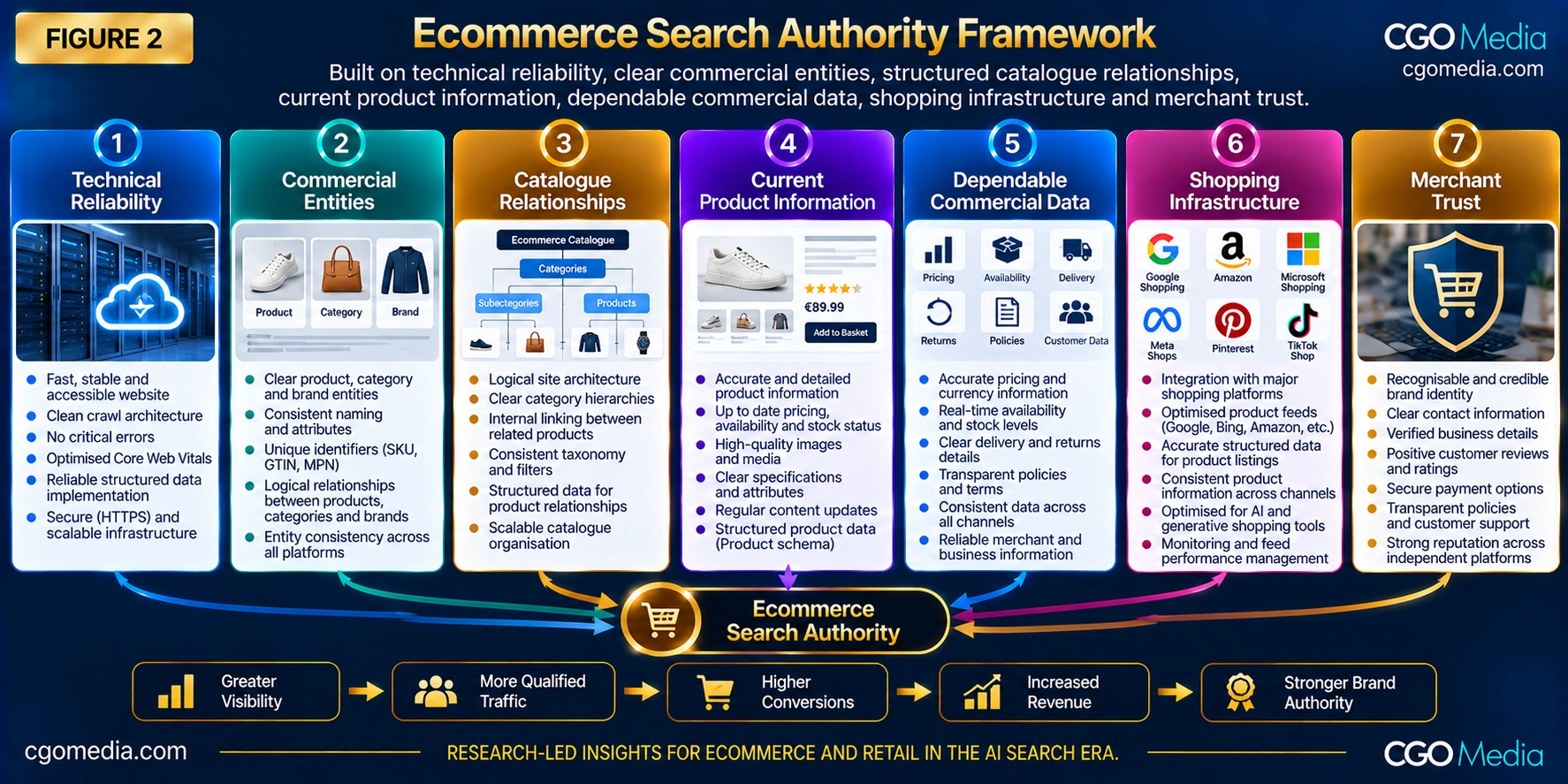
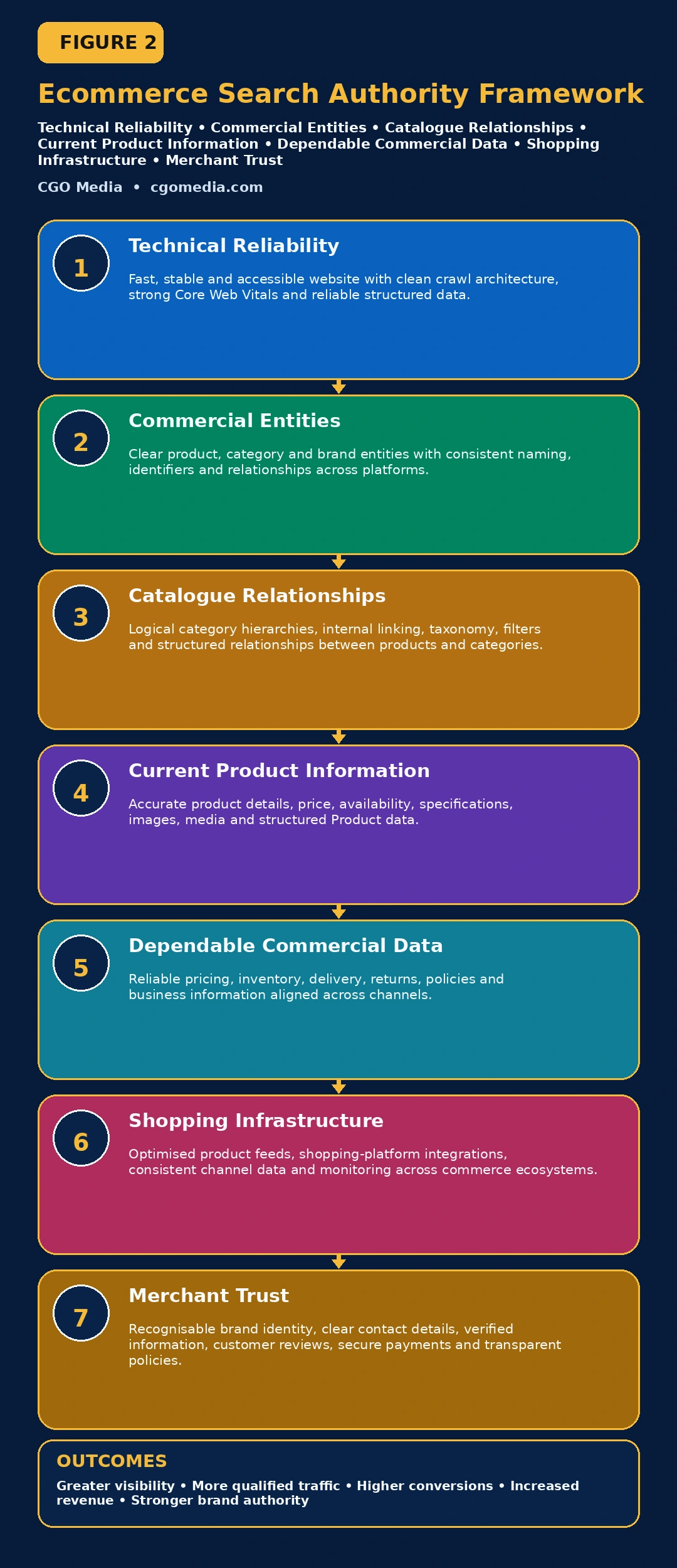
Figure 2. Ecommerce Search Authority is built on technical reliability, clear commercial entities, structured catalogue relationships, current Product Information, dependable commercial data, shopping infrastructure and Merchant Trust.
47. Phase Four — Strengthen
Once the technical and catalogue architecture is reliable, the organisation can strengthen the depth and usefulness of its product, category, brand and merchant evidence.
The objective is to move from basic information availability toward stronger decision support.
Phase Four should answer:
“Do shoppers and digital systems have enough evidence to understand why these products, brands and retailers are relevant?”
48. Strengthen Product Evidence
Priority product pages should provide richer decision evidence through:
- Detailed descriptions
- Complete specifications
- High-quality imagery
- Demonstration content
- Review evidence
- Compatibility information
Product content should explain both strengths and relevant limitations so users can determine genuine Product Fit.
The strongest pages support:
Identification → Evaluation → Comparison → Purchase Confidence
49. Strengthen Category Evidence
Priority categories should move beyond simple product grids.
Useful evidence can include:
- Category explanation
- Selection criteria
- Important attributes
- Use cases
- Subcategory guidance
- Relevant brands
Category content should help shoppers understand how to narrow a broad market into an appropriate consideration set.
The purpose is not to increase page length artificially, but to make the category more useful as a Product Discovery environment.
50. Strengthen Brand Evidence
Brand environments can be strengthened through:
- Brand history
- Product families
- Technical expertise
- Current ranges
- Independent reviews
- Retail availability
The brand should be represented as a coherent commercial entity rather than only as a filter or logo.
Brand evidence should make relationships clear across:
Brand → Category → Product Family → Product → Retail Availability
51. Strengthen Product Comparison Evidence
Comparison content should help users understand meaningful differences between products.
Useful comparison criteria can include:
- price;
- features;
- performance;
- compatibility;
- warranty;
- reviews;
- availability;
- and intended use.
Comparison should explain trade-offs rather than force every decision into one universal ranking.
52. Strengthen Use-Case Content
Use-case content can connect products with real consumer requirements such as:
- Best for travel
- Best for beginners
- Best for professional use
- Best for small spaces
- Best within a fixed budget
The purpose is to connect Product Evidence with realistic shopper contexts.
Use-case content should explain why a product fits the scenario rather than merely attach a promotional label.
53. Strengthen Product Review Evidence
Where appropriate, organisations can make verified, current and useful product reviews easier to discover and interpret.
Review presentation should help shoppers understand:
- overall sentiment;
- review volume;
- recency;
- recurring strengths;
- and recurring weaknesses.
Review evidence is most useful when connected with Product Fit rather than treated as a standalone star rating.
54. Strengthen Merchant Review Authority
Retailer review development should focus on recent and representative customer experiences.
Relevant themes include:
- delivery;
- order accuracy;
- returns;
- refunds;
- customer service;
- and problem resolution.
The objective is not simply to increase review volume.
It is to build credible evidence that the merchant delivers the transaction experience it promises.
55. Strengthen Delivery Confidence
Delivery evidence should explain:
- Costs
- Expected timescales
- Tracking
- Collection options
- Regional restrictions
Where delivery varies by product, postcode, market or fulfilment method, those differences should be made clear.
The stronger objective is:
Delivery Promise → Delivery Understanding → Delivery Confidence
56. Strengthen Returns Confidence
Returns policies should be clear enough for customers to understand likely conditions before purchasing.
Important information can include:
- return window;
- return cost;
- product-condition requirements;
- exchange options;
- refund timing;
- and exclusions.
Returns confidence can materially influence Retailer Fit where Product Fit cannot be established completely before purchase.
57. Strengthen Customer Service Visibility
Support channels should be visible and appropriate to the complexity and value of the products being sold.
Relevant evidence can include:
- contact options;
- support hours;
- technical assistance;
- order help;
- returns support;
- and warranty assistance.
Customer-service visibility reduces uncertainty around what happens when a transaction does not proceed normally.
58. Strengthen Commercial Transparency
The organisation should make important transaction conditions easy to understand, including:
- Total price
- Delivery
- Returns
- Payment options
- Warranty
Commercial transparency reduces late-stage friction and improves retailer comparison.
The customer should not need to reach checkout before discovering material conditions capable of changing the purchase decision.
59. Strengthen Original Retail Research
Original research can strengthen external authority around topics such as:
- Consumer demand
- Product trends
- Category growth
- Price behaviour
- Shopping preferences
Useful research can provide journalists, publishers and industry analysts with evidence unavailable from ordinary product pages.
Strong retail research should use transparent methodology and distinguish empirical data from observation or interpretation.
60. Strengthen Branded Validation
The organisation should examine what consumers encounter when they search for:
- Retailer reviews
- Brand reviews
- Product reviews
- Product problems
- Retailer complaints
- Returns experience
These searches often occur close to purchase and reveal the questions shoppers still need answered.
Weak branded validation can undermine strong acquisition performance if external evidence creates uncertainty immediately before conversion.
61. Phase Four Output
The Strengthen phase should leave the organisation with substantially deeper product, category, brand and merchant evidence capable of supporting discovery, evaluation, comparison and selection.
The expected outcome is stronger:
- Product Understanding;
- Category Authority;
- Brand Authority;
- Merchant Trust;
- Comparison Quality;
- and Commercial Transparency.
The organisation now has a stronger first-party evidence environment that can be tested and reinforced externally.
62. Phase Five — Validate
The Validate phase extends ecommerce authority beyond the organisation’s owned website and internal commerce systems.
The objective is to strengthen independent evidence around products, brands, retailer trust, market expertise and customer experience.
This matters because strong first-party claims become more credible when relevant external sources independently support them.
The validation principle is:
First-Party Evidence + Independent Evidence → Stronger Authority Confidence
63. Validate Retailer Identity
Important external sources should represent the retailer accurately.
These may include:
- Business profiles
- Shopping environments
- Marketplaces
- Review platforms
- Industry directories
- Social profiles
Validation should confirm that these environments consistently refer to the correct merchant, website, locations and trading identity.
64. Validate Brand Authority
Brand credibility can be strengthened through independent evidence such as:
- Product reviews
- Publisher coverage
- Retail representation
- Industry recognition
- Expert commentary
External evidence should reinforce genuine strengths rather than attempt to manufacture authority unsupported by the underlying products.
The strongest Brand Authority emerges when first-party positioning and independent evidence converge.
65. Validate Product Authority
Priority products can gain stronger external validation through:
- Independent reviews
- Comparison articles
- Buying guides
- Specialist publisher coverage
- Creator demonstrations
These sources can provide evidence around:
- performance;
- quality;
- value;
- use cases;
- and limitations.
Product Validation is particularly important where shopper decisions require more than manufacturer or retailer claims.
66. Validate Merchant Trust
Retailer trust can be reinforced through:
- Independent customer reviews
- Business reputation
- Reliable service evidence
- Industry recognition
- External merchant profiles
These sources should provide evidence that the retailer reliably performs across:
- delivery;
- service;
- returns;
- refunds;
- and transaction management.
67. Validate Customer Experience
Customer experience can be validated through current evidence involving:
- Delivery
- Returns
- Refunds
- Customer service
- Packaging
- Problem resolution
The organisation should compare its stated customer proposition with the outcomes customers actually report.
Repeated differences between promise and experience should feed back into operational improvement.
68. Validate Category Expertise
Specialist retailers and brands can strengthen Category Authority through:
- Expert commentary
- Buying guides
- Research
- Publisher contributions
- Industry participation
Category expertise should demonstrate genuine understanding of:
- products;
- customer needs;
- market developments;
- and selection criteria.
This can help distinguish specialist authority from simple catalogue breadth.
69. Validate Through Product Publishers
Specialist product publications can reinforce authority through:
- Reviews
- Comparisons
- Buying guides
- Expert recommendations
Relevant publisher validation can expose products to shoppers during the stage where independent evidence is actively being sought.
The most valuable coverage is normally relevant, evidence-led and connected with real Product Strength.
70. Validate Through Consumer Media
Consumer publications can provide broader independent validation around:
- Product quality
- Retail trends
- Value
- Shopping behaviour
- Customer experience
This type of coverage can connect products and retailers with wider consumer conversations beyond narrow specialist audiences.
71. Validate Through Industry Media
Industry publications can reinforce expertise around:
- Retail technology
- Ecommerce operations
- Consumer trends
- Category development
- Market innovation
Industry validation can strengthen corporate and commercial authority, particularly where the retailer or brand contributes useful data, expertise or operational insight.
72. Research-Led Digital PR
Retailers and brands can create original research around topics such as:
- Consumer demand
- Shopping behaviour
- Price sensitivity
- Product trends
- Category growth
- Seasonal purchasing
The strongest research-led Digital PR starts with useful evidence rather than a promotional headline.
Useful assets can include:
- datasets;
- trend analysis;
- statistics;
- research reports;
- and expert interpretation.
These assets can support both External Authority and Citation Authority.
73. Citation Authority Development
Citation Authority develops when credible external sources repeatedly associate the organisation, brand or research with strategically important products, categories or market expertise.
Potential citation sources include:
- journalists;
- industry publishers;
- researchers;
- specialist publications;
- comparison resources;
- and other credible external websites.
The objective should be to become a useful source of evidence rather than merely acquire mentions.
74. Validate Marketplace Reputation
Marketplace seller authority can also contribute to the wider evidence environment through:
- Seller ratings
- Fulfilment performance
- Customer feedback
- Returns history
Marketplace reputation should be assessed separately from platform-level trust.
A strong marketplace seller profile can provide additional validation around:
- service reliability;
- delivery;
- transaction volume;
- and customer satisfaction.
75. Phase Five Output
The Validate phase should create a stronger independent evidence environment around strategically important products, brands, categories and merchant capabilities.
The organisation should now possess a broader authority footprint across:
- Product Publishers;
- Consumer Media;
- Industry Media;
- Review Platforms;
- Marketplaces;
- Comparison Environments;
- Research Citations;
- and external Merchant Profiles.
This marks an important transition.
The organisation is no longer relying only on what it says about itself.
Its strongest products, categories, expertise and merchant capabilities are increasingly reinforced by credible independent evidence.
The resulting progression is:
First-Party Product Evidence → External Validation → Citation Authority → Stronger Recommendation Confidence
The Ecommerce External Validation Architecture shows how Product Authority, Brand Authority, Merchant Trust and Category Expertise extend beyond owned ecommerce environments into independent sources that can reinforce credibility and recommendation confidence.
Product Publishers
Independent reviews, specialist testing, comparisons and buying guides provide external evidence around Product Quality, Product Fit, value and limitations.
Consumer Media
Consumer publications can validate product quality, retail trends, value, shopping behaviour and customer-experience themes for broader audiences.
Industry Media
Retail and ecommerce publications can reinforce expertise around technology, operations, category development, consumer trends and market innovation.
Customer Reviews
Current customer evidence validates real outcomes involving product performance, delivery, returns, refunds, service and problem resolution.
Comparison Environments
Comparison sources provide independent context around product differences, prices, retailer options, availability and relevant alternatives.
Marketplaces
Seller ratings, fulfilment history, customer feedback and returns experience provide additional Merchant Authority evidence outside the owned website.
Original Research
Consumer studies, trend analysis, pricing research and category data can create useful evidence that journalists, analysts and publishers may reference independently.
Research Citations
Repeated citation by credible external sources can strengthen association between the organisation and strategically important products, categories or market expertise.
Validation principle: Ecommerce authority becomes stronger when important first-party claims are supported by credible independent evidence rather than relying exclusively on owned Product and Brand Content.
Product principle: Reviews, testing, comparisons and specialist publisher coverage can validate Product Quality, Product Fit and competitive strengths.
Merchant principle: Customer reviews, marketplace reputation and external merchant profiles can validate whether delivery, returns, service and transaction reliability match the retailer’s stated proposition.
Citation principle: Research-led Digital PR can develop longer-term Citation Authority when original data, analysis and expertise become genuinely useful to credible external sources.
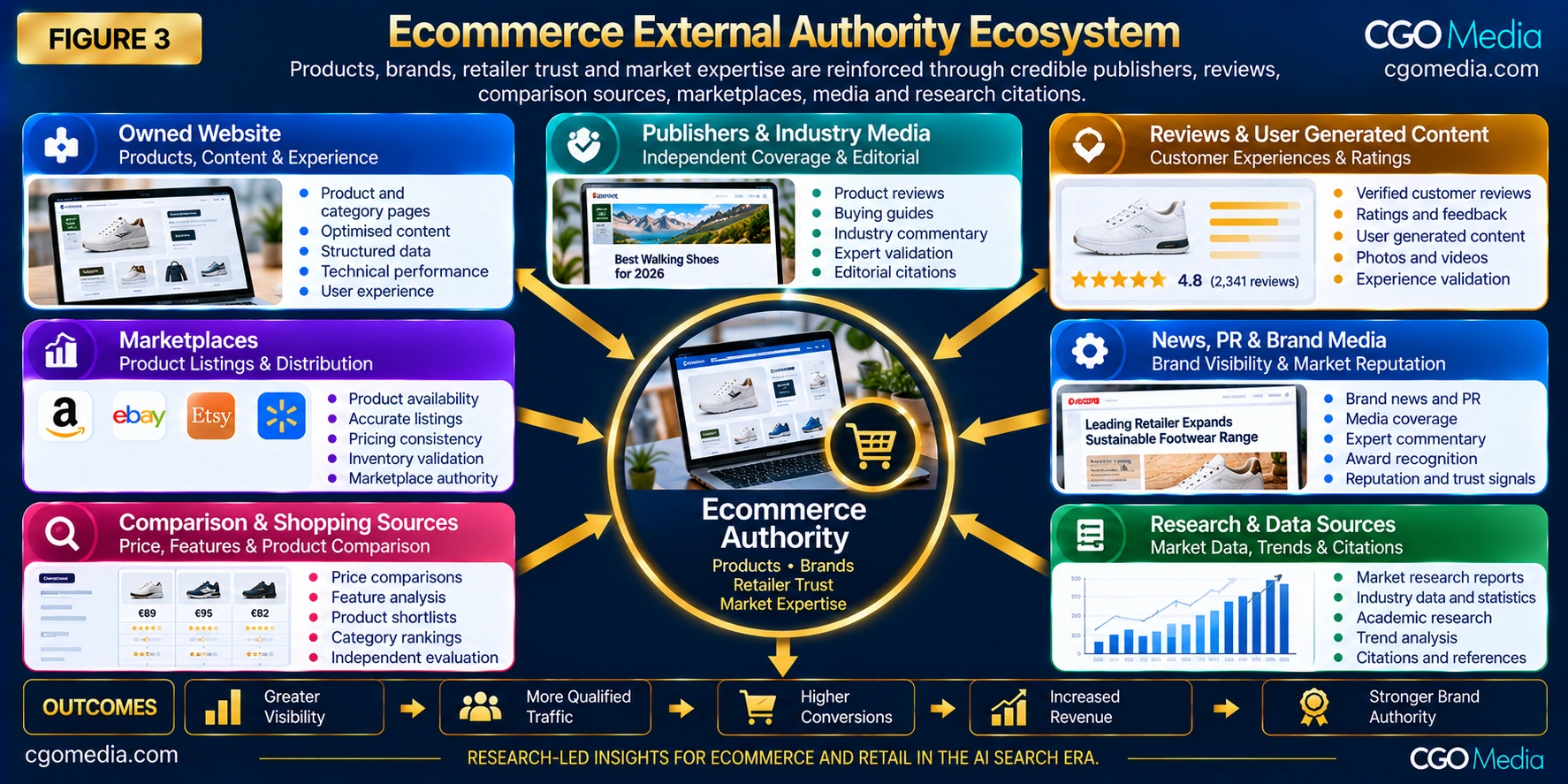
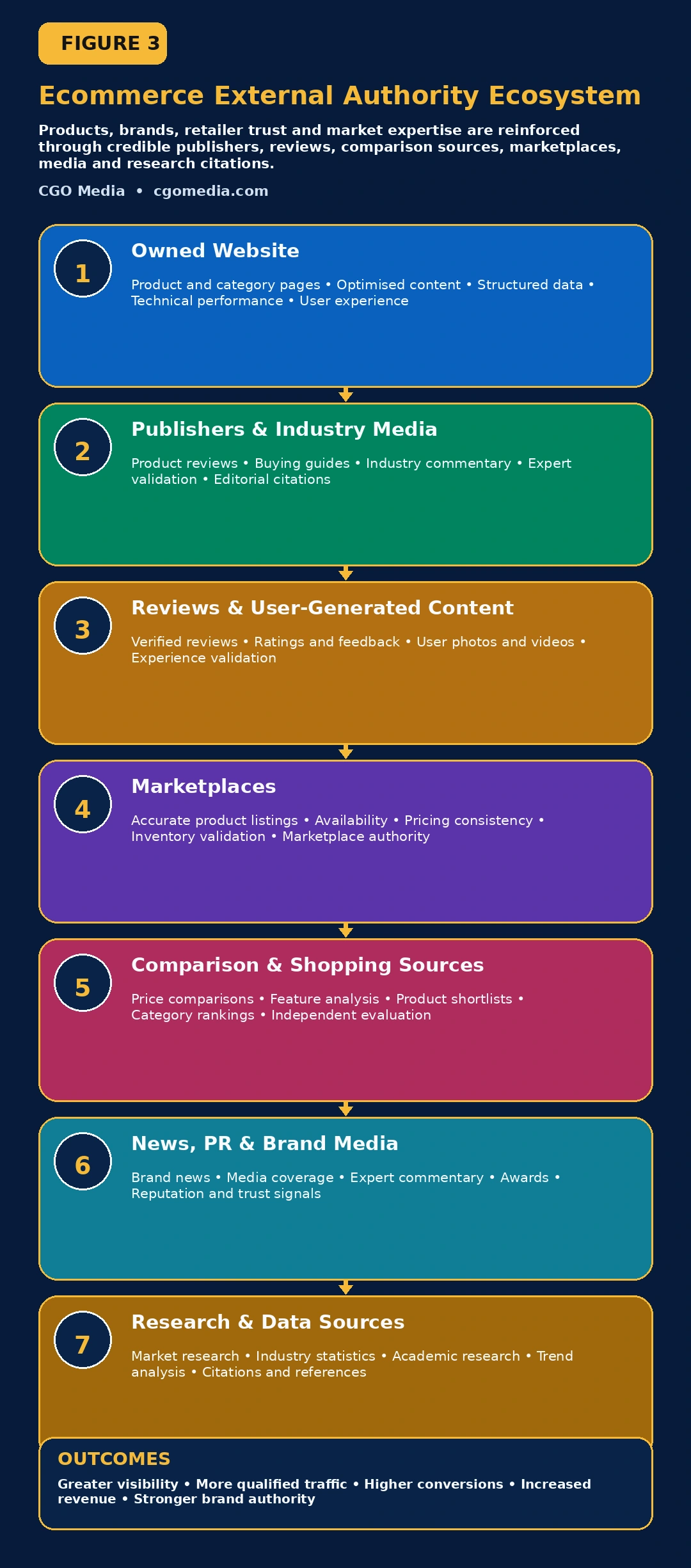
Figure 3. Ecommerce authority extends beyond owned websites when products, brands, retailer trust and market expertise are reinforced through credible publishers, reviews, comparison sources, marketplaces, media and research citations.
76. Phase Six — Integrate
The Integrate phase connects Technical SEO, Catalogue Management, Product Data, shopping feeds, marketplaces, reviews, Digital PR, Customer Experience and AI Visibility into one operating system.
Earlier phases establish reliable foundations, structured relationships, stronger evidence and external validation.
Integration ensures those capabilities no longer operate as separate workstreams.
The objective is:
Search Intelligence + Product Intelligence + Commercial Intelligence + Customer Intelligence → Integrated Ecommerce Authority
This matters because Product Discovery and Retailer Selection depend on information generated by multiple teams.
SEO may understand search demand, while:
- Merchandising understands commercial priorities;
- Product Data teams understand catalogue attributes;
- Pricing teams understand competitiveness;
- Customer Experience teams understand friction;
- and Digital PR teams understand external authority.
The Integrate phase brings those signals together.
77. Integrate SEO and Merchandising
Search and merchandising teams should coordinate around:
- Category architecture
- Product priorities
- Seasonal demand
- Product launches
- Internal linking
SEO can identify how customers search, while merchandising understands which categories and products matter commercially.
Combining both perspectives improves prioritisation.
Category Architecture
Search demand can inform whether category structure reflects real customer language, while merchandising can ensure the structure also supports commercial range and inventory.
Product Priorities
High-revenue, high-margin, strategic or newly launched products may deserve stronger internal support where genuine search demand exists.
Seasonal Demand
Search data can help anticipate seasonal shifts before peak trading periods begin.
Product Launches
New products should enter the catalogue with:
- correct categorisation;
- complete Product Data;
- internal linking;
- feed inclusion;
- and relevant launch content.
Internal Linking
Merchandising and SEO should jointly reinforce relationships between:
- priority categories;
- new products;
- brands;
- buying guides;
- and seasonal collections.
78. Integrate SEO and Product Data
Search teams should work closely with Product Data owners to improve:
- Titles
- Specifications
- Identifiers
- Variants
- Lifecycle status
- Structured data
Product Data increasingly forms part of search infrastructure because the same fields influence:
- organic discovery;
- shopping feeds;
- marketplaces;
- filters;
- comparison;
- and AI-assisted Product Discovery.
Search teams can identify information gaps revealed through shopper language, while Product Data teams can improve the underlying catalogue source rather than repeatedly patching individual pages.
The preferred model is:
Improve Source Product Data Once → Distribute Better Evidence Across Multiple Channels
79. Integrate SEO and Pricing Intelligence
Pricing data can inform search and merchandising strategy by revealing:
- Price competitiveness
- Margin constraints
- Promotional opportunities
- Price-sensitive demand
Search teams should not determine pricing policy, but pricing intelligence can improve interpretation of commercial search performance.
Price Competitiveness
A product may have strong visibility but weak conversion because competitors offer materially better pricing.
Margin Constraints
High search demand does not automatically mean aggressive promotion is commercially sensible.
Promotional Opportunities
Search demand can help identify categories where a temporary price change may have greater visibility impact.
Price-Sensitive Demand
Queries containing:
- cheap;
- budget;
- under £X;
- deal;
- or discount
can reveal segments where price plays a particularly strong role in Product Selection.
80. Integrate SEO and Customer Search Behaviour
Internal site search and external search data can reveal:
- Emerging product demand
- Popular attributes
- New use cases
- Changing terminology
- Unmet catalogue demand
External search shows how potential customers describe needs before reaching the retailer.
Internal search shows what customers look for once they are already inside the ecommerce environment.
Together, these datasets can identify:
- missing products;
- weak navigation;
- unclear category names;
- new attributes;
- and emerging customer priorities.
Search behaviour therefore becomes a source of Product and Merchandising Intelligence rather than only an acquisition metric.
81. Integrate SEO and Review Intelligence
Review data can improve:
- Product descriptions
- Buying guides
- Category content
- Customer-service messaging
- Product selection
Reviews provide direct evidence of how customers experience products after purchase.
Recurring themes can reveal information missing from existing Product Content.
For example, repeated review comments may show that shoppers care strongly about:
- fit;
- battery life;
- assembly difficulty;
- noise;
- durability;
- or compatibility.
These themes can then improve pre-purchase guidance.
The feedback loop becomes:
Customer Experience → Review Insight → Better Product Information → Better Product Fit
82. Integrate SEO and Returns Intelligence
Returns data can reveal weaknesses in:
- Size information
- Compatibility guidance
- Product descriptions
- Visual representation
- Expectation setting
Returns are particularly valuable because they reveal cases where acquisition succeeded but Product Fit failed.
Size Information
High size-related returns may indicate weak:
- dimensions;
- fit guidance;
- or sizing explanations.
Compatibility Guidance
Compatibility-related returns can identify missing Product Evidence around:
- devices;
- standards;
- software;
- or accessories.
Visual Representation
Returns caused by unexpected:
- colour;
- scale;
- finish;
- or appearance
can indicate weak imagery.
Returns Intelligence should therefore feed directly into Product Content and merchandising improvement.
83. Integrate Shopping Feed Governance
Shopping feed management should connect directly with primary catalogue and inventory systems.
The strongest operating model reduces manual divergence between:
- product-page data;
- feed data;
- inventory;
- pricing;
- and promotional systems.
Priority feed fields should have clear ownership, including:
- titles;
- identifiers;
- price;
- availability;
- images;
- and category mapping.
Feed errors should be treated as commercial system issues rather than isolated marketing-platform problems.
84. Integrate Marketplace Intelligence
Marketplace data can provide useful intelligence around:
- Product demand
- Price competitiveness
- Seller performance
- Review trends
- Category competition
Marketplaces can reveal patterns that may not be visible through the owned ecommerce website alone.
Product Demand
Sales and visibility can reveal which products gain traction within a marketplace-led discovery environment.
Price Competitiveness
Multiple sellers can provide near-immediate evidence of relative market price.
Seller Performance
Seller ratings and fulfilment outcomes can indicate Merchant Trust strengths or weaknesses.
Review Trends
Large review volumes can reveal recurring Product Strengths, weaknesses and emerging customer concerns.
Category Competition
Marketplace rankings and product density can reveal:
- new competitors;
- new brands;
- and changing category structures.
Marketplace Intelligence should therefore inform Product, Pricing and Search Strategy where relevant.
85. Integrate Digital PR and Commercial Priorities
Digital PR should reinforce strategically important:
- Categories
- Brands
- Product expertise
- Original research
- Seasonal commercial themes
Authority-building activity should connect with commercial priorities rather than operate as an unrelated publicity programme.
Category Priorities
Research and commentary can reinforce categories where the organisation wants stronger long-term authority.
Brand Priorities
External coverage can strengthen recognition around strategically important owned or represented brands.
Product Expertise
Specialist commentary can demonstrate genuine knowledge around:
- Product Selection;
- technical criteria;
- market developments;
- and customer behaviour.
Original Research
Data-led assets can create recurring citation opportunities when they provide useful evidence to journalists and researchers.
Seasonal Commercial Themes
Research and media activity can be timed around relevant:
- shopping periods;
- product launches;
- or changing consumer trends.
86. Integrate AI Source Monitoring
The organisation should identify which sources repeatedly influence AI-generated product and retailer recommendations.
Where source visibility can be observed, analysis can include:
- brand websites;
- retailer websites;
- marketplaces;
- publishers;
- comparison platforms;
- review environments;
- and original research.
The objective is not to assume a fixed AI source hierarchy.
It is to identify recurring external evidence patterns across repeatable shopper scenarios.
This can reveal where the organisation lacks sufficient representation within the wider information ecosystem.
87. Integrate AI Citation Monitoring
Where citations are available, organisations should monitor whether their own:
- Product information
- Buying guides
- Research
- Category expertise
are being referenced.
Citation monitoring can help determine which assets are sufficiently useful or authoritative to be surfaced as supporting sources.
Useful analysis can record:
- which pages receive citations;
- which topics generate citations;
- which competitors receive citations;
- and whether the cited information is current.
Citation visibility should be treated as one authority signal rather than as a standalone definition of AI Search success.
88. Integrate AI Recommendation Monitoring
Repeatable prompt sets should cover realistic scenarios involving:
- Product recommendations
- Best-for-use-case recommendations
- Brand comparisons
- Retailer comparisons
- Budget-led searches
- Feature-led searches
The monitoring programme should use stable prompt families so changes can be evaluated over time.
Each observation can record:
- products included;
- brands included;
- retailers included;
- competitors;
- recommendation reasoning;
- sources where observable;
- and date of observation.
The key objective is to understand:
Relevant Recommendation Visibility
rather than simply counting mentions.
89. Integrate AI Accuracy Monitoring
Generated answers should be reviewed for material inaccuracies involving:
- Price
- Availability
- Product specification
- Brand relationships
- Retailer policies
- Product lifecycle
Accuracy becomes particularly important as shoppers move closer to purchase.
Price and Availability
Incorrect commercial data can produce unusable recommendations.
Product Specification
Incorrect specifications can cause inappropriate Product Fit.
Brand Relationships
Systems may occasionally confuse:
- manufacturer;
- brand;
- retailer;
- or seller.
Retailer Policies
Outdated information around:
- delivery;
- returns;
- or warranty
can distort Merchant Fit.
Product Lifecycle
Older or discontinued products should not be represented automatically as current models.
AI monitoring should therefore measure:
Visibility + Relevance + Accuracy + Freshness
rather than visibility alone.
90. Integrate Competitor Intelligence
Competitor monitoring should combine:
- Search visibility
- Category authority
- Price
- Product range
- Reviews
- Marketplace presence
- Publisher authority
- AI recommendation visibility
The purpose is to understand why competitors gain stronger consideration within important shopper journeys.
A competitor may be stronger because of:
- better technical visibility;
- deeper Product Evidence;
- stronger pricing;
- more reviews;
- better merchant reputation;
- greater publisher coverage;
- or stronger AI Recommendation Visibility.
Integrated competitor intelligence helps distinguish:
SEO Gaps
from:
Commercial, Product, Authority or Evidence Gaps.
91. Integrate Commercial Measurement
Search-authority reporting should connect with:
- Product views
- Add-to-cart events
- Checkout
- Orders
- Revenue
- Margin where appropriate
- Repeat purchase
The objective is to move beyond isolated SEO reporting.
For example:
- strong visibility with weak Product Views can indicate relevance problems;
- strong Product Views with weak Add to Cart can indicate Product Fit or pricing problems;
- strong cart activity with weak checkout can indicate transaction friction;
- strong sales with high returns can indicate Product Expectation problems.
Where data availability permits, search reporting should therefore connect:
Visibility → Product Engagement → Commercial Action → Customer Outcome
This creates a stronger measurement model for Qualified Ecommerce Performance.
92. The Integrated Ecommerce Authority System
At this stage, the organisation begins operating a connected system:
Search → Product Evidence → Catalogue Authority → Merchant Trust → External Validation → AI Visibility → Product Selection → Commercial Outcomes
Each component strengthens the next.
Search Creates Discovery
Technical SEO, categories, products, feeds and marketplaces create entry points into the shopping journey.
Product Evidence Creates Understanding
Specifications, imagery, reviews, variants and use-case information help determine Product Fit.
Catalogue Authority Creates Structure
Clear relationships between:
- departments;
- categories;
- brands;
- products;
- and variants
make the range easier to navigate and interpret.
Merchant Trust Creates Purchase Confidence
Delivery, returns, service, payment and reputation help determine whether the retailer is an appropriate transaction partner.
External Validation Creates Independent Confidence
Publishers, customers, marketplaces, comparison sources and research citations reinforce important claims beyond owned channels.
AI Visibility Creates an Additional Discovery Layer
Generative systems can compress:
- category discovery;
- Product Comparison;
- brand evaluation;
- and Retailer Selection.
Product Selection Connects Evidence with Shopper Need
The strongest outcome is not universal inclusion.
It is accurate matching between:
- shopper requirement;
- Product Fit;
- Retailer Fit;
- and current commercial conditions.
Commercial Outcomes Complete the System
Orders, revenue, returns, satisfaction and repeat purchase provide evidence of whether the complete authority system is generating qualified commercial value.
The Integrate phase therefore transforms Ecommerce Search from a marketing activity into a broader organisational intelligence capability.
The Integrated Ecommerce Search Authority System connects technical discovery, Catalogue Architecture, Product Evidence, Merchant Trust, External Authority, AI Representation, Product Selection and Commercial Outcomes into one coordinated ecommerce operating model.
1. Search & Discovery
Technical SEO, category visibility, Product Visibility, shopping feeds, marketplaces and supporting content create access to relevant shopper journeys.
2. Product Evidence
Specifications, variants, imagery, compatibility, reviews, pricing and availability help establish Product Understanding and Product Fit.
3. Catalogue Authority
Departments, categories, brands, Product Families, products and variants create a structured commercial knowledge environment.
4. Merchant Trust
Delivery, returns, payment, warranty, service and reputation determine whether the retailer provides a credible purchase route.
5. External Validation
Publishers, reviews, marketplaces, comparison environments, industry media and research citations provide independent supporting evidence.
6. AI Visibility
AI-assisted discovery can synthesise Product, Brand, Merchant and external evidence into shortlists, comparisons and recommendations.
7. Product & Retailer Selection
Shopper need, Product Fit, Retailer Fit, trust evidence and current commercial conditions determine qualified purchase options.
8. Commercial Outcomes
Product engagement, Add to Cart, checkout, orders, revenue, returns, satisfaction and repeat purchase show whether the complete authority system creates commercial value.
Integration principle: Modern Ecommerce Search Authority becomes stronger when SEO, Product Data, Merchandising, Pricing, Reviews, Marketplaces, Digital PR, Customer Experience and AI monitoring operate as connected information systems rather than isolated functions.
Intelligence principle: Search, reviews, returns, marketplace data and AI observations can provide valuable commercial intelligence when they are integrated with Product and Merchandising decision-making.
Measurement principle: Search Authority should be connected with Product Engagement, Commercial Outcomes and post-purchase behaviour so visibility is evaluated through its contribution to Qualified Ecommerce Performance.
AI principle: AI Visibility becomes one layer within the wider ecommerce authority system, connecting Product Evidence, External Validation and Merchant Trust with emerging recommendation environments.
Figure 4. Integrated Ecommerce Search Authority connects Technical Discovery with Product Evidence, Catalogue Structure, Merchant Trust, External Authority, AI Representation, Product Selection and measurable Commercial Outcomes.
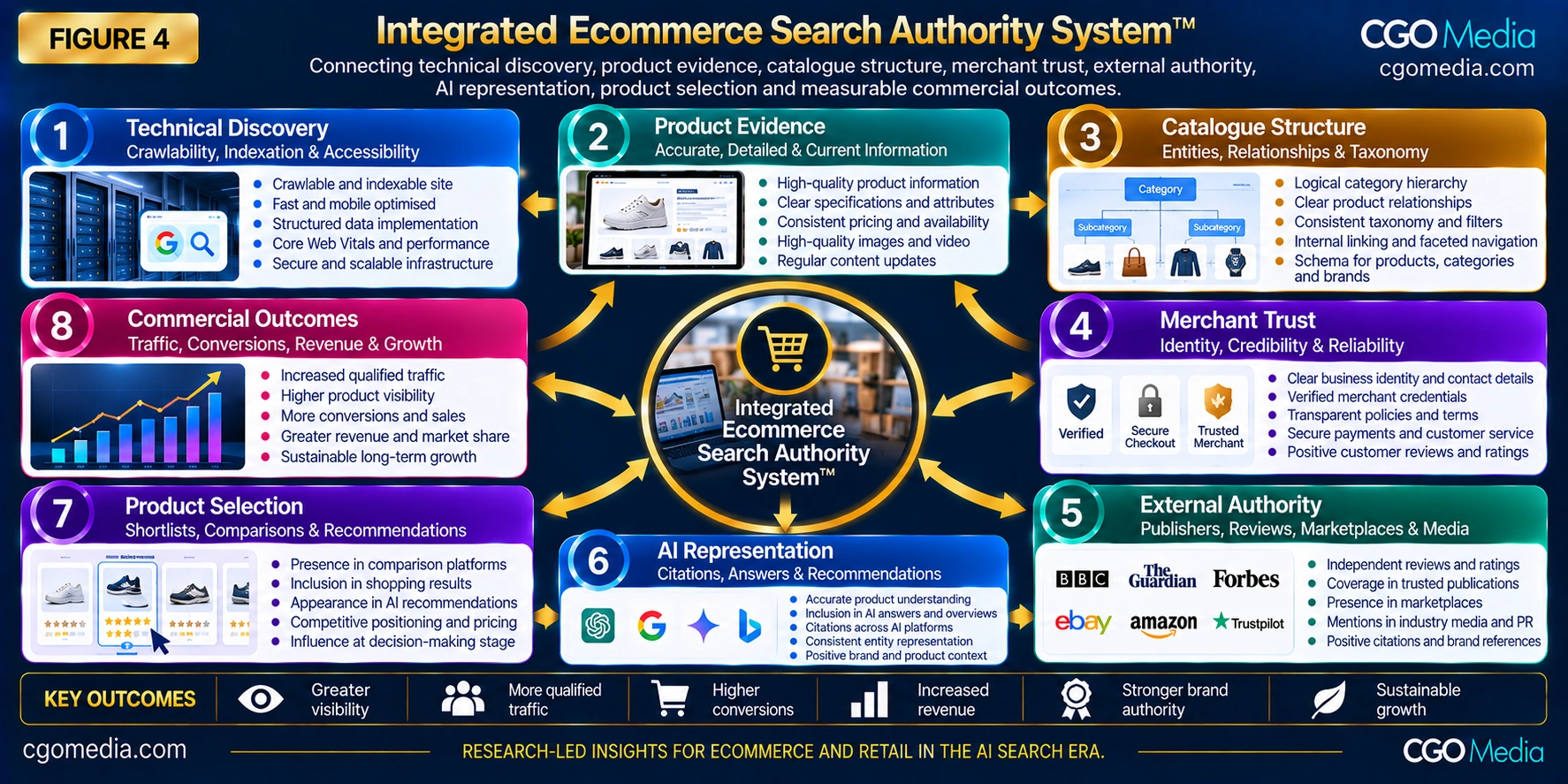
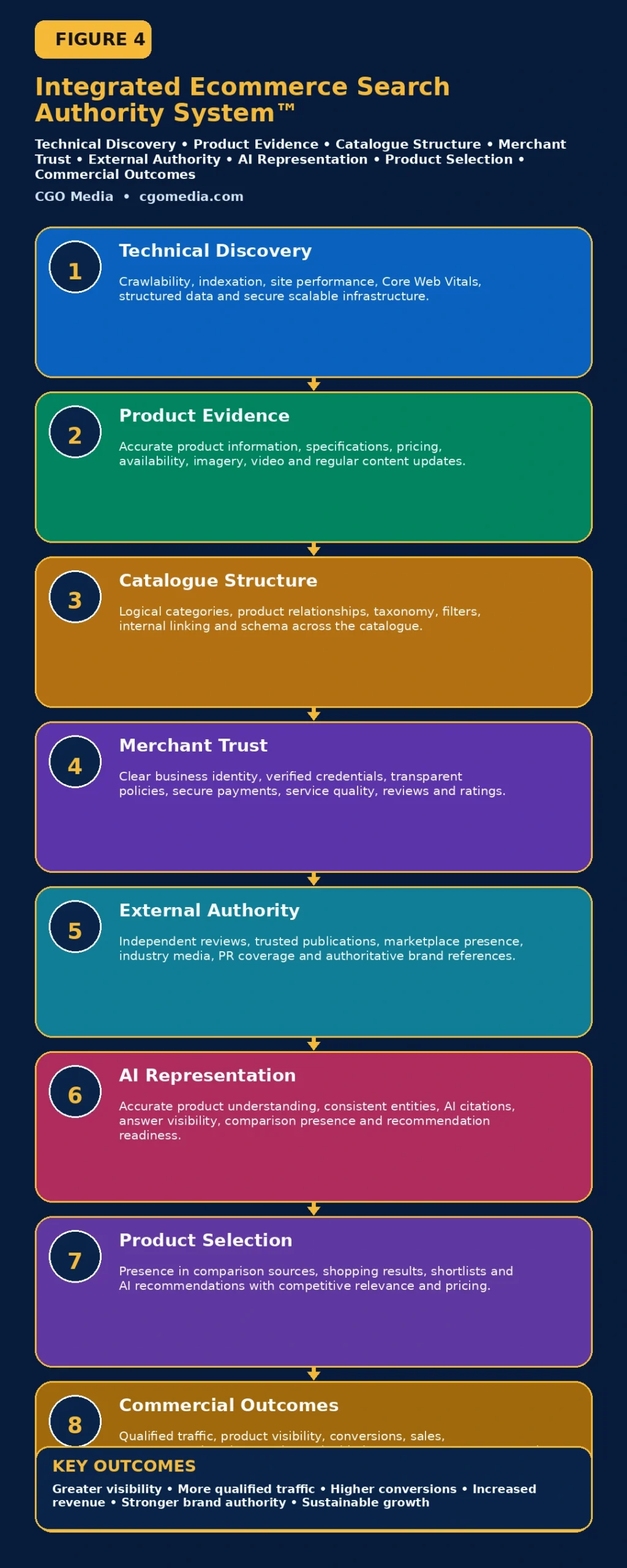
93. Phase Seven — Evolve
The Evolve phase transforms Ecommerce Search Authority from a project into a continuous operating capability.
The organisation should now be capable of adapting as:
- Products change
- Prices move
- Stock changes
- Categories evolve
- Competitors change
- Consumer behaviour shifts
- AI systems develop
The objective is not constant tactical reaction.
It is to create a disciplined system that observes change, identifies material movement and updates the organisation’s search, product and commercial evidence accordingly.
The Evolve phase therefore moves the organisation toward:
Continuous Observation → Diagnosis → Prioritisation → Improvement → Validation → Learning
94. Continuous Technical Monitoring
Technical monitoring should identify:
- Indexation problems
- Crawl inefficiencies
- Performance degradation
- Faceted-navigation issues
- Structured data errors
- Platform problems
Large ecommerce websites change continuously as products, filters, categories and platform functionality are added or removed.
Technical monitoring should therefore focus particularly on commercially important areas where technical change could affect large numbers of products.
Priority monitoring can include:
- strategic categories;
- high-revenue products;
- new launches;
- and major platform releases.
95. Continuous Catalogue Monitoring
The organisation should monitor:
- New categories
- Category changes
- New brands
- New products
- Variants
- Discontinued products
Catalogue monitoring protects the Knowledge Architecture established during earlier phases.
New products should enter the correct:
- department;
- category;
- brand;
- Product Family;
- and variant structure.
Likewise, discontinued or replaced products should be handled deliberately so Product Relationships remain clear over time.
96. Continuous Price Monitoring
Price changes should be reflected consistently throughout distributed commercial environments.
Monitoring should identify:
- website-feed mismatches;
- expired promotions;
- marketplace divergence;
- unexpected pricing changes;
- and competitor movement.
Price Intelligence can also reveal when products move into new competitive or shopper segments.
A premium product may become a strong value option after discounting, while a previously competitive product can lose recommendation relevance after a price increase.
97. Continuous Availability Monitoring
Stock monitoring should identify:
- Low stock
- Out of stock
- Restocked products
- Pre-orders
- Discontinued products
Availability changes can alter Product Discovery Eligibility immediately.
Monitoring should therefore connect inventory changes with:
- product pages;
- shopping feeds;
- marketplaces;
- merchandising;
- and recommendation monitoring.
Restocked products should be able to re-enter appropriate consideration environments quickly, while permanently discontinued products should not continue appearing as current standard options.
98. Continuous Product Evidence Development
Product information should evolve as:
- Specifications change
- New customer questions emerge
- Reviews reveal information gaps
- Product variants expand
- New media assets become available
Product pages should therefore not be treated as static documents created once at launch.
Useful evidence can be strengthened when new information emerges around:
- compatibility;
- use cases;
- common questions;
- limitations;
- comparison criteria;
- or Product Fit.
The strongest Product Evidence environment continuously incorporates learning from real customer behaviour.
99. Continuous Merchant Trust Development
Merchant Trust should evolve according to:
- Review themes
- Delivery performance
- Returns behaviour
- Customer-service feedback
- Payment expectations
Retailer Trust is not fixed.
Customer expectations can change around:
- delivery speed;
- free returns;
- digital payment;
- support channels;
- and refund timing.
The organisation should compare its stated merchant proposition with current customer evidence and improve weak areas where recurring patterns appear.
100. Continuous External Authority Development
Relevant authority can continue developing through:
- Product publishers
- Consumer publications
- Industry media
- Comparison environments
- Research citations
External Authority should evolve alongside the organisation’s commercial priorities.
As new categories, products and markets become strategically important, authority-building activity can shift accordingly.
The objective is to maintain credible independent evidence around the areas where the organisation most needs discovery and recommendation strength.
101. Continuous AI Monitoring
The organisation should monitor changes in:
- Product recommendations
- Brand recommendations
- Retailer recommendations
- Source selection
- Citation patterns
- Competitor visibility
AI monitoring should be longitudinal because individual responses can vary.
The more useful objective is to identify recurring patterns such as:
- consistent Product Inclusion;
- persistent Product Exclusion;
- changing competitive sets;
- new source patterns;
- or repeated representation inaccuracies.
Stable prompt families make those changes easier to interpret.
102. Continuous Competitor Monitoring
Competitor changes may include:
- New products
- New categories
- Price changes
- Review growth
- Marketplace expansion
- Publisher coverage
- AI visibility changes
Competitor monitoring should focus on changes that materially affect shopper consideration.
A competitor may strengthen because of:
- better Product Data;
- a new product range;
- stronger pricing;
- more independent validation;
- or improved Merchant Trust.
The organisation should therefore investigate the evidence behind competitive movement rather than react only to ranking changes.
103. Continuous Consumer Intelligence
Search, review, return and sales data can reveal:
- Changing feature demand
- Emerging products
- New use cases
- Price sensitivity
- Category growth
- Brand shifts
These signals can provide early evidence of market change.
For example, repeated searches for a feature not currently represented in filters or Product Content may indicate:
- changing shopper priorities;
- a new category requirement;
- or unmet catalogue demand.
Likewise, returns or review evidence can reveal where existing Product Information no longer matches customer expectations.
104. Search as Retail Strategy Intelligence
At higher maturity, search and AI data can inform:
- Merchandising
- Category expansion
- Product development
- Pricing strategy
- Content priorities
- Retail positioning
Search therefore becomes more than an acquisition channel.
It can provide evidence about:
- what customers want;
- how they describe products;
- which features are becoming important;
- which competitors are gaining authority;
- and where new commercial opportunities may exist.
The strategic progression becomes:
Search Measurement → Search Intelligence → Retail Intelligence → Commercial Decision Support
105. Continuous Governance
Authority development should have defined owners, review cycles and escalation processes.
Governance should clarify responsibility for:
- Technical SEO;
- Catalogue Architecture;
- Product Data;
- pricing;
- inventory;
- shopping feeds;
- marketplaces;
- reviews;
- External Authority;
- and AI monitoring.
Review cycles should reflect the volatility and risk of the information being managed.
For example, price and stock may require far more frequent monitoring than stable product dimensions or brand history.
Governance should also define escalation for high-impact issues such as:
- large feed failures;
- incorrect pricing;
- major indexation loss;
- or widespread Product Data errors.
106. Phase Seven Output
The output of the Evolve phase is an adaptive Ecommerce Search Authority system capable of learning from catalogue, customer, market, search, AI and commercial signals.
The organisation should now be able to:
- identify material change;
- diagnose evidence gaps;
- prioritise commercial impact;
- update Product and Merchant Evidence;
- validate results;
- and preserve organisational learning.
The final operational state is therefore:
Continuously Monitored → Evidence-Led → Commercially Prioritised → Adaptively Improved
107. Implementation Sequencing
The seven phases provide a strategic sequence rather than a rigid project timetable.
Some activities can overlap where dependencies allow.
For example:
- Technical Stabilisation can continue while Catalogue Structure is improved.
- Product Evidence development can begin within priority categories before the entire catalogue is restructured.
- External Authority development can begin for high-priority categories while wider Product Data work continues.
The important principle is that advanced work should not depend on evidence known to be unreliable.
Implementation should therefore follow:
Dependency + Commercial Importance + Risk
rather than an inflexible calendar.
108. A Practical Twelve-Month Structure
A typical implementation programme may broadly follow:
- Months 1–2: Assess and Stabilise
- Months 3–4: Structure
- Months 5–7: Strengthen
- Months 6–9: Validate
- Months 8–11: Integrate
- Month 12 onward: Evolve
Actual sequencing should reflect catalogue scale, ecommerce platform, market coverage, commercial model and available resources.
Large multinational retailers may require longer stabilisation and structural phases, while smaller specialist retailers may progress more quickly.
The roadmap should therefore be adapted to organisational reality rather than treated as a fixed implementation promise.
109. Prioritisation Framework
Potential initiatives can be assessed against:
- Commercial importance
- Information risk
- Search-authority impact
- Selection impact
- Implementation effort
- Dependencies
A practical priority model can be represented as:
Commercial Importance + Customer Impact + Authority Impact + Risk − Implementation Friction
This is a decision framework rather than a literal scoring formula.
Its purpose is to prevent low-impact activity from consuming resources while high-risk Product Data or Merchant Trust problems remain unresolved.
110. Critical Product Information Problems First
Issues involving price, availability, Product Identity or specification accuracy should generally take priority over lower-impact expansion work.
These fields influence:
- Product Eligibility;
- shopping feeds;
- comparison;
- AI representation;
- and purchase confidence.
Incorrect Product Information can also create direct customer harm through:
- wrong purchases;
- returns;
- failed compatibility;
- or unexpected transaction cost.
Accuracy therefore precedes expansion.
111. Priority Categories First
Where resources are limited, organisations can initially concentrate on the categories and brands with the greatest strategic importance.
Priority can reflect:
- revenue;
- margin;
- growth potential;
- customer demand;
- competitive pressure;
- or strategic positioning.
A focused implementation within priority categories can create measurable evidence before the model is expanded across the full catalogue.
This also reduces organisational complexity during early implementation.
112. Evidence Quality Before Catalogue Expansion
Adding more products or category pages should not automatically take priority over correcting weaknesses in existing Product Evidence, Merchant Trust and Data Consistency.
A larger catalogue can magnify weak information architecture.
If every new product introduces:
- missing specifications;
- poor variant handling;
- weak imagery;
- or inconsistent Product Identity,
catalogue growth can increase Search Authority problems rather than solve them.
The stronger principle is:
Improve the Product Evidence System before scaling the Product Inventory represented by that system.
113. Measuring Ecommerce Roadmap Progress
Implementation should be measured through both completed activity and observable improvement in the wider Ecommerce Search Authority system.
The objective is not simply to confirm that technical, content or commercial tasks have been completed.
The organisation should determine whether implementation is improving:
- Product discoverability
- Catalogue understanding
- Product evidence quality
- Merchant trust
- External authority
- AI representation
- Commercial performance
A useful distinction is:
Activity Measurement — what was completed.
Capability Measurement — what became stronger.
Outcome Measurement — what changed commercially.
114. Measuring the Assess Phase
The Assess phase is complete when the organisation has a reliable baseline covering:
- Technical performance
- Catalogue architecture
- Product information
- Retailer and brand identity
- Shopping feeds
- Marketplaces
- Reviews
- External authority
- AI visibility
- Commercial outcomes
The strongest evidence of completion is a prioritised Ecommerce Search Authority Gap Register with:
- owners;
- risk;
- dependencies;
- and implementation priorities.
115. Measuring the Stabilise Phase
The Stabilise phase should reduce foundational technical, catalogue and Product Data problems.
Potential measures include:
- Reduced indexation errors
- Reduced duplicate URLs
- Improved product freshness
- Reduced price mismatches
- Reduced availability mismatches
- Improved feed approval rates
- More reliable conversion tracking
The objective is measurable reduction in instability rather than completion of a checklist.
116. Measuring the Structure Phase
The Structure phase can be evaluated by examining whether meaningful relationships now exist between:
- Retailer
- Store or channel
- Department
- Category
- Brand
- Product
- Variant
- Offer
Useful evidence can include:
- clearer taxonomy;
- stronger internal linking;
- improved variant handling;
- better brand-product relationships;
- and more consistent machine-readable evidence.
117. Measuring the Strengthen Phase
The Strengthen phase should increase the depth and usefulness of product and commercial evidence.
Relevant indicators include:
- Improved product completeness
- Stronger category guidance
- Better product imagery
- More useful comparison content
- Improved review evidence
- Stronger delivery and returns clarity
Measurement can focus particularly on priority categories and products where the commercial impact is easiest to observe.
118. Measuring the Validate Phase
The Validate phase should improve independent evidence around products, brands and retailer authority.
Potential measures include:
- Independent product reviews
- Publisher coverage
- Comparison visibility
- Research citations
- Merchant review authority
- Industry recognition
The strongest validation signals should be:
- relevant;
- credible;
- current;
- and connected with strategically important products or categories.
119. Measuring the Integrate Phase
The Integrate phase should produce evidence of coordination between search, merchandising, Product Data, Customer Experience, Digital PR and AI monitoring.
Examples include:
- Review intelligence improving product information
- Returns data improving size or compatibility guidance
- Search demand informing merchandising
- Digital PR aligned with strategic categories
- AI monitoring informing evidence development
The strongest evidence is operational.
Teams should be able to demonstrate that insights from one function produce measurable improvement in another.
120. Measuring the Evolve Phase
The Evolve phase is characterised by continuous adaptation.
Relevant indicators include:
- Ongoing catalogue monitoring
- Continuous price and stock monitoring
- Regular product-evidence improvement
- Ongoing review analysis
- AI monitoring
- Competitor monitoring
- Governance reviews
The organisation has reached this stage when continuous improvement is part of normal operating practice rather than a temporary project.
121. The Ecommerce & Retail Implementation Scorecard
A practical scorecard can track progress across the seven roadmap phases.
| Phase | Primary Objective | Evidence of Progress |
|---|---|---|
| Assess | Understand the current Ecommerce Search Authority position. | Baseline assessment and prioritised authority-gap register. |
| Stabilise | Remove technical, catalogue and Product Data weaknesses. | Reduced errors, fresher commercial data and more reliable feeds. |
| Structure | Build a connected ecommerce Knowledge Architecture. | Clear relationships between retailer, categories, brands, products, variants and offers. |
| Strengthen | Improve the depth of product, category and merchant evidence. | Stronger Product Pages, category guidance, reviews and Commercial Transparency. |
| Validate | Develop credible independent authority. | Publisher coverage, independent reviews, citations and external recognition. |
| Integrate | Connect search, commerce, trust and AI intelligence. | Cross-functional workflows and integrated commercial measurement. |
| Evolve | Maintain an adaptive Ecommerce Search Authority system. | Continuous monitoring, learning and governance. |
The scorecard provides a practical executive view of implementation maturity without reducing each phase to a simple completion percentage.
An organisation may be advanced in one area while weaker in another.
The more useful question is:
“What evidence shows that each roadmap phase is creating stronger Ecommerce Search Authority?”
This allows the roadmap to remain outcome-led rather than task-led.
The Ecommerce & Retail SEO and AI Implementation Scorecard translates the seven roadmap phases into measurable implementation objectives and evidence of progress.
Assess
Build the baseline, identify technical, catalogue, product, merchant and authority gaps, then create a prioritised Ecommerce Search Authority Gap Register.
Stabilise
Reduce technical errors, Product Data weaknesses, price and stock mismatch, feed instability and basic Merchant Trust gaps.
Structure
Create explicit relationships between retailer, department, category, brand, product, variant, offer and supporting buying-guide evidence.
Strengthen
Increase the depth and usefulness of Product Evidence, category guidance, reviews, Commercial Transparency and merchant information.
Validate
Strengthen independent authority through publishers, specialist reviews, comparison sources, customer evidence, media and research citations.
Integrate
Connect Search Intelligence, Product Data, Merchandising, Reviews, Pricing, Marketplaces, Digital PR, AI monitoring and commercial measurement.
Evolve
Operate continuous monitoring, learning, governance and adaptation as products, demand, competitors, commercial conditions and AI systems change.
Scorecard principle: Roadmap progress should be measured through evidence of improved capability rather than by counting completed SEO or ecommerce tasks.
Sequence principle: Assess, Stabilise and Structure establish reliability; Strengthen and Validate deepen authority; Integrate and Evolve turn that authority into a sustained organisational capability.
Commercial principle: Each phase should ultimately contribute to more accurate Product Discovery, stronger Merchant Selection, lower information risk and more qualified commercial outcomes.
Governance principle: The scorecard should remain active after implementation so Ecommerce Search Authority can continue adapting to catalogue, market, customer and AI change.
Figure 5. The Ecommerce & Retail SEO and AI Implementation Scorecard tracks progress across Assess, Stabilise, Structure, Strengthen, Validate, Integrate and Evolve, connecting implementation activity with evidence of Ecommerce Search Authority improvement.
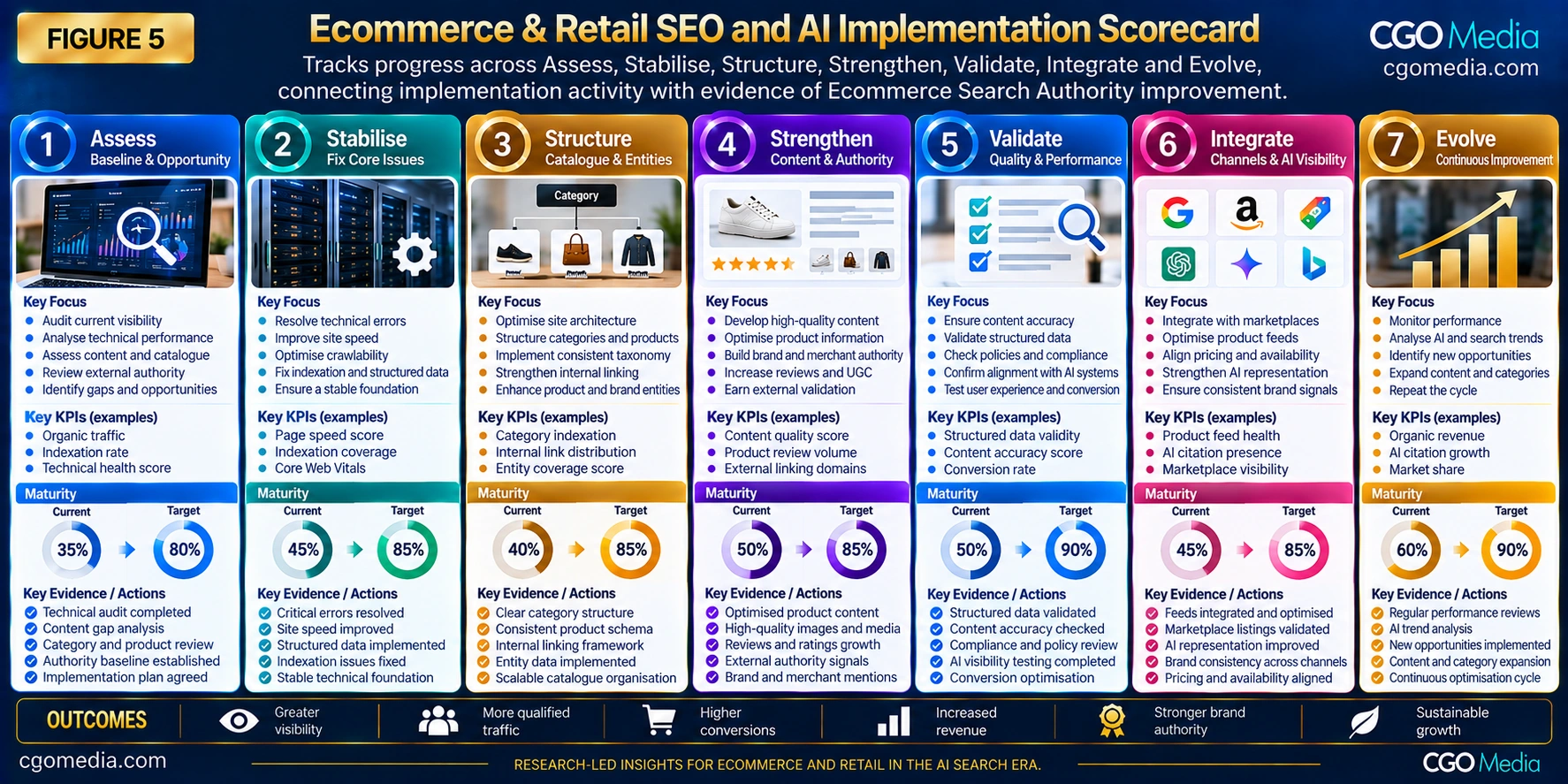
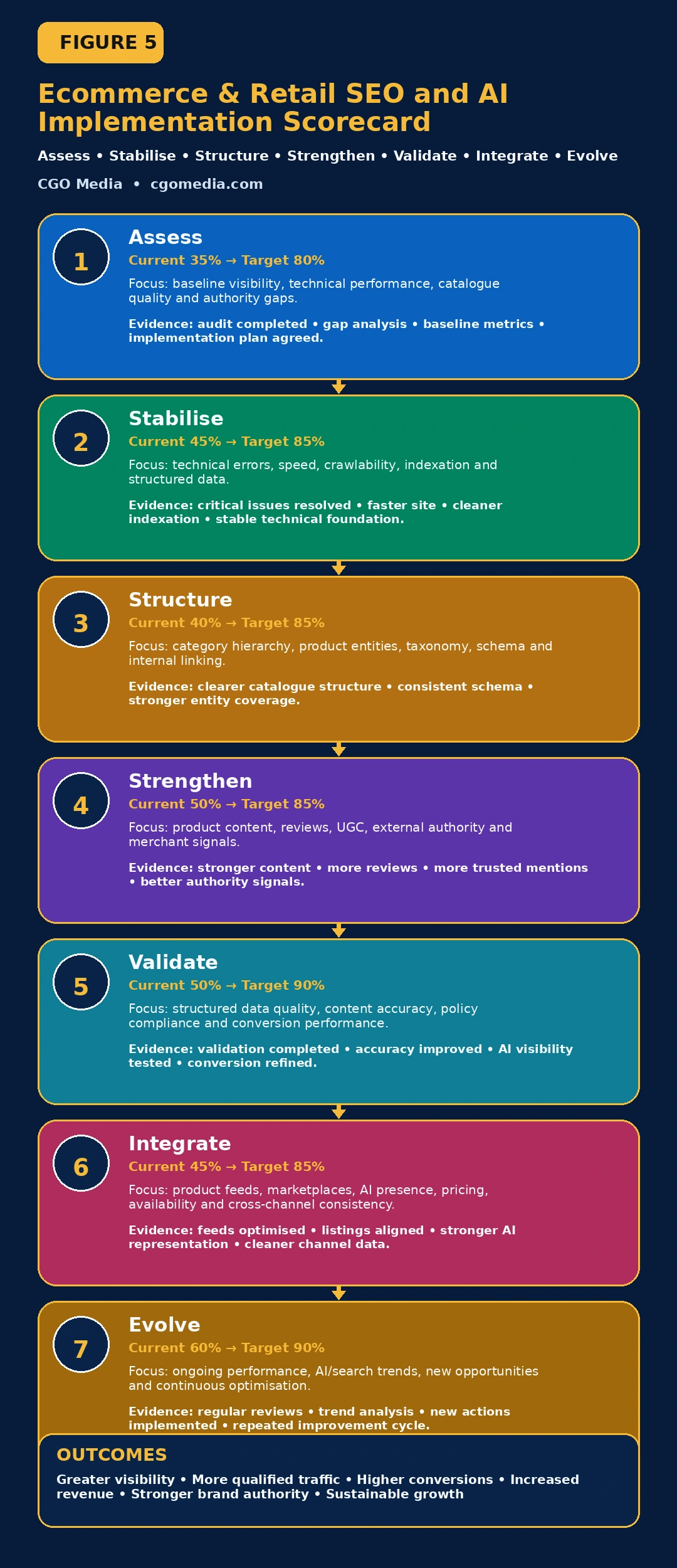
122. Commercial Measurement
The roadmap should ultimately contribute to stronger commercial outcomes.
Relevant measures can include:
- Product views
- Add-to-cart events
- Checkout initiation
- Conversion rate
- Orders
- Average order value
- Revenue
- Repeat purchase
These metrics help connect Search Authority development with actual customer behaviour.
The objective is not to attribute every sale to one search activity. It is to understand whether stronger Product Evidence, better Merchant Trust and improved discovery are contributing to healthier commercial journeys.
123. Measuring Search Contribution
The organisation should understand how customers discover products and the retailer across:
- Organic search
- Shopping environments
- Marketplaces
- Publishers
- Social discovery
- AI assistants
Each environment may influence a different stage of the purchase journey.
Organic search may introduce a category, a publisher may validate a product, an AI assistant may create a shortlist and a shopping environment may expose the final retailer.
Measurement should therefore avoid assuming that one channel always owns the entire conversion journey.
124. Measuring Category Contribution
Category-level measurement can reveal which areas of Catalogue Authority contribute most strongly to:
- Product discovery
- Revenue
- New customer acquisition
- Cross-selling
Useful comparisons can include:
- category visibility;
- category traffic;
- Product Views generated;
- conversion;
- and revenue contribution.
This can help identify categories that are commercially important but underrepresented in search, as well as categories attracting significant traffic without producing strong downstream engagement.
125. Measuring Product Evidence Contribution
Product Evidence improvements can be compared with changes in:
- Engagement
- Add-to-cart rate
- Conversion
- Returns
- Customer reviews
For example, stronger compatibility guidance may reduce returns, while clearer specifications or imagery may improve Add-to-Cart behaviour.
Product Evidence should therefore be evaluated not only through page engagement but through whether it improves the quality of customer decisions.
126. Measuring Merchant Trust Contribution
Improvements to delivery, returns and retailer confidence can be evaluated against:
- Checkout completion
- Customer-service contacts
- Review sentiment
- Repeat purchase
For example, clearer delivery costs may reduce checkout abandonment, while stronger returns guidance may reduce pre-purchase customer-service enquiries.
The objective is to understand whether improved Merchant Trust is reducing transaction uncertainty.
127. Measuring AI Discovery Contribution
Where customers mention AI-assisted discovery, this should be captured as part of acquisition and Product Selection intelligence.
The organisation may also monitor whether AI systems increasingly:
- Recommend priority products
- Recommend strategic brands
- Recommend the retailer
- Cite buying guides or research
AI contribution should be treated cautiously because direct attribution may be incomplete.
A useful objective is to build evidence around:
AI Discovery Presence → Product or Brand Consideration → Subsequent Commercial Behaviour
128. Measuring Returns as Evidence Quality
Returns should not be viewed only as an operational cost.
They can reveal information-quality weaknesses involving:
- Size
- Fit
- Compatibility
- Product expectations
- Visual representation
Return reasons should therefore feed back into Product Evidence.
A high rate of size-related returns can suggest weak sizing guidance. Compatibility-related returns can indicate missing technical information. Appearance-related returns may reveal that imagery does not set expectations accurately.
Returns Intelligence can therefore become a direct input into Ecommerce Search Authority improvement.
129. Roadmap Governance
Implementation requires clear ownership because Ecommerce Search Authority spans technical, merchandising, commercial, customer and communications functions.
Without governance, improvements can become fragmented across teams with different priorities and data sources.
The organisation should therefore establish:
- named owners;
- review cycles;
- shared standards;
- escalation processes;
- and common measurement.
130. Executive Ownership
A senior sponsor can help ensure that Search Authority is treated as a commercial capability rather than an isolated marketing activity.
Executive ownership is particularly useful where implementation requires cooperation between:
- Technology;
- SEO;
- Merchandising;
- Product Data;
- Customer Experience;
- Digital PR;
- and commercial teams.
The sponsor should help resolve priority conflicts and ensure strategically important evidence gaps receive appropriate resources.
131. SEO Ownership
SEO teams should coordinate:
- Technical search
- Catalogue architecture
- Category strategy
- Internal linking
- Structured data
- AI visibility monitoring
SEO should increasingly operate as a connecting function between search behaviour and wider product, content and commercial systems.
Its role is not to own every activity, but to ensure Search Authority requirements are visible across the organisation.
132. Merchandising Ownership
Merchandising teams should contribute to:
- Category prioritisation
- Product relationships
- Seasonal demand
- Commercial positioning
- Product-range changes
Merchandising knowledge helps ensure search strategy reflects what the organisation actually sells, where commercial opportunity exists and how product ranges change throughout the year.
133. Product Data Ownership
Product Data teams should maintain:
- Titles
- Identifiers
- Specifications
- Variants
- Images
- Lifecycle status
These fields should follow category-specific standards and flow reliably into downstream systems.
Strong Product Data governance reduces repeated manual correction across:
- product pages;
- shopping feeds;
- marketplaces;
- and comparison environments.
134. Pricing and Inventory Ownership
Commercial or operational teams should maintain reliable:
- Price
- Promotional information
- Availability
- Stock status
Because these fields are highly volatile, ownership and update processes should be especially clear.
Price and stock errors can invalidate otherwise strong Product Evidence immediately.
135. Customer Experience Ownership
Customer-experience teams should contribute evidence involving:
- Delivery
- Returns
- Customer service
- Reviews
- Recurring complaints
These teams often possess direct evidence of where customer expectations differ from the information presented before purchase.
Their insight should feed back into:
- Product Content;
- Merchant Trust information;
- returns guidance;
- and Product Selection support.
136. Digital PR Ownership
Digital PR should develop independent authority around strategically important:
- Categories
- Products
- Brands
- Consumer trends
- Original research
The focus should be on credible evidence and expertise rather than coverage volume alone.
Authority activity should connect with the categories and commercial themes the organisation wants to strengthen over the long term.
137. Technology Ownership
Technology teams or suppliers should maintain reliable:
- Commerce platform performance
- Product feeds
- Inventory integrations
- Analytics
- Data consistency
Technology ownership is critical because many Ecommerce Search Authority problems originate from underlying systems rather than individual pages.
Platform change should therefore consider potential impact on:
- crawlability;
- Product Data;
- feeds;
- structured data;
- and measurement.
138. Governance Cadence
A practical governance rhythm may include:
- Daily or weekly monitoring of critical Product Data
- Monthly operational reviews
- Quarterly authority reviews
- Six-monthly maturity assessments
- Annual strategic review
Cadence should reflect data volatility and commercial risk.
Price and stock require more frequent monitoring than relatively stable information such as brand history or product dimensions.
The objective is a review rhythm proportionate to the importance and speed of change.
139. Common Implementation Failure Modes
Several recurring problems can prevent the roadmap from producing sustainable Ecommerce Search Authority.
These failure modes usually arise when implementation becomes:
- too fragmented;
- too channel-specific;
- insufficiently evidence-led;
- or disconnected from commercial feedback.
Recognising these patterns early can reduce wasted effort.
140. Failure Mode One — Expanding the Catalogue Before Fixing Product Data
Adding more products while price, stock, identifiers or specifications remain unreliable increases the scale of the underlying problem.
Every new product can multiply:
- feed errors;
- variant ambiguity;
- incorrect Product Comparison;
- and AI representation risk.
The stronger sequence is:
Stabilise Product Data → Establish Standards → Scale Catalogue Coverage
141. Failure Mode Two — Treating Product Pages as Isolated URLs
Products that are disconnected from categories, brands, variants and buying guidance create a weaker Knowledge Architecture.
Product pages should sit inside meaningful relationships connecting:
- category;
- brand;
- Product Family;
- variant;
- related products;
- and relevant buying guidance.
Search Authority grows more reliably when the catalogue operates as a connected system.
142. Failure Mode Three — Overdependence on Marketplaces
Marketplace revenue can conceal weak first-party retailer and Brand Authority.
Potential risks include:
- limited direct customer relationships;
- platform dependence;
- weak branded demand;
- and reduced ownership of reviews and Product Discovery.
Marketplaces can remain valuable commercial channels, but owned Search Authority should ideally develop alongside them.
143. Failure Mode Four — Thin Category Expansion
Creating large numbers of weak category pages can increase indexable inventory without increasing meaningful Category Authority.
New categories should normally exist because they provide a useful distinction based on:
- shopper demand;
- Product Type;
- use case;
- attributes;
- or commercial relevance.
Category expansion should improve Product Discovery rather than simply multiply landing pages.
144. Failure Mode Five — Ignoring Review and Returns Intelligence
Retailers lose valuable evidence when recurring customer problems are not used to improve Product Information and commercial experience.
Reviews and returns can reveal:
- fit problems;
- compatibility problems;
- misleading imagery;
- weak expectation setting;
- and recurring Merchant Trust issues.
Ignoring these signals prevents the ecommerce information environment from learning from real outcomes.
145. Failure Mode Six — Digital PR Without Commercial Relevance
Media coverage creates less strategic value when it has little connection with priority categories, products, brand expertise or market positioning.
Digital PR should ideally strengthen:
- Category Authority;
- Brand Authority;
- Product Expertise;
- research credibility;
- or merchant reputation.
The objective is credible authority connected with areas the organisation actually wants to be known for.
146. Failure Mode Seven — AI Monitoring Without Action
Recording product and retailer recommendations has limited value if evidence gaps and source weaknesses are not translated into implementation priorities.
AI monitoring should therefore produce actions such as:
- correcting Product Information;
- improving source evidence;
- strengthening Merchant Trust;
- developing better comparison content;
- or addressing representation inaccuracies.
The useful cycle is:
Observe → Diagnose → Improve → Re-Test
147. Failure Mode Eight — Optimising for Traffic Without Commercial Feedback
Search teams can misallocate effort if they cannot connect visibility with:
- Add-to-cart behaviour
- Conversion
- Returns
- Revenue
- Repeat purchase
Traffic growth can appear successful while attracting poorly matched customers or producing high-return purchases.
The better objective is:
Qualified Visibility → Qualified Product Selection → Qualified Commercial Outcome
148. Application for Pure-Play Ecommerce Retailers
Pure-play retailers can use the roadmap to coordinate:
- Technical SEO
- Catalogue management
- Product evidence
- Merchant trust
- Shopping feeds
- AI product visibility
Because the complete customer relationship is digital, particular emphasis may be placed on:
- Product Information Quality;
- delivery transparency;
- returns;
- online reviews;
- and transaction confidence.
149. Application for Omnichannel Retailers
Omnichannel retailers can additionally integrate:
- Store entities
- Local inventory
- Click and collect
- Store reviews
- Online and offline commercial journeys
Their roadmap should connect digital search with physical fulfilment so customers can move coherently between:
Search → Product → Local Availability → Store or Collection → Purchase
150. Application for Consumer Brands
Consumer brands can use the roadmap to coordinate:
- Brand authority
- Product knowledge
- Retail distribution
- Publisher authority
- Independent reviews
- AI brand visibility
Brands should pay particular attention to how their products are represented by third-party retailers and marketplaces because external Product Data can influence wider digital understanding.
151. Application for Marketplaces
Marketplaces may adapt the roadmap around:
- Catalogue architecture
- Seller identity
- Product information quality
- Review systems
- Comparison functionality
- Transactional trust
At marketplace scale, strong reconciliation between product, offer and seller entities becomes especially important.
The shopper should be able to distinguish:
Product → Seller → Offer → Fulfilment → Transaction Protection
152. Application for Fashion Retail
Fashion retailers may place additional emphasis on:
- Variant accuracy
- Size and fit guidance
- Visual evidence
- Returns intelligence
- Seasonal catalogue changes
Returns data can be particularly useful for identifying weaknesses in:
- size guidance;
- fit expectations;
- colour representation;
- and Product Imagery.
153. Application for Consumer Electronics
Electronics retailers may prioritise:
- Specifications
- Compatibility
- Model identity
- Product lifecycle
- Comparison authority
- Warranty information
The roadmap should ensure older generations, regional variants and technical configurations remain clearly distinguished.
Accurate compatibility information should receive particularly high priority because errors can lead directly to failed purchases and returns.
154. Application for Beauty and Personal Care
Beauty retailers may require stronger implementation around:
- Ingredients
- Suitability
- Product claims
- Use guidance
- Review authority
- Brand trust
Product claims should remain appropriately supported, while customer guidance should help users understand relevant use cases without overstating outcomes.
Clear Product Information and Brand Trust are especially important where users evaluate formulations, ingredients and personal suitability.
155. Application for International Ecommerce
International retailers may additionally prioritise:
- Multilingual catalogue architecture
- Regional currency
- Regional stock
- Local merchant trust
- Cross-border delivery
- Taxes and duties
- Market-specific AI visibility
The same product can have different commercial suitability across markets because:
- price differs;
- stock differs;
- delivery differs;
- and local retailer confidence differs.
International implementation should therefore preserve global Product Identity while allowing market-specific commercial evidence.
156. Continuous Ecommerce Search Improvement
Once the seven phases are established, the roadmap becomes a continuous operating cycle:
Measure → Identify Gaps → Prioritise → Implement → Validate → Integrate → Evolve
The cycle prevents Ecommerce Search Authority from becoming a one-time project.
Measure
Track:
- search visibility;
- Product Evidence;
- Merchant Trust;
- External Authority;
- AI Representation;
- and commercial outcomes.
Identify Gaps
Locate weaknesses affecting:
- Product Discovery;
- Product Fit;
- Retailer Selection;
- or Recommendation Confidence.
Prioritise
Use:
- commercial importance;
- customer impact;
- risk;
- authority impact;
- and implementation dependency.
Implement
Correct technical, catalogue, Product Data, merchant or authority weaknesses according to the priority model.
Validate
Confirm whether the improvement produces stronger:
- information quality;
- customer behaviour;
- External Authority;
- or commercial performance.
Integrate
Feed the learning into:
- SEO;
- Product;
- Merchandising;
- Customer Experience;
- Digital PR;
- and AI monitoring.
Evolve
Repeat the cycle as:
- products;
- customers;
- competitors;
- markets;
- and discovery systems
change.
The long-term implementation objective is therefore:
Adaptive Ecommerce Search Authority rather than static Ecommerce SEO.
The Continuous Ecommerce SEO and AI Improvement Cycle shows how the seven-phase roadmap becomes an ongoing operating system in which ecommerce organisations measure performance, identify authority gaps, prioritise improvements, implement change, validate outcomes, integrate learning and evolve continuously.
1. Measure
Monitor Technical Search, Product Discovery, Catalogue Authority, Merchant Trust, External Authority, AI Representation and commercial outcomes.
2. Identify Gaps
Find technical, Product Data, catalogue, merchant, authority, AI or commercial weaknesses restricting Qualified Discovery and Product Selection.
3. Prioritise
Rank improvements according to commercial importance, Customer Impact, Authority Impact, information risk and implementation dependency.
4. Implement
Strengthen the relevant technical, catalogue, Product Evidence, Merchant Trust, External Authority or measurement capability.
5. Validate
Confirm whether implementation improves Product Understanding, Retailer Confidence, External Validation, customer behaviour or commercial outcomes.
6. Integrate
Feed the evidence back into SEO, Product Data, Merchandising, Pricing, Customer Experience, Digital PR, Marketplaces and AI monitoring.
7. Evolve
Adapt the system as products, prices, customers, competitors, markets, platforms and AI-powered discovery environments continue changing.
Continuous-improvement principle: The implementation roadmap should become an operating cycle rather than end when the initial seven phases have been completed.
Evidence principle: Each new cycle should begin with observable search, product, merchant, customer, AI or commercial evidence rather than assumption.
Prioritisation principle: The strongest next action is determined by commercial importance, Customer Impact, Authority Impact, risk and implementation dependency.
Learning principle: Insights from reviews, returns, Search Behaviour, Marketplaces, competitors and AI monitoring should continuously improve Product Information, Merchant Trust and Ecommerce Search Authority.
Figure 6. Sustainable Ecommerce Search Authority develops through a continuous cycle of measurement, gap identification, prioritisation, implementation, validation, integration and adaptation.
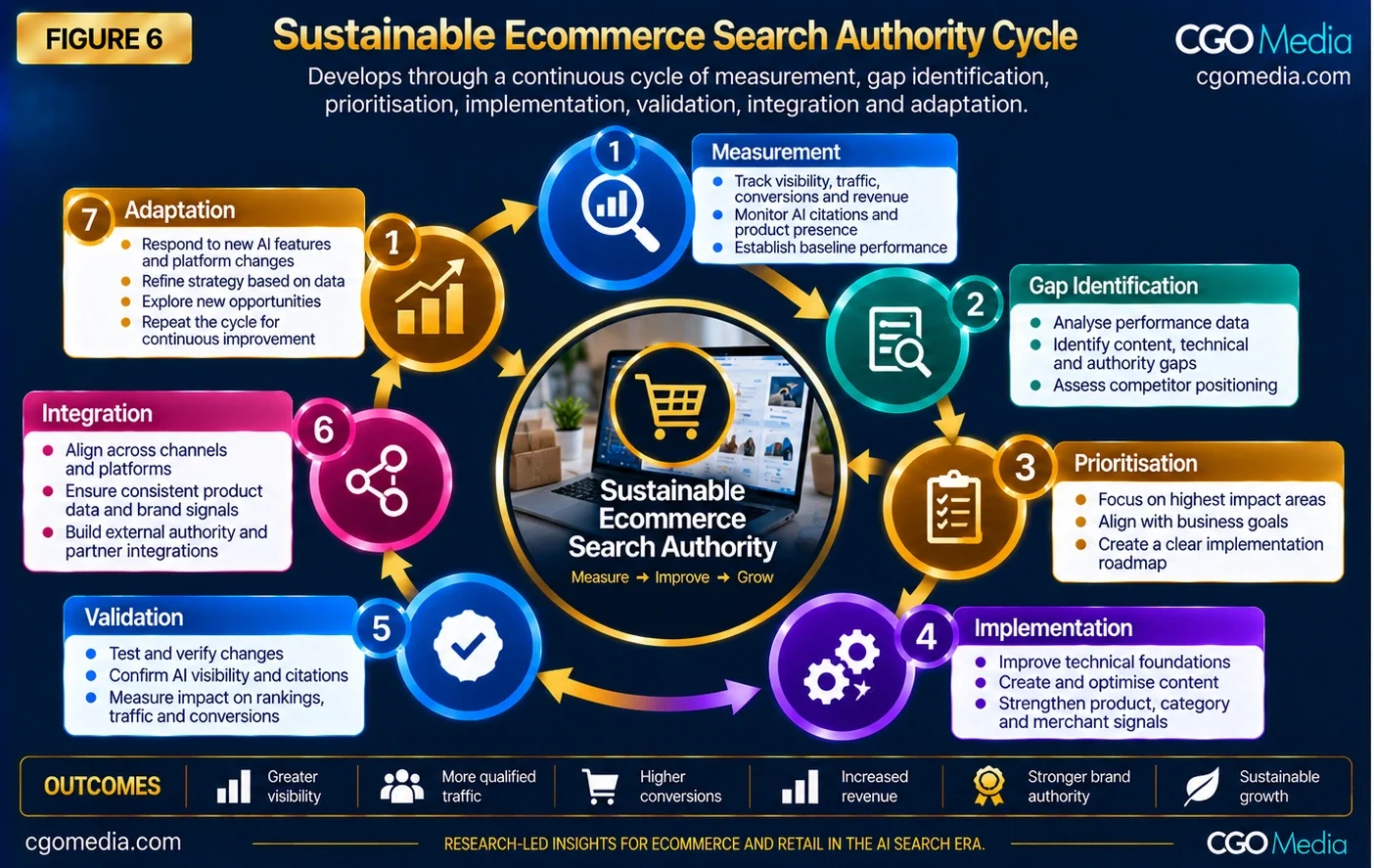
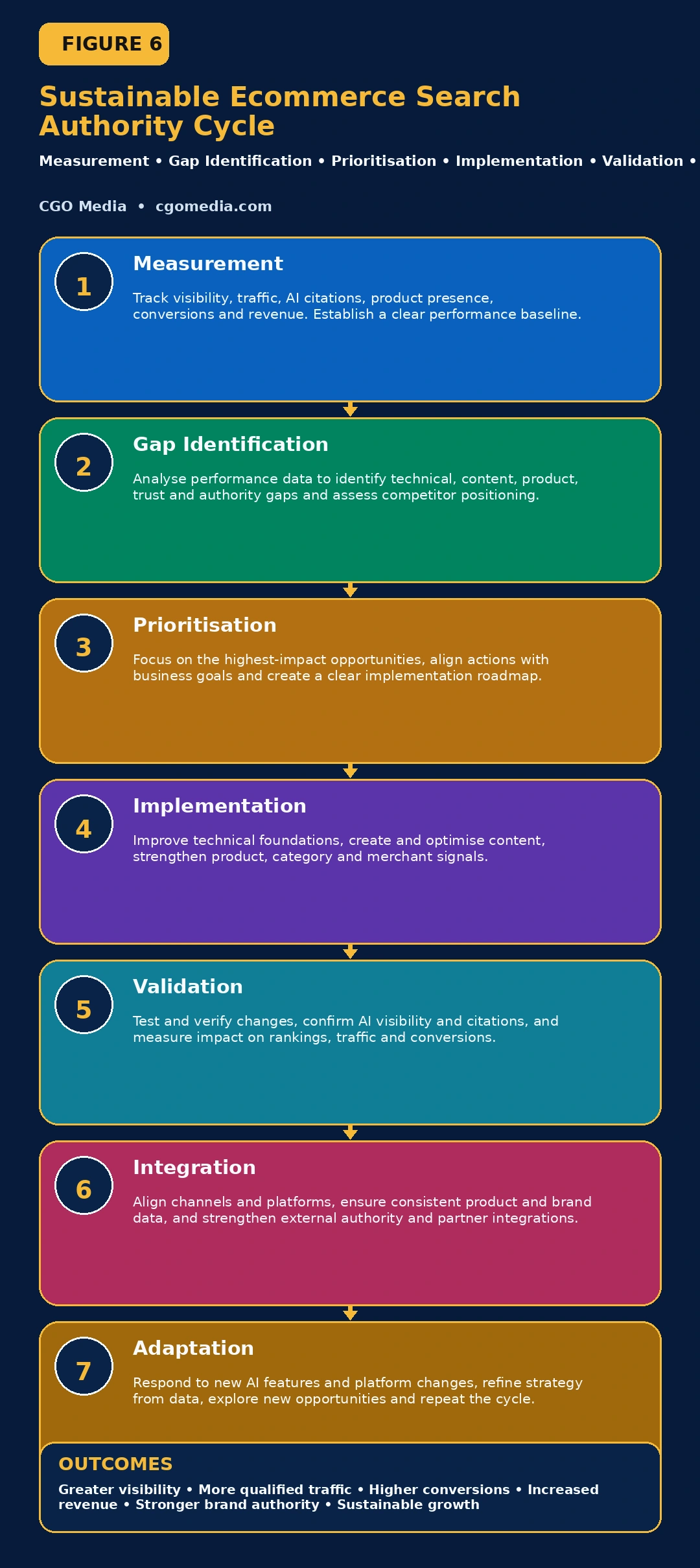
157. Relationship with the Ecommerce & Retail AI Trust and Visibility Framework
The Ecommerce & Retail AI Trust and Visibility Framework defines the evidence conditions that strengthen Product Trust, Merchant Trust and Recommendation Confidence.
It examines how product, brand, retailer and external evidence interact across conventional search and AI-assisted discovery.
The implementation roadmap provides the practical sequence for developing those conditions.
The relationship can therefore be understood as:
Trust & Visibility Requirements → Implementation Priorities → Operational Improvement
Where the framework identifies a weakness in Product Evidence, Merchant Trust, External Authority or AI representation, the roadmap helps determine:
- which underlying capability should be corrected;
- which dependencies exist;
- and when the improvement should occur.
158. Relationship with the Product Discovery and Retailer Selection Model
The Ecommerce Product Discovery and Retailer Selection Model explains how shoppers progress from need recognition through Product Discovery, evaluation, retailer validation, comparison and purchase.
The roadmap develops the Product, Merchant and Authority Evidence required to support those stages.
For example:
- Catalogue Structure supports category discovery.
- Product Evidence supports Product Fit.
- Review Authority supports validation.
- Merchant Trust supports retailer selection.
- Price and availability support final purchase feasibility.
The relationship is therefore:
Shopper Decision Journey → Required Evidence → Implementation Capability
159. Relationship with the Ecommerce Search Authority Maturity Model
The Ecommerce Search Authority Maturity Model identifies the organisation’s current level of capability across technical search, Product Data, Catalogue Authority, Merchant Trust, External Authority, AI visibility, measurement and governance.
The roadmap provides the implementation sequence required to move from the current state toward a stronger and more adaptive maturity level.
The maturity model therefore answers:
“Where are we now?”
while the roadmap answers:
“What should we improve next, and in what sequence?”
Together, the two resources connect diagnosis with implementation.
160. Relationship with the Parent Research
This roadmap forms part of the research architecture established in Ecommerce & Retail SEO in an AI Search Environment.
The parent research examines how Ecommerce SEO is expanding into a broader system involving:
- Product Discovery;
- Catalogue Authority;
- Product Information Quality;
- Merchant Trust;
- shopping feeds;
- marketplaces;
- External Authority;
- and AI-assisted recommendations.
The implementation roadmap converts those research observations into a staged operational model.
The wider sequence is:
Research Environment → Trust & Visibility → Product & Retailer Selection → Maturity Assessment → Implementation Roadmap
161. Methodological Position
The Ecommerce & Retail SEO and AI Implementation Roadmap is a conceptual and strategic implementation framework.
It organises Ecommerce Search Authority development into seven phases:
- Assess
- Stabilise
- Structure
- Strengthen
- Validate
- Integrate
- Evolve
The phases are intended to support:
- sequencing;
- prioritisation;
- measurement;
- governance;
- and cross-functional implementation.
The roadmap does not claim that completion of any phase guarantees:
- organic rankings;
- shopping visibility;
- marketplace performance;
- AI citations;
- AI recommendations;
- or commercial outcomes.
Search engines, shopping systems, marketplaces and AI platforms use proprietary and evolving retrieval, ranking, synthesis and recommendation processes.
The roadmap instead focuses on improving observable technical, informational, commercial and authority conditions that support:
- Product Discovery;
- Product Understanding;
- Product Validation;
- Retailer Selection;
- comparison;
- and Recommendation Readiness.
Implementation results should therefore be evaluated empirically through:
- search performance;
- Product Engagement;
- review and returns evidence;
- AI observations;
- and downstream commercial behaviour.
162. Strategic Implications
The principal implementation challenge for ecommerce organisations is not a shortage of possible optimisation activity.
It is deciding:
- which weaknesses matter most;
- which problems should be corrected first;
- which capabilities depend on others;
- and how separate search, Product, Commercial and Trust activities should reinforce each other.
The seven-phase sequence addresses that challenge:
Assess → Stabilise → Structure → Strengthen → Validate → Integrate → Evolve
Assessment Prevents Blind Implementation
Organisations should understand their current position before allocating substantial resources.
Stabilisation Reduces Foundational Risk
Technical, Product Data, pricing and availability problems should be controlled before advanced authority-building activity expands.
Structure Creates Knowledge Relationships
Retailer, Category, Brand, Product, Variant and Offer relationships should be sufficiently explicit to support Product Discovery and comparison.
Strengthening Improves Decision Evidence
Product, Category and Merchant Information should help shoppers understand genuine suitability rather than simply increase page volume.
Validation Extends Authority Beyond First-Party Claims
Independent publishers, reviews, marketplaces, research citations and external media can provide supporting evidence around strategically important products and commercial capabilities.
Integration Converts Search into Commercial Intelligence
Search, reviews, returns, marketplace data and AI observations can inform Product, Merchandising and Customer Experience decisions.
Evolution Creates Long-Term Capability
Search Authority must adapt continuously because:
- catalogues change;
- prices change;
- stock changes;
- customer expectations evolve;
- and AI-assisted discovery environments continue developing.
The strategic shift is therefore:
Fragmented Ecommerce SEO → Connected Ecommerce Search Authority → Adaptive Commercial Intelligence
163. Conclusion
Modern ecommerce discovery requires coordinated management of Technical Accessibility, Catalogue Architecture, Product Data, Merchant Trust, External Authority and AI representation.
The Ecommerce & Retail SEO and AI Implementation Roadmap provides seven phases for developing those capabilities:
- Assess
- Stabilise
- Structure
- Strengthen
- Validate
- Integrate
- Evolve
The roadmap begins by establishing the current authority position and identifying the technical, catalogue, Product Information and Merchant Trust weaknesses most likely to restrict future performance.
It then stabilises critical foundations before creating a connected commercial Knowledge Architecture across:
- retailer;
- department;
- category;
- brand;
- product;
- variant;
- and offer.
Once those foundations are reliable, the organisation can strengthen Product Evidence, Category Authority, reviews, commercial transparency and Merchant Trust.
Independent validation then extends authority through:
- publishers;
- customer evidence;
- marketplaces;
- comparison sources;
- Digital PR;
- industry media;
- and research citations.
The Integrate phase connects these capabilities with:
- Merchandising;
- Product Data;
- Pricing;
- Customer Experience;
- Marketplace Intelligence;
- AI monitoring;
- and commercial measurement.
The final phase transforms implementation into an ongoing operating system.
The long-term strategic objective is therefore not merely:
to complete an Ecommerce SEO project.
It is:
to create an adaptive Ecommerce Search Authority capability that continues improving as products, prices, customers, markets, competitors, platforms and AI-powered discovery systems change.
References
External Academic, Technical and Industry Sources
- 1. Google. Product Structured Data. Google Search Central.
- 2. Google. Product Data Specification. Google Merchant Center.
- 3. Schema.org. Product. Schema.org.
- 4. Schema.org. Offer. Schema.org.
- 5. Schema.org. Organization. Schema.org.
- 6. Schema.org. AggregateRating. Schema.org.
- 7. Schema.org. Review. Schema.org.
- 8. World Wide Web Consortium. Web Content Accessibility Guidelines (WCAG) 2.2. W3C.
- 9. Metzger, M. J. (2007). Making Sense of Credibility on the Web: Models for Evaluating Online Information and Recommendations for Future Research. Journal of the American Society for Information Science and Technology, 58(13), 2078–2091.
- 10. Hogan, A. et al. (2021). Knowledge Graphs. ACM Computing Surveys, 54(4).
- 11. Ji, Z. et al. (2023). Survey of Hallucination in Natural Language Generation. ACM Computing Surveys, 55(12).
CGO Media Research Frameworks
- 12. Wilkinson, R. (2026). CGO AI Authority Model. CGO Media.
- 13. Wilkinson, R. (2026). CGO Media Entity Authority Framework. CGO Media.
- 14. Wilkinson, R. (2026). CGO Media Content Authority Framework. CGO Media.
- 15. Wilkinson, R. (2026). CGO Media Brand Signal Framework. CGO Media.
- 16. Wilkinson, R. (2026). CGO Media AI Citation Framework. CGO Media.
- 17. Wilkinson, R. (2026). CGO Media AI Search Readiness Framework. CGO Media.
- 18. Wilkinson, R. (2026). CGO Media Knowledge Architecture Map. CGO Media.
- 19. Wilkinson, R. (2026). CGO Media Search Ecosystem Model. CGO Media.
CGO Media Research Ecosystem
The Ecommerce & Retail SEO and AI Implementation Roadmap forms part of the CGO Media Framework Library and the wider CGO Media research programme examining:
- Ecommerce SEO;
- AI Search;
- Product Discovery;
- Merchant Trust;
- Citation Authority;
- Entity Authority;
- and recommendation visibility.
The wider research ecosystem connects:
- CGO Media Research Library
- CGO Media Framework Library
- CGO Media Research Architecture
- CGO Media Research Observations Library
- CGO Media Statistics Library
This allows the roadmap to sit within a broader research architecture linking strategic research, implementation models, frameworks, observations and supporting evidence.
About Roger Wilkinson
Roger Wilkinson is an independent researcher, SEO practitioner and founder of CGO Media with more than 25 years of experience in search, online visibility and digital strategy.
His current research examines how artificial intelligence is reshaping:
- search engines;
- recommendation systems;
- digital authority;
- Product Discovery;
- Entity Authority;
- AI citations;
- and commercial visibility.
Through independent research papers and strategic frameworks, Roger examines the relationship between:
- Technical SEO;
- Entity Authority;
- Brand Signals;
- AI Visibility;
- Citation Authority;
- Knowledge Graphs;
- and Search Visibility.
He is the creator of the CGO Framework Series, a collection of research-led methodologies designed to help organisations measure, improve and govern digital visibility across conventional and AI-powered search environments.
Related Ecommerce & Retail Research and Frameworks
- Ecommerce & Retail SEO in an AI Search Environment
- Ecommerce & Retail AI Trust and Visibility Framework
- Ecommerce Product Discovery and Retailer Selection Model
- Ecommerce Search Authority Maturity Model
- CGO Media Research Library
- CGO Media Framework Library
- CGO Media Research Architecture
Together, these resources connect:
Research Environment → Trust & Visibility → Product & Retailer Selection → Maturity Assessment → Implementation
They are designed to be used as a connected Ecommerce & Retail research family rather than as isolated publications.
Research Usage & Citation
CGO Media encourages researchers, journalists, retailers, brands, marketplaces and practitioners to reference this roadmap where it contributes to broader understanding of:
- Ecommerce SEO;
- AI Search;
- implementation sequencing;
- Product Authority;
- Merchant Trust;
- and Recommendation Readiness.
Reasonable quotations, summaries, figures and excerpts may be used in:
- articles;
- reports;
- presentations;
- academic work;
- and professional publications
provided appropriate acknowledgement is given to Roger Wilkinson and CGO Media.
Cite This Roadmap / Embed Citation
The Ecommerce & Retail SEO and AI Implementation Roadmap, developed by Roger Wilkinson at CGO Media, proposes a seven-phase implementation sequence — Assess, Stabilise, Structure, Strengthen, Validate, Integrate and Evolve — for building and continuously improving Ecommerce Search Authority and AI Recommendation Readiness.
APA Citation
Wilkinson, R. (2026). Ecommerce & Retail SEO and AI Implementation Roadmap. CGO Media. https://cgomedia.com/ecommerce-retail-seo-ai-implementation-roadmap/
Research Paper
This roadmap is supported by the parent research paper:
Ecommerce & Retail SEO in an AI Search Environment.
Author: Roger Wilkinson
Published by: CGO Media
For permissions relating to extensive reproduction, commercial licensing or republication of substantial portions of this roadmap, please contact CGO Media directly.