
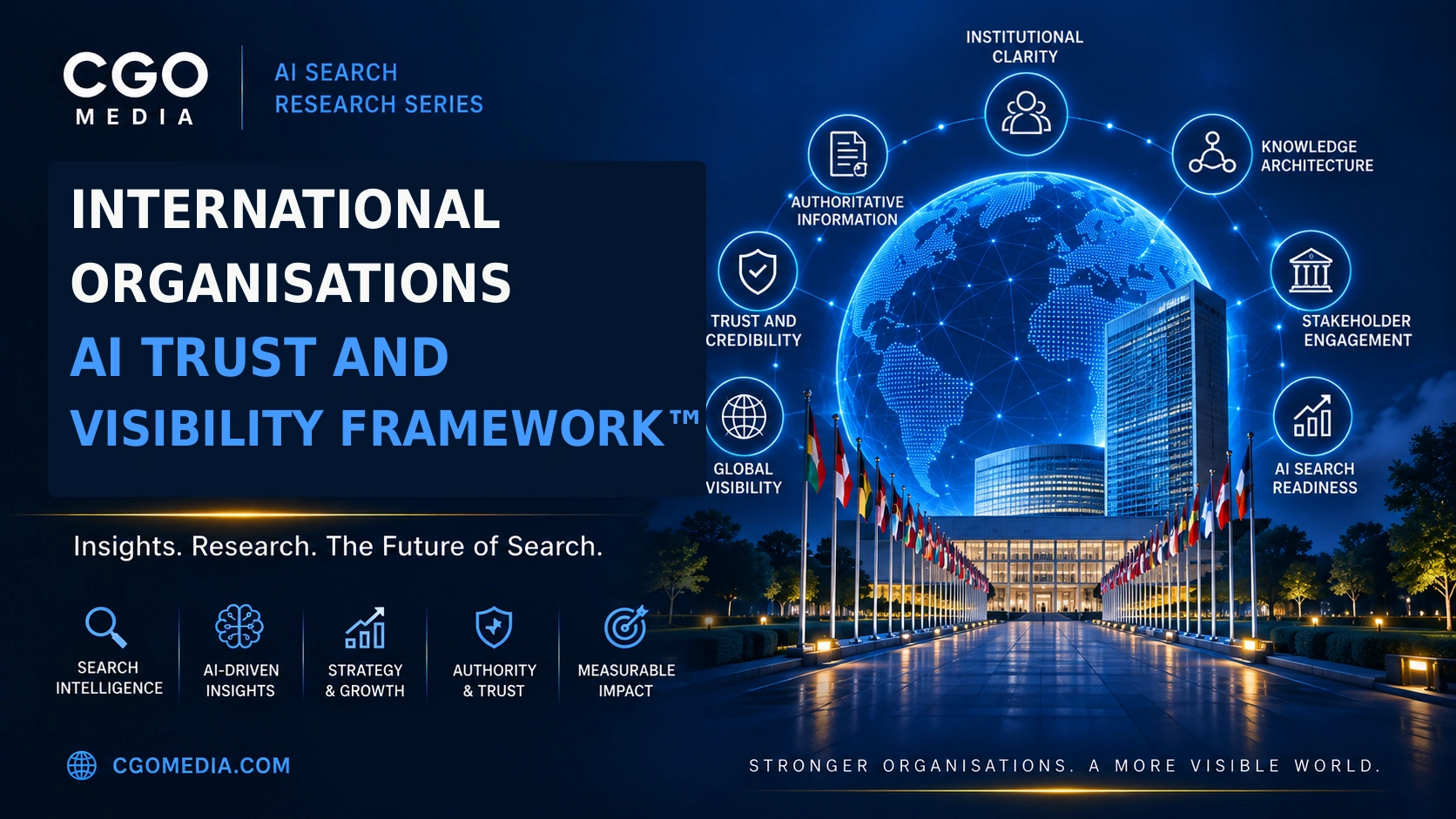
International Organisations AI Trust and Visibility Framework™
The International Organisations AI Trust and Visibility Framework™ provides a structured methodology for assessing how global institutions, international NGOs, development organisations, foundations, associations, standards bodies and research organisations can strengthen discoverability, institutional trust and AI-assisted recommendation readiness.
The framework builds on the parent research paper International Organisations SEO in an AI Search Environment.
Its purpose is to evaluate whether the organisation possesses the authority, evidence and structural clarity required to be understood accurately across global, regional, country, language, policy, research and AI discovery environments.
1. Why International Organisations Need a Trust and Visibility Framework
International organisations operate within unusually complex information environments.
They may need to represent:
- Global headquarters
- Regional structures
- Country offices
- Programmes
- Projects
- Research
- Experts
- Funding relationships
- Partners
- Member organisations
These relationships must remain understandable across multiple languages, countries and digital platforms.
2. Visibility Without Institutional Trust
An organisation can rank prominently or receive significant traffic while still failing to demonstrate sufficient credibility for important institutional decisions.
3. Institutional Trust Without Visibility
An organisation may also possess substantial real-world authority while remaining difficult to discover in search and AI systems.
4. The Six Dimensions of International Trust and Visibility
The framework evaluates six connected dimensions:
- Organisation and Entity Clarity
- Mission, Programme and Knowledge Authority
- Country, Region and Language Architecture
- Trust, Governance and Institutional Credibility
- External, Academic and Policy Authority
- AI Search and International Recommendation Readiness
Figure 1 — International Organisations AI Trust and Visibility Framework™
This figure presents the six dimensions that determine whether an international organisation can be clearly understood, independently validated and credibly represented across search and AI discovery systems.
Figure 1. International organisation trust and visibility depend on Organisation and Entity Clarity, Mission and Programme Authority, Geographic and Language Architecture, Institutional Credibility, External Authority and AI Recommendation Readiness.
5. Dimension One — Organisation and Entity Clarity
The first dimension assesses whether the organisation is represented consistently and unambiguously across its digital environment.
6. Official Organisation Name
The organisation’s formal name should be represented consistently across:
- Website
- Research publications
- Partner references
- Government citations
- Social profiles
- Media coverage
7. Acronym Consistency
Many international organisations are primarily known by acronyms.
The acronym should be clearly connected with the full organisation name to reduce ambiguity.
8. Legal Entity Clarity
Where multiple legal entities exist, their relationship with the wider organisation should be understandable.
9. Headquarters Clarity
The location and role of global headquarters should be clearly represented.
10. Regional Entity Clarity
Regional offices should maintain clear relationships with the global organisation.
11. Country Office Clarity
Country offices should be represented as part of the wider institutional structure rather than as disconnected entities.
12. Programme Entity Clarity
Major programmes should be connected clearly with:
- Parent organisation
- Region
- Country
- Partners
- Funding
- Research outputs
13. Leadership Entity Clarity
Senior leaders should be connected with:
- Current role
- Organisation
- Relevant programmes
- Expertise
- Official biography
14. Expert Entity Clarity
Researchers and subject specialists can become important institutional entities in their own right.
15. Partner Relationship Clarity
Partnerships should distinguish between:
- Strategic partners
- Programme partners
- Funding partners
- Research collaborators
- Member organisations
16. Dimension Two — Mission, Programme and Knowledge Authority
The second dimension assesses whether the organisation demonstrates sustained authority around its mission and areas of activity.
17. Mission Clarity
The organisation should communicate clearly:
- Purpose
- Mandate
- Beneficiaries
- Strategic priorities
- Geographic scope
18. Programme Authority
Programme authority develops through:
- Clear objectives
- Operational evidence
- Partners
- Outputs
- Results
- Impact reporting
19. Programme Lifecycle Clarity
Users should be able to distinguish between:
- Planned programmes
- Active programmes
- Completed programmes
- Archived programmes
20. Research Authority
Research authority develops when publications demonstrate:
- Clear authorship
- Methodology
- Publication date
- Subject relevance
- Supporting data
- External citation
21. Statistical Authority
Statistical resources should provide:
- Source information
- Methodology
- Update date
- Historical context
- Downloadable data where appropriate
22. Policy Authority
Policy resources can strengthen authority when they connect clear recommendations with institutional expertise and supporting evidence.
23. Standards Authority
Standards organisations should maintain clear documentation around:
- Standard title
- Version
- Status
- Publication date
- Technical scope
- Related guidance
24. Knowledge Architecture
A useful institutional knowledge architecture can connect:
Organisation → Mission → Programme → Geography → Research → Evidence → Impact
25. Publication Architecture
Research libraries should allow users and machines to understand relationships between:
- Research papers
- Authors
- Subjects
- Programmes
- Countries
- Datasets
26. Internal Linking as Institutional Infrastructure
Internal links should reinforce important relationships between programme, geography, research and organisational entities.
27. Dimension Three — Country, Region and Language Architecture
The third dimension assesses whether the organisation’s geographic and multilingual structure supports accurate international discovery.
28. Global Architecture
Global pages should provide the institutional context connecting regional and country operations.
29. Regional Architecture
Regional sections can connect global strategy with country-level programmes and evidence.
30. Country Architecture
Country sections should connect:
- Country office
- Programmes
- Research
- Statistics
- Partners
- Local contacts
31. Language Architecture
Equivalent content in different languages should maintain clear relationships while reflecting genuine language and market needs.
32. Language and Geography Separation
Language architecture should not assume that one language represents only one country.
33. Hreflang Governance
Where relevant, hreflang implementation should reflect actual equivalent language or regional pages.
34. Local Terminology
Translations should reflect terminology used by local institutions, policy makers and target audiences.
35. Country-Level Evidence
Country pages should provide evidence specific to local operations rather than relying only on global institutional statements.
36. Local Research Authority
Country-specific research can strengthen relevance within local search and AI environments.
37. Local Citation Authority
Country-level citations from governments, universities, media and programme partners can reinforce local institutional authority.
Figure 2 — International Trust and Visibility Matrix
This figure maps institutional visibility against evidence quality, showing why global recognition alone is insufficient where programme, geographic, language or trust signals remain weak.
Figure 2. International organisations achieve stronger search and AI visibility when institutional identity, programme authority, geographic relevance and trustworthy evidence reinforce one another.
38. Dimension Four — Trust, Governance and Institutional Credibility
The fourth dimension evaluates whether users and external systems can find sufficient evidence to understand how the institution is governed and whether its claims are credible.
39. Governance Transparency
Relevant evidence may include:
- Governance structure
- Board or governing body
- Leadership
- Institutional mandate
- Decision-making structure
40. Financial Transparency
Where appropriate, organisations should publish clear information around:
- Annual accounts
- Funding sources
- Donor relationships
- Programme funding
- Audits
41. Impact Transparency
Impact claims should be supported where possible by:
- Metrics
- Methodology
- Case studies
- Independent evaluation
42. Leadership Transparency
Current leadership should be easy to identify and distinguish from former officeholders.
43. Programme Transparency
Users should be able to understand:
- What the programme does
- Where it operates
- Who supports it
- What it has achieved
44. Partnership Transparency
Partnership relationships should be represented accurately rather than overstated.
45. Funding Relationship Transparency
Where funding relationships materially affect programme understanding, they should be represented clearly.
46. Institutional History
Historical information can strengthen context around:
- Founding
- Mandate changes
- Major programmes
- Institutional development
47. Correction and Versioning Transparency
Research and policy resources should make significant corrections or updated versions understandable.
48. Trust Is Cumulative
Institutional trust rarely depends on one single signal.
It develops through the cumulative consistency of governance, research, programmes, financial evidence, external recognition and operational history.
49. Dimension Five — External, Academic and Policy Authority
The fifth dimension evaluates whether credible external organisations independently reinforce the institution’s expertise, relevance and trustworthiness.
For international organisations, external authority may be particularly important because institutional claims are frequently assessed through cross-reference rather than first-party evidence alone.
50. Government Authority
Government references can reinforce institutional relevance where ministries, agencies or public bodies cite:
- Research
- Statistics
- Policy guidance
- Standards
- Programme evidence
51. Academic Authority
Academic citations can strengthen research credibility when universities, researchers and scholarly publications reference the organisation’s:
- Reports
- Datasets
- Methodologies
- Statistics
- Policy research
52. Think-Tank Authority
Think tanks may reinforce authority by incorporating institutional research into broader policy analysis and debate.
53. Policy Authority
Policy authority develops where the organisation’s work is referenced within:
- Government policy
- Consultation documents
- Regulatory guidance
- Legislative discussion
- International agreements
54. Standards Authority
Standards organisations can develop strong external authority when their specifications are referenced by:
- Governments
- Industry bodies
- Companies
- Technical publishers
- Academic institutions
55. Media Authority
Media coverage can reinforce authority where journalists repeatedly associate the organisation with relevant:
- Research
- Statistics
- Experts
- Policy analysis
- Programme activity
56. Specialist Media Authority
Specialist publications can provide particularly strong contextual validation within narrow subject areas.
57. Partner Authority
Programme and institutional partners can reinforce credibility when relationships are independently confirmed.
58. Donor and Funder Authority
Funding bodies may provide external evidence of institutional relationships, programme legitimacy and operational scale.
59. Member Authority
International associations and membership bodies can strengthen institutional credibility through clear relationships with recognised member organisations.
60. Citation Quality Versus Citation Volume
Large numbers of low-value references do not necessarily create strong institutional authority.
The relevance, independence and credibility of citing sources matter more than raw volume alone.
61. Citation Diversity
A robust authority environment may include recognition from:
- Governments
- Universities
- Media
- Think tanks
- Partners
- Industry organisations
62. Geographic Citation Diversity
International organisations should also examine whether external recognition is distributed across relevant regions and countries.
63. Language Citation Diversity
An organisation may possess strong English-language external authority while remaining underrepresented within important local-language information environments.
64. Research Citation Architecture
Research resources should make citation straightforward through clear:
- Titles
- Authors
- Publication dates
- Persistent URLs
- Methodology
- Suggested citations
65. Dataset Citation Architecture
Datasets should provide sufficient metadata for researchers, journalists and institutions to cite the underlying evidence accurately.
66. External Authority as Independent Verification
Independent references act as an important verification layer between what the organisation claims and how it is recognised by the wider information environment.
67. Dimension Six — AI Search and International Recommendation Readiness
The sixth dimension evaluates whether the organisation is sufficiently clear, authoritative and current to participate effectively in AI-assisted discovery.
68. AI Organisation Visibility
Organisations can monitor whether they appear in responses to questions about:
- Relevant institutions
- Global organisations
- Subject experts
- International programmes
- Research providers
69. AI Programme Visibility
Programme-level monitoring can identify whether AI systems understand:
- Programme purpose
- Current status
- Geographic scope
- Partners
- Outcomes
70. AI Research Visibility
Research visibility should examine whether institutional reports and datasets are surfaced when users request reliable evidence.
71. AI Statistical Visibility
Statistical resources may become particularly important within factual and evidence-led AI queries.
72. AI Policy Visibility
Policy organisations can monitor whether their guidance and frameworks appear in relevant policy-oriented answers.
73. AI Expert Visibility
Expert monitoring can examine whether current researchers, programme leaders and subject specialists are represented accurately.
74. AI Country Visibility
Organisations should test whether country-specific prompts surface the correct local offices, programmes and evidence.
75. AI Language Visibility
AI representation should be tested in strategically important languages rather than only in English.
76. AI Source Visibility
Where citations are available, organisations can analyse which institutional resources are selected as sources.
77. AI Citation Visibility
Research reports, statistics, programme pages and policy resources may become direct citations within AI-generated responses.
78. AI Recommendation Visibility
Recommendation monitoring can assess whether the organisation appears within shortlists for:
- Relevant international institutions
- Potential partners
- Research sources
- Funding organisations
- Standards bodies
- Programme providers
79. AI Representation Accuracy
Accuracy monitoring should include:
- Organisation identity
- Leadership
- Mission
- Programme status
- Geographic presence
- Current research
- Statistics
80. AI Temporal Accuracy
International organisations frequently change leadership, programmes, statistics and policy positions.
AI systems may continue presenting outdated information if the wider evidence environment is not maintained clearly.
81. AI Source Competition
The organisation competes for source visibility with:
- Governments
- Universities
- Think tanks
- Media organisations
- Research companies
- Peer institutions
82. Recommendation Readiness Is Cumulative
AI recommendation readiness should not be treated as an isolated optimisation target.
It reflects the combined quality of entity clarity, programme authority, geographic structure, institutional trust and external validation.
Figure 3 — International Organisation Evidence Threshold
This figure presents the evidence progression an international organisation must typically move through before becoming a credible candidate for institutional selection or AI recommendation.
Figure 3. International organisation authority progresses through Discoverable, Understandable, Relevant, Verifiable, Trusted, Shortlist Ready and Recommendation Ready evidence thresholds.
83. The International Organisation Evidence Threshold
The framework uses seven broad evidence thresholds:
- Discoverable
- Understandable
- Relevant
- Verifiable
- Trusted
- Shortlist Ready
- Recommendation Ready
84. Discoverable
The organisation, programme or resource can be found through the discovery environments used by the intended audience.
85. Understandable
Search systems and users can identify:
- What the organisation is
- What it does
- Where it operates
- Who it serves
86. Relevant
The organisation demonstrates direct relevance to the subject, geography or institutional need.
87. Verifiable
Important claims can be checked against:
- Research
- Programme evidence
- Data
- Partners
- External references
88. Trusted
Governance, transparency, research quality and independent authority provide sufficient confidence.
89. Shortlist Ready
The organisation possesses sufficient relevance and credibility to remain within a smaller consideration set.
90. Recommendation Ready
The institution possesses sufficiently strong evidence to become a plausible recommendation candidate within search and AI discovery systems.
91. International Knowledge Architecture as a Trust Layer
Trust improves when users and machines can navigate coherent relationships between:
- Organisation
- Mission
- Programme
- Geography
- Research
- Expert
- Partner
- Impact
92. Programme Architecture
Programme pages should link clearly to relevant:
- Countries
- Partners
- Research
- Experts
- Results
- Funding information
93. Country Architecture
Country sections should connect local institutional evidence with the global organisation.
94. Research Architecture
Research libraries should allow discovery by:
- Subject
- Country
- Programme
- Author
- Publication type
95. Expert Architecture
Expert profiles should connect individuals with current institutional roles, publications, programmes and subject expertise.
96. Partnership Architecture
Partnership evidence should clarify the nature and context of institutional relationships.
97. Structured Data and Machine-Readable Institutional Evidence
Appropriate structured data can reinforce visible relationships through relevant types such as:
- Organization
- Person
- Article
- Report
- Dataset
- Event
- BreadcrumbList
98. Structured Data Does Not Create Institutional Trust
Markup can clarify relationships, but it cannot compensate for weak governance, outdated programmes or poor evidence quality.
99. Multilingual Evidence Consistency
Important institutional claims should remain consistent across language versions unless legitimate local differences exist.
100. Geographic Evidence Consistency
Global, regional and country pages should not create conflicting representations of current programme activity.
101. Temporal Evidence Consistency
Leadership, programme status, statistics and policy information should be updated according to clearly defined review cycles.
102. External Evidence Consistency
Where important external sources contain outdated institutional information, organisations should identify whether corrected first-party evidence can make the current position clearer.
103. International Digital Evidence Ecosystem
The wider authority environment may include:
- Global website
- Regional sites
- Country pages
- Research repositories
- Government references
- Academic citations
- Partner websites
- Media coverage
- AI systems
104. First-Party Evidence
First-party evidence establishes the institution’s own authoritative representation of its structure, programmes and research.
105. Independent Evidence
Independent evidence demonstrates how that institution is recognised by external organisations.
106. Distributed Evidence
International authority becomes increasingly distributed as information about the organisation appears across countries, languages, research environments and institutional networks.
107. Trust Depends on Alignment
The strongest trust environment exists when first-party, external and distributed evidence largely agrees on important institutional facts.
Figure 4 — International Organisation Digital Evidence Ecosystem
This figure shows how institutional authority is reinforced across global and country websites, research repositories, governments, universities, partners, media and AI systems.
Figure 4. International organisation trust and visibility develop through alignment between first-party institutional evidence, geographic and multilingual resources, independent citations and AI-mediated representations.
108. International Trust Gap Analysis
The six dimensions can be used to identify areas where institutional evidence is incomplete, inconsistent or insufficiently validated.
109. Entity Clarity Gaps
Common gaps may include:
- Ambiguous acronyms
- Outdated leadership
- Unclear country-office relationships
- Conflicting organisation names
110. Programme Authority Gaps
Programme gaps may include:
- Weak objectives
- Missing outcome evidence
- Unclear programme status
- Limited partner information
111. Geographic Architecture Gaps
Geographic weaknesses may include:
- Disconnected country websites
- Weak regional architecture
- Outdated country content
- Insufficient local evidence
112. Language Authority Gaps
Language weaknesses may include:
- Incomplete translations
- Incorrect hreflang
- Outdated language versions
- Translation without localisation
113. Institutional Trust Gaps
Trust gaps may involve:
- Weak governance information
- Limited financial transparency
- Unsubstantiated impact claims
- Outdated leadership information
114. External Authority Gaps
An organisation may possess strong first-party expertise but little independent recognition within strategically important subject or geographic environments.
115. AI Visibility Gaps
AI gaps may include:
- Missing organisation mentions
- Incorrect programme descriptions
- Outdated leadership
- Weak citation visibility
- Limited recommendation presence
116. Prioritising Trust Improvements
The highest-priority improvements should normally address evidence weaknesses that create the greatest institutional risk or discovery constraint.
117. Accuracy Before Expansion
Correcting inaccurate organisation, programme and country information should generally take priority over publishing additional low-value content.
118. High-Risk Institutional Information First
Priority should be given to information involving:
- Leadership
- Governance
- Funding
- Programme status
- Statistics
- Country operations
119. Strategic Countries and Languages First
Where resources are constrained, organisations can initially focus on the countries and languages most important to their institutional objectives.
120. Evidence Quality Before Content Volume
The framework prioritises coherent and verifiable institutional evidence over simply increasing the number of published pages or documents.
121. Measuring International Trust and Visibility
The International Organisations AI Trust and Visibility Framework™ can be measured across the six dimensions to understand where institutional evidence is strongest and where authority gaps may restrict discovery, trust or recommendation readiness.
122. Measuring Organisation and Entity Clarity
Relevant indicators may include:
- Organisation-name consistency
- Acronym consistency
- Leadership accuracy
- Country-office clarity
- Programme relationships
- Partner relationship clarity
123. Measuring Mission, Programme and Knowledge Authority
Relevant indicators can include:
- Programme completeness
- Research publication quality
- Dataset quality
- Policy-resource visibility
- Internal knowledge relationships
- Programme-to-impact evidence
124. Measuring Country, Region and Language Architecture
Relevant indicators may include:
- Country-page coverage
- Regional architecture
- Language parity
- Hreflang accuracy
- Local search visibility
- Local citation authority
125. Measuring Trust, Governance and Institutional Credibility
Relevant indicators can include:
- Governance transparency
- Leadership transparency
- Financial transparency
- Impact reporting
- Programme transparency
- Versioning and correction clarity
126. Measuring External, Academic and Policy Authority
This dimension can be assessed through:
- Government references
- Academic citations
- Think-tank references
- Media coverage
- Partner references
- Policy citations
127. Measuring AI Search and International Recommendation Readiness
AI visibility can be assessed through:
- Organisation mentions
- Programme mentions
- Country-level mentions
- Research citations
- Source visibility
- Recommendation visibility
- Representation accuracy
128. International Trust and Visibility Scorecard
A practical scorecard can assess the current condition of each dimension.
| Dimension | Assessment Focus | Key Question |
|---|---|---|
| Organisation and Entity Clarity | Identity, leadership, offices, programmes and relationships. | Can users and machines understand what the organisation is and how its entities are connected? |
| Mission, Programme and Knowledge Authority | Mission, programmes, research, statistics, standards and policy resources. | Does the organisation demonstrate sustained subject and programme authority? |
| Country, Region and Language Architecture | Global, regional, country and multilingual structure. | Can the organisation be discovered accurately across relevant geographies and languages? |
| Trust, Governance and Institutional Credibility | Governance, funding, leadership, impact and transparency. | Is sufficient institutional evidence available to support trust? |
| External, Academic and Policy Authority | Independent citations and institutional recognition. | Do credible external sources validate the organisation’s authority? |
| AI Search and International Recommendation Readiness | AI representation, citations, sources and recommendations. | Is the organisation represented accurately and competitively within AI discovery systems? |
Figure 5 — International Organisations Trust and Visibility Scorecard
This figure translates the six framework dimensions into a repeatable scorecard for identifying institutional trust gaps, geographic weaknesses, external-authority gaps and AI visibility constraints.
Figure 5. International organisation trust and visibility can be assessed across entity clarity, programme authority, geographic and language architecture, institutional credibility, external authority and AI recommendation readiness.
129. Longitudinal Measurement
Trust and visibility should be measured over time rather than through one-off assessments.
130. Global Versus Local Measurement
Global authority and local authority should be evaluated separately where appropriate.
131. Country-Level Measurement
Country-level assessment can include:
- Local search visibility
- Country programme visibility
- Government citations
- Local media coverage
- Partner references
- AI country-level representation
132. Language-Level Measurement
Language-level assessment can identify whether authority differs across strategically important language environments.
133. Programme-Level Measurement
Major programmes can be assessed independently where they function as significant discovery entities.
134. Research-Level Measurement
Research authority can be tracked through:
- Search visibility
- Downloads
- Academic citations
- Government references
- Media references
- AI citations
135. AI Representation Monitoring
Repeatable prompt sets should be used to identify whether important institutional facts remain accurate over time.
136. Governance of International Trust and Visibility
The framework requires coordinated governance because evidence is often distributed across global, regional, country, research, policy and communications teams.
137. Organisation Entity Ownership
A defined owner should maintain authoritative information about:
- Organisation name
- Acronym
- Headquarters
- Leadership
- Institutional structure
138. Programme Ownership
Programme owners should maintain accurate:
- Status
- Objectives
- Geographic scope
- Partners
- Outputs
- Results
139. Country Ownership
Country teams should maintain current local institutional and programme evidence.
140. Language Ownership
Language owners should maintain:
- Translation quality
- Terminology
- Content freshness
- Localisation standards
141. Research Ownership
Research governance should define standards for:
- Authorship
- Methodology
- Publication date
- Versioning
- Citation format
- Supporting data
142. Governance and Transparency Ownership
Relevant teams should maintain current:
- Governance information
- Financial reporting
- Leadership
- Impact evidence
- Institutional policies
143. External Authority Ownership
Communications, research and public-affairs teams can coordinate:
- Academic relationships
- Government citations
- Media outreach
- Policy engagement
- Partner validation
144. AI Visibility Ownership
Responsibility should be defined for:
- Prompt monitoring
- Source analysis
- Representation accuracy
- Recommendation monitoring
- Competitor analysis
145. Common International Trust Failure Modes
Several recurring weaknesses can undermine institutional trust and AI visibility.
146. Strong Global Brand with Weak Entity Structure
An internationally recognised organisation can still create confusion if offices, programmes and leadership relationships are poorly represented.
147. Strong Research with Weak Discoverability
High-quality research creates limited search value if reports are difficult to find, classify and cite.
148. Strong Global Authority with Weak Country Evidence
Global institutional authority does not automatically establish local relevance.
149. Strong English Visibility with Weak Multilingual Authority
An organisation may perform well globally while remaining underrepresented in strategically important language environments.
150. Strong Programme Claims with Weak Impact Evidence
Programme authority is weakened when claims are unsupported by transparent evidence.
151. Strong First-Party Evidence with Weak External Validation
Owned information alone may not create sufficient independent credibility for some institutional decisions.
152. Strong External Recognition with Outdated First-Party Information
External authority cannot fully compensate for outdated leadership, programme or country information on the organisation’s own properties.
153. AI Monitoring Without Institutional Improvement
Monitoring AI outputs creates limited value if identified evidence gaps are not addressed.
154. Application for Intergovernmental Organisations
Intergovernmental organisations may prioritise:
- Mandate clarity
- Member-state relationships
- Policy authority
- Statistical authority
- Government recognition
155. Application for International NGOs
International NGOs may prioritise:
- Mission clarity
- Country programmes
- Impact evidence
- Funding transparency
- Donor and partner trust
156. Application for Development Organisations
Development organisations may place particular emphasis on:
- Programme outcomes
- Country authority
- Funding
- Government partnerships
- Research evidence
157. Application for International Associations
Associations may prioritise:
- Member relationships
- Standards
- Industry authority
- Events
- Policy representation
158. Application for Foundations
Foundations may require stronger evidence around:
- Governance
- Funding priorities
- Grant programmes
- Research
- Impact
159. Application for Standards Bodies
Standards bodies may prioritise:
- Standard identity
- Versioning
- Technical authority
- Industry adoption
- External citation
160. Application for Research Organisations
Research organisations may focus on:
- Researcher authority
- Publication architecture
- Datasets
- Academic citation
- AI source visibility
161. Application for Multinational Charities
Multinational charities may prioritise:
- Mission
- Impact
- Country programmes
- Funding transparency
- Public trust
162. Continuous International Trust and Visibility Development
The framework should operate as a continuous development cycle:
Measure → Identify Trust Gaps → Improve Institutional Evidence → Strengthen External Validation → Monitor AI Representation → Refine
Figure 6 — International Trust and Visibility Improvement Cycle
This figure presents international trust and visibility as a continuous process in which organisations measure evidence quality, identify institutional gaps, strengthen owned and external authority, monitor AI representation and refine global, regional, country and language information.
Figure 6. International organisation trust and visibility improve through continuous measurement, institutional evidence development, external validation, AI monitoring and refinement across global and local environments.
163. Relationship with the International Discovery and Organisation Selection Model™
The International Discovery and Organisation Selection Model™ explains how governments, researchers, journalists, donors, partners and other audiences move from institutional discovery through validation, shortlisting and engagement.
The International Organisations AI Trust and Visibility Framework™ defines the evidence conditions that support that journey.
164. Relationship with the International Search Authority Maturity Model™
The International Search Authority Maturity Model™ assesses how advanced an organisation has become in building and governing these trust and authority capabilities.
165. Relationship with the International Organisations SEO and AI Implementation Roadmap™
The International Organisations SEO and AI Implementation Roadmap™ provides the practical sequence for improving institutional evidence, geographic architecture, external validation and AI visibility.
166. Relationship with the Parent Research
This framework forms part of the research architecture established in International Organisations SEO in an AI Search Environment.
167. Methodological Position
The International Organisations AI Trust and Visibility Framework™ is a conceptual and strategic framework for assessing institutional evidence and digital authority.
It does not claim that search engines or AI systems use the six dimensions as confirmed ranking or recommendation criteria.
The framework instead provides a structured methodology for examining whether organisations are understandable, verifiable, independently validated and sufficiently current across global, regional, country, language and AI discovery environments.
168. Strategic Implications
International organisations should increasingly treat trust, search visibility and AI representation as connected institutional concerns.
The strategic question is no longer simply:
“Can people find our website?”
It is increasingly:
“Can users and AI systems understand who we are, verify what we do, recognise our expertise and trust our institutional evidence across different countries and languages?”
169. Conclusion
The International Organisations AI Trust and Visibility Framework™ identifies six connected dimensions:
- Organisation and Entity Clarity
- Mission, Programme and Knowledge Authority
- Country, Region and Language Architecture
- Trust, Governance and Institutional Credibility
- External, Academic and Policy Authority
- AI Search and International Recommendation Readiness
Together, these dimensions provide a structured way to evaluate whether an international organisation possesses the institutional evidence required for modern global discovery.
The strongest organisations combine clear entity relationships, well-structured programme and research evidence, strong country and language architecture, transparent governance, independent validation and systematic AI monitoring.
The objective is not simply international visibility.
It is to create a coherent and verifiable international authority environment capable of supporting trust, citation, selection and recommendation across search and AI systems.
References
External Academic, Technical and Institutional Sources
- Google Search Central. Tell Google about localized versions of your page.
- Google Search Central. Managing multi-regional and multilingual sites.
- Schema.org. Organization.
- Schema.org. Person.
- Schema.org. Report.
- Schema.org. Dataset.
- World Wide Web Consortium. Web Content Accessibility Guidelines (WCAG) 2.2.
- Metzger, M.J. (2007). Making Sense of Credibility on the Web: Models for Evaluating Online Information and Recommendations for Future Research. Journal of the American Society for Information Science and Technology, 58(13), pp. 2078–2091.
- Hogan, A. et al. (2021). Knowledge Graphs. ACM Computing Surveys, 54(4).
- Ji, Z. et al. (2023). Survey of Hallucination in Natural Language Generation. ACM Computing Surveys, 55(12).
CGO Media Research Frameworks
- Wilkinson, R. (2026). CGO AI Authority Model™. CGO Media.
- Wilkinson, R. (2026). CGO Media Entity Authority Framework™. CGO Media.
- Wilkinson, R. (2026). CGO Media Content Authority Framework™. CGO Media.
- Wilkinson, R. (2026). CGO Media Brand Signal Framework™. CGO Media.
- Wilkinson, R. (2026). CGO Media AI Citation Framework™. CGO Media.
- Wilkinson, R. (2026). CGO Media AI Search Readiness Framework™. CGO Media.
- Wilkinson, R. (2026). CGO Media Knowledge Architecture Map™. CGO Media.
- Wilkinson, R. (2026). CGO Media Search Ecosystem Model™. CGO Media.
CGO Media Research Ecosystem
The International Organisations AI Trust and Visibility Framework™ forms part of the CGO Media Framework Library™ and the wider CGO Media research programme examining International SEO, institutional authority, multilingual search, Citation Authority and AI-assisted discovery.
About Roger Wilkinson
Roger Wilkinson is an independent researcher, SEO practitioner and founder of CGO Media with more than 25 years of experience in search, online visibility and digital strategy.
His current research focuses on how artificial intelligence is reshaping search engines, recommendation systems and digital authority. Through independent research papers and strategic frameworks, Roger examines the relationship between Technical SEO, Entity Authority, Brand Signals, AI Visibility, Citation Authority, Knowledge Graphs and Search Visibility.
Roger is the creator of the CGO Framework Series, a collection of executive-level methodologies designed to help organisations measure, improve and govern their digital visibility in an increasingly AI-centric environment.
View Roger Wilkinson’s researcher profile →
Related International Organisations Research and Frameworks
- International Organisations SEO in an AI Search Environment
- International Discovery and Organisation Selection Model™
- International Search Authority Maturity Model™
- International Organisations SEO and AI Implementation Roadmap™
- International Organisations GEO: Generative Engine Optimisation™
- CGO Media Research Library
- CGO Media Framework Library
- CGO Media Research Architecture
Research Usage & Citation
CGO Media encourages researchers, journalists, international organisations, NGOs, policy institutions, associations and practitioners to reference this framework where it contributes to broader understanding of international SEO, institutional trust, multilingual search and AI-assisted discovery.
Reasonable quotations, summaries, figures and excerpts may be used in articles, reports, presentations and academic work provided appropriate acknowledgement is given.
Cite This Framework / Embed Citation
The International Organisations AI Trust and Visibility Framework™, developed by Roger Wilkinson at CGO Media, evaluates institutional authority across entity clarity, programme and knowledge authority, country and language architecture, governance and trust, external validation and AI recommendation readiness.
APA Citation
Wilkinson, R. (2026). International Organisations AI Trust and Visibility Framework. CGO Media.
https://cgomedia.com/international-organisations-ai-trust-visibility-framework/
Research Paper
This framework is supported by the parent research paper:
International Organisations SEO in an AI Search Environment.
Author: Roger Wilkinson
Published by: CGO Media
For permissions relating to extensive reproduction, commercial licensing or republication of substantial portions of this framework, please contact CGO Media directly.