
The CGO Ecommerce Visibility Framework
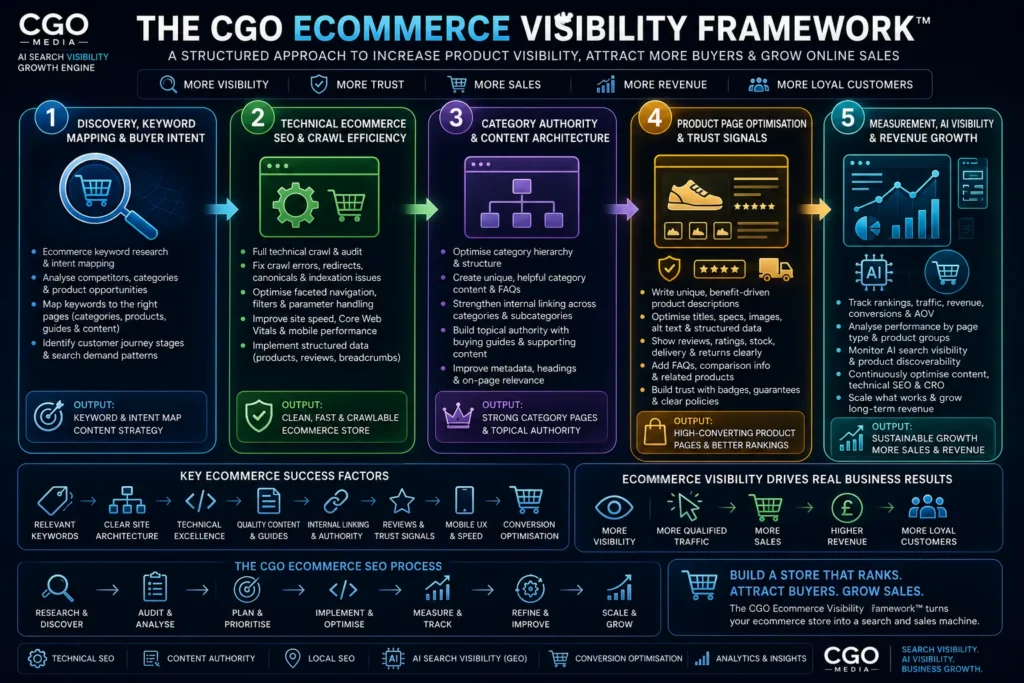
The CGO Ecommerce Visibility Framework shows how technical SEO, product optimisation, category authority and conversion strategy work together to increase ecommerce visibility and sales.
Introduction to the CGO Ecommerce Visibility Framework
Ecommerce has become one of the most competitive environments within modern search. Online retailers no longer compete solely against businesses offering similar products. They compete simultaneously against marketplaces, manufacturers, comparison websites, review platforms, AI-powered shopping assistants and increasingly sophisticated recommendation systems.
This changing landscape requires a broader approach to visibility.
Traditional Ecommerce SEO has often concentrated on product rankings, category optimisation and technical improvements. While these disciplines remain essential, artificial intelligence is transforming how consumers discover, evaluate and purchase products. AI systems increasingly recommend products, summarise reviews, compare alternatives and answer buying questions before users even visit an ecommerce website.
The CGO Ecommerce Visibility Framework has been developed to help organisations build sustainable visibility across both traditional search engines and emerging AI-powered commerce environments.
Rather than focusing only on rankings, the framework considers every factor that contributes to product discovery, commercial trust and long-term ecommerce growth.
Ecommerce Visibility Definition
Ecommerce Visibility is the measurable ability of an online retailer to make products, categories and brand knowledge discoverable, understandable and trustworthy across search engines, AI platforms, marketplaces and digital commerce ecosystems throughout the complete customer buying journey.
Why Ecommerce Visibility Has Changed
The customer journey has become significantly more complex.
Consumers increasingly move between multiple discovery channels before making purchasing decisions.
Examples include:
- Traditional Google searches.
- Google AI Overviews.
- ChatGPT product research.
- Perplexity shopping recommendations.
- Google Shopping.
- Marketplace comparisons.
- Review platforms.
- Social commerce.
Rather than relying upon one source of information, customers combine multiple sources before selecting products.
Consequently, ecommerce businesses require broader visibility strategies that extend beyond conventional SEO.
Core Principle
Future ecommerce success depends upon becoming visible wherever customers research, compare and purchase products rather than relying upon a single search channel.
Beyond Traditional Ecommerce SEO
The CGO Ecommerce Visibility Framework expands conventional optimisation by incorporating additional strategic capabilities that strengthen long-term commercial authority.
These include:
- AI Search readiness.
- Product entity optimisation.
- Content Authority.
- Brand Signals.
- Structured product data.
- Digital PR.
- Customer trust.
- Knowledge development.
Together these disciplines create stronger visibility across both search engines and AI-powered recommendation systems.
Ecommerce visibility is no longer determined solely by where products rank, but by how effectively AI systems understand, trust and recommend both the products and the retailer.
The Shift from Product Pages to Product Knowledge
Traditional ecommerce optimisation frequently centred on improving individual product pages.
AI-powered commerce increasingly evaluates broader product knowledge.
Customers now ask questions such as:
- Which product is best?
- What are the differences between alternatives?
- Which retailer is most trustworthy?
- Which products offer the best value?
- What do experts recommend?
- Which products solve specific problems?
- Which brands are recognised for quality?
- Which retailer provides the strongest buying experience?
These questions require organisations to develop comprehensive product knowledge ecosystems rather than relying solely on transactional pages.
Knowledge Commerce Principle
AI-powered shopping increasingly rewards retailers that educate customers before they attempt to sell products.
The Ecommerce Visibility Ecosystem
Long-term ecommerce success depends upon multiple interconnected components working together.
| Visibility Component | Primary Purpose | Strategic Contribution |
|---|---|---|
| ⚙️ Technical Ecommerce SEO | Improve crawlability and indexation. | Supports discoverability. |
| 🛍️ Product Knowledge | Develop comprehensive buying information. | Strengthens AI understanding. |
| 📚 Category Authority | Expand topical expertise. | Builds commercial relevance. |
| 🔗 Structured Product Data | Improve machine readability. | Supports AI interpretation. |
| 🛡️ Brand Trust | Strengthen customer confidence. | Improves recommendations. |
| 📊 Performance Measurement | Monitor commercial visibility. | Supports continuous optimisation. |
Visibility Throughout the Buying Journey
The framework recognises that customers interact with brands throughout multiple stages before purchasing.
Successful ecommerce organisations therefore create visibility across the complete buying journey rather than focusing exclusively on transactional intent.
| Buying Stage | Customer Need | Visibility Objective |
|---|---|---|
| 🔎 Awareness | Understand products. | Educational visibility. |
| 📊 Research | Compare alternatives. | Authority building. |
| ✓ Evaluation | Build confidence. | Trust development. |
| 🛒 Purchase | Complete transaction. | Conversion optimisation. |
| 🤝 Post-Purchase | Support customers. | Long-term loyalty. |
The strongest ecommerce brands remain visible before, during and after the purchase rather than only at the point of transaction.
The Objectives of the CGO Ecommerce Visibility Framework
The framework has been developed to provide organisations with a structured methodology for increasing commercial visibility across traditional search, AI-powered search and future digital commerce platforms.
Its primary objectives include:
- Increasing product discoverability.
- Strengthening category authority.
- Improving AI Search readiness.
- Supporting AI recommendations.
- Expanding product knowledge.
- Building customer trust.
- Strengthening Brand Signals.
- Creating sustainable ecommerce growth.
Framework Vision
The purpose of the CGO Ecommerce Visibility Framework is to help online retailers build comprehensive visibility ecosystems that enable products, brands and expertise to be discovered, trusted and recommended across the rapidly evolving world of AI-powered commerce.
Part 2 explores the strategic principles that underpin Ecommerce Visibility, explains how the framework integrates with the wider CGO ecosystem and introduces the long-term role of AI-powered product discovery in the future of ecommerce.
The Strategic Principles of Ecommerce Visibility
The CGO Ecommerce Visibility Framework is built upon a series of strategic principles that reflect the evolution of digital commerce. Rather than treating search visibility as an isolated SEO activity, the framework considers ecommerce success to be the result of interconnected technical, commercial and knowledge-based capabilities that collectively improve product discovery and customer trust.
These principles recognise that future ecommerce success will depend upon how effectively organisations help both customers and AI systems understand their products, categories and expertise.
Strategic Principle
Ecommerce Visibility is created when products, categories, brands and organisational knowledge work together as one connected commercial ecosystem.
The Five Pillars of Ecommerce Visibility
The framework is organised around five strategic pillars that support long-term commercial growth.
| Framework Pillar | Primary Focus | Strategic Outcome |
|---|---|---|
| ⚙️ Technical Excellence | Optimise crawlability, speed and indexation. | Supports discoverability. |
| 🛍️ Product Knowledge | Create comprehensive product information. | Improves AI understanding. |
| 🛡️ Commercial Trust | Strengthen credibility and customer confidence. | Increases conversions. |
| 🏆 Authority Development | Build recognised expertise within product categories. | Supports recommendations. |
| 📊 Performance Measurement | Monitor visibility across search and AI platforms. | Enables continuous improvement. |
Long-term ecommerce growth is achieved when technical optimisation, product expertise and customer trust operate as one integrated visibility strategy.
Integrating the Framework with the CGO Ecosystem
The Ecommerce Visibility Framework does not operate independently. It complements the wider CGO framework ecosystem by connecting ecommerce optimisation with organisational authority, semantic understanding and AI-powered discovery.
For example, the AI Search Readiness Framework improves AI interpretation of ecommerce websites, while the Entity Authority Framework strengthens product and brand entities. The Brand Signal Framework reinforces customer trust, the Content Authority Framework develops comprehensive buying resources and the AI Citation Framework increases opportunities for products and brands to be referenced within AI-generated responses.
Together these frameworks provide organisations with a unified methodology for achieving sustainable visibility across both traditional and AI-powered commerce environments.
Framework Integration Principle
Ecommerce Visibility becomes significantly stronger when technical optimisation, product knowledge, Brand Signals, Content Authority and AI readiness are developed together rather than as separate marketing initiatives.
The Future of AI-Powered Product Discovery
Artificial intelligence is expected to become increasingly influential throughout the ecommerce buying journey.
Rather than simply presenting lists of products, AI assistants will compare specifications, summarise reviews, recommend alternatives and provide personalised purchasing guidance based upon customer intent.
This evolution means that organisations must optimise not only for search engines but also for AI systems that interpret product information before presenting recommendations.
Businesses that invest in structured product knowledge, authoritative content and trustworthy Brand Signals will therefore be better positioned to benefit from future AI-driven commerce.
The future of ecommerce belongs to retailers whose knowledge is sufficiently comprehensive, trustworthy and well-structured for AI systems to recommend with confidence.
Preparing for the Remaining Framework
The remaining sections of the CGO Ecommerce Visibility Framework examine every component required to build sustainable commercial visibility, including technical ecommerce optimisation, product entity development, category authority, structured data, AI shopping readiness, customer trust, performance measurement and executive governance.
Each section combines strategic principles with practical implementation guidance, governance models and executive measurement frameworks that organisations can apply to strengthen long-term ecommerce performance.
Section 1 Executive Summary
The introduction establishes Ecommerce Visibility as a strategic organisational capability that extends beyond traditional SEO. By integrating technical excellence, product knowledge, AI Search readiness, Brand Signals, Content Authority and structured governance, organisations can build ecommerce ecosystems that improve discoverability, strengthen customer trust and increase recommendation potential across both traditional search engines and emerging AI-powered commerce platforms. Sustainable ecommerce growth depends upon developing products, knowledge and organisational authority together as one connected commercial strategy.
Technical Ecommerce Foundations for AI Search
Technical excellence remains the foundation of Ecommerce Visibility. Regardless of how advanced artificial intelligence becomes, search engines and AI-powered commerce platforms still depend upon accessible, structured and technically reliable websites to discover, understand and recommend products.
However, the role of technical optimisation has evolved.
Traditional Ecommerce SEO focused primarily on crawling, indexing and rankings. The AI era expands these objectives by requiring ecommerce websites to communicate product information clearly to both search engines and machine learning systems that interpret product knowledge before generating recommendations.
The CGO Ecommerce Visibility Framework therefore positions technical optimisation as the infrastructure that enables AI understanding, product discovery and long-term commercial visibility.
Technical Ecommerce Foundation Definition
Technical Ecommerce Foundations comprise the infrastructure, architecture and optimisation standards that enable products, categories and commercial knowledge to be efficiently discovered, interpreted and trusted by search engines, AI systems and digital commerce platforms.
Why Technical Excellence Still Matters
Regardless of advances in AI, product information cannot contribute to visibility if search systems cannot consistently access, interpret and organise it.
Technical optimisation ensures that every product, category and supporting resource forms part of a reliable commercial knowledge ecosystem.
Without this foundation, even outstanding product information may remain underutilised within search and AI environments.
Technical Principle
AI-powered commerce depends upon technically accessible product knowledge that can be interpreted accurately, consistently and at scale.
The Core Components of Technical Ecommerce Optimisation
The framework identifies several technical disciplines that collectively strengthen Ecommerce Visibility.
| Technical Component | Primary Purpose | Visibility Contribution |
|---|---|---|
| 🔍 Crawlability | Enable efficient discovery of products. | Improves indexation. |
| 🏗️ Site Architecture | Organise products and categories logically. | Strengthens AI understanding. |
| 🔗 Structured Data | Provide machine-readable product information. | Supports AI interpretation. |
| ⚡ Performance Optimisation | Improve loading speed and responsiveness. | Enhances user experience. |
| 🔀 Internal Linking | Strengthen semantic product relationships. | Expands contextual understanding. |
| 🗂️ Index Management | Control searchable content. | Improves content quality. |
Technical optimisation creates the infrastructure that enables every other aspect of Ecommerce Visibility to perform effectively.
Information Architecture for Ecommerce
Well-designed information architecture enables both customers and AI systems to understand how products relate to categories, brands and broader commercial topics.
Rather than viewing product pages as isolated destinations, the framework recommends organising ecommerce websites into structured knowledge hierarchies that reflect customer intent and product relationships.
Logical architecture improves discoverability while strengthening semantic understanding across the entire ecommerce ecosystem.
Architecture Principle
Products become easier to discover when they exist within clearly organised category structures supported by meaningful semantic relationships.
Managing Product Scale
Large ecommerce websites frequently contain thousands or even millions of product pages.
The framework therefore recommends scalable technical strategies that maintain quality without sacrificing efficiency.
Examples include:
- Consistent URL structures.
- Logical category hierarchies.
- Controlled faceted navigation.
- Efficient XML sitemaps.
- Duplicate content management.
- Canonical implementation.
- Automated structured data.
- Standardised product templates.
These processes enable organisations to expand product catalogues while maintaining strong technical foundations.
Scalable technical architecture enables ecommerce businesses to grow without reducing search quality or AI understanding.
Technical Optimisation for AI Systems
AI-powered search systems increasingly interpret relationships between products, brands, categories and supporting information.
Technical optimisation therefore extends beyond improving crawlability to ensuring that commercial knowledge is presented in a structured and machine-readable format.
Semantic consistency, structured data, logical navigation and clear content hierarchies all contribute to stronger AI interpretation and recommendation readiness.
AI Readiness Principle
Technical excellence enables AI systems to interpret ecommerce websites as structured commercial knowledge rather than disconnected collections of product pages.
Technical Infrastructure as a Competitive Advantage
As ecommerce competition continues to increase, technically mature websites gain significant long-term advantages.
Reliable infrastructure supports faster product discovery, stronger semantic understanding, improved customer experience and more effective AI interpretation.
Rather than serving as a background technical requirement, infrastructure becomes an essential strategic asset supporting sustainable Ecommerce Visibility.
Technical infrastructure provides the foundation upon which AI-powered product discovery, customer trust and long-term ecommerce growth are built.
Part 2 explores technical governance, structured data strategy, technical performance KPIs, maturity models, implementation methodology and the long-term role of technical excellence within AI-powered ecommerce.
Technical Governance for Ecommerce
Technical optimisation should be managed through structured governance rather than reactive maintenance. As ecommerce platforms grow, consistent governance ensures that technical quality remains aligned with business objectives while supporting search engines, AI systems and customers.
The framework recommends documented technical standards that apply across product pages, category pages, structured data, internal linking, site architecture and performance optimisation.
Technical Governance Principle
Long-term Ecommerce Visibility depends upon consistent technical governance that protects website quality, semantic integrity and AI readiness as product catalogues continue to expand.
Technical Governance Framework
| Governance Area | Primary Purpose | Strategic Benefit |
|---|---|---|
| 🏗️ Site Architecture Standards | Maintain logical category structures. | Improves discoverability. |
| 🔗 Structured Data Management | Ensure accurate product markup. | Strengthens AI interpretation. |
| ⚡ Performance Monitoring | Review speed and usability. | Enhances customer experience. |
| 🗂️ Index Management | Control crawl efficiency and content quality. | Supports search visibility. |
| 🔀 Internal Linking Governance | Maintain semantic product relationships. | Improves contextual understanding. |
| 🔍 Technical Audit Programme | Identify issues before they affect visibility. | Supports continuous optimisation. |
Technical governance protects the integrity of ecommerce platforms while enabling sustainable growth and stronger AI understanding.
Technical Ecommerce KPIs
Technical performance should be measured using indicators that reflect both operational efficiency and commercial visibility.
| KPI | Purpose | Strategic Value |
|---|---|---|
| 📑 Index Coverage Rate | Measure the percentage of valuable pages indexed. | Supports discoverability. |
| 🕷️ Crawl Efficiency Score | Monitor how effectively search engines access content. | Improves technical performance. |
| 🔗 Structured Data Accuracy | Assess product schema quality. | Strengthens AI understanding. |
| ⚡ Core Web Performance | Evaluate loading speed and responsiveness. | Enhances user experience. |
| 🧩 Internal Link Integrity | Measure semantic connectivity across products and categories. | Supports knowledge architecture. |
| 🛠️ Technical Error Rate | Track critical technical issues affecting visibility. | Maintains platform quality. |
Measurement Principle
Technical performance should be measured according to how effectively infrastructure supports product discovery, AI interpretation and long-term commercial visibility.
Technical Maturity Model
| Maturity Level | Characteristics | Strategic Outcome |
|---|---|---|
| 🌱 Level 1 – Basic Technical Setup | Foundational ecommerce platform with limited optimisation. | Initial search visibility. |
| 🧱 Level 2 – Structured Technical Optimisation | Improved architecture, performance and crawl management. | Growing discoverability. |
| 🤖 Level 3 – AI-Ready Technical Platform | Comprehensive structured data, semantic architecture and scalable optimisation. | Enhanced AI understanding. |
| ⚙️ Level 4 – Advanced Ecommerce Infrastructure | Continuous technical governance supported by automation and monitoring. | High AI recommendation readiness. |
| 🏆 Level 5 – Technical Commerce Leader | Internationally recognised technical excellence supporting large-scale AI-powered commerce. | Long-term Ecommerce Visibility leadership. |
Common Technical Weaknesses
Technical audits frequently identify recurring issues that limit ecommerce performance and reduce AI understanding.
- Poor category architecture.
- Duplicate product content.
- Weak structured data implementation.
- Slow page performance.
- Broken internal links.
- Uncontrolled faceted navigation.
- Indexation inefficiencies.
- Inconsistent URL structures.
- Limited technical monitoring.
- Reactive rather than proactive governance.
Resolving these weaknesses strengthens both traditional search visibility and future AI-powered product discovery.
Technical excellence creates a scalable ecommerce platform capable of supporting continual catalogue expansion without compromising search quality or AI readiness.
Technical Implementation Methodology
The framework recommends implementing technical optimisation through a structured programme.
- Audit the existing ecommerce platform.
- Improve crawlability and index management.
- Optimise category and product architecture.
- Implement comprehensive structured data.
- Strengthen internal semantic relationships.
- Improve website performance and usability.
- Monitor technical KPIs.
- Conduct recurring technical audits.
- Maintain governance standards.
- Continuously optimise the technical infrastructure for AI-powered commerce.
Section 2 Executive Summary
Technical Ecommerce Foundations provide the infrastructure required for sustainable visibility across traditional search engines and AI-powered commerce platforms. Through structured architecture, scalable optimisation, comprehensive structured data, semantic consistency, governance and continuous performance measurement, organisations create technically resilient ecommerce ecosystems that improve product discoverability, strengthen AI understanding and support long-term commercial growth. Technical excellence is not simply an operational requirement but a strategic capability that underpins every aspect of Ecommerce Visibility.
Product Entity Optimisation and Semantic Commerce
Products are no longer viewed by search engines and AI systems as isolated webpages containing titles, descriptions and prices. Modern search technologies increasingly interpret products as entities with identifiable characteristics, relationships and contextual meaning that extend across the wider digital ecosystem.
This evolution represents one of the most significant developments in ecommerce optimisation.
Rather than optimising only individual product pages, organisations must now develop structured product entities that AI systems can understand, compare and confidently recommend. Every product becomes part of a larger semantic network that connects brands, categories, attributes, customer intent and supporting knowledge.
The CGO Ecommerce Visibility Framework therefore introduces Product Entity Optimisation as a strategic capability for strengthening AI understanding, product discoverability and long-term ecommerce visibility.
Product Entity Definition
A Product Entity is a structured digital representation of a product that combines its attributes, relationships, commercial context and supporting knowledge into a machine-understandable object that can be recognised, interpreted and recommended by search engines and AI-powered commerce platforms.
Why Product Entities Matter
Customers increasingly ask conversational questions rather than searching for exact product names.
Examples include:
- Which laptop is best for engineering students?
- What is the most energy-efficient washing machine?
- Which office chair offers the best back support?
- What running shoes are recommended for beginners?
- Which coffee machine provides the best value?
- What camera is suitable for wildlife photography?
- Which standing desk is most durable?
- Which retailer offers the best customer support?
AI systems answer these questions by evaluating relationships between products, features, brands, reviews and contextual knowledge rather than relying solely on keyword matching.
Entity Principle
Products become more discoverable when AI systems understand what they are, how they relate to other entities and which customer needs they satisfy.
Building Strong Product Entities
The framework recommends developing product entities that extend beyond basic ecommerce information.
| Entity Component | Primary Purpose | Visibility Contribution |
|---|---|---|
| 🏷️ Product Attributes | Describe specifications and features. | Supports AI understanding. |
| 🏢 Brand Relationships | Connect products with recognised brands. | Strengthens trust. |
| 🗂️ Category Relationships | Position products within commercial hierarchies. | Improves discoverability. |
| 🎯 Use Cases | Explain customer applications. | Supports recommendations. |
| 📚 Supporting Content | Provide educational knowledge. | Expands semantic understanding. |
| 🔗 Structured Data | Create machine-readable entities. | Improves AI interpretation. |
Strong product entities combine technical structure with commercial knowledge to create richer semantic understanding across AI-powered commerce platforms.
Semantic Commerce
Semantic Commerce describes the process through which products, brands, categories and customer intent become connected within an integrated knowledge ecosystem.
Rather than treating each product independently, semantic commerce enables AI systems to recognise relationships that support comparison, recommendation and contextual understanding.
For example, a product may be linked to:
- Its manufacturer.
- Its product family.
- Alternative models.
- Complementary accessories.
- Buying guides.
- Expert reviews.
- Customer use cases.
- Industry standards.
Together these relationships strengthen the AI’s understanding of both the product and the retailer.
Semantic Commerce Principle
Products become significantly more valuable when they exist within connected knowledge ecosystems rather than isolated catalogue pages.
Product Knowledge Beyond Specifications
Technical specifications alone rarely provide sufficient context for AI-powered recommendations.
The framework therefore encourages organisations to develop comprehensive product knowledge that explains why products exist, who they are designed for, how they compare with alternatives and which customer problems they solve.
This richer context improves recommendation quality while strengthening commercial authority.
| Knowledge Type | Purpose | Authority Benefit |
|---|---|---|
| 🛒 Buying Guides | Support purchasing decisions. | Builds trust. |
| ⚖️ Comparison Content | Differentiate alternatives. | Supports AI recommendations. |
| 📘 Product Tutorials | Explain product usage. | Expands expertise. |
| 🏭 Industry Advice | Provide specialist guidance. | Strengthens authority. |
| ⭐ Expert Reviews | Validate product quality. | Improves credibility. |
| ❓ Frequently Asked Questions | Answer customer concerns. | Supports conversational search. |
Product knowledge enables AI systems to understand not only what a product is, but why customers should choose it.
Product Entities Within AI Search
As AI-powered commerce continues to evolve, product entities will become increasingly important because they enable AI systems to generate personalised recommendations based upon customer intent, commercial context and trusted knowledge.
Retailers that invest in Product Entity Optimisation will therefore be better positioned to increase discoverability, improve recommendation potential and strengthen long-term Ecommerce Visibility.
Framework Vision
The objective of Product Entity Optimisation is to transform ecommerce catalogues into structured commercial knowledge ecosystems that AI systems can understand, compare and confidently recommend.
Part 2 explores entity governance, semantic commerce KPIs, Product Entity maturity models, implementation methodology and the long-term role of structured product knowledge within AI-powered ecommerce.
Product Entity Governance
Product entities require structured governance to ensure that commercial information remains accurate, consistent and semantically connected as product catalogues continue to evolve. Without governance, inconsistencies in product attributes, relationships and terminology can reduce AI understanding and weaken recommendation potential.
The framework therefore recommends managing product entities through documented standards that apply across every product, category and supporting knowledge asset.
Entity Governance Principle
Product entities deliver the greatest commercial value when their attributes, relationships and supporting knowledge are maintained through consistent governance and continuous quality assurance.
Product Entity Governance Framework
| Governance Area | Primary Purpose | Strategic Benefit |
|---|---|---|
| 🏷️ Attribute Management | Maintain accurate product specifications. | Improves AI understanding. |
| 🔗 Entity Relationships | Manage links between products, brands and categories. | Strengthens semantic commerce. |
| 🧩 Structured Data Standards | Maintain consistent machine-readable information. | Supports AI interpretation. |
| 📝 Content Quality Control | Review descriptions and supporting knowledge. | Builds customer trust. |
| 🔄 Catalogue Maintenance | Update products throughout their lifecycle. | Maintains relevance. |
| 📚 Knowledge Integration | Connect products with educational resources. | Expands commercial authority. |
Effective governance transforms product catalogues into reliable commercial knowledge ecosystems that AI systems can confidently interpret and recommend.
Product Entity KPIs
Organisations should measure Product Entity Optimisation using indicators that evaluate semantic quality, structured data and commercial understanding rather than product quantity alone.
| KPI | Purpose | Strategic Value |
|---|---|---|
| 🧩 Entity Completeness Score | Measure the quality of product attributes. | Improves AI interpretation. |
| 🔗 Structured Data Coverage | Assess implementation across the catalogue. | Strengthens discoverability. |
| 🕸️ Semantic Relationship Density | Monitor connections between products and supporting entities. | Supports recommendation quality. |
| 📚 Product Knowledge Coverage | Evaluate educational content supporting products. | Builds authority. |
| 🤖 AI Recommendation Visibility | Track product appearance within AI-generated recommendations. | Measures commercial visibility. |
| ✓ Entity Accuracy Rate | Monitor consistency across commercial data. | Maintains trust. |
Measurement Principle
Product Entity performance should be evaluated according to how effectively AI systems understand, compare and recommend products within the wider commercial knowledge ecosystem.
Product Entity Maturity Model
| Maturity Level | Characteristics | Strategic Outcome |
|---|---|---|
| 🌱 Level 1 – Basic Catalogue | Product pages with limited structured information. | Foundational visibility. |
| 🧱 Level 2 – Structured Product Data | Consistent attributes and improved category organisation. | Better search understanding. |
| 🔗 Level 3 – Connected Product Entities | Products integrated with brands, categories and supporting knowledge. | Growing AI recommendation potential. |
| 🧠 Level 4 – Semantic Commerce Platform | Comprehensive entity relationships supported by governance and automation. | High AI commerce readiness. |
| 🌍 Level 5 – Global Product Knowledge Leader | Internationally recognised product knowledge ecosystem with continuous semantic optimisation. | Long-term Ecommerce Visibility leadership. |
Common Product Entity Weaknesses
Many ecommerce businesses continue to optimise products primarily for search rankings while overlooking the semantic information required for AI-powered commerce.
Common weaknesses include:
- Incomplete product attributes.
- Weak structured data implementation.
- Limited product relationships.
- Minimal educational content.
- Disconnected buying guides.
- Inconsistent product terminology.
- Outdated product information.
- Weak governance.
- Poor category integration.
- Limited AI performance measurement.
Resolving these weaknesses enables organisations to improve semantic understanding while strengthening long-term product discoverability across both traditional and AI-powered commerce platforms.
Product Entity Optimisation succeeds when every product becomes part of a structured, trustworthy and continuously expanding commercial knowledge ecosystem.
Product Entity Implementation Methodology
The framework recommends implementing Product Entity Optimisation through a structured programme.
- Audit product entity quality.
- Standardise product attributes.
- Strengthen category and brand relationships.
- Implement comprehensive structured data.
- Create supporting educational resources.
- Expand semantic product relationships.
- Measure Product Entity KPIs.
- Review AI recommendation performance.
- Maintain governance standards.
- Continuously strengthen the commercial knowledge ecosystem.
The Future of Semantic Commerce
As AI-powered shopping assistants continue to mature, Product Entity Optimisation will become increasingly important because AI systems will rely on structured commercial knowledge to compare products, understand customer intent and generate trustworthy recommendations.
Retailers that invest in semantic commerce today will establish stronger product visibility, greater recommendation potential and more resilient competitive positions as AI increasingly influences digital purchasing decisions.
Section 3 Executive Summary
Product Entity Optimisation enables organisations to transform ecommerce catalogues into structured commercial knowledge ecosystems that support AI understanding, product discovery and recommendation readiness. Through comprehensive product attributes, semantic relationships, structured data, educational content, governance and continuous performance measurement, retailers strengthen Ecommerce Visibility while improving customer trust and long-term competitive advantage. Sustainable success in AI-powered commerce depends upon treating products as interconnected entities within a continuously evolving knowledge ecosystem.
Category Authority and Commercial Topic Leadership
Individual product optimisation alone is no longer sufficient to achieve sustainable Ecommerce Visibility. AI-powered search increasingly evaluates whether retailers demonstrate comprehensive expertise across entire product categories rather than simply offering individual products for sale.
This represents a significant evolution in ecommerce strategy.
Customers increasingly begin their buying journey by researching categories, comparing product types and seeking expert advice before selecting specific products. AI systems mirror this behaviour by identifying organisations that consistently demonstrate category-level expertise through educational content, structured knowledge and comprehensive commercial resources.
The CGO Ecommerce Visibility Framework therefore introduces Category Authority as a strategic capability that strengthens product discovery, commercial trust and long-term recommendation potential.
Category Authority Definition
Category Authority is the demonstrated ability of an organisation to provide comprehensive, trustworthy and interconnected knowledge across an entire commercial product category, enabling AI systems and customers to recognise the retailer as an authoritative source of buying guidance and product expertise.
Why Category Authority Matters
Consumers rarely purchase complex products without first researching broader category information.
Typical buying questions include:
- Which type of product is most suitable?
- What features should buyers compare?
- Which brands are most reliable?
- What represents the best value?
- How do different models compare?
- Which products suit specific requirements?
- What common mistakes should buyers avoid?
- Which retailers demonstrate genuine expertise?
Retailers that answer these questions comprehensively strengthen customer confidence while improving AI understanding of their commercial expertise.
Category Principle
Retailers achieve stronger Ecommerce Visibility when they become recognised authorities for entire product categories rather than simply listing products for sale.
Building Category Authority
The framework recommends developing comprehensive category ecosystems that combine commercial content with educational resources and expert guidance.
| Category Asset | Primary Purpose | Visibility Contribution |
|---|---|---|
| 🗂️ Category Pages | Organise product collections. | Supports discoverability. |
| 🛒 Buying Guides | Help customers evaluate products. | Builds trust. |
| ⚖️ Comparison Articles | Explain product differences. | Supports AI recommendations. |
| 👤 Expert Advice | Provide specialist knowledge. | Strengthens authority. |
| 📚 Educational Resources | Answer common questions. | Improves semantic understanding. |
| 📈 Industry Insights | Explain market developments. | Expands topical expertise. |
Category Authority develops when commercial content is supported by genuine educational expertise that helps customers make informed purchasing decisions.
Commercial Topic Leadership
Commercial Topic Leadership extends Category Authority by positioning retailers as recognised experts within specialist markets.
Rather than focusing solely on products, organisations develop authoritative knowledge covering technologies, buying considerations, maintenance, regulations, trends and customer outcomes.
This broader knowledge strengthens semantic relationships while increasing the likelihood that AI systems will reference the retailer when answering category-level questions.
Commercial Leadership Principle
Retailers become category leaders by educating customers throughout the buying journey rather than concentrating exclusively on transactions.
Developing Category Knowledge Ecosystems
Strong Category Authority depends upon connected knowledge assets rather than isolated commercial pages.
| Knowledge Asset | Purpose | Authority Benefit |
|---|---|---|
| 🏛️ Category Hub | Centralise commercial knowledge. | Improves semantic organisation. |
| 🛒 Buying Guides | Support customer decisions. | Builds confidence. |
| ⚖️ Product Comparisons | Differentiate alternatives. | Supports recommendations. |
| ❓ Frequently Asked Questions | Address common concerns. | Improves conversational search. |
| ✍️ Expert Articles | Expand topical understanding. | Strengthens authority. |
| 🔗 Related Product Resources | Connect commercial information. | Supports AI interpretation. |
Category Authority and AI Commerce
AI-powered shopping assistants increasingly evaluate category expertise when recommending products.
Retailers that consistently demonstrate authority through structured category knowledge, expert guidance and educational content provide stronger signals that AI systems can use when generating recommendations.
This approach supports not only product visibility but also long-term brand recognition across commercial search environments.
Category Authority transforms ecommerce websites from online catalogues into recognised commercial knowledge resources.
Framework Vision
The objective of Category Authority is to establish retailers as trusted experts whose category knowledge supports customer decisions, strengthens AI understanding and improves long-term Ecommerce Visibility.
Part 2 explores Category Authority governance, commercial topic KPIs, maturity models, implementation methodology and the strategic relationship between category expertise and AI-powered product recommendations.
Category Authority Governance
Category Authority requires structured governance to ensure that commercial knowledge remains accurate, comprehensive and aligned with evolving customer needs. As product categories expand and technologies change, organisations should continuously review category resources to maintain authority and relevance.
The framework recommends documented governance covering category ownership, editorial standards, content quality, semantic consistency and ongoing knowledge development.
Category Governance Principle
Category Authority grows when every commercial knowledge asset is maintained through consistent governance, expert review and continuous improvement.
Category Governance Framework
| Governance Area | Primary Purpose | Strategic Benefit |
|---|---|---|
| 👤 Category Ownership | Assign responsibility for each commercial topic. | Strengthens accountability. |
| 📝 Editorial Standards | Maintain consistency across category resources. | Improves authority. |
| 🔄 Knowledge Reviews | Update buying advice and educational content. | Maintains relevance. |
| 🧠 Semantic Consistency | Protect terminology and category relationships. | Improves AI understanding. |
| ✓ Expert Validation | Verify technical accuracy and recommendations. | Builds customer trust. |
| 📊 Performance Monitoring | Review visibility and authority growth. | Supports continuous optimisation. |
Well-governed category knowledge creates stronger commercial trust while improving AI confidence in product recommendations.
Category Authority KPIs
Category Authority should be measured using indicators that evaluate the quality, depth and influence of commercial knowledge rather than the performance of individual product pages.
| KPI | Purpose | Strategic Value |
|---|---|---|
| 🏆 Category Authority Score | Measure overall expertise within priority categories. | Evaluates commercial leadership. |
| 📚 Knowledge Coverage Index | Assess completeness of category resources. | Strengthens topical expertise. |
| 🤖 AI Recommendation Visibility | Track category mentions within AI-generated recommendations. | Measures AI recognition. |
| 📈 Commercial Content Engagement | Evaluate interaction with buying guides and educational resources. | Indicates customer value. |
| 🕸️ Semantic Relationship Density | Measure connections between products, categories and supporting content. | Improves AI understanding. |
| 🔄 Category Content Freshness | Monitor review and update frequency. | Maintains long-term relevance. |
Measurement Principle
Category Authority should be measured by the organisation’s ability to educate, guide and influence purchasing decisions across an entire product category rather than by product rankings alone.
Category Authority Maturity Model
| Maturity Level | Characteristics | Strategic Outcome |
|---|---|---|
| 🌱 Level 1 – Basic Category Pages | Simple product listings with limited educational content. | Foundational visibility. |
| 🧱 Level 2 – Structured Category Resources | Buying guides and organised commercial content. | Improved customer understanding. |
| 🏆 Level 3 – Category Authority | Comprehensive educational resources integrated with products and expert guidance. | Growing AI recommendation potential. |
| 📈 Level 4 – Commercial Topic Leader | Recognised category expertise supported by research, governance and continuous optimisation. | High AI commerce readiness. |
| 🌍 Level 5 – Global Category Authority | Internationally recognised commercial knowledge ecosystem with continuous innovation and executive oversight. | Long-term Ecommerce Visibility leadership. |
Common Category Authority Weaknesses
Many ecommerce retailers focus heavily on individual products while neglecting the broader commercial knowledge that influences purchasing decisions.
Common weaknesses include:
- Thin category pages.
- Limited buying advice.
- Weak educational resources.
- Minimal expert contributions.
- Poor semantic relationships.
- Disconnected product and category content.
- Outdated buying guides.
- Inconsistent terminology.
- Limited governance.
- No structured authority measurement.
Addressing these weaknesses strengthens customer confidence, improves AI understanding and establishes broader commercial expertise across priority product categories.
Category Authority succeeds when every product category functions as a comprehensive knowledge destination rather than simply a commercial catalogue.
Category Authority Implementation Methodology
The framework recommends implementing Category Authority through a structured programme.
- Identify priority commercial categories.
- Audit existing category content.
- Develop comprehensive buying guides.
- Create expert educational resources.
- Strengthen semantic relationships between products and categories.
- Integrate category knowledge with Product Entity Optimisation.
- Measure Category Authority KPIs.
- Review category resources regularly.
- Maintain governance standards.
- Continuously expand commercial topic leadership.
The Future of Commercial Topic Leadership
As AI-powered commerce increasingly answers category-level buying questions before presenting individual products, retailers with comprehensive commercial knowledge will gain significant competitive advantages.
Businesses that consistently educate customers, strengthen category expertise and maintain authoritative commercial resources will improve their visibility across traditional search, conversational AI and future recommendation systems.
Section 4 Executive Summary
Category Authority enables ecommerce organisations to become recognised experts across entire commercial product categories rather than focusing solely on individual product pages. Through structured category knowledge, buying guides, expert content, semantic relationships, governance and continuous performance measurement, retailers strengthen AI understanding, improve recommendation potential and build long-term customer trust. Sustainable Ecommerce Visibility is achieved when category expertise supports every stage of the customer buying journey while reinforcing the wider commercial knowledge ecosystem.
Structured Product Data and Machine-Readable Commerce
Artificial intelligence depends upon structured information to understand products accurately. While human customers can interpret descriptions, images and marketing copy, AI systems require clearly defined data that communicates product attributes, relationships and commercial information in a consistent machine-readable format.
Structured Product Data therefore represents one of the most important technical and semantic foundations of modern Ecommerce Visibility.
Within the CGO Ecommerce Visibility Framework, structured data extends beyond traditional SEO markup. It becomes a strategic mechanism for enabling search engines, AI assistants, shopping platforms and recommendation systems to interpret products with greater confidence.
As AI-powered commerce continues to evolve, organisations that maintain high-quality structured product data will provide stronger signals for product discovery, comparison and recommendation.
Structured Product Data Definition
Structured Product Data is the consistent organisation of machine-readable commercial information that enables search engines, AI systems and digital commerce platforms to accurately identify, interpret and connect products, brands, categories, attributes and customer-relevant information.
Why Structured Data Matters
AI systems increasingly evaluate structured information before generating product recommendations or presenting commercial comparisons.
Rather than interpreting promotional copy alone, AI models rely upon clearly defined product characteristics that can be analysed consistently across thousands of retailers.
Structured data therefore improves both discoverability and semantic understanding throughout the ecommerce ecosystem.
Structured Data Principle
The clearer and more consistent product information becomes, the easier it is for AI systems to understand, compare and recommend commercial offerings.
Core Components of Structured Product Data
The framework recommends maintaining comprehensive machine-readable information across every significant product attribute.
| Structured Data Component | Primary Purpose | Visibility Contribution |
|---|---|---|
| 🏷️ Product Identification | Define unique product entities. | Improves AI recognition. |
| 🏢 Brand Information | Associate products with recognised manufacturers. | Strengthens trust. |
| 📋 Product Attributes | Describe specifications and features. | Supports comparison. |
| 💷 Commercial Information | Communicate pricing and availability. | Improves commerce accuracy. |
| ⭐ Customer Ratings | Represent product reputation. | Supports recommendations. |
| 🗂️ Category Relationships | Connect products within commercial hierarchies. | Strengthens semantic understanding. |
Structured Product Data transforms ecommerce catalogues into machine-readable commercial knowledge that AI systems can process efficiently and accurately.
Beyond Product Schema
Although structured product markup remains essential, the framework recommends extending machine-readable information throughout the wider ecommerce ecosystem.
Examples include:
- Brand entities.
- Category hierarchies.
- Organisation information.
- Frequently Asked Questions.
- Buying guides.
- Review content.
- Store locations.
- Supporting educational resources.
Together these structured assets strengthen semantic consistency while improving AI interpretation of the retailer’s complete commercial knowledge.
Semantic Structure Principle
Machine-readable information becomes significantly more valuable when products, brands, categories and supporting knowledge are connected through consistent semantic relationships.
Structured Data and AI Commerce
AI-powered shopping assistants increasingly rely upon structured information when comparing products, summarising specifications and answering customer questions.
Retailers that maintain comprehensive structured data therefore improve the likelihood that their products can be understood accurately within AI-generated recommendations.
This capability becomes particularly valuable as conversational commerce continues replacing traditional keyword-based shopping behaviour.
| AI Commerce Activity | Structured Data Role | Commercial Benefit |
|---|---|---|
| ⚖️ Product Comparison | Provide consistent specifications. | Supports informed decisions. |
| 🤖 Recommendation Generation | Describe product suitability. | Improves AI recommendations. |
| 🧠 Knowledge Extraction | Supply machine-readable information. | Enhances interpretation. |
| 🏢 Brand Recognition | Connect products with trusted entities. | Builds confidence. |
| 🔎 Commercial Discovery | Improve semantic visibility. | Expands discoverability. |
Structured Product Data provides the language through which AI systems understand ecommerce websites.
Machine-Readable Commerce as Competitive Advantage
As AI-powered commerce continues to mature, retailers with richer and more consistent structured information will increasingly outperform competitors that rely primarily on unstructured product descriptions.
Machine-readable commerce supports scalability, improves recommendation quality and strengthens the retailer’s ability to participate in future AI-driven shopping ecosystems.
Framework Vision
The objective of Structured Product Data is to create machine-readable commercial knowledge that enables AI systems to understand products accurately, strengthen recommendations and improve long-term Ecommerce Visibility.
Part 2 explores structured data governance, machine-readable commerce KPIs, maturity models, implementation methodology and the future role of semantic product information within AI-powered ecommerce.
Structured Data Governance
Structured Product Data requires continuous governance to ensure that machine-readable information remains accurate, consistent and aligned with the organisation’s evolving product catalogue. As ecommerce businesses introduce new products, categories and brands, governance prevents inconsistencies that may reduce AI understanding and commercial visibility.
The framework recommends documented governance covering structured data standards, product information quality, semantic consistency and recurring technical validation.
Structured Data Governance Principle
Machine-readable commerce delivers maximum value when structured information is managed through consistent governance, quality assurance and continuous validation.
Structured Data Governance Framework
| Governance Area | Primary Purpose | Strategic Benefit |
|---|---|---|
| 📐 Schema Standards | Maintain consistent structured markup. | Improves AI interpretation. |
| ✓ Attribute Validation | Verify product specifications and commercial data. | Strengthens accuracy. |
| 🧠 Semantic Consistency | Protect relationships between products, brands and categories. | Supports knowledge integrity. |
| 🔍 Technical Validation | Monitor structured data quality. | Maintains search performance. |
| 🔄 Catalogue Synchronisation | Keep structured information aligned with inventory changes. | Improves reliability. |
| 📋 Governance Reviews | Audit structured data regularly. | Supports continuous optimisation. |
Well-governed structured data strengthens trust by ensuring that AI systems consistently receive accurate and reliable commercial information.
Structured Product Data KPIs
Structured data performance should be measured using indicators that evaluate completeness, consistency and AI readiness rather than implementation alone.
| KPI | Purpose | Strategic Value |
|---|---|---|
| 📊 Structured Data Coverage | Measure implementation across the product catalogue. | Improves discoverability. |
| ✓ Schema Accuracy Rate | Assess correctness of machine-readable information. | Strengthens AI confidence. |
| 🏷️ Attribute Completeness Index | Evaluate the quality of structured product attributes. | Supports recommendations. |
| 🧠 Semantic Integrity Score | Monitor relationships between products, brands and categories. | Improves contextual understanding. |
| 🤖 AI Product Recognition | Track successful interpretation of product entities. | Measures semantic performance. |
| 🛡️ Validation Compliance | Review structured data quality against governance standards. | Maintains long-term reliability. |
Measurement Principle
Structured Product Data should be measured according to how effectively machine-readable information supports product discovery, semantic understanding and AI-powered recommendations.
Structured Data Maturity Model
| Maturity Level | Characteristics | Strategic Outcome |
|---|---|---|
| 🌱 Level 1 – Basic Product Markup | Limited structured data with inconsistent implementation. | Foundational machine readability. |
| 🧱 Level 2 – Structured Commerce | Comprehensive product schema and improved attribute consistency. | Better search interpretation. |
| 🔗 Level 3 – Semantic Product Ecosystem | Integrated structured data across products, brands, categories and supporting resources. | Growing AI recommendation potential. |
| 🤖 Level 4 – AI-Ready Commerce Platform | Advanced governance, automation and semantic optimisation. | High AI commerce readiness. |
| 🏆 Level 5 – Machine-Readable Commerce Leader | Internationally recognised semantic commerce ecosystem with continuous innovation and governance. | Long-term Ecommerce Visibility leadership. |
Common Structured Data Weaknesses
Many ecommerce websites implement structured data only partially, limiting the ability of AI systems to interpret products accurately.
Common weaknesses include:
- Incomplete product attributes.
- Inconsistent schema implementation.
- Missing brand relationships.
- Weak category hierarchy.
- Outdated pricing or availability information.
- Disconnected product entities.
- Poor validation processes.
- Minimal semantic consistency.
- Weak governance.
- Limited performance measurement.
Addressing these weaknesses strengthens machine-readable commerce while improving product discoverability and AI interpretation across evolving digital commerce platforms.
Structured Product Data succeeds when every commercial data point contributes to a consistent, trustworthy and semantically connected ecommerce ecosystem.
Structured Data Implementation Methodology
The framework recommends implementing machine-readable commerce through a structured programme.
- Audit structured data across the ecommerce platform.
- Standardise schema implementation.
- Improve product attribute completeness.
- Strengthen brand and category relationships.
- Validate structured data continuously.
- Monitor structured data KPIs.
- Review AI product interpretation regularly.
- Maintain semantic consistency.
- Apply governance standards.
- Continuously strengthen machine-readable commerce.
The Future of Machine-Readable Commerce
As AI-powered commerce platforms continue to develop, structured commercial information will become increasingly important because intelligent systems depend upon reliable machine-readable data to compare products, answer customer questions and generate trustworthy recommendations.
Retailers that invest in comprehensive structured data today will create stronger foundations for AI-powered product discovery, conversational commerce and future digital shopping experiences.
Section 5 Executive Summary
Structured Product Data enables ecommerce organisations to transform commercial information into machine-readable knowledge that supports AI understanding, product discovery and recommendation readiness. Through comprehensive schema implementation, semantic consistency, governance, continuous validation and strategic performance measurement, retailers strengthen Ecommerce Visibility while improving AI interpretation and long-term commercial competitiveness. Sustainable success in AI-powered commerce depends upon maintaining structured information that remains accurate, connected and trustworthy throughout the complete product lifecycle.
Customer Trust, Reviews and Purchase Confidence
Customer trust has become one of the most influential factors in Ecommerce Visibility. While technical optimisation and product knowledge improve discoverability, purchasing decisions are ultimately influenced by confidence. AI-powered shopping systems increasingly evaluate signals that indicate whether retailers consistently deliver reliable products, positive customer experiences and trustworthy commercial practices.
This evolution extends trust beyond traditional review scores.
Modern ecommerce authority is established through the combination of transparent business practices, verified customer experiences, recognised brand reputation, expert guidance and consistent post-purchase satisfaction. Together these signals help both customers and AI systems determine whether a retailer deserves to be recommended.
The CGO Ecommerce Visibility Framework therefore positions Customer Trust as a strategic capability that supports visibility, conversion performance and long-term commercial resilience.
Customer Trust Definition
Customer Trust is the measurable confidence that consumers and AI-powered commerce platforms place in an ecommerce business based on verified customer experiences, transparent business practices, product reliability, service quality and consistent organisational credibility throughout the purchasing journey.
Why Trust Has Become a Visibility Signal
Consumers increasingly research retailers before making purchasing decisions.
Rather than relying solely on product descriptions, customers seek reassurance through independent evidence that demonstrates quality and reliability.
AI systems increasingly evaluate similar signals when identifying retailers suitable for recommendations.
Trust Principle
Retailers that consistently demonstrate credibility, transparency and customer satisfaction are more likely to earn long-term visibility across both traditional search and AI-powered commerce.
The Components of Customer Trust
The framework identifies multiple interconnected trust signals that collectively influence commercial authority.
| Trust Component | Primary Purpose | Visibility Contribution |
|---|---|---|
| ⭐ Verified Customer Reviews | Demonstrate genuine customer experiences. | Builds confidence. |
| 🏢 Business Transparency | Communicate policies and company information. | Strengthens credibility. |
| 🛡️ Product Reliability | Deliver consistent product quality. | Supports recommendations. |
| 💬 Customer Support | Provide responsive assistance. | Improves reputation. |
| 👤 Expert Guidance | Support informed purchasing decisions. | Builds authority. |
| 🤝 Post-Purchase Experience | Maintain customer satisfaction after delivery. | Encourages long-term loyalty. |
Trust develops through consistently positive customer experiences rather than individual marketing messages or isolated reviews.
The Strategic Role of Reviews
Customer reviews represent one of the most visible expressions of commercial trust.
However, the framework encourages organisations to view reviews as part of a wider trust ecosystem rather than simply a rating metric.
High-quality reviews provide valuable insights into product performance, customer satisfaction, service quality and brand credibility. They also create additional commercial knowledge that can reinforce AI understanding of products and retailers.
Review Principle
Verified customer experiences strengthen Ecommerce Visibility by providing independent evidence that supports purchasing confidence and AI recommendations.
Trust Throughout the Customer Journey
Customer confidence should be strengthened at every stage of the buying journey.
| Journey Stage | Trust Objective | Commercial Benefit |
|---|---|---|
| 🔎 Discovery | Establish brand credibility. | Encourages engagement. |
| 📚 Research | Provide reliable product knowledge. | Supports informed decisions. |
| ⚖️ Evaluation | Present reviews and expert guidance. | Builds confidence. |
| 🛒 Purchase | Deliver transparent pricing and policies. | Reduces purchase friction. |
| 🤝 Post-Purchase | Provide support and follow-up. | Encourages repeat business. |
AI Commerce and Commercial Trust
AI-powered shopping assistants increasingly evaluate trust signals before recommending products or retailers.
Retailers that consistently demonstrate positive customer experiences, transparent governance and strong reputational signals provide AI systems with greater confidence when generating recommendations.
Consequently, trust becomes both a conversion factor and an increasingly important component of Ecommerce Visibility.
Commercial trust enables AI systems to recommend retailers with greater confidence because customer satisfaction provides independent validation of business quality.
Framework Vision
The objective of Customer Trust is to establish ecommerce organisations as reliable commercial partners whose products, service and reputation consistently justify customer confidence and AI-powered recommendations.
Part 2 explores trust governance, review management KPIs, customer confidence maturity models, implementation methodology and the future relationship between commercial trust and AI-powered ecommerce visibility.
Trust Governance and Reputation Management
Customer Trust should be managed through structured governance rather than reactive reputation management. As ecommerce organisations grow, maintaining consistent customer experiences, transparent communication and reliable service standards becomes essential for sustaining both commercial credibility and AI recommendation potential.
The framework recommends documented governance covering customer feedback, review management, service quality, transparency and continuous reputation improvement.
Trust Governance Principle
Long-term customer confidence is built through consistent governance that ensures every interaction reinforces credibility, transparency and service excellence.
Customer Trust Governance Framework
| Governance Area | Primary Purpose | Strategic Benefit |
|---|---|---|
| ⭐ Review Management | Monitor and respond to customer feedback. | Strengthens trust. |
| 💬 Customer Service Standards | Maintain consistent support quality. | Improves satisfaction. |
| 🏢 Business Transparency | Provide clear policies and company information. | Builds credibility. |
| 📊 Reputation Monitoring | Track customer sentiment across digital channels. | Supports brand confidence. |
| 🛠️ Issue Resolution | Resolve customer concerns promptly. | Protects reputation. |
| 🔄 Continuous Improvement | Use customer feedback to enhance products and services. | Strengthens long-term trust. |
Trust grows when organisations treat every customer interaction as an opportunity to strengthen long-term credibility rather than simply complete a transaction.
Customer Trust KPIs
Trust should be measured using indicators that evaluate customer confidence, service quality and commercial reputation rather than sales performance alone.
| KPI | Purpose | Strategic Value |
|---|---|---|
| 🛡️ Customer Trust Score | Measure overall confidence in the retailer. | Evaluates reputation. |
| ⭐ Verified Review Quality | Assess the volume and quality of genuine customer feedback. | Supports credibility. |
| 😊 Customer Satisfaction Index | Monitor post-purchase experiences. | Strengthens loyalty. |
| ⏱️ Issue Resolution Time | Measure responsiveness to customer concerns. | Improves service quality. |
| 🔁 Repeat Purchase Rate | Track customer retention. | Reflects long-term confidence. |
| 🤖 AI Recommendation Visibility | Monitor retailer appearances in AI-generated shopping recommendations. | Measures commercial trust. |
Measurement Principle
Customer Trust should be evaluated according to the consistency of positive customer experiences and the retailer’s ability to sustain confidence over time.
Customer Trust Maturity Model
| Maturity Level | Characteristics | Strategic Outcome |
|---|---|---|
| 🌱 Level 1 – Basic Customer Service | Limited review management and reactive support. | Foundational trust. |
| 🧱 Level 2 – Structured Reputation Management | Consistent customer support, review collection and transparent policies. | Growing customer confidence. |
| 🏆 Level 3 – Trusted Ecommerce Brand | Strong customer satisfaction supported by structured governance and service excellence. | Increasing AI recommendation potential. |
| ⭐ Level 4 – Industry Trust Leader | Recognised reputation, expert guidance and continuous customer experience optimisation. | High commercial authority. |
| 🌍 Level 5 – Global Trust Authority | Internationally recognised reputation supported by exceptional customer experiences and executive governance. | Long-term Ecommerce Visibility leadership. |
Common Trust Weaknesses
Many ecommerce businesses underestimate the importance of structured trust management, resulting in inconsistent customer experiences and weaker commercial authority.
Common weaknesses include:
- Limited verified reviews.
- Slow response to customer issues.
- Unclear business policies.
- Inconsistent customer service.
- Weak reputation monitoring.
- Minimal post-purchase engagement.
- Poor transparency.
- Reactive complaint management.
- No structured trust measurement.
- Limited governance.
Addressing these weaknesses improves customer confidence while strengthening the trust signals increasingly evaluated by AI-powered commerce platforms.
Customer Trust becomes a sustainable competitive advantage when positive experiences are delivered consistently across the entire buying journey.
Trust Implementation Methodology
The framework recommends implementing Customer Trust through a structured programme.
- Audit customer trust signals.
- Strengthen review collection processes.
- Improve business transparency.
- Enhance customer service standards.
- Monitor customer satisfaction continuously.
- Measure trust KPIs.
- Respond proactively to customer feedback.
- Review reputation performance regularly.
- Maintain governance standards.
- Continuously strengthen customer confidence across every commercial interaction.
The Future of Customer Trust in AI Commerce
As AI-powered shopping assistants become more influential in product discovery and purchasing decisions, commercial trust will become an increasingly important factor in recommendation algorithms. AI systems are expected to place greater emphasis on verified customer experiences, transparent business practices and consistent service quality when determining which retailers to recommend.
Organisations that invest in structured trust management today will strengthen both customer loyalty and long-term visibility across future AI-powered commerce ecosystems.
Section 6 Executive Summary
Customer Trust provides the credibility that underpins sustainable Ecommerce Visibility. Through verified reviews, transparent business practices, excellent customer service, structured governance, continuous performance measurement and proactive reputation management, ecommerce organisations strengthen customer confidence while improving AI recommendation potential. Long-term commercial success depends upon consistently delivering trustworthy experiences that reinforce both human confidence and AI understanding throughout the complete customer journey.
AI Shopping Optimisation and Conversational Commerce
The rapid development of AI-powered shopping assistants is transforming how customers discover, compare and purchase products. Rather than browsing multiple websites and manually evaluating product options, consumers are increasingly asking conversational AI systems for recommendations, comparisons and buying advice.
This shift represents one of the most significant changes in ecommerce since the emergence of online search.
AI platforms are evolving from information retrieval tools into commercial decision-support systems that summarise product information, compare alternatives, explain technical specifications and recommend retailers based on customer intent.
The CGO Ecommerce Visibility Framework therefore introduces AI Shopping Optimisation as a strategic capability that prepares ecommerce organisations for the next generation of digital commerce.
AI Shopping Optimisation Definition
AI Shopping Optimisation is the structured process of preparing ecommerce websites, products and commercial knowledge so that AI-powered shopping assistants can accurately understand, compare and recommend products throughout the conversational buying journey.
Why Conversational Commerce Matters
Traditional ecommerce has largely relied on keyword searches followed by manual browsing.
Conversational commerce changes this behaviour by allowing customers to ask natural language questions that AI systems interpret before presenting recommendations.
Examples include:
- Which laptop offers the best value under £1,000?
- What coffee machine is easiest to maintain?
- Which running shoes are best for beginners?
- What office chair is recommended for long working hours?
- Which retailer has the best customer support?
- What is the most energy-efficient dishwasher?
- Which camera is suitable for travel photography?
- What standing desk is best for home offices?
Retailers must therefore optimise for questions, intent and product understanding rather than focusing solely on keyword rankings.
Conversational Commerce Principle
Future ecommerce visibility depends upon helping AI systems answer customer questions with confidence before customers visit individual product pages.
The Components of AI Shopping Optimisation
The framework identifies several strategic capabilities that collectively strengthen AI commerce readiness.
| Optimisation Component | Primary Purpose | Strategic Benefit |
|---|---|---|
| 📚 Product Knowledge | Provide comprehensive commercial information. | Improves AI understanding. |
| 🔗 Structured Product Data | Support machine-readable interpretation. | Strengthens recommendations. |
| 💬 Customer Intent Content | Answer conversational buying questions. | Expands discoverability. |
| 🛡️ Brand Trust Signals | Demonstrate retailer credibility. | Supports recommendation confidence. |
| 🧠 Semantic Relationships | Connect products with categories and knowledge. | Improves contextual understanding. |
| 🏆 Commercial Authority | Establish recognised expertise. | Builds AI confidence. |
AI Shopping Optimisation enables ecommerce businesses to become trusted knowledge sources rather than simply online retailers.
Preparing Products for AI Recommendations
AI systems require significantly more contextual information than traditional search engines.
Products should therefore include information that explains:
- Who the product is designed for.
- Which problems it solves.
- Its advantages over alternatives.
- Relevant use cases.
- Buying considerations.
- Compatibility with related products.
- Maintenance requirements.
- Long-term customer value.
This richer knowledge enables AI systems to generate more accurate and trustworthy recommendations.
Recommendation Principle
Products supported by comprehensive commercial knowledge are significantly more likely to appear in AI-generated buying recommendations.
The Evolution of Conversational Commerce
Conversational commerce extends beyond product search.
Future AI shopping assistants are expected to provide increasingly personalised guidance by combining product knowledge, customer preferences, previous purchasing behaviour and contextual understanding.
Retailers that invest in AI-ready commercial information today will be better positioned as these technologies continue to mature.
| Commerce Evolution | Traditional Ecommerce | AI-Powered Commerce |
|---|---|---|
| 🔎 Product Discovery | Keyword search. | Conversational recommendations. |
| ⚖️ Product Comparison | Manual evaluation. | AI-generated comparisons. |
| 🛒 Buying Advice | Customer research. | Interactive AI guidance. |
| 🎯 Decision Support | User interpretation. | AI-assisted recommendations. |
| 💬 Commercial Journey | Linear navigation. | Conversational interaction. |
The future of ecommerce will increasingly revolve around conversations rather than searches.
Framework Vision
The objective of AI Shopping Optimisation is to prepare ecommerce organisations for a future in which AI-powered assistants become trusted commercial advisors that influence product discovery, purchasing decisions and long-term customer relationships.
Part 2 explores AI Shopping governance, conversational commerce KPIs, maturity models, implementation methodology and the future relationship between AI-powered recommendations and Ecommerce Visibility.
AI Shopping Governance
AI Shopping Optimisation requires structured governance to ensure that product information, commercial knowledge and recommendation signals remain accurate, consistent and aligned with evolving AI-powered commerce platforms. As conversational shopping experiences become more sophisticated, governance helps organisations maintain recommendation readiness while protecting customer trust.
The framework recommends documented governance covering AI-ready content, structured product information, conversational intent, semantic consistency and continuous performance monitoring.
AI Shopping Governance Principle
Retailers strengthen long-term AI recommendation potential by governing commercial knowledge with the same discipline applied to products, pricing and customer service.
AI Shopping Governance Framework
| Governance Area | Primary Purpose | Strategic Benefit |
|---|---|---|
| 🤖 AI Content Standards | Maintain high-quality conversational content. | Improves AI understanding. |
| 📚 Product Knowledge Governance | Keep commercial information accurate and complete. | Strengthens recommendations. |
| 💬 Conversational Intent Mapping | Align content with customer questions. | Expands discoverability. |
| 🧠 Semantic Consistency | Maintain relationships between products, categories and brands. | Supports contextual understanding. |
| 📊 Recommendation Monitoring | Evaluate AI-generated product visibility. | Measures AI performance. |
| 🔄 Continuous Optimisation | Refine AI readiness over time. | Supports sustainable growth. |
Effective governance ensures that conversational commerce remains accurate, trustworthy and commercially valuable as AI technologies continue to evolve.
AI Shopping KPIs
Performance should be measured using indicators that evaluate AI visibility, conversational relevance and recommendation quality.
| KPI | Purpose | Strategic Value |
|---|---|---|
| 🤖 AI Recommendation Visibility | Measure appearances within AI-generated shopping results. | Evaluates commercial reach. |
| 💬 Conversational Query Coverage | Assess how well customer questions are answered. | Improves AI readiness. |
| 📚 Product Knowledge Completeness | Evaluate contextual product information. | Strengthens recommendations. |
| 🎯 Intent Match Score | Measure alignment between content and customer intent. | Supports conversational commerce. |
| 🧠 Semantic Relationship Index | Monitor connections across products, brands and categories. | Improves AI understanding. |
| 📈 AI Commerce Growth Index | Track long-term AI visibility improvements. | Supports executive planning. |
Measurement Principle
AI Shopping Optimisation should be evaluated according to how effectively ecommerce knowledge supports conversational discovery, recommendation quality and customer decision-making.
AI Shopping Maturity Model
| Maturity Level | Characteristics | Strategic Outcome |
|---|---|---|
| 🌱 Level 1 – Traditional Ecommerce | Optimised primarily for keyword-based search. | Basic online visibility. |
| 🧱 Level 2 – AI-Aware Commerce | Structured product information and improved semantic content. | Growing AI understanding. |
| 💬 Level 3 – Conversational Commerce Ready | Products, categories and buying guidance optimised for AI interactions. | Increasing recommendation potential. |
| 🤖 Level 4 – AI Commerce Leader | Advanced governance, conversational content strategy and continuous optimisation. | High AI shopping readiness. |
| 🏆 Level 5 – Intelligent Commerce Authority | Internationally recognised AI-ready ecommerce ecosystem supported by continuous innovation and executive governance. | Long-term Ecommerce Visibility leadership. |
Common AI Shopping Weaknesses
Many retailers continue to optimise primarily for traditional search while overlooking the requirements of conversational AI systems.
Common weaknesses include:
- Limited conversational content.
- Weak product context.
- Incomplete structured data.
- Poor intent mapping.
- Disconnected product knowledge.
- Minimal AI visibility monitoring.
- Weak semantic relationships.
- Reactive optimisation.
- Limited governance.
- No AI commerce strategy.
Addressing these weaknesses prepares ecommerce businesses for the continued growth of AI-powered product discovery and recommendation systems.
Conversational commerce succeeds when organisations optimise for customer intent, contextual understanding and trusted AI recommendations rather than rankings alone.
AI Shopping Implementation Methodology
The framework recommends implementing AI Shopping Optimisation through a structured programme.
- Audit AI shopping readiness.
- Identify high-value conversational queries.
- Expand AI-ready product knowledge.
- Strengthen semantic relationships.
- Improve structured product information.
- Optimise content for conversational intent.
- Monitor AI Shopping KPIs.
- Review recommendation performance regularly.
- Maintain governance standards.
- Continuously improve AI commerce capabilities.
The Future of Conversational Commerce
Conversational commerce is expected to become one of the dominant methods of product discovery as AI assistants evolve into trusted purchasing advisors. Rather than navigating complex ecommerce websites, customers will increasingly rely on AI systems to identify suitable products, compare alternatives and recommend trusted retailers.
Retailers that invest in AI Shopping Optimisation today will be better positioned to strengthen discoverability, recommendation visibility and customer trust as conversational AI becomes an integral part of the global ecommerce ecosystem.
Section 7 Executive Summary
AI Shopping Optimisation prepares ecommerce organisations for the next generation of digital commerce by aligning product knowledge, conversational content, structured data and semantic relationships with the requirements of AI-powered shopping assistants. Through structured governance, AI-focused KPIs, continuous optimisation and recommendation readiness, retailers strengthen Ecommerce Visibility while improving customer experience and long-term commercial competitiveness. The future of ecommerce belongs to organisations that enable AI systems to understand, compare and confidently recommend their products.
Digital PR, Brand Authority and Ecommerce Reputation
Technical optimisation, product entities and structured data establish the foundations of Ecommerce Visibility, but long-term commercial success increasingly depends upon how retailers are recognised beyond their own websites. AI-powered search systems evaluate not only the information that organisations publish but also how they are discussed, referenced and trusted across the wider digital ecosystem.
Digital PR therefore becomes significantly more than a promotional activity.
Within the CGO Ecommerce Visibility Framework, Digital PR strengthens Brand Authority by increasing external recognition, independent validation and commercial credibility. Every authoritative mention, expert feature, industry publication and trusted citation contributes to the retailer’s wider reputation and supports AI confidence.
As AI-powered commerce evolves, externally recognised expertise becomes an increasingly valuable competitive advantage.
Digital PR and Ecommerce Reputation Definition
Digital PR and Ecommerce Reputation represent the structured development of external authority through trusted media coverage, industry recognition, expert contributions and independent validation that strengthen Brand Authority, AI recommendations and long-term Ecommerce Visibility.
Why External Recognition Matters
Consumers frequently evaluate retailers before making purchasing decisions by consulting independent sources of information.
AI systems increasingly analyse similar signals when determining which businesses demonstrate sufficient credibility to support commercial recommendations.
External recognition therefore reinforces trust in ways that cannot be achieved through self-published marketing content alone.
Digital PR Principle
Independent recognition strengthens Ecommerce Visibility because external validation provides stronger trust signals than self-promotional messaging.
The Components of Ecommerce Brand Authority
The framework identifies multiple activities that contribute to external commercial authority.
| Authority Component | Primary Purpose | Visibility Contribution |
|---|---|---|
| 📰 Digital PR Campaigns | Generate authoritative media coverage. | Builds credibility. |
| 📚 Industry Publications | Demonstrate specialist expertise. | Strengthens authority. |
| 🎙️ Expert Commentary | Provide recognised commercial insights. | Supports trust. |
| ⭐ Independent Reviews | Validate products and services. | Improves recommendation confidence. |
| 🔬 Research Publications | Create original commercial knowledge. | Supports citations. |
| 🤝 Strategic Partnerships | Expand organisational recognition. | Strengthens Brand Signals. |
Brand Authority grows when organisations become recognised contributors to their industries rather than simply participants within them.
Digital PR Beyond Link Acquisition
Traditional Digital PR often focused on acquiring backlinks.
The framework recommends a broader strategic objective centred on authority development.
High-quality Digital PR should strengthen brand recognition, expert credibility, product reputation and organisational knowledge while creating opportunities for AI systems to identify trusted commercial entities.
Media coverage therefore contributes simultaneously to search visibility, commercial trust and AI recommendation readiness.
Authority Development Principle
The most valuable Digital PR campaigns create lasting recognition that continues influencing commercial trust long after publication.
Building an Ecommerce Reputation Ecosystem
Long-term commercial reputation depends upon the interaction of multiple external trust signals.
| Reputation Asset | Purpose | Authority Benefit |
|---|---|---|
| 📰 Industry Media Coverage | Increase external visibility. | Builds recognition. |
| 💡 Thought Leadership | Demonstrate expertise. | Strengthens credibility. |
| 🔬 Research Publications | Share original knowledge. | Supports citations. |
| 🎙️ Expert Interviews | Expand professional influence. | Improves trust. |
| 🏆 Industry Awards | Validate commercial excellence. | Strengthens reputation. |
| 🤝 Professional Partnerships | Increase organisational authority. | Supports long-term visibility. |
Digital PR Within AI Commerce
AI-powered commerce increasingly benefits from retailers that demonstrate recognised expertise beyond their own websites.
External citations, media mentions, expert commentary and research publications provide additional signals that support AI confidence when generating commercial recommendations.
Consequently, Digital PR contributes directly to future Ecommerce Visibility rather than functioning solely as a communications activity.
External recognition transforms retailers into trusted commercial authorities that AI systems can recommend with greater confidence.
Framework Vision
The objective of Digital PR and Brand Authority is to establish ecommerce organisations as recognised industry leaders whose external reputation strengthens customer trust, AI understanding and long-term commercial visibility.
Part 2 explores Digital PR governance, Brand Authority KPIs, maturity models, implementation methodology and the future relationship between external recognition and AI-powered Ecommerce Visibility.
Digital PR Governance and Reputation Management
Digital PR should be managed through structured governance that aligns external communications with the organisation’s long-term commercial objectives. As ecommerce brands expand across multiple markets and digital channels, consistent governance ensures that media coverage, expert contributions and industry recognition strengthen Brand Authority rather than creating fragmented messaging.
The framework recommends documented governance covering media strategy, brand positioning, research publication, expert communications and reputation monitoring.
Digital PR Governance Principle
Long-term Brand Authority is achieved when every external communication reinforces organisational expertise, customer trust and commercial credibility.
Digital PR Governance Framework
| Governance Area | Primary Purpose | Strategic Benefit |
|---|---|---|
| 📰 Media Strategy | Coordinate authoritative media engagement. | Strengthens visibility. |
| 🏷️ Brand Messaging | Maintain consistent commercial positioning. | Improves recognition. |
| 🔬 Research Communications | Promote original industry knowledge. | Supports authority. |
| 👤 Expert Representation | Develop recognised subject-matter experts. | Builds credibility. |
| 📊 Reputation Monitoring | Track brand sentiment and external recognition. | Protects trust. |
| 🔄 Continuous Improvement | Refine Digital PR strategy over time. | Supports sustainable growth. |
Well-governed Digital PR creates lasting authority by ensuring that every external mention contributes to a consistent and trustworthy brand reputation.
Digital PR and Brand Authority KPIs
Performance should be measured using indicators that evaluate recognition, credibility and long-term authority rather than media volume alone.
| KPI | Purpose | Strategic Value |
|---|---|---|
| 🏆 Brand Authority Score | Measure overall external credibility. | Evaluates reputation. |
| 📰 Authoritative Media Mentions | Track coverage by trusted publications. | Strengthens recognition. |
| 🔬 Research Citation Frequency | Monitor references to proprietary research. | Supports AI visibility. |
| 👤 Expert Contribution Index | Measure recognised specialist participation. | Builds trust. |
| 🤖 AI Recommendation Visibility | Monitor retailer mentions within AI-generated shopping responses. | Measures commercial authority. |
| 📈 Reputation Growth Index | Track long-term expansion of external recognition. | Supports executive planning. |
Measurement Principle
Digital PR success should be evaluated according to how effectively external recognition strengthens customer trust, AI understanding and long-term commercial authority.
Brand Authority Maturity Model
| Maturity Level | Characteristics | Strategic Outcome |
|---|---|---|
| 🌱 Level 1 – Limited Brand Recognition | Minimal external visibility and reactive communications. | Foundational reputation. |
| 🧱 Level 2 – Structured Brand Presence | Consistent Digital PR activity supported by recognised messaging. | Growing market awareness. |
| 🏆 Level 3 – Trusted Ecommerce Brand | Regular media coverage, expert contributions and research-led communications. | Increasing AI recommendation potential. |
| ⭐ Level 4 – Industry Brand Authority | Recognised thought leadership supported by governance and continuous reputation management. | High commercial credibility. |
| 🌍 Level 5 – Global Ecommerce Authority | Internationally recognised brand with sustained media influence, research leadership and executive governance. | Long-term Ecommerce Visibility leadership. |
Common Digital PR Weaknesses
Many ecommerce businesses continue to treat Digital PR as a short-term promotional activity rather than a strategic authority-building capability.
Common weaknesses include:
- Limited media engagement.
- Weak thought leadership.
- Minimal original research.
- Inconsistent brand messaging.
- Reactive communications.
- Poor reputation monitoring.
- Limited expert participation.
- Weak governance.
- No authority measurement.
- Underinvestment in long-term brand development.
Addressing these weaknesses enables organisations to build sustainable Brand Authority that supports customer confidence, AI recommendations and long-term commercial growth.
Digital PR delivers its greatest value when it consistently expands organisational credibility rather than simply increasing publicity.
Digital PR Implementation Methodology
The framework recommends implementing Digital PR and Brand Authority through a structured programme.
- Audit existing brand reputation.
- Define long-term authority objectives.
- Develop a research-led Digital PR strategy.
- Strengthen expert participation.
- Create authoritative commercial content.
- Expand relationships with trusted publications.
- Monitor Brand Authority KPIs.
- Review external recognition regularly.
- Maintain governance standards.
- Continuously strengthen commercial reputation and industry leadership.
The Future of Digital PR in AI Commerce
As AI-powered commerce increasingly evaluates external trust signals when recommending retailers, Digital PR will become a core component of Ecommerce Visibility rather than a supporting marketing activity. Organisations recognised for research, expertise and commercial leadership will generate stronger authority signals than businesses relying solely on advertising or product promotion.
Retailers that invest consistently in Digital PR, expert knowledge and long-term Brand Authority will strengthen both customer confidence and AI recommendation readiness across future digital commerce ecosystems.
Section 8 Executive Summary
Digital PR, Brand Authority and Ecommerce Reputation strengthen commercial visibility by expanding external recognition, independent validation and industry credibility. Through structured governance, authoritative media engagement, expert contributions, research-led communications, continuous reputation management and strategic performance measurement, ecommerce organisations improve customer trust while increasing AI recommendation potential. Sustainable Ecommerce Visibility is achieved when external recognition consistently reinforces the organisation’s expertise, reputation and long-term commercial authority.
Measuring Ecommerce Visibility and Commercial Performance
Ecommerce Visibility cannot be managed effectively without comprehensive measurement. Traditional ecommerce reporting has focused primarily on rankings, traffic, revenue and conversion rates. While these indicators remain important, they provide only a partial view of commercial performance within AI-powered commerce.
The CGO Ecommerce Visibility Framework therefore introduces a broader measurement methodology that evaluates discoverability, commercial authority, customer trust, semantic understanding and AI recommendation performance alongside traditional ecommerce metrics.
This approach enables organisations to measure how effectively their complete ecommerce ecosystem supports long-term visibility and commercial growth.
Ecommerce Visibility Measurement Definition
Ecommerce Visibility Measurement is the structured evaluation of technical performance, product discoverability, customer trust, semantic understanding, AI recommendation readiness and commercial authority through strategic indicators that support continuous optimisation and executive decision-making.
Why Traditional Ecommerce Metrics Are No Longer Sufficient
Sales performance alone does not explain why some ecommerce businesses consistently outperform competitors within AI-powered search environments.
Retailers may achieve strong short-term revenue while possessing limited commercial authority, weak semantic optimisation or poor AI recommendation visibility.
Conversely, organisations investing in knowledge development, Brand Authority and AI readiness often build long-term competitive advantages that extend beyond immediate sales performance.
Measurement Principle
The strongest ecommerce measurement frameworks evaluate the complete commercial ecosystem rather than focusing exclusively on revenue and rankings.
The Four Dimensions of Ecommerce Visibility Measurement
The framework groups strategic performance indicators into four complementary dimensions.
| Measurement Dimension | Primary Focus | Strategic Objective |
|---|---|---|
| ⚙️ Technical Performance | Infrastructure and discoverability. | Strengthen platform quality. |
| 🏆 Commercial Authority | Brand recognition and customer trust. | Improve recommendation potential. |
| 🧠 Knowledge Performance | Product entities and category expertise. | Support AI understanding. |
| 📈 Business Outcomes | Conversions, loyalty and revenue growth. | Measure commercial success. |
Long-term Ecommerce Visibility is achieved by measuring how technical excellence, authority and customer trust work together to drive sustainable commercial performance.
Core Ecommerce Visibility KPIs
The framework recommends monitoring a balanced set of strategic indicators.
| KPI | Purpose | Strategic Value |
|---|---|---|
| 📊 Ecommerce Visibility Score | Measure overall commercial discoverability. | Executive performance indicator. |
| 🤖 AI Recommendation Visibility | Track retailer and product appearances within AI-generated shopping responses. | Measures AI readiness. |
| 🏆 Category Authority Index | Evaluate expertise across commercial product categories. | Strengthens authority. |
| 🛡️ Customer Trust Score | Assess confidence based on reviews and reputation. | Supports conversions. |
| 🔗 Structured Data Quality | Monitor machine-readable commerce. | Improves AI interpretation. |
| 📚 Commercial Knowledge Growth | Measure expansion of educational ecommerce resources. | Supports long-term competitiveness. |
Executive Performance Reporting
Senior leadership requires dashboards that summarise Ecommerce Visibility using commercially meaningful indicators rather than operational marketing reports.
The framework recommends executive reporting that evaluates:
- Technical platform performance.
- Commercial authority growth.
- AI recommendation visibility.
- Customer trust development.
- Category Authority.
- Product entity maturity.
- Knowledge ecosystem expansion.
- Revenue contribution.
Executive Reporting Principle
Executive dashboards should translate Ecommerce Visibility into measurable business intelligence that supports strategic investment decisions.
From Operational Metrics to Commercial Intelligence
As AI-powered commerce continues to evolve, organisations will increasingly evaluate how technical optimisation, semantic commerce, customer trust and Brand Authority contribute collectively to sustainable business growth.
Measurement therefore becomes an executive capability that supports long-term planning rather than simply monitoring website performance.
What organisations measure determines how effectively they develop sustainable Ecommerce Visibility within increasingly AI-driven commercial environments.
Framework Vision
The objective of Ecommerce Visibility measurement is to provide leadership with actionable commercial intelligence that supports continuous optimisation, stronger AI readiness and sustainable competitive advantage.
Part 2 explores Ecommerce Visibility maturity models, executive governance, implementation methodology, common measurement challenges and the long-term role of strategic performance management within AI-powered ecommerce.
Ecommerce Visibility Maturity Model
Strategic measurement becomes significantly more valuable when organisations can benchmark their current capability against a structured maturity model. The CGO Ecommerce Visibility Framework therefore introduces five progressive levels that enable executive teams to evaluate the development of their ecommerce ecosystem over time.
The model measures organisational capability rather than individual campaign performance, allowing businesses to assess sustainable commercial competitiveness within both traditional and AI-powered commerce.
| Maturity Level | Characteristics | Strategic Outcome |
|---|---|---|
| 🌱 Level 1 – Basic Ecommerce Visibility | Traditional ecommerce optimisation with limited AI readiness and inconsistent measurement. | Foundational online presence. |
| 🧱 Level 2 – Structured Ecommerce Platform | Improved technical optimisation, product knowledge and structured governance. | Growing commercial visibility. |
| 🤖 Level 3 – AI-Ready Ecommerce | Connected product entities, Category Authority, customer trust and AI-focused optimisation. | Increasing recommendation potential. |
| 🏆 Level 4 – Commercial Authority Leader | Integrated measurement, Brand Authority, Digital PR and executive governance. | High AI commerce readiness. |
| 🌍 Level 5 – Global Ecommerce Visibility Leader | Internationally recognised ecommerce ecosystem supported by continuous innovation, AI optimisation and executive oversight. | Sustainable competitive leadership. |
Organisations progress towards long-term Ecommerce Visibility by continuously improving technical excellence, commercial authority and customer trust through structured measurement.
Executive Governance for Ecommerce Visibility
Measurement should be supported by executive governance that aligns Ecommerce Visibility with wider organisational objectives including commercial growth, customer experience, digital transformation and long-term competitiveness.
The framework recommends regular executive reviews covering:
- Technical platform performance.
- AI recommendation visibility.
- Commercial authority growth.
- Customer trust indicators.
- Product knowledge development.
- Category Authority performance.
- Brand reputation.
- Strategic investment priorities.
Governance Principle
Ecommerce Visibility delivers maximum strategic value when executive leadership reviews commercial authority with the same discipline applied to financial and operational performance.
Common Measurement Challenges
Many ecommerce businesses continue to rely heavily on traditional performance indicators that overlook emerging AI commerce opportunities.
Common challenges include:
- Over-reliance on revenue metrics.
- Limited AI visibility measurement.
- Weak Category Authority reporting.
- No Product Entity performance analysis.
- Minimal customer trust monitoring.
- Poor semantic performance measurement.
- Disconnected technical reporting.
- Limited executive dashboards.
- Reactive optimisation.
- No long-term visibility benchmarking.
Addressing these challenges enables organisations to evaluate Ecommerce Visibility more accurately while identifying strategic opportunities for continuous improvement.
Comprehensive measurement enables organisations to anticipate changes in digital commerce rather than simply responding to declining performance.
Ecommerce Visibility Implementation Methodology
The framework recommends implementing strategic measurement through a structured programme.
- Establish Ecommerce Visibility objectives.
- Define executive KPIs.
- Create integrated performance dashboards.
- Measure AI recommendation visibility.
- Monitor Product Entity and Category Authority performance.
- Evaluate customer trust and Brand Authority.
- Review technical optimisation regularly.
- Conduct quarterly strategic performance reviews.
- Maintain governance standards.
- Continuously refine commercial measurement methodologies.
The Future of Ecommerce Performance Measurement
As AI-powered commerce continues to mature, performance reporting will increasingly extend beyond rankings, traffic and sales. Organisations will evaluate how effectively their commercial knowledge ecosystems support AI understanding, product recommendations, customer confidence and long-term competitive positioning.
Businesses that adopt broader visibility measurement frameworks today will be significantly better prepared to identify emerging opportunities, strengthen AI readiness and maintain sustainable commercial growth within future digital commerce environments.
Section 9 Executive Summary
Measuring Ecommerce Visibility enables organisations to evaluate the complete commercial ecosystem that supports product discovery, customer trust and AI-powered recommendations. Through executive KPIs, structured governance, maturity assessments, integrated performance dashboards and continuous optimisation, retailers gain strategic insight into technical excellence, Brand Authority, Product Entity development and commercial growth. Sustainable Ecommerce Visibility is achieved by treating measurement as an executive capability that guides long-term investment, innovation and competitive advantage across the evolving landscape of AI-powered commerce.
Ecommerce Governance and Operational Excellence
Long-term Ecommerce Visibility depends upon more than technical optimisation, commercial knowledge and customer trust. Sustainable success requires structured governance that ensures every aspect of the ecommerce operation remains aligned with strategic objectives while adapting continuously to changing customer expectations and AI-powered commerce technologies.
Without governance, even technically advanced ecommerce platforms gradually lose effectiveness through inconsistent product information, fragmented customer experiences, outdated commercial knowledge and declining operational quality.
The CGO Ecommerce Visibility Framework therefore positions Ecommerce Governance as the organisational capability that protects commercial quality, maintains operational consistency and supports continuous improvement across the complete digital commerce ecosystem.
Ecommerce Governance Definition
Ecommerce Governance is the structured management of ecommerce operations through documented policies, quality standards, ownership, performance monitoring and continuous optimisation that protect Ecommerce Visibility while supporting sustainable commercial growth and AI readiness.
Why Governance Matters
As ecommerce businesses expand, operational complexity increases significantly.
Product catalogues grow, customer expectations evolve, AI technologies advance and multiple teams contribute to commercial performance. Governance ensures that these activities remain coordinated through consistent standards and clearly defined responsibilities.
Strong governance also provides AI systems with more reliable commercial information, improving recommendation confidence and long-term discoverability.
Governance Principle
Sustainable Ecommerce Visibility is achieved when operational quality, customer experience and commercial knowledge are managed through structured governance rather than reactive decision-making.
The Objectives of Ecommerce Governance
The framework identifies several strategic objectives that support operational excellence.
| Governance Objective | Primary Purpose | Strategic Benefit |
|---|---|---|
| ⚙️ Operational Consistency | Maintain reliable ecommerce processes. | Improves customer experience. |
| 🗂️ Data Quality | Protect product and commercial information. | Strengthens AI understanding. |
| 🛒 Customer Experience | Deliver consistent purchasing journeys. | Builds trust. |
| 📊 Performance Monitoring | Review commercial effectiveness. | Supports optimisation. |
| 🎯 Strategic Alignment | Connect operations with business objectives. | Improves long-term growth. |
| 🔄 Continuous Improvement | Strengthen ecommerce capability over time. | Supports sustainable competitiveness. |
Governance transforms ecommerce operations from a collection of individual activities into a coordinated commercial system focused on long-term performance.
Operational Excellence Across the Customer Journey
Operational quality should support every stage of the customer journey.
| Customer Journey Stage | Operational Objective | Commercial Outcome |
|---|---|---|
| 🔎 Product Discovery | Maintain accurate product information. | Improves visibility. |
| ⚖️ Product Evaluation | Provide trustworthy buying guidance. | Builds confidence. |
| 🛒 Purchase | Deliver reliable checkout experiences. | Improves conversions. |
| 📦 Fulfilment | Ensure dependable delivery processes. | Strengthens satisfaction. |
| 🤝 After-Sales Support | Resolve customer issues efficiently. | Encourages loyalty. |
Governance and AI-Powered Commerce
AI systems increasingly rely on consistent operational signals when evaluating retailers for recommendations.
Retailers that maintain accurate product information, transparent commercial policies, reliable customer experiences and structured governance provide stronger confidence signals than businesses with inconsistent operational standards.
Governance therefore contributes directly to AI readiness as well as customer satisfaction.
Operational Principle
AI-powered commerce increasingly rewards retailers that demonstrate operational consistency, commercial transparency and dependable customer experiences.
Cross-Functional Collaboration
Ecommerce Governance requires collaboration across technical teams, marketing, customer service, merchandising, logistics and executive leadership.
Each department contributes different elements of Ecommerce Visibility, making coordinated governance essential for maintaining commercial quality and organisational consistency.
The strongest ecommerce organisations align every operational function around one shared objective: delivering trustworthy, AI-ready and customer-focused commerce.
Framework Vision
The objective of Ecommerce Governance is to establish operational excellence that continuously strengthens Ecommerce Visibility, customer confidence and AI-powered commercial performance.
Part 2 explores governance KPIs, operational maturity models, implementation methodology, executive governance structures and the long-term role of operational excellence within AI-powered ecommerce.
Operational Governance Framework
Operational excellence depends upon structured governance that coordinates every function contributing to Ecommerce Visibility. As organisations grow, governance ensures that technical operations, merchandising, customer experience, fulfilment and commercial strategy remain aligned with common performance standards.
The framework recommends documented governance supported by recurring audits, executive oversight, clearly defined ownership and continuous operational improvement.
Operational Governance Principle
Long-term Ecommerce Visibility is achieved when every operational process consistently reinforces customer confidence, commercial quality and AI readiness.
Operational Governance Areas
| Governance Area | Primary Purpose | Strategic Benefit |
|---|---|---|
| 📦 Product Catalogue Governance | Maintain accurate product information. | Improves AI understanding. |
| 🛒 Customer Experience Governance | Ensure consistent purchasing journeys. | Strengthens trust. |
| 📊 Operational Performance Reviews | Monitor commercial efficiency. | Supports optimisation. |
| 🤝 Cross-Functional Coordination | Align operational teams. | Improves organisational consistency. |
| ✅ Quality Assurance | Maintain operational standards. | Protects commercial reputation. |
| 🔄 Continuous Improvement | Strengthen ecommerce capability. | Supports long-term growth. |
Operational governance enables ecommerce organisations to scale while maintaining the quality, consistency and trust required for AI-powered commerce.
Ecommerce Governance KPIs
Operational governance should be evaluated using indicators that measure process quality, customer experience and organisational consistency.
| KPI | Purpose | Strategic Value |
|---|---|---|
| 🏆 Operational Excellence Score | Measure overall governance performance. | Supports executive reporting. |
| 📦 Product Data Accuracy | Monitor the quality of catalogue information. | Strengthens AI readiness. |
| 🛒 Customer Experience Index | Evaluate purchasing journey quality. | Improves satisfaction. |
| 📦 Order Fulfilment Performance | Measure operational reliability. | Builds customer confidence. |
| ✅ Operational Compliance Rate | Assess adherence to governance standards. | Maintains consistency. |
| 🔄 Continuous Improvement Index | Track operational optimisation initiatives. | Supports long-term development. |
Measurement Principle
Operational performance should be measured according to how effectively governance supports customer satisfaction, organisational quality and sustainable Ecommerce Visibility.
Ecommerce Governance Maturity Model
| Maturity Level | Characteristics | Strategic Outcome |
|---|---|---|
| 🌱 Level 1 – Basic Operational Management | Reactive governance with limited documentation. | Foundational operational control. |
| 🧱 Level 2 – Structured Governance | Documented operational standards and recurring reviews. | Improved organisational consistency. |
| 🔗 Level 3 – Integrated Ecommerce Operations | Cross-functional governance supporting customer experience, product quality and AI readiness. | Growing commercial resilience. |
| 🏆 Level 4 – Operational Excellence | Continuous optimisation supported by executive oversight and advanced performance reporting. | High AI commerce readiness. |
| 🌍 Level 5 – Global Ecommerce Operations Leader | Internationally recognised operational governance supported by innovation, automation and executive leadership. | Long-term Ecommerce Visibility leadership. |
Common Governance Weaknesses
Many ecommerce organisations experience declining operational performance because governance develops more slowly than commercial growth.
Common weaknesses include:
- Inconsistent product information.
- Weak ownership of operational processes.
- Disconnected customer experience management.
- Limited governance documentation.
- Reactive operational improvements.
- Poor cross-functional communication.
- Weak performance reporting.
- Limited AI readiness monitoring.
- Irregular operational reviews.
- Underdeveloped executive oversight.
Addressing these weaknesses strengthens organisational resilience while improving customer confidence and long-term commercial performance.
Operational excellence becomes a competitive advantage when governance consistently supports quality, transparency and continuous improvement across every aspect of ecommerce.
Ecommerce Governance Implementation Methodology
The framework recommends implementing operational governance through a structured programme.
- Audit existing operational processes.
- Define governance objectives and ownership.
- Document operational standards.
- Strengthen cross-functional collaboration.
- Establish governance KPIs.
- Create executive reporting dashboards.
- Conduct recurring operational reviews.
- Monitor AI commerce readiness.
- Maintain governance standards.
- Continuously improve operational performance.
The Future of Operational Excellence in AI Commerce
As AI-powered commerce platforms become increasingly capable of evaluating retailer quality, operational excellence will influence visibility as much as technical optimisation. Businesses that consistently deliver reliable products, accurate information, transparent policies and exceptional customer experiences will generate stronger trust signals for both customers and AI systems.
Retailers that invest in structured operational governance today will be better positioned to achieve sustainable Ecommerce Visibility while adapting successfully to future AI-driven commercial environments.
Section 10 Executive Summary
Ecommerce Governance and Operational Excellence provide the organisational foundation required for sustainable Ecommerce Visibility. Through structured governance, operational quality, customer experience management, cross-functional collaboration, executive oversight and continuous performance measurement, organisations strengthen commercial consistency while improving AI readiness and customer confidence. Long-term ecommerce success is achieved by embedding governance into every operational process that contributes to product discovery, purchasing and customer satisfaction.
Future Trends in AI Commerce and the Evolution of Ecommerce Visibility
Ecommerce is entering a new phase of development in which artificial intelligence will increasingly influence every stage of the buying journey. Traditional search engines, ecommerce marketplaces and retailer websites will continue to play important roles, but AI-powered assistants are expected to become the primary interface through which many consumers discover, compare and purchase products.
This transition represents more than another technological advancement.
It signals a structural shift from keyword-driven ecommerce towards intelligent commerce ecosystems where AI systems interpret customer intent, evaluate commercial knowledge and recommend products based upon trust, relevance and contextual understanding.
The CGO Ecommerce Visibility Framework has therefore been designed not only for today’s ecommerce environment but also for the future evolution of AI-powered commerce.
Future Ecommerce Visibility Definition
Future Ecommerce Visibility is the organisational capability to remain discoverable, trusted and commercially competitive as AI systems increasingly mediate product discovery, customer decision-making and digital purchasing behaviour.
The Next Generation of Digital Commerce
Several technological developments are expected to reshape ecommerce over the coming years.
The future of ecommerce will increasingly reward organisations that build trusted knowledge ecosystems rather than simply optimising product listings.
The Expanding Role of Artificial Intelligence
AI will continue evolving beyond product comparison and recommendation engines.
Future AI systems are expected to assist customers throughout the complete commercial journey by:
- Understanding complex purchasing requirements.
- Comparing products across multiple retailers.
- Evaluating customer reviews and expert opinions.
- Providing personalised buying advice.
- Recommending complementary products.
- Explaining technical specifications.
- Supporting post-purchase assistance.
- Improving long-term customer relationships.
This evolution places increasing importance on structured product knowledge, customer trust and organisational authority.
Future AI Principle
Retailers that help AI systems understand products with greater accuracy will strengthen their long-term commercial visibility.
The Strategic Importance of Knowledge
Knowledge will become one of the most valuable commercial assets within AI-powered ecommerce.
Rather than relying solely on transactional content, successful retailers will develop comprehensive educational resources, expert guidance, original research and structured commercial knowledge that supports customer decision-making.
This transition reflects the growing importance of knowledge as a competitive differentiator.
| Knowledge Asset | Purpose | Strategic Contribution |
|---|---|---|
| 📖 Buying Guides | Educate prospective customers. | Builds authority. |
| ⚖️ Product Comparisons | Support purchasing decisions. | Strengthens recommendations. |
| 🔬 Original Research | Create proprietary commercial knowledge. | Supports AI citations. |
| 👨💼 Expert Advice | Demonstrate specialist expertise. | Builds trust. |
| 🎓 Customer Education | Improve product understanding. | Enhances engagement. |
| 🧠 Semantic Knowledge Architecture | Connect products and expertise. | Improves AI interpretation. |
Preparing for Continuous Change
No organisation can predict every future development in AI-powered commerce.
However, organisations can develop capabilities that remain valuable regardless of technological change.
These include:
- Technical excellence.
- High-quality product knowledge.
- Structured semantic architecture.
- Customer trust.
- Brand Authority.
- Continuous innovation.
- Executive governance.
- Performance measurement.
These capabilities create resilience that enables ecommerce businesses to adapt successfully as AI technologies continue evolving.
The organisations that invest continuously in knowledge, trust and innovation will remain visible regardless of how ecommerce technology evolves.
Framework Vision
The objective of the CGO Ecommerce Visibility Framework is to help organisations build resilient ecommerce ecosystems that remain competitive across future generations of AI-powered commerce through continuous innovation, trusted knowledge and strategic governance.
Part 2 explores future readiness, innovation governance, executive planning, long-term implementation strategies and concludes the strategic vision for sustainable Ecommerce Visibility within AI-powered commerce.
Innovation Governance and Future Readiness
Preparing for the future of AI-powered commerce requires more than adopting new technologies. Organisations must establish governance that continuously evaluates emerging developments, strengthens organisational capabilities and integrates innovation into long-term commercial strategy.
The framework recommends treating innovation as a permanent business capability rather than a series of isolated technology projects. This approach enables ecommerce organisations to adapt proactively while maintaining operational stability and commercial competitiveness.
Innovation Principle
The organisations that continuously strengthen knowledge, technology and governance will be best positioned to succeed as AI-powered commerce continues to evolve.
Future Readiness Framework
| Strategic Capability | Primary Purpose | Long-Term Benefit |
|---|---|---|
| ⚙️ Innovation Governance | Coordinate strategic technology adoption. | Improves adaptability. |
| 🤖 AI Commerce Monitoring | Track developments across AI shopping platforms. | Supports early adoption. |
| 📚 Knowledge Development | Expand proprietary commercial expertise. | Strengthens authority. |
| 🔬 Technology Evaluation | Assess emerging commerce technologies. | Supports informed investment. |
| 🎯 Executive Strategy Reviews | Align innovation with business objectives. | Improves long-term planning. |
| 🔄 Continuous Capability Development | Strengthen organisational readiness. | Builds competitive resilience. |
Future-ready ecommerce organisations continuously improve their knowledge, governance and commercial capabilities rather than reacting only when technologies become mainstream.
Future Readiness KPIs
Executive leadership should monitor indicators that evaluate innovation capability alongside operational performance.
| KPI | Purpose | Strategic Value |
|---|---|---|
| 🤖 AI Readiness Score | Measure preparedness for emerging AI commerce platforms. | Supports strategic planning. |
| 🚀 Innovation Adoption Index | Track implementation of new technologies. | Measures organisational agility. |
| 📚 Knowledge Growth Rate | Monitor expansion of commercial expertise. | Strengthens authority. |
| 🔬 Technology Evaluation Frequency | Assess how regularly emerging platforms are reviewed. | Encourages continuous innovation. |
| 📈 AI Recommendation Growth | Track improvements in AI-powered product visibility. | Measures future competitiveness. |
| 🎯 Strategic Readiness Index | Evaluate organisational preparedness for market change. | Supports executive governance. |
Measurement Principle
Future readiness should be measured according to an organisation’s ability to anticipate, adapt to and capitalise on changes in AI-powered commerce.
Future Readiness Maturity Model
| Maturity Level | Characteristics | Strategic Outcome |
|---|---|---|
| 🌱 Level 1 – Reactive Organisation | Responds to technological change after competitors. | Limited adaptability. |
| 🧱 Level 2 – Emerging AI Awareness | Monitors AI developments and adopts selected innovations. | Improving preparedness. |
| 🚀 Level 3 – Future-Ready Ecommerce | Structured innovation governance and continuous capability development. | Growing competitive resilience. |
| 🤖 Level 4 – AI Commerce Innovator | Organisation-wide AI readiness supported by executive leadership and strategic investment. | High adaptability. |
| 🌍 Level 5 – Global Commerce Innovation Leader | Internationally recognised for continuous innovation, knowledge leadership and AI commerce excellence. | Sustainable long-term leadership. |
Common Future Readiness Weaknesses
Many ecommerce organisations continue to prioritise short-term commercial performance while underinvesting in the capabilities required for long-term competitiveness.
Common weaknesses include:
- Reactive technology adoption.
- Limited AI strategy.
- Weak innovation governance.
- Minimal investment in commercial knowledge.
- Poor executive oversight.
- Limited technology monitoring.
- Fragmented strategic planning.
- Slow organisational adaptation.
- No future readiness measurement.
- Limited continuous learning.
Addressing these weaknesses strengthens organisational resilience while enabling ecommerce businesses to respond confidently to future developments in AI-powered commerce.
Competitive advantage increasingly belongs to organisations that build the capability to adapt continuously rather than simply responding to technological disruption.
Future Readiness Implementation Methodology
The framework recommends implementing future readiness through a structured programme.
- Assess organisational AI readiness.
- Develop an innovation governance strategy.
- Monitor emerging AI commerce platforms.
- Strengthen commercial knowledge development.
- Invest in organisational capability building.
- Measure future readiness KPIs.
- Conduct executive innovation reviews.
- Maintain governance standards.
- Continuously evaluate new technologies.
- Embed innovation into long-term business strategy.
Strategic Outlook for AI Commerce
The evolution of AI-powered commerce is expected to accelerate over the coming decade as conversational shopping, intelligent recommendation systems and autonomous purchasing assistants become increasingly sophisticated. Organisations that establish strong governance, trusted knowledge ecosystems and continuous innovation capabilities will be better positioned to adapt regardless of which technologies ultimately become dominant.
Future Ecommerce Visibility will therefore depend less on responding to individual algorithm updates and more on building resilient commercial ecosystems capable of supporting ongoing technological change.
Section 11 Executive Summary
Future Trends in AI Commerce emphasise the importance of continuous innovation, strategic governance and organisational adaptability. Through structured innovation management, executive oversight, future readiness measurement, knowledge development and long-term capability building, ecommerce organisations strengthen their resilience while preparing for the continued evolution of AI-powered commerce. Sustainable Ecommerce Visibility belongs to organisations that continuously improve their knowledge, technology and governance while remaining focused on delivering trusted customer value in an increasingly intelligent digital marketplace.
Conclusion and Executive Recommendations
The evolution of ecommerce is redefining how products are discovered, evaluated and purchased. Traditional optimisation strategies centred primarily on rankings, keywords and transactional product pages are no longer sufficient to achieve sustainable commercial success.
Artificial intelligence is transforming ecommerce into an ecosystem where knowledge, trust, semantic understanding and organisational authority increasingly determine commercial visibility.
The CGO Ecommerce Visibility Framework provides organisations with a comprehensive methodology for adapting to this new environment by integrating technical excellence, Product Entity Optimisation, Category Authority, structured product data, customer trust, AI Shopping Optimisation, Digital PR, strategic governance and executive measurement into one unified commercial strategy.
Rather than treating these disciplines as independent marketing activities, the framework positions them as interconnected capabilities that collectively strengthen long-term Ecommerce Visibility across both traditional search engines and AI-powered commerce platforms.
Strategic Conclusion
Ecommerce Visibility is achieved when technical capability, commercial knowledge, customer trust and organisational authority operate together as one continuously improving AI-ready commerce ecosystem.
The Strategic Evolution of Ecommerce
The framework demonstrates that competitive advantage increasingly depends upon organisational capabilities rather than isolated optimisation tactics.
Businesses that invest in knowledge development, semantic architecture, operational excellence and customer trust will establish stronger positions as AI systems become increasingly influential throughout the buying journey.
This represents a shift from optimisation towards intelligent commerce leadership.
Executive Principle
The future leaders of ecommerce will be organisations that consistently educate customers, strengthen trust and enable AI systems to understand and recommend their commercial knowledge with confidence.
The Integrated Ecommerce Visibility Model
The CGO Ecommerce Visibility Framework combines every major component required for sustainable commercial growth.
| Framework Component | Strategic Role | Commercial Contribution |
|---|---|---|
| ⚙️ Technical Foundations | Support discoverability and AI readiness. | Strengthen visibility. |
| 🔗 Product Entities | Improve semantic understanding. | Support recommendations. |
| 🏆 Category Authority | Build commercial expertise. | Increase customer trust. |
| 📊 Structured Data | Enable machine-readable commerce. | Improve AI interpretation. |
| 🛡️ Customer Trust | Strengthen reputation and loyalty. | Increase conversions. |
| 🤖 AI Shopping Optimisation | Prepare for conversational commerce. | Expand recommendation visibility. |
| 📰 Digital PR & Brand Authority | Develop external recognition. | Build long-term credibility. |
| 📈 Governance & Measurement | Support continuous optimisation. | Protect sustainable growth. |
The greatest competitive advantage is created when every component of Ecommerce Visibility functions as part of one integrated commercial ecosystem.
Executive Recommendations
Senior leadership should prioritise the following strategic initiatives:
- Develop AI-ready ecommerce infrastructure.
- Strengthen Product Entity Optimisation.
- Expand Category Authority through educational content.
- Implement comprehensive structured product data.
- Invest in customer trust and reputation management.
- Prepare for conversational AI shopping experiences.
- Develop Brand Authority through Digital PR and original research.
- Establish executive governance for Ecommerce Visibility.
- Measure AI recommendation performance alongside commercial KPIs.
- Continuously invest in innovation, knowledge development and organisational capability.
Strategic Vision
The organisations that treat Ecommerce Visibility as a long-term business capability rather than a short-term marketing initiative will establish stronger positions within the future AI-powered digital economy.
Part 2 concludes the framework with the Ecommerce Visibility Maturity Model, executive implementation roadmap, final strategic recommendations and a comprehensive executive summary that brings together every principle presented throughout the framework.
The Ecommerce Visibility Maturity Model
The CGO Ecommerce Visibility Framework concludes with a comprehensive maturity model that enables organisations to evaluate the long-term development of their commercial capabilities. Rather than measuring isolated marketing activities, the model assesses how effectively technical excellence, product knowledge, customer trust, AI readiness and organisational governance work together to create sustainable competitive advantage.
| Maturity Level | Characteristics | Strategic Outcome |
|---|---|---|
| 🌱 Level 1 – Traditional Ecommerce | Basic ecommerce platform focused primarily on products, rankings and transactions. | Foundational online visibility. |
| 🧱 Level 2 – Structured Ecommerce Organisation | Improved technical optimisation, structured product data and documented operational processes. | Growing commercial visibility. |
| 🤖 Level 3 – AI-Ready Ecommerce Business | Integrated Product Entities, Category Authority, customer trust and AI Shopping Optimisation. | Increasing recommendation potential. |
| 🏆 Level 4 – Ecommerce Authority Leader | Advanced governance, Digital PR, Brand Authority, executive reporting and continuous optimisation. | High AI commerce readiness. |
| 🌍 Level 5 – Global AI Commerce Leader | Internationally recognised ecommerce knowledge ecosystem supported by innovation, governance and continuous strategic development. | Sustainable long-term market leadership. |
Ecommerce leadership is achieved through continuous investment in knowledge, trust, operational excellence and AI readiness rather than isolated optimisation initiatives.
Executive Ecommerce Visibility Checklist
Senior leadership should review the following priorities regularly to ensure Ecommerce Visibility continues developing as a strategic organisational capability.
| Strategic Priority | Executive Objective | Business Impact |
|---|---|---|
| ⚙️ Strengthen Technical Excellence | Maintain scalable, AI-ready ecommerce infrastructure. | Supports long-term discoverability. |
| 🧠 Develop Product Knowledge | Expand Product Entities and commercial expertise. | Improves AI understanding. |
| 🏆 Build Category Authority | Create comprehensive educational resources. | Strengthens commercial leadership. |
| 🛡️ Increase Customer Trust | Continuously improve customer experience and reputation. | Supports conversions and loyalty. |
| 📰 Expand Brand Authority | Invest in Digital PR, research and expert recognition. | Improves recommendation potential. |
| 🤖 Measure AI Visibility | Monitor AI recommendations alongside commercial KPIs. | Supports executive decision-making. |
| 🛡️ Maintain Governance | Protect operational quality and strategic alignment. | Strengthens organisational resilience. |
| 🚀 Invest in Innovation | Continuously develop future AI commerce capabilities. | Maintains competitive advantage. |
Final Strategic Recommendations
The CGO Ecommerce Visibility Framework recommends that organisations evolve beyond conventional ecommerce optimisation and adopt a broader commercial strategy centred on knowledge, trust and AI readiness.
Priority recommendations include:
- Develop AI-ready ecommerce architecture.
- Create structured Product Entity ecosystems.
- Expand Category Authority through expert educational content.
- Implement comprehensive structured product data.
- Strengthen customer trust through exceptional experiences.
- Invest consistently in Digital PR and Brand Authority.
- Prepare content for conversational AI shopping.
- Measure AI recommendation performance alongside traditional ecommerce metrics.
- Maintain structured governance across all ecommerce operations.
- Continuously strengthen organisational knowledge and innovation capabilities.
Strategic Principle
The future of ecommerce belongs to organisations that combine trusted knowledge, operational excellence and AI readiness into one integrated commercial strategy.
The Future Competitive Advantage
Artificial intelligence will continue reshaping how products are discovered, compared and purchased. While technologies will evolve, the underlying competitive advantages will remain remarkably consistent.
Retailers that consistently invest in trustworthy knowledge, structured product information, customer satisfaction, semantic architecture, Brand Authority and executive governance will build resilient businesses capable of adapting to future changes in digital commerce.
Rather than responding to every technological development individually, organisations should focus on building capabilities that remain valuable regardless of how AI platforms evolve.
The strongest ecommerce organisations will not simply sell products. They will become trusted commercial knowledge providers that AI systems confidently recommend.
Final Conclusion
The transition towards AI-powered commerce represents one of the most significant changes in the history of ecommerce. Success will increasingly depend upon an organisation’s ability to develop trusted commercial knowledge, structured product information, customer confidence and operational excellence rather than relying solely on rankings or transactional optimisation.
The CGO Ecommerce Visibility Framework provides a comprehensive methodology for achieving this transformation by integrating technical foundations, Product Entity Optimisation, Category Authority, structured product data, customer trust, AI Shopping Optimisation, Digital PR, governance and executive measurement into a unified strategic model.
Ultimately, Ecommerce Visibility is not simply about improving search performance. It is about creating an intelligent commercial ecosystem that enables customers and AI systems alike to discover, understand, trust and recommend an organisation’s products with confidence. Businesses that embrace this broader strategic approach will be best positioned to achieve sustainable growth throughout the next generation of AI-powered commerce.
Framework Executive Summary
The CGO Ecommerce Visibility Framework provides a comprehensive strategic methodology for building sustainable commercial visibility across traditional search engines and AI-powered commerce platforms. By integrating technical excellence, Product Entity Optimisation, Category Authority, structured product data, customer trust, AI Shopping Optimisation, Digital PR, executive governance and continuous performance measurement, organisations create resilient ecommerce ecosystems that strengthen discoverability, recommendation potential and long-term competitive advantage. As AI increasingly shapes product discovery and purchasing behaviour, retailers that invest consistently in knowledge, trust and operational excellence will become the organisations most frequently understood, recommended and trusted throughout the future of digital commerce.

About Roger Wilkinson
Roger Wilkinson is an independent researcher, SEO practitioner and founder of CGO Media with more than 25 years of experience in search, online visibility and business growth. Having worked in search since the late 1990s, he has witnessed the evolution of the industry from traditional keyword optimisation through to today’s AI-driven search landscape.
His current research focuses on how artificial intelligence is reshaping search engines, recommendation systems and digital authority. Through independent research papers and strategic frameworks, Roger examines the relationship between Technical SEO, Entity Authority, Brand Signals, AI Visibility, Citation Authority, Knowledge Graphs and Search Visibility to help organisations prepare for the future of search.
Roger is the creator of the CGO Framework Series, a collection of executive-level methodologies designed to help organisations measure, improve and govern their digital visibility in an increasingly AI-centric environment. These frameworks are intended to bridge the gap between traditional SEO, semantic search, generative AI and long-term organisational authority.
His research combines practical industry experience with strategic analysis, focusing on enterprise governance, executive reporting, AI readiness and sustainable digital growth. Rather than relying on short-term optimisation tactics, his work promotes structured, measurable frameworks that enable organisations to build trusted, resilient and future-ready digital ecosystems.
The research published through CGO Media is intended to contribute to industry discussion and encourage organisations to adopt more integrated approaches to Search Visibility, AI Visibility and Digital Authority. Each framework and research paper is developed as part of an ongoing programme of independent analysis and is periodically reviewed to reflect changes in search technology, artificial intelligence and user behaviour.
Roger continues to work with organisations seeking to strengthen their digital presence while researching the long-term impact of AI on search, marketing and organisational competitiveness.
Research Usage & Citation
CGO Media encourages researchers, journalists, organisations, educators and industry professionals to reference and build upon our research where it contributes to broader discussion and understanding of AI Search, SEO, Digital Authority and Search Visibility.
Reasonable quotations, summaries, charts and excerpts from our research papers and frameworks may be used in articles, reports, presentations, academic work and other publications, provided appropriate acknowledgement is given.
When referencing our work, we kindly request that you include one of the citations:
Cite This Framework / Embed Citation
Researchers, journalists, organisations and publishers may reference this framework with attribution to CGO Media.
APA Citation:
CGO Media. (2026).
The CGO Ecommerce Visibility Framework.
CGO Ecommerce Visibility Framework
Framework:
CGO Ecommerce Visibility Framework
Developed and published by:
CGO Media
Digital Object Identifier: 10.5281/zenodo.22955281
This acknowledgement helps readers access the complete research, methodology and future updates while supporting our ongoing programme of independent research into AI Search and Digital Visibility.
For permissions relating to extensive reproduction, commercial licensing or republication of substantial portions of our research, please contact CGO Media directly.