
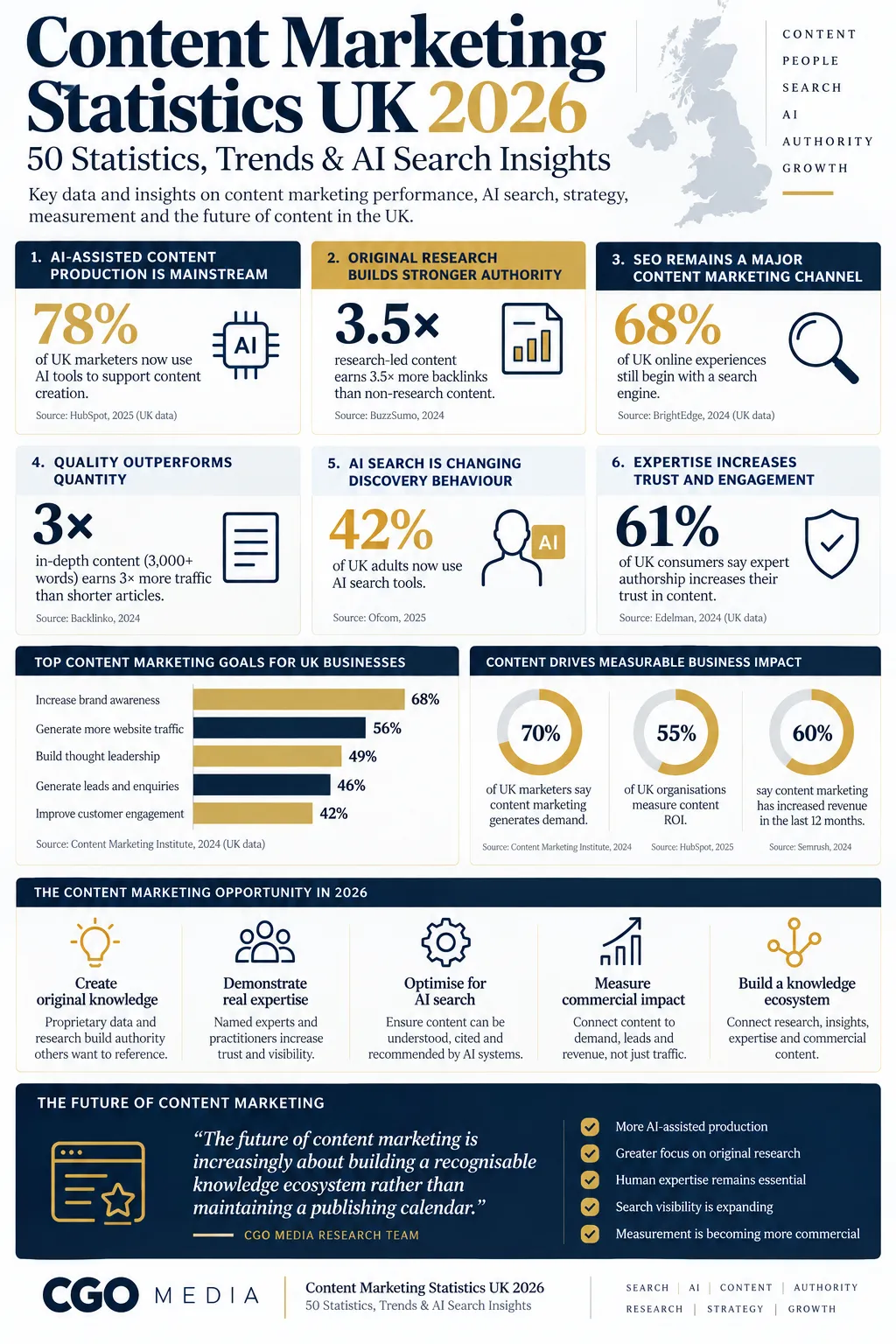
Content marketing in 2026 sits at the intersection of search, brand authority, audience education, lead generation and AI-powered discovery.
Businesses are no longer creating content solely to attract visits from conventional search engines. Content can now contribute to visibility across Google, AI Overviews, ChatGPT, Gemini, Copilot, Perplexity and other generative discovery environments.
At the same time, the volume of digital content continues to increase, AI-assisted production is accelerating and organisations face growing pressure to demonstrate that their content produces measurable commercial value.
This research brings together 50 quantitative content marketing statistics covering content investment, publishing, strategy, performance, first-party data, personalisation, artificial intelligence, SEO, AI search, citation visibility and content marketing measurement.
The objective is to distinguish measurable evidence from general content marketing commentary and provide businesses, marketers, journalists and researchers with a structured view of how content marketing is changing in 2026.
The central shift identified by the research is from content production towards content authority: creating information that demonstrates expertise, contributes original evidence and can be discovered across both traditional search and AI-generated answers.
Executive Summary
The evidence reviewed for this study points towards a fundamental shift in the role of content.
Content is increasingly expected to perform several functions simultaneously:
- Answer customer questions.
- Generate organic search visibility.
- Demonstrate expertise.
- Support lead generation.
- Strengthen brand and entity authority.
- Provide material for Digital PR.
- Earn backlinks and external citations.
- Support first-party audience understanding.
- Contribute to AI search visibility.
- Become eligible for retrieval, citation and recommendation by AI systems.
This creates a substantially different content marketing environment from one based primarily on publishing blog posts around keywords.
The Emerging Content Marketing Model
↓
Useful Content
↓
Search Visibility
↓
Engagement & Trust
↓
Independent References
↓
Brand & Content Authority
↓
Search & AI Discovery
↓
Commercial Outcome
What the 50 Statistics Examine
The research is organised into five evidence areas, with ten statistics in each section.
| Statistics | Research Area | What It Examines |
|---|---|---|
| 1–10 | Content Marketing Adoption & Investment | Adoption, marketing budgets, investment priorities, owned media and the strategic importance of content. |
| 11–20 | Content Production & Publishing | Article production, publishing resources, AI-assisted workflows, content quality and operational challenges. |
| 21–30 | Content Performance, Strategy & Measurement | Performance, original research, strategy refinement, conversion, measurement and commercial effectiveness. |
| 31–40 | First-Party Data, Personalisation & Audience Intelligence | First-party data, customer intelligence, personalisation, audience relevance and account-based marketing. |
| 41–50 | AI Search, AEO & the Future of Content Marketing | AI adoption, AI-assisted content, changing search behaviour, citation visibility, AEO, GEO and generative discovery. |
Why Content Marketing Is Changing
Three forces are reshaping content marketing simultaneously.
Search Is Becoming More Answer-Led
Traditional search remains important, but users increasingly encounter information directly within search interfaces and generative AI systems.
Content therefore needs to compete not only for conventional ranking positions but also for potential retrieval, citation, brand mentions and recommendation within AI-generated responses.
Search implication: Visibility increasingly needs to be measured across rankings, AI answers, citations, mentions and recommendations rather than through organic positions alone.
AI Is Increasing Content Supply
Generative AI makes content production faster and less expensive.
That creates an important consequence:
↓
More Competition
↓
Greater Need for Differentiation
As basic content becomes easier to produce, competitive advantage increasingly comes from information that cannot simply be reproduced from existing material.
This can include:
- Original research.
- Proprietary data.
- First-hand expertise.
- Case studies.
- Original analysis.
- Unique tools and methodologies.
- Expert interpretation.
- Distinctive organisational knowledge.
Content Is Becoming an Authority Asset
High-value content can contribute to far more than website traffic.
One strong research or reference asset can potentially support:
- Organic search visibility.
- Backlinks.
- Media coverage.
- Brand mentions.
- Social distribution.
- Journalist citations.
- AI citations.
- First-party audience development.
- Qualified leads.
- Long-term brand and entity authority.
This creates an important distinction between content production and content authority.
CGO Media interpretation: In an environment where producing content is becoming easier, the strategic advantage increasingly comes from becoming a recognised source of useful information rather than simply increasing publication volume.
Central Research Question
What Does the Available Evidence Tell Us About the Role of Content Marketing in Search, AI Discovery, Authority Building and Business Growth in 2026?
The following 50 statistics examine that question across five connected areas of content marketing.
Rather than relying on general claims about the importance of content, each section focuses on quantitative evidence, the context behind the number and its practical implication for organisations operating in an increasingly AI-mediated search environment.
Publication: CGO Media Research
Year: 2026
Research Type: Statistics & Evidence Synthesis
Research Team: CGO Media Research Team
DOI: 10.5281/zenodo.22958888
Statistics 1–10 — Content Marketing Adoption & Investment Statistics
Content Marketing remains a significant part of the marketing mix in 2026, but investment is increasingly being scrutinised against measurable outcomes.
The statistics below primarily draw on HubSpot’s 2026 State of Marketing research involving more than 1,500 marketers globally and Content Marketing Institute and MarketingProfs’ 2026 B2B Content and Marketing Trends study of 1,015 B2B marketers.
The Content Marketing Institute sample was predominantly North American. These figures therefore provide international industry benchmarks rather than direct estimates of UK business behaviour.
1. 35.6% of Brands Use Content Marketing as a Marketing Channel
35.6% of brands
HubSpot’s 2026 State of Marketing research found that 35.6% of surveyed brands use Content Marketing.
Content Marketing ranked alongside established channels including email, social media, Brand Awareness and website-based marketing.
The figure is particularly significant because Content Marketing can operate across several other channels simultaneously.
One research report, article, video or guide can potentially support:
- organic Search;
- email;
- social media;
- Digital PR;
- lead generation;
- and AI discovery.
Content implication: Content Marketing should increasingly be viewed as infrastructure supporting multiple marketing channels rather than as a standalone publishing activity.
Source:
HubSpot — Marketing Budgets 2026 / State of Marketing
2. 44.6% of Brands Use Website, Blog and SEO Marketing
44.6%
HubSpot found that 44.6% of surveyed brands use website, blog and SEO activity, making it the most commonly used marketing channel in its 2026 dataset.
This places owned digital content ahead of:
- organic social media — 40.3%;
- email marketing — 39.6%;
- paid social media — 39.4%;
- and Content Marketing as a separately defined channel — 35.6%.
The categories overlap, but the result reinforces the continuing importance of owned websites and discoverable content.
Content implication: Even as AI interfaces grow, websites and owned content remain central assets within digital marketing.
Source:
HubSpot — Marketing Budgets 2026
3. 36.9% of Marketers Plan to Increase Content Marketing Investment
36.9% plan increased investment
HubSpot reports that 36.9% of marketers plan to increase spending on Content Marketing during 2026.
Content Marketing was among the highest-ranked areas for increased investment, alongside paid social media and video.
The result suggests that organisations are not abandoning content because generative AI has made production easier.
Instead, investment continues while expectations around differentiation and measurable performance increase.
Investment implication: Content budgets remain active, but increased investment will place more pressure on organisations to demonstrate quality, authority and commercial impact.
Source:
HubSpot — 2026 Marketing Budget Trends
4. 35.4% Plan to Increase Investment in Website, Blog and SEO
35.4%
A further 35.4% of marketers told HubSpot they planned to increase investment in website, blog and SEO activity.
This is particularly relevant to Content Marketing because the website remains the primary environment in which organisations control:
- content architecture;
- research assets;
- landing pages;
- structured information;
- internal linking;
- and conversion journeys.
Investment implication: Owned content infrastructure continues to receive substantial investment despite the expansion of social platforms and generative Search interfaces.
Source:
HubSpot — 2026 Marketing Budget Trends
5. 79.2% of Marketing Teams Expect Their Overall Budget to Increase in 2026
79.2% expect at least some budget growth
HubSpot found that 79.2% of marketing teams expect at least a slight increase in their overall marketing budgets in 2026 compared with 2025.
Within that group, 21.2% expected a significant increase.
Only 6% expected their budgets to decline.
This is not a Content Marketing-specific budget statistic, but it provides important context for the 36.9% planning to increase Content Marketing expenditure.
Investment implication: Content teams are operating within a broader environment of budget growth, but they are competing with AI, paid media, video and other channels for that additional investment.
Source:
HubSpot — State of Marketing 2026
6. 73% Say Marketing Budgets Are Receiving More Scrutiny
73% report greater budget scrutiny
Budget growth does not mean marketing teams face less pressure.
HubSpot found that 73% of marketers say their budgets receive more scrutiny from leadership than they did previously.
This makes measurement increasingly important for Content Marketing teams.
Metrics based only on publication volume, pageviews or impressions may be insufficient when leadership expects evidence of:
- leads;
- pipeline;
- revenue;
- Search visibility;
- Brand Authority;
- and customer acquisition.
Measurement implication: Content Marketing investment increasingly needs to be connected to identifiable business outcomes rather than content output alone.
Source:
HubSpot — State of Marketing 2026
7. 97% of B2B Marketers Say They Have a Content Strategy
97% have a Content Strategy
Content Marketing Institute and MarketingProfs found that 97% of the B2B marketers surveyed had a Content Strategy.
Only 3% said they did not.
The research involved 1,015 B2B marketers from a global survey, with respondents predominantly located in North America.
The statistic demonstrates how widespread formal Content Strategy has become within B2B marketing.
Adoption implication: The competitive question is increasingly no longer whether an organisation has a Content Strategy, but whether that strategy produces distinctive and measurable results.
Source:
Content Marketing Institute / MarketingProfs — B2B Content and Marketing Trends: Insights for 2026
8. 61% of B2B Marketers Say Their Content Strategy Improved
61% reported improvement
Among B2B marketers with a Content Strategy, 61% said its effectiveness had improved during the previous 12 months.
The breakdown was:
- 13% — significantly improved;
- 48% — somewhat improved;
- 30% — remained stable;
- 8% — somewhat declined;
- 1% — significantly declined.
Among marketers reporting improvement, 74% attributed part of that progress to strategy refinement.
Strategy implication: Improvement appears to depend on better strategic direction rather than simply publishing a greater volume of content.
Source:
Content Marketing Institute / MarketingProfs — 2026 B2B Content Research
9. 32% of B2B Marketers Plan to Increase Investment in Owned Media
32% plan increased owned-media investment
When Content Marketing Institute asked B2B marketers which areas they planned to increase investment in during 2026, 32% selected owned media.
Owned media was defined to include assets such as:
- content resources;
- websites;
- blogs;
- and email.
Only AI-powered marketing tools at 45% and events or experiential marketing at 33% received higher responses.
Investment implication: Organisations continue to invest in content environments they control rather than relying entirely on third-party platforms.
Source:
Content Marketing Institute / MarketingProfs — B2B Content and Marketing Trends 2026
10. 24% of B2B Marketers Plan to Increase Investment in Content Personalisation
24% plan increased personalisation investment
Content Marketing Institute found that 24% of B2B marketers identified Content Personalisation as one of their top areas for increased investment in 2026.
The same study found that 89% of B2B marketers already use some form of personalisation, although most described their implementation as relatively basic.
The investment data suggests that the next stage of Content Marketing is not simply producing more material, but delivering more relevant content to specific audiences, accounts and stages of the customer journey.
Investment implication: Content relevance and audience fit are becoming investment priorities alongside content volume and production efficiency.
Source:
Content Marketing Institute / MarketingProfs — B2B Content and Marketing Trends 2026
What Statistics 1–10 Tell Us
Content Marketing remains widely embedded within the modern marketing environment.
Three findings stand out.
First, organisations continue to invest in owned content.
HubSpot reports increased spending intentions for both Content Marketing and website/blog/SEO, while Content Marketing Institute finds owned media among the leading B2B investment priorities for 2026.
Second, Content Strategy is now close to universal among the B2B marketers surveyed.
The competitive advantage therefore comes less from simply having a strategy and more from the quality of its execution.
Third, content budgets face greater accountability.
Investment is rising while leadership scrutiny is also increasing.
The emerging model is:
Content Investment
↓
Strategic Content
↓
Audience Relevance
↓
Owned Media Authority
↓
Measurable Performance
The challenge for 2026 is therefore not simply securing a Content Marketing budget. It is demonstrating that the investment creates useful, differentiated and measurable business value.
Statistics 11–20 — Content Production & Publishing Statistics
Content production is becoming faster, but faster production does not automatically produce stronger marketing performance.
Orbit Media’s 2026 Annual Blogger Survey, based on 1,042 content marketers, shows falling production time alongside historically low reported performance.
Content Marketing Institute’s 2026 B2B research also demonstrates that the principal challenges facing content teams remain conversion, resources, measurement, quality and differentiation.
11. The Average Blog Post Contains 1,312 Words
1,312 words
Orbit Media’s 2026 blogging research found that the average blog post contains 1,312 words.
This is below the study’s historical peak of 1,427 words in 2023.
The decline suggests that the long-running trend toward continually longer articles has started to reverse.
That does not mean long-form content has stopped working.
Rather, organisations appear to be moving away from increasing word count simply for its own sake.
Publishing implication: Content depth should be determined by the information required to answer the subject properly, not by an arbitrary word-count target.
Source:
Orbit Media — Blogging Statistics 2026
12. The Average Blog Post Takes 3 Hours and 20 Minutes to Produce
3 hours 20 minutes
Orbit Media found that marketers spend an average of 3 hours and 20 minutes creating a typical article.
Production time previously peaked at 4 hours and 10 minutes in 2022.
Average creation time has therefore fallen by approximately 50 minutes from that peak.
Orbit Media associates much of this acceleration with the widespread adoption of AI-assisted workflows.
Production implication: Content teams can now produce material more efficiently, but the strategic question is whether the time saved is being redirected toward research, expertise, editing and differentiation.
Source:
Orbit Media — Blogging Statistics 2026
13. The Average Content Marketer Produces Approximately 57 Posts Per Year
Approximately 57 posts per year
Orbit Media’s 2026 analysis uses an average publishing volume of approximately 57 articles per marketer per year when calculating annual production efficiency.
That equates to slightly more than one article per week on average.
Publishing volume alone, however, did not emerge as a guarantee of strong results.
Orbit’s wider research indicates that the effectiveness of the content programme depends heavily on the strategies surrounding production.
Publishing implication: Organisations should distinguish between the amount of content produced and the amount of genuinely useful Content Authority created.
Source:
Orbit Media — Blogging Statistics 2026
14. Only 13.9% of Content Marketers Say Their Blog Produces Strong Results
13.9% report strong results
Orbit Media found that only 13.9% of respondents described their blogging programme as delivering strong marketing results in 2026.
This was the lowest result recorded across the long-running annual study.
For many years, the share reporting strong results remained between approximately 20% and 30%.
The decline occurred even while content production became faster.
Production implication: Greater production efficiency does not automatically translate into stronger Content Marketing effectiveness.
Source:
Orbit Media — Blogging Statistics 2026
15. 18.9% Cannot Tell Whether Their Blog Produces Results
18.9% do not know
At the same time, 18.9% of content marketers said they did not know whether their blogging programme was producing results.
Orbit Media notes that this figure had historically remained between approximately 9% and 14%.
Nearly one in five respondents therefore lacked a clear assessment of whether the content they were producing was effective.
Measurement implication: Publishing without a measurement framework creates the risk of maintaining large content programmes without knowing which activities create value.
Source:
Orbit Media — Blogging Statistics 2026
16. 40% of B2B Marketers Struggle to Create Content That Prompts Action
40%
Content Marketing Institute and MarketingProfs found that 40% of B2B marketers identify creating content that prompts a desired action, such as conversion, as one of their three biggest Content Marketing challenges.
It was the most frequently selected challenge in the 2026 study.
This highlights the difference between producing material that attracts attention and producing material that moves the audience toward a meaningful next step.
Production implication: Content should be designed around user progression and intent rather than publication volume alone.
Source:
Content Marketing Institute / MarketingProfs — B2B Content and Marketing Trends 2026
17. 39% Identify Resource Constraints as a Major Content Marketing Challenge
39%
The second most frequently selected challenge in Content Marketing Institute’s research was resource constraints, cited by 39% of B2B marketers.
Resources can include:
- time;
- people;
- budget;
- specialist expertise;
- research capacity;
- and production capability.
The finding is notable because generative AI has reduced the time required for many production tasks, yet resource limitations remain one of the industry’s largest problems.
Production implication: Faster drafting does not remove the need for expertise, research, editing, design, distribution and measurement.
Source:
Content Marketing Institute / MarketingProfs — B2B Content and Marketing Trends 2026
18. 33% Struggle to Measure Content Effectiveness
33%
One third of B2B marketers — 33% — identified measuring Content Marketing effectiveness as one of their leading challenges.
Measurement becomes increasingly difficult when content contributes indirectly to:
- Search visibility;
- Brand Awareness;
- sales enablement;
- AI citations;
- research journeys;
- and assisted conversions.
Pageviews alone cannot capture all of these outcomes.
Measurement implication: Content reporting increasingly needs to connect publishing activity with Search visibility, engagement, leads, pipeline, Brand Authority and AI visibility.
Source:
Content Marketing Institute / MarketingProfs — B2B Content and Marketing Trends 2026
19. 28% Struggle to Produce Enough Quality Content
28%
Content Marketing Institute found that 28% of B2B marketers identify creating enough quality content to meet organisational requirements as a major challenge.
The wording is important.
The challenge is not simply creating enough content.
It is creating enough quality content.
In an environment where AI can produce basic drafts quickly, the limiting factors increasingly become:
- originality;
- accuracy;
- expertise;
- research;
- editorial quality;
- and usefulness.
Production implication: The production bottleneck is shifting from generating words toward producing information worth consuming and trusting.
Source:
Content Marketing Institute / MarketingProfs — B2B Content and Marketing Trends 2026
20. 24% Say Differentiating Content From Competitors Is a Major Challenge
24%
Nearly one quarter of B2B marketers — 24% — identified differentiating their content from competitors as one of their most significant Content Marketing challenges.
Differentiation becomes more important as generative AI enables organisations to produce similar explanatory content at much greater speed.
Content differentiation can increasingly come from:
- proprietary data;
- original research;
- first-hand experience;
- named expert perspectives;
- case studies;
- distinctive methodologies;
- and unique Brand Knowledge.
Production implication: Publishing information that could have been produced by almost any competitor creates limited defensibility. Original evidence and expertise provide stronger differentiation.
Source:
Content Marketing Institute / MarketingProfs — B2B Content and Marketing Trends 2026
What Statistics 11–20 Tell Us
Content production is becoming easier.
Content effectiveness is not.
Orbit Media’s longitudinal research shows that marketers are producing articles faster than at the historical production-time peak, yet the proportion reporting strong results has fallen to its lowest recorded level.
At the same time, B2B marketers continue to struggle with:
- conversion;
- resources;
- measurement;
- quality;
- and differentiation.
This creates an important distinction:
Production Efficiency
≠
Content Effectiveness
The stronger production model is:
Efficient Production
↓
Human Expertise
↓
Original Evidence
↓
Editorial Quality
↓
Audience Relevance
↓
Measurable Action
In 2026, the advantage is increasingly moving away from the ability to produce content and toward the ability to produce content that is distinctive, trustworthy and useful enough to create a measurable response.
Statistics 21–30 — Content Performance, Strategy & Measurement
Producing more content does not automatically produce better marketing results. The latest research shows a widening gap between organisations that can create content efficiently and those that can demonstrate measurable business performance from it.
This distinction is becoming particularly important as AI reduces production barriers. When almost every organisation has access to faster research, drafting and repurposing tools, competitive advantage increasingly depends upon strategy, originality, measurement and the ability to create information audiences genuinely value.
Research scope: The statistics in this section include international content marketing datasets that provide useful benchmarks for UK organisations. They should not be interpreted as measurements of the entire UK business population.
21. Only 13.9% of content marketers report strong blogging results
Only 13.9% of content marketers surveyed by Orbit Media in 2026 said their blogs deliver strong marketing results.
Orbit Media describes this as an all-time low within its long-running annual blogging research.
For much of the previous decade, the proportion of respondents reporting strong results remained considerably higher. The decline is particularly noteworthy because content production has simultaneously become faster and easier through AI-assisted workflows.
The finding suggests that increased production capacity does not necessarily translate into improved marketing effectiveness.
Performance implication: Publishing frequency should not be treated as a proxy for content success. Organisations need to determine whether individual assets create visibility, engagement, authority, leads or revenue.
Source: Orbit Media Studios, 2026 Blogging Statistics.
22. 18.9% of content marketers do not know whether their blogs produce results
18.9% of respondents in Orbit Media’s 2026 research said they did not know whether their blog delivers marketing results.
This is almost one in five content marketers.
The increase in uncertainty illustrates how difficult attribution is becoming as customer journeys fragment across search engines, social platforms, video, email, third-party publications and AI assistants.
A potential customer may encounter an organisation several times before ever reaching its website or completing an enquiry.
Measurement implication: Content programmes should combine website analytics with CRM data, branded search, assisted conversions, earned links, citations and AI visibility monitoring.
Source: Orbit Media Studios, 2026 Blogging Statistics.
23. Original research increases the likelihood of strong content performance by 50%
Orbit Media reports that publishing original research improves the likelihood of strong content performance by approximately 50%.
This is one of the most important findings in the 2026 dataset.
Original research creates something conventional content production cannot: genuinely new information. Surveys, proprietary datasets, experiments, benchmarking studies, statistical analysis and original methodologies can make an organisation the primary source rather than another publisher summarising existing information.
That distinction becomes increasingly valuable as generative AI makes derivative informational content easier and cheaper to produce.
Authority implication: Original research can simultaneously support SEO, Digital PR, backlinks, journalist citations, brand authority and potential visibility within AI-generated answers.
Source: Orbit Media Studios, 2026 Blogging Statistics.
24. Influencer collaboration is associated with 2.6× stronger content performance
Orbit Media’s 2026 research found that marketers collaborating with influencers performed approximately 2.6 times above the study’s performance benchmark.
Yet relatively few content marketers currently use this approach.
In a B2B or professional context, influencer collaboration does not need to mean consumer-style social promotion. It can include subject specialists, researchers, executives, customers, practitioners, analysts and recognised industry experts contributing commentary, experience or evidence.
External expertise can introduce first-hand knowledge and viewpoints that generic content production cannot easily reproduce.
Content implication: Expert interviews, collaborative research and external specialist contributions can strengthen originality, credibility and distribution simultaneously.
Source: Orbit Media Studios, 2026 Blogging Statistics.
25. Traffic-focused measurement is associated with weaker reported performance
39% of respondents monitored volume metrics such as traffic, yet only 11% of marketers focusing on these metrics reported strong results.
This is below the overall strong-performance benchmark recorded by the study.
Traffic remains useful, but it does not reveal whether visitors represent potential customers, whether the content changes buying behaviour or whether the organisation is strengthening commercial authority.
The limitation becomes more important as zero-click search and AI-generated answers weaken the historic relationship between online visibility and website visits.
Measurement implication: Traffic should increasingly be evaluated alongside qualified leads, enquiries, pipeline contribution, revenue, branded demand, earned links, citations and AI visibility.
Source: Orbit Media Studios, 2026 Blogging Statistics.
26. 59% of B2B marketers consider their marketing at least somewhat effective
59% of B2B marketers surveyed by Content Marketing Institute and MarketingProfs rated their marketing as either highly effective or somewhat effective.
The research found that 12% considered their activity highly effective and a further 47% somewhat effective.
However, a substantial proportion reported neutral, mixed or ineffective performance.
The results illustrate the difference between simply participating in digital marketing and building a consistently effective marketing system.
Strategic implication: Organisations should identify which specific activities generate measurable outcomes rather than assuming additional content production or technology investment will automatically improve performance.
Source: Content Marketing Institute and MarketingProfs, B2B Content and Marketing Trends: Insights for 2026.
27. 61% of B2B marketers say their content strategy improved
61% of B2B marketers with a content strategy reported that its effectiveness improved during the previous 12 months.
The research found that 13% reported significant improvement and another 48% reported some improvement.
A further 30% said content strategy effectiveness remained stable, while only a relatively small proportion reported deterioration.
This suggests that organisations can continue to improve content performance despite increased publishing competition, AI-generated material and changing search behaviour.
Strategy implication: The changing search environment does not eliminate the need for content strategy. It increases the importance of continually refining it.
Source: Content Marketing Institute and MarketingProfs, B2B Content and Marketing Trends: Insights for 2026.
28. 74% attribute improved content strategy performance to strategy refinement
Among marketers whose content strategy improved, 74% identified strategy refinement as a contributing factor.
This was substantially higher than the proportion attributing improvement primarily to budget changes or broader market conditions.
New technology also played an important role, but strategy refinement remained the most frequently reported contributor.
The finding is especially relevant during rapid AI adoption. Technology can accelerate production, research, analysis and distribution, but it cannot independently determine an organisation’s positioning, expertise, audience priorities or commercial objectives.
Strategic implication: Businesses should treat AI and marketing technology as components within a defined content strategy rather than allowing newly available tools to determine what gets published.
Source: Content Marketing Institute and MarketingProfs, B2B Content and Marketing Trends: Insights for 2026.
29. 40% say creating content that drives action remains a major challenge
40% of B2B marketers identify creating content that prompts a desired action or conversion as one of their biggest content marketing challenges.
The statistic highlights the difference between informational content and commercially effective content.
A page can be accurate, well written and highly visible while still failing to encourage the reader to continue through the customer journey.
Effective content therefore needs to connect useful information with an appropriate next step, whether that means further research, exploring a service, downloading evidence, subscribing, comparing solutions or making an enquiry.
Conversion implication: Content architecture should connect informational authority with clearly defined customer journeys rather than creating isolated articles with no strategic destination.
Source: Content Marketing Institute and MarketingProfs, B2B Content and Marketing Trends: Insights for 2026.
30. 33% say measuring content effectiveness remains a major challenge
One-third of B2B marketers — 33% — identify measuring content effectiveness as one of their major content marketing challenges.
This problem becomes more significant as discovery spreads across Google, social platforms, video, industry publications, communities and generative AI systems.
Traditional analytics primarily measure activity that eventually reaches the website. They capture much less of the influence created when potential customers encounter an organisation within search results, AI-generated answers, external publications or industry discussions before making direct contact.
The measurement model therefore needs to evolve alongside the discovery environment.
Measurement implication: Future content reporting should combine website analytics with search visibility, CRM outcomes, branded demand, earned mentions, citations, AI visibility and revenue attribution.
Source: Content Marketing Institute and MarketingProfs, B2B Content and Marketing Trends: Insights for 2026.
What Statistics 21–30 Tell Us
The evidence shows that content marketing is becoming easier to produce but harder to differentiate and measure.
Only a relatively small proportion of content marketers report exceptionally strong blogging results, while uncertainty about performance remains substantial. At the same time, strategies requiring greater originality, expertise and human involvement continue to show stronger relationships with reported outcomes.
The strongest signals from the research are:
- Publishing more content does not guarantee stronger results.
- Original research provides meaningful differentiation.
- External experts and collaborative content can strengthen performance.
- Traffic alone is an increasingly incomplete success metric.
- Content strategy can improve when organisations actively refine it.
- Technology can support strategy but does not replace it.
- Driving meaningful audience action remains difficult.
- Measurement must increasingly extend beyond website visits.
For UK organisations, a more useful content-performance model is:
↓
Original Content
↓
Search & AI Discoverability
↓
Trust & Authority
↓
Audience Action
↓
Qualified Leads
↓
Commercial Outcomes
Statistics 31–40 — First-Party Data, Personalisation & Audience Intelligence
Content marketing is increasingly influenced by an organisation’s ability to understand its audience rather than simply attract one. As third-party data becomes less dependable and customer journeys become more fragmented, first-party information is becoming an important component of content strategy.
Subscriptions, communities, webinars, gated research, CRM interactions, behavioural data and direct customer engagement can all provide organisations with information that helps make content more relevant to identifiable audiences.
The latest B2B research also exposes a significant maturity gap. Most organisations collect first-party data, yet many have not developed the strategy, governance or personalisation capabilities required to use that information effectively.
Research scope: The figures in this section are drawn primarily from the 2026 Content Marketing Institute and MarketingProfs B2B study of 1,015 B2B marketers. The sample is international and predominantly North American, so the figures should be treated as industry benchmarks relevant to UK organisations rather than UK population statistics.
31. 91% of B2B marketers collect first-party data
91% of B2B marketers surveyed by Content Marketing Institute and MarketingProfs report collecting first-party data.
First-party data is information an organisation collects directly through its own relationships and digital properties rather than purchasing or obtaining it from external data providers.
It can include website behaviour, newsletter subscriptions, webinar registrations, CRM records, customer enquiries, communities, loyalty programmes, downloads and interactions with sales or customer-service teams.
Its importance is increasing because it provides organisations with direct evidence about what their own customers and prospects need, rather than relying exclusively on broad external audience assumptions.
Content implication: First-party data can help organisations identify recurring customer questions, emerging information needs and subjects worthy of deeper content investment.
Source: Content Marketing Institute and MarketingProfs, B2B Content and Marketing Trends: Insights for 2026.
32. 50% remain in the early stages of first-party data strategy
Half of B2B marketers describe their first-party data strategy as either exploratory or developing.
The research found that 19% remain at the exploratory stage and another 31% describe their implementation as developing.
This creates a striking contrast with the 91% already collecting first-party data. Data collection has therefore become widespread considerably faster than strategic maturity.
Collecting large volumes of customer information provides limited value when that information remains disconnected across analytics systems, CRM platforms, email databases and sales records.
Strategy implication: The next competitive advantage is likely to come less from simply acquiring more data and more from connecting, interpreting and using existing first-party information effectively.
Source: Content Marketing Institute and MarketingProfs, B2B Content and Marketing Trends: Insights for 2026.
33. 77% collect first-party data through direct customer engagement
77% of B2B marketers collecting first-party data use direct customer engagement such as subscriptions, loyalty programmes and communities.
This is the most widely reported first-party data collection method in the 2026 research.
Direct engagement has an important advantage over inferred audience information: customers actively reveal their interests through participation.
Newsletter subscriptions, community activity, research registrations and similar interactions can therefore create both an audience relationship and a source of intelligence about customer priorities.
Audience implication: Content programmes should be designed not only to attract visitors but also to create opportunities for continuing relationships with relevant audiences.
Source: Content Marketing Institute and MarketingProfs, B2B Content and Marketing Trends: Insights for 2026.
34. 68% use content itself to collect first-party data
68% of B2B marketers collect first-party data through content-driven methods such as gated assets, webinars and interactive tools.
This demonstrates that content can serve two functions simultaneously: providing useful information to an audience while helping an organisation understand who is engaging with particular subjects.
Research papers, calculators, benchmarking tools, webinars, assessments and specialist reports can reveal considerably more about audience intent than anonymous page views alone.
However, organisations should avoid placing unnecessary barriers around information purely to capture an email address. The exchange needs to provide meaningful value to the user.
Content implication: High-value research and interactive resources can function as both authority assets and first-party audience intelligence mechanisms.
Source: Content Marketing Institute and MarketingProfs, B2B Content and Marketing Trends: Insights for 2026.
35. 52% say first-party data improves targeting and personalisation
52% of surveyed B2B marketers report improved targeting and personalisation as an outcome of using first-party data.
This was the most frequently reported benefit in the study.
First-party information can help organisations distinguish between industries, customer types, areas of interest, buying stages and levels of engagement rather than delivering identical content to every visitor.
This becomes particularly important as users become accustomed to highly contextual information experiences across search engines and AI assistants.
Personalisation implication: Better audience data should ultimately influence what content an organisation creates, who receives it and how it is presented.
Source: Content Marketing Institute and MarketingProfs, B2B Content and Marketing Trends: Insights for 2026.
36. 44% say first-party data improves customer understanding
44% of B2B marketers report enhanced customer insights and understanding as a benefit of first-party data.
Customer understanding can directly affect content quality.
Search-volume data can reveal what people search for, but first-party information can reveal which problems existing customers repeatedly encounter, which objections delay decisions and which information prospects request before buying.
Combining these datasets creates a more complete picture of actual information demand.
Research implication: Strong content strategies should combine external search intelligence with internal customer evidence rather than relying upon keyword volume alone.
Source: Content Marketing Institute and MarketingProfs, B2B Content and Marketing Trends: Insights for 2026.
37. 85% of marketers using personalisation apply it to email campaigns
Email campaigns are by far the most common personalisation channel, used by 85% of B2B marketers applying personalisation.
Other channels remain considerably less widely personalised. The same research reports lower levels across social media, websites, digital advertising, content marketing, webinars and video.
This suggests that many organisations still equate personalisation primarily with email databases rather than with the wider customer experience.
True content personalisation can extend much further, including sector-specific landing pages, role-specific resources, customer-stage content and tailored research recommendations.
Content implication: Personalisation strategies should increasingly extend beyond email and influence websites, research, content hubs and customer journeys.
Source: Content Marketing Institute and MarketingProfs, B2B Content and Marketing Trends: Insights for 2026.
38. Nearly 60% personalise content across only one or two channels
Nearly 60% of B2B marketers using personalisation apply it across only one or two channels.
This indicates that personalisation remains relatively shallow for many organisations.
A personalised email followed by a completely generic website experience creates limited continuity. More mature approaches attempt to maintain relevance across multiple stages of the customer journey.
For content teams, that could mean connecting an individual’s industry, interests or previous engagement with the research, services and resources subsequently presented to them.
Experience implication: Effective personalisation is less about inserting a person’s name and more about consistently delivering information relevant to their situation.
Source: Content Marketing Institute and MarketingProfs, B2B Content and Marketing Trends: Insights for 2026.
39. 49% of B2B marketers use account-based marketing, ABX or both
19% of surveyed B2B marketers use both account-based marketing and account-based experience, while another 30% use account-based marketing alone.
Combined, this means 49% use account-based marketing in some form, while 51% report using neither ABM nor ABX.
These approaches concentrate marketing activity around specific high-value organisations rather than broad audiences.
For content teams, this can involve developing resources around the specific problems, industries, roles or buying stages represented within strategically important accounts.
B2B implication: Content can increasingly be designed for identifiable commercial audiences rather than attempting to maximise undifferentiated reach.
Source: Content Marketing Institute and MarketingProfs, B2B Content and Marketing Trends: Insights for 2026.
40. 65% of measured ABM users say it outperforms traditional marketing
Among ABM users who measured comparative performance, 18% said account-based marketing significantly outperformed traditional marketing and 47% said it somewhat outperformed.
Combined, 65% of measured users reported some degree of outperformance.
The finding reinforces the commercial value of relevance. Content created for a defined industry, account, customer requirement or buying stage can provide a more precise response than general-purpose material intended for everyone.
This principle is increasingly relevant beyond formal ABM programmes. Sector landing pages, specialist research, industry frameworks and audience-specific content clusters all apply a similar concept: greater contextual relevance.
Commercial implication: Content programmes should consider whether narrower, better-targeted information can generate greater commercial value than broad content designed primarily to maximise reach.
Source: Content Marketing Institute and MarketingProfs, B2B Content and Marketing Trends: Insights for 2026.
What Statistics 31–40 Tell Us
The next phase of content marketing is likely to depend increasingly on the combination of content, audience intelligence and relevance.
The overwhelming majority of B2B marketers already collect first-party data, yet strategic maturity remains much lower. This creates a substantial gap between having customer information and turning that information into better content experiences.
The research points towards several important developments:
- First-party data is becoming a mainstream marketing asset.
- Data collection is significantly more mature than data strategy.
- Content itself can generate valuable audience intelligence.
- Customer information can improve targeting and personalisation.
- Email remains the dominant personalisation channel.
- Cross-channel personalisation remains relatively immature.
- Account-based approaches are already used by almost half of surveyed B2B marketers.
- Greater audience relevance is associated with stronger measured marketing performance.
For content-led organisations, the emerging model can be represented as:
↓
Audience Understanding
↓
Content Relevance
↓
Personalised Experience
↓
Stronger Engagement
↓
Higher Commercial Intent
Statistics 41–50 — AI Search, AEO & the Future of Content Marketing
Artificial intelligence is changing both sides of content marketing. AI is increasingly involved in producing and optimising content, while generative search systems are simultaneously changing how audiences discover, evaluate and interact with that information.
For organisations, this creates a fundamental shift. Content can no longer be developed exclusively for conventional search rankings and website visits. It increasingly needs to be understandable, authoritative and reusable across Google AI Overviews, ChatGPT, Gemini, AI Mode and other answer-driven discovery environments.
Research scope: The figures below combine international marketing surveys and large-scale AI search studies. They provide current benchmarks relevant to UK content strategy but should not be interpreted as statistics describing the entire UK business population.
41. 40.6% of marketers are updating SEO strategies for changes in search
40.6% of marketers surveyed by HubSpot identified updating SEO for changes in search as one of the major marketing trends they are addressing in 2026.
Search optimisation is therefore increasingly extending beyond conventional rankings.
Google AI Overviews, generative search interfaces and dedicated AI assistants can synthesise information before a user visits the underlying source. This changes what organisations need from content.
A page may now influence customer discovery through its information being extracted, summarised or cited even when that interaction does not immediately result in a traditional organic click.
Search implication: Content strategies should consider conventional SEO and AI visibility as connected components of the same discovery ecosystem.
Source: HubSpot, 2026 State of Marketing.
42. 70.2% of marketers believe they can adapt to changes in organic search
70.2% of marketers surveyed by HubSpot believe they are able to adapt their marketing strategy to changes in organic search, including AI Overviews.
The figure suggests that the marketing industry has moved beyond the initial uncertainty surrounding generative search and towards active experimentation and adaptation.
However, confidence in adapting does not necessarily mean organisations have established reliable measurement systems for AI visibility or clearly understand why particular sources are selected by answer engines.
Search teams therefore increasingly need to understand not only ranking performance but also source selection, entity recognition, brand mentions and citation behaviour.
Strategy implication: AI search adaptation should be supported by measurement and evidence rather than relying solely on confidence or experimentation.
Source: HubSpot, 2026 State of Marketing.
43. 86.4% of marketing teams now use AI in at least some marketing activities
86.4% of marketing teams surveyed by HubSpot say they use artificial intelligence in at least some areas of marketing.
AI adoption has therefore moved well beyond experimental use.
Applications now extend across content creation, media production, administrative automation, advertising optimisation, learning, brainstorming, analysis and strategic planning.
As access becomes commonplace, simply using AI is unlikely to provide a durable competitive advantage. The distinction increasingly lies in how organisations combine technology with proprietary information, expertise and human judgement.
Competitive implication: AI adoption itself is becoming a baseline capability rather than a differentiator.
Source: HubSpot, 2026 State of Marketing.
44. Around 80% of marketers use AI for content creation
Approximately 80% of marketers surveyed by HubSpot use AI for content creation, either extensively or occasionally.
Content creation is now one of the most established applications of generative AI within marketing.
AI can support research, ideation, drafting, editing, summarisation, repurposing and optimisation. That efficiency also creates a new problem: competitors have access to many of the same technologies.
Consequently, the ability to produce competent written material at scale becomes less distinctive as adoption rises.
Content implication: Competitive differentiation increasingly depends on the information behind the content — proprietary research, experience, data, expertise and original interpretation.
Source: HubSpot, 2026 State of Marketing.
45. 92.7% report at least some productivity improvement from AI
92.7% of surveyed marketers reported that AI had increased productivity to at least some degree.
HubSpot reports that 26.5% said AI had significantly increased productivity, while another 66.2% reported a slight or moderate increase.
This demonstrates why AI adoption has accelerated so rapidly. The technology can reduce the time required for many routine research, production and administrative activities.
However, higher productivity measures efficiency rather than effectiveness. Faster content production does not automatically create stronger rankings, citations, leads or revenue.
Operational implication: AI productivity improvements should ultimately be evaluated against marketing outcomes rather than the quantity of content produced.
Source: HubSpot, 2026 State of Marketing.
46. 73.4% believe AI will work alongside marketers rather than replace them
73.4% of marketers surveyed by HubSpot say they expect AI to work in conjunction with marketers and assist with most job responsibilities.
This supports a hybrid model of content production rather than a purely automated one.
AI can accelerate repetitive processes, but human specialists remain important for research design, fact checking, expert interpretation, editorial judgement, brand positioning and accountability.
These human contributions become particularly important where content addresses complex, technical, financial, legal, healthcare or other trust-sensitive subjects.
Editorial implication: Organisations should design AI-assisted workflows around identifiable human oversight rather than treating automation as a replacement for expertise.
Source: HubSpot, 2026 State of Marketing.
47. 62.7% believe more human-centred content is needed to compete with AI-generated content
62.7% of marketers surveyed by HubSpot believe organisations need more distinctive, human-centred content to compete with the growing volume of AI-generated material.
This finding captures one of the central contradictions of AI-assisted marketing.
The same technology making content easier to produce also increases the amount of generic information competing for attention.
First-hand experience, named experts, proprietary data, strong opinions supported by evidence, original research and recognisable organisational expertise can therefore become more valuable precisely because automated production is becoming commonplace.
Differentiation implication: Human expertise should increasingly be visible within the content itself rather than existing only behind the production process.
Source: HubSpot, 2026 State of Marketing.
48. 42% of CRM buyers used AI search during their purchase evaluation
42% of more than 3,000 CRM purchase decision-makers surveyed by HubSpot in January 2026 used AI search during their evaluation process.
HubSpot also found that these AI-search users were 36% more likely to purchase than buyers who did not use AI search.
The research relates specifically to CRM purchasing rather than all buying behaviour, but it demonstrates that generative search is moving beyond informational discovery into commercial evaluation.
Prospective customers can now ask AI systems to compare providers, identify alternatives, summarise strengths and weaknesses and recommend potential solutions before visiting supplier websites.
Commercial implication: Visibility inside AI-generated recommendations may influence purchasing decisions before conventional website analytics record any interaction.
Source: HubSpot, State of AEO 2026 / AI Search Buyer Research.
49. Clear, summarised content showed a 32.83% positive association with AI citations
Semrush research found that clarity and summarisation showed a +32.83% association with AI citation behaviour.
The study compared content characteristics across thousands of AI citations and similar pages appearing within conventional Google search results.
Other positively associated characteristics included stronger E-E-A-T signals, question-and-answer formatting, clear section structure and structured data elements.
The research does not establish that any single formatting change guarantees an AI citation. It does, however, provide evidence that content organisation and explicit communication may influence how easily generative systems can interpret and reuse information.
GEO implication: Content intended for AI discovery should present important information clearly, use meaningful section structures and make expertise and evidence easy to identify.
Source: Semrush, Content Optimisation for AI Search Study, 2026.
50. 61.7% of AI citations can occur without the brand being named
Semrush found that 61.7% of analysed AI citation appearances were “ghost citations” — the source was cited, but the brand itself was not named within the generated answer.
The study analysed 3,981 domain appearances across 115 prompts, 14 countries and four AI search environments.
This distinction is strategically important. Citation visibility and brand visibility are not necessarily the same thing.
An organisation may provide information that helps construct an AI-generated answer while receiving relatively little explicit brand recognition from the user.
Content strategy for AI discovery therefore needs to consider not only whether information is technically citable, but whether the organisation has sufficiently strong entity, brand and authority signals to be recognised alongside that information.
Authority implication: Future AI visibility measurement should distinguish between citations, explicit brand mentions, recommendation visibility and the context in which the organisation appears.
Source: Semrush and Growth Memo, Ghost Citations Study, 2026.
What Statistics 41–50 Tell Us
Artificial intelligence is no longer simply another content-production tool. It is changing how content is created, discovered, interpreted and presented to potential customers.
AI adoption among marketers is already widespread, while AI-assisted search is increasingly participating in commercial discovery. This creates a dual challenge: organisations need to use AI productively without allowing greater production efficiency to result in generic, undifferentiated content.
The evidence points towards several important developments:
- Search optimisation is expanding beyond conventional rankings.
- AI has become a mainstream marketing capability.
- Content creation is one of the dominant AI use cases.
- AI is producing substantial productivity improvements.
- Human expertise and editorial oversight remain strategically important.
- Distinctive human-centred content may become more valuable as automated publishing increases.
- AI search is already participating in commercial buying journeys.
- Clear structure and explicit expertise are associated with stronger AI citation behaviour.
- Being cited does not necessarily mean a brand is visibly recognised.
- Content marketing, SEO, GEO, brand authority and entity optimisation are increasingly converging.
The emerging content discovery model can therefore be represented as:
↓
High-Quality Structured Content
↓
SEO + GEO + Entity Signals
↓
Search & AI Source Eligibility
↓
Citations + Brand Mentions
↓
Audience Trust & Discovery
↓
Commercial Opportunity
CGO Media Analysis — What the 50 Content Marketing Statistics Tell Us
Taken together, the 50 statistics in this report point to a content marketing environment undergoing a structural change rather than a simple change in publishing tactics.
Artificial intelligence has reduced many of the practical barriers to content production. Research, drafting, editing, summarisation, repurposing and optimisation can now be completed more quickly than at any previous point in the development of digital marketing.
But greater production capacity has not produced an equivalent improvement in marketing performance.
The evidence instead suggests that the competitive advantage is moving away from the ability to publish content and towards the ability to create information that is original, authoritative, useful, measurable and difficult to reproduce.
The central finding from the 2026 evidence is straightforward: content volume is becoming easier to create, while distinctive authority is becoming harder — and potentially more valuable.
1. Content Production Is Being Commoditised
AI-assisted content creation has become mainstream. Large proportions of marketers now use artificial intelligence for drafting, ideation, research, editing and related production activities.
This means that basic production capability is becoming less useful as a competitive differentiator.
If thousands of organisations can generate competent explanatory articles quickly and inexpensively, publishing another generic article on a widely covered subject creates progressively less strategic advantage.
CGO Media interpretation: The scarcity is shifting from content production to original knowledge, credible evidence and recognised expertise.
2. More Content Does Not Necessarily Mean Better Performance
One of the clearest patterns across the research is the difference between increased production efficiency and measurable marketing performance.
Marketers frequently report substantial productivity improvements from AI. Yet the proportion reporting exceptionally strong blogging or content results remains relatively low.
This distinction matters because organisations can easily mistake increased output for improved strategy.
Producing 100 articles instead of 50 may increase the amount of material available to search engines and users, but it does not automatically increase authority, demand, conversions or commercial value.
CGO Media interpretation: Content velocity should be treated as an operational metric, not a success metric.
3. Original Research Is Becoming a Strategic Content Asset
Among the strongest signals in the evidence is the relationship between original research and stronger reported content performance.
This is logical. Most online content reorganises information that already exists. Original research introduces new information into the wider search and knowledge ecosystem.
That new information can create multiple forms of value:
- Journalists can reference it.
- Other websites can cite and link to it.
- Industry professionals can discuss it.
- Search engines can associate the organisation with a specialist subject.
- AI systems can potentially use it as source material.
- Sales teams can use it as evidence.
- Customers can use it when evaluating providers.
This means a single strong research asset can support content marketing, SEO, Digital PR, brand authority, link acquisition and GEO simultaneously.
CGO Media interpretation: Organisations that become primary sources of information have a stronger strategic position than organisations that only summarise other sources.
4. Human Expertise Becomes More Important as AI Content Increases
The growth of generative AI does not necessarily reduce the importance of human expertise. The evidence suggests the opposite may occur.
As automated content becomes widespread, first-hand knowledge becomes more distinctive.
Named specialists, researchers, executives, engineers, clinicians, lawyers, consultants, customers and other practitioners can contribute information that generic generation systems do not independently possess.
This can include:
- Original observations.
- Professional experience.
- Internal data.
- Case studies.
- Expert interpretation.
- Industry commentary.
- Research methodologies.
- Real examples of implementation and outcomes.
CGO Media interpretation: Human expertise should become more visible inside content, not merely remain hidden behind the publishing process.
5. Traffic Is Becoming an Incomplete Measure of Content Value
Website traffic remains useful, but the statistics reinforce the limitations of using visits as the dominant content-performance metric.
Discovery increasingly takes place across a wider ecosystem that includes search results, AI-generated answers, social platforms, video, communities, third-party publications and direct brand interactions.
A potential customer may learn about an organisation, encounter its research or see its brand referenced several times before ever arriving on the website.
At the same time, AI-generated answers can expose information from a source without producing a conventional organic click.
CGO Media interpretation: Content measurement needs to expand from traffic reporting towards visibility, citations, branded demand, qualified leads, assisted conversions and revenue contribution.
6. SEO and Content Marketing Are Converging With GEO
Traditional SEO historically concentrated on improving visibility within ranked search results.
That remains important, but the discovery environment is expanding.
Google AI Overviews, AI Mode, ChatGPT, Gemini and other answer systems can synthesise information from multiple sources and present a response before the user visits an individual website.
This introduces new questions for content teams:
- Can machines clearly understand the information?
- Is the organisation recognisable as a distinct entity?
- Is expertise clearly attributable?
- Are claims supported by evidence?
- Can important passages be extracted without losing meaning?
- Does the organisation possess broader authority beyond its own website?
- Is the brand being cited, mentioned or recommended?
CGO Media interpretation: Modern content strategy increasingly sits at the intersection of SEO, GEO, entity authority, Digital PR and brand visibility.
7. First-Party Data Can Make Content More Relevant
The research shows widespread collection of first-party data but considerably lower maturity in how organisations use it.
That gap represents an opportunity.
Website behaviour, enquiries, CRM records, subscriptions, webinar participation, downloads, communities and customer conversations can reveal subjects and problems that conventional keyword research may not identify fully.
Combining search data with direct customer evidence allows organisations to create content around real information requirements rather than relying solely upon search volume.
CGO Media interpretation: The strongest content strategies will increasingly combine search intelligence with first-party customer intelligence.
8. AI Citation Does Not Automatically Equal Brand Visibility
One of the most important emerging distinctions is between an AI system using an organisation’s information and explicitly identifying that organisation to the user.
A source can contribute to an AI-generated answer without receiving prominent brand recognition.
This means organisations should not measure AI visibility through citations alone.
A more complete measurement framework should distinguish between:
- Source citations.
- Brand mentions.
- Entity recognition.
- Product or service references.
- Recommendation visibility.
- Share of AI answers.
- Competitive positioning within generated responses.
CGO Media interpretation: Citation authority and brand authority are connected, but they are not the same thing.
9. Content Is Becoming Organisational Knowledge Infrastructure
The traditional model treated content primarily as a marketing output: an article was created, published, promoted and measured.
The emerging model is broader.
High-quality content can become part of an organisation’s knowledge infrastructure. Research, datasets, frameworks, case studies, expert commentary and technical resources can support search engines, AI systems, journalists, customers, sales teams and internal staff simultaneously.
This changes the economic logic of content investment.
Instead of asking how many articles can be published each month, organisations can ask how much useful knowledge they are creating and making discoverable.
CGO Media interpretation: The most valuable content assets increasingly behave like durable organisational intellectual property rather than disposable marketing collateral.
10. The Competitive Advantage Is Moving From Publishing to Authority
The combined evidence leads to a broader conclusion.
Publishing capability is becoming abundant. Authority remains scarce.
Any organisation can increasingly generate articles, summaries, images and social posts. Far fewer organisations possess recognised expertise, original datasets, established entities, independent references, credible authors, strong brand signals and research that others choose to cite.
These characteristics are difficult to manufacture instantly because they develop across multiple channels and over time.
CGO Media interpretation: In an AI-assisted content environment, competitive advantage increasingly comes from becoming a recognised source rather than simply producing more content.
The 2026 Content Authority Model
The findings across the 50 statistics can be summarised through a simple progression:
↓
Original Research & Expertise
↓
Useful, Structured Content
↓
Entity & Brand Authority
↓
Search + AI Discoverability
↓
Citations, Mentions & Recommendations
↓
Audience Trust
↓
Qualified Demand & Commercial Value
This model reflects a wider transition in digital marketing. Content remains important, but the strategic objective is no longer simply to publish more information.
The objective is to build an identifiable body of knowledge and evidence that search engines, AI systems, journalists, customers and other organisations increasingly recognise as authoritative.
What UK Businesses Should Do in 2026
The statistics in this report suggest that content marketing remains commercially important, but the conditions for success are changing.
Producing more articles is no longer enough. Businesses increasingly need to create content that demonstrates expertise, contributes original information, supports brand authority and can be discovered across both traditional search engines and AI-generated answer environments.
For UK organisations, this requires a shift from a publishing-led approach towards a broader content authority strategy.
The objective for 2026 should not simply be to create more content. It should be to build a body of evidence, expertise and knowledge that search engines, AI systems and potential customers can recognise and trust.
1. Reduce Dependence on Generic Content Production
Generic informational content is becoming easier for competitors to reproduce.
AI-assisted tools can now generate basic articles, summaries and explanatory pages quickly, which means businesses need to be more selective about where they invest editorial resources.
Before commissioning a new article, organisations should ask:
- Does this add information that is not already widely available?
- Does it demonstrate genuine organisational expertise?
- Does it answer an important customer question better than existing sources?
- Can it support a commercial objective?
- Could another business reproduce it easily?
Recommended action: Audit existing content and identify pages that are generic, outdated, duplicated or strategically weak. Improve, consolidate or remove them rather than continually increasing publication volume.
2. Invest in Original Research and Proprietary Evidence
Original research is increasingly valuable because it gives other organisations, journalists, search engines and AI systems a reason to reference the business as a primary source.
Research does not always require a large academic programme. Useful proprietary evidence can include:
- Customer surveys.
- Industry benchmarking.
- Internal trend analysis.
- Aggregated customer data.
- Pricing studies.
- Original experiments.
- Market observations.
- Case-study datasets.
- Annual sector reports.
The strongest assets should have transparent methodology, publication dates, clear authorship and supporting evidence.
Recommended action: Identify at least one subject where your organisation can publish information that competitors currently do not possess.
3. Make Expertise Visible
Businesses should make it clear who is responsible for important content and why that person or team is qualified to contribute.
Useful authority signals can include:
- Named authors.
- Detailed author biographies.
- Research team pages.
- Professional experience.
- Relevant qualifications.
- External publications.
- Conference participation.
- Industry memberships.
- Methodology documentation.
This is particularly important for subjects where trust, accuracy and professional expertise materially affect customer decisions.
Recommended action: Review the strongest pages on your website and ensure expertise is attributable rather than anonymous.
4. Build Content Around Customer Evidence, Not Keywords Alone
Keyword research remains useful, but it should not be the only input into editorial planning.
Organisations already possess valuable sources of customer intelligence through:
- Sales conversations.
- Customer-service tickets.
- CRM records.
- Website search data.
- Proposal questions.
- Email enquiries.
- Webinars.
- Communities.
- Product feedback.
These sources can reveal problems and information needs that conventional search-volume tools may overlook.
Recommended action: Combine SEO keyword research with first-party customer questions when planning future content.
5. Optimise Important Content for AI Discovery as Well as Google
AI search introduces an additional discovery layer beyond conventional rankings.
Businesses should therefore make important information easy for both people and machines to interpret.
This includes:
- Clear headings.
- Concise summaries.
- Direct answers to important questions.
- Logical page structure.
- Defined terminology.
- Supporting sources.
- Visible authorship.
- Accurate structured data.
- Consistent entity information.
The goal is not to rewrite every page for an algorithm. It is to remove unnecessary ambiguity and make important evidence easy to understand and attribute.
Recommended action: Prioritise commercially important pages, research assets and high-authority informational content for GEO and AI search review.
6. Strengthen Brand and Entity Signals Beyond the Website
An organisation’s authority is not created entirely by what it says about itself.
External evidence can reinforce who the organisation is, what it specialises in and whether independent sources consider it credible.
Relevant signals can include:
- Journalist coverage.
- Industry citations.
- Academic or research repositories.
- Professional directories.
- Partner references.
- Conference appearances.
- Podcasts and interviews.
- Independent reviews.
- High-quality backlinks.
These external references can help create a clearer relationship between the organisation, its expertise and the subjects it wants to be associated with.
Recommended action: Integrate content marketing with Digital PR, research distribution and entity-building activity rather than treating them as separate disciplines.
7. Measure More Than Organic Traffic
Traffic remains relevant, but it should sit within a wider measurement framework.
Modern content reporting can include:
- Qualified organic visits.
- Leads and enquiries.
- Assisted conversions.
- Pipeline influence.
- Revenue contribution.
- Branded search demand.
- Backlinks.
- Journalist citations.
- AI citations.
- AI brand mentions.
- Recommendation visibility.
This gives organisations a more realistic picture of how content contributes across fragmented customer journeys.
Recommended action: Build a content scorecard that combines visibility, authority, lead-generation and commercial metrics.
8. Use AI to Increase Efficiency, Not to Remove Editorial Standards
AI can substantially reduce the time involved in research preparation, drafting, editing, summarisation and repurposing.
That efficiency can be valuable, but organisations still need clear publishing standards.
Human review should remain particularly strong around:
- Facts and statistics.
- Source accuracy.
- Legal or regulatory claims.
- Health or financial information.
- Original research.
- Brand positioning.
- Expert conclusions.
The objective should be to use AI to remove unnecessary production friction while preserving responsibility for what ultimately gets published.
Recommended action: Create a documented AI-assisted editorial workflow defining where automation is appropriate and where human approval is mandatory.
9. Treat High-Value Content as a Long-Term Asset
Strong research, evergreen guides and specialist resources should not be considered finished when they are first published.
High-value content can be updated, expanded, republished, cited, distributed and reused across multiple channels.
A single authoritative research asset can potentially support:
- Organic search.
- AI search.
- Digital PR.
- Journalist outreach.
- Email marketing.
- Social media.
- Sales enablement.
- Presentations.
- Thought leadership.
Recommended action: Identify the organisation’s most valuable knowledge assets and maintain them as living resources rather than one-off publications.
10. Build a Recognisable Knowledge Architecture
The strongest long-term content strategies are likely to involve more than isolated articles.
Organisations should increasingly connect research, commercial pages, expertise, supporting articles, frameworks, statistics and sector-specific resources into a coherent knowledge structure.
This makes it easier for users, search engines and AI systems to understand the subjects the organisation covers and the relationships between those subjects.
A coherent architecture also allows individual pages to strengthen one another through internal linking and shared topical context.
Recommended action: Organise important subjects into clear content ecosystems rather than publishing disconnected articles.
A Practical Content Marketing Priority Model for 2026
For UK businesses deciding where to invest next, the priorities can be simplified into five stages:
↓
2. Create Original Evidence
↓
3. Demonstrate Expertise & Entity Authority
↓
4. Expand Search & AI Discoverability
↓
5. Measure Commercial Impact
The organisations most likely to build durable visibility will not necessarily be those publishing the greatest volume of content. They will be those creating the clearest relationship between expertise, evidence, authority, discoverability and customer value.
Content Marketing Trends UK 2026–2027
The statistics analysed in this report indicate that UK content marketing is entering a period in which production capability is becoming less important than information quality, authority and discoverability.
Artificial intelligence is now embedded within mainstream marketing workflows, while AI-powered search is creating new routes between organisations and potential customers. At the same time, first-party data, brand authority, original research and identifiable human expertise are becoming more important sources of differentiation.
The following trends are therefore not presented as predictions of guaranteed outcomes. They represent evidence-led developments that CGO Media expects organisations to monitor as content marketing evolves through the remainder of 2026 and into 2027.
The next phase of content marketing is unlikely to be defined by who can create the most content. It is increasingly likely to be defined by who can create the most useful knowledge, establish the strongest authority and remain visible wherever customers search for answers.
Trend 1 — AI Becomes Infrastructure Rather Than a Competitive Advantage
AI adoption is now sufficiently widespread that simply using generative tools offers diminishing differentiation.
HubSpot’s 2026 research describes AI as a baseline marketing capability, with approximately 80% of surveyed marketers already using it for content creation.
The distinction is therefore moving from whether businesses use AI towards how effectively they use it.
Organisations that apply AI primarily to increase publishing volume may generate efficiencies without necessarily improving market position. Businesses that use it to improve research, analyse customer information, identify opportunities and support specialist teams may create more durable advantages.
2026–2027 direction: AI capability increasingly becomes expected infrastructure. Proprietary knowledge, strategy and execution quality become the differentiators.
Trend 2 — SEO Expands Into Search and Answer Visibility
Traditional search engine optimisation is not disappearing, but its operating environment is becoming broader.
Users can increasingly obtain information through Google AI Overviews, AI Mode, ChatGPT, Gemini and other generative interfaces without following the traditional sequence of query, search results page and website click.
This means organisations increasingly need to understand several forms of visibility simultaneously:
- Traditional organic rankings.
- Featured search results.
- AI citations.
- Brand mentions within generated answers.
- Entity recognition.
- Product and service recommendations.
- Competitive share of AI-generated responses.
The change is likely to accelerate integration between SEO, content, GEO, Digital PR and brand strategy.
2026–2027 direction: Search teams increasingly optimise for visibility across an ecosystem of ranked results, generated answers, citations, mentions and recommendations.
Trend 3 — Citation Visibility and Brand Visibility Become Separate Metrics
Emerging AI-search research demonstrates that being used as a source does not automatically mean an organisation receives visible brand recognition.
Semrush’s 2026 research found that a substantial proportion of AI citations can occur without the underlying brand being explicitly named within the generated response.
This creates a measurement problem that did not exist in quite the same form within traditional organic search.
Businesses will increasingly need to distinguish between:
- Being used as a source.
- Being visibly cited.
- Being named.
- Being positively described.
- Being recommended.
These are related outcomes, but they are not interchangeable.
2026–2027 direction: AI visibility reporting becomes more sophisticated, moving beyond a simple count of citations towards brand recognition and recommendation context.
Trend 4 — Original Evidence Becomes More Valuable as Generic Content Expands
Generative AI can efficiently reproduce and reorganise information that already exists. It cannot independently create proprietary customer datasets, company experiments, original surveys or first-hand organisational experience.
That gives original evidence greater strategic importance.
The most defensible content assets are increasingly likely to include:
- Proprietary statistics.
- Industry surveys.
- Original research.
- Internal benchmarking.
- Experiments.
- Case-study evidence.
- Expert observations.
- Unique frameworks and methodologies.
These assets can provide information that competitors and generative systems may subsequently need to reference rather than merely reproduce independently.
2026–2027 direction: Research-led content becomes increasingly important within SEO, GEO, Digital PR and authority-building programmes.
Trend 5 — Human Expertise Becomes a Stronger Differentiation Signal
The expansion of AI-generated material increases the value of information that clearly originates from real expertise and experience.
This does not mean organisations need to avoid AI-assisted workflows. It means the human contribution needs to remain identifiable.
Businesses are likely to place greater emphasis on:
- Named subject specialists.
- Research teams.
- Expert commentary.
- First-hand experience.
- Professional biographies.
- Clear editorial responsibility.
- Transparent methodologies.
- Expert review processes.
Authorship therefore becomes part of authority architecture rather than merely a name displayed beneath an article title.
2026–2027 direction: Organisations increasingly make expertise visible as part of their content, brand and entity strategy.
Trend 6 — First-Party Data Plays a Larger Role in Editorial Strategy
As customer journeys spread across search engines and AI systems, businesses may receive less behavioural information from conventional website analytics alone.
At the same time, Content Marketing Institute research shows that first-party data collection is already widespread among B2B marketers.
The next development is likely to involve using that information more intelligently.
CRM data, customer enquiries, subscriptions, research downloads, communities, webinars and sales conversations can help identify:
- Recurring customer problems.
- Emerging questions.
- Differences between sectors.
- Buying-stage requirements.
- Commercial objections.
- Subjects requiring deeper explanation.
2026–2027 direction: Editorial planning increasingly combines keyword intelligence with CRM, customer and first-party behavioural data.
Trend 7 — Personalisation Moves Beyond Email
Email remains the most widely personalised B2B marketing channel, but AI and better audience data make broader personalisation increasingly practical.
Businesses can develop different content experiences according to:
- Industry.
- Organisation size.
- Professional role.
- Location.
- Previous engagement.
- Commercial requirement.
- Stage of the buying journey.
The objective is not necessarily to create thousands of slightly different pages. It is to make the organisation’s knowledge architecture sufficiently structured that relevant information can be presented to different audiences when required.
2026–2027 direction: Content relevance becomes increasingly audience-specific while maintaining a consistent underlying brand and knowledge structure.
Trend 8 — One Strong Asset Supports More Channels
HubSpot identifies content repurposing across channels as one of the major marketing trends of 2026.
This encourages a shift away from producing isolated assets for individual platforms.
A substantial piece of original research can potentially become:
- A research paper.
- A statistics page.
- A press release.
- A journalist briefing.
- A LinkedIn series.
- A webinar.
- A video.
- An email campaign.
- A sales presentation.
- An AI-citable source.
This can increase the return from the underlying research while maintaining consistency across channels.
2026–2027 direction: Content programmes increasingly move from high-volume isolated production towards fewer, stronger knowledge assets distributed across multiple formats.
Trend 9 — Content Measurement Moves Closer to Revenue and Demand
AI search and increasingly fragmented customer journeys make simplistic content attribution more difficult.
Page views and organic sessions will remain useful, but organisations will increasingly need to connect content with broader commercial indicators.
These may include:
- Qualified enquiries.
- Marketing-qualified leads.
- Pipeline influence.
- Assisted conversions.
- Revenue contribution.
- Branded search demand.
- Earned citations.
- AI visibility.
- Recommendation visibility.
The objective is to understand whether content is helping create demand and authority, not merely attracting visitors.
2026–2027 direction: Content teams face greater pressure to demonstrate commercial contribution rather than report publishing activity.
Trend 10 — Knowledge Architecture Becomes a Competitive Discipline
As websites accumulate research, service pages, statistics, articles, frameworks and sector content, the relationships between those assets become increasingly important.
Disconnected content creates fragmented signals.
A structured knowledge architecture can establish clear relationships between:
- Core organisational expertise.
- Commercial services.
- Research.
- Statistics.
- Industry sectors.
- Authors and experts.
- Frameworks.
- Supporting informational content.
This can make the organisation easier for customers, search engines and AI systems to understand.
2026–2027 direction: Content strategy increasingly evolves into knowledge architecture — determining not simply what an organisation publishes, but how its expertise is structured, connected and made discoverable.
The Direction of Content Marketing
The evidence analysed throughout this report suggests that content marketing is moving through a broader transition:
↓
Knowledge Creation
↓
Evidence & Expertise
↓
Brand & Entity Authority
↓
SEO + GEO + AI Discoverability
↓
Citations, Mentions & Recommendations
↓
Customer Trust
↓
Commercial Growth
The shift does not mean traditional content marketing has ended. It means the discipline is becoming broader.
For UK organisations, the opportunity during 2026–2027 is to move beyond simply publishing content and instead build a connected body of research, expertise and evidence capable of supporting visibility across both traditional and AI-mediated discovery.
Research Methodology & Limitations
This report was developed by the CGO Media Research Team to provide a structured overview of current content marketing statistics, behavioural trends and strategic developments relevant to UK organisations in 2026.
The objective was not simply to assemble a large collection of marketing statistics. The research process prioritised data capable of helping businesses understand how content production, performance measurement, artificial intelligence, search discovery, first-party data and authority building are changing.
Where robust UK-only evidence was unavailable, this report uses recent international marketing datasets as industry benchmarks. These figures are clearly treated as benchmarks and should not be interpreted as measurements of the entire UK business population.
Research Scope
The report focuses on evidence relevant to six interconnected areas of modern content marketing:
- Content production and publishing behaviour.
- Content performance and measurement.
- Artificial intelligence adoption.
- First-party data and personalisation.
- Search and AI discovery.
- Content authority, citations and brand visibility.
Statistics were selected where they contributed materially to understanding one or more of these areas.
The report therefore does not attempt to catalogue every available content marketing statistic. Priority was given to evidence that helps explain structural changes affecting organisations during 2026.
Source Selection
CGO Media prioritised established research organisations, marketing platforms and studies with identifiable methodologies, sample information or clearly documented data sources.
Principal sources used within this report include research published by:
- Content Marketing Institute.
- MarketingProfs.
- HubSpot.
- Orbit Media Studios.
- Semrush.
- Other directly attributable industry research where relevant.
Where possible, statistics were traced to the original research rather than relying solely on secondary statistics roundups.
Source principle: Preference was given to original surveys, research reports and primary datasets over unattributed compilations or statistics reproduced without clear methodological context.
How Statistics Were Selected
Individual statistics were assessed according to their relevance, recency, source transparency and usefulness to the wider research question.
Selection criteria included:
- Relevance to content marketing in 2026.
- Connection to changing search and AI behaviour.
- Clear identification of the originating research organisation.
- Availability of sufficient context to interpret the number responsibly.
- Usefulness for UK businesses, marketers, journalists and researchers.
- Avoidance of unnecessary duplication between statistics.
Where several available statistics described essentially the same behaviour, the report favoured the figure offering the strongest methodological or strategic value.
UK-Specific and International Evidence
A recurring challenge in content marketing research is the limited availability of large, representative UK-only datasets covering every aspect of the discipline.
For that reason, this report distinguishes between UK-specific evidence and international industry benchmarks relevant to UK organisations.
International datasets can provide valuable evidence of wider marketing behaviour, particularly in areas such as AI adoption, B2B content strategy and first-party data. However, results from international samples should not automatically be assumed to describe UK marketers at exactly the same rates.
Interpretation rule: International statistics in this report are used to identify relevant industry patterns and benchmarks, not to claim that an identical percentage applies specifically to the UK population.
Survey Data and Self-Reported Results
A number of the studies included in this report rely on surveys of marketers.
Survey research can provide valuable information about professional behaviour, priorities and perceived outcomes, but it also has limitations.
Respondents may interpret questions differently, may not have access to complete performance information or may report perceptions rather than independently audited results.
For example, a marketer reporting that a strategy has become more effective represents a useful indicator of professional experience, but it is different from independently measured evidence of revenue growth.
For this reason, CGO Media distinguishes between reported behaviour, reported perceptions and measured associations wherever the source material allows that distinction to be made.
Correlation Does Not Establish Causation
Several studies identify relationships between particular content practices and stronger reported outcomes.
These relationships should not automatically be interpreted as proof that a single activity caused the improvement.
For example, organisations conducting original research may also possess larger teams, stronger brands, more sophisticated distribution strategies or greater marketing resources.
Similarly, content associated with stronger AI citation performance may share several characteristics that contribute simultaneously to its visibility.
Interpretation rule: Where research identifies an association or correlation, this report does not present that relationship as proof of direct causation.
AI Search Research Is Still Developing
Research into generative search, AI citations and recommendation behaviour remains a rapidly developing field.
AI systems change frequently, and results can vary according to platform, query wording, location, language, personalisation, model version and time of testing.
A citation pattern observed in one study should therefore not be interpreted as a permanent rule governing every AI search environment.
CGO Media treats emerging AI-search studies as evidence of observable patterns rather than fixed ranking formulas.
This distinction is particularly important when analysing concepts such as:
- AI citation frequency.
- Source selection.
- Brand mentions.
- Recommendation visibility.
- Entity recognition.
- Generative search optimisation.
AI research principle: Findings should be monitored and retested as generative search products, models and source-selection systems evolve.
Publication Dates and Data Freshness
Priority was given to recent evidence available during preparation of the 2026 report.
However, the publication date of a research report and the date on which its underlying survey or dataset was collected may differ.
Where this distinction is material to interpretation, readers should consult the original source methodology for the precise research period.
Content marketing and AI search are changing rapidly, so individual statistics should not be assumed to remain unchanged indefinitely.
Rounding and Presentation
Some percentages have been rounded for readability where the original source provides greater decimal precision.
Where multiple categories have been combined, this is stated in the accompanying explanation rather than presenting the combined figure as a directly published source statistic.
CGO Media has also added interpretation beneath individual statistics. These analytical observations are separate from the underlying source data and represent CGO Media’s interpretation of the potential implications for content marketing, SEO and AI search.
Transparency principle: Source statistics and CGO Media interpretation should be read as separate layers of the report.
Research Limitations
No statistics report can provide a complete representation of a rapidly changing discipline.
Key limitations include:
- Not all datasets are UK-specific.
- Survey samples may not represent every business size, industry or marketing team.
- Some findings are based on self-reported performance.
- AI search behaviour can change as platforms and models are updated.
- Different research organisations may define terms differently.
- Correlation between marketing practices and outcomes does not automatically establish causation.
- Commercial outcomes can be affected by factors outside content marketing.
- New research may supersede individual findings after publication.
These limitations do not remove the value of the evidence. They define the boundaries within which the statistics should be interpreted.
CGO Media Research Standard
CGO Media approaches statistics research using four core principles:
↓
Methodological Context
↓
Responsible Interpretation
↓
Clear Separation of Evidence & Analysis
Statistics should provide context for decision-making rather than create false precision.
CGO Media therefore encourages readers, journalists and researchers to consult the original sources when using individual figures and to consider the population, methodology and research period associated with each statistic.
Frequently Asked Questions — Content Marketing Statistics UK 2026
The questions below summarise some of the most important issues raised by the statistics and analysis in this report.
They are designed to help UK businesses, marketing teams, journalists and researchers interpret how content marketing is changing as artificial intelligence, generative search and new audience behaviours become more influential.
Content marketing remains an important component of digital visibility in 2026, but the evidence increasingly favours quality, expertise, original evidence and measurable authority over publication volume alone.
1. Is content marketing still effective in 2026?
Yes, but effectiveness varies considerably between organisations and content strategies.
The research reviewed in this report shows that content continues to support organic visibility, customer education, lead generation, brand authority and commercial discovery.
However, relatively few marketers report exceptionally strong blogging results, while the volume of competing content continues to increase.
The implication is that content marketing itself has not become ineffective. Rather, generic or poorly differentiated content is becoming less likely to produce meaningful results.
Short answer: Content marketing still works, but strong performance increasingly depends on originality, relevance, authority and distribution.
2. Is AI replacing content marketers?
Current evidence suggests that AI is more commonly being integrated into marketing workflows than used as a complete replacement for human marketers.
AI can accelerate research preparation, drafting, editing, summarisation, repurposing and analysis. These efficiencies can significantly reduce production time.
Human expertise remains important for strategy, research design, fact checking, interpretation, editorial judgement, brand positioning and accountability.
Short answer: AI is changing content roles and workflows, but the strongest model remains a combination of automation and human expertise.
3. Does publishing more content improve SEO performance?
Not automatically.
Publishing more pages can increase the number of potential search entry points, but volume alone does not guarantee stronger rankings, authority or conversions.
If additional articles duplicate existing information, target weak topics or provide little new value, they can consume editorial resources without materially strengthening the website.
The evidence reviewed in this report increasingly favours quality, originality, specialist expertise and strategic relevance over output for its own sake.
Short answer: More content only helps when the additional content contributes useful coverage, authority and value.
4. Why is original research becoming more important?
Original research creates information that did not previously exist in the public information ecosystem.
This can give journalists, publishers, customers, search engines and AI systems a reason to reference the organisation as a primary source.
Examples include surveys, proprietary datasets, benchmarking studies, experiments, pricing analysis, industry observations and aggregated customer insights.
As AI makes derivative content easier to produce, genuinely new evidence becomes comparatively more distinctive.
Short answer: Original research can create backlinks, media references, citations, authority and AI source opportunities because other sources cannot simply substitute an identical original dataset.
5. What is the difference between SEO content and GEO content?
SEO content is traditionally optimised to improve visibility within search engine results.
GEO — Generative Engine Optimisation — considers how information can also be understood, selected, cited or referenced within generative search and AI answer systems.
The two disciplines overlap substantially. Both benefit from clear structure, useful information, authority, strong internal relationships and credible external signals.
The difference is that GEO places additional emphasis on factors such as source selection, citation eligibility, entity clarity, brand recognition and visibility within generated answers.
Short answer: SEO focuses heavily on ranking and discovery through search results; GEO expands that objective to visibility within AI-generated answers, citations and recommendations.
6. Can a website appear in AI answers without ranking number one in Google?
Yes.
AI systems can draw upon multiple sources when constructing responses, and source selection does not necessarily mirror conventional organic ranking positions exactly.
A source may be selected because it contains relevant evidence, provides clear information, demonstrates subject authority or contributes information useful to the generated answer.
Traditional SEO visibility remains valuable, but AI source selection introduces an additional discovery layer.
Short answer: Strong Google rankings can help visibility, but AI citation and recommendation systems do not simply reproduce Google’s traditional ranking order.
7. Is an AI citation the same as a brand mention?
No.
An AI platform may use or cite information from a source without prominently naming the organisation within the generated answer.
This means AI visibility should ideally be measured across several dimensions:
- Citations.
- Brand mentions.
- Entity recognition.
- Recommendation visibility.
- Product or service references.
- Competitive context.
The distinction is important because source usage does not always result in equivalent brand exposure.
Short answer: Citation authority and brand visibility are related, but they should be measured separately.
8. What types of content are most difficult for competitors to reproduce?
The most defensible content normally contains information or expertise unique to the organisation.
This can include:
- Original research.
- Proprietary datasets.
- Expert interviews.
- First-hand case studies.
- Internal benchmarking.
- Unique methodologies.
- Specialist frameworks.
- Real implementation experience.
- Customer or market observations.
Generic explanatory content can still be useful, but it is usually much easier for competitors — and AI systems — to recreate.
Short answer: Content becomes harder to reproduce when it contains evidence, data or experience that originates with the organisation itself.
9. Should businesses still measure organic traffic?
Yes, but organic traffic should no longer be treated as the only measure of content performance.
Modern discovery increasingly occurs across search results, AI answers, social channels, third-party publications and direct brand interactions.
A more complete performance framework can include:
- Organic traffic.
- Qualified enquiries.
- Marketing-qualified leads.
- Assisted conversions.
- Revenue contribution.
- Branded search growth.
- Backlinks.
- Press references.
- AI citations.
- AI brand mentions.
Short answer: Traffic remains useful, but businesses need broader visibility, authority and commercial metrics.
10. How often should important content be updated?
There is no universal update schedule that applies to every page.
Update frequency should depend on how quickly the subject changes, the importance of accuracy and the commercial value of the content.
Statistics pages, AI-search research, technology content, pricing studies and regulatory information may require relatively frequent review. Evergreen conceptual material may remain accurate for much longer.
Updates should also be substantive. Changing a publication date without reviewing the underlying evidence does not improve the reliability of the content.
Short answer: Review content according to evidence freshness and business importance rather than following an arbitrary publishing calendar.
11. What role does first-party data play in content marketing?
First-party data can help businesses understand what their own customers and prospects actually need.
Useful sources include CRM records, customer enquiries, site behaviour, subscriptions, webinars, downloads, sales conversations and support requests.
This information can complement conventional keyword research by revealing questions, objections and information requirements that search-volume tools may not fully capture.
Short answer: First-party data helps businesses move from creating content for an assumed audience towards creating content around observed customer needs.
12. What should UK businesses prioritise first?
For many organisations, the first priority should not be increasing publication volume.
A stronger sequence is:
- Audit existing content.
- Improve strategically important pages.
- Identify gaps in expertise and evidence.
- Create original research or proprietary information.
- Strengthen authorship and entity signals.
- Improve internal knowledge architecture.
- Expand visibility across SEO and AI search.
- Measure commercial outcomes.
This approach strengthens the underlying information ecosystem before additional publishing resources are committed.
Short answer: Strengthen what already exists, add evidence competitors cannot easily reproduce, and then expand strategically.
The Core Question for Content Marketing in 2026
For much of the previous era of digital marketing, the dominant question was:
“What should we publish?”
The emerging question is broader:
“What knowledge should our organisation become known for?”
That change captures the wider transition identified throughout this report — from content production towards research, expertise, authority and discoverability.
Conclusion — Content Marketing Statistics UK 2026
The evidence reviewed throughout this report shows that content marketing is not disappearing. It is becoming more demanding.
Artificial intelligence has made content creation faster, cheaper and more accessible. At the same time, search behaviour is changing, AI-generated answers are creating new discovery environments, and audiences are being exposed to substantially more information than before.
This combination is increasing competition for attention, trust and authority.
The defining content marketing challenge in 2026 is no longer simply how to produce information efficiently. It is how to create information that is sufficiently useful, credible and distinctive to earn attention, citations, recognition and commercial trust.
Content Volume Is No Longer a Sustainable Advantage
The expansion of generative AI means that publishing capability is increasingly available to almost every organisation.
Businesses can now produce articles, summaries, social posts, emails and supporting materials far more quickly than was previously possible.
But this also means competitors can do the same.
As production becomes easier, quantity becomes a weaker source of differentiation. A strategy based primarily on publishing more generic information risks creating additional volume without creating additional authority.
The evidence instead points towards a stronger emphasis on originality, specialist knowledge and content that contributes something new to the wider information ecosystem.
Original Knowledge Is Becoming More Valuable
Original research is one of the clearest opportunities identified throughout the report.
Proprietary statistics, experiments, customer data, benchmarking, case studies and specialist methodologies create information that cannot simply be reproduced from existing sources.
This gives research-led content potential value across several disciplines simultaneously:
- Content marketing.
- SEO.
- Digital PR.
- Link acquisition.
- Journalist outreach.
- Brand authority.
- AI citation visibility.
- Sales enablement.
The strategic opportunity is therefore to move from being another publisher of available information towards becoming an organisation that contributes information others may need to reference.
Human Expertise Remains Central
AI can assist with production, but it does not remove the importance of identifiable expertise.
Named specialists, researchers, practitioners and experienced professionals can contribute context, judgement and first-hand knowledge that generic automated production cannot independently replicate.
This makes expertise part of the content asset itself.
For organisations operating in complex or trust-sensitive markets, clear authorship, transparent research processes and expert review can also help demonstrate responsibility for published information.
Search Visibility Is Becoming Broader Than Rankings
Google rankings remain commercially important, but they now represent only one part of a larger discovery environment.
AI search systems can summarise, compare, cite and recommend information without following the traditional search-results-to-website journey.
Content performance therefore increasingly includes questions such as:
- Is the organisation cited?
- Is the brand named?
- Is it recognised as an entity?
- Are products or services referenced?
- Is the organisation included in recommendations?
- How frequently does it appear relative to competitors?
This does not replace SEO. It expands the definition of search visibility.
Content Measurement Must Become More Commercial
The report also demonstrates why traditional volume metrics are increasingly insufficient.
Organic sessions, impressions and page views remain useful indicators, but they do not fully explain whether content is contributing to customer acquisition or business growth.
A stronger measurement framework connects content with:
- Qualified demand.
- Leads and enquiries.
- Pipeline influence.
- Revenue.
- Brand demand.
- External citations.
- Backlinks.
- AI visibility.
- Recommendation authority.
This shift moves content reporting closer to the commercial outcomes organisations ultimately care about.
Content Marketing Is Becoming Knowledge Architecture
Perhaps the most important long-term change is structural.
Content marketing is increasingly moving beyond the production of individual articles and towards the creation of interconnected bodies of organisational knowledge.
Research papers, statistics, frameworks, expert biographies, sector resources, commercial pages and supporting informational content can work together to establish a coherent picture of what an organisation knows and what subjects it has authority to discuss.
This matters to users, but it can also help search engines and AI systems understand the relationship between an organisation, its experts, its research and its commercial activity.
CGO Media conclusion: The future of content marketing is increasingly about building a recognisable knowledge ecosystem rather than maintaining a publishing calendar.
Final Research Findings
Across the 50 statistics and supporting research reviewed for this report, ten conclusions stand out:
- AI-assisted content production is now mainstream.
- Greater production efficiency does not automatically create stronger performance.
- Original research is becoming a major source of differentiation.
- Human expertise remains strategically important.
- Traffic alone is an incomplete measure of content value.
- First-party data can improve content relevance and audience understanding.
- SEO is expanding into AI search and generative discovery.
- AI citations and brand visibility need to be measured separately.
- Content authority increasingly depends on signals beyond the organisation’s own website.
- The most durable content strategies are becoming structured knowledge systems rather than collections of individual articles.
+
Evidence
+
Expertise
+
Authority
+
Discoverability
=
Content Marketing Advantage
For UK businesses, the practical message is not to abandon content marketing because AI is changing the environment.
It is to raise the standard of what content marketing is expected to achieve.
The organisations that build the strongest long-term position are likely to be those that create useful knowledge, demonstrate genuine expertise, earn external recognition and make that information discoverable across both traditional and AI-mediated search.
Research Usage, Citation & Press
CGO Media publishes research, statistics, frameworks and search-industry analysis to support businesses, journalists, researchers and organisations examining the changing relationship between traditional search, artificial intelligence and digital visibility.
The statistics and analysis within this report may be referenced in editorial coverage, research papers, presentations, industry commentary and other publications, provided the original source and appropriate context are retained.
Recommended Citation
CGO Media Research Team (2026). Content Marketing Statistics UK 2026: 50 Statistics, Trends & AI Search Insights. CGO Media.
Using Individual Statistics
Where an individual statistic originates from an external research organisation, CGO Media recommends citing the original study as the primary source whenever possible.
CGO Media may be cited for the analysis, interpretation, synthesis or contextual commentary surrounding that statistic.
For example:
Preferred approach: Attribute the underlying statistic to the original research organisation and attribute the wider interpretation or UK market analysis to CGO Media.
This helps preserve the distinction between third-party evidence and CGO Media’s own research interpretation.
Using CGO Media Analysis
The analytical sections of this report — including the interpretation of the 50 statistics, implications for UK organisations, the content authority model and the 2026–2027 trends analysis — represent CGO Media Research Team analysis.
Journalists and researchers are welcome to quote or summarise these findings with attribution to:
CGO Media Research Team
Content Marketing Statistics UK 2026
cgomedia.com/content-marketing-statistics-uk-2026/
Press & Media Enquiries
Journalists, editors, broadcasters, researchers and industry publications requiring additional commentary, clarification or access to CGO Media research can use the dedicated Press & Media area.
This includes enquiries relating to:
- AI search and generative search.
- SEO and organic search behaviour.
- Generative Engine Optimisation.
- AI citation and source-selection research.
- Content marketing.
- Brand and entity authority.
- Digital PR.
- Search behaviour and market trends.
- Industry-specific search research.
Press & Media Resources
Access research, media information and press resources from CGO Media.
Research Methodology
CGO Media publishes its wider research principles and methodological approach separately to help readers understand how evidence is selected, interpreted and presented across the Research Library.
The methodology covers areas including source selection, primary and secondary evidence, international datasets, AI search research, limitations and responsible interpretation.
View the CGO Media Research Methodology
Research Updates
Content marketing, AI search and generative discovery are developing rapidly. CGO Media periodically reviews its research as new datasets, studies and observable search behaviours become available.
Readers should therefore check the publication and update information associated with this report when citing individual findings.
Where a newer edition or materially updated version is published, the most recent version should normally be used for current research and editorial work.
Research principle: Statistics pages should be treated as maintained research resources rather than static articles that are never revisited after publication.
Editorial and Research Attribution
This report was prepared and reviewed by the CGO Media Research Team as part of CGO Media’s wider programme examining search visibility, AI search, GEO, authority and digital discovery.
The research programme combines external evidence with CGO Media analysis to examine how search and discovery systems are changing and what those changes may mean for businesses and organisations.
Research, Press & Citation
↓
Clear Methodology
↓
Responsible Interpretation
↓
Journalist & Research Access
↓
Citable Research Assets
CGO Media’s objective is to make its research useful not only as website content, but as a transparent and referenceable body of evidence for businesses, journalists, researchers and organisations studying the evolution of search and AI-mediated discovery.
