
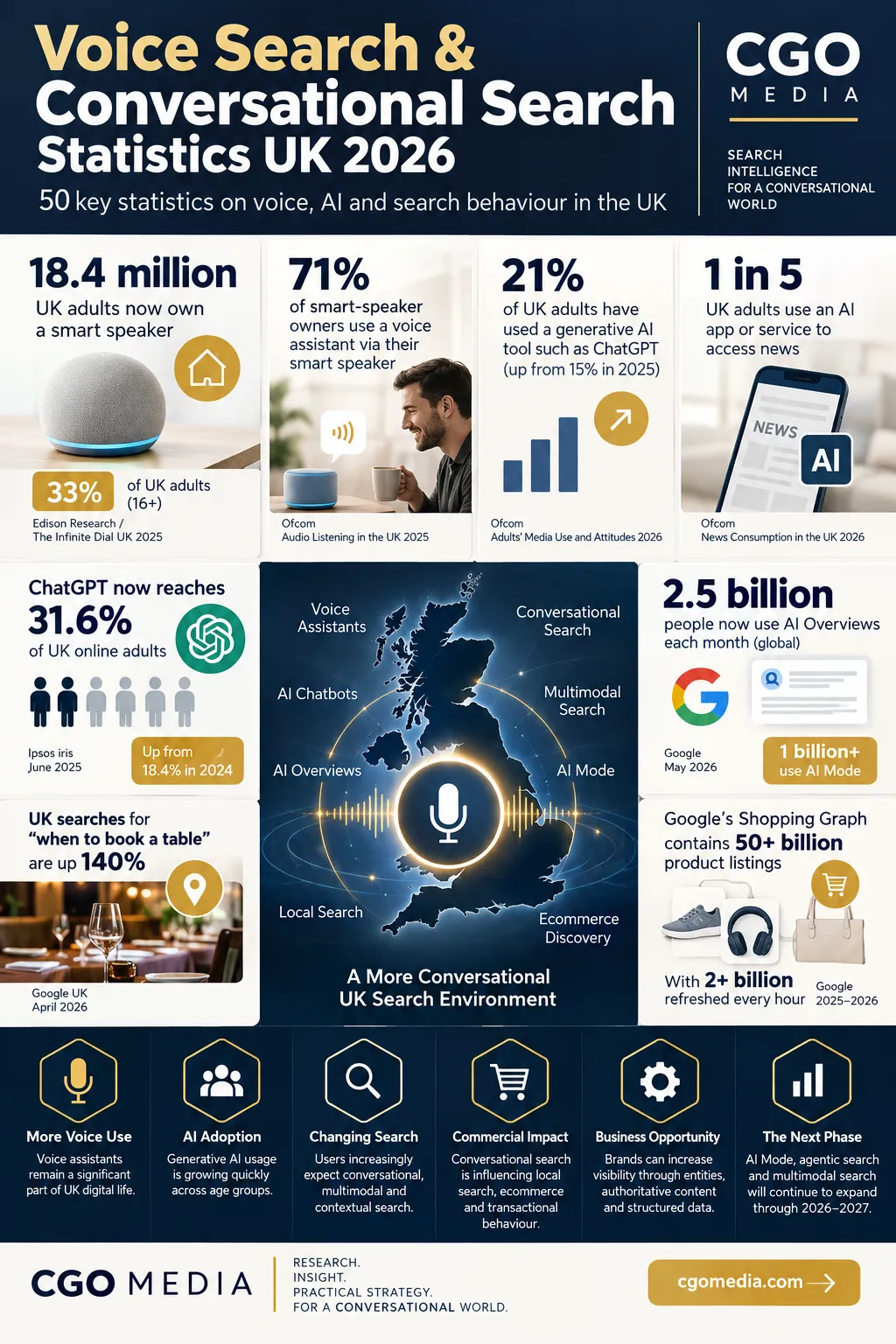
Voice search and conversational search are becoming increasingly important parts of the wider UK search ecosystem, but they should not be treated as the same behaviour.
Voice search describes the use of spoken input to search for information, control a device, find a location, play media or complete another digital action.
Conversational search is broader. It allows people to ask natural-language questions, add context, refine requests and continue through follow-up questions. The interaction can take place through voice, text, images or other forms of input.
This distinction has become increasingly important as search evolves beyond traditional keyword entry.
Smart speakers such as Amazon Alexa helped normalise spoken interaction in UK households. Smartphones extended voice access outside the home. Generative AI systems including ChatGPT and Google AI Mode are now pushing conversational interaction further by allowing users to ask substantially longer, more nuanced and multi-stage questions.
Central Research Finding: Voice search has become an established interface within UK homes and connected devices, while conversational search is expanding the behaviour into a much larger ecosystem of AI-assisted, contextual and multi-stage discovery.
Executive Summary
The evidence reviewed for this report shows that voice-enabled technology is already widely distributed across the United Kingdom.
Edison Research’s 2025 Infinite Dial UK study found that 45% of people aged 16 and over owned a smart speaker, while individual ownership of Amazon Alexa, Google Home and Apple HomePod had all increased substantially since 2021.
Ofcom research also demonstrates that these devices are used for far more than music. UK consumers use smart speakers for live radio, weather information, reminders, questions and news.
At the same time, conversational discovery is moving beyond dedicated voice devices. Google AI Mode, AI Overviews, ChatGPT and other generative interfaces now allow users to ask natural-language questions, continue with follow-ups and combine several requirements inside one search journey.
This creates an important strategic distinction:
↓
Natural Language
↓
Contextual Understanding
↓
Follow-Up Questions
↓
Direct Answers & Recommendations
↓
Conversational Discovery
What the 50 Statistics Examine
| Statistics | Research Area | What It Measures |
|---|---|---|
| 1–10 | UK Voice Device Adoption & Everyday Usage | Smart-speaker ownership, platforms and everyday voice-enabled behaviour. |
| 11–20 | Smart Speakers, Voice Assistants & Audio Behaviour | Voice-assistant usage, connected audio, radio and device choice. |
| 21–30 | Conversational Search & Generative AI Adoption | ChatGPT, AI search, AI Overviews and growth in conversational discovery. |
| 31–40 | Query Behaviour, Local Discovery & Commercial Intent | Query length, contextual prompts, local behaviour and commercial research. |
| 41–50 | AI Search Interfaces & Future Discovery | Follow-up search, multimodality, direct answers and evolving conversational interfaces. |
Research Scope
This report is written for a UK audience, but the evidence base contains several different forms of research.
UK-specific statistics are prioritised wherever reliable data is available, particularly Ofcom, Edison Research and UK government evidence.
International platform data from organisations such as Google is included where it documents broader changes in conversational search technology and user behaviour. Such figures are clearly distinguished from UK population statistics.
This is particularly important because terms such as voice search, voice assistant usage, smart-speaker ownership and conversational search measure different behaviours and should not be treated as interchangeable.
Statistics 1–10 — UK Voice Device Adoption & Everyday Usage
The first ten statistics establish the size of the UK’s voice-enabled device base and how consumers use smart speakers in everyday life.
Important measurement note: Edison Research measures ownership among the UK population aged 16+, while Ofcom’s Technology Tracker uses household-level measures for some smart-speaker statistics. These figures describe different populations and should not be treated as directly interchangeable.
1. 45% of UK adults aged 16+ own a smart speaker
Edison Research found that 45% of the UK population aged 16 and over owned a smart speaker in 2025.
The Infinite Dial UK estimated this represented approximately 22 million people.
Smart speakers therefore remain a substantial voice-enabled interface even as conversational AI expands onto smartphones, computers and conventional search engines.
Source: Edison Research, The Infinite Dial UK 2025.
2. UK smart-speaker ownership increased from 25% to 45% in four years
Smart-speaker ownership among UK adults aged 16+ rose from 25% in 2021 to 45% in 2025.
That represents an increase of 20 percentage points and an approximately 80% relative increase over four years.
The growth shows that spoken interaction with connected devices has moved beyond an early-adopter behaviour.
Source: Edison Research, The Infinite Dial UK 2025.
3. 37% of UK adults aged 16+ own an Amazon Alexa device
Amazon Alexa ownership reached 37% of the UK population aged 16+ in 2025.
This was almost double the 19% recorded in the equivalent 2021 study.
Alexa therefore remains one of the most widely distributed dedicated voice-assistant ecosystems in the UK.
Source: Edison Research, The Infinite Dial UK 2025.
4. Google Home ownership reached 16% of UK adults aged 16+
16% of the UK population aged 16+ reported owning a Google Home device in 2025.
The equivalent figure in 2021 was 7%.
Ownership therefore more than doubled across the four-year comparison period.
Source: Edison Research, The Infinite Dial UK 2025.
5. Apple HomePod ownership reached 5% of UK adults aged 16+
5% of UK adults aged 16+ reported owning an Apple HomePod in 2025.
The figure stood at 2% in 2021.
Although considerably smaller than Amazon Alexa ownership, the data demonstrates that all three major smart-speaker ecosystems recorded substantial growth.
Source: Edison Research, The Infinite Dial UK 2025.
6. 41% of UK households had a smart speaker in Ofcom’s research
Ofcom reported that 41% of UK households had a smart speaker in its Technology Tracker evidence referenced in the 2025 Audio Report.
This figure uses a household measure rather than Edison Research’s population measure, which explains why the percentages should not be compared directly.
Taken together, however, the studies provide strong evidence that voice-enabled speakers have achieved substantial UK penetration.
Source: Ofcom, Audio Listening in the UK 2025.
7. 63% of UK smart-speaker owners use the device for streamed music
Streaming music was the most commonly reported use of smart speakers, used by 63% of owners.
This demonstrates that voice-enabled devices often operate as media interfaces rather than purely as search tools.
That distinction matters when evaluating “voice search” statistics because ownership or voice-assistant usage should not automatically be interpreted as search activity.
Source: Ofcom, Audio Listening in the UK 2025.
8. 57% of UK smart-speaker owners use them for live radio
57% of UK smart-speaker owners reported using their device to listen to live radio.
Voice-controlled access to radio has become sufficiently important that UK legislation now contains provisions governing designated voice-activated radio-selection services.
This demonstrates that voice interfaces are not simply experimental technology; they can become intermediaries between audiences and established media services.
Source: Ofcom, Audio Listening in the UK 2025.
9. 40% of smart-speaker owners use voice-enabled devices for weather reports
40% of UK smart-speaker owners reported using their device to access weather information.
Weather illustrates a classic direct-answer voice interaction: the user usually wants a concise response rather than a collection of webpages to examine.
This type of behaviour helped establish expectations that information systems should understand natural questions and return immediate answers.
Source: Ofcom, Audio Listening in the UK 2025.
10. 38% of smart-speaker owners use them to search for answers to questions
38% of UK smart-speaker owners reported using the device to search for answers to questions.
This is one of the most directly relevant statistics for understanding voice search itself.
It shows that smart speakers are used not only for commands and media playback but also for information retrieval.
However, it also demonstrates why the total installed base of smart speakers should not be presented as though every owner regularly conducts voice searches.
Source: Ofcom, Audio Listening in the UK 2025.
What Statistics 1–10 Tell Us
Voice-enabled devices are already embedded in a substantial proportion of UK homes and personal technology environments.
But the evidence also shows why voice-search research requires careful definitions.
Owning a smart speaker does not mean every interaction is a search. Many users primarily listen to music or radio, while others use voice commands for weather, reminders and household tasks.
The important development is that these devices have helped normalise a wider behaviour: speaking naturally to technology and expecting an immediate response.
That behavioural foundation now connects directly with conversational AI.
The principal findings from Statistics 1–10 are:
- Smart-speaker ownership has become mainstream in the UK.
- Ownership increased substantially between 2021 and 2025.
- Amazon Alexa has the largest installed base among the brands measured by Edison Research.
- Google Home and Apple HomePod ownership also increased materially.
- Ofcom independently identifies substantial household smart-speaker penetration.
- Audio remains the dominant use case.
- Voice-controlled live radio is commercially and regulatorily significant.
- Weather demonstrates the importance of immediate direct answers.
- More than a third of smart-speaker owners use the device to obtain answers to questions.
- Voice usage should not be confused automatically with voice search.
↓
Routine Voice Interaction
↓
Natural-Language Questions
↓
Expectation of Direct Answers
↓
Conversational Search Behaviour
The strategic significance of voice therefore extends beyond the number of searches conducted through smart speakers. Voice interfaces helped establish the natural-language behaviours that are now being amplified by conversational AI systems.
Statistics 11–20 — Smart Speakers, Voice Assistants & Audio Behaviour
Smart speakers represent only one part of the voice ecosystem.
Voice assistants are now accessible through smartphones, smart TVs, vehicles, wearables, computers and dedicated speakers, allowing people to interact with digital services without necessarily touching a screen.
Ofcom’s UK research shows that voice assistants are already used by a majority of surveyed adults, but behaviour varies substantially according to device, location and task.
Research context: Statistics 11–20 primarily use Ofcom’s Audio Listening in the UK 2025 research. Some measures relate to all adults, others to voice-assistant users or smart-speaker owners, so the population measured is stated for each statistic.
11. 39% of UK smart-speaker owners use alarms and reminders
Ofcom reported that 39% of smart-speaker owners used their device for alarms and reminders.
This places organisational tasks close to question answering and weather information among the most common non-audio uses of smart speakers.
The finding demonstrates that voice interfaces have become part of everyday routines rather than being limited to entertainment or search.
Behaviour implication: Voice interaction is often task-driven and immediate, reinforcing expectations that technology should understand short, natural commands without requiring navigation through a visual interface.
Source: Ofcom, Audio Listening in the UK 2025.
12. 24% of smart-speaker owners use their device for news reports
Almost one quarter of UK smart-speaker owners use their device to listen to news reports.
News is especially important from a search and source-selection perspective because the voice assistant may choose which provider or source is presented to the listener.
This makes voice assistants an intermediary between the audience and the publisher rather than merely a neutral playback device.
Discovery implication: In voice environments, source selection can determine which organisation receives the user’s attention when only one answer or provider is surfaced.
Source: Ofcom, Audio Listening in the UK 2025.
13. Live radio accounts for 55% of listening time on UK smart speakers
Online live radio accounted for 55% of all audio listening time on smart speakers among adults aged 15+.
Live radio therefore remains the single largest audio category consumed through smart speakers.
The finding demonstrates how voice-controlled hardware has become an important distribution platform for traditional broadcast brands as well as newer digital services.
Platform implication: Voice assistants can influence how established media services are discovered and accessed even when the underlying content itself is not new.
Source: Ofcom / IPA TouchPoints 2024 Superhub.
14. Streamed music accounts for 36% of smart-speaker listening time
Streamed music represented 36% of audio listening time on smart speakers among UK adults aged 15+.
Together, live radio and streamed music account for the overwhelming majority of smart-speaker listening time.
This reinforces the need to distinguish voice-device usage from voice search itself. A person using Alexa to play music is using a voice interface, but not necessarily conducting an information search.
Measurement implication: Voice-enabled activity should not automatically be counted as voice-search activity.
Source: Ofcom / IPA TouchPoints 2024 Superhub.
15. Among 15–34-year-olds, streamed music rises to 58% of smart-speaker listening
Streamed music accounted for 58% of smart-speaker listening time among UK users aged 15–34.
This reverses the overall pattern, where live radio leads streamed music.
Among 15–34-year-olds, online live radio represented 33% of smart-speaker listening time.
The difference shows that the same voice-enabled hardware supports substantially different behaviours across age groups.
Audience implication: Voice strategy should consider who is using the device and for what purpose rather than assuming a universal smart-speaker behaviour.
Source: Ofcom / IPA TouchPoints 2024 Superhub.
16. Smart speakers increased their share of total UK radio listening from 14% to 18%
The share of UK radio listening taking place through smart speakers increased from 14% in Q1 2023 to 18% in Q1 2025.
The four-percentage-point increase occurred while traditional broadcast sets continued to account for most listening.
This illustrates a gradual rather than immediate platform shift: established behaviours persist, but voice-controlled access is gaining a larger share of listening.
Distribution implication: Voice platforms can become commercially significant without replacing older channels entirely.
Source: Ofcom / RAJAR, Audio Listening in the UK 2025.
17. 51% of smart-speaker users have at least some awareness of the source of voice-delivered news
51% of UK smart-speaker users said they were at least sometimes aware of the original provider when asking their device for a news update.
Of these users, 17% said they were always aware of the original source and 34% said they were sometimes aware.
By contrast, 8% said they were never aware, while 38% said they did not use their smart speaker for news.
This demonstrates a fundamental challenge of answer-led interfaces: users may receive information without forming a strong relationship with the organisation that produced it.
Brand implication: Visibility within a voice response does not necessarily translate into strong source recognition.
Source: Ofcom, Audio Listening in the UK 2025.
18. 70% of smart-speaker users have never changed their default news or music provider
Seven in ten smart-speaker users said they had never changed their settings to select an alternative provider for news or music.
Only 22% said they had changed the default provider.
Among users who had never changed the setting, 53% were unaware that changing the default provider was possible.
This illustrates the potential power of default settings in voice ecosystems.
Platform implication: When users rarely change defaults, platform configuration can influence which services and brands receive repeated exposure.
Source: Ofcom, Audio Listening in the UK 2025.
19. 58% of smart-speaker radio users say the device has played the wrong thing
58% of smart-speaker users who listen to radio said their device had played the wrong station or programme after a voice request.
This was materially higher than the previous year’s 49%.
The finding shows that voice discovery remains vulnerable to ambiguity, imperfect entity matching and interpretation errors.
A spoken request provides fewer visual clues than a conventional search-results page, so an incorrect interpretation can immediately redirect the user to the wrong destination.
Entity implication: Clear naming, consistent metadata and unambiguous entity signals become particularly important when systems must resolve spoken requests without showing a list of alternatives first.
Source: Ofcom, Audio Listening in the UK 2025.
20. 54% of UK adults surveyed had used a voice assistant within the previous three months
More than half of adults in Ofcom’s survey — 54% — said they had used a voice assistant during the previous three months.
Among those voice-assistant users:
- 66% reported using Amazon Alexa.
- 31% reported using Google Assistant.
- 28% reported using Apple Siri.
- 4% used Samsung Bixby.
- 3% used Microsoft Cortana.
Voice-assistant usage also extends across physical environments. Among users, 37% reported using a voice assistant in the living room, 36% in the kitchen and 13% in the car.
Ecosystem implication: Voice behaviour is no longer tied to one type of hardware. The same interaction model increasingly follows users across home, mobile and vehicle environments.
Source: Ofcom, Audio Listening in the UK 2025.
What Statistics 11–20 Tell Us
The evidence shows that voice technology is already embedded within everyday UK digital behaviour, but it also reveals why the next stage of search cannot be understood through smart-speaker ownership alone.
Voice assistants operate across multiple devices, and users employ them for a mixture of media, information, household tasks and direct commands.
The data also exposes several issues that are highly relevant to conversational search:
- Voice systems frequently return a single selected source rather than a page of alternatives.
- Users often leave default providers unchanged.
- Source awareness can be weak.
- Voice requests can be misinterpreted.
- Entity ambiguity can send users to the wrong result.
- Behaviour varies substantially by age and device.
The transition can therefore be represented as:
↓
Spoken Request
↓
Entity Interpretation
↓
Source or Service Selection
↓
Single Delivered Response
↓
Voice-Mediated Discovery
This matters because conversational AI is extending the same principle beyond audio.
The user increasingly expects the system to interpret intent, select relevant information and provide a direct response — whether the query was spoken or typed.
Statistics 21–30 — Conversational Search & Generative AI Adoption
The most important change in conversational search is no longer confined to smart speakers or traditional voice assistants.
Generative AI has introduced natural-language interaction into mainstream information discovery. Users can ask complex questions, request comparisons, refine previous answers and continue a search journey without repeatedly reformulating individual keyword queries.
The UK data now shows that this behaviour has moved well beyond a small early-adopter audience.
Research context: This section combines 2025–2026 UK evidence from Ofcom, Ipsos iris and the UK Department for Science, Innovation and Technology. Measures include self-reported AI usage, measured website/app reach and exposure to AI-generated search summaries. These measures describe different behaviours and should not be treated as interchangeable.
21. 54% of UK adults now use AI tools such as ChatGPT, Copilot or Gemini
Ofcom’s 2026 Adults’ Media Use and Attitudes research found that 54% of UK adults use AI tools such as ChatGPT, Copilot or Gemini.
This is an important threshold because generative AI is no longer limited to a specialist technology audience.
More than half of UK adults now report using tools capable of conversational interaction, natural-language information retrieval and AI-assisted discovery.
Search implication: Conversational interfaces have reached sufficient adoption to influence mainstream search and research behaviour.
Source: Ofcom, Adults’ Media Use and Attitudes 2026.
22. 79% of UK 16–24-year-olds use AI tools
AI-tool usage rises to 79% among UK adults aged 16–24.
Younger adults are therefore substantially ahead of the total adult population in adoption.
This matters strategically because search habits developed among younger audiences can influence expectations about how information systems should work more broadly.
Users accustomed to conversational AI may be less willing to reduce complex needs into a sequence of short keyword queries.
Audience implication: Conversational search behaviour is particularly advanced among younger UK adults.
Source: Ofcom, Adults’ Media Use and Attitudes 2026.
23. 74% of UK adults aged 25–34 use AI tools
Almost three quarters — 74% — of UK adults aged 25–34 now use AI tools.
The high adoption rate extends conversational AI well beyond students and the youngest adult demographic.
The 25–34 age group contains substantial numbers of working professionals, business buyers, consumers, renters, homeowners and parents.
Their adoption therefore increases the commercial relevance of conversational search across multiple sectors.
Commercial implication: AI-assisted discovery is increasingly relevant to mainstream consumer and professional decision journeys.
Source: Ofcom, Adults’ Media Use and Attitudes 2026.
24. 59% of UK adults used generative AI within the previous three months
The UK Government’s 2025/2026 Public Engagement Survey found that 59% of adults had used some form of generative AI during the previous three months.
The same research found that 56% had recently used AI capable of producing human-like text or speech in response to queries, while 54% had used AI-powered digital assistants capable of understanding natural language.
This independently supports the wider picture of conversational interaction becoming common across the UK population.
Behaviour implication: Natural-language interaction with AI is becoming an established digital behaviour rather than an occasional novelty.
Source: UK Department for Science, Innovation and Technology, Public Engagement Survey 2025/2026.
25. 15.8 million UK online adults visited an AI chatbot in June 2025
Ipsos iris data cited by Ofcom found that 15.8 million UK online adults visited at least one major AI chatbot in June 2025.
That represented 32% of the UK online adult population.
The measured services included ChatGPT, Copilot, Gemini, DeepSeek, Perplexity, Claude.ai and Grok.
This is measured website and app reach rather than a survey asking whether people remember using AI.
However, Ofcom cautions that visiting an AI chatbot does not prove that every visit involved search activity.
Measurement implication: AI-chatbot reach is now significant, but AI-tool usage and AI search usage should still be distinguished.
Source: Ofcom, The Era of Answer Engines, citing Ipsos iris, June 2025.
26. ChatGPT alone reached 13 million UK online adults in June 2025
ChatGPT reached approximately 13.0 million UK online adults in June 2025, equivalent to 26% of the online adult population measured by Ipsos iris.
It was substantially ahead of other standalone AI chatbot services in the same dataset.
Microsoft Copilot reached approximately 2.6 million UK online adults, while Google Gemini reached approximately 1.7 million.
Platform implication: ChatGPT had already established a materially larger standalone UK audience than competing AI chatbot services by mid-2025.
Source: Ofcom, The Era of Answer Engines, citing Ipsos iris.
27. ChatGPT’s measured UK adult reach increased by approximately 194% in one year
ChatGPT’s measured UK online adult audience grew from approximately 4.4 million in June 2024 to almost 13.0 million in June 2025.
That represents growth of approximately 194%, taking the measured audience to almost three times its size one year earlier.
The scale of the increase demonstrates how quickly AI-assisted information discovery can develop once a conversational interface becomes widely known.
Growth implication: Conversational AI adoption has progressed at a pace substantially faster than many established digital behaviours.
Source: Ofcom, The Era of Answer Engines, citing Ipsos iris.
28. ChatGPT received 1.8 billion UK visits in the first eight months of 2025
Ofcom reported 1.8 billion UK visits to ChatGPT during the first eight months of 2025.
The equivalent period in 2024 generated approximately 368 million visits.
That means measured visit volume was approximately 4.9 times higher, an increase of roughly 389% year on year across the comparison period.
Visit counts differ from unique-user reach because one user can visit a service repeatedly, but the growth still demonstrates substantial increases in usage intensity.
Usage implication: Growth is occurring not only in the number of people exposed to conversational AI but also in the volume of interactions with those services.
Source: Ofcom, Online Nation 2025.
29. Around 30% of UK searches now display an AI Overview
Ofcom reports that approximately 30% of searches now display an AI-generated overview.
This is strategically important because conversational and generative search behaviour is not limited to people actively choosing an AI chatbot.
AI-generated responses are increasingly being inserted into conventional search journeys.
Users can therefore experience answer-led search without consciously deciding to switch from a traditional search engine to an AI tool.
Search implication: Generative search adoption is occurring through both active chatbot use and passive integration into existing search interfaces.
Source: Ofcom, Online Nation 2025.
30. 53% of UK adults say they often see AI-generated search summaries
More than half of UK adults — 53% — say they often encounter AI-generated summaries when searching.
In many cases, users are not actively requesting an AI experience. The summaries are presented automatically within the search interface.
This represents a fundamental change from the earlier smart-speaker model.
Conversational search is no longer an alternative interface that users must consciously choose. Generative answers are increasingly being integrated into mainstream discovery itself.
Strategic implication: Businesses need to consider visibility inside answer-led search even if their target audience does not actively identify itself as an AI-search user.
Source: Ofcom, Online Nation 2025.
What Statistics 21–30 Tell Us
The evidence shows that conversational AI has moved from experimentation towards mainstream UK digital behaviour.
More than half of UK adults now report using AI tools, adoption among younger adults approaches four in five, and tens of millions of UK users are interacting with conversational AI services.
At the same time, AI-generated answers are being integrated directly into conventional search engines.
This creates two overlapping routes into conversational discovery:
↓
AI-Generated Search Summary
+
↓
Natural-Language Conversation
=
Answer-Led Search Ecosystem
The main findings from Statistics 21–30 are:
- More than half of UK adults now use AI tools.
- AI adoption is particularly high among people under 35.
- Recent UK government research independently confirms widespread generative-AI usage.
- Almost one third of UK online adults visited a major AI chatbot in a single measured month.
- ChatGPT has the largest measured standalone UK chatbot audience.
- ChatGPT’s UK audience expanded rapidly between 2024 and 2025.
- Repeat usage is generating very large volumes of UK visits.
- AI answers are increasingly integrated into conventional search.
- Users can adopt generative search without deliberately switching search products.
- Conversational discovery is becoming part of mainstream search behaviour rather than a separate niche activity.
The next strategic question is therefore no longer whether conversational search exists at meaningful scale. It is how the structure of queries and customer discovery changes when users can describe their complete requirement in natural language and continue through follow-up questions.
Statistics 31–40 — Query Behaviour, Local Discovery & Commercial Intent
Conversational search changes more than the interface used to enter a query.
It changes how much information users can provide at the beginning of the search, how easily they can refine a request and how many requirements can be included within a single interaction.
Instead of reducing a need to a short phrase such as Italian restaurant London, a user can describe party size, location, dietary requirements, preferred atmosphere, budget and timing in one request.
The same pattern applies to ecommerce, travel, professional services and product research.
Research context: Several statistics in this section come from Google’s global or US AI Mode data rather than a UK population study. They are included because AI Mode has been available in the UK since July 2025 and they document how the search interface itself is changing. UK-specific evidence is identified separately.
31. AI Mode queries are now approximately three times longer than traditional Google searches
Google reported in 2026 that the average AI Mode query is approximately three times the length of a traditional Search query.
Earlier AI Mode testing in 2025 had already shown queries around two to three times longer than conventional searches.
The change is significant because longer queries allow users to express considerably more context, restrictions and intent before the system returns an answer.
A conventional keyword query may identify the category being searched.
A conversational query can identify the category, location, budget, preferences, exclusions and desired outcome simultaneously.
Search implication: Search optimisation increasingly needs to address complete user requirements rather than isolated keyword strings.
Source: Google Search, AI Mode behavioural data, 2025–2026.
32. Google AI Mode has surpassed one billion monthly users globally
Google reported in May 2026 that AI Mode had surpassed one billion monthly users globally only one year after its wider launch.
This scale demonstrates that conversational search is no longer restricted to standalone AI chatbot platforms.
It is being incorporated directly into one of the world’s largest existing search ecosystems.
Platform implication: Conversational search is increasingly becoming a layer within mainstream search rather than a separate category of technology.
Source: Google, A New Era for AI Search, May 2026.
33. AI Mode query volume more than doubled every quarter after launch
Google reported that the number of AI Mode queries more than doubled every quarter following launch.
This measures usage growth rather than simple availability.
A product can be technically accessible without becoming part of users’ normal behaviour. Rapid query growth provides stronger evidence that people are returning to the interface and expanding the types of questions they ask.
Adoption implication: The growth of conversational search is visible in interaction volume as well as user reach.
Source: Google Search, May 2026.
34. More than one in six AI Mode searches in the US now use voice or images
Google reported in 2026 that more than one in six AI Mode searches in the United States used voice or images rather than text alone.
This is an important evolution of the original voice-search concept.
Users are no longer restricted to choosing between typing and speaking. They can combine natural-language questions with visual input and continue the search conversationally.
Multimodal implication: Future search optimisation increasingly needs to consider how products, places, objects and entities can be understood across text, voice and visual inputs.
Source: Google, How AI Mode Is Changing and Expanding the Way People Search, May 2026.
35. Image searches in AI Mode were growing by more than 40% month on month
Google reported that image-based AI Mode searches in the US were growing by more than 40% month on month in 2026.
Visual search allows users to begin with something they see rather than something they can easily describe.
The user can then add natural-language context through follow-up questions.
For retailers, property businesses, travel organisations, hospitality companies and other visually driven sectors, this creates new discovery pathways that do not begin with a conventional keyword query.
Visual discovery implication: Image quality, product information, structured data and clear entity association become increasingly important as search becomes multimodal.
Source: Google Search AI Mode behavioural data, May 2026.
36. Planning-related AI Mode queries grew 80% faster than AI Mode queries overall
Google Trends data showed that planning-related AI Mode queries in the US grew 80% faster than AI Mode queries overall during the preceding six months.
Planning is particularly suited to conversational search because it usually involves multiple criteria and several stages.
Examples can include:
- Planning a holiday.
- Finding a restaurant.
- Organising an event.
- Comparing products.
- Creating an itinerary.
- Researching a major purchase.
Traditional search often requires several separate queries to complete these tasks. Conversational systems can maintain context across the journey.
Journey implication: Search is increasingly moving from finding individual pieces of information towards helping users complete multi-stage decisions.
Source: Google Search Trends analysis, May 2026.
37. Brainstorming queries in AI Mode grew 30% faster than overall AI Mode usage
Google reported that brainstorming queries in AI Mode grew approximately 30% faster than AI Mode queries overall following launch.
This type of search differs substantially from classic navigational or informational search.
The user may not know exactly what they want when the interaction begins.
Instead, the system becomes part of the discovery process — helping the user generate ideas, refine criteria and compare possibilities.
Intent implication: Conversational search increasingly operates before a user has formed a precise keyword or final purchase requirement.
Source: Google Search AI Mode trends, May 2026.
38. UK searches for “when to book a table” surged 140% in 2026
Google reported that UK searches for “when to book a table” had increased by 140% during 2026.
The finding was published alongside the rollout of AI Mode’s restaurant-booking capabilities in the UK.
Users can now provide multiple conditions inside a single restaurant request — including date, time, party size, cuisine, dietary requirements and location — before being shown relevant available options.
This is a strong example of conversational search moving beyond information retrieval into local commercial action.
Local-search implication: Local discovery increasingly depends on complete, accurate business information that can satisfy multiple user constraints simultaneously.
Source: Google UK, Booking Restaurants in the UK Just Got Easier with AI in Search, April 2026.
39. Google’s Shopping Graph contains more than 50 billion product listings
By late 2025, Google’s Shopping Graph contained more than 50 billion product listings from retailers around the world.
AI Mode can use this product data to respond to conversational requests in which users describe what they want using natural language rather than fixed ecommerce filters.
For example, a user can specify fit, style, budget, colour or intended use inside one conversational query and then refine the results further.
Ecommerce implication: Product visibility increasingly depends on accurate machine-readable product attributes as well as conventional category and keyword optimisation.
Source: Google, AI Mode Shopping update, September 2025.
40. More than two billion Google product listings are refreshed every hour
Google reports that more than two billion product listings in its Shopping Graph are refreshed every hour.
Those updates can include pricing, availability, promotions and other product information.
This highlights an increasingly important difference between conversational commercial search and static content discovery.
When users ask for a recommendation based on budget, availability, location or another immediate constraint, freshness becomes part of relevance.
Commercial implication: Product feeds, inventory accuracy, price data and structured product information increasingly contribute to whether an organisation can satisfy highly specific conversational queries.
Source: Google Shopping / AI Mode product infrastructure data.
What Statistics 31–40 Tell Us
The shift towards conversational search is changing the structure of demand.
Users are increasingly able to describe what they actually want rather than translating that requirement into a short phrase they believe a search engine will understand.
That creates richer expressions of intent.
A user can combine:
- Location.
- Budget.
- Timing.
- Availability.
- Preferences.
- Exclusions.
- Product attributes.
- Personal context.
- Desired outcome.
The discovery model consequently begins to change:
↓
Category Match
becomes
↓
Multiple Constraints
↓
Candidate Evaluation
↓
Recommendation
↓
Action
The principal findings from Statistics 31–40 are:
- Conversational queries are substantially longer than traditional searches.
- AI Mode has reached very large global usage.
- AI-search interaction volume continues to grow rapidly.
- Voice and images are becoming part of conversational search.
- Visual search is expanding quickly.
- Planning is one of the fastest-growing AI-search behaviours.
- Users increasingly search before they have formed a precise final requirement.
- Conversational search can move directly into local bookings and transactions.
- Commercial discovery increasingly depends on detailed structured product data.
- Freshness and availability become important when recommendations involve immediate commercial intent.
The strategic shift is therefore from optimising only for individual keywords towards making an organisation, product, service or location sufficiently clear and data-rich to satisfy highly specific combinations of user requirements.
Statistics 41–50 — AI Search Interfaces, Follow-Up Questions & Future Discovery
The final ten statistics show how conversational discovery is becoming embedded inside mainstream search rather than remaining a separate activity confined to dedicated AI chatbots.
AI summaries now appear directly within search results. Users can continue from an initial answer into follow-up questions, combine text with images, voice or camera input and increasingly use AI systems to discover information that would previously have required several separate searches.
The strategic significance is therefore broader than “voice search”.
The emerging model is an interconnected search environment in which users move between traditional search, generated answers, conversational follow-ups and multimodal discovery.
Research context: UK adoption figures in this section are primarily from Ofcom’s 2026 Adults’ Media Use and Attitudes research. Global platform figures are identified separately and are used to show the scale and direction of AI-enabled search infrastructure.
41. 75% of UK online adults read AI-generated search summaries at least some of the time
Three quarters of UK online adults say they read AI-generated search summaries at least some of the time.
Ofcom’s 2026 research presented participants with an example of an AI-generated search summary and asked about their engagement with this type of result.
The finding demonstrates that generated answers have already become part of ordinary information discovery for a large majority of UK internet users.
Search implication: AI-mediated discovery now reaches substantially more people than those who deliberately choose to use standalone AI chatbots.
Source: Ofcom, Adults’ Media Use and Attitudes 2026.
42. 42% of UK online adults read AI search summaries often or always
More than two in five UK online adults — 42% — say they read AI-generated search summaries “often” or “always”.
This is more significant than occasional exposure.
It indicates that generated summaries are becoming a regular part of information-seeking behaviour for a substantial proportion of the population.
Visibility implication: Organisations increasingly need to consider whether their information can be understood and selected within generated answers as well as conventional organic listings.
Source: Ofcom, Adults’ Media Use and Attitudes 2026.
43. 54% of people who do not use AI chatbots still read AI search summaries
Even among UK adults who do not use AI chatbots, 54% say they read AI-generated search summaries at least sometimes.
This is one of the most strategically important findings in the report.
It shows that measuring ChatGPT, Gemini or Copilot usage alone significantly understates exposure to AI-mediated search.
A user can avoid standalone AI tools entirely and still interact regularly with generated answers embedded inside conventional search.
Measurement implication: AI-search adoption should not be estimated solely from chatbot usage.
Source: Ofcom, Adults’ Media Use and Attitudes 2026.
44. 62% of UK 16–24-year-olds read AI search summaries often or always
62% of UK internet users aged 16–24 say they read AI-generated search summaries often or always.
Younger users therefore show materially higher routine engagement than the 42% recorded across online adults overall.
This supports the wider evidence that younger audiences are adopting AI-mediated discovery particularly quickly.
Audience implication: Businesses targeting younger consumers should expect generated answers and conversational interfaces to play an increasingly prominent role in information discovery.
Source: Ofcom, Adults’ Media Use and Attitudes 2026.
45. 60% of UK 25–34-year-olds read AI search summaries often or always
60% of UK internet users aged 25–34 say they engage with AI search summaries often or always.
This means regular use remains high beyond the youngest adult demographic.
The 25–34 age group includes substantial numbers of consumers making decisions around careers, housing, travel, financial products, professional services and major purchases.
Commercial implication: AI-mediated search is becoming relevant across high-value consumer and professional decision categories rather than remaining concentrated among students or technology enthusiasts.
Source: Ofcom, Adults’ Media Use and Attitudes 2026.
46. 57% of UK adults aware of AI would trust AI-written news less than human-written news
57% of UK adults who are aware of AI say they would trust a news story written by AI less than one written by a person.
A further 27% said they would trust AI-generated news about the same, while only 7% said they would trust it more.
The finding highlights an important tension within conversational discovery.
People are increasingly consuming AI-generated answers while remaining cautious about AI-generated information.
Trust implication: Source transparency, identifiable evidence and authoritative attribution are likely to remain important as generated answers become more common.
Source: Ofcom, Adults’ Media Use and Attitudes 2026.
47. Even among AI users, 50% trust AI-written news less than human-written news
Half of UK AI users say they would trust an AI-generated news story less than one produced by a person.
Regular use therefore does not automatically remove scepticism.
Users can find AI tools useful while still wanting evidence, recognisable sources and the ability to verify important claims independently.
Authority implication: AI visibility and trust are different objectives. Being surfaced in a generated response does not by itself establish user confidence.
Source: Ofcom, Adults’ Media Use and Attitudes 2026.
48. Google AI Overviews now reaches more than 2.5 billion monthly active users
Google reported in 2026 that AI Overviews had grown to more than 2.5 billion monthly active users globally.
The scale is significant because AI Overviews are integrated within conventional Google Search rather than requiring users to visit a separate chatbot interface.
For publishers and businesses, this creates a discovery environment where visibility can occur inside a generated answer, through cited links or through conventional organic search results on the same journey.
Ecosystem implication: AI-generated answers now operate at mainstream search-engine scale.
Source: Google Search, website-owner update, 2026.
49. AI Overviews have increased Google usage by more than 10% for the query types where they appear
Google reports that AI Overviews have driven more than a 10% increase in Google usage for the types of queries where AI Overviews are displayed.
The company has also reported growth in overall and commercial query volumes alongside expansion of its AI search experiences.
This challenges the assumption that generated answers necessarily eliminate further searching.
For some query types, Google reports that users search more after becoming accustomed to AI-assisted results.
Behaviour implication: Conversational and generated search can expand the number and complexity of searches rather than simply replacing existing keyword queries one for one.
Source: Google Search / Alphabet, AI Overviews usage data.
50. One in five UK adults now use AI tools to keep up with news
Ofcom reported in September 2026 that one in five UK adults now use AI tools such as ChatGPT to keep up to date with news.
This is particularly significant because news has traditionally been accessed through publishers, broadcasters, search engines and social-media feeds.
AI assistants are now becoming another intermediary through which audiences discover and interpret current information.
The same Ofcom research found that UK adults encounter approximately 12 different news sources in an average month, rising to 18 among 25–34-year-olds.
Discovery implication: AI systems are becoming part of the information-distribution layer itself, not merely tools people use after reaching a publisher’s website.
Source: Ofcom, News Consumption in the UK 2026, September 2026.
What Statistics 41–50 Tell Us
The final statistics show that conversational search has moved beyond the original voice-assistant model.
Voice remains an important input method, but the wider transformation is the emergence of search systems that can interpret complex natural-language requests, generate direct answers, maintain conversational context and support follow-up exploration.
Most importantly, this behaviour is now embedded within mainstream information discovery.
Users do not need to identify themselves as “AI search users” for AI to mediate their search experience.
The principal findings from Statistics 41–50 are:
- Three quarters of UK online adults engage with AI-generated search summaries at least sometimes.
- More than two in five read them frequently.
- AI summaries reach people who do not use standalone AI chatbots.
- Younger UK adults show particularly high routine engagement.
- AI-generated information still faces substantial trust challenges.
- Regular AI users can remain sceptical of AI-generated content.
- AI Overviews now operates at multi-billion-user scale globally.
- Google reports increased search activity for query types using AI Overviews.
- AI systems are increasingly becoming intermediaries for current information and news.
- The distinction between traditional search and conversational AI is becoming progressively less clear.
The emerging discovery journey can therefore be represented as:
↓
AI-Generated Answer
↓
Source Evaluation
↓
Follow-Up Question
↓
Comparison or Recommendation
↓
Action
Voice, text and visual search are increasingly becoming different entry points into the same conversational discovery system.
The strategic challenge for organisations is therefore no longer simply to rank for a spoken or typed keyword. It is to become a sufficiently clear, relevant, authoritative and machine-understandable source to participate throughout an evolving answer-led search journey.
CGO Media Analysis — What the 50 Voice & Conversational Search Statistics Tell Us
Taken together, the 50 statistics show that the most important change is not simply an increase in the number of people speaking searches into devices.
The larger transformation is the movement from short, isolated queries towards natural-language, contextual and increasingly multi-stage discovery.
Voice assistants helped establish the behavioural foundation. Generative AI and AI-integrated search are now extending that behaviour across text, voice, images and conventional search interfaces.
The central finding is that “voice search” is becoming part of a much larger conversational search ecosystem in which users can describe complete needs, refine them through follow-up questions and increasingly receive direct answers, comparisons and recommendations before visiting a website.
1. Voice Search Is No Longer the Whole Story
The data confirms that smart speakers and voice assistants have achieved substantial penetration in the UK.
However, the most strategically important development is that conversational behaviour has escaped the dedicated voice-device category.
Users can now interact naturally with:
- Smart speakers.
- Smartphones.
- Search engines.
- AI chatbots.
- Smart TVs.
- Vehicles.
- Visual-search interfaces.
- Multimodal AI systems.
This means organisations should avoid building a strategy around the narrow idea of optimising specifically for Alexa-style searches.
CGO Media interpretation: Voice search should now be treated as one input method within a broader conversational discovery environment.
2. Natural-Language Search Is Becoming Mainstream
The adoption figures for ChatGPT, Gemini, Copilot and AI-generated search summaries show that conversational interaction is no longer limited to early adopters.
A majority of UK adults now use AI tools, while younger age groups report particularly high usage.
The effect on search behaviour is significant because these systems allow people to formulate requests in a way that more closely resembles ordinary speech.
Instead of learning how to phrase a search for the machine, users increasingly expect the machine to understand how they naturally describe a problem.
CGO Media interpretation: Search increasingly rewards information that maps to real user needs rather than content created only around abbreviated keyword phrases.
3. Queries Are Becoming Richer Expressions of Intent
Google’s AI Mode data shows that conversational queries are materially longer than conventional searches.
Longer queries matter because they allow users to provide more context before the system begins evaluating possible answers.
A traditional search might be:
best hotel Manchester
A conversational query might instead ask:
Which central Manchester hotels are suitable for a two-night business trip, have reliable Wi-Fi, parking nearby and good restaurants within walking distance?
The second query contains far more information about the user’s actual decision criteria.
CGO Media interpretation: Conversational search increases the importance of entities, attributes, relationships and supporting evidence because systems need enough information to evaluate candidates against multiple criteria.
4. Search Is Moving From Retrieval Towards Evaluation
Traditional search primarily helped users locate documents.
Conversational search increasingly helps users evaluate options.
A system may be asked to:
- Compare several providers.
- Recommend suitable products.
- Filter businesses according to constraints.
- Explain trade-offs.
- Construct itineraries.
- Summarise evidence.
- Identify the best match for a specific requirement.
This changes the role of optimisation.
It is no longer enough for a webpage simply to contain the phrase used in the search.
The organisation needs to provide enough evidence for a system to understand what it offers, who it serves, where it operates and why it may be relevant to a particular requirement.
CGO Media interpretation: Search visibility increasingly depends on whether an organisation can survive candidate evaluation, not merely whether its page can match a query.
5. Direct Answers Reduce the Number of Visible Choices
Voice assistants established an important characteristic of answer-led discovery: the user may receive one selected response instead of a page containing multiple alternatives.
AI-generated answers extend the same principle into conventional search.
A generated response can synthesise information from several sources, highlight a small number of recommendations or answer the question without requiring the user to open every underlying page.
This increases the strategic value of being selected as a source or candidate.
CGO Media interpretation: Answer-led search increases competition for inclusion before the click, not simply competition for ranking position after the results page appears.
6. Entity Clarity Becomes More Important
Ofcom’s voice research shows that devices can misinterpret requests and deliver the wrong station or service.
Conversational AI faces a related challenge at much larger scale: it must determine which organisation, product, person, service or location the user actually means.
Clear entity signals can therefore become increasingly important.
These may include:
- Consistent organisation names.
- Clear service definitions.
- Accurate location information.
- Structured data.
- Consistent third-party profiles.
- Strong About and organisation information.
- Author and expert attribution.
- Reliable external references.
CGO Media interpretation: Conversational discovery increases the cost of ambiguity. Systems need to understand exactly which entity they are evaluating before they can recommend it confidently.
7. Structured Data Becomes More Commercially Important
Conversational search increasingly involves constraints that machines need to evaluate directly.
Examples include:
- Price.
- Availability.
- Opening hours.
- Product specifications.
- Location.
- Delivery options.
- Ratings.
- Event dates.
- Service areas.
Google’s Shopping Graph illustrates the scale of this transition, with tens of billions of product listings and billions of updates every hour.
The implication extends beyond ecommerce.
Any organisation whose suitability depends on attributes or availability benefits from making those facts clear, consistent and machine-readable.
CGO Media interpretation: Structured data increasingly supports candidate evaluation by helping systems understand the factual attributes required to answer highly specific queries.
8. Local Search Becomes More Conversational and Transactional
The evolution of restaurant booking provides a useful example.
A local search no longer needs to end with a list of businesses.
The user can potentially specify location, party size, time, cuisine and dietary requirements before the system identifies suitable options and moves directly towards a booking.
The same model can extend to:
- Hotels.
- Healthcare providers.
- Professional services.
- Property.
- Retail.
- Travel.
- Events.
CGO Media interpretation: Local search is moving from “find businesses near me” towards “find the business that satisfies this exact set of requirements and help me act”.
9. Trust Becomes More Important as Answers Become More Synthesised
The Ofcom trust data reveals an important contradiction.
Consumers are increasingly using AI-generated answers while remaining cautious about information generated by AI.
This means visibility alone is insufficient.
Users and systems both benefit from information supported by:
- Identifiable sources.
- Original research.
- Expert authorship.
- Evidence.
- Dates.
- Clear methodology.
- Consistent facts.
- Independent corroboration.
This is especially important in higher-trust sectors such as healthcare, financial services, legal services and professional advice.
CGO Media interpretation: The growth of AI-generated answers increases the value of verifiable source authority rather than reducing it.
10. Voice, AI Search and Traditional SEO Are Converging
The evidence does not support treating voice search, conversational AI and traditional search as completely separate disciplines.
The same underlying information may now need to serve:
- A conventional Google result.
- An AI Overview.
- An AI Mode response.
- A ChatGPT answer.
- A voice-assistant response.
- A visual-search result.
- A local recommendation.
The interface changes, but many of the underlying requirements remain connected:
clear information, strong entities, reliable sources, useful content, technical accessibility and consistent factual signals.
CGO Media interpretation: The future is not “voice SEO versus traditional SEO”. It is a wider search ecosystem in which the same organisation needs to remain discoverable across several answer and retrieval interfaces.
The CGO Media Conversational Discovery Model
The 50 statistics suggest that conversational discovery increasingly follows a multi-stage process:
↓
Intent Interpretation
↓
Entity Recognition
↓
Candidate Retrieval
↓
Evidence & Attribute Evaluation
↓
Source Selection
↓
Answer or Recommendation
↓
Follow-Up or Action
This model explains why optimisation for conversational search requires more than simply adding question-and-answer content to a page.
The organisation itself needs to be understandable.
Its products, services, expertise, locations, evidence, attributes and relationships need to be sufficiently clear for search and AI systems to evaluate them against increasingly detailed user requirements.
The broader transition is therefore from keyword visibility towards entity understanding, evidence retrieval and recommendation eligibility.
What UK Businesses Should Do in 2026
The evidence in this report shows that voice search, conversational AI and traditional search are increasingly converging.
For UK businesses, the practical objective should therefore not be to create a separate “voice SEO” strategy in isolation.
The stronger approach is to make the organisation, its services, products, locations, expertise and evidence sufficiently clear for search engines and AI systems to understand, evaluate and recommend across multiple interfaces.
The priority for 2026 should be to build search assets that answer real natural-language questions, establish clear entities and provide enough evidence for systems to understand why the organisation is relevant to a particular user need.
1. Write for Complete Questions, Not Just Keywords
Conversational queries are longer and contain more context than many conventional searches.
Businesses should therefore expand important pages beyond a narrow target phrase and answer the wider questions a potential customer is likely to ask.
That can include:
- Who the service is suitable for.
- Where the organisation operates.
- What the service includes.
- What it costs.
- How long it takes.
- What alternatives exist.
- What makes one option more suitable than another.
- What evidence supports the claims being made.
Recommended action: Expand key service and product pages around complete customer questions and decision criteria rather than relying only on one primary keyword.
2. Strengthen Entity Clarity Across the Website
Conversational systems need to understand exactly which organisation, service, person, location or product they are evaluating.
Businesses should therefore improve consistency around:
- Organisation name.
- Brand descriptions.
- Office and service locations.
- Team members and experts.
- Products and services.
- Parent and subsidiary relationships.
- Sector specialisms.
- Contact information.
The same information should remain consistent across the website and important third-party profiles.
Recommended action: Audit entity information across the website, business profiles, directories, media mentions and authoritative third-party sources.
3. Use Structured Data Where It Describes Real Page Content
Structured data can help machines understand important attributes and relationships.
Depending on the organisation, this can include:
- Organisation information.
- Local business data.
- Products.
- Offers.
- Prices.
- Events.
- Articles.
- Authors.
- Reviews where eligible.
- Breadcrumbs.
Structured data should reflect content genuinely visible and supported on the page rather than being added purely to create additional machine-readable claims.
Recommended action: Map each important content type to appropriate structured data and validate that the markup matches the visible page.
4. Make Product and Service Attributes Explicit
Conversational search increasingly works through combinations of user requirements.
A system may need to determine whether a product or service satisfies conditions involving:
- Price.
- Location.
- Availability.
- Size.
- Features.
- Eligibility.
- Delivery.
- Opening hours.
- Specialisms.
- Service area.
If these attributes exist only inside vague marketing language, they can be harder for users and machines to evaluate.
Recommended action: Present commercially important attributes in clear prose, tables, specifications and structured data where appropriate.
5. Build Strong Question-and-Answer Coverage
FAQs remain useful when they answer genuine customer questions rather than being added mechanically for SEO.
Good FAQ content should address:
- Specific objections.
- Common comparisons.
- Eligibility questions.
- Costs.
- Timelines.
- Service boundaries.
- Local availability.
- Implementation questions.
These sections can help support conversational search because they often mirror the natural form of user questions.
Recommended action: Add FAQs only where real questions exist and answer them directly before adding supporting detail.
6. Strengthen Local Information for Conversational Discovery
Local conversational queries can contain multiple constraints at once.
Businesses should make important local information easy to identify, including:
- Full address.
- Service area.
- Opening hours.
- Telephone number.
- Booking options.
- Parking or accessibility information.
- Nearby areas served.
- Location-specific services.
Local profiles should remain consistent with the information presented on the website.
Recommended action: Treat local information as structured discovery data, not merely contact details in the footer.
7. Create Evidence That Can Support Recommendations
Conversational search frequently asks systems to compare or recommend.
Recommendation confidence is likely to be stronger where an organisation can demonstrate evidence beyond its own marketing claims.
Useful evidence can include:
- Original research.
- Statistics.
- Case studies.
- Named experts.
- Independent coverage.
- Industry references.
- Methodology pages.
- Documented outcomes.
This is especially important where the query asks which organisation is suitable, credible or experienced.
Recommended action: Build a visible evidence layer around important commercial claims so systems and users can verify why the organisation should be considered.
8. Improve Source Transparency and Authorship
Ofcom’s research shows that users remain cautious about AI-generated information.
Content therefore benefits from clear evidence about who produced it and why the source should be trusted.
Important research and advice pages should make authorship, methodology, dates and supporting sources easy to identify.
Recommended action: Strengthen author profiles, research-team information, publication dates, update dates, sources and methodology across evidence-led content.
9. Optimise for Follow-Up Questions
Traditional SEO often treats each query as a separate event.
Conversational search allows the user to continue from the previous answer.
For example:
Initial question:
“Which accounting firms in Manchester specialise in ecommerce businesses?”
Follow-up:
“Which of those also works with companies selling internationally?”
Further refinement:
“Which one publishes useful guidance about VAT and cross-border payments?”
The organisation therefore needs depth beyond the initial category match.
Recommended action: Build connected content clusters that answer likely second- and third-stage questions rather than stopping at the initial search term.
10. Measure More Than Conventional Organic Rankings
As search becomes more answer-led, ranking reports alone provide an incomplete view of visibility.
Businesses should increasingly monitor:
- Traditional search visibility.
- AI Overview appearances.
- AI citations where measurable.
- Branded search demand.
- Referral traffic from AI platforms.
- Local profile visibility.
- Search Console performance.
- Conversion from AI-assisted journeys.
Some AI-platform measurement remains incomplete, so businesses should avoid inventing precision that current analytics cannot support.
Recommended action: Build a wider visibility dashboard that combines traditional SEO data with the AI and conversational-search signals that can currently be measured reliably.
A Practical Conversational Search Priority Model for 2026
For organisations deciding where to start, the process can be simplified into seven stages:
↓
2. Define Products, Services & Attributes
↓
3. Answer Real Customer Questions
↓
4. Add Structured Evidence
↓
5. Strengthen External Authority
↓
6. Support Follow-Up Discovery
↓
7. Measure Search & AI Visibility
The old optimisation question was:
“What keyword should this page rank for?”
The stronger question for conversational search is:
“What does a search or AI system need to understand and verify before it can confidently include or recommend this organisation?”
That shift connects traditional SEO, entity optimisation, structured data, original research, digital PR, local information and GEO within one wider discovery strategy.
Voice & Conversational Search Trends UK 2026–2027
The evidence reviewed throughout this report points towards a search environment in which the boundaries between traditional search, voice search and conversational AI continue to weaken.
Voice remains an important input method, but the larger development is the emergence of search systems capable of maintaining context, interpreting multiple requirements, combining different forms of input and assisting users through increasingly complex decisions.
The trends below are therefore presented as evidence-led directions rather than guaranteed predictions.
The defining search trend for 2026–2027 is likely to be the continued transition from entering isolated queries towards conducting ongoing conversations with search systems that can interpret intent, preserve context and help users move from discovery towards action.
Trend 1 — Voice Search Becomes One Part of Multimodal Search
The original voice-search model focused primarily on spoken questions directed at smartphones or smart speakers.
That model is becoming broader.
Modern AI search can increasingly accept:
- Typed questions.
- Voice input.
- Images.
- Camera input.
- Files.
- Video.
- Existing browser context.
Google’s 2026 Search updates explicitly move in this direction, allowing users to search across several input types inside the same AI-assisted environment.
2026–2027 direction: Voice increasingly becomes an input option inside a multimodal search system rather than a separate search category.
Trend 2 — Follow-Up Questions Become a Normal Part of Search
Traditional search typically required users to reformulate each query manually.
Conversational search preserves context.
Google now allows users to move directly from an AI Overview into a follow-up conversation in AI Mode, while retaining the context of the original question.
This changes search from a sequence of disconnected queries into a connected research journey.
2026–2027 direction: Businesses increasingly need enough content depth to remain relevant after the first question has already been answered.
Trend 3 — Queries Become Longer and More Specific
Google’s AI Mode data already shows users asking questions significantly longer than traditional search queries.
This allows users to specify several requirements at once rather than splitting a decision across multiple searches.
A search for a hotel, product, restaurant or professional service can increasingly contain:
- Location.
- Budget.
- Timing.
- Preferences.
- Restrictions.
- Features.
- Intended use.
This places greater emphasis on content that clearly describes attributes and suitability.
2026–2027 direction: Search optimisation increasingly shifts from matching short phrases towards satisfying combinations of intent and constraints.
Trend 4 — AI Search Moves Further Into Commercial Action
Conversational search is beginning to move beyond research and recommendation.
Google’s UK rollout of agentic restaurant-booking functionality demonstrates how a conversational query can progress from a detailed requirement directly towards a transaction.
The user can specify party size, cuisine, location, dietary requirements and timing before receiving relevant options and booking links.
This model could become increasingly relevant across other transactional sectors.
2026–2027 direction: The distinction between search, recommendation and transaction continues to narrow.
Trend 5 — Search Agents Become Part of Ongoing Discovery
Google has begun introducing AI agents within Search that can continue monitoring information after the original query.
This represents a substantial change from conventional search.
Instead of asking the user to repeat the same search later, an agent can potentially monitor changing information across sources and identify relevant updates.
This creates a search environment in which discovery can continue even when the user is not actively conducting another query.
2026–2027 direction: Search increasingly develops from a request-and-response system towards persistent information assistance.
Trend 6 — Visual Search and Conversational Search Converge
Some user needs are difficult to express accurately through words alone.
A person may know the type of furniture, clothing, plant, product or destination they want when they see it but struggle to describe it.
AI Mode increasingly allows users to begin with an image and then refine the discovery process conversationally.
This produces a combined visual and language-based journey.
2026–2027 direction: High-quality imagery, product attributes and clear relationships between images and entities become more important as visual and conversational discovery merge.
Trend 7 — AI Search Becomes Embedded Rather Than Optional
Ofcom’s UK data shows that AI-generated search summaries already reach people who do not consider themselves users of AI chatbots.
This is likely to become increasingly important.
Users may experience conversational or generated search without deliberately selecting a separate AI product.
The transition is therefore happening inside existing search behaviour rather than only through migration to new platforms.
2026–2027 direction: AI-search visibility increasingly becomes relevant even for audiences that never actively open ChatGPT, Gemini or another standalone chatbot.
Trend 8 — Source Authority Becomes More Important, Not Less
Generated answers create an understandable concern that users may pay less attention to individual source websites.
However, the trust data suggests that identifiable, credible sources remain important.
Users continue to show caution towards AI-generated information, particularly in areas such as news and higher-trust decisions.
At the same time, AI systems need reliable underlying material from which to construct answers.
This increases the strategic value of:
- Original research.
- Primary data.
- Expert authorship.
- Transparent methodology.
- Independent citations.
- Consistent brand signals.
2026–2027 direction: As answers become more synthesised, the quality and verifiability of underlying sources become increasingly important.
Trend 9 — Entity Understanding Becomes a Core Search Requirement
Conversational queries increasingly ask systems to identify which candidate satisfies multiple conditions.
That requires the system to understand entities and their attributes rather than merely match pages containing similar words.
Businesses with ambiguous names, inconsistent locations, vague service descriptions or weak third-party references may become harder to evaluate confidently.
2026–2027 direction: Entity clarity, attributes and relationships increasingly become foundations of search visibility across both traditional and AI-led interfaces.
Trend 10 — “Voice SEO” Declines as a Standalone Discipline
The evidence does not suggest that voice interaction is disappearing.
The opposite is true: voice is becoming integrated into a larger number of interfaces.
What is becoming less useful is the idea that voice search requires an entirely separate SEO discipline with its own isolated optimisation techniques.
The same organisation may now be discovered through:
- A spoken query.
- A typed AI Mode query.
- An AI Overview.
- A ChatGPT conversation.
- A visual search.
- A local search.
- A conventional organic result.
These interfaces increasingly draw on overlapping information, authority and entity signals.
2026–2027 direction: Voice optimisation increasingly becomes part of a wider SEO, GEO and AI-search strategy rather than an isolated tactical discipline.
The Direction of Conversational Search
The evidence points towards a broader change in how search journeys are structured:
↓
Natural-Language Search
↓
Contextual Follow-Ups
↓
Multimodal Discovery
↓
AI Evaluation & Recommendation
↓
Agentic Action
↓
Continuous Conversational Discovery
The future search journey may therefore contain fewer hard boundaries between searching, researching, comparing and acting.
A single conversation can increasingly move through all four stages.
For businesses, the strategic priority is to become understandable and credible throughout that journey — not merely visible for the first keyword that started it.
Research Methodology & Limitations
This report was developed by the CGO Media Research Team to provide a structured assessment of voice search, voice-assistant usage, conversational search, generative AI adoption and emerging search behaviour relevant to UK organisations in 2026.
The research deliberately distinguishes between several concepts that are frequently combined in industry commentary despite measuring different behaviours.
A person owning a smart speaker is not necessarily conducting voice searches. A person using an AI chatbot is not necessarily using it as a search engine. A user reading an AI-generated Google summary may be participating in AI-mediated search without ever opening a standalone AI chatbot.
Research Scope
The report examines five connected areas:
- UK voice-device adoption and everyday usage.
- Smart speakers, voice assistants and audio behaviour.
- Conversational search and generative AI adoption.
- Query behaviour, local discovery and commercial intent.
- AI search interfaces, follow-up questions and future discovery.
These categories were selected because together they provide a more accurate picture of the transition from traditional voice interfaces towards wider conversational search.
Primary Research Sources
CGO Media prioritised primary research, official platform documentation and large-scale audience measurement wherever possible.
Principal sources include:
- Ofcom.
- UK Department for Science, Innovation and Technology.
- Ipsos iris.
- Edison Research.
- Google Search and Google UK.
- Google Shopping and AI Mode product documentation.
Where platform companies publish behavioural data about their own products, those statistics are attributed directly to the platform and are not presented as independent population research.
Source principle: UK population and audience behaviour is prioritised from independent or public-sector measurement. Platform data is used primarily to explain how search products and interfaces are changing.
Voice Search, Voice Assistants and Smart Speakers
The terms voice search, voice assistant usage and smart-speaker usage are not treated as interchangeable within this report.
A smart speaker may be used to:
- Play music.
- Listen to radio.
- Set alarms.
- Control household devices.
- Hear weather information.
- Ask factual questions.
Only some of these activities represent information-search behaviour.
For this reason, device ownership figures are used to measure potential access to voice technology rather than the number of people conducting voice searches.
Interpretation rule: Smart-speaker ownership should not be converted into a claim that the same percentage of the population conducts voice searches.
Conversational Search Definition
CGO Media uses conversational search to describe information-discovery interactions in which users can communicate in natural language and retain or refine context across a continuing search journey.
The interaction may occur through:
- Voice.
- Text.
- Images.
- Camera input.
- Multimodal AI interfaces.
Conversational search is therefore broader than voice search.
A typed ChatGPT question or an AI Mode follow-up can be conversational even when no spoken input is used.
UK-Specific and International Evidence
The report is written for a UK audience and prioritises UK-specific evidence wherever reliable research is available.
However, some important evidence about AI search interfaces comes from global or US platform data.
Examples include:
- Global AI Mode usage.
- Global AI Overview adoption.
- US multimodal AI Mode behaviour.
- Google Shopping Graph scale.
These figures are included because they document the development of search technologies already available or relevant to UK users.
They are not presented as measurements of UK population behaviour unless the underlying source is specifically UK-based.
Geographic principle: Global and US platform statistics can demonstrate technological direction, but they should not automatically be described as UK user statistics.
Survey Data and Measured Audience Data
The report combines self-reported research with measured audience data.
These methodologies answer different questions.
Survey evidence can reveal whether people say they use AI, voice assistants or particular features.
Audience measurement, such as Ipsos iris, can estimate how many users actually visited measured websites and applications during a specific period.
Neither methodology should automatically be treated as superior in every context.
Self-reported behaviour can be affected by memory or interpretation, while measured audience data may not reveal exactly what the user did during each visit.
Measurement principle: A visit to an AI chatbot does not prove that the user conducted a search, while survey responses depend on how participants understand terms such as AI or search.
AI Chatbot Usage and AI Search Usage
A substantial methodological distinction exists between using generative AI and using generative AI specifically for search.
People may use AI tools for:
- Writing.
- Programming.
- Brainstorming.
- Summarisation.
- Translation.
- Image generation.
- Information discovery.
The first six activities do not necessarily represent search.
This report therefore avoids treating total ChatGPT or generative-AI usage as though every interaction represents a replacement for Google Search.
AI Search Summaries and Embedded AI
Conversational and generative search increasingly appears within conventional search interfaces.
This creates another measurement challenge.
A user may encounter an AI Overview without intentionally choosing an AI search product.
For this reason, the report distinguishes between:
- Standalone AI chatbot usage.
- AI Mode usage.
- AI Overview exposure.
- Traditional search activity.
These experiences can overlap within the same customer journey.
Interpretation rule: The growth of AI-mediated search cannot be measured accurately using chatbot adoption alone.
Platform-Reported Behavioural Data
Several statistics in this report originate from Google statements about AI Mode, AI Overviews and Shopping Graph behaviour.
Examples include query length, multimodal usage, planning behaviour and product-data scale.
These figures provide valuable evidence about the behaviour observed within Google’s own products.
However, they remain platform-reported statistics and should be interpreted as such.
They do not automatically demonstrate that identical behaviour occurs across ChatGPT, Perplexity, Gemini or every other conversational-search system.
Platform evidence principle: Product-owner data is useful for understanding that product, but should not be generalised beyond the evidence supplied.
Search Intent and Commercial Behaviour
Conversational search can reveal more detailed user intent because queries may contain several criteria at once.
However, a longer query does not automatically mean stronger commercial intent.
Users can ask long questions for research, learning, planning, entertainment or purchasing.
Commercial implications should therefore be assessed from the nature of the task rather than query length alone.
Voice Search and Local Search
Voice and conversational interfaces can be particularly relevant to local discovery because users can specify location and immediate requirements naturally.
However, this report avoids repeating older unsourced claims that a fixed percentage of all voice searches are local.
Instead, local-search conclusions are based on documented platform capabilities and measurable UK behaviour where available.
Evidence principle: Widely repeated industry claims are not included merely because they appear frequently across SEO websites.
AI Search Visibility and Citations
AI systems do not expose all aspects of their source-selection or recommendation processes publicly.
This limits the certainty with which any organisation can claim that a single optimisation technique directly causes citation or recommendation.
CGO Media therefore distinguishes between:
- Observable source citations.
- Documented platform guidance.
- Empirical research.
- Reasoned strategic interpretation.
The report does not treat assumptions about hidden model behaviour as established ranking factors.
Correlation and Causation
Growth in AI adoption, longer queries and increased exposure to generated answers demonstrate changing search behaviour.
They do not prove that every observed change in website traffic, conversion or traditional search usage is caused by conversational AI.
Search behaviour is influenced by multiple factors, including:
- Platform changes.
- Device adoption.
- Demographics.
- Market conditions.
- Content availability.
- User habits.
- Product design.
Interpretation rule: The research describes measurable changes in discovery behaviour without claiming that conversational AI is the sole cause of wider changes in digital performance.
Research Limitations
The principal limitations of this research include:
- Not every statistic is UK-specific.
- Voice-device ownership does not equal voice-search usage.
- AI chatbot usage does not necessarily equal AI-search usage.
- Survey responses are self-reported.
- Measured visits do not reveal the purpose of every interaction.
- Platform-reported statistics may use proprietary methodologies.
- AI search products are evolving rapidly.
- Product availability and functionality can differ by country.
- Search systems do not reveal every source-selection mechanism.
- New evidence may supersede individual findings after publication.
These limitations are part of responsible interpretation rather than reasons to disregard the evidence.
CGO Media Voice & Conversational Search Research Standard
CGO Media applies six principles when analysing conversational-search statistics:
↓
Identify the Population
↓
Preserve Geographic Context
↓
Separate Platform Data from Independent Research
↓
Distinguish Evidence from Interpretation
↓
Avoid Unsupported Search Claims
A conversational-search statistic is only useful when the reader knows what behaviour was measured, which users were studied, where the evidence applies and whether the figure came from an independent study or the platform itself.
CGO Media therefore separates source statistics from its own analysis and recommends that journalists, researchers and organisations consult the original evidence when quoting individual figures.
Frequently Asked Questions — Voice Search & Conversational Search Statistics UK 2026
The questions below address some of the most common issues surrounding voice search, conversational search, AI-generated answers and the changing way UK consumers discover information online.
The most important distinction is that voice search is one form of conversational interaction. Conversational search is broader and can take place through voice, text, images and other multimodal interfaces.
1. What is voice search?
Voice search is the use of spoken language to request information or perform a search through a digital device.
The interaction may take place through a smartphone, smart speaker, vehicle, smart TV or another voice-enabled system.
Voice search should be distinguished from general voice-assistant usage because people also use voice assistants to play music, set alarms, control devices or perform tasks that do not involve information search.
Short answer: Voice search means using spoken input to find information; not every voice-assistant interaction is a search.
2. What is conversational search?
Conversational search allows users to search using natural language and continue refining the request through follow-up questions.
Unlike traditional keyword search, the system can retain context from earlier stages of the interaction.
Conversational search can take place through voice or text and increasingly includes images, camera input and other multimodal information.
Short answer: Conversational search is an ongoing, context-aware search interaction rather than a sequence of isolated keyword queries.
3. How common are smart speakers in the UK?
Smart-speaker ownership is now widespread.
Edison Research reported that 45% of UK people aged 16 and over owned a smart speaker in 2025, while Ofcom separately reported smart-speaker availability in 41% of UK households.
The measures use different populations, so the percentages should not be treated as directly equivalent.
Short answer: Smart speakers are already present across a substantial proportion of UK households and adult users.
4. Does smart-speaker ownership mean the same percentage of people use voice search?
No.
Smart speakers are commonly used for music, live radio, reminders, weather information and other tasks.
Ofcom found that 38% of smart-speaker owners used their device to search for answers to questions, which is more directly related to information-search behaviour.
Short answer: Device ownership measures access to voice technology, not the number of people conducting voice searches.
5. Is voice search still growing?
Voice-enabled technology remains widely used, but the larger growth story is increasingly conversational and multimodal search rather than voice alone.
Spoken input is being integrated into wider AI-search interfaces where users can also type, upload images and continue with follow-up questions.
This means voice is becoming part of a broader interaction model rather than necessarily expanding as an isolated search category.
Short answer: Voice remains important, but its future is increasingly tied to multimodal conversational search.
6. How common is generative AI usage in the UK?
Generative AI has reached mainstream adoption.
Ofcom reported in 2026 that 54% of UK adults use AI tools such as ChatGPT, Copilot or Gemini.
Usage is significantly higher among younger adults, including 79% of 16–24-year-olds and 74% of 25–34-year-olds.
Short answer: More than half of UK adults now use AI tools, with adoption substantially higher among younger age groups.
7. Is ChatGPT replacing Google Search?
The available evidence does not support treating the relationship as a simple one-for-one replacement.
ChatGPT has built a large UK audience, but Google continues to operate at enormous scale and is integrating AI-generated answers and conversational interfaces directly into Search.
Users may therefore use conventional search, AI Overviews, AI Mode and standalone AI assistants within the same research journey.
Short answer: The evidence points towards convergence between search and AI rather than a straightforward replacement of one platform by another.
8. What are AI Overviews?
AI Overviews are AI-generated summaries displayed within Google Search for certain queries.
They can synthesise information and provide links to supporting sources alongside conventional search results.
This means users can encounter an AI-generated answer without deliberately switching to a separate AI chatbot.
Short answer: AI Overviews integrate generative answers directly into conventional Google Search.
9. What is Google AI Mode?
AI Mode is Google’s conversational search experience designed for more complex questions, follow-up queries and multimodal search.
Users can ask detailed natural-language questions, continue the interaction and use different forms of input.
Google reports that AI Mode queries are substantially longer than traditional search queries, suggesting that users provide more context and constraints.
Short answer: AI Mode turns Google Search into a more conversational, context-aware and multimodal experience.
10. Why are conversational search queries longer?
Users no longer need to compress a complex requirement into a few keywords.
They can include several criteria in one request, such as:
- Location.
- Budget.
- Timing.
- Preferences.
- Features.
- Restrictions.
- Desired outcome.
The system can then use these constraints together when constructing an answer or recommendation.
Short answer: Conversational interfaces allow users to describe the complete need instead of searching one fragment at a time.
11. Does conversational search matter for local businesses?
Yes.
Local conversational queries can combine several conditions such as location, opening hours, availability, services, price and customer requirements.
Search systems can increasingly use these attributes to identify businesses that fit the request.
Short answer: Accurate local data becomes more important when search systems are evaluating businesses against several conditions simultaneously.
12. Does conversational search matter for ecommerce?
Yes.
Conversational product discovery allows users to describe the product they want using natural language and refine the results according to attributes such as price, size, style, features and availability.
This increases the importance of accurate product feeds, structured attributes, pricing and inventory information.
Short answer: Ecommerce visibility increasingly depends on whether machines can understand exactly what a product is and which customer requirements it satisfies.
13. Do businesses need separate voice-search pages?
Usually not.
Creating large numbers of thin pages specifically targeting spoken variants of existing keywords is unlikely to represent the strongest strategy.
A better approach is to build authoritative pages that answer genuine natural-language questions and provide enough detail to support several search interfaces.
Short answer: Improve the underlying content and entity information rather than creating duplicate pages for voice phrasing.
14. Are FAQs useful for conversational search?
They can be.
FAQs naturally mirror question-based user behaviour and can provide concise answers to specific customer concerns.
However, FAQs should answer real questions and should not be created simply to repeat keywords or manufacture large numbers of near-identical queries.
Short answer: FAQs are useful when they genuinely improve the page’s answer coverage and decision support.
15. Does schema markup guarantee AI citations?
No.
Structured data can help search systems understand entities and attributes, but there is no public evidence that adding a particular schema type guarantees selection or citation by an AI system.
Structured data should therefore support accurate machine understanding rather than be treated as an AI-ranking shortcut.
Short answer: Schema can improve clarity, but it does not guarantee inclusion in an AI-generated response.
16. How can a business improve its chances of appearing in conversational search?
There is no guaranteed formula, but businesses can strengthen the information search systems have available to evaluate them.
Priority areas include:
- Clear entity information.
- Detailed product and service attributes.
- Strong topic coverage.
- Original research.
- Expert authorship.
- Structured data.
- Consistent local information.
- Independent authoritative references.
Short answer: Make the organisation easy to understand, verify and evaluate rather than chasing one supposed AI-ranking factor.
The Core Conversational Search Question
Traditional SEO commonly asks:
“Can this page rank for the query?”
Conversational search introduces a broader question:
“Can the system understand, verify and confidently use this organisation or source when answering the user’s complete requirement?”
That difference explains why entity clarity, evidence, source authority, structured attributes and connected topic coverage are becoming increasingly important alongside traditional SEO.
Conclusion — Voice Search & Conversational Search Statistics UK 2026
The evidence reviewed throughout this report shows that voice search remains an established part of UK digital behaviour, but it is no longer the most important way to understand the wider shift taking place in search.
The larger transformation is conversational discovery.
Users increasingly expect search systems to understand natural language, retain context, evaluate several requirements at once and help them progress from an initial question towards a recommendation, comparison or action.
Voice is becoming one input into that wider system alongside text, images, camera input and other multimodal interfaces.
The defining search change in 2026 is not simply that more people can speak to search systems. It is that search itself is becoming more conversational, contextual, multimodal and increasingly capable of helping users complete complex decisions.
Voice Interfaces Are Already Mainstream
Smart-speaker ownership and voice-assistant usage show that spoken interaction with technology is already familiar to a substantial proportion of UK consumers.
Voice interfaces are used for music, radio, weather, reminders, questions and many other everyday tasks.
This matters because it helped normalise a fundamental behavioural change:
users can speak naturally to technology and expect the system to interpret the request.
Conversational AI Has Expanded That Behaviour Beyond Voice
ChatGPT, Gemini, Copilot, AI Overviews and AI Mode have extended natural-language interaction into a much broader discovery environment.
The UK adoption evidence now shows mainstream usage of generative AI, especially among younger adults.
At the same time, AI-generated summaries are reaching users who may never deliberately choose to open a standalone chatbot.
This means conversational search is becoming part of ordinary search behaviour rather than remaining a separate technology category.
Queries Are Becoming More Expressive
Traditional search encouraged users to simplify their requirements into short phrases.
Conversational search allows the opposite.
Users can describe:
- What they want.
- Where they want it.
- What they can spend.
- Which features matter.
- Which restrictions apply.
- What outcome they are trying to achieve.
This creates richer intent and gives search systems more information with which to evaluate possible answers.
Search Is Moving Towards Recommendation and Action
The search journey increasingly extends beyond locating a webpage.
Systems can now compare options, interpret constraints, suggest suitable candidates and in some cases help users progress towards booking or purchase.
This shifts visibility from a simple ranking problem towards a wider question:
Can this organisation be understood, evaluated and confidently selected for the user’s requirement?
Entity Understanding Becomes More Important
Conversational systems need to know which business, service, product, person or location they are evaluating.
That increases the importance of clear entity information, consistent naming, structured attributes and reliable external references.
Ambiguity becomes more costly when a system is expected to provide one recommendation rather than ten blue links.
Authority and Trust Remain Critical
The Ofcom evidence shows that AI usage is increasing faster than trust in AI-generated information.
This makes source credibility more important, not less.
Organisations that publish identifiable expertise, original research, transparent methodology, reliable data and externally corroborated information can provide stronger evidence for both users and search systems.
Traditional SEO Remains Part of the System
Conversational search does not make conventional SEO irrelevant.
Search engines and AI systems still need accessible, understandable and useful information.
Technical quality, internal linking, content relevance, structured data, authority, page experience and crawlability remain important foundations.
What changes is the scope of optimisation.
The objective increasingly extends beyond ranking one page for one keyword towards ensuring the organisation can participate across multiple discovery interfaces and stages of the customer journey.
CGO Media conclusion: The strongest strategy for voice and conversational search is not to optimise for one device or one phrase. It is to build a clear, authoritative and machine-understandable information ecosystem that can support traditional search, AI answers, voice interactions and recommendation-led discovery.
Final Research Findings
Across the 50 statistics and supporting evidence reviewed for this report, ten findings stand out:
- Voice-enabled devices are already widely established in the UK.
- Smart-speaker ownership should not be confused with voice-search usage.
- Voice assistants helped normalise natural-language interaction with technology.
- Generative AI has moved conversational search into mainstream UK behaviour.
- AI-generated search summaries reach users beyond standalone chatbot audiences.
- Conversational queries are longer and can contain significantly more context.
- Search is becoming increasingly multimodal across voice, text and images.
- Entity clarity and structured attributes become more important as systems evaluate candidates against multiple requirements.
- Authority, evidence and source transparency remain essential because AI adoption is growing faster than user trust.
- Voice search, traditional SEO, GEO and AI-search optimisation are increasingly converging into one wider discovery discipline.
+
Detailed Attributes
+
Natural-Language Coverage
+
Evidence & Authority
+
Structured Data
+
Search Accessibility
=
Conversational Discovery Readiness
For UK businesses, the practical message is not to create content that merely sounds conversational.
The stronger objective is to provide search and AI systems with enough clear, verified information to understand the organisation and determine when it genuinely satisfies the user’s need.
The organisations best positioned for the next phase of search will be those that combine traditional discoverability with strong entity understanding, verifiable authority and the depth of information required for increasingly complex conversational decisions.
Research Usage, Citation & Press
CGO Media publishes research, statistics, frameworks and analysis to support businesses, journalists, researchers and organisations examining how search behaviour is changing across Google, AI search platforms, voice interfaces and conversational discovery.
The statistics and analysis contained within this report may be referenced in editorial coverage, research papers, presentations, industry reports and commercial analysis, provided appropriate attribution and research context are retained.
Recommended Citation
CGO Media Research Team (2026). Voice Search & Conversational Search Statistics UK 2026: 50 Data Points on Voice, AI & Search Behaviour. CGO Media.
Using Individual Statistics
Where an individual statistic originates from Ofcom, Edison Research, Ipsos iris, the UK Government, Google or another external organisation, CGO Media recommends citing the original research as the primary source whenever possible.
CGO Media may be cited for the synthesis, interpretation and UK-focused analysis surrounding that evidence.
Preferred citation approach: Attribute the underlying statistic to the organisation that produced the data and attribute the interpretation or wider analysis to CGO Media.
This distinction helps preserve the difference between original evidence and CGO Media’s own research conclusions.
Using CGO Media Analysis
The analytical sections of this report — including the interpretation of the 50 statistics, implications for UK businesses, the Conversational Discovery Model and 2026–2027 trends — represent CGO Media Research Team analysis.
Journalists, publishers, researchers and organisations are welcome to quote or summarise these findings with attribution to:
CGO Media Research Team
Voice Search & Conversational Search Statistics UK 2026
cgomedia.com/voice-search-conversational-search-statistics-uk-2026/
Press & Media Enquiries
Journalists, editors, broadcasters, researchers and industry publications requiring additional commentary or clarification can use the dedicated CGO Media Press & Media area.
Relevant enquiry topics include:
- Voice search in the UK.
- Conversational search.
- ChatGPT and AI search adoption.
- Google AI Overviews.
- Google AI Mode.
- Smart speakers and voice assistants.
- Generative Engine Optimisation.
- AI citation and source selection.
- Entity authority.
- Search behaviour and consumer discovery.
Press & Media Resources
Access CGO Media research, media information, press resources and current research programmes.
Research Methodology
CGO Media publishes a dedicated Research Methodology explaining how sources are selected, evaluated and interpreted across the wider research programme.
The methodology covers:
- Primary and secondary evidence.
- Source selection.
- Geographic limitations.
- Platform-reported data.
- AI-search evidence.
- Research limitations.
- Responsible interpretation.
View the CGO Media Research Methodology
Research Updates
Voice technology, generative AI and conversational search are developing rapidly.
Search interfaces, AI models, platform capabilities and user adoption can change substantially over relatively short periods.
CGO Media therefore reviews its search and AI research as new evidence becomes available.
Readers citing individual statistics should check the original publication date, population and geographic scope, particularly where a figure relates to a fast-moving AI platform or product feature.
Research principle: Voice and conversational-search statistics should be treated as maintained research evidence rather than permanent figures that remain unchanged as platforms and user behaviour evolve.
Editorial & Research Attribution
This report was prepared and reviewed by the CGO Media Research Team as part of CGO Media’s wider programme examining search behaviour, AI search, GEO, technical SEO, entity authority, citation authority and digital discovery.
The report combines external evidence with CGO Media analysis to examine how voice interfaces and conversational AI are changing the way users search, compare, evaluate and act.
Research, Press & Citation
↓
Clear Definitions
↓
Geographic Context
↓
Responsible Interpretation
↓
Journalist & Research Access
↓
Citable Search Research
CGO Media’s objective is to make its voice and conversational-search research useful not simply as online content, but as a transparent and referenceable evidence resource for businesses, journalists, researchers and search professionals.
Sources & References
The Voice Search & Conversational Search Statistics UK 2026 report draws primarily on official UK research, independent audience measurement and first-party platform data.
CGO Media prioritised original sources wherever possible rather than relying on statistics reproduced across marketing, SEO or technology websites without clear methodology.
Source statistics remain attributable to their original publishers. CGO Media’s contribution is the selection, organisation, comparison and interpretation of this evidence within the wider context of UK voice search, conversational search and AI-assisted discovery.
1. Ofcom — Audio Listening in the UK 2025
Publisher: Ofcom
Publication: Audio Listening in the UK 2025
Geography: United Kingdom
Research area: Audio behaviour, voice assistants, smart speakers and radio consumption
This report provides several of the principal UK statistics used within the voice-assistant and smart-speaker sections of this research.
Evidence drawn from the report includes smart-speaker usage, voice-assistant behaviour, audio consumption through smart speakers, source awareness, default-provider behaviour and problems with voice requests being interpreted incorrectly.
Used principally in: Statistics 6–20.
2. Edison Research / SSRS — The Infinite Dial UK 2025
Research organisation: Edison Research
Publication platform: SSRS
Publication: The Infinite Dial UK 2025
Published: May 2025
Geography: United Kingdom
The Infinite Dial UK provides evidence on smart-speaker ownership and technology adoption among people aged 16 and over.
The report documents the growth of Amazon Alexa, Google Home and Apple HomePod ownership between 2021 and 2025 and provides an important longitudinal view of smart-speaker adoption in the UK.
Used principally in: Statistics 1–5.
3. Ofcom — Adults’ Media Use and Attitudes 2026
Publisher: Ofcom
Publication: Adults’ Media Use and Attitudes 2026
Published: April 2026
Population: UK adults aged 16+
Research area: Media behaviour, AI adoption and attitudes towards AI-generated information
This is one of the most important UK-specific sources in the report.
It provides evidence on generative-AI usage among UK adults, age differences in adoption, engagement with AI-generated search summaries and attitudes towards AI-generated information.
Used principally in: Statistics 21–23 and 41–47.
4. Department for Science, Innovation and Technology — Public Engagement Survey 2025/2026
Publisher: UK Department for Science, Innovation and Technology
Publication: DSIT Public Engagement Survey 2025/2026
Published: 16 July 2026
Population: UK adults aged 16+
Fieldwork: November 2025 to March 2026
The nationally representative survey provides independent UK Government evidence about public engagement with digital technology and generative AI.
It is used in this report as an additional source for assessing the scale of generative-AI and natural-language assistant adoption in the UK.
Used principally in: Statistic 24 and supporting analysis of UK generative-AI adoption.
5. Ofcom — The Era of Answer Engines
Publisher: Ofcom
Publication: The Era of Answer Engines: Generative AI’s Impact on Search Experiences and Online Safety
Published: November 2025
Research area: Generative-AI search, AI chatbots, AI search summaries and UK search behaviour
Ofcom’s discussion paper examines how generative AI is changing information retrieval from a system primarily designed to locate webpages towards one that can generate answers directly.
It also draws on Ipsos iris audience measurement and Ofcom qualitative research into UK adults’ search experiences.
Used principally in: Statistics 25–27 and the distinction between traditional search, AI chatbots and AI-generated search summaries.
6. Ipsos iris — UK Online Audience Measurement
Organisation: Ipsos
Dataset: Ipsos iris
Period cited: June 2024 and June 2025
Population: UK online adults
Ipsos iris audience data cited by Ofcom provides measured reach estimates for major AI chatbot services rather than relying exclusively on self-reported adoption.
The data is used to compare UK reach for services including ChatGPT, Microsoft Copilot and Google Gemini.
Used principally in: Statistics 25–27.
7. Ofcom — Online Nation 2025
Publisher: Ofcom
Publication: Online Nation 2025
Published: December 2025
Geography: United Kingdom
Research area: Online behaviour, platforms, AI services and search
Online Nation provides broader evidence about how people in the UK use online services and how AI tools are becoming integrated into digital behaviour.
The report supports analysis of the rapid expansion of ChatGPT usage in the UK and the growing presence of AI-generated search experiences.
Used principally in: Statistics 28–30 and wider analysis of AI-assisted search adoption.
8. Google — AI Mode Now Available in the UK
Publisher: Google
Publication: Google Search: Introducing AI Mode in the UK
Published: 28 July 2025
Geography: United Kingdom
Google’s UK launch documentation describes AI Mode’s advanced reasoning, multimodal capabilities and ability to support follow-up questions.
Google also reported that early AI Mode users were asking questions approximately two to three times longer than traditional Search queries.
Used principally in: Statistics 31 onward and the analysis of longer, contextual search queries.
9. Google — A New Era for AI Search
Publisher: Google Search
Publication: A New Era for AI Search
Published: 19 May 2026
Geography: Global platform data
Google reported that AI Mode surpassed one billion monthly users approximately one year after launch and that AI Mode queries more than doubled every quarter after launch.
The update also documents Google’s continued development of conversational, agentic and multimodal search functionality.
Used principally in: Statistics 32–37 and the 2026–2027 trends analysis.
10. Google UK — AI Mode Restaurant Booking
Publisher: Google UK
Publication: Booking Restaurants in the UK Just Got Easier with AI in Search
Published: 10 April 2026
Geography: United Kingdom
The update documents the introduction of agentic restaurant-booking capabilities into AI Mode for UK users.
It demonstrates how conversational search can combine requirements such as location, date, time, party size, cuisine and dietary preferences before presenting suitable booking options.
Google also reported a 140% rise in UK searches for “when to book a table” during 2026 at the time of publication.
Used principally in: Statistic 38 and analysis of local and transactional conversational search.
11. Google — Shopping Graph & AI Mode Shopping
Publisher: Google
Research area: Shopping Graph, AI Mode and conversational product discovery
Geography: Global platform data
Google reports that its Shopping Graph contains more than 50 billion product listings, covering information such as price, availability, reviews and product characteristics.
More than two billion of these listings are refreshed every hour.
The data illustrates the importance of current, structured product information when conversational search systems are required to evaluate products against highly specific user criteria.
Used principally in: Statistics 39–40 and ecommerce implications.
12. Google — AI Overviews & AI Search Usage
Publisher: Google Search
Period: 2025–2026
Geography: Global and selected-market platform data
Google reported in 2026 that AI Overviews had surpassed 2.5 billion monthly active users globally, while AI Mode had surpassed one billion monthly users.
Google has also reported increased Search usage for query categories where AI Overviews appear.
These figures are treated in this report as first-party platform data rather than independent audience research.
Used principally in: Statistics 48–49 and analysis of AI-generated answers within mainstream search.
13. Ofcom — News Consumption in the UK 2026
Publisher: Ofcom
Publication: News Consumption in the UK 2026
Published: 15 September 2026
Geography: United Kingdom
Ofcom’s 2026 news research examines how UK audiences discover and consume news across publishers, search engines, social platforms and AI intermediaries.
The research found that approximately one in five UK adults used an AI app or service to access news during the previous month, demonstrating the growing role of AI systems as information-discovery intermediaries.
Used principally in: Statistic 50 and the report’s analysis of AI systems as information-distribution gateways.
Source Hierarchy Used by CGO Media
When reviewing evidence for this report, CGO Media applied the following source hierarchy:
↓
Independent Audience Measurement
↓
Original Research Organisations
↓
First-Party Platform Behavioural Data
↓
Supporting Industry Evidence
Secondary statistics websites and marketing articles were not treated as primary evidence where the original source could be identified.
This is particularly important within voice-search research because a number of older statistics have been repeatedly reproduced online without adequate information about their original study population, date or methodology.
Important Citation Note
Researchers and journalists citing a specific numerical statistic should, wherever practical, reference the original organisation that produced the data.
CGO Media should be cited where the material being referenced relates to:
- The organisation of the 50-statistic dataset.
- Comparison between evidence sources.
- CGO Media analysis.
- The Conversational Discovery Model.
- Strategic interpretation.
- 2026–2027 search trends.
This distinction preserves the integrity of the original research while allowing CGO Media’s synthesis and analysis to be referenced independently.
Research Review Date
Research reviewed: September 2026
CGO Media Research Team
Voice search, generative AI and conversational search remain fast-moving research areas. Platform functionality, audience reach and user behaviour should therefore be reviewed periodically as new evidence becomes available.
Research Integrity
The purpose of this report is not to demonstrate that every traditional search will become a voice search or that AI chatbots will replace established search engines.
The evidence instead points towards a more nuanced structural change:
+
Traditional Search
+
Generative AI
+
Multimodal Search
+
AI Recommendations
=
A Broader Conversational Discovery Ecosystem
CGO Media will continue reviewing this evidence as the UK search environment develops.
