
Property & Real Estate SEO in an AI Search Environment
 Property & Real Estate SEO in an AI Search Environment examines how estate agents, real estate agencies, property developers, brokerages, property portals and specialist property organisations can build the search visibility, entity clarity, location authority, property evidence and professional trust required to remain discoverable as property search becomes increasingly influenced by artificial intelligence.
Property discovery has already moved far beyond a conventional website-and-rankings model. Buyers, sellers, tenants, landlords and investors may move between search engines, maps, property portals, agency websites, developer websites, local guides, market reports, review platforms, social media, planning information, mortgage resources and AI assistants before contacting a provider.
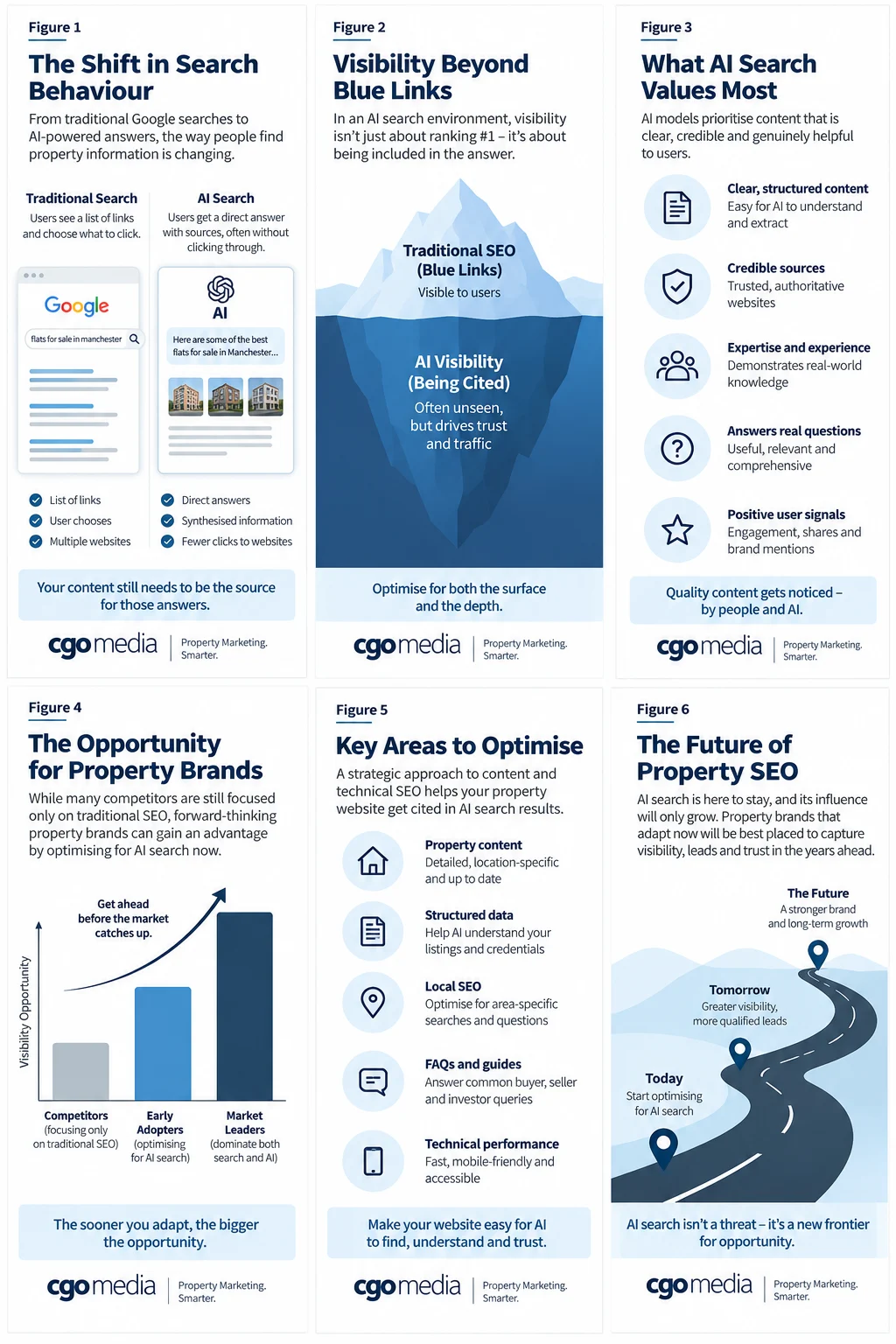
AI-assisted search introduces an additional discovery and recommendation layer. Users can increasingly ask systems to identify suitable locations, compare neighbourhoods, explain market conditions, recommend estate agents, evaluate developments or narrow large property markets according to several requirements simultaneously.
The strategic objective therefore expands beyond ranking for individual keywords. Property organisations increasingly need to become clear, current and sufficiently evidenced entities capable of participating throughout discovery, evaluation, comparison, recommendation and enquiry.
1. The Changing Nature of Property Search
Property search is evolving from a conventional listings-and-rankings environment toward a broader discovery and decision-support ecosystem.
2. Traditional Property Search Remains Important
Users continue to search for terms such as:
- Estate agents near me
- Property for sale in Marbella
- Apartments for sale in Manchester
- Luxury villas Costa del Sol
- Commercial property agents London
3. AI Search Expands the Discovery Environment
Users can now express more complex needs in a single request.
For example:
Which areas near Málaga are suitable for a family looking for a three-bedroom property under €650,000 near international schools with good airport access?
4. Complex Property Queries Combine Multiple Requirements
A single property-discovery question can contain:
- Location
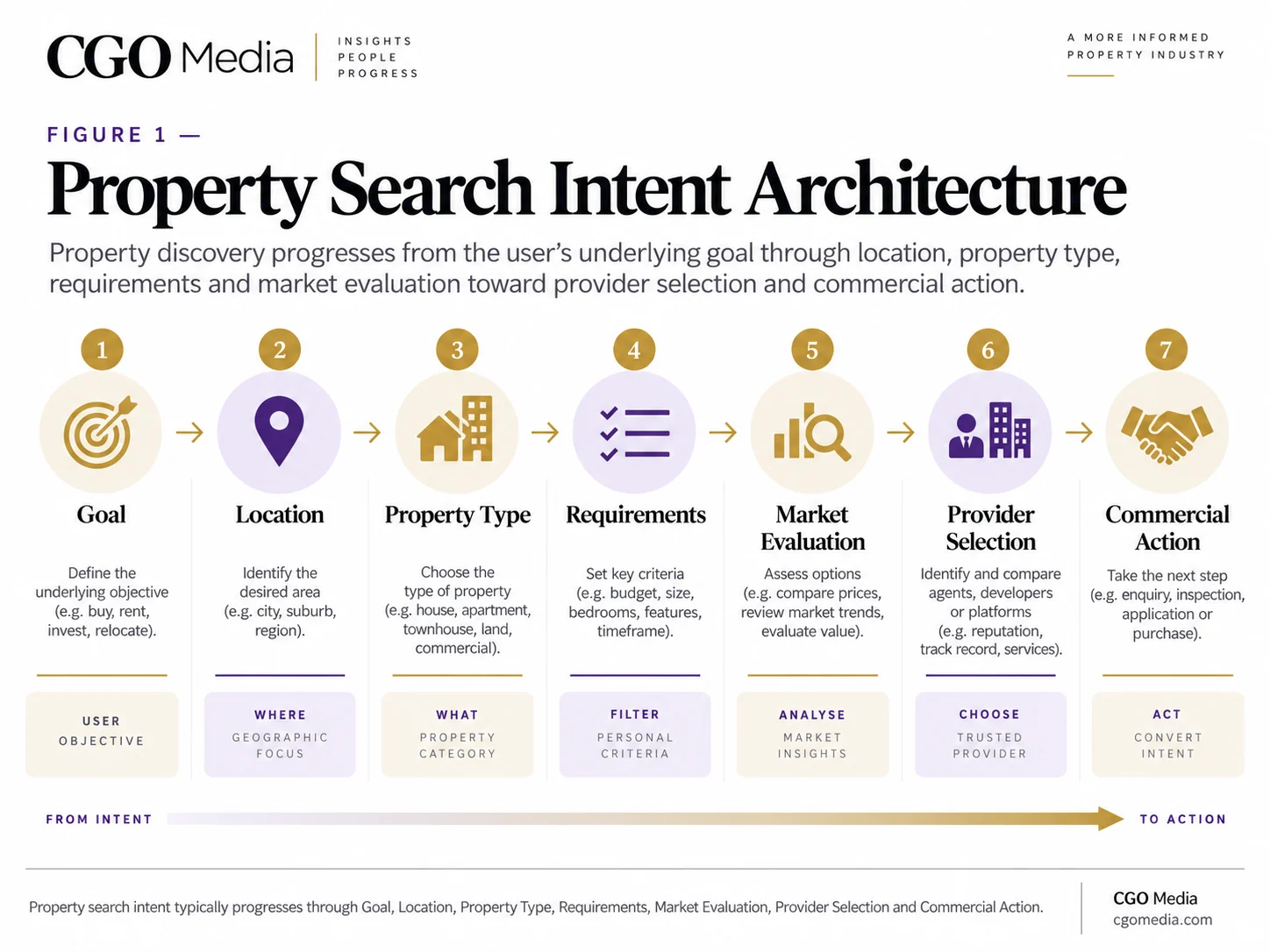
- Budget
- Property type
- Number of bedrooms
- Lifestyle requirement
- Transport requirement
- Provider requirement
5. Property Search Is Therefore Becoming a Multi-Criteria Matching Problem
The relevant question is no longer only:
Which page ranks for this keyword?
It increasingly becomes:
Which locations, properties, developments and providers appear sufficiently relevant and evidenced for this user’s complete requirement?
6. Property SEO Must Support Several Decision Stages
Property organisations increasingly need visibility across:
- Need recognition
- Location discovery
- Property discovery
- Market research
- Provider discovery
- Comparison
- Validation
- Enquiry
7. Rankings Are One Part of a Larger Discovery System
Strong rankings remain commercially valuable, but they do not capture the complete property-discovery environment.
8. Property Visibility Can Begin on Search Engines
Traditional organic search can introduce:
- Properties
- Locations
- Agents
- Developments
- Market information
9. Property Visibility Can Begin on Maps
Local search can be particularly important for:
- Estate agencies
- Branch offices
- Local specialists
- Commercial property providers
10. Property Visibility Can Begin on Portals
Property portals can play a major role in:
- Listing discovery
- Price comparison
- Location discovery
- Agent visibility
- Market understanding
11. Property Visibility Can Begin through AI Assistants
Generative systems can introduce users to locations, property types, providers and market concepts before conventional search begins.
12. This Changes the Meaning of Search Visibility
Visibility increasingly includes whether a property organisation can be:
- Found
- Understood
- Validated
- Compared
- Cited
- Recommended
13. Property Discovery Eligibility
Property Discovery Eligibility can be understood as the degree to which available evidence makes a property, development, location or provider suitable for inclusion within a relevant discovery set.
14. Discovery Eligibility Is a Strategic Concept
It is not presented as a known search-engine or AI-platform metric.
15. Property Discovery Eligibility Can Depend on
- Location relevance
- Property fit
- Information clarity
- Current availability
- Price
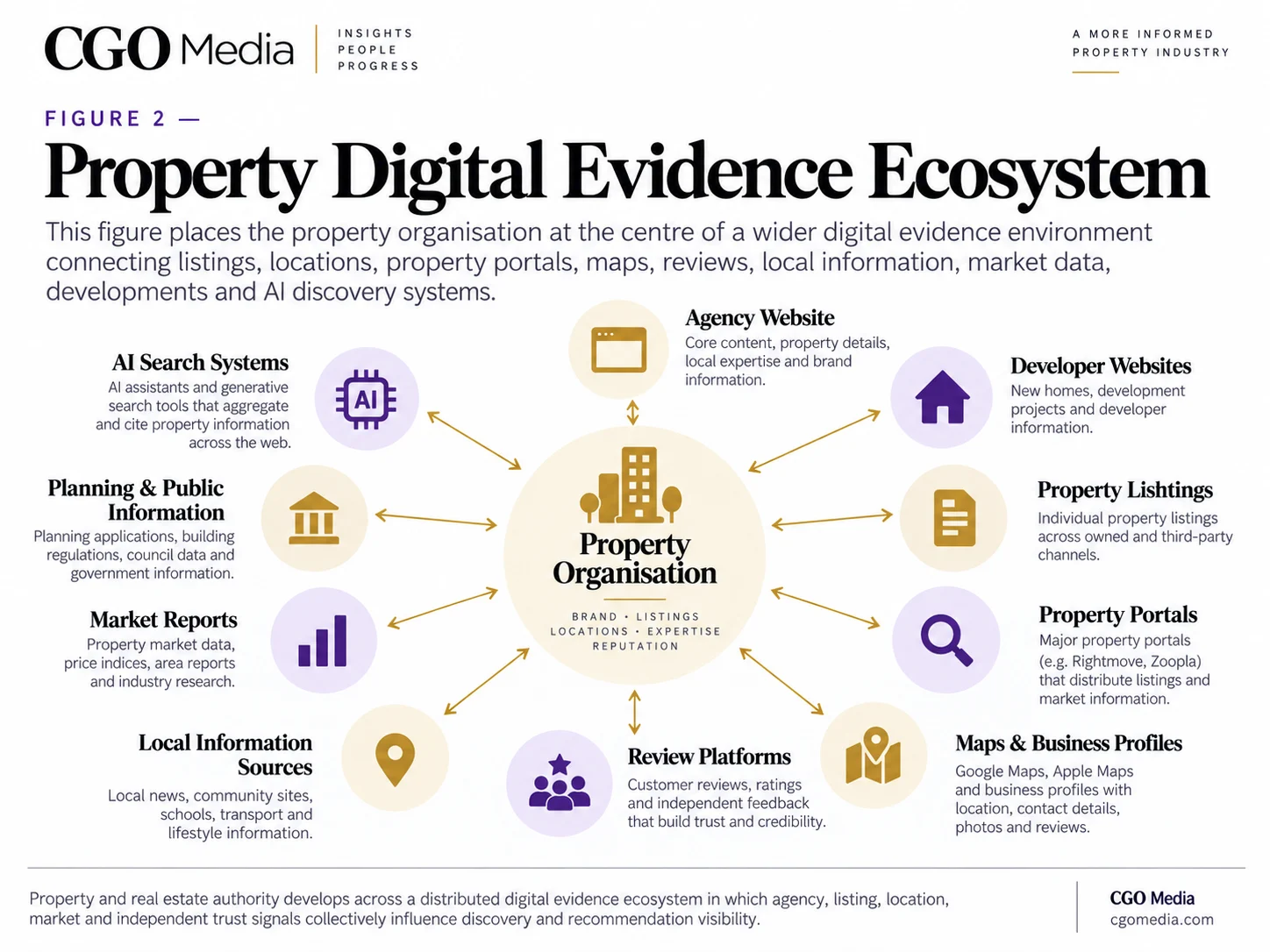
- Provider trust
- Market context
16. Discoverability and Eligibility Should Be Distinguished
A property can be technically discoverable without being suitable for a particular user’s requirement.
17. Eligibility Is Context-Specific
A property can be highly relevant for one user and unsuitable for another.
18. Provider Eligibility Is Also Context-Specific
An estate agency may be highly suitable for:
- Luxury property
- New developments
- International buyers
- Commercial property
- Rental property
without being equally relevant across every property market.
19. Property SEO Should therefore Support Qualified Discovery
The objective should not be maximum exposure alone.
A stronger objective is:
Relevant User → Relevant Property or Location → Relevant Provider → Sufficient Evidence → Appropriate Progression
20. Property Search Begins with User Intent
Understanding property intent is essential because the same user can move through several different search states before making contact.
21. The Property Search Intent Hierarchy
A practical intent hierarchy includes:
- Goal Intent
- Location Intent
- Property-Type Intent
- Requirement Intent
- Market Intent
- Provider Intent
- Commercial Intent
22. Goal Intent
Goal Intent describes the user’s broad objective.
23. Goal Intent Can Include
- Buy
- Sell
- Rent
- Invest
- Relocate
- Develop
24. Goal Intent Can Be Broad and Exploratory
A user may initially ask:
- Where should I buy a holiday home in Spain?
- Where should my family live near London?
- Where can I invest in rental property?
- Which areas are good for retirement?
25. Goal-Led Searches Can Influence the Entire Journey
Early answers can affect:
- Location choice
- Budget expectations
- Property type
- Provider discovery
- Market perception
26. Property Organisations Can Participate Before a Specific Listing Search
Useful early-stage content can address:
- Relocation
- Investment
- Family living
- Retirement
- Commuting
- Lifestyle
27. Location Intent
Once the broad goal is established, geographic intent often becomes one of the strongest organising layers.
28. Location Intent Can Operate at Several Levels
A useful hierarchy is:
Country → Region → Province → City → District → Neighbourhood → Development
29. Location Intent Can Begin Broadly
Examples can include:
- Property in Spain
- Homes in southern England
- Property on the Costa del Sol
- Property in Greater Manchester
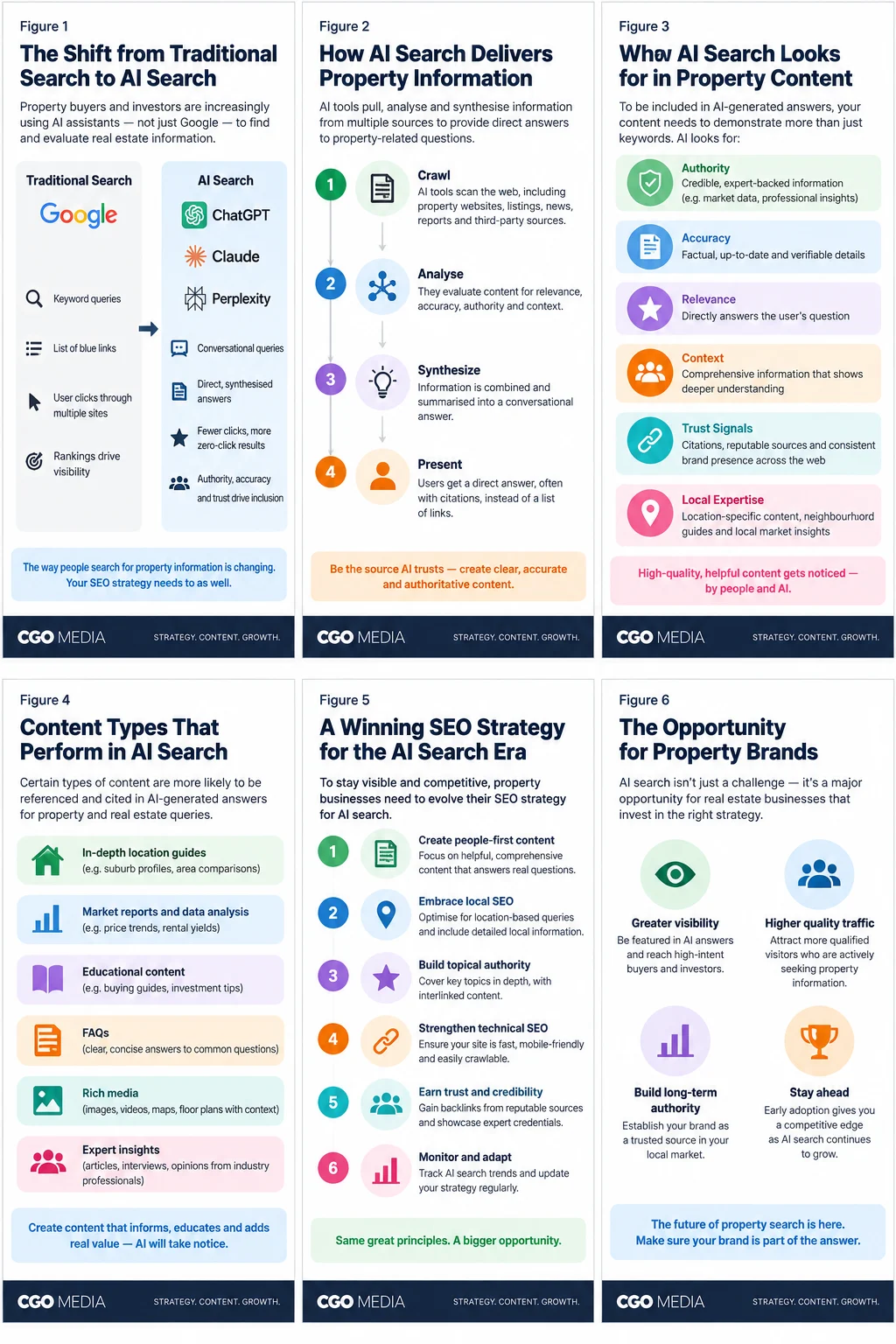
30. Location Intent Can Become Highly Specific
Examples can include:
- Villas in Nueva Andalucía
- Apartments in La Cala de Mijas
- Homes near a particular international school
- Properties in a named development
31. Geographic Refinement Narrows the Eligible Market
As geographic specificity increases, the number of relevant properties and providers can decline significantly.
32. Location Search Is Not Only Geographic
It can also encode:
- Lifestyle
- Transport
- Schools
- Employment
- Investment
- Community preferences
33. Location Authority therefore Requires More Than Place Names
Property organisations need evidence that helps users understand whether an area genuinely fits their requirements.
34. Property-Type Intent
Users may refine discovery according to the form of property they require.
35. Property-Type Intent Can Include
- Apartment
- Villa
- Townhouse
- Detached house
- New-build property
- Commercial property
- Land
36. Property Type Can Interact with Location
Some areas may be strongly associated with:
- Apartments
- Villas
- New developments
- Historic properties
- Commercial space
37. Property Type Can Interact with Budget
A user’s preferred property category may change as market reality becomes clearer.
38. Requirement Intent
Requirement Intent adds more precise criteria around the asset or location.
39. Requirement Intent Can Include
- Budget
- Bedrooms
- Bathrooms
- Property size
- Parking
- Outdoor space
- Accessibility
40. Lifestyle Requirements Can Also Form Part of Requirement Intent
Examples can include:
- Beach proximity
- Schools
- Golf
- Restaurants
- Walkability
- Privacy
41. Requirement Intent Can Be Expressed in One Complex Query
A user might ask:
Find suitable three-bedroom properties under €700,000 close to international schools and within 30 minutes of Málaga Airport.
42. Complex Requirements Increase the Need for Structured Information
The system needs sufficiently clear information to understand:
- Property attributes
- Location
- Budget
- Nearby amenities
- Availability
43. Hard Requirements
Hard requirements determine whether a property remains eligible for consideration.
44. Hard Requirements Can Include
- Maximum budget
- Minimum bedrooms
- Required location
- Accessibility requirement
- Completion date
- Property type
45. Soft Requirements
Soft requirements influence preference without automatically excluding a property.
46. Soft Requirements Can Include
- Views
- Orientation
- Architectural style
- Walking distance
- Prestige
- Community character
47. Property Requirements Can Evolve
Users frequently change priorities as they learn more about the available market.
48. Requirement Refinement Is Therefore Iterative
A useful relationship is:
Initial Requirement → Market Discovery → New Evidence → Requirement Refinement → More Focused Discovery
49. Market Intent
Users may seek information about the wider market before selecting an individual property or provider.
50. Market Intent Can Include
- Average prices
- Price movement
- Rental yields
- Inventory
- Buyer demand
- Development activity
51. Market Research Can Influence Location Selection
A user may move from one market to another because of:
- Affordability
- Supply
- Investment potential
- Rental demand
- Development pipeline
52. Market Intent Can Also Be Seller-Led
Sellers may search for:
- Current prices
- Valuation trends
- Buyer demand
- Time to sell
- Comparable listings
53. Market Intent Requires Evidence Quality
Property organisations should distinguish between:
- Current market data
- Historical data
- Observation
- Forecast
- Opinion
54. Provider Intent
At some point in the journey, users may begin actively evaluating organisations and professionals.
55. Provider Intent Can Include
- Estate agent
- Brokerage
- Developer
- Property manager
- Specialist agency
- Local office
56. Provider Searches Can Be Generic
Examples can include:
- Estate agents Marbella
- Property agents Manchester
- Commercial property brokers London
57. Provider Searches Can Be Context-Specific
Examples can include:
- English-speaking estate agent Costa del Sol
- Luxury villa specialist Marbella
- New-build property specialist Spain
- Commercial property agent Manchester
58. AI Search Can Make Provider Intent More Complex
A user might ask:
Which estate agents on the Costa del Sol specialise in luxury property, work with international buyers and have strong local reviews?
59. Provider Discovery therefore Requires Clear Entity Evidence
Useful evidence can include:
- Official organisation identity
- Office locations
- Markets served
- Property specialisms
- Agent profiles
- Reviews
- External authority
60. Commercial Intent
Commercial Intent reflects movement toward direct action.
61. Buyer Commercial Intent Can Include
- Book a viewing
- Request more information
- Arrange a call
- Make an offer
- Register requirements
62. Seller Commercial Intent Can Include
- Request valuation
- Compare agents
- Book appraisal
- List property
- Discuss marketing
63. Commercial Intent Often Follows Validation
Before contacting a provider, users may investigate:
- Reviews
- Agent profiles
- Office details
- Market expertise
- Company history
64. Intent Stages Can Overlap
A single search can contain several layers of intent.
65. AI-Assisted Search Makes Intent Compression More Common
A complex AI query can combine:
- Goal
- Location
- Property type
- Budget
- Lifestyle
- Provider trust
66. This Creates Higher Information Requirements
Property organisations need sufficient evidence across several dimensions rather than optimising one page for one keyword in isolation.
67. Search Intent Should Map to Information Architecture
Different intent layers should connect with appropriate information assets.
68. Goal Intent Can Connect to Strategic Guides
Examples can include:
- Relocation guides
- Investment guides
- Buying guides
- Selling guides
69. Location Intent Can Connect to Geographic Authority
Examples can include:
- Regional pages
- City pages
- Neighbourhood pages
- Development pages
70. Property-Type Intent Can Connect to Inventory Architecture
Examples can include:
- Apartment categories
- Villa categories
- New-build categories
- Commercial categories
71. Requirement Intent Can Connect to Filtering and Content
Useful structures can support:
- Budget
- Bedrooms
- Features
- Amenities
- Lifestyle
72. Market Intent Can Connect to Research
Useful assets can include:
- Market reports
- Price studies
- Rental analysis
- Inventory research
- Buyer-demand analysis
73. Provider Intent Can Connect to Entity Architecture
Useful assets can include:
- Company profile
- Office pages
- Agent profiles
- Specialist-service pages
- Reviews
74. Commercial Intent Can Connect to Clear Action Paths
Useful actions can include:
- Contact
- Call
- Message
- Request valuation
- Book viewing
75. The Property Search Requirement Stack
A practical sequence is:
Goal → Location → Property Type → Budget → Requirements → Market Context → Provider → Action
76. Each Layer Narrows the Potential Consideration Set
As more requirements are added, fewer properties, locations and providers remain relevant.
77. The Search System Must Therefore Handle Increasing Specificity
Broad category visibility is useful early in the journey, while richer structured evidence becomes increasingly important as intent becomes more specific.
78. The First Property & Real Estate Search Principle
Property SEO should be understood as a multi-stage discovery system rather than a rankings-only discipline because users can move through goal, location, property, market, provider and commercial intent before making direct contact.
79. The Second Property & Real Estate Search Principle
Property discovery should optimise for qualified eligibility rather than maximum visibility, ensuring that properties, locations and providers surface where sufficient relevance and supporting evidence exist.
80. The Third Property & Real Estate Search Principle
Property information architecture should reflect the hierarchy of user intent so strategic guides, geographic pages, property categories, market research, provider entities and commercial actions operate as a connected discovery system.
81. The Fourth Property & Real Estate Search Principle
AI-assisted property search increases the importance of structured and connected evidence because several location, property, lifestyle, financial and provider requirements can now be expressed and evaluated within a single discovery interaction.
82. The Property Search Intent Architecture
The complete progression can be summarised as:
Goal Intent → Location Intent → Property-Type Intent → Requirement Intent → Market Intent → Provider Intent → Commercial Intent
83. The Strategic Implication
Property organisations should design search strategy around the complete property decision journey rather than concentrating only on listing keywords and final-stage enquiries. The strongest architecture supports users from broad need recognition through geographic and property refinement, market investigation, provider validation and eventual commercial action, while supplying search and AI systems with enough structured, current and credible evidence to understand which properties, locations and providers genuinely fit each stage of the journey.
84. Property Search Authority Depends on a Distributed Evidence Ecosystem
Property organisations do not build visibility and trust through their own websites alone.
Users, search engines and AI systems can encounter evidence across multiple environments before reaching an enquiry or transaction.
85. The Property Digital Evidence Ecosystem
A useful high-level model is:
Owned Evidence + Platform Evidence + Professional Evidence + Market Evidence + Independent Evidence → Property Search Authority
86. Owned Evidence
Owned evidence is information controlled directly by the property organisation.
87. Owned Evidence Can Include
- Property listings
- Area pages
- Development pages
- Agent profiles
- Market reports
- Buying and selling guides
88. Owned Evidence Provides the Core Information Layer
It should explain clearly:
- What the organisation does
- Where it operates
- Which properties it represents
- Which markets it understands
- Which professionals are responsible
89. Owned Evidence Should Be Accurate
Incorrect first-party information can create inconsistency throughout the wider digital ecosystem.
90. Owned Evidence Should Be Current
Property organisations manage unusually volatile information, including:
- Price
- Availability
- Status
- Development progress
- Agent availability
91. Owned Evidence Should Be Structured
Important relationships should be explicit rather than implied.
92. Property Entity Relationships Can Include
Property → Development → Neighbourhood → City → Region
93. Provider Entity Relationships Can Include
Organisation → Office → Agent → Service Area → Expertise
94. Development Relationships Can Include
Developer → Development → Unit Type → Property → Location
95. Owned Property Listings Are Core Evidence Assets
A listing can contain:
- Price
- Status
- Property type
- Bedrooms
- Bathrooms
- Dimensions
- Features
- Location
96. Listing Completeness Affects Search Understanding
Missing or ambiguous information can make property matching harder.
97. Listing Freshness Affects User Confidence
Stale availability or outdated prices can reduce trust quickly.
98. Listing Consistency Matters Across Channels
The same property may appear on:
- Agency websites
- Property portals
- Developer websites
- Partner sites
- Social media
99. Conflicting Listing Data Creates Evidence Friction
Potential conflicts can include:
- Different prices
- Different status
- Different dimensions
- Different descriptions
- Different availability
100. Area Pages Are Owned Location Evidence
Strong area pages can help explain:
- Property stock
- Pricing
- Lifestyle
- Schools
- Transport
- Development activity
101. Location Evidence Should Go Beyond Generic Description
A mature area page should demonstrate market knowledge rather than repeat tourism-style information.
102. Development Pages Are Owned Project Evidence
They can connect:
- Developer
- Development
- Location
- Unit types
- Construction status
- Available properties
103. Agent Profiles Are Owned Professional Evidence
They should communicate more than:
- Name
- Role
- Photograph
- Contact details
104. Strong Agent Profiles Can Include
- Experience
- Local expertise
- Property specialisms
- Languages
- Professional qualifications
- Market commentary
105. Market Reports Are Owned Research Evidence
They can demonstrate understanding of:
- Pricing
- Inventory
- Demand
- Buyer behaviour
- Rental conditions
- Development trends
106. Buying and Selling Guides Are Owned Decision-Support Evidence
They can support users before direct contact.
107. Platform Evidence
Platform evidence appears on third-party systems that structure or distribute property information.
108. Platform Evidence Can Include
- Property portals
- Business profiles
- Map platforms
- Review platforms
- Social platforms
109. Property Portals Are Major Distribution Platforms
They can influence:
- Property discovery
- Price comparison
- Provider visibility
- Location understanding
- Buyer expectations
110. Portal Visibility Can Be Commercially Significant
High-performing portal presence can generate substantial demand even where owned search authority is weaker.
111. Portal Dependence Creates Strategic Risk
A business relying heavily on one platform may have limited control over:
- Ranking
- Presentation
- Lead cost
- Algorithm changes
- Customer relationship
112. Portal Data Quality Matters
Feed quality affects whether properties appear:
- Correctly priced
- Available
- Well categorised
- In the correct location
- With complete media
113. Business Profiles Are Platform Entity Evidence
They can reinforce:
- Office identity
- Location
- Telephone number
- Opening hours
- Reviews
114. Multi-Office Businesses Require Strong Profile Governance
Each branch should be represented accurately and distinctly where appropriate.
115. Map Platforms Support Geographic Validation
Users can evaluate:
- Office location
- Property location
- Distance
- Transport
- Surrounding amenities
116. Review Platforms Provide External Customer Evidence
They can influence perceptions of:
- Trust
- Responsiveness
- Professionalism
- Local knowledge
- Transaction quality
117. Professional Evidence
Professional evidence concerns the people and expertise behind the property organisation.
118. Professional Evidence Can Include
- Agent biographies
- Credentials
- Professional memberships
- Market commentary
- Research contributions
- Media commentary
119. Professional Evidence Matters Because Property Is Trust-Intensive
Buyers and sellers often rely heavily on:
- Advice
- Negotiation
- Local knowledge
- Transaction guidance
- Market interpretation
120. Professional Authority Should Be Attributable
Search systems and users should be able to determine who is responsible for advice or analysis.
121. Agent Expertise Should Be Specific
Useful specialisms can include:
- Luxury villas
- New developments
- Commercial property
- International buyers
- Investment property
- Specific geographic markets
122. Professional Authority Can Be Strengthened through Original Commentary
Agents can contribute to:
- Market reports
- Area guides
- Buyer commentary
- Seller commentary
- Media responses
123. Professional Authority Can Be Strengthened through External Recognition
Examples can include:
- Journalist quotations
- Trade-publication commentary
- Conference participation
- Industry awards
- Research citations
124. Market Evidence
Market evidence provides broader context around property value, supply and demand.
125. Market Evidence Can Include
- Price trends
- Inventory levels
- Rental demand
- Buyer origin
- Transaction activity
- Development pipeline
126. Market Evidence Helps Users Interpret Individual Properties
A listing is easier to evaluate when users understand the surrounding market.
127. Market Evidence Helps Sellers Evaluate Valuation
It can provide context around:
- Comparable properties
- Current competition
- Demand
- Likely pricing range
128. Market Evidence Helps Investors Evaluate Opportunity
Relevant factors can include:
- Rental yield
- Vacancy
- Demand
- Capital growth
- Liquidity
129. Market Evidence Should Have Clear Methodology
Original research should explain:
- Dataset
- Time period
- Geographic scope
- Definitions
- Limitations
130. Observation Should Be Distinguished from Statistics
An agent’s professional view can be valuable, but it should not be presented as empirical evidence where no underlying dataset exists.
131. Independent Evidence
Independent evidence is produced by sources outside the property organisation’s direct control.
132. Independent Evidence Can Include
- News media
- Trade publications
- Research organisations
- Industry bodies
- Public authorities
- Independent directories
133. Independent Evidence Can Validate Organisational Claims
External sources may reinforce claims around:
- Expertise
- Market presence
- Professional recognition
- Research authority
134. Independent Evidence Can Validate Market Claims
External data can support or challenge:
- Price trends
- Rental demand
- Market growth
- Development activity
135. Independent Evidence Can Reduce Self-Promotion Bias
Users may give greater weight to claims supported by multiple independent sources.
136. Media Coverage Can Become Search Authority Evidence
Journalist references can associate an organisation or agent with:
- Specific locations
- Property markets
- Specialist expertise
- Research findings
137. Research Citations Can Become Durable Authority Evidence
Original research can be referenced by:
- Journalists
- Researchers
- Industry publications
- AI systems
138. Evidence Convergence Is More Powerful Than Isolated Evidence
The same conclusion appearing across multiple relevant sources can increase confidence.
139. A Useful Evidence-Convergence Model Is
Owned Evidence + Platform Evidence + Professional Evidence + Market Evidence + Independent Evidence → Authority Confidence
140. Evidence Conflict Creates Uncertainty
Conflicts can occur where:
- Property prices differ
- Property status differs
- Office addresses differ
- Agent information differs
- Market claims conflict
141. Evidence Conflict Should Be Governed
Property organisations should identify and correct inconsistencies where possible.
142. Information Freshness Is Central to the Evidence Ecosystem
Different evidence types change at different rates.
143. Highly Volatile Property Evidence
Examples include:
- Price
- Availability
- Status
- New development inventory
- Mortgage conditions
144. Moderately Volatile Evidence
Examples can include:
- Market reports
- Agent profiles
- Review evidence
- Development progress
- Rental demand
145. More Stable Evidence
Examples can include:
- Company history
- Neighbourhood geography
- Established infrastructure
- Long-term service specialisms
146. Evidence Review Frequency Should Reflect Volatility
A useful relationship is:
Information Volatility + Decision Impact + Risk → Review Frequency
147. Source Authority Should Be Contextual
No source is automatically authoritative for every property question.
148. A Property Portal May Be Strong for Inventory Discovery
It may be less suitable as the sole source for:
- Professional expertise
- Legal advice
- Detailed market research
149. An Agency Website May Be Strong for Listing Detail
It may still require independent validation for wider market claims.
150. A Local Authority May Be Strong for Planning Information
It may not provide detailed buyer guidance or agent-selection evidence.
151. Source Fitness Matters More Than Source Volume
The strongest evidence environment uses the right source for the right question.
152. Property SEO Should therefore Build Source Diversity
A mature authority system does not depend entirely on:
- Owned content
- Portals
- Reviews
- Media
153. Source Diversity Reduces Single-Channel Dependence
It can strengthen resilience if one platform changes visibility or distribution.
154. AI Search Makes Source Diversity More Important
Generative systems can synthesise evidence from several source types when constructing answers.
155. AI Systems Can Encounter Property Evidence Indirectly
An organisation may be represented through:
- Its own website
- Portal profiles
- Media references
- Review platforms
- Directories
- Research citations
156. This Creates an External Representation Layer
The organisation does not fully control every source that describes it.
157. External Representation Should Be Monitored
Important dimensions can include:
- Company name
- Office locations
- Agents
- Services
- Markets served
- Specialisms
158. Entity Consistency Strengthens the Evidence Ecosystem
Search and AI systems encounter less ambiguity where core organisational facts are consistent.
159. Property Entity Consistency Is Also Important
The same property should not appear materially differently across owned and external channels without explanation.
160. Development Entity Consistency Matters
Development name, developer identity, location, completion status and unit information should remain clear.
161. Professional Entity Consistency Matters
Agent role, office, specialism and contact information should remain current across relevant platforms.
162. Internal Linking Helps Connect Owned Evidence
A strong architecture can connect:
- Listings
- Locations
- Developments
- Agents
- Research
- Buying guidance
163. Entity Relationships Help Explain Meaning
A page becomes more useful when the wider information network makes clear:
- Who
- What
- Where
- Why relevant
- How connected
164. Structured Data Can Support Explicit Entity Description
Where appropriate and correctly implemented, structured data can reinforce machine-readable information about organisations, local businesses and other supported entities.
165. Structured Data Does Not Replace On-Page Evidence
Markup should reflect visible, accurate information rather than attempt to create authority independently.
166. Technical Accessibility Remains a Requirement
Evidence cannot contribute effectively if important pages are difficult to crawl or index.
167. Property Feed Architecture Is therefore Part of the Evidence System
Feeds can determine whether inventory reaches:
- Portals
- Partner systems
- Advertising platforms
- Other distribution environments
168. Feed Errors Can Create Widespread Evidence Inconsistency
One data problem can propagate across several external platforms.
169. Property Data Governance Should therefore Be Centralised Where Possible
A reliable source of truth can reduce:
- Price conflict
- Status conflict
- Duplicate records
- Location conflict
- Availability errors
170. The Property Website Can Become an Authority Hub
The strongest owned environment can connect:
Property Inventory + Location Knowledge + Professional Expertise + Market Research + Transaction Guidance
171. Portals Remain Discovery Platforms
Owned authority and portal visibility should not be treated as mutually exclusive.
172. Search Engines Remain Discovery and Navigation Platforms
They can connect users with:
- Listings
- Locations
- Providers
- Market research
- Transactional guidance
173. AI Assistants Add a Synthesis Layer
They can combine information about:
- Location
- Budget
- Property requirements
- Provider suitability
- Market evidence
174. This Makes Evidence Architecture Increasingly Important
The organisation should make useful information:
- Clear
- Consistent
- Current
- Attributable
- Connected
175. Property SEO Should therefore Move Beyond Isolated Page Optimisation
The strategic unit increasingly becomes the wider evidence ecosystem.
176. A Strong Property Evidence Ecosystem Supports Users
It helps them:
- Discover
- Understand
- Compare
- Validate
- Select
177. A Strong Property Evidence Ecosystem Supports Search Systems
It can reduce ambiguity around:
- Entities
- Locations
- Properties
- Expertise
- Relationships
178. A Strong Property Evidence Ecosystem Supports AI Discovery
It can provide richer and more consistent source material for generative synthesis.
179. Evidence Gaps Should Be Diagnosed
A useful model is:
User Question → Required Evidence → Available Evidence → Evidence Gap
180. Listing Evidence Gaps Can Include
- Missing floorplans
- Unclear dimensions
- Stale availability
- Weak descriptions
- Missing cost information
181. Location Evidence Gaps Can Include
- No market data
- Weak neighbourhood information
- No transport context
- No school context
- No current inventory relationship
182. Professional Evidence Gaps Can Include
- Thin agent profiles
- Missing credentials
- No location specialism
- Few independent references
- Weak review evidence
183. Market Evidence Gaps Can Include
- Outdated reports
- Unsupported pricing claims
- No methodology
- No inventory evidence
- No comparable context
184. External Authority Gaps Can Include
- Little media recognition
- No research citation
- Weak trade visibility
- Limited independent references
185. Evidence Gap Analysis Can Guide Content Investment
The organisation can prioritise assets that answer unresolved user questions.
186. Evidence Gap Analysis Can Guide Data Investment
Some weaknesses require better:
- CRM fields
- Feeds
- Property status processes
- Entity relationships
- Market datasets
187. Evidence Gap Analysis Can Guide Digital PR
Original research can create external authority where important evidence is currently weak.
188. Evidence Gap Analysis Can Guide AI Search Monitoring
The organisation can test whether missing or inconsistent information is reflected in generative answers.
189. The Fifth Property & Real Estate Search Principle
Property search authority should be built across a distributed evidence ecosystem rather than through owned-page optimisation alone, because users and discovery systems can encounter property, provider and market information across portals, maps, review platforms, media and AI-assisted environments.
190. The Sixth Property & Real Estate Search Principle
Evidence quality should be assessed through accuracy, freshness, attribution, consistency and contextual relevance, recognising that conflicting information across property, location, provider and market sources can reduce both user confidence and machine interpretability.
191. The Seventh Property & Real Estate Search Principle
Property organisations should build source diversity and independent validation rather than relying excessively on one website, portal or platform, creating a more resilient authority environment capable of supporting search, comparison and generative discovery.
192. The Eighth Property & Real Estate Search Principle
Property SEO should increasingly be managed as evidence architecture, connecting listings, locations, developments, professional entities, research and external authority so users and systems can understand not only individual pages but the wider relationships between them.
193. The Property Digital Evidence Ecosystem
The complete relationship can be summarised as:
Owned Evidence + Platform Evidence + Professional Evidence + Market Evidence + Independent Evidence → Search Authority → Validation Confidence → Recommendation Readiness
194. The Strategic Implication
Property organisations should develop an evidence ecosystem in which current property data, structured location knowledge, professional expertise, market research, platform consistency and independent recognition reinforce one another. The strongest search strategy is no longer only the optimisation of individual pages, but the creation of a connected information environment that enables users, search engines and AI systems to discover, interpret and validate properties, providers and markets with greater confidence.
195. Property Search Visibility Must Convert into Selection Confidence
Discovery alone does not create a commercial outcome.
Once users identify potentially relevant locations, properties or providers, they need enough evidence to decide whether those options deserve continued attention.
196. Property Selection Is Therefore an Evidence Problem
A useful relationship is:
Property Evidence + Location Evidence + Provider Evidence + Market Evidence + Financial Evidence + Independent Validation → Selection Confidence
197. Property Evidence Is the First Layer
Users need reliable information about the individual property under consideration.
198. Core Property Evidence Can Include
- Price
- Availability
- Status
- Property type
- Bedrooms
- Bathrooms
- Built area
- Plot size
199. Property Evidence Should Be Specific
Generic promotional descriptions provide less decision value than clear factual information.
200. Property Features Should Be Explicit
Relevant information can include:
- Parking
- Pool
- Garden
- Terrace
- Lift
- Air conditioning
- Views
201. Property Evidence Should Be Current
Outdated listings create friction and can damage trust.
202. Property Status Should Be Managed Carefully
Useful status labels can include:
- Available
- Reserved
- Under offer
- Sold
- Rented
- Withdrawn
203. Availability Is a High-Impact Attribute
A user who discovers an attractive property that is no longer available may lose confidence in the provider’s wider inventory.
204. Property Price Should Be Consistent
Different prices across portals, websites or brochures can create uncertainty.
205. Property Size Should Be Clearly Defined
Users may need to distinguish between:
- Built area
- Usable area
- Terrace area
- Plot area
- Storage
206. Photography Is Part of Property Evidence
Images can help users evaluate:
- Condition
- Design
- Views
- Natural light
- Outdoor space
- Finishes
207. Photography Should Represent the Property Accurately
Misleading angles, excessive editing or incomplete coverage can create distrust later in the journey.
208. Floorplans Improve Property Understanding
Floorplans can help users assess:
- Room relationships
- Circulation
- Practical layout
- Space utilisation
- Potential alterations
209. Video Can Reduce Information Uncertainty
Video can reveal property characteristics that static photographs may not communicate clearly.
210. Virtual Viewings Can Support Remote Discovery
They can be particularly useful for:
- International buyers
- Relocating families
- Investors
- Time-constrained purchasers
211. Property Limitations Should Also Be Evidenced
Useful information can include:
- Renovation requirements
- Access limitations
- Community restrictions
- Noise exposure
- Nearby construction
212. Transparency Can Strengthen Trust
Balanced information can be more persuasive than purely promotional language because it reduces uncertainty.
213. Location Evidence Is the Second Layer
Property suitability is heavily influenced by the surrounding area.
214. Location Evidence Can Include
- Neighbourhood character
- Schools
- Transport
- Healthcare
- Retail
- Leisure
- Community
215. Location Evidence Should Be Practical
Users need information that helps them understand daily life, not only general promotional description.
216. Distance Evidence Can Help
Relevant distances can include:
- Beach
- Airport
- Schools
- Town centre
- Rail station
- Golf
217. Travel Time Can Be More Useful Than Distance Alone
Road conditions, congestion and public transport can materially change practical accessibility.
218. School Evidence Can Be Important for Family Buyers
Useful information can include:
- School type
- Curriculum
- Distance
- Transport
- Admissions context
219. Lifestyle Evidence Can Influence Property Fit
Users may consider:
- Restaurants
- Nightlife
- Walkability
- Sports facilities
- Community character
- Privacy
220. Location Evidence Should Be Matched to User Need
A characteristic that is attractive to one user may be undesirable to another.
221. Market Evidence Is the Third Layer
Users often need to understand whether a property’s price and value make sense within the surrounding market.
222. Market Evidence Can Include
- Price trends
- Current inventory
- Sales velocity
- Buyer demand
- Rental demand
- Development activity
223. Market Evidence Can Support Price Validation
Users may compare the property with:
- Similar current listings
- Recent sales
- Nearby developments
- Alternative neighbourhoods
224. Price Per Square Metre Can Be Useful but Limited
It does not automatically account for:
- Condition
- Views
- Orientation
- Floor level
- Development quality
- Exact micro-location
225. Market Evidence Should Therefore Be Contextual
Strong property comparison requires several dimensions rather than one headline metric.
226. Market Evidence Can Support Sellers
Sellers may use evidence to understand:
- Likely valuation range
- Competing inventory
- Buyer demand
- Pricing strategy
- Expected time to sell
227. Market Evidence Can Support Investors
Investors may evaluate:
- Rental yield
- Occupancy
- Tenant demand
- Capital growth
- Liquidity
228. Market Research Can Strengthen Search Authority
Original analysis can demonstrate deeper expertise than simple listing aggregation.
229. Provider Evidence Is the Fourth Layer
Users need confidence in the organisation or professional facilitating the transaction.
230. Provider Evidence Can Include
- Company identity
- Office presence
- Agent profiles
- Reviews
- Professional credentials
- Market expertise
231. Agent Evidence Can Influence Selection
Users may examine:
- Experience
- Local expertise
- Property specialism
- Languages
- Professional background
- Market commentary
232. Seller Provider Evidence Can Differ from Buyer Evidence
Sellers may prioritise:
- Valuation expertise
- Marketing reach
- Local transaction history
- Negotiation capability
- Professional reputation
233. Buyer Provider Evidence Can Focus More on Support
Buyers may prioritise:
- Inventory access
- Responsiveness
- Local knowledge
- Language support
- Transaction guidance
234. Developer Evidence Requires Different Validation
New-build buyers may investigate:
- Previous projects
- Delivery history
- Construction quality
- Customer experience
- Financial credibility
235. Reviews Are One Provider Evidence Layer
Reviews can reveal recurring themes around:
- Communication
- Professionalism
- Responsiveness
- Market knowledge
- Transaction management
236. Review Context Matters
Evidence from:
- Buyer
- Seller
- Tenant
- Landlord
- Investor
can reflect different aspects of provider performance.
237. Review Recency Matters
Very old reviews may not accurately represent current:
- Staff
- Service quality
- Office operations
- Market capability
238. Independent Provider Evidence Can Strengthen Confidence
Useful sources can include:
- Media coverage
- Trade publications
- Professional bodies
- Industry recognition
- Research citations
239. Financial Evidence Is the Fifth Layer
Property suitability depends partly on whether the transaction is financially viable.
240. Purchase-Cost Evidence Can Include
- Taxes
- Legal fees
- Registration
- Notary costs where applicable
- Mortgage costs
- Agency costs where applicable
241. Running-Cost Evidence Can Include
- Community charges
- Property taxes
- Insurance
- Utilities
- Maintenance
242. International Buyers May Need Additional Financial Evidence
Relevant considerations can include:
- Currency
- International transfers
- Non-resident taxation
- Financing availability
- Cross-border costs
243. Mortgage Information Can Influence Eligibility
Users may need to understand:
- Deposit
- Loan-to-value
- Affordability
- Interest rates
- Documentation
244. Investment Evidence Requires Greater Precision
Potential investment returns should distinguish between:
- Gross yield
- Net yield
- Operating costs
- Vacancy
- Taxation
245. Investment Claims Should Avoid Unsupported Certainty
Historic performance or current demand does not guarantee future returns.
246. Independent Validation Is the Sixth Layer
Users often seek evidence beyond the organisation marketing the property.
247. Independent Validation Can Include
- Property portals
- Maps
- Review platforms
- Media
- Independent market data
- Public information
248. Different Sources Validate Different Claims
A map can validate location while a review platform can provide evidence about provider experience.
249. Independent Data Can Validate Market Claims
Third-party evidence can help users evaluate whether pricing and market statements align with broader information.
250. Independent Media Can Validate Expertise
External commentary can reinforce professional or organisational authority.
251. Independent Validation Reduces Self-Promotion Bias
Users may place greater confidence in claims supported by more than one relevant source.
252. Evidence Convergence Increases Confidence
Confidence can rise where independent evidence materially agrees.
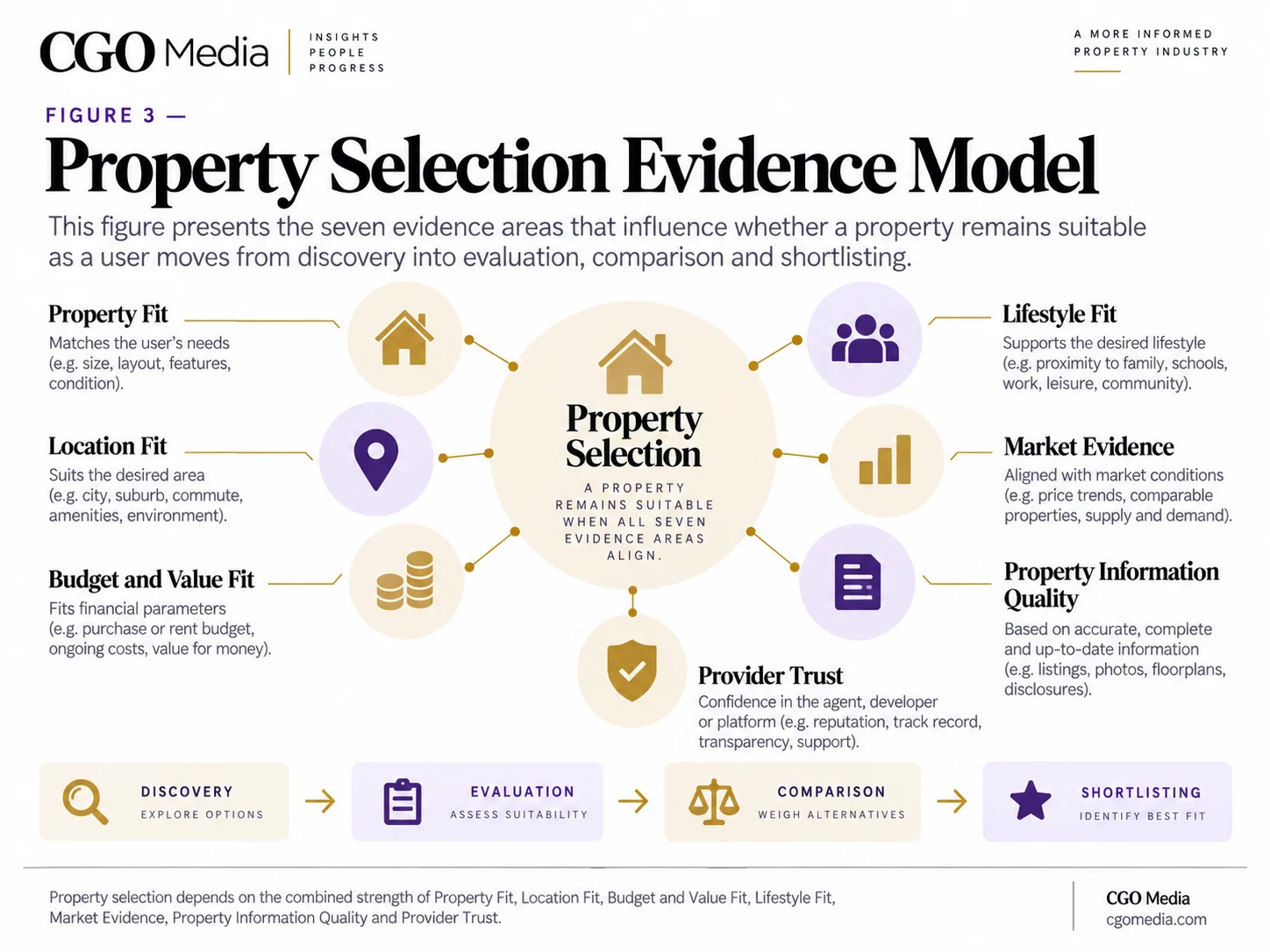
253. The Property Selection Evidence Model
A useful relationship is:
Property Evidence + Location Evidence + Market Evidence + Provider Evidence + Financial Evidence + Independent Validation → Selection Confidence
254. Evidence Conflict Reduces Confidence
Important conflicts can include:
- Different prices
- Different availability
- Different dimensions
- Different locations
- Contradictory provider claims
255. Evidence Conflict Should Be Investigated
Potential causes can include:
- Feed delay
- Outdated listing data
- Duplicate records
- Provider error
- Platform lag
256. Evidence Requirements Increase with Decision Risk
A useful model is:
Financial Exposure + Transaction Complexity + Market Unfamiliarity + Information Uncertainty → Required Evidence Threshold
257. High-Value Transactions Require Higher Evidence Thresholds
Users may seek stronger:
- Legal verification
- Provider validation
- Financial analysis
- Physical inspection
- Market evidence
258. International Transactions Can Require Higher Evidence Thresholds
Distance, language and unfamiliar processes can increase perceived risk.
259. New-Build Transactions Require Different Evidence
Relevant evidence can include:
- Developer history
- Construction stage
- Delivery timetable
- Specifications
- Payment schedule
260. Off-Plan Property Requires Future-Oriented Evidence
The user is evaluating an asset that may not yet exist in completed physical form.
261. Resale Property Requires Current Physical Evidence
Users may focus more strongly on:
- Condition
- Renovation needs
- Building quality
- Community condition
- Immediate availability
262. Commercial Property Requires Different Selection Evidence
Relevant factors can include:
- Lease income
- Tenant covenant
- Yield
- Use restrictions
- Location economics
- Operating costs
263. Luxury Property Can Require Greater Discretion
Not all relevant inventory, provider relationships or evidence may be publicly visible.
264. Evidence Quality Can Influence Shortlisting
Two similar properties can produce different outcomes when one is supported by clearer and more consistent evidence.
265. Better Evidence Reduces Decision Friction
Users can move forward with fewer unresolved questions.
266. Poor Evidence Can Create Low-Quality Enquiries
Users may contact an agency before understanding whether the property genuinely fits their requirements.
267. Better Evidence Can Improve Enquiry Quality
Users arrive with a clearer understanding of:
- Property fit
- Location
- Price
- Transaction conditions
- Provider role
268. Property SEO Should therefore Support Decision Quality
The objective is not simply to create clicks but to help users make better-informed selection decisions.
269. Selection Evidence Should Be Distributed Across the Site
A single property page does not need to carry the complete decision burden.
270. A Useful Owned-Evidence Architecture Is
Property Listing → Location Guide → Market Evidence → Agent Profile → Buying Guidance → Contact
271. Development Evidence Requires Its Own Architecture
A useful relationship is:
Developer → Development → Location → Unit Types → Properties → Sales Provider
272. Provider Evidence Requires Its Own Architecture
A useful relationship is:
Organisation → Office → Agent → Market Expertise → Listings → Reviews → Research
273. Internal Linking Should Reflect These Relationships
Users and search systems should be able to move naturally between related evidence.
274. Evidence Architecture Can Improve AI Interpretability
Clear relationships can help systems understand:
- Which agent covers which market
- Which property belongs to which development
- Which location evidence supports which listings
- Which research supports which market claims
275. AI Search Can Act as an Evidence Synthesiser
Generative systems may combine several sources into one response.
276. This Creates Opportunities and Risks
Strong evidence can support accurate synthesis, while inconsistent evidence can increase the risk of incorrect representation.
277. AI Representation Should Be Monitored
Important dimensions can include:
- Agency identity
- Office locations
- Agent expertise
- Markets served
- Property specialisms
278. Property-Level AI Monitoring Can Be More Difficult
Inventory changes rapidly, making static representation particularly vulnerable to becoming outdated.
279. Organisation-Level Evidence Is More Stable
Company identity, expertise and location relationships may persist longer than individual listings.
280. Search Strategy Should therefore Balance Stable and Volatile Evidence
Stable authority assets can support the organisation while volatile property information remains tightly governed.
281. Evidence Freshness Should Be Risk-Based
A useful relationship is:
Information Volatility + Decision Impact + Transaction Risk → Required Review Frequency
282. Highly Volatile Evidence Requires Frequent Review
Examples can include:
- Price
- Availability
- Status
- Development inventory
- Mortgage conditions
283. Moderately Volatile Evidence Requires Periodic Review
Examples can include:
- Agent profiles
- Market reports
- Review evidence
- Development progress
- Rental demand
284. More Stable Evidence Still Requires Governance
Examples can include:
- Company history
- Geographic relationships
- Long-term service specialisms
- Established infrastructure
285. Search Content Should Distinguish Fact from Interpretation
This is particularly important in market commentary.
286. Property Facts Should Be Presented as Facts
Examples include:
- Price
- Size
- Status
- Location
- Features
287. Market Observations Should Be Attributed
Professional judgement can be valuable but should be identifiable as commentary where appropriate.
288. Forecasts Should Be Distinguished from Historic Data
Predictions about:
- Prices
- Rental demand
- Capital growth
- Market direction
should not be presented as guaranteed outcomes.
289. Property Organisations Can Build Selection Confidence Before Contact
Strong evidence enables users to resolve many questions independently.
290. This Can Improve Sales Efficiency
Agents may spend less time answering basic questions and more time discussing genuine fit.
291. Better Selection Evidence Can Reduce Poor-Fit Viewings
Users can eliminate unsuitable properties earlier.
292. Better Selection Evidence Can Strengthen Seller Proposition
Sellers may perceive a provider as more capable where its listings, market research and professional evidence are consistently strong.
293. Better Selection Evidence Can Strengthen Developer Proposition
New-build buyers can gain clearer understanding of:
- Developer
- Project
- Location
- Unit options
- Transaction timeline
294. Property SEO Should therefore Be Connected with Conversion Quality
Visibility should ultimately support better:
- Matching
- Validation
- Enquiry quality
- Viewing quality
- Selection confidence
295. Selection Confidence Is More Useful Than Traffic Alone
Traffic indicates exposure, while selection confidence reflects whether users have enough evidence to progress.
296. The Ninth Property & Real Estate Search Principle
Property SEO should support selection confidence as well as discovery by connecting accurate property facts, location evidence, market context, provider authority, financial information and independent validation throughout the user journey.
297. The Tenth Property & Real Estate Search Principle
Evidence requirements should increase with transaction value, complexity, market unfamiliarity and information uncertainty, making evidence quality particularly important for international, high-value, off-plan and investment property journeys.
298. The Eleventh Property & Real Estate Search Principle
Selection evidence should be distributed across a connected property information architecture rather than concentrated within individual listing pages, allowing locations, agents, research, developments and transactional guidance to reinforce one another.
299. The Twelfth Property & Real Estate Search Principle
Property organisations should distinguish factual data, professional interpretation and forward-looking claims clearly so users and discovery systems can assess the reliability, source and limitations of different forms of property and market evidence.
300. The Property Selection Evidence Model
The complete relationship can be summarised as:
Property Evidence + Location Evidence + Market Evidence + Provider Evidence + Financial Evidence + Independent Validation → Selection Confidence
301. The Strategic Implication
Property organisations should design SEO, content and data systems to reduce decision uncertainty as users move from discovery toward serious consideration. Stronger performance comes from connecting accurate property facts with meaningful location context, current market evidence, credible professionals, transparent financial information and independent validation so search visibility becomes the beginning of a better-informed selection journey rather than an isolated traffic event.
302. Property Search Is Increasingly Influenced by Recommendation Systems
Users do not always search for a specific property or provider. They may ask search engines, local platforms or AI assistants to help narrow a market, identify suitable areas, compare options or recommend professionals.
303. Recommendation Changes the Search Objective
The question moves from:
Which page should rank?
toward:
Which property, location or provider is appropriate enough to be included in a recommendation set?
304. Recommendation Requires More Than Visibility
A property or provider can be highly visible without being suitable for a specific recommendation context.
305. Recommendation Should Therefore Be Qualified
A strong recommendation outcome should reflect:
- Relevance
- Suitability
- Evidence strength
- Provider trust
- Context fit
306. Property Recommendation and Provider Recommendation Are Different
A system may recommend:
- A location
- A property type
- A development
- An estate agency
- An individual agent
- A property itself
307. Location Recommendation
A user may ask:
- Best areas for families
- Best locations for rental investment
- Best commuter towns
- Best areas for retirement
- Best neighbourhoods near international schools
308. Property-Type Recommendation
A system may help users understand whether an:
- Apartment
- Villa
- Townhouse
- New-build property
- Resale property
is more suitable for a particular need.
309. Development Recommendation
Users may compare developments according to:
- Location
- Price
- Delivery date
- Facilities
- Developer reputation
- Property type
310. Provider Recommendation
Users may ask for:
- Estate agents in a location
- Luxury property specialists
- International buyer specialists
- New-build specialists
- Commercial property agents
311. Individual Professional Recommendation
In some contexts, the relevant recommendation may concern an individual professional rather than the wider organisation.
312. Property Recommendation
A direct property recommendation requires strong alignment between the property and the user’s requirements.
313. Recommendation Readiness Can Be Treated as an Evidence State
A useful conceptual relationship is:
Relevance + Entity Clarity + Property Evidence + Provider Trust + Independent Validation + Context Fit → Recommendation Readiness
314. Recommendation Readiness Is Not Presented as a Platform Metric
It is a strategic framework for evaluating whether enough evidence exists to support appropriate recommendation.
315. Relevance Is the First Recommendation Dimension
A property or provider should match the actual user need.
316. Property Relevance Can Include
- Location fit
- Budget fit
- Property-type fit
- Space fit
- Lifestyle fit
- Investment fit
317. Provider Relevance Can Include
- Market served
- Property specialism
- Transaction type
- Language capability
- User profile
- Professional expertise
318. Entity Clarity Is the Second Recommendation Dimension
A system needs enough clarity to distinguish:
- Organisation
- Office
- Agent
- Developer
- Development
- Property
319. Entity Ambiguity Can Weaken Recommendation Quality
For example, an agent may appear associated with the wrong:
- Office
- Location
- Specialism
- Organisation
320. Property Evidence Is the Third Recommendation Dimension
A property should have enough accurate information to be evaluated meaningfully.
321. Provider Trust Is the Fourth Recommendation Dimension
Provider recommendation should be supported by observable evidence rather than brand prominence alone.
322. Provider Trust Can Include
- Professional expertise
- Review evidence
- Local knowledge
- External recognition
- Market research
- Transaction experience
323. Independent Validation Is the Fifth Recommendation Dimension
External evidence can reinforce claims made within owned channels.
324. Context Fit Is the Sixth Recommendation Dimension
Recommendation should be appropriate to the specific scenario.
325. Context Fit Can Depend on
- User type
- Location
- Budget
- Property type
- Transaction type
- Timing
326. Recommendation Is Therefore Conditional
A provider can be appropriate for one scenario and inappropriate for another.
327. The Property Authority and Recommendation Matrix Uses Two Principal Axes
- Relevance / Suitability
- Authority / Evidence Strength
328. High Relevance / High Authority Is the Preferred State
The property or provider fits the requirement and is supported by strong evidence.
329. High Relevance / High Authority Can Support Qualified Recommendation
This is the strongest recommendation condition within the model.
330. High Relevance / Low Authority Creates Evidence Risk
The property or provider may fit, but insufficient trust or evidence exists.
331. Evidence Risk Can Result from
- Thin professional profiles
- Weak reviews
- Conflicting information
- Limited external validation
- Weak market evidence
332. High Relevance / Low Authority Can Cause Relevant Exclusion
A genuinely suitable provider may fail to enter recommendation because supporting evidence is insufficient or unclear.
333. Low Relevance / High Authority Creates Prestige without Fit
A well-known organisation may be credible but inappropriate for the user’s actual need.
334. Low Relevance / High Authority Can Cause Irrelevant Inclusion
A prominent provider may be surfaced even where another specialist would be more suitable.
335. Low Relevance / Low Authority Is the Weakest Recommendation State
The option is neither well matched nor strongly evidenced.
336. The Four Recommendation Outcomes Are
- Relevant Inclusion
- Irrelevant Inclusion
- Relevant Exclusion
- Appropriate Exclusion
337. Relevant Inclusion
A property or provider appears where genuine fit exists.
338. Irrelevant Inclusion
A property or provider appears despite poor scenario fit.
339. Relevant Exclusion
A suitable option fails to appear.
340. Appropriate Exclusion
An unsuitable option does not appear.
341. Maximum Recommendation Frequency Is Therefore Not the Goal
The strategic objective should be relevant inclusion across appropriate scenarios.
342. Recommendation Quality Matters More Than Raw Mention Volume
A high number of irrelevant mentions can create:
- Poor-fit enquiries
- Weak conversion
- User confusion
- Agent inefficiency
343. Qualified Recommendation Can Be Expressed as
Relevant Need + Suitable Property or Provider + Strong Evidence + Correct Context → Qualified Recommendation
344. Provider Recommendation Should Be Market-Specific
An organisation may possess strong authority in one geographic market but not another.
345. Provider Recommendation Should Be Property-Type Specific
A provider may be especially relevant for:
- Luxury villas
- New developments
- Commercial property
- Investment property
- Rental property
346. Provider Recommendation Should Be Transaction-Specific
Buying, selling, renting and property management require different capabilities.
347. Provider Recommendation Should Be User-Specific
International buyers may require different support from local sellers or landlords.
348. Property Recommendation Should Be Requirement-Specific
A property should only remain relevant where it satisfies enough of the user’s actual criteria.
349. Hard Constraints Should Override Broad Authority
A highly authoritative provider cannot make a property under the required bedroom count or over the maximum budget genuinely suitable.
350. AI Search Can Compress Recommendation Evaluation
A user can ask one system to compare multiple dimensions simultaneously.
351. This Raises the Importance of Explicit Evidence
Relevant information should be sufficiently clear for systems to interpret:
- Where the organisation operates
- What it specialises in
- Which users it serves
- Which properties it represents
- Why it may be trusted
352. Recommendation Systems Can Rely on Multiple Source Types
Potential evidence can come from:
- Owned websites
- Property portals
- Maps
- Reviews
- Media
- Research
353. Source Convergence Can Strengthen Recommendation Confidence
A provider’s authority is stronger where multiple independent sources reinforce the same relevant expertise.
354. Source Conflict Can Weaken Recommendation Confidence
Examples can include:
- Different office locations
- Different market descriptions
- Old agent profiles
- Conflicting company information
- Outdated reviews
355. Recommendation Readiness Therefore Depends on Evidence Governance
Property organisations should monitor the consistency of important external information.
356. Reviews Can Influence Provider Recommendation
They can provide evidence of:
- Responsiveness
- Professionalism
- Communication
- Market knowledge
- Transaction support
357. Reviews Should Not Be Interpreted in Isolation
They are stronger when combined with:
- Professional profiles
- Market expertise
- Independent references
- Current organisational information
358. Original Research Can Strengthen Provider Authority
Market research can demonstrate:
- Local knowledge
- Market depth
- Analytical capability
- Professional expertise
359. Media Commentary Can Strengthen External Authority
Independent journalist attribution can connect an organisation or professional with a particular market or specialist topic.
360. Strong External Authority Should Remain Relevant
Media recognition in an unrelated topic should not automatically imply expertise for a specific property recommendation.
361. Recommendation Authority Should Therefore Be Topical
A useful relationship is:
Relevant Expertise + Relevant Evidence + Relevant External Validation → Topical Authority
362. Local Authority Is Especially Important in Property Search
Property markets are highly geographic.
363. Local Authority Can Include
- Office presence
- Local agents
- Location pages
- Local inventory
- Market research
- Local reviews
364. Local Authority Should Be Evidenced Rather Than Claimed
A provider describing itself as a local expert should demonstrate meaningful evidence of that expertise.
365. Geographic Breadth Can Reduce Local Specificity
Large organisations should avoid assuming that national brand authority automatically translates into deep local relevance in every market.
366. Specialist Providers Can Compete through Relevance
Smaller organisations may possess stronger evidence within:
- One neighbourhood
- One property type
- One buyer segment
- One transaction category
367. Brand Authority and Specialist Authority Are Different
Both can influence selection, but they should not be treated as identical.
368. Property Recommendation Can Be Dynamic
A suitable option today may become unsuitable tomorrow because of:
- Availability
- Price changes
- User requirement changes
- Market movement
369. Provider Recommendation Can Also Be Dynamic
Changes in:
- Staff
- Office coverage
- Specialisms
- Reviews
- External evidence
can alter recommendation context.
370. Recommendation Monitoring Should therefore Be Longitudinal
One AI response or one search result provides limited evidence about persistent discovery behaviour.
371. Scenario Libraries Can Improve Recommendation Monitoring
Useful scenario groups can include:
- Family relocation
- Luxury buyer
- International buyer
- Investor
- Seller
- Landlord
372. Scenario Libraries Should Vary Geography
Testing can include:
- Regional
- City
- District
- Neighbourhood
- Development-level questions
373. Scenario Libraries Should Vary Property Type
Testing can include:
- Apartments
- Villas
- Townhouses
- New builds
- Commercial property
374. Recommendation Monitoring Should Record Inclusion
The organisation can record whether it appears within relevant recommendation sets.
375. Recommendation Monitoring Should Record Exclusion
Relevant exclusion can identify authority or evidence gaps.
376. Recommendation Monitoring Should Record Competitors
Competitor appearance can help reveal:
- Alternative authority sources
- Stronger specialist evidence
- Different source ecosystems
- Potential coverage gaps
377. Recommendation Monitoring Should Record Sources
Where visible, cited or referenced sources can help identify which information environments contribute to answers.
378. Recommendation Monitoring Should Record Rationale
The stated reasons for inclusion can reveal how the organisation is represented.
379. Recommendation Rationale Can Be Accurate
The organisation may be recognised correctly for:
- Location expertise
- International support
- Luxury property
- New developments
- Strong reviews
380. Recommendation Rationale Can Also Be Inaccurate
Generative systems may associate the organisation with:
- Wrong locations
- Outdated services
- Incorrect specialisms
- Old office information
381. Representation Accuracy Is Therefore a Recommendation Metric
Visibility has limited value where the underlying description is incorrect.
382. Qualified Recommendation Should Include Accuracy
A useful relationship is:
Relevant Inclusion + Accurate Representation + Appropriate Rationale → Qualified Recommendation Visibility
383. Property Organisations Should Avoid Trying to Become Relevant Everywhere
Excessively broad positioning can weaken clarity around genuine expertise.
384. Clear Specialisation Can Improve Recommendation Fit
Strong entity and service relationships can help define:
- Markets served
- Property categories
- User types supported
- Professional expertise
385. Recommendation Readiness Can Be Improved through Better Property Data
Accurate data improves the ability to determine fit.
386. Recommendation Readiness Can Be Improved through Better Location Evidence
Deeper geographic evidence improves contextual relevance.
387. Recommendation Readiness Can Be Improved through Better Provider Profiles
Clear professional expertise helps distinguish provider fit.
388. Recommendation Readiness Can Be Improved through Independent Authority
Relevant external validation can strengthen confidence.
389. Recommendation Readiness Can Be Improved through Better Entity Consistency
Consistent organisation, office and professional information reduces ambiguity.
390. Recommendation Readiness Can Be Improved through Current Evidence
Freshness is especially important where:
- Properties change
- Agents change
- Offices change
- Market conditions change
391. Recommendation Visibility Should Connect with Commercial Relevance
A recommendation only creates meaningful value if it produces appropriate user interest.
392. Poor-Fit Recommendation Can Increase Low-Quality Enquiries
Users may contact the organisation for:
- Markets it does not serve
- Property types it does not specialise in
- Services it does not offer
393. Relevant Recommendation Can Improve Enquiry Quality
Users arrive with a stronger match between their needs and the organisation’s actual capabilities.
394. Recommendation Performance Should Therefore Be Measured Qualitatively
Useful questions include:
- Was the inclusion relevant?
- Was the description accurate?
- Was the rationale appropriate?
- Did the resulting demand fit the business?
395. AI Recommendation Should Not Replace Independent User Judgment
Property decisions remain high-value and context-dependent.
396. Users Should Continue to Validate Important Claims
Relevant areas can include:
- Legal status
- Financial suitability
- Property condition
- Provider credentials
- Market claims
397. Property SEO in an AI Search Environment Should Support Better Recommendation Inputs
The organisation cannot control recommendation systems directly, but it can improve the quality and clarity of the evidence available around it.
398. Better Inputs Can Include
- Accurate property data
- Clear entity relationships
- Strong local evidence
- Professional expertise
- Independent authority
- Current information
399. Recommendation Strategy Is Therefore an Evidence Strategy
The objective is to make genuine suitability and authority easier to understand.
400. The Thirteenth Property & Real Estate Search Principle
Property and provider recommendation should be treated as a qualified relevance problem rather than a visibility contest, with strong outcomes requiring genuine fit, clear entity identity, sufficient evidence, contextual authority and accurate representation.
401. The Fourteenth Property & Real Estate Search Principle
Property organisations should distinguish relevant inclusion, irrelevant inclusion, relevant exclusion and appropriate exclusion so recommendation performance is assessed by quality and contextual suitability rather than mention frequency alone.
402. The Fifteenth Property & Real Estate Search Principle
Provider authority should be market-, property- and transaction-specific, recognising that broad brand prominence does not automatically establish relevance for every geographic area, user type or specialist property requirement.
403. The Sixteenth Property & Real Estate Search Principle
Recommendation readiness should be strengthened through accurate property data, entity clarity, location expertise, professional evidence, independent authority and information freshness rather than through attempts to influence recommendation systems directly.
404. The Property Authority and Recommendation Matrix
The complete relationship can be summarised as:
Relevance / Suitability × Authority / Evidence Strength → Recommendation Confidence
The strongest outcome is:
High Relevance + High Authority + Accurate Representation → Qualified Recommendation
405. The Strategic Implication
Property organisations should treat AI and search recommendation visibility as the outcome of a wider evidence system rather than a standalone optimisation target. The strongest position is created when the organisation is clearly associated with the right locations, property categories, services and professional expertise; its claims are supported by current and independent evidence; and recommendation systems have enough context to include it accurately where genuine fit exists while excluding it where it does not.
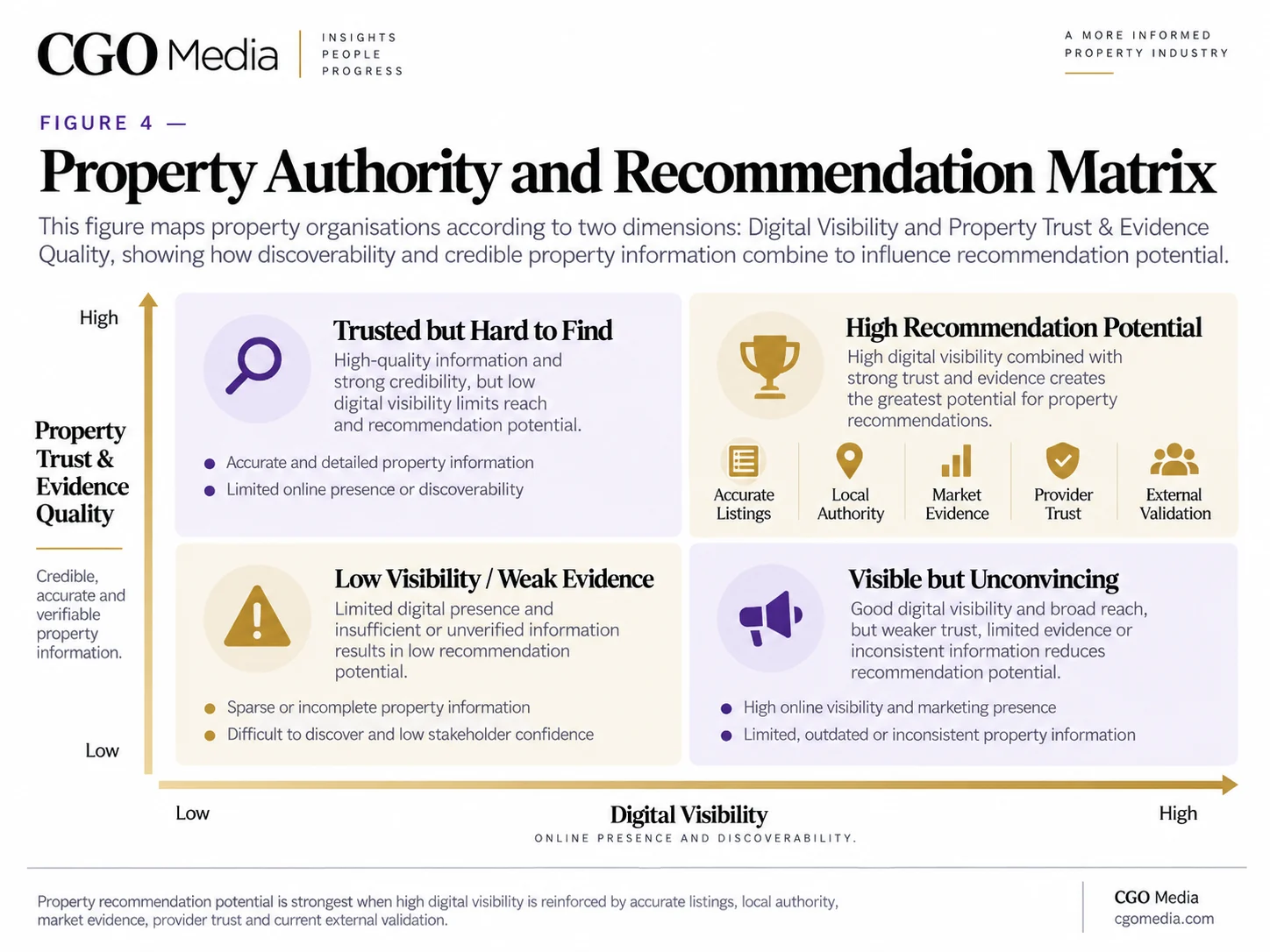
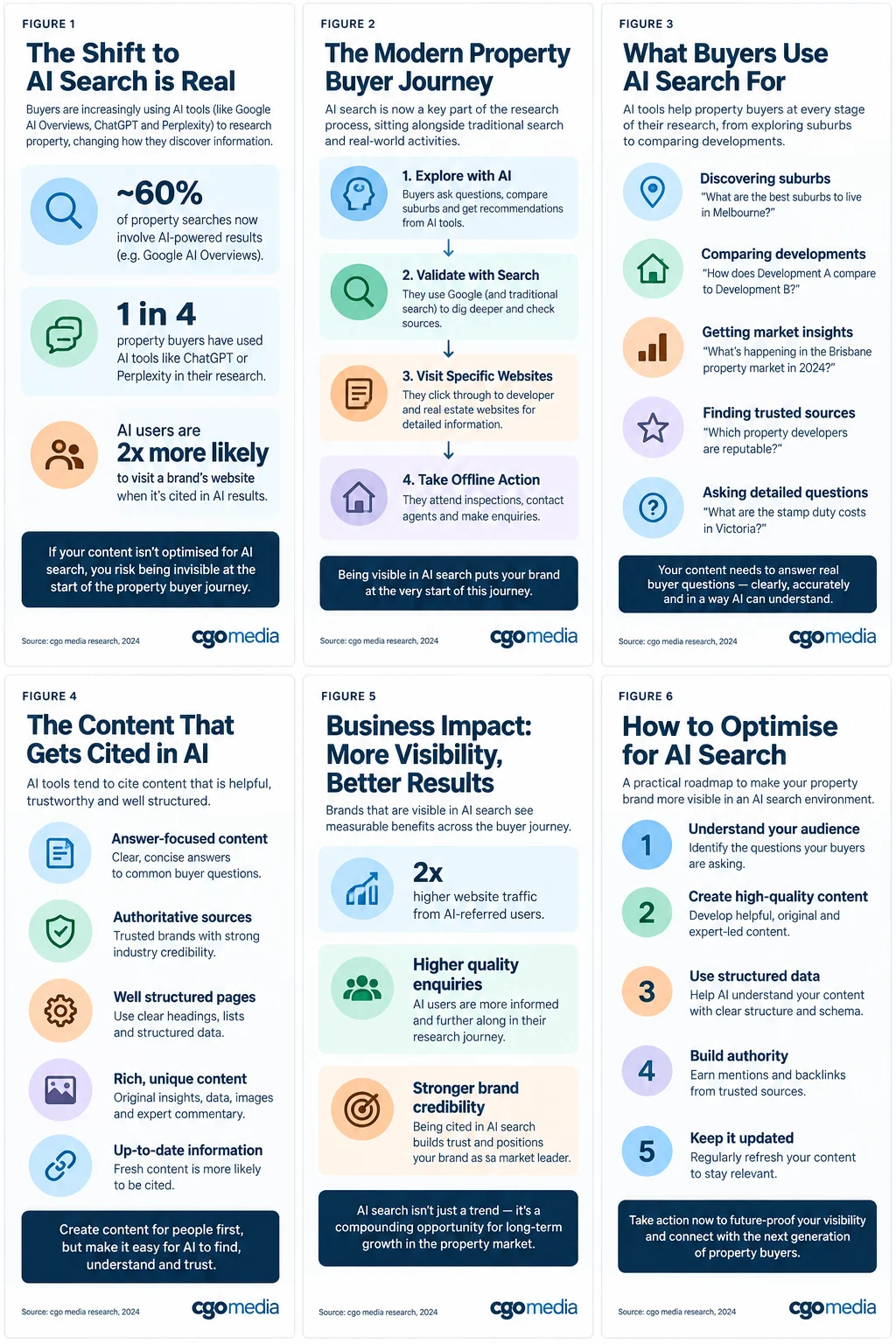
406. Property Search Performance Should Be Measured Across the Full Authority Funnel
Traditional SEO reporting often concentrates on rankings, impressions, clicks and organic traffic.
These metrics remain useful, but they do not fully explain whether property organisations are being discovered, understood, trusted, compared and selected across modern search and AI-assisted environments.
407. A Property Search Authority Measurement Funnel Can Include
Visibility → Entity Accuracy → Evidence Engagement → Trust → Comparison Visibility → Recommendation Visibility → Qualified Enquiry → Commercial Outcome
408. Visibility Is the First Measurement Layer
Visibility measures whether relevant users and systems encounter the organisation, property, development, location or professional.
409. Organic Visibility Can Include
- Search impressions
- Search clicks
- Keyword visibility
- Landing-page visibility
- Location visibility
410. Local Visibility Can Include
- Business-profile visibility
- Map discovery
- Office discovery
- Local pack visibility
- Branded local search
411. Portal Visibility Can Include
- Listing exposure
- Provider profile exposure
- Development visibility
- Location visibility
- Lead volume
412. AI Visibility Can Include
- Brand mentions
- Source visibility
- Citation visibility
- Comparison inclusion
- Recommendation inclusion
413. Visibility Should Be Qualified by Relevance
A high level of visibility has limited strategic value if the organisation appears for markets, property types or user needs it does not genuinely serve.
414. Qualified Visibility Can Be Defined as
Relevant Discovery Presence ÷ Relevant Search or Recommendation Opportunities
415. Visibility Should Be Segmented by User Intent
Useful segments can include:
- Buyer discovery
- Seller discovery
- Investor discovery
- Landlord discovery
- Tenant discovery
- Provider discovery
416. Visibility Should Be Segmented by Geography
Useful dimensions can include:
- Country
- Region
- City
- District
- Neighbourhood
- Development
417. Visibility Should Be Segmented by Property Type
Useful categories can include:
- Apartments
- Villas
- Townhouses
- New developments
- Commercial property
- Rental property
418. Entity Accuracy Is the Second Measurement Layer
Visibility is less valuable if the organisation or property is represented incorrectly.
419. Organisation Entity Accuracy Can Include
- Company name
- Office locations
- Telephone details
- Services
- Markets served
420. Professional Entity Accuracy Can Include
- Agent name
- Role
- Office
- Specialism
- Location expertise
421. Property Entity Accuracy Can Include
- Price
- Status
- Location
- Dimensions
- Features
- Development relationship
422. Development Entity Accuracy Can Include
- Developer
- Development name
- Location
- Construction status
- Available units
423. Entity Accuracy Should Be Monitored Across External Sources
Potential environments can include:
- Business profiles
- Property portals
- Directories
- Media
- AI-generated answers
424. Entity Inconsistency Can Create Measurement Noise
Different platforms may describe the same organisation or property differently.
425. Evidence Engagement Is the Third Measurement Layer
Evidence engagement examines whether users interact with the information required to validate a property, location or provider.
426. Property Evidence Engagement Can Include
- Gallery interaction
- Floorplan engagement
- Video viewing
- Specification review
- Map interaction
427. Location Evidence Engagement Can Include
- Area-page visits
- Neighbourhood-page visits
- School information
- Transport information
- Market-report engagement
428. Provider Evidence Engagement Can Include
- Agent-profile visits
- Office-page visits
- Review interaction
- Research-page visits
- Company-profile visits
429. Evidence Engagement Should Not Be Interpreted as Trust Automatically
Users may investigate evidence because they are uncertain rather than because they are already confident.
430. Trust Is the Fourth Measurement Layer
Trust measurement examines whether sufficient evidence exists to support continued consideration.
431. Trust Evidence Can Include
- Review strength
- Review recency
- Professional-profile depth
- Professional credentials
- Independent media references
- Research citations
432. Trust Can Also Be Observed Through Behaviour
Potential signals can include:
- Repeat visits
- Direct brand searches
- Agent-name searches
- Contact-page visits
- Saved properties
433. Behavioural Trust Signals Are Indicative Rather Than Definitive
They should be interpreted alongside wider evidence.
434. Comparison Visibility Is the Fifth Measurement Layer
Property and provider selection often involves comparison rather than isolated evaluation.
435. Property Comparison Behaviour Can Include
- Multiple listing views
- Multiple area views
- Price filtering
- Property-type filtering
- Saved-property comparison
436. Provider Comparison Can Include
- Multiple agent profiles
- Multiple office pages
- Review comparison
- Competitor research
- AI comparison questions
437. AI Comparison Visibility Should Be Measured Separately
Generative systems can include organisations within explicit comparison sets.
438. Comparison Monitoring Can Record
- Which providers appear
- Which providers are absent
- Which evidence is cited
- Which differences are highlighted
- Which recommendation rationale is used
439. Comparison Inclusion Should Be Qualified
The organisation should distinguish relevant comparison inclusion from irrelevant appearance.
440. Recommendation Visibility Is the Sixth Measurement Layer
Recommendation visibility examines whether the organisation, location, development or property is surfaced for appropriate user scenarios.
441. Provider Recommendation Scenarios Can Include
- Best estate agents in a location
- Luxury property specialists
- International buyer specialists
- New-build specialists
- Commercial property specialists
442. Location Recommendation Scenarios Can Include
- Best places for families
- Best locations for investment
- Best commuter areas
- Best retirement locations
- Best areas near international schools
443. Recommendation Monitoring Should Record Relevance
The organisation should ask whether inclusion genuinely matches:
- User need
- Market served
- Property category
- Transaction type
- Professional expertise
444. Recommendation Monitoring Should Record Accuracy
A recommendation may be relevant but described inaccurately.
445. Recommendation Monitoring Should Record Rationale
The stated reasons for recommendation can reveal which authority signals are being associated with the organisation.
446. Recommendation Monitoring Should Record Sources Where Available
Source visibility can help identify which evidence environments contribute to generative answers.
447. Qualified Recommendation Visibility Can Be Expressed as
Relevant Recommendation Presence + Accurate Representation + Appropriate Rationale
448. Recommendation Visibility Should Be Longitudinal
A single AI result provides limited evidence about persistent recommendation behaviour.
449. Scenario Libraries Can Support Longitudinal Measurement
Repeatable scenario groups can help identify movement over time.
450. Qualified Enquiry Is the Seventh Measurement Layer
The commercial value of discovery depends partly on whether users reaching the organisation are genuinely relevant.
451. Buyer Enquiry Quality Can Include
- Budget fit
- Location fit
- Property-type fit
- Timing
- Transaction readiness
452. Seller Enquiry Quality Can Include
- Property location
- Property type
- Instruction readiness
- Valuation need
- Timeframe
453. Investor Enquiry Quality Can Include
- Budget
- Return expectation
- Market preference
- Financing
- Investment horizon
454. Raw Enquiry Volume Can Be Misleading
Large volumes of poor-fit leads can create:
- Agent inefficiency
- Slow response
- Low conversion
- Poor user experience
455. Qualified Enquiry Rate Can Be More Useful
A useful relationship is:
Relevant Enquiries ÷ Total Enquiries
456. Enquiry Attribution Should Be Treated Carefully
Property users often interact with several discovery channels before making contact.
457. A Multi-Touch Journey Could Be
AI Discovery → Organic Search → Property Portal → Agency Website → Direct Enquiry
458. Another Multi-Touch Journey Could Be
Portal Listing → Area Research → Agent Review Search → Brand Search → Viewing Request
459. Last-Click Attribution Can Understate Earlier Discovery Influence
The final channel may receive credit even when earlier search or AI interaction created the initial consideration.
460. First-Touch Attribution Can Also Be Incomplete
The first discovery source may not have created the trust required for enquiry.
461. Journey-Level Interpretation Is Therefore Preferable
The organisation should examine how multiple evidence and discovery channels contribute together.
462. Commercial Outcome Is the Eighth Measurement Layer
Search and AI visibility should ultimately be interpreted in the context of meaningful business outcomes.
463. Commercial Outcomes Can Include
- Viewings
- Seller instructions
- Offers
- Reservations
- Sales agreed
- Completed transactions
464. Search Should Not Be Given Full Credit for Transactions
Property transactions are influenced by many later-stage factors.
465. Transaction Factors Can Include
- Financing
- Legal issues
- Survey findings
- Negotiation
- Seller decisions
- Market change
466. Search Contribution Should Therefore Be Interpreted as One Part of the Journey
Visibility and authority can support qualified opportunity without determining the final commercial outcome alone.
467. Post-Transaction Outcomes Should Also Be Measured
Positive customer outcomes can generate:
- Reviews
- Referrals
- Repeat business
- Testimonials
- External reputation
468. Post-Transaction Evidence Feeds Future Search Authority
A useful relationship is:
Transaction Experience → Review & Referral Evidence → Stronger Provider Trust → Stronger Future Discovery
469. Search Measurement Should Be Segmented by Business Model
Different property organisations require different reporting structures.
470. Estate Agency Measurement Can Emphasise
- Buyer enquiries
- Seller enquiries
- Viewings
- Instructions
- Transactions
471. Developer Measurement Can Emphasise
- Development discovery
- Unit enquiries
- Brochure requests
- Site visits
- Reservations
472. Portal Measurement Can Emphasise
- Inventory coverage
- Search usage
- Property engagement
- Lead generation
- Provider participation
473. Commercial Property Measurement Can Emphasise
- Qualified enquiries
- Viewings
- Lease or purchase negotiations
- Investor engagement
- Instruction value
474. Measurement Should Be Segmented by Market
Performance can differ substantially between:
- Geographic areas
- Price bands
- Property categories
- User types
- Languages
475. International Property Search Requires Additional Segmentation
Useful dimensions can include:
- User country
- Language
- Currency
- Buyer type
- Remote versus local enquiry
476. Search Metrics Should Be Connected with Property Data
Visibility can be difficult to interpret without understanding:
- Available inventory
- Average price
- Property type
- Location supply
- Property lifecycle
477. Inventory Changes Can Explain Visibility Changes
Organic traffic can fall because:
- Fewer properties are available
- High-demand properties sold
- A location has limited stock
- A development completed sales
478. Search Reporting Should Therefore Include Inventory Context
Search teams should avoid interpreting all visibility movement as optimisation success or failure.
479. Market Conditions Can Also Explain Commercial Changes
Enquiry and transaction behaviour can change because of:
- Interest rates
- Affordability
- Buyer confidence
- Seasonality
- Market supply
480. Measurement Should Distinguish Controllable and External Factors
This improves strategic interpretation.
481. Controllable Factors Can Include
- Technical quality
- Property data
- Content
- Entity clarity
- Provider evidence
- Enquiry handling
482. External Factors Can Include
- Market conditions
- Interest rates
- Regulation
- Search-platform changes
- Competitor activity
483. Measurement Should Include Data Quality
Weak measurement data can produce poor decisions.
484. Data Quality Problems Can Include
- Duplicate leads
- Missing source information
- Incorrect property IDs
- Inconsistent CRM stages
- Weak attribution
485. CRM Integration Can Improve Measurement
Search and marketing data become more useful when connected with:
- Lead qualification
- Viewings
- Instructions
- Offers
- Transactions
486. Measurement Should Connect Marketing and Agents
Marketing teams can identify discovery patterns while agents understand user quality and later-stage objections.
487. Agent Feedback Can Explain Search Metrics
Agents can report whether users are:
- Well informed
- Appropriately matched
- Ready to view
- Within budget
- Serious about transaction
488. Viewing Feedback Can Explain Listing Quality
Repeated differences between digital presentation and physical reality can identify evidence gaps.
489. Lost-Opportunity Analysis Can Explain Selection Friction
Potential reasons can include:
- Price
- Location
- Property mismatch
- Provider concern
- Competitor selected
- Finance problem
490. Seller Lost-Instruction Analysis Can Also Be Valuable
Potential reasons can include:
- Fee
- Valuation
- Brand perception
- Marketing strategy
- Local reputation
491. AI Search Measurement Requires Controlled Observation
Generative outputs are variable and should not be treated like fixed conventional rankings.
492. AI Scenario Monitoring Should Use Repeatable Query Families
Useful query groups can cover:
- Location discovery
- Provider discovery
- Property-type research
- Seller questions
- Investment questions
- Recommendation questions
493. AI Monitoring Should Record Date
Outputs can change over time.
494. AI Monitoring Should Record Platform or Model
Different systems may produce different results.
495. AI Monitoring Should Record Scenario
Comparisons are more useful where the same underlying question is tested consistently.
496. AI Monitoring Should Record Source Visibility
Where available, source references can help identify the wider evidence ecosystem.
497. AI Monitoring Should Record Entity Accuracy
Incorrect information should be distinguished from simple non-visibility.
498. AI Monitoring Should Record Comparison Presence
The organisation can assess whether it enters appropriate provider or location comparisons.
499. AI Monitoring Should Record Recommendation Presence
Relevant recommendation visibility can then be assessed longitudinally.
500. AI Monitoring Should Record Competitor Sets
This can reveal which alternative providers repeatedly appear.
501. Competitor Monitoring Should Focus on Evidence Differences
Useful questions include:
- Do competitors have stronger location evidence?
- Do competitors have stronger review evidence?
- Do competitors have better external authority?
- Do competitors have clearer specialisms?
502. Measurement Should Lead to Diagnosis
Reporting should not end with a dashboard.
503. A Useful Diagnostic Relationship Is
Metric Change → Evidence Review → Likely Cause → Improvement Priority
504. Visibility Loss Should Be Diagnosed
Potential causes can include:
- Technical problems
- Inventory changes
- Competitor gains
- Content decline
- Market changes
505. Entity-Accuracy Problems Should Be Diagnosed
Potential causes can include:
- Outdated owned information
- Old external profiles
- Conflicting directories
- Weak entity relationships
506. Recommendation Exclusion Should Be Diagnosed
Potential causes can include:
- Weak relevance
- Weak topical authority
- Insufficient external evidence
- Entity ambiguity
- Competitor evidence strength
507. Poor Enquiry Quality Should Be Diagnosed
Potential causes can include:
- Over-broad visibility
- Weak property filtering
- Insufficient cost information
- Unclear market positioning
- Irrelevant recommendation
508. Measurement Should Support Resource Allocation
The strongest reporting identifies where investment can produce the greatest improvement.
509. Technical Investment Can Be Prioritised Where Discoverability Is Constrained
Examples can include:
- Crawl management
- Indexation
- Performance
- Property lifecycle handling
510. Content Investment Can Be Prioritised Where Evidence Is Weak
Examples can include:
- Location pages
- Market reports
- Buying guides
- Agent profiles
511. Data Investment Can Be Prioritised Where Accuracy Is Weak
Examples can include:
- CRM improvements
- Feed validation
- Property-status governance
- Entity mapping
512. Authority Investment Can Be Prioritised Where Independent Evidence Is Weak
Examples can include:
- Research
- Digital PR
- Media commentary
- Trade visibility
513. AI Monitoring Investment Can Be Prioritised Where Recommendation Visibility Matters
The organisation can build controlled scenario monitoring around priority markets and services.
514. The Seventeenth Property & Real Estate Search Principle
Property search performance should be measured across a wider authority funnel that includes visibility, entity accuracy, evidence engagement, trust, comparison presence, recommendation visibility and qualified commercial outcomes rather than relying on rankings and traffic alone.
515. The Eighteenth Property & Real Estate Search Principle
Search and AI visibility should be qualified by relevance and accuracy, recognising that irrelevant inclusion, incorrect representation or low-quality enquiries can create activity without producing genuine strategic value.
516. The Nineteenth Property & Real Estate Search Principle
Measurement should connect search, property inventory, CRM, agent feedback and commercial outcomes where possible so performance changes can be interpreted within the context of available stock, market conditions, user fit and operational quality.
517. The Twentieth Property & Real Estate Search Principle
AI-assisted visibility should be monitored longitudinally through repeatable scenario libraries that record inclusion, exclusion, representation accuracy, cited sources, competitor sets and recommendation rationale rather than treating isolated generative outputs as stable rankings.
518. The Property Search Authority Measurement Funnel
The complete relationship can be summarised as:
Visibility → Entity Accuracy → Evidence Engagement → Trust → Comparison Visibility → Recommendation Visibility → Qualified Enquiry → Commercial Outcome → New Authority Evidence
519. The Strategic Implication
Property organisations should build measurement systems that explain not simply how many people discover them, but whether the organisation, locations, properties and professionals are being represented accurately, supported by sufficient evidence, included in relevant comparisons and recommendations and converted into appropriate commercial opportunities. Search reporting becomes strategically stronger when traditional SEO metrics are connected with property data, authority evidence, AI observations, agent feedback and downstream transaction outcomes.
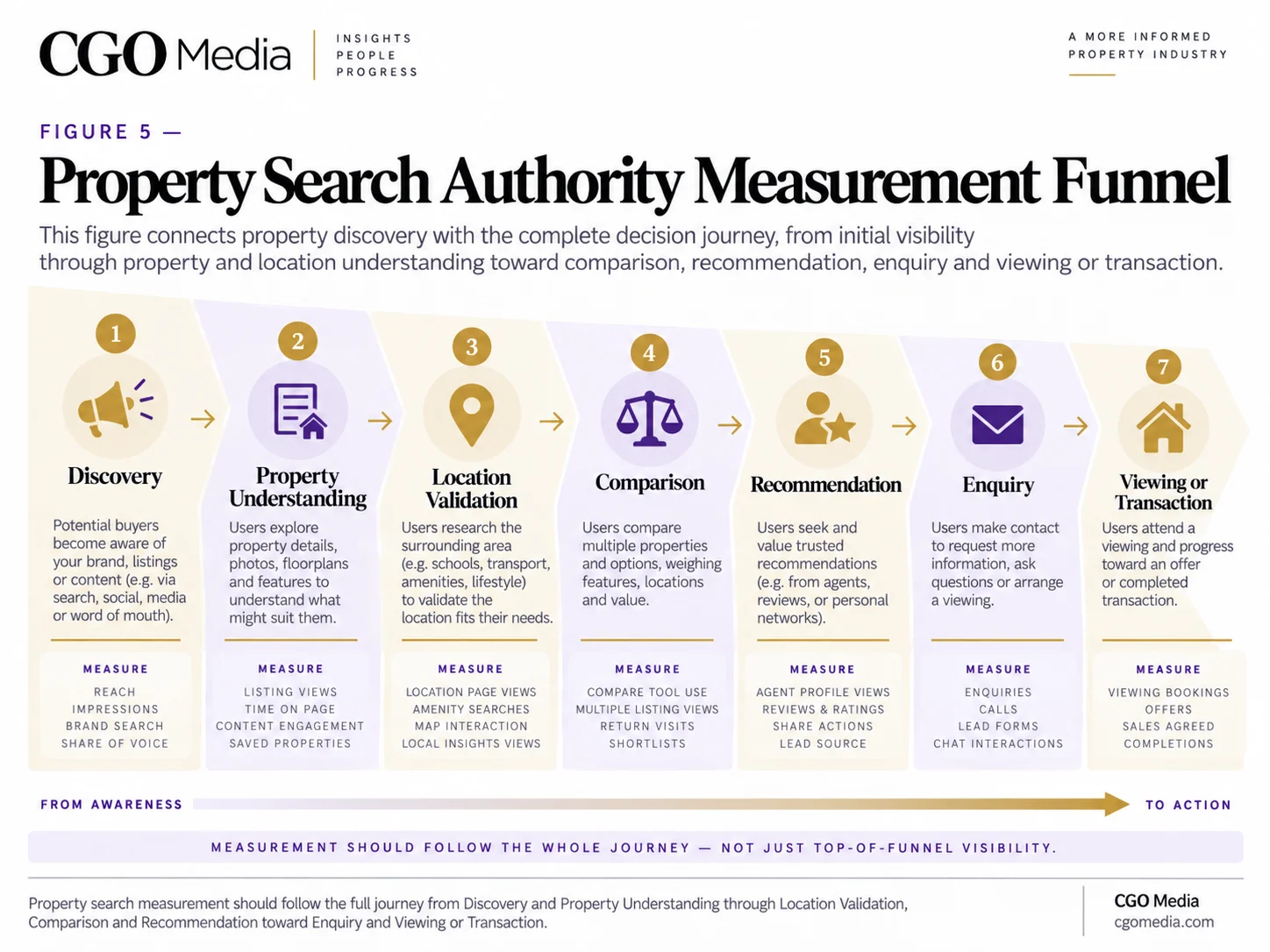
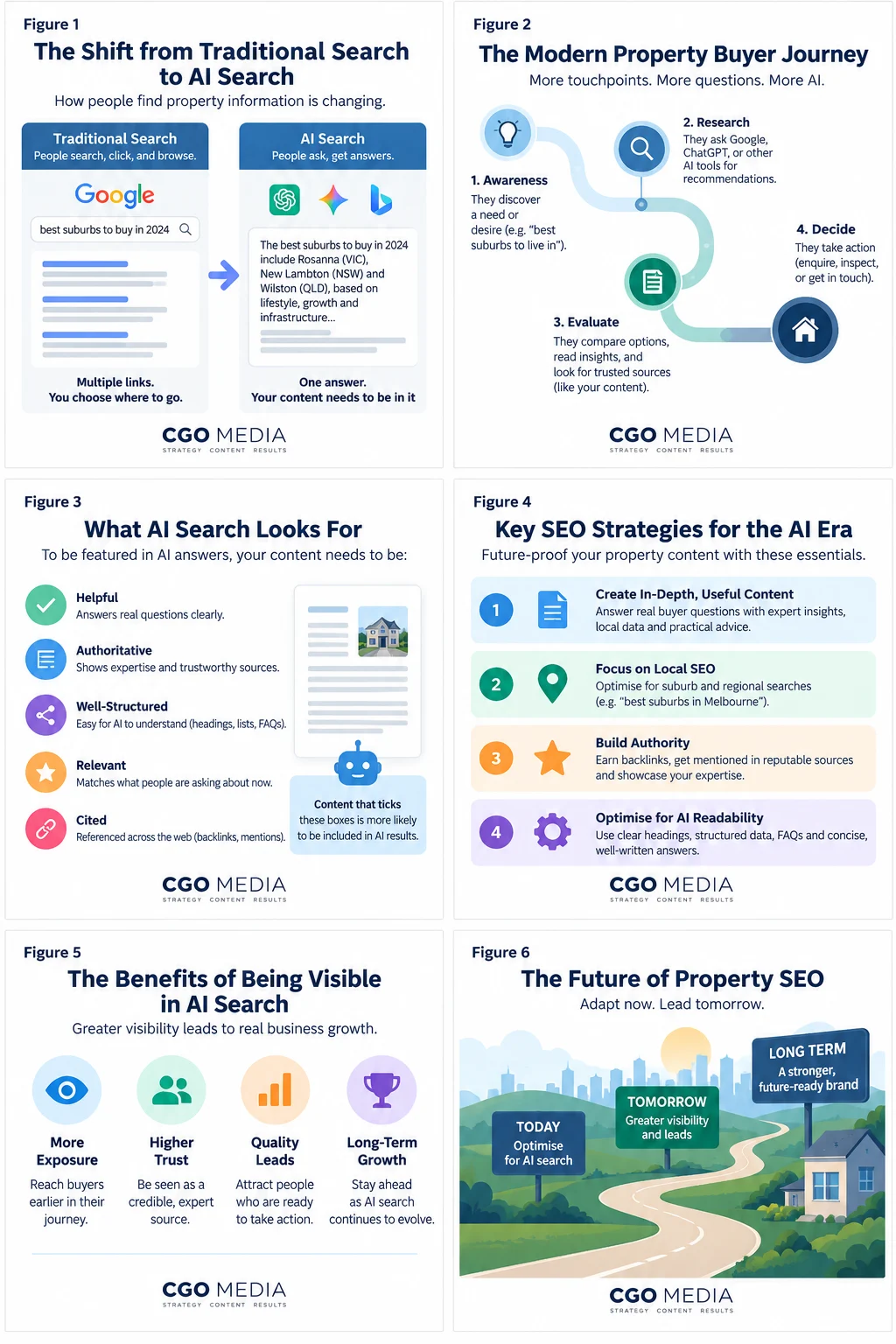
520. Property Search Authority Should Be Managed as a Continuous Improvement System
Search, property inventory, user behaviour, market conditions and AI-assisted discovery change continuously.
A one-time SEO project is therefore insufficient for organisations operating in dynamic property markets.
521. A Continuous Property Search Authority Cycle Can Be Expressed as
Audit → Diagnose → Prioritise → Improve → Measure → Learn → Adapt
522. Step One — Audit the Current Search Environment
The first stage is to understand the organisation’s present visibility, evidence quality and authority position.
523. Technical Search Auditing
Technical review can examine:
- Crawlability
- Indexation
- Site architecture
- Internal linking
- Performance
- Property lifecycle handling
524. Property Data Auditing
The organisation can review:
- Price accuracy
- Status accuracy
- Availability
- Property attributes
- Duplicate records
- Feed consistency
525. Location Authority Auditing
Review can include:
- Regional coverage
- City coverage
- Neighbourhood coverage
- Development coverage
- Market evidence
526. Provider Authority Auditing
Review can include:
- Organisation identity
- Office identity
- Agent profiles
- Professional specialisms
- Review evidence
- External recognition
527. AI Visibility Auditing
The organisation can examine:
- Brand mentions
- Entity accuracy
- Source visibility
- Comparison inclusion
- Recommendation inclusion
528. Commercial Outcome Auditing
Search performance should be connected where possible with:
- Qualified enquiries
- Viewings
- Seller instructions
- Reservations
- Completed transactions
529. Step Two — Diagnose Authority Gaps
The objective is to determine why relevant visibility, trust or selection performance is weak.
530. Technical Authority Gaps
Potential problems can include:
- Poor crawl architecture
- Indexation problems
- Slow performance
- Duplicate property URLs
- Weak internal linking
531. Property Information Gaps
Potential problems can include:
- Missing attributes
- Stale availability
- Weak descriptions
- Missing floorplans
- Inconsistent prices
532. Location Authority Gaps
Potential problems can include:
- Thin area pages
- No market evidence
- Weak neighbourhood coverage
- Little internal linking
- Limited local expertise
533. Provider Authority Gaps
Potential problems can include:
- Thin agent profiles
- Weak review evidence
- Unclear specialisms
- Inconsistent office data
- Limited external recognition
534. External Authority Gaps
Potential weaknesses can include:
- Limited media coverage
- No research citations
- Weak trade visibility
- Few independent references
535. AI Representation Gaps
Potential problems can include:
- Incorrect entity descriptions
- Missing comparison inclusion
- Relevant recommendation exclusion
- Incorrect service associations
- Outdated location associations
536. Measurement Gaps
Potential problems can include:
- No CRM integration
- Weak source attribution
- No AI monitoring
- No qualified-lead classification
- No lost-opportunity analysis
537. Step Three — Prioritise Improvements
Not every weakness should receive the same level of investment.
538. A Useful Priority Model Is
Authority Gap + User Impact + Commercial Impact + Risk + Frequency → Improvement Priority
539. High-Risk Issues Should Be Prioritised
Examples can include:
- Incorrect property pricing
- Incorrect availability
- Wrong office information
- Misleading property details
- Incorrect AI representation
540. High-Dependency Issues Should Be Prioritised
Some improvements strengthen several capabilities simultaneously.
541. Property Data Quality Is a High-Dependency Capability
It can influence:
- Search visibility
- Portal distribution
- User trust
- Property matching
- AI representation
542. Entity Clarity Is a High-Dependency Capability
It can influence:
- Brand understanding
- Local search
- Professional visibility
- AI interpretation
- Recommendation fit
543. Location Authority Is a High-Dependency Capability
It can support:
- Geographic discovery
- Property discovery
- Provider authority
- Market research
- AI recommendation
544. Original Research Can Be a High-Dependency Authority Asset
It can support:
- Search visibility
- Digital PR
- Professional authority
- Media citation
- AI source visibility
545. Step Four — Improve the Search and Evidence Environment
Interventions should address the specific weaknesses identified.
546. Technical Improvements Can Include
- Better crawl architecture
- Improved indexation control
- Property lifecycle management
- Improved internal linking
- Performance improvements
547. Property Data Improvements Can Include
- Required data fields
- Feed validation
- Status automation
- Price governance
- Duplicate control
548. Listing Improvements Can Include
- Clearer specifications
- Better photography
- Floorplans
- Video
- Location context
- Transparent limitations
549. Location Authority Improvements Can Include
- Deeper neighbourhood pages
- Market data
- School information
- Transport context
- Local inventory relationships
550. Professional Authority Improvements Can Include
- Expanded agent profiles
- Clear specialisms
- Professional biographies
- Market commentary
- Research contribution
551. Trust Improvements Can Include
- Review development
- Review responses
- Clear office information
- External evidence
- Transparent service information
552. External Authority Improvements Can Include
- Original research
- Digital PR
- Journalist commentary
- Trade publication contributions
- Independent citations
553. AI Readiness Improvements Can Include
- Entity consistency
- Topical clarity
- Location clarity
- Professional attribution
- Current source evidence
554. Commercial Journey Improvements Can Include
- Clear contact routes
- Better qualification
- Faster response
- Better follow-up
- Viewing preparation
555. Improvement Should Preserve User Value
Search optimisation should not create unnecessary friction, duplicate content or misleading promotional claims.
556. More Pages Are Not Automatically Better
Expansion should be supported by meaningful:
- Property evidence
- Location evidence
- Market knowledge
- User need
557. More Schema Is Not Automatically Better
Structured data should support accurate visible information and supported entity relationships.
558. More AI Mentions Are Not Automatically Better
Relevant and accurate visibility is more useful than indiscriminate mention frequency.
559. More Leads Are Not Automatically Better
Qualified enquiries should remain the stronger commercial objective.
560. Step Five — Measure the Impact
Changes should be evaluated using metrics relevant to the capability improved.
561. Technical Improvements Can Be Measured Through
- Indexation quality
- Crawl efficiency
- Page performance
- Organic visibility
- Error reduction
562. Property Data Improvements Can Be Measured Through
- Feed-error reduction
- Price consistency
- Status accuracy
- Duplicate reduction
- Listing completeness
563. Location Authority Improvements Can Be Measured Through
- Location visibility
- Area-page engagement
- Market-query visibility
- Local enquiry quality
- AI location inclusion
564. Provider Authority Improvements Can Be Measured Through
- Agent-profile engagement
- Brand searches
- Review strength
- Media citations
- Provider recommendation visibility
565. External Authority Improvements Can Be Measured Through
- Media references
- Research citations
- Relevant links
- Trade mentions
- Source visibility
566. AI Readiness Improvements Can Be Measured Through
- Entity accuracy
- Relevant inclusion
- Comparison visibility
- Recommendation visibility
- Source visibility
567. Commercial Improvements Can Be Measured Through
- Qualified enquiry rate
- Viewing conversion
- Seller instruction rate
- Offer progression
- Transaction outcomes
568. Measurement Should Compare Like with Like
Changes should be interpreted carefully where:
- Inventory changes
- Market conditions change
- Seasonality changes
- Pricing changes
- Advertising changes
569. Step Six — Learn from the Outcome
The organisation should determine why an intervention succeeded, failed or produced mixed results.
570. Learning Records Can Include
- Problem identified
- Intervention made
- Expected result
- Measured result
- Interpretation
- Next action
571. Agent Feedback Should Be Included in Learning
Agents can identify whether users are becoming:
- Better informed
- Better qualified
- More relevant
- More transaction-ready
572. Customer Feedback Should Be Included in Learning
Useful sources can include:
- Reviews
- Viewing feedback
- Customer interviews
- Lost-enquiry analysis
- Post-transaction feedback
573. Search Evidence Should Be Included in Learning
Useful signals can include:
- Organic movement
- Local visibility
- Portal visibility
- AI visibility
- Source visibility
574. Commercial Evidence Should Be Included in Learning
Useful signals can include:
- Lead quality
- Viewing quality
- Instructions
- Offers
- Transactions
575. Learning Should Be Cross-Functional
The strongest diagnosis combines:
- Search intelligence
- Property intelligence
- Agent intelligence
- Customer intelligence
- Commercial intelligence
576. Step Seven — Adapt
Validated learning should change future standards, processes and investment priorities.
577. Technical Standards Can Be Adapted
Examples can include:
- Indexation rules
- Property lifecycle rules
- Internal-linking standards
- Performance standards
578. Property Data Standards Can Be Adapted
Examples can include:
- Required fields
- Status definitions
- Price validation
- Feed rules
- Media requirements
579. Location Content Standards Can Be Adapted
Strong-performing evidence can become part of standard area-page requirements.
580. Agent Profile Standards Can Be Adapted
Useful profile requirements can include:
- Expertise
- Locations
- Languages
- Experience
- Research or commentary
581. Research Standards Can Be Adapted
Successful studies can inform future:
- Market reports
- Location studies
- Buyer research
- Seller research
582. AI Monitoring Standards Can Be Adapted
Scenario libraries can be refined as new:
- Platforms
- Models
- Search interfaces
- User behaviours
emerge.
583. Search Authority Improvement Should Be Iterative
A useful relationship is:
Audit → Diagnose → Prioritise → Improve → Measure → Learn → Adapt → Audit Again
584. Property Data Requires Frequent Iteration
Property information changes rapidly because:
- Listings enter the market
- Prices change
- Status changes
- Properties sell
- Developments release new units
585. Market Research Requires Periodic Iteration
Reports can become outdated as:
- Prices move
- Inventory changes
- Demand changes
- Financing changes
586. Provider Evidence Requires Event-Based Iteration
Updates may be triggered by:
- New staff
- New office
- Role changes
- New qualifications
- New specialisms
587. External Authority Requires Ongoing Development
Relevant recognition cannot usually be created through one campaign alone.
588. AI Representation Requires Repeated Review
Generative outputs and source behaviour can change over time.
589. Continuous Improvement Should Be Market-Specific
Different markets can require different priorities.
590. Luxury Property May Require Greater Emphasis on
- Professional authority
- Privacy
- International evidence
- High-quality presentation
- Relationship building
591. New Development Search May Require Greater Emphasis on
- Developer identity
- Project entity structure
- Construction status
- Unit availability
- Completion evidence
592. Local Residential Search May Require Greater Emphasis on
- Local offices
- Neighbourhood authority
- Reviews
- Local inventory
- Seller visibility
593. International Property Search May Require Greater Emphasis on
- Multilingual information
- International buyer guidance
- Transaction education
- Cross-border trust
- Remote validation
594. Commercial Property Search May Require Greater Emphasis on
- Investment evidence
- Asset class expertise
- Local economics
- Professional authority
- Transaction complexity
595. Improvement Should Also Be Organisation-Specific
An independent local agency, international brokerage, developer and portal will not require identical priorities.
596. Local Agencies May Prioritise Geographic Depth
Strong local evidence can compensate for lower national brand visibility.
597. Large Networks May Prioritise Entity Governance
Many offices and agents create greater complexity around consistency.
598. Developers May Prioritise Development Entity Architecture
Clear relationships between developer, project, location and units can be especially important.
599. Portals May Prioritise Inventory and Taxonomy Quality
Their authority depends heavily on large-scale structured property information.
600. Continuous Improvement Should Be Connected to Business Strategy
Search priorities should reflect:
- Priority locations
- Priority services
- Priority property types
- Priority audiences
- Commercial objectives
601. Authority Development Should Not Be Separated from Commercial Positioning
The organisation should become more authoritative where it genuinely intends to compete.
602. This Produces a Strategic Authority Loop
A useful relationship is:
Business Strategy → Evidence Investment → Search Authority → Qualified Discovery → Commercial Learning → Better Strategy
603. Successful Search Authority Creates New Evidence
Strong performance can generate:
- Transactions
- Reviews
- Case evidence
- Market insight
- Media opportunities
604. New Evidence Can Strengthen Future Search Authority
The system can therefore become cumulative.
605. The Long-Term Authority Flywheel
A useful model is:
Better Evidence → Better Discovery → Better Matching → Better Experience → Better Outcomes → New Trust Evidence → Stronger Authority
606. Search Authority Can Also Decline
Without governance, organisations can accumulate:
- Stale listings
- Outdated agent profiles
- Thin location pages
- Old research
- Conflicting external information
607. Authority Maintenance Is Therefore as Important as Authority Creation
Established organisations should not assume historical reputation remains sufficient indefinitely.
608. Continuous Improvement Supports Resilience
A stronger evidence ecosystem is better able to adapt to:
- Search-engine changes
- Portal changes
- AI search changes
- Market changes
- User behaviour changes
609. The Twenty-First Property & Real Estate Search Principle
Property search authority should be managed through a continuous audit, diagnosis, prioritisation, improvement and measurement cycle because property inventory, search environments, provider evidence and AI representation change continuously.
610. The Twenty-Second Property & Real Estate Search Principle
Improvement priorities should reflect authority gaps, user impact, commercial impact, risk and frequency, favouring high-dependency capabilities such as property data quality, entity clarity, location authority and credible research where they strengthen several discovery and selection stages simultaneously.
611. The Twenty-Third Property & Real Estate Search Principle
Property SEO improvement should combine technical, content, data, authority, AI visibility and commercial evidence rather than treating these disciplines as isolated programmes with separate objectives.
612. The Twenty-Fourth Property & Real Estate Search Principle
The strongest long-term property search strategy is cumulative, using better evidence to create better discovery, better matching and better user experiences that generate new reviews, market insight, professional authority and independent validation for future discovery.
613. The Continuous Property Search Authority Improvement Cycle
The complete improvement cycle can be summarised as:
Audit → Diagnose → Prioritise → Improve → Measure → Learn → Adapt
614. The Property Search Authority Flywheel
The long-term authority relationship can be summarised as:
Better Property Data + Stronger Location Evidence + Clearer Provider Authority + Independent Validation → Better Discovery → Better Matching → Better Outcomes → New Authority Evidence
615. The Strategic Implication
Property organisations should treat search authority as an operational capability that requires continuous maintenance and improvement rather than as a finite SEO campaign. The strongest programmes connect technical search performance with accurate inventory, geographic expertise, professional identity, original research, external recognition, AI representation and commercial feedback so each improvement strengthens not only current discovery but the evidence base supporting future search, comparison and recommendation.
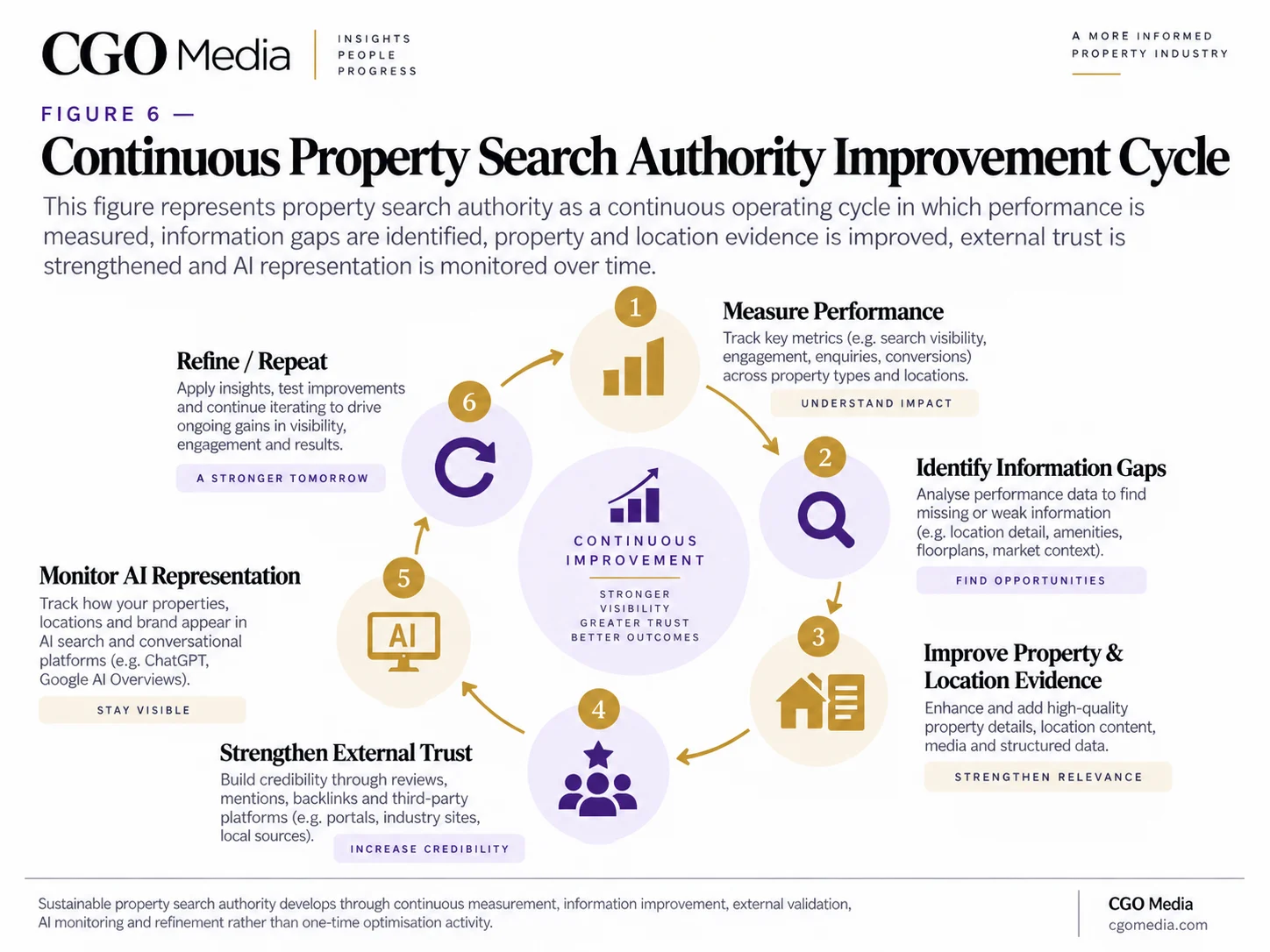
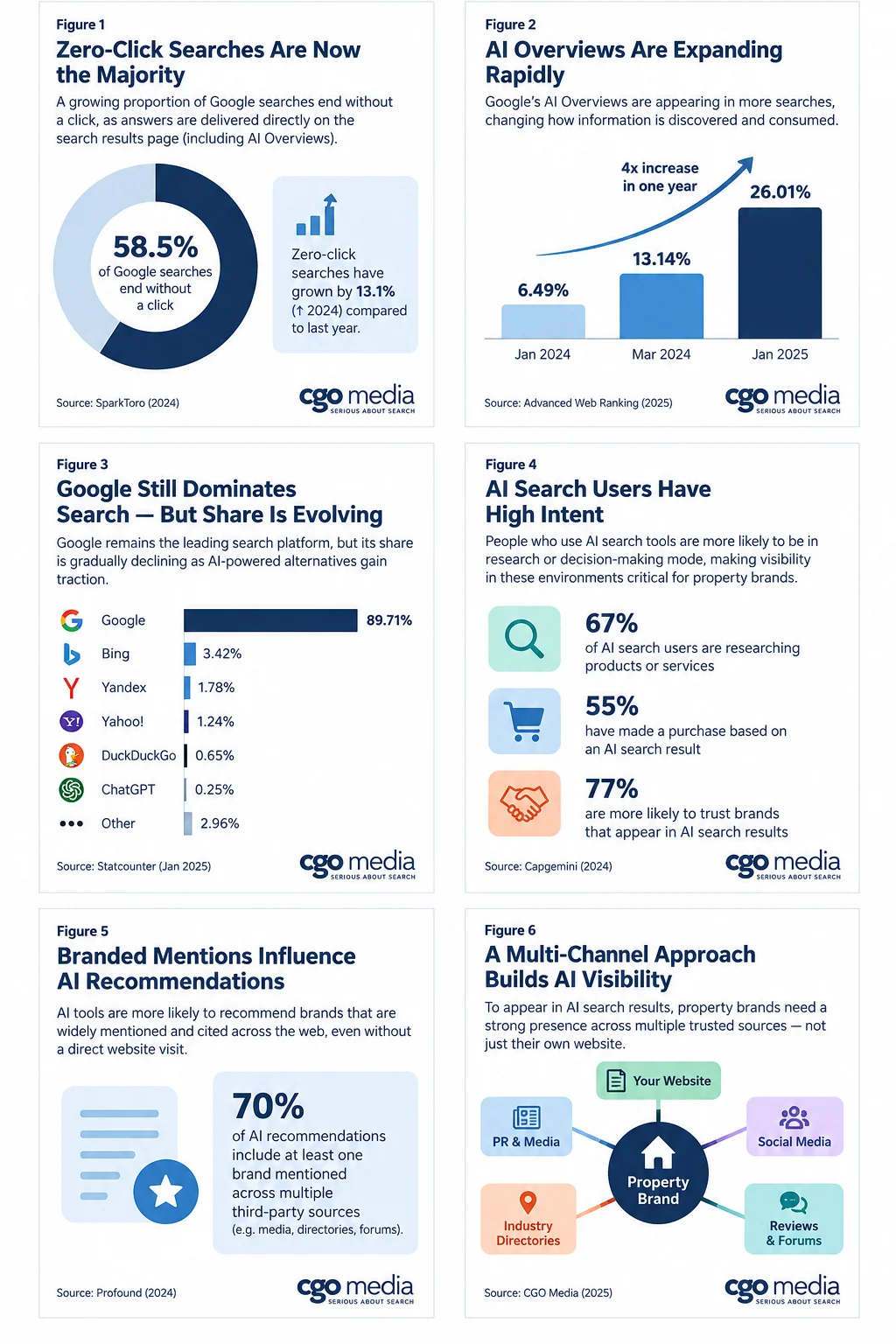
616. Research Methodology
Property & Real Estate SEO in an AI Search Environment is a conceptual research paper developed by CGO Media to examine how property organisations can build sustainable discoverability, authority and recommendation readiness across conventional search engines, local search, property platforms and emerging AI-assisted discovery systems.
Core Research Question
The central research question is:
How should property organisations structure search visibility, property information, local authority, professional evidence and external trust as property discovery expands beyond conventional search rankings into AI-assisted comparison and recommendation environments?
Research Scope
The paper considers organisations including:
- Estate agencies
- Real estate brokerages
- Property developers
- New-build specialists
- Property portals
- Property investment organisations
- Commercial property organisations
- Property-management providers
User Scope
The research considers search and discovery journeys involving:
- Buyers
- Sellers
- Tenants
- Landlords
- Investors
- International property buyers
These audiences should not be treated as one homogeneous property-search market.
Research Environment
The framework considers evidence encountered across:
- Search engines
- Local search
- Property portals
- Agency websites
- Developer websites
- Review platforms
- Media
- AI-assisted discovery environments
Conceptual Research Method
The paper synthesises established SEO, entity, information-quality, credibility and digital-authority principles with observed changes in modern property discovery.
The models are strategic and conceptual.
They should not be interpreted as descriptions of proprietary ranking, retrieval, citation or recommendation algorithms used by Google, property portals, AI platforms or other third-party systems.
Systems Approach
Property search is treated as an interconnected system involving:
- Technical accessibility
- Property data
- Location authority
- Provider identity
- Professional identity
- Market evidence
- External authority
- User trust
- AI-assisted discovery
Multi-Channel Visibility
The framework does not assume that all property discovery begins with conventional organic search.
A user may move between:
AI Assistant → Search Engine → Property Portal → Agency or Developer Website → Direct Enquiry
before commercial contact occurs.
Distributed Property Evidence
Information about the same property, development, organisation or professional can appear across multiple platforms.
The methodology therefore considers whether important facts remain sufficiently consistent across relevant owned and third-party environments.
Property Entity Architecture
A useful property entity model is:
Organisation → Office → Professional → Development → Property → Property Type → Location → Transaction Type
Not every organisation will use every entity layer, but the relationships between them should remain sufficiently clear.
Organisation, Office and Professional Identity
Property organisations may be assessed according to whether search users and digital systems can distinguish between:
- Organisation
- Branch or office
- Individual professional
- Developer
- Development
- Individual property
These entities should not be conflated where they perform different roles within discovery or transaction journeys.
Authority Is Contextual
An organisation can possess strong authority within one:
- Location
- Property type
- Transaction category
- User segment
without possessing equivalent authority in every property context.
The methodology therefore evaluates authority in relation to the specific discovery scenario rather than assuming universal property authority.
Qualified Recommendation
The paper distinguishes relevant recommendation visibility from indiscriminate inclusion.
The stronger objective is:
Relevant User + Relevant Location + Relevant Property or Provider + Accurate Evidence + Appropriate Context → Qualified Recommendation Readiness
Multi-Stage Measurement
Search performance is evaluated across:
Visibility → Entity Accuracy → Evidence Engagement → Trust → Comparison → Recommendation → Qualified Enquiry → Commercial Outcome
No single stage should be treated as a complete measure of property-search performance.
Evidence Quality
Useful evidence should be assessed according to:
- Accuracy
- Freshness
- Consistency
- Attribution
- Contextual relevance
Property Information Volatility
Property search differs from many information environments because important facts can change rapidly.
Volatile information can include:
- Price
- Availability
- Status
- Development inventory
- Mortgage or financing conditions
- Completion information
- Property specifications
Listing Status Accuracy
The methodology should distinguish materially different listing states such as:
- Available
- Reserved
- Under offer
- Sold
- Let or rented
- Withdrawn
- No longer marketed
Outdated status information can reduce trust and create poor user experiences even where the underlying listing continues to rank strongly.
Listing Freshness
Property freshness should be assessed according to both the likelihood of change and the consequence of stale information.
A useful conceptual relationship is:
Information Volatility + Decision Impact + Transaction Risk → Required Review Frequency
Duplicate Listing Method
The same property may appear across:
- Agency websites
- Developer websites
- Property portals
- Franchise networks
- Multiple agents
- Partner feeds
The methodology should therefore consider whether duplicate or near-duplicate records create confusion concerning:
- Price
- Status
- Agent identity
- Availability
- Property specifications
- Source freshness
Duplicate presence should not automatically be treated as an authority problem where legitimate multi-agent or multi-platform distribution exists.
The principal risk is inconsistent or outdated evidence.
Property Specification Accuracy
Material property information can include:
- Bedrooms
- Bathrooms
- Internal area
- Plot size
- Property type
- Development status
- Amenities
- Parking
- Location information
Where these facts materially influence property selection, they should be maintained with appropriate accuracy and source consistency.
Development Information Method
For new-build and development-led discovery, assessment may include:
- Developer identity
- Development identity
- Development status
- Unit availability
- Completion information
- Specifications
- Location
- Payment or purchase-stage information where published
Future-facing information should be clearly distinguished from completed or currently available property evidence.
Location Hierarchy
Location evidence can be modelled through a hierarchy such as:
Country → Region → City → District or Municipality → Neighbourhood → Development → Property
The appropriate levels vary between markets.
The objective is geographic clarity rather than artificially attaching properties or providers to locations they do not genuinely serve.
Location Authority
Location authority may be supported by evidence including:
- Local market knowledge
- Area guides
- Property inventory
- Transaction experience
- Office presence
- Professional expertise
- Original market research
Market Evidence Method
Property-market evidence should be interpreted according to:
- Location
- Property type
- Transaction type
- Measurement period
- Dataset
- Sample
- Methodology
- Currency
Market-level evidence should not automatically be applied to every individual property.
Market Research Freshness
Property-market statistics can lose relevance as market conditions change.
Research outputs should therefore state the relevant measurement period clearly and distinguish current observations from historic evidence.
Investment and Financial Claims
Claims concerning:
- Rental yield
- Capital growth
- Investment returns
- Expected appreciation
- Future value
should be supported by appropriate evidence and contextual qualification.
Historic or market-level performance should not automatically be presented as a prediction for an individual property.
Search Intent Hierarchy
The research models intent as:
Goal Intent → Location Intent → Property-Type Intent → Requirement Intent → Market Intent → Provider Intent → Commercial Intent
This helps distinguish early exploration from later transaction or provider-selection behaviour.
Digital Evidence Ecosystem
The digital evidence environment is modelled as:
Owned Evidence + Platform Evidence + Professional Evidence + Market Evidence + Independent Evidence → Search Authority
Property Selection Evidence
Selection confidence is modelled as:
Property Evidence + Location Evidence + Market Evidence + Provider Evidence + Financial Evidence + Independent Validation → Selection Confidence
Selection Confidence is an analytical concept rather than a guarantee that a user will proceed with a transaction.
Recommendation Readiness
Recommendation readiness is modelled as:
Relevance + Entity Clarity + Evidence Strength + Provider Trust + Independent Validation + Context Fit → Recommendation Readiness
Recommendation Readiness does not guarantee inclusion within any particular search or AI-generated recommendation system.
Provider Recommendation Method
Provider recommendations should remain contextual.
A useful model is:
User Need + Location + Transaction Type + Property Context + Provider Relevance + Trust Evidence → Provider Relevance for Further Evaluation
This does not establish that a particular agency, broker, developer or adviser is objectively the best provider for every user.
Property Recommendation Method
Property recommendation should likewise remain contextual.
A useful model is:
User Requirements + Location + Budget + Property Type + Availability + Accurate Property Evidence → Property Relevance for Further Evaluation
Search Authority Measurement
Search authority is measured across:
Visibility → Entity Accuracy → Evidence Engagement → Trust → Comparison Visibility → Recommendation Visibility → Qualified Enquiry → Commercial Outcome
Qualified Enquiry Method
Raw enquiry volume should not automatically be treated as successful property-search performance.
More useful analysis can consider whether enquiries match:
- Location
- Property type
- Budget
- Transaction type
- Provider service
- User requirements
AI Observation Method
AI-assisted property discovery can be observed using repeatable scenario classes covering:
- Location discovery
- Property-type discovery
- Buyer research
- Seller-provider discovery
- Rental discovery
- Investment research
- Developer and development discovery
- Agency comparison
- Property-provider recommendation
Where practicable, observation can record:
- Platform or model
- Prompt
- Date
- Location
- Property type
- User scenario
- Provider presence
- Property or development presence
- Representation accuracy
- Visible sources where available
Longitudinal Observation
Individual AI outputs should not be treated as stable rankings.
Repeated scenario testing is generally more informative than isolated observation.
Continuous Improvement Method
The research models continuous improvement as:
Audit → Diagnose → Prioritise → Improve → Measure → Learn → Adapt
617. Limitations
Property & Real Estate SEO in an AI Search Environment is a conceptual research framework.
It does not reproduce or claim access to proprietary ranking, retrieval, citation, recommendation or matching systems operated by search engines, property portals, AI providers or other third parties.
Property Search Behaviour Is Not Uniform
Different users can follow very different property-discovery journeys.
Buyer, Seller, Landlord, Tenant and Investor Journeys Differ
The information and evidence required by:
- Buyers
- Sellers
- Landlords
- Tenants
- Investors
can differ substantially.
Local and International Buyer Journeys Differ
International buyers may require greater:
- Market education
- Remote validation
- Legal information
- Financial information
- Provider trust
Seller Journeys Differ from Buyer Journeys
Sellers may place greater emphasis on:
- Valuation
- Provider authority
- Marketing capability
- Negotiation capability
- Local reputation
Rental Journeys Can Be Faster
Rental search may involve greater urgency and shorter availability windows than property purchase.
Listing freshness and status accuracy can therefore be particularly important.
Luxury Property Can Operate Differently
Luxury property can involve:
- Off-market inventory
- Privacy
- International buyers
- Relationship-led transactions
- Lower public inventory visibility
Limited public inventory should therefore not automatically be interpreted as weak market capability.
Commercial Property Can Operate Differently
Relevant considerations can include:
- Lease structures
- Tenant covenants
- Yield
- Use restrictions
- Location economics
New-Build Search Can Operate Differently
Users may evaluate:
- Developer identity
- Development status
- Completion date
- Payment schedule
- Future specifications
- Unit availability
Property Data Changes Rapidly
Price, availability, status, specifications and development inventory can change rapidly.
Even recently accurate information can become outdated.
Listing Status Can Be Ambiguous
Terms such as available, reserved, under offer, sold, let and withdrawn can be used differently across organisations and markets.
Property organisations should define and manage their status terminology consistently where practicable.
Duplicate Listings Are Not Always Errors
The same property may legitimately appear across multiple agents, portals or distribution partners.
The more significant risk is conflicting information across those records.
Price Information Can Become Outdated
Property prices may change during marketing.
A price displayed by one platform may not reflect the latest information available elsewhere.
Property Specifications Can Differ Between Sources
Measurements, room counts, amenity descriptions and other property details may be recorded differently across systems.
Material discrepancies should be investigated rather than assumed to be equivalent.
Development Information Can Be Forward-Looking
New-build specifications, completion dates and future amenities can change.
Projected information should not be confused with completed or currently available features.
Search Visibility Does Not Prove Authority
A highly visible organisation may still have:
- Weak professional evidence
- Weak local expertise
- Poor reviews
- Inconsistent information
Authority Does Not Guarantee Property Fit
A highly trusted provider cannot make an unsuitable property suitable for a particular user.
Property Fit Does Not Guarantee Provider Selection
Users may reject a relevant property because of weak provider trust, financing, legal issues, survey findings or transaction concerns.
Recommendation Visibility Does Not Prove Recommendation Quality
An organisation can appear within a recommendation environment while being:
- Incorrectly described
- Poorly matched
- Included for the wrong reason
- Associated with outdated evidence
Property Recommendation Does Not Equal Investment Advice
AI-assisted or search-based property recommendations should not automatically be treated as financial, investment, legal, tax or valuation advice.
Provider Recommendation Does Not Establish Universal Suitability
An estate agency, broker, developer or other provider may be relevant to one property market or transaction type without being suitable for every user or circumstance.
Market-Level Evidence Does Not Determine Individual Property Value
Market trends can provide useful context but cannot by themselves establish the value, future performance or transaction outcome of an individual property.
Historic Capital Growth Does Not Guarantee Future Growth
Past market performance should not be treated as a guarantee of future property appreciation.
Historic Rental Yield Does Not Guarantee Future Yield
Rental performance can vary according to:
- Occupancy
- Costs
- Location
- Property condition
- Demand
- Regulatory conditions
Valuation Evidence Has Limitations
Indicative online estimates, asking prices, historic sales evidence and professional valuations can represent different concepts and should not automatically be treated as interchangeable.
Reviews Have Limitations
Reviews can provide evidence of service experience but do not establish:
- Property quality
- Valuation accuracy
- Investment performance
- Transaction outcome
Portal Presence Is Not Equivalent to Independent Validation
Appearance on a property portal can provide distribution and discovery but should not automatically be interpreted as independent endorsement of a property or provider.
External Recognition Has Limitations
Awards, rankings and editorial recognition should be interpreted according to their methodology, geography, category and date.
AI Outputs Are Variable
Generative answers can change according to:
- Platform
- Model
- Prompt
- Conversation context
- Date
- Location
- Available source evidence
Individual AI Outputs Should Not Be Treated as Stable Rankings
Longitudinal scenario testing is generally more informative than isolated observation.
Source Selection Is Not Fully Observable
External organisations cannot inspect every internal process by which AI systems retrieve, weight, synthesise or recommend information.
Visible Citation Does Not Establish Complete Causality
A visible source does not prove that it was the only source involved or that it alone caused a property or provider recommendation.
Absence of Visible Citation Does Not Prove Absence of Influence
A source may potentially contribute to retrieval or answer construction without appearing as a visible citation.
Search Attribution Is Incomplete
A user may encounter:
AI Assistant → Search Engine → Property Portal → Agency Website → Direct Enquiry
before commercial contact occurs.
Last-Click Attribution Can Be Misleading
The final channel can receive credit even where earlier discovery sources created the opportunity.
Commercial Outcomes Are Influenced by External Factors
Property transactions can be affected by:
- Interest rates
- Financing
- Market conditions
- Legal issues
- Survey findings
- Negotiation
- User circumstances
Search Should Not Be Given Full Credit for Transactions
Search and authority can create qualified opportunity but cannot determine every subsequent commercial outcome.
Correlation Does Not Establish Causation
Improved visibility, enquiries or transactions following a search intervention do not automatically prove that the intervention caused those outcomes.
Metrics Should Be Interpreted as Partial Evidence
No single dataset reveals the full property-discovery and decision journey.
This Research Does Not Provide Property, Financial, Legal or Investment Advice
The framework concerns digital discovery, information quality, provider authority, search visibility and AI-assisted recommendation environments.
It does not determine whether an individual property, investment, valuation, financing arrangement or provider is appropriate for a particular user.
618. Frequently Asked Questions
What is Property & Real Estate SEO in an AI Search Environment?
It is a CGO Media research paper examining how property organisations can build sustainable discoverability across conventional search, local search, property portals and AI-assisted discovery environments.
Which property organisations does the research cover?
The research can apply to:
- Estate agencies
- Brokerages
- Developers
- New-build specialists
- Property portals
- Property investment organisations
- Commercial property firms
- Property-management providers
Which property audiences does the research consider?
It considers journeys involving buyers, sellers, tenants, landlords, investors and international property buyers.
Why is property search considered multi-channel?
Users may move between search engines, local search, portals, agency websites, developer websites, reviews, media and AI assistants before making contact.
What is the Property Search Authority system?
The broader authority model is:
Technical Accessibility + Property Data + Location Authority + Professional Authority + Market Evidence + External Validation + AI Readiness → Qualified Property Search Authority
Why is accurate property data so important?
Property data can affect:
- Search discoverability
- User trust
- Portal distribution
- Property matching
- AI interpretation
What property data can change quickly?
Examples include:
- Price
- Availability
- Listing status
- Development inventory
- Completion information
- Financing conditions
How should listing freshness be managed?
Review frequency should reflect how quickly the information can change and how much harm stale information could cause.
A useful model is:
Information Volatility + Decision Impact + Transaction Risk → Required Review Frequency
Why do listing statuses matter?
A property described as available when it is reserved, sold, let or withdrawn can create poor user experience and reduce trust.
Are duplicate property listings always a problem?
No.
A property may legitimately be marketed across multiple agencies and portals.
The greater risk is conflicting price, status, specification or agent information.
What is property entity clarity?
Property entity clarity concerns whether users and systems can distinguish relationships between:
Organisation → Office → Professional → Development → Property → Property Type → Location → Transaction Type
Why does location hierarchy matter?
Property discovery often depends on geography.
Clear relationships between region, city, municipality, neighbourhood, development and individual property can improve contextual understanding.
What is location authority?
Location authority reflects the organisation’s evidence of genuine knowledge and relevance within a particular property market or geographic area.
What role do property professionals play in search authority?
Agents, brokers and specialists can contribute professional evidence through identifiable roles, local expertise, property-type expertise and attributable market knowledge.
What is market evidence?
Market evidence can include research and data concerning:
- Prices
- Transactions
- Inventory
- Demand
- Property types
- Locations
Its interpretation should reflect methodology, measurement period and geographic scope.
Can market trends predict the value of an individual property?
No.
Market data provides context but cannot by itself determine the value or future performance of an individual property.
Does historic capital growth predict future growth?
No.
Historic performance should not be treated as a guarantee of future appreciation.
Does historic rental yield predict future rental yield?
No.
Future yield can be affected by occupancy, costs, demand, location, regulation and property condition.
What is property selection confidence?
The research models selection confidence as:
Property Evidence + Location Evidence + Market Evidence + Provider Evidence + Financial Evidence + Independent Validation → Selection Confidence
What is recommendation readiness?
Recommendation readiness is modelled as:
Relevance + Entity Clarity + Evidence Strength + Provider Trust + Independent Validation + Context Fit → Recommendation Readiness
Does recommendation readiness guarantee an AI recommendation?
No.
No framework can guarantee inclusion or recommendation by a particular AI or search system.
What is qualified property visibility?
Qualified visibility means appearing where the property or provider genuinely matches the user’s location, requirements, transaction type and context.
Why is maximum recommendation visibility not the goal?
A property or provider appearing in irrelevant scenarios can create poor matching, wasted enquiries and weaker user trust.
Does a highly visible estate agency automatically have strong authority?
No.
High search visibility can coexist with weak professional evidence, inconsistent information, poor reviews or weak local relevance.
Does strong provider authority make every property suitable?
No.
A trusted provider cannot make an unsuitable property appropriate for a user’s budget, location or requirements.
What role do property portals play?
Property portals can strongly influence inventory discovery, comparison and provider visibility.
Portal presence should not automatically be interpreted as independent endorsement.
What role do reviews play?
Reviews can provide evidence about service experience, communication and provider trust.
They do not directly prove property quality, valuation accuracy or investment performance.
What role does original market research play?
Original research can strengthen:
- Market authority
- Search visibility
- Digital PR
- Media citation
- AI source visibility
where its methodology and evidence support the published claims.
How should international-buyer content differ?
International buyers may need stronger evidence concerning:
- Market context
- Remote validation
- Location understanding
- Legal considerations
- Financial considerations
- Provider trust
How do seller journeys differ from buyer journeys?
Sellers may place greater emphasis on valuation, provider authority, local reputation, marketing capability and negotiation experience.
How does rental search differ from purchase search?
Rental discovery often involves shorter decision windows and faster changes in availability, making listing freshness particularly important.
How does luxury property search differ?
Luxury property may involve off-market inventory, privacy, international clients, relationship-led transactions and lower public inventory visibility.
How does commercial property search differ?
Commercial property users may consider lease structures, tenant covenants, yields, use restrictions and local economic conditions in addition to standard property attributes.
How does new-build search differ?
New-build users may evaluate developer identity, development status, projected completion, unit availability, payment stages and future specifications.
Can AI recommend a property?
AI systems can surface potentially relevant properties, but a generated suggestion should not automatically be treated as investment, financial, legal or valuation advice.
Can AI recommend a property provider?
AI systems can surface potentially relevant agencies, developers or other providers.
Recommendation presence does not establish universal suitability or professional superiority.
Why should AI monitoring be longitudinal?
Generative outputs can vary between prompts, dates, models and source environments.
Repeated scenario testing provides more useful evidence than one isolated answer.
Does a visible AI citation prove that source caused the recommendation?
No.
A visible citation does not establish complete causality.
Can a source influence an AI answer without being visibly cited?
Potentially, yes.
Not every system exposes every source involved in retrieval or answer construction.
How should property search performance be measured?
The research uses the progression:
Visibility → Entity Accuracy → Evidence Engagement → Trust → Comparison Visibility → Recommendation Visibility → Qualified Enquiry → Commercial Outcome
Why are qualified enquiries more useful than raw enquiry volume?
An enquiry is more useful when the property, location, budget, transaction type and provider service genuinely match the user’s requirements.
How does this paper connect with the Property & Real Estate AI Trust and Visibility Framework?
The Property & Real Estate AI Trust and Visibility Framework converts the parent research into a structured authority and trust assessment model.
How does this paper connect with the Property Discovery and Provider Selection Model?
The Property Discovery and Provider Selection Model examines how buyers, sellers, landlords, tenants and investors move through discovery, validation, comparison and provider selection.
How does this paper connect with the Property Search Authority Maturity Model?
The Property Search Authority Maturity Model evaluates how systematically organisations manage the capabilities described in the research.
How does this paper connect with the Property & Real Estate SEO and AI Implementation Roadmap?
The Property & Real Estate SEO and AI Implementation Roadmap provides a practical implementation sequence for strengthening the required capabilities.
How does this paper connect with Property & Real Estate GEO?
Property & Real Estate GEO: Generative Engine Optimisation examines generative source eligibility, citation visibility, entity interpretation, comparison inclusion and qualified recommendation.
619. Conclusion
Property & Real Estate SEO is moving from a predominantly rankings-led discipline towards a broader system of digital discoverability, property information, geographic authority, professional credibility, market evidence and recommendation readiness.
Conventional search remains important, but it increasingly operates alongside local search, property portals, external evidence sources and AI-assisted discovery.
Conventional Search Remains Foundational
Search engines continue to provide important visibility for:
- Properties
- Locations
- Estate agencies
- Developments
- Market information
Strong technical SEO and conventional organic visibility therefore remain important components of the wider property-search system.
Local Search Remains Important
Office identity, local evidence, reviews and geographic expertise remain highly relevant to property-provider discovery.
Location authority should reflect genuine operational and market relationships.
Property Portals Remain Major Discovery Platforms
Portals can strongly influence:
- Inventory discovery
- Property comparison
- Price comparison
- Provider visibility
Property-search strategy should therefore recognise portal evidence as part of the wider discovery environment.
AI Search Adds a New Discovery Layer
Users can increasingly combine:
- Location
- Budget
- Property type
- Lifestyle
- Market requirements
- Provider requirements
within more complex discovery interactions.
Connected Evidence Becomes More Important
Search and AI systems need sufficient evidence to interpret relationships between:
- Properties
- Developments
- Locations
- Professionals
- Organisations
- Market evidence
The strategic challenge therefore extends beyond optimising individual property pages.
Property Data Becomes an Authority Input
Accurate inventory is not simply operational data.
It can influence:
- Search discoverability
- User trust
- Portal distribution
- Property matching
- AI interpretation
Freshness Becomes an Authority Input
Property data loses value when price, availability, status or specifications become stale.
For volatile information, authority increasingly depends on the organisation’s ability to maintain current evidence.
The principle is:
Accurate Data + Current Data + Consistent Data → Stronger Property Evidence
Listing Consistency Becomes an Authority Input
A property may appear across multiple platforms.
The objective is not to eliminate legitimate distribution.
It is to reduce material conflict between:
- Price
- Status
- Availability
- Specifications
- Provider information
Location Knowledge Becomes an Authority Input
Deep geographic evidence can support:
- Location discovery
- Buyer education
- Seller confidence
- Provider relevance
- AI-assisted location comparison
Professional Expertise Becomes an Authority Input
Agents and specialists should be represented as identifiable professionals with relevant and attributable expertise.
The stronger relationship is:
Professional Identity → Location Expertise → Property Expertise → Provider Trust
Market Research Becomes an Authority Input
Original research can strengthen:
- Search visibility
- Market authority
- Digital PR
- Media citation
- AI source visibility
But research authority depends on methodology, geographic scope, measurement period and evidence quality.
Market Evidence Requires Context
Property-market evidence should not automatically be converted into claims about the future value or investment performance of an individual property.
The stronger progression is:
Market Evidence → Market Context → Property Evaluation
not:
Historic Market Performance → Guaranteed Individual Property Return
Independent Validation Becomes an Authority Input
External references can reinforce claims that would otherwise exist only within owned channels.
Relevant external evidence may include:
- Media coverage
- Independent research
- Industry data
- Reviews
- Professional or institutional references
User Trust Remains Central
Property transactions involve substantial financial and informational risk.
Strong search performance should therefore be supported by credible and current evidence rather than visibility alone.
Property Relevance and Provider Relevance Must Remain Distinct
A relevant property can be represented by a provider the user does not trust.
A trusted provider can also market a property that does not suit the user’s requirements.
The discovery system should therefore preserve both dimensions:
Property Fit + Provider Fit
AI Recommendation Is a Discovery Outcome
AI-assisted recommendations can help users discover potentially relevant properties or providers.
They should not automatically be interpreted as:
- Investment advice
- Financial advice
- Legal advice
- Professional valuation
- Guarantees of suitability
Recommendation Readiness Is a Consequence of the Wider System
Property organisations cannot directly control third-party recommendation systems.
They can improve the clarity, consistency, relevance and credibility of the evidence available around their:
- Properties
- Developments
- Locations
- Professionals
- Market knowledge
- Organisation
Qualified Visibility Should Be the Strategic Objective
The strongest objective is not maximum presence across every search or recommendation environment.
It is:
Relevant User → Relevant Property or Provider → Strong Evidence → Accurate Representation → Appropriate Progression
The Complete Property Search Authority System
The research can be summarised as:
Technical Accessibility + Accurate Property Data + Location Authority + Professional Authority + Market Evidence + External Validation + AI Readiness → Qualified Property Search Authority
Property Search Authority Requires Continuous Maintenance
Search authority can weaken when:
- Listings become stale
- Prices change
- Status information becomes outdated
- Market pages age
- Agents change
- Offices change
- Developments change status
- Reviews decline
- External information becomes inconsistent
The Long-Term Property Search Flywheel
A useful relationship is:
Better Evidence → Better Discovery → Better Matching → Better User Experience → Better Commercial Outcomes → New Trust Evidence → Stronger Future Authority
The Strategic Objective
The future of Property & Real Estate SEO is unlikely to be defined by the disappearance of conventional search.
Instead, conventional search is becoming part of a larger information-discovery environment that also includes local platforms, property portals, external authority sources and generative AI systems.
Property organisations should therefore continue to invest in strong technical SEO and conventional organic visibility while expanding their strategy to include:
- Structured property information
- Listing freshness
- Location authority
- Professional entities
- Original market evidence
- External validation
- AI representation
- Recommendation monitoring
The strongest organisations will not simply optimise individual property pages.
They will build connected evidence systems that make the right properties, developments, locations, professionals and providers easier to discover, understand, validate and appropriately recommend to the right users.
References
External Technical, Search and Research Sources
- Google Search Central. SEO Starter Guide.
- Google Search Central. Organization Structured Data.
- Google Search Central. Local Business Structured Data.
- Schema.org. Organization.
- Schema.org. RealEstateAgent.
- Schema.org. Residence.
- Hogan, A. et al. (2021). Knowledge Graphs. ACM Computing Surveys, 54(4).
- Metzger, M.J. (2007). Making Sense of Credibility on the Web: Models for Evaluating Online Information and Recommendations for Future Research. Journal of the American Society for Information Science and Technology, 58(13), 2078–2091.
- Ji, Z. et al. (2023). Survey of Hallucination in Natural Language Generation. ACM Computing Surveys, 55(12).
Property & Real Estate AI & GEO Search Research Family
This parent research paper forms the foundation of the wider CGO Media Property & Real Estate AI Search, SEO and GEO research programme.
Property & Real Estate AI & GEO Search Research
The sector pillar brings together the complete Property & Real Estate research programme, including the parent research paper, trust framework, provider-selection model, maturity model, implementation roadmap and GEO research.
Explore Property & Real Estate AI & GEO Search Research →
Property & Real Estate AI Trust and Visibility Framework
This framework examines the technical, entity, property-information, location, provider-trust and external-authority capabilities required to build sustainable property visibility.
Explore the Property & Real Estate AI Trust and Visibility Framework →
Property Discovery and Provider Selection Model
This model examines the complete journey through which buyers, sellers, investors, landlords and tenants discover, validate, compare and select properties and property-service providers.
Explore the Property Discovery and Provider Selection Model →
Property Search Authority Maturity Model
The maturity model evaluates how property organisations progress from Functional participation through Optimised, Structured and Integrated capability towards Adaptive Authority.
Explore the Property Search Authority Maturity Model →
Property & Real Estate SEO and AI Implementation Roadmap
The roadmap translates the research family into a practical sequence for improving technical search, property information, geographic authority, entity clarity, professional trust, external evidence and AI-assisted discovery.
Explore the Property & Real Estate SEO and AI Implementation Roadmap →
Property & Real Estate GEO: Generative Engine Optimisation
The GEO research examines how property organisations can improve source eligibility, citation visibility, entity interpretation, comparison inclusion and qualified recommendation across generative search systems.
Explore Property & Real Estate GEO →
How the Property Research Family Connects
The complete research architecture can be summarised as:
Sector Research Pillar → Parent Search Research → Trust & Visibility Framework → Discovery & Provider Selection → Search Authority Maturity → Implementation Roadmap → GEO
CGO Media Research Ecosystem
CGO Media Research Library | CGO Media Framework Library | CGO Media Research Architecture | CGO Media Research Observations Library | CGO Media Statistics Library
About Roger Wilkinson
Roger Wilkinson is an independent Search and AI researcher, SEO practitioner and founder of CGO Media with more than 25 years of experience in search, online visibility and digital strategy.
His research examines how artificial intelligence is changing search engines, information discovery, source selection, citation systems, entity authority, provider comparison and recommendation environments.
His sector research applies these concepts to industries where trust, evidence, professional authority and provider selection play an important role in digital discovery.
Within property and real estate, his research examines how property information, geographic authority, professional identity, market evidence, external validation and AI-assisted search combine to influence how properties and providers are discovered, evaluated and recommended.
Research Usage & Citation
CGO Media encourages property organisations, estate agencies, developers, brokerages, portals, researchers, journalists, analysts and digital teams to reference this research where it contributes to discussion or analysis of Property SEO, AI Search, GEO, property discovery, provider selection or digital authority.
Reasonable quotations, summaries, figures and excerpts may be used in articles, research, presentations and other publications provided appropriate acknowledgement is given to Roger Wilkinson and CGO Media.
Cite This Research / Embed Citation
Property & Real Estate SEO in an AI Search Environment by Roger Wilkinson at CGO Media proposes that sustainable property-search visibility increasingly depends on the combined strength of technical accessibility, accurate and current property data, location authority, professional expertise, market evidence, external validation and AI recommendation readiness.
APA Citation
Wilkinson, R. (2026). Property & Real Estate SEO in an AI Search Environment. CGO Media. https://cgomedia.com/property-real-estate-seo-in-an-ai-search-environment/
Author: Roger Wilkinson | Published by: CGO Media
For permissions relating to substantial reproduction, commercial licensing or republication of significant portions of this research, please contact CGO Media directly.