
Property & Real Estate GEO: Generative Engine Optimisation
 Property & Real Estate GEO examines how estate agencies, property developers, brokerages, portals, buyer agencies and other real estate organisations can improve their visibility, accuracy, authority and recommendation readiness across generative search and AI-assisted property discovery environments.
The framework extends traditional Property SEO into a broader discovery model in which generative systems may identify properties, compare locations, interpret market evidence, evaluate estate agents and developers, synthesise information from multiple sources and recommend properties or professional providers according to the context of a buyer, seller, investor, landlord or tenant.
Property GEO therefore cannot be reduced to producing content for individual AI prompts. It depends on whether the wider information environment surrounding an organisation, professional, development, property and location is sufficiently clear, current, authoritative and consistent to support accurate retrieval, citation, comparison and recommendation.
1. Property GEO Extends Traditional Property SEO
Traditional Property SEO remains an important foundation for organic visibility across search engines.
2. Traditional Property Search Can Include
- Property searches
- Location searches
- Estate agent searches
- Developer searches
- Property advice
- Market research
3. Property GEO Adds Generative Discovery
Generative systems can potentially influence:
- Property discovery
- Location comparison
- Agent selection
- Developer selection
- Investment research
- Property recommendation
4. Search Is Becoming More Conversational
Users increasingly express several requirements within one query or conversational interaction.
5. Property Questions Can Combine Multiple Criteria
A user may ask:
- Where should I buy?
- Which areas fit my budget?
- Which properties suit my requirements?
- Which estate agents specialise in this market?
- Which developers have relevant projects?
6. A Single Query Can Contain Several Decision Layers
For example:
User Need → Location Need → Property Need → Provider Need → Commercial Constraint → Recommendation
7. Property GEO Should therefore Be Context-Aware
The relevance of a property, location or professional depends on the actual scenario being evaluated.
8. Buyer Context Can Include
- Budget
- Property type
- Location
- Bedrooms
- Lifestyle
- Timing
9. Seller Context Can Include
- Property type
- Location
- Valuation requirement
- Marketing requirement
- Transaction timing
- Agent specialism
10. Investor Context Can Include
- Capital budget
- Rental demand
- Yield expectations
- Capital-growth expectations
- Liquidity
- Risk
11. Tenant Context Can Include
- Monthly budget
- Location
- Lease duration
- Property size
- Furnishing
- Availability
12. GEO Should therefore Optimise for Qualified Visibility
The objective should not be maximum mention frequency.
13. Qualified Property GEO Visibility Can Be Expressed as
Relevant Presence + Accurate Representation + Strong Evidence + Appropriate Context → Qualified GEO Visibility
14. Property GEO Has Multiple Visibility Layers
A useful framework distinguishes:
- Source visibility
- Citation visibility
- Property and entity accuracy
- Location visibility
- Comparison visibility
- Recommendation visibility
15. Source Visibility Is the First Layer
A property organisation, portal, developer, market report or other information source may contribute to a generative answer.
16. Source Visibility Can Exist without Explicit Citation
Information can influence an answer even where the user is not shown a direct reference to the underlying source.
17. Source Visibility Is therefore Broader Than Citation Visibility
These concepts should be measured separately.
18. Citation Visibility Is the Second Layer
Citation visibility occurs where a source is explicitly surfaced or referenced within the generated result.
19. Property Citation Sources Can Include
- Estate agency websites
- Developer websites
- Property portals
- Market research
- Government sources
- Media
20. Citation Does Not Automatically Equal Recommendation
A source can support information without the organisation or property being recommended.
21. Property and Entity Accuracy Is the Third Layer
Visibility only creates value when important facts are represented correctly.
22. Property Accuracy Can Include
- Property type
- Location
- Price
- Bedrooms
- Bathrooms
- Availability
23. Organisation Accuracy Can Include
- Company name
- Office locations
- Services
- Markets served
- Professional team
24. Professional Accuracy Can Include
- Agent name
- Role
- Office
- Location expertise
- Property specialism
25. Development Accuracy Can Include
- Developer
- Development name
- Location
- Construction status
- Available units
26. Accuracy Should Be Treated as a Core GEO Outcome
An organisation appearing frequently with incorrect information has not achieved strong qualified visibility.
27. Location Visibility Is the Fourth Layer
Property discovery is strongly dependent on geographic interpretation.
28. Location Visibility Can Include
- Country
- Region
- City
- District
- Neighbourhood
- Development
29. Location Visibility Can Support Property Discovery
A user may begin with an area rather than a specific listing.
30. Location Visibility Can Support Provider Discovery
A user may ask which estate agents or specialists operate within a particular market.
31. Comparison Visibility Is the Fifth Layer
Generative systems can place several:
- Properties
- Locations
- Estate agents
- Developers
within the same evaluation set.
32. Comparison Visibility Requires Context
The fact that an organisation appears in a comparison does not mean it is the most suitable option for every user.
33. Recommendation Visibility Is the Sixth Layer
Recommendation occurs when a property, location or provider is presented as potentially suitable for a specific scenario.
34. Recommendation Is More Selective Than Visibility
A source can be visible without becoming a recommended option.
35. Recommendation Requires Fit
A useful relationship is:
User Scenario + Property Fit + Location Fit + Provider Trust + Commercial Fit → Recommendation Confidence
36. Property GEO Should Distinguish Visibility from Recommendation
These outcomes represent different levels of generative participation.
37. A Property GEO Visibility Progression Can Be
Source Presence → Citation → Accurate Representation → Comparison Inclusion → Qualified Recommendation
38. Higher Visibility Is Not Always Better
Generative visibility can be weak in quality where:
- The wrong property appears
- The wrong location is described
- The property is unavailable
- The wrong agent is associated
- The recommendation does not fit the user
39. Property GEO Should therefore Measure Recommendation Quality
Useful questions include:
- Was the inclusion relevant?
- Was the information accurate?
- Was the rationale appropriate?
- Was the property still available?
- Was the recommended provider suitable?
40. Property Entity Clarity Is Fundamental
Generative systems need enough evidence to distinguish important real-estate entities.
41. Important Property Entities Can Include
- Organisation
- Office
- Agent
- Developer
- Development
- Property
- Location
42. Property Entities Should Be Connected
A useful relationship is:
Organisation → Office / Agent / Developer → Development → Property → Location → Market
43. Organisation Identity Should Be Explicit
Relevant signals can include:
- Official name
- Brand name
- Website
- Office locations
- Services
- Service areas
44. Office Identity Should Be Explicit
Multi-office organisations should make clear:
- Address
- Telephone
- Agents
- Markets served
- Services
45. Agent Identity Should Be Distinct from Agency Identity
Individual professionals can develop authority independently of the wider organisation.
46. Agent Identity Can Include
- Name
- Role
- Office
- Languages
- Location expertise
- Property specialisms
47. Developer Identity Should Be Explicit
Generative systems may need to distinguish:
- Developer
- Constructor
- Marketing agent
- Sales agent
- Property owner
48. Development Identity Should Be Explicit
A development can have its own:
- Name
- Location
- Developer
- Property types
- Amenities
- Status
49. Property Identity Should Be Specific
Individual properties should be distinguishable from:
- Other units
- Other developments
- Similar listings
- Duplicate representations
50. Property GEO Depends on Listing Clarity
Generative systems require enough information to identify and describe a property correctly.
51. Core Listing Evidence Can Include
- Property type
- Bedrooms
- Bathrooms
- Built area
- Plot size
- Price
- Location
- Status
52. Distinguishing Property Characteristics Can Include
- Sea views
- Golf views
- Pool
- Terrace
- Parking
- Community facilities
53. Property Features Should Be Verifiable
Promotional language should not replace factual description.
54. Property Descriptions Should Reduce Ambiguity
Useful descriptions can clarify:
- Layout
- Condition
- Orientation
- Setting
- Access
- Relevant limitations
55. Property GEO Requires Location Clarity
A property cannot be evaluated independently of its geographic context.
56. Location Context Can Include
- Town
- City
- District
- Urbanisation
- Neighbourhood
- Region
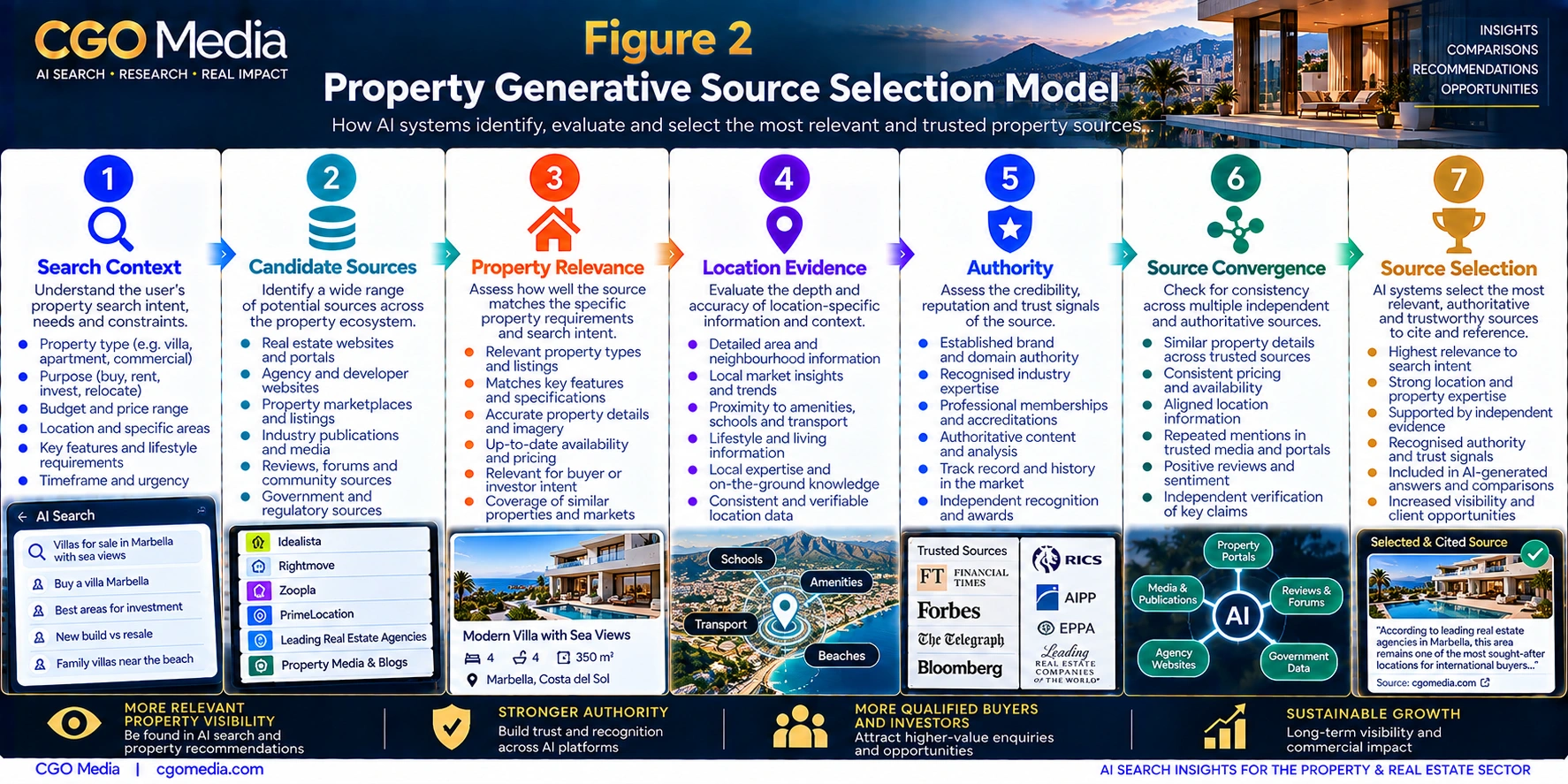
- Country
57. Location Relationships Should Be Hierarchical
A useful property relationship is:
Property → Development / Urbanisation → Neighbourhood → Town / City → Region → Country
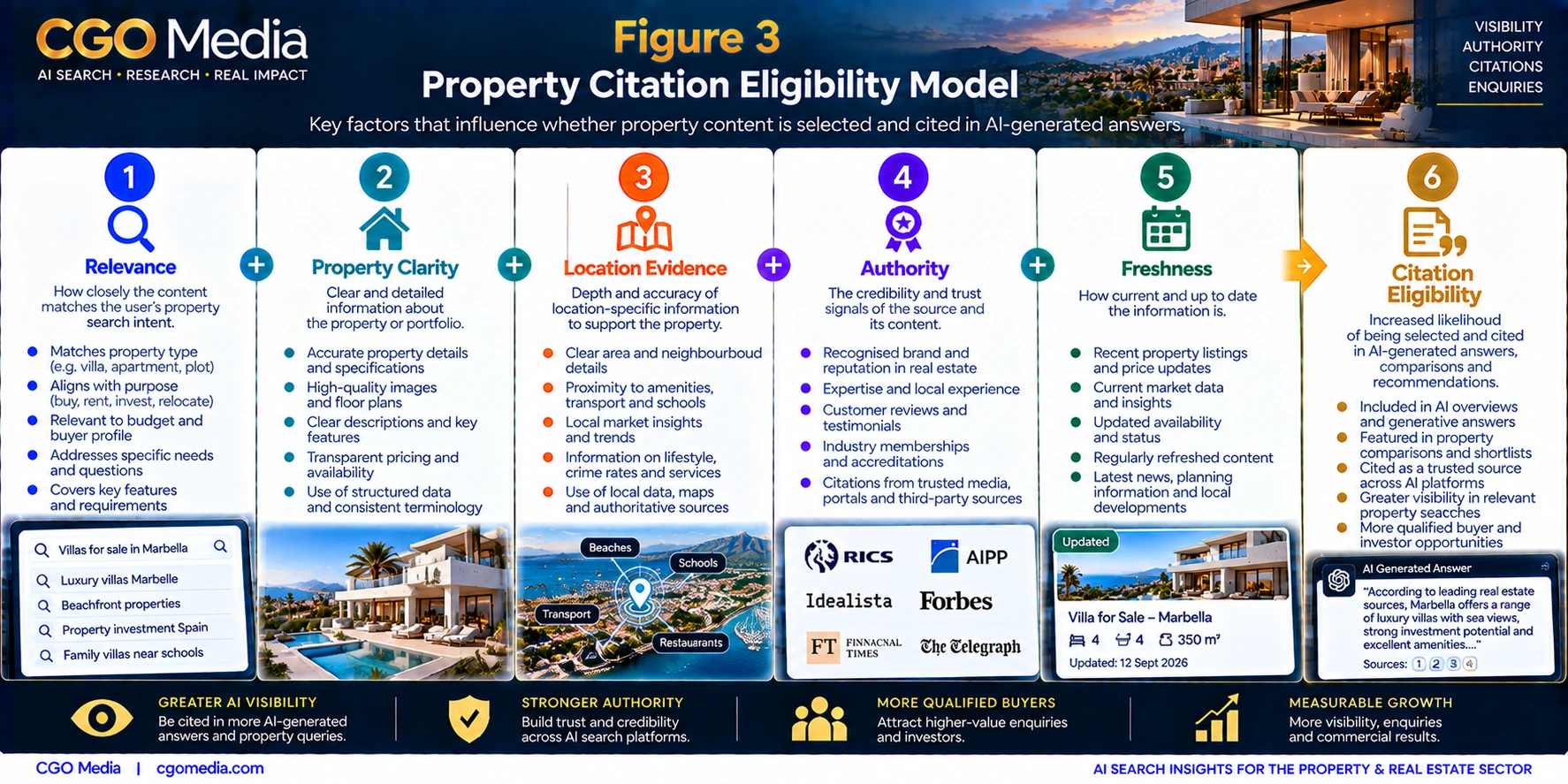
58. Location Ambiguity Can Reduce Recommendation Quality
Similar or loosely defined place names can create uncertainty around the actual market being discussed.
59. Location Information Should therefore Be Specific
Where relevant, information can clarify:
- Municipality
- Neighbourhood
- Nearby destinations
- Travel times
- Transport links
60. Location Evidence Should Support Location Claims
Assertions about a market should be supported by appropriate evidence where the information materially affects user decisions.
61. Location Evidence Can Include
- Official local information
- Transport information
- Statistical information
- Mapping information
- Property-market research
62. Property Search Intent Can Be Highly Location-Specific
Examples can include:
- Villas in Marbella
- Apartments in Mijas Costa
- Golf property on the Costa del Sol
- New developments in Málaga
63. Location Fit Is a Core Recommendation Factor
A strong property can remain unsuitable where the location does not match the user’s requirements.
64. Buyer Location Needs Can Include
- Commute
- Schools
- Beaches
- Golf
- Transport
- Healthcare
65. Investor Location Needs Can Differ
Investment-oriented users may prioritise:
- Rental demand
- Capital-growth potential
- Tourism demand
- Liquidity
- Infrastructure
66. Retiree Location Needs Can Differ Again
Relevant factors can include:
- Healthcare
- Climate
- Accessibility
- Community
- Services
67. Family Location Needs Can Differ
Families may place greater emphasis on:
- Schools
- Space
- Safety
- Transport
- Community facilities
68. Location Fit Should therefore Be Scenario-Specific
A universal ranking of areas can be misleading where users have materially different requirements.
69. Property Fit Is Also Scenario-Specific
Different users may prioritise:
- Price
- Space
- Amenities
- Condition
- Rental potential
- Accessibility
70. A Useful Buyer-to-Property Relationship Is
Buyer Need → Location Criteria → Property Criteria → Available Properties → Property Fit
71. Seller-to-Agent Fit Is Also Scenario-Specific
A seller may require a provider with expertise in:
- Local residential property
- Luxury property
- International marketing
- New developments
- Commercial property
72. A Useful Seller-to-Provider Relationship Is
Seller Need → Property Context → Market → Provider Specialism → Trust Evidence → Agent Fit
73. Property GEO Requires Commercial Freshness
Property information can change rapidly.
74. High-Volatility Property Information Can Include
- Price
- Availability
- Reservation status
- Completion status
75. Lower-Volatility Property Information Can Include
- Property type
- Location
- Development structure
- Core specifications
76. Availability Should Be Current
A property should not continue to be represented as available after it becomes:
- Reserved
- Sold
- Withdrawn
- Off market
77. Price Should Be Current
Properties can be:
- Reduced
- Increased
- Repriced
- Withdrawn
78. Development Status Should Be Current
Projects can move through:
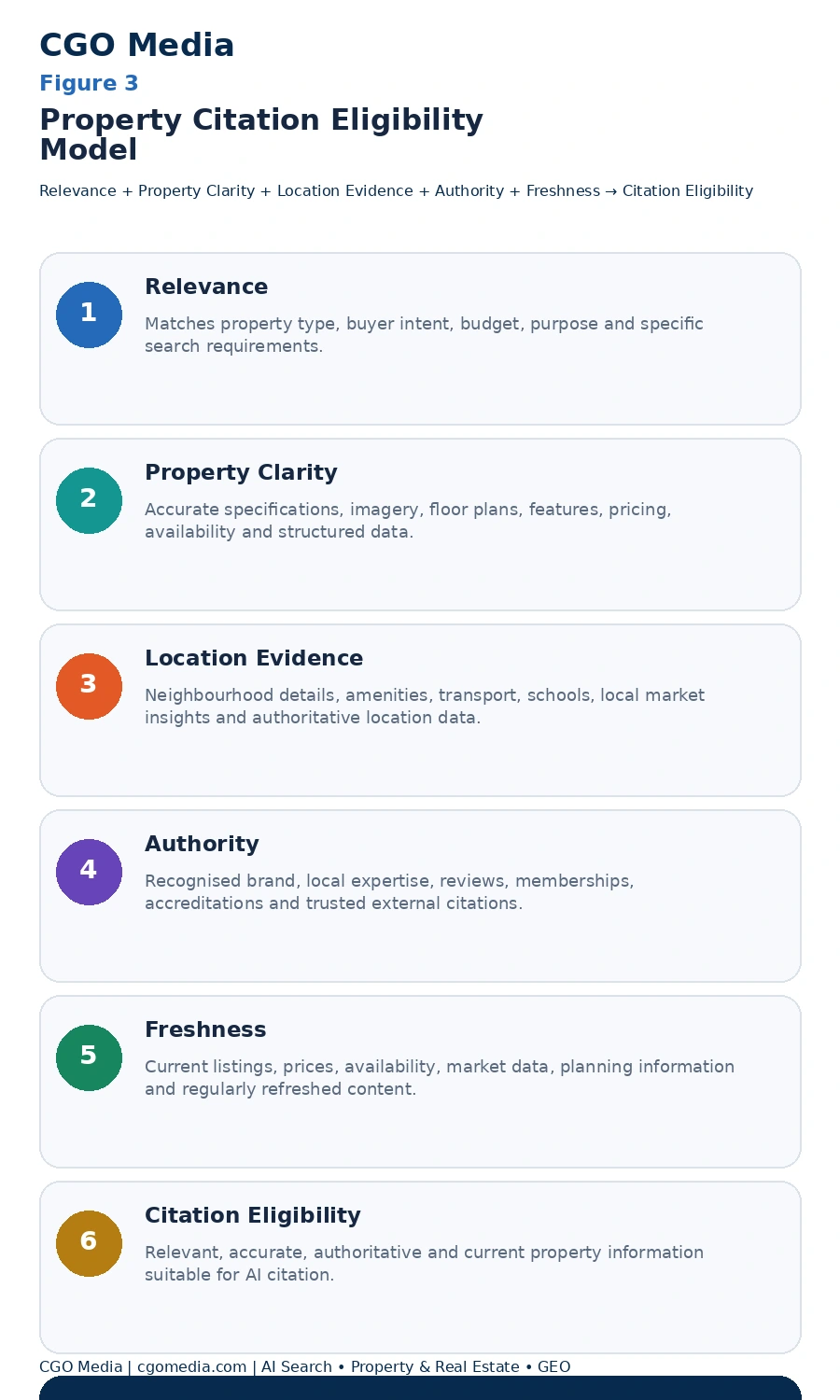
- Planning
- Launch
- Construction
- Completion
- Sold out
79. Freshness Requirements Should Reflect Risk
A useful relationship is:
Information Volatility + User Impact + Commercial Importance → Required Freshness
80. GEO Requires Source Authority
Generative property answers can potentially draw from several source types.
81. First-Party Property Sources Can Include
- Estate agency websites
- Developer websites
- Property listings
- Market reports
- Location guides
82. Third-Party Property Sources Can Include
- Property portals
- News publishers
- Market research organisations
- Review platforms
- Professional directories
83. Official Sources Can Support Location Evidence
Relevant sources can include:
- Government publications
- Land registries
- Municipal sources
- Transport authorities
- Statistical agencies
84. Source Authority Should Be Claim-Specific
The most useful source for one type of property information may be inappropriate for another.
85. Listing Sources Can Be Strong for Property Facts
Examples can include:
- Price
- Bedrooms
- Property dimensions
- Features
- Availability
86. Official Sources Can Be Stronger for Public Information
Examples can include:
- Transport
- Planning
- Infrastructure
- Public services
- Population
87. Specialist Research Can Be Stronger for Market Evidence
Relevant evidence can include:
- Price trends
- Transaction volume
- Rental demand
- Supply
- Buyer behaviour
88. External Sources Can Be Stronger for Professional Validation
Relevant evidence can include:
- Reviews
- Industry recognition
- Professional credentials
- Press coverage
- Independent references
89. Property GEO therefore Requires Source Fitness
A useful relationship is:
Claim Type → Evidence Requirement → Appropriate Source → Confidence
90. Property Truth and Market Truth Are Not Identical
A listing may accurately describe one property while providing limited evidence about the wider market.
91. Location Truth and Provider Trust Are Not Identical
A location guide may provide useful geographic information without proving that the publisher is the most suitable estate agent.
92. Source Roles Should therefore Be Distinguished
A useful model is:
Property Truth + Location Truth + Market Evidence + Professional Evidence → Source Confidence
93. Property GEO Requires Source Convergence
Confidence can increase where independent sources materially agree.
94. Source Convergence Can Occur Around Property Information
Several relevant sources may agree on:
- Price
- Property type
- Location
- Development
- Status
95. Source Convergence Can Occur Around Location Information
Several sources may support:
- Transport connections
- Schools
- Healthcare
- Infrastructure
- Local amenities
96. Source Convergence Can Occur Around Professional Trust
Evidence can include:
- Organisation profile
- Agent profile
- Reviews
- Media references
- Professional recognition
97. Source Conflict Should Reduce Confidence
Conflicting information can create uncertainty.
98. Property Source Conflicts Can Include
- Different prices
- Different availability
- Different dimensions
- Different features
- Different reference numbers
99. Development Source Conflicts Can Include
- Different completion dates
- Different status
- Different unit availability
- Different developer attribution
100. Professional Source Conflicts Can Include
- Different offices
- Different roles
- Old staff profiles
- Incorrect specialisms
101. GEO Should Diagnose Source Conflict
The organisation should determine whether a conflicting source is:
- Outdated
- Incorrect
- Incomplete
- Describing another entity
102. Property Duplication Creates Additional Complexity
The same underlying property can appear on multiple:
- Agency websites
- Broker websites
- Portals
- Aggregators
103. Duplicate Listings Can Contain Different Information
Differences may appear in:
- Price
- Description
- Availability
- Features
- Property reference
104. Property Entity Resolution Is therefore Important
A generative system should ideally be able to recognise where several listings refer to the same underlying property.
105. Property Identifiers Can Support Entity Resolution
Useful identifiers can include:
- Property ID
- Listing reference
- Development reference
- Address where appropriate
106. Agent Entity Resolution Is Also Important
An individual agent can appear across:
- Company websites
- Property portals
- Directories
- Social profiles
- Media
107. Developer Entity Resolution Is Also Important
The same developer can appear through:
- Corporate website
- Development websites
- Planning sources
- Property portals
- Media
108. Entity Clarity Supports Source Selection
Sources become more useful when the underlying property, professional or organisation can be identified reliably.
109. Entity Clarity Supports Citation Accuracy
Clear identities reduce the risk of attributing information to the wrong property or provider.
110. Entity Clarity Supports Comparison Quality
Comparison becomes more meaningful when systems can distinguish genuinely different options.
111. Entity Clarity Supports Recommendation Quality
Recommendation becomes stronger where:
- The entity is clear
- The user need is clear
- The evidence is relevant
- The information is current
112. Property GEO Should therefore Be Treated as an Evidence System
It is not simply a prompt-optimisation exercise.
113. The Core Property GEO Inputs Are
- Entity clarity
- Property clarity
- Location clarity
- Trust evidence
- Source authority
- Freshness
- User fit
114. The Core Property GEO Outcomes Are
- Source visibility
- Citation visibility
- Accurate representation
- Comparison visibility
- Recommendation visibility
115. Buyer Fit Should Remain Central
A property can be highly visible and well evidenced but still be inappropriate for the user.
116. Provider Fit Should Remain Central
A well-known estate agency can be authoritative without being the best contextual match for every market, property type or transaction.
117. Recommendation Confidence Should therefore Be Conditional
A useful relationship is:
Clear Entity + Clear Property + Clear Location + Strong Evidence + Buyer / Seller Fit → Recommendation Confidence
118. The First Property GEO Principle
Property and real estate organisations should optimise for qualified generative visibility rather than raw mention volume, recognising that relevant presence, accurate representation, current information and appropriate recommendation are more strategically important than appearing indiscriminately across AI-generated answers.
119. The Second Property GEO Principle
Property GEO should be built around explicit relationships between organisations, offices, professionals, developers, developments, properties and locations so generative systems have clearer evidence for identifying entities, resolving duplicated information and interpreting genuine areas of expertise.
120. The Third Property GEO Principle
Property information, location evidence, professional trust and market evidence should be supported by sources appropriate to the specific claim being made, recognising that source authority is contextual and that no single source should be expected to provide every form of property truth.
121. The Fourth Property GEO Principle
Property GEO should treat freshness and source convergence as central trust requirements because volatile information such as price, availability, development status and professional roles can materially affect property discovery, comparison and recommendation when outdated or conflicting evidence remains visible.
122. The Property & Real Estate GEO Ecosystem
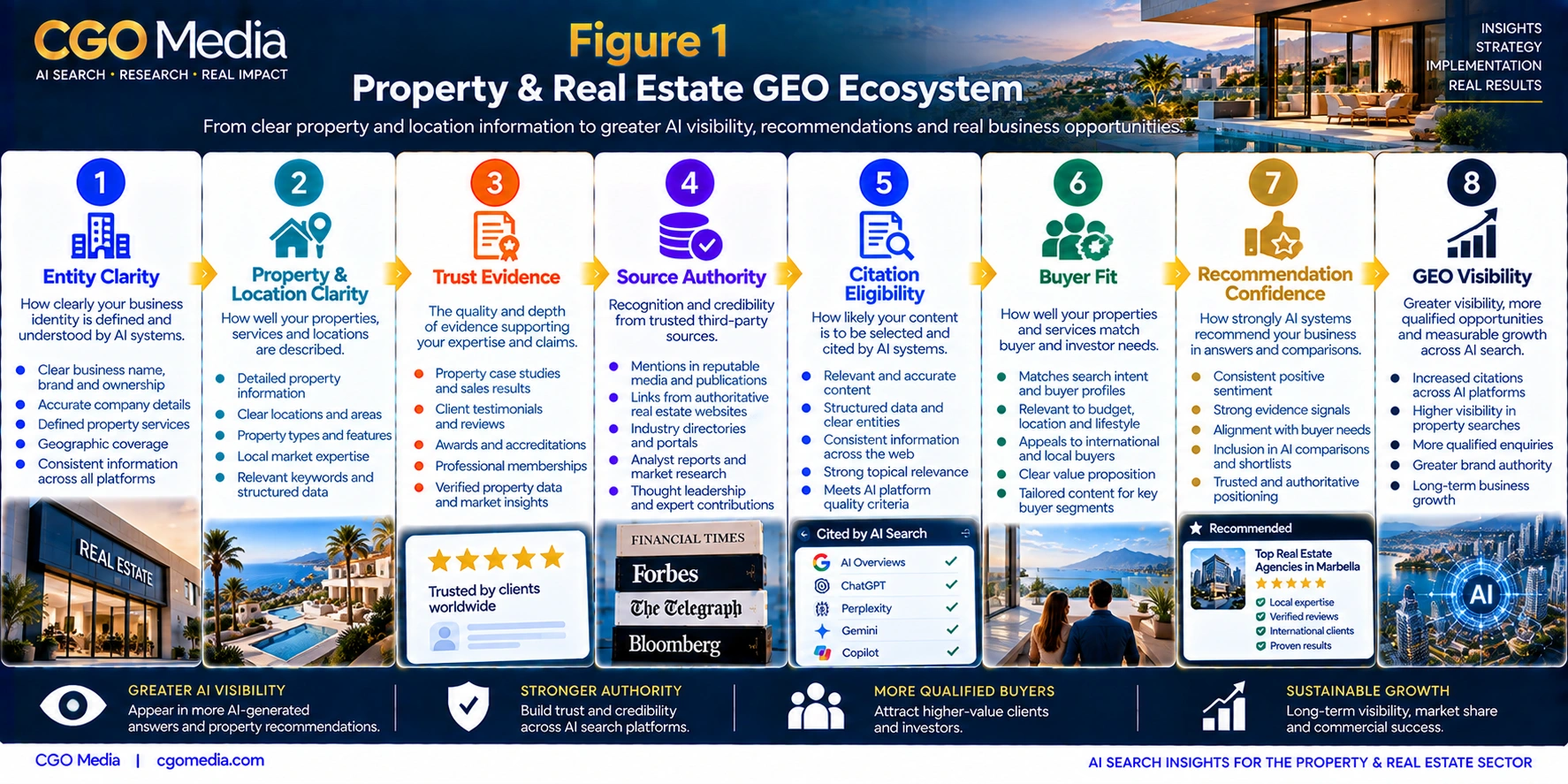
The complete initial GEO relationship can be summarised as:
Entity Clarity → Property & Location Clarity → Trust Evidence → Source Authority → Citation Eligibility → Buyer Fit → Recommendation Confidence → GEO Visibility
123. The Strategic Implication
Property and real estate organisations should treat Generative Engine Optimisation as a structured property-information, location-authority and recommendation system rather than as an isolated AI-content tactic. The strongest foundations are created when organisations, professionals, developments, properties and locations are clearly identifiable; important commercial information is current; relevant claims are supported by appropriate owned and independent evidence; and buyer, seller, investor or tenant fit remains central to comparison and recommendation. This creates the evidence environment required for the next stage of GEO: understanding how generative systems may select among competing property, location, market and professional sources.
124. Property GEO Depends on Source Selection
Generative property answers can combine information from multiple source types rather than relying on one website or one ranking position.
125. Source Selection Is therefore a Core GEO Question
The relevant question becomes:
Which sources are sufficiently appropriate, current and credible to support a particular property, location, market or provider claim?
126. Not All Sources Serve the Same Function
Property information environments contain sources designed for different purposes.
127. Property Fact Sources
These can include:
- Estate agency listings
- Developer listings
- Property portals
- Property-management systems
128. Location Information Sources
These can include:
- Local authority websites
- Transport sources
- Education sources
- Mapping platforms
- Local guides
129. Market Evidence Sources
These can include:
- Property research organisations
- Government statistics
- Land registries
- Market reports
- Original brokerage research
130. Professional Trust Sources
These can include:
- Review platforms
- Professional associations
- Media
- Trade publications
- Independent directories
131. Source Fitness Should therefore Be Claim-Specific
A source should be evaluated according to whether it is appropriate for the type of information being supported.
132. A Useful Source Selection Relationship Is
Claim Type → Information Need → Source Fitness → Evidence Strength → Selection Confidence
133. Property Price Requires a Suitable Source
Current pricing is best supported by a source directly connected with the active property representation.
134. Property Availability Requires a Suitable Source
Availability is highly volatile and should ideally be supported by a current operational source.
135. Property Features Require a Suitable Source
Detailed specifications can be supported by:
- Listing data
- Developer documentation
- Verified property records
136. Market Trend Claims Require Different Sources
A single active listing does not provide sufficient evidence for a wider market trend.
137. Market Trend Sources Can Include
- Transaction data
- Inventory studies
- Price indices
- Rental data
- Longitudinal research
138. Provider Trust Claims Require Different Sources Again
An estate agency describing itself as trusted does not constitute independent validation.
139. Provider Trust Can Be Supported by
- Reviews
- Professional recognition
- Media references
- Research citations
- Industry evidence
140. Source Fitness Is Therefore More Important Than Source Uniformity
A strong generative answer may rely on different source types for different parts of the same recommendation.
141. One Source Can Be Strong for Property Facts but Weak for Market Context
A listing can describe:
- Price
- Bedrooms
- Features
- Location
while providing limited evidence about:
- Market direction
- Investment outlook
- Provider reputation
142. One Source Can Be Strong for Market Context but Weak for Active Inventory
A research report can explain market trends without providing current property availability.
143. One Source Can Be Strong for Provider Reputation but Weak for Property Facts
A review platform can support service evidence without confirming the current price or status of a listing.
144. Source Specialisation Should therefore Be Expected
The strongest evidence environment combines complementary sources rather than forcing one source to support every decision layer.
145. Source Authority Is the First Source Selection Dimension
Authority relates to whether a source has credible expertise or responsibility for the information it provides.
146. First-Party Authority
First-party sources can be authoritative for information under the organisation’s direct control.
147. First-Party Authority Can Include
- Current listings
- Agent biographies
- Office information
- Service descriptions
- Original research
148. First-Party Authority Has Limitations
Owned claims can require independent validation where trust or comparative quality is involved.
149. Official Authority
Public or official sources can be particularly useful for:
- Planning
- Infrastructure
- Transport
- Population
- Public statistics
150. Specialist Authority
Specialist organisations can be useful for:
- Market analysis
- Property trends
- Investment research
- Sector commentary
151. Independent Authority
External sources can help validate:
- Provider reputation
- Professional expertise
- Research quality
- Market recognition
152. Source Authority Should Be Topical
A generally respected source may still be weak for a claim outside its area of expertise.
153. Topical Authority Can Be Expressed as
Relevant Expertise + Appropriate Evidence + Current Information → Topical Source Authority
154. Freshness Is the Second Source Selection Dimension
Property search contains a high proportion of time-sensitive information.
155. Highly Volatile Information Requires Strong Freshness
Examples can include:
- Price
- Availability
- Reservation status
- Construction stage
156. Moderately Volatile Information Also Requires Review
Examples can include:
- Market conditions
- Rental demand
- Mortgage environment
- Local development activity
157. Stable Information Can Have Longer Useful Lifecycles
Examples can include:
- Geographic hierarchy
- Building type
- Core property dimensions
- Established transport infrastructure
158. Source Freshness Should Match Claim Volatility
A useful relationship is:
Claim Volatility → Required Freshness → Suitable Source
159. An Old Source Can Remain Valuable for Stable Information
Historical information should not automatically be rejected where the underlying fact remains unchanged.
160. An Old Source Can Be Weak for Volatile Information
A market report from several years ago may provide useful history while being unsuitable for a current price or demand claim.
161. Source Accuracy Is the Third Source Selection Dimension
A source should contain materially correct information.
162. Property Accuracy Should Be Auditable
Important facts can include:
- Price
- Status
- Location
- Dimensions
- Features
163. Professional Accuracy Should Be Auditable
Important facts can include:
- Role
- Office
- Specialism
- Languages
- Markets served
164. Development Accuracy Should Be Auditable
Important facts can include:
- Developer
- Phase
- Completion status
- Unit types
- Availability
165. Source Consistency Is the Fourth Source Selection Dimension
Strong evidence environments reduce unnecessary contradiction.
166. Consistency Does Not Mean All Sources Must Be Identical
Different sources may provide different levels of detail while still agreeing on core facts.
167. Core Fact Consistency Is Especially Important
Relevant fields can include:
- Price
- Location
- Status
- Provider identity
- Development identity
168. Source Conflict Should Trigger Validation
Where important sources disagree, the organisation should determine which information is current and correct.
169. Independence Is the Fifth Source Selection Dimension
Independent sources can provide stronger validation for claims that would otherwise be self-asserted.
170. Independence Is Especially Important for Trust Claims
Examples can include:
- Best agent
- Trusted provider
- Market leader
- Highly experienced specialist
171. Self-Description Alone Should Not Be Treated as Independent Validation
Owned claims should be distinguished from external evidence.
172. Independent Validation Can Include
- Reviews
- Media coverage
- Trade recognition
- Research citations
- Professional associations
173. Independence Can Be Partial
Some platforms contain information submitted directly by the business alongside independent user or editorial content.
174. Source Provenance Is therefore Important
The organisation should understand where information originated.
175. Source Provenance Can Help Distinguish
- Owned claims
- Platform-generated information
- User-generated reviews
- Editorial commentary
- Official data
176. Corroboration Is the Sixth Source Selection Dimension
Confidence can increase where independent evidence materially converges.
177. Property Corroboration Can Include
Agency Listing + Portal Listing + Development Information → Stronger Property Confidence
178. Location Corroboration Can Include
Local Authority Information + Transport Evidence + Market Research → Stronger Location Confidence
179. Provider Corroboration Can Include
Organisation Profile + Reviews + Media + Professional Evidence → Stronger Provider Confidence
180. Research Corroboration Can Include
Original Study + External Citation + Independent Data Comparison → Stronger Research Confidence
181. Corroboration Should Focus on Independent Evidence Where Possible
Repeated syndication of one original claim does not necessarily create several independent confirmations.
182. Syndicated Property Information Can Create Apparent Convergence
The same listing may be copied across:
- Portals
- Partner sites
- Aggregators
- Broker networks
183. Apparent Convergence Should Be Distinguished from True Corroboration
Several pages repeating one source are not equivalent to several independently verified sources.
184. Source Diversity Is the Seventh Source Selection Dimension
A balanced answer can require evidence from several source categories.
185. Source Diversity Can Reduce Over-Reliance on One Information Environment
For example, a property recommendation may benefit from combining:
- Listing evidence
- Location evidence
- Market evidence
- Provider evidence
186. Source Diversity Should Remain Relevant
Adding unrelated sources does not automatically improve confidence.
187. A Useful Source Diversity Model Is
Relevant Source Variety + Independent Evidence + Claim Fit → Stronger Evidence Environment
188. Entity Clarity Is the Eighth Source Selection Dimension
A source is less useful if it is unclear which property, development, office or professional it refers to.
189. Property Entity Clarity Can Depend on
- Stable property reference
- Address
- Development relationship
- Location
- Distinctive characteristics
190. Professional Entity Clarity Can Depend on
- Name
- Organisation
- Office
- Role
- Specialism
191. Development Entity Clarity Can Depend on
- Development name
- Developer
- Location
- Phase
- Unit types
192. Entity Ambiguity Can Reduce Source Selection Confidence
A system may avoid or misinterpret sources where it cannot resolve the underlying entity clearly.
193. Accessibility Is the Ninth Source Selection Dimension
Useful evidence should be technically available enough to be discovered and interpreted.
194. Accessibility Can Be Weakened by
- Blocked crawling
- Broken pages
- Heavy rendering dependency
- Poor internal linking
- Unstable URLs
195. Important Evidence Should Not Depend Entirely on Hidden Interfaces
Critical information should be represented in ways that are accessible to both users and discovery systems.
196. Extractability Is the Tenth Source Selection Dimension
Important facts should be sufficiently explicit to interpret.
197. Property Facts Should Be Explicit
Users and systems should not need to infer:
- Price
- Bedrooms
- Bathrooms
- Location
- Status
198. Professional Expertise Should Be Explicit
Agent profiles should clearly identify:
- Markets served
- Property specialisms
- Languages
- Role
199. Research Findings Should Be Explicit
Important conclusions should be distinguishable from surrounding promotional material.
200. Source Transparency Is the Eleventh Source Selection Dimension
Evidence becomes more useful where users can understand who produced it and when.
201. Useful Source Transparency Can Include
- Author
- Publisher
- Publication date
- Methodology
- Update date
202. Transparency Is Especially Important for Research
Market reports should make clear:
- Data source
- Sample
- Time period
- Geographic scope
- Limitations
203. Transparency Is Also Important for Property Information
Users should be able to understand whether information comes from:
- Agent
- Developer
- Owner
- Portal
- Third party
204. Commercial Intent Does Not Automatically Invalidate a Source
Commercial sources can provide accurate and highly useful property information.
205. Commercial Claims Should Still Be Evaluated in Context
Promotional language should be distinguished from factual evidence.
206. The Best Source Can Differ by Query Stage
Discovery, evaluation, validation and recommendation can require different source combinations.
207. Early Discovery Can Rely More Heavily on Broad Market Sources
Useful evidence can include:
- Area guides
- Market research
- Property portals
- Official sources
208. Property Evaluation Can Rely More Heavily on Listing Evidence
Useful sources can include:
- Listing page
- Developer information
- Floorplans
- Property media
209. Provider Validation Can Rely More Heavily on Independent Evidence
Useful sources can include:
- Reviews
- Media
- Trade sources
- Professional profiles
210. Recommendation Can Require All Three
A strong recommendation may depend on:
Property Evidence + Market Context + Provider Trust
211. Source Selection Can Be Multi-Stage
A useful conceptual sequence is:
Candidate Sources → Relevance Filtering → Authority Assessment → Freshness Check → Corroboration → Synthesis
212. Candidate Source Generation
The system first requires enough potential evidence to evaluate.
213. Relevance Filtering
Sources unrelated to the actual user scenario should carry less decision value.
214. Authority Assessment
The source should be appropriate to the information need.
215. Freshness Check
Time-sensitive claims require sufficiently current evidence.
216. Corroboration Check
Important claims can be compared against other relevant evidence.
217. Synthesis
Relevant evidence can then be combined into a response, comparison or recommendation.
218. Source Selection Confidence Should Be Conditional
Confidence should vary according to:
- Claim importance
- Source quality
- Freshness
- Agreement
- Entity clarity
219. High-Risk Property Claims Require Higher Evidence Thresholds
A useful relationship is:
Financial Impact + Decision Importance + Information Volatility → Required Source Confidence
220. High-Risk Claims Can Include
- Current price
- Availability
- Development completion
- Investment returns
- Legal status
221. Lower-Risk Descriptive Claims May Require Less Evidence
Examples can include:
- General architectural style
- Long-established neighbourhood characteristics
- Broad property category
222. Property GEO Should Avoid False Precision
A source should not support a more precise conclusion than its evidence justifies.
223. Investment Claims Require Particular Caution
Forecasts around:
- Yield
- Capital growth
- Occupancy
- Future demand
should be distinguished from observed historical evidence.
224. Market Forecasts Should Be Labelled as Forecasts
Future expectations are not equivalent to established facts.
225. Professional Claims Also Require Appropriate Evidence
Claims such as:
- Best agent
- Leading agency
- Top developer
require clearly defined criteria if used comparatively.
226. Broad Superlatives Are Weak Evidence
Generative optimisation should favour specific, supportable evidence over unsupported promotional claims.
227. Specific Expertise Is Easier to Validate
For example:
- Specialises in Marbella luxury villas
- Works with international buyers
- Focuses on new developments
- Handles commercial property
228. Source Selection Can Reinforce Specialist Authority
Repeated relevant evidence can strengthen the association between a provider and a genuine specialist area.
229. Specialist Authority Should Be Evidence-Led
Relevant signals can include:
- Current inventory
- Agent expertise
- Research
- Reviews
- External recognition
230. Source Selection Should Reflect Geographic Relevance
Property markets are inherently local.
231. Local Source Authority Can Include
- Local offices
- Local agents
- Local listings
- Local research
- Local media
232. National Authority Does Not Automatically Equal Local Authority
A nationally prominent brand may still possess limited evidence within a specific neighbourhood or specialist market.
233. Local Specialist Sources Can therefore Be Highly Relevant
Smaller organisations may contribute stronger evidence for specific local questions.
234. Source Selection Should Reflect User Type
Different users require different evidence.
235. International Buyers Can Require Different Sources
Useful evidence can include:
- Cross-border buying guides
- Legal information
- Currency information
- Local provider evidence
236. Investors Can Require Different Sources
Useful evidence can include:
- Rental data
- Market analysis
- Yield methodology
- Operating-cost information
237. Sellers Can Require Different Sources
Useful evidence can include:
- Local market performance
- Agent expertise
- Review evidence
- Marketing capability
238. Tenants Can Require Different Sources
Useful evidence can include:
- Current availability
- Lease conditions
- Location information
- Property condition
239. Source Selection Is therefore User-Context Dependent
There is no universal source set for every property question.
240. Source Selection Should Be Monitored Indirectly
External organisations cannot inspect proprietary internal source-selection systems in full.
241. Observable Signals Can Still Be Studied
Where available, organisations can record:
- Citations
- Linked sources
- Quoted evidence
- Repeated source domains
- Recommendation rationale
242. Source Monitoring Should Be Longitudinal
One generated answer provides limited evidence about persistent source behaviour.
243. Source Monitoring Can Use Query Families
Useful families can include:
- Property discovery
- Location discovery
- Agent discovery
- Developer discovery
- Investment research
244. Source Monitoring Should Record Change
The organisation can observe whether new:
- Sources
- Domains
- Research assets
- Provider profiles
begin appearing over time.
245. Source Monitoring Should Not Become Source Manipulation
The objective is to understand evidence environments and improve genuine information quality.
246. Property GEO Source Strategy Should Focus on Becoming Useful
A source becomes more competitive when it provides:
- Clear information
- Current information
- Unique evidence
- Relevant expertise
- Transparent provenance
247. Unique Evidence Can Strengthen Source Differentiation
Examples can include:
- Original local market research
- Buyer surveys
- Seller surveys
- Development analysis
- Inventory studies
248. Original Research Can Create Citation Opportunities
Useful research can become relevant to:
- Journalists
- Researchers
- Market analysts
- AI-assisted answers
249. Strong Source Strategy Should Combine Stable and Volatile Evidence
Stable assets can include:
- Agent profiles
- Location architecture
- Research methodology
250. Volatile Assets Can Include
- Listings
- Prices
- Availability
- Market reports
251. Stable and Volatile Evidence Require Different Governance
The same update process should not be applied to every information type.
252. Source Governance Should therefore Be Layered
A useful model is:
Stable Entity Governance + Volatile Property Governance + Periodic Market Governance + External Authority Monitoring
253. Source Selection Can Reward Clarity
Information that is explicit and well structured is easier to evaluate than ambiguous or contradictory material.
254. Source Selection Can Reward Specificity
Specific evidence is often more useful than broad promotional claims.
255. Source Selection Can Reward Freshness
Current information is particularly important in volatile property contexts.
256. Source Selection Can Reward Independent Validation
External evidence can increase confidence around provider and professional claims.
257. Source Selection Can Reward Originality
Original research can create information unavailable elsewhere.
258. Source Selection Can Reward Local Depth
Detailed local expertise can be valuable for geographically specific property questions.
259. The Fifth Property GEO Principle
Property GEO should treat source selection as a claim-specific evidence problem, recognising that property facts, market conditions, location information and provider trust require different source types and that no single source should be expected to provide universal authority.
260. The Sixth Property GEO Principle
Source authority should be evaluated according to topical relevance, freshness, accuracy, independence, entity clarity and corroboration, with higher evidence thresholds applied to volatile or financially consequential property claims.
261. The Seventh Property GEO Principle
Property organisations should distinguish genuine corroboration from repeated syndication, recognising that several pages reproducing the same underlying listing or claim do not constitute several independent confirmations.
262. The Eighth Property GEO Principle
The strongest generative source strategy is to become a clearer, more useful and more distinctive source of accurate property, location, professional or market evidence rather than attempting to optimise mechanically for unspecified proprietary source-selection systems.
263. The Property Generative Source Selection Model
The complete source-selection relationship can be summarised as:
Claim Relevance + Source Fitness + Topical Authority + Freshness + Accuracy + Independence + Corroboration + Entity Clarity → Source Selection Confidence
264. The Strategic Implication
Property organisations seeking greater generative visibility should focus on the fitness and quality of the evidence they contribute to the wider information ecosystem. Current listing data, deep local knowledge, transparent market research, clear professional identities and credible external validation serve different but complementary roles. The strongest GEO source strategy therefore builds a portfolio of relevant evidence that is technically accessible, appropriately current, independently reinforced where necessary and sufficiently explicit for both users and generative systems to interpret.
265. Property GEO Should Distinguish Source Visibility from Citation Eligibility
A source can contribute useful information to a generative answer without being surfaced explicitly as a citation.
266. Citation Eligibility Is Therefore a More Selective State
The source must be suitable not only for retrieval or synthesis, but also for visible attribution within the context of the claim being supported.
267. A Useful Citation Eligibility Relationship Is
Claim Fit + Source Clarity + Authority + Freshness + Verifiability + Attribution Readiness → Citation Eligibility
268. Claim Fit Is the First Citation Dimension
A cited source should be directly relevant to the information it supports.
269. Weak Claim Fit Can Reduce Citation Value
A source may be credible overall but unsuitable for a specific claim.
270. Property Price Citation
Current pricing should generally be supported by a current property or developer source rather than a broad market article.
271. Property Availability Citation
Availability is volatile and requires highly current evidence.
272. Market Trend Citation
Wider claims about pricing, demand or transaction behaviour require broader market evidence.
273. Provider Reputation Citation
Trust claims are stronger when supported by independent sources rather than self-description alone.
274. Citation Clarity Is the Second Citation Dimension
The relevant information should be identifiable enough for users to understand what the source is supporting.
275. Clear Property Citation Can Include
- Specific property
- Specific listing
- Current price
- Current status
- Source publisher
276. Clear Market Citation Can Include
- Study title
- Publisher
- Date
- Geographic scope
- Relevant finding
277. Clear Professional Citation Can Include
- Named professional
- Organisation
- Role
- Relevant expertise
- External evidence
278. Citation Ambiguity Can Reduce Usefulness
A source becomes less valuable where it is unclear:
- Who produced it
- What entity it refers to
- When it was published
- Which claim it supports
279. Authority Is the Third Citation Dimension
A citation should come from a source with reasonable authority for the claim being supported.
280. Citation Authority Is Contextual
Different sources can be stronger for:
- Property facts
- Market statistics
- Location information
- Professional validation
281. Official Sources Can Be Strong for Public Facts
Examples can include:
- Planning
- Transport
- Population
- Infrastructure
- Public statistics
282. First-Party Property Sources Can Be Strong for Active Listing Facts
Relevant claims can include:
- Price
- Availability
- Features
- Property type
- Development relationship
283. Independent Sources Can Be Strong for Reputation Claims
Relevant evidence can include:
- Reviews
- Editorial coverage
- Professional recognition
- Research citations
284. Freshness Is the Fourth Citation Dimension
Cited evidence should be current enough for the type of claim being made.
285. Property Citation Freshness Should Be High
Price and status can change rapidly.
286. Market Citation Freshness Can Vary
A historic study can remain relevant for long-term context while being unsuitable for a current-market claim.
287. Professional Citation Freshness Can Also Vary
An old media reference may still demonstrate historic expertise but should not be used to imply a current role that has changed.
288. Citation Freshness Should Match Claim Volatility
A useful relationship is:
Claim Volatility → Required Citation Freshness
289. Verifiability Is the Fifth Citation Dimension
A source should allow a user to inspect or understand the underlying evidence.
290. Property Verifiability Can Include
- Visible listing details
- Property reference
- Development information
- Current status
291. Research Verifiability Can Include
- Methodology
- Data source
- Sample
- Time period
- Limitations
292. Professional Verifiability Can Include
- Named author
- Role
- Organisation
- Relevant biography
- Supporting evidence
293. Attribution Readiness Is the Sixth Citation Dimension
A source is easier to cite where authorship, publisher and publication context are explicit.
294. Attribution-Ready Research Can Include
- Title
- Author
- Publisher
- Publication date
- Permanent URL
295. Attribution-Ready Market Commentary Can Include
- Named professional
- Role
- Organisation
- Date
- Topic
296. Citation Eligibility Can Be Weakened by Anonymous Content
Content without clear authorship or publishing context may provide weaker attribution signals.
297. Citation Eligibility Can Be Weakened by Unclear Publication Dates
Users and systems may struggle to determine whether information remains current.
298. Citation Eligibility Can Be Weakened by Unsupported Statistics
Numbers without clear methodology or source provenance should be treated cautiously.
299. Citation Eligibility Can Be Weakened by Promotional Superlatives
Claims such as:
- Best estate agent
- Number-one property company
- Leading developer
require clear supporting criteria if they are to function as evidential claims.
300. Citation-Ready Property Research Should Separate Evidence from Promotion
A report becomes more useful where factual findings are clearly distinguishable from commercial messaging.
301. Original Research Can Increase Citation Eligibility
Unique evidence can create a reason for other publishers or systems to reference the source directly.
302. Original Property Research Can Include
- Price studies
- Inventory studies
- Buyer surveys
- Seller surveys
- Development pipeline analysis
- Rental-market analysis
303. Research Should Have a Defined Question
The study should make clear what it is investigating.
304. Research Should Define Its Data
Readers should understand:
- Where the data came from
- What period it covers
- Which market it represents
- How it was analysed
305. Research Should Define Its Limitations
Citation confidence improves when the boundaries of the study are explicit.
306. Research Should Avoid Over-Generalisation
Evidence from one city, buyer segment or period should not automatically be presented as representative of every property market.
307. Figures and Tables Can Improve Citation Usability
Well-labelled visual evidence can make important findings easier to identify and reference.
308. Figure Captions Should Explain the Evidence
A caption should clarify what the figure demonstrates rather than merely repeat the title.
309. Citation-Ready Figures Should Have Stable Context
Important information can include:
- Figure title
- Data period
- Source
- Methodological note
310. Research Pages Should Be Technically Accessible
Citation value is weakened where important evidence is difficult to crawl, render or access.
311. Stable URLs Support Citation Persistence
Frequent URL changes can weaken long-term references.
312. Permanent Research Architecture Can Support Durable Citations
Research should remain accessible after initial publication wherever practical.
313. Updated Research Should Preserve Version Clarity
Where findings change materially, the publication should indicate:
- Updated date
- Version
- Changed data period
- Material methodological changes
314. Citation Eligibility Can Also Apply to Location Guides
A high-quality location guide can provide useful evidence if it is factual, current and appropriately sourced.
315. Citation-Ready Location Content Can Include
- Transport
- Schools
- Infrastructure
- Market context
- Development information
316. Location Claims Should Be Supportable
Broad lifestyle claims should be distinguished from verifiable facts.
317. Citation Eligibility Can Apply to Professional Profiles
A professional profile can become a useful source where expertise is clear and attributable.
318. Citation-Ready Professional Profiles Can Include
- Full name
- Role
- Organisation
- Markets served
- Specialisms
- Research or commentary
319. Professional Profiles Should Avoid Unsupported Authority Claims
Specific evidence is stronger than generic labels.
320. Citation Eligibility Can Apply to Development Pages
Development pages can support claims around:
- Developer
- Location
- Construction status
- Unit types
- Amenities
321. Development Citation Quality Depends on Current Status
Outdated construction or availability information can materially reduce citation value.
322. Citation Eligibility Can Apply to Property Listings
Listings can support current facts where:
- Information is accurate
- Status is current
- The property is identifiable
- The source is accessible
323. Listing Citation Eligibility Has a Shorter Lifecycle
Individual properties can become unavailable quickly.
324. Citation-Ready Property Facts Should therefore Be Maintained Actively
The page should not continue presenting outdated commercial information as current.
325. Citation Eligibility Can Be Dynamic
A source suitable for citation today may become unsuitable later if:
- The property sells
- The agent leaves
- The report becomes outdated
- The development completes
- The market changes
326. Citation Eligibility Should therefore Be Monitored
Important evidence assets should have review cycles.
327. Property Citation Monitoring Can Include
- Listing freshness
- Source accessibility
- Entity accuracy
- Research updates
- External citations
328. Citation Monitoring Should Distinguish Citation Presence from Citation Quality
Being cited is not automatically a positive outcome if the source is:
- Misrepresented
- Quoted out of context
- Associated with an outdated claim
329. Citation Quality Should Include Context Accuracy
The organisation should evaluate whether its evidence is being used for the purpose it actually supports.
330. Research Citation Can Strengthen Entity Authority
Repeated relevant references can connect the organisation or author with a specialist topic.
331. Location Citation Can Strengthen Geographic Authority
Research or commentary repeatedly referenced around a specific market can reinforce local expertise.
332. Professional Citation Can Strengthen Individual Authority
Named expert commentary can reinforce professional identity.
333. Citation Authority Should Remain Topic-Specific
Recognition in one area should not automatically be used to imply expertise in an unrelated area.
334. Citation Eligibility and Recommendation Eligibility Are Different
A source can be citation-worthy without the publisher being a suitable recommended provider.
335. Example — Market Research Publisher
A market report may be an excellent citation source for pricing trends without the publisher being the most appropriate estate agency for every buyer.
336. Example — Property Portal
A portal may be a strong source for inventory discovery without being the actual provider representing the property.
337. Example — Local Authority
An official source may be ideal for planning or transport information while having no role in provider recommendation.
338. Citation and Recommendation Should therefore Be Separated Analytically
A useful relationship is:
Citation Eligibility ≠ Provider Recommendation Eligibility
339. Citation Eligibility Can Contribute to Wider Authority
Repeated relevant citation can strengthen the overall evidence environment around:
- Organisation
- Professional
- Location
- Research programme
340. Citation Eligibility Can Be Strengthened through Better Page Design
Useful elements can include:
- Clear headings
- Concise findings
- Named authorship
- Publication dates
- Stable URLs
341. Citation Eligibility Can Be Strengthened through Better Information Architecture
Research, location and professional evidence should be easy to discover from relevant parts of the site.
342. Citation Eligibility Can Be Strengthened through Explicit Claims
Important findings should be stated clearly enough to understand without excessive inference.
343. Citation Eligibility Can Be Strengthened through Evidence Separation
Facts, observations, forecasts and promotional claims should not be blended indiscriminately.
344. Facts Should Be Identified as Facts
These are claims supported directly by evidence.
345. Observations Should Be Identified as Observations
These may describe patterns without claiming statistical universality.
346. Forecasts Should Be Identified as Forecasts
Future expectations should remain distinct from measured historical results.
347. Promotional Claims Should Remain Separate
Commercial messaging should not be presented as independent research evidence.
348. Clear Evidence Categories Improve Citation Confidence
Users and systems can interpret the information with less ambiguity.
349. Citation Eligibility Can Be Strengthened through Methodological Transparency
This is particularly important for:
- Price studies
- Buyer surveys
- Investment reports
- Market comparisons
350. Citation Eligibility Can Be Strengthened through Originality
Unique evidence gives other sources a reason to refer directly to the original publication.
351. Citation Eligibility Can Be Strengthened through Relevance
Research should address questions that:
- Users ask
- Journalists investigate
- Analysts compare
- AI systems attempt to answer
352. Citation Eligibility Can Be Strengthened through Update Discipline
Older pages should be reviewed where important facts or market conditions have changed.
353. Citation Eligibility Can Be Strengthened through External Recognition
Existing citations, media references and academic or industry references can reinforce the source’s wider authority.
354. Citation Readiness Should Be Audited
Priority pages can be reviewed for:
- Claim clarity
- Source authority
- Freshness
- Attribution
- Verifiability
- Technical accessibility
355. High-Value Citation Assets Should Be Prioritised
These can include:
- Original research
- Market statistics
- Location studies
- Expert commentary
- Property-market frameworks
356. Citation Assets Should Connect to the Wider Entity Architecture
A research paper should connect clearly with:
- Author
- Organisation
- Topic
- Relevant market
357. Author Identity Can Strengthen Citation Clarity
Named researchers or professionals make attribution easier.
358. Organisation Identity Can Strengthen Citation Clarity
The publisher should be explicit.
359. Topic Identity Can Strengthen Citation Clarity
The subject of the publication should be unambiguous.
360. Geographic Identity Can Strengthen Citation Clarity
The market covered by the evidence should be clear.
361. Citation Eligibility Should Be Treated as an Outcome of Evidence Quality
It should not be treated as a technical switch that guarantees citation.
362. Organisations Cannot Control Proprietary Citation Decisions Directly
They can improve the characteristics that make their sources more useful, understandable and attributable.
363. The Ninth Property GEO Principle
Property citation eligibility should be treated as a selective evidence state requiring direct claim relevance, sufficient source authority, appropriate freshness, clear attribution and enough verifiability for the cited information to withstand user inspection.
364. The Tenth Property GEO Principle
Property organisations should design original research, location resources, professional profiles and development information for attribution clarity by making authorship, publication context, methodology, date and entity relationships explicit rather than relying on anonymous or promotional content.
365. The Eleventh Property GEO Principle
Citation visibility should be measured separately from source visibility and recommendation visibility because a source may contribute to an answer without being cited, and a cited source may support evidence without the publisher itself being an appropriate provider recommendation.
366. The Twelfth Property GEO Principle
Citation readiness should remain dynamic, with high-volatility assets such as listings, prices, availability and development status reviewed more frequently than stable research, geographic or entity information so visible references do not become detached from current reality.
367. The Property Citation Eligibility Model
The complete relationship can be summarised as:
Claim Fit + Source Authority + Freshness + Verifiability + Attribution Clarity + Evidence Transparency + Entity Clarity → Citation Eligibility
368. The Strategic Implication
Property organisations seeking greater citation visibility should concentrate on producing evidence that is genuinely worth citing. This means creating clear and attributable research, maintaining accurate and current property and development information, publishing explicit professional expertise, using transparent methodology and keeping important assets technically accessible. Citation eligibility emerges from the usefulness and credibility of the evidence itself rather than from attempts to force generative systems to reference a particular page.
369. Property GEO Extends Beyond Citation into Recommendation
A generative system can do more than identify sources or summarise market information. It can also compare locations, properties, agents, developers and service providers within the context of a user’s stated requirements.
370. Recommendation Is a Higher-Order GEO Outcome
Recommendation requires more than source visibility.
371. A Useful Recommendation Progression Is
Source Visibility → Evidence Retrieval → Citation → Comparison → Suitability Assessment → Recommendation
372. Recommendation Should Remain Contextual
A property or provider should not be treated as universally suitable.
373. Property Recommendation Requires User Fit
Relevant criteria can include:
- Budget
- Location
- Property type
- Size
- Lifestyle
- Timing
374. Agent Recommendation Requires Professional Fit
Relevant criteria can include:
- Location expertise
- Property specialism
- Transaction type
- Language capability
- Buyer or seller profile
375. Developer Recommendation Requires Project Fit
Relevant factors can include:
- Development type
- Location
- Delivery record
- Project status
- Buyer requirements
376. Location Recommendation Requires Lifestyle and Market Fit
Relevant criteria can include:
- Schools
- Transport
- Healthcare
- Property budget
- Rental demand
- Lifestyle
377. Recommendation Should therefore Be Multi-Factor
A useful conceptual relationship is:
User Need + Entity Relevance + Evidence Strength + Trust + Commercial Fit + Current Availability → Recommendation Confidence
378. Recommendation Confidence Is Not a Claimed Platform Metric
It is a conceptual framework for evaluating whether enough relevant evidence exists to support a qualified recommendation.
379. Relevance Is the First Recommendation Dimension
The candidate property, location or provider should match the underlying user requirement.
380. Property Relevance Can Include
- Budget fit
- Bedroom fit
- Property-type fit
- Location fit
- Feature fit
381. Agent Relevance Can Include
- Market fit
- Specialism fit
- Language fit
- Transaction fit
- User-profile fit
382. Developer Relevance Can Include
- Project type
- Geography
- Budget range
- Delivery timetable
- Buyer suitability
383. Authority Is the Second Recommendation Dimension
Relevant candidates should also possess sufficient evidence to support trust.
384. Provider Authority Can Include
- Professional expertise
- Review evidence
- Market research
- External recognition
- Local presence
385. Property Authority Is Different from Provider Authority
A property itself is evaluated primarily through the strength and completeness of its factual evidence.
386. Property Evidence Can Include
- Current price
- Current status
- Specifications
- Photography
- Floorplans
- Location context
387. Trust Is the Third Recommendation Dimension
Recommendation should account for whether the underlying source and provider appear credible.
388. Trust Can Be Supported by
- Reviews
- Professional identity
- Independent references
- Consistent information
- Transparent research
389. Freshness Is the Fourth Recommendation Dimension
A property cannot be recommended reliably if its most important commercial facts are outdated.
390. Freshness Is Particularly Important for
- Price
- Availability
- Reservation status
- Construction status
- Professional roles
391. Recommendation Systems Should Ideally Penalise Stale Evidence
Outdated information can create poor user outcomes.
392. Entity Clarity Is the Fifth Recommendation Dimension
The system needs enough clarity to distinguish the actual candidate being evaluated.
393. Property Entity Clarity Can Include
- Property reference
- Location
- Development
- Property type
- Distinctive attributes
394. Agent Entity Clarity Can Include
- Name
- Organisation
- Office
- Role
- Markets served
395. Development Entity Clarity Can Include
- Development name
- Developer
- Location
- Phase
- Unit types
396. Commercial Fit Is the Sixth Recommendation Dimension
The recommendation should remain compatible with the user’s real transaction constraints.
397. Commercial Fit Can Include
- Budget
- Financing
- Transaction timing
- Property availability
- Provider capability
398. Recommendation Should Respect Hard Constraints
A highly authoritative property or provider can still be inappropriate where a mandatory requirement is not met.
399. Hard Property Constraints Can Include
- Maximum budget
- Minimum bedrooms
- Required location
- Accessibility
- Availability date
400. Soft Preferences Can Be Weighted Differently
Examples can include:
- View
- Style
- Orientation
- Proximity to leisure
- Specific amenities
401. Recommendation Should Distinguish Mandatory Fit from Preference Fit
This can reduce poor-fit suggestions.
402. Recommendation Can Be Modelled as a Gated Process
A useful sequence is:
Hard Requirement Fit → Entity Validation → Evidence Review → Trust Assessment → Preference Matching → Recommendation
403. Hard Requirement Failure Should Usually Prevent Recommendation
A property outside the user’s maximum budget should not remain a strong candidate simply because it has excellent evidence.
404. Entity Validation Comes Before Comparative Ranking
Systems should ideally understand which property or provider is being evaluated before comparing quality.
405. Evidence Review Comes Before Confidence
Recommendation should be stronger where relevant claims are supported by suitable sources.
406. Trust Assessment Comes Before Provider Recommendation
Provider fit should include evidence that the professional or organisation can credibly support the transaction.
407. Preference Matching Can Refine the Candidate Set
Once mandatory criteria are satisfied, softer preferences can help distinguish between suitable options.
408. Recommendation Should Remain Explainable
Where possible, users should be able to understand why a property, location or provider was included.
409. Useful Recommendation Rationale Can Include
- Matches budget
- Matches location
- Meets bedroom requirement
- Provider specialises in the market
- Strong review evidence
410. Unsupported Recommendation Rationale Should Be Avoided
Reasons should not be invented where the available evidence does not support them.
411. Property Recommendation and Agent Recommendation Should Be Separated
The best property and the best provider are different questions.
412. A Strong Property Does Not Prove the Listing Agent Is the Best Provider
Property suitability and professional suitability should be evaluated independently.
413. A Strong Agent Does Not Make Every Listing Suitable
Professional authority cannot override property mismatch.
414. Recommendation Should therefore Use Separate Evidence Streams
A useful model is:
Property Fit + Provider Fit + Transaction Fit → Combined Recommendation Confidence
415. Buyer Recommendation Can Be Multi-Stage
A typical sequence can be:
Need → Location Shortlist → Property Shortlist → Provider Validation → Viewing Recommendation
416. Seller Recommendation Can Be Multi-Stage
A typical sequence can be:
Property Context → Local Market → Agent Candidates → Trust Validation → Instruction Recommendation
417. Investor Recommendation Can Be Multi-Stage
A typical sequence can be:
Investment Objective → Market Selection → Property Type → Financial Evidence → Provider Selection → Recommendation
418. Tenant Recommendation Can Be More Time-Sensitive
Rental availability can change quickly.
419. Rental Recommendation therefore Requires Strong Freshness
Current availability and timing can outweigh broader authority where stock changes rapidly.
420. New-Build Recommendation Has Additional Evidence Requirements
Relevant dimensions can include:
- Developer identity
- Construction stage
- Completion timetable
- Payment structure
- Unit availability
421. Luxury Property Recommendation Has Additional Trust Requirements
Relevant dimensions can include:
- Professional discretion
- Market expertise
- International capability
- Off-market access
- Reputation
422. International Buyer Recommendation Has Additional Support Requirements
Relevant evidence can include:
- Language capability
- Remote buying support
- Cross-border transaction guidance
- Local professional network
423. Commercial Property Recommendation Has Additional Analytical Requirements
Relevant dimensions can include:
- Asset class
- Yield
- Lease structure
- Tenant profile
- Location economics
424. Location Recommendation Also Requires Evidence Thresholds
A location should not be recommended on generic lifestyle claims alone.
425. Strong Location Recommendation Can Combine
- Property availability
- Price evidence
- Transport
- Schools
- Lifestyle
- Market context
426. Location Recommendations Should Avoid Universal Rankings
An area suitable for one user may be unsuitable for another.
427. Recommendation Should therefore Be Scenario-Specific
A useful relationship is:
User Scenario → Relevant Criteria → Evidence Evaluation → Candidate Set → Qualified Recommendation
428. Relevant Inclusion Is the Preferred Recommendation Outcome
The property or provider appears because it genuinely fits the scenario.
429. Irrelevant Inclusion Is a Recommendation Error
The candidate appears despite poor fit.
430. Relevant Exclusion Is a Discovery Failure
A genuinely suitable candidate fails to appear.
431. Appropriate Exclusion Is a Positive Outcome
An unsuitable candidate is correctly omitted.
432. Property GEO Should Measure All Four Outcomes
This prevents raw mention frequency from becoming the primary success metric.
433. Qualified Recommendation Rate Can Be Conceptualised as
Relevant Recommendations ÷ Relevant Recommendation Opportunities
434. Recommendation Quality Should Also Include Accuracy
A relevant recommendation can still be poor if important details are incorrect.
435. Recommendation Quality Should Include Rationale Quality
The stated reason for inclusion should reflect genuine evidence.
436. Recommendation Quality Should Include Commercial Fit
The user should be reasonably capable of progressing with the suggested property or provider.
437. Recommendation Quality Should Include Freshness
Current status should remain central where inventory is volatile.
438. A More Complete Recommendation Quality Model Is
Relevance + Accuracy + Evidence Strength + Freshness + Appropriate Rationale + Commercial Fit
439. Recommendation Systems Can Amplify Entity Errors
Incorrect relationships can produce:
- Wrong agent attribution
- Wrong office attribution
- Wrong developer attribution
- Wrong location association
440. Entity Governance Is therefore a GEO Recommendation Capability
Property organisations should maintain important relationships consistently.
441. Recommendation Systems Can Amplify Stale Information
Old listing data can remain visible after operational reality changes.
442. Freshness Governance Is therefore a GEO Recommendation Capability
Property information should have update and retirement processes.
443. Recommendation Systems Can Amplify Weak External Evidence
Competitors with stronger third-party validation may appear more credible.
444. External Authority Is therefore a GEO Recommendation Capability
Relevant reviews, research citations and media references can strengthen provider trust.
445. Recommendation Systems Can Amplify Local Authority Differences
Providers with deeper evidence in a specific market can be more relevant than nationally prominent but locally weaker competitors.
446. Geographic Authority Is therefore a GEO Recommendation Capability
Useful evidence can include:
- Local listings
- Local agents
- Local market research
- Local reviews
- Local media
447. Recommendation Systems Can Amplify Specialist Authority
Clear specialisation can improve fit for specific user scenarios.
448. Specialist Authority Can Include
- Luxury property
- New developments
- Commercial property
- International buyers
- Investment property
449. Specialist Authority Should Be Supported by Evidence
Relevant inventory, research, reviews and external references can reinforce the specialism.
450. Recommendation Readiness Can Be Audited
Priority entities can be reviewed against:
- Relevance
- Authority
- Trust
- Freshness
- Entity clarity
- Commercial fit
451. Property Recommendation Readiness Audits Can Include
- Listing completeness
- Price accuracy
- Status freshness
- Location evidence
- Property-media quality
452. Agent Recommendation Readiness Audits Can Include
- Profile completeness
- Specialism clarity
- Location expertise
- Reviews
- External validation
453. Development Recommendation Readiness Audits Can Include
- Developer clarity
- Construction status
- Unit availability
- Location evidence
- Independent validation
454. Location Recommendation Readiness Audits Can Include
- Property-market evidence
- Infrastructure
- Lifestyle evidence
- Current inventory
- Relevant user scenarios
455. Recommendation Monitoring Should Use Scenario Libraries
Repeatable prompts can help reveal changes over time.
456. Buyer Scenario Families Can Include
- Family relocation
- Retirement
- Luxury purchase
- International purchase
- First-time purchase
457. Investor Scenario Families Can Include
- Rental yield
- Capital growth
- Holiday rental
- Commercial investment
- New-build investment
458. Seller Scenario Families Can Include
- Local agent selection
- Luxury agent selection
- International marketing
- Developer sales support
- Commercial disposal
459. Scenario Monitoring Should Record Candidate Sets
The organisation should note which properties, locations or providers appear repeatedly.
460. Scenario Monitoring Should Record Recommendation Rationale
This can reveal which evidence is being associated with each candidate.
461. Scenario Monitoring Should Record Accuracy
Incorrect details should be distinguished from simple non-inclusion.
462. Scenario Monitoring Should Record Source Visibility
Where sources are visible, they can help explain recommendation formation.
463. Scenario Monitoring Should Record Change Over Time
Recommendation behaviour can evolve as:
- Sources change
- Inventory changes
- Models change
- Market evidence changes
464. Recommendation Monitoring Should Not Be Interpreted as Algorithm Reverse Engineering
External observations cannot fully reveal proprietary decision processes.
465. Recommendation Monitoring Is Best Used as Diagnostic Evidence
It can reveal:
- Visibility gaps
- Accuracy gaps
- Authority gaps
- Entity gaps
- Source gaps
466. Recommendation Gaps Should Lead to Evidence Questions
Useful diagnostic questions include:
- Is the candidate genuinely relevant?
- Is its identity clear?
- Is the supporting information current?
- Is external validation sufficient?
- Are stronger competing sources available?
467. Relevant Exclusion Can Have Several Causes
Possible explanations can include:
- Weak source visibility
- Weak entity clarity
- Limited authority
- Insufficient corroboration
- Competitor strength
468. Irrelevant Inclusion Can Also Reveal Problems
Possible explanations can include:
- Over-broad service descriptions
- Weak geographic boundaries
- Ambiguous specialist claims
- Outdated external information
469. Recommendation Strategy Should therefore Improve Precision
The objective is to become easier to recommend in appropriate contexts and easier to exclude in inappropriate ones.
470. Recommendation Precision Can Improve Lead Quality
More accurate matching can reduce:
- Out-of-area enquiries
- Budget mismatch
- Service mismatch
- Property mismatch
471. Recommendation Precision Can Improve User Experience
Users encounter fewer unsuitable options.
472. Recommendation Precision Can Improve Agent Efficiency
Professionals spend more time with relevant prospects.
473. Recommendation Precision Can Improve Commercial Measurement
Search visibility becomes easier to connect with qualified demand.
474. Recommendation Optimisation Should Avoid Manipulative Tactics
Property GEO should focus on improving genuine evidence and fit rather than attempting to manufacture unsupported recommendation signals.
475. Strong Recommendation Readiness Is an Evidence Outcome
A useful summary is:
Relevant Entity + Current Facts + Strong Evidence + Independent Trust + Scenario Fit → Recommendation Readiness
476. The Thirteenth Property GEO Principle
Property and provider recommendation should be treated as a contextual matching problem rather than a universal ranking exercise, with user need, hard constraints, commercial fit and evidence strength evaluated before recommendation.
477. The Fourteenth Property GEO Principle
Property recommendation and provider recommendation should be assessed through separate evidence streams because a highly suitable property does not automatically establish that the associated agent is the most appropriate professional, and strong provider authority does not make every represented property suitable.
478. The Fifteenth Property GEO Principle
Property organisations should optimise for relevant inclusion and appropriate exclusion rather than maximum recommendation frequency, using qualified recommendation visibility to distinguish genuine fit from irrelevant exposure.
479. The Sixteenth Property GEO Principle
Recommendation readiness should be strengthened through accurate inventory, clear entity relationships, current property information, specialist authority, local evidence and credible external validation rather than through attempts to influence proprietary recommendation mechanisms directly.
480. The AI Property & Agent Recommendation Model
The complete recommendation relationship can be summarised as:
User Need + Hard Requirement Fit + Entity Clarity + Property Evidence + Provider Authority + Trust + Freshness + Commercial Fit → Qualified Recommendation
481. The Strategic Implication
Property GEO should treat AI recommendation as the final stage of a wider evidence and matching process rather than as a standalone visibility target. The strongest recommendation readiness emerges when the property, location, professional or organisation is clearly identifiable; current factual evidence supports the candidate; independent signals reinforce relevant trust; and the option genuinely matches the user’s financial, geographic and transaction requirements. This shifts GEO strategy away from attempting to appear everywhere and toward building the evidence required to be recommended accurately where genuine fit exists.
Figure 4 – AI Property & Agent Recommendation Model — Buyer Scenario → Property Fit → Location Fit → Agent/Developer Trust → Commercial Fit → External Validation → Recommendation Confidence.
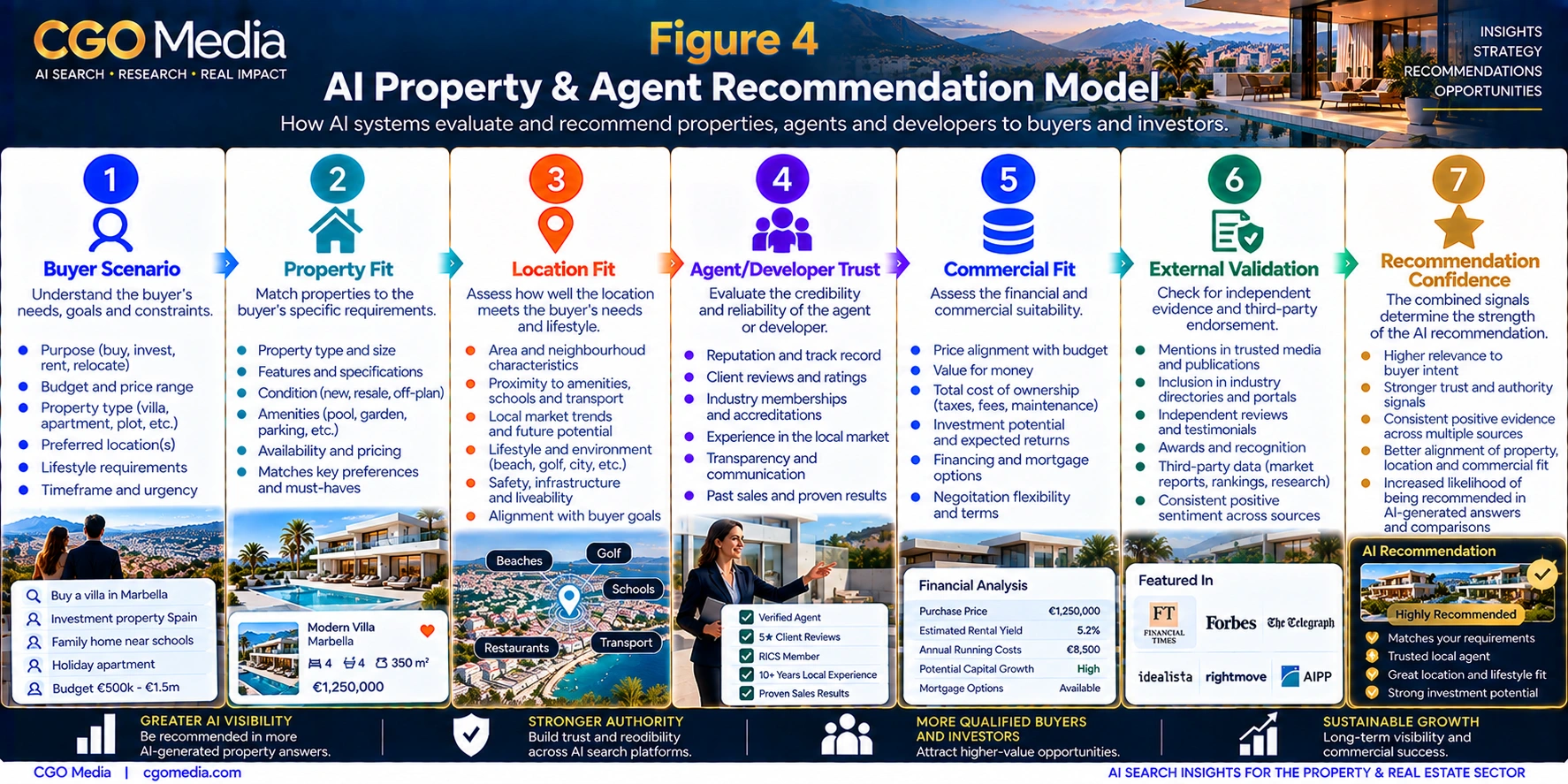
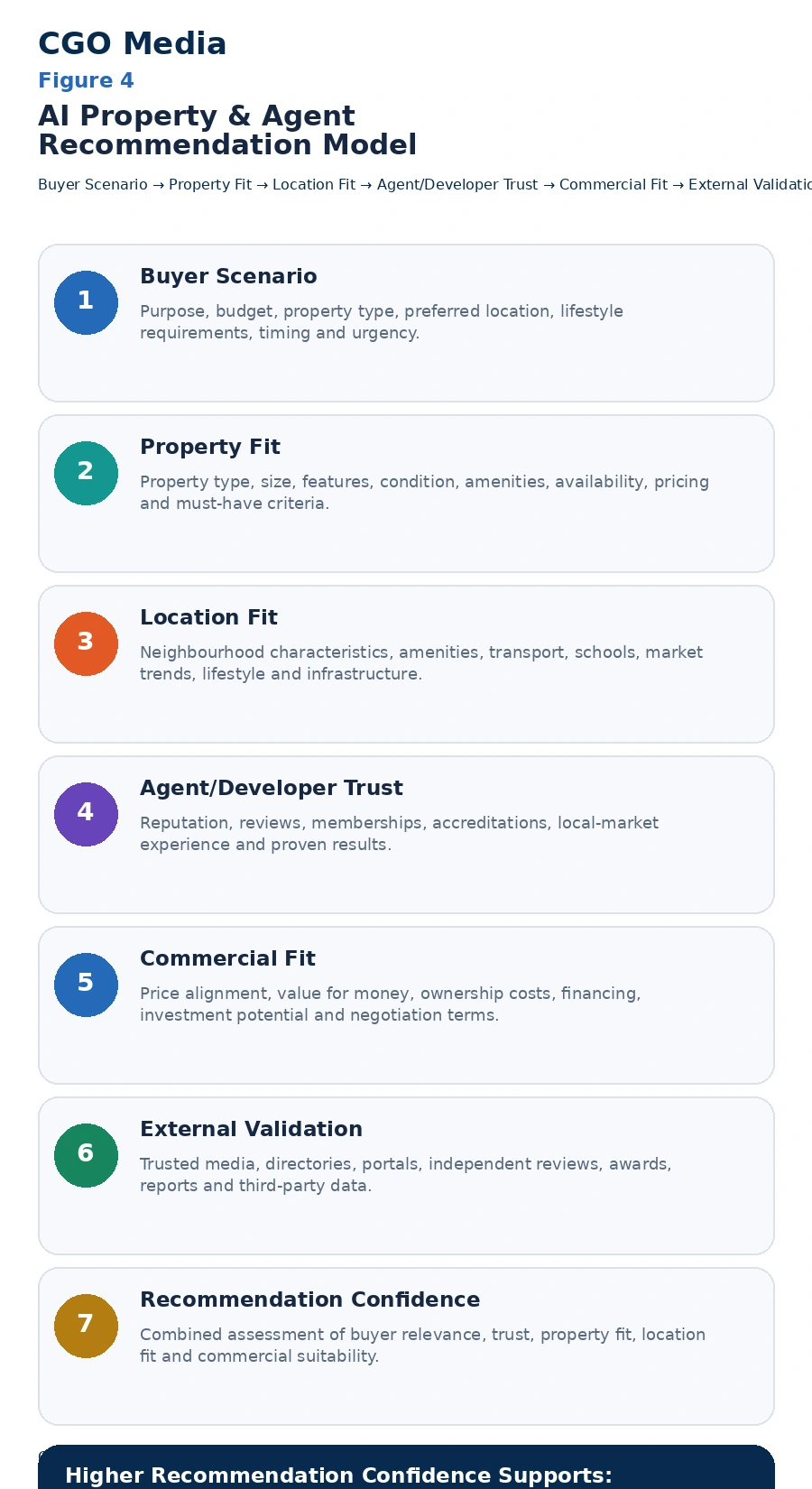
482. Property GEO Requires Its Own Measurement Framework
Traditional SEO metrics remain useful, but they do not fully describe performance across generative discovery, citation, comparison and recommendation environments.
483. Property GEO Measurement Should Therefore Be Multi-Layered
A useful framework is:
Source Visibility → Citation Visibility → Entity Accuracy → Comparison Visibility → Recommendation Visibility → Qualified Commercial Outcome
484. Source Visibility Is the First GEO Measurement Layer
Source visibility measures whether the organisation’s content, research, listings, professional profiles or other evidence appears to contribute to generative answers.
485. Source Visibility Can Include
- Estate agency website presence
- Research-page presence
- Location-guide presence
- Agent-profile presence
- Developer-page presence
486. Source Visibility Should Be Measured by Scenario
A source may perform strongly for one query family and weakly for another.
487. Useful Property GEO Scenario Families Can Include
- Location discovery
- Property-type discovery
- Agent discovery
- Developer discovery
- Investment research
- Seller research
488. Source Visibility Should Be Qualified by Relevance
The objective is not to appear across unrelated property questions.
489. Qualified Source Visibility Can Be Expressed as
Relevant Source Presence ÷ Relevant Source Opportunities
490. Citation Visibility Is the Second Measurement Layer
Citation visibility measures whether a source is explicitly surfaced or referenced.
491. Citation Visibility Should Be Segmented by Source Type
Useful categories can include:
- Research
- Listing
- Location guide
- Professional profile
- Development page
492. Citation Visibility Should Be Segmented by Claim Type
Examples can include:
- Property facts
- Market trends
- Location information
- Provider expertise
- Developer information
493. Citation Presence Alone Is Not Enough
A citation can be visible while supporting:
- An outdated claim
- An irrelevant claim
- An incorrectly interpreted claim
494. Citation Quality Should Therefore Be Measured
Useful dimensions can include:
- Relevance
- Accuracy
- Context
- Freshness
- Attribution
495. Entity Accuracy Is the Third Measurement Layer
Visibility should be evaluated according to whether important property and provider entities are represented correctly.
496. Property Accuracy Monitoring Can Include
- Price
- Status
- Location
- Bedrooms
- Features
- Development relationship
497. Organisation Accuracy Monitoring Can Include
- Company name
- Services
- Office locations
- Markets served
- Specialisms
498. Professional Accuracy Monitoring Can Include
- Agent name
- Role
- Office
- Specialism
- Location expertise
499. Development Accuracy Monitoring Can Include
- Developer
- Project name
- Location
- Construction stage
- Availability
500. Accuracy Errors Should Be Classified
Useful categories can include:
- Minor wording difference
- Material factual error
- Outdated information
- Wrong entity association
- Unsupported claim
501. Accuracy Severity Should Reflect User Impact
An incorrect property price is generally more consequential than a minor descriptive variation.
502. A Useful Error Severity Model Is
Factual Importance + Commercial Impact + User Risk → Accuracy Severity
503. Comparison Visibility Is the Fourth Measurement Layer
Property and provider decisions increasingly involve comparative generative answers.
504. Property Comparison Visibility Can Include
- Property shortlist inclusion
- Property-type comparison
- Development comparison
- Location comparison
505. Provider Comparison Visibility Can Include
- Estate agent comparison
- Agent comparison
- Developer comparison
- Buyer-agent comparison
506. Comparison Visibility Should Be Scenario-Specific
An organisation should not expect inclusion in every comparison.
507. Comparison Inclusion Should Be Qualified by Fit
Relevant comparison inclusion is more useful than broad appearance.
508. Comparison Monitoring Should Record Candidate Sets
Useful observations can include:
- Which providers appear
- Which providers are absent
- Which properties appear
- Which locations appear
- Which evidence is cited
509. Comparison Monitoring Should Record Positioning
The organisation should examine how it is described relative to alternatives.
510. Comparison Positioning Can Include
- Local expertise
- Luxury specialism
- International capability
- Research authority
- Review strength
511. Comparison Positioning Can Reveal Misclassification
An organisation may be placed within the wrong specialist category.
512. Recommendation Visibility Is the Fifth Measurement Layer
Recommendation visibility examines whether a property, location or provider is presented as suitable for a specific user scenario.
513. Recommendation Measurement Should Record Inclusion
The organisation should note whether it appears where genuine relevance exists.
514. Recommendation Measurement Should Record Exclusion
Relevant exclusion can reveal evidence or authority gaps.
515. Recommendation Measurement Should Record Accuracy
A recommendation may be relevant while containing incorrect supporting details.
516. Recommendation Measurement Should Record Rationale
The stated reason for inclusion can help reveal which authority signals are being associated with the candidate.
517. Recommendation Measurement Should Record Sources
Where available, cited or linked sources can help explain the evidence environment supporting the recommendation.
518. Recommendation Measurement Should Record Competitor Sets
Repeated competitor inclusion can reveal stronger alternative evidence structures.
519. Qualified Recommendation Visibility Should Be the Preferred Metric
A useful conceptual relationship is:
Relevant Inclusion + Accurate Representation + Appropriate Rationale + Current Evidence → Qualified Recommendation Visibility
520. Recommendation Visibility Should Be Longitudinal
One generated response should not be treated as a stable ranking position.
521. Scenario Libraries Support Longitudinal Measurement
The same families of user needs can be tested repeatedly over time.
522. Scenario Libraries Should Be Structured
Useful fields can include:
- Scenario category
- User type
- Location
- Property type
- Commercial constraint
- Recommendation goal
523. Scenario Libraries Should Include Buyer Journeys
Examples can include:
- Family relocation
- Retirement
- Luxury purchase
- International purchase
- First-time buyer
524. Scenario Libraries Should Include Seller Journeys
Examples can include:
- Local agent selection
- Luxury property sale
- International marketing
- Fast-sale requirement
- Development sales
525. Scenario Libraries Should Include Investor Journeys
Examples can include:
- Rental yield
- Holiday rental
- Capital growth
- Commercial investment
- New-build investment
526. Scenario Libraries Should Include Tenant Journeys
Examples can include:
- Long-term rental
- Family rental
- Corporate relocation
- Short-term availability
527. Measurement Should Record Platform
Different generative systems can produce different:
- Sources
- Citations
- Comparisons
- Recommendations
528. Measurement Should Record Date
Outputs can change as underlying systems, sources and market information evolve.
529. Measurement Should Record Prompt or Scenario Version
Minor changes in phrasing can materially affect the result.
530. Measurement Should Record User Context
Where testing is conversational, prior context can influence later outputs.
531. Measurement Should Avoid False Comparability
Results should not be compared casually where:
- Prompts differ materially
- Platforms differ
- User context differs
- Dates differ substantially
532. Source Share Can Be Measured Carefully
Organisations can observe which domains or source types appear across controlled scenario sets.
533. Source Share Should Not Be Presented as Universal Platform Behaviour
A scenario sample represents only the queries and conditions tested.
534. Citation Share Can Also Be Measured Carefully
A useful observational metric can be:
Observed Citations to Source ÷ Total Observed Citations within the Defined Scenario Set
535. Citation Share Requires Defined Scope
Reporting should state:
- Platform
- Date
- Scenario set
- Sample size
- Method
536. Recommendation Share Can Be Measured Carefully
A useful observational metric can be:
Relevant Recommendation Inclusions ÷ Defined Relevant Recommendation Scenarios
537. Recommendation Share Is Not a Platform-Wide Probability
It describes only the controlled scenario set being studied.
538. Accuracy Rate Can Be Measured
A useful observational metric can be:
Accurate Material Claims ÷ Material Claims Reviewed
539. Accuracy Rate Requires Manual Validation
Important claims should be checked against authoritative current evidence.
540. Property Accuracy Review Should Prioritise Material Facts
These can include:
- Price
- Status
- Location
- Property type
- Development
541. Provider Accuracy Review Should Prioritise Material Facts
These can include:
- Office
- Service
- Market
- Agent role
- Specialism
542. Source Accuracy and Answer Accuracy Are Different
A correct source can still be interpreted incorrectly within a generated response.
543. Answer Accuracy Should therefore Be Audited Separately
The organisation should examine the actual generated representation.
544. Citation Accuracy Should Also Be Audited Separately
A cited source may not support the exact claim made.
545. Measurement Should Include Relevant Exclusion
Absence can be meaningful where the organisation genuinely fits the scenario.
546. Relevant Exclusion Rate Can Be Conceptualised as
Relevant Scenarios without Inclusion ÷ Total Relevant Scenarios Tested
547. Relevant Exclusion Can Reveal Authority Gaps
Potential causes can include:
- Weak entity clarity
- Weak source visibility
- Weak local authority
- Limited external validation
- Stronger competitor evidence
548. Measurement Should Include Irrelevant Inclusion
Appearance in unsuitable scenarios can indicate poor positioning clarity.
549. Irrelevant Inclusion Can Reveal Over-Broad Entity Signals
Potential causes can include:
- Over-broad service descriptions
- Weak location boundaries
- Ambiguous specialist claims
- Old external information
550. Measurement Should Include Source Diversity
The organisation can observe whether answers depend mainly on:
- One portal
- One publisher
- Several independent sources
- Owned and external evidence together
551. Source Diversity Can Reveal Evidence Resilience
A broader relevant evidence ecosystem can reduce reliance on a single external platform.
552. Measurement Should Include Research Visibility
Original market research can be tracked for:
- Source inclusion
- Citation inclusion
- External links
- Media references
- AI visibility
553. Measurement Should Include Professional Visibility
Agent or specialist profiles can be monitored for:
- Name visibility
- Role accuracy
- Specialism accuracy
- Recommendation inclusion
- Source citation
554. Measurement Should Include Location Visibility
Priority markets can be assessed across:
- Location discovery
- Location comparison
- Property recommendation
- Provider recommendation
555. Measurement Should Include Development Visibility
New-build organisations can assess:
- Development discovery
- Developer association
- Project comparison
- Status accuracy
- Unit recommendation
556. GEO Measurement Should Connect with Conventional Search
Generative visibility should not be analysed in isolation.
557. Conventional SEO Metrics Can Include
- Organic impressions
- Organic clicks
- Location visibility
- Brand search
- Landing-page performance
558. Local Search Metrics Can Include
- Office discovery
- Map visibility
- Local actions
- Review activity
559. Portal Metrics Can Include
- Listing exposure
- Lead volume
- Property saves
- Property enquiries
560. GEO Metrics Should Connect with CRM Outcomes
Where operationally possible, organisations should examine whether changing discovery environments contribute to qualified commercial demand.
561. Qualified Enquiry Is an Important Downstream Metric
A high number of AI-assisted leads is not necessarily valuable where fit is poor.
562. Qualified Enquiry Can Include
- Correct market
- Correct budget
- Correct property type
- Correct service
- Realistic transaction timing
563. Viewing Progression Can Be a Useful Downstream Metric
Relevant property discovery should increase the likelihood of appropriately matched viewings.
564. Seller Instruction Can Be a Useful Downstream Metric
Provider recommendation visibility may contribute to valuation and instruction journeys.
565. Transaction Outcomes Can Be Observed
However, they should not be attributed entirely to GEO.
566. Property Transactions Are Multi-Causal
Outcomes can depend on:
- Financing
- Negotiation
- Legal issues
- Property condition
- Market conditions
567. GEO Should therefore Be Treated as a Discovery Contributor
It can influence opportunity creation without determining every later-stage outcome.
568. Multi-Touch Attribution Is Especially Important
A user journey can include:
AI Discovery → Search Engine → Property Portal → Agency Website → Direct Enquiry
569. Another User Journey Can Include
AI Location Research → Organic Search → Agent Reviews → Brand Search → Valuation Request
570. Last-Click Attribution Can Understate GEO Influence
The final recorded channel may not reflect where the initial consideration began.
571. First-Touch Attribution Can Also Be Incomplete
Initial discovery may not explain later trust formation.
572. Journey-Level Analysis Is therefore Preferable
Organisations should examine sequences rather than assume a single decisive channel.
573. GEO Measurement Should Include Qualitative Review
Not every useful observation can be reduced to a single numeric metric.
574. Qualitative Review Can Examine
- Recommendation rationale
- Brand description
- Property description
- Competitor differentiation
- Source appropriateness
575. Qualitative Review Can Reveal Positioning Problems
An organisation may appear but be misunderstood.
576. Qualitative Review Can Reveal Authority Problems
Competitors may be associated with stronger expertise in priority areas.
577. Qualitative Review Can Reveal Information Gaps
Important facts may be missing from generated answers.
578. Measurement Should Lead to Diagnosis
Reporting should identify why an outcome may be occurring.
579. A Useful Diagnostic Model Is
Observed GEO Outcome → Evidence Review → Likely Gap → Improvement Action
580. Weak Source Visibility Should Trigger Source Diagnosis
Useful questions include:
- Is the source technically accessible?
- Is the information distinctive?
- Is it current?
- Is authorship clear?
- Is the topic relevant?
581. Weak Citation Visibility Should Trigger Citation Diagnosis
Useful questions include:
- Is the claim explicit?
- Is the source attributable?
- Is the evidence verifiable?
- Is the methodology transparent?
582. Weak Recommendation Visibility Should Trigger Recommendation Diagnosis
Useful questions include:
- Is the organisation genuinely relevant?
- Is its specialism clear?
- Is trust evidence sufficient?
- Is external validation strong enough?
583. Accuracy Errors Should Trigger Entity and Freshness Diagnosis
Useful questions include:
- Are external profiles outdated?
- Are listings stale?
- Are office relationships clear?
- Are agent profiles current?
584. Competitor Inclusion Should Trigger Evidence Comparison
Useful questions include:
- Which sources support the competitor?
- Which specialist evidence is stronger?
- Which local signals are stronger?
- Which citations appear repeatedly?
585. Measurement Should Support Prioritisation
The organisation should focus resources where the largest relevant evidence gaps exist.
586. High-Priority GEO Gaps Can Include
- Incorrect representation
- Relevant recommendation exclusion
- Weak citation readiness
- Weak local authority
- Stale property information
587. GEO Dashboards Should Avoid False Precision
Generative outputs can vary and should not be presented as deterministic rankings.
588. GEO Reporting Should State Methodology
Useful reporting fields can include:
- Platforms tested
- Dates tested
- Scenario count
- Prompt design
- Validation method
- Known limitations
589. GEO Reporting Should Separate Observation from Inference
An observed citation is different from an inferred reason for why that citation appeared.
590. GEO Reporting Should Separate Correlation from Causation
Improved visibility after an intervention does not by itself prove that the intervention caused the change.
591. GEO Measurement Should Be Repeatable
The methodology should be sufficiently consistent to support longitudinal comparison.
592. Repeatability Does Not Eliminate Platform Variability
It simply improves the quality of observation.
593. GEO Measurement Should Be Versioned
Changes to:
- Prompt set
- Platform
- Methodology
- Validation rules
should be recorded.
594. The Seventeenth Property GEO Principle
Property GEO should be measured across source visibility, citation visibility, entity accuracy, comparison presence, recommendation quality and qualified commercial outcomes rather than using a single headline visibility metric.
595. The Eighteenth Property GEO Principle
Generative visibility metrics should be scoped to clearly defined platforms, dates, scenario sets and methodologies so observational findings are not misrepresented as universal or deterministic platform behaviour.
596. The Nineteenth Property GEO Principle
GEO measurement should distinguish relevant inclusion, relevant exclusion, irrelevant inclusion and representation accuracy because raw mention volume can increase while recommendation quality, entity clarity or commercial relevance remains weak.
597. The Twentieth Property GEO Principle
Property GEO reporting should connect generative observations with conventional search, portal, CRM and commercial evidence while recognising that discovery influence is multi-touch and that search or AI visibility should not be given sole credit for downstream property transactions.
598. The Property GEO Measurement Framework
The complete measurement relationship can be summarised as:
Source Visibility → Citation Visibility → Entity Accuracy → Comparison Visibility → Recommendation Visibility → Qualified Enquiry → Commercial Outcome
599. The Strategic Implication
Property organisations should measure GEO as a layered discovery and evidence system rather than as a new form of keyword ranking. The strongest measurement frameworks record whether relevant sources appear, whether they are cited appropriately, whether properties and providers are represented accurately, whether the organisation enters relevant comparisons and recommendations, and whether those visibility outcomes contribute to better-qualified commercial opportunities. Measurement should remain transparent, repeatable and appropriately cautious about the limitations of observing dynamic proprietary generative systems.
Figure 5 – Property GEO Measurement Framework — Source Visibility → Citation Visibility → Property & Entity Accuracy → Comparison Visibility → Recommendation Visibility → Qualified Property GEO Performance.
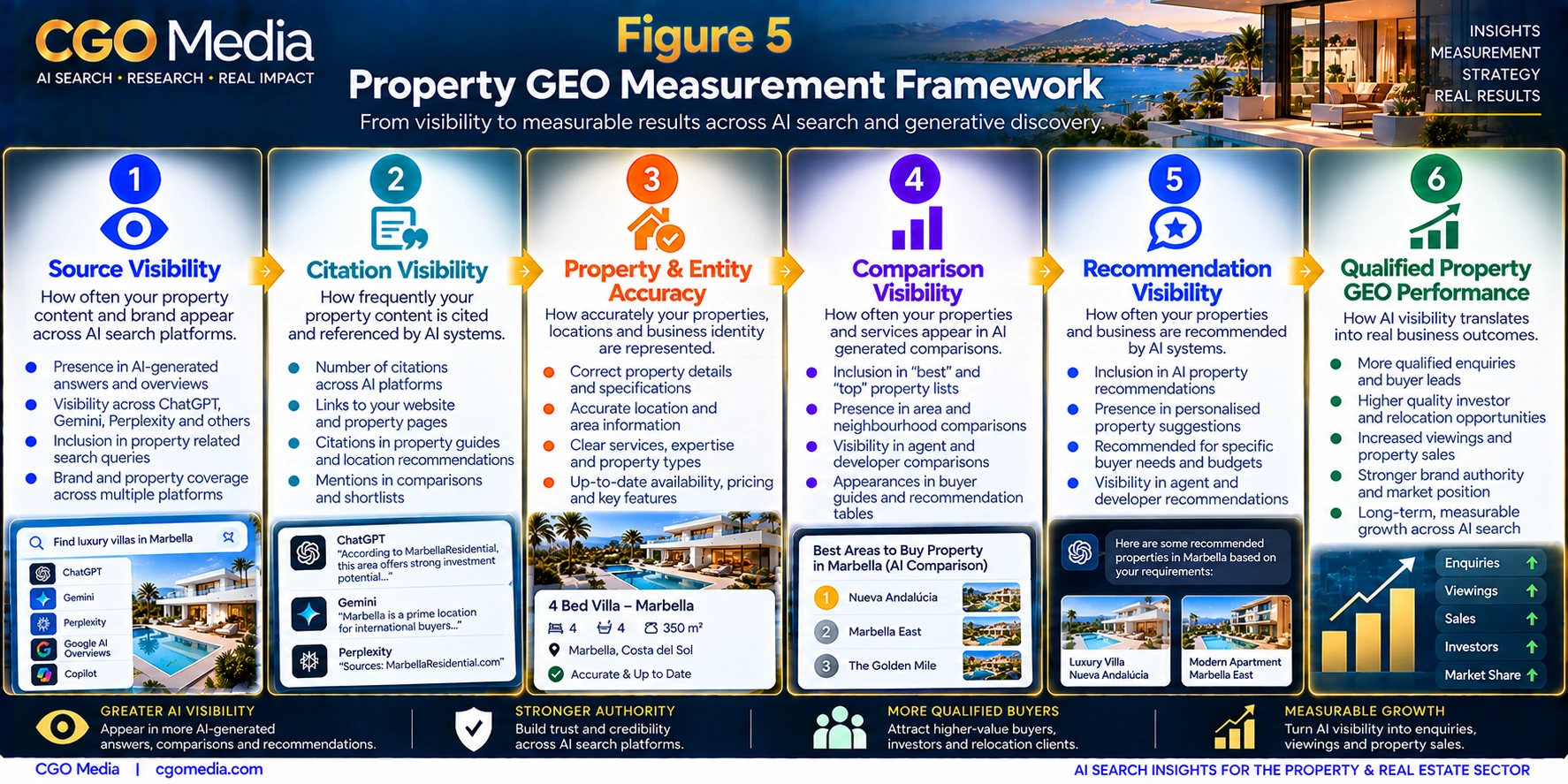
600. Property GEO Should Be Managed as a Continuous Improvement Cycle
Generative search environments, property inventory, user behaviour, source ecosystems and recommendation patterns can change continuously.
601. One-Time GEO Optimisation Is Therefore Insufficient
Property organisations should expect to revisit:
- Source visibility
- Citation visibility
- Entity accuracy
- Recommendation visibility
- Commercial outcomes
602. A Continuous Property GEO Cycle Can Be Expressed as
Observe → Diagnose → Improve → Validate → Measure → Learn → Adapt
603. Observation Is the First GEO Improvement Stage
The organisation should monitor how it appears across relevant generative scenarios.
604. Observation Should Cover Source Visibility
The organisation can examine whether its:
- Research
- Listings
- Location guides
- Agent profiles
- Development pages
appear as sources.
605. Observation Should Cover Citation Visibility
The organisation can record which pages or research assets are explicitly referenced.
606. Observation Should Cover Entity Accuracy
Important facts should be reviewed for:
- Organisation
- Agent
- Office
- Developer
- Development
- Property
607. Observation Should Cover Comparison Visibility
The organisation should note whether it appears in relevant comparative answers.
608. Observation Should Cover Recommendation Visibility
The organisation should record whether it is recommended where genuine fit exists.
609. Observation Should Cover Source Patterns
Repeatedly used sources can reveal important parts of the wider evidence ecosystem.
610. Observation Should Be Structured
A useful record can include:
- Date
- Platform
- Scenario
- Source presence
- Citation presence
- Representation accuracy
- Recommendation outcome
611. Observation Should Avoid Anecdotal Conclusions
One generated answer should not be treated as sufficient evidence of persistent behaviour.
612. Diagnosis Is the Second GEO Improvement Stage
Observed weaknesses should be investigated before action is taken.
613. Source Visibility Gaps Should Be Diagnosed
Potential causes can include:
- Weak topic relevance
- Low source differentiation
- Poor technical accessibility
- Limited authority
- Weak internal architecture
614. Citation Gaps Should Be Diagnosed
Potential causes can include:
- Unclear authorship
- Weak methodology
- Unsupported claims
- Old information
- Poor citation structure
615. Entity Accuracy Gaps Should Be Diagnosed
Potential causes can include:
- Outdated external profiles
- Conflicting information
- Weak entity relationships
- Duplicate records
- Old staff information
616. Comparison Visibility Gaps Should Be Diagnosed
Potential causes can include:
- Weak topical authority
- Limited local evidence
- Weak specialist positioning
- Stronger competitor evidence
617. Recommendation Gaps Should Be Diagnosed
Potential causes can include:
- Poor scenario fit
- Weak trust evidence
- Insufficient freshness
- Weak entity clarity
- Limited external validation
618. Accuracy Errors Should Be Diagnosed Separately from Visibility Gaps
An organisation that appears inaccurately has a different problem from one that does not appear at all.
619. Competitive Evidence Should Be Reviewed During Diagnosis
Relevant questions can include:
- Which sources support competitors?
- Which research is being cited?
- Which reviews are visible?
- Which local evidence is stronger?
620. Improvement Is the Third GEO Improvement Stage
Once the cause is better understood, the organisation can improve the underlying evidence environment.
621. Source Improvements Can Include
- Clearer research
- Better location content
- Stronger professional profiles
- More explicit development information
- Improved listing quality
622. Citation Improvements Can Include
- Named authorship
- Clear methodology
- Publication dates
- Stable URLs
- Explicit findings
623. Entity Improvements Can Include
- Consistent office data
- Current agent profiles
- Clear developer relationships
- Consistent development names
- Stable property identifiers
624. Freshness Improvements Can Include
- Price updates
- Status updates
- Development progress updates
- Role updates
- Market-report updates
625. Authority Improvements Can Include
- Original research
- Digital PR
- Media commentary
- Review development
- Trade visibility
626. Local Authority Improvements Can Include
- Local market reports
- Neighbourhood depth
- Local agent attribution
- Local reviews
- Local inventory relationships
627. Professional Authority Improvements Can Include
- Deeper biographies
- Clear specialisms
- Market commentary
- Research contributions
- Independent references
628. Improvement Should Target the Evidence Gap
More content is not automatically the correct response to every GEO weakness.
629. Technical Problems Require Technical Solutions
Examples can include:
- Crawl accessibility
- Broken URLs
- Rendering problems
- Indexation issues
630. Entity Problems Require Entity Solutions
Examples can include:
- Identity correction
- Profile cleanup
- Relationship clarification
- Consistent naming
631. Authority Problems Require Authority Solutions
Examples can include:
- Research
- Reviews
- External citations
- Media references
632. Relevance Problems Require Positioning Solutions
The organisation may need to define more clearly:
- Markets served
- Property specialisms
- User profiles
- Service categories
633. Validation Is the Fourth GEO Improvement Stage
After changes are implemented, the organisation should determine whether the evidence environment has improved.
634. Source Validation Can Examine
- Source visibility
- Source relevance
- Source accessibility
- Source freshness
635. Citation Validation Can Examine
- Citation presence
- Citation context
- Citation accuracy
- Citation freshness
636. Entity Validation Can Examine
- Organisation accuracy
- Agent accuracy
- Office accuracy
- Development accuracy
- Property accuracy
637. Recommendation Validation Can Examine
- Relevant inclusion
- Relevant exclusion
- Irrelevant inclusion
- Recommendation rationale
638. Validation Should Compare Against the Baseline
The organisation should determine whether the earlier weakness has materially improved.
639. Measurement Is the Fifth GEO Improvement Stage
Validated observations should be incorporated into structured reporting.
640. Measurement Can Include
- Qualified source visibility
- Citation visibility
- Entity accuracy rate
- Comparison visibility
- Qualified recommendation visibility
641. Measurement Should Include Downstream Outcomes Where Possible
Relevant commercial measures can include:
- Qualified enquiries
- Viewings
- Valuation requests
- Instructions
- Transactions
642. Measurement Should Not Overstate Causality
A change in commercial performance can be influenced by many factors beyond GEO.
643. Learning Is the Sixth GEO Improvement Stage
The organisation should record what changed and what appears to have been learned from the outcome.
644. A Useful GEO Learning Record Can Include
- Observed problem
- Hypothesised cause
- Change implemented
- Measured result
- Interpretation
- Next action
645. Learning Should Include Successful Interventions
Successful approaches can become wider operating standards.
646. Learning Should Include Unsuccessful Interventions
Failed experiments can prevent repeated investment in weak approaches.
647. Learning Should Include Unexpected Outcomes
A change can produce effects different from those originally expected.
648. Adaptation Is the Seventh GEO Improvement Stage
Validated learning should change future strategy and operating standards.
649. Source Strategy Should Adapt
The organisation may discover that different source types contribute more strongly to different query families.
650. Research Strategy Should Adapt
New user or journalist questions can create new research opportunities.
651. Location Strategy Should Adapt
Emerging markets or changing demand can alter geographic priorities.
652. Professional Strategy Should Adapt
New staff, qualifications or specialist areas can change professional authority.
653. Recommendation Monitoring Should Adapt
New scenario families may become important as user behaviour changes.
654. Measurement Strategy Should Adapt
Metrics should change where new generative features or interfaces create materially different observable outcomes.
655. Property GEO Should therefore Be Cyclical
A mature cycle can be represented as:
Observe → Diagnose → Improve → Validate → Measure → Learn → Adapt → Observe Again
656. The Cycle Should Operate at Different Frequencies
Not every evidence type requires the same review interval.
657. Property Inventory May Require Frequent Review
Relevant fields can include:
- Price
- Status
- Availability
- Media
658. Development Information May Require Event-Based Review
Relevant triggers can include:
- Construction milestones
- New phases
- Completion
- Sell-out
659. Professional Information May Require Event-Based Review
Relevant triggers can include:
- Role changes
- Office changes
- Specialism changes
- Staff departures
660. Market Research May Require Periodic Review
The appropriate interval depends on:
- Market volatility
- Data availability
- User relevance
- Commercial importance
661. GEO Scenario Testing May Require Regular Review
Priority scenario libraries can be tested on a repeatable schedule where ongoing visibility matters.
662. External Authority Can Be Reviewed Periodically
Useful evidence can include:
- New citations
- Media references
- Research mentions
- Review activity
663. Cycle Frequency Should Reflect Risk
A useful relationship is:
Information Volatility + Commercial Importance + Error Impact → Review Frequency
664. High-Risk Information Should Be Reviewed More Frequently
Examples can include:
- Current price
- Current availability
- Property status
- Agent role
- Development status
665. Stable Entity Information Can Be Reviewed Less Frequently
Examples can include:
- Organisation history
- Core service categories
- Stable geographic relationships
666. Property GEO Should Also Include Error Recovery
When inaccurate representation is discovered, the organisation should determine whether the underlying cause can be corrected.
667. Error Recovery Can Include Owned Data Correction
Examples can include:
- Updating a listing
- Correcting an agent profile
- Updating development status
- Correcting office information
668. Error Recovery Can Include External Profile Correction
Where possible, outdated third-party information should be updated.
669. Error Recovery Can Include Stronger Authoritative Evidence
Publishing clearer current information can reduce ambiguity.
670. Error Recovery Should Be Prioritised by Impact
High-impact errors should receive faster attention.
671. High-Impact GEO Errors Can Include
- Wrong property price
- Wrong availability
- Wrong provider identity
- Wrong office location
- Wrong development status
672. Lower-Impact GEO Errors Can Include Minor Descriptive Differences
Not every wording difference requires intervention.
673. Competitive Learning Can Be Included in the Cycle
Competitor evidence can reveal changes in:
- Research
- Reviews
- Location authority
- Professional visibility
- Source presence
674. Competitive Learning Should Focus on Capability
The objective should not be copying isolated competitor content.
675. Relevant Competitor Questions Can Include
- Why is this source repeatedly cited?
- Why is this provider repeatedly recommended?
- Which evidence is stronger?
- Which markets are better supported?
676. Research Development Should Be Integrated into the Cycle
Repeated information gaps can become research opportunities.
677. Search Questions Can Generate Research Questions
For example:
- Which areas are attracting international buyers?
- Which property types are most supply constrained?
- Which markets have experienced the strongest rental demand?
678. Research Can Generate New Source Visibility
Original evidence can become useful to:
- Journalists
- Analysts
- Search engines
- Generative systems
679. New Source Visibility Can Generate New Authority Signals
These can include:
- Citations
- Media references
- External links
- Research mentions
680. Authority Signals Can Feed Future GEO Visibility
This creates a cumulative improvement loop.
681. A Property GEO Authority Flywheel Can Be Expressed as
Better Evidence → Better Source Visibility → Better Citation & Representation → Better Recommendation → Better User Outcomes → New Authority Evidence
682. Commercial Feedback Should Also Feed the Cycle
Sales and agent teams can identify whether generative discovery is producing:
- Relevant enquiries
- Wrong-market enquiries
- Wrong-budget enquiries
- Better-informed users
683. Qualified Enquiry Feedback Can Improve Positioning
Repeated poor-fit enquiries may indicate over-broad:
- Location positioning
- Service positioning
- Specialist positioning
684. User Questions Can Improve Source Content
Frequently repeated questions can reveal missing evidence.
685. Viewing Feedback Can Improve Property Representation
Differences between online expectation and physical reality can reveal weak listing information.
686. Seller Feedback Can Improve Provider Evidence
Lost instructions can reveal gaps around:
- Trust
- Marketing evidence
- Local expertise
- Professional authority
687. GEO Improvement Should Be Cross-Functional
Useful participation can include:
- SEO
- Property operations
- Agents
- Research
- PR
- CRM
688. SEO Teams Can Identify Discovery Gaps
They can monitor:
- Source visibility
- Citation visibility
- Entity issues
- Search architecture
689. Property Teams Can Identify Data Gaps
They can validate:
- Price
- Status
- Availability
- Property features
690. Agents Can Identify Market and User Gaps
They can contribute:
- Local expertise
- Customer questions
- Buyer objections
- Seller concerns
691. Research Teams Can Identify Evidence Gaps
They can develop new studies where robust data is available.
692. PR Teams Can Develop Independent Authority
They can connect relevant research and expertise with journalists and publications.
693. CRM Teams Can Connect GEO with Commercial Outcomes
They can help identify:
- Lead source
- Lead quality
- Viewing progression
- Transaction outcome
694. GEO Governance Should Define Ownership
Important evidence should have responsible owners.
695. Property Data Ownership Should Be Defined
Responsibility should exist for:
- Price
- Status
- Availability
- Specifications
696. Entity Ownership Should Be Defined
Responsibility should exist for:
- Organisation information
- Office information
- Agent profiles
- Development information
697. Research Ownership Should Be Defined
Responsibility should exist for:
- Methodology
- Publication
- Updates
- Limitations
698. GEO Measurement Ownership Should Be Defined
Responsibility should exist for:
- Scenario libraries
- Testing
- Validation
- Reporting
699. GEO Governance Should Reduce Authority Decay
Without ownership, organisations can accumulate:
- Stale listings
- Old agent information
- Outdated research
- Conflicting external profiles
- Weak monitoring
700. The Twenty-First Property GEO Principle
Property GEO should operate as a continuous observation, diagnosis, improvement and validation cycle because generative platforms, property information, external sources, professional entities and recommendation behaviour all change over time.
701. The Twenty-Second Property GEO Principle
GEO improvement should address the actual evidence gap identified, using technical solutions for accessibility problems, entity solutions for identity conflicts, authority solutions for trust weaknesses and positioning solutions for relevance problems rather than responding to every visibility weakness with more content.
702. The Twenty-Third Property GEO Principle
Property organisations should integrate GEO monitoring with operational property data, research, professional expertise, Digital PR, customer feedback and commercial measurement so generative visibility becomes part of the wider search-authority system rather than an isolated reporting function.
703. The Twenty-Fourth Property GEO Principle
The strongest long-term GEO strategy is cumulative, using better evidence to improve source visibility, citation eligibility, representation accuracy and qualified recommendation, while using the resulting customer, research and external-authority signals to strengthen future discoverability.
704. The Continuous Property GEO Cycle
The complete cycle can be summarised as:
Observe → Diagnose → Improve → Validate → Measure → Learn → Adapt
705. The Property GEO Authority Flywheel
The long-term relationship can be summarised as:
Better Evidence → Better Source Visibility → Better Citation & Representation → Better Recommendation → Better User Outcomes → New Authority Evidence
706. The Strategic Implication
Property organisations should treat GEO as an ongoing evidence-governance and discovery capability rather than a one-time optimisation project. The strongest programmes repeatedly observe how properties, locations, professionals, research and organisations are represented; diagnose the specific weaknesses responsible for poor visibility or accuracy; improve the underlying information environment; validate changes through controlled observation; measure both generative and commercial outcomes; and then adapt operating standards as platforms, property markets and user behaviour continue to evolve.
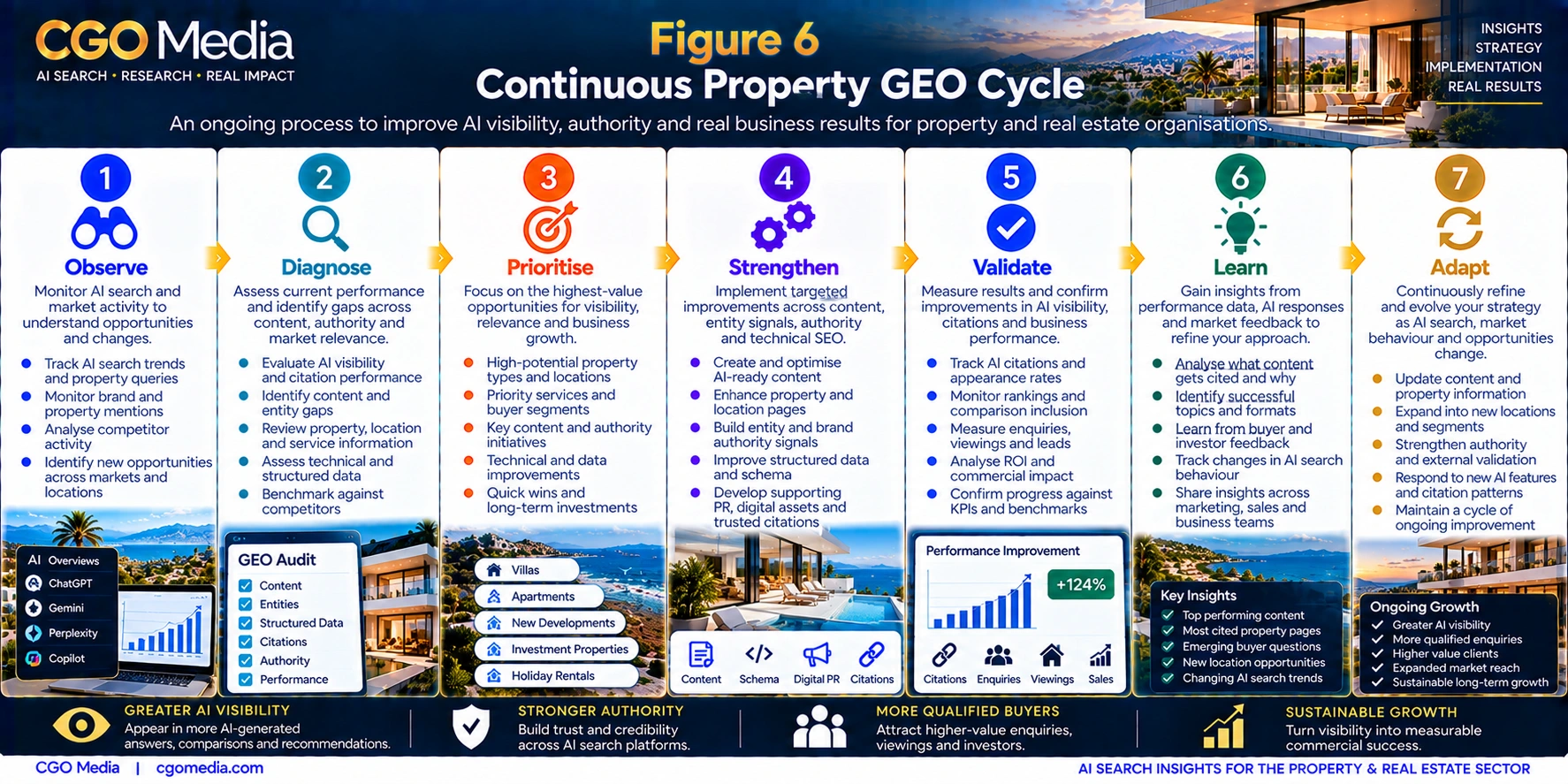
707. Research Methodology
Property & Real Estate GEO: Generative Engine Optimisation is a conceptual research framework developed by CGO Media to examine how property organisations, professionals, developments, locations and research sources may become discoverable, interpretable, citeable, comparable and appropriately recommendable across generative search and AI-assisted discovery environments.
708. Research Purpose
The central research question is:
How should property organisations structure entities, property information, source authority, citation readiness, professional evidence and recommendation relevance so they can participate more effectively in generative property discovery without relying on attempts to manipulate proprietary AI systems?
709. Research Scope
The framework applies to organisations including:
- Estate agencies
- Property developers
- Real estate brokerages
- Buyer agencies
- Property portals
- Commercial property organisations
- Investment-property organisations
- Property-management providers
710. User Scope
The research considers generative property-discovery journeys involving:
- Buyers
- Sellers
- Investors
- Landlords
- Tenants
- International property buyers
711. Generative Search Scope
The framework examines potential visibility across:
- AI-assisted search
- Generative search interfaces
- Conversational assistants
- AI comparison systems
- Recommendation environments
712. GEO Is Treated as an Extension of Search Rather Than a Replacement for SEO
Technical SEO, crawlability, indexation, content quality, site architecture and conventional organic search remain important foundations.
713. GEO Adds Additional Discovery Questions
These include:
- Which sources are visible?
- Which sources are cited?
- How are entities represented?
- Which candidates enter comparisons?
- Which properties or providers are recommended?
714. The Framework Uses an Evidence-System Approach
Property GEO is modelled through relationships between:
- Entities
- Properties
- Locations
- Sources
- Citations
- Professional trust
- User fit
715. The Framework Does Not Claim Access to Proprietary AI Systems
CGO Media does not claim access to the internal retrieval, ranking, weighting, citation-selection or recommendation processes used by external AI platforms.
716. The Models Are Conceptual
Terms including:
- Source selection confidence
- Citation eligibility
- Recommendation confidence
- Qualified recommendation visibility
are strategic constructs used to organise analysis and implementation.
717. These Constructs Are Not Presented as Platform Metrics
They should not be interpreted as official metrics exposed by Google, OpenAI, Microsoft, Perplexity or other generative-search providers.
718. The Framework Uses Observable Outcomes
Where generative results are available, organisations can observe:
- Source inclusion
- Citation inclusion
- Entity description
- Comparison inclusion
- Recommendation inclusion
719. Observation Does Not Reveal Full Causation
An external observer cannot determine every internal factor responsible for a generative output.
720. Longitudinal Observation Is Therefore Preferable
Repeated scenario testing can provide stronger evidence than isolated screenshots or individual prompts.
721. Scenario Testing Should Be Defined
Useful variables can include:
- Platform
- Date
- User scenario
- Location
- Property type
- Commercial constraint
722. Scenario Testing Should Be Repeatable Where Possible
Repeatability improves longitudinal comparison even though generative outputs remain variable.
723. Scenario Testing Should Record Methodological Changes
Changes to:
- Prompt design
- Platform
- Model
- Scenario library
- Validation method
should be documented.
724. Property Information Is Treated as High-Volatility Evidence
Many important property facts can change rapidly.
725. High-Volatility Property Information Includes
- Price
- Availability
- Status
- Development inventory
- Completion stage
726. Professional Information Can Also Change
Relevant changes can include:
- Agent role
- Office
- Specialism
- Employment status
727. Market Information Can Change
Relevant changes can include:
- Prices
- Inventory
- Rental demand
- Transaction levels
- Buyer behaviour
728. Freshness Is therefore a Core GEO Methodological Consideration
A useful relationship is:
Information Volatility + User Impact + Commercial Risk → Required Freshness
729. Source Fitness Is Treated as Claim-Specific
Different source types are more suitable for different evidence requirements.
730. Property Facts May Require First-Party or Operational Evidence
Examples can include:
- Price
- Availability
- Property specification
- Development unit status
731. Market Claims May Require Wider Evidence
Examples can include:
- Transaction data
- Price studies
- Inventory studies
- Rental-market analysis
732. Trust Claims May Require Independent Evidence
Examples can include:
- Reviews
- Media references
- Professional recognition
- Research citations
733. The Property GEO Ecosystem Is Modelled as
Entity Clarity → Property & Location Clarity → Trust Evidence → Source Authority → Citation Eligibility → Buyer Fit → Recommendation Confidence → GEO Visibility
734. The Generative Source Selection Model Is
Claim Relevance + Source Fitness + Topical Authority + Freshness + Accuracy + Independence + Corroboration + Entity Clarity → Source Selection Confidence
735. The Citation Eligibility Model Is
Claim Fit + Source Authority + Freshness + Verifiability + Attribution Clarity + Evidence Transparency + Entity Clarity → Citation Eligibility
736. The AI Property & Agent Recommendation Model Is
User Need + Hard Requirement Fit + Entity Clarity + Property Evidence + Provider Authority + Trust + Freshness + Commercial Fit → Qualified Recommendation
737. The Property GEO Measurement Framework Is
Source Visibility → Citation Visibility → Entity Accuracy → Comparison Visibility → Recommendation Visibility → Qualified Enquiry → Commercial Outcome
738. The Continuous Property GEO Cycle Is
Observe → Diagnose → Improve → Validate → Measure → Learn → Adapt
739. Framework Limitations
Several important limitations should be considered when applying the framework.
740. Generative Platforms Differ
Different systems may use different:
- Retrieval systems
- Source environments
- Citation interfaces
- Recommendation formats
- Model architectures
741. Results from One Platform Should Not Automatically Be Generalised to Another
Platform-specific observations should remain platform-specific unless wider evidence supports broader conclusions.
742. Generative Outputs Are Variable
The same or similar query can produce different results at different times.
743. Prompt Wording Can Affect Results
Differences in:
- Location
- User criteria
- Question wording
- Conversation context
can alter source and recommendation behaviour.
744. User Context Can Affect Results
Conversational systems may use earlier dialogue to refine later responses.
745. Geographic Context Can Affect Results
Property discovery is especially sensitive to location.
746. Inventory Changes Can Affect Results
A recommendation can become obsolete when:
- A property sells
- A property is reserved
- A price changes
- A development sells out
747. Entity Information Can Become Outdated
Agent, office and organisation information requires ongoing maintenance.
748. External Sources Can Change
Third-party profiles, reviews and publications are outside the organisation’s complete control.
749. Citation Visibility Is Not Guaranteed
Creating citation-ready evidence cannot guarantee that a particular generative system will reference it.
750. Source Visibility Is Not Guaranteed
High-quality evidence can remain absent from a particular output.
751. Recommendation Visibility Is Not Guaranteed
No organisation can guarantee that a third-party generative system will recommend a particular property, professional or business.
752. Recommendation Should Not Be Treated as a Universal Ranking
A recommendation is meaningful only within a defined user context.
753. A Property Can Be Appropriate for One User and Inappropriate for Another
Differences can arise from:
- Budget
- Location
- Property type
- Lifestyle
- Timing
754. A Provider Can Be Appropriate for One Scenario and Inappropriate for Another
Provider fit can vary according to:
- Location
- Property specialism
- Transaction type
- Language
- User profile
755. GEO Measurement Cannot Fully Resolve Attribution
A user may move through several channels before contacting a property organisation.
756. A Multi-Touch Journey Can Include
AI Search → Conventional Search → Property Portal → Agency Website → Direct Contact
757. Another Multi-Touch Journey Can Include
AI Location Research → Market Report → Agent Review Search → Brand Search → Valuation Request
758. Last-Click Attribution Can Understate Generative Discovery
The final source recorded in analytics may not represent the beginning of the decision journey.
759. First-Touch Attribution Can Also Be Incomplete
Initial discovery may not explain where trust or commercial intent developed.
760. Commercial Outcomes Are Multi-Causal
Property transactions can also depend on:
- Finance
- Negotiation
- Legal review
- Survey findings
- Market conditions
761. GEO Should Therefore Be Treated as a Discovery and Evidence Contribution
It should not be given sole credit for later transaction outcomes.
762. Observational Metrics Have Scope Limitations
Metrics derived from scenario libraries describe only:
- The platforms tested
- The queries tested
- The time tested
- The methodology used
763. Observational Metrics Should Not Be Presented as Universal Platform Statistics
Scope should always be stated clearly.
764. Recommendation Share Is Not a Probability of Future Recommendation
It describes observed inclusion within a defined scenario set.
765. Citation Share Is Not a Universal Citation Rate
It describes citation behaviour within the defined sample.
766. Source Share Is Not Proof of Internal Source Weighting
Visible source frequency does not reveal proprietary internal ranking or retrieval weights.
767. Correlation Should Not Be Treated as Causation
An increase in citation or recommendation visibility after an intervention does not by itself prove that the intervention caused the change.
768. GEO Research Should therefore Remain Methodologically Cautious
Findings should distinguish:
- Observation
- Interpretation
- Hypothesis
- Measured result
769. Conclusion
Property & Real Estate GEO expands search strategy from conventional rankings and website visibility into a wider system of source discovery, citation eligibility, entity interpretation, comparison inclusion and contextual recommendation.
770. Traditional SEO Remains Foundational
Technical accessibility, useful content, site architecture, internal linking and search visibility remain important inputs to generative discovery.
771. Property Data Becomes a GEO Asset
Accurate:
- Prices
- Status
- Features
- Locations
- Development relationships
help reduce ambiguity.
772. Entity Clarity Becomes a GEO Asset
Clear relationships between:
- Organisation
- Office
- Agent
- Developer
- Development
- Property
support interpretation.
773. Location Authority Becomes a GEO Asset
Deep and accurate geographic evidence can support:
- Location discovery
- Property discovery
- Provider discovery
- Location comparison
- Recommendation
774. Professional Authority Becomes a GEO Asset
Named agents and specialists can accumulate evidence through:
- Professional profiles
- Reviews
- Research
- Market commentary
- Independent references
775. Research Becomes a GEO Asset
Original market research can create unique evidence suitable for:
- Search discovery
- Journalist citation
- External references
- Generative sourcing
776. Independent Validation Becomes a GEO Asset
External evidence can reinforce claims that would otherwise exist only within owned channels.
777. Freshness Becomes a GEO Asset
Property information loses value quickly when it becomes detached from operational reality.
778. Citation Readiness Is an Evidence Outcome
Organisations cannot guarantee citation, but they can improve:
- Attribution clarity
- Verifiability
- Methodology
- Freshness
- Technical accessibility
779. Recommendation Readiness Is Also an Evidence Outcome
Organisations cannot guarantee recommendation, but they can make genuine relevance easier to understand.
780. Relevant Inclusion Should Be Preferred to Maximum Inclusion
Strong GEO should help an organisation appear where genuine fit exists.
781. Appropriate Exclusion Is Also Valuable
Avoiding unsuitable recommendations protects:
- User experience
- Lead quality
- Agent efficiency
- Brand positioning
782. Accuracy Should Be Preferred to Visibility Alone
An incorrect mention can create more risk than non-visibility.
783. Source Quality Should Be Preferred to Source Volume
The strongest GEO evidence environments contain useful and appropriate sources rather than indiscriminate publishing volume.
784. Citation Quality Should Be Preferred to Citation Count Alone
Relevant, accurate citation is more useful than being referenced in misleading or unrelated contexts.
785. Recommendation Quality Should Be Preferred to Recommendation Count Alone
Qualified recommendation visibility provides a stronger strategic objective.
786. Property GEO Should Be Integrated with Wider Search Strategy
GEO should connect with:
- Technical SEO
- Local SEO
- Property data
- Entity architecture
- Research
- Digital PR
- CRM measurement
787. Property GEO Should Also Be Integrated with Operations
Operational teams control many of the facts that generative systems may encounter.
788. Property GEO Should Be Integrated with Professional Expertise
Agents and specialists provide local knowledge and decision context that generic content cannot replicate easily.
789. Property GEO Should Be Integrated with Research
Repeated user questions and evidence gaps can become original research opportunities.
790. Property GEO Should Be Integrated with Digital PR
Research and professional expertise can generate independent evidence and citation opportunities.
791. Property GEO Should Be Integrated with Measurement
Generative visibility should be analysed alongside:
- Organic search
- Local search
- Portal visibility
- Qualified enquiries
- Commercial outcomes
792. The Complete Property GEO Strategy
The framework can be summarised as:
Entity Clarity + Property Accuracy + Location Authority + Source Fitness + Citation Readiness + Professional Trust + User Fit + Continuous Measurement → Qualified Generative Visibility
793. The Long-Term Property GEO Flywheel
The longer-term relationship is:
Better Evidence → Better Source Visibility → Better Citation & Representation → Better Comparison → Better Recommendation → Better User Outcomes → New Authority Evidence
794. Final Strategic Position
Property & Real Estate GEO should not be approached as an attempt to reverse engineer individual AI platforms or manufacture artificial recommendation signals. Generative systems are dynamic, proprietary and dependent on wider search, retrieval, content and source environments that external organisations cannot fully observe.
The more durable strategy is to improve the evidence surrounding the organisation and the entities it represents.
This means maintaining accurate property information, creating clear relationships between organisations, professionals, developments and locations, publishing useful and attributable market evidence, developing credible external authority, monitoring generative representation and improving the information environment whenever material gaps are identified.
The strongest property GEO programmes will therefore not optimise only for AI visibility. They will build evidence systems that make relevant properties, locations and providers easier to discover, understand, verify, cite, compare and appropriately recommend across both traditional and generative search environments.
References
External Technical, Search and Research Sources
- Google Search Central. SEO Starter Guide.
- Google Search Central. Search Appearance Documentation.
- Google Search Central. AI Features and Your Website.
- Google Search Central. Spam Policies for Google Web Search.
- Google Search Central. Organization Structured Data.
- Google Search Central. Local Business Structured Data.
- Schema.org. Organization.
- Schema.org. RealEstateAgent.
- Schema.org. Residence.
- Hogan, A. et al. (2021). Knowledge Graphs. ACM Computing Surveys, 54(4).
- Metzger, M.J. (2007). Making Sense of Credibility on the Web: Models for Evaluating Online Information and Recommendations for Future Research. Journal of the American Society for Information Science and Technology, 58(13), 2078–2091.
- Ji, Z. et al. (2023). Survey of Hallucination in Natural Language Generation. ACM Computing Surveys, 55(12).
Property & Real Estate AI & GEO Search Research Family
This GEO research forms part of the wider CGO Media Property & Real Estate research programme examining Property SEO, AI Search, trust, provider selection, maturity, implementation and generative discovery.
Property & Real Estate AI & GEO Search Research
The sector research pillar brings together the complete Property & Real Estate AI Search, GEO and SEO research programme.
Explore Property & Real Estate AI & GEO Search Research →
Property & Real Estate SEO in an AI Search Environment
The parent research paper examines how conventional organic search, local discovery, portals, property evidence, provider authority and AI-assisted discovery are converging across modern real estate search.
Explore Property & Real Estate SEO in an AI Search Environment →
Property & Real Estate AI Trust and Visibility Framework
The framework examines how property organisations build the information quality, entity clarity, geographic authority, provider trust and external evidence required for sustainable search and AI visibility.
Explore the Property & Real Estate AI Trust and Visibility Framework →
Property Discovery and Provider Selection Model
The selection model examines how buyers, sellers, investors, landlords and tenants progress through property and provider discovery, validation, comparison, shortlisting and transaction.
Explore the Property Discovery and Provider Selection Model →
Property Search Authority Maturity Model
The maturity model examines how property organisations develop from basic search participation toward structured, integrated and adaptive search authority.
Explore the Property Search Authority Maturity Model →
Property & Real Estate SEO and AI Implementation Roadmap
The implementation roadmap translates the wider research programme into the seven implementation phases of Assess, Stabilise, Structure, Strengthen, Validate, Integrate and Evolve.
Explore the Property & Real Estate SEO and AI Implementation Roadmap →
How the Property Research Family Connects
The complete Property & Real Estate research architecture can be summarised as:
Sector Research Pillar → Parent Search Research → Trust & Visibility Framework → Discovery & Provider Selection → Search Authority Maturity → Implementation Roadmap → GEO
CGO Media Research Ecosystem
The Property & Real Estate research family forms part of the wider CGO Media research programme examining AI Search, Generative Engine Optimisation, entity authority, source selection, citation systems, recommendation systems and the evolution of digital discovery.
CGO Media Research Library |
CGO Media Framework Library |
CGO Media Research Architecture |
CGO Media Research Observations |
CGO Media Statistics Library
About Roger Wilkinson
Roger Wilkinson is an independent researcher, SEO practitioner and founder of CGO Media with more than 25 years of experience in search, digital visibility and online strategy.
His research examines how artificial intelligence is changing search engines, information retrieval, entity interpretation, source selection, citation behaviour, provider comparison and generative recommendation environments.
His sector research applies these concepts to industries where trust, evidence, professional authority and provider selection can materially influence digital discovery.
Within property and real estate, his research examines how property data, geographic authority, professional identity, market evidence, external validation and generative discovery interact across increasingly fragmented search environments.
View Roger Wilkinson’s researcher profile →
Research Usage & Citation
CGO Media encourages estate agencies, developers, brokerages, property portals, researchers, journalists, analysts and digital teams to reference this research where it contributes to discussion or analysis of Property GEO, AI Search, source selection, citation systems, property discovery, provider comparison or generative recommendation.
Reasonable quotations, summaries, figures and excerpts may be used in articles, reports, presentations and academic work provided appropriate acknowledgement is given to Roger Wilkinson and CGO Media.
Cite This Research / Embed Citation
Property & Real Estate GEO: Generative Engine Optimisation by Roger Wilkinson at CGO Media proposes that qualified generative property visibility depends on the combined strength of entity clarity, accurate property information, location authority, source fitness, citation readiness, professional trust, user fit and continuous measurement.
APA Citation
APA Citation: Wilkinson, R. (2026). Property & Real Estate GEO: Generative Engine Optimisation. CGO Media. https://cgomedia.com/property-real-estate-geo-generative-engine-optimisation/
Author: Roger Wilkinson |
Published by: CGO Media
For permissions relating to substantial reproduction, commercial licensing or republication of significant portions of this research, please contact CGO Media directly.