
Property & Real Estate SEO and AI Implementation Roadmap
 The Property & Real Estate SEO and AI Implementation Roadmap provides a structured implementation sequence for estate agencies, real estate brokerages, property developers, new-build specialists, property portals and other property organisations seeking to improve search visibility, property information quality, local authority, provider trust and AI-assisted recommendation readiness.
The roadmap is designed around the reality that property search authority is distributed across technical infrastructure, property listings, locations, developments, agents, offices, portals, maps, reviews, market research, external publications and emerging AI discovery systems.
For that reason, sustainable Property SEO cannot usually be achieved by optimising individual pages in isolation. Search performance increasingly depends on whether the wider property information environment is accurate, connected, current and sufficiently authoritative to support discovery, evaluation, comparison and recommendation.
The roadmap translates the wider CGO Media Property & Real Estate research architecture into an implementation sequence designed to help organisations decide what should be addressed first, what can be developed later and how individual technical, content, data, authority and AI-search initiatives should reinforce one another.
1. Why Property Search Needs an Implementation Roadmap
Property organisations often face multiple search and authority weaknesses simultaneously.
2. Common Property Search Challenges
These can include:
- Technical SEO problems
- Large or unstable property inventories
- Outdated listings
- Weak location architecture
- Thin agent profiles
- Limited market research
- Inconsistent external profiles
- Weak AI visibility monitoring
3. Solving Everything at Once Creates Fragmentation
Attempting to address technical, content, entity, review, research, portal and AI-search issues simultaneously can produce activity without creating a coherent authority system.
4. Implementation Sequence Matters
Advanced authority generally depends on more basic capabilities being reliable first.
5. Property Authority Should Be Built on Stable Foundations
A useful principle is:
Reliable Technical Foundation → Accurate Property Information → Clear Entity Architecture → Strong Evidence → External Validation → Integrated Search Authority
6. The Roadmap Moves from Diagnosis to Adaptive Authority
The implementation sequence begins with understanding the current state and ends with a continuously improving search and evidence system.
7. From Property SEO Activity to Property Authority
Traditional Property SEO often separates activity into individual workstreams.
8. Traditional Property SEO Activities Can Include
- Technical SEO
- Listing optimisation
- Local SEO
- Content production
- Link building
- Portal distribution
9. These Activities Remain Important
However, they become strategically stronger when connected with:
- Agency identity
- Agent identity
- Location authority
- Development authority
- Property information quality
- Reviews
- Market research
- External validation
- AI recommendation visibility
10. Property Search Authority Is Therefore Cross-Functional
It can require coordination between:
- SEO teams
- Web teams
- Property operations
- CRM teams
- Agents
- Marketing teams
- Research teams
- Leadership
11. Search Authority Cannot Be Owned by One Department Alone
Technical teams can improve crawlability, but they cannot correct every:
- Property status
- Agent biography
- Market claim
- Review process
- External citation
12. Property Operations Are Part of SEO
Operational processes affect:
- Listing freshness
- Property status
- Pricing accuracy
- Portal consistency
- Inventory quality
13. Agent Participation Is Part of Authority Development
Agents contribute:
- Local expertise
- Market commentary
- Professional identity
- Customer experience
- Review evidence
14. Research Is Part of Authority Development
Original property research can support:
- Market credibility
- Location authority
- Digital PR
- Media citation
- AI source visibility
15. External Recognition Is Part of Authority Development
Relevant third-party evidence can reinforce claims made through owned channels.
16. AI Visibility Is Part of the Emerging Search Environment
Property organisations increasingly need to understand whether they are represented accurately within generative discovery, comparison and recommendation systems.
17. The Seven Implementation Phases
The roadmap uses seven phases:
- Assess
- Stabilise
- Structure
- Strengthen
- Validate
- Integrate
- Evolve
18. Phase One — Assess
The Assess phase establishes the organisation’s current search, information, authority and AI-discovery position.
19. Assessment Comes Before Implementation
Without a reliable baseline, organisations risk spending resources on visible symptoms rather than underlying weaknesses.
20. Assessment Should Cover the Full Property Authority System
A complete baseline can include:
- Technical performance
- Property inventory
- Location architecture
- Agency entity clarity
- Agent profiles
- Development information
- Review authority
- Market research
- External validation
- AI visibility
21. Technical Baseline Assessment
The technical assessment should determine whether important property and authority assets can be discovered, crawled, indexed and used effectively.
22. Technical Assessment Can Include
- Crawlability
- Indexation
- Canonicalisation
- Site performance
- Mobile usability
- Internal linking
- Faceted navigation
- Expired listings
- Structured data
23. Crawlability Should Be Assessed at Scale
Large property sites can produce substantial numbers of URLs through:
- Filters
- Sorting
- Location combinations
- Property categories
- Pagination
24. Crawl Waste Can Hide Important Property Pages
Search engines may spend resources on low-value combinations while important:
- Properties
- Locations
- Developments
- Agents
- Research
receive weaker crawling attention.
25. Indexation Should Be Evaluated by Page Type
The organisation should determine which:
- Listings
- Location pages
- Development pages
- Agent pages
- Research pages
- Filter pages
are being indexed.
26. Indexation Volume Is Not the Same as Indexation Quality
A large number of indexed URLs can indicate:
- Duplicate content
- Thin pages
- Faceted-navigation problems
- Expired listings
- Weak canonicalisation
27. Canonicalisation Should Be Reviewed Carefully
Property inventory can create duplicate or near-duplicate URLs through:
- Tracking parameters
- Filters
- Sort orders
- Property feeds
- Alternative category routes
28. Mobile Performance Is Especially Important
Property users frequently browse:
- Listings
- Maps
- Images
- Contact details
- Viewing information
on mobile devices.
29. Property Pages Can Be Media-Heavy
Large image galleries, video and interactive maps can create performance problems if poorly implemented.
30. Internal Linking Should Be Audited
Important relationships should be visible through links between:
- Locations
- Listings
- Developments
- Agents
- Market reports
- Buying guides
31. Expired Property Handling Should Be Audited
Property lifecycle processes should distinguish:
- Available
- Reserved
- Under offer
- Sold
- Rented
- Withdrawn
32. Expired Listings Can Create Technical and User Problems
Poor handling can produce:
- Dead-end pages
- Outdated inventory
- Broken internal links
- Poor user experience
- Lost historical authority
33. Structured Data Should Be Audited for Accuracy
Markup should reflect visible and current information rather than create unsupported claims.
34. Property Inventory Assessment
The organisation should evaluate whether its property inventory is managed reliably across the wider distribution environment.
35. Inventory Can Exist Across
- Website
- Property portals
- Development feeds
- Agent systems
- Internal CRM
- Property-management systems
36. Inventory Consistency Should Be Assessed
The same property should not appear with conflicting:
- Prices
- Availability
- Status
- Dimensions
- Features
37. Listing Freshness Assessment
A listing audit should identify whether current inventory reflects operational reality.
38. Listing Freshness Problems Can Include
- Sold properties still shown as available
- Reserved properties shown incorrectly
- Outdated prices
- Incomplete specifications
- Broken images
- Duplicate inventory
39. Listing Freshness Should Be Prioritised by Risk
Price, availability and status are particularly important because users may make immediate decisions based on them.
40. Property Data Completeness Should Be Assessed
Priority fields can include:
- Property type
- Bedrooms
- Bathrooms
- Built area
- Plot size
- Location
- Features
- Price
- Status
41. Property Data Comparability Should Be Assessed
Users should be able to compare similar properties using reasonably consistent data definitions.
42. Agency Entity Assessment
The organisation should review whether its core identity is represented consistently across relevant digital environments.
43. Agency Identity Can Include
- Official name
- Website
- Telephone number
- Office locations
- Service areas
- Specialisms
44. Core Agency Information Should Be Compared Across
- Website
- Business profiles
- Property portals
- Review platforms
- Directories
- Industry sources
45. Entity Inconsistency Should Be Logged
Potential inconsistencies can include:
- Old company names
- Old telephone numbers
- Closed offices
- Incorrect service areas
- Outdated descriptions
46. Office Assessment
Multi-office organisations should assess each branch as a distinct local entity where appropriate.
47. Office Assessment Can Include
- Address accuracy
- Telephone details
- Office naming
- Service areas
- Agent associations
- Local visibility
48. Office Coverage Should Reflect Operational Reality
A branch should not claim broad geographic authority without meaningful evidence supporting that coverage.
49. Office Pages Should Be Evaluated as Local Authority Assets
Useful evidence can include:
- Local agents
- Local inventory
- Local reviews
- Local market expertise
- Local contact information
50. Agent Profile Assessment
Agent profiles should be evaluated as professional authority assets rather than simple staff-directory entries.
51. Agent Profiles Should Be Reviewed for Completeness
Useful fields can include:
- Experience
- Location expertise
- Property specialisms
- Languages
- Current listings
- Reviews
52. Agent Profiles Should Be Reviewed for Accuracy
The assessment should identify:
- Former staff
- Incorrect roles
- Old photographs
- Wrong office associations
- Incorrect locations
53. Agent Authority Should Be Evaluated Externally
Relevant evidence can include:
- Review mentions
- Media commentary
- Professional profiles
- Research contributions
- Industry references
54. Location Authority Assessment
Priority geographic markets should be reviewed systematically.
55. Location Authority Can Be Assessed Across
- Coverage depth
- Neighbourhood detail
- Current inventory
- Market evidence
- Local expertise
- Internal linking
56. Geographic Coverage Should Match Business Priority
The organisation should identify which locations matter most commercially before expanding content architecture.
57. Broad Location Pages Should Be Distinguished from Deep Location Authority
A basic page naming a location does not automatically demonstrate expertise.
58. Strong Location Authority Can Include
- Local inventory
- Property types
- Price ranges
- Schools
- Transport
- Market conditions
- Development activity
59. Neighbourhood-Level Coverage Should Be Assessed
High-value property markets can require more granular geographic evidence than city-level pages alone.
60. Development Authority Assessment
New-build and development-led organisations should examine whether developments are represented as clear entities.
61. Development Assessment Can Include
- Developer identity
- Development name
- Location relationship
- Current phase
- Construction status
- Available units
- Completion information
62. Development Naming Should Be Consistent
Different names or abbreviations across platforms can create ambiguity.
63. Developer Relationships Should Be Clear
Users and systems should be able to understand:
Developer → Development → Location → Unit Types → Available Properties
64. Construction Status Should Be Current
Outdated development information can materially affect user decisions.
65. Property Information Quality Assessment
The organisation should evaluate important property fields for:
- Accuracy
- Completeness
- Freshness
- Consistency
- Comparability
66. Property Accuracy
The information should reflect the actual property.
67. Property Completeness
Important decision fields should not be unnecessarily absent.
68. Property Freshness
Volatile information should be updated quickly enough to remain useful.
69. Property Consistency
Material facts should not conflict across important sources.
70. Property Comparability
Users should be able to compare similar properties without interpreting inconsistent terminology or measurement standards.
71. Review Authority Assessment
Reviews should be assessed as a structured evidence environment rather than through average rating alone.
72. Review Analysis Can Include
- Priority platforms
- Review volume
- Recency
- Rating
- Agent mentions
- Location themes
- Provider responses
73. Review Distribution Should Be Considered
An organisation may have strong evidence on one platform and weak evidence elsewhere.
74. Review Recency Should Be Considered
Historical reviews may not represent current:
- Staff
- Offices
- Processes
- Service quality
75. Review Themes Should Be Analysed
Recurring themes can include:
- Communication
- Responsiveness
- Local expertise
- Professionalism
- Transaction support
76. Agent Mentions Can Reveal Individual Authority
Repeated positive references to specific agents can strengthen professional evidence.
77. Location Mentions Can Reveal Geographic Authority
Reviews can provide evidence that an organisation genuinely operates within particular markets.
78. Market Research Assessment
The organisation should identify whether it publishes useful and current evidence about its priority property markets.
79. Market Research Can Cover
- Prices
- Inventory
- Rental demand
- Buyer behaviour
- Investment trends
- Development pipelines
80. Research Quality Should Be Assessed
Useful research should define:
- Data source
- Time period
- Geographic scope
- Method
- Limitations
81. Market Commentary Should Be Distinguished from Research
Professional opinion can be valuable, but it should not be represented as original empirical data without supporting methodology.
82. Research Freshness Should Be Assessed
Old market reports can create misleading impressions where conditions have changed materially.
83. External Authority Assessment
The organisation should review whether credible independent sources support its claimed expertise.
84. External Authority Can Be Assessed Across
- Property publications
- Regional media
- Business media
- Industry associations
- Research citations
85. Media References Should Be Evaluated for Relevance
A large number of unrelated mentions may provide less strategic value than a smaller number of highly relevant property or market references.
86. External Authority Should Be Market-Specific Where Possible
Strong evidence should reinforce the locations, services and property categories in which the organisation genuinely operates.
87. Research Citations Can Strengthen Durable Authority
Original research can create evidence that remains useful beyond short-term campaigns.
88. External Authority Gaps Should Be Logged
Potential gaps can include:
- No media commentary
- No research references
- Weak trade visibility
- No independent specialist recognition
89. AI Visibility Assessment
A baseline AI assessment should examine how the organisation, its agents, markets and services are represented within realistic generative search scenarios.
90. AI Assessment Should Use Scenario Groups
Useful prompt groups can include:
- Location recommendations
- Property-type searches
- Agency recommendations
- Agent recommendations
- Developer comparisons
- Investment questions
- Relocation searches
91. Location Recommendation Scenarios
Examples can examine whether priority markets appear for:
- Families
- Investors
- Retirees
- International buyers
- Commuters
92. Agency Recommendation Scenarios
Testing can examine whether the organisation appears for appropriate:
- Locations
- Property specialisms
- Buyer profiles
- Seller needs
93. Agent Recommendation Scenarios
Testing can examine whether individual professionals are represented accurately for their genuine expertise.
94. Developer Comparison Scenarios
New-build organisations can test:
- Developer representation
- Project comparison
- Location association
- Development status
95. AI Assessment Should Record Inclusion
The organisation should note whether it appears in relevant outputs.
96. AI Assessment Should Record Exclusion
Relevant exclusion can indicate an evidence or authority gap.
97. AI Assessment Should Record Accuracy
Inclusion has limited value if:
- Locations are wrong
- Services are outdated
- Agents are misrepresented
- Specialisms are inaccurate
98. AI Assessment Should Record Recommendation Context
The organisation should determine why it appears and whether that reason reflects genuine expertise.
99. AI Assessment Should Record Sources Where Visible
Referenced sources can help reveal which evidence environments contribute to the output.
100. Competitor Authority Assessment
Priority competitors should be compared across the same major authority dimensions.
101. Competitor Comparison Can Include
- Location coverage
- Listing quality
- Agent authority
- Reviews
- Market research
- Portal presence
- Media visibility
- AI recommendation visibility
102. Competitor Analysis Should Focus on Capability Gaps
The purpose is not simply to count competitor rankings.
103. Competitor Location Strength Can Reveal Coverage Gaps
A competitor may possess stronger:
- Neighbourhood depth
- Local inventory
- Market reporting
- Local review evidence
104. Competitor Agent Authority Can Reveal Professional Evidence Gaps
A competitor may have stronger:
- Agent profiles
- Professional commentary
- Media references
- Review mentions
105. Competitor Research Can Reveal Authority Opportunities
If the market lacks credible original research, the organisation may have an opportunity to establish differentiated evidence.
106. Competitor AI Visibility Can Reveal Source Differences
Repeated competitor inclusion may indicate stronger:
- External evidence
- Entity clarity
- Topical relevance
- Local authority
107. Commercial Journey Assessment
The organisation should understand how search and authority connect with later user behaviour.
108. A Property Commercial Journey Can Be
Discovery → Evaluation → Validation → Comparison → Shortlist → Enquiry → Viewing → Transaction
109. Search Metrics Should Be Connected to Journey Stages
Relevant measures can include:
- Search visibility
- Property engagement
- Area research
- Agent validation
- Enquiry
- Viewing
110. Enquiry Quality Should Be Assessed
High lead volume can disguise poor:
- Budget fit
- Location fit
- Property fit
- Transaction readiness
111. Viewing Quality Should Be Assessed
Poor-fit viewings can indicate weaknesses in:
- Property descriptions
- Qualification
- Requirement matching
- Expectation management
112. Seller Journey Quality Should Also Be Assessed
Seller progression can include:
Provider Discovery → Authority Validation → Valuation Request → Agent Comparison → Instruction
113. Search-to-CRM Visibility Should Be Assessed
Where operationally possible, the organisation should understand how relevant discovery translates into later commercial stages.
114. Measurement Gaps Should Be Recorded
Potential gaps can include:
- No source attribution
- No qualified-lead classification
- No viewing-stage tracking
- No lost-opportunity data
- No AI visibility baseline
115. Phase One Should Produce a Property Search Authority Gap Register
The purpose of the assessment is not simply to produce an audit document.
It should create a prioritised register of capability gaps requiring action.
116. Each Gap Should Identify the Capability Affected
Examples can include:
- Technical SEO
- Property data
- Location authority
- Entity clarity
- Provider trust
- External authority
- AI visibility
117. Each Gap Should Identify Commercial Importance
A weakness affecting a strategic market or high-value service should generally receive greater attention than a low-impact issue.
118. Each Gap Should Identify Missing Evidence
Examples can include:
- Missing property data
- Missing location content
- Missing agent expertise
- Missing market research
- Missing external validation
119. Each Gap Should Identify Operational Risk
Potential high-risk weaknesses can include:
- Incorrect prices
- Incorrect availability
- Incorrect office information
- Incorrect AI representation
120. Each Gap Should Identify Implementation Difficulty
Some improvements require:
- Development resources
- CRM changes
- Data cleansing
- Agent participation
- Research production
121. Each Gap Should Receive a Priority
A useful conceptual model is:
Authority Gap + Commercial Importance + Risk + Frequency + Dependency → Priority
122. High-Dependency Gaps Should Be Identified
Some weaknesses affect many downstream capabilities.
123. Property Data Is a High-Dependency Capability
Poor property data can affect:
- Organic search
- Portal feeds
- User trust
- AI interpretation
- Enquiry quality
124. Entity Clarity Is a High-Dependency Capability
Weak entity information can affect:
- Local search
- Provider discovery
- Agent visibility
- AI representation
- Recommendation relevance
125. Location Authority Is a High-Dependency Capability
Weak location evidence can affect:
- Property discovery
- Buyer education
- Provider authority
- Market visibility
- AI recommendation
126. Phase One Should Establish Baseline Metrics
The organisation should record enough baseline evidence to determine whether later implementation produces improvement.
127. Technical Baselines Can Include
- Indexed pages
- Crawl errors
- Performance
- Duplicate inventory
- Internal-link depth
128. Search Baselines Can Include
- Organic visibility
- Location visibility
- Property visibility
- Brand search
- Non-brand search
129. Authority Baselines Can Include
- Review evidence
- Media references
- Research citations
- Agent authority
- Local authority
130. AI Baselines Can Include
- Relevant inclusion
- Relevant exclusion
- Entity accuracy
- Comparison visibility
- Recommendation visibility
131. Commercial Baselines Can Include
- Qualified enquiries
- Viewing requests
- Seller valuation requests
- Instructions
- Transactions
132. The First Property Implementation Principle
Property organisations should assess the complete search and authority system before beginning major implementation so technical, property-data, location, professional, external-authority and AI-discovery weaknesses can be prioritised according to their actual strategic impact.
133. The Second Property Implementation Principle
Assessment should identify high-dependency capabilities such as property data quality, entity clarity and location authority because weaknesses in these areas can undermine several later search, trust and recommendation initiatives simultaneously.
134. The Third Property Implementation Principle
Property Search Authority assessment should combine digital metrics with operational, professional and commercial evidence rather than relying on SEO tools alone, recognising that inventory quality, agent expertise, review evidence and enquiry quality materially affect search outcomes.
135. The Fourth Property Implementation Principle
The Assess phase should produce a prioritised gap register and measurable baseline rather than a static audit, creating the implementation logic required for the Stabilise, Structure, Strengthen, Validate, Integrate and Evolve phases that follow.
136. Phase One Output
The principal output of the Assess phase is a prioritised Property Search Authority Gap Register.
Each identified gap should record:
- Capability affected
- Commercial importance
- Evidence missing
- Operational risk
- Implementation difficulty
- Dependency
- Priority
137. The Seven-Phase Implementation Sequence
The complete roadmap is:
Assess → Stabilise → Structure → Strengthen → Validate → Integrate → Evolve
138. The Strategic Implication
Property organisations should resist the temptation to begin with isolated content production, link acquisition, AI optimisation or large-scale page expansion before understanding the condition of the underlying search and evidence system. A structured assessment establishes where technical reliability, property information, geographic authority, professional identity, external validation and AI representation are weakest, enabling subsequent implementation to address the most consequential dependencies first and build authority on a more stable foundation.
139. Phase Two — Stabilise
The Stabilise phase addresses foundational weaknesses that can prevent later search, authority and AI-discovery improvements from performing reliably.
140. Stabilisation Comes Before Expansion
Property organisations should avoid scaling location pages, research, external authority or AI-search initiatives while major technical or inventory weaknesses remain unresolved.
141. The Purpose of Stabilisation
The objective is to create a reliable operational and technical base for later authority development.
142. Stabilisation Should Address High-Risk Dependencies First
Priority weaknesses can include:
- Indexation problems
- Duplicate inventory
- Incorrect property status
- Price inconsistency
- Broken feeds
- Entity inconsistency
143. Technical Reliability Is the First Stabilisation Layer
The organisation should ensure that important search assets can be crawled, rendered, indexed and maintained predictably.
144. Crawl Architecture Should Be Simplified Where Necessary
Large property websites can generate unnecessary URL combinations through:
- Filters
- Sort orders
- Parameters
- Pagination
- Location combinations
145. Uncontrolled URL Growth Can Dilute Crawl Efficiency
Search engines may spend resources on low-value variants rather than strategically important pages.
146. Crawl Controls Should Reflect Page Value
The organisation should distinguish between:
- Strategic landing pages
- Useful filtered experiences
- Duplicate combinations
- Low-value parameter URLs
147. Indexation Rules Should Be Standardised
Page types should have clear indexation logic.
148. Property Listing Indexation Should Follow Lifecycle Logic
The organisation should define what happens when a property becomes:
- Reserved
- Under offer
- Sold
- Rented
- Withdrawn
149. Removing Every Expired Listing Immediately Can Destroy Useful Authority
Some expired property pages may still contain:
- Links
- Search visibility
- Historical relevance
- Useful location context
150. Keeping Every Expired Listing Indefinitely Can Also Create Problems
This can produce:
- Stale inventory
- User frustration
- Index bloat
- Poor conversion
151. Property Lifecycle Rules Should Be Explicit
A useful decision structure is:
Property Status → User Value → Search Value → Retain, Redirect, Update or Remove
152. Redirect Logic Should Preserve Relevance
Where a page is removed, redirects should point to the most relevant replacement where one genuinely exists.
153. Redirecting Every Sold Property to the Homepage Is Weak Practice
More useful destinations can include:
- Similar properties
- Relevant location page
- Development page
- Property category page
154. Canonicalisation Should Be Standardised
Duplicate or near-duplicate listing URLs should resolve consistently.
155. Parameter Governance Should Be Established
The organisation should document:
- Which parameters create indexable pages
- Which parameters should remain crawlable
- Which parameters should be excluded
- Which combinations create strategic landing pages
156. Faceted Navigation Should Be Controlled
Useful filters can improve user experience while uncontrolled filter combinations can create large volumes of weak pages.
157. Strategic Filter Pages Should Be Intent-Led
Examples can include:
- Villas in Marbella
- Apartments in Manchester city centre
- New-build properties in Málaga
- Commercial property in London
158. Thin Filter Combinations Should Not Be Created Automatically at Scale
Search architecture should reflect real demand and meaningful inventory.
159. Performance Stabilisation
Property websites are often image-heavy and can become slow without disciplined media and front-end management.
160. Performance Improvements Can Include
- Image optimisation
- Lazy loading
- Efficient video handling
- Script reduction
- Font optimisation
- Caching
161. Mobile Performance Should Be Prioritised
Property search is frequently performed on mobile devices.
162. Mobile Listing Usability Should Be Reviewed
Important elements should remain easy to use, including:
- Gallery
- Price
- Property facts
- Map
- Contact
- Viewing request
163. Property Data Governance Is the Second Stabilisation Layer
Property data should have a reliable operational source of truth.
164. A Property Data Source of Truth Can Reduce
- Price inconsistency
- Status inconsistency
- Duplicate listings
- Portal conflict
- Agent confusion
165. Property Status Definitions Should Be Standardised
Terms such as:
- Available
- Reserved
- Under offer
- Sold
- Withdrawn
should have consistent operational meanings.
166. Price Governance Should Be Standardised
The organisation should define:
- Who can change a price
- Where the change originates
- How quickly feeds update
- How errors are detected
167. Availability Governance Should Be Standardised
Users should not repeatedly encounter properties that are no longer genuinely available.
168. Property Data Completeness Should Be Standardised
Required fields should be defined for each property type.
169. Core Property Fields Can Include
- Property type
- Price
- Status
- Bedrooms
- Bathrooms
- Built area
- Plot size
- Location
170. Optional Fields Can Be Defined Separately
Additional fields can include:
- Orientation
- View
- Pool
- Parking
- Terrace
- Energy information
171. Measurement Definitions Should Be Standardised
The organisation should distinguish where relevant between:
- Built area
- Usable area
- Terrace area
- Plot area
172. Standardised Definitions Improve Comparability
Users and systems can interpret property information more reliably.
173. Duplicate Property Governance Should Be Established
Duplicate records can arise through:
- Multiple agents
- Partner feeds
- Development imports
- CRM duplication
- Re-listing
174. Duplicate Detection Should Use Stable Property Identifiers Where Possible
The objective is to reduce ambiguity around whether two records represent the same asset.
175. Feed Governance Is the Third Stabilisation Layer
Property feeds can distribute errors quickly across many external platforms.
176. Feed Quality Should Be Monitored
Useful checks can include:
- Missing fields
- Invalid values
- Duplicate records
- Incorrect locations
- Broken media
- Stale status
177. Feed Update Frequency Should Match Property Volatility
High-change inventory should update frequently enough to remain reliable.
178. Portal Feed Differences Should Be Documented
Different portals may require:
- Different field names
- Different taxonomies
- Different image rules
- Different location formats
179. Feed Transformation Should Preserve Meaning
Mapping between systems should not materially distort property information.
180. Feed Failures Should Trigger Alerts
Silent feed failures can create large-scale inventory inconsistency.
181. Location Data Stabilisation
Property locations should be represented consistently enough to support search, filtering and local discovery.
182. Geographic Naming Should Be Standardised
The organisation should define canonical names for:
- Regions
- Cities
- Districts
- Neighbourhoods
- Developments
183. Alternate Geographic Names Should Be Mapped
Property markets often use:
- English names
- Local-language names
- Historic names
- Informal area names
184. Geographic Relationships Should Be Explicit
A useful hierarchy is:
Country → Region → Province → City → District → Neighbourhood → Development
185. Location Boundaries Should Be Operationally Consistent
Teams should avoid applying the same location name differently across:
- Website
- CRM
- Portals
- Reports
- Marketing
186. Development Data Should Be Stabilised
Development information should use consistent:
- Name
- Developer
- Location
- Construction phase
- Completion date
- Unit taxonomy
187. Development Status Should Be Governed
Useful states can include:
- Planned
- Under construction
- Completed
- Sold out
188. Office Entity Stabilisation
Office information should be corrected and standardised across important external and owned environments.
189. Office Core Data Can Include
- Office name
- Address
- Telephone
- Opening hours
- Service areas
- Associated agents
190. Closed or Relocated Offices Should Be Updated Promptly
Outdated office information can create:
- User confusion
- Local-search inconsistency
- Entity ambiguity
191. Agent Entity Stabilisation
Professional profiles should reflect current organisational reality.
192. Former Agents Should Be Handled Deliberately
The organisation should decide whether former profiles should:
- Be removed
- Be redirected
- Remain as historical content
193. Agent Role Changes Should Be Updated
Professional authority weakens where job titles and office associations are outdated.
194. Agent Specialisms Should Be Accurate
Profiles should not claim expertise unsupported by actual practice.
195. Review Environment Stabilisation
Review profiles should be corrected before large-scale reputation development begins.
196. Review Profile Information Should Be Accurate
Useful checks can include:
- Company name
- Office location
- Website link
- Contact information
- Category
197. Duplicate Review Profiles Should Be Investigated
Split review evidence can weaken clarity around the organisation’s true reputation.
198. Review Response Processes Should Be Established
The organisation should define:
- Who responds
- Expected response time
- Escalation rules
- Tone standards
199. Negative Reviews Should Be Managed Transparently
A mature reputation system should not assume all criticism can or should be removed.
200. External Profile Stabilisation
Important third-party profiles should be reviewed for outdated or inconsistent information.
201. External Profiles Can Include
- Industry directories
- Property portals
- Professional profiles
- Business directories
- Association profiles
202. Brand Naming Should Be Consistent
Variation should be intentional rather than accidental.
203. Contact Information Should Be Consistent
Conflicting contact details create both user and entity ambiguity.
204. Service Descriptions Should Reflect Current Capability
Old services should not remain prominent after the organisation’s actual offering changes.
205. Content Stabilisation
Existing pages should be reviewed before large-scale new content production begins.
206. Thin Content Should Be Identified
Potential examples can include:
- Near-empty location pages
- Duplicate property-type pages
- Generic development pages
- Thin agent profiles
207. Outdated Content Should Be Identified
Potential examples can include:
- Old market reports
- Expired buying guides
- Old tax information
- Outdated mortgage information
208. Duplicate Content Should Be Identified
Property organisations can create duplication through:
- Similar location pages
- Repeated portal descriptions
- Development templates
- Agent biographies
209. Content Decisions Should Be Deliberate
Each weak page should be considered for:
- Improvement
- Consolidation
- Redirection
- Removal
210. Internal-Link Stabilisation
Important pages should not remain isolated.
211. Core Location Pages Should Receive Strong Internal Support
Relevant links can come from:
- Property listings
- Neighbourhood pages
- Market reports
- Agent profiles
- Buying guides
212. Development Pages Should Connect to Relevant Entities
Useful relationships can include:
- Developer
- Location
- Available units
- Sales team
- Market information
213. Agent Profiles Should Connect to Expertise
They can link to:
- Locations served
- Current listings
- Research
- Market commentary
214. Broken Internal Links Should Be Corrected
Property lifecycle changes frequently create broken references to expired inventory.
215. Measurement Stabilisation
Measurement foundations should be corrected before performance comparisons are made.
216. Analytics Should Distinguish Important Page Types
Useful classifications can include:
- Property
- Location
- Development
- Agent
- Research
- Commercial landing page
217. Lead Sources Should Be Standardised
CRM source categories should be sufficiently consistent to support later analysis.
218. Lead Stages Should Be Standardised
Useful stages can include:
- New enquiry
- Qualified enquiry
- Viewing
- Offer
- Transaction
- Lost
219. Lost Reasons Should Be Standardised
Useful categories can include:
- Budget
- Location
- Property unavailable
- Timing
- Competitor selected
- Finance
220. AI Baseline Data Should Also Be Standardised
Scenario monitoring should record:
- Date
- Platform
- Prompt family
- Inclusion
- Accuracy
- Sources where visible
221. Stabilisation Should Be Time-Bounded
The objective is not to delay progress indefinitely in pursuit of perfect data.
222. Critical Risks Should Be Resolved First
A practical order can be:
- Incorrect or misleading information
- Major technical failures
- Inventory and feed inconsistency
- Entity inconsistency
- Measurement inconsistency
- Lower-risk content cleanup
223. Some Stabilisation Work Can Run in Parallel
For example:
- Feed cleanup
- Office-data correction
- Agent-profile updates
- Analytics standardisation
may proceed concurrently where dependencies allow.
224. Stabilisation Should Produce New Operating Standards
Correcting old errors without changing the process that created them is insufficient.
225. Property Listing Standards Should Be Documented
They can define:
- Required fields
- Media requirements
- Status rules
- Update frequency
- Quality checks
226. Property Lifecycle Standards Should Be Documented
They can define how pages are handled at each lifecycle state.
227. Feed Standards Should Be Documented
They can define:
- Source system
- Update frequency
- Field mapping
- Error handling
- Quality assurance
228. Office Standards Should Be Documented
They can define how branches are represented across owned and external platforms.
229. Agent Profile Standards Should Be Documented
They can define:
- Minimum biography depth
- Specialisms
- Locations
- Languages
- Current role
230. Location Naming Standards Should Be Documented
They can define canonical:
- Area names
- Hierarchy
- Alternative names
- Translations
231. Measurement Standards Should Be Documented
They can define:
- Traffic classifications
- Lead stages
- Qualified enquiry
- Lost reasons
- AI visibility observations
232. Stabilisation Should Produce a More Reliable Source Environment
The objective is:
One Reliable Property Record → Consistent Distribution → Clear User Experience → Stronger Search Evidence
233. Stabilisation Should Improve Trust
Users are more likely to trust an organisation where:
- Prices match
- Availability is current
- Offices are correct
- Agents are current
- Information is consistent
234. Stabilisation Should Improve Machine Interpretability
Search and AI systems encounter fewer conflicting signals when the wider information environment is better governed.
235. Stabilisation Should Improve Operational Efficiency
Teams spend less time correcting:
- Duplicate listings
- Wrong portal data
- Expired inventory
- Old staff information
- Incorrect enquiries
236. Stabilisation Should Improve Later Authority Work
Location content, market research, Digital PR and AI-search initiatives become stronger when foundational information is reliable.
237. The Fifth Property Implementation Principle
Property organisations should stabilise technical architecture, property data, entity information and measurement before major authority expansion because unreliable foundations can propagate inconsistency across search engines, portals, users and AI-assisted discovery environments.
238. The Sixth Property Implementation Principle
Property lifecycle, pricing, status, location and feed governance should be treated as search capabilities rather than purely operational functions because these data systems directly influence discoverability, trust, portal consistency and machine interpretation.
239. The Seventh Property Implementation Principle
Stabilisation should create documented operating standards rather than one-time corrections so property listings, offices, agents, locations, feeds and measurement remain reliable as inventory and organisational information change.
240. The Eighth Property Implementation Principle
The Stabilise phase should be prioritised according to risk and dependency, correcting misleading or high-impact information first while avoiding indefinite delay in pursuit of perfect data where a sufficiently reliable operational standard has already been achieved.
241. Phase Two Output
The principal output of the Stabilise phase is a reliable Property Search Foundation consisting of:
- Controlled crawl and indexation architecture
- Defined property lifecycle rules
- Consistent property data
- Reliable feed governance
- Standardised locations
- Accurate office and agent entities
- Stable measurement definitions
242. The Transition to Phase Three
Once the organisation has reduced foundational inconsistency, it can begin structuring the wider authority environment around properties, locations, developments, agents, research and internal relationships.
243. The Strategic Implication
The Stabilise phase turns Property SEO from a fragile collection of pages and feeds into a more dependable information system. By resolving the highest-risk technical, inventory, location, entity and measurement inconsistencies first, property organisations create the operational reliability required for later authority development. This makes subsequent location architecture, professional profiles, market research, external validation and AI-search work more coherent because those initiatives are built on information that users and discovery systems can trust.
244. Phase Three — Structure
The Structure phase converts a stabilised property search foundation into a connected information architecture that makes properties, locations, developments, offices, agents, research and services easier to understand.
245. Structure Comes After Stability
Once technical and data foundations are reliable, the next priority is to make relationships between important entities explicit.
246. Property Search Architecture Should Reflect Real-World Relationships
A useful principle is:
Organisation → Office → Agent → Market → Location → Development → Property
247. Not Every Property Business Uses the Same Architecture
The exact structure should reflect:
- Business model
- Markets served
- Inventory type
- Office structure
- Property specialisms
248. The Purpose of Structure
The organisation should make it easier for users and discovery systems to understand:
- Who the provider is
- Where it operates
- Which professionals work there
- Which properties it represents
- Which locations it understands
- Which developments it covers
249. Information Architecture Is the First Structural Layer
The website should have a clear hierarchy for major page types.
250. Core Page Types Can Include
- Homepage
- Service pages
- Location pages
- Property category pages
- Development pages
- Property listings
- Agent profiles
- Research pages
251. The Homepage Should Function as a Strategic Authority Hub
It should communicate:
- Organisation identity
- Primary markets
- Main services
- Professional expertise
- Research or authority signals
252. Service Architecture Should Be Explicit
Services can include:
- Property sales
- Buyer representation
- Seller services
- Rental services
- Property management
- Investment advisory
253. Service Pages Should Connect to Relevant Markets
A seller-service page should connect naturally to:
- Valuation information
- Local market pages
- Agent profiles
- Seller guides
- Case evidence
254. Location Architecture Is the Second Structural Layer
Geographic structure is especially important in property search.
255. A Useful Geographic Hierarchy Is
Country → Region → Province → City → District → Neighbourhood → Development
256. Geographic Hierarchy Should Reflect Actual Search Demand
Not every geographic level needs a dedicated page.
257. Strategic Location Pages Should Be Prioritised
Priority can reflect:
- Commercial value
- Inventory depth
- Search demand
- Local expertise
- Business priority
258. Location Pages Should Demonstrate Depth
Useful evidence can include:
- Property stock
- Property types
- Price ranges
- Schools
- Transport
- Lifestyle
- Market trends
259. Location Pages Should Connect to Current Inventory
This helps users move from market understanding to available property.
260. Location Pages Should Connect to Relevant Agents
This helps demonstrate who has professional expertise in the market.
261. Location Pages Should Connect to Market Research
This can reinforce authority beyond promotional description.
262. Neighbourhood Pages Should Be Used Selectively
They are most useful where:
- Search demand exists
- Inventory exists
- Local differentiation exists
- The organisation has real expertise
263. Thin Neighbourhood Expansion Should Be Avoided
Large numbers of weak pages can dilute quality.
264. Property Category Architecture Is the Third Structural Layer
Users often refine discovery by property type.
265. Property Categories Can Include
- Apartments
- Villas
- Townhouses
- New builds
- Commercial property
- Land
266. Property Categories Should Connect with Locations
Useful combinations can include:
- Villas in Marbella
- Apartments in Málaga
- Commercial property in Manchester
- New builds on the Costa del Sol
267. Category-Location Combinations Should Be Demand-Led
They should not be generated automatically without meaningful inventory or user value.
268. Development Architecture Is the Fourth Structural Layer
New-build and development-led property businesses require clear entity relationships.
269. A Useful Development Architecture Is
Developer → Development → Location → Unit Type → Property
270. Developer Identity Should Be Explicit
Users should be able to distinguish:
- Developer
- Sales agent
- Marketing agent
- Property owner
271. Development Pages Should Function as Entity Hubs
They can connect:
- Developer
- Location
- Construction status
- Available units
- Specifications
- Sales team
272. Unit Types Should Be Structured Clearly
Users should be able to distinguish:
- Apartment types
- Villa types
- Bedroom counts
- Size ranges
- Price ranges
273. Individual Properties Should Connect Back to the Development
This creates stronger contextual relationships.
274. Development Location Should Be Explicit
The relationship with:
- Neighbourhood
- City
- Region
should be clear.
275. Office Architecture Is the Fifth Structural Layer
Multi-office organisations should make branch relationships clear.
276. Office Pages Can Include
- Address
- Telephone
- Opening hours
- Service areas
- Associated agents
- Local inventory
277. Office Pages Should Connect to Local Authority
They should not operate as isolated contact pages.
278. Office-to-Agent Relationships Should Be Explicit
Users should understand which professionals are associated with each branch.
279. Office-to-Market Relationships Should Be Explicit
Each office should demonstrate its actual geographic coverage.
280. Agent Architecture Is the Sixth Structural Layer
Individual professionals should be represented as identifiable entities.
281. Strong Agent Profiles Can Include
- Biography
- Role
- Office
- Locations
- Property specialisms
- Languages
- Current listings
282. Agent Profiles Should Connect to Relevant Locations
This helps demonstrate geographic expertise.
283. Agent Profiles Should Connect to Relevant Listings
This helps users understand active professional involvement.
284. Agent Profiles Can Connect to Market Commentary
This can strengthen professional authority.
285. Agent Profiles Can Connect to Research
Named contribution to market analysis can demonstrate expertise.
286. Organisation Architecture Is the Seventh Structural Layer
The relationship between the company and its supporting entities should be coherent.
287. A Useful Organisation Model Is
Organisation → Offices → Agents → Services → Locations → Listings → Research
288. Organisation Identity Should Remain Consistent Across the Architecture
The website should avoid creating ambiguity about:
- Trading name
- Legal entity
- Brand name
- Office relationships
289. Research Architecture Is the Eighth Structural Layer
Original market research should be connected to the markets and expertise it supports.
290. Research Can Be Structured by
- Location
- Property type
- Buyer behaviour
- Seller behaviour
- Investment
- Market conditions
291. Research Should Connect to Relevant Location Pages
This strengthens geographic authority.
292. Research Should Connect to Relevant Agent Profiles
This strengthens professional attribution.
293. Research Should Connect to Relevant Service Pages
This can support commercial relevance.
294. Internal Linking Is the Ninth Structural Layer
Internal links should express meaningful relationships rather than simply distribute PageRank.
295. Property Listings Should Link to Location Evidence
Relevant links can include:
- Neighbourhood
- City
- Development
- Buying guide
296. Property Listings Should Link to Professional Evidence
Where appropriate, users should be able to identify:
- Listing agent
- Office
- Relevant service
297. Location Pages Should Link to Properties
Current inventory should reinforce the market relationship.
298. Location Pages Should Link to Research
Market data and analysis can deepen authority.
299. Location Pages Should Link to Agents
Professional expertise should be connected to geography.
300. Development Pages Should Link to Available Units
This supports progression from project research to property discovery.
301. Development Pages Should Link to Location Evidence
Users should be able to understand the wider market context.
302. Agent Profiles Should Link to Listings and Expertise
This helps connect professional identity with active market participation.
303. Research Pages Should Link to the Wider Authority Architecture
Relevant connections can include:
- Location pages
- Service pages
- Agent profiles
- Related research
304. Navigation Should Reflect Strategic Architecture
Important authority hubs should not depend only on contextual links buried deep in the site.
305. Breadcrumbs Can Reinforce Hierarchy
They can help users understand relationships such as:
Region → City → Neighbourhood → Property
306. URL Architecture Should Be Stable
Frequent structural changes can create:
- Redirect chains
- Broken links
- Lost authority
- Analytics fragmentation
307. URL Structure Should Support Clarity
It should be understandable without forcing overly complex nesting.
308. Taxonomy Should Be Standardised
Common terms should have consistent definitions.
309. Property-Type Taxonomy Should Be Standardised
Examples can include:
- Apartment
- Penthouse
- Villa
- Townhouse
- Commercial unit
310. Location Taxonomy Should Be Standardised
The organisation should distinguish:
- Region
- City
- District
- Neighbourhood
- Development
311. Service Taxonomy Should Be Standardised
Users and systems should be able to distinguish:
- Sales
- Lettings
- Property management
- Buyer services
- Seller services
312. Entity Naming Should Be Consistent
The same:
- Office
- Development
- Agent
- Location
should not be represented by several unexplained names.
313. Structured Data Can Support the Architecture
Where appropriate and technically valid, structured data can reinforce machine-readable relationships around organisations and local business entities.
314. Structured Data Should Reflect the Visible Architecture
Schema should not attempt to create entity relationships unsupported by actual page content.
315. Structured Data Should Remain Lean
The objective is to describe important entities and relationships without duplicating the entire page.
316. Site Architecture Should Support Users First
Machine interpretability is strongest when the underlying user experience is already coherent.
317. Property Search Architecture Should Support Discovery Paths
A buyer may move:
Region → City → Neighbourhood → Property → Agent → Enquiry
318. Seller Search Architecture Should Support Different Paths
A seller may move:
Location Research → Agent Profile → Seller Service → Valuation Request
319. Investor Search Architecture Should Support Evidence Paths
An investor may move:
Market Research → Location → Property Type → Investment Property → Enquiry
320. New-Build Search Architecture Should Support Project Paths
A user may move:
Location → Development → Unit Type → Property → Sales Agent
321. International Buyer Architecture Should Support Education
Useful paths can include:
Buying Guide → Location → Market Research → Property → Agent → Transaction Guidance
322. Architecture Should Reduce Dead Ends
Users should have meaningful next steps from important content.
323. Dead Ends Can Weaken Search Value
Examples can include:
- Sold listings with no alternatives
- Location pages with no inventory
- Agent pages with no expertise links
- Research pages disconnected from commercial architecture
324. Architecture Should Support Content Reuse without Duplication
Core information should be connected rather than copied repeatedly across many pages.
325. Shared Market Evidence Should Have a Primary Source
Other pages can reference the research instead of duplicating it in full.
326. Shared Agent Expertise Should Have a Primary Profile
Location and listing pages can link to the authoritative professional profile.
327. Shared Development Information Should Have a Primary Hub
Individual property pages can link back to the main development entity.
328. Architecture Should Support Future AI Interpretation
Clear relationships reduce ambiguity when systems attempt to understand:
- Who specialises in what
- Which office serves which market
- Which properties belong to which development
- Which research supports which market claims
329. Structure Creates an Entity Graph
A useful conceptual model is:
Organisation ↔ Office ↔ Agent ↔ Location ↔ Development ↔ Property ↔ Research
330. The Entity Graph Should Reflect Reality
Artificially creating relationships for SEO purposes can reduce credibility.
331. Strong Architecture Supports Evidence Convergence
Several related pages can reinforce the same genuine expertise.
332. Location Authority Can Be Reinforced by
- Local inventory
- Local agents
- Local research
- Local reviews
- Local office evidence
333. Professional Authority Can Be Reinforced by
- Agent profile
- Listings
- Market commentary
- Research
- External references
334. Development Authority Can Be Reinforced by
- Developer identity
- Project information
- Location evidence
- Unit inventory
- Construction updates
335. Structural Gaps Should Be Recorded
Common weaknesses can include:
- Orphaned location pages
- Unlinked agents
- Unconnected developments
- Research without contextual links
- Properties without location hierarchy
336. Structural Improvements Should Be Prioritised by Authority Importance
Priority should generally begin with:
- Primary markets
- Core services
- Key offices
- Priority agents
- Strategic developments
337. Structure Should Be Scalable
The architecture should support future:
- Locations
- Offices
- Agents
- Developments
- Research
without requiring major redesign.
338. Structure Should Also Be Governable
Teams should understand:
- Who creates pages
- Who maintains them
- Who updates relationships
- Who retires outdated entities
339. Entity Lifecycle Governance Is Important
Agents leave, offices move, developments complete and markets change.
340. Entity Lifecycle Rules Should Be Documented
The organisation should define what happens when:
- An agent leaves
- An office closes
- A development sells out
- A service ends
- A market is no longer targeted
341. Structural Architecture Should Be Tested
Useful tests can include:
- Can users reach priority pages easily?
- Can crawlers discover them?
- Are important relationships linked?
- Are entities named consistently?
342. Structural Architecture Should Be Measured
Useful measures can include:
- Internal-link depth
- Orphan-page count
- Location coverage
- Entity completeness
- Navigation usage
343. Structure Should Improve Search Understanding
The objective is not simply to create more links, but to communicate clearer relationships.
344. Structure Should Improve User Discovery
Users should be able to move naturally between:
- Market research
- Locations
- Properties
- Professionals
- Commercial actions
345. Structure Should Improve AI Readiness
Connected evidence can make genuine expertise easier to interpret.
346. The Ninth Property Implementation Principle
Property organisations should structure websites around real relationships between organisations, offices, agents, locations, developments, properties, services and research so users and discovery systems can understand the wider authority environment rather than isolated pages.
347. The Tenth Property Implementation Principle
Geographic architecture should be demand-led and evidence-led, prioritising strategically important markets where the organisation has genuine inventory, expertise and commercial relevance rather than creating large volumes of thin location pages.
348. The Eleventh Property Implementation Principle
Internal linking should communicate entity, geographic and decision relationships, connecting properties with locations, agents, developments, research and services so authority evidence converges around genuine areas of expertise.
349. The Twelfth Property Implementation Principle
Property architecture should be scalable and governable, with documented taxonomy, entity naming and lifecycle rules that allow offices, agents, developments, locations and research assets to evolve without creating ambiguity or structural decay.
350. Phase Three Output
The principal output of the Structure phase is a connected Property Search Entity and Information Architecture.
The architecture should connect:
Organisation → Offices → Agents → Services → Locations → Developments → Properties → Research
351. The Transition to Phase Four
Once the organisation has created a stable and connected architecture, it can begin strengthening the quality and depth of the evidence attached to each important entity, market and decision stage.
352. The Strategic Implication
The Structure phase transforms a reliable property website into a coherent authority environment. By connecting organisations, offices, professionals, geographic markets, developments, listings, research and services through clear hierarchy, taxonomy and internal relationships, property organisations make genuine expertise easier for users and discovery systems to interpret. This creates the structural foundation required for the next phase, where the depth, trust and usefulness of the evidence attached to those entities can be strengthened.
353. Phase Four — Strengthen
The Strengthen phase deepens the evidence attached to the entities, locations, properties and services established during the Structure phase.
354. Structure Without Evidence Is Incomplete
A well-organised architecture can still underperform if the pages within it provide weak, generic or outdated information.
355. The Purpose of Strengthening
The objective is to increase the usefulness, credibility and differentiation of the organisation’s owned evidence.
356. Strengthening Should Focus on Priority Authority Areas
Priority can reflect:
- Commercial value
- Strategic markets
- Search demand
- Inventory depth
- Existing authority gaps
357. Location Authority Is the First Strengthening Layer
Priority geographic pages should become deeper market resources rather than simple landing pages.
358. Strong Location Content Can Include
- Market overview
- Property types
- Price ranges
- Schools
- Transport
- Lifestyle
- Development activity
359. Location Pages Should Reflect Market Reality
They should be supported by real:
- Inventory
- Agent expertise
- Research
- Local evidence
360. Location Authority Should Be Specific
Generic descriptions such as “desirable area” or “excellent location” provide limited authority value without supporting detail.
361. Geographic Depth Should Increase Where User Need Justifies It
Priority city pages can be supported by:
- District pages
- Neighbourhood pages
- Development pages
- Local research
362. Location Pages Should Answer Decision Questions
Useful questions can include:
- What types of property are available?
- What does property cost?
- Who lives here?
- What are transport links like?
- What schools are nearby?
- What developments are active?
363. Location Pages Should Support Comparison
Users often compare several markets before narrowing their search.
364. Location Comparison Content Can Include
- Price differences
- Property types
- Lifestyle
- Accessibility
- Investment characteristics
- Market maturity
365. Market Research Can Strengthen Location Authority
Current data can support claims around:
- Pricing
- Inventory
- Demand
- Rental activity
- Development pipelines
366. Local Expert Attribution Can Strengthen Location Authority
Named agents or researchers can contribute relevant commentary.
367. Local Inventory Can Strengthen Location Authority
Current properties demonstrate active market participation.
368. Local Reviews Can Strengthen Location Authority
Customer feedback mentioning specific markets can provide independent geographic evidence.
369. Property Evidence Is the Second Strengthening Layer
Priority listings should contain enough information to support informed selection.
370. Strong Property Evidence Can Include
- Accurate price
- Current status
- Clear dimensions
- Complete specifications
- High-quality photography
- Floorplans
- Location context
371. Property Descriptions Should Add Decision Value
Descriptions should explain meaningful characteristics rather than repeat generic promotional language.
372. Property Descriptions Can Explain
- Layout
- Condition
- Orientation
- Views
- Renovation potential
- Community characteristics
373. Property Limitations Should Be Communicated Where Material
Relevant limitations can include:
- Renovation needs
- Access issues
- Noise
- Community restrictions
- Nearby construction
374. Transparency Can Improve Qualified Enquiry
Users can eliminate unsuitable options earlier and enquire with better expectations.
375. Property Imagery Should Be Strengthened
Media quality can influence:
- Understanding
- Trust
- Comparison
- Shortlisting
376. Floorplans Should Be Added Where Appropriate
They can reduce uncertainty around:
- Room relationships
- Layout
- Space
- Practicality
377. Video Can Strengthen Remote Evaluation
This is especially useful for:
- International buyers
- Relocating families
- Investors
- High-value properties
378. Development Evidence Is the Third Strengthening Layer
Development pages should provide sufficient detail to support evaluation beyond marketing brochures.
379. Development Evidence Can Include
- Developer identity
- Construction status
- Completion timetable
- Unit mix
- Specifications
- Available inventory
380. Developer History Can Strengthen Development Trust
Useful evidence can include:
- Previous projects
- Delivery record
- Construction quality
- Customer experience
381. Development Updates Should Be Current
Construction-stage information should be reviewed regularly.
382. Professional Authority Is the Fourth Strengthening Layer
Agent and specialist profiles should demonstrate genuine expertise.
383. Strong Professional Profiles Can Include
- Experience
- Market specialisms
- Property specialisms
- Languages
- Professional credentials
- Research contribution
384. Professional Profiles Should Show Evidence of Expertise
Claims such as “local expert” should be supported by:
- Listings
- Market commentary
- Reviews
- Media references
- Research
385. Agent Profiles Can Become Authority Hubs
They can connect:
- Biography
- Locations
- Listings
- Market insights
- Reviews
386. Professional Attribution Should Be Consistent
Named expertise should appear consistently across relevant pages.
387. Market Research Is the Fifth Strengthening Layer
Original analysis can differentiate organisations operating in competitive property markets.
388. Research Topics Can Include
- Price trends
- Inventory
- Buyer demand
- Rental demand
- Market segmentation
- Development pipelines
389. Research Should Answer Real Market Questions
Useful studies should address uncertainty experienced by:
- Buyers
- Sellers
- Investors
- Developers
- Journalists
390. Research Should Have Clear Methodology
Useful reporting should define:
- Data source
- Time period
- Geographic scope
- Method
- Limitations
391. Research Should Distinguish Data from Observation
Professional commentary should not be presented as empirical statistics without supporting data.
392. Research Should Be Attributable
Named authorship can strengthen accountability and professional authority.
393. Research Should Connect Back to Commercial Architecture
Relevant links can connect research with:
- Location pages
- Agent profiles
- Seller services
- Buyer services
- Investment pages
394. Buyer Education Is the Sixth Strengthening Layer
Educational resources can support users before direct enquiry.
395. Buyer Guides Can Cover
- Purchase process
- Financing
- Taxes
- Legal steps
- Viewing preparation
- Location selection
396. International Buyer Guides Can Require Greater Depth
Relevant topics can include:
- Residency context
- Cross-border payments
- Financing
- Legal representation
- Remote purchase processes
397. Seller Education Is the Seventh Strengthening Layer
Seller resources can support provider selection before valuation.
398. Seller Guides Can Cover
- Valuation
- Preparing a property
- Marketing
- Viewings
- Negotiation
- Transaction process
399. Seller Evidence Should Demonstrate Marketing Capability
Useful evidence can include:
- Photography standards
- Portal distribution
- Search visibility
- International marketing
- Local buyer reach
400. Review Authority Is the Eighth Strengthening Layer
A mature review system should create credible and current customer evidence.
401. Review Development Should Be Systematic
The organisation should define when and how customers are invited to provide feedback.
402. Review Requests Should Reflect Genuine Customer Experience
The objective should be authentic evidence rather than manufactured reputation.
403. Review Coverage Should Reflect Service Diversity
Useful evidence can come from:
- Buyers
- Sellers
- Landlords
- Tenants
- Investors
404. Review Recency Should Be Maintained
A steady stream of genuine current feedback can be more useful than a historic spike.
405. Agent-Level Review Evidence Can Strengthen Professional Authority
Specific mentions can reinforce individual expertise and service quality.
406. Location-Level Review Evidence Can Strengthen Local Authority
Reviews mentioning specific markets can reinforce geographic relevance.
407. External Evidence Is the Ninth Strengthening Layer
Owned authority becomes stronger where relevant independent sources reinforce it.
408. External Evidence Can Include
- Journalist citations
- Trade publications
- Research citations
- Professional associations
- Independent market commentary
409. External Evidence Should Be Relevant
A mention is more valuable where it reinforces the organisation’s actual:
- Market
- Service
- Specialism
- Research
410. Digital PR Can Support External Authority
Useful PR assets can include:
- Original market data
- Property research
- Expert commentary
- Regional analysis
- Buyer behaviour studies
411. Research-Led Digital PR Can Be Durable
Well-designed studies can continue generating references after initial publication.
412. Link Acquisition Should Follow Authority Relevance
The objective should not be raw link volume.
413. Relevant Links Can Reinforce
- Market authority
- Professional authority
- Research authority
- Geographic relevance
414. Trust Architecture Is the Tenth Strengthening Layer
Users should be able to validate the organisation before direct contact.
415. Core Trust Evidence Can Include
- Company identity
- Office details
- Agent profiles
- Reviews
- Market research
- External recognition
416. Trust Evidence Should Be Easy to Find
Important credibility information should not be buried deep within the site.
417. Trust Should Be Consistent Across Channels
The website, business profiles, portals and external sources should reinforce rather than contradict one another.
418. Evidence Depth Should Match Transaction Risk
Higher-value and more complex property decisions generally require stronger validation.
419. A Useful Relationship Is
Transaction Value + Complexity + Market Unfamiliarity → Required Evidence Depth
420. Luxury Property Can Require Deeper Trust Evidence
Relevant factors can include:
- Professional discretion
- International capability
- Local expertise
- Reputation
- Relationship quality
421. International Property Can Require Deeper Trust Evidence
Users may rely more heavily on:
- Language capability
- Transaction guidance
- Professional profiles
- Independent references
422. Investment Property Can Require Deeper Market Evidence
Users may require:
- Rental data
- Yield analysis
- Demand evidence
- Operating costs
- Market liquidity
423. Commercial Property Can Require Deeper Professional Evidence
Users may need stronger evidence of:
- Asset-class expertise
- Lease knowledge
- Investment analysis
- Location economics
424. Content Strengthening Should Be Prioritised by Decision Value
Pages that influence major user decisions should generally receive greater investment.
425. High-Decision-Value Pages Can Include
- Priority location pages
- Key service pages
- Major development pages
- High-value agent profiles
- Market research
426. Content Depth Should Not Become Content Bloat
More words do not automatically create stronger evidence.
427. Strong Content Should Be Useful, Specific and Attributable
The objective is information quality rather than maximum page length.
428. Evidence Should Be Updated
Authority weakens where market and professional information becomes stale.
429. Update Frequency Should Reflect Volatility
A useful relationship is:
Information Volatility + User Impact + Authority Importance → Review Frequency
430. Property Data Requires Frequent Updates
Prices, availability and status can change rapidly.
431. Market Research Requires Periodic Updates
Older reports should be reviewed as conditions change.
432. Agent Profiles Require Event-Based Updates
Profiles should change when:
- Roles change
- Offices change
- Specialisms change
- Qualifications change
433. Review Evidence Requires Ongoing Development
Trust evidence should continue reflecting current service experience.
434. Authority Strengthening Should Be Measured
Useful measures can include:
- Location visibility
- Agent-profile engagement
- Research citations
- Review growth
- Qualified enquiry
435. Location Strengthening Can Be Measured Through
- Organic visibility
- Local visibility
- Location-page engagement
- Relevant enquiries
- AI location inclusion
436. Professional Strengthening Can Be Measured Through
- Agent-name searches
- Profile engagement
- Review mentions
- Media citations
- Lead attribution
437. Research Strengthening Can Be Measured Through
- External citations
- Links
- Journalist references
- Organic visibility
- AI source visibility
438. Trust Strengthening Can Be Measured Through
- Review quality
- Brand search
- Repeat visits
- Qualified enquiry
- Viewing progression
439. Strengthening Should Create Evidence Convergence
A mature authority environment should reinforce the same genuine expertise through multiple sources.
440. Location Evidence Convergence Can Include
Location Page + Local Inventory + Local Agent + Market Research + Local Reviews → Stronger Location Authority
441. Professional Evidence Convergence Can Include
Agent Profile + Listings + Reviews + Research + Media Commentary → Stronger Professional Authority
442. Development Evidence Convergence Can Include
Developer + Development Page + Construction Evidence + Inventory + Location Context → Stronger Development Authority
443. Evidence Convergence Should Remain Genuine
Repeated claims across owned pages do not become independent validation simply because they appear several times.
444. Independent Evidence Remains Distinct
Third-party validation becomes more valuable where it confirms claims made through owned channels.
445. Stronger Evidence Can Improve AI Readiness
Clearer and richer information can reduce ambiguity around:
- Locations
- Professional expertise
- Property categories
- Service capability
446. Stronger Evidence Does Not Guarantee AI Recommendation
The organisation cannot control proprietary recommendation systems directly.
447. Strengthening Improves the Available Evidence Environment
The organisation can make genuine expertise easier to evaluate.
448. The Thirteenth Property Implementation Principle
Property organisations should strengthen evidence around strategically important locations, properties, developments, professionals and services rather than expanding page volume indiscriminately, prioritising information that directly supports user decisions and genuine areas of expertise.
449. The Fourteenth Property Implementation Principle
Authority strengthening should combine owned property information, local market knowledge, professional attribution, customer reviews, original research and independent references so evidence converges around the organisation’s genuine capabilities.
450. The Fifteenth Property Implementation Principle
Evidence depth should reflect transaction complexity and user risk, recognising that high-value, international, investment and commercial property journeys often require deeper professional, market and trust evidence than routine discovery.
451. The Sixteenth Property Implementation Principle
Content strengthening should focus on specificity, usefulness, attribution and freshness rather than word count alone, ensuring that important market and professional evidence remains current enough to support both human decision-making and machine interpretation.
452. Phase Four Output
The principal output of the Strengthen phase is a deeper Property Authority Evidence Layer connecting:
Location Expertise + Property Evidence + Development Evidence + Professional Authority + Market Research + Review Evidence + External Authority
453. The Transition to Phase Five
Once owned evidence and authority have been strengthened, the organisation can move into the Validate phase, where claims, identities, market expertise and authority are reinforced through external sources and tested across search and AI-assisted discovery environments.
454. The Strategic Implication
The Strengthen phase converts a structured property information architecture into a substantive authority environment. By deepening location evidence, property information, professional profiles, development detail, market research, customer reviews and independent authority, property organisations create richer signals for users, search engines and AI-assisted discovery systems while improving the quality of the decisions users can make before direct contact.
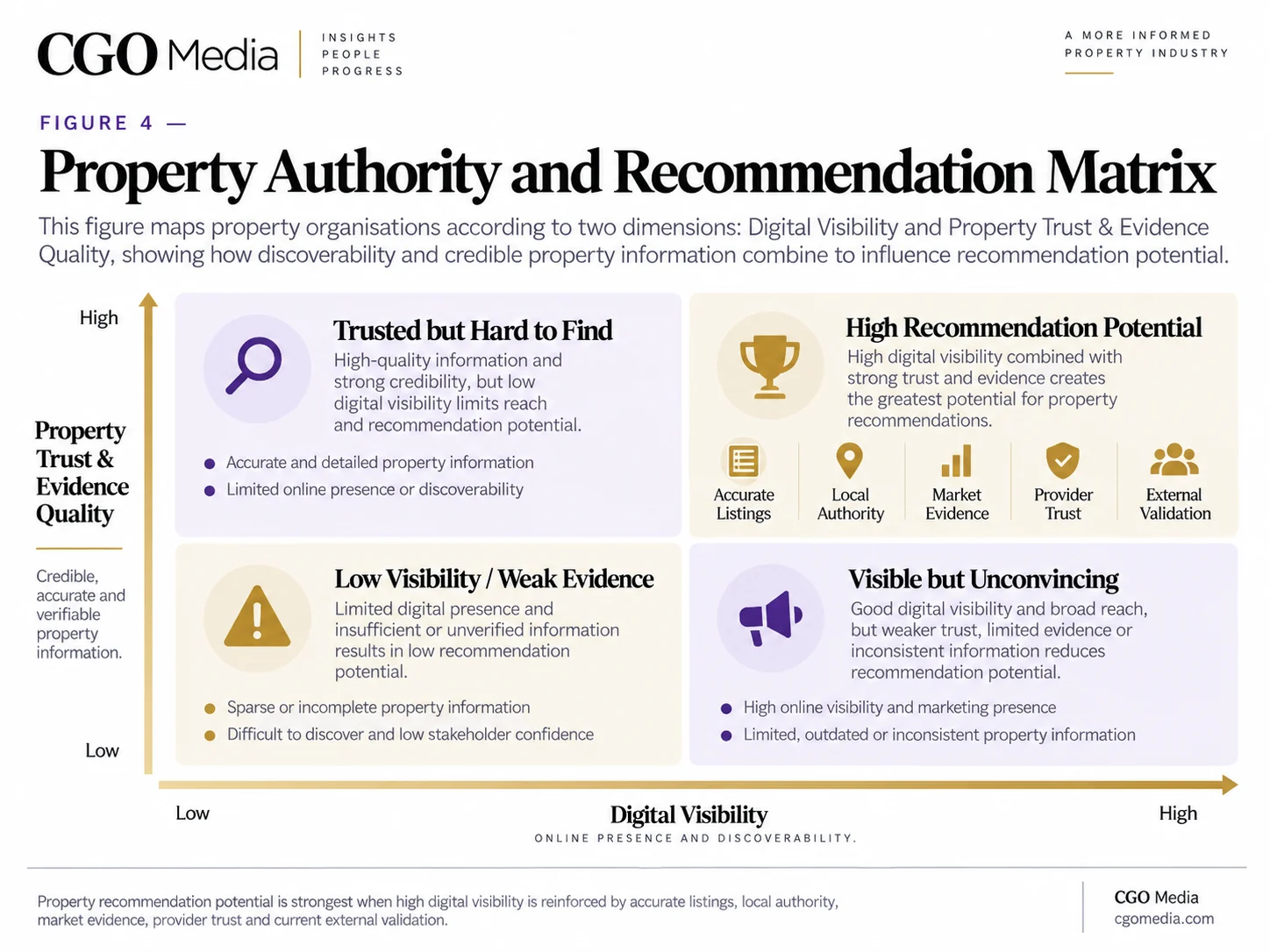
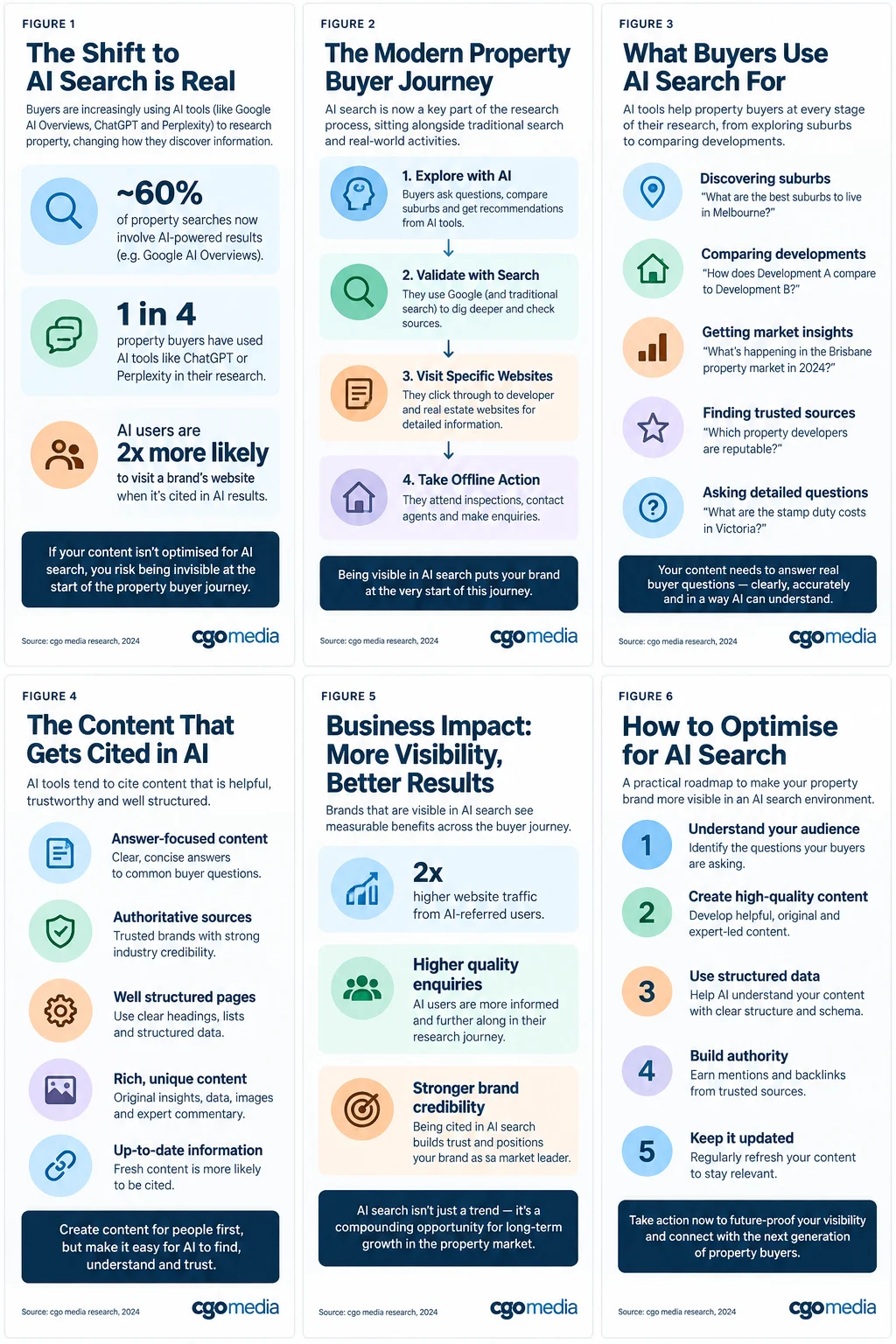
455. Phase Five — Validate
The Validate phase tests whether the authority built through technical reliability, information architecture and owned evidence is reinforced by credible external sources and represented accurately across wider discovery environments.
456. Validation Moves Beyond Self-Assertion
A property organisation can describe itself as experienced, local, specialist or trusted, but stronger authority emerges when relevant independent evidence supports those claims.
457. The Purpose of Validation
The objective is to determine whether the organisation’s owned evidence is:
- Externally reinforced
- Consistently represented
- Accurately understood
- Appropriately recommended
458. Independent Validation Is the First Validation Layer
Independent sources can provide evidence beyond the organisation’s direct control.
459. Independent Validation Can Include
- Journalist coverage
- Trade publications
- Industry associations
- Research citations
- Review platforms
- Independent directories
460. Independent Evidence Should Be Relevant
The strongest validation reinforces the organisation’s actual:
- Locations
- Services
- Property specialisms
- Professional expertise
- Research
461. Independent Evidence Should Not Be Treated as a Volume Game
A smaller number of highly relevant references can be more strategically useful than a large number of weak mentions.
462. Media Validation
Media references can strengthen authority where journalists associate the organisation or professional with genuine expertise.
463. Useful Media Validation Can Include
- Property-market commentary
- Local market analysis
- Buyer behaviour
- Seller trends
- Investment commentary
- Development analysis
464. Media Attribution Should Be Specific
Named attribution can strengthen the connection between:
- Professional
- Organisation
- Market
- Expertise
465. Trade Publication Validation
Relevant industry publications can reinforce specialist credibility.
466. Trade Validation Can Be Particularly Useful for
- Commercial property
- Luxury property
- Development
- Investment
- Property technology
467. Research Citation Validation
Original property research can create durable authority when referenced by external organisations.
468. Research Citation Can Reinforce
- Market expertise
- Geographic authority
- Analytical capability
- Professional authority
469. Research Should Be Designed for Citation Quality
Useful research should include:
- Clear methodology
- Defined time period
- Geographic scope
- Transparent limitations
- Named authorship
470. Review Validation
Reviews provide independent customer evidence about service experience.
471. Review Validation Should Examine More Than Rating
Useful dimensions can include:
- Volume
- Recency
- Specificity
- Agent mentions
- Location mentions
- Service themes
472. Review Themes Can Reinforce Claimed Expertise
For example, repeated references to:
- Local knowledge
- Responsiveness
- International buyer support
- Negotiation
- Professionalism
can provide external evidence of service quality.
473. Review Evidence Should Be Interpreted Carefully
Reviews are subjective and may not represent every customer experience.
474. Professional Validation
Individual agents and specialists can also accumulate external authority.
475. Professional Validation Can Include
- Media commentary
- Professional memberships
- Industry recognition
- Review mentions
- Research contributions
476. Agent Authority Should Be Relevant to Claimed Specialisms
A professional described as a luxury-property specialist should have evidence connected to that actual area of practice.
477. Location Validation
Local authority should also be supported externally where possible.
478. Location Validation Can Include
- Local media mentions
- Local reviews
- Local listings
- Local research
- Local office presence
479. Development Validation
Development claims can also require external evidence.
480. Development Validation Can Include
- Developer information
- Planning information
- Construction updates
- Independent media
- Customer feedback
481. Entity Consistency Is the Second Validation Layer
The organisation should verify that key entity information remains consistent across owned and external sources.
482. Organisation Entity Validation Can Include
- Company name
- Website
- Office locations
- Telephone details
- Services
- Markets served
483. Agent Entity Validation Can Include
- Name
- Role
- Office
- Specialism
- Location expertise
484. Development Entity Validation Can Include
- Developer
- Development name
- Location
- Construction status
- Completion information
485. Entity Conflict Should Be Logged
Potential conflicts can include:
- Old office data
- Former agents
- Incorrect market descriptions
- Old brand names
- Outdated development status
486. Entity Conflict Should Be Corrected Where Possible
The organisation should prioritise high-impact inconsistencies.
487. Source Validation Is the Third Validation Layer
The organisation should identify which sources consistently reinforce or contradict its desired representation.
488. Source Mapping Can Include
- Owned website
- Property portals
- Business profiles
- Review platforms
- Media
- Industry sources
489. Source Mapping Should Identify Strong Sources
Some sources may consistently provide accurate and relevant information.
490. Source Mapping Should Identify Weak Sources
Other sources may contain:
- Outdated information
- Incorrect categories
- Old offices
- Weak descriptions
491. Source Mapping Should Identify Missing Sources
The organisation may lack presence in strategically relevant:
- Trade publications
- Directories
- Professional associations
- Research environments
492. Search Validation
The organisation should test whether strengthened evidence is improving conventional search visibility.
493. Search Validation Can Include
- Location visibility
- Service visibility
- Agent-name visibility
- Research visibility
- Property-category visibility
494. Search Validation Should Examine Qualified Visibility
The objective is not simply more rankings but more relevant discovery.
495. Local Search Validation
Local performance can be reviewed through:
- Office visibility
- Map visibility
- Review evidence
- Location relevance
496. Portal Validation
Portal presence should be checked for:
- Inventory accuracy
- Provider profile accuracy
- Property status
- Location categorisation
497. AI Validation Is the Fourth Validation Layer
The organisation should test how strengthened evidence is represented in generative search scenarios.
498. AI Validation Should Use Controlled Scenario Families
Useful categories can include:
- Location recommendation
- Provider recommendation
- Property-type discovery
- Seller questions
- Investor questions
- Development comparison
499. AI Validation Should Record Inclusion
The organisation should determine whether it appears where genuine relevance exists.
500. AI Validation Should Record Exclusion
Relevant exclusion can indicate remaining evidence gaps.
501. AI Validation Should Record Accuracy
A mention is not successful if the organisation is represented incorrectly.
502. AI Validation Should Record Recommendation Rationale
The stated reasons for inclusion can reveal which authority signals are being associated with the organisation.
503. AI Validation Should Record Sources Where Available
Visible source references can help identify which external environments contribute to the answer.
504. AI Validation Should Record Competitor Sets
Repeated competitor inclusion can reveal alternative authority pathways.
505. AI Validation Should Be Repeated Over Time
Single observations are insufficient because generative outputs can vary.
506. Scenario Testing Should Be Versioned
Useful records can include:
- Date
- Platform
- Prompt family
- Result
- Sources
- Accuracy notes
507. Recommendation Validation
The organisation should distinguish relevant inclusion from irrelevant inclusion.
508. Relevant Inclusion
The organisation appears in a scenario that matches its genuine expertise.
509. Irrelevant Inclusion
The organisation appears in a scenario outside its actual capabilities.
510. Relevant Exclusion
A genuinely suitable organisation fails to appear.
511. Appropriate Exclusion
An unsuitable organisation does not appear.
512. Qualified Recommendation Visibility Is the Preferred Outcome
A useful relationship is:
Relevant Inclusion + Accurate Representation + Appropriate Rationale → Qualified Recommendation Visibility
513. Competitor Validation
Competitor analysis should compare evidence systems rather than rankings alone.
514. Competitor Validation Can Include
- Media visibility
- Review strength
- Research authority
- Location authority
- Agent visibility
- AI recommendation visibility
515. Competitor Evidence Gaps Can Reveal Opportunities
The organisation can identify areas where the wider market has:
- Weak research
- Weak local evidence
- Thin professional authority
- Limited external validation
516. Validation Should Connect Back to the Gap Register
Phase Five should show which Phase One weaknesses have improved and which remain unresolved.
517. Validation Should Use Before-and-After Comparison
Useful comparisons can include:
- Search visibility
- Review strength
- Media references
- Entity accuracy
- AI inclusion
518. Validation Should Distinguish Correlation from Causation
Improved performance may result from several simultaneous factors.
519. Search Improvement Can Coincide with Market Change
Visibility or enquiry movement may also reflect:
- Seasonality
- Inventory change
- Buyer demand
- Competitor change
- Platform updates
520. Commercial Validation
Authority improvement should eventually be interpreted alongside downstream outcomes.
521. Commercial Validation Can Include
- Qualified enquiry rate
- Viewing progression
- Seller instructions
- Reservation progression
- Completed transactions
522. Review Growth Can Be a Post-Transaction Validation Signal
Positive customer experiences can create new independent authority evidence.
523. Referral Growth Can Also Reinforce Validation
Referral behaviour can indicate strong user confidence.
524. External Citation Growth Can Reinforce Research Authority
Research referenced by others can become a durable validation asset.
525. Validation Should Identify False Positives
Examples can include:
- High visibility for irrelevant searches
- AI mentions for unsupported services
- Traffic with low commercial relevance
- Review growth unrelated to priority markets
526. Validation Should Identify False Negatives
Examples can include:
- Strong expertise but weak search visibility
- Strong local presence but weak AI inclusion
- Strong research but few external citations
- Strong reviews but weak provider discovery
527. Validation Should Produce an Evidence Confidence View
A useful conceptual relationship is:
Owned Evidence + Independent Evidence + Representation Accuracy + Search Visibility + AI Validation → Authority Confidence
528. High Authority Confidence
The organisation is:
- Accurately represented
- Externally validated
- Visible in relevant search
- Included appropriately in AI scenarios
529. Medium Authority Confidence
The organisation has strong owned evidence but uneven external validation or inconsistent representation.
530. Low Authority Confidence
The organisation relies mainly on self-published claims with weak independent reinforcement.
531. Validation Should Lead to Corrective Action
Weak areas should feed directly into:
- Content improvement
- Entity correction
- Review development
- Research production
- Digital PR
- AI monitoring
532. Validation Should Be Repeated
Authority is not permanently established after one successful review.
533. External Sources Change
Media, directories, review platforms and portal information can become outdated.
534. AI Representation Changes
Generative systems can alter:
- Sources
- Comparisons
- Recommendations
- Descriptions
535. Market Authority Changes
Competitors can develop stronger:
- Research
- Reviews
- Location coverage
- Professional authority
536. Validation Should Therefore Become an Ongoing Governance Function
The organisation should not treat external authority as a one-time campaign.
537. The Seventeenth Property Implementation Principle
Property authority should be validated through relevant independent evidence rather than self-assertion alone, using reviews, media, research citations, trade recognition and other credible sources to reinforce genuine market, professional and geographic expertise.
538. The Eighteenth Property Implementation Principle
Entity consistency should be tested across owned and external environments so organisations, offices, agents, developments and services are represented accurately enough to reduce ambiguity for both users and machine systems.
539. The Nineteenth Property Implementation Principle
AI-assisted visibility should be validated through repeatable scenario testing that records inclusion, exclusion, representation accuracy, recommendation rationale, source visibility and competitor sets rather than treating isolated outputs as stable evidence.
540. The Twentieth Property Implementation Principle
Validation should distinguish relevant authority gains from misleading activity, recognising that irrelevant visibility, inaccurate AI inclusion, weak commercial fit and unrelated external mentions can increase headline metrics without strengthening qualified property search authority.
541. Phase Five Output
The principal output of the Validate phase is a documented Property Authority Validation Layer combining:
Independent Evidence + Entity Consistency + Search Validation + AI Validation + Commercial Validation → Authority Confidence
542. The Transition to Phase Six
Once the organisation has built and validated stronger authority, it can move into the Integrate phase, where technical search, property operations, research, external authority, AI monitoring and commercial measurement are combined into one ongoing operating system.
543. The Strategic Implication
The Validate phase determines whether the authority built through earlier implementation survives beyond owned content. By testing independent evidence, entity consistency, search visibility, review authority, external citations and AI-assisted representation, property organisations can identify where their claimed expertise is genuinely reinforced and where important gaps remain. This creates a more defensible authority position and prepares the organisation to integrate search, data, research, professional expertise and commercial measurement into one coordinated operating model.
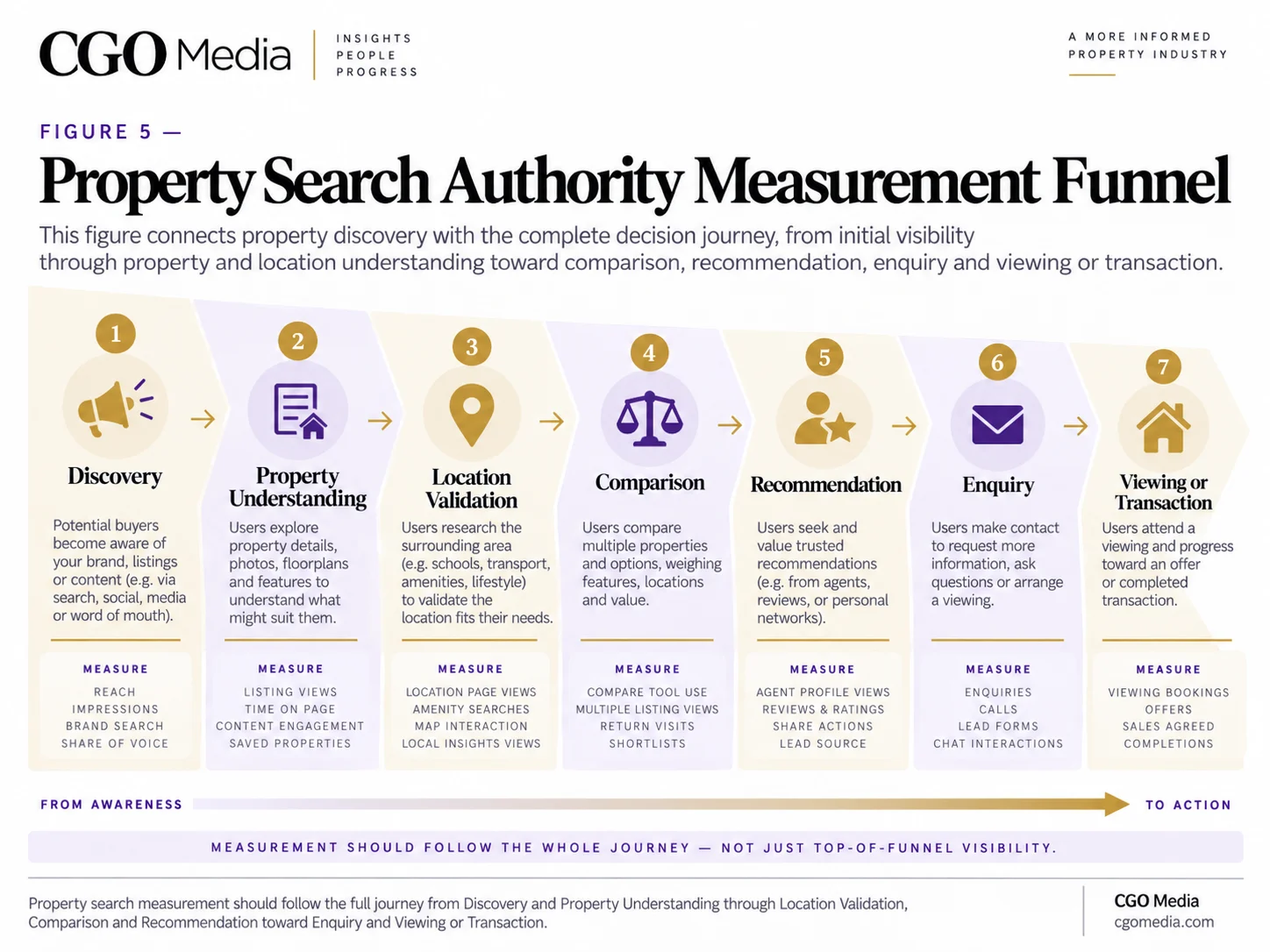
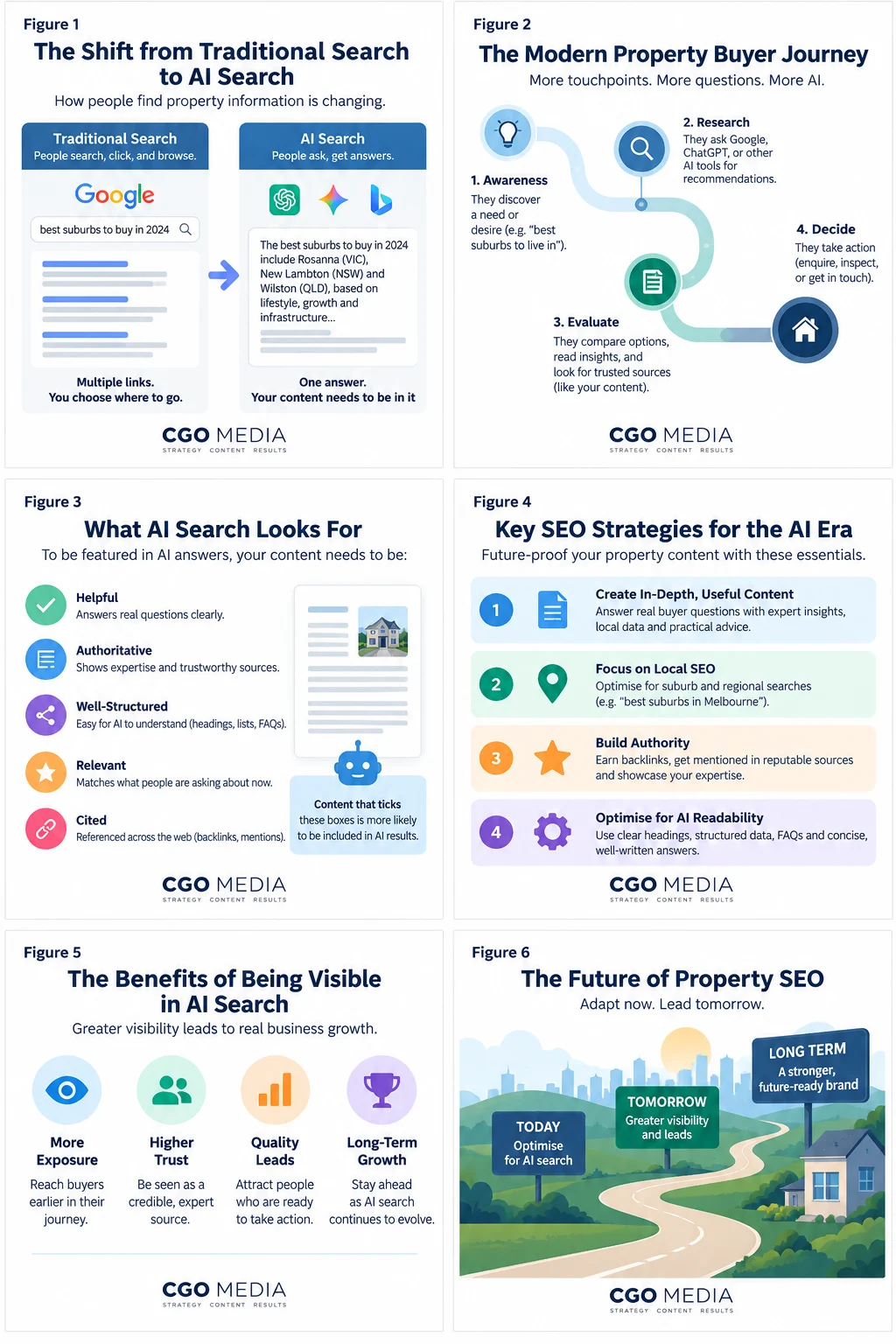
544. Phase Six — Integrate
The Integrate phase combines the capabilities developed through assessment, stabilisation, structural improvement, authority strengthening and validation into one coordinated Property Search Authority operating model.
545. Integration Reduces Fragmentation
Search performance becomes stronger when technical, content, data, professional, research and commercial teams work from shared standards.
546. The Purpose of Integration
The objective is to create a connected system in which:
- Technical SEO
- Property data
- Location authority
- Professional entities
- Market research
- External authority
- AI monitoring
- Commercial outcomes
reinforce one another.
547. Search Governance Is the First Integration Layer
Property organisations should establish clear ownership of the major search and authority capabilities.
548. Technical Search Ownership
Technical responsibilities can include:
- Crawlability
- Indexation
- Performance
- Internal linking
- Property lifecycle rules
- Structured data
549. Property Data Ownership
Operational responsibilities can include:
- Price
- Status
- Availability
- Property attributes
- Feed quality
- Duplicate control
550. Location Authority Ownership
Responsibilities can include:
- Location-page quality
- Market data
- Neighbourhood coverage
- Local inventory relationships
- Local-agent attribution
551. Professional Authority Ownership
Responsibilities can include:
- Agent profiles
- Professional biographies
- Specialisms
- Reviews
- Research contribution
552. Research Ownership
Research responsibilities can include:
- Topic selection
- Methodology
- Data quality
- Publication
- Updates
- External distribution
553. External Authority Ownership
Responsibilities can include:
- Digital PR
- Media relations
- Trade publications
- Research citation
- Independent references
554. AI Visibility Ownership
Responsibilities can include:
- Scenario testing
- Entity accuracy checks
- Comparison monitoring
- Recommendation monitoring
- Source observation
555. Commercial Measurement Ownership
Responsibilities can include:
- Qualified enquiry
- Viewing conversion
- Seller instructions
- Lost-opportunity analysis
- Transaction outcomes
556. Shared Governance Prevents Capability Silos
A technical SEO team should not operate independently from the teams controlling:
- Property data
- Agents
- Research
- CRM
- Customer experience
557. Property Data and Search Should Be Integrated
Search architecture should reflect actual inventory and operational property status.
558. CRM and Search Should Be Integrated
Search data becomes more useful when later outcomes are visible.
559. CRM Integration Can Connect
Discovery Source → Enquiry → Qualification → Viewing → Offer → Transaction
560. Agent Feedback Should Feed Search Strategy
Agents can provide insight into:
- User objections
- Property mismatch
- Location questions
- Trust barriers
- Common information gaps
561. Search Data Should Feed Agent Strategy
Search teams can identify:
- Emerging location demand
- New property-type demand
- Seller search behaviour
- Investment interest
- AI recommendation patterns
562. Research Should Feed Content Strategy
Original findings can strengthen:
- Location pages
- Seller content
- Investment content
- Buyer guides
- Media outreach
563. Research Should Feed Digital PR
Original data can provide journalists with:
- Statistics
- Market trends
- Regional comparisons
- Expert commentary
- Visual assets
564. Digital PR Should Feed Authority Architecture
Relevant external citations can reinforce:
- Organisation authority
- Location authority
- Professional authority
- Research authority
565. Review Intelligence Should Feed Service Improvement
Review themes can reveal recurring strengths and weaknesses.
566. Review Intelligence Should Feed Content
Common customer questions can inform:
- Buying guides
- Seller guides
- FAQs
- Agent profiles
- Location content
567. Review Intelligence Should Feed Professional Development
Recurring feedback can identify:
- Communication strengths
- Response issues
- Local knowledge gaps
- Transaction-support needs
568. AI Monitoring Should Feed Evidence Development
Repeated exclusion or inaccurate representation can reveal where evidence needs improvement.
569. AI Monitoring Can Reveal Location Gaps
An organisation may fail to appear in markets where it claims expertise but has weak supporting evidence.
570. AI Monitoring Can Reveal Entity Gaps
Agents, offices or services may be misrepresented because information is inconsistent or thin.
571. AI Monitoring Can Reveal External Authority Gaps
Competitors may appear more frequently because they have stronger independent references or source diversity.
572. AI Monitoring Should Therefore Connect to Improvement Planning
Generative-search observation should not operate as a reporting exercise alone.
573. The Integrated Search Operating Model
A useful relationship is:
Technical Search + Property Data + Entity Architecture + Location Authority + Professional Evidence + Research + External Authority + AI Monitoring + Commercial Measurement
574. Shared KPIs Can Improve Integration
Cross-functional teams can align around metrics such as:
- Qualified organic visibility
- Property-data accuracy
- Local authority coverage
- Agent-profile completeness
- Research citations
- Qualified AI inclusion
- Qualified enquiry rate
575. Shared KPIs Should Avoid Vanity Metrics
Large traffic, page-count or mention numbers should not become targets where they are disconnected from relevance and commercial value.
576. Integrated Reporting Should Connect Leading and Lagging Indicators
Leading indicators can include:
- Property-data quality
- Indexation quality
- Authority content
- External references
- AI visibility
577. Lagging Indicators Can Include
- Qualified enquiries
- Viewings
- Instructions
- Transactions
- Reviews
578. Integration Should Include Regular Review Cycles
Useful review frequencies can include:
- Weekly operational checks
- Monthly performance reviews
- Quarterly authority reviews
- Periodic research updates
579. Weekly Reviews Can Focus on Volatile Data
Examples can include:
- Inventory
- Price
- Status
- Feed errors
- Major technical issues
580. Monthly Reviews Can Focus on Search and Commercial Performance
Useful measures can include:
- Search visibility
- Qualified enquiries
- Viewing progression
- Local visibility
- Review activity
581. Quarterly Reviews Can Focus on Authority Development
Useful dimensions can include:
- Location depth
- Research authority
- Media citations
- Professional profiles
- AI recommendation visibility
582. Integrated Governance Should Include Change Management
Search authority can be damaged by unmanaged changes.
583. Website Redesigns Should Include Search Governance
Redesign processes should protect:
- URLs
- Internal links
- Structured data
- Location hierarchy
- Historical authority
584. CRM Migrations Should Include Search Governance
Changes to property-data systems can affect:
- Listings
- Feeds
- Status
- Property IDs
- URLs
585. Rebrands Should Include Entity Governance
A rebrand can create inconsistency across:
- Website
- Business profiles
- Portals
- Reviews
- Media
586. Office Changes Should Include Local Entity Governance
Opening, closing or moving offices should trigger updates across the full evidence environment.
587. Agent Changes Should Include Professional Entity Governance
Role changes or departures should update relevant:
- Profiles
- Listings
- Office pages
- Research attribution
588. Integrated Governance Should Reduce Authority Decay
The purpose is not only to create authority but to preserve it.
589. Phase Six Output
The principal output of the Integrate phase is a coordinated Property Search Authority Operating Model.
A mature operating relationship can be summarised as:
Property Operations + Search + Content + Research + PR + AI Monitoring + CRM + Commercial Feedback → Integrated Search Authority
590. The Transition to Phase Seven
Once the authority system is integrated into normal operations, the organisation can move into the Evolve phase, where it adapts continuously to changing markets, search environments, AI systems and user behaviour.
591. Phase Seven — Evolve
The Evolve phase turns Property Search Authority from an implementation programme into a continuously adapting organisational capability.
592. Property Search Environments Do Not Remain Static
Change can occur in:
- Search interfaces
- AI platforms
- Property portals
- Buyer behaviour
- Market conditions
- Regulation
593. Evolution Requires Continuous Observation
The organisation should monitor:
- Search demand
- AI discovery patterns
- Competitor behaviour
- Customer questions
- Market movement
594. Search Demand Evolves
New search themes can emerge around:
- Locations
- Property types
- Lifestyle priorities
- Investment questions
- Regulatory changes
595. User Language Evolves
Users may move from short keyword searches toward longer, conversational and multi-criteria queries.
596. Property Search Strategy Should Adapt to Changing Intent
New content or information structures should follow meaningful changes in user need.
597. Market Conditions Evolve
Changes can occur in:
- Prices
- Inventory
- Mortgage conditions
- Buyer confidence
- Rental demand
598. Market Research Should therefore Be Updated
Old assumptions should not continue indefinitely where current evidence changes.
599. Location Priorities Can Evolve
New markets can become commercially important.
600. Business Priorities Can Evolve
The organisation may expand into:
- New locations
- New property categories
- New buyer segments
- New services
601. Authority Architecture Should Follow Genuine Business Expansion
New search authority should be built where operational capability actually exists.
602. AI Search Systems Evolve
Generative environments can change:
- Retrieval behaviour
- Source selection
- Citation behaviour
- Comparison formats
- Recommendation behaviour
603. AI Monitoring Should therefore Be Adaptive
Scenario libraries should evolve as platforms and user behaviour change.
604. New AI Scenarios Should Be Added Selectively
Useful additions can reflect:
- New user questions
- New markets
- New services
- New platform features
605. Old AI Scenarios Should Be Retired Where They Lose Relevance
Monitoring should reflect current strategic needs rather than accumulate indefinitely.
606. Competitor Authority Evolves
Competitors can improve:
- Research
- Reviews
- Location depth
- Media visibility
- AI representation
607. Competitive Review Should therefore Be Repeated
The objective is to identify changing capability gaps rather than copy competitor activity.
608. User Trust Expectations Evolve
Users may increasingly expect:
- Better property data
- More transparency
- Stronger reviews
- Clear professional identity
- Independent evidence
609. Trust Architecture Should Evolve with User Expectations
Evidence that was sufficient previously may become weaker as the market matures.
610. Research Opportunities Evolve
New market questions can create opportunities for original research.
611. Research Development Should Be Systematic
Potential topics can be prioritised according to:
- User uncertainty
- Journalist interest
- Business relevance
- Data availability
- Evidence gaps
612. Research Can Become a Continuous Authority Engine
A useful relationship is:
New Market Question → Original Research → Media & Citation Visibility → Stronger Authority → New Discovery
613. External Authority Should Evolve
Media and citation strategies should follow the organisation’s changing areas of expertise.
614. Reputation Should Evolve
Review programmes should continue to reflect current:
- Agents
- Offices
- Services
- Customer outcomes
615. Professional Authority Should Evolve
Agent profiles should develop as professionals gain:
- Experience
- New specialisms
- New qualifications
- Research involvement
- Media recognition
616. Technical Architecture Should Evolve Carefully
New functionality should not create uncontrolled:
- URLs
- Duplicates
- Indexation
- Performance problems
617. Property Data Architecture Should Evolve
New fields may become strategically important as user needs change.
618. New Data Fields Should Have Clear Purpose
They should support:
- User decisions
- Search discovery
- Filtering
- Comparison
- AI interpretation
619. Evolution Should Be Evidence-Led
The organisation should avoid chasing every new:
- Search trend
- AI feature
- Platform change
- Content format
620. Strategic Change Should Follow Demonstrated Need
A useful relationship is:
Observed Change → Evidence → Strategic Relevance → Controlled Experiment → Measured Outcome
621. Experimentation Is Part of Evolution
Property organisations can test improvements in:
- Location architecture
- Property presentation
- Agent profiles
- Research formats
- AI visibility
622. Experiments Should Have Clear Hypotheses
Teams should define:
- What is changing
- Why it is changing
- Expected result
- How success will be measured
623. Experiments Should Be Measured Before Scaling
A successful small test can become a broader standard.
624. Failed Experiments Should Be Recorded
Unsuccessful activity provides useful organisational learning.
625. Learning Should Feed the Roadmap Again
The system becomes cyclical rather than linear.
626. The Seven Phases Form a Continuous Loop
A mature organisation repeatedly moves through:
Assess → Stabilise → Structure → Strengthen → Validate → Integrate → Evolve → Reassess
627. Reassessment Prevents Authority Decay
Even mature organisations can accumulate:
- Technical debt
- Stale content
- Old profiles
- Weak market evidence
- Outdated AI representation
628. Adaptive Authority Is the Long-Term Objective
Adaptive Authority describes an organisation capable of maintaining and improving search relevance as markets, users and discovery systems change.
629. Adaptive Authority Requires Governance
Without ownership and standards, improvement becomes dependent on isolated campaigns.
630. Adaptive Authority Requires Measurement
The organisation should know which capabilities are improving and which are weakening.
631. Adaptive Authority Requires Learning
Search and commercial evidence should inform future strategy.
632. Adaptive Authority Requires Evidence Renewal
Market, professional, review and external evidence should remain current.
633. Adaptive Authority Requires Operational Participation
SEO teams alone cannot maintain accurate property and professional information.
634. The Integrated Authority Flywheel
A useful relationship is:
Accurate Operations → Stronger Evidence → Better Discovery → Better Matching → Better Outcomes → New Trust Evidence → Stronger Authority
635. Better Discovery Creates Better Learning
More qualified users provide richer:
- Enquiry data
- Viewing feedback
- Customer questions
- Review evidence
636. Better Learning Improves Future Evidence
The organisation can refine:
- Listings
- Location content
- Agent profiles
- Research
- Qualification
637. Better Evidence Can Improve Future Discovery
The authority system becomes increasingly cumulative.
638. The Twenty-First Property Implementation Principle
Property Search Authority should be integrated into normal operations so technical search, property data, location content, professional entities, research, external authority, AI monitoring and commercial measurement reinforce one another instead of operating as disconnected workstreams.
639. The Twenty-Second Property Implementation Principle
Integrated governance should connect leading authority indicators with downstream commercial outcomes, allowing organisations to understand whether stronger data, evidence, visibility and recommendation presence are producing more relevant enquiries, viewings, instructions and transactions.
640. The Twenty-Third Property Implementation Principle
Property Search Authority should evolve continuously in response to changing user behaviour, property markets, search interfaces, AI systems and competitive evidence, using controlled experimentation and documented learning rather than reactive adoption of every new platform trend.
641. The Twenty-Fourth Property Implementation Principle
The long-term objective should be Adaptive Authority: an organisational capability that repeatedly reassesses, updates and strengthens the technical, informational, professional, external and AI-search evidence required to remain relevant across changing property-discovery environments.
642. Phase Six Output
The principal output of the Integrate phase is an operational Property Search Authority Operating Model connecting:
Property Operations + Technical Search + Entity Governance + Location Authority + Professional Evidence + Research + Digital PR + AI Monitoring + Commercial Measurement
643. Phase Seven Output
The principal output of the Evolve phase is Adaptive Property Search Authority.
This can be represented as:
Continuous Observation + Evidence Renewal + Controlled Experimentation + Organisational Learning → Adaptive Authority
644. The Complete Property SEO and AI Implementation Roadmap
The full implementation sequence can be summarised as:
Assess → Stabilise → Structure → Strengthen → Validate → Integrate → Evolve
645. The Continuous Implementation Loop
At maturity, the roadmap becomes:
Assess → Stabilise → Structure → Strengthen → Validate → Integrate → Evolve → Reassess
646. The Strategic Implication
The Integrate and Evolve phases move Property SEO beyond project-based optimisation and into organisational capability. By connecting technical search, property operations, entity governance, geographic expertise, professional authority, market research, external validation, AI monitoring and commercial feedback, property organisations can build an authority system that continuously learns from changes in users, inventory, markets and discovery platforms. The long-term objective is not a completed SEO programme, but an adaptive property information and authority environment capable of remaining accurate, relevant and credible as search itself evolves.
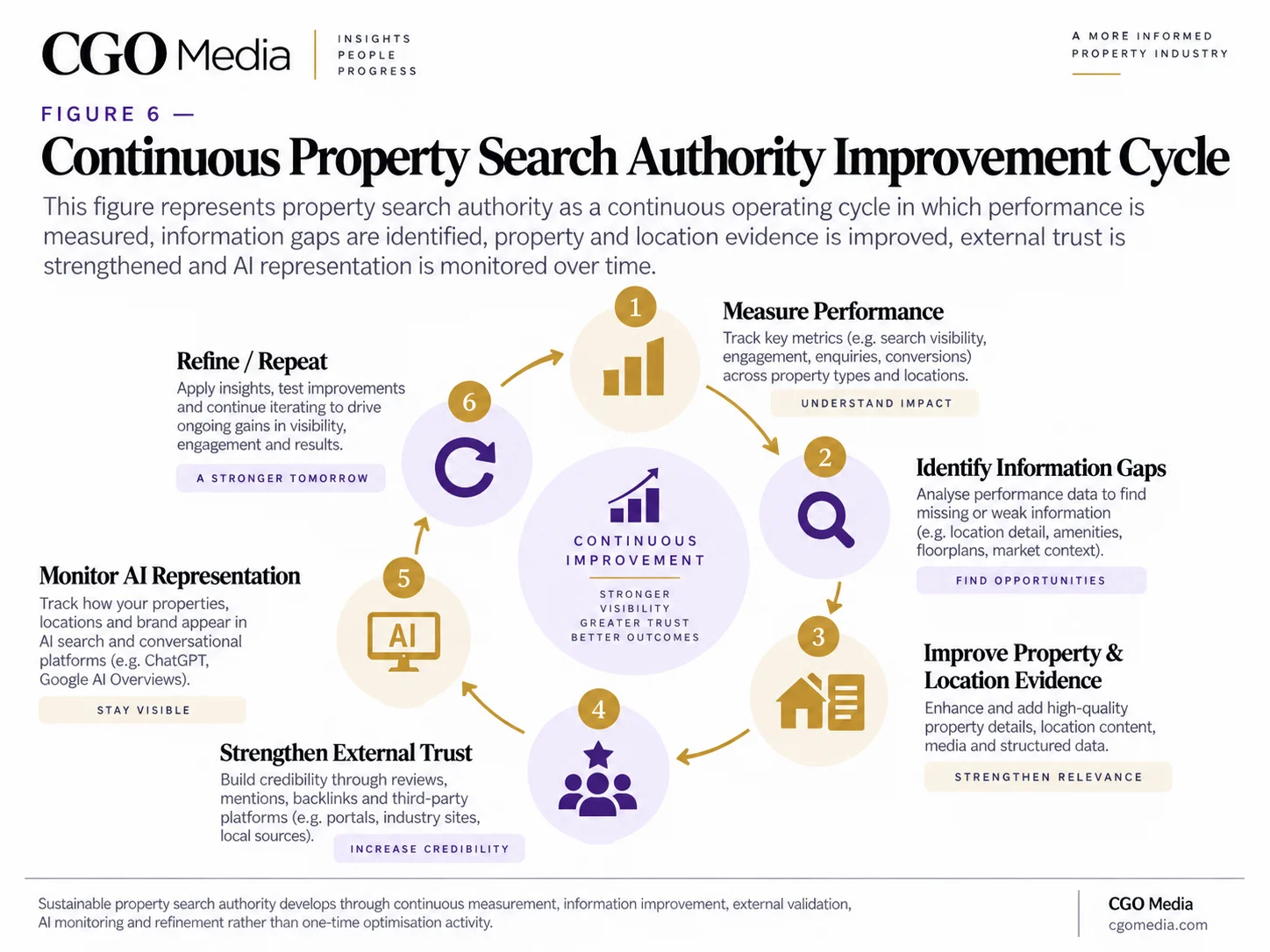
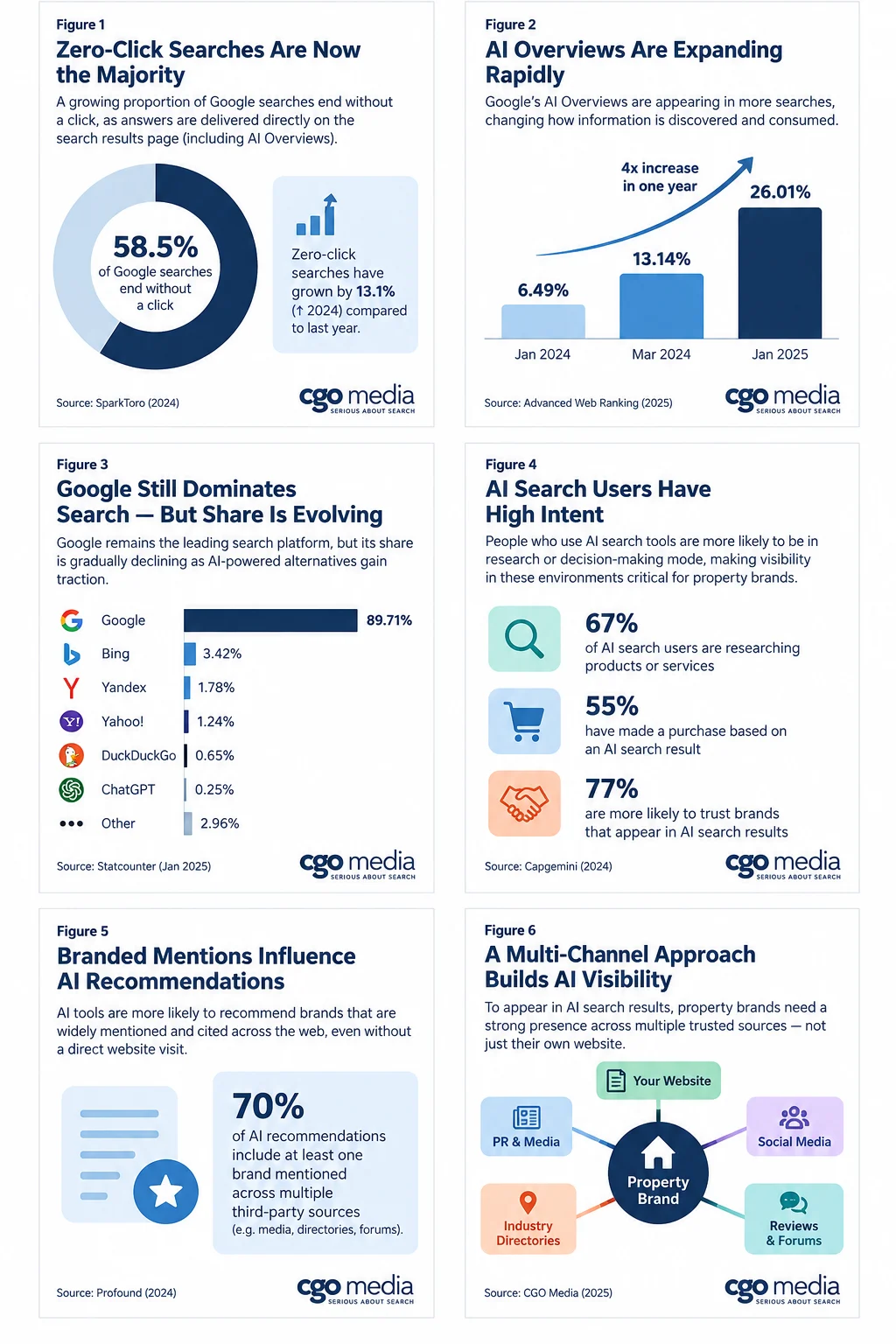
647. Research Methodology
The Property & Real Estate SEO and AI Implementation Roadmap is a conceptual implementation framework developed by CGO Media to translate Property SEO, AI Search, entity authority, provider trust, location authority and evidence strategy into a practical sequence of organisational actions.
648. Research Purpose
The central implementation question is:
How should property organisations sequence technical, informational, authority, validation and AI-search improvements so each capability supports the next rather than operating as an isolated activity?
649. Roadmap Scope
The roadmap can be applied to:
- Estate agencies
- Real estate brokerages
- Property developers
- New-build specialists
- Property portals
- Property-management organisations
- Commercial property firms
- Investment-property organisations
650. The Seven-Phase Implementation Model
The roadmap uses:
Assess → Stabilise → Structure → Strengthen → Validate → Integrate → Evolve
651. Phase One — Assess
The Assess phase identifies current weaknesses across:
- Technical search
- Property data
- Location authority
- Entity clarity
- Professional evidence
- External authority
- AI visibility
652. Phase Two — Stabilise
The Stabilise phase reduces foundational risk by improving:
- Crawlability
- Indexation
- Property lifecycle governance
- Feed consistency
- Entity accuracy
- Measurement standards
653. Phase Three — Structure
The Structure phase creates connected relationships between:
Organisation → Offices → Agents → Services → Locations → Developments → Properties → Research
654. Phase Four — Strengthen
The Strengthen phase deepens:
- Location evidence
- Property evidence
- Professional authority
- Market research
- Review authority
- External evidence
655. Phase Five — Validate
The Validate phase tests whether authority is reinforced through:
- Independent evidence
- Search visibility
- Entity consistency
- Review evidence
- AI representation
- Commercial outcomes
656. Phase Six — Integrate
The Integrate phase connects:
- Property operations
- Technical search
- Content
- Research
- Digital PR
- AI monitoring
- CRM
- Commercial feedback
657. Phase Seven — Evolve
The Evolve phase turns the roadmap into a continuous operating capability capable of adapting to changes in markets, users, search systems and AI platforms.
658. Implementation Is Sequential but Not Completely Linear
Some workstreams can operate in parallel where dependencies allow.
659. Dependencies Still Matter
For example, large-scale authority development is less effective where:
- Property data is unreliable
- Entities are inconsistent
- Locations are poorly structured
- Technical indexing problems remain unresolved
660. The Roadmap Is Designed Around Capability Dependency
A useful principle is:
Foundation Quality → Structural Clarity → Evidence Strength → External Validation → Integrated Authority
661. Technical Capability Is Foundational
Users and discovery systems cannot benefit fully from strong evidence where important pages remain inaccessible or unstable.
662. Property Data Capability Is Foundational
Accurate inventory influences:
- Search visibility
- Portal distribution
- User trust
- Property comparison
- AI interpretation
663. Location Capability Is Foundational to Geographic Authority
Property discovery remains highly location-dependent.
664. Professional Capability Is Foundational to Provider Trust
Users frequently evaluate the professionals behind the organisation before progressing.
665. Research Capability Strengthens Market Authority
Original analysis can provide stronger evidence than generic promotional content.
666. External Authority Strengthens Validation
Independent references can reinforce claims made through owned channels.
667. AI Monitoring Adds an Emerging Validation Layer
Property organisations increasingly need to understand whether their entities, locations, expertise and services are represented accurately within generative discovery systems.
668. Implementation Should Be Risk-Based
High-risk issues should generally receive priority.
669. High-Risk Issues Can Include
- Incorrect prices
- Incorrect property status
- Incorrect office information
- Broken feeds
- Major indexation problems
- Incorrect AI representation
670. Implementation Should Be Dependency-Based
High-dependency capabilities should receive early attention because they influence several downstream outcomes.
671. Implementation Should Be Commercially Prioritised
Priority markets, services and property categories should receive greater investment than low-value areas.
672. Implementation Should Be Evidence-Led
Changes should follow observed weaknesses rather than arbitrary SEO checklists.
673. Implementation Should Be Measurable
Each major initiative should have:
- Baseline
- Expected outcome
- Measurement method
- Review point
674. Framework Limitations
The roadmap is a conceptual implementation model and does not describe proprietary search-engine, property-portal or AI-platform algorithms.
675. Organisations Differ in Starting Maturity
A local estate agency may begin with different priorities from:
- A national brokerage
- A developer
- A property portal
- A commercial-property organisation
676. Organisations Differ in Technical Complexity
Large inventory platforms may require more work around:
- Faceted navigation
- Crawl control
- Property feeds
- Indexation governance
677. Organisations Differ in Geographic Complexity
A single-market agency and international network should not use identical location architecture.
678. Organisations Differ in Professional Structure
Some businesses rely heavily on individual agent authority while others operate through centralised brands.
679. Organisations Differ in Research Capability
Not every property organisation has immediate access to original datasets or research teams.
680. Organisations Differ in External Authority
Some already possess strong:
- Media visibility
- Reviews
- Industry recognition
- Research citations
681. The Roadmap Should Therefore Be Adapted
The seven phases should provide sequencing logic rather than a rigid identical checklist for every organisation.
682. Implementation Timelines Will Differ
The framework does not prescribe a fixed duration for each phase.
683. Some Stabilisation Can Occur Rapidly
Examples can include:
- Correcting office data
- Updating agent profiles
- Fixing high-risk listing errors
684. Some Structural Change Can Take Longer
Examples can include:
- CRM redesign
- Feed architecture
- Location restructuring
- Entity modelling
685. Authority Development Is Usually Cumulative
Strong research, reviews, professional authority and independent validation often develop over time.
686. AI Visibility Is Not Fully Controllable
Property organisations cannot directly determine how generative systems:
- Select sources
- Construct answers
- Compare providers
- Generate recommendations
687. AI Monitoring Provides Observation Rather Than Certainty
Repeated scenario testing can reveal patterns but cannot guarantee future outputs.
688. Commercial Outcomes Are Influenced by External Factors
Performance can also change because of:
- Interest rates
- Inventory
- Market sentiment
- Seasonality
- Regulation
689. Attribution Is Therefore Partial
Search and AI visibility should be interpreted as contributors to commercial outcomes rather than sole causes.
690. Conclusion
The Property & Real Estate SEO and AI Implementation Roadmap provides a practical sequencing model for turning Property SEO and AI-search strategy into an operational search-authority programme.
691. Assessment Creates Direction
Organisations first need to understand where technical, data, entity, authority and AI-search weaknesses exist.
692. Stabilisation Creates Reliability
Technical infrastructure, inventory data, feeds and entity information should be sufficiently reliable before large-scale expansion.
693. Structure Creates Meaning
Clear relationships between organisations, offices, agents, locations, developments, properties and research make the wider authority environment easier to interpret.
694. Strengthening Creates Evidence
Location knowledge, property detail, professional expertise, reviews and research create the substance behind authority.
695. Validation Creates Confidence
Independent references, reviews, search visibility and AI representation test whether claimed authority survives beyond owned channels.
696. Integration Creates Operational Capability
Search becomes stronger when connected with property operations, agents, research, PR, CRM and commercial measurement.
697. Evolution Creates Adaptive Authority
Mature organisations continue reassessing and improving as:
- Markets change
- Inventory changes
- User behaviour changes
- Search interfaces change
- AI systems change
698. The Complete Implementation Sequence
Assess → Stabilise → Structure → Strengthen → Validate → Integrate → Evolve
699. The Continuous Implementation Loop
Assess → Stabilise → Structure → Strengthen → Validate → Integrate → Evolve → Reassess
700. The Long-Term Authority Relationship
Reliable Operations → Clear Structure → Strong Evidence → Independent Validation → Integrated Authority → Continuous Learning → Adaptive Search Authority
701. Final Strategic Position
Property SEO and AI Search should not be treated as separate programmes. Both depend on the quality, clarity, relevance and authority of the information environment surrounding properties, locations, professionals and organisations.
The strongest long-term implementation approach therefore begins with reliable foundations, builds clear entity and location architecture, strengthens evidence, validates authority through independent sources, integrates search with normal operations and then evolves continuously as discovery systems and property markets change.
The objective is not to complete SEO. It is to build an organisational capability capable of maintaining accurate, relevant and credible property authority across conventional search, local search, portals and AI-assisted discovery.
References
External Technical, Search and Research Sources
- Google Search Central. SEO Starter Guide.
- Google Search Central. Organization Structured Data.
- Google Search Central. Local Business Structured Data.
- Schema.org. Organization.
- Schema.org. RealEstateAgent.
- Schema.org. Residence.
- Hogan, A. et al. (2021). Knowledge Graphs. ACM Computing Surveys, 54(4).
- Metzger, M.J. (2007). Making Sense of Credibility on the Web: Models for Evaluating Online Information and Recommendations for Future Research. Journal of the American Society for Information Science and Technology, 58(13), 2078–2091.
- Ji, Z. et al. (2023). Survey of Hallucination in Natural Language Generation. ACM Computing Surveys, 55(12).
Property & Real Estate AI & GEO Search Research Family
The Property & Real Estate SEO and AI Implementation Roadmap forms part of the wider CGO Media Property & Real Estate research programme examining Property SEO, AI Search, provider selection, authority development, GEO and generative discovery.
Property & Real Estate AI & GEO Search Research
The sector pillar brings together the full Property & Real Estate research family.
Explore Property & Real Estate AI & GEO Search Research →
Property & Real Estate SEO in an AI Search Environment
The parent research paper examines how conventional search, local discovery, property portals, entity authority, market evidence and AI-assisted recommendation are converging across modern property search.
Explore Property & Real Estate SEO in an AI Search Environment →
Property & Real Estate AI Trust and Visibility Framework
The framework examines how property organisations build the entity clarity, location authority, information quality, provider trust, market authority and AI visibility required for sustainable discovery.
Explore the Property & Real Estate AI Trust and Visibility Framework →
Property Discovery and Provider Selection Model
The provider-selection model examines how buyers, sellers, tenants, landlords and investors move from initial need through discovery, evaluation, validation, shortlisting and transaction.
Explore the Property Discovery and Provider Selection Model →
Property Search Authority Maturity Model
The maturity model assesses how property organisations progress from Functional participation through Optimised, Structured and Integrated capability toward Adaptive Authority.
Explore the Property Search Authority Maturity Model →
Property & Real Estate GEO: Generative Engine Optimisation
The GEO research examines source eligibility, citation visibility, entity interpretation, comparison inclusion and qualified property and provider recommendation across generative systems.
Explore Property & Real Estate GEO →
How the Property Research Family Connects
The complete relationship can be summarised as:
Sector Research → Parent Search Research → Trust Framework → Discovery & Provider Selection → Authority Maturity → Implementation Roadmap → GEO
CGO Media Research Ecosystem
CGO Media Research Library |
CGO Media Framework Library |
CGO Media Research Architecture |
CGO Media Research Observations |
CGO Media Statistics Library
About Roger Wilkinson
Roger Wilkinson is an independent researcher, SEO practitioner and founder of CGO Media with more than 25 years of experience in search, digital visibility and online strategy.
His research examines how artificial intelligence is changing search engines, entity understanding, source selection, citation systems, provider comparison and generative recommendation environments.
His sector research applies these wider concepts to industries where trust, evidence, professional authority and provider selection materially influence discovery.
Within property and real estate, his work examines how technical search, property information, local authority, professional expertise, market research, external validation and AI-assisted discovery combine to influence search authority.
View Roger Wilkinson’s researcher profile →
Research Usage & Citation
CGO Media encourages estate agencies, developers, brokerages, property portals, researchers, journalists, analysts and digital teams to reference this roadmap where it contributes to discussion or analysis of Property SEO, AI Search, GEO, implementation strategy, authority development or generative discovery.
Reasonable quotations, summaries, figures and excerpts may be used in articles, reports, presentations and academic work provided appropriate acknowledgement is given to Roger Wilkinson and CGO Media.
Cite This Research / Embed Citation
The Property & Real Estate SEO and AI Implementation Roadmap by Roger Wilkinson at CGO Media provides a seven-phase implementation sequence — Assess, Stabilise, Structure, Strengthen, Validate, Integrate and Evolve — for building sustainable property search authority across conventional and AI-assisted discovery environments.
APA Citation
APA Citation: Wilkinson, R. (2026). Property & Real Estate SEO and AI Implementation Roadmap. CGO Media. https://cgomedia.com/property-real-estate-seo-ai-implementation-roadmap/
Author: Roger Wilkinson |
Published by: CGO Media
For permissions relating to substantial reproduction, commercial licensing or republication of significant portions of this research, please contact CGO Media directly.