
Property Discovery and Provider Selection Model
 The Property Discovery and Provider Selection Model is a CGO Media research framework for understanding how buyers, sellers, tenants, landlords and investors move from an initial property need through location discovery, property evaluation, provider validation, comparison, shortlisting and eventual enquiry, viewing or transaction.
The model recognises that property search is rarely a simple progression from keyword to listing to enquiry. Users can move repeatedly between search engines, maps, property portals, agency websites, developer websites, reviews, market reports, local guides, professional recommendations and AI assistants before deciding which locations, properties and providers remain credible enough for further consideration.
The framework therefore treats property selection as a progressive process of narrowing, evidence accumulation, trust validation and risk reduction.
1. Why Property Discovery Requires a Selection Model
Property search combines high information volume with high financial, practical and emotional significance.
Users may need to evaluate:
- Location
- Budget
- Property type
- Property condition
- Lifestyle suitability
- Investment potential
- Provider credibility
- Transaction complexity
2. Discovery Is Only the Beginning of the Property Journey
Visibility creates entry into the decision process, but it does not determine final selection.
A property or provider can be discovered easily and still fail to progress because:
- The property does not fit
- The location does not fit
- The price does not fit
- The information appears unreliable
- The provider is not trusted
- The transaction appears too complex
3. Property Selection Is a Progressive Narrowing Process
A useful high-level sequence is:
Total Market → Discoverable Market → Relevant Options → Validated Options → Comparison Set → Shortlist → Enquiry → Transaction
4. Provider Selection Runs Alongside Property Selection
Users are not only choosing an asset.
They may also be choosing:
- Estate agent
- Brokerage
- Developer
- Property manager
- Mortgage adviser
- Legal adviser
5. Property Fit and Provider Trust Are Interdependent
A highly suitable property may fail to progress if the user does not trust the listing, agency, developer or transaction environment.
6. Provider Trust Cannot Make an Unsuitable Property Suitable
A highly credible agency cannot compensate for poor:
- Location fit
- Budget fit
- Property-type fit
- Lifestyle fit
- Investment fit
7. The Model therefore Evaluates Two Parallel Questions
Is this property suitable?
Is this provider credible enough to help me proceed?
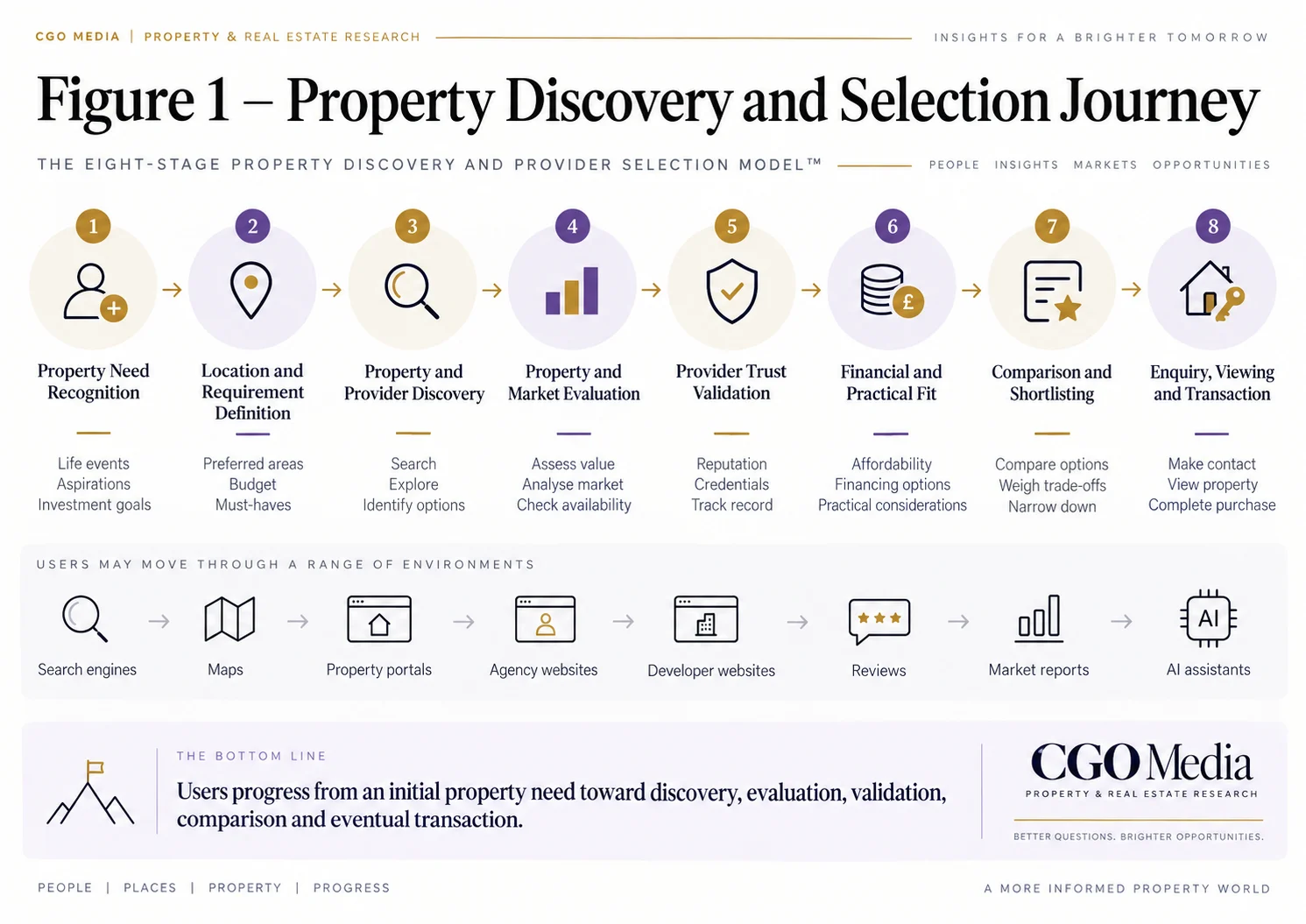
8. The Eight Stages of Property Discovery and Selection
The model uses eight principal stages:
- Property Need Recognition
- Location and Requirement Definition
- Property and Provider Discovery
- Property and Market Evaluation
- Provider Trust Validation
- Financial and Practical Fit Assessment
- Comparison and Shortlisting
- Enquiry, Viewing and Transaction
9. The Eight Stages Are Not Always Linear
Users can move backwards and forwards between stages.
For example:
- A property discovery may cause the buyer to reconsider location.
- A pricing comparison may cause the buyer to change budget.
- A viewing may cause the buyer to redefine required features.
- Provider distrust may return the user to discovery.
10. Property Journeys Can Also Be Compressed
An experienced local buyer may move quickly from discovery to enquiry because they already understand:
- The location
- The market
- The property type
- The provider
11. Property Journeys Can Be Extended
International, high-value or complex transactions can require substantially more validation.
12. Complexity Increases Evidence Requirements
A useful relationship is:
Transaction Complexity + Financial Exposure + Market Unfamiliarity → Required Evidence
13. Stage One — Property Need Recognition
The journey begins when an individual, family, investor or organisation recognises a property-related need.
14. Property Need Recognition Can Be Triggered by Life Events
Examples can include:
- Family growth
- Marriage
- Separation
- Retirement
- Relocation
- Inheritance
15. Property Need Recognition Can Be Triggered by Employment
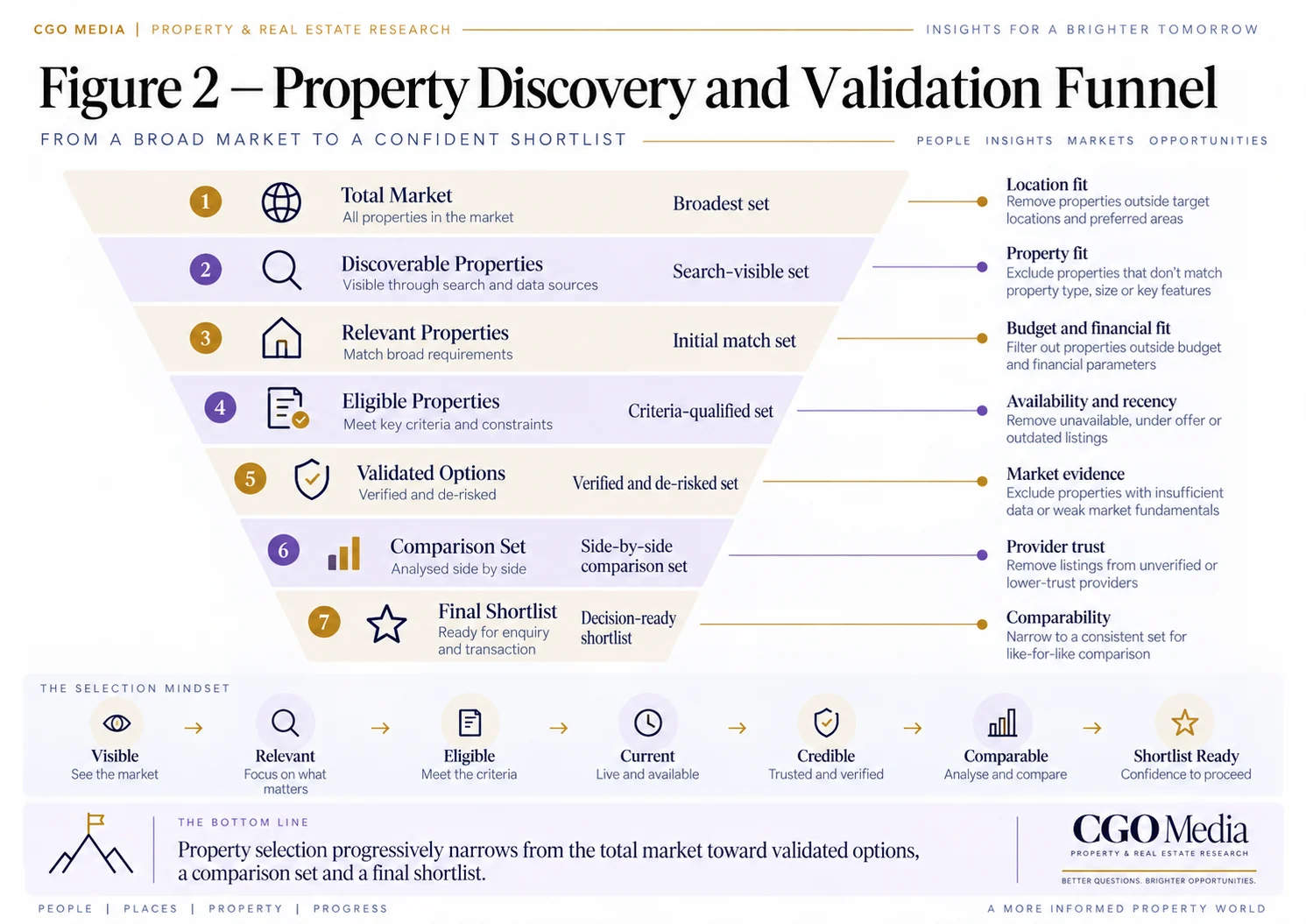
Examples can include:
- New job
- Office relocation
- Remote working
- International assignment
- Business expansion
16. Property Need Recognition Can Be Triggered by Investment
Investors may begin searching because of:
- Capital allocation
- Rental-income objectives
- Portfolio diversification
- Retirement planning
- Market opportunity
17. Property Need Recognition Can Be Triggered by Lifestyle
Users may seek:
- Better climate
- Beach access
- Golf
- International schools
- Walkability
- More space
18. Seller Need Recognition Also Begins a Selection Journey
Owners may decide to sell because of:
- Relocation
- Financial need
- Portfolio restructuring
- Inheritance
- Changing family circumstances
19. Sellers Then Enter a Provider-Selection Journey
Instead of searching primarily for properties, they may search for:
- Estate agents
- Valuation services
- Local specialists
- Luxury-property specialists
- International marketing capability
20. Landlords Also Enter Provider-Selection Journeys
Landlords may seek:
- Letting agents
- Property managers
- Tenant-finding services
- Compliance support
- Rental-market advice
21. Need Recognition Often Begins Broadly
Users may initially express a goal rather than a precise property specification.
22. Goal-Led Property Searches Can Include
- Where should I live near Málaga?
- Where should I buy a holiday home in Spain?
- Best commuter areas near London
- Best places to retire on the Costa del Sol
- Best areas for rental property investment
23. Goal-Led Searches Are Discovery-Rich
They allow search and AI systems to introduce:
- Locations
- Property types
- Lifestyle considerations
- Budget expectations
- Providers
24. AI Assistance Can Influence Need Recognition Early
Generative systems can help users frame requirements before they have selected a location or provider.
25. Early AI Questions Can Be Multi-Factor
For example:
Where should a family live on the Costa del Sol if they want international schools, beach access, airport connectivity and a quieter residential environment?
26. Multi-Factor Questions Can Shape Later Search Behaviour
An answer may introduce:
- New locations
- Budget expectations
- Property types
- Transport considerations
- School catchments
27. Need Recognition Can therefore Be Influenced Before Traditional Search Begins
This expands property discovery beyond conventional keyword-driven journeys.
28. Property Organisations Should Understand Need States
Different need states produce different information requirements.
29. Family Buyer Need States
Family buyers may prioritise:
- Schools
- Space
- Safety
- Community
- Transport
- Long-term suitability
30. Investor Need States
Investors may prioritise:
- Yield
- Capital growth
- Liquidity
- Tenant demand
- Operating costs
- Exit potential
31. Lifestyle Buyer Need States
Lifestyle buyers may prioritise:
- Climate
- Views
- Beach access
- Golf
- Restaurants
- Privacy
32. International Buyer Need States
International buyers may also prioritise:
- Language support
- Legal guidance
- Remote viewings
- Mortgage access
- After-sales support
- Transaction confidence
33. Stage Two — Location and Requirement Definition
Once the underlying need becomes clearer, the user begins converting broad goals into explicit requirements.
34. Location Definition Is Often the First Major Filter
Users may begin narrowing from:
Country → Region → City → District → Neighbourhood → Development
35. Location Selection Can Be Progressive
A user may first choose a country, then compare regions, cities and neighbourhoods as more evidence becomes available.
36. Location Definition Can Be Lifestyle-Led
Relevant factors can include:
- Schools
- Beach proximity
- Restaurants
- Transport
- Walkability
- Community
37. Location Definition Can Be Employment-Led
Users may evaluate:
- Commute time
- Road access
- Rail connections
- Airport access
- Business districts
38. Location Definition Can Be Investment-Led
Investors may examine:
- Rental demand
- Price movement
- Liquidity
- Development pipeline
- Tenant profile
39. Budget Definition Is Another Major Filter
Budget can determine:
- Location
- Property type
- Property size
- Condition
- Development quality
40. Headline Purchase Price Is Not the Entire Financial Requirement
Users may also need to account for:
- Taxes
- Legal fees
- Mortgage costs
- Community charges
- Renovation
- Maintenance
41. Property-Type Definition Narrows the Search Further
Users may define requirements around:
- Apartment
- Villa
- Townhouse
- Detached house
- New-build property
- Commercial property
- Land
42. Property-Type Requirements Can Evolve
A buyer initially seeking a villa may later consider a townhouse or penthouse after comparing:
- Budget
- Location
- Maintenance
- Availability
- Lifestyle
43. Space Requirements Can Be Explicit
These can include:
- Bedrooms
- Bathrooms
- Interior size
- Terrace
- Garden
- Parking
- Storage
44. Lifestyle Requirements Can Be Explicit
These can include:
- Beach proximity
- Schools
- Golf
- Restaurants
- Nightlife
- Walkability
- Privacy
45. Accessibility Can Be a Hard Requirement
Relevant considerations can include:
- Lift access
- Single-level living
- Step-free access
- Parking proximity
- Accessible bathrooms
46. Investment Requirements Can Be Explicit
Investors may define requirements involving:
- Rental yield
- Capital growth
- Tenant demand
- Liquidity
- Development pipeline
- Property-management needs
47. Commercial Property Requirements Can Be Different
Commercial users may prioritise:
- Floor area
- Use class
- Transport access
- Lease terms
- Footfall
- Yield
48. Requirements Can Be Divided into Hard and Soft Criteria
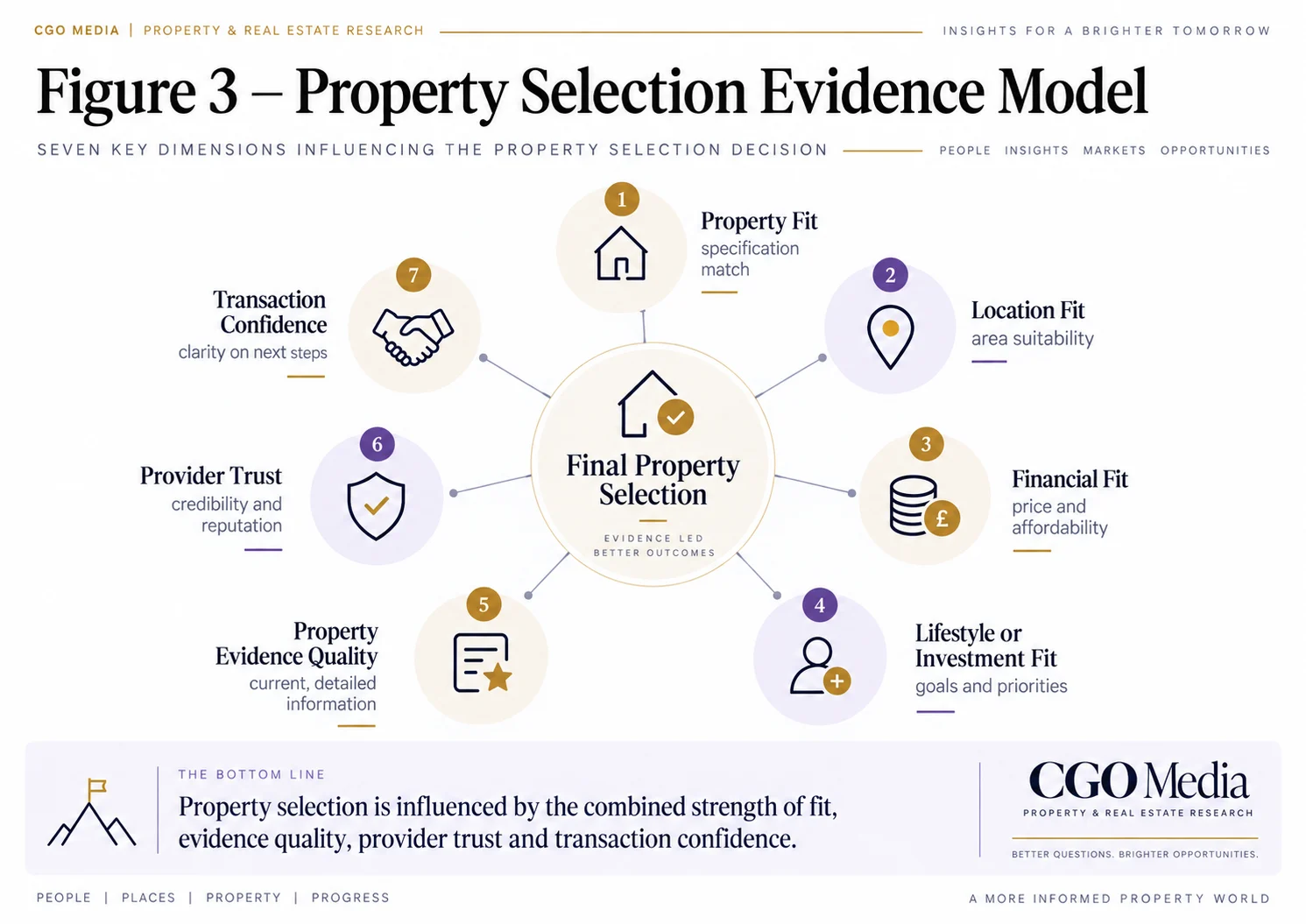
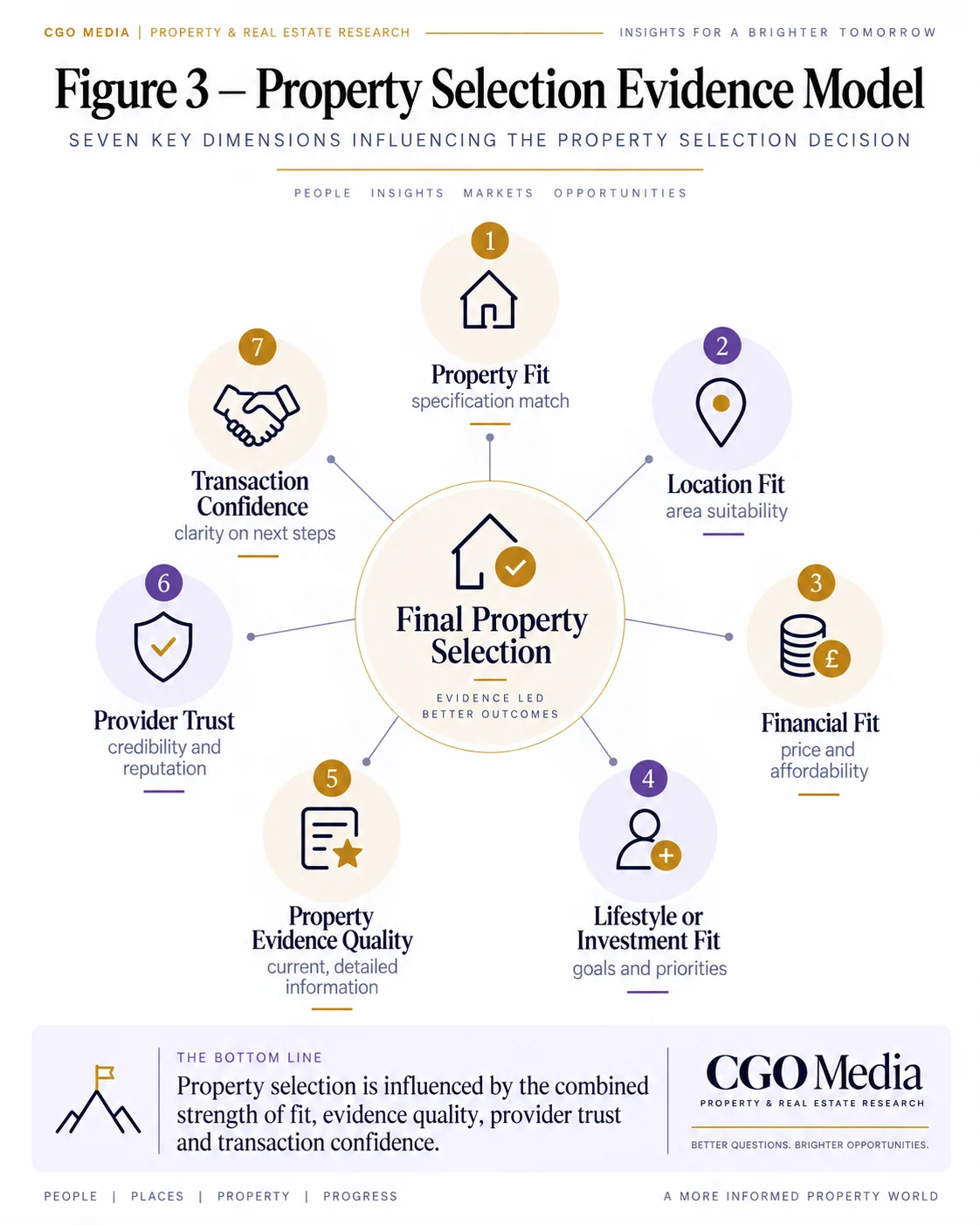
This distinction helps explain why some properties are eliminated immediately while others remain open to consideration.
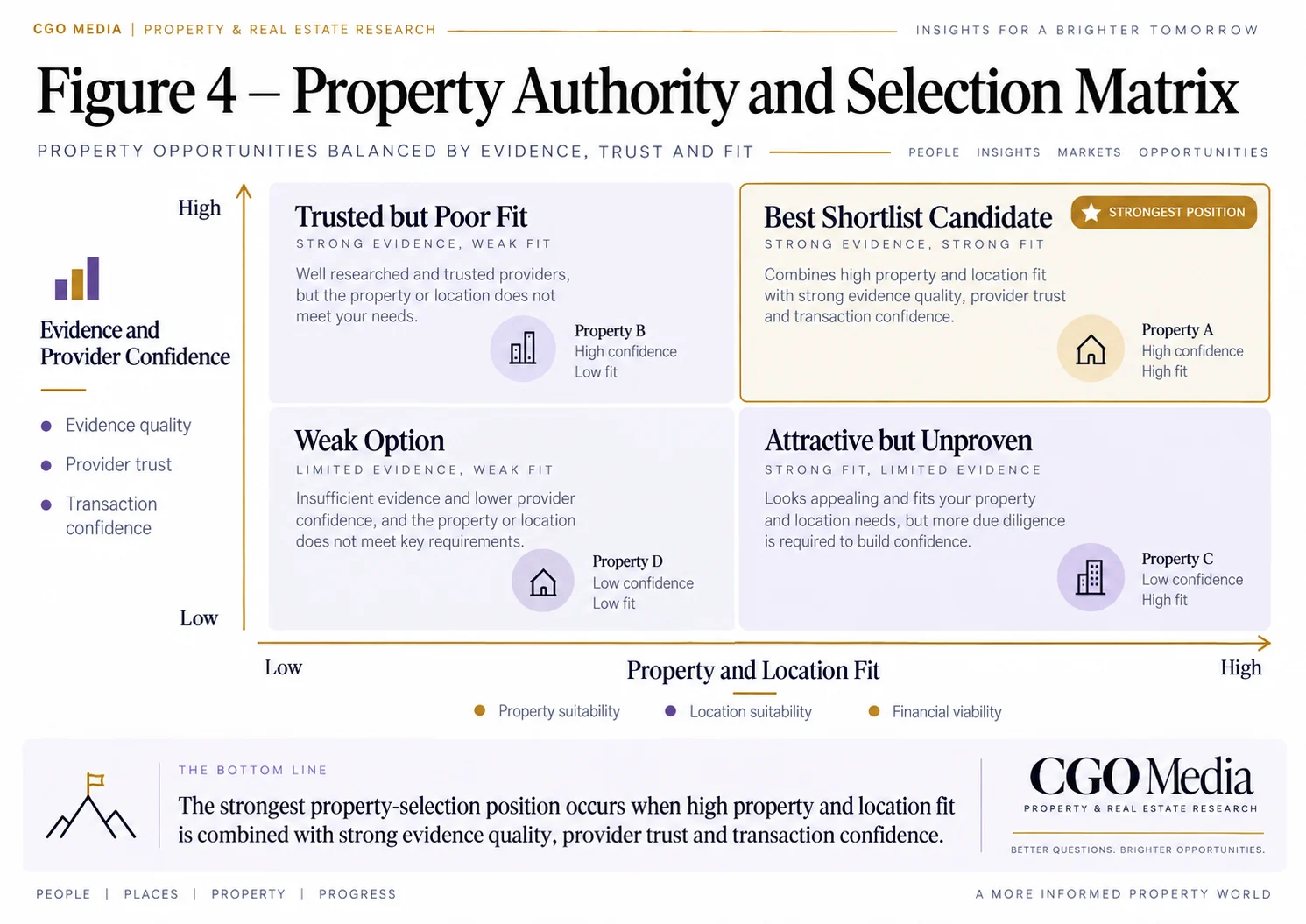
49. Hard Requirements Are Usually Non-Negotiable
Typical examples can include:
- Maximum budget
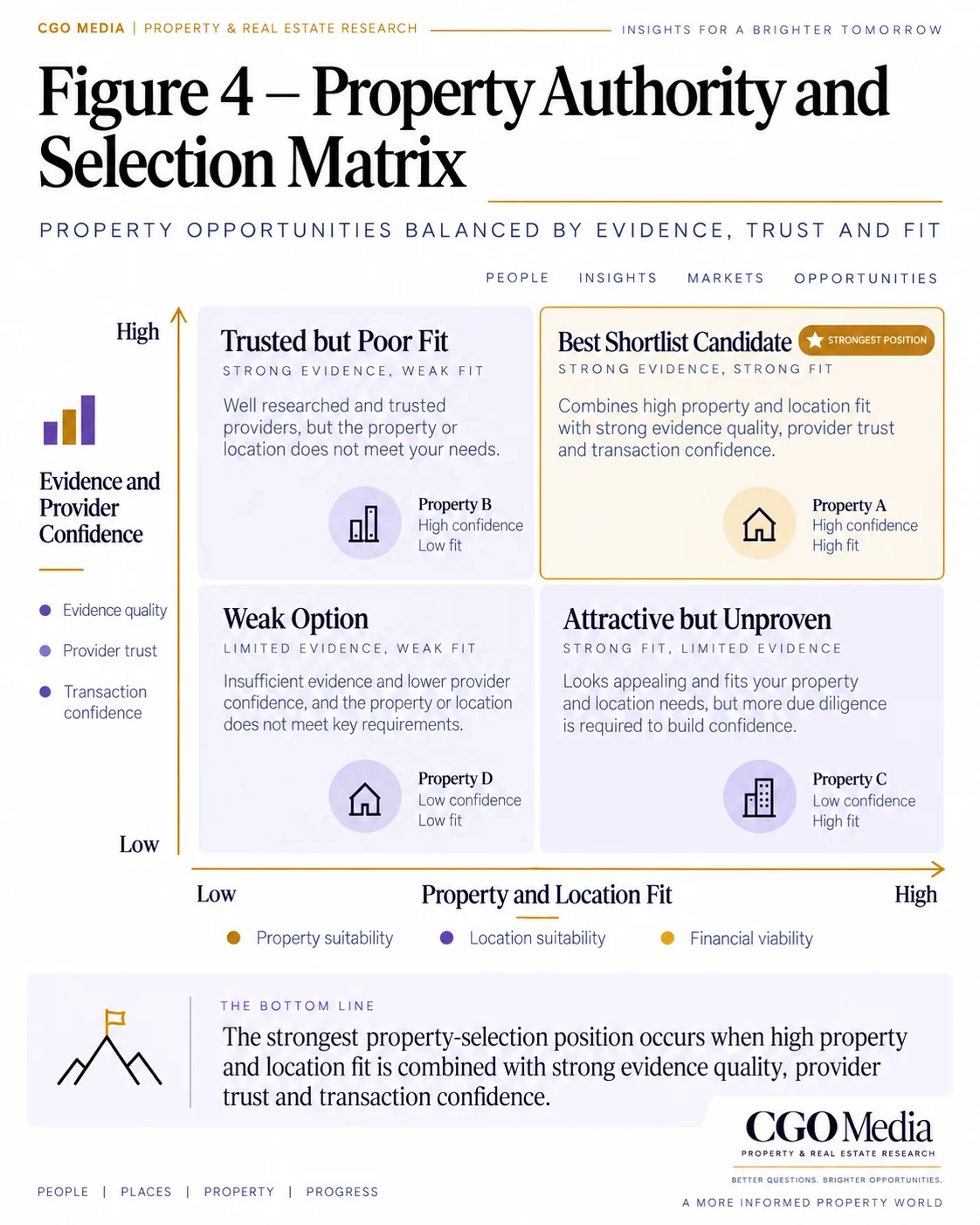
- Minimum bedrooms
- Required location
- Property type
- Completion deadline
- Accessibility
50. Soft Requirements Are Usually Preference-Based
Typical examples can include:
- Views
- Orientation
- Architectural style
- Community atmosphere
- Walking distance
- Prestige
51. Hard and Soft Requirements Can Change
A requirement initially considered essential may become negotiable after the user understands the market better.
52. Requirement Definition Is therefore Iterative
A useful relationship is:
Initial Need → Market Discovery → Requirement Refinement → More Focused Discovery
53. Market Reality Can Reshape User Expectations
Users may discover that their original combination of:
- Budget
- Location
- Size
- Condition
- Features
is unrealistic within the current market.
54. Requirement Refinement Reduces Search Noise
As criteria become clearer, irrelevant properties and locations can be removed more efficiently.
55. Location Authority Matters During Requirement Definition
Users need credible information to understand differences between markets and neighbourhoods.
56. Useful Location Evidence Can Include
- Price levels
- Property stock
- Schools
- Transport
- Lifestyle
- Development activity
57. Property Organisations Can Influence Requirement Quality
Useful guidance can help users define more realistic:
- Budgets
- Locations
- Property types
- Timelines
- Transaction expectations
58. Requirement Guidance Can Reduce Poor-Fit Enquiries
Better informed users are more likely to enquire about properties that genuinely match their needs.
59. Requirement Guidance Can Also Build Provider Trust
Organisations that explain trade-offs clearly can demonstrate practical market expertise.
60. Requirement Definition Can Include Provider Requirements
Users may also decide that they need a provider with specific capabilities.
61. Provider Requirements Can Include
- Local expertise
- Language support
- Luxury experience
- Investment expertise
- New-build expertise
- International buyer support
62. Seller Provider Requirements Can Differ
Sellers may prioritise:
- Valuation expertise
- Marketing reach
- Local transaction history
- Database strength
- Negotiation ability
63. Landlord Provider Requirements Can Differ Again
Landlords may prioritise:
- Tenant demand
- Property management
- Compliance
- Rental valuation
- Maintenance support
64. Requirement Definition Produces an Initial Eligibility Filter
A property or provider that fails a critical hard requirement may leave consideration immediately.
65. Initial Eligibility Can Be Represented as
Need + Location + Budget + Property Type + Essential Requirements → Eligible Search Space
66. Eligible Search Space Is Smaller Than the Total Market
The relevant decision environment is therefore only a subset of all available properties and providers.
67. Discoverability Will Reduce the Market Further
Even suitable properties may remain invisible if they are not surfaced through the channels the user consults.
68. Property Discovery therefore Begins Before the User Encounters a Listing
The system must first determine which locations, providers and properties enter the user’s information environment.
69. This Creates a Discovery Gate
A useful relationship is:
Total Eligible Market → Discoverable Market → User Consideration Set
70. The Discovery Gate Can Be Influenced by Multiple Channels
These can include:
- Search engines
- Property portals
- Maps
- AI assistants
- Social platforms
- Referrals
71. Different Channels Can Surface Different Markets
A property highly visible on a portal may have weak search visibility, while a specialist agency may surface through local search, media or recommendation.
72. The Discovery Environment Is therefore Fragmented
Users may build their consideration set from several partially overlapping property inventories and provider sources.
73. Property Availability Can Also Affect Discoverability
A suitable property may be:
- Off-market
- Newly listed
- Poorly syndicated
- Listed by one provider only
- Not indexed effectively
74. Discoverability and Suitability Should Remain Separate Concepts
A visible property is not necessarily suitable, and a suitable property is not necessarily visible.
75. Property Discovery Quality Depends on Matching
The stronger the match between user requirements and surfaced inventory, the more useful the discovery environment becomes.
76. A Useful Early-Stage Matching Model Is
User Need + Location Fit + Budget Fit + Property-Type Fit + Essential Requirements → Discovery Relevance
77. Provider Discovery Quality Also Depends on Matching
A highly visible agency may still be irrelevant if it does not serve the user’s:
- Location
- Property type
- Transaction type
- Language
- Buyer or seller profile
78. Provider Relevance Can Be Represented as
Service Need + Market Expertise + Transaction Capability + User Context → Provider Relevance
79. Property and Provider Discovery therefore Operate Together
The user may discover:
- A property first and then investigate the provider
- A provider first and then browse its inventory
- A location first and then discover both
80. The Journey Can Enter Through Different Starting Points
This is why a property selection model should not assume one universal entry page or channel.
81. The First Property Discovery Principle
Property discovery should be understood as a progressive decision process rather than a single search event, with users repeatedly refining requirements and narrowing the available market as evidence accumulates.
82. The Second Property Discovery Principle
Property selection and provider selection should be analysed together because users must often establish both asset suitability and provider credibility before they are willing to progress toward enquiry or transaction.
83. The Third Property Discovery Principle
Need recognition and requirement definition should be treated as strategic discovery stages because search engines, local platforms and AI assistants can influence location, property-type and provider consideration before a user reaches an individual property listing.
84. The Fourth Property Discovery Principle
Discoverability and suitability should remain distinct, recognising that strong visibility only creates consideration while property fit, market evidence, provider trust and transaction confidence determine whether an option continues through the selection journey.
85. The Property Discovery and Selection Journey
The complete eight-stage model can be summarised as:
Property Need Recognition → Location & Requirement Definition → Property & Provider Discovery → Property & Market Evaluation → Provider Trust Validation → Financial & Practical Fit → Comparison & Shortlisting → Enquiry, Viewing & Transaction
86. The Strategic Implication
Property organisations should optimise for more than initial discovery. They should provide enough location evidence, requirement guidance, property information and provider context to help users progress from an initial housing, investment, rental or selling need toward a progressively narrower and more credible set of properties and providers. This requires search visibility to operate as the entrance to a wider evidence and decision system rather than as the final objective.
87. Property Discovery Operates as a Funnel
The total property market is much larger than the set of properties a user will actually discover, consider, validate and shortlist.
A useful funnel is:
Total Market → Discoverable Market → Relevant Options → Validated Options → Trusted Options → Practical Fit → Shortlist
88. The Total Market Includes More Properties Than the User Can Realistically Evaluate
The total market can include:
- Public listings
- Off-market properties
- New developments
- Resale properties
- Rental properties
- Commercial properties
89. Discoverability Is the First Major Filter
A property can only enter active consideration if the user becomes aware of it.
90. Discoverability Depends on Distribution
Properties can surface through:
- Search engines
- Property portals
- Agency websites
- Developer websites
- Maps
- AI assistants
- Social platforms
- Referrals
91. Discoverability Can Be Uneven
Some properties achieve broad exposure while others remain visible only within specialist channels.
92. Discoverability Can Depend on Listing Quality
Poor titles, incomplete descriptions, weak images or missing location data can reduce the probability that a property enters the user’s consideration set.
93. Discoverability Can Depend on Provider Authority
Users may be more likely to encounter properties represented by agencies or developers with strong search visibility, local authority or portal presence.
94. Discoverability Can Depend on Algorithmic Selection
Search engines, portals and AI systems can determine which properties, locations and providers receive attention.
95. Discoverability Should therefore Be Measured Separately from Suitability
High visibility does not prove that the property matches the user’s actual requirements.
96. Relevance Is the Second Major Filter
Once discovered, a property must satisfy enough user requirements to remain under consideration.
97. Property Relevance Can Include
- Location fit
- Budget fit
- Property-type fit
- Size fit
- Lifestyle fit
- Investment fit
98. Hard Requirements Create Immediate Exclusion
A property may leave consideration immediately because of:
- Price
- Location
- Bedrooms
- Accessibility
- Completion date
- Property type
99. Soft Requirements Affect Relative Preference
A property may remain viable despite weaker:
- Views
- Orientation
- Style
- Prestige
- Walkability
100. Relevance Is therefore Multi-Dimensional
A useful relationship is:
Location Fit + Budget Fit + Property-Type Fit + Space Fit + Lifestyle Fit + Transaction Fit → Property Relevance
101. Provider Relevance Should Also Be Evaluated
An agency or developer may be visible but poorly matched to the user’s actual needs.
102. Provider Relevance Can Include
- Market coverage
- Property specialism
- Language capability
- Transaction expertise
- International buyer support
- Local knowledge
103. Property and Provider Relevance Can Diverge
A relevant property can be represented by a provider that the user does not consider suitable.
104. The Third Filter Is Verification
Once a property appears relevant, the user begins validating whether the available information is reliable.
105. Property Verification Can Include
- Price confirmation
- Availability
- Location
- Dimensions
- Condition
- Features
106. Property Verification Often Uses Multiple Sources
Users may compare:
- Agency listings
- Portal listings
- Developer information
- Maps
- Street imagery
- Local guides
107. Conflicting Information Can Reduce Confidence
Material discrepancies can include:
- Different prices
- Different property sizes
- Different availability
- Different descriptions
- Different locations
108. Verification Is Especially Important for International Buyers
International users may have less ability to verify properties through direct local knowledge.
109. Verification Can Include Location Validation
Users may confirm:
- Distance to schools
- Beach proximity
- Transport
- Road access
- Local amenities
110. Location Validation Can Change Property Relevance
A property that initially appears attractive may become less suitable after the user understands the surrounding area.
111. Property Condition Requires Verification
Marketing images may not fully reveal:
- Renovation needs
- Noise
- Layout constraints
- Building condition
- Neighbouring development
112. Property Verification Can Extend to Legal and Transactional Factors
These can include:
- Ownership
- Planning status
- Licences
- Community rules
- Tenancy status
113. Verification Requirements Increase with Transaction Risk
A useful relationship is:
Financial Exposure + Transaction Complexity + Information Uncertainty → Verification Requirement
114. The Fourth Filter Is Provider Trust Validation
Users may decide that a suitable property is not worth pursuing if they do not trust the provider.
115. Provider Trust Can Include
- Professional reputation
- Local expertise
- Review evidence
- Office presence
- Professional identity
- External recognition
116. Trust Validation Is Especially Important in High-Value Transactions
Property buyers and sellers can face significant:
- Financial risk
- Legal complexity
- Information asymmetry
- Negotiation risk
117. Provider Reviews Can Contribute to Trust
Users may examine recurring themes around:
- Communication
- Professionalism
- Responsiveness
- Market knowledge
- Transaction management
118. Review Volume Alone Does Not Establish Trust
Review quality can also depend on:
- Recency
- Context
- Location
- Agent attribution
- Consistency
119. Agent Identity Can Influence Trust
Users may investigate:
- Experience
- Local specialism
- Professional background
- Languages
- Market commentary
120. Office Identity Can Influence Trust
Physical presence, local contact information and consistent business information can reduce uncertainty.
121. Developer Trust Can Require Different Evidence
New-build buyers may investigate:
- Previous developments
- Delivery history
- Construction quality
- Financial credibility
- External reviews
122. Provider Trust Can Be Strengthened by Independent Sources
Useful external evidence can include:
- Media coverage
- Industry references
- Professional profiles
- Research citations
- Independent directories
123. Trust Validation Can Remove Otherwise Suitable Options
The property may remain attractive while the provider fails the trust threshold.
124. The Fifth Filter Is Practical Fit
After relevance and trust have been established, the user must determine whether progressing is practically realistic.
125. Practical Fit Can Include Financial Fit
The user may evaluate:
- Purchase price
- Deposit
- Mortgage access
- Taxes
- Fees
- Running costs
126. Practical Fit Can Include Timing
Relevant questions can include:
- When is the property available?
- When can completion occur?
- Is the development complete?
- Does the buyer need to sell first?
127. Practical Fit Can Include Transaction Feasibility
A property may be attractive but impractical because of:
- Financing constraints
- Legal complexity
- Residency requirements
- Renovation burden
- Timing mismatch
128. Practical Fit Can Include Lifestyle Feasibility
A desirable second home may be impractical if:
- Travel access is difficult
- Maintenance is high
- Local services are limited
- Seasonality is unsuitable
129. Practical Fit Is More Important Than Aspirational Fit
A property can be emotionally attractive while remaining financially or operationally unsuitable.
130. A Useful Practical-Fit Model Is
Financial Feasibility + Timing + Transaction Feasibility + Operational Suitability → Practical Fit
131. The Sixth Filter Is Comparison
Validated and practical options then compete within a smaller active consideration set.
132. Property Comparison Can Include
- Price
- Location
- Size
- Condition
- Features
- Running costs
133. Provider Comparison Can Include
- Trust
- Expertise
- Responsiveness
- Inventory
- Language support
- Transaction support
134. Comparison Is Often Relative Rather Than Absolute
Users may accept a weakness in one area if another option performs substantially better in a more important dimension.
135. Comparison Requires Trade-Offs
Examples can include:
- Location versus size
- Condition versus price
- Views versus access
- New build versus established location
- Prestige versus practicality
136. Property Comparison Criteria Can Change During the Journey
After viewing several options, users may redefine what matters most.
137. Provider Comparison Criteria Can Also Change
Responsiveness or market knowledge may become more important after direct contact.
138. Shortlisting Is the Seventh Funnel Stage
Only a small number of properties and providers usually reach serious consideration.
139. Shortlisting Indicates Decision Readiness
A shortlisted property has normally passed several filters:
- Discovery
- Relevance
- Verification
- Trust
- Practical fit
- Comparison
140. A Shortlist Can Include Different Property Archetypes
For example:
- Larger property farther from amenities
- Smaller property in a preferred location
- New-build property with later completion
- Resale property requiring renovation
141. Shortlisting Reflects Trade-Off Acceptance
Few properties satisfy every preference perfectly.
142. Provider Shortlisting Can Also Occur
Sellers may compare a limited number of estate agencies before selecting one to instruct.
143. Seller Provider Shortlisting Can Depend on
- Valuation confidence
- Local evidence
- Marketing strategy
- Fee structure
- Professional trust
144. Buyer Provider Shortlisting Can Depend on
- Inventory
- Responsiveness
- Local knowledge
- Language capability
- Transaction support
145. The Funnel Can Collapse at Any Stage
A user can abandon the process because of:
- Poor information
- Trust concerns
- Budget mismatch
- Transaction friction
- Better alternatives
146. Property Organisations Should Understand Funnel Leakage
Funnel leakage occurs where users abandon otherwise relevant options because of avoidable information, trust or usability problems.
147. Discovery Leakage
Suitable properties are never surfaced.
148. Relevance Leakage
The listing fails to communicate why the property fits the user’s requirements.
149. Verification Leakage
Information is incomplete, conflicting or difficult to confirm.
150. Trust Leakage
The provider does not provide sufficient confidence.
151. Practical-Fit Leakage
Important costs, timing or transaction conditions become barriers.
152. Comparison Leakage
Competitors communicate value or suitability more clearly.
153. Funnel Leakage Should Be Diagnosed by Stage
A useful relationship is:
Drop-Off Point → Likely Barrier → Evidence Gap → Improvement Opportunity
154. Discovery Leakage Can Indicate Search Visibility Problems
Potential causes can include:
- Poor indexing
- Weak portal distribution
- Limited local visibility
- Weak AI discovery
155. Relevance Leakage Can Indicate Property Information Problems
Potential causes can include:
- Weak descriptions
- Missing specifications
- Poor location context
- Insufficient imagery
156. Verification Leakage Can Indicate Data-Governance Problems
Potential causes can include:
- Outdated pricing
- Stale availability
- Conflicting portal information
- Incomplete documentation
157. Trust Leakage Can Indicate Provider-Authority Problems
Potential causes can include:
- Thin agent profiles
- Weak review evidence
- Inconsistent business information
- Limited external authority
158. Practical-Fit Leakage Can Indicate Poor Decision Support
Users may lack clear information about:
- Taxes
- Running costs
- Financing
- Completion timelines
- Transaction requirements
159. Comparison Leakage Can Indicate Weak Differentiation
The organisation may fail to explain why one property, development, location or provider is more suitable than alternatives.
160. Funnel Diagnosis Can Improve Content Strategy
Different stages require different information assets.
161. Discovery-Stage Content Can Include
- Area pages
- Property-category pages
- Development pages
- Provider profiles
162. Validation-Stage Content Can Include
- Detailed listings
- Floorplans
- Market data
- Agent profiles
- Developer information
163. Comparison-Stage Content Can Include
- Neighbourhood comparisons
- Property-type comparisons
- Development comparisons
- Buying guides
- Market reports
164. Transaction-Stage Content Can Include
- Buying process guides
- Financing information
- Legal process guidance
- Viewing information
- Contact routes
165. AI-Assisted Property Discovery Can Influence Every Funnel Stage
Generative systems can contribute to:
- Initial location discovery
- Property-type discovery
- Market validation
- Provider comparison
- Transaction guidance
166. AI Visibility Should therefore Be Evaluated by Funnel Stage
An organisation may be visible for early market research but absent during provider recommendation.
167. Property Portal Visibility Should Also Be Evaluated by Funnel Stage
Portals can dominate property discovery while contributing less to provider trust or transaction guidance.
168. Owned Websites Can Become Stronger During Validation
Agency and developer websites can provide deeper:
- Property detail
- Professional context
- Location evidence
- Transaction guidance
169. Reviews Can Become More Important Near Provider Selection
Users often seek stronger trust evidence as they approach direct contact.
170. Market Research Can Support Multiple Funnel Stages
It can strengthen:
- Location discovery
- Price validation
- Investment analysis
- Provider expertise
171. The Fifth Property Discovery Principle
Property discovery should be analysed as a funnel in which the total market narrows through discoverability, relevance, verification, provider trust, practical fit and comparison before a shortlist is formed.
172. The Sixth Property Discovery Principle
Property and provider validation should rely on converging evidence rather than visibility alone, because a highly visible property or agency can still fail when information is inconsistent, trust is weak or practical fit is poor.
173. The Seventh Property Discovery Principle
Funnel leakage should be diagnosed at the stage where it occurs, distinguishing discovery, relevance, verification, trust, practical-fit and comparison problems so improvements target the actual decision barrier.
174. The Eighth Property Discovery Principle
Property organisations should create information assets for different stages of the decision journey rather than expecting one property page or one location page to satisfy discovery, validation, comparison and transaction needs simultaneously.
175. The Property Discovery and Validation Funnel
The complete funnel can be summarised as:
Total Market → Discoverable Market → Relevant Options → Validated Options → Trusted Options → Practical Fit → Comparison Set → Shortlist
176. The Strategic Implication
Property organisations should measure more than whether properties and providers are visible. The stronger objective is to understand whether suitable options remain credible as users move through discovery, relevance assessment, information verification, provider trust validation and practical-fit evaluation. By diagnosing where otherwise viable options leave the funnel, organisations can improve the evidence, content, data quality and trust signals that determine whether initial visibility becomes serious consideration.
177. Property Selection Depends on Evidence Quality
Visibility and relevance are only the beginning of the decision process.
As users progress toward enquiry, viewing or transaction, they require stronger evidence that the property, provider and surrounding market are suitable.
178. A Useful Property Selection Evidence Model Is
Property Evidence + Location Evidence + Provider Evidence + Market Evidence + Financial Evidence + Independent Validation → Selection Confidence
179. Evidence Requirements Increase as Commitment Increases
Early discovery may require only broad information.
Later stages require more detailed and verifiable evidence.
180. Property Evidence Is the First Layer
Users need reliable information about the specific asset under consideration.
181. Core Property Evidence Can Include
- Price
- Property type
- Bedrooms
- Bathrooms
- Interior size
- Plot size
- Status
- Condition
182. Property Evidence Should Be Current
Outdated information can undermine trust quickly.
183. Price Accuracy Is Critical
Users may lose confidence where the same property appears with different prices across multiple platforms.
184. Availability Accuracy Is Also Critical
A property that is already sold, reserved or withdrawn should not continue to appear as fully available without clarification.
185. Property Status Should Be Explicit
Useful status labels can include:
- Available
- Reserved
- Under offer
- Sold
- Rented
- Off market
186. Property Dimensions Should Be Clear
Users may compare:
- Built area
- Usable area
- Terrace
- Plot size
- Storage
187. Measurement Ambiguity Can Reduce Confidence
Different definitions of property size can make comparison difficult.
188. Property Features Should Be Verifiable
Important features can include:
- Pool
- Parking
- Lift
- Air conditioning
- Garden
- Sea view
189. Feature Claims Should Be Specific
Broad marketing language provides less decision value than clear factual description.
190. Photography Is a Core Evidence Layer
Strong imagery can help users evaluate:
- Condition
- Layout
- Views
- Light
- Outdoor space
- Finishes
191. Photography Should Represent the Property Honestly
Overly distorted or misleading images can create distrust once the property is viewed in person.
192. Floorplans Strengthen Evidence
They help users understand:
- Room relationships
- Circulation
- Dimensions
- Usability
- Potential alterations
193. Video Can Reduce Information Uncertainty
Video can provide a more realistic sense of:
- Flow
- Scale
- Condition
- Views
- Surroundings
194. Virtual Viewings Can Be Important for Remote Buyers
They can be particularly valuable for:
- International buyers
- Relocating families
- Investors
- Time-constrained buyers
195. Property Evidence Should Include Limitations Where Material
Useful information can include:
- Renovation requirements
- Access limitations
- Community restrictions
- Noise exposure
- Construction nearby
196. Transparent Limitations Can Increase Trust
Users are more likely to trust providers that present both strengths and material constraints.
197. Location Evidence Is the Second Layer
Property value and suitability are heavily influenced by location.
198. Location Evidence Can Include
- Neighbourhood character
- Transport
- Schools
- Healthcare
- Retail
- Leisure
199. Location Evidence Should Be Specific
Generic statements such as “excellent location” provide limited decision value.
200. Distance Evidence Can Be Useful
Users may want to understand proximity to:
- Beach
- Airport
- Schools
- Town centre
- Train station
- Golf
201. Travel-Time Evidence Can Be More Useful Than Distance Alone
Road networks, congestion and public transport can materially affect practical accessibility.
202. School Evidence Can Influence Family Selection
Useful information can include:
- School type
- Curriculum
- Distance
- Transport
- Admissions context
203. Lifestyle Evidence Can Influence Selection
Users may evaluate:
- Restaurants
- Nightlife
- Community
- Walkability
- Sports facilities
- Cultural amenities
204. Location Evidence Should Be Matched to User Need
A nightlife district may be attractive to one buyer and unsuitable for another.
205. Location Evidence Can Include Market Context
Users may want to understand:
- Average pricing
- Property stock
- Demand
- Rental activity
- Development pipeline
206. Provider Evidence Is the Third Layer
Users need confidence in the organisation or professional facilitating the transaction.
207. Provider Evidence Can Include
- Company history
- Office presence
- Agent profiles
- Reviews
- Professional credentials
- Market expertise
208. Agent Evidence Can Be Particularly Important
Users may want to understand:
- Experience
- Local expertise
- Languages
- Property specialism
- Professional background
209. Seller Selection Can Depend Strongly on Agent Evidence
Sellers may evaluate:
- Local transaction experience
- Valuation knowledge
- Marketing capability
- Negotiation experience
- Professional reputation
210. Buyer Selection Can Depend on Different Provider Evidence
Buyers may prioritise:
- Inventory access
- Responsiveness
- Local knowledge
- Language support
- Transaction guidance
211. Developer Evidence Requires Different Validation
Users may investigate:
- Previous projects
- Delivery record
- Construction quality
- Financial credibility
- Customer experience
212. Provider Reviews Form One Evidence Layer
Reviews can reveal recurring patterns around:
- Communication
- Professionalism
- Responsiveness
- Market knowledge
- Transaction management
213. Review Context Matters
A review from a seller may not provide the same evidence as a review from:
- Buyer
- Landlord
- Tenant
- Investor
214. Market Evidence Is the Fourth Layer
Users often need to understand whether a property or asking price makes sense within the wider market.
215. Market Evidence Can Include
- Price trends
- Inventory levels
- Sales velocity
- Rental demand
- New development
- Buyer demand
216. Market Evidence Can Support Price Validation
Users may compare the target property with similar:
- Listings
- Recent sales
- Developments
- Neighbourhoods
217. Price Per Square Metre Can Be Useful but Incomplete
It may not capture differences in:
- Condition
- Views
- Floor level
- Orientation
- Development quality
- Exact micro-location
218. Comparable Evidence Should therefore Be Contextual
Strong comparison requires more than one headline metric.
219. Market Evidence Can Help Investors
Investors may examine:
- Rental yields
- Vacancy
- Tenant demand
- Capital growth
- Liquidity
220. Market Evidence Can Help Sellers
Sellers may use evidence to understand:
- Likely valuation range
- Competing inventory
- Time to sell
- Buyer demand
- Pricing strategy
221. Market Evidence Can Strengthen Provider Authority
Organisations that publish reliable and current market analysis can demonstrate expertise beyond listing inventory.
222. Financial Evidence Is the Fifth Layer
Property suitability depends partly on whether the transaction is financially realistic.
223. Financial Evidence Can Include Purchase Costs
Users may need information about:
- Taxes
- Legal fees
- Notary fees
- Registration
- Mortgage costs
- Agency costs where applicable
224. Running-Cost Evidence Can Also Be Important
Relevant costs can include:
- Community fees
- Property tax
- Insurance
- Utilities
- Maintenance
225. International Buyers May Need Additional Financial Context
Considerations can include:
- Currency movement
- International transfer
- Non-resident taxation
- Financing availability
- Cross-border costs
226. Mortgage Evidence Can Affect Practical Fit
Users may need to understand:
- Loan-to-value
- Eligibility
- Affordability
- Interest rates
- Documentation
227. Financial Evidence Should Be Current
Taxes, fees, lending conditions and interest rates can change.
228. Investment Evidence Requires Additional Discipline
Potential returns should distinguish:
- Gross yield
- Net yield
- Operating costs
- Vacancy
- Taxation
229. Investment Claims Should Avoid Unsupported Certainty
Historic performance does not guarantee future appreciation or rental returns.
230. Independent Validation Is the Sixth Layer
Users often seek sources beyond the organisation marketing the property.
231. Independent Validation Can Include
- Property portals
- Maps
- Media coverage
- Market reports
- Review platforms
- Public information sources
232. Independent Sources Serve Different Functions
A map may validate location while a review platform validates provider experience.
233. Independent Market Sources Can Strengthen Price Context
They can help users determine whether provider claims align with wider market evidence.
234. Independent Media Can Strengthen Provider Authority
External commentary and citations can reinforce professional credibility.
235. Independent Evidence Is Particularly Important Where Information Asymmetry Is High
Property transactions often involve substantial differences between what the provider knows and what the user knows.
236. Evidence Convergence Increases Selection Confidence
Confidence can increase where multiple relevant sources materially agree.
237. A Useful Evidence Convergence Model Is
Property Facts + Location Evidence + Provider Trust + Market Context + Financial Evidence + Independent Validation → Selection Confidence
238. Evidence Conflict Reduces Selection Confidence
Important conflicts can include:
- Different prices
- Different availability
- Conflicting location information
- Different size figures
- Contradictory provider claims
239. Evidence Conflict Should Be Investigated Rather Than Ignored
Material inconsistency can indicate:
- Outdated feeds
- Portal delay
- Incorrect listing data
- Duplicate property records
- Provider error
240. Evidence Strength Should Match Decision Importance
A low-value rental enquiry may require less validation than a high-value international purchase.
241. A Useful Evidence Threshold Model Is
Financial Exposure + Transaction Complexity + Market Unfamiliarity + Information Risk → Required Evidence Threshold
242. High-Value Property Decisions Require Higher Evidence Thresholds
Users may seek stronger:
- Legal verification
- Financial validation
- Provider evidence
- Market evidence
- Property inspection
243. International Property Decisions Can Require Higher Evidence Thresholds
Distance, language, legal systems and market unfamiliarity can increase uncertainty.
244. New-Build Decisions Can Require Different Evidence
Users may need to validate:
- Developer history
- Construction stage
- Delivery timetable
- Specifications
- Payment schedule
245. Off-Plan Property Requires Forward-Looking Evidence
The user is often evaluating a future asset rather than an existing completed property.
246. Resale Property Requires Current Physical Evidence
Users may focus more heavily on:
- Condition
- Renovation
- Building quality
- Community condition
- Immediate availability
247. Luxury Property Can Require Greater Privacy and Discretion
Not every relevant asset or evidence source will necessarily be publicly visible.
248. Commercial Property Requires Different Evidence
Users may assess:
- Lease income
- Tenant covenant
- Yield
- Use class
- Location economics
- Operating costs
249. Evidence Quality Can Influence Shortlisting
Two similar properties may be treated differently if one is supported by clearer, more complete and more consistent evidence.
250. Better Evidence Can Reduce Decision Friction
Users may progress more quickly when important questions can be answered without repeated clarification.
251. Poor Evidence Can Increase Enquiry Friction
Users may need to ask basic questions about:
- Price
- Status
- Location
- Size
- Fees
- Availability
252. Poor Evidence Can Also Produce Low-Quality Enquiries
Users may enquire before understanding whether the property genuinely fits their needs.
253. Property Organisations Should Build Evidence Architectures
Evidence should not be concentrated entirely within one listing page.
254. Property Evidence Can Connect to Supporting Assets
A useful structure can be:
Property Listing → Location Guide → Market Evidence → Agent Profile → Buying Guidance → Independent Validation
255. Provider Evidence Can Connect to Property Evidence
A useful structure can be:
Agency → Office → Agent → Market Expertise → Listings → Reviews → Research
256. Development Evidence Can Connect Multiple Entities
A useful relationship is:
Developer → Development → Location → Unit Types → Individual Properties → Sales Provider
257. Evidence Architecture Supports Search and AI Interpretation
Clear relationships help systems understand how:
- Properties
- Locations
- Providers
- Developments
- Research
relate to one another.
258. AI Systems Can Participate in Evidence Synthesis
Generative systems may combine information from multiple sources when answering property questions.
259. AI Evidence Synthesis Can Be Helpful
It can bring together:
- Location information
- Market context
- Provider information
- Transaction guidance
260. AI Evidence Synthesis Can Also Introduce Error
Generated answers can reproduce:
- Outdated listings
- Incorrect provider information
- Old market data
- Conflicting property details
261. Property Organisations Should therefore Monitor Representation Accuracy
Important checks can include:
- Agency identity
- Office locations
- Agent identity
- Market specialisms
- Property status
262. Evidence Freshness Should Be Risk-Based
Different evidence types change at different speeds.
263. Highly Volatile Evidence Can Include
- Price
- Availability
- Property status
- Mortgage rates
- New development inventory
264. Moderately Volatile Evidence Can Include
- Market reports
- Agent profiles
- Development status
- Rental demand
- Review evidence
265. More Stable Evidence Can Include
- Neighbourhood geography
- Company history
- Long-term property type
- Established infrastructure
266. A Useful Evidence Freshness Model Is
Information Volatility + Decision Impact + Transaction Risk → Required Review Frequency
267. Evidence Attribution Matters
Users should be able to understand who is making:
- Market claims
- Valuation statements
- Investment claims
- Professional commentary
268. Attribution Strengthens Professional Accountability
Named authors, agents or researchers make evidence easier to evaluate.
269. Original Property Research Can Strengthen Evidence
Useful research can examine:
- Price movement
- Buyer demand
- Inventory
- Rental markets
- Development trends
270. Research Methodology Should Be Transparent
Useful property research should define:
- Dataset
- Time period
- Geographic area
- Definitions
- Limitations
271. Market Commentary Should Be Distinguished from Market Data
Interpretation and observation are related but not identical.
272. Provider Opinion Should Be Clearly Attributed
An agent’s view of a market should not automatically be presented as objective market fact.
273. Evidence Quality Can Become a Competitive Advantage
Property organisations with stronger information systems can reduce user uncertainty more effectively.
274. Strong Evidence Can Improve Buyer Confidence
Users can understand properties, markets and transaction conditions more clearly.
275. Strong Evidence Can Improve Seller Confidence
Sellers can better evaluate provider expertise, valuation quality and marketing capability.
276. Strong Evidence Can Improve Investor Confidence
Investors can evaluate property, market and financial assumptions more systematically.
277. Strong Evidence Can Improve AI Representation
Clear, consistent and current information reduces ambiguity within the wider source environment.
278. Evidence Gaps Should Be Diagnosed
A useful relationship is:
Decision Question → Required Evidence → Available Evidence → Evidence Gap
279. Property Evidence Gaps Can Include
- Missing floorplan
- Unclear property size
- Missing fees
- Weak location detail
- Stale availability
280. Location Evidence Gaps Can Include
- No market context
- Weak transport information
- No school information
- Limited neighbourhood detail
- No local price evidence
281. Provider Evidence Gaps Can Include
- Thin agent profiles
- Few reviews
- Weak external authority
- No clear local expertise
- Unclear office identity
282. Market Evidence Gaps Can Include
- No recent price analysis
- No inventory context
- No demand evidence
- No comparable analysis
- Outdated reports
283. Financial Evidence Gaps Can Include
- Unclear purchase costs
- Missing community fees
- Weak mortgage guidance
- No running-cost context
- Unsupported investment claims
284. Evidence Gaps Can Cause Funnel Leakage
A user may abandon an otherwise suitable property because uncertainty remains unresolved.
285. Evidence Gap Analysis Can Inform Content Strategy
The organisation can create:
- Better listings
- Area guides
- Market reports
- Agent profiles
- Buying guides
286. Evidence Gap Analysis Can Inform Product and Data Strategy
Some gaps require better:
- CRM data
- Listing fields
- Feed architecture
- Status governance
- Property relationships
287. Evidence Gap Analysis Can Inform Research Strategy
Unanswered market questions can create opportunities for original property research.
288. The Ninth Property Discovery Principle
Property selection confidence should be built through converging property, location, provider, market, financial and independent evidence rather than relying on listing visibility or promotional claims alone.
289. The Tenth Property Discovery Principle
Evidence requirements should increase with financial exposure, transaction complexity, market unfamiliarity and information uncertainty, recognising that high-value, international, off-plan and complex property decisions generally require stronger validation.
290. The Eleventh Property Discovery Principle
Property organisations should treat evidence freshness as a governance issue because prices, availability, development status, financing conditions and provider information change at different rates and can materially affect selection confidence.
291. The Twelfth Property Discovery Principle
Evidence gaps should be diagnosed at decision-question level so content, property data, market research and provider authority can be strengthened where uncertainty is most likely to prevent otherwise suitable properties or providers from progressing.
292. The Property Selection Evidence Model
The complete relationship can be summarised as:
Property Evidence + Location Evidence + Provider Evidence + Market Evidence + Financial Evidence + Independent Validation → Selection Confidence
293. The Strategic Implication
Property organisations should build a connected evidence environment around properties, locations and providers rather than relying on individual listings to carry the entire decision burden. Stronger selection confidence emerges when accurate property facts, local context, professional credibility, market evidence, financial information and independent validation reinforce one another, reducing uncertainty as buyers, sellers, tenants, landlords and investors move closer to direct engagement and transaction.
294. Property Selection Depends on Both Asset Suitability and Provider Authority
A suitable property can fail to progress if the user does not trust the provider, while a highly trusted provider cannot make an unsuitable property appropriate.
295. The Property Authority and Selection Matrix Uses Two Core Dimensions
- Property Suitability
- Provider Authority
296. Property Suitability Reflects Fit
Useful dimensions can include:
- Location fit
- Budget fit
- Property-type fit
- Space fit
- Lifestyle fit
- Investment fit
297. Provider Authority Reflects Confidence
Useful dimensions can include:
- Professional expertise
- Review evidence
- Local knowledge
- External recognition
- Transaction competence
- Information quality
298. The Matrix Produces Four Broad States
- High Suitability / High Authority
- High Suitability / Low Authority
- Low Suitability / High Authority
- Low Suitability / Low Authority
299. High Suitability / High Authority Is the Strongest Selection State
The property fits the user well and the provider supplies enough evidence and trust to support progression.
300. High Suitability / High Authority Can Support
- Enquiry
- Viewing
- Shortlisting
- Negotiation
- Transaction progression
301. High Suitability / Low Authority Creates Trust Friction
The user may like the property but remain uncertain about the agency, developer or professional involved.
302. Trust Friction Can Result from
- Weak reviews
- Thin professional profiles
- Inconsistent business information
- Limited local evidence
- Poor responsiveness
303. High Suitability / Low Authority Can Cause Provider Switching
A user may try to find the same or a similar property through another provider.
304. Provider Switching Is a Distinct Property Behaviour
Property and provider choice can become separated where multiple agencies represent similar inventory.
305. Low Suitability / High Authority Produces Trust Without Asset Fit
The provider may remain credible even though the individual property does not match the user.
306. Low Suitability / High Authority Can Still Produce Future Opportunity
A trusted provider can redirect the user toward better:
- Properties
- Locations
- Developments
- Budgets
- Property types
307. This Makes Provider Authority Valuable Beyond One Listing
Strong authority can retain the user within the provider relationship even when a specific property fails.
308. Low Suitability / Low Authority Is the Weakest State
The property does not fit and the provider supplies insufficient reason for continued engagement.
309. Low Suitability / Low Authority Usually Produces Rapid Exit
The user is likely to return to discovery or comparison.
310. The Matrix Can Be Applied to Buyer Journeys
Buyers may assess:
- Property suitability
- Agency trust
- Agent expertise
- Transaction support
311. The Matrix Can Be Applied to Seller Journeys
Sellers may assess:
- Provider fit
- Valuation quality
- Marketing capability
- Local evidence
- Negotiation confidence
312. The Matrix Can Be Applied to Landlords
Landlords may assess:
- Rental-market expertise
- Tenant demand
- Management capability
- Compliance knowledge
- Fee structure
313. The Matrix Can Be Applied to Investors
Investors may evaluate both the asset and the provider’s ability to supply credible investment evidence.
314. Provider Authority Can Reduce Perceived Information Risk
A credible provider can make it easier for users to trust:
- Listing information
- Market commentary
- Comparable evidence
- Transaction guidance
315. Provider Authority Cannot Eliminate Independent Verification
Important decisions may still require:
- Legal advice
- Surveying
- Financial advice
- Independent valuation
- Technical inspection
316. Property Suitability Is Not Static
It can change as users learn more about:
- Location
- Costs
- Condition
- Development plans
- Transaction complexity
317. Provider Authority Is Also Dynamic
Trust can increase or decrease through:
- Communication
- Responsiveness
- Transparency
- Accuracy
- Professional conduct
318. Early Provider Authority Can Be Digital
Before direct contact, users may rely on:
- Website quality
- Agent profiles
- Reviews
- Media coverage
- Market research
319. Later Provider Authority Becomes Experiential
After contact, users can evaluate:
- Responsiveness
- Accuracy
- Listening
- Professionalism
- Market knowledge
320. Digital Authority and Human Experience Should Align
A highly authoritative digital presence can lose value quickly if direct interaction is poor.
321. Strong Human Experience Can Reinforce Digital Authority
Positive service can generate:
- Reviews
- Referrals
- Testimonials
- Repeat business
- Future external authority
322. Provider Authority therefore Has a Feedback Loop
A useful relationship is:
Digital Trust → Direct Experience → Customer Outcome → Review & Referral Evidence → Stronger Future Trust
323. Property Suitability Can Also Have a Feedback Loop
Viewing and transaction evidence can refine what users consider suitable.
324. Viewing Often Changes Selection Criteria
Users may discover that:
- Space matters more than expected
- Location matters more than expected
- Condition matters less than expected
- Views matter more than expected
325. Provider Expertise Can Improve Suitability Matching
Strong agents can help users refine requirements before unnecessary viewings occur.
326. Better Matching Can Improve Funnel Efficiency
It can reduce:
- Irrelevant enquiries
- Poor-fit viewings
- Buyer frustration
- Agent time waste
327. Provider Authority Can Therefore Improve Selection Quality
The strongest providers do not simply promote inventory; they help users understand fit.
328. Authority Should Be Market-Specific
A provider may possess strong authority in one location but weak authority in another.
329. Authority Should Be Property-Type Specific
A provider may be highly credible in:
- Luxury villas
- New developments
- Commercial property
- Rental property
- Investment property
330. Authority Should Be Transaction-Type Specific
Buying, selling, renting and property management require different expertise.
331. Provider Selection Should Therefore Be Contextual
A useful relationship is:
User Need + Market + Property Type + Transaction Type + Provider Evidence → Provider Fit
332. Property Suitability Should Also Be Contextual
The same property can be highly suitable for one user and unsuitable for another.
333. A Useful Property Suitability Model Is
Need + Location + Budget + Property Type + Lifestyle + Practical Constraints → Property Fit
334. Property and Provider Fit Should Then Be Combined
A useful relationship is:
Property Fit + Provider Fit + Evidence Confidence → Selection Confidence
335. Selection Confidence Should Increase as Evidence Converges
Confidence can grow where:
- Property facts are consistent
- Location evidence is strong
- Provider evidence is strong
- Market evidence supports the decision
- Independent validation agrees
336. Selection Confidence Should Fall Where Evidence Conflicts
Important conflicts can include:
- Different asking prices
- Different property status
- Different location descriptions
- Contradictory provider claims
- Unclear transaction conditions
337. Property Selection Should Use Confidence Thresholds
Different decisions require different confidence.
338. Discovery Requires a Lower Confidence Threshold
Users can investigate properties with limited initial evidence.
339. Shortlisting Requires a Higher Confidence Threshold
The property and provider need to survive more substantial validation.
340. Viewing Requires Higher Commitment
Users invest time, travel and attention.
341. Offer or Negotiation Requires Higher Confidence Again
Financial and transaction evidence becomes increasingly important.
342. Transaction Requires the Highest Evidence Threshold
Legal, financial and technical verification become central.
343. A Useful Confidence Progression Is
Discovery Confidence → Consideration Confidence → Shortlist Confidence → Viewing Confidence → Transaction Confidence
344. Property Organisations Should Support Each Confidence Stage
Different assets can support different stages.
345. Discovery Confidence Can Be Supported by
- Clear listings
- Area pages
- Development pages
- Search visibility
346. Consideration Confidence Can Be Supported by
- Detailed property data
- Photography
- Floorplans
- Location evidence
- Agent profiles
347. Shortlist Confidence Can Be Supported by
- Market analysis
- Reviews
- Comparable properties
- Provider expertise
- Financial context
348. Viewing Confidence Can Be Supported by
- Accurate availability
- Clear directions
- Viewing preparation
- Transparent limitations
- Responsive communication
349. Transaction Confidence Can Be Supported by
- Process guidance
- Accurate documentation
- Professional coordination
- Transparent costs
- Independent specialist advice
350. Provider Authority Can Influence Conversion Between Stages
Strong authority may help users move from:
- Discovery to consideration
- Consideration to enquiry
- Enquiry to viewing
- Viewing to negotiation
351. Weak Authority Can Interrupt Progression at Any Stage
Examples can include:
- Unreturned enquiries
- Inaccurate listing data
- Poor market knowledge
- Weak transaction guidance
- Inconsistent communication
352. Property Authority Should therefore Be Measured Through Behavioural Outcomes
Useful signals can include:
- Enquiry quality
- Viewing conversion
- Repeat engagement
- Review quality
- Referral activity
353. Behavioural Outcomes Should Not Be Treated as Pure Authority Measures
They can also be influenced by:
- Pricing
- Market conditions
- Inventory quality
- Finance availability
- Buyer urgency
354. Property Authority Is therefore One Part of Selection Performance
A useful relationship is:
Property Suitability + Provider Authority + Market Conditions + User Readiness → Selection Outcome
355. AI-Assisted Discovery Can Influence Both Matrix Dimensions
Generative systems may shape user perceptions of:
- Property areas
- Provider reputation
- Market suitability
- Investment potential
356. AI Systems Can Introduce Providers into Consideration
Users may ask:
- Which estate agents specialise in this area?
- Which agencies work with international buyers?
- Who specialises in new developments?
- Which property agents are well reviewed?
357. AI Recommendation Can Increase Provider Visibility
However, recommendation should not be interpreted automatically as verified suitability.
358. AI Recommendation Can Also Reinforce Property Categories
Generative systems may suggest:
- Locations
- Property types
- Development categories
- Provider categories
359. Property Organisations Should Monitor AI Representation Accuracy
Important dimensions can include:
- Locations served
- Property specialisms
- Agent expertise
- Service type
- Market positioning
360. Incorrect AI Representation Can Distort Provider Fit
An agency may be recommended for a market or property type it does not genuinely specialise in.
361. Irrelevant Provider Inclusion Is a Poor Selection Outcome
It can produce:
- Poor-fit enquiries
- User frustration
- Wasted agent time
- Weak conversion
362. Relevant Provider Exclusion Is a Missed Opportunity
A genuinely suitable provider may fail to enter consideration.
363. Relevant Inclusion Is the Preferred Outcome
A suitable provider enters the consideration set for an appropriate user need.
364. Appropriate Exclusion Is Also Correct
A provider should not be considered visible in every market, property type or transaction context.
365. The Four Provider Selection Outcomes Are
- Relevant Inclusion
- Irrelevant Inclusion
- Relevant Exclusion
- Appropriate Exclusion
366. These Outcomes Can Also Apply to Property Recommendations
A property can be:
- Correctly included
- Incorrectly included
- Incorrectly excluded
- Correctly excluded
367. Qualified Inclusion Is More Valuable Than Maximum Visibility
The objective should be to surface properties and providers where genuine fit exists.
368. Qualified Selection Can Be Represented as
Relevant Property + Relevant Provider + Strong Evidence + Appropriate User Need → Qualified Selection Opportunity
369. The Thirteenth Property Discovery Principle
Property suitability and provider authority should be assessed as separate but interacting dimensions because a strong asset cannot fully compensate for weak provider trust and a highly authoritative provider cannot make an unsuitable property appropriate.
370. The Fourteenth Property Discovery Principle
Provider authority should be contextual, reflecting the organisation’s real expertise in the relevant market, property type, transaction type and user need rather than broad brand visibility alone.
371. The Fifteenth Property Discovery Principle
Selection confidence should increase progressively as property facts, location evidence, provider authority, financial information and independent validation converge, with higher commitment stages requiring stronger evidence thresholds.
372. The Sixteenth Property Discovery Principle
Property organisations should optimise for qualified inclusion rather than maximum visibility, distinguishing relevant inclusion, irrelevant inclusion, relevant exclusion and appropriate exclusion across both property and provider discovery.
373. The Property Authority and Selection Matrix
The matrix can be summarised as:
Property Suitability × Provider Authority → Selection Confidence
The strongest outcome occurs where:
High Property Suitability + High Provider Authority + Strong Evidence → High Selection Confidence
374. The Strategic Implication
Property organisations should build authority not simply to make themselves more visible, but to reduce decision uncertainty around the properties, markets and services they represent. The strongest selection environment combines relevant inventory with credible professionals, accurate property information, market expertise, responsive service and independent evidence so users can progress from discovery toward viewing and transaction with increasing confidence.
375. Property Selection Should Be Measured Across the Full Journey
Property organisations often measure traffic and enquiries while having limited visibility into the decision stages between initial discovery and transaction.
376. A Property Selection Measurement Funnel Can Include
Discovery → Validation → Trust → Comparison → Shortlist → Enquiry → Viewing → Transaction
377. Discovery Measurement
Discovery measures whether relevant users encounter the organisation, location, property or provider.
378. Discovery Metrics Can Include
- Organic impressions
- Organic clicks
- Local visibility
- Portal visibility
- Property-page entry
- AI visibility
379. Discovery Volume Should Not Be Interpreted Without Relevance
Large visibility numbers can include users who have little realistic fit with the organisation’s market or inventory.
380. Qualified Discovery Is More Useful
Qualified discovery occurs where the user, property or provider relationship is genuinely relevant.
381. Qualified Discovery Can Be Measured by Intent Segments
Useful segments can include:
- Buyer intent
- Seller intent
- Landlord intent
- Tenant intent
- Investor intent
382. Discovery Can Also Be Measured by Geography
Useful dimensions can include:
- Country
- Region
- City
- Neighbourhood
- Development
383. Property-Type Discovery Should Be Measured Separately
Examples can include:
- Apartments
- Villas
- Townhouses
- New builds
- Commercial property
- Rental property
384. Provider Discovery Should Also Be Measured
Users may discover the organisation through:
- Brand search
- Agent search
- Local business search
- Media citation
- AI recommendation
385. Validation Measurement
Validation measures whether users engage with enough evidence to determine that a property or provider deserves further consideration.
386. Property Validation Signals Can Include
- Gallery engagement
- Floorplan interaction
- Video viewing
- Map interaction
- Specification review
- Return visits
387. Location Validation Signals Can Include
- Area-page visits
- Neighbourhood research
- School information
- Market-report engagement
- Development research
388. Provider Validation Signals Can Include
- Agent-profile visits
- Office-page visits
- Review interaction
- About-page visits
- Research-page visits
389. Validation Should Not Be Reduced to Page Views Alone
A user can consume important evidence without generating a large number of page views.
390. Validation Quality Matters More Than Raw Volume
Useful questions include:
- Did the user access the information needed to make a decision?
- Was the information current?
- Was it consistent?
- Did it answer likely objections?
391. Trust Measurement
Trust measurement examines whether provider evidence appears strong enough to support progression.
392. Trust Signals Can Include
- Review strength
- Review recency
- Agent-profile depth
- Professional credentials
- External media references
- Research citations
393. Trust Can Also Be Measured Through User Behaviour
Potential behavioural signals can include:
- Repeat visits
- Direct brand searches
- Agent-specific searches
- Contact-page visits
- Review-page visits
394. Behavioural Signals Should Be Interpreted Carefully
They can indicate interest but do not prove trust on their own.
395. Comparison Measurement
Comparison measures whether users are actively evaluating alternatives.
396. Comparison Behaviour Can Include
- Multiple property views
- Multiple area views
- Repeated sessions
- Saved properties
- Price filtering
- Property-type filtering
397. Provider Comparison Can Also Be Observed
Users may visit:
- Multiple agent profiles
- Multiple office pages
- Review platforms
- Competitor websites
- AI comparison outputs
398. Comparison Visibility Is Important in AI Search
Generative systems may place providers or locations into comparative sets.
399. AI Comparison Monitoring Can Ask
- Which providers are included?
- Which providers are excluded?
- What reasons are given?
- Which sources support the comparison?
400. Shortlist Measurement
Shortlisting represents stronger decision intent than broad browsing.
401. Digital Shortlist Signals Can Include
- Saved properties
- Favourite lists
- Repeated property visits
- Brochure downloads
- Viewing preparation
402. Offline Shortlisting Can Also Occur
Users may maintain their own notes, spreadsheets, screenshots or messaging threads outside the property website.
403. Not All Shortlist Activity Is Therefore Observable
Measurement should recognise that some decision behaviour occurs beyond owned systems.
404. Enquiry Measurement
Enquiry is often treated as the main conversion event.
405. Enquiry Volume Alone Is Incomplete
Organisations should also assess:
- Enquiry relevance
- Property fit
- Budget fit
- Geographic fit
- Transaction readiness
406. Qualified Enquiry Is More Valuable Than Raw Enquiry Volume
A smaller number of well-matched enquiries can create more commercial value than large volumes of poor-fit leads.
407. Buyer Enquiries Can Be Classified by Intent
Useful categories can include:
- General enquiry
- Specific property enquiry
- Viewing request
- Location enquiry
- Investment enquiry
408. Seller Enquiries Can Also Be Classified
Useful categories can include:
- Valuation request
- Marketing enquiry
- Agent comparison
- Urgent sale
- General seller advice
409. Landlord Enquiries Can Also Be Classified
Examples can include:
- Rental valuation
- Property management
- Tenant finding
- Compliance support
410. Enquiry Source Should Be Recorded
Useful source categories can include:
- Organic search
- Local search
- Property portal
- Paid media
- Referral
- AI-assisted discovery
411. AI-Assisted Enquiry Attribution Can Be Difficult
Users may discover a provider through AI and later arrive through brand search or direct navigation.
412. Self-Reported Attribution Can Help
Contact forms or agent conversations can ask how the user first discovered the organisation.
413. Self-Reported Attribution Has Limitations
Users may:
- Forget
- Simplify
- Use several channels
- Report the final rather than first touchpoint
414. Viewing Measurement
Viewing requests represent a stronger form of property consideration.
415. Viewing Conversion Can Be Measured
A useful relationship is:
Qualified Enquiries → Viewing Requests → Completed Viewings
416. Low Viewing Conversion Can Indicate Poor Matching
Possible causes can include:
- Weak property relevance
- Inaccurate listing information
- Budget mismatch
- Slow response
- Availability problems
417. Viewing Quality Should Also Be Assessed
Agents can record whether the property:
- Matched expectations
- Failed specific criteria
- Changed buyer requirements
- Produced a shortlist
418. Viewing Feedback Is Valuable Discovery Data
It can reveal whether digital descriptions accurately prepare users for the physical property.
419. Viewing Feedback Can Improve Listing Quality
Recurring surprises can indicate missing or misleading information.
420. Transaction Measurement
Transaction-stage measurement examines progression from serious consideration toward agreement or completion.
421. Transaction Metrics Can Include
- Offers
- Negotiations
- Reservations
- Sales agreed
- Completed transactions
422. Transaction Conversion Is Influenced by Many Non-Search Factors
Examples can include:
- Financing
- Legal issues
- Survey findings
- Negotiation
- Seller decisions
423. Search and Authority Should therefore Not Be Given Full Credit for Transactions
The framework separates discovery contribution from later transactional factors.
424. Post-Transaction Measurement Matters
The journey can continue after completion.
425. Post-Transaction Outcomes Can Include
- Reviews
- Referrals
- Repeat business
- Property management
- Future sales
426. Post-Transaction Evidence Feeds Future Provider Selection
Customer outcomes can generate new trust evidence for future users.
427. This Creates a Selection Feedback Loop
A useful relationship is:
Selection → Service Experience → Transaction Outcome → Review & Referral Evidence → Future Selection Confidence
428. Property Selection Measurement Should therefore Extend Beyond the Lead
The complete decision system includes:
- Discovery
- Evidence consumption
- Trust formation
- Comparison
- Contact
- Transaction
- Post-transaction evidence
429. Funnel Metrics Should Be Segmented by User Type
Buyer, seller, investor, landlord and tenant journeys should not necessarily be combined.
430. Buyer Funnels Can Focus on
- Property discovery
- Property validation
- Viewing
- Offer
- Completion
431. Seller Funnels Can Focus on
- Provider discovery
- Trust validation
- Valuation request
- Instruction
- Sale
432. Investor Funnels Can Focus on
- Market discovery
- Investment validation
- Asset comparison
- Financial fit
- Transaction
433. Funnel Metrics Should Be Segmented by Market
Performance can differ significantly between:
- Locations
- Price bands
- Property types
- Buyer nationalities
- Transaction types
434. Market Segmentation Helps Explain Conversion Differences
A luxury international market may naturally have:
- Longer research cycles
- More validation
- Fewer but higher-value enquiries
435. Rental Markets May Have Shorter Decision Cycles
Availability and urgency can create faster progression.
436. New-Build Funnels Can Be Longer
Users may evaluate:
- Developer
- Construction status
- Payment plan
- Delivery date
- Development alternatives
437. Funnel Duration Should therefore Be Measured Where Possible
Useful measures can include:
- Time from first visit to enquiry
- Time from enquiry to viewing
- Time from viewing to offer
- Time from offer to completion
438. Long Decision Cycles Are Not Automatically Negative
High-value property decisions can require extended research and validation.
439. Abnormally Long Cycles Can Indicate Friction
Potential causes can include:
- Weak information
- Poor communication
- Unclear costs
- Low trust
- Financing uncertainty
440. Drop-Off Analysis Should Be Stage-Specific
A useful relationship is:
Stage Entry → Stage Completion → Drop-Off → Likely Barrier
441. Discovery Drop-Off
Users discover the property or provider but do not investigate further.
442. Validation Drop-Off
Users begin investigating but do not find enough evidence to continue.
443. Trust Drop-Off
The property fits but provider confidence remains insufficient.
444. Comparison Drop-Off
Another property or provider becomes more attractive.
445. Enquiry Drop-Off
The user appears ready to contact but does not complete the action.
446. Contact Friction Can Cause Enquiry Drop-Off
Potential causes can include:
- Complex forms
- Missing telephone number
- No messaging option
- Poor mobile experience
- Unclear next step
447. Response-Time Measurement Is Important
A strong digital discovery system can lose value if enquiries are handled slowly.
448. Response Quality Should Also Be Measured
A fast response that fails to address the user’s actual need may still perform poorly.
449. Useful Enquiry-Handling Measures Can Include
- First-response time
- Response completion
- Qualification quality
- Viewing conversion
- Follow-up consistency
450. Search and Sales Measurement Should Be Connected
Marketing teams may understand discovery while agents understand later-stage selection.
451. Shared Measurement Improves Diagnosis
A drop in transaction performance may originate in:
- Discovery quality
- Listing quality
- Lead qualification
- Agent response
- Market conditions
452. Property Selection Measurement Should Use Both Quantitative and Qualitative Evidence
Quantitative evidence can show where users move or drop out.
Qualitative evidence can help explain why.
453. Qualitative Evidence Can Include
- Agent feedback
- Viewing feedback
- Customer interviews
- Review analysis
- Lost-enquiry analysis
454. Lost-Enquiry Analysis Can Be Valuable
Reasons can include:
- Budget mismatch
- Location mismatch
- Property unavailable
- Provider trust issue
- Competitor selected
455. Lost-Instruction Analysis Can Be Valuable for Sellers
Potential reasons can include:
- Fee
- Valuation difference
- Marketing proposition
- Local reputation
- Relationship quality
456. AI Discovery Should Be Added to the Measurement Framework
Useful measures can include:
- Source visibility
- Citation visibility
- Entity accuracy
- Comparison visibility
- Recommendation visibility
457. AI Source Visibility
This measures whether owned or external evidence associated with the organisation appears within generative answers.
458. AI Citation Visibility
This examines whether relevant sources are explicitly cited.
459. AI Entity Accuracy
This examines whether the organisation, offices, agents, services and markets are represented correctly.
460. AI Comparison Visibility
This examines whether the organisation enters relevant comparison sets.
461. AI Recommendation Visibility
This examines whether the organisation is recommended for appropriate scenarios.
462. Recommendation Visibility Should Be Qualified
The objective is relevant recommendation, not indiscriminate inclusion.
463. A Useful Qualified AI Measure Is
Relevant Recommendation Presence ÷ Relevant Tested Scenarios
464. Recommendation Quality Should Also Be Reviewed
The organisation should ask:
- Is the recommendation context correct?
- Are the reasons accurate?
- Is the market fit appropriate?
- Are the cited sources credible?
465. Property Selection Measurement Should Avoid False Attribution
A single channel rarely explains the complete journey.
466. A User May Move Across Multiple Channels
For example:
AI Discovery → Google Search → Property Portal → Agency Website → Direct Enquiry
467. Another Journey Could Be
Portal Discovery → Area Research → Agent Reviews → Direct Brand Search → Viewing Request
468. Multi-Touch Journeys Require Cautious Interpretation
Last-click attribution can over-credit the final channel.
469. First-Touch Attribution Can Also Be Incomplete
The first discovery source may not be the source that created final trust.
470. Journey-Level Measurement Is therefore Preferable
The organisation should understand the sequence of evidence and channels contributing to progression.
471. A Useful Measurement Hierarchy Is
Visibility → Engagement → Validation → Trust → Shortlist → Enquiry → Viewing → Transaction → Advocacy
472. The Seventeenth Property Discovery Principle
Property selection should be measured across the complete decision journey rather than reduced to traffic and enquiry volume, because discovery, validation, trust formation, comparison and shortlisting determine whether initial visibility progresses toward meaningful commercial engagement.
473. The Eighteenth Property Discovery Principle
Measurement should prioritise qualified discovery and qualified enquiry, distinguishing whether the property, provider, location and user need are genuinely aligned instead of rewarding maximum visibility or lead volume alone.
474. The Nineteenth Property Discovery Principle
Search, AI discovery, property engagement and agent outcomes should be connected where possible so organisations can identify whether selection friction originates in discoverability, evidence quality, provider trust, commercial fit or enquiry handling.
475. The Twentieth Property Discovery Principle
Property measurement should combine quantitative funnel data with qualitative evidence from agents, viewings, customer feedback and lost opportunities because behavioural metrics can identify where users leave the journey but often cannot explain why.
476. The Property Selection Measurement Funnel
The complete measurement relationship can be summarised as:
Discovery → Validation → Trust → Comparison → Shortlist → Enquiry → Viewing → Transaction → Advocacy
477. The Strategic Implication
Property organisations should measure whether discovery produces progressively stronger user confidence rather than simply whether traffic reaches a website or enquiries enter a CRM. By connecting search visibility, evidence engagement, provider validation, shortlisting, enquiry quality, viewing outcomes and transaction feedback, organisations can identify where the selection journey is working, where confidence is being lost and which information, authority or operational improvements are most likely to strengthen qualified property and provider selection.
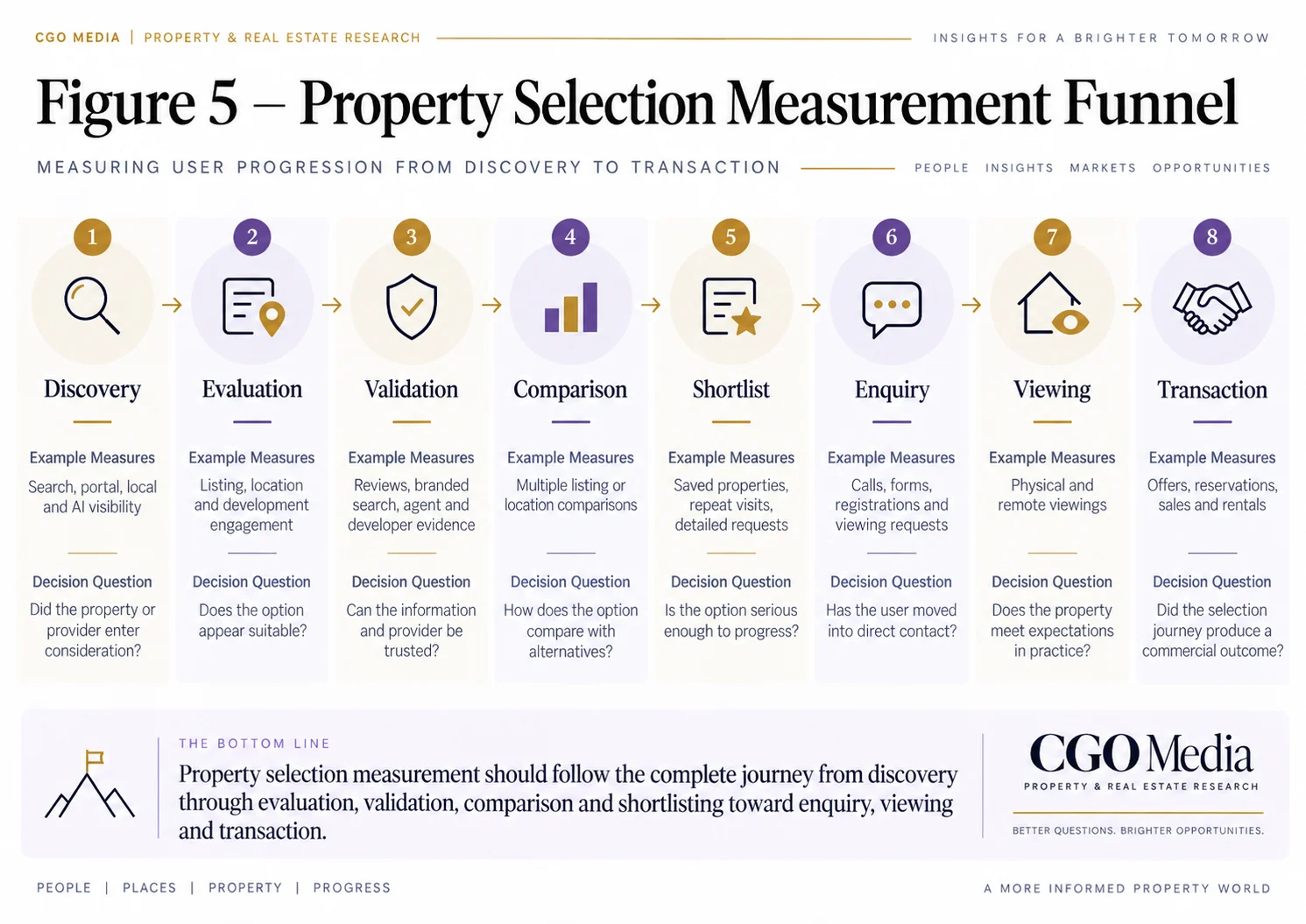
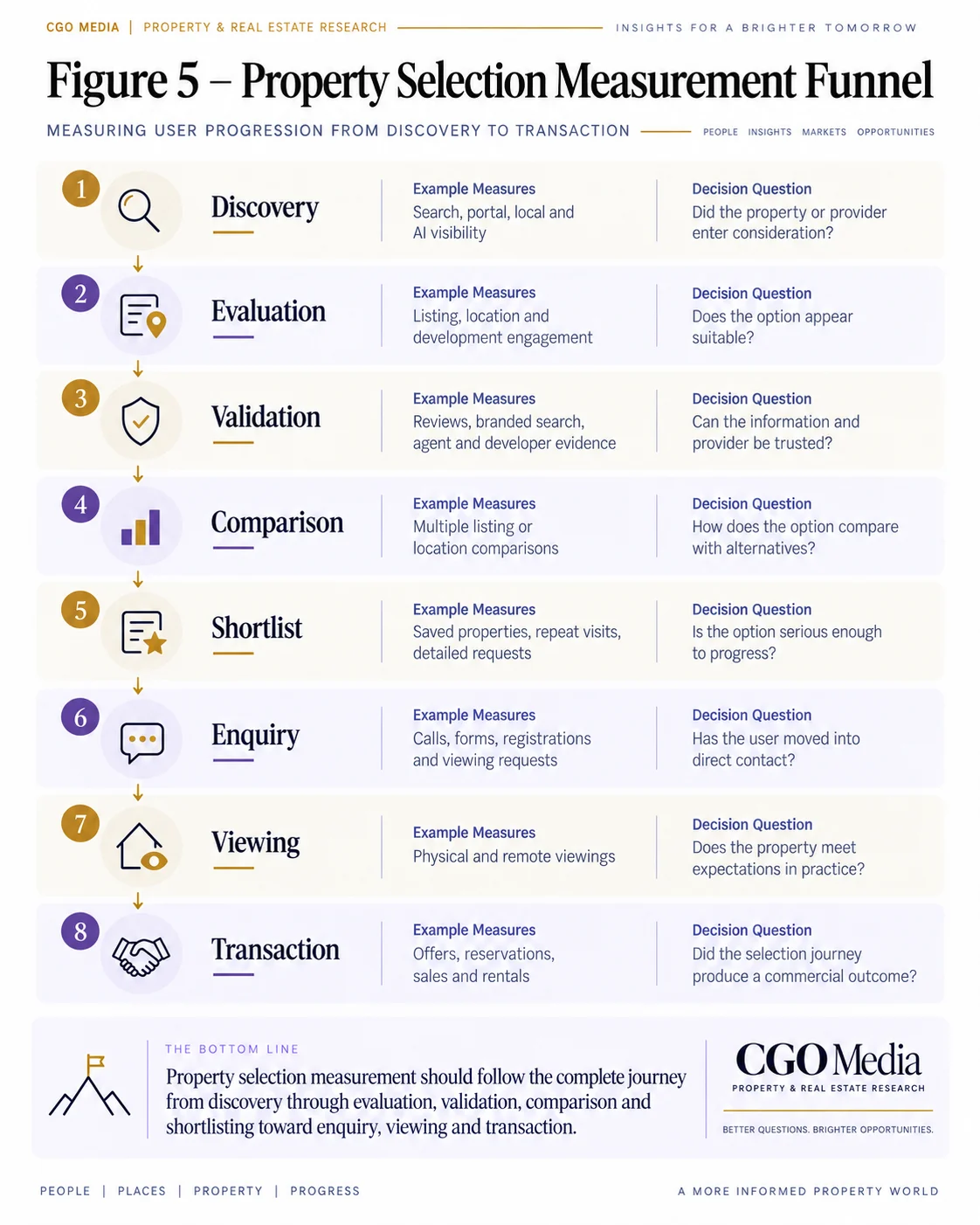
478. Property Selection Performance Should Be Improved Systematically
The Property Discovery and Provider Selection Model is intended to support continuous improvement rather than one-time diagnosis.
A useful improvement cycle is:
Observe → Diagnose → Prioritise → Improve → Measure → Learn → Adapt
479. Step One — Observe the Selection Journey
The organisation should begin by understanding how users currently move through:
- Discovery
- Validation
- Trust formation
- Comparison
- Shortlisting
- Enquiry
- Viewing
- Transaction
480. Observation Should Include Multiple Channels
Useful sources can include:
- Organic search
- Local search
- Property portals
- Agency websites
- Developer websites
- AI-assisted discovery
481. Observation Should Include User Segments
Useful segments can include:
- Buyers
- Sellers
- Investors
- Landlords
- Tenants
- International buyers
482. Observation Should Include Market Segments
The journey can differ by:
- Location
- Price band
- Property type
- Transaction type
- Buyer profile
483. Step Two — Diagnose Selection Friction
The organisation should identify where otherwise relevant properties or providers fail to progress.
484. Discovery Friction
Potential problems can include:
- Poor indexation
- Weak local visibility
- Weak portal distribution
- Low AI visibility
- Limited area coverage
485. Relevance Friction
Potential problems can include:
- Weak descriptions
- Poor targeting
- Missing property facts
- Weak location context
- Insufficient filtering
486. Verification Friction
Potential problems can include:
- Different prices
- Stale availability
- Conflicting specifications
- Missing floorplans
- Weak market evidence
487. Trust Friction
Potential problems can include:
- Weak agent profiles
- Few reviews
- Inconsistent company information
- Limited external recognition
- Poor responsiveness
488. Comparison Friction
Potential problems can include:
- Weak differentiation
- Unclear value
- Insufficient market context
- Poor development comparisons
- Weak provider positioning
489. Enquiry Friction
Potential problems can include:
- Long forms
- Weak mobile usability
- No obvious contact route
- Slow response
- Generic follow-up
490. Viewing Friction
Potential problems can include:
- Poor qualification
- Property mismatch
- Availability errors
- Weak preparation
- Scheduling difficulty
491. Transaction Friction
Potential problems can include:
- Financing issues
- Legal uncertainty
- Poor communication
- Unexpected costs
- Negotiation breakdown
492. Friction Should Be Diagnosed at the Earliest Relevant Stage
Problems should not automatically be attributed to the final conversion stage.
493. Poor Enquiry Volume Can Begin with Discovery Problems
The organisation may have too little relevant visibility.
494. Poor Enquiry Quality Can Begin with Relevance Problems
The organisation may be attracting users whose needs do not match:
- Inventory
- Location
- Budget
- Service capability
495. Poor Viewing Conversion Can Begin with Listing Problems
Properties may appear more suitable online than they are in reality.
496. Poor Transaction Conversion Can Begin with Trust Problems
Users may remain uncertain about the provider despite strong property fit.
497. Step Three — Prioritise Improvements
Not every weakness should receive the same level of attention.
498. Prioritisation Can Consider
- User impact
- Commercial impact
- Frequency
- Risk
- Ease of correction
- Dependency importance
499. A Useful Priority Model Is
Selection Friction + Commercial Impact + Risk + Frequency → Improvement Priority
500. High-Frequency Problems Can Deserve Priority
A small issue affecting thousands of users may create substantial cumulative loss.
501. High-Risk Problems Can Also Deserve Priority
Examples can include:
- Incorrect pricing
- Incorrect availability
- Misleading location information
- Incorrect provider representation
502. High-Dependency Problems Can Deserve Priority
Some improvements can strengthen several stages of the selection journey simultaneously.
503. Better Property Data Is a High-Leverage Improvement
It can strengthen:
- Discovery
- Relevance
- Verification
- Comparison
- AI representation
504. Better Agent Profiles Are a High-Leverage Improvement
They can strengthen:
- Provider discovery
- Trust
- Local authority
- External recognition
- Recommendation confidence
505. Better Market Research Is a High-Leverage Improvement
It can strengthen:
- Location discovery
- Price validation
- Provider authority
- Digital PR
- AI citation visibility
506. Better Location Architecture Is a High-Leverage Improvement
It can improve:
- Search discovery
- User navigation
- Market understanding
- Property relevance
- Local authority
507. Step Four — Improve the Selection Environment
Improvements should be designed around the actual friction identified.
508. Discovery Improvements Can Include
- Technical SEO
- Improved internal linking
- Location-page expansion
- Property-feed optimisation
- Local-search improvements
509. Relevance Improvements Can Include
- Better filters
- Stronger descriptions
- Clear specifications
- Better location context
- Improved categorisation
510. Verification Improvements Can Include
- Current prices
- Current availability
- Floorplans
- Video
- Market evidence
- Cost information
511. Trust Improvements Can Include
- Better agent profiles
- More visible reviews
- Professional credentials
- Market commentary
- Independent media evidence
512. Comparison Improvements Can Include
- Neighbourhood comparisons
- Development comparisons
- Property-type guidance
- Market reports
- Provider differentiation
513. Enquiry Improvements Can Include
- Shorter forms
- Clear telephone contact
- Messaging options
- Mobile optimisation
- Clear next steps
514. Viewing Improvements Can Include
- Better qualification
- Accurate availability
- Clear viewing instructions
- Agent preparation
- Expectation management
515. Transaction Improvements Can Include
- Clear process guidance
- Cost transparency
- Professional coordination
- Regular communication
- Specialist referrals where appropriate
516. Selection Improvements Should Preserve Accuracy
Conversion optimisation should never depend on withholding material information.
517. Transparency Can Improve Qualified Conversion
Clear information may reduce raw enquiry volume while increasing:
- Relevance
- Readiness
- Trust
- Viewing quality
518. Step Five — Measure the Impact
Improvement should be validated using metrics relevant to the stage changed.
519. Discovery Improvements Can Be Measured Through
- Qualified impressions
- Qualified clicks
- Location visibility
- Property discovery
- AI visibility
520. Relevance Improvements Can Be Measured Through
- Filter use
- Property engagement
- Return visits
- Enquiry relevance
- Lower immediate abandonment
521. Verification Improvements Can Be Measured Through
- Floorplan engagement
- Video engagement
- Reduced basic-information enquiries
- Lower property-data complaints
- Higher viewing confidence
522. Trust Improvements Can Be Measured Through
- Agent-profile engagement
- Review engagement
- Direct brand search
- Provider enquiries
- Viewing conversion
523. Comparison Improvements Can Be Measured Through
- Repeat visits
- Saved properties
- Comparison-page engagement
- Shortlist behaviour
- Qualified enquiries
524. Enquiry Improvements Can Be Measured Through
- Form completion
- Telephone enquiries
- Messaging enquiries
- Lead quality
- Response time
525. Viewing Improvements Can Be Measured Through
- Viewing-request conversion
- Completed viewings
- Viewing quality
- Shortlist progression
- Offer progression
526. Transaction Improvements Can Be Measured Through
- Offer progression
- Reservation progression
- Sales agreed
- Completion
- Post-transaction reviews
527. Measurement Should Include Unintended Effects
An improvement can create benefits in one area while harming another.
528. More Aggressive Lead Capture Can Reduce User Trust
Excessive forms, pop-ups or contact barriers can create friction.
529. More Filtering Can Reduce Discovery if Poorly Designed
Overly restrictive filters can hide relevant properties.
530. More Location Pages Can Create Thin Content
Geographic expansion should be supported by meaningful evidence.
531. More AI Optimisation Can Create Poor-Fit Visibility
The objective should remain qualified inclusion rather than maximum mention frequency.
532. Step Six — Learn from the Outcome
The organisation should determine why the improvement succeeded, failed or produced mixed results.
533. Learning Should Be Documented
Useful records can include:
- Original problem
- Intervention
- Expected outcome
- Measured outcome
- Lessons
- Next action
534. Learning Should Include Agent Feedback
Agents can identify whether digital changes affect:
- Lead quality
- Buyer readiness
- Viewing fit
- Seller confidence
- Common questions
535. Learning Should Include User Feedback
Useful sources can include:
- Reviews
- Customer interviews
- Viewing feedback
- Lost-opportunity analysis
- Support enquiries
536. Learning Should Include Search Evidence
The organisation should review:
- Organic behaviour
- Local visibility
- Portal visibility
- AI visibility
- Citation visibility
537. Learning Should Include Commercial Evidence
Search improvements should ultimately be interpreted alongside:
- Lead quality
- Viewing quality
- Instructions
- Transactions
- Customer value
538. Step Seven — Adapt
The organisation should incorporate validated learning into future standards and processes.
539. Successful Changes Can Become Standard Practice
Examples can include:
- Listing standards
- Agent-profile standards
- Location-content templates
- Enquiry-handling standards
- AI monitoring procedures
540. Failed Changes Should Also Be Preserved as Learning
This reduces the risk of repeating ineffective activity.
541. Adaptation Should Be Market-Specific Where Necessary
A process that works for:
- Luxury villas
- Urban apartments
- Commercial property
- New developments
may not work identically for all segments.
542. Adaptation Should Be User-Specific Where Necessary
International buyers, local sellers, investors and landlords can require different journeys.
543. Adaptation Should Be Channel-Specific Where Necessary
Users arriving through AI, portals, organic search and referrals may begin with different levels of knowledge and trust.
544. Property Selection Improvement Should Be Continuous
Markets, inventory, user behaviour and discovery systems change continuously.
545. Market Change Can Alter Selection Criteria
Changes can occur in:
- Prices
- Mortgage conditions
- Inventory
- Buyer demand
- Rental demand
546. Inventory Change Can Alter Discovery Performance
A strong search strategy cannot compensate indefinitely for weak or unsuitable available stock.
547. Provider Change Can Alter Trust
New agents, office closures, acquisitions and rebrands can change provider evidence.
548. Search Change Can Alter Discoverability
Search engines, local platforms and property portals can change how inventory and providers are surfaced.
549. AI Change Can Alter Source and Recommendation Behaviour
Generative systems can change:
- Source selection
- Citation patterns
- Comparison sets
- Provider recommendations
550. The Improvement Cycle Should therefore Be Repeated Periodically
A useful relationship is:
Observe → Diagnose → Prioritise → Improve → Measure → Learn → Adapt → Observe Again
551. Property Organisations Can Use Stage-Level Review Cycles
Different parts of the journey may require different review frequencies.
552. Property Data May Require Frequent Review
Because:
- Prices change
- Status changes
- Inventory changes
- Availability changes
553. Market Evidence May Require Periodic Review
Useful cycles can include:
- Monthly
- Quarterly
- Biannual
554. Provider Evidence May Require Event-Based Review
Triggers can include:
- New agent
- Role change
- Office change
- New qualification
- New media recognition
555. AI Discovery May Require Repeated Scenario Testing
One-off checks provide limited evidence about persistent representation.
556. Selection Improvement Should Connect Marketing and Operations
Marketing teams cannot optimise the complete journey alone.
557. Agents Hold Important Selection Intelligence
They understand:
- Buyer objections
- Seller concerns
- Viewing feedback
- Common misunderstandings
- Lost opportunities
558. Property Operations Hold Important Data Intelligence
They understand:
- Listing accuracy
- Feed quality
- Availability
- Status changes
- Property lifecycle
559. Search Teams Hold Important Discovery Intelligence
They understand:
- Search demand
- Technical visibility
- Location visibility
- Content performance
- AI discovery patterns
560. Leadership Holds Strategic Context
Leadership can connect selection performance with:
- Market priorities
- Growth
- Investment
- Brand positioning
- Commercial strategy
561. Cross-Functional Learning Strengthens the Model
A useful relationship is:
Search Intelligence + Property Intelligence + Agent Intelligence + Customer Intelligence → Better Selection Strategy
562. Selection Improvement Should Preserve Qualified Outcomes
The objective is not maximum:
- Traffic
- Visibility
- Enquiries
- Viewings
563. The Objective Is Better Matching
A stronger outcome is:
Right User → Right Property → Right Provider → Right Evidence → Appropriate Progression
564. Better Matching Can Improve Commercial Efficiency
It can reduce:
- Poor-fit enquiries
- Unproductive viewings
- Agent time waste
- User frustration
- Selection friction
565. Better Matching Can Improve User Experience
Users spend less time investigating irrelevant or unsuitable options.
566. Better Matching Can Improve Provider Reputation
Users may perceive the organisation as:
- More knowledgeable
- More transparent
- More relevant
- More professional
567. Better Matching Can Improve AI Recommendation Quality
Clearer evidence about:
- Markets served
- Property specialisms
- User types supported
- Transaction capabilities
can reduce ambiguity within the wider information environment.
568. Property Selection Improvement Can Therefore Become an Authority Strategy
The organisation improves not only conversion but also the quality, consistency and usefulness of its overall evidence environment.
569. The Twenty-First Property Discovery Principle
Property selection performance should be improved through a continuous diagnostic cycle that identifies the specific stage where decision friction occurs, rather than applying generic conversion or SEO improvements across the entire journey.
570. The Twenty-Second Property Discovery Principle
Selection improvements should be prioritised according to user impact, commercial importance, risk, frequency and dependency, favouring interventions such as better property data, stronger provider evidence and deeper market information where they strengthen several decision stages simultaneously.
571. The Twenty-Third Property Discovery Principle
Improvement should be validated through stage-appropriate measurement and cross-functional evidence, combining digital behaviour with agent, customer, operational and commercial feedback before successful changes are incorporated into organisational standards.
572. The Twenty-Fourth Property Discovery Principle
The strongest selection systems optimise for qualified matching rather than maximum traffic, visibility, enquiries or viewings, aiming to connect the right users with appropriate properties, credible providers and sufficient evidence to support informed progression.
573. The Property Selection Improvement Cycle
The complete cycle can be summarised as:
Observe → Diagnose → Prioritise → Improve → Measure → Learn → Adapt
574. The Qualified Property Selection Model
The intended outcome can be summarised as:
Relevant Discovery + Strong Property Fit + Credible Provider + Sufficient Evidence + Practical Feasibility → Qualified Selection Opportunity
575. The Long-Term Selection System
Over time, the strongest organisations develop a connected system:
Accurate Property Data → Strong Discovery → Relevant Matching → Evidence Validation → Provider Trust → Qualified Enquiry → Better Experience → New Trust Evidence → Stronger Future Discovery
576. The Strategic Implication
Property organisations should treat discovery and provider selection as a continuously improving system rather than a sequence that ends when a lead is generated. By observing where users lose confidence, diagnosing the underlying information or authority gap, improving the relevant stage, measuring both digital and human outcomes and preserving validated learning, organisations can progressively improve the quality of matching between users, properties and providers while strengthening the wider evidence environment that supports future search and AI-assisted discovery.
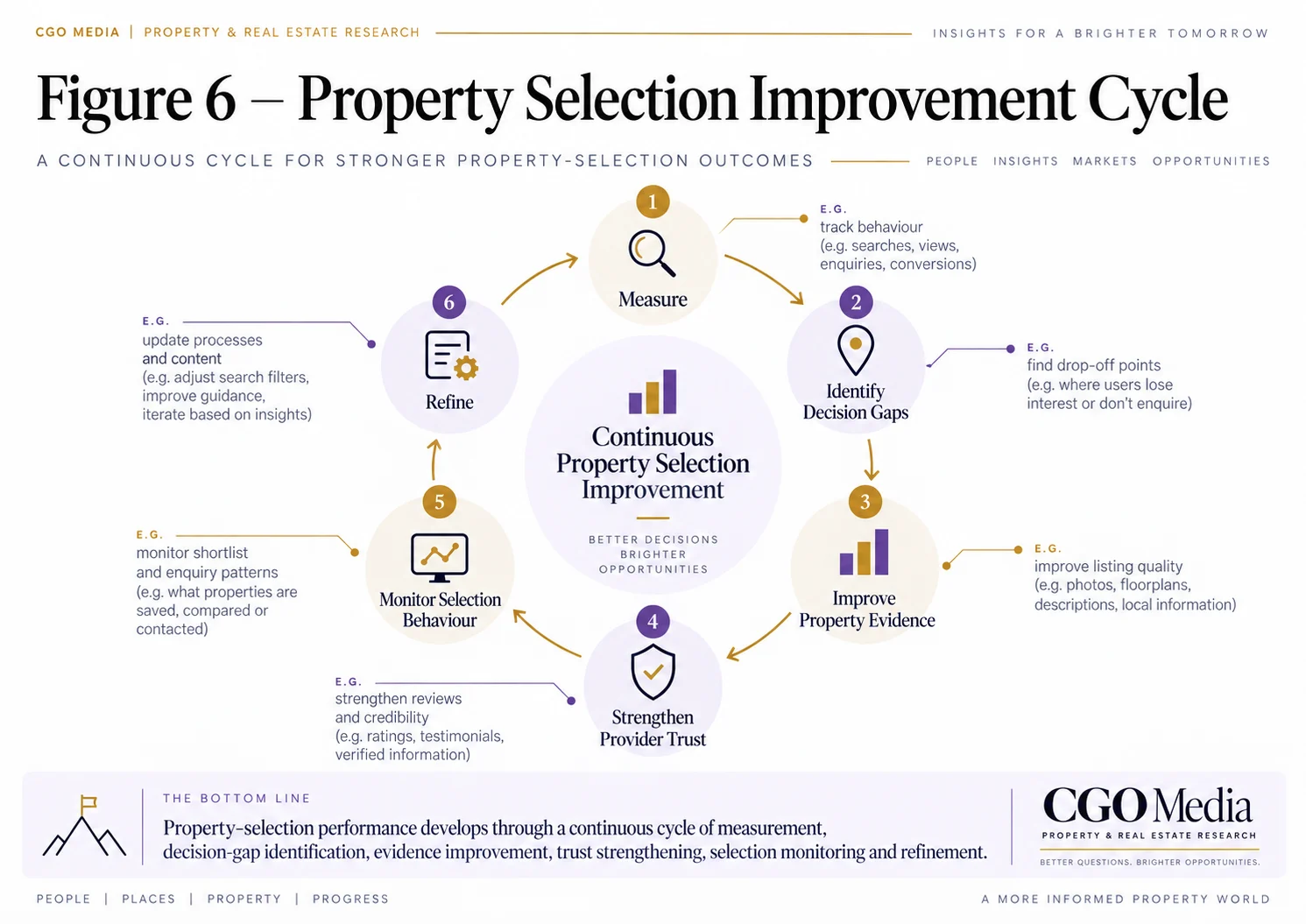
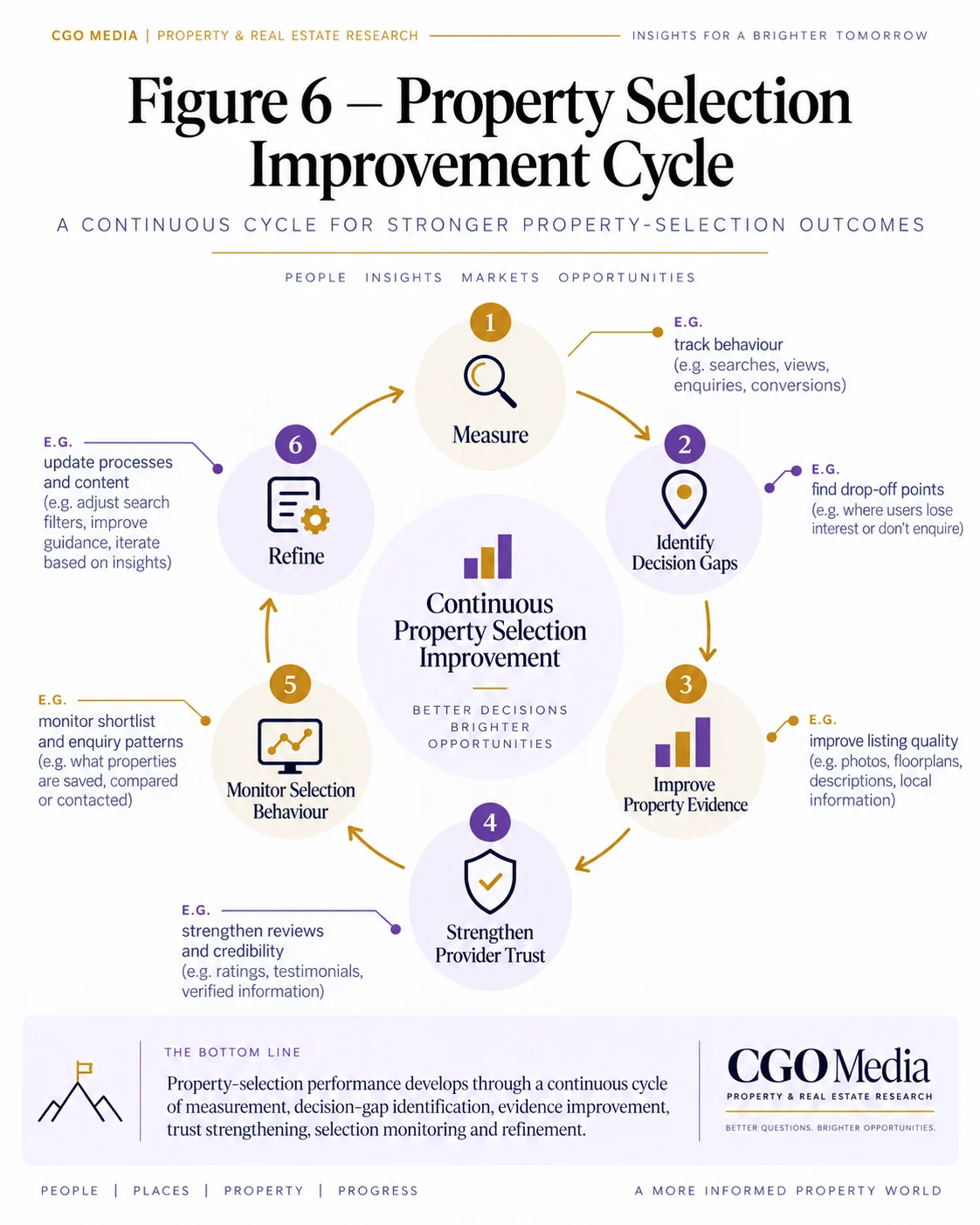
577. Methodology
The Property Discovery and Provider Selection Model is a conceptual research framework developed by CGO Media to examine how buyers, sellers, tenants, landlords and investors discover, evaluate, validate, compare and select properties and property-service providers across increasingly fragmented search, portal, local, review and AI-assisted discovery environments.
578. Research Purpose
The central research question is:
How do users move from an initial property need through discovery, validation, provider evaluation, comparison and eventual enquiry or transaction?
579. Framework Scope
The model can be applied to:
- Residential property
- Luxury property
- New developments
- Investment property
- Rental property
- Commercial property
- International property
- Property-service provider selection
580. User Groups
The framework considers journeys involving:
- Buyers
- Sellers
- Tenants
- Landlords
- Investors
- International purchasers
581. Provider Groups
The provider-selection component can include:
- Estate agencies
- Real estate brokerages
- Property developers
- New-build specialists
- Property managers
- Other relevant property professionals
582. The Eight-Stage Decision Journey
The framework defines eight principal stages:
- Property Need Recognition
- Location and Requirement Definition
- Property and Provider Discovery
- Property and Market Evaluation
- Provider Trust Validation
- Financial and Practical Fit Assessment
- Comparison and Shortlisting
- Enquiry, Viewing and Transaction
583. The Journey Is Not Assumed to Be Strictly Linear
Users can move backwards and forwards between stages as new information changes their understanding of:
- Budget
- Location
- Property type
- Provider suitability
- Transaction feasibility
584. Discovery Methodology
Property discovery is evaluated across multiple potential channels rather than through conventional organic search alone.
585. Discovery Channels Can Include
- Search engines
- Local search
- Property portals
- Agency websites
- Developer websites
- AI assistants
- Social platforms
- Referrals
586. Discovery and Suitability Are Evaluated Separately
The framework distinguishes whether a property or provider is visible from whether it genuinely matches the user’s requirements.
587. Property Suitability Method
Suitability can be considered across dimensions such as:
- Location fit
- Budget fit
- Property-type fit
- Space fit
- Lifestyle fit
- Investment fit
- Practical fit
588. Provider Fit Method
Provider suitability can be considered through:
- Market expertise
- Property specialism
- Professional experience
- Language capability
- Transaction support
- Local knowledge
589. Evidence Methodology
The framework treats selection confidence as the result of multiple evidence layers rather than one signal.
590. The Six Evidence Layers
These are:
- Property Evidence
- Location Evidence
- Provider Evidence
- Market Evidence
- Financial Evidence
- Independent Validation
591. Property Evidence
Property evidence can include:
- Price
- Availability
- Status
- Dimensions
- Condition
- Features
- Photography
- Floorplans
592. Location Evidence
Location evidence can include:
- Neighbourhood information
- Transport
- Schools
- Amenities
- Market context
- Development activity
593. Provider Evidence
Provider evidence can include:
- Professional profiles
- Office information
- Reviews
- Credentials
- Market expertise
- External recognition
594. Market Evidence
Market evidence can include:
- Pricing trends
- Inventory
- Buyer demand
- Rental demand
- Development trends
- Comparable properties
595. Financial Evidence
Financial evidence can include:
- Purchase costs
- Taxes
- Mortgage considerations
- Running costs
- Investment assumptions
596. Independent Validation
Independent validation can include:
- Property portals
- Maps
- Review platforms
- Independent market reports
- Media coverage
- Public information sources
597. Evidence Convergence Method
A central proposition of the framework is:
Property Evidence + Location Evidence + Provider Evidence + Market Evidence + Financial Evidence + Independent Validation → Selection Confidence
598. Evidence Conflict Is Also Considered
Where sources materially disagree, confidence can decrease.
599. Evidence Freshness Method
Different information types should be reviewed according to how quickly they can change and how much they can affect the decision.
600. A Useful Evidence-Freshness Relationship Is
Information Volatility + Decision Impact + Transaction Risk → Required Review Frequency
601. Provider-Authority Method
Provider authority is treated as contextual rather than universal.
602. Authority Can Differ by
- Location
- Property type
- Transaction type
- Buyer profile
- Seller requirement
603. Property Authority and Selection Matrix Method
The framework evaluates:
Property Suitability × Provider Authority → Selection Confidence
604. The Four Matrix States
- High Suitability / High Authority
- High Suitability / Low Authority
- Low Suitability / High Authority
- Low Suitability / Low Authority
605. Selection Threshold Method
The framework assumes that evidence requirements increase as the user moves toward greater commitment.
606. A Useful Confidence Progression Is
Discovery Confidence → Consideration Confidence → Shortlist Confidence → Viewing Confidence → Transaction Confidence
607. Qualified Inclusion Method
The model distinguishes between:
- Relevant Inclusion
- Irrelevant Inclusion
- Relevant Exclusion
- Appropriate Exclusion
608. Qualified Inclusion Is the Preferred Visibility Outcome
The objective is not for every property or provider to appear in every discovery environment.
609. Measurement Methodology
The framework measures selection across the complete journey rather than relying solely on traffic or lead volume.
610. The Measurement Funnel
A useful sequence is:
Discovery → Validation → Trust → Comparison → Shortlist → Enquiry → Viewing → Transaction → Advocacy
611. Discovery Measurement
Discovery can include:
- Organic visibility
- Local visibility
- Portal visibility
- Property visibility
- AI visibility
612. Validation Measurement
Validation can include engagement with:
- Property detail
- Floorplans
- Location information
- Market evidence
- Professional profiles
613. Trust Measurement
Trust can be examined through:
- Review strength
- Agent evidence
- External authority
- Repeat engagement
- Direct brand interest
614. Comparison Measurement
Comparison can include:
- Multiple property engagement
- Location comparison
- Provider comparison
- Repeat visits
- Saved properties
615. Enquiry Measurement
Enquiry quality should be considered alongside enquiry volume.
616. Viewing Measurement
Viewing measurement can include:
- Viewing requests
- Completed viewings
- Viewing quality
- Shortlist progression
- Offer progression
617. Transaction Measurement
Transaction-stage measures can include:
- Offers
- Negotiations
- Reservations
- Sales agreed
- Completed transactions
618. Attribution Limitations Are Recognised
Property journeys can involve multiple channels and sources before direct contact.
619. Multi-Touch Journey Example
AI Discovery → Search Engine → Property Portal → Agency Website → Direct Enquiry
620. Improvement Methodology
The improvement cycle is:
Observe → Diagnose → Prioritise → Improve → Measure → Learn → Adapt
621. Observation
The organisation identifies where users enter, move through and leave the selection journey.
622. Diagnosis
The organisation identifies the underlying:
- Discovery gap
- Information gap
- Trust gap
- Comparison gap
- Operational gap
623. Prioritisation
A useful conceptual model is:
Selection Friction + Commercial Impact + Risk + Frequency → Improvement Priority
624. Improvement
The intervention should address the specific cause rather than apply generic optimisation.
625. Measurement
Results should be assessed using metrics appropriate to the stage changed.
626. Learning
Successful and unsuccessful interventions should be documented.
627. Adaptation
Validated learning should inform future:
- Property-data standards
- Content standards
- Provider profiles
- Search strategy
- AI monitoring
- Enquiry processes
628. Framework Limitations
The Property Discovery and Provider Selection Model is a conceptual research model and does not claim to reproduce proprietary search-engine, property-portal, recommendation or AI-system algorithms.
629. Property Journeys Differ Between Users
Not every user passes through every stage in the same sequence.
630. Experienced Buyers May Compress the Journey
Local knowledge and provider familiarity can reduce the need for extensive early-stage research.
631. International Buyers May Extend the Journey
Distance, language, legal unfamiliarity and higher information asymmetry can increase validation needs.
632. Seller Journeys Differ from Buyer Journeys
Sellers typically place greater emphasis on provider selection, valuation and marketing capability.
633. Rental Journeys Can Differ from Purchase Journeys
Rental markets can involve:
- Greater urgency
- Shorter availability windows
- Different financial requirements
- Different provider roles
634. Commercial Property Journeys Can Differ Substantially
Commercial selection can involve:
- Lease analysis
- Tenant covenants
- Yield
- Use restrictions
- Business-location economics
635. High Visibility Does Not Guarantee Selection
Visibility only creates an opportunity to enter consideration.
636. Strong Evidence Does Not Guarantee Transaction
Users can still reject otherwise credible properties because of:
- Price
- Finance
- Personal preference
- Market change
- Better alternatives
637. Strong Provider Authority Does Not Guarantee Selection
Provider trust cannot replace property suitability.
638. Strong Property Suitability Does Not Guarantee Selection
Provider distrust or transaction complexity can prevent progression.
639. Search and AI Visibility Cannot Be Fully Attributed to Transactions
Many later-stage factors influence commercial outcomes.
640. AI-Assisted Discovery Is Partially Observable
Organisations cannot directly inspect all internal source-selection, retrieval or recommendation logic used by generative systems.
641. AI Outputs Can Vary
Outputs can differ according to:
- Platform
- Model
- Prompt wording
- Conversation context
- Date
- Source availability
642. Single AI Outputs Should Not Be Treated as Stable Evidence
Repeated testing is generally more useful for identifying patterns.
643. Property Data Has Inherent Volatility
Price, availability and status can change quickly.
644. Market Data Can Also Change
Property-market conditions vary over time.
645. Review Evidence Has Limitations
Reviews can be:
- Subjective
- Unevenly distributed
- Service-specific
- Outdated
646. Behavioural Metrics Have Limitations
A page visit, saved property or return session does not reveal the user’s complete decision process.
647. Some Selection Behaviour Occurs Outside Owned Systems
Users may compare properties using:
- Private notes
- Spreadsheets
- Messaging applications
- Conversations
- Offline recommendations
648. Measurement Should therefore Be Interpreted as Partial Evidence
No single dataset reveals the complete property decision journey.
649. The Framework Should Be Used as a Diagnostic Model
Its purpose is to structure observation, evidence gathering and improvement rather than to claim exact prediction of individual user behaviour.
650. Conclusion
The Property Discovery and Provider Selection Model describes property selection as a progressive movement from need recognition through discovery, validation, comparison and increasing commitment.
651. Property Selection Begins Before a Listing Is Viewed
Users can begin by defining:
- Location
- Budget
- Lifestyle
- Investment objectives
- Provider requirements
652. Discovery Creates the Initial Consideration Set
Search engines, portals, local search, referrals and AI systems can determine which locations, properties and providers enter the user’s information environment.
653. Discovery Does Not Establish Suitability
Properties must still satisfy user requirements.
654. Relevance Does Not Establish Confidence
Relevant options must still survive validation.
655. Validation Requires Evidence
Users can examine:
- Property facts
- Location information
- Market context
- Provider evidence
- Financial information
- Independent sources
656. Provider Trust Operates Alongside Property Fit
Users often need confidence in both the asset and the professional environment around the transaction.
657. Comparison Narrows the Consideration Set
Users make trade-offs between:
- Price
- Location
- Condition
- Space
- Lifestyle
- Provider confidence
658. Shortlisting Represents Increasing Selection Confidence
Only a relatively small number of options normally survive the earlier filters.
659. Enquiry Is Not the End of the Journey
The property and provider must still perform during:
- Communication
- Viewing
- Negotiation
- Transaction
660. Post-Transaction Experience Feeds Future Selection
Reviews, referrals and repeat business become evidence for later users.
661. Property Discovery Is therefore a Feedback System
A useful relationship is:
Discovery → Selection → Experience → Outcome → Trust Evidence → Future Discovery
662. Qualified Visibility Is More Valuable Than Maximum Visibility
The objective should be to surface relevant properties and credible providers for appropriate user needs.
663. Qualified Matching Is the Central Outcome
A useful relationship is:
Right User → Right Property → Right Provider → Right Evidence → Appropriate Progression
664. Property Organisations Should Build Around the Full Journey
Search visibility, property information, location authority, provider identity, reviews, market research and enquiry handling should support one connected decision system.
665. The Complete Eight-Stage Journey
Property Need Recognition → Location & Requirement Definition → Property & Provider Discovery → Property & Market Evaluation → Provider Trust Validation → Financial & Practical Fit → Comparison & Shortlisting → Enquiry, Viewing & Transaction
666. The Discovery and Validation Funnel
Total Market → Discoverable Market → Relevant Options → Validated Options → Trusted Options → Practical Fit → Comparison Set → Shortlist
667. The Evidence Model
Property Evidence + Location Evidence + Provider Evidence + Market Evidence + Financial Evidence + Independent Validation → Selection Confidence
668. The Authority and Selection Model
Property Suitability + Provider Authority + Evidence Confidence → Selection Confidence
669. The Measurement Model
Discovery → Validation → Trust → Comparison → Shortlist → Enquiry → Viewing → Transaction → Advocacy
670. The Improvement Model
Observe → Diagnose → Prioritise → Improve → Measure → Learn → Adapt
671. The Long-Term Property Selection System
Accurate Property Information → Relevant Discovery → Strong Matching → Evidence Validation → Provider Trust → Qualified Engagement → Positive Experience → New Authority Evidence → Stronger Future Discovery
672. Final Strategic Position
Property organisations should treat discovery and provider selection as a connected information, evidence and trust system rather than a simple journey from search result to enquiry form.
The strongest property discovery environments make it easier for users to understand which properties genuinely fit their requirements, which providers possess relevant expertise, which evidence can be trusted and which options deserve progression toward viewing or transaction.
For estate agencies, developers, brokerages and property platforms, the long-term objective is therefore not maximum exposure alone. It is to create the information clarity, property accuracy, location expertise, professional authority and evidence environment required to produce more qualified discovery and more confident selection.
References
External Technical, Search and Research Sources
- Google Search Central. SEO Starter Guide.
- Google Search Central. Organization Structured Data.
- Google Search Central. Local Business Structured Data.
- Schema.org. Organization.
- Schema.org. RealEstateAgent.
- Schema.org. Residence.
- Hogan, A. et al. (2021). Knowledge Graphs. ACM Computing Surveys, 54(4).
- Metzger, M.J. (2007). Making Sense of Credibility on the Web: Models for Evaluating Online Information and Recommendations for Future Research. Journal of the American Society for Information Science and Technology, 58(13), 2078–2091.
- Ji, Z. et al. (2023). Survey of Hallucination in Natural Language Generation. ACM Computing Surveys, 55(12).
Property & Real Estate Research Family
The Property Discovery and Provider Selection Model forms part of the wider CGO Media Property & Real Estate AI Search, SEO and GEO research programme.
Property & Real Estate SEO in an AI Search Environment
The parent research paper examines how property discovery is changing as traditional search, local search, property portals, entity understanding, market authority and AI-assisted recommendation increasingly overlap.
Explore Property & Real Estate SEO in an AI Search Environment →
Property & Real Estate AI Trust and Visibility Framework
This framework examines how property organisations build the entity clarity, local authority, evidence, professional trust and external validation required to remain visible across conventional and AI-assisted discovery environments.
Explore the Property & Real Estate AI Trust and Visibility Framework →
Property Search Authority Maturity Model
The maturity model evaluates how property organisations progress from Functional participation through Optimised, Structured and Integrated capability toward Adaptive Authority.
Explore the Property Search Authority Maturity Model →
Property & Real Estate SEO and AI Implementation Roadmap
The implementation roadmap translates the research family into practical phases for strengthening technical search, property information, location authority, professional trust, external evidence and AI discovery capability.
Explore the Property & Real Estate SEO and AI Implementation Roadmap →
Property & Real Estate GEO: Generative Engine Optimisation
The GEO research extends the property family into generative source selection, citation eligibility, comparison visibility, provider recommendation and qualified AI-assisted property discovery.
Explore Property & Real Estate GEO →
How the Property Research Family Connects
The relationship can be summarised as:
Search Environment → Trust & Visibility → Discovery & Selection → Search Authority Maturity → Implementation → GEO
CGO Media Research Ecosystem
CGO Media Research Library |
CGO Media Framework Library |
CGO Media Research Architecture |
CGO Media Research Observations |
CGO Media Statistics Library
About Roger Wilkinson
Roger Wilkinson is an independent researcher, SEO practitioner and founder of CGO Media with more than 25 years of experience in search, online visibility and digital strategy.
His research examines how artificial intelligence is changing search engines, information discovery, source selection, citation systems, entity authority, provider comparison and recommendation environments.
His sector research applies these wider search concepts to industries where evidence, trust, provider selection and recommendation can materially influence commercial discovery.
Within property and real estate, this research examines how listings, locations, professional expertise, market evidence, external authority and AI-assisted discovery combine across the buyer, seller and provider-selection journey.
View Roger Wilkinson’s researcher profile →
Research Usage & Citation
CGO Media encourages estate agencies, developers, brokerages, property portals, researchers, journalists, analysts and digital teams to reference this model where it contributes to analysis of property discovery, user decision-making, provider selection, AI search, GEO or digital property authority.
Reasonable quotations, summaries, figures and excerpts may be used in articles, reports, presentations, academic work and other publications provided appropriate acknowledgement is given to Roger Wilkinson and CGO Media.
Cite This Research / Embed Citation
The Property Discovery and Provider Selection Model by Roger Wilkinson at CGO Media describes property selection as an eight-stage journey progressing from need recognition and requirement definition through discovery, evaluation, provider validation, comparison, shortlisting, enquiry and transaction.
APA Citation
APA Citation: Wilkinson, R. (2026). Property Discovery and Provider Selection Model. CGO Media. https://cgomedia.com/property-discovery-provider-selection-model/
Author: Roger Wilkinson |
Published by: CGO Media
For permissions relating to substantial reproduction, commercial licensing or republication of significant portions of this research, please contact CGO Media directly.