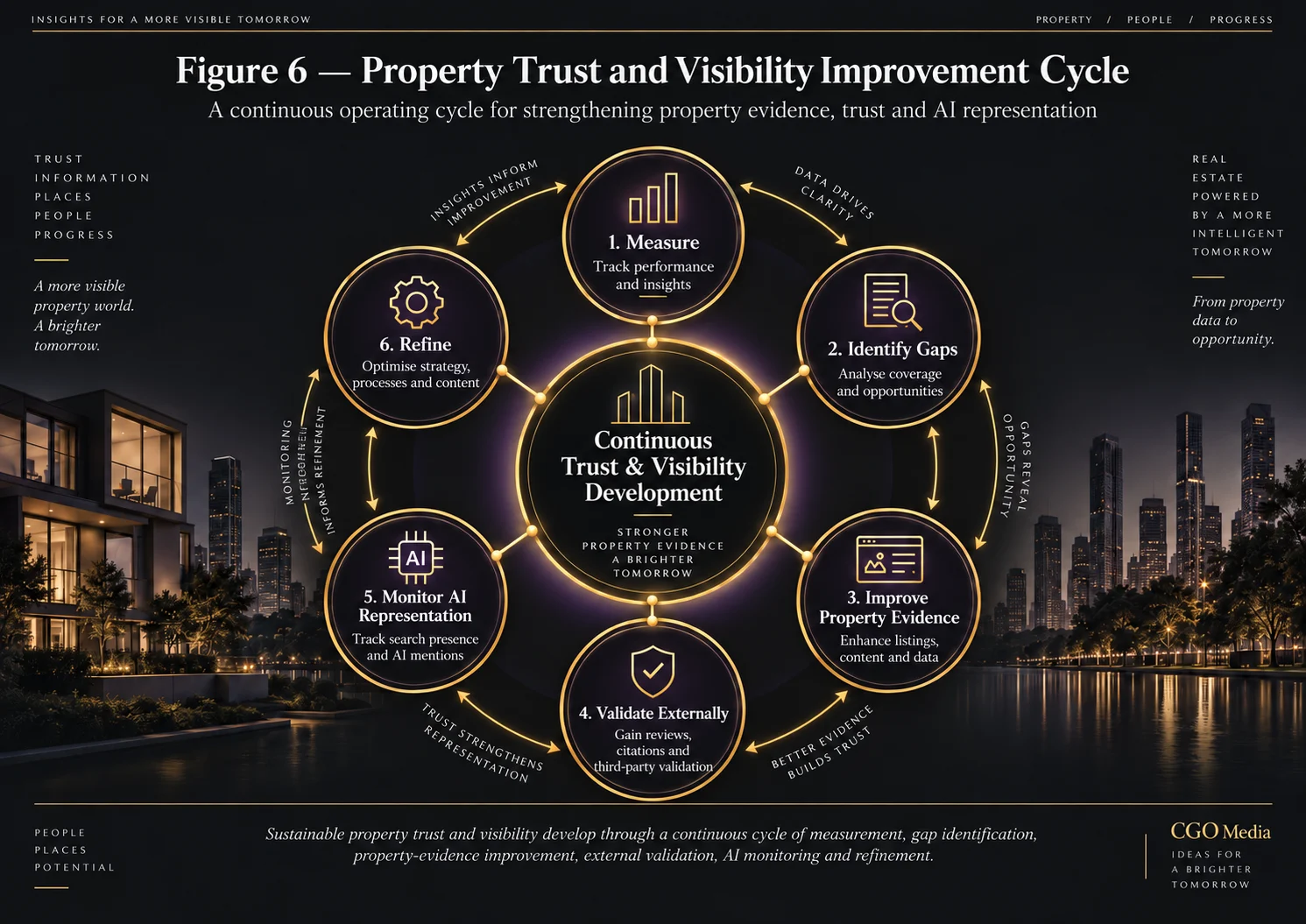
Property & Real Estate AI Trust and Visibility Framework
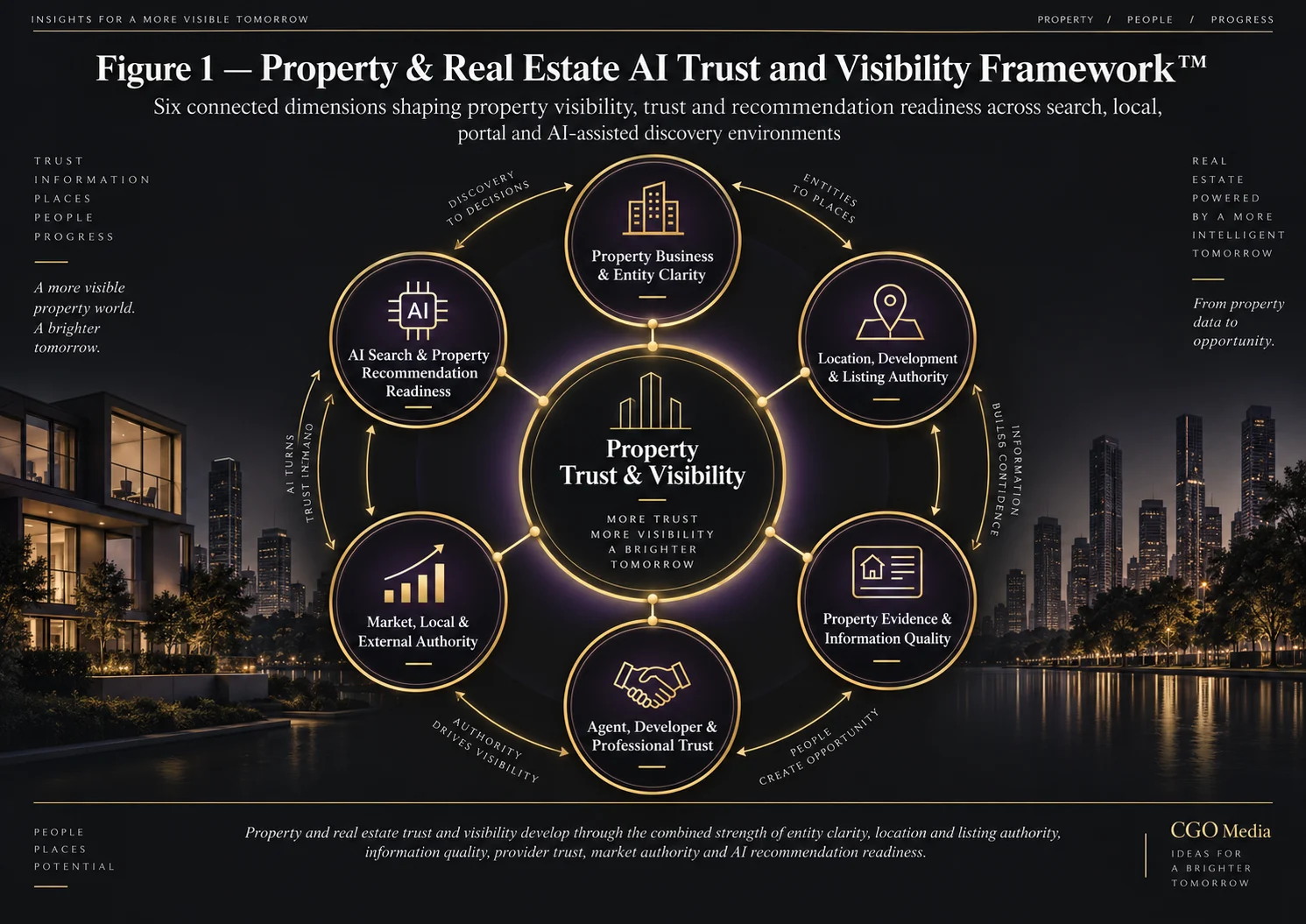
 The Property & Real Estate AI Trust and Visibility Framework provides a structured methodology for evaluating how estate agencies, real estate brokerages, property developers, new-build specialists, property portals and other property organisations build the clarity, evidence, trust and external authority required to remain visible across conventional search, local discovery and AI-assisted recommendation environments.
The framework is designed around the reality that property authority is distributed across many different sources. A prospective buyer, seller, tenant or investor may encounter listings, agency websites, portals, reviews, local guides, developer information, market reports and AI-generated recommendations before making direct contact.
It builds on the parent research paper Property & Real Estate SEO in an AI Search Environment and translates its findings into six connected dimensions of property trust and visibility.
1. Why Property Search Needs a Trust and Visibility Framework
Property search combines high commercial value with high information complexity.
2. Users Need to Evaluate More Than the Property Itself
A property decision can require users to understand:
- The property
- The location
- The agency
- The agent
- The developer
- The market
- The transaction context
3. Visibility Alone Does Not Provide Enough Decision Support
A property, agency or development may be easy to discover while still providing weak evidence around:
- Accuracy
- Expertise
- Trust
- Local relevance
- Current status
4. Trust Without Visibility Creates the Opposite Problem
A property organisation may possess strong expertise and a good reputation while remaining difficult to discover digitally.
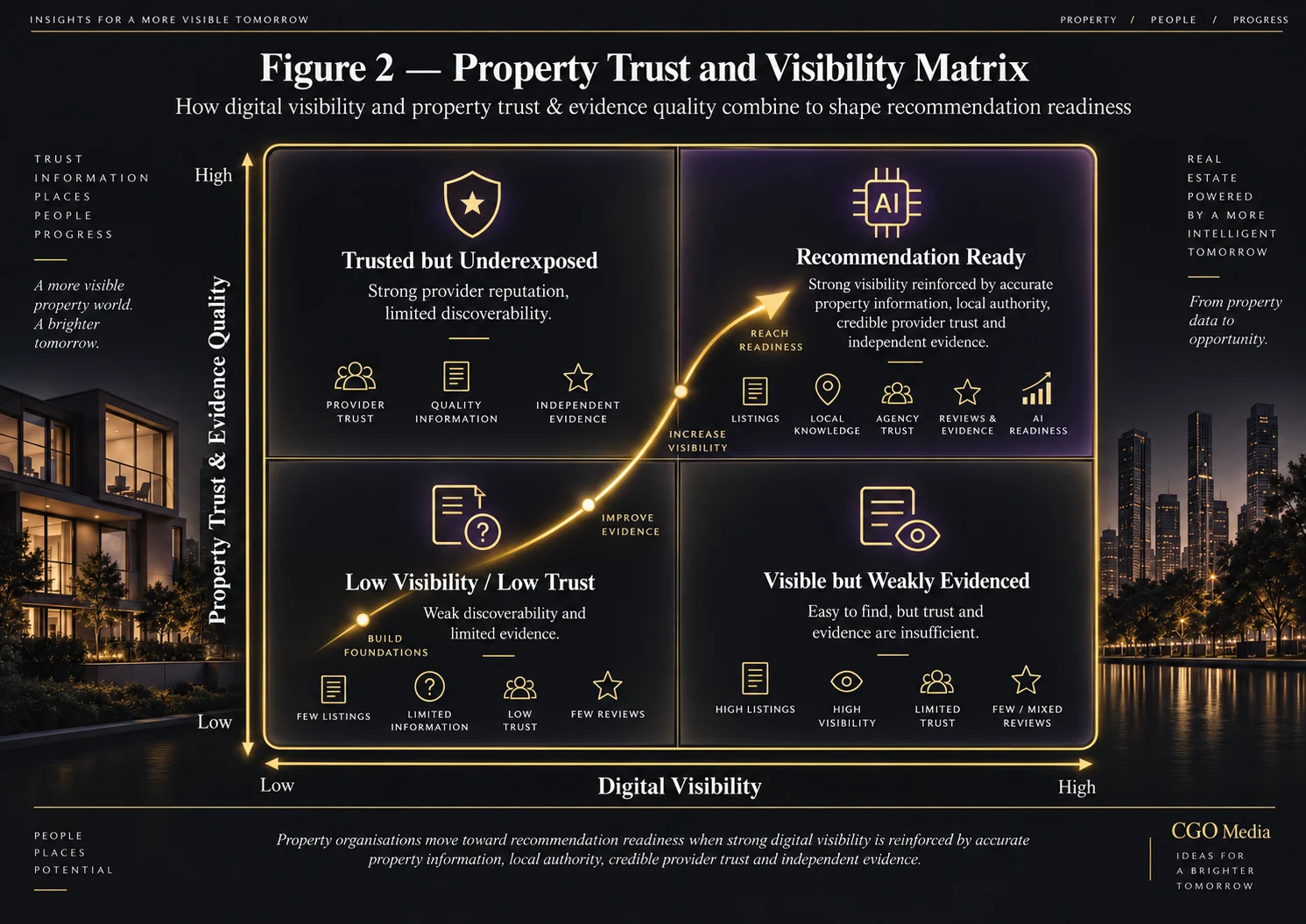
5. Visibility and Trust Should therefore Be Evaluated Together
A useful relationship is:
Discovery + Understanding + Evidence + Validation + Recommendation Readiness → Property Search Authority
6. Property Authority Is Distributed
Evidence can exist across:
- Agency websites
- Property portals
- Developer websites
- Maps
- Review platforms
- Media
- Market research
- AI-assisted discovery systems
7. Distributed Authority Creates Evidence Complexity
Different sources may contain different versions of:
- Property facts
- Office details
- Agent roles
- Development status
- Market claims
8. Property Trust therefore Depends on Evidence Consistency
Conflicting information can reduce confidence for both users and discovery systems.
9. The Framework Evaluates Six Connected Dimensions
- Property Business and Entity Clarity
- Location, Development and Listing Authority
- Property Evidence and Information Quality
- Agent, Developer and Professional Trust
- Market, Local and External Authority
- AI Search and Property Recommendation Readiness
10. No Single Dimension Is Sufficient
Strong property authority depends on the combined strength of all six dimensions.
11. Strong Listings Cannot Compensate for Weak Entity Clarity
Users may struggle to understand:
- Which organisation represents the property
- Which office is responsible
- Which agent is involved
- Which developer owns the project
12. Strong Reviews Cannot Compensate for Outdated Property Information
Trust can weaken where current listings contain:
- Incorrect prices
- Old status
- Missing specifications
- Broken media
13. Strong Local Knowledge Cannot Compensate for Weak Discoverability
Expertise that remains offline or undocumented contributes little to digital authority.
14. Strong Search Visibility Cannot Compensate for Weak Provider Trust
Users may still hesitate where:
- Agent profiles are thin
- Reviews are weak
- Company identity is unclear
- External validation is limited
15. AI Visibility Depends on the Other Dimensions
AI recommendation readiness should be treated as cumulative rather than isolated.
16. A Useful Cumulative Relationship Is
Entity Clarity + Location & Listing Authority + Information Quality + Provider Trust + Market Authority → AI Recommendation Readiness
17. Dimension One — Property Business and Entity Clarity
Property Business and Entity Clarity evaluates whether the organisation can be identified consistently across the wider property ecosystem.
18. Core Business Identity Should Be Explicit
Relevant information can include:
- Official business name
- Trading name
- Website
- Telephone details
- Primary services
- Service areas
19. Legal Name and Trading Name Should Be Distinguished Where Necessary
Property businesses may operate under:
- Legal company name
- Trading brand
- Franchise brand
- Office-specific naming
20. Naming Consistency Reduces Ambiguity
Unexplained variation can make it harder to connect:
- Website
- Reviews
- Portals
- Media
- Business profiles
21. Office Identity Should Be Explicit
Multi-office organisations should distinguish each branch where appropriate.
22. Office Identity Can Include
- Office name
- Address
- Telephone
- Opening hours
- Service areas
- Associated agents
23. Office Relationships Should Be Clear
A useful relationship is:
Organisation → Office → Agent → Service Area
24. Office Service Areas Should Reflect Actual Coverage
A branch should not claim authority across locations where it has little operational evidence.
25. Agent Identity Should Be Explicit
Individual professionals can accumulate their own authority.
26. Agent Identity Can Include
- Name
- Role
- Office
- Languages
- Location expertise
- Property specialisms
27. Agent Profiles Should Be More Than Staff Directory Entries
A useful professional profile can communicate:
- Experience
- Market expertise
- Current listings
- Research contribution
- Review evidence
28. Agent Relationships Should Be Explicit
A useful model is:
Agent → Office → Locations → Specialisms → Listings → Professional Evidence
29. Developer Identity Should Be Explicit
Users should be able to distinguish between:
- Developer
- Builder
- Sales agent
- Marketing agent
- Property owner
30. Development Relationships Should Be Explicit
A useful relationship is:
Developer → Development → Location → Unit Types → Properties
31. Entity Clarity Should Extend to Services
The organisation should make clear whether it offers:
- Sales
- Lettings
- Buyer representation
- Property management
- Investment services
32. Service Ambiguity Can Create Poor-Fit Enquiries
Users may contact the organisation for services it does not actually provide.
33. Geographic Entity Clarity Is Also Important
Property markets can involve overlapping geographic names.
34. A Useful Geographic Hierarchy Is
Country → Region → Province → City → District → Neighbourhood → Development
35. Geographic Naming Should Be Standardised
Alternative local names can be mapped without creating unnecessary ambiguity.
36. Entity Clarity Should Extend Beyond the Website
Important information should remain reasonably consistent across:
- Property portals
- Business profiles
- Review platforms
- Directories
- Media
37. Entity Conflict Should Be Monitored
Potential conflicts can include:
- Old office addresses
- Former agents
- Old company names
- Incorrect service areas
- Wrong professional roles
38. Entity Clarity Supports Search Understanding
Clear identities help search systems connect information with the correct organisation or professional.
39. Entity Clarity Supports Local Discovery
Office and geographic relationships help users understand where the organisation operates.
40. Entity Clarity Supports AI Interpretation
Generative systems have less ambiguity when:
- Organisation identity is clear
- Office identity is clear
- Professional identity is clear
- Location relationships are clear
41. Entity Clarity Supports Recommendation Precision
A system is better positioned to distinguish which provider is relevant to which location or transaction context.
42. Dimension Two — Location, Development and Listing Authority
Location, Development and Listing Authority evaluates whether the organisation possesses sufficient evidence around the markets and properties it seeks to represent.
43. Property Search Is Fundamentally Geographic
Location influences:
- Property value
- Lifestyle
- Transport
- Schools
- Investment demand
- Provider relevance
44. Location Authority Should Be Evidence-Led
An organisation claiming local expertise should demonstrate:
- Local inventory
- Local professionals
- Local market knowledge
- Local research
- Local customer evidence
45. Location Pages Should Provide Decision Value
Useful information can include:
- Property types
- Price ranges
- Schools
- Transport
- Healthcare
- Lifestyle
46. Location Authority Should Extend Beyond Generic Description
Phrases such as “highly desirable area” provide limited authority without supporting evidence.
47. Location Evidence Can Include Current Inventory
Relevant property stock demonstrates active participation in the market.
48. Location Evidence Can Include Market Research
Useful evidence can include:
- Prices
- Supply
- Demand
- Rental activity
- Development pipelines
49. Location Evidence Can Include Professional Expertise
Named agents can reinforce local authority through:
- Market commentary
- Listings
- Reviews
- Research
50. Location Evidence Can Include Independent Validation
External local evidence can include:
- Media references
- Customer reviews
- Local business profiles
- Market citations
51. Development Authority Is a Distinct Sub-Dimension
New-build property requires clear relationships around projects and developers.
52. Development Authority Can Include
- Developer identity
- Project name
- Location
- Construction status
- Unit types
- Available inventory
53. Development Pages Should Act as Authority Hubs
They can connect:
- Developer
- Location
- Project details
- Unit inventory
- Sales professionals
54. Construction Status Should Be Current
Users should be able to distinguish:
- Planned
- Under construction
- Completed
- Sold out
55. Listing Authority Is Also a Distinct Sub-Dimension
Individual listings form a major part of the property evidence environment.
56. Listing Authority Depends on Accuracy
Important facts can include:
- Price
- Status
- Property type
- Bedrooms
- Bathrooms
- Dimensions
57. Listing Authority Depends on Completeness
Important decision information should not be unnecessarily absent.
58. Listing Authority Depends on Freshness
Stale listings can weaken user trust and search quality.
59. Listing Authority Depends on Distinctiveness
The property should be distinguishable from:
- Duplicate listings
- Similar units
- Other developments
- Expired inventory
60. Listing Authority Depends on Context
A property should connect clearly to:
- Location
- Development
- Agent
- Office
- Property category
61. Listing Authority Is Not the Same as Listing Volume
Publishing more properties does not automatically create stronger property authority.
62. Listing Quality Should Be Preferred to Uncontrolled Volume
A smaller collection of accurate and current inventory can be more useful than a larger set of stale or duplicated listings.
63. Property Lifecycle Management Supports Listing Authority
The organisation should manage:
- Available
- Reserved
- Under offer
- Sold
- Rented
- Withdrawn
64. Expired Listings Should Be Handled Deliberately
A useful decision model is:
Property Status → User Value → Search Value → Retain, Update, Redirect or Remove
65. Location, Development and Listing Authority Should Reinforce One Another
A useful relationship is:
Location Evidence + Development Evidence + Current Listings → Stronger Market Authority
66. Strong Location Authority Can Support Provider Discovery
Users searching for estate agents may evaluate whether the organisation has genuine depth within the market.
67. Strong Development Authority Can Support Buyer Trust
Clear project evidence reduces uncertainty around new-build property.
68. Strong Listing Authority Can Support Property Selection
Accurate and complete information makes comparison easier.
69. The First Property Trust and Visibility Principle
Property organisations should establish clear and consistent relationships between the organisation, offices, professionals, services, locations, developments and listings so users and digital systems can identify the entities involved without unnecessary ambiguity.
70. The Second Property Trust and Visibility Principle
Location authority should be demonstrated through meaningful evidence such as current inventory, local professional expertise, market research, reviews and external validation rather than relying on generic geographic landing pages or unsupported claims of local expertise.
71. The Third Property Trust and Visibility Principle
Development authority should connect developer identity, project status, location, unit types and available inventory so users can understand the project as a coherent property entity rather than a collection of disconnected listings.
72. The Fourth Property Trust and Visibility Principle
Listing authority should be measured through accuracy, completeness, freshness, distinctiveness and contextual relationships rather than property volume alone, recognising that stale or duplicated inventory can weaken both trust and discovery quality.
73. The Six-Dimension Property Trust and Visibility System
The complete framework is:
Property Business & Entity Clarity + Location, Development & Listing Authority + Property Evidence & Information Quality + Agent, Developer & Professional Trust + Market, Local & External Authority + AI Search & Property Recommendation Readiness
74. The Strategic Implication
Property and real estate organisations should treat digital visibility as the outcome of a connected trust and evidence system rather than as a collection of independent listings or rankings. The strongest foundations are created when the organisation, offices, professionals, developments, properties and locations are clearly identifiable and when geographic and listing authority are supported by current, meaningful evidence. This foundation allows the remaining dimensions of information quality, provider trust, external authority and AI recommendation readiness to develop on top of a more coherent property-search environment.

75. Dimension Three — Property Evidence and Information Quality
Property Evidence and Information Quality evaluates whether the information surrounding a property is sufficiently accurate, complete, current and useful to support confident comparison and decision-making.
76. Property Decisions Depend on Information Quality
Users may make important financial decisions based on:
- Price
- Location
- Dimensions
- Condition
- Features
- Availability
77. Weak Information Quality Creates Decision Risk
Incomplete or conflicting property information can produce:
- User confusion
- Poor-fit enquiries
- Wasted viewings
- Reduced trust
- Transaction friction
78. Property Evidence Should therefore Be Treated as a Trust Layer
The quality of the listing itself contributes directly to how confidently the user can evaluate the opportunity.
79. Accuracy Is the First Property Evidence Dimension
Material facts should reflect the actual property.
80. Core Property Accuracy Can Include
- Price
- Status
- Bedrooms
- Bathrooms
- Built area
- Plot size
- Location
81. Feature Accuracy Also Matters
Relevant features can include:
- Pool
- Parking
- Terrace
- Sea view
- Lift
- Garden
82. Property Descriptions Should Not Contradict Structured Facts
A narrative description should align with the underlying property data.
83. Price Accuracy Is Especially Important
Price is a high-impact commercial field and should be updated quickly when it changes.
84. Status Accuracy Is Especially Important
Users should be able to distinguish:
- Available
- Reserved
- Under offer
- Sold
- Rented
- Withdrawn
85. Dimension Accuracy Should Be Defined Consistently
The organisation should distinguish where relevant between:
- Built area
- Usable area
- Terrace area
- Plot area
86. Location Accuracy Should Be Precise Enough for the Context
The listing should identify the correct:
- Development
- Neighbourhood
- Town or city
- Region
87. Property Evidence Should Avoid False Precision
Where an exact figure is not reliable, the information should not be presented with unjustified precision.
88. Completeness Is the Second Property Evidence Dimension
Important decision fields should not be unnecessarily absent.
89. Listing Completeness Should Reflect Property Type
Different property categories may require different minimum information.
90. Residential Property Completeness Can Include
- Price
- Bedrooms
- Bathrooms
- Dimensions
- Location
- Key features
91. New-Build Property Completeness Can Require Additional Information
Relevant fields can include:
- Developer
- Construction status
- Completion date
- Payment schedule
- Unit types
92. Investment Property Completeness Can Require Additional Evidence
Relevant information can include:
- Rental context
- Operating costs
- Potential yield methodology
- Demand context
- Occupancy assumptions
93. Commercial Property Completeness Can Require Different Information
Relevant fields can include:
- Use class
- Lease structure
- Tenant information
- Yield
- Floor area
94. Completeness Should Support Comparison
Similar properties should expose enough common information for users to compare them meaningfully.
95. Comparability Is the Third Property Evidence Dimension
Property information should use consistent terminology and measurement standards wherever practical.
96. Inconsistent Terminology Weakens Comparison
Examples can include:
- Different names for the same property type
- Different area definitions
- Different status labels
- Different location naming
97. Standardised Taxonomy Improves Comparability
The organisation should define consistent:
- Property types
- Features
- Locations
- Status categories
- Measurement units
98. Comparability Supports Better Filtering
Users can refine inventory more reliably when the underlying fields are consistent.
99. Comparability Supports Better AI Interpretation
Consistent terminology reduces ambiguity when several properties are evaluated together.
100. Freshness Is the Fourth Property Evidence Dimension
Property information can lose value quickly when operational reality changes.
101. High-Volatility Fields Require Frequent Review
Examples can include:
- Price
- Availability
- Status
- Construction stage
102. Lower-Volatility Fields Can Have Longer Review Cycles
Examples can include:
- Property type
- Building dimensions
- Development name
- General location
103. Review Frequency Should Match Information Risk
A useful relationship is:
Information Volatility + User Impact + Commercial Risk → Required Review Frequency
104. Listing Freshness Should Be Operationally Managed
Updates should not depend solely on occasional marketing review.
105. Feed Freshness Should Be Monitored
The organisation should understand how quickly changes propagate to:
- Website
- Property portals
- Partner sites
- CRM
- External feeds
106. Media Freshness Also Matters
Outdated photography or floorplans can create inaccurate expectations.
107. Transparency Is the Fifth Property Evidence Dimension
Useful property evidence should distinguish factual information from promotional interpretation.
108. Transparent Listings Can Include Material Limitations
Relevant limitations can include:
- Renovation requirement
- Access restrictions
- Nearby construction
- Community restrictions
- Condition issues
109. Transparency Can Improve Qualification
Users can eliminate unsuitable options before enquiry.
110. Transparency Can Improve Viewing Efficiency
Better-informed users arrive with more realistic expectations.
111. Transparency Can Improve Trust
Balanced property information can be more credible than purely promotional description.
112. Media Quality Is the Sixth Property Evidence Dimension
Visual evidence can materially affect remote property evaluation.
113. Photography Should Support Understanding
Useful photography should represent:
- Rooms
- Layout
- Exterior
- Views
- Setting
114. Photography Should Not Create Misleading Expectations
Extreme editing or selective imagery can reduce trust when physical reality differs materially.
115. Floorplans Can Strengthen Property Evidence
They can help users understand:
- Room relationships
- Layout
- Circulation
- Practical space
116. Video Can Strengthen Remote Evaluation
This can be particularly useful for:
- International buyers
- Relocation users
- Investors
- High-value property
117. Virtual Viewings Can Extend Property Evidence Further
They can provide additional spatial context before an in-person visit.
118. Media Should Be Connected to the Correct Property Entity
Image or video duplication across several listings can create confusion.
119. Location Context Is the Seventh Property Evidence Dimension
A property should not be evaluated only through its internal features.
120. Useful Location Context Can Include
- Neighbourhood
- Schools
- Transport
- Healthcare
- Retail
- Leisure
121. Distance Claims Should Be Clear
Where proximity is important, the organisation should distinguish:
- Distance
- Drive time
- Walking time
- Public transport time
122. Location Context Should Be Relevant to the User
Different users can prioritise different local factors.
123. Family Buyers May Prioritise
- Schools
- Space
- Community
- Transport
124. Investors May Prioritise
- Rental demand
- Tourism
- Liquidity
- Future development
125. Retirees May Prioritise
- Healthcare
- Accessibility
- Services
- Community
126. International Buyers May Prioritise
- Airport access
- International schools
- Language support
- Remote-buying support
127. Financial Context Is the Eighth Property Evidence Dimension
Property evaluation often extends beyond asking price.
128. Purchase Cost Context Can Include
- Taxes
- Legal costs
- Registration costs
- Notary costs
- Agency costs where applicable
129. Running Cost Context Can Include
- Community fees
- Local taxes
- Maintenance
- Insurance
- Utilities
130. Financing Context Can Include
- Mortgage availability
- Loan-to-value
- Interest environment
- Buyer eligibility
131. Financial Information Should Be Clearly Qualified
Indicative figures should not be presented as guaranteed transaction costs.
132. Investment Evidence Should Avoid Unsupported Forecasting
Future:
- Yield
- Occupancy
- Capital growth
- Rental income
should be distinguished from measured historical evidence.
133. Forecasts Should Be Labelled as Forecasts
Expected future performance should remain distinct from established fact.
134. Property Evidence Should Include Source Provenance Where Relevant
Users should understand whether information originates from:
- Agent
- Developer
- Owner
- Public authority
- External research
135. Source Provenance Improves Interpretability
Different evidence types carry different strengths and limitations.
136. Duplicate Property Evidence Requires Special Attention
The same underlying property can appear across multiple agencies and portals.
137. Duplicate Listings Can Create Conflicting Evidence
Differences can include:
- Price
- Status
- Property description
- Dimensions
- Availability
138. Property Entity Resolution Supports Information Quality
Stable identifiers can help distinguish whether several pages represent:
- The same property
- Different units
- Different phases
- Different developments
139. Property Evidence Should Connect to Development Evidence Where Relevant
New-build listings should connect clearly to:
- Developer
- Development
- Unit type
- Project status
- Completion information
140. Property Evidence Should Connect to Agent Evidence
The responsible professional should be identifiable where appropriate.
141. Property Evidence Should Connect to Location Evidence
The wider geographic context should be easy to explore.
142. Property Evidence Should Connect to Buying Guidance
Users may require additional information about the transaction process.
143. Evidence Connections Support Decision Progression
A useful journey can be:
Property Listing → Location Evidence → Agent Profile → Buying Guidance → Enquiry
144. Property Evidence Quality Should Be Measured
Useful dimensions can include:
- Accuracy
- Completeness
- Freshness
- Comparability
- Transparency
145. Property Completeness Rate Can Be Measured
A useful internal metric can be:
Required Property Fields Completed ÷ Total Required Property Fields
146. Freshness Compliance Can Be Measured
The organisation can assess whether high-volatility fields are updated within defined operational standards.
147. Property Conflict Rate Can Be Measured
The organisation can identify how often important facts differ across core channels.
148. Media Completeness Can Be Measured
Useful checks can include whether priority listings contain:
- Photography
- Floorplan
- Video
- Location context
149. Property Evidence Quality Should Connect with Enquiry Quality
Better information should help users self-qualify before contacting the provider.
150. Property Evidence Quality Should Connect with Viewing Quality
Better representation should reduce avoidable mismatch between online expectations and physical reality.
151. Property Evidence Quality Should Connect with AI Accuracy
Clear and current information reduces the risk of inaccurate generative representation.
152. Information Quality Should Be Governed Operationally
The organisation should define responsibility for:
- Property facts
- Status
- Price
- Media
- Location
153. Information Quality Should Have Standards
A property-information standard can define:
- Required fields
- Allowed values
- Update frequency
- Validation rules
- Ownership
154. Information Quality Should Have Escalation Rules
High-risk errors should be corrected quickly.
155. High-Risk Property Errors Can Include
- Wrong price
- Wrong availability
- Wrong location
- Wrong status
- Wrong development
156. Lower-Risk Errors Can Include Minor Description Differences
Not every wording variation requires the same operational urgency.
157. Property Information Quality Supports Trust
Users are more likely to trust evidence that is consistent and current.
158. Property Information Quality Supports Search Visibility
Clear property information can improve the relevance and usefulness of search landing pages.
159. Property Information Quality Supports AI Interpretation
Explicit and consistent facts reduce ambiguity around property entities.
160. Property Information Quality Supports Comparison
Standardised evidence makes it easier to compare several properties fairly.
161. Property Information Quality Supports Recommendation
Recommendation becomes more defensible where the underlying candidate evidence is complete and current.
162. The Fifth Property Trust and Visibility Principle
Property evidence should be managed as a structured trust layer, with material facts maintained for accuracy, completeness, freshness, comparability and transparency so users can evaluate properties without relying on vague promotional description or conflicting information.
163. The Sixth Property Trust and Visibility Principle
Property information standards should reflect decision risk and information volatility, with high-impact fields such as price, availability, status and development progress governed more frequently than relatively stable descriptive information.
164. The Seventh Property Trust and Visibility Principle
Property evidence should include sufficient visual, location and financial context to support informed comparison, while forecasts, indicative costs and promotional claims should remain clearly distinguished from directly verifiable facts.
165. The Eighth Property Trust and Visibility Principle
Property information quality should be operationally governed through defined data ownership, required fields, validation rules, lifecycle processes and escalation standards so accuracy is maintained across websites, portals, feeds and AI-assisted discovery environments.
166. The Property Evidence and Information Quality Model
The complete relationship can be summarised as:
Accuracy + Completeness + Freshness + Comparability + Transparency + Media Quality + Location Context + Financial Context → Property Evidence Quality
167. The Strategic Implication
Property organisations should treat listing quality as a central authority capability rather than as a purely operational publishing task. Accurate and complete property facts, current availability, transparent descriptions, useful media, relevant location evidence and clearly qualified financial context improve the user’s ability to evaluate and compare properties while also creating a cleaner evidence environment for search and AI-assisted systems. Strong property information quality therefore becomes the bridge between raw inventory and trusted property discovery.
168. Dimension Four — Agent, Developer and Professional Trust
Agent, Developer and Professional Trust evaluates whether the people and organisations behind a property transaction possess sufficient visible evidence to support confidence, specialist relevance and recommendation.
169. Property Decisions Are Provider Decisions as Well as Property Decisions
Users frequently evaluate:
- The agency
- The individual agent
- The developer
- The wider professional network
170. Provider Trust Is Especially Important in High-Value Transactions
The financial and practical consequences of poor provider selection can be substantial.
171. Professional Trust Should Therefore Be Evidence-Led
Broad claims of expertise or market leadership should be supported by observable evidence.
172. Agent Trust Begins with Clear Professional Identity
A useful profile can include:
- Full name
- Role
- Office
- Languages
- Markets served
- Property specialisms
173. Agent Profiles Should Demonstrate Relevance
The profile should help users understand why the professional is relevant to a particular market or transaction.
174. Agent Experience Should Be Specific Where Possible
Useful evidence can include:
- Years in property
- Years in the local market
- Transaction types
- Property categories
- Buyer or seller segments
175. Local Expertise Should Be Demonstrated
Examples can include:
- Local listings
- Market commentary
- Location guides
- Research contributions
- Local reviews
176. Specialist Expertise Should Also Be Demonstrated
Relevant specialisms can include:
- Luxury property
- New developments
- International buyers
- Commercial property
- Investment property
177. Professional Expertise Should Connect to Evidence
A useful relationship is:
Professional Profile → Specialist Evidence → Listings → Reviews → Research → External Validation
178. Reviews Are a Major Trust Layer
Review evidence can help users understand the quality of:
- Communication
- Market knowledge
- Negotiation
- Transaction support
- Responsiveness
179. Review Volume Alone Is Not Enough
The usefulness of review evidence also depends on:
- Recency
- Specificity
- Relevance
- Distribution
- Authenticity
180. Review Specificity Can Strengthen Trust
Detailed reviews can reveal whether the professional has demonstrated genuine expertise.
181. Review Recency Can Strengthen Trust
Recent feedback can provide stronger evidence of current service quality.
182. Review Distribution Can Strengthen Trust
Evidence spread across several independent sources can reduce reliance on one platform.
183. Review Diversity Can Strengthen Trust
Useful review evidence can cover:
- Buyers
- Sellers
- Landlords
- Tenants
- International clients
184. Review Evidence Should Connect to the Relevant Professional Where Possible
Named agent references can strengthen individual professional authority.
185. Review Evidence Should Connect to the Relevant Market Where Possible
Location-specific reviews can reinforce geographic expertise.
186. Developer Trust Has Different Evidence Requirements
Users evaluating a developer may need evidence around:
- Project history
- Delivery record
- Build quality
- Professional reputation
- Current developments
187. Developer Identity Should Be Consistent
The developer should be distinguishable from:
- Builder
- Sales agent
- Marketing agency
- Project company
188. Developer Track Record Can Strengthen Trust
Relevant evidence can include:
- Completed developments
- Current projects
- Delivery history
- Professional recognition
- External references
189. Developer Claims Should Be Verifiable
Statements around:
- Experience
- Project count
- Market position
- Delivery performance
should be supported where material.
190. New-Build Trust Requires Project-Level Evidence
Confidence can depend on:
- Construction status
- Development progress
- Unit availability
- Planning information
- Completion expectations
191. Professional Credentials Can Strengthen Trust Where Relevant
Useful evidence can include:
- Qualifications
- Professional memberships
- Licences
- Recognised training
- Industry roles
192. Credentials Should Be Current
Expired or outdated professional claims can weaken trust.
193. Credentials Should Be Relevant
A qualification should support the professional area being represented.
194. Credentials Should Not Replace Demonstrated Expertise
Formal credentials are one trust signal rather than a complete substitute for:
- Experience
- Market knowledge
- Reviews
- External evidence
195. Professional Authorship Can Strengthen Trust
Named experts can contribute:
- Market analysis
- Location guides
- Research
- Media commentary
- Buyer education
196. Authorship Connects Expertise with Evidence
A useful relationship is:
Professional Identity → Authored Evidence → External Citation → Stronger Professional Authority
197. Market Commentary Can Strengthen Professional Trust
Regular commentary can demonstrate:
- Market awareness
- Local knowledge
- Specialist insight
- Professional continuity
198. Market Commentary Should Be Specific
Generic statements about a strong or desirable market provide limited authority.
199. Stronger Commentary Can Reference
- Price movements
- Inventory
- Buyer behaviour
- Development activity
- Transaction trends
200. Research Participation Can Strengthen Professional Authority
Agents and specialists can contribute:
- Market observations
- Survey interpretation
- Local data
- Professional commentary
201. Research Participation Should Be Attributed Clearly
Users should understand who contributed and in what capacity.
202. External Media Can Strengthen Professional Trust
Relevant coverage can include:
- Quoted commentary
- Interviews
- Research references
- Market analysis
- Industry coverage
203. Media Relevance Matters More Than Raw Mention Count
A relevant property or market citation can provide stronger authority than unrelated publicity.
204. Trade Publication Visibility Can Strengthen Specialist Trust
Industry-specific evidence can reinforce professional expertise within a defined market.
205. Independent Research Citations Can Strengthen Trust
External use of an organisation’s research can provide validation beyond owned content.
206. Professional Associations Can Strengthen Trust Where Meaningful
Membership or recognition can help users understand professional standing.
207. Association Claims Should Be Verifiable
The organisation should avoid implying relationships that are inactive or unsupported.
208. Professional Trust Should Be Consistent Across Sources
Important information should align across:
- Company website
- Professional profiles
- Portals
- Directories
- Media
209. Professional Inconsistency Can Create Entity Confusion
Examples can include:
- Different job titles
- Old office associations
- Conflicting market specialisms
- Outdated biographies
210. Role Changes Should Be Updated Promptly
Professional information can become stale when agents:
- Change office
- Change role
- Change company
- Leave the industry
211. Professional Trust Can Be Weakened by Thin Profiles
A name and photograph alone provide limited evidence of expertise.
212. Professional Trust Can Be Weakened by Generic Bios
Generic descriptions fail to distinguish the professional from other agents.
213. Professional Trust Can Be Weakened by Unsupported Superlatives
Claims such as:
- Leading agent
- Top property expert
- Best local specialist
require evidence or defined criteria to carry meaningful trust value.
214. Professional Trust Can Be Weakened by Review Mismatch
A profile claiming strong local expertise may appear weaker where review evidence relates mainly to unrelated markets.
215. Professional Trust Can Be Weakened by Low Recency
Old evidence may demonstrate historical authority but provide limited support for current capability.
216. Trust Should Therefore Be Current as Well as Historical
A mature professional evidence environment combines:
- Experience
- Current activity
- Recent reviews
- Ongoing commentary
- Current external validation
217. Provider Trust Should Be Scenario-Specific
A strong professional in one category may not be the correct provider for another.
218. Buyer-Side Trust Can Depend on
- Property access
- Local knowledge
- Buyer support
- Language capability
219. Seller-Side Trust Can Depend on
- Valuation expertise
- Local sales history
- Marketing capability
- Negotiation
220. Investor Trust Can Depend on
- Market evidence
- Financial understanding
- Rental knowledge
- Risk transparency
221. Luxury Property Trust Can Depend on
- Discretion
- International reach
- High-value experience
- Network quality
222. International Buyer Trust Can Depend on
- Languages
- Remote support
- Cross-border transaction understanding
- Professional network
223. Developer-Side Trust Can Depend on
- Project delivery
- Sales infrastructure
- Market knowledge
- Buyer support
224. Professional Trust Should Match the Recommendation Context
Recommendation quality improves when provider evidence is specific to the user’s actual need.
225. Professional Trust Should Include Evidence of Independence
Owned profiles should be reinforced where possible through independent sources.
226. Independent Trust Evidence Can Include
- Reviews
- Media
- Trade references
- Professional associations
- Research citations
227. Multiple Independent Sources Can Strengthen Trust
A useful relationship is:
Owned Professional Evidence + Review Evidence + External Recognition + Research Evidence → Stronger Professional Trust
228. Source Diversity Can Improve Trust Resilience
Authority becomes less dependent on a single third-party platform.
229. Professional Trust Should Be Monitored Over Time
Useful dimensions can include:
- Review volume
- Review recency
- Profile completeness
- Media mentions
- Research citations
230. Agent Profile Completeness Can Be Measured
Useful fields can include:
- Role
- Office
- Locations
- Languages
- Specialisms
- Biography
231. Review Recency Can Be Measured
The organisation can monitor whether recent trust evidence exists for priority professionals and offices.
232. Professional Citation Visibility Can Be Measured
The organisation can observe whether named experts are referenced in:
- Media
- Research
- Industry publications
- AI-assisted answers
233. Local Professional Authority Can Be Measured
Useful signals can include:
- Local listings
- Local reviews
- Local research
- Local media
234. Specialist Professional Authority Can Be Measured
Useful signals can include:
- Relevant inventory
- Relevant commentary
- Relevant reviews
- Relevant external references
235. Developer Trust Can Be Measured Separately
Useful dimensions can include:
- Project history
- Delivery evidence
- External references
- Current developments
- Buyer feedback
236. Professional Trust Should Feed Provider Selection
Provider comparison should consider more than brand visibility.
237. A Useful Provider Trust Relationship Is
Identity Clarity + Relevant Expertise + Current Activity + Review Evidence + External Validation → Provider Trust
238. Professional Trust Should Feed AI Recommendation Readiness
Clear specialist evidence can help distinguish a provider within a relevant scenario.
239. AI Recommendation Readiness Should Not Depend on Self-Promotion Alone
Independent evidence can strengthen confidence around expertise and reputation.
240. Professional Trust Should Connect to Entity Architecture
A professional should connect clearly to:
- Organisation
- Office
- Locations
- Listings
- Research
- Reviews
241. Professional Trust Should Connect to Market Authority
Agent expertise becomes stronger when it contributes to the organisation’s wider market evidence.
242. Professional Trust Should Connect to Customer Outcomes
Review evidence can help demonstrate whether claimed expertise produces positive service experiences.
243. Professional Trust Should Connect to External Authority
Media, trade and research references can validate the professional beyond owned channels.
244. Professional Trust Should Be Governed
Organisations should define ownership for:
- Profile accuracy
- Role updates
- Review monitoring
- Credential updates
- External references
245. Professional Profiles Should Have Update Triggers
Relevant triggers can include:
- New role
- New office
- New specialism
- New qualification
- New research
246. Developer Profiles Should Also Have Update Triggers
Relevant triggers can include:
- New project launch
- Construction milestone
- Project completion
- New market entry
247. The Ninth Property Trust and Visibility Principle
Professional trust should be built around explicit professional identity, demonstrable market and specialist expertise, current activity, review evidence and relevant external validation rather than relying on generic biographies or unsupported claims of authority.
248. The Tenth Property Trust and Visibility Principle
Agent and developer authority should remain scenario-specific, recognising that expertise in one location, property type or transaction context does not automatically establish provider suitability across every market or user need.
249. The Eleventh Property Trust and Visibility Principle
Professional profiles should connect clearly with listings, locations, research, reviews, media and organisational entities so expertise can be evaluated through a wider evidence network rather than through self-description alone.
250. The Twelfth Property Trust and Visibility Principle
Professional trust should be maintained as a current operating capability through defined ownership, profile-update triggers, review monitoring and external-evidence tracking so outdated roles, offices, credentials or specialist claims do not weaken provider confidence.
251. The Agent, Developer and Professional Trust Model
The complete relationship can be summarised as:
Identity Clarity + Relevant Expertise + Local Evidence + Current Activity + Review Evidence + Credentials + Research + External Validation → Professional Trust
252. The Strategic Implication
Property organisations should treat professional authority as a structured evidence system rather than a collection of staff biographies. Users, search engines and AI-assisted discovery systems need enough information to understand who the professionals are, where they operate, what they genuinely specialise in, and which independent signals support those claims. Strong professional trust emerges when individual expertise is connected with active market participation, current reviews, original research, credible external references and clearly maintained entity relationships.
253. Dimension Five — Market, Local and External Authority
Market, Local and External Authority evaluates whether a property organisation can demonstrate genuine expertise beyond its own listings and owned website content.
254. Property Authority Should Extend Beyond Inventory
An organisation can publish many properties while still providing limited evidence around:
- Market understanding
- Local expertise
- Research capability
- External recognition
255. Market Authority Is Built through Evidence
Useful evidence can include:
- Price analysis
- Inventory analysis
- Buyer behaviour
- Rental trends
- Development pipelines
- Transaction observations
256. Market Authority Should Be Specific
Generic statements about a strong or growing market provide limited authority without supporting evidence.
257. Stronger Market Evidence Can Include
- Defined time periods
- Defined locations
- Defined property categories
- Defined data sources
- Defined methodology
258. Market Evidence Should Distinguish Data from Commentary
Measured findings, observations and professional interpretation should not be blended together without distinction.
259. Data Should Be Identified as Data
Where quantitative evidence exists, the organisation should make clear:
- Source
- Sample
- Time period
- Geographic scope
- Limitations
260. Observations Should Be Identified as Observations
Professional experience can provide useful market insight without being presented as statistically universal.
261. Forecasts Should Be Identified as Forecasts
Expected future market behaviour should remain distinct from historical evidence.
262. Market Research Can Strengthen Organisational Authority
Original research can demonstrate depth beyond transactional property publishing.
263. Original Property Research Can Include
- Buyer surveys
- Seller surveys
- Pricing studies
- Inventory studies
- Rental-market analysis
- Development research
264. Research Should Answer Real Market Questions
Useful questions can include:
- Which property types are experiencing the strongest demand?
- Where is supply most constrained?
- Which buyer groups are most active?
- How are asking prices changing?
- Which locations are attracting new development?
265. Research Should Avoid Being Created Solely for Link Acquisition
The strongest research should provide genuine informational value even if no external citation is generated.
266. Useful Research Can Create External Citation Opportunities
Relevant findings can become useful to:
- Journalists
- Researchers
- Trade publications
- Market analysts
- AI-assisted discovery systems
267. Market Authority Can Become Cumulative
A useful relationship is:
Original Research → External Reference → Wider Discovery → Stronger Market Association → New Citation Opportunities
268. Local Authority Is a Distinct Capability
Property markets are geographically specific.
269. Local Authority Should Be Demonstrated Through Activity
Relevant signals can include:
- Local listings
- Local agents
- Local reviews
- Local research
- Local media
270. Local Authority Should Be Demonstrated Through Knowledge
Useful evidence can include understanding of:
- Neighbourhoods
- Property types
- Buyer profiles
- Infrastructure
- Development activity
271. Local Authority Should Be Demonstrated Through Continuity
A sustained presence within a market can provide stronger evidence than short-term content expansion.
272. Local Authority Should Not Be Assumed from Office Presence Alone
An address provides location evidence but does not by itself prove local expertise.
273. Local Authority Should Connect Office, Agent and Market Evidence
A useful relationship is:
Local Office + Local Agents + Local Inventory + Local Research + Local Reviews → Stronger Local Authority
274. Location Pages Should Support Local Authority
Priority location pages can connect:
- Current inventory
- Local experts
- Market research
- Neighbourhood information
- Relevant services
275. Location Pages Should Avoid Generic Duplication
Changing only the place name while repeating the same content provides weak evidence of local expertise.
276. Neighbourhood Authority Can Be Valuable
Where commercially relevant, neighbourhood-level evidence can demonstrate deeper market understanding.
277. Neighbourhood Evidence Can Include
- Property mix
- Typical price positioning
- Local amenities
- Transport
- Development activity
278. Development Authority Can Reinforce Local Authority
Detailed knowledge of active and completed developments can demonstrate current market participation.
279. Local Market Research Can Reinforce Local Authority
Research tied to a defined area can provide stronger evidence than broad national commentary.
280. Local Review Evidence Can Reinforce Local Authority
Reviews mentioning specific:
- Locations
- Agents
- Property types
- Transaction experiences
can provide useful local trust signals.
281. External Authority Is the Third Component
External Authority evaluates whether relevant third parties recognise or reference the organisation, professionals or research.
282. External Authority Can Include Media References
Relevant examples can include:
- Journalist commentary
- Property-market articles
- Research citations
- Expert interviews
283. External Authority Can Include Trade References
Industry publications can provide relevant recognition within specialist property markets.
284. External Authority Can Include Research Citations
Original evidence becomes more authoritative when other publishers find it useful enough to reference.
285. External Authority Can Include Professional Recognition
Relevant recognition can include:
- Industry memberships
- Accreditations
- Awards
- Professional appointments
286. External Authority Can Include Independent Reviews
Customer experience provides another form of evidence beyond company claims.
287. External Authority Should Be Relevant
A property organisation does not gain meaningful property authority from unrelated publicity alone.
288. Topical Relevance Matters
Relevant external authority can connect the organisation with:
- Property
- Real estate
- Local markets
- Investment
- Development
289. Geographic Relevance Also Matters
Local or regional references can be particularly useful where the organisation seeks authority within a defined market.
290. Professional Relevance Also Matters
External references to named experts can strengthen individual authority.
291. Research Relevance Also Matters
External citations of original analysis can strengthen research authority.
292. External Authority Should Not Be Measured Only by Link Count
A smaller number of highly relevant references can provide more meaningful authority than large volumes of weak or unrelated links.
293. Digital PR Should therefore Be Evidence-Led
Strong Digital PR can begin with:
- Original research
- Expert commentary
- Market insight
- Useful datasets
- Clear visual evidence
294. Digital PR Should Answer Editorial Needs
Journalists are more likely to use evidence that is:
- Timely
- Specific
- Credible
- Easy to interpret
- Clearly attributable
295. Property Research Can Support Journalist Outreach
Useful editorial assets can include:
- Statistics
- Comparisons
- Market commentary
- Charts
- Infographics
296. Expert Commentary Can Complement Research
Professionals can interpret the practical meaning of market findings.
297. Research and Commentary Should Remain Distinct
The data should not be altered to support a preferred commercial narrative.
298. External Validation Can Strengthen Search Authority
Relevant independent references can increase confidence around:
- Market expertise
- Local expertise
- Professional expertise
- Research quality
299. External Validation Can Strengthen AI Interpretation
Multiple independent references can create a stronger evidence environment around the entity.
300. External Validation Can Strengthen Provider Recommendation Readiness
A provider supported by credible independent evidence may be easier to evaluate than one supported entirely by self-description.
301. External Authority Should Be Diverse
A mature evidence environment can include:
- Media
- Reviews
- Trade sources
- Research citations
- Professional organisations
302. Source Diversity Reduces Dependency
Authority should not rely entirely on one:
- Portal
- Review platform
- Publisher
- Directory
303. Independent Evidence Should Be Genuine
Several websites repeating the same syndicated claim should not be treated as several independent validations.
304. Syndication Can Create Apparent Authority
Property information may be copied across:
- Portals
- Aggregators
- Partner websites
- Broker networks
305. Apparent Authority Should Be Distinguished from Independent Authority
The organisation should understand whether evidence originates from several independent sources or one repeated source.
306. Source Provenance therefore Matters
Useful questions include:
- Who originated the claim?
- Who independently verified it?
- Who merely reproduced it?
307. Citation Authority Is a Distinct External Signal
Being referenced as a source can demonstrate that information produced by the organisation is considered useful by others.
308. Citation Authority Can Be Built through Originality
Unique evidence provides a reason for publishers to cite the original source.
309. Citation Authority Can Be Built through Transparency
Clear:
- Authorship
- Methodology
- Publication date
- Data source
make research easier to reference responsibly.
310. Citation Authority Can Be Built through Accessibility
Useful research should remain technically accessible and available at stable URLs.
311. Citation Authority Can Be Built through Relevance
Evidence should address questions that matter to:
- Users
- Journalists
- Researchers
- Market analysts
312. Citation Authority Can Reinforce Brand Authority
Repeated relevant citations can connect the organisation with particular topics.
313. Citation Authority Can Reinforce Professional Authority
Named experts can become associated with areas where their commentary is repeatedly referenced.
314. Citation Authority Can Reinforce Geographic Authority
Research on a specific market can strengthen association with that location.
315. Market Authority Should Be Connected to Commercial Expertise
Research becomes more strategically useful when it reflects areas where the organisation genuinely operates.
316. Research Should Not Create Artificial Expertise
Publishing about a location does not by itself prove meaningful operational experience there.
317. Market Authority Should therefore Converge with Operational Evidence
A useful relationship is:
Market Research + Active Inventory + Local Professionals + Customer Evidence → Stronger Market Authority
318. External Authority Should Converge with Owned Evidence
Independent references are most useful when they support expertise already demonstrated through owned channels.
319. Authority Convergence Can Reduce Ambiguity
Confidence can increase where:
- Owned evidence
- Customer evidence
- Research evidence
- Independent evidence
materially reinforce one another.
320. A Property Authority Convergence Model Can Be
Owned Evidence + Local Evidence + Customer Evidence + Research Evidence + Independent Evidence → Stronger Property Authority
321. Market Authority Should Be Monitored
Useful dimensions can include:
- Research output
- Research citations
- Market coverage
- External references
- Local evidence
322. Research Visibility Can Be Monitored
Useful measures can include:
- Organic visibility
- External links
- Media citations
- AI citation visibility
- Research mentions
323. Local Authority Can Be Monitored
Useful evidence can include:
- Local rankings
- Local reviews
- Local citations
- Location-page performance
- Local AI recommendation visibility
324. External Authority Can Be Monitored
Useful measures can include:
- Relevant referring domains
- Media mentions
- Expert citations
- Research references
- Review growth
325. External Authority Metrics Should Be Qualified
Raw totals should be interpreted alongside:
- Relevance
- Authority
- Geographic fit
- Topical fit
- Independence
326. Market Authority Should Have Governance
Responsibility should exist for:
- Research planning
- Methodology
- Publication
- Updates
- Distribution
327. Local Authority Should Have Governance
Responsibility should exist for:
- Location content
- Local data
- Local professional attribution
- Local review development
- Inventory relationships
328. External Authority Should Have Governance
Responsibility should exist for:
- Digital PR
- Media relationships
- Research outreach
- External citation monitoring
- Profile consistency
329. Research Should Be Updated When Market Reality Changes
Old evidence can weaken authority if it continues to be presented as current.
330. Research Updates Should Preserve Transparency
Useful information can include:
- Original publication date
- Update date
- Data period
- Methodological changes
331. Market Authority Should Avoid Content Inflation
Publishing large volumes of repetitive market content does not automatically create stronger expertise.
332. Evidence Depth Should Be Preferred to Content Volume
A smaller number of strong market resources can provide more value than extensive thin coverage.
333. Local Authority Should Avoid Geographic Inflation
Organisations should not create large location footprints unsupported by:
- Inventory
- Agents
- Customers
- Operational activity
334. Geographic Authority Should Reflect Genuine Market Presence
This improves both user trust and recommendation precision.
335. External Authority Should Avoid Artificial Inflation
Low-quality links, manufactured mentions or unsupported claims can weaken credibility rather than strengthen it.
336. Authority Strategy Should Focus on Evidence Value
Useful questions include:
- Does this evidence prove genuine expertise?
- Does it help users make decisions?
- Is it relevant to the target market?
- Can it be independently validated?
337. Authority Should Be Built Around Strategic Markets
Priority locations and services should receive deeper evidence investment.
338. Authority Should Be Built Around Strategic Specialisms
Examples can include:
- Luxury property
- New developments
- International buyers
- Investment property
- Commercial property
339. Authority Should Be Built Around Strategic Audiences
Relevant audiences can include:
- Buyers
- Sellers
- Investors
- Developers
- Landlords
340. Strategic Alignment Improves Evidence Efficiency
The organisation can focus resources where authority is most commercially important.
341. Market Authority Can Support Search Visibility
Useful research and location evidence can attract relevant search demand.
342. Market Authority Can Support Media Visibility
Original evidence can make the organisation more useful to journalists.
343. Market Authority Can Support Citation Visibility
Unique research can become a reference source.
344. Market Authority Can Support AI Visibility
Clear and attributable evidence can contribute to the wider source environment used in generative discovery.
345. Local Authority Can Support Provider Recommendation
Deep local evidence can help distinguish genuinely relevant providers.
346. External Authority Can Support Trust Validation
Independent evidence can strengthen confidence in claims made on owned channels.
347. Market, Local and External Authority Should therefore Be Integrated
These are not separate promotional activities.
348. A Mature Authority System Can Be Expressed as
Original Market Evidence + Local Operational Depth + Independent Validation → Stronger Property Search Authority
349. The Thirteenth Property Trust and Visibility Principle
Market authority should be built through specific, transparent and useful evidence such as original research, market analysis and clearly qualified professional observations rather than generic claims of expertise or promotional commentary.
350. The Fourteenth Property Trust and Visibility Principle
Local authority should reflect genuine operational depth through the convergence of local inventory, local professionals, market research, customer evidence and external references rather than office presence or location-page volume alone.
351. The Fifteenth Property Trust and Visibility Principle
External authority should be evaluated through relevance, independence, topical fit and geographic fit rather than raw link or mention volume, with genuine third-party validation distinguished from repeated syndication of the same underlying claim.
352. The Sixteenth Property Trust and Visibility Principle
Research, local expertise and Digital PR should operate as one evidence system in which original findings create useful external references, relevant external references reinforce market authority, and stronger market authority improves future search, citation and recommendation readiness.
353. The Market, Local and External Authority Model
The complete relationship can be summarised as:
Original Research + Local Operational Evidence + Local Professional Expertise + Customer Evidence + Media & Trade References + Independent Citations → Market, Local & External Authority
354. The Strategic Implication
Property organisations should build authority beyond their own websites by developing evidence that demonstrates genuine understanding of the markets in which they operate. Original research, location-specific expertise, current local inventory, customer reviews, professional commentary, media references and independent citations should reinforce one another. When these signals converge, the organisation becomes easier to recognise not merely as a publisher of property listings, but as a credible market participant with demonstrable local knowledge and externally validated expertise.
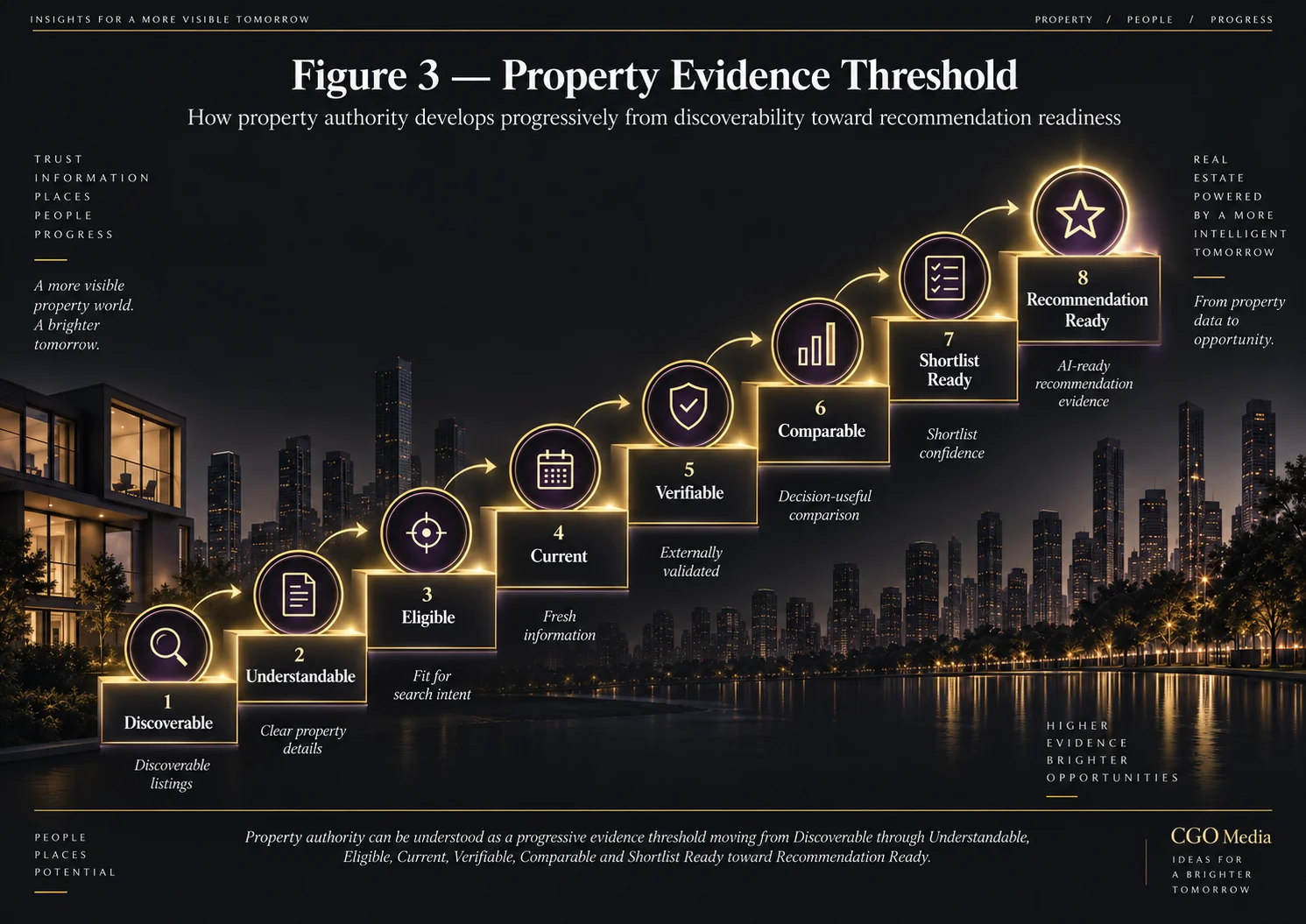

355. Dimension Six — AI Search and Property Recommendation Readiness
AI Search and Property Recommendation Readiness evaluates whether the organisation, its professionals, locations, developments and properties are represented through a sufficiently clear and authoritative evidence environment to support accurate generative discovery, comparison and recommendation.
356. AI Visibility Should Be Treated as a Downstream Outcome
Generative visibility depends on the quality of the evidence already established across the earlier framework dimensions.
357. Strong AI Readiness Requires Strong Foundations
A useful relationship is:
Entity Clarity + Property Evidence + Professional Trust + Market Authority + Source Accessibility → AI Search Readiness
358. AI Search Is Not the Same as Conventional Search
Generative systems can do more than return a list of webpages.
359. Generative Property Search Can Include
- Property discovery
- Location comparison
- Provider comparison
- Market summaries
- Property recommendation
- Agent recommendation
360. Generative Search Can Combine Several Sources
Answers may synthesise information from:
- Agency websites
- Property portals
- Developer websites
- Research reports
- Review platforms
- Media
361. AI Visibility Should therefore Be Analysed as an Evidence Ecosystem
The organisation should ask whether its wider evidence environment is sufficiently strong, current and explicit to support inclusion.
362. Source Visibility Is the First AI Readiness Layer
The organisation’s evidence must be sufficiently discoverable to participate in generative search environments.
363. Source Visibility Can Include
- Listings
- Location pages
- Research
- Professional profiles
- Development pages
364. Source Visibility Should Be Relevant
The objective should not be to appear for every property-related question.
365. Relevant Source Visibility Is More Valuable
The source should contribute where:
- The topic is relevant
- The location is relevant
- The service is relevant
- The user need is relevant
366. Source Accessibility Supports AI Readiness
Important information should be technically accessible and understandable.
367. Source Accessibility Can Be Weakened by
- Broken pages
- Blocked crawling
- Unstable URLs
- Poor rendering
- Weak internal linking
368. Important Evidence Should Be Explicit
Critical facts should not depend on difficult inference.
369. Explicit Property Evidence Can Include
- Price
- Status
- Location
- Bedrooms
- Property type
370. Explicit Professional Evidence Can Include
- Name
- Role
- Office
- Markets served
- Specialisms
371. Explicit Market Evidence Can Include
- Research finding
- Data period
- Methodology
- Geographic scope
- Author
372. Entity Interpretation Is the Second AI Readiness Layer
Generative systems need enough evidence to distinguish the entities involved.
373. Organisation Identity Should Be Clear
The system should be able to distinguish the organisation from:
- Other agencies
- Branches
- Franchises
- Similar brand names
374. Office Identity Should Be Clear
Each office should connect with:
- Address
- Service area
- Agents
- Services
375. Agent Identity Should Be Clear
Each professional should connect with:
- Organisation
- Office
- Locations
- Specialisms
- Listings
376. Developer Identity Should Be Clear
Users should be able to distinguish the developer from the sales or marketing organisation.
377. Development Identity Should Be Clear
Each project should connect with:
- Developer
- Location
- Status
- Unit types
- Available properties
378. Property Identity Should Be Clear
Individual properties should be distinguishable from:
- Duplicate listings
- Similar units
- Other phases
- Other developments
379. Entity Accuracy Is as Important as Entity Visibility
A visible entity represented incorrectly creates weak AI readiness.
380. AI Representation Should therefore Be Audited
Useful checks can include:
- Correct company name
- Correct office
- Correct agent role
- Correct location
- Correct development association
381. Citation Readiness Is the Third AI Readiness Layer
Some evidence may be suitable for explicit reference within generative outputs.
382. Citation-Ready Sources Should Be Clear
Useful characteristics can include:
- Named authorship
- Publication date
- Stable URL
- Explicit findings
- Defined topic
383. Citation-Ready Research Should Be Verifiable
Useful research can include:
- Methodology
- Data source
- Sample
- Time period
- Limitations
384. Citation-Ready Property Information Should Be Current
Volatile information loses value when it becomes outdated.
385. Citation-Ready Professional Information Should Be Current
Roles, offices and specialisms should remain accurate.
386. Citation Eligibility Should Not Be Confused with Recommendation Eligibility
A strong research source may be appropriate for citation without the publisher being the right provider for every user.
387. Comparison Readiness Is the Fourth AI Readiness Layer
Property and provider decisions increasingly involve comparative evaluation.
388. Property Comparison Can Include
- Price
- Location
- Size
- Features
- Status
- Investment context
389. Provider Comparison Can Include
- Local expertise
- Specialisms
- Reviews
- Research
- External validation
390. Location Comparison Can Include
- Property prices
- Infrastructure
- Schools
- Transport
- Lifestyle
- Rental demand
391. Comparison Readiness Requires Standardised Evidence
Candidates become easier to compare where important information is structured consistently.
392. Comparison Readiness Requires Sufficient Evidence
A provider with thin information may be excluded even where genuine relevance exists.
393. Comparison Readiness Requires Context
Comparison should reflect the actual user scenario.
394. A Useful Comparison Relationship Is
User Requirement → Relevant Candidate Set → Comparable Evidence → Trust Evaluation → Shortlist
395. Recommendation Readiness Is the Fifth AI Readiness Layer
Recommendation requires the system to move beyond discovery and comparison toward suitability.
396. Property Recommendation Requires Property Fit
Relevant dimensions can include:
- Budget
- Location
- Property type
- Bedrooms
- Features
- Availability
397. Agent Recommendation Requires Provider Fit
Relevant dimensions can include:
- Location expertise
- Specialist expertise
- Reviews
- Language
- Transaction capability
398. Developer Recommendation Requires Project and Trust Fit
Relevant dimensions can include:
- Project type
- Track record
- Current status
- Location
- Buyer requirement
399. Recommendation Should Respect Hard Constraints
A strong candidate should not remain suitable where a mandatory user requirement is not met.
400. Hard Property Constraints Can Include
- Maximum budget
- Minimum bedrooms
- Required location
- Accessibility
- Required timing
401. Soft Preferences Can Influence Later Comparison
Examples can include:
- View
- Orientation
- Architecture
- Leisure access
- Specific amenities
402. Recommendation Readiness Should therefore Be Contextual
A useful relationship is:
Hard Requirement Fit + Evidence Strength + Trust + Preference Fit → Recommendation Readiness
403. Recommendation Readiness Should Include Freshness
A property recommendation becomes weak when:
- Price is outdated
- Status is outdated
- Availability is outdated
- Development status is outdated
404. Recommendation Readiness Should Include Provider Accuracy
A provider recommendation becomes weak when:
- Agent has left
- Office has moved
- Service is no longer offered
- Specialism is outdated
405. Recommendation Readiness Should Include Independent Trust
External evidence can reinforce confidence around:
- Expertise
- Reputation
- Local authority
- Professional capability
406. Recommendation Readiness Should Include Appropriate Rationale
The reason for inclusion should be supported by genuine evidence.
407. Qualified Recommendation Is Preferable to Raw Recommendation Frequency
The objective should be relevant inclusion rather than appearing indiscriminately.
408. Relevant Inclusion Is a Positive Outcome
The organisation or property appears where genuine fit exists.
409. Relevant Exclusion Is a Visibility Gap
A suitable candidate fails to appear.
410. Irrelevant Inclusion Is a Precision Problem
The candidate appears where the user need is poorly matched.
411. Appropriate Exclusion Is Also a Positive Outcome
An unsuitable candidate does not appear.
412. AI Readiness Should therefore Be Evaluated Through Precision as Well as Visibility
A useful conceptual model is:
Relevant Inclusion + Accurate Representation + Appropriate Exclusion → Higher Recommendation Precision
413. AI Visibility Should Be Monitored Through Scenario Families
Repeatable scenarios can reveal patterns over time.
414. Buyer Scenario Families Can Include
- Family relocation
- Retirement
- Luxury purchase
- International purchase
- First-time buyer
415. Seller Scenario Families Can Include
- Local agent selection
- Luxury property sale
- International marketing
- Developer sales support
416. Investor Scenario Families Can Include
- Rental yield
- Capital growth
- Holiday rental
- Commercial investment
- New development
417. Tenant Scenario Families Can Include
- Long-term rental
- Corporate relocation
- Family rental
- Short-term availability
418. Scenario Monitoring Should Record Source Visibility
The organisation can observe which sources contribute repeatedly.
419. Scenario Monitoring Should Record Citation Visibility
Where visible, citations can provide evidence about the sources supporting the answer.
420. Scenario Monitoring Should Record Entity Accuracy
Material facts should be checked manually where appropriate.
421. Scenario Monitoring Should Record Candidate Sets
The organisation can observe which:
- Properties
- Locations
- Agents
- Developers
appear repeatedly.
422. Scenario Monitoring Should Record Recommendation Rationale
The stated rationale can reveal which characteristics are being associated with the candidate.
423. Scenario Monitoring Should Record Relevant Exclusion
Important absences can reveal evidence gaps.
424. Scenario Monitoring Should Record Irrelevant Inclusion
Poor-fit appearances can reveal overly broad positioning.
425. AI Search Monitoring Should Be Longitudinal
One generated answer should not be treated as a permanent ranking.
426. Generative Outputs Can Change Over Time
Changes can result from:
- Source changes
- Model changes
- Prompt changes
- Inventory changes
- Market changes
427. AI Search Monitoring Should therefore Record Date and Platform
This creates better context for longitudinal analysis.
428. AI Search Monitoring Should Record Scenario Version
Material changes in prompt design should be documented.
429. AI Search Monitoring Should Not Be Treated as Reverse Engineering
External testing cannot reveal proprietary internal algorithms in full.
430. Monitoring Should Be Used Diagnostically
It can identify potential:
- Source gaps
- Entity gaps
- Authority gaps
- Freshness gaps
- Positioning gaps
431. Weak Source Visibility Should Trigger Source Review
Useful questions can include:
- Is the content relevant?
- Is it technically accessible?
- Is it distinctive?
- Is it current?
432. Weak Citation Visibility Should Trigger Citation Review
Useful questions can include:
- Is authorship clear?
- Is the claim explicit?
- Is the evidence verifiable?
- Is the methodology transparent?
433. Weak Entity Accuracy Should Trigger Entity Review
Useful questions can include:
- Are external profiles current?
- Are office relationships clear?
- Are agent roles current?
- Are development relationships consistent?
434. Weak Recommendation Visibility Should Trigger Fit and Authority Review
Useful questions can include:
- Is the organisation genuinely relevant?
- Is specialist expertise explicit?
- Is local authority strong enough?
- Is independent trust sufficient?
435. AI Readiness Should Be Improved Through Underlying Evidence
The strongest response to a visibility gap is usually to improve the evidence environment.
436. AI Readiness Can Be Improved through Stronger Entity Clarity
Important relationships should be explicit and consistent.
437. AI Readiness Can Be Improved through Better Property Evidence
Listings should remain complete, accurate and current.
438. AI Readiness Can Be Improved through Stronger Professional Evidence
Professional profiles should demonstrate real expertise.
439. AI Readiness Can Be Improved through Stronger Market Evidence
Original research can create distinctive and attributable information.
440. AI Readiness Can Be Improved through External Validation
Reviews, media and citations can reinforce trust.
441. AI Readiness Can Be Improved through Better Technical Accessibility
Important evidence should be discoverable and stable.
442. AI Readiness Should Avoid Manipulative Optimisation
The objective should not be to manufacture artificial recommendation signals.
443. AI Readiness Should Focus on Genuine Usefulness
A strong evidence asset should remain useful even if no generative system references it.
444. AI Readiness Should Focus on Accuracy
Incorrect visibility can create reputational and commercial risk.
445. AI Readiness Should Focus on Appropriate Context
The organisation should be easier to discover where genuine relevance exists.
446. AI Readiness Should Focus on Evidence Convergence
A stronger environment exists where:
- Owned evidence
- Customer evidence
- Research evidence
- External evidence
materially reinforce one another.
447. A Property AI Trust Convergence Model Can Be
Clear Entity + Current Property Evidence + Professional Trust + Market Authority + Independent Validation → AI Recommendation Readiness
448. AI Readiness Should Connect with Commercial Outcomes
Generative visibility becomes more meaningful when it produces:
- Relevant enquiries
- Better-informed buyers
- Qualified seller leads
- Appropriate property matches
449. Qualified Enquiry Should Be Preferred to Raw Enquiry Volume
A large number of poorly matched enquiries can create operational inefficiency.
450. AI Visibility Should therefore Connect to CRM Measurement
Where possible, organisations should examine:
- Lead source
- Lead quality
- Viewing progression
- Valuation progression
- Transaction progression
451. Attribution Should Remain Cautious
A user may move through several channels before contacting the organisation.
452. AI Search Can Be an Early-Stage Influence
A journey can be:
AI Location Research → Organic Search → Agent Reviews → Website Visit → Enquiry
453. AI Search Can Also Be a Mid-Journey Influence
A journey can be:
Property Portal → AI Comparison → Agency Website → Viewing Request
454. AI Search Can Also Support Provider Validation
A user may ask generative systems to compare agencies after initially discovering them elsewhere.
455. AI Recommendation Readiness Should therefore Be Integrated with Wider Search Strategy
It should connect with:
- Technical SEO
- Local SEO
- Property data
- Research
- Digital PR
- CRM
456. AI Recommendation Readiness Should Be Integrated with Operations
Operational teams control much of the information that affects accuracy.
457. AI Recommendation Readiness Should Be Integrated with Professional Expertise
Agents and specialists provide the market knowledge that supports provider relevance.
458. AI Recommendation Readiness Should Be Integrated with Research
Repeated information gaps can become research opportunities.
459. AI Recommendation Readiness Should Be Integrated with External Authority
Independent evidence can strengthen trust around genuine areas of expertise.
460. AI Recommendation Readiness Should Be Governed
Responsibility should exist for:
- Scenario testing
- Entity accuracy
- Source monitoring
- Recommendation monitoring
- Reporting
461. AI Monitoring Should Have Review Cycles
The appropriate frequency depends on:
- Business priority
- Market volatility
- Platform change
- Evidence change
462. High-Priority Markets Should Receive Deeper Monitoring
Organisations should focus effort where generative visibility has genuine commercial relevance.
463. High-Priority Specialisms Should Receive Deeper Monitoring
Examples can include:
- Luxury
- New developments
- International buyers
- Investment
464. High-Priority Professional Entities Should Receive Deeper Monitoring
Named experts can be assessed for:
- Visibility
- Accuracy
- Specialist association
- Recommendation inclusion
465. AI Search Readiness Should Be Measured as a System
A useful measurement hierarchy is:
Source Visibility → Citation Visibility → Entity Accuracy → Comparison Visibility → Recommendation Visibility → Qualified Enquiry
466. The Seventeenth Property Trust and Visibility Principle
AI search readiness should be treated as the downstream result of clear entities, accurate property information, demonstrable professional expertise, market authority and accessible evidence rather than as an isolated optimisation discipline.
467. The Eighteenth Property Trust and Visibility Principle
Property organisations should measure AI visibility through relevant source presence, accurate representation, comparison inclusion and qualified recommendation rather than raw mention frequency, recognising that appropriate exclusion can be as valuable as broad visibility where genuine fit is absent.
468. The Nineteenth Property Trust and Visibility Principle
AI recommendation readiness should be strengthened through genuine user fit, current property evidence, explicit professional specialism and credible independent validation, with hard commercial constraints respected before softer preference matching.
469. The Twentieth Property Trust and Visibility Principle
Generative monitoring should function as a diagnostic component of the wider property-search authority system, identifying source, entity, authority and freshness gaps while avoiding unsupported claims about proprietary retrieval, ranking or recommendation algorithms.
470. The AI Search and Property Recommendation Readiness Model
The complete relationship can be summarised as:
Entity Clarity + Property Evidence + Professional Trust + Market Authority + Source Accessibility + User Fit + Freshness + Independent Validation → AI Search & Recommendation Readiness
471. The Strategic Implication
Property organisations should approach AI visibility as the cumulative result of a coherent evidence system. Accurate property information, clear business and professional entities, strong local and market expertise, independent validation and technically accessible sources make it easier for generative systems to interpret what the organisation does, where it operates and when it may be relevant to a user. The objective is not to maximise indiscriminate AI mentions, but to improve the probability of accurate, contextually appropriate discovery, comparison and recommendation where genuine fit exists.


472. Property Trust and Visibility Should Be Managed as a Continuous System
The six dimensions of the framework should not be treated as one-time optimisation tasks.
473. Property Evidence Environments Change Continuously
Change can occur in:
- Inventory
- Prices
- Agent roles
- Office locations
- Development status
- Market conditions
- External references
474. Search and AI Discovery Environments Also Change
Search interfaces, source selection, citation behaviour and generative recommendation patterns can evolve independently of the organisation.
475. Continuous Improvement Is therefore Required
A useful cycle is:
Assess → Prioritise → Strengthen → Validate → Measure → Learn → Improve
476. Assessment Is the First Improvement Stage
The organisation should review the current strength of each framework dimension.
477. Entity Clarity Should Be Assessed
Useful checks can include:
- Organisation identity
- Office identity
- Agent identity
- Developer identity
- Development identity
- Property identity
478. Location and Listing Authority Should Be Assessed
Useful checks can include:
- Location depth
- Local inventory
- Development relationships
- Listing freshness
- Property lifecycle governance
479. Property Evidence Quality Should Be Assessed
Useful checks can include:
- Accuracy
- Completeness
- Freshness
- Comparability
- Transparency
480. Professional Trust Should Be Assessed
Useful checks can include:
- Profile completeness
- Review evidence
- Specialist relevance
- Research participation
- External validation
481. Market and External Authority Should Be Assessed
Useful checks can include:
- Research output
- Research citations
- Media references
- Trade visibility
- Local authority
482. AI Search Readiness Should Be Assessed
Useful checks can include:
- Source visibility
- Citation visibility
- Entity accuracy
- Comparison inclusion
- Recommendation inclusion
483. Assessment Should Produce a Gap Register
Each weakness can be recorded according to:
- Framework dimension
- Business impact
- User impact
- Evidence gap
- Priority
484. Prioritisation Is the Second Improvement Stage
Not every weakness has equal strategic importance.
485. High-Risk Errors Should Receive Priority
Examples can include:
- Incorrect property price
- Incorrect availability
- Incorrect office information
- Incorrect professional role
- Incorrect development status
486. High-Value Markets Should Receive Priority
Priority locations should receive deeper authority investment where they are commercially important.
487. High-Value Services Should Receive Priority
Examples can include:
- Luxury sales
- New developments
- International buyers
- Property investment
- Commercial property
488. High-Dependency Gaps Should Receive Priority
Some weaknesses affect several other dimensions.
489. Weak Entity Clarity Is a High-Dependency Gap
It can affect:
- Search interpretation
- Local visibility
- Professional authority
- AI recommendation accuracy
490. Weak Property Data Is a High-Dependency Gap
It can affect:
- Listing trust
- Portal accuracy
- Property comparison
- AI representation
491. Weak Location Authority Is a High-Dependency Gap
It can affect:
- Local SEO
- Provider relevance
- Location comparison
- AI recommendation
492. Prioritisation Should therefore Consider Dependency
A useful relationship is:
Business Importance + User Risk + Evidence Gap + Dependency → Improvement Priority
493. Strengthening Is the Third Improvement Stage
The organisation should improve the specific evidence weakness identified.
494. Entity Weaknesses Require Entity Improvements
Relevant actions can include:
- Profile cleanup
- Relationship clarification
- Name standardisation
- Office updates
- Agent updates
495. Listing Weaknesses Require Property Data Improvements
Relevant actions can include:
- Data correction
- Status updates
- Feed governance
- Media improvements
- Lifecycle rules
496. Location Weaknesses Require Local Authority Improvements
Relevant actions can include:
- Market research
- Local inventory integration
- Local expert attribution
- Location-page improvement
- Local review development
497. Professional Trust Weaknesses Require Professional Evidence Improvements
Relevant actions can include:
- Profile expansion
- Review development
- Specialist evidence
- Research contribution
- Media commentary
498. External Authority Weaknesses Require External Evidence Improvements
Relevant actions can include:
- Original research
- Digital PR
- Journalist outreach
- Trade visibility
- Research citation development
499. AI Readiness Weaknesses Require Underlying Evidence Improvements
The organisation should improve the evidence system rather than attempt to manipulate individual AI outputs directly.
500. Validation Is the Fourth Improvement Stage
Strengthened evidence should be tested to determine whether the underlying weakness has improved.
501. Entity Validation Can Include
- Website checks
- Portal checks
- Business-profile checks
- Search checks
- AI representation checks
502. Property Validation Can Include
- Price consistency
- Status consistency
- Property detail consistency
- Feed consistency
- Media accuracy
503. Professional Validation Can Include
- Role accuracy
- Profile completeness
- Review evidence
- Specialist positioning
- External references
504. Market Authority Validation Can Include
- Research visibility
- Research citations
- Media references
- Local visibility
- External mentions
505. AI Validation Can Include
- Source presence
- Citation presence
- Entity accuracy
- Comparison inclusion
- Recommendation relevance
506. Validation Should Compare against a Baseline
Without a baseline, improvement becomes difficult to evaluate objectively.
507. Measurement Is the Fifth Improvement Stage
The framework should be translated into measurable indicators.
508. Entity Clarity Metrics Can Include
- Profile completeness
- Entity conflict rate
- Office accuracy
- Professional accuracy
509. Location and Listing Metrics Can Include
- Location coverage
- Listing freshness
- Listing completeness
- Property conflict rate
510. Property Evidence Metrics Can Include
- Data completeness
- Freshness compliance
- Media completeness
- Transparency compliance
511. Professional Trust Metrics Can Include
- Review recency
- Profile completeness
- External citations
- Research contribution
512. Market Authority Metrics Can Include
- Research output
- Research citations
- Media references
- Local authority signals
513. AI Readiness Metrics Can Include
- Qualified source visibility
- Citation visibility
- Entity accuracy
- Qualified recommendation visibility
514. Measurement Should Connect to Commercial Outcomes
Useful downstream measures can include:
- Qualified enquiries
- Viewings
- Valuation requests
- Instructions
- Transactions
515. Measurement Should Avoid Vanity Metrics
High traffic, listing volume, link volume or mention volume should not automatically be interpreted as authority.
516. Learning Is the Sixth Improvement Stage
The organisation should record which interventions appear to improve:
- Trust
- Visibility
- Accuracy
- Recommendation relevance
- Commercial quality
517. Learning Should Include Unsuccessful Interventions
Weak results can prevent repeated investment in low-value activity.
518. Learning Should Include Unexpected Outcomes
A change can affect a different framework dimension from the one originally targeted.
519. Improvement Is the Seventh Stage
Validated learning should become part of future operating standards.
520. Property Data Standards Should Improve
Recurring errors should lead to better:
- Required fields
- Validation rules
- Feed processes
- Status governance
521. Professional Profile Standards Should Improve
Recurring gaps should lead to better:
- Biography standards
- Specialism fields
- Role updates
- Review attribution
522. Research Standards Should Improve
Recurring citation or credibility gaps should lead to stronger:
- Methodology
- Attribution
- Data disclosure
- Limitations
523. Location Standards Should Improve
Recurring geographic gaps should lead to better:
- Location architecture
- Market evidence
- Agent attribution
- Inventory relationships
524. AI Monitoring Standards Should Improve
Recurring observations should refine:
- Scenario libraries
- Validation methods
- Reporting standards
- Accuracy checks
525. The Six Dimensions Should Reinforce One Another
Property trust becomes stronger when:
Entity Clarity → Better Listing Context → Better Professional Evidence → Stronger Market Authority → Better AI Readiness
526. Entity Clarity Supports Property Evidence
Clear relationships help users understand who represents each property.
527. Property Evidence Supports Professional Trust
High-quality listings demonstrate operational competence.
528. Professional Trust Supports Local Authority
Recognised experts strengthen market credibility.
529. Local Authority Supports External Authority
Original local evidence creates opportunities for external citation.
530. External Authority Supports AI Readiness
Independent validation strengthens the wider evidence environment.
531. AI Monitoring Can Feed Back into Entity Governance
Incorrect representations can reveal unresolved entity conflicts.
532. AI Monitoring Can Feed Back into Property Governance
Outdated property information can reveal freshness failures.
533. AI Monitoring Can Feed Back into Professional Governance
Incorrect roles or specialisms can reveal profile gaps.
534. AI Monitoring Can Feed Back into Market Authority
Relevant exclusion can reveal weak research or external evidence.
535. This Creates a Continuous Authority Loop
A useful relationship is:
Evidence → Discovery → Validation → Measurement → Learning → Better Evidence
536. Trust and Visibility Should Be Managed at Different Frequencies
Not every dimension changes at the same rate.
537. Property Inventory Requires Frequent Governance
High-volatility fields should be reviewed often.
538. Professional Information Requires Event-Based Governance
Relevant triggers can include:
- Role changes
- Office changes
- New qualifications
- Staff departures
539. Development Information Requires Milestone-Based Governance
Relevant triggers can include:
- Launch
- Construction milestone
- Completion
- Sell-out
540. Market Research Requires Periodic Governance
Update frequency should reflect:
- Market volatility
- Data availability
- Research relevance
- Commercial importance
541. External Authority Requires Ongoing Monitoring
New:
- Reviews
- Citations
- Media references
- Research mentions
can change the authority environment over time.
542. AI Search Readiness Requires Repeat Observation
Generative systems should not be treated as static ranking environments.
543. Review Frequency Should Reflect Risk
A useful relationship is:
Volatility + Commercial Importance + Error Impact → Review Frequency
544. Governance Should Define Ownership
Each framework dimension should have clear responsibility.
545. Entity Governance Ownership Can Include
- Organisation information
- Office information
- Professional information
- Developer relationships
546. Property Governance Ownership Can Include
- Price
- Status
- Property facts
- Media
- Feed integrity
547. Trust Governance Ownership Can Include
- Professional profiles
- Reviews
- Credentials
- Research participation
548. Authority Governance Ownership Can Include
- Research
- Digital PR
- Media outreach
- External citation monitoring
549. AI Governance Ownership Can Include
- Scenario testing
- Representation validation
- Source monitoring
- Recommendation monitoring
550. Cross-Functional Governance Is Required
No single SEO team controls every evidence source.
551. Property Teams Control Operational Evidence
They often control:
- Inventory
- Price
- Status
- Property attributes
552. Agents Control Professional and Local Evidence
They can contribute:
- Market knowledge
- Customer insight
- Local commentary
- Transaction expertise
553. Research Teams Control Research Evidence
They can contribute:
- Methodology
- Data analysis
- Market studies
- Original findings
554. PR Teams Support External Authority
They can connect:
- Research
- Expertise
- Market commentary
- Journalists
555. Search Teams Connect the Evidence Architecture
They can coordinate:
- Technical accessibility
- Internal linking
- Entity structure
- Search measurement
- AI monitoring
556. CRM Teams Connect Trust and Visibility with Outcomes
They can help measure:
- Lead quality
- Viewing progression
- Valuation progression
- Transaction progression
557. Continuous Improvement Should therefore Be Organisational
Property Trust and Visibility becomes stronger when responsibility extends beyond the marketing department.
558. The Twenty-First Property Trust and Visibility Principle
Property trust and visibility should be managed through a continuous assess, prioritise, strengthen, validate, measure, learn and improve cycle because property information, professional entities, market evidence, external authority and AI representation all change over time.
559. The Twenty-Second Property Trust and Visibility Principle
Improvement priorities should reflect business importance, user risk, evidence weakness and capability dependency so high-impact errors and foundational gaps are addressed before lower-value visibility expansion.
560. The Twenty-Third Property Trust and Visibility Principle
The six dimensions should be governed as one connected authority system in which entity clarity supports property evidence, property evidence supports provider trust, provider trust strengthens market authority, external authority reinforces validation and AI monitoring feeds weaknesses back into the wider evidence environment.
561. The Twenty-Fourth Property Trust and Visibility Principle
Long-term property authority should depend on cross-functional governance involving property operations, professional teams, research, Digital PR, search and commercial measurement rather than assigning responsibility for trust and visibility solely to SEO or content teams.
562. The Continuous Property Trust and Visibility Improvement Cycle
The complete improvement cycle can be summarised as:
Assess → Prioritise → Strengthen → Validate → Measure → Learn → Improve
563. The Property Trust and Visibility Authority Loop
The long-term relationship can be summarised as:
Better Evidence → Better Discovery → Better Validation → Better Measurement → Better Learning → Stronger Property Authority
564. The Strategic Implication
Property Trust and Visibility should be managed as an ongoing organisational capability rather than as a one-time website project. The strongest organisations repeatedly review the clarity of their entities, the quality of their listings, the strength of professional evidence, the depth of local and market authority, the quality of independent validation and the accuracy of AI-assisted representation. Each weakness should lead to a targeted evidence improvement, each improvement should be validated, and the resulting learning should become part of future operating standards. This creates a cumulative property-authority system capable of adapting as inventory, professionals, markets, search environments and AI discovery systems continue to change.
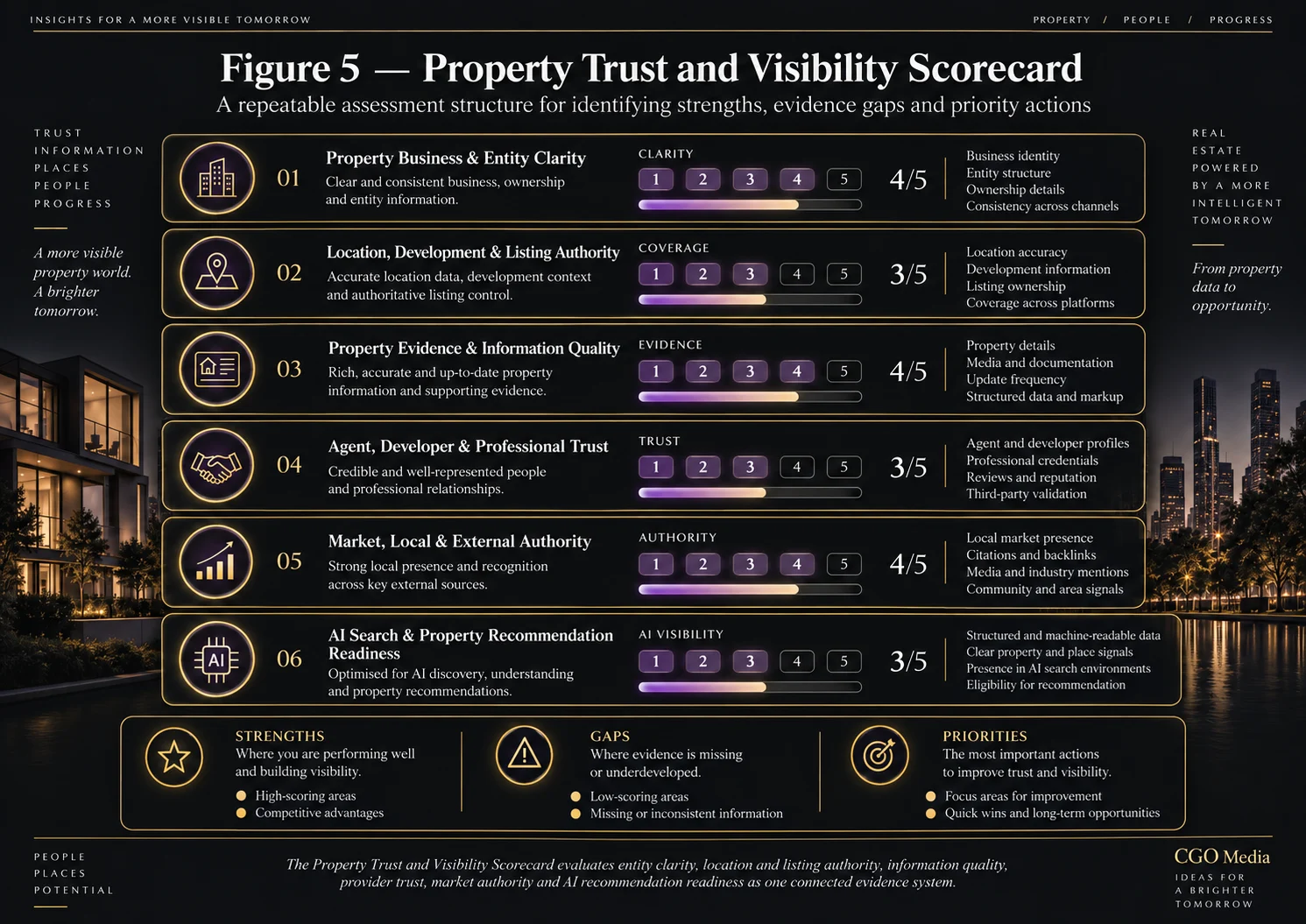
565. Research Methodology
The Property & Real Estate AI Trust and Visibility Framework is a conceptual framework developed by CGO Media to examine how property organisations build the clarity, evidence, trust, authority and recommendation readiness required across conventional search, local discovery, property platforms and AI-assisted search environments.
Core Research Question
The central research question is:
Which combinations of entity clarity, property evidence, professional trust, market authority, independent validation and AI-search readiness help property organisations become easier to discover, understand, evaluate and appropriately recommend?
Framework Scope
The framework can be applied to organisations including:
- Estate agencies
- Real estate brokerages
- Property developers
- New-build specialists
- Property portals
- Buyer agencies
- Property-management organisations
- Commercial property firms
User Scope
The framework considers property journeys involving:
- Buyers
- Sellers
- Investors
- Landlords
- Tenants
- International buyers
These user groups should not be treated as having identical information, trust or recommendation requirements.
Search Scope
The framework covers visibility across:
- Organic search
- Local search
- Property portals
- AI-assisted search
- Generative discovery environments
- Provider comparison
- Recommendation systems
Six Connected Dimensions
The framework uses six connected dimensions:
- Property Business and Entity Clarity
- Location, Development and Listing Authority
- Property Evidence and Information Quality
- Agent, Developer and Professional Trust
- Market, Local and External Authority
- AI Search and Property Recommendation Readiness
The dimensions are interdependent.
Stronger authority emerges when they reinforce one another rather than functioning as isolated capabilities.
Dimension One — Property Business and Entity Clarity
This dimension examines whether the relationships between relevant property entities are sufficiently clear.
A useful model is:
Organisation → Office → Agent/Professional → Developer → Development → Unit/Property → Location → Transaction Type
Not every property organisation will use every layer, but different entities should not be unnecessarily conflated.
Organisation and Office Clarity
The methodology can assess whether users and search systems can distinguish:
- Parent organisation
- Branch or office
- Franchise location
- Trading identity
- Service area
Agent and Professional Clarity
Professional identity can include:
- Name
- Current role
- Office relationship
- Organisation relationship
- Property specialism
- Location expertise
- Current activity
Developer and Development Clarity
Developer identity should remain distinct from:
- Estate agency
- Sales agent
- Development
- Individual unit
- Marketing partner
This distinction can be particularly important in new-build and international property discovery.
Dimension Two — Location, Development and Listing Authority
This dimension considers whether location expertise, development information and active inventory provide meaningful evidence of participation within the target market.
Location Authority
Location authority can be supported by:
- Current property inventory
- Area expertise
- Location guides
- Office presence
- Transaction experience
- Professional knowledge
- Market research
- External local references
Location Hierarchy
A useful geographic model is:
Country → Region → City → Municipality/District → Neighbourhood → Development → Property
The exact hierarchy will vary by market.
The objective is geographic precision rather than artificially broad location coverage.
Listing Authority
Listing Authority should not be treated as raw inventory volume.
Stronger listing authority can depend on:
- Accuracy
- Completeness
- Freshness
- Distinctiveness
- Availability accuracy
- Location clarity
- Entity relationships
Listing Lifecycle Governance
Property listings are dynamic records and should be governed through an appropriate lifecycle.
A conceptual sales lifecycle is:
Create → Verify → Publish → Syndicate → Update → Reserve/Under Offer → Complete → Withdraw → Archive
A rental lifecycle may include:
Create → Verify → Publish → Available → Reserved → Let → Withdraw → Archive
Page Existence and Property Availability Are Different
The framework distinguishes:
Page Exists ≠ Property Available
and:
Indexed Listing ≠ Current Inventory
A property page can remain useful after a transaction, but its current status should not be ambiguous.
Listing Status Governance
Material listing states can include:
- Available
- Reserved
- Under offer
- Sold
- Let or rented
- Withdrawn
- No longer marketed
Organisations should maintain clear definitions and consistent handling of these states where practicable.
Duplicate Property Evidence
The same property can appear across:
- Agency websites
- Developer websites
- Property portals
- Multiple agents
- Partner sites
- Property feeds
Duplicate presence is not automatically a problem.
The more important issue is whether duplicate records create conflicting evidence.
Duplicate Evidence Conflicts
Potential conflicts can involve:
- Price
- Status
- Description
- Dimensions
- Availability
- Agent identity
- Developer identity
Property Entity Resolution
Entity-resolution analysis can consider whether multiple records represent:
- The same property
- Different units
- Different phases
- Different developments
- Different versions of an outdated listing
Development Authority
Development Authority can consider whether there is clear and current evidence concerning:
- Developer identity
- Development identity
- Development location
- Current phase
- Available unit types
- Completion information
- Specifications
- Current availability
Future Development Information
New-build information should distinguish where appropriate between:
- Current Fact
- Planned Feature
- Indicative Specification
- Estimated Completion
- Completed Feature
Projected information should not be presented as though it were already completed or guaranteed.
Dimension Three — Property Evidence and Information Quality
This dimension considers:
- Accuracy
- Completeness
- Freshness
- Comparability
- Transparency
Property Facts
Material property facts can include:
- Price
- Status
- Bedrooms
- Bathrooms
- Dimensions
- Plot size
- Property type
- Amenities
- Location
- Availability
Property Facts Require Operational Validation
Operational property evidence should be validated against the organisation’s most reliable current source where practicable.
Price Evidence
The framework distinguishes between concepts including:
- Asking price
- Advertised price
- Historic transaction price
- Professional valuation
- Automated valuation estimate
- Market-average price
These concepts should not automatically be treated as interchangeable.
Information Volatility
High-volatility property information can include:
- Price
- Status
- Availability
- Development progress
- Available units
Professional information can also change through:
- Role changes
- Office changes
- Company changes
- Specialism changes
- Availability changes
Market evidence can become outdated through changes in:
- Pricing
- Inventory
- Buyer behaviour
- Rental demand
- Transaction volumes
Freshness Method
A useful conceptual relationship is:
Information Volatility + User Impact + Commercial Importance → Required Freshness
Validation Should Match the Evidence Type
Different claims require different sources of validation.
Property Facts Require Operational Validation
Examples can include:
- Price
- Status
- Bedrooms
- Dimensions
- Availability
Market Claims Require Broader Validation
Examples can include:
- Transaction data
- Market reports
- Price studies
- Inventory studies
- Rental data
Investment Claims Require Stronger Qualification
Claims involving:
- Rental yield
- Capital appreciation
- Investment performance
- Expected returns
- Future resale value
should be supported by appropriate evidence and limitations.
Historic or market-level evidence should not automatically be converted into predictions for an individual property.
Dimension Four — Agent, Developer and Professional Trust
This dimension considers whether agents, developers and other professionals possess sufficient evidence of:
- Identity
- Expertise
- Current activity
- Reviews
- External validation
Professional Trust Evidence
Professional trust can be supported through evidence including:
- Complete professional profiles
- Relevant market expertise
- Property-type expertise
- Local experience
- Current organisational relationship
- Research or commentary
- Relevant external references
Developer Trust
Developer trust can include evidence concerning:
- Developer identity
- Current projects
- Completed developments
- Project status
- External references
- Relevant professional or institutional evidence
Reviews as Experience Evidence
Reviews can contribute evidence concerning:
- Communication
- Responsiveness
- Professionalism
- Administration
- Service experience
Reviews should not automatically be treated as evidence of:
- Property quality
- Valuation accuracy
- Investment quality
- Future property performance
Dimension Five — Market, Local and External Authority
This dimension considers:
- Original research
- Local evidence
- Media references
- Research citations
- Independent validation
Market Authority
Market Authority can be supported by evidence concerning:
- Property-market activity
- Pricing trends
- Transaction patterns
- Inventory
- Buyer behaviour
- Rental demand
- Location-specific analysis
Original Research Method
Where organisations publish original property research, methodology should identify where relevant:
- Geographic scope
- Property segment
- Dataset
- Sample
- Measurement period
- Definitions
- Analysis method
- Limitations
The governing principle is:
The strength of the claim should not exceed the strength of the evidence.
Independent Validation
Independent validation can include:
- Relevant reviews
- Media references
- Professional recognition
- Research citations
- Industry evidence
- Institutional references
External validation should reinforce genuine market or professional authority rather than substitute for it.
Entity Claims Require Consistency
Important relationships should align reasonably across:
- Website
- Property portals
- Business profiles
- Review platforms
- External sources
Dimension Six — AI Search and Property Recommendation Readiness
This dimension considers:
- Source visibility
- Citation visibility
- Entity accuracy
- Comparison inclusion
- Recommendation relevance
AI Readiness Is Downstream
AI readiness should emerge from stronger underlying evidence rather than function as an isolated optimisation programme.
A useful model is:
Entity Clarity + Property Evidence + Professional Trust + Market Authority + Source Accessibility → AI Search Readiness
AI Measurement Hierarchy
A useful measurement progression is:
Source Visibility → Citation Visibility → Entity Accuracy → Comparison Visibility → Recommendation Visibility → Qualified Enquiry
Source Visibility
Source Visibility considers whether relevant owned or external evidence appears within observable AI-assisted discovery environments.
Citation Visibility
Citation Visibility considers whether a source receives visible attribution.
Visible citation should not be interpreted as complete proof of causality.
Entity Accuracy
Entity Accuracy can evaluate whether generated outputs correctly represent:
- Organisation
- Office
- Agent
- Developer
- Development
- Property
- Location
Comparison Visibility
Comparison Visibility considers whether genuinely relevant properties or providers appear within appropriate comparison scenarios.
Recommendation Readiness
A useful property recommendation-readiness model is:
User Need + Location + Property Type + Budget + Current Availability + Property Evidence + Provider Trust → Qualified Recommendation Readiness
Recommendation Readiness Is Not Recommendation Guarantee
Recommendation Readiness is an analytical construct.
It does not guarantee recommendation by Google, OpenAI, Microsoft, Perplexity or any other external system.
Property Recommendation and Provider Recommendation Are Different
A recommendation system may surface:
- A property
- A development
- An agency
- An agent
- A developer
These represent different recommendation outcomes and should not be treated as interchangeable.
Qualified Recommendation Outcomes
The framework distinguishes:
- Relevant Inclusion
- Irrelevant Inclusion
- Relevant Exclusion
- Appropriate Exclusion
Relevant Inclusion
A property or provider appears within a scenario where genuine relevance exists and material information is sufficiently accurate.
Irrelevant Inclusion
A property or provider appears despite weak location, price, property-type, availability or service fit.
This should be treated as a recommendation-quality problem rather than a visibility success.
Relevant Exclusion
A genuinely relevant property or provider is repeatedly absent from appropriate scenarios.
This may justify further evidence and visibility analysis.
Appropriate Exclusion
A property or provider does not appear because the scenario is outside its genuine market, location, property type, availability or service capability.
This should not automatically be treated as weak performance.
Evidence Confidence
Framework findings can be supplemented by an Evidence Confidence classification:
- Low
- Medium
- High
Evidence Confidence can reflect:
- Source reliability
- Evidence completeness
- Freshness
- Consistency
- Coverage
- Validation quality
A useful reporting format is:
Location and Listing Authority: Strong | Evidence Confidence: Medium
Critical Overrides
Material inaccuracies should remain separately visible even where the wider authority environment is strong.
Potential Critical Overrides can include:
- Materially incorrect price
- False availability
- Wrong property location
- Incorrect developer identity
- Incorrect development status
- Materially incorrect property specifications
- Misleading professional affiliation
The governing principle is:
Strong aggregate authority must not conceal a critical property, professional or location inaccuracy.
Framework Summary
The six dimensions can be summarised as:
Entity Clarity + Location & Listing Authority + Property Evidence Quality + Professional Trust + Market & External Authority + AI Recommendation Readiness → Property Trust & Visibility
Continuous Improvement Cycle
The operating cycle is:
Assess → Prioritise → Strengthen → Validate → Measure → Learn → Improve
Change Triggers
Reassessment can be triggered by changes including:
- Price changes
- Status changes
- Property sold or let
- New development phases
- Completion-date revisions
- Agent departure
- Office change
- Developer change
- Property-feed change
- Market-data refresh
566. Limitations
The Property & Real Estate AI Trust and Visibility Framework is a strategic and operational model rather than a predictive formula.
It does not reproduce or claim access to proprietary ranking, retrieval, citation-selection or recommendation systems used by search engines, portals or AI platforms.
Organisations Have Different Starting Points
A single-office estate agency may require a different implementation emphasis from:
- A national brokerage
- A developer
- A property portal
- A commercial property organisation
Markets Differ
Property markets vary in:
- Regulation
- Data availability
- Portal dominance
- Transaction processes
- Buyer behaviour
Geographic Authority Differs by Market
Evidence considered strong in one location may not transfer directly to another.
Review Ecosystems Differ
Some markets rely more heavily on:
- Google reviews
- Property portals
- Trade platforms
- Local reputation
Professional Regulation Differs
Licensing, professional membership and disclosure requirements can vary by jurisdiction.
Property Data Structures Differ
Organisations may use:
- Internal CRM systems
- MLS systems
- Property feeds
- Portal-managed inventories
Property Information Is Highly Dynamic
Price, availability, development status, unit inventory and property specifications can change rapidly.
Page Existence Does Not Prove Current Availability
A property page may remain accessible after the property has been reserved, sold, let or withdrawn.
Duplicate Listings Are Not Automatically Errors
Legitimate multi-agent and multi-platform distribution can create duplicate records.
The greater risk is inconsistent evidence between those records.
Property Measurements Can Differ
Floor area, plot size, room counts and other specifications may differ because of:
- Measurement standards
- Source systems
- Rounding
- Historic data
- Recording errors
Price Concepts Are Not Interchangeable
Asking price, transaction price, automated valuation, professional valuation and market-average price represent different concepts.
Valuation Evidence Has Limitations
Indicative valuations and market estimates should not automatically be treated as definitive property values.
Investment Evidence Has Limitations
Historic rental yields, capital growth or market appreciation do not guarantee future performance for an individual property.
Market-Level Evidence Does Not Determine Individual Outcomes
Area-level data may provide context without accurately predicting the future value, rental performance or transaction outcome of a specific property.
New-Build Information Can Change
Development timelines, unit availability, specifications and planned amenities may change before completion.
Planned Features Are Not Completed Features
Future-facing project information should not be presented as though construction or delivery has already occurred.
Reviews Have Limitations
Reviews can support analysis of service experience but do not prove:
- Property quality
- Valuation accuracy
- Investment performance
- Future returns
External Recognition Has Limitations
Awards, media coverage and third-party recognition should be interpreted according to their methodology, scope, geography and date.
External Authority Is Not Fully Controllable
Media, reviews, citations and third-party profiles remain partly outside organisational control.
AI Platforms Differ
Different systems may produce different:
- Sources
- Citations
- Comparisons
- Recommendations
Results from One Platform Should Not Automatically Be Generalised
Platform-specific observations should remain platform-specific unless additional evidence supports a broader conclusion.
Generative Results Are Variable
The same or similar query may produce different outputs over time.
Prompt Wording Can Affect Results
Differences in:
- Location
- Budget
- Property type
- User wording
- Conversation context
can change the candidate set.
User Context Can Affect Recommendations
A provider or property suitable for one user may be unsuitable for another.
Recommendation Visibility Is Not a Universal Ranking
Recommendation should be evaluated within the context of the actual user scenario.
AI Recommendation Does Not Guarantee Property Suitability
A generated recommendation can surface potentially relevant inventory but cannot guarantee that a property is suitable for a particular buyer, tenant or investor.
AI Recommendation Does Not Guarantee Availability
A generated system may rely on evidence that has become outdated.
Current availability should be verified through an appropriate current source.
AI Recommendation Is Not Investment Advice
Generated property suggestions should not automatically be interpreted as investment recommendations or predictions of future return.
AI Recommendation Is Not Valuation Advice
Generated descriptions or comparisons should not automatically be treated as professional valuations.
AI Recommendation Is Not Legal or Financial Advice
Property discovery systems do not replace appropriate legal, tax, mortgage, financial or other professional advice where required.
Provider Recommendation Does Not Prove Professional Superiority
Appearance in an AI-generated provider set does not prove that one estate agency, developer, broker or other provider is objectively superior to another.
Citation Visibility Is Not Guaranteed
Publishing strong research or evidence does not guarantee that an external system will cite it.
Visible Citation Does Not Establish Complete Causality
The appearance of a source does not prove that the source alone caused a generated statement or recommendation.
Absence of Visible Citation Does Not Prove Absence of Influence
A source may potentially contribute to retrieval or answer construction without being displayed visibly.
Search Visibility Is Not Guaranteed
High-quality content and strong evidence do not guarantee particular organic or local search positions.
AI Recommendation Is Not Guaranteed
No organisation can guarantee inclusion within a third-party generative recommendation.
Market Conditions Affect Commercial Outcomes
Factors can include:
- Interest rates
- Inventory
- Economic conditions
- Seasonality
- Regulatory change
- Financing
Search and Trust Improvements Should Not Receive Sole Credit for Transactions
Property transactions are multi-stage and multi-causal.
Correlation Does Not Establish Causation
Improved visibility or authority occurring alongside increased enquiries or transactions does not automatically prove that one intervention caused those outcomes.
The Framework Does Not Provide Property, Investment, Valuation, Financial or Legal Advice
The framework concerns search visibility, property information, digital authority, provider trust and AI-assisted discovery.
It does not determine whether an individual property, investment, valuation, financing arrangement or provider is appropriate for a particular user.
567. Frequently Asked Questions
What is the Property & Real Estate AI Trust and Visibility Framework?
It is a CGO Media framework for evaluating the evidence, trust, entity, location, property-information, market-authority and AI-readiness capabilities supporting modern property discovery.
What are the six framework dimensions?
The six dimensions are:
- Property Business and Entity Clarity
- Location, Development and Listing Authority
- Property Evidence and Information Quality
- Agent, Developer and Professional Trust
- Market, Local and External Authority
- AI Search and Property Recommendation Readiness
What is Property Business and Entity Clarity?
It concerns whether users and digital systems can clearly distinguish the organisation, offices, professionals, developers, developments, properties and locations involved in property discovery.
Why are an organisation and an office different entities?
A multi-office property organisation may operate through separate branches with different local markets, staff and inventory.
Clear relationships help avoid confusing the parent organisation with individual locations.
Why should developer and estate-agency identity remain distinct?
Developers, agents and sales partners can perform different roles within a property transaction.
Clear identity helps users understand who developed, markets or represents a property.
What is Location Authority?
Location Authority reflects evidence that an organisation has genuine knowledge, inventory, professional expertise and market participation within a particular geographic area.
What is Listing Authority?
Listing Authority reflects the quality and reliability of current property inventory rather than simply the number of listings published.
Does more inventory automatically mean stronger Listing Authority?
No.
A large inventory containing stale, inaccurate or duplicated information can create weaker evidence than a smaller but current and well-governed inventory.
Why does listing freshness matter?
Prices, availability and status can change rapidly.
Stale inventory can create poor user experience, inaccurate recommendations and reduced trust.
What is property listing lifecycle governance?
It is the process used to manage listings through stages such as:
Create → Verify → Publish → Update → Reserve/Under Offer → Complete → Withdraw → Archive
Should sold or let property pages always be deleted?
No.
A historic property page can still provide useful evidence or context.
The important requirement is that its status is not misleading.
Does an indexed property page mean the property is still available?
No.
Indexed Listing ≠ Current Inventory.
Are duplicate property listings always a problem?
No.
The same property can legitimately appear across multiple portals or agents.
The main concern is conflicting price, status, specification, availability or provider evidence.
What is property entity resolution?
Property entity resolution is the process of determining whether different records represent the same property, different units, different phases or different developments.
What is Property Evidence Quality?
Property Evidence Quality concerns the accuracy, completeness, freshness, comparability and transparency of property information.
Why can property specifications conflict?
Differences can arise from measurement methods, portal feeds, historic information, rounding or data-entry errors.
How should property prices be governed?
Organisations should distinguish between asking prices, advertised prices, transaction prices, professional valuations, automated estimates and market averages.
Does an asking price equal a property valuation?
No.
An asking price and a professional valuation represent different concepts.
What is Development Authority?
Development Authority concerns the clarity, currency and evidence surrounding a development’s identity, status, developer, units, specifications, location and progress.
How should future development information be labelled?
Where relevant, organisations should distinguish between current facts, planned features, indicative specifications, estimated completion and completed features.
What is Agent, Developer and Professional Trust?
It concerns whether relevant professionals and organisations have sufficient evidence of identity, expertise, current activity, market relevance and external validation.
Do reviews prove property quality?
No.
Reviews mainly provide evidence about service experience and provider relationships.
Do reviews prove investment quality?
No.
Reviews do not establish likely rental yield, capital growth or future property performance.
What is Market Authority?
Market Authority reflects credible evidence that an organisation understands and participates within a particular property market.
What role does original property research play?
Original research can strengthen market authority, media visibility, external citations and AI source visibility when its methodology supports the claims made.
What should property research methodology include?
Where relevant, it should identify:
- Geography
- Property segment
- Dataset
- Sample
- Measurement period
- Definitions
- Methodology
- Limitations
Can historic property-market growth predict future performance?
No.
Historic market performance should not be treated as a guarantee of future capital appreciation.
Can historic rental yield predict future yield?
No.
Future rental performance can change with occupancy, costs, regulation, market demand and property condition.
What is External Authority?
External Authority includes relevant evidence from sources outside the organisation, such as media references, research citations, reviews, institutions and professional recognition.
What is AI Search Readiness?
AI Search Readiness is the organisation’s preparedness to be represented accurately and relevantly across AI-assisted property discovery.
Why is AI readiness downstream?
AI readiness depends on stronger underlying evidence.
A useful model is:
Entity Clarity + Property Evidence + Professional Trust + Market Authority + Source Accessibility → AI Search Readiness
What is Citation Visibility?
Citation Visibility measures whether a source receives visible attribution within an AI-generated response.
Does a visible citation prove that the source caused the answer?
No.
Visible citation does not establish complete causality.
Can a source influence an answer without being visibly cited?
Potentially, yes.
Not every system exposes every source involved in retrieval or answer construction.
What is Comparison Visibility?
Comparison Visibility considers whether genuinely relevant properties or providers appear within appropriate generated comparison scenarios.
What is Recommendation Readiness?
Recommendation Readiness describes whether available evidence makes a property or provider sufficiently relevant, accurate and trustworthy for appropriate recommendation contexts.
Does Recommendation Readiness guarantee AI inclusion?
No.
No framework can guarantee third-party recommendation visibility.
Does an AI property recommendation guarantee suitability?
No.
A generated recommendation can help discovery but does not prove that the property meets every user requirement.
Does an AI property recommendation constitute investment advice?
No.
AI-assisted property discovery should not automatically be treated as investment, financial, valuation, tax or legal advice.
Does an AI provider recommendation prove professional superiority?
No.
Recommendation presence does not establish that one agency, developer, broker or professional is objectively superior to another.
What is Relevant Inclusion?
Relevant Inclusion means a property or provider appears where genuine contextual relevance exists.
What is Irrelevant Inclusion?
Irrelevant Inclusion means a property or provider appears despite poor fit with the location, property type, availability, budget or user need.
What is Relevant Exclusion?
Relevant Exclusion means a genuinely suitable property or provider is repeatedly absent from relevant scenarios.
What is Appropriate Exclusion?
Appropriate Exclusion means the organisation or property is absent because it does not genuinely match the scenario.
This can be a correct outcome.
What is Evidence Confidence?
Evidence Confidence indicates how strongly the available evidence supports a framework assessment.
The classifications are:
- Low
- Medium
- High
What is a Critical Override?
A Critical Override is a material inaccuracy serious enough that it should remain visible regardless of stronger scores elsewhere.
What can trigger a Critical Override?
Examples can include:
- Incorrect price
- False availability
- Wrong location
- Incorrect developer
- Incorrect development status
- Materially incorrect property specifications
- Misleading professional affiliation
How should the framework be monitored over time?
The continuous improvement cycle is:
Assess → Prioritise → Strengthen → Validate → Measure → Learn → Improve
What changes should trigger reassessment?
Examples include:
- Price changes
- Status changes
- Properties sold or let
- Development-phase changes
- Completion-date revisions
- Agent departures
- Office changes
- Developer changes
- Feed changes
- Updated market data
How does the framework connect with Property & Real Estate SEO in an AI Search Environment?
Property & Real Estate SEO in an AI Search Environment provides the parent research describing the wider property-search and AI-discovery environment.
How does the framework connect with the Property Discovery and Provider Selection Model?
The Property Discovery and Provider Selection Model examines how buyers, sellers, investors, landlords and tenants move through discovery, validation, comparison and provider selection.
How does the framework connect with the Property Search Authority Maturity Model?
The Property Search Authority Maturity Model assesses how mature the organisation has become in managing the framework’s capabilities.
How does the framework connect with the Property & Real Estate SEO and AI Implementation Roadmap?
The Property & Real Estate SEO and AI Implementation Roadmap converts framework findings into a sequenced improvement programme.
How does the framework connect with Property & Real Estate GEO?
Property & Real Estate GEO: Generative Engine Optimisation examines source visibility, citation eligibility, entity interpretation, comparison inclusion and qualified property and provider recommendation across generative discovery environments.
568. Conclusion
The Property & Real Estate AI Trust and Visibility Framework provides a structured model for understanding how property organisations can strengthen search visibility and provider trust across increasingly complex digital discovery environments.
The framework’s central principle is that property trust and digital visibility emerge from the same underlying evidence environment.
Entity Clarity Creates the Foundation
Organisations, offices, agents, developers, developments, properties and locations should be clearly identifiable and connected.
The foundational relationship is:
Organisation → Office → Agent/Professional → Developer → Development → Unit/Property → Location → Transaction Type
Entity Accuracy Matters More Than Entity Volume
Publishing more profiles, developments or listings does not create stronger authority if the relationships between them are unclear or inaccurate.
Clarity should precede scale.
Location and Listing Authority Create Market Relevance
Current inventory, local expertise, development evidence and market participation demonstrate genuine relevance within a target location.
Local authority should reflect real market evidence rather than unsupported geographic coverage.
Listing Freshness Is Part of Authority
A property listing loses decision value when its price, status or availability becomes stale.
The stronger relationship is:
Accurate Listing + Current Status + Clear Location + Reliable Provider Evidence → Stronger Listing Authority
Listing Lifecycle Governance Protects Trust
Property information should evolve as the underlying property moves through its commercial lifecycle.
A property page can remain useful after a transaction, but users should be able to understand whether the property is:
- Available
- Reserved
- Under offer
- Sold
- Let
- Withdrawn
Duplicate Inventory Requires Evidence Consistency
Multiple listings are common across property markets.
The key authority issue is not duplication alone.
It is whether users encounter materially conflicting evidence concerning:
- Price
- Status
- Availability
- Specifications
- Provider relationships
Property Evidence Quality Creates Decision Confidence
Accurate, complete, current and transparent information enables users to evaluate opportunities more effectively.
Property Evidence Quality should therefore remain a core trust dimension rather than being treated as routine content administration.
Price Evidence Requires Clear Meaning
An asking price, automated estimate, historic sale price and professional valuation do not mean the same thing.
Property organisations should avoid creating false equivalence between different price concepts.
Development Evidence Requires Temporal Clarity
New-build and development information often contains both current and future-facing evidence.
The stronger distinction is:
Current Fact → Planned Feature → Indicative Specification → Estimated Completion → Completed Feature
This helps reduce ambiguity as developments evolve.
Professional Trust Creates Provider Confidence
Agents, developers and other property professionals become easier to evaluate where expertise is supported by:
- Clear identity
- Current profiles
- Relevant expertise
- Reviews
- Research
- External references
Reviews Provide Service Evidence
Reviews can strengthen trust around communication, responsiveness and service experience.
They should not be interpreted as proof of property quality, investment performance or valuation accuracy.
Market Authority Creates Broader Credibility
Original research, local evidence and market commentary can demonstrate expertise beyond basic inventory publication.
Research becomes stronger where its:
- Geography
- Dataset
- Sample
- Measurement period
- Methodology
- Limitations
are clearly communicated.
Market Claims Must Remain Proportionate to Evidence
The governing research principle is:
The strength of the claim should not exceed the strength of the evidence.
External Authority Creates Independent Validation
Relevant reviews, media references, research citations and institutional evidence can reinforce claims that would otherwise exist only within owned channels.
Independent validation should reinforce genuine authority rather than substitute for it.
Evidence Confidence Prevents False Certainty
Property data can be fragmented across internal systems, portals and external sources.
The combination of:
Framework Finding + Evidence Confidence
provides a more useful assessment than a framework judgement alone.
Critical Errors Must Remain Visible
A strong overall authority position should not hide serious inaccuracies involving:
- Price
- Availability
- Location
- Developer identity
- Development status
- Property specifications
- Professional affiliation
The governing principle is:
Strong aggregate authority must not conceal a critical property, professional or location inaccuracy.
AI Readiness Is the Cumulative Outcome
AI recommendation readiness becomes stronger when:
- Entities are clear
- Property information is current
- Professional expertise is explicit
- Market authority is demonstrated
- External validation exists
The stronger progression is:
Entity Clarity → Listing Authority → Property Evidence → Professional Trust → Market Authority → External Validation → AI Readiness
AI Visibility Should Not Be Optimised in Isolation
Prompt testing and recommendation monitoring can be useful measurement activities.
They do not replace the underlying evidence required to support accurate property discovery.
Qualified Recommendation Is Better Than Maximum Recommendation
The objective should not be to make every property or provider appear in every generated recommendation.
The stronger model is:
User Need + Location + Property Type + Budget + Current Availability + Accurate Evidence + Provider Trust → Qualified Recommendation
Relevant Inclusion Is Positive
A property or provider appears where genuine fit exists.
Irrelevant Inclusion Is a Quality Problem
A property or provider appears despite weak location, budget, availability or service fit.
Relevant Exclusion Is an Opportunity
A genuinely relevant property or provider is repeatedly absent from appropriate scenarios.
Appropriate Exclusion Can Be Valuable
An organisation should not seek visibility for markets, services or property types it does not genuinely support.
Accuracy Should Be Preferred to Raw Visibility
Incorrect visibility can damage trust.
A stable but inaccurate AI recommendation is not stronger than an accurate but less frequent one.
Evidence Depth Should Be Preferred to Content Volume
More pages, listings or articles do not automatically create stronger authority.
Independent Validation Should Be Preferred to Unsupported Self-Promotion
External evidence strengthens claims that might otherwise remain self-asserted.
Local Depth Should Be Preferred to Geographic Inflation
Real local authority is stronger than broad location coverage unsupported by operational evidence.
Professional Evidence Should Be Preferred to Generic Staff Profiles
Users need sufficient information to understand actual expertise and market relevance.
Market Evidence Should Be Preferred to Generic Commentary
Research and clearly qualified observations provide stronger authority than unsupported market claims.
Investment Claims Require Restraint
Property-search authority should not be used to imply guaranteed:
- Capital growth
- Rental yield
- Investment returns
- Future resale value
Market evidence should provide context rather than certainty.
AI Recommendation Is a Discovery Outcome
An AI-generated property or provider recommendation should not automatically be interpreted as:
- Investment advice
- Financial advice
- Valuation advice
- Legal advice
- Proof of property suitability
Long-Term Trust Requires Continuous Governance
Property authority can decay where:
- Listings become stale
- Prices change
- Agents change roles
- Developments progress
- Reviews age
- Research becomes outdated
- External evidence becomes inconsistent
The Continuous Improvement Cycle
The operating cycle remains:
Assess → Prioritise → Strengthen → Validate → Measure → Learn → Improve
The Complete Property Trust and Visibility Model
The complete framework can be summarised as:
Clear Entities → Location & Listing Authority → Accurate Property Evidence → Professional Trust → Market Authority → Independent Validation → AI Readiness → Qualified Recommendation → Continuous Governance
Final Strategic Position
Property trust and visibility should not be treated as separate marketing objectives.
Both depend on the same underlying evidence environment.
An organisation becomes easier to discover when its entities, locations, properties, professionals and research are clearly represented.
It becomes easier to trust when those same entities are supported by:
- Accurate information
- Current activity
- Transparent market evidence
- Professional expertise
- Customer experience
- Independent validation
The strongest property organisations will therefore build connected authority systems rather than isolated SEO campaigns.
Property trust is strongest when the organisation, professionals, developments, listings and locations are represented through current, consistent and verifiable evidence — not simply when they are highly visible.
References
External Technical, Search and Research Sources
- Google Search Central. SEO Starter Guide.
- Google Search Central. Optimizing for Generative AI Features in Google Search.
- Google Search Central. AI Features and Your Website.
- Google Search Central. Organization Structured Data.
- Google Search Central. Local Business Structured Data.
- Schema.org. Organization.
- Schema.org. RealEstateAgent.
- Schema.org. Residence.
- Hogan, A. et al. (2021). Knowledge Graphs. ACM Computing Surveys, 54(4).
- Metzger, M.J. (2007). Making Sense of Credibility on the Web: Models for Evaluating Online Information and Recommendations for Future Research. Journal of the American Society for Information Science and Technology, 58(13), 2078–2091.
- Ji, Z. et al. (2023). Survey of Hallucination in Natural Language Generation. ACM Computing Surveys, 55(12).
Property & Real Estate AI & GEO Search Research Family
The Property & Real Estate AI Trust and Visibility Framework forms part of the wider CGO Media Property & Real Estate research programme examining SEO, AI Search, provider selection, search authority, implementation and generative discovery.
Property & Real Estate AI & GEO Search Research
The sector pillar brings together the complete Property & Real Estate AI Search, SEO and GEO research family.
Explore Property & Real Estate AI & GEO Search Research →
Property & Real Estate SEO in an AI Search Environment
The parent research paper examines how organic search, local discovery, property portals, entity authority, market evidence and AI-assisted recommendation are converging across modern property search.
Explore Property & Real Estate SEO in an AI Search Environment →
Property Discovery and Provider Selection Model
The selection model examines how buyers, sellers, investors, landlords and tenants move through property and provider discovery, evaluation, validation, comparison, shortlisting and transaction.
Explore the Property Discovery and Provider Selection Model →
Property Search Authority Maturity Model
The maturity model examines how property organisations progress from basic search participation towards structured, integrated and adaptive authority.
Explore the Property Search Authority Maturity Model →
Property & Real Estate SEO and AI Implementation Roadmap
The implementation roadmap translates the research family into the seven phases of Assess, Stabilise, Structure, Strengthen, Validate, Integrate and Evolve.
Explore the Property & Real Estate SEO and AI Implementation Roadmap →
Property & Real Estate GEO: Generative Engine Optimisation
The GEO research examines source visibility, citation eligibility, entity interpretation, comparison inclusion and qualified property and provider recommendation across generative discovery environments.
Explore Property & Real Estate GEO →
How the Property Research Family Connects
The complete research architecture can be summarised as:
Sector Research Pillar → Parent Search Research → Trust & Visibility Framework → Discovery & Provider Selection → Search Authority Maturity → Implementation Roadmap → GEO
CGO Media Research Ecosystem
CGO Media Research Library | CGO Media Framework Library | CGO Media Research Architecture | CGO Media Research Observations Library | CGO Media Statistics Library
About Roger Wilkinson
Roger Wilkinson is an independent Search and AI researcher, SEO practitioner and founder of CGO Media with more than 25 years of experience in search, digital visibility and online strategy.
His research examines how artificial intelligence is changing search engines, information retrieval, entity understanding, source selection, citation behaviour, provider comparison and generative recommendation environments.
His sector research applies these concepts to industries where trust, evidence, professional authority and provider selection materially influence discovery.
Within property and real estate, his work examines how property data, geographic authority, professional expertise, original research, external validation and AI-assisted discovery combine to shape modern search authority.
Research Usage & Citation
CGO Media encourages estate agencies, developers, brokerages, property portals, researchers, journalists, analysts and digital teams to reference this framework where it contributes to discussion or analysis of Property SEO, AI Search, professional trust, local authority, entity clarity, market evidence or generative discovery.
Reasonable quotations, summaries, figures and excerpts may be used in articles, reports, presentations and academic work provided appropriate acknowledgement is given to Roger Wilkinson and CGO Media.
Cite This Research / Embed Citation
The Property & Real Estate AI Trust and Visibility Framework by Roger Wilkinson at CGO Media proposes that sustainable property-search authority depends on the combined strength of entity clarity, location and listing authority, current property information, professional trust, market and external authority, and AI recommendation readiness.
APA Citation
Wilkinson, R. (2026). Property & Real Estate AI Trust and Visibility Framework. CGO Media. https://cgomedia.com/property-real-estate-ai-trust-visibility-framework/
Author: Roger Wilkinson | Published by: CGO Media
For permissions relating to substantial reproduction, commercial licensing or republication of significant portions of this research, please contact CGO Media directly.