
Professional Services SEO in an AI Search Environment
 Professional Services SEO in an AI Search Environment examines how accountancy firms, consultancies, advisory businesses, recruiters, architects, engineers and other expertise-led organisations can build the authority, trust and digital clarity required to remain discoverable as provider selection becomes increasingly influenced by artificial intelligence.
Professional services search differs from many transactional search environments because prospective clients rarely choose a provider after one simple query. They frequently move through a multi-stage process involving problem recognition, service discovery, expertise evaluation, professional validation, provider comparison, commercial fit assessment and eventual engagement.
AI-assisted search introduces another layer into this journey. Users can increasingly combine several requirements into one conversational request and ask an AI system to identify the type of provider required, explain relevant services, compare firms, evaluate specialist expertise, shortlist suitable professionals or recommend providers with experience in a particular sector, location or business challenge.
The strategic objective therefore expands beyond ranking for service keywords. Professional services organisations increasingly need to become sufficiently clear, evidenced and trusted to remain visible throughout the complete provider-discovery journey.
1. The Changing Nature of Professional Services Search
Professional services search is evolving from a conventional search-ranking environment into a broader provider-discovery and trust-evaluation system.
2. Professional Services Search Often Begins with a Problem
Prospective clients may begin with:
- A business problem
- A compliance requirement
- A strategic objective
- A staffing challenge
- A technical requirement
- A need for specialist advice
3. The User May Not Initially Know Which Service Is Required
A business may understand its problem without understanding the professional service category that can solve it.
4. Problem-Led Search Can therefore Precede Service-Led Search
A typical progression can be:
Business Problem → Advisory Need → Service Category → Specialist Provider
5. Professional Services SEO Should Support Early-Stage Discovery
Firms should address the questions prospective clients ask before they know exactly which service they need.
6. Professional Services SEO Should Also Support Defined Service Intent
Users may later search directly for services such as:
- Business consulting
- Tax advisory
- Audit
- Executive recruitment
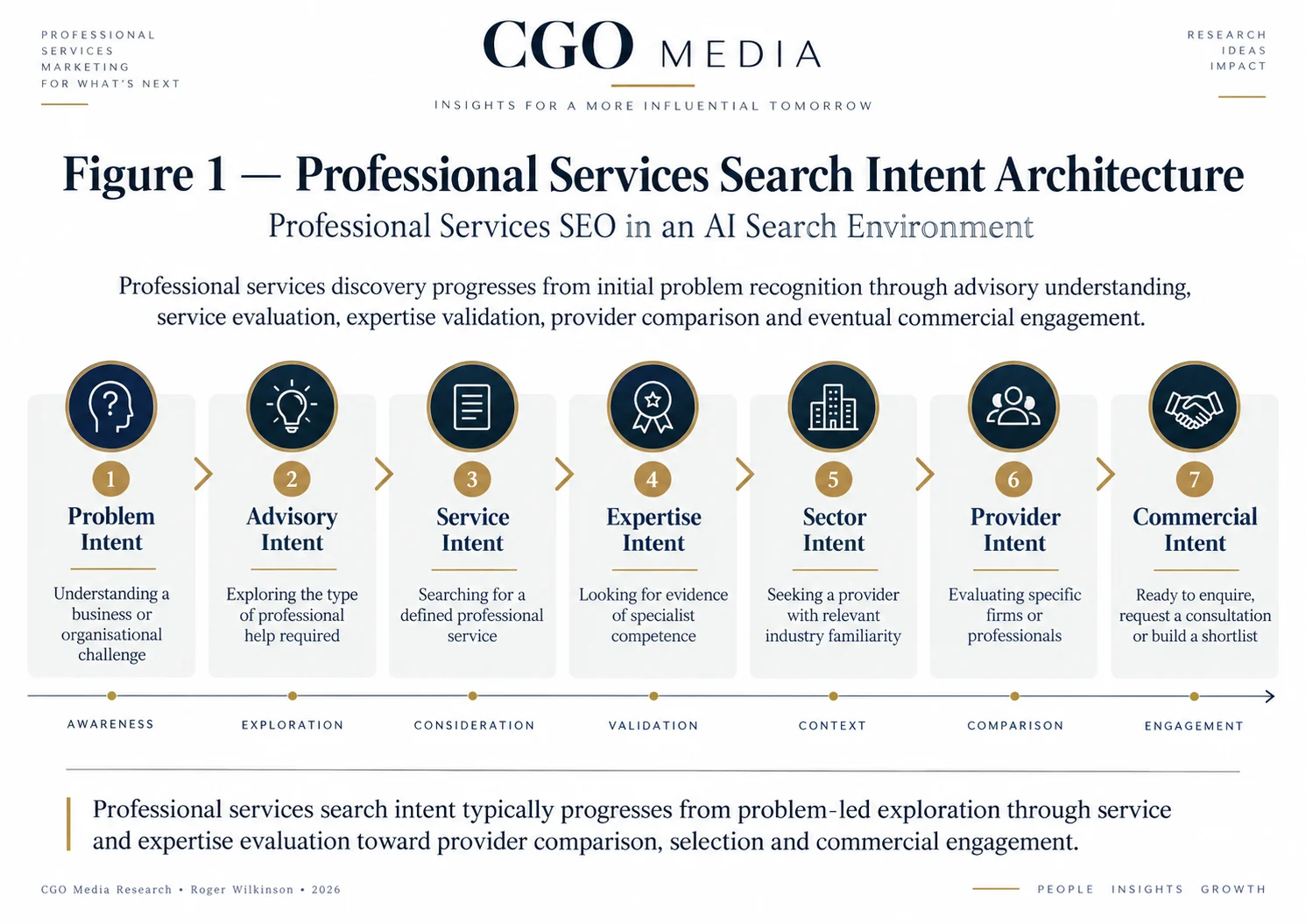
- Architecture
- Engineering consultancy
7. Service Discovery Is Only One Stage of the Decision Journey
Prospective clients frequently continue into:
- Expertise validation
- Sector-fit assessment
- Professional review
- Provider comparison
- Commercial evaluation
8. Provider Discovery Is therefore Multi-Stage
A useful relationship is:
Problem Recognition → Service Understanding → Expertise Validation → Provider Comparison → Commercial Engagement
9. AI Search Compresses Several Search Stages
Instead of conducting several separate searches, a user may ask one question containing:
- Business problem
- Required expertise
- Sector
- Location
- Provider size
- Commercial constraints
10. AI Systems Can therefore Act as Provider-Discovery Interfaces
A user may ask a generative system to:
- Explain which type of adviser is needed
- Compare different service approaches
- Identify suitable firms
- Compare providers
- Recommend specialists
11. This Changes the Strategic Search Objective
The question is no longer only:
Can this firm rank for the service?
12. The New Question Is Broader
Professional services organisations increasingly need to ask:
Is the firm sufficiently understood, evidenced and trusted to be considered an appropriate provider?
13. This Is the Shift from Rankings to Provider Eligibility
Provider eligibility describes whether enough public evidence exists for a firm to remain under consideration during discovery and evaluation.
14. Provider Eligibility Is More Demanding Than Basic Visibility
Visibility may only establish that the firm exists.
15. Eligibility Requires Evidence of Suitability
A user may need evidence around:
- Service capability
- Specialist expertise
- Sector experience
- Professional credentials
- Client outcomes
- Geographic relevance
16. Professional Services Search Is therefore a Trust-Matching Problem
Provider selection depends on both relevance and confidence.
17. Service Fit Is the First Trust-Matching Dimension
The provider must offer the service required.
18. Expertise Fit Is the Second Trust-Matching Dimension
The provider should demonstrate enough knowledge and experience to handle the specific requirement.
19. Sector Fit Is the Third Trust-Matching Dimension
Clients may prefer providers with experience in their:
- Industry
- Business model
- Regulatory environment
- Organisational context
20. Professional Fit Is the Fourth Trust-Matching Dimension
Users may evaluate the actual professionals who will deliver the work.
21. Organisational Fit Is the Fifth Trust-Matching Dimension
Relevant considerations can include:
- Firm size
- Geographic reach
- Senior involvement
- Resource depth
- Delivery model
22. Commercial Fit Is the Sixth Trust-Matching Dimension
The provider must also be compatible with:
- Budget
- Timeline
- Scope
- Engagement structure
- Procurement requirements
23. Professional Services Search Authority Depends on Fit and Evidence
A useful relationship is:
Service Fit + Expertise Fit + Sector Fit + Professional Trust + Commercial Fit → Provider Suitability
24. Provider Suitability Is Contextual
A strong firm may still be unsuitable for a particular engagement.
25. A Large Firm Is Not Automatically the Best Fit
Some clients may require:
- Specialist depth
- Senior access
- Local expertise
- Flexible delivery
26. A Specialist Firm Is Not Automatically the Best Fit Either
Some assignments may require:
- International scale
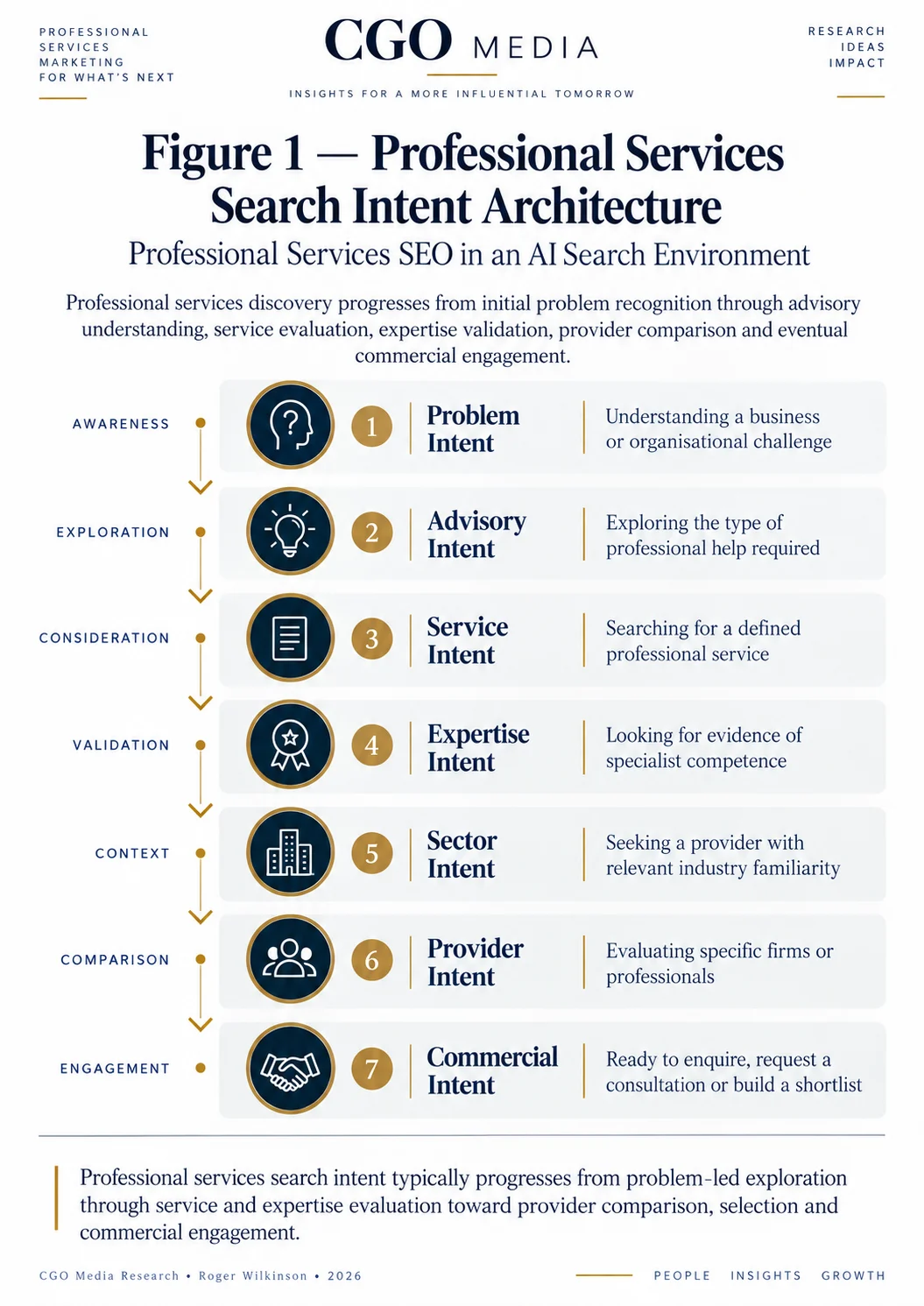
- Multidisciplinary teams
- Large delivery capacity
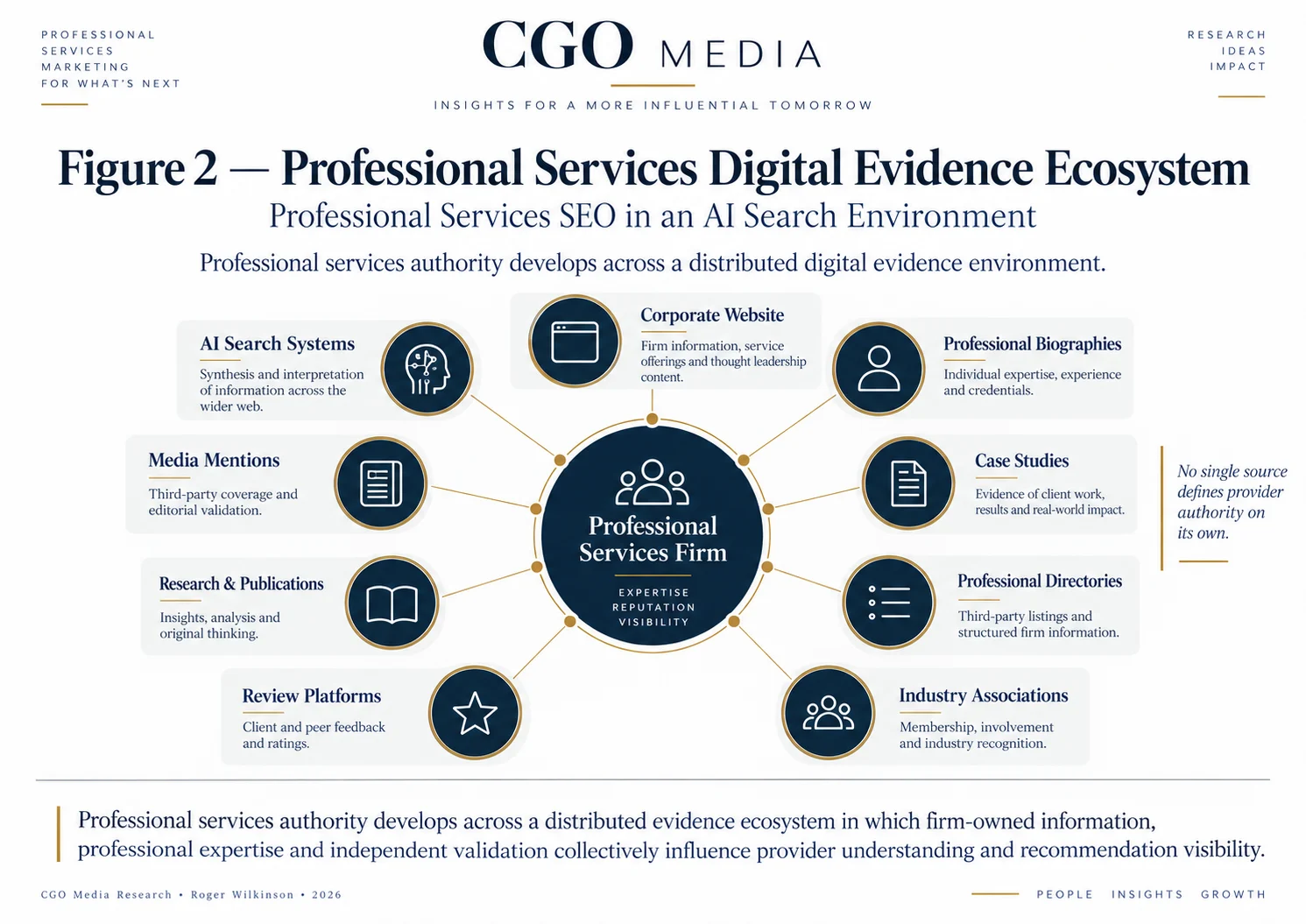
- Extensive governance
27. Professional Services Search Should therefore Avoid Universal Provider Rankings
Provider suitability should remain tied to the actual client requirement.
28. The Professional Services Search Intent Hierarchy
Professional services discovery can be organised into recurring intent levels.
29. Level One — Problem Intent
The prospective client is trying to understand a business, organisational or technical problem.
30. Problem Intent Can Include
- Why is staff turnover increasing?
- How can we reduce tax exposure?
- How should we restructure the business?
- Why is project delivery failing?
- How should we expand internationally?
31. Problem Intent Often Has High Informational Value
The user may not yet be ready to contact a provider.
32. Problem-Led Content Can Build Early Authority
Useful resources can include:
- Guides
- Research
- Diagnostic frameworks
- Expert commentary
- FAQs
33. Level Two — Advisory Intent
The user understands that external professional help may be required.
34. Advisory Intent Can Include Questions Such As
- Do I need a management consultant?
- When should I use an external recruiter?
- Do I need a structural engineer?
- When should I appoint a tax adviser?
35. Advisory Content Should Clarify Service Boundaries
Users should understand when a professional service is appropriate and when another type of specialist may be required.
36. Level Three — Service Intent
The user understands the service category being sought.
37. Service Intent Can Include
- Strategy consultancy
- Executive search
- Corporate tax advisory
- Architectural design
- Engineering consultancy
- Business valuation
38. Service Intent Requires Clear Service Architecture
Professional services firms should make clear:
- What the service is
- Who it is for
- Which problems it addresses
- What it includes
- What outcomes it supports
39. Level Four — Expertise Intent
The user begins evaluating whether the firm possesses the required specialist competence.
40. Expertise Intent Can Include
- Specialist methodology
- Professional background
- Sector experience
- Technical expertise
- Relevant qualifications
41. Expertise Intent Requires More Than Service Description
A service page says what the organisation offers.
42. Expertise Evidence Explains Why the Firm Can Deliver It
Useful evidence can include:
- Professional biographies
- Thought leadership
- Research
- Case studies
- Methodologies
- Qualifications
43. Level Five — Provider Validation Intent
The prospective client now evaluates whether the firm is credible and trustworthy.
44. Provider Validation Can Include
- Reviews
- Testimonials
- Professional memberships
- Accreditations
- Media references
- Independent directories
45. Validation Often Extends Beyond the Firm’s Website
The user may verify claims through independent sources.
46. Level Six — Provider Comparison Intent
The user compares several potentially suitable firms.
47. Provider Comparison Can Examine
- Service fit
- Sector expertise
- Professional team
- Case studies
- Credentials
- Commercial model
48. Comparison Requires Differentiation
If several providers make identical generic claims, the user has limited evidence for distinguishing them.
49. Differentiation Should therefore Be Evidence-Based
Useful differentiation can include:
- Distinct methodology
- Specialist expertise
- Original research
- Relevant sector experience
- Professional credentials
50. Level Seven — Commercial Engagement Intent
The user is ready to move into direct contact.
51. Commercial Engagement Can Include
- Consultation request
- Proposal request
- Call booking
- Tender invitation
- Direct enquiry
52. Engagement Intent Requires Low Friction
Users should be able to understand:
- How to contact the firm
- Who will respond
- What happens next
- What information is required
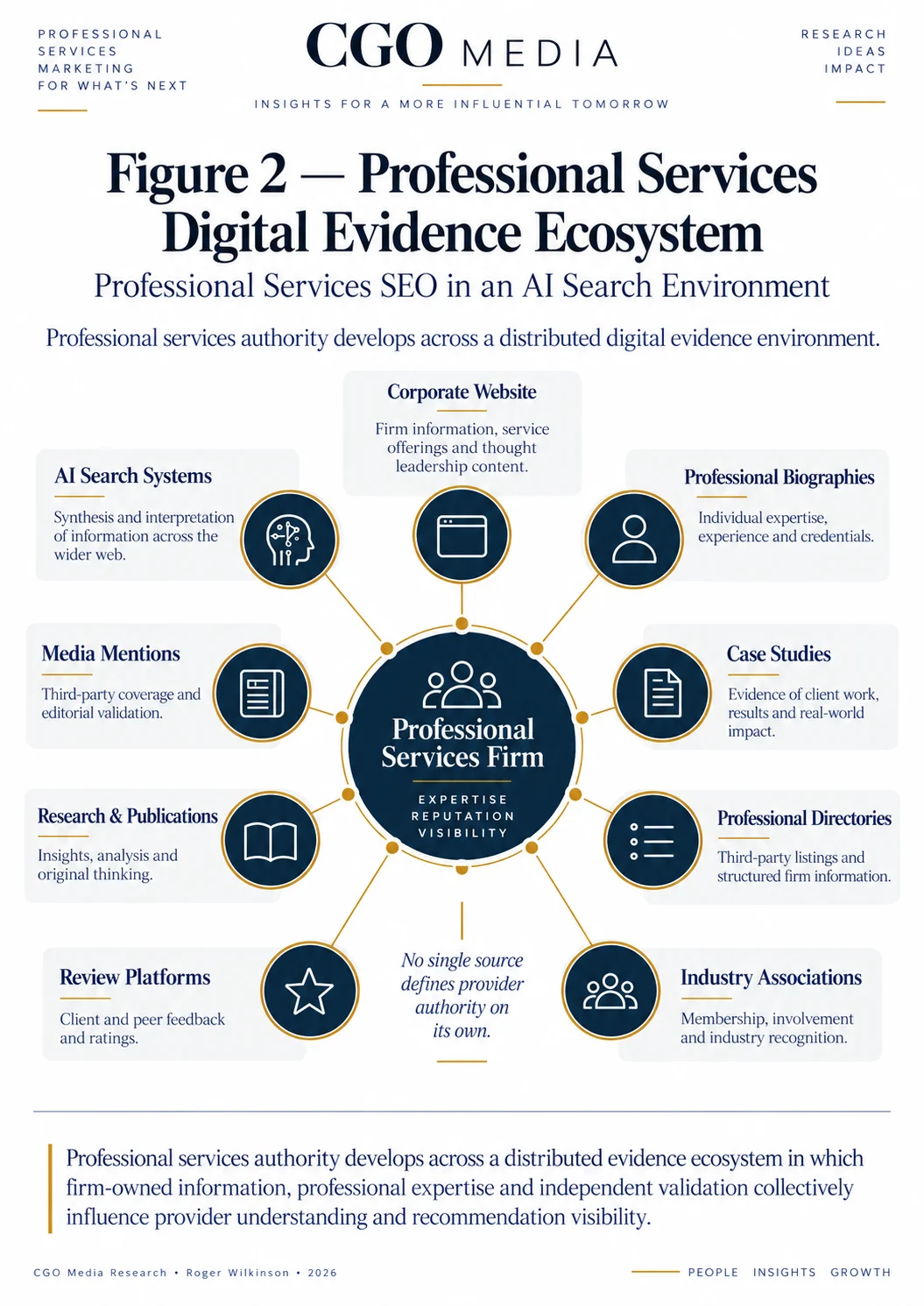
53. The Search Intent Journey Is therefore Progressive
A useful progression is:
Problem → Advisory Need → Service → Expertise → Validation → Comparison → Engagement
54. The Journey Can Also Move Backwards
A client may return to earlier research after discovering:
- A new requirement
- A qualification issue
- A sector concern
- A commercial constraint
55. Professional Services Search Is therefore Non-Linear
Users can move repeatedly between discovery, validation and comparison.
56. Search Architecture Should Support This Movement
Relevant pages should connect naturally between:
- Problems
- Services
- Experts
- Sectors
- Case studies
- Research
57. Problem Pages Can Connect to Services
A business challenge should lead toward relevant professional solutions.
58. Service Pages Can Connect to Experts
Users should be able to identify the professionals associated with the service.
59. Expert Profiles Can Connect to Sector Experience
This helps demonstrate contextual expertise.
60. Sector Pages Can Connect to Case Studies
Client evidence can demonstrate how expertise has been applied in practice.
61. Research Can Connect Across the Entire Architecture
Original research can support:
- Problem understanding
- Service authority
- Expert authority
- Sector authority
- Media authority
62. Professional Services Search Should therefore Be Built Around Knowledge Relationships
A useful relationship is:
Problem → Service → Specialism → Expert → Sector → Evidence → Outcome
63. Service Authority Begins with Clarity
Professional services can be difficult to understand where terminology is vague or internally defined.
64. Service Pages Should Explain the Client Problem
The strongest pages begin with the problem or objective the client recognises.
65. Service Pages Should Explain Scope
Users should understand what the engagement may include.
66. Service Pages Should Explain Deliverables
Relevant examples can include:
- Assessment
- Strategy
- Report
- Design
- Implementation support
- Recruitment shortlist
67. Service Pages Should Explain Appropriate Client Types
The service may be designed for:
- SMEs
- Enterprises
- Public organisations
- Investors
- Professional partnerships
68. Service Pages Should Explain Relevant Sectors
Sector applicability can materially affect client confidence.
69. Service Pages Should Explain Associated Expertise
The user should be able to move from the service to:
- Specialists
- Methodologies
- Case studies
- Research
70. Service Authority Should Be More Than Keyword Coverage
Publishing a service page does not itself prove professional competence.
71. Service Authority Requires Supporting Evidence
A useful relationship is:
Service Definition + Specialist Expertise + Professional Evidence + Client Evidence → Service Authority
72. Expertise Authority Is the Next Layer
Professional services firms are selected partly because clients believe their people can solve a complex problem.
73. Expertise Authority Can Be Demonstrated through Professional Profiles
Useful profile evidence can include:
- Role
- Experience
- Specialisms
- Qualifications
- Sector expertise
- Publications
74. Expertise Authority Can Be Demonstrated through Methodologies
Distinct approaches can help users understand how the firm works.
75. Expertise Authority Can Be Demonstrated through Research
Original analysis can provide evidence of deeper subject understanding.
76. Expertise Authority Can Be Demonstrated through Case Studies
Client examples can show how expertise has been applied.
77. Expertise Authority Can Be Demonstrated through Thought Leadership
Relevant commentary can demonstrate current professional understanding.
78. Expertise Authority Can Be Demonstrated through External Participation
Examples can include:
- Conferences
- Industry panels
- Professional committees
- Media commentary
- Academic collaboration
79. Expertise Should Be Specific Rather Than Generic
Claims such as “experienced professionals” provide limited differentiation without evidence.
80. Specialist Expertise Should Connect to Real Evidence
Useful evidence can include:
- Named experts
- Relevant projects
- Published research
- Professional credentials
- External references
81. Sector Authority Is Also Important
Professional services firms frequently compete on industry understanding as well as technical capability.
82. Sector Authority Can Include
- Sector-specific services
- Sector case studies
- Sector research
- Sector experts
- Client evidence
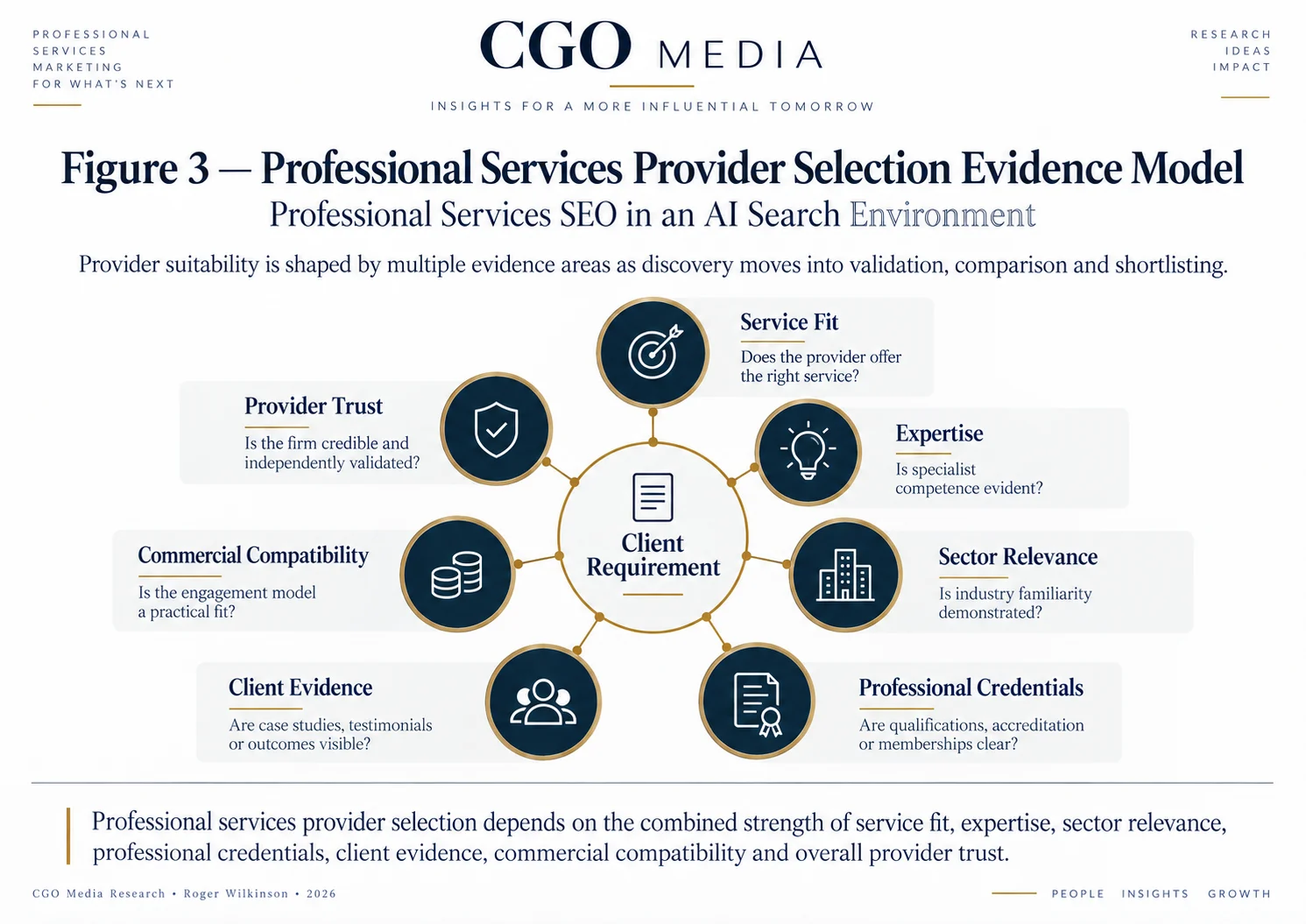
83. Sector Authority Should Avoid Generic Vertical Pages
Changing only the industry name provides weak evidence of genuine sector understanding.
84. Strong Sector Pages Should Demonstrate Relevant Problems
The page should reflect issues specific to the sector.
85. Strong Sector Pages Should Demonstrate Relevant Services
The relationship between client problem and professional service should be explicit.
86. Strong Sector Pages Should Demonstrate Relevant Experts
Named professionals can strengthen sector credibility.
87. Strong Sector Pages Should Demonstrate Client Evidence
Relevant case studies can reinforce sector experience.
88. Strong Sector Pages Should Demonstrate Thought Leadership
Research or commentary can show ongoing engagement with sector issues.
89. Geographic Authority Can Also Matter
Some professional services decisions require:
- Local regulation
- Regional expertise
- Office presence
- Local professional networks
90. Geographic Authority Should Reflect Genuine Capability
Office presence alone does not prove local expertise.
91. Geographic Authority Can Be Demonstrated through
- Local experts
- Local clients
- Local case studies
- Regional research
- Professional relationships
92. Professional Services Search therefore Has Multiple Authority Axes
These include:
- Service authority
- Expertise authority
- Sector authority
- Geographic authority
- Professional authority
93. These Authority Axes Can Intersect
For example:
Service + Sector + Expert + Region → High-Specificity Provider Relevance
94. High-Specificity Relevance Can Strengthen Provider Eligibility
The firm becomes easier to evaluate against a clearly defined client requirement.
95. Search Architecture Should therefore Make Authority Relationships Explicit
Users should be able to move between:
- Services
- Experts
- Sectors
- Locations
- Evidence
96. Firm Identity Should Be Explicit
The organisation should make clear:
- Official name
- Trading name
- Locations
- Service areas
- Professional team
97. Office Relationships Should Be Explicit
Multi-office firms should make clear which:
- Professionals
- Services
- Markets
- Locations
relate to each office.
98. Professional Relationships Should Be Explicit
A useful relationship is:
Firm → Office → Professional → Service → Specialism → Sector
99. Firm and Professional Entities Should Remain Distinct
A recognised firm and a recognised individual professional represent related but different forms of authority.
100. Individual Experts Can Develop Independent Authority
This can emerge through:
- Research
- Media
- Conference participation
- Professional bodies
- Publications
101. Individual Authority Can Reinforce Firm Authority
Named professionals can make organisational expertise more credible.
102. Firm Authority Can Reinforce Individual Authority
The organisation provides professional context and institutional support.
103. Search Should therefore Represent Both Levels
A useful relationship is:
Firm Authority ↔ Professional Authority
104. Professional Services SEO Should Build Decision Evidence
The purpose is not simply to attract a click.
105. Decision Evidence Helps Users Progress
Useful evidence can answer:
- Can this firm provide the service?
- Does it understand my sector?
- Who will perform the work?
- What evidence supports its expertise?
- Is the provider credible?
106. Decision Evidence Reduces Information Friction
The easier these questions are to answer, the easier the provider is to evaluate.
107. Decision Evidence Can Improve Lead Quality
Better-informed users can self-select before contacting the provider.
108. Decision Evidence Can Improve Commercial Efficiency
Business-development teams can spend less time explaining basic suitability.
109. Decision Evidence Can Improve AI Interpretation
Clear relationships and explicit claims make provider capabilities easier to understand.
110. AI Search Readiness therefore Begins Before AI Search
The foundation is the wider information environment surrounding the firm.
111. The First Professional Services Search Principle
Professional services organisations should optimise for the complete decision journey from problem recognition through service discovery, expertise validation, provider comparison and commercial engagement rather than concentrating solely on final-stage service keywords.
112. The Second Professional Services Search Principle
Provider visibility should be supported by evidence of service fit, specialist expertise, sector relevance, professional capability and commercial suitability so discoverability can progress into genuine provider eligibility.
113. The Third Professional Services Search Principle
Service pages, professional profiles, sector content, research, case studies and external validation should operate as a connected evidence architecture rather than isolated content assets.
114. The Fourth Professional Services Search Principle
Professional services search should favour specific and demonstrable expertise over generic authority claims, recognising that clients and AI-assisted discovery systems need enough evidence to understand precisely where a firm and its professionals are relevant.
115. The Professional Services Search Intent Architecture
The complete early-stage decision journey can be summarised as:
Problem Intent → Advisory Intent → Service Intent → Expertise Intent → Provider Validation → Provider Comparison → Commercial Engagement
116. The Strategic Implication
Professional Services SEO should be designed around the way prospective clients actually make high-consideration provider decisions. The strongest search strategies help users move from understanding their problem to understanding the service required, identifying credible specialists, validating expertise, comparing suitable firms and progressing into commercial engagement. As AI-assisted discovery compresses more of these stages into conversational search, organisations need a clear and connected evidence environment that allows both users and digital systems to understand what the firm does, who its experts are, which sectors it understands and why it should remain eligible for consideration.
117. Professional Services Search Depends on a Digital Evidence Ecosystem
Professional services organisations are rarely evaluated through one page, one source or one interaction.
118. Provider Trust Is Usually Distributed
Prospective clients may encounter:
- Firm websites
- Professional profiles
- Case studies
- Research
- Reviews
- Directories
- Media coverage
- AI-generated summaries
119. The Evidence Ecosystem Should therefore Be Managed Holistically
The firm should understand how its owned and external evidence combine to shape provider perception.
120. A Useful Evidence Model Is
Owned Evidence + Professional Evidence + Client Evidence + Market Evidence + Independent Evidence → Provider Confidence
121. Owned Evidence Is the First Layer
Owned evidence includes information published directly by the organisation.
122. Owned Evidence Can Include
- Service pages
- Sector pages
- Professional profiles
- Case studies
- Research
- Methodologies
123. Owned Evidence Establishes the Firm’s Core Narrative
It explains:
- What the firm does
- Who it serves
- Who its experts are
- How it works
- What evidence supports its claims
124. Owned Evidence Should Be Explicit
Users should not need to infer:
- Service scope
- Sector relevance
- Expert involvement
- Geographic reach
- Delivery model
125. Owned Evidence Should Be Current
Outdated service descriptions or staff profiles can reduce trust.
126. Owned Evidence Should Be Consistent
Conflicting statements across service, sector and professional pages can create ambiguity.
127. Professional Evidence Is the Second Layer
Professional evidence relates specifically to the people delivering or leading the work.
128. Professional Evidence Can Include
- Qualifications
- Professional memberships
- Experience
- Specialisms
- Publications
- Speaking engagements
129. Professional Profiles Should Demonstrate Capability
A profile should help answer:
- What does this person specialise in?
- Which clients do they work with?
- Which sectors do they understand?
- What evidence supports their expertise?
130. Professional Evidence Should Be Role-Specific
A senior adviser, engineer, architect, recruiter or accountant may require different evidence.
131. Credentials Should Be Relevant to the Service
A qualification has limited value where it does not support the expertise being claimed.
132. Professional Authority Should Be Current
Profiles should reflect:
- Current role
- Current firm
- Current specialisms
- Current professional standing
133. Client Evidence Is the Third Layer
Client evidence demonstrates how professional capability has been applied in practice.
134. Client Evidence Can Include
- Case studies
- Testimonials
- Reviews
- Client references
- Outcome summaries
135. Case Studies Are Particularly Important
They can connect:
- Client problem
- Service delivered
- Professional expertise
- Methodology
- Outcome
136. Strong Case Studies Should Be Specific
A useful case study explains enough context to demonstrate relevance.
137. Strong Case Studies Should Identify the Problem
The reader should understand the challenge being addressed.
138. Strong Case Studies Should Identify the Intervention
The firm should explain what work was performed.
139. Strong Case Studies Should Identify the Relevant Expertise
Where appropriate, the professionals or specialist teams involved should be clear.
140. Strong Case Studies Should Identify the Outcome
Outcomes can include:
- Operational improvement
- Risk reduction
- Revenue improvement
- Recruitment success
- Technical resolution
141. Outcomes Should Be Evidenced Carefully
Firms should avoid implying direct causation where outcomes depended on several factors.
142. Testimonials Add Another Form of Client Evidence
Testimonials can reinforce:
- Service quality
- Professionalism
- Responsiveness
- Expertise
- Commercial value
143. Testimonials Should Be Credible
Anonymous or generic praise provides weaker evidence than specific, attributable feedback where disclosure is appropriate.
144. Reviews Can Complement Testimonials
Independent review platforms can provide externalised client evidence.
145. Review Relevance Matters
Feedback should ideally relate to:
- The service
- The professional
- The sector
- The engagement type
146. Review Recency Matters
Recent evidence can provide stronger support for current capability.
147. Review Specificity Matters
Specific feedback can help distinguish genuine strengths from generic reputation claims.
148. Market Evidence Is the Fourth Layer
Market evidence demonstrates understanding of the environments in which clients operate.
149. Market Evidence Can Include
- Industry research
- Benchmark studies
- Trend analysis
- Regulatory commentary
- Sector reports
150. Market Evidence Can Strengthen Sector Authority
A firm becomes easier to trust where it demonstrates understanding of sector-specific challenges.
151. Market Research Can Strengthen Service Authority
Research can show why a service is relevant within a changing market context.
152. Market Research Can Strengthen Professional Authority
Named experts can become associated with particular issues or sectors.
153. Market Evidence Should Be Transparent
Useful research should make clear:
- Data source
- Time period
- Sample
- Method
- Limitations
154. Market Evidence Should Distinguish Data from Interpretation
Observed findings and professional commentary should remain distinct where appropriate.
155. Independent Evidence Is the Fifth Layer
Independent evidence comes from sources outside the organisation’s direct control.
156. Independent Evidence Can Include
- Media references
- Trade publications
- Professional directories
- Awards
- Research citations
- Industry bodies
157. Independent Evidence Can Validate Firm-Level Claims
External references can reinforce:
- Market reputation
- Specialist expertise
- Research quality
- Professional standing
158. Independent Evidence Can Validate Professional-Level Claims
Named experts can receive:
- Media citations
- Conference invitations
- Professional recognition
- Research references
159. Independent Evidence Should Be Relevant
Unrelated publicity provides limited support for professional-services authority.
160. Topical Relevance Matters
A reference is stronger when it relates directly to:
- The service
- The sector
- The expertise
- The market issue
161. Geographic Relevance Can Also Matter
Local or regional recognition can strengthen market-specific authority.
162. Independence Should Be Genuine
Syndicated or self-submitted content should not automatically be treated as independent validation.
163. Source Provenance therefore Matters
A useful question is:
Did this source originate independently, or did it repeat information supplied by the firm?
164. Evidence Convergence Is More Powerful Than Isolated Evidence
Provider confidence can increase where several evidence types materially support the same conclusion.
165. Service Authority Can Converge
A useful relationship is:
Service Page + Expert Profile + Case Study + Client Evidence + External Reference → Stronger Service Authority
166. Sector Authority Can Converge
A useful relationship is:
Sector Page + Sector Research + Sector Expert + Relevant Case Study + Trade Reference → Stronger Sector Authority
167. Professional Authority Can Converge
A useful relationship is:
Professional Profile + Qualifications + Publications + Client Evidence + External Recognition → Stronger Professional Authority
168. Geographic Authority Can Converge
A useful relationship is:
Local Office + Local Professionals + Local Clients + Local Research + Local Media → Stronger Geographic Authority
169. Evidence Convergence Reduces Ambiguity
The same expertise is supported from several independent angles.
170. Evidence Convergence Supports User Confidence
Clients can validate provider claims more easily.
171. Evidence Convergence Supports Search Understanding
Search systems can associate the organisation with more specific areas of expertise.
172. Evidence Convergence Supports AI Interpretation
Generative systems encounter a clearer and more consistent information environment.
173. Professional Services Evidence Should Be Structured Around Decision Questions
The ecosystem should help answer:
- What does the firm do?
- Who does the work?
- Which sectors does it understand?
- What proof exists?
- Who validates the claims?
174. Evidence Gaps Can Prevent Provider Progression
A firm may be discovered but fail during later evaluation.
175. Service Evidence Gaps Can Create Uncertainty
Users may not understand whether the firm can solve the problem.
176. Professional Evidence Gaps Can Create Uncertainty
Users may not know who possesses the required expertise.
177. Sector Evidence Gaps Can Create Uncertainty
The firm may appear technically capable but unfamiliar with the client’s industry.
178. Client Evidence Gaps Can Create Uncertainty
Prospective clients may not see proof that the firm has applied its expertise successfully.
179. Independent Evidence Gaps Can Create Uncertainty
The organisation may appear entirely self-validated.
180. Evidence Gaps Should therefore Be Diagnosed Systematically
A useful gap review can examine:
- Service evidence
- Professional evidence
- Sector evidence
- Client evidence
- External evidence
181. Evidence Quality Is More Important Than Evidence Volume
Large content libraries can remain weak if the evidence is generic or repetitive.
182. Evidence Depth Should Be Preferred to Content Inflation
A smaller number of strong assets may provide greater decision value.
183. Professional Services Firms Should Avoid Generic Authority Language
Claims such as:
- Trusted advisers
- Industry-leading experts
- Market-leading consultancy
- Experienced professionals
provide limited value without evidence.
184. Generic Claims Should Be Replaced with Specific Evidence
Useful evidence can include:
- Named specialists
- Defined qualifications
- Published research
- Relevant case studies
- Independent recognition
185. Evidence Should Be Attributable
Users should understand who created or supports the information.
186. Research Should Have Named Authorship
This improves accountability and attribution.
187. Expert Commentary Should Have Named Authorship
The professional behind the insight should be clear.
188. Case Studies Should Identify the Responsible Capability
Where confidentiality permits, the relationship between the work and relevant service team should be explicit.
189. External References Should Be Traceable
Relevant media or professional references should be discoverable where appropriate.
190. Evidence Should Be Fresh
Professional-services capabilities can change as:
- Staff change
- Services evolve
- Regulation changes
- Markets change
191. Professional Profiles Require Update Governance
Profiles should be reviewed when:
- Roles change
- Qualifications change
- People leave
- Specialisms change
192. Service Pages Require Update Governance
Service scope should remain aligned with actual delivery capability.
193. Sector Pages Require Update Governance
Industry content should reflect current market and regulatory realities.
194. Research Requires Update Governance
Older research should not continue to be presented as current where the evidence has materially changed.
195. Evidence Governance Should Have Ownership
Important authority assets should have responsible owners.
196. Service Evidence Ownership Can Include
- Service scope
- Methodology
- Deliverables
- Sector applicability
197. Professional Evidence Ownership Can Include
- Biography
- Role
- Qualifications
- Specialisms
- Publications
198. Client Evidence Ownership Can Include
- Case studies
- Testimonials
- Outcome validation
- Permissions
199. Research Evidence Ownership Can Include
- Methodology
- Data quality
- Publication
- Updates
- Limitations
200. External Evidence Ownership Can Include
- Media monitoring
- Research citations
- Directory profiles
- Professional recognition
201. Evidence Should Connect through Internal Linking
A user should be able to move naturally between:
- Service
- Expert
- Sector
- Case study
- Research
202. Internal Linking Should Reflect Relationships
The purpose is not merely to distribute authority mechanically.
203. Service-to-Expert Links Should Demonstrate Delivery Responsibility
Users can identify who provides the service.
204. Expert-to-Research Links Should Demonstrate Intellectual Contribution
Users can see where the professional has contributed original expertise.
205. Sector-to-Case-Study Links Should Demonstrate Applied Experience
Users can see relevant client evidence.
206. Research-to-Service Links Should Demonstrate Commercial Relevance
Research should connect where appropriate to the professional capability it informs.
207. External Evidence Should Reinforce Internal Evidence
Independent validation is strongest where it supports expertise already demonstrated through owned channels.
208. The Evidence Ecosystem Should Avoid Contradiction
Conflicting descriptions of services, sectors or experts can weaken trust.
209. Common Evidence Conflicts Can Include
- Different job titles
- Different service names
- Outdated sector descriptions
- Old office information
- Expired professional memberships
210. Evidence Consistency Should therefore Be Audited
Priority entities and services should be reviewed across core sources.
211. Professional Services Evidence Can Be Evaluated through Five Questions
- Is the evidence relevant?
- Is the evidence specific?
- Is the evidence current?
- Is the evidence attributable?
- Is the evidence independently supported?
212. Relevance Determines Decision Value
The evidence should match the client’s actual need.
213. Specificity Determines Differentiation
Specific evidence helps distinguish the provider from generic competitors.
214. Freshness Determines Current Validity
Outdated capability claims can weaken confidence.
215. Attribution Determines Accountability
Users should know who is making the claim.
216. Independence Determines External Validation
Third-party evidence helps test self-asserted authority.
217. A Useful Evidence Quality Relationship Is
Relevance + Specificity + Freshness + Attribution + Independent Validation → Evidence Quality
218. Evidence Quality Supports Provider Eligibility
A firm with strong and coherent evidence becomes easier to include in a relevant provider set.
219. Evidence Quality Supports Provider Comparison
Users can compare firms using more than generic brand claims.
220. Evidence Quality Supports AI-Assisted Discovery
Generative systems can encounter clearer relationships between:
- Firm
- Service
- Professional
- Sector
- Evidence
221. The Fifth Professional Services Search Principle
Professional services organisations should treat digital authority as a distributed evidence ecosystem combining owned content, professional expertise, client evidence, market research and independent validation rather than relying on service pages alone to establish provider trust.
222. The Sixth Professional Services Search Principle
Case studies, professional profiles, research, testimonials and external references should be connected around specific services, sectors and client problems so provider authority can be evaluated through converging evidence rather than generic reputation claims.
223. The Seventh Professional Services Search Principle
Evidence quality should be assessed through relevance, specificity, freshness, attribution and independent validation, recognising that large content volumes or broad authority claims do not automatically increase provider credibility.
224. The Eighth Professional Services Search Principle
Professional-services evidence should be actively governed through clear ownership, update triggers and consistency checks so service capability, professional expertise, sector positioning and external validation remain aligned with current operational reality.
225. The Professional Services Digital Evidence Ecosystem
The complete evidence relationship can be summarised as:
Owned Evidence + Professional Evidence + Client Evidence + Market Evidence + Independent Evidence → Provider Confidence → Search & AI Eligibility
226. The Strategic Implication
Professional Services SEO becomes stronger when the firm’s digital presence functions as a connected evidence environment rather than a set of isolated marketing pages. Service descriptions establish what the organisation offers; professional profiles explain who holds the expertise; case studies and testimonials demonstrate applied capability; research demonstrates intellectual depth; and independent references validate those claims beyond the firm’s own channels. When these evidence layers converge, prospective clients and AI-assisted discovery systems have a stronger basis for understanding which providers are credible, relevant and appropriate for continued consideration.
227. Professional Services Search Ultimately Supports Provider Selection
Visibility only creates commercial value when the organisation remains credible enough to progress into a realistic provider shortlist.
228. Provider Selection Is an Evidence-Reduction Process
Prospective clients often begin with many possible firms and progressively reduce the candidate set.
229. A Useful Selection Relationship Is
Discovery → Relevance Filtering → Expertise Validation → Trust Assessment → Commercial Fit → Shortlist
230. Relevance Filtering Comes First
The client initially determines whether the organisation appears relevant to the problem.
231. Service Relevance Is a Core Filter
The firm must offer the required service.
232. Sector Relevance Is Another Core Filter
The client may prefer providers with experience in the relevant industry.
233. Geographic Relevance Can Also Be a Filter
Some assignments require:
- Local presence
- Jurisdiction knowledge
- Regional networks
- On-site delivery
234. Organisational Scale Can Be a Filter
Some clients may require:
- Large multidisciplinary teams
- International reach
- Specialist boutique support
- Senior partner involvement
235. Expertise Validation Comes Next
The client then evaluates whether the firm possesses sufficient competence.
236. Expertise Validation Can Include
- Professional biographies
- Qualifications
- Research
- Methodologies
- Case studies
- Public commentary
237. Expertise Should Match the Problem
Generic capability is weaker than directly relevant expertise.
238. Specialist Expertise Can Reduce Perceived Risk
Clients may feel more confident where the provider has experience with similar:
- Problems
- Sectors
- Regulatory contexts
- Business models
239. Trust Assessment Comes After Relevance
A firm can appear capable while still failing to establish confidence.
240. Professional Trust Can Depend on
- Reputation
- Client evidence
- Professional standing
- External references
- Consistency
241. Client Evidence Is Especially Important
Case studies and testimonials show whether the firm has applied its expertise in practice.
242. Client Evidence Should Be Contextual
The strongest examples relate to:
- Similar problems
- Similar sectors
- Similar organisation types
- Similar project complexity
243. External Validation Adds Another Trust Layer
Independent evidence can include:
- Media references
- Trade recognition
- Research citations
- Professional directories
- Awards
244. Commercial Fit Is the Next Selection Layer
Even a highly credible provider may be unsuitable commercially.
245. Commercial Fit Can Include
- Budget
- Timeline
- Scope
- Engagement structure
- Procurement requirements
246. Delivery Fit Can Also Matter
Clients may evaluate:
- Remote delivery
- On-site delivery
- International delivery
- Team structure
- Senior involvement
247. Cultural Fit Can Influence Provider Selection
Some clients evaluate whether the provider’s working style aligns with their organisation.
248. Cultural Fit Can Include
- Communication style
- Decision-making approach
- Collaboration model
- Risk appetite
- Pace of delivery
249. Provider Selection therefore Requires Multi-Dimensional Fit
A useful relationship is:
Service Fit + Expertise Fit + Trust Fit + Commercial Fit + Delivery Fit + Cultural Fit → Provider Fit
250. Professional Services Comparison Is Rarely Based on One Criterion
Users often balance several forms of evidence simultaneously.
251. Firms Can Be Compared by Expertise
Clients may ask:
- Which firm has deeper specialist knowledge?
- Which team has more relevant experience?
- Which advisers understand the problem best?
252. Firms Can Be Compared by Sector Experience
Relevant questions can include:
- Which firm understands our sector?
- Which firm has similar clients?
- Which firm publishes relevant research?
253. Firms Can Be Compared by Professional Team
Users may compare:
- Senior professionals
- Specialists
- Qualifications
- Experience
- Availability
254. Firms Can Be Compared by Methodology
Distinct delivery methods can influence confidence.
255. Firms Can Be Compared by Evidence of Outcomes
Relevant evidence can include:
- Case studies
- Testimonials
- Benchmark improvements
- Operational outcomes
256. Firms Can Be Compared by Reputation
Reputation evidence can include:
- Reviews
- Media
- Professional recognition
- Industry citations
257. Firms Can Be Compared by Commercial Model
Relevant considerations can include:
- Fixed fee
- Retainer
- Project fee
- Contingency model
- Hourly rate
258. Firms Can Be Compared by Organisational Scale
Some clients may prefer:
- Global firms
- National firms
- Regional specialists
- Boutique providers
259. Scale Should Not Be Confused with Suitability
A larger organisation is not automatically the better fit.
260. Specialist Depth Can Outweigh Scale
A niche provider may possess deeper expertise in a specific problem.
261. Scale Can Outweigh Specialist Depth in Other Contexts
Large engagements may require broader operational capacity.
262. Provider Comparison Should therefore Remain Scenario-Specific
A provider should be evaluated against the actual client requirement.
263. AI Search Can Compress Provider Comparison
Users may ask generative systems to compare:
- Firms
- Services
- Experts
- Methodologies
- Sector experience
264. This Increases the Importance of Explicit Evidence
A firm can be excluded from comparison where its differentiators are not visible clearly enough.
265. Provider Comparison Requires Comparable Evidence
Clients need enough common information to distinguish between providers fairly.
266. Comparable Evidence Can Include
- Service scope
- Relevant expertise
- Sector evidence
- Professional team
- Client outcomes
267. Comparable Evidence Does Not Mean Standardised Firms
Providers can remain differentiated while still exposing enough information for meaningful evaluation.
268. Differentiation Should Be Specific
Useful differentiators can include:
- Proprietary methodology
- Specialist sector knowledge
- Original research
- Senior practitioner access
- International capability
269. Differentiation Should Be Verifiable
Broad claims of uniqueness should be supported by evidence.
270. Distinct Methodology Can Strengthen Differentiation
A defined process can help users understand how the firm approaches the engagement.
271. Original Research Can Strengthen Differentiation
Research can demonstrate intellectual authority unavailable from generic competitors.
272. Named Experts Can Strengthen Differentiation
Clients can evaluate the actual professionals behind the service.
273. Specialist Case Studies Can Strengthen Differentiation
Applied evidence can show relevance within a specific problem or sector.
274. External Recognition Can Strengthen Differentiation
Independent validation can reinforce the firm’s position.
275. Shortlisting Is the Critical Selection Threshold
The firm must remain sufficiently relevant and trusted to enter the final candidate set.
276. Shortlist Inclusion Is More Valuable Than Generic Visibility
A provider appearing in broad informational search has less commercial significance than inclusion among realistic candidates.
277. Shortlist Readiness Requires Several Evidence Layers
A useful relationship is:
Relevant Service + Demonstrated Expertise + Client Evidence + Independent Trust + Commercial Fit → Shortlist Readiness
278. Shortlist Exclusion Can Reveal Evidence Gaps
A relevant provider may fail to progress because:
- Expertise is unclear
- Sector evidence is weak
- Client proof is limited
- Professional profiles are thin
- External validation is weak
279. Shortlist Exclusion Can Also Be Appropriate
The firm may genuinely be unsuitable for the requirement.
280. Professional Services SEO Should therefore Value Appropriate Exclusion
The objective is not to appear in every provider shortlist.
281. Qualified Visibility Is the Stronger Strategic Goal
A useful relationship is:
Relevant Discovery + Accurate Positioning + Appropriate Comparison Inclusion → Qualified Visibility
282. Qualified Visibility Can Improve Lead Quality
Prospective clients arrive with stronger alignment around:
- Service
- Sector
- Scope
- Expertise
- Commercial expectations
283. Qualified Visibility Can Reduce Sales Friction
Business-development teams spend less time on unsuitable opportunities.
284. Qualified Visibility Can Improve Proposal Efficiency
The firm can focus on opportunities with stronger fit.
285. Professional Services Search Should therefore Connect with Commercial Qualification
Search success should not be measured solely through:
- Traffic
- Clicks
- Rankings
- Enquiry volume
286. Commercial Qualification Can Include
- Correct service
- Correct budget
- Correct sector
- Correct organisational type
- Realistic timeline
287. Provider Selection Data Should Feed Search Strategy
Commercial teams can identify which search-generated opportunities become:
- Qualified conversations
- Proposals
- Shortlists
- Wins
- Losses
288. Lost Opportunity Data Can Reveal Search Positioning Problems
Repeated losses may reveal:
- Weak sector fit
- Weak professional authority
- Commercial mismatch
- Poor differentiation
289. Won Opportunity Data Can Reveal Strong Authority Patterns
Common characteristics can help identify:
- High-fit services
- Strong sectors
- Effective experts
- Relevant evidence
290. CRM Data Can therefore Strengthen Search Strategy
A useful relationship is:
Search Discovery → Enquiry → Qualification → Proposal → Shortlist → Win / Loss
291. Provider Selection Should Be Measured Beyond Initial Lead Generation
The firm should understand which discovery pathways produce meaningful commercial outcomes.
292. Professional Services Search Has Long Decision Cycles
Users may return repeatedly before engaging.
293. Long Decision Cycles Increase the Importance of Persistent Evidence
The firm should remain credible across multiple visits and sources.
294. Search Journeys Can Be Multi-Touch
A typical journey can include:
Research Article → Service Page → Expert Profile → LinkedIn → Case Study → Direct Enquiry
295. Another Journey Can Include
AI Comparison → Firm Website → Professional Directory → Research Paper → Consultation Request
296. Another Journey Can Include
Google Search → Sector Page → Case Study → Media Article → Proposal Request
297. Attribution Should therefore Be Multi-Touch Where Possible
Last-click reporting can understate earlier discovery and trust interactions.
298. First-Touch Reporting Can Also Be Incomplete
Initial discovery does not explain where provider confidence developed.
299. Journey-Level Analysis Is More Informative
The organisation should examine the sequence of:
- Discovery
- Validation
- Comparison
- Engagement
300. Provider Selection Evidence Should Be Connected Internally
Key pages should support logical progression.
301. Service Pages Should Link to Expert Profiles
Users can identify who delivers the capability.
302. Service Pages Should Link to Case Studies
Users can see how the service has been applied.
303. Service Pages Should Link to Relevant Research
Users can evaluate intellectual depth.
304. Expert Profiles Should Link to Relevant Services
Users can understand the professional’s commercial role.
305. Expert Profiles Should Link to Publications
Users can validate subject expertise.
306. Sector Pages Should Link to Relevant Services
Users can understand how the firm supports the industry.
307. Sector Pages Should Link to Relevant Case Studies
Users can see evidence of sector experience.
308. Case Studies Should Link Back to Service Capability
Applied experience should reinforce commercial relevance.
309. Research Should Link Back to Relevant Expertise
The connection between intellectual authority and professional capability should be explicit where appropriate.
310. Provider Selection Evidence Should Be Externally Reinforced
Independent evidence can help validate:
- Reputation
- Expertise
- Sector authority
- Professional standing
311. External Validation Can Influence Shortlisting
Clients may use:
- Media
- Directories
- Professional bodies
- Reviews
- Research citations
312. Professional Directories Can Be Important in Some Sectors
Their importance varies by profession and market.
313. Professional Associations Can Be Important in Some Sectors
Formal membership may carry greater decision value where professional regulation is strong.
314. Media Authority Can Matter in Advisory Markets
Repeated relevant commentary can reinforce subject expertise.
315. Research Authority Can Matter in Complex Advisory Markets
Original evidence can strengthen provider differentiation.
316. Recommendation Readiness Depends on Provider Fit
AI-assisted systems may increasingly help users identify suitable firms.
317. Provider Recommendation Should Be Contextual
A recommendation should reflect:
- Service need
- Sector need
- Expertise need
- Geographic need
- Commercial fit
318. Recommendation Readiness Should therefore Be Evidence-Led
The organisation should make its genuine strengths easier to understand.
319. Recommendation Readiness Should Avoid Over-Broad Positioning
Claiming universal expertise can reduce recommendation precision.
320. Recommendation Precision Can Improve Commercial Fit
The firm is more likely to be considered for work it can genuinely deliver.
321. Provider Selection Evidence Can Be Audited
A useful review can examine:
- Service relevance
- Professional evidence
- Sector evidence
- Client evidence
- External validation
- Commercial fit
322. Provider Selection Audits Should Focus on Priority Services
Not every service requires identical evidence investment.
323. Provider Selection Audits Should Focus on Priority Sectors
Strategic industries should have deeper supporting evidence.
324. Provider Selection Audits Should Focus on Priority Experts
Senior and specialist professionals may require stronger public evidence.
325. Provider Selection Audits Should Identify Evidence Breakpoints
A breakpoint is the stage where the client lacks enough information to continue confidently.
326. Common Evidence Breakpoints Can Include
- Unclear service scope
- Thin expert profiles
- No relevant case studies
- No sector evidence
- Weak independent validation
327. Evidence Breakpoints Should Be Prioritised
High-impact gaps can materially reduce shortlist eligibility.
328. Provider Selection Evidence Should Be Updated
Firm capabilities and professional teams change over time.
329. Service Updates Can Change Provider Fit
New capabilities may create new search and comparison opportunities.
330. Professional Changes Can Change Provider Fit
New hires, departures or promotions can alter visible expertise.
331. Sector Expansion Can Change Provider Fit
New sector capability should be supported by real evidence before broad positioning is expanded.
332. Commercial Model Changes Can Change Provider Fit
Changes in:
- Pricing
- Delivery model
- Minimum engagement size
- Geography
can alter suitability.
333. Provider Selection Strategy Should therefore Remain Current
The evidence environment should reflect operational reality.
334. The Ninth Professional Services Search Principle
Professional services organisations should treat provider selection as a staged evidence-reduction process in which users move from broad relevance through expertise validation, trust assessment, commercial fit and shortlist formation rather than assuming that initial search visibility leads directly to engagement.
335. The Tenth Professional Services Search Principle
Provider comparison should be supported by specific and comparable evidence around service scope, expert capability, sector experience, client outcomes, delivery model and independent validation so firms can be distinguished on genuine suitability rather than generic reputation claims.
336. The Eleventh Professional Services Search Principle
Qualified shortlist inclusion should be preferred to indiscriminate provider visibility, recognising that appropriate exclusion from unsuitable engagements can improve lead quality, commercial efficiency and recommendation precision.
337. The Twelfth Professional Services Search Principle
Search and AI-assisted discovery should connect with CRM and commercial qualification data so firms can understand which discovery pathways generate meaningful conversations, proposals, shortlist inclusion and wins rather than measuring success only through traffic or enquiry volume.
338. The Professional Services Provider Selection Evidence Model
The complete selection relationship can be summarised as:
Service Relevance + Expertise Validation + Sector Fit + Client Evidence + Independent Trust + Commercial Fit → Shortlist Readiness
339. The Strategic Implication
Professional Services SEO should support the complete movement from discovery into shortlist readiness. Firms need enough evidence to demonstrate not only that they offer the required service, but that they possess relevant specialists, understand the client’s sector, have applied their expertise successfully, carry credible external validation and can meet the practical requirements of the engagement. As AI-assisted provider comparison becomes more common, this evidence must be explicit enough for both users and digital systems to distinguish genuine fit from broad visibility.
340. Professional Services Authority Is Multi-Dimensional
A provider can be strong in one area of authority while remaining weak in another.
341. Expertise Depth Is One Major Authority Axis
Expertise depth describes how strongly the organisation demonstrates genuine knowledge and capability around a specific:
- Service
- Sector
- Problem
- Jurisdiction
- Professional discipline
342. Independent Validation Is Another Major Authority Axis
Independent validation describes the degree to which relevant third parties reinforce the organisation’s authority.
343. Independent Validation Can Include
- Media references
- Professional directories
- Research citations
- Client reviews
- Industry recognition
- Professional memberships
344. Expertise Depth and Independent Validation Should Be Evaluated Together
A useful matrix can distinguish providers according to the strength of both dimensions.
345. High Expertise and High Validation Represent Strong Authority
This profile can indicate:
- Clear specialist capability
- Strong professional evidence
- External recognition
- Higher comparison readiness
346. High Expertise and Low Validation Represent Hidden Authority
A firm may genuinely possess deep expertise while remaining weakly recognised externally.
347. Hidden Authority Can Occur When
- Experts publish little
- Case studies are absent
- Media visibility is weak
- Research is not distributed
- External profiles are thin
348. Low Expertise and High Validation Can Represent Perceived Authority without Depth
A firm may have strong brand visibility or recognition while providing limited evidence of specialist depth in the specific issue being evaluated.
349. Perceived Authority Should therefore Be Tested against Relevant Expertise
Visibility and reputation should not automatically be treated as proof of fit.
350. Low Expertise and Low Validation Represent Weak Authority
The provider may remain difficult to justify within a serious shortlist.
351. The Matrix Helps Separate Brand Prominence from Specialist Suitability
A prominent firm can still be a weak match for a specific engagement.
352. The Matrix Also Helps Identify Under-Recognised Specialists
A smaller firm may possess strong expertise but limited external visibility.
353. Professional Services SEO Should therefore Surface Hidden Expertise
Useful actions can include:
- Strengthening professional profiles
- Publishing original research
- Creating specialist case studies
- Developing expert commentary
- Improving external distribution
354. Specialist Authority Should Be Built Around Defined Topics
A professional organisation should be able to state clearly which areas it genuinely understands.
355. Topic Authority Can Be Service-Led
Examples can include:
- Corporate restructuring
- Executive search
- Tax advisory
- Digital transformation
- Structural engineering
356. Topic Authority Can Be Problem-Led
Examples can include:
- Reducing employee turnover
- Entering a new market
- Improving operational efficiency
- Resolving compliance risk
- Scaling leadership teams
357. Topic Authority Can Be Sector-Led
Examples can include:
- Financial services consulting
- Healthcare recruitment
- Manufacturing advisory
- Technology tax services
- Property engineering
358. Topic Authority Can Be Geographic
Some providers need specific jurisdiction or regional expertise.
359. Professional Authority Should Connect Multiple Evidence Types
A useful relationship is:
Expert Profile + Specialist Service + Research + Case Study + External Validation → Stronger Topic Authority
360. Expertise Depth Should Be Demonstrated through People
Professional services are delivered by individuals and teams.
361. Named Expertise Is Stronger Than Anonymous Organisational Claims
Users often want to understand who actually holds the relevant knowledge.
362. Named Experts Can Support Service Authority
The service becomes easier to trust when the associated specialists are visible.
363. Named Experts Can Support Sector Authority
Professionals with relevant client or research experience can strengthen industry positioning.
364. Named Experts Can Support Media Authority
Journalists and publishers can attribute commentary to identifiable professionals.
365. Named Experts Can Support AI Interpretation
Explicit relationships between professionals, services and sectors create clearer entity associations.
366. Professional Expertise Should Be Supported by Current Activity
Evidence can include:
- Recent publications
- Recent research
- Current client work
- Current professional roles
- Recent media commentary
367. Historical Expertise Remains Useful but Should Be Contextualised
Old evidence may demonstrate long-standing experience without proving current activity.
368. Authority Recency therefore Matters
A mature evidence profile combines historical depth with current participation.
369. Professional Credentials Can Support Authority
Relevant evidence can include:
- Professional qualifications
- Chartered status
- Licences
- Professional memberships
- Recognised certifications
370. Credentials Should Be Profession-Specific
Their importance varies across:
- Accountancy
- Engineering
- Architecture
- Recruitment
- Management consulting
371. Credentials Should Not Be Used as Universal Authority Substitutes
Formal status can support trust but does not replace relevant expertise or delivery evidence.
372. Case Studies Provide Applied Authority
They demonstrate that expertise has been used in a real client context.
373. Case Studies Should Connect to Specialist Capability
The reader should understand:
- The problem
- The intervention
- The relevant expertise
- The outcome
374. Case Study Relevance Is More Important Than Case Study Volume
A small number of highly relevant examples can be more persuasive than many generic projects.
375. Research Provides Intellectual Authority
Original analysis can demonstrate:
- Subject understanding
- Methodological capability
- Market awareness
- Original thinking
376. Research Can Distinguish Similar Providers
Where service claims are similar, original evidence can create meaningful differentiation.
377. Research Can Strengthen External Authority
Useful findings can attract:
- Media citations
- Trade references
- Academic references
- AI-assisted citations
378. External Authority Is Strongest When It Reinforces Genuine Expertise
Recognition should ideally support areas the firm actually delivers.
379. Media Authority Can Reinforce Expertise
Relevant expert commentary can demonstrate:
- Subject knowledge
- Timeliness
- Professional credibility
- Market relevance
380. Media Authority Should Remain Topically Relevant
Unrelated publicity creates limited evidence around a specialist professional service.
381. Trade Authority Can Reinforce Sector Expertise
Industry-specific references can strengthen provider relevance within a vertical.
382. Professional Directory Authority Can Reinforce Provider Validation
Directories can provide useful external evidence where they have genuine standing in the profession.
383. Review Authority Can Reinforce Client Trust
Reviews can validate:
- Professionalism
- Responsiveness
- Communication
- Delivery quality
- Client experience
384. Reviews Should Be Interpreted Carefully in B2B Services
Some professional engagements are confidential and may generate limited public review volume.
385. Low Review Volume Does Not Automatically Equal Low Trust
Alternative evidence may include:
- Case studies
- Client references
- Professional recognition
- Long-term relationships
- Research authority
386. Authority Should therefore Be Profession-Sensitive
Different sectors produce different evidence patterns.
387. Recruitment Firms May Have Strong Review Evidence
Candidate and employer feedback may be relatively visible.
388. Accountancy Firms May Have Strong Credential Evidence
Professional qualifications and memberships may play a greater role.
389. Engineering Firms May Have Strong Project and Technical Evidence
Applied project history can be central to provider confidence.
390. Architecture Firms May Have Strong Portfolio Evidence
Project portfolios and professional recognition can carry significant decision value.
391. Consulting Firms May Have Strong Research and Thought-Leadership Evidence
Intellectual authority may play a larger role in differentiation.
392. Provider Authority Should therefore Be Contextualised by Profession
One universal authority checklist would oversimplify professional-services markets.
393. AI Recommendation Readiness Also Depends on Contextual Authority
A generative system may need to distinguish between different provider types.
394. Provider Recommendation Can Require Service Fit
The firm should offer the required capability.
395. Provider Recommendation Can Require Specialist Fit
The organisation should demonstrate relevant expertise.
396. Provider Recommendation Can Require Sector Fit
Relevant industry evidence can improve contextual suitability.
397. Provider Recommendation Can Require Geographic Fit
Some assignments require jurisdictional or regional expertise.
398. Provider Recommendation Can Require Organisational Fit
The client’s scale and procurement requirements can affect suitability.
399. Provider Recommendation Can Require Commercial Fit
Budget and engagement model can remain decisive.
400. A Useful Recommendation Relationship Is
Service Fit + Specialist Fit + Sector Fit + Trust Evidence + Organisational Fit + Commercial Fit → Recommendation Readiness
401. Recommendation Readiness Should Not Be Confused with Brand Fame
A famous firm can still be a poor match for a highly specific requirement.
402. Recommendation Readiness Should Not Be Confused with Website Size
Large content volume does not automatically create provider suitability.
403. Recommendation Readiness Should Not Be Confused with Link Volume
External references should be relevant and meaningful.
404. Recommendation Readiness Should Be Built through Evidence Precision
The organisation should make clear:
- What it does
- Who does it
- Which sectors it understands
- Which problems it solves
- Which evidence supports those claims
405. Evidence Precision Improves Comparison
Users and AI systems can distinguish the firm more accurately.
406. Evidence Precision Improves Appropriate Inclusion
The firm is more likely to remain relevant within matching scenarios.
407. Evidence Precision Improves Appropriate Exclusion
The firm can be omitted from scenarios outside its genuine capability.
408. Appropriate Exclusion Protects Provider Positioning
Broad but irrelevant inclusion can create:
- Poor-fit enquiries
- Confused positioning
- Lower conversion quality
409. Qualified Recommendation Should therefore Be the Preferred Outcome
A useful relationship is:
Relevant Inclusion + Accurate Representation + Appropriate Evidence + Commercial Fit → Qualified Recommendation
410. Provider Authority Should Be Measured Across Multiple Evidence Layers
Useful dimensions can include:
- Expert profile strength
- Case-study relevance
- Research authority
- External citations
- Professional validation
411. Expert Authority Can Be Measured
Useful indicators can include:
- Profile completeness
- Publications
- Media citations
- Professional roles
- Research contributions
412. Service Authority Can Be Measured
Useful indicators can include:
- Service depth
- Expert association
- Case-study evidence
- Research support
- Search visibility
413. Sector Authority Can Be Measured
Useful indicators can include:
- Sector research
- Sector case studies
- Sector professionals
- Trade references
- Client evidence
414. External Authority Can Be Measured
Useful indicators can include:
- Relevant media mentions
- Research citations
- Professional recognition
- Directory visibility
- Reviews
415. AI Recommendation Visibility Can Be Observed
Controlled scenario testing can record:
- Provider inclusion
- Provider exclusion
- Recommendation rationale
- Visible sources
- Representation accuracy
416. Recommendation Monitoring Should Focus on Relevant Scenarios
The firm should not measure itself against every possible professional-services query.
417. Priority Scenarios Can Be Defined by Service
Examples can include:
- Strategy consulting
- Executive search
- Tax advisory
- Engineering consultancy
- Architecture
418. Priority Scenarios Can Be Defined by Sector
Examples can include:
- Healthcare
- Technology
- Financial services
- Manufacturing
- Property
419. Priority Scenarios Can Be Defined by Problem
Examples can include:
- International expansion
- Business restructuring
- Leadership hiring
- Compliance change
- Technical project delivery
420. Priority Scenarios Can Be Defined by Geography
This may be important where jurisdiction or market knowledge matters.
421. Authority Monitoring Should Be Longitudinal
One visible result does not establish persistent provider authority.
422. Provider Sets Can Change Over Time
Changes can result from:
- New research
- Professional moves
- New external references
- Platform changes
- Competitor improvements
423. Authority Decay Should Be Monitored
Strong historical evidence can weaken if:
- Profiles become stale
- Services change
- Experts leave
- Research becomes outdated
- External profiles conflict
424. Authority Governance Should therefore Be Continuous
The evidence system requires ongoing maintenance.
425. Firm-Level Authority Ownership Should Be Clear
Responsibility can include:
- Brand identity
- Service architecture
- Sector positioning
- External profiles
426. Professional Authority Ownership Should Be Clear
Responsibility can include:
- Biographies
- Credentials
- Publications
- Speaking activity
- Professional memberships
427. Research Authority Ownership Should Be Clear
Responsibility can include:
- Research questions
- Methodology
- Publication
- Versioning
- Distribution
428. External Authority Ownership Should Be Clear
Responsibility can include:
- Media outreach
- Directory profiles
- Award submissions
- Research distribution
- Citation monitoring
429. Authority Governance Should Avoid Artificial Inflation
The objective should not be to create unsupported or manufactured evidence.
430. Professional Authority Should Remain Substantive
The strongest signals arise from genuine:
- Expertise
- Research
- Client work
- Professional standing
- External recognition
431. The Thirteenth Professional Services Search Principle
Professional-services authority should be evaluated across both expertise depth and independent validation, recognising that high visibility without relevant specialist evidence and deep expertise without external recognition represent different authority gaps requiring different responses.
432. The Fourteenth Professional Services Search Principle
Provider authority should remain profession-specific and scenario-specific, because accountancy, recruitment, consulting, engineering, architecture and other professional-services markets produce different combinations of credential, project, research, client and external evidence.
433. The Fifteenth Professional Services Search Principle
AI recommendation readiness should be built through evidence precision around service capability, specialist expertise, sector knowledge, geographic relevance, organisational fit and commercial suitability rather than through broad claims of universal provider authority.
434. The Sixteenth Professional Services Search Principle
Professional-services organisations should optimise for qualified recommendation and appropriate exclusion, making genuine areas of expertise easier to identify while avoiding over-broad positioning that produces weak-fit comparisons, enquiries or recommendations.
435. The Professional Services Authority and Recommendation Matrix
The complete authority relationship can be summarised as:
Expertise Depth + Professional Evidence + Client Evidence + Independent Validation + Scenario Fit → Provider Authority → Recommendation Readiness
436. The Strategic Implication
Professional Services SEO increasingly depends on making genuine expertise externally legible. Firms should develop enough evidence for users and AI-assisted discovery systems to distinguish deep specialist capability from general brand prominence, recognise where independent validation reinforces those capabilities and understand the specific circumstances in which the provider is relevant. The strongest authority position combines visible subject expertise, current professional evidence, applied client experience and credible independent recognition, producing a clearer foundation for comparison, shortlisting and qualified recommendation.
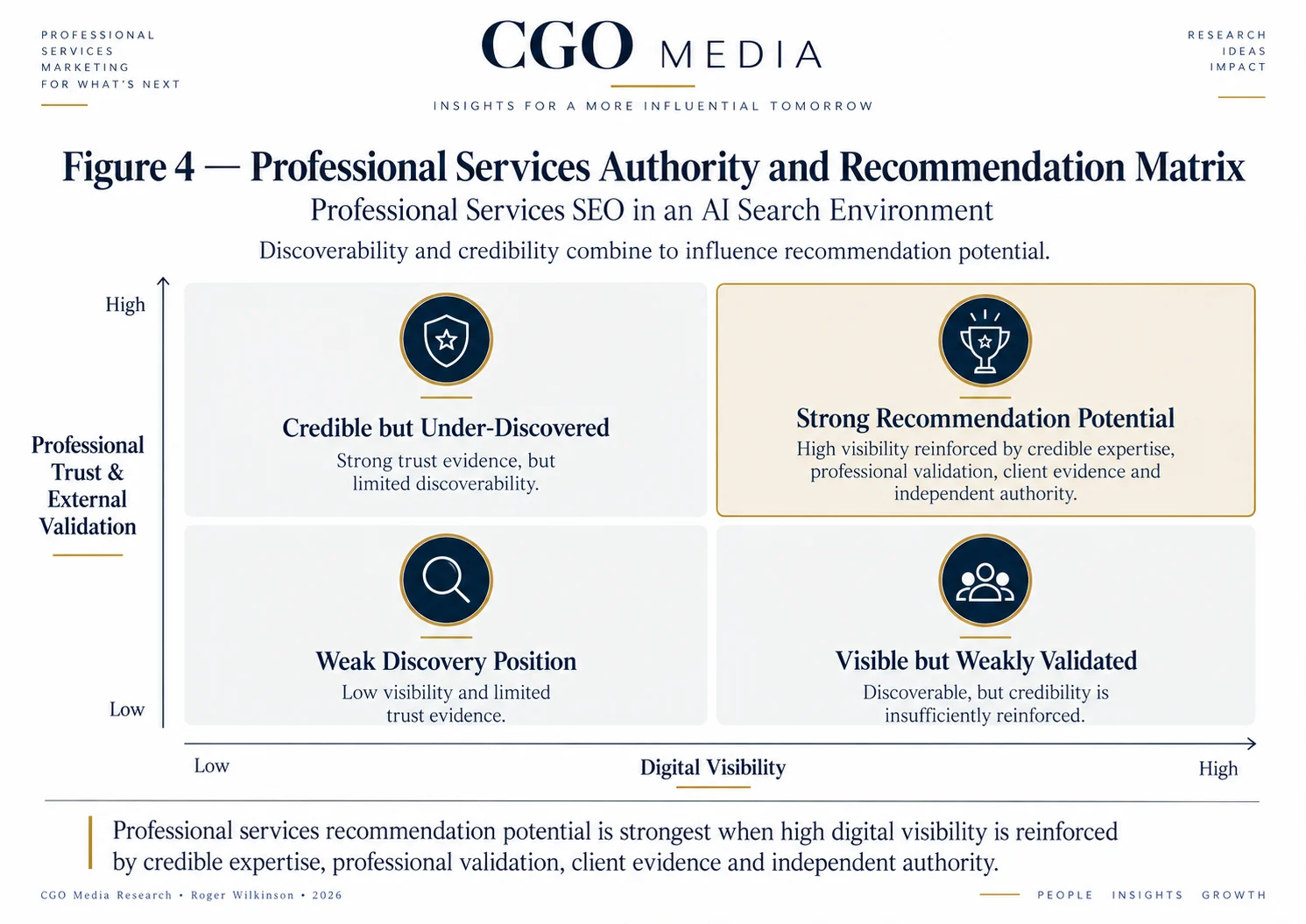
437. Professional Services Search Authority Should Be Measured Beyond Rankings
Rankings remain useful, but they represent only one part of a wider provider-discovery environment.
438. Traditional SEO Metrics Still Matter
Useful measures include:
- Organic visibility
- Search impressions
- Clicks
- Landing-page performance
- Conversions
439. Traditional Metrics Should Be Connected to Authority Metrics
Professional services organisations increasingly need to understand whether search visibility is strengthening:
- Service authority
- Expert authority
- Sector authority
- Provider consideration
- Recommendation readiness
440. A Useful Measurement Funnel Is
Search Visibility → Source Visibility → Entity Accuracy → Expertise Recognition → Comparison Inclusion → Recommendation Visibility → Qualified Commercial Outcome
441. Search Visibility Is the First Measurement Layer
This examines whether the firm’s relevant assets are discoverable through conventional search.
442. Service Visibility Should Be Measured
Priority services can be evaluated across:
- Generic service searches
- Problem-led searches
- Sector-specific searches
- Location-specific searches
443. Expert Visibility Should Be Measured
Named professionals can be monitored across:
- Name searches
- Specialist searches
- Sector searches
- Media visibility
444. Sector Visibility Should Be Measured
The organisation should understand whether it appears for relevant industry-specific queries.
445. Research Visibility Should Be Measured
Original studies can be monitored for:
- Organic discovery
- External citations
- Media references
- AI-assisted source visibility
446. Source Visibility Is the Second Measurement Layer
Source visibility examines whether the firm’s evidence appears within broader discovery and answer environments.
447. Source Visibility Can Include Owned Pages
Examples include:
- Service pages
- Expert profiles
- Sector pages
- Case studies
- Research
448. Source Visibility Can Include External Sources
Examples include:
- Media articles
- Professional directories
- Trade publications
- Review platforms
449. Source Visibility Should Be Scenario-Specific
A source is most useful when it appears in a context relevant to the firm’s actual expertise.
450. Source Visibility Should Not Be Interpreted as Universal Reach
Observed source inclusion should remain tied to the specific:
- Platform
- Scenario
- Query
- Date
- Location
451. Entity Accuracy Is the Third Measurement Layer
Visibility is weak if the organisation or professionals are represented incorrectly.
452. Firm-Level Accuracy Should Be Checked
Useful checks can include:
- Firm name
- Service scope
- Office locations
- Sector focus
- Professional relationships
453. Professional Accuracy Should Be Checked
Useful checks can include:
- Current role
- Current employer
- Specialism
- Qualifications
- Sector expertise
454. Service Accuracy Should Be Checked
The organisation should verify whether its capabilities are being represented correctly.
455. Sector Accuracy Should Be Checked
The firm should not be incorrectly associated with industries where it has little evidence.
456. Entity Conflict Rate Can Be Used Internally
A useful diagnostic measure is the proportion of priority entity facts that conflict across major sources.
457. Expertise Recognition Is the Fourth Measurement Layer
The organisation should assess whether relevant expertise is visible and correctly associated with the firm.
458. Expertise Recognition Can Be Firm-Level
The firm may be associated with:
- Services
- Sectors
- Problems
- Locations
459. Expertise Recognition Can Be Professional-Level
Named experts may be associated with:
- Specialisms
- Research
- Case studies
- Media commentary
460. Expertise Recognition Can Be Research-Led
Original studies can strengthen topical associations.
461. Expertise Recognition Should Be Evaluated for Accuracy
Broad visibility is less valuable if the firm is associated with the wrong expertise.
462. Comparison Inclusion Is the Fifth Measurement Layer
The organisation should understand whether it appears when users compare possible providers.
463. Comparison Inclusion Can Be Measured across Defined Scenarios
Examples can include:
- Best firm for a defined service requirement
- Compare providers for a defined sector
- Which advisers specialise in a specific business problem?
- Which firms serve a specific market or location?
464. Comparison Inclusion Should Be Qualified
The firm should only value inclusion where it is genuinely relevant.
465. Relevant Inclusion Is a Positive Signal
The provider appears in a scenario where real fit exists.
466. Relevant Exclusion Is a Potential Visibility Gap
A suitable firm fails to appear despite strong evidence of fit.
467. Irrelevant Inclusion Is a Precision Problem
The firm appears in a scenario where its expertise is poorly matched.
468. Appropriate Exclusion Is Not a Failure
The firm is omitted from a scenario outside its genuine capability.
469. Comparison Precision Should therefore Be Measured as Well as Inclusion
A useful conceptual relationship is:
Relevant Inclusion + Accurate Representation + Appropriate Exclusion → Higher Comparison Precision
470. Recommendation Visibility Is the Sixth Measurement Layer
Recommendation visibility examines whether the firm is surfaced as a potentially suitable provider within relevant AI-assisted discovery scenarios.
471. Recommendation Visibility Should Remain Scenario-Specific
One observed recommendation should not be treated as a universal provider rank.
472. Recommendation Visibility Can Be Measured by Service
Examples can include:
- Tax advisory
- Executive recruitment
- Management consulting
- Engineering consultancy
- Architecture
473. Recommendation Visibility Can Be Measured by Sector
Examples can include:
- Healthcare
- Technology
- Financial services
- Manufacturing
- Property
474. Recommendation Visibility Can Be Measured by Problem
Examples can include:
- International expansion
- Business restructuring
- Leadership hiring
- Compliance transformation
- Operational improvement
475. Recommendation Visibility Can Be Measured by Geography
This is especially relevant where jurisdiction or local delivery matters.
476. Recommendation Rationale Should Be Recorded
Where visible, the stated rationale can show which attributes are being associated with the provider.
477. Recommendation Rationale Can Reveal Strong Associations
Examples can include:
- Sector expertise
- Specialist capability
- Professional reputation
- Research authority
- Geographic relevance
478. Recommendation Rationale Can Also Reveal Weak Associations
Examples can include:
- Outdated positioning
- Over-broad claims
- Incorrect sector association
- Weakly supported specialisms
479. Recommendation Accuracy Should Be Validated Manually
Important provider facts should be checked before being treated as meaningful evidence.
480. Source Presence Should Be Recorded Where Visible
This can help identify which evidence sources repeatedly support provider representation.
481. Citation Presence Should Be Recorded Where Visible
Citations can help reveal whether the firm’s:
- Research
- Expert profiles
- Service content
- External references
are contributing to generative answers.
482. Source and Citation Frequency Should Be Scoped Carefully
Any observed frequency should be described within the actual sample tested.
483. Scenario Testing Should Define Its Methodology
Useful documentation can include:
- Platform
- Date
- Prompt family
- Geography
- Number of scenarios
- Validation method
484. Scenario Samples Should Not Be Presented as Platform-Wide Probabilities
A controlled test provides evidence about that test environment, not a universal measurement of all platform behaviour.
485. Longitudinal Testing Can Be More Useful Than One-Time Testing
Repeating consistent scenario families can reveal changes over time.
486. Version Control Supports Longitudinal Measurement
Material changes to:
- Prompts
- Platforms
- Locations
- Scoring methods
should be documented.
487. Qualified Commercial Outcome Is the Seventh Measurement Layer
Search authority becomes commercially meaningful when it contributes to relevant business opportunities.
488. Qualified Enquiries Are More Useful Than Raw Enquiries
A qualified enquiry can meet defined criteria around:
- Service
- Sector
- Budget
- Organisation type
- Timeline
489. Qualification Criteria Should Be Defined Internally
Different firms will use different commercial thresholds.
490. Search-Generated Conversations Can Be Measured
The organisation can track whether discovery progresses into a meaningful discussion.
491. Proposal Progression Can Be Measured
The firm can identify which search-generated opportunities progress into formal proposals.
492. Shortlist Progression Can Be Measured
For larger engagements, shortlist inclusion can represent an important commercial milestone.
493. Win Rate Can Be Analysed by Discovery Pathway
This can help reveal which routes produce the strongest commercial fit.
494. Commercial Measurement Should Remain Multi-Touch
The provider may be discovered through one channel and validated through several others.
495. A Typical Multi-Touch Journey Can Be
Google Search → Research Article → Expert Profile → LinkedIn → Case Study → Direct Enquiry
496. Another Multi-Touch Journey Can Be
AI Provider Comparison → Firm Website → Professional Directory → Consultation Request
497. Another Multi-Touch Journey Can Be
Media Citation → Brand Search → Sector Page → Proposal Request
498. First-Click Attribution Is therefore Incomplete
Initial discovery does not show where trust developed.
499. Last-Click Attribution Is also Incomplete
Final conversion does not show what created awareness or confidence earlier in the journey.
500. Journey-Level Measurement Is Stronger
A more complete model examines:
Discovery → Validation → Comparison → Engagement → Qualification → Proposal → Win / Loss
501. CRM Integration Is Important
Search measurement becomes more valuable when combined with:
- Lead quality
- Opportunity stage
- Service required
- Sector
- Win / loss outcome
502. CRM Data Can Reveal Strong Search Segments
The firm may identify that certain:
- Services
- Sectors
- Problems
- Content assets
generate better-qualified opportunities.
503. CRM Data Can Reveal Weak Search Segments
High traffic may generate little commercial value where fit is weak.
504. Search Reporting Should therefore Include Quality
A mature report should distinguish between:
- Visibility
- Traffic
- Enquiries
- Qualified opportunities
- Commercial progression
505. Search Authority Measurement Should Also Include Qualitative Review
Not every important signal is easily reduced to a number.
506. Qualitative Review Can Examine Message Accuracy
Does the search environment represent the firm’s capabilities correctly?
507. Qualitative Review Can Examine Differentiation
Does the firm appear meaningfully distinct from competitors?
508. Qualitative Review Can Examine Evidence Quality
Are the visible sources strong enough to support confidence?
509. Qualitative Review Can Examine Recommendation Rationale
Is the stated reason for provider inclusion accurate and defensible?
510. Qualitative Review Can Examine Commercial Fit
Do the scenarios generating visibility resemble the work the firm actually wants?
511. Quantitative and Qualitative Measurement Should Work Together
A useful relationship is:
Quantitative Visibility Data + Qualitative Evidence Review + Commercial Outcome Data → Better Search Authority Measurement
512. Benchmarking Can Support Measurement
The organisation can compare performance against:
- Previous periods
- Priority competitors
- Target scenarios
- Internal standards
513. Competitive Benchmarking Should Be Contextual
Competitors should be relevant to the same:
- Service
- Sector
- Location
- Client type
514. Competitor Visibility Alone Should Not Dictate Strategy
A competitor may be visible for work the firm does not want.
515. Competitive Evidence Gaps Can Still Be Useful
They can reveal where other providers demonstrate stronger:
- Research
- Expert profiles
- Case studies
- External authority
516. Measurement Should Feed Diagnosis
Weak performance should be traced to the most likely evidence problem.
517. Weak Search Visibility Can Indicate Discovery Problems
Potential causes can include:
- Technical issues
- Weak relevance
- Thin service architecture
- Competitive weakness
518. Weak Source Visibility Can Indicate Evidence Problems
Potential causes can include:
- Low distinctiveness
- Weak accessibility
- Limited research authority
- Poor external distribution
519. Weak Entity Accuracy Can Indicate Consistency Problems
Potential causes can include:
- Outdated profiles
- Conflicting job titles
- Old office information
- Ambiguous service relationships
520. Weak Expertise Recognition Can Indicate Authority Problems
Potential causes can include:
- Thin professional profiles
- Limited publications
- Weak sector evidence
- Poor expert attribution
521. Weak Comparison Inclusion Can Indicate Provider-Fit Problems
Potential causes can include:
- Unclear differentiation
- Limited client evidence
- Weak external validation
- Insufficient specialist positioning
522. Weak Recommendation Visibility Can Indicate Several Combined Gaps
Potential causes can include:
- Weak relevance
- Weak authority
- Weak trust
- Weak evidence precision
523. High Visibility with Low Commercial Progression Is Also Diagnostic
The firm may be attracting:
- Wrong client types
- Wrong budget ranges
- Wrong service intent
- Wrong geographies
524. Search Authority Measurement Should therefore Diagnose Quality as Well as Quantity
The objective is not maximum visibility in isolation.
525. Qualified Visibility Is the Stronger Metric
A conceptual relationship is:
Relevant Visibility + Accurate Representation + Strong Evidence + Commercial Fit → Qualified Visibility
526. Reporting Should Separate Observation from Interpretation
A report should distinguish:
- What was observed
- What may explain it
- What remains uncertain
527. Reporting Should Avoid Unsupported Causation
An improvement following an intervention does not by itself prove that the intervention caused the change.
528. Reporting Should Record Important External Changes
Examples can include:
- Platform updates
- Competitor activity
- Market changes
- Professional team changes
529. Reporting Should Be Versioned
Longitudinal research becomes easier to interpret when methodology and scenario changes are documented.
530. Professional Services Search Measurement Should therefore Be Repeatable
Consistent methods improve comparability over time.
531. Priority Measurement Should Focus on Strategic Services
The firm should invest most deeply where search authority has genuine commercial value.
532. Priority Measurement Should Focus on Strategic Sectors
High-value industries may require deeper scenario and authority monitoring.
533. Priority Measurement Should Focus on Strategic Professionals
Senior and specialist experts may warrant dedicated authority tracking.
534. Priority Measurement Should Focus on Strategic Problems
Problem-led discovery can reveal important early-stage search opportunities.
535. A Professional Services Search Scorecard Can therefore Include
- Organic visibility
- Source visibility
- Entity accuracy
- Expert recognition
- Comparison inclusion
- Recommendation visibility
- Qualified commercial outcomes
536. The Seventeenth Professional Services Search Principle
Professional-services search performance should be measured through a layered funnel moving from conventional search visibility into source visibility, entity accuracy, expertise recognition, provider comparison, recommendation visibility and qualified commercial outcomes rather than relying on rankings and traffic alone.
537. The Eighteenth Professional Services Search Principle
AI-assisted source, comparison and recommendation observations should be reported within clearly defined platform, scenario, date, geography and sample boundaries and should not be presented as universal platform probabilities or proprietary ranking metrics.
538. The Nineteenth Professional Services Search Principle
Search reporting should connect visibility with CRM and commercial progression so organisations can distinguish high-volume discovery from genuinely qualified opportunities, proposal progression, shortlist inclusion and client wins.
539. The Twentieth Professional Services Search Principle
Professional-services measurement should combine quantitative visibility data with qualitative evidence review and cautious interpretation so observed changes can support diagnosis without overstating causation or internal knowledge of external search and AI systems.
540. The Professional Services Search Authority Measurement Funnel
The complete measurement relationship can be summarised as:
Search Visibility → Source Visibility → Entity Accuracy → Expertise Recognition → Comparison Inclusion → Recommendation Visibility → Qualified Commercial Outcome
541. The Strategic Implication
Professional Services SEO should be measured as a progression from discoverability toward commercial relevance. Rankings and traffic remain valuable, but mature measurement also asks whether the organisation’s evidence is being found, whether the firm and its experts are represented accurately, whether genuine expertise is recognised, whether the provider appears in relevant comparison and recommendation scenarios and whether those discovery pathways contribute to qualified conversations, proposals, shortlist inclusion and client wins. This creates a more useful definition of search performance: not simply more visibility, but more accurate and commercially relevant authority.
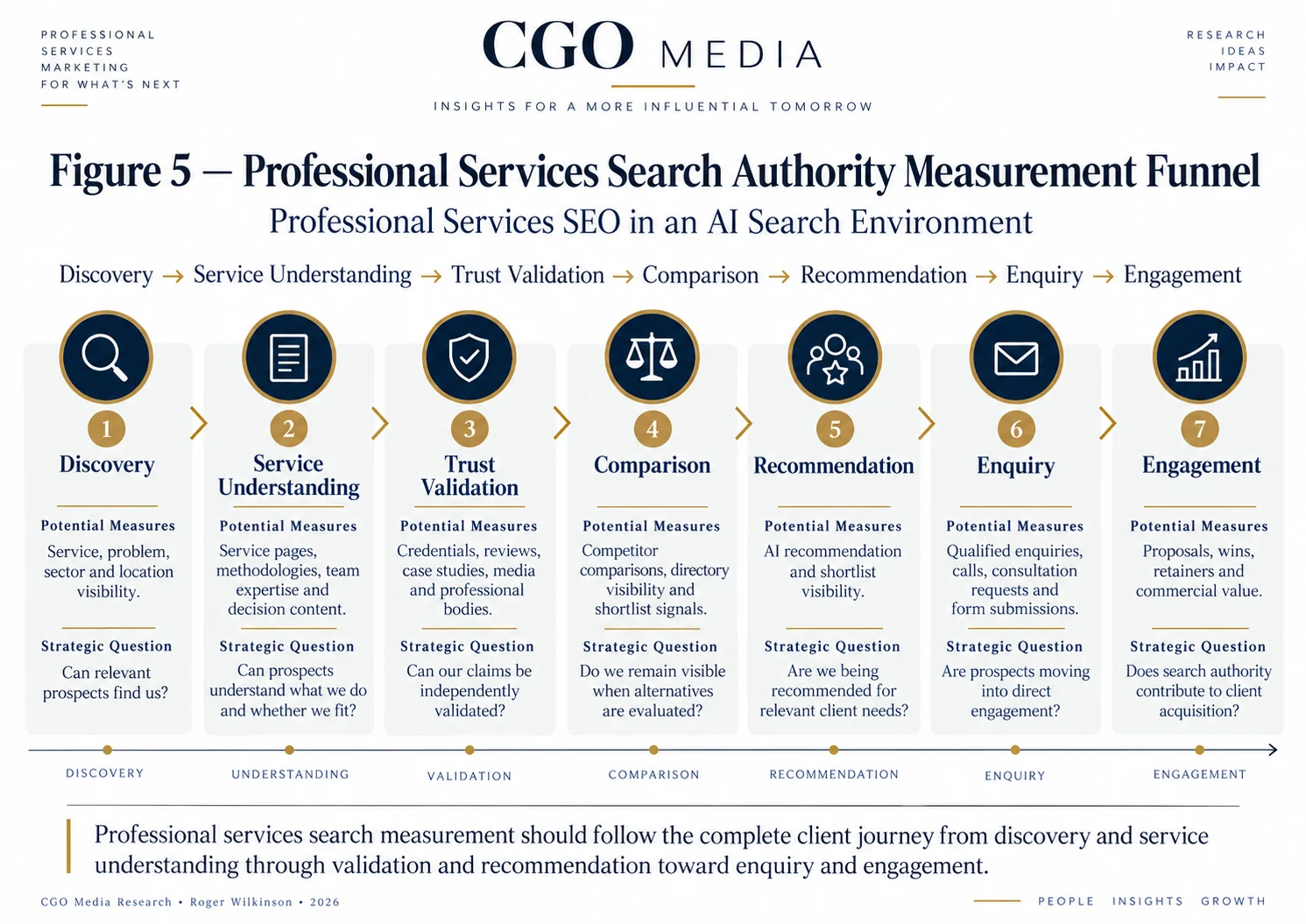
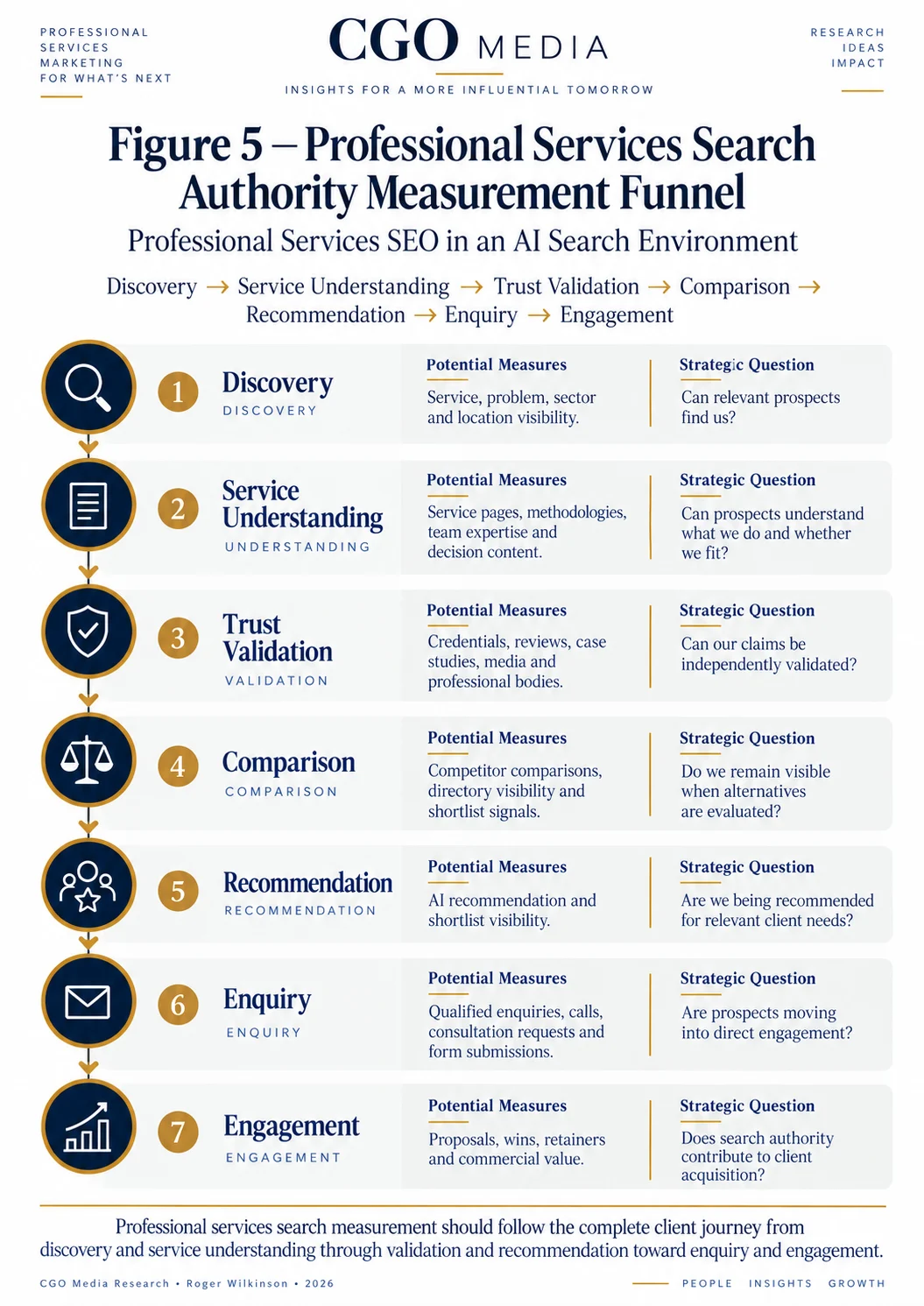
542. Professional Services Search Authority Should Be Managed Continuously
Professional-services authority is not a fixed state.
543. Firm Capabilities Change
Changes can occur in:
- Services
- Professional teams
- Sectors served
- Locations
- Commercial models
544. External Evidence Also Changes
New:
- Reviews
- Media references
- Research citations
- Directory profiles
- Professional recognition
can alter the authority environment over time.
545. Search and AI Discovery Environments Also Change
Search interfaces, source patterns, comparison behaviour and generative recommendations can evolve independently of the firm.
546. Continuous Improvement Is therefore Necessary
A useful operating cycle is:
Observe → Diagnose → Strengthen → Validate → Measure → Learn → Adapt
547. Observation Is the First Stage
The organisation should observe how it is represented across its priority discovery environment.
548. Search Visibility Should Be Observed
Priority service, sector, problem and location queries should be monitored.
549. Source Visibility Should Be Observed
The firm should understand which owned and external sources repeatedly surface.
550. Entity Representation Should Be Observed
The organisation should verify whether its:
- Firm identity
- Professional roles
- Services
- Locations
- Sector associations
are represented correctly.
551. Expertise Recognition Should Be Observed
The organisation should examine whether genuine specialisms are visible.
552. Comparison Inclusion Should Be Observed
Priority provider-comparison scenarios can reveal whether the firm is entering relevant candidate sets.
553. Recommendation Visibility Should Be Observed
Relevant AI-assisted scenarios can be monitored for provider inclusion, exclusion and rationale.
554. Commercial Progression Should Be Observed
Search-originated opportunities should be tracked through:
- Enquiry
- Qualification
- Proposal
- Shortlist
- Win or loss
555. Observation Should Be Structured
Useful records can include:
- Date
- Platform
- Scenario
- Observed result
- Evidence source
- Commercial relevance
556. Diagnosis Is the Second Stage
Observation alone does not explain why a particular result occurred.
557. Diagnosis Should Identify the Most Likely Evidence Gap
A weak outcome can stem from:
- Technical weakness
- Relevance weakness
- Entity weakness
- Expertise weakness
- Trust weakness
- Commercial mismatch
558. Weak Search Visibility Can Indicate Discovery Gaps
Possible causes include:
- Weak service architecture
- Technical problems
- Insufficient topical depth
- Limited internal linking
559. Weak Source Visibility Can Indicate Evidence Gaps
Possible causes include:
- Generic content
- Weak distinctiveness
- Poor accessibility
- Low external authority
560. Weak Entity Accuracy Can Indicate Governance Gaps
Possible causes include:
- Outdated staff profiles
- Conflicting titles
- Old office information
- Unclear service relationships
561. Weak Expertise Recognition Can Indicate Professional Evidence Gaps
Possible causes include:
- Thin expert profiles
- Limited publications
- Weak sector evidence
- Insufficient authorship
562. Weak Comparison Inclusion Can Indicate Differentiation Gaps
Possible causes include:
- Generic positioning
- Limited case-study evidence
- Weak independent validation
- Unclear specialist fit
563. Weak Recommendation Visibility Can Reflect Several Combined Gaps
A recommendation gap may involve:
- Relevance
- Authority
- Trust
- Entity clarity
- Commercial fit
564. High Visibility with Weak Lead Quality Is Also Diagnostic
The organisation may be visible for the wrong:
- Services
- Client types
- Budgets
- Sectors
- Geographies
565. Diagnosis Should therefore Include Commercial Data
Search visibility should be interpreted alongside opportunity quality.
566. Strengthening Is the Third Stage
The firm should improve the evidence weakness identified during diagnosis.
567. Service Weaknesses Require Service Improvements
Relevant actions can include:
- Clearer scope
- Stronger problem framing
- Better expert attribution
- Improved case-study integration
- Stronger sector context
568. Expert Weaknesses Require Professional Evidence Improvements
Relevant actions can include:
- Expanded biographies
- Specialist publications
- Research participation
- Media commentary
- Credential updates
569. Sector Weaknesses Require Sector Authority Improvements
Relevant actions can include:
- Sector research
- Sector case studies
- Named sector experts
- Trade commentary
- Sector-specific services
570. Client-Evidence Weaknesses Require Applied Proof
Relevant actions can include:
- Case studies
- Testimonials
- Outcome summaries
- Reference programmes
571. External Authority Weaknesses Require External Evidence Development
Relevant actions can include:
- Original research
- Digital PR
- Media relations
- Research distribution
- Professional participation
572. Entity Weaknesses Require Consistency Improvements
Relevant actions can include:
- Profile updates
- Role standardisation
- Office corrections
- Service relationship clarification
573. AI Visibility Weaknesses Should Be Addressed through Underlying Evidence
The firm should improve the source and authority environment rather than attempt to manipulate individual generated outputs.
574. Validation Is the Fourth Stage
Changes should be checked to determine whether the original problem has improved.
575. Technical Changes Should Be Validated Technically
Useful checks can include:
- Indexability
- Rendering
- Internal linking
- Canonicalisation
- Structured information
576. Entity Changes Should Be Validated Across Sources
Important facts should be checked on:
- Firm website
- Professional directories
- Business profiles
- External publications
577. Expertise Changes Should Be Validated through Discovery
The organisation can check whether relevant professional associations become clearer.
578. Authority Changes Should Be Validated Externally
Useful signals can include:
- New citations
- Media references
- Trade mentions
- Research visibility
579. Comparison Changes Should Be Validated through Scenario Testing
Relevant provider-comparison scenarios can be repeated using consistent methods.
580. Recommendation Changes Should Be Validated Carefully
Observed changes should remain contextual rather than being interpreted as permanent ranking movement.
581. Commercial Changes Should Be Validated through CRM
The firm should examine whether improved visibility produces:
- Better lead quality
- More proposals
- More shortlist inclusion
- Higher-value opportunities
582. Measurement Is the Fifth Stage
Validated changes should feed the wider measurement framework.
583. Measurement Should Track Leading Indicators
These can include:
- Visibility
- Entity accuracy
- Expert recognition
- Citation presence
- Comparison inclusion
584. Measurement Should Also Track Lagging Indicators
These can include:
- Qualified enquiries
- Proposal progression
- Shortlist progression
- Client wins
- Revenue contribution
585. Leading and Lagging Indicators Should Be Connected
A useful relationship is:
Authority Improvement → Better Discovery → Better Qualification → Better Commercial Opportunity
586. Learning Is the Sixth Stage
The organisation should identify which changes appear to produce stronger outcomes.
587. Learning Should Capture Successful Interventions
These can inform future strategy.
588. Learning Should Capture Unsuccessful Interventions
This reduces repeated investment in low-value activity.
589. Learning Should Capture Unexpected Effects
An intervention can influence a different authority dimension than originally expected.
590. Learning Should Include Commercial Feedback
Business-development teams can identify whether the firm’s public positioning matches real client needs.
591. Win Data Can Reveal Strong Positioning
Recurring patterns can show which:
- Services
- Sectors
- Experts
- Evidence types
support successful selection.
592. Loss Data Can Reveal Weak Positioning
Recurring losses can expose:
- Weak differentiation
- Commercial mismatch
- Insufficient evidence
- Wrong market targeting
593. Adaptation Is the Seventh Stage
Validated learning should change future operating standards.
594. Service Architecture Should Adapt
Recurring user confusion can justify clearer service segmentation.
595. Expert Profiles Should Adapt
Recurring expertise gaps can justify stronger professional evidence standards.
596. Sector Strategy Should Adapt
Recurring market opportunities can justify deeper sector research and case-study development.
597. Research Strategy Should Adapt
Repeated information gaps can become new research questions.
598. Digital PR Strategy Should Adapt
Research attracting strong external attention can guide future media programmes.
599. Measurement Strategy Should Adapt
Low-value metrics should be replaced where more useful indicators emerge.
600. Scenario Libraries Should Adapt
Priority AI and provider-comparison tests should evolve with changing client behaviour.
601. Professional Services Search Authority Has Different Review Frequencies
Not every evidence type changes at the same speed.
602. Professional Profiles Require Event-Based Review
Relevant triggers include:
- New role
- Promotion
- Departure
- New qualification
- New specialism
603. Service Pages Require Capability-Based Review
Updates should occur when:
- Scope changes
- Delivery changes
- Pricing structure changes
- Target markets change
604. Sector Pages Require Market-Based Review
Updates can be triggered by:
- Regulatory change
- Market change
- New research
- New client evidence
605. Research Requires Methodological Review
Older research should be reviewed when:
- New data becomes available
- Market conditions change
- Methodology changes
- Findings become outdated
606. External Profiles Require Periodic Review
Directories and third-party profiles can become stale.
607. AI and Generative Observation Requires Repeat Review
Outputs should not be assumed to remain stable.
608. Review Frequency Should Reflect Strategic Risk
A useful relationship is:
Evidence Volatility + Business Importance + Error Impact → Review Frequency
609. Cross-Functional Governance Is Required
Professional Services SEO cannot be managed effectively by SEO teams alone.
610. Service Leaders Control Capability Evidence
They can validate:
- Service scope
- Methodology
- Delivery model
- Specialist claims
611. Professionals Control Expertise Evidence
They contribute:
- Technical knowledge
- Sector insight
- Research
- Commentary
612. Marketing Teams Coordinate Communication
They can connect:
- Services
- Experts
- Sectors
- Case studies
- Research
613. Research Teams Strengthen Intellectual Authority
They can support:
- Original studies
- Methodology
- Data interpretation
- Publication standards
614. PR Teams Strengthen External Authority
They connect relevant expertise with:
- Journalists
- Trade publications
- Research audiences
- Industry conversations
615. Search Teams Connect the Evidence Architecture
They support:
- Technical accessibility
- Information architecture
- Entity clarity
- Internal linking
- Search measurement
616. Business Development Teams Provide Commercial Feedback
They understand:
- Client objections
- Competitive losses
- Shortlist dynamics
- Commercial fit
617. CRM Teams Connect Discovery with Outcomes
They enable analysis of:
- Lead quality
- Opportunity progression
- Proposal activity
- Win and loss patterns
618. Cross-Functional Learning Creates a Stronger Search System
A useful operating relationship is:
Search Evidence + Professional Knowledge + Research + External Authority + Commercial Feedback → Better Provider Positioning
619. Continuous Improvement Creates an Authority Flywheel
The organisation can move through:
Better Evidence → Better Discovery → Better Validation → Better Comparison → Better Commercial Feedback → Better Evidence
620. Better Evidence Improves Discovery
Clearer services, experts and sectors become easier to find.
621. Better Discovery Improves Evaluation
Prospective clients encounter stronger decision support.
622. Better Evaluation Improves Provider Comparison
Relevant differentiation becomes clearer.
623. Better Comparison Improves Qualification
Poor-fit opportunities can be excluded earlier.
624. Better Qualification Improves Commercial Learning
The firm receives clearer feedback about where it wins and loses.
625. Commercial Learning Improves Future Evidence
Search strategy becomes informed by real client selection behaviour.
626. Research Can Strengthen the Flywheel
Original research can create:
- Search visibility
- Expert authority
- Media opportunities
- External citations
- New client conversations
627. Digital PR Can Strengthen the Flywheel
External references can amplify useful evidence beyond owned channels.
628. Professional Participation Can Strengthen the Flywheel
Experts who contribute publicly create stronger entity and authority signals.
629. Client Evidence Can Strengthen the Flywheel
Case studies and testimonials connect authority with applied outcomes.
630. Search Measurement Can Strengthen the Flywheel
Observed evidence gaps can guide future improvements.
631. The Professional Services Search Operating Model
A mature operating model connects:
- Technical SEO
- Service architecture
- Entity management
- Professional authority
- Sector authority
- Research
- Digital PR
- Commercial measurement
632. Technical SEO Supports Accessibility
Authority evidence must remain technically discoverable.
633. Service Architecture Supports Relevance
Clients should understand what the firm actually offers.
634. Entity Management Supports Accuracy
Firm, professional, service and office relationships should remain explicit.
635. Professional Authority Supports Trust
Named expertise makes organisational claims easier to validate.
636. Sector Authority Supports Context
Relevant industry evidence improves provider fit.
637. Research Supports Differentiation
Original evidence can distinguish the firm from generic competitors.
638. Digital PR Supports Independent Validation
External recognition reinforces the wider evidence ecosystem.
639. Commercial Measurement Supports Relevance
Search strategy can focus on the opportunities most valuable to the organisation.
640. SEO and GEO Should therefore Be Integrated
Conventional search and generative discovery rely on many of the same underlying authority assets.
641. SEO Creates Discoverability
Technical accessibility, relevance and useful content remain foundational.
642. GEO Extends the Evidence Environment
Generative Engine Optimisation places additional emphasis on:
- Source eligibility
- Entity clarity
- Citation readiness
- Comparison readiness
- Recommendation readiness
643. GEO Should Not Replace SEO
The stronger model is:
SEO Foundation + Entity Authority + Evidence Quality + External Validation + GEO Measurement
644. AI Search Should Not Be Managed as a Separate Marketing Channel
It is increasingly connected to the same evidence environment used across wider search and provider selection.
645. The Strongest Strategy Improves the Underlying Evidence System
This remains valuable even where a particular platform does not surface the firm.
646. The Twenty-First Professional Services Search Principle
Professional-services search authority should be managed through a continuous observe, diagnose, strengthen, validate, measure, learn and adapt cycle because services, professional teams, client evidence, external authority and AI-assisted discovery environments all change over time.
647. The Twenty-Second Professional Services Search Principle
Search optimisation should address the specific underlying evidence gap identified through diagnosis rather than responding to weak visibility with indiscriminate content production, link acquisition or generic AI-search optimisation.
648. The Twenty-Third Professional Services Search Principle
Long-term professional-services authority requires cross-functional governance connecting service leaders, professionals, research, marketing, Digital PR, search and commercial teams so public evidence remains aligned with operational capability and real client selection behaviour.
649. The Twenty-Fourth Professional Services Search Principle
SEO, GEO and provider-selection strategy should operate as one connected authority system in which better evidence improves discovery, stronger discovery improves validation, better validation improves comparison, and commercial feedback continuously strengthens future evidence.
650. The Continuous Professional Services Search Authority Improvement Cycle
The complete continuous improvement relationship can be summarised as:
Observe → Diagnose → Strengthen → Validate → Measure → Learn → Adapt
651. The Professional Services Authority Flywheel
The long-term authority relationship can be summarised as:
Better Evidence → Better Discovery → Better Trust → Better Comparison → Better Qualification → Better Commercial Learning → Stronger Evidence
652. The Strategic Implication
Professional Services SEO should operate as an adaptive authority system rather than a sequence of isolated optimisation campaigns. Firms need to observe how they are discovered and represented, diagnose the actual evidence gaps behind weak outcomes, strengthen service and professional authority, validate whether those changes improve discovery and comparison, measure commercial relevance and feed the resulting learning back into future strategy. When technical SEO, expert evidence, sector authority, research, Digital PR, AI-search measurement and CRM data operate together, search becomes a continuous provider-authority capability rather than simply a source of website traffic.
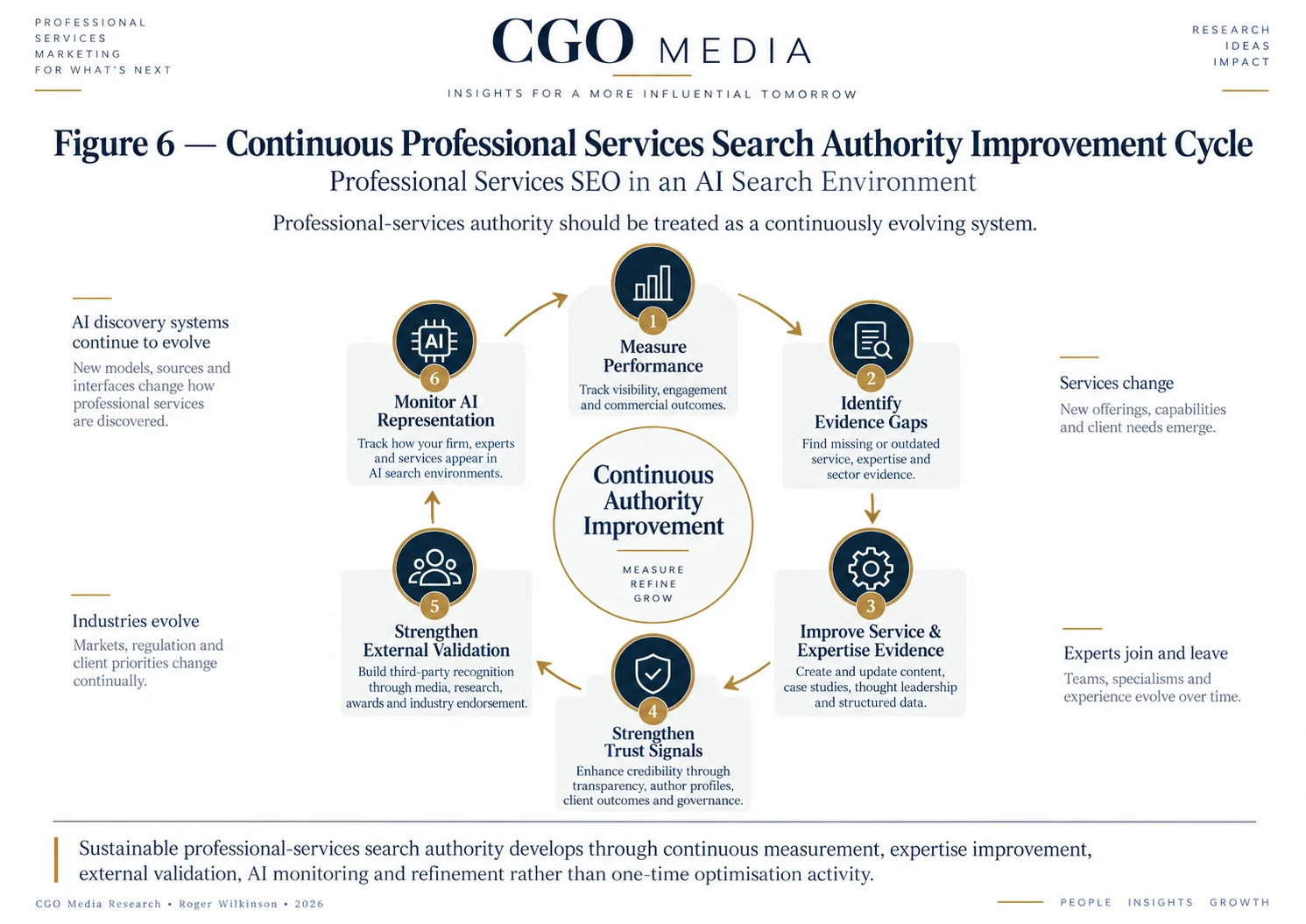
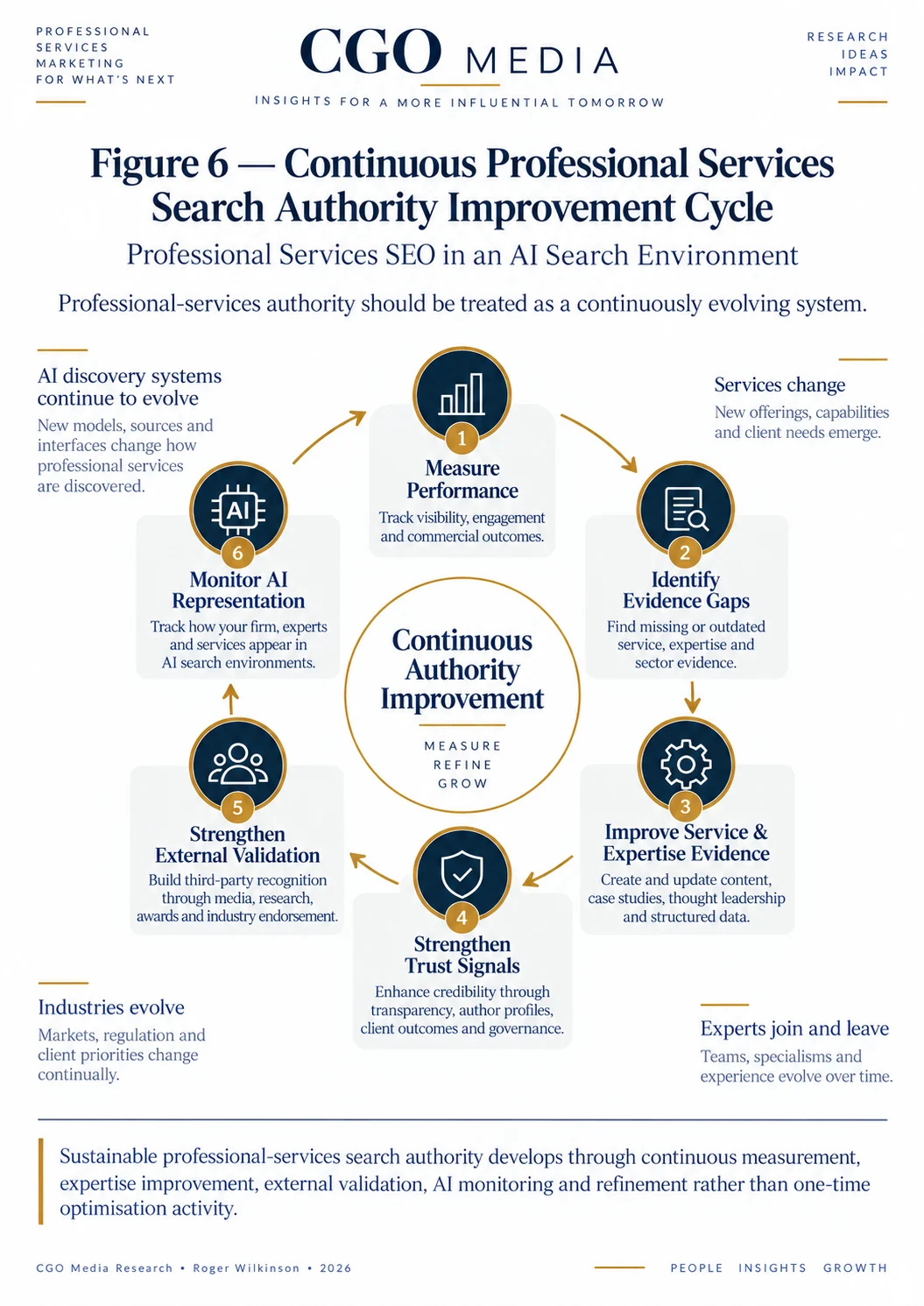
653. Research Methodology
Professional Services SEO in an AI Search Environment is a conceptual and observational research paper developed by CGO Media to examine how expertise-led organisations are discovered, evaluated, compared and selected across conventional search engines, professional information environments and AI-assisted discovery systems.
654. Research Purpose
The central research question is:
How should professional-services organisations structure their digital evidence, expertise, entities, sector authority and external validation so they remain discoverable, trusted and appropriately recommendation-ready as search evolves beyond conventional rankings?
655. Research Scope
The research is intended to be applicable across professional-services sectors including:
- Management consulting
- Accountancy
- Tax advisory
- Recruitment and executive search
- Architecture
- Engineering consultancy
- Business advisory
- Specialist professional practices
656. Provider-Discovery Scope
The research examines provider discovery across:
- Organic search
- Problem-led search
- Sector search
- Professional directories
- Business media
- Review environments
- AI-assisted search
- Generative recommendation systems
657. The Research Uses a Provider-Selection Perspective
Professional Services SEO is examined not only as a ranking discipline but as part of a broader decision journey.
658. The Core Provider Journey Is
Problem Recognition → Service Understanding → Expertise Validation → Provider Comparison → Commercial Engagement
659. The Extended Search Intent Architecture Is
Problem Intent → Advisory Intent → Service Intent → Expertise Intent → Provider Validation → Provider Comparison → Commercial Engagement
660. The Research Examines Distributed Evidence
Professional-services authority may be expressed across:
- Firm websites
- Professional profiles
- Case studies
- Research
- Media
- Directories
- Professional bodies
- Client evidence
661. Owned Evidence Is Treated as One Layer
Owned evidence explains what the firm claims about:
- Services
- Expertise
- Sectors
- Professionals
- Methodologies
662. Professional Evidence Is Treated as a Second Layer
This includes:
- Experience
- Qualifications
- Specialisms
- Professional roles
- Publications
663. Client Evidence Is Treated as a Third Layer
This can include:
- Case studies
- Testimonials
- Reviews
- Outcome evidence
- Client references
664. Market Evidence Is Treated as a Fourth Layer
This can include:
- Research
- Benchmark studies
- Sector analysis
- Regulatory commentary
- Market observations
665. Independent Evidence Is Treated as a Fifth Layer
This can include:
- Media references
- Trade publications
- Professional directories
- Research citations
- Industry recognition
666. Evidence Convergence Is a Core Research Concept
The research proposes that professional-services authority becomes stronger where several relevant evidence types support the same conclusion.
667. A Useful Evidence Relationship Is
Owned Evidence + Professional Evidence + Client Evidence + Market Evidence + Independent Evidence → Provider Confidence
668. Provider Selection Is Treated as an Evidence-Reduction Process
Prospective clients frequently move from a broad candidate set toward a smaller shortlist.
669. The Provider Selection Relationship Is
Discovery → Relevance Filtering → Expertise Validation → Trust Assessment → Commercial Fit → Shortlist
670. Authority Is Treated as Contextual
No professional-services provider should be assumed to be universally suitable.
671. Provider Suitability Can Depend on
- Service fit
- Expertise fit
- Sector fit
- Professional trust
- Geographic fit
- Commercial fit
672. Recommendation Is therefore Treated as Scenario-Specific
A provider can be appropriate in one context and inappropriate in another.
673. Research Observation Is Distinguished from Proprietary Platform Knowledge
CGO Media does not claim access to proprietary search-engine or AI-system retrieval, ranking, citation-selection or recommendation algorithms.
674. AI-Related Concepts Are Analytical Constructs
Terms used in this research such as:
- Recommendation readiness
- Qualified recommendation visibility
- Source visibility
- Comparison inclusion
- Expertise recognition
are analytical concepts used to organise measurement and strategy.
675. These Concepts Are Not Official Platform Metrics
They should not be interpreted as proprietary metrics supplied by Google, OpenAI, Microsoft, Perplexity or other external search and AI platforms.
676. Observational Testing Should Be Scoped
Where AI-assisted provider discovery is tested, results should be reported with relevant context.
677. Useful Context Can Include
- Platform
- Date
- Scenario
- Geography
- Prompt family
- Sample size
678. Observed Frequencies Should Remain Sample-Specific
A measured source, comparison or recommendation frequency within a controlled scenario set should not be presented as a universal probability for the platform as a whole.
679. Observation Should Be Separated from Interpretation
Research reporting should distinguish between:
- What was observed
- What may explain it
- What remains uncertain
680. Correlation Should Be Separated from Causation
A change in visibility following an intervention does not by itself prove that the intervention caused the observed change.
681. Professional-Services Evidence Can Change Over Time
Important changes can occur in:
- Professional teams
- Services
- Sector capability
- Office locations
- Credentials
- External recognition
682. Freshness Is therefore an Important Research Constraint
Evidence should be evaluated in relation to the period in which it remains materially current.
683. Professional Profiles Can Become Stale
Examples include:
- Old job titles
- Former employers
- Expired memberships
- Outdated specialisms
684. Service Evidence Can Become Stale
Service scope can change as firms:
- Launch new practices
- Withdraw services
- Enter new sectors
- Change delivery models
685. Research Evidence Can Become Stale
Market conditions, regulations and industry benchmarks can change.
686. External Evidence Can Also Change
Directories, reviews, citations and professional recognition may evolve over time.
687. Framework Limitations
The research provides a structured strategic framework rather than a predictive ranking formula.
688. Professional-Services Markets Differ
Different professions have different:
- Regulation
- Credential requirements
- Evidence environments
- Client behaviours
- Procurement processes
689. Accountancy Authority May Depend Strongly on Credentials
Professional qualifications, regulatory status and recognised professional bodies may carry substantial trust value.
690. Engineering Authority May Depend Strongly on Technical and Project Evidence
Project history and specialist technical capability may carry greater decision value.
691. Architecture Authority May Depend Strongly on Portfolio Evidence
Completed work and design expertise can play a major role in provider evaluation.
692. Recruitment Authority May Depend Strongly on Market and Client Evidence
Candidate reach, employer outcomes and specialist recruitment expertise may carry greater importance.
693. Consulting Authority May Depend Strongly on Intellectual Authority
Research, methodologies, senior expertise and sector thinking can play a substantial role.
694. One Authority Model Should therefore Not Be Applied Mechanically
The relative weighting of evidence should reflect the profession and client requirement.
695. Provider Selection Also Varies by Client Type
Different selection behaviour can exist among:
- SMEs
- Large enterprises
- Public-sector organisations
- Investors
- Professional partnerships
696. Procurement Complexity Varies
Some professional-services purchases involve:
- Direct enquiry
- Informal comparison
- Formal procurement
- Tender processes
- Multi-stage evaluation
697. Commercial Fit Can therefore Override Search Authority
A highly visible provider may remain unsuitable because of:
- Budget
- Capacity
- Scope
- Geography
- Procurement requirements
698. Search Visibility Is Not a Guarantee of Provider Selection
Strong search performance only creates an opportunity to enter the decision process.
699. AI Citation Is Not Guaranteed
Publishing useful content or research does not guarantee citation within generative systems.
700. AI Comparison Inclusion Is Not Guaranteed
A relevant provider may not appear in every comparison response.
701. AI Recommendation Is Not Guaranteed
No organisation can guarantee inclusion within third-party generative recommendations.
702. Generated Outputs Can Vary
Differences can result from:
- Prompt wording
- Platform
- Conversation context
- Location
- Time
- Source availability
703. One Output Should therefore Not Be Treated as a Permanent Ranking
Repeated observations are more informative than isolated generated responses.
704. External Authority Is Partly Outside the Firm’s Control
Media, reviews, citations and independent directories are influenced by external parties.
705. Client Confidentiality Can Limit Public Evidence
Professional-services organisations may not always be able to disclose:
- Client names
- Project detail
- Commercial outcomes
- Sensitive methodologies
706. Lack of Public Case-Study Detail Does Not Automatically Mean Lack of Capability
Alternative forms of evidence may be required where confidentiality is material.
707. Evidence Should therefore Be Interpreted within Professional Context
Authority assessment should recognise sector-specific disclosure constraints.
708. Conclusion
Professional Services SEO is evolving from a discipline centred primarily on keyword rankings and service-page visibility into a broader system of expertise discovery, provider validation, comparison and recommendation.
709. Traditional SEO Remains Foundational
Professional-services organisations still require:
- Technically accessible websites
- Clear information architecture
- Relevant content
- Strong internal linking
- Search-engine discoverability
710. But Visibility Alone Is Increasingly Insufficient
Prospective clients need evidence explaining why the organisation deserves continued consideration.
711. Firm Clarity Creates the Organisational Foundation
Users and digital systems should be able to understand:
- Who the firm is
- Where it operates
- Which services it provides
- Which professionals belong to it
712. Service Authority Creates Capability Clarity
Service pages should explain:
- Client problems
- Scope
- Methodology
- Deliverables
- Relevant expertise
713. Professional Authority Creates Expertise Confidence
Named experts should demonstrate:
- Relevant experience
- Specialisms
- Qualifications
- Research
- External participation
714. Sector Authority Creates Contextual Relevance
The organisation should demonstrate that it understands the client environment rather than simply repeating generic service language across multiple industries.
715. Client Evidence Creates Applied Trust
Case studies and testimonials demonstrate how capability has been used in practice.
716. Research Creates Intellectual Authority
Original analysis can strengthen:
- Subject authority
- Professional authority
- Sector authority
- Media authority
- Citation potential
717. Independent Evidence Creates External Validation
Media, directories, professional bodies, reviews and citations can reinforce claims made through owned channels.
718. Evidence Convergence Creates Stronger Provider Confidence
The strongest authority environment exists where:
Firm Evidence + Professional Evidence + Client Evidence + Research Evidence + Independent Evidence → Provider Confidence
719. Provider Confidence Supports Comparison Readiness
Prospective clients need enough evidence to distinguish the firm from relevant alternatives.
720. Comparison Readiness Supports Shortlist Eligibility
The firm is more likely to remain under consideration when its genuine differentiators are visible.
721. Shortlist Eligibility Supports Commercial Opportunity
Search authority becomes commercially meaningful when it contributes to realistic opportunities.
722. AI Search Extends This Decision Environment
Generative systems can increasingly help users:
- Understand services
- Identify experts
- Compare providers
- Evaluate evidence
- Generate shortlists
723. GEO therefore Extends Rather Than Replaces SEO
Generative Engine Optimisation adds further focus on:
- Source visibility
- Entity clarity
- Citation readiness
- Comparison readiness
- Recommendation readiness
724. The Stronger Strategic Model Is
SEO Foundation + Entity Clarity + Expertise Authority + Client Evidence + External Validation + GEO Measurement
725. Professional Services Search Should Prioritise Qualified Visibility
The objective should not be maximum provider exposure.
726. Qualified Visibility Means Appearing Where Genuine Relevance Exists
This can improve:
- Lead quality
- Provider fit
- Comparison accuracy
- Commercial efficiency
727. Appropriate Exclusion Can Be Valuable
A firm should not seek inclusion in provider scenarios outside its genuine capability.
728. Evidence Precision Should therefore Be Preferred to Over-Broad Positioning
Clear specialisation can create stronger provider fit than generic authority claims.
729. Search Authority Should Be Connected with Commercial Learning
CRM and business-development data can reveal:
- Which services attract the strongest opportunities
- Which sectors convert best
- Which experts influence provider selection
- Which evidence supports wins
730. Commercial Learning Should Feed Back into Search Strategy
This creates the continuous relationship:
Evidence → Discovery → Validation → Comparison → Commercial Outcome → Learning → Better Evidence
731. The Complete Professional Services Search Authority Model
The wider research can be summarised as:
Firm Clarity + Service Authority + Expert Authority + Sector Authority + Client Evidence + Research + Independent Validation + Commercial Fit → Qualified Provider Visibility
732. The Long-Term Authority Flywheel
A mature professional-services organisation can move through:
Better Evidence → Better Discovery → Better Trust → Better Comparison → Better Qualification → Better Commercial Learning → Stronger Evidence
733. Final Strategic Position
The future of Professional Services SEO is unlikely to be defined by a single ranking factor, content tactic or AI-optimisation technique. It is better understood as the management of a connected professional evidence system.
Professional-services firms become easier to discover when their websites clearly explain their services, sectors, locations and experts. They become easier to evaluate when those claims are supported by professional profiles, case studies, methodologies, research and client evidence. They become easier to trust when independent sources such as professional bodies, trade publications, media, directories, reviews and research citations reinforce the same areas of expertise.
As AI-assisted discovery becomes increasingly integrated into provider research and comparison, these same evidence systems become important for generative visibility. Clear entities, accessible sources, specialist expertise, credible external validation and contextual provider fit can help search and AI systems understand when a firm is relevant without requiring the organisation to abandon established SEO principles.
The strategic objective should therefore be neither rankings alone nor indiscriminate AI visibility. It should be qualified provider visibility: being discoverable, accurately represented and sufficiently evidenced when the firm’s genuine services, expertise, sector understanding and commercial capabilities align with the needs of the prospective client.
References
External Technical, Search and Research Sources
- Google Search Central. SEO Starter Guide.
- Google Search Central. AI Features and Your Website.
- Google Search Central. Organization Structured Data.
- Schema.org. Organization.
- Schema.org. Person.
- Schema.org. Service.
- Hogan, A. et al. (2021). Knowledge Graphs. ACM Computing Surveys, 54(4).
- Metzger, M.J. (2007). Making Sense of Credibility on the Web: Models for Evaluating Online Information and Recommendations for Future Research. Journal of the American Society for Information Science and Technology, 58(13), 2078–2091.
- Ji, Z. et al. (2023). Survey of Hallucination in Natural Language Generation. ACM Computing Surveys, 55(12).
Professional Services AI & GEO Search Research Family
Professional Services SEO in an AI Search Environment forms the parent research paper within the wider CGO Media Professional Services AI & GEO Search Research programme.
Professional Services AI & GEO Search Research
The sector pillar brings together the complete Professional Services SEO, AI Search and GEO research family.
Explore Professional Services AI & GEO Search Research →
Professional Services AI Trust and Visibility Framework
The framework examines the evidence required to strengthen firm clarity, service and expertise authority, professional trust, external validation, sector authority and AI provider recommendation readiness.
Explore the Professional Services AI Trust and Visibility Framework →
Professional Services Discovery and Provider Selection Model
The provider-selection model examines how organisations move from problem recognition and service discovery through expertise validation, provider comparison, trust assessment, shortlisting and engagement.
Explore the Professional Services Discovery and Provider Selection Model →
Professional Services Search Authority Maturity Model
The maturity model examines how professional-services organisations progress from basic search participation toward structured, integrated and adaptive provider authority.
Explore the Professional Services Search Authority Maturity Model →
Professional Services SEO and AI Implementation Roadmap
The roadmap translates the Professional Services research programme into a practical sequence for strengthening technical SEO, service architecture, professional authority, external validation, AI readiness and organisational governance.
Explore the Professional Services SEO and AI Implementation Roadmap →
Professional Services GEO: Generative Engine Optimisation
The GEO research examines how professional-services organisations can improve firm and expert understanding, source visibility, citation readiness, provider comparison and qualified recommendation visibility within generative discovery environments.
Explore Professional Services GEO →
How the Professional Services Research Family Connects
The complete Professional Services research architecture can be summarised as:
Sector Research Pillar → Parent Search Research → Trust & Visibility Framework → Discovery & Provider Selection → Search Authority Maturity → Implementation Roadmap → GEO
CGO Media Research Ecosystem
The Professional Services research family forms part of the wider CGO Media research programme examining AI Search, Generative Engine Optimisation, entity authority, source selection, citation systems, recommendation systems and the continuing evolution of digital discovery.
CGO Media Research Library |
CGO Media Framework Library |
CGO Media Research Architecture |
CGO Media Research Observations |
CGO Media Statistics Library
About Roger Wilkinson
Roger Wilkinson is an independent search and AI researcher, SEO practitioner and founder of CGO Media with more than 25 years of experience in search, online visibility and digital strategy.
His research examines how artificial intelligence is changing information retrieval, entity understanding, source selection, citation behaviour, provider comparison and recommendation-led discovery.
His sector research applies these concepts to markets where professional expertise, trust, evidence and provider selection materially influence commercial decisions.
Within Professional Services, his work examines how service clarity, expert authority, client evidence, sector expertise, research, external validation and AI-assisted discovery combine to shape provider visibility and recommendation readiness.
View Roger Wilkinson’s researcher profile →
Research Usage & Citation
CGO Media encourages professional-services firms, advisers, consultants, accountants, recruiters, architects, engineers, researchers, journalists and digital teams to reference this research where it contributes to discussion or analysis of Professional Services SEO, AI Search, expertise authority, provider discovery, professional trust, comparison systems or generative recommendation.
Reasonable quotations, summaries, figures and excerpts may be used in articles, reports, presentations and academic work provided appropriate acknowledgement is given to Roger Wilkinson and CGO Media.
Cite This Research / Embed Citation
Professional Services SEO in an AI Search Environment by Roger Wilkinson at CGO Media proposes that sustainable professional-services visibility increasingly depends on the combined strength of firm clarity, service authority, expert evidence, sector relevance, client validation, independent authority and qualified AI-assisted provider recommendation readiness.
APA Citation
APA Citation: Wilkinson, R. (2026). Professional Services SEO in an AI Search Environment. CGO Media. https://cgomedia.com/professional-services-seo-in-an-ai-search-environment/
Author: Roger Wilkinson |
Published by: CGO Media
For permissions relating to substantial reproduction, commercial licensing or republication of significant portions of this research, please contact CGO Media directly.