
Professional Services Discovery and Provider Selection Model
 The Professional Services Discovery and Provider Selection Model explains how prospective clients move from recognising a business problem to identifying, evaluating, validating, comparing and selecting a professional-services provider.
The model is designed for accountancy firms, consultancies, advisory businesses, recruiters, architecture practices, engineering consultancies and other expertise-led organisations where provider selection depends on a combination of capability, professional trust, evidence, sector relevance, commercial fit and perceived risk.
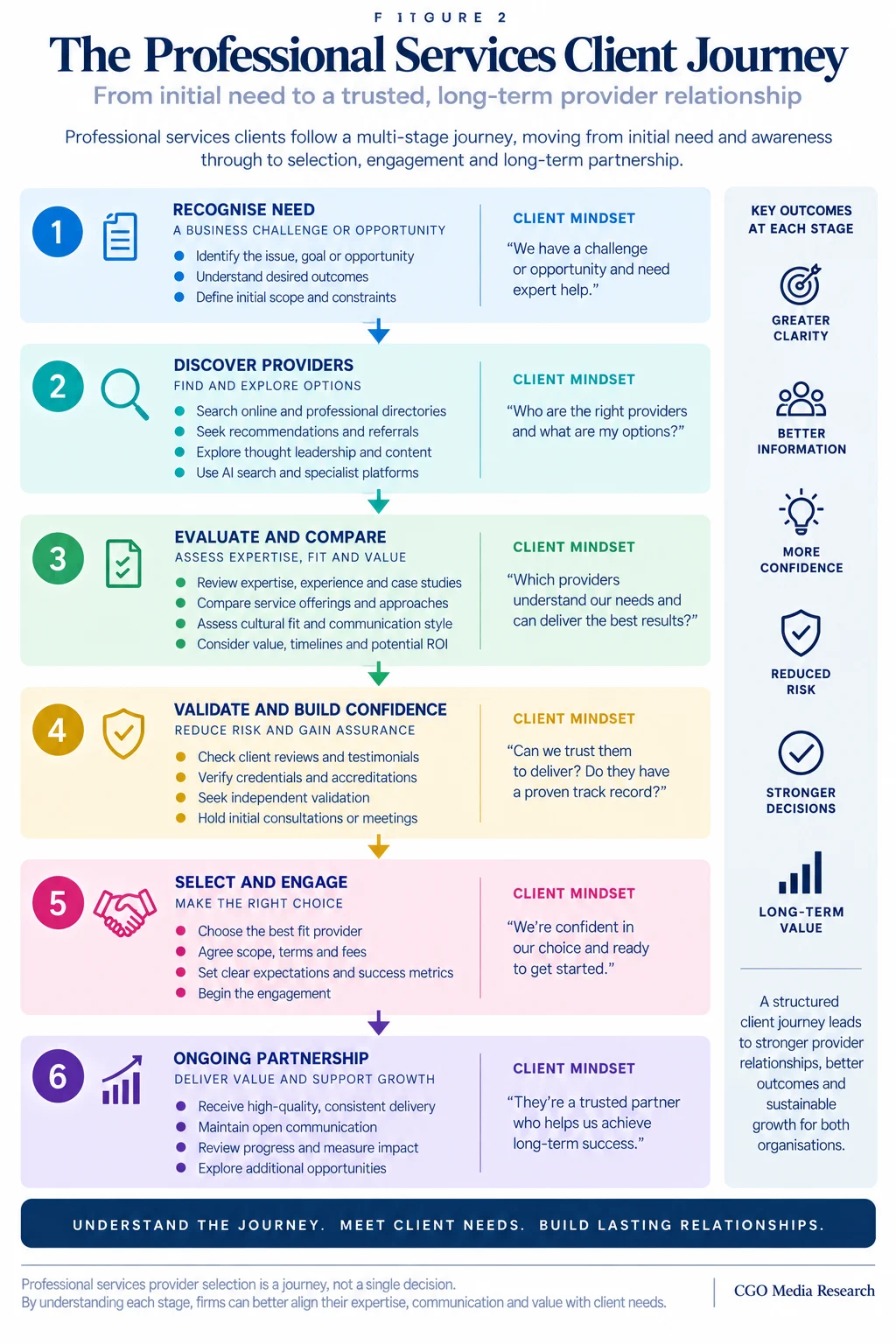
Professional-services selection is rarely a single search event. Buyers often move through a sequence of discovery and evaluation stages, gathering different forms of evidence before they are willing to engage a provider.
Search engines, AI assistants, professional directories, trade publications, media coverage, professional networks, referrals, research, case studies and direct provider websites can all influence different stages of the journey.
1. Why Professional Services Provider Selection Needs a Model
Professional-services engagements are frequently high-consideration decisions.
2. The Buyer Is Often Selecting Expertise Rather Than a Standard Product
The client may be purchasing:
- Judgement
- Advice
- Professional interpretation
- Specialist capability
- Project delivery
- Risk reduction
3. This Makes Provider Evaluation More Complex
The prospective client must assess not only what the provider claims to offer, but whether the provider can be trusted to deliver it.
4. Search Visibility Alone Does Not Complete the Selection Process
A provider may be discovered early while losing consideration later because evidence is insufficient.
5. Reputation Alone Does Not Complete the Selection Process
A well-known firm may still be rejected where specialist fit is weak.
6. Expertise Alone Does Not Complete the Selection Process
Strong capability can remain commercially invisible if it is difficult to discover or validate.
7. Provider Selection therefore Requires Multiple Evidence Layers
A useful relationship is:
Discoverability + Capability + Expertise + Trust + Evidence + Commercial Fit → Provider Selection Potential
8. Professional Services Journeys Are Often Non-Linear
Prospective clients can move backwards and forwards between stages.
9. New Evidence Can Change the Requirement
A client may begin searching for one type of provider and later realise a different specialism is required.
10. New Evidence Can Change the Shortlist
Research, referrals, reviews or expert profiles can introduce additional providers.
11. New Evidence Can Remove a Provider
The client may identify:
- Wrong expertise
- Wrong location
- Insufficient credentials
- Poor commercial fit
- Weak sector experience
12. The Model therefore Represents a Decision System
It should not be interpreted as a rigid funnel.
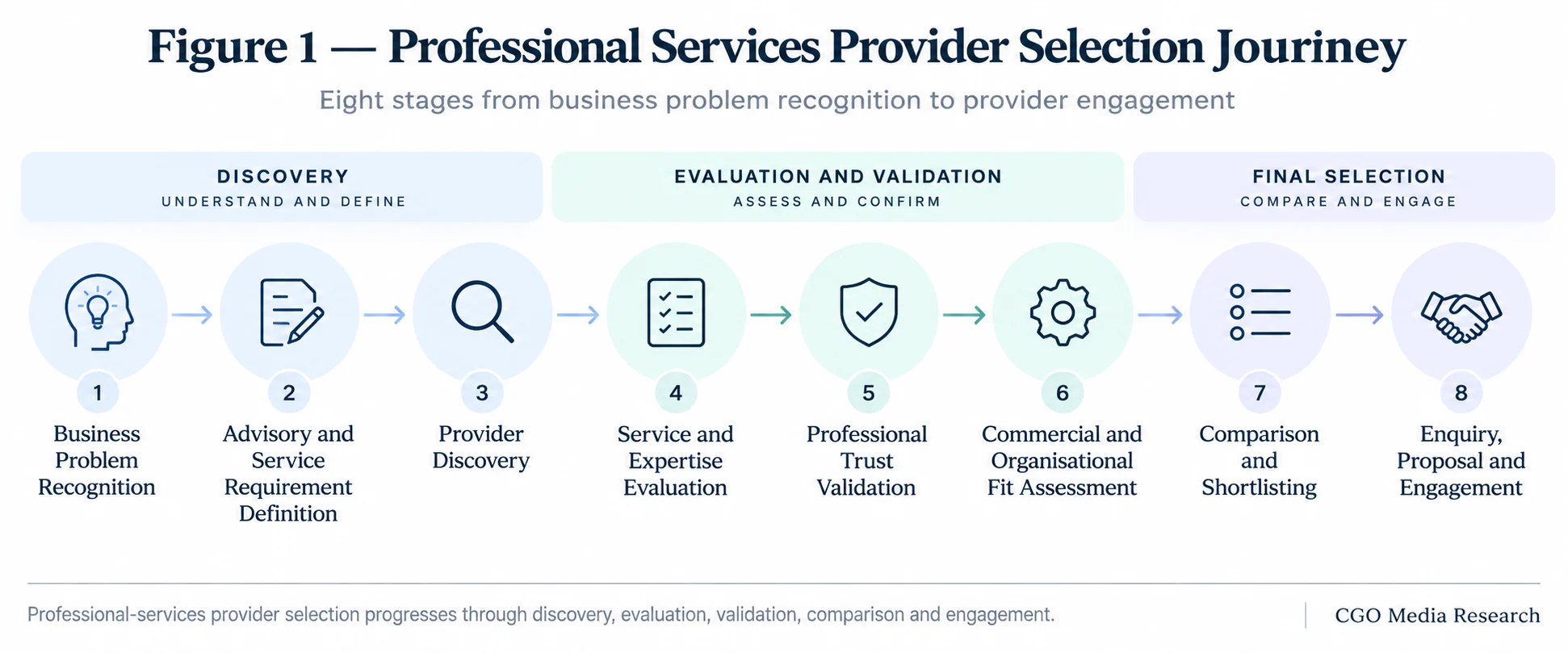
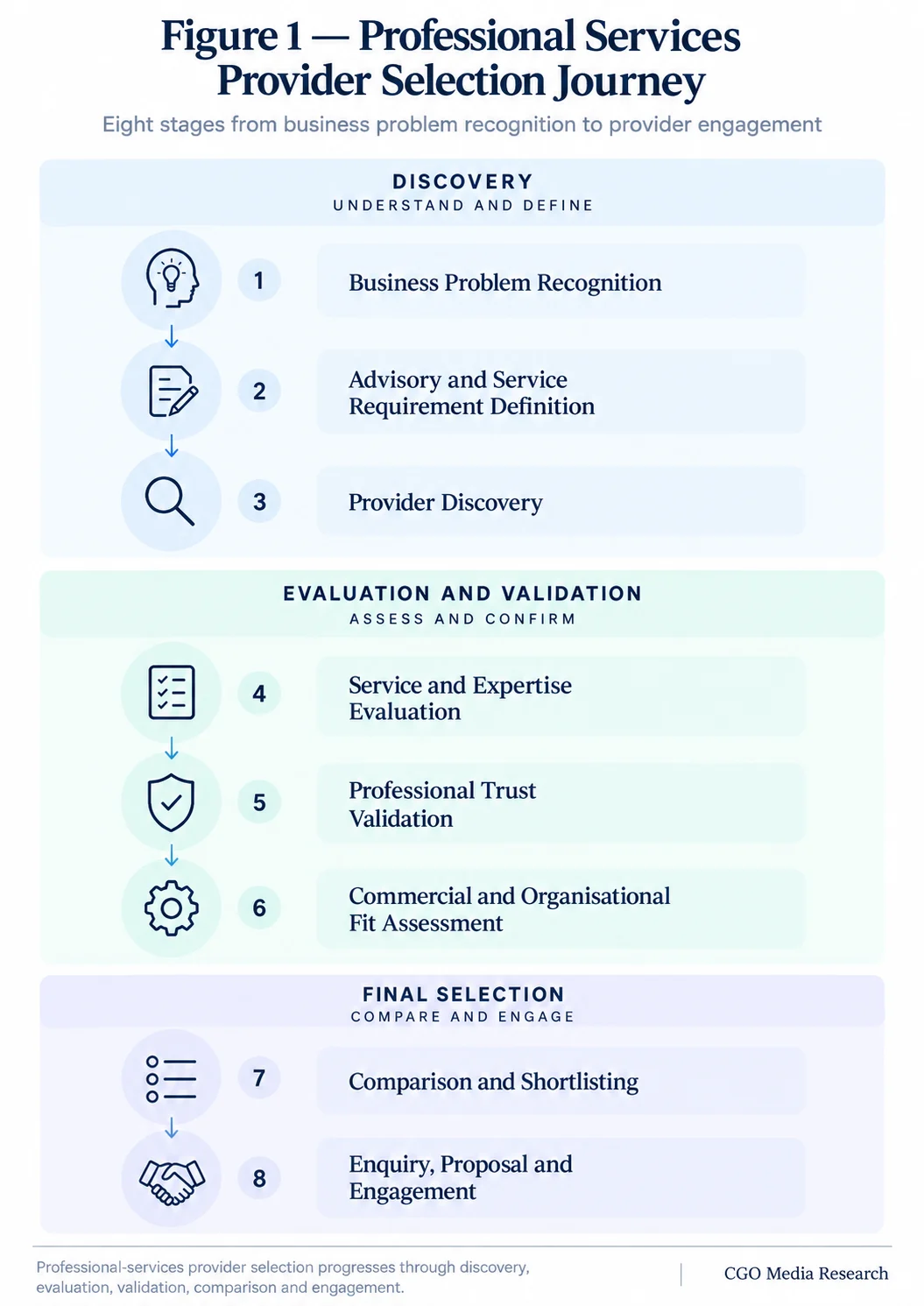
13. The Eight Stages of Professional Services Provider Selection
- Business Problem Recognition
- Advisory and Service Requirement Definition
- Provider Discovery
- Service and Expertise Evaluation
- Professional Trust Validation
- Commercial and Organisational Fit Assessment
- Comparison and Shortlisting
- Enquiry, Proposal and Engagement
14. Stage One — Business Problem Recognition
The provider-selection journey often begins before the prospective client knows which professional service is required.
15. The Initial Trigger Is Usually a Business Situation
Examples can include:
- A performance problem
- A regulatory requirement
- A strategic objective
- An organisational change
- A skills gap
- A growth opportunity
- A risk or crisis
16. Problem Recognition Can Be Reactive
A client may seek external support after something has already gone wrong.
17. Reactive Triggers Can Include
- Declining performance
- Staff turnover
- Financial problems
- Compliance concerns
- Project failure
- Leadership gaps
18. Problem Recognition Can Also Be Proactive
The client may seek expertise before a major change.
19. Proactive Triggers Can Include
- Expansion
- Restructuring
- Transformation
- Succession planning
- New market entry
- Technology adoption
20. Problem Recognition Often Begins Internally
A leadership team may identify a challenge through:
- Internal reporting
- Board discussion
- Operational feedback
- Employee feedback
- Client feedback
21. Internal Recognition Does Not Always Produce Immediate External Search
The organisation may initially attempt to solve the problem internally.
22. External Search Often Begins When Internal Capability Appears Insufficient
The need for external support becomes more visible when the organisation lacks:
- Expertise
- Capacity
- Independence
- Credentials
- Experience
23. The Client May Not Yet Know the Correct Service Category
At the beginning of the journey, the user may search for the problem rather than a provider.
24. Problem-Led Search Behaviour Is therefore Important
Searches may take forms such as:
- Why employee turnover is increasing
- How to restructure a growing company
- How to reduce operational costs
- How to improve financial reporting
- How to recruit a senior executive
25. Problem-Led Search Can Occur Before Commercial Intent
The user may initially be seeking explanation rather than a supplier.
26. This Creates an Early Discovery Opportunity
Professional-services organisations can become visible by helping users understand the problem itself.
27. Problem-Led Content Can Create Initial Authority
Useful explanations can establish:
- Subject familiarity
- Terminology
- Diagnostic understanding
- Possible intervention categories
28. Early Authority Should Be Educational Rather Than Aggressively Commercial
The user may not yet be ready to select a provider.
29. Educational Content Can Help Define the Problem
A strong resource can explain:
- Possible causes
- Common risks
- Diagnostic questions
- Potential solutions
- When external advice may be useful
30. Research Can Influence Problem Recognition
Original data can help a client understand whether an issue is:
- Normal
- Unusual
- Increasing
- Sector-specific
- Strategically important
31. Benchmarks Can Influence Problem Recognition
A prospective client may recognise a gap only after comparing its own position with wider market evidence.
32. Expert Commentary Can Influence Problem Recognition
Professional interpretation can help users understand the significance of emerging issues.
33. Trade Media Can Influence Problem Recognition
Industry reporting may introduce risks or opportunities before the client begins formal provider research.
34. Professional Networks Can Influence Problem Recognition
Peers can identify challenges and suggest that external support is needed.
35. Existing Advisers Can Influence Problem Recognition
An accountant, consultant, architect, recruiter or other professional may identify a related requirement outside their own scope.
36. AI Systems Can Also Participate During Problem Recognition
Generative assistants can help users interpret complex business situations.
37. A User May Describe the Situation Rather Than Name the Service
For example:
“Our employee retention has declined significantly over the last year. What type of consultant should we speak to?”
38. AI Assistance Can Reframe the Problem
The response may suggest that the situation relates to:
- Employee engagement
- Reward
- Leadership
- Organisational design
- Recruitment
39. Problem Interpretation Influences Provider Discovery
How the challenge is categorised determines which provider types later enter consideration.
40. One Business Problem Can Lead to Several Professional Categories
Declining employee retention might lead toward:
- HR consultancy
- Employee engagement specialists
- Reward consultants
- Leadership consultants
- Recruitment advisers
41. This Makes Category Definition Strategically Important
The firm needs to be associated with the problems it genuinely helps solve.
42. Problem Authority Can therefore Precede Service Authority
A useful relationship is:
Problem Understanding → Service Category Understanding → Provider Discovery
43. The First Authority Challenge Is Relevance
The organisation must demonstrate that it understands the client’s actual situation.
44. Generic Content Can Fail the Relevance Test
Broad commentary may not address the user’s specific problem sufficiently.
45. Specialist Content Can Improve Relevance
More precise material can address:
- Problem type
- Industry
- Organisation size
- Market conditions
- Regulatory context
46. Relevance Should Remain Genuine
Professional-services firms should not claim expertise in every possible client problem.
47. Appropriate Non-Relevance Is Valuable
Clear boundaries can help the client identify when another provider category is more suitable.
48. Early-Stage Transparency Can Build Trust
A provider can increase credibility by explaining where its service is and is not appropriate.
49. Problem Recognition Can Also Be Influenced by Urgency
Some situations create immediate provider-search behaviour.
50. High-Urgency Situations Can Compress the Journey
Examples can include:
- Regulatory deadlines
- Leadership departures
- Operational crises
- Financial reporting failures
- Major project problems
51. Low-Urgency Situations Can Extend the Journey
Strategic or exploratory projects can involve weeks or months of research.
52. Journey Length Should therefore Be Contextual
The eight stages describe decision functions rather than fixed time periods.
53. Problem Complexity Can Affect Journey Length
More ambiguous problems may require more research before service requirements can be defined.
54. Organisational Risk Can Affect Journey Length
High-risk decisions often require greater validation.
55. Engagement Value Can Affect Journey Length
Higher-value projects often involve deeper provider evaluation.
56. Stakeholder Count Can Affect Journey Length
Multiple decision-makers can create additional validation and comparison stages.
57. Procurement Can Affect Journey Length
Formal procurement processes can introduce mandatory requirements before engagement.
58. Stage One Ends When the Client Can Describe the Problem More Clearly
The prospect does not necessarily know the exact provider yet.
59. The Transition to Stage Two Is Requirement Formation
The client begins asking:
What type of professional support do we actually need?
60. Stage Two — Advisory and Service Requirement Definition
Once the business problem is better understood, the prospective client begins defining the characteristics of the professional support required.
61. Requirement Definition Converts the Problem into Selection Criteria
The client starts translating uncertainty into a more structured brief.
62. Requirement Definition Can Include Service Category
The organisation needs to determine the general form of professional support.
63. Requirement Definition Can Include Specialism
A broad service category may be insufficient.
64. Requirement Definition Can Include Project Scope
The client begins estimating:
- Scale
- Complexity
- Duration
- Deliverables
- Internal involvement
65. Requirement Definition Can Include Sector Expertise
Industry familiarity may become a selection criterion.
66. Requirement Definition Can Include Geography
The client may require:
- Local presence
- National coverage
- International reach
- Remote delivery
67. Requirement Definition Can Include Professional Credentials
Certain services may require:
- Chartered status
- Professional registration
- Specific certification
- Regulatory approval
- Insurance
68. Requirement Definition Can Include Delivery Model
The client may prefer:
- Advisory engagement
- Project delivery
- Retained support
- Embedded consultancy
- Interim support
69. Requirement Definition Can Include Seniority
Some buyers require direct senior involvement.
70. Requirement Definition Can Include Team Scale
The client may need:
- One specialist
- A small advisory team
- A multidisciplinary team
- International resources
71. Requirement Definition Can Include Timing
Provider suitability may depend on availability.
72. Requirement Definition Can Include Budget
Commercial constraints can determine which providers remain viable.
73. Requirement Definition Can Include Risk Tolerance
Some clients prefer established providers while others may favour specialist boutiques.
74. Service Category Discovery Is Often Necessary
Clients may need to distinguish between related professional disciplines.
75. Related Services Can Appear Similar to Non-Specialists
Examples include:
- Accountancy versus financial advisory
- Strategy consulting versus operational consulting
- Recruitment agency versus executive search
- Architect versus engineering consultancy
76. Educational Content Can Help Differentiate Service Categories
Useful resources can explain:
- Role differences
- Scope differences
- Typical use cases
- Qualification requirements
- Expected outputs
77. Clear Service Taxonomy Supports Requirement Formation
The provider’s own architecture can help prospects understand the market.
78. Poor Service Taxonomy Creates Buyer Confusion
Overlapping or unclear terminology can make it harder to identify the correct capability.
79. Specialism Definition Often Follows Service Category Definition
The client progressively narrows the requirement.
80. A Requirement Can Become Increasingly Specific
For example:
Consultant → Management Consultant → Operations Consultant → Manufacturing Operations Specialist
81. Increasing Specificity Changes the Relevant Provider Set
Broad firms may remain eligible while specialist providers become more attractive.
82. Specialist Discovery Depends on Specialist Legibility
Providers need to make genuine niche capability visible.
83. Generic Expertise Labels Can Reduce Specialist Legibility
Terms such as “business consultancy” may be too broad to support some provider-selection scenarios.
84. Explicit Specialisms Can Improve Matching
The organisation can clarify:
- Problem type
- Methodology
- Sector
- Professional expertise
85. Sector Requirements Can Become Hard Selection Criteria
Some engagements require deep industry familiarity.
86. Sector Familiarity Can Matter Because of Regulation
Different industries can operate under distinct legal or compliance conditions.
87. Sector Familiarity Can Matter Because of Language
Industry-specific terminology can influence effective delivery.
88. Sector Familiarity Can Matter Because of Operating Models
Providers may need to understand specialised commercial environments.
89. Sector Familiarity Can Matter Because of Stakeholder Expectations
Professional advice may need to reflect industry-specific decision processes.
90. Sector Expertise Should therefore Be Demonstrable
A generic statement that the firm serves an industry may be insufficient.
91. Sector Evidence Can Include
- Named specialists
- Case studies
- Research
- Trade commentary
- Relevant client experience
92. Geographic Requirements Can Also Narrow the Provider Set
Professional services can be:
- Local
- Regional
- National
- International
- Fully remote
93. Geography Matters Differently by Service
A strategic consultancy engagement can tolerate different geographic arrangements from a project requiring physical site attendance.
94. Jurisdiction Can Matter More Than Physical Proximity
Professional knowledge of local law, regulation or standards may outweigh office distance.
95. Multi-Country Engagements Can Create Additional Requirements
The client may need:
- International coordination
- Local specialists
- Multilingual support
- Cross-border experience
96. Professional Requirements Can Determine Basic Eligibility
Some requirements cannot be substituted by marketing strength.
97. Qualification Can Be a Hard Requirement
The provider may need a recognised professional status.
98. Registration Can Be a Hard Requirement
Certain assignments may require formal registration.
99. Regulatory Approval Can Be a Hard Requirement
A provider without the required authorisation should not remain in consideration.
100. Insurance Can Be a Hard Requirement
Professional indemnity or other cover may be mandatory.
101. Procurement Standards Can Be Hard Requirements
Larger organisations may require:
- Security standards
- Insurance levels
- Financial stability
- Compliance documentation
- Supplier onboarding
102. Hard and Soft Requirements Should Be Distinguished
Not every selection criterion performs the same function.
103. Hard Requirements Determine Eligibility
Failure can remove a provider from consideration.
104. Typical Hard Requirements Can Include
- Required service
- Professional qualification
- Regulatory status
- Geographic coverage
- Sector capability
105. Soft Requirements Influence Preference
Several providers can meet the hard requirements while differing substantially on softer criteria.
106. Typical Soft Requirements Can Include
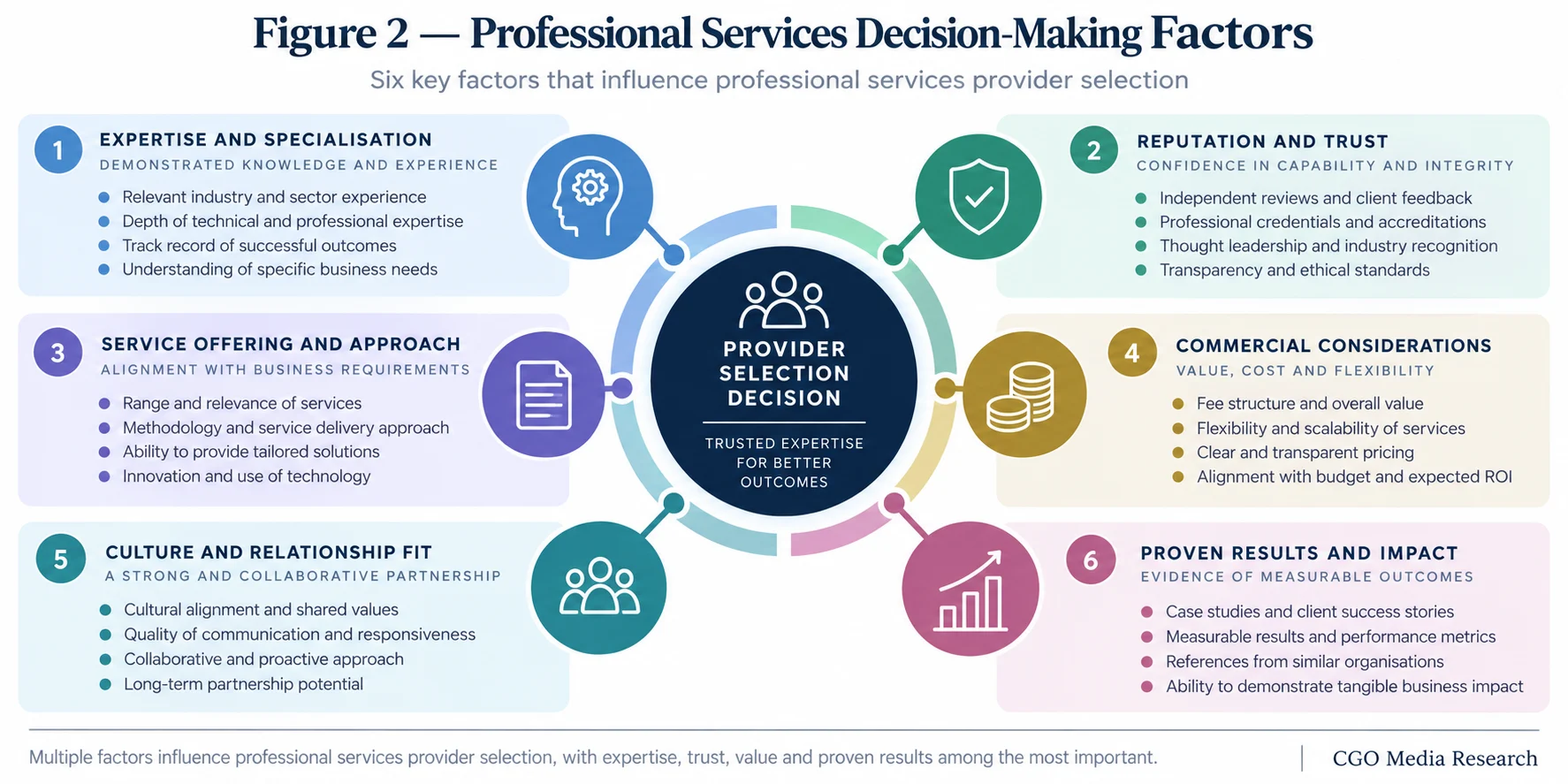
- Reputation
- Communication style
- Methodology
- Cultural fit
- Commercial model
- Senior involvement
107. Soft Requirements Can Become Decisive Later
Once basic eligibility is established, preference factors often shape the shortlist.
108. The Distinction between Hard and Soft Requirements Can Change by Client
One organisation may require sector experience while another treats it as desirable.
109. The Distinction Can Also Change by Engagement
A high-risk project may create stricter requirements than a routine assignment.
110. Requirement Definition Is therefore Contextual
Provider suitability cannot be reduced to one universal checklist.
111. AI Assistants Can Participate in Requirement Definition
Users can ask generative systems to explain:
- Which service they need
- Which credentials matter
- Which specialist experience is relevant
- What questions they should ask providers
112. AI Systems Can Compress Category Research
A user may move from a broad problem description to a relatively detailed provider brief within one interaction.
113. This Can Accelerate Provider Discovery
The user can enter Stage Three with more explicit requirements.
114. But AI Interpretation Can Also Be Incomplete
The resulting service category or requirement set may not capture every relevant professional consideration.
115. Buyers May therefore Validate AI Guidance Elsewhere
They can consult:
- Search results
- Professional bodies
- Industry publications
- Provider websites
- Existing advisers
116. Providers Should Not Depend on One Discovery Interface
Requirement-definition evidence should remain accessible across the wider information environment.
117. Requirement Definition Creates the Initial Selection Filter
Providers that do not meet hard requirements can be excluded before detailed evaluation.
118. This Means Discovery Is Already Selective
The provider does not compete equally in every search scenario.
119. The Initial Candidate Set Is Shaped by Requirement Fit
A useful relationship is:
Problem Definition + Service Requirement + Specialism + Sector + Geography + Credentials → Initial Provider Eligibility
120. Provider Eligibility Should Be Genuine
Organisations should not attempt to appear eligible for work they cannot properly deliver.
121. Clear Boundaries Can Improve Provider Fit
Explicitly communicating limitations can reduce poor-quality enquiries.
122. Clear Boundaries Can Also Improve Trust
Professional-services buyers often value precision over broad claims.
123. Requirement Matching Is therefore More Important Than Maximum Visibility
Visibility should be concentrated around scenarios where real capability exists.
124. Qualified Discovery Begins at Stage Two
The prospective client’s emerging requirements begin determining which providers are relevant.
125. Search Architecture Should Reflect Requirement Dimensions
Professional-services websites can make important distinctions visible through:
- Service architecture
- Specialism architecture
- Sector architecture
- Professional profiles
- Location information
126. Expert Profiles Can Support Requirement Matching
Named professionals can demonstrate the required specialism.
127. Case Studies Can Support Requirement Matching
Comparable client situations can demonstrate applied fit.
128. Research Can Support Requirement Matching
Relevant studies can demonstrate understanding of the problem or market.
129. External Evidence Can Support Requirement Matching
Professional bodies, media and trade sources can reinforce claimed suitability.
130. Poor Information Architecture Can Obscure Genuine Fit
A provider may possess the required expertise while failing to make it discoverable.
131. Hidden Expertise Can therefore Reduce Provider Eligibility in Practice
Capability that cannot be found or validated may not enter the buyer’s candidate set.
132. The Provider-Selection Model Distinguishes Capability from Visibility
A firm can be capable without being visible.
133. The Model Also Distinguishes Visibility from Suitability
A firm can be visible without being the right provider.
134. The Stronger Objective Is Qualified Suitability Visibility
A useful relationship is:
Real Capability + Relevant Visibility + Verifiable Evidence → Qualified Provider Eligibility
135. Stage Two Ends When the Buyer Has a Usable Requirement Set
This does not mean every requirement is final.
136. Requirements Can Continue Evolving During Provider Evaluation
New information can reveal additional selection criteria.
137. Provider Discovery Can Introduce New Requirements
A buyer may learn that certain credentials, methodologies or specialisms are important only after seeing provider evidence.
138. Expert Conversations Can Introduce New Requirements
Initial consultations may reshape the brief.
139. The Journey Is therefore Iterative
Stages One and Two can be revisited later.
140. The First Professional Services Provider Selection Principle
Professional-services provider selection should be understood as a multi-stage decision process in which discoverability alone is insufficient because prospective clients progressively evaluate capability, expertise, trust, evidence, commercial fit and risk before committing to engagement.
141. The Second Professional Services Provider Selection Principle
Business problem recognition frequently occurs before the buyer understands the correct professional-service category, creating an early authority opportunity for providers that can explain problems accurately without forcing premature commercial positioning.
142. The Third Professional Services Provider Selection Principle
Requirement definition converts a broad business problem into a set of hard and soft provider-selection criteria involving service category, specialism, sector, geography, credentials, delivery model, timing and commercial constraints.
143. The Fourth Professional Services Provider Selection Principle
The strongest discovery strategy should prioritise qualified provider eligibility rather than maximum visibility, ensuring professional-services organisations are most visible where genuine capability, evidence and client requirements align.
144. Stage One and Stage Two Output — Defined Provider Requirement
At the end of the first two stages, the prospective client should have progressed from:
Business Problem → Problem Interpretation → Service Category → Required Specialism → Sector / Geographic / Professional Requirements → Initial Provider Eligibility Criteria
145. The Strategic Position Before Provider Discovery
Before the client actively compares providers, a substantial amount of selection has already occurred. The business problem has been interpreted, the likely professional-service category has been identified, specialist requirements have begun to form and hard eligibility conditions may already exclude unsuitable firms. Professional-services organisations therefore influence provider selection well before a branded search or contact form submission. Their problem-led content, service architecture, expert profiles, sector evidence, research and external representation can all help determine whether they enter the initial candidate set when Stage Three — Provider Discovery — begins.
146. Stage Three — Provider Discovery
Once the prospective client has defined the problem and established an initial requirement, attention shifts toward identifying potential providers.
147. Provider Discovery Creates the Initial Candidate Market
The client moves from asking:
What type of help do we need?
to:
Which providers could potentially help us?
148. Discovery Is a Filtering Process
The total provider market is rarely visible to the buyer.
149. Only a Subset Becomes Digitally Discoverable
Providers can be excluded simply because they are difficult to find.
150. Only a Subset of Discoverable Providers Are Relevant
Visibility alone does not establish suitability.
151. The Discovery Relationship Can Be Represented as
Total Provider Market → Discoverable Providers → Relevant Providers → Candidate Set
152. Discovery Can Occur Through Multiple Channels
Professional-services providers can enter the client’s awareness through:
- Search engines
- AI assistants
- Professional directories
- Personal referrals
- Industry associations
- Business networks
- Trade publications
- Review platforms
- Research publications
153. Different Discovery Channels Create Different Forms of Initial Trust
A referral introduces a provider differently from a generic search result.
154. Search Engine Discovery
Traditional search remains an important provider-discovery route.
155. Search Queries Can Combine Multiple Requirement Dimensions
Prospective clients may search by:
- Service
- Location
- Sector
- Problem
- Professional designation
156. Service-Led Queries Can Be Broad
Examples can include:
- Management consultancy
- Executive search firm
- Engineering consultancy
- Business accountant
157. Service-Led Queries Can Become More Specific
The prospect may add:
- Sector
- Location
- Specialism
- Organisation size
- Project type
158. Sector-Led Queries Can Narrow the Market
Examples can include:
- SaaS accountants
- Manufacturing consultants
- Healthcare recruitment firms
- Property engineering consultants
159. Geographic Queries Can Narrow the Market
Location modifiers can reflect:
- Proximity requirements
- Jurisdictional needs
- Regional market knowledge
160. Professional-Designation Queries Can Narrow the Market
A prospect may search specifically for:
- Chartered professionals
- Certified specialists
- Registered practitioners
- Accredited advisers
161. Problem-Led Queries Can Continue into Provider Discovery
The user may search for providers through the language of the problem itself.
162. This Means Problem Authority Can Influence Candidate Inclusion
Providers that explain a problem well can enter consideration before they rank for a conventional provider phrase.
163. Search Results Create an Initial Provider Impression
The buyer may observe:
- Page title
- Brand name
- Location
- Reviews
- Result type
- Visible expertise
164. Search Snippets Can Affect Click Selection
The initial representation influences which providers receive deeper evaluation.
165. Branded Search Can Follow Non-Branded Discovery
A user may first find a provider generically and then perform more focused branded validation.
166. Search Discovery Is therefore Multi-Step
A useful relationship is:
Generic Search → Provider Discovery → Branded Search → Deeper Validation
167. AI-Assisted Provider Discovery
AI-assisted systems can combine multiple requirements within one provider-discovery request.
168. AI Provider Queries Can Be Highly Contextual
A prospect may ask:
“Recommend UK accountancy firms that specialise in SaaS companies and can support international expansion.”
169. This Query Combines Several Selection Dimensions
It includes:
- Profession
- Sector
- Country
- Specialism
- Growth requirement
170. AI Discovery Can Therefore Compress Search Steps
The user can move directly from a detailed requirement to a provider candidate set.
171. AI Discovery Can Include Explanatory Context
The system may provide reasons why a provider appears relevant.
172. Recommendation Rationale Can Shape Candidate Confidence
Where visible, the explanation can reinforce associations such as:
- Sector expertise
- Specialist capability
- Professional reputation
- Research authority
- Geographic coverage
173. AI Discovery Can Also Introduce Provider Comparison Immediately
Multiple providers can be presented side by side before the buyer visits any website.
174. This Changes the Traditional Discovery Sequence
Comparison can begin during discovery rather than after it.
175. AI Provider Sets Should Still Be Treated as Contextual
One generated result does not represent a universal market ranking.
176. AI Provider Discovery Can Vary by Scenario
Outputs can differ according to:
- Prompt wording
- Platform
- Date
- Location
- Conversation context
177. Providers Should therefore Focus on Underlying Evidence
The durable objective is to make genuine capabilities legible across the wider source environment.
178. Referral-Led Discovery
Personal recommendations remain highly influential in professional-services markets.
179. Referrals Can Reduce Initial Search Friction
The client begins with at least one provider already suggested.
180. Referrals Can Transfer Initial Trust
Confidence in the referrer can influence confidence in the provider.
181. Referrals Rarely Remove the Need for Digital Validation
Prospects often investigate the recommended provider independently.
182. Referral Validation Can Include Branded Search
The client may search:
- Firm name
- Professional name
- Firm name + reviews
- Firm name + clients
- Firm name + accreditation
183. Referral Validation Can Include Website Review
The client may inspect:
- Services
- Team
- Case studies
- Research
- Contact information
184. Referral Validation Can Include Third-Party Evidence
Professional bodies, media and reviews can reinforce or weaken the referral.
185. A Referral Is therefore an Entry Point, Not Always the Final Decision
The provider still needs sufficient evidence to survive later stages.
186. Directory-Led Discovery
Professional and industry directories can reduce the available provider market through structured filtering.
187. Directory Filters Can Include
- Location
- Profession
- Membership
- Specialism
- Sector
188. Directory Presence Can Establish Basic Eligibility
In some professional markets, recognised directory inclusion may provide useful trust.
189. Directory Completeness Can Affect Discovery
Incomplete profiles can reduce the probability of matching relevant filters.
190. Directory Accuracy Can Affect Trust
Outdated professional or office information can create uncertainty.
191. Directory Discovery Can Trigger Website Validation
The user often visits the provider’s own site after finding a directory listing.
192. Media-Led Discovery
A prospective client can discover a provider through public commentary rather than a commercial search.
193. Expert Commentary Can Introduce Named Professionals
A journalist may quote a specialist before the buyer knows the wider firm.
194. Trade Journalism Can Introduce Sector Specialists
Industry-specific visibility can create a strong initial relevance signal.
195. Conference Coverage Can Introduce Professional Expertise
Speaking activity can create additional discovery pathways.
196. Research-Led Discovery
Original studies can introduce the organisation through evidence rather than promotion.
197. Research Can Create Discovery Before Commercial Intent
A user may encounter a firm while seeking:
- Data
- Benchmarks
- Market analysis
- Methodology
- Industry trends
198. Research Discovery Can Produce Higher-Trust Entry Points
The provider is initially encountered as a source of useful knowledge.
199. Research Can Introduce Both Firm and Expert Entities
Named authorship can connect organisational and professional authority.
200. Research Discovery Can Trigger Further Provider Evaluation
The prospective client may move from a paper or report toward:
- Professional profile
- Service page
- Sector page
- Case study
201. Network-Led Discovery
Business networks, peer groups and professional communities can also introduce providers.
202. Network Discovery Can Be Informal
A peer may mention a provider during:
- Conversation
- Online discussion
- Industry event
- Professional community exchange
203. Network Discovery Can Be Formal
Professional associations may maintain supplier or member directories.
204. Network Trust Can Influence Initial Candidate Inclusion
But the provider may still need evidence to progress.
205. Review-Platform Discovery
Some professional-services clients may use review environments directly when identifying potential providers.
206. Review Discovery Is More Relevant in Some Professional Categories Than Others
Public-review behaviour varies substantially across B2B and confidential services.
207. Low Review Volume Should therefore Be Interpreted Contextually
A confidential advisory firm may naturally generate fewer public reviews than a transactional service provider.
208. Discovery Sources Often Overlap
A client can encounter the same provider through several routes.
209. Repeated Discovery Can Increase Familiarity
The provider may appear through:
- Search
- Media
- Research
- Referral
- Directory
210. Familiarity Can Support Initial Confidence
But repeated exposure should not be confused with proof of suitability.
211. The Discoverable Provider Market Is Dynamic
Candidate sets can change as the client modifies the requirement.
212. Broad Requirements Produce Larger Candidate Sets
General service queries can expose many providers.
213. Specialist Requirements Produce Smaller Candidate Sets
Sector, credential or geographic criteria can eliminate many providers.
214. Discovery Quality Is therefore More Important Than Discovery Volume
A provider should seek inclusion within relevant candidate sets rather than every possible provider list.
215. Qualified Discovery Can Reduce Commercial Waste
Relevant visibility can reduce:
- Poor-fit enquiries
- Unrealistic proposals
- Low-probability opportunities
216. Stage Three Ends When a Candidate Set Exists
The prospective client has identified providers that appear potentially relevant.
217. Discovery Does Not Yet Establish Capability
The next stage asks whether those providers can actually deliver the required service.
218. Stage Four — Service and Expertise Evaluation
Once a provider enters the candidate set, the prospective client evaluates whether the organisation appears capable of solving the defined problem.
219. Evaluation Begins with Service Fit
The client asks:
Does this organisation actually provide what we need?
220. Broad Service Labels Are Often Insufficient
A generic term may not explain:
- Scope
- Depth
- Methodology
- Suitable client type
- Deliverables
221. Service Scope Should Be Clear
The provider should explain what is included and excluded.
222. Service Scope Supports Expectation Setting
The prospect can determine whether the provider’s offer matches the requirement.
223. Service Pages Should Explain Typical Problems Addressed
This helps the buyer recognise contextual fit.
224. Service Pages Should Explain Deliverables
The prospective client should understand what the engagement may produce.
225. Service Pages Should Explain Process Where Appropriate
Methodological clarity can reduce uncertainty.
226. Service Pages Should Explain Suitable Client Types
Clear suitability criteria improve qualification.
227. Service Fit Is therefore More Than Keyword Alignment
A page can rank for a service term without demonstrating genuine capability.
228. The Service Fit Relationship Is
Relevant Service + Appropriate Scope + Suitable Method + Client Applicability → Service Fit
229. Expertise Fit Is the Next Evaluation Layer
The client asks:
Does this provider possess the specialist knowledge required?
230. Expertise Should Be Attributable
Professional-services buyers often want to know who holds the expertise.
231. Named Experts Can Strengthen Capability Evidence
Relevant profiles can demonstrate:
- Experience
- Specialisms
- Qualifications
- Sector familiarity
232. Professional Qualifications Can Support Expertise Fit
Formal credentials can be especially important in regulated or technical services.
233. Relevant Experience Can Support Expertise Fit
The client may evaluate whether professionals have addressed comparable situations.
234. Published Insight Can Support Expertise Fit
Articles, research and commentary can demonstrate depth of understanding.
235. Specialist Methodologies Can Support Expertise Fit
Distinctive approaches can help explain how professional knowledge is applied.
236. Expertise Should Be Relevant Rather Than Merely Impressive
A strong reputation in an unrelated area may contribute little to the current selection scenario.
237. Relevance Should Be Claim-Specific
Evidence should support the particular capability under evaluation.
238. Sector Fit Is the Next Evaluation Layer
The client asks whether the provider understands the commercial or professional environment in which the problem exists.
239. Sector Fit Can Be Important in Complex Markets
Relevant context can include:
- Regulation
- Industry terminology
- Customer behaviour
- Operating models
- Competitive conditions
240. Sector Case Studies Can Support Sector Fit
Applied examples demonstrate experience within similar environments.
241. Industry Research Can Support Sector Fit
Original evidence can demonstrate deeper market understanding.
242. Relevant Clients Can Support Sector Fit
Where disclosure is appropriate, client evidence can demonstrate practical experience.
243. Trade Publication Contributions Can Support Sector Fit
External commentary reinforces industry participation.
244. Named Sector Specialists Can Support Sector Fit
The organisation should make clear who understands the market.
245. Sector Fit Should Not Be Claimed Without Evidence
Generic industry pages can create weak provider confidence.
246. Context Fit Extends Beyond Sector
Two organisations in the same industry can still have very different needs.
247. Context Fit Can Include Organisation Size
A multinational client can require different capabilities from an SME.
248. Context Fit Can Include Growth Stage
A start-up, scale-up and mature enterprise may need different support.
249. Context Fit Can Include Complexity
Multi-country or multi-stakeholder assignments can require broader capability.
250. Context Fit Can Include Risk
High-risk situations may require more experienced or specialised providers.
251. Methodology Fit Is Another Evaluation Layer
Clients may evaluate how the provider proposes to approach the assignment.
252. Methodology Can Reduce Perceived Uncertainty
A clear process helps the buyer understand what working with the provider may involve.
253. Methodology Can Include Assessment
The provider explains how the current situation will be understood.
254. Methodology Can Include Diagnosis
The provider explains how causes or requirements will be identified.
255. Methodology Can Include Planning
The provider explains how recommendations or delivery plans will be developed.
256. Methodology Can Include Implementation
The provider explains how action will be taken.
257. Methodology Can Include Measurement
The provider explains how progress or outcomes may be assessed.
258. Methodology Should Remain Proportionate
Not every service requires the same level of process disclosure.
259. Proprietary Detail Does Not Need to Be Disclosed Fully
The objective is sufficient clarity for provider evaluation.
260. Team Fit Is Another Evaluation Layer
The identity of the professionals delivering the work can materially influence selection.
261. Seniority Can Influence Team Fit
Clients may want to understand how much senior involvement they will receive.
262. Relevant Experience Can Influence Team Fit
Professional history can help establish confidence.
263. Sector Knowledge Can Influence Team Fit
Named experts with relevant industry experience can strengthen suitability.
264. Availability Can Influence Team Fit
A highly suitable professional may still be unsuitable if unavailable.
265. Team Scale Can Influence Fit
Some assignments require:
- One senior adviser
- A specialist team
- A multidisciplinary group
- International resources
266. The Named Team Can Matter More Than the Firm Brand
In expertise-led work, the actual delivery team may determine client confidence.
267. Case Studies Provide Applied Expertise Evidence
They help answer:
Has this provider handled a comparable situation before?
268. Strong Case Studies Should Provide Context
The client needs enough background to judge comparability.
269. Strong Case Studies Should Identify the Problem
The challenge should be explained clearly.
270. Strong Case Studies Should Identify the Service
The reader should understand what intervention occurred.
271. Strong Case Studies Should Identify Relevant Expertise
The provider should connect the work with the capability that delivered it.
272. Strong Case Studies Should Explain the Outcome
The result provides evidence of applied capability.
273. A Useful Case Study Relationship Is
Client Context → Problem → Service → Expertise → Outcome
274. Outcome Evidence Can Be Quantitative
Where appropriate, providers can report measurable change.
275. Outcome Evidence Can Be Qualitative
Relevant results can also include:
- Improved decision quality
- Risk reduction
- Process improvement
- Better governance
- Successful delivery
276. Outcome Evidence Should Be Accurate
Results should not be exaggerated or detached from context.
277. Individual Outcomes Should Not Be Presented as Universal Guarantees
Professional-services results depend on circumstances beyond the provider’s control.
278. Confidentiality Can Restrict Case Study Detail
Professional-services firms may need to use:
- Anonymisation
- Aggregation
- Client-approved summaries
279. Lack of Public Client Names Does Not Automatically Remove Evidential Value
The important question is whether the evidence remains credible and sufficiently contextual.
280. Service and Expertise Evaluation Reduces Capability Uncertainty
The client moves from:
They appear relevant
toward:
They appear capable
281. Stage Four Ends When Capability Appears Credible
The client now needs to decide whether that capability can be trusted.
282. Stage Five — Professional Trust Validation
Once service and expertise fit appear credible, the prospective client increasingly evaluates whether the provider is trustworthy.
283. Trust Validation Asks a Different Question
The question becomes:
Can we rely on this provider?
284. Trust Is Multi-Dimensional
Professional-services trust can involve:
- Competence
- Integrity
- Professional standing
- Client experience
- Reputation
- Independent recognition
285. Credential Validation Is One Trust Layer
Professional credentials can act as both eligibility and confidence signals.
286. Credentials Should Be Relevant
A qualification should support the capability under evaluation.
287. Credentials Should Be Current Where Current Status Matters
Expired or outdated claims can undermine trust.
288. Credentials Should Be Independently Verifiable Where Possible
Relevant validation may come from:
- Professional bodies
- Regulators
- Accreditation organisations
- Certification bodies
289. Professional Memberships Can Support Trust
Membership can indicate participation within a recognised professional community.
290. Membership Should Not Be Overstated
Different memberships carry different levels of significance.
291. Regulatory Status Can Be a Critical Trust Layer
Some professional activities require formal authorisation.
292. Regulatory Accuracy Is therefore Material
Incorrect claims can create both trust and compliance risk.
293. Review Validation Is Another Trust Layer
Client reviews can reveal recurring experiences across engagements.
294. Review Rating Is One Dimension
The headline rating provides only a partial picture.
295. Review Volume Is Another Dimension
A larger body of feedback can provide more context.
296. Review Recency Is Another Dimension
Recent feedback can better reflect current service delivery.
297. Review Themes Are Another Dimension
Repeated themes can reveal perceptions around:
- Expertise
- Communication
- Responsiveness
- Professionalism
- Value
298. Negative Feedback Is Part of Trust Evaluation
Prospects may examine how recurring problems are described.
299. Provider Responses Can Affect Trust
Professional responses can demonstrate accountability and communication quality.
300. Review Evidence Should Be Interpreted by Professional Context
Confidential advisory firms may naturally have less public-review evidence.
301. Client References Can Supplement Public Reviews
Direct references can provide deeper validation in high-value B2B engagements.
302. Testimonials Can Support Trust
They can provide client perspective where attribution and context are appropriate.
303. Testimonials Are Stronger When Specific
Useful feedback can identify:
- Problem
- Service
- Professional experience
- Outcome
304. Reputation Validation Extends Beyond Reviews
Prospective clients can research wider public evidence.
305. Branded Reputation Searches Can Include
- Firm name + reviews
- Firm name + complaints
- Professional name
- Firm name + clients
- Firm name + accreditation
306. Professional Name Searches Can Be Particularly Important
Senior advisers often function as independent trust entities within the provider-selection journey.
307. Media Reputation Can Support Trust
Relevant third-party commentary can reinforce public expertise.
308. Trade Reputation Can Support Trust
Industry-specific recognition can strengthen sector credibility.
309. Research Citations Can Support Trust
External use of a firm’s research can reinforce intellectual authority.
310. Independent Recognition Can Support Trust
Relevant evidence can include:
- Awards
- Professional appointments
- Conference invitations
- Media citations
- Research citations
311. Recognition Should Be Assessed for Relevance
An award or citation matters most when it supports the capability under consideration.
312. Recognition Should Be Assessed for Independence
Paid or self-submitted recognition differs from genuinely independent validation.
313. Recognition Should Be Assessed for Recency
Historical recognition can remain useful but may not reflect current capability fully.
314. Recognition Should Be Assessed for Specificity
Named professional or service recognition can be more informative than a generic brand mention.
315. Trust Is Contextual
The amount of evidence required varies by engagement.
316. Service Type Influences Trust Requirements
Regulated and specialist work may require greater validation.
317. Project Value Influences Trust Requirements
Higher-value engagements often involve deeper due diligence.
318. Risk Level Influences Trust Requirements
High-impact decisions can require stronger evidence.
319. Regulatory Environment Influences Trust Requirements
Formal status may be mandatory in some professional contexts.
320. Organisation Size Influences Trust Requirements
Large enterprises may impose more formal procurement and validation standards.
321. Decision-Maker Expectations Influence Trust Requirements
Different stakeholders may prioritise:
- Credentials
- Reputation
- Client evidence
- Risk controls
- Commercial value
322. Higher-Risk Engagements Require Stronger Evidence
A small advisory assignment may require relatively limited validation.
323. Major Projects Require Deeper Trust Evidence
Examples can include:
- Transformation programmes
- Executive appointments
- Major engineering projects
- Regulated advisory work
- Multi-country engagements
324. Trust Validation Is Progressive Risk Reduction
Each credible evidence layer reduces a different form of uncertainty.
325. Service Evidence Reduces Relevance Uncertainty
The client learns whether the provider offers the required capability.
326. Expert Evidence Reduces Capability Uncertainty
The client learns whether suitable professionals exist.
327. Case Studies Reduce Applied-Experience Uncertainty
The client learns whether similar problems have been addressed.
328. Credentials Reduce Professional-Standing Uncertainty
The client learns whether important claims are independently supported.
329. Reviews Reduce Client-Experience Uncertainty
The client learns how other clients describe the provider.
330. External Recognition Reduces Reputation Uncertainty
The client sees whether independent sources reinforce the provider’s authority.
331. The Validation Funnel Narrows the Candidate Set
The progression can be represented as:
Total Provider Market → Discoverable Providers → Relevant Providers → Eligible Providers → Validated Providers → Consideration Set
332. A Provider Can Be Discoverable but Not Relevant
Visibility does not guarantee requirement fit.
333. A Provider Can Be Relevant but Not Eligible
A missing credential or capability can remove it from consideration.
334. A Provider Can Be Eligible but Not Validated
Insufficient evidence can reduce trust.
335. A Validated Provider Enters a Stronger Consideration Set
The client now has enough evidence to evaluate commercial and organisational fit.
336. Evidence Accumulates Throughout the Journey
Provider selection should not be viewed as one final trust decision.
337. Service Pages Can Establish Relevance
They explain whether the capability matches the requirement.
338. Professional Profiles Can Establish Expertise
They demonstrate who holds the capability.
339. Case Studies Can Establish Applied Experience
They demonstrate how expertise has been used.
340. Professional Bodies Can Establish Credentials
They provide independent verification.
341. Reviews Can Establish Client Confidence
They provide experience-based evidence.
342. Research Can Establish Intellectual Authority
Original evidence can reinforce both expertise and sector understanding.
343. Media Can Establish External Recognition
Relevant public commentary reinforces independent authority.
344. Together, These Layers Determine Advancement
The provider progresses when the evidence is sufficiently coherent and credible.
345. AI Systems Can Compress Discovery, Evaluation and Trust Validation
A single request can combine several selection stages.
346. A User Might Ask
“Which UK consulting firms specialise in supply-chain optimisation for mid-sized manufacturers, and which have strong evidence of relevant client work?”
347. This Query Combines Provider Discovery
It asks which firms are available.
348. This Query Combines Expertise Evaluation
It asks which firms possess the relevant specialism.
349. This Query Combines Sector Fit
It restricts the provider set to manufacturing experience.
350. This Query Combines Trust Validation
It asks for evidence of relevant client work.
351. AI Compression Increases the Importance of Connected Evidence
Providers need evidence that supports several decision questions simultaneously.
352. Disconnected Evidence Creates Interpretation Friction
A system may identify the provider but fail to connect it with the correct expert, sector or client proof.
353. Connected Evidence Supports Better Provider Understanding
A useful relationship is:
Service → Expert → Sector → Client Evidence → External Validation
354. The Fifth Professional Services Provider Selection Principle
Provider discovery should be understood as the creation of a qualified candidate set across search engines, AI systems, referrals, directories, media, research and professional networks, with relevance and genuine requirement fit more important than maximum visibility.
355. The Sixth Professional Services Provider Selection Principle
Service and expertise evaluation should connect clear service scope, attributable professional expertise, sector context, methodology, team evidence and comparable case studies so prospective clients can move from simple provider awareness toward credible capability assessment.
356. The Seventh Professional Services Provider Selection Principle
Professional trust validation should rely on relevant, accurate and independently verifiable evidence where possible, recognising that credentials, reviews, client references, reputation, professional memberships, media recognition and research citations perform different trust functions.
357. The Eighth Professional Services Provider Selection Principle
The first five stages of provider selection should be understood as progressive uncertainty reduction, narrowing a large theoretical market through discoverability, relevance, eligibility, expertise and trust until a smaller validated consideration set remains.
358. Stage Three to Stage Five Output — Validated Provider Consideration Set
The complete progression can be summarised as:
Provider Discovery → Service Fit → Expertise Fit → Sector Fit → Applied Evidence → Credential Validation → Reputation Validation → Validated Provider
359. The Strategic Position after Trust Validation
At the end of Stage Five, the prospective client has moved substantially beyond simple digital discovery. Providers have entered the candidate set through search, AI systems, referrals, directories, media, research or professional networks; service and expertise evidence has been examined; and relevant credentials, client experience and independent recognition have been used to reduce perceived risk. The remaining providers now appear sufficiently capable and trustworthy to justify deeper assessment. The next stage therefore shifts away from basic capability and trust toward a different question: whether the provider is commercially, operationally and organisationally suitable for the specific engagement.
360. Stage Six — Commercial and Organisational Fit Assessment
Once a professional-services provider appears sufficiently capable and trustworthy, the prospective client begins evaluating whether the organisation is commercially and operationally suitable for the engagement.
361. Commercial Fit Is Different from Capability Fit
A provider can possess the required expertise while still being unsuitable because of:
- Price
- Capacity
- Delivery model
- Geography
- Timing
- Organisational compatibility
362. Stage Six Asks a Different Question
The client increasingly asks:
Can this provider work with us effectively under the conditions of this engagement?
363. Commercial and Organisational Fit Is Multi-Dimensional
The live model identifies factors including:
- Pricing model
- Project scale
- Team availability
- Geographic coverage
- Engagement structure
- Communication approach
- Organisational compatibility
364. Pricing Fit Is One Commercial Dimension
Pricing Fit concerns whether the provider’s commercial model is compatible with the client’s:
- Budget
- Expectations
- Procurement requirements
- Perceived value
365. Professional-Services Pricing Can Take Different Forms
Common arrangements can include:
- Project fees
- Retainers
- Hourly rates
- Fixed-fee packages
- Success-linked models
- Hybrid arrangements
366. Different Pricing Models Suit Different Engagements
A short specialist review may require a different structure from an ongoing advisory relationship.
367. Price Is Not the Same as Value
Professional-services buyers do not always select the lowest-priced provider.
368. Perceived Value Can Depend on Expertise
A highly experienced provider may justify a higher fee where the client believes specialist knowledge reduces uncertainty.
369. Perceived Value Can Depend on Risk Reduction
Clients may be willing to pay more where provider quality reduces the potential cost of failure.
370. Perceived Value Can Depend on Speed
Urgent projects can place greater value on fast availability and delivery.
371. Perceived Value Can Depend on Senior Involvement
Direct access to experienced professionals can materially influence perceived value.
372. Perceived Value Can Depend on Specialist Knowledge
Niche expertise may command greater value where generalist alternatives would require more learning or create additional risk.
373. Perceived Value Can Depend on Expected Commercial Impact
The client may judge fees relative to the potential financial or strategic value of the outcome.
374. A Useful Value Relationship Is
Relevant Expertise + Risk Reduction + Delivery Confidence + Expected Impact → Perceived Value
375. Price Transparency Can Affect Commercial Fit
Different professional-services markets have different expectations around public pricing information.
376. Some Services Can Support Published Pricing
Clearly defined packages may permit:
- Starting prices
- Fixed fees
- Indicative ranges
377. Complex Services May Require Custom Pricing
The organisation may need to understand:
- Scope
- Complexity
- Resources
- Timescale
- Risk
before quoting accurately.
378. Pricing Clarity Still Matters Where Exact Fees Are Not Published
The provider can explain:
- How fees are determined
- What drives cost
- Typical engagement structures
- What is included
379. Pricing Ambiguity Can Increase Selection Friction
A prospective client may hesitate where the commercial model is impossible to understand.
380. Pricing Precision Can Improve Qualification
Clear commercial expectations can reduce poor-fit enquiries.
381. Engagement Model Fit Is Another Commercial Dimension
Clients may prefer different ways of working depending on the nature of the requirement.
382. One-Off Project Engagements
These may suit clearly defined assignments with:
- Specific scope
- Defined deliverables
- Clear completion criteria
383. Retained Advisory Support
This can suit clients requiring continuing access to expertise.
384. Embedded Consultancy
Some projects require external specialists to work closely with internal teams over an extended period.
385. Fractional Leadership
A client may require senior capability without a full-time appointment.
386. Outsourced Function Models
Some providers may assume continuing responsibility for a defined business capability.
387. Specialist Review or Audit Models
The provider may be engaged to evaluate a specific area and deliver findings or recommendations.
388. Engagement Structure Can Influence Provider Eligibility
A provider offering only project-based work may be unsuitable for a client seeking long-term embedded support.
389. Delivery Flexibility Can Strengthen Fit
Where appropriate, providers capable of adapting their engagement structure can remain eligible across a wider range of situations.
390. Delivery Flexibility Should Not Create Ambiguity
The organisation should still explain what each model involves.
391. Team and Capacity Fit Is Another Major Dimension
Clients may evaluate whether the provider has sufficient resources and the correct team structure.
392. The Client May Ask Who Leads the Work
Leadership visibility can influence confidence.
393. The Client May Ask Who Performs Day-to-Day Delivery
The named sales contact may not be the person responsible for execution.
394. The Client May Ask How Much Senior Involvement Is Included
This can materially influence perceived value.
395. The Client May Ask Whether the Provider Has Sufficient Capacity
A specialist firm can have strong capability but insufficient resources for a large programme.
396. The Client May Ask Whether Work Can Begin on Time
Availability can be a decisive selection criterion.
397. Team Evidence Can Reduce Capacity Uncertainty
Useful information can include:
- Named project leadership
- Team roles
- Specialisms
- Office coverage
- Delivery capacity
398. Team Scale Should Match Project Scale
A useful relationship is:
Project Complexity + Required Expertise + Delivery Volume + Timescale → Required Team Capacity
399. Bigger Is Not Always Better
Some clients may prefer specialist teams with greater direct senior access.
400. Smaller Is Not Always Better
Large or complex assignments may require wider multidisciplinary resources.
401. Organisational Scale Fit Is Therefore Contextual
The live model recognises that clients may prefer:
- Large multidisciplinary firms
- Mid-sized specialist practices
- Boutique consultancies
- Individual senior advisers
402. The Right Scale Depends on the Engagement
Relevant factors include:
- Complexity
- Budget
- Risk
- Required expertise
- Delivery geography
403. Scale Can Influence Perceived Risk
A larger firm may be perceived as having greater capacity and continuity.
404. Scale Can Influence Perceived Access
A smaller provider may be perceived as offering more direct senior involvement.
405. Scale Can Influence Specialist Depth
A boutique may possess deeper expertise in a narrow problem than a larger generalist firm.
406. Scale Can Influence Breadth
A multidisciplinary firm may support several related needs within one engagement.
407. Cultural Fit Is Another Selection Dimension
Cultural Fit becomes particularly important where providers will work closely with internal teams.
408. Communication Style Can Influence Cultural Fit
Clients may prefer providers that communicate in a way compatible with their organisation.
409. Working Approach Can Influence Cultural Fit
Some organisations prefer:
- Highly collaborative delivery
- Independent specialist advice
- Structured methodology
- Flexible working
410. Decision-Making Style Can Influence Cultural Fit
The provider may need to work effectively within:
- Founder-led businesses
- Corporate hierarchies
- Public-sector governance
- International structures
411. Responsiveness Can Influence Cultural Fit
Client expectations around communication frequency and speed can vary significantly.
412. Values Alignment Can Influence Cultural Fit
Some organisations evaluate:
- Ethics
- Sustainability
- Diversity
- Professional standards
as part of supplier assessment.
413. Collaboration Model Can Influence Cultural Fit
The provider may need to work with:
- Leadership teams
- Internal specialists
- Other advisers
- Suppliers
- Regulators
414. Cultural Fit Is Difficult to Judge Through Static Pages Alone
It can become clearer through:
- Initial calls
- Consultations
- Proposal meetings
- Client references
- Professional commentary
415. Digital Evidence Can Still Influence Initial Cultural Perception
Tone, transparency and clarity can shape expectations before direct engagement.
416. Geographic and Delivery Fit Is Another Dimension
Some services require physical proximity while others can be delivered remotely.
417. Office Proximity Can Matter
Physical presence can be important where:
- Site visits are required
- Local relationships matter
- Regular in-person collaboration is expected
418. National Coverage Can Matter
Clients with multiple locations may require broader operational reach.
419. International Capability Can Matter
Cross-border projects can require:
- International coordination
- Local knowledge
- Multilingual capability
- Multiple jurisdictions
420. Remote Delivery Experience Can Matter
Digital delivery capability can expand the relevant provider market.
421. Time-Zone Compatibility Can Matter
International working arrangements can create practical delivery constraints.
422. Geography Should Be Evaluated According to the Service
Physical office location does not carry equal importance across all professional-services engagements.
423. Jurisdiction Can Be More Important Than Distance
Relevant regulatory or professional knowledge may matter more than physical proximity.
424. Procurement Fit Can Become Important at Stage Six
Larger clients may have formal supplier requirements.
425. Procurement Requirements Can Include
- Insurance
- Security standards
- Financial stability
- Data protection
- Compliance policies
- Supplier onboarding
426. Procurement Fit Can Remove Otherwise Strong Providers
A provider can possess excellent expertise but fail a mandatory supplier requirement.
427. Commercial Fit Can therefore Contain Hard Requirements
Examples can include:
- Maximum budget
- Required capacity
- Required insurance
- Delivery geography
- Mandatory contractual terms
428. Commercial Fit Can Also Contain Soft Requirements
Examples can include:
- Preferred pricing model
- Communication style
- Senior access
- Working culture
- Delivery flexibility
429. Commercial Fit Is Therefore Another Filtering Layer
A validated provider can still leave consideration where the operational model does not fit.
430. The Commercial-Fit Relationship Can Be Represented as
Price + Value + Team Capacity + Engagement Model + Culture + Geography + Procurement Fit → Commercial and Organisational Suitability
431. Stage Six Reduces Implementation Risk
The client increasingly tests whether a successful engagement appears operationally realistic.
432. Capability Without Delivery Fit Creates Risk
A provider may understand the problem but be unable to deliver under the required conditions.
433. Delivery Fit Without Capability Also Creates Risk
Availability and price cannot compensate for inadequate expertise.
434. Strong Fit Requires Both
A useful relationship is:
Professional Capability + Commercial Suitability → Engagement Viability
435. Stage Six Ends When Commercial Viability Is Established
The remaining providers appear sufficiently:
- Capable
- Trustworthy
- Affordable
- Available
- Operationally compatible
436. Stage Seven — Comparison and Shortlisting
At the comparison stage, the client evaluates a smaller group of validated and commercially viable providers against a more explicit selection framework.
437. The Purpose Is No Longer Broad Discovery
The objective becomes:
Which providers deserve final consideration?
438. The Comparison Set Is Smaller Than the Initial Candidate Set
Providers have already been filtered through:
- Relevance
- Eligibility
- Expertise
- Trust
- Commercial fit
439. Comparison Is Usually Multi-Factor
A client rarely compares professional-services firms on one variable alone.
440. Typical Comparison Dimensions Include
- Service fit
- Expertise
- Sector experience
- Credentials
- Team quality
- Client evidence
- Commercial model
- Reputation
441. The Model Identifies Seven Core Provider Selection Signals
- Service Fit
- Expertise Fit
- Sector and Context Fit
- Professional Credentials and Trust
- Client Evidence and Outcomes
- Commercial and Organisational Fit
- Provider Confidence
442. Signal One — Service Fit
Service Fit evaluates whether the organisation provides the required capability at the necessary level of depth.
443. Strong Service Fit Requires More Than a Matching Label
The provider should demonstrate:
- Appropriate scope
- Relevant methodology
- Suitable delivery model
- Clear client applicability
444. Service Fit Can Be High or Low
A provider may offer the broad service while lacking the required specialist depth.
445. Signal Two — Expertise Fit
Expertise Fit evaluates whether the provider possesses the specialist professional knowledge required for the engagement.
446. Expertise Fit Should Be Attributable
The client should ideally be able to identify:
- Relevant professionals
- Experience
- Specialisms
- Qualifications
- Research or commentary
447. Expertise Fit Can Differentiate Similar Service Providers
Several firms may offer the same service while possessing very different specialist depth.
448. Signal Three — Sector and Context Fit
Sector and Context Fit evaluates whether the provider understands the client’s market, operating environment and specific situation.
449. Sector Fit Can Include Regulatory Understanding
Industry-specific obligations can materially affect service delivery.
450. Sector Fit Can Include Commercial Understanding
Different markets have different:
- Business models
- Customer behaviours
- Margins
- Competitive structures
451. Context Fit Goes Beyond Sector
The provider may need experience with:
- Similar organisation size
- Similar growth stage
- Similar geography
- Similar project complexity
452. Signal Four — Professional Credentials and Trust
This signal evaluates whether important claims around competence, standing and professional legitimacy can be validated.
453. Professional Credentials Can Include
- Qualifications
- Registrations
- Memberships
- Accreditations
- Regulatory approvals
454. Trust Extends Beyond Formal Credentials
It can also include:
- Reputation
- Professional conduct
- Reviews
- Independent recognition
- Client references
455. Signal Five — Client Evidence and Outcomes
Client evidence helps establish whether the firm has successfully applied its expertise in relevant contexts.
456. Strong Client Evidence Can Include
- Case studies
- Testimonials
- Client references
- Outcome evidence
- Repeat engagements
457. Client Evidence Is Strongest When Comparable
The prospect wants to understand whether previous work resembles the current problem.
458. Client Evidence Is Strongest When Contextual
The evidence should explain:
- Who the client was or what type of organisation
- What problem existed
- What intervention occurred
- What outcome followed
459. Signal Six — Commercial and Organisational Fit
This signal evaluates whether the provider’s pricing, scale, delivery model and working structure are compatible with the client’s needs.
460. Commercial Fit Can Become Decisive Even Where Expertise Is Similar
Two technically capable providers may offer substantially different:
- Fees
- Team structures
- Timescales
- Engagement models
- Working approaches
461. Signal Seven — Provider Confidence
Provider Confidence represents the client’s overall belief that the organisation is a credible and suitable choice.
462. Provider Confidence Is Emergent
It arises from the combined effect of the other selection signals rather than one standalone factor.
463. Provider Confidence Is Not Equivalent to Brand Awareness
A famous provider can still produce low confidence for a specific requirement.
464. Provider Confidence Is Not Equivalent to Search Ranking
High visibility does not guarantee selection confidence.
465. Provider Confidence Is Not Equivalent to Review Rating
Public feedback is only one part of the evidence environment.
466. A Useful Provider Confidence Relationship Is
Service Fit + Expertise Fit + Context Fit + Trust + Client Evidence + Commercial Fit → Provider Confidence
467. Provider Confidence Is Scenario-Specific
The same organisation can generate high confidence for one engagement and low confidence for another.
468. Context Changes Signal Weight
Different selection criteria become more or less important according to the situation.
469. Regulated Assignments Can Weight Credentials More Heavily
Professional status can become a hard requirement.
470. Specialist Consulting Engagements Can Weight Sector Expertise More Heavily
Deep market understanding may differentiate otherwise similar providers.
471. Large Transformation Projects Can Weight Capacity More Heavily
Delivery scale can become a major constraint.
472. High-Risk Projects Increase the Evidence Threshold
As project value, complexity or risk increases, clients typically demand stronger evidence.
473. Higher Evidence Thresholds Can Require
- More detailed case studies
- Senior professional involvement
- Independent references
- Formal credentials
- More rigorous commercial evaluation
474. Low-Risk Engagements Can Require Less Validation
Smaller or routine assignments may progress with fewer evidence layers.
475. Basic Clarity Remains Important at Lower Risk
The provider still needs to demonstrate:
- Relevant service
- Credibility
- Availability
- Commercial suitability
476. Comparison Criteria Can Be Weighted Explicitly
Formal procurement processes may use scored evaluation matrices.
477. Comparison Criteria Can Also Be Weighted Informally
Smaller organisations may use discussion and judgement rather than formal scoring.
478. Formal Scoring Does Not Eliminate Subjective Judgement
Criteria such as:
- Cultural fit
- Communication quality
- Confidence
- Senior-team chemistry
can remain partly qualitative.
479. Comparison Content Can Support the Client
Professional-services firms can publish information that answers common selection questions.
480. Useful Comparison Content Can Explain Suitability
The provider can state which organisations or situations the service is designed for.
481. Useful Comparison Content Can Explain Engagement Structure
The client can understand how work is typically delivered.
482. Useful Comparison Content Can Explain Who Delivers the Work
Named team evidence can reduce uncertainty.
483. Useful Comparison Content Can Explain Relevant Sector Experience
This helps establish context fit.
484. Useful Comparison Content Can Explain Typical Project Structures
The buyer gains a more realistic understanding of engagement expectations.
485. Useful Comparison Content Can Explain How Fees Are Determined
This improves commercial transparency even where exact prices vary.
486. Comparison Content Should Support Decision-Making Rather Than Attack Competitors
The strongest approach is to explain:
- Fit
- Scope
- Evidence
- Methodology
- Commercial model
487. External Comparison Platforms Can Influence Shortlisting
Directories and other platforms may organise providers according to standard attributes.
488. External Comparison Attributes Can Include
- Location
- Specialism
- Reviews
- Professional status
- Sector expertise
- Firm size
489. Standardised Attributes Can Improve Comparability
The buyer can evaluate multiple providers through a common structure.
490. Standardisation Can Also Oversimplify Providers
Complex professional expertise cannot always be represented adequately through a fixed set of filters.
491. AI-Assisted Comparison Adds Another Comparison Layer
AI systems can synthesise evidence across several providers.
492. AI Comparison Queries Can Be Explicit
A user may ask:
“Compare three UK consulting firms with experience in digital transformation for financial-services companies.”
493. AI Comparison Requires Comparative Interpretation
The system must determine differences across:
- Capability
- Expertise
- Sector fit
- Evidence
- Reputation
494. Comparative Evidence Consistency Becomes Important
Comparisons become harder where similar capabilities are described using inconsistent terminology.
495. Clear Service Definitions Improve Comparability
The provider should explain its capability in precise language.
496. Clear Expert Definitions Improve Comparability
Named specialists should be associated with genuine areas of expertise.
497. Clear Sector Definitions Improve Comparability
Industry evidence should support claimed market experience.
498. Clear Case Study Context Improves Comparability
Prospects can understand whether previous work resembles their own situation.
499. AI-Generated Comparisons Have Limitations
They may occasionally:
- Omit relevant providers
- Use outdated information
- Misstate services
- Overgeneralise differences
- Rely on weak third-party sources
500. Providers Should Monitor Comparative Representation
Relevant scenario testing can reveal:
- Incorrect positioning
- Missing expertise
- Outdated facts
- Weak source evidence
501. AI Comparison Monitoring Should Be Methodologically Bounded
Useful records can include:
- Platform
- Date
- Prompt family
- Geography
- Visible sources
502. One AI Comparison Is Not a Universal Provider Ranking
Observed comparison outcomes remain scenario-specific.
503. The Shortlist Is Smaller Than the Consideration Set
The purpose of Stage Seven is to identify the providers worthy of final engagement.
504. Shortlist Formation Requires Clear Relevance
The provider should match the defined requirement.
505. Shortlist Formation Requires Strong Expertise
The necessary professional capability should be visible and credible.
506. Shortlist Formation Requires Trust Evidence
Important claims should be sufficiently validated.
507. Shortlist Formation Requires Commercial Suitability
The engagement should appear operationally viable.
508. Shortlist Formation Requires Acceptable Perceived Risk
The client should believe the provider represents a manageable decision.
509. Shortlist Formation Often Requires Differentiation
When several providers meet the core requirements, meaningful distinctions become more important.
510. Differentiation Should Not Depend Entirely on Slogans
Generic claims such as:
- Trusted experts
- Client-focused
- Innovative solutions
- Leading advisers
provide limited comparative evidence unless supported.
511. Specialist Expertise Can Create Differentiation
A provider may possess deeper knowledge of the precise problem.
512. Sector Focus Can Create Differentiation
Strong market experience can reduce the client’s perceived learning risk.
513. Distinctive Methodology Can Create Differentiation
A clearly articulated approach can help the client understand how the provider works.
514. Senior-Team Access Can Create Differentiation
Direct access to recognised specialists can influence final consideration.
515. Original Research Can Create Differentiation
Distinctive evidence can demonstrate deeper understanding of the market or problem.
516. Client Evidence Can Create Differentiation
Relevant outcomes can provide stronger applied proof than generic positioning.
517. Delivery Model Can Create Differentiation
A provider may offer a structure that better fits the client’s operational needs.
518. Differentiation Should Be Relevant to the Requirement
An unusual feature has limited value if it does not affect the client’s decision.
519. Meaningful Differentiation Reduces Substitutability
The provider becomes more difficult to replace with an apparently similar alternative.
520. Reputation Can Influence Shortlist Formation
Relevant reputation sources can include:
- Peer recommendations
- Client references
- Media coverage
- Professional bodies
- Review platforms
- Industry recognition
521. Reputation Can Act as a Risk Shortcut
A strong existing reputation can reduce the perceived need for some forms of validation.
522. Reputation Should Not Override Requirement Fit
A highly recognised provider may still be unsuitable for a specialist engagement.
523. Thought Leadership Can Influence Shortlisting
Useful professional insight can reinforce the perception that a firm understands the client’s problem deeply.
524. Thought Leadership Is Particularly Relevant to Strategic Services
Complex advisory engagements often involve judgement rather than standardised delivery alone.
525. Strong Thought Leadership Should Be Expert-Led
Named specialists can strengthen attribution and professional credibility.
526. Strong Thought Leadership Should Be Specific
Generic commentary provides less differentiation than clear insight into relevant problems.
527. Named Expert Visibility Can Influence Shortlisting
Clients may select a firm because they want access to one or more recognised professionals.
528. The Professional Can Become a Selection Anchor
The organisation’s wider authority may be interpreted through a trusted individual.
529. Expert Authority Can therefore Transfer to Firm Authority
A useful relationship is:
Recognised Professional Expertise → Increased Firm Confidence → Stronger Shortlist Potential
530. Firm Authority Can Also Transfer to Expert Confidence
A respected organisation can provide an initial trust environment around individual professionals.
531. Strong Provider Selection Systems Connect Both
The most robust model combines:
Firm Authority + Named Expert Authority
532. Shortlisting Can Be Formal
Large organisations may use:
- RFP processes
- Procurement panels
- Supplier scoring
- Formal interviews
- Tender stages
533. Shortlisting Can Be Informal
Smaller organisations may simply reduce a list of providers through internal discussion.
534. Formal and Informal Shortlisting Use Similar Evidence Questions
Both ultimately ask:
- Can they do the work?
- Do we trust them?
- Do they fit our situation?
- Can we work with them?
- Are they worth the cost?
535. Shortlist Success Depends on Evidence Coherence
The strongest provider presents mutually reinforcing evidence rather than isolated claims.
536. Service Evidence Should Reinforce Expert Evidence
The named specialists should match the advertised capability.
537. Expert Evidence Should Reinforce Sector Evidence
Industry authority should be associated with relevant professionals.
538. Sector Evidence Should Reinforce Client Evidence
Case studies should demonstrate actual market experience where possible.
539. Client Evidence Should Reinforce Trust Evidence
External feedback and outcomes should support the provider’s claims.
540. Commercial Evidence Should Reinforce Delivery Confidence
Pricing, capacity and engagement structure should appear realistic.
541. A Coherent Evidence System Produces Stronger Provider Confidence
The buyer encounters the same underlying capability across several independent decision dimensions.
542. Incoherent Evidence Can Reduce Confidence
Examples include:
- Service page claims with no named experts
- Expert profiles with no relevant service connection
- Sector claims with no client evidence
- Outdated credentials
- Contradictory commercial information
543. Provider Confidence Can Collapse Late in the Journey
Strong early visibility does not protect a provider from contradictory evidence discovered during comparison.
544. Late-Stage Evidence Quality Is therefore Critical
The closer the client moves toward selection, the more important decision-support precision becomes.
545. The Ninth Professional Services Provider Selection Principle
Commercial and organisational fit should be treated as a distinct selection layer because professional capability and trust do not automatically establish pricing compatibility, delivery capacity, engagement-model fit, cultural compatibility, geographic suitability or procurement eligibility.
546. The Tenth Professional Services Provider Selection Principle
Professional-services comparison should evaluate providers through a contextual combination of service fit, expertise fit, sector and situational fit, professional trust, client evidence, commercial suitability and overall provider confidence rather than rely on one headline metric.
547. The Eleventh Professional Services Provider Selection Principle
Provider Confidence is an emergent outcome created by the convergence of multiple evidence layers, meaning strong brand awareness, rankings, reviews or credentials alone should not be treated as equivalent to complete selection readiness.
548. The Twelfth Professional Services Provider Selection Principle
Shortlist formation should favour meaningful differentiation grounded in genuine expertise, sector relevance, client evidence, methodology, senior access, research and delivery fit rather than unsupported promotional claims or attempts to appear universally suitable.
549. Stage Six and Stage Seven Output — Shortlist-Ready Provider
The complete progression can be summarised as:
Validated Provider → Commercial Fit → Organisational Fit → Comparative Evidence → Provider Confidence → Meaningful Differentiation → Shortlist
550. The Strategic Position before Final Engagement
At the end of Stage Seven, the prospective client has moved from a broad market of possible providers to a much smaller group that appear capable, trustworthy, commercially viable and sufficiently differentiated to justify final consideration. Service fit, expertise, sector context, professional credentials, client evidence and commercial suitability have been compared directly, while overall Provider Confidence has emerged from the combined consistency of those evidence layers. The final stage therefore shifts from digital and comparative evaluation toward direct interaction: enquiry, proposal, negotiation and the final engagement decision.
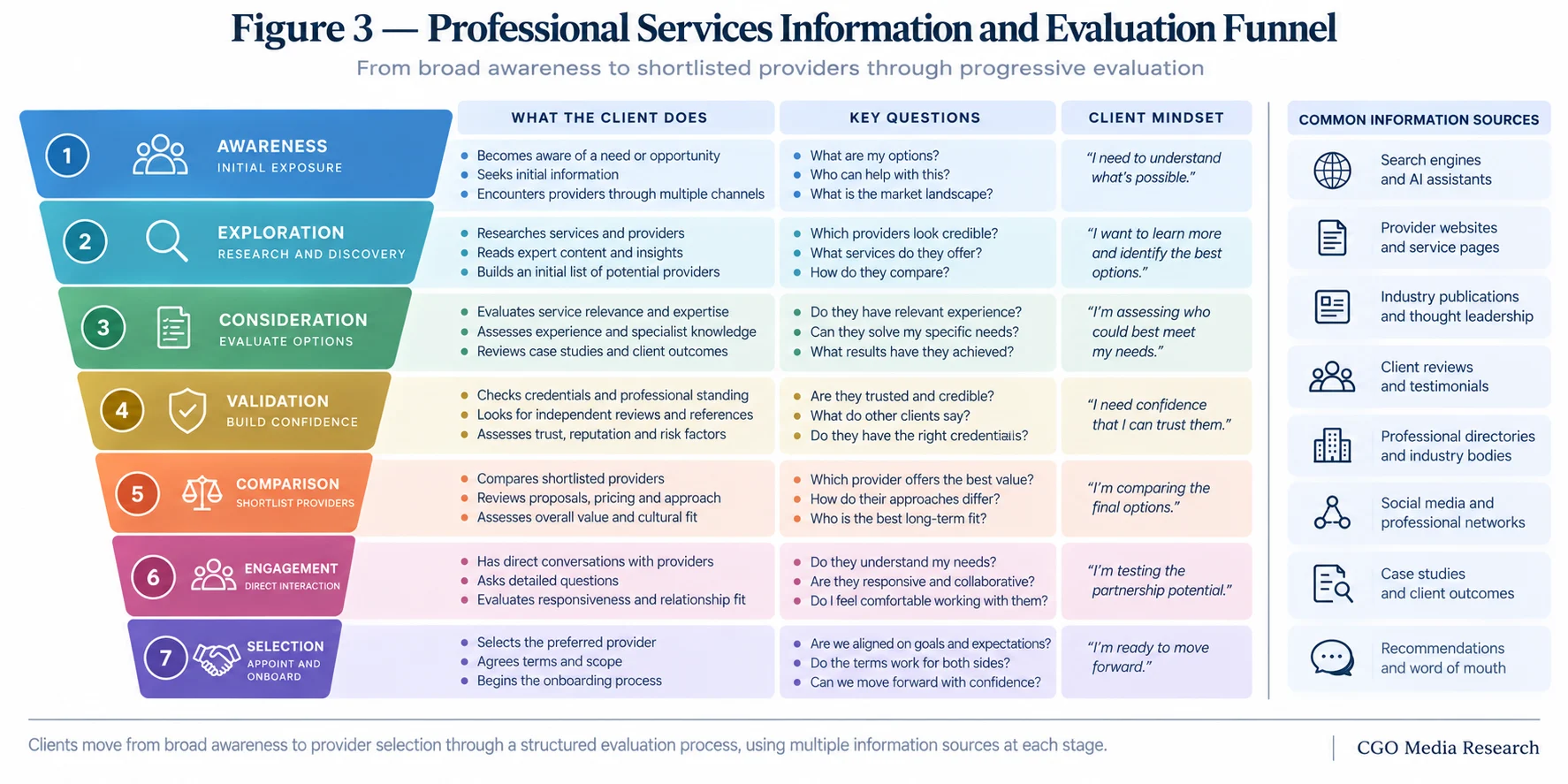
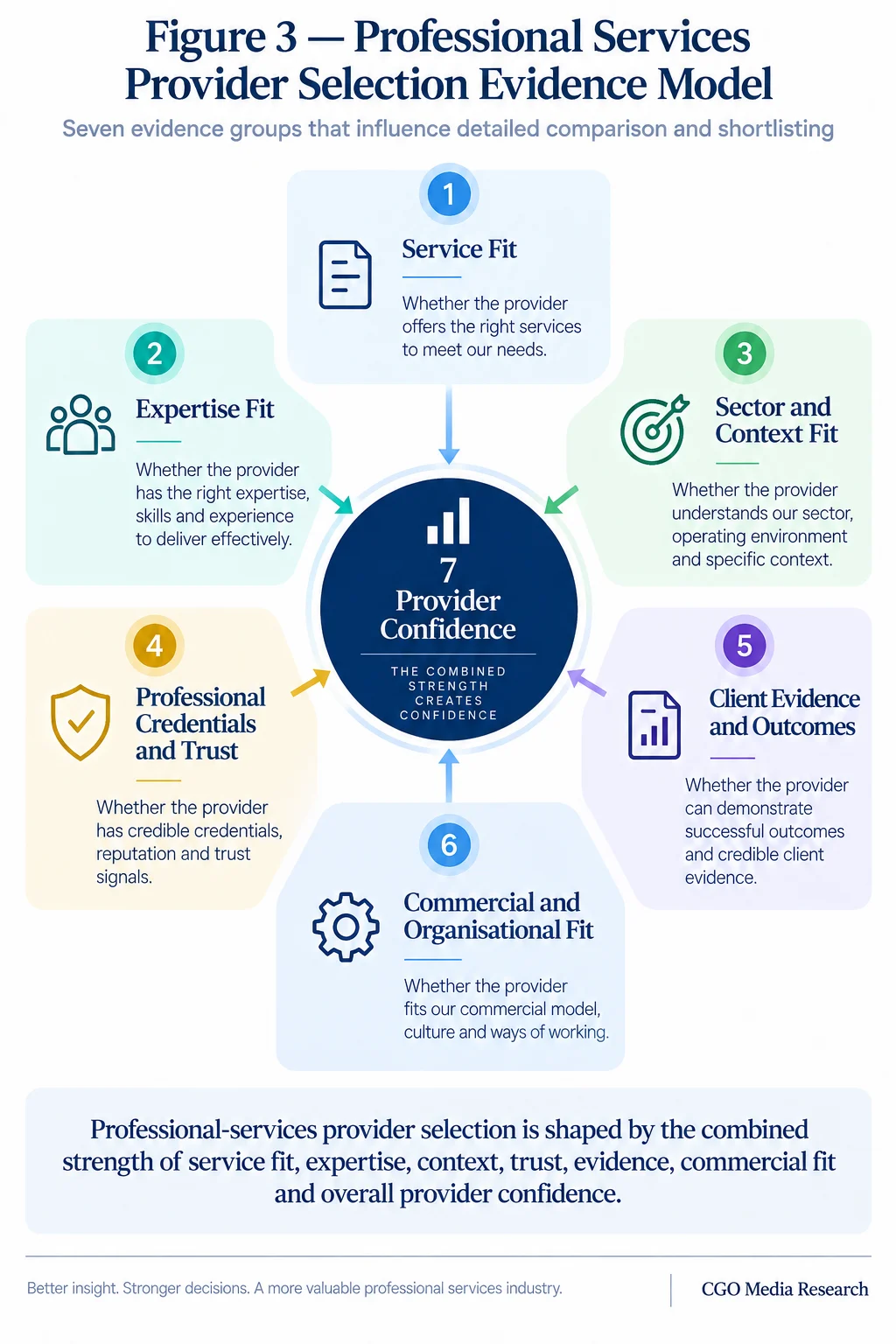
551. Stage Eight — Enquiry, Proposal and Engagement
At the final stage, the prospective client moves from digital evaluation and comparative shortlisting into direct commercial interaction with one or more providers.
552. The Transition from Evaluation to Engagement Is Critical
A provider can accumulate strong trust throughout the earlier stages and still lose the opportunity if the enquiry or proposal experience is weak.
553. Stage Eight Converts Public Authority into Client-Specific Confidence
The provider must demonstrate that the expertise, trust and evidence encountered during earlier research can be translated into a credible solution for the client’s actual situation.
554. The Enquiry Experience Is the First Direct Test
The client begins evaluating how the organisation behaves when direct contact occurs.
555. Enquiry Accessibility Matters
The client should be able to understand clearly:
- How to contact the firm
- Which team to contact
- What information to provide
- What happens next
556. Contact Routes Should Match the Service
Different professional-services engagements may require different routes such as:
- General enquiry
- Consultation request
- Proposal request
- Specialist contact
- Office contact
557. Overly Generic Contact Routes Can Create Friction
A high-value prospect may be less confident if every enquiry disappears into one undifferentiated form.
558. Named Specialist Contact Can Reduce Friction
Where appropriate, connecting the enquiry with a relevant professional can reinforce confidence.
559. Response Speed Can Influence Selection
The provider’s responsiveness becomes part of the client’s assessment of operational reliability.
560. Response Quality Matters More Than Speed Alone
A fast but generic response may contribute less confidence than a considered and relevant one.
561. The First Response Should Demonstrate Understanding
The organisation should show that it has understood:
- The client’s problem
- The likely service requirement
- The relevant context
- The next useful step
562. Initial Consultation Can Become a Selection Event
For complex services, the first conversation may materially alter the shortlist.
563. The Client Evaluates Professional Judgement During Initial Contact
The conversation can reveal:
- Depth of understanding
- Quality of questions
- Commercial awareness
- Communication quality
- Professional confidence
564. Good Questions Can Strengthen Provider Confidence
Experienced professionals often demonstrate expertise by identifying important issues the client has not yet considered.
565. Poor Questions Can Reduce Provider Confidence
A superficial discovery process can contradict earlier claims of specialist expertise.
566. Direct Interaction Validates Digital Positioning
The provider’s behaviour should be consistent with the authority established online.
567. A Strong Digital Brand with Weak Direct Interaction Creates an Evidence Conflict
The client may begin questioning whether public positioning accurately reflects delivery quality.
568. Consistency Strengthens Confidence
A useful relationship is:
Public Evidence + Direct Professional Experience → Stronger Provider Confidence
569. The Proposal Stage Converts Authority into a Client-Specific Solution
The proposal should demonstrate more than generic capability.
570. The Proposal Should Demonstrate Problem Understanding
The client should see evidence that the provider understands the specific business situation.
571. The Proposal Should Demonstrate Requirement Understanding
The proposed service should align with the brief that emerged through the earlier stages.
572. The Proposal Should Demonstrate Relevant Methodology
The provider should explain how the work is expected to proceed.
573. The Proposal Should Demonstrate Team Fit
The client should understand:
- Who will lead
- Who will deliver
- Which specialists are involved
- How much senior input is included
574. The Proposal Should Demonstrate Timeline Fit
The delivery plan should match the client’s urgency and operational constraints.
575. The Proposal Should Demonstrate Deliverable Clarity
The client should understand what will be produced.
576. The Proposal Should Demonstrate Commercial Clarity
Relevant information can include:
- Fees
- Payment structure
- Scope boundaries
- Assumptions
- Additional costs
577. The Proposal Should Demonstrate Relevant Evidence
The provider can reinforce the recommendation with:
- Comparable case studies
- Named experts
- Relevant credentials
- Sector evidence
- Research
- Client references
578. Proposal Evidence Should Be Selective
The strongest evidence is not necessarily the largest volume of evidence.
579. Relevant Evidence Is Stronger Than Generic Evidence
A case study closely aligned with the current requirement can carry more value than several unrelated success stories.
580. Proposal Personalisation Should Be Genuine
Replacing the client’s name within a generic template does not create meaningful personalisation.
581. Genuine Personalisation Reflects the Actual Decision Context
It should consider:
- Business problem
- Sector
- Risk
- Stakeholders
- Timescale
- Desired outcome
582. Proposal Quality Can Reveal Organisational Capability
The document itself can signal:
- Attention to detail
- Commercial understanding
- Professional discipline
- Communication quality
583. Proposal Quality Should Not Substitute for Capability
A polished document cannot compensate for weak expertise.
584. Capability Should Not Substitute for Proposal Clarity
Strong professionals can still lose work where the client cannot understand the proposed solution.
585. The Strongest Proposal Combines Both
A useful relationship is:
Relevant Expertise + Clear Solution + Credible Evidence + Commercial Clarity → Proposal Confidence
586. Professional Services Selection Does Not End When the Proposal Arrives
Clients can continue validating the provider throughout the final decision stage.
587. Reference Checks Can Continue after Proposal
The client may speak directly with previous or existing clients.
588. Professional Registration Checks Can Continue after Proposal
Formal status can be verified independently.
589. Additional Online Research Can Continue after Proposal
Decision-makers may conduct further:
- Brand searches
- Expert searches
- Review searches
- Media searches
590. Leadership Review Can Continue after Proposal
Senior stakeholders may investigate a provider independently before approving the engagement.
591. Procurement Assessment Can Continue after Proposal
Commercial or compliance processes can run in parallel with professional evaluation.
592. Late-Stage Evidence Contradictions Can Still Damage Selection
Examples can include:
- Outdated professional status
- Conflicting office information
- Unexpected negative reviews
- Unclear commercial terms
- Unverified claims
593. Late-Stage Consistency Is Therefore Important
The provider should maintain coherence between:
- Website
- Proposal
- Professional profiles
- External evidence
- Direct conversation
594. Procurement Can Introduce a Separate Selection System
Larger organisations may evaluate the provider through formal commercial and compliance processes.
595. Requests for Proposal Can Standardise Comparison
The client may require several providers to answer the same set of questions.
596. Supplier Questionnaires Can Extend Validation
They may examine:
- Financial stability
- Operational capacity
- Security
- Data protection
- Insurance
- Business continuity
597. Compliance Checks Can Determine Eligibility
Failure to satisfy a mandatory requirement can remove a provider regardless of its expertise.
598. Insurance Requirements Can Determine Eligibility
Professional indemnity or other coverage may be mandatory.
599. Commercial Scoring Can Formalise Comparison
The client may weight:
- Price
- Capability
- Methodology
- Experience
- Risk
600. Reference Validation Can Formalise Trust
Independent client feedback can become part of the procurement process.
601. Procurement and Professional Evaluation Can Produce Different Rankings
A provider that appears strongest professionally may not score highest commercially.
602. The Final Selection Therefore Requires Trade-Offs
Decision-makers may need to balance:
- Expertise
- Cost
- Risk
- Capacity
- Cultural fit
603. Selection Committees Increase Decision Complexity
Large or important engagements can involve multiple stakeholders.
604. Executive Sponsors Can Focus on Strategic Value
They may prioritise:
- Outcome potential
- Strategic fit
- Leadership confidence
605. Operational Leaders Can Focus on Delivery Fit
They may prioritise:
- Methodology
- Implementation
- Practical collaboration
- Team quality
606. Procurement Can Focus on Commercial and Supplier Risk
Relevant factors can include:
- Price
- Contract terms
- Supplier standards
- Compliance
607. Finance Can Focus on Commercial Value
Decision-makers may assess:
- Budget
- Return potential
- Payment terms
- Financial risk
608. Legal Can Focus on Contractual Risk
Relevant issues can include:
- Liability
- Data protection
- Confidentiality
- Intellectual property
609. Technical Specialists Can Focus on Professional Depth
They may scrutinise:
- Methodology
- Credentials
- Technical competence
- Delivery assumptions
610. Different Stakeholders Can Weight Evidence Differently
The strongest provider must often create confidence across several decision perspectives.
611. Consensus Can Be More Important Than Individual Preference
One stakeholder may strongly prefer one provider while the wider organisation selects another.
612. Final Selection Can Reflect the Provider with the Broadest Acceptable Confidence
The chosen firm does not necessarily need to dominate every criterion.
613. Consensus Can Depend on Risk Acceptability
Decision groups often prefer providers that create sufficient confidence across all major risks.
614. Consensus Can Depend on Evidence Coherence
Contradictory evidence can make internal approval harder.
615. Consensus Can Depend on Internal Explainability
Decision-makers may need to justify why a provider was selected.
616. Strong Evidence Helps Internal Champions Defend the Selection
A stakeholder recommending a provider can point to:
- Expertise
- Case studies
- Credentials
- Commercial fit
- Independent validation
617. Provider Selection Is Therefore an Evidence Aggregation Process
The final decision can be understood as the accumulation and interpretation of evidence across the entire journey.
618. Relevance Is the First Evidence Group
The provider must address the correct problem and service requirement.
619. Expertise Is the Second Evidence Group
The provider must possess the required professional capability.
620. Trust Is the Third Evidence Group
Important claims must be sufficiently credible and validated.
621. Commercial Fit Is the Fourth Evidence Group
The engagement must be financially and operationally viable.
622. Client Evidence Is the Fifth Evidence Group
Applied experience can demonstrate that the provider has delivered relevant work.
623. Confidence Is the Aggregating Decision Layer
The client interprets the combined evidence and decides whether remaining uncertainty is acceptable.
624. The Simplified Final Selection Relationship Is
Relevance + Expertise + Trust + Commercial Fit + Evidence + Confidence → Selection Potential
625. Selection Potential Is Not a Universal Score
It changes according to the specific engagement.
626. Professional Authority Is One Selection Dimension
Professional Authority reflects the provider’s broader strength across:
- Expertise
- Professional standing
- Evidence
- Research
- External recognition
627. Client Fit Is a Separate Selection Dimension
Client Fit reflects how well the provider matches:
- Service requirement
- Sector context
- Project scale
- Commercial constraints
- Delivery requirements
628. High Authority and High Fit Create the Strongest Selection Position
The provider possesses both broad professional credibility and strong contextual suitability.
629. High Authority and Low Fit Can Still Produce Weak Selection Potential
An established provider may be inappropriate for a specific requirement.
630. A Large Consultancy Can Illustrate This
It may possess significant authority while being:
- Too expensive
- Too large
- Insufficiently specialist
- Operationally unsuitable
for a particular engagement.
631. Low Authority and High Fit Creates a Different Risk
A specialist provider can appear highly relevant while lacking sufficient external evidence or trust.
632. Specialist Fit Alone May Not Overcome Trust Deficit
The client may hesitate where:
- Credentials are unclear
- Client evidence is weak
- External validation is limited
- Professional reputation is difficult to assess
633. Low Authority and Low Fit Create the Weakest Position
The provider lacks both contextual suitability and sufficient trust evidence.
634. The Strongest Position therefore Combines Authority and Fit
A useful relationship is:
Professional Authority + Client Fit + Supporting Evidence + Decision Confidence → Stronger Selection Potential
635. Authority Should Not Be Optimised Independently of Fit
A professional-services firm should not seek to appear authoritative in every possible scenario.
636. Fit Should Not Be Optimised Independently of Authority
A provider should not simply create pages claiming relevance without supporting evidence.
637. The Strategic Objective Is Qualified Authority
The strongest position is to possess credible authority where the organisation genuinely fits the client requirement.
638. Qualified Authority Improves Recommendation Precision
The provider becomes more likely to be considered in appropriate scenarios and less dependent on generic prominence.
639. Qualified Authority Can Improve Lead Quality
Better-fit discovery can reduce poor-quality enquiries.
640. Qualified Authority Can Improve Proposal Efficiency
More relevant opportunities can reduce unnecessary proposal work.
641. Qualified Authority Can Improve Commercial Learning
Win and loss data becomes more useful where the underlying opportunity was genuinely relevant.
642. Final Selection Is Often a Risk-Adjusted Decision
Clients rarely seek theoretical maximum expertise without considering delivery risk.
643. Perceived Risk Can Include Capability Risk
The client asks whether the provider can solve the problem.
644. Perceived Risk Can Include Professional Risk
The client asks whether the provider’s credentials and standing are reliable.
645. Perceived Risk Can Include Delivery Risk
The client asks whether the provider can execute effectively.
646. Perceived Risk Can Include Commercial Risk
The client asks whether the engagement represents acceptable value and financial exposure.
647. Perceived Risk Can Include Relationship Risk
The client asks whether the teams can work effectively together.
648. Perceived Risk Can Include Reputational Risk
The client may consider whether the selection itself could create internal or external criticism.
649. Evidence Reduces Different Forms of Risk
Different evidence types perform different functions.
650. Credentials Can Reduce Professional Risk
Independent status validation can strengthen confidence.
651. Case Studies Can Reduce Capability Risk
Comparable work demonstrates applied experience.
652. References Can Reduce Delivery Risk
Previous clients can describe the actual engagement experience.
653. Commercial Clarity Can Reduce Financial Risk
Transparent scope and fee structures reduce uncertainty.
654. Team Profiles Can Reduce Relationship Risk
The client understands who will be involved.
655. Independent Recognition Can Reduce Reputational Risk
External authority can make the provider easier to defend internally.
656. Provider Selection Can therefore Be Viewed as Progressive Risk Reduction
The complete journey reduces uncertainty layer by layer.
657. The Selection Journey Begins with Problem Uncertainty
The client may not initially know what support is required.
658. Requirement Definition Reduces Category Uncertainty
The client identifies the likely service and specialist criteria.
659. Provider Discovery Reduces Market Uncertainty
The client identifies possible suppliers.
660. Expertise Evaluation Reduces Capability Uncertainty
The client assesses whether providers can perform the work.
661. Trust Validation Reduces Credibility Uncertainty
The client validates whether important claims can be believed.
662. Commercial Fit Assessment Reduces Delivery Uncertainty
The client assesses whether the engagement can work practically.
663. Comparison Reduces Relative Uncertainty
The client determines which providers appear stronger than alternatives.
664. Proposal and Engagement Reduce Final Decision Uncertainty
The client tests the provider’s solution, team, commercial terms and direct interaction.
665. The Complete Risk-Reduction Sequence Is
Problem Uncertainty → Category Uncertainty → Market Uncertainty → Capability Uncertainty → Trust Uncertainty → Delivery Uncertainty → Relative Uncertainty → Decision Confidence
666. The Thirteenth Professional Services Provider Selection Principle
The enquiry and proposal stage should be treated as a continuation of the provider-selection process rather than a separate sales event because direct interaction tests whether the professional expertise, trust, service clarity and commercial confidence established earlier remain consistent when applied to the client’s specific situation.
667. The Fourteenth Professional Services Provider Selection Principle
Professional-services proposals should convert public authority into a client-specific solution by connecting problem understanding, methodology, team, timescale, deliverables, commercial terms and relevant evidence rather than relying primarily on generic capability statements.
668. The Fifteenth Professional Services Provider Selection Principle
Final provider selection should be understood as evidence aggregation across multiple stakeholders, where professional authority and client-specific fit perform different functions and a highly authoritative provider can still be unsuitable when service, sector, commercial or organisational fit is weak.
669. The Sixteenth Professional Services Provider Selection Principle
The strongest provider-selection position combines professional authority, contextual client fit, relevant supporting evidence and sufficient decision confidence, creating qualified selection potential rather than attempting to maximise authority independently of suitability.
670. Stage Eight Output — Engagement-Ready Provider
The complete final-stage progression can be summarised as:
Shortlist → Enquiry → Direct Professional Interaction → Proposal → Continued Validation → Procurement → Stakeholder Consensus → Engagement Decision
671. The Strategic Position at the Final Selection Stage
At the end of Stage Eight, provider selection has moved far beyond initial visibility. The client has progressively reduced uncertainty around the business problem, service category, provider market, specialist capability, professional trust, commercial suitability and relative provider strength. Direct interaction, proposal quality, procurement checks, reference validation and stakeholder consensus then determine whether the remaining evidence is sufficient to support engagement. The strongest position belongs not simply to the provider with the greatest market authority, nor necessarily to the provider with the closest apparent fit, but to the organisation that combines credible professional authority with strong client-specific suitability and enough coherent evidence to create decision confidence across the relevant stakeholder group.
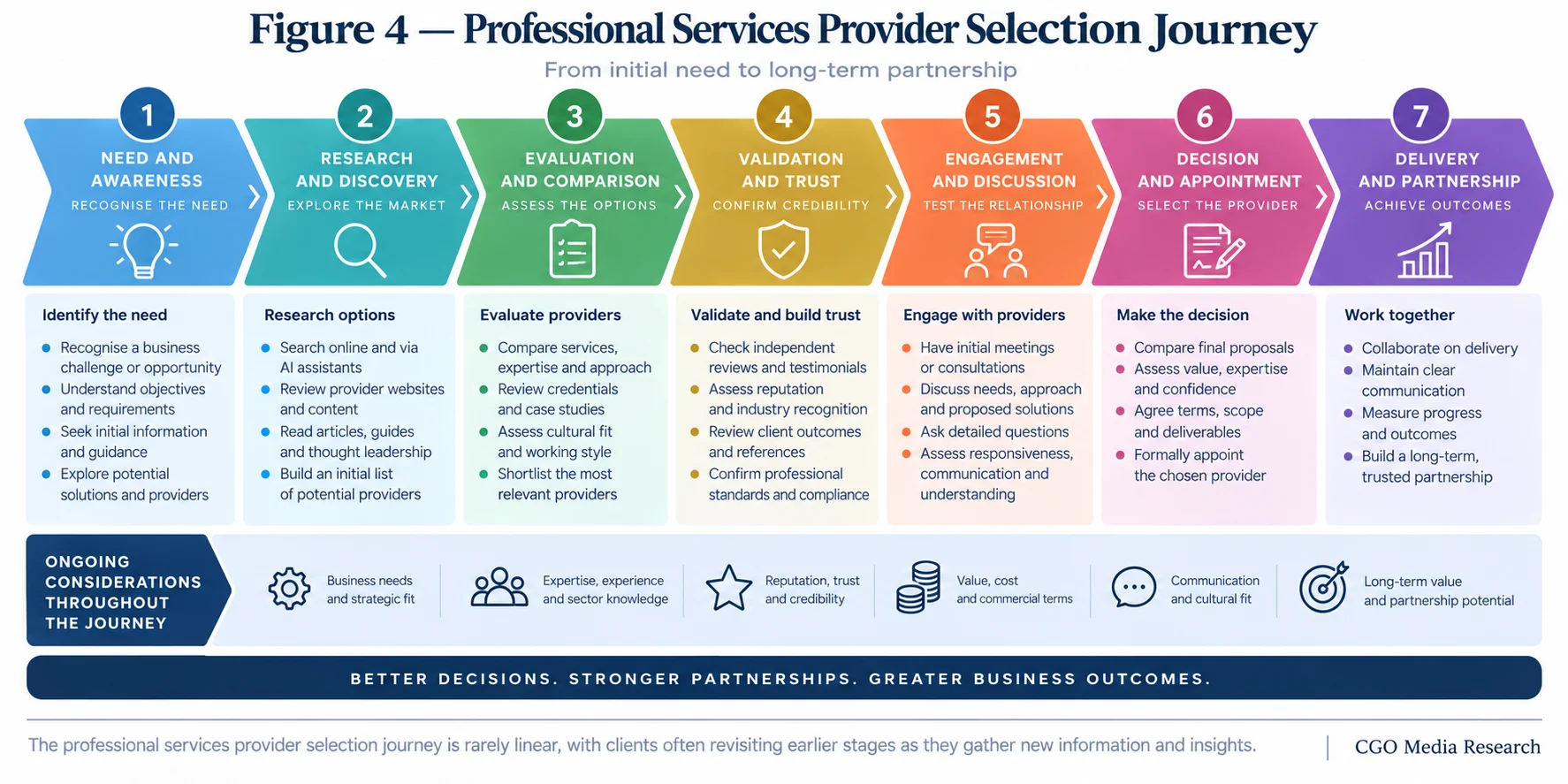
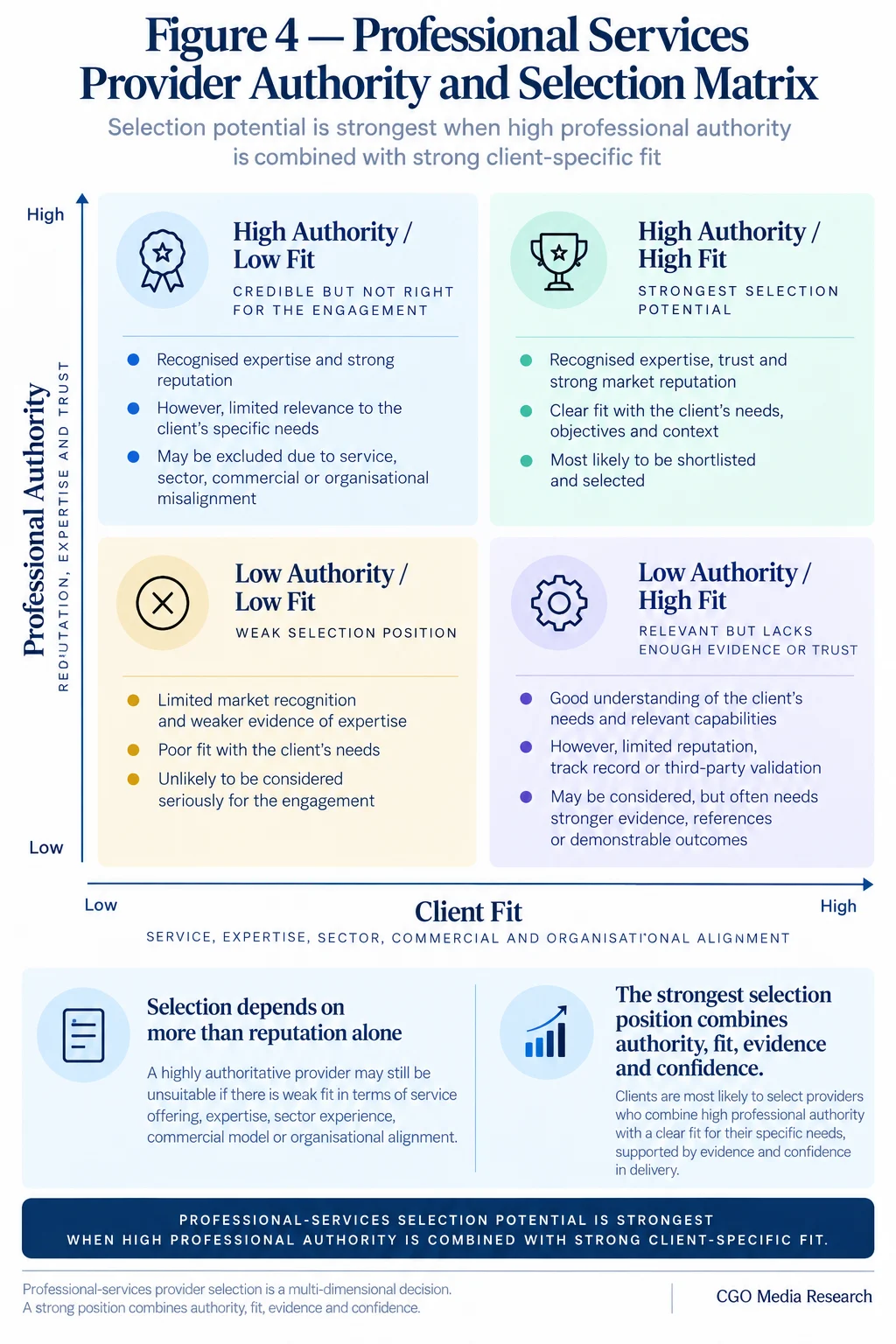
672. Authority Alone Does Not Guarantee Selection
A professional-services provider can possess substantial market authority and still be unsuitable for a specific client requirement.
673. High Authority Can Coexist with Low Client Fit
A large internationally recognised consultancy may possess:
- Strong brand recognition
- Extensive research
- Senior professional authority
- International coverage
while still being inappropriate for a small, highly specialised or commercially constrained engagement.
674. Fit Alone Does Not Guarantee Selection
A provider can appear highly relevant while failing to progress because professional trust, evidence depth or organisational credibility remains weak.
675. Strong Fit with Weak Authority Creates Validation Risk
The client may believe the provider understands the requirement but still hesitate because:
- Credentials are unclear
- Client evidence is limited
- External validation is weak
- Professional reputation is difficult to assess
676. The Strongest Selection Position Combines Four Conditions
Authority + Fit + Evidence + Confidence
677. The Complete Professional Services Selection Sequence
The complete journey can be summarised as:
Problem Recognition → Requirement Definition → Provider Discovery → Expertise Evaluation → Trust Validation → Commercial Fit → Comparison & Shortlisting → Enquiry, Proposal & Engagement
678. The Strategic Meaning of the Model
Professional-services organisations should not optimise only for the moment of initial discovery.
679. Discovery Is Only the Beginning
A provider must remain competitive as the buyer moves through:
- Understanding
- Validation
- Comparison
- Shortlisting
- Final selection
680. A Discoverable Provider Can Still Fail
A firm that appears prominently in search can disappear from consideration if its service or expertise evidence is weak.
681. A Trusted Provider Can Still Fail
A respected firm can lose where contextual client fit is poor.
682. A Relevant Provider Can Still Fail
A highly suitable specialist can lose if supporting evidence is insufficient.
683. A Strong Proposal Can Still Fail
Late-stage commercial or procurement incompatibility can remove an otherwise credible provider.
684. The Strategic Objective Is Continuity Across the Journey
The organisation should build sufficient evidence to remain competitive from initial discovery through final engagement.
685. Provider Selection Should therefore Be Measured Across the Full Journey
Traffic, rankings and enquiry volume reveal only part of the process.
686. Measurement Should Ask Whether the Organisation Is Becoming Easier to
- Discover
- Understand
- Validate
- Compare
- Shortlist
- Select
687. Provider-Selection Measurement Should Mirror the Decision Journey
Each stage creates different questions and therefore requires different measures.
688. A Useful Measurement Sequence Is
Discovery → Requirement Understanding → Expertise Evaluation → Trust Validation → Comparison → Shortlist → Proposal → Engagement
689. Stage One Measurement — Problem and Service Discovery
The organisation should assess whether it is visible before the buyer knows exactly which provider to select.
690. Problem-Led Search Visibility Is One Early-Stage Measure
The organisation can monitor whether useful content appears for:
- Problem searches
- Diagnostic searches
- Risk searches
- Strategic questions
691. Advisory Search Visibility Is Another Measure
The firm can assess whether it appears when users begin translating problems into service categories.
692. Service Category Visibility Is Another Measure
The organisation should understand whether priority services are discoverable through conventional search.
693. Sector-Specific Visibility Is Another Measure
Relevant combinations can include:
- Service + sector
- Consultant + sector
- Adviser + sector
- Professional service + industry
694. Location-Specific Visibility Is Another Measure
Geographic intent can matter where the service is local, regional or jurisdiction-sensitive.
695. AI-Assisted Service Discovery Can Also Be Measured
The organisation can test whether relevant AI scenarios identify the correct professional-service category.
696. Early AI Testing Should Record Context
Useful fields can include:
- Platform
- Date
- Prompt family
- Geography
- Visible sources
697. Problem Visibility Should Not Be Judged Only by Traffic
Some early-stage content can influence later provider selection without generating immediate enquiries.
698. Assisted Discovery Matters
A user may first encounter the provider through research or educational content and return later through branded search.
699. Branded Search Growth Can therefore Be an Assisted Signal
Increasing brand demand can indicate growing awareness generated through earlier discovery channels.
700. Stage Two Measurement — Requirement Understanding
The organisation should assess whether prospective clients can connect their need with the firm’s services.
701. Service-Page Engagement Can Support Requirement Measurement
Useful indicators can include:
- Entry volume
- Engaged visits
- Internal navigation
- Contact progression
702. Sector-Page Engagement Can Support Requirement Measurement
The organisation can observe whether users move between:
- Industry pages
- Services
- Experts
- Case studies
703. Professional-Profile Engagement Can Support Requirement Measurement
Movement from a service page to a named expert can indicate deeper provider evaluation.
704. Problem-to-Service Navigation Can Be Particularly Useful
The organisation can examine whether educational content successfully connects users with relevant capabilities.
705. Requirement Understanding Can Be Measured Qualitatively
Business-development teams can ask whether prospects arrive with accurate expectations about:
- Service scope
- Expertise
- Deliverables
- Engagement model
706. Misunderstood Enquiries Can Reveal Information Gaps
Repeated confusion can indicate that public content does not explain the service sufficiently.
707. Poor-Fit Enquiries Can Reveal Positioning Gaps
High enquiry volume is not necessarily positive when many prospects are unsuitable.
708. Qualified Requirement Understanding Is the Stronger Measure
A useful relationship is:
Correct Problem Understanding + Correct Service Understanding + Appropriate Expectation → Better Qualified Discovery
709. Stage Three Measurement — Provider Discovery
The organisation should measure how often it enters relevant provider candidate sets.
710. Organic Search Visibility Is One Discovery Measure
The organisation can monitor relevant:
- Service searches
- Sector searches
- Problem searches
- Location searches
711. AI Provider Mentions Are Another Discovery Measure
The firm can observe whether it appears in relevant provider-discovery scenarios.
712. AI Mention Frequency Should Remain Sample-Specific
Observed inclusion within a defined scenario set should not be presented as a universal platform probability.
713. Professional Directory Visibility Is Another Discovery Measure
The organisation can assess whether relevant directory profiles are complete, current and visible.
714. Referral Traffic Is Another Discovery Measure
External websites can reveal whether users are arriving from:
- Professional bodies
- Trade publications
- Directories
- Partners
715. Industry Publication Visibility Is Another Discovery Measure
Trade and media coverage can introduce the organisation within relevant professional contexts.
716. Research Visibility Is Another Discovery Measure
Original research can create entry points that are not conventional commercial searches.
717. Branded Search Growth Is Another Discovery Measure
An increase in brand queries can indicate awareness generated elsewhere.
718. Direct Traffic Can Contain Discovery Signals
Users may arrive directly after encountering the provider in:
- Media
- Research
- AI systems
- Offline recommendations
719. Direct Traffic Should Be Interpreted Carefully
It does not reveal the complete preceding journey.
720. Discovery Measurement Should therefore Be Multi-Source
No single analytics channel captures every provider-discovery pathway.
721. Stage Four Measurement — Expertise Evaluation
The organisation should assess whether discovered providers appear sufficiently capable to remain under consideration.
722. Service-Page Engagement Is One Expertise Signal
The client may spend more time evaluating service scope and methodology.
723. Professional-Biography Engagement Is Another Expertise Signal
Named professional research can indicate deeper evaluation.
724. Case-Study Engagement Is Another Expertise Signal
Prospects may seek evidence of comparable work.
725. Research-Paper Engagement Is Another Expertise Signal
Original research can support intellectual authority.
726. Methodology-Content Engagement Is Another Expertise Signal
Users may seek information about how the provider works.
727. Sector-Page Engagement Is Another Expertise Signal
Industry-specific pages can help validate context fit.
728. Cross-Asset Navigation Can Reveal Deeper Evaluation
A user moving through:
Service → Expert → Case Study → Research
may be performing a more advanced provider assessment.
729. Cross-Asset Navigation Should Not Be Treated as Proof of Purchase Intent
It remains an observational indicator rather than a definitive commercial signal.
730. Expert Name Searches Can Support Expertise Measurement
Growing demand for named professionals can indicate increasing professional visibility.
731. Expert Media Referrals Can Support Expertise Measurement
Relevant external commentary can drive users toward professional profiles.
732. Research Citations Can Support Expertise Measurement
Independent use of original evidence can strengthen professional authority.
733. Business-Development Feedback Can Strengthen Expertise Measurement
Sales and proposal teams can record whether prospects mention:
- Specific professionals
- Case studies
- Research
- Methodology
- Sector expertise
734. Stage Five Measurement — Trust Validation
The organisation should assess whether important professional claims can be verified externally.
735. Review-Profile Engagement Is One Trust Indicator
Users may move toward review platforms during validation.
736. Professional-Body Referrals Are Another Trust Indicator
Traffic from professional bodies can indicate credential validation.
737. Credential-Page Engagement Is Another Trust Indicator
Where the site contains relevant credential information, users may inspect it directly.
738. Branded Review Searches Are Another Trust Indicator
Search behaviour may include:
- Firm name + reviews
- Professional name + reviews
- Firm name + complaints
- Firm name + accreditation
739. Case-Study Interaction Can Also Support Trust Measurement
Case studies perform both expertise and trust functions.
740. External Media Referrals Can Support Trust Measurement
Relevant coverage may strengthen independent authority.
741. Professional Profile Verification Can Support Trust Measurement
The organisation can audit whether major external profiles remain accurate.
742. Credential Accuracy Can Be Measured Operationally
The firm can track:
- Current qualifications
- Current memberships
- Current regulatory status
- Current professional titles
743. Review Recency Can Be Measured
The organisation can assess whether feedback reflects current service delivery.
744. Review Relevance Can Be Measured
The firm can identify whether feedback supports:
- Priority services
- Priority sectors
- Priority offices
745. Trust Validation Should Not Be Reduced to Review Volume
Professional trust depends on multiple evidence types.
746. Independent Evidence Diversity Is a Useful Trust Indicator
A provider supported across several independent evidence sources can possess a more resilient trust environment.
747. A Useful Trust Measurement Relationship Is
Credential Accuracy + Client Evidence + Independent Recognition + External Consistency → Stronger Trust Validation
748. Stage Six Measurement — Commercial and Organisational Fit
Commercial fit is more difficult to measure through web analytics alone.
749. Sales Conversations Become Important at This Stage
Business-development teams can record recurring questions around:
- Price
- Team
- Availability
- Timescale
- Engagement structure
750. Pricing Objections Can Reveal Commercial Fit Gaps
Repeated concerns may indicate:
- Wrong audience
- Wrong expectation setting
- Weak value communication
- Commercial mismatch
751. Capacity Objections Can Reveal Delivery Fit Gaps
The organisation may be attracting opportunities larger than it can support.
752. Timing Objections Can Reveal Availability Gaps
Strong provider fit may be undermined by scheduling constraints.
753. Engagement-Model Objections Can Reveal Structural Gaps
Prospects may prefer a delivery model the provider does not offer.
754. Procurement Failure Can Reveal Organisational Fit Gaps
The provider may fail because of:
- Insurance
- Compliance
- Security
- Contractual requirements
755. Commercial Fit Should therefore Be Measured Through CRM and Sales Intelligence
Digital analytics alone cannot capture the complete selection environment.
756. Stage Seven Measurement — Comparison Behaviour
Comparison behaviour is one of the hardest stages to observe directly.
757. Much Comparison Happens Off-Site
Clients can compare providers through:
- AI systems
- Directories
- Internal spreadsheets
- Procurement documents
- Stakeholder discussions
758. AI Comparison Visibility Is One Observable Measure
The organisation can test relevant comparative scenarios.
759. Competitor Co-Mentions Are Another Observable Measure
The firm can record which competitors appear in the same provider sets.
760. Directory Positioning Is Another Observable Measure
The organisation can assess how it is categorised relative to alternatives.
761. Proposal-Stage Feedback Can Reveal Comparison Criteria
Prospects can explain which alternatives they considered.
762. Sales Conversations Can Reveal Comparison Criteria
Business-development teams can record:
- Competitor names
- Selection priorities
- Evidence requested
- Commercial objections
763. Win/Loss Analysis Is One of the Strongest Comparison Measures
It can reveal why one provider was selected over another.
764. Comparison Measurement Should Identify Competitor Patterns
The organisation should understand which providers appear repeatedly within final consideration.
765. Repeated Competitor Co-Occurrence Can Define the Real Competitive Set
The providers encountered in live deals may differ from those assumed internally.
766. Comparison Measurement Should Identify Evidence Patterns
The organisation can ask:
- Which case studies mattered?
- Which credentials mattered?
- Which professionals mattered?
- Which sector signals mattered?
767. Stage Eight Measurement — Shortlist Inclusion
Shortlist inclusion is one of the most commercially meaningful indicators of provider authority.
768. Shortlist Inclusion Indicates More Than Visibility
The provider has typically passed multiple earlier filters.
769. Business-Development Teams Should Record Whether the Firm Was Proactively Approached
This can reveal whether the provider entered the journey with existing authority.
770. Teams Should Record Whether the Firm Appeared on an Existing Shortlist
This can indicate stronger pre-contact provider recognition.
771. Teams Should Record How the Client Discovered the Firm
Relevant answers can include:
- Search
- AI assistant
- Referral
- Research
- Media
- Directory
772. Teams Should Record Which Alternatives Were Considered
This helps define the actual competitive environment.
773. Teams Should Record Why the Firm Progressed
Potential reasons can include:
- Specialist expertise
- Sector knowledge
- Professional reputation
- Client evidence
- Commercial fit
774. Teams Should Record Why the Firm Failed to Progress
Loss reasons can expose authority or fit gaps.
775. Shortlist Rate Can Be More Meaningful Than Enquiry Rate
A high volume of poor-fit enquiries may create less commercial value than a smaller number of serious shortlist opportunities.
776. Qualified Shortlist Rate Is an Even Stronger Measure
The organisation should distinguish between:
- Nominal inclusion
- Competitive shortlisting
- Strategic final consideration
777. Stage Nine Measurement — Enquiry Quality
Enquiry volume alone can be misleading.
778. Low-Fit Enquiries Should Be Separated
These can include prospects with:
- Wrong service needs
- Wrong budget
- Wrong geography
- Wrong client type
779. Qualified Opportunities Should Be Separated
These represent clients with realistic potential.
780. Strategic Opportunities Should Be Separated
Some opportunities can have unusually high importance because of:
- Value
- Sector relevance
- Long-term potential
- Brand significance
781. Referral-Led Opportunities Should Be Identified
Referral authority can behave differently from generic search discovery.
782. AI-Assisted Discovery Opportunities Should Be Identified Where Known
Business-development teams can ask how prospects first encountered or researched the provider.
783. Self-Reported Discovery Data Has Limitations
Clients may not remember every earlier touchpoint accurately.
784. Self-Reported Data Is Still Useful When Combined with Analytics
Multiple evidence sources can provide a more complete journey picture.
785. Stage Ten Measurement — Proposal Conversion
Proposal-stage measurement reveals whether provider authority converts into commercial preference.
786. Proposal Volume Is One Measure
It indicates how many opportunities progress to formal consideration.
787. Proposal-to-Win Rate Is Another Measure
This helps assess final-stage conversion effectiveness.
788. Average Opportunity Value Is Another Measure
The organisation can distinguish between high-volume low-value and lower-volume high-value selection pathways.
789. Time to Decision Is Another Measure
Long decision periods can indicate:
- Complexity
- Risk
- Procurement requirements
- Internal stakeholder involvement
790. Reasons for Loss Are Another Measure
Common reasons can include:
- Price
- Weak fit
- Competitor preference
- Insufficient evidence
- Capacity
- Timing
791. Reasons for Selection Are Another Measure
The firm should also understand why it wins.
792. Win Reasons Can Reveal Authority Strengths
Clients may cite:
- Expertise
- Sector knowledge
- Professional reputation
- Client evidence
- Methodology
- Commercial fit
793. Proposal Conversion Should Be Segmented
Useful segments can include:
- Service
- Sector
- Location
- Opportunity size
- Discovery route
794. Segmentation Can Reveal Hidden Weaknesses
The organisation may have strong conversion in one practice and weak conversion in another.
795. Stage Eleven Measurement — Client Acquisition Value
The strongest provider-selection measurement connects discovery and selection with commercial outcomes.
796. New Client Wins Are One Outcome Measure
The organisation can track how many selection journeys result in new relationships.
797. Average Engagement Value Is Another Outcome Measure
This provides context around commercial quality.
798. Client Lifetime Value Is Another Outcome Measure
Professional-services relationships can extend beyond the initial engagement.
799. Retainer Conversion Is Another Outcome Measure
Project work can evolve into continuing advisory relationships.
800. Cross-Service Opportunities Are Another Outcome Measure
One successful engagement can create demand for related capabilities.
801. Referral Generation Is Another Outcome Measure
Satisfied clients can become future discovery channels.
802. Provider Authority Can therefore Compound Commercially
A successful selection journey can produce:
- Client evidence
- Repeat work
- Referrals
- Reputation
- Future authority
803. The Provider Selection Measurement Funnel
The full measurement progression can be represented as:
Discovery → Requirement Understanding → Expertise Evaluation → Trust Validation → Comparison → Shortlist → Proposal → Engagement
804. Discovery Measurement Asks
Are relevant clients finding us?
805. Requirement Understanding Measurement Asks
Can clients connect their need with our services?
806. Expertise Evaluation Measurement Asks
Does our capability appear credible?
807. Trust Validation Measurement Asks
Can important claims be verified?
808. Comparison Measurement Asks
Do we remain competitive against relevant alternatives?
809. Shortlist Measurement Asks
Are we reaching final consideration?
810. Proposal Measurement Asks
Can we convert authority into commercial preference?
811. Engagement Measurement Asks
Does provider authority create meaningful commercial value?
812. The Measurement Funnel Should Not Be Interpreted as Perfect Attribution
Professional-services journeys often contain multiple interactions across channels.
813. Multi-Touch Journeys Are Common
A client may experience:
Research → Search → Professional Profile → Media Validation → AI Comparison → Direct Enquiry
814. Last-Click Attribution Is therefore Incomplete
The final interaction may not represent the source that established trust.
815. First-Touch Attribution Is also Incomplete
Initial discovery does not reveal which evidence ultimately drove selection.
816. Journey-Level Measurement Is Stronger
The organisation should connect observable digital data with commercial feedback where possible.
817. CRM Integration Is Essential for Mature Measurement
Web analytics should increasingly connect with:
- Qualified opportunities
- Shortlists
- Proposals
- Wins
- Losses
818. Business-Development Teams Provide Critical Measurement Context
They can identify information that analytics tools cannot observe directly.
819. Useful Business-Development Fields Can Include
- Discovery source
- Service requested
- Sector
- Competitors considered
- Reason for shortlist
- Reason for win or loss
820. Provider-Selection Measurement Should Distinguish Visibility from Progression
A provider can be visible without progressing.
821. Visibility Should therefore Be Connected with Advancement
A useful relationship is:
Visibility → Validation → Shortlist → Proposal → Engagement
822. Provider-Selection Measurement Should Distinguish Volume from Quality
High traffic or enquiry volume does not automatically indicate strong selection performance.
823. Qualified Progression Is the Stronger Objective
The organisation should seek:
- Relevant visibility
- Relevant enquiries
- Relevant shortlists
- Relevant proposals
- Relevant client wins
824. Measurement Should Distinguish Observation from Interpretation
The organisation should record what occurred before explaining why.
825. Measurement Should Distinguish Correlation from Causation
An increase in shortlist inclusion after a research campaign does not automatically prove that the research caused the improvement.
826. External Conditions Can Affect Provider Selection
Relevant factors can include:
- Market changes
- Competitor activity
- Economic conditions
- Procurement changes
- Platform changes
827. Long Sales Cycles Can Affect Measurement
Commercial outcomes may occur months after initial discovery.
828. Measurement Windows Should therefore Reflect the Service
Short transactional services and complex advisory engagements can require different evaluation periods.
829. Measurement Should Be Longitudinal
Repeated observation is more useful than one isolated reporting period.
830. Measurement Should Be Segmented by Strategic Priority
High-value services and sectors should receive deeper analysis.
831. Measurement Should Be Segmented by Client Type
Different buyer groups can behave differently.
832. Measurement Should Be Segmented by Discovery Route
Search, referral, research and AI-assisted journeys may produce different commercial outcomes.
833. Measurement Should Be Segmented by Geography Where Relevant
Provider selection patterns can vary by market or jurisdiction.
834. Measurement Should Be Segmented by Engagement Value
Higher-value engagements often involve more validation stages.
835. The Seventeenth Professional Services Provider Selection Principle
Provider-selection measurement should follow the complete client decision journey rather than rely primarily on traffic, rankings or enquiry volume because professional-services authority creates value only when relevant discovery progresses through understanding, validation, comparison, shortlisting and commercial selection.
836. The Eighteenth Professional Services Provider Selection Principle
Measurement should distinguish raw visibility from qualified progression, recognising that relevant shortlist inclusion, proposal opportunities and strategically appropriate client wins can provide stronger evidence of provider-selection performance than high volumes of poorly matched traffic or enquiries.
837. The Nineteenth Professional Services Provider Selection Principle
CRM and business-development intelligence should complement digital analytics because much of provider comparison, stakeholder evaluation, procurement and shortlist formation occurs outside the provider website and cannot be observed reliably through web analytics alone.
838. The Twentieth Professional Services Provider Selection Principle
Professional-services measurement should remain longitudinal, segmented and methodologically cautious, separating observation from interpretation and correlation from causation while accounting for long sales cycles, external market conditions and multi-touch discovery journeys.
839. Measurement Output — Provider Selection Performance System
The complete measurement architecture can be summarised as:
Discovery Visibility + Requirement Understanding + Expertise Engagement + Trust Validation + Comparison Visibility + Shortlist Intelligence + Proposal Conversion + Client Acquisition → Provider Selection Performance
840. The Strategic Position Before Figure Five
At this point in the model, provider selection has been translated from a conceptual decision journey into a measurable commercial system. Early-stage visibility shows whether relevant clients can discover the organisation; service, professional and sector engagement reveal whether the requirement can be understood and the provider’s capability evaluated; trust indicators show whether important claims can be validated; comparison and shortlist intelligence reveal whether the firm remains competitive against alternatives; and proposal and engagement data show whether authority ultimately converts into commercial preference. This creates the basis for a measurement funnel that connects digital discovery with actual provider selection rather than treating search visibility as an isolated marketing outcome.
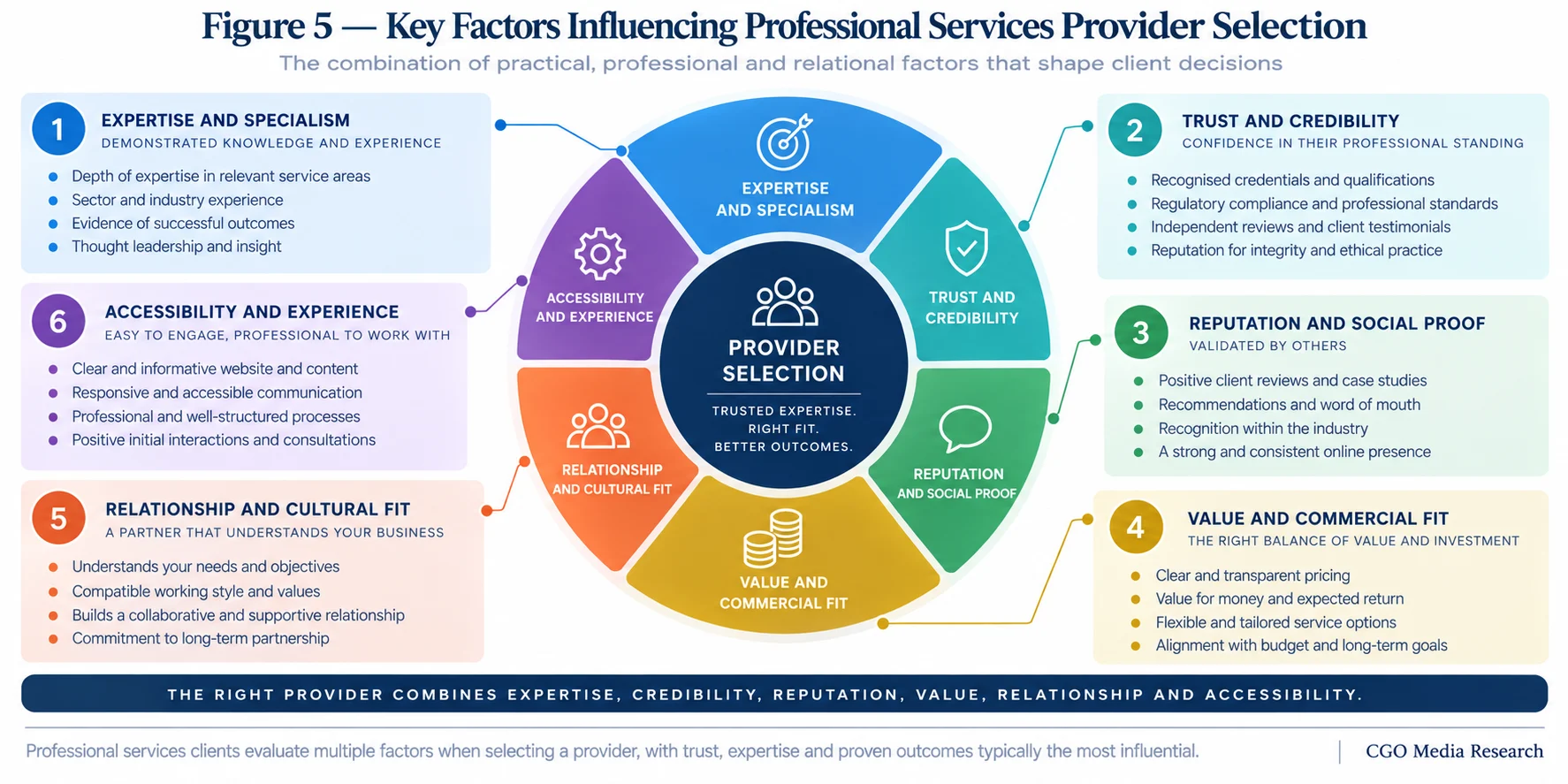
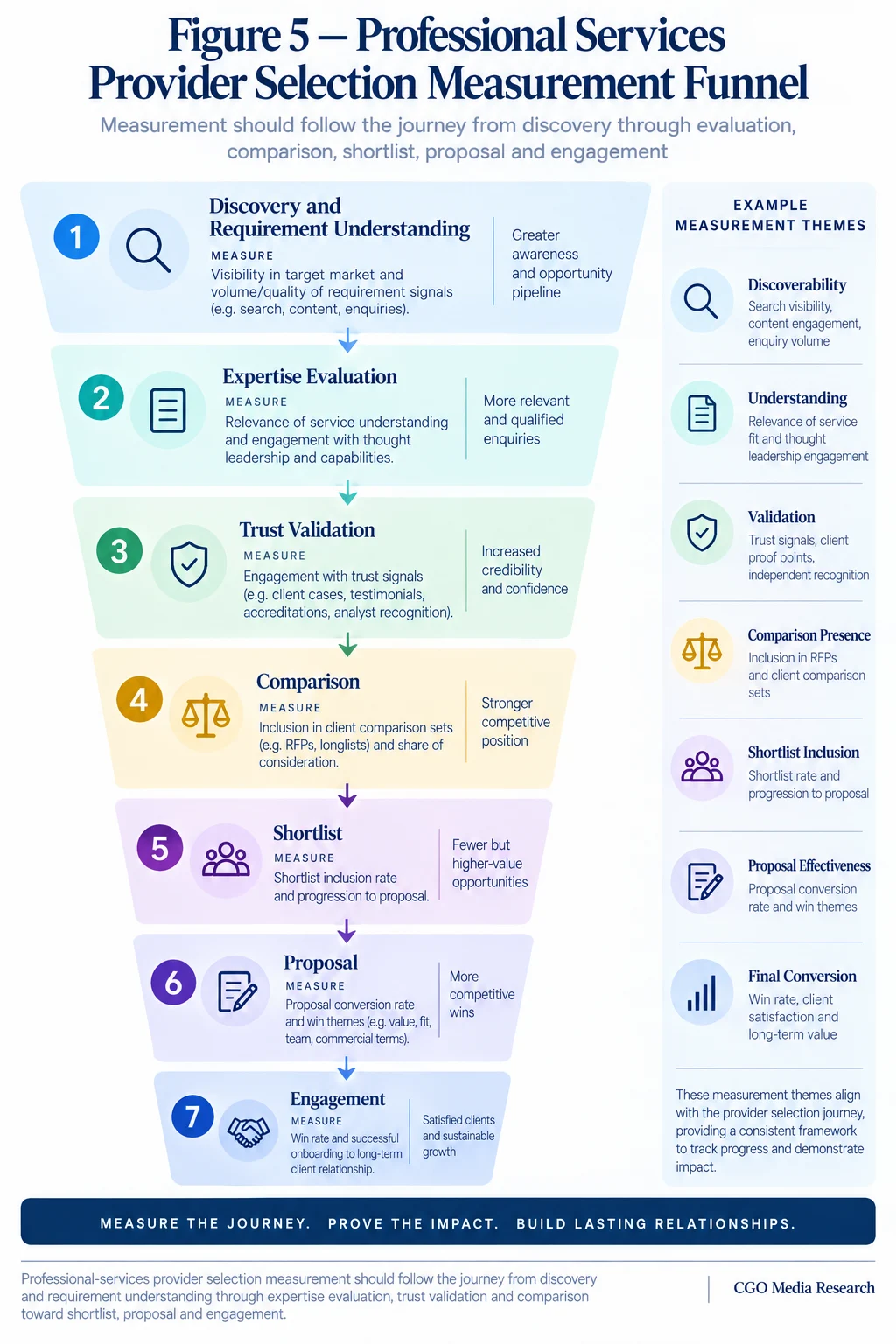
841. Provider Selection Should Become a Continuous Learning System
Professional-services organisations should not treat provider selection as a one-time marketing problem.
842. Every Client Journey Generates New Evidence
Search behaviour, enquiries, shortlists, proposals, wins and losses can all reveal how prospective clients evaluate providers.
843. The Strongest Organisations Reuse That Evidence
Commercial learning should feed back into:
- Search strategy
- Service architecture
- Professional profiles
- Sector positioning
- Research
- External authority
844. A Continuous Improvement Relationship Is
Observe → Diagnose → Strengthen → Validate → Measure → Learn → Adapt
845. Observation Is the First Step
The organisation records how prospects actually move through discovery and selection.
846. Observation Should Include Search Behaviour
Relevant evidence can include:
- Problem-led searches
- Service searches
- Sector searches
- Location searches
- Branded searches
847. Observation Should Include AI-Assisted Discovery
The firm can monitor scenario-specific provider inclusion, visible sources and representation accuracy.
848. Observation Should Include Website Behaviour
Useful pathways can include:
- Service to expert
- Expert to research
- Sector to case study
- Research to enquiry
849. Observation Should Include Commercial Progression
The organisation should record whether opportunities move through:
Enquiry → Qualification → Shortlist → Proposal → Win / Loss
850. Observation Should Include Qualitative Feedback
Business-development teams can record what prospects say about:
- Expertise
- Reputation
- Case studies
- Pricing
- Competitors
- Decision criteria
851. Diagnosis Is the Second Step
The organisation interprets where provider-selection friction exists.
852. Discovery Friction Should Be Diagnosed
Relevant providers may fail to appear where genuine fit exists.
853. Requirement Friction Should Be Diagnosed
Prospective clients may misunderstand the service or its scope.
854. Expertise Friction Should Be Diagnosed
The organisation may possess strong expertise that is not publicly legible.
855. Trust Friction Should Be Diagnosed
Claims may not have sufficient independent validation.
856. Comparison Friction Should Be Diagnosed
The firm may be difficult to distinguish from similar providers.
857. Commercial Friction Should Be Diagnosed
Pricing, capacity or engagement model may repeatedly block progression.
858. Proposal Friction Should Be Diagnosed
Opportunities may reach formal consideration but fail to convert.
859. Each Friction Type Requires a Different Response
More content is not the answer to every problem.
860. Discovery Friction May Require Better Search Architecture
Relevant capabilities may need stronger visibility.
861. Requirement Friction May Require Better Service Clarity
The provider may need to explain scope and suitability more precisely.
862. Expertise Friction May Require Better Professional Evidence
Named specialists may need stronger profiles, research and case-study connections.
863. Trust Friction May Require Better External Validation
Relevant actions can include:
- Professional-body verification
- Client references
- Media
- Research citations
864. Comparison Friction May Require Stronger Differentiation
The organisation may need clearer evidence around:
- Specialism
- Methodology
- Sector expertise
- Client outcomes
865. Commercial Friction May Require Positioning Change
The issue may concern:
- Target client
- Pricing
- Delivery model
- Project scale
- Availability
866. Proposal Friction May Require Better Client-Specific Evidence
Generic proposals can weaken otherwise strong authority.
867. Strengthening Is the Third Step
The organisation improves the specific evidence layer responsible for provider-selection weakness.
868. Service Evidence Can Be Strengthened
The firm can improve:
- Scope clarity
- Methodology
- Deliverables
- Suitability guidance
869. Professional Evidence Can Be Strengthened
The firm can improve:
- Profiles
- Specialisms
- Credentials
- Research
- Public commentary
870. Client Evidence Can Be Strengthened
The organisation can expand:
- Case studies
- Testimonials
- References
- Outcome evidence
871. Sector Evidence Can Be Strengthened
Priority industries can receive more:
- Research
- Named experts
- Case studies
- Trade visibility
872. External Authority Can Be Strengthened
Relevant media, professional and research visibility can reinforce trust.
873. Commercial Evidence Can Be Strengthened
The organisation can explain more clearly:
- Pricing structure
- Engagement models
- Team composition
- Delivery expectations
874. Validation Is the Fourth Step
The organisation checks whether strengthened evidence is improving provider-selection confidence.
875. Search Validation Can Be Used
The firm can assess whether relevant pages become easier to discover.
876. Entity Validation Can Be Used
The organisation can check whether firm, professional and service information remains accurate.
877. Trust Validation Can Be Used
The organisation can check whether independent evidence supports important claims.
878. AI Validation Can Be Used
Relevant scenarios can be retested after material evidence improvements.
879. Commercial Validation Can Be Used
The organisation can examine whether stronger evidence improves:
- Lead quality
- Shortlist progression
- Proposal conversion
- Win rate
880. Measurement Is the Fifth Step
The organisation should compare outcomes against defined baselines.
881. Measurement Should Remain Stage-Specific
Different stages require different indicators.
882. Discovery Measures Should Not Be Used as Selection Measures
Visibility does not prove shortlist progression.
883. Shortlist Measures Should Not Be Used as Engagement Measures
Final commercial conversion remains a separate outcome.
884. Measurement Should Remain Longitudinal
Provider-selection change is easier to interpret across repeated observation.
885. Learning Is the Sixth Step
The organisation identifies what the combined evidence suggests.
886. Learning Should Include Positive Outcomes
The firm should understand why it wins.
887. Learning Should Include Negative Outcomes
Losses can reveal:
- Fit gaps
- Trust gaps
- Pricing gaps
- Evidence gaps
- Competitor advantages
888. Learning Should Include Neutral Outcomes
Changes that produce no clear improvement still provide useful evidence.
889. Learning Should Be Documented
The organisation should avoid relying solely on memory.
890. Useful Learning Records Can Include
- Observed issue
- Intervention
- Result
- Interpretation
- Limitations
- Next action
891. Adaptation Is the Seventh Step
Validated learning should influence future provider-selection strategy.
892. Search Architecture Can Adapt
The organisation can change how services, sectors and experts are represented.
893. Professional Profiles Can Adapt
New evidence and specialisms can be incorporated.
894. Research Priorities Can Adapt
Recurring client questions can become new research themes.
895. Digital PR Priorities Can Adapt
External authority activity can focus more tightly on decision-relevant themes.
896. Commercial Positioning Can Adapt
The firm can refine:
- Target clients
- Service scope
- Pricing
- Delivery model
897. AI Observation Scenarios Can Adapt
The organisation can add or retire scenarios as client behaviour changes.
898. The Continuous Improvement Cycle Should Repeat
Adaptation creates the starting point for the next observation cycle.
899. The Provider Selection Improvement Cycle Is
Observe → Diagnose → Strengthen → Validate → Measure → Learn → Adapt
900. Continuous Improvement Should Be Evidence-Led
The organisation should not change strategy solely because a new tactic becomes fashionable.
901. New Tactics Should Be Evaluated Against Selection Outcomes
Useful questions include:
- Does this improve relevant discovery?
- Does this strengthen trust?
- Does this improve comparison readiness?
- Does this improve shortlist progression?
- Does this improve commercial fit?
902. AI Changes Should Be Treated as Observations
One generated result should not trigger major provider-selection strategy changes by itself.
903. Repeated AI Observations Are More Useful
Patterns across defined scenarios can provide better diagnostic value.
904. AI Observation Should Remain Scenario-Specific
The organisation should not present test results as universal provider rankings.
905. Provider-Selection Improvement Requires Cross-Functional Governance
Search teams alone cannot observe the entire client decision journey.
906. Search Teams Can Contribute Discovery Evidence
They can monitor:
- Search demand
- Organic visibility
- AI observations
- Site journeys
907. Professional Teams Can Contribute Expertise Evidence
They can validate:
- Service accuracy
- Specialisms
- Professional claims
- Methodology
908. Research Teams Can Contribute Authority Evidence
They can identify:
- Research themes
- Citations
- Evidence gaps
- Emerging market questions
909. PR Teams Can Contribute External Validation Evidence
They can monitor:
- Media citations
- Trade coverage
- Expert commentary
- External reputation
910. Business-Development Teams Can Contribute Selection Evidence
They can record:
- Lead quality
- Shortlist inclusion
- Competitors
- Objections
- Win and loss reasons
911. CRM Teams Can Contribute Progression Evidence
They can connect:
- Discovery source
- Opportunity stage
- Proposal
- Win
- Revenue
912. Governance Should Define Ownership
Each provider-selection evidence layer should have a responsible owner.
913. Search Ownership Can Cover Discovery
Relevant responsibilities can include:
- Technical visibility
- Content architecture
- Search measurement
- AI scenario monitoring
914. Professional Ownership Can Cover Expertise Accuracy
Service and professional claims should be validated by subject specialists.
915. Research Ownership Can Cover Methodological Quality
Research should maintain clear standards around:
- Authorship
- Methodology
- Sources
- Limitations
916. PR Ownership Can Cover External Authority
External validation activity should align with real expertise.
917. Commercial Ownership Can Cover Selection Outcomes
Win/loss and shortlist intelligence should feed back into authority strategy.
918. Cross-Functional Review Should Occur Periodically
The organisation can review the entire provider-selection system rather than individual channels.
919. Useful Cross-Functional Questions Include
- Where are clients discovering us?
- Which providers are we compared against?
- Where are we failing to progress?
- Which evidence is influencing wins?
- Which objections occur repeatedly?
920. Provider Selection Governance Should Be Commercially Prioritised
Not every service requires the same depth of monitoring.
921. High-Value Services Should Receive Deeper Analysis
Complex or strategically important offerings can justify more detailed journey measurement.
922. High-Value Sectors Should Receive Deeper Analysis
Priority industries can justify stronger authority monitoring.
923. High-Value Professionals Should Receive Deeper Analysis
Named experts central to major practices can materially influence selection.
924. High-Value Markets Should Receive Deeper Analysis
Important geographies can require separate discovery and comparison analysis.
925. Provider Selection Should Be Viewed as a System of Evidence Dependencies
Each stage depends partly on what came before.
926. Weak Discovery Reduces Later Opportunity
A provider that never enters consideration cannot be selected.
927. Weak Requirement Clarity Reduces Qualification
Poor service explanation can attract unsuitable prospects.
928. Weak Expertise Evidence Reduces Capability Confidence
Relevant services without visible professionals can remain difficult to validate.
929. Weak Trust Evidence Reduces Progression
Claims without sufficient external support can create hesitation.
930. Weak Commercial Fit Reduces Shortlist Potential
Capability alone cannot overcome an impractical engagement model.
931. Weak Comparison Differentiation Reduces Preference
The firm can appear credible while remaining interchangeable.
932. Weak Proposal Execution Reduces Final Conversion
Public authority must still be translated into a client-specific solution.
933. The Provider Selection System Is Therefore Multiplicative
Severe weakness at one important stage can reduce the value created by strengths elsewhere.
934. A Simplified Relationship Is
Discovery × Relevance × Expertise × Trust × Fit × Comparison × Proposal Confidence → Selection Potential
935. The Relationship Should Not Be Interpreted as a Mathematical Formula
It is a conceptual representation of dependency between decision stages.
936. Provider Selection Resilience Depends on Evidence Diversity
The organisation should avoid relying on one discovery or trust channel.
937. Discovery Diversity Can Include
- Search
- AI systems
- Referrals
- Research
- Media
- Directories
938. Trust Diversity Can Include
- Credentials
- Reviews
- Case studies
- Client references
- Independent recognition
939. Evidence Diversity Reduces Channel Dependency
Changes to one platform become less damaging where authority exists across several environments.
940. Provider Selection Resilience Also Depends on Evidence Freshness
Older evidence can gradually lose relevance.
941. Professional Profiles Should Remain Current
Roles and expertise can change.
942. Case Studies Should Remain Representative
Historical work should not be the only evidence supporting current capability.
943. Research Should Remain Current Where Time Sensitivity Matters
Market data and observations can age.
944. Credentials Should Remain Current
Professional status should be reviewed where relevant.
945. External Profiles Should Remain Current
Third-party information can become outdated.
946. Provider Selection Resilience Requires Periodic Revalidation
Authority that was strong previously should not be assumed to remain strong indefinitely.
947. Recommendation Readiness Should Also Be Revalidated
AI-assisted discovery environments can change.
948. Provider Comparison Sets Can Change
New competitors can emerge.
949. Client Selection Criteria Can Change
Buyers may place increasing weight on new issues such as:
- AI capability
- Security
- Sustainability
- Data governance
- Sector specialism
950. Continuous Learning Helps the Provider Adapt
The organisation becomes better able to recognise changing client expectations before they create major commercial weakness.
951. The Twenty-First Professional Services Provider Selection Principle
Professional-services provider selection should be managed as a continuous learning system in which search behaviour, client journeys, external authority, AI-assisted discovery, shortlist progression, proposal conversion and win/loss evidence repeatedly inform future service positioning and authority development.
952. The Twenty-Second Professional Services Provider Selection Principle
Provider-selection weaknesses should be diagnosed by stage because discovery, requirement clarity, expertise, trust, comparison, commercial fit and proposal conversion represent different decision problems and require different corrective interventions.
953. The Twenty-Third Professional Services Provider Selection Principle
Cross-functional governance is required for mature provider-selection measurement because SEO, professional teams, research, Digital PR, business development and CRM each observe different parts of the buyer journey and no single function possesses a complete view independently.
954. The Twenty-Fourth Professional Services Provider Selection Principle
The strongest provider-selection strategy should combine evidence freshness, channel diversity, qualified visibility, contextual recommendation readiness and commercial learning so the organisation remains resilient as clients, competitors, search interfaces and AI-assisted discovery environments evolve.
955. Continuous Provider Selection Improvement Output
The complete operating relationship can be summarised as:
Observe → Diagnose → Strengthen → Validate → Measure → Learn → Adapt
956. The Strategic Position Before Figure Six
At this point, the Professional Services Discovery and Provider Selection Model has moved from describing the buyer journey to defining a repeatable organisational learning system. Discovery, requirement interpretation, expertise evaluation, trust validation, commercial fit, comparison, shortlisting, proposal and engagement can each be observed separately, while business-development and CRM evidence provides context that digital analytics alone cannot supply. The organisation can then diagnose the stage where progression is being lost, strengthen the appropriate evidence layer, validate the intervention, measure the result and feed the learning back into future authority strategy. This closes the loop between search visibility and commercial provider selection.
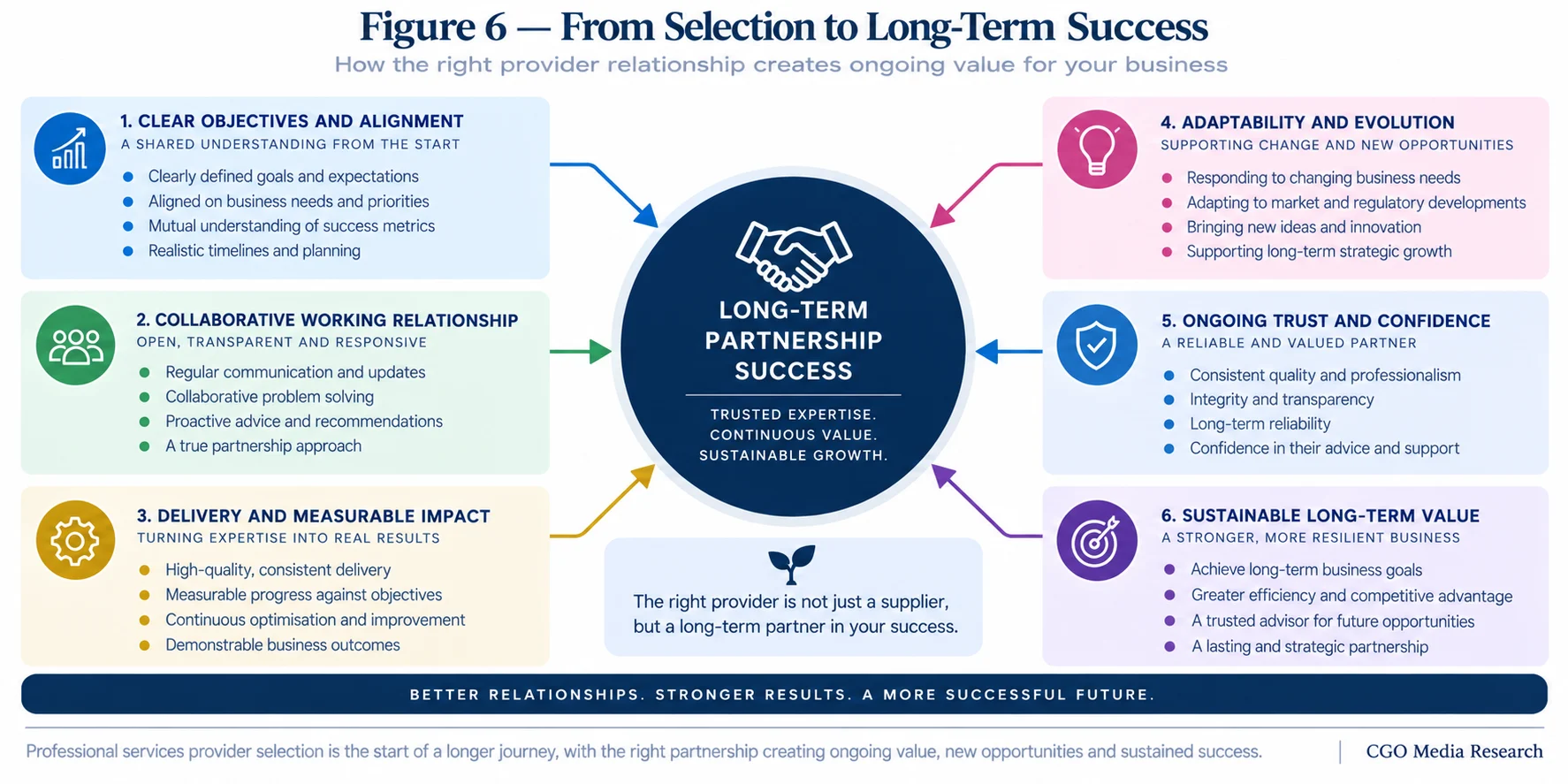
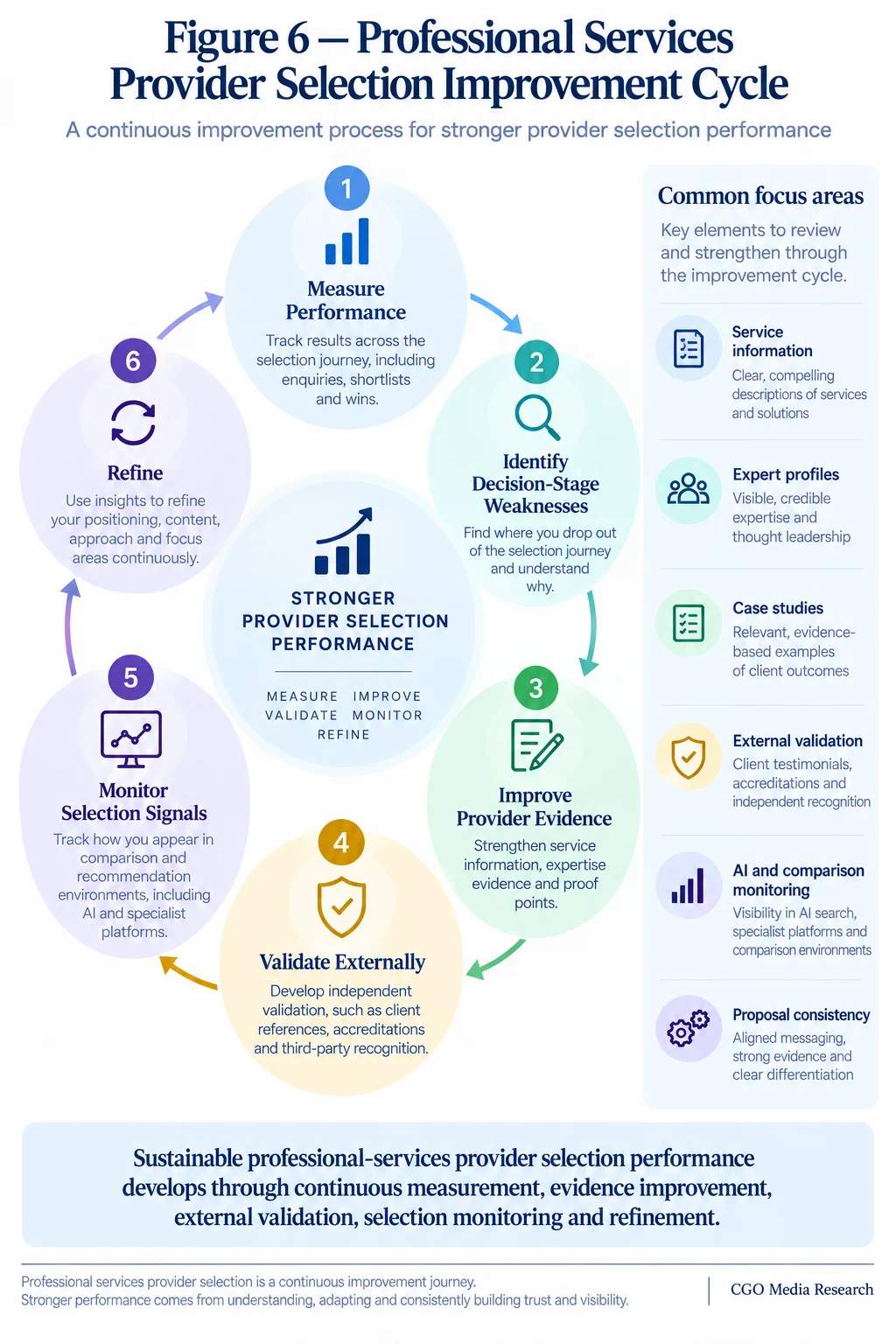
957. Methodological Position
The Professional Services Discovery and Provider Selection Model is a conceptual decision-journey framework developed by CGO Media to explain how prospective clients can move from recognising a business problem to identifying, validating, comparing and selecting a professional-services provider.
958. The Model Is Designed for Expertise-Led Markets
It is particularly relevant to professional-services environments where provider selection depends on more than basic product comparison.
959. Relevant Professional-Services Markets Can Include
- Accountancy
- Management consulting
- Specialist advisory
- Recruitment
- Executive search
- Architecture
- Engineering consultancy
960. The Model Focuses on Provider-Selection Behaviour
It examines how clients can combine different evidence types as they progress through increasingly specific decision stages.
961. The Eight Core Stages Are
- Business Problem Recognition
- Advisory and Service Requirement Definition
- Provider Discovery
- Service and Expertise Evaluation
- Professional Trust Validation
- Commercial and Organisational Fit Assessment
- Comparison and Shortlisting
- Enquiry, Proposal and Engagement
962. The Eight Stages Should Not Be Interpreted as a Rigid Linear Funnel
Professional-services buyers can move backwards and forwards between stages as new information changes:
- The problem definition
- The required service
- The provider set
- The evidence threshold
- The commercial brief
963. The Model therefore Represents Decision Functions Rather Than Fixed Time Periods
One buyer can move through several stages rapidly while another may take months.
964. Journey Length Depends on Context
Relevant factors can include:
- Engagement value
- Project complexity
- Risk
- Stakeholder count
- Procurement requirements
- Urgency
965. The Model Does Not Claim to Predict Individual Buyer Behaviour
It provides a structured way to interpret recurring provider-selection activities rather than a deterministic prediction of how every prospective client will behave.
966. The Model Does Not Assign Universal Weight to Every Selection Signal
Different engagements can assign different importance to:
- Expertise
- Credentials
- Sector fit
- Client evidence
- Pricing
- Capacity
- Geography
967. Selection Criteria Are Contextual
The same provider can be highly suitable for one client situation and poorly suited to another.
968. Provider Authority Is therefore Not Universal
Professional authority should be interpreted in relation to the requirement being evaluated.
969. Client Fit Is also Contextual
A provider’s fit can change according to:
- Problem
- Sector
- Organisation size
- Budget
- Location
- Timescale
970. The Provider Authority and Selection Matrix Is therefore Conceptual
The matrix illustrates the relationship between Professional Authority and Client Fit rather than establishing a universal numeric score.
971. High Authority Does Not Guarantee Selection
A highly recognised provider can still be inappropriate for a specific engagement.
972. High Fit Does Not Guarantee Selection
A specialist provider can appear highly relevant while lacking sufficient trust evidence or organisational credibility.
973. Strong Selection Potential Usually Requires Evidence Convergence
A useful conceptual relationship is:
Authority + Fit + Evidence + Confidence → Stronger Selection Potential
974. The Relationship Should Not Be Treated as a Mathematical Formula
It summarises interacting decision dimensions.
975. Provider Selection Is an Evidence-Aggregation Process
Prospective clients can accumulate evidence across:
- Owned websites
- Professional profiles
- Research
- Media
- Directories
- Reviews
- Referrals
- AI-assisted discovery
976. Different Sources Perform Different Functions
A service page can establish relevance while a professional body can validate a credential and a case study can demonstrate applied experience.
977. Evidence Roles Are Claim-Specific
One source should not automatically be treated as equally relevant to every provider claim.
978. Professional Profiles Support Expertise Claims
They can connect named people with:
- Roles
- Specialisms
- Experience
- Qualifications
979. Service Pages Support Capability Claims
They explain:
- Scope
- Methodology
- Deliverables
- Suitability
980. Case Studies Support Applied-Capability Claims
They can demonstrate how expertise has been used in practice.
981. Research Supports Intellectual-Authority Claims
Original evidence can demonstrate deeper understanding of a problem, service or market.
982. External Sources Support Independent Validation
Relevant external evidence can include:
- Professional bodies
- Trade publications
- Media
- Reviews
- Research citations
983. Selection Evidence Should Be Current Where Currentness Matters
Older evidence can remain useful but may not fully represent current:
- Professional roles
- Capabilities
- Credentials
- Client experience
- Market positioning
984. Selection Evidence Should Be Accurate
Professional-services organisations should avoid overstating:
- Credentials
- Sector expertise
- Client outcomes
- Professional involvement
- Independent recognition
985. Selection Evidence Should Be Attributable
Important professional or research claims are stronger when users can understand who is responsible for them.
986. Confidentiality Creates Methodological Constraints
Professional-services firms may not always be able to publish:
- Client names
- Commercial data
- Detailed outcomes
- Sensitive project information
987. Lack of Public Client Identification Does Not Automatically Remove Evidential Value
Anonymised or aggregated evidence can remain useful where context and methodology are sufficiently clear.
988. Review Evidence Should Be Interpreted by Market
Some professional-services environments naturally generate more public reviews than others.
989. Low Review Volume Is Not Automatically Evidence of Weak Service Quality
Confidentiality, client type and engagement frequency can materially affect review behaviour.
990. Alternative Trust Evidence Can Be Important
Relevant alternatives can include:
- Client references
- Professional recognition
- Credentials
- Research
- Repeat engagements
991. AI-Assisted Discovery Introduces Additional Methodological Constraints
Generative outputs can vary across:
- Platform
- Date
- Prompt wording
- Conversation context
- Location
992. One Generated Provider Set Should Not Be Treated as a Universal Ranking
Observed provider inclusion remains specific to the tested scenario.
993. AI Mention Frequency Should Remain Sample-Specific
If an organisation records provider inclusion across a scenario set, the resulting frequency applies to that defined sample rather than the entire platform.
994. AI Source Observations Should Also Remain Sample-Specific
Observed citation or source patterns should not be presented as proprietary knowledge of internal AI selection systems.
995. The Model Does Not Claim Access to Proprietary AI Algorithms
CGO Media does not claim direct knowledge of undisclosed:
- Retrieval systems
- Ranking systems
- Citation-selection systems
- Recommendation algorithms
996. AI Observation Should therefore Be Descriptive
Research should distinguish what was observed from what may explain the observation.
997. Observation and Inference Should Be Separated
A useful reporting sequence is:
Observation → Interpretation → Hypothesis → Further Testing
998. Correlation and Causation Should Be Separated
A change in provider visibility following an intervention does not automatically prove that the intervention caused the change.
999. External Variables Can Influence Provider Visibility
Relevant factors can include:
- Competitor activity
- Search-platform changes
- AI-platform changes
- Market demand
- Seasonality
1000. Provider-Selection Measurement Also Has Attribution Limits
Professional-services journeys can include many interactions before direct engagement.
1001. Last-Click Attribution Is Incomplete
The final interaction may not identify the source that established initial confidence.
1002. First-Touch Attribution Is Also Incomplete
Initial discovery does not reveal which later evidence created final preference.
1003. Multi-Touch Analysis Is More Appropriate
A professional-services journey can resemble:
Research → Search → Expert Profile → Media Validation → AI Comparison → Direct Enquiry → Proposal
1004. CRM Data Can Improve Journey Interpretation
Commercial systems can provide evidence around:
- Lead quality
- Shortlist progression
- Proposal stages
- Wins
- Losses
1005. CRM Data Is Also Incomplete
It may not capture every interaction that occurred before the opportunity was created.
1006. Self-Reported Discovery Data Has Limitations
Prospective clients may not remember every prior:
- Search
- Article
- Referral
- AI interaction
- Media exposure
1007. Multiple Evidence Sources Are therefore Preferable
The organisation can combine:
- Search analytics
- Website analytics
- CRM data
- AI observations
- Business-development feedback
- Win/loss interviews
1008. Provider-Selection Measurement Should Be Longitudinal
Repeated observation is more useful than isolated snapshots.
1009. Measurement Windows Should Reflect the Sales Cycle
Complex professional-services engagements can take significantly longer to convert than more transactional work.
1010. Provider Selection Should Be Segmented by Service
Different professional capabilities can produce different decision journeys.
1011. Provider Selection Should Be Segmented by Sector
Industry context can affect:
- Trust requirements
- Credentials
- Buyer sophistication
- Procurement behaviour
1012. Provider Selection Should Be Segmented by Client Type
A small business and a multinational enterprise can evaluate providers very differently.
1013. Provider Selection Should Be Segmented by Engagement Value
Higher-value decisions often require more extensive validation.
1014. Provider Selection Should Be Segmented by Geography Where Relevant
Professional and commercial expectations can vary between markets and jurisdictions.
1015. Provider Selection Should Be Segmented by Discovery Route
Referral-led, search-led, research-led and AI-assisted journeys can produce different patterns.
1016. The Model Should Not Be Used to Manufacture Artificial Authority
Professional-services firms should not create unsupported:
- Expertise claims
- Case studies
- Credentials
- Reviews
- Research
- External validation
1017. Genuine Capability Should Remain the Foundation
The purpose of search and provider-selection strategy is to make real professional value easier to discover and validate.
1018. Qualified Visibility Is Preferable to Maximum Visibility
The provider should seek greater visibility where:
- Service fit exists
- Expertise fit exists
- Sector fit exists
- Commercial fit exists
1019. Appropriate Exclusion Can Be Valuable
A provider should not seek inclusion within scenarios it cannot serve effectively.
1020. Qualified Recommendation Is Preferable to Universal Recommendation
The strongest recommendation environment is one in which provider inclusion reflects genuine suitability.
1021. Clear Boundaries Can Improve Qualification
Providers can explain:
- Who the service is for
- Who it is not for
- What the service includes
- What it does not include
1022. Clear Boundaries Can Improve Trust
Precision can be more credible than attempting to present the organisation as suitable for every client.
1023. The Model therefore Supports Both Visibility and Exclusion
Strong provider positioning helps appropriate clients progress while allowing poor-fit opportunities to leave the journey earlier.
1024. This Can Improve Commercial Efficiency
Better qualification can reduce:
- Irrelevant enquiries
- Unnecessary proposals
- Low-probability opportunities
- Commercial friction
1025. Final Strategic Implications
The model suggests that Professional Services SEO should not be evaluated solely through rankings or traffic.
1026. Search Visibility Creates Opportunity, Not Selection
Discovery is an important early condition but does not determine final provider preference.
1027. Professional Expertise Creates Capability Confidence
Named experts and specialist evidence help clients judge whether a provider can perform the required work.
1028. Client Evidence Creates Applied Confidence
Case studies and relevant outcomes help demonstrate that capability has been used successfully.
1029. Independent Evidence Creates Trust Confidence
Credentials, media, reviews and external citations can reinforce owned claims.
1030. Commercial Fit Creates Engagement Viability
Price, team, timing and delivery structure determine whether a theoretically suitable provider can actually be engaged.
1031. Comparison Creates Relative Preference
Providers are evaluated against real alternatives.
1032. Proposal Quality Creates Client-Specific Confidence
The provider must translate general authority into a credible solution for the specific engagement.
1033. Commercial Learning Improves Future Authority
Win and loss evidence can reveal where future:
- Search
- Content
- Research
- Professional positioning
- Commercial strategy
should improve.
1034. The Model therefore Connects Search with Revenue More Carefully
It does not assume that visibility directly causes revenue.
1035. Instead, Search Contributes to a Wider Decision System
A useful relationship is:
Discovery → Understanding → Evidence → Trust → Comparison → Selection → Commercial Outcome
1036. SEO Remains Foundational
Professional-services organisations still require:
- Technical accessibility
- Useful information
- Clear service architecture
- Strong internal linking
- Relevant search visibility
1037. GEO Extends the Provider-Selection Environment
Generative Engine Optimisation adds further attention to:
- Source visibility
- Entity understanding
- Citation readiness
- Provider comparison
- Recommendation visibility
1038. GEO Should Not Be Separated from the Wider Evidence System
AI-assisted provider visibility ultimately depends on many of the same underlying authority assets required for conventional provider evaluation.
1039. The Stronger Strategic Model Is
SEO Foundation + Professional Expertise + Client Evidence + Independent Trust + GEO Observation + Commercial Learning
1040. Conclusion
Professional-services provider selection is better understood as a progressive process of uncertainty reduction than as a single ranking or conversion event.
1041. The Journey Begins with Problem Uncertainty
The client may not initially know which professional category is required.
1042. Requirement Definition Reduces Category Uncertainty
The buyer clarifies the service, specialism and contextual requirements.
1043. Provider Discovery Reduces Market Uncertainty
Potential suppliers enter the candidate set.
1044. Expertise Evaluation Reduces Capability Uncertainty
The client assesses whether providers appear capable of solving the problem.
1045. Trust Validation Reduces Credibility Uncertainty
Important professional claims are checked against supporting evidence.
1046. Commercial Fit Reduces Delivery Uncertainty
The client determines whether the engagement can work operationally and financially.
1047. Comparison Reduces Relative Uncertainty
The remaining providers are evaluated against one another.
1048. Proposal and Engagement Reduce Final Decision Uncertainty
The client evaluates a specific solution, team and commercial proposition.
1049. The Complete Uncertainty-Reduction Sequence Is
Problem Uncertainty → Category Uncertainty → Market Uncertainty → Capability Uncertainty → Trust Uncertainty → Delivery Uncertainty → Relative Uncertainty → Decision Confidence
1050. The Model Explains Why Ranking First Is Not the Final Objective
Visibility creates an opportunity to be evaluated.
1051. The Stronger Objective Is Provider Selection Readiness
A provider should be:
- Discoverable
- Relevant
- Credible
- Comparable
- Commercially suitable
1052. Provider Selection Readiness Requires Evidence Continuity
Evidence should remain coherent from initial search through final proposal.
1053. Evidence Continuity Creates Decision Confidence
The client repeatedly encounters mutually reinforcing evidence rather than contradictions.
1054. The Long-Term Provider Selection Flywheel
A useful relationship is:
Better Evidence → Better Discovery → Better Qualification → Better Selection → Better Client Outcomes → Stronger Evidence
1055. Better Client Outcomes Can Create New Case Studies
Successful work strengthens applied evidence.
1056. Better Client Outcomes Can Create Referrals
Satisfied clients can become future discovery sources.
1057. Better Client Outcomes Can Create Reputation
Positive professional experience can strengthen future trust.
1058. Better Research and Learning Can Improve Future Positioning
The provider becomes more precise about:
- Where it fits
- Where it does not fit
- Which evidence matters
- Which clients produce the strongest outcomes
1059. The Final Strategic Relationship
Relevant Discovery + Professional Capability + Verifiable Trust + Client Fit + Commercial Viability + Decision Confidence → Provider Selection Potential
1060. Final Strategic Position
The Professional Services Discovery and Provider Selection Model provides a structured way to understand the full journey between a business problem and a professional engagement. It recognises that discovery is only the first part of the process and that professional-services organisations remain under evaluation throughout service understanding, expertise assessment, trust validation, commercial comparison, shortlisting and proposal.
The model also highlights why strong digital authority should not be interpreted as a universal claim of superiority. Provider suitability remains contextual. A large established firm can be wrong for a specialist project, while a smaller expert provider can be highly relevant but insufficiently validated. Strong provider-selection potential therefore depends on the convergence of professional authority and client-specific fit.
Search engines and AI-assisted systems can influence multiple stages of the journey, but neither conventional rankings nor generated provider lists represent the complete decision process. Prospective clients may use referrals, directories, research, professional bodies, media, reviews, expert profiles, case studies, commercial discussions and procurement checks before reaching a decision.
The strategic implication is that Professional Services SEO, GEO, research, Digital PR and business development should increasingly be connected around one objective: making genuine expertise easier for the right clients to discover, understand, validate, compare and select.
References
External Technical, Search and Research Sources
- Google Search Central. SEO Starter Guide.
- Google Search Central. AI Features and Your Website.
- Google Search Central. Organization Structured Data.
- Schema.org. Organization.
- Schema.org. Person.
- Schema.org. Service.
- Hogan, A. et al. (2021). Knowledge Graphs. ACM Computing Surveys, 54(4).
- Metzger, M.J. (2007). Making Sense of Credibility on the Web: Models for Evaluating Online Information and Recommendations for Future Research. Journal of the American Society for Information Science and Technology, 58(13), 2078–2091.
- Ji, Z. et al. (2023). Survey of Hallucination in Natural Language Generation. ACM Computing Surveys, 55(12).
Professional Services AI & GEO Search Research Family
The Professional Services Discovery and Provider Selection Model forms part of the wider CGO Media Professional Services research programme examining how expertise-led organisations are discovered, validated, compared and selected across conventional search and AI-assisted environments.
Professional Services AI & GEO Search Research
The sector pillar brings together the complete Professional Services SEO, AI Search and GEO research family.
Explore Professional Services AI & GEO Search Research →
Professional Services SEO in an AI Search Environment
The parent research paper examines the broader professional-services search environment, including service discovery, expert authority, client evidence, provider evaluation and AI-assisted visibility.
Explore Professional Services SEO in an AI Search Environment →
Professional Services AI Trust and Visibility Framework
The framework examines how service evidence, professional expertise, client proof and independent validation contribute to stronger trust and AI-search visibility.
Explore the Professional Services AI Trust and Visibility Framework →
Professional Services Search Authority Maturity Model
The maturity model examines progression from basic digital functionality through Optimised, Structured and Integrated capability toward Adaptive Authority.
Explore the Professional Services Search Authority Maturity Model →
Professional Services SEO and AI Implementation Roadmap
The implementation roadmap translates the wider research into the seven-phase sequence Assess, Stabilise, Structure, Strengthen, Validate, Integrate and Evolve.
Explore the Professional Services SEO and AI Implementation Roadmap →
Professional Services GEO: Generative Engine Optimisation
The GEO research examines source visibility, entity clarity, citation readiness, provider comparison and qualified recommendation visibility across generative discovery environments.
Explore Professional Services GEO →
How the Professional Services Research Family Connects
The complete Professional Services research architecture can be summarised as:
Sector Research Pillar → Parent Search Research → Trust & Visibility Framework → Discovery & Provider Selection → Search Authority Maturity → Implementation Roadmap → GEO
CGO Media Research Ecosystem
The Professional Services Discovery and Provider Selection Model forms part of the CGO Media Framework Library and wider research programme examining AI Search, Generative Engine Optimisation, entity authority, citation systems, recommendation systems, trust, knowledge architecture and the evolution of search.
CGO Media Research Library |
CGO Media Framework Library |
CGO Media Research Architecture |
CGO Media Research Observations |
CGO Media Statistics Library
About Roger Wilkinson
Roger Wilkinson is an independent search and AI researcher, SEO practitioner and founder of CGO Media with more than 25 years of experience in search, online visibility and digital strategy.
His research examines how conventional search, AI-assisted discovery, entity understanding, source selection, citation behaviour and recommendation systems are changing the ways users discover and evaluate organisations.
His sector research applies these concepts to markets where expertise, trust, independent evidence and provider selection materially influence commercial decisions.
The Professional Services Discovery and Provider Selection Model applies this wider research to expertise-led organisations by examining how clients move from business-problem recognition through service definition, provider discovery, expertise evaluation, trust validation, comparison, shortlisting and eventual engagement.
View Roger Wilkinson’s researcher profile →
Research Usage & Citation
CGO Media encourages researchers, journalists, professional-services organisations, consultants, advisers, marketers and search practitioners to reference this model where it contributes to broader understanding of Professional Services SEO, AI Search, provider discovery, provider selection, professional trust or generative recommendation systems.
Reasonable quotations, summaries, figures and excerpts may be used in articles, reports, presentations and academic work provided appropriate acknowledgement is given to Roger Wilkinson and CGO Media.
Cite This Model / Embed Citation
The Professional Services Discovery and Provider Selection Model, developed by Roger Wilkinson at CGO Media, describes an eight-stage professional-services decision journey from Business Problem Recognition and Service Requirement Definition through Provider Discovery, Expertise Evaluation, Trust Validation, Commercial Fit, Comparison and Shortlisting, and finally Enquiry, Proposal and Engagement.
APA Citation
APA Citation: Wilkinson, R. (2026). Professional Services Discovery and Provider Selection Model. CGO Media. https://cgomedia.com/professional-services-discovery-provider-selection-model/
Author: Roger Wilkinson |
Published by: CGO Media
For permissions relating to substantial reproduction, commercial licensing or republication of significant portions of this model, please contact CGO Media directly.