
Professional Services AI Trust and Visibility Framework
 The Professional Services AI Trust and Visibility Framework provides a structured methodology for evaluating how professional-services organisations develop the clarity, expertise evidence, professional trust, independent validation and digital authority required to remain visible across conventional search, AI-assisted discovery and provider-recommendation environments.
The framework is designed for accountancy firms, advisory businesses, consultancies, recruitment organisations, executive-search firms, architectural practices, engineering consultancies and other expertise-led organisations where provider selection depends heavily on professional capability, evidence, reputation, contextual fit and trust.
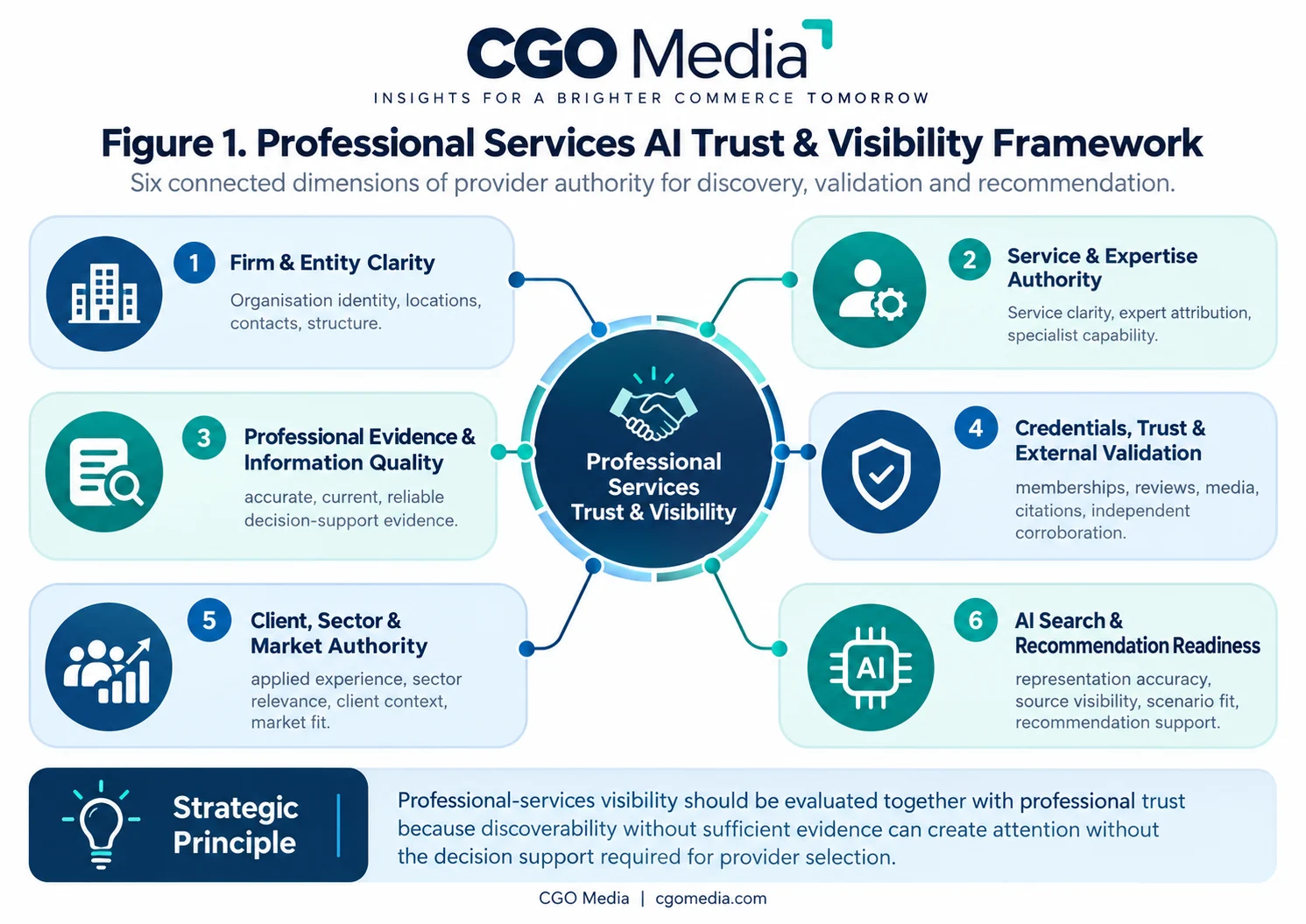
It builds on the wider CGO Media research into Professional Services SEO in an AI Search Environment and translates that research into six connected dimensions of provider authority.
The central premise is that professional-services visibility is no longer determined solely by whether a website ranks for a commercial search term. A prospective client can encounter and evaluate an organisation through search engines, AI assistants, professional directories, review platforms, trade publications, professional bodies, research, media commentary, conference profiles, social networks, referrals and the organisation’s own digital properties.
The resulting authority environment is distributed. The organisation’s website remains important, but it increasingly operates as one component within a much larger network of evidence.
1. Why Professional Services Search Needs a Trust and Visibility Framework
Professional-services search differs from many transactional digital markets because the buyer is often evaluating expertise, judgement, professional capability and risk rather than simply comparing a standardised product.
2. Professional Services Are Often High-Consideration Purchases
The client may be selecting a provider for:
- Strategic advice
- Financial guidance
- Recruitment
- Engineering expertise
- Architecture
- Operational consultancy
- Specialist professional support
3. The Cost of a Poor Provider Decision Can Be Significant
The consequences can include:
- Financial loss
- Project failure
- Compliance problems
- Delayed delivery
- Reputational damage
- Missed commercial opportunity
4. This Creates a Higher Evidence Requirement
The prospective client often needs more than a persuasive service page.
5. The Client Wants to Understand the Provider
Important questions can include:
- Who is the organisation?
- What does it actually do?
- Who performs the work?
- What expertise exists?
- Which clients or sectors has it supported?
- What evidence validates its claims?
6. Search Visibility Creates Opportunity Rather Than Trust
Ranking prominently can introduce the organisation into consideration, but it does not automatically establish professional confidence.
7. Visibility and Trust Are Different Dimensions
A provider can be highly visible while offering limited evidence.
8. Trust and Visibility Should therefore Be Evaluated Together
A useful relationship is:
Discoverability + Evidence + Professional Authority + Independent Validation → Stronger Provider Trust
9. Provider Authority Is Increasingly Distributed
Prospective clients may encounter the organisation through:
- Google Search
- AI assistants
- Professional directories
- Review platforms
- Industry associations
- Business publications
- Conference profiles
- Research and thought leadership
10. The Firm’s Website Is No Longer the Only Authority Environment
Owned content remains central, but external evidence can materially influence provider evaluation.
11. Search Engines Can Encounter Multiple Evidence Sources
Digital systems may encounter:
- Organisation pages
- Professional profiles
- Directories
- Media articles
- Professional bodies
- Research repositories
12. AI Systems Can Also Encounter Distributed Evidence
Generative systems may synthesise information from multiple sources before presenting a provider.
13. Distributed Evidence Creates a Consistency Challenge
The organisation can appear differently across different environments.
14. Distributed Evidence Creates an Accuracy Challenge
External sources may contain outdated:
- Job titles
- Office addresses
- Services
- Professional information
- Business names
15. Distributed Evidence Creates an Authority Challenge
The organisation must establish coherent credibility across both owned and independent environments.
16. Visibility Without Evidence
A professional-services firm may achieve strong organic visibility while still providing insufficient evidence for confident provider selection.
17. Generic Service Pages Can Create Visibility Without Decision Support
A page may describe a service without explaining:
- Who delivers it
- How it works
- Who it is suitable for
- What experience supports it
- What outcomes have been achieved
18. Minimal Professional Profiles Can Weaken Visibility
The user may discover the organisation but remain unable to evaluate its experts.
19. Weak Case Study Evidence Can Weaken Provider Confidence
The prospective client may understand what the firm claims to do without seeing evidence that comparable work has been delivered.
20. Weak Sector Evidence Can Reduce Contextual Trust
A firm can appear technically capable while failing to demonstrate understanding of the client’s industry.
21. Limited Credentials Can Increase Professional Uncertainty
Relevant qualifications, registrations or memberships may be difficult to identify.
22. Weak Independent Validation Can Increase Trust Friction
The organisation’s claims may remain largely self-authored.
23. Visibility Without Evidence Creates a Structural Weakness
The provider receives attention but cannot support the next stages of evaluation sufficiently.
24. Search Traffic Is therefore Not Equivalent to Provider Authority
Visitors still need enough evidence to progress.
25. Rankings Are therefore Not Equivalent to Recommendation Readiness
Prominent organic positioning does not prove that a provider is suitable for recommendation.
26. The Visibility-to-Trust Gap
A useful conceptual relationship is:
High Visibility + Weak Evidence → Visibility-to-Trust Gap
27. The Visibility-to-Trust Gap Can Reduce Conversion
Users may leave the site to investigate alternatives.
28. The Visibility-to-Trust Gap Can Reduce Shortlist Inclusion
A prospect can discover the provider without finding enough evidence to retain it.
29. The Visibility-to-Trust Gap Can Affect AI-Assisted Evaluation
If supporting evidence is fragmented or weak, the provider may be difficult to characterise accurately in comparative or recommendation scenarios.
30. Expertise Without Visibility
The reverse problem also occurs.
31. Strong Firms Can Remain Digitally Underrepresented
An organisation may possess:
- Experienced professionals
- Strong client relationships
- Specialist expertise
- High-quality work
while remaining difficult to discover digitally.
32. Expertise Can Remain Hidden When It Is Poorly Documented
Knowledge that exists only inside the organisation cannot provide full digital authority.
33. Expertise Can Remain Hidden When Service Pages Are Weak
Professional capability may not be connected clearly to searchable services.
34. Expertise Can Remain Hidden When Professional Profiles Are Incomplete
Named specialists may possess substantial credibility without sufficiently detailed digital profiles.
35. Expertise Can Remain Hidden When Case Studies Are Not Published
Applied experience can remain invisible to prospective clients.
36. Expertise Can Remain Hidden When Search Architecture Is Fragmented
Relevant relationships between services, professionals, sectors and evidence may be difficult to understand.
37. Expertise Can Remain Hidden When External Authority Is Disconnected
A professional may receive media recognition that is never connected back to the firm or service architecture.
38. Research Can Exist Without Supporting Commercial Visibility
Useful reports can remain isolated from the services and experts they support.
39. Professional Recognition Can Exist Without Digital Integration
Awards, qualifications or memberships can remain difficult to discover.
40. This Creates an Expertise-to-Visibility Gap
A useful relationship is:
High Professional Capability + Weak Digital Representation → Expertise-to-Visibility Gap
41. The Expertise-to-Visibility Gap Creates Lost Discovery Opportunity
Potential clients may never encounter the provider.
42. It Can Create Lost Comparison Opportunity
The firm may not enter relevant provider sets.
43. It Can Create Lost Recommendation Opportunity
AI-assisted systems and other intermediaries may lack sufficient accessible evidence to represent the provider appropriately.
44. The Strategic Objective Is Alignment
Professional quality and digital visibility should reinforce one another.
45. The Stronger Authority Relationship Is
Genuine Expertise + Clear Representation + Supporting Evidence + Independent Validation → Stronger Digital Authority
46. The Framework Does Not Treat Visibility as an End State
Visibility is one component within a broader provider-authority system.
47. The Framework Does Not Treat Trust as a Branding Exercise
Trust should be supported by evidence rather than slogans.
48. Professional Trust Is Evidence-Led
Relevant evidence can include:
- Qualifications
- Experience
- Client evidence
- Research
- Professional recognition
- Independent validation
49. Professional Trust Is Contextual
Different engagements require different evidence.
50. Professional Trust Is Cumulative
Confidence usually develops through several reinforcing signals.
51. Professional Trust Is Vulnerable to Contradiction
One major inconsistency can undermine otherwise strong evidence.
52. Contradictions Can Include Identity Conflicts
Different sources may show different organisation names or addresses.
53. Contradictions Can Include Professional Conflicts
An external profile may show a different role or employer.
54. Contradictions Can Include Service Conflicts
Third-party descriptions may not reflect current capabilities.
55. Contradictions Can Include Credential Conflicts
Professional status may appear outdated or unclear.
56. Contradictions Increase Interpretation Friction
Prospective clients and digital systems must reconcile competing information.
57. Information Consistency therefore Supports Trust
Consistency reduces unnecessary ambiguity.
58. Consistency Does Not Mean Repeating Identical Text Everywhere
Different sources can describe the same organisation differently while remaining factually aligned.
59. Factual Alignment Is the Key Requirement
Core information should remain compatible across the wider digital ecosystem.
60. The Framework Focuses on Six Connected Dimensions
The live framework identifies six dimensions:
- Firm and Entity Clarity
- Service and Expertise Authority
- Professional Evidence and Information Quality
- Credentials, Trust and External Validation
- Client, Sector and Market Authority
- AI Search and Provider Recommendation Readiness
61. No Single Dimension Is Sufficient
Strong provider authority develops when the six dimensions reinforce one another.
62. Dimension One — Firm and Entity Clarity
Firm and Entity Clarity concerns whether the organisation can be identified accurately and consistently.
63. Entity Clarity Begins with Organisation Identity
The digital ecosystem should make clear:
- Organisation name
- Trading identity
- Group relationships
- Locations
- Contact information
64. Entity Clarity Includes Firm Structure
Professional-services organisations can contain:
- Practice areas
- Subsidiaries
- Offices
- Regional brands
- Specialist divisions
65. Entity Clarity Includes Professional Identity
Named professionals can function as distinct authority entities within the wider organisation.
66. Professional Identity Should Be Connected to Organisational Identity
The relationship between the professional and the firm should be clear.
67. Entity Clarity Reduces Provider Ambiguity
Users can understand who the organisation is and who works there.
68. Entity Clarity Supports Search Interpretation
Clear relationships make the organisation easier to interpret digitally.
69. Entity Clarity Supports External Validation
Third-party sources can be compared more reliably where identity is unambiguous.
70. Dimension Two — Service and Expertise Authority
Service and Expertise Authority concerns whether the organisation provides sufficient evidence of genuine professional capability.
71. Service Authority Begins with Clear Service Definition
The user should be able to understand what the provider actually offers.
72. Service Authority Requires Scope
The organisation should clarify what the service includes.
73. Service Authority Requires Suitability
The client should understand who the service is designed for.
74. Service Authority Requires Expertise Attribution
Relevant services should connect to the professionals capable of delivering them.
75. Expertise Authority Requires Named Professionals
Professional-services capability is often embodied in identifiable specialists.
76. Expertise Authority Requires Evidence of Knowledge
Relevant evidence can include:
- Qualifications
- Experience
- Research
- Professional commentary
- Project work
77. Expertise Authority Requires Specialism Clarity
Broad labels such as “consulting” may be insufficient for complex provider evaluation.
78. Service and Expertise Authority Should Be Connected
A useful relationship is:
Service → Specialist → Evidence → Client Relevance
79. Dimension Three — Professional Evidence and Information Quality
Professional Evidence and Information Quality concerns the accuracy, completeness, usefulness and freshness of the information used to evaluate the organisation.
80. Professional Evidence Should Be Attributable
Important claims should be connected with identifiable people, projects or sources.
81. Professional Evidence Should Be Relevant
Evidence should support the specific expertise being claimed.
82. Professional Evidence Should Be Current
Professional information can become outdated as roles and capabilities change.
83. Professional Evidence Should Be Complete Enough for Evaluation
Minimal biographies can create insufficient context.
84. Information Quality Includes Accuracy
Incorrect information can undermine provider trust.
85. Information Quality Includes Consistency
Core facts should align across important environments.
86. Information Quality Includes Context
Evidence should explain what a qualification, project or achievement actually means.
87. Information Quality Includes Freshness
Recent evidence can help demonstrate current capability.
88. Professional Evidence Supports Human Evaluation
Prospective clients need sufficient information to judge capability.
89. Professional Evidence Also Supports Digital Interpretation
Structured, connected evidence can make relationships easier to understand.
90. Dimension Four — Credentials, Trust and External Validation
Credentials, Trust and External Validation concerns the independent evidence supporting the organisation’s own claims.
91. Owned Claims Are Not Always Sufficient
Every provider can describe itself positively.
92. Independent Evidence Can Strengthen Confidence
Relevant sources can include:
- Professional bodies
- Regulators
- Trade publications
- Media
- Review platforms
- Research citations
93. Credentials Perform a Specific Trust Function
They can validate professional standing.
94. Reviews Perform a Different Trust Function
They can provide evidence of client experience.
95. Media Performs a Different Trust Function
Relevant coverage can demonstrate external recognition.
96. Research Citations Perform a Different Trust Function
They can demonstrate independent use of an organisation’s intellectual output.
97. Trust Evidence Should Be Claim-Specific
The strongest evidence is connected directly with the authority being evaluated.
98. Trust Evidence Should Be Independent Where Possible
External validation can provide a stronger counterweight to self-authored claims.
99. Trust Evidence Should Be Current Where Current Status Matters
Professional registrations and memberships can change.
100. External Validation Creates Authority Redundancy
The organisation’s credibility does not depend entirely on its own website.
101. Dimension Five — Client, Sector and Market Authority
Client, Sector and Market Authority concerns whether the organisation demonstrates practical relevance within the commercial environments it claims to serve.
102. Client Evidence Demonstrates Applied Capability
Relevant forms can include:
- Case studies
- Testimonials
- References
- Outcome evidence
103. Sector Authority Demonstrates Industry Context
The firm should show that it understands the environments in which its services are applied.
104. Sector Authority Can Include Named Experts
Professionals can be associated with specific industries.
105. Sector Authority Can Include Research
Original evidence can demonstrate deeper market understanding.
106. Sector Authority Can Include Trade Visibility
Relevant industry publications can strengthen external credibility.
107. Market Authority Can Include Public Commentary
Professionals can contribute interpretation of important market developments.
108. Client Evidence Should Be Contextual
A strong case study explains the situation rather than simply listing a client logo.
109. Confidentiality Can Limit Public Evidence
Professional-services firms may be unable to disclose all client details.
110. Alternative Evidence Can Still Support Authority
Anonymised case studies, aggregate evidence, research and professional recognition can remain useful.
111. Sector Authority Should Reflect Genuine Capability
The organisation should avoid creating unsupported industry positioning.
112. Market Authority Should Be Earned Rather Than Manufactured
Useful participation in the market provides stronger authority than generic promotional commentary.
113. Dimension Six — AI Search and Provider Recommendation Readiness
AI Search and Provider Recommendation Readiness concerns whether the organisation has sufficient clarity and evidence to be represented accurately within generative discovery environments.
114. AI Search Readiness Begins with the Same Foundations
Technical accessibility, entity clarity and useful information remain important.
115. AI Readiness Requires Clear Provider Identity
The organisation should be identifiable without unnecessary ambiguity.
116. AI Readiness Requires Service Clarity
Capabilities should be described precisely.
117. AI Readiness Requires Professional Clarity
Named experts should be connected with relevant services and specialisms.
118. AI Readiness Requires Evidence
Claims should be supported by useful professional and client information.
119. AI Readiness Requires External Validation
Independent sources can strengthen the wider authority environment.
120. AI Readiness Requires Source Visibility
Relevant evidence should exist in environments that can be discovered and evaluated.
121. AI Readiness Requires Representation Accuracy
Generated descriptions should ideally reflect the organisation’s actual:
- Services
- Specialisms
- Professionals
- Locations
- Markets
122. AI Recommendation Readiness Is More Than Mention Visibility
Being named within a generated answer does not automatically indicate strong provider authority.
123. Recommendation Readiness Requires Contextual Fit
The provider should be relevant to the scenario being evaluated.
124. Recommendation Readiness Requires Trust Evidence
The recommendation environment should be supported by credible underlying information.
125. Recommendation Readiness Requires Appropriate Exclusion
A specialist firm should not expect to appear in every provider scenario.
126. Qualified Recommendation Is the Stronger Objective
The organisation should seek inclusion where genuine capability and client need align.
127. The Six Dimensions Form a Connected Authority System
Each dimension strengthens the others.
128. Entity Clarity Supports Service Understanding
Users can identify which organisation provides the capability.
129. Service Authority Supports Professional Evaluation
The buyer can understand what the provider does and who performs the work.
130. Professional Evidence Supports Trust
Qualifications, experience and research make expertise more visible.
131. External Validation Supports Independent Confidence
Third-party evidence reinforces owned information.
132. Client and Market Authority Supports Contextual Fit
The organisation demonstrates where its expertise has practical relevance.
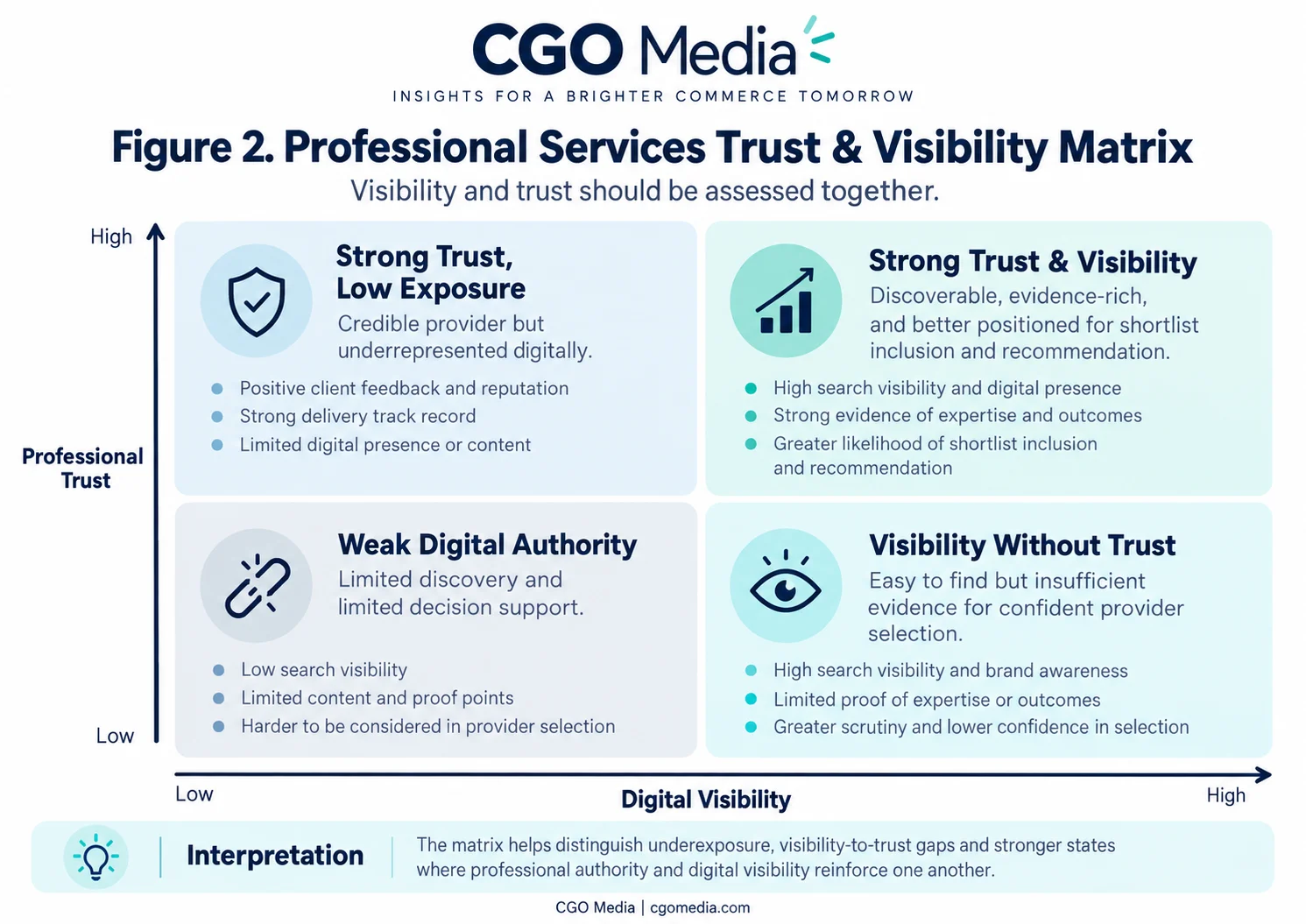
133. The Combined System Supports AI Recommendation Readiness
Connected evidence makes the provider easier to interpret within complex discovery scenarios.
134. Weakness in One Dimension Can Constrain the Whole System
The framework should therefore be assessed as an interconnected model.
135. Weak Entity Clarity Can Constrain External Validation
Third-party references are less useful where identity is ambiguous.
136. Weak Service Authority Can Constrain Professional Relevance
Strong professionals may not be connected clearly to commercially relevant capabilities.
137. Weak Professional Evidence Can Constrain Trust
Service claims may lack attributable specialists.
138. Weak External Validation Can Constrain Independent Confidence
The provider may depend too heavily on self-authored claims.
139. Weak Client and Market Authority Can Constrain Context Fit
The organisation may appear capable but generic.
140. Weak AI Readiness Can Constrain Generative Visibility
Strong underlying authority may remain poorly represented within emerging discovery environments.
141. The Framework Should therefore Be Used Diagnostically
The objective is to identify which authority dimension most limits provider trust and visibility.
142. The First Professional Services Trust and Visibility Principle
Professional-services search visibility should be evaluated together with professional trust because discoverability without sufficient evidence can create attention without the decision support required for provider selection.
143. The Second Professional Services Trust and Visibility Principle
Strong professional expertise should be made digitally legible through clear service architecture, named professionals, evidence, client context and external validation so genuine capability does not remain hidden from prospective clients and digital discovery systems.
144. The Third Professional Services Trust and Visibility Principle
Provider authority should be understood as a distributed evidence system spanning owned information, professional identities, client evidence, independent validation, market participation and external sources rather than as a property of the corporate website alone.
145. The Fourth Professional Services Trust and Visibility Principle
AI search and provider recommendation readiness should build on the same underlying foundations of entity clarity, expertise, information quality, independent trust and market relevance rather than being treated as a separate collection of isolated generative-search tactics.
146. The Six-Dimension Framework Output
The complete framework can be summarised as:
Firm & Entity Clarity + Service & Expertise Authority + Professional Evidence & Information Quality + Credentials, Trust & External Validation + Client, Sector & Market Authority + AI Search & Provider Recommendation Readiness → Professional Services Trust & Visibility
147. The Strategic Position Before Figure One
The Professional Services AI Trust and Visibility Framework therefore begins from a simple but important distinction: professional capability, digital visibility and provider trust are related but not identical. Strong search visibility cannot compensate indefinitely for weak professional evidence, while excellent offline expertise can remain commercially underexposed when it is poorly represented online. The six dimensions provide a structured way to close that gap by connecting organisation identity, services, professionals, evidence, independent validation, market authority and AI-assisted discovery within one coherent authority system.
148. Dimension One — Firm and Entity Clarity
Firm and Entity Clarity evaluates whether the organisation can be identified consistently across its digital ecosystem and whether the relationships between the firm, its offices, professionals, services and specialist areas are sufficiently explicit to support confident interpretation.
149. Entity Clarity Starts with a Stable Organisational Identity
The organisation should make its core identity clear across all major digital environments.
150. Core Identity Information Can Include
- Organisation name
- Trading name
- Legal name where relevant
- Primary website
- Head office
- Other offices
- Telephone numbers
- Primary service categories
151. Professional Services Firms Often Operate Under Multiple Names
A single organisation can appear under:
- Legal company names
- Trading names
- Legacy brands
- Abbreviations
- Regional names
- Group identities
152. Multiple Names Are Not Necessarily a Problem
The problem arises when the relationships between those names are unclear.
153. Naming Relationships Should Be Explicit
Where relevant, the digital ecosystem should make clear whether one identity is:
- A trading style
- A parent company
- A subsidiary
- A regional office
- A specialist practice
154. Historic Names Can Create Entity Confusion
Older directory listings, press coverage or professional profiles can continue using previous names after a rebrand.
155. Rebrands Should therefore Trigger an Entity Review
The organisation should examine:
- Business listings
- Professional directories
- Association profiles
- Media biographies
- Research repositories
- Social profiles
156. Entity Clarity Extends to Firm Structure
Professional-services organisations can contain multiple layers of organisational meaning.
157. Firm Structure Can Include
- Organisation
- Practice area
- Service line
- Specialism
- Sector team
- Regional office
- Named professional
158. A Useful Structural Relationship Is
Organisation → Practice Area → Service → Specialism → Professional → Evidence
159. Firm Structure Should Be Reflected in Navigation
The website should help users understand how the organisation’s capabilities are organised.
160. Firm Structure Should Be Reflected in Internal Linking
Relevant pages should connect logically.
161. Firm Structure Should Be Reflected in Professional Profiles
A professional should be associated with the services and sectors they actually support.
162. Firm Structure Should Be Reflected in External Profiles
Professional directories and association listings should align with the firm’s current structure where possible.
163. Office and Location Clarity Are Part of Entity Authority
Location can influence provider selection for professional services.
164. Relevant Office Information Can Include
- Street address
- Telephone number
- Geographic coverage
- Professionals based at the office
- Services provided
- Regional experience
165. Office Pages Should Have a Real Purpose
They should explain the role of the location rather than merely duplicate contact information.
166. Office Clarity Supports Local Discovery
Accurate location information can strengthen geographically relevant search visibility.
167. Office Clarity Supports Client Confidence
The buyer can understand whether the firm has an appropriate presence for the engagement.
168. Office Clarity Supports Professional Relationships
Named professionals can be connected with the correct location.
169. Geographic Coverage Should Be Described Accurately
A firm should distinguish between:
- Physical office presence
- National delivery
- International delivery
- Remote capability
170. Jurisdiction Can Matter More Than Physical Proximity
Some professional services depend more heavily on relevant regulatory or legal knowledge than on office distance.
171. Entity Clarity Extends to Named Professionals
Professional-services authority is frequently evaluated through individual people rather than corporate branding alone.
172. Senior Professionals Can Function as Independent Authority Entities
They can possess their own:
- Qualifications
- Experience
- Specialisms
- Research
- Speaking activity
- Media commentary
173. Professional Identity Should Be Stable
Basic facts should remain aligned across:
- Corporate website
- Linked professional profiles
- Professional bodies
- Conference biographies
- Research repositories
174. Job Titles Matter
Inconsistent titles can create uncertainty about:
- Seniority
- Role
- Responsibility
- Specialism
175. Professional Roles Should Be Current
Former titles should not continue appearing as current where this could mislead prospective clients.
176. Professional Relationships Should Be Explicit
A useful structure is:
Professional → Role → Service → Specialism → Sector → Firm
177. The Firm Should Also Connect Back to the Professional
Important services and sector pages should identify relevant specialists where appropriate.
178. Reciprocal Linking Strengthens Relationship Clarity
Professional profiles can link to relevant services while service pages link back to the professional.
179. Structured Data Can Support Entity Representation
Where appropriate, structured data can reinforce visible relationships around:
- Organisation
- Person
- Service
- Location
180. Structured Data Should Reflect Visible Information
It should not be used to make unsupported claims.
181. Entity Clarity Depends on the Underlying Content First
Technical markup cannot compensate for unclear or contradictory visible information.
182. Entity Clarity Should Be Audited Beyond the Website
A firm can maintain accurate owned content while external sources remain outdated.
183. An Entity Audit Can Review
- Organisation naming
- Office addresses
- Telephone numbers
- Professional roles
- Service descriptions
- Professional memberships
184. Entity Conflicts Should Be Prioritised by Importance
Not every discrepancy has the same effect.
185. High-Priority Conflicts Can Include
- Incorrect firm name
- Wrong office location
- Former employee presented as current
- Outdated professional title
- Incorrect service information
186. Entity Clarity Is an Authority Foundation
If users cannot establish who the provider is, later trust signals become harder to interpret.
187. Dimension One Output — Clear Provider Identity
A strong Dimension One position produces an organisation whose core identity, locations, professional relationships and service structure are clear across the digital environment.
188. Dimension Two — Service and Expertise Authority
Service and Expertise Authority evaluates whether the organisation provides enough credible evidence for users to understand what it does, who performs the work and why those professionals are qualified to deliver the service.
189. Service Authority Begins with Clear Definition
Each strategically important service should have a clear purpose.
190. A Strong Service Page Should Explain the Problem
The client should understand which business situation the service addresses.
191. A Strong Service Page Should Explain the Service
The scope should be sufficiently precise to support meaningful evaluation.
192. A Strong Service Page Should Explain Suitability
The organisation should identify the types of clients or situations for which the service is appropriate.
193. A Strong Service Page Should Explain Process
Where useful, the page can describe how an engagement typically works.
194. A Strong Service Page Should Explain Deliverables
The prospective client should understand what the engagement may produce.
195. A Strong Service Page Should Identify Relevant Specialists
Professional-services capability should not remain anonymous where named expertise is commercially important.
196. A Strong Service Page Should Connect Supporting Evidence
Relevant evidence can include:
- Case studies
- Research
- Client outcomes
- Professional credentials
- Sector expertise
197. Service Authority Should Be Decision-Oriented
The purpose is not simply to produce more words.
198. Service Authority Should Reduce Client Uncertainty
Useful content helps the prospect answer:
- Is this the right service?
- Does this firm understand the problem?
- Who will do the work?
- What evidence supports the claim?
199. Broad Service Labels Can Be Insufficient
Professional-services categories can contain many distinct specialisms.
200. Consulting Is One Example
The term can include:
- Strategy consulting
- Operations consulting
- Technology consulting
- Financial advisory
- HR consulting
- Risk consulting
201. Accountancy Is Another Example
The category can include:
- Audit
- Tax
- Management accounts
- Corporate finance
- Transaction support
- Outsourced finance
202. Recruitment Is Another Example
The category can include:
- Executive search
- Permanent recruitment
- Contract recruitment
- Interim management
- Specialist talent advisory
203. Architecture and Engineering Can Also Require Deep Specialism
Different project types can require substantially different professional capabilities.
204. Specialism Architecture Improves Clarity
The organisation should distinguish genuine specialist capabilities rather than relying entirely on broad category terms.
205. Specialism Architecture Improves Search Relevance
More precise pages can align more closely with complex user requirements.
206. Specialism Architecture Improves Provider Comparison
Prospective clients can distinguish one provider’s strengths from another’s.
207. Expertise Authority Requires Named Evidence
The firm should show who holds the relevant expertise.
208. Qualifications Are One Evidence Type
Relevant qualifications can include:
- Academic qualifications
- Professional qualifications
- Chartered status
- Licences
- Certifications
- Professional memberships
209. Qualifications Should Be Relevant to the Service
A qualification carries greatest decision value when it supports the capability under evaluation.
210. Qualifications Should Be Presented Accurately
Professional status should not be exaggerated.
211. Qualifications Should Be Current Where Status Can Change
Expired or lapsed credentials should not continue appearing as current.
212. Experience Is Another Evidence Type
Relevant professional experience can include:
- Years in the field
- Previous roles
- Sector experience
- Project experience
- Client types supported
- Areas of responsibility
213. Experience Should Be Specific Enough to Be Useful
Generic statements such as “extensive experience” provide limited decision support.
214. Experience Should Be Connected to the Claimed Expertise
The relationship between career history and present specialism should be clear.
215. Applied Experience Can Be Stronger Than General Experience
The client often wants to know whether the professional has handled comparable situations.
216. Methodology Can Strengthen Expertise Authority
Some firms possess distinctive approaches for solving client problems.
217. A Methodology Can Explain Professional Judgement
A useful conceptual sequence is:
Problem → Assessment → Analysis → Intervention → Measurement → Improvement
218. Methodology Can Reduce Engagement Uncertainty
The client gains a clearer understanding of how the firm works.
219. Methodology Can Demonstrate Process Discipline
A coherent approach can distinguish structured professional delivery from vague advisory claims.
220. Methodology Should Not Be Invented for Marketing
Published methodologies should reflect genuine operating practices.
221. Proprietary Detail Does Not Need to Be Published Fully
Enough information should be disclosed to support understanding without revealing commercially sensitive knowledge.
222. Thought Leadership Can Strengthen Expertise Authority
Thought leadership demonstrates that the organisation contributes professional knowledge rather than merely promoting services.
223. Thought Leadership Can Include
- Research papers
- Industry reports
- Frameworks
- Guides
- Expert commentary
- Webinars
- Conference presentations
224. Strong Thought Leadership Should Be Useful Independently
It should provide value even when the reader does not become a client.
225. Strong Thought Leadership Should Be Attributable
Named authorship supports professional identity.
226. Strong Thought Leadership Should Be Relevant
Published expertise should connect with areas the firm genuinely understands.
227. Thought Leadership Can Strengthen Service Authority
A relevant research paper or framework can support a commercial service without becoming promotional.
228. Thought Leadership Can Strengthen Professional Authority
Named experts become associated with identifiable subjects.
229. Thought Leadership Can Strengthen External Validation
Useful work can later attract:
- Citations
- Media coverage
- Conference invitations
- Professional references
230. Research Authority Is a More Structured Form of Thought Leadership
Original research can provide independently useful evidence.
231. Professional Services Research Can Address Market Benchmarks
Benchmark studies can help organisations compare their own position with a wider market.
232. Research Can Address Industry Trends
Professional firms can document observable changes within the sectors they serve.
233. Research Can Address Workforce Data
Recruitment, HR and advisory organisations can study relevant labour-market patterns.
234. Research Can Address Client Priorities
Survey or observational work can examine changing decision criteria.
235. Research Can Address Technology Adoption
Professional firms can investigate how new technologies affect their clients.
236. Research Can Address Business Performance
Where appropriate data exists, studies can explore operational or commercial trends.
237. Research Should Have a Clear Methodology
The reader should understand:
- Research question
- Source selection
- Sample
- Method
- Limitations
238. Research Should Separate Observation from Interpretation
Observed evidence should be distinguished from conclusions drawn from it.
239. Research Should Avoid Manufacturing Statistics
Numerical claims require a genuine dataset or appropriately sourced external evidence.
240. Research Should Be Connected to the Wider Authority Architecture
Relevant research can link with:
- Services
- Professionals
- Sectors
- Case studies
- Media activity
241. Service and Expertise Authority Is Strongest When Evidence Converges
A useful relationship is:
Clear Service + Named Expert + Relevant Experience + Methodology + Research + Applied Evidence → Stronger Expertise Authority
242. Dimension Two Output — Verifiable Professional Capability
A strong Dimension Two position makes the organisation’s services, specialisms, experts and supporting evidence sufficiently clear for meaningful provider evaluation.
243. Dimension Three — Professional Evidence and Information Quality
Professional Evidence and Information Quality evaluates whether prospective clients have enough reliable, current and decision-useful information to assess the organisation confidently.
244. Information Quality Is Not the Same as Content Volume
A large website can still contain incomplete, outdated or poorly structured evidence.
245. Strong Information Quality Reduces Uncertainty
The user can find the information required to evaluate:
- Service relevance
- Expertise
- Trust
- Fit
- Next steps
246. Service Information Completeness Is One Component
Professional-service pages should answer important pre-contact questions.
247. The Client Should Understand What the Service Involves
Scope should be described clearly enough to support evaluation.
248. The Client Should Understand Who the Service Is For
Suitability guidance improves qualification.
249. The Client Should Understand What Problems the Service Addresses
Problem relevance helps users recognise whether the service fits their situation.
250. The Client Should Understand Who Provides the Service
Relevant professionals should be identifiable.
251. The Client Should Understand What Evidence Supports the Expertise
Supporting assets should be accessible.
252. The Client Should Understand What Happens after an Enquiry
Clear next-step expectations can reduce contact friction.
253. Professional Biography Quality Is Another Component
Professional biographies should contain more than a job title and photograph.
254. A Useful Professional Profile Can Include Current Role
The reader should understand the professional’s present position.
255. A Useful Professional Profile Can Include Specialisms
Specific areas of expertise should be explicit.
256. A Useful Professional Profile Can Include Qualifications
Relevant credentials can strengthen trust.
257. A Useful Professional Profile Can Include Sector Experience
Industry context can improve provider fit.
258. A Useful Professional Profile Can Include Selected Projects
Applied experience can demonstrate professional capability.
259. A Useful Professional Profile Can Include Research and Publications
Authored work can support intellectual authority.
260. A Useful Professional Profile Can Include Professional Memberships
External memberships can reinforce professional standing where relevant.
261. Professional Profiles Should Remain Proportionate
Not every professional requires identical depth.
262. Senior and Specialist Professionals May Require Greater Detail
Individuals central to provider selection may warrant more comprehensive evidence.
263. Professional Profiles Should Avoid Unsupported Superlatives
Claims such as “leading expert” require meaningful support.
264. Professional Profiles Should Avoid Vague Experience Claims
Statements become more useful when contextualised.
265. Case Study Information Quality Is Another Component
Case studies should help clients understand how expertise is applied.
266. A Useful Case Study Structure Is
Context → Problem → Approach → Expertise → Outcome
267. Context Explains the Client Environment
The reader should understand enough about the situation to judge comparability.
268. Problem Explains the Requirement
The challenge should be stated clearly.
269. Approach Explains the Intervention
The case study should describe what the provider did.
270. Expertise Explains Who or What Capability Was Applied
Relevant professionals or specialist teams can be identified.
271. Outcome Explains the Result
The result can be quantitative or qualitative depending on the engagement.
272. Case Studies Should Avoid Universalising Individual Outcomes
One client’s result does not guarantee the same outcome elsewhere.
273. Confidentiality Should Be Respected
Where client identity cannot be disclosed, anonymised examples can still provide useful evidence.
274. Anonymisation Should Preserve Enough Context
Removing the client name should not make the case study meaningless.
275. Evidence Freshness Is Another Information Quality Dimension
Professional evidence can become outdated.
276. Former Team Members Can Create Stale Evidence
Old biographies can misrepresent current capability.
277. Old Office Locations Can Create Stale Evidence
Outdated addresses can affect both discovery and trust.
278. Expired Credentials Can Create Stale Evidence
Current professional status should be represented accurately.
279. Outdated Services Can Create Stale Evidence
The organisation may continue appearing for capabilities it no longer prioritises.
280. Historic Awards Can Be Misleading When Presented as Current
Dates and context should remain visible.
281. Obsolete Case Studies Can Distort Current Positioning
Historical examples should be balanced with more recent evidence where possible.
282. Evidence Governance Should therefore Include Regular Review
Review frequency should reflect how quickly the information can change.
283. High-Change Information May Require More Frequent Review
Examples can include:
- Professional roles
- Office details
- Service availability
- Credentials
284. Lower-Change Information Can Be Reviewed Less Frequently
Stable methodologies or historical research may not require the same cadence.
285. Event-Driven Review Can Complement Periodic Review
Important triggers can include:
- New hire
- Professional departure
- Office opening
- Office closure
- Service launch
- Rebrand
- Credential change
286. Digital Ecosystem Consistency Is Another Information Quality Dimension
Key provider information should remain materially aligned across important sources.
287. Relevant Sources Can Include
- Website
- Professional directories
- Business profiles
- Review platforms
- Association profiles
- Conference biographies
- Media profiles
288. Consistency Does Not Require Identical Copy
Different platforms can use different descriptions.
289. Material Facts Should Remain Compatible
Core facts such as:
- Identity
- Location
- Role
- Service
- Credential status
should not conflict.
290. Information Quality Should Be Evaluated from the User’s Perspective
The key question is whether the available information allows a prospective client to make a better decision.
291. Information Quality Should Also Be Evaluated Operationally
The organisation needs processes for:
- Ownership
- Review
- Correction
- Version control
292. Dimension Three Output — Reliable Decision-Support Evidence
A strong Dimension Three position produces professional information that is accurate, sufficiently complete, appropriately contextualised, current and consistent enough to support confident provider evaluation.
293. Dimension Four — Credentials, Trust and External Validation
Credentials, Trust and External Validation evaluates whether the organisation’s own authority claims are reinforced by relevant independent evidence.
294. External Validation Reduces Dependence on Self-Authored Claims
An organisation can describe itself positively, but independent sources can provide additional confidence.
295. External Validation Can Confirm Professional Identity
Relevant sources can verify whether a professional:
- Exists
- Holds the stated role
- Possesses recognised credentials
296. External Validation Can Confirm Qualifications
Professional bodies and official registers can provide independent support.
297. External Validation Can Confirm Experience Indirectly
Media, conference and professional sources can show sustained participation in a field.
298. External Validation Can Confirm Client Satisfaction
Reviews and references can provide evidence of client experience.
299. External Validation Can Confirm Industry Standing
Trade media, professional appointments and conference participation can reinforce market recognition.
300. External Validation Can Confirm Expertise
Relevant citations, interviews or specialist contributions can support professional claims.
301. Professional Memberships Are One Validation Type
Membership of recognised organisations can strengthen professional identity where the membership is meaningful and verifiable.
302. Membership Relevance Matters
A professional membership is strongest when it relates directly to the expertise being evaluated.
303. Membership Status Matters
Current membership should not be confused with historical association.
304. Membership Significance Matters
Different organisations have different entry requirements and professional standing.
305. Accreditation Is Another Validation Type
Accreditation can provide formal evidence around:
- Capability
- Standards
- Compliance
- Professional status
306. Registration Is Another Validation Type
Some professional services depend on registration with recognised bodies.
307. Relevant Evidence Can Include Regulatory Registers
Regulatory databases can validate required professional status.
308. Relevant Evidence Can Include Professional Registers
Official professional listings can reinforce qualifications or membership.
309. Relevant Evidence Can Include Accreditation Databases
Independent databases can validate organisational certifications.
310. Relevant Evidence Can Include Certification Bodies
Certification providers can support claims where the certification remains valid.
311. Credential Evidence Should Be Easy to Understand
The prospective client should not need specialist knowledge to interpret basic professional standing.
312. Credential Evidence Should Be Accurate
The organisation should avoid overstating:
- Membership level
- Accreditation scope
- Regulatory status
- Certification meaning
313. Reviews Are Another External Validation Type
Reviews can provide independent evidence of client experience.
314. Review Volume Is One Dimension
A larger sample can provide more context, although volume alone does not establish quality.
315. Review Recency Is Another Dimension
Recent reviews can better reflect current delivery.
316. Platform Relevance Is Another Dimension
Different review environments can carry different significance across professional-services markets.
317. Review Themes Are Another Dimension
Recurring feedback can reveal patterns around:
- Expertise
- Communication
- Responsiveness
- Professionalism
- Value
318. Review Authenticity Is Another Dimension
Professional-services organisations should avoid artificial review-generation practices.
319. Provider Responses Are Another Dimension
Thoughtful responses can demonstrate communication quality and accountability.
320. Reviews Should Be Interpreted by Professional Context
Confidential B2B firms may naturally have fewer public reviews than high-volume transactional services.
321. Low Review Volume Is therefore Not Automatically a Trust Failure
Alternative evidence can provide validation.
322. Alternative Client Validation Can Include
- Client references
- Testimonials
- Case studies
- Repeat engagements
- Long-term client relationships
323. Media Validation Is Another External Authority Type
Relevant media coverage can strengthen authority when a firm or professional is cited because of genuine expertise.
324. Expert Commentary Can Support Media Validation
A named professional can be quoted on subjects they genuinely understand.
325. Research Findings Can Support Media Validation
Journalists can use original data or analysis.
326. Industry Analysis Can Support Media Validation
Specialist interpretation can demonstrate sector knowledge.
327. Market Forecasts Can Support Media Validation
Where responsibly framed, expert forecasts can demonstrate professional judgement.
328. Professional Guidance Can Support Media Validation
Clear educational commentary can strengthen external authority.
329. Media Relevance Matters More Than Raw Mention Volume
A small number of highly relevant citations can support expertise more effectively than large volumes of unrelated coverage.
330. Named Expert Attribution Strengthens Media Authority
The reader can connect external recognition with the relevant professional.
331. Media Authority Can Reinforce Service Authority
Relevant coverage should be connected back to the capability it supports where appropriate.
332. Media Authority Can Reinforce Sector Authority
Trade publications can strengthen industry-specific trust.
333. Awards Are Another Supporting Evidence Type
Awards can contribute to trust when relevance and independence are clear.
334. Awards Should Be Evaluated for Relevance
An award should support an aspect of the provider that matters to the selection decision.
335. Awards Should Be Evaluated for Independence
The selection process behind the award should be considered.
336. Awards Should Be Evaluated for Recency
Historical awards can remain meaningful but should not be represented as current achievements.
337. Awards Should Be Evaluated for Specificity
An award for a named professional or service can provide clearer evidence than a vague corporate accolade.
338. Awards Should Not Substitute for Deeper Evidence
They should support rather than replace:
- Expertise
- Client evidence
- Professional credentials
- External recognition
339. Research Citations Can Provide Another Form of External Validation
Independent use of a firm’s research can reinforce its intellectual authority.
340. Citation Quality Matters
A relevant citation by a credible source can carry more significance than a large number of low-context mentions.
341. Citation Context Matters
The organisation should understand which research claim or dataset is being referenced.
342. Citation Diversity Can Strengthen Authority
Independent use across:
- Journalism
- Academic work
- Industry reports
- Professional publications
can create a more resilient evidence base.
343. External Validation Should Be Connected to the Correct Entity
A media citation to one professional should not automatically be treated as evidence for every service offered by the firm.
344. External Validation Should Be Connected to the Correct Claim
Claim-specific evidence is more credible than broad association.
345. External Validation Should Be Connected to the Correct Timeframe
Older evidence should be interpreted according to its age.
346. Independent Evidence Reduces Single-Source Dependency
The firm’s authority does not depend entirely on its own website.
347. Independent Evidence Can Create Discovery Paths
Users may first encounter the firm through:
- Media
- Directories
- Professional bodies
- Research citations
- Reviews
348. Independent Evidence Can Create Validation Paths
Users who discover the provider elsewhere can use third-party sources to confirm its claims.
349. Independent Evidence Can Create AI Source Visibility
Relevant third-party sources may also appear in generative search and provider-recommendation environments.
350. External Validation Should therefore Be Developed Strategically
The objective is not simply to accumulate mentions.
351. Strategic Validation Supports Priority Services
External authority should reinforce commercially important capabilities.
352. Strategic Validation Supports Priority Experts
Named professionals central to important practices can warrant greater external visibility.
353. Strategic Validation Supports Priority Sectors
Trade and industry authority can strengthen contextual relevance.
354. Strategic Validation Supports Priority Markets
Relevant geographic or professional sources can strengthen local or jurisdictional authority.
355. Dimension Four Output — Independently Reinforced Trust
A strong Dimension Four position produces a provider whose professional claims are supported by relevant credentials, reviews, media, registrations, awards, citations and other independent evidence appropriate to the service and market.
356. The First Four Dimensions Create the Core Trust Architecture
The relationship can be represented as:
Entity Clarity + Service & Expertise Authority + Professional Evidence Quality + External Validation → Core Professional Trust
357. Core Trust Can Exist with Low Visibility
A strong firm may possess substantial expertise and independent validation while remaining digitally underexposed.
358. High Visibility Can Exist with Weak Core Trust
A heavily optimised website can attract attention without providing enough professional evidence.
359. The Stronger Strategic Position Combines Both
Professional-services organisations should seek strong digital visibility supported by credible professional trust.
360. The Fifth Professional Services Trust and Visibility Principle
Firm and Entity Clarity should establish an unambiguous relationship between the organisation, its offices, professionals, services, specialist areas and supporting evidence so both prospective clients and digital systems can interpret the provider consistently.
361. The Sixth Professional Services Trust and Visibility Principle
Service and Expertise Authority should connect clear service scope with attributable professional qualifications, experience, methodologies, thought leadership, research and applied evidence rather than relying primarily on generic commercial descriptions.
362. The Seventh Professional Services Trust and Visibility Principle
Professional Evidence and Information Quality should be evaluated through accuracy, completeness, relevance, freshness, attribution and consistency because stale or contradictory information can reduce confidence even where genuine capability remains strong.
363. The Eighth Professional Services Trust and Visibility Principle
External validation should reinforce specific claims through relevant and sufficiently independent evidence, recognising that professional bodies, reviews, media, awards, research citations and client references perform different trust functions and should not be treated as interchangeable signals.
364. The Strategic Position Before Figure Two
The first four dimensions reveal why digital visibility and professional trust should be treated as separate but interacting properties. A firm can be highly visible while remaining poorly validated, or it can possess exceptional expertise, credentials and client confidence while remaining difficult to discover. Firm and Entity Clarity establishes who the provider is; Service and Expertise Authority establishes what it can do; Professional Evidence and Information Quality determines whether that capability can be evaluated reliably; and Credentials, Trust and External Validation determine whether important claims are reinforced independently. Together these dimensions create the basis for assessing where an organisation sits between underexposure, visibility without sufficient trust, and a stronger state in which professional authority and digital visibility reinforce one another.
365. Dimension Five — Client, Sector and Market Authority
Client, Sector and Market Authority evaluates whether the organisation demonstrates meaningful participation in the industries, commercial environments and client situations it claims to understand.
366. General Professional Capability Is Not Always Enough
A prospective client may believe that a provider is professionally competent while still questioning whether it understands the specific market in which the client’s problem exists.
367. Sector Authority Provides Context
It helps answer:
Does this provider understand organisations like ours?
368. Sector Authority Can Be Especially Important in Complex Markets
Relevant complexity can include:
- Regulation
- Industry terminology
- Operating models
- Customer behaviour
- Commercial structures
- Procurement expectations
369. Sector Authority Should Be Evidence-Based
A generic statement that the firm “works across many sectors” provides limited decision support.
370. Stronger Sector Authority Connects Several Evidence Layers
A useful relationship is:
Industry → Client Problem → Service → Expert → Evidence → Outcome
371. Sector-Specific Client Work Is One Evidence Type
Comparable client experience can demonstrate practical understanding of an industry environment.
372. Sector-Specific Case Studies Are Another Evidence Type
They can show how professional capability has been applied within a particular market.
373. Sector-Specific Research Is Another Evidence Type
Original research can demonstrate deeper understanding of:
- Market conditions
- Client priorities
- Industry risks
- Technology adoption
- Workforce issues
374. Trade Media Coverage Is Another Evidence Type
Relevant trade publications can validate specialist participation within an industry.
375. Conference Participation Is Another Evidence Type
Named professionals speaking at relevant events can reinforce sector authority.
376. Specialist Partnerships Are Another Evidence Type
Partnerships with relevant organisations can demonstrate market participation where the relationship is substantive.
377. Institutional Relationships Can Also Contribute
Relevant relationships can include:
- Universities
- Professional bodies
- Trade organisations
- Industry groups
- Research organisations
378. Sector Authority Should Be Connected to Named Experts
The organisation should identify which professionals possess relevant industry experience.
379. Sector Authority Should Be Connected to Services
The client should understand which capabilities are applied within the sector.
380. Sector Authority Should Be Connected to Client Problems
The provider should explain which recurring challenges it helps address.
381. Sector Authority Should Be Connected to Evidence
Case studies, research, client outcomes and independent recognition should support the positioning.
382. Sector Authority Should Be Connected to Outcomes
Where possible, the organisation should explain what its expertise has helped achieve.
383. Sector Pages Should therefore Function as Authority Hubs
A mature sector page can connect:
- Industry context
- Client problems
- Relevant services
- Named experts
- Research
- Case studies
- External validation
384. Sector Pages Should Not Merely Repeat Service Copy
The page should add market-specific value.
385. Sector Pages Should Demonstrate Contextual Knowledge
Useful information can include:
- Industry challenges
- Market structure
- Regulatory considerations
- Operational constraints
- Client priorities
386. Sector Authority Can Support Search Relevance
The organisation can become more legible for service-plus-sector searches.
387. Sector Authority Can Support Human Evaluation
The prospective client can determine whether the provider understands the market.
388. Sector Authority Can Support AI-Assisted Comparison
Clear industry evidence can help distinguish general professional capability from relevant specialist experience.
389. Client Evidence Is Central to Dimension Five
Client evidence demonstrates that professional expertise has been applied in real situations.
390. Client Evidence Can Include Named Case Studies
Where confidentiality permits, named clients can provide strong context.
391. Client Evidence Can Include Anonymised Case Studies
Confidential assignments can still be described without revealing the organisation’s identity.
392. Client Evidence Can Include Testimonials
Direct client feedback can support trust when the context is clear.
393. Client Evidence Can Include Client Logos
Logos can provide high-level social proof but usually offer limited information about:
- Scope
- Service
- Outcome
- Professional involvement
394. Client Logos Should therefore Be Treated as Supporting Evidence
They are stronger when accompanied by more contextual proof.
395. Client Evidence Can Include Outcome Data
Where reliable data exists, measurable results can support applied authority.
396. Outcome Data Should Be Contextualised
The reader should understand:
- What was measured
- Over what period
- Under what conditions
- What role the provider played
397. Outcome Data Should Not Be Manufactured
Numerical claims require genuine evidence.
398. Individual Client Outcomes Should Not Be Presented as Universal Guarantees
Professional-services results depend on client circumstances and external factors.
399. Long-Term Client Relationships Can Provide Another Evidence Layer
Ongoing engagements can indicate sustained trust where the relationship is represented accurately.
400. Repeat Engagements Can Provide Another Evidence Layer
Clients returning for additional work can support evidence of continuing confidence.
401. Client References Can Provide High-Depth Validation
They are particularly useful in high-value B2B provider-selection processes.
402. Client Evidence Should Reflect Strategic Priorities
Priority services and sectors should ideally have relevant supporting examples.
403. Client Evidence Gaps Can Reveal Authority Weakness
A service can be strategically important while possessing little visible proof of delivery.
404. Client Evidence Gaps Can Also Reveal Confidentiality Constraints
The absence of named case studies does not automatically mean the absence of experience.
405. Confidential Firms Need Alternative Evidence Architecture
Useful substitutes can include:
- Anonymised case studies
- Aggregate outcomes
- Client references
- Research
- Professional credentials
- Independent recognition
406. Market Participation Extends Sector Authority
Professional-services organisations can demonstrate that they participate in the wider intellectual and professional environment around their markets.
407. Industry Conferences Are One Form of Market Participation
Relevant professionals can:
- Speak
- Moderate
- Present research
- Participate in panels
408. Professional Panels Are Another Form of Market Participation
Participation can demonstrate engagement with wider professional debate.
409. Research Partnerships Are Another Form of Market Participation
Collaborative work can strengthen evidence depth where roles and methodology are clear.
410. Trade Associations Are Another Form of Market Participation
Active involvement can strengthen sector context.
411. Media Commentary Is Another Form of Market Participation
Relevant expert analysis can demonstrate current understanding of market issues.
412. Professional Education Is Another Form of Market Participation
Experts may contribute through:
- Training
- Webinars
- Lectures
- Guides
- Professional development
413. Market Participation Should Be Substantive
Simply appearing at events provides less authority than meaningful contribution.
414. Market Participation Should Be Attributable
The relevant professional should be identifiable.
415. Market Participation Should Be Relevant
Activity should support areas the organisation genuinely understands.
416. Market Participation Should Be Current
Historic activity can remain useful but should not substitute entirely for present participation.
417. Market Authority Is Strongest When Evidence Converges
A useful relationship is:
Sector Experience + Client Evidence + Research + Trade Participation + External Recognition → Stronger Market Authority
418. Sector Authority Can Be Narrow and Deep
A boutique firm may possess exceptionally strong authority within a small number of industries.
419. Sector Authority Can Be Broad and Structured
A larger professional-services firm may maintain dedicated authority systems across multiple industries.
420. Breadth Is Not Automatically Better Than Depth
The appropriate structure depends on actual capability and commercial strategy.
421. Unsupported Sector Expansion Can Dilute Authority
Creating generic pages for industries with little evidence can weaken positioning.
422. Sector Prioritisation Should Follow Real Capability
Relevant factors can include:
- Existing client base
- Expertise
- Research
- Commercial opportunity
- External validation
423. Dimension Five Output — Contextual Client and Market Authority
A strong Dimension Five position demonstrates that the organisation’s professional expertise is not merely theoretical but is connected with real client situations, sector knowledge, market participation and relevant applied evidence.
424. Dimension Six — AI Search and Provider Recommendation Readiness
AI Search and Provider Recommendation Readiness evaluates whether the organisation’s distributed evidence is sufficiently clear, connected and credible to support accurate provider understanding across generative discovery environments.
425. AI Recommendation Readiness Is Not a Single Score
The framework does not assume that there is one universal AI recommendation metric.
426. Different AI Systems Can Behave Differently
Provider representation can vary according to:
- Platform
- Prompt
- Location
- Date
- Conversation context
427. AI Readiness Should therefore Be Evaluated Through Underlying Evidence Conditions
The central question is whether the provider has enough accurate and distributed evidence to support meaningful interpretation.
428. The First AI Readiness Condition Is Entity Clarity
The system should be able to identify the correct organisation.
429. The Second AI Readiness Condition Is Service Clarity
The provider’s capabilities should be explicit.
430. The Third AI Readiness Condition Is Professional Clarity
Named experts should be associated with relevant services and specialisms.
431. The Fourth AI Readiness Condition Is Evidence Quality
Claims should be supported by useful information.
432. The Fifth AI Readiness Condition Is External Trust
Independent sources can reinforce provider interpretation.
433. The Sixth AI Readiness Condition Is Market Context
Sector and client evidence can help establish where the organisation is relevant.
434. AI Source Visibility Is One Measurement Area
Professional-services firms can monitor which sources appear when AI systems discuss:
- The organisation
- Its services
- Its professionals
- Its specialist sectors
- Its competitors
435. Source Visibility Can Reveal Which Evidence Environments Are Being Surfaced
Observed sources can include:
- Owned pages
- Directories
- Media
- Professional bodies
- Research repositories
- Review platforms
436. Source Visibility Should Be Recorded Methodologically
Useful fields can include:
- Platform
- Date
- Prompt family
- Geography
- Visible sources
437. AI Source Visibility Is Scenario-Specific
Observed sources from one scenario should not be presented as universal system behaviour.
438. AI Citation Visibility Is Another Measurement Area
The organisation can examine whether generated answers visibly cite:
- Its own research
- Its service content
- Professional profiles
- Independent external sources
439. Citation Visibility Can Reveal Research Utility
Original evidence may become useful beyond the firm’s own website.
440. Citation Visibility Can Reveal Third-Party Authority
Independent sources may be used to support claims about the organisation.
441. Citation Visibility Does Not Prove a Universal Ranking Signal
Observed citations should remain descriptive.
442. AI Recommendation Visibility Is Another Measurement Area
Recommendation monitoring should focus on realistic provider-selection prompts.
443. Recommendation Scenarios Can Be Service-Specific
For example:
“Which UK consultancies specialise in supply-chain transformation?”
444. Recommendation Scenarios Can Be Sector-Specific
For example:
“Which accountancy firms specialise in SaaS companies?”
445. Recommendation Scenarios Can Be Credential-Specific
For example:
“Which firms have appropriately qualified specialists for this type of work?”
446. Recommendation Scenarios Can Be Geographic
For example:
“Which engineering consultancies operate in this region?”
447. Recommendation Scenarios Can Be Problem-Specific
For example:
“Which consultancies have experience solving this type of organisational problem?”
448. Recommendation Monitoring Should Focus on Fit
The objective should not be inclusion within every provider list.
449. Recommendation Monitoring Should Distinguish Appropriate Inclusion
A provider should ideally appear in scenarios where genuine capability exists.
450. Recommendation Monitoring Should Distinguish Appropriate Exclusion
Non-inclusion can be entirely appropriate where the provider does not match the requirement.
451. Qualified Recommendation Is therefore a Better Objective Than Maximum Recommendation Frequency
A useful relationship is:
Relevant Scenario + Genuine Capability + Supporting Evidence → Qualified Recommendation Visibility
452. Provider Representation Accuracy Is Another Measurement Area
AI systems may occasionally describe organisations incorrectly or incompletely.
453. Service Accuracy Should Be Reviewed
Generated answers should ideally reflect current capabilities.
454. Location Accuracy Should Be Reviewed
Office and market information should be represented correctly.
455. Professional Accuracy Should Be Reviewed
Named experts should be associated with the correct organisation and role.
456. Credential Accuracy Should Be Reviewed
Professional status should not be misstated.
457. Sector Accuracy Should Be Reviewed
The organisation should not be associated with unsupported industry expertise.
458. Market Positioning Accuracy Should Be Reviewed
Generated descriptions should not materially mischaracterise the provider.
459. Inaccurate Representation Can Reveal Evidence Problems
Potential causes can include:
- Outdated third-party profiles
- Ambiguous service descriptions
- Conflicting professional data
- Weak sector evidence
- Legacy brand information
460. Representation Errors Should Be Diagnosed Rather Than Chased Individually
The organisation should examine the underlying information environment.
461. One Generated Error Does Not Prove a Systemic Problem
Repeated observations across defined scenarios provide stronger diagnostic evidence.
462. AI Monitoring Should therefore Be Longitudinal
The organisation can track whether representation improves or deteriorates over time.
463. AI Recommendation Readiness Is Cumulative
It emerges from the combined strength of the first five dimensions.
464. The Cumulative Relationship Is
Entity Clarity + Expertise Authority + Professional Evidence + External Trust + Market Authority → AI Recommendation Readiness
465. AI Readiness Should Not Become a Separate Content Silo
The strongest foundations usually already support:
- Human provider evaluation
- Search relevance
- Professional trust
- External authority
466. AI Readiness Extends Existing Search and Authority Work
It adds greater focus on:
- Source visibility
- Entity interpretation
- Citation visibility
- Comparison inclusion
- Recommendation accuracy
467. SEO Remains Foundational
Technical accessibility, information architecture, internal linking and useful content remain necessary.
468. GEO Extends That Foundation
Generative Engine Optimisation focuses more directly on how provider evidence is interpreted, sourced, compared and recommended across AI-assisted environments.
469. Dimension Six Output — Qualified AI Recommendation Readiness
A strong Dimension Six position produces an organisation whose identity, services, experts, evidence, external validation and market context are sufficiently coherent to support accurate representation and qualified recommendation within relevant AI-assisted provider-discovery scenarios.
470. The Six Dimensions Should Be Treated as a Connected Authority System
The live framework does not treat the dimensions as isolated workstreams.
471. Firm Clarity Strengthens Expertise Interpretation
A clear organisational structure makes it easier to associate professional capability with the correct:
- Firm
- Office
- Practice area
- Service
- Professional
- Sector
472. Expertise Strengthens Service Credibility
A commercial service claim becomes more defensible when named professionals, relevant qualifications and experience support it.
473. A Useful Service Credibility Relationship Is
Service Claim → Expert Evidence → Applied Experience → Client Evidence → External Validation
474. Professional Evidence Strengthens Trust
Detailed and verifiable evidence provides stronger decision support than promotional language.
475. Generic Claims Create Weak Trust
Statements such as:
“Our experienced team provides leading strategic advice.”
provide limited independent decision value.
476. Specific Evidence Creates Stronger Trust
The same claim becomes more useful when supported by:
- Named professionals
- Relevant qualifications
- Specific expertise
- Case-study evidence
- External recognition
477. External Validation Strengthens Recommendation Potential
Independent evidence reduces reliance on self-published provider claims.
478. This Matters Particularly During Provider Comparison
Several firms can describe similar services using similar promotional language.
479. External Evidence Helps Differentiate Credibility
The prospective client can compare:
- Credentials
- Reviews
- Client evidence
- Media
- Professional recognition
480. Market Authority Strengthens Contextual Relevance
General competence and contextual expertise are different.
481. A Provider Can Possess Strong General Expertise but Weak Sector Evidence
The client may still question whether that expertise transfers effectively into its own market.
482. Sector Evidence Helps Bridge That Gap
Relevant client work, research and trade authority can strengthen contextual suitability.
483. AI Readiness Reflects the Whole Evidence Environment
AI-assisted visibility should therefore be treated as an outcome of the wider authority system rather than as a standalone publishing tactic.
484. The Strongest Foundation Exists When
- The firm is clearly identified
- Services are well defined
- Experts are connected to relevant services
- Professional evidence is detailed
- Claims can be externally validated
- Sector experience is visible
485. Provider Authority Can Be Understood through Evidence Thresholds
Professional-services firms do not move directly from invisible to recommendation-ready.
486. Different Decision Thresholds Must Be Crossed
The live framework uses the progression:
Discoverable → Understandable → Eligible → Verifiable → Comparable → Shortlist Ready → Recommendation Ready
487. Evidence Thresholds Represent Increasing Decision Support
Each stage adds information required for deeper provider evaluation.
488. Threshold One — Discoverable
At the Discoverable stage, the organisation can be found for relevant:
- Service searches
- Problem searches
- Sector searches
- Geographic searches
489. Discoverability Is the Minimum Digital Participation Threshold
If the provider cannot be found, its expertise cannot enter the selection process through that discovery route.
490. Discoverability Does Not Establish Understanding
The buyer can encounter the provider while remaining unclear about what it actually does.
491. Discoverability Does Not Establish Eligibility
Visibility does not prove that the organisation can satisfy the requirement.
492. Discoverability Does Not Establish Trust
Search presence is not equivalent to professional validation.
493. Discoverability Should therefore Be Treated as the Entry Threshold
It creates opportunity for further evaluation.
494. Threshold Two — Understandable
At the Understandable stage, the provider’s identity and capabilities become sufficiently clear for meaningful interpretation.
495. Users Should Be Able to Determine What the Firm Does
Core professional capabilities should be explicit.
496. Users Should Be Able to Determine Which Services It Provides
Service taxonomy should reduce ambiguity.
497. Users Should Be Able to Determine Who Its Professionals Are
Named expertise should be visible where appropriate.
498. Users Should Be Able to Determine Which Sectors It Serves
Market relationships should be clear.
499. Users Should Be Able to Determine Where It Operates
Office, jurisdiction and delivery information should be understandable.
500. Understandability Requires Coherent Information Architecture
Important evidence should connect logically rather than exist as isolated pages.
501. The Understandable Threshold Reduces Interpretation Friction
The prospective client no longer needs to infer basic facts.
502. Threshold Three — Eligible
At the Eligible stage, enough evidence exists to suggest that the provider could reasonably satisfy the stated requirement.
503. Service Fit Can Determine Eligibility
The provider must offer the required capability.
504. Specialist Expertise Can Determine Eligibility
The assignment may require a particular professional specialism.
505. Sector Experience Can Determine Eligibility
Industry knowledge may be important to the engagement.
506. Professional Qualification Can Determine Eligibility
Some services require recognised credentials.
507. Geographic Capability Can Determine Eligibility
The provider may need:
- Physical presence
- Jurisdictional knowledge
- Regional delivery capacity
508. Eligibility Can Include Hard Requirements
Failure to satisfy a mandatory condition can remove the provider from consideration.
509. Eligibility Can Include Soft Requirements
Preferred attributes can influence selection without being mandatory.
510. The Eligible Threshold Converts Visibility into Plausible Suitability
The provider now appears capable of meeting the client’s stated need.
511. Eligibility Still Requires Validation
The buyer may believe the claims are relevant without yet knowing whether they can be trusted.
512. Threshold Four — Verifiable
At the Verifiable stage, important provider claims can be supported through credible evidence.
513. Professional Registers Can Support Verification
They can validate professional status where relevant.
514. Accreditation Bodies Can Support Verification
They can validate organisation-level or professional credentials.
515. Client Reviews Can Support Verification
They can provide evidence of real client experience.
516. Case Studies Can Support Verification
They can demonstrate applied capability.
517. Media Coverage Can Support Verification
Relevant independent commentary can reinforce expertise.
518. Association Profiles Can Support Verification
Professional participation can be corroborated externally.
519. Verification Should Be Claim-Specific
Different claims require different supporting evidence.
520. Verification Should Be Current Where Status Can Change
Outdated evidence can weaken trust.
521. Verification Reduces Credibility Uncertainty
The buyer gains stronger evidence that the provider’s claims are real.
522. Threshold Five — Comparable
At the Comparable stage, the organisation provides enough information to be evaluated meaningfully against relevant alternatives.
523. Specialisms Support Comparability
The buyer can distinguish narrow expertise.
524. Methodology Supports Comparability
The buyer can understand how providers differ in approach.
525. Sector Experience Supports Comparability
The buyer can compare contextual relevance.
526. Team Expertise Supports Comparability
The buyer can compare the professionals likely to deliver the work.
527. Commercial Model Supports Comparability
The buyer can evaluate whether engagement structures differ.
528. Client Evidence Supports Comparability
The buyer can compare relevant applied experience.
529. Comparability Requires Sufficient Information Depth
A provider can be credible without being easy to compare.
530. Comparability Requires Differentiation
The organisation should make meaningful distinctions visible.
531. Comparability Should Not Depend on Unsupported Superlatives
Claims such as “best”, “leading” or “most trusted” provide little comparative value without evidence.
532. Evidence-Led Differentiation Is Stronger
A provider can distinguish itself through:
- Specialist expertise
- Research
- Methodology
- Client evidence
- Senior-team access
- Sector authority
533. Threshold Six — Shortlist Ready
A provider becomes Shortlist Ready when it demonstrates enough relevance, trust and differentiation to remain under active consideration.
534. Shortlist Readiness Requires Service Fit
The provider must match the core requirement.
535. Shortlist Readiness Requires Credible Expertise
Relevant professional capability should be visible and attributable.
536. Shortlist Readiness Requires Trust
Important claims should be sufficiently verified.
537. Shortlist Readiness Requires Differentiation
The provider should give the buyer a reason to retain it against alternatives.
538. Shortlist Readiness Can Require Commercial Fit
The provider may need suitable:
- Pricing
- Capacity
- Timing
- Delivery model
539. Shortlist Readiness Is More Meaningful Than Raw Visibility
The provider has progressed through multiple evidence thresholds.
540. Threshold Seven — Recommendation Ready
Recommendation Ready represents the strongest evidence threshold within the framework.
541. The Provider Is No Longer Merely Discoverable
Basic visibility has been established.
542. The Provider Is No Longer Merely Understandable
Its identity, capabilities and market position are clear.
543. The Provider Is No Longer Merely Eligible
There is evidence of relevant fit.
544. The Provider Is No Longer Merely Verifiable
Important claims can be independently supported.
545. The Provider Is No Longer Merely Comparable
The organisation can be evaluated meaningfully against alternatives.
546. The Provider Is No Longer Merely Shortlist Ready
The available evidence can support stronger recommendation confidence.
547. Recommendation Ready Means Sufficient Distributed Evidence Exists
The provider possesses enough connected evidence to support inclusion within relevant human or AI-assisted provider recommendations.
548. Recommendation Readiness Remains Contextual
A provider can be Recommendation Ready for one scenario while inappropriate for another.
549. Recommendation Readiness Should therefore Be Qualified
The stronger objective is:
Relevant Recommendation + Accurate Representation + Supporting Evidence + Genuine Fit
550. Recommendation Readiness Is Not Permanent
Evidence can become outdated.
551. Professional Teams Can Change
Named expertise can move.
552. Services Can Change
Capabilities can expand or contract.
553. Credentials Can Change
Professional status can expire or be updated.
554. Client Evidence Can Age
Historical case studies may become less representative of current capability.
555. External Sources Can Change
Third-party information can become outdated.
556. AI Environments Can Change
Provider representation and visible sources can evolve over time.
557. Recommendation Readiness therefore Requires Ongoing Governance
The evidence environment should be reviewed as the organisation and market change.
558. The Ninth Professional Services Trust and Visibility Principle
Client, Sector and Market Authority should demonstrate genuine contextual participation through relevant client evidence, sector-specific expertise, research, trade visibility and professional involvement rather than relying on generic statements of industry experience.
559. The Tenth Professional Services Trust and Visibility Principle
AI Search and Provider Recommendation Readiness should be evaluated through scenario-specific source visibility, citation visibility, representation accuracy and qualified recommendation rather than through an assumed universal AI score or isolated generated output.
560. The Eleventh Professional Services Trust and Visibility Principle
The six framework dimensions should operate as a connected authority system in which entity clarity strengthens expertise interpretation, professional evidence strengthens trust, independent validation strengthens provider confidence and market authority strengthens contextual relevance.
561. The Twelfth Professional Services Trust and Visibility Principle
Professional-services authority should be evaluated through progressive evidence thresholds because discoverability alone does not establish understandability, eligibility, verification, comparability, shortlist readiness or recommendation readiness.
562. The Provider Evidence Threshold Output
The complete progression can be summarised as:
Discoverable → Understandable → Eligible → Verifiable → Comparable → Shortlist Ready → Recommendation Ready
563. The Strategic Position Before Figure Three
The first five framework dimensions establish the provider’s underlying authority environment, while the sixth considers how that authority can support accurate representation within AI-assisted discovery. The resulting evidence-threshold model demonstrates why provider visibility should be interpreted progressively. A firm that can be found has crossed only the first threshold. It must then become understandable, demonstrate eligibility, provide verifiable evidence, support meaningful comparison and establish sufficient relevance and differentiation to become shortlist ready. Recommendation readiness represents the strongest stage because enough distributed evidence exists to support appropriate provider inclusion within both human and AI-assisted selection environments.
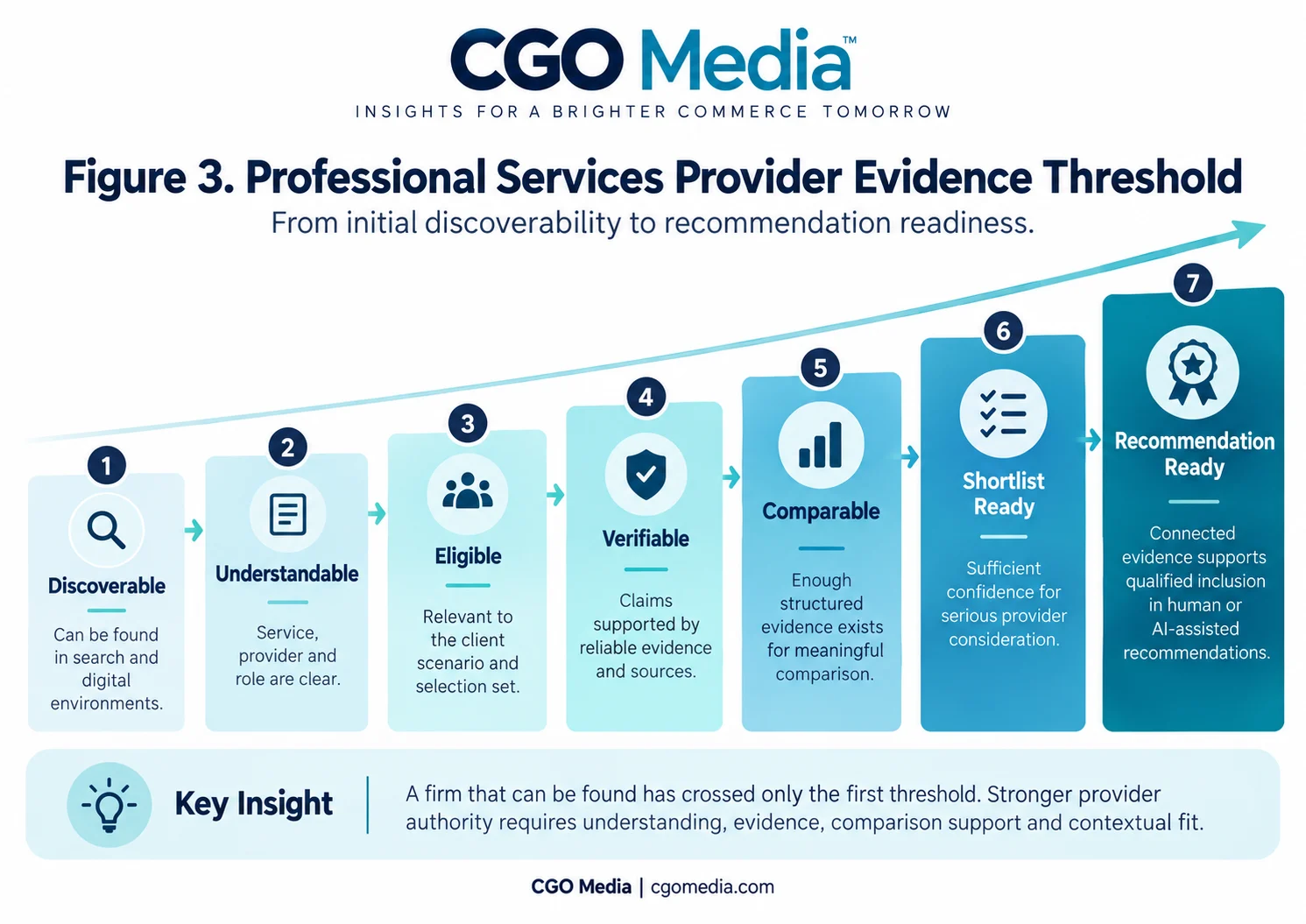
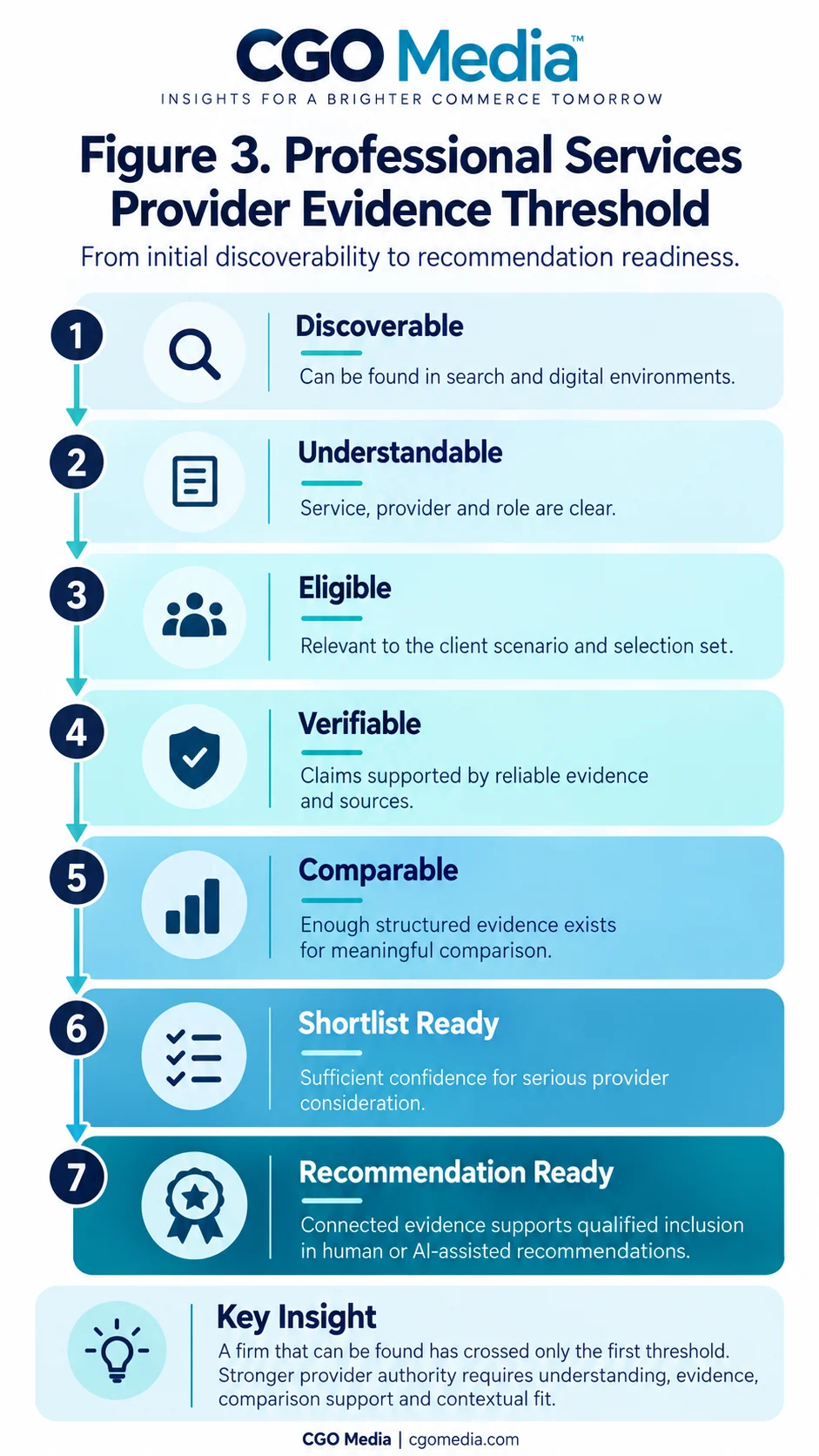
564. Professional Services Information Quality
Information quality affects whether prospective clients, search systems and AI-assisted discovery environments can understand a provider accurately enough to support meaningful evaluation.
565. High-Quality Information Should Be Accurate
Important facts should reflect the organisation’s current:
- Services
- Professionals
- Credentials
- Locations
- Sector capabilities
566. High-Quality Information Should Be Specific
Specific evidence is usually more useful than broad claims.
567. High-Quality Information Should Be Current
Professional information can become stale as:
- People change roles
- Services evolve
- Offices move
- Credentials change
- Markets shift
568. High-Quality Information Should Be Consistent
Core facts should remain materially aligned across owned and external environments.
569. High-Quality Information Should Be Verifiable
Important claims are stronger when relevant evidence can be checked independently.
570. High-Quality Information Should Be Decision-Relevant
The purpose is not simply to publish more content but to help users answer the questions required for provider selection.
571. Decision-Relevant Information Reduces Friction
The user should not need to infer basic facts that could be explained directly.
572. Decision-Relevant Information Should Support Provider Comparison
Strong information makes it easier to understand differences between providers.
573. Information Quality Should therefore Be Evaluated by Usefulness
The key question is:
Does this information help a prospective client make a better provider decision?
574. Service Transparency
Service transparency reduces uncertainty about what the organisation actually provides.
575. Service Transparency Begins with Scope
The provider should explain what the service covers.
576. Scope Should Be Specific Enough to Distinguish Adjacent Services
Clients should understand where one service ends and another begins.
577. Service Transparency Includes Process
The organisation can explain how an engagement typically progresses.
578. Service Transparency Includes Deliverables
The client should understand what the work may produce.
579. Service Transparency Includes Specialist Involvement
The organisation should clarify which professionals or teams normally contribute.
580. Service Transparency Includes Typical Client Profile
The provider can explain which types of organisations or situations are most suitable.
581. Service Transparency Can Include Commercial Structure
Where appropriate, the firm can explain whether work is structured around:
- Projects
- Retainers
- Advisory engagements
- Embedded support
- Specialist reviews
582. Service Transparency Should Include Boundaries
The organisation can also explain what the service does not cover.
583. Clear Boundaries Improve Qualification
Poor-fit clients can self-select out earlier.
584. Clear Boundaries Improve Trust
Precision often appears more credible than universal capability claims.
585. Service Transparency Should Connect with Evidence
The strongest service pages connect:
Scope → Expert → Method → Evidence → Outcome
586. Service Transparency Supports Conventional Search
Clear service descriptions improve alignment with relevant search intent.
587. Service Transparency Supports AI Interpretation
More explicit service information can reduce ambiguity in generative provider descriptions.
588. Expertise Transparency
Expertise transparency means making professional capability attributable to identifiable people wherever practical.
589. Generic Organisational Claims Are Weaker Than Attributable Expertise
A statement such as “we have specialist expertise” provides limited decision support unless the user can identify who holds that expertise.
590. Expertise Transparency Should Identify Relevant Professionals
Named specialists can be connected with:
- Services
- Specialisms
- Sectors
- Research
- Case studies
591. Expertise Transparency Should Explain Professional Role
The user should understand what the individual actually does.
592. Expertise Transparency Should Explain Experience
Relevant career history can help demonstrate capability.
593. Expertise Transparency Should Explain Qualifications
Professional credentials should be represented clearly.
594. Expertise Transparency Should Explain Applied Work
Relevant projects or case studies can strengthen credibility.
595. Expertise Transparency Should Explain Intellectual Contribution
Research, commentary and speaking activity can strengthen expert authority.
596. Expertise Transparency Should Not Overstate Individual Capability
The organisation should distinguish between:
- Personal expertise
- Team expertise
- Firm-level capability
597. Expertise Transparency Improves Human Evaluation
Clients can understand who they may work with.
598. Expertise Transparency Improves Digital Interpretation
Named relationships reduce ambiguity around who is associated with a service or subject.
599. Credential Transparency
Credential transparency requires professional status to be described precisely.
600. Individual Qualifications Should Be Distinguished from Organisation-Level Accreditation
These are different forms of evidence.
601. Membership Should Be Distinguished from Certification
Membership in an organisation does not automatically imply a formal certification.
602. Certification Should Be Distinguished from Regulatory Registration
Different forms of professional status carry different meanings.
603. Credential Language Should Match the Underlying Status
The organisation should avoid wording that implies a stronger level of recognition than actually exists.
604. Credential Dates Should Be Clear Where Relevant
The reader should be able to distinguish between:
- Current status
- Historic status
- Completed qualification
- Ongoing membership
605. Credential Transparency Supports Independent Verification
Where appropriate, users should be able to check status through recognised bodies.
606. Credential Transparency Reduces Professional Risk
The client gains greater confidence that important professional claims are accurate.
607. Case Study Transparency
Case studies should provide sufficient context to demonstrate meaningful experience without overstating outcomes.
608. Case Study Transparency Starts with Client Context
The reader should understand enough about the organisation or situation to judge relevance.
609. Case Study Transparency Includes Sector
Industry context can materially affect comparability.
610. Case Study Transparency Includes Problem
The challenge should be stated clearly.
611. Case Study Transparency Includes Service
The reader should understand what professional capability was applied.
612. Case Study Transparency Includes Methodology
Where appropriate, the provider can explain how the work was approached.
613. Case Study Transparency Includes Outcome
The result should be represented accurately.
614. Quantitative Outcomes Require Genuine Data
Numerical performance claims should be supported by real evidence.
615. Qualitative Outcomes Can Also Be Valuable
Relevant outcomes can include:
- Improved governance
- Reduced risk
- Better decision-making
- Improved process
- Successful delivery
616. Case Study Transparency Includes Provider Role
The organisation should avoid implying responsibility for outcomes it did not control.
617. Case Study Transparency Includes Limitations Where Appropriate
Context improves credibility.
618. Confidentiality Can Restrict Case Study Detail
Professional-services firms may need to remove sensitive information.
619. Anonymised Case Studies Can Still Be Transparent
Useful information can include:
- Organisation type
- Sector
- Problem
- Service
- Outcome
620. Transparency Does Not Require Disclosure of Confidential Material
The objective is sufficient evidence for meaningful evaluation within legitimate confidentiality constraints.
621. Commercial Transparency
Commercial transparency helps prospective clients understand how an engagement is likely to work.
622. Commercial Transparency Does Not Necessarily Mean Publishing Fixed Prices
Complex professional-services work often requires custom scoping.
623. The Firm Can Explain How Engagements Are Structured
Relevant models can include:
- Projects
- Retainers
- Advisory arrangements
- Interim support
- Embedded models
624. The Firm Can Explain What Affects Pricing
Potential factors can include:
- Scope
- Complexity
- Team seniority
- Timescale
- Geographic requirements
625. The Firm Can Explain the Initial Consultation
The client should understand what happens before a proposal is produced.
626. The Firm Can Explain Typical Engagement Stages
A high-level sequence can reduce uncertainty.
627. The Firm Can Explain What Is Included in the Fee
This can reduce commercial misunderstanding later.
628. The Firm Can Explain What May Create Additional Costs
Transparency around scope change can improve commercial confidence.
629. Commercial Transparency Supports Qualification
Poor-fit opportunities can be identified earlier.
630. Commercial Transparency Supports Comparison
Prospects can evaluate providers more realistically.
631. Professional Profile Transparency
Professional biographies should provide enough information for clients to assess whether the individual has relevant expertise.
632. Professional Profiles Should Include Current Role
The user’s first question is often what the professional does now.
633. Professional Profiles Should Include Relevant Specialisms
Specific areas of expertise improve provider evaluation.
634. Professional Profiles Should Include Relevant Qualifications
Credentials can strengthen trust where appropriate.
635. Professional Profiles Should Include Relevant Sector Experience
Industry context can improve fit.
636. Professional Profiles Should Include Selected Applied Experience
Representative work can demonstrate capability.
637. Professional Profiles Should Include Research Where Relevant
Authored publications can strengthen subject authority.
638. Professional Profiles Should Include External Activity Where Relevant
Examples can include:
- Media commentary
- Conference speaking
- Professional panels
- Industry contributions
639. Professional Profiles Should Avoid Biographical Inflation
Long biographies are not automatically stronger.
640. Professional Profile Quality Depends on Decision Relevance
The strongest profile answers the questions a prospective client is likely to ask.
641. External Validation Architecture
External validation should be treated as a structured authority layer rather than a random collection of links, mentions or profiles.
642. External Validation Architecture Begins with Evidence Mapping
The organisation can identify which external environments support which claims.
643. Professional Bodies Can Validate Credentials
They can support professional identity and status.
644. Trade Associations Can Validate Sector Participation
Relevant involvement can reinforce industry context.
645. Independent Review Platforms Can Validate Client Experience
They can provide evidence around service quality and reputation.
646. Business Publications Can Validate Expertise
Relevant media citations can support professional authority.
647. Trade Journals Can Validate Sector Expertise
Industry-specific commentary can reinforce contextual relevance.
648. Conference Organisations Can Validate Professional Participation
Speaker profiles and event programmes can support public expertise.
649. Research Publishers Can Validate Intellectual Contribution
Repositories and publishers can make research independently accessible.
650. Accreditation Sources Can Validate Formal Status
Certification or accreditation databases can support organisation-level trust.
651. External Validation Architecture Should Be Claim-Specific
Each major authority claim should have appropriate supporting environments.
652. Service Claims Need Relevant External Evidence
Generic brand mentions may offer limited support for a specialist capability.
653. Professional Claims Need Relevant External Evidence
The strongest evidence relates directly to the individual and subject area.
654. Sector Claims Need Relevant External Evidence
Trade publications, case studies and industry participation can provide stronger support.
655. Research Claims Need Relevant External Evidence
Independent citations and repository records can reinforce publication authority.
656. External Validation Architecture Should Also Consider Independence
Not all external sources carry the same evidential value.
657. Paid Listings and Earned Recognition Should Be Distinguished
Both can be useful, but they perform different trust functions.
658. Self-Submitted Profiles and Independently Authored Profiles Should Be Distinguished
The level of editorial independence affects interpretation.
659. External Validation Architecture Should Consider Freshness
Outdated profiles can reduce trust.
660. External Validation Architecture Should Consider Coverage Gaps
The organisation may discover that:
- Strong experts have little external representation
- Priority sectors lack trade visibility
- Research receives little citation activity
- Key credentials are not easy to verify
661. Coverage Gaps Can Become Strategic Priorities
The organisation can strengthen the external evidence layer where it matters most.
662. External Validation Should Not Be Built Solely for Links
The stronger objective is independent professional evidence.
663. Relevant Links Can Be a By-Product
But the primary authority value can also come from:
- Attribution
- Reputation
- Entity reinforcement
- Sector context
- Research visibility
664. The Professional Services Digital Evidence Ecosystem
Professional-services authority exists across a wider evidence network rather than within a single website.
665. The Corporate Website Is One Core Evidence Environment
It provides the organisation’s primary owned representation.
666. Service Pages Are Another Evidence Environment
They define capabilities and commercial relevance.
667. Professional Profiles Are Another Evidence Environment
They establish named expertise.
668. Case Studies Are Another Evidence Environment
They demonstrate applied capability.
669. Professional Bodies Are Another Evidence Environment
They can validate professional status.
670. Review Platforms Are Another Evidence Environment
They can provide client-experience evidence.
671. Industry Publications Are Another Evidence Environment
They can reinforce sector and expert authority.
672. Research and Thought Leadership Are Another Evidence Environment
They can support intellectual and subject authority.
673. Conference Platforms Are Another Evidence Environment
They can validate public professional participation.
674. AI Search Systems Are Another Evidence Environment
They increasingly act as discovery, interpretation, comparison and recommendation interfaces.
675. The Evidence Ecosystem Is Distributed
No single source provides a complete picture of provider authority.
676. Owned Evidence Performs One Function
The firm can explain:
- Identity
- Services
- Professionals
- Methodology
- Case studies
677. Professional Evidence Performs Another Function
Named individuals demonstrate expertise, qualifications and subject authority.
678. Client Evidence Performs Another Function
Case studies, testimonials and references demonstrate applied capability.
679. Independent Evidence Performs Another Function
External sources provide validation beyond the firm’s own claims.
680. Research Evidence Performs Another Function
Original work can demonstrate deeper subject contribution.
681. Media Evidence Performs Another Function
Relevant coverage can reinforce public recognition.
682. AI Systems Can Synthesize Several Evidence Types
Generative environments can present a combined interpretation of:
- Firm identity
- Services
- Expertise
- External reputation
- Market relevance
683. Evidence Ecosystem Strength Depends on Connectivity
Authority is stronger when evidence layers reinforce one another.
684. Service Pages Should Connect to Professionals
This links capability with named expertise.
685. Professional Profiles Should Connect to Research
This links individual expertise with intellectual contribution.
686. Sector Pages Should Connect to Case Studies
This links industry positioning with applied evidence.
687. Research Should Connect to Relevant Services and Experts
This links intellectual authority with practical capability.
688. External Validation Should Connect Back to the Correct Authority Claim
Relevant citations and profiles should reinforce the appropriate service, professional or sector.
689. Evidence Ecosystem Strength Depends on Diversity
Authority supported by several credible environments can be more resilient than authority dependent on one channel.
690. Evidence Ecosystem Strength Depends on Accuracy
Distributed evidence creates risk where external sources contain contradictory information.
691. Evidence Ecosystem Strength Depends on Freshness
Professional-services evidence can decay over time.
692. Evidence Ecosystem Strength Depends on Relevance
Large volumes of unrelated external mentions provide limited support for a specialist claim.
693. Evidence Ecosystem Strength Depends on Independence
Independent support can strengthen confidence beyond owned messaging.
694. The Evidence Ecosystem Should Be Audited as a Network
The organisation should review both assets and relationships.
695. The Audit Should Examine Owned Evidence
Relevant assets include:
- Service pages
- Professional profiles
- Sector pages
- Case studies
- Research
696. The Audit Should Examine External Evidence
Relevant sources include:
- Directories
- Professional bodies
- Media
- Reviews
- Trade publications
- Research repositories
697. The Audit Should Examine Evidence Relationships
The organisation should identify whether:
- Services link to experts
- Experts link to sectors
- Sectors link to client evidence
- Research links to relevant capabilities
- External validation reinforces priority claims
698. The Audit Should Examine Representation Gaps
Strong offline authority may remain poorly represented online.
699. The Audit Should Examine Contradictions
Conflicting information should be corrected where practical.
700. The Audit Should Examine Under-Supported Claims
Strategic service or sector claims may need stronger evidence.
701. The Audit Should Examine Over-Dependent Claims
Important authority should not depend entirely on one source.
702. The Evidence Ecosystem Can Be Prioritised Commercially
Priority services, experts and sectors should receive stronger evidence coverage.
703. The Evidence Ecosystem Can Be Prioritised by Risk
Higher-risk professional claims may require stronger validation.
704. The Evidence Ecosystem Can Be Prioritised by Visibility Gap
Strong capabilities with poor discoverability can warrant greater attention.
705. The Evidence Ecosystem Can Be Prioritised by Trust Gap
Highly visible services with weak independent evidence can also require improvement.
706. The Evidence Ecosystem Can Be Prioritised by AI Representation Gap
Important services or experts that are consistently misrepresented may require better underlying evidence.
707. The Thirteenth Professional Services Trust and Visibility Principle
Professional-services information should be accurate, specific, current, consistent, verifiable and decision-relevant because authority depends not on content volume alone but on whether users and digital systems can interpret the provider correctly.
708. The Fourteenth Professional Services Trust and Visibility Principle
Service, expertise, credential, case-study, commercial and professional-profile transparency should reduce ambiguity without requiring organisations to disclose confidential or commercially sensitive information unnecessarily.
709. The Fifteenth Professional Services Trust and Visibility Principle
External validation should be designed as a claim-specific architecture in which professional bodies, reviews, trade media, research publishers, conference platforms and accreditation sources reinforce the particular expertise, service or sector claim they are best suited to validate.
710. The Sixteenth Professional Services Trust and Visibility Principle
Professional-services authority should be managed as a distributed evidence ecosystem in which owned information, named expertise, client evidence, research, independent validation and AI-assisted discovery reinforce one another through accurate and relevant relationships.
711. Digital Evidence Ecosystem Output
The connected authority structure can be summarised as:
Owned Evidence + Professional Evidence + Client Evidence + Research + Independent Validation + Media + AI Discovery → Distributed Provider Authority
712. The Strategic Position Before Figure Four
The framework now moves beyond the question of whether individual pages or profiles are strong enough and instead considers the broader evidence network surrounding the organisation. Service transparency, expert attribution, credential clarity, case-study context and commercial transparency improve the quality of owned evidence, while professional bodies, review platforms, trade publications, research publishers and conference organisations provide independent validation. These sources form a distributed digital evidence ecosystem in which the corporate website remains central but no longer operates alone. The strength of professional-services authority increasingly depends on how accurately, consistently and meaningfully these evidence environments reinforce one another.
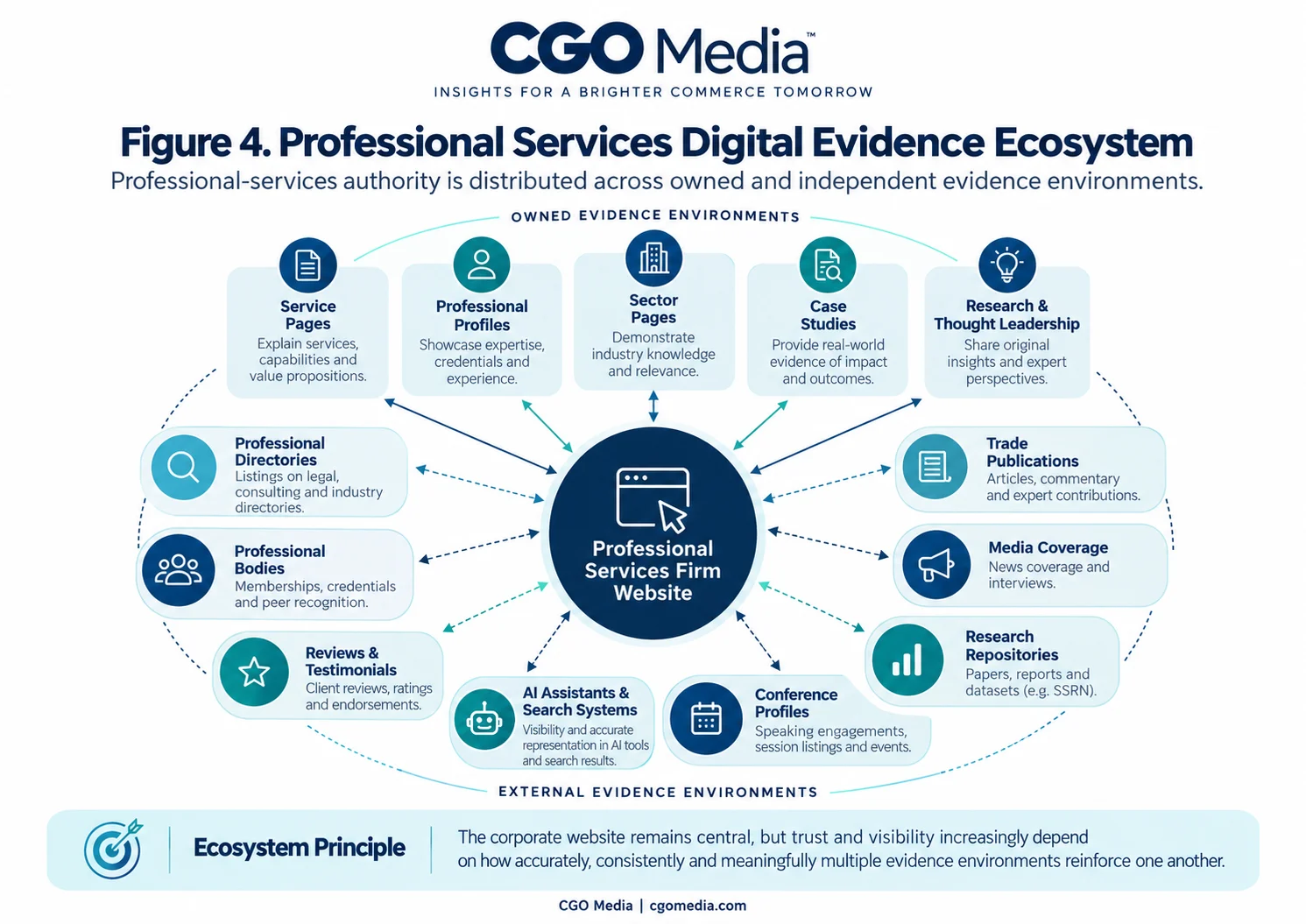
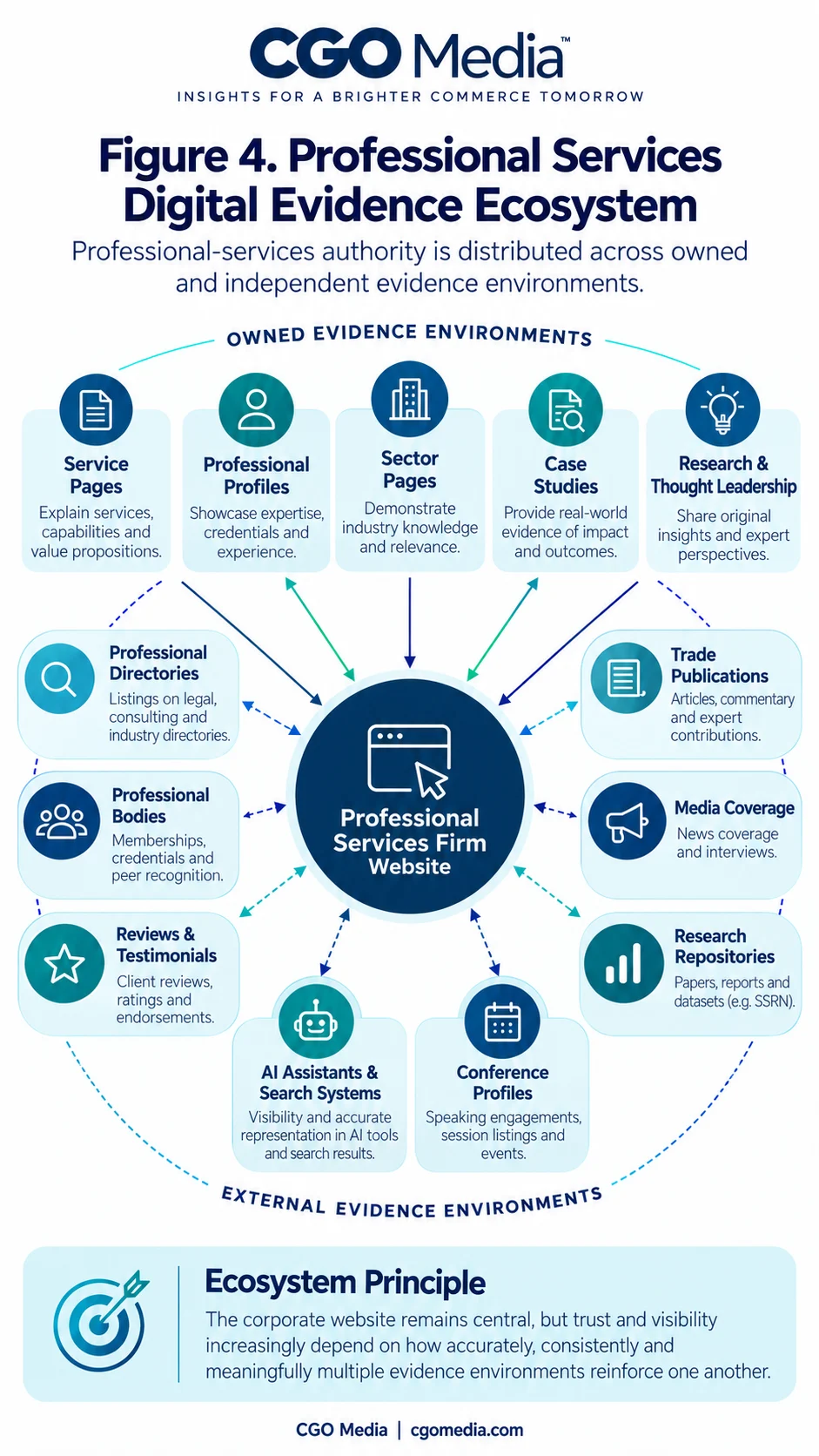
713. Evidence Ecosystem Strength Should Be Diagnosed Strategically
Once the organisation understands its distributed evidence environment, the next task is to identify where trust and visibility are weakest.
714. Trust Gaps Are Not All the Same
A professional-services organisation can suffer from:
- Low discoverability
- Weak expertise representation
- Poor information quality
- Insufficient independent validation
- Weak market evidence
- Inaccurate AI representation
715. A Strong Diagnostic Process Separates Different Failure Types
Each type of weakness requires a different response.
716. Visibility Gaps Occur When Strong Capability Is Difficult to Discover
A firm may possess:
- Strong specialists
- Strong client outcomes
- Strong research
- Strong credentials
while remaining underexposed digitally.
717. Trust Gaps Occur When Visibility Exceeds Evidence Strength
The firm may rank strongly but provide insufficient support for provider evaluation.
718. Entity Gaps Occur When Provider Identity Is Ambiguous
Users and digital systems may encounter conflicting information around:
- Firm name
- Office location
- Professional role
- Service scope
719. Expertise Gaps Occur When Professional Capability Is Poorly Attributed
Strong services may be described without named specialists.
720. Evidence Quality Gaps Occur When Information Is Incomplete or Stale
Examples can include:
- Thin biographies
- Old case studies
- Outdated credentials
- Incomplete service pages
721. External Validation Gaps Occur When Authority Is Mostly Self-Authored
The organisation may have strong owned content but limited independent evidence.
722. Market Authority Gaps Occur When Sector Claims Lack Context
The firm may claim industry expertise without:
- Named experts
- Client evidence
- Research
- Trade recognition
723. AI Representation Gaps Occur When Generative Systems Misunderstand the Provider
Observed problems can include:
- Incorrect services
- Wrong locations
- Missing specialists
- Weak comparison inclusion
- Inaccurate descriptions
724. Trust Gaps Should Be Mapped against Commercial Importance
Not every weakness deserves the same priority.
725. A Priority Service with Weak Expertise Evidence Deserves Attention
The commercial importance of the service increases the cost of the gap.
726. A Priority Sector with Weak Client Evidence Deserves Attention
Sector positioning should be supported where it matters commercially.
727. A Priority Expert with Weak External Visibility Deserves Attention
Important specialists may warrant stronger public authority.
728. A Low-Priority Capability with Minor Gaps May Require Less Immediate Investment
The framework should support prioritisation rather than indiscriminate optimisation.
729. Trust Gaps Can Be Evaluated by Impact
The organisation can ask:
How much does this weakness affect provider understanding, validation or recommendation readiness?
730. Trust Gaps Can Be Evaluated by Dependency
Some weaknesses constrain several other authority layers.
731. Entity Clarity Has High Dependency
Poor identity information can weaken:
- Professional interpretation
- External validation
- Local visibility
- AI representation
732. Expertise Clarity Has High Dependency
Weak expert attribution can reduce:
- Service credibility
- Media authority
- Sector authority
- Recommendation confidence
733. Information Quality Has High Dependency
Outdated evidence can damage several trust dimensions simultaneously.
734. External Validation Has High Dependency in High-Risk Services
Independent support can become essential where professional claims require verification.
735. Trust Gaps Can Also Be Evaluated by Risk
Incorrect professional or regulatory information can be more serious than a minor content weakness.
736. Trust Gaps Can Be Evaluated by Effort
Some weaknesses can be corrected quickly.
737. Simple Accuracy Corrections Can Have High Value
Examples include:
- Updating office details
- Correcting titles
- Removing former employees
- Updating credentials
738. Structural Authority Gaps Can Require More Work
Building:
- Research authority
- Sector evidence
- Client evidence
- External recognition
can require longer-term investment.
739. A Useful Prioritisation Relationship Is
Authority Gap + Commercial Importance + Dependency + Risk + Effort → Improvement Priority
740. Trust Gaps Should Be Recorded Explicitly
A structured gap register can improve governance.
741. A Trust Gap Register Can Include
- Dimension
- Evidence gap
- Business impact
- Owner
- Priority
- Required action
- Status
742. Gap Registers Should Avoid False Precision
The purpose is structured prioritisation rather than producing a meaningless numerical score.
743. Strategic Questions Are More Useful Than Arbitrary Ratings
For each dimension, the organisation should ask whether the available evidence supports the relevant decision.
744. Firm and Entity Clarity Should Ask
Can the organisation be identified clearly and consistently?
745. Service and Expertise Authority Should Ask
Is genuine expertise visible and attributable?
746. Professional Evidence Quality Should Ask
Is there enough reliable information for provider evaluation?
747. Credentials and External Validation Should Ask
Can important claims be independently verified?
748. Client, Sector and Market Authority Should Ask
Does the organisation demonstrate contextual relevance?
749. AI Search and Recommendation Readiness Should Ask
Is the provider represented accurately and competitively in relevant scenarios?
750. Measuring Professional Services Trust and Visibility
Measurement should extend beyond rankings, traffic and generic conversion data.
751. The Objective Is to Measure Decision Support
The framework should reveal whether the organisation is becoming easier to:
- Discover
- Interpret
- Validate
- Compare
- Shortlist
- Recommend
752. Measurement Should Follow the Six Framework Dimensions
Each dimension requires different evidence.
753. Measurement Dimension One — Firm and Entity Clarity
Firm and Entity Clarity can be assessed through the consistency and accuracy of core organisation information.
754. Organisation Naming Consistency Is One Indicator
The firm can compare major owned and external sources.
755. Office Accuracy Is Another Indicator
The organisation can review whether:
- Addresses
- Telephone numbers
- Office names
- Geographic coverage
remain correct.
756. Professional Relationship Accuracy Is Another Indicator
The organisation can verify whether:
- Current staff are shown correctly
- Former staff have been removed
- Roles are current
- Office relationships are accurate
757. Organisational Relationship Clarity Is Another Indicator
Users should be able to understand:
- Parent brands
- Subsidiaries
- Practice areas
- Specialist divisions
758. External Profile Consistency Is Another Indicator
The organisation can audit major directories and professional sources.
759. AI-Generated Firm Accuracy Is Another Indicator
Relevant scenarios can be tested for:
- Correct firm name
- Correct location
- Correct services
- Correct professional relationships
760. Firm Clarity Measurement Should Record Material Conflicts
Not every wording difference requires correction.
761. Material Factual Conflicts Should Be Prioritised
Incorrect facts create greater trust risk than harmless description variation.
762. Measurement Dimension Two — Service and Expertise Authority
Service and Expertise Authority measurement should examine both visibility and evidence depth.
763. Priority Service Visibility Is One Indicator
The organisation can monitor whether important capabilities are discoverable through:
- Conventional search
- AI-assisted discovery
- External professional sources
764. Service Information Depth Is Another Indicator
The organisation can review whether priority pages contain sufficient:
- Scope
- Methodology
- Suitability
- Deliverables
- Supporting evidence
765. Named Expert Coverage Is Another Indicator
Priority services should connect to relevant specialists.
766. Professional Qualification Evidence Is Another Indicator
Important credentials should be visible and accurately represented.
767. Research and Thought-Leadership Output Is Another Indicator
The organisation can assess whether important expertise areas have meaningful intellectual support.
768. Expert Citation Visibility Is Another Indicator
Relevant media and professional citations can demonstrate external authority.
769. Service Authority Measurement Should Be Claim-Specific
The strongest evidence should relate directly to the capability being evaluated.
770. Service Authority Measurement Should Be Segmented by Strategic Importance
Priority services warrant deeper assessment.
771. Measurement Dimension Three — Professional Evidence and Information Quality
Professional Evidence Quality measurement should determine whether the organisation maintains enough reliable decision-support information.
772. Service-Page Completeness Is One Indicator
The organisation can evaluate whether pages answer important pre-selection questions.
773. Professional-Profile Completeness Is Another Indicator
Profiles can be reviewed for:
- Current role
- Specialisms
- Qualifications
- Sector experience
- Research
- External activity
774. Case-Study Coverage Is Another Indicator
Priority services and sectors should ideally possess representative applied evidence.
775. Evidence Freshness Is Another Indicator
The organisation can assess the age and current relevance of:
- Profiles
- Case studies
- Research
- Credentials
- Service content
776. Commercial Transparency Is Another Indicator
The organisation can assess whether clients can understand:
- Engagement structures
- What affects pricing
- Typical process
- Next steps
777. Information Consistency Is Another Indicator
Important facts should remain compatible across relevant sources.
778. Information Quality Should Be Measured by Decision Usefulness
Completeness should not become a simple word-count exercise.
779. Measurement Dimension Four — Credentials and External Validation
This dimension evaluates how effectively independent evidence supports the organisation’s professional claims.
780. Professional Membership Visibility Is One Indicator
Relevant current memberships should be easy to identify where they matter.
781. Accreditation Visibility Is Another Indicator
Organisation-level credentials can be reviewed for:
- Accuracy
- Current status
- Verification
- Relevance
782. Independent Review Strength Is Another Indicator
Review assessment can consider:
- Relevance
- Recency
- Volume
- Recurring themes
783. Relevant Media Coverage Is Another Indicator
The organisation can assess whether:
- Priority experts are cited
- Priority services receive recognition
- Priority sectors receive relevant coverage
784. Trade and Professional Citations Are Another Indicator
Relevant citations can demonstrate stronger subject-specific recognition.
785. Conference Participation Is Another Indicator
Professional participation can support visible market authority.
786. External Validation Measurement Should Consider Quality
Raw mention volume is an incomplete measure.
787. Relevance Is an Important Quality Dimension
The external source should support the claim under evaluation.
788. Independence Is an Important Quality Dimension
Editorially independent recognition differs from self-submitted profiles.
789. Freshness Is an Important Quality Dimension
Recent evidence can better support current authority.
790. Specificity Is an Important Quality Dimension
A citation to a named expert or specific service can provide stronger contextual support.
791. Measurement Dimension Five — Client, Sector and Market Authority
This dimension evaluates whether the organisation demonstrates contextual authority within strategically important markets.
792. Sector-Specific Visibility Is One Indicator
The organisation can monitor relevant combinations of:
- Service + sector
- Professional + sector
- Problem + sector
793. Relevant Case-Study Coverage Is Another Indicator
The firm can evaluate whether priority sectors have meaningful applied evidence.
794. Industry Publication Mentions Are Another Indicator
Trade visibility can demonstrate participation within the market.
795. Research Citations Are Another Indicator
Independent use of sector research can reinforce authority.
796. Client Evidence Is Another Indicator
The organisation can assess whether sector claims are supported by:
- Case studies
- Testimonials
- References
- Outcome evidence
797. Trade-Association Visibility Is Another Indicator
Relevant professional or industry participation can reinforce market context.
798. Market Authority Measurement Should Distinguish Breadth from Depth
An organisation can possess:
- Broad but shallow sector coverage
- Narrow but deep sector authority
799. Neither Structure Is Automatically Superior
Measurement should reflect real commercial strategy.
800. Measurement Dimension Six — AI Search and Provider Recommendation Readiness
AI readiness should be evaluated through repeatable scenario testing rather than anecdotal experimentation.
801. Service Discovery Scenarios Should Be Tested
These scenarios examine whether the organisation appears for relevant capability questions.
802. Expert Discovery Scenarios Should Be Tested
These scenarios examine whether named professionals are represented accurately.
803. Sector-Specific Provider Scenarios Should Be Tested
These scenarios examine whether the provider appears where sector fit genuinely exists.
804. Provider Comparison Scenarios Should Be Tested
These scenarios examine how the organisation is represented relative to relevant alternatives.
805. Professional Recommendation Scenarios Should Be Tested
These scenarios examine whether genuine professional capability is recognised.
806. Location-Specific Recommendation Scenarios Should Be Tested
These scenarios can assess geographic or jurisdictional provider visibility.
807. AI Monitoring Should Record Inclusion
The organisation can record whether it appears within the tested scenario.
808. AI Monitoring Should Record Exclusion
Non-inclusion can also provide useful evidence.
809. AI Monitoring Should Record Representation Accuracy
The organisation can assess whether generated descriptions correctly reflect:
- Services
- Professionals
- Locations
- Specialisms
- Sectors
810. AI Monitoring Should Record Visible Sources
Where sources are shown, the organisation can record which evidence environments appear.
811. AI Monitoring Should Record Competitor Co-Occurrence
The firm can identify which providers appear repeatedly in the same scenarios.
812. AI Monitoring Should Record Context
A useful record includes:
- Platform
- Date
- Prompt
- Geography
- Conversation context
813. AI Monitoring Should Not Create Universal Scores from Small Samples
Observed frequencies remain specific to the tested scenario set.
814. AI Recommendation Measurement Should Focus on Qualified Inclusion
The strongest objective is appropriate visibility in scenarios where genuine capability exists.
815. Appropriate Exclusion Should Not Automatically Be Treated as Failure
A specialist firm should not be expected to appear in unrelated recommendations.
816. The Six Measurement Dimensions Should Be Reviewed Together
A single strong area cannot compensate indefinitely for major weakness elsewhere.
817. Strong Search Visibility with Weak Trust Should Be Flagged
This can indicate a visibility-to-trust gap.
818. Strong Credentials with Weak Discoverability Should Be Flagged
This can indicate an expertise-to-visibility gap.
819. Strong Client Evidence with Weak External Validation Should Be Flagged
The organisation may require stronger independent authority.
820. Strong Sector Authority with Weak Service Connections Should Be Flagged
Relevant evidence may not be connected clearly with commercial capabilities.
821. Strong Conventional Visibility with Weak AI Representation Should Be Flagged
The underlying evidence may not be sufficiently clear across generative discovery environments.
822. Measurement Should Identify Authority Imbalances
The objective is not simply to maximise every indicator independently.
823. Authority Balance Matters
A more resilient provider typically combines:
- Clear identity
- Visible expertise
- Reliable evidence
- Independent validation
- Market relevance
- Accurate AI representation
824. Building a Professional Services Trust Scorecard
The six framework dimensions can be converted into a repeatable scorecard or assessment process.
825. The Scorecard Should Start with Firm and Entity Clarity
The strategic question is:
Can the firm be clearly identified?
826. The Scorecard Should Include Service and Expertise Authority
The strategic question is:
Is genuine expertise visible?
827. The Scorecard Should Include Professional Evidence Quality
The strategic question is:
Is there enough reliable decision evidence?
828. The Scorecard Should Include Credentials and External Validation
The strategic question is:
Can key claims be independently validated?
829. The Scorecard Should Include Client, Sector and Market Authority
The strategic question is:
Does the firm demonstrate contextual relevance?
830. The Scorecard Should Include AI Search and Recommendation Readiness
The strategic question is:
Is the provider represented accurately and competitively?
831. The Scorecard Should Not Become an Arbitrary Vanity Score
The purpose is to identify strengths, weaknesses and strategic priorities.
832. Internal Scores Can Be Used Where Criteria Are Defined
An organisation may create an internal scoring system if:
- Criteria are documented
- Evidence is retained
- Changes are tracked
- Interpretation remains cautious
833. Scorecard Criteria Should Remain Stable Enough for Longitudinal Comparison
Constantly changing the assessment method makes progress difficult to interpret.
834. Scorecard Criteria Can Still Evolve
New evidence environments or commercial priorities may justify controlled changes.
835. Method Changes Should Be Documented
This improves comparability between reporting periods.
836. The Scorecard Should Support Prioritisation
Weak dimensions can become defined improvement programmes.
837. The Scorecard Should Support Governance
Each dimension can have:
- An owner
- A review process
- Evidence standards
- Improvement actions
838. The Scorecard Should Support Commercial Alignment
Priority services, sectors and experts can receive deeper measurement.
839. The Scorecard Should Support AI Monitoring
Generative representation becomes part of the wider trust-and-visibility system rather than an isolated experiment.
840. Measurement Should Be Longitudinal
A one-time audit produces only a snapshot.
841. Longitudinal Measurement Can Identify Improving Dimensions
Repeated assessment can reveal genuine progress.
842. Longitudinal Measurement Can Identify Persistent Weaknesses
Recurring gaps may indicate structural problems.
843. Longitudinal Measurement Can Identify New Evidence Gaps
New services, professionals and markets can create fresh weaknesses.
844. Longitudinal Measurement Can Identify Competitor Movement
Authority is partly relative within provider-selection environments.
845. Longitudinal Measurement Can Identify Changes in AI Representation
Repeated scenario testing can show whether generated descriptions, comparisons or recommendations change over time.
846. Measurement Frequency Should Reflect Risk and Change
There is no universal cadence suitable for every professional-services organisation.
847. High-Change Areas May Require More Frequent Review
Examples can include:
- Professional roles
- AI representation
- Office information
- Service changes
848. Lower-Change Areas May Require Less Frequent Review
Stable historical evidence can be assessed less often.
849. Event-Driven Measurement Can Supplement Regular Reviews
Important events can trigger reassessment.
850. Relevant Events Can Include
- New office
- New professional hire
- Professional departure
- Service launch
- Rebrand
- Major research publication
- Credential change
- Significant AI representation error
851. Measurement Should Preserve Context
Changes should be interpreted alongside relevant organisational and market events.
852. Observation Should Be Separated from Interpretation
A stronger reporting structure is:
Observation → Context → Interpretation → Action
853. Correlation Should Be Separated from Causation
An improvement in AI visibility after an authority intervention does not automatically prove that the intervention caused the change.
854. External Factors Can Influence Visibility
Relevant factors can include:
- Platform changes
- Competitor activity
- Market demand
- Media attention
- Algorithmic change
855. Measurement Should therefore Remain Methodologically Cautious
The framework should support structured learning rather than overconfident claims.
856. The Seventeenth Professional Services Trust and Visibility Principle
Trust and visibility gaps should be diagnosed by dimension and prioritised according to commercial importance, dependency, risk and required effort rather than treated as a single generic SEO problem.
857. The Eighteenth Professional Services Trust and Visibility Principle
Professional-services measurement should assess whether the organisation is becoming easier to discover, interpret, validate, compare, shortlist and recommend across the six framework dimensions rather than rely primarily on rankings, traffic or generic conversion volume.
858. The Nineteenth Professional Services Trust and Visibility Principle
A trust and visibility scorecard should function as a governance and diagnostic system rather than a vanity score, using documented criteria, retained evidence and longitudinal comparison to identify authority imbalances and improvement priorities.
859. The Twentieth Professional Services Trust and Visibility Principle
Measurement should remain longitudinal and methodologically cautious, preserving platform, date, scenario and organisational context while separating observation from interpretation and correlation from causation.
860. Trust and Visibility Scorecard Output
The complete measurement structure can be summarised as:
Entity Clarity + Expertise Authority + Professional Evidence Quality + External Validation + Market Authority + AI Recommendation Readiness → Trust & Visibility Scorecard
861. The Strategic Position Before Figure Five
The framework now converts the six dimensions from a conceptual authority system into a repeatable measurement structure. Firm and Entity Clarity measures whether the provider can be identified correctly; Service and Expertise Authority measures whether genuine capability is visible; Professional Evidence and Information Quality measures whether enough reliable decision support exists; Credentials and External Validation measure whether important claims can be corroborated independently; Client, Sector and Market Authority measures contextual relevance; and AI Search and Recommendation Readiness measures whether the organisation is represented accurately and competitively in relevant generative discovery scenarios. Repeated longitudinal assessment allows the organisation to identify authority gaps, compare improvement over time and prioritise the weaknesses most likely to constrain provider trust and visibility.
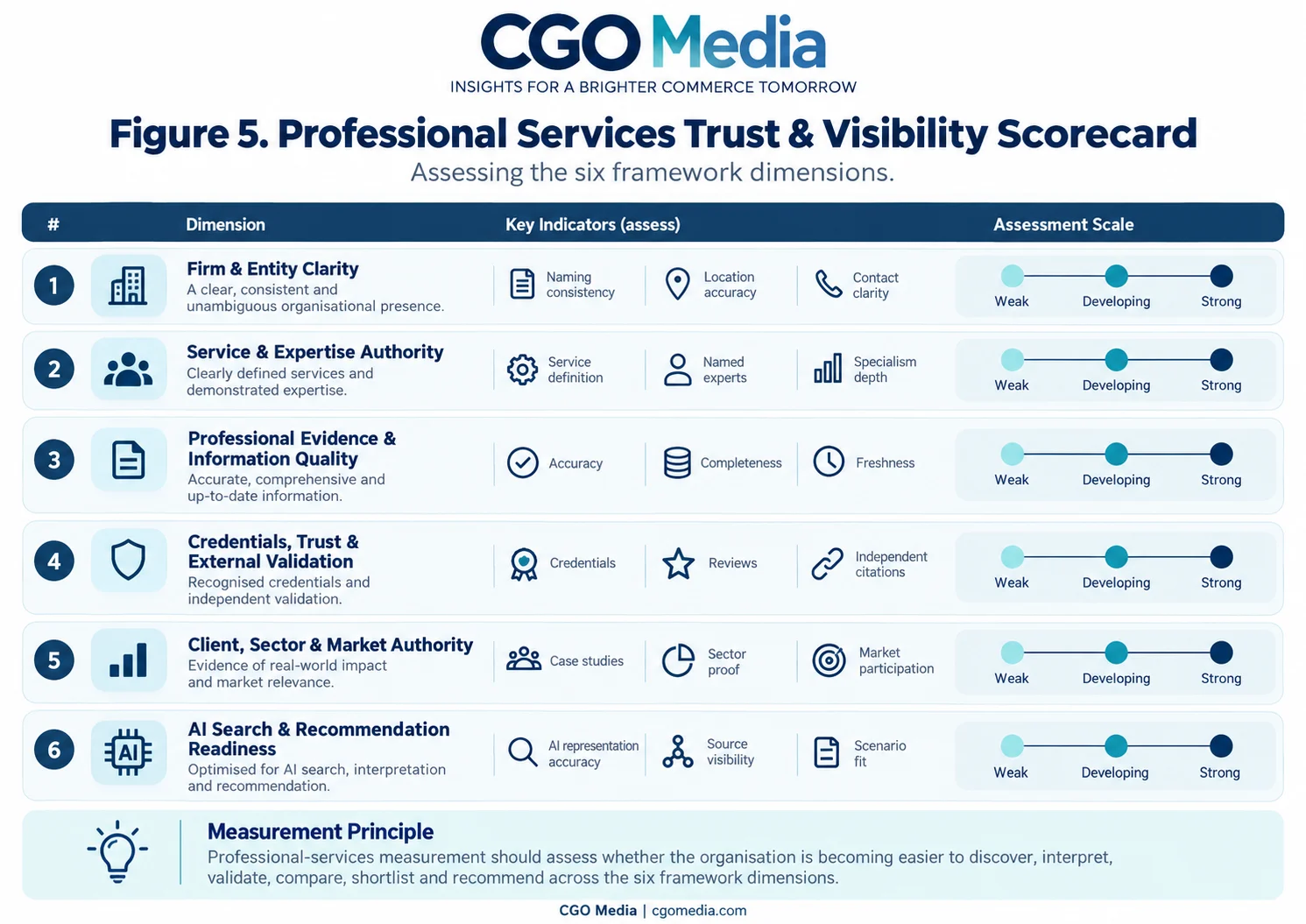
862. Governance of Professional Services Trust
Professional-services trust and visibility require ongoing governance because important evidence is distributed across multiple teams, systems and external platforms.
863. Trust Governance Is Cross-Functional
Relevant internal functions can include:
- Marketing
- SEO
- Business development
- Professional specialists
- Client services
- Compliance
- Leadership
864. No Single Team Controls the Entire Authority Environment
Marketing can manage messaging, but it may not own professional qualifications, client evidence, regulatory status, case-study permissions, external profiles or commercial outcomes.
865. Governance Should therefore Define Clear Ownership
Each important trust and visibility asset should have an identifiable owner.
866. Ownership Should Cover Firm Entity Information
Organisations should define responsibility for maintaining:
- Official firm name
- Trading identities
- Office information
- Contact information
- Leadership information
- Practice areas
- Professional affiliations
867. Core Firm Information Should Have a Single Source of Truth
Where practical, the organisation should maintain an authoritative internal record that other teams and systems can reference.
868. A Single Source of Truth Reduces Contradiction
It helps prevent different teams from publishing conflicting:
- Office details
- Leadership information
- Service names
- Professional titles
869. Entity Ownership Should Include Change Management
Updates should be triggered when important organisational changes occur.
870. Important Entity Change Events Can Include
- Rebrand
- Office opening
- Office closure
- Merger
- Acquisition
- Leadership change
- New practice area
871. Entity Changes Should Be Propagated beyond the Website
Relevant external environments can include:
- Business profiles
- Professional directories
- Industry associations
- Conference platforms
- Research repositories
- Social profiles
872. Ownership of Professional Profiles
Professional biographies should have an identifiable owner and review process.
873. Professional Profile Ownership Should Be Shared
Marketing teams can manage presentation while professionals or practice leaders validate accuracy.
874. Profiles Should Be Updated When Roles Change
Job titles and responsibilities should remain current.
875. Profiles Should Be Updated When Qualifications Change
New qualifications, memberships or registrations can strengthen the evidence record.
876. Profiles Should Be Updated When Specialisms Change
Professional expertise can evolve over time.
877. Profiles Should Be Updated When Research Is Published
Relevant authored work can strengthen subject authority.
878. Profiles Should Be Updated When Media Activity Occurs
Relevant external commentary can strengthen independent validation.
879. Profiles Should Be Updated When Professionals Leave
Former employees should not remain represented as current team members.
880. Professional Departures Require Wider Evidence Review
The organisation should identify whether the departing individual is connected with:
- Service pages
- Sector pages
- Research
- Case studies
- Media citations
- External profiles
881. Authority Should Not Depend Excessively on One Individual
Where possible, firms should build institutional authority alongside personal authority.
882. Individual Authority Still Remains Valuable
Professional-services buyers frequently evaluate named experts directly.
883. The Strategic Objective Is Balance
A useful relationship is:
Firm Authority + Professional Authority → More Resilient Provider Trust
884. Ownership of Service Information
Service content should be reviewed jointly by marketing teams and subject specialists.
885. Marketing Teams Can Support Clarity
They can help ensure that service information is:
- Readable
- Structured
- Discoverable
- Decision-oriented
886. Subject Specialists Should Validate Technical Accuracy
Commercial messaging should not distort the actual scope of professional capability.
887. Service Owners Should Confirm Scope
The organisation should ensure that published descriptions reflect what is actually delivered.
888. Service Owners Should Confirm Suitability
Target-client statements should reflect real engagement experience.
889. Service Owners Should Confirm Methodology
Published process descriptions should reflect genuine operating practices.
890. Service Owners Should Confirm Professional Associations
Named experts should actually be relevant to the capability.
891. Service Reviews Should Be Triggered by Material Change
Relevant triggers can include:
- New offering
- Service retirement
- Methodology change
- New regulation
- Team restructuring
- Market repositioning
892. Ownership of Case Studies
Case studies require governance around accuracy, confidentiality and outcome claims.
893. Client Permission Should Be Managed
Where client identity or quotations are used, appropriate approval should be obtained.
894. Confidentiality Should Be Reviewed
Sensitive information should not be disclosed without appropriate permission.
895. Outcome Claims Should Be Validated
Quantitative and qualitative results should accurately reflect what occurred.
896. Provider Contribution Should Be Clear
The firm should avoid claiming sole responsibility for outcomes influenced by multiple factors.
897. Publication Dates Should Be Retained
Dates help users understand the age of the evidence.
898. Case Studies Should Have Review Cycles
Older examples should be checked for continuing relevance.
899. Case Study Libraries Should Reflect Current Strategic Priorities
The strongest evidence portfolio should support important:
- Services
- Sectors
- Markets
- Professional teams
900. Ownership of Research Evidence
Research should also have defined governance.
901. Research Governance Should Cover Authorship
Named responsibility supports accountability and attribution.
902. Research Governance Should Cover Methodology
The organisation should document how evidence was collected and interpreted.
903. Research Governance Should Cover Sources
External evidence should be traceable where appropriate.
904. Research Governance Should Cover Limitations
Methodological boundaries should be explained clearly.
905. Research Governance Should Cover Versioning
Updated findings should not create uncertainty about which version is current.
906. Research Governance Should Cover Commercial Separation
Research can inform consulting and marketing without becoming disguised promotional material.
907. Ownership of External Profiles
Professional directories, review platforms and association profiles should be reviewed periodically for outdated or inconsistent information.
908. External Profile Ownership Should Be Assigned
Without clear responsibility, third-party information can decay unnoticed.
909. External Profiles Should Be Prioritised
The organisation does not necessarily need to manage every minor directory equally.
910. High-Value External Profiles Can Include
- Professional-body profiles
- Major business listings
- Important industry directories
- Strategic review platforms
- Research repositories
911. External Profile Reviews Should Check Accuracy
The organisation should verify:
- Name
- Address
- Service information
- Professional relationships
- Current links
912. External Profile Reviews Should Check Relevance
Old category assignments can misrepresent current positioning.
913. External Profile Reviews Should Check Completeness
Important fields should be populated where the information is useful.
914. Ownership of AI Monitoring
AI visibility should become a defined monitoring responsibility rather than an occasional experiment.
915. AI Monitoring Should Cover Priority Services
The organisation can maintain scenario sets around strategically important capabilities.
916. AI Monitoring Should Cover Priority Sectors
Sector-specific provider discovery can reveal contextual representation.
917. AI Monitoring Should Cover Named Experts
The firm can evaluate whether important professionals are represented accurately.
918. AI Monitoring Should Cover Location Searches
Relevant geographic scenarios can test office and market representation.
919. AI Monitoring Should Cover Competitor Comparisons
The organisation can observe which providers appear within the same comparison sets.
920. AI Monitoring Should Cover Provider Recommendations
Scenario testing can examine whether the firm appears where genuine fit exists.
921. AI Monitoring Should Use Repeatable Prompt Families
Repeatability improves longitudinal comparison.
922. AI Monitoring Should Retain Context
Useful fields include:
- Platform
- Date
- Prompt
- Geography
- Conversation state
- Visible sources
923. AI Monitoring Should Trigger Evidence Review
Persistent misrepresentation can indicate underlying data or authority gaps.
924. AI Monitoring Should Not Trigger Reactive Content Changes after Every Output
Isolated generative responses contain too much variability to justify constant strategic changes.
925. Governance Should Connect AI Observation with Existing Authority Work
The response to weak AI representation may involve:
- Entity correction
- Service clarification
- Professional evidence improvement
- External profile correction
- Stronger sector evidence
926. Common Trust and Visibility Failure Modes
Several recurring patterns can weaken Professional Services search authority.
927. Failure Mode One — Strong Visibility with Weak Validation
The firm may rank well but provide insufficient evidence for provider selection.
928. This Failure Mode Often Appears as Promotional Authority
The organisation can use strong marketing language without sufficient supporting evidence.
929. Promotional Authority Can Include Claims Such as
- Leading firm
- Trusted adviser
- Top experts
- Industry-leading specialists
930. Promotional Claims Should Ideally Be Supported
Relevant support can include:
- Credentials
- Client evidence
- Research
- External citations
- Professional recognition
931. Unsupported Superlatives Create Limited Decision Value
Prospective clients still need evidence to understand why the claim should be believed.
932. Failure Mode Two — Strong Credentials with Poor Discoverability
The organisation may possess significant professional authority while remaining difficult to find.
933. This Is an Expertise-to-Visibility Problem
Strong offline capability is not translated effectively into digital evidence.
934. The Solution Is Not to Manufacture New Expertise
The stronger approach is to make existing capability more legible.
935. Existing Capability Can Be Made More Legible through
- Professional profiles
- Service architecture
- Research
- Case studies
- Internal linking
- External validation
936. Failure Mode Three — Fragmented Professional Authority
Expertise becomes fragmented when professional profiles, research, service pages and case studies do not connect with one another.
937. Fragmentation Creates Interpretation Friction
The user may encounter strong evidence but fail to understand how it relates to the commercial capability.
938. The Desired Relationship Is
Professional → Expertise → Service → Sector → Evidence → Firm
939. Fragmentation Can Reduce Internal Authority Flow
Research may receive visibility without strengthening relevant service pages.
940. Fragmentation Can Reduce External Interpretation
Digital systems may encounter disconnected evidence without clear relationships.
941. Failure Mode Four — Outdated Trust Evidence
Old awards, former staff, outdated memberships or historic credentials can create misleading impressions if they are not dated or maintained.
942. Evidence Age Should Be Visible Where Relevant
Historical evidence can remain useful when its timeframe is clear.
943. Outdated Evidence Should Not Be Presented as Current
This applies particularly to:
- Professional roles
- Accreditation
- Awards
- Memberships
- Office information
944. Evidence Decay Should Be Monitored
Trust assets can weaken as circumstances change.
945. Failure Mode Five — Weak Independent Validation
A firm may publish substantial self-authored content while receiving very little recognition from credible external sources.
946. This Creates an Authority Imbalance
The organisation describes its expertise extensively but provides limited external support.
947. More Owned Content Does Not Automatically Solve This Problem
The missing layer is independent evidence.
948. Independent Validation Can Be Strengthened through Genuine External Participation
Relevant opportunities can include:
- Professional associations
- Research dissemination
- Relevant media commentary
- Industry publications
- Conference activity
949. Failure Mode Six — Broad Sector Claims
Claiming expertise across many industries without corresponding evidence can weaken credibility.
950. Broad Sector Coverage Creates an Evidence Burden
Each claimed industry should ideally have enough supporting authority to justify the positioning.
951. Strong Sector Authority Normally Requires Multiple Evidence Types
Relevant evidence can include:
- Relevant professionals
- Case studies
- Research
- Client examples
- External citations
952. Narrower Sector Positioning Can Be Stronger
A specialist firm can build deeper evidence around fewer markets.
953. Sector Expansion Should Follow Capability
The organisation should avoid building market positioning purely around search opportunity.
954. Failure Mode Seven — AI Monitoring without Evidence Improvement
An organisation may repeatedly test AI assistants without addressing underlying authority weaknesses.
955. Monitoring Alone Does Not Improve Recommendation Readiness
Observation creates diagnostic information.
956. Improvement Requires Changes to the Evidence Environment
Potential actions can include:
- Correcting identity information
- Strengthening service pages
- Improving expert profiles
- Publishing stronger evidence
- Improving external validation
957. Failure Mode Eight — Treating AI Search as a Separate Channel
AI visibility should not be isolated from the wider search and authority programme.
958. The Same Underlying Evidence Influences Multiple Discovery Environments
Relevant foundations include:
- Firm identity
- Service information
- Professional expertise
- External trust
- Market authority
959. Conventional Search and AI Search Should therefore Share Core Foundations
GEO should extend rather than replace strong SEO and authority architecture.
960. Failure Modes Should Be Used Diagnostically
The organisation should identify which pattern best explains the observed weakness.
961. Failure Modes Can Occur Simultaneously
A provider may have:
- Strong visibility
- Weak external validation
- Fragmented professional authority
- Outdated profiles
at the same time.
962. Failure-Mode Diagnosis Should Lead to Prioritised Action
The organisation should address the weakness with the greatest strategic effect.
963. Application for Accountancy Firms
Accountancy firms can apply the framework across practice areas, partners, professional qualifications, sector specialisation and regional authority.
964. Accountancy Entity Clarity Can Include
- Firm identity
- Offices
- Partners
- Practice areas
- Professional memberships
965. Accountancy Expertise Authority Can Include
- Audit specialists
- Tax specialists
- Corporate-finance professionals
- Outsourced-finance experts
966. Accountancy Trust Evidence Can Include
- Professional qualifications
- Regulatory status
- Client evidence
- Relevant sector expertise
967. Accountancy Sector Authority Can Be Particularly Important
A technology business may evaluate an accountant differently from a property company, healthcare provider or manufacturing business.
968. Accountancy Research Can Strengthen Market Authority
Relevant subjects can include:
- Tax developments
- Financial reporting
- Business confidence
- Sector benchmarks
969. Application for Advisory Firms
Advisory businesses can use the framework to connect strategic services, specialist consultants, methodologies, research, sector evidence and client outcomes.
970. Advisory Authority Often Depends Strongly on Intellectual Evidence
Clients are frequently purchasing judgement and analysis.
971. Advisory Firms Can Strengthen Methodology Visibility
Clear frameworks can explain how professional judgement is applied.
972. Advisory Firms Can Strengthen Expert Attribution
Named specialists can be associated with specific:
- Problems
- Sectors
- Methods
- Research
973. Advisory Firms Can Strengthen Research Authority
Original studies can demonstrate deeper subject knowledge.
974. Advisory Firms Can Strengthen Client Evidence
Relevant case studies can demonstrate applied capability.
975. Application for Recruitment Firms
Recruitment organisations can apply the framework around role specialisation, recruiter expertise, sector knowledge, salary research and employer evidence.
976. Recruitment Entity Clarity Should Distinguish Specialisms
The organisation can make clear which teams focus on:
- Executive search
- Permanent recruitment
- Contract recruitment
- Interim appointments
- Specialist functions
977. Recruiter Profiles Can Strengthen Professional Authority
Relevant evidence can include:
- Sector experience
- Role specialisms
- Market knowledge
- Professional commentary
978. Recruitment Research Can Strengthen Market Authority
Relevant research can include:
- Salary data
- Hiring trends
- Talent shortages
- Candidate behaviour
979. Recruitment Reviews Can Provide Client and Candidate Evidence
Review environments can be more significant in some recruitment markets than in highly confidential advisory work.
980. Recruitment AI Readiness Can Focus on Specialist Matching
The organisation should seek qualified visibility where its role and sector expertise genuinely fit.
981. Application for Architecture and Engineering Practices
Architecture and engineering practices can combine professional registration, named expertise, project evidence, technical specialisms, sector experience and independent project recognition.
982. Professional Registration Can Be Central
Relevant professional status may carry substantial decision importance.
983. Project Evidence Can Be Central
Prospective clients often evaluate:
- Project type
- Scale
- Sector
- Technical challenge
- Outcome
984. Project Evidence Should Connect to Named Expertise
The client should understand which professionals or teams delivered the work.
985. Technical Specialisms Should Be Explicit
General architecture or engineering positioning can be insufficient for specialist requirements.
986. Independent Project Recognition Can Strengthen Trust
Relevant external evidence can include:
- Awards
- Professional publications
- Industry media
- Conference presentations
987. Application for Specialist Consultancies
Boutique consultancies can use concentrated authority to compete with larger firms.
988. Specialist Firms Do Not Need Broad Authority Everywhere
They can build deep evidence around a narrow set of:
- Problems
- Specialisms
- Sectors
- Experts
- Outcomes
989. Concentrated Authority Can Improve Relevance
The provider can become highly legible within a narrow decision context.
990. Concentrated Authority Can Improve Differentiation
Specialist evidence can distinguish the consultancy from larger generalist competitors.
991. Concentrated Authority Can Improve Qualified Recommendation Readiness
The objective is to appear where the specialist genuinely fits rather than within every possible provider query.
992. Specialist Firms Should Prioritise Evidence Depth
Deep authority in a limited number of topics can be strategically stronger than superficial coverage across many areas.
993. Application across Professional Services Should Remain Contextual
The framework provides common dimensions, but evidence patterns differ between professions.
994. Different Professions Have Different Credential Structures
Formal registration may be central in one profession and less important in another.
995. Different Professions Have Different Client-Evidence Constraints
Confidentiality levels can vary significantly.
996. Different Professions Have Different Review Behaviours
Public review evidence may be common in one market and unusual in another.
997. Different Professions Have Different Research Opportunities
Some markets naturally generate more accessible datasets and public observations.
998. The Framework Should therefore Be Adapted without Losing Its Core Logic
The six dimensions remain useful while the supporting evidence changes by profession.
999. Continuous Trust and Visibility Development
Professional-services authority should not be treated as a completed project.
1000. Firms Change
Organisations:
- Hire professionals
- Lose professionals
- Launch services
- Close services
- Enter markets
- Change positioning
1001. Markets Change
Client priorities and competitive conditions evolve.
1002. Evidence Changes
Case studies, research, reviews and external profiles age.
1003. Discovery Systems Change
Search engines, AI assistants, directories and recommendation interfaces evolve.
1004. Authority Governance Must therefore Be Continuous
The organisation should periodically reassess the complete evidence environment.
1005. The Live Framework Uses a Six-Step Improvement Cycle
The cycle is:
Measure → Identify Gaps → Improve Evidence → Validate Externally → Monitor AI Representation → Refine
1006. Step One — Measure
The organisation assesses the current strength of all six framework dimensions.
1007. Measurement Should Establish a Baseline
The firm should understand its present:
- Entity clarity
- Expertise authority
- Evidence quality
- External validation
- Market authority
- AI readiness
1008. Step Two — Identify Gaps
Weak dimensions and unsupported claims are documented.
1009. Gap Identification Should Be Specific
Rather than recording “weak authority”, the organisation should identify the actual issue.
1010. Specific Gap Examples Can Include
- Priority service has no named expert
- Important expert profile lacks sector evidence
- Case study library is outdated
- Professional credentials are difficult to verify
- AI descriptions use an old office location
1011. Step Three — Improve Evidence
The organisation strengthens the authority layer responsible for the gap.
1012. Entity Evidence Can Be Improved
Incorrect and incomplete identity information can be corrected.
1013. Service Evidence Can Be Improved
Priority service pages can gain stronger:
- Scope
- Expert attribution
- Methodology
- Case studies
1014. Professional Evidence Can Be Improved
Profiles can gain stronger:
- Specialisms
- Experience
- Qualifications
- Research
- External activity
1015. Client Evidence Can Be Improved
Representative case studies and outcome evidence can be developed where appropriate.
1016. Market Evidence Can Be Improved
Priority sectors can gain stronger research and applied examples.
1017. Step Four — Validate Externally
The organisation strengthens independent support for relevant authority claims.
1018. External Validation Can Include Professional Sources
Credentials and memberships can be made easier to verify.
1019. External Validation Can Include Client Sources
Reviews and references can support applied trust.
1020. External Validation Can Include Media Sources
Relevant expert commentary can strengthen subject authority.
1021. External Validation Can Include Research Sources
Repositories and independent citations can strengthen intellectual authority.
1022. External Validation Should Be Earned Where Possible
The objective should be meaningful recognition rather than artificial signal creation.
1023. Step Five — Monitor AI Representation
The organisation reassesses relevant AI-assisted discovery scenarios.
1024. AI Monitoring Should Review Identity Accuracy
Firm, office and professional information should be checked.
1025. AI Monitoring Should Review Service Accuracy
Generated descriptions should reflect current capabilities.
1026. AI Monitoring Should Review Comparison Positioning
The firm can observe which competitors appear within relevant scenarios.
1027. AI Monitoring Should Review Recommendation Fit
The organisation can assess whether inclusion occurs in appropriate provider-selection contexts.
1028. AI Monitoring Should Review Visible Sources
Where available, supporting sources can reveal which evidence environments are being surfaced.
1029. Step Six — Refine
The organisation uses the combined evidence to adjust its authority strategy.
1030. Refinement Can Affect Search Architecture
Services, sectors and professional relationships can be reorganised where evidence justifies change.
1031. Refinement Can Affect Content Priorities
Weak evidence areas can receive greater attention.
1032. Refinement Can Affect Research Priorities
Recurring client and market questions can inform future studies.
1033. Refinement Can Affect Digital PR Priorities
External authority activity can focus on the claims most in need of independent support.
1034. Refinement Can Affect AI Monitoring
Scenario libraries can evolve as client behaviour changes.
1035. Refinement Returns the Organisation to Measurement
The cycle begins again.
1036. Continuous Development Should Avoid Unnecessary Tactical Churn
Not every platform change requires an immediate strategic response.
1037. Durable Authority Foundations Should Be Preserved
These include:
- Accurate identity
- Clear services
- Named expertise
- Reliable evidence
- Independent validation
- Market relevance
1038. Adaptation Should Follow Evidence
Changes should respond to observed authority gaps rather than short-lived speculation.
1039. The Twenty-First Professional Services Trust and Visibility Principle
Professional-services trust governance should assign clear ownership across firm identity, professional profiles, services, client evidence, research, external profiles and AI monitoring because distributed authority cannot remain accurate without ongoing cross-functional maintenance.
1040. The Twenty-Second Professional Services Trust and Visibility Principle
Common authority failure modes should be diagnosed separately because promotional authority, fragmented expertise, outdated evidence, weak independent validation, unsupported sector claims and isolated AI monitoring each require different corrective actions.
1041. The Twenty-Third Professional Services Trust and Visibility Principle
The six-dimensional framework should be adapted to the evidence patterns of individual professional-services markets, recognising that accountancy, advisory, recruitment, architecture, engineering and specialist consulting differ in credentials, confidentiality, review behaviour and market-authority structures.
1042. The Twenty-Fourth Professional Services Trust and Visibility Principle
Sustainable professional-services authority should operate as a continuous improvement process in which measurement identifies weaknesses, evidence is strengthened, independent validation is developed, AI representation is monitored and the resulting learning informs the next cycle.
1043. Continuous Trust and Visibility Development Output
The complete improvement cycle can be summarised as:
Measure → Identify Gaps → Improve Evidence → Validate Externally → Monitor AI Representation → Refine
1044. The Strategic Position Before Figure Six
The Professional Services AI Trust and Visibility Framework is therefore not intended to end with a one-time assessment. Firm information changes, professionals move, services evolve, market authority develops, external evidence ages and AI-assisted discovery environments continue to shift. Sustainable provider authority requires a governance system capable of detecting those changes and responding proportionately. By repeatedly measuring the six framework dimensions, identifying the authority gaps that materially affect provider understanding or recommendation readiness, strengthening the underlying evidence, developing appropriate independent validation and monitoring AI representation, the organisation creates a continuous improvement loop in which genuine professional capability becomes progressively easier to discover, understand, verify and recommend.
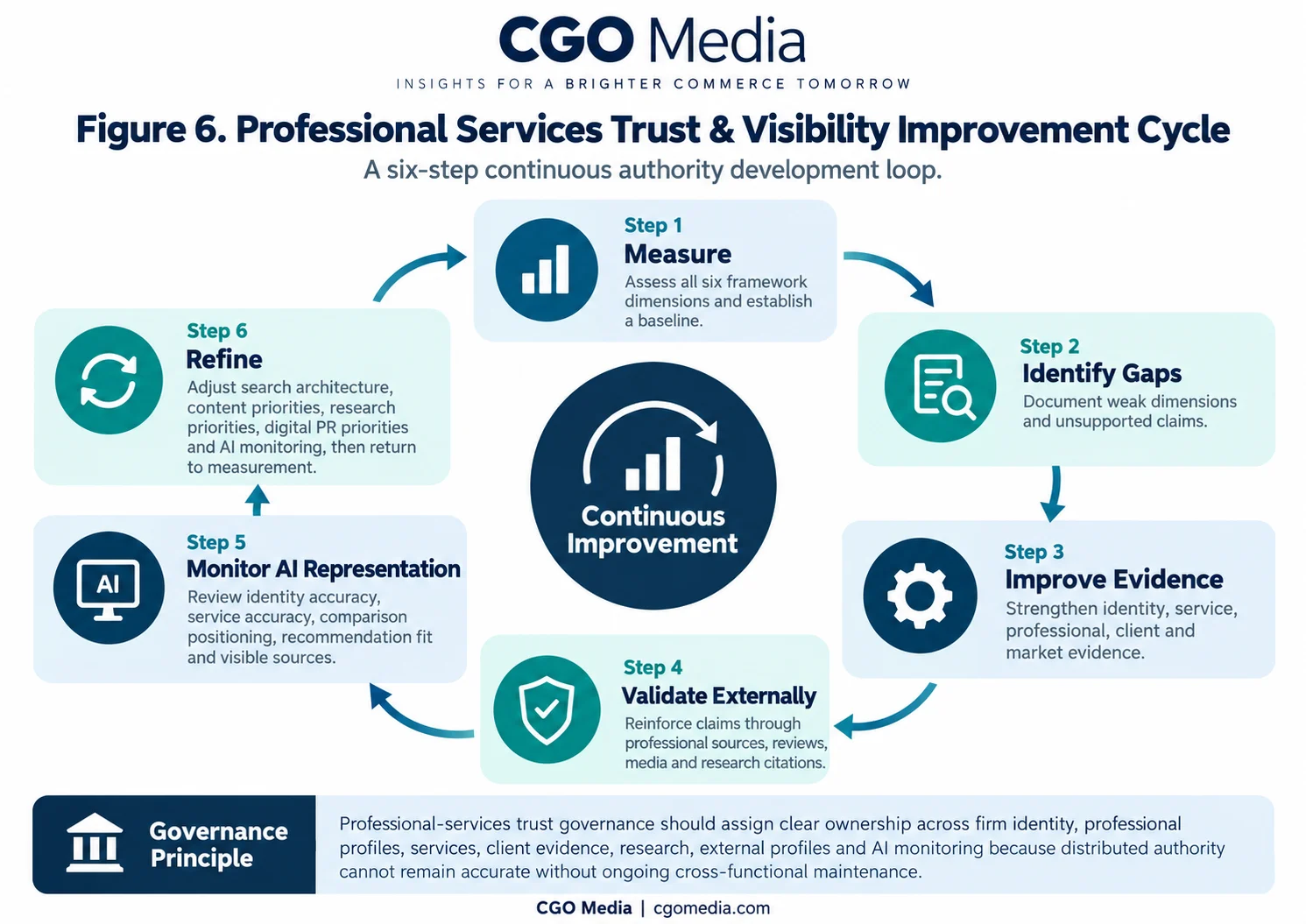
1045. Methodological Position
The Professional Services AI Trust and Visibility Framework is a conceptual and strategic framework developed by CGO Media to organise the principal evidence conditions that can influence how professional-services organisations are discovered, understood, validated, compared and potentially recommended across conventional search and AI-assisted discovery environments.
1046. The Framework Is Designed for Expertise-Led Organisations
It is particularly relevant to markets where prospective clients must evaluate professional capability before making a provider decision.
1047. Relevant Professional Services Can Include
- Accountancy
- Management consulting
- Specialist advisory
- Recruitment
- Executive search
- Architecture
- Engineering consultancy
- Other expertise-led professional services
1048. The Framework Examines Digital Authority Rather Than Professional Competence
The framework does not attempt to determine whether one professional-services organisation is objectively more competent than another.
1049. Professional Competence and Digital Representation Are Different Concepts
A highly capable firm can be poorly represented digitally.
1050. Strong Digital Representation Does Not Prove Professional Competence
A visible and well-structured website cannot independently establish the underlying quality of professional advice or delivery.
1051. The Framework therefore Focuses on Evidence Conditions
It examines whether genuine capability is represented through:
- Clear entities
- Defined services
- Named professionals
- Reliable evidence
- External validation
- Market context
- AI-search readiness
1052. The Six Framework Dimensions
The framework uses six connected dimensions:
- Firm and Entity Clarity
- Service and Expertise Authority
- Professional Evidence and Information Quality
- Credentials, Trust and External Validation
- Client, Sector and Market Authority
- AI Search and Provider Recommendation Readiness
1053. The Dimensions Are Interdependent
No single dimension should be interpreted as sufficient on its own.
1054. Entity Clarity Supports Interpretation
Users and digital systems need to understand which organisation, office, professional or service an item of evidence relates to.
1055. Expertise Authority Supports Capability Evaluation
Prospective clients need enough evidence to determine whether the provider possesses the required specialist knowledge.
1056. Information Quality Supports Decision Confidence
Accurate, current and contextual information reduces uncertainty.
1057. Independent Validation Supports Trust
External evidence can reinforce claims made by the organisation itself.
1058. Market Authority Supports Contextual Relevance
Client, sector and market evidence helps demonstrate where professional capability has practical application.
1059. AI Readiness Extends the Wider Authority System
Generative discovery should therefore be considered in relation to the same underlying evidence architecture rather than treated as an isolated optimisation discipline.
1060. The Framework Is Not a Proprietary AI Ranking Model
CGO Media does not claim access to undisclosed internal systems used by search engines or AI platforms.
1061. The Framework Does Not Claim Knowledge of Hidden Recommendation Algorithms
It should not be interpreted as a description of proprietary:
- Retrieval systems
- Ranking systems
- Citation-selection mechanisms
- Recommendation algorithms
1062. AI Search Observations Should therefore Remain Empirical and Bounded
Where AI-assisted visibility is tested, observations should be tied to the conditions under which they were collected.
1063. Relevant Observation Fields Can Include
- Platform
- Date
- Prompt
- Prompt family
- Geography
- Conversation context
- Visible sources
1064. AI Outputs Can Vary
Different outputs may be produced for similar questions because generative systems are dynamic.
1065. One Generated Answer Should Not Be Treated as a Stable Platform Position
A single result provides an observation rather than a universal conclusion.
1066. Repeated Scenario Testing Provides Stronger Diagnostic Value
Longitudinal testing can help identify recurring patterns while preserving the limits of the sample.
1067. Recommendation Frequency Should Remain Sample-Specific
If a provider appears within a defined scenario set, that frequency applies only to the tested scenarios.
1068. Citation Frequency Should Remain Sample-Specific
Observed source use should not be extrapolated automatically to the wider platform.
1069. Representation Accuracy Can Be Measured More Directly
The organisation can examine whether generated descriptions correctly represent:
- Firm identity
- Services
- Professionals
- Locations
- Specialisms
- Markets
1070. Observation Should Be Separated from Interpretation
A useful research sequence is:
Observation → Context → Interpretation → Hypothesis → Further Testing
1071. Correlation Should Be Separated from Causation
An improvement in visibility after an authority intervention does not automatically prove that the intervention caused the improvement.
1072. External Variables Can Affect Search Visibility
Relevant variables can include:
- Algorithmic change
- Competitor activity
- Demand change
- Seasonality
- Media attention
1073. External Variables Can Affect AI Representation
Generative systems, available sources and retrieval behaviour can change independently of actions taken by the provider.
1074. The Framework Does Not Guarantee Rankings
Strengthening professional evidence does not guarantee a specific organic-search position.
1075. The Framework Does Not Guarantee Citations
Publishing strong research or evidence does not guarantee that an AI system will cite it.
1076. The Framework Does Not Guarantee Recommendations
A provider can build strong authority and still be excluded from a particular recommendation scenario.
1077. Provider Suitability Remains Contextual
A firm can be highly credible while being inappropriate for a specific requirement.
1078. Qualified Visibility Is therefore Preferable to Universal Visibility
The organisation should seek greater visibility where genuine capability exists.
1079. Qualified Recommendation Is Preferable to Universal Recommendation
The strongest outcome is accurate provider inclusion within relevant scenarios.
1080. Appropriate Exclusion Can Be a Positive Outcome
A specialist firm should not expect to be recommended for work outside its genuine capability.
1081. The Framework Does Not Require Every Firm to Maximise All Six Dimensions Equally
Strategic priorities vary by organisation.
1082. A Boutique Consultancy May Prioritise Expert and Research Authority
Its competitive strength may depend on deep specialist knowledge.
1083. A Large Accountancy Group May Prioritise Entity and Governance Clarity
Multiple offices, professionals and practice areas create greater structural complexity.
1084. A Recruitment Firm May Prioritise Specialist and Market Evidence
Role expertise, salary research and sector knowledge can be central to provider differentiation.
1085. An Architecture or Engineering Practice May Prioritise Credentials and Project Evidence
Professional registration and applied project capability can carry greater weight.
1086. Framework Application Should therefore Remain Contextual
The relative importance of evidence types changes according to:
- Profession
- Service
- Sector
- Client type
- Risk
- Regulation
1087. Confidentiality Is a Material Limitation
Professional-services firms may not be able to publish full details of client assignments.
1088. Confidentiality Can Affect Case Studies
Client names and commercial details may need to remain private.
1089. Confidentiality Can Affect Outcome Evidence
Quantitative results may not always be publishable.
1090. Confidentiality Can Affect Testimonials
Some clients may not permit public attribution.
1091. Confidentiality Does Not Remove the Need for Evidence
It changes which forms of evidence are appropriate.
1092. Alternative Evidence Can Include
- Anonymised case studies
- Aggregated outcomes
- Professional credentials
- Client references
- Research
- Independent recognition
1093. Review Behaviour Is Another Contextual Limitation
Public review volume varies significantly across professional-services markets.
1094. Low Review Volume Should Not Automatically Be Interpreted as Weak Trust
Confidential B2B advisory relationships may generate relatively little public feedback.
1095. Review Evidence Should therefore Be Considered alongside Other Validation Sources
Professional trust can also be supported by:
- References
- Credentials
- Case studies
- Media
- Professional recognition
1096. External Evidence Has Different Degrees of Independence
Not every third-party profile represents independent editorial endorsement.
1097. Self-Submitted Directory Profiles Should Be Interpreted Appropriately
They can support identity and discovery without necessarily constituting independent recognition.
1098. Paid Listings Should Be Interpreted Appropriately
Commercial inclusion differs from earned editorial coverage.
1099. Professional Registers Perform a Different Function
They can provide formal verification of status.
1100. Media Coverage Performs a Different Function
It can provide independent recognition of expertise.
1101. Research Citations Perform a Different Function
They can demonstrate independent use of intellectual output.
1102. Evidence Sources Should therefore Be Evaluated by Role
A useful question is:
What specific claim does this source help support?
1103. Evidence Freshness Is another Limitation
Professional-services authority can decay as circumstances change.
1104. People Change
Professionals join, leave or develop new specialisms.
1105. Services Change
Organisations launch, reposition or retire capabilities.
1106. Credentials Change
Memberships, certifications and regulatory status can change.
1107. Markets Change
Client priorities and industry conditions evolve.
1108. Evidence therefore Requires Governance
Authority should not be treated as permanently established.
1109. Authority Can Be Lost through Inaccuracy
Incorrect professional information can undermine confidence.
1110. Authority Can Be Lost through Staleness
Old research and outdated case studies can weaken current relevance.
1111. Authority Can Be Lost through Organisational Change
Restructuring can create new entity ambiguity.
1112. Authority Can Be Lost through Fragmentation
Strong evidence can become disconnected from relevant services, experts or sectors.
1113. The Continuous Improvement Cycle Addresses This Risk
The framework therefore returns repeatedly to:
Measure → Identify Gaps → Improve Evidence → Validate Externally → Monitor AI Representation → Refine
1114. SEO Remains Foundational to the Framework
Conventional search fundamentals continue to support:
- Crawlability
- Indexation
- Information architecture
- Internal linking
- Relevant content
- User discovery
1115. GEO Extends the Framework beyond Conventional Search Visibility
Generative Engine Optimisation introduces additional attention to:
- Source visibility
- Entity clarity
- Citation eligibility
- Provider comparison
- Recommendation readiness
1116. GEO Does Not Replace Professional Evidence
AI-search optimisation cannot substitute for genuine expertise, accurate information or credible validation.
1117. GEO Does Not Replace Technical SEO
Content still needs to remain accessible and understandable.
1118. GEO Does Not Replace Reputation Development
Independent trust remains an important part of provider authority.
1119. The Stronger Strategic Relationship Is
SEO Foundation + Professional Evidence + External Trust + Market Authority + GEO Readiness → Stronger Search and AI Visibility
1120. Final Framework Synthesis
The Professional Services AI Trust and Visibility Framework proposes that sustainable professional-services authority emerges from the interaction of six connected evidence dimensions rather than from one isolated ranking, content or reputation tactic.
1121. Firm and Entity Clarity Establishes Identity
The organisation, offices and professionals become easier to interpret consistently.
1122. Service and Expertise Authority Establishes Capability
The organisation demonstrates what it does and which professionals hold the relevant expertise.
1123. Professional Evidence and Information Quality Establish Decision Support
Users receive enough reliable information to evaluate the provider.
1124. Credentials, Trust and External Validation Establish Independent Confidence
Important claims are reinforced beyond the provider’s own marketing environment.
1125. Client, Sector and Market Authority Establish Contextual Relevance
The organisation demonstrates where and how its expertise has practical application.
1126. AI Search and Provider Recommendation Readiness Extends the System
The same authority assets become relevant to generative provider discovery, comparison and recommendation.
1127. The Six Dimensions Work Best When Evidence Converges
The strongest authority environment connects:
Firm → Service → Professional → Evidence → Client Context → External Validation
1128. Convergence Reduces Interpretation Friction
Users encounter mutually reinforcing evidence rather than disconnected claims.
1129. Convergence Reduces Trust Friction
Important professional claims become easier to validate.
1130. Convergence Reduces Comparison Friction
The provider’s strengths and limitations become clearer relative to alternatives.
1131. Convergence Can Improve Recommendation Readiness
Provider identity, capability and contextual fit become more legible within AI-assisted discovery environments.
1132. The Framework therefore Moves beyond Traditional Visibility
The strategic objective is not simply to appear.
1133. The Strategic Objective Is Qualified Provider Authority
Qualified authority combines:
- Relevant visibility
- Genuine expertise
- Reliable evidence
- Independent trust
- Client fit
- Accurate representation
1134. Qualified Provider Authority Supports Better Discovery
Relevant clients are more likely to encounter appropriate capabilities.
1135. Qualified Provider Authority Supports Better Validation
Prospective clients have more evidence available when evaluating the firm.
1136. Qualified Provider Authority Supports Better Comparison
Meaningful differentiation becomes easier to understand.
1137. Qualified Provider Authority Supports Better Recommendation Precision
The organisation can be represented more appropriately within relevant provider-selection scenarios.
1138. Final Strategic Relationship
The complete framework can be summarised as:
Clear Identity + Verifiable Expertise + Reliable Professional Evidence + Independent Trust + Market Relevance + AI Recommendation Readiness → Sustainable Professional Services Authority
1139. Conclusion
Professional-services visibility is becoming increasingly distributed across conventional search engines, AI-assisted discovery, professional directories, industry media, review platforms, research environments and the organisation’s own digital properties. This makes provider authority more complex than a traditional ranking problem.
A firm can achieve strong search visibility while remaining weakly validated. Another can possess exceptional professional capability while remaining digitally underrepresented. The central strategic challenge is therefore alignment: genuine professional quality should be made sufficiently clear, structured and independently supported that the right clients can discover, understand, validate and compare the provider.
The six dimensions of the Professional Services AI Trust and Visibility Framework provide a structured way to examine that challenge. Firm and Entity Clarity establishes the provider’s identity. Service and Expertise Authority demonstrates capability. Professional Evidence and Information Quality improves decision support. Credentials, Trust and External Validation reinforce important claims independently. Client, Sector and Market Authority demonstrates contextual relevance. AI Search and Provider Recommendation Readiness extends those foundations into emerging generative discovery environments.
The long-term objective is not maximum visibility, maximum content volume or universal AI recommendation. It is stronger qualified authority: making genuine expertise easier to discover and verify within the client situations where that expertise is actually appropriate.
References
External Technical, Search and Research Sources
- Google Search Central. SEO Starter Guide.
- Google Search Central. AI Features and Your Website.
- Google Search Central. Organization Structured Data.
- Schema.org. Organization.
- Schema.org. Person.
- Schema.org. Service.
- Hogan, A. et al. (2021). Knowledge Graphs. ACM Computing Surveys, 54(4).
- Metzger, M. J. (2007). Making Sense of Credibility on the Web: Models for Evaluating Online Information and Recommendations for Future Research. Journal of the American Society for Information Science and Technology, 58(13), 2078–2091.
- Ji, Z. et al. (2023). Survey of Hallucination in Natural Language Generation. ACM Computing Surveys, 55(12).
Professional Services AI & GEO Search Research Family
This framework forms part of the wider CGO Media Professional Services research programme examining how expertise-led organisations can improve search visibility, professional trust, provider-selection authority and generative-search readiness.
Professional Services AI & GEO Search Research
The sector pillar brings together the complete Professional Services SEO, AI Search and GEO research family.
Explore Professional Services AI & GEO Search Research →
Professional Services SEO in an AI Search Environment
The parent research paper examines the broader search, expertise, trust, client-evidence and provider-selection environment underlying this framework.
Explore Professional Services SEO in an AI Search Environment →
Professional Services Discovery and Provider Selection Model
The provider-selection model examines how clients progress from problem recognition and service definition through discovery, validation, comparison, shortlisting and engagement.
Explore the Professional Services Discovery and Provider Selection Model →
Professional Services Search Authority Maturity Model
The maturity model examines progression from Functional through Optimised, Structured and Integrated capability toward Adaptive Authority.
Explore the Professional Services Search Authority Maturity Model →
Professional Services SEO and AI Implementation Roadmap
The implementation roadmap translates the wider Professional Services research into the sequence Assess, Stabilise, Structure, Strengthen, Validate, Integrate and Evolve.
Explore the Professional Services SEO and AI Implementation Roadmap →
Professional Services GEO: Generative Engine Optimisation
The GEO research examines source visibility, entity clarity, citation readiness, provider comparison and qualified recommendation visibility across generative discovery environments.
Explore Professional Services GEO →
How the Professional Services Research Family Connects
The complete Professional Services research architecture can be summarised as:
Sector Research Pillar → Parent Search Research → Trust & Visibility Framework → Discovery & Provider Selection → Search Authority Maturity → Implementation Roadmap → GEO
CGO Media Research Ecosystem
This framework forms part of the CGO Media Framework Library and wider research programme examining AI Search, Generative Engine Optimisation, entity authority, source selection, citation systems, recommendation systems, digital trust, knowledge architecture and the continuing evolution of search.
CGO Media Research Library |
CGO Media Framework Library |
CGO Media Research Architecture |
CGO Media Research Observations |
CGO Media Statistics Library
About Roger Wilkinson
Roger Wilkinson is an independent search and AI researcher, SEO practitioner and founder of CGO Media with more than 25 years of experience in search, online visibility and digital strategy.
His research examines the changing relationship between conventional search, AI-assisted discovery, entity understanding, source selection, citation behaviour, professional authority, provider comparison and recommendation-led discovery.
His sector research applies these concepts to markets where expertise, professional evidence, trust and provider selection materially influence commercial decisions.
This framework applies that wider research to professional-services organisations by examining how firm identity, service authority, professional evidence, independent trust, market context and AI-assisted visibility combine within a distributed provider-authority system.
View Roger Wilkinson’s researcher profile →
Research Usage & Citation
CGO Media encourages researchers, journalists, professional-services organisations, consultants, advisers, marketers and search practitioners to reference this framework where it contributes to broader understanding of Professional Services SEO, AI Search, digital trust, provider authority, external validation or generative recommendation readiness.
Reasonable quotations, summaries, figures and excerpts may be used in articles, reports, presentations and academic work provided appropriate acknowledgement is given to Roger Wilkinson and CGO Media.
Cite This Framework / Embed Citation
The Professional Services AI Trust and Visibility Framework by Roger Wilkinson at CGO Media proposes that sustainable provider authority increasingly depends on the combined strength of firm and entity clarity, service and expertise authority, professional evidence, external validation, client and market authority, and AI recommendation readiness.
APA Citation
APA Citation: Wilkinson, R. (2026). Professional Services AI Trust and Visibility Framework. CGO Media. https://cgomedia.com/professional-services-ai-trust-visibility-framework/
Author: Roger Wilkinson |
Published by: CGO Media
For permissions relating to substantial reproduction, commercial licensing or republication of significant portions of this framework, please contact CGO Media directly.