
Professional Services Search Authority Maturity Model
 The Professional Services Search Authority Maturity Model provides a structured method for assessing how advanced a professional-services organisation has become in managing search visibility, professional authority, trust, external validation, provider comparison and AI-assisted discovery.
The model is designed for accountancy firms, advisory businesses, consultancies, recruiters, architecture practices, engineering consultancies and other expertise-led organisations where digital visibility depends increasingly on more than conventional rankings.
Professional-services search authority develops progressively. Some organisations operate with little more than a functioning website and a handful of service pages. Others have developed sophisticated service architecture, strong professional profiles, sector-specific evidence, original research, structured entity relationships, independent citations, Digital PR programmes, provider-comparison visibility and active AI-search measurement.
The maturity model therefore evaluates organisational capability rather than activity volume alone.
1. Why Professional Services Search Authority Needs a Maturity Model
Professional-services organisations do not develop digital authority at the same rate or in the same sequence.
2. Search Capability Can Vary Substantially Between Firms
Two firms operating in the same professional market can have very different levels of digital maturity.
3. One Firm May Have Only Basic Digital Infrastructure
Its online presence may consist primarily of:
- A homepage
- Basic service pages
- Contact information
- Short team biographies
4. Another Firm May Have Advanced Authority Infrastructure
Its digital environment may include:
- Detailed service architecture
- Expert profiles
- Sector hubs
- Case studies
- Research
- External citations
- Structured data
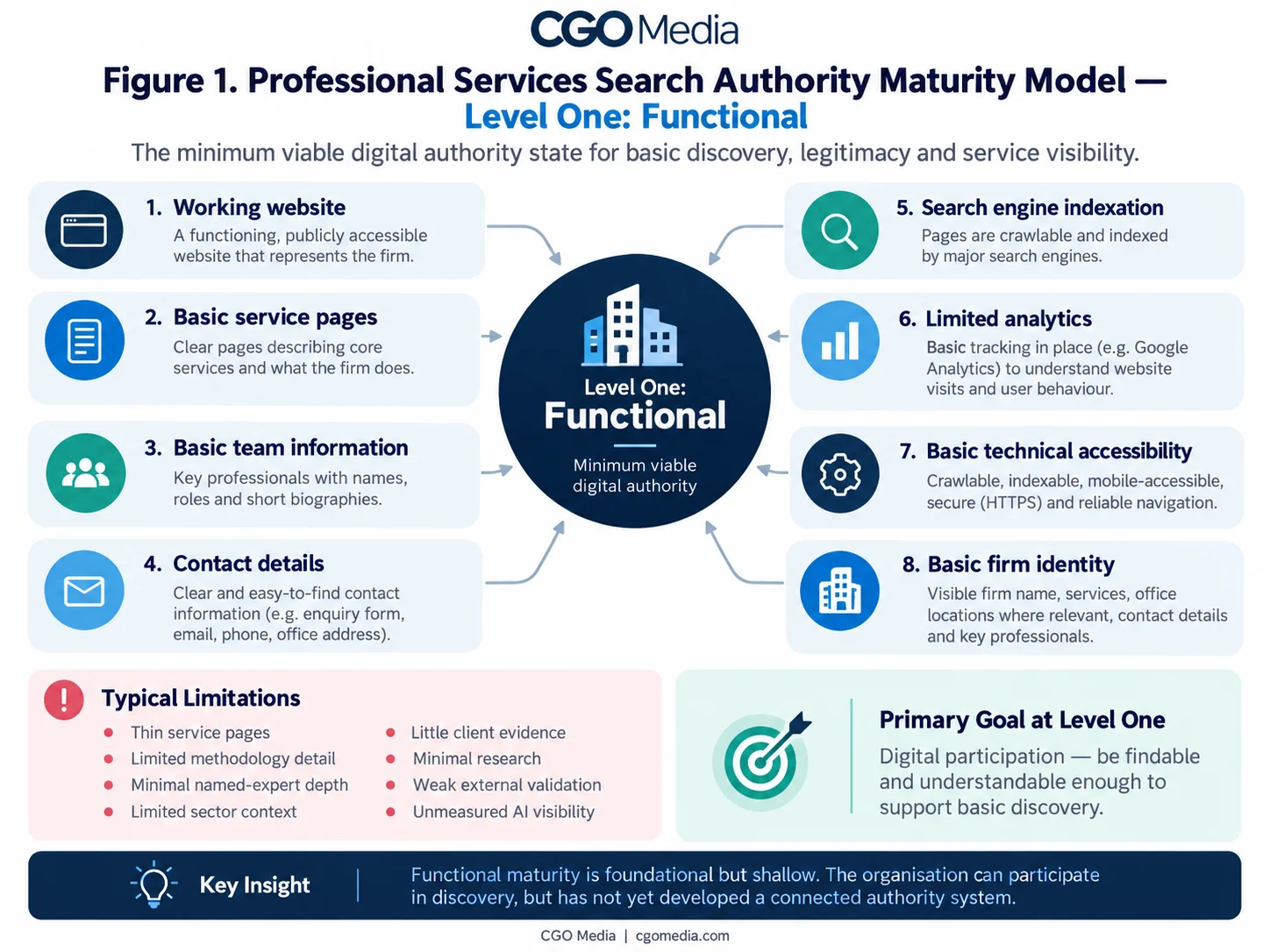
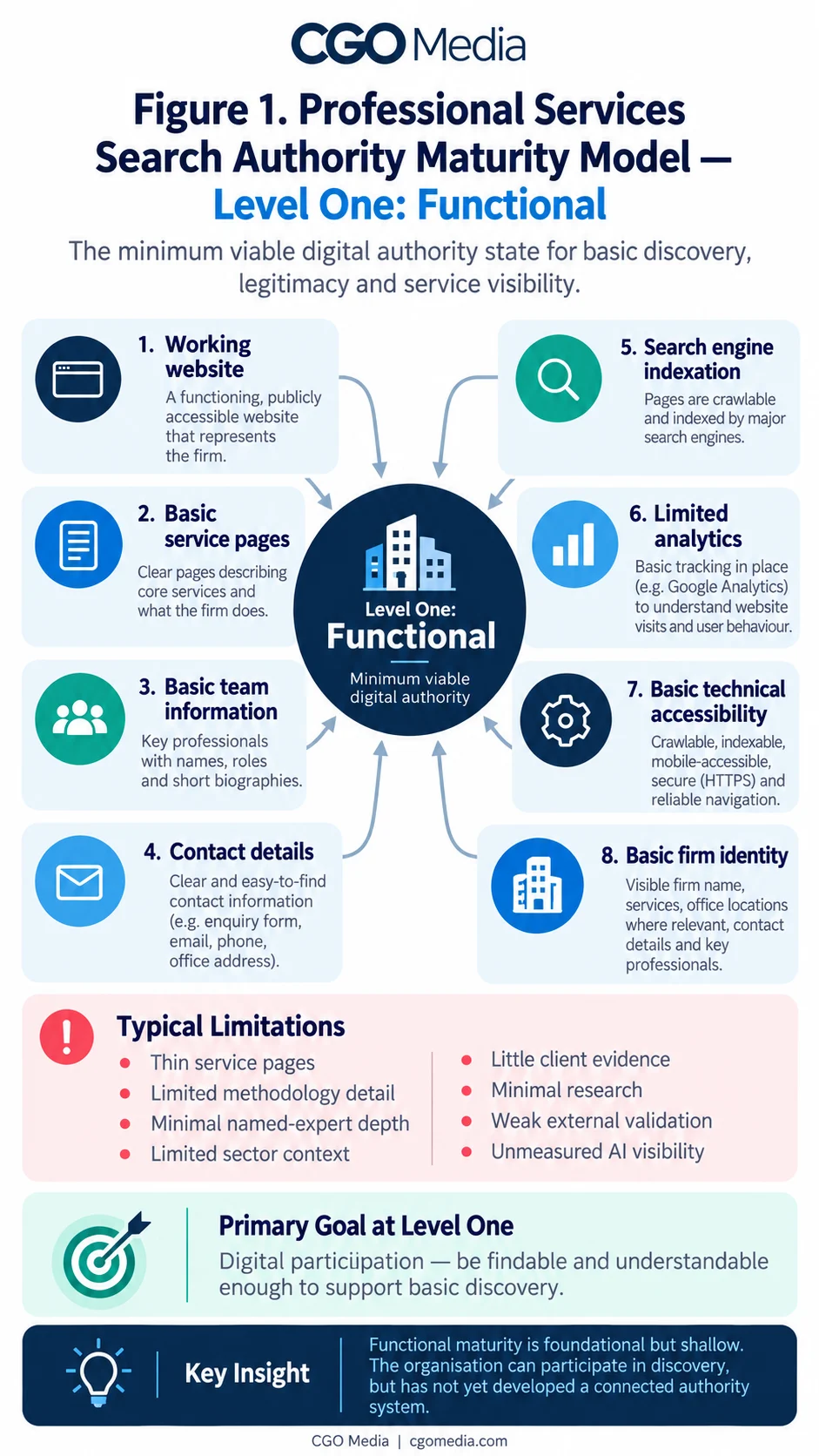
- AI visibility monitoring
5. Activity Volume Does Not Equal Search Maturity
Publishing frequently does not necessarily mean the organisation has developed strong search authority.
6. A High-Activity Firm Can Still Have Weak Foundations
It may produce large amounts of content while still having:
- Poor information architecture
- Weak professional profiles
- Limited client evidence
- Entity inconsistencies
- Minimal independent validation
7. A Low-Volume Firm Can Still Have Strong Authority
A specialist professional-services business may publish less frequently while possessing highly credible:
- Experts
- Client relationships
- Case studies
- Professional credentials
- External recognition
8. The Maturity Model therefore Focuses on Capability
The key question becomes:
How advanced is the organisation’s ability to build, connect, validate, measure and improve professional-services search authority?
9. Maturity Should Be Evaluated Across Multiple Dimensions
A firm can be mature in one capability and weak in another.
10. Technical Maturity Is One Dimension
The organisation must maintain reliable discovery infrastructure.
11. Entity Maturity Is Another Dimension
Firm, office and professional identities should be represented clearly.
12. Service Authority Is Another Dimension
Commercial capabilities should be explained with sufficient depth and evidence.
13. Professional Authority Is Another Dimension
Named specialists should demonstrate expertise and trust.
14. Sector Authority Is Another Dimension
The organisation should demonstrate genuine industry knowledge where sector positioning matters.
15. External Validation Is Another Dimension
Independent evidence can reinforce owned claims.
16. AI Search Readiness Is Another Dimension
The organisation should increasingly understand how it is represented in generative discovery environments.
17. Measurement and Governance Form Another Dimension
Authority should be measurable and operationally managed.
18. The Model Is Developmental Rather Than Binary
An organisation should not be classified simply as having or not having search authority.
19. Capability Develops Progressively
Professional-services organisations generally move from basic digital participation toward more structured, integrated and adaptive authority systems.
20. The Five Maturity Levels
- Functional
- Optimised
- Structured
- Integrated
- Adaptive Authority
21. Level One — Functional
At the Functional level, the organisation possesses the minimum digital infrastructure required to participate in search and support basic client discovery.
22. Functional Does Not Mean Ineffective
A Functional organisation may still generate leads and win clients.
23. Functional Means the System Remains Basic
Search activity is usually limited in scale, coordination and authority depth.
24. Typical Functional Characteristics Include
- Working website
- Basic service pages
- Basic team information
- Contact details
- Search engine indexation
- Limited analytics
25. The Primary Goal at Level One Is Digital Participation
The organisation needs to be findable and understandable enough to support basic discovery.
26. Functional Technical Foundations Come First
The website should at minimum be accessible to users and search engines.
27. Crawlability Is a Functional Requirement
Important pages should be accessible to search crawlers where appropriate.
28. Indexability Is a Functional Requirement
Priority service and firm pages should be capable of appearing in search results.
29. Mobile Accessibility Is a Functional Requirement
Users should be able to research the organisation across modern devices.
30. Security Is a Functional Requirement
The site should use an appropriate secure connection.
31. Basic Performance Is a Functional Requirement
Pages should load reliably enough to support normal use.
32. Navigation Should Function Reliably
Users should be able to reach important pages without broken pathways.
33. Core Pages Should Not Be Broken
Priority pages should avoid:
- Server errors
- Broken links
- Missing assets
- Major rendering failures
34. Functional Search Architecture Can Be Simple
At this stage, sophisticated entity and evidence architecture is not yet expected.
35. But Basic Hierarchy Should Exist
A user should normally be able to move between:
- Homepage
- Services
- Team
- Contact
36. Functional Firm Identity Is the Next Requirement
The organisation should clearly explain who it is.
37. Firm Name Should Be Visible
The user should not need to infer the identity of the organisation.
38. Primary Services Should Be Visible
The website should explain the main professional capabilities offered.
39. Office Locations Should Be Visible Where Relevant
Clients should understand where the organisation operates.
40. Contact Details Should Be Visible
Basic commercial accessibility remains essential.
41. Key Professionals Should Be Visible
Professional-services organisations depend on people, so complete anonymity weakens trust.
42. Functional Identity Should Be Consistent Enough to Avoid Confusion
Major contradictions around name, address or contact details should not exist.
43. Functional Service Coverage Is the Next Requirement
Priority services should have enough information to support basic understanding.
44. Core Services Should Have Dedicated Pages Where Appropriate
Important capabilities should not all be compressed into one generic paragraph.
45. Service Pages Should Explain What the Firm Does
A basic page should answer:
- What is the service?
- Who is it for?
- How can the firm help?
46. Service Pages Should Avoid Major Ambiguity
Users should not have to guess whether a service is actually offered.
47. Functional Service Pages May Still Be Thin
At Level One they often lack:
- Detailed methodology
- Named experts
- Sector context
- Case studies
- Research
48. This Is a Key Limitation of Functional Maturity
The organisation can describe capability without yet demonstrating substantial authority.
49. Functional Professional Profiles Are the Next Requirement
Key professionals should have basic public biographies.
50. A Basic Professional Profile Should Include the Name
The individual should be clearly identifiable.
51. A Basic Professional Profile Should Include the Role
Users should understand the person’s position within the firm.
52. A Basic Professional Profile Should Include Relevant Expertise
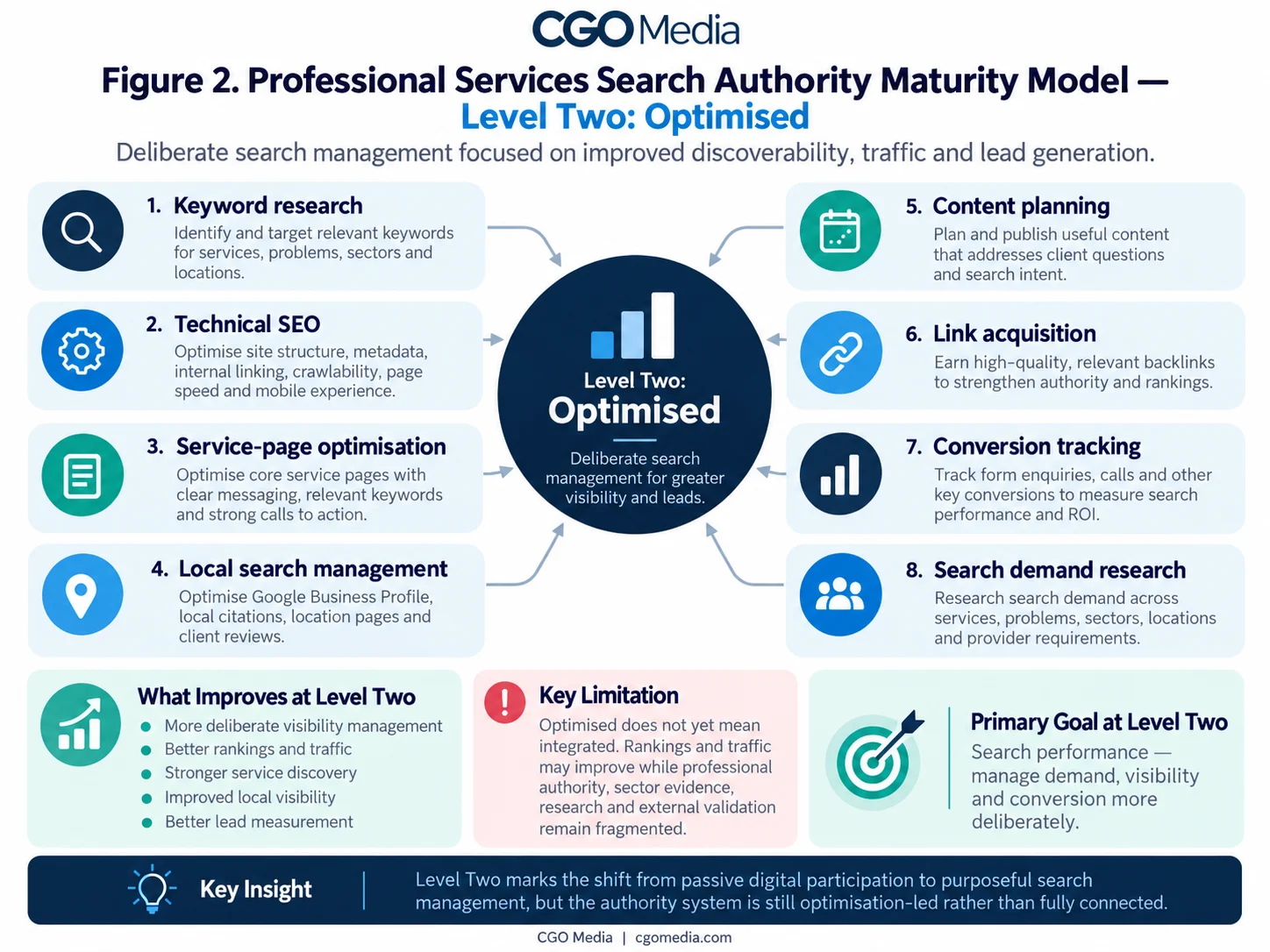
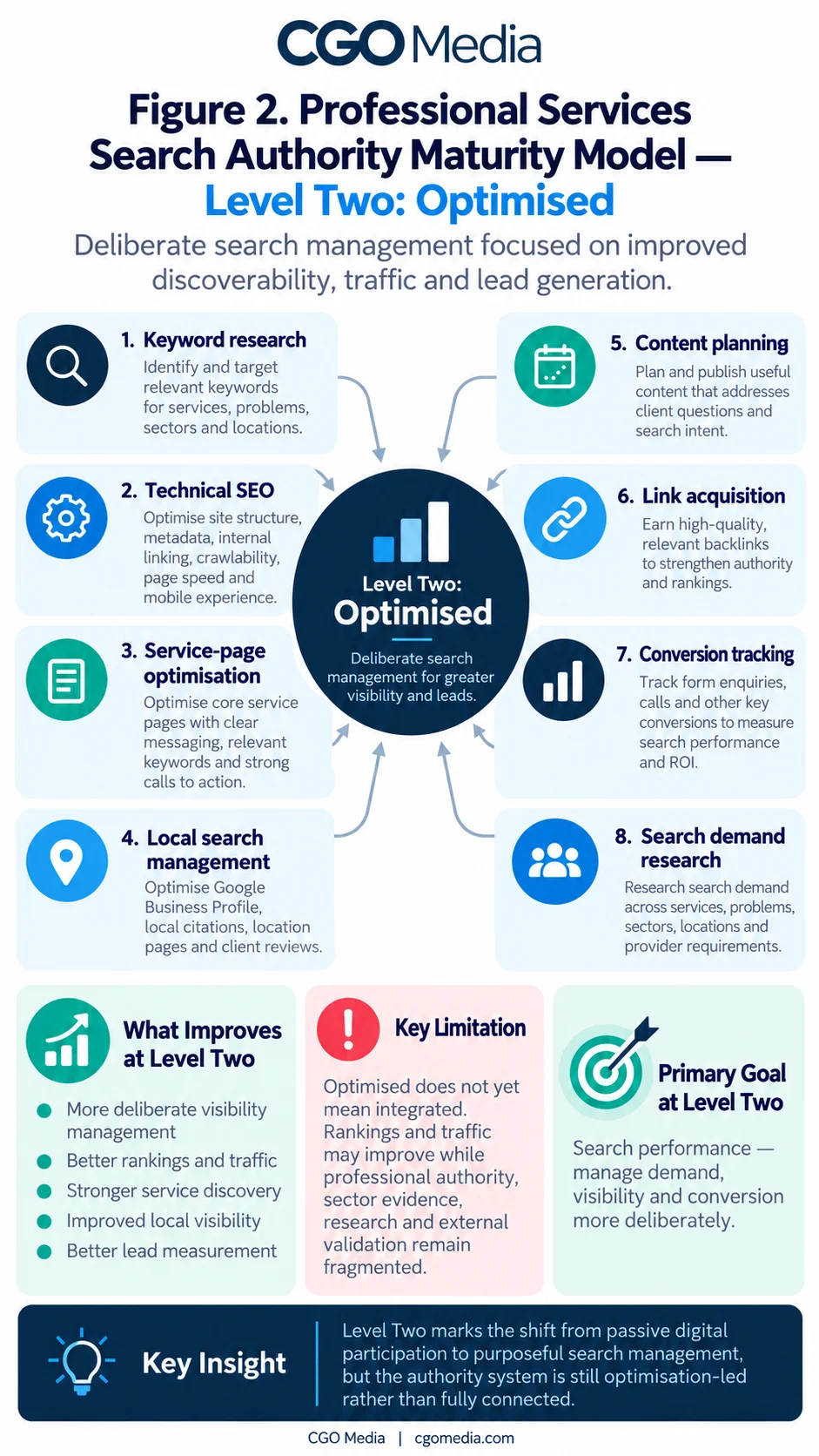
The biography should explain what the person actually knows or does.
53. Relevant Qualifications Should Be Included Where Appropriate
Credentials can provide important trust evidence in professional markets.
54. Basic Profiles Often Remain Employment Biographies
At Level One they may focus more on career history than decision-support evidence.
55. Functional Profiles Often Lack Strong Service Relationships
The user may not be able to tell which services the professional helps deliver.
56. Functional Profiles Often Lack Sector Relationships
Relevant industry experience may remain implicit.
57. Functional Profiles Often Lack Research Relationships
Publications and professional thinking may not be connected to the individual.
58. Functional Profiles Often Lack External Validation
Media, speaking or professional recognition may be absent or disconnected.
59. Functional Sector Authority Is Usually Limited
Many Level One organisations do not yet maintain substantive industry-specific architecture.
60. Sector Coverage May Exist Only in Generic Copy
The firm may state that it works with several industries without providing supporting evidence.
61. Functional Sector Evidence Can Include Basic Industry Lists
These may help users understand general market coverage.
62. But Industry Lists Do Not Establish Deep Sector Authority
There may be no:
- Sector specialists
- Sector research
- Sector case studies
- Trade citations
63. Functional Client Evidence Is Often Limited
The website may contain only a small number of:
- Testimonials
- Client logos
- Short case studies
64. Client Evidence May Be Poorly Connected
A testimonial may appear without explaining which service or professional it validates.
65. Functional Case Studies May Be Promotional Rather Than Evidential
They may describe success without enough context to support provider evaluation.
66. Functional Research Authority Is Often Minimal
Original research programmes are usually absent at this stage.
67. Content May Be Primarily Marketing-Led
The organisation may publish:
- Company news
- Basic advice
- Occasional blog posts
68. This Content Can Still Be Useful
Level One does not imply that all content lacks value.
69. But Content Is Usually Not Managed as an Authority System
Publications may remain disconnected from services, experts and client evidence.
70. Functional External Authority Is Often Passive
Third-party recognition may exist but is not systematically managed.
71. The Firm May Have Professional Directory Listings
These can provide basic external discovery.
72. The Firm May Have Professional Memberships
Membership can provide baseline trust evidence.
73. The Firm May Have Occasional Media Mentions
These are often opportunistic rather than part of a deliberate authority strategy.
74. The Firm May Have Basic Reviews
Public feedback may exist without formal review governance.
75. External Evidence Is Rarely Connected Systematically at Level One
Relevant references may not reinforce the firm’s priority services or experts deliberately.
76. Functional Local Visibility Can Be Basic
Firms with physical offices may maintain:
- Business profiles
- Basic location pages
- Map visibility
77. Local Information May Be Inconsistent
Older addresses or telephone numbers can remain on external sources.
78. Multi-Office Governance Is Usually Limited
Each location may be managed independently without common standards.
79. Functional Measurement Is Primarily Channel-Based
The organisation usually focuses on basic web and search metrics.
80. Traffic Is a Common Level One Metric
The firm may monitor the volume of visitors arriving through search.
81. Rankings Are a Common Level One Metric
Priority keywords may be tracked.
82. Contact-Form Submissions Are a Common Level One Metric
The organisation may count online enquiries.
83. Calls Are a Common Level One Metric
Telephone enquiries can provide another basic conversion signal.
84. Functional Measurement Often Lacks Lead Quality
The firm may know how many enquiries it receives without knowing whether they are suitable.
85. Functional Measurement Often Lacks Service-Level Attribution
The organisation may not know which services generate the strongest opportunities.
86. Functional Measurement Often Lacks Sector-Level Attribution
Industry-specific commercial value may remain unclear.
87. Functional Measurement Often Lacks Expert-Level Visibility
The contribution of professional profiles may not be measured.
88. Functional Measurement Often Lacks Research Metrics
Research authority is generally not yet part of the reporting system.
89. Functional Measurement Rarely Includes AI Visibility
The organisation may not monitor generative provider discovery at all.
90. Functional Governance Is Usually Informal
Search activity may depend on:
- A marketing manager
- An external agency
- A website provider
- Individual practice leaders
91. Ownership Can Be Fragmented
No one team may have responsibility for the whole authority environment.
92. Professional Profile Updates May Be Reactive
Changes may occur only when someone notices outdated information.
93. Service Updates May Be Reactive
Old services can remain visible after operational changes.
94. Location Updates May Be Reactive
External office information may become stale.
95. Client Evidence Updates May Be Reactive
Case studies may be added irregularly without strategic coverage.
96. Functional Search Strategy Is Often Campaign-Based
SEO may be treated as a project rather than an ongoing capability.
97. This Can Produce Temporary Improvement
Individual pages can improve without the wider authority system maturing.
98. Level One Can Still Support Branded Discovery
Prospective clients who already know the firm may find it easily.
99. Level One Can Support Some Service Discovery
The organisation may rank for selected service terms.
100. Level One Can Support Referral Validation
A referred prospect may use the website to confirm basic legitimacy.
101. Referral Validation Is Important in Professional Services
Many buyers arrive through relationships before using search to verify the provider.
102. A Functional Website Can Pass Basic Legitimacy Checks
The user can confirm:
- The firm exists
- The service exists
- The professionals exist
- The organisation can be contacted
103. But Level One Often Struggles During Advanced Provider Evaluation
A prospect comparing several firms requires deeper evidence.
104. Provider Comparison Exposes Level One Weaknesses
Competitors may provide stronger:
- Expert profiles
- Case studies
- Research
- Sector evidence
- External authority
105. Level One Often Depends Heavily on Existing Reputation
Offline brand strength may compensate for digital evidence gaps.
106. Smaller Firms May Depend Heavily on Referrals
Their digital system may primarily validate rather than generate demand.
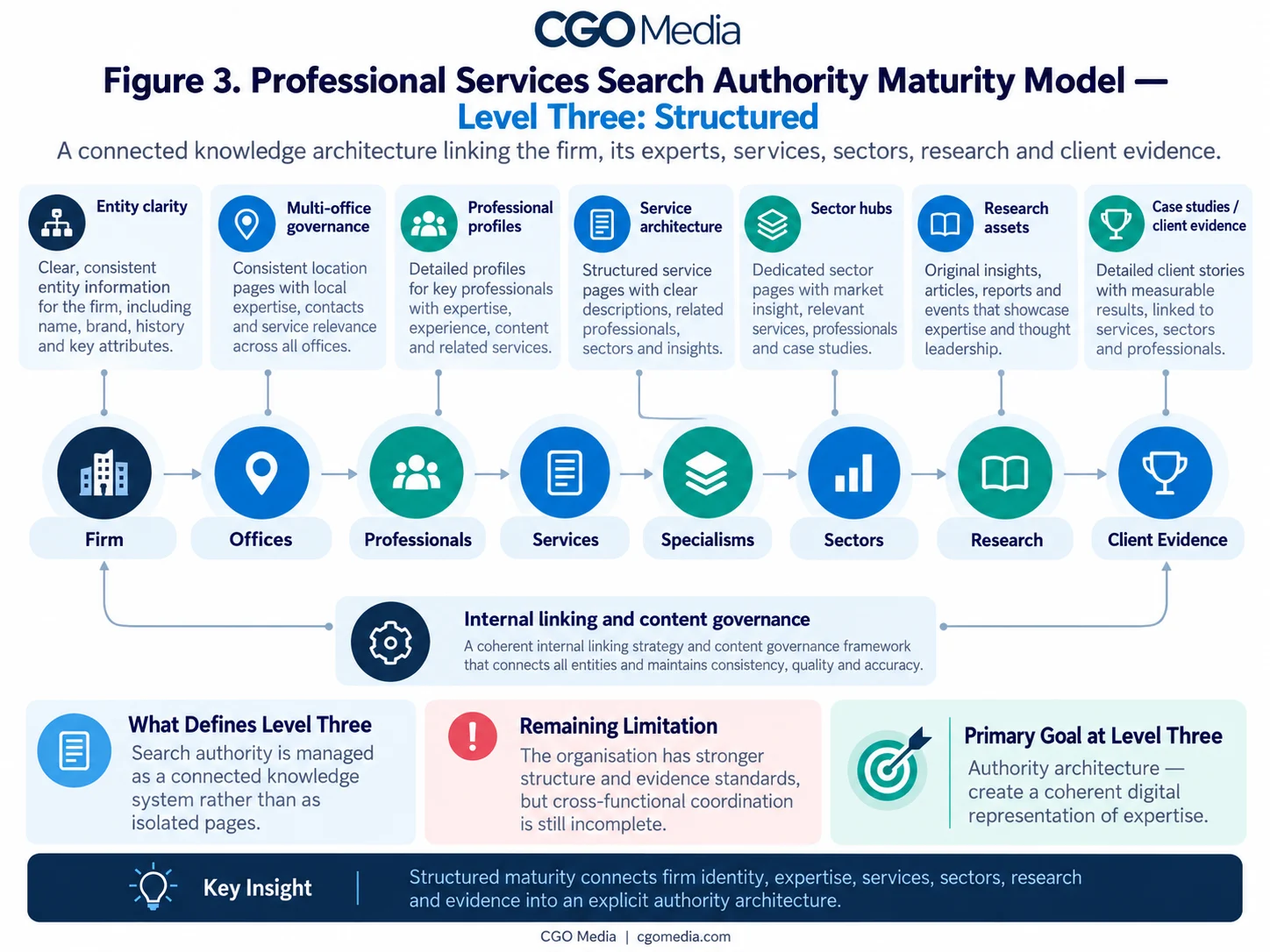
107. This Is Not Necessarily a Commercial Failure
A firm can operate successfully with limited search maturity.
108. But It Creates Strategic Dependency
Growth becomes more dependent on:
- Existing relationships
- Referrals
- Brand familiarity
- Direct outreach
109. Search Maturity Reduces That Dependency
More advanced capability can create additional discovery and authority pathways.
110. Functional AI Search Readiness Is Usually Incidental
The organisation has not yet developed deliberate generative discovery strategy.
111. The Firm May Still Appear in AI Systems
Existing web and external evidence can create incidental visibility.
112. Incidental Visibility Is Not the Same as Managed Readiness
The organisation may not know:
- Where it appears
- How it is represented
- Which sources are used
- Whether information is accurate
113. Entity Errors Can therefore Persist Undetected
Generative systems may surface outdated or incomplete information that the firm has not monitored.
114. Provider Comparison Visibility Is Usually Unmeasured
The firm may not know whether it appears in relevant shortlist or comparison scenarios.
115. Citation Visibility Is Usually Unmeasured
The organisation may not know whether its content or research is being referenced.
116. Recommendation Readiness Is Usually Unmanaged
Professional fit may exist without enough structured evidence to make that fit externally legible.
117. Functional Maturity Is therefore Primarily Foundational
The organisation can participate digitally but lacks coordinated authority infrastructure.
118. A Functional Firm Can Still Have Strong Offline Expertise
Digital maturity should not be confused with professional competence.
119. The Model Measures Digital Authority Capability
It does not claim to measure the underlying professional quality of a firm directly.
120. This Distinction Is Important
A highly capable professional-services organisation can remain digitally immature.
121. Digital Immaturity Can Hide Genuine Expertise
The problem becomes one of external legibility.
122. Hidden Expertise Is a Common Level One Condition
The firm may possess substantial knowledge that is poorly represented online.
123. Hidden Expertise Can Exist in Senior Professionals
Experienced practitioners may have minimal public profiles.
124. Hidden Expertise Can Exist in Client Work
Strong projects may never be translated into case-study evidence.
125. Hidden Expertise Can Exist in Sector Knowledge
The firm may understand an industry deeply without publishing sector-specific evidence.
126. Hidden Expertise Can Exist in Methodology
Strong delivery processes may never be explained publicly.
127. Hidden Expertise Can Exist in Research
Internal analysis may not be developed into publishable authority assets.
128. Level One Maturity Often Has a Visibility–Capability Gap
A useful relationship is:
Professional Capability > Public Evidence = Hidden Authority
129. Closing the Visibility–Capability Gap Is a Major Maturity Opportunity
The organisation can progress without inventing new expertise by making existing capability easier to understand and validate.
130. Functional Maturity Should therefore Be Audited for Latent Authority
The organisation should identify strong offline assets that are not represented digitally.
131. Latent Authority Can Include
- Senior expertise
- Client outcomes
- Sector knowledge
- Professional credentials
- Research
- Industry participation
132. Functional Firms Should Also Audit Basic Risk
Before progressing, the organisation should identify issues capable of undermining later maturity.
133. Technical Risk Should Be Identified
Examples include:
- Poor indexation
- Broken pages
- Weak mobile usability
- Slow performance
134. Entity Risk Should Be Identified
Examples include:
- Wrong office details
- Old professionals
- Incorrect job titles
- Conflicting firm information
135. Service Risk Should Be Identified
Examples include:
- Missing services
- Outdated services
- Ambiguous scope
- Weak service differentiation
136. Trust Risk Should Be Identified
Examples include:
- Unsupported credentials
- Weak profiles
- Outdated testimonials
- Limited client proof
137. Measurement Risk Should Be Identified
The organisation should know whether basic enquiries and conversions are being measured reliably.
138. The Transition from Functional to Optimised Requires Deliberate Search Activity
The organisation begins moving beyond passive digital participation.
139. Keyword and Demand Research Usually Increase
The firm begins examining how users search for:
- Services
- Problems
- Sectors
- Locations
140. Technical SEO Becomes More Systematic
The organisation begins managing rather than merely tolerating technical issues.
141. Service Pages Become More Search-Aware
Commercial capabilities begin aligning more closely with genuine search demand.
142. Professional Profiles Begin Expanding
Expertise, specialisms and credentials become more visible.
143. Content Production Becomes More Deliberate
The organisation moves beyond occasional publishing.
144. Local Search Can Become More Deliberate
Multi-office firms begin managing location visibility more actively.
145. Link and External Authority Activity Can Begin
The organisation may pursue:
- Directories
- Professional associations
- Partnerships
- Media references
146. Measurement Begins Expanding
The firm starts connecting visibility with conversion performance.
147. Level One Is therefore the Foundation for Level Two
A Functional organisation has enough infrastructure to begin purposeful optimisation.
148. The First Professional Services Maturity Principle
Professional-services search maturity should be evaluated through organisational capability rather than publication volume or isolated ranking performance because sustainable authority depends on the combined strength of technical infrastructure, firm identity, services, professionals, evidence, external trust and measurement.
149. The Second Professional Services Maturity Principle
Level One — Functional should be understood as the minimum viable digital authority state in which the organisation is crawlable, indexable, identifiable, contactable and capable of presenting basic services and professional information, but has not yet developed an integrated authority system.
150. The Third Professional Services Maturity Principle
Digital maturity should not be confused with underlying professional competence because highly capable firms can remain digitally immature where expertise, client evidence, sector knowledge and professional authority are not made externally legible.
151. The Fourth Professional Services Maturity Principle
Progression from Functional to Optimised maturity should begin by identifying latent authority and foundational risk so the organisation can improve search visibility using genuine existing expertise rather than manufacturing artificial evidence.
152. Level One Output — Functional Search Foundation
A Level One organisation should possess:
- A functioning website
- Search engine accessibility
- Clear firm identity
- Basic service coverage
- Basic professional profiles
- Contact pathways
- Basic measurement
153. The Strategic Position at Level One
At the Functional level, the professional-services organisation can participate in digital discovery and support basic legitimacy checks, branded searches and selected service discovery. However, its authority system remains shallow. Services may be visible without strong evidence, experts may be named without deep profiles, sector knowledge may remain implicit, external authority may be passive, and AI-assisted provider visibility may be entirely unmeasured. The next stage is therefore not to build a complete authority architecture immediately, but to begin systematically optimising the existing digital estate and converting passive visibility into deliberate search capability.
154. Level Two — Optimised
At the Optimised level, the professional-services organisation begins managing search deliberately rather than relying primarily on passive visibility, brand recognition or referral validation.
155. Optimised Maturity Introduces Systematic SEO
The organisation begins using structured search research, technical improvement and content optimisation to increase discoverability.
156. Search Activity Becomes More Deliberate
Common characteristics can include:
- Keyword research
- Technical SEO
- Service-page optimisation
- Local search management
- Content planning
- Link acquisition
- Conversion tracking
157. Optimised Does Not Yet Mean Integrated
Individual SEO workstreams may be stronger while professional authority, entity architecture and external validation remain only partially connected.
158. The Primary Goal at Level Two Is Search Performance
The organisation attempts to improve visibility for commercially relevant search demand.
159. Search Demand Becomes a Strategic Input
The firm begins researching how prospective clients describe:
- Services
- Problems
- Sectors
- Locations
- Provider requirements
160. Keyword Research Becomes More Systematic
The organisation may classify demand according to:
- Search volume
- Commercial intent
- Service relevance
- Competitive difficulty
161. Service Intent Is Usually Prioritised
Commercial pages increasingly target terms directly related to the firm’s capabilities.
162. Problem-Led Intent Begins to Receive Attention
The organisation may create useful content around client challenges that precede formal service selection.
163. Sector-Led Intent May Also Be Targeted
The firm can begin developing industry-specific search visibility.
164. Geographic Intent May Be Targeted More Deliberately
This is especially relevant to firms serving local, regional or jurisdiction-specific markets.
165. Search Demand Begins Influencing Architecture
The organisation may create or improve:
- Service pages
- Sector pages
- Location pages
- Advice content
166. Technical SEO Becomes More Mature
Rather than waiting for obvious failures, the organisation begins managing technical health routinely.
167. Crawl Management Becomes Deliberate
The firm starts identifying unnecessary or problematic crawl paths.
168. Indexation Management Becomes Deliberate
The organisation distinguishes between pages that should and should not appear in search.
169. Canonicalisation Becomes More Systematic
Duplicate and overlapping content issues receive greater attention.
170. Internal Linking Becomes More Intentional
Priority pages receive stronger contextual support.
171. Site Performance Becomes a Managed Metric
The organisation begins monitoring technical performance rather than treating it as a one-time development issue.
172. Mobile Usability Becomes a Managed Requirement
Cross-device user experience receives more consistent attention.
173. Technical Audits Become Periodic
The firm may introduce:
- Monthly checks
- Quarterly audits
- Launch reviews
- Migration reviews
174. Technical Ownership Becomes Clearer
Responsibility may sit with:
- Internal search teams
- Marketing
- Developers
- External SEO specialists
175. Service-Page Optimisation Becomes More Advanced
Priority commercial pages receive systematic improvement.
176. Page Titles and Metadata Become More Deliberate
Search presentation begins reflecting actual user intent and service positioning.
177. Heading Architecture Becomes More Deliberate
Content structure begins supporting both readability and topical clarity.
178. Service Pages Become More Comprehensive
They may begin explaining:
- Client problems
- Service scope
- Processes
- Outcomes
- Frequently asked questions
179. Service Pages Begin Differentiating More Clearly
The organisation attempts to move beyond generic descriptions shared across competitors.
180. Conversion Pathways Become More Deliberate
Priority service pages may include stronger:
- Contact routes
- Consultation CTAs
- Proposal requests
- Lead forms
181. Search Optimisation Can Improve Commercial Clarity
The process of defining search intent can force the firm to explain services more precisely.
182. But Level Two Service Pages Can Still Be SEO-Led Rather Than Evidence-Led
A page may be well optimised while containing limited proof of expertise.
183. Professional Profiles Begin to Improve at Level Two
The organisation increasingly recognises that named professionals contribute to trust.
184. Professional Profiles May Become More Detailed
Useful additions can include:
- Experience
- Specialisms
- Qualifications
- Sector experience
- Professional memberships
185. Expert Pages May Begin Targeting Name Searches
This can improve control over branded professional discovery.
186. Expert Profiles May Begin Linking to Services
The connection between individual expertise and commercial capability becomes clearer.
187. Expert Profiles May Begin Linking to Content
Articles and commentary can start reinforcing individual subject authority.
188. Professional Profile Templates May Become Standardised
The organisation begins expecting a minimum level of completeness.
189. Professional Profiles Can Still Remain Uneven
Some senior experts may have rich profiles while others remain thin.
190. Professional Authority Is Often Secondary to Page Optimisation at Level Two
The organisation is aware of expert trust but has not yet built a fully structured authority system.
191. Sector Content Begins Expanding
Priority industries can receive dedicated pages.
192. Sector Pages May Target Commercial Search Demand
Examples can include combinations of:
- Service + sector
- Consultant + sector
- Adviser + sector
- Specialist + sector
193. Sector Pages May Begin Including Market Context
The organisation can move beyond generic industry statements.
194. Sector Pages May Begin Linking to Relevant Services
This improves commercial navigation.
195. Sector Pages May Begin Linking to Named Experts
Industry positioning gains a human evidence layer.
196. Sector Pages Can Still Be Relatively Thin
At Level Two they may lack:
- Sector research
- Multiple case studies
- Trade citations
- Deep original evidence
197. Content Production Becomes More Planned
The firm may introduce an editorial calendar.
198. Search Demand Often Drives the Editorial Calendar
Content themes can be chosen around:
- Keyword opportunity
- Client questions
- Service demand
- Sector issues
199. Informational Content Expands
The organisation may publish:
- Guides
- Articles
- FAQs
- Explainers
- Commentary
200. Content Begins Supporting Funnel Stages
Different assets can address:
- Awareness
- Understanding
- Evaluation
- Engagement
201. Content Quality Usually Improves
Search optimisation encourages deeper coverage of common user questions.
202. But Content Can Become Keyword-Led
The organisation may still create material primarily because a query has measurable demand.
203. This Can Produce Content Inflation
Many articles may be created without sufficient connection to:
- Expertise
- Client evidence
- Research
- Commercial strategy
204. Optimised Maturity therefore Has a Content-Governance Risk
The organisation can increase publishing faster than authority maturity.
205. Local Search Often Becomes More Systematic at Level Two
Professional-services firms with physical offices may begin actively managing geographic visibility.
206. Business Profiles Become More Deliberate
The organisation may improve:
- Categories
- Descriptions
- Photos
- Opening details
- Service information
207. Location Pages May Be Created or Expanded
The firm attempts to improve visibility across priority markets.
208. Local Reviews May Receive More Attention
Review generation and monitoring can become part of the marketing programme.
209. Local Citation Consistency May Improve
The organisation begins correcting major directory inconsistencies.
210. Multi-Office Firms May Introduce Common Standards
This reduces variation across local profiles.
211. Local Optimisation Can Still Become Over-Expanded
A firm may create numerous location pages without enough genuine local evidence.
212. Level Two Should therefore Distinguish Market Presence from Keyword Opportunity
Geographic targeting should remain aligned with operational reality.
213. External Link Acquisition Becomes More Deliberate
The organisation may begin actively seeking links and mentions.
214. Common Level Two Link Sources Can Include
- Directories
- Professional associations
- Partners
- Guest articles
- Media coverage
215. Link Building Can Improve Discovery
Relevant external references can strengthen the wider search environment.
216. But Link Volume Can Become an Over-Simplified Objective
The organisation may evaluate success primarily through the number of links acquired.
217. Link Quality Should Begin Replacing Link Quantity
More mature Level Two programmes start evaluating:
- Relevance
- Authority
- Context
- Independence
218. Digital PR May Begin Emerging
The firm can start promoting:
- Expert commentary
- Company announcements
- Surveys
- Market observations
219. PR and SEO May Still Operate Separately
The outreach programme may not yet align systematically with priority services and professional authority.
220. Review and Reputation Management Becomes More Deliberate
The organisation can begin monitoring client feedback systematically.
221. Review Requests May Become Process-Based
Teams can request feedback following:
- Project completion
- Successful placement
- Key milestones
- End of engagement
222. Review Responses May Become Standardised
The firm begins applying consistent tone and governance.
223. Reviews May Begin Appearing on Service Pages
This can strengthen commercial trust.
224. Reviews May Still Lack Strategic Mapping
The organisation may not yet connect feedback systematically with:
- Specific services
- Specific professionals
- Specific sectors
225. Case Study Production Becomes More Deliberate
Professional-services firms at Level Two often recognise the need for stronger proof.
226. Case Studies May Begin Using a Standard Format
A basic structure can include:
- Challenge
- Approach
- Outcome
227. Case Studies May Be Optimised for Search
Relevant service and sector terminology can improve discoverability.
228. Case Studies May Begin Supporting Service Pages
This introduces a stronger evidence relationship.
229. Case Studies Can Still Be Sparse
Coverage may remain uneven across important services and sectors.
230. Client Evidence May Still Be Marketing-Led
The organisation may focus more on persuasive storytelling than evidence completeness.
231. Research Activity May Begin at Level Two
Some firms start producing:
- Surveys
- Market reports
- Trend articles
- Industry commentary
232. Early Research Can Support Search Visibility
Useful data can attract external interest.
233. Early Research Can Support Media Outreach
Distinctive findings provide stronger reasons for journalists to engage.
234. Early Research Can Support Professional Authority
Named experts can become associated with subject insight.
235. But Research Standards May Still Be Inconsistent
Early-stage programmes may lack:
- Clear methodology
- Named authorship
- Limitations
- Versioning
- Citation guidance
236. Optimised Maturity therefore Creates the Foundation for Research Authority
The organisation begins recognising the value of original evidence without yet managing it as a formal research system.
237. Measurement Becomes More Advanced at Level Two
The organisation moves beyond basic traffic and rankings.
238. Organic Conversions Begin to Matter More
The firm starts assessing whether search produces enquiries.
239. Conversion Rates May Be Monitored
This helps distinguish high-traffic pages from commercially effective ones.
240. Service-Level Reporting May Begin
The organisation starts comparing performance between practices.
241. Landing-Page Performance May Be Monitored
This can reveal which content supports commercial progression.
242. Search Visibility May Be Segmented
Reporting can distinguish:
- Branded search
- Non-branded search
- Service search
- Local search
243. Keyword Rankings Still Carry Significant Weight
At Level Two, traditional ranking metrics often remain central to performance reporting.
244. Lead Quality May Begin to Be Discussed
Marketing and commercial teams start distinguishing between raw enquiries and useful opportunities.
245. CRM Integration Is Usually Limited
Search and commercial data may still operate in separate systems.
246. Multi-Touch Attribution Is Usually Limited
The organisation may rely heavily on last-click measurement.
247. Professional-Level Measurement Is Usually Limited
The influence of named experts is rarely analysed deeply.
248. External Authority Measurement Is Usually Limited
Links may be counted without analysing wider citation or trust value.
249. AI Visibility Measurement Is Usually Emerging or Absent
The organisation may experiment with generative search monitoring without a formal methodology.
250. AI Search Awareness Can Begin at Level Two
Teams may notice that prospective clients increasingly use:
- AI assistants
- Generative search
- AI-powered comparisons
251. The Firm May Begin Testing AI Outputs Informally
Examples can include asking:
- Who are leading providers?
- Which firms specialise in a sector?
- Which consultants offer a service?
252. Informal AI Testing Can Reveal Representation Problems
The organisation may identify:
- Missing providers
- Outdated information
- Incorrect expertise
- Competitor prominence
253. But Informal Testing Is Not Yet Mature Measurement
The organisation may fail to record:
- Platform
- Date
- Prompt
- Location
- Observed sources
254. AI Outputs May Be Over-Interpreted at Level Two
Teams can mistakenly treat one generated answer as a stable ranking.
255. Maturity Requires Moving Beyond Anecdotal AI Observation
The Structured stage introduces more systematic evidence and entity architecture.
256. Governance Improves at Level Two
SEO responsibility becomes clearer.
257. Search May Receive Dedicated Ownership
Responsibility can sit with:
- Internal SEO staff
- Digital marketing teams
- External agencies
258. Content Ownership Becomes More Defined
Editorial calendars and approval processes may be introduced.
259. Technical Ownership Becomes More Defined
Developers and SEO teams coordinate more regularly.
260. Local Profile Ownership Becomes More Defined
Multi-office businesses can introduce central governance.
261. Professional Input May Still Be Inconsistent
Experts often contribute only when requested.
262. Search Can Remain Marketing-Led
Professional-services authority is not yet embedded across the organisation.
263. Level Two Produces Better Search Performance
The organisation can improve:
- Rankings
- Traffic
- Service discovery
- Local discovery
- Lead generation
264. But Level Two Often Has an Optimisation Ceiling
Further growth can become difficult where the firm lacks deeper authority evidence.
265. The Optimisation Ceiling Appears When Competitors Have Stronger Expertise Evidence
Better on-page optimisation cannot fully compensate for much stronger professional authority.
266. The Optimisation Ceiling Appears When Competitors Have Stronger Client Evidence
Provider comparison can favour firms with more credible applied proof.
267. The Optimisation Ceiling Appears When Competitors Have Stronger Sector Authority
Generic service optimisation may struggle against specialist industry evidence.
268. The Optimisation Ceiling Appears When Competitors Have Stronger External Validation
Independent recognition can differentiate otherwise similar providers.
269. The Optimisation Ceiling Appears in AI-Assisted Discovery
Keyword targeting alone provides limited control over provider recommendation environments.
270. Level Two Can therefore Produce Strong Traffic but Weak Authority Depth
A useful relationship is:
Good SEO Execution + Weak Evidence Architecture = Optimised Visibility without Integrated Authority
271. This Is the Core Limitation of Optimised Maturity
The organisation has improved its ability to attract search demand but has not fully connected search with expertise, evidence and independent validation.
272. Level Two Organisations Should Audit Authority Depth
The firm should examine whether its search performance is supported by:
- Named experts
- Case studies
- Sector evidence
- Research
- External citations
273. Service Authority Gaps Should Be Identified
High-performing pages may still lack decision-support evidence.
274. Professional Authority Gaps Should Be Identified
The organisation should determine whether important experts are publicly visible.
275. Sector Authority Gaps Should Be Identified
Industry positioning should be supported by more than keyword-targeted pages.
276. Client Evidence Gaps Should Be Identified
Priority services should ideally have relevant applied proof.
277. External Validation Gaps Should Be Identified
The organisation should understand whether independent sources reinforce its strongest claims.
278. Entity Relationship Gaps Should Be Identified
Services, experts, sectors and evidence may exist without being connected systematically.
279. This Is the Main Transition Toward Level Three
The organisation moves from optimising individual pages toward structuring the entire authority system.
280. Level Three Requires Knowledge Architecture
The firm begins organising:
- Firm
- Offices
- Professionals
- Services
- Specialisms
- Sectors
- Research
- Client evidence
as connected entities.
281. Level Three Requires Stronger Evidence Standards
Content quality becomes defined by authority contribution rather than keyword coverage alone.
282. Level Three Requires Stronger Professional Participation
Experts become active components of the search system.
283. Level Three Requires Better External Validation
Digital PR, research citations and professional recognition become more strategically aligned.
284. Level Three Requires More Mature Measurement
Search data begins connecting with authority and provider-selection outcomes.
285. The Fifth Professional Services Maturity Principle
Level Two — Optimised represents the transition from passive digital participation to deliberate search management, characterised by systematic technical SEO, service-page optimisation, search-demand research, planned content, local visibility management, external link development and improved conversion measurement.
286. The Sixth Professional Services Maturity Principle
Optimised maturity should not be confused with integrated authority because a firm can achieve strong rankings, traffic and lead generation while professional expertise, sector evidence, client proof, research and independent validation remain fragmented or underdeveloped.
287. The Seventh Professional Services Maturity Principle
The principal risk at Level Two is an optimisation ceiling in which further keyword, content and link activity creates diminishing strategic value because provider discovery increasingly depends on evidence depth, entity clarity, professional trust and contextual suitability.
288. The Eighth Professional Services Maturity Principle
Progression from Optimised to Structured maturity requires the organisation to move from page-level optimisation toward a connected knowledge and evidence architecture in which services, experts, sectors, client evidence, research and external authority systematically reinforce one another.
289. Level Two Output — Optimised Search Capability
A Level Two organisation typically possesses:
- Systematic technical SEO
- Search-demand research
- Optimised service pages
- Improved professional profiles
- Planned informational content
- Managed local visibility
- Active link acquisition
- Basic reputation management
- Improved conversion measurement
290. The Strategic Position at Level Two
At the Optimised level, the professional-services organisation has moved beyond simple digital participation and developed a deliberate search programme capable of improving rankings, traffic, service discovery, local visibility and lead generation. However, the system remains predominantly optimisation-led. Professional profiles, case studies, sector authority, research and external recognition may be improving but are not yet organised as a coherent authority architecture. The transition to Level Three therefore requires the organisation to stop treating search primarily as a collection of pages and campaigns and begin structuring the firm itself — its services, experts, sectors, evidence and research — as a connected digital knowledge system.
291. Level Three — Structured
At the Structured level, the professional-services organisation begins managing search authority as a connected knowledge system rather than a collection of independently optimised pages.
292. Structure Is the Defining Characteristic of Level Three
The organisation establishes clearer relationships between:
- Firm
- Offices
- Professionals
- Services
- Specialisms
- Sectors
- Research
- Client evidence
293. The Primary Goal at Level Three Is Authority Architecture
The firm moves from optimising isolated assets to creating a coherent digital representation of its expertise.
294. A Useful Structural Relationship Is
Firm → Offices → Professionals → Services → Specialisms → Sectors → Research → Client Evidence
295. Entity Clarity Becomes More Deliberate
The organisation begins treating its key entities as connected components of the wider search environment.
296. Firm Identity Becomes More Structured
The organisation defines a consistent representation of:
- Official name
- Trading identity
- Locations
- Primary capabilities
- Professional team
297. Office Architecture Becomes More Structured
Each location can be connected with:
- Professionals
- Services
- Regional expertise
- Relevant markets
298. Multi-Office Governance Improves
The organisation begins reducing inconsistencies between locations.
299. Professional Profiles Become Entity Hubs
Profiles move beyond basic biographies and begin connecting individual professionals with:
- Services
- Specialisms
- Sectors
- Research
- Case studies
300. Professional Specialisms Become Explicit
The organisation begins defining areas of expertise more precisely.
301. Professional Service Relationships Become Explicit
Users can identify which professionals actually deliver specific services.
302. Professional Sector Relationships Become Explicit
Relevant industry experience becomes more visible.
303. Professional Research Relationships Become Explicit
Named experts become connected with:
- Research
- Reports
- Commentary
- Publications
304. Professional Client-Evidence Relationships Can Become Explicit
Case studies can reinforce applied expertise where confidentiality permits.
305. Service Architecture Becomes More Deliberate
The organisation defines clearer distinctions between:
- Practice areas
- Core services
- Specialist services
306. Service Hierarchies Become More Logical
The structure begins reflecting real client and delivery relationships rather than minor keyword variations.
307. Service Pages Become More Evidence-Led
They increasingly include:
- Problem context
- Scope
- Methodology
- Named experts
- Case studies
- Research
308. Service Pages Begin Supporting Provider Evaluation
The content starts answering not only what the firm does, but why the firm is credible.
309. Specialism Architecture Can Develop
Niche capabilities can receive distinct representation where sufficient evidence exists.
310. Specialism Pages Become Evidence-Dependent
The organisation increasingly avoids creating pages solely because a long-tail keyword exists.
311. Sector Architecture Becomes More Strategic
Priority industries receive dedicated authority hubs.
312. Sector Hubs Begin Connecting Multiple Evidence Types
A mature Level Three sector page can connect:
- Industry problems
- Relevant services
- Named experts
- Case studies
- Research
313. Sector Pages Become Less Generic
The organisation begins demonstrating genuine market-specific understanding.
314. Sector-Specific Client Evidence Expands
Relevant case studies strengthen industry credibility.
315. Sector-Specific Research Can Begin Expanding
Original evidence starts supporting market authority.
316. Geographic Architecture Becomes More Disciplined
Location pages increasingly reflect genuine operational or jurisdictional relevance.
317. Thin Location Expansion Is Reduced
The organisation becomes less likely to create near-identical geographic pages without local evidence.
318. Local Professional Relationships Become Clearer
Office pages can identify the people and services actually available within the location.
319. Jurisdictional Expertise Can Become More Explicit
This is important where professional advice varies by:
- Country
- Region
- Regulatory environment
- Professional jurisdiction
320. Research Architecture Becomes More Formal
The organisation begins distinguishing research from ordinary marketing content.
321. Research Can Be Organised by Type
Useful categories can include:
- Research papers
- Market reports
- Benchmarks
- Frameworks
- Observations
- Statistics resources
322. Research Authorship Becomes More Explicit
Named professionals are connected with intellectual output.
323. Research Methodology Begins Improving
Publications may include:
- Research scope
- Methodology
- Sources
- Limitations
- Publication date
324. Research Begins Supporting Service Authority
Relevant studies reinforce commercial capabilities.
325. Research Begins Supporting Sector Authority
Industry-specific evidence strengthens market positioning.
326. Research Begins Supporting Professional Authority
Named authorship creates clearer expertise associations.
327. Research Begins Supporting Digital PR
Distinctive evidence can create more credible media opportunities.
328. Client Evidence Architecture Becomes More Deliberate
Case studies and testimonials begin supporting specific decision pathways.
329. Case Studies Can Be Categorised by Service
This reinforces capability validation.
330. Case Studies Can Be Categorised by Sector
This reinforces industry authority.
331. Case Studies Can Be Categorised by Problem
This helps users identify comparable situations.
332. Case Studies Can Connect to Named Professionals
Applied evidence begins reinforcing expert authority.
333. Testimonials Become More Contextual
Client quotations can be associated with:
- Service
- Sector
- Professional
- Outcome
334. Internal Linking Becomes Architectural
Links are increasingly used to express real relationships rather than merely support SEO mechanics.
335. Service-to-Expert Links Become Standard
Users can identify who delivers the capability.
336. Expert-to-Service Links Become Standard
Professional profiles show commercial relevance.
337. Service-to-Sector Links Become Standard
Users can understand industry applicability.
338. Sector-to-Service Links Become Standard
Industry needs connect with relevant capabilities.
339. Service-to-Case-Study Links Become Standard
Users can move from service claims to applied proof.
340. Expert-to-Research Links Become Standard
Professional authority is reinforced through intellectual evidence.
341. Research-to-Expert Links Become Standard
Authorship becomes clearer.
342. Sector-to-Research Links Become Standard
Original evidence reinforces market authority.
343. Structured Data Use Becomes More Deliberate
The organisation begins reinforcing visible entity relationships through appropriate structured information.
344. Structured Data Remains Secondary to Visible Content
It should reflect actual page content rather than introduce unsupported relationships.
345. Knowledge Architecture Improves Human Navigation
Users can move more logically through:
Problem → Service → Expert → Evidence → Enquiry
346. Knowledge Architecture Improves Machine Interpretation
Clearer relationships reduce ambiguity around:
- Who the professionals are
- What services they provide
- Which sectors they understand
- Which evidence supports those claims
347. Authority Standards Become More Formal
The organisation begins defining minimum evidence requirements for different asset types.
348. Professional Profile Standards Can Include
- Current role
- Specialisms
- Sector expertise
- Credentials
- Research
349. Service Standards Can Include
- Problem definition
- Scope
- Methodology
- Named experts
- Client evidence
350. Sector Standards Can Include
- Industry-specific problems
- Relevant services
- Named experts
- Case studies
- Research
351. Research Standards Can Include
- Named authorship
- Methodology
- Sources
- Limitations
- Versioning
352. Case Study Standards Can Include
- Context
- Problem
- Intervention
- Outcome
- Relevant capability
353. Content Governance Improves Substantially at Level Three
The organisation increasingly prevents weak or redundant assets from entering the architecture.
354. New Service Pages Require Stronger Justification
The organisation begins asking whether there is:
- Distinct capability
- Distinct user need
- Sufficient expertise
- Sufficient evidence
355. New Sector Pages Require Stronger Justification
The organisation becomes less willing to claim industry authority without real proof.
356. New Expert Pages Follow Consistent Standards
Professional profiles become easier to maintain and compare internally.
357. New Research Fits an Existing Architecture
Publications connect deliberately to relevant services, professionals and sectors.
358. New Case Studies Fit an Existing Evidence Model
The organisation can identify which authority gaps each example strengthens.
359. Search and Content Teams Become More Coordinated
SEO strategy begins influencing content architecture rather than simply page optimisation.
360. Professional Input Becomes More Systematic
Experts increasingly contribute to:
- Service content
- Research
- Sector commentary
- Case studies
361. Research and Marketing Become More Connected
Original evidence starts supporting wider authority strategy.
362. PR and Search Become More Connected
External outreach begins reinforcing priority topics.
363. Digital PR Becomes More Evidence-Led
The organisation can promote:
- Research findings
- Expert commentary
- Market analysis
- Original data
364. External Authority Becomes More Strategic
The firm begins evaluating whether third-party references support genuine areas of expertise.
365. Link Quality Becomes More Important Than Raw Link Volume
Relevance and context begin receiving greater weight.
366. Professional Citations Become More Valuable
Named expert references can reinforce authority more precisely than generic firm mentions.
367. Sector Citations Become More Valuable
Trade media can strengthen industry-specific authority.
368. Research Citations Become More Valuable
External use of original findings can reinforce intellectual authority.
369. Review Strategy Becomes More Contextual
Client feedback begins supporting specific services or markets rather than existing only as generic reputation evidence.
370. Review Governance Improves
The organisation may formalise:
- Request timing
- Response standards
- Platform priorities
- Escalation procedures
371. Measurement Becomes More Structured
The organisation begins measuring authority components as well as traffic.
372. Service-Level Performance Becomes Standard
Priority capabilities can be compared more reliably.
373. Sector-Level Performance Becomes More Visible
The organisation can evaluate strategic markets separately.
374. Professional Profile Performance Becomes More Visible
Named expert discovery can be monitored.
375. Research Performance Becomes More Visible
The organisation can begin tracking:
- Search visibility
- External citations
- Media references
- Assisted enquiries
376. External Authority Measurement Begins Expanding
The firm increasingly examines the quality and relevance of references rather than link counts alone.
377. CRM Integration May Begin
Search and commercial teams start sharing more information about lead quality and provider selection.
378. Qualified Enquiry Definitions May Become Formal
The organisation begins distinguishing between:
- Raw enquiries
- Qualified enquiries
- Proposal opportunities
- Shortlist opportunities
379. AI Search Measurement Begins Becoming Structured
The organisation moves beyond ad hoc testing.
380. Priority AI Scenario Families Can Be Defined
These can include:
- Service discovery
- Sector discovery
- Problem-led discovery
- Provider comparison
- Location-specific discovery
381. AI Testing Begins Recording Methodology
Useful fields can include:
- Platform
- Date
- Prompt
- Location
- Observed sources
382. Entity Accuracy Begins Being Monitored
The firm can identify whether its people and capabilities are represented correctly.
383. Comparison Inclusion Begins Being Monitored
The organisation can observe whether it enters relevant provider candidate sets.
384. Citation Visibility Begins Being Monitored
Research and owned content can be checked for visible use within generative outputs.
385. Recommendation Visibility Begins Being Monitored
The firm can observe relevant inclusion without treating it as a fixed ranking.
386. AI Search Is Still Not Fully Integrated at Level Three
Measurement exists, but it may remain owned primarily by SEO or innovation teams.
387. Structured Maturity Creates Better Diagnostic Capability
The organisation can identify whether a weakness is primarily:
- Technical
- Structural
- Professional
- Sector-specific
- Evidential
- External
388. Diagnosis Replaces Generic Optimisation
A weak service does not automatically trigger another blog article.
389. A Weak Expert Profile Triggers Professional Evidence Work
The organisation can improve:
- Specialisms
- Research
- Credentials
- Media visibility
390. A Weak Sector Position Triggers Sector Evidence Work
The organisation can strengthen:
- Research
- Case studies
- Expert participation
- Trade authority
391. A Weak Service Position Triggers Service Evidence Work
The organisation can strengthen:
- Scope
- Methodology
- Expert association
- Client proof
392. A Weak External Position Triggers Independent Validation Work
Owned content alone is no longer assumed to solve every authority problem.
393. Structured Maturity Also Improves Scalability
The organisation can expand without recreating the same inconsistencies repeatedly.
394. New Offices Can Enter a Defined Architecture
Location governance becomes easier.
395. New Professionals Can Enter a Defined Profile System
Expert representation becomes more consistent.
396. New Services Can Enter a Defined Taxonomy
Capability expansion becomes clearer.
397. New Sectors Can Enter a Defined Authority Standard
The organisation can require evidence before claiming expertise.
398. New Research Can Enter a Defined Publication System
Authorship and methodology become more consistent.
399. Structured Maturity Reduces Authority Fragmentation
The firm begins concentrating evidence around genuine strategic capabilities.
400. Authority Density Increases
More of the firm’s evidence begins reinforcing the same:
- Services
- Experts
- Sectors
- Research themes
401. Authority Density Can Improve Provider Understanding
A useful relationship is:
Clear Entities + Connected Evidence + Consistent Expertise → Stronger Provider Understanding
402. Structured Maturity Supports Better Comparison Readiness
The organisation presents more comparable decision evidence.
403. Structured Maturity Supports Better Recommendation Readiness
Genuine areas of fit become easier to identify.
404. Structured Maturity Supports Better Internal Governance
Teams understand the role of each authority asset more clearly.
405. But Level Three Still Has a Coordination Limitation
The system can be well structured while different teams continue operating independently.
406. SEO Can Still Be a Separate Function
Search teams may manage the architecture without full commercial integration.
407. Research Can Still Be a Separate Function
Research output may not yet be fully integrated with Digital PR and business development.
408. PR Can Still Be a Separate Function
External authority activity may not consistently align with search priorities.
409. Business Development Can Still Be a Separate Function
Commercial learning may not yet feed systematically back into search strategy.
410. AI Search Monitoring Can Still Be a Separate Function
Generative observations may not yet influence wider authority governance.
411. This Creates the Structured-to-Integrated Gap
The organisation has architecture but not complete organisational coordination.
412. The Transition to Level Four Requires Cross-Functional Integration
Search authority must begin operating across:
- SEO
- Professional teams
- Research
- Marketing
- Digital PR
- Business development
- CRM
413. The Ninth Professional Services Maturity Principle
Level Three — Structured represents the transition from page-level optimisation to a connected professional-services knowledge architecture in which firm, offices, professionals, services, specialisms, sectors, research and client evidence are represented as explicit and reinforcing relationships.
414. The Tenth Professional Services Maturity Principle
Structured maturity requires evidence standards for professional profiles, service pages, sector hubs, research and case studies so authority assets are created because they strengthen genuine capability and provider understanding rather than merely expand keyword coverage.
415. The Eleventh Professional Services Maturity Principle
Internal linking, structured information and content governance should reflect real organisational relationships, helping users and digital systems understand who provides each service, where expertise sits, which sectors the firm understands and which evidence supports those claims.
416. The Twelfth Professional Services Maturity Principle
Progression from Structured to Integrated maturity requires the organisation to connect the architecture with cross-functional operations so search, research, professional expertise, Digital PR, CRM and commercial learning begin reinforcing one another continuously.
417. Level Three Output — Structured Professional Authority
A Level Three organisation typically possesses:
- Clear entity architecture
- Structured service hierarchy
- Strong professional-profile standards
- Strategic sector hubs
- Connected case studies
- Formalising research architecture
- Contextual internal linking
- Improving external authority
- Structured AI-search observation
- More mature authority measurement
418. The Strategic Position at Level Three
At the Structured level, the professional-services organisation has moved beyond optimising individual pages and begun managing its digital presence as a coherent representation of the firm itself. Services, professionals, sectors, research and client evidence increasingly reinforce one another; authority standards become more formal; external references become more strategically relevant; and AI-assisted discovery can be observed through repeatable scenario testing. The remaining limitation is organisational coordination. The next maturity stage therefore requires these structured assets to become integrated across search, research, Digital PR, professional teams and commercial systems rather than remaining well-organised but operationally separate.
419. Level Four — Integrated
At the Integrated level, the professional-services organisation moves beyond structured digital architecture and begins operating search authority as a coordinated organisational capability.
420. Integration Is the Defining Characteristic of Level Four
The organisation connects:
- SEO
- Professional expertise
- Research
- Marketing
- Digital PR
- Business development
- CRM
- AI search observation
421. The Primary Goal at Level Four Is Operational Coordination
Authority assets no longer exist only as a well-structured website. They become part of shared workflows across the organisation.
422. A Useful Integrated Relationship Is
Search + Expertise + Research + Digital PR + Client Evidence + AI Observation + CRM + Commercial Learning → Integrated Professional Authority
423. Search Strategy Becomes Cross-Functional
SEO priorities begin reflecting:
- Commercial priorities
- Professional expertise
- Research opportunities
- Client questions
- External authority gaps
424. Technical SEO Remains Important
Reliable discovery infrastructure continues to support the entire authority system.
425. But Technical SEO Is No Longer Managed in Isolation
Technical decisions increasingly consider the strategic importance of:
- Service pages
- Expert profiles
- Research
- Sector hubs
- Case studies
426. Service Strategy Becomes Integrated with Search
Practice leaders and search teams begin coordinating around priority capabilities.
427. Practice Leaders Inform Search Priorities
They can identify:
- High-value services
- Emerging demand
- Commercial constraints
- Client objections
428. Search Teams Inform Practice Leaders
They can identify:
- Search demand
- Competitor authority
- Discovery gaps
- Evidence gaps
429. Professional Expertise Becomes an Operational Input
Experts increasingly contribute directly to:
- Service content
- Research
- Commentary
- Case studies
- Media responses
430. Professional Participation Becomes More Systematic
Expert contribution is no longer purely ad hoc.
431. Research Becomes a Strategic Authority Function
Original evidence begins serving multiple purposes simultaneously.
432. Research Supports Search
Distinctive studies can create useful organic discovery.
433. Research Supports Professional Authority
Named authorship strengthens expert associations.
434. Research Supports Sector Authority
Industry-specific studies reinforce market expertise.
435. Research Supports Digital PR
Original findings provide stronger editorial material.
436. Research Supports AI Source Readiness
Clear, attributable and accessible evidence can improve source usefulness.
437. Research Governance Becomes More Mature
The organisation may introduce stronger standards around:
- Methodology
- Authorship
- Versioning
- Limitations
- Citation guidance
438. Digital PR Becomes More Integrated
External outreach increasingly reinforces priority areas of professional expertise.
439. Media Outreach Becomes Expert-Led
Named specialists are connected with journalists covering relevant topics.
440. Trade Media Outreach Becomes Sector-Led
Industry authority becomes more deliberate.
441. Research Distribution Becomes More Strategic
New findings can be shared with:
- Journalists
- Trade publications
- Professional bodies
- Researchers
- Industry analysts
442. External Authority Becomes More Concentrated Around Strategic Themes
The organisation seeks to build recognition around areas that matter commercially.
443. Client Evidence Becomes More Integrated
Case studies are no longer treated as standalone marketing assets.
444. Case Studies Reinforce Service Pages
They provide applied proof.
445. Case Studies Reinforce Sector Pages
They demonstrate industry experience.
446. Case Studies Reinforce Professional Profiles
They can strengthen named expert authority.
447. Case Studies Support Business Development
They can be used within:
- Proposals
- Pitch materials
- Shortlist processes
- Procurement responses
448. Testimonials Become More Strategically Placed
Client feedback can support specific:
- Services
- Sectors
- Professionals
- Decision stages
449. CRM Integration Becomes a Major Maturity Shift
Search performance increasingly connects with commercial outcomes.
450. Search-Generated Enquiries Can Be Qualified
The organisation can distinguish between:
- Raw leads
- Qualified enquiries
- Proposal opportunities
- Shortlisted opportunities
- Wins
451. Service-Level Commercial Performance Can Be Compared
The firm can identify which services produce stronger opportunities.
452. Sector-Level Commercial Performance Can Be Compared
The organisation can identify which industries produce better-fit clients.
453. Professional Influence Can Begin Being Observed
The firm can examine whether named experts appear repeatedly within successful client journeys.
454. Research Influence Can Begin Being Observed
Original studies may assist provider evaluation before direct conversion.
455. Multi-Touch Attribution Becomes More Important
A professional-services journey can include:
Search → Research → Expert Profile → External Validation → Direct Enquiry
456. Another Integrated Journey Can Include
AI Comparison → Service Page → Case Study → Consultation → Proposal
457. Another Integrated Journey Can Include
Trade Article → Brand Search → Sector Page → Expert Profile → Shortlist
458. Integrated Maturity Recognises That Attribution Is Distributed
Search authority often influences commercial outcomes indirectly.
459. AI Search Observation Becomes More Formal at Level Four
Generative discovery is treated as part of the wider authority measurement system.
460. AI Scenario Libraries Become More Mature
They can cover:
- Service discovery
- Problem-led discovery
- Sector discovery
- Provider comparison
- Recommendation scenarios
- Location-sensitive scenarios
461. AI Testing Becomes Methodologically Consistent
The organisation records:
- Platform
- Date
- Prompt family
- Geography
- Observed sources
- Representation accuracy
462. Entity Accuracy Becomes a Tracked AI Metric
The firm monitors whether its organisation, professionals and services are represented correctly.
463. Source Visibility Becomes a Tracked AI Metric
The organisation records which sources appear within relevant outputs where visible.
464. Citation Visibility Becomes a Tracked AI Metric
The firm can observe whether its:
- Research
- Service pages
- Professional profiles
- External references
are cited.
465. Provider Comparison Inclusion Becomes a Tracked AI Metric
The organisation can observe whether it appears within relevant candidate sets.
466. Recommendation Visibility Becomes a Tracked AI Metric
The firm can observe whether it appears in scenarios where genuine provider fit exists.
467. Recommendation Rationale Becomes More Important
Where visible, the organisation examines which characteristics are being associated with it.
468. AI Visibility Is Connected with Underlying Evidence
The organisation increasingly asks whether observed representation is supported by:
- Service clarity
- Expert authority
- Sector evidence
- Research
- External validation
469. AI Monitoring Is No Longer Treated as a Novelty
It becomes another diagnostic layer within the wider search authority model.
470. AI Observation Still Remains Contextual
The organisation does not treat a single generated output as a permanent ranking.
471. Reporting Becomes Integrated at Level Four
A mature dashboard can combine:
- Technical health
- Organic visibility
- Professional authority
- Sector authority
- Research authority
- External validation
- AI observations
- Commercial outcomes
472. Reporting Begins Focusing on Qualified Visibility
The organisation moves beyond asking only:
How visible are we?
473. The Stronger Question Becomes
Are we visible, accurately represented and commercially relevant in the scenarios that matter?
474. Leading and Lagging Indicators Are Connected
The organisation recognises that authority improvements may precede commercial results.
475. Leading Indicators Can Include
- Entity accuracy
- Expert visibility
- Research citations
- Comparison inclusion
- External references
476. Lagging Indicators Can Include
- Qualified enquiries
- Proposal progression
- Shortlist progression
- Wins
- Revenue contribution
477. Competitive Analysis Becomes More Sophisticated
The organisation stops comparing competitors only through keyword positions.
478. Competitor Technical Capability Is Still Compared
Foundational visibility remains relevant.
479. Competitor Service Authority Is Compared
The organisation assesses how deeply alternative providers explain their capabilities.
480. Competitor Expert Authority Is Compared
Named professional evidence becomes a competitive dimension.
481. Competitor Sector Authority Is Compared
Industry-specific evidence becomes more important.
482. Competitor Research Authority Is Compared
Original studies and frameworks can differentiate providers.
483. Competitor External Authority Is Compared
The organisation assesses relevant:
- Media
- Trade citations
- Professional recognition
- Research citations
484. Competitor AI Visibility Can Be Compared Observationally
The organisation can monitor defined scenario families without treating outputs as permanent rankings.
485. Provider Comparison Becomes a Core Strategic Concept
The firm increasingly recognises that visibility must survive comparison.
486. Comparison Readiness Requires Comparable Evidence
The organisation should make clear:
- Service scope
- Expertise
- Sector experience
- Client evidence
- External trust
487. Recommendation Readiness Also Becomes a Core Concept
The organisation begins optimising for genuine contextual suitability rather than generic prominence.
488. Qualified Recommendation Becomes More Important Than Universal Inclusion
The firm should appear where genuine fit exists.
489. Appropriate Exclusion Is Recognised
The organisation accepts that omission from irrelevant scenarios is not a maturity failure.
490. Integrated Governance Becomes More Mature
Different functions have clearer ownership within the authority system.
491. Search Teams Can Own Discovery Standards
Relevant responsibilities can include:
- Technical accessibility
- Information architecture
- Search measurement
- AI observation
492. Professional Teams Can Own Expertise Accuracy
Relevant responsibilities can include:
- Specialisms
- Service capability
- Sector expertise
- Credentials
493. Research Teams Can Own Research Standards
Relevant responsibilities can include:
- Methodology
- Authorship
- Versioning
- Limitations
- Citation guidance
494. PR Teams Can Own External Distribution
Relevant responsibilities can include:
- Media relationships
- Trade outreach
- Expert commentary
- Research distribution
495. Business Development Teams Can Own Commercial Feedback
Relevant responsibilities can include:
- Lead quality
- Client objections
- Shortlist dynamics
- Win and loss reasons
496. Integrated Governance Creates Shared Priorities
Search, research, PR and commercial teams begin focusing on the same:
- Services
- Sectors
- Experts
- Research themes
497. Shared Priorities Increase Authority Density
More evidence begins reinforcing the same strategic areas.
498. Authority Density Improves Provider Understanding
A useful relationship is:
Aligned Services + Experts + Research + Client Evidence + External Recognition → Stronger Integrated Authority
499. Integrated Workflows Become Event-Driven
Real organisational changes trigger coordinated updates.
500. A New Professional Joining Can Trigger
- Profile creation
- Service mapping
- Sector mapping
- External profile updates
- Media positioning review
501. A Professional Departure Can Trigger
- Profile removal or update
- Service reassignment
- Research authorship review
- External profile correction
502. A New Service Launch Can Trigger
- Search research
- Service architecture updates
- Expert mapping
- Sector mapping
- Measurement setup
503. A New Research Publication Can Trigger
- Internal linking
- Expert profile updates
- Sector integration
- Digital PR
- Citation monitoring
504. A New Case Study Can Trigger
- Service reinforcement
- Sector reinforcement
- Professional-profile reinforcement
- Business-development use
505. A Major Client Loss Can Trigger
- Competitor review
- Positioning review
- Evidence-gap analysis
- Commercial-fit review
506. An AI Representation Error Can Trigger
- Entity review
- Source review
- External-profile review
- Evidence correction
507. Integrated Maturity Improves Organisational Learning
Feedback moves between functions more efficiently.
508. Search Data Can Inform Research
Recurring client questions can become research topics.
509. Research Can Inform PR
Distinctive findings can create media opportunities.
510. PR Can Inform Search Authority
Relevant external references can strengthen professional and sector evidence.
511. CRM Can Inform Search Strategy
Commercial outcomes can reveal which discovery pathways matter most.
512. Business Development Can Inform Content
Recurring objections can reveal missing decision-support information.
513. AI Observation Can Inform Entity Governance
Representation errors can expose inconsistencies across source environments.
514. Integrated Maturity Can Produce an Authority Flywheel
A useful relationship is:
Better Evidence → Better Discovery → Better Trust → Better Comparison → Better Qualification → Better Learning → Stronger Evidence
515. Better Evidence Improves Discovery
Clearer services, experts and sectors become easier to understand.
516. Better Discovery Improves Provider Evaluation
Prospective clients encounter stronger decision support.
517. Better Evaluation Improves Comparison
Relevant differentiation becomes clearer.
518. Better Comparison Improves Qualification
Poor-fit opportunities can be excluded earlier.
519. Better Qualification Improves Commercial Learning
The organisation gains stronger feedback around provider fit.
520. Commercial Learning Improves Future Evidence
Authority strategy becomes more closely aligned with real client-selection behaviour.
521. Integrated Maturity Reduces Channel Silos
SEO is no longer evaluated only through search metrics.
522. Research Is No Longer Evaluated Only through Publication Output
Its contribution to authority and commercial discovery becomes visible.
523. PR Is No Longer Evaluated Only through Mention Volume
Relevance and strategic authority contribution matter more.
524. Professional Profiles Are No Longer Treated as Static Biographies
They become active search and trust assets.
525. Case Studies Are No Longer Treated as Isolated Sales Assets
They become part of the digital evidence system.
526. AI Search Is No Longer Treated as a Separate Novelty
It becomes another observation layer within provider discovery.
527. Integrated Maturity Still Has a Limitation
The organisation can be highly coordinated while still relying on periodic planning cycles and relatively static operating standards.
528. Market Conditions Continue to Change
Client needs, sectors and regulation evolve.
529. Professional Teams Continue to Change
Experts join, leave and develop new specialisms.
530. Search Interfaces Continue to Change
Discovery behaviour can evolve rapidly.
531. AI Systems Continue to Change
Source presentation and recommendation patterns may shift.
532. Competitors Continue to Improve
Authority advantages can decay over time.
533. This Creates the Integrated-to-Adaptive Gap
The organisation needs not only coordination, but continuous learning and adjustment.
534. The Transition to Level Five Requires Adaptive Governance
The system must respond systematically to changing evidence.
535. Level Five Requires Continuous Reassessment
The organisation repeatedly re-evaluates:
- Technical health
- Entity clarity
- Professional authority
- Sector authority
- Research
- External validation
- AI representation
- Commercial outcomes
536. Level Five Requires Controlled Experimentation
Changes should increasingly be tested rather than adopted purely because they are fashionable.
537. Level Five Requires Authority Decay Monitoring
Strong evidence should not be assumed to remain strong indefinitely.
538. Level Five Requires Organisational Learning
Successful and unsuccessful interventions should influence future operating standards.
539. The Thirteenth Professional Services Maturity Principle
Level Four — Integrated represents the point at which search authority becomes a cross-functional organisational capability connecting technical SEO, professional expertise, client evidence, research, Digital PR, AI-search observation, CRM and business-development learning.
540. The Fourteenth Professional Services Maturity Principle
Integrated maturity requires shared strategic priorities so services, experts, sector positioning, research, external authority and commercial measurement reinforce the same genuine areas of professional capability rather than operating as disconnected marketing programmes.
541. The Fifteenth Professional Services Maturity Principle
AI-assisted discovery should be integrated as a diagnostic and measurement layer within the wider authority system, with scenario-based observations connected back to entity accuracy, source strength, provider comparison and commercial relevance rather than treated as a standalone optimisation channel.
542. The Sixteenth Professional Services Maturity Principle
Progression from Integrated to Adaptive Authority requires the organisation to move from coordinated operations toward continuous reassessment, experimentation, authority-decay monitoring and institutional learning so the system can respond to changing clients, competitors and discovery environments.
543. Level Four Output — Integrated Professional Authority
A Level Four organisation typically possesses:
- Cross-functional search governance
- Integrated professional expertise
- Strategic research programmes
- Evidence-led Digital PR
- Connected client evidence
- Structured AI-search observation
- CRM integration
- Multi-touch commercial measurement
- Shared authority priorities
- Event-driven authority workflows
544. The Strategic Position at Level Four
At the Integrated level, the professional-services organisation has moved beyond a structured digital estate and developed a coordinated authority operating model. SEO, professional expertise, research, client evidence, Digital PR, AI-search observation and commercial data begin reinforcing one another; provider comparison and recommendation visibility can be measured more deliberately; and search strategy becomes increasingly informed by real client-selection behaviour. The remaining maturity challenge is adaptability. The next level therefore requires the organisation to make reassessment, experimentation, learning and authority renewal continuous rather than periodic.
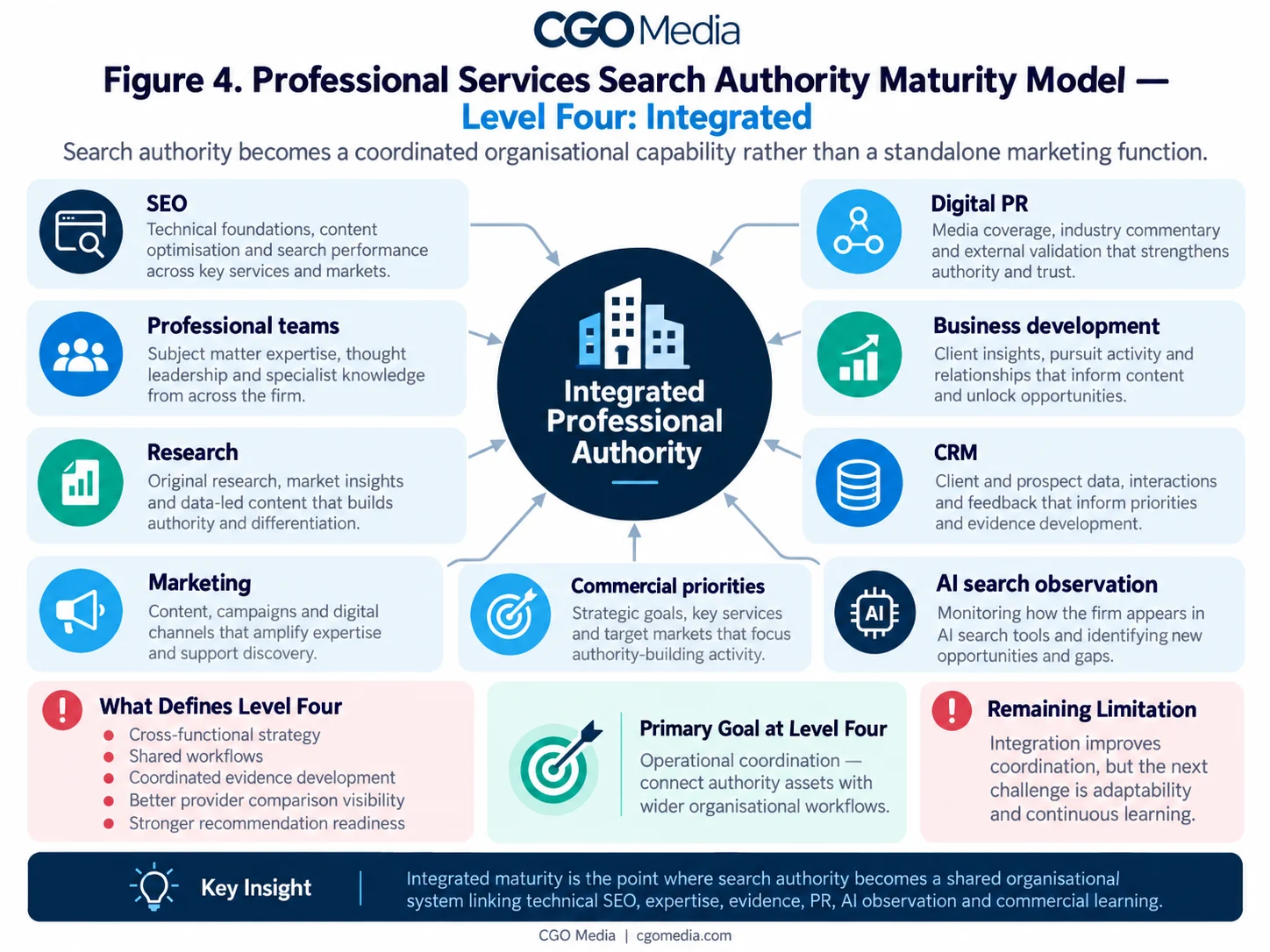
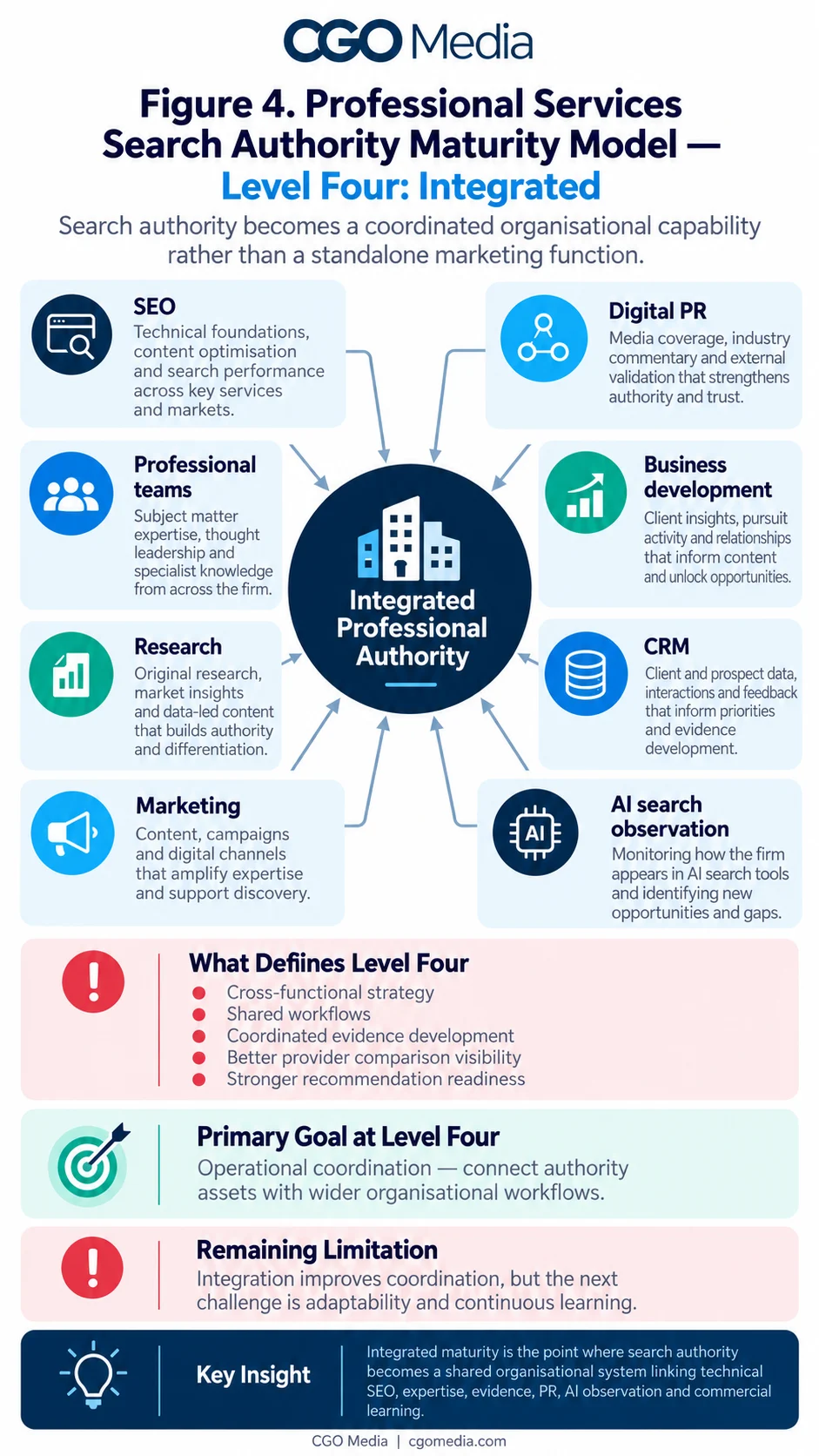
545. Level Five — Adaptive Authority
At the Adaptive Authority level, the professional-services organisation operates search authority as a continuously evolving capability.
546. Adaptability Is the Defining Characteristic of Level Five
The organisation does not simply maintain an integrated authority system. It continually reassesses and improves that system in response to changing:
- Client behaviour
- Professional markets
- Competitors
- Search interfaces
- AI-assisted discovery
- Commercial outcomes
547. The Primary Goal at Level Five Is Continuous Relevance
The organisation aims to remain discoverable, trusted and appropriately recommendation-ready as external conditions change.
548. A Useful Adaptive Relationship Is
Observe → Reassess → Experiment → Validate → Learn → Adapt → Reassess
549. Continuous Reassessment Becomes Standard
The organisation regularly revisits the core authority system rather than waiting for a major decline.
550. Technical Reassessment Becomes Continuous
The organisation monitors whether:
- Priority pages remain accessible
- Indexation remains healthy
- Templates remain reliable
- Internal links remain intact
- Performance remains acceptable
551. Entity Reassessment Becomes Continuous
Firm, office and professional information is reviewed as operational changes occur.
552. Professional Reassessment Becomes Continuous
Named experts are re-evaluated when:
- Roles change
- Specialisms evolve
- Qualifications change
- New research is published
- External recognition changes
553. Service Reassessment Becomes Continuous
Capabilities are reviewed as the organisation:
- Launches services
- Withdraws services
- Changes methodology
- Changes target markets
- Changes delivery models
554. Sector Reassessment Becomes Continuous
Strategic industries are reviewed as market conditions and commercial priorities change.
555. Research Reassessment Becomes Continuous
Older studies are evaluated for:
- Freshness
- Methodology
- Current relevance
- Need for update
- Need for replacement
556. External Authority Reassessment Becomes Continuous
The organisation monitors whether media, trade and citation evidence still reinforces current priorities.
557. AI Representation Reassessment Becomes Continuous
The firm periodically rechecks relevant generative discovery scenarios.
558. Commercial Reassessment Becomes Continuous
Search authority is compared against real client-selection outcomes.
559. Adaptive Authority Requires Faster Feedback Loops
The time between observation, diagnosis and corrective action becomes shorter.
560. Event-Driven Governance Becomes More Important
Authority updates are triggered by material organisational changes.
561. Professional Changes Trigger Immediate Review
Examples include:
- New hire
- Promotion
- Departure
- New qualification
- New leadership role
562. Service Changes Trigger Immediate Review
Relevant changes can include:
- New offering
- Service withdrawal
- Scope expansion
- Pricing-model change
563. Office Changes Trigger Immediate Review
The organisation updates:
- Website information
- Business profiles
- Professional directories
- Internal links
- Local content
564. Regulatory Changes Trigger Immediate Review Where Relevant
Professional advice and public claims may require rapid updates.
565. Major Research Releases Trigger Authority Workflows
New findings can activate:
- Internal linking
- Expert positioning
- Digital PR
- Sector updates
- Citation monitoring
566. Major Client Outcomes Can Trigger Evidence Workflows
New case studies or anonymised evidence can be incorporated when appropriate.
567. Significant Losses Can Trigger Diagnostic Workflows
The organisation can reassess:
- Positioning
- Service fit
- Sector fit
- Evidence strength
- Commercial expectations
568. Search Decline Can Trigger Diagnostic Workflows
The organisation distinguishes between:
- Technical problems
- Competitive change
- Demand change
- Authority decay
- Content ageing
569. AI Representation Errors Can Trigger Diagnostic Workflows
The organisation can review:
- Entity accuracy
- Source conflicts
- External profiles
- Professional evidence
- Service clarity
570. Adaptive Authority Requires Controlled Experimentation
The organisation begins testing changes systematically rather than adopting every new tactic.
571. Experiments Should Have a Defined Question
The organisation should state what it is trying to learn.
572. Experiments Should Have a Defined Hypothesis
The organisation should state what it expects the intervention to affect.
573. Experiments Should Have a Baseline
Pre-change evidence provides context for later interpretation.
574. Experiments Should Have Defined Measures
Relevant measures can include:
- Search visibility
- Entity accuracy
- Expert recognition
- External citations
- Comparison inclusion
- Qualified enquiries
575. Experiments Should Have a Defined Time Period
Short-term noise should be distinguished from persistent change.
576. Experiments Should Record External Factors
Relevant contextual changes can include:
- Platform changes
- Competitor activity
- Seasonality
- Market changes
577. Experiments Should Record Limitations
The organisation should avoid overstating certainty.
578. Successful Experiments Should Become Standards
Validated improvements can be incorporated into future:
- Templates
- Processes
- Content standards
- Measurement methods
579. Unsuccessful Experiments Should Produce Learning
The organisation can avoid repeating low-value activity.
580. Neutral Results Should Also Produce Learning
Not every intervention needs to produce a positive outcome to be useful.
581. Adaptive Authority Requires Authority-Decay Monitoring
Strong evidence should not be assumed to remain strong permanently.
582. Professional Authority Can Decay
This can occur when:
- Profiles become outdated
- Professionals leave
- Qualifications expire
- Public activity declines
583. Service Authority Can Decay
This can occur when:
- Client needs change
- Competitors improve
- Methodologies change
- Content becomes outdated
584. Sector Authority Can Decay
Industry expertise can become less credible where market evidence remains static.
585. Research Authority Can Decay
Old data may lose relevance.
586. External Authority Can Decay
Historical media references may become less representative of current expertise.
587. Local Authority Can Decay
Office and local-profile information can become inaccurate.
588. AI Representation Can Decay
Changing source environments can alter how the organisation is represented.
589. Authority Decay Should Be Measured by Strategic Importance
Priority services and experts require more active monitoring than low-value assets.
590. A Useful Authority-Decay Relationship Is
Age + Market Change + Evidence Change + Competitive Change + Business Importance → Review Priority
591. Adaptive Authority Requires Scenario Refresh
The organisation’s AI and provider-comparison scenario libraries should evolve with user behaviour.
592. Existing Scenarios Should Be Retained Where Longitudinal Comparison Matters
This preserves historical comparability.
593. New Scenarios Should Be Added Where New Demand Emerges
The organisation can extend monitoring while preserving core baselines.
594. Obsolete Scenarios Can Be Retired Carefully
Retirement should be documented where trend continuity matters.
595. Problem-Led Scenarios Should Evolve
New client challenges can create new discovery pathways.
596. Service Scenarios Should Evolve
New professional capabilities can require new monitoring.
597. Sector Scenarios Should Evolve
Strategic industry priorities can change.
598. Geographic Scenarios Should Evolve
Expansion or consolidation can alter location relevance.
599. Provider Comparison Scenarios Should Evolve
Different competitors may become relevant over time.
600. Recommendation Scenarios Should Evolve
Client selection criteria can change.
601. Adaptive Authority Requires Competitor Refresh
The organisation continually reassesses the competitive evidence environment.
602. New Competitors Can Enter the Market
Specialist providers can emerge rapidly.
603. Existing Competitors Can Reposition
Firms can enter new:
- Services
- Sectors
- Geographies
- Professional niches
604. Competitors Can Improve Research Authority
New evidence programmes can shift market perception.
605. Competitors Can Improve Expert Authority
Named specialists can become more visible.
606. Competitors Can Improve External Authority
Media and trade participation can strengthen.
607. Competitive Benchmarking Should Therefore Remain Current
Historical competitor assumptions should not become permanent strategy inputs.
608. Adaptive Authority Requires Search-Intent Refresh
The language clients use can evolve.
609. Search Terminology Can Change
New technologies and professional practices can introduce new terms.
610. Client Problems Can Change Faster Than Service Names
Problem-led research can reveal emerging demand early.
611. Search Intent Can Shift toward Comparison
Users may increasingly seek:
- Provider comparisons
- Expert comparisons
- Best-fit advisers
- Service alternatives
612. Search Intent Can Shift toward AI-Assisted Research
Prospective clients may use generative systems earlier in the journey.
613. Content Architecture Should Adapt to Intent Change
The organisation should avoid keeping an architecture that reflects old demand patterns.
614. Adaptive Authority Requires Research-Led Learning
Original research can help the organisation understand changing markets.
615. Search Data Can Generate Research Questions
Recurring searches can reveal information gaps.
616. Client Questions Can Generate Research Questions
Business-development teams can identify recurring uncertainty.
617. AI Representation Gaps Can Generate Research Questions
Repeated ambiguity may reveal weak public evidence.
618. Competitor Gaps Can Generate Research Questions
Areas with weak market evidence can create research opportunities.
619. Research Findings Can Then Feed Search Strategy
The relationship becomes:
Observation → Research Question → Evidence → Publication → Authority → New Observation
620. Adaptive Authority Requires Commercial Learning
Search strategy increasingly reflects actual provider-selection behaviour.
621. Win Data Should Feed Authority Strategy
Recurring win patterns can reveal which evidence matters.
622. Loss Data Should Feed Authority Strategy
Recurring losses can reveal:
- Weak differentiation
- Wrong market fit
- Commercial mismatch
- Evidence gaps
623. Lead Quality Should Feed Search Strategy
High traffic with poor fit can indicate targeting problems.
624. Proposal Quality Should Feed Search Strategy
The organisation can identify which discovery pathways produce stronger opportunities.
625. Shortlist Data Should Feed Search Strategy
Provider-selection patterns can reveal authority gaps.
626. Adaptive Authority Requires Institutional Memory
Learning should not depend entirely on individual staff remembering past decisions.
627. Standards Should Be Documented
The organisation should retain:
- Entity standards
- Content standards
- Research standards
- Measurement standards
- Governance rules
628. Experiments Should Be Documented
The organisation should retain:
- Hypothesis
- Baseline
- Intervention
- Result
- Interpretation
- Limitations
629. Major Strategic Decisions Should Be Documented
This helps future teams understand why changes were made.
630. Measurement Methodology Should Be Versioned
Longitudinal data becomes easier to interpret when methodological changes are recorded.
631. Institutional Memory Improves Resilience
The authority system becomes less dependent on:
- Individual employees
- Individual agencies
- Individual consultants
632. Adaptive Authority Requires Governance Review
Ownership itself should evolve as the organisation changes.
633. Search Ownership May Change
A growing organisation may move from external agency dependence toward internal capability.
634. Research Ownership May Change
A formal research function can emerge.
635. PR Ownership May Change
Media activity can become more specialised.
636. Professional Authority Ownership May Change
Subject specialists may receive greater direct responsibility.
637. Commercial Measurement Ownership May Change
CRM and revenue teams can become more integrated.
638. Governance Should Follow Capability Maturity
The organisational model should evolve with the authority system.
639. Adaptive Authority Requires Resilience
The system should continue functioning when:
- Staff leave
- Agencies change
- Platforms change
- Market conditions shift
640. Resilience Depends on Standards
Documented processes reduce dependence on tacit knowledge.
641. Resilience Depends on Distributed Expertise
Authority should not depend entirely on one individual where avoidable.
642. Resilience Depends on Evidence Diversity
The organisation should avoid relying on one:
- Search channel
- Media source
- Review platform
- Professional profile
643. Resilience Depends on Commercial Diversity
Search should support a portfolio of relevant opportunities rather than one narrow source of demand.
644. Adaptive Authority Requires Continuous Source Review
The organisation should understand where its public evidence is being reinforced externally.
645. Source Visibility Can Shift
Different platforms may surface different evidence over time.
646. Citation Sources Can Shift
Research and media references may change.
647. Provider Comparison Sources Can Shift
Different directories, articles or research assets can become influential.
648. Source Review Should therefore Remain Longitudinal
The organisation should avoid assuming that one historically important source will remain dominant.
649. Adaptive Authority Requires Qualified Visibility Measurement
The organisation measures not just whether it is visible, but whether visibility is:
- Relevant
- Accurate
- Trusted
- Commercially useful
650. A Useful Qualified Visibility Relationship Is
Relevant Visibility + Accurate Representation + Strong Evidence + Commercial Fit → Qualified Visibility
651. Adaptive Authority Requires Recommendation Precision
The organisation values being recommended where genuine fit exists.
652. Universal Recommendation Is Not the Objective
A provider should not seek to appear in every scenario.
653. Appropriate Exclusion Supports Precision
The firm can be omitted where its capability does not match the requirement.
654. Recommendation Precision Can Improve Lead Quality
Better-fit visibility can reduce irrelevant enquiries.
655. Recommendation Precision Can Improve Commercial Efficiency
Business-development teams can focus on stronger opportunities.
656. Adaptive Authority Requires Cautious AI Interpretation
Generative observations should remain methodologically bounded.
657. AI Output Variation Should Be Expected
Differences can arise from:
- Prompt wording
- Platform
- Context
- Date
- Location
658. One AI Output Should Not Trigger Major Strategic Change Alone
Repeated observations provide stronger diagnostic value.
659. AI Scenario Samples Should Not Be Treated as Universal Probabilities
Observed frequency should remain tied to the tested sample.
660. AI Changes Should Be Interpreted Alongside Other Evidence
The organisation should also consider:
- Search visibility
- External citations
- Entity accuracy
- Commercial outcomes
661. Adaptive Authority Requires Observation Discipline
The organisation distinguishes between:
- Observation
- Interpretation
- Hypothesis
- Conclusion
662. Observation Should Come First
The organisation records what actually occurred.
663. Interpretation Should Be Explicit
Possible explanations should be identified as interpretation rather than fact.
664. Hypotheses Should Be Testable Where Possible
Potential causes can guide future experiments.
665. Conclusions Should Reflect Evidence Strength
Weak evidence should not support strong claims.
666. Adaptive Authority Requires Correlation Discipline
Changes that occur together should not automatically be treated as causal.
667. Multi-Factor Environments Require Caution
Visibility may change because of:
- Own-site improvements
- Competitor changes
- Platform changes
- Market changes
668. Adaptive Organisations Document Uncertainty
Uncertainty is treated as part of research quality rather than a weakness.
669. Level Five Maturity Is Not a Permanent Achievement
Adaptive Authority requires continued operation.
670. An Adaptive Organisation Can Regress
Capability can weaken if governance, expertise or measurement deteriorates.
671. Staff Turnover Can Reduce Maturity
Critical knowledge can leave the organisation.
672. Research Decay Can Reduce Maturity
Outdated evidence can weaken authority.
673. Technical Neglect Can Reduce Maturity
Foundational problems can reappear.
674. Commercial Misalignment Can Reduce Maturity
Search strategy can drift away from business priorities.
675. AI Over-Reaction Can Reduce Maturity
Chasing unstable outputs can fragment a previously coherent strategy.
676. Adaptive Authority therefore Requires Balance
The organisation should evolve without abandoning durable foundations.
677. Durable Foundations Include
- Technical reliability
- Entity clarity
- Professional expertise
- Client evidence
- Research quality
- Independent validation
678. Adaptation Should Occur Around Those Foundations
Tactics and interfaces can change while evidence quality remains central.
679. SEO Remains Foundational at Level Five
Advanced authority does not remove the need for conventional search accessibility.
680. GEO Extends the Authority System at Level Five
Generative Engine Optimisation adds additional attention to:
- Source visibility
- Citation readiness
- Entity clarity
- Comparison visibility
- Recommendation precision
681. SEO and GEO Become One Authority System
A useful relationship is:
SEO Foundation + Entity Authority + Evidence Quality + Independent Validation + GEO Observation → Adaptive Search Authority
682. Level Five Organisations Focus on Systems Rather Than Tactics
The central question becomes:
How do we continuously improve the evidence system that supports discovery, trust and selection?
683. Level Five Organisations Focus on Qualified Discovery
The objective is not maximum visibility in isolation.
684. Level Five Organisations Focus on Evidence Quality
Authority growth remains grounded in real expertise and verifiable evidence.
685. Level Five Organisations Focus on Organisational Learning
Search authority becomes a feedback system.
686. Level Five Organisations Focus on Resilience
The system is designed to continue functioning despite external and internal change.
687. Level Five Organisations Focus on Strategic Adaptation
They change where evidence supports change rather than reacting to every industry trend.
688. Adaptive Authority Can Produce Cumulative Advantage
Repeated improvement can create a compounding evidence effect.
689. Better Evidence Can Produce Better Discovery
Clearer capability becomes easier to identify.
690. Better Discovery Can Produce Better Validation
Prospective clients encounter stronger trust evidence.
691. Better Validation Can Produce Better Comparison
Differentiation becomes clearer.
692. Better Comparison Can Produce Better Qualification
Relevant prospects progress while weak-fit opportunities can be filtered.
693. Better Qualification Can Produce Better Commercial Learning
The organisation gains more useful win and loss evidence.
694. Better Commercial Learning Can Produce Better Future Evidence
The cycle becomes self-reinforcing.
695. The Adaptive Authority Flywheel Is
Evidence → Discovery → Trust → Comparison → Qualification → Commercial Learning → Stronger Evidence
696. Adaptive Authority Is therefore Both a Search Model and an Operating Model
It connects digital visibility with professional expertise, research, external authority and commercial intelligence.
697. The Seventeenth Professional Services Maturity Principle
Level Five — Adaptive Authority represents the highest maturity state in the model, where professional-services search authority is managed through continuous reassessment, controlled experimentation, authority-decay monitoring, scenario refresh, competitive review and institutional learning rather than periodic optimisation alone.
698. The Eighteenth Professional Services Maturity Principle
Adaptive maturity requires the organisation to treat search, professional expertise, research, Digital PR, AI-assisted discovery and commercial feedback as a continuously connected evidence system in which observations generate hypotheses, experiments produce learning and validated learning updates future standards.
699. The Nineteenth Professional Services Maturity Principle
AI-search observations at the Adaptive Authority level should remain methodologically bounded, longitudinal and integrated with wider evidence such as entity accuracy, conventional search visibility, external citation and commercial outcomes rather than being interpreted as standalone or permanent provider rankings.
700. The Twentieth Professional Services Maturity Principle
Adaptive Authority should prioritise qualified visibility, recommendation precision, evidence authenticity and organisational resilience so the firm remains relevant as client behaviour, competitors, professional teams, search interfaces and generative discovery systems continue to change.
701. Level Five Output — Adaptive Professional Search Authority
A Level Five organisation typically possesses:
- Continuous authority reassessment
- Event-driven governance
- Controlled experimentation
- Authority-decay monitoring
- AI scenario refresh
- Competitive evidence refresh
- Research-led learning
- Commercial feedback loops
- Institutional memory
- Qualified visibility measurement
702. The Strategic Position at Level Five
At the Adaptive Authority level, the professional-services organisation no longer treats search maturity as a project with a final completion date. Technical SEO, professional expertise, research, client evidence, external authority, AI-search observation and commercial learning operate as one adaptive system. Changes in client demand, professional teams, market conditions, competitive evidence and discovery platforms trigger reassessment rather than panic; new tactics are tested rather than adopted blindly; authority decay is monitored; and validated learning becomes part of future operating standards. The organisation’s strongest advantage is therefore not one ranking, one research paper, one expert profile or one recommendation result. It is the institutional capability to keep improving the evidence system that supports qualified discovery and provider selection.
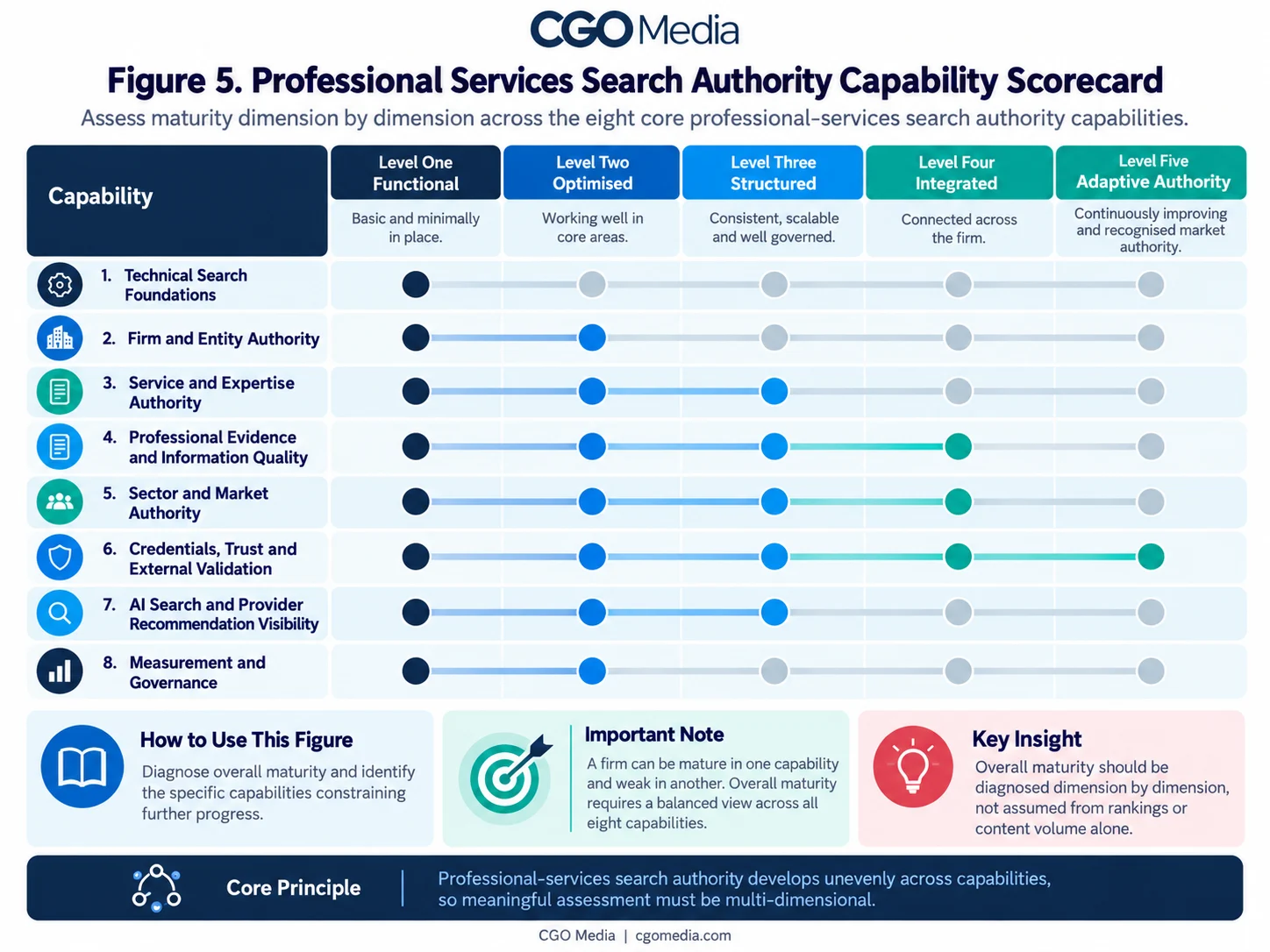
703. Maturity Should Be Assessed Across Multiple Capabilities
The five maturity levels provide a broad organisational position, but professional-services search authority develops across several connected capability areas.
704. A Firm Can Be Mature in One Capability and Weak in Another
For example, an organisation may possess:
- Strong technical SEO
- Weak professional profiles
- Strong research
- Weak external validation
- Limited AI visibility measurement
705. Overall Maturity Should therefore Be Diagnosed Dimension by Dimension
A useful assessment model should identify both the organisation’s broad maturity level and the specific capabilities constraining further progress.
706. The Eight Professional Services Search Authority Capabilities
- Technical Search Foundations
- Firm and Entity Authority
- Service and Expertise Authority
- Professional Evidence and Information Quality
- Sector and Market Authority
- Credentials, Trust and External Validation
- AI Search and Provider Recommendation Visibility
- Measurement and Governance
707. Capability One — Technical Search Foundations
This capability assesses whether the organisation maintains the technical conditions required for sustainable discovery.
708. Technical Search Foundations Include
- Crawlability
- Indexation
- Performance
- Mobile accessibility
- Site architecture
- Internal linking
- Canonicalisation
- Rendering reliability
709. Technical Foundations at Functional Maturity
The organisation maintains a working, crawlable and indexable website with basic usability.
710. Technical Foundations at Optimised Maturity
The organisation actively improves:
- Performance
- Internal linking
- Indexation efficiency
- Page optimisation
- Technical hygiene
711. Technical Foundations at Structured Maturity
Technical architecture begins supporting explicit relationships between:
- Services
- Professionals
- Sectors
- Research
- Evidence
- Locations
712. Technical Foundations at Integrated Maturity
Technical governance becomes coordinated with content, entity, research and authority strategy.
713. Technical Foundations at Adaptive Authority
Technical health is monitored continuously as content, services, templates, technology and discovery systems evolve.
714. Technical Maturity Is Not the Same as Overall Authority Maturity
A technically excellent website can still possess weak professional evidence.
715. Capability Two — Firm and Entity Authority
This capability assesses whether the organisation, its offices and its professionals are represented consistently and clearly.
716. Firm and Entity Authority Includes
- Firm identity
- Office identity
- Professional identity
- Service relationships
- Sector relationships
- External profile consistency
717. Firm and Entity Authority at Functional Maturity
The organisation presents basic firm, office and professional information.
718. Firm and Entity Authority at Optimised Maturity
Major identity inconsistencies are corrected and important external profiles receive more deliberate management.
719. Firm and Entity Authority at Structured Maturity
Explicit relationships are established between:
Firm → Offices → Practice Areas → Services → Professionals → Sectors
720. Firm and Entity Authority at Integrated Maturity
Entity information becomes coordinated across:
- Website
- Professional directories
- Business profiles
- Research
- Media
- Commercial systems
721. Firm and Entity Authority at Adaptive Authority
Entity changes trigger ongoing review and correction across the wider digital evidence environment.
722. Entity Maturity Reduces Ambiguity
Users and digital systems can understand more clearly:
- Who the organisation is
- Where it operates
- Who works there
- What those professionals do
723. Capability Three — Service and Expertise Authority
This capability evaluates the depth and credibility of evidence supporting the services and specialisms the firm promotes.
724. Service and Expertise Authority Includes
- Service clarity
- Scope
- Methodology
- Specialisms
- Named expertise
- Client applicability
725. Service Authority at Functional Maturity
Core services have basic dedicated pages.
726. Service Authority at Optimised Maturity
Service pages become more comprehensive and aligned with search demand.
727. Service Authority at Structured Maturity
Services are placed within a deliberate hierarchy and connected with relevant:
- Professionals
- Sectors
- Case studies
- Research
728. Service Authority at Integrated Maturity
Practice leaders, SEO teams, research and business-development functions collectively strengthen priority capabilities.
729. Service Authority at Adaptive Authority
The service architecture changes as:
- Client needs evolve
- New capabilities emerge
- Commercial priorities shift
- Evidence changes
730. Expertise Authority Should Be More Than Marketing Copy
The strongest service claims are supported by visible professional capability.
731. Capability Four — Professional Evidence and Information Quality
This capability evaluates the completeness, accuracy, freshness and decision usefulness of professional-services information.
732. Professional Evidence Includes
- Professional biographies
- Qualifications
- Specialisms
- Case studies
- Research
- Commentary
- Speaking activity
733. Information Quality Includes
- Accuracy
- Completeness
- Freshness
- Attribution
- Context
- Consistency
734. Professional Evidence at Functional Maturity
Key professionals have basic biographies containing name, role and limited expertise information.
735. Professional Evidence at Optimised Maturity
Profiles expand to include stronger:
- Experience
- Specialisms
- Qualifications
- Service relationships
736. Professional Evidence at Structured Maturity
Profiles become entity hubs connecting professionals to:
- Services
- Sectors
- Research
- Case studies
- External activity
737. Professional Evidence at Integrated Maturity
Experts participate systematically in content, research, media and commercial authority development.
738. Professional Evidence at Adaptive Authority
Professional authority is reviewed continuously as roles, expertise and market activity change.
739. Information Freshness Becomes More Important as Maturity Increases
Advanced authority systems require active governance rather than static biographies.
740. Capability Five — Sector and Market Authority
This capability assesses whether the organisation demonstrates genuine contextual authority within the industries and markets it serves.
741. Sector and Market Authority Includes
- Sector-specific services
- Sector professionals
- Client evidence
- Research
- Trade commentary
- Market understanding
742. Sector Authority at Functional Maturity
The organisation may identify the industries it serves without dedicated evidence.
743. Sector Authority at Optimised Maturity
Priority industries begin receiving dedicated pages and search-led content.
744. Sector Authority at Structured Maturity
Sector hubs connect:
- Industry problems
- Services
- Named experts
- Case studies
- Research
745. Sector Authority at Integrated Maturity
Research, trade media, expert commentary and commercial strategy begin reinforcing strategic markets.
746. Sector Authority at Adaptive Authority
Industry priorities and evidence standards change in response to:
- Market developments
- Client demand
- Regulation
- Competitive change
747. Sector Authority Should Reflect Genuine Experience
Advanced maturity does not mean creating pages for every possible industry.
748. Capability Six — Credentials, Trust and External Validation
This capability assesses how effectively independent evidence supports the firm’s professional and commercial claims.
749. Trust and External Validation Can Include
- Professional qualifications
- Memberships
- Accreditations
- Reviews
- Media references
- Trade citations
- Awards
- Research citations
750. Trust Evidence at Functional Maturity
Basic qualifications, memberships or reviews may be visible.
751. Trust Evidence at Optimised Maturity
The organisation actively manages relevant:
- Directories
- Links
- Reviews
- External profiles
752. Trust Evidence at Structured Maturity
External validation begins reinforcing specific services, professionals and sectors.
753. Trust Evidence at Integrated Maturity
Digital PR, professional participation, research distribution and reputation management are coordinated with authority priorities.
754. Trust Evidence at Adaptive Authority
Independent validation is monitored for:
- Relevance
- Freshness
- Independence
- Authority decay
- Strategic fit
755. External Validation Becomes More Precise as Maturity Increases
Raw mention or link volume becomes less important than contextual authority.
756. Capability Seven — AI Search and Provider Recommendation Visibility
This capability assesses how effectively the organisation understands and manages its representation within AI-assisted discovery environments.
757. AI Search Capability Includes
- Entity accuracy
- Source visibility
- Citation visibility
- Provider comparison inclusion
- Recommendation visibility
- Recommendation precision
758. AI Visibility at Functional Maturity
The organisation may appear incidentally but performs little or no systematic monitoring.
759. AI Visibility at Optimised Maturity
Teams may test provider and service prompts informally.
760. AI Visibility at Structured Maturity
The organisation begins defining repeatable scenario families and recording:
- Platform
- Date
- Prompt
- Location
- Visible sources
761. AI Visibility at Integrated Maturity
AI observations become part of the wider search-authority reporting and diagnostic system.
762. AI Visibility at Adaptive Authority
Scenario libraries, source observations and representation standards are refreshed continuously as platforms and client behaviour evolve.
763. AI Search Maturity Should Remain Evidence-Led
The organisation should improve underlying evidence rather than chase isolated generated outputs.
764. AI Recommendation Visibility Should Remain Contextual
No generated provider set should be treated as a permanent universal ranking.
765. Recommendation Precision Is More Mature Than Maximum Inclusion
The strongest outcome is appearing in scenarios where genuine provider fit exists.
766. Capability Eight — Measurement and Governance
This capability assesses whether search authority is measured consistently and governed across the organisation.
767. Measurement and Governance Includes
- Search measurement
- Authority measurement
- AI observation
- CRM integration
- Commercial outcomes
- Ownership
- Standards
- Documentation
768. Measurement at Functional Maturity
The organisation tracks basic:
- Traffic
- Rankings
- Form submissions
- Calls
769. Measurement at Optimised Maturity
Reporting expands into:
- Organic conversions
- Landing-page performance
- Service-level reporting
- Local-search performance
770. Measurement at Structured Maturity
The organisation begins tracking:
- Professional visibility
- Research authority
- Sector performance
- External authority
- AI observations
771. Measurement at Integrated Maturity
Search data becomes connected with:
- CRM
- Qualified enquiries
- Proposals
- Shortlists
- Win and loss data
772. Measurement at Adaptive Authority
The organisation uses longitudinal data, experimentation, authority-decay monitoring and commercial learning to change future standards.
773. Governance Also Progresses through the Five Levels
Ownership changes from informal marketing responsibility toward coordinated organisational governance.
774. Functional Governance Is Often Informal
Search responsibility may depend on one marketer, agency or web supplier.
775. Optimised Governance Introduces Dedicated Ownership
SEO and content processes become more deliberate.
776. Structured Governance Introduces Standards
The organisation defines:
- Taxonomies
- Page standards
- Professional-profile standards
- Research standards
- Evidence standards
777. Integrated Governance Introduces Cross-Functional Ownership
Search, research, PR, professional teams and commercial teams share responsibility for the authority system.
778. Adaptive Governance Introduces Continuous Learning
Governance itself changes as the organisation learns.
779. Maturity Assessment Should therefore Use a Capability Profile
A useful assessment should not rely only on one overall maturity label.
780. The Capability Profile Shows Where the Firm Is Strongest
For example:
- Technical — Integrated
- Entity — Structured
- Service Authority — Structured
- Professional Evidence — Optimised
- Sector Authority — Structured
- External Validation — Optimised
- AI Visibility — Functional
- Governance — Structured
781. This Profile Is More Useful Than a Single Average
A simple average can hide a critical capability gap.
782. The Lowest Strategic Capability Can Become the Constraint
An organisation may be prevented from progressing because one important authority layer remains weak.
783. A Weak Technical Foundation Can Constrain Everything Else
Evidence cannot create full value if priority assets are difficult to discover.
784. Weak Entity Authority Can Constrain Professional Trust
Conflicting firm or expert information undermines confidence.
785. Weak Professional Evidence Can Constrain Service Authority
Strong service pages are less convincing when no visible specialists support them.
786. Weak Sector Authority Can Constrain Provider Fit
A technically strong firm may still appear generic within an industry.
787. Weak External Validation Can Constrain Trust
Owned claims may remain insufficiently reinforced.
788. Weak AI Measurement Can Constrain Diagnosis
The organisation may not understand how generative discovery represents it.
789. Weak Governance Can Constrain Every Capability
Strong individual assets can decay without ownership and maintenance.
790. Maturity Development Should therefore Be Constraint-Led
The organisation should prioritise the capability most likely to limit strategic progress.
791. Not Every Capability Needs to Reach the Same Level Simultaneously
Priorities should reflect commercial relevance.
792. High-Value Services May Require More Advanced Authority
Strategically important practices can justify deeper investment.
793. High-Value Experts May Require More Advanced Professional Evidence
Professionals central to important work can warrant greater authority development.
794. High-Value Sectors May Require More Advanced Sector Authority
Strategic markets can justify stronger research and trade visibility.
795. Regulated Services May Require More Advanced Trust Governance
Credential and information accuracy can have greater importance.
796. Maturity Prioritisation Should Consider Commercial Importance
A useful relationship is:
Current Capability Gap + Commercial Importance + User Impact + Dependency → Development Priority
797. Maturity Assessment Should Be Evidence-Based
The organisation should avoid assigning maturity levels based solely on internal perception.
798. Technical Maturity Should Use Technical Evidence
Relevant evidence can include:
- Crawl data
- Indexation data
- Performance data
- Architecture review
799. Entity Maturity Should Use Consistency Evidence
Relevant evidence can include owned and external profiles.
800. Service Maturity Should Use Content and Evidence Review
The organisation should examine whether priority capabilities have sufficient depth and support.
801. Professional Maturity Should Use Profile and Authority Evidence
Relevant evidence can include:
- Profile completeness
- Credentials
- Publications
- Media
- Research
802. Sector Maturity Should Use Market-Specific Evidence
The organisation should examine whether strategic industries have real supporting proof.
803. External Validation Maturity Should Use Independent Evidence
Relevant sources can include:
- Media
- Professional bodies
- Reviews
- Trade publications
- Research citations
804. AI Maturity Should Use Documented Observations
Scenario testing should remain methodologically bounded.
805. Governance Maturity Should Use Operational Evidence
The organisation should be able to demonstrate:
- Ownership
- Standards
- Update triggers
- Reporting
- Documentation
806. Maturity Should Be Reassessed Periodically
An organisation’s capability profile changes over time.
807. Growth Can Increase Maturity
New systems and evidence can strengthen authority.
808. Growth Can Also Create New Complexity
New:
- Offices
- Professionals
- Services
- Sectors
can introduce governance problems.
809. Maturity Can Decline
Search authority should not be assumed to move only upward.
810. Staff Turnover Can Reduce Maturity
Expertise and governance can leave the organisation.
811. Technical Neglect Can Reduce Maturity
Site expansion can create new discovery problems.
812. Evidence Ageing Can Reduce Maturity
Research, profiles and case studies can become stale.
813. Commercial Misalignment Can Reduce Maturity
Search strategy can drift away from desired client work.
814. Organisational Restructuring Can Reduce Maturity
Entity relationships may become inaccurate.
815. Maturity Development Should therefore Be Cyclical
The organisation should repeatedly reassess its position.
816. The First Step Is Assess
The organisation establishes its current capability profile.
817. The Second Step Is Identify Gaps
Weak or incomplete authority capabilities are documented.
818. The Third Step Is Prioritise
The organisation determines which gaps have the greatest strategic effect.
819. The Fourth Step Is Improve Capabilities
Targeted work strengthens the limiting authority layer.
820. The Fifth Step Is Measure
The organisation evaluates whether the intervention improved the intended capability.
821. The Sixth Step Is Reassess
The capability profile is reviewed again.
822. Reassessment Creates the Next Improvement Cycle
The maturity model therefore operates as a continuous development system.
823. The Maturity Development Relationship Is
Assess → Identify Gaps → Prioritise → Improve Capabilities → Measure → Reassess
824. Assessment Should Avoid Artificial Precision
Maturity levels are strategic categories rather than mathematically exact measurements.
825. Internal Scores Can Be Useful for Diagnosis
Organisations may create internal scoring systems where the methodology is clearly defined.
826. Internal Scores Should Not Be Presented as Universal Industry Standards
A firm-specific maturity score reflects the criteria used within that assessment.
827. Maturity Assessment Should Prioritise Evidence over Opinion
The strongest conclusions are supported by observable capability.
828. Maturity Assessment Should Separate Current State from Desired State
The organisation should define:
- Current maturity
- Target maturity
- Required capability development
829. Not Every Organisation Needs Adaptive Authority Everywhere
Smaller or specialist firms may not require maximum maturity across every capability.
830. Maturity Should Reflect Strategic Need
The correct maturity target depends on:
- Market competition
- Client complexity
- Organisation scale
- Growth ambition
- Commercial value
831. A Specialist Boutique May Need Advanced Expert Authority
It may not need the same governance complexity as a multinational firm.
832. A Large Enterprise Firm May Need Advanced Governance
Multiple offices, services and professionals create greater coordination requirements.
833. A Research-Led Consultancy May Need Advanced Research Authority
Research can form a major part of market differentiation.
834. A Local Professional Firm May Need Advanced Geographic Authority
Local trust and office evidence can carry greater importance.
835. Maturity Should therefore Be Strategic Rather Than Performative
The purpose is not to claim the highest level.
836. The Purpose Is to Identify the Next Useful Capability
A maturity model creates value when it guides practical development.
837. The Twenty-First Professional Services Maturity Principle
Professional-services search maturity should be assessed across multiple capabilities because technical strength, entity clarity, service authority, professional evidence, sector expertise, external validation, AI visibility and governance can develop at different rates within the same organisation.
838. The Twenty-Second Professional Services Maturity Principle
Maturity development should be constraint-led and commercially prioritised, focusing first on the capability gap most likely to limit qualified discovery, provider trust, comparison readiness or business outcomes rather than attempting to raise every dimension simultaneously.
839. The Twenty-Third Professional Services Maturity Principle
Maturity assessments should use observable evidence and clearly defined internal criteria while avoiding false precision or presenting organisation-specific scores as universal industry benchmarks.
840. The Twenty-Fourth Professional Services Maturity Principle
Search maturity should be treated as a continuous development cycle in which organisations assess current capability, identify gaps, prioritise strategic constraints, improve the underlying system, measure progress and reassess their position as professional, commercial and discovery environments evolve.
841. The Eight-Capability Maturity Model
The complete capability architecture can be summarised as:
Technical Foundations + Entity Authority + Service & Expertise Authority + Professional Evidence + Sector Authority + Trust & External Validation + AI Search Visibility + Measurement & Governance → Professional Services Search Authority Maturity
842. The Continuous Maturity Development Model
The development cycle can be summarised as:
Assess → Identify Gaps → Prioritise → Improve Capabilities → Measure → Reassess
843. The Strategic Outcome of the Maturity Development Cycle
The Professional Services Search Authority Maturity Model is most useful when it becomes a recurring diagnostic process rather than a one-time classification exercise. Organisations should understand which capabilities are already strong, which authority layers are constraining further progress and which maturity targets are commercially appropriate for their market. By repeatedly assessing technical foundations, entity clarity, service and expert authority, professional evidence, sector strength, external validation, AI-assisted visibility and governance, firms can direct investment toward the capabilities most likely to improve qualified discovery and provider selection while avoiding the assumption that every organisation must reach the same maturity level in every area.
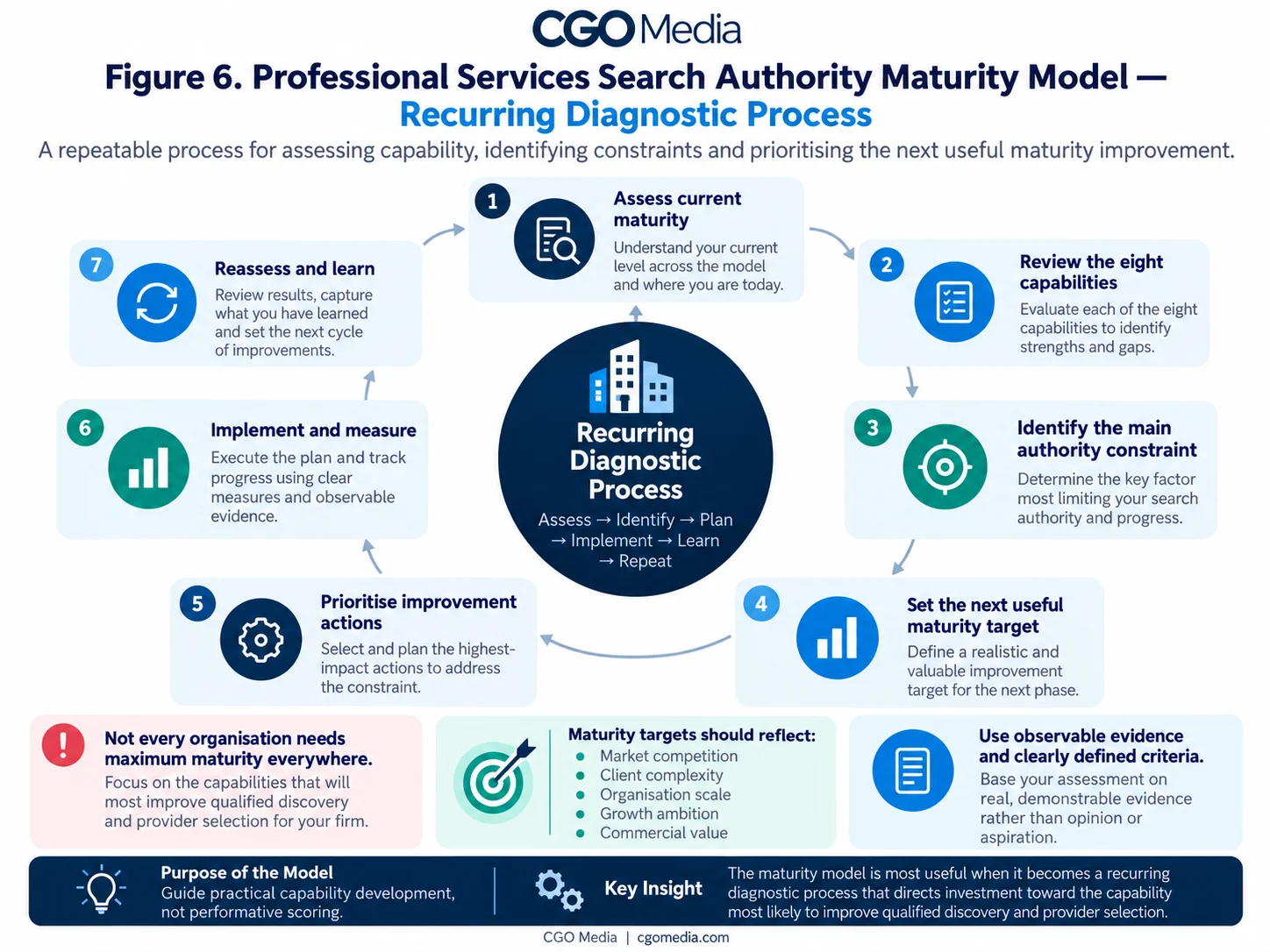
844. Methodological Position
The Professional Services Search Authority Maturity Model is a conceptual organisational maturity framework developed by CGO Media to help professional-services organisations assess how advanced they have become in managing search visibility, professional authority, client evidence, external validation, AI-assisted discovery and search governance.
845. The Model Measures Capability Rather Than Professional Quality
The model does not attempt to score the underlying competence, integrity or service quality of a professional-services organisation.
846. Digital Maturity and Professional Competence Are Different Concepts
A highly capable advisory, accountancy, recruitment, architecture, engineering or consulting organisation can possess relatively low digital maturity.
847. The Model Examines External Authority Capability
It considers how effectively professional capability is:
- Represented
- Structured
- Supported by evidence
- Validated externally
- Measured
- Governed
848. The Five Maturity Levels Are Developmental Categories
The model uses:
- Functional
- Optimised
- Structured
- Integrated
- Adaptive Authority
849. The Levels Should Not Be Treated as Exact Mathematical Scores
They provide a strategic framework for interpreting organisational capability.
850. Functional Represents Basic Digital Participation
The organisation possesses sufficient infrastructure to be discoverable, identifiable and contactable.
851. Optimised Represents Deliberate Search Management
Technical SEO, service optimisation, content planning, local visibility and conversion measurement become more systematic.
852. Structured Represents Connected Authority Architecture
Services, professionals, sectors, research and client evidence begin operating within a deliberate knowledge structure.
853. Integrated Represents Cross-Functional Authority Management
SEO, expertise, research, Digital PR, AI observation and commercial systems begin reinforcing one another.
854. Adaptive Authority Represents Continuous Learning
The organisation repeatedly reassesses, experiments, measures, learns and adapts.
855. Progression Is Not Necessarily Linear
Organisations can progress at different rates across different capabilities.
856. Technical Maturity Can Outpace Professional Evidence
A firm can maintain excellent technical SEO while its expert profiles remain weak.
857. Research Maturity Can Outpace Commercial Integration
A firm can publish strong research without connecting it effectively to business-development outcomes.
858. External Authority Can Outpace Entity Clarity
A well-known organisation can still maintain inconsistent firm, office or professional information.
859. AI Monitoring Can Outpace Underlying Evidence Quality
A firm can monitor generative outputs extensively without having sufficiently strong service, expert or client evidence.
860. Overall Maturity Should therefore Use a Capability Profile
The eight-capability structure provides a more useful diagnostic model than a single headline score.
861. The Eight Capabilities Are
- Technical Search Foundations
- Firm and Entity Authority
- Service and Expertise Authority
- Professional Evidence and Information Quality
- Sector and Market Authority
- Credentials, Trust and External Validation
- AI Search and Provider Recommendation Visibility
- Measurement and Governance
862. Capability Profiles Should Be Evidence-Based
Assessment should use observable evidence wherever possible.
863. Technical Capability Should Use Technical Evidence
Relevant evidence can include:
- Crawlability
- Indexation
- Performance
- Architecture
- Internal linking
864. Entity Capability Should Use Consistency Evidence
Firm, office and professional information should be compared across important sources.
865. Service Capability Should Use Decision-Support Evidence
Priority service pages should be evaluated for:
- Scope
- Methodology
- Expertise
- Client relevance
- Supporting evidence
866. Professional Capability Should Use Expert Evidence
Relevant indicators can include:
- Profile completeness
- Credentials
- Research
- Publications
- Media participation
867. Sector Capability Should Use Industry-Specific Evidence
The organisation should examine whether strategic markets are supported by real:
- Expertise
- Case studies
- Research
- Trade authority
868. Trust Capability Should Use Independent Evidence
Relevant evidence can include:
- Professional bodies
- Reviews
- Media
- Trade publications
- Research citations
869. AI Search Capability Should Use Documented Observation
Scenario testing should define:
- Platform
- Date
- Prompt family
- Geography
- Sample
870. Governance Capability Should Use Operational Evidence
A mature organisation should be able to demonstrate:
- Ownership
- Standards
- Update triggers
- Measurement
- Documentation
871. Maturity Should Be Interpreted Relative to Strategic Need
Not every organisation needs Level Five capability in every area.
872. A Specialist Firm Can Have Different Priorities from a Global Firm
A boutique consultancy may require exceptional expert and research authority while operating with simpler organisational governance.
873. A Large Professional-Services Group May Require Greater Governance Maturity
Multiple:
- Offices
- Professionals
- Services
- Countries
- Sectors
create greater coordination requirements.
874. A Local Professional Firm May Require Strong Geographic Authority
Local entity accuracy, reviews and jurisdiction relevance can carry greater importance.
875. A Research-Led Consultancy May Require Stronger Research Governance
Methodology, authorship, versioning and citation architecture can become central authority capabilities.
876. The Target Maturity Level Should therefore Reflect the Business Model
A useful relationship is:
Market Complexity + Client Complexity + Competitive Intensity + Growth Ambition + Commercial Value → Appropriate Maturity Target
877. Maturity Is Not a Competition for the Highest Label
The objective is not simply to claim Adaptive Authority.
878. Maturity Is a Diagnostic Tool
Its purpose is to identify:
- Current strengths
- Capability constraints
- Strategic priorities
- Next useful improvements
879. The Lowest Capability Can Become the Constraint
A mature system can still be weakened by one strategically important gap.
880. Weak Technical Foundations Can Constrain Strong Content
Authority assets cannot create full search value if they are difficult to access.
881. Weak Entity Clarity Can Constrain Strong Expertise
Conflicting information can undermine understanding and trust.
882. Weak Expert Evidence Can Constrain Strong Service Pages
Commercial claims are weaker when no visible specialists support them.
883. Weak Client Evidence Can Constrain Provider Confidence
Users may understand a service without seeing enough proof that the firm has delivered it successfully.
884. Weak External Validation Can Constrain Strong Owned Evidence
The firm can make clear claims without sufficient independent reinforcement.
885. Weak Governance Can Constrain Every Capability
Even strong assets can become outdated without ownership and maintenance.
886. Capability Development Should therefore Be Constraint-Led
The organisation should prioritise the weakness most likely to affect:
- Qualified discovery
- Trust
- Comparison
- Recommendation readiness
- Commercial outcomes
887. Maturity Should Also Be Commercially Prioritised
High-value services, professionals, sectors and markets can justify more advanced development.
888. Internal Scoring Can Support Diagnosis
Organisations may create internal scoring systems around the eight capability areas.
889. Internal Scores Require Defined Criteria
The meaning of each score should be documented.
890. Internal Scores Should Not Be Presented as Universal Benchmarks
A score developed within one organisation reflects that organisation’s assessment methodology.
891. Artificial Precision Should Be Avoided
A maturity score should not imply a level of certainty unsupported by the underlying evidence.
892. Qualitative Interpretation Remains Important
Some capability differences cannot be represented meaningfully through a single number.
893. Professional Services Differ Substantially by Sector
The relative importance of maturity dimensions varies between:
- Management consulting
- Accountancy
- Recruitment
- Architecture
- Engineering
- Specialist advisory services
894. Regulation Can Change the Meaning of Trust Maturity
Credential and regulatory accuracy may be particularly important in certain professions.
895. Confidentiality Can Change the Meaning of Client-Evidence Maturity
Some organisations cannot disclose client identities or detailed project outcomes.
896. Limited Public Case Studies Do Not Automatically Mean Low Professional Capability
Alternative trust evidence can include:
- Anonymised examples
- Professional recognition
- Research
- Credentials
- Client references
897. Review Volume Should Also Be Interpreted by Profession
Confidential B2B firms may generate fewer public reviews than more transactional professional services.
898. Maturity Assessment Should therefore Be Contextual
Framework criteria should be applied with professional and commercial context.
899. AI Search Introduces Additional Measurement Constraints
Generative outputs can vary across:
- Platforms
- Prompts
- Dates
- Locations
- Conversation contexts
900. One AI Output Should Not Define Maturity
Repeated and documented observations are more useful.
901. AI Inclusion Should Not Be Treated as a Universal Ranking
Provider recommendation remains contextual.
902. AI Source Frequency Should Remain Sample-Specific
Observed source frequency within a controlled test should not be presented as a universal platform behaviour.
903. AI Measurement Should Separate Observation from Interpretation
The organisation should distinguish:
- What occurred
- What may explain it
- What remains uncertain
904. Maturity Research Should Separate Correlation from Causation
An improvement in one capability followed by stronger visibility does not automatically prove that the intervention caused the change.
905. Platform Changes Can Affect Outcomes Independently
Search and AI systems can evolve without any corresponding change by the organisation.
906. Competitor Changes Can Affect Outcomes Independently
Relative visibility can change because competing providers improve or decline.
907. Market Demand Can Affect Outcomes Independently
Search volume and client behaviour can change.
908. Measurement Should therefore Record Context
Relevant contextual information can improve interpretation.
909. Maturity Is Dynamic
An organisation can progress or regress over time.
910. Professional Turnover Can Reduce Maturity
Expertise and authority relationships can disappear when senior professionals leave.
911. Research Ageing Can Reduce Maturity
Strong historical research can become less useful if it is not updated.
912. Technical Neglect Can Reduce Maturity
Site changes can introduce new crawl, indexation or usability problems.
913. Sector Repositioning Can Reduce Maturity Temporarily
The firm can enter a new industry before sufficient evidence exists.
914. Rapid Growth Can Reduce Governance Maturity
Expansion can create:
- Duplicate services
- Inconsistent profiles
- Fragmented office information
- Weak ownership
915. AI Over-Reaction Can Also Reduce Strategic Maturity
Constantly changing strategy in response to isolated generative outputs can fragment an otherwise coherent authority system.
916. Mature Organisations therefore Need Stability and Adaptability
They should preserve durable foundations while adapting where evidence justifies change.
917. Durable Foundations Include
- Technical reliability
- Entity clarity
- Professional expertise
- Accurate information
- Client evidence
- Independent validation
918. Adaptive Capabilities Include
- Continuous measurement
- Experimentation
- Scenario refresh
- Competitive review
- Commercial learning
919. SEO Remains Foundational Across Every Maturity Level
Technical accessibility, useful information, internal linking and search relevance remain important from Functional through Adaptive Authority.
920. GEO Extends the Higher Maturity Levels
Generative Engine Optimisation adds greater attention to:
- Source eligibility
- Entity understanding
- Citation readiness
- Comparison visibility
- Recommendation precision
921. GEO Does Not Replace the Lower Levels
An organisation cannot compensate for weak technical, entity and evidence foundations solely through AI-search tactics.
922. Higher Maturity therefore Builds on Lower-Level Capabilities
A useful relationship is:
Functional Foundation → Optimised Discovery → Structured Authority → Integrated Operations → Adaptive Learning
923. Conclusion
Professional-services search maturity should be understood as the progressive development of organisational capability rather than the accumulation of isolated SEO tactics.
924. Functional Maturity Creates Participation
The organisation becomes discoverable and can support basic client validation.
925. Optimised Maturity Creates Deliberate Search Performance
Technical SEO, content optimisation and conversion measurement become more systematic.
926. Structured Maturity Creates Authority Architecture
Services, experts, sectors, client evidence and research begin reinforcing one another.
927. Integrated Maturity Creates Organisational Coordination
Search, research, Digital PR, professional expertise and commercial learning become connected.
928. Adaptive Authority Creates Continuous Development
The organisation can respond systematically to changing:
- Client demand
- Markets
- Competitors
- Search interfaces
- AI discovery environments
929. The Five-Level Model Is therefore Cumulative
Each level extends the capabilities established before it.
930. Maturity Does Not Mean More Content
Advanced authority depends on better:
- Structure
- Evidence
- Validation
- Integration
- Learning
931. Maturity Does Not Mean More Links
External authority becomes more valuable when references are relevant, independent and contextually aligned.
932. Maturity Does Not Mean Maximum AI Visibility
Advanced organisations should prioritise qualified recommendation and accurate representation.
933. Maturity Does Not Mean Eliminating Uncertainty
Search and provider-selection environments contain external variables that organisations cannot fully control.
934. Mature Organisations Manage Uncertainty Better
They use:
- Measurement
- Documentation
- Experimentation
- Evidence
- Commercial feedback
to make better decisions.
935. Qualified Visibility Is a Stronger Maturity Objective
The organisation should seek visibility where:
- Service fit exists
- Expertise fit exists
- Sector fit exists
- Commercial fit exists
936. Recommendation Precision Is a Stronger Maturity Objective
The organisation should be represented accurately in scenarios where genuine provider suitability exists.
937. Appropriate Exclusion Can Indicate Mature Positioning
A specialist provider should not expect inclusion within every possible professional-services recommendation.
938. Organisational Learning Is the Long-Term Maturity Asset
The strongest organisations continually improve their ability to understand:
- How clients discover providers
- Which evidence creates trust
- Which sources validate authority
- Which scenarios produce strong opportunities
939. The Final Maturity Relationship Is
Technical Reliability + Entity Clarity + Professional Expertise + Evidence Quality + External Validation + Measurement + Organisational Learning → Sustainable Professional Search Authority
940. The Continuous Development Cycle
Maturity should therefore operate through:
Assess → Identify Gaps → Prioritise → Improve Capabilities → Measure → Reassess
941. Reassessment Prevents Maturity from Becoming Static
The organisation repeatedly returns to its capability profile as conditions change.
942. Capability Development Should Follow Evidence
Investment should be directed toward the authority layer most likely to improve qualified provider discovery.
943. The Final Strategic Position
The Professional Services Search Authority Maturity Model provides a way to understand the transition from basic digital participation to adaptive professional authority without assuming that every organisation needs the same tactics, the same infrastructure or the same maturity target.
The most useful application of the model is diagnostic. A professional-services organisation should identify where its current authority system is strong, where genuine expertise remains hidden, where evidence is fragmented, where independent validation is weak and where search or AI visibility is disconnected from commercial relevance.
The model also recognises that maturity is not permanent. Professional teams change, services evolve, markets shift, research ages, competitors improve and search interfaces continue to develop. Organisations that reach higher maturity levels therefore need governance capable of reassessing and renewing their authority rather than assuming previous success will persist automatically.
The long-term objective is not the achievement of a maturity label. It is the development of an organisational capability that continually makes genuine professional expertise easier to discover, easier to understand, easier to validate and easier to match with the client situations where that expertise is most relevant.
References
External Technical, Search and Research Sources
- Google Search Central. SEO Starter Guide.
- Google Search Central. AI Features and Your Website.
- Google Search Central. Organization Structured Data.
- Schema.org. Organization.
- Schema.org. Person.
- Schema.org. Service.
- Hogan, A. et al. (2021). Knowledge Graphs. ACM Computing Surveys, 54(4).
- Metzger, M.J. (2007). Making Sense of Credibility on the Web: Models for Evaluating Online Information and Recommendations for Future Research. Journal of the American Society for Information Science and Technology, 58(13), 2078–2091.
- Ji, Z. et al. (2023). Survey of Hallucination in Natural Language Generation. ACM Computing Surveys, 55(12).
Professional Services AI & GEO Search Research Family
The Professional Services Search Authority Maturity Model forms part of the wider CGO Media Professional Services research programme examining how expertise-led organisations develop stronger visibility, trust, provider-selection authority and AI-search readiness.
Professional Services AI & GEO Search Research
The sector pillar brings together the complete Professional Services SEO, AI Search and GEO research family.
Explore Professional Services AI & GEO Search Research →
Professional Services SEO in an AI Search Environment
The parent research paper examines the broader search, expertise, provider-discovery and commercial environment that underpins this maturity model.
Explore Professional Services SEO in an AI Search Environment →
Professional Services AI Trust and Visibility Framework
The framework examines the trust, evidence and authority conditions required for stronger professional-services visibility and AI-assisted recommendation readiness.
Explore the Professional Services AI Trust and Visibility Framework →
Professional Services Discovery and Provider Selection Model
The provider-selection model examines how prospective clients move through discovery, expertise evaluation, trust validation, comparison, shortlisting and commercial engagement.
Explore the Professional Services Discovery and Provider Selection Model →
Professional Services SEO and AI Implementation Roadmap
The roadmap translates the wider Professional Services research into an implementation sequence based on Assess, Stabilise, Structure, Strengthen, Validate, Integrate and Evolve.
Explore the Professional Services SEO and AI Implementation Roadmap →
Professional Services GEO: Generative Engine Optimisation
The GEO research examines source visibility, entity clarity, citation readiness, provider comparison and qualified recommendation visibility across generative discovery environments.
Explore Professional Services GEO →
How the Professional Services Research Family Connects
The complete Professional Services research architecture can be summarised as:
Sector Research Pillar → Parent Search Research → Trust & Visibility Framework → Discovery & Provider Selection → Search Authority Maturity → Implementation Roadmap → GEO
CGO Media Research Ecosystem
The Professional Services Search Authority Maturity Model forms part of the CGO Media Framework Library and wider research programme examining AI Search, Generative Engine Optimisation, entity authority, source selection, citation systems, recommendation systems, trust, knowledge architecture and the continuing evolution of search.
CGO Media Research Library |
CGO Media Framework Library |
CGO Media Research Architecture |
CGO Media Research Observations |
CGO Media Statistics Library
About Roger Wilkinson
Roger Wilkinson is an independent search and AI researcher, SEO practitioner and founder of CGO Media with more than 25 years of experience in search, online visibility and digital strategy.
His research examines the changing relationship between conventional search, AI-assisted discovery, entity understanding, source selection, citation behaviour, provider comparison and recommendation-led discovery.
His sector research applies these concepts to industries where trust, expertise, evidence and provider selection materially influence commercial outcomes.
The Professional Services Search Authority Maturity Model applies this research to expertise-led organisations by examining how firms progress from basic digital functionality toward structured, integrated and adaptive professional search authority.
View Roger Wilkinson’s researcher profile →
Research Usage & Citation
CGO Media encourages researchers, journalists, professional-services organisations, consultants, advisers, marketers and search practitioners to reference this maturity model where it contributes to broader understanding of Professional Services SEO, AI Search, professional authority, organisational search maturity, provider discovery or generative recommendation readiness.
Reasonable quotations, summaries, figures and excerpts may be used in articles, reports, presentations and academic work provided appropriate acknowledgement is given to Roger Wilkinson and CGO Media.
Cite This Model / Embed Citation
The Professional Services Search Authority Maturity Model, developed by Roger Wilkinson at CGO Media, proposes five organisational maturity levels — Functional, Optimised, Structured, Integrated and Adaptive Authority — for assessing how professional-services organisations develop and govern search authority across technical foundations, entities, expertise, professional evidence, sector authority, external trust, AI-assisted visibility and measurement.
APA Citation
APA Citation: Wilkinson, R. (2026). Professional Services Search Authority Maturity Model. CGO Media. https://cgomedia.com/professional-services-search-authority-maturity-model/
Author: Roger Wilkinson |
Published by: CGO Media
For permissions relating to substantial reproduction, commercial licensing or republication of significant portions of this maturity model, please contact CGO Media directly.