
Professional Services SEO and AI Implementation Roadmap
 The Professional Services SEO and AI Implementation Roadmap provides a structured implementation sequence for accountancy firms, consultancies, advisory businesses, recruiters, architecture practices, engineering consultancies and other expertise-led organisations seeking to improve technical search performance, firm and expert authority, client decision evidence, external validation and AI-assisted provider visibility.
Professional Services SEO increasingly depends on more than individual page optimisation. Sustainable visibility requires coordination between technical accessibility, firm identity, service architecture, professional expertise, sector relevance, client evidence, independent authority and the way those signals are represented across conventional and generative search environments.
The implementation challenge is therefore not simply identifying potential SEO tasks. It is determining which capabilities should be improved first, which weaknesses are foundational, which authority assets depend on earlier work and how separate activities should combine into a coherent provider-discovery system.
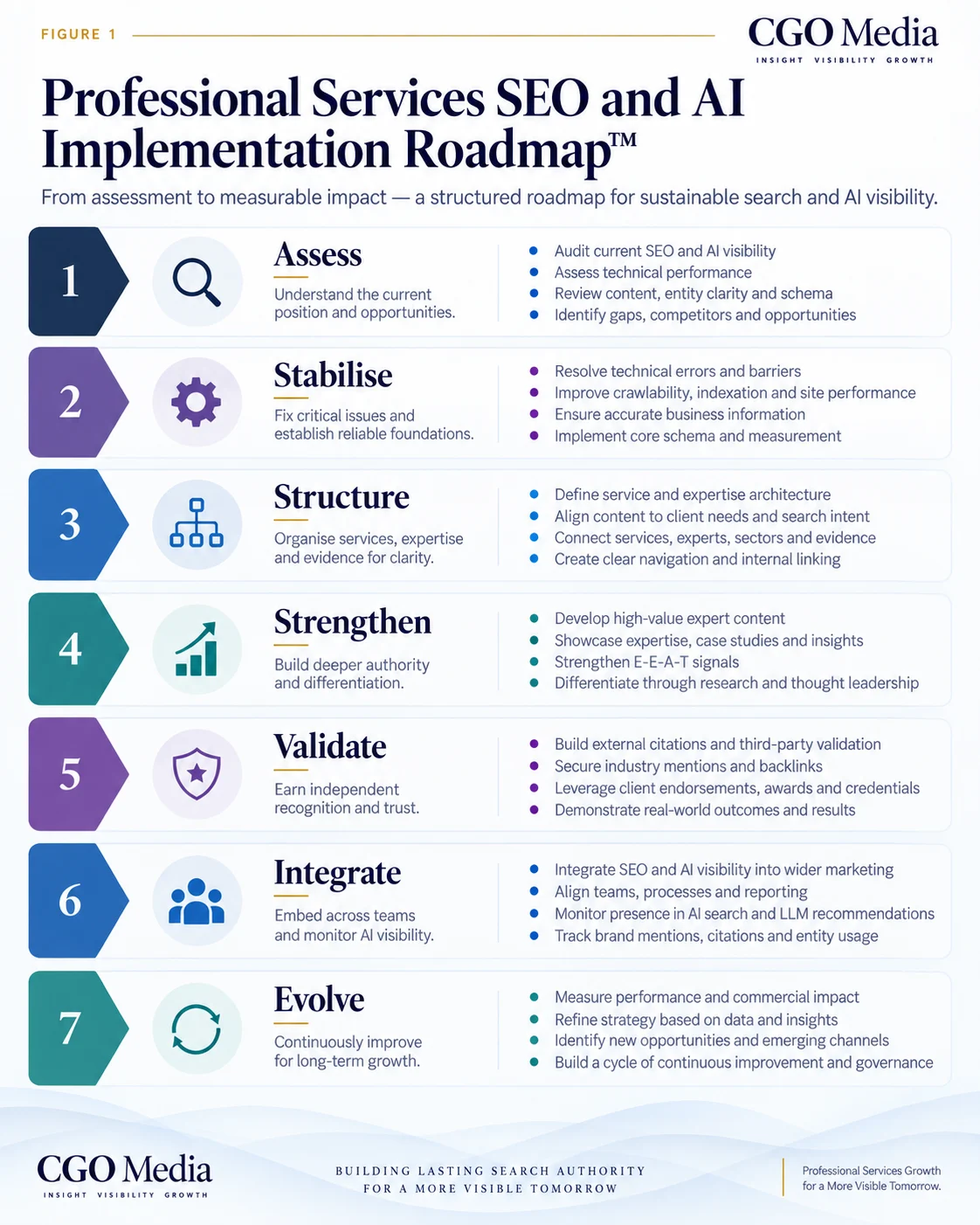
The roadmap uses seven implementation phases:
Assess → Stabilise → Structure → Strengthen → Validate → Integrate → Evolve
These phases can overlap operationally, but the sequence reflects a central implementation principle: advanced professional-services authority should be built on reliable technical, organisational and evidential foundations.
1. Why Professional Services Search Needs an Implementation Roadmap
Professional-services organisations frequently know that their digital presence needs improvement while lacking a clear sequence for implementation.
2. Firms Often Face Several Authority Problems Simultaneously
A firm may need:
- Technical SEO improvements
- Better service architecture
- Stronger professional profiles
- More relevant case studies
- Better sector evidence
- Stronger external validation
- More systematic AI visibility monitoring
3. Attempting Everything at Once Can Fragment Implementation
Teams can create isolated improvements that fail to reinforce one another.
4. The Roadmap Provides Sequencing
A structured implementation model helps determine:
- What should be assessed first
- What must be stabilised
- What relationships must be structured
- Which evidence should be strengthened
- Which claims require external validation
- Which capabilities should be integrated
- How the system should evolve
5. The Strategic Objective Is Professional Authority
The final objective is not simply higher rankings.
6. Professional Authority Combines Multiple Capabilities
These can include:
- Technical accessibility
- Entity clarity
- Service relevance
- Professional expertise
- Sector authority
- Client evidence
- External recognition
- AI-search readiness
7. Traditional SEO Workstreams Often Operate Separately
Common workstreams can include:
- Technical SEO
- Content production
- Link acquisition
- Local SEO
- Digital PR
8. Professional Services Authority Requires Those Workstreams to Connect
A useful relationship is:
Technical SEO + Entity Clarity + Expert Evidence + Client Evidence + External Validation → Professional Search Authority
9. Provider Discovery Adds Another Strategic Layer
Professional-services organisations need to understand not only whether pages rank, but whether the firm remains credible throughout provider selection.
10. Provider Selection Can Progress Through
Problem Recognition → Service Discovery → Provider Evaluation → Trust Validation → Comparison → Enquiry → Engagement
11. AI Search Can Compress This Journey
A prospective client can increasingly ask a single system to:
- Identify the service required
- Explain possible approaches
- Compare firms
- Evaluate specialists
- Suggest providers
12. Implementation Should therefore Support Both Search and Provider Evaluation
The strongest digital system should help users:
- Discover the firm
- Understand its capabilities
- Identify relevant experts
- Validate trust
- Compare suitability
- Progress commercially
13. The Seven Implementation Phases
- Assess
- Stabilise
- Structure
- Strengthen
- Validate
- Integrate
- Evolve
14. Phase One — Assess
The first phase establishes the organisation’s current technical, authority, evidence and commercial position.
15. Assessment Should Be Wider Than a Traditional SEO Audit
A conventional SEO audit can identify technical and content issues, but professional-services authority also depends on:
- Firm identity
- Expert identity
- Service clarity
- Sector positioning
- Client evidence
- External authority
- AI representation
16. Assessment Should Establish a Baseline
Without a baseline, later improvement becomes difficult to evaluate.
17. The Technical Baseline Should Be Assessed
Priority areas include:
- Crawlability
- Indexation
- Canonicalisation
- Performance
- Mobile usability
- Internal linking
- Duplicate content
- Structured data
18. Crawlability Should Be Reviewed
Important pages should be accessible to search crawlers where appropriate.
19. Indexation Should Be Reviewed
The organisation should identify whether priority:
- Service pages
- Expert profiles
- Sector pages
- Case studies
- Research
are indexed correctly.
20. Canonicalisation Should Be Reviewed
Duplicate or overlapping pages can weaken clarity around priority assets.
21. Technical Performance Should Be Reviewed
Poor performance can reduce usability and weaken discovery.
22. Mobile Experience Should Be Reviewed
Professional-services research increasingly occurs across multiple devices.
23. Internal Linking Should Be Reviewed
Important relationships should be represented between:
- Services
- Experts
- Sectors
- Case studies
- Research
24. Duplicate Service Content Should Be Identified
Multiple near-identical pages can obscure the organisation’s true service architecture.
25. Structured Information Should Be Reviewed
Visible entity information should be represented consistently and accurately.
26. Firm Entity Assessment Is the Next Baseline
The organisation should determine whether its core identity is represented consistently across important digital sources.
27. Firm Identity Assessment Can Include
- Official firm name
- Trading name
- Website
- Office locations
- Telephone details
- Primary services
28. External Firm Profiles Should Be Included
Relevant sources can include:
- Business profiles
- Professional directories
- Industry associations
- Media profiles
- Other major third-party sources
29. Firm Identity Conflicts Should Be Recorded
Examples can include:
- Old names
- Former addresses
- Outdated descriptions
- Incorrect service classifications
30. Office and Location Assessment Should Be Separate
Multi-office professional-services firms often have additional entity and local-search complexity.
31. Office Assessment Can Include
- Address accuracy
- Office naming
- Location pages
- Professionals by office
- Services by office
- Local visibility
32. Office Relationships Should Reflect Operational Reality
A useful relationship is:
Firm → Office → Professionals → Services → Markets
33. Service Authority Assessment Is a Core Phase-One Task
Each strategically important service should be reviewed.
34. Service Coverage Should Be Assessed
The firm should determine whether priority capabilities have dedicated, useful coverage.
35. Service Scope Should Be Assessed
Users should be able to understand what the service actually includes.
36. Client Suitability Should Be Assessed
The service page should make clear which organisations or situations it is designed for.
37. Named Expertise Should Be Assessed
Priority services should connect with relevant professionals.
38. Case-Study Support Should Be Assessed
The organisation should identify whether service claims are supported by applied evidence.
39. Sector Relationships Should Be Assessed
Priority services should connect with the industries in which they are genuinely delivered.
40. Service Duplication Should Be Assessed
Several pages targeting minor keyword variations can weaken overall service clarity.
41. Service Gaps Should Be Recorded
The organisation should identify commercially important capabilities that lack sufficient search or evidence coverage.
42. Expertise Authority Assessment Is Another Core Task
The firm should determine whether its strongest professional expertise is visible digitally.
43. Professional Biographies Should Be Assessed
Useful fields can include:
- Current role
- Experience
- Specialisms
- Sector expertise
- Qualifications
44. Professional Qualifications Should Be Assessed
Relevant credentials should be current and accurately represented.
45. Specialisms Should Be Assessed
The organisation should identify whether its strongest areas of professional expertise are explicit.
46. Research Authorship Should Be Assessed
Named experts should be connected with research where they have genuinely contributed.
47. Speaking Activity Should Be Assessed
Relevant external participation can reinforce professional authority.
48. Media Commentary Should Be Assessed
Quoted expertise can strengthen external recognition.
49. Professional Profile Completeness Should Be Assessed
Thin profiles can prevent genuine expertise from becoming visible.
50. Professional Role Accuracy Should Be Assessed
Outdated or conflicting titles should be identified.
51. Professional Status Should Be Assessed
Where relevant, the firm should verify:
- Membership
- Chartered status
- Accreditation
- Certification
- Regulatory registration
52. Service Connections Should Be Assessed
The organisation should determine whether each expert is connected with the services they actually support.
53. Sector Connections Should Be Assessed
Professionals should be associated with sectors where genuine experience exists.
54. Expert Visibility Should Be Assessed Externally
The firm should review how priority professionals appear outside the website.
55. Sector Authority Assessment Is Another Phase-One Requirement
Strategic sector pages should be reviewed for genuine industry evidence.
56. Sector Specialists Should Be Identified
A sector page should connect with relevant named experts.
57. Sector Services Should Be Identified
The organisation should make clear which capabilities matter to that industry.
58. Client Evidence Should Be Assessed by Sector
Relevant client examples can strengthen sector authority.
59. Sector Case Studies Should Be Assessed
The firm should determine whether it can demonstrate applied experience within priority industries.
60. Sector Research Should Be Assessed
Original evidence can strengthen market-specific authority.
61. External Sector Citations Should Be Assessed
Trade or media references can validate the firm’s industry expertise.
62. Generic Sector Pages Should Be Identified
Pages that merely repeat broad service copy with a different industry name provide weak authority.
63. Case Study Assessment Should Be Systematic
The organisation should inventory the evidence supporting its strongest claims.
64. Case Studies Should Be Mapped to Services
This reveals which capabilities have strong applied evidence.
65. Case Studies Should Be Mapped to Sectors
This reveals where industry authority is strongest or weakest.
66. Case Studies Should Be Reviewed for Freshness
Very old examples may still demonstrate capability but require context.
67. Confidentiality Constraints Should Be Recorded
Professional-services firms may be unable to disclose some client work publicly.
68. Anonymised Evidence Opportunities Should Be Identified
Where appropriate, firms may still explain:
- Problem type
- Approach
- Expertise used
- Outcome category
without identifying the client.
69. Outcome Claims Should Be Assessed for Verifiability
Unsubstantiated performance claims can weaken trust.
70. Credential Assessment Should Be Included
Professional status often influences provider confidence.
71. Professional Memberships Should Be Assessed
Relevant memberships should be accurate and current.
72. Chartered Status Should Be Assessed Where Applicable
Formal standing can be important in regulated or credential-led professions.
73. Accreditation Should Be Assessed
The organisation should identify which accreditations materially support service credibility.
74. Certification Should Be Assessed
Certification claims should remain current and relevant.
75. Regulatory Registration Should Be Assessed
Where regulation applies, official status can form an important trust layer.
76. Credential Relevance Should Be Assessed
Not every credential supports every service claim.
77. Review Authority Assessment Should Be Included
The importance of public reviews differs by profession, but they can contribute to client validation.
78. Priority Review Platforms Should Be Identified
The firm should focus on platforms relevant to its actual client market.
79. Review Volume Should Be Assessed
Volume can provide context but should not be treated as authority in isolation.
80. Review Recency Should Be Assessed
Recent feedback can provide stronger evidence of current service quality.
81. Review Themes Should Be Assessed
Recurring themes can reveal how clients actually perceive the firm.
82. Review Response Quality Should Be Assessed
Responses can demonstrate professionalism and accountability.
83. Low Review Volume Should Be Interpreted by Profession
Confidential B2B services may naturally generate fewer public reviews than consumer-facing professional services.
84. External Authority Assessment Is Essential
The firm should identify where relevant third parties reference its:
- Organisation
- Professionals
- Research
- Services
- Sector expertise
85. Professional Body References Should Be Assessed
These can validate credentials and professional standing.
86. Business Publication References Should Be Assessed
Relevant commentary can strengthen subject authority.
87. Trade Journal References Should Be Assessed
Industry-specific coverage can reinforce sector expertise.
88. Conference Visibility Should Be Assessed
Speaking roles can demonstrate professional participation.
89. Research Citations Should Be Assessed
External references to original studies can strengthen intellectual authority.
90. Industry Association Visibility Should Be Assessed
Relevant association roles can reinforce professional or market standing.
91. External Authority Should Be Evaluated for Relevance
A raw mention count provides limited strategic insight.
92. Topical Relevance Should Be Evaluated
The external reference should ideally relate to the firm’s genuine expertise.
93. Sector Relevance Should Be Evaluated
Trade references can carry additional value where industry expertise matters.
94. Professional Relevance Should Be Evaluated
Named expert citations can strengthen individual authority.
95. Independent Authority Should Be Distinguished from Syndication
Repeated republication of one source does not necessarily represent several independent validations.
96. AI Visibility Assessment Should Establish a Baseline
Professional-services organisations should record how they are currently represented across relevant generative discovery scenarios.
97. AI Testing Should Focus on Priority Services
The firm should test commercially meaningful capabilities rather than broad generic prompts.
98. AI Testing Should Focus on Priority Sectors
Relevant industry-specific provider scenarios can reveal contextual authority.
99. Named Professionals Should Be Tested Where Appropriate
The organisation can assess whether important experts are represented accurately.
100. Provider Comparison Scenarios Should Be Tested
Useful scenarios can examine whether the firm appears when several providers are compared.
101. Location-Specific Recommendations Should Be Tested Where Relevant
This can matter for firms with jurisdictional or local-delivery requirements.
102. Problem-Led Provider Searches Should Be Tested
These can reveal whether the organisation is visible before the user knows the formal service name.
103. AI Testing Should Record the Platform
Results can differ across systems.
104. AI Testing Should Record the Date
Generative outputs can change over time.
105. AI Testing Should Record the Scenario
The commercial context should remain clear.
106. AI Testing Should Record Visible Sources Where Available
This can help identify which evidence repeatedly contributes to provider representation.
107. AI Testing Should Record Representation Accuracy
Visibility is weak if the firm is described incorrectly.
108. AI Testing Should Record Relevant Inclusion and Exclusion
The organisation should distinguish between:
- Relevant inclusion
- Relevant exclusion
- Irrelevant inclusion
- Appropriate exclusion
109. AI Testing Should Not Be Treated as a Universal Ranking Measurement
Observed results should remain tied to the specific platform, scenario and date tested.
110. Competitor Authority Assessment Should Use the Same Framework
Competitors should not be compared only through keyword positions.
111. Technical Visibility Should Be Compared
The organisation should understand whether competing providers have stronger foundational search performance.
112. Service Depth Should Be Compared
Competitors may explain capabilities more clearly or comprehensively.
113. Expert Profiles Should Be Compared
The organisation should examine how visible competitor professionals are.
114. Sector Evidence Should Be Compared
Competitors may demonstrate stronger industry-specific authority.
115. Case Study Coverage Should Be Compared
Applied evidence can materially influence provider selection.
116. Review Authority Should Be Compared Carefully
Relevant differences can reveal stronger client-validation environments.
117. Media Authority Should Be Compared
Competitor experts may have stronger external recognition.
118. AI Recommendation Visibility Can Be Compared Observationally
The organisation can record differences across defined scenario families without treating them as permanent rankings.
119. Competitor Analysis Should Identify Evidence Advantages
The most useful question is not simply:
Who ranks higher?
120. The Stronger Question Is
Which provider presents stronger evidence around the areas that matter to the client’s decision?
121. Client Decision Journey Assessment Is Essential
The roadmap should reflect how prospective clients actually choose providers.
122. Problem Recognition Should Be Assessed
The firm should understand which business problems trigger discovery.
123. Service Discovery Should Be Assessed
The organisation should understand how users identify the relevant professional service.
124. Provider Evaluation Should Be Assessed
The firm should identify which evidence users require to judge suitability.
125. Trust Validation Should Be Assessed
Relevant sources can include:
- Professional credentials
- Client evidence
- Media
- Directories
- Research
126. Comparison Behaviour Should Be Assessed
The organisation should understand which characteristics clients use to distinguish firms.
127. Enquiry Behaviour Should Be Assessed
The firm should understand what causes a user to move from evaluation into contact.
128. Engagement Behaviour Should Be Assessed
The organisation should understand what happens after initial enquiry.
129. Business Development Assessment Adds Commercial Reality
Search data alone cannot explain all provider-selection behaviour.
130. Common Client Questions Should Be Recorded
These can reveal gaps in the public evidence environment.
131. Selection Criteria Should Be Recorded
Business-development teams often know which factors clients use when comparing firms.
132. Frequent Objections Should Be Recorded
Recurring objections can reveal:
- Evidence gaps
- Positioning problems
- Commercial mismatch
- Trust weaknesses
133. Competitors Encountered in Live Opportunities Should Be Recorded
These often provide a more commercially relevant competitor set than generic SEO tools.
134. Reasons for Wins Should Be Recorded
Patterns can reveal strong:
- Expertise
- Sector fit
- Professional trust
- Commercial fit
- Differentiation
135. Reasons for Losses Should Be Recorded
Patterns can reveal:
- Evidence weaknesses
- Pricing mismatch
- Insufficient scale
- Weak sector relevance
- Poor positioning
136. Commercial Evidence Should Be Connected to Search Evidence
A useful relationship is:
Search Visibility → Provider Evaluation → Commercial Qualification → Win / Loss Learning
137. Assessment Should Identify Capability Imbalance
A firm may have strong technical SEO but weak professional evidence.
138. Another Firm May Have Strong Expertise but Weak Discoverability
This creates hidden authority.
139. Another Firm May Have Strong Brand Recognition but Weak Specialist Evidence
This creates perceived authority without sufficient depth in a particular context.
140. Assessment Should therefore Identify Bottlenecks
The goal is to find the capability most likely to limit downstream authority.
141. Bottlenecks Can Be Technical
Important evidence may be difficult to discover.
142. Bottlenecks Can Be Structural
Relationships between services, experts and sectors may be unclear.
143. Bottlenecks Can Be Evidential
Claims may lack sufficient support.
144. Bottlenecks Can Be External
The firm may lack independent validation.
145. Bottlenecks Can Be Commercial
The organisation may attract visibility for poor-fit opportunities.
146. Phase One Should Produce a Prioritised Authority-Gap Register
The output should go beyond a generic list of SEO issues.
147. Each Gap Should Identify the Capability Affected
Examples can include:
- Technical accessibility
- Firm identity
- Service authority
- Professional authority
- Sector authority
- External authority
- AI readiness
148. Each Gap Should Identify Commercial Importance
Priority should reflect the importance of the service, sector, location or professional involved.
149. Each Gap Should Identify the Missing Evidence
The organisation should define what is absent rather than simply saying that authority is weak.
150. Each Gap Should Identify Implementation Difficulty
Some improvements require:
- Technical development
- Professional input
- Client permissions
- Research
- External outreach
151. Each Gap Should Identify Dependency
The organisation should record whether another capability must be fixed first.
152. Each Gap Should Receive a Priority
A useful relationship is:
Commercial Importance + Evidence Weakness + User Impact + Dependency + Implementation Effort → Priority
153. High-Risk Entity Errors Should Usually Be Prioritised
Incorrect firm or professional information can undermine multiple downstream authority layers.
154. High-Value Service Gaps Should Usually Be Prioritised
Strategically important services require sufficient evidence to support discovery and comparison.
155. High-Value Sector Gaps Should Usually Be Prioritised
Priority industries should not rely on thin or generic evidence.
156. High-Dependency Technical Problems Should Usually Be Prioritised
Advanced authority work provides limited value where core pages cannot be reliably accessed or indexed.
157. High-Impact Trust Gaps Should Usually Be Prioritised
Weak professional or client evidence can prevent progression into a shortlist even where search visibility is strong.
158. The Assess Phase Should Establish Ownership
Each major gap should have a responsible team or individual.
159. Technical Gaps May Require Search and Development Ownership
Implementation often spans more than one function.
160. Service Gaps May Require Practice-Leader Ownership
Marketing teams should not define professional capability without expert input.
161. Expert Gaps May Require Professional Participation
Authentic expertise cannot be manufactured solely by content teams.
162. Client Evidence Gaps May Require Business Development and Client Approval
Case-study development often depends on operational cooperation.
163. External Authority Gaps May Require Research and PR
Relevant recognition frequently develops through publishable expertise and outreach.
164. AI Visibility Gaps May Require Several Teams
Weak AI representation can originate from:
- Technical issues
- Entity conflicts
- Weak expert evidence
- Insufficient external validation
165. Phase One Should Establish Measurement Standards
The organisation should define how future progress will be assessed.
166. Baseline Search Metrics Should Be Recorded
Useful measures can include:
- Organic visibility
- Priority rankings
- Search impressions
- Traffic
- Conversions
167. Baseline Authority Metrics Should Be Recorded
Useful measures can include:
- Expert profile completeness
- Case-study coverage
- Research citations
- Review recency
- External references
168. Baseline AI Observations Should Be Recorded
Useful observations can include:
- Source visibility
- Entity accuracy
- Provider inclusion
- Recommendation rationale
169. Baseline Commercial Metrics Should Be Recorded
Useful measures can include:
- Qualified enquiries
- Proposal progression
- Shortlist progression
- Win rate
- Reasons for loss
170. Phase One Should End with an Implementation Sequence
The authority-gap register should be converted into a practical order of work.
171. The First Professional Services Implementation Principle
Professional-services organisations should begin with a broad authority assessment covering technical performance, firm identity, service architecture, professional expertise, sector evidence, client proof, external validation, AI representation and commercial performance rather than limiting Phase One to a conventional SEO audit.
172. The Second Professional Services Implementation Principle
Assessment should identify the specific evidence gap and capability dependency behind each weakness so implementation can address root causes rather than producing generic content, technical fixes or authority activity without strategic sequencing.
173. The Third Professional Services Implementation Principle
Competitor analysis should compare relevant provider evidence across services, experts, sectors, case studies, reviews, external authority and AI-assisted visibility rather than treating search rankings alone as a complete measure of competitive strength.
174. The Fourth Professional Services Implementation Principle
Business-development and CRM evidence should be included from the beginning so implementation priorities reflect real client questions, objections, provider comparisons, reasons for wins and reasons for losses rather than search data in isolation.
175. Phase One Output — The Professional Services Authority-Gap Register
The complete Assess phase should produce a prioritised authority-gap register covering:
- Capability affected
- Commercial importance
- Evidence missing
- User impact
- Capability dependency
- Implementation effort
- Responsible owner
- Priority
176. The Strategic Outcome of Phase One
At the end of the Assess phase, the organisation should understand its current technical condition, entity accuracy, service architecture, visible professional expertise, sector authority, client evidence, external validation, AI representation and commercial performance well enough to determine what must happen next. The objective is not merely to produce a longer audit document. It is to convert fragmented evidence into a practical implementation sequence that distinguishes foundational weaknesses from later-stage authority opportunities and gives each priority a clear commercial rationale.
177. Phase Two — Stabilise
The Stabilise phase addresses foundational weaknesses that could undermine later authority development.
178. Stabilisation Comes Before Expansion
Professional-services organisations should avoid building advanced authority assets on top of unreliable technical, organisational or evidential foundations.
179. The Core Stabilisation Objective Is Reliability
The organisation should reach a position where important information is:
- Accessible
- Accurate
- Consistent
- Current
- Measurable
180. Stabilisation Reduces Downstream Risk
Foundational inconsistencies can affect:
- Search discovery
- Firm understanding
- Professional trust
- Provider comparison
- AI representation
181. Technical Stability Is the First Priority
Priority technical weaknesses should be corrected before large-scale content or authority expansion.
182. Indexation Failures Should Be Corrected
Priority pages should be discoverable where appropriate.
183. Priority Indexed Assets Can Include
- Core service pages
- Professional profiles
- Sector pages
- Case studies
- Research
184. Index Bloat Should Be Reduced
Low-value or duplicative pages can dilute the clarity of the wider site.
185. Canonicalisation Problems Should Be Corrected
Canonical signals should support a clear preferred version of important pages.
186. Redirect Problems Should Be Corrected
Common issues can include:
- Broken redirects
- Redirect chains
- Redirect loops
- Old URLs without a suitable destination
187. Broken Internal Links Should Be Corrected
Important authority relationships should not depend on dead links.
188. Navigation Errors Should Be Corrected
Users should be able to reach:
- Services
- Experts
- Sectors
- Case studies
- Research
without unnecessary friction.
189. Site Performance Should Be Stabilised
Slow loading can weaken usability and reduce the effectiveness of later authority work.
190. Mobile Usability Should Be Stabilised
Professional research and provider validation increasingly occur across multiple devices.
191. Template Problems Should Be Corrected
Systemic issues affecting multiple pages should normally be fixed at template level rather than manually page by page.
192. Rendering Problems Should Be Corrected
Important content should remain available and understandable when pages load.
193. Duplicate Service Content Should Be Reduced
Professional-services websites often accumulate overlapping pages around minor keyword variations.
194. Overlapping Service Pages Can Create Several Problems
- Internal competition
- User confusion
- Weak differentiation
- Fragmented authority
195. Service Consolidation Should Be Considered Where Appropriate
A smaller number of stronger pages can sometimes provide clearer authority than many thin variants.
196. Thin Location Pages Should Be Reviewed
Geographic expansion should not depend on large numbers of near-identical pages with limited local relevance.
197. Thin Sector Pages Should Also Be Reviewed
Industry pages should demonstrate actual sector capability rather than simple keyword substitution.
198. Structured Information Should Be Stabilised
Core firm and professional information should remain consistent across the visible site.
199. Firm Identity Is the Second Stabilisation Priority
The organisation should establish one reliable representation of its core identity.
200. Firm Name Should Be Standardised
The preferred business name should be used consistently where appropriate.
201. Trading and Legal Names Should Be Distinguished Where Necessary
Users should be able to understand the relationship between:
- Legal entity
- Trading brand
- Group brand
- Local office
202. Website Information Should Be Standardised
Primary domain references should be current and consistent.
203. Telephone Information Should Be Standardised
Old or conflicting numbers can create user and entity confusion.
204. Office Information Should Be Standardised
Relevant details can include:
- Office name
- Address
- Telephone
- Opening information
- Associated professionals
205. Former Offices Should Be Managed Deliberately
Closed or relocated offices should not remain presented as active.
206. Service Descriptions Should Be Stabilised at Firm Level
Core business descriptions should reflect actual capability.
207. Firm-Level External Profiles Should Be Corrected
Priority third-party profiles should be reviewed for:
- Old names
- Former offices
- Wrong website
- Outdated services
- Incorrect categories
208. Entity Correction Should Focus on High-Value Sources First
Not every low-value directory requires the same effort.
209. High-Value Sources Can Include
- Major business profiles
- Professional directories
- Regulatory profiles
- Industry associations
- High-authority media profiles
210. Professional Identity Is the Third Stabilisation Priority
Professional-services organisations depend heavily on the accuracy of named expertise.
211. Former Staff Should Be Removed or Updated Where Appropriate
Old profiles can create confusion around current delivery capability.
212. Current Roles Should Be Corrected
Job titles should reflect present responsibilities.
213. Office Associations Should Be Corrected
Professionals should be connected with the office in which they currently operate.
214. Service Associations Should Be Corrected
Professionals should be connected with services they actually support.
215. Sector Associations Should Be Corrected
Industry expertise should reflect genuine experience.
216. Missing Qualifications Should Be Added Where Relevant
Professional credentials can provide useful validation in regulated or technical markets.
217. Expired Qualifications Should Be Removed or Qualified
Current status should be represented accurately.
218. Professional Memberships Should Be Reviewed
Relevant memberships should be current and verifiable.
219. Biography Accuracy Should Be Reviewed
Outdated years of experience, sectors or role descriptions should be corrected.
220. Professional Profile URLs Should Be Stabilised
Stable URLs support continuity around individual professional entities.
221. Broken Professional Links Should Be Corrected
Profiles should not point to removed:
- Services
- Research
- Case studies
- Office pages
222. Professional Naming Should Be Consistent
Names should be represented consistently enough to reduce ambiguity across sources.
223. Professional Entity Conflicts Should Be Logged
Examples can include:
- Old employer
- Different job title
- Former office
- Outdated specialism
224. Service Information Is the Fourth Stabilisation Priority
Priority services should be represented clearly and accurately before service architecture is expanded.
225. Service Names Should Be Standardised
Different internal labels for the same capability can create unnecessary ambiguity.
226. Service Scope Should Be Stabilised
The firm should identify what each service actually includes.
227. Service Boundaries Should Be Clarified
Users should understand where one service ends and another begins.
228. Service Ownership Should Be Clarified
Relevant practice leaders and specialists should be identifiable.
229. Service Availability Should Be Current
Discontinued capabilities should not remain actively promoted.
230. New Services Should Not Be Overstated
New capabilities should be supported by real expertise before broad promotional expansion.
231. Geographic Service Availability Should Be Accurate
A service should not be presented as locally available where delivery capability does not exist.
232. Sector Applicability Should Be Accurate
Professional-services firms should avoid presenting every service as relevant to every industry without evidence.
233. Service Content Should Be Consolidated Where Necessary
Overlapping pages can be rationalised into clearer authority hubs.
234. Service CTAs Should Reflect Actual Engagement Routes
Contact options should match the way the firm handles enquiries.
235. Credential Information Is the Fifth Stabilisation Priority
Professional status can materially affect client confidence.
236. Credential Accuracy Should Be Verified
The organisation should confirm:
- Qualification name
- Membership body
- Current status
- Relevant professional
237. Credential Formatting Should Be Standardised
Professional titles and post-nominals should be represented consistently.
238. Regulatory Statements Should Be Reviewed
Where regulated services are offered, public information should remain accurate.
239. Accreditation Claims Should Be Reviewed
The organisation should verify that claimed accreditations remain active.
240. Award Claims Should Be Qualified
Relevant details can include:
- Award body
- Category
- Year
- Recipient
241. Historic Awards Should Not Be Presented as Current Status
Date context helps avoid misleading authority claims.
242. Client Evidence Is the Sixth Stabilisation Priority
Existing case studies and testimonials should be made reliable before large-scale evidence expansion.
243. Case Study Accuracy Should Be Reviewed
Claims should reflect what was actually delivered.
244. Client Permissions Should Be Confirmed
Public use of names, logos or quotations should be appropriately authorised.
245. Outcome Claims Should Be Verified
The organisation should avoid unsupported statements around:
- Revenue growth
- Cost savings
- Recruitment performance
- Efficiency improvement
- Risk reduction
246. Case Study Attribution Should Be Correct
The relevant service and team should be represented accurately.
247. Old Case Studies Should Be Reviewed
Older examples can remain useful but may require date context.
248. Testimonials Should Be Reviewed
Anonymous, outdated or poorly contextualised quotations can weaken trust.
249. Client Evidence Should Respect Confidentiality
Stabilisation should not require disclosure of information that should remain private.
250. Review Environments Are the Seventh Stabilisation Priority
Major review and reputation environments should be identified and governed.
251. Priority Review Platforms Should Be Defined
The appropriate set varies by profession.
252. Review Monitoring Should Be Established
The organisation should have a process for identifying new feedback.
253. Review Responses Should Be Governed
Professional responses should avoid:
- Confidential disclosure
- Hostile language
- Unsupported claims
- Inconsistent tone
254. Fake or Manipulated Review Activity Should Be Avoided
Trust should be built through genuine client evidence.
255. Review Profile Accuracy Should Be Checked
Profiles should contain current:
- Firm name
- Location
- Website
- Service information
256. External Profiles Are the Eighth Stabilisation Priority
Important third-party information should align with current organisational reality.
257. Professional Directory Profiles Should Be Corrected
Relevant fields can include:
- Firm name
- Professional names
- Service categories
- Locations
- Qualifications
258. Association Profiles Should Be Corrected
Professional body listings should reflect current status.
259. Media Biographies Should Be Reviewed
Where controllable, old or misleading descriptions should be corrected.
260. Conference Profiles Should Be Reviewed
Speaker information can become outdated after role or company changes.
261. Research Repository Profiles Should Be Reviewed Where Relevant
Professional or organisational research identities should remain coherent.
262. External Profile Correction Should Be Prioritised by Authority and Visibility
High-impact profiles should receive attention before obscure sources.
263. Measurement Stability Is the Ninth Stabilisation Priority
The organisation needs reliable measurement before it can judge later implementation.
264. Analytics Should Be Verified
The firm should confirm that important page activity is measured consistently.
265. Conversion Tracking Should Be Verified
Priority actions can include:
- Contact forms
- Consultation requests
- Phone enquiries
- Proposal requests
- Downloads
266. Duplicate Conversion Events Should Be Removed
Inflated conversion data weakens later performance evaluation.
267. Internal Traffic Should Be Considered
Large professional organisations can distort website data through employee usage.
268. CRM Source Capture Should Be Reviewed
The organisation should understand whether commercially meaningful enquiries can be traced to acquisition channels where practical.
269. Service-Level Performance Should Be Measurable
The firm should be able to distinguish performance across priority practices.
270. Sector-Level Performance Should Be Measurable Where Useful
This can support strategic market comparison.
271. Professional Profile Performance Should Be Measurable
Useful measures can include:
- Search discovery
- Profile visits
- Related service engagement
- Contact progression
272. Research Performance Should Be Measurable
Relevant measures can include:
- Organic discovery
- Media referrals
- External citations
- Assisted enquiries
273. AI Observation Methods Should Be Standardised
If the organisation tracks generative visibility, the methodology should be sufficiently consistent for later comparison.
274. Scenario Families Should Be Defined
Priority scenarios can be grouped by:
- Service
- Sector
- Problem
- Location
- Provider type
275. Scenario Wording Should Be Recorded
Material prompt changes can affect outputs.
276. Platform and Date Should Be Recorded
Generative outputs can change independently of the organisation.
277. AI Observations Should Be Separated from Conventional Search Metrics
They represent different forms of evidence.
278. Commercial Measurement Should Also Be Stabilised
Search performance should eventually connect with provider-selection outcomes.
279. Qualified Enquiry Definitions Should Be Agreed
A qualified opportunity can reflect:
- Correct service
- Correct client type
- Suitable budget
- Suitable timing
- Suitable geography
280. Proposal Definitions Should Be Agreed
Teams should use consistent commercial stages.
281. Shortlist Definitions Should Be Agreed Where Relevant
Larger B2B engagements may involve formal or informal shortlist stages.
282. Win and Loss Reasons Should Be Standardised
Useful categories can include:
- Expertise fit
- Sector fit
- Price
- Scale
- Location
- Relationship
- Competitor selection
283. Measurement Definitions Should Be Documented
This improves consistency across later phases.
284. Stabilisation Should Include Risk Prioritisation
Not every error requires equal urgency.
285. High-Risk Technical Errors Should Be Corrected First
Examples can include:
- Priority pages unavailable
- Critical indexation failures
- Broken conversion paths
- Major mobile failures
286. High-Risk Entity Errors Should Be Corrected First
Examples can include:
- Wrong firm name
- Wrong office
- Former professionals presented as current
- Incorrect qualifications
287. High-Risk Service Errors Should Be Corrected First
Examples can include:
- Discontinued services
- Incorrect claims
- Wrong geographic coverage
- Unclear regulated status
288. High-Risk Trust Errors Should Be Corrected First
Examples can include:
- Unsupported credentials
- Incorrect client claims
- Outdated regulatory information
- Misleading award claims
289. Stabilisation Should Avoid Expanding Weakness
A common implementation mistake is scaling content or authority activity before foundational problems have been resolved.
290. More Service Pages Should Not Be Added Before Service Architecture Is Reliable
Expansion can multiply inconsistency.
291. More Professional Profiles Should Not Be Added Before Profile Standards Are Defined
Weak templates can replicate thin evidence at scale.
292. More Sector Pages Should Not Be Added Before Sector Evidence Standards Are Clear
Otherwise generic vertical pages can proliferate.
293. More Digital PR Should Not Be Added Before Core Claims Are Reliable
External amplification can spread inaccurate positioning.
294. More AI Monitoring Should Not Be Added Before Baseline Methods Are Stable
Inconsistent testing creates weak longitudinal evidence.
295. Stabilisation Should Produce Operational Standards
Recurring corrections should become preventive rules.
296. A Firm Identity Standard Should Be Created
This can define:
- Preferred business name
- Office naming
- Contact details
- Core descriptions
297. A Professional Profile Standard Should Be Created
This can define:
- Required fields
- Role terminology
- Credentials
- Specialisms
- Update triggers
298. A Service Information Standard Should Be Created
This can define:
- Service name
- Scope
- Audience
- Delivery model
- Associated experts
299. A Client Evidence Standard Should Be Created
This can define:
- Approval requirements
- Outcome evidence
- Confidentiality rules
- Attribution
300. An External Profile Standard Should Be Created
This can define which external sources require ongoing review.
301. A Measurement Standard Should Be Created
This can define:
- Key metrics
- Conversion definitions
- Commercial stages
- AI observation methodology
- Reporting frequency
302. Stabilisation Should Establish Update Triggers
Reliable information requires event-based governance.
303. Professional Updates Should Be Triggered by Role Changes
Relevant events include:
- Joining
- Promotion
- Office transfer
- Departure
304. Credential Updates Should Be Triggered by Status Changes
Membership and accreditation should remain current.
305. Service Updates Should Be Triggered by Capability Changes
Relevant events include:
- Service launch
- Service withdrawal
- Scope change
- Delivery-model change
306. Office Updates Should Be Triggered by Location Changes
External profiles should be included in the update process.
307. Client Evidence Updates Should Be Triggered by New Permissions or Outcomes
New case-study material should be incorporated when appropriate.
308. Research Updates Should Be Triggered by Material Evidence Changes
Older findings should not continue to be presented as current where circumstances have changed substantially.
309. Stabilisation Should Establish Escalation Rules
High-impact errors should be corrected faster than minor presentation issues.
310. A Useful Escalation Relationship Is
Error Severity + User Impact + Commercial Impact + Authority Impact → Correction Priority
311. Stabilisation Should Be Cross-Functional
Many foundational problems cannot be corrected by SEO teams alone.
312. Search Teams Can Own Technical Stability
They can coordinate:
- Indexation
- Canonicalisation
- Internal linking
- Measurement
313. Practice Leaders Can Own Service Accuracy
Professional capability should be verified by the people responsible for delivery.
314. HR or Professional Operations Can Support Profile Accuracy
They often know when roles and employment status change.
315. Compliance Teams Can Support Credential and Regulatory Accuracy
This can be especially important in regulated professional markets.
316. Marketing Teams Can Support Consistent Communication
They can coordinate firm, service and sector language.
317. Business Development Teams Can Support Commercial Definitions
They can help define:
- Qualified enquiries
- Proposal stages
- Shortlist stages
- Win and loss reasons
318. Stabilisation Should Be Measured
The phase should end with evidence that foundational risk has reduced.
319. Technical Stabilisation Measures Can Include
- Reduction in critical crawl errors
- Improved indexation quality
- Reduced broken links
- Improved template reliability
320. Firm Identity Measures Can Include
- Reduced profile conflicts
- Corrected office information
- Consistent core firm descriptions
321. Professional Stability Measures Can Include
- Former profiles corrected
- Current roles verified
- Credentials updated
- Profile completeness improved
322. Service Stability Measures Can Include
- Service duplication reduced
- Service scope clarified
- Inactive services removed
- Ownership confirmed
323. External Profile Stability Measures Can Include
- Priority directories corrected
- Association information updated
- Review profiles corrected
- Old URLs removed
324. Measurement Stability Measures Can Include
- Reliable analytics
- Reliable conversion tracking
- Agreed commercial stages
- Documented AI observation methods
325. Phase Two Should Produce a Stable Search Foundation
The organisation should be able to rely on its technical environment and core public information before moving into deeper authority architecture.
326. The Fifth Professional Services Implementation Principle
The Stabilise phase should prioritise technical reliability, entity accuracy, professional profile correctness, service clarity, credential validity, external-profile consistency and dependable measurement before large-scale authority expansion begins.
327. The Sixth Professional Services Implementation Principle
Professional-services organisations should correct high-impact inconsistencies at their source and convert recurring corrections into operational standards so future content, profiles, services and authority assets do not reproduce the same weaknesses.
328. The Seventh Professional Services Implementation Principle
Stabilisation should focus first on errors that prevent discovery, misrepresent professionals or services, undermine trust or weaken commercial measurement, while lower-impact expansion work should remain secondary until those foundational risks are controlled.
329. The Eighth Professional Services Implementation Principle
The organisation should emerge from Phase Two with stable technical systems, reliable firm and professional information, clear service definitions, trustworthy credentials, corrected high-value external profiles and agreed measurement standards capable of supporting the later Structure, Strengthen and Validate phases.
330. Phase Two Output — Stable Professional Services Search Foundation
The Stabilise phase should produce a reliable foundation consisting of:
- Stable technical discovery
- Correct firm identity
- Correct office information
- Current professional profiles
- Accurate service information
- Verified credentials
- Reliable client evidence
- Correct priority external profiles
- Reliable measurement
331. The Strategic Outcome of Phase Two
At the end of Stabilise, the organisation should no longer be trying to build advanced professional authority while simultaneously correcting basic contradictions in its digital environment. Priority pages should be accessible, the firm and its professionals should be represented accurately, services should reflect operational reality, important credentials and external profiles should be current, and measurement should provide a dependable baseline. This creates the stable platform required for Phase Three, where those reliable assets can be organised into a deliberate professional-services knowledge and entity architecture.
332. Phase Three — Structure
The Structure phase organises the firm’s reliable technical and factual foundation into a coherent professional-services knowledge architecture.
333. Structure Comes After Stability
The organisation should avoid formalising weak or contradictory information into a larger system.
334. The Core Structural Objective Is Relationship Clarity
Users and digital systems should be able to understand how the firm’s:
- Organisation
- Offices
- Professionals
- Services
- Specialisms
- Sectors
- Research
- Client evidence
relate to one another.
335. A Useful Structural Relationship Is
Firm → Offices → Professionals → Services → Specialisms → Sectors → Research → Client Evidence
336. Firm-Level Architecture Comes First
The organisation should define the role of its core entity within the wider information system.
337. Firm Identity Should Anchor the Architecture
Important pages should reinforce a consistent understanding of:
- Who the firm is
- What it does
- Where it operates
- Who works there
- Which markets it serves
338. Group and Subsidiary Relationships Should Be Explicit Where Relevant
Professional-services groups can create confusion where brands, legal entities and operating businesses overlap.
339. Parent and Subsidiary Roles Should Be Clear
A useful relationship can be:
Group → Operating Firm → Office → Professional
340. Office Architecture Is the Next Layer
Multi-office firms should define how each location relates to the wider organisation.
341. Office Pages Should Have a Clear Purpose
A useful office page can explain:
- Location
- Professionals
- Services
- Regional expertise
- Contact details
342. Office Pages Should Not Be Thin Location Variants
Each page should reflect actual operational differences where they exist.
343. Office-to-Professional Relationships Should Be Explicit
Users should be able to identify which professionals are based in or associated with each office.
344. Office-to-Service Relationships Should Be Explicit
Not every location necessarily delivers every service.
345. Office-to-Sector Relationships Can Be Explicit Where Meaningful
Some offices may have stronger industry concentration than others.
346. Professional Architecture Is a Core Structural Layer
Each important professional should have a clear role within the firm’s wider authority system.
347. Professional Profiles Should Be Entity Hubs
They should connect the individual with:
- Firm
- Office
- Services
- Specialisms
- Sectors
- Research
- Case studies
348. Professional Profiles Should Avoid Generic Biography Structure
The page should communicate professional relevance, not merely employment history.
349. Professional Specialisms Should Be Explicit
Relevant fields can include:
- Technical specialism
- Advisory specialism
- Sector specialism
- Geographic specialism
- Client-type specialism
350. Professional Service Relationships Should Be Explicit
Users should be able to move from an expert profile to the services that person helps deliver.
351. Professional Sector Relationships Should Be Explicit
Relevant industry experience should be visible where genuine evidence exists.
352. Professional Research Relationships Should Be Explicit
Named experts should connect to:
- Research papers
- Reports
- Commentary
- Publications
353. Professional Client-Evidence Relationships Should Be Explicit Where Appropriate
Relevant case studies can reinforce applied expertise.
354. Service Architecture Is the Next Major Layer
The firm’s commercial capabilities should be represented in a logical hierarchy.
355. Services Should Be Grouped by Real Capability
The structure should reflect how the organisation actually delivers work.
356. Service Hierarchies Should Avoid Keyword-Driven Fragmentation
Minor search variations should not automatically become separate services.
357. Parent Services Can Organise Related Capabilities
A useful pattern is:
Practice Area → Core Service → Specialist Service
358. Service Relationships Should Reflect Client Logic
Users should understand how related capabilities connect.
359. Service Pages Should Connect to Problems
The organisation should explain which client needs the service addresses.
360. Service Pages Should Connect to Professionals
Users should be able to identify who provides the capability.
361. Service Pages Should Connect to Sectors
The firm should demonstrate where the service is most relevant.
362. Service Pages Should Connect to Case Studies
Applied evidence should support commercial claims.
363. Service Pages Should Connect to Research
Original expertise can strengthen subject authority.
364. Service Pages Should Connect to Related Capabilities
Adjacent services can support a more complete client journey.
365. Problem Architecture Can Strengthen Service Discovery
Many clients begin with a business problem rather than a formal service category.
366. Problem-Led Content Should Connect into Service Architecture
A useful relationship is:
Business Problem → Diagnostic Content → Relevant Service → Relevant Expert
367. Problem Pages Should Avoid Becoming Thin Lead-Generation Pages
They should provide substantive guidance before moving toward commercial engagement.
368. Problem Architecture Can Improve Early-Stage Search Visibility
It allows the firm to address needs before the client knows the professional terminology.
369. Specialism Architecture Adds Further Precision
A broad service can contain several specialist areas.
370. Specialism Pages Can Be Appropriate Where Evidence Is Sufficient
A specialism should normally have:
- Distinct client need
- Distinct expertise
- Relevant professionals
- Supporting evidence
371. Specialism Pages Should Not Be Created Solely for Long-Tail Keywords
The information architecture should reflect genuine professional capability.
372. Sector Architecture Is Another Core Layer
Professional-services buyers often evaluate sector understanding alongside technical capability.
373. Priority Sectors Should Be Defined Strategically
The firm should focus on industries where it has:
- Real client experience
- Relevant professionals
- Relevant services
- Research or thought leadership
374. Sector Pages Should Act as Authority Hubs
They can connect:
- Sector problems
- Relevant services
- Named experts
- Case studies
- Research
- External evidence
375. Sector Pages Should Reflect Industry-Specific Problems
Generic descriptions weaken credibility.
376. Sector Pages Should Reflect Industry-Specific Services
The firm should explain which capabilities are particularly relevant to that industry.
377. Sector Pages Should Reflect Industry-Specific Experts
Named specialists can strengthen provider confidence.
378. Sector Pages Should Reflect Industry-Specific Evidence
Relevant case studies and research can demonstrate genuine market understanding.
379. Geographic Architecture Should Be Deliberate
Professional-services firms should not automatically create pages for every city or region.
380. Geographic Pages Should Reflect Genuine Operational Relevance
Useful local evidence can include:
- Office presence
- Local professionals
- Local clients
- Jurisdiction expertise
- Regional research
381. Geographic Architecture Should Reflect Jurisdictional Reality
Some services are highly dependent on legal, regulatory or professional boundaries.
382. International Firms Need Clear Geographic Relationships
A useful model can be:
Global Firm → Country → Office → Professionals → Local Services
383. Research Architecture Is Another Strategic Layer
Research should not sit as an isolated content library.
384. Research Should Connect to Services
Relevant studies can strengthen commercial and intellectual authority.
385. Research Should Connect to Professionals
Authorship clarifies who holds the expertise.
386. Research Should Connect to Sectors
Industry-specific findings can reinforce market authority.
387. Research Should Connect to Problems
Original evidence can help users understand emerging or complex issues.
388. Research Should Connect to External Authority
Citation and media opportunities can amplify useful findings.
389. Research Architecture Should Distinguish Asset Types
Useful distinctions can include:
- Research paper
- Benchmark study
- Framework
- Market report
- Research observation
- Statistics resource
390. Case Study Architecture Should Also Be Deliberate
Client evidence should be organised so users can find examples relevant to their decision.
391. Case Studies Should Be Categorised by Service
This supports capability validation.
392. Case Studies Should Be Categorised by Sector
This supports industry-fit validation.
393. Case Studies Can Be Categorised by Problem Type
This can help users identify similar engagements.
394. Case Studies Should Connect to Professionals Where Appropriate
This reinforces applied expertise.
395. Case Studies Should Connect Back to Relevant Services
Applied evidence should support commercial pathways.
396. Testimonial Architecture Should Be Considered
Client quotations should be placed where they support relevant decisions.
397. Testimonials Can Support Service Pages
They can reinforce client confidence in a specific capability.
398. Testimonials Can Support Professional Profiles
Where appropriate, they can reinforce individual trust.
399. Testimonials Can Support Sector Pages
Industry-specific feedback can strengthen market relevance.
400. External Evidence Should Be Connected into the Architecture
Owned pages can reference relevant:
- Professional bodies
- Media commentary
- Awards
- Research citations
- Industry participation
401. External Evidence Should Not Dominate the User Journey
Its role is to reinforce claims rather than distract from core information.
402. Internal Linking Is the Mechanism that Connects the Architecture
Links should represent real relationships.
403. Firm-to-Service Links Establish Capability
The organisation should expose its primary professional offerings clearly.
404. Firm-to-Expert Links Establish Human Expertise
Users should be able to identify key professionals easily.
405. Service-to-Expert Links Establish Delivery Responsibility
This can answer who actually performs or leads the work.
406. Expert-to-Service Links Establish Commercial Relevance
A professional profile should show where expertise is applied.
407. Service-to-Sector Links Establish Context
Users can see how capabilities apply within specific industries.
408. Sector-to-Service Links Establish Solutions
Industry challenges should connect with relevant capabilities.
409. Service-to-Case-Study Links Establish Applied Evidence
Users can move from promise to proof.
410. Case-Study-to-Service Links Reinforce Authority
The relationship should work in both directions.
411. Expert-to-Research Links Establish Intellectual Authority
Users can verify where professionals contribute original thinking.
412. Research-to-Expert Links Establish Authorship
Research should not appear detached from the people responsible for it.
413. Sector-to-Research Links Establish Market Authority
Original evidence can reinforce sector expertise.
414. Research-to-Sector Links Establish Contextual Relevance
The relationship should be explicit where appropriate.
415. Information Architecture Should Support User Progression
A useful journey is:
Problem → Service → Expert → Case Study → Research → Enquiry
416. Another Useful Journey Is
Sector → Relevant Services → Experts → Client Evidence → Contact
417. Another Useful Journey Is
Research → Expert → Service → Commercial Engagement
418. Search Architecture Should Support Multiple Entry Points
Users may arrive through:
- Service searches
- Problem searches
- Expert searches
- Sector searches
- Research searches
419. Every Major Entry Point Should Offer a Logical Next Step
This reduces decision friction.
420. Entity Architecture Should Be Explicit in Visible Content
Important relationships should not depend entirely on structured data.
421. Structured Data Can Reinforce Visible Relationships
Where appropriate, it can support clear representation of:
- Organisation
- Person
- Service
- Article
- Local office
422. Structured Data Should Reflect Page Reality
It should not claim relationships that are absent from visible content.
423. Entity Architecture Should Reduce Ambiguity
The system should make it easier to distinguish:
- Firm from office
- Office from professional
- Professional from service
- Service from specialism
- Sector from location
424. Entity Architecture Should Support External Consistency
The same core relationships should be broadly reflected across high-value external sources.
425. Taxonomy Should Be Standardised
The organisation should define consistent terminology for:
- Services
- Specialisms
- Sectors
- Professional roles
- Locations
426. Service Taxonomy Should Avoid Synonym Confusion
Multiple internal names for the same service can weaken clarity.
427. Professional Role Taxonomy Should Be Clear
Titles should reflect actual responsibility and seniority.
428. Sector Taxonomy Should Be Strategically Defined
The firm should use a manageable, consistent industry structure.
429. Location Taxonomy Should Reflect Operational Reality
Geographic labels should not exaggerate market presence.
430. Content Ownership Should Be Built into the Structure
Every priority entity and content type should have clear responsibility.
431. Service Ownership Should Be Defined
Practice leaders can validate:
- Scope
- Methodology
- Associated professionals
- Sector applicability
432. Professional Profile Ownership Should Be Defined
Role changes and credentials require clear update responsibility.
433. Sector Ownership Should Be Defined
Industry pages should remain aligned with actual client experience and market developments.
434. Research Ownership Should Be Defined
Authorship, methodology, updates and citation standards require governance.
435. Case Study Ownership Should Be Defined
Client evidence requires coordination between marketing, delivery teams and commercial stakeholders.
436. Structure Should Support Scalable Governance
The objective is not only to organise today’s website, but to make future growth more reliable.
437. New Services Should Fit an Existing Structural Logic
They should not be added arbitrarily.
438. New Professionals Should Fit an Existing Profile Standard
This reduces inconsistent biography quality.
439. New Sectors Should Require Evidence Thresholds
The firm should avoid declaring sector authority before genuine capability exists.
440. New Research Should Fit the Research Architecture
Publications should connect logically to relevant sectors, services and experts.
441. New Case Studies Should Fit the Evidence Architecture
They should support defined capabilities and markets.
442. Structure Should Also Support Measurement
A clear architecture makes performance analysis easier.
443. Service-Level Performance Becomes Easier to Measure
Distinct service hubs create cleaner reporting categories.
444. Professional-Level Performance Becomes Easier to Measure
Named profile architecture allows expert visibility to be observed.
445. Sector-Level Performance Becomes Easier to Measure
Industry hubs support market-specific analysis.
446. Research-Level Performance Becomes Easier to Measure
Dedicated publication architecture supports citation and discovery monitoring.
447. Structural Clarity Can Improve AI Interpretation
Explicit relationships help reduce ambiguity around:
- Who the experts are
- What services they provide
- Which sectors they understand
- Which evidence supports those claims
448. Structural Clarity Can Improve Provider Comparison Readiness
Users can access comparable evidence more efficiently.
449. Structural Clarity Can Improve Recommendation Precision
The firm becomes easier to match with scenarios where genuine fit exists.
450. Structural Clarity Should Not Be Confused with Page Volume
A larger architecture is not automatically a better one.
451. Every Major Page Type Should Have a Defined Role
The organisation should understand why each template exists.
452. Redundant Pages Should Be Avoided
Duplicate representations can fragment authority.
453. Orphaned Pages Should Be Avoided
Important assets should connect to the wider knowledge system.
454. Dead-End Pages Should Be Avoided
Users should have a logical continuation path where appropriate.
455. Over-Centralised Architecture Should Also Be Avoided
Not every relationship should depend on the homepage or top navigation.
456. Contextual Internal Linking Is Essential
Relevant relationships should be expressed within the content itself.
457. Structure Should Support Both Human and Machine Understanding
The architecture should remain useful to clients first, while also creating clearer digital relationships.
458. The Ninth Professional Services Implementation Principle
Professional-services knowledge architecture should make the relationships between firm, offices, professionals, services, specialisms, sectors, research and client evidence explicit so users and digital systems can understand how professional capability is organised.
459. The Tenth Professional Services Implementation Principle
Service, sector and geographic architecture should reflect genuine operational capability rather than keyword demand alone, with new pages created only where distinct client need, specialist expertise and supporting evidence justify a separate authority asset.
460. The Eleventh Professional Services Implementation Principle
Internal linking should represent real professional relationships, connecting services to experts, experts to research, sectors to relevant capabilities and case studies to the work they validate rather than being treated solely as a mechanism for distributing SEO authority.
461. The Twelfth Professional Services Implementation Principle
The Structure phase should establish standardised taxonomies, page roles, ownership and update rules so future expansion strengthens the professional-services knowledge system instead of recreating fragmented service, expert, sector and evidence silos.
462. Phase Three Output — Professional Services Knowledge Architecture
The complete structural model can be summarised as:
Firm → Offices → Professionals → Services → Specialisms → Sectors → Research → Client Evidence
463. The Strategic Outcome of Phase Three
At the end of the Structure phase, the organisation should possess more than a collection of technically stable pages. It should have a coherent knowledge architecture in which the firm, its offices, professionals, services, specialisms, sectors, research and client evidence reinforce one another through clear relationships. This architecture provides the foundation for Phase Four, where the quality, depth and independent strength of those authority assets can be expanded systematically.
464. Phase Four — Strengthen
The Strengthen phase expands the depth, quality and external credibility of the professional-services evidence system created during the first three phases.
465. Structure Alone Does Not Create Authority
A well-organised site can still remain weak if its services, experts, sectors and evidence lack depth.
466. The Core Strengthening Objective Is Evidence Depth
The organisation should increase the quality and distinctiveness of the evidence supporting its most important commercial and professional claims.
467. Strengthening Should Be Prioritised
Not every service, sector or professional requires the same level of investment.
468. Priority Should Reflect Commercial Importance
The firm should focus first on:
- High-value services
- Strategic sectors
- Priority professionals
- Important markets
- High-potential research themes
469. Service Authority Is the First Strengthening Layer
Priority service pages should move beyond basic description.
470. Strong Service Pages Should Explain the Problem
The client should understand which business need the service addresses.
471. Strong Service Pages Should Explain Scope
The page should clarify what the engagement can include.
472. Strong Service Pages Should Explain Methodology
Where appropriate, the firm should explain how the work is approached.
473. Strong Service Pages Should Explain Deliverables
Relevant examples can include:
- Assessment
- Strategy
- Implementation support
- Recruitment shortlist
- Technical design
- Ongoing advisory
474. Strong Service Pages Should Explain Suitability
The page should help users understand whether the service fits their:
- Organisation
- Sector
- Problem
- Scale
- Commercial context
475. Strong Service Pages Should Connect to Experts
Users should be able to identify the professionals responsible for the capability.
476. Strong Service Pages Should Connect to Client Evidence
Relevant case studies can show how the service has been applied.
477. Strong Service Pages Should Connect to Research
Original insight can reinforce expertise.
478. Strong Service Pages Should Connect to Sector Context
The firm should explain how the service applies to different markets where relevant.
479. Service Strengthening Should Avoid Generic Expansion
More words do not automatically create stronger authority.
480. Distinctive Evidence Should Be Preferred
The strongest additions are those that answer important client questions competitors do not address clearly.
481. Professional Authority Is the Second Strengthening Layer
Priority experts should become stronger public evidence assets.
482. Professional Profiles Should Demonstrate Specific Expertise
Useful additions can include:
- Named specialisms
- Sector expertise
- Professional qualifications
- Research participation
- Public commentary
483. Professional Profiles Should Demonstrate Experience
Relevant information can include:
- Years of practice
- Types of engagement
- Relevant markets
- Client categories
- Technical specialisms
484. Professional Profiles Should Demonstrate Current Activity
Current evidence can include:
- Recent research
- Recent speaking activity
- Recent media commentary
- Current professional roles
- Recent projects where disclosure is possible
485. Professional Profiles Should Demonstrate External Recognition
Relevant evidence can include:
- Media citations
- Conference invitations
- Professional appointments
- Research citations
- Industry recognition
486. Professional Profiles Should Avoid Unsupported Superlatives
Claims such as “leading expert” or “top adviser” should be supported by evidence or avoided.
487. Named Authorship Can Strengthen Professional Authority
Experts should be connected clearly to the research and commentary they produce.
488. Expert-Led Content Can Strengthen Service Authority
Professional insight makes the organisation’s capabilities more credible.
489. Expert-Led Content Can Strengthen Sector Authority
Industry commentary can demonstrate applied market understanding.
490. Sector Authority Is the Third Strengthening Layer
Priority industry pages should move beyond generic vertical copy.
491. Sector Pages Should Address Real Industry Problems
Useful content can examine:
- Regulatory pressures
- Operational challenges
- Talent issues
- Technology changes
- Market conditions
492. Sector Pages Should Connect to Relevant Services
The organisation should explain which capabilities help address those challenges.
493. Sector Pages Should Connect to Named Experts
Users should be able to identify relevant professionals.
494. Sector Pages Should Connect to Client Evidence
Case studies can demonstrate applied market experience.
495. Sector Pages Should Connect to Research
Original evidence can strengthen industry authority.
496. Sector Pages Should Connect to External Recognition
Trade or media references can reinforce specialist credibility.
497. Sector Strengthening Should Focus on Strategic Markets
The firm should prioritise sectors where it has real commercial intent and genuine evidence.
498. Client Evidence Is the Fourth Strengthening Layer
Professional-services authority becomes stronger when expertise is supported by applied client outcomes.
499. Case Study Coverage Should Be Expanded Strategically
The organisation should identify service and sector gaps in its evidence library.
500. Case Studies Should Reflect Priority Services
Important capabilities should have credible applied evidence where disclosure is possible.
501. Case Studies Should Reflect Priority Sectors
Strategic industries should have relevant examples where available.
502. Case Studies Should Reflect Priority Problems
The firm should demonstrate experience solving issues similar to those prospective clients face.
503. Case Studies Should Explain the Client Context
The reader should understand:
- The challenge
- The environment
- The constraints
- The relevant capability
504. Case Studies Should Explain the Intervention
The organisation should describe what it actually did.
505. Case Studies Should Explain the Relevant Expertise
Where appropriate, the professional or team responsible should be identifiable.
506. Case Studies Should Explain the Outcome Carefully
Results should be supported and not overstate causation.
507. Quantitative Outcomes Should Be Verifiable
Where numbers are used, the organisation should understand their source and context.
508. Qualitative Outcomes Can Also Be Valuable
Examples can include:
- Improved governance
- Better decision-making
- Reduced risk
- Improved stakeholder alignment
- Successful project completion
509. Confidential Case Studies Can Still Provide Value
Where client identity cannot be disclosed, anonymised evidence can preserve:
- Problem type
- Sector
- Approach
- Outcome category
510. Testimonials Should Be Strengthened Strategically
Priority testimonials should be relevant to specific services or sectors where possible.
511. Research Authority Is the Fifth Strengthening Layer
Original research can create one of the strongest forms of differentiation in professional services.
512. Research Should Address Real Client and Market Questions
Useful studies can examine:
- Industry change
- Operational performance
- Recruitment trends
- Technology adoption
- Risk
- Regulation
513. Research Should Have Clear Methodology
Useful components can include:
- Research question
- Data source
- Sample
- Time period
- Limitations
514. Research Should Have Named Authorship
This strengthens accountability and professional authority.
515. Research Should Have Stable Publication URLs
Stable assets are easier to reference externally.
516. Research Should Be Designed for Citation
Useful attributes can include:
- Explicit findings
- Charts
- Figures
- Definitions
- Methodology
- Citation guidance
517. Research Should Support Professional Expertise
The connection between authors and subject authority should be visible.
518. Research Should Support Sector Authority
Industry-specific studies can reinforce market credibility.
519. Research Should Support Digital PR
Distinctive findings can provide journalists with useful editorial material.
520. Research Should Support AI Source Eligibility
Clear, attributable and accessible evidence can strengthen the wider source environment.
521. Thought Leadership Is the Sixth Strengthening Layer
Ongoing professional commentary helps demonstrate current expertise between major research publications.
522. Thought Leadership Should Be Expert-Led
Named specialists should provide substantive input.
523. Thought Leadership Should Be Timely
Useful commentary can address:
- New regulation
- Market changes
- Emerging risks
- Technology shifts
- Industry developments
524. Thought Leadership Should Be Specific
Generic opinion provides limited authority.
525. Thought Leadership Should Connect Back to Expertise
The reader should understand why the professional is qualified to comment.
526. Thought Leadership Should Connect to Services Where Relevant
Commercial relevance can be explicit without making every article promotional.
527. External Authority Is the Seventh Strengthening Layer
The organisation should increase relevant independent validation around its strongest areas of expertise.
528. Digital PR Should Be Evidence-Led
The strongest outreach often begins with:
- Original research
- Expert commentary
- New data
- Useful analysis
- Timely professional insight
529. Media Outreach Should Match Expertise
The firm should connect relevant specialists with journalists covering their actual subject areas.
530. Trade Outreach Should Match Sector Authority
Industry publications can reinforce specialist credibility.
531. Research Distribution Should Match Research Audience
Relevant audiences can include:
- Journalists
- Researchers
- Trade bodies
- Professional associations
- Industry analysts
532. External Citations Should Be Monitored
The organisation should identify where its:
- Research
- Experts
- Frameworks
- Statistics
- Commentary
are referenced.
533. External Authority Should Be Evaluated for Relevance
A relevant citation is generally more useful than unrelated publicity.
534. External Authority Should Be Evaluated for Independence
Self-published or syndicated material should be distinguished from genuinely independent references.
535. External Authority Should Be Evaluated for Recency
Current recognition can provide stronger evidence of active expertise.
536. External Authority Should Be Evaluated for Topical Fit
The reference should ideally reinforce the subject area the firm seeks to own.
537. Review and Reputation Authority Is the Eighth Strengthening Layer
Client feedback can reinforce service quality and professional trust.
538. Review Development Should Remain Ethical
The organisation should encourage genuine feedback rather than manipulated review activity.
539. Review Requests Can Be Systematised
Appropriate trigger points can include:
- Project completion
- Successful placement
- Milestone delivery
- End of engagement
540. Review Evidence Should Be Interpreted by Profession
Some B2B advisory firms will naturally generate fewer public reviews than more transactional professional services.
541. Alternative Trust Evidence Should Be Used Where Review Volume Is Naturally Low
Examples can include:
- Client references
- Case studies
- Professional recognition
- Research authority
- Long-term client relationships
542. Geographic Authority Can Be Strengthened Where Relevant
Firms serving local or jurisdiction-sensitive markets should deepen evidence around actual geographic capability.
543. Local Expert Profiles Can Strengthen Geographic Authority
Professionals can demonstrate knowledge of:
- Local regulation
- Regional markets
- Local business conditions
- Professional networks
544. Regional Research Can Strengthen Geographic Authority
Local data can create distinctive market evidence.
545. Local Client Evidence Can Strengthen Geographic Authority
Relevant examples can demonstrate actual market participation.
546. Geographic Expansion Should Follow Evidence
The firm should avoid broad location targeting before genuine operational capability exists.
547. Authority Strengthening Should Be Connected
The organisation should avoid building isolated assets.
548. Service Strength Should Reinforce Expert Strength
Named professionals make service authority more credible.
549. Expert Strength Should Reinforce Research Strength
Authorship creates accountable intellectual authority.
550. Research Strength Should Reinforce Sector Strength
Original findings can support market expertise.
551. Sector Strength Should Reinforce Client-Evidence Strength
Relevant case studies can demonstrate applied capability.
552. Client Evidence Should Reinforce Service Strength
Applied proof makes commercial claims more credible.
553. External Authority Should Reinforce the Entire System
Relevant third-party recognition can validate:
- Experts
- Research
- Sectors
- Services
554. This Creates an Authority Evidence Layer
A useful relationship is:
Professional Expertise + Client Evidence + Research + Sector Depth + External Validation → Stronger Professional Authority
555. Strengthening Should Focus on Evidence Gaps Identified Earlier
The organisation should not create assets simply because competitors have them.
556. A Weak Expert Profile Requires Professional Evidence
It does not necessarily require another generic blog article.
557. A Weak Sector Position Requires Sector Evidence
It may require:
- Research
- Case studies
- Named experts
- Trade commentary
558. A Weak Service Position Requires Service Evidence
It may require:
- Clearer scope
- Methodology
- Client proof
- Expert attribution
559. A Weak External Position Requires Independent Validation
More owned content alone may not solve the problem.
560. A Weak AI Position Often Requires Better Underlying Evidence
The organisation should strengthen the source environment rather than optimise for individual generated answers.
561. Evidence Strengthening Should Have Quality Standards
Every major authority asset should meet defined thresholds.
562. Professional Profile Standards Can Include
- Current role
- Defined specialisms
- Sector expertise
- Qualifications
- Research and commentary
563. Service Evidence Standards Can Include
- Clear problem definition
- Scope
- Methodology
- Expert ownership
- Client evidence
564. Sector Evidence Standards Can Include
- Specific market problems
- Relevant services
- Named experts
- Case studies
- Research
565. Research Standards Can Include
- Named authorship
- Methodology
- Sources
- Limitations
- Publication date
566. Case Study Standards Can Include
- Context
- Problem
- Intervention
- Outcome
- Relevant service
567. External Authority Standards Can Include
- Relevance
- Independence
- Topical fit
- Recency
- Source quality
568. Strengthening Should Be Measured
The organisation should record whether its authority system is becoming deeper and more credible.
569. Professional Strength Measures Can Include
- Profile completeness
- Research authorship
- Media citations
- Professional recognition
570. Service Strength Measures Can Include
- Evidence completeness
- Case-study support
- Expert association
- Search visibility
571. Sector Strength Measures Can Include
- Relevant case studies
- Sector research
- Trade citations
- Named experts
572. Research Strength Measures Can Include
- External citations
- Media mentions
- Organic visibility
- Research downloads or engagement
573. External Authority Measures Can Include
- Relevant media references
- Research citations
- Professional recognition
- Trade mentions
574. Authority Growth Should Be Evaluated for Quality
Raw publication, link or mention volume should not be treated as the primary objective.
575. Strengthening Should Support Provider Comparison
Deeper evidence should make the firm easier to distinguish from competitors.
576. Strengthening Should Support Shortlist Readiness
The organisation should provide enough proof to remain under serious consideration.
577. Strengthening Should Support AI Search Readiness
Clearer and more authoritative evidence improves the wider discovery environment.
578. Strengthening Should Support Digital PR
Useful research and expert insight create stronger outreach opportunities.
579. Strengthening Should Support Commercial Qualification
Better evidence helps prospective clients determine whether the firm genuinely fits their needs.
580. Strengthening Should Avoid Artificial Authority
The organisation should not manufacture:
- Fake reviews
- Unsupported credentials
- Artificial case studies
- Fabricated research
- Misleading authority claims
581. Authenticity Is Essential to Professional Authority
The strongest evidence originates from real:
- Expertise
- Client work
- Research
- Professional activity
- External recognition
582. The Thirteenth Professional Services Implementation Principle
The Strengthen phase should deepen the evidence supporting priority services, professionals, sectors and markets through better service content, expert profiles, client proof, original research, thought leadership and relevant external validation rather than expanding content volume indiscriminately.
583. The Fourteenth Professional Services Implementation Principle
Authority assets should reinforce one another, with service pages connected to experts, experts connected to research, research connected to sectors, case studies connected to capabilities and external references validating genuine areas of professional expertise.
584. The Fifteenth Professional Services Implementation Principle
Original research and expert commentary should be treated as strategic authority assets capable of supporting search visibility, professional reputation, sector differentiation, Digital PR, external citation and AI-source readiness when developed with transparent authorship and methodology.
585. The Sixteenth Professional Services Implementation Principle
Strengthening activity should remain evidence-led and authentic, prioritising relevance, specificity, recency, attribution and independent validation over raw publication, link, review or mention volume.
586. Phase Four Output — Professional Services Authority Evidence Layer
The complete authority-strengthening relationship can be summarised as:
Service Depth + Professional Expertise + Sector Evidence + Client Proof + Research + Thought Leadership + External Validation → Stronger Professional Authority
587. The Strategic Outcome of Phase Four
At the end of the Strengthen phase, the organisation should possess a substantially deeper and more defensible evidence environment than it did at the start of the roadmap. Priority services should be supported by real expertise, named professionals should demonstrate visible authority, strategic sectors should contain distinctive market evidence, client work should provide applied proof, original research should strengthen intellectual authority and relevant external references should validate the firm’s genuine capabilities. The next phase is therefore not simply to create more evidence, but to test whether that evidence is actually trusted, consistent and externally validated.
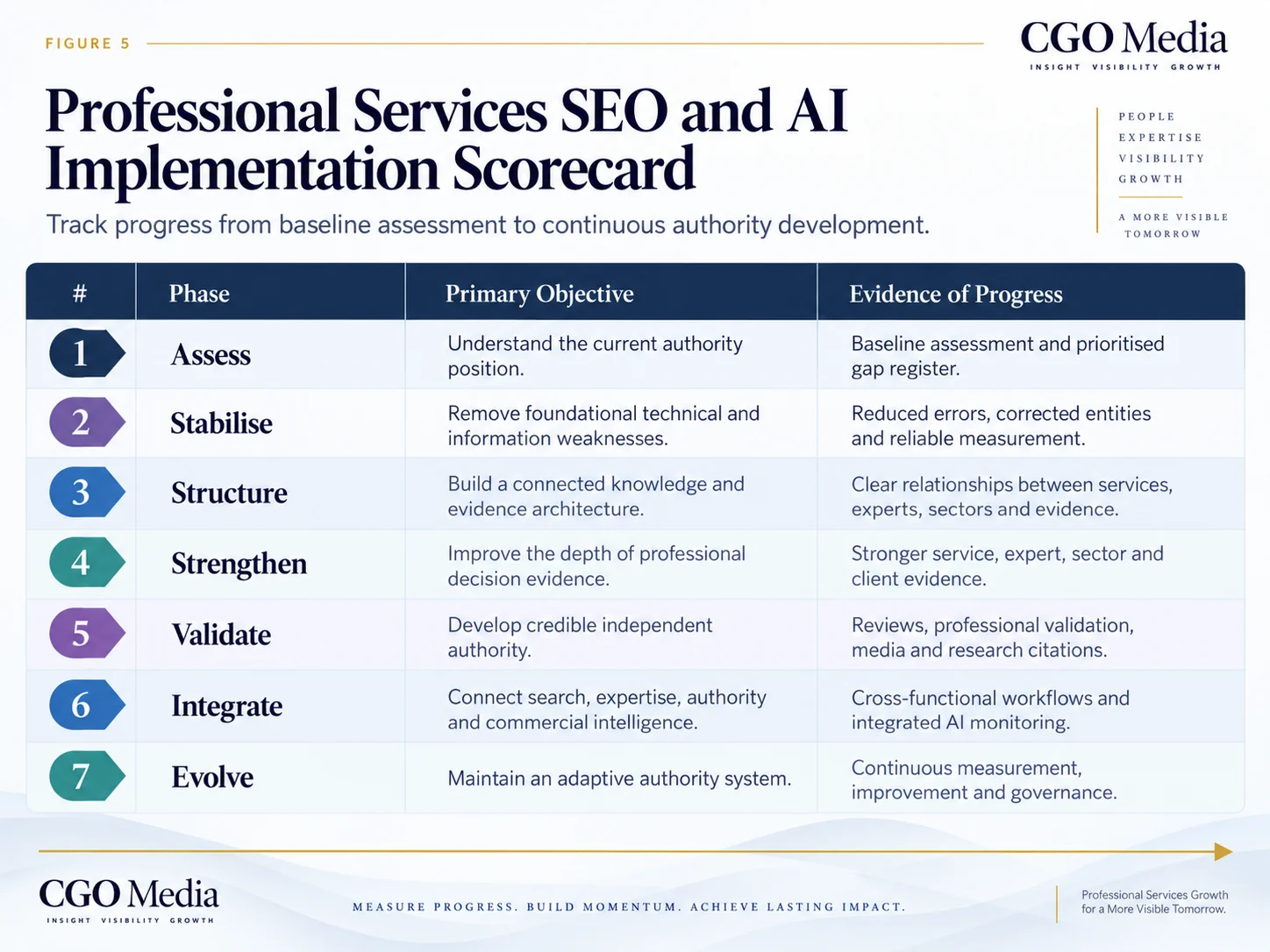
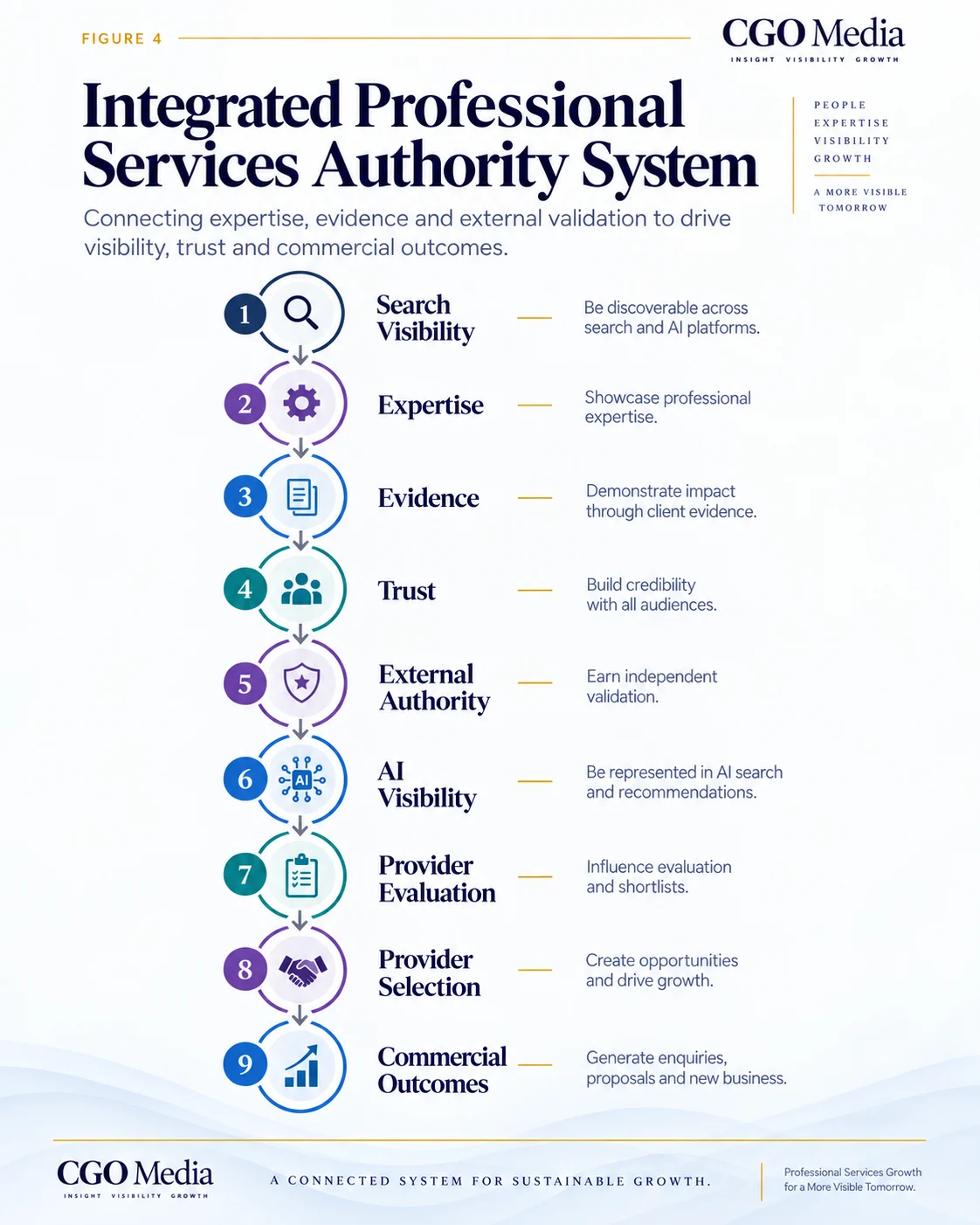
588. Phase Five — Validate
The Validate phase tests whether the professional-services authority system built through the earlier phases is sufficiently consistent, credible, externally supported and commercially relevant.
589. Validation Comes After Strengthening
The organisation should first improve the evidence environment before judging whether that environment is genuinely trusted.
590. The Core Validation Objective Is Confidence
The organisation should determine whether its claims are supported consistently enough to create confidence among:
- Prospective clients
- Search engines
- Professional directories
- Media
- AI-assisted discovery systems
591. Validation Should Test More Than Visibility
A page can be visible while the underlying authority remains weak.
592. A Useful Validation Relationship Is
Evidence Strength + Entity Consistency + Independent Validation + Search Validation + AI Validation + Commercial Validation → Authority Confidence
593. Independent Validation Is the First Validation Layer
The organisation should examine whether relevant third parties reinforce its strongest claims.
594. Independent Validation Can Include
- Media references
- Professional directories
- Industry associations
- Research citations
- Client reviews
- Awards and recognition
595. Independent Validation Should Be Relevant
External evidence should ideally support the service, expertise or sector being claimed.
596. Topic Relevance Should Be Tested
The organisation should ask:
Does this external reference genuinely reinforce the area of expertise we want to demonstrate?
597. Sector Relevance Should Be Tested
Trade or industry references can provide stronger evidence where sector expertise matters.
598. Professional Relevance Should Be Tested
Named external references can strengthen individual expert authority.
599. Geographic Relevance Should Be Tested Where Appropriate
Local or jurisdiction-specific recognition can strengthen market authority.
600. Independence Should Be Tested
The organisation should distinguish between:
- Genuinely independent coverage
- Syndicated coverage
- Paid profiles
- Self-submitted content
- Owned content
601. Syndication Should Not Be Misread as Multiple Independent Validations
Several websites repeating the same press release may represent one underlying source.
602. Source Provenance Should Be Recorded
The firm should understand where important claims originated.
603. Citation Validation Should Be Included
Research citations can provide useful evidence of intellectual authority.
604. Citation Quality Should Be Evaluated
Useful questions can include:
- Who cited the research?
- Why was it cited?
- Which finding was used?
- Was the attribution accurate?
605. Citation Relevance Should Be Evaluated
A relevant professional or industry citation can be more meaningful than a generic mention.
606. Media Validation Should Be Included
Relevant expert quotations can validate subject authority.
607. Media Validation Should Be Assessed for Depth
A named expert used repeatedly for meaningful commentary provides stronger evidence than a passing brand mention.
608. Professional Association Validation Should Be Included
Membership, status or participation can reinforce professional standing where relevant.
609. Awards Should Be Validated Carefully
The organisation should understand:
- Who issued the award
- What the category was
- When it was awarded
- Who or what received it
610. Review Validation Should Be Included
Client feedback can validate aspects of service quality and professional trust.
611. Review Recency Should Be Examined
Current feedback can provide stronger evidence of present capability.
612. Review Specificity Should Be Examined
Detailed feedback can reveal whether reviewers mention:
- Expertise
- Communication
- Service quality
- Sector understanding
- Commercial value
613. Review Distribution Should Be Examined
Authority that depends entirely on one platform can be less resilient.
614. Review Patterns Should Be Interpreted by Profession
Confidential B2B advisory markets may naturally generate less public feedback.
615. Alternative Validation Should Be Recognised Where Reviews Are Limited
Relevant evidence can include:
- Client references
- Repeat engagements
- Case studies
- Professional recognition
- Research citations
616. Entity Consistency Is the Second Validation Layer
The organisation should verify whether important facts remain aligned across owned and external sources.
617. Firm-Level Entity Validation Should Include
- Firm name
- Trading name
- Website
- Office locations
- Primary services
618. Professional Entity Validation Should Include
- Name
- Role
- Employer
- Office
- Specialisms
- Credentials
619. Office Entity Validation Should Include
- Address
- Telephone
- Professionals
- Services
- Geographic scope
620. Service Entity Validation Should Include
- Service name
- Scope
- Professional ownership
- Sector relevance
- Availability
621. Entity Validation Should Focus on Material Conflict
Minor wording differences are less important than factual contradiction.
622. Material Firm Conflicts Can Include
- Wrong address
- Old company name
- Incorrect website
- Discontinued service
623. Material Professional Conflicts Can Include
- Former employer
- Wrong job title
- Expired credential
- Incorrect specialism
624. Material Service Conflicts Can Include
- Wrong scope
- Wrong location
- Wrong practice ownership
- Wrong sector association
625. Entity Conflict Rate Can Be Used as an Internal Diagnostic
The organisation can track how often material facts differ across priority sources.
626. Entity Consistency Should Be Weighted by Source Importance
A conflict on a major professional or regulatory source may require greater attention than one on an obscure directory.
627. Search Validation Is the Third Validation Layer
The organisation should assess whether the strengthened authority system is improving relevant conventional search outcomes.
628. Service Search Validation Should Be Included
Priority capabilities can be tested across:
- Service terms
- Problem-led terms
- Sector-service combinations
- Geographic combinations
629. Expert Search Validation Should Be Included
Named professionals can be assessed for:
- Name visibility
- Specialism visibility
- Research visibility
- Media visibility
630. Sector Search Validation Should Be Included
The firm should examine whether stronger industry evidence improves relevant discovery.
631. Research Search Validation Should Be Included
Original studies can be monitored for:
- Organic discovery
- External links
- Media citations
- Brand association
632. Search Validation Should Be Longitudinal
One ranking movement should not be treated as proof of persistent authority improvement.
633. Search Validation Should Use Comparable Baselines
The organisation should compare against:
- Pre-implementation performance
- Previous periods
- Priority competitors
- Defined search segments
634. Search Validation Should Separate Branded and Non-Branded Demand
Brand growth and generic provider discovery represent different outcomes.
635. Search Validation Should Examine Landing-Page Relevance
The page ranking should be the page best suited to the user’s intent where possible.
636. Search Validation Should Examine Query Quality
High visibility for poor-fit terms is not necessarily an improvement.
637. AI Validation Is the Fourth Validation Layer
The organisation should examine how its firm, experts and evidence are represented in relevant generative discovery scenarios.
638. AI Validation Should Begin with Entity Accuracy
The organisation should confirm whether the platform represents:
- Firm identity
- Service capability
- Expert roles
- Sector expertise
- Office locations
accurately.
639. Source Visibility Should Be Recorded Where Available
The organisation can observe which sources contribute repeatedly to relevant answers.
640. Citation Visibility Should Be Recorded Where Available
Relevant cited assets can include:
- Research
- Expert profiles
- Service pages
- External media
641. Comparison Inclusion Should Be Tested
The firm can examine whether it enters relevant provider candidate sets.
642. Recommendation Inclusion Should Be Tested
The organisation can observe whether it appears where genuine fit exists.
643. Recommendation Rationale Should Be Examined
Where visible, the rationale can reveal which characteristics are being associated with the provider.
644. Recommendation Rationale Can Validate Strong Associations
Examples can include:
- Sector expertise
- Professional credibility
- Research authority
- Geographic relevance
- Specialist capability
645. Recommendation Rationale Can Reveal Weak Associations
Examples can include:
- Outdated positioning
- Incorrect sector association
- Over-broad expertise claims
- Weakly supported services
646. Relevant Exclusion Should Be Recorded
A genuine provider fit that fails to appear can indicate an authority gap.
647. Irrelevant Inclusion Should Be Recorded
The firm appearing in poorly matched scenarios can indicate imprecise positioning.
648. Appropriate Exclusion Should Also Be Recognised
A firm should not seek inclusion where the scenario does not match its genuine capability.
649. AI Validation Should Remain Scenario-Specific
One observed output should not be treated as a universal provider ranking.
650. AI Validation Should Record Platform and Date
Generative systems can change independently of the organisation.
651. AI Validation Should Record Prompt Family
Material wording differences can affect results.
652. AI Validation Should Record Geography Where Relevant
Local and jurisdiction-specific context can influence provider suitability.
653. AI Validation Should Record Sample Boundaries
Observed source or recommendation frequency should remain tied to the actual tested scenario set.
654. AI Validation Should Not Be Presented as Reverse Engineering
External observations cannot reveal proprietary internal ranking or recommendation mechanisms in full.
655. Commercial Validation Is the Fifth Validation Layer
The organisation should determine whether stronger authority is producing better provider-selection outcomes.
656. Qualified Enquiry Quality Should Be Examined
Useful dimensions can include:
- Correct service
- Correct client type
- Correct budget
- Correct sector
- Correct geography
657. Proposal Progression Should Be Examined
The firm can compare whether authority improvements are associated with more relevant proposal opportunities.
658. Shortlist Progression Should Be Examined
This is particularly useful in higher-value B2B professional-services engagements.
659. Win Rate Should Be Examined
Win-rate analysis can reveal whether stronger public evidence supports commercial selection.
660. Loss Reasons Should Be Examined
Common reasons can include:
- Weak specialist fit
- Weak sector fit
- Price
- Scale
- Location
- Relationship
661. Commercial Validation Should Be Segmented
The firm should evaluate outcomes by:
- Service
- Sector
- Client type
- Location
- Acquisition pathway
662. Commercial Validation Should Recognise Multi-Touch Journeys
A client may interact with:
- Search
- Research
- Media
- Professional profiles
- AI-assisted comparison
before making direct contact.
663. Last-Click Attribution Should Not Be Used Alone
The final conversion source may not reflect the earlier authority-building interactions.
664. First-Touch Attribution Should Not Be Used Alone Either
Initial discovery does not show where trust developed.
665. Journey-Level Validation Is Stronger
A useful relationship is:
Discovery → Validation → Comparison → Enquiry → Qualification → Proposal → Win / Loss
666. Validation Should Include Qualitative Review
Not every meaningful authority outcome can be reduced to a number.
667. Qualitative Validation Can Examine Positioning Accuracy
Does the firm appear associated with the services and sectors it actually wants?
668. Qualitative Validation Can Examine Professional Authority
Are the right experts being recognised for the right specialisms?
669. Qualitative Validation Can Examine Differentiation
Does the evidence explain why the firm is distinct from alternatives?
670. Qualitative Validation Can Examine Trust
Do external sources reinforce the claims made on owned channels?
671. Qualitative Validation Can Examine Commercial Fit
Are the opportunities generated by stronger visibility actually desirable?
672. Validation Should Test Evidence Convergence
Authority becomes more credible when multiple independent evidence types support the same conclusion.
673. Service Validation Can Use Evidence Convergence
A useful relationship is:
Service Page + Expert Profile + Case Study + Research + External Reference → Stronger Service Confidence
674. Professional Validation Can Use Evidence Convergence
A useful relationship is:
Professional Profile + Credentials + Research + Media + Client Evidence → Stronger Expert Confidence
675. Sector Validation Can Use Evidence Convergence
A useful relationship is:
Sector Page + Relevant Experts + Sector Case Studies + Research + Trade References → Stronger Sector Confidence
676. Firm-Level Validation Can Use Evidence Convergence
A useful relationship is:
Firm Identity + Service Evidence + Expert Evidence + Client Evidence + Independent Recognition → Stronger Firm Confidence
677. Validation Should Identify Weak Convergence
The organisation may discover that one authority layer is much weaker than the others.
678. Strong Owned Evidence with Weak External Evidence Indicates a Validation Gap
The organisation may understand itself clearly but lack independent reinforcement.
679. Strong External Visibility with Weak Owned Evidence Indicates a Clarity Gap
The firm may be well known without providing enough detail for provider evaluation.
680. Strong Expert Evidence with Weak Service Architecture Indicates a Commercial Connection Gap
Professional expertise may not be connected clearly to the capability being sold.
681. Strong Service Evidence with Weak Client Evidence Indicates an Applied-Proof Gap
The firm explains what it can do without showing sufficiently how it has done it.
682. Strong Search Visibility with Weak Commercial Progression Indicates a Fit Gap
The organisation may be attracting poorly matched demand.
683. Strong AI Visibility with Weak Representation Accuracy Indicates an Entity Gap
Visibility should not be treated as positive if the provider is described incorrectly.
684. Validation Should therefore Produce a Confidence Map
The organisation should record where authority appears:
- Strong
- Partially validated
- Unvalidated
- Conflicted
685. Priority Services Should Receive Confidence Ratings Internally
The purpose is diagnostic rather than promotional.
686. Priority Experts Should Receive Confidence Assessments
The organisation can examine whether each professional has sufficient:
- Profile evidence
- Credentials
- Research
- Client proof
- External validation
687. Priority Sectors Should Receive Confidence Assessments
The firm can evaluate whether industry authority is sufficiently supported.
688. Priority Markets Should Receive Confidence Assessments Where Relevant
This can reveal weak geographic or jurisdictional authority.
689. Validation Should Trigger Corrective Action
The purpose is not simply to score the current position.
690. Weak Entity Confidence Should Trigger Entity Correction
Conflicting facts should be resolved at their source.
691. Weak Professional Confidence Should Trigger Expert-Evidence Improvement
Relevant actions can include:
- Better profiles
- Research participation
- Credential clarification
- External commentary
692. Weak Service Confidence Should Trigger Service-Evidence Improvement
Relevant actions can include:
- Clearer scope
- Named experts
- Case studies
- Research support
693. Weak Sector Confidence Should Trigger Sector-Evidence Improvement
Relevant actions can include:
- Sector research
- Trade outreach
- Case studies
- Named specialists
694. Weak External Confidence Should Trigger Independent Validation Activity
This may require:
- Digital PR
- Research distribution
- Professional participation
- Media engagement
695. Weak Commercial Confidence Should Trigger Positioning Review
The firm may need to reconsider:
- Target audience
- Service framing
- Sector focus
- Commercial messaging
696. Validation Should Be Repeatable
The organisation should use sufficiently consistent methods to compare authority over time.
697. Validation Should Be Versioned
Changes to:
- Scenarios
- Platforms
- Sources
- Criteria
should be documented.
698. Validation Should Distinguish Observation from Inference
The organisation should record what it observed before explaining why it believes the result occurred.
699. Validation Should Distinguish Correlation from Causation
A visibility improvement following new research does not automatically prove that the research caused the change.
700. Validation Should Include Limitations
Relevant constraints can include:
- Small samples
- Platform variability
- Confidential commercial data
- Limited external-source access
701. Validation Should Be Commercially Prioritised
The organisation should focus most deeply on areas where provider authority materially influences business outcomes.
702. High-Value Services Should Receive Deeper Validation
Strategic capabilities warrant stronger scrutiny.
703. High-Value Experts Should Receive Deeper Validation
Priority professional entities may influence large numbers of provider decisions.
704. High-Value Sectors Should Receive Deeper Validation
Strategic verticals should be supported by stronger evidence convergence.
705. High-Risk Regulated Services Should Receive Deeper Validation
Incorrect or unsupported claims can create additional trust and compliance risk.
706. Validation Should Become an Operating Standard
The organisation should not wait for a major audit before checking whether authority remains credible.
707. Professional Changes Should Trigger Revalidation
Relevant events include:
- Promotion
- Departure
- New qualification
- New specialism
708. Service Changes Should Trigger Revalidation
New or changed capabilities should be checked across internal and external sources.
709. Sector Expansion Should Trigger Revalidation
New industry positioning should be tested against the actual evidence available.
710. Research Publication Should Trigger Citation Monitoring
The organisation should observe whether new evidence attracts relevant external use.
711. Major AI-Platform Changes Can Trigger Revalidation
Generative visibility should be re-observed when the discovery environment changes materially.
712. Validation Should Feed the Integration Phase
Only validated capabilities should be treated as mature enough for broader operational integration.
713. The Seventeenth Professional Services Implementation Principle
The Validate phase should test whether strengthened service, professional, sector, client and research evidence is reinforced by consistent entity information, relevant independent validation, credible search visibility, accurate AI-assisted representation and meaningful commercial progression.
714. The Eighteenth Professional Services Implementation Principle
Validation should distinguish genuine independent authority from syndication, self-submitted profiles or repeated owned claims and should prioritise evidence that is topically, professionally, geographically and commercially relevant to the provider capability being assessed.
715. The Nineteenth Professional Services Implementation Principle
AI-assisted validation should remain scenario-specific, longitudinal and methodologically transparent, recording platform, date, prompt family, geography, visible sources, representation accuracy and relevant inclusion or exclusion without presenting controlled observations as universal ranking probabilities.
716. The Twentieth Professional Services Implementation Principle
Authority validation should connect with CRM and business-development evidence so firms can distinguish strong digital visibility from genuinely validated provider confidence, shortlist progression and commercially relevant opportunities.
717. Phase Five Output — Professional Services Authority Validation Layer
The complete validation relationship can be summarised as:
Independent Evidence + Entity Consistency + Search Validation + AI Validation + Commercial Validation → Authority Confidence
718. The Strategic Outcome of Phase Five
At the end of the Validate phase, the organisation should understand not only which authority assets it has built, but which of those assets are genuinely reinforced by independent evidence, consistent entity representation, relevant search performance, accurate AI-assisted visibility and meaningful commercial outcomes. Weak convergence should be visible, material contradictions should be identified and the firm should possess a clearer confidence map across its priority services, experts, sectors and markets. This prepares the organisation for Phase Six, where validated search, expertise, research, PR and commercial capabilities can be integrated into one operating model.
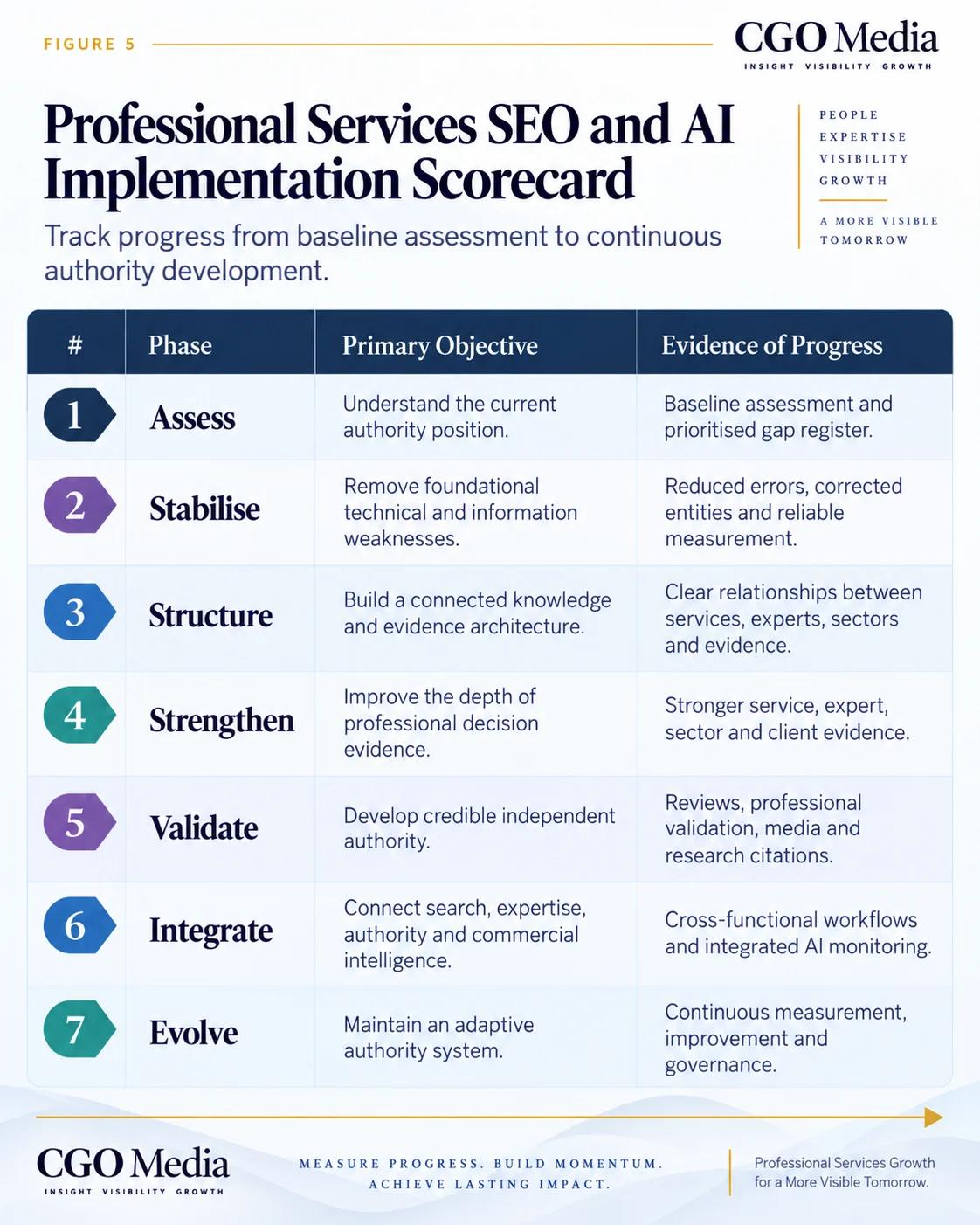
719. Phase Six — Integrate
The Integrate phase brings the technical, structural, evidential and validation capabilities developed across the earlier phases into one professional-services search authority operating model.
720. Integration Comes After Validation
The organisation should avoid operationalising weak or untested authority assets at scale.
721. The Core Integration Objective Is Coordination
Professional Services SEO becomes more effective when:
- Search
- Professional expertise
- Research
- Digital PR
- Business development
- CRM
- AI visibility monitoring
operate as connected functions rather than separate activities.
722. A Useful Integration Relationship Is
Search + Expertise + Research + Digital PR + AI Observation + CRM + Commercial Feedback → Integrated Professional Authority
723. Technical SEO Should Be Integrated with Content Governance
Search teams should understand which pages represent strategic services, experts, sectors and research assets.
724. Content Governance Should Be Integrated with Service Ownership
Professional capability should be validated by the people responsible for delivery.
725. Service Leaders Should Inform Search Strategy
They can identify:
- Priority services
- Common client problems
- Emerging demand
- Commercial constraints
726. Search Teams Should Inform Service Leaders
They can identify:
- Search demand
- Discovery gaps
- Authority gaps
- Competitor evidence
727. Professional Expertise Should Be Integrated with Content Production
Subject specialists should contribute meaningfully to:
- Research
- Commentary
- Service content
- Sector content
- Case studies
728. Authorship Should Be Integrated with Expertise Governance
Named professionals should be connected to the areas where they genuinely contribute.
729. Research Should Be Integrated with Service Strategy
Research can address questions that matter commercially to priority practices.
730. Research Should Be Integrated with Sector Strategy
Industry-specific studies can strengthen vertical authority.
731. Research Should Be Integrated with Digital PR
Distinctive findings can provide stronger editorial value than generic promotional outreach.
732. Research Should Be Integrated with AI Source Readiness
Clear authorship, methodology, findings and stable publication architecture improve the usefulness of research as a reference source.
733. Digital PR Should Be Integrated with Professional Expertise
Relevant experts should be connected with the media topics they genuinely understand.
734. Digital PR Should Be Integrated with Sector Authority
Trade media can reinforce industry-specific credibility.
735. Digital PR Should Be Integrated with Research Distribution
New studies can be distributed strategically to:
- Journalists
- Trade publications
- Industry bodies
- Researchers
- Professional communities
736. Search and Digital PR Should Share Authority Priorities
The organisation should avoid a situation where PR builds authority around subjects unrelated to its strategic services.
737. Business Development Should Be Integrated with Search Strategy
Commercial teams understand which provider-selection criteria matter most in live opportunities.
738. Business Development Can Identify Search Evidence Gaps
Recurring client questions can reveal missing:
- Service explanations
- Case studies
- Credentials
- Sector evidence
- Commercial information
739. Search Teams Can Feed Better Evidence into Business Development
Stronger digital assets can support:
- Proposals
- Sales conversations
- Shortlisting
- Procurement responses
740. CRM Should Be Integrated with Search Measurement
This allows the organisation to examine which discovery pathways generate commercially meaningful outcomes.
741. CRM Integration Can Connect Search with Service Demand
The organisation can identify which services produce the strongest qualified opportunities.
742. CRM Integration Can Connect Search with Sector Demand
The firm can understand which industries produce the strongest commercial progression.
743. CRM Integration Can Connect Search with Professional Influence
The organisation can examine whether specific experts frequently appear within successful journeys.
744. CRM Integration Can Connect Search with Research Influence
Original research may assist opportunities even when it is not the final conversion source.
745. Multi-Touch Attribution Should therefore Be Integrated
A useful journey can be:
Search → Research → Expert Profile → Media Validation → Direct Enquiry → Proposal
746. Another Integrated Journey Can Be
AI Provider Comparison → Firm Website → Case Study → Consultation → Shortlist
747. Another Integrated Journey Can Be
Trade Article → Brand Search → Sector Page → Expert Profile → Proposal Request
748. AI Search Observation Should Be Integrated with Wider Search Measurement
Generative visibility should not operate as an isolated reporting function.
749. AI Observation Can Reveal Source Gaps
The organisation may discover that its strongest owned assets are not visible in relevant scenarios.
750. AI Observation Can Reveal Entity Gaps
The firm or its professionals may be represented inaccurately.
751. AI Observation Can Reveal Authority Gaps
Relevant competitors may possess stronger visible external evidence.
752. AI Observation Can Reveal Positioning Gaps
The organisation may be associated with outdated or low-priority services.
753. AI Observation Should Feed Evidence Improvement
The correct response is usually to strengthen the underlying source environment rather than attempt to optimise one generated answer.
754. Search Reporting Should Be Integrated
A mature reporting framework can include:
- Technical search health
- Organic visibility
- Professional authority
- Sector authority
- Research authority
- External validation
- AI observations
- Commercial outcomes
755. Reporting Should Separate Leading and Lagging Indicators
Leading indicators can show whether authority is strengthening before revenue effects appear.
756. Leading Indicators Can Include
- Indexation quality
- Entity accuracy
- Expert profile completeness
- Research citations
- Comparison inclusion
757. Lagging Indicators Can Include
- Qualified enquiries
- Proposal progression
- Shortlist inclusion
- Client wins
- Revenue contribution
758. Integrated Reporting Should Support Diagnosis
The objective is not simply to produce a larger dashboard.
759. Reporting Should Answer Strategic Questions
Examples can include:
- Where are we gaining authority?
- Where are we losing provider relevance?
- Which experts need stronger evidence?
- Which sectors deserve further investment?
- Which search pathways produce strong opportunities?
760. Governance Should Be Integrated
The organisation should define responsibility across major authority capabilities.
761. Search Governance Can Own Technical and Discovery Standards
Relevant responsibilities can include:
- Technical accessibility
- Information architecture
- Internal linking
- Search measurement
762. Professional Governance Can Own Expertise Accuracy
Relevant responsibilities can include:
- Roles
- Specialisms
- Credentials
- Research participation
763. Research Governance Can Own Evidence Quality
Relevant responsibilities can include:
- Methodology
- Authorship
- Versioning
- Limitations
- Citation standards
764. PR Governance Can Own External Distribution
Relevant responsibilities can include:
- Media relationships
- Trade outreach
- Expert commentary
- Research distribution
765. Commercial Governance Can Own Outcome Feedback
Relevant responsibilities can include:
- Lead quality
- Proposal progression
- Shortlist feedback
- Win and loss analysis
766. Integration Should Create Shared Priorities
Teams should work toward the same strategic services, sectors and expert themes.
767. Shared Priorities Reduce Fragmentation
Without integration:
- SEO may target one set of topics
- PR may promote another
- Research may examine unrelated themes
- Commercial teams may pursue different markets
768. Strategic Alignment Improves Authority Density
A greater proportion of the firm’s evidence begins reinforcing the same genuine capabilities.
769. Authority Density Can Strengthen Provider Understanding
A useful relationship is:
Aligned Services + Experts + Research + Client Evidence + External Recognition → Stronger Authority Density
770. Integration Should Not Eliminate Specialist Ownership
Coordination does not mean every function performs the same role.
771. Specialists Should Retain Domain Responsibility
The objective is shared evidence architecture rather than centralised control of all activity.
772. Integrated Workflows Should Be Defined
Recurring authority events should trigger coordinated action.
773. A New Professional Joining Can Trigger
- Profile creation
- Service association
- Sector association
- External profile updates
- Media positioning review
774. A New Service Launch Can Trigger
- Search research
- Service page creation
- Expert mapping
- Sector mapping
- Measurement setup
775. New Research Publication Can Trigger
- Internal linking
- Expert-profile updates
- Sector-page integration
- Digital PR
- Citation monitoring
776. A New Case Study Can Trigger
- Service-page reinforcement
- Sector-page reinforcement
- Professional-profile reinforcement
- Commercial use
777. A Major Client Loss Can Trigger
- Positioning review
- Competitor review
- Evidence-gap analysis
- Commercial-fit review
778. An AI Representation Error Can Trigger
- Entity review
- Source review
- External-profile review
- Evidence correction
779. Phase Six Should Produce an Operating Model
The organisation should move from campaign-based authority building to repeatable operating processes.
780. The Professional Services Search Authority Operating Model
A mature operating model can connect:
Technical SEO → Entity Governance → Service Authority → Expert Authority → Research → Digital PR → AI Observation → CRM → Commercial Learning
781. Phase Seven — Evolve
The Evolve phase ensures that the integrated authority system adapts as professional markets, search environments, AI systems and client expectations change.
782. Evolution Is Not Optional
A professional-services authority system can weaken if it remains static.
783. Services Evolve
New capabilities can emerge as:
- Regulation changes
- Technology changes
- Client needs change
- Markets change
784. Professional Teams Evolve
The organisation may experience:
- New hires
- Promotions
- Departures
- New qualifications
- New specialist practices
785. Sector Priorities Evolve
Commercial strategy can move toward new industries or away from mature markets.
786. Search Behaviour Evolves
Users may adopt new ways of:
- Researching problems
- Understanding services
- Comparing providers
- Validating expertise
787. AI-Assisted Discovery Evolves
Source presentation, citations, comparison interfaces and recommendation patterns may change.
788. Competitor Evidence Evolves
Competing firms can improve their:
- Research
- Expert profiles
- Case studies
- Media authority
- Search architecture
789. Evolution Should Begin with Reassessment
The organisation should periodically revisit the original authority-gap framework.
790. Reassessment Should Review Technical Health
New technical issues can emerge through:
- Platform changes
- Site redesigns
- New templates
- Content expansion
791. Reassessment Should Review Entity Accuracy
Firm, office and professional information can become stale.
792. Reassessment Should Review Service Architecture
New capabilities can require restructuring.
793. Reassessment Should Review Professional Authority
Priority experts may change over time.
794. Reassessment Should Review Sector Authority
Strategic industry priorities can shift.
795. Reassessment Should Review Research Authority
Older research can require:
- Updates
- New datasets
- Methodological revision
- Replacement
796. Reassessment Should Review External Authority
Media and citation environments can change.
797. Reassessment Should Review AI Visibility
Provider representation and source patterns can evolve across platforms.
798. Reassessment Should Review Commercial Outcomes
The firm should understand whether its authority strategy continues to attract the right work.
799. Search Intent Should Be Re-Evaluated
New client terminology can emerge around changing problems and services.
800. Problem-Led Demand Should Be Re-Evaluated
Emerging challenges can create new early-stage discovery opportunities.
801. Service Demand Should Be Re-Evaluated
Some services may become:
- More important
- Less important
- More competitive
- More specialised
802. Sector Demand Should Be Re-Evaluated
Industry conditions can change commercial opportunity.
803. Geographic Demand Should Be Re-Evaluated
Expansion or consolidation can alter location priorities.
804. Provider Selection Behaviour Should Be Re-Evaluated
Clients may begin placing greater emphasis on:
- Research
- Specialist credentials
- AI capability
- Industry expertise
- Commercial flexibility
805. Evidence Standards Should Evolve
The organisation should increase minimum quality thresholds as its authority system matures.
806. Professional Profile Standards Can Evolve
More mature profiles may include:
- Research authorship
- Media commentary
- Speaking activity
- Case-study relationships
807. Service Standards Can Evolve
Priority service pages can become richer in:
- Methodology
- Decision guidance
- Client evidence
- Research support
808. Sector Standards Can Evolve
Strategic industry pages can incorporate more:
- Original research
- Benchmarks
- Named experts
- Trade citations
809. Research Standards Can Evolve
Methodology, versioning and data disclosure can become more rigorous over time.
810. AI Observation Standards Can Evolve
Scenario libraries and reporting methods should adapt to changing interfaces and research questions.
811. Evolution Should Be Evidence-Led
The organisation should not change strategy solely because a new search or AI tactic becomes fashionable.
812. New Tactics Should Be Evaluated against the Authority Model
Useful questions include:
- Does this improve user value?
- Does this improve evidence quality?
- Does this improve authority?
- Does this improve qualified discovery?
- Can the effect be measured?
813. Evolution Should Avoid Reactive AI Optimisation
Professional-services organisations should not rebuild strategy around isolated generated outputs.
814. AI Observations Should Be Treated as Diagnostic Evidence
They can reveal:
- Entity gaps
- Source gaps
- Authority gaps
- Positioning gaps
815. New AI Features Should Be Evaluated Cautiously
The organisation should distinguish:
- Documented platform behaviour
- Observed behaviour
- Industry speculation
816. Evolution Should Maintain the SEO Foundation
Technical accessibility and useful content remain central even as search interfaces change.
817. Evolution Should Maintain Entity Clarity
Clear relationships remain useful across changing discovery systems.
818. Evolution Should Maintain Evidence Quality
Accurate and attributable expertise remains valuable regardless of platform.
819. Evolution Should Maintain Independent Validation
External evidence remains an important trust layer.
820. Evolution Should Maintain Commercial Relevance
The authority system should continue to support the kind of work the firm wants to win.
821. Research Can Guide Evolution
Recurring market questions can become:
- Research studies
- Benchmarks
- Frameworks
- Observations
822. Search Data Can Guide Evolution
Changing discovery patterns can reveal new client questions.
823. AI Observation Can Guide Evolution
Repeated representation gaps can reveal weaknesses in the evidence ecosystem.
824. Commercial Data Can Guide Evolution
Win and loss patterns can reveal changing provider-selection criteria.
825. Competitor Evidence Can Guide Evolution
Competitor improvements can identify areas where the market standard is rising.
826. Evolution Should Include Controlled Experimentation
The organisation can test improvements to:
- Service architecture
- Professional profiles
- Research formats
- Internal linking
- Commercial pathways
827. Experiments Should Have a Defined Hypothesis
The organisation should state what it expects the change to improve.
828. Experiments Should Have a Baseline
Without baseline evidence, change becomes harder to interpret.
829. Experiments Should Have Defined Measures
Useful measures can include:
- Discovery
- Engagement
- Expert recognition
- Comparison visibility
- Commercial progression
830. Experiments Should Have Limitations
Changes should not be over-attributed where several factors may have influenced the outcome.
831. Successful Experiments Should Become Operating Standards
Validated improvements can be incorporated into future templates and workflows.
832. Unsuccessful Experiments Should Still Produce Learning
Negative or neutral outcomes can prevent repeated low-value investment.
833. Evolution Should Include Knowledge Retention
Authority strategy should not depend entirely on individual team members remembering past decisions.
834. Documentation Should Record
- Standards
- Methodologies
- Taxonomies
- Measurement definitions
- Experiment results
- Major strategic decisions
835. Documentation Supports Continuity
This becomes especially important as:
- Teams change
- Agencies change
- Leadership changes
- Technology changes
836. Evolution Should Include Scenario Refresh
AI and provider-selection scenario libraries should reflect current client behaviour.
837. Old Scenarios Should Be Retained Where Longitudinal Comparison Matters
This preserves trend evidence.
838. New Scenarios Should Be Added Where New Demand Emerges
The organisation can expand observation without losing methodological continuity.
839. Evolution Should Include Competitive Refresh
The commercially relevant competitor set can change.
840. New Competitors Can Emerge
Specialist firms may enter markets previously dominated by established providers.
841. Existing Competitors Can Reposition
Firms can expand into new services or sectors.
842. Competitive Authority Should therefore Be Reassessed
The organisation should compare current evidence rather than relying on old assumptions.
843. Evolution Should Include Authority Decay Monitoring
Strong authority can weaken if evidence is not maintained.
844. Professional Authority Can Decay
This can occur when:
- Profiles become stale
- Experts leave
- Qualifications change
- Public activity stops
845. Research Authority Can Decay
Old studies can lose relevance as markets change.
846. Sector Authority Can Decay
Competitors can publish stronger and more current evidence.
847. External Authority Can Decay
Old media mentions become less representative of current activity.
848. Search Visibility Can Decay
Technical, competitive and behavioural changes can reduce discoverability.
849. AI Representation Can Decay
Changing sources and systems can alter how the provider is described.
850. Authority Decay Should therefore Trigger Reassessment
The roadmap should operate as a cycle rather than a one-way project.
851. The Full Continuous Sequence Is
Assess → Stabilise → Structure → Strengthen → Validate → Integrate → Evolve → Reassess
852. The Professional Services Authority Flywheel Emerges from This Cycle
A useful relationship is:
Better Structure → Better Evidence → Better Validation → Better Integration → Better Learning → Stronger Authority
853. Better Structure Improves Evidence Placement
Professional assets reinforce the correct services and sectors.
854. Better Evidence Improves Trust
Claims become easier to validate.
855. Better Validation Improves Confidence
The firm understands which authority signals are genuinely strong.
856. Better Integration Improves Efficiency
Search, research, PR and commercial teams reinforce one another.
857. Better Learning Improves Prioritisation
Future investment can focus on areas with stronger strategic value.
858. Stronger Authority Creates New Evidence Opportunities
Improved visibility can produce:
- More media opportunities
- More citations
- More professional recognition
- More qualified commercial interactions
859. These Outcomes Can Feed the Next Cycle
This creates cumulative authority rather than one-time optimisation.
860. The Professional Services Search Authority Operating Model
The mature system can be summarised as:
SEO Foundation + Entity Governance + Service Authority + Expert Authority + Sector Evidence + Research + Digital PR + AI Observation + CRM + Commercial Learning
861. The Twenty-First Professional Services Implementation Principle
The Integrate phase should connect technical SEO, service governance, professional expertise, research, Digital PR, AI observation, CRM and business-development feedback into one operating model so evidence created in one function strengthens authority across the wider provider-discovery system.
862. The Twenty-Second Professional Services Implementation Principle
Integrated workflows should be triggered by real organisational events such as professional appointments, service launches, research publication, new case studies, major client wins or losses and material representation errors so authority governance becomes operational rather than campaign-based.
863. The Twenty-Third Professional Services Implementation Principle
The Evolve phase should continuously reassess technical health, entity clarity, service architecture, professional evidence, sector authority, research, external validation, AI representation and commercial outcomes as client behaviour, markets and discovery systems change.
864. The Twenty-Fourth Professional Services Implementation Principle
Professional-services organisations should treat new search and AI tactics as hypotheses to be evaluated against user value, evidence quality, authority, qualified discovery and commercial outcomes rather than allowing short-term industry trends to replace the underlying SEO and professional-authority foundations.
865. Phase Six and Seven Output — Adaptive Professional Services Search Authority
The integrated and evolving authority system can be summarised as:
Search + Expertise + Research + External Authority + AI Observation + Commercial Feedback → Integrated Learning → Adaptive Professional Authority
866. The Strategic Outcome of Integration and Evolution
At the end of the Integrate and Evolve phases, Professional Services SEO should no longer operate as a collection of isolated technical, content, PR and AI initiatives. The organisation should possess a repeatable authority operating model in which services, experts, sectors, research, client evidence, external validation and commercial feedback continually reinforce one another. Search and AI observations should feed diagnosis rather than reactive optimisation, commercial data should guide priorities, and validated learning should become part of future standards. The result is an adaptive professional-services search authority system capable of evolving as client needs, competitive evidence, search interfaces and generative discovery environments change.
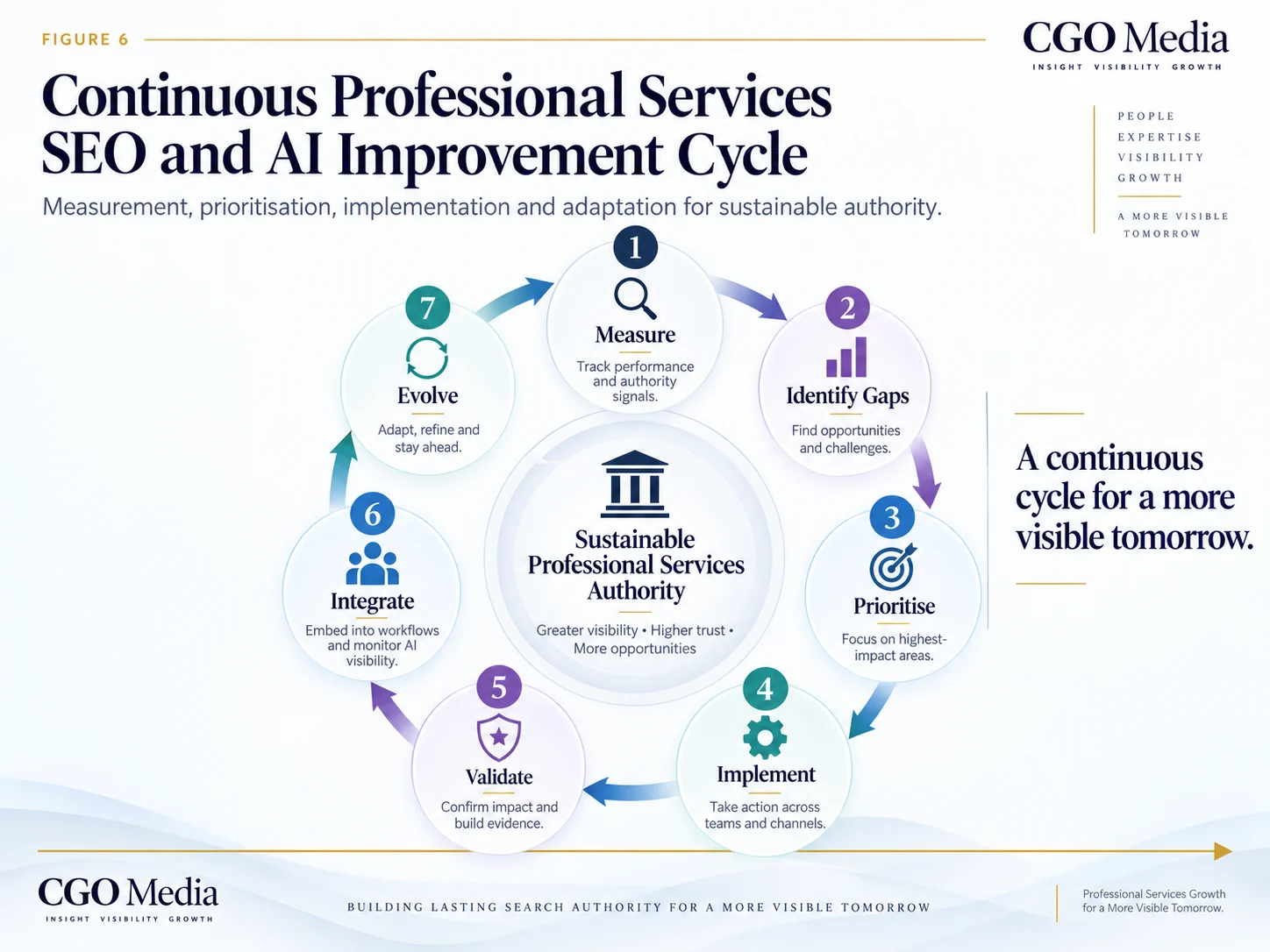
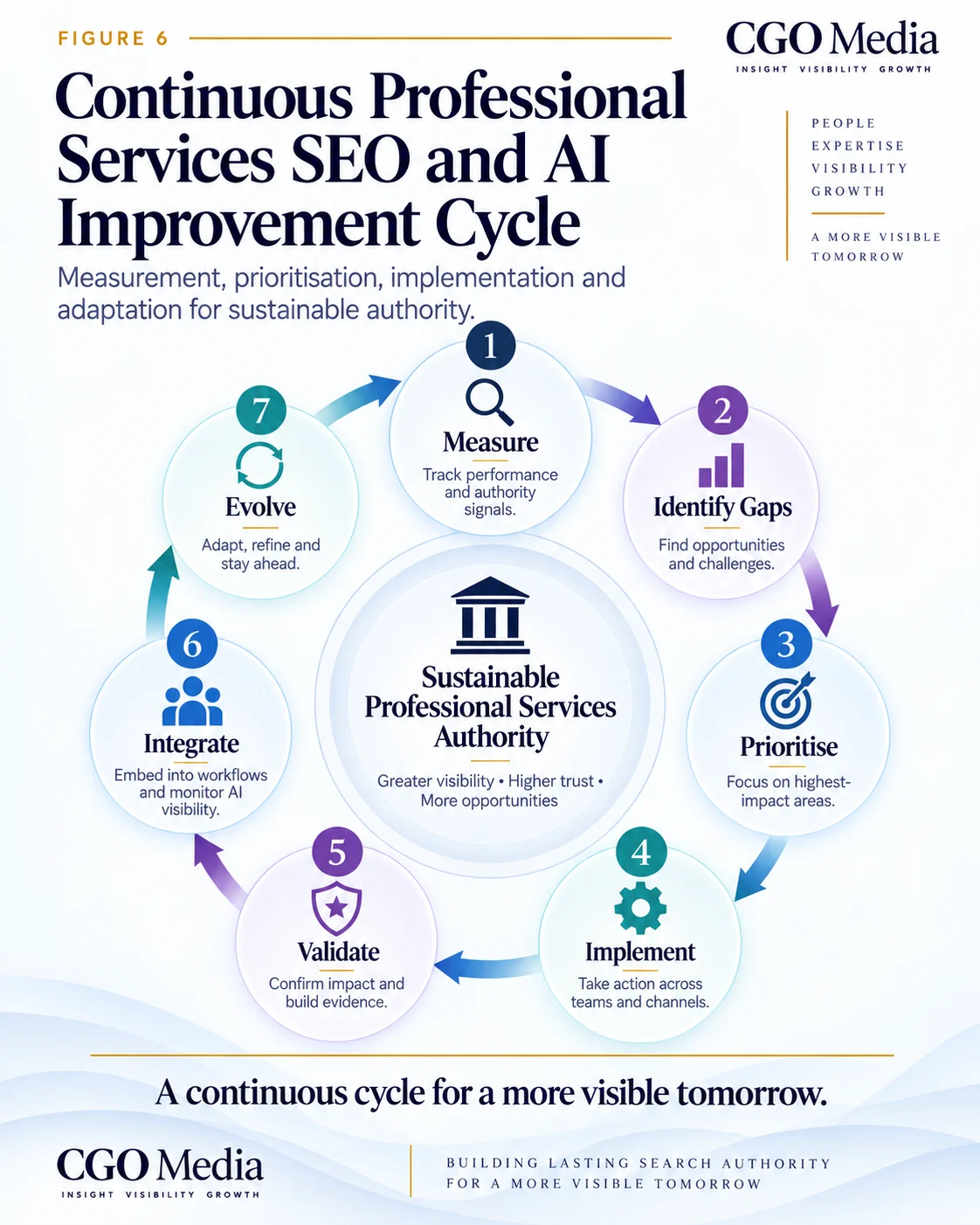
867. Methodological Position
The Professional Services SEO and AI Implementation Roadmap is a conceptual and strategic implementation framework developed by CGO Media to help expertise-led organisations sequence the development of stronger search visibility, professional authority, provider trust and AI-assisted recommendation readiness.
868. The Roadmap Is an Implementation Framework
It is designed to organise work into a practical sequence rather than provide a deterministic ranking formula.
869. The Seven-Phase Sequence Is
Assess → Stabilise → Structure → Strengthen → Validate → Integrate → Evolve
870. The Sequence Reflects Capability Dependency
Later authority development depends on earlier technical, organisational and evidential foundations.
871. Assessment Establishes the Starting Position
The organisation first identifies:
- Technical weaknesses
- Entity conflicts
- Service gaps
- Professional evidence gaps
- Sector gaps
- External authority gaps
- Measurement weaknesses
872. Stabilisation Reduces Foundational Risk
Important information should become accessible, accurate, consistent and measurable before authority is expanded.
873. Structure Creates the Knowledge Architecture
The organisation establishes clear relationships between:
- Firm
- Offices
- Professionals
- Services
- Specialisms
- Sectors
- Research
- Client evidence
874. Strengthening Deepens the Evidence Environment
Priority authority assets are expanded through:
- Professional expertise
- Client evidence
- Sector evidence
- Research
- Thought leadership
- External recognition
875. Validation Tests the Authority Environment
Evidence is assessed against:
- Independent sources
- Entity consistency
- Search behaviour
- AI-assisted representation
- Commercial outcomes
876. Integration Connects Organisational Functions
Search, professional expertise, research, Digital PR, CRM and commercial feedback become part of one operating model.
877. Evolution Converts the Roadmap into a Continuous System
The organisation repeatedly reassesses and improves the authority environment as markets and discovery systems change.
878. The Framework Is Conceptual
It is intended to support strategic planning, governance and implementation sequencing.
879. The Framework Does Not Claim Proprietary Algorithmic Knowledge
CGO Media does not claim access to proprietary search-engine or AI-system ranking, retrieval, citation-selection or recommendation algorithms.
880. Search and AI Systems Continue to Change
External platforms can change:
- Retrieval systems
- Ranking systems
- Source presentation
- Citation behaviour
- Recommendation interfaces
881. Completion of the Roadmap Does Not Guarantee Rankings
Search visibility depends on many factors outside the direct control of an organisation.
882. Completion of the Roadmap Does Not Guarantee AI Citation
Publishing strong research or evidence does not guarantee citation by a generative platform.
883. Completion of the Roadmap Does Not Guarantee Provider Recommendation
Recommendation outcomes remain contextual and platform-dependent.
884. Completion of the Roadmap Does Not Guarantee Commercial Outcomes
Client selection can also depend on:
- Budget
- Relationships
- Availability
- Procurement
- Geography
- Commercial fit
885. The Roadmap Instead Strengthens Underlying Conditions
The implementation model focuses on conditions that can improve:
- Discoverability
- Understanding
- Trust
- Comparison readiness
- Recommendation readiness
886. Implementation Priorities Should Be Organisation-Specific
Different firms will begin the roadmap from different maturity positions.
887. A Technically Weak Firm May Require Greater Stabilisation
Technical reliability can be the dominant early-stage constraint.
888. A Strong SEO Firm May Require Greater Professional Evidence
High organic visibility can coexist with weak expert or client authority.
889. A Strong Brand May Require Greater Specialist Clarity
Brand recognition does not automatically demonstrate expertise in every professional-service scenario.
890. A Specialist Boutique May Require Greater External Validation
Deep expertise can remain under-recognised outside owned channels.
891. Implementation Should Therefore Begin from the Actual Gap
The roadmap should not be applied mechanically.
892. Professional Services Markets Differ
The relative importance of evidence can vary across:
- Consulting
- Accountancy
- Recruitment
- Architecture
- Engineering
- Specialist advisory
893. Regulation Can Affect Implementation
Some professions require greater emphasis on:
- Credential accuracy
- Professional status
- Regulatory statements
- Disclosure standards
894. Confidentiality Can Affect Implementation
Professional-services organisations may not always be able to disclose:
- Client identities
- Project details
- Commercial outcomes
- Internal methodologies
895. Evidence Standards Should Respect Confidentiality
Anonymised or aggregated evidence may be more appropriate in some markets.
896. Organisational Scale Can Affect Implementation
A global professional-services organisation may require substantially more governance than a specialist advisory firm.
897. Multi-Office Organisations Have Greater Entity Complexity
They may require governance across:
- Countries
- Offices
- Professionals
- Services
- Local profiles
898. Multi-Practice Firms Have Greater Service Complexity
Service taxonomies can become difficult to manage as organisations expand.
899. Professional Movement Creates Additional Complexity
Experts can join, leave or change roles frequently.
900. Entity Governance Is therefore an Ongoing Requirement
Professional identity should be treated as operational data rather than static website copy.
901. AI Observation Has Methodological Limitations
Generative outputs can vary across:
- Platform
- Prompt
- Date
- Conversation context
- Location
902. AI Testing Should therefore Be Documented
Useful fields can include:
- Platform
- Date
- Scenario
- Prompt family
- Geography
- Sample size
903. Observed Frequencies Should Remain Sample-Specific
A measured frequency within a controlled test should not be presented as a universal platform probability.
904. Observation Should Be Separated from Inference
Reports should distinguish clearly between:
- What was observed
- What may explain it
- What remains uncertain
905. Correlation Should Be Separated from Causation
An authority improvement followed by stronger visibility does not by itself prove that the intervention caused the change.
906. Commercial Measurement Also Has Limitations
Professional-services journeys can involve many interactions before conversion.
907. Last-Click Attribution Is Incomplete
The final acquisition channel can understate earlier authority interactions.
908. First-Touch Attribution Is Also Incomplete
Initial discovery does not reveal where provider confidence developed.
909. Multi-Touch Analysis Is More Appropriate
A useful relationship is:
Discovery → Research → Validation → Comparison → Enquiry → Proposal → Win / Loss
910. Long Professional-Sales Cycles Should Be Considered
Commercial outcomes may occur months after initial discovery.
911. Implementation Should therefore Use Leading and Lagging Measures
Leading measures can reveal authority improvement before commercial results become visible.
912. Leading Measures Can Include
- Technical stability
- Entity accuracy
- Professional profile completeness
- Research citations
- External authority
- Comparison inclusion
913. Lagging Measures Can Include
- Qualified enquiries
- Proposal progression
- Shortlist inclusion
- Client wins
- Revenue contribution
914. Implementation Should Be Prioritised by Strategic Value
The organisation should not invest equally across every service, sector, office or professional.
915. Priority Services Should Receive Greater Investment
High-value or strategically important capabilities can justify deeper evidence development.
916. Priority Sectors Should Receive Greater Investment
Strategic industries can justify stronger research, case studies and external authority.
917. Priority Experts Should Receive Greater Investment
Professionals central to important practices can become major authority assets.
918. Priority Research Themes Should Receive Greater Investment
Distinctive research can create value across:
- Search
- Media
- Professional authority
- Sector authority
- AI source visibility
919. The Roadmap Should Produce Organisational Learning
Each implementation cycle should improve the organisation’s understanding of:
- Client discovery
- Provider evaluation
- Authority gaps
- Commercial fit
920. Successful Changes Should Become Standards
Validated improvements can be incorporated into:
- Templates
- Governance
- Research methodology
- Content standards
- Measurement
921. Unsuccessful Changes Should Also Produce Learning
Neutral or negative outcomes can reduce repeated investment in low-value activity.
922. The Roadmap Is therefore Iterative
The end of one implementation cycle becomes the beginning of the next assessment.
923. The Complete Operating Cycle Is
Assess → Stabilise → Structure → Strengthen → Validate → Integrate → Evolve → Reassess
924. Strategic Implications
The main implementation challenge facing professional-services organisations is rarely a lack of possible SEO activity.
925. The More Important Challenge Is Sequencing
The organisation must decide:
- What should happen first
- Which capabilities depend on others
- Where evidence is weakest
- Where investment creates the greatest strategic value
926. Isolated Technical Work Is Insufficient
Technical accessibility is essential but does not alone establish professional authority.
927. Isolated Content Production Is Insufficient
More pages do not automatically improve provider confidence.
928. Isolated Link Building Is Insufficient
External links cannot substitute for weak service, professional or client evidence.
929. Isolated Digital PR Is Insufficient
Publicity around unrelated themes can create little strategic authority.
930. Isolated AI Optimisation Is Insufficient
Generative visibility depends substantially on the wider evidence environment.
931. The Stronger Approach Is Integrated Authority Development
A useful relationship is:
Technical Foundation + Entity Clarity + Expertise + Evidence + Independent Validation + Measurement → Professional Search Authority
932. SEO Remains Foundational
Professional-services organisations still require:
- Accessible websites
- Useful content
- Clear architecture
- Internal linking
- Search visibility
933. GEO Extends the Authority Model
Generative Engine Optimisation adds further attention to:
- Source eligibility
- Entity understanding
- Citation readiness
- Comparison readiness
- Recommendation readiness
934. GEO Should therefore Be Integrated with SEO
The stronger model is:
SEO Foundation + Professional Authority + Evidence Quality + External Validation + GEO Measurement
935. Professional Authority Is the Long-Term Asset
Search interfaces can change while genuine expertise, evidence and independent recognition retain strategic value.
936. Conclusion
Professional Services SEO increasingly requires coordinated management of technical accessibility, firm identity, professional expertise, service evidence, sector relevance, client proof, independent validation and AI-assisted representation.
937. The Roadmap Provides Seven Implementation Phases
- Assess
- Stabilise
- Structure
- Strengthen
- Validate
- Integrate
- Evolve
938. Assess Establishes Reality
The organisation identifies the authority gaps that actually exist.
939. Stabilise Creates Reliability
Technical, factual and measurement inconsistencies are reduced.
940. Structure Creates Relationships
Firm, services, experts, sectors, research and client evidence become part of one coherent architecture.
941. Strengthen Creates Depth
The organisation adds richer professional, research, client and external evidence.
942. Validate Creates Confidence
Claims are tested against independent sources, entity consistency, search behaviour, AI representation and commercial results.
943. Integrate Creates Operational Coordination
Search, expertise, research, Digital PR and commercial teams begin reinforcing one another.
944. Evolve Creates Adaptability
The authority system becomes capable of responding to changing markets, competitors and discovery environments.
945. The Final Objective Is Not Roadmap Completion
The strategic objective is a professional-services authority capability that continues improving after the initial implementation programme ends.
946. The Final Strategic Relationship Is
Reliable Foundation → Clear Knowledge Architecture → Strong Evidence → Independent Validation → Integrated Operations → Continuous Learning → Adaptive Authority
947. Professional Services Search Authority Should Become an Organisational Capability
When implemented effectively, SEO ceases to operate as an isolated marketing activity and becomes connected with professional expertise, research, reputation, client evidence and commercial learning.
948. The Long-Term Authority Flywheel
The complete long-term relationship can be summarised as:
Better Evidence → Better Discovery → Better Trust → Better Comparison → Better Qualification → Better Commercial Learning → Stronger Evidence
949. Final Strategic Position
Professional-services organisations do not need to choose between conventional SEO and emerging AI-search visibility. The more durable approach is to strengthen the underlying authority system that supports both.
That means ensuring important services are technically accessible, the organisation and its professionals are represented accurately, specialist capability is structured clearly, client and research evidence support important claims, independent sources validate genuine expertise and commercial feedback continually informs future priorities.
Generative discovery adds new measurement and representation challenges, but it does not remove the need for these foundations. Clear entities, strong professional evidence, original research, independent recognition and commercially relevant service architecture remain useful whether the prospective client begins with Google, an AI assistant, a professional directory, a media article, a referral or a direct brand search.
The purpose of the Professional Services SEO and AI Implementation Roadmap is therefore not to prescribe a temporary set of optimisation tactics. It is to provide an implementation sequence for creating a search authority system capable of remaining useful as search technology, professional markets and provider-selection behaviour continue to evolve.
References
External Technical, Search and Research Sources
- Google Search Central. SEO Starter Guide.
- Google Search Central. AI Features and Your Website.
- Google Search Central. Organization Structured Data.
- Schema.org. Organization.
- Schema.org. Person.
- Schema.org. Service.
- Hogan, A. et al. (2021). Knowledge Graphs. ACM Computing Surveys, 54(4).
- Metzger, M.J. (2007). Making Sense of Credibility on the Web: Models for Evaluating Online Information and Recommendations for Future Research. Journal of the American Society for Information Science and Technology, 58(13), 2078–2091.
- Ji, Z. et al. (2023). Survey of Hallucination in Natural Language Generation. ACM Computing Surveys, 55(12).
Professional Services AI & GEO Search Research Family
The Professional Services SEO and AI Implementation Roadmap forms part of the wider CGO Media Professional Services research architecture examining search visibility, provider discovery, professional trust, authority maturity and generative discovery.
Professional Services AI & GEO Search Research
The sector pillar brings together the wider Professional Services SEO, AI Search and GEO research programme.
Explore Professional Services AI & GEO Search Research →
Professional Services SEO in an AI Search Environment
The parent research paper examines how expertise-led organisations are discovered, evaluated, compared and selected across conventional search and AI-assisted discovery.
Explore Professional Services SEO in an AI Search Environment →
Professional Services AI Trust and Visibility Framework
The framework defines the evidence conditions that can strengthen firm clarity, professional trust, external validation and provider recommendation readiness.
Explore the Professional Services AI Trust and Visibility Framework →
Professional Services Discovery and Provider Selection Model
The model examines how clients move through problem recognition, provider discovery, expertise evaluation, trust validation, comparison, shortlisting and commercial engagement.
Explore the Professional Services Discovery and Provider Selection Model →
Professional Services Search Authority Maturity Model
The maturity model evaluates how advanced an organisation is in building coordinated technical, professional, sector, trust and AI-search authority.
Explore the Professional Services Search Authority Maturity Model →
Professional Services GEO: Generative Engine Optimisation
The GEO research examines source visibility, entity clarity, citation readiness, provider comparison and qualified recommendation visibility across generative discovery systems.
Explore Professional Services GEO →
How the Professional Services Research Family Connects
The complete research architecture can be summarised as:
Sector Research Pillar → Parent Search Research → Trust & Visibility Framework → Discovery & Provider Selection → Search Authority Maturity → Implementation Roadmap → GEO
CGO Media Research Ecosystem
The Professional Services SEO and AI Implementation Roadmap forms part of the CGO Media Framework Library and the wider CGO Media research programme examining AI Search, GEO, provider selection, Entity Authority, Citation Authority, Knowledge Architecture and recommendation visibility.
CGO Media Research Library |
CGO Media Framework Library |
CGO Media Research Architecture |
CGO Media Research Observations |
CGO Media Statistics Library
About Roger Wilkinson
Roger Wilkinson is an independent search and AI researcher, SEO practitioner and founder of CGO Media with more than 25 years of experience in search, online visibility and digital strategy.
His research examines how artificial intelligence is changing information retrieval, entity understanding, source selection, citation behaviour, provider comparison and recommendation-led discovery.
His sector research applies these concepts to markets in which expertise, professional trust, client evidence and provider selection materially influence commercial decisions.
The Professional Services SEO and AI Implementation Roadmap translates this wider research into a practical implementation sequence for organisations seeking to strengthen technical SEO, professional authority, research visibility, independent validation and AI-search readiness.
View Roger Wilkinson’s researcher profile →
Research Usage & Citation
CGO Media encourages researchers, journalists, professional-services organisations, consultants, advisers and practitioners to reference this roadmap where it contributes to broader understanding of Professional Services SEO, AI Search, implementation sequencing, professional authority, provider discovery or generative recommendation readiness.
Reasonable quotations, summaries, figures and excerpts may be used in articles, reports, presentations and academic work provided appropriate acknowledgement is given to Roger Wilkinson and CGO Media.
Cite This Roadmap / Embed Citation
The Professional Services SEO and AI Implementation Roadmap, developed by Roger Wilkinson at CGO Media, proposes a seven-phase implementation sequence — Assess, Stabilise, Structure, Strengthen, Validate, Integrate and Evolve — for building and continuously improving professional-services search authority and AI recommendation readiness.
APA Citation
APA Citation: Wilkinson, R. (2026). Professional Services SEO and AI Implementation Roadmap. CGO Media. https://cgomedia.com/professional-services-seo-ai-implementation-roadmap/
Author: Roger Wilkinson |
Published by: CGO Media
For permissions relating to substantial reproduction, commercial licensing or republication of significant portions of this roadmap, please contact CGO Media directly.