
Technology SEO in an AI Search Environment
Executive Summary
 Technology search is entering a new phase in which visibility is no longer determined only by conventional organic rankings. Search engines, AI assistants, software comparison platforms, technical publications, developer communities, review environments, professional networks and knowledge systems increasingly influence how technology organisations are discovered, evaluated and selected.
For technology companies, this creates a particularly complex search environment because buyers often need to establish much more than whether a provider exists.
They may need to understand:
What the organisation does
Which products, platforms or services it provides
Who those products are designed for
Which technical problems they solve
How they integrate with existing systems
Whether they satisfy security or compliance requirements
Whether the provider can be trusted
How the offering compares with credible alternatives
Technology SEO therefore increasingly operates as an authority and evidence system rather than only a webpage-ranking discipline.
A useful strategic progression is:
Discovery → Understanding → Technical Evaluation → Trust Validation → Comparison → Selection
Traditional SEO remains essential. Technical accessibility, content quality, internal architecture, links and organic visibility continue to influence discovery.
However, these capabilities now interact with a broader authority environment containing:
- Owned content
- Technical documentation
- Entity clarity
- Customer evidence
- Independent authority
- Search visibility
- AI recommendation visibility
The central argument of this paper is that technology organisations should optimise not merely to be found, but to be understood, verified, compared and appropriately recommended.
1. Technology Search Has Become a Multi-Layered Discovery System
Traditional Technology SEO has typically concentrated on areas such as keyword targeting, technical optimisation, product pages, service pages, content development, link acquisition and organic rankings.
These disciplines remain important, but technology buyers now move through a much wider discovery ecosystem.
A potential customer can encounter a provider through:
- Google Search
- AI assistants
- Technical publications
- Software comparison platforms
- Developer communities
- Industry research
- Professional networks
- Customer reviews
This means a provider can be mentioned, summarised, compared, recommended or excluded before the buyer reaches its own website.
The objective of Technology SEO therefore expands from:
Rank a webpage
to:
Build sufficient technical relevance, entity clarity, evidence and external authority for the organisation to participate accurately across multiple discovery environments.
2. Technology Buying Decisions Require More Information Than Many Search Journeys
Technology products can be difficult to evaluate because the decision often combines commercial, technical and operational requirements.
A buyer may need to consider:
- Functionality
- Architecture
- Integration
- Security
- Scalability
- Reliability
- Compliance
- Support
- Pricing
- Implementation requirements
The more complex or high-risk the purchase becomes, the more evidence is normally required before selection.
This is especially relevant for markets such as:
- Enterprise infrastructure
- Cybersecurity
- Cloud computing
- Artificial intelligence platforms
- Data infrastructure
- Developer tools
A useful conceptual relationship is:
Purchase Risk ↑ → Evidence Requirement ↑
This has important implications for search strategy.
A technology provider cannot rely entirely on persuasive commercial copy where the buyer needs detailed technical validation.
3. Technology SEO Must Support Understanding
Discovery creates an opportunity to be evaluated, but the buyer still needs to understand what the organisation actually offers.
A strong digital environment should make clear:
- What the organisation is
- Which products it owns
- Which platforms or services it operates
- Who each offering is designed for
- Which problems each offering solves
- How different offerings relate to one another
Technology organisations frequently weaken this understanding through vague category language, overlapping product names or excessive marketing terminology.
The stronger objective is:
Visibility + Product Clarity + Technical Evidence → Useful Discovery
4. Entity Clarity Is Particularly Important in Technology
Technology organisations often contain several related entities.
These can include:
- Parent company
- Product brand
- Platform
- Application
- API
- Cloud service
- Business unit
- Consulting service
If these relationships are unclear, buyers and search systems may struggle to determine which organisation owns a product, whether products belong to the same portfolio, whether a product has been renamed or whether technical documentation still applies.
A simplified product-led architecture can be represented as:
Organisation → Brand → Product → Platform → Feature → Use Case → Industry
A service-led organisation may instead require:
Organisation → Practice Area → Service → Capability → Industry → Use Case → Case Study
The exact architecture will vary by organisation, but the principle remains the same: important technology relationships should be explicit.
5. Product and Service Identity Should Not Be Blurred
Technology organisations frequently combine products, platforms, managed services and consulting capabilities.
These offerings can solve related problems while representing very different buyer decisions.
A software platform should therefore not be represented in the same way as a consulting service merely because both operate within the same technology category.
Clear architecture helps buyers and AI systems distinguish:
- What is purchased
- What is implemented
- What is supported
- What is delivered as a service
This becomes particularly important when an organisation expands through acquisitions or introduces several products under one corporate brand.
6. Technical Documentation Is Part of Search Authority
Technology authority does not exist only within marketing pages.
Technical documentation can answer high-intent questions involving:
- Configuration
- Integration
- API behaviour
- Deployment
- Troubleshooting
- Security
- Supported environments
This means documentation can function as search infrastructure.
It can support discovery, technical evaluation, customer confidence and AI understanding simultaneously.
Weak documentation can have the opposite effect by introducing ambiguity around how the product actually works.
7. Product Claims Should Be Specific and Verifiable
Generic technology language provides limited evaluation value.
Terms such as:
- Innovative
- Powerful
- Next-generation
- Industry-leading
- AI-powered
may communicate positioning but rarely explain technical capability by themselves.
More useful evidence can describe:
- Capabilities
- Architecture
- Integration requirements
- Performance characteristics
- Deployment models
- Supported environments
- Known constraints
A useful principle is:
Claim → Capability → Technical Evidence
The stronger the buyer’s technical requirements, the more important this progression becomes.
8. Technology Search Intent Covers the Entire Buying Journey
Technology search demand is unusually diverse.
It can begin with educational research and progress through problem investigation, category discovery, provider comparison and implementation.
Common intent classes include:
Informational Search
Queries designed to understand a concept, architecture or technology.
Problem-Led Search
Queries focused on solving an operational or technical problem.
Category Search
Queries identifying relevant product or service categories.
Provider Search
Queries identifying companies, platforms or specialists.
Comparison Search
Queries comparing products, providers, architectures or approaches.
Implementation Search
Queries involving integration, migration, configuration or troubleshooting.
An organisation focused only on high-volume category terms can therefore miss large parts of the buying journey.
9. The Technology Buyer Journey Is Multi-Stage
A useful simplified technology search journey is:
Problem Recognition → Research → Category Discovery → Provider Discovery → Technical Evaluation → Trust Validation → Comparison → Selection
Problem Recognition
The buyer identifies an operational, technical or strategic challenge.
Research
The buyer investigates technologies, architectures or methods capable of solving the problem.
Category Discovery
Relevant product or service categories begin to emerge.
Provider Discovery
Specific companies, products or platforms enter consideration.
Technical Evaluation
The buyer evaluates capability, compatibility, security, scalability and implementation requirements.
Trust Validation
The buyer looks for evidence that important technical and commercial claims are credible.
Comparison
Plausible providers are compared across capability, cost, risk, support and fit.
Selection
The buyer selects a product, platform, service provider or implementation partner.
10. AI Search Can Compress Several Buying Stages into One Interaction
A buyer can now ask an AI system to:
- Explain a technology
- Compare technical approaches
- Recommend providers
- Identify risks
- Summarise product differences
This can compress several stages of research into one conversational environment.
A provider can therefore undergo substantial evaluation before receiving a website visit.
This creates a new form of pre-click technology evaluation.
11. Pre-Click Evaluation Increases the Importance of Explicit Evidence
Consider a buyer asking:
Which cloud data platforms are suitable for a regulated European enterprise that requires European data residency, strong API support and real-time analytics?
This question combines:
- Product category
- Regulatory context
- Geography
- API capability
- Analytics capability
- Enterprise suitability
A provider with clear evidence around these attributes is easier to evaluate.
Missing evidence is not necessarily neutral.
In a comparative environment it can favour competitors whose capabilities are described more clearly.
12. Technology Comparison Readiness Is Becoming a Search Requirement
Decision-critical attributes should be:
- Explicit
- Current
- Accurate
- Easy to verify
This creates a broader Technology SEO objective:
Make the provider sufficiently clear and evidence-rich to support accurate comparison.
Comparison readiness does not mean claiming superiority across every category.
It means making genuine strengths, constraints and suitability sufficiently clear for an informed decision.
13. Technology Trust Is Multi-Layered
Technology buyers may need several forms of confidence before selection.
Technical Credibility
Can be supported through documentation, architecture information, technical expertise and developer resources.
Security Credibility
Can include evidence around security controls, certifications, privacy, compliance and responsible disclosure.
Operational Credibility
Can include reliability, uptime, scalability, support and incident-management evidence.
Commercial Credibility
Can include customer evidence, case studies, pricing clarity and contract transparency.
Brand Credibility
Can be supported by industry recognition, independent research, partnerships, publications and relevant external references.
Technology trust therefore develops through several evidence layers rather than one trust signal.
14. Technology Authority Depends on Evidence Convergence
A useful conceptual relationship is:
Provider Claims + Technical Evidence + Customer Evidence + Independent Validation → Stronger Technology Trust
For example, a provider’s claim of enterprise suitability becomes more credible where:
- The product architecture supports enterprise deployment.
- Security documentation addresses relevant controls.
- Customer case studies demonstrate comparable use.
- Independent sources recognise the provider in the relevant market.
Evidence convergence reduces the amount of trust placed on unsupported self-description.
15. Technology Search Authority Is Distributed
The organisation’s search authority does not exist in one website or one ranking.
It develops across several connected evidence environments.
The most important components include:
- Owned Content
- Technical Documentation
- Entity Clarity
- Customer Evidence
- Independent Authority
- Search Visibility
- AI Recommendation Visibility
These components influence different stages of the technology buying journey.
16. Owned Content Establishes the Provider’s Core Position
Owned content explains:
- Products
- Services
- Capabilities
- Use cases
- Industries
- Commercial positioning
It forms the organisation’s primary representation of what it offers.
However, first-party content alone does not establish complete authority.
17. Technical Documentation Provides Operational Evidence
Documentation can demonstrate how products operate in real environments.
It can expose:
- Architecture
- APIs
- Integrations
- Deployment requirements
- Technical constraints
For many technology buyers, this evidence is essential to progressing from commercial interest into technical evaluation.
18. Entity Clarity Connects the Evidence
Entity clarity helps search systems and buyers determine which:
- Organisation
- Product
- Platform
- Service
- Feature
the evidence describes.
Without this clarity, technical documentation, customer evidence and external authority can become fragmented across inconsistent product names or organisational identities.
19. Customer Evidence Demonstrates Real-World Application
Customer evidence can include:
- Case studies
- Testimonials
- Implementation examples
- Customer stories
- Verified reviews
Its purpose is not merely promotional.
Strong customer evidence can show that the product has been applied successfully within relevant technical, organisational or industry conditions.
20. Independent Authority Extends Beyond the Provider’s Own Claims
Independent authority can come from:
- Technical publications
- Industry media
- Research
- Professional communities
- Standards organisations
- Relevant partners
The strongest sources depend on the claim being validated.
A specialist technical source may provide greater evidential value for a technical claim than a larger but unrelated publication.
21. Search Visibility Connects Authority with Demand
Search visibility determines whether this evidence can be discovered during relevant buyer journeys.
Visibility can exist around:
- Problems
- Categories
- Products
- Use cases
- Industries
- Technical questions
- Comparisons
The objective should be to connect the organisation with demand where it has genuine relevance.
22. AI Recommendation Visibility Extends the Authority Environment
AI-assisted discovery can synthesise evidence from several parts of the public information environment.
The organisation may therefore be:
- Explained
- Compared
- Cited
- Shortlisted
- Recommended
without the buyer following the same sequence of webpage visits associated with traditional search.
AI visibility should therefore be understood as an extension of the wider technology authority system.
23. Qualified Visibility Is More Valuable Than Raw Exposure
A technology organisation does not benefit equally from every search impression or AI mention.
A provider of enterprise cybersecurity infrastructure may have little commercial value in appearing for buyers seeking a simple consumer security application.
A stronger objective is:
Relevant Demand + Accurate Representation + Technical Fit + Trust = Qualified Visibility
This aligns search visibility with actual product suitability.
24. The First Technology SEO Principle
Technology search authority is distributed across owned information, technical evidence, external validation, entity representation and AI-assisted discovery rather than being determined by organic rankings alone.
25. The Second Technology SEO Principle
Technology organisations should optimise for understanding as well as visibility because buyers and AI systems increasingly evaluate products through detailed attributes, capabilities and constraints.
26. The Third Technology SEO Principle
The more complex or high-risk the technology decision, the greater the requirement for explicit technical evidence and independent validation.
27. The Fourth Technology SEO Principle
Qualified visibility should be prioritised over raw exposure so that search and AI discovery connect the provider with buyers whose requirements genuinely match the product or service.
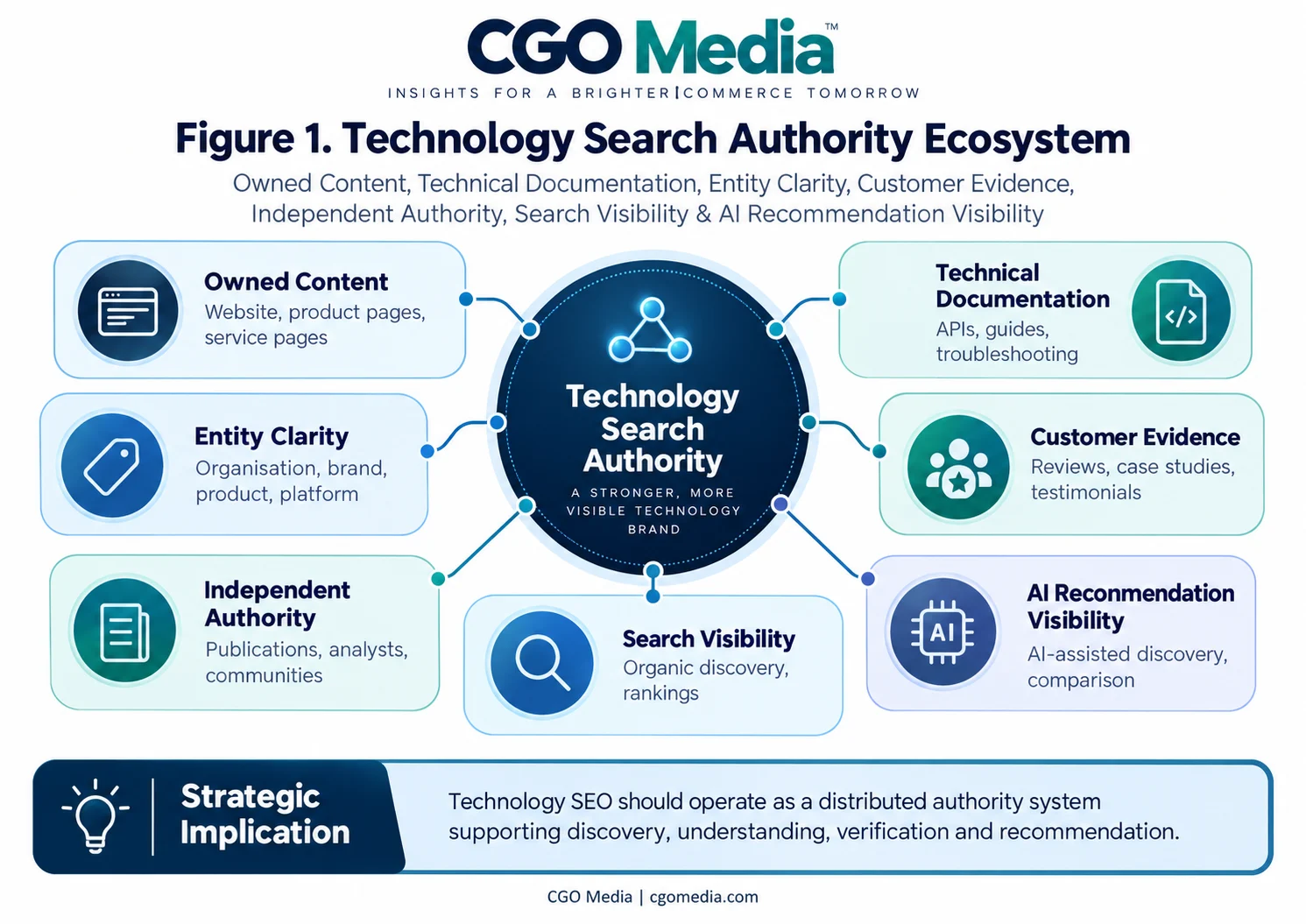
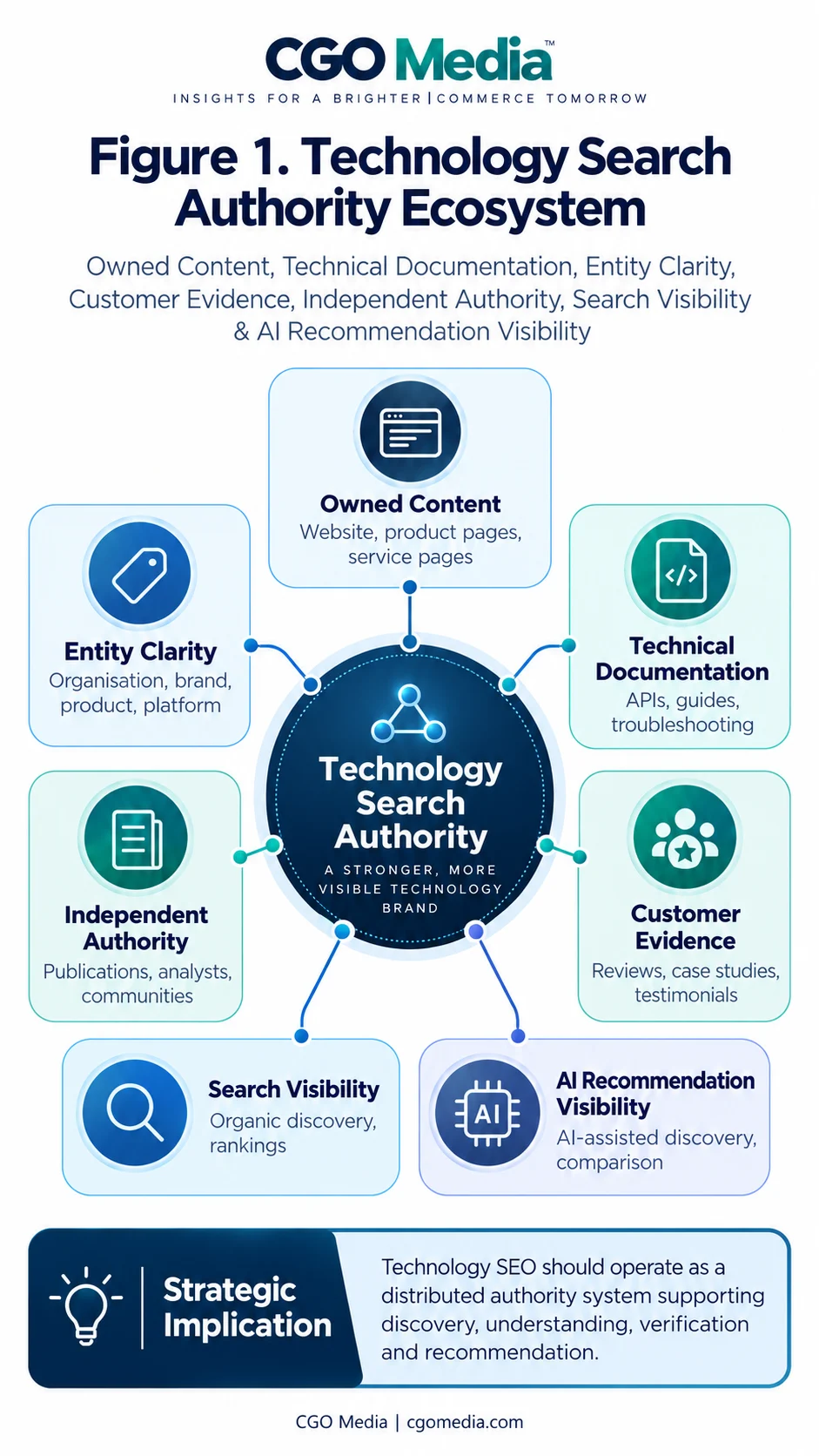
28. The Technology Search Authority Ecosystem
The complete environment can be summarised as:
Owned Content + Technical Documentation + Entity Clarity + Customer Evidence + Independent Authority + Search Visibility + AI Recommendation Visibility
Owned Content
Defines the organisation, products, services, capabilities, industries and use cases.
Technical Documentation
Provides detailed evidence about how technology operates, integrates and is implemented.
Entity Clarity
Connects organisations, brands, products, platforms, features and services into an understandable structure.
Customer Evidence
Demonstrates real-world application, suitability and outcomes.
Independent Authority
Provides validation from credible sources outside the provider’s direct control.
Search Visibility
Connects this evidence with relevant buyer demand across conventional search environments.
AI Recommendation Visibility
Reflects whether the wider evidence environment supports accurate and relevant representation within AI-assisted discovery and comparison.
The strategic implication is that technology organisations should treat SEO as a distributed authority system designed to make the organisation discoverable, understandable, verifiable and appropriately comparable across traditional search, technical research environments and AI-assisted discovery.
Figure 1 : Technology Search Authority Ecosystem — Owned Content, Technical Documentation, Entity Clarity, Customer Evidence, Independent Authority, Search Visibility & AI Recommendation Visibility.
29. Technology Search Authority Depends on Clear Entity Architecture
The Technology Search Authority Ecosystem establishes the major evidence layers supporting discovery and recommendation.
The next requirement is to organise those layers around clear technology entities.
A buyer or AI system should be able to determine:
- Which organisation owns the technology
- Which product or platform is being described
- How products relate to one another
- Which features belong to which product
- Which documentation applies to which version
- Which use cases and industries each offering supports
A useful architecture is:
Organisation → Brand → Product → Platform → Feature → Use Case → Industry
This structure reduces ambiguity and helps connect technical, commercial and external evidence to the correct entity.
30. Technology Portfolios Commonly Create Entity Ambiguity
Technology organisations often expand through:
- New products
- Acquisitions
- Product mergers
- Platform consolidation
- Rebranding
- Feature expansion
These changes can produce overlapping names, legacy documentation and conflicting external references.
Without careful governance, buyers may struggle to understand whether:
- A former product still exists
- A feature moved into another platform
- A legacy brand is still supported
- An acquired company now belongs to another organisation
Search and AI systems can face the same ambiguity.
31. Entity Governance Should Accompany Product Change
Important product changes should trigger coordinated updates across the public information environment.
Relevant changes can include:
- Product renaming
- Product retirement
- Platform migration
- Acquisition
- Feature deprecation
- Portfolio consolidation
A practical sequence is:
Confirm New Entity State → Update Owned Content → Update Documentation → Reconcile External Profiles → Preserve Historical Context
The objective is continuity rather than abrupt deletion of useful historical information.
32. Historical Information Should Remain Clearly Identified
Technology buyers often need historical documentation for:
- Legacy systems
- Migration planning
- Older APIs
- Previous versions
- Long-term support environments
Historical information can therefore remain valuable.
The risk arises when historical information appears current.
Clear status labels such as:
- Current
- Deprecated
- Archived
- Legacy
- End of support
help preserve usefulness while reducing ambiguity.
33. Product Naming Should Remain Consistent
Technology evaluation becomes harder when the same product is described differently across:
- Website
- Documentation
- Sales materials
- Partner pages
- Comparison platforms
- External publications
Consistency does not require identical wording.
It requires material compatibility around:
- Product identity
- Ownership
- Capabilities
- Status
- Supported environments
34. AI Search Increases the Cost of Ambiguous Product Information
AI systems can synthesise information from different sources and time periods.
Where current and historical information conflict, the resulting answer can become inaccurate or misleading.
This increases the value of:
- Version clarity
- Deprecation notices
- Current product naming
- Consistent external representation
Technology information governance is therefore increasingly part of AI search readiness.
35. Technical Documentation Should Be Treated as a Core Search Asset
Documentation is often one of the strongest sources of product evidence available to technical buyers.
It can provide information around:
- Architecture
- APIs
- Deployment
- Integrations
- Configuration
- Troubleshooting
- Security
- Supported environments
Documentation therefore contributes directly to:
Discovery + Understanding + Technical Validation + Trust
36. Documentation Architecture Requires Search Governance
Large technical documentation estates can create search problems through:
- Version duplication
- Parameter duplication
- Thin utility pages
- Broken internal links
- Outdated pages
- Fragmented navigation
Documentation should therefore be managed as a search architecture rather than treated solely as a product-support environment.
37. Documentation Should Help Buyers Reach Exact Answers Quickly
Technical evaluation often depends on very specific questions.
For example:
- Does the platform support a particular authentication protocol?
- Is a specific API available?
- Which deployment models are supported?
- Does the product integrate with a particular cloud environment?
Searchable documentation, logical navigation and clear internal linking reduce evaluation friction.
38. Technical Content Should Be Layered by Audience
Not every technology buyer needs the same depth of information.
A useful content hierarchy is:
Category Explanation → Product Overview → Technical Detail → Documentation → Implementation Guidance
This allows different stakeholders to enter at the level appropriate to their role and progress toward deeper evidence when needed.
39. Introductory Content Supports Category Discovery
Early-stage buyers may need to understand:
- The technology category
- The problem being solved
- Common approaches
- Important terminology
This content supports discovery before a provider shortlist exists.
40. Product Content Supports Commercial Evaluation
Product pages should explain:
- Capabilities
- Use cases
- Benefits
- Target users
- Deployment options
- Important constraints
The objective is to make product suitability understandable without relying entirely on sales contact.
41. Technical Evidence Supports Technical Validation
Technical buyers may require evidence around:
- Architecture
- APIs
- Security
- Performance
- Integrations
- Deployment requirements
This is where broad commercial positioning must be translated into verifiable technical information.
A useful progression is:
Commercial Claim → Technical Capability → Supporting Evidence
42. Customer Evidence Supports Real-World Validation
Case studies and implementation evidence can demonstrate:
- The customer problem
- The implementation context
- The technology used
- The resulting outcome
Strong case studies provide enough context for a buyer to judge whether the evidence applies to their own environment.
43. Quantitative Claims Require Context
Technology case studies frequently use metrics involving:
- Performance improvement
- Cost reduction
- Time saved
- Scale achieved
Where quantitative evidence is used, buyers should be able to understand:
- What was measured
- Over what period
- Against which baseline
- Under what conditions
Contextualised evidence is more useful than isolated headline percentages.
44. Security Evidence Requires Particular Precision
Security claims can influence high-risk purchasing decisions and should therefore be carefully qualified.
Useful security information can include:
- Security architecture
- Encryption
- Access controls
- Compliance frameworks
- Security certifications
Broad statements such as “enterprise-grade security” provide limited evidence without supporting detail.
45. Compliance Claims Should Distinguish Responsibilities
Technology organisations should distinguish clearly between:
- Product capability
- Organisation certification
- Customer responsibility
- Regional applicability
A technology product that supports relevant controls does not necessarily make every customer automatically compliant.
Clarity reduces legal, procurement and trust risk.
46. Reliability Evidence Can Influence Selection
Buyers may evaluate evidence involving:
- Availability
- Resilience
- Recovery
- Incident history
- Support
Status information and transparent incident communication can also contribute to operational trust where relevant.
47. Support Is Part of the Technology Product
Technology products with similar technical capabilities can differ substantially in support quality.
Buyers may evaluate:
- Support channels
- Response expectations
- Documentation quality
- Community support
- Professional services
Support therefore becomes both a technical and commercial comparison factor.
48. Commercial Attributes Also Need Clarity
Technology evaluation is not purely technical.
Where appropriate, buyers may need information around:
- Pricing structure
- Contract model
- Support
- Service levels
- Implementation requirements
Commercial ambiguity can create evaluation friction even where technical fit is strong.
49. Technology Comparison Is Multi-Dimensional
A provider can be strong in one area while comparatively weak in another.
Technology comparison can include:
- Features
- Architecture
- Integration
- Security
- Performance
- Support
- Pricing
- Commercial flexibility
The strongest provider depends on the buyer context.
A product suited to one organisation may be unsuitable for another because of differences in scale, infrastructure, budget or risk tolerance.
50. Universal “Best Technology” Claims Are Often Weak
Technology suitability depends on context.
A useful relationship is:
Buyer Requirements + Existing Environment + Risk Constraints + Commercial Fit → Provider Suitability
This means search and AI content should avoid reducing complex provider selection to generic superiority claims.
51. Different Stakeholders Evaluate Different Evidence
Technology purchases often involve several decision-makers.
Common stakeholder groups include:
- Executives
- Technical teams
- Security teams
- Procurement
- Finance
- Operations
Each stakeholder can evaluate the same provider through a different evidence lens.
52. Executive Evaluation Focuses on Strategic Fit
Executive audiences may prioritise:
- Business value
- Risk
- Cost
- Strategic fit
They generally require enough technical context to understand risk without necessarily needing implementation-level detail.
53. Technical Evaluation Requires Deeper Evidence
Technical audiences may prioritise:
- Architecture
- Integration
- Performance
- Security
- Implementation
For these users, shallow marketing pages are rarely sufficient.
54. Procurement Evaluation Adds Commercial and Governance Requirements
Procurement teams may focus on:
- Pricing
- Contracts
- Compliance
- Support
- Vendor stability
This means technology search journeys can branch across multiple stakeholder paths before final selection.
55. Technology Content Architecture Should Support Multiple Stakeholders
A single page rarely answers every buyer question.
A more realistic evaluation journey may be:
Executive Evaluation → Technical Validation → Security Review → Procurement Review → Selection
Each branch creates different search and information requirements.
The provider can appear commercially strong while failing at technical, security or procurement validation.
56. Evaluation Friction Should Be Reduced
The objective is not to remove necessary due diligence.
It is to make reliable evidence easier to locate and evaluate.
Buyers should be able to find:
- Documentation
- Security information
- Pricing information
- Case studies
- Support information
without navigating an unnecessarily fragmented information environment.
57. Clear Terminology Reduces Evaluation Friction
Product names and important terminology should remain sufficiently consistent across:
- Website
- Documentation
- Sales material
- External profiles
Unnecessary terminology changes create ambiguity and can weaken both buyer understanding and machine interpretation.
58. Decision Pages Can Support Complex Evaluation
Dedicated decision-support pages can explain areas such as:
- Deployment options
- Migration
- Integration
- Security
- Pricing models
These pages can bridge the gap between broad product positioning and deep technical documentation.
They can also become useful retrieval sources within AI-assisted comparison.
59. Technology Information Has a Shorter Useful Life
Technical information can become outdated quickly, especially in areas such as:
- Artificial intelligence
- Cybersecurity
- Cloud platforms
- Developer tools
- Data infrastructure
Recency therefore forms part of technical authority.
However, freshness should reflect real changes rather than cosmetic publication-date updates.
60. Material Product Changes Should Trigger Content Review
Review triggers can include:
- Feature launch
- Pricing change
- New integration
- Security change
- Product retirement
The organisation should identify which pages, documentation, external profiles and sales materials are affected by each change.
61. Versioning and Change History Improve Technical Context
For technical audiences, clear change history can explain how a product evolved.
Useful mechanisms can include:
- Version numbers
- Release notes
- Change logs
- Documentation update dates
- Deprecation notices
This helps buyers determine whether technical guidance remains applicable.
62. Technology Content Requires Lifecycle Management
A mature information lifecycle can be represented as:
Create → Validate → Publish → Maintain → Update → Deprecate → Archive
Create
New technical or commercial information is produced.
Validate
Accuracy is checked by the appropriate technical, product, security or commercial owner.
Publish
The information becomes publicly accessible.
Maintain
Accuracy and relevance are monitored.
Update
Information changes as the product, market or operating environment evolves.
Deprecate
Information that is no longer current is clearly identified.
Archive
Historical material is retained where useful without being confused with current guidance.
63. Lifecycle Governance Requires Ownership
Important information should have identified owners.
Ownership can involve:
- Product teams
- Engineering
- Security
- Marketing
- Documentation teams
- Legal or compliance
The purpose is to prevent critical information from remaining online indefinitely without anyone being responsible for its accuracy.
64. Brand and Expert Authority Reinforce Product Evaluation
Technology buyers often evaluate the organisation as well as the product.
Brand authority can be influenced by:
- Leadership
- Research
- Media coverage
- Partnerships
- Customer adoption
- Industry participation
Technical organisations can also benefit when credible specialists are clearly associated with research, engineering, security, product development or industry expertise.
Expert identity should reflect genuine expertise rather than fabricated authority signals.
65. Research Can Strengthen Technology Authority
Original research can provide evidence around:
- Market behaviour
- Technology adoption
- Security trends
- Performance
- Operational outcomes
Credible research should explain:
- Methodology
- Sample
- Time period
- Limitations
Unsupported statistics can weaken rather than strengthen trust.
66. Digital PR Should Reinforce Relevant Technology Authority
External coverage can strengthen:
- Brand recognition
- Technical credibility
- Entity validation
- Research visibility
However, relevance matters more than raw mention volume.
Coverage connected directly with the provider’s products, expertise, technology categories or industry problems provides stronger strategic value than unrelated publicity.
67. Technical Web Performance Remains Foundational
Technology authority can still be undermined by basic technical weaknesses such as:
- Poor crawlability
- Slow rendering
- Duplicate content
- Broken documentation
- Weak internal linking
Dynamic JavaScript-heavy experiences should therefore preserve reliable access to important content.
AI search does not remove the need for technically sound SEO infrastructure.
68. The Fifth Technology SEO Principle
Technology entity architecture should make relationships between organisations, products, platforms, features, versions, use cases and industries sufficiently explicit for both buyers and search systems to interpret accurately.
69. The Sixth Technology SEO Principle
Technical documentation should be treated as part of the search and authority system because it supports discovery, evaluation, validation and implementation simultaneously.
70. The Seventh Technology SEO Principle
Technology comparison readiness depends on explicit attributes, verifiable technical evidence, external trust and clear buyer fit rather than promotional positioning alone.
71. The Eighth Technology SEO Principle
Technology information should be governed throughout its lifecycle so that current, deprecated and historical information remain clearly distinguishable as products and platforms evolve.
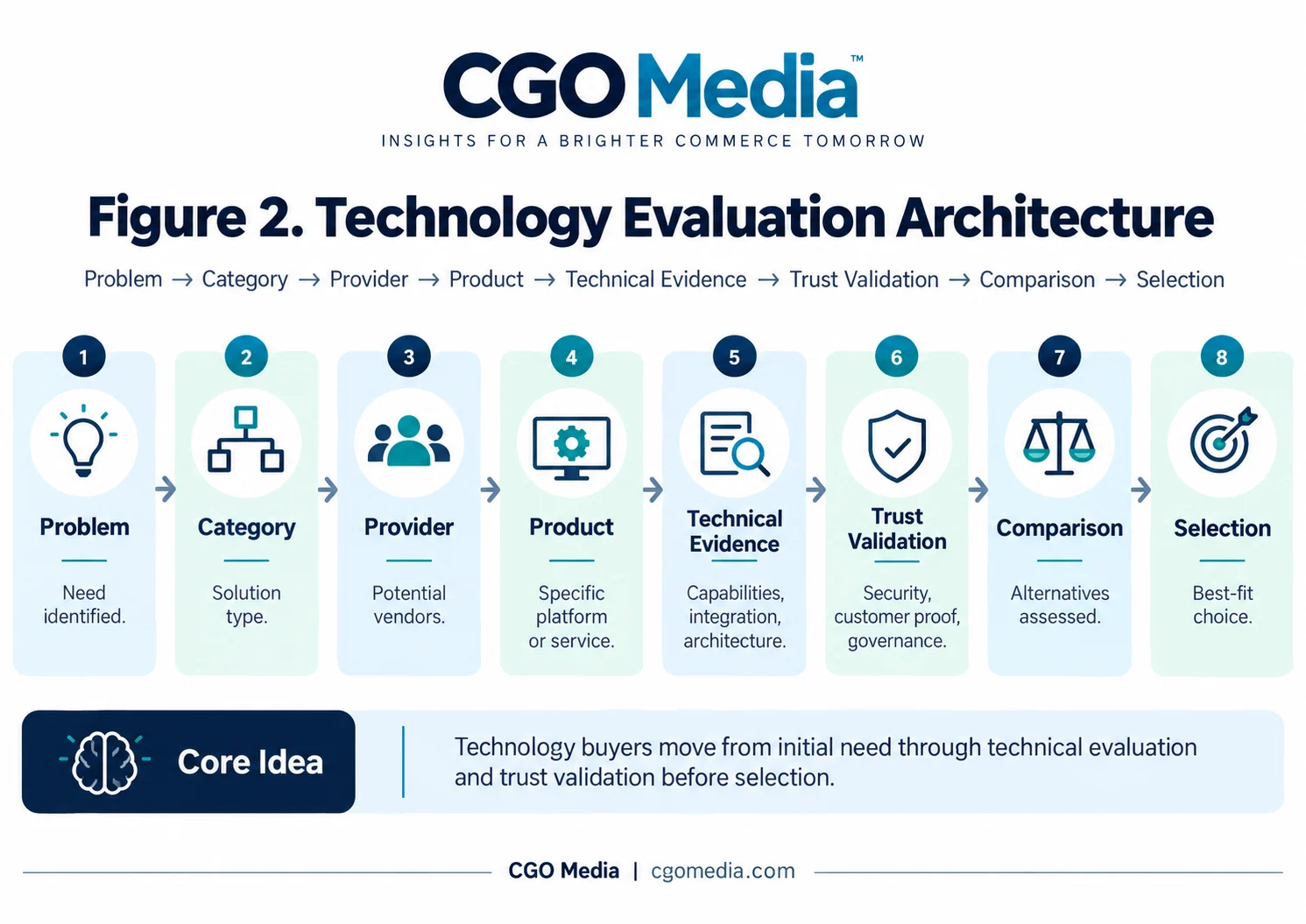
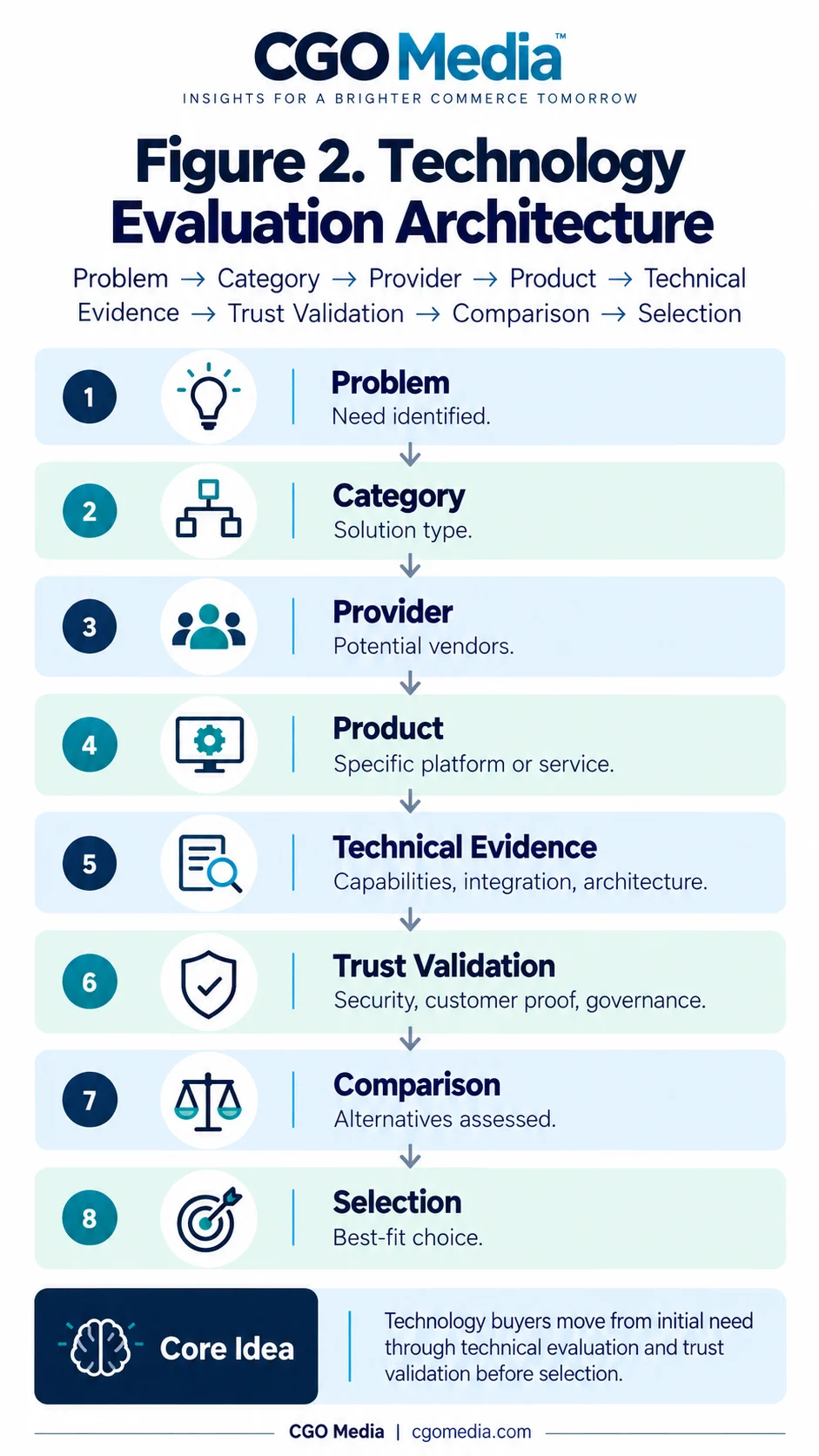
72. The Technology Evaluation Architecture
The complete evaluation relationship can be summarised as:
Problem → Category → Provider → Product → Technical Evidence → Trust Validation → Comparison → Selection
Problem
The buyer begins with a technical, operational or strategic requirement.
Category
The buyer identifies which technology category or solution approach may address the problem.
Provider
Relevant organisations enter the consideration set.
Product
The buyer identifies the specific product, platform or service capable of meeting the requirement.
Technical Evidence
Architecture, integration, security, performance, documentation and implementation information establish technical viability.
Trust Validation
Customer evidence, external authority, research, security evidence and organisational credibility help establish confidence.
Comparison
Plausible providers are evaluated according to technical fit, commercial fit, risk, support and implementation requirements.
Selection
The buyer selects the technology provider or solution representing the strongest fit for the specific organisational requirement.
The strategic implication is that technology organisations should build search architectures connecting product identity, documentation, technical evidence, customer validation and comparison criteria so buyers and AI systems can evaluate not merely whether a provider is visible, but whether it is genuinely suitable for a particular technical and commercial requirement.
Figure 2 : Technology Evaluation Architecture — Problem → Category → Provider → Product → Technical Evidence → Trust Validation → Comparison → Selection.
73. Technology Authority Requires Technical Depth
The Technology Evaluation Architecture explains how buyers move from identifying a problem through category discovery, provider evaluation, technical evidence, trust validation and eventual selection.
The next requirement is confidence.
Technology buyers often need to establish not merely that a product exists, but that important technical and commercial claims are sufficiently supported.
A useful trust relationship is:
Technical Evidence + Security Evidence + Customer Evidence + Independent Validation + Information Governance → Stronger Technology Trust
Technology authority therefore develops through evidence rather than promotional language alone.
74. Technical Buyers Need More Than Benefit Statements
Commercial content may explain why a product is useful, but technical buyers frequently need deeper information before progressing.
Important evidence can involve:
- Architecture
- APIs
- Integrations
- Deployment
- Performance
- Security
- Operational constraints
A product becomes easier to evaluate when commercial claims connect directly with supporting technical evidence.
75. Technical Content Should Support Different Depths of Evaluation
Technology audiences do not all require the same information depth.
A useful progression is:
Category Education → Product Understanding → Technical Validation → Expert Evaluation
Category Education
Explains the problem, terminology and broad solution approaches.
Product Understanding
Explains capabilities, use cases and suitability.
Technical Validation
Provides architecture, integration, security and implementation evidence.
Expert Evaluation
Supports deeper examination through technical papers, benchmarks, architecture guides and research.
76. Developer Search Behaviour Requires Separate Consideration
Developers frequently search differently from commercial buyers.
Their queries can involve highly specific tasks such as:
- API endpoints
- Authentication methods
- SDK support
- Configuration
- Error messages
- Integration problems
This means developer documentation can generate significant search visibility independently of conventional product marketing.
77. Developer Search Is Often Task-Led
Developer queries frequently begin with an immediate objective:
How do I make this technology perform a specific task?
The organisation that provides the clearest answer can become part of the developer’s evaluation process even when broader commercial research has not yet begun.
Documentation therefore plays both a support role and a discovery role.
78. Developer Discovery Happens Across Multiple Environments
Technical discovery may occur through:
- Search engines
- Developer forums
- Code repositories
- Community discussions
- AI coding assistants
The provider website is therefore only one part of the developer information environment.
Consistent terminology and clear technical identity become especially important when evidence is distributed across several systems.
79. Developer Experience Can Influence Product Selection
A commercially strong product can lose technical preference where developers encounter:
- Poor documentation
- Unclear APIs
- Weak examples
- Difficult integration
- Inconsistent terminology
Developer experience should therefore be considered part of product-selection authority.
80. Documentation Searchability Is Strategic
Technical users should be able to locate exact implementation answers efficiently.
Useful documentation structures can include:
- Getting started
- Authentication
- Integration
- Configuration
- Troubleshooting
- Migration
- Reference documentation
Clear titles and task-oriented navigation reduce friction for both human users and retrieval systems.
81. Error and Troubleshooting Content Can Capture High-Intent Demand
Technical users frequently search using exact:
- Error messages
- Failure states
- Configuration problems
- Integration issues
Useful troubleshooting resources can support:
Search Discovery + Problem Resolution + Product Confidence
This type of content may have relatively narrow search volume while carrying high relevance for active users and evaluators.
82. API Documentation Can Become Long-Term Authority Infrastructure
Well-maintained API documentation can attract recurring technical discovery because implementation questions continue throughout the customer lifecycle.
Strong API resources should make important information clear, including:
- Authentication
- Endpoints
- Parameters
- Responses
- Errors
- Rate limits
- Version status
Documentation quality therefore contributes to both acquisition and customer retention.
83. Technical Proof Should Match the Claim
Different technology claims require different forms of evidence.
For example:
Performance Claims
May require benchmarks or clearly defined operating conditions.
Integration Claims
May require documentation, connectors, APIs or implementation examples.
Scalability Claims
May require architecture evidence and relevant customer examples.
Security Claims
May require security documentation, certifications or independently verifiable controls.
The general principle is:
Claim Importance ↑ → Evidence Requirement ↑
84. Performance Evidence Needs Context
Technology performance figures can become misleading when the test environment is unclear.
Useful performance evidence should explain where appropriate:
- Test conditions
- Workload
- Infrastructure
- Dataset
- Measurement method
A benchmark without context can appear precise while providing limited decision value.
85. Security Evidence Is a Distinct Trust Layer
Security can determine whether a provider remains eligible for consideration.
Security evidence can include:
- Encryption
- Identity and access controls
- Security architecture
- Data handling
- Certifications
- Independent testing
- Incident processes
The level of evidence required increases where the product handles sensitive, regulated or mission-critical information.
86. Security Claims Should Be Precise
Statements such as:
Secure by design.
may describe positioning but provide little technical evidence by themselves.
A stronger security environment connects:
Security Claim → Control → Evidence → Current Status
This improves both buyer confidence and internal governance.
87. Compliance Evidence Requires Careful Qualification
Technology providers may operate within regulatory environments involving:
- Privacy
- Data residency
- Industry standards
- Security requirements
- Sector-specific regulation
Organisations should distinguish clearly between:
- Organisation certification
- Product capability
- Customer configuration
- Customer compliance responsibility
Overstating compliance can create significant commercial and reputational risk.
88. Trust Centres Can Consolidate High-Value Evidence
Where appropriate, technology organisations can consolidate important trust information into clearly organised resources covering:
- Security
- Privacy
- Compliance
- Reliability
- Data practices
The objective is not simply to create another marketing page.
It is to make due-diligence evidence easier to locate and verify.
89. Operational Evidence Also Matters
Technology buyers may need confidence that a platform can remain reliable after implementation.
Operational evidence can involve:
- Availability
- Resilience
- Recovery
- Monitoring
- Incident response
- Support
This is particularly important for systems that become embedded within critical business processes.
90. Customer Evidence Adds Real-World Context
Technical documentation explains what a product can theoretically do.
Customer evidence can demonstrate how it has been used under real organisational conditions.
Strong customer evidence can show:
- Customer type
- Problem
- Implementation context
- Technology used
- Outcome
This helps buyers assess whether the experience is relevant to their own situation.
91. Customer Evidence Should Be Specific Enough to Evaluate
A testimonial stating that a platform is “excellent” provides limited technical or comparative value.
A stronger case study explains:
- What problem existed
- Why the product was selected
- How implementation occurred
- What changed afterwards
Specific evidence is easier to assess, cite and compare.
92. Customer Evidence Should Reflect Relevant Buyer Contexts
Customer evidence becomes more useful when it reflects important dimensions such as:
- Industry
- Company size
- Technical environment
- Use case
- Geography
A regulated enterprise may place greater weight on evidence from comparable regulated organisations than on generic customer examples.
93. Independent Validation Extends Beyond Customer Evidence
Technology authority can also be reinforced by external sources including:
- Technical publications
- Industry media
- Research organisations
- Professional communities
- Standards bodies
- Relevant partners
These sources can validate different aspects of the organisation’s expertise, technology or market position.
94. Source Relevance Matters More Than Generic Prestige
The strongest external source depends on the claim being supported.
For example:
- A specialist security publication may strengthen a cybersecurity claim.
- A developer community may provide useful evidence around integration experience.
- An industry publication may strengthen sector-specific relevance.
- A standards organisation may provide evidence around recognised technical standards.
Authority should therefore be assessed contextually.
95. Technology Trust Is Claim-Specific
A provider can be highly recognised while still having weak evidence around a particular capability.
Trust should therefore be evaluated according to the claim being made.
Relevant dimensions can include:
- Technical capability
- Security
- Reliability
- Scalability
- Integration
- Commercial viability
General brand strength should not substitute automatically for evidence in these areas.
96. Source Convergence Strengthens Technology Confidence
Technology authority becomes stronger when several evidence sources support the same underlying conclusion.
For example:
- The product page describes an integration.
- Documentation explains how the integration works.
- A customer case study demonstrates its use.
- An independent source references the relevant capability.
This creates evidence convergence.
A useful model is:
Owned Evidence + Technical Evidence + Customer Evidence + Independent Evidence → Stronger Confidence
97. Evidence Conflict Can Reduce Trust
Technology confidence can weaken when important sources materially disagree.
Examples include:
- Marketing claims a capability that documentation does not support.
- Documentation describes a feature that has been deprecated.
- External listings use outdated product names.
- Comparison platforms describe pricing or deployment incorrectly.
Conflict creates uncertainty about which evidence remains current.
98. Conflict Severity Should Be Weighted
A useful relationship is:
Conflict Severity + Persistence + Buyer Impact + Decision Importance → Evidence Risk
Minor wording differences may require little intervention.
Persistent conflicts involving security, product status, deployment or compatibility can materially influence provider eligibility.
99. Information Governance Is Therefore Part of Technology Trust
Public evidence should not be treated as a collection of pages maintained independently.
Important information should have clear ownership for:
- Accuracy
- Approval
- Publication
- Monitoring
- Updating
Information governance becomes particularly important where products change rapidly.
100. Subject-Matter Ownership Should Be Explicit
Different information classes may require different owners.
Product Information
May require product ownership.
Technical Documentation
May require engineering or documentation ownership.
Security Information
May require security-team validation.
Commercial Information
May require revenue, sales or finance ownership.
Compliance Information
May require legal, security or compliance review.
Clear ownership reduces the risk that outdated information remains publicly visible without accountability.
101. Governance Should Include Validation Before Publication
High-impact technology claims should be reviewed by appropriate subject-matter owners before they become part of the public evidence environment.
This is particularly important for claims involving:
- Security
- Performance
- Compliance
- Availability
- Technical compatibility
SEO optimisation should not reduce technical accuracy.
102. Governance Should Include Monitoring After Publication
Information can become inaccurate after publication because the underlying product changes.
Organisations should therefore monitor important evidence according to:
- Product changes
- Release cycles
- Security changes
- Commercial changes
- Regulatory changes
High-volatility information should generally receive more frequent review.
103. Search, Digital PR and AI Visibility Reinforce One Another
Technology evidence can perform several authority functions simultaneously.
A strong research report can:
- Rank in search
- Earn editorial citations
- Support AI-assisted answers
- Strengthen expert authority
A strong documentation page can:
- Capture technical searches
- Help developers
- Support sales evaluation
- Provide retrievable technical evidence
This creates a multiplier effect from high-utility evidence assets.
104. Technology Research Can Build External Authority
Original research can provide useful evidence around areas such as:
- Technology adoption
- Security trends
- Industry change
- Performance
- Buyer behaviour
Where methodology and limitations are transparent, research can become useful to:
- Buyers
- Journalists
- Analysts
- Researchers
- AI systems
This can extend technology authority beyond conventional commercial content.
105. Digital PR Should Reinforce Genuine Expertise
Digital PR is most valuable when external coverage reflects the organisation’s real:
- Technical capabilities
- Research
- Expertise
- Market relevance
Unrelated publicity may generate awareness without materially improving authority around the technology category that matters to buyers.
106. Search Discovery, External Citation and AI Synthesis Form One Authority Environment
Technology evidence can now contribute across three connected systems:
Search Discovery + External Citation + AI Synthesis
These should not be managed as completely separate programmes.
The same high-quality evidence can support all three.
107. High-Utility Evidence Assets Deserve Priority
Technology organisations should prioritise evidence capable of serving several audiences and discovery environments simultaneously.
High-utility assets can support:
- Searchers
- Buyers
- Developers
- Journalists
- AI systems
This produces greater strategic value than creating large volumes of low-depth content with limited evidential purpose.
108. The Ninth Technology SEO Principle
Technology search authority strengthens when commercial information, documentation, developer resources, research and independent validation form a connected evidence ecosystem rather than isolated content programmes.
109. The Tenth Technology SEO Principle
Technology trust should be evaluated claim by claim across technical, security, operational, commercial and organisational dimensions rather than inferred from brand reputation alone.
110. The Eleventh Technology SEO Principle
Source convergence can strengthen technology recommendation confidence, while material conflicts across websites, documentation, reviews and external platforms can weaken understanding and trust.
111. The Twelfth Technology SEO Principle
Technology information governance should connect subject-matter ownership with validation, publication, search accessibility, monitoring and update so that public evidence remains accurate as products evolve.
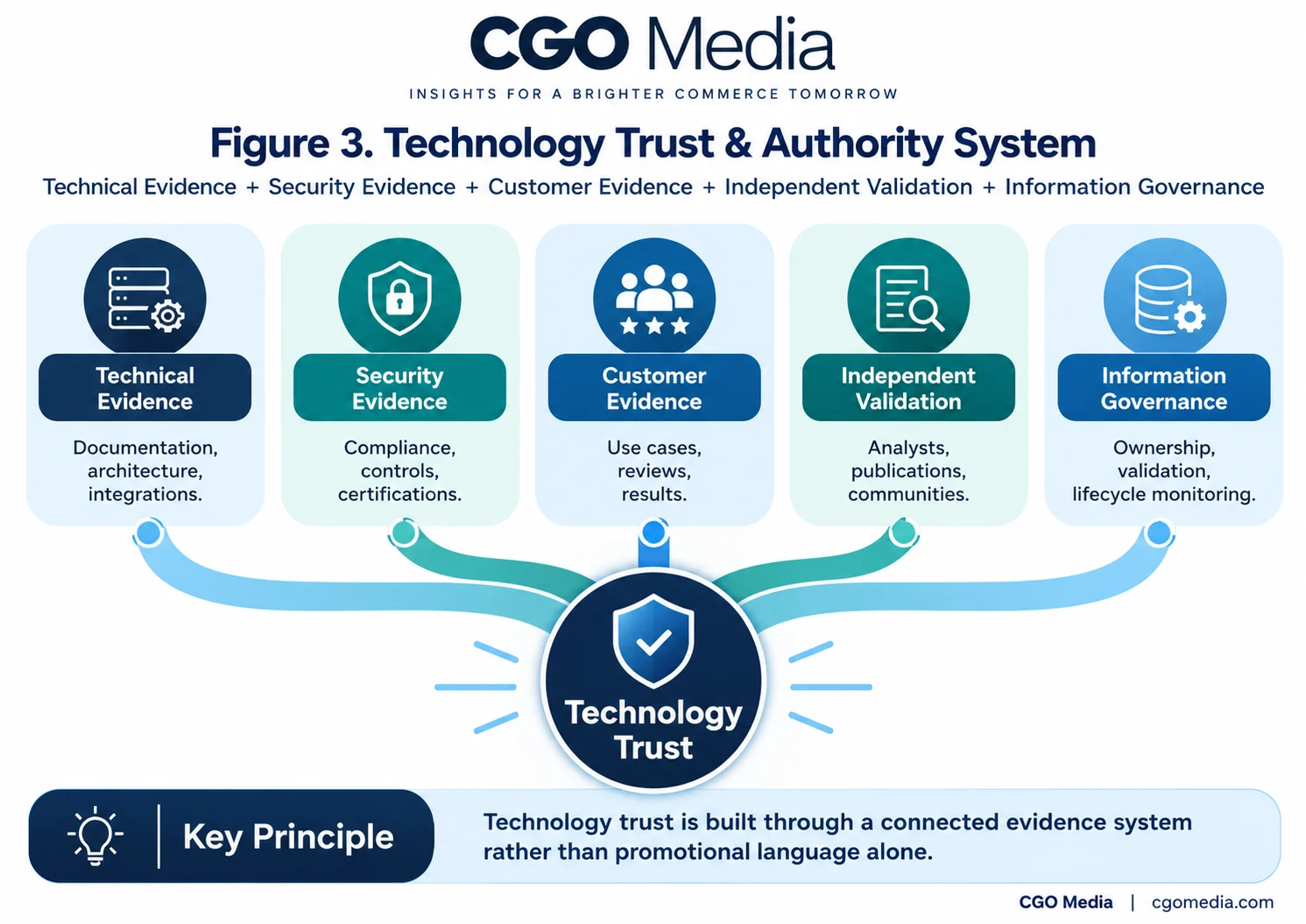
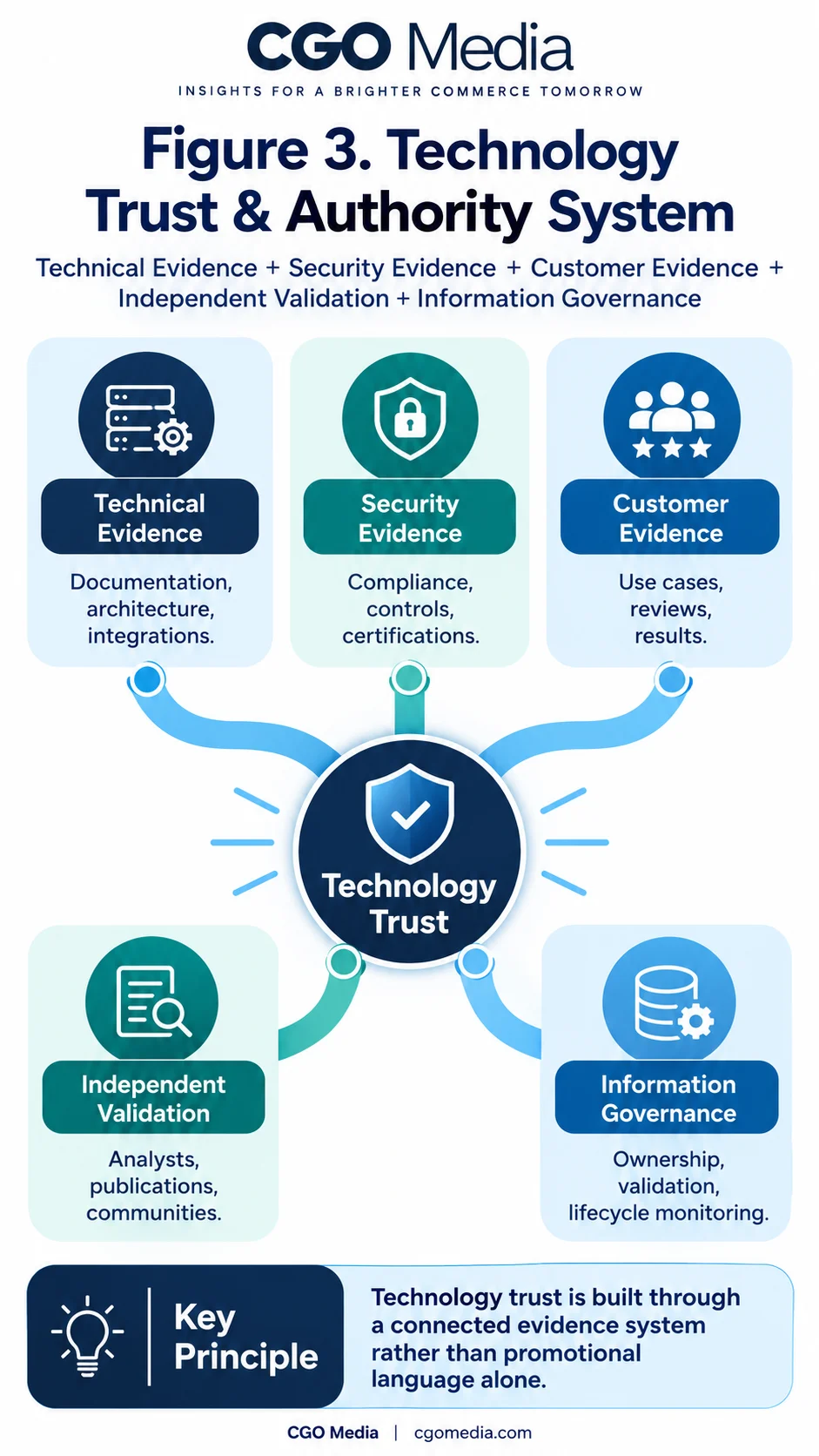
112. The Technology Trust & Authority System
The complete trust relationship can be summarised as:
Technical Evidence + Security Evidence + Customer Evidence + Independent Validation + Information Governance = Stronger Technology Trust
Technical Evidence
Architecture, documentation, integrations, APIs, implementation guidance and performance evidence help establish what the technology can genuinely do.
Security Evidence
Security architecture, controls, certifications, privacy information and appropriate compliance evidence help buyers assess technical and organisational risk.
Customer Evidence
Case studies, implementation examples, customer stories and verified reviews demonstrate how the technology performs within real organisational environments.
Independent Validation
Relevant publications, professional communities, research, standards organisations and other external sources can reinforce important technical or market claims.
Information Governance
Ownership, validation, lifecycle management and monitoring help ensure that public information remains current and internally consistent as products evolve.
The strategic implication is that technology organisations should build trust through a connected evidence system in which technical documentation, security information, customer proof, external authority and internal governance reinforce one another.
Figure 3 : Technology Trust & Authority System — Technical Evidence + Security Evidence + Customer Evidence + Independent Validation + Information Governance
113. AI Search Changes Technology Provider Discovery
The Technology Trust & Authority System explains how technical, security, customer and independent evidence contribute to provider confidence.
The next question is how that evidence influences discovery, comparison and shortlisting when buyers use AI-assisted search.
Technology discovery is increasingly capable of moving from:
Search Retrieval → Attribute Evaluation → Multi-Constraint Filtering → Provider Comparison → Shortlist Construction
This changes the strategic objective from merely appearing for a category keyword to becoming sufficiently clear and well evidenced to survive a more complex provider-selection process.
114. AI-Assisted Technology Search Can Combine Multiple Requirements
A conventional search journey may require several separate queries.
A buyer can now ask one compound question such as:
Which infrastructure monitoring platforms are suitable for a European financial organisation requiring hybrid deployment, strong security controls, enterprise support and integration with its existing cloud environment?
This combines several decision dimensions simultaneously:
- Product category
- Industry
- Geography
- Deployment model
- Security
- Support
- Integration
This creates multi-constraint technology discovery.
115. Multi-Constraint Discovery Requires Multi-Layer Evidence
A provider must be understandable across each material requirement used in the comparison.
If important evidence is missing, the provider may be harder to include confidently even where the underlying product is genuinely suitable.
This creates a useful principle:
Requirement Complexity ↑ → Evidence Completeness Requirement ↑
116. Search Visibility Alone Is Insufficient
A provider may rank strongly for a broad technology category while still failing to enter a credible recommendation shortlist.
Shortlist inclusion may also depend on whether the provider can demonstrate:
- Technical eligibility
- Operational suitability
- Security fit
- Commercial viability
- Buyer relevance
The organisation therefore needs both visibility and evaluability.
117. Qualified Inclusion Becomes a Core Technology SEO Objective
A stronger objective is:
Qualified Inclusion in Relevant Technology Consideration Sets
Qualified inclusion means the provider appears where it genuinely matches the buyer’s:
- Technical requirements
- Operational environment
- Commercial needs
- Risk profile
This is more strategically valuable than generic mention volume.
118. Technology Shortlists Are Built Through Progressive Filtering
A simplified provider funnel can be represented as:
Available Providers → Visible Providers → Technically Eligible Providers → Trusted Providers → Commercially Viable Providers → Shortlist → Selected Provider
Each stage removes providers that fail an important requirement.
119. Visibility Is the First Filter
A provider that is not discovered cannot enter the consideration process.
Discovery can occur through:
- Organic search
- AI recommendations
- Industry publications
- Comparison platforms
- Developer communities
- Partner ecosystems
Visibility remains necessary, but it is only the beginning.
120. Technical Eligibility Is the Second Filter
The product must satisfy essential technical requirements.
These can include:
- Deployment model
- Integration support
- Security controls
- Scalability
- Regional availability
- Architecture compatibility
Failure on one critical requirement can remove an otherwise strong provider from consideration.
121. Trust Is the Third Filter
The buyer needs sufficient confidence that important claims are supported.
Trust can depend on:
- Technical documentation
- Security evidence
- Customer evidence
- External authority
- Information consistency
Technical eligibility without credible evidence can still produce shortlist uncertainty.
122. Commercial Viability Is the Fourth Filter
A technically suitable provider may still become unsuitable because of:
- Budget
- Contract model
- Procurement requirements
- Support expectations
- Implementation cost
Technology provider selection therefore combines technical and commercial viability.
123. Shortlisting Is the Result of Surviving Multiple Filters
The shortlist contains providers that remain viable across the dimensions most important to the buyer.
This means technology selection is not a simple ranking problem.
It is a multi-dimensional suitability problem.
124. The Best Provider Depends on Buyer Context
The same technology can be highly suitable for:
- A large regulated enterprise
while being unnecessarily complex or expensive for:
- A smaller organisation with simpler requirements
Recommendation quality therefore depends on context rather than generic product superiority.
125. Recommendation Fit Is Contextual
A useful model is:
Buyer Requirements + Provider Attributes + Evidence Quality = Recommendation Fit
Buyer requirements define the problem.
Provider attributes define capability.
Evidence quality determines how confidently the match can be evaluated.
126. Buyer Requirements Define the Evaluation Problem
Buyer requirements can include:
- Technical need
- Business objective
- Risk tolerance
- Budget
- Deployment environment
- Industry obligations
These requirements determine which provider attributes deserve the greatest attention.
127. Provider Attributes Define Capability
Provider attributes can include:
- Features
- Architecture
- Integrations
- Security
- Support
- Pricing model
Technology comparison becomes more reliable when these attributes are explicit and current.
128. Evidence Quality Defines Confidence
A technically strong provider can remain difficult to recommend when the supporting evidence is:
- Incomplete
- Outdated
- Contradictory
- Overly promotional
Stronger and more consistent evidence makes the provider easier to evaluate.
129. Recommendation Fit Should Not Be Reduced to Brand Fame
A highly recognised technology company may still be poorly suited to a specific requirement.
Conversely, a smaller specialist provider can become highly relevant where it offers:
- Specific capability
- Clear evidence
- Strong buyer fit
- Credible validation
This creates meaningful opportunity for specialist technology providers.
130. Specialist Positioning Can Strengthen Qualified Visibility
Technology organisations often weaken relevance by positioning themselves as suitable for every customer and every problem.
Strong specialist positioning should explain:
- Who the provider serves
- Which problems it solves
- Where it is strongest
- Which requirements it supports
Specific expertise can make provider suitability easier to understand.
131. Explicit Boundaries Can Improve Trust
A provider does not need to claim suitability for every environment.
Acknowledging where a product is:
- Not designed for a particular use case
- Unavailable in a region
- Dependent on specific infrastructure
- Unsuitable below a certain scale
can improve credibility by reducing ambiguity.
132. AI Systems Can Compare Trade-Offs
Technology comparison frequently involves trade-offs rather than one universally superior option.
A buyer may ask:
Which platform offers the strongest security and integration flexibility even if implementation is more expensive?
This introduces weighted comparison.
133. Not Every Attribute Carries Equal Weight
Different organisations prioritise different attributes.
A useful conceptual relationship is:
Attribute Importance × Provider Strength × Evidence Confidence
This is not intended as a literal platform ranking formula.
It demonstrates why identical provider attributes can have very different importance across buyers.
134. Security Can Carry High Weight in Regulated Markets
A regulated organisation may accept:
- Higher cost
- Longer implementation
- Greater operational complexity
in exchange for stronger security, governance or compliance support.
Security evidence therefore becomes a major comparative input.
135. Integration Can Carry High Weight in Complex Enterprises
A provider with fewer headline features may still be the stronger option where it integrates more effectively with:
- Existing infrastructure
- Identity systems
- Data platforms
- Cloud environments
- Operational workflows
Compatibility can therefore outweigh raw feature volume.
136. Ease of Use Can Carry High Weight for Smaller Organisations
A technically powerful platform can become a weak fit where:
- Implementation is too complex
- Administration requires specialist staff
- Operational overhead is excessive
This is another example of context changing recommendation strength.
137. Support Can Carry High Weight for Mission-Critical Systems
Buyers may place significant weight on:
- 24/7 support
- Named account support
- Response commitments
- Implementation assistance
A provider with stronger support evidence may therefore outperform a technically similar competitor.
138. Pricing Can Carry High Weight in More Standardised Categories
Where technical differences between providers are comparatively small, commercial terms can become more important.
Technology comparison should therefore account for:
- Technical differentiation
- Operational value
- Commercial terms
rather than assuming one evaluation model applies to every category.
139. Evidence Confidence Influences Shortlist Inclusion
A provider can possess strong underlying capability while remaining difficult to shortlist because the evidence needed to confirm suitability is weak.
Common information gaps can involve:
- Security
- Deployment
- Integration
- Pricing
- Support
Missing evidence creates recommendation uncertainty.
140. Evaluation Completeness Is a Strategic Requirement
A provider is evaluation-ready when enough reliable information exists to answer important buyer questions.
Evaluation completeness can include:
- Product identity
- Feature clarity
- Technical architecture
- Security evidence
- Integration evidence
- Commercial clarity
This is different from content volume.
A website can contain hundreds of pages while still failing to answer the questions that determine selection.
141. Information Gaps Should Be Diagnosed by Buyer Stage
The organisation should ask:
- What does the buyer need to know now?
- What prevents progression?
- Which evidence is missing?
This is more useful than simply identifying topics for additional content production.
142. Early-Stage Buyers Need Category Understanding
Early-stage information can include:
- Definitions
- Use cases
- Problem framing
- Solution approaches
The objective is to help the buyer understand the technology landscape before provider evaluation becomes dominant.
143. Mid-Stage Buyers Need Provider Understanding
Mid-stage evaluation can require:
- Product information
- Capabilities
- Industry relevance
- Integration options
This is where entity clarity and explicit provider attributes become especially important.
144. Late-Stage Buyers Need Validation
Late-stage buyers may require:
- Security documentation
- Case studies
- Pricing information
- Support details
- Procurement evidence
The information environment should therefore deepen as the buyer moves toward selection.
145. Technology Buying Journeys Are Multi-Stakeholder
Different stakeholders can enter the journey at different stages.
A developer may begin with documentation.
An executive may begin with category research.
A security team may enter during technical validation.
Procurement may enter close to selection.
Technology SEO should therefore support several evaluation paths simultaneously.
146. Terminology Mapping Can Improve Discovery
Different stakeholders may use different language for the same technology.
Technology organisations should understand:
- Technical terminology
- Commercial terminology
- Industry terminology
- Buyer terminology
Search strategy can connect these language systems without distorting technical meaning.
147. Technology Comparison Requires Competitor Intelligence
A provider should understand which alternatives buyers genuinely consider.
The relevant competitive set can include:
- Direct competitors
- Adjacent technology providers
- Alternative technical approaches
- Internal build options
The effective comparison set can therefore differ from the competitors tracked by sales or marketing teams.
148. AI Co-Occurrence Can Reveal the Effective Competitive Set
Where several providers repeatedly appear together in relevant AI recommendation scenarios, that co-occurrence can provide useful evidence about how the market is being framed.
Organisations should distinguish between:
- Commercial competitors
- Search competitors
- AI recommendation competitors
These groups may overlap without being identical.
149. Competitive Gaps Should Be Classified Correctly
Where another provider consistently performs better, the organisation should determine why.
The gap may be:
Capability Gap
The competitor genuinely offers stronger functionality or suitability.
Evidence Gap
The organisation has equivalent capability but explains it poorly.
Authority Gap
The capability is clear but lacks sufficient external validation.
Positioning Gap
The organisation appears less relevant to the buyer’s specific requirement.
This distinction prevents genuine product problems from being treated as content problems.
150. Capability Gaps Require Product Improvement
SEO cannot sustainably compensate for missing:
- Features
- Integrations
- Security capability
- Required deployment models
Where the product genuinely fails the buyer requirement, the correct intervention is product or service improvement.
151. Evidence Gaps Require Better Representation
Where the capability exists but is poorly explained, the organisation may need stronger:
- Product content
- Technical documentation
- Architecture information
- Case studies
- Comparison support
This is where Technology SEO can create substantial value.
152. Authority Gaps Require Independent Validation
Where owned evidence is clear but external confidence remains weak, improvement can involve:
- Research
- Technical publications
- Digital PR
- Customer evidence
- Relevant third-party validation
The purpose is to strengthen credible authority around genuine capabilities.
153. Positioning Gaps Require Greater Relevance
A provider can possess the right capabilities while presenting itself too broadly.
Stronger positioning can clarify:
- Priority markets
- Best-fit industries
- Key use cases
- Deployment strengths
- Technical specialisms
This can improve qualified consideration without requiring broader visibility.
154. Technology Search Authority Is Cross-Functional
Accurate provider discovery depends on evidence controlled by several functions.
A practical model is:
SEO + Product + Engineering + Security + Sales + Customer Success + PR
SEO
Contributes discoverability, architecture and search insight.
Product
Contributes positioning, capability definition and roadmap context.
Engineering
Contributes technical truth.
Security
Contributes risk, control and compliance evidence.
Sales
Contributes buyer objections and comparison intelligence.
Customer Success
Contributes post-sale evidence and implementation insight.
PR
Contributes external authority and independent visibility.
Technology search authority is strongest when these inputs converge.
155. The Thirteenth Technology SEO Principle
AI-assisted technology discovery increasingly operates through multi-constraint recommendation, making explicit buyer fit and technically verifiable provider attributes essential for relevant shortlist inclusion.
156. The Fourteenth Technology SEO Principle
Technology comparison is weighted and context-specific, so recommendation strength depends on the importance of each attribute to the buyer as well as the quality of the evidence supporting it.
157. The Fifteenth Technology SEO Principle
Competitive search gaps should be diagnosed as capability, evidence, authority or positioning problems so organisations do not attempt to solve genuine product weaknesses with content optimisation alone.
158. The Sixteenth Technology SEO Principle
Technology search authority is inherently cross-functional because accurate discovery and recommendation depend on coordinated input from product, engineering, security, sales, customer success, PR and SEO.
159. The Integrated Technology Selection System
The complete provider-selection relationship can be summarised as:
Buyer Requirements → Provider Attributes → Technical Evidence → Trust Validation → Comparative Fit → Recommendation Confidence → Shortlist
Buyer Requirements
Define the technical, operational, commercial and risk conditions the solution must satisfy.
Provider Attributes
Describe the product’s features, architecture, integrations, deployment model, security, support and commercial characteristics.
Technical Evidence
Documentation, architecture information, integration guidance, security material and product evidence establish whether claimed capabilities are supportable.
Trust Validation
Customer evidence, independent authority, security validation and information consistency increase confidence in the provider’s claims.
Comparative Fit
The provider is evaluated against realistic alternatives according to the attributes most important to the buyer.
Recommendation Confidence
Sufficient evidence exists to determine that the provider represents a credible and relevant option.
Shortlist
The provider survives the most important technical, trust and commercial filters and remains among the plausible options for final evaluation.
The strategic implication is that technology organisations should optimise for qualified shortlist inclusion by ensuring that buyer requirements, provider capabilities, technical evidence, trust signals and comparative positioning are explicit enough to support accurate evaluation across conventional search and AI-assisted recommendation environments.
Figure 4 : Integrated Technology Selection System — Buyer Requirements → Provider Attributes → Technical Evidence → Trust Validation → Comparative Fit → Recommendation Confidence → Shortlist.
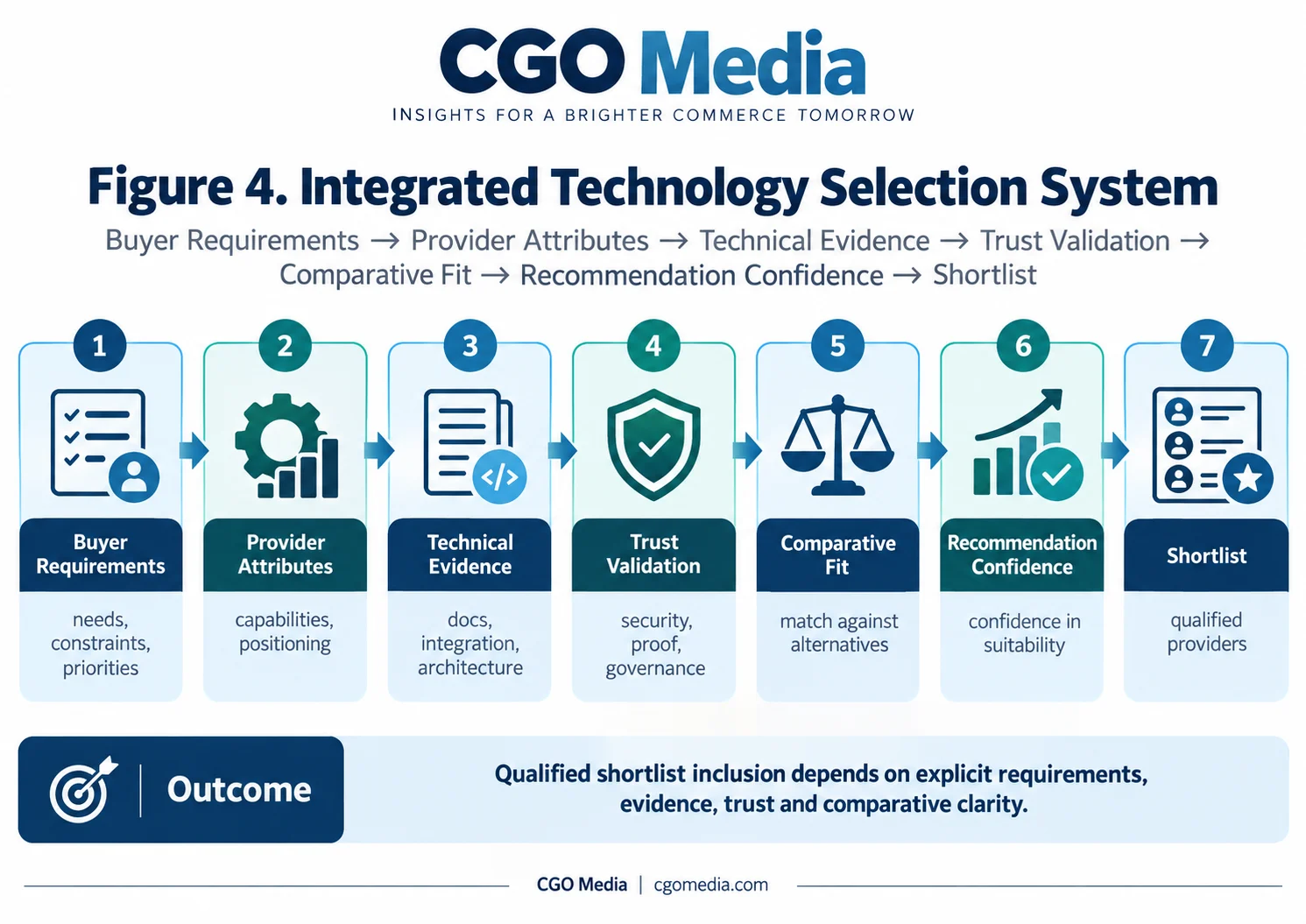
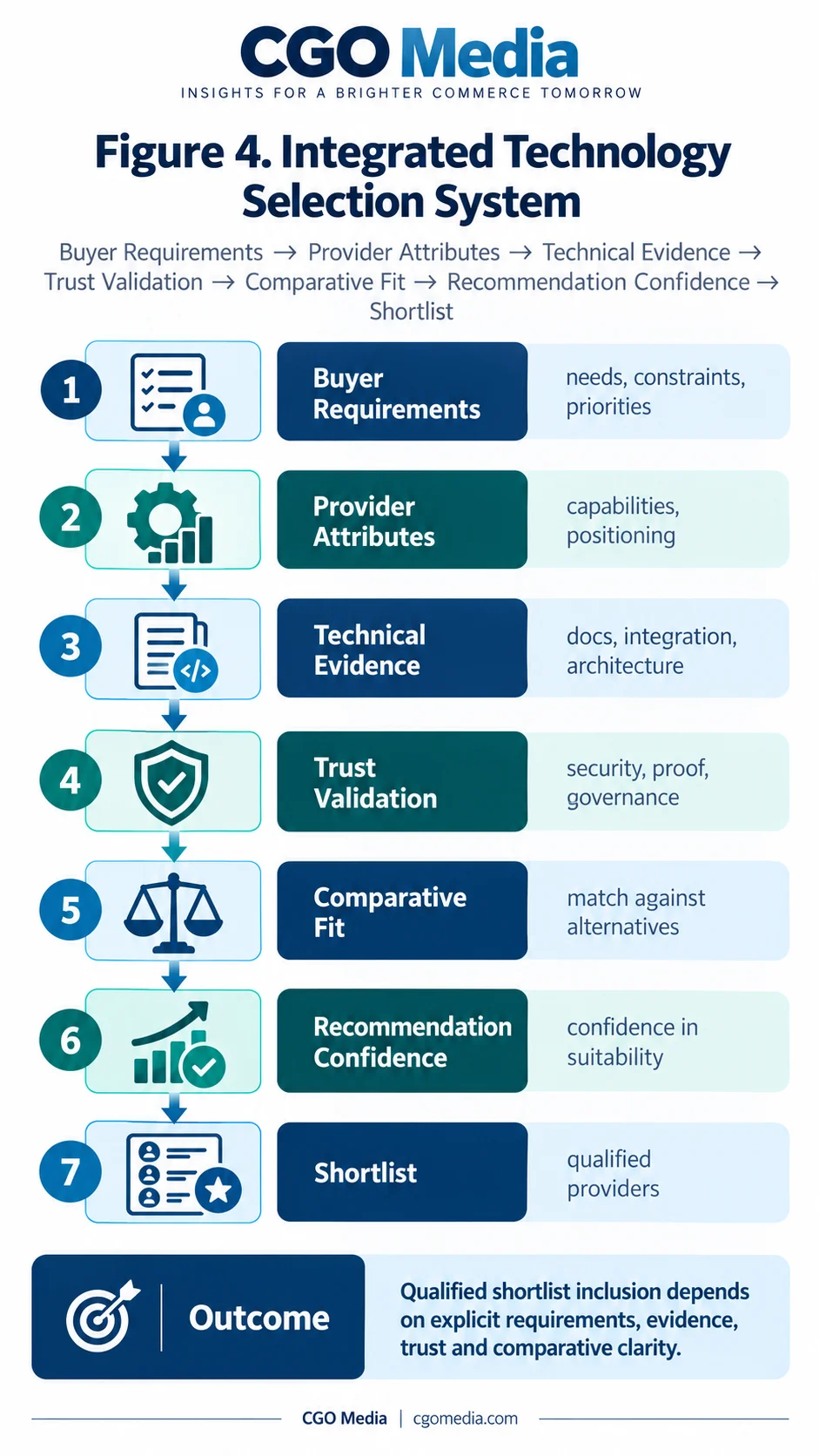
160. Technology SEO Should Be Measured Across the Full Buyer Journey
The Integrated Technology Selection System explains how buyer requirements, provider attributes, technical evidence and trust combine to influence shortlist inclusion.
The next question is how this performance should be measured.
Traffic alone does not reveal whether technology search visibility is creating meaningful commercial value.
A more useful measurement sequence is:
Discovery → Understanding → Technical Evaluation → Trust → Comparison → Shortlist → Qualified Conversion → Commercial Impact
Each stage answers a different strategic question.
161. Discovery Measurement
Discovery measurement asks:
Does the organisation enter relevant buyer consideration?
Useful discovery measures can include:
- Category visibility
- Use-case visibility
- Industry visibility
- Technical search visibility
- AI discovery presence
- Referral visibility from relevant external sources
The objective is not simply maximum impressions.
It is meaningful visibility among buyers whose requirements could plausibly match the offering.
162. Non-Brand Visibility Indicates New Discovery
Non-brand search visibility helps measure whether buyers can discover the organisation before already knowing its name.
Relevant query groups can include:
- Technology categories
- Operational problems
- Industry requirements
- Use cases
- Technical implementation questions
This makes non-brand visibility particularly important for market expansion and category discovery.
163. Branded Search Measures a Different Behaviour
Branded search can reflect:
- Existing awareness
- Sales influence
- External media coverage
- AI-assisted discovery
- Previous product exposure
It should therefore not automatically be attributed to organic SEO alone.
Technology buying journeys are commonly multi-touch.
164. Understanding Measurement
After discovery, the buyer must understand the provider sufficiently to continue evaluation.
Understanding measurement asks:
Can buyers determine what the organisation offers, who it serves and how its technology fits their requirement?
Useful indicators can include:
- Product-page engagement
- Use-case exploration
- Industry-page engagement
- Navigation into technical information
- Repeated clarification questions
165. Information Gaps Can Be Identified from Buyer Questions
Recurring questions from buyers, sales teams and customer-facing staff can reveal weak digital representation.
Common gaps may involve:
- Pricing
- Integrations
- Deployment
- Security
- Support
- Regional availability
If buyers repeatedly ask questions that should be answerable before sales contact, the information architecture may require improvement.
166. Technical Evaluation Measurement
Technical evaluation asks:
Can technical stakeholders find sufficient evidence to determine whether the product is viable?
Useful measurement areas include:
- Documentation engagement
- Architecture-resource engagement
- API documentation usage
- Integration-content usage
- Security-resource usage
- Technical downloads
This stage should not be evaluated solely through immediate lead generation.
167. Documentation Has Different Success Metrics from Product Pages
Documentation often supports evaluation, implementation and retention rather than immediate conversion.
Useful signals can include:
- Search visibility
- Successful navigation
- Technical task completion
- Repeat usage
- Reduced support friction
Measuring documentation only by demo requests can therefore underestimate its strategic value.
168. Evaluation Readiness Can Be Audited
A practical technical-evaluation audit can assess:
- Documentation completeness
- Architecture clarity
- Integration evidence
- Security evidence
- Implementation guidance
- Version accuracy
The objective is to identify whether the buyer has enough evidence to progress without unnecessary uncertainty.
169. Trust Measurement
Trust measurement asks:
Does the wider evidence environment reinforce the provider’s technical and commercial claims?
Useful indicators can include:
- Customer evidence
- External citations
- Relevant media visibility
- Technical authority
- Partner validation
- Review quality where applicable
Trust should be analysed in relation to important claims rather than reduced to a single reputation score.
170. Technical Trust Should Be Measured Separately from General Brand Awareness
A recognised brand can still possess weak evidence around:
- Security
- Integration
- Architecture
- Scalability
- Compliance support
Measurement should therefore distinguish general awareness from capability-specific trust.
171. Independent Authority Should Be Evaluated for Relevance
External mentions are not equally valuable.
More meaningful authority can come from sources directly connected with:
- The technology category
- The relevant industry
- The technical claim
- The buyer problem
Relevant authority provides stronger evidence than unrelated publicity.
172. Comparison Measurement
Comparison measurement asks:
Does the provider remain competitive when realistic alternatives are evaluated alongside it?
Comparison can involve:
- Features
- Architecture
- Security
- Integrations
- Support
- Pricing
- Implementation requirements
The strongest provider will vary according to buyer context.
173. Comparison Readiness Should Be Tested
A comparison-readiness review can ask:
- Are major capabilities explicit?
- Are important constraints clear?
- Can deployment models be understood?
- Can security evidence be verified?
- Can buyers identify relevant differentiation?
Where the answers are weak, the provider may underperform during comparison even when the product itself is competitive.
174. AI Recommendation Measurement
AI-assisted search creates a distinct measurement layer.
The organisation should evaluate whether it appears within appropriate:
- Provider recommendations
- Technology comparisons
- Category explanations
- Use-case recommendations
- Industry-specific shortlists
Presence alone is not sufficient.
The quality of that presence also matters.
175. AI Visibility Should Be Measured Across Four Dimensions
A practical model includes:
- Presence
- Relevance
- Accuracy
- Recommendation Fit
Presence
Does the provider appear?
Relevance
Does inclusion make sense for the buyer scenario?
Accuracy
Are important product facts represented correctly?
Recommendation Fit
Does the provider genuinely satisfy the stated requirements?
176. AI Presence Without Relevance Is a Weak Success Metric
A technology company can appear frequently while being recommended for poorly matched use cases.
This can create:
- Low-quality traffic
- Poor sales qualification
- Buyer confusion
- Commercial inefficiency
Qualified recommendation visibility is therefore more useful than raw mention count.
177. AI Accuracy Should Be Monitored
Important product attributes to monitor can include:
- Product identity
- Capabilities
- Integrations
- Deployment model
- Security
- Availability
- Pricing model where relevant
Incorrect representation can create more risk than simple absence where buyers rely on that information during evaluation.
178. AI Testing Should Use Scenario Families
One prompt cannot represent an entire technology market.
Monitoring should therefore use structured scenario families combining variables such as:
- Technology category
- Industry
- Organisation size
- Deployment model
- Security requirement
- Integration requirement
- Budget or commercial constraint
This produces a more representative picture of recommendation visibility.
179. AI Measurement Should Be Longitudinal
Generated outputs can vary over time.
Monitoring should therefore record factors such as:
- Platform
- Prompt
- Date
- Market
- Language
- Observed provider set
The objective is to identify persistent patterns rather than react to isolated outputs.
180. Shortlist Measurement Is More Valuable Than Generic Presence
A particularly useful AI and search objective is:
Relevant Shortlist Inclusion
This asks:
Across strategically important buyer scenarios, how often does the organisation remain among the credible provider options?
This moves measurement closer to actual buyer evaluation.
181. Shortlist Inclusion Should Be Segmented
Analysis can be segmented by:
- Category
- Use case
- Industry
- Buyer type
- Technical constraint
- Geography
A provider may be highly visible for one category while relatively weak for another strategically important scenario.
182. Co-Occurrence Can Reveal the Real Competitive Set
Where technology providers repeatedly appear together in:
- Search results
- Comparison pages
- AI shortlists
the pattern can reveal the effective competitive environment.
This can help organisations distinguish:
- Commercial competitors
- Search competitors
- AI recommendation competitors
183. Conversion Measurement Should Focus on Qualification
Technology conversions can include:
- Demo requests
- Trials
- Technical consultations
- Contact forms
- Sales enquiries
However, raw conversion count can be misleading where the resulting demand is poorly matched.
A stronger objective is:
Qualified Conversion
184. Qualified Conversion Connects Visibility with Buyer Fit
A qualified conversion involves a buyer whose:
- Requirements
- Organisation profile
- Technical environment
- Commercial conditions
have meaningful alignment with the provider’s offering.
This creates a stronger relationship between SEO performance and sales quality.
185. Conversion Quality Is More Valuable Than Conversion Volume Alone
A search programme producing large numbers of poorly matched enquiries can increase:
- Sales workload
- Qualification cost
- Pipeline noise
A smaller volume of better-matched enquiries may create greater commercial value.
A useful relationship is:
Qualified Visibility → Qualified Engagement → Qualified Conversion → Commercial Opportunity
186. Sales Qualification Data Should Feed Back into SEO
Sales teams often possess evidence about:
- Buyer fit
- Lost opportunities
- Common objections
- Missing capabilities
- Competitor selection
This information should inform:
- Content strategy
- Comparison strategy
- Positioning
- Keyword targeting
- AI visibility analysis
Search intelligence and sales intelligence should operate as connected systems.
187. Commercial Impact Measurement
Commercial impact asks:
Is search and AI visibility contributing to commercially meaningful outcomes?
Useful indicators can include:
- Pipeline contribution
- Opportunity creation
- Revenue contribution
- Sales efficiency
- Acquisition quality
This does not require every sale to be attributed exclusively to SEO.
It requires understanding how search contributes to the wider buying journey.
188. Search Attribution in Technology Markets Is Multi-Touch
A buyer may interact with:
- Organic search
- Documentation
- AI assistants
- Industry publications
- Case studies
- Sales teams
- Webinars
before becoming a customer.
The final conversion source therefore rarely explains the complete influence pathway.
189. AI Influence Can Occur Without a Direct Referral
A buyer may discover or compare the provider through an AI assistant and later return through:
- Branded search
- Direct navigation
- A sales conversation
Direct referral data can therefore understate AI-assisted discovery influence.
190. Search Assets Should Have Stage-Appropriate KPIs
Different assets serve different buyer stages.
A useful framework is:
- Discovery pages → Qualified visibility
- Documentation → Technical engagement
- Comparison pages → Shortlist progression
- Product pages → Qualified conversion
Measuring every page against the same conversion metric produces a weak understanding of value.
191. Informational Research Can Influence Commercial Decisions Indirectly
Research and educational content may:
- Create initial awareness
- Establish expertise
- Support technical evaluation
- Earn external authority
before a buyer reaches a product page.
The commercial role of research should therefore be interpreted within the complete journey.
192. Executive Measurement Should Remain Compact
Senior decision-makers do not need hundreds of isolated SEO metrics.
A practical Technology Search Executive Scorecard can consolidate performance into:
- Discovery Visibility
- Technical Evaluation Readiness
- Trust Strength
- AI Recommendation Visibility
- Qualified Conversion
- Commercial Impact
193. Discovery Visibility Score
This dimension can reflect:
- Category visibility
- Use-case visibility
- Industry visibility
- AI presence
The purpose is to assess whether the organisation enters relevant buyer discovery environments.
194. Technical Evaluation Readiness Score
This dimension can reflect:
- Documentation completeness
- Architecture clarity
- Integration evidence
- Security evidence
The purpose is to assess whether technical stakeholders have enough information to evaluate viability.
195. Trust Strength Score
This dimension can reflect:
- Customer evidence
- Independent validation
- Technical authority
- External citations
The purpose is to assess whether important provider claims are sufficiently reinforced outside first-party marketing.
196. AI Recommendation Visibility Score
This dimension can reflect:
- Relevant inclusion
- Accuracy
- Recommendation fit
- Stability over repeated testing
The objective is to measure useful recommendation visibility rather than isolated mentions.
197. Qualified Conversion Score
This dimension can reflect:
- Qualified demos
- Qualified trials
- Qualified enquiries
- Opportunity creation
It helps connect search performance with genuine buyer fit.
198. Commercial Impact Score
This dimension can reflect:
- Pipeline contribution
- Revenue contribution
- Sales efficiency
- Acquisition quality
The score should be interpreted alongside the limitations of multi-touch attribution.
199. Critical Risks Should Sit Outside the Average Score
Certain technology-information failures deserve immediate attention and should not disappear inside an overall score.
Critical risks can include:
- False security information
- Incorrect compliance claims
- Wrong product identity
- Material integration misinformation
- Incorrect product availability
These issues can influence buyer risk, contractual decisions and organisational trust disproportionately.
200. Measurement Should Identify the Constraint
The central management question should be:
Where are qualified buyers being lost?
If Discovery Is Weak
Prioritise visibility and category relevance.
If Understanding Is Weak
Prioritise product clarity and information architecture.
If Technical Evaluation Is Weak
Prioritise documentation and technical evidence.
If Trust Is Weak
Prioritise customer evidence and independent validation.
If Shortlist Inclusion Is Weak
Prioritise fit, positioning and comparison readiness.
If Conversion Is Weak
Prioritise qualification, commercial clarity and buyer friction.
If Commercial Impact Is Weak
Investigate whether visibility is attracting the wrong demand or failing to influence meaningful opportunities.
201. The Seventeenth Technology SEO Principle
Technology SEO should be measured across discovery, technical evaluation, trust, shortlisting and qualified conversion rather than through traffic and rankings alone.
202. The Eighteenth Technology SEO Principle
AI visibility should be assessed through repeated scenario-based testing of presence, relevance, accuracy and recommendation fit rather than through isolated generated answers.
203. The Nineteenth Technology SEO Principle
Search attribution in technology markets should recognise multiple discovery, validation and comparison touchpoints because final conversion sources rarely explain the complete buying journey.
204. The Twentieth Technology SEO Principle
Qualified conversion is a stronger commercial metric than raw enquiry volume because it reflects whether search visibility is connecting the provider with buyers whose technical and commercial requirements genuinely match the offering.
205. The Technology Search Measurement Funnel
The complete measurement sequence can be summarised as:
Discovery → Understanding → Technical Evaluation → Trust → Comparison → Shortlist → Qualified Conversion → Commercial Impact
Discovery
Measures whether the provider enters relevant category, problem, use-case, industry and AI-assisted discovery environments.
Understanding
Measures whether buyers can determine what the organisation offers and whether the technology could plausibly fit their needs.
Technical Evaluation
Measures whether documentation, architecture, integrations, security and implementation evidence support deeper technical assessment.
Trust
Measures whether customer evidence, independent authority and information consistency sufficiently reinforce important claims.
Comparison
Measures whether the provider remains competitive when assessed alongside realistic alternatives.
Shortlist
Measures whether the provider survives the buyer’s technical, commercial and trust filters and remains among the credible options.
Qualified Conversion
Measures whether relevant discovery progresses into demos, trials, enquiries or sales opportunities with genuine buyer fit.
Commercial Impact
Measures how the wider search and AI authority system contributes to pipeline, revenue, sales efficiency and acquisition quality.
The strategic implication is that technology organisations should connect search measurement with buyer progression and commercial quality, evaluating each search asset according to the role it plays in discovery, technical validation, shortlist inclusion and qualified demand rather than judging the entire programme through traffic volume alone.
Figure 5 : Technology Search Measurement Funnel — Discovery → Understanding → Technical Evaluation → Trust → Comparison → Shortlist → Qualified Conversion → Commercial Impact.
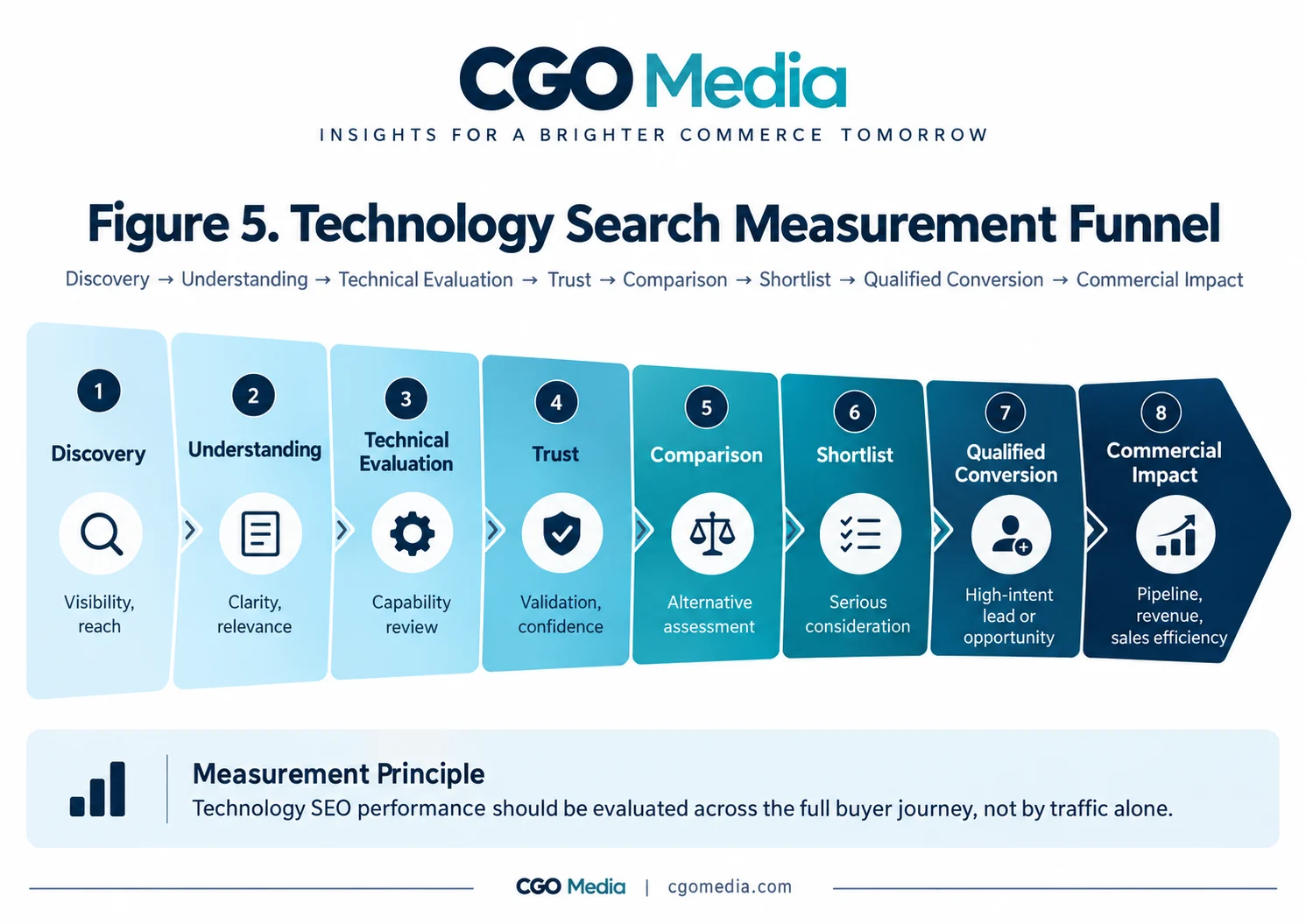
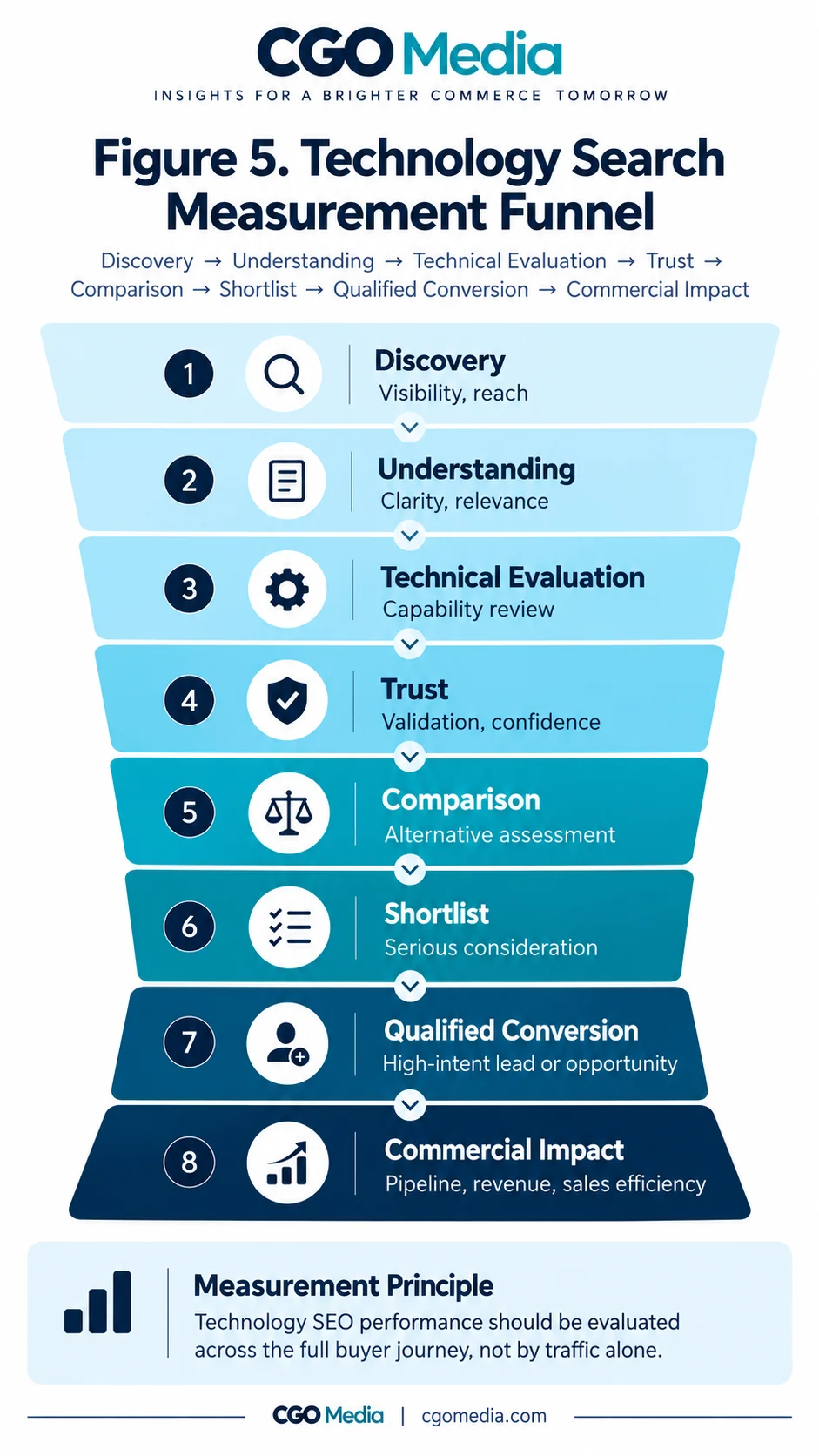
206. Technology Search Authority Requires Continuous Improvement
Technology markets evolve too quickly for search authority to be treated as a one-time optimisation project.
Products change.
Buyer requirements change.
Competitors reposition.
Search interfaces evolve.
AI-assisted discovery systems change how information is retrieved, compared and presented.
A provider that possesses strong authority today can therefore become less competitive tomorrow even if its website remains unchanged.
The long-term requirement is continuous alignment between:
Product Truth → Technical Evidence → External Trust → Qualified Discovery → Commercial Relevance
207. Products Change Continuously
Technology organisations regularly introduce:
- New features
- New integrations
- New pricing models
- New deployment options
- New product names
Every material product change can alter the evidence buyers and AI systems need to evaluate the offering accurately.
Search governance should therefore be connected directly with product change management.
208. Markets Change
Technology categories can emerge, converge or disappear.
Examples include:
- New AI categories
- Cloud-native replacement of legacy infrastructure
- Convergence between security categories
- Expansion of data platforms into adjacent functions
Category language used by buyers may therefore change before the organisation changes its internal terminology.
Search strategy should monitor how markets are actually being described.
209. Buyer Requirements Change
Technology selection criteria can shift because of:
- Security expectations
- Regulation
- Cloud adoption
- AI adoption
- Cost pressure
- New interoperability requirements
A product that previously satisfied most buyers may become less competitive as requirements change.
Technology SEO should therefore reflect current buyer expectations rather than historical positioning alone.
210. Search Environments Change
Search interfaces increasingly combine:
- Traditional results
- AI-generated summaries
- Conversational search
- Comparison experiences
- Recommendations
This changes how technology information is discovered and how far provider evaluation can progress before a website visit occurs.
Search strategy therefore needs to account for both retrieval and recommendation environments.
211. External Evidence Changes
Technology providers gain and lose:
- Customer reviews
- Media references
- Research citations
- Partner relationships
- Community visibility
External authority should therefore be treated as dynamic rather than permanent.
212. Search Authority Can Decay
Strong historical visibility does not guarantee current authority.
Authority can weaken because:
- Product information becomes outdated.
- Documentation becomes inaccurate.
- Competitors improve their evidence.
- External references become stale.
- Buyer expectations move elsewhere.
Technology organisations need systems capable of detecting this decay before it significantly affects qualified demand.
213. Information Decay Is a Major Technology Risk
Outdated public information can affect:
- Search accuracy
- Buyer confidence
- AI representation
- Sales qualification
The risk becomes greater where the information influences important technical or commercial decisions.
214. Product Pages Can Decay
Product content can become inaccurate when:
- Features change
- Integrations change
- Pricing changes
- Availability changes
- Positioning changes
A page can remain technically indexed while becoming commercially misleading.
215. Documentation Can Decay
Documentation can become outdated because of:
- New versions
- API changes
- Deprecated functionality
- Changed configuration requirements
- New deployment methods
Documentation governance should therefore include version status and update ownership.
216. External Comparisons Can Decay
Third-party sources may continue describing a product using outdated information.
This can affect:
- Comparison platforms
- Industry directories
- Editorial articles
- Partner pages
Organisations cannot control every external source, but they should understand which outdated sources remain influential.
217. Information Risk Should Be Prioritised
A useful technology information-risk relationship is:
Rate of Change + Buyer Impact + Technical Risk + Commercial Importance → Information Priority
Not every piece of technology information requires the same review frequency.
The fastest-changing and highest-impact information deserves stronger governance.
218. High-Risk Information Requires Stronger Governance
Examples include:
- Security claims
- Compliance claims
- Data residency
- Product compatibility
- Current support status
Incorrect information in these areas can materially affect buyer decisions and organisational risk.
219. High-Change Information Requires More Frequent Review
Examples include:
- Pricing
- Features
- Integrations
- Security information
- Product availability
These areas should generally be reviewed more frequently than stable organisational information.
220. Stable Information Still Requires Ownership
Information such as organisation identity, long-term product architecture and ownership relationships may change less frequently.
However, it should still have defined ownership so that major corporate or product changes trigger updates when required.
221. Search Governance Should Connect to Subject-Matter Governance
SEO teams should not own underlying technical truth.
Instead, the organisation should connect:
- Search governance
- Product governance
- Engineering governance
- Security governance
- Commercial governance
This reduces the risk of search content becoming disconnected from operational reality.
222. Every Important Information Class Should Have an Owner
Ownership can be distributed according to expertise.
Product Teams
Can own product capability, roadmap and positioning.
Engineering Teams
Can own architecture, technical implementation and integration truth.
Security Teams
Can own security evidence and related claims.
Commercial Teams
Can own pricing, contracts and commercial availability.
SEO Teams
Can ensure important information remains discoverable, structured and connected.
223. Governance Should Define Review Triggers
Content should not rely only on calendar-based review.
Event-driven triggers can include:
- Product launch
- Feature change
- Integration change
- Security update
- Pricing change
- Rebrand
- Product retirement
Material operational change should automatically trigger review of affected public evidence.
224. Governance Should Define Validation
Technology information should be validated by the appropriate subject-matter owner before significant publication or amendment.
The objective is to protect both:
- Search visibility
- Technical accuracy
SEO effectiveness should never depend on weakening factual precision.
225. Governance Should Define Deprecation
When information is no longer current, organisations should decide whether to:
- Update it
- Redirect it
- Archive it
- Mark it as deprecated
The correct choice depends on whether the historical information remains useful.
226. Continuous Monitoring Should Cover the Complete Authority System
Monitoring should extend across:
- Search visibility
- Technical information
- Entity accuracy
- External authority
- AI recommendation visibility
- Commercial outcomes
This provides a more complete view than monitoring rankings alone.
227. Search Visibility Should Be Monitored for Structural Change
Material changes can include:
- Loss of category visibility
- Loss of technical visibility
- Competitor expansion
- Changed search-result formats
The objective is to identify persistent change rather than react to routine fluctuation.
228. Documentation Visibility Should Also Be Monitored
Technical resources can lose visibility because of:
- Indexation problems
- Broken links
- Version duplication
- Weak internal navigation
- Content decay
Documentation monitoring should therefore combine technical SEO with information-quality review.
229. Entity Accuracy Should Be Monitored
Important entity relationships can become inconsistent after:
- Acquisitions
- Product renaming
- Portfolio restructuring
- Platform consolidation
Monitoring should confirm that the organisation, products and services remain represented coherently across important public environments.
230. AI Recommendation Visibility Should Be Monitored Longitudinally
AI-assisted recommendation visibility should be observed through repeatable scenario families rather than isolated prompts.
Monitoring should consider:
- Presence
- Relevance
- Accuracy
- Recommendation fit
- Source recurrence
The objective is to identify persistent patterns capable of influencing qualified buyer discovery.
231. AI Errors Should Be Diagnosed Rather Than Chased
One generated answer should not automatically trigger major content changes.
A better process is:
Observe → Re-Test → Identify Pattern → Diagnose Evidence → Correct Source → Validate
This helps distinguish isolated output variation from genuine information problems.
232. Evidence Problems Should Be Corrected at Their Source
If a product is repeatedly described incorrectly, the organisation should determine whether the problem originates in:
- Owned content
- Documentation
- External listings
- Legacy pages
- Conflicting terminology
Correcting the source is generally more durable than reacting only to the visible generated answer.
233. Continuous Improvement Begins with Observation
The first stage of the authority cycle is Observe.
The organisation should monitor important signals across:
- Search
- AI visibility
- Documentation
- Sales
- External authority
The goal is to detect meaningful change.
234. Observation Should Distinguish Signal from Noise
A meaningful change should ideally be:
- Relevant
- Persistent
- Material
- Commercially significant
Short-term fluctuation without buyer or business impact should not automatically become a strategic priority.
235. The Second Stage Is Diagnosis
Once a material change is identified, the organisation should determine why it occurred.
Potential causes can include:
- Technical SEO issues
- Documentation problems
- Entity ambiguity
- Weak product evidence
- Competitive change
- External-authority change
Diagnosis should precede intervention.
236. The Third Stage Is Prioritisation
The organisation should determine which issue creates the greatest strategic constraint.
A useful model is:
Severity + Persistence + Buyer Impact + Commercial Importance → Priority
This helps prevent large volumes of low-impact SEO work from displacing more important authority problems.
237. The Fourth Stage Is Improvement
The required intervention can involve:
- Technical SEO
- Documentation
- Entity clarification
- Content
- Digital PR
- Product communication
The chosen intervention should match the diagnosed cause.
238. Capability Problems Require Product Improvement
If the provider genuinely lacks a required capability, the correct solution is not stronger SEO language.
Product, engineering or service improvement is required.
This protects the distinction between:
Search Problem and Product Problem.
239. Evidence Problems Require Better Representation
Where the capability exists but is poorly represented, improvement can include:
- Product content
- Documentation
- Architecture diagrams
- Implementation guidance
- Case studies
This is where search and content teams can strengthen evaluation readiness.
240. Authority Problems Require External Validation
Where owned evidence is strong but external authority remains weak, improvement can involve:
- Original research
- Digital PR
- Technical publications
- Customer evidence
- Industry participation
Authority building should remain connected to genuine expertise and product relevance.
241. The Fifth Stage Is Validation
The organisation should confirm whether the intervention produced the intended change.
Validation can include:
- Technical testing
- Search re-evaluation
- Documentation review
- AI re-testing
- Sales-feedback analysis
Implementation alone does not establish success.
242. Search Changes Should Be Validated
Where technical or content changes have been implemented, teams should confirm:
- Crawlability
- Indexation
- Rendering
- Internal linking
- Relevant visibility
243. AI Representation Changes Should Be Re-Tested
Where evidence has been corrected, the relevant AI scenarios should be tested again over time.
The organisation should look for:
- Improved accuracy
- Improved recommendation relevance
- Reduced persistent errors
One improved response should not automatically be treated as permanent resolution.
244. The Sixth Stage Is Learning
Findings should improve future:
- Standards
- Templates
- Governance
- Priorities
This transforms individual fixes into organisational capability.
245. Learning Should Change Future Processes
If a product launch repeatedly creates outdated documentation, the lesson should not simply be to repair the affected pages each time.
The better response is to improve the launch process so documentation and search updates become part of the release workflow.
Continuous improvement should therefore reduce the recurrence of known problems.
246. Technology Search Authority Requires Organisational Ownership
The major components of authority are distributed across several teams.
A practical ownership model is:
SEO + Product + Engineering + Security + Sales + Customer Success + PR + Leadership
Each function contributes a different part of the public evidence system.
247. SEO Owns Discoverability, Not Technical Truth
SEO teams can own:
- Search architecture
- Technical visibility
- Internal linking
- Search demand analysis
- AI monitoring
But the underlying factual claims should remain owned by appropriate subject-matter teams.
248. Product and Engineering Own Capability Truth
Product and engineering teams provide authoritative information about:
- Features
- Architecture
- Integrations
- Implementation
- Technical constraints
Their participation is essential to maintaining accurate public evidence.
249. Security Owns High-Risk Trust Evidence
Security teams should validate high-risk information involving:
- Security controls
- Certifications
- Privacy
- Compliance support
- Data protection
These claims should not be inferred or simplified without appropriate review.
250. Sales and Customer Success Provide Buyer Evidence
Sales and customer-success teams can contribute evidence about:
- Buyer objections
- Competitor comparisons
- Information gaps
- Implementation friction
- Post-sale outcomes
This information should feed back into search and content strategy.
251. Leadership Should Support Cross-Functional Governance
Search authority becomes difficult to maintain when departments optimise isolated objectives.
Leadership should encourage shared accountability for:
- Product accuracy
- Technical evidence
- External authority
- Buyer understanding
- Commercial outcomes
252. Competitive Repositioning Should Be Monitored
Competitors can change:
- Category
- Target market
- Product scope
- Pricing
- Geography
Historic competitor assumptions can therefore become outdated.
253. Search Competitors May Differ from Commercial Competitors
The providers encountered through search may not exactly match the competitors identified by sales teams.
AI recommendation competitors may differ from both.
Organisations should therefore review:
- Commercial competitors
- Search competitors
- AI recommendation competitors
as overlapping but distinct groups.
254. Category Evolution Should Be Monitored
Technology categories can change as buyer language evolves.
Organisations should periodically review:
- Category terminology
- Problem terminology
- Emerging technology labels
- Buyer language
Positioning should change only when market evidence supports the change.
255. Technology SEO Should Be Treated as Organisational Infrastructure
Long-term search authority should connect marketing with:
- Product
- Engineering
- Security
- Sales
- Customer success
- Leadership
This makes Technology SEO part of the organisation’s wider information and authority infrastructure.
256. Strategic Recommendations
Build Around Product Truth
Ensure important technology claims begin with accurate product and technical information.
Govern Documentation as Search Infrastructure
Maintain current, searchable and clearly versioned technical resources.
Define Entity Relationships Explicitly
Clarify the relationship between organisation, brand, product, platform, feature and use case.
Monitor Information Decay
Prioritise high-change and high-risk information.
Measure Relevant AI Visibility
Track accurate shortlist inclusion rather than raw mention frequency.
Connect Search with Sales Intelligence
Use qualification and lost-opportunity evidence to improve positioning and content.
Build Independent Authority
Strengthen customer proof, original research, technical publications and relevant external validation.
Maintain Clear Product Lifecycle Signals
Make current, deprecated and archived information easy to distinguish.
Review the Real Competitive Set
Analyse commercial, search and AI recommendation competitors separately.
Validate Material Changes
Do not treat implementation as completion.
Strengthen Cross-Functional Governance
Connect SEO with product, engineering, security and commercial teams.
Optimise for Qualified Discovery
Prioritise buyers whose requirements genuinely match the organisation’s capabilities.
Monitor Category Evolution
Adapt positioning when market language and technology structures genuinely change.
Treat Technology SEO as Organisational Infrastructure
Build authority as an enduring cross-functional capability rather than a sequence of isolated campaigns.
257. The Twenty-First Technology SEO Principle
Technology search authority should be continuously maintained because product information, documentation, external evidence and buyer requirements can decay or change rapidly.
258. The Twenty-Second Technology SEO Principle
Cross-functional governance is essential because accurate technology search visibility depends on coordinated ownership of product, engineering, security, commercial and external-authority information.
259. The Twenty-Third Technology SEO Principle
Authority resilience depends partly on the organisation’s ability to detect, diagnose, correct and validate material search and information problems efficiently.
260. The Twenty-Fourth Technology SEO Principle
The strongest long-term Technology SEO strategy combines stable authority principles with adaptive execution so the organisation can respond intelligently as products, buyers, competitors, search systems and AI interfaces evolve.
261. The Continuous Technology Search Authority Cycle
The operational cycle can be summarised as:
Observe → Diagnose → Prioritise → Improve → Validate → Learn → Repeat
Observe
Monitor meaningful changes across search visibility, technical information, entity representation, AI recommendation visibility, external authority and commercial outcomes.
Diagnose
Identify whether the underlying constraint involves technical SEO, product evidence, documentation, authority, positioning or genuine capability.
Prioritise
Focus first on issues with the greatest combination of persistence, buyer impact, technical risk and commercial importance.
Improve
Apply the intervention appropriate to the diagnosed cause.
Validate
Confirm that the intervention changed the intended technical, informational, search or commercial outcome.
Learn
Convert findings into better standards, templates, governance and future priorities.
Repeat
Re-enter the cycle as products, buyer requirements, competitors and search environments continue to evolve.
262. The Long-Term Technology Authority Model
The strategic system can be summarised as:
Accurate Product Truth → Strong Technical Evidence → External Trust → Qualified Discovery → Relevant Recommendation → Commercial Fit → Continuous Learning
This model connects internal product accuracy with the external authority environment and eventual commercial value.
263. The Strategic Implication
Technology organisations should manage SEO as a living authority system in which:
- Product truth
- Documentation
- Technical evidence
- External validation
- AI visibility
- Commercial performance
remain continuously aligned as the technology market evolves.
The long-term objective is not simply to preserve rankings.
It is to preserve the organisation’s ability to be:
- Discovered accurately
- Understood clearly
- Evaluated technically
- Validated independently
- Recommended appropriately
- Selected commercially
across an increasingly distributed search and AI discovery environment.
Figure 6 : Continuous Technology Search Authority Cycle — Observe → Diagnose → Prioritise → Improve → Validate → Learn → Repeat.
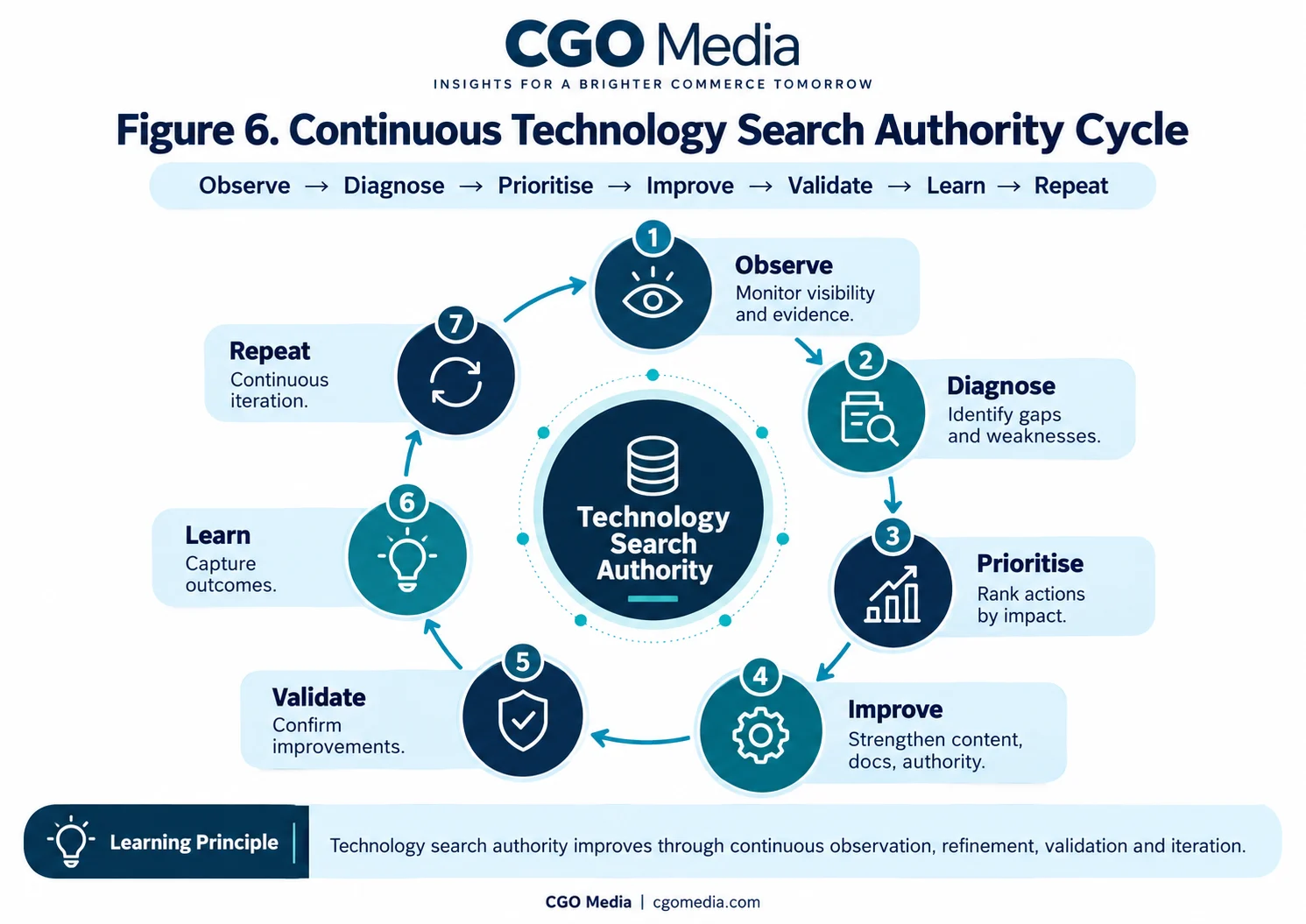
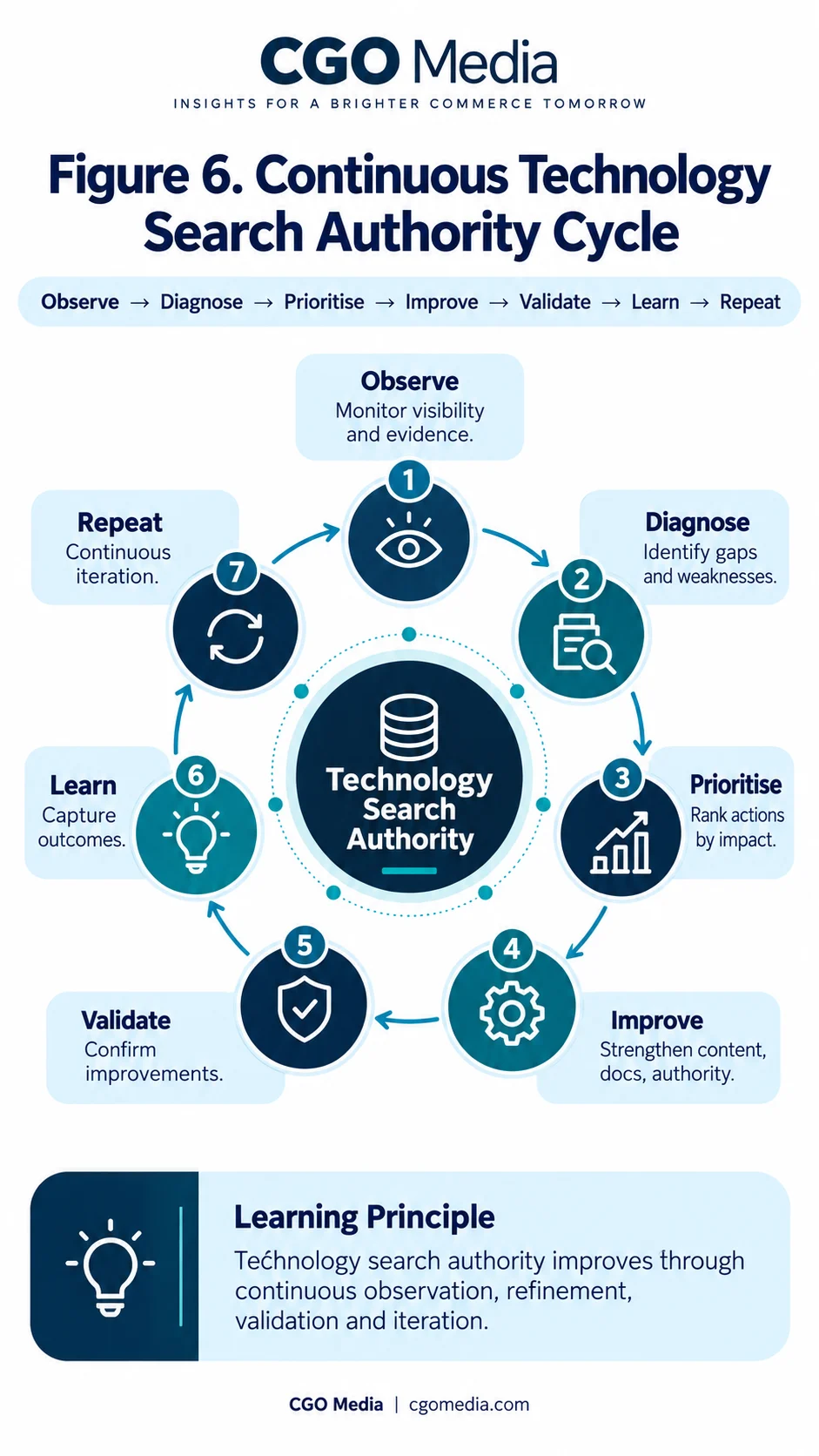
264. Methodology
Technology SEO in an AI Search Environment is a conceptual research paper developed by CGO Media to examine how technology organisations are discovered, understood, technically evaluated, compared and recommended across traditional search, technical information environments and AI-assisted discovery.
The research moves beyond a narrow interpretation of Technology SEO based primarily on keywords, rankings and website traffic.
Instead, it examines the wider authority system connecting:
- Technical accessibility
- Entity clarity
- Product information
- Technical documentation
- Security evidence
- Customer evidence
- Independent authority
- AI recommendation visibility
Central Research Question
The central research question is:
How should technology organisations structure, validate and govern their digital authority so buyers and AI systems can discover, understand, technically evaluate and compare them accurately?
Research Scope
The research can be applied across technology organisations including:
- Software providers
- Cloud platforms
- Cybersecurity companies
- Infrastructure providers
- Data companies
- Artificial intelligence companies
- Developer-tool providers
- Technology consultancies
- Managed service providers
- Hardware and infrastructure vendors
Technology Discovery Scope
The research considers technology discovery across environments including:
- Search engines
- AI assistants
- Technical publications
- Comparison platforms
- Developer communities
- Research environments
- Professional networks
- Provider websites
Buyer-Journey Method
The technology discovery and evaluation journey is represented conceptually as:
Problem Recognition → Research → Category Discovery → Provider Discovery → Technical Evaluation → Trust Validation → Comparison → Selection
This allows search visibility to be considered according to the role it plays at different stages of buyer decision-making.
Technology Search Authority Method
The paper treats technology authority as a distributed evidence system rather than a property of one website.
The core authority environment includes:
Owned Content + Technical Documentation + Entity Clarity + Customer Evidence + Independent Authority + Search Visibility + AI Recommendation Visibility
Each layer contributes different evidence to the buyer and machine-assisted discovery process.
Entity-Architecture Method
Technology entities are examined through relationships such as:
Organisation → Brand → Product → Platform → Feature → Use Case → Industry
This architecture helps distinguish organisations, products, platforms, features and applications while preserving meaningful relationships between them.
Technical-Evidence Method
Technical evaluation is examined through evidence involving:
- Architecture
- Documentation
- APIs
- Integrations
- Deployment
- Performance
- Security
- Implementation requirements
The underlying principle is:
Commercial Claim → Technical Capability → Supporting Evidence
Trust-Authority Method
Technology trust is considered through:
Technical Evidence + Security Evidence + Customer Evidence + Independent Validation + Information Governance
This framework recognises that broad brand authority does not independently validate every technical, security or operational claim.
Provider-Selection Method
Technology selection is modelled through:
Buyer Requirements → Provider Attributes → Technical Evidence → Trust Validation → Comparative Fit → Recommendation Confidence → Shortlist
This treats provider recommendation as a contextual suitability process rather than a universal ranking of technology companies.
Multi-Constraint Discovery Method
AI-assisted search is examined as an environment capable of combining several buyer requirements simultaneously, including:
- Technology category
- Industry
- Deployment model
- Security requirement
- Integration requirement
- Commercial constraint
This increases the importance of explicit and comparable provider attributes.
Competitive-Gap Method
Competitive weakness is classified into four broad categories:
- Capability Gap — the competitor genuinely possesses stronger functionality or suitability.
- Evidence Gap — the organisation has the capability but represents it poorly.
- Authority Gap — the capability exists but lacks sufficient external validation.
- Positioning Gap — the organisation is weakly associated with the relevant category, use case or buyer requirement.
This distinction helps prevent organisations from attempting to solve genuine product weaknesses through content optimisation alone.
Measurement Method
Technology search performance is examined through:
Discovery → Understanding → Technical Evaluation → Trust → Comparison → Shortlist → Qualified Conversion → Commercial Impact
This connects SEO and AI visibility with buyer progression and commercial relevance rather than treating traffic as the final outcome.
AI Visibility Method
AI visibility is evaluated conceptually across:
- Presence
- Relevance
- Accuracy
- Recommendation fit
Repeated scenario-based observations are more useful than isolated generated answers because AI outputs can vary between prompts, systems and time periods.
Qualified-Visibility Method
The research distinguishes between raw visibility and visibility among buyers whose requirements genuinely match the provider.
The underlying model is:
Relevant Demand + Accurate Representation + Technical Fit + Trust → Qualified Visibility
Information-Lifecycle Method
Technology information is examined through the lifecycle:
Create → Validate → Publish → Maintain → Update → Deprecate → Archive
This recognises that product information, documentation, security material and external evidence can lose accuracy as technology evolves.
Continuous Improvement Method
Long-term Technology SEO authority management is represented as:
Observe → Diagnose → Prioritise → Improve → Validate → Learn → Repeat
The objective is to create an organisational capability capable of adapting as products, competitors, buyers and discovery systems change.
Research Position
The models presented throughout this paper are conceptual tools intended to organise observable relationships between technology information, buyer evaluation, digital authority and AI-assisted discovery.
They should not be interpreted as descriptions of proprietary search-engine, AI-platform or technology-marketplace algorithms.
265. Limitations
This research provides a conceptual framework for understanding Technology SEO and AI-assisted provider discovery. Several limitations should be considered when applying the models.
Technology Markets Differ Significantly
The discovery journey for:
- Enterprise cybersecurity
- Developer tooling
- Consumer technology
- Cloud infrastructure
- Technology consulting
can differ materially.
The framework should therefore be adapted to the commercial and technical characteristics of the market being analysed.
Buyer Journeys Are Not Uniform
Different buyers can:
- Enter at different stages
- Repeat stages
- Skip stages
- Change requirements
- Change providers
The buyer journey should therefore be interpreted as an analytical structure rather than a fixed sequence followed by every organisation.
Stakeholder Journeys Differ
Technology decisions can involve:
- Executives
- Developers
- Security teams
- Operations
- Procurement
- Finance
Each group can use different terminology and require different forms of evidence.
AI Systems Differ
Different AI-assisted discovery systems can use different:
- Models
- Retrieval systems
- Source sets
- Ranking processes
- Interfaces
Observed behaviour on one platform should not automatically be generalised to another.
AI Outputs Are Variable
Generated responses can change according to:
- Model
- Prompt
- Date
- Language
- Market
- Available evidence
One generated response does not establish stable provider authority.
AI Recommendation Order Is Not a Stable Ranking
A provider appearing first in one generated response should not be interpreted as having a permanent or universal recommendation position.
Monitoring should prioritise patterns of relevant inclusion and representation rather than isolated ordering.
Visible Citations Are Incomplete Evidence
Where AI systems expose sources, those citations can help analyse the public evidence environment.
They should not be assumed to represent every source, internal process or signal involved in generating the response.
Recommendation Absence Is Not Automatically an SEO Failure
A provider may be absent because it is genuinely unsuitable for the tested requirement.
Relevant monitoring therefore depends on well-designed buyer scenarios.
Search Visibility Does Not Establish Product Quality
High rankings or repeated AI inclusion do not prove that a technology product is technically superior.
Product capability should be evaluated independently.
Product Capability Cannot Be Created Through SEO
Search optimisation cannot compensate sustainably for missing:
- Features
- Security controls
- Integrations
- Deployment capabilities
- Operational performance
Where the underlying capability is absent, product or service improvement is required.
Technical Claims Require Appropriate Expertise
Technology marketing and SEO teams should not independently infer claims involving:
- Security
- Compliance
- Architecture
- Performance
- Compatibility
High-impact technical claims should be validated by appropriate subject-matter specialists.
Security Evidence Changes
Security status, certifications, controls and threat environments can change.
Security information therefore requires appropriate ongoing governance.
Compliance Evidence Is Contextual
A product supporting certain controls does not automatically make every customer’s use of the product compliant.
Organisation certification, product capability and customer responsibility should remain distinct.
Technology Information Can Become Outdated Quickly
Rapidly evolving markets can make:
- Product pages
- Documentation
- Comparison pages
- External articles
- AI representations
outdated within comparatively short periods.
Information freshness should therefore reflect the volatility of the underlying technology.
Customer Evidence Is Context-Specific
A successful customer implementation does not prove that the same result will occur within every organisation.
Relevant differences can include:
- Infrastructure
- Industry
- Organisation size
- Implementation quality
- Operating conditions
Benchmark Evidence Requires Context
Technology performance can vary according to:
- Architecture
- Hardware
- Configuration
- Dataset
- Workload
- Environment
Performance figures should therefore be interpreted in relation to the methodology under which they were produced.
Third-Party Sources Can Become Outdated
Comparison platforms, directories, editorial articles and partner pages may continue to publish legacy information after the underlying product changes.
Organisations cannot control all external sources.
External Authority Does Not Establish Universal Suitability
Strong brand recognition, media visibility or industry recognition does not mean that a provider is the correct choice for every buyer requirement.
Attribution Is Incomplete
Technology buyers can interact with:
- Organic search
- Documentation
- AI assistants
- Technical media
- Case studies
- Sales teams
- Events
- Professional communities
before becoming a customer.
The final conversion source therefore rarely describes the complete discovery journey.
AI Influence Can Occur Without Direct Referral Data
A buyer may discover or evaluate the provider through an AI assistant and later return through branded search, direct navigation or sales contact.
AI influence can therefore exist without a measurable AI referral.
Correlation Does Not Establish Causation
Improved AI visibility, branded demand, search traffic and commercial outcomes can occur together without proving that one directly caused another.
Where causal claims are important, additional evidence is required.
266. Conclusion
Technology SEO is evolving from a page-ranking discipline into a broader authority and evidence-management system.
Technology buyers increasingly move between search engines, AI assistants, documentation, technical publications, developer communities, comparison platforms, provider websites and commercial evaluation before reaching a decision.
This creates a discovery environment in which providers can enter or leave consideration before the buyer reaches their own website.
Discovery Is No Longer Website-Centric
Technology providers should therefore consider visibility across:
- Search engines
- Technical information environments
- External publications
- AI-assisted discovery
rather than treating website rankings as the complete market.
Entity Clarity Becomes More Important
Search and AI systems need to distinguish relationships involving:
- Organisation
- Brand
- Product
- Platform
- Feature
- Use case
- Industry
Without this clarity, evidence can become fragmented across legacy names, documentation, external sources and changing product portfolios.
Technical Evidence Becomes More Important
Technology buyers require more than promotional claims.
Important evaluation evidence can include:
- Architecture
- Implementation
- Integration
- Security
- Operational behaviour
Documentation therefore becomes part of the authority system rather than merely a post-sale support asset.
External Evidence Becomes Part of Technology Authority
Customer evidence, technical publications, independent research, professional communities and other credible sources can reinforce or challenge provider claims.
The strongest authority systems create convergence between:
Owned Evidence + Technical Evidence + Customer Evidence + Independent Evidence
AI Search Adds an Additional Interpretation Layer
AI systems can synthesise:
- Provider information
- Technical evidence
- Customer evidence
- Independent sources
into answers, comparisons and recommendations.
This can move significant provider evaluation upstream of the direct website visit.
Technology SEO Must Therefore Optimise for Buyer Fit
The provider should make it easy to establish:
- Who it serves
- What it solves
- What it supports
- What it does not support
Strong technology positioning is often conditional rather than universal.
Statements explaining where a technology is best suited can be more credible than claims that it is appropriate for every organisation.
Explicit Limitations Can Strengthen Trust
Technology buyers often value precision around:
- Constraints
- Dependencies
- Unsupported scenarios
- Implementation requirements
Accuracy can therefore create stronger long-term authority than exaggerated positioning.
Trust Must Be Evidence-Led
Important claims should be supported through appropriate:
- Technical evidence
- Security evidence
- Customer evidence
- Independent validation
The required evidence increases with the importance and risk of the claim.
Authority Should Be Distributed
The strongest technology organisations build useful evidence across multiple relevant environments rather than relying entirely on one website or platform.
A distributed authority environment is more resilient to changes in individual search interfaces or discovery systems.
Search and Product Strategy Must Remain Connected
A provider cannot optimise its way out of a genuine capability gap.
The correct relationship is:
Product Truth → Evidence → Visibility → Evaluation → Trust → Selection
Search should expose genuine capability rather than manufacture unsupported capability claims.
Technology SEO Becomes Cross-Functional
High-quality technology visibility increasingly depends on coordinated input from:
- SEO
- Product
- Engineering
- Security
- Sales
- Customer Success
- PR
Technology search authority is therefore an organisational information capability rather than a marketing function operating in isolation.
Measurement Must Extend Beyond Rankings
The complete measurement system should consider:
Discovery → Understanding → Technical Evaluation → Trust → Comparison → Shortlist → Qualified Conversion → Commercial Impact
This links search performance with buyer progression and commercial fit.
AI Visibility Should Be Qualified
Raw mention frequency provides limited strategic value where inclusion is inaccurate or irrelevant.
The stronger objective is:
Relevant Inclusion + Accurate Representation + Buyer Fit
This creates a more meaningful understanding of AI recommendation visibility.
Technology Search Authority Must Be Maintained
Products, documentation, markets, competitors and external evidence continue to evolve.
Long-term authority therefore requires:
Observe → Diagnose → Prioritise → Improve → Validate → Learn → Repeat
The purpose of this cycle is not simply to preserve rankings.
It is to preserve the organisation’s ability to remain discoverable, understandable, technically credible and commercially relevant as the wider discovery environment changes.
The Complete Technology Authority System
The overall strategic relationship can be summarised as:
Accurate Product Truth → Strong Technical Evidence → External Trust → Qualified Discovery → Relevant Recommendation → Commercial Fit → Continuous Learning
This connects the organisation’s internal technical reality with its external search and AI authority.
The Long-Term Strategic Position
Technology organisations should not optimise solely for the current search-results page.
They should build resilient information and authority systems capable of supporting discovery, technical evaluation, trust, comparison and recommendation across changing search and AI environments.
The strongest long-term objective is to become:
Easy to discover, easy to understand, easy to technically evaluate, easy to validate and appropriately easy to recommend.
References
External Academic, Technical and Search Sources
- Google Search Central. SEO Starter Guide.
- Google Search Central. Crawling and Indexing Overview.
- Google Search Central. Understand How Structured Data Works.
- Google Search Central. Tell Google About Localised Versions of Your Page.
- Schema.org. SoftwareApplication.
- Schema.org. TechArticle.
- Schema.org. Organization.
- W3C. Web Content Accessibility Guidelines (WCAG) 2.2.
- Hogan, A. et al. (2021). Knowledge Graphs. ACM Computing Surveys, 54(4).
- Metzger, M.J. (2007). Making Sense of Credibility on the Web: Models for Evaluating Online Information and Recommendations for Future Research. Journal of the American Society for Information Science and Technology, 58(13), 2078–2091.
- Ji, Z. et al. (2023). Survey of Hallucination in Natural Language Generation. ACM Computing Surveys, 55(12).
CGO Media Related Research and Frameworks
- Wilkinson, R. (2026). CGO AI Search Readiness Framework. CGO Media.
- Wilkinson, R. (2026). CGO Entity Authority Framework. CGO Media.
- Wilkinson, R. (2026). CGO Content Authority Framework. CGO Media.
- Wilkinson, R. (2026). CGO AI Citation Framework. CGO Media.
- Wilkinson, R. (2026). CGO Brand Signal Framework. CGO Media.
CGO Media Research Ecosystem
CGO Media Research Library | CGO Media Framework Library | CGO Media Research Architecture | CGO Media Research Observations Library | CGO Media Statistics Library
About Roger Wilkinson
Roger Wilkinson is an independent researcher, SEO practitioner and founder of CGO Media with more than 25 years of experience in search, digital visibility and business growth.
His research focuses on how artificial intelligence is reshaping search engines, recommendation systems, entity representation, digital authority and organisational visibility.
Roger is the creator of the CGO Framework Series, a collection of research-led methodologies designed to help organisations measure, improve and govern Search Visibility, AI Visibility and Digital Authority.
His work examines the relationship between Technical SEO, Entity Authority, Content Authority, Citation Authority, Brand Signals, Knowledge Architecture and AI Search Readiness.
Related Technology AI, GEO & Search Research
The Technology research family contains seven connected pages. This page is supported by the six related Technology research, framework, implementation and GEO resources below.
Technology AI & GEO Search Research | Technology AI Trust & Visibility Framework | Technology Discovery & Provider Selection Model | Technology Search Authority Maturity Model | Technology SEO & AI Implementation Roadmap | Technology GEO: Generative Engine Optimisation
Research Usage & Citation
CGO Media encourages technology companies, software providers, cloud platforms, infrastructure organisations, cybersecurity companies, researchers, journalists, analysts and digital teams to reference this research where it contributes to analysis of Technology SEO, AI Search, GEO, provider discovery, technical authority and recommendation visibility.
Reasonable quotations, summaries, figures and excerpts may be used in articles, reports, presentations, academic work and other publications provided appropriate acknowledgement is given to Roger Wilkinson and CGO Media.
Cite This Research / Embed Citation
Technology SEO in an AI Search Environment by Roger Wilkinson at CGO Media examines how technology organisations can build search authority through product clarity, documentation, technical evidence, external trust, entity architecture and AI-assisted recommendation visibility.
APA Citation
Wilkinson, R. (2026). Technology SEO in an AI Search Environment. CGO Media. https://cgomedia.com/technology-seo-in-an-ai-search-environment/
Author: Roger Wilkinson | Published by: CGO Media
For permissions relating to substantial reproduction, commercial licensing or republication of significant portions of this research, please contact CGO Media directly.