
Technology Discovery and Provider Selection Model
Executive Summary
 The Technology Discovery and Provider Selection Model explains how organisations discover, understand, validate, compare and ultimately select technology providers across search engines, AI assistants, technical publications, comparison platforms, professional networks and direct provider research.
Technology buying is rarely a single-search or single-page decision.
Buyers typically move through a progressive evaluation journey:
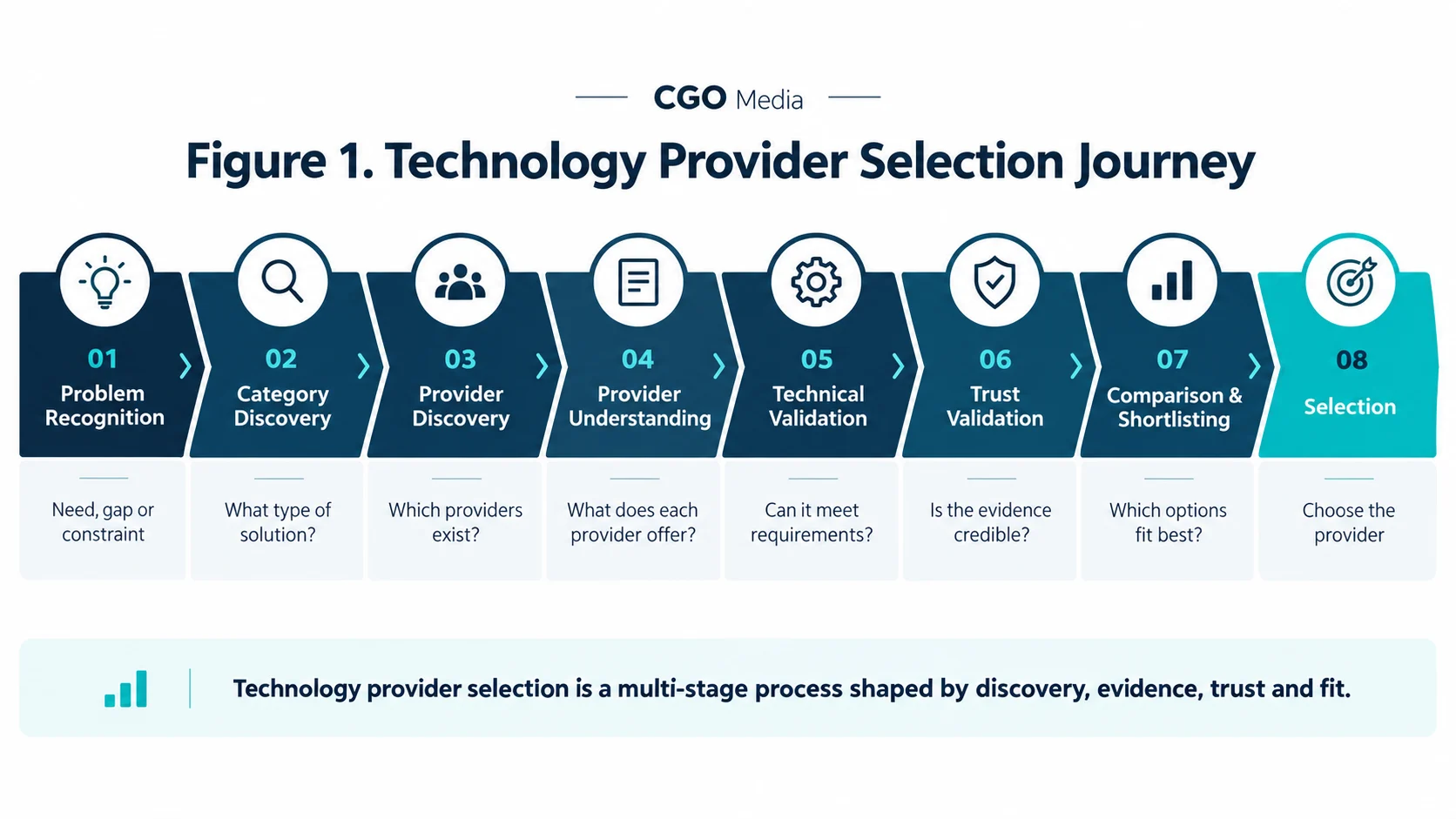
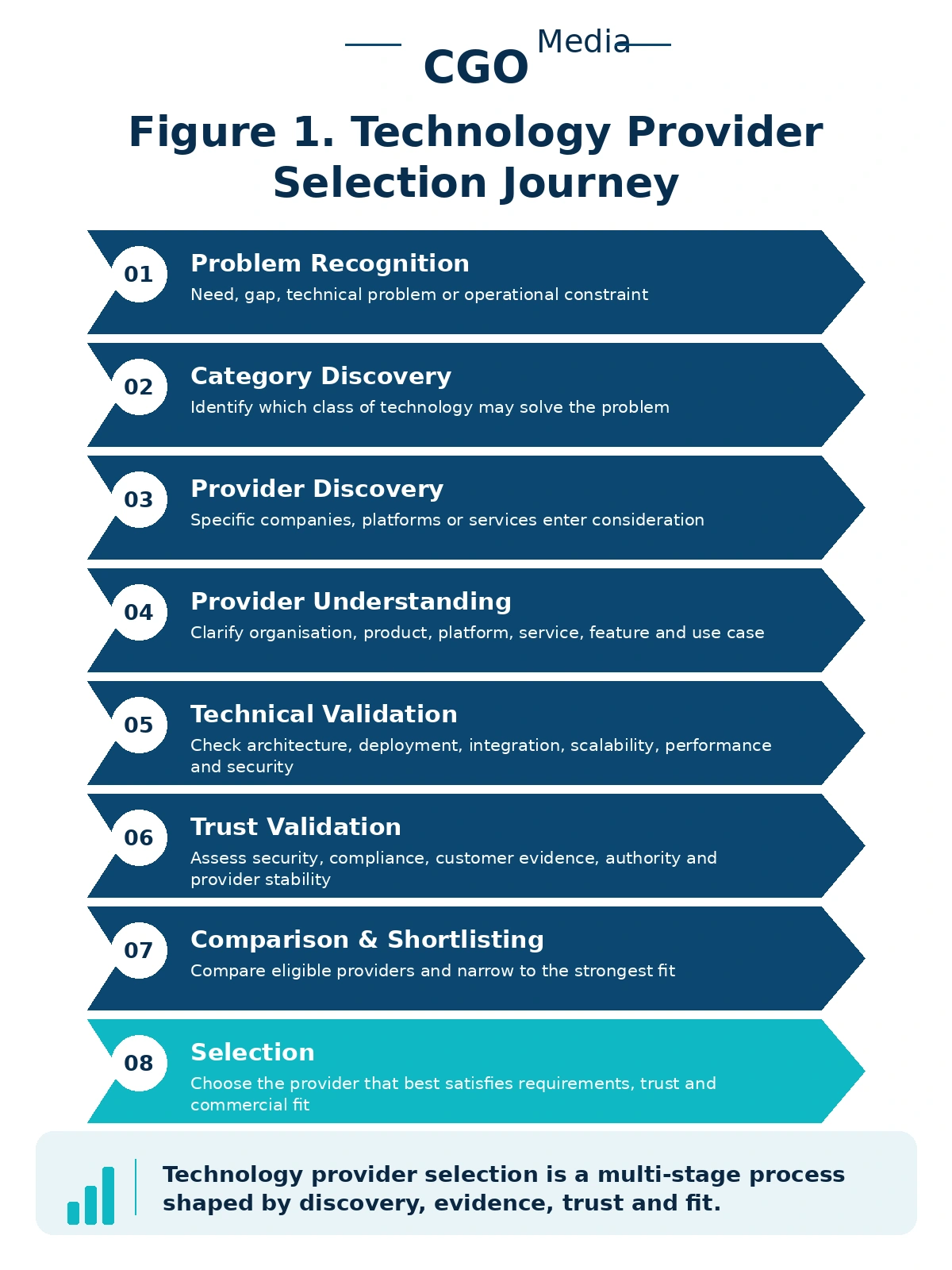
Problem Recognition → Category Discovery → Provider Discovery → Provider Understanding → Technical Validation → Trust Validation → Comparison & Shortlisting → Selection
Each stage can remove providers from consideration for a different reason.
A provider may fail because it:
- Is never discovered
- Is difficult to understand
- Lacks a required technical capability
- Cannot provide sufficient evidence
- Fails a trust requirement
- Does not satisfy commercial constraints
- Offers a weaker overall fit than competing providers
The model therefore distinguishes visibility from selection readiness.
Visibility creates the opportunity to be considered.
Selection readiness determines whether the provider survives technical, trust, commercial and organisational evaluation strongly enough to enter the final shortlist.
This distinction becomes increasingly important as AI-assisted discovery compresses several stages of the technology buying journey into a single interaction.
1. Technology Provider Selection Is a Progressive Filtering Process
Technology buyers rarely identify a provider and move directly to purchase.
Instead, potential providers are progressively filtered according to:
- Relevance
- Capability
- Evidence
- Trust
- Commercial fit
- Buyer context
A simplified progression is:
Known Providers → Relevant Providers → Technically Eligible Providers → Trusted Providers → Commercially Viable Providers → Shortlist → Selected Provider
2. Stage One — Problem Recognition
The technology buying journey begins when an organisation recognises that an existing condition requires change.
The trigger may be:
- A technical problem
- An operational constraint
- A strategic requirement
- A capability gap
At this stage, the buyer may not yet know which technology category or provider is relevant.
3. Problem-Led Discovery Often Comes Before Category Knowledge
Technology buyers frequently search for solutions using the language of the problem rather than the language of the technology category.
Examples can include:
- How to reduce cloud costs
- How to improve application security
- How to automate document workflows
- How to integrate customer data
Providers that build useful problem authority can therefore become visible before a buyer has developed category awareness.
4. Internal Events Can Trigger Problem Recognition
Internal triggers can include:
- Business growth
- System failure
- Compliance pressure
- Cost pressure
- Technology debt
These events can create immediate demand for information about alternative technology approaches.
5. External Events Can Also Trigger Technology Demand
External triggers can include:
- New regulation
- Competitive pressure
- Technology change
- Security incidents
- Changing market expectations
The provider may therefore enter the buying journey before the buyer has defined a formal procurement project.
6. Stage Two — Category Discovery
Once the problem has been recognised, the buyer begins identifying which class of technology might solve it.
This can involve comparing:
- Technology categories
- Architectural approaches
- Product models
- Service models
Category discovery is therefore partly an educational process.
7. Technology Categories Can Be Difficult to Interpret
Technology markets often contain:
- Overlapping terminology
- New category names
- Vendor-created terminology
- Adjacent categories
Different stakeholders may describe the same requirement differently.
8. Different Buyers Use Different Language
An executive, technical buyer and procurement specialist may describe the same requirement through different terminology.
For example:
- An executive may focus on business outcomes.
- An engineer may focus on architecture.
- Procurement may focus on commercial requirements.
Strong category content should therefore bridge several forms of buyer language.
9. Search and AI Systems Can Influence Category Understanding
Search engines and AI assistants can help buyers understand:
- Which technologies exist
- How categories differ
- Which approaches may be suitable
This means category education can influence which providers eventually enter the candidate set.
10. Category Education Creates Earlier Provider Visibility
A provider that helps buyers understand the market can become relevant before its product is being searched for directly.
A useful progression is:
Problem Education → Category Understanding → Provider Discovery
This creates an earlier entry point into the selection journey.
11. Stage Three — Provider Discovery
Provider discovery begins when specific companies, platforms, products or services enter the consideration set.
This can occur through:
- Organic search
- AI assistants
- Comparison platforms
- Technical media
- Peer recommendation
- Professional networks
Discovery creates opportunity, but it does not demonstrate suitability.
12. Visibility Creates Entry into Consideration
Once discovered, the provider still needs to demonstrate:
- Relevance
- Capability
- Trust
- Fit
The difference between discovery and selection is therefore substantial.
13. Provider Discovery Can Be Broad
Broad discovery questions can include:
- Best cloud platforms
- Top cybersecurity providers
- Leading AI companies
These queries can create large candidate sets.
14. Provider Discovery Can Also Be Highly Constrained
A buyer may instead ask for a provider satisfying several requirements simultaneously.
For example:
Cloud security providers for UK financial organisations requiring hybrid deployment and European data residency.
Multi-constraint discovery can create a smaller but more qualified consideration set.
15. Qualified Discovery Is More Valuable Than Broad Visibility
Large visibility volumes can have limited commercial value when the organisation repeatedly appears for buyers it cannot serve effectively.
A stronger objective is:
Relevant Discovery + Genuine Provider Fit
16. Stage Four — Provider Understanding
Once a provider has been discovered, the buyer needs to understand what the organisation actually offers.
The provider should make it easy to answer:
- What is it?
- Who is it for?
- What problem does it solve?
- How is it different?
Poor provider understanding can create early elimination even when the underlying product is suitable.
17. Entity Clarity Supports Provider Understanding
The buyer should be able to distinguish between:
- Organisation
- Product
- Platform
- Service
- Feature
Unclear product relationships can make the provider more difficult to evaluate.
18. Category Clarity Supports Market Understanding
The provider should explain where it fits within the wider technology market.
This becomes particularly important where several adjacent categories overlap.
The buyer should not need to infer the organisation’s category position from disconnected product claims.
19. Use-Case Clarity Supports Relevance
Buyers should understand which problems and operational scenarios the technology is designed to address.
Useful use-case clarity can connect:
Buyer Problem → Technology Capability → Product → Evidence
20. Audience Clarity Supports Qualification
The provider should also make clear whether the offering is intended for:
- SMBs
- Mid-market organisations
- Enterprises
- Developers
- Specific industries
This reduces evaluation effort for unsuitable buyers and strengthens relevance for suitable ones.
21. Provider Understanding Reduces Evaluation Friction
Clear information allows buyers to determine quickly whether further investigation is justified.
The objective is not to make every provider appear suitable.
It is to make suitability easier to determine.
22. Stage Five — Technical Validation
Technical validation determines whether the technology can satisfy the buyer’s operational requirements.
Evaluation can include:
- Architecture
- Deployment
- Integration
- Scalability
- Performance
- Security
This stage frequently involves more specialised stakeholders.
23. Documentation Becomes Critical During Technical Validation
Technical buyers may consult:
- API documentation
- Integration guides
- Security documentation
- Architecture resources
- Implementation guides
Documentation therefore contributes directly to provider selection rather than functioning solely as post-sale support.
24. Some Technical Requirements Are Mandatory
A provider may be removed from consideration if it lacks:
- A required integration
- A required deployment model
- A required security capability
- Sufficient scalability
For critical requirements, technical validation can operate as a hard filter.
25. Mandatory Requirements Create Eligibility
A provider either satisfies a hard requirement or it does not.
Examples can include:
- Required regional deployment
- Specific authentication support
- Mandatory integration support
- Required compliance capability
Marketing strength cannot compensate for a genuine capability gap.
26. Other Technical Requirements Are Relative
Several providers may satisfy the minimum requirement while differing in:
- Ease of implementation
- Performance
- Flexibility
- Developer experience
Relative requirements move the buying process toward comparison rather than binary eligibility.
27. Capability and Evidence Should Be Distinguished
A provider may possess the required technical capability but fail to communicate it clearly.
This creates an important distinction:
Capability Gap ≠ Evidence Gap
A capability gap requires product or service improvement.
An evidence gap requires better documentation, validation or communication.
28. Stage Six — Trust Validation
After establishing potential technical fit, buyers need confidence that important provider claims are credible.
Trust validation can involve:
- Security evidence
- Compliance evidence
- Customer evidence
- External authority
- Provider stability
29. Trust Requirements Increase with Purchase Risk
A useful conceptual relationship is:
Purchase Risk ↑ → Trust Requirement ↑
Higher-risk technology decisions generally require stronger supporting evidence.
30. High-Risk Technology Decisions Require Deeper Validation
Examples can include:
- Cybersecurity platforms
- Enterprise infrastructure
- Data platforms
- AI systems
- Mission-critical software
Buyers in these environments may require extensive technical, operational and organisational evidence before shortlisting.
31. Security Trust Can Be Decision-Critical
Security evaluation can include:
- Encryption
- Access controls
- Certifications
- Incident response
- Data protection
Weak security evidence can remove an otherwise capable provider from consideration.
32. Operational Trust Can Be Decision-Critical
Buyers may evaluate:
- Reliability
- Availability
- Support
- Recovery
- Scalability
These factors influence whether the provider appears capable of supporting the relationship after implementation.
33. Commercial Trust Can Be Decision-Critical
Buyers can also evaluate:
- Pricing
- Contract structure
- Support commitments
- Commercial transparency
Commercial ambiguity can increase perceived risk even where technical capability is strong.
34. Organisational Trust Supports Long-Term Confidence
Technology buyers may assess whether the provider appears capable of sustaining the relationship over time.
Relevant indicators can include:
- Customer evidence
- Operational maturity
- Relevant external authority
- Support capability
35. Trust Validation Is Multi-Source
Buyers can consult:
- Provider information
- Customer reviews
- Industry publications
- Analyst research
- Peer recommendations
Trust is therefore shaped by an evidence ecosystem rather than by owned marketing alone.
36. Source Convergence Strengthens Trust
Confidence can increase when several credible sources materially reinforce the same conclusion.
A useful structure is:
Provider Evidence + Customer Evidence + Independent Evidence → Greater Trust Confidence
37. Conflicting Evidence Can Reduce Trust
Public sources may disagree about:
- Features
- Integrations
- Security
- Support
- Product status
Persistent disagreement creates additional evaluation friction.
38. Stage Seven — Comparison & Shortlisting
Providers that survive discovery, understanding, technical validation and trust validation move into active comparison.
Comparison can include:
- Technical capability
- Security
- Integration
- Support
- Commercial fit
- Trust
39. Technology Comparison Is Multi-Dimensional
No single attribute determines every provider-selection decision.
Different buyers assign different importance to:
- Functionality
- Risk
- Cost
- Implementation complexity
- Operational support
40. Comparison Is Weighted by Buyer Context
A conceptual comparison model is:
Buyer Requirement × Attribute Importance × Provider Strength × Evidence Confidence
This is not intended as a literal mathematical formula.
It illustrates that provider strength only becomes meaningful when interpreted through the buyer’s priorities.
41. Security Can Carry Greater Weight in Regulated Markets
A regulated organisation may accept:
- Higher cost
- Greater implementation complexity
in exchange for stronger security or compliance capability.
42. Cost Can Carry Greater Weight in More Standardised Categories
Where product differentiation is relatively limited, commercial factors can become more decisive.
These can include:
- Price
- Contract flexibility
- Implementation cost
- Ongoing operational cost
43. Integration Can Carry Greater Weight in Complex Enterprises
Compatibility with existing systems can become a critical selection factor.
A provider with broader feature coverage may still lose where integration risk is substantially higher.
44. Simplicity Can Carry Greater Weight for Smaller Organisations
Smaller organisations may value:
- Ease of deployment
- Ease of use
- Accessible support
- Predictable pricing
more strongly than maximum technical sophistication.
45. There Is Rarely One Universally Best Technology Provider
Provider suitability depends on the requirements and constraints of the buyer.
A more useful question is:
Which provider offers the strongest overall fit for this particular buyer scenario?
46. Shortlisting Represents Serious Consideration
Providers reaching the shortlist have normally survived several filters:
- Discovery
- Understanding
- Technical validation
- Trust validation
- Comparison
This makes shortlist inclusion more commercially meaningful than broad visibility alone.
47. Qualified Shortlist Inclusion Should Be Measured
Qualified shortlist inclusion can be understood as:
Inclusion among credible providers for a buyer scenario in which the organisation’s actual capabilities and commercial model genuinely fit.
This avoids treating irrelevant shortlist appearances as positive performance.
48. Stage Eight — Selection
The final stage is selection of the preferred provider.
However, additional validation may still occur through:
- Procurement
- Security review
- Legal review
- Commercial negotiation
- Implementation planning
The provider therefore remains exposed to elimination even after becoming the apparent preferred option.
49. Final Selection Can Differ from Initial Preference
A preferred provider may still fail:
- Security review
- Procurement requirements
- Commercial negotiation
- Technical validation
Provider selection therefore remains a progressive filtering process until the decision is completed.
50. Provider Selection Failure Should Be Diagnosed by Stage
Different providers fail for different reasons.
A practical failure taxonomy includes:
- Discovery Gap
- Understanding Gap
- Capability Gap
- Evidence Gap
- Trust Gap
- Commercial Gap
Each gap requires a different strategic response.
51. Discovery Gap
The provider does not enter consideration.
Potential causes can include:
- Weak search visibility
- Weak category association
- Weak AI visibility
- Limited external authority
52. Understanding Gap
The provider is discovered but buyers cannot interpret the offering easily.
Potential causes can include:
- Unclear product architecture
- Weak positioning
- Ambiguous category language
- Poor information architecture
53. Capability Gap
The provider genuinely lacks a mandatory requirement.
This is fundamentally a product or service issue rather than a search problem.
Content optimisation cannot create a capability that does not exist.
54. Evidence Gap
The required capability exists but is poorly documented or validated publicly.
Potential responses can include:
- Documentation
- Architecture evidence
- Technical validation
- Case studies
55. Trust Gap
The provider’s claims are understood but insufficiently validated.
Potential responses can include:
- Security evidence
- Customer validation
- Independent references
- Research
56. Commercial Gap
The provider does not satisfy requirements involving:
- Budget
- Contract structure
- Support
- Procurement
This usually requires a commercial or packaging decision rather than an SEO intervention.
57. Correct Diagnosis Prevents the Wrong Intervention
A discovery problem is not the same as a trust problem.
A capability problem is not the same as an evidence problem.
A commercial problem is not automatically a visibility problem.
The organisation should diagnose the point of failure before deciding what to improve.
58. AI Search Can Influence Every Stage
AI assistants can help buyers:
- Define the problem
- Identify categories
- Discover providers
- Compare products
- Evaluate trust
- Create shortlists
This creates an increasingly AI-mediated provider-selection environment.
59. AI Can Compress Multiple Selection Stages
A detailed prompt can combine category discovery, provider discovery, attribute comparison and shortlisting within one interaction.
For example:
Which three data infrastructure providers are best suited to a UK enterprise that needs real-time analytics, strong governance and predictable support?
This type of query already contains several decision criteria.
60. AI-Mediated Selection Increases the Importance of Explicit Evidence
Decision-critical provider attributes should be:
- Clear
- Current
- Verifiable
- Easy to associate with the correct provider
Important capabilities that are difficult to verify may contribute less to provider selection than the organisation expects.
61. Missing Evidence Can Reduce Recommendation Confidence
A provider may genuinely possess a relevant capability but still be excluded from a shortlist if the public evidence environment does not demonstrate it sufficiently.
This is one of the clearest differences between capability and selection readiness.
62. Conflicting Evidence Can Also Reduce Recommendation Confidence
Public sources can disagree about:
- Features
- Integrations
- Security
- Support
- Product status
Conflict creates uncertainty during both human and AI-assisted evaluation.
63. Source Convergence Supports Provider Confidence
Confidence can increase when credible owned and external sources materially reinforce the same conclusion.
A useful relationship is:
Product Evidence + Technical Evidence + Customer Evidence + External Validation → Greater Selection Confidence
64. Provider Selection Is an Evidence Problem as Well as a Visibility Problem
The strongest provider is not necessarily the organisation with the greatest visibility.
A strong provider must survive the relevant filters involving:
- Relevance
- Technical fit
- Trust
- Commercial fit
- Buyer context
65. Visibility and Selection Readiness Should Be Measured Separately
A provider may be highly visible but consistently eliminated during:
- Technical validation
- Trust assessment
- Commercial comparison
Another provider may have lower broad visibility but stronger performance within qualified buyer scenarios.
The latter may have greater commercial selection strength.
66. The First Technology Discovery Principle
Technology provider selection should be treated as a progressive filtering process in which visibility creates entry into consideration but technical, trust and commercial validation determine whether the provider remains viable.
67. The Second Technology Discovery Principle
Provider discovery should be evaluated separately from provider understanding because being visible does not guarantee that buyers or AI systems can interpret the organisation’s products, capabilities and market fit correctly.
68. The Third Technology Discovery Principle
Technology selection gaps should be diagnosed as discovery, understanding, capability, evidence, trust or commercial problems so organisations can apply the correct strategic response.
69. The Fourth Technology Discovery Principle
AI-assisted discovery increases the importance of explicit and verifiable provider attributes because category discovery, comparison, trust assessment and shortlisting can increasingly occur within a single interaction.
70. The Technology Provider Selection Journey
The complete first-stage model can be summarised as:
Problem Recognition → Category Discovery → Provider Discovery → Provider Understanding → Technical Validation → Trust Validation → Comparison & Shortlisting → Selection
Problem Recognition
The buyer identifies the technical, operational or strategic problem requiring change.
Category Discovery
The buyer identifies which technology or service category may address the problem.
Provider Discovery
Specific organisations, products and services enter the consideration set through search, AI, media, platforms, networks and recommendations.
Provider Understanding
The buyer determines what each provider offers, which audience it serves and how the offering relates to the requirement.
Technical Validation
The buyer determines whether mandatory technical and operational requirements can be satisfied.
Trust Validation
The buyer evaluates whether important technical, security, operational and organisational claims are sufficiently credible.
Comparison & Shortlisting
Providers that remain viable are compared according to weighted buyer criteria and evidence confidence.
Selection
The preferred provider survives final procurement, technical, security, legal and commercial validation and becomes the selected option.
71. The Strategic Implication
Technology organisations should optimise not only for initial discovery but for progression through the complete provider-selection journey.
The information and evidence environment should help buyers and AI systems determine:
- Whether the provider is relevant
- What the provider offers
- Whether mandatory capabilities exist
- Whether important claims can be trusted
- How the provider compares with alternatives
- Whether it belongs in the final shortlist
The strategic objective is therefore not maximum visibility.
It is to create a provider-selection system in which qualified buyers can discover the organisation, understand it accurately, validate its capabilities and determine confidently whether it represents a strong fit.
Figure 1 : Technology Provider Selection Journey — Problem Recognition → Category Discovery → Provider Discovery → Provider Understanding → Technical Validation → Trust Validation → Comparison & Shortlisting → Selection.
72. Technology Discovery Is Distributed Across Multiple Environments
Technology buyers rarely rely on one discovery channel.
Provider awareness can develop through:
- Search engines
- AI assistants
- Technical publications
- Comparison platforms
- Professional networks
- Peer recommendation
Different environments can influence different stages of the selection journey.
73. Search Often Supports Problem and Category Discovery
Search engines can help buyers move from an initial problem toward understanding:
- Relevant technology categories
- Potential solutions
- Available providers
This makes non-branded problem and category visibility strategically important.
74. AI Assistants Can Compress Several Discovery Stages
AI-assisted queries can combine:
- Problem understanding
- Category education
- Provider discovery
- Comparison
- Shortlisting
This creates a more compressed provider-selection journey.
75. Technical Publications Can Influence Trust and Evaluation
Specialist publications can reinforce:
- Technical credibility
- Market recognition
- Category association
- Independent validation
These sources can become especially influential where the purchase carries significant technical or operational risk.
76. Comparison Platforms Can Accelerate Shortlist Formation
Comparison and review environments can help buyers evaluate:
- Features
- Reviews
- Pricing
- Alternative providers
These environments can rapidly narrow a large market into a smaller consideration set.
77. Professional Networks Can Influence High-Trust Decisions
Peer recommendations can carry significant weight where buyers face:
- High implementation risk
- Complex technical requirements
- Limited internal expertise
Professional recommendation can therefore operate alongside search and AI-assisted discovery.
78. Provider Discovery Should Be Multi-Channel
A technology organisation should not assume that one discovery environment controls the complete buying journey.
A stronger strategic view considers:
Search Visibility + AI Visibility + External Authority + Peer Visibility
These channels can reinforce one another during provider selection.
79. Discovery Channels Should Reinforce Consistent Product Truth
Different environments should not provide materially contradictory descriptions of:
- Product capability
- Market position
- Availability
- Target audience
Consistency reduces uncertainty as buyers move between sources.
80. Technology Buying Usually Involves Multiple Stakeholders
Provider selection is rarely controlled by one individual in complex B2B technology purchases.
Relevant stakeholders can include:
- Executives
- Technical teams
- Security teams
- Procurement
- Operational users
Each group can apply a different evaluation framework.
81. Executive Stakeholders Evaluate Strategic Fit
Executives may focus on:
- Business value
- Strategic relevance
- Risk
- Scalability
- Long-term viability
They may require high-level evidence demonstrating that the technology supports broader organisational objectives.
82. Technical Stakeholders Evaluate Capability and Architecture
Technical teams may focus on:
- Architecture
- APIs
- Integrations
- Performance
- Implementation complexity
Detailed technical evidence becomes especially important for these stakeholders.
83. Security Stakeholders Evaluate Risk
Security teams can examine:
- Security controls
- Certifications
- Data protection
- Incident processes
- Auditability
A provider can perform strongly commercially while still failing security review.
84. Procurement Evaluates Commercial and Contractual Fit
Procurement may assess:
- Pricing
- Contract terms
- Commercial predictability
- Supplier risk
- Support commitments
This creates a distinct evaluation layer beyond product capability.
85. Operational Users Evaluate Practical Fit
Operational stakeholders may care about:
- Usability
- Workflow fit
- Training
- Support
- Day-to-day reliability
A technically impressive product can still fail if practical adoption is difficult.
86. Stakeholder Requirements Can Conflict
Different teams may prefer different providers for legitimate reasons.
For example:
- Engineering may prefer flexibility.
- Security may prefer control.
- Procurement may prefer cost predictability.
- Operations may prefer simplicity.
Technology selection therefore requires reconciliation of competing priorities.
87. Selection Readiness Means Surviving Multiple Evaluation Paths
A provider should be able to support evaluation across:
- Strategic fit
- Technical fit
- Security fit
- Commercial fit
- Operational fit
This is broader than conventional search visibility.
88. Different Stakeholders Need Different Evidence
The same generic product page rarely provides enough information for every decision-maker.
A more complete information environment can include:
- Executive value propositions
- Technical documentation
- Security evidence
- Commercial information
- Customer case studies
89. Buyer Requirements Should Be Structured
Technology-selection requirements can be divided into three broad groups:
- Mandatory Requirements
- Preferred Requirements
- Differentiators
These groups perform different roles during shortlisting.
90. Mandatory Requirements Are Hard Filters
Mandatory requirements are non-negotiable conditions.
Examples can include:
- Required integrations
- Deployment model
- Security controls
- Regional availability
- Compliance requirements
Failure against one critical requirement may remove the provider from consideration.
91. Hard Filters Should Be Evaluated Before Preference
A provider should first demonstrate that it satisfies essential requirements.
A useful sequence is:
Pass Mandatory Filters → Then Apply Comparative Evaluation
This prevents attractive but ineligible providers from receiving misleadingly high overall scores.
92. Preferred Requirements Rank Eligible Providers
Preferred requirements help buyers compare providers that have already passed the mandatory filters.
These can include:
- Ease of implementation
- Support quality
- Usability
- Roadmap alignment
- Commercial flexibility
Preferred requirements influence relative attractiveness rather than basic eligibility.
93. Differentiators Influence Final Preference
Differentiators can include:
- Specialist expertise
- Better ecosystem integration
- Stronger customer evidence
- Lower operational complexity
These factors can become decisive once several providers satisfy the core requirements.
94. Technology Selection Should Separate Eligibility from Preference
Eligibility asks:
Can this provider meet our essential requirements?
Preference asks:
Which eligible provider offers the strongest overall fit?
These are different stages of the decision.
95. Hard Filters Should Not Be Averaged Away
A provider that fails one mandatory requirement should not appear highly suitable merely because it scores strongly across several optional attributes.
Mandatory fit should therefore sit outside weighted preference scoring.
96. Weighted Comparison Should Reflect Buyer Priorities
Once mandatory criteria are satisfied, buyers can evaluate:
- Security
- Cost
- Integration
- Support
- Ease of use
The weighting assigned to each dimension should reflect actual organisational priorities.
97. Weighting Should Be Agreed Before Final Comparison
Defining evaluation priorities before the final provider comparison reduces the risk of changing criteria retrospectively to justify a preferred provider.
This makes the decision process more transparent.
98. Stakeholder Weighting Can Differ
Different teams may assign different importance to the same attributes.
For example:
- Executives may prioritise strategic value.
- Engineering may prioritise flexibility.
- Security may prioritise risk reduction.
- Procurement may prioritise commercial predictability.
These differences should be visible rather than hidden.
99. Trade-Offs Are Normal in Technology Selection
No provider is likely to dominate every comparison dimension.
Buyers may accept:
- Higher price for stronger security
- Greater complexity for better scalability
- Fewer features for easier implementation
Selection therefore involves acceptable trade-offs rather than universal superiority.
100. Comparison Content Should Explain Trade-Offs Honestly
Useful comparison content should explain:
- Where the product is strong
- Where another approach may be stronger
- Which buyer contexts favour each option
Realistic positioning can improve trust and qualification.
101. AI-Assisted Comparison Can Evaluate Several Attributes Simultaneously
A buyer may ask:
Which provider offers the best balance of security, integration flexibility and predictable pricing for a mid-market organisation?
This requires several attributes to be compared within one decision context.
102. Public Evidence Must Support Each Important Attribute
Multi-attribute comparison depends on sufficiently clear evidence for each criterion.
Missing evidence can reduce confidence even where the underlying capability exists.
103. Attribute Evidence Should Be Specific
A statement such as:
Flexible integrations
provides less decision value than explicit evidence covering:
- APIs
- Connectors
- Supported platforms
- Integration methods
Specificity improves comparability.
104. Buyer Requirements Should Be Mapped to Evidence
A useful relationship is:
Buyer Requirement → Provider Attribute → Supporting Evidence → Evaluation Outcome
This makes information gaps easier to identify.
105. Evidence Maps Can Reveal Hidden Selection Weaknesses
The provider may possess the required capability while the public information environment fails to demonstrate it.
For each important buyer requirement, the organisation can record:
- Requirement
- Importance
- Evidence
- Evidence quality
- Gap
106. Evaluation Completeness Matters More Than Content Volume
A provider can publish hundreds of pages and still omit decision-critical information.
Evaluation completeness asks whether enough information exists to support a credible selection decision.
107. Evaluation Completeness Can Include
- Product identity
- Technical capability
- Security evidence
- Support evidence
- Commercial clarity
Missing information within these areas can delay or stop progression toward a shortlist.
108. Decision-Critical Information Should Receive Priority
Missing information should not be prioritised equally.
Evidence concerning:
- Security
- Compliance
- Mandatory integrations
- Data residency
may matter more than secondary descriptive information.
109. Evidence Quality Should Be Evaluated
Evidence can be classified broadly as:
- Low
- Medium
- High
This makes it easier to distinguish unsupported claims from well-validated capabilities.
110. Low Evidence Quality
Low-quality evidence can involve:
- Vague claims
- Outdated information
- Conflicting sources
- Weak validation
These conditions create uncertainty during provider evaluation.
111. Medium Evidence Quality
Medium-quality evidence suggests that the requirement is partly supported but important uncertainty remains.
The buyer may need additional validation before proceeding.
112. High Evidence Quality
High-quality evidence is:
- Current
- Specific
- Relevant
- Verifiable
Strong evidence makes shortlist inclusion easier to justify internally.
113. Evidence Confidence Should Be Requirement-Specific
A provider may have strong evidence for:
- Security
- Scalability
while having weaker evidence for:
- Support
- Pricing predictability
One average evidence score can conceal an important weakness.
114. Missing Evidence Does Not Always Mean Missing Capability
Buyers should distinguish between:
- Capability Absent
- Capability Unclear
- Capability Unsupported
These states require different conclusions.
115. Capability Absent
The provider genuinely cannot satisfy the requirement.
Where the requirement is mandatory, elimination may be justified.
116. Capability Unclear
The available information does not establish whether the capability exists.
Further investigation may be necessary before eliminating the provider.
117. Capability Unsupported
The provider claims the capability exists but the available evidence is weak.
This creates a trust problem rather than necessarily a capability problem.
118. Evidence Gaps Should Be Prioritised by Decision Impact
Not every evidence gap has the same consequence.
A useful classification can include:
- Critical
- High
- Medium
- Low
119. Critical Decision Impact
Critical evidence gaps can include:
- Security
- Compliance
- Mandatory integration
- Data residency
These gaps can prevent selection entirely.
120. High Decision Impact
High-impact evidence gaps can include:
- Support coverage
- Scalability
- Implementation complexity
- Operational reliability
These may materially influence shortlist position even where they are not absolute filters.
121. Medium and Low Decision Impact
Medium-impact gaps may involve secondary features or workflow differences.
Low-impact gaps may involve minor preferences unlikely to determine the final decision.
This distinction helps organisations focus evidence investment where it matters most.
122. Trust Strength Should Be Assessed Separately
Evidence can exist while confidence remains weak.
Trust may depend on:
- Source credibility
- Consistency
- Independent validation
- Customer evidence
Trust strength therefore extends beyond simple information availability.
123. External Validation Can Strengthen Shortlist Confidence
Relevant external sources can reinforce:
- Security
- Technical credibility
- Market standing
- Customer outcomes
Independent evidence can reduce uncertainty around important provider claims.
124. Customer Evidence Supports Practical Confidence
Buyers may look for evidence from organisations with similar:
- Industries
- Company sizes
- Use cases
- Technical environments
Contextually similar case studies can provide stronger validation than generic testimonials.
125. Selection Confidence Is Scenario-Specific
A useful conceptual relationship is:
Technical Fit + Trust Strength + Commercial Fit + Evidence Confidence
The same provider can have high selection confidence in one buyer scenario and low confidence in another.
126. Enterprise Selection Confidence
Enterprise buyers may place greater emphasis on:
- Security
- Scalability
- Governance
- Support
127. Developer Selection Confidence
Developer audiences may place greater emphasis on:
- Documentation
- API quality
- SDK support
- Implementation simplicity
128. Small-Business Selection Confidence
Smaller organisations may prioritise:
- Pricing
- Ease of use
- Quick deployment
- Accessible support
129. Regulated-Industry Selection Confidence
Regulated buyers may place greater weight on:
- Security
- Compliance
- Data location
- Auditability
This reinforces why universal provider rankings are a poor substitute for scenario-specific evaluation.
130. Shortlist Formation Is Contextual
There is no single shortlist that applies to every technology buyer.
The shortlist should reflect:
- Buyer requirements
- Provider capabilities
- Evidence quality
- Risk tolerance
- Commercial context
131. Qualified Shortlist Visibility Is the Stronger Objective
Qualified shortlist visibility means:
Consistent inclusion in serious consideration sets where provider capability, buyer requirement and public evidence genuinely align.
This sits closer to commercial decision-making than generic mention visibility.
132. Irrelevant Shortlist Inclusion Is Weak Visibility
A provider appearing in poorly matched scenarios can generate:
- Poor-fit demand
- Sales friction
- Low conversion quality
More inclusion is not always better.
133. Appropriate Exclusion Is Not Necessarily Negative
If the provider does not satisfy the buyer’s requirements, exclusion can represent accurate market positioning.
The objective should remain qualified relevance rather than universal inclusion.
134. Technology Providers Compete Across Three Competitive Sets
A useful distinction is between:
- Commercial Competitors
- Search Competitors
- AI Recommendation Competitors
These sets can overlap without being identical.
135. Commercial Competitors
These are organisations encountered during:
- Sales opportunities
- Procurement processes
- Direct provider comparisons
136. Search Competitors
These organisations compete for:
- Problem queries
- Category queries
- Provider discovery
- Comparison visibility
They may not always be direct commercial competitors.
137. AI Recommendation Competitors
These are providers repeatedly appearing within AI-generated:
- Comparisons
- Shortlists
- Recommendations
This competitive set can reveal market associations that are less visible through conventional analysis.
138. Competitor Co-Occurrence Should Be Monitored
Repeated co-occurrence can reveal the effective comparison set.
It can also show whether the provider is associated with:
- Enterprise platforms
- Specialist providers
- SMB tools
- Adjacent-category solutions
139. Competitive Framing Should Be Monitored
Providers may be described as:
- Premium
- Specialist
- Enterprise-focused
- Developer-friendly
- Low-cost
Persistent framing can influence buyer expectations before direct provider evaluation begins.
140. AI Framing Can Differ from Intended Brand Positioning
Where persistent differences exist, the organisation should investigate whether they originate from:
- Public evidence
- Legacy information
- Owned content
- External market perception
Positioning problems should be addressed at their source.
141. Sales Intelligence Should Inform Selection Strategy
Sales teams can identify:
- Recurring competitors
- Buyer objections
- Missing evidence
- Reasons for loss
This provides direct evidence about how provider evaluation works in practice.
142. Lost-Deal Analysis Can Reveal Selection Weaknesses
Repeated reasons for loss can include:
- Missing capability
- Weak trust
- Price
- Integration
- Support
These patterns can help distinguish product problems from information or evidence problems.
143. Win Analysis Can Reveal Real Differentiators
Organisations should also understand why buyers selected them.
Winning factors may differ from internal marketing assumptions.
Recurring strengths should inform:
- Content strategy
- Evidence strategy
- Positioning
- Sales enablement
144. Customer Interviews Can Improve Provider-Selection Understanding
Buyers can explain:
- How they discovered the provider
- Which alternatives they considered
- Which evidence mattered
- Why they selected the final option
This creates richer selection intelligence than search data alone.
145. Buyer Research Should Inform Search Architecture
Public information should reflect real decision criteria.
The strongest selection model combines:
- Search data
- AI observations
- Sales intelligence
- Customer research
This connects discovery strategy with actual buying behaviour.
146. The Fifth Technology Discovery Principle
Technology provider discovery should be treated as a distributed, multi-channel process because search engines, AI assistants, technical publications, comparison platforms and peer networks influence different stages of the buying journey.
147. The Sixth Technology Discovery Principle
Selection readiness depends on whether the provider can survive multiple stakeholder evaluation paths, including executive, technical, security, procurement and operational review.
148. The Seventh Technology Discovery Principle
Shortlist formation should distinguish mandatory requirements, preferred requirements and differentiators because these operate as different filters during technology comparison.
149. The Eighth Technology Discovery Principle
Qualified shortlist visibility is a stronger strategic objective than broad mention visibility because it reflects inclusion in serious consideration sets where buyer requirements, provider capability and public evidence genuinely align.
150. The Technology Selection Readiness Model
The complete relationship can be summarised as:
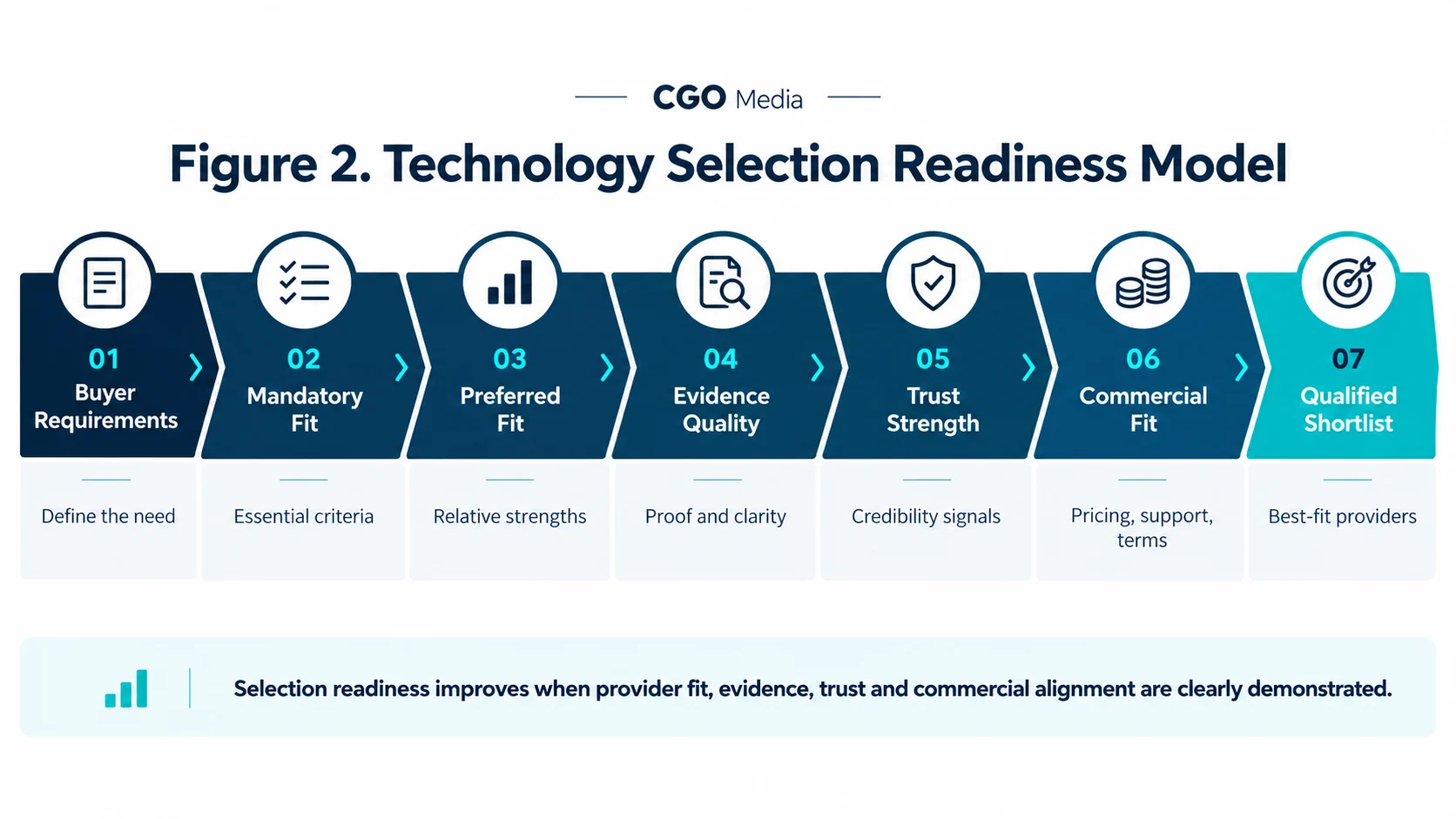
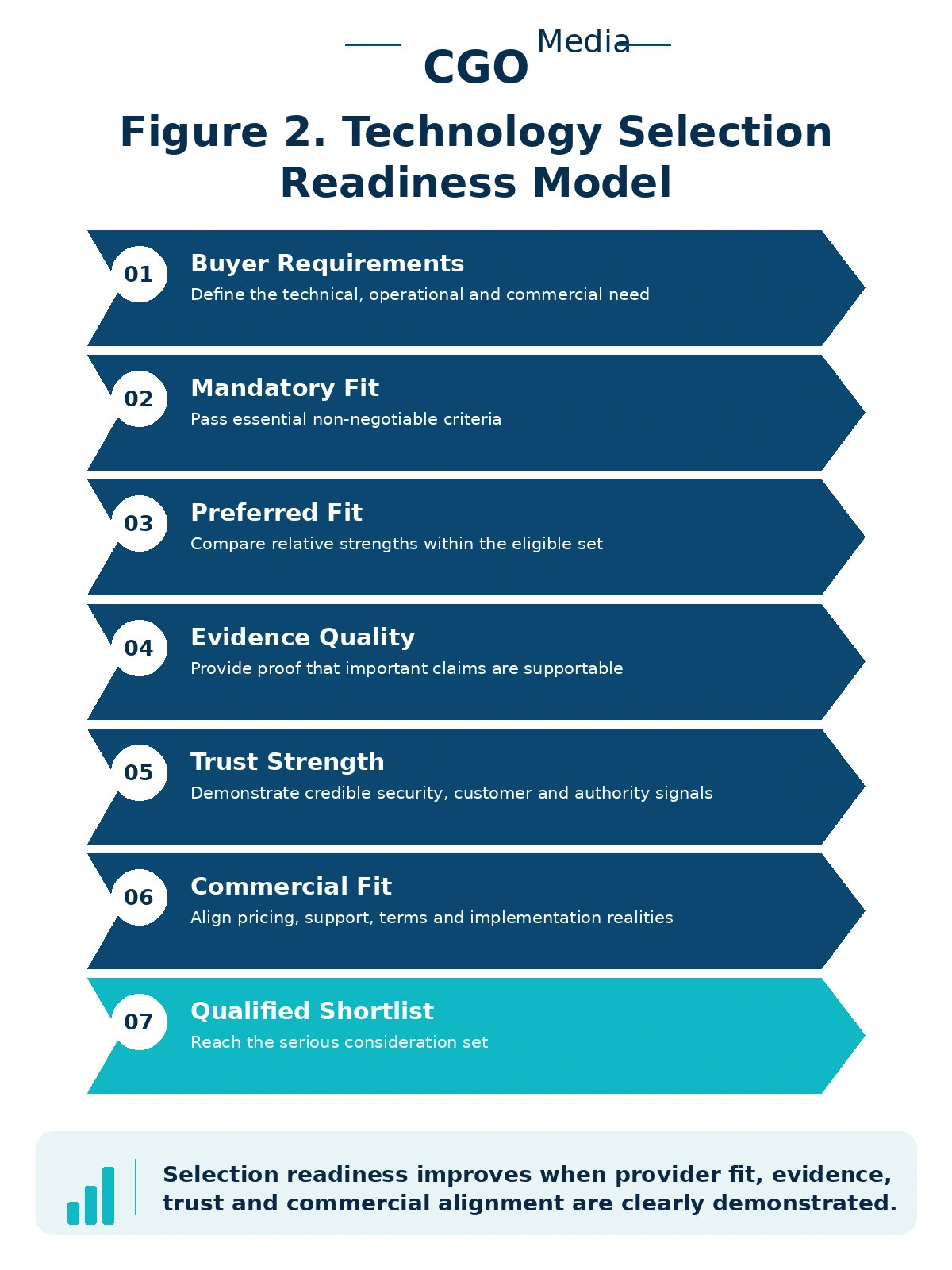
Buyer Requirements → Mandatory Fit → Preferred Fit → Evidence Quality → Trust Strength → Commercial Fit → Qualified Shortlist
Buyer Requirements
Define the functional, technical, security, operational and commercial needs that shape the decision.
Mandatory Fit
Determines whether the provider satisfies the non-negotiable requirements required to remain eligible.
Preferred Fit
Evaluates which eligible providers offer stronger usability, support, flexibility, roadmap alignment or operational fit.
Evidence Quality
Determines whether important provider claims are supported by current, specific, relevant and verifiable evidence.
Trust Strength
Evaluates whether owned claims are reinforced sufficiently through customer evidence, security evidence, independent validation and consistent information.
Commercial Fit
Determines whether pricing, contracts, support and commercial terms align with the buyer’s requirements.
Qualified Shortlist
Represents the providers that satisfy essential requirements, demonstrate sufficient evidence and trust, and remain commercially viable for the specific buyer scenario.
151. The Strategic Implication
Technology organisations should design discovery and information systems around the real selection requirements of multiple buyer stakeholders.
The provider should make:
- Mandatory capabilities
- Preferred strengths
- Technical evidence
- Trust evidence
- Commercial fit
sufficiently clear to support progression from broad discovery into a qualified shortlist.
The strategic objective is not simply to become visible across more technology searches or AI-generated answers.
It is to become consistently eligible, credible and competitive within serious buyer consideration sets where the organisation’s capabilities genuinely match the requirement.
Figure 2 : Technology Selection Readiness Model — Buyer Requirements → Mandatory Fit → Preferred Fit → Evidence Quality → Trust Strength → Commercial Fit → Qualified Shortlist.
152. Qualified Shortlisting Should Lead to Structured Evaluation
Once providers satisfy the initial selection-readiness requirements, buyers need a disciplined method for comparing the remaining candidates.
The strongest process separates:
- Mandatory eligibility
- Evidence confidence
- Trust strength
- Weighted preferences
- Commercial fit
This prevents attractive but ineligible providers from progressing simply because they perform strongly on secondary criteria.
153. Mandatory Fit Comes First
Mandatory requirements should be evaluated before broader scoring begins.
Examples can include:
- Required integration
- Deployment model
- Security control
- Compliance requirement
- Regional availability
These criteria determine whether the provider remains eligible for further comparison.
154. Hard Filters Should Be Binary Where Appropriate
Some requirements are genuinely non-negotiable.
A useful evaluation can therefore classify them as:
- Pass
- Fail
- Unclear
The Unclear state is important because missing public evidence should not automatically be interpreted as a confirmed capability failure.
155. Unclear Mandatory Fit Requires Investigation
Where a critical capability is unclear, buyers may need additional:
- Documentation
- Technical validation
- Provider clarification
- Security evidence
This distinguishes incomplete evidence from genuine ineligibility.
156. Providers Should Not Be Rewarded for Secondary Strengths Before Passing Hard Filters
A provider with excellent usability, strong brand recognition and attractive pricing may still be unsuitable if it fails a mandatory requirement.
The evaluation order should therefore remain:
Eligibility First → Comparative Preference Second
157. Evidence Confidence Is the Second Evaluation Layer
Once mandatory requirements appear to be satisfied, buyers should consider how strongly those capabilities are evidenced.
Evidence confidence can be assessed at requirement level rather than averaged across the whole provider.
158. Requirement-Level Evidence Confidence Is More Useful Than One Global Score
A provider may have:
- Strong security evidence
- Strong scalability evidence
- Weak support evidence
- Weak pricing evidence
One average score can conceal a decision-critical weakness.
159. Evidence Confidence Can Be Classified
A simple structure can use:
- High Confidence — clear, current and verifiable evidence.
- Moderate Confidence — evidence exists but some uncertainty remains.
- Low Confidence — evidence is vague, incomplete or difficult to verify.
This creates a clearer distinction between capability and confidence in that capability.
160. High-Impact Requirements Need Higher Evidence Confidence
Buyers should expect stronger evidence where incorrect assumptions would create greater risk.
Examples can include:
- Security
- Compliance
- Scalability
- Data residency
- Critical integrations
A useful principle is:
Decision Risk ↑ → Required Evidence Confidence ↑
161. Evidence Confidence Should Reflect Source Quality
Evidence can come from:
- Official documentation
- Security resources
- Customer evidence
- Research
- Independent technical sources
The appropriate source depends on the claim being evaluated.
162. First-Party Evidence Is Strongest for Product Truth
Official provider sources are normally most appropriate for current facts such as:
- Product functionality
- Deployment options
- Current integrations
- Technical specifications
- Availability
These facts should be easy to verify directly.
163. Independent Evidence Is Stronger for External Validation
External sources can provide additional confidence around:
- Customer experience
- Market reputation
- Comparative performance
- Industry recognition
Selection confidence is strongest where first-party truth and independent validation reinforce one another.
164. Trust Strength Is the Third Evaluation Layer
Evidence quality alone does not capture the complete trust environment.
Trust can also depend on:
- Source consistency
- Customer evidence
- External authority
- Operational credibility
Trust strength therefore represents a broader confidence judgement.
165. Source Consistency Supports Trust
Important provider facts should remain materially consistent across:
- Website
- Documentation
- Security resources
- Partner pages
- External profiles
Contradictory information increases buyer uncertainty.
166. Customer Evidence Supports Practical Validation
Customer evidence is strongest where it explains:
Customer Context → Requirement → Implementation → Outcome
This makes it easier for a buyer to determine whether the provider has succeeded under comparable conditions.
167. External Authority Supports Independent Confidence
Relevant third-party references can reinforce provider credibility through:
- Industry publications
- Technical media
- Research citations
- Professional recognition
Authority is most useful where it relates directly to the technology or requirement under evaluation.
168. Operational Credibility Also Matters
Buyers may ask whether the organisation appears capable of supporting:
- Implementation
- Ongoing service
- Incident response
- Scaling
- Long-term support
This becomes increasingly important in high-risk purchases.
169. Weighted Preferences Come After Eligibility and Trust
Once providers have passed essential requirements and achieved sufficient evidence confidence, buyers can compare preferred attributes.
These can include:
- Ease of implementation
- Usability
- Support
- Flexibility
- Roadmap alignment
170. Preference Weighting Should Reflect Buyer Priorities
A conceptual model is:
Requirement Importance × Provider Strength × Evidence Confidence
This is not intended as a universal scoring algorithm.
It illustrates that a strong provider attribute matters more when the buyer also considers that attribute important and believes the supporting evidence.
171. Weighting Should Be Agreed Transparently
Where possible, buyers should define major evaluation priorities before the final provider comparison.
This reduces the risk that criteria are changed retrospectively to justify an existing preference.
172. Stakeholder Weighting Differences Should Be Visible
Different decision-makers can legitimately assign different importance to the same criterion.
For example:
- Engineering may prioritise flexibility.
- Security may prioritise control.
- Procurement may prioritise predictability.
- Operations may prioritise simplicity.
These differences should be resolved explicitly rather than hidden inside one blended score.
173. Technology Selection Involves Trade-Offs
Shortlisted providers frequently offer different combinations of strengths and weaknesses.
Buyers may accept:
- Higher cost for lower risk
- Greater complexity for higher scalability
- Less flexibility for easier governance
- Fewer features for faster deployment
These trade-offs are normal.
174. Trade-Offs Should Be Made Explicit
A useful selection process should document:
- What advantage is being gained
- What disadvantage is being accepted
- Why the trade-off is appropriate
This improves decision transparency and implementation expectations.
175. No Provider Should Be Treated as Universally Superior
The strongest provider depends on the scenario.
A product that performs strongly for an enterprise buyer may be poorly suited to a smaller organisation.
Similarly, a simple low-cost tool may outperform a more sophisticated platform where complexity provides little additional value.
176. Commercial Fit Is a Separate Selection Layer
A technically strong and trusted provider can still fail commercial evaluation.
Commercial fit can include:
- Pricing
- Contract structure
- Implementation cost
- Support terms
- Procurement requirements
177. Commercial Fit Should Not Be Reduced to Price
Total commercial suitability can include:
- Entry cost
- Ongoing cost
- Implementation effort
- Support requirements
- Contract flexibility
A cheaper product can become more expensive operationally if implementation and support requirements are substantially greater.
178. Procurement Constraints Can Act as Hard Filters
Some buyers may require:
- Specific contract terms
- Insurance requirements
- Supplier registration
- Minimum support commitments
Failure to satisfy these conditions can eliminate a provider even after strong technical evaluation.
179. Shortlist Decisions Should Preserve the Reasoning
For each shortlisted or eliminated provider, the organisation should understand why the decision occurred.
Useful reasons can include:
- Mandatory fit
- Evidence strength
- Trust strength
- Weighted preference
- Commercial fit
This turns the shortlist process into reusable decision intelligence.
180. Selection Outcomes Should Be Classified
A practical provider outcome taxonomy can include:
- Selected
- Shortlisted
- Eligible but not shortlisted
- Eliminated
- Insufficient evidence
This provides more information than a simple win/loss label.
181. Elimination Reasons Should Be Structured
Useful elimination categories include:
- Capability-based
- Evidence-based
- Trust-based
- Commercial
- Contextual fit
These categories help determine which part of the organisation should respond.
182. Capability-Based Elimination
The provider genuinely lacks a requirement.
Examples can include:
- Missing feature
- Unsupported integration
- Unavailable deployment model
- Insufficient scalability
This should feed primarily into product or service strategy.
183. Evidence-Based Elimination
The capability may exist, but the buyer cannot establish it with sufficient confidence.
This can indicate a need for:
- Better documentation
- Stronger technical evidence
- Clearer product information
- Improved case studies
This is fundamentally different from a missing capability.
184. Trust-Based Elimination
The provider may satisfy the technical requirement while failing to create sufficient confidence.
Potential weaknesses can involve:
- Security evidence
- Customer validation
- Independent references
- Operational credibility
These issues should feed into trust and authority strategy.
185. Commercial Elimination
The provider may be technically and operationally suitable while failing:
- Pricing requirements
- Contract requirements
- Support requirements
- Procurement requirements
Repeated commercial elimination may require a business-model or packaging response rather than additional search optimisation.
186. Contextual-Fit Elimination
The provider may be strong overall but poorly suited to the specific buyer scenario.
This can involve:
- Company size
- Industry
- Geography
- Implementation model
- Operational complexity
Appropriate contextual exclusion is not necessarily a weakness.
187. Appropriate Elimination Can Improve Commercial Efficiency
Providers should not attempt to remain in every buying process.
Early elimination from poor-fit opportunities can reduce:
- Sales effort
- Procurement cost
- Expectation mismatch
- Implementation risk
Qualified selection is preferable to universal consideration.
188. Persistent Elimination Patterns Are Strategic Data
A single lost opportunity may provide limited insight.
Repeated losses for the same reason can indicate a structural issue.
Examples include repeated loss because of:
- Missing security certification
- Weak integration coverage
- Poor evidence
- Commercial inflexibility
189. Persistent Inclusion Can Also Reveal Strong Association
Repeated shortlist inclusion can indicate that the provider is strongly associated with:
- A particular category
- A buyer segment
- A technical strength
- An industry use case
This can provide valuable positioning intelligence.
190. Persistent Inclusion Should Still Be Checked for Accuracy
Frequent inclusion is not automatically beneficial if the provider is consistently associated with:
- The wrong market
- An outdated capability
- An unsuitable buyer type
- An inaccurate product description
Visibility quality matters alongside frequency.
191. Shortlist and Elimination Data Should Feed Back into Strategy
Provider-selection intelligence can improve:
- Product
- Marketing
- Sales
- SEO
- Customer success
This converts provider-selection outcomes into organisational learning.
192. Product Teams Can Use Selection Intelligence
Repeated capability-based elimination can help product teams identify:
- Feature gaps
- Integration gaps
- Security requirements
- Roadmap priorities
This connects lost demand with product strategy.
193. Marketing Teams Can Use Selection Intelligence
Marketing can identify weaknesses involving:
- Positioning
- Audience clarity
- Use-case clarity
- Differentiation
Repeated buyer confusion can therefore inform messaging and information architecture.
194. Sales Teams Can Use Selection Intelligence
Sales can improve:
- Qualification
- Competitive positioning
- Evidence delivery
- Expectation setting
Better qualification can reduce effort spent on opportunities with weak provider fit.
195. SEO Teams Can Use Selection Intelligence
SEO and search teams can strengthen:
- Problem discovery
- Category discovery
- Evidence visibility
- Comparison readiness
This connects search architecture with real buyer-selection behaviour.
196. Customer Success Can Use Selection Intelligence
Selection data can reveal where buyers begin with unrealistic expectations.
This can improve:
- Implementation guidance
- Onboarding
- Expectation management
- Customer-fit assessment
197. Provider Selection Should Operate as a Feedback System
A useful organisational loop is:
Discovery → Evaluation → Shortlist → Selection Outcome → Reason Analysis → Organisational Improvement
The decision process therefore creates information that can improve future demand, product fit and buyer outcomes.
198. Decision Intelligence Should Be Recorded Consistently
Useful fields can include:
- Buyer scenario
- Mandatory requirements
- Shortlisted providers
- Selected provider
- Elimination reasons
- Confidence level
Consistent data improves the organisation’s ability to identify recurring patterns.
199. Selection Data Should Be Segmented
Patterns can be different across:
- Industries
- Company sizes
- Markets
- Products
- Use cases
Segmentation prevents one broad conclusion from hiding meaningful differences between buyer groups.
200. Enterprise Buyers May Eliminate Providers for Different Reasons
Common enterprise constraints can include:
- Security
- Governance
- Scalability
- Integration
- Support
201. Smaller Buyers May Eliminate Providers for Different Reasons
Common SMB constraints can include:
- Price
- Complexity
- Deployment effort
- Ease of use
The same provider can therefore perform very differently across market segments.
202. Selection Intelligence Can Reveal Misaligned Positioning
A provider may attract buyers for whom the offering is repeatedly:
- Too complex
- Too expensive
- Too specialised
- Insufficiently scalable
This can indicate that discovery visibility and commercial fit are poorly aligned.
203. Poor-Fit Discovery Should Be Reduced, Not Maximised
More visibility is not always better if it consistently produces:
- Low-quality enquiries
- Low win rates
- High sales effort
- Weak customer fit
Search and AI discovery should support qualified demand.
204. Strong Selection Systems Improve Buyer-Provider Matching
The longer-term objective is better alignment between:
- Buyer requirements
- Provider capability
- Evidence quality
- Commercial fit
Better matching can improve both conversion quality and post-sale outcomes.
205. Customer Outcomes Should Validate Selection Quality
Successful selection should lead to outcomes such as:
- Successful implementation
- Retention
- Expansion
- Advocacy
Poor post-sale outcomes can indicate that provider-selection criteria or positioning require improvement.
206. Selection Quality Can Become Self-Reinforcing
A useful cycle is:
Qualified Discovery → Strong Evaluation Fit → Correct Selection → Successful Outcome → Stronger Evidence → Better Future Selection
Successful customer relationships can therefore strengthen future provider-selection readiness.
207. The Ninth Technology Discovery Principle
Technology provider comparison should separate hard eligibility filters from weighted preferences so mandatory requirements cannot be obscured by strong performance on less important attributes.
208. The Tenth Technology Discovery Principle
Evidence confidence should be assessed at requirement level because a provider can be strongly evidenced in one area and weakly evidenced in another decision-critical area.
209. The Eleventh Technology Discovery Principle
Provider-selection decisions should make trade-offs explicit because the strongest technology choice is usually the best acceptable fit across technical, trust, operational and commercial constraints rather than a universally superior product.
210. The Twelfth Technology Discovery Principle
Shortlist and elimination data should feed back into product, sales, marketing, SEO and customer-success strategy so repeated selection patterns become organisational learning.
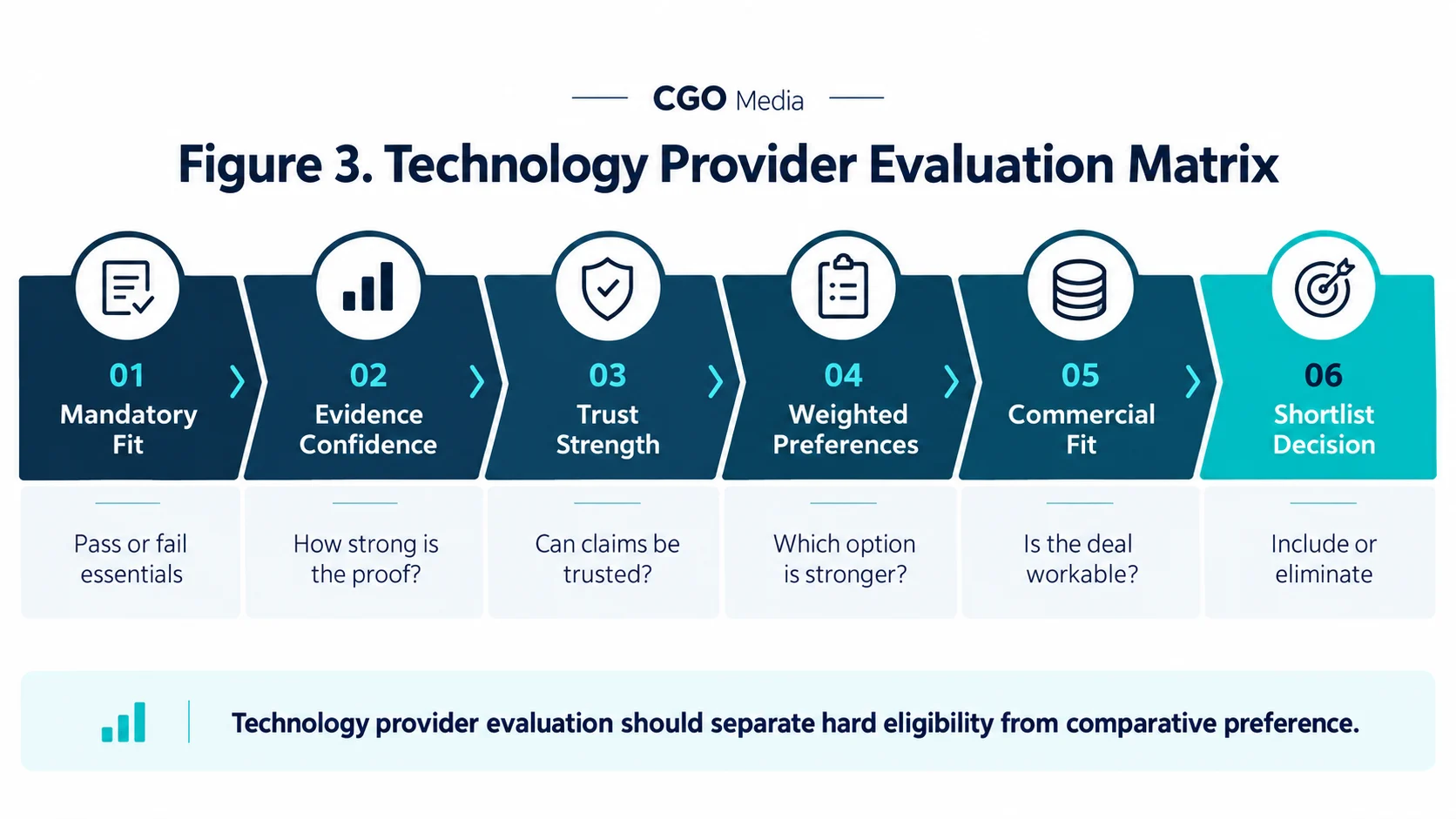
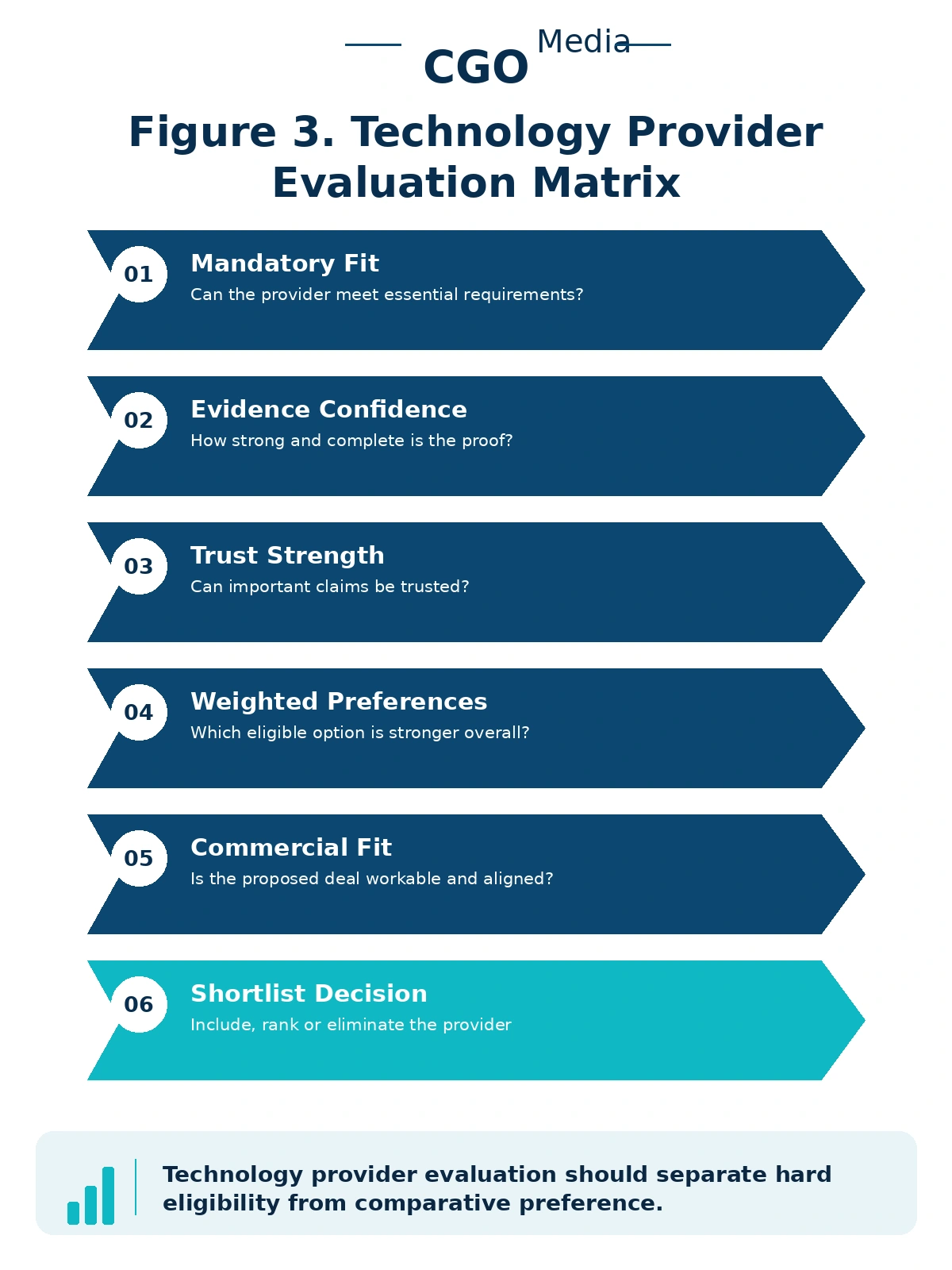
211. The Technology Provider Evaluation Matrix
The complete evaluation relationship can be summarised as:
Mandatory Fit → Evidence Confidence → Trust Strength → Weighted Preferences → Commercial Fit → Shortlist Decision
Mandatory Fit
Determines whether the provider satisfies every non-negotiable technical, security, operational or geographic requirement necessary to remain eligible.
Evidence Confidence
Determines how strongly each decision-critical capability is supported by current, specific and verifiable information.
Trust Strength
Evaluates whether provider claims are reinforced through consistent information, customer evidence, external validation and operational credibility.
Weighted Preferences
Compares eligible providers across preferred characteristics according to the priorities of the buyer and relevant stakeholders.
Commercial Fit
Determines whether pricing, contracts, implementation costs, procurement conditions and support requirements remain acceptable.
Shortlist Decision
Identifies which providers remain credible, eligible and commercially suitable enough to progress toward final selection.
The purpose of the matrix is not to create one universal technology-provider ranking.
It provides a structured method for evaluating providers against the requirements and trade-offs of a specific buyer scenario.
212. The Strategic Implication
Technology organisations should understand not only whether they enter buyer consideration, but whether they survive the complete evaluation process.
They should therefore examine:
- Which mandatory requirements they satisfy
- How strongly those requirements are evidenced
- Whether trust signals support the claims
- How they compare on buyer preferences
- Whether commercial terms remain competitive
- Why they are shortlisted or eliminated
The strongest provider-selection strategy uses these outcomes as feedback.
Repeated capability losses should inform product strategy.
Repeated evidence losses should improve documentation and content.
Repeated trust losses should strengthen authority.
Repeated commercial losses should inform business strategy.
Provider selection therefore becomes not only a buyer decision process, but an organisational learning system capable of improving future discovery, evaluation and customer fit.
Figure 3 : Technology Provider Evaluation Matrix — Mandatory Fit → Evidence Confidence → Trust Strength → Weighted Preferences → Commercial Fit → Shortlist Decision.
213. AI-Assisted Provider Selection Creates a New Shortlisting Layer
Technology buyers can increasingly use AI systems to identify, compare and narrow plausible providers before conducting detailed direct research.
This creates a new selection layer in which providers can enter or leave consideration before:
- A website visit
- A sales conversation
- A product demo
- A procurement process
AI-assisted shortlisting therefore has the potential to influence the consideration set earlier than many conventional analytics systems can observe.
214. AI Can Change How Consideration Sets Are Formed
Traditional discovery often required the buyer to identify several providers manually and investigate them individually.
AI-assisted discovery can compress this process by generating an initial shortlist directly from a combination of:
- Buyer requirements
- Public product information
- Available evidence
- External authority
- Comparative context
215. AI-Mediated Shortlisting Can Be Broad
A buyer may begin with a broad question such as:
Which cybersecurity platforms should we consider?
This type of request can create a relatively large initial consideration set based primarily on category association and broad provider relevance.
216. AI-Mediated Shortlisting Can Also Be Highly Specific
A more constrained question might ask:
Which cybersecurity platforms are suitable for a UK financial-services organisation requiring hybrid deployment, Microsoft integration and 24/7 enterprise support?
This type of scenario combines category discovery with technical and operational filtering.
217. Specific Buyer Prompts Create More Selective Consideration Sets
Detailed requests can introduce several qualification criteria at the discovery stage.
Potential filters can include:
- Security
- Integration
- Scalability
- Support
- Geography
- Deployment model
Providers may therefore be excluded before the buyer manually investigates them.
218. Technical Filtering Can Move Earlier in the Buying Journey
Where an AI-assisted request contains explicit technical constraints, a provider may fail to enter consideration if those capabilities are:
- Absent
- Unclear
- Poorly evidenced
This increases the importance of making decision-critical technical information explicit and accessible.
219. AI Systems Can Apply Comparative Framing
Providers may be described comparatively as:
- Best suited to enterprise environments
- Strong for developers
- Strong for security-sensitive use cases
- Value-focused
- Easy to deploy
This framing can influence how the buyer interprets each provider before direct evaluation begins.
220. Comparative Framing Can Shape Buyer Expectations
A buyer may approach the provider with an existing perception of its:
- Strengths
- Weaknesses
- Target audience
- Market position
This means AI-generated positioning can influence later interpretation of provider information.
221. Comparative Framing Should Be Monitored
Technology organisations should observe whether recurring descriptions align with:
- Actual product capability
- Intended market positioning
- Commercial strategy
- Target customer profile
Persistent misalignment may require changes to the wider information environment.
222. Framing Misalignment Can Create Selection Friction
For example, an enterprise technology product repeatedly framed as an SMB tool may attract:
- Poor-fit enquiries
- Incorrect expectations
- Low-value comparison scenarios
The opposite can also occur where a product designed for smaller organisations is repeatedly positioned as enterprise-only.
223. Framing Problems Should Be Diagnosed at Source
Persistent positioning differences can arise from:
- Owned content
- Legacy product information
- External commentary
- Customer reviews
- Partner descriptions
The corrective response should strengthen the underlying information ecosystem rather than attempt to manipulate one generated answer.
224. AI Shortlists Reveal Competitive Co-Occurrence
The same provider names may repeatedly appear together within AI-generated comparisons and recommendations.
Repeated co-occurrence can provide useful evidence about the effective competitive set.
225. The Effective Competitive Set Can Differ from Internal Assumptions
Technology organisations often maintain competitor lists based on:
- Sales opportunities
- Market research
- Strategic planning
AI-generated consideration sets can surface alternative competitors not currently treated as direct rivals internally.
226. Technology Organisations Should Track Three Competitive Sets
- Commercial Competitors
- Search Competitors
- AI Recommendation Competitors
These sets can overlap, but they should not be assumed to be identical.
227. Commercial Competitors
Commercial competitors are providers encountered directly within:
- Sales opportunities
- Procurement processes
- Formal buyer evaluations
They represent competition visible within the actual commercial pipeline.
228. Search Competitors
Search competitors compete for visibility across:
- Problem queries
- Category queries
- Use-case searches
- Provider comparisons
Some may be publishers, marketplaces or adjacent-category organisations rather than direct commercial rivals.
229. AI Recommendation Competitors
AI recommendation competitors are providers repeatedly surfaced within generated:
- Consideration sets
- Comparisons
- Shortlists
- Recommendations
This group can reveal how the wider public information environment associates the organisation with alternatives.
230. Competitive Sets Should Be Compared
A useful strategic exercise is to compare:
Commercial Competition vs Search Competition vs AI Recommendation Competition
Significant differences can reveal emerging market dynamics or gaps in internal competitor understanding.
231. AI Co-Occurrence Can Reveal Category Perception
If a provider is repeatedly grouped with a particular class of companies, this may indicate how public evidence currently positions the organisation.
The provider may be associated with:
- An intended category
- An adjacent category
- A specialist niche
- A different buyer segment
232. AI Co-Occurrence Can Reveal Market Drift
Market drift can occur where the provider becomes increasingly associated with:
- A new technology category
- A lower-cost market segment
- A narrower specialist niche
- A different customer size
This may be positive, negative or simply reflective of genuine product evolution.
233. Market Drift Should Be Diagnosed Before It Is Corrected
Potential causes can include:
- Actual product evolution
- Outdated public information
- External market commentary
- Internal positioning inconsistency
Not every change in market association should automatically be reversed.
234. AI Recommendation Logic Should Be Interpreted Through Buyer Constraints
The relevant shortlist should depend on what the buyer actually values.
Common constraints can include:
- Security
- Budget
- Integration
- Scalability
- Support
- Geography
Different combinations of these constraints can produce different provider sets.
235. Different Constraint Sets Should Produce Different Shortlists
This is expected.
A provider may be particularly strong when:
- Security matters more than price
- Enterprise support is essential
- Integration breadth carries high weight
The same provider may perform less strongly where simplicity or low entry cost dominates.
236. There Is No Single Universal Provider Ranking
Technology selection depends on:
- Buyer needs
- Constraint weighting
- Risk tolerance
- Commercial context
A provider ranking that is meaningful for one scenario can be misleading for another.
237. AI Recommendation Order Should Not Be Treated as a Fixed League Table
Generated order can vary according to:
- Prompt wording
- Model
- Date
- Evidence availability
- Constraint weighting
One ranked list should therefore not be interpreted as a stable market hierarchy.
238. Persistent Relative Position Is More Informative
Repeated comparative strength within a consistent scenario family can provide more useful evidence than one generated ranking.
Longitudinal observations can reveal:
- Stable strengths
- Persistent weaknesses
- Competitive displacement
- Changing market association
239. AI Shortlist Analysis Should Record Scenario Context
Useful observation fields can include:
- Prompt
- Buyer type
- Requirements
- Market
- Date
Without this context, later comparison can become unreliable.
240. AI Shortlist Analysis Should Record the Outcome
Useful outcome classifications can include:
- Included
- Excluded
- Positioned strongly
- Positioned conditionally
- Misrepresented
This makes monitoring more useful than simply counting mentions.
241. Inclusion Alone Is Not Enough
A provider can appear within a shortlist for the wrong reason or under the wrong assumptions.
The quality of inclusion therefore matters as much as the fact of inclusion.
242. Qualified Inclusion Should Be Accurate
Material facts about the provider should be correct.
This includes:
- Product identity
- Capabilities
- Availability
- Target market
Inaccurate inclusion can create buyer confusion rather than useful visibility.
243. Qualified Inclusion Should Be Relevant
The provider should genuinely belong within the scenario.
Relevant inclusion aligns with:
- Buyer need
- Product capability
- Commercial fit
- Market strategy
244. Qualified Inclusion Should Be Properly Framed
The explanation should represent:
- Real strengths
- Material limitations
- Appropriate buyer fit
Overstated strengths or missing limitations can reduce the quality of the recommendation.
245. Qualified Inclusion Should Be Evidence-Supported
Public evidence should support the provider’s inclusion.
Relevant evidence can include:
- Official documentation
- Security resources
- Customer evidence
- Independent technical publications
- Relevant research
246. AI Shortlist Quality Is Multi-Dimensional
A useful conceptual relationship is:
Presence + Accuracy + Relevance + Comparative Framing + Evidence Support
Each dimension contributes a different aspect of shortlist quality.
247. Presence
Presence asks whether the provider appears within the relevant consideration set.
Absence can indicate weak category association, poor discovery or insufficient competitive relevance.
248. Accuracy
Accuracy asks whether important provider facts are represented correctly.
Persistent factual errors should be treated as an information-governance problem rather than simply a visibility issue.
249. Relevance
Relevance asks whether the provider genuinely fits the buyer scenario.
Relevant inclusion is preferable to broad inclusion that attracts poorly matched demand.
250. Comparative Framing
Comparative framing asks how the provider is differentiated from alternatives.
This can reveal whether it is consistently associated with:
- Enterprise scale
- Security strength
- Developer usability
- Value
- Specialist expertise
251. Evidence Support
Evidence support asks whether the generated explanation appears consistent with credible public information.
Where visible source support is weak, buyers may have less confidence in the shortlist.
252. Shortlist Quality Should Be Tracked Longitudinally
Repeated observations are more useful than isolated outputs.
Longitudinal monitoring can identify:
- Stable inclusion
- Stable exclusion
- Recurring misrepresentation
- Changing comparative position
253. Repeated Accurate Inclusion Indicates Stronger Selection Visibility
This is especially meaningful when the scenario aligns with:
- Target customers
- Priority use cases
- Core technical strengths
- Commercial strategy
254. Repeated Misrepresentation Indicates an Information Problem
Potential causes can include:
- Outdated sources
- Weak product clarity
- Conflicting evidence
- Legacy positioning
The organisation should investigate the wider public source environment.
255. Repeated Exclusion Can Have Several Causes
Potential causes include:
- Weak discovery
- Poor fit
- Weak evidence
- Weak authority
- Stronger competitors
Exclusion should therefore be diagnosed before corrective action is chosen.
256. Appropriate Exclusion Is Better Than Poor-Fit Inclusion
A provider should not aim to appear in scenarios where its product does not genuinely fit.
Poor-fit recommendation can create:
- Low-quality enquiries
- Wasted sales effort
- Expectation mismatch
- Weak conversion quality
257. Technology Provider Selection Should Optimise for Qualified Inclusion
The objective is not universal AI shortlist presence.
The objective is repeated relevant inclusion within high-value buyer scenarios where the provider’s capabilities and commercial model genuinely align.
258. High-Value Scenarios Should Reflect Business Strategy
Priority scenarios should correspond with:
- Target customers
- Priority industries
- Strategic markets
- Core use cases
- Product strengths
This keeps AI shortlist monitoring commercially focused.
259. Source Support Can Influence Shortlist Confidence
Where AI systems surface sources, buyers may inspect the evidence behind the recommendation.
Strong source support can improve confidence that the shortlist is based on credible information.
260. Strong Source Support Can Include
- Official documentation
- Security resources
- Customer evidence
- Independent technical publications
- Relevant research
Different source types can reinforce different parts of the selection decision.
261. Weak Source Support Can Create Doubt
This becomes particularly important in high-risk technology decisions involving:
- Security
- Compliance
- Infrastructure
- Data
- Mission-critical operations
262. Visible Sources Should Be Interpreted Carefully
Visible citations or supporting links can provide useful observational evidence.
They should not automatically be treated as a complete explanation of how a generated answer was produced.
263. Source Support Can Still Reveal Evidence Gaps
For example, a provider may be repeatedly recommended while the visible evidence relies mainly on weak third-party summaries.
This can indicate an opportunity to strengthen the provider’s own:
- Product information
- Documentation
- Security evidence
- Case studies
264. External Evidence Can Strengthen Independent Confidence
External validation can include:
- Research citations
- Technical media
- Professional validation
- Independent reviews
The strongest external evidence is directly relevant to the claim or buyer requirement under consideration.
265. Source Conflict Can Weaken Shortlist Confidence
Conflicting public information can create uncertainty about whether a provider satisfies important requirements.
Critical conflicts can involve:
- Security claims
- Integration support
- Product status
- Support availability
- Pricing logic
266. Source Conflict Can Create Silent Shortlist Loss
The buyer may eliminate the provider without contacting the organisation.
This can occur entirely within pre-click research.
As a result, conventional website analytics may provide no direct evidence that the opportunity ever existed.
267. Silent Elimination Is Strategically Important
A provider can lose consideration because a requirement appears:
- Unsupported
- Unclear
- Contradictory
- Inferior to competitors
without any direct interaction with the organisation.
268. Selection Intelligence Should Combine Multiple Evidence Sources
Technology organisations should combine:
- Search observations
- AI observations
- Sales intelligence
- Customer research
- Competitive analysis
No single dataset provides a complete view of provider selection.
269. Sales Intelligence Reveals Real Commercial Competitors
Sales teams can identify which providers appear repeatedly within actual opportunities.
This provides direct evidence about the commercial consideration set.
270. AI Observation Can Reveal Emerging Competitive Sets
New competitors may begin appearing in generated shortlists before they become obvious within sales data.
This can provide an early signal of:
- Category convergence
- New entrants
- Alternative solutions
- Changing market perception
271. Search Data Reveals Discovery Competition
Search analysis can show which organisations compete across:
- Category visibility
- Use-case visibility
- Problem discovery
- Comparison searches
This competitor set may differ from both sales and AI recommendation competitors.
272. Customer Research Reveals Decision Logic
Customers can explain:
- Which providers they considered
- Which evidence mattered
- Why they eliminated alternatives
- Why they selected the final provider
This provides direct insight into selection behaviour that search or AI observation alone cannot provide.
273. Competitive Selection Intelligence Should Be Combined
A useful relationship is:
Search Competition + AI Co-Occurrence + Sales Competition + Customer Decision Evidence
This creates a more complete understanding of the provider-selection environment.
274. AI-Assisted Comparison Should Be Tested Across Buyer Stages
Different stages generate different information needs.
Useful monitoring should therefore include:
- Early-stage scenarios
- Mid-stage scenarios
- Late-stage scenarios
275. Early-Stage AI Scenarios
Early-stage prompts can focus on:
- Categories
- Problems
- Approaches
These tests reveal whether the provider enters initial market discovery.
276. Mid-Stage AI Scenarios
Mid-stage prompts can focus on:
- Provider lists
- Capabilities
- Use-case fit
- Technical differences
These tests reveal whether the provider progresses into active evaluation.
277. Late-Stage AI Scenarios
Late-stage prompts can focus on:
- Security
- Pricing
- Support
- Final trade-offs
These scenarios test whether the provider can survive decision-critical comparison.
278. Selection Visibility Should Be Mapped Across the Journey
A provider can perform strongly at one stage and weakly at another.
This creates several possible patterns.
279. Strong Early Discovery with Weak Late-Stage Evidence Creates Leakage
The provider enters consideration frequently but fails during:
- Technical validation
- Trust validation
- Commercial comparison
- Final shortlisting
High discovery visibility therefore does not guarantee strong selection performance.
280. Weak Early Discovery with Strong Late-Stage Evidence Creates Hidden Strength
The provider may convert effectively when discovered but fail to enter enough consideration sets.
This indicates that evaluation readiness is stronger than discovery strength.
281. Strong Selection Performance Requires Both
A useful relationship is:
Discovery Strength + Evaluation Strength
Discovery strength brings the provider into consideration.
Evaluation strength keeps it there.
282. AI Selection Monitoring Should Identify the Leakage Point
The key question is:
At which stage does the provider stop progressing?
This converts AI shortlist monitoring from visibility reporting into selection diagnosis.
283. Leakage Can Occur at Category Discovery
The provider may not be sufficiently associated with the relevant category, problem or use case.
This is primarily a discovery problem.
284. Leakage Can Occur at Provider Understanding
The product or organisation may be visible while:
- Its offering remains unclear
- Its audience is ambiguous
- Its use-case positioning is weak
This is primarily an understanding problem.
285. Leakage Can Occur at Technical Validation
A mandatory capability may be:
- Absent
- Unclear
- Poorly evidenced
The response depends on which of these conditions is responsible.
286. Leakage Can Occur at Trust Validation
Important claims may lack sufficient confidence because of weak:
- Security evidence
- Customer evidence
- External validation
- Source consistency
287. Leakage Can Occur at Commercial Comparison
Pricing, contract structure, support or procurement requirements may weaken overall fit even where technical capability is strong.
288. Leakage Can Occur at Final Shortlisting
A provider may satisfy many requirements but still lose because another provider offers a stronger overall trade-off.
This is not necessarily evidence of a single capability failure.
289. Selection Leakage Should Be Diagnosed Systematically
A practical diagnostic relationship is:
Stage → Evidence → Gap → Elimination Risk → Corrective Action
290. Stage
Identifies where the buyer is within the selection journey.
This establishes the type of information or evidence likely to matter most.
291. Evidence
Identifies the information required to progress at that stage.
This can include:
- Product information
- Technical documentation
- Security evidence
- Customer validation
- Commercial information
292. Gap
Identifies what is:
- Missing
- Weak
- Outdated
- Conflicting
The gap should be defined precisely enough to support corrective action.
293. Elimination Risk
Estimates how likely the weakness is to remove the provider from consideration.
Risk should be higher where the gap affects a mandatory requirement or high-priority buyer criterion.
294. Corrective Action
Defines the organisational response most appropriate to the problem.
Corrective action should reflect the type of gap rather than defaulting to more content production.
295. Discovery Gaps Require Stronger Visibility
Potential responses can include:
- Problem-led content
- Category authority
- Search visibility
- AI visibility
296. Understanding Gaps Require Better Clarity
Potential responses can include:
- Clearer product architecture
- Better category positioning
- Improved use-case explanation
- Stronger entity relationships
297. Capability Gaps Require Product or Service Change
If the provider genuinely cannot satisfy the requirement, search or content changes cannot solve the underlying problem.
This should feed into product, service or commercial strategy.
298. Evidence Gaps Require Better Proof
Where the capability exists but is poorly demonstrated, potential responses can include:
- Documentation
- Technical evidence
- Case studies
- Research
299. Trust Gaps Require Stronger Validation
Potential responses can include:
- Security evidence
- Customer validation
- Independent references
- Relevant external authority
300. Commercial Gaps Require Business Decisions
Repeated problems involving:
- Pricing
- Contracts
- Support
- Procurement
may require changes to commercial strategy rather than search strategy.
301. Correct Diagnosis Protects Organisational Efficiency
A useful provider-selection model prevents:
- SEO teams being asked to solve capability problems
- Content teams being asked to solve pricing problems
- Sales teams being asked to overcome missing mandatory functionality
The intervention should match the real cause of shortlist loss.
302. The Thirteenth Technology Discovery Principle
AI-assisted shortlisting should be evaluated through qualified inclusion, accuracy, comparative framing and evidence support because provider presence alone does not establish meaningful selection visibility.
303. The Fourteenth Technology Discovery Principle
Competitive co-occurrence should be monitored because AI-generated consideration sets can reveal emerging competitors and market associations that differ from traditional sales or search competitor lists.
304. The Fifteenth Technology Discovery Principle
Provider-selection visibility should be analysed across buyer stages so organisations can identify where discovery strength fails to convert into technical validation, trust, commercial fit or final shortlist inclusion.
305. The Sixteenth Technology Discovery Principle
Selection leakage should be diagnosed by stage, evidence requirement, gap type and elimination risk so corrective action addresses the real cause of shortlist loss.
306. The Technology AI Shortlist Quality Model
The complete relationship can be summarised as:
Relevant Presence → Accurate Representation → Strong Evidence → Appropriate Framing → Qualified Shortlist Inclusion
Relevant Presence
The provider appears within AI-assisted consideration sets that align with its actual target market, capabilities and commercial strategy.
Accurate Representation
Important facts about the organisation, products, capabilities, availability and target audience are represented correctly.
Strong Evidence
Provider inclusion is supported through credible technical, security, customer, research or independent evidence appropriate to the buyer requirement.
Appropriate Framing
The provider is differentiated from alternatives in a way that reflects real strengths, limitations and market positioning.
Qualified Shortlist Inclusion
The provider remains among credible options within a buyer scenario where its actual capabilities, evidence and commercial model genuinely fit the requirement.
307. The Strategic Implication
Technology organisations should monitor how they are discovered, framed, compared and shortlisted across AI-assisted buyer journeys.
The organisation should identify whether shortlist loss results from:
- Weak category association
- Inaccurate representation
- Missing evidence
- Source conflict
- Competitive displacement
- Poor buyer fit
It should also identify where silent elimination occurs before a direct website or sales interaction.
The strategic objective is not to appear in every AI-generated consideration set.
It is to achieve repeated, accurate and evidence-supported inclusion within the high-value scenarios where the organisation genuinely belongs.
Figure 4 : Technology AI Shortlist Quality Model — Relevant Presence → Accurate Representation → Strong Evidence → Appropriate Framing → Qualified Shortlist Inclusion.
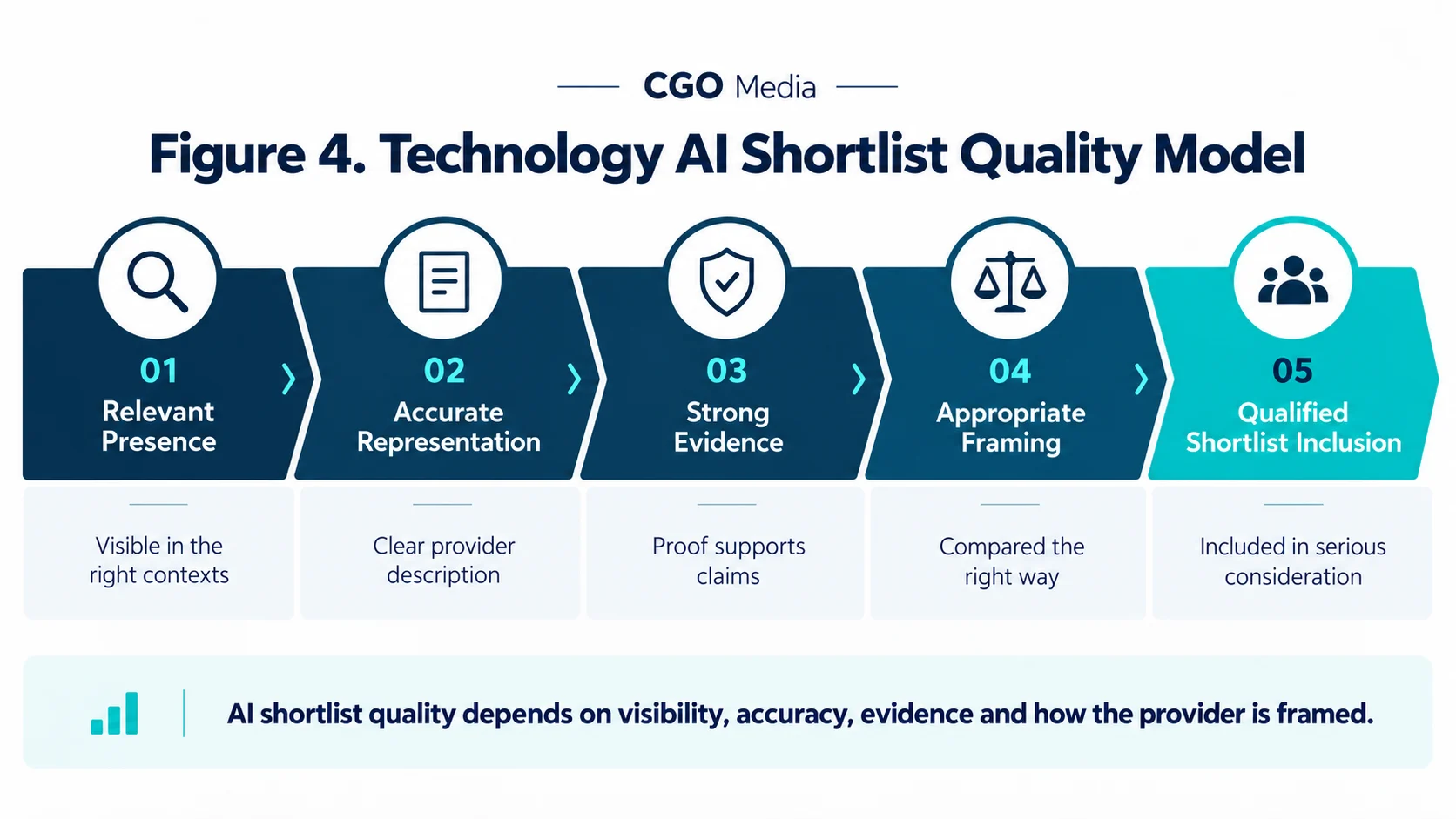
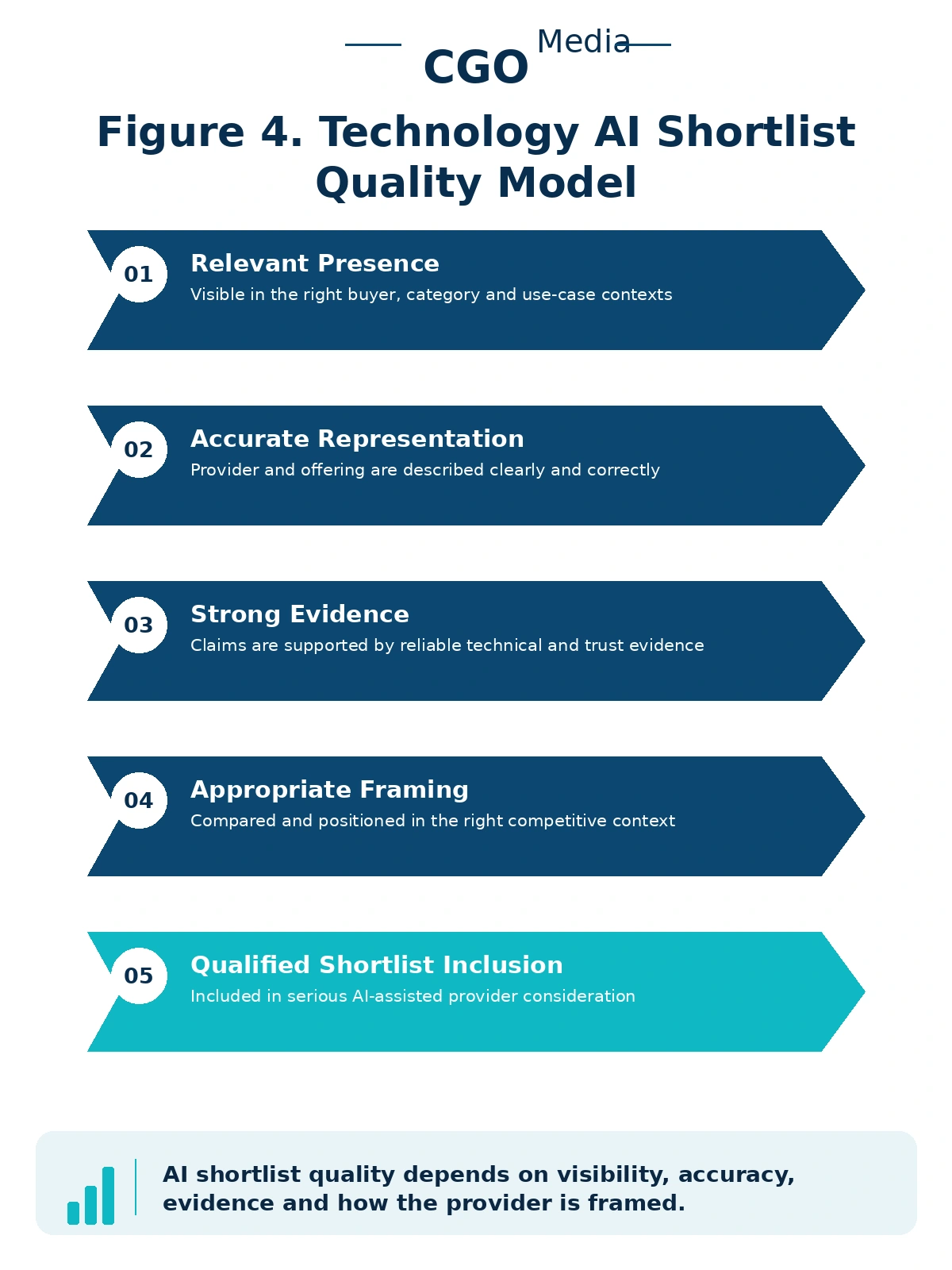
308. Technology Provider Selection Should Be Measured Beyond Traffic
Traffic indicates exposure, but provider-selection performance depends on whether qualified buyers continue progressing through discovery, evaluation, trust validation, shortlisting and commercial conversion.
A stronger measurement system should therefore include:
- Discovery Visibility
- Evaluation Readiness
- Trust Strength
- Qualified Shortlist Inclusion
- Conversion Quality
- Commercial Outcome
309. Discovery Visibility Is the First Measurement Layer
Discovery visibility asks whether the provider enters relevant consideration sets.
Useful indicators can include:
- Category visibility
- Use-case visibility
- Industry visibility
- AI inclusion
- External discovery
The focus should remain on commercially relevant discovery rather than raw reach alone.
310. Discovery Strength Should Be Segmented
A provider can be highly visible overall while remaining weak within strategically important segments.
Useful segmentation can include:
- Industry
- Company size
- Geography
- Use case
- Technical requirement
This helps distinguish broad awareness from qualified market visibility.
311. Evaluation Readiness Is the Second Measurement Layer
Evaluation readiness asks whether the buyer can obtain enough information to assess the provider properly.
Useful measures can include:
- Product clarity
- Documentation completeness
- Security information
- Integration evidence
- Commercial clarity
A provider can be visible but still difficult to evaluate.
312. Evaluation Readiness Should Measure Decision-Critical Completeness
The objective is not to count pages.
The more useful question is whether enough credible information exists to answer the buyer’s important decision questions.
Relevant areas can include:
- What the product does
- How it integrates
- How it is secured
- Who it suits
- What commercial constraints apply
313. Trust Strength Is the Third Measurement Layer
Trust strength asks whether enough evidence exists to support important provider claims.
Useful measures can include:
- Customer evidence
- Independent references
- Security validation
- Technical authority
- Source consistency
Trust measurement should focus on evidence relevant to the buyer’s actual risk and selection criteria.
314. Trust Should Be Measured by Requirement
A provider may have strong trust evidence in one area and weak evidence in another.
For example:
- Strong security evidence
- Strong product evidence
- Weak customer evidence
- Weak commercial transparency
One overall trust score can therefore conceal decision-critical weaknesses.
315. Qualified Shortlist Inclusion Is the Fourth Measurement Layer
Qualified shortlist inclusion asks whether the provider remains among credible options for relevant buyer scenarios.
Useful shortlist measures can include:
- Inclusion frequency
- Scenario relevance
- Comparative framing
- Competitor co-occurrence
- Recommendation fit
316. Shortlist Inclusion Should Be Segmented
Shortlist performance can vary significantly according to:
- Industry
- Company size
- Use case
- Geography
- Technical constraint
Segmentation helps identify where the provider possesses strong selection readiness and where meaningful weaknesses remain.
317. Industry-Level Shortlist Measurement
Industry segmentation can reveal whether provider-selection strength differs across sectors such as:
- Financial services
- Healthcare
- Manufacturing
- Retail
- Public sector
This can expose differences in trust requirements, regulation and buyer expectations.
318. Company-Size Shortlist Measurement
Providers can perform differently across:
- SMB
- Mid-market
- Enterprise
A product that performs strongly for enterprise buyers may struggle where simplicity and price are more important, and vice versa.
319. Use-Case Shortlist Measurement
Shortlist performance can also be evaluated across use cases such as:
- Security
- Data
- AI
- Automation
- Infrastructure
This reveals the scenarios where provider association is strongest.
320. Geographic Shortlist Measurement
Regional measurement can reveal differences involving:
- Market awareness
- Support perception
- Data-location relevance
- Regional authority
Technology providers should not assume that shortlist strength in one market automatically transfers to another.
321. Technical-Constraint Measurement
Scenario testing can also include constraints such as:
- Hybrid deployment
- API support
- Security requirements
- Scalability
- Integration
This reveals whether the provider remains competitive when buyer requirements become more demanding.
322. Shortlist Measurement Should Track Inclusion Quality
A useful scorecard can assess:
- Presence
- Accuracy
- Relevance
- Comparative Position
- Evidence Confidence
This provides a more meaningful view than inclusion frequency alone.
323. Presence
Presence asks whether the provider appears within the relevant consideration or shortlist environment.
It is the starting point rather than the complete performance measure.
324. Accuracy
Accuracy asks whether important provider facts are represented correctly.
Material errors concerning:
- Capabilities
- Product status
- Availability
- Target market
can reduce the value of inclusion.
325. Relevance
Relevance asks whether the provider genuinely belongs within the scenario.
Qualified inclusion should reflect actual buyer fit rather than maximum visibility.
326. Comparative Position
Comparative position asks how the provider is framed against alternatives.
Persistent framing can reveal whether the organisation is associated with:
- Enterprise capability
- Technical depth
- Security
- Value
- Ease of use
327. Evidence Confidence
Evidence confidence asks how strongly public evidence supports the provider’s inclusion and comparative position.
Weak evidence can make shortlist visibility fragile even where the provider appears frequently.
328. Shortlist Measurement Should Be Longitudinal
Repeated patterns are more informative than isolated outputs.
Longitudinal measurement can distinguish:
- Stable inclusion
- Stable exclusion
- Persistent misrepresentation
- Competitive displacement
329. Stable Inclusion Can Indicate Stronger Market Association
Repeated inclusion within strategically important scenarios can indicate durable association between the provider and a:
- Category
- Use case
- Buyer type
- Technical strength
This is more meaningful than occasional presence.
330. Stable Exclusion Can Reveal a Structural Weakness
Persistent exclusion can arise from:
- Weak discovery
- Poor buyer fit
- Weak evidence
- Weak authority
The underlying cause should be diagnosed before corrective action is chosen.
331. Stable Misrepresentation Can Reveal an Information Problem
Repeated incorrect framing can point to:
- Legacy sources
- Ambiguous positioning
- Conflicting product information
- Outdated external descriptions
This should be treated as an information-governance issue.
332. Competitive Co-Occurrence Should Also Be Measured
Repeated co-occurrence can reveal:
- Primary AI competitors
- Emerging competitors
- Category associations
- Changing market position
Co-occurrence is an observational signal rather than a direct measure of market share.
333. Conversion Quality Is the Fifth Measurement Layer
Conversion quality asks whether shortlisted buyers become meaningful commercial opportunities.
Useful indicators can include:
- Demo requests
- Trials
- Technical consultations
- Qualified opportunities
- Procurement progression
The objective is to measure whether shortlist visibility translates into serious buying behaviour.
334. Qualified Conversion Is More Important Than Raw Conversion
A high volume of low-fit enquiries can consume sales resources without creating strong commercial outcomes.
A stronger objective is:
Qualified Shortlist → Qualified Opportunity
This keeps measurement aligned with buyer-provider fit.
335. Conversion Quality Can Reveal Discovery Misalignment
If shortlist visibility increases while qualified conversion remains weak, the organisation may be attracting:
- Poor-fit buyers
- Incorrect expectations
- Unrealistic use cases
More visibility would not necessarily solve this problem.
336. Commercial Outcome Is the Sixth Measurement Layer
Commercial outcome asks whether provider-selection visibility contributes to valuable business results.
Useful measures can include:
- Pipeline contribution
- Revenue contribution
- Win rate
- Sales-cycle quality
- Acquisition efficiency
337. Commercial Outcomes Should Be Interpreted Carefully
Technology buying journeys are multi-touch.
Search, AI, peer recommendation, technical publications, sales interaction and provider research can all influence the final decision.
One channel should therefore not automatically receive full causal credit.
338. Provider Selection Creates Attribution Complexity
A typical journey may include:
Search → Technical Article → AI Assistant → Provider Website → Documentation → Sales Conversation → Procurement
Another may begin through peer recommendation and later involve AI comparison and branded search.
The final click rarely explains the full decision journey.
339. First-Touch Attribution Is Incomplete
The first recorded interaction may identify where discovery began without explaining:
- Which evidence built trust
- Which comparisons mattered
- Which factors produced final selection
340. Last-Click Attribution Is Also Incomplete
The final website visit may occur after the buyer has already:
- Compared providers
- Reviewed technical evidence
- Received peer recommendations
- Used AI-assisted research
Last-click data can therefore underestimate earlier discovery and evaluation influence.
341. Selection Attribution Should Be Multi-Evidence
A more useful analysis can combine:
- Search data
- AI observation
- CRM evidence
- Sales interviews
- Customer research
The objective is to identify recurring patterns rather than claim precision unsupported by the available evidence.
342. Win and Loss Data Are Critical Selection Evidence
Sales teams can record why providers were:
- Selected
- Shortlisted
- Eliminated
- Rejected
This connects visibility data with real buyer decisions.
343. Lost-Deal Reasons Should Be Classified
A practical taxonomy includes:
- Capability Loss
- Evidence Loss
- Trust Loss
- Commercial Loss
- Relationship Loss
344. Capability Loss
The provider genuinely lacked an important requirement.
Repeated capability losses can inform:
- Product roadmaps
- Integration priorities
- Service design
345. Evidence Loss
The required capability may have existed but was insufficiently demonstrated.
Repeated evidence losses should inform:
- Documentation
- Technical content
- Case studies
- Research
346. Trust Loss
The buyer lacked confidence in the provider.
Potential weaknesses can involve:
- Security validation
- Customer proof
- Independent references
- Operational credibility
347. Commercial Loss
Pricing, contract structure, support or procurement conditions prevented selection.
Persistent commercial losses can require changes to business strategy rather than search or content strategy.
348. Relationship Loss
Another provider may possess stronger:
- Existing relationships
- Partner influence
- Internal sponsorship
Relationship-based losses should be distinguished from capability or evidence weaknesses.
349. Win Analysis Should Be Conducted Alongside Loss Analysis
Organisations should also understand why buyers select them.
Winning factors can include:
- Technical strength
- Integration
- Support
- Specialist expertise
- Commercial flexibility
These reasons can reveal genuine differentiators.
350. Win and Loss Data Can Challenge Marketing Assumptions
Customers may value capabilities or characteristics the organisation does not emphasise publicly.
Selection intelligence should therefore feed into:
- Positioning
- Content
- Search strategy
- Sales enablement
351. Search Strategy Should Reflect Real Selection Strengths
If buyers repeatedly choose the provider because of a particular capability, that strength should be represented clearly within relevant search and evaluation content.
This connects actual commercial performance with future discovery strategy.
352. Product Strategy Should Reflect Repeated Capability Losses
If the same missing capability repeatedly removes the provider from serious consideration, the issue may deserve product-level investment.
Selection intelligence can therefore become a roadmap input.
353. Measurement Should Identify the Main Selection Constraint
A provider-selection system can be constrained at different points.
Examples include:
- Strong evaluation readiness but weak discovery
- Strong discovery but weak evidence
- Strong trust but weak shortlist inclusion
- Strong shortlist inclusion but weak qualified conversion
The main constraint should guide investment priority.
354. Selection Performance Should Be Treated as a Funnel
The conceptual progression is:
Discovery → Evaluation Readiness → Trust → Qualified Shortlist → Qualified Conversion → Commercial Outcome
The funnel does not imply that every technology buyer follows a perfectly linear journey.
355. Buyers Can Move Backward and Forward
Technology buyers can:
- Repeat evaluation stages
- Skip stages
- Return to earlier research
- Add new providers late in the process
The funnel remains useful because it helps diagnose where provider progression is most frequently constrained.
356. Executive Reporting Should Focus on Progression
An executive scorecard can report:
- Discovery Strength
- Evaluation Readiness
- Trust Strength
- Qualified Shortlist Inclusion
- Conversion Quality
- Commercial Outcome
Each dimension can be assessed against:
- Current state
- Target state
- Trend
- Confidence
- Priority
357. Trend Should Be Visible
Useful trend classifications can include:
- Improving
- Stable
- At Risk
- Deteriorating
A static score can hide meaningful deterioration.
358. Confidence Should Be Reported
Selection intelligence is not always based on equally strong evidence.
Confidence can be classified as:
- Low
- Medium
- High
This prevents uncertain observations from being presented with false precision.
359. Priority Should Reflect the Main Constraint
Useful priority levels can include:
- Critical
- High
- Medium
- Low
The priority should reflect the likely impact of the constraint on qualified provider progression.
360. The Selection Scorecard Should Be Diagnostic
Its purpose is not to create a decorative summary.
It should identify where the provider-selection system is constrained.
For example:
- Strong discovery but weak evaluation readiness
- Strong evidence but weak shortlist inclusion
- Strong shortlist inclusion but weak conversion quality
361. Measurement Should Drive Action
Where the constraint is discovery, investment may focus on:
- Category authority
- Search visibility
- AI discovery
Where the constraint is evaluation readiness, investment should instead strengthen product clarity, documentation and decision-critical evidence.
362. Trust Constraints Require Stronger Validation
Trust weaknesses can require:
- Customer evidence
- Security evidence
- Independent references
- Research authority
The appropriate intervention should follow the measured constraint.
363. Shortlist Constraints Require Competitive Diagnosis
Where evaluation readiness and trust are strong but shortlist inclusion remains weak, teams should examine:
- Competitive position
- Category association
- Buyer fit
- Comparative framing
364. Conversion Constraints Require Commercial Diagnosis
Strong shortlist visibility combined with weak qualified conversion can indicate problems involving:
- Pricing
- Sales process
- Support model
- Buyer qualification
- Procurement fit
This may require action outside marketing or SEO.
365. The Seventeenth Technology Discovery Principle
Technology provider-selection measurement should move beyond traffic and rankings to assess discovery, evaluation readiness, trust, qualified shortlist inclusion, conversion quality and commercial outcome.
366. The Eighteenth Technology Discovery Principle
Win, loss and elimination data should be integrated with search and AI observations because real buyer decisions reveal whether visibility and evidence are translating into serious consideration.
367. The Nineteenth Technology Discovery Principle
Attribution should recognise multiple discovery, validation and comparison touchpoints because technology selection is rarely explained accurately by first-touch or last-click reporting alone.
368. The Twentieth Technology Discovery Principle
Executive reporting should identify the stage constraining provider progression so investment can be directed toward the specific discovery, evidence, trust, shortlist or conversion problem limiting commercial performance.
369. The Technology Provider Selection Measurement Funnel
The complete measurement relationship can be summarised as:
Discovery → Evaluation Readiness → Trust → Qualified Shortlist → Qualified Conversion → Commercial Outcome
Discovery
Measures whether the provider enters relevant problem, category, use-case and provider consideration sets across search, AI and external discovery environments.
Evaluation Readiness
Measures whether buyers can obtain sufficiently clear product, technical, security, integration and commercial information to assess the provider properly.
Trust
Measures whether provider claims are supported through credible technical evidence, customer proof, external validation and consistent information.
Qualified Shortlist
Measures whether the provider remains among credible alternatives within buyer scenarios where its capabilities and commercial model genuinely fit.
Qualified Conversion
Measures whether shortlisted buyers progress into meaningful demos, trials, technical evaluations, qualified opportunities and procurement activity.
Commercial Outcome
Measures whether provider-selection performance contributes to pipeline, revenue, win rate, sales quality and efficient customer acquisition.
370. The Strategic Implication
Technology organisations should measure provider-selection performance as a connected journey from discovery through commercial outcome.
The measurement system should combine:
- Search visibility
- AI shortlist monitoring
- Sales intelligence
- CRM data
- Customer research
This allows the organisation to identify where qualified buyers are:
- Gained
- Lost
- Misdirected
- Prevented from progressing
The objective is not simply to generate more exposure.
It is to strengthen progression through the entire provider-selection system so relevant buyers can discover the organisation, evaluate it confidently, shortlist it appropriately and progress toward commercially valuable outcomes.
Figure 5 : Technology Provider Selection Measurement Funnel — Discovery → Evaluation Readiness → Trust → Qualified Shortlist → Qualified Conversion → Commercial Outcome.
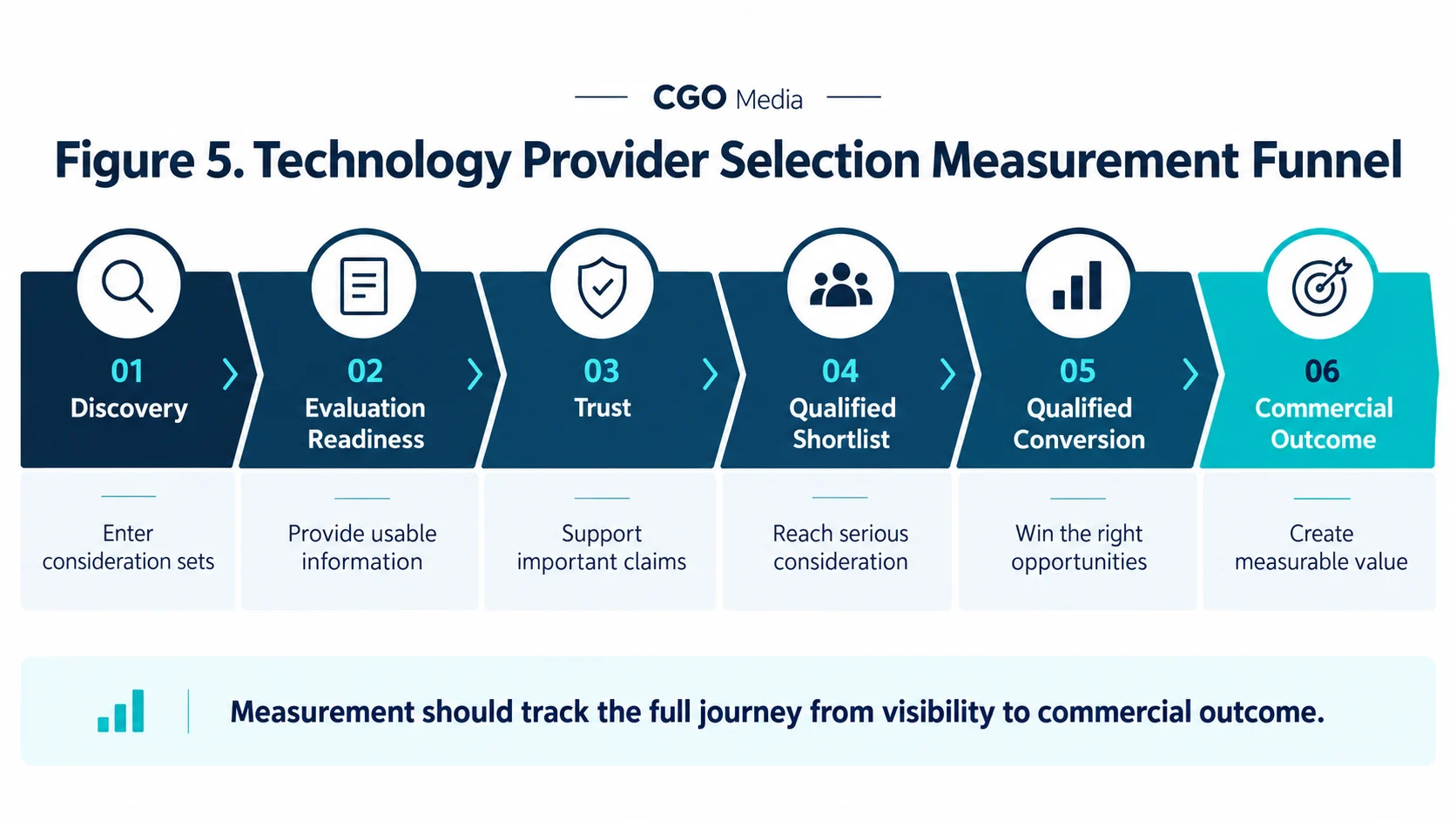
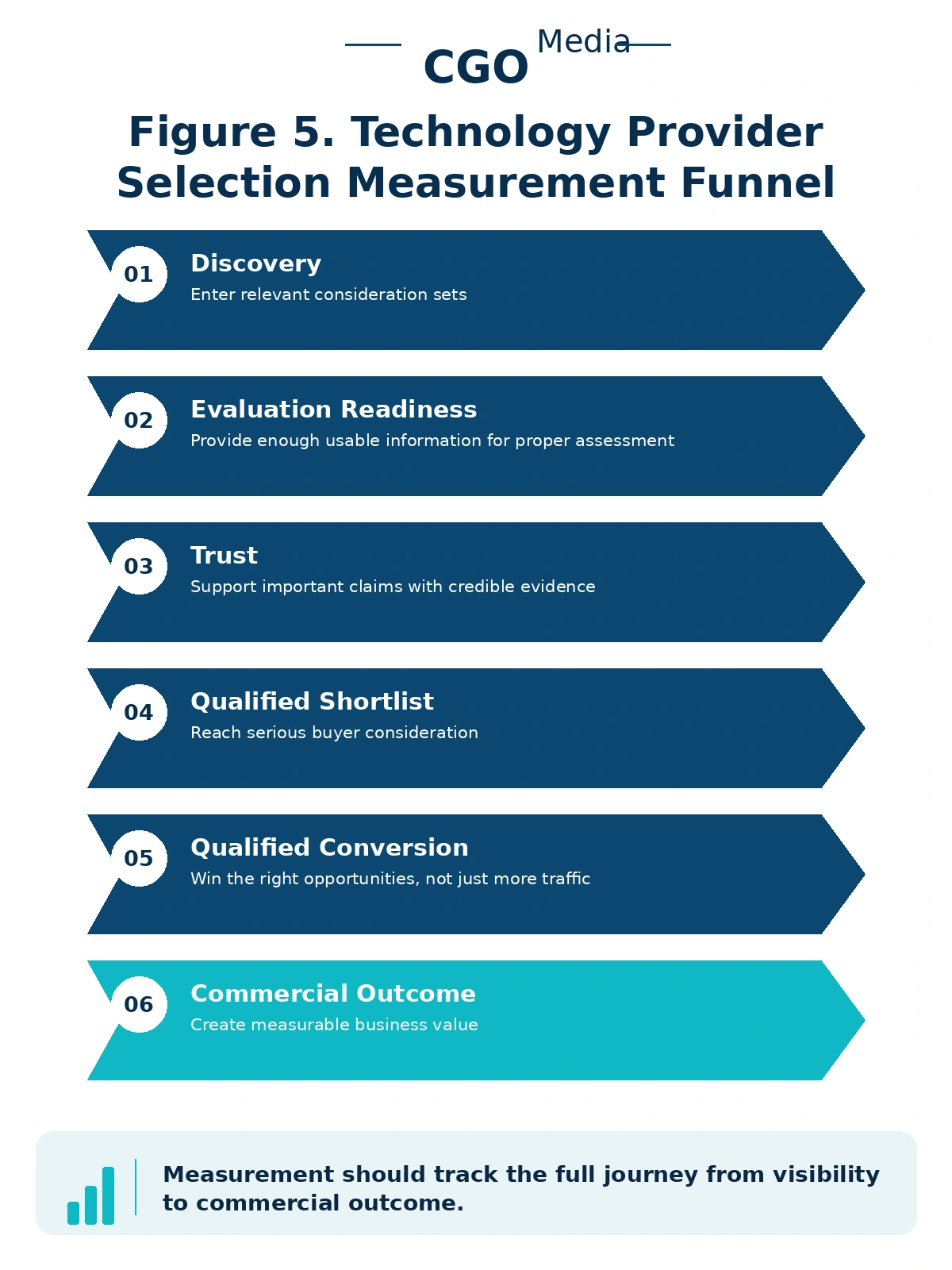
371. Technology Provider Selection Should Be Continuously Reviewed
Technology markets, buyer requirements and competitive environments change too quickly for provider-selection assumptions to remain static.
Selection performance should therefore be reviewed continuously rather than treated as a one-time research exercise.
372. Buyer Requirements Change
Changes can include:
- New security expectations
- New integration requirements
- New regulatory constraints
- New commercial priorities
- New deployment preferences
A provider that was strongly aligned with market requirements previously can become less competitive if buyer expectations change.
373. Provider Capabilities Change
Technology providers continuously introduce:
- New features
- New integrations
- New deployment options
- New service models
Selection readiness should therefore be reassessed as product capability evolves.
374. Competitors Change
Competitive environments can shift through:
- New entrants
- Acquisitions
- Product expansion
- Pricing changes
- Category convergence
A previously differentiated strength may become a standard market expectation.
375. AI Recommendation Environments Change
AI systems, retrieval environments, interfaces and public source ecosystems can change over time.
Technology organisations should therefore monitor whether:
- Competitive sets change
- Shortlist inclusion changes
- Comparative framing changes
- Source support changes
376. Provider Selection Requires a Feedback Loop
A continuous selection system should connect:
Observation → Comparison → Diagnosis → Improvement → Validation → Learning → Adaptation
Each selection cycle should improve organisational knowledge.
377. Observe
The organisation should collect evidence from:
- Search
- AI-assisted discovery
- Sales
- Customers
- Competitors
Observation creates the evidence base for selection improvement.
378. Search Observation
Search observation can identify changes in:
- Problem discovery
- Category visibility
- Provider discovery
- Comparison visibility
This reveals whether the organisation continues to enter relevant buyer journeys.
379. AI Observation
AI monitoring can identify changes in:
- Provider inclusion
- Competitive co-occurrence
- Comparative framing
- Recommendation visibility
Repeated observations are more useful than individual outputs.
380. Sales Observation
Sales teams can provide evidence about:
- Recurring competitors
- Buyer objections
- Missing evidence
- Reasons for win or loss
This connects public discovery with actual commercial evaluation.
381. Customer Observation
Customer research can reveal:
- How the provider was discovered
- Which alternatives were considered
- Which evidence mattered
- Why the final decision was made
This provides direct insight into provider-selection behaviour.
382. Competitor Observation
Competitor monitoring can reveal changes in:
- Capabilities
- Evidence
- Positioning
- Pricing
- External authority
These changes can alter the relative strength of the provider even when its own performance remains stable.
383. Compare
Observed performance should be compared against:
- Target scenarios
- Competitor sets
- Historical performance
- Commercial outcomes
Comparison provides context before conclusions are drawn.
384. Compare Against Target Scenarios
The organisation should assess whether it remains competitive within the buyer situations that matter strategically.
Target scenarios can be defined by:
- Industry
- Company size
- Use case
- Geography
- Technical requirements
385. Compare Against Competitor Sets
Performance should be compared with:
- Commercial competitors
- Search competitors
- AI recommendation competitors
Different competitive sets can reveal different selection pressures.
386. Compare Against Historical Performance
Historical comparison can reveal:
- Improvement
- Stability
- Deterioration
- Market drift
This helps distinguish new problems from long-standing structural weaknesses.
387. Compare Against Commercial Outcomes
Selection visibility should ultimately be compared with:
- Qualified opportunities
- Pipeline
- Win rate
- Customer fit
Strong visibility combined with poor commercial outcomes can indicate misaligned discovery or positioning.
388. Diagnose
Diagnosis should identify why the provider is succeeding or failing at a particular stage.
Common causes can include:
- Discovery weakness
- Understanding weakness
- Capability weakness
- Evidence weakness
- Trust weakness
- Commercial weakness
389. Diagnosis Should Identify the Point of Selection Leakage
The central diagnostic question is:
Where does the provider stop progressing through the buyer-selection journey?
This prevents broad visibility problems from being confused with late-stage selection problems.
390. Discovery Leakage
The provider fails to enter consideration.
Potential causes include:
- Weak search visibility
- Weak category association
- Weak AI visibility
- Limited external authority
391. Understanding Leakage
The provider appears but remains difficult to interpret.
Potential causes include:
- Unclear product architecture
- Weak use-case explanation
- Ambiguous audience positioning
- Inconsistent terminology
392. Capability Leakage
The provider genuinely lacks a requirement.
This should feed into:
- Product strategy
- Service strategy
- Integration planning
- Roadmap priorities
393. Evidence Leakage
The capability exists but is not demonstrated strongly enough.
Potential responses include:
- Better documentation
- Technical evidence
- Case studies
- Research
394. Trust Leakage
The buyer understands the capability but remains insufficiently confident in the provider.
Potential responses include:
- Security validation
- Customer evidence
- Independent references
- External authority
395. Commercial Leakage
The provider survives technical and trust evaluation but fails on:
- Pricing
- Contracts
- Support
- Procurement
This requires commercial rather than search intervention.
396. Improve
Improvement should address the diagnosed constraint rather than defaulting to one universal response.
A useful relationship is:
Observed Problem → Root Cause → Appropriate Owner → Corrective Action
397. Product Teams Should Own Capability Improvements
Where recurring selection losses result from:
- Missing functionality
- Missing integrations
- Deployment limitations
the primary response belongs within product strategy.
398. Content and SEO Teams Should Own Information Improvements
Where capability exists but remains difficult to discover or understand, improvements can involve:
- Information architecture
- Product clarity
- Search visibility
- Documentation accessibility
399. Security and Technical Teams Should Strengthen High-Risk Evidence
Selection gaps involving:
- Security
- Architecture
- Performance
- Reliability
should be supported through evidence validated by appropriate subject experts.
400. PR and Research Teams Should Strengthen External Authority
Where buyer confidence is constrained by weak independent validation, the organisation can strengthen:
- Original research
- Industry evidence
- Expert commentary
- External citations
401. Commercial Teams Should Own Commercial Improvements
Persistent losses involving:
- Pricing
- Contracts
- Support packaging
- Procurement structure
require business decisions rather than additional marketing activity.
402. Validate
After improvement, the organisation should determine whether provider-selection performance actually changed.
Validation can include:
- Search visibility
- AI shortlist inclusion
- Sales outcomes
- Customer feedback
- Win-rate changes
403. Validation Should Match the Original Problem
If the original problem involved discovery, validate discovery.
If it involved trust, validate trust.
If it involved commercial fit, validate commercial progression.
Measurement should reflect the problem that the intervention was designed to solve.
404. Validation Should Be Longitudinal
One improved outcome does not establish durable change.
Stronger evidence comes from repeated improvement across:
- Relevant scenarios
- Comparable time periods
- Real sales opportunities
405. Learn
Every improvement cycle should produce reusable organisational knowledge.
Learning can update:
- Product priorities
- Content standards
- Sales playbooks
- Evidence requirements
- Competitor intelligence
406. Successful Interventions Should Become Standards
If an improvement repeatedly strengthens provider-selection performance, it should be incorporated into normal operating procedures.
Examples can include:
- Product-page requirements
- Evidence standards
- Case-study structures
- Sales qualification criteria
407. Failed Interventions Should Also Be Recorded
Negative results can prevent repeated investment in:
- Ineffective content changes
- Poorly targeted campaigns
- Weak authority activity
- Incorrect assumptions
Organisational learning should preserve both positive and negative evidence.
408. Adapt
The final stage is adaptation.
Provider-selection strategy should evolve as:
- Buyer needs change
- Products change
- Competitors change
- AI systems change
- Markets change
409. Adaptive Selection Does Not Mean Constant Reaction
Mature organisations should avoid changing strategy every time:
- A competitor appears
- An AI output changes
- A single opportunity is lost
Adaptation should follow persistent evidence rather than isolated events.
410. Stable Selection Principles Should Remain
Core principles include:
- Relevant discovery
- Clear provider understanding
- Strong technical evidence
- Trust validation
- Buyer fit
- Commercial viability
These principles remain useful even when individual channels and technologies change.
411. Provider Selection Requires Cross-Functional Governance
No single department controls the entire provider-selection system.
A mature model can connect:
Product + SEO + Content + Engineering + Security + Research + PR + Sales + Customer Success
412. Product Owns Capability Truth
Product teams should ensure that:
- Capabilities are current
- Limitations are clear
- Product relationships are accurate
- Roadmap changes are reflected publicly
413. SEO and Content Own Discovery and Clarity
Search and content teams should help buyers discover and understand:
- Problems
- Categories
- Products
- Use cases
The objective is qualified discovery rather than indiscriminate traffic growth.
414. Engineering and Security Own Technical Evidence
Technical teams should validate high-impact information involving:
- Architecture
- Integration
- Security
- Performance
- Reliability
This helps prevent marketing language from exceeding technical reality.
415. Research and PR Own External Evidence Development
Research and PR can strengthen:
- Primary evidence
- Independent citations
- Expert authority
- Industry visibility
This reinforces provider trust outside the organisation’s own website.
416. Sales Own Direct Selection Intelligence
Sales teams should capture:
- Competitors
- Objections
- Evidence requests
- Win reasons
- Loss reasons
This is one of the strongest direct sources of buyer-selection intelligence.
417. Customer Success Owns Post-Selection Evidence
Customer-success teams can identify whether the selected provider actually delivered the expected outcome.
Useful post-selection evidence includes:
- Implementation success
- Adoption
- Retention
- Expansion
- Advocacy
418. Post-Selection Performance Should Validate Provider Fit
The buying journey should not be considered complete at contract signature.
A correct provider selection should produce reasonable alignment between:
- Buyer expectation
- Product capability
- Implementation reality
- Customer outcome
419. Poor Post-Selection Outcomes Can Reveal Selection Failure
Problems can include:
- Poor implementation fit
- Expectation mismatch
- Unexpected complexity
- Weak support alignment
These outcomes should feed back into future positioning and qualification.
420. Successful Outcomes Strengthen Future Selection Authority
Successful customers can create:
- Case studies
- Reviews
- Testimonials
- References
- Advocacy
This strengthens the evidence available to future buyers.
421. The Post-Selection Reinforcement Loop
A useful relationship is:
Appropriate Selection → Successful Outcome → Customer Evidence → Greater Trust → Stronger Future Shortlisting
Provider-selection quality can therefore become self-reinforcing.
422. Win and Loss Learning Should Be Institutionalised
Selection data should not remain isolated inside individual sales opportunities.
Recurring patterns should inform:
- Product development
- Positioning
- Search strategy
- Evidence development
- Commercial strategy
423. Repeated Capability Losses Should Inform Product Strategy
If buyers repeatedly eliminate the provider because of a missing:
- Feature
- Integration
- Deployment model
- Security capability
that evidence should enter product planning.
424. Repeated Evidence Losses Should Inform Information Strategy
If capabilities exist but buyers repeatedly fail to verify them, the organisation should improve:
- Documentation
- Product information
- Case studies
- Research evidence
425. Repeated Trust Losses Should Inform Authority Strategy
Persistent trust weakness can justify investment in:
- Security validation
- Independent evidence
- Research authority
- Customer references
426. Repeated Commercial Losses Should Inform Business Strategy
Persistent problems involving:
- Price
- Packaging
- Contract structure
- Support
should not be treated as marketing problems.
427. Repeated Positioning Losses Should Inform Market Strategy
The organisation may be:
- Targeting the wrong audience
- Associated with the wrong category
- Communicating too broadly
These patterns can indicate a need to revisit market positioning.
428. Provider Selection Should Monitor Market Drift
A technology provider’s perceived category can change over time.
Market drift may occur because of:
- Product evolution
- Competitive change
- AI framing
- External commentary
429. Market Drift Can Be Positive
The provider may become associated with a:
- Higher-value category
- More strategic use case
- Stronger enterprise position
This can create new commercial opportunities.
430. Market Drift Can Be Negative
The provider may become associated with:
- A lower-value segment
- An outdated category
- A shrinking market
- A poorly matched customer profile
Persistent negative drift should be investigated.
431. Market Drift Should Be Validated Across Multiple Sources
Evidence can include:
- Search behaviour
- AI comparison sets
- Sales conversations
- Customer research
- Media coverage
One observation should not trigger major repositioning.
432. Provider Selection Should Be Internationally Contextual
Selection criteria can differ between countries because of:
- Regulation
- Pricing expectations
- Support requirements
- Data-location requirements
- Local competition
433. International Provider Selection Requires Local Evidence
Useful local evidence can include:
- Regional customers
- Local certifications
- Local-language documentation
- Local partner evidence
- Regional support information
This can strengthen confidence within specific markets.
434. Global Product Truth Should Remain Consistent
Localisation should not create contradictory information about:
- Product identity
- Core capability
- Ownership
- Architecture
Global consistency and local relevance should operate together.
435. International Selection Monitoring Should Be Localised
Scenario libraries should reflect:
- Local buyer terminology
- Local regulation
- Local competitors
- Local buying expectations
Simple translation of one market’s scenarios may be insufficient.
436. Provider Selection Should Scale Through Shared Standards
Large technology organisations may operate across:
- Multiple products
- Multiple regions
- Multiple buyer segments
Shared standards help preserve consistency while allowing local adaptation.
437. Shared Selection Standards Can Cover
- Requirement classification
- Evidence standards
- Competitor tracking
- Win/loss taxonomy
- Scenario monitoring
- Commercial outcome definitions
This creates a common operating language across teams.
438. Provider Selection Monitoring Can Be Partly Automated
Automation can help organise:
- Scenario testing
- Competitor tracking
- Win/loss data
- Evidence monitoring
Automation should support rather than replace professional judgement.
439. Human Review Remains Essential
Human interpretation is especially important when evaluating:
- Buyer fit
- Trade-offs
- Evidence quality
- Comparative framing
- Commercial significance
Provider selection contains contextual decisions that should not be reduced entirely to automated scoring.
440. Provider Selection Requires Recovery Capability
Performance can deteriorate because of:
- Product change
- Competitive change
- Outdated information
- Market repositioning
- New buyer requirements
Mature organisations should be able to identify and correct deterioration quickly.
441. A Provider Selection Recovery Cycle
A useful recovery process is:
Detect → Diagnose → Assign Owner → Correct → Validate → Learn
The objective is to restore selection strength while reducing the probability of recurrence.
442. Recovery Speed Can Be Measured
Useful measures can include:
- Detection time
- Diagnosis time
- Correction time
- Validation time
Faster recovery creates a more resilient provider-selection system.
443. Provider Selection Should Build Organisational Memory
The organisation should preserve lessons from:
- Wins
- Losses
- Product changes
- Market changes
- Successful interventions
This reduces repeated rediscovery of the same selection problems.
444. Adaptive Selection Intelligence Is the Long-Term Capability
The strongest provider-selection system does not simply report what happened.
It helps the organisation understand:
- Why it happened
- What changed
- What should improve
- Whether the improvement worked
445. Adaptive Selection Intelligence Combines Multiple Evidence Systems
A useful relationship is:
Search Intelligence + AI Intelligence + Sales Intelligence + Customer Intelligence + Competitive Intelligence
Together, these provide a more complete understanding of technology-provider selection.
446. Selection Intelligence Should Improve Buyer Fit
The purpose is not simply to maximise inclusion.
It should improve alignment between:
- Buyer requirement
- Provider capability
- Evidence
- Commercial model
Better alignment reduces wasted evaluation for both buyer and provider.
447. Selection Intelligence Should Improve Commercial Efficiency
Better selection fit can contribute to:
- Higher-quality opportunities
- Lower sales friction
- Better win rates
- Stronger implementation outcomes
These outcomes are more meaningful than visibility volume alone.
448. Strategic Recommendation One — Monitor Buyer Requirements
Track how decision criteria evolve across industries, markets and buyer segments.
449. Strategic Recommendation Two — Maintain Product Truth
Keep public product information aligned with current functionality, availability and limitations.
450. Strategic Recommendation Three — Strengthen Decision-Critical Evidence
Prioritise evidence supporting mandatory technical, security and operational requirements.
451. Strategic Recommendation Four — Monitor Competitive Sets
Compare commercial, search and AI recommendation competitors continuously.
452. Strategic Recommendation Five — Connect Sales Intelligence
Use win/loss and objection data to improve provider-selection strategy.
453. Strategic Recommendation Six — Connect Customer Outcomes
Use post-selection evidence to validate whether buyer-provider matching is producing successful outcomes.
454. Strategic Recommendation Seven — Monitor AI Shortlist Quality
Measure relevant inclusion, accuracy, comparative framing and evidence support rather than raw mention volume.
455. Strategic Recommendation Eight — Diagnose Selection Leakage
Identify the stage where qualified buyers stop progressing and determine the underlying reason.
456. Strategic Recommendation Nine — Separate Capability and Evidence Gaps
Do not confuse a missing capability with a capability that exists but is poorly documented.
457. Strategic Recommendation Ten — Improve Selection Governance
Assign clear ownership across product, search, technical, security, commercial and customer teams.
458. Strategic Recommendation Eleven — Build International Selection Intelligence
Evaluate buyer requirements, competition and evidence separately across priority markets.
459. Strategic Recommendation Twelve — Preserve Qualified Discovery
Prioritise buyer relevance and fit rather than maximising broad visibility.
460. Strategic Recommendation Thirteen — Institutionalise Win/Loss Learning
Convert recurring selection outcomes into product, positioning, evidence and commercial improvements.
461. Strategic Recommendation Fourteen — Validate Through Customer Outcomes
Use implementation, retention, expansion and advocacy as evidence of selection quality.
462. Strategic Recommendation Fifteen — Improve Recovery Capability
Reduce the time required to identify, diagnose and correct provider-selection weaknesses.
463. Strategic Recommendation Sixteen — Build Adaptive Selection Intelligence
Treat provider selection as a continuous organisational learning system rather than a static marketing funnel.
464. The Twenty-First Technology Discovery Principle
Technology provider selection should be continuously reassessed because buyer requirements, provider capabilities, competitive sets and AI recommendation environments can all change over time.
465. The Twenty-Second Technology Discovery Principle
Selection intelligence should combine search, AI, sales, customer and market evidence because no single data source captures the complete technology buying journey.
466. The Twenty-Third Technology Discovery Principle
Provider-selection quality should be evaluated beyond the point of purchase because strong post-selection outcomes create customer evidence, trust and advocacy that can improve future shortlisting.
467. The Twenty-Fourth Technology Discovery Principle
The highest level of provider-selection capability is adaptive, using continuous observation, diagnosis, feedback and organisational learning to improve discovery, evidence, buyer fit and commercial outcomes over time.
468. The Continuous Technology Provider Selection Cycle
The operational model can be summarised as:
Observe → Compare → Diagnose → Improve → Validate → Learn → Adapt
Observe
Collect evidence from search, AI-assisted discovery, sales, customers and competitive environments.
Compare
Evaluate current selection performance against target scenarios, relevant competitors, historical performance and commercial outcomes.
Diagnose
Identify whether the primary constraint involves discovery, understanding, capability, evidence, trust, positioning or commercial fit.
Improve
Assign the issue to the appropriate organisational owner and strengthen the underlying capability, evidence or process.
Validate
Determine whether the intervention improved relevant discovery, shortlist inclusion, sales progression or customer outcomes.
Learn
Convert successful and unsuccessful interventions into organisational standards, playbooks and decision intelligence.
Adapt
Adjust provider-selection strategy as buyer requirements, products, competitors, AI systems and markets evolve.
469. The Long-Term Technology Selection System
The strategic relationship can be summarised as:
Relevant Discovery → Clear Evaluation → Strong Trust → Qualified Shortlist → Appropriate Selection → Successful Outcome → Stronger Future Authority
Relevant Discovery
The provider becomes visible to buyers whose requirements genuinely align with the offering.
Clear Evaluation
Buyers can understand the product, technical requirements, commercial model and important limitations without unnecessary friction.
Strong Trust
Decision-critical claims are supported through credible technical, customer, research and external evidence.
Qualified Shortlist
The provider remains among credible alternatives after mandatory requirements and comparative preferences are considered.
Appropriate Selection
The selected provider represents a strong overall fit for the buyer’s actual technical, operational and commercial requirements.
Successful Outcome
Implementation and post-sale experience validate the original selection decision.
Stronger Future Authority
Successful outcomes create new evidence, customer advocacy, case studies, reviews and external validation that strengthen future provider-selection readiness.
470. The Strategic Implication
Technology organisations should treat provider selection as a continuously improving system rather than a simple progression from search visibility to sales conversion.
Discovery, evaluation, shortlist visibility, sales intelligence, customer outcomes and competitive evidence should feed back into one another.
The organisation should repeatedly ask:
- Are the right buyers discovering us?
- Can they evaluate us easily?
- Is important evidence strong enough?
- Are we entering the right shortlists?
- Why are we winning or losing?
- Are selected customers achieving successful outcomes?
The objective is to create a provider-selection system that becomes more accurate, more efficient and more resilient over time.
Strong technology discovery should lead to better evaluation.
Better evaluation should lead to more qualified shortlists.
More qualified shortlists should lead to more appropriate provider selection.
Successful selection should then create stronger customer evidence and greater authority for the next generation of buyers.
Figure 6 : Continuous Technology Provider Selection Cycle — Observe → Compare → Diagnose → Improve → Validate → Learn → Adapt.
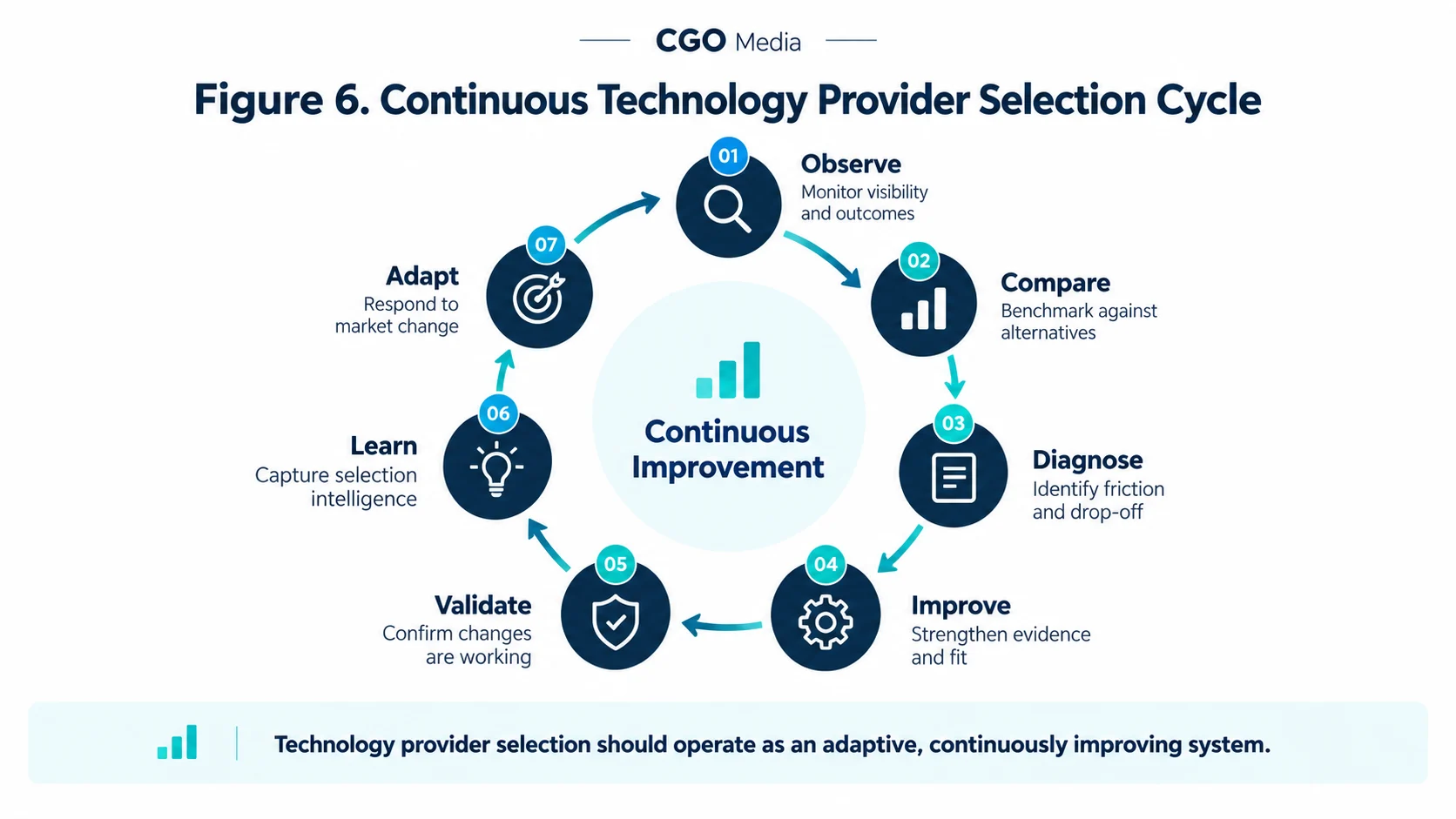
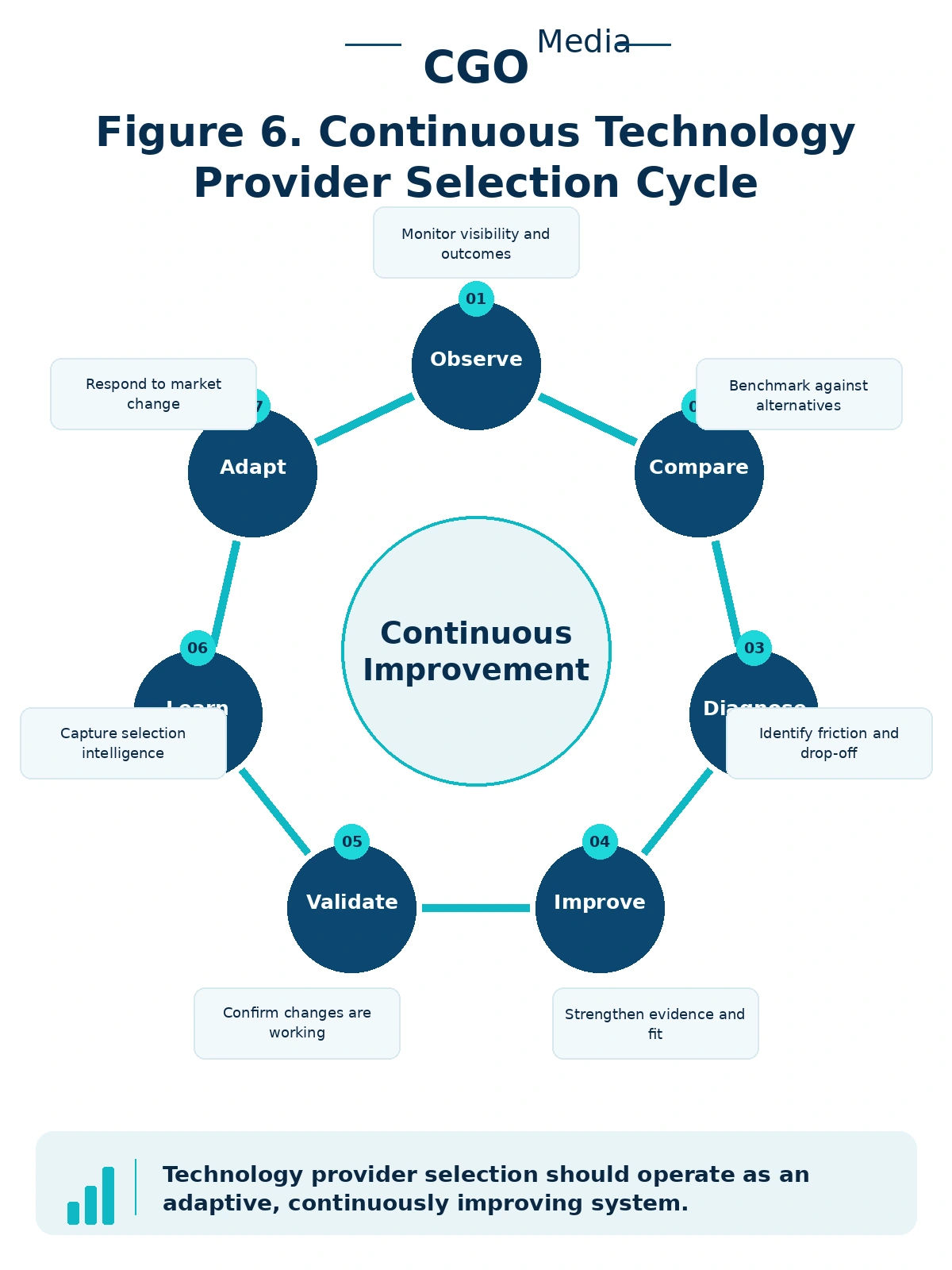
471. Methodology
The Technology Discovery and Provider Selection Model is a conceptual research framework developed by CGO Media to examine how organisations discover, evaluate, compare, shortlist and select technology providers across modern search, AI-assisted discovery and multi-channel buying environments.
The framework addresses a central question:
How do technology buyers move from problem recognition to a qualified provider decision, and which capability, evidence, trust and commercial factors determine whether a provider remains in consideration?
Research Scope
The model can be applied to technology markets including:
- Software
- SaaS
- Cloud infrastructure
- Cybersecurity
- Artificial intelligence platforms
- Data technology
- Developer tools
- Enterprise technology
- Technology consultancies
- Managed technology services
Core Journey Structure
The framework evaluates technology-provider selection through:
Problem Recognition → Category Discovery → Provider Discovery → Provider Understanding → Technical Validation → Trust Validation → Comparison & Shortlisting → Selection
Problem Recognition Method
The process begins by identifying the operational, technical or strategic problem creating buying intent.
Problem recognition can result from internal or external events including growth, technical failure, regulation, security requirements, cost pressure or changing market expectations.
Category Discovery Method
The model then considers how buyers determine which technology category, service model or solution approach may address the problem.
Category discovery is important because buyers may initially understand the problem without knowing the appropriate technology terminology.
Provider Discovery Method
Provider discovery is assessed across multiple environments including:
- Search engines
- AI assistants
- Technical publications
- Comparison platforms
- Professional networks
- Peer recommendations
The framework therefore treats technology discovery as a distributed process rather than a website-only interaction.
Provider Understanding Method
The model evaluates whether buyers can determine:
- What the provider offers
- Who the technology is designed for
- Which problems it solves
- Which use cases apply
- How it differs from alternatives
Provider understanding therefore depends on product clarity, category clarity, use-case clarity and audience clarity.
Technical Validation Method
Technical validation considers whether the provider satisfies decision-critical requirements involving:
- Architecture
- Integration
- Deployment
- Performance
- Scalability
- Security
The model distinguishes genuine capability gaps from evidence gaps where the capability exists but cannot be verified sufficiently.
Trust Validation Method
Trust validation examines whether important provider claims are supported by sufficient evidence.
Relevant evidence can include:
- Security documentation
- Customer evidence
- Technical documentation
- Independent reviews
- Technical publications
- Professional validation
Selection Readiness Method
The selection-readiness relationship is:
Buyer Requirements → Mandatory Fit → Preferred Fit → Evidence Quality → Trust Strength → Commercial Fit → Qualified Shortlist
Mandatory Requirements
Mandatory requirements operate as hard filters.
Where a genuinely non-negotiable requirement is not satisfied, the provider may no longer remain eligible regardless of strengths elsewhere.
Preferred Requirements
Preferred requirements influence comparative preference among providers that already satisfy the mandatory conditions.
These can include usability, implementation simplicity, support, flexibility and roadmap alignment.
Differentiators
Differentiators can influence final preference where several providers remain technically and commercially viable.
Provider Evaluation Method
The provider-evaluation relationship is:
Mandatory Fit → Evidence Confidence → Trust Strength → Weighted Preferences → Commercial Fit → Shortlist Decision
This structure deliberately separates hard eligibility from comparative preference.
Evidence Confidence Method
Evidence confidence is assessed at requirement level rather than through one undifferentiated provider score.
Evidence can broadly be classified as:
- High Confidence
- Moderate Confidence
- Low Confidence
Higher-risk requirements should generally require stronger supporting evidence.
AI-Assisted Shortlist Method
AI-assisted provider selection is evaluated through:
- Presence
- Accuracy
- Relevance
- Comparative framing
- Evidence support
The resulting relationship is:
Relevant Presence → Accurate Representation → Strong Evidence → Appropriate Framing → Qualified Shortlist Inclusion
Competitive Analysis Method
The framework distinguishes three competitive environments:
- Commercial Competitors
- Search Competitors
- AI Recommendation Competitors
These groups can overlap but should not be assumed to be identical.
Elimination Analysis Method
Provider-selection failures can be classified as:
- Discovery Gap
- Understanding Gap
- Capability Gap
- Evidence Gap
- Trust Gap
- Commercial Gap
This classification helps organisations direct corrective action toward the actual cause of provider-selection failure.
Selection Leakage Method
The framework identifies where provider progression stops through:
Stage → Evidence → Gap → Elimination Risk → Corrective Action
Measurement Method
Provider-selection performance is evaluated through:
Discovery → Evaluation Readiness → Trust → Qualified Shortlist → Qualified Conversion → Commercial Outcome
This provides a broader measurement model than rankings, website visits or AI mentions alone.
Attribution Method
The model recommends assisted attribution because technology buying journeys frequently contain multiple discovery, validation and comparison touchpoints.
Relevant evidence can include:
- Search data
- AI observations
- CRM data
- Sales interviews
- Customer research
Selection Intelligence Method
A broader intelligence relationship is:
Search Evidence + AI Evidence + Sales Evidence + Customer Evidence + Market Evidence
No single source is assumed to provide a complete explanation of technology-provider selection.
Win/Loss Method
Selection outcomes can be analysed using categories such as:
- Capability Loss
- Evidence Loss
- Trust Loss
- Commercial Loss
- Relationship Loss
Winning factors should also be analysed to identify recurring provider strengths.
Continuous Improvement Method
The operational improvement cycle is:
Observe → Compare → Diagnose → Improve → Validate → Learn → Adapt
Post-Selection Validation Method
The framework extends beyond contract award to consider whether selected customers achieve appropriate outcomes.
Relevant indicators can include:
- Implementation success
- Adoption
- Retention
- Expansion
- Customer satisfaction
This allows the organisation to test whether provider-selection success also represented genuine buyer-provider fit.
International Application
International assessments should account for differences in:
- Buyer language
- Regulation
- Regional competitors
- Data-location requirements
- Support expectations
- Commercial norms
Core product truth should remain consistent while evidence and selection scenarios are adapted appropriately to local markets.
472. Limitations
The Technology Discovery and Provider Selection Model is a conceptual research framework rather than a proprietary ranking, scoring or recommendation system used by any search engine, AI provider, marketplace or technology-review platform.
Technology Buying Journeys Are Not Fully Linear
Buyers can:
- Skip stages
- Repeat stages
- Return to earlier stages
- Add new providers late in the process
- Introduce new stakeholders after evaluation has begun
The journey structure should therefore be used diagnostically rather than interpreted as a rigid purchasing sequence.
Buyer Requirements Differ
Different organisations can assign very different importance to:
- Security
- Integration
- Cost
- Support
- Usability
No universal provider evaluation weighting should therefore be assumed.
Mandatory Requirements Are Contextual
A condition that is essential for one buyer may be irrelevant to another.
Mandatory criteria should always reflect the specific buying environment.
Provider Rankings Are Scenario-Dependent
The framework does not support the concept of one universally strongest technology provider.
Provider fit depends on buyer requirements, constraints, risk tolerance and commercial context.
AI Outputs Are Variable
AI-generated provider lists can differ according to:
- Model
- Prompt
- Date
- Language
- Market
- Available evidence
Individual generated shortlists should not be treated automatically as durable market positions.
AI Recommendation Order Is Not a Stable Ranking
A provider appearing first within one generated answer does not establish permanent superiority or market leadership.
Longitudinal scenario analysis is more useful than isolated ordering.
Co-Occurrence Does Not Equal Market Share
Repeated provider co-occurrence can indicate comparative association but does not establish commercial market share.
Search Visibility Does Not Guarantee Shortlist Inclusion
A highly visible provider can still fail because of:
- Technical requirements
- Weak evidence
- Trust concerns
- Commercial constraints
Shortlist Inclusion Does Not Guarantee Purchase
Final selection can still be affected by:
- Procurement
- Security review
- Negotiation
- Existing relationships
- Internal organisational factors
Purchase Does Not Guarantee Long-Term Fit
A successful sale does not necessarily demonstrate that provider selection was appropriate.
Post-selection implementation and customer outcomes remain important.
Customer Evidence Can Contain Selection Bias
Published case studies typically highlight successful customers and may not represent the complete customer population.
Review Platforms Can Contain Bias
Public review environments may not represent every customer experience or buyer type.
Public Evidence Can Be Incomplete
A capability can exist even where sufficiently strong public evidence is unavailable.
The framework therefore distinguishes:
- Capability absent
- Capability unclear
- Capability unsupported
Self-Reported Attribution Has Limitations
Buyers may not remember every search, article, AI interaction, recommendation or conversation that influenced a complex technology decision.
Analytics Can Miss Pre-Click Influence
AI assistants, search summaries, external publications and peer conversations can influence provider selection without generating directly attributable website referrals.
Win/Loss Data Can Be Incomplete
Sales teams may not always know the complete reason behind a buyer’s decision.
Reported loss reasons should therefore be interpreted alongside other available evidence.
Commercial Outcomes Are Multi-Causal
Search visibility, shortlist inclusion, sales performance and revenue can improve together without proving that one directly caused another.
Technology Categories Can Change Rapidly
New categories can emerge while established categories can:
- Merge
- Split
- Be renamed
- Converge with adjacent markets
Provider Capabilities Can Change Rapidly
Feature launches, new integrations, acquisitions, pricing changes and product retirement can alter selection fit.
Competitive Sets Are Dynamic
The providers encountered today may differ from those appearing in future search, AI and sales environments.
The Model Is Diagnostic
The Technology Discovery and Provider Selection Model is intended to structure analysis, evidence development and decision-making.
It does not produce a universal ranking of technology providers and does not guarantee search visibility, AI recommendation, shortlist inclusion, commercial conversion or customer success.
473. Conclusion
The Technology Discovery and Provider Selection Model provides a structured method for understanding how technology buyers move from an initial problem through category discovery, provider evaluation, trust validation, shortlisting, final selection and post-selection outcomes.
Discovery Is the First Requirement
The provider must first enter relevant buyer consideration.
This can occur through:
- Search
- AI assistants
- Technical publications
- Comparison environments
- Professional networks
- Peer recommendations
Understanding Is the Second Requirement
Buyers must be able to determine:
- What the provider offers
- Who it serves
- Which problems it solves
- How its products relate
- How it differs from alternatives
Technical Eligibility Is the Third Requirement
The provider must satisfy mandatory technical, security, deployment and integration constraints relevant to the specific buyer scenario.
Evidence Confidence Is the Fourth Requirement
Buyers need sufficient public proof to evaluate whether important capabilities actually exist and whether provider claims can be verified.
Trust Is the Fifth Requirement
The provider must appear sufficiently credible for the risk and importance of the purchase.
Trust can depend on:
- Security evidence
- Customer evidence
- Technical authority
- Independent validation
- Information consistency
Commercial Fit Is the Sixth Requirement
Pricing, contracts, support, implementation requirements and procurement constraints must remain viable.
Shortlist Inclusion Represents Serious Consideration
Qualified shortlist inclusion is more commercially meaningful than generic visibility because the provider has survived several stages of buyer filtering.
AI-Assisted Discovery Can Compress the Journey
AI systems can combine:
- Category discovery
- Provider discovery
- Technical comparison
- Trust assessment
- Shortlisting
within a single interaction.
Explicit Provider Evidence Therefore Matters More
Important attributes should be:
- Clear
- Current
- Specific
- Verifiable
Provider Selection Should Be Diagnosed by Stage
Organisations should identify whether the main constraint involves:
- Discovery
- Understanding
- Capability
- Evidence
- Trust
- Commercial fit
Different constraints require different responses.
Capability Problems Require Product Decisions
If an important capability genuinely does not exist, content or search optimisation cannot solve the problem.
Evidence Problems Require Better Proof
Where the capability exists but is difficult to verify, documentation, case studies, technical evidence or research can strengthen selection readiness.
Trust Problems Require Stronger Validation
Customer evidence, security validation, independent references and external authority can help reduce uncertainty.
Commercial Problems Require Business Decisions
Pricing, contracts, packaging and support issues should be addressed through appropriate commercial strategy.
Search and AI Visibility Should Support Selection
The purpose of visibility is to place the provider into relevant decision environments.
Visibility should therefore support qualified evaluation rather than exist as an isolated marketing objective.
Win and Loss Intelligence Should Improve Future Discovery
Real buyer behaviour should inform:
- Search architecture
- Positioning
- Documentation
- Product strategy
- Commercial strategy
Post-Selection Outcomes Matter
Strong buyer-provider fit can contribute to:
- Successful implementation
- Retention
- Expansion
- Advocacy
- Customer evidence
Successful Outcomes Reinforce Future Authority
The long-term relationship is:
Good Fit → Successful Outcome → Stronger Evidence → Greater Trust → Better Future Shortlisting
The Complete Technology Provider Selection System
The full relationship can be summarised as:
Relevant Discovery → Clear Evaluation → Technical Fit → Strong Evidence → Trust → Qualified Shortlist → Appropriate Selection → Successful Outcome → Stronger Future Authority
Final Strategic Position
Technology organisations should optimise not simply to be found, but to be understood, validated, trusted, appropriately shortlisted and selected by buyers for whom the provider offers genuine technical and commercial fit.
The strongest provider-selection systems connect:
- Search visibility
- AI visibility
- Technical evidence
- Customer evidence
- Sales intelligence
- Commercial outcomes
- Post-selection performance
into one continuous learning system.
The objective is therefore not maximum visibility or universal inclusion.
It is to create a discovery and provider-selection environment in which appropriate buyers can find the organisation, understand it accurately, validate its capabilities, compare it fairly and determine whether it represents the right technology choice for their requirements.
References
External Academic, Technical and Search Sources
- Google Search Central. SEO Starter Guide.
- Google Search Central. Understand How Structured Data Works.
- Schema.org. SoftwareApplication.
- Schema.org. Organization.
- W3C. Web Content Accessibility Guidelines (WCAG) 2.2.
- Hogan, A. et al. (2021). Knowledge Graphs. ACM Computing Surveys, 54(4).
- Metzger, M.J. (2007). Making Sense of Credibility on the Web: Models for Evaluating Online Information and Recommendations for Future Research. Journal of the American Society for Information Science and Technology, 58(13), 2078–2091.
- Ji, Z. et al. (2023). Survey of Hallucination in Natural Language Generation. ACM Computing Surveys, 55(12).
CGO Media Technology Research and Frameworks
- Wilkinson, R. (2026). Technology SEO in an AI Search Environment. CGO Media.
- Wilkinson, R. (2026). Technology AI Trust & Visibility Framework. CGO Media.
- Wilkinson, R. (2026). Technology Search Authority Maturity Model. CGO Media.
- Wilkinson, R. (2026). Technology SEO & AI Implementation Roadmap. CGO Media.
- Wilkinson, R. (2026). Technology GEO: Generative Engine Optimisation. CGO Media.
- Wilkinson, R. (2026). CGO Entity Authority Framework. CGO Media.
- Wilkinson, R. (2026). CGO Content Authority Framework. CGO Media.
- Wilkinson, R. (2026). CGO AI Citation Framework. CGO Media.
CGO Media Research Ecosystem
CGO Media Research Library | CGO Media Framework Library | CGO Media Research Architecture | CGO Media Research Observations Library | CGO Media Statistics Library
About Roger Wilkinson
Roger Wilkinson is an independent researcher, SEO practitioner and founder of CGO Media with more than 25 years of experience in search, digital visibility and business growth.
His research focuses on how artificial intelligence is reshaping search engines, recommendation systems, entity representation, digital authority and organisational visibility.
Roger is the creator of the CGO Framework Series, a collection of research-led methodologies designed to help organisations measure, improve and govern Search Visibility, AI Visibility, GEO and Digital Authority.
His work examines the relationship between Technical SEO, Generative Engine Optimisation, Entity Authority, Content Authority, Citation Authority, Brand Signals, Knowledge Architecture and AI Search Readiness.
Related Technology AI, GEO & Search Research
The Technology research family contains seven connected pages. This Technology Discovery and Provider Selection Model is supported by the six related Technology sector, SEO, trust, maturity, implementation and GEO resources below.
Technology AI & GEO Search Research | Technology SEO in an AI Search Environment | Technology AI Trust & Visibility Framework | Technology Search Authority Maturity Model | Technology SEO & AI Implementation Roadmap | Technology GEO: Generative Engine Optimisation
Research Usage & Citation
CGO Media encourages technology companies, researchers, journalists, analysts, consultants and digital teams to reference the Technology Discovery and Provider Selection Model where it contributes to analysis of technology buying behaviour, AI-assisted provider discovery, search visibility, provider evaluation, shortlisting, recommendation systems or digital authority.
Reasonable quotations, summaries, figures and excerpts may be used in articles, reports, presentations, academic work and other publications provided appropriate acknowledgement is given to Roger Wilkinson and CGO Media.
Cite This Research / Embed Citation
The Technology Discovery and Provider Selection Model by Roger Wilkinson at CGO Media presents a research-led framework for understanding how technology buyers move from problem recognition and provider discovery through technical validation, evidence, trust, comparison, shortlisting, selection and post-selection outcomes.
APA Citation
Wilkinson, R. (2026). Technology Discovery and Provider Selection Model. CGO Media. https://cgomedia.com/technology-discovery-provider-selection-model/
Author: Roger Wilkinson | Published by: CGO Media
For permissions relating to substantial reproduction, commercial licensing or republication of significant portions of this model, please contact CGO Media directly.