
Technology GEO: Generative Engine Optimisation
Executive Summary
 Technology GEO — Generative Engine Optimisation — is the process of improving how technology organisations are understood, sourced, cited, compared and recommended within AI-assisted search and generative answer environments.
Traditional SEO remains essential because AI-assisted discovery still depends on accessible, structured and authoritative information. GEO extends that foundation by addressing a broader set of questions:
Can the technology provider be identified correctly?
Is it associated with the correct category, products and use cases?
Can relevant information be retrieved easily?
Are important claims supported by credible evidence?
Are useful sources available for citation?
Is the provider appropriate for the buyer scenario?
Is it represented accurately when compared with alternatives?
The Technology GEO framework presented in this paper treats generative visibility as the outcome of an interconnected information and authority system.
The core progression is:
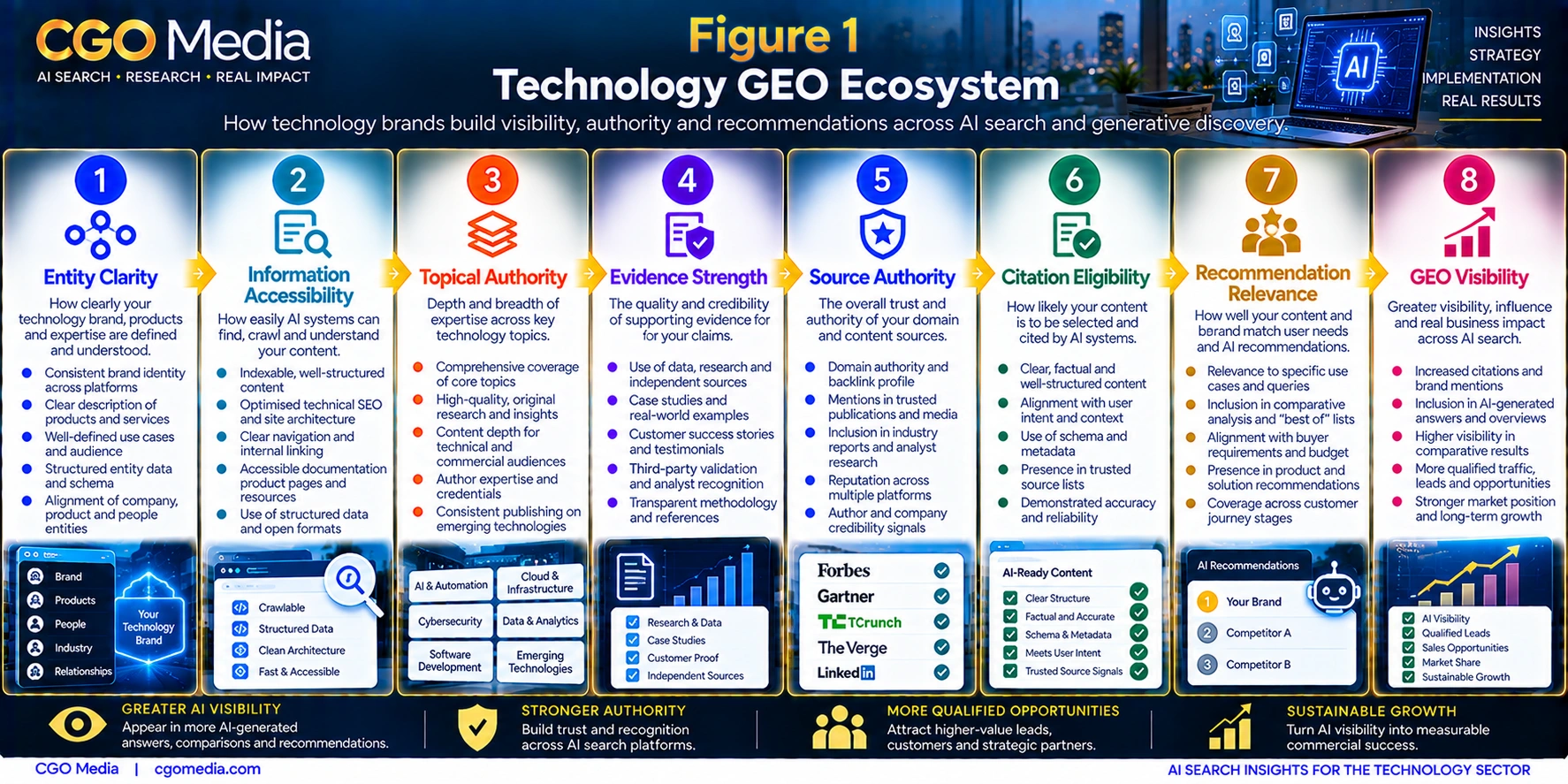
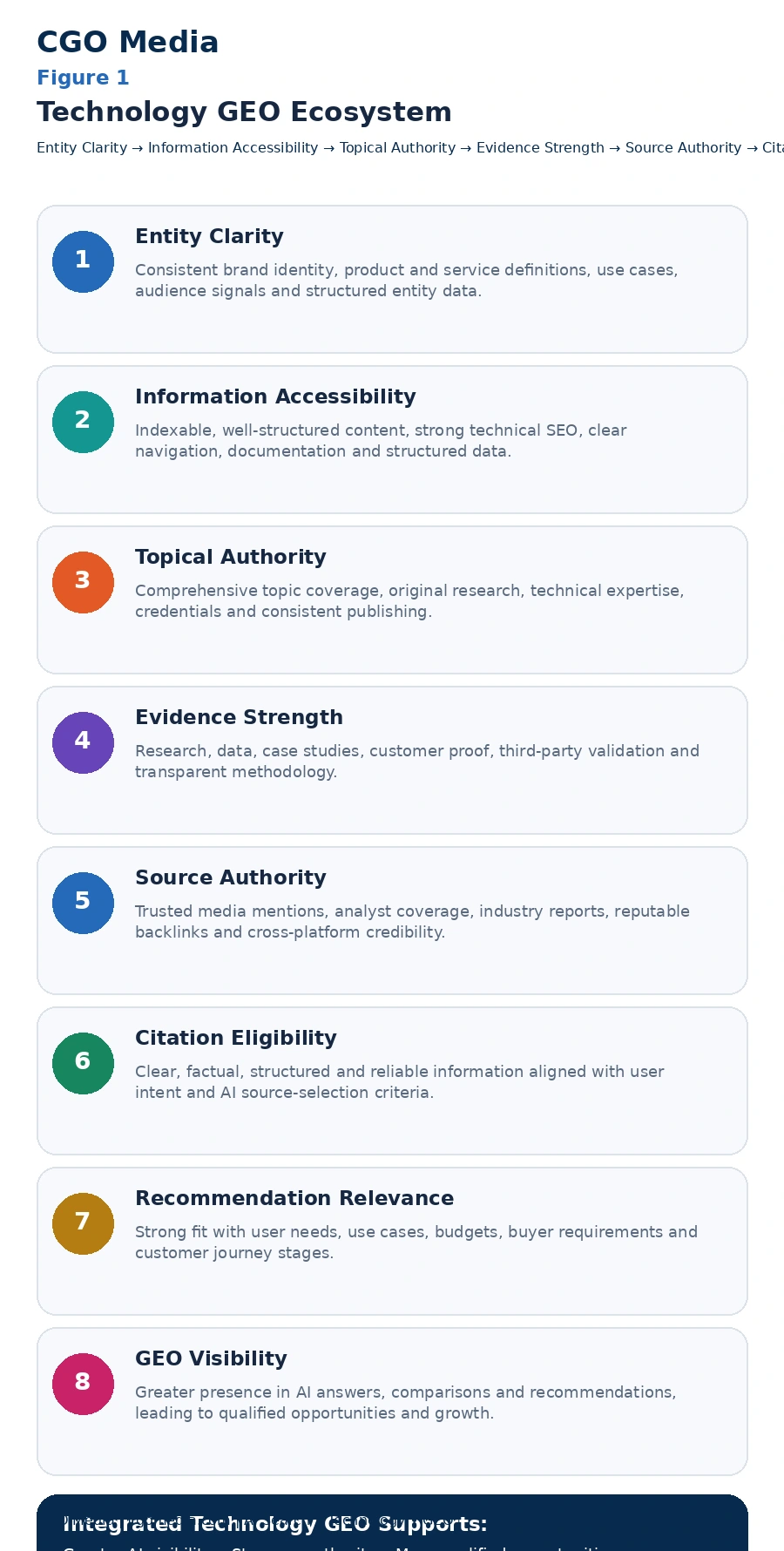
Entity Clarity → Information Accessibility → Topical Authority → Evidence Strength → Source Authority → Citation Eligibility → Recommendation Relevance → GEO Visibility
The strategic objective is not maximum AI mention volume.
It is qualified GEO visibility: relevant presence, accurate representation, strong evidence and appropriate recommendation within buyer scenarios where the organisation genuinely fits.
1. Technology GEO Extends Beyond Traditional SEO
Traditional SEO primarily focuses on improving the ability of search engines to crawl, index, understand and rank web content.
Generative Engine Optimisation addresses an additional layer of visibility: whether AI-assisted systems can use available information to construct accurate answers, comparisons and recommendations.
Technology organisations therefore need to optimise not only for document discovery, but also for:
- Entity understanding
- Evidence retrieval
- Source selection
- Citation suitability
- Comparative relevance
- Recommendation fit
2. Search Visibility and Generative Visibility Are Related but Different
A technology company can perform strongly in conventional search while remaining poorly represented within generative answers.
High rankings do not automatically guarantee that an AI system will:
- Understand the organisation correctly
- Select its content as evidence
- Cite its research
- Include it in comparisons
- Recommend it appropriately
GEO therefore builds on SEO without being identical to it.
3. Representation Is as Important as Discovery
Generative visibility can fail even where an organisation is easy to find.
Poor representation can include:
- Incorrect product descriptions
- Outdated capabilities
- Wrong category associations
- Missing use cases
- Weak competitive framing
- Confusion between current and legacy products
Technology GEO should therefore address both whether the organisation appears and how it is represented when it does.
4. GEO Requires Search and Knowledge Alignment
A strong technology GEO programme should make the organisation:
- Discoverable — relevant information can be found.
- Understandable — organisational and product relationships are clear.
- Verifiable — important claims are supported by evidence.
- Comparable — meaningful differences can be evaluated.
- Recommendable — suitability can be assessed within a buyer context.
These capabilities depend on the wider information environment rather than on individual pages alone.
5. The Technology GEO Ecosystem
A useful conceptual relationship is:
Entity Clarity → Information Accessibility → Topical Authority → Evidence Strength → Source Authority → Citation Eligibility → Recommendation Relevance → GEO Visibility
Each layer supports the next.
Weakness at an upstream layer can constrain downstream visibility even where the organisation performs strongly elsewhere.
6. Entity Clarity Is the First GEO Layer
Generative systems need to understand basic organisational relationships before they can evaluate suitability confidently.
This includes:
- Who the organisation is
- Which products it offers
- Which categories those products belong to
- Which use cases they support
- How products and brands relate to one another
7. Entity Ambiguity Weakens Generative Understanding
Technology organisations frequently create ambiguity through:
- Rebrands
- Acquisitions
- Multiple product names
- Legacy terminology
- Inconsistent external profiles
- Overlapping product families
These inconsistencies can force systems and buyers to infer relationships that should be stated explicitly.
8. Technology Entity Relationships Should Be Explicit
A useful product-led relationship can be represented as:
Organisation → Product Family → Product → Feature → Integration → Use Case
For service-led technology organisations, a structure may instead resemble:
Organisation → Practice → Service → Capability → Industry → Evidence
The precise architecture can vary, but the underlying relationships should remain clear.
9. Product Identity Requires Lifecycle Governance
Technology products change frequently through:
- Renaming
- Acquisition
- Product consolidation
- Platform migration
- Retirement
GEO requires current product truth to remain distinguishable from historical information.
10. Entity Clarity Helps Reduce Incorrect Inference
Generative systems should not need to infer basic facts such as:
- Who owns a product
- Whether a product still exists
- Whether two names refer to the same platform
- Whether an integration is current
Explicit information reduces ambiguity for both machine systems and human buyers.
11. Information Accessibility Is the Second GEO Layer
Useful evidence cannot contribute effectively to generative visibility if it is difficult to access.
Accessibility depends on technical factors including:
- Crawlability
- Indexation
- Internal linking
- Rendering
- Documentation accessibility
Traditional technical SEO therefore remains a foundational component of GEO.
12. Technology Information Estates Are Often Fragmented
Important information may be distributed across:
- Main corporate websites
- Product websites
- Documentation portals
- Developer portals
- Support centres
- Trust centres
- Regional sites
These environments can function separately even though buyers and generative systems need to understand them as parts of one organisation.
13. GEO Requires a Connected Information Estate
Commercial, technical and trust information should reinforce one another.
A useful relationship can be:
Product → Documentation → Security → Customer Evidence → Research → External Validation
The objective is to create coherent pathways between different forms of evidence.
14. Internal Linking Supports Information Relationships
Internal links can connect:
- Product pages to technical documentation
- Use cases to customer evidence
- Research to relevant product categories
- Security claims to supporting resources
This improves both human navigation and the discoverability of related information.
15. Documentation Accessibility Is Particularly Important
Technology buyers frequently depend on documentation when evaluating:
- Integrations
- APIs
- Architecture
- Implementation
- Compatibility
Documentation should therefore be treated as part of the search and GEO information environment rather than only as post-sale support material.
16. Topical Authority Is the Third GEO Layer
Generative systems need sufficient evidence that an organisation is genuinely relevant to the subject being discussed.
Topical authority can be built across:
- Problems
- Technology categories
- Use cases
- Technical concepts
- Industries
The strongest authority usually extends beyond product pages alone.
17. Technology GEO Should Not Depend Only on Product Pages
Broader authority can be developed through:
- Research
- Documentation
- Technical education
- Expert commentary
- Case studies
These resources provide evidence that the organisation understands the wider problem space in which its products operate.
18. Problem Authority Supports Earlier AI Discovery
Buyers may begin with a problem rather than a recognised technology category.
Problem authority allows an organisation to become relevant before the buyer has identified:
- The solution category
- Potential providers
- Specific products
This can create earlier generative discovery.
19. Category Authority Supports Comparative Discovery
Strong category authority can support inclusion within:
- Provider discovery
- Best-provider queries
- Category comparisons
- Alternative searches
- Shortlist generation
This moves the organisation from being discoverable only by name toward being considered as part of the market itself.
20. Use-Case Authority Supports Recommendation Fit
AI systems can evaluate suitability more effectively when the organisation provides explicit evidence connecting:
Buyer Need → Technology Capability → Use Case → Supporting Evidence
Use-case authority helps distinguish where a product is genuinely appropriate from scenarios where another provider may be a better fit.
21. Industry Authority Adds Context
Technology buyers often have sector-specific requirements involving:
- Regulation
- Security
- Workflow
- Integration
- Operational constraints
Industry-specific evidence can help generative systems evaluate suitability within those contexts.
22. Technical Authority Supports Specialist Queries
Technical content can establish relevance for questions involving:
- Architecture
- Implementation
- APIs
- Performance
- Security
This can strengthen source eligibility for detailed technical answers where generic marketing content provides insufficient depth.
23. Evidence Strength Is the Fourth GEO Layer
Generative visibility becomes more defensible when important claims are supported by credible evidence.
Evidence can include:
- Technical documentation
- Security information
- Customer outcomes
- Research
- Independent validation
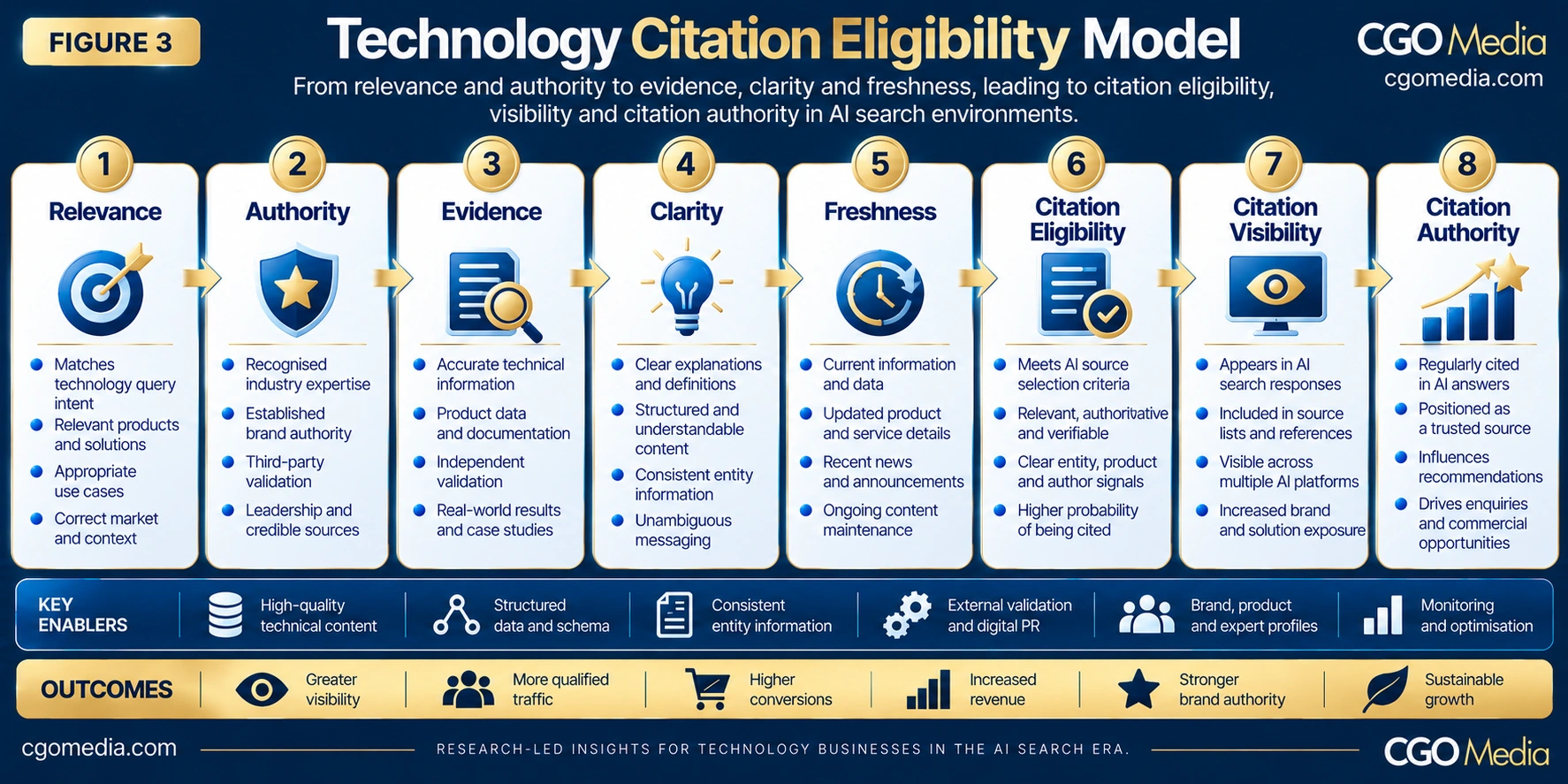
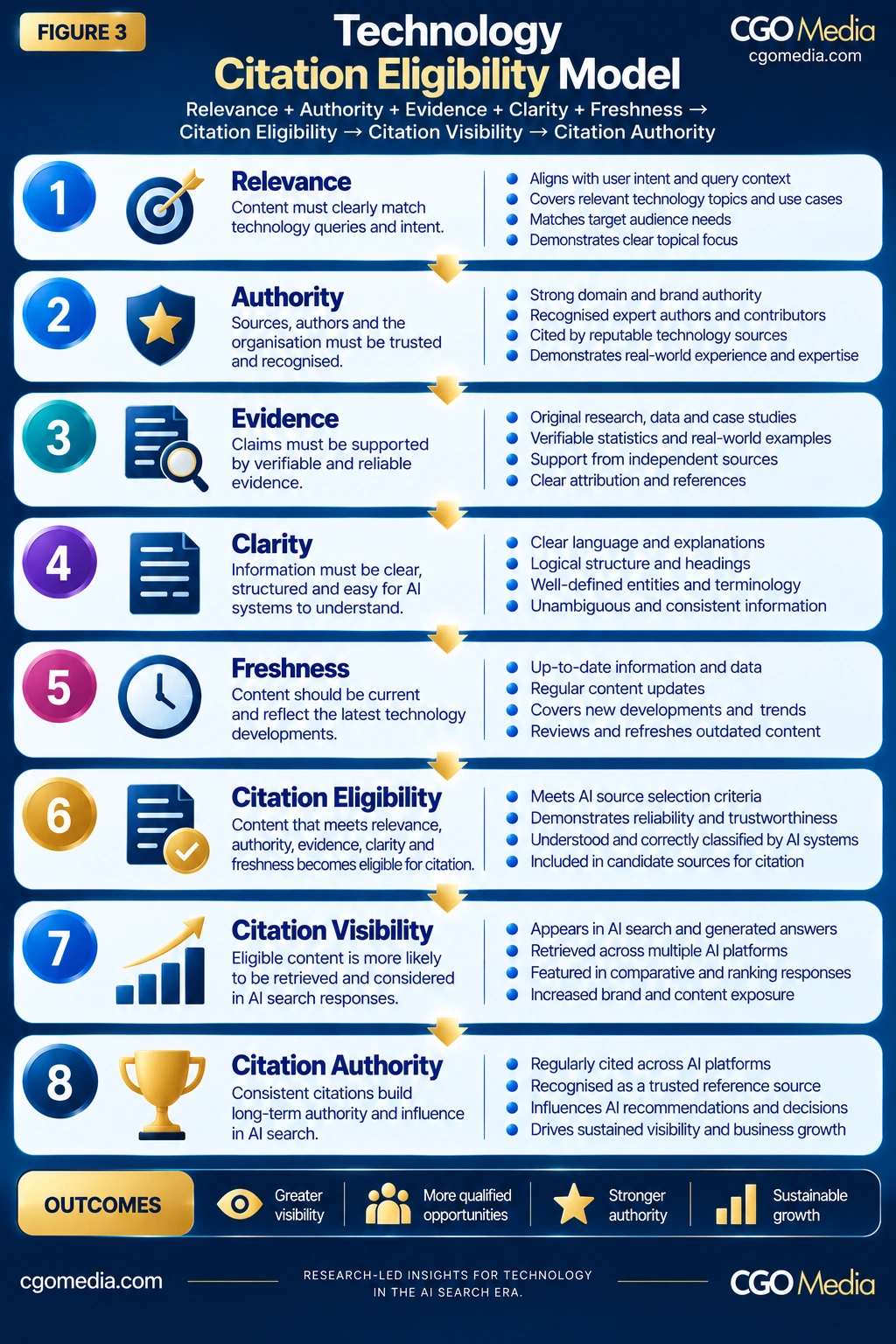
The objective is to make important claims inspectable rather than merely asserted.
24. Strong Evidence Should Be Specific
Generic statements such as:
- Secure
- Scalable
- Enterprise-ready
- Easy to integrate
provide less evaluation value than clearly defined technical or operational evidence.
Specificity improves both buyer understanding and source usefulness.
25. Strong Evidence Should Be Current
Technology information can become outdated quickly following:
- Product releases
- Integration changes
- Architecture changes
- Security updates
- Certification changes
Evidence that was once accurate can become misleading if not maintained.
26. Strong Evidence Should Be Relevant
The evidence used should answer the actual question under consideration.
A corporate award may provide general brand credibility but contribute little to a specific question about:
- API capability
- Security controls
- Data residency
- Deployment architecture
Evidence relevance matters as much as evidence volume.
27. Strong Evidence Should Be Verifiable
Where practical, important claims should connect directly to supporting sources.
A useful relationship is:
Claim → Appropriate Evidence → External Reinforcement → Confidence
This creates a stronger evidence chain for both buyers and generative systems.
28. High-Risk Claims Require Stronger Evidence
Claims involving areas such as:
- Security
- Compliance
- Scalability
- Reliability
- Performance
can materially affect buying decisions.
A practical principle is:
Claim Risk ↑ → Evidence Requirement ↑
29. Customer Evidence Supports Real-World Validation
Customer evidence can connect technology capability with demonstrated use.
A useful structure is:
Customer Problem → Implementation → Technology Used → Outcome
Context improves the buyer’s ability to determine whether the evidence resembles their own situation.
30. Research Can Strengthen Primary Evidence
Original research can contribute:
- Data
- Benchmarks
- Market studies
- Technical observations
Research can therefore strengthen both topical authority and the organisation’s usefulness as a source.
31. Source Authority Is the Fifth GEO Layer
Generative systems can draw on multiple owned and external sources when constructing answers.
A strong source environment can include:
- Official product pages
- Technical documentation
- Research
- Industry publications
- Customer references
GEO should therefore be understood as an ecosystem problem rather than a website-only problem.
32. Source Diversity Improves Resilience
Dependence on one source can create fragility.
A more resilient information environment includes:
- Owned evidence
- Customer evidence
- Industry sources
- Research citations
- Professional references
Diversity reduces the consequences of one source changing, disappearing or becoming outdated.
33. Source Consistency Is Equally Important
Diverse sources should not materially contradict one another on important facts.
Consistency should be maintained across:
- Website
- Documentation
- External profiles
- Partner pages
- Research assets
Source diversity without information consistency can increase uncertainty rather than reduce it.
34. Source Conflict Can Reduce Confidence
Examples of harmful source conflict include:
- Different product names across websites
- Conflicting deployment descriptions
- Old integration information on partner pages
- Legacy claims remaining active after product changes
Persistent conflict should be treated as an information-governance issue.
35. Citation Eligibility Is the Sixth GEO Layer
A source can be visible without being sufficiently useful or credible to support a generated answer.
Citation eligibility can be understood conceptually through:
Relevance + Clarity + Evidence + Authority + Freshness
36. Relevance Determines Whether the Source Answers the Question
A useful source should address the specific information need rather than merely discuss the general topic.
For specialised technology queries, a focused technical resource may provide greater utility than a broad product overview.
37. Clarity Reduces Interpretation Burden
Information should be explicit enough that important facts do not need to be inferred from:
- Marketing language
- Several disconnected pages
- Ambiguous terminology
Clear information improves both retrieval and interpretation.
38. Evidence Supports Source Confidence
Claims supported through appropriate documentation, research or external validation provide stronger source utility than unsupported assertion.
39. Authority Supports Subject Credibility
Source authority can be strengthened through:
- Recognised expertise
- Research citations
- Industry references
- Customer validation
The relevant authority depends on the type of question being answered.
40. Freshness Supports Current Decision-Making
Technology information can lose usefulness quickly where products, integrations or standards change.
Freshness should therefore be evaluated according to the decision context rather than through publication date alone.
41. Citation Eligibility Is Not the Same as Ranking
A page ranking strongly in conventional search may not always be the most appropriate source for a generated answer.
Generative source selection can favour information that is more:
- Specific
- Explicit
- Evidence-led
- Current
for the particular question.
42. Different Questions Require Different Source Types
A product-comparison query, technical implementation question and security evaluation may require completely different evidence.
Technology GEO should therefore ensure that the organisation possesses appropriate source assets for multiple information needs.
43. Recommendation Relevance Is the Seventh GEO Layer
Being cited and being recommended are different outcomes.
A technology provider may supply useful information that supports an answer while another provider is more appropriate for the buyer’s situation.
Recommendation visibility must therefore be evaluated contextually.
44. Recommendation Fit Depends on Buyer Context
Relevant factors can include:
- Buyer type
- Industry
- Budget
- Technical requirements
- Geography
- Security or compliance needs
A provider should not be expected to appear equally across every scenario.
45. GEO Should Optimise for Appropriate Inclusion
The objective is not universal recommendation visibility.
The organisation should appear where:
- Its capabilities genuinely fit
- Evidence supports that fit
- The buyer context is relevant
This produces stronger commercial value than broad but poorly matched inclusion.
46. GEO Visibility Is the Final Outcome Layer
Generative visibility can take several forms:
- Source visibility
- Citation visibility
- Entity visibility
- Comparison visibility
- Recommendation visibility
These should be measured separately because they represent different forms of influence.
47. Source Visibility
The organisation’s information contributes to an answer even where the organisation is not prominently identified.
This can represent informational influence without direct brand visibility.
48. Citation Visibility
The organisation is explicitly referenced or linked as a supporting source.
Citation visibility can contribute to:
- Trust
- Referral opportunity
- Brand association
49. Entity Visibility
The organisation or product becomes part of the answer itself.
Entity visibility depends on the system identifying the organisation correctly and associating it with the relevant subject or category.
50. Comparison Visibility
The organisation appears within comparative evaluation alongside alternative providers, products or approaches.
This indicates a stronger relationship with buyer consideration than source visibility alone.
51. Recommendation Visibility
The organisation is presented as potentially suitable within a specific buyer scenario.
This is one of the most commercially significant GEO layers, but it should remain qualified by actual buyer fit.
52. GEO Visibility Should Be Treated as Layered
A useful progression is:
Source → Citation → Entity → Comparison → Recommendation
An organisation can perform strongly at one layer while remaining weak at another.
A single AI visibility score can therefore conceal strategically important differences.
53. High Citation Visibility Does Not Guarantee Recommendation Visibility
The organisation may provide excellent research or technical information while its product remains unsuitable for the buyer’s scenario.
Citation authority and recommendation fit should therefore be measured independently.
54. High Recommendation Visibility Does Not Guarantee Strong Source Visibility
A provider can be named frequently even where its own website or research is not heavily cited.
This means brand recommendation visibility and owned-source influence can develop differently.
55. GEO Measurement Should Be Multi-Dimensional
Technology organisations should evaluate:
- Source presence
- Citation presence
- Entity accuracy
- Comparison inclusion
- Recommendation fit
This produces a more useful view of generative visibility than raw mention counts.
56. GEO Queries Should Be Scenario-Based
Generic prompts provide limited strategic intelligence.
Useful scenario families can include:
- Enterprise technology selection
- Developer tool selection
- Industry-specific software selection
- Regional provider selection
- Technical feature comparison
Scenario design should reflect real commercial priorities.
57. GEO Monitoring Should Include Competitor Co-Occurrence
Generative systems can reveal an effective competitive set that differs from the one traditionally tracked by sales teams.
Repeated co-occurrence can identify:
- Emerging competitors
- Alternative categories
- Unexpected comparison sets
- Changing market positioning
58. Comparative Framing Should Be Monitored
The organisation should observe whether it is repeatedly described as:
- Enterprise-focused
- Developer-focused
- Premium
- Specialist
- Value-led
Persistent framing can influence how buyers understand market position.
59. Misaligned Framing Should Be Investigated
The organisation can compare:
- Intended positioning
- Owned content
- External sources
- Generated representation
Where persistent differences exist, the underlying information environment should be examined before attempting tactical prompt-level fixes.
60. GEO Is Not Controlled Through Prompt Engineering Alone
Prompt testing can reveal how systems currently respond, but it does not independently create sustainable authority.
Long-term GEO performance depends more fundamentally on:
- Clear entities
- Useful information
- Strong evidence
- External validation
- Consistent source truth
61. GEO Is an Organisational Capability
Sustainable GEO requires coordination between:
- SEO
- Content
- Product
- Engineering
- Research
- PR
- Sales
Different teams control different parts of the information and evidence ecosystem.
62. Product Teams Support GEO Through Accurate Product Truth
Product teams can validate:
- Capabilities
- Use cases
- Product status
- Positioning
This helps ensure generative representations remain aligned with current product reality.
63. Engineering Teams Support GEO Through Technical Evidence
Engineering can strengthen:
- Documentation
- Architecture explanations
- Performance evidence
- Integration evidence
This creates stronger source material for specialist technical questions.
64. Research Teams Support GEO Through Primary Evidence
Original research can strengthen:
- Citations
- Source authority
- Category authority
- Media authority
Research can therefore become a central GEO asset where methodology and evidence are sufficiently strong.
65. PR Supports GEO Through External Validation
Relevant industry and media references can reinforce:
- Expertise
- Category relevance
- Research authority
- Organisational credibility
External authority becomes most useful when it relates directly to the subject or capability being evaluated.
66. Sales Teams Contribute Buyer Intelligence
Sales teams can reveal:
- Decision criteria
- Competitors
- Buyer language
- Trust concerns
This information can improve scenario design and expose gaps between intended positioning and real buyer evaluation.
67. GEO Should Be Connected to Buyer Decisions
Generative visibility has greatest commercial relevance when it supports:
- Discovery
- Evaluation
- Comparison
- Shortlisting
Visibility that occurs far outside relevant buyer scenarios may create little strategic value.
68. Mention Volume Alone Is a Weak GEO Objective
High mention volume can include:
- Irrelevant scenarios
- Inaccurate descriptions
- Poor-fit recommendations
More mentions do not automatically represent better generative visibility.
69. Qualified GEO Visibility Is the Strategic Goal
A useful conceptual relationship is:
Relevant Presence + Accurate Representation + Strong Evidence + Appropriate Recommendation
Relevant Presence
The organisation appears in scenarios aligned with its offering.
Accurate Representation
Material facts about products, capabilities and availability are correct.
Strong Evidence
Important claims are supported by appropriate sources.
Appropriate Recommendation
The provider is recommended where buyer fit is reasonable.
70. GEO Should Also Protect Against Misinformation
Generative visibility can create risk when material information is wrong.
Critical GEO errors can include:
- False security claims
- False compliance claims
- Incorrect product status
- Wrong pricing information
- Incorrect geographic availability
Visibility without accuracy is not a desirable outcome.
71. GEO Risk Should Be Prioritised
A practical conceptual model is:
Severity + Persistence + Buyer Impact + Commercial Importance
High-risk errors should receive faster escalation than low-impact variations in wording or positioning.
72. High-Risk GEO Errors Require Cross-Functional Escalation
Depending on the issue, relevant teams can include:
- SEO
- Product
- Security
- Legal
- PR
The corrective action should address the underlying source of inaccurate information rather than only the generated output.
73. GEO Should Be Monitored Longitudinally
Individual generated answers can vary.
Repeated monitoring is more useful for identifying patterns such as:
- Persistent inclusion
- Persistent exclusion
- Recurring misinformation
- Changing competitor sets
The organisation should distinguish stable patterns from isolated output variation.
74. The First Technology GEO Principle
Technology GEO should be treated as the optimisation of an information and authority ecosystem rather than as a narrow extension of keyword SEO, because generative systems evaluate entities, evidence, sources, comparative fit and recommendation relevance across multiple information layers.
75. The Second Technology GEO Principle
Generative visibility should be assessed across source, citation, entity, comparison and recommendation layers because an organisation can perform strongly at one layer while remaining weak at another.
76. The Third Technology GEO Principle
Technology organisations should prioritise qualified GEO visibility — relevant presence, accurate representation, strong evidence and appropriate recommendation — rather than maximising raw AI mention volume.
77. The Fourth Technology GEO Principle
Long-term GEO performance should be built through clear entity architecture, accessible information, topical authority, verifiable evidence, relevant external sources and ongoing monitoring rather than through prompt testing alone.
78. The Technology GEO Ecosystem
The complete conceptual progression can be summarised as:
Entity Clarity → Information Accessibility → Topical Authority → Evidence Strength → Source Authority → Citation Eligibility → Recommendation Relevance → GEO Visibility
Entity Clarity
Defines the organisation, products, services, experts and relationships that need to be understood accurately.
Information Accessibility
Ensures useful commercial, technical, research and trust information can be discovered and retrieved.
Topical Authority
Demonstrates relevance to the problems, categories, use cases, industries and technical concepts associated with the organisation.
Evidence Strength
Supports important claims through specific, current, relevant and verifiable information.
Source Authority
Builds a resilient ecosystem of owned and external sources capable of reinforcing organisational credibility.
Citation Eligibility
Improves the usefulness of source material through relevance, clarity, evidence, authority and freshness.
Recommendation Relevance
Connects provider capabilities with the buyer scenarios in which the organisation genuinely fits.
GEO Visibility
Represents the resulting source, citation, entity, comparison and recommendation visibility across generative search environments.
79. The Strategic Implication
Technology organisations should approach Generative Engine Optimisation as a coordinated search, knowledge, evidence and authority discipline.
The organisation should create an information environment in which generative systems can:
- Identify the organisation correctly
- Access useful information
- Understand product and category relationships
- Verify important claims
- Select appropriate supporting sources
- Evaluate competitive fit
- Recommend the provider where relevant
The objective is not to manipulate individual AI responses.
It is to strengthen the underlying information and authority ecosystem from which accurate, useful and commercially relevant generative visibility can emerge.
80. Generative Source Selection Is a Core GEO Problem
A technology organisation can publish accurate and useful information without that information necessarily becoming a preferred source within a generated answer.
GEO therefore needs to consider not only whether information exists, but whether it is sufficiently useful, relevant and authoritative to compete with alternative sources addressing the same question.
The central question becomes:
Why would a generative system select this source rather than another source available for the same information need?
81. Source Selection Begins with Query Context
Source suitability depends first on the question being answered.
A source that is highly useful for one query may provide little value for another.
Technology questions can involve:
- Product discovery
- Technical implementation
- Security
- Comparison
- Research
- Provider selection
Each information need can require a different evidence profile.
82. Candidate Availability Comes Before Selection
A source must first be accessible and relevant enough to enter the potential source environment.
Candidate sources can include:
- Official product pages
- Technical documentation
- Research papers
- Industry publications
- Review platforms
- Customer references
Being available does not mean a source will ultimately be selected.
83. Candidate Sources Compete
Once several plausible sources exist, they can compete on dimensions including:
- Relevance
- Specificity
- Evidence quality
- Authority
- Freshness
Generative source selection can therefore be treated as a competitive information-quality problem.
84. Relevance Determines Query Fit
A source should answer the actual information need rather than merely discuss the general subject.
A broad product page may be useful for understanding what a platform does while remaining unsuitable for a detailed question about:
- Encryption
- API limits
- Regional hosting
- Deployment architecture
Precise relevance can therefore outperform broad topical relevance.
85. Specificity Strengthens Source Utility
Technology questions frequently require explicit information.
Useful specificity can include:
- Named technical capabilities
- Explicit use cases
- Named certifications
- Defined deployment models
- Current integration information
Specific source material reduces the amount of interpretation required to construct an answer.
86. Evidence Quality Influences Source Confidence
Unsupported promotional statements provide weaker source utility than information supported through appropriate evidence.
A useful relationship is:
Explicit Claim + Supporting Evidence → Greater Source Utility
This is particularly important where the question concerns risk, technical capability or suitability.
87. Authority Influences Source Trust
Source authority can be reinforced through:
- Recognised expertise
- Original research
- External citations
- Industry references
- Customer validation
Authority should still be interpreted in relation to the subject being evaluated.
88. Freshness Influences Decision Suitability
Technology information can change rapidly.
Older information may be less useful where the question involves:
- Current features
- Integrations
- Security status
- Pricing
- Availability
Freshness therefore matters according to the volatility of the underlying information.
89. Different Query Types Require Different Source Architecture
Technology GEO should not assume that one page type can answer every question.
A stronger source system provides different evidence environments for different query families.
These can include:
- Product discovery sources
- Technical implementation sources
- Security and trust sources
- Comparison sources
- Research sources
90. Product Discovery Queries Need Clear Product Sources
Questions about what a product does, who it serves or which problems it solves can be supported through:
- Product pages
- Solution pages
- Use-case resources
- Customer examples
These sources should make product positioning explicit rather than forcing the reader to reconstruct it across multiple pages.
91. Technical Implementation Queries Need Technical Sources
Implementation questions can require:
- Documentation
- Developer guides
- API references
- Architecture resources
Commercial pages rarely provide sufficient detail for these questions.
Technical source architecture is therefore a distinct GEO requirement.
92. Security Queries Need Trust-Specific Evidence
Security questions can require sources such as:
- Security documentation
- Trust centres
- Certification information
- Independent validation
Generic statements describing a product as secure provide limited evidence for detailed evaluation.
93. Research Queries Need Primary Evidence
Research-oriented questions may be better supported through:
- Original studies
- Datasets
- Methodology pages
- Research publications
Primary evidence can provide information unavailable from product-marketing content.
94. Comparison Queries Require Multiple Evidence Types
Comparative evaluation can require:
- Provider information
- Independent comparisons
- Customer evidence
- Technical documentation
- Analyst-style material
No single source may provide a complete comparative picture.
95. First-Party Sources Are Strong for Product Truth
Technology organisations are normally the primary authority for facts such as:
- Product functionality
- Current integrations
- Technical specifications
- Product availability
- Documentation
These facts should therefore be represented clearly within owned source environments.
96. First-Party Sources Have Limits
Owned sources are less independent when addressing questions such as:
- Which provider is best?
- How strong is customer satisfaction?
- How is the company perceived externally?
- Which providers lead the category?
These questions can require external validation.
97. Independent Sources Strengthen External Validation
External evidence can include:
- Industry media
- Independent research
- Customer reviews
- Professional publications
- Analyst commentary
Relevant external validation can strengthen confidence where independent judgement is valuable.
98. Strong GEO Combines First-Party Truth and External Reinforcement
A healthy technology information environment combines:
First-Party Truth + Independent Reinforcement
Owned sources establish what the organisation says about itself.
External sources provide additional evidence about how those claims are validated, experienced or interpreted elsewhere.
99. Source Convergence Strengthens Confidence
Source convergence occurs when different credible sources materially support the same conclusion.
For example:
- The product page describes a capability.
- Documentation explains how it works.
- A customer demonstrates it in practice.
- An independent publication confirms its relevance.
The combined evidence can create greater confidence than any single source alone.
100. Source Convergence Is Different from Duplication
Source convergence does not require every source to repeat identical language.
Different sources can contribute different forms of evidence while supporting a consistent overall conclusion.
A useful model is:
Product Truth + Technical Proof + Customer Proof + External Validation
101. Source Conflict Can Reduce Confidence
Technology organisations should identify material contradictions across:
- Marketing pages
- Documentation
- Security resources
- Partner pages
- External profiles
Conflicting information makes it harder for buyers and generative systems to determine which source is current and authoritative.
102. Product Changes Commonly Create Source Conflict
Conflict can develop after:
- Product renaming
- Feature changes
- Integration changes
- Acquisitions
- Product retirement
A strong GEO programme should therefore include information lifecycle governance.
103. Canonical Product Truth Should Be Identifiable
For important product facts, the organisation should know which internal or public source represents current truth.
This can help teams reconcile outdated information across dependent environments.
A simple governance relationship is:
Canonical Fact → Primary Source → Supporting Sources → Review Ownership
104. Source Hierarchy Can Reduce Ambiguity
Different source types can hold different levels of authority for different claims.
For example:
- Official documentation may be primary for technical implementation.
- A trust centre may be primary for current security information.
- A research publication may be primary for original findings.
- Independent reviews may be more useful for customer perception.
Technology GEO should respect these distinctions.
105. Information Should Be Designed for Source Utility
Useful source content should make important facts easy to locate and understand.
Source utility can be strengthened through:
- Clear headings
- Explicit statements
- Defined terminology
- Supporting evidence
- Current information
The aim is clarity, not artificial formatting designed solely for machine extraction.
106. Extractability Supports Source Utility
Important information should be understandable without requiring excessive interpretation from distant sections of a page.
Useful extractable information can include:
- Clear definitions
- Direct answers
- Explicit product relationships
- Structured comparisons
- Concise findings
Extractability should improve human usability as well as machine accessibility.
107. Explicit Claims Reduce Ambiguous Interpretation
An important technical statement should make clear:
- The subject
- The capability
- The relevant condition
- The supporting evidence
This is particularly useful where product capabilities vary according to plan, configuration, geography or version.
108. Definitions Can Strengthen Technology Sources
Technology markets often contain:
- Complex terminology
- Overlapping category names
- Vendor-created language
- Rapidly changing concepts
Clear definitions can improve both buyer understanding and subject relevance.
109. Comparisons Should Explain Decision Criteria
Useful comparison content should explain:
- What is being compared
- Which criteria matter
- Where alternatives differ
- Which situations favour each approach
Comparison usefulness depends on transparency rather than promotional superiority claims.
110. Tables Can Improve Source Utility Where Appropriate
Structured tables can help communicate:
- Feature differences
- Product tiers
- Integration support
- Deployment options
The information should still be explained adequately in surrounding text so context is not lost.
111. Research Findings Should Be Explicit
Research can lose source value when important findings are buried inside long narrative sections.
Strong research sources should make clear:
- What was studied
- What was found
- How it was measured
- What limitations apply
This improves both human evaluation and citation utility.
112. Methodology Supports Research Source Quality
Research methodology can include:
- Research question
- Sample
- Data source
- Time period
- Definitions
- Limitations
Transparent methodology allows external users to judge whether findings are appropriate for the claim being made.
113. Original Data Can Create Strong Source Utility
Technology organisations can create new information through:
- Benchmark studies
- Usage analysis
- Market surveys
- Technical testing
- Search behaviour research
Primary data can become especially useful because it cannot simply be reproduced from an existing external source.
114. Expert Content Can Strengthen Source Authority
Named subject-matter experts can contribute:
- Technical explanations
- Research interpretation
- Professional analysis
- Methodological expertise
Expert authority becomes stronger where the relationship between the person, organisation and subject area is explicit.
115. Source Freshness Should Reflect Information Volatility
Not every technology source requires the same review schedule.
High-change information can include:
- Pricing
- Product features
- Integrations
- Security status
- Availability
Lower-change information can include:
- Definitions
- Historical methodology
- Foundational research
- Conceptual frameworks
A useful principle is:
Rate of Change ↑ → Review Frequency ↑
116. Source Maintenance Is Part of GEO
Source quality can decline even when the original page remains technically accessible.
Maintenance should identify:
- Outdated facts
- Broken references
- Legacy terminology
- Changed product relationships
- Expired evidence
Freshness should therefore be managed rather than assumed.
117. High-Value Source Pages Should Have Owners
Important product, documentation, security and research assets should have clear responsibility for:
- Accuracy
- Review
- Updating
- Deprecation
Source ownership helps preserve quality as the organisation changes.
118. Competitor Source Analysis Can Reveal GEO Gaps
Technology GEO should compare more than conventional rankings.
Competitor analysis can examine:
- Coverage
- Evidence depth
- External citations
- Freshness
- Extractability
This helps identify why competing sources may be more useful within generative answers.
119. Coverage Measures Information Breadth
The organisation should ask whether competitors answer more priority buyer questions across:
- Discovery
- Technical evaluation
- Trust
- Comparison
Missing information can prevent the organisation from competing for source selection regardless of page quality elsewhere.
120. Evidence Depth Measures Proof Strength
A competitor can outperform an organisation by supporting similar claims with stronger:
- Documentation
- Customer examples
- Research
- Independent evidence
The problem may therefore be evidence depth rather than keyword targeting.
121. External Citations Measure Independent Reinforcement
Competitor source authority can be stronger where credible external sources repeatedly recognise its:
- Expertise
- Research
- Product capability
- Category relevance
Relevant citations can strengthen the wider source ecosystem.
122. Freshness Measures Current Relevance
Competitors may provide more current:
- Documentation
- Product information
- Research
- Comparison resources
A technically superior page can still become a weaker source if its information is materially outdated.
123. Extractability Measures Clarity
A source can contain the correct answer while presenting it so ambiguously that its practical utility is reduced.
Teams should examine whether important competitor information is easier to:
- Locate
- Understand
- Verify
- Reuse
than equivalent information on their own properties.
124. GEO Improvement Should Address the Weakest Source Dimension
Technology providers may discover that their primary source constraint is:
- Insufficient content coverage
- Weak evidence
- Limited external authority
- Poor information architecture
- Outdated source material
The correct response should address the actual constraint rather than defaulting to more publishing.
125. The Fifth Technology GEO Principle
Generative source selection should be treated as a competitive evidence problem in which technology sources must be sufficiently relevant, specific, authoritative, current and useful to compete with alternative candidate sources for the same information need.
126. The Sixth Technology GEO Principle
Technology organisations should build query-specific source architecture because product, technical, security, comparison and research questions often require different forms of evidence and different source types.
127. The Seventh Technology GEO Principle
Source convergence should be strengthened across owned, technical, customer and independent evidence so important technology claims are reinforced consistently rather than contradicted across the public information environment.
128. The Eighth Technology GEO Principle
GEO content should prioritise source utility through clarity, specificity, evidence, freshness and extractability, making important information easier to understand and reuse without relying on manipulative or purely prompt-driven tactics.
129. The Technology Generative Source Selection Model
The conceptual process can be summarised as:
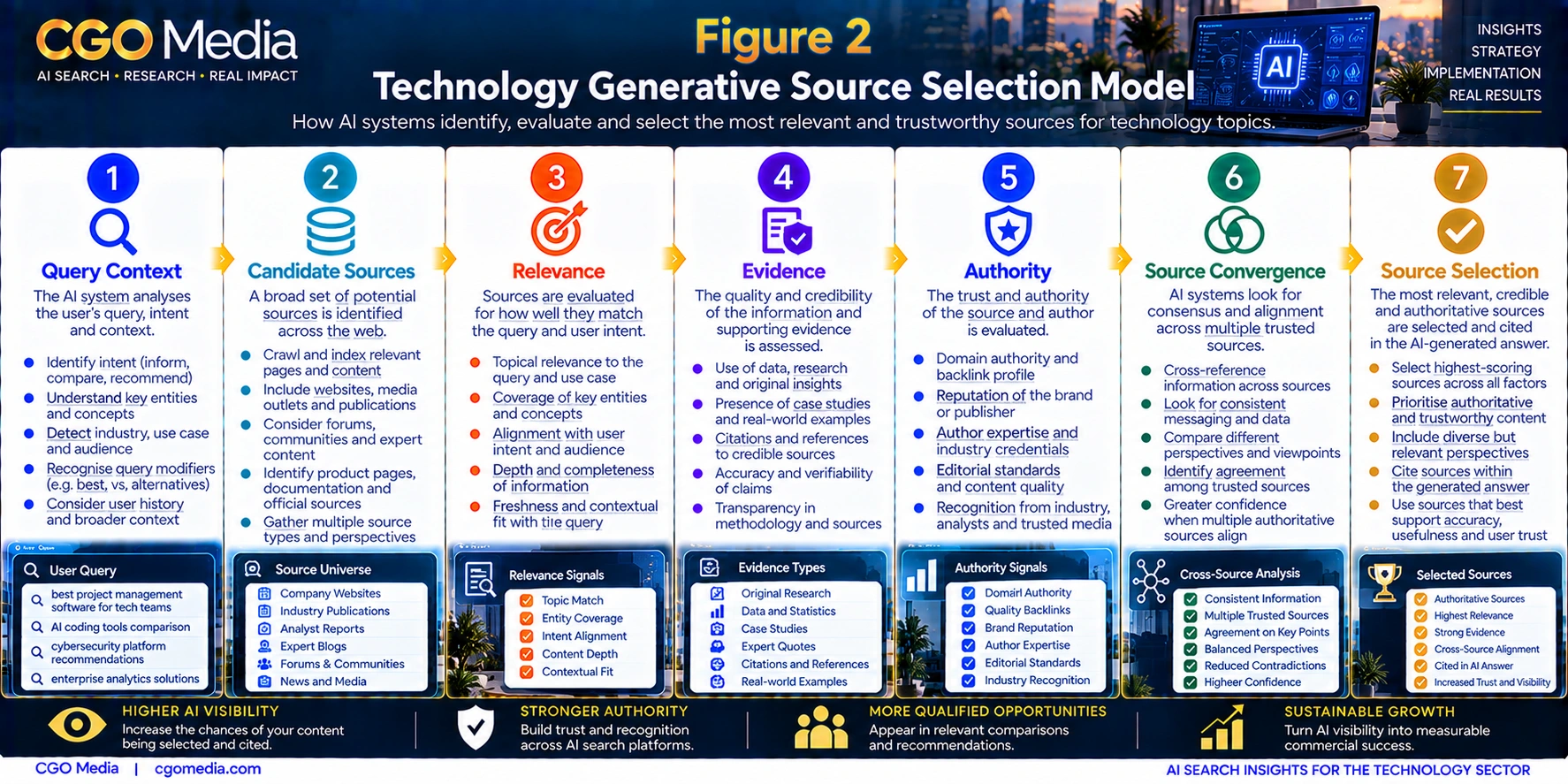
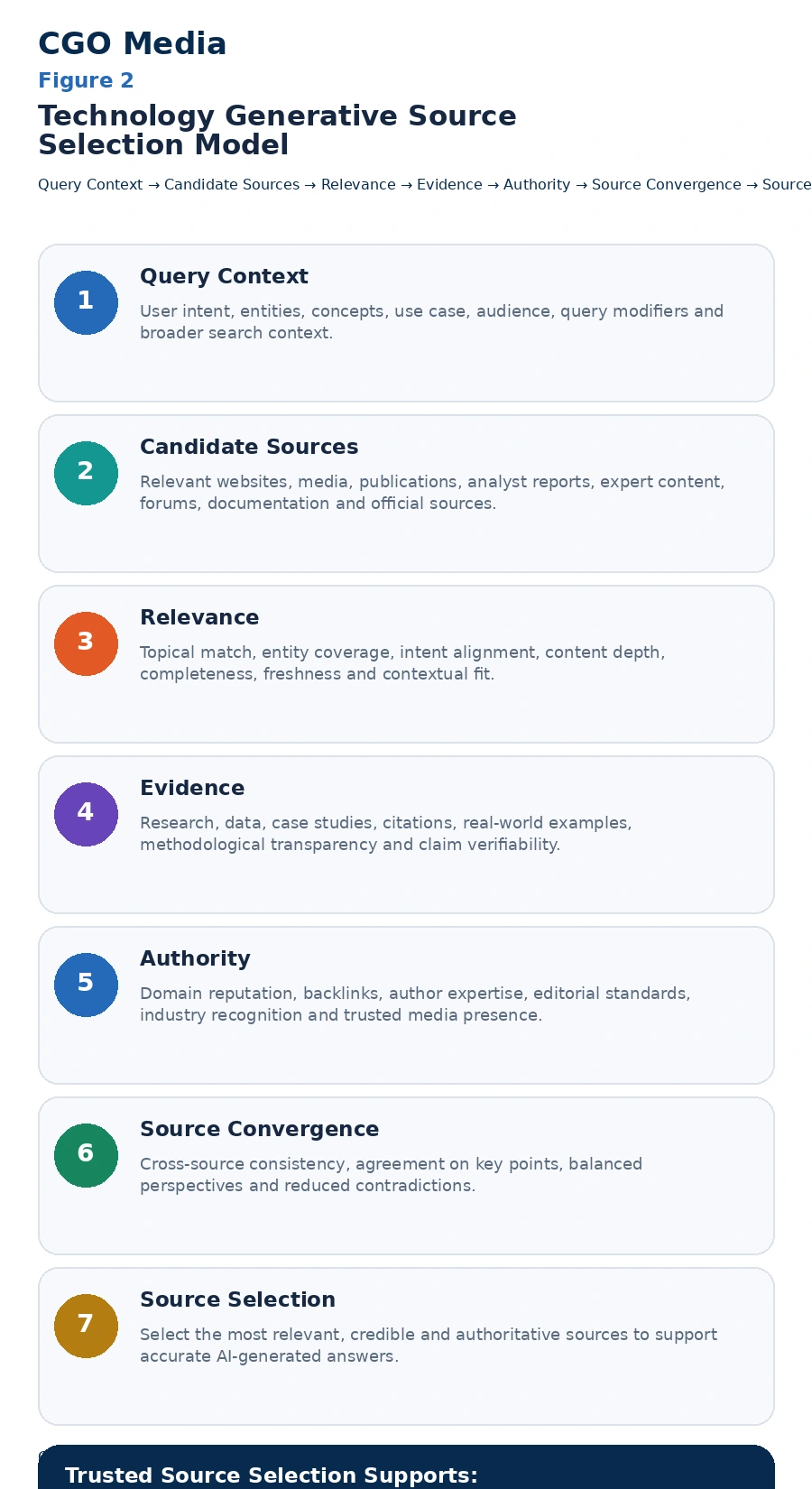
Query Context → Candidate Sources → Relevance → Evidence → Authority → Source Convergence → Source Selection
Query Context
The information need determines which type of source is most appropriate, whether the question concerns products, technical implementation, security, research, comparison or provider selection.
Candidate Sources
Accessible product pages, documentation, research, industry sources, customer evidence and independent resources form the candidate environment.
Relevance
The source must address the specific question closely enough to provide useful information rather than broad topical association alone.
Evidence
Important statements should be supported through technical, customer, research or independent evidence appropriate to the claim.
Authority
The source and organisation should demonstrate sufficient subject-specific credibility for the information being evaluated.
Source Convergence
Owned, technical, customer and independent sources should materially reinforce rather than contradict one another on important facts.
Source Selection
The resulting source should be sufficiently relevant, evidence-rich, authoritative, current and useful to compete for inclusion within the generated answer.
130. The Strategic Implication
Technology organisations should approach generative source selection as a competitive information-quality problem.
The goal is to build the right source type for each important buyer question, strengthen the evidence supporting those sources and create sufficient external reinforcement that important product and category claims become easier to verify.
Source selection cannot be guaranteed through formatting or prompt testing alone.
Long-term GEO performance depends on whether the organisation consistently produces information that is:
- Relevant
- Specific
- Evidence-led
- Authoritative
- Current
- Clear
The strongest technology GEO programmes therefore improve not only individual pages but the entire source environment surrounding the organisation, its products, its research and its expertise.
131. Citation Visibility Is a Distinct GEO Outcome
A technology organisation can influence a generated answer without receiving explicit attribution.
Citation visibility represents a stronger and more visible outcome because the organisation, page, research asset or source is explicitly referenced as supporting evidence.
This can contribute to:
- Brand recognition
- Referral opportunity
- Source credibility
- Research visibility
132. Citation Eligibility Should Be Treated Separately from General Visibility
A source can be accessible and relevant without being sufficiently suitable for explicit citation.
The central citation question is:
Does this source provide enough relevance, authority, evidence, clarity and freshness to support the claim being made?
A useful conceptual relationship is:
Relevance + Authority + Evidence + Clarity + Freshness → Citation Eligibility
133. Relevance Is the First Citation Dimension
A source should directly support the statement or conclusion being generated.
Broad topical relevance is weaker than precise relevance.
A general product page may be less suitable than a dedicated source addressing the exact:
- Capability
- Implementation method
- Integration
- Security control
- Use case
134. Citation-Oriented Content Should Answer Specific Questions
Strong citation assets can answer explicit questions such as:
- What does the technology do?
- How is it implemented?
- Which integrations are supported?
- Which security controls exist?
- Which use cases fit best?
The more directly a source answers a decision-relevant question, the stronger its potential citation utility.
135. Authority Is the Second Citation Dimension
Source credibility depends partly on whether the organisation or author demonstrates genuine subject authority.
Authority can be reinforced through:
- Subject-matter expertise
- Original research
- Independent citations
- External recognition
- Customer evidence
Authority should remain topic-specific rather than assumed universally.
136. Topic-Specific Authority Matters
A technology organisation can possess strong authority within one specialist field while remaining relatively weak within another.
For example, authority in cybersecurity does not automatically establish authority in:
- Developer infrastructure
- Financial technology
- Healthcare technology
- Enterprise analytics
Authority should therefore be built through sustained contribution to the relevant subject area.
137. Evidence Is the Third Citation Dimension
Explicit citations are strongest when the source contains information capable of supporting the generated claim.
Useful evidence can be:
- First-party
- Third-party
Both have different roles within the technology evidence environment.
138. First-Party Evidence Supports Product Truth
Technology organisations are often the primary source for facts involving:
- Product functionality
- Technical specifications
- Documentation
- Current integrations
- Product availability
These facts should therefore be represented clearly and consistently within official source environments.
139. Third-Party Evidence Supports Independent Validation
Independent sources can provide stronger support for questions involving:
- Reputation
- Comparative position
- Market recognition
- Customer experience
Relevant third-party evidence can therefore strengthen credibility beyond first-party assertion.
140. Strong Citation Environments Combine Both Evidence Types
A healthy GEO evidence system can be represented as:
First-Party Truth + Independent Reinforcement
Owned evidence explains what the product is and how it works.
Independent evidence can reinforce whether those claims are recognised, validated or experienced elsewhere.
141. Clarity Is the Fourth Citation Dimension
A source can be accurate yet difficult to cite if important information is buried or ambiguously expressed.
Strong citation assets should make important statements explicit.
Where relevant, they should identify:
- Subject
- Claim
- Condition
- Evidence
142. Clarity Reduces Ambiguous Extraction
Generative systems and human readers should not need to reconstruct a critical statement from several disconnected sections.
Clear source design can include:
- Direct findings
- Defined terminology
- Explicit evidence
- Concise explanatory passages
The objective is clarity rather than artificial machine-oriented formatting.
143. Freshness Is the Fifth Citation Dimension
Technology information has different rates of decay.
High-change information can include:
- Pricing
- Features
- Integrations
- Security status
- Product availability
These areas often require more frequent review than stable conceptual information.
144. Lower-Change Information Can Remain Useful Longer
Examples can include:
- Definitions
- Foundational research
- Historical methodology
- Conceptual frameworks
The appropriate review frequency should therefore reflect information volatility.
A useful principle is:
Rate of Change ↑ → Review Frequency ↑
145. Citation Eligibility Can Be Managed
Technology organisations can improve citation readiness by strengthening:
- Relevance
- Authority
- Evidence
- Clarity
- Freshness
This does not guarantee citation, but it improves the usefulness and defensibility of the source material available.
146. Citation Authority Extends Beyond Individual Pages
An organisation can gradually become recognised as a useful source within a technology category.
Citation authority develops when its information is increasingly:
- Referenced
- Quoted
- Linked
- Summarised
across credible external environments.
147. Citation Authority Can Become Self-Reinforcing
A useful authority cycle is:
Useful Evidence → External Reference → Greater Authority → Wider Discovery → More Citation Opportunities
Strong source assets can therefore create compounding authority where they remain useful, accessible and relevant.
148. Original Research Is Especially Important for Citation Authority
Technology organisations can create information that does not exist elsewhere.
Original research can include:
- Benchmark studies
- Usage research
- Market surveys
- Technical testing
- Search behaviour analysis
Primary information creates a stronger reason for others to cite the original source.
149. Primary Data Creates Citation Utility
Journalists, analysts, researchers and industry practitioners frequently need:
- Original numbers
- Observed trends
- Technical findings
- Comparative evidence
Primary data can therefore create citation opportunities that purely derivative content cannot replicate as easily.
150. Research Should Begin with a Clear Research Question
The research asset should make clear what is being investigated and why.
A clear research question improves:
- Method selection
- Result interpretation
- External usability
- Citation context
151. Research Methodology Should Be Transparent
Useful methodological information can include:
- Sample
- Data source
- Time period
- Definitions
- Limitations
Transparency allows external users to judge how strongly the evidence supports the conclusion.
152. Research Findings Should Be Explicit
Important results should not be hidden within long narrative sections.
Findings can be communicated through:
- Summary statements
- Tables
- Figures
- Clearly separated results sections
This improves both human understanding and citation utility.
153. Findings and Interpretation Should Be Distinguished
Research should separate:
- What was observed
- How the organisation interprets the observation
This distinction strengthens methodological clarity and reduces the risk that interpretation is mistaken for empirical result.
154. Citation-Oriented Research Should Include Limitations
Useful limitations can explain:
- Sample constraints
- Method limitations
- Geographic limitations
- Time limitations
Transparent limitations can improve credibility because external users can assess the boundaries of the finding.
155. Publication Dates Should Be Clear
Clear publication and update dates help researchers and journalists determine whether the information remains appropriate for current use.
This is particularly important within rapidly evolving technology categories.
156. Research Versioning Can Strengthen Longitudinal Authority
Repeated studies can demonstrate:
- Trend
- Change
- Market development
- Technology adoption
A recurring research series can become more useful over time as historical comparisons become possible.
157. Longitudinal Research Can Become a Market Reference Point
A study repeated using a consistent methodology can create evidence about change that a one-time publication cannot provide.
This can strengthen:
- Research authority
- Media usefulness
- External citation potential
- Category authority
158. One Research Asset Can Support Several GEO Functions
A substantive research project can generate:
- Research papers
- Charts
- Statistics pages
- Press materials
- Expert commentary
- Sector analysis
This increases the authority value generated from a single evidence base.
159. Definitions Can Also Become Citation Assets
Technology markets frequently contain emerging or unclear terminology.
A useful definition should clarify:
- Meaning
- Scope
- Boundaries
- Related concepts
Clear definitions can become useful reference material when the wider market lacks consistent terminology.
160. Frameworks Can Become Citation Assets
Original conceptual frameworks can provide structure where a market lacks a useful model for:
- Diagnosis
- Comparison
- Measurement
- Planning
The value of a named framework depends on its practical usefulness rather than the name itself.
161. Expert Contribution Can Strengthen Citation Authority
Recognised experts can contribute through:
- Research
- Technical commentary
- Definitions
- Industry analysis
Expert authority becomes stronger where substantive output demonstrates the claimed expertise.
162. Expert Identity Should Be Clear
Useful identity signals can include:
- Name
- Role
- Specialism
- Publications
- Relationship with the organisation
This helps connect the individual expert with the evidence and subject area being cited.
163. Expert Authority Should Be Substantive
A biography alone does not demonstrate expertise.
Authority should be supported through evidence such as:
- Research
- Technical writing
- Media commentary
- Conference contribution
The objective is demonstrated contribution rather than superficial credentials.
164. Digital PR Can Strengthen Citation Authority
Digital PR can distribute useful evidence to relevant external audiences.
Strong GEO-oriented PR should emphasise:
- Original studies
- Industry data
- Technical findings
- Expert analysis
This gives external sources a stronger reason to cite the organisation.
165. Journalists Need Citable Material
A useful research or data asset should make it easy to identify:
- Finding
- Number
- Method
- Source
- Date
Reducing the effort required to verify a claim can improve practical media usability.
166. Press Resources Can Improve Citation Accessibility
A well-designed press environment can provide:
- Research summaries
- Figures
- Expert contacts
- Methodology
This improves access to citation-ready evidence without replacing the underlying full research asset.
167. Citation Authority Should Not Depend Only on Media
Other relevant external environments can include:
- Academic repositories
- Industry associations
- Professional communities
- Partner ecosystems
Authority diversity reduces dependence on one distribution channel.
168. Distribution Matters Because Strong Research Can Remain Invisible
Publication alone does not guarantee external use.
Research distribution should therefore be intentional.
Relevant audiences can include:
- Journalists
- Analysts
- Researchers
- Industry specialists
- Customers
169. Citation Authority Should Be Monitored
Technology organisations can track:
- External references
- Research citations
- Media mentions
- AI citations
The objective is to understand whether external use of the organisation’s information is increasing and whether that use is strategically relevant.
170. Citation Quality Matters More Than Raw Volume
Not every citation carries equal strategic value.
High-value references can come from:
- Technical publications
- Research organisations
- Industry media
- Professional bodies
Relevance and credibility should therefore be evaluated alongside quantity.
171. Citation Diversity Supports Resilience
Authority becomes more resilient when references come from several credible environments.
Heavy dependence on one:
- Publication
- Platform
- Industry community
- Research source
can create concentration risk.
172. Citation Recency Can Indicate Continuing Relevance
Current references can demonstrate that the organisation remains active and relevant within a technology category.
Older citations can still remain valuable where they reference:
- Foundational research
- Established definitions
- Durable conceptual frameworks
173. Citation Context Should Be Monitored
The organisation should understand not only whether it is referenced, but why.
Positive citation contexts can include:
- Expert source
- Research source
- Technical reference
- Market authority
Context can reveal which types of authority the market currently associates with the organisation.
174. Negative Citation Context Also Matters
External references can highlight:
- Security issues
- Service problems
- Product limitations
- Controversies
Generative systems can incorporate critical evidence as well as positive evidence.
GEO should therefore not treat all citations as beneficial.
175. Negative External Evidence Should Be Addressed Through Reality
Valid criticism should not be approached primarily as a suppression problem.
The organisation should improve the underlying:
- Product
- Service
- Evidence
- Communication
where legitimate problems exist.
176. Trust Recovery Can Improve Citation Context
A mature recovery sequence can be represented as:
Issue → Correction → Evidence → Communication → External Reassessment
Corrective action should create new evidence demonstrating how the problem has been addressed.
177. Citation Strategy Should Distinguish Owned Assets and External Sources
Owned citation assets are resources created by the organisation.
Examples can include:
- Research papers
- Datasets
- Definitions
- Technical studies
- Frameworks
178. External Citation Sources Provide Independent Reinforcement
External citation sources can include:
- Media organisations
- Research organisations
- Professional bodies
- Customer publications
These sources can strengthen the authority of owned evidence through independent reference.
179. Strong GEO Connects Owned Evidence with External Distribution
A useful authority relationship is:
Owned Evidence → External Distribution → Independent Citation → Broader Authority
The organisation first creates something worth citing, then ensures relevant external audiences can discover and evaluate it.
180. Citation Eligibility Should Be Evaluated at Page Level
For an important source page, teams can ask:
- Is this page directly relevant?
- Is the claim explicit?
- Is supporting evidence available?
- Is the page current?
- Is the source authoritative?
This provides a practical citation-readiness assessment.
181. Citation Authority Should Be Evaluated at Organisational Level
At organisational level, teams can ask:
- Are we frequently referenced?
- Are we cited for the right subjects?
- Are citations diverse?
- Are citations current?
This distinguishes the strength of one page from the authority of the wider organisation.
182. Citation Fit Matters
A technology organisation should aim to be cited where it has genuine expertise.
Irrelevant citation volume can distort the appearance of authority without strengthening meaningful category association.
The stronger objective is qualified citation authority.
183. Qualified Citation Authority
A useful conceptual relationship is:
Relevant Citation + Credible Source + Correct Context + Strong Evidence
This produces stronger strategic value than citation volume alone.
184. Citation Authority Can Strengthen Recommendation Confidence
Independent references can reduce uncertainty around important provider claims.
This can be particularly valuable where the buyer needs confidence around:
- Technical capability
- Security
- Market expertise
- Research credibility
185. Citation Authority Can Strengthen Category Association
Repeated relevant references can connect the organisation with specific:
- Categories
- Problems
- Use cases
- Technical concepts
This can reinforce the organisation’s position within the wider knowledge environment.
186. Citation Authority Develops Over Time
Strong citation authority is rarely created through one campaign.
Long-term programmes can include:
- Research publication
- Research distribution
- Expert commentary
- Digital PR
- Framework development
Consistency increases the opportunity for the organisation to become a recurring reference source.
187. Citation Authority Should Be Integrated with Content Strategy
Organisations should understand the primary purpose of important assets.
Some assets may be designed primarily to:
- Rank
- Educate
- Convert
- Attract citations
One asset can perform several functions, but strategic intent should remain clear.
188. Citation-Oriented Content May Require Different Design
Citation-focused assets can place greater emphasis on:
- Data
- Methodology
- Definitions
- Explicit findings
- Reusable figures
The aim is to make the information easier for external users to verify and reference.
189. Citation Accessibility Matters
Researchers, journalists and analysts should be able to find and understand useful material efficiently.
Helpful accessibility features can include:
- Clear headings
- Stable URLs
- Publication dates
- Named authors
- Methodology sections
190. Citation Persistence Matters
Research and evidence URLs should not disappear unnecessarily.
Persistent citation assets support long-term authority because older external references remain useful when the destination content remains available and accurate.
191. The Ninth Technology GEO Principle
Citation eligibility should be treated as a distinct GEO capability, requiring technology sources to combine precise relevance, credible authority, strong evidence, clear presentation and appropriate freshness for the information need being answered.
192. The Tenth Technology GEO Principle
Technology organisations should build citation authority through useful primary evidence, transparent research, substantive expert contribution and independent distribution rather than pursuing citation volume without topical relevance.
193. The Eleventh Technology GEO Principle
Citation strategy should connect owned citation assets with independent external references so original research, technical evidence, definitions and frameworks create opportunities for broader validation across the public information ecosystem.
194. The Twelfth Technology GEO Principle
Citation authority should be evaluated by relevance, source credibility, context, diversity and persistence because explicit reference carries greatest value when it reinforces genuine expertise and accurate category association.
195. The Technology Citation Eligibility Model
The complete conceptual relationship can be summarised as:
Relevance + Authority + Evidence + Clarity + Freshness → Citation Eligibility → Citation Visibility → Citation Authority
Relevance
The source directly addresses the information need or claim being supported.
Authority
The source demonstrates appropriate subject expertise, research strength or external recognition.
Evidence
The claim is supported through appropriate product, technical, customer, research or independent evidence.
Clarity
Important facts and findings are expressed explicitly and can be understood without unnecessary interpretation.
Freshness
The source remains sufficiently current for the volatility and decision context of the information being cited.
Citation Eligibility
The source becomes sufficiently relevant, credible and useful to be considered suitable for explicit reference.
Citation Visibility
The organisation, research asset or source is explicitly referenced within generated answers or external publications.
Citation Authority
Repeated relevant external use strengthens the organisation’s broader reputation as a useful source within the technology category.
196. The Strategic Implication
Technology organisations should treat citation visibility as a deliberate GEO objective rather than an incidental outcome.
The organisation should create source material that is:
- Relevant
- Authoritative
- Evidence-rich
- Clear
- Current
while also developing original research, expert authority and external distribution systems that make those assets easier for relevant external audiences to discover and reuse.
Long-term citation authority is strongest where the organisation becomes genuinely useful as a reference within the technology knowledge ecosystem.
197. Recommendation Visibility Is the Most Commercially Significant GEO Layer
A technology organisation can be cited without being shortlisted and shortlisted without being strongly recommended.
Recommendation visibility should therefore be treated as a distinct GEO outcome.
The practical question is:
Under which realistic buyer scenarios is the provider considered a suitable option?
198. Recommendation Visibility Is Contextual
A provider may be highly suitable in one scenario and inappropriate in another.
Relevant context can include:
- Industry
- Company size
- Geography
- Technical requirements
- Budget
- Compliance needs
Technology GEO should therefore evaluate recommendation visibility through buyer scenarios rather than generic category prompts alone.
199. Recommendation Fit Should Be Scenario-Based
A useful progression is:
Buyer Scenario → Provider Fit → Evidence Strength → External Validation → Comparative Position → Recommendation Confidence → Qualified Recommendation
Each layer helps determine whether the organisation belongs within the final consideration set.
200. Buyer Scenario Is the Starting Point
Generative recommendation requests can contain several constraints simultaneously.
A single buyer scenario might specify:
- Enterprise scale
- European hosting
- API access
- Specific integrations
- Security requirements
The provider must therefore satisfy more than broad category relevance.
201. Multi-Constraint Prompts Compress the Buyer Journey
A detailed AI query can combine several traditional buying stages into one interaction:
Discovery → Filtering → Comparison → Shortlisting
This increases the importance of making decision-critical provider attributes explicit.
202. Constraint Clarity Supports Recommendation Eligibility
Important provider attributes should be represented clearly enough that systems and buyers can determine whether the requirement is satisfied.
This can include:
- Supported markets
- Deployment models
- Integrations
- Security controls
- Product tiers
Ambiguous information can weaken recommendation eligibility even where the capability genuinely exists.
203. Provider Fit Is the Second Recommendation Dimension
Provider fit describes whether the technology genuinely satisfies the buyer’s requirements.
Useful fit dimensions include:
- Functional fit
- Technical fit
- Industry fit
- Commercial fit
- Geographic fit
204. Functional Fit
Functional fit evaluates whether the product performs the required task.
The provider should be able to demonstrate clearly which:
- Capabilities exist
- Use cases are supported
- Important limitations apply
205. Technical Fit
Technical fit evaluates whether the technology can operate within the buyer’s required environment.
Evidence can include:
- Architecture
- APIs
- SDKs
- Integrations
- Deployment requirements
206. Industry Fit
Industry fit evaluates whether the organisation possesses evidence relevant to the buyer’s sector.
This can become particularly important where buyers require:
- Regulatory understanding
- Industry-specific workflows
- Relevant customer evidence
- Sector-specific integrations
207. Commercial Fit
Commercial fit can depend on:
- Pricing model
- Contract structure
- Support model
- Implementation effort
A technically strong provider can still be commercially unsuitable for a particular buyer scenario.
208. Geographic Fit
Geographic fit can depend on:
- Product availability
- Data residency
- Support coverage
- Regulation
- Regional pricing
Recommendation visibility should therefore be evaluated separately across strategically important markets.
209. Evidence Strength Is the Third Recommendation Dimension
Provider fit should be supported by evidence.
A provider may genuinely satisfy a requirement but still be under-represented where that capability is not communicated clearly enough.
This creates an important GEO distinction:
Capability ≠ Evidenced Capability
210. Evidence Gaps Can Create Recommendation Exclusion
Where several providers appear capable, a system may favour competitors with clearer supporting evidence.
Recommendation-relevant evidence can include:
- Product documentation
- Customer case studies
- Technical specifications
- Security documentation
- Independent references
211. Evidence Should Match the Requirement
A security requirement should be supported by security evidence.
A scalability requirement should be supported by appropriate scalability evidence.
An integration requirement should be supported by current integration documentation.
Generic brand reputation cannot substitute for requirement-specific proof.
212. High-Risk Requirements Need Stronger Proof
Recommendation confidence should be supported by stronger evidence where the buyer requirement involves:
- Security
- Compliance
- Reliability
- Data residency
- Mission-critical integrations
The evidence threshold should reflect the consequence of an incorrect recommendation.
213. External Validation Is the Fourth Recommendation Dimension
Independent evidence can reinforce owned claims and reduce recommendation uncertainty.
Relevant external validation can include:
- Industry coverage
- Customer reviews
- Research references
- Professional recognition
- Partner evidence
External authority is strongest when it relates directly to the requirement being evaluated.
214. External Validation Should Be Relevant
Unrelated prestige provides limited support for a specialised recommendation decision.
For example, broad corporate recognition may provide little evidence about whether a product satisfies a specific:
- API requirement
- Security requirement
- Deployment requirement
- Industry use case
215. Customer Evidence Can Provide Contextual Validation
Customer evidence becomes particularly useful when it resembles the buyer scenario under evaluation.
Relevant contextual attributes can include:
- Industry
- Company size
- Technical environment
- Use case
- Geography
This helps demonstrate that product capability has translated into practical outcomes under comparable conditions.
216. Comparative Position Is the Fifth Recommendation Dimension
Generative recommendations are frequently comparative rather than isolated.
The organisation competes against a scenario-specific set of alternatives.
The relevant question is not simply:
Are we a strong provider?
It is:
Are we a strong fit relative to the other credible options for this particular scenario?
217. Competitor Sets Are Dynamic
A technology provider can compete against different organisations depending on the buyer context.
Different competitor sets can emerge for:
- Enterprise scenarios
- Developer-tool scenarios
- SMB scenarios
- Industry-specific scenarios
Static competitor lists can therefore miss important GEO competition.
218. Recommendation Monitoring Should Track Co-Occurrence
Useful observations can include:
- Which providers appear together
- Which providers appear repeatedly
- Which strengths are attributed
- Which weaknesses are attributed
Co-occurrence can reveal the effective competitive set within AI-assisted discovery.
219. Co-Occurrence Can Reveal Category Association
Repeated comparison with particular providers may indicate how the organisation is being understood within the wider market.
This can reveal whether it is associated with:
- The intended category
- An adjacent category
- A narrower specialist niche
- A broader platform category
220. Comparative Framing Can Reveal Positioning
An organisation may be repeatedly described as:
- Enterprise-focused
- Developer-friendly
- Specialist
- Premium
- Value-led
Repeated framing can provide useful insight into how the public evidence environment positions the provider.
221. Comparative Framing Can Be Positive or Limiting
A strong position within one segment can strengthen recommendation confidence there while reducing visibility within other segments.
This is not automatically a problem.
A focused market identity can be strategically valuable where it reflects product reality and commercial strategy.
222. GEO Should Not Attempt to Broaden Every Position
The objective should be accurate positioning rather than universal relevance.
Representation should remain consistent with:
- Product reality
- Market strategy
- Customer outcomes
Broad but inaccurate positioning can generate poorly matched buyers.
223. Recommendation Confidence Is the Final Decision Layer
Recommendation confidence can increase when the information environment provides:
- Strong provider fit
- Strong evidence
- Relevant external validation
- Consistent information
A conceptual model is:
Scenario Relevance + Provider Fit + Evidence Confidence + External Validation + Source Consistency
224. Scenario Relevance
Scenario relevance asks whether the provider reasonably belongs within the consideration set.
This is the first protection against irrelevant recommendation visibility.
225. Provider Fit
Provider fit evaluates whether the buyer’s functional, technical, industry, commercial and geographic constraints can be satisfied.
226. Evidence Confidence
Evidence confidence evaluates whether the supporting information is sufficiently clear and strong to substantiate the proposed fit.
227. External Validation
External validation evaluates whether independent sources reinforce important provider claims and relevant market positioning.
228. Source Consistency
Source consistency evaluates whether important facts materially agree across:
- Website
- Documentation
- Customer evidence
- Partner information
- External sources
Conflicting information can weaken recommendation confidence.
229. Recommendation Confidence Is a Diagnostic Concept
The model should not be interpreted as an attempt to reproduce a proprietary AI ranking score.
Its purpose is diagnostic.
Technology organisations can use the model to identify where recommendation readiness is weak.
230. Recommendation Readiness Can Fail at Several Stages
A provider can be:
- Unknown
- Misunderstood
- Weakly evidenced
- Poorly validated
- Incorrectly positioned
Each failure mode requires a different response.
231. Unknown Providers Have a Discovery Problem
The organisation fails to enter the relevant candidate set.
Potential causes can include:
- Weak topical coverage
- Weak category association
- Limited external visibility
232. Misunderstood Providers Have an Entity or Content Problem
The organisation may be visible while important capabilities or relationships remain unclear.
Potential improvements can include:
- Clearer product relationships
- Consistent naming
- Stronger knowledge architecture
- Better use-case content
233. Weakly Evidenced Providers Have a Trust Problem
The provider may possess the required capability while failing to prove it sufficiently.
Potential improvements can include:
- Documentation
- Case studies
- Security evidence
- Research
234. Poorly Validated Providers Have an External Authority Problem
Owned claims may be clear while independent reinforcement remains limited.
Potential improvements can include:
- Digital PR
- Research distribution
- Expert commentary
- Industry participation
235. Incorrectly Positioned Providers Have a Comparative Framing Problem
The organisation may be placed within the wrong:
- Category
- Buyer segment
- Use case
- Competitive set
Potential improvements can include clearer category language, stronger use-case evidence and better comparative information.
236. GEO Diagnostics Should Identify the Actual Failure Mode
The organisation should avoid responding to every recommendation weakness with additional content.
A practical diagnostic relationship is:
Observed Recommendation Weakness → Root Cause → Appropriate Intervention
The root cause may be discovery, entity clarity, evidence, external authority or positioning.
237. Recommendation Visibility Should Be Measured Across Buyer Stages
Buyer prompts can represent different points within the technology selection journey.
Useful stages include:
- Early discovery
- Mid-stage comparison
- Late-stage recommendation
238. Early-Stage Recommendation Scenarios
Early-stage prompts can include questions such as:
- What solutions exist?
- Which technology categories should I consider?
- How can this problem be solved?
Visibility here can establish category and problem association before provider selection begins.
239. Mid-Stage Recommendation Scenarios
Mid-stage prompts can include:
- Which providers offer this?
- Which tools fit this use case?
- What alternatives should I consider?
Visibility at this stage indicates that the organisation has entered the active competitive set.
240. Late-Stage Recommendation Scenarios
Late-stage prompts can include:
- Which provider is best suited to this requirement?
- Which option should I shortlist?
- Which platform meets these constraints?
Late-stage visibility depends more heavily on evidence, fit and comparative confidence.
241. GEO Should Monitor All Three Buyer Stages
Focusing only on final recommendation prompts can hide weaknesses earlier in the journey.
A provider may perform strongly during late-stage branded evaluation while remaining weak in:
- Category discovery
- Problem discovery
- Early provider comparison
242. Recommendation Visibility Should Be Evaluated by Quality
A mention should not automatically be treated as success.
High-quality recommendation visibility includes:
- Correct category
- Correct capabilities
- Correct use case
- Appropriate buyer fit
243. Low-Quality Recommendation Visibility Can Create Risk
Low-quality visibility can include:
- Wrong category
- Outdated capabilities
- Wrong target market
- Misleading comparison
This can create poorly matched enquiries and commercial friction.
244. Poorly Matched Recommendations Can Produce Weak Commercial Outcomes
Potential consequences include:
- Low-quality leads
- Sales friction
- Implementation disappointment
- Customer dissatisfaction
Qualified recommendation visibility is therefore preferable to maximum inclusion.
245. Exclusion Should Also Be Monitored
Absence from a recommendation can be informative.
However, exclusion should always be interpreted in context.
246. Appropriate Exclusion Is Not a Failure
A provider should not necessarily appear where it does not satisfy the requirement.
Correct exclusion can indicate that the recommendation environment is distinguishing buyer fit appropriately.
247. Inappropriate Exclusion Is More Important
The organisation should investigate when it genuinely fits the requirement but is repeatedly omitted.
Possible causes can include:
- Weak evidence
- Poor category association
- Low external authority
- Entity ambiguity
248. Inclusion and Exclusion Quality Should Be Tracked Together
A balanced recommendation framework distinguishes:
- Relevant inclusion
- Irrelevant inclusion
- Relevant exclusion
- Appropriate exclusion
This provides a stronger view of recommendation performance than inclusion frequency alone.
249. Source Support Can Explain Recommendation Outcomes
Where citations or sources are visible, teams can examine what evidence appears to support the recommendation.
Competitors may benefit from:
- Better research
- Stronger reviews
- Clearer documentation
- More relevant external references
This can guide future GEO investment.
250. Competitive Source Analysis Can Guide Improvement
When competitors appear more consistently, teams should determine whether the difference relates to:
- Owned content
- Evidence quality
- Citations
- External validation
- Entity clarity
The objective is diagnosis rather than imitation.
251. Recommendation Visibility Should Be Segmented by Geography
Provider fit can change between markets because of:
- Product availability
- Data residency
- Support coverage
- Regulation
- Pricing
International GEO monitoring should therefore use locally relevant buyer scenarios.
252. Recommendation Visibility Should Be Segmented by Industry
Different sectors can require different forms of evidence.
Regulated industries may place greater emphasis on:
- Security
- Compliance
- Governance
- Data protection
The evidence architecture should reflect those differences.
253. Technical Audiences Can Require Different Proof
Developer and infrastructure buyers may prioritise:
- APIs
- SDKs
- Architecture
- Integration quality
Generic brand or corporate evidence may provide limited decision value for these audiences.
254. Recommendation Visibility Should Be Segmented by Company Size
Enterprise and smaller organisations can evaluate providers differently.
Enterprise recommendation fit may depend more heavily on:
- Governance
- Security
- Scalability
- Support
SMB fit may place greater emphasis on:
- Simplicity
- Price
- Ease of setup
- Accessible support
255. Recommendation Strategy Should Therefore Be Segmented
One generic GEO programme can miss commercially important differences between buyer groups.
Segmentation helps teams develop the evidence required for each priority audience.
256. Recommendation Visibility Should Connect to Customer Outcomes
Strong recommendation performance should ultimately improve the quality of buyer-provider matching.
Post-selection indicators can include:
- Implementation success
- Retention
- Expansion
- Advocacy
These outcomes provide evidence about whether recommendation fit was commercially meaningful.
257. Poor Customer Outcomes Can Reveal Over-Broad Positioning
If buyers repeatedly discover the organisation through scenarios where the product performs poorly, the problem may involve:
- Over-broad positioning
- Weak qualification
- Inaccurate recommendation fit
More AI visibility would not solve this problem.
258. Customer Success Can Improve Future GEO
Successful outcomes can create:
- Case studies
- Customer references
- External reviews
- Stronger evidence
This creates a reinforcing recommendation cycle.
259. The Recommendation Reinforcement Loop
A useful relationship is:
Qualified Recommendation → Strong Fit → Successful Outcome → Better Evidence → Greater Recommendation Confidence
Successful customer matching can therefore strengthen future GEO visibility.
260. Sustainable Recommendation Quality Is the Goal
The objective is not temporary prominence within AI-generated recommendations.
Sustainable recommendation quality requires:
- Accurate information
- Strong evidence
- Appropriate fit
- Positive customer outcomes
This connects generative visibility with real product suitability.
261. The Thirteenth Technology GEO Principle
Technology recommendation visibility should be evaluated through realistic buyer scenarios because provider suitability depends on functional, technical, commercial, geographic and industry-specific constraints rather than generic category relevance alone.
262. The Fourteenth Technology GEO Principle
Recommendation confidence should be strengthened through provider fit, evidence quality, external validation and source consistency so generative systems have clearer grounds for appropriate inclusion within comparison and shortlist scenarios.
263. The Fifteenth Technology GEO Principle
Technology organisations should monitor both inclusion and exclusion quality, recognising that appropriate exclusion can reflect good recommendation fit while repeated exclusion from genuinely relevant scenarios can reveal evidence, authority or entity weaknesses.
264. The Sixteenth Technology GEO Principle
Recommendation visibility should ultimately be connected to customer outcomes because strong GEO performance should improve the quality of buyer-provider matching rather than merely increase the frequency with which a technology brand is mentioned.
265. The Technology AI Recommendation Visibility Model
The conceptual progression can be summarised as:
Buyer Scenario → Provider Fit → Evidence Strength → External Validation → Comparative Position → Recommendation Confidence → Qualified Recommendation
Buyer Scenario
Defines the real buyer context through industry, company size, geography, technical requirements, budget and compliance needs.
Provider Fit
Determines whether the provider satisfies the functional, technical, industry, commercial and geographic requirements of the scenario.
Evidence Strength
Determines whether the provider can substantiate the capabilities required for that scenario through appropriate technical, customer and trust evidence.
External Validation
Reinforces relevant provider claims through credible independent sources such as customers, research, industry publications and professional references.
Comparative Position
Evaluates how the provider fits relative to the scenario-specific competitive set and whether its positioning is accurate.
Recommendation Confidence
Increases where provider fit, evidence, external validation and source consistency materially reinforce the same conclusion.
Qualified Recommendation
The provider appears within a recommendation scenario where there is genuine alignment between buyer requirements and product capability.
The strategic objective is therefore not universal AI recommendation visibility, but strong and accurate inclusion within scenarios where the technology is genuinely suitable.
266. The Strategic Implication
Technology organisations should optimise recommendation visibility around real buyer constraints and commercially meaningful scenarios.
This requires stronger alignment between:
- Product truth
- Technical evidence
- Customer evidence
- External validation
- Comparative positioning
The organisation should also understand when exclusion is appropriate.
The strongest GEO programme does not attempt to force the provider into every generated shortlist.
It creates an evidence environment in which the provider can be recommended confidently when buyer requirements, product capability and supporting proof genuinely align.
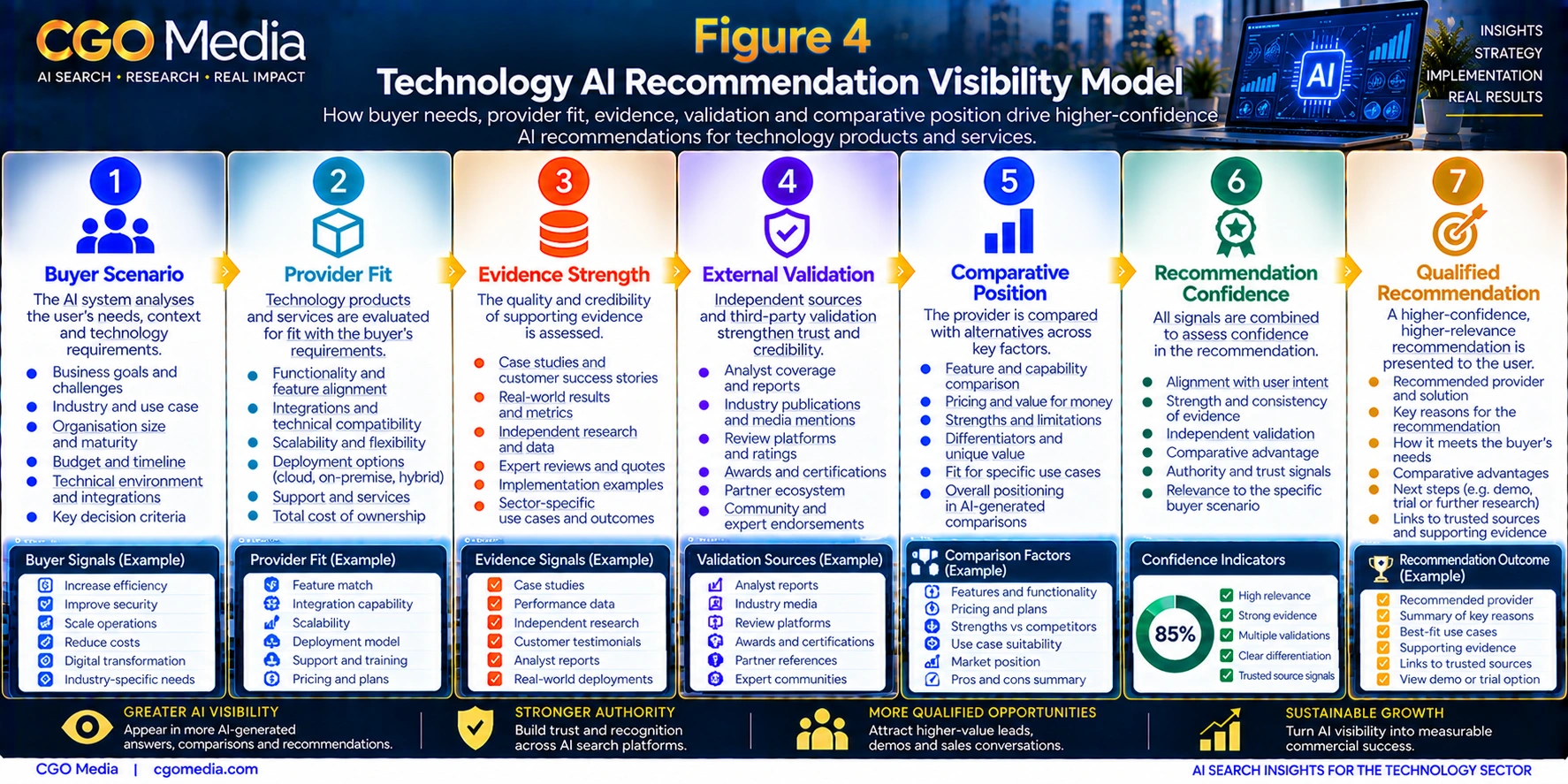
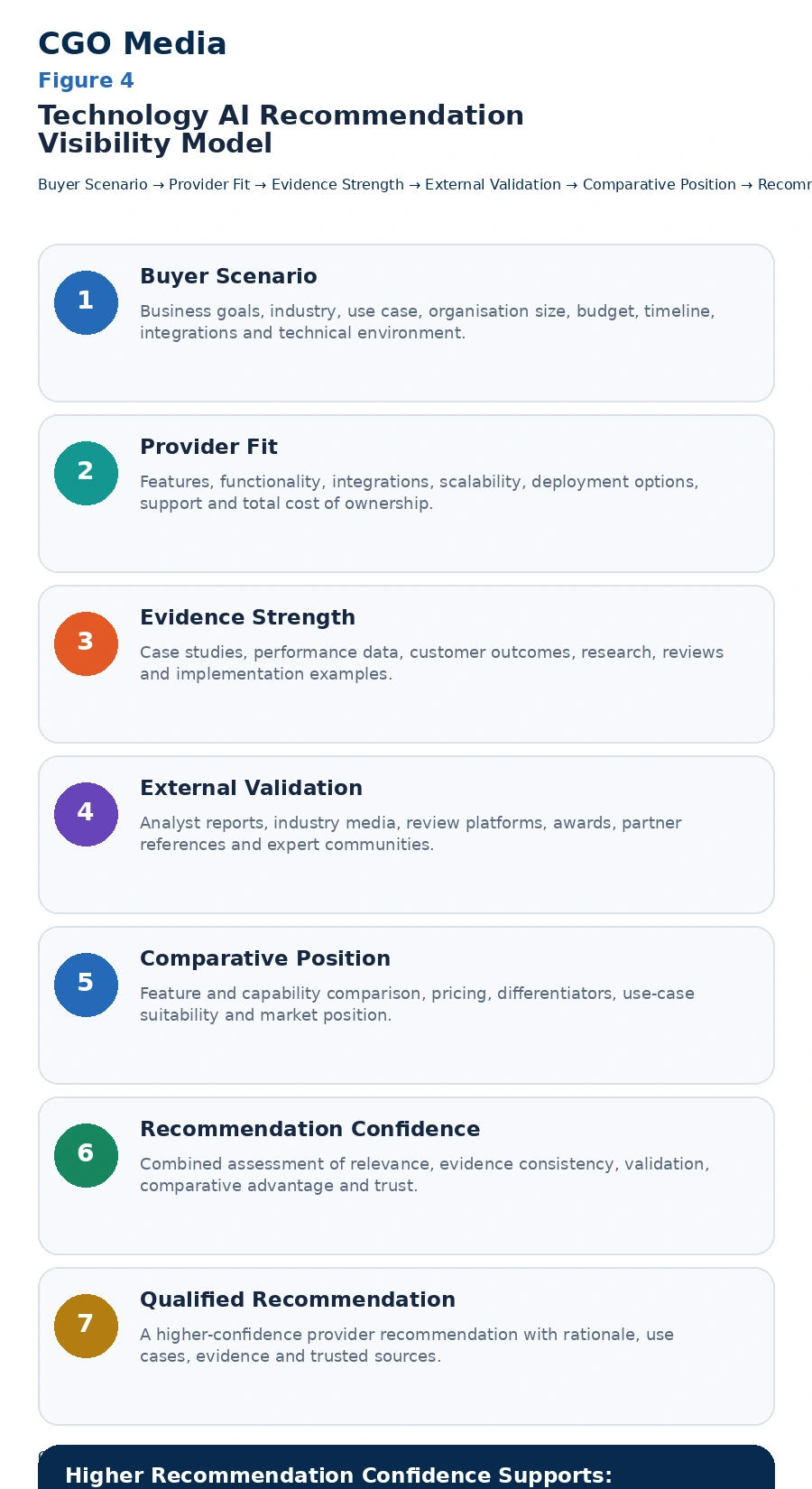
267. Technology GEO Requires a Dedicated Measurement Framework
Generative Engine Optimisation cannot be measured reliably through conventional rankings, traffic or raw AI mention counts alone.
Technology organisations need to distinguish between several different forms of generative visibility:
- Source visibility
- Citation visibility
- Entity accuracy
- Comparison visibility
- Recommendation visibility
These represent different stages of generative discovery and should therefore be measured separately.
268. GEO Measurement Should Begin with Commercially Relevant Scenarios
Measurement is most useful when prompts and scenarios reflect real buyer needs.
A scenario library can include:
- Problem discovery
- Category discovery
- Provider discovery
- Technical evaluation
- Comparison
- Recommendation
The objective is to understand visibility within commercially meaningful contexts rather than across arbitrary prompt volume.
269. Scenario Libraries Should Reflect Real Buyer Language
Scenario development can draw from:
- Search behaviour
- Sales conversations
- Customer interviews
- Support questions
- Product research
This helps align GEO monitoring with the questions technology buyers actually ask.
270. Scenario Libraries Should Be Segmented
Useful segmentation can include:
- Buyer type
- Industry
- Company size
- Geography
- Use case
- Technical requirement
Segmentation makes it possible to distinguish broad visibility from qualified visibility.
271. Source Visibility Is the First Measurement Layer
Source visibility measures whether the organisation’s information contributes to generated answers.
This can include content from:
- Product pages
- Documentation
- Research
- Technical resources
- Trust and security resources
Source visibility can exist even where the organisation is not prominently named.
272. Source Visibility Indicates Information Influence
High source visibility suggests that the organisation’s information is entering the generative evidence environment.
However, source visibility alone does not show whether:
- The organisation is cited
- The entity is represented accurately
- The provider enters comparisons
- The provider is recommended
273. Source Visibility Should Be Segmented by Source Type
Teams can distinguish visibility from:
- Owned commercial content
- Technical documentation
- Research
- External media
- Customer evidence
This reveals which parts of the information ecosystem are contributing most strongly.
274. Citation Visibility Is the Second Measurement Layer
Citation visibility measures whether the organisation or its information is explicitly referenced as supporting evidence.
This creates stronger attribution than source influence alone.
275. Citation Share Can Be Measured Across a Defined Scenario Set
A practical conceptual measure is:
Relevant Scenarios with Citation ÷ Total Relevant Scenarios Tested
The purpose is not to create a universal citation score, but to track whether explicit source attribution is increasing within priority scenarios.
276. Citation Quality Should Be Measured Alongside Citation Presence
Useful citation assessment can consider:
- Source relevance
- Citation context
- Source authority
- Accuracy
A citation from an irrelevant or outdated source should not automatically be treated as strong GEO performance.
277. Citation Diversity Can Also Be Monitored
A resilient GEO environment can contain references across:
- Owned sources
- Research sources
- Industry media
- Customer evidence
- Professional publications
Diversity reduces dependence on one citation environment.
278. Entity Accuracy Is the Third Measurement Layer
Being mentioned is not sufficient if the organisation or product is represented incorrectly.
Entity accuracy should assess whether generated responses correctly describe:
- Organisation identity
- Product identity
- Ownership
- Capabilities
- Availability
279. Entity Accuracy Should Be Treated as a Quality Metric
A useful classification can include:
- Accurate
- Partially Accurate
- Materially Inaccurate
Material inaccuracies should receive greater priority where they can affect buyer trust or selection.
280. Entity Accuracy Should Include Product Relationships
Monitoring should identify whether generated outputs understand relationships such as:
Organisation → Product Family → Product → Capability → Use Case
Errors within these relationships can create incorrect market positioning.
281. Legacy Information Should Be Monitored
Technology organisations frequently change:
- Product names
- Brands
- Features
- Ownership structures
Persistent use of outdated information can indicate that the wider source environment still contains conflicting evidence.
282. Comparison Visibility Is the Fourth Measurement Layer
Comparison visibility measures whether the organisation enters relevant competitive evaluation.
This can include:
- Alternative queries
- Provider comparisons
- Shortlist requests
- Feature comparisons
Comparison visibility indicates that the organisation has moved beyond basic discoverability into active consideration.
283. Comparison Share Can Reveal Competitive Presence
Within a defined scenario library, organisations can track how often they appear alongside relevant alternatives.
The objective is to understand whether the provider is entering the competitive sets that matter commercially.
284. Comparison Co-Occurrence Reveals Effective Competitors
Repeated co-occurrence can identify:
- Established competitors
- Emerging competitors
- Adjacent-category providers
- Unexpected substitutes
This can provide additional market intelligence beyond traditional competitor lists.
285. Comparative Positioning Should Also Be Recorded
Visibility should be evaluated alongside how the provider is described.
Common framing can include:
- Enterprise
- SMB
- Developer-focused
- Specialist
- Premium
Persistent framing can reveal how the wider evidence environment positions the organisation.
286. Recommendation Visibility Is the Fifth Measurement Layer
Recommendation visibility measures whether the provider is included within scenarios where the buyer is seeking a suitable technology option.
This is one of the most commercially relevant GEO measures.
287. Recommendation Share Should Be Qualified
A simple inclusion count can be misleading.
The organisation should distinguish between:
- Relevant recommendation
- Irrelevant recommendation
- Relevant exclusion
- Appropriate exclusion
This prevents maximum mention frequency from becoming the default objective.
288. Recommendation Fit Should Be Evaluated
A recommended provider should reasonably satisfy the scenario’s:
- Functional requirements
- Technical requirements
- Industry requirements
- Geographic requirements
- Commercial requirements
This keeps measurement aligned with genuine buyer suitability.
289. Qualified GEO Performance Combines the Five Layers
A useful measurement progression is:
Source Visibility → Citation Visibility → Entity Accuracy → Comparison Visibility → Recommendation Visibility
Qualified GEO performance considers the quality of progression across the complete system.
290. Presence and Accuracy Should Be Separated
Growing visibility can conceal growing misinformation.
Technology organisations should therefore measure:
Presence + Accuracy
rather than assuming that more frequent appearance is automatically beneficial.
291. Visibility and Recommendation Fit Should Also Be Separated
A provider can appear frequently while being recommended within poorly matched scenarios.
Qualified GEO therefore requires:
Visibility + Appropriate Fit
292. GEO Monitoring Should Be Longitudinal
AI outputs can vary between individual tests.
Longitudinal monitoring helps distinguish:
- Persistent patterns
- Short-term variation
- Emerging changes
- Structural deterioration
One generated answer should rarely determine strategic action by itself.
293. Stability Is an Important GEO Metric
Technology organisations can monitor whether visibility remains reasonably stable across repeated observations.
Useful stability questions include:
- Are we repeatedly cited?
- Are product descriptions consistently accurate?
- Do we enter the same relevant comparison sets?
- Is recommendation visibility persistent?
294. Stable Accuracy Is More Valuable Than Unstable Prominence
An organisation appearing accurately across repeated relevant scenarios can possess stronger qualified GEO performance than one appearing very frequently but inconsistently.
295. Material Change Should Trigger Diagnosis
A significant shift may involve:
- Loss of citation visibility
- New entity errors
- Competitive displacement
- Changed recommendation fit
The correct response is investigation rather than immediate tactical reaction.
296. GEO Measurement Should Preserve Test Context
Each observation should record sufficient context for later comparison.
This can include:
- Prompt or scenario
- Date
- Market
- Language
- System or model
Without context, longitudinal interpretation becomes weaker.
297. Scenario Consistency Supports Trend Analysis
Core scenarios should remain sufficiently stable over time to allow meaningful comparison.
However, the scenario library should also evolve when:
- Products launch
- Markets change
- Buyer language changes
- New competitors emerge
298. Old Scenarios Should Be Retired
Scenario libraries should not grow indefinitely.
Outdated or commercially irrelevant tests can create reporting noise and unnecessary monitoring effort.
A useful principle is:
Commercial Relevance Before Prompt Volume
299. GEO Measurement Should Include Competitor Comparison
Performance can be compared with:
- Previous periods
- Relevant competitors
- Target scenarios
Competitor comparison can reveal whether visibility changes reflect an internal issue or broader market movement.
300. Source Competition Should Be Analysed Separately from Provider Competition
A provider may compete commercially with one organisation while its research or documentation competes for citation with entirely different sources.
Technology GEO therefore involves both:
- Provider Competition
- Source Competition
301. GEO Measurement Should Diagnose Source Weakness
Where source visibility declines, teams should examine:
- Coverage
- Specificity
- Evidence quality
- Freshness
- External authority
The problem may not be general visibility but insufficient source usefulness.
302. GEO Measurement Should Diagnose Citation Weakness
Where the organisation influences answers but receives little explicit attribution, teams can investigate:
- Citation eligibility
- Research authority
- Source clarity
- External references
The appropriate intervention may be different from a general content programme.
303. GEO Measurement Should Diagnose Entity Weakness
Where representation is inaccurate, teams should investigate:
- Product naming
- Brand relationships
- Legacy information
- External profiles
Entity problems require information reconciliation rather than simply greater content volume.
304. GEO Measurement Should Diagnose Comparison Weakness
Where a provider rarely enters relevant comparisons, potential causes can include:
- Weak category association
- Limited comparison content
- Weak external authority
- Insufficient product evidence
305. GEO Measurement Should Diagnose Recommendation Weakness
Where the provider is considered but rarely recommended within scenarios where it genuinely fits, teams should examine:
- Provider evidence
- Trust signals
- External validation
- Comparative positioning
- Source consistency
306. GEO Monitoring Should Detect Critical Misinformation
High-risk errors can include:
- Incorrect security claims
- Incorrect compliance claims
- Wrong pricing
- Incorrect product availability
- False capability descriptions
These issues should be escalated separately from ordinary visibility variation.
307. Critical GEO Risk Should Be Prioritised
A practical priority relationship is:
Severity + Persistence + Buyer Impact + Commercial Importance
This helps distinguish urgent misinformation from lower-impact differences in phrasing or positioning.
308. GEO Measurement Should Connect with Commercial Data
Generative visibility becomes more meaningful when compared with:
- Qualified enquiries
- Pipeline
- Win rate
- Customer fit
Direct attribution may remain incomplete, but commercial evidence can still help determine whether GEO visibility is attracting relevant buyers.
309. AI-Assisted Influence May Occur Before the Click
A buyer can learn about a provider through an AI-generated answer before later reaching the organisation through:
- Direct navigation
- Branded search
- Sales outreach
- Another marketing channel
This can make conventional last-click attribution incomplete.
310. Assisted GEO Influence Can Still Be Studied
Useful evidence can come from:
- CRM notes
- Buyer interviews
- Sales surveys
- Attribution data
The objective is to identify recurring patterns rather than claim precision that the available data cannot support.
311. GEO Measurement Should Use Leading and Lagging Indicators
Leading indicators show authority development before commercial outcomes become fully visible.
Lagging indicators show whether that development ultimately contributes to buyer and business outcomes.
312. GEO Leading Indicators
Useful leading indicators can include:
- Entity accuracy
- Source visibility
- Citation visibility
- Comparison inclusion
- Recommendation fit
313. GEO Lagging Indicators
Useful lagging indicators can include:
- Qualified enquiries
- Pipeline
- Win rate
- Customer fit
These help connect visibility with commercial quality rather than traffic alone.
314. Executive GEO Reporting Should Remain Concise
Leadership does not require every prompt-level observation.
An executive Technology GEO scorecard can focus on:
- Source Visibility
- Citation Share
- Entity Accuracy
- Comparison Share
- Recommendation Share
- Critical GEO Risk
315. Executive Reporting Should Include Trend
Each important measure can be classified as:
- Improving
- Stable
- At Risk
- Deteriorating
This prevents static numbers from concealing worsening GEO performance.
316. Executive Reporting Should Highlight the Main GEO Constraint
The primary constraint may involve:
- Source weakness
- Citation weakness
- Entity weakness
- Comparison weakness
- Recommendation weakness
Surfacing the main constraint makes the measurement system actionable.
317. GEO Measurement Should Drive Diagnosis
The purpose is not simply to produce dashboards.
A diagnostic cycle can be:
Observe → Classify → Compare → Diagnose → Prioritise → Improve → Re-Test
318. Observe
Capture generated outputs and relevant source patterns across priority scenarios.
319. Classify
Identify whether the observation primarily concerns:
- Source
- Citation
- Entity
- Comparison
- Recommendation
320. Compare
Compare the observation with:
- Previous periods
- Relevant competitors
- Target scenarios
This provides context before conclusions are drawn.
321. Diagnose
Identify the likely underlying cause rather than responding only to the visible output.
The cause may involve:
- Content
- Evidence
- Entity clarity
- External authority
- Competitive change
322. Prioritise
Focus on the issue with the strongest combination of:
- Buyer impact
- Commercial importance
- Strategic risk
323. Improve
Strengthen the underlying information or authority system rather than attempting to manipulate one generated answer directly.
324. Re-Test
Repeat the relevant scenario using comparable conditions and determine whether the observed pattern changed.
Re-testing converts optimisation activity into evidence-based learning.
325. Vanity GEO Metrics Should Be Avoided
Weak metrics can include:
- Raw mention volume without context
- Unqualified recommendation counts
- Huge prompt libraries without commercial relevance
These measures can create activity without useful decision intelligence.
326. Qualified GEO Metrics Should Be Preferred
A useful relationship is:
Relevant Scenario + Accurate Representation + Strong Evidence + Appropriate Inclusion
This places quality and buyer relevance ahead of raw visibility volume.
327. The Seventeenth Technology GEO Principle
Technology GEO measurement should separate source, citation, entity, comparison and recommendation visibility because each represents a different stage of generative discovery and a different type of commercial opportunity.
328. The Eighteenth Technology GEO Principle
GEO performance should be evaluated through commercially relevant scenario libraries and longitudinal monitoring rather than isolated outputs, allowing organisations to distinguish persistent visibility patterns from temporary model variation.
329. The Nineteenth Technology GEO Principle
Entity accuracy, citation quality, comparison inclusion and recommendation fit should be measured alongside presence so increasing visibility does not conceal misinformation, weak positioning or inappropriate buyer matching.
330. The Twentieth Technology GEO Principle
GEO measurement should remain diagnostic and decision-oriented, connecting observed generative visibility with the underlying source, evidence, entity and authority systems that can actually be improved.
331. The Technology GEO Measurement Framework
The measurement relationship can be summarised as:
Source Visibility → Citation Visibility → Entity Accuracy → Comparison Visibility → Recommendation Visibility → Qualified GEO Performance
Source Visibility
Measures whether the organisation’s owned or external information contributes to generated answers within relevant scenarios.
Citation Visibility
Measures whether the organisation or its evidence receives explicit attribution as a supporting source.
Entity Accuracy
Measures whether the organisation, products, capabilities and relationships are represented correctly.
Comparison Visibility
Measures whether the provider enters commercially relevant competitive evaluation and shortlist scenarios.
Recommendation Visibility
Measures whether the organisation is appropriately included where buyer requirements and product capability genuinely align.
Qualified GEO Performance
Combines relevant presence, accurate representation, strong evidence and appropriate inclusion to provide a more commercially meaningful measure than raw AI mention volume.
332. The Strategic Implication
Technology organisations should measure Generative Engine Optimisation as a layered visibility and representation system.
The measurement framework should distinguish between:
- Being used as a source
- Being explicitly cited
- Being accurately understood
- Being included in relevant comparisons
- Being appropriately recommended
This allows GEO investment to be directed toward the specific information, evidence, entity or authority constraint limiting qualified generative visibility.
The objective is not simply to demonstrate that a brand appears in AI-generated answers.
It is to determine whether the organisation is becoming more visible, more accurately represented, more credible and more appropriately considered by the buyers and markets that matter.
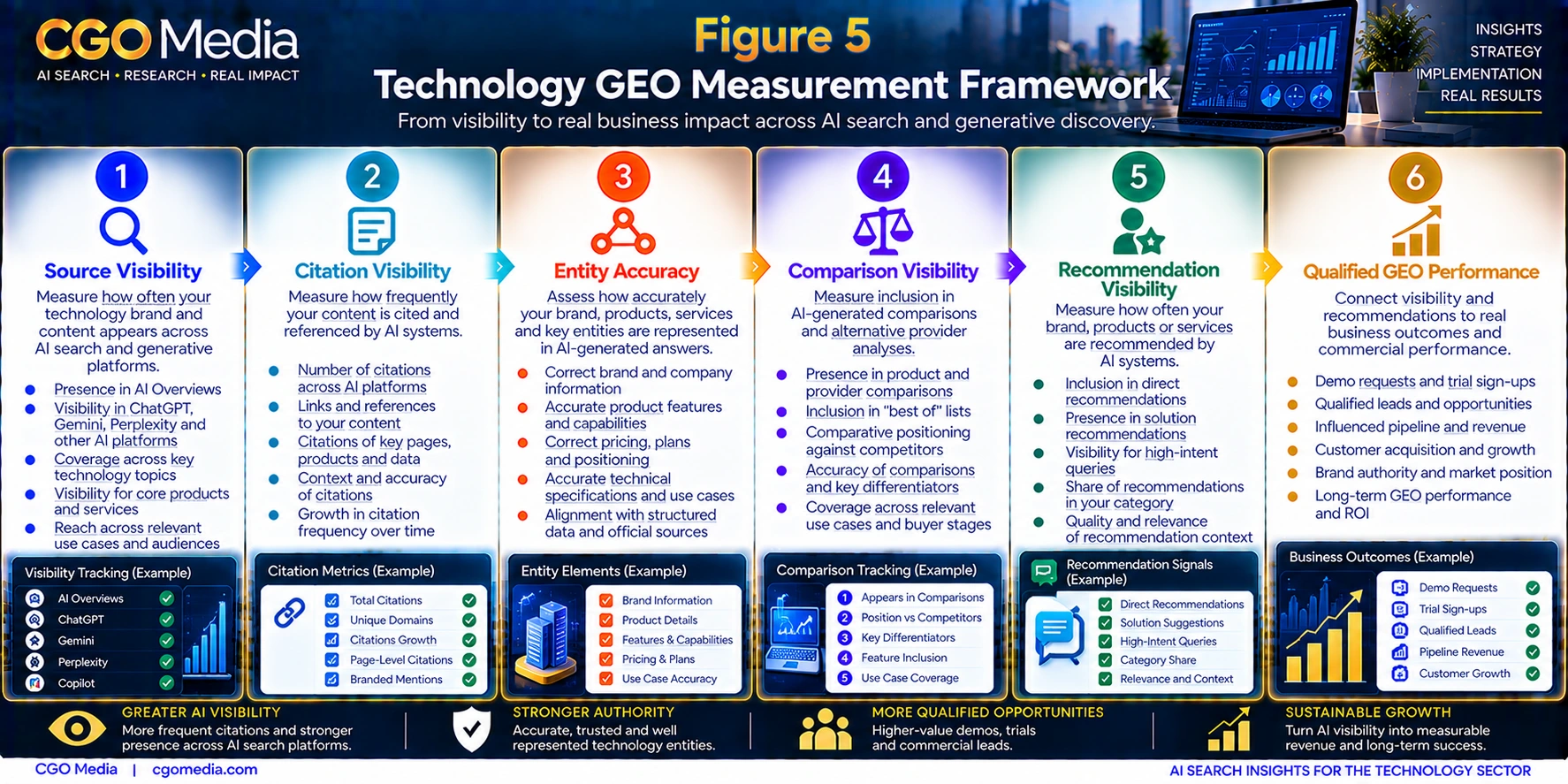
333. Technology GEO Should Operate Continuously
Generative visibility is not a fixed outcome.
AI models change, retrieval environments evolve, competitors publish new information, products develop and external evidence changes over time.
Technology organisations therefore need a continuous GEO operating cycle rather than a one-time optimisation project.
The core cycle is:
Observe → Diagnose → Prioritise → Strengthen → Validate → Learn → Adapt
334. Observe
The organisation should monitor how it is represented across commercially important generative scenarios.
Observation can include:
- Source visibility
- Citation visibility
- Entity accuracy
- Comparison visibility
- Recommendation visibility
The purpose is to identify persistent patterns rather than react to every individual generated answer.
335. Observation Should Be Scenario-Based
Monitoring should reflect realistic buyer journeys rather than arbitrary prompt collections.
Priority scenarios can include:
- Problem discovery
- Category discovery
- Technical evaluation
- Provider comparison
- Shortlisting
- Recommendation
This keeps GEO measurement connected to commercial relevance.
336. Diagnose
When a meaningful visibility problem is identified, the organisation should determine the underlying cause.
Possible causes include:
- Weak information coverage
- Entity ambiguity
- Insufficient evidence
- Weak external authority
- Source inconsistency
- Competitive change
The visible AI response is often only the symptom.
337. GEO Diagnosis Should Be Root-Cause Led
A provider omitted from an important recommendation scenario may not simply need more content.
The underlying issue may instead be:
- Weak product evidence
- Poor category association
- Insufficient external validation
- Incorrect product information
Intervention should follow diagnosis.
338. Prioritise
Not every GEO issue deserves equal attention.
A useful prioritisation relationship is:
Severity + Persistence + Buyer Impact + Commercial Importance + Dependency
This helps distinguish strategic weaknesses from low-impact variation.
339. Critical Misinformation Should Receive Immediate Priority
High-risk issues can include inaccurate claims involving:
- Security
- Compliance
- Product availability
- Pricing
- Technical capability
These errors can directly influence buyer decisions and should therefore be escalated separately from ordinary visibility optimisation.
340. Strategic GEO Development Can Continue Alongside Risk Remediation
A mature programme can operate through two parallel streams:
- Critical GEO Risk Remediation
- Strategic GEO Authority Development
One protects the existing information environment.
The other builds stronger future visibility.
341. Strengthen
The organisation should improve the underlying information and authority system responsible for the observed weakness.
Interventions can involve:
- Technical accessibility
- Entity clarification
- Content development
- Evidence strengthening
- Research
- Digital PR
- External authority
The objective is structural improvement rather than manipulation of one generated output.
342. Source Weakness Requires Source Improvement
Where source visibility is weak, teams can strengthen:
- Coverage
- Specificity
- Evidence
- Freshness
- Accessibility
Publishing additional generic content may not address the actual deficiency.
343. Citation Weakness Requires Citation-Ready Evidence
Where explicit citations remain limited, the organisation can improve:
- Original research
- Definitions
- Methodology transparency
- Clear findings
- External distribution
The aim is to create material that is genuinely useful as supporting evidence.
344. Entity Weakness Requires Information Reconciliation
Where generated representations repeatedly confuse products, ownership or capabilities, the organisation should reconcile information across:
- Website
- Documentation
- External profiles
- Partner pages
- Legacy resources
Entity problems are usually broader than one page.
345. Recommendation Weakness Requires Stronger Fit Evidence
Where the organisation genuinely fits a scenario but is repeatedly excluded, teams can examine:
- Use-case evidence
- Technical evidence
- Customer proof
- External validation
- Comparative positioning
The objective is to make suitability easier to establish.
346. Validate
After an intervention, the organisation should determine whether the intended GEO outcome actually improved.
Validation can assess:
- Visibility
- Accuracy
- Citation behaviour
- Comparison inclusion
- Recommendation fit
347. Validation Should Use Comparable Scenarios
Where possible, post-intervention testing should preserve:
- Similar buyer scenarios
- Comparable markets
- Comparable languages
- Relevant time context
This makes before-and-after interpretation more meaningful.
348. One Positive Result Should Not Establish Success
AI outputs can vary.
Meaningful improvement is more credible when it appears:
- Repeatedly
- Across relevant scenarios
- Over time
Persistent improvement matters more than an isolated favourable output.
349. Learn
Every meaningful intervention should improve organisational knowledge.
Successful and unsuccessful GEO activity can inform:
- Standards
- Playbooks
- Content guidance
- Evidence requirements
- Monitoring procedures
This prevents the organisation from repeatedly solving the same problem from first principles.
350. Successful Interventions Should Become Standards
Where a repeatable improvement is demonstrated, the organisation can incorporate the learning into normal operations.
Examples can include:
- Product-page requirements
- Documentation standards
- Research publication standards
- Entity-governance processes
351. Failed Interventions Should Also Be Preserved
Negative results provide useful evidence.
Documenting unsuccessful approaches can reduce repeated investment in:
- Ineffective content changes
- Weak authority campaigns
- Unsupported assumptions
Learning should include what did not work as well as what did.
352. Adapt
The final stage is to adapt strategy as:
- Models change
- Search interfaces change
- Products change
- Competitors change
- Buyer behaviour changes
The organisation should preserve stable principles while allowing tactics and monitoring systems to evolve.
353. Adaptive GEO Does Not Mean Constant Reaction
Mature organisations should not respond tactically to every:
- Prompt variation
- AI output
- Competitive mention
- Temporary citation change
Constant reaction can create instability and distract from stronger structural work.
354. Stable GEO Principles Should Remain Consistent
Core principles include:
- Clear entities
- Accessible information
- Useful content
- Strong evidence
- Relevant authority
- Buyer fit
These principles remain useful even as individual AI platforms and interfaces change.
355. GEO Governance Should Be Cross-Functional
No single team controls the complete information ecosystem.
A mature operating model can connect:
SEO + Product + Engineering + Content + Research + PR + Sales
Each function contributes a different part of the evidence required for accurate generative representation.
356. SEO Should Coordinate Discoverability and Measurement
SEO teams can support:
- Technical accessibility
- Information architecture
- Search visibility
- GEO monitoring
The role increasingly connects traditional search performance with broader AI-assisted discovery.
357. Product Teams Should Own Product Truth
Product teams should help validate:
- Capabilities
- Use cases
- Availability
- Limitations
This reduces the risk that optimisation activity creates information inconsistent with actual product capability.
358. Engineering Should Support Technical Truth
Engineering and technical teams can validate:
- Architecture
- APIs
- Integrations
- Performance
- Implementation information
This is particularly important for specialist technical queries.
359. Research Should Support Primary Evidence
Research teams can strengthen GEO through:
- Original data
- Benchmarking
- Technical studies
- Market research
Primary evidence can strengthen both citation authority and wider category authority.
360. PR Should Support External Authority
PR can increase exposure of credible evidence to:
- Journalists
- Industry publications
- Researchers
- Professional communities
External references are most useful when they reinforce genuine expertise or evidence.
361. Sales Should Support Buyer Scenario Design
Sales teams can contribute intelligence about:
- Buyer questions
- Competitive alternatives
- Objections
- Decision criteria
This improves the commercial relevance of GEO scenario libraries.
362. Governance Should Define Ownership
Important GEO capabilities should have accountable owners.
Ownership can include:
- Entity accuracy
- Technical evidence
- Research quality
- AI monitoring
- Critical misinformation escalation
Without ownership, known GEO weaknesses can persist indefinitely.
363. Governance Should Include Escalation
High-risk misinformation should have a defined route for investigation and correction.
A useful escalation model is:
Detect → Assess Risk → Assign Owner → Correct Source Environment → Re-Test
364. GEO Recovery Should Address the Underlying Evidence Environment
Persistent misinformation should not be treated only as an AI-output problem.
Recovery should investigate:
- Outdated owned information
- Conflicting documentation
- Legacy external sources
- Weak product clarity
- Insufficient evidence
365. A GEO Recovery Cycle
A practical recovery process is:
Detect → Diagnose → Correct → Validate → Learn
The objective is both to resolve the immediate problem and strengthen the system against recurrence.
366. Recovery Performance Can Be Measured
Useful measures can include:
- Detection time
- Diagnosis time
- Correction time
- Validation time
Improving these measures can make GEO governance more resilient.
367. Repeated Errors Should Improve Governance
Recurring misinformation should trigger stronger:
- Information standards
- Review processes
- Entity governance
- Monitoring
The same problem should not have to be rediscovered repeatedly.
368. GEO Experimentation Should Be Structured
Technology organisations can test improvements involving:
- Source architecture
- Evidence
- Entity clarity
- External authority
- Recommendation relevance
Experiments should be evidence-led rather than based on anecdotal prompt behaviour.
369. Experiments Should Begin with a Hypothesis
A useful hypothesis links a proposed intervention to an expected GEO outcome.
For example:
Strengthening enterprise deployment evidence will improve inclusion within enterprise infrastructure recommendation scenarios.
370. Experiments Need a Baseline
Before implementation, teams should record relevant:
- Visibility
- Accuracy
- Citation behaviour
- Recommendation behaviour
Without a baseline, improvement becomes difficult to evaluate.
371. Experiments Need Success Criteria
Success may involve:
- Improved entity accuracy
- Increased relevant citation visibility
- Stronger comparison inclusion
- Better recommendation fit
The measurement should match the original problem.
372. Confounding Factors Should Be Recorded
Interpretation can be affected by:
- Model changes
- Search changes
- Competitor campaigns
- Product launches
- New external sources
These factors should be considered before attributing a change entirely to the intervention.
373. GEO Experiments Should Produce Organisational Learning
A mature experimentation programme asks not only:
Did visibility improve?
but also:
What did this teach us about the information and authority system?
374. International GEO Requires Additional Context
Generative representation can differ by:
- Language
- Country
- Product availability
- Regulation
- Local evidence
International organisations should therefore avoid assuming that GEO performance in one market represents every market.
375. Global Product Truth Should Remain Consistent
Core facts should remain coherent across markets, including:
- Product identity
- Core capabilities
- Ownership
- Architecture
Localisation should not create contradictory product truth.
376. Local GEO Evidence Should Reflect Market Context
Market-specific evidence can include:
- Local customers
- Regional compliance
- Language-specific documentation
- Local industry references
This can improve relevance within regional recommendation scenarios.
377. International Scenario Libraries Should Be Localised
Buyer questions can differ between countries because of:
- Terminology
- Regulation
- Market maturity
- Commercial expectations
Scenario monitoring should therefore reflect local buyer behaviour rather than relying entirely on translated prompts.
378. International GEO Requires Central Standards and Local Execution
A useful operating model is:
Central Standards + Local Evidence + Shared Measurement
This preserves organisational coherence while allowing the authority system to reflect regional reality.
379. GEO Should Scale Through Standards Rather Than Duplication
As technology organisations add:
- Products
- Markets
- Languages
- Business units
GEO becomes more difficult to manage manually.
Shared standards reduce unnecessary duplication.
380. Scalable GEO Standards Can Cover
- Entity naming
- Evidence requirements
- Source ownership
- Scenario classification
- Critical-risk escalation
- Measurement definitions
These standards create a common operating language across teams.
381. Automation Can Support Monitoring
Automation can help collect or organise repeated observations across:
- Scenario libraries
- Markets
- Product groups
- Time periods
Automation should support human judgement rather than replace it.
382. Human Review Remains Important
Human interpretation is particularly important when assessing:
- Recommendation quality
- Material inaccuracies
- Comparative framing
- Commercial relevance
These dimensions frequently require contextual judgement.
383. GEO Data Should Connect with Other Intelligence
Generative observations become more useful when considered alongside:
- Search data
- Sales intelligence
- Customer feedback
- Product intelligence
This creates a richer view of market discovery than GEO data alone.
384. GEO Can Reveal Emerging Competitors
Repeated AI co-occurrence may reveal providers that conventional competitor tracking has overlooked.
This can indicate:
- Category convergence
- New entrants
- Alternative solutions
- Changing buyer expectations
385. GEO Can Reveal Category Change
Generative systems may begin grouping providers under terminology or category structures that differ from traditional market definitions.
Persistent patterns can indicate changes in how the market is being understood.
386. Category Change Should Inform Strategy Carefully
Repeated signals can justify reviewing:
- Taxonomy
- Content architecture
- Product positioning
- Research priorities
One isolated generated answer should not trigger structural repositioning.
387. GEO Should Connect with Sales Intelligence
Sales teams can validate whether AI-assisted discovery is producing buyers with the expected:
- Needs
- Expectations
- Comparisons
- Understanding
This can reveal gaps between generative representation and commercial reality.
388. Customer Outcomes Should Feed Back into GEO
Successful customers create evidence through:
- Case studies
- Reviews
- Testimonials
- References
These outcomes can strengthen future recommendation confidence.
389. A Long-Term GEO Reinforcement Loop
The relationship can be represented as:
Qualified GEO Visibility → Better Buyer Fit → Successful Outcome → Stronger Evidence → Greater Authority → Better Future GEO Visibility
This connects generative visibility with real customer outcomes.
390. GEO Resilience Requires Authority Diversity
Technology organisations should avoid excessive dependence on one:
- AI platform
- Search engine
- Publication
- Review environment
Distributed authority creates greater resilience when individual platforms or sources change.
391. Authority Diversity Should Remain Relevant
The objective is not simply to accumulate mentions across many websites.
Relevant authority can include:
- Technical publications
- Research environments
- Customer evidence
- Professional communities
Quality and contextual relevance remain more important than raw volume.
392. GEO Should Preserve Source Consistency Across Channels
Distributed authority should still reinforce coherent product truth.
Material inconsistencies across external and owned environments can weaken:
- Entity accuracy
- Citation confidence
- Recommendation confidence
393. Adaptive GEO Is the Long-Term Capability
The highest-level GEO capability is not perfect control over generative outputs.
It is the ability to maintain a strong information and authority system while adapting to changes in:
- Models
- Interfaces
- Markets
- Products
- Buyer behaviour
394. Adaptive GEO Combines Stability and Change
A useful relationship is:
Stable Principles + Continuous Observation + Evidence-Led Adaptation
Stable principles protect the integrity of the authority system.
Continuous observation identifies important change.
Evidence-led adaptation determines when action is justified.
395. The Twenty-First Technology GEO Principle
Technology GEO should operate as a continuous improvement system because generative visibility, citation patterns, competitive sets and recommendation behaviour can change as models, sources, products and markets evolve.
396. The Twenty-Second Technology GEO Principle
GEO governance should connect SEO, product, engineering, content, research, PR and sales so generated representation is informed by accurate product truth, strong evidence, external authority and real buyer behaviour.
397. The Twenty-Third Technology GEO Principle
Technology organisations should build recovery and experimentation capability so persistent misinformation, citation weaknesses and recommendation gaps can be diagnosed, corrected, re-tested and converted into institutional learning.
398. The Twenty-Fourth Technology GEO Principle
The highest GEO capability is adaptive GEO, where stable principles around entities, evidence, source quality and buyer fit are preserved while tactics evolve in response to changing generative environments.
399. The Continuous Technology GEO Cycle
The complete operational cycle can be summarised as:
Observe → Diagnose → Prioritise → Strengthen → Validate → Learn → Adapt
Observe
Monitor source, citation, entity, comparison and recommendation visibility across commercially relevant scenarios.
Diagnose
Identify the information, evidence, authority or positioning issue responsible for the observed weakness.
Prioritise
Direct resources according to severity, persistence, buyer impact, commercial importance and dependency.
Strengthen
Improve the underlying source, entity, evidence or authority environment rather than attempting to manipulate isolated generated outputs.
Validate
Re-test comparable scenarios and determine whether the improvement is persistent, accurate and commercially relevant.
Learn
Convert successful and unsuccessful interventions into standards, playbooks, evidence requirements and governance.
Adapt
Update strategy as generative systems, sources, products, competitors and buyer expectations evolve while preserving stable GEO principles.
400. The Long-Term Technology GEO System
The wider strategic relationship can be summarised as:
Clear Entities → Accessible Information → Strong Evidence → Source Authority → Citation Visibility → Recommendation Confidence → Qualified GEO Visibility → Organisational Learning
The system becomes stronger when each cycle creates better:
- Information
- Evidence
- Governance
- Measurement
- Organisational knowledge
Technology GEO therefore becomes progressively more resilient as the organisation learns from repeated observation and intervention.
401. The Strategic Implication
Technology organisations should operate Generative Engine Optimisation as a continuous, cross-functional and evidence-led discipline.
The organisation should repeatedly monitor how its:
- Entities
- Sources
- Citations
- Comparisons
- Recommendations
are represented across relevant generative environments.
Where weaknesses appear, the priority should be to strengthen the underlying information and authority system, validate whether the intervention produced durable improvement and convert the resulting learning into better organisational standards.
The strongest GEO capability is therefore not the ability to manipulate individual AI outputs.
It is the ability to maintain accurate, evidence-rich, resilient and commercially relevant representation while AI discovery systems, technology markets and buyer expectations continue to change.
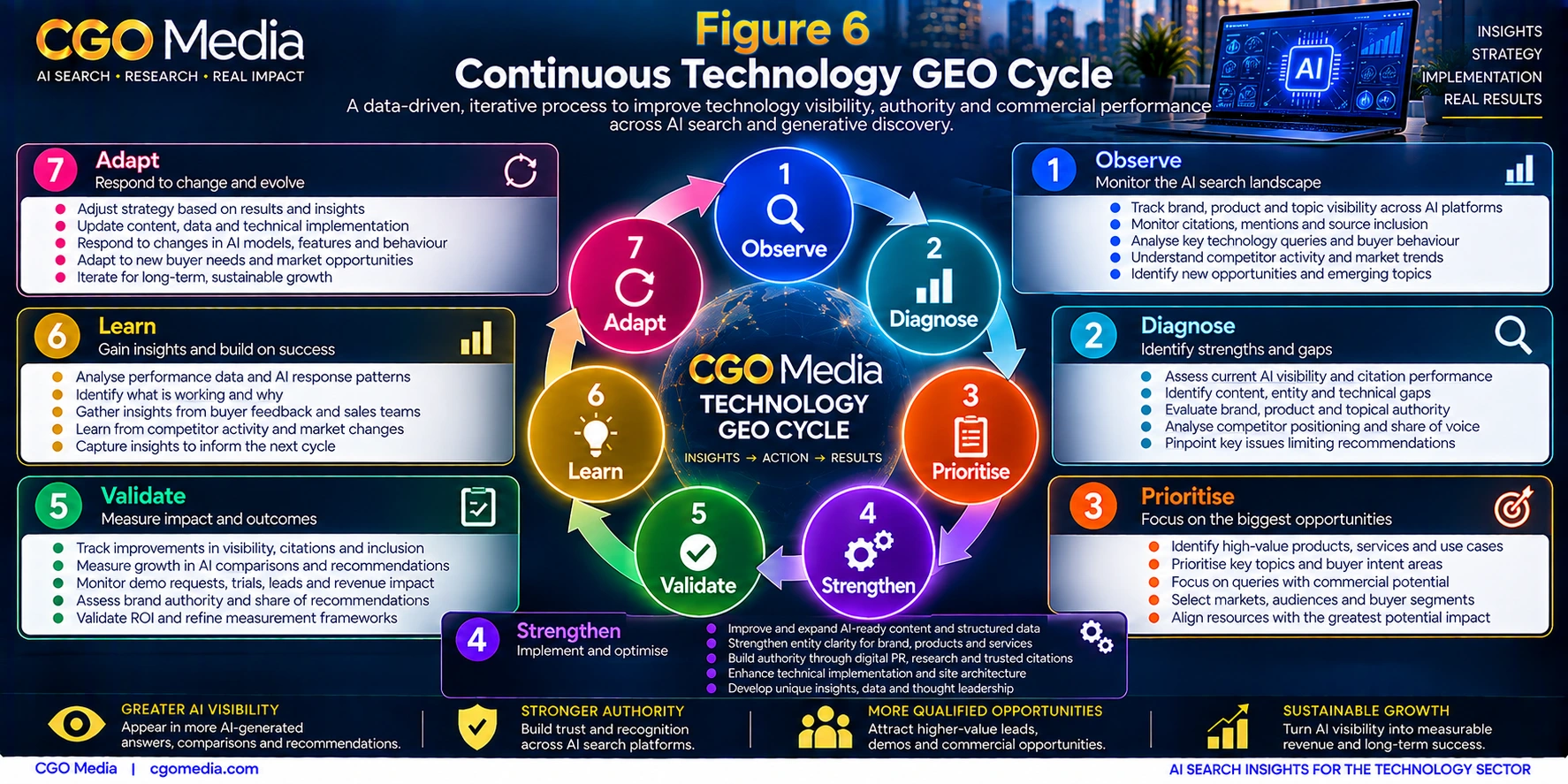
402. Methodology
Technology GEO: Generative Engine Optimisation for AI Search and Recommendation Systems is a conceptual research framework developed by CGO Media to help technology organisations understand and improve how they are represented, sourced, cited, compared and recommended across generative search and AI-assisted discovery environments.
The paper addresses a central question:
How can technology organisations improve the quality, authority and commercial relevance of their visibility within generative answer, comparison and recommendation systems?
Research Scope
The framework is relevant to technology organisations including:
- Software companies
- SaaS providers
- Cloud platforms
- Artificial intelligence companies
- Cybersecurity providers
- Data and analytics platforms
- Developer-tool companies
- Enterprise technology providers
- Technology consultancies
- Managed service providers
GEO as an Information and Authority System
The framework does not treat GEO as a collection of isolated prompt techniques.
It evaluates a connected system involving:
- Entity clarity
- Information accessibility
- Topical authority
- Evidence strength
- Source authority
- Citation eligibility
- Recommendation relevance
The core progression is:
Entity Clarity → Information Accessibility → Topical Authority → Evidence Strength → Source Authority → Citation Eligibility → Recommendation Relevance → GEO Visibility
Entity Analysis
Entity analysis examines whether public information clearly represents:
- Organisation identity
- Product identity
- Brand relationships
- Ownership
- Expert relationships
A technology product relationship can be mapped as:
Organisation → Product Family → Product → Feature → Integration → Use Case
Information Accessibility Analysis
Accessibility assessment considers whether relevant information is:
- Crawlable
- Indexable
- Linked
- Understandable
- Available within appropriate digital environments
The wider source estate can include corporate websites, documentation portals, developer resources, support centres, research libraries and trust or security resources.
Topical Authority Analysis
Topical authority can be evaluated across:
- Buyer problems
- Technology categories
- Use cases
- Industries
- Technical concepts
The objective is to determine whether the organisation demonstrates sufficient subject depth to support discovery and evaluation beyond branded queries alone.
Evidence Method
Important claims can be evaluated through:
Claim → Appropriate Evidence → External Reinforcement → Confidence
Evidence categories can include:
- Technical evidence
- Security evidence
- Customer evidence
- Research evidence
- Independent validation
Generative Source Selection Method
Source selection is conceptualised as:
Query Context → Candidate Sources → Relevance → Evidence → Authority → Source Convergence → Source Selection
Different query types can require different source formats.
Technical queries may favour documentation, API references, architecture guidance and implementation evidence.
Security queries may favour security documentation, certification evidence, trust centres and independent validation.
Comparison queries may require product information, customer evidence, independent comparisons and commercial context.
Research queries may depend more heavily on original studies, datasets, methodology pages and explicit findings.
Source Convergence Method
Important technology claims can be compared across:
Owned Evidence + Technical Evidence + Customer Evidence + Independent Evidence
The objective is to identify whether multiple credible sources materially reinforce or contradict one another.
Citation Eligibility Method
Citation readiness is conceptualised through:
Relevance + Authority + Evidence + Clarity + Freshness
Citation authority can then be examined through:
- Relevant citations
- Research references
- Media references
- External-source diversity
- Citation context
Primary Research Method
Where original research is developed as part of GEO authority building, research assets should explain:
- Research question
- Sample
- Data source
- Time period
- Definitions
- Limitations
Citation-oriented assets can include research papers, datasets, definitions, technical studies and original frameworks.
Recommendation Method
Recommendation visibility is conceptualised through:
Buyer Scenario → Provider Fit → Evidence Strength → External Validation → Comparative Position → Recommendation Confidence → Qualified Recommendation
Provider fit can include:
- Functional fit
- Technical fit
- Industry fit
- Commercial fit
- Geographic fit
Recommendation confidence can be assessed conceptually through:
Scenario Relevance + Provider Fit + Evidence Confidence + External Validation + Source Consistency
GEO Measurement Method
The framework separates five primary visibility layers:
- Source Visibility
- Citation Visibility
- Entity Accuracy
- Comparison Visibility
- Recommendation Visibility
Qualified GEO performance is then conceptualised as:
Relevant Presence + Accurate Representation + Strong Evidence + Appropriate Recommendation
Scenario Library Method
Monitoring should use commercially meaningful buyer scenarios segmented where relevant by:
- Buyer stage
- Industry
- Company size
- Geography
- Technical requirement
Longitudinal Method
Repeated testing can help identify persistent patterns involving:
- Inclusion
- Exclusion
- Misinformation
- Competitive displacement
- Category drift
Longitudinal observation is preferred to conclusions based on isolated outputs.
GEO Risk Method
Material GEO errors can be prioritised through:
Severity + Persistence + Buyer Impact + Commercial Importance
Critical risk can include incorrect security or compliance information, wrong product identity, incorrect pricing or inaccurate product availability.
Continuous Improvement Method
The operational GEO cycle is:
Observe → Diagnose → Prioritise → Strengthen → Validate → Learn → Adapt
Recovery Method
Material GEO errors can be managed through:
Detect → Verify → Diagnose → Correct → Re-Test → Learn
Experimentation Method
Structured GEO experiments can include:
- Hypothesis
- Baseline
- Intervention
- Observation window
- Success criteria
- Result
Governance Method
Technology GEO should be governed cross-functionally.
A mature operating relationship can include:
SEO + Product + Content + Engineering + Research + PR + Sales
International GEO Method
International GEO should preserve coherent product truth while adapting:
- Buyer language
- Evidence
- Local authority
- Regulatory information
- Scenario design
Product Portfolio Method
Multi-product organisations should assess GEO at both:
- Organisation level
- Individual product level
This helps distinguish broad brand authority from the visibility and evidence strength of individual products.
403. Limitations
Technology GEO: Generative Engine Optimisation for AI Search and Recommendation Systems is a conceptual research framework.
It does not represent or reproduce proprietary ranking, retrieval, source-selection or recommendation systems used by individual search engines, AI systems or generative platforms.
Generative Systems Are Only Partially Observable
External researchers and technology organisations cannot directly observe every internal:
- Retrieval process
- Ranking process
- Source-selection process
- Recommendation process
The framework therefore focuses on observable information, source and visibility patterns rather than claims about proprietary internal mechanisms.
Source Influence Can Be Difficult to Verify
Generated answers may not expose every source contributing to the output.
An organisation may influence an answer without receiving explicit attribution.
Citation Visibility Is Platform-Dependent
Some generative interfaces expose explicit citations while others provide limited or no source information.
Citation measurement should therefore be interpreted according to platform behaviour.
AI Outputs Can Vary
Generated responses can vary according to:
- Model
- Prompt
- Conversation context
- Date
- Language
- Market
Individual outputs should therefore not be treated automatically as durable representation.
Longitudinal Testing Does Not Remove All Uncertainty
Repeated observations can identify patterns more reliably than isolated tests, but they cannot prove the complete internal mechanism responsible for those patterns.
Recommendation Visibility Is Contextual
A technology provider can be highly appropriate in one buyer scenario while irrelevant in another.
Recommendation performance should therefore be interpreted in relation to actual buyer constraints and product fit.
High Mention Volume Does Not Prove Strong GEO
Frequent mentions can coexist with:
- Incorrect information
- Poor buyer fit
- Weak evidence
- Low commercial value
Raw mention frequency should not be treated as a complete GEO success measure.
Citation Frequency Does Not Automatically Equal Authority
Citation quality, relevance, source credibility and context also matter.
Large citation volume within irrelevant or weak environments can provide less strategic value than fewer highly relevant references.
External Authority Is Partially Observable
Public evidence does not reveal every source, reputation signal or authority factor that may contribute to generated outputs.
Competitor Analysis Is Also Partial
Public analysis cannot reveal every competitor’s internal:
- Content strategy
- Research programme
- Data assets
- Authority strategy
Competitive GEO analysis should therefore be treated as evidence-based but incomplete.
GEO Attribution Is Incomplete
AI-assisted influence can occur:
- Before a website visit
- Without a website visit
- Across multiple sessions
- Alongside conventional search
Direct revenue attribution should therefore remain cautious where evidence cannot support causal conclusions.
SEO and GEO Overlap Substantially
Many GEO capabilities depend on established:
- Technical SEO
- Content architecture
- Entity clarity
- Digital authority
GEO should not be positioned as a replacement for SEO.
It is better understood as an extension of the discovery system that adds explicit focus on sources, citations, representation, comparison and recommendation.
GEO Terminology Is Still Evolving
Definitions, measurement conventions and platform capabilities may continue to change as generative search develops.
The framework should therefore remain adaptive while preserving stable principles around entity clarity, information accessibility, evidence, source authority and buyer fit.
404. Conclusion
Technology GEO introduces a broader model of digital visibility in which technology organisations compete not only to rank pages, but also to become trusted sources, recognised entities, credible comparison candidates and appropriate recommendations within generative systems.
Entity Clarity Establishes Identity
Generative systems need clear information about:
- Who the organisation is
- Which products it offers
- How those products relate
- Which categories and use cases apply
Information Accessibility Establishes Availability
Useful information needs to remain accessible across:
- Websites
- Documentation
- Research
- Support resources
Topical Authority Establishes Relevance
Technology organisations require sufficient depth across the problems, categories, use cases and technical subjects that matter to buyers.
Evidence Establishes Confidence
Important claims should be supported through:
- Technical evidence
- Customer evidence
- Security evidence
- Research
Source Authority Establishes Trust
Owned information becomes stronger when relevant external sources reinforce the organisation’s expertise, product capability and evidence.
Citation Eligibility Establishes Reference Potential
Useful citation sources combine:
Relevance + Authority + Evidence + Clarity + Freshness
Citation Authority Establishes Wider Knowledge Influence
Technology organisations can increasingly become sources that journalists, researchers, analysts, buyers and generative systems reference when evaluating important technology subjects.
Recommendation Relevance Establishes Commercial Fit
Provider visibility has greatest value when it occurs within scenarios where the organisation genuinely satisfies the buyer’s requirements.
Comparison Visibility Establishes Competitive Presence
The organisation moves from broad discovery into active consideration alongside relevant alternatives.
Qualified Recommendation Visibility Establishes Selection Presence
The organisation remains a credible option after contextual requirements and comparative alternatives have been considered.
GEO Measurement Should Preserve These Distinctions
Source, citation, entity, comparison and recommendation visibility represent different outcomes.
A single mention metric cannot explain the quality of the complete generative visibility system.
The Strategic Objective Is Qualified GEO Visibility
A useful relationship is:
Relevant Presence + Accurate Representation + Strong Evidence + Appropriate Recommendation
The objective is quality rather than maximum mention volume.
Original Research Can Become a Significant GEO Asset
Primary evidence can strengthen:
- Source utility
- Citation visibility
- External authority
- Category association
Digital PR Can Strengthen External Source Authority
Relevant external references can reinforce the public evidence environment surrounding the organisation and its products.
Customer Outcomes Can Strengthen Recommendation Confidence
Successful customer relationships can generate:
- Case studies
- Reviews
- References
- Independent validation
Strong GEO Can Become Self-Reinforcing
A useful long-term relationship is:
Useful Information → Strong Evidence → External Reference → Greater Authority → Better Generative Visibility → More Discovery → More Evidence
GEO Should Operate Continuously
Models, sources, competitors and product information all change.
Technology organisations should therefore be able to:
- Detect change
- Diagnose problems
- Strengthen evidence
- Validate interventions
- Learn
Adaptive GEO Is the Long-Term Capability
The organisation should preserve stable principles while adapting implementation as generative discovery evolves.
Stable GEO principles include:
- Clear entities
- Accessible information
- Useful content
- Strong evidence
- Relevant authority
- Buyer fit
Technology GEO Should Improve Decision Quality
The strongest outcome is not merely that AI systems mention the organisation more frequently.
Buyers should receive better information about:
- Capabilities
- Fit
- Evidence
- Limitations
Better representation can support better provider selection.
Better provider selection can in turn support stronger customer outcomes.
Customer Outcomes Can Reinforce Future GEO
The long-term cycle is:
Qualified GEO Visibility → Better Buyer Fit → Successful Outcome → Stronger Evidence → Greater Authority → Better Future GEO Visibility
The Complete Technology GEO Model
The complete strategic relationship is:
Clear Entity → Accessible Information → Topical Authority → Strong Evidence → Source Authority → Citation Visibility → Comparison Visibility → Recommendation Confidence → Qualified GEO Visibility
Final Strategic Position
Technology organisations should treat Generative Engine Optimisation as a permanent extension of search, content, entity, research and authority strategy rather than as a short-term attempt to manipulate AI answers.
The strongest GEO programmes build an information ecosystem that makes the organisation easier to:
- Identify
- Understand
- Verify
- Cite
- Compare
- Recommend
The objective is not simply to appear more frequently.
It is to increase the probability that technology organisations are represented accurately, supported by credible evidence and recommended appropriately when buyers use AI-assisted systems to discover and evaluate providers.
References
External Academic, Technical and Search Sources
- Google Search Central. SEO Starter Guide.
- Google Search Central. Crawling and Indexing Overview.
- Google Search Central. Understand How Structured Data Works.
- Google Search Central. Tell Google About Localised Versions of Your Page.
- Schema.org. Organization.
- Schema.org. SoftwareApplication.
- Schema.org. TechArticle.
- Hogan, A. et al. (2021). Knowledge Graphs. ACM Computing Surveys, 54(4).
- Metzger, M.J. (2007). Making Sense of Credibility on the Web: Models for Evaluating Online Information and Recommendations for Future Research. Journal of the American Society for Information Science and Technology, 58(13), 2078–2091.
- Ji, Z. et al. (2023). Survey of Hallucination in Natural Language Generation. ACM Computing Surveys, 55(12).
CGO Media Technology Research and Frameworks
- Wilkinson, R. (2026). Technology SEO in an AI Search Environment. CGO Media.
- Wilkinson, R. (2026). Technology AI Trust and Visibility Framework. CGO Media.
- Wilkinson, R. (2026). Technology Discovery and Provider Selection Model. CGO Media.
- Wilkinson, R. (2026). Technology Search Authority Maturity Model. CGO Media.
- Wilkinson, R. (2026). Technology SEO and AI Implementation Roadmap. CGO Media.
- Wilkinson, R. (2026). CGO AI Search Readiness Framework. CGO Media.
- Wilkinson, R. (2026). CGO AI Citation Framework. CGO Media.
- Wilkinson, R. (2026). CGO Entity Authority Framework. CGO Media.
- Wilkinson, R. (2026). CGO Content Authority Framework. CGO Media.
CGO Media Research Ecosystem
CGO Media Research Library | CGO Media Framework Library | CGO Media Research Architecture | CGO Media Research Observations Library | CGO Media Statistics Library
About Roger Wilkinson
Roger Wilkinson is an independent researcher, SEO practitioner and founder of CGO Media with more than 25 years of experience in search, digital visibility and business growth.
His research focuses on how artificial intelligence is reshaping search engines, recommendation systems, entity representation, digital authority and organisational visibility.
Roger is the creator of the CGO Framework Series, a collection of research-led methodologies designed to help organisations measure, improve and govern Search Visibility, AI Visibility, GEO and Digital Authority.
His work examines the relationship between Technical SEO, Generative Engine Optimisation, Entity Authority, Content Authority, Citation Authority, Brand Signals, Knowledge Architecture and AI Search Readiness.
Related Technology AI, GEO & Search Research
The Technology research family contains seven connected pages. This Technology GEO research paper is supported by the six related Technology sector, SEO, trust, provider-selection, maturity and implementation resources below.
Technology AI & GEO Search Research | Technology SEO in an AI Search Environment | Technology AI Trust & Visibility Framework | Technology Discovery & Provider Selection Model | Technology Search Authority Maturity Model | Technology SEO & AI Implementation Roadmap
Research Usage & Citation
CGO Media encourages technology organisations, researchers, journalists, analysts, consultants and digital teams to reference this research where it contributes to analysis of Generative Engine Optimisation, AI search visibility, source selection, citation authority, technology recommendation systems or digital authority.
Reasonable quotations, summaries, figures and excerpts may be used in articles, reports, presentations, academic work and other publications provided appropriate acknowledgement is given to Roger Wilkinson and CGO Media.
Cite This Research / Embed Citation
Technology GEO: Generative Engine Optimisation for AI Search and Recommendation Systems by Roger Wilkinson at CGO Media presents a research framework for understanding how technology organisations can improve entity clarity, source selection, citation eligibility, recommendation confidence and qualified visibility across generative search environments.
APA Citation
Wilkinson, R. (2026). Technology GEO: Generative Engine Optimisation for AI Search and Recommendation Systems. CGO Media. https://cgomedia.com/technology-geo-generative-engine-optimisation/
Author: Roger Wilkinson | Published by: CGO Media
For permissions relating to substantial reproduction, commercial licensing or republication of significant portions of this research, please contact CGO Media directly.