
Technology Search Authority Maturity Model
Executive Summary
 The Technology Search Authority Maturity Model provides a structured method for assessing how effectively technology organisations build, govern and strengthen visibility across search engines, AI-assisted discovery, technical research environments, industry media and digital recommendation systems.
Technology search authority is not a binary condition.
An organisation can be technically visible while remaining weak in content authority, highly recognised within one technology category while poorly represented within another, or successful in conventional search while remaining inconsistent across AI-assisted discovery.
The model therefore evaluates maturity as a progression across capabilities including:
Technical visibility
Content depth
Entity clarity
Evidence strength
External authority
AI visibility
Measurement maturity
Governance
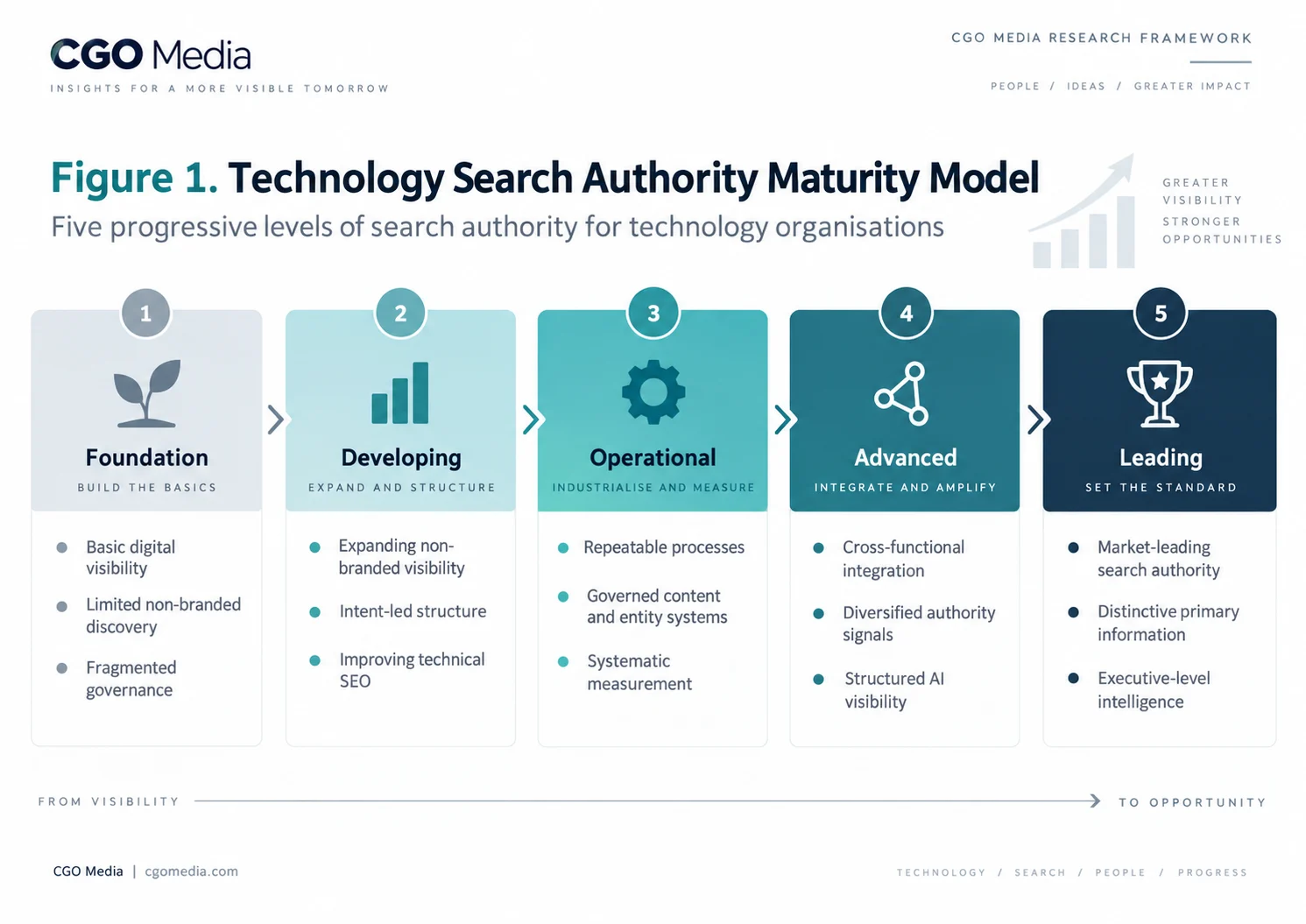
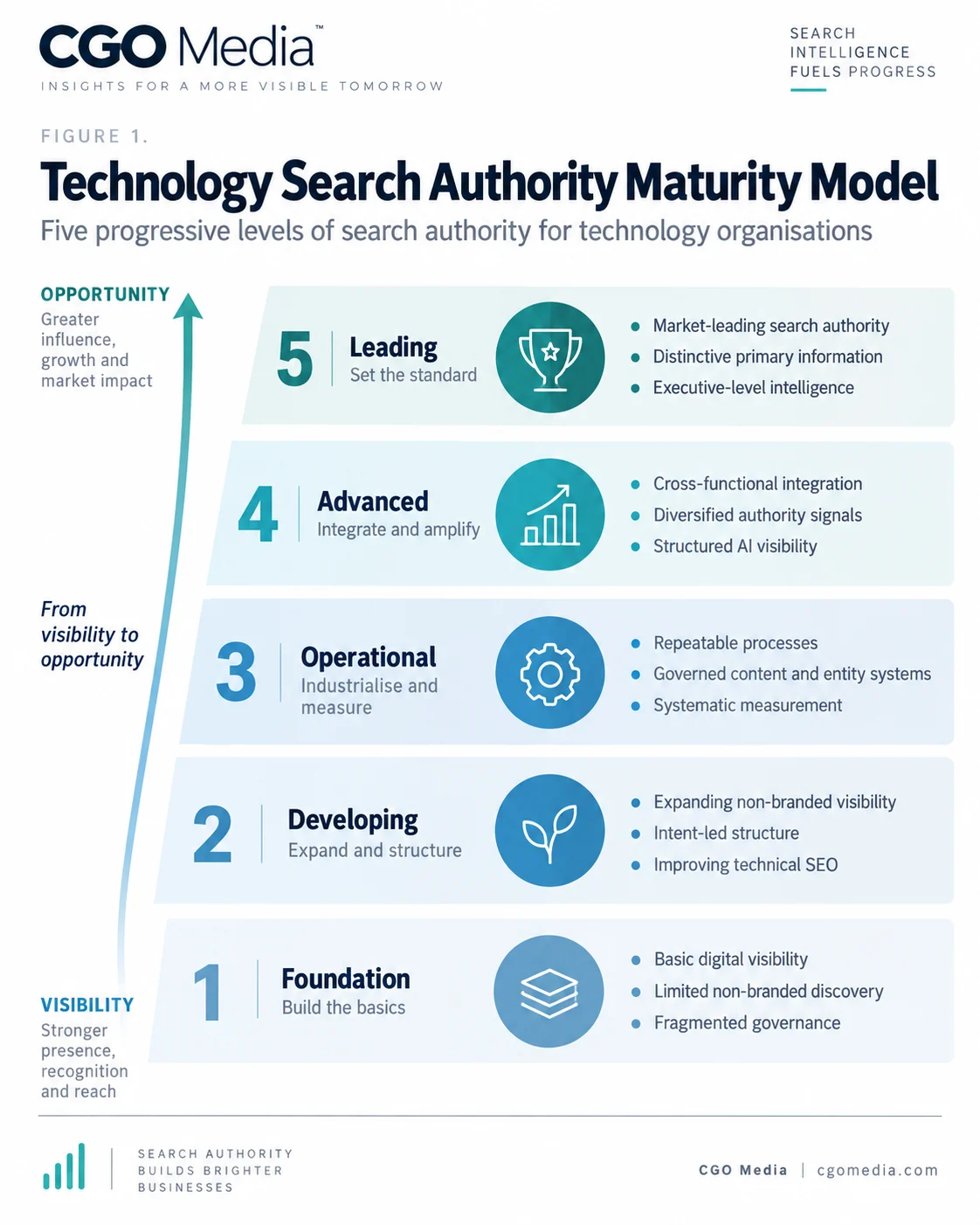
The five maturity levels are:
- Foundation
- Developing
- Operational
- Advanced
- Leading
The progression can be understood broadly as:
Basic Visibility → Structured Authority → Operational Authority → Integrated Authority → Adaptive Market Authority
The objective is not simply to reach the highest theoretical level.
It is to understand the organisation’s current capability, identify the constraints limiting progression and develop the systems required for search and AI authority to become repeatable, measurable and resilient.
1. Technology Search Authority Is a Progressive Capability
Technology organisations rarely move directly from basic SEO activity to sophisticated search and AI authority.
Capability develops progressively as the organisation strengthens:
- Technical infrastructure
- Information architecture
- Content coverage
- Entity representation
- Technical evidence
- External validation
- AI monitoring
- Measurement
- Governance
Each maturity level therefore reflects not simply performance, but the organisation’s ability to reproduce and govern that performance.
2. Maturity Should Be Assessed Across Several Dimensions
A technology provider can be strong in one capability while weak in another.
For example, an organisation may have:
- Excellent technical SEO but weak external authority
- Strong content but fragmented product entities
- High search visibility but poor AI representation
- Strong brand recognition but limited technical evidence
A maturity assessment should therefore examine the system as a whole rather than assign maturity based on one successful channel or metric.
3. The Five Levels Represent Organisational Capability
The Technology Search Authority Maturity Model uses five levels:
Foundation → Developing → Operational → Advanced → Leading
The first three levels describe the transition from fragmented visibility toward systematic authority.
The later levels describe organisations in which search, evidence, AI visibility, research, governance and commercial intelligence become increasingly integrated.
4. Level One — Foundation
At the Foundation level, the organisation has basic digital visibility, but search authority remains fragmented, reactive or incomplete.
The organisation may be visible to people who already know the brand while remaining difficult to discover through broader category, problem or use-case research.
Search activity is often tactical rather than systematic.
5. Foundation Visibility Is Commonly Brand-Dependent
Foundation organisations may rank for:
- Brand terms
- Product names
- Limited service terms
However, they may struggle to appear when buyers search by:
- Problem
- Category
- Use case
- Industry
- Comparison
This means the organisation can be easy to find after awareness exists but weak at generating new discovery.
6. Non-Branded Discovery Is Usually Limited
At this stage, search visibility is often concentrated around terms directly associated with the organisation’s existing brand or products.
The company may have limited visibility within earlier buyer questions such as:
- How do I solve this problem?
- What technology category addresses it?
- Which providers support this use case?
- What alternatives should I compare?
The organisation therefore enters the buyer journey relatively late.
7. Technical SEO Is Often Basic or Reactive
Common Foundation-level weaknesses can include:
- Incomplete crawl optimisation
- Weak internal linking
- Inconsistent metadata
- Unclear canonicalisation
- Limited performance monitoring
Technical issues may be addressed only after visibility or traffic declines rather than through preventative governance.
8. Information Architecture Often Reflects Internal Structure
Foundation organisations frequently structure websites around internal departments or product ownership rather than the way buyers research technology.
This can make it difficult to move naturally between:
Problem → Category → Product → Feature → Use Case → Evidence
Internal organisational logic and buyer research logic are not always the same.
9. Product Relationships Can Be Difficult to Understand
The public information environment may not clearly explain relationships such as:
Organisation → Product Family → Product → Feature → Use Case
Confusion can increase where the organisation has:
- Several related products
- Acquired brands
- Legacy products
- Recently renamed platforms
10. Documentation May Be Disconnected
Technical documentation may exist without strong relationships to:
- Product pages
- Solution pages
- Use cases
- Commercial content
This limits the ability of documentation to support both search visibility and buyer evaluation.
11. Entity Clarity Is Often Weak
Search engines, AI systems and buyers may encounter uncertainty around:
- Organisation identity
- Product identity
- Brand relationships
- Rebrands
- Acquisitions
- Legacy products
Weak entity clarity can fragment otherwise useful evidence across inconsistent names and environments.
12. Foundation Content Is Usually Reactive
Publishing may be driven mainly by:
- Immediate campaigns
- Keyword opportunities
- Product launches
- Sales requests
The result can be many isolated assets without a coherent knowledge architecture.
13. Topical Coverage Is Fragmented
Individual pages may perform reasonably well while important buyer questions remain unanswered elsewhere in the journey.
The organisation may therefore possess content volume without complete authority coverage.
A common missing structure is:
Problem → Category → Solution → Product → Technical Evidence → Comparison
14. Evidence Is Often Promotional Rather Than Verifiable
Foundation organisations may rely heavily on broad claims such as:
- Leading
- Secure
- Scalable
- Flexible
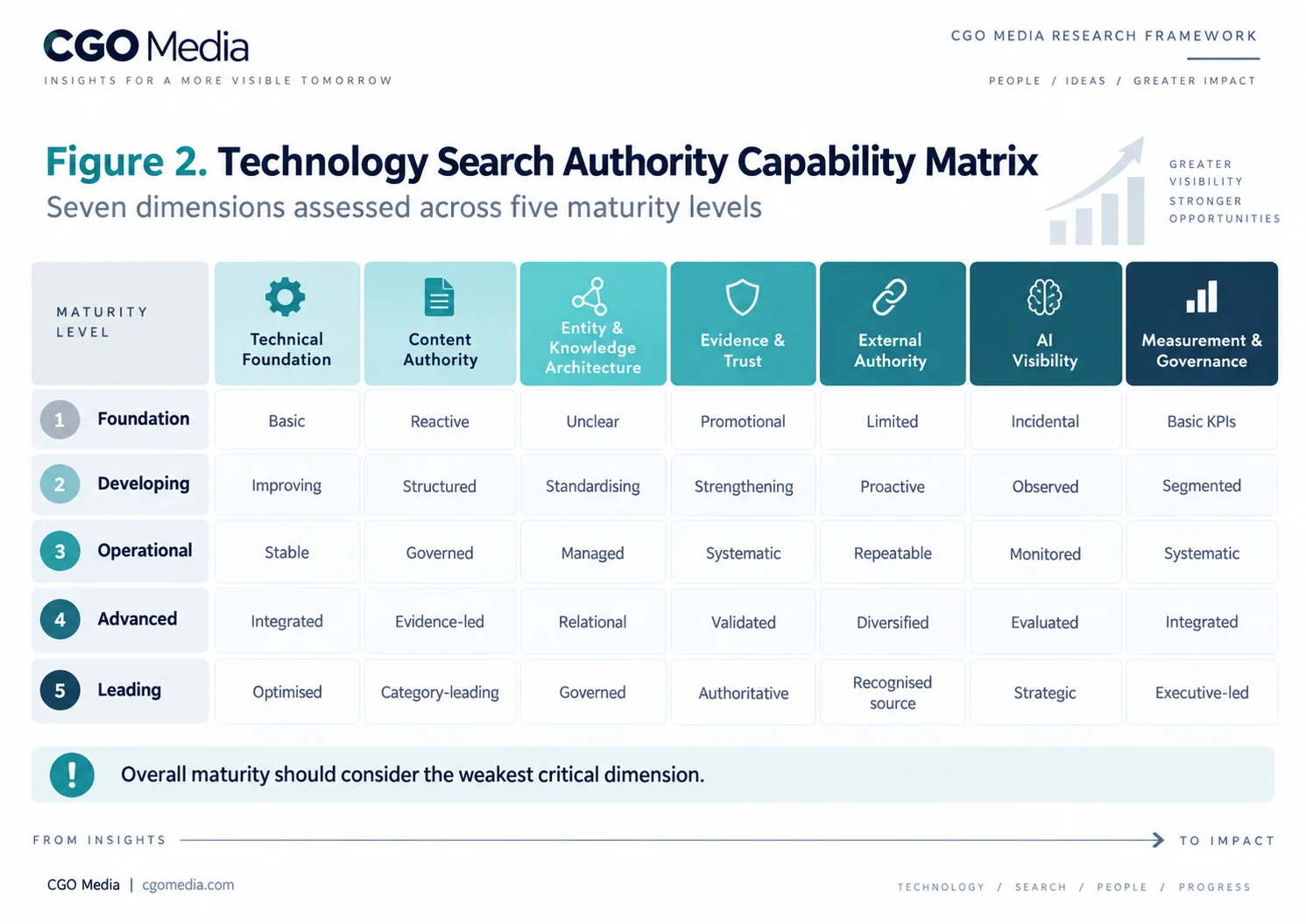
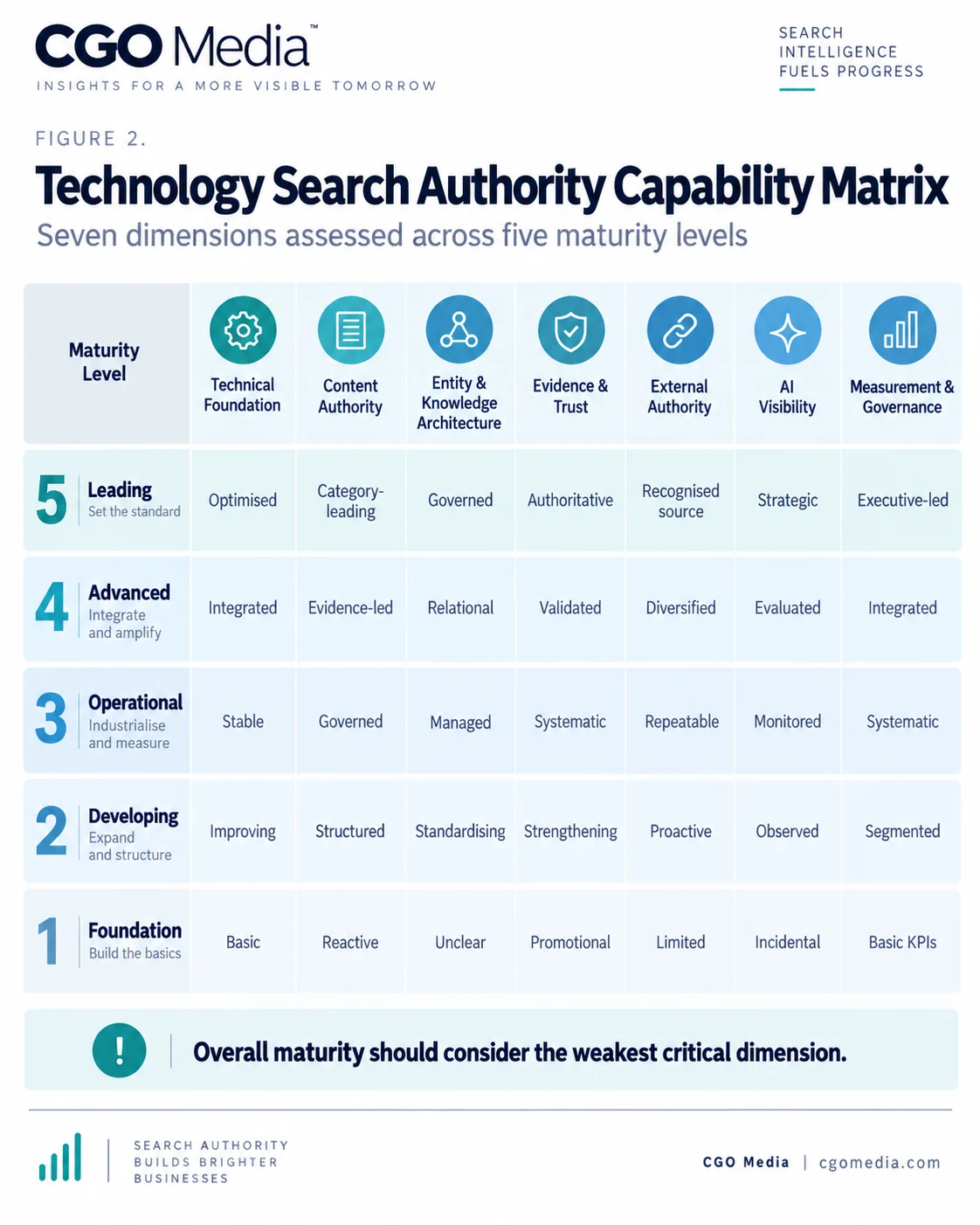
without providing enough supporting technical, customer or independent evidence.
The distinction between a marketing claim and a validated capability remains weak.
15. Customer Evidence Is Limited
Customer validation may consist mainly of:
- A small number of case studies
- Generic testimonials
- Logo collections
- Limited use-case evidence
This makes it harder for new buyers to determine whether the technology has been proven in comparable environments.
16. External Authority Is Usually Weak
The organisation may receive limited relevant recognition from:
- Technical media
- Industry publications
- Researchers
- Professional organisations
- Independent specialists
Most claims therefore remain concentrated within first-party channels.
17. AI Visibility Is Incidental
The organisation may occasionally appear within AI-assisted answers but does not systematically understand:
- Where it appears
- Why it appears
- How accurately it is represented
- Which competitors appear alongside it
AI visibility remains observational rather than managed.
18. AI Representation Can Be Inconsistent
Generated answers may contain:
- Outdated product information
- Weak differentiation
- Incorrect category associations
- Missing capabilities
- Legacy product names
The organisation may have no repeatable process for detecting or investigating these issues.
19. Foundation Measurement Is Conventional
Typical performance measures include:
- Rankings
- Traffic
- Clicks
- Leads
These metrics remain useful, but they provide only a partial view of modern technology discovery and authority.
20. Foundation Governance Is Fragmented
Responsibility may be spread between:
- Marketing
- Product
- Engineering
- External agencies
No single governance structure connects technical SEO, product information, evidence, external authority and AI visibility.
This can produce inconsistent decisions and slow response to important problems.
21. Foundation-Level Strategic Risk
The principal risk is that the organisation remains visible to audiences that already know it while competitors gain greater visibility within broader category discovery.
The organisation may therefore retain branded demand while losing influence earlier in the buyer journey.
22. Foundation-Level Strategic Objective
The immediate objective should be to create a reliable search and information foundation.
Priority areas normally include:
- Technical SEO
- Information architecture
- Entity clarity
- Core content coverage
- Measurement baselines
The purpose is to establish the infrastructure required for systematic authority development.
23. Level Two — Developing
At the Developing level, the organisation begins moving from reactive optimisation toward structured search authority.
Technical SEO becomes more dependable, non-branded coverage expands, entities become clearer and the organisation begins recognising external evidence and AI visibility as strategic concerns.
24. Developing Organisations Expand Non-Branded Visibility
Search strategy begins targeting areas such as:
- Problems
- Categories
- Use cases
- Industries
This allows the organisation to enter buyer journeys before brand awareness exists.
25. Search Strategy Becomes More Intent-Led
Buyer intent begins to be organised into stages such as:
- Problem intent
- Category intent
- Provider intent
- Comparison intent
- Implementation intent
Content planning increasingly reflects how technology buyers research rather than only which keywords appear attractive.
26. Technical SEO Becomes More Systematic
The organisation begins establishing stronger processes for:
- Crawlability
- Site architecture
- Internal linking
- Performance monitoring
- Indexation
Technical infrastructure and content strategy become more closely connected.
27. Entity Architecture Starts to Become Explicit
The organisation begins clarifying relationships such as:
Organisation → Brand → Product → Feature → Integration → Use Case
Service-led technology organisations may instead require structures such as:
Organisation → Practice → Service → Capability → Industry → Evidence
The objective is coherent machine and buyer understanding rather than adherence to one universal taxonomy.
28. Product Naming Becomes More Controlled
The organisation begins reducing ambiguity across:
- Website
- Documentation
- External profiles
- Partner references
Legacy product names and rebrands are handled more deliberately.
29. Documentation Becomes Search-Aware
Technical resources begin connecting more clearly with:
- Commercial pages
- Product pages
- Implementation resources
- Developer content
Documentation starts functioning as part of the wider search and authority system rather than only as a support environment.
30. Content Coverage Develops into Topic Families
The organisation begins moving from isolated articles toward connected knowledge structures such as:
Category → Problem → Solution → Product → Feature → Evidence
This creates deeper coverage around strategically important technology subjects.
31. Comparison Content Becomes More Important
Developing organisations begin supporting comparative buyer research through resources such as:
- Approach comparisons
- Technology comparisons
- Alternative pages
- Use-case comparisons
The organisation starts recognising comparison as a core stage of technology selection rather than a purely sales-led activity.
32. Evidence Quality Begins to Improve
The organisation develops stronger:
- Case studies
- Technical documentation
- Security resources
- Implementation evidence
Claims become more specific and easier to evaluate.
33. Claims Become More Technical and Verifiable
Instead of stating simply that a platform is highly scalable, the provider begins explaining relevant:
- Architecture
- Capacity
- Deployment models
- Performance evidence
This represents an important maturity shift from promotional assertion toward evidence-led authority.
34. External Authority Begins to Grow
The organisation may increase:
- Industry mentions
- Technical media coverage
- Partner references
- Customer advocacy
Digital PR begins supporting authority, category association and citation potential rather than operating only as general brand promotion.
35. Original Research Begins to Appear
Technology organisations at this stage may begin producing:
- Benchmarks
- Surveys
- Technical studies
- Market observations
Useful original evidence can attract references from journalists, researchers, analysts and industry publications.
36. AI Visibility Begins to Be Monitored
The organisation starts checking whether it appears within:
- Category questions
- Provider recommendation prompts
- Comparison scenarios
- Use-case queries
AI monitoring is often still manual, but visibility is no longer ignored.
37. Developing AI Monitoring Is Usually Basic
Teams may begin recording:
- Presence
- Accuracy
- Competitors
- Basic recommendation framing
They also begin identifying recurring misinformation such as outdated features, incorrect categories or legacy product names.
38. Measurement Starts to Expand
Developing organisations may begin measuring:
- Non-branded visibility
- Topic coverage
- Conversion paths
- Share of search
Performance may be segmented by:
- Brand
- Category
- Problem
- Use case
- Industry
This produces better diagnostic insight than one aggregate visibility metric.
39. Governance Starts to Formalise
Responsibilities become clearer between:
- SEO
- Product
- Content
- Engineering
- PR
The organisation starts moving from individual ownership of tactics toward shared ownership of authority outcomes.
40. Developing-Level Strategic Risk
The principal risk is rapid growth without adequate governance.
The organisation may improve visibility and content coverage while still suffering from:
- Inconsistent evidence
- Weak ownership
- Uneven entity clarity
- Manual AI monitoring
41. Developing-Level Strategic Objective
The objective is to move from isolated optimisation toward systematic authority building.
Priority areas should include:
- Topic architecture
- Entity architecture
- Evidence quality
- External authority
- AI observation
- Clearer governance
42. Level Three — Operational
At the Operational level, search authority becomes an established organisational capability rather than a collection of individual SEO activities.
Visibility, technical governance, content authority, entity clarity, evidence and AI monitoring operate with greater consistency.
43. Operational Organisations Have Broad Discovery Coverage
They can participate across:
- Problem discovery
- Category discovery
- Product discovery
- Comparison
- Implementation research
Visibility becomes more balanced between branded and non-branded demand.
44. Search Architecture Reflects the Buyer Journey
Information increasingly supports progression through:
Problem → Category → Provider → Evaluation → Comparison → Selection
The organisation is no longer simply publishing around isolated keywords.
It is building a connected information system around buyer progression.
45. Technical SEO Is Systematically Managed
Processes exist for:
- Crawling
- Indexation
- Internal linking
- Performance
- Structured information
Search impact also begins to form part of:
- Website releases
- Platform migrations
- Product launches
- Documentation changes
This reduces dependence on reactive remediation after problems occur.
46. Entity and Knowledge Architecture Are Intentional
Relationships between:
- Organisation
- Products
- Services
- People
- Research
are increasingly explicit.
Information is structured intentionally around categories, concepts, problems, capabilities and supporting evidence.
47. Content Authority Is Built Systematically
The organisation develops connected coverage across:
- Commercial content
- Educational content
- Technical content
- Research content
- Comparison content
Publishing becomes part of a wider knowledge architecture rather than a sequence of disconnected campaigns.
48. Content Quality Is Governed
Processes can include:
- Subject-matter review
- Fact checking
- Update schedules
- Named ownership
This helps keep decision-critical technology information accurate as products evolve.
49. Documentation Becomes Search Infrastructure
Technical resources are increasingly integrated into the broader knowledge system.
Documentation contributes to:
- Search discovery
- Developer experience
- Technical evaluation
- Implementation
- Customer support
This makes documentation an important component of search authority rather than a separate support function.
50. Evidence Architecture Becomes More Mature
Important technology claims are increasingly supported through:
- Technical documentation
- Security evidence
- Customer evidence
- Research
- External validation
The organisation begins treating evidence as a strategic authority resource.
51. Original Research Becomes Structured
Research programmes may begin producing repeatable:
- Benchmarks
- Market studies
- Technical testing
- Usage research
Research starts contributing systematically to external citations, media visibility and category authority.
52. AI Visibility Becomes an Operational Measurement Area
The organisation begins systematically monitoring:
- Source visibility
- Entity representation
- Comparison visibility
- Recommendation visibility
AI discovery becomes part of normal measurement rather than an occasional experiment.
53. AI Monitoring Becomes Scenario-Based
Rather than using generic prompts, teams test scenarios involving:
- Buyer type
- Use case
- Industry
- Geography
- Technical requirement
This makes AI monitoring more representative of real buyer discovery.
54. AI Visibility Quality Is Evaluated
The organisation considers:
- Presence
- Accuracy
- Relevance
- Recommendation fit
Critical misinformation can trigger cross-functional review rather than remaining an unowned observation.
55. Operational Organisations Understand Multiple Competitive Sets
The organisation starts distinguishing between:
- Commercial competitors
- Search competitors
- AI recommendation competitors
These groups can overlap without being identical.
Repeated AI co-occurrence can therefore provide additional insight into how the market is being framed.
56. Measurement Becomes Multi-Dimensional
Performance can be evaluated across:
- Discovery visibility
- Content authority
- Technical health
- External authority
- AI visibility
- Qualified conversion
The organisation begins moving away from single-metric definitions of success.
57. Measurement Connects More Closely with Business Outcomes
Search and AI performance may be compared with:
- Qualified enquiries
- Pipeline
- Opportunity creation
- Revenue
Attribution remains imperfect, but the organisation begins recognising the multi-touch nature of technology discovery and selection.
58. Governance Becomes Cross-Functional
A more mature operating relationship can include:
SEO + Product + Engineering + Content + Research + PR + Sales
Different components of search authority have clearer ownership.
The organisation increasingly recognises that no single department controls every element of the public evidence environment.
59. Operational-Level Strategic Risk
The organisation may perform strongly while remaining dependent on:
- Manual processes
- Individual specialists
- Uneven execution across teams
- Inconsistent implementation across markets
The next maturity challenge is therefore integration, standardisation and resilience.
60. Operational-Level Strategic Objective
The objective is to make search authority:
- Consistent
- Measurable
- Repeatable
- Governed
Priority areas should include:
- Cross-functional governance
- Evidence architecture
- AI visibility measurement
- External authority diversity
- Commercial integration
61. The First Technology Search Authority Maturity Principle
Technology search authority should be assessed as a progression from basic discoverability toward integrated technical, content, entity, evidence and recommendation authority rather than as a binary state.
62. The Second Technology Search Authority Maturity Principle
Maturity should be evaluated across multiple authority dimensions because a provider can be technically strong but weak in content, highly visible in search but poorly represented in AI, or well known but weakly evidenced.
63. The Third Technology Search Authority Maturity Principle
Organisations should move from reactive optimisation toward governed systems in which technical SEO, content architecture, entity clarity, evidence quality, external authority and AI visibility reinforce one another.
64. The Fourth Technology Search Authority Maturity Principle
Progression between maturity levels should be based on repeatable capability and governance rather than isolated campaigns, temporary ranking gains or individual high-performing pages.
65. The First Three Levels of Technology Search Authority
The first half of the maturity progression can be summarised as:
Foundation → Developing → Operational
Foundation
Search visibility exists, but authority remains fragmented, branded-demand dependent and weakly governed.
Developing
The organisation begins creating structured technical, content, entity, evidence and external-authority capabilities.
Operational
Search authority becomes an established organisational capability with systematic technical management, broader discovery coverage, stronger evidence, AI monitoring and cross-functional governance.
The transition across these first three levels represents movement from fragmented visibility toward systematic search authority.
66. The Strategic Implication
Technology organisations should determine whether their current search capability remains dependent on basic branded visibility and isolated optimisation, or whether they have developed the technical, content, entity, evidence and governance systems required to operate search authority consistently.
The important question is not simply:
How well are we ranking?
It is:
How mature is the organisational system responsible for making us discoverable, understandable, verifiable and appropriately recommendable?
The later maturity levels build on this foundation by integrating search authority more deeply with product operations, research, external authority, AI-assisted discovery, commercial intelligence and adaptive governance.
Figure 1 : Technology Search Authority Maturity Model — Foundation → Developing → Operational → Advanced → Leading.
67. Level Four — Advanced
At the Advanced level, search authority becomes deeply integrated into product, technical, content, research and commercial operations.
The organisation no longer treats SEO, AI visibility, content authority and external validation as independent disciplines.
Instead, they operate as connected components of one authority system.
68. Advanced Organisations Compete Across Multiple Discovery Environments
Meaningful visibility can exist across:
- Conventional search
- AI-assisted search
- Technical publications
- Comparison environments
- Professional communities
The organisation recognises that buyers may move between these environments during the same evaluation journey.
69. Advanced Visibility Is Selective Rather Than Universal
The organisation does not attempt to appear for every possible technology query.
It prioritises qualified visibility where:
- The buyer is relevant
- The use case fits
- The evidence is strong
- The commercial opportunity matters
This creates a closer relationship between visibility and genuine buyer suitability.
70. Search Architecture Reflects Market Architecture
Information is increasingly organised around:
- Categories
- Buyer problems
- Use cases
- Industries
- Products
- Evidence
This allows the organisation to participate across several stages of discovery while preserving clear relationships between commercial and technical information.
71. Category Authority Is Strong
Advanced providers can become associated with a technology category before buyers search specifically for their brand.
Category authority can develop through:
- Educational leadership
- Original research
- Technical explanation
- External citation
- Industry participation
This extends authority beyond product-page visibility.
72. Problem Authority Supports Earlier Discovery
Advanced organisations become visible around the problems buyers are attempting to solve.
This allows the provider to enter consideration before a defined shortlist exists.
A useful progression is:
Problem Authority → Category Authority → Provider Discovery → Evaluation
73. Use-Case Authority Demonstrates Practical Relevance
The organisation can demonstrate relevance to specific operational scenarios rather than relying only on general product positioning.
Useful supporting evidence can include:
- Case studies
- Technical documentation
- Research
- Performance evidence
This makes buyer fit easier to evaluate.
74. Entity Architecture Is Highly Controlled
Advanced organisations maintain clear relationships between:
- Parent organisation
- Brands
- Products
- Services
- Experts
- Research assets
The organisation reduces the amount of interpretation required from buyers, search systems and AI systems.
75. Product Lifecycle Changes Are Governed
Changes such as:
- Rebrands
- Acquisitions
- Product mergers
- Deprecations
- Portfolio restructuring
are reflected systematically across websites, documentation and external representations.
This reduces ambiguity created by outdated product identities.
76. Structured Information Reinforces Entity Clarity
Structured data can support clearer machine interpretation where appropriate.
However, it should reinforce visible information rather than compensate for unclear content or contradictory product architecture.
The underlying principle remains:
Visible Clarity First → Structured Reinforcement Second
77. Technical SEO Is Embedded into Operations
Search implications are considered during:
- Platform changes
- Product releases
- International expansion
- Documentation redesign
- Product launches
This reduces reliance on reactive technical remediation after visibility has already been affected.
78. Technical Change Control Is Established
High-impact changes can receive search review before deployment.
Relevant controls can include:
- Crawl-impact checks
- Indexation review
- Internal-link review
- Redirect validation
- Documentation checks
Technical SEO therefore becomes part of operational governance.
79. Content Governance Is Formalised
Important content assets can have:
- Named owners
- Review dates
- Source evidence
- Update requirements
This becomes particularly important for information influencing technical evaluation, procurement or risk.
80. Information Lifecycle Governance Is Mature
A practical lifecycle is:
Create → Validate → Publish → Monitor → Update → Deprecate → Archive
This creates clearer control over how technology information enters and eventually leaves the active public information environment.
81. Content Decay Is Managed
Advanced organisations recognise that information quality declines when ownership and review are weak.
Decision-critical information receives greater attention according to factors such as:
Rate of Change + Buyer Impact + Technical Risk + Commercial Importance
82. High-Risk Content Receives More Frequent Review
Examples can include:
- Security information
- Compliance information
- Pricing
- Technical compatibility
- Product availability
The organisation therefore allocates review effort according to risk rather than applying the same maintenance schedule to every asset.
83. Advanced Content Authority Is Evidence-Led
Important claims are connected with appropriate proof.
A useful relationship is:
Claim → Evidence → Validation → Authority → Buyer Confidence
This represents a significant maturity shift from content production toward evidence architecture.
84. Research Programmes Become More Structured
Advanced organisations may publish research involving:
- Benchmarks
- Sector studies
- Usage research
- Technical testing
- Market observations
The research programme begins contributing systematically to external authority and category understanding.
85. Research Methodology Becomes More Transparent
Research assets can explain:
- Sample
- Method
- Time period
- Definitions
- Limitations
This makes the findings easier for journalists, analysts, buyers and researchers to evaluate.
86. Research Authority Supports External Citation
Useful original evidence can attract:
- Journalist references
- Industry citations
- Analyst attention
- Academic references
This strengthens authority beyond conventional link acquisition.
87. External Authority Is Diversified
Advanced organisations seek relevant validation across several environments, including:
- Technical media
- Trade publications
- Professional bodies
- Customer advocacy
- Research ecosystems
Diversity reduces excessive dependence on any one external authority source.
88. Authority Concentration Risk Is Understood
Dependence on one:
- Publication
- Review platform
- Partner
- Community
can create fragility.
Authority diversification improves resilience if an important external source changes or disappears.
89. AI Visibility Is Strategically Managed
Advanced organisations monitor several forms of AI-assisted visibility, including:
- Source visibility
- Entity visibility
- Category visibility
- Comparison visibility
- Recommendation visibility
AI discovery becomes part of the wider authority operating model.
90. AI Monitoring Is Scenario-Based and Repeatable
Testing can be organised according to variables such as:
- Buyer type
- Industry
- Use case
- Geography
- Technical constraints
This allows the organisation to assess qualified AI visibility rather than generic mention frequency.
91. AI Visibility Quality Is Evaluated
The organisation distinguishes between:
- Presence
- Accuracy
- Relevance
- Evidence confidence
- Recommendation fit
This prevents raw inclusion from being mistaken automatically for strong authority.
92. AI Misinformation Risk Is Prioritised
Persistent errors can be assessed through:
Severity + Persistence + Buyer Impact + Commercial Importance
Material misinformation may require involvement from:
- SEO
- Product
- Engineering
- Security
- Legal
- PR
The response depends on the type and consequence of the error.
93. AI Competitive Sets Are Monitored
Advanced organisations compare:
- Commercial competitors
- Search competitors
- AI recommendation competitors
This can reveal whether AI-assisted discovery is framing the market differently from conventional commercial analysis.
94. Comparative Framing Is Monitored
The organisation may observe whether it is repeatedly described as:
- Enterprise-focused
- Developer-friendly
- Specialist
- Premium
- Value-led
Persistent differences between intended positioning and external or AI-assisted representation can then be investigated.
95. Advanced Measurement Is Integrated
Technology authority may be evaluated across:
- Discovery visibility
- Technical health
- Content authority
- Entity clarity
- External authority
- AI visibility
- Qualified conversion
No single ranking, traffic or AI-mention metric is allowed to define overall authority.
96. Leading and Lagging Indicators Are Used Together
Leading indicators can include:
- Evidence completeness
- Source consistency
- External citations
- AI recommendation stability
- Technical health
Lagging indicators can include:
- Qualified enquiries
- Pipeline
- Win rate
- Revenue
This allows teams to observe authority development before all commercial outcomes become visible.
97. Search Authority Is Treated as One System
A useful representation is:
Technical Foundation + Entity Clarity + Content Authority + Evidence Strength + External Authority + AI Visibility + Measurement
The organisation manages interactions between these capabilities rather than optimising them independently.
98. Advanced Governance Is Cross-Functional
A mature operating relationship can involve:
SEO + Product + Engineering + Content + Research + PR + Sales
Decision rights become clearer around areas such as:
- Technical search health
- Entity architecture
- Content standards
- Research quality
- AI monitoring
99. Advanced-Level Risk
The organisation can become highly sophisticated while developing processes that are difficult to replicate across:
- Multiple products
- International markets
- Business units
Complexity can therefore become the principal constraint at this stage.
100. Advanced-Level Strategic Objective
The objective is to make search authority:
- Resilient
- Scalable
- Integrated
- Embedded across the organisation
Priorities increasingly include:
- Automation
- Authority resilience
- International consistency
- Adaptive AI monitoring
- Organisation-wide governance
101. Level Five — Leading
At the Leading level, search authority becomes a strategic organisational asset rather than primarily a marketing capability.
The organisation does not simply compete for visibility within an existing information environment.
It begins helping shape that environment.
102. Leading Organisations Influence Their Category
This influence can develop through:
- Original research
- Standards
- Technical leadership
- Expert commentary
- Original frameworks
The organisation contributes information that helps others understand the market itself.
103. Leading Organisations Become Reference Sources
Their information may be cited or referenced by:
- Journalists
- Researchers
- Industry publications
- Analysts
- Other technology organisations
Search authority therefore extends beyond rankings into the wider knowledge ecosystem.
104. Category Authority Becomes Deep
The organisation can become associated with:
- Core categories
- Emerging categories
- Technical concepts
- Industry trends
It may influence how a market discusses new technology rather than merely responding to established terminology.
105. Category Language Can Be Influenced
Terminology, research or frameworks introduced by leading organisations can sometimes be adopted by:
- Media
- Industry practitioners
- Researchers
- Other organisations
This represents a stronger form of authority than ranking for terminology created elsewhere.
106. Entity Authority Is Highly Developed
The organisation maintains clear and resilient relationships across:
- Brands
- Products
- Experts
- Research
- Partnerships
- Corporate relationships
These relationships remain understandable through organisational change.
107. Entity Governance Survives Corporate Change
Acquisitions, rebrands and portfolio restructuring are reflected consistently across the public information environment.
This prevents organisational growth from creating persistent ambiguity around products, ownership or expertise.
108. Knowledge Architecture Becomes Strategic Infrastructure
Information is organised to support:
- Human discovery
- Search discovery
- AI understanding
- Buyer evaluation
Knowledge architecture is therefore managed as infrastructure rather than only as website navigation.
109. Leading Content Authority Is Distinctive
The organisation produces information that competitors cannot easily replicate.
Distinctive authority assets can include:
- Original datasets
- Longitudinal research
- Technical benchmarks
- Proprietary methodologies
- Expert analysis
This reduces dependence on summarising the same third-party information available to every competitor.
110. Primary Evidence Strengthens Citation Authority
Leading organisations increasingly publish information that originates within the organisation.
This creates the opportunity for other sources to cite the provider as an original source rather than merely linking to its interpretation of external information.
111. Expert Authority Is Institutionalised
Subject-matter experts contribute through:
- Research
- Technical writing
- Media commentary
- Conferences
- Industry bodies
The public information architecture makes the relationship between those experts and the organisation clear.
112. Authority Loops Become Self-Reinforcing
A useful authority cycle is:
Original Expertise → Useful Evidence → External Reference → Greater Authority → Wider Discovery → More Evidence
Strong evidence attracts references that can support future discovery and additional authority development.
113. Leading AI Visibility Is Qualified and Stable
The objective is repeated inclusion within relevant scenarios rather than universal mention volume.
The organisation can assess:
- Scenario fit
- Competitive framing
- Accuracy
- Recommendation stability
This provides a stronger view of AI authority than isolated appearances.
114. AI Visibility Becomes Market Intelligence
AI monitoring can help identify:
- Emerging competitors
- Category change
- Market perception
- Buyer-language shifts
AI visibility data therefore contributes to organisational decision-making rather than remaining confined to an SEO dashboard.
115. Leading Organisations Have Strong Recovery Capability
When material misinformation or authority deterioration occurs, mature organisations can respond through:
Detect → Diagnose → Correct → Validate → Learn
The objective is not perfect control.
It is rapid and informed recovery.
116. Adaptive Authority Is the Long-Term Objective
Adaptive authority combines:
- Strong foundations
- Continuous monitoring
- Rapid recovery
- Organisational learning
- Strategic adaptation
This makes the authority system resilient to changes in products, search systems, markets and AI interfaces.
117. Search Authority Reaches Executive Measurement
Leadership can monitor:
- Authority strength
- AI visibility
- Critical risk
- Competitive position
- Commercial impact
Search authority becomes connected with strategic planning rather than being evaluated only through operational marketing metrics.
118. Search Intelligence Can Influence Strategy
Insights can support decisions involving:
- Product strategy
- Market entry
- Category positioning
- Research priorities
- Communications strategy
This represents a major maturity shift: search becomes a source of market intelligence as well as a visibility channel.
119. Search Authority Connects with Sales Intelligence
Win/loss data can inform:
- Search strategy
- Content strategy
- Product development
- Comparison positioning
Search intelligence and sales intelligence become mutually reinforcing.
120. Customer Outcomes Reinforce Future Authority
Successful customers can generate:
- Case studies
- Reviews
- Referrals
- External references
A long-term reinforcement loop is:
Qualified Discovery → Strong Fit → Successful Outcome → Stronger Evidence → Greater Authority → Better Future Discovery
121. Distributed Authority Improves Resilience
Leading organisations avoid excessive dependence on one discovery channel.
Authority can be distributed across:
- Search
- AI
- Research
- Media
- Professional communities
- Customer advocacy
Changes within one platform therefore have less ability to disrupt overall market discovery.
122. International Authority Is Globally Coherent and Locally Relevant
Leading organisations can govern:
- Language
- Regional content
- Product availability
- Support coverage
- Regulatory differences
International consistency does not require identical content.
Core product truth remains stable while market-specific evidence and messaging adapt appropriately.
123. Experimentation Is Mature
Leading organisations can test improvements involving:
- Content architecture
- Evidence quality
- Authority programmes
- AI visibility interventions
Experiments use defined hypotheses, baselines and success criteria.
Negative results are retained so the organisation does not repeatedly invest in tactics that have already failed.
124. Learning Is Institutionalised
Findings are converted into:
- Standards
- Processes
- Training
- Governance
The search authority system therefore becomes less dependent on individual employees, consultants or agencies.
125. Leading-Level Strategic Objective
The objective is to maintain search authority that is:
- Adaptive
- Resilient
- Influential
- Evidence-led
- Institutionally governed
Priorities include:
- Category leadership
- Primary research
- Adaptive authority
- Authority resilience
- Institutional learning
126. Maturity Levels Should Be Interpreted as Capability Profiles
An organisation may not fit perfectly into one maturity level.
For example:
- Technical SEO may be Advanced
- Content Authority may be Operational
- AI Visibility may still be Developing
The model should therefore be used diagnostically rather than as a simplistic label.
127. Overall Maturity Should Reflect the Complete System
A single strong capability should not automatically create a high overall maturity classification.
Strong content cannot fully compensate for severe technical indexation problems.
Likewise, high AI mention frequency cannot compensate for weak evidence or critical trust problems.
128. Critical Weaknesses Can Constrain Overall Maturity
Important constraints can include:
- Technical failure
- Weak entity clarity
- Critical security misinformation
- Poor evidence governance
- Weak organisational ownership
Critical weaknesses should remain visible rather than disappearing inside an average score.
129. Technology Search Authority Is Multi-Dimensional
The complete maturity model evaluates seven connected dimensions:
- Technical Foundation
- Content Authority
- Entity & Knowledge Architecture
- Evidence & Trust
- External Authority
- AI Visibility
- Measurement & Governance
These dimensions provide the basis for a structured maturity profile.
130. Technical Foundation
This dimension assesses areas including:
- Crawlability
- Indexation
- Performance
- Architecture
- Technical governance
It determines whether the wider authority system rests on dependable technical infrastructure.
131. Content Authority
This dimension assesses:
- Topic coverage
- Content depth
- Expertise
- Freshness
- Buyer usefulness
The objective is to determine whether the organisation provides sufficient useful information throughout discovery and evaluation.
132. Entity & Knowledge Architecture
This dimension assesses:
- Entity clarity
- Product relationships
- Knowledge structure
- Information consistency
It evaluates whether important organisational and conceptual relationships are explicit rather than fragmented across disconnected pages.
133. Evidence & Trust
This dimension assesses:
- Technical evidence
- Security evidence
- Customer evidence
- Claim validation
It determines whether important technology claims are supported strongly enough for serious buyer evaluation.
134. External Authority
This dimension assesses:
- Citations
- Media coverage
- Research references
- Professional recognition
It measures whether the organisation’s authority extends beyond its own websites and marketing claims.
135. AI Visibility
This dimension assesses:
- Source visibility
- Entity accuracy
- Comparison visibility
- Recommendation fit
The focus is qualified and accurate AI visibility rather than raw mention frequency.
136. Measurement & Governance
This dimension assesses:
- KPIs
- Ownership
- Monitoring
- Escalation
- Continuous improvement
It determines whether search authority is being managed as an organisational system rather than through isolated activity.
137. Maturity Scoring Should Be Diagnostic
The objective is not to produce a vanity score.
The purpose is to identify where the authority system is:
- Strong
- Underdeveloped
- At risk
- Constraining progression
A five-level score can be applied independently to each dimension:
- 1 — Foundation
- 2 — Developing
- 3 — Operational
- 4 — Advanced
- 5 — Leading
138. Dimension-Level Assessment Reveals Uneven Development
A technology organisation may have strong infrastructure while remaining weak in external authority.
Another may possess strong research and brand authority while still having weak technical governance.
Dimension-level assessment makes these differences visible and helps identify the next meaningful capability investment.
139. Progression Between Levels Requires Different Capability Changes
The broad transitions can be summarised as:
Foundation → Developing: reactive visibility becomes structured optimisation.
Developing → Operational: activities become repeatable, broader and governed.
Operational → Advanced: authority becomes more integrated, evidence-led and cross-functional.
Advanced → Leading: the organisation develops category influence, primary authority, resilience and institutional learning.
140. Progression Should Be Evidence-Based
Higher maturity should require sustained capability rather than temporary performance.
Short-lived increases in:
- Traffic
- Rankings
- Media mentions
- AI visibility
do not independently demonstrate a mature authority system.
The organisation should be able to reproduce, govern and protect strong performance over time.
141. The Fifth Technology Search Authority Maturity Principle
Advanced search authority should integrate technical SEO, knowledge architecture, evidence governance, external authority and AI visibility into a single operating system rather than managing them as isolated disciplines.
142. The Sixth Technology Search Authority Maturity Principle
Leading search authority is characterised by category influence and primary evidence creation, where the organisation increasingly becomes a source that others cite, reference and use to understand the market.
143. The Seventh Technology Search Authority Maturity Principle
Overall maturity should reflect the balance of the complete authority system because strong performance in one capability cannot reliably compensate for critical weaknesses in technical foundations, trust, entity clarity or governance.
144. The Eighth Technology Search Authority Maturity Principle
Progression between maturity levels should require sustained, repeatable and governed capability rather than isolated campaigns, temporary traffic gains or short-lived AI visibility.
145. The Complete Technology Search Authority Maturity Progression
The full progression can be summarised as:
Foundation → Developing → Operational → Advanced → Leading
Across that progression, the organisation moves from fragmented visibility toward a system in which technical foundations, content, entities, evidence, external authority, AI visibility and governance reinforce one another.
The most mature organisations do more than optimise existing demand.
They contribute original evidence, influence category understanding, maintain resilient information systems and use search and AI intelligence to support wider organisational decisions.
146. The Strategic Implication
Technology organisations should assess maturity across the complete authority system rather than judging performance from the strongest visible capability.
The practical question is:
Which authority dimension currently prevents the organisation from progressing to the next maturity level?
A weak technical foundation can constrain strong content.
Weak evidence can constrain strong visibility.
Weak governance can prevent strong capabilities from becoming repeatable.
The Technology Search Authority Capability Matrix therefore provides a structured way to examine maturity across the seven capabilities that collectively determine the organisation’s ability to build, protect and extend search and AI authority.
Figure 2 : Technology Search Authority Capability Matrix — Technical Foundation + Content Authority + Entity & Knowledge Architecture + Evidence & Trust + External Authority + AI Visibility + Measurement & Governance.
147. Maturity Assessment Should Be Dimension-Specific
Technology organisations should assess each authority dimension independently before assigning an overall maturity position.
This prevents strong performance in one capability from hiding weakness elsewhere.
A provider may, for example, have:
- Advanced technical SEO
- Operational content authority
- Developing AI visibility
- Foundation-level governance
The purpose of maturity assessment is therefore diagnostic rather than cosmetic.
148. The Seven Dimensions Should Be Evaluated Separately
The complete capability profile includes:
- Technical Foundation
- Content Authority
- Entity & Knowledge Architecture
- Evidence & Trust
- External Authority
- AI Visibility
- Measurement & Governance
Each dimension should be assessed according to the characteristics of the five maturity levels.
149. Dimension One — Technical Foundation
Technical maturity determines whether search systems can reliably access, interpret and navigate the organisation’s digital estate.
The assessment should consider areas including:
- Crawlability
- Indexation
- Canonicalisation
- Performance
- Internal linking
- Release governance
150. Foundation Technical Maturity
At Foundation level, technical capability is mainly reactive.
Typical characteristics include:
- Basic crawlability
- Limited monitoring
- Inconsistent internal linking
- Issues addressed after visibility declines
Technical SEO exists but is not yet governed systematically.
151. Developing Technical Maturity
At Developing level, the organisation begins establishing repeatable technical processes.
These can include:
- Regular audits
- Improved crawl control
- Better canonical management
- Improved architecture
- More consistent technical monitoring
152. Operational Technical Maturity
At Operational level, technical search health becomes part of normal digital operations.
The organisation may have:
- Defined technical standards
- Regular monitoring
- Release checks
- Migration processes
- Clear technical ownership
Technical SEO becomes repeatable rather than dependent on occasional specialist intervention.
153. Advanced Technical Maturity
At Advanced level, search implications are considered during:
- Product launches
- Platform changes
- Documentation redesigns
- International expansion
- Major migrations
Search governance therefore moves upstream into planning and delivery.
154. Leading Technical Maturity
At Leading level, technical search health is treated as organisational infrastructure.
Capabilities can include:
- Automated monitoring
- Early-warning systems
- Regression detection
- Formal recovery processes
- Institutional technical standards
The organisation becomes capable of detecting and recovering from technical deterioration quickly.
155. Dimension Two — Content Authority
Content maturity evaluates whether the organisation provides sufficient useful information to support discovery, education, evaluation and comparison.
The assessment should examine:
- Coverage
- Depth
- Expertise
- Freshness
- Buyer usefulness
156. Foundation Content Maturity
At Foundation level, content is often:
- Campaign-led
- Keyword-led
- Fragmented
- Weakly connected to buyer progression
Important questions may remain unanswered despite substantial publishing activity.
157. Developing Content Maturity
At Developing level, content begins to organise around:
- Problems
- Categories
- Use cases
- Industries
- Products
The organisation starts building topic families rather than isolated pages.
158. Operational Content Maturity
At Operational level, content supports several buyer stages systematically.
The organisation may maintain:
- Educational resources
- Product content
- Technical resources
- Comparison content
- Research content
Content governance and review processes also become more consistent.
159. Advanced Content Maturity
At Advanced level, important content is:
- Evidence-led
- Expert-reviewed
- Governed for freshness
- Connected to buyer and product architecture
The organisation increasingly treats information quality as a strategic capability.
160. Leading Content Maturity
At Leading level, the organisation produces distinctive information that competitors cannot easily replicate.
This can include:
- Original datasets
- Technical benchmarks
- Research programmes
- Original methodologies
- Expert-led analysis
Content authority therefore extends beyond publishing into knowledge creation.
161. Dimension Three — Entity & Knowledge Architecture
This dimension evaluates whether important relationships between organisations, products, services, experts and research are explicit and coherent.
A useful conceptual structure can include:
Organisation → Brand → Product → Feature → Use Case → Evidence
162. Foundation Entity Maturity
At Foundation level, public identity can be fragmented.
Common problems include:
- Inconsistent product names
- Unclear ownership
- Legacy-brand confusion
- Weak expert identity
163. Developing Entity Maturity
At Developing level, the organisation begins clarifying:
- Product relationships
- Brand relationships
- Expert identity
- Organisation structure
Important entity relationships become more explicit.
164. Operational Entity Maturity
At Operational level, entity architecture is intentional and repeatable.
Product, service, expert and research relationships are reflected consistently across important owned environments.
Legacy and current information is more clearly distinguished.
165. Advanced Entity Maturity
At Advanced level, entity governance is embedded within:
- Product launches
- Acquisitions
- Rebrands
- Portfolio changes
- International expansion
The organisation manages entity change as part of corporate and product governance.
166. Leading Entity Maturity
At Leading level, entity architecture remains resilient through organisational change.
The organisation maintains coherent relationships across:
- Brands
- Products
- Experts
- Research
- Corporate relationships
Knowledge architecture becomes strategic infrastructure.
167. Dimension Four — Evidence & Trust
This dimension evaluates whether important technology claims are supported strongly enough to survive serious buyer evaluation.
Relevant evidence can include:
- Technical documentation
- Security information
- Customer proof
- Performance evidence
- Independent validation
168. Foundation Evidence Maturity
At Foundation level, authority relies heavily on promotional claims.
Common weaknesses include:
- Unsupported capability claims
- Generic testimonials
- Weak security evidence
- Limited technical validation
169. Developing Evidence Maturity
At Developing level, the organisation begins strengthening:
- Case studies
- Technical documentation
- Security information
- Implementation evidence
Claims become more specific and easier to verify.
170. Operational Evidence Maturity
At Operational level, evidence becomes part of the normal information architecture.
Important claims are increasingly connected with:
- Documentation
- Customer examples
- Security evidence
- Research
Trust development becomes systematic rather than opportunistic.
171. Advanced Evidence Maturity
At Advanced level, evidence is:
- Governed
- Current
- Claim-specific
- Cross-functional
Decision-critical claims receive stronger review according to buyer impact and risk.
172. Leading Evidence Maturity
At Leading level, the organisation becomes a producer of primary evidence through:
- Original research
- Benchmarking
- Technical analysis
- Longitudinal data
- Expert methodologies
Evidence creation itself becomes part of market authority.
173. Dimension Five — External Authority
External authority measures how strongly the organisation’s expertise and technology are reinforced beyond its own websites and marketing channels.
Relevant signals can include:
- Citations
- Media coverage
- Research references
- Professional recognition
- Customer advocacy
174. Foundation External Authority Maturity
At Foundation level, external validation is limited and inconsistent.
The organisation may depend mainly on:
- Owned claims
- Partner mentions
- Occasional media coverage
175. Developing External Authority Maturity
At Developing level, the organisation starts creating deliberate authority programmes through:
- Digital PR
- Customer advocacy
- Expert commentary
- Industry participation
176. Operational External Authority Maturity
At Operational level, external authority becomes repeatable.
The organisation may receive regular recognition across:
- Industry publications
- Technical media
- Customer references
- Research citations
177. Advanced External Authority Maturity
At Advanced level, authority is diversified across several relevant environments.
The organisation understands and manages concentration risk rather than depending excessively on one platform, publication or partner.
178. Leading External Authority Maturity
At Leading level, the organisation becomes a reference source.
Its research, expertise, frameworks or technical analysis may be cited by:
- Journalists
- Researchers
- Analysts
- Industry practitioners
The organisation contributes directly to the wider knowledge environment.
179. Dimension Six — AI Visibility
AI visibility maturity evaluates whether the organisation understands and manages how it is represented within AI-assisted discovery and recommendation environments.
The assessment should consider:
- Presence
- Accuracy
- Comparison visibility
- Recommendation fit
- Monitoring maturity
180. Foundation AI Visibility Maturity
At Foundation level, AI visibility is incidental.
The organisation may:
- Check occasional prompts
- Observe random mentions
- Have no formal monitoring process
Errors or omissions are often not tracked systematically.
181. Developing AI Visibility Maturity
At Developing level, the organisation begins monitoring:
- Presence
- Accuracy
- Competitors
- Recommendation framing
Monitoring is usually still manual but becomes more structured.
182. Operational AI Visibility Maturity
At Operational level, monitoring becomes scenario-based and repeatable.
Testing may vary by:
- Buyer type
- Use case
- Industry
- Market
- Technical requirement
AI visibility becomes part of the normal performance system.
183. Advanced AI Visibility Maturity
At Advanced level, the organisation evaluates AI visibility through:
- Qualified inclusion
- Accuracy
- Competitive framing
- Recommendation fit
- Source support
Critical misinformation can trigger formal cross-functional review.
184. Leading AI Visibility Maturity
At Leading level, AI visibility becomes part of wider market intelligence.
Monitoring can help identify:
- Emerging competitors
- Category change
- Buyer-language shifts
- Persistent market perception
The organisation uses AI discovery data strategically rather than treating it solely as another marketing metric.
185. Dimension Seven — Measurement & Governance
This dimension evaluates whether authority performance is measured, owned and improved through repeatable organisational processes.
Important capabilities can include:
- KPIs
- Ownership
- Monitoring
- Escalation
- Learning
186. Foundation Measurement & Governance Maturity
At Foundation level, measurement is dominated by:
- Rankings
- Traffic
- Clicks
- Leads
Ownership is fragmented and cross-functional governance is weak.
187. Developing Measurement & Governance Maturity
At Developing level, the organisation begins adding:
- Non-brand visibility
- Topic coverage
- Authority indicators
- Basic AI monitoring
Responsibilities between SEO, product, content and PR become clearer.
188. Operational Measurement & Governance Maturity
At Operational level, the organisation monitors several authority dimensions consistently.
Ownership and processes exist across:
- Technical search health
- Content
- Entities
- Authority
- AI visibility
Performance becomes easier to diagnose and manage.
189. Advanced Measurement & Governance Maturity
At Advanced level, leading and lagging indicators are combined.
The organisation can monitor:
- Authority development
- Risk
- Qualified AI visibility
- Qualified conversion
- Commercial contribution
Cross-functional governance becomes formalised.
190. Leading Measurement & Governance Maturity
At Leading level, authority measurement supports strategic decision-making.
Search and AI intelligence can influence:
- Product strategy
- Market positioning
- Research priorities
- Commercial planning
The authority system also contains repeatable learning and recovery processes.
191. Overall Maturity Should Not Be a Simple Average
An organisation could theoretically average strong scores while still carrying one severe weakness.
For example:
- Strong content
- Strong external authority
- Strong AI visibility
- Critical technical indexation failure
A simple numerical average could hide the severity of that constraint.
192. Critical Weaknesses Should Constrain the Overall Profile
Critical weaknesses can include:
- Severe technical accessibility problems
- Major product-entity ambiguity
- Unsupported high-risk claims
- Persistent serious AI misinformation
- No governance ownership
These should remain visible in the maturity assessment regardless of strengths elsewhere.
193. Confidence Should Accompany Maturity Assessment
Not every maturity judgement will have the same evidence quality.
Assessment confidence can be classified broadly as:
- High Confidence — strong evidence supports the assessment.
- Moderate Confidence — evidence exists but is incomplete.
- Low Confidence — the maturity position relies heavily on assumption.
This prevents apparent precision where the underlying evidence is weak.
194. Evidence Sources Should Be Recorded
A maturity assessment can draw from:
- Technical audits
- Search data
- Content audits
- Entity reviews
- External authority data
- AI observations
- Sales evidence
Recording the evidence source improves repeatability when the assessment is revisited later.
195. Maturity Profiles Should Identify Critical Gaps
After scoring each dimension, the organisation should identify the capability gaps limiting progression.
These gaps can be:
- Technical
- Content-based
- Entity-based
- Evidence-based
- Authority-based
- AI-visibility-based
- Governance-based
196. Technical Capability Gaps
Examples include:
- Weak crawl governance
- Uncontrolled platform changes
- Fragmented documentation
- Limited monitoring
These gaps can weaken every downstream authority layer.
197. Content Capability Gaps
Examples include:
- Insufficient topic coverage
- Weak technical depth
- Limited expert contribution
- Poor freshness control
The organisation may be technically discoverable while remaining informationally weak.
198. Entity Capability Gaps
Examples include:
- Inconsistent product naming
- Unclear ownership relationships
- Weak expert identity
- Legacy-brand ambiguity
These gaps can fragment search, external and AI understanding.
199. Evidence Capability Gaps
Examples include:
- Unsupported claims
- Weak customer evidence
- Insufficient security information
- Missing technical validation
Evidence gaps often become most visible during serious buyer evaluation.
200. External Authority Gaps
Examples include:
- Limited citations
- Weak media visibility
- Low research recognition
- Dependence on one authority source
These gaps can leave otherwise strong product claims dependent mainly on first-party assertion.
201. AI Visibility Capability Gaps
Examples include:
- No systematic monitoring
- Poor entity representation
- Weak recommendation visibility
- Recurring misinformation
The organisation may have little understanding of how it appears within AI-assisted discovery.
202. Governance Capability Gaps
Examples include:
- Unclear ownership
- No escalation process
- No review cycle
- No organisational learning system
Governance gaps can prevent strong capabilities from becoming repeatable and resilient.
203. Critical Gaps Should Be Prioritised
Once gaps are identified, the organisation should determine which one is currently limiting progression most strongly.
A useful relationship is:
Gap Severity + Dependency + Buyer Impact + Commercial Importance + Risk → Priority
204. Dependency Matters
Some capability gaps sit upstream of others.
For example:
- Technical accessibility affects content discovery.
- Entity clarity affects evidence interpretation.
- Evidence quality affects trust and recommendation confidence.
- Governance affects the durability of every capability.
Addressing upstream constraints can therefore improve several downstream dimensions simultaneously.
205. Buyer Impact Matters
A weakness should receive greater priority where it directly affects:
- Discovery
- Technical evaluation
- Trust
- Shortlisting
- Selection
The strongest maturity improvement is not necessarily the one producing the largest score increase.
206. Commercial Importance Matters
A capability gap affecting a strategically important product, market or buyer segment may deserve greater investment than a larger gap within a low-priority area.
Maturity assessment should therefore remain connected to commercial strategy.
207. Risk Matters
Some weaknesses require attention even where direct revenue impact is difficult to quantify.
Examples can include:
- Incorrect security information
- Incorrect compliance claims
- Major entity confusion
- Serious technical accessibility failure
Critical risk should remain visible outside any average score.
208. Improvement Actions Should Match the Gap
Different capability gaps require different responses.
The organisation should avoid treating every maturity weakness as a content problem.
Technical Gap
May require engineering or platform change.
Content Gap
May require improved knowledge architecture or subject-matter depth.
Entity Gap
May require clearer identity, taxonomy or lifecycle governance.
Evidence Gap
May require technical proof, customer evidence or validation.
Authority Gap
May require research, digital PR or external citation development.
AI Visibility Gap
May require better underlying evidence, entity clarity and systematic monitoring.
Governance Gap
May require ownership, review cycles and escalation processes.
209. Every Priority Gap Should Have an Owner
A diagnostic assessment becomes useful only when responsibility is clear.
Each priority gap should identify:
- Current maturity
- Target maturity
- Required improvement
- Owner
- Validation method
This converts maturity assessment into an improvement programme.
210. Reassessment Is Essential
Maturity should be reassessed after material improvement work.
The organisation should determine whether:
- The capability actually improved
- The improvement is repeatable
- Governance now supports it
- The original constraint has been reduced
Completed work does not automatically equal maturity progression.
211. The Ninth Technology Search Authority Maturity Principle
Technology search authority should be assessed dimension by dimension so strengths in technical, content, entity, evidence, external authority, AI visibility or governance do not conceal weaknesses elsewhere in the system.
212. The Tenth Technology Search Authority Maturity Principle
Overall maturity should be constrained by critical weaknesses so that strong performance in one authority capability cannot conceal severe deficiencies elsewhere.
213. The Eleventh Technology Search Authority Maturity Principle
Maturity assessment should prioritise repeatable capability, documented ownership, evidence quality and governance rather than superficial output volume or temporary visibility gains.
214. The Twelfth Technology Search Authority Maturity Principle
Technology organisations should use maturity profiles as diagnostic tools, identifying which authority dimension is currently limiting progression and directing investment toward the highest-value capability gap.
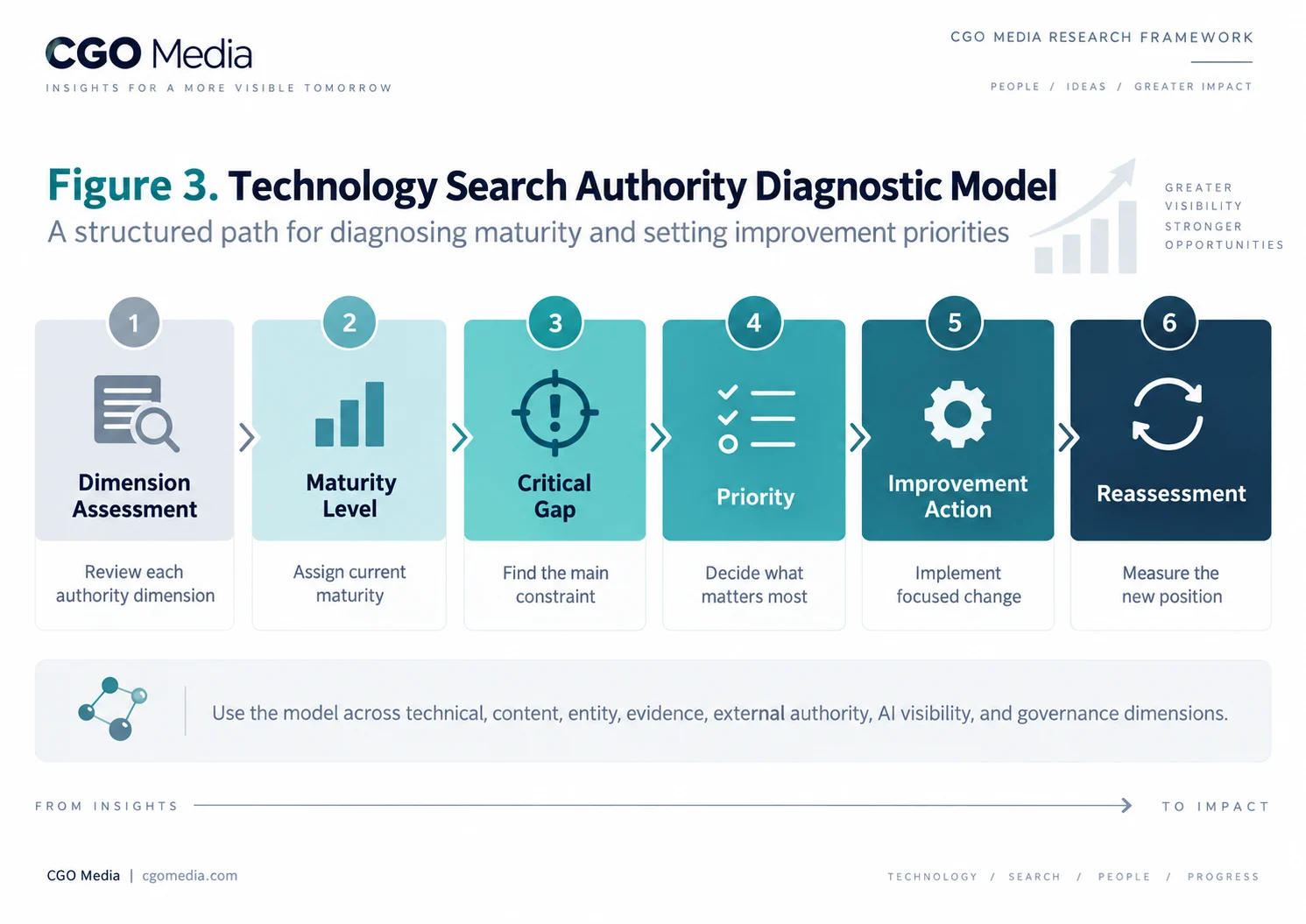
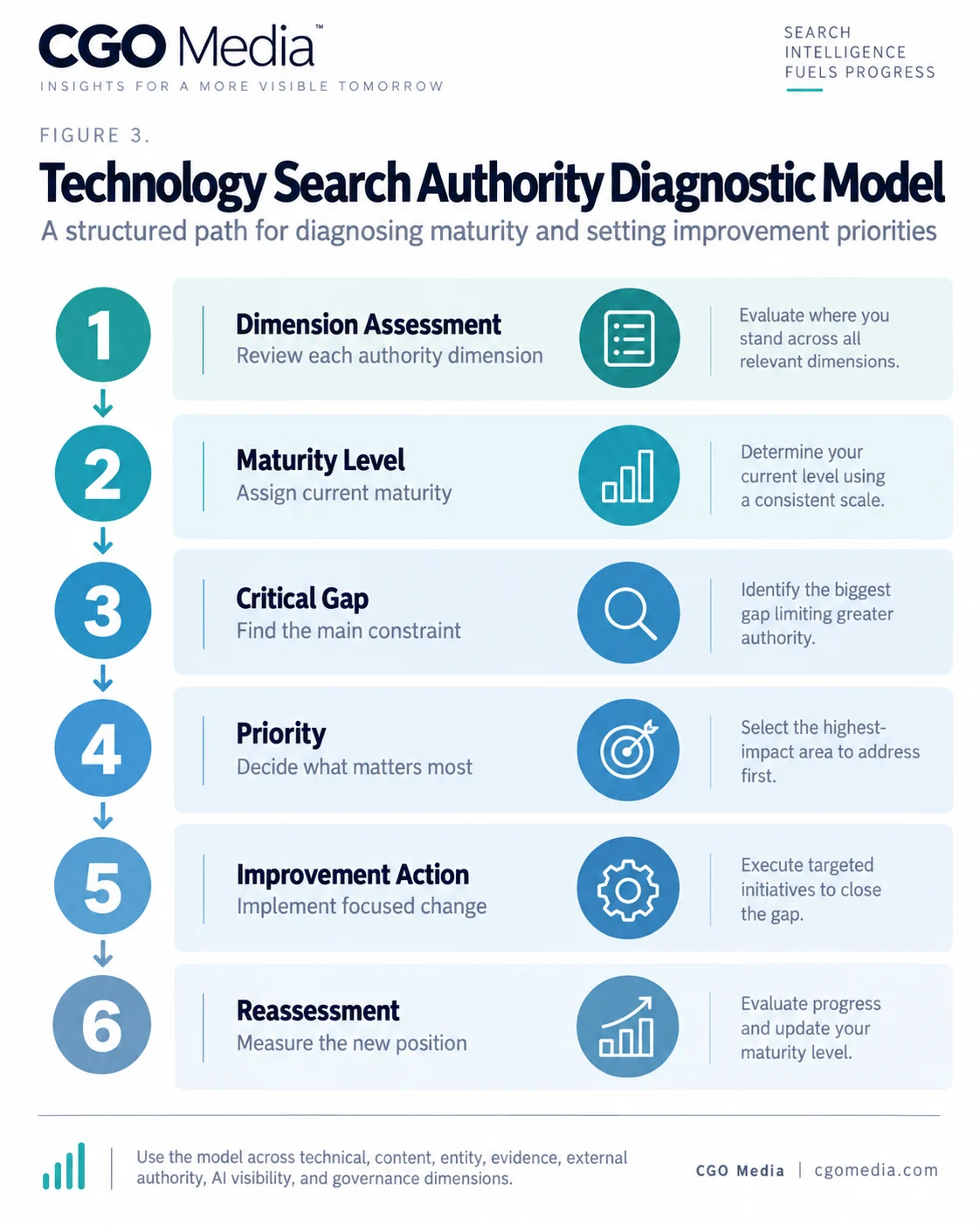
215. The Technology Search Authority Diagnostic Model
The complete diagnostic relationship can be summarised as:
Dimension Assessment → Maturity Level → Critical Gap → Priority → Improvement Action → Reassessment
Dimension Assessment
Evaluate the organisation independently across Technical Foundation, Content Authority, Entity & Knowledge Architecture, Evidence & Trust, External Authority, AI Visibility and Measurement & Governance.
Maturity Level
Assign the current capability position from Foundation through Leading according to observable and repeatable evidence.
Critical Gap
Identify the weakness most likely to constrain overall authority progression or create material search, buyer or organisational risk.
Priority
Assess the gap according to severity, dependency, buyer impact, commercial importance and risk.
Improvement Action
Apply the intervention appropriate to the underlying capability problem rather than defaulting automatically to additional content or SEO activity.
Reassessment
Re-evaluate the capability after implementation to determine whether the improvement is material, repeatable, governed and sufficient to support progression.
The strategic implication is that the Technology Search Authority Maturity Model should be used as an operational diagnostic system rather than a simple scoring exercise. Its purpose is to reveal which capability currently limits progression and where the organisation should direct investment to strengthen the authority system as a whole.
Figure 3 : Technology Search Authority Diagnostic Model — Dimension Assessment → Maturity Level → Critical Gap → Priority → Improvement Action → Reassessment.
216. Maturity Progression Requires Structural Change
Progressing from one maturity level to another requires more than improved rankings, additional content or temporary AI visibility.
Each transition should reflect stronger organisational capability across areas such as:
- Technical infrastructure
- Information architecture
- Evidence quality
- External authority
- AI monitoring
- Measurement
- Governance
The central principle is:
Higher Maturity = Stronger Capability + Greater Repeatability + Better Governance
217. Performance Improvement Alone Does Not Prove Maturity
A technology organisation can experience a temporary increase in:
- Organic traffic
- Rankings
- Media coverage
- AI mentions
without developing the systems required to sustain that improvement.
Maturity therefore depends on whether strong performance can be reproduced and protected.
218. Maturity Progression Should Be Capability-Led
The organisation should ask:
What capability must become stronger before the authority system can operate reliably at the next level?
This shifts attention away from superficial scoring and toward structural improvement.
219. The Weakest Critical Capability Can Become the Bottleneck
A technology organisation may possess several mature capabilities while remaining constrained by one weak area.
For example:
- Strong content can be constrained by weak technical accessibility.
- Strong visibility can be constrained by weak evidence.
- Strong external authority can be constrained by entity ambiguity.
- Strong AI presence can be constrained by poor recommendation fit.
The most important improvement is therefore often the one that removes the system bottleneck.
220. Bottleneck-Led Maturity Investment
A useful progression principle is:
Identify Constraint → Understand Dependency → Strengthen Capability → Validate Improvement → Reassess System
This prevents investment from being distributed evenly across every capability when one weakness is limiting the entire authority system.
221. Foundation to Developing
The transition from Foundation to Developing requires movement away from fragmented, reactive activity.
The organisation begins establishing:
- More reliable technical SEO
- Structured content planning
- Clearer product and entity relationships
- Basic evidence standards
- Initial AI monitoring
- Defined ownership
The core shift is from individual optimisation tasks toward structured authority development.
222. Foundation Organisations Need Reliable Technical Access First
Where serious crawl, indexation or architecture problems exist, these constraints should usually be addressed before large-scale content expansion.
Otherwise, new information may remain:
- Difficult to discover
- Poorly connected
- Weakly indexed
Technical accessibility therefore acts as a common dependency during early maturity progression.
223. Foundation Organisations Need Clearer Information Architecture
The organisation should begin connecting:
Problem → Category → Product → Feature → Use Case → Evidence
This creates a stronger basis for non-brand discovery and buyer progression.
224. Foundation Organisations Need Basic Entity Clarity
Before more advanced authority programmes begin, the organisation should be able to explain:
- Who the organisation is
- Which products it owns
- How products relate to one another
- Which names are current
- Which products or brands are historical
Without this clarity, later evidence can remain fragmented.
225. Foundation Organisations Need Initial Evidence Standards
Important claims should begin moving from broad promotional language toward specific support.
A basic evidence model is:
Claim → Supporting Source → Owner → Review Date
This introduces accountability into the public evidence environment.
226. Developing to Operational
The transition from Developing to Operational requires activities to become repeatable.
The organisation moves from:
We sometimes do this
to:
This is how the organisation normally operates.
Processes, ownership and measurement become more consistent.
227. Developing Organisations Need Repeatable Technical Governance
Technical SEO should move beyond periodic audit work into processes supporting:
- Releases
- Migrations
- Platform changes
- Documentation updates
The organisation begins preventing avoidable failures rather than repeatedly fixing them afterwards.
228. Developing Organisations Need Structured Topic Coverage
Content should expand from individual pages into connected topic families covering:
- Problems
- Categories
- Use cases
- Products
- Technical evaluation
- Comparison
This creates more complete authority across the buyer journey.
229. Developing Organisations Need Better Evidence Architecture
Important product claims should increasingly be supported through:
- Documentation
- Security information
- Customer evidence
- Technical validation
The objective is to make buyer evaluation easier and more reliable.
230. Developing Organisations Need Systematic AI Monitoring
AI visibility should move beyond occasional manual checking.
The organisation should begin monitoring:
- Presence
- Accuracy
- Competitor co-occurrence
- Recommendation fit
across repeatable buyer scenarios.
231. Operational Readiness Requires Ownership
A capability becomes operational when responsibilities are sufficiently clear.
Important ownership can include:
- Technical search health
- Product information
- Documentation
- Security evidence
- Research
- AI monitoring
Unclear ownership is a common barrier to maturity progression.
232. Operational to Advanced
The transition from Operational to Advanced requires deeper integration.
At this point, the organisation moves from managing several competent search activities toward operating them as one connected authority system.
The core shift is:
Repeatable Capability → Integrated Authority
233. Operational Organisations Need Cross-Functional Integration
SEO alone cannot control all of the evidence required for advanced authority.
Greater integration is needed between:
SEO + Product + Engineering + Security + Content + Research + PR + Sales
This ensures search authority reflects operational reality rather than marketing interpretation alone.
234. Operational Organisations Need Formal Information Governance
Important assets should increasingly have:
- Owners
- Validation processes
- Review triggers
- Lifecycle status
Governance becomes particularly important where technology information changes quickly.
235. Operational Organisations Need Stronger External Authority
Advanced maturity requires evidence beyond the organisation’s own properties.
Priority areas can include:
- Customer validation
- Original research
- Technical media
- Relevant external citations
- Expert recognition
The objective is stronger convergence between first-party and independent evidence.
236. Operational Organisations Need Qualified AI Visibility
AI measurement should progress from basic presence toward:
- Relevant inclusion
- Accurate representation
- Competitive framing
- Recommendation fit
- Source support
This creates a stronger understanding of AI-assisted market discovery.
237. Advanced Readiness Requires Integrated Measurement
The organisation should increasingly connect authority development with:
- Qualified discovery
- Evaluation readiness
- Shortlisting
- Qualified conversion
- Commercial outcomes
This moves measurement beyond isolated marketing metrics.
238. Advanced to Leading
The transition from Advanced to Leading requires more than excellent execution.
The organisation begins developing:
- Primary evidence
- Category influence
- Institutional authority
- Adaptive governance
- Search and AI intelligence
The shift is from strong participation in the market toward contributing to how the market is understood.
239. Leading Readiness Requires Primary Evidence Creation
The organisation should increasingly contribute information that originates from its own:
- Research
- Data
- Technical testing
- Benchmarks
- Expert methodologies
This makes the organisation a source rather than only a publisher of interpretations.
240. Leading Readiness Requires Category Contribution
Advanced organisations become strong within established categories.
Leading organisations may help shape:
- Terminology
- Frameworks
- Research priorities
- Technical understanding
This represents a deeper form of authority.
241. Leading Readiness Requires Authority Resilience
Strong maturity should survive:
- Staff changes
- Platform changes
- Search-system changes
- Corporate changes
- Market changes
Capability that disappears when one specialist leaves is not yet fully institutionalised.
242. Leading Readiness Requires Institutional Learning
Successful and unsuccessful interventions should improve:
- Standards
- Processes
- Training
- Governance
The organisation should become better at maintaining authority because it has learned from previous cycles.
243. Capability Dependencies Influence Transition Speed
Some maturity improvements depend heavily on prior capabilities.
A useful conceptual sequence is:
Technical Access → Entity Clarity → Information Coverage → Evidence → Authority → Measurement → Governance
This sequence is not absolute, but it demonstrates why upstream weaknesses can reduce the value of later-stage investment.
244. Technical Access Is an Upstream Dependency
Strong content and evidence provide limited search value when important assets are:
- Not indexed
- Poorly rendered
- Weakly linked
Technical stability therefore remains foundational even at higher maturity levels.
245. Entity Clarity Is an Interpretation Dependency
External evidence becomes less useful when it is unclear which:
- Organisation
- Product
- Version
- Service
the evidence describes.
Entity clarity therefore supports the interpretation of later authority signals.
246. Information Coverage Is an Evaluation Dependency
Buyers cannot evaluate a provider effectively where essential information is missing.
Coverage should therefore address:
- Problems
- Categories
- Products
- Technical requirements
- Comparison questions
247. Evidence Is a Trust Dependency
Important claims require appropriate evidence before the organisation can build reliable trust.
A useful progression is:
Claim → Evidence → Validation → Confidence
Without evidence, stronger visibility can simply expose unsupported claims to more buyers.
248. External Authority Is a Validation Dependency
First-party claims become more credible when relevant independent sources also support the organisation’s expertise or capabilities.
External authority therefore strengthens the evidence system rather than replacing owned information.
249. Measurement Is a Learning Dependency
Without measurement, the organisation cannot determine whether capability investment creates meaningful improvement.
Measurement should reveal:
- What changed
- Where progression improved
- Which constraints remain
250. Governance Is a Sustainability Dependency
A strong capability without ownership can deteriorate quickly.
Governance creates:
- Accountability
- Review processes
- Escalation
- Continuity
This allows maturity gains to survive organisational change.
251. Maturity Readiness Should Be Explicit
An organisation should not move automatically to a higher maturity classification because several initiatives have been completed.
Next-level readiness should require evidence that the capability is:
- Established
- Repeatable
- Measured
- Owned
- Governed
252. Established Capability
The required systems or processes exist and are being used in practice.
A documented plan without operational adoption does not demonstrate full capability.
253. Repeatable Capability
The organisation can reproduce the behaviour across relevant:
- Products
- Teams
- Markets
- Time periods
One successful project should not independently determine maturity.
254. Measured Capability
The organisation has evidence that the capability is producing the intended effect.
Measurement may involve:
- Technical stability
- Coverage improvement
- Authority improvement
- Qualified visibility
- Commercial progression
255. Owned Capability
Accountability is explicit.
The organisation knows:
- Who owns the capability
- Who maintains it
- Who validates it
- Who responds when it fails
256. Governed Capability
Processes exist for:
- Monitoring
- Review
- Updating
- Escalation
- Learning
This helps ensure the maturity gain remains durable.
257. Maturity Gaps Should Be Sequenced
Where several gaps exist, the organisation should not attempt to improve every capability simultaneously.
A practical order is:
Critical Risk → Upstream Dependency → Main Bottleneck → Strategic Growth Capability → Long-Term Authority
258. Critical Risks Come First
Examples can include:
- Severe indexation failure
- Material security misinformation
- Incorrect compliance claims
- Major product-identity confusion
These issues should normally be addressed before lower-risk maturity improvements.
259. Upstream Dependencies Come Next
Examples can include:
- Technical accessibility
- Entity clarity
- Information architecture
These capabilities enable more advanced evidence, authority and AI work to perform effectively.
260. The Main Bottleneck Should Receive Concentrated Investment
After critical risk and foundational dependencies are addressed, investment should focus on the capability most strongly limiting overall progression.
This can produce greater system-wide improvement than distributing equal resources across all dimensions.
261. Strategic Growth Capabilities Follow
Once major constraints are reduced, the organisation can strengthen capabilities supporting competitive expansion, including:
- Research authority
- Category authority
- AI visibility
- International authority
262. Long-Term Authority Requires Institutional Capability
The final stage of maturity progression depends increasingly on:
- Research systems
- Training
- Governance
- Automation
- Institutional learning
This protects authority from excessive dependence on individual campaigns or specialists.
263. Transition Criteria Should Be Contextual
Not every organisation needs identical evidence to progress between maturity levels.
Requirements can differ according to:
- Business model
- Technology category
- Buyer risk
- Organisation size
- Geographic scope
A cybersecurity platform and a developer productivity tool may require very different trust and evidence systems.
264. The Underlying Capability Structure Should Remain Consistent
Although transition criteria are contextual, the assessment should continue to consider the same broad capability areas:
- Technical
- Content
- Entity
- Evidence
- External authority
- AI visibility
- Measurement and governance
This preserves comparability while allowing practical adaptation.
265. Roadmaps Should Target the Next Realistic Level
A Foundation organisation should not immediately design every process around Leading-level complexity.
A stronger progression is:
Current Level → Next-Level Requirement → Priority Gap → Implementation → Validation
This creates manageable capability development.
266. Foundation Priorities
Common priorities include:
- Technical stability
- Core information architecture
- Entity clarity
- Foundational content
- Basic measurement
267. Developing Priorities
Common priorities include:
- Systematic topic coverage
- Better evidence
- External authority
- Basic AI monitoring
- Formalised ownership
268. Operational Priorities
Common priorities include:
- Cross-functional integration
- Evidence governance
- Structured research
- Scenario-based AI monitoring
- Commercial measurement
269. Advanced Priorities
Common priorities include:
- Authority diversification
- Automation
- International consistency
- Primary research
- Adaptive governance
270. Leading Priorities
Common priorities include:
- Category influence
- Primary research leadership
- Adaptive governance
- Institutional authority
271. The Thirteenth Technology Search Authority Maturity Principle
Maturity progression should be based on structural capability change rather than temporary performance improvement, requiring stronger systems, governance, evidence and repeatability at each transition.
272. The Fourteenth Technology Search Authority Maturity Principle
Capability dependencies should guide progression because foundational weaknesses in technical infrastructure, entity clarity, evidence or governance can constrain the value of improvements elsewhere.
273. The Fifteenth Technology Search Authority Maturity Principle
Maturity transition criteria should be contextual to the organisation’s business model while preserving a common underlying structure across technical, content, entity, evidence, authority, AI and governance capabilities.
274. The Sixteenth Technology Search Authority Maturity Principle
Technology organisations should prioritise the maturity bottleneck currently limiting system-wide progression rather than distributing investment evenly across every authority capability.
275. The Technology Search Authority Transition Model
The progression relationship can be summarised as:
Capability Gap → Dependency Analysis → Priority Improvement → Repeatable Performance → Governance → Next-Level Readiness
Capability Gap
Identify the specific technical, content, entity, evidence, authority, AI or governance capability preventing stronger system performance.
Dependency Analysis
Determine whether the gap sits upstream of other capabilities and whether resolving it will strengthen several parts of the authority system simultaneously.
Priority Improvement
Direct investment toward the capability with the strongest combination of dependency, buyer impact, commercial importance and risk.
Repeatable Performance
Require evidence that the improved capability operates consistently rather than appearing only in one successful campaign, product or market.
Governance
Establish ownership, monitoring, review and escalation processes so the capability can be maintained over time.
Next-Level Readiness
Reassess the authority system and determine whether the organisation now possesses the structural capability required for progression to the next maturity level.
The strategic implication is that technology organisations should progress through maturity levels by identifying the capability bottleneck constraining the authority system, understanding its dependencies, directing investment toward that constraint and requiring sustained, governed and repeatable capability before moving to a higher maturity classification.
Figure 4 : Technology Search Authority Transition Model — Capability Gap → Dependency Analysis → Priority Improvement → Repeatable Performance → Governance → Next-Level Readiness.
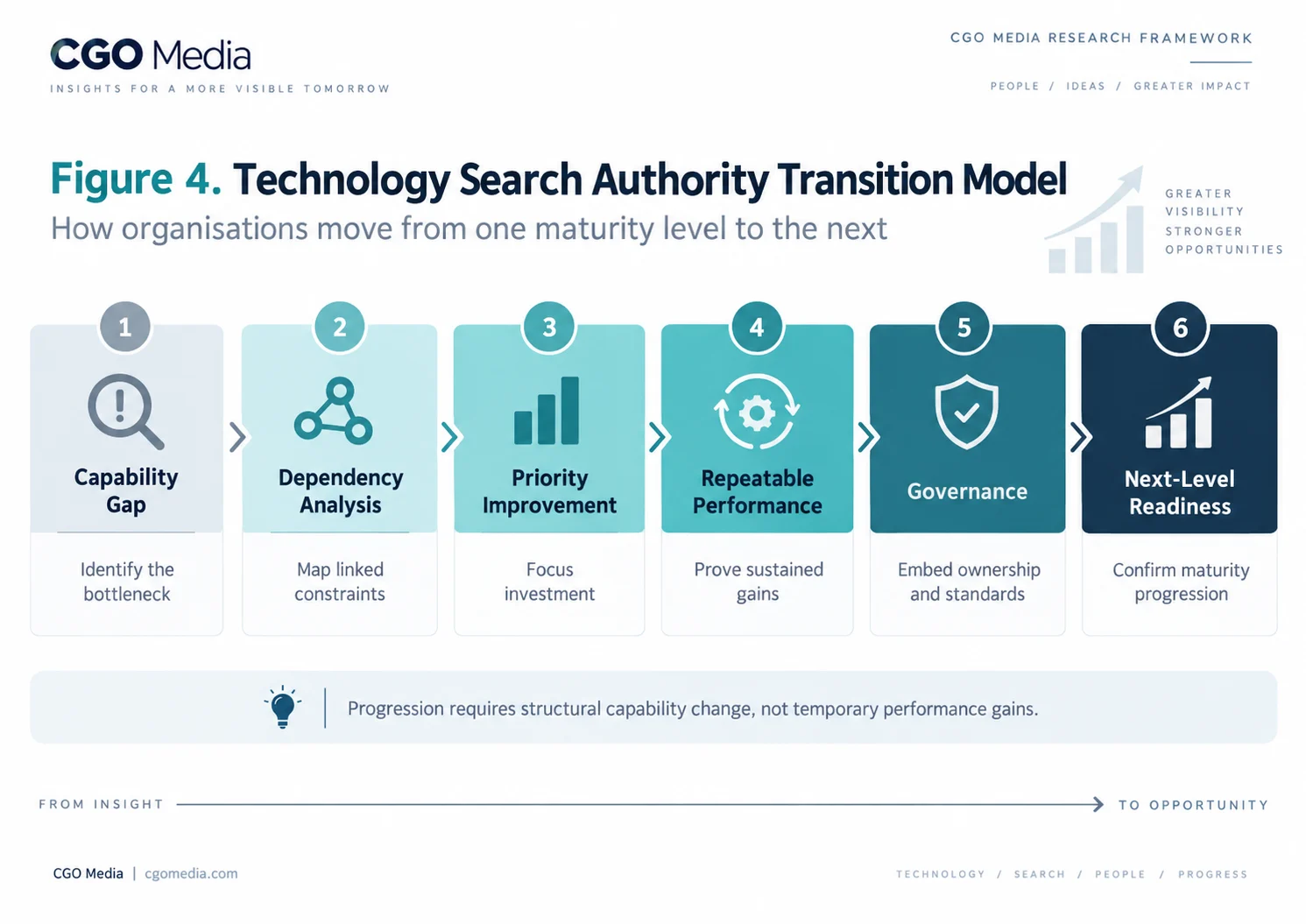
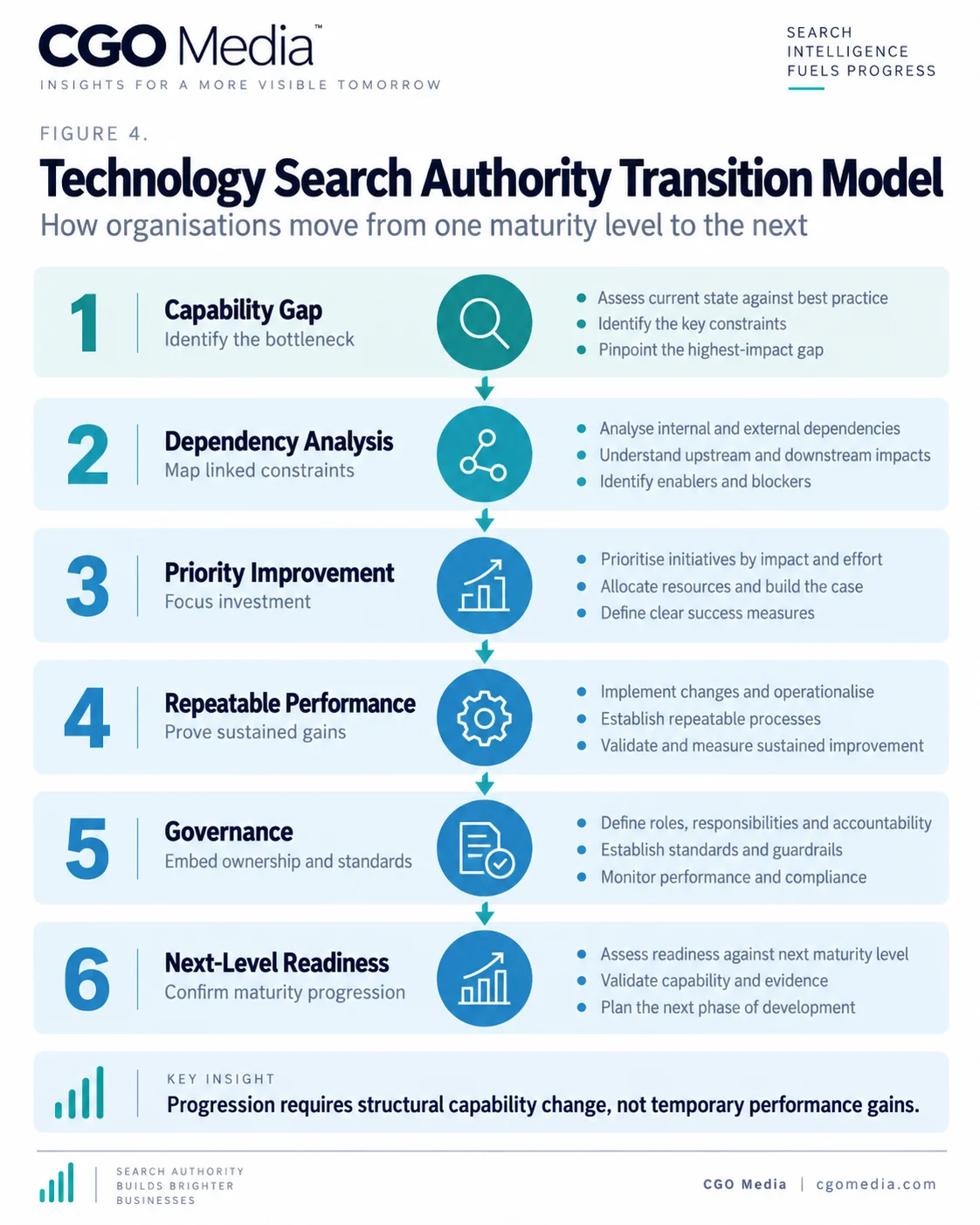
276. Maturity Should Be Measured Over Time
A maturity assessment provides a snapshot of current capability, but technology search authority is dynamic.
Capability can:
- Improve
- Stagnate
- Deteriorate
as products, people, platforms, search systems, external authority and organisational priorities change.
Maturity should therefore be measured longitudinally rather than through isolated assessments.
277. Current Maturity Is Only the Starting Point
The organisation should understand where it currently sits across each authority dimension.
However, current maturity alone does not explain:
- Where the organisation needs to reach
- Whether capability is improving
- Whether deterioration is occurring
- Which risks require intervention
A stronger management model combines current state with direction and strategic requirement.
278. Target Maturity Should Reflect Business Strategy
Not every technology organisation requires Leading-level capability across every dimension.
The appropriate target should depend on factors such as:
- Market position
- Buyer complexity
- Product risk
- Competitive intensity
- Geographic scope
- Growth strategy
Maturity should support business ambition rather than become an end in itself.
279. Different Business Models Require Different Maturity
A specialist technology consultancy may require a different authority profile from:
- An enterprise software platform
- A cybersecurity provider
- A developer tool
- A global cloud infrastructure company
The target maturity state should therefore reflect the demands of the market in which the organisation competes.
280. Moving Upmarket Can Increase Required Maturity
An organisation targeting larger enterprise buyers may require stronger:
- Technical evidence
- Security information
- Governance
- External authority
- Comparison readiness
The authority system must evolve as the commercial model becomes more complex.
281. International Expansion Can Increase Required Maturity
International growth can require stronger capabilities involving:
- International SEO
- Regional information governance
- Localised evidence
- Entity consistency
- Market-specific authority
An authority system that works effectively in one country may not automatically scale across several markets.
282. Category Expansion Can Increase Required Maturity
Entering a broader or more competitive technology category can require greater:
- Content depth
- Evidence quality
- External validation
- Research authority
Target maturity should therefore evolve alongside market ambition.
283. Maturity Trend Is Strategically Important
Two organisations can hold the same current maturity position while moving in very different directions.
One may be improving rapidly.
Another may be deteriorating.
A useful maturity view therefore includes:
Current Position + Direction of Travel
284. Trend Can Be Positive, Stable or Negative
A simple trend classification can be:
- Improving — capability is strengthening.
- Stable — capability remains broadly unchanged.
- Deteriorating — capability or governance is weakening.
This gives leadership a clearer understanding of authority momentum.
285. Improvement Velocity Can Also Be Measured
The speed at which important maturity gaps are being reduced can reveal execution capability.
A useful conceptual measure is:
Gap Reduction Over Time
High improvement velocity can indicate strong delivery, but speed should not replace quality or governance.
286. Rapid Improvement Without Governance Can Be Fragile
An organisation can improve quickly through:
- New content
- External campaigns
- Technical intervention
- Short-term AI monitoring
while failing to establish the processes required to preserve those gains.
Sustainable progress requires:
Improvement Velocity + Governance Stability
287. Maturity Can Deteriorate
Higher maturity should never be assumed to be permanent.
Deterioration can occur when:
- Key specialists leave
- Documentation becomes outdated
- Technical systems change
- External authority weakens
- AI representation changes
- Governance loses ownership
Maturity therefore requires maintenance as well as progression.
288. Technical Maturity Can Deteriorate
Technical deterioration can follow:
- Platform migrations
- Redesigns
- CMS changes
- Documentation-platform changes
- Uncontrolled releases
A previously mature technical environment can quickly develop serious visibility constraints when governance weakens.
289. Content Authority Can Deteriorate
Content authority can weaken when:
- Information becomes outdated
- Review processes stop
- Expert ownership disappears
- Competitors publish stronger evidence
Content volume can remain constant while authority quality declines.
290. Entity Maturity Can Deteriorate
Entity clarity can weaken following:
- Acquisitions
- Rebrands
- Product restructuring
- Product retirement
- Changes in expert ownership
Without lifecycle governance, a previously coherent knowledge environment can become fragmented again.
291. External Authority Can Deteriorate
Authority may weaken because:
- External citations disappear
- Research becomes dated
- Customer evidence becomes less representative
- Competitors gain stronger recognition
External authority therefore requires ongoing development rather than one-time acquisition.
292. AI Visibility Can Deteriorate
A provider that previously appeared accurately within AI-assisted discovery can later experience:
- Reduced inclusion
- Changed competitive framing
- New misinformation
- Weaker recommendation fit
Longitudinal monitoring is therefore necessary even after strong visibility has been achieved.
293. Governance Deterioration Is Particularly Important
Governance weakness can eventually affect every other authority dimension.
Common warning signs include:
- Unclear ownership
- Missed reviews
- Undocumented processes
- Slow escalation
- Loss of specialist knowledge
A decline in governance can precede visible performance deterioration.
294. Maturity Confidence Should Be Reported
Assessment confidence should remain visible alongside the maturity score.
A capability may appear Advanced while the available evidence is incomplete.
A practical confidence classification is:
- High
- Moderate
- Low
This helps leadership distinguish strong conclusions from areas requiring additional evidence.
295. Low-Confidence Scores Should Trigger Better Evidence Collection
Where assessment confidence is weak, the organisation should identify what additional evidence is required.
This may include:
- Technical data
- Content audits
- AI observations
- External authority evidence
- Sales or customer data
The objective is to improve the quality of future maturity decisions.
296. Critical Risk Should Sit Outside the Average Score
Some weaknesses deserve immediate executive attention regardless of overall maturity.
Examples include:
- Major indexation failure
- Security misinformation
- Material compliance errors
- Severe entity ambiguity
These should not disappear inside an otherwise strong average maturity profile.
297. Critical Risk Can Override Normal Prioritisation
A smaller numerical gap can deserve immediate action where the potential consequences are severe.
This means maturity planning should separate:
- Critical Risk Remediation
- Strategic Maturity Development
The two streams can operate in parallel.
298. Critical Risk Remediation Protects the Existing Authority System
This stream addresses immediate threats to:
- Visibility
- Trust
- Buyer confidence
- Commercial performance
The priority is stabilisation.
299. Strategic Maturity Development Builds Future Capability
This stream focuses on longer-term improvements such as:
- Research authority
- AI monitoring maturity
- International governance
- Category influence
- Institutional learning
The objective is progression rather than emergency remediation.
300. Resilience Becomes More Important at Higher Maturity
As search and AI authority becomes more strategically important, loss of that authority can create greater organisational risk.
Higher maturity should therefore include resilience as well as performance.
Resilience can be understood as the ability to:
Detect → Respond → Recover → Learn
301. Resilience Requires Monitoring
The organisation should be able to detect deterioration across:
- Technical health
- Content freshness
- Entity consistency
- External authority
- AI visibility
Early detection reduces the period during which problems can affect buyers and search systems.
302. Resilience Requires Documentation
Important processes should remain understandable when:
- Employees leave
- Agencies change
- Teams reorganise
- Products move between business units
Documentation helps preserve organisational knowledge and continuity.
303. Resilience Requires Redundancy
Technology search authority should not depend excessively on one:
- Person
- Platform
- Publication
- Technology
- Data source
Single-point dependence increases vulnerability to operational or market change.
304. People Redundancy Protects Institutional Knowledge
Critical authority knowledge should not reside entirely with one employee, consultant or agency.
Important processes should be supported through:
- Documentation
- Training
- Shared standards
- Defined ownership
305. Platform Redundancy Protects Discovery
An organisation dependent almost entirely on one search, media or AI environment can become vulnerable to external change.
A more resilient authority system can distribute discovery across:
- Organic search
- Research
- Industry media
- Customer advocacy
- AI-assisted discovery
306. External Authority Redundancy Protects Trust
Authority should not rely on one publication, review platform or partner relationship.
Diverse credible external references create a stronger and more durable trust environment.
307. Recovery Processes Reduce Authority Downtime
Mature organisations should know how to respond when important visibility or trust deteriorates.
A practical recovery process is:
Detect → Diagnose → Decide → Correct → Validate → Learn
308. Detect
The organisation identifies a material change affecting:
- Search visibility
- Information quality
- Entity accuracy
- External authority
- AI representation
Detection should distinguish serious change from normal fluctuation.
309. Diagnose
The organisation determines the likely root cause.
The problem may involve:
- Technical failure
- Content decay
- Product change
- Entity ambiguity
- Authority loss
- Competitive change
Diagnosis should precede correction.
310. Decide
The organisation selects the appropriate response according to:
- Severity
- Buyer impact
- Risk
- Strategic importance
This prevents low-impact issues from displacing critical recovery work.
311. Correct
The required intervention may involve:
- Engineering
- Content
- Documentation
- Entity governance
- External communication
- Product correction
The corrective action should match the root cause.
312. Validate
The organisation confirms whether the correction produced the intended change.
Validation can include:
- Technical checks
- Search re-evaluation
- AI retesting
- Content review
- Sales feedback
313. Learn
The organisation updates:
- Standards
- Processes
- Documentation
- Monitoring
- Training
The objective is to reduce the probability that the same failure occurs again.
314. Recovery Speed Can Be Measured
Useful operational indicators include:
- Detection time
- Diagnosis time
- Correction time
- Validation time
These measures help determine how effectively the organisation responds when authority deteriorates.
315. Faster Detection Reduces Exposure
The earlier a problem is identified, the less time inaccurate or inaccessible information remains visible to buyers, search systems and AI platforms.
316. Faster Diagnosis Reduces Wasted Effort
Correct diagnosis reduces the risk of teams:
- Changing the wrong pages
- Launching unnecessary campaigns
- Applying technical fixes to non-technical problems
Recovery quality depends on identifying the actual cause.
317. Faster Correction Reduces Commercial Risk
Material problems involving visibility, security information, product identity or technical availability can affect qualified demand.
Efficient correction reduces the duration of that risk.
318. Faster Validation Improves Learning
Rapid validation helps teams determine whether the intervention actually worked.
Successful responses can then become part of organisational standards and recovery playbooks.
319. Mature Organisations Should Learn Institutionally
Repeated problems should not be solved repeatedly from first principles.
Learning should improve:
- Technical standards
- Content governance
- Entity governance
- Evidence governance
- AI monitoring
This converts incidents into stronger organisational capability.
320. Repeated Technical Problems Should Improve Technical Standards
Recurring technical failures can result in stronger:
- Release checklists
- Migration controls
- Platform requirements
- Monitoring rules
The process should become more resistant to known failure modes.
321. Repeated Content Problems Should Improve Content Governance
Recurring information-quality problems can lead to stronger:
- Review schedules
- Ownership
- Fact validation
- Deprecation rules
322. Repeated Entity Problems Should Improve Identity Governance
Recurring entity ambiguity can result in stronger controls around:
- Product naming
- Brand relationships
- Expert identity
- Lifecycle handling
323. Repeated Evidence Problems Should Improve Claim Governance
Important claims can receive:
- Named owners
- Approved evidence
- Review dates
- Risk classification
This reduces the probability of unsupported or outdated claims reappearing.
324. Repeated AI Visibility Problems Should Improve Monitoring Standards
The organisation can strengthen:
- Scenario libraries
- Accuracy checks
- Escalation rules
- Competitive observation
AI monitoring becomes more systematic as the organisation learns from repeated patterns.
325. Institutional Learning Should Be Documented
Important knowledge should not remain only within:
- Meetings
- Individual employees
- External agencies
Institutional learning can be retained through:
- Standards
- Playbooks
- Templates
- Training
- Governance procedures
326. Maturity Should Support Organisational Scale
Authority systems should remain effective as the organisation adds:
- Products
- Markets
- Languages
- Teams
- Acquisitions
A process that works for one product may not remain effective across a large portfolio.
327. Shared Standards Become More Important at Scale
Multi-product organisations can establish common standards for:
- Entity naming
- Content quality
- Technical SEO
- Evidence management
- AI monitoring
The governing principle is:
Common Standards + Local Relevance + Clear Ownership
328. International Maturity Requires Consistency and Localisation
International organisations may need to manage differences involving:
- Language
- Regional product availability
- Local regulation
- Market-specific evidence
- Support coverage
Core product truth should remain coherent while buyer context and supporting evidence adapt to the local market.
329. Executive Maturity Reporting Should Remain Compact
Leadership does not need every underlying maturity observation in routine reporting.
A practical executive view can focus on six elements:
- Current Maturity
- Target Maturity
- Trend
- Confidence
- Critical Risk
- Priority
This gives leadership both the current position and the action required.
330. Current Maturity
Shows the organisation’s present capability position across the authority system.
Dimension-level detail should remain available beneath the executive view.
331. Target Maturity
Defines the level of capability required to support the organisation’s strategic direction.
The target should reflect business need rather than an assumption that every organisation must reach the highest level.
332. Trend
Shows whether maturity is:
- Improving
- Stable
- Deteriorating
Trend prevents static scores from hiding a weakening authority system.
333. Confidence
Indicates how strongly available evidence supports the maturity assessment.
Low-confidence areas can then be prioritised for better evidence collection before major strategic decisions are made.
334. Critical Risk
Highlights severe weaknesses that require attention regardless of average maturity.
Critical risk should remain visible at executive level rather than being absorbed into a composite score.
335. Priority
Identifies the principal capability bottleneck or intervention requiring leadership attention.
This converts the maturity model from reporting into strategic management.
336. The Seventeenth Technology Search Authority Maturity Principle
Technology search authority maturity should be measured longitudinally because capability can improve, stagnate or deteriorate as technology platforms, information, external authority and organisational ownership change over time.
337. The Eighteenth Technology Search Authority Maturity Principle
Maturity assessment should combine capability, performance, governance, risk and resilience so temporary outcomes are not mistaken for durable organisational authority.
338. The Nineteenth Technology Search Authority Maturity Principle
Executive maturity reporting should separate critical risk and the primary capability bottleneck from average scores so leadership can see where the authority system is most constrained.
339. The Twentieth Technology Search Authority Maturity Principle
Target maturity should be aligned with business strategy because different markets, buyer segments, product models and expansion goals require different levels of technical, evidence, authority and governance capability.
340. The Technology Search Authority Measurement Model
The executive relationship can be summarised as:
Current Maturity + Target Maturity + Trend + Confidence + Critical Risk + Priority
Current Maturity
Establishes the organisation’s present authority capability across the seven maturity dimensions.
Target Maturity
Defines the level of capability required to support the organisation’s products, markets, buyers and strategic ambitions.
Trend
Shows whether the authority system is improving, remaining stable or deteriorating over time.
Confidence
Indicates the strength of evidence supporting the maturity assessment and highlights areas where additional measurement may be required.
Critical Risk
Surfaces serious technical, information, evidence or governance weaknesses that require action regardless of average maturity.
Priority
Identifies the capability bottleneck most likely to constrain future search, AI and commercial authority.
The strategic implication is that Technology Search Authority maturity should be managed as an ongoing executive process rather than a one-time assessment. The organisation should compare current capability with its strategic target, monitor improvement or deterioration, preserve visibility of critical risks and focus investment on the capability most likely to limit future authority.
Figure 5 : Technology Search Authority Measurement Model — Current Maturity + Target Maturity + Trend + Confidence + Critical Risk + Priority.
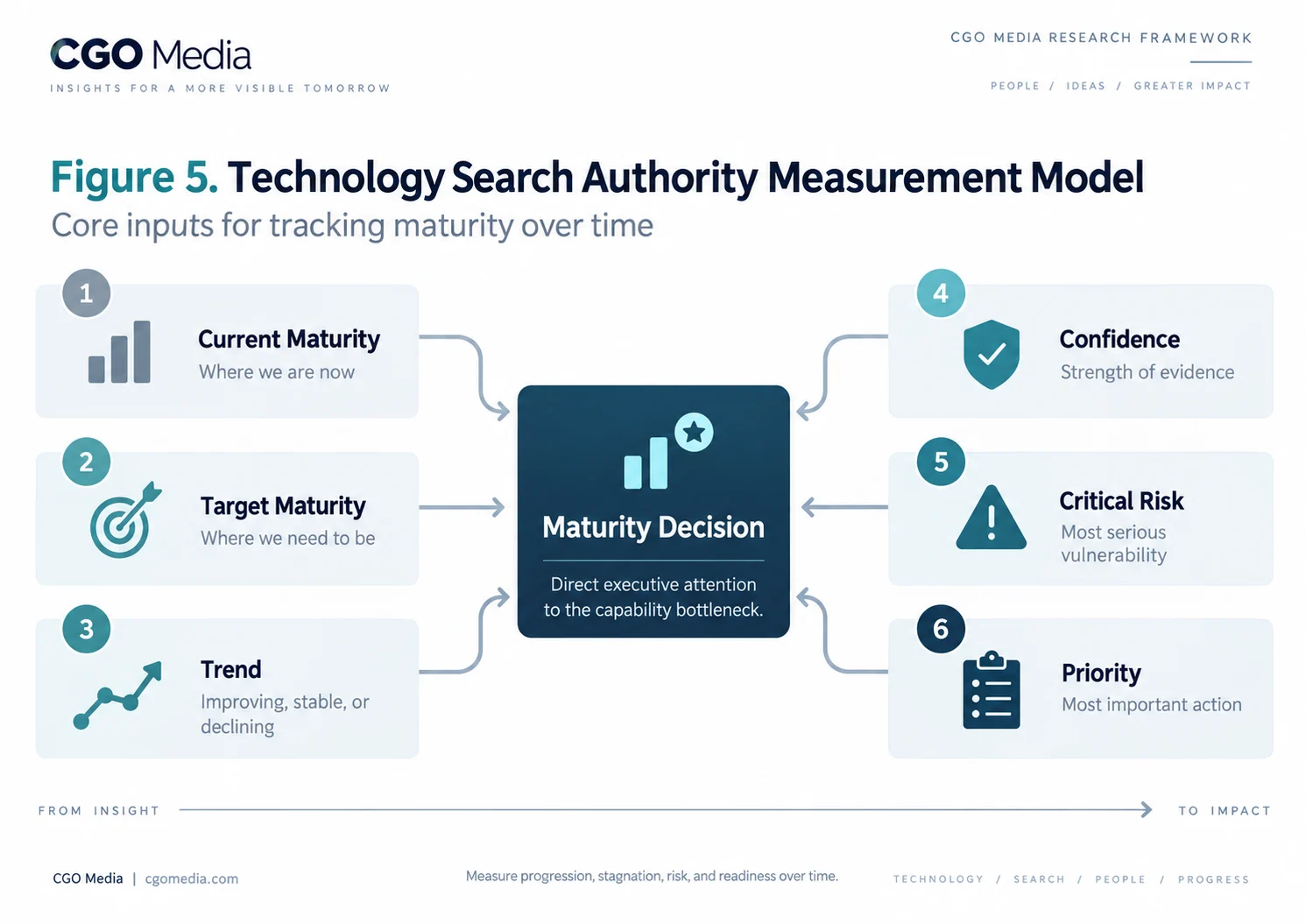
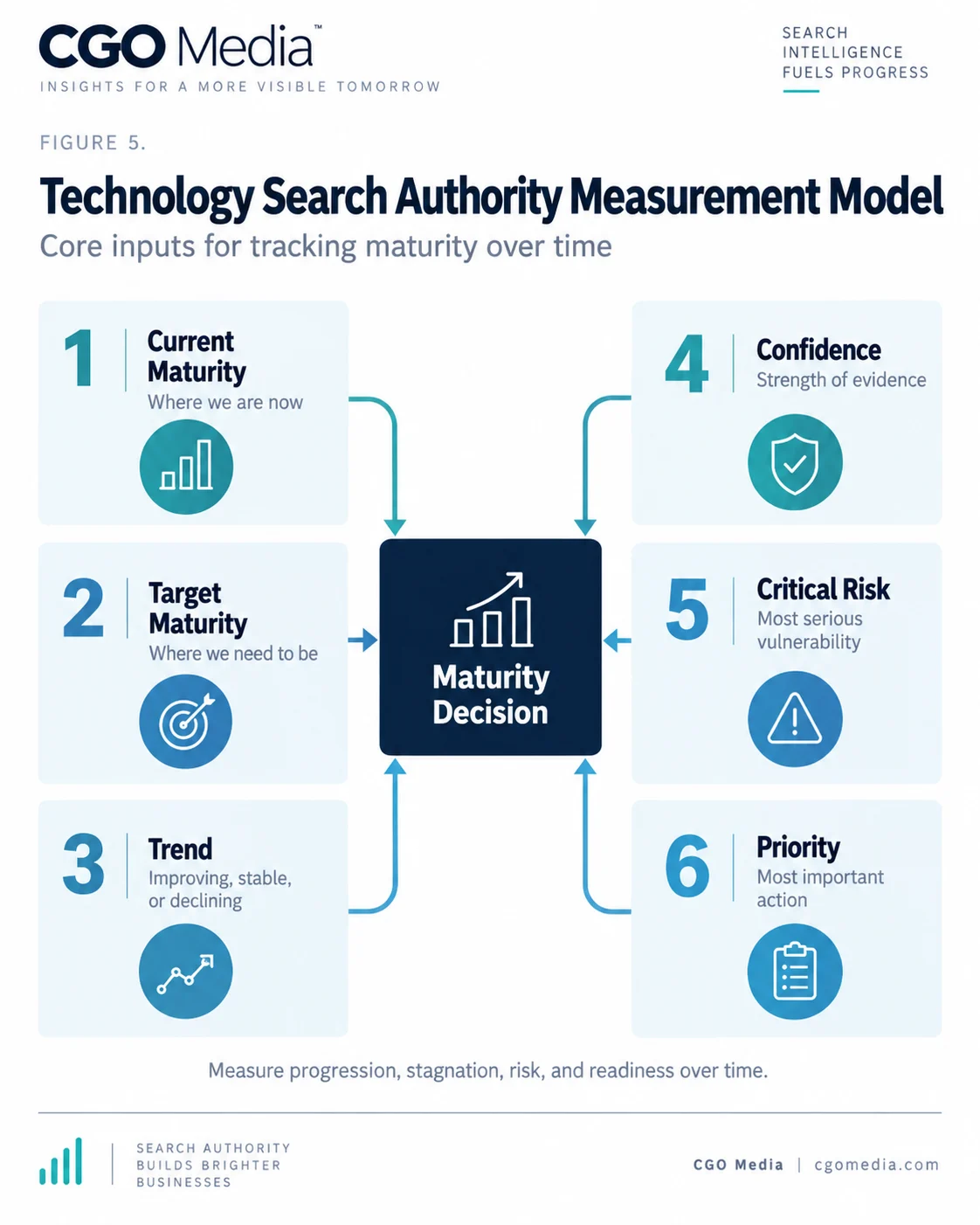
341. Search Authority Maturity Requires Continuous Improvement
Technology search authority should not be treated as a project with a fixed completion point.
Products change, markets evolve, competitors strengthen, search systems change and AI-assisted discovery develops continuously.
Maturity should therefore operate as a recurring cycle:
Assess → Diagnose → Prioritise → Improve → Validate → Learn → Reassess
342. Assess
The organisation begins by establishing its current maturity position across the seven authority dimensions:
- Technical Foundation
- Content Authority
- Entity & Knowledge Architecture
- Evidence & Trust
- External Authority
- AI Visibility
- Measurement & Governance
The assessment should reflect current evidence rather than historical assumptions.
343. Diagnose
The organisation identifies the capability currently constraining progression.
The weakness may involve:
- Technical accessibility
- Content coverage
- Entity ambiguity
- Insufficient evidence
- Weak external authority
- Poor AI representation
- Weak governance
The objective is to identify the underlying cause rather than only its visible symptoms.
344. Prioritise
Not every weakness should receive equal investment.
Priority can be determined through:
Business Impact + Dependency + Risk + Strategic Importance
This concentrates resources on the capability gap most likely to improve the wider authority system.
345. Critical Risk Can Override Normal Prioritisation
Some problems require immediate attention even where they are not the largest numerical maturity gap.
Examples can include:
- Major indexation failure
- Security misinformation
- Severe product-entity ambiguity
- Material compliance errors
These issues can affect visibility, trust and commercial confidence directly.
346. Improvement Programmes Can Operate in Two Streams
A practical structure separates:
- Critical Risk Remediation
- Strategic Maturity Development
Critical remediation protects the existing authority system.
Maturity development builds longer-term capability.
347. Improve
The organisation implements the capability change required to address the priority gap.
Improvement may involve:
- Engineering
- Content
- Documentation
- Entity architecture
- Research
- Digital PR
- AI monitoring
- Governance
The intervention should match the diagnosis.
348. Validate
Completed activity does not automatically represent maturity improvement.
The organisation should determine whether the intervention produced a material and repeatable change.
Validation can ask:
- Did the capability actually improve?
- Did the bottleneck reduce?
- Can the improvement be repeated?
- Is ownership clear?
- Is the result governed?
349. Learn
Successful and unsuccessful interventions should create organisational knowledge.
Lessons can be converted into:
- Standards
- Playbooks
- Templates
- Training
- Governance
The objective is to improve future decisions rather than repeatedly solve the same problems from first principles.
350. Reassess
After improvement has been validated, the organisation should reassess the maturity profile.
The previous bottleneck may no longer be the primary constraint.
A different capability may now limit progression.
This creates a continuous improvement system rather than a one-time maturity exercise.
351. Continuous Improvement Should Be Bottleneck-Led
Resources should not be distributed evenly across every authority capability.
A more effective approach is:
Find the Constraint → Improve the Constraint → Validate → Find the Next Constraint
This focuses organisational effort where it can create the greatest system-wide improvement.
352. Authority Resilience Becomes More Important at Higher Maturity
As search and AI authority becomes more strategically valuable, loss of that authority creates greater organisational risk.
Mature organisations should therefore design resilience into the system.
Resilience can include:
- Monitoring
- Documentation
- Redundancy
- Recovery processes
- Knowledge retention
353. Monitoring Supports Early Detection
The organisation should be able to detect deterioration across:
- Technical health
- Content freshness
- Entity consistency
- External authority
- AI visibility
Early detection can reduce the duration and impact of authority loss.
354. Documentation Supports Continuity
Important authority processes should remain understandable when:
- Employees leave
- Agencies change
- Teams reorganise
- Products move between business units
Documented standards reduce dependence on individual knowledge.
355. Redundancy Reduces Single-Point Dependence
Technology search authority should not depend excessively on one:
- Person
- Platform
- Publication
- Technology
- Data source
Distributed capability improves resilience when one dependency changes or disappears.
356. Recovery Capability Is Part of Mature Authority
Even strong authority systems will experience failures.
The important question is how effectively the organisation can respond.
A practical recovery cycle is:
Detect → Diagnose → Decide → Correct → Validate → Learn
357. Recovery Speed Can Be Measured
Useful indicators include:
- Detection time
- Diagnosis time
- Correction time
- Validation time
These measures help determine whether the organisation is becoming more resilient as maturity increases.
358. Recovery Should Strengthen Future Governance
Every significant failure should create a governance question:
What should change so that this problem is detected earlier, corrected faster or prevented next time?
The answer may involve:
- Monitoring
- Documentation
- Ownership
- Release controls
- Training
359. Organisational Learning Should Be Cumulative
Mature organisations preserve the lessons created by:
- Technical incidents
- Content failures
- Entity problems
- Authority decline
- AI misinformation
This allows maturity to become institutional rather than dependent on individual memory.
360. Scaling Requires Central Governance with Contextual Adaptation
A useful relationship is:
Common Standards + Local Relevance + Clear Ownership
Central standards can govern:
- Technical requirements
- Entity principles
- Evidence standards
- Measurement definitions
Local teams can adapt implementation to different products, markets and buyer contexts.
361. International Scaling Requires Additional Maturity
International organisations may need to manage:
- Language
- Regional product availability
- Local regulation
- Market-specific evidence
- Support differences
The authority system must remain coherent even as local market conditions differ.
362. International Consistency Should Focus on Product Truth
Core information should remain coherent across markets.
This can include:
- Product identity
- Capabilities
- Architecture
- Integrations
- Security controls
Market adaptation should not create contradictory technical truth.
363. International Relevance Should Focus on Buyer Context
Different markets may require different:
- Examples
- Evidence
- Terminology
- Commercial information
Mature international authority balances global consistency with local relevance.
364. Category Change Can Affect Maturity
Technology markets evolve continuously.
Categories can:
- Appear
- Merge
- Split
- Change terminology
A mature authority system should detect these changes rather than remain locked to an outdated market structure.
365. Category Change Should Be Monitored
Signals can come from:
- Search behaviour
- Sales conversations
- AI recommendations
- Technical media
- Research
Persistent signals can indicate that the organisation needs to revisit how it describes the market.
366. Category Change Can Require Architecture Change
The organisation may need to update:
- Taxonomy
- Content architecture
- Product positioning
- Entity relationships
This prevents authority architecture from becoming disconnected from the market buyers actually recognise.
367. Adaptive Authority Is the Highest Maturity Capability
Adaptive authority combines:
- Strong foundations
- Continuous monitoring
- Fast recovery
- Institutional learning
- Strategic adaptation
The organisation becomes capable of evolving without losing the coherence of its underlying authority system.
368. Adaptive Authority Does Not Mean Constant Tactical Change
A mature organisation should not react to every:
- Ranking movement
- AI response
- Competitive publication
- Short-term market fluctuation
Constant tactical reaction can create instability rather than maturity.
369. Core Principles Should Remain Stable
Stable authority principles include:
- Technical accessibility
- Clear identity
- Useful information
- Strong evidence
- Relevant authority
- Buyer fit
Tactics can change around these principles as markets and technologies evolve.
370. Mature Organisations Should Experiment Deliberately
Experiments can test improvements involving:
- Architecture
- Evidence
- Content
- Authority
- AI visibility
Experimentation should strengthen organisational learning rather than create uncontrolled tactical change.
371. Experiments Should Begin with a Hypothesis
A useful experiment defines the expected relationship between intervention and outcome.
For example:
Improving technical deployment evidence will strengthen qualified visibility within enterprise infrastructure evaluation scenarios.
372. Experiments Should Record a Baseline
Teams should understand the starting position before changing the authority system.
The baseline can include:
- Visibility
- Evidence coverage
- AI representation
- Qualified commercial engagement
373. Experiments Need Defined Success Criteria
Success measures can include:
- Visibility improvement
- Evidence usage
- Recommendation improvement
- Commercial progression
The criteria should reflect the purpose of the intervention.
374. Observation Windows Should Be Appropriate
Not every authority improvement creates immediate measurable results.
The observation period should reflect the type of change being evaluated rather than forcing every experiment into the same timeframe.
375. Confounding Factors Should Be Recorded
Relevant external changes can include:
- Search algorithm changes
- AI model changes
- Competitor activity
- Product launches
- Media events
These factors can affect interpretation of the experiment.
376. Negative Results Should Be Preserved
An experiment that does not produce the expected result still creates useful knowledge.
Negative findings can help prevent repeated investment in ineffective interventions.
377. Search Authority Learning Should Be Cumulative
Each experiment should improve future:
- Diagnosis
- Prioritisation
- Standards
- Decision-making
This turns experimentation into a long-term maturity capability.
378. Commercial Learning Should Inform Maturity
Search authority should not operate independently from sales and customer outcomes.
Commercial intelligence can reveal whether the authority system is attracting buyers with genuine product fit.
379. Sales Intelligence Can Reveal Authority Gaps
Buyers may repeatedly identify:
- Missing evidence
- Weak differentiation
- Competitor strengths
- Trust concerns
These observations can reveal weaknesses not immediately visible within search data.
380. Win/Loss Analysis Can Inform Maturity Priorities
Repeated commercial patterns can influence future:
- Content
- Evidence
- Product positioning
- Authority development
Mature search systems learn from buyer decisions rather than operating separately from them.
381. Customer Success Tests Buyer Fit
A mature authority system should attract buyers for whom the technology can genuinely create value.
Strong-fit customers are more likely to generate:
- Positive outcomes
- Case studies
- Advocacy
- References
382. Customer Outcomes Can Reinforce Future Authority
A long-term reinforcement loop is:
Qualified Discovery → Strong Fit → Successful Outcome → Stronger Evidence → Greater Authority → Better Future Discovery
This connects authority development directly with real-world customer success.
383. Commercial Maturity Requires Qualified Visibility
A technically mature search system that attracts poorly matched buyers is not fully mature commercially.
Leading organisations aim to become highly visible where:
- Buyer needs are relevant
- Product capability is strong
- Evidence is sufficient
- Successful outcomes are realistic
384. Authority Should Be Resilient Across Discovery Channels
Leading organisations avoid excessive dependence on:
- One search engine
- One AI assistant
- One publication
- One comparison platform
Discovery diversity protects authority from changes outside the organisation’s control.
385. Distributed Authority Supports Long-Term Stability
Relevant visibility can exist across:
- Search
- AI
- Research
- Media
- Professional networks
- Customer advocacy
This creates a more resilient discovery ecosystem.
386. Distributed Authority Must Remain Coherent
Diversity without consistency can create confusion.
External and owned environments should continue to reflect materially consistent:
- Product identity
- Capabilities
- Positioning
- Core evidence
387. Authority Resilience Requires Diversity and Coherence
A useful model is:
Relevant Authority Diversity + Consistent Product Truth + Strong Governance
This combines broad discovery with stable interpretation.
388. Strategic Recommendation One — Establish the Maturity Baseline
Assess all seven authority dimensions before defining major improvement programmes.
389. Strategic Recommendation Two — Define the Target State
Set maturity targets according to business strategy, buyer complexity, market ambition and risk.
390. Strategic Recommendation Three — Identify the Primary Bottleneck
Find the capability currently limiting system-wide progression.
391. Strategic Recommendation Four — Separate Critical Risk from Development Work
Resolve severe visibility, trust or governance failures immediately while continuing longer-term maturity development.
392. Strategic Recommendation Five — Build Repeatable Processes
Replace one-off optimisation with standards capable of operating repeatedly across products, teams and markets.
393. Strategic Recommendation Six — Assign Capability Ownership
Create accountable ownership for areas including:
- Technical health
- Content authority
- Entity architecture
- Evidence governance
- AI visibility
394. Strategic Recommendation Seven — Document Standards
Reduce dependence on individual knowledge by documenting the processes required to maintain authority quality.
395. Strategic Recommendation Eight — Build Recovery Capability
Reduce:
- Detection time
- Diagnosis time
- Correction time
- Validation time
when material authority failures occur.
396. Strategic Recommendation Nine — Connect Authority to Sales Intelligence
Use recurring buyer objections, competitor comparisons and win/loss evidence to improve maturity priorities.
397. Strategic Recommendation Ten — Connect Authority to Customer Outcomes
Use post-selection performance to determine whether discovery is attracting genuinely suitable buyers.
398. Strategic Recommendation Eleven — Diversify External Authority
Reduce concentration risk across publications, platforms, communities and other authority environments.
399. Strategic Recommendation Twelve — Monitor Category Change
Adapt taxonomy, content and positioning where sustained market evidence indicates that the technology category itself has changed.
400. Strategic Recommendation Thirteen — Build International Governance
Maintain global product coherence while allowing evidence and buyer communication to remain locally relevant.
401. Strategic Recommendation Fourteen — Experiment Systematically
Use hypotheses, baselines, success criteria and validation rather than uncontrolled tactical experimentation.
402. Strategic Recommendation Fifteen — Preserve Organisational Learning
Convert repeated findings into standards, documentation and training so maturity becomes institutional.
403. Strategic Recommendation Sixteen — Build Adaptive Authority
Treat search authority as a permanent organisational capability capable of evolving with markets, search systems and AI-assisted discovery environments.
404. The Twenty-First Technology Search Authority Maturity Principle
Search authority maturity should be continuously managed because technical infrastructure, information quality, entity clarity, external authority and AI representation can all deteriorate over time.
405. The Twenty-Second Technology Search Authority Maturity Principle
Resilience should be treated as part of maturity, requiring monitoring, documentation, recovery processes and institutional learning rather than assuming that established authority will remain stable indefinitely.
406. The Twenty-Third Technology Search Authority Maturity Principle
Leading search authority should connect visibility with commercial and customer outcomes so the organisation becomes more discoverable by buyers for whom it can genuinely create strong long-term value.
407. The Twenty-Fourth Technology Search Authority Maturity Principle
The highest maturity state is adaptive authority, where stable principles, continuous monitoring, systematic experimentation and organisational learning allow the authority system to evolve without losing coherence.
408. The Continuous Technology Search Authority Maturity Cycle
The operational cycle can be summarised as:
Assess → Diagnose → Prioritise → Improve → Validate → Learn → Reassess
Assess
Measure the current maturity position across the seven technology authority dimensions.
Diagnose
Identify the capability bottleneck or critical risk preventing stronger authority performance.
Prioritise
Direct investment according to business impact, dependency, risk and strategic importance.
Improve
Implement the capability change required to address the identified weakness.
Validate
Determine whether the intervention produced a material, repeatable and governed improvement.
Learn
Convert successful and unsuccessful outcomes into organisational standards, processes and knowledge.
Reassess
Review the authority system again and identify the next capability requiring attention.
409. The Long-Term Technology Search Authority Model
The strategic relationship can be summarised as:
Strong Foundations → Clear Entities → Useful Content → Strong Evidence → External Authority → Qualified AI Visibility → Governance → Adaptive Authority
Strong Foundations
Reliable technical infrastructure allows important information to remain accessible and discoverable.
Clear Entities
Organisations, products, services, experts and research assets are represented consistently and coherently.
Useful Content
Information supports buyer discovery, technical understanding, evaluation and comparison.
Strong Evidence
Important claims are supported through technical, customer, security and research evidence.
External Authority
Independent sources reinforce expertise, product capability and market relevance.
Qualified AI Visibility
The organisation appears accurately and appropriately within relevant AI-assisted discovery, comparison and recommendation scenarios.
Governance
Ownership, review, monitoring, recovery and institutional learning protect authority over time.
Adaptive Authority
The organisation responds intelligently to changes in markets, products, search systems and AI discovery without losing the coherence of its underlying authority model.
410. The Strategic Implication
Technology organisations should treat search authority maturity as a continuous organisational capability rather than a fixed achievement.
The strongest systems repeatedly assess, improve and protect:
- Technical foundations
- Entity clarity
- Content authority
- Evidence quality
- External validation
- AI visibility
- Governance
The objective is not merely to achieve a high maturity label.
It is to build an authority system capable of remaining accurate, resilient, commercially relevant and adaptable as technology markets and digital discovery continue to evolve.
Figure 6 : Continuous Technology Search Authority Maturity Cycle — Assess → Diagnose → Prioritise → Improve → Validate → Learn → Reassess.
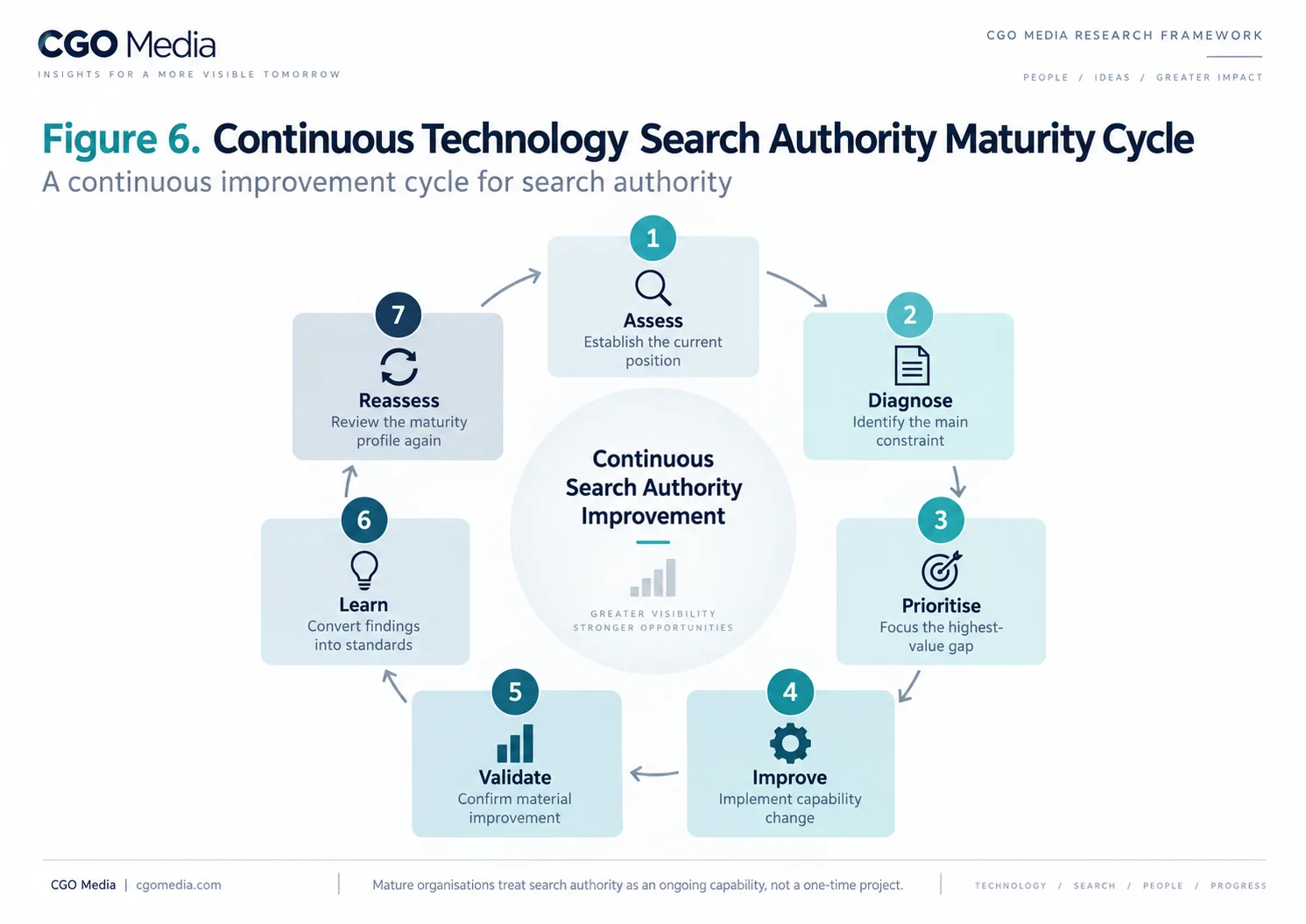
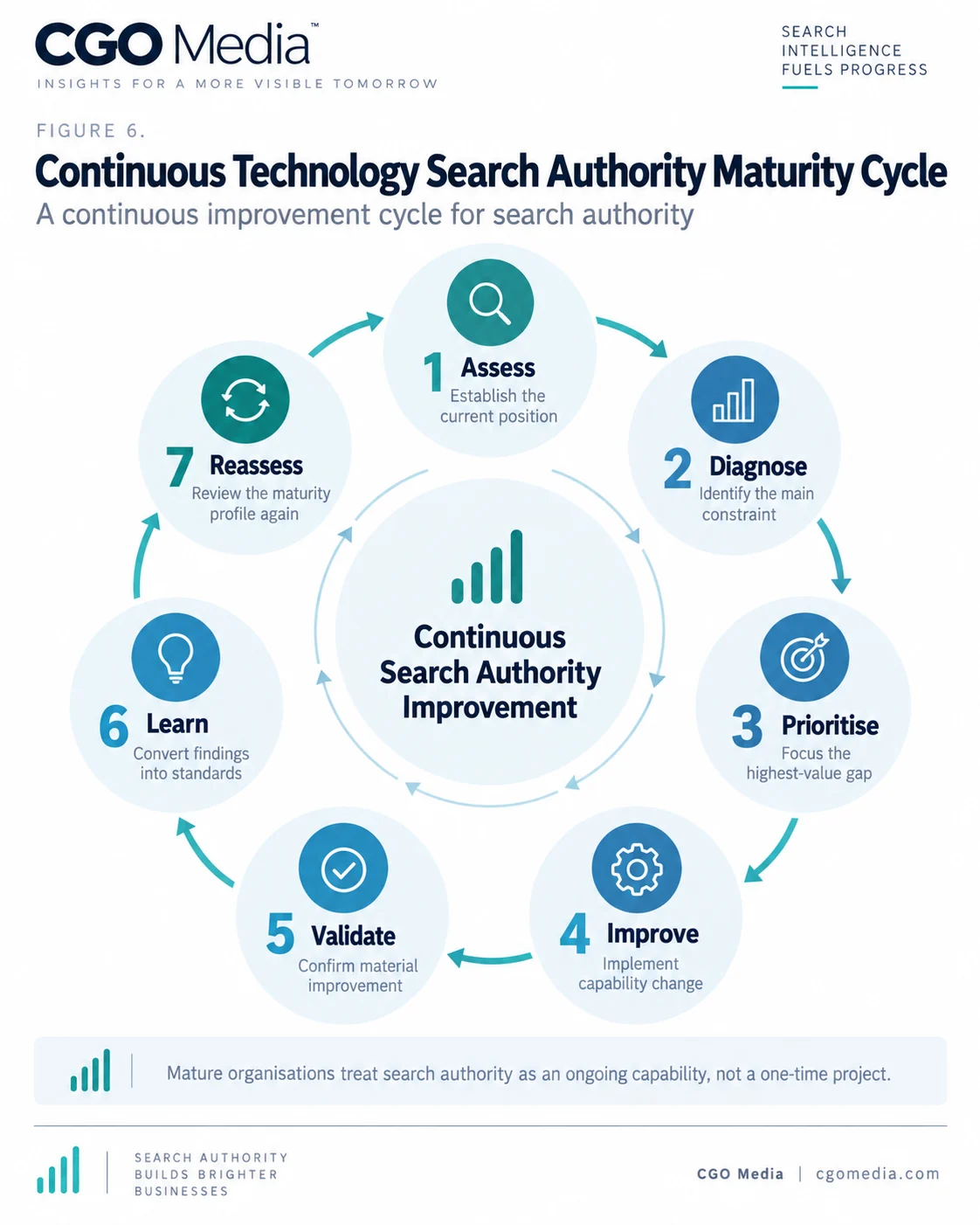
411. Methodology
The Technology Search Authority Maturity Model is a conceptual maturity framework developed by CGO Media to help technology organisations assess how effectively they build, manage and protect authority across conventional search, AI-assisted discovery and the wider digital information environment.
The model addresses a central organisational question:
How mature is the system responsible for making a technology organisation discoverable, understandable, verifiable, trusted and appropriately recommendable?
Research Scope
The model is designed for technology organisations including:
- Software companies
- SaaS providers
- Artificial intelligence companies
- Cloud and infrastructure providers
- Cybersecurity companies
- Data and analytics platforms
- Developer technology providers
- Enterprise technology organisations
- Technology consultancies
- Managed service providers
Five-Level Maturity Structure
The framework uses five primary maturity levels:
Foundation → Developing → Operational → Advanced → Leading
These levels represent increasing organisational capability rather than simple performance rankings.
Seven Authority Dimensions
Maturity is assessed across seven connected dimensions:
- Technical Foundation
- Content Authority
- Entity & Knowledge Architecture
- Evidence & Trust
- External Authority
- AI Visibility
- Measurement & Governance
The model treats these dimensions independently because technology organisations can display substantially different levels of maturity across them.
Capability Assessment
Each dimension is evaluated according to observable capabilities rather than output volume alone.
Assessment considers whether a capability is:
- Established
- Repeatable
- Measured
- Owned
- Governed
This helps distinguish temporary performance from durable organisational maturity.
Diagnostic Method
The diagnostic relationship is:
Dimension Assessment → Maturity Level → Critical Gap → Priority → Improvement Action → Reassessment
The purpose is not merely to assign a maturity level, but to identify the capability currently constraining progression.
Transition Method
Movement between maturity levels is assessed through:
Capability Gap → Dependency Analysis → Priority Improvement → Repeatable Performance → Governance → Next-Level Readiness
This reflects the principle that maturity progression requires structural capability change rather than temporary increases in rankings, traffic, coverage or AI mentions.
Measurement Method
Longitudinal maturity management combines:
Current Maturity + Target Maturity + Trend + Confidence + Critical Risk + Priority
This allows organisations to distinguish current state from strategic requirement and identify whether capability is improving, stable or deteriorating.
Continuous Improvement Method
The model is designed to operate continuously through:
Assess → Diagnose → Prioritise → Improve → Validate → Learn → Reassess
New evidence should therefore inform each subsequent maturity cycle.
Evidence Considered
Depending on the organisation and assessment scope, maturity evidence can include:
- Technical audits
- Search-performance data
- Content and documentation reviews
- Entity and knowledge architecture
- Customer evidence
- External citations and authority
- AI visibility observations
- Sales and commercial intelligence
- Governance documentation
Conceptual Nature of the Model
The Technology Search Authority Maturity Model is intended as a structured diagnostic and management framework.
It does not claim to reproduce proprietary search-engine algorithms, AI model internals or universal causal relationships between individual authority signals and visibility outcomes.
412. Limitations
The Technology Search Authority Maturity Model should be adapted to organisational context rather than applied as a universal scoring system.
Technology Organisations Differ
A global enterprise software provider, cybersecurity platform, developer tool and specialist technology consultancy can require substantially different levels of evidence, governance and external authority.
The appropriate maturity target should therefore reflect the organisation’s actual commercial and operational environment.
Maturity Is Multi-Dimensional
Organisations may operate at different maturity levels across different dimensions.
A single overall label can therefore conceal meaningful differences between technical, content, entity, evidence, external authority, AI and governance capabilities.
Scores Should Not Create False Precision
The five-level maturity structure is designed to support diagnosis and prioritisation.
It should not imply that complex organisational capability can always be represented precisely by one numerical score.
Assessment Quality Depends on Evidence Quality
Maturity conclusions become less reliable where:
- Technical data is incomplete
- Authority data is unavailable
- AI observations are inconsistent
- Governance processes are undocumented
Assessment confidence should therefore be considered alongside the maturity level.
Critical Weaknesses Can Distort Aggregate Scores
A simple average can conceal severe weaknesses.
For example, strong content and external authority cannot fully compensate for major technical accessibility problems or serious misinformation involving security or product identity.
Critical risk should therefore remain visible separately.
Maturity Can Deteriorate
A previously mature organisation can lose capability because of:
- Staff changes
- Platform migrations
- Outdated information
- Corporate restructuring
- Weakening external authority
- Reduced governance
Maturity should therefore be reassessed periodically.
Search Systems Change
Search-engine interfaces, ranking systems and AI-assisted search features can evolve.
Operational practices may therefore require revision even where the underlying maturity principles remain relevant.
AI Systems Differ
AI platforms can differ in:
- Models
- Retrieval systems
- Source environments
- Recommendation processes
- Interfaces
Observations from one system should not automatically be generalised to another.
AI Outputs Can Vary
Generated responses can change according to:
- Prompt
- Model
- Date
- Language
- Geography
- Available evidence
Individual responses should not be treated as stable measures of authority.
AI Visibility Is Not Equivalent to Authority
Frequent inclusion in generated answers does not necessarily indicate:
- Accuracy
- Buyer relevance
- Evidence strength
- Recommendation suitability
Qualified AI visibility should therefore be evaluated separately from raw presence.
External Authority Cannot Be Fully Controlled
Technology organisations cannot directly control independent:
- Media coverage
- Reviews
- Research citations
- Community discussion
- Third-party comparisons
The maturity model focuses on strengthening the underlying evidence and authority environment rather than guaranteeing particular external outcomes.
Business Strategy Influences Target Maturity
Not every organisation requires Leading-level capability across every dimension.
Target maturity should be aligned with:
- Market ambition
- Buyer complexity
- Commercial risk
- Competitive intensity
- International scope
Correlation Does Not Establish Causation
Higher maturity, stronger visibility, increased brand demand and improved commercial outcomes can occur together without proving that one directly caused another.
Additional analysis is required where causal conclusions are important.
413. Conclusion
The Technology Search Authority Maturity Model provides technology organisations with a structured method for understanding how search and AI authority develop from basic digital visibility into a mature, resilient and adaptive organisational capability.
The five maturity levels are:
Foundation → Developing → Operational → Advanced → Leading
Progression through these levels reflects increasing strength across:
- Technical infrastructure
- Content authority
- Entity and knowledge architecture
- Evidence and trust
- External authority
- AI visibility
- Measurement and governance
Foundation Establishes Basic Visibility
At Foundation level, authority remains fragmented and frequently dependent on branded demand, basic technical accessibility and reactive optimisation.
Developing Introduces Structure
At Developing level, organisations begin building connected topic architecture, clearer entities, stronger evidence, broader non-branded visibility and initial AI monitoring.
Operational Creates Repeatable Capability
At Operational level, search authority becomes part of normal organisational activity.
Technical management, content governance, evidence development, external authority and AI monitoring become more systematic.
Advanced Integrates Authority
At Advanced level, search, product, technical, evidence, research and external authority systems become increasingly integrated.
The organisation focuses more strongly on qualified visibility, information governance, external validation and commercial relevance.
Leading Creates Institutional Authority
At Leading level, the organisation increasingly contributes original:
- Research
- Data
- Technical analysis
- Frameworks
- Expert knowledge
It can become a reference source within its category rather than merely competing for visibility within information created by others.
Maturity Should Be Assessed Dimension by Dimension
The seven-dimensional capability model prevents one strong area from concealing weaknesses elsewhere.
The purpose is to identify the capability currently limiting the organisation’s broader authority system.
Maturity Progression Should Be Bottleneck-Led
A practical progression is:
Identify Constraint → Understand Dependency → Improve Capability → Validate → Govern → Reassess
This directs resources toward the part of the system most likely to unlock wider improvement.
Higher Maturity Requires Repeatability
Temporary performance should not independently determine maturity.
Capabilities should become:
- Established
- Repeatable
- Measured
- Owned
- Governed
Resilience Is Part of Maturity
A mature organisation should also be capable of responding when authority deteriorates.
The recovery relationship is:
Detect → Diagnose → Decide → Correct → Validate → Learn
Failures should strengthen future governance rather than simply trigger isolated repairs.
Target Maturity Should Reflect Strategy
The appropriate maturity state depends on:
- Products
- Markets
- Buyer risk
- Competition
- Growth ambitions
The objective is not to maximise a maturity score but to build the level of organisational capability required to support the business.
The Model Is Continuous
The complete maturity cycle is:
Assess → Diagnose → Prioritise → Improve → Validate → Learn → Reassess
Each cycle should improve both authority performance and the organisation’s ability to manage that authority.
Adaptive Authority Is the Long-Term State
The strategic progression can ultimately be understood as:
Foundation → Developing → Operational → Advanced → Leading → Adaptive Authority
Adaptive authority does not mean constant tactical change.
It means maintaining stable principles around:
- Technical accessibility
- Entity clarity
- Useful information
- Strong evidence
- Relevant external validation
- Buyer fit
while adapting implementation as technology markets, search systems, AI platforms and buyer behaviour evolve.
Final Strategic Position
Technology search authority should be treated as organisational infrastructure rather than a collection of disconnected SEO activities.
The strongest organisations will combine:
- Reliable technical foundations
- Clear entities
- Useful and distinctive content
- Decision-critical evidence
- Diversified external authority
- Qualified AI visibility
- Cross-functional governance
- Institutional learning
The objective is not simply to rank more often or appear more frequently in AI answers.
It is to build a durable authority system that enables appropriate buyers to discover the organisation, understand its technology, verify its claims, assess its suitability and make better-informed decisions.
References
External Academic, Technical and Search Sources
- Google Search Central. SEO Starter Guide.
- Google Search Central. Crawling and Indexing Overview.
- Google Search Central. Understand How Structured Data Works.
- Google Search Central. Tell Google About Localised Versions of Your Page.
- Schema.org. SoftwareApplication.
- Schema.org. TechArticle.
- Schema.org. Organization.
- W3C. Web Content Accessibility Guidelines (WCAG) 2.2.
- Hogan, A. et al. (2021). Knowledge Graphs. ACM Computing Surveys, 54(4).
- Metzger, M.J. (2007). Making Sense of Credibility on the Web: Models for Evaluating Online Information and Recommendations for Future Research. Journal of the American Society for Information Science and Technology, 58(13), 2078–2091.
- Ji, Z. et al. (2023). Survey of Hallucination in Natural Language Generation. ACM Computing Surveys, 55(12).
CGO Media Technology Research and Frameworks
- Wilkinson, R. (2026). Technology SEO in an AI Search Environment. CGO Media.
- Wilkinson, R. (2026). Technology AI Trust & Visibility Framework. CGO Media.
- Wilkinson, R. (2026). Technology Discovery & Provider Selection Model. CGO Media.
- Wilkinson, R. (2026). CGO AI Search Readiness Framework. CGO Media.
- Wilkinson, R. (2026). CGO Entity Authority Framework. CGO Media.
- Wilkinson, R. (2026). CGO Content Authority Framework. CGO Media.
- Wilkinson, R. (2026). CGO AI Citation Framework. CGO Media.
CGO Media Research Ecosystem
CGO Media Research Library | CGO Media Framework Library | CGO Media Research Architecture | CGO Media Research Observations Library | CGO Media Statistics Library
About Roger Wilkinson
Roger Wilkinson is an independent researcher, SEO practitioner and founder of CGO Media with more than 25 years of experience in search, digital visibility and business growth.
His research focuses on how artificial intelligence is reshaping search engines, recommendation systems, entity representation, digital authority and organisational visibility.
Roger is the creator of the CGO Framework Series, a collection of research-led methodologies designed to help organisations measure, improve and govern Search Visibility, AI Visibility and Digital Authority.
His work examines the relationship between Technical SEO, Entity Authority, Content Authority, Citation Authority, Brand Signals, Knowledge Architecture and AI Search Readiness.
Related Technology AI, GEO & Search Research
The Technology research family contains seven connected pages. This Technology Search Authority Maturity Model is supported by the six related Technology sector, research, framework, provider-selection, implementation and GEO resources below.
Technology AI & GEO Search Research | Technology SEO in an AI Search Environment | Technology AI Trust & Visibility Framework | Technology Discovery & Provider Selection Model | Technology SEO & AI Implementation Roadmap | Technology GEO: Generative Engine Optimisation
Research Usage & Citation
CGO Media encourages technology companies, researchers, journalists, analysts, consultants and digital teams to reference the Technology Search Authority Maturity Model where it contributes to analysis of search maturity, AI visibility, digital authority, entity architecture, technology content governance or organisational search capability.
Reasonable quotations, summaries, figures and excerpts may be used in articles, reports, presentations, academic work and other publications provided appropriate acknowledgement is given to Roger Wilkinson and CGO Media.
Cite This Research / Embed Citation
The Technology Search Authority Maturity Model by Roger Wilkinson at CGO Media presents a five-level framework for assessing technology-sector search authority across technical foundations, content authority, entity and knowledge architecture, evidence and trust, external authority, AI visibility and organisational governance.
APA Citation
Wilkinson, R. (2026). Technology Search Authority Maturity Model. CGO Media. https://cgomedia.com/technology-search-authority-maturity-model/
Author: Roger Wilkinson | Published by: CGO Media
For permissions relating to substantial reproduction, commercial licensing or republication of significant portions of this model, please contact CGO Media directly.