
Legal Information and Professional Selection Process
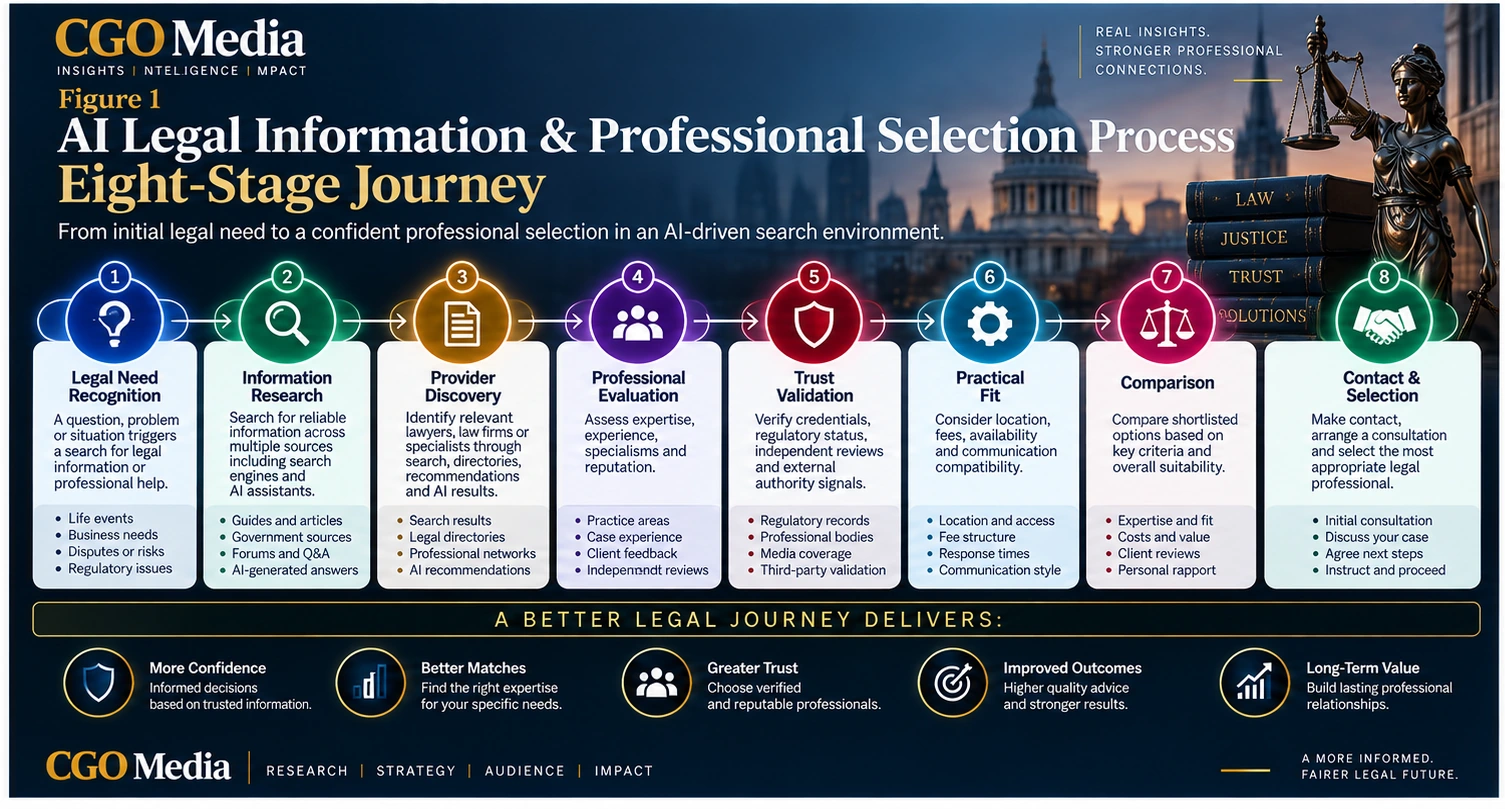
 The Legal Information and Professional Selection Process explains how individuals and organisations may move from recognising a legal problem through information research, provider discovery, professional verification, trust assessment, comparison and final selection.
The model builds on Legal SEO and Entity Authority and the Legal Entity Authority Framework, translating the broader authority architecture into a practical decision journey.
1. Purpose of the Selection Process
The purpose of the model is to show that legal provider selection is rarely driven by one search, one review or one ranking position.
2. Legal Selection Is a Multi-Stage Decision
Users may move through several overlapping stages before contacting or instructing a legal professional.
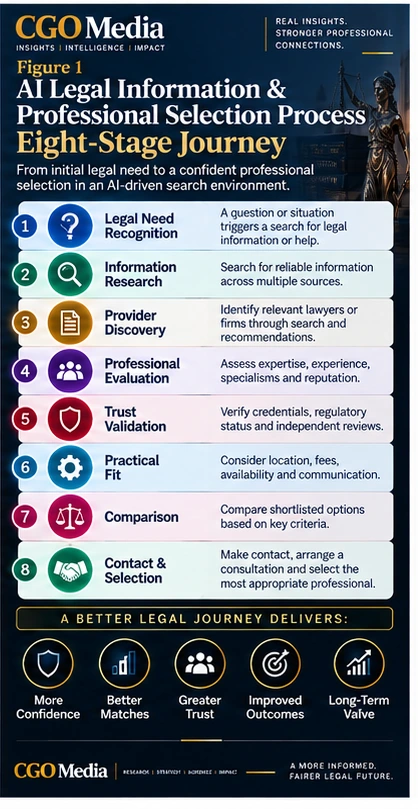
3. Eight Stages of Legal Information and Professional Selection
- Legal Need or Problem Recognition
- Legal Information and Process Research
- Practice Area and Provider Discovery
- Professional Relevance and Expertise Evaluation
- Regulatory, Reputational and Trust Validation
- Jurisdiction, Location and Practical Fit
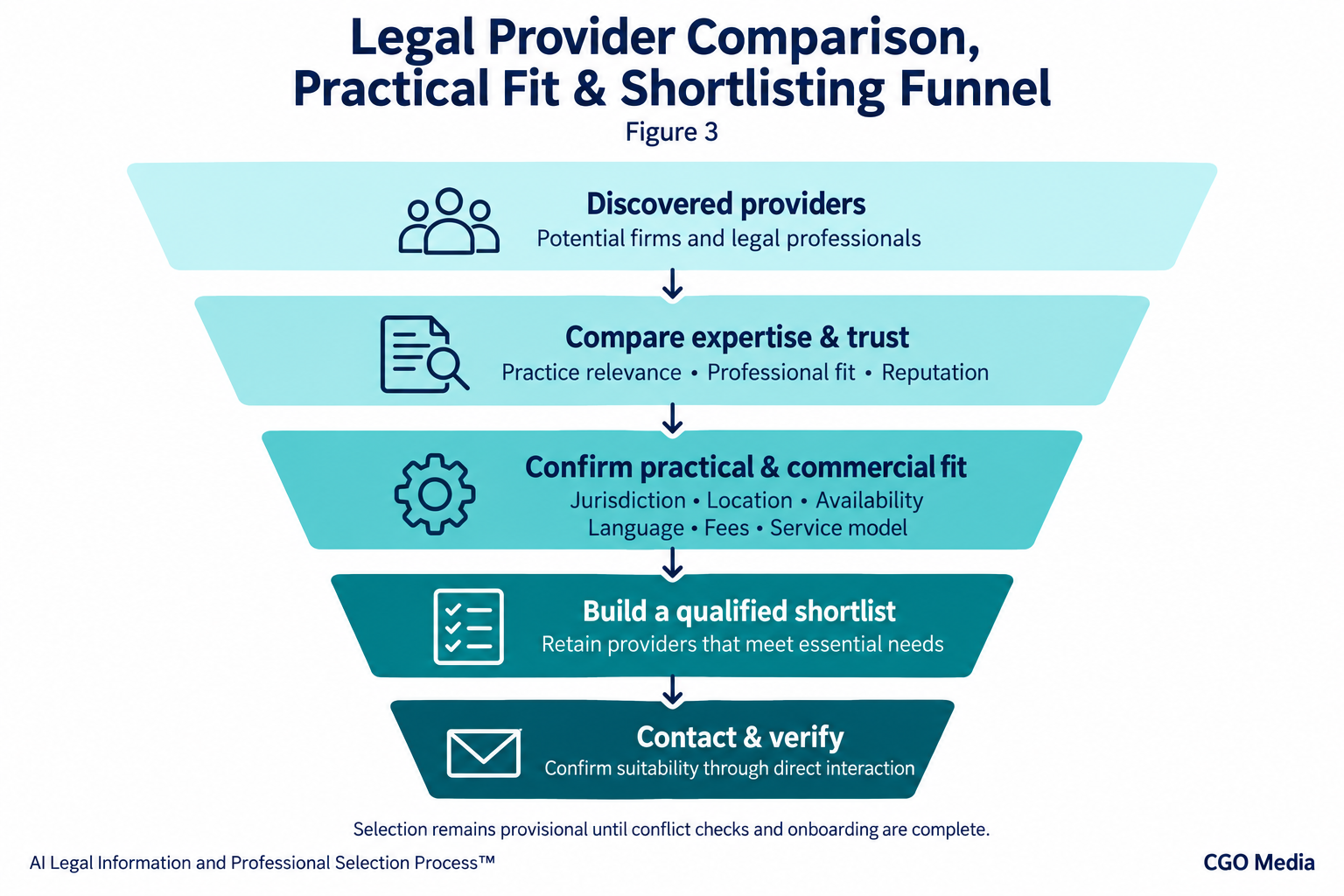
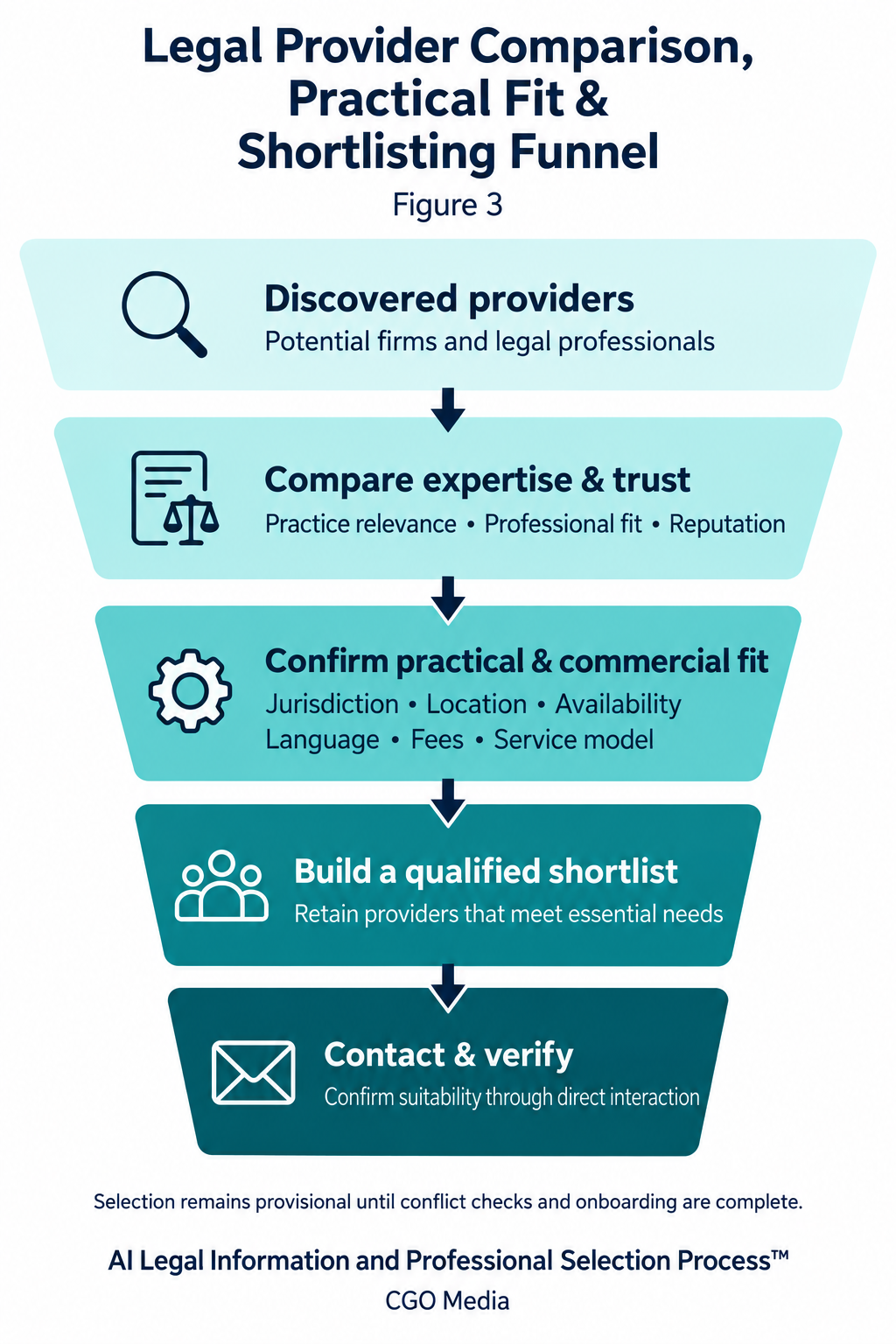
- Provider Comparison and Shortlisting
- Contact, Consultation and Professional Selection
4. The Overall Decision Journey
The process can be represented as:
Recognise → Understand → Discover → Evaluate → Verify → Compare → Contact → Select
5. Legal Search Does Not Always Begin with a Lawyer
Many users begin with a problem, event or uncertainty rather than a known practice area or professional title.
6. Stage One — Legal Need or Problem Recognition
The first stage begins when an individual or organisation recognises that a situation may have legal implications.
7. Problem Recognition May Be Immediate
Some legal needs arise suddenly through events such as:
- Dismissal
- Dispute
- Arrest
- Contract failure
- Relationship breakdown
8. Problem Recognition May Be Gradual
Other users may become aware over time that a commercial, employment, family, property or regulatory issue requires professional attention.
9. Users May Not Know the Legal Category
A person experiencing a legal problem may not know whether it falls within:
- Employment law
- Family law
- Litigation
- Property law
- Commercial law
10. Everyday Language Often Comes First
Initial searches may use ordinary language describing the user’s circumstances rather than formal legal terminology.
11. Problem-Led Queries
Examples may include searches around:
- An employer dispute
- A broken agreement
- A property problem
- A divorce or separation issue
- A business conflict
12. Question-Led Queries
Users may ask:
- What are my rights?
- What happens next?
- Can I challenge this?
- Do I need a solicitor?
- How long do I have?
13. AI Assistants Can Enter at Stage One
Users may increasingly describe their situation conversationally to an AI system rather than translate it immediately into a conventional search query.
14. Conversational Search Can Clarify the Problem
AI-assisted discovery may help users identify:
- Relevant legal terminology
- Possible legal categories
- Potential processes
- The type of professional they may need
15. Early Legal Information Has High Influence
The first explanation a user encounters can shape how they interpret the entire problem and what they search for next.
16. Early Information Should Avoid False Certainty
General legal information should not imply that the facts of an individual matter automatically lead to a particular legal outcome.
17. Jurisdiction Matters from the Beginning
A legal explanation may be inaccurate or irrelevant if the applicable jurisdiction is misunderstood.
18. Early Jurisdiction Questions
Users may need to determine:
- Which country’s law applies
- Which regional legal system applies
- Where the event occurred
- Where the parties are based
19. Search Visibility at Stage One
Legal organisations can become discoverable through useful problem-led information before the user knows the firm’s name.
20. Stage One Authority Requirement
The organisation needs enough topical and jurisdictional relevance to be associated with the problem accurately.
21. Stage One Failure Mode — Keyword-Led Misalignment
A page may rank for a broad legal query while failing to address the real problem the user is trying to solve.
22. Stage One Failure Mode — Excessive Legal Jargon
Users may abandon legal information when the language assumes specialist knowledge they do not yet possess.
23. Stage One Failure Mode — Premature Sales Pressure
Aggressive conversion messaging before the user understands the issue may weaken trust.
24. Stage One Success Condition
The first stage succeeds when the user can recognise the likely legal category and identify a sensible next information step.
25. Stage Two — Legal Information and Process Research
The second stage begins when the user seeks a deeper understanding of the legal issue, possible rights, procedures, risks and options.
26. Users Move from Recognition to Understanding
The user’s questions may become more specific as legal terminology and process become clearer.
27. Process Research
Users may investigate:
- Legal procedures
- Timelines
- Potential remedies
- Evidence requirements
- Likely stages of a matter
28. Rights-Based Research
Users may search for explanations of:
- Legal rights
- Contractual rights
- Employment rights
- Property rights
- Consumer rights
29. Risk-Based Research
Users may also investigate:
- Potential liabilities
- Financial exposure
- Procedural consequences
- Deadlines
- Possible escalation
30. Outcome Research
Users may look for examples of possible outcomes while trying to understand what could happen.
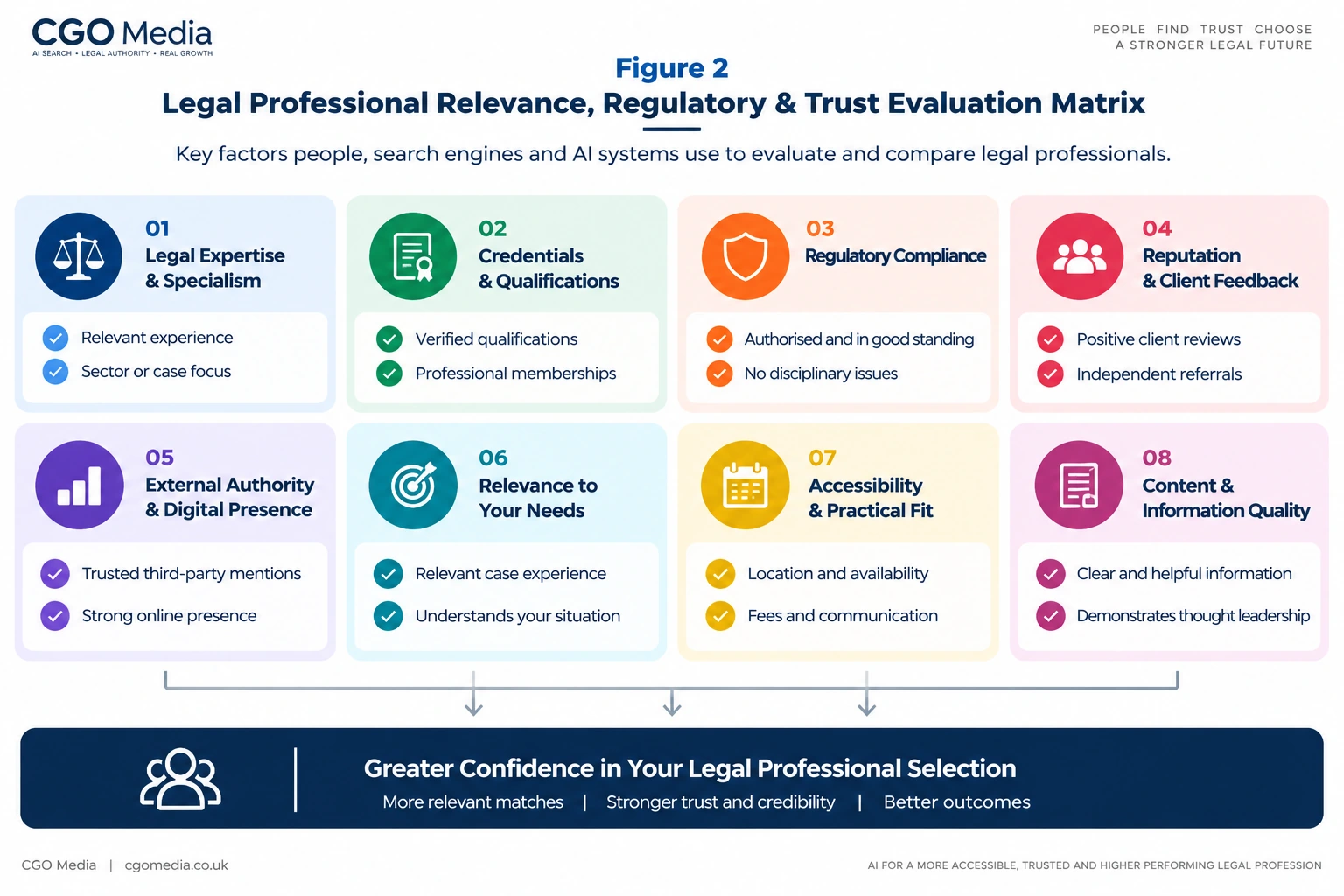
31. Outcome Information Requires Care
Past cases or general examples should not be represented as predictions of the user’s likely result.
32. Legal Information Sources Expand at Stage Two
Users may encounter:
- Law firm guides
- Government information
- Regulatory material
- Professional bodies
- Legal publications
- AI-generated summaries
33. Source Credibility Becomes More Important
As the potential consequences of the matter become clearer, users may become more selective about which information they trust.
34. Authority Signals at Stage Two
Users may look for:
- Professional authorship
- Current information
- Relevant sources
- Clear jurisdiction
- Recognisable legal expertise
35. Content Freshness Can Affect Decision Confidence
Legal information that appears outdated may undermine confidence even when the underlying principle remains valid.
36. Legal Review Signals
Where appropriate, significant legal content may indicate:
- Author
- Professional reviewer
- Review date
- Jurisdiction
37. Practice-Area Architecture Supports Understanding
Strong legal websites help users progress from broad information into more specific practice areas and services.
38. Information-to-Practice Pathway
A useful progression may be:
Problem → Explanation → Legal Process → Practice Area → Service
39. Information-to-Professional Pathway
Where appropriate, legal information should also connect users with professionals who genuinely work in the relevant area.
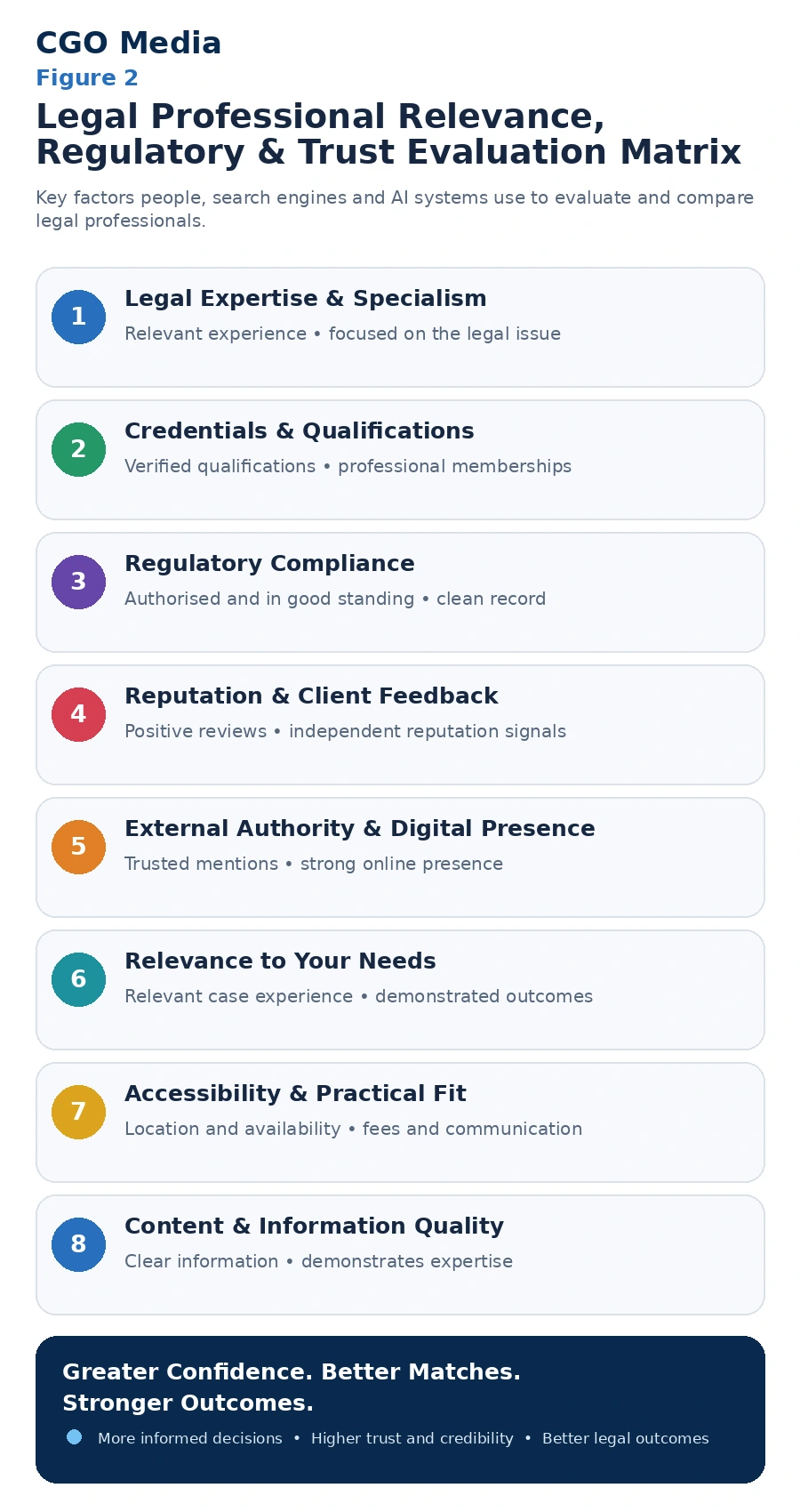
40. AI Search at Stage Two
AI systems may answer several related legal questions in one extended conversation, reducing the number of separate traditional searches required.
41. AI Can Compress Legal Research
One conversation may cover:
- Terminology
- Rights
- Process
- Timelines
- Potential professional support
42. AI Compression Can Increase Source Dependence
Where users rely on a synthesised answer, they may see fewer individual sources directly.
43. This Raises the Importance of Source Quality
Legal organisations should therefore focus on producing clear, accurate and well-governed source information rather than merely targeting isolated queries.
44. Stage Two Failure Mode — Thin Information
Generic explanations may fail to answer the questions necessary for the user to understand their situation.
45. Stage Two Failure Mode — Outdated Legal Information
Old legal content can create material decision risk where law, procedure or guidance has changed.
46. Stage Two Failure Mode — No Jurisdictional Context
A detailed explanation can still be misleading when the legal system to which it applies is unclear.
47. Stage Two Failure Mode — No Professional Connection
Useful information may generate awareness but fail to establish why the organisation has relevant professional expertise.
48. Stage Two Success Condition
Stage Two succeeds when the user understands the legal issue sufficiently to begin identifying the type of service or professional that may be relevant.
49. Stage Three — Practice Area and Provider Discovery
The third stage begins when the user shifts from understanding the legal problem toward identifying possible providers.
50. The User’s Search Language Becomes More Commercial
Queries may move from informational questions toward provider-oriented searches.
51. Practice-Area Provider Search
Examples may include:
- Employment solicitor
- Family lawyer
- Commercial litigation firm
- Property solicitor
- Immigration lawyer
52. Matter-Specific Provider Search
Users may search for a provider connected with a more specific matter or legal situation.
53. Local Provider Search
Users may add geographic context where proximity or local access matters.
54. Sector-Specific Legal Search
Commercial clients may seek providers with experience in:
- Financial services
- Technology
- Healthcare
- Real estate
- Manufacturing
55. Professional-Level Discovery
Users may discover an individual lawyer before fully evaluating the wider firm.
56. Provider Discovery Environments
Users may encounter legal providers through:
- Organic search
- Local search
- AI assistants
- Legal directories
- Professional referrals
- Editorial content
57. Search Results Begin the Shortlisting Process
Users may form an initial impression before visiting any provider website.
58. Initial Provider Signals
These may include:
- Firm name
- Practice relevance
- Location
- Review information
- External recognition
59. AI Provider Discovery
AI systems may introduce several possible firms or professionals within one answer.
60. AI Can Create a Pre-Website Shortlist
The user may enter individual firm websites only after an AI system has already framed a set of possible providers.
61. Provider Recommendation Accuracy Matters
A recommended legal provider should be genuinely relevant to the:
- Matter type
- Practice area
- Jurisdiction
- Geography where relevant
62. Branded Discovery Can Follow Non-Branded Discovery
Once a provider is identified, users may begin searching specifically for:
- The firm
- Its lawyers
- Reviews
- Office information
- Reputation evidence
63. Discovery Is Not Selection
Appearing within a search result, directory or AI answer merely creates consideration.
64. The User Now Needs Evidence
The next questions become:
- Does this firm really handle my matter?
- Which lawyer would deal with it?
- Can I verify their expertise?
- Can I trust this provider?
65. Stage Three Failure Mode — Broad Practice Claims
A firm may appear relevant initially but lose consideration if its website provides little evidence of genuine practice depth.
66. Stage Three Failure Mode — Weak Local Accuracy
Incorrect office or professional information can interrupt provider discovery.
67. Stage Three Failure Mode — AI Misclassification
A provider may be surfaced for a legal service or jurisdiction it does not genuinely support.
68. Stage Three Failure Mode — No Relevant Professional
Users may abandon a provider where they cannot identify who has appropriate expertise.
69. Stage Three Success Condition
Stage Three succeeds when the user identifies one or more legal providers that appear genuinely relevant and worthy of deeper professional evaluation.
70. The First Three Stages Create the Initial Consideration Set
The early legal decision journey can therefore be represented as:
Problem Recognition → Legal Understanding → Practice Area Discovery → Provider Consideration
71. The Next Stage Moves from Firm Relevance to Professional Relevance
Once a provider enters consideration, the user begins evaluating the people, expertise and evidence behind the organisation.
72. Stage Four — Professional Relevance and Expertise Evaluation
The fourth stage begins when the user moves from evaluating the firm generally to evaluating the specific legal professionals who may handle the matter.
73. Professional Evaluation Can Determine Whether the Firm Remains in Consideration
A strong firm brand may generate initial confidence, but users may still leave the journey if the relevant lawyer or team cannot be identified clearly.
74. The Core Professional Evaluation Question
The user is effectively asking:
Does this professional appear sufficiently relevant, experienced and credible for my specific legal matter?
75. Professional Identity Comes First
The user should be able to establish:
- Who the professional is
- What role they hold
- Which organisation they belong to
- Where they practise
76. Practice-Area Relevance
The professional should demonstrate a genuine relationship with the legal area relevant to the user’s problem.
77. Matter-Type Relevance
Users may look for evidence that the lawyer has experience with matters similar in type or complexity to their own.
78. Sector Relevance
Commercial clients may place additional value on evidence of experience within their industry or business environment.
79. Jurisdictional Relevance
A professional may be highly experienced but still unsuitable if the relevant legal qualification, jurisdiction or geographic capability is unclear.
80. Professional Role
Users may consider whether the individual is:
- Partner
- Senior lawyer
- Solicitor
- Barrister
- Associate
- Specialist practitioner
81. Professional Seniority Is Contextual
A more senior title does not automatically make a professional more suitable for every matter.
82. Qualifications
Relevant qualifications may provide evidence supporting professional identity and capability.
83. Professional Status
Where applicable, users may verify the individual’s current professional status through authoritative sources.
84. Professional Memberships
Relevant current memberships may add context around specialist or professional involvement.
85. Professional Biography Depth
A useful biography should go beyond generic statements and provide enough evidence for the user to understand the lawyer’s professional focus.
86. Professional Experience Evidence
Relevant evidence may include:
- Practice history
- Specialist responsibilities
- Sector work
- Representative matters
- Leadership roles
87. Representative Matters
Where disclosure is appropriate, representative matters can help users understand the nature of the lawyer’s experience.
88. Representative Matters Require Context
Past experience should not be presented as a guarantee of a similar result in another matter.
89. Case Outcome Evidence
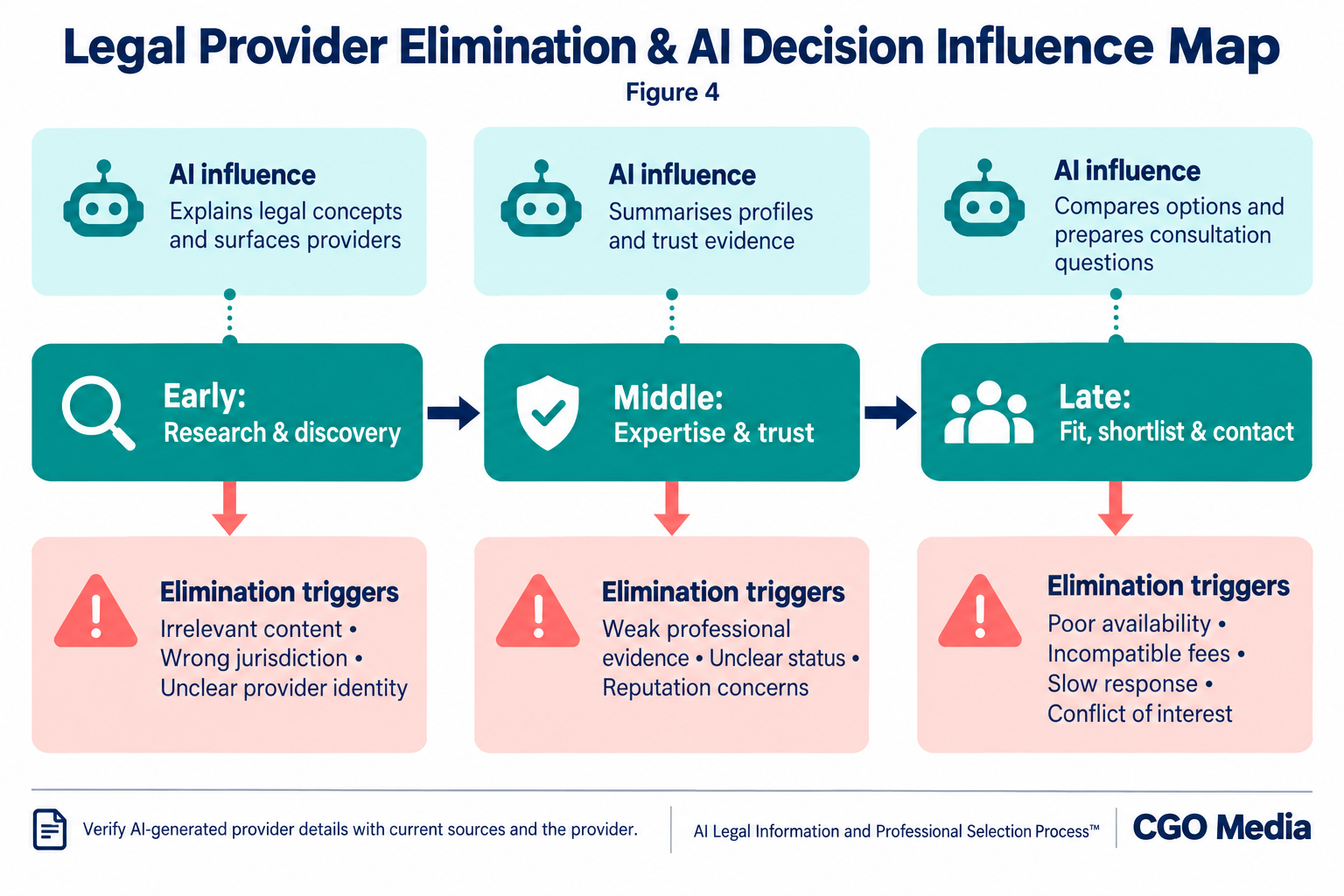
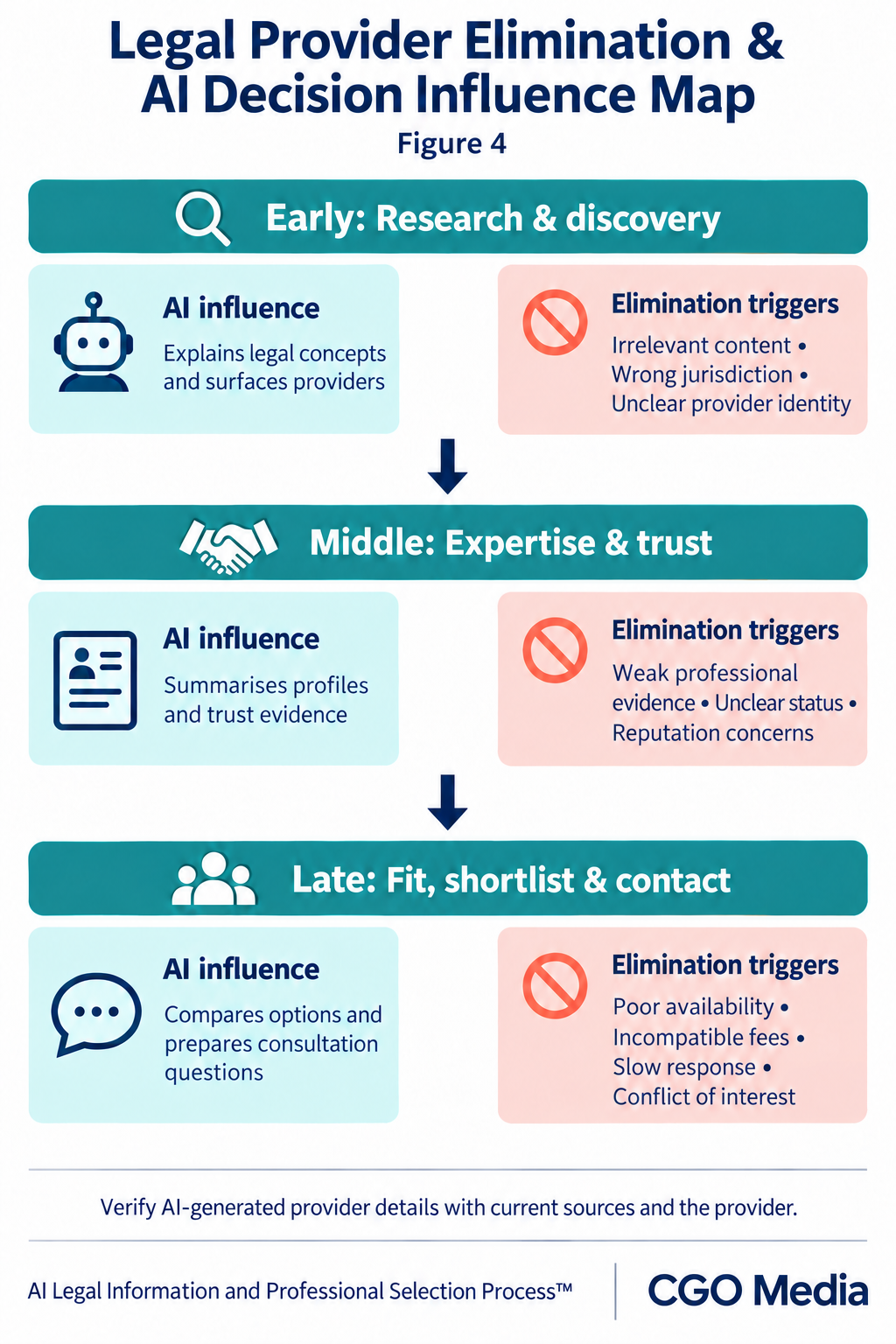
Where public and appropriate, case outcomes may provide some context around relevant legal work.
90. Case Outcomes Do Not Establish Future Results
Legal matters depend on facts, evidence, law, procedure and jurisdiction.
91. Transaction Experience
Commercial legal users may look for evidence involving:
- Deal types
- Transaction size
- Sectors
- Jurisdictions
- Cross-border work
92. Dispute Experience
Litigation clients may look for evidence involving:
- Type of dispute
- Forum
- Complexity
- Relevant sector
93. Publication Evidence
Relevant articles, research or legal commentary may support professional authority.
94. Speaking Evidence
Relevant conference, seminar or professional speaking activity may strengthen evidence of subject expertise.
95. Academic Evidence
Teaching, lecturing or academic roles may provide additional context where relevant to the practice area.
96. External Recognition
Users may consider:
- Legal directory rankings
- Awards
- Professional recognitions
- Industry acknowledgements
97. Recognition Should Be Specific
The user should be able to understand:
- Who received the recognition
- Which practice area applied
- Which year applied
- Which jurisdiction applied
98. Professional Reviews and Mentions
Some users may search specifically for reviews or public references involving an individual lawyer.
99. Professional Review Evidence Has Limits
Client commentary may provide insight into communication or service experience, but it does not directly measure technical legal capability.
100. Professional Profile Consistency
Users may compare the firm biography with:
- Regulatory profiles
- Legal directories
- Professional bodies
- External biographies
101. Professional Inconsistency Creates Friction
Confidence may weaken where sources disagree about:
- Current firm
- Role
- Practice area
- Office
102. AI Professional Evaluation
Users may ask an AI system directly about a lawyer’s:
- Experience
- Practice area
- Firm affiliation
- Reputation
- Location
103. AI Can Pre-Summarise Professional Evidence
A user may form an impression of a lawyer before opening the professional’s own profile.
104. AI Professional Summaries Should Be Monitored
Material inaccuracies involving role, affiliation or expertise can distort the selection journey.
105. Professional Comparison Can Occur Inside AI Search
Users may ask AI systems to compare several lawyers within one conversation.
106. Professional Comparison Dimensions
Generated comparisons may involve:
- Experience
- Practice focus
- Location
- Recognition
- Sector expertise
107. Comparison Outputs Require Caution
Generated summaries may omit important context or rely on incomplete external information.
108. Stage Four Failure Mode — Thin Lawyer Profile
A user may abandon consideration if the professional profile contains insufficient evidence of relevant expertise.
109. Stage Four Failure Mode — Generic Expertise Claims
Statements such as “highly experienced” provide limited decision value without supporting context.
110. Stage Four Failure Mode — Old Professional Information
Outdated role, firm or office information can undermine trust quickly.
111. Stage Four Failure Mode — Weak Matter Relevance
A lawyer may appear experienced generally but not clearly relevant to the user’s specific matter.
112. Stage Four Failure Mode — Recognition Without Context
Awards or rankings may create confusion where their scope is unclear.
113. Stage Four Success Condition
Stage Four succeeds when the user can identify one or more professionals who appear genuinely relevant and sufficiently credible for deeper trust validation.
114. Stage Five — Regulatory, Reputational and Trust Validation
The fifth stage begins when the user attempts to verify whether the firm and professional are sufficiently trustworthy to contact or instruct.
115. Trust Validation Is Stronger in Higher-Stakes Matters
As legal, financial, commercial or personal consequences increase, users may seek more evidence before making contact.
116. Regulatory Verification
Where applicable, users may seek confirmation that the firm or individual professional has the relevant status or authorisation.
117. Firm-Level Regulatory Verification
Users may verify whether the legal organisation is appropriately represented within the relevant professional or regulatory system.
118. Individual Professional Verification
Users may separately verify the lawyer’s current status.
119. Regulatory Entity Matching Matters
The user should be able to match the correct:
- Firm
- Professional
- Office where relevant
120. Regulatory Ambiguity Can Eliminate a Provider
Where status appears unclear or inconsistent, users may remove the firm from consideration rather than investigate further.
121. Reputation Validation
Users may search for evidence beyond the provider’s own website.
122. Reputation Sources
These may include:
- Legal directories
- Client reviews
- Media coverage
- Professional organisations
- Industry publications
123. Legal Directory Validation
Users may consult directories to understand:
- Practice-area recognition
- Professional recognition
- Market presence
- Jurisdictional standing
124. Directory Evidence Is One Input
Directory recognition should generally be considered alongside broader professional and provider evidence.
125. Review Validation
Client reviews may help users assess service experience.
126. Review Themes Relevant to Selection
Users may look for recurring evidence around:
- Communication
- Responsiveness
- Professionalism
- Clarity
- Administration
127. Review Recency
Recent reviews may be particularly influential where the user wants to understand current client experience.
128. Review Consistency
Repeated themes across multiple reviews may influence confidence more strongly than isolated comments.
129. Reviews Do Not Prove Legal Outcomes
Review evidence should not be interpreted as a guarantee of professional performance or matter outcome.
130. Negative Review Research
Users may actively search for complaints or negative experiences before making contact.
131. Provider Response Can Influence Perception
Public responses may influence trust where they demonstrate professionalism without breaching confidentiality.
132. Confidentiality Limits Public Response
Legal organisations may be unable to respond publicly with detailed facts about a client matter.
133. Client-Care Validation
Users may also evaluate whether the organisation provides clear information around:
- Complaints
- Privacy
- Confidentiality
- Initial contact
- Client care
134. Fee Trust
Where fee information is relevant, users may assess whether pricing appears sufficiently transparent.
135. Fee Uncertainty Can Create Selection Friction
Users may hesitate where they cannot understand whether the service is likely to involve:
- Fixed fees
- Hourly fees
- Initial consultation fees
- Additional charges
136. Fee Transparency Has Limits
Complex legal matters may not allow meaningful fixed pricing before sufficient facts are known.
137. Case and Matter Validation
Users may examine public representative matters to determine whether the firm has handled similar work.
138. Case Evidence Should Demonstrate Relevance
Useful evidence may clarify:
- Matter type
- Sector
- Jurisdiction
- Complexity
139. Case Evidence Should Not Promise Replication
Past matter outcomes should never be treated as guarantees of future results.
140. Institutional Trust
Professional or institutional relationships may add further confidence where they are genuine and relevant.
141. Institutional Trust Sources
These may include:
- Professional bodies
- Universities
- Industry organisations
- Research institutions
142. Editorial Trust
Relevant expert commentary in reputable publications may strengthen perceptions of professional authority.
143. Brand Search Intensifies at Stage Five
Users may search directly for:
- Firm name + reviews
- Lawyer name + reviews
- Firm name + complaints
- Firm name + regulator
- Lawyer name + firm
144. Brand Search Is a Trust Validation Environment
Branded visibility should therefore be treated as more than navigational search.
145. AI Trust Validation
Users may ask AI systems questions such as:
- Is this firm reputable?
- What is this lawyer known for?
- Does this firm handle this type of matter?
- What should I know before contacting them?
146. AI Trust Summaries Can Influence Selection
Generated answers may combine reviews, directories, firm information and other sources into one compressed impression.
147. Source Quality Matters During AI Trust Validation
If underlying information is outdated or inconsistent, generated trust summaries may be incomplete or misleading.
148. Trust Validation Is Multi-Source
A useful model is:
Professional Evidence + Regulatory Verification + Client Experience + Reputation + External Authority
149. Users Apply Trust Thresholds
A provider may be removed from consideration once a sufficiently serious concern appears.
150. Trust Thresholds Vary by Matter
A routine legal service may require less validation than a high-value commercial dispute, criminal matter or complex family case.
151. Consumer Trust Priorities
Consumers may place greater emphasis on:
- Reviews
- Communication
- Cost clarity
- Location
- Professional approachability
152. Commercial Trust Priorities
Business clients may place greater emphasis on:
- Professional expertise
- Sector knowledge
- Reputation
- Complex matter experience
- Institutional credibility
153. Stage Five Failure Mode — Regulatory Ambiguity
The user may abandon the provider if professional status cannot be verified confidently.
154. Stage Five Failure Mode — Poor Review Pattern
Repeated concerns involving communication or responsiveness may eliminate the provider even where legal expertise appears strong.
155. Stage Five Failure Mode — Reputation Claims Without Evidence
Broad claims of market leadership can create scepticism where supporting evidence is unclear.
156. Stage Five Failure Mode — Outdated External Information
Old directory, media or professional information may conflict with the provider’s current identity.
157. Stage Five Failure Mode — Confidentiality Mishandled Publicly
Inappropriate public responses to reviews or complaints may create additional trust concerns.
158. Stage Five Success Condition
Stage Five succeeds when the user can verify sufficient professional, regulatory and reputational evidence to keep the provider within the final consideration set.
159. Professional Relevance and Trust Work Together
A provider needs both:
Relevant Legal Expertise + Sufficient Trust Evidence
160. The Mid-Journey Selection Model
Stages Four and Five can be summarised as:
Identify Relevant Professional → Verify Expertise → Validate Professional Status → Assess Reputation → Establish Trust
161. Stage Six — Jurisdiction, Location and Practical Fit
The sixth stage begins when the user has identified one or more credible legal providers and starts assessing whether each option is practically suitable for the matter.
162. Practical Fit Can Eliminate an Otherwise Strong Provider
A firm may appear highly authoritative yet still be unsuitable because of jurisdiction, geography, availability, language, fee structure or service model.
163. Jurisdiction Is a Core Practical Constraint
The user must determine whether the legal professional or organisation is relevant to the legal system governing the matter.
164. Jurisdiction Questions
Users may need to establish:
- Which law applies
- Where proceedings may occur
- Where the professional is qualified
- Whether cross-border capability is required
165. Jurisdictional Clarity Supports Provider Elimination
A provider may be removed quickly from consideration where the user discovers that the organisation does not operate within the relevant legal context.
166. Multi-Jurisdiction Matters
More complex matters may involve:
- Multiple countries
- Several legal systems
- Cross-border contracts
- International parties
- Regulatory overlap
167. Cross-Border Capability
International users may evaluate whether the firm can coordinate advice across more than one jurisdiction.
168. Professional Qualification Matters
Users should be able to understand whether relevant professionals have the appropriate qualification or local capability for the matter.
169. Location Still Influences Many Legal Decisions
Even where remote consultation is available, geography may remain important for:
- Convenience
- Local court familiarity
- Face-to-face meetings
- Document handling
- Client preference
170. Office Verification
Users may check:
- Office address
- Telephone
- Opening information
- Transport
- Accessibility
171. Office-Professional Fit
The user may need to verify whether the relevant lawyer actually works from the office under consideration.
172. Office-Service Fit
A firm may have multiple offices without every service being available from every location.
173. Local Search Can Influence Stage Six
Users may return to maps, local profiles and branded local searches to verify practical location information.
174. Local Information Should Match the Firm Website
Conflicting location information can create unnecessary uncertainty immediately before contact.
175. Remote Consultation Fit
Some users may prioritise whether the organisation supports:
- Telephone consultation
- Video consultation
- Digital document exchange
- Remote onboarding
176. Remote Capability Can Broaden the Consideration Set
Where physical proximity is not essential, users may compare providers across a much wider geographic market.
177. Language Capability
Some legal matters require communication in a particular language or support for multilingual parties.
178. Language Claims Should Reflect Genuine Capability
A firm should distinguish between fluent legal-service capability and basic language support where the difference is material.
179. Client-Type Fit
A provider may specialise primarily in:
- Individuals
- Small businesses
- Large companies
- Institutions
- Public-sector organisations
180. Client-Type Misalignment Can Create Friction
A technically relevant provider may still be inappropriate if its service model does not fit the user’s scale or requirements.
181. Matter-Size Fit
Commercial users may assess whether the firm commonly handles matters of comparable complexity or financial scale.
182. Specialist Fit
Some matters require narrow expertise that cannot be inferred from a broad practice-area label alone.
183. Availability
The provider must have sufficient capacity to accept or assess the matter within an appropriate timeframe.
184. Urgency Can Change Provider Selection
Where deadlines or urgent legal action are involved, responsiveness and availability may become more important than broader reputation signals.
185. Initial Response Time
Users may evaluate how quickly a firm:
- Acknowledges an enquiry
- Requests relevant information
- Explains next steps
- Offers an initial consultation
186. Contact Method Fit
Users may prefer:
- Telephone
- Online form
- Video consultation
- In-person appointment
187. Contact Friction Can Eliminate a Provider
A complicated enquiry process can undermine the authority and trust built earlier in the journey.
188. Fee Structure as Practical Fit
Users may evaluate whether the firm’s charging model appears compatible with their circumstances.
189. Fixed-Fee Fit
For some services, users may prefer a clearly defined fee.
190. Hourly-Fee Fit
For more complex matters, users may expect hourly or staged charging.
191. Commercial Retainer Fit
Business clients may assess whether the provider supports:
- Ongoing retainers
- Panel arrangements
- Project-based work
- Multi-jurisdiction coordination
192. Pricing Transparency Reduces Uncertainty
Where detailed pricing cannot be published, firms can still explain how fees are generally structured and which factors affect cost.
193. Conflict Checks
A legal provider may be unable to act even when every other selection criterion is satisfied.
194. Conflict Restrictions Are Unique to Legal Selection
Provider selection may therefore remain provisional until conflict and onboarding requirements are completed.
195. Client Onboarding Requirements
Users may also encounter requirements involving:
- Identity verification
- Conflict checks
- Engagement terms
- Initial documentation
196. Practical Fit Is a Threshold Stage
A provider may remain highly credible but leave the shortlist because one essential practical condition cannot be satisfied.
197. Stage Six AI Use
Users may ask AI systems to compare providers according to:
- Location
- Language capability
- Specialism
- Client type
- Jurisdiction
198. AI Practical-Fit Information Requires Verification
Generated answers may contain outdated office, professional or service information and should not replace direct provider verification.
199. Stage Six Failure Mode — Wrong Jurisdiction
A provider may appear highly relevant until the user discovers that the organisation cannot advise within the required legal system.
200. Stage Six Failure Mode — Wrong Office Capability
A local office page may create false expectations where the relevant professional or service is not actually available there.
201. Stage Six Failure Mode — Poor Availability Information
Users may leave when there is no clear route to determine whether the firm can assess the matter promptly.
202. Stage Six Failure Mode — Fee Uncertainty
A provider may lose consideration where users cannot form even a basic understanding of the likely charging approach.
203. Stage Six Failure Mode — Contact Friction
Poor forms, unclear telephone routes or slow responses can interrupt an otherwise successful selection journey.
204. Stage Six Success Condition
Stage Six succeeds when the user can confirm that the legal provider is sufficiently relevant in jurisdiction, location, availability, service model and practical access to remain within the final shortlist.
205. Stage Seven — Provider Comparison and Shortlisting
The seventh stage brings together all earlier evidence as the user compares a smaller number of serious provider options.
206. Shortlisting Is an Evidence-Compression Stage
The user may reduce a large amount of information into a small number of decisive comparison factors.
207. A Legal Provider Comparison Model
A practical comparison structure is:
Relevance + Professional Fit + Trust + Reputation + Jurisdiction + Practical Fit + Commercial Fit
208. Comparison Dimension One — Practice Relevance
Does the provider genuinely appear to handle the relevant legal matter?
209. Comparison Dimension Two — Professional Fit
Is there a clearly identifiable professional or team with relevant expertise?
210. Comparison Dimension Three — Professional Verification
Can the lawyer’s role, qualification and firm affiliation be verified sufficiently?
211. Comparison Dimension Four — Reputation
What relevant external evidence supports the provider’s standing?
212. Comparison Dimension Five — Client Trust
What do reviews, client-care information and public interactions suggest about the service experience?
213. Comparison Dimension Six — Jurisdictional Fit
Is the firm appropriate for the relevant legal system and geographic context?
214. Comparison Dimension Seven — Practical Access
Can the user access the relevant professional through a suitable office, remote process or consultation method?
215. Comparison Dimension Eight — Commercial Fit
Does the likely fee structure, service model and matter scale appear compatible with the user’s needs?
216. Different Users Weight These Factors Differently
Provider selection is not a universal scoring exercise.
217. Consumer Legal Comparison
An individual client may place greater weight on:
- Communication
- Location
- Reviews
- Cost clarity
- Professional approachability
218. SME Legal Comparison
A smaller business may place greater weight on:
- Commercial understanding
- Responsiveness
- Cost predictability
- Direct partner access
219. Enterprise Legal Comparison
A larger organisation may place greater weight on:
- Specialist depth
- Sector experience
- Multi-jurisdiction capability
- Team capacity
- Governance
220. High-Stakes Litigation Comparison
Users may prioritise:
- Relevant dispute experience
- Professional seniority
- Strategic capability
- Reputation
221. Routine Legal-Service Comparison
For more standardised matters, users may prioritise:
- Convenience
- Speed
- Cost
- Clear process
222. Brand Strength Can Influence Shortlisting
Recognisable firms may enter a shortlist more easily, but brand recognition does not remove the need for matter-specific relevance.
223. Professional Brand Can Influence Shortlisting
A recognised lawyer may strengthen a firm’s position where their expertise aligns directly with the matter.
224. Legal Directories Can Influence Comparison
Users may compare firms using external directory evidence alongside first-party information.
225. Directory Evidence Should Be Interpreted Contextually
Users should consider whether recognition relates to:
- The relevant year
- The correct practice area
- The appropriate jurisdiction
- The specific lawyer or team
226. Reviews Can Influence Final Shortlisting
Client-experience patterns may become increasingly important when several providers appear technically suitable.
227. Negative Signals Can Carry Disproportionate Weight
A single serious trust concern may remove a provider even when many other signals are positive.
228. Provider Elimination Is Often Faster Than Provider Selection
Users may eliminate firms quickly because of:
- Wrong jurisdiction
- Unclear expertise
- Poor reviews
- Weak responsiveness
- Unclear pricing
- Incorrect office information
229. Shortlisting Is Therefore a Threshold Process
A provider must remain above several minimum confidence thresholds simultaneously.
230. The Seven Shortlisting Thresholds
A simplified model is:
Relevance → Professional Confidence → Trust → Jurisdiction → Access → Commercial Fit → Responsiveness
231. Failure at One Threshold Can End the Journey
Exceptional professional expertise may not compensate for an unresolved conflict, wrong jurisdiction or inability to accept the matter.
232. AI-Assisted Comparison
Users may ask AI systems to compare shortlisted firms directly.
233. AI Comparison Questions
These may involve:
- Which firm appears most specialised?
- Which lawyers handle this type of matter?
- Which provider has an office nearby?
- Which firm appears suitable for a business of this size?
234. AI Can Compress Multiple Evidence Sources
A generated comparison may combine:
- Firm information
- Lawyer profiles
- Directories
- Reviews
- Editorial sources
235. AI Comparison Can Create Apparent Certainty
Generated systems may present provider differences confidently even where the available evidence is incomplete.
236. AI Comparison Should Be Verified
Material facts involving:
- Professional status
- Practice area
- Jurisdiction
- Office location
- Service availability
should be checked against appropriate current sources.
237. Recommendation Order Should Not Be Treated as Ranking
The order in which providers appear in one generated answer should not be interpreted as a stable measure of legal quality.
238. Recommendation Frequency Should Be Interpreted Carefully
Repeated presence may be useful as an observation, but it does not establish professional superiority.
239. Provider Comparison Can Return to Traditional Search
After receiving an AI-generated shortlist, users may perform branded searches to validate each provider independently.
240. Branded Search During Shortlisting
Users may search:
- Firm name
- Firm name + reviews
- Lawyer name
- Lawyer name + firm
- Firm name + practice area
241. Cross-Channel Comparison Is Normal
A user may move repeatedly between:
Search → AI → Firm Website → Directory → Reviews → Search
242. Shortlisting Should Be Measured Across Channels
Legal organisations should avoid assuming that the final enquiry source represents the whole client journey.
243. Last-Click Attribution Can Hide Earlier Influence
A branded search may generate the final website visit even though earlier discovery occurred through AI, a directory or editorial content.
244. Stage Seven Failure Mode — Weak Differentiation
A firm may survive early evaluation but lose the shortlist when users cannot identify why it is particularly relevant.
245. Stage Seven Failure Mode — Inconsistent Professional Evidence
Conflicting lawyer information may cause the user to favour a provider with clearer professional representation.
246. Stage Seven Failure Mode — Trust Deficit
Weak review patterns, unclear regulation or poor client-care information may become decisive when technical expertise appears similar.
247. Stage Seven Failure Mode — Practical Misfit
The provider may be removed because of geography, availability, price or service model.
248. Stage Seven Failure Mode — AI Misrepresentation
An inaccurate generated comparison may incorrectly weaken or exaggerate the provider’s apparent relevance.
249. Stage Seven Success Condition
Stage Seven succeeds when the user reduces the consideration set to one or a small number of providers that satisfy the main relevance, professional, trust and practical thresholds.
250. Stages Six and Seven Form the Final Evaluation Gate
The late-stage legal selection journey can be represented as:
Verify Jurisdiction → Confirm Practical Fit → Compare Providers → Apply Trust Thresholds → Create Final Shortlist
251. Stage Eight — Contact, Consultation and Professional Selection
The eighth stage begins when the user moves from comparison into direct interaction with one or more shortlisted legal providers.
252. Contact Is the First Operational Test
Until this point, the user’s judgement has been based primarily on information, reputation and perceived relevance.
The contact stage tests whether the organisation can convert that accumulated confidence into a practical client experience.
253. Contact Pathways Should Be Clear
Users should be able to identify quickly:
- How to make an enquiry
- Which contact method is appropriate
- Which office applies
- What information may be required
254. Telephone Contact
Telephone remains important for users who need:
- Immediate clarification
- Urgent legal support
- Human reassurance
- Appointment confirmation
255. Online Enquiry Forms
Forms should collect enough information for effective triage without creating unnecessary friction.
256. Excessive Form Complexity Can Reduce Conversion
Long or intrusive forms may discourage users before a professional has assessed whether the matter is suitable.
257. Email Enquiries
Email may remain appropriate for users who need to describe a matter or share preliminary information in writing.
258. Secure Communication May Be Required
Where sensitive information is involved, legal organisations should use appropriate processes for secure communication and document exchange.
259. Initial Enquiry Triage
The first operational task is to determine whether the matter appears relevant to the firm’s capabilities.
260. Triage May Assess
- Practice area
- Jurisdiction
- Urgency
- Client type
- Matter complexity
- Potential conflicts
261. Poor Triage Creates Client Friction
A user may lose confidence if they are repeatedly transferred between teams or asked to restate the same information.
262. Rapid Acknowledgement Supports Trust
Even where a full professional response cannot be immediate, clear acknowledgement can reassure the user that the enquiry has been received.
263. Response Time Can Influence Final Selection
Where several firms appear equally credible, responsiveness may become a decisive factor.
264. Urgent Legal Matters Increase Response Sensitivity
For time-critical matters, delayed acknowledgement may eliminate a provider from consideration quickly.
265. Conflict Checking
Legal provider selection may remain provisional until the organisation determines whether it can act.
266. Conflict Checks Can Interrupt an Otherwise Successful Journey
A firm may be relevant, trusted and selected by the user but still be unable to accept the instruction.
267. Conflict Transparency
The organisation should explain the need for conflict checks appropriately without exposing confidential information.
268. Identity and Onboarding Requirements
Client onboarding may involve:
- Identity verification
- Conflict checks
- Engagement documentation
- Source-of-funds checks where applicable
- Initial matter documentation
269. Onboarding Is Part of Provider Selection
A user may still change providers if onboarding feels unnecessarily difficult, unclear or slow.
270. Initial Consultation
The consultation is often the point at which digital authority is tested through direct professional interaction.
271. Consultation Expectations
Users may expect to understand:
- Whether the professional understands the issue
- What possible next steps exist
- What information is still required
- How the engagement may proceed
272. Professional Relevance Is Reassessed During Consultation
The user may confirm or revise the assumptions formed from:
- Professional profiles
- Legal content
- Directories
- Reviews
- AI-generated summaries
273. Consultation Can Reinforce Digital Trust
A strong initial interaction may validate the professional authority established earlier in the journey.
274. Consultation Can Also Break Digital Trust
A poor interaction may quickly outweigh strong rankings, reviews or external recognition.
275. Communication Clarity
Users may evaluate whether the professional explains the legal situation in a clear and understandable way.
276. Technical Expertise and Communication Are Different
A highly capable legal professional may still create selection friction if the user cannot understand the proposed process.
277. Expectation Management
The initial consultation should avoid creating unrealistic certainty around:
- Outcome
- Timescale
- Cost
- Procedure
278. Fee Discussion
At this stage, the user may expect a clearer explanation of:
- Charging model
- Initial costs
- Likely stages
- Potential additional costs
279. Fee Clarity Supports Final Selection
The user does not necessarily require a fixed total cost, but should understand the commercial basis of the engagement sufficiently to make an informed decision.
280. Scope Clarity
The provider should explain what work is and is not included within the proposed engagement.
281. Team Structure
The user may want to understand:
- Who will lead the matter
- Who else may work on it
- How supervision operates
- Who the main contact will be
282. Team Transparency Can Influence Selection
Users may become dissatisfied where they expect to work with one professional but discover that the matter will be handled differently.
283. Availability and Capacity
The provider should be able to explain whether it can support the matter within the required timeframe.
284. Capacity Is a Selection Factor
A prestigious provider may be less suitable than a more available provider where timing is critical.
285. Client-Service Fit
The user may evaluate whether the firm’s style appears compatible with their expectations around:
- Communication
- Speed
- Access
- Formality
- Commercial approach
286. Personal Fit Can Influence Individual Legal Selection
For personal legal matters, trust in the individual professional may carry particular weight.
287. Organisational Fit Can Influence Commercial Selection
Business clients may evaluate whether the provider can integrate with:
- Internal legal teams
- Procurement
- Finance
- Senior management
- Other advisers
288. Procurement Can Extend Stage Eight
Larger organisations may require additional evaluation involving:
- Panel processes
- Pricing review
- Information security
- Insurance requirements
- Governance review
289. Final Professional Selection
The selection decision is the result of cumulative evidence rather than the final consultation alone.
290. The Final Selection Equation
A simplified model is:
Relevant Expertise + Trust + Jurisdictional Fit + Practical Fit + Commercial Fit + Positive Direct Interaction
291. Selection May Be Firm-Level
The user may choose the organisation and allow the firm to allocate an appropriate professional.
292. Selection May Be Professional-Level
The user may choose the firm specifically because of one lawyer’s perceived expertise or reputation.
293. Selection May Be Team-Level
Complex matters may require confidence in a wider team rather than one individual professional.
294. Stage Eight Failure Mode — Slow Response
A delayed response can cause the user to contact another shortlisted provider.
295. Stage Eight Failure Mode — Poor Triage
Repeated transfers or unclear responsibility can undermine confidence.
296. Stage Eight Failure Mode — Unclear Fees
The user may withdraw where the commercial arrangement remains difficult to understand.
297. Stage Eight Failure Mode — Professional Mismatch
The consultation may reveal that the person presented digitally is not the most relevant professional for the matter.
298. Stage Eight Failure Mode — Weak Communication
A technically capable provider may lose the instruction where the user feels the legal process has not been explained clearly.
299. Stage Eight Failure Mode — Onboarding Friction
Unnecessarily complicated onboarding may weaken the client experience before substantive legal work begins.
300. Stage Eight Success Condition
Stage Eight succeeds when the user selects a legal provider that satisfies the main professional, trust, jurisdictional, practical and commercial requirements and is able to accept the instruction.
301. Provider Selection Is Not the End of the Authority Journey
The experience after instruction can influence future reviews, referrals, branded search and external reputation.
302. The Complete Eight-Stage Legal Selection Journey
The full process can be represented as:
Need Recognition → Legal Research → Provider Discovery → Professional Evaluation → Trust Validation → Practical Fit → Shortlisting → Contact & Selection
303. Provider Elimination Occurs Throughout the Journey
Users do not only add providers to consideration. They also remove them continuously.
304. Early-Stage Elimination
A provider may be eliminated because:
- The content appears irrelevant
- The jurisdiction is wrong
- The practice area is unclear
- The provider is difficult to identify
305. Mid-Stage Elimination
A provider may be removed because:
- The relevant professional cannot be identified
- Professional evidence is weak
- Regulatory information is unclear
- Reputation concerns appear
306. Late-Stage Elimination
A provider may be removed because:
- Location is unsuitable
- Availability is poor
- Fees appear incompatible
- Response is slow
- The firm cannot act
307. Provider Elimination Can Be Faster Than Provider Selection
Users may spend considerable time building confidence but only seconds responding to a serious negative signal.
308. The Legal Provider Elimination Model
A simplified sequence is:
Relevance Failure → Professional Failure → Trust Failure → Jurisdiction Failure → Practical Failure → Commercial Failure → Contact Failure
309. Critical Elimination Factors
Some factors may remove a provider almost immediately.
310. Wrong Jurisdiction
The provider may simply be incapable of supporting the relevant legal matter.
311. Professional Status Conflict
Material uncertainty around professional status may create an immediate trust barrier.
312. Conflict of Interest
The provider may be unable to act regardless of perceived authority.
313. Service Unavailability
A firm may appear relevant online while lacking current capacity or capability for the matter.
314. Severe Reputation Concern
A significant trust issue may remove the provider from consideration even where other evidence is strong.
315. Provider Elimination Should Be Measured
Legal organisations should try to identify where users abandon the journey before enquiry.
316. Potential Elimination Signals
These may include:
- High exit rates from professional profiles
- Repeated fee questions
- Repeated jurisdiction questions
- Low enquiry completion
- High form abandonment
317. Front-Line Teams Can Reveal Elimination Causes
Reception, intake and business-development teams may identify recurring reasons why prospective clients do not proceed.
318. AI Influence Across the Eight Stages
AI-assisted search can now influence almost every stage of legal provider selection.
319. AI at Stage One — Problem Recognition
AI may help the user translate a real-world situation into possible legal terminology.
320. AI at Stage Two — Legal Research
AI may summarise:
- Legal concepts
- Potential processes
- General rights
- Possible next questions
321. AI at Stage Three — Provider Discovery
AI may introduce relevant:
- Firm types
- Law firms
- Professional categories
- Specific providers
322. AI at Stage Four — Professional Evaluation
Generated answers may summarise lawyers’ roles, practice areas and public professional evidence.
323. AI at Stage Five — Trust Validation
AI may synthesise:
- Reputation information
- Reviews
- Directories
- Professional evidence
324. AI at Stage Six — Practical Fit
Users may ask questions about:
- Location
- Jurisdiction
- Languages
- Service availability
325. AI at Stage Seven — Provider Comparison
AI systems may compare several legal providers within one answer.
326. AI at Stage Eight — Contact Preparation
Users may ask AI systems how to prepare for:
- An initial consultation
- Documents required
- Questions to ask
- Information to provide
327. AI Can Compress the Entire Journey
One conversation may now move from problem recognition through provider comparison without the user conducting numerous separate searches.
328. Compression Increases the Importance of Evidence Quality
When multiple stages are compressed into one generated experience, inaccurate information can influence several decisions simultaneously.
329. AI Influence Should Not Be Confused with Legal Advice
Generated information may support general understanding but should not be assumed to provide advice appropriate to an individual matter.
330. AI Provider Recommendations Require Verification
Users should verify material information involving:
- Professional status
- Firm affiliation
- Practice area
- Jurisdiction
- Location
331. AI Can Create New Discovery Opportunities
Legal organisations with strong entity and professional evidence may become discoverable in new conversational provider-selection contexts.
332. AI Can Also Expose Existing Weaknesses
Conflicting firm, professional or service information may become more visible when AI systems synthesise multiple sources.
333. Post-Selection Experience
After a client selects a provider, the actual service experience begins influencing the next generation of public evidence.
334. Experience Can Reinforce Authority
Positive experiences may contribute to:
- Reviews
- Referrals
- Repeat business
- Professional reputation
335. Experience Can Weaken Authority
Repeated problems may contribute to:
- Negative reviews
- Complaints
- Poor referrals
- Reputational decline
336. Review Generation Is an Outcome, Not the Entire Objective
The stronger goal is a service experience that naturally produces accurate and sustainable trust evidence.
337. Client Feedback Should Inform Digital Information
Recurring questions may reveal areas where the website does not explain:
- Process
- Fees
- Timing
- Professional roles
- Next steps
338. Client Feedback Should Inform Operational Improvement
Repeated complaints may identify service weaknesses rather than content weaknesses alone.
339. Professional Feedback Should Inform the Information Journey
Lawyers may identify patterns where prospective clients arrive with:
- Incorrect assumptions
- Wrong jurisdiction expectations
- Misunderstood procedures
- Unrealistic outcome expectations
340. Feedback Creates a Closed Decision Loop
The provider-selection system therefore extends beyond initial instruction.
341. The Legal Selection Feedback Loop
A complete model is:
Discovery → Evaluation → Selection → Experience → Feedback → Reputation → Future Discovery
342. Search and AI Systems May Re-Use New Reputation Evidence
Over time, new reviews, professional evidence, publications and external references may influence how future users discover and evaluate the provider.
343. Operational Performance Therefore Influences Search Authority
Digital authority is not completely separate from the real-world client experience.
344. The Full Selection System
The complete Legal Information and Professional Selection Process can therefore be represented as:
Need → Understand → Discover → Evaluate Professional → Validate Trust → Confirm Practical Fit → Compare → Contact → Select → Experience → Feedback
345. Selection Is a Dynamic Evidence Process
The legal provider most visible at the beginning of the journey is not necessarily the provider selected at the end.
346. The Strongest Providers Reduce Friction Across Multiple Stages
Sustainable legal visibility therefore depends on more than acquisition.
It depends on helping the user move through information, professional verification, trust, practical evaluation and contact with progressively greater confidence.
347. Measuring the Eight-Stage Legal Selection Journey
The Legal Information and Professional Selection Process can be used as a diagnostic model for understanding where prospective clients progress, hesitate or leave the provider-selection journey.
348. Measurement Should Follow the Decision Process
Rather than treating all website traffic or enquiries as one category, legal organisations can map evidence and behaviour to the eight stages of selection.
349. Stage One Measurement — Legal Need Recognition
The first stage measures whether the organisation becomes visible when users begin describing legal problems in everyday language.
350. Stage One Visibility Measures
Potential indicators may include:
- Non-branded informational visibility
- Problem-led query visibility
- AI appearance around relevant legal questions
- Organic impressions for early-stage topics
351. Stage One Engagement Measures
Potential indicators may include:
- Informational page engagement
- Internal progression to related legal information
- Progression toward practice-area content
352. Stage One Diagnostic Question
The organisation should ask:
Are users able to recognise that our legal expertise is relevant to the problem they are trying to understand?
353. Stage Two Measurement — Legal Information and Process Research
The second stage measures whether the organisation helps users build sufficient understanding to continue toward provider discovery.
354. Stage Two Content Measures
Potential indicators may include:
- Coverage of priority legal questions
- Content freshness
- Jurisdictional clarity
- Professional review coverage
355. Stage Two Behaviour Measures
Potential indicators may include:
- Progression from informational content to practice areas
- Progression from legal guides to service pages
- Progression toward professional profiles
356. Stage Two Diagnostic Question
The organisation should ask:
Does our legal information help users move from general uncertainty toward a clearer understanding of the relevant service or professional?
357. Stage Three Measurement — Practice Area and Provider Discovery
The third stage measures whether the organisation enters relevant provider-consideration environments.
358. Organic Provider Discovery Measures
Potential indicators may include:
- Practice-area visibility
- Service visibility
- Non-branded commercial visibility
- Qualified organic sessions
359. Local Provider Discovery Measures
Potential indicators may include:
- Office visibility
- Maps visibility
- Local profile engagement
- Location-page engagement
360. AI Provider Discovery Measures
Potential indicators may include:
- Relevant non-branded provider presence
- Practice-area recommendation presence
- Local provider presence
- Accuracy of firm representation
361. Stage Three Diagnostic Question
The organisation should ask:
Do we enter the consideration set when users search for the type of legal provider we genuinely are?
362. Stage Four Measurement — Professional Relevance and Expertise Evaluation
The fourth stage measures whether users can identify and verify appropriate professionals.
363. Professional Profile Measures
Potential indicators may include:
- Profile completeness
- Practice-area relationship coverage
- Office relationship coverage
- Professional status clarity
364. Professional Engagement Measures
Potential indicators may include:
- Professional profile views
- Progression from practice areas to lawyer profiles
- Progression from lawyer profiles to contact pathways
365. External Professional Validation Measures
Potential indicators may include:
- Directory profile accuracy
- Professional-body consistency
- Relevant publication visibility
- External biography consistency
366. AI Professional Representation Measures
Potential indicators may include accuracy of:
- Role
- Firm affiliation
- Practice area
- Office location
367. Stage Four Diagnostic Question
The organisation should ask:
Can prospective clients identify a professional who appears genuinely relevant and sufficiently credible for their matter?
368. Stage Five Measurement — Regulatory, Reputational and Trust Validation
The fifth stage measures whether the user can verify enough trust evidence to keep the provider under consideration.
369. Regulatory Trust Measures
Potential indicators may include:
- Regulatory information coverage
- Professional verification completeness
- Accuracy of firm and individual status
370. Client Trust Measures
Potential indicators may include:
- Review recency
- Review themes
- Client-care information coverage
- Complaints information accessibility
371. Reputation Measures
Potential indicators may include:
- Relevant directory recognition
- Editorial references
- Professional recognition
- Institutional evidence
372. Branded Trust Search Measures
The organisation may observe search demand around combinations such as:
- Firm name + reviews
- Lawyer name + reviews
- Firm name + complaints
- Firm name + regulator
373. Stage Five Diagnostic Question
The organisation should ask:
Can users verify the professional, regulatory and reputational evidence necessary to maintain confidence?
374. Stage Six Measurement — Jurisdiction, Location and Practical Fit
The sixth stage measures whether practical constraints remove otherwise suitable providers.
375. Jurisdiction Measures
Potential indicators may include:
- Jurisdictional clarity on service pages
- Professional qualification clarity
- Cross-border capability clarity
376. Location Measures
Potential indicators may include:
- Office information accuracy
- Professional-office relationship accuracy
- Local profile consistency
- Office-service relationship accuracy
377. Access Measures
Potential indicators may include clarity around:
- Remote consultation
- Telephone contact
- In-person meetings
- Language support
378. Fee and Commercial Fit Measures
Potential indicators may include:
- Fee information coverage
- Charging-model clarity
- Initial consultation information
- Recurring fee-related enquiries
379. Availability Measures
Potential indicators may include:
- Enquiry response time
- Consultation availability
- Urgent matter handling
380. Stage Six Diagnostic Question
The organisation should ask:
Are otherwise qualified prospects leaving because practical information or access is unclear?
381. Stage Seven Measurement — Provider Comparison and Shortlisting
The seventh stage measures whether the legal organisation survives comparison against appropriate competing providers.
382. Comparison Behaviour Measures
Potential indicators may include:
- Repeat branded visits
- Professional profile revisits
- Review-page engagement
- Directory referral traffic
383. Search Comparison Measures
The organisation may monitor queries involving:
- Firm comparisons
- Lawyer comparisons
- Practice-area comparisons
- Review comparisons
384. AI Comparison Measures
Potential indicators may include:
- Presence in relevant comparison prompts
- Accuracy of comparative descriptions
- Recurring competitor sets
- Visible source patterns
385. Shortlisting Signals
The organisation may infer stronger consideration from behaviour such as:
- Multiple high-intent page visits
- Professional profile engagement
- Contact-page visits
- Repeated branded sessions
386. Stage Seven Diagnostic Question
The organisation should ask:
When users compare us with relevant alternatives, which evidence strengthens or weakens our position?
387. Stage Eight Measurement — Contact, Consultation and Selection
The eighth stage measures whether accumulated search authority converts into qualified client interaction.
388. Enquiry Measures
Potential indicators may include:
- Telephone enquiries
- Form submissions
- Email enquiries
- Consultation requests
389. Qualified Enquiry Rate
Raw enquiry volume should be distinguished from enquiries involving:
- Relevant legal matters
- Appropriate jurisdictions
- Suitable client types
- Realistic service requirements
390. Response-Time Measures
Potential indicators may include:
- Time to acknowledgement
- Time to first substantive response
- Time to consultation offer
391. Consultation Measures
Potential indicators may include:
- Consultation booking rate
- Consultation attendance
- Consultation-to-instruction rate
392. Conflict-Rejection Rate
Legal organisations may track the proportion of otherwise relevant matters they cannot accept because of conflicts.
393. Service-Fit Rejection Rate
The organisation may also identify enquiries that fall outside:
- Practice area
- Jurisdiction
- Matter size
- Client type
394. Instruction Rate
The proportion of qualified consultations or enquiries resulting in instruction provides a stronger outcome measure than traffic alone.
395. Stage Eight Diagnostic Question
The organisation should ask:
Does the quality of our enquiry, consultation and onboarding experience reinforce the authority developed earlier in the journey?
396. Stage-to-Stage Conversion Measurement
The eight-stage process becomes more useful when the organisation examines movement between stages rather than measuring each stage independently.
397. Information-to-Practice Conversion
Measure progression from early legal information toward relevant practice-area or service content.
398. Practice-to-Professional Conversion
Measure progression from service evaluation toward professional profiles.
399. Professional-to-Trust Conversion
Measure whether users continue from professional evaluation toward reputation, regulatory or client-care evidence.
400. Trust-to-Contact Conversion
Measure whether users who engage with trust evidence progress toward contact.
401. Contact-to-Consultation Conversion
Measure whether qualified enquiries result in an appropriate consultation.
402. Consultation-to-Instruction Conversion
Measure how effectively relevant consultations convert into formal engagement.
403. Abandonment Measurement
Provider-selection diagnostics should also identify where users stop progressing.
404. Early-Stage Abandonment
Potential causes may include:
- Irrelevant information
- Excessive jargon
- Jurisdictional mismatch
- Weak topical depth
405. Professional-Evaluation Abandonment
Potential causes may include:
- Thin profiles
- Unclear expertise
- Old professional information
- Weak external verification
406. Trust-Stage Abandonment
Potential causes may include:
- Regulatory ambiguity
- Poor reviews
- Unclear client-care information
- Reputational concerns
407. Practical-Fit Abandonment
Potential causes may include:
- Wrong location
- Wrong jurisdiction
- Poor availability
- Unclear fees
408. Contact-Stage Abandonment
Potential causes may include:
- Long forms
- Poor response time
- Unclear contact ownership
- Complicated onboarding
409. Abandonment Is Not Always Negative
A well-designed information environment may appropriately filter users whose matter, jurisdiction or requirements are not suitable for the firm.
410. Qualified Filtering Can Improve Efficiency
The goal is not to convert every visitor.
It is to help appropriate prospective clients progress while reducing unsuitable enquiries.
411. Source Attribution Across the Journey
Users may interact with multiple discovery sources before instructing a provider.
412. Potential Discovery Sources
These may include:
- Organic search
- Local search
- AI assistants
- Legal directories
- Referrals
- Editorial sources
- Professional networks
413. First-Touch Attribution
First-touch measurement can help identify which environment initially introduced the legal provider.
414. Last-Touch Attribution
Last-touch measurement identifies the immediate source preceding the enquiry but may miss earlier influence.
415. Assisted Attribution
Where practical, organisations should identify sources that contributed during the wider consideration journey.
416. Example Assisted Legal Journey
A user may progress through:
AI Answer → Firm Legal Guide → Lawyer Profile → Legal Directory → Branded Search → Consultation
417. Another Legal Journey
A user may progress through:
Referral → Lawyer Search → Firm Website → Reviews → Consultation
418. Source Influence Is Not Always Visible in Analytics
Users may read external sources on another device, speak with colleagues or return through direct navigation.
419. Enquiry Qualification Can Add Attribution Context
Intake processes may ask appropriately how the prospective client first became aware of the firm.
420. Avoid Over-Attribution
Users’ recollection of discovery sources can be incomplete, so self-reported attribution should be treated as one evidence source rather than absolute truth.
421. AI Attribution Is Particularly Difficult
AI-assisted discovery may not always produce a directly measurable referral click even when it influenced provider consideration.
422. AI Influence Can Be Measured Through Multiple Signals
Potential indicators may include:
- AI referral traffic where identifiable
- Branded search growth around monitored queries
- Self-reported discovery
- Repeated provider presence in relevant prompts
423. Provider-Selection Scorecard
The eight stages can be combined into an executive diagnostic scorecard.
| Selection Stage | Primary Question | Potential Measure | Typical Risk |
|---|---|---|---|
| 1. Need Recognition | Are we discoverable around the problem? | Relevant informational visibility | Problem-language mismatch |
| 2. Legal Research | Do we help the user understand? | Content quality and progression | Outdated or unclear legal information |
| 3. Provider Discovery | Do we enter consideration? | Organic, local and AI presence | Weak relevance or visibility |
| 4. Professional Evaluation | Can relevant expertise be verified? | Profile and professional evidence coverage | Thin or inconsistent profiles |
| 5. Trust Validation | Can the provider be trusted? | Regulatory, reputation and review evidence | Trust deficit |
| 6. Practical Fit | Can the provider realistically act? | Jurisdiction, location, fee and availability clarity | Practical mismatch |
| 7. Shortlisting | Do we survive comparison? | Comparison and repeat-engagement signals | Competitive evidence weakness |
| 8. Contact & Selection | Does confidence convert into instruction? | Qualified enquiry and instruction rate | Operational friction |
424. Score Each Stage Separately
A strong overall conversion rate can conceal important weaknesses within one stage of the journey.
425. Suggested Stage Scoring
A simple assessment may use:
- 1 — Critical weakness
- 2 — Weak
- 3 — Established
- 4 — Strong
- 5 — Leading
426. Evidence Confidence Should Accompany Scores
Each stage score should indicate whether the supporting evidence is:
- Low confidence
- Medium confidence
- High confidence
427. Weighting May Vary by Legal Service
Different legal practices may assign different importance to each selection stage.
428. Consumer Legal Services
These may place greater weight on:
- Local discovery
- Reviews
- Fee clarity
- Contact experience
429. Commercial Legal Services
These may place greater weight on:
- Professional expertise
- Practice relevance
- External recognition
- Commercial fit
430. High-Complexity Legal Services
These may place greater weight on:
- Professional evidence
- Specialist relevance
- Jurisdiction
- Trust
- Team capability
431. Critical Weaknesses Should Not Be Averaged Away
A provider-selection score should not hide material issues such as:
- Incorrect professional status
- Wrong jurisdiction
- Regulatory ambiguity
- Major service mismatch
432. Journey Gap Analysis
The selection scorecard can be converted into:
Current Stage Performance → Desired Performance → Evidence Gap → Priority Action
433. Early-Journey Gap Analysis
Questions may include:
- Are we visible for the right legal problems?
- Does our information build understanding?
- Can users identify the relevant practice area?
434. Mid-Journey Gap Analysis
Questions may include:
- Are relevant professionals easy to identify?
- Can professional expertise be verified?
- Is sufficient trust evidence available?
435. Late-Journey Gap Analysis
Questions may include:
- Is jurisdiction clear?
- Are fees and access understandable?
- Does contact create unnecessary friction?
436. Provider-Selection Measurement Should Support Improvement
The objective is not merely to report where users leave.
It is to identify which information, authority, trust or operational changes could improve the journey for appropriate prospective clients.
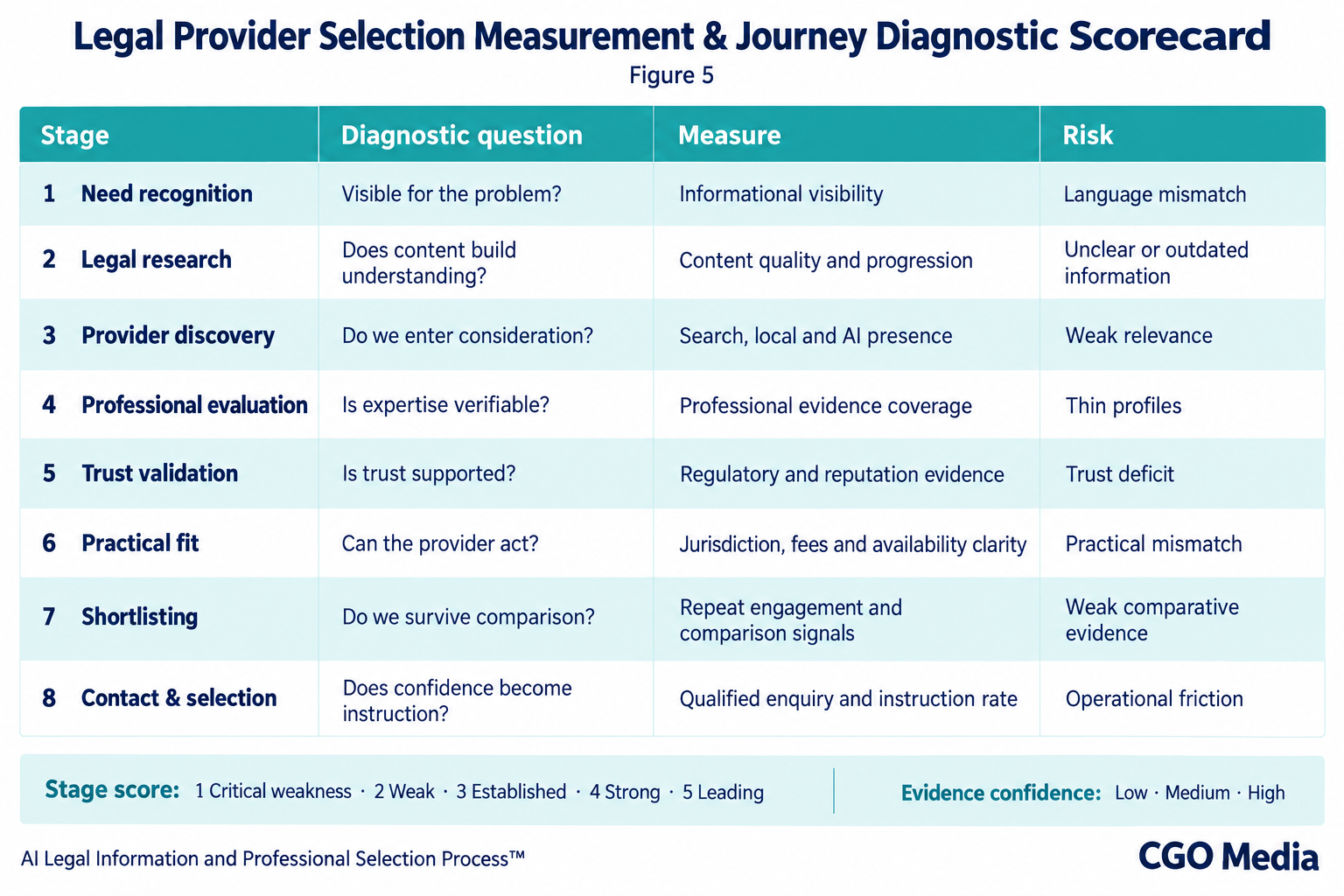
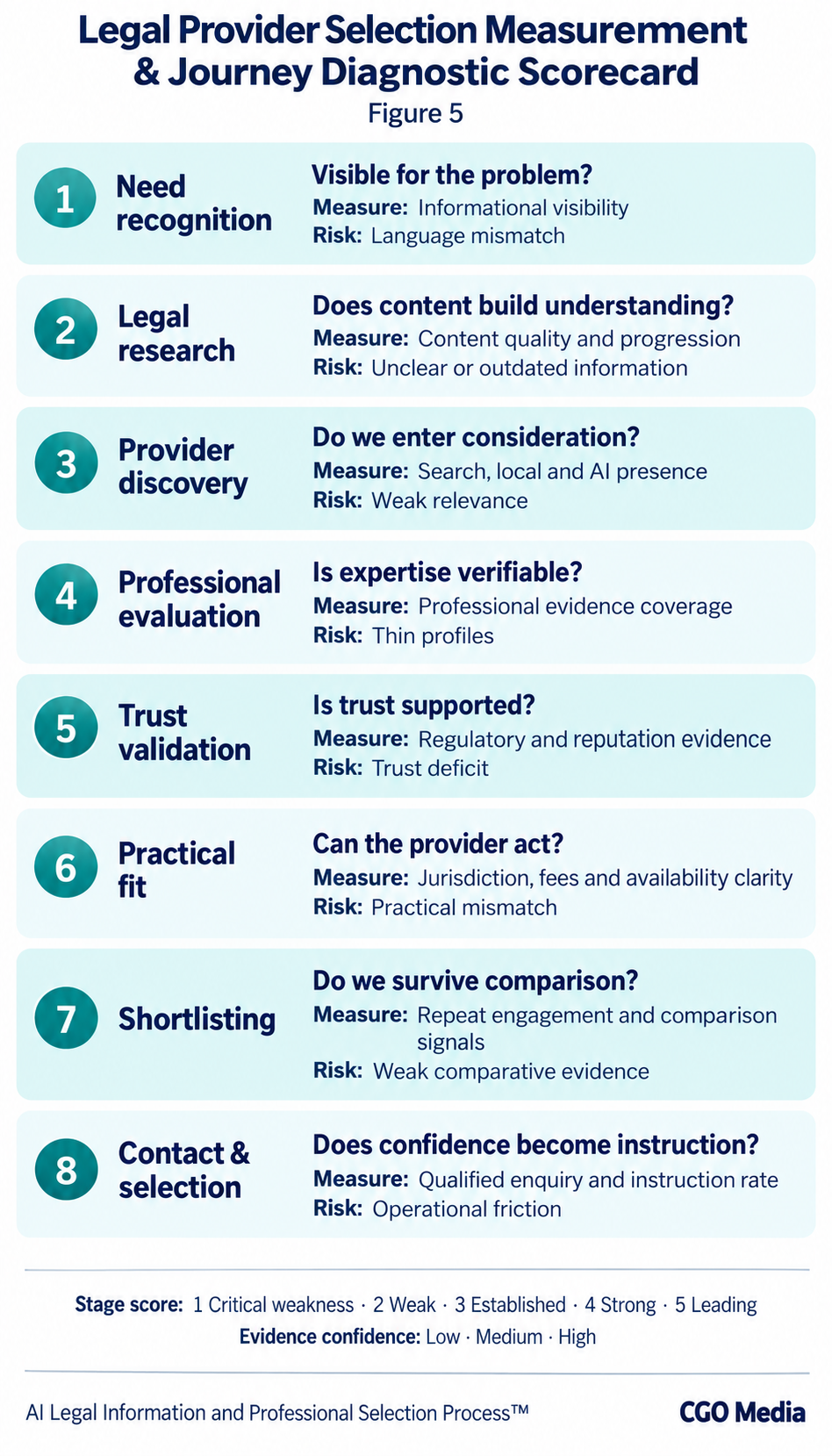
437. Continuous Improvement of the Legal Selection Journey
The Legal Information and Professional Selection Process should be treated as a dynamic decision system rather than a fixed funnel.
438. User Behaviour Changes Over Time
Prospective clients may alter how they research and compare legal providers as new search interfaces, AI systems, directories and referral behaviours emerge.
439. Legal Information Demand Changes
Search behaviour may shift because of:
- New legislation
- Regulatory changes
- Economic conditions
- Social change
- New business risks
440. Practice-Area Demand Can Change Rapidly
Changes in the legal, political or commercial environment may create new demand for particular types of legal information and professional support.
441. Search Terminology Evolves
Users may begin describing legal needs with new language long before firms update their existing content architecture.
442. AI Changes How Users Phrase Legal Questions
Conversational systems may encourage longer, more contextual questions rather than short traditional keyword searches.
443. Journey Reassessment Should Follow Behaviour Change
Legal organisations should periodically review whether their content and provider-selection architecture still reflects how users actually search.
444. Legal Evidence Decay Can Disrupt the Selection Journey
Provider-selection confidence may weaken when previously accurate information becomes outdated.
445. Professional Evidence Decay
Professional-selection information may deteriorate when:
- Lawyers leave
- Roles change
- Practice focus changes
- Office locations change
446. Practice-Area Evidence Decay
Practice-area information may become less useful when:
- Services change
- Teams are restructured
- New specialisms emerge
- Old terminology remains
447. Legal Content Decay
Information may become weaker when:
- Law changes
- Procedure changes
- Guidance changes
- Sources become outdated
448. Regulatory Evidence Decay
Professional or firm status information may become inconsistent across first-party and external sources.
449. Local Evidence Decay
Office information may become inaccurate after:
- Moves
- Closures
- Telephone changes
- Changes in professional availability
450. Review Evidence Decay
Older reviews may become less representative of the current client experience as teams and processes change.
451. Fee Information Decay
Published pricing or consultation information may become outdated and create friction during practical-fit evaluation.
452. Contact-Process Decay
Forms, telephone routing and onboarding processes may deteriorate even when the wider authority environment remains strong.
453. AI Selection Drift
AI systems may change which providers they surface, how they describe them and which sources they cite.
454. AI Drift Can Affect Multiple Selection Stages
A material change in AI representation may influence:
- Problem interpretation
- Provider discovery
- Professional evaluation
- Trust validation
- Provider comparison
455. AI Drift Should Be Monitored Longitudinally
One isolated result should not automatically trigger major strategic change.
456. Standard Prompt Sets Help Detect Drift
Repeatable monitoring can reveal whether representation changes are:
- Temporary
- Persistent
- Entity-specific
- Practice-specific
457. Branded AI Drift
Monitor whether generated descriptions of the firm change materially over time.
458. Professional AI Drift
Monitor whether lawyers’ roles, practice areas and affiliations remain accurate.
459. Local AI Drift
Monitor whether office and professional-location relationships remain correct.
460. Recommendation-Set Drift
Observe whether the firms repeatedly appearing in relevant provider comparisons change over time.
461. Source-Pattern Drift
Where citations are visible, monitor whether new source environments become more prominent.
462. Journey Failure Mode — Optimising Only for Discovery
A legal organisation may increase visibility without improving the professional, trust or practical evidence necessary for selection.
463. Journey Failure Mode — Strong Information, Weak Professional Profiles
High-quality legal content may create interest but fail to convert if users cannot identify a suitable lawyer.
464. Journey Failure Mode — Strong Lawyers, Weak Trust Evidence
Professional authority may not be enough where regulatory or reputation information is unclear.
465. Journey Failure Mode — Strong Trust, Wrong Jurisdiction
A highly trusted provider can still be unsuitable where the legal context does not match.
466. Journey Failure Mode — Strong Reputation, Poor Practical Fit
Users may choose another provider because of:
- Location
- Availability
- Language
- Fee structure
467. Journey Failure Mode — Strong Digital Experience, Weak Contact Experience
A polished website cannot compensate for slow response, poor triage or difficult onboarding.
468. Journey Failure Mode — Excessive Legal Jargon
Users may leave early if the information environment assumes knowledge they do not yet have.
469. Journey Failure Mode — No Jurisdictional Clarity
Unclear legal scope may create confusion at several stages of the journey.
470. Journey Failure Mode — Premature Conversion Pressure
Aggressive calls to action may weaken trust before the user has established sufficient understanding.
471. Journey Failure Mode — Hidden Professional Expertise
The firm may have strong relevant lawyers whose expertise is difficult to discover digitally.
472. Journey Failure Mode — Reviews Without Context
Raw review volume should not be treated as a substitute for broader trust and professional evidence.
473. Journey Failure Mode — Directory Dependence
A provider may become overly dependent on one external directory for reputation or discovery.
474. Journey Failure Mode — AI Recommendation Chasing
Changing content primarily to influence one AI prompt can weaken the broader information architecture.
475. Journey Failure Mode — Treating AI Order as Ranking
Generated provider order should not be treated as a stable league table.
476. Journey Failure Mode — Ignoring Operational Filtering
Not every abandoned journey represents lost opportunity.
Some users should exit because the matter, jurisdiction or client type is not suitable.
477. Journey Failure Mode — Measuring Traffic Instead of Qualified Progression
High informational traffic may have limited value if few appropriate users progress toward professional evaluation or enquiry.
478. Journey Failure Mode — Last-Click Attribution Only
The final referral source may conceal earlier influence from AI, directories, editorial content or professional referrals.
479. Journey Failure Mode — No Front-Line Feedback
Analytics may miss important reasons why prospective clients fail to progress.
480. Journey Failure Mode — No Change Triggers
The selection journey can become inaccurate quickly if professional, office or service changes are not propagated through the digital environment.
481. Journey Failure Mode — No Cross-Functional Ownership
Provider selection spans:
- Marketing
- Lawyers
- Business development
- Reception
- Intake
- Compliance
Weak coordination across these functions can create friction.
482. Continuous Improvement Requires Named Ownership
Each major stage should have a responsible team or role capable of addressing recurring weaknesses.
483. Early-Journey Ownership
Potential contributors may include:
- SEO
- Content
- Knowledge teams
- Practice leaders
484. Professional-Evaluation Ownership
Potential contributors may include:
- Marketing
- HR
- Practice management
- Individual lawyers
485. Trust-Stage Ownership
Potential contributors may include:
- Compliance
- Risk
- Client-care teams
- Marketing
486. Practical-Fit Ownership
Potential contributors may include:
- Office management
- Operations
- Finance
- Business development
487. Contact and Onboarding Ownership
Potential contributors may include:
- Reception
- Intake teams
- Business development
- Compliance
- Fee earners
488. AI Monitoring Ownership
Potential contributors may include:
- SEO
- Digital strategy
- Data teams
- Risk and compliance
489. Continuous Improvement Should Use Multiple Evidence Sources
A strong improvement process combines:
Search Data + Website Behaviour + Professional Feedback + Intake Data + Client Feedback + AI Observation
490. Search Data
Search data may reveal:
- Changing user language
- Emerging legal questions
- New practice demand
- Local discovery changes
491. Website Behaviour
Digital behaviour may reveal:
- High-exit pages
- Weak progression paths
- Professional-profile engagement
- Contact friction
492. Professional Feedback
Lawyers may identify:
- Common misunderstandings
- Wrong client assumptions
- Missing information
- New service requirements
493. Intake Data
Intake teams may reveal:
- Unsuitable enquiries
- Jurisdiction mismatches
- Fee misunderstandings
- Repeated triage problems
494. Client Feedback
Reviews and complaints may reveal:
- Communication issues
- Process confusion
- Response problems
- Expectation gaps
495. AI Observation
AI monitoring may reveal:
- Entity ambiguity
- Professional inaccuracies
- Provider misclassification
- New comparison behaviours
496. Improvement Should Follow Verified Evidence
The organisation should avoid redesigning the selection journey around isolated data points without confirming that a genuine pattern exists.
497. Prioritise by Client Impact
Issues should be prioritised according to the effect they may have on:
- User understanding
- Professional confidence
- Trust
- Qualified progression
- Conversion
498. Prioritise by Risk
Higher priority may be given to:
- Professional-status errors
- Jurisdictional errors
- Regulatory ambiguity
- Misleading legal information
499. Prioritise by Strategic Importance
High-value practice areas or priority offices may justify greater improvement resources where foundational risks are controlled.
500. Reassess the Eight Stages Periodically
The complete selection journey should be reviewed at intervals appropriate to the organisation’s scale and rate of change.
501. Reassess Stage One
Are users still describing legal needs in the way the information architecture expects?
502. Reassess Stage Two
Does legal information remain current, understandable and jurisdictionally appropriate?
503. Reassess Stage Three
Does the organisation enter the right provider-consideration environments?
504. Reassess Stage Four
Can users identify and verify relevant professionals easily?
505. Reassess Stage Five
Is sufficient regulatory, reputational and client-trust evidence available?
506. Reassess Stage Six
Are jurisdiction, location, fee, availability and access information sufficiently clear?
507. Reassess Stage Seven
Does the provider remain competitive when users compare appropriate alternatives?
508. Reassess Stage Eight
Does contact, consultation and onboarding reinforce the confidence created earlier?
509. Reassess Post-Selection Feedback
Are reviews, complaints and client experiences strengthening or weakening future provider discovery?
510. Reassess AI Influence Across the Journey
Review whether AI systems are introducing new:
- Search behaviours
- Comparison patterns
- Source dependencies
- Representation risks
511. Reassess Competitor Sets
The firms users compare may change because of:
- Market entry
- Mergers
- Regional expansion
- Practice-area growth
512. Reassess Journey Weighting
The relative importance of individual stages may change according to practice area, client type and market conditions.
513. Continuous Improvement Should Strengthen Appropriate Filtering
The objective is not to remove every point of friction.
Some friction is necessary to determine whether the provider can act appropriately.
514. Good Friction
Necessary friction may include:
- Conflict checks
- Identity verification
- Jurisdiction verification
- Matter qualification
515. Bad Friction
Avoidable friction may include:
- Broken forms
- Wrong contact details
- Unclear professional roles
- Repeated information requests
- Slow acknowledgement
516. The Objective Is Qualified Progression
A strong legal selection journey helps appropriate prospective clients progress while allowing unsuitable matters to exit clearly and efficiently.
517. The Continuous Legal Selection Improvement Cycle
A practical cycle is:
Observe → Diagnose → Prioritise → Improve → Measure → Learn → Reassess
518. Observe
Monitor search, website, intake, client and AI evidence across the eight-stage journey.
519. Diagnose
Determine whether the issue originates in:
- Information
- Professional evidence
- Trust
- Practical fit
- Operations
520. Prioritise
Rank weaknesses according to:
- Legal or professional risk
- Client impact
- Commercial importance
- Frequency
521. Improve
Strengthen the relevant content, professional profile, trust evidence, practical information or operational process.
522. Measure
Assess whether qualified users progress more effectively through the affected stage.
523. Learn
Use the resulting evidence to improve standards and future decision-making.
524. Reassess
Repeat the full journey analysis to identify the next priority.
525. The Full Continuous Selection System
The Legal Information and Professional Selection Process can therefore be represented as:
Need → Understand → Discover → Evaluate → Verify → Confirm Fit → Compare → Contact → Select → Experience → Feedback → Learn → Improve
526. The Long-Term Objective Is Decision Confidence
The strongest legal provider-selection environment is not simply the one producing the most enquiries.
It is one that helps appropriate users move from uncertainty toward a suitably informed professional selection with progressively stronger evidence, clearer expectations and lower avoidable friction.
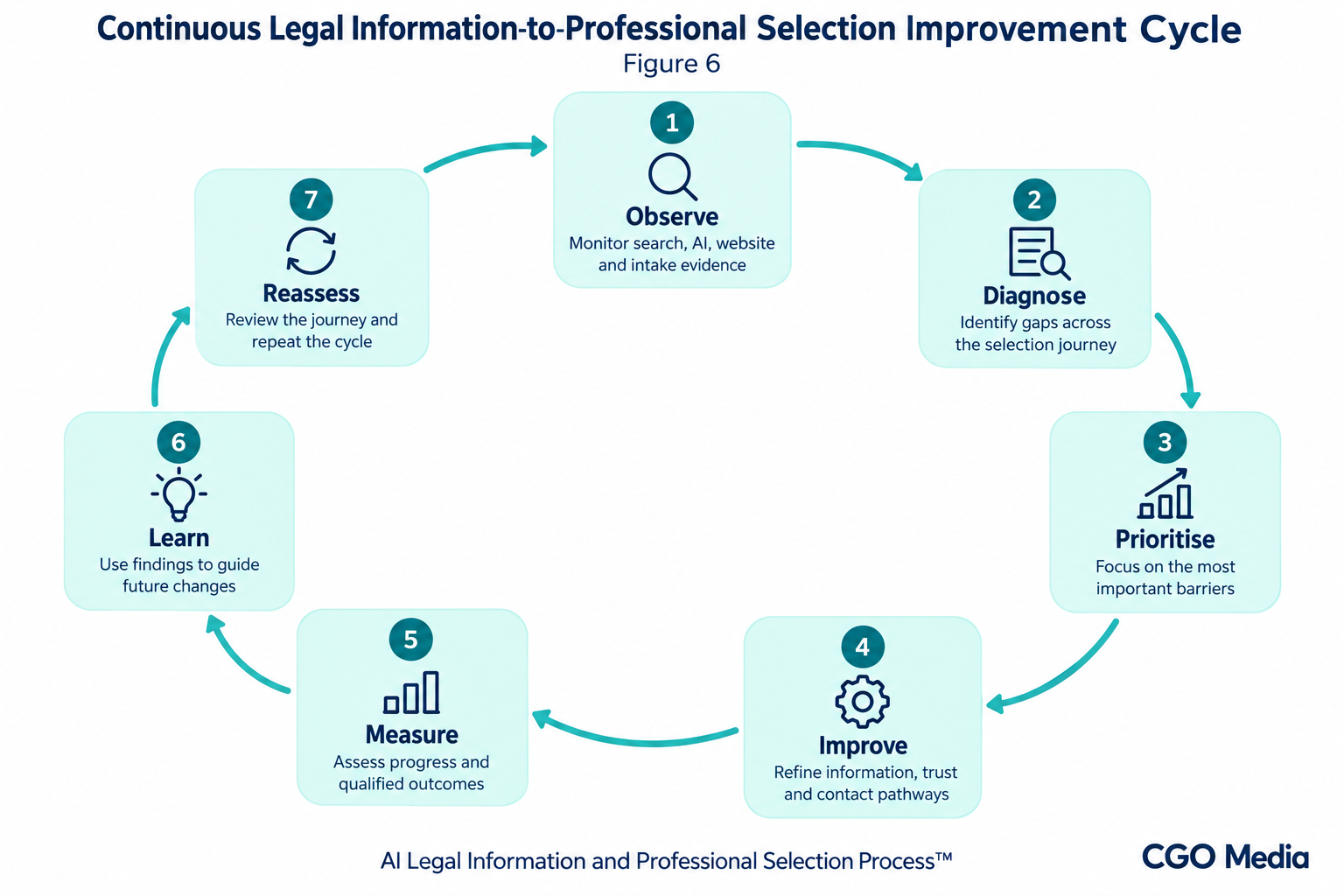
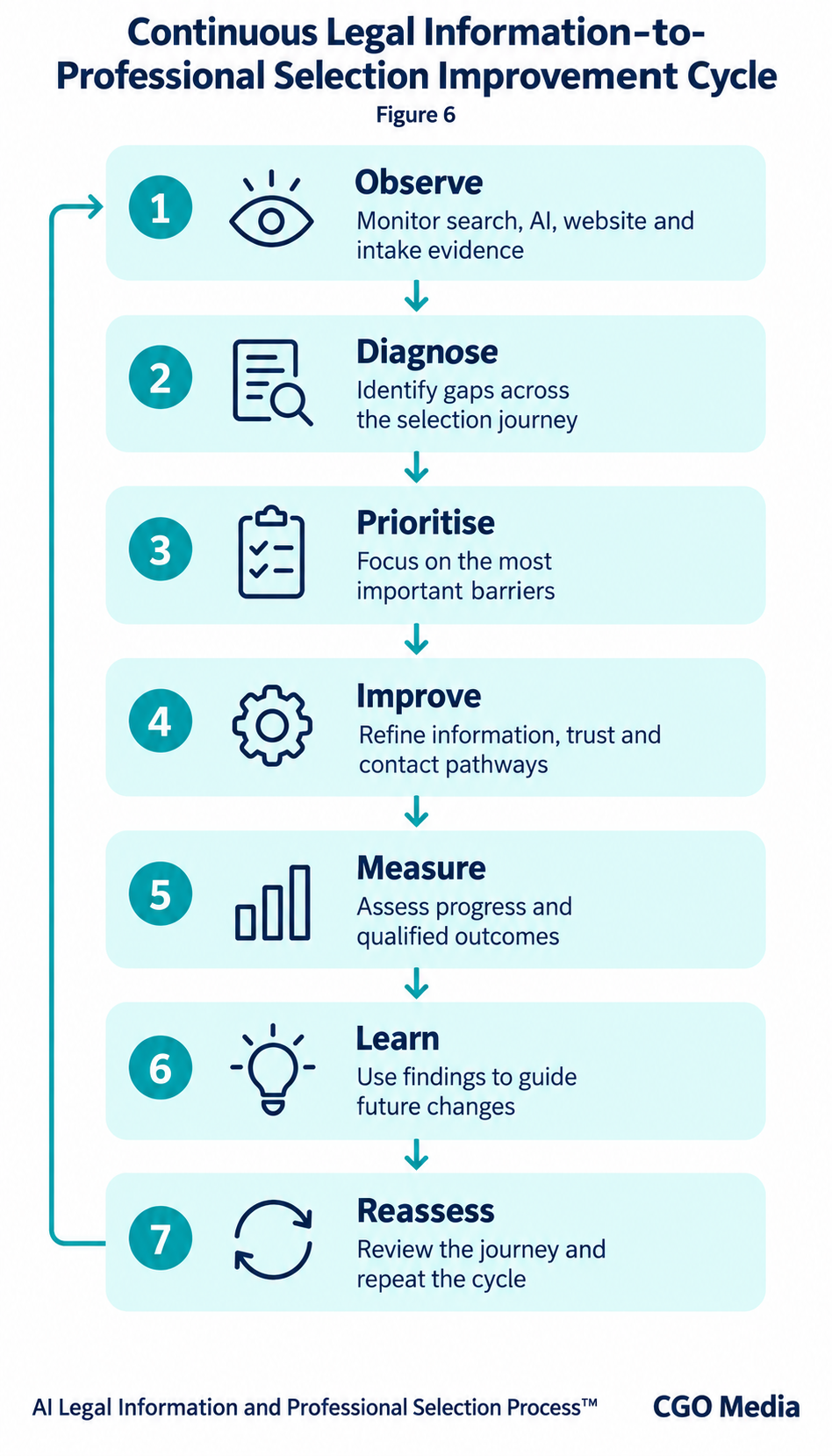
527. Strategic Implications
The Legal Information and Professional Selection Process shows that legal provider selection is not a single search event. It is a cumulative decision process shaped by information quality, professional relevance, trust, jurisdictional fit, practical access, comparison and direct interaction.
528. Legal Discovery Begins Before Provider Search
Many users first need to understand the problem before they can identify the appropriate legal service or professional.
529. Early Information Can Shape the Entire Journey
Problem-led legal information influences:
- Terminology
- Perceived urgency
- Practice-area understanding
- Provider expectations
530. Legal Information Should Support Progression
Strong legal content should help users move logically from:
Problem → Understanding → Practice Area → Service → Professional
531. Provider Discovery Is Only the Beginning
A firm entering the consideration set still needs to survive deeper evaluation of professional expertise, trust, jurisdiction and practical fit.
532. Professional Evidence Is Central to Legal Selection
Users often need to understand not only whether a firm handles the relevant practice area, but which professional is likely to have appropriate expertise.
533. Professional Authority Should Be Verifiable
Relevant profiles should provide enough current information for users to assess:
- Role
- Practice focus
- Experience
- Office
- Professional status
534. Trust Is Multi-Source
Legal trust can develop through:
- Professional verification
- Regulatory transparency
- Client experience
- Reputation evidence
- External corroboration
535. Reviews Should Remain in Context
Reviews may influence perceptions of service, communication and responsiveness, but should not be treated as direct evidence of legal competence.
536. Jurisdiction Is a Critical Selection Filter
A highly regarded provider may still be unsuitable if the matter falls outside its legal or geographic capability.
537. Practical Fit Can Override Reputation
Availability, location, language, service model, responsiveness and fee structure can influence final selection even after strong authority has been established.
538. Provider Comparison Compresses Evidence
At the shortlist stage, users may reduce a complex research journey into a relatively small set of decision factors.
539. Final Selection Is Cumulative
A simplified decision model is:
Relevant Expertise + Professional Confidence + Trust + Jurisdiction + Practical Fit + Commercial Fit + Positive Direct Interaction
540. Operational Experience Is Part of Search Performance
The search and selection journey does not end when the user reaches the contact page.
Response time, triage, consultation and onboarding can determine whether accumulated digital authority converts into an instruction.
541. Qualified Progression Matters More Than Raw Traffic
The objective should not be to move every visitor toward enquiry.
The stronger objective is to help appropriate users progress while allowing unsuitable matters to filter out efficiently.
542. AI Search Can Compress Multiple Selection Stages
AI-assisted search may allow a user to move from problem recognition through provider comparison within a single conversational environment.
543. AI Compression Raises the Importance of Evidence Quality
When an AI system synthesises several sources into one answer, inaccurate firm, professional or jurisdictional information can affect multiple stages of provider selection at once.
544. AI Provider Presence Is Not Professional Endorsement
Inclusion in a generated provider list should not be interpreted as accreditation, professional recommendation or proof of suitability.
545. The Complete Legal Selection Model
The complete process can be represented as:
Need Recognition → Legal Research → Provider Discovery → Professional Evaluation → Trust Validation → Practical Fit → Comparison → Contact → Selection → Experience → Feedback
546. Relationship with the CGO Media Legal Research Family
The Legal Information and Professional Selection Process forms part of the wider CGO Media Legal research architecture.
Legal SEO and Entity Authority | Legal Entity Authority Framework | Legal Entity Authority Maturity Model | Legal SEO and Entity Authority Implementation Roadmap
547. Relationship with Legal SEO and Entity Authority
The parent research paper Legal SEO and Entity Authority provides the wider research foundation for the legal search, entity and authority environment explored by this process model.
548. Relationship with the Legal Entity Authority Framework
The Legal Entity Authority Framework defines the six authority dimensions that support accurate legal organisation and professional representation across search and AI-assisted discovery.
549. Relationship with the Legal Entity Authority Maturity Model
The Legal Entity Authority Maturity Model evaluates how consistently organisations govern the authority evidence required to support the selection journey.
550. Relationship with the Legal SEO and Entity Authority Implementation Roadmap
The Legal SEO and Entity Authority Implementation Roadmap translates the wider legal research family into a practical implementation sequence.
551. Methodology
The Legal Information and Professional Selection Process is a conceptual decision-journey methodology developed by CGO Media to structure analysis of how users may discover, evaluate and select legal providers across traditional search, local search, external sources and AI-assisted environments.
552. Eight Primary Decision Stages
The methodology uses eight core stages:
- Legal Need or Problem Recognition
- Legal Information and Process Research
- Practice Area and Provider Discovery
- Professional Relevance and Expertise Evaluation
- Regulatory, Reputational and Trust Validation
- Jurisdiction, Location and Practical Fit
- Provider Comparison and Shortlisting
- Contact, Consultation and Professional Selection
553. Journey Analysis
Each stage can be assessed according to:
- User information needs
- Potential search environments
- Evidence requirements
- Selection risks
- Progression signals
- Abandonment signals
554. User-Intent Analysis
The framework distinguishes between early problem-led intent, information research, provider discovery, professional verification, comparison and final contact intent.
555. Information Analysis
Legal information may be assessed according to:
- Accuracy
- Clarity
- Freshness
- Jurisdictional context
- Professional connection
556. Professional Analysis
Professional evaluation may consider:
- Role
- Practice relevance
- Professional status
- Office
- External evidence
557. Trust Analysis
Trust validation may consider:
- Regulatory evidence
- Professional verification
- Reviews
- Client-care information
- Reputation evidence
558. Practical-Fit Analysis
Practical selection may consider:
- Jurisdiction
- Location
- Availability
- Language
- Fees
- Service model
559. Comparison Analysis
Provider comparison considers whether the organisation survives evaluation against relevant alternatives on the factors most important to the user.
560. Contact Analysis
The final stage may assess:
- Enquiry friction
- Response time
- Triage quality
- Consultation experience
- Onboarding
561. Stage Scoring
Each stage may be scored on a 1–5 scale:
- 1 — Critical Weakness
- 2 — Weak
- 3 — Established
- 4 — Strong
- 5 — Leading
562. Evidence Confidence
Stage scores may also include a confidence classification:
- Low
- Medium
- High
563. Stage Weighting
Organisations may apply different weighting according to:
- Practice area
- Client type
- Jurisdiction
- Matter complexity
- Commercial model
564. Conversion Analysis
The model can be used to assess progression between stages, including:
Information → Practice Area → Professional → Trust → Contact → Consultation → Instruction
565. Abandonment Analysis
The framework also considers whether users leave because of:
- Weak relevance
- Professional ambiguity
- Trust concerns
- Jurisdictional mismatch
- Practical barriers
- Operational friction
566. Attribution Analysis
Where practical, the methodology considers multiple discovery influences rather than relying on the final website referral alone.
567. AI Observation Method
AI-assisted provider discovery may be observed using repeatable prompt classes covering:
- Problem-led questions
- Practice-area discovery
- Professional discovery
- Local provider search
- Provider comparison
568. AI Observation Should Be Longitudinal
Repeated observations are generally more useful than conclusions drawn from a single generated answer.
569. Limitations
The Legal Information and Professional Selection Process is a conceptual search and decision framework. It is not a universal behavioural prediction model.
570. Individual Legal Decisions Differ
Users may begin, skip, repeat or reorder stages depending on their circumstances.
571. Referral-Led Journeys Differ
A user arriving through a trusted personal or professional referral may begin with substantially higher provider confidence than a user beginning with a non-branded search.
572. Existing-Client Journeys Differ
Existing clients may bypass much of the discovery and trust-validation process when seeking additional legal support from a provider they already know.
573. Urgent Matters Differ
Urgency may compress the process significantly and increase the importance of availability and response speed.
574. Consumer and Commercial Journeys Differ
Individual consumers and large organisations may apply very different selection criteria and procurement processes.
575. Jurisdictions Differ
Legal terminology, regulatory structures, professional titles and provider-selection behaviours vary between countries and legal systems.
576. Practice Areas Differ
The selection journey for routine conveyancing, complex commercial litigation, criminal defence or international transactions may differ substantially.
577. Search Data Is Incomplete
Analytics cannot capture every offline conversation, referral, device switch or external source involved in provider selection.
578. Attribution Is Approximate
First-touch, last-touch and self-reported attribution each provide only partial views of the decision journey.
579. Review Evidence Has Limitations
Reviews can provide valuable client-experience context, but they do not directly establish technical legal quality or likely case outcomes.
580. Directory Evidence Has Limitations
Directory rankings and recognition should be interpreted according to their relevant year, category, geography and methodology.
581. AI Outputs Are Variable
AI responses may differ according to:
- Model
- Prompt
- Time
- Geography
- Retrieval system
- Available sources
582. AI Source Visibility Can Be Incomplete
Some AI systems may not expose every source influencing a generated response.
583. AI Recommendation Does Not Equal Legal Endorsement
Generated provider suggestions should not be interpreted as professional accreditation, legal advice or a guarantee of provider suitability.
584. The Framework Does Not Predict Outcomes
The model does not determine whether a selected legal provider will achieve a particular legal, commercial or personal result.
585. The Framework Does Not Replace Professional Advice
General legal information encountered through search or AI-assisted systems should not be treated as a substitute for advice based on the facts of an individual matter.
586. Conclusion
The modern legal client journey extends far beyond traditional keyword search.
Users may move between search engines, AI assistants, directories, firm websites, professional profiles, regulatory sources, reviews and direct contact before choosing a provider.
The Legal Information and Professional Selection Process provides a structured model for understanding that journey across eight connected stages.
Its central principle is that legal selection becomes progressively more evidence-intensive as a user moves from general uncertainty toward professional instruction.
Visibility creates discovery, but discovery alone does not create selection.
Legal organisations must also demonstrate professional relevance, verifiable trust, jurisdictional suitability, practical accessibility and an effective direct client experience.
As AI-assisted search compresses parts of this journey, organisations with clear, current and well-connected evidence may be better positioned for accurate representation across both traditional and generative discovery environments.
References
External Academic, Technical and Search Sources
- Google Search Central. SEO Starter Guide.
- Google Search Central. Understand how structured data works.
- Schema.org. LegalService.
- Schema.org. Organization.
- Schema.org. Person.
- Hogan, A. et al. (2021). Knowledge Graphs. ACM Computing Surveys, 54(4).
- Metzger, M.J. (2007). Making Sense of Credibility on the Web: Models for Evaluating Online Information and Recommendations for Future Research. Journal of the American Society for Information Science and Technology, 58(13), 2078–2091.
- Ji, Z. et al. (2023). Survey of Hallucination in Natural Language Generation. ACM Computing Surveys, 55(12).
CGO Media Legal Research and Frameworks
- Wilkinson, R. (2026). Legal SEO and Entity Authority. CGO Media.
- Wilkinson, R. (2026). Legal Entity Authority Framework. CGO Media.
- Wilkinson, R. (2026). Legal Entity Authority Maturity Model. CGO Media.
- Wilkinson, R. (2026). Legal SEO and Entity Authority Implementation Roadmap. CGO Media.
CGO Media Research Ecosystem
CGO Media Research Library | CGO Media Framework Library | CGO Media Research Architecture
About Roger Wilkinson
Roger Wilkinson is an independent researcher, SEO practitioner and founder of CGO Media with more than 25 years of experience in search, online visibility and business growth.
His current research focuses on how artificial intelligence is reshaping search engines, recommendation systems, digital authority, entity representation and organisational visibility.
Roger is the creator of the CGO Framework Series, a collection of research-led methodologies designed to help organisations measure, strengthen and govern Search Visibility, AI Visibility and Digital Authority.
His work examines the relationship between Technical SEO, Entity Authority, Content Authority, Citation Authority, Brand Signals, Knowledge Architecture and AI Search Readiness.
View Roger Wilkinson’s researcher profile →
Related Legal Research and Frameworks
Legal SEO and Entity Authority | Legal Entity Authority Framework | Legal Entity Authority Maturity Model | Legal SEO and Entity Authority Implementation Roadmap
Research Usage & Citation
CGO Media encourages researchers, journalists, legal organisations, professional-services firms, educators and industry professionals to reference this framework where it contributes to broader discussion and understanding of Legal SEO, professional discovery, provider selection, AI Search and digital authority.
Reasonable quotations, summaries, figures and excerpts may be used in articles, reports, presentations, academic work and other publications provided appropriate acknowledgement is given to Roger Wilkinson and CGO Media.
Cite This Framework / Embed Citation
The Legal Information and Professional Selection Process by Roger Wilkinson at CGO Media provides an eight-stage model for understanding how users move from legal need recognition and information research through provider discovery, professional evaluation, trust validation, comparison and final professional selection.
APA Citation
APA Citation: Wilkinson, R. (2026). Legal Information and Professional Selection Process. CGO Media. https://cgomedia.com/ai-legal-information-and-professional-selection-process/
Author: Roger Wilkinson | Published by: CGO Media
For permissions relating to extensive reproduction, commercial licensing or republication of substantial portions of this framework, please contact CGO Media directly.