
Legal Entity Authority Framework
 The Legal Entity Authority Framework provides a structured model for evaluating how clearly and credibly a legal organisation is represented across search engines, professional environments, external sources and AI-assisted discovery systems.
The framework builds on the parent research paper Legal SEO and Entity Authority and translates that research into six connected authority dimensions covering organisational identity, legal information, professional expertise, regulatory trust, external validation and AI recommendation readiness.
1. Purpose of the Framework
The purpose of the framework is to help legal organisations assess whether the evidence surrounding their firm, offices, professionals and practice areas is sufficiently clear, current and trustworthy to support modern search visibility and AI-assisted provider discovery.
2. Why Legal Entity Authority Matters
Search engines and AI systems increasingly interpret legal providers through networks of entities and relationships rather than through isolated webpages alone.
3. Legal Authority Is Distributed
A law firm’s digital authority may be represented across:
- Firm website
- Professional profiles
- Regulatory sources
- Legal directories
- Local business profiles
- Publications
- Editorial coverage
- Reviews
4. Entity Authority Is More Than Name Consistency
Entity authority depends not only on whether a firm name is written consistently, but whether important relationships are represented accurately.
5. The Core Legal Entity Chain
A practical legal entity architecture may be represented as:
Legal Organisation → Office → Professional → Practice Area → Legal Service → Jurisdiction → Matter Type
6. Six Connected Authority Dimensions
The Legal Entity Authority Framework evaluates six primary dimensions:
- Legal Organisation and Entity Clarity
- Legal Information and Practice-Area Authority
- Professional and Practitioner Authority
- Regulatory, Client and Reputational Trust
- External, Institutional and Local Authority
- AI Search and Professional Recommendation Readiness
7. Framework Logic
The framework can be summarised as:
Entity Clarity + Legal Information Authority + Professional Authority + Regulatory & Client Trust + External Authority + AI Recommendation Readiness
8. Dimension One — Legal Organisation and Entity Clarity
The first dimension assesses whether the legal provider is represented consistently and unambiguously across its digital and external information environment.
9. Firm Identity
Users and automated systems should be able to determine:
- The firm’s current name
- Its provider type
- Its principal locations
- Its main practice areas
10. Organisational Type
The firm should be represented according to its actual legal and professional structure rather than through generic terminology that creates ambiguity.
11. Brand and Legal Entity Relationships
Where the public-facing brand differs from the underlying legal entity, that relationship should be sufficiently clear.
12. Parent and Subsidiary Relationships
Larger legal groups may need to distinguish:
- Parent organisation
- Operating entities
- Regional brands
- Specialist subsidiaries
13. Rebrands and Historical Names
Historical identities may remain visible externally long after a firm has changed name.
14. Merger Entity Complexity
Firm mergers can create overlapping:
- Names
- Domains
- Professional biographies
- Directory listings
- Office records
15. Office Entity Clarity
Each significant office should have a distinct and current digital identity.
16. Office Data
Important office information may include:
- Canonical office name
- Address
- Telephone
- Opening information
- Relevant professionals
- Relevant practice areas
17. Office Relationships
Each office should connect clearly with:
- The parent organisation
- Professionals based there
- Practice areas genuinely supported there
- Local contact pathways
18. Avoid Artificial Office Coverage
Legal organisations should not represent locations as substantive offices where there is no meaningful operational presence.
19. Professional Entity Clarity
Individual legal professionals should be represented as distinct entities rather than as generic members of a team.
20. Core Professional Identity
A professional profile may include:
- Full name
- Current title
- Current role
- Professional status
- Practice areas
- Office locations
21. Professional Affiliation
The relationship between a lawyer and the current legal organisation should be explicit.
22. Professional Role Changes
Promotion, partnership changes and leadership appointments should trigger updates to connected information.
23. Professional Departure
When a lawyer leaves, the organisation should review:
- Professional profile
- Practice-area pages
- Service pages
- Office pages
- External profiles
24. Practice-Area Entity Clarity
Practice areas should be represented consistently across navigation, professional profiles, service pages and external descriptions.
25. Practice Areas Should Reflect Genuine Capability
The firm should avoid creating authority claims around practice areas where there is little genuine professional depth.
26. Broad Practice Areas
A broad category may include:
- Corporate law
- Employment law
- Family law
- Dispute resolution
- Real estate law
27. Specific Legal Services
Within a practice area, users may require specific services or matter types.
28. Practice-Area-to-Service Relationships
The architecture should connect broad legal themes with the actual services provided by the organisation.
29. Service-to-Professional Relationships
Each strategically important legal service should identify the professionals who genuinely work in that area.
30. Professional-to-Practice-Area Relationships
Professional profiles should make relevant practice-area expertise explicit.
31. Professional-to-Office Relationships
Profiles should show where the professional currently practises.
32. Office-to-Practice-Area Relationships
Location pages should identify which practice areas are supported by the professionals available there.
33. Jurisdiction Entity Clarity
Jurisdiction is a critical context layer in legal entity architecture.
34. Jurisdiction Should Not Be Implied
Users should be able to understand where legal information or service capability applies.
35. Multi-Jurisdiction Firms
International or cross-border firms may need to distinguish:
- Country
- State or regional jurisdiction
- Professional qualification
- Office capability
36. Matter-Type Relationships
Common client situations can provide a useful connection between everyday user language and formal legal-service terminology.
37. Example Entity Path
A practical relationship may be:
Employment Law → Unfair Dismissal → Employment Solicitor → London Office → England & Wales
38. Entity Relationships Should Reflect Reality
The framework prioritises accurate relationships over maximum relationship density.
39. Avoid Linking Every Professional to Every Service
Over-connection can create a misleading impression of expertise.
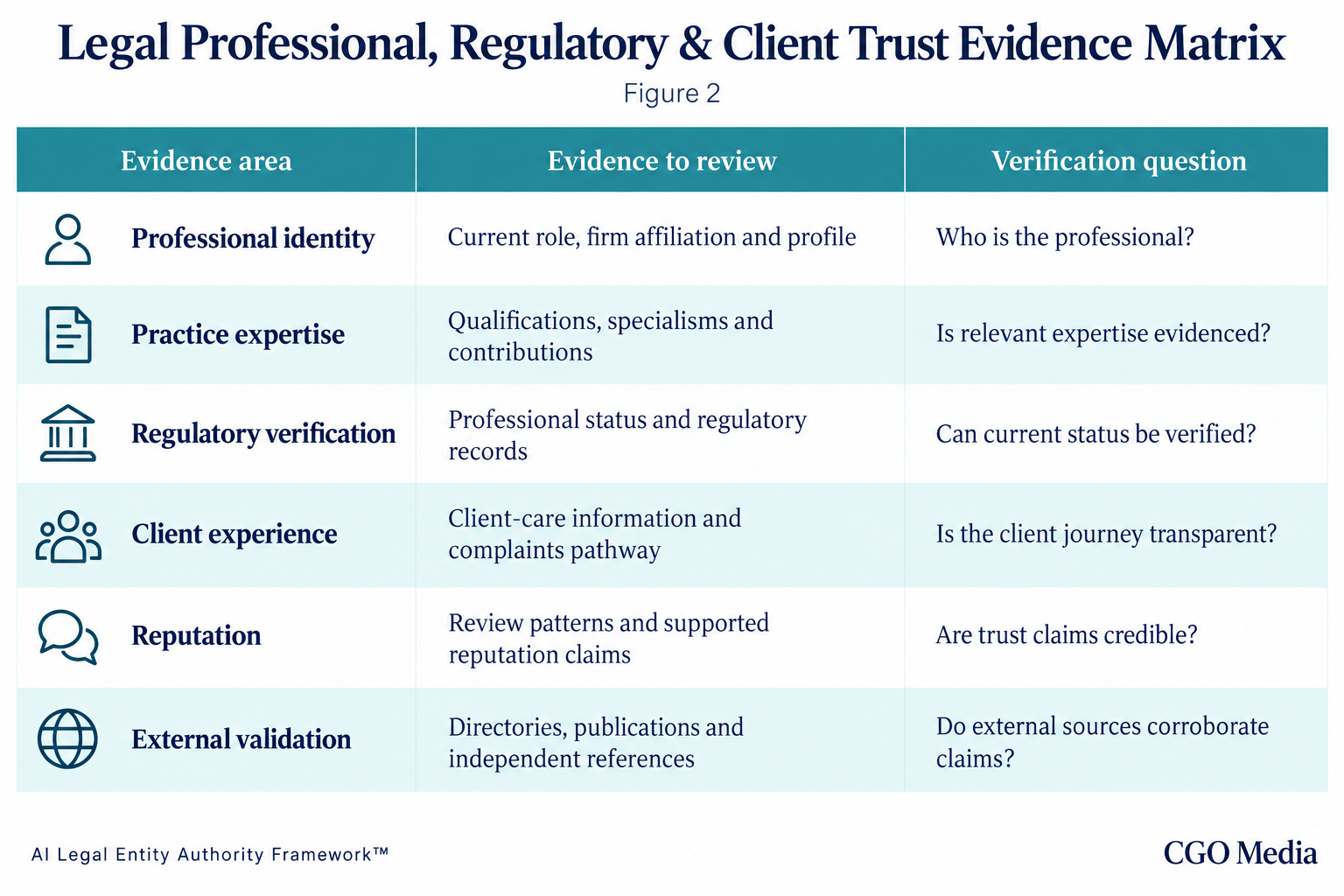
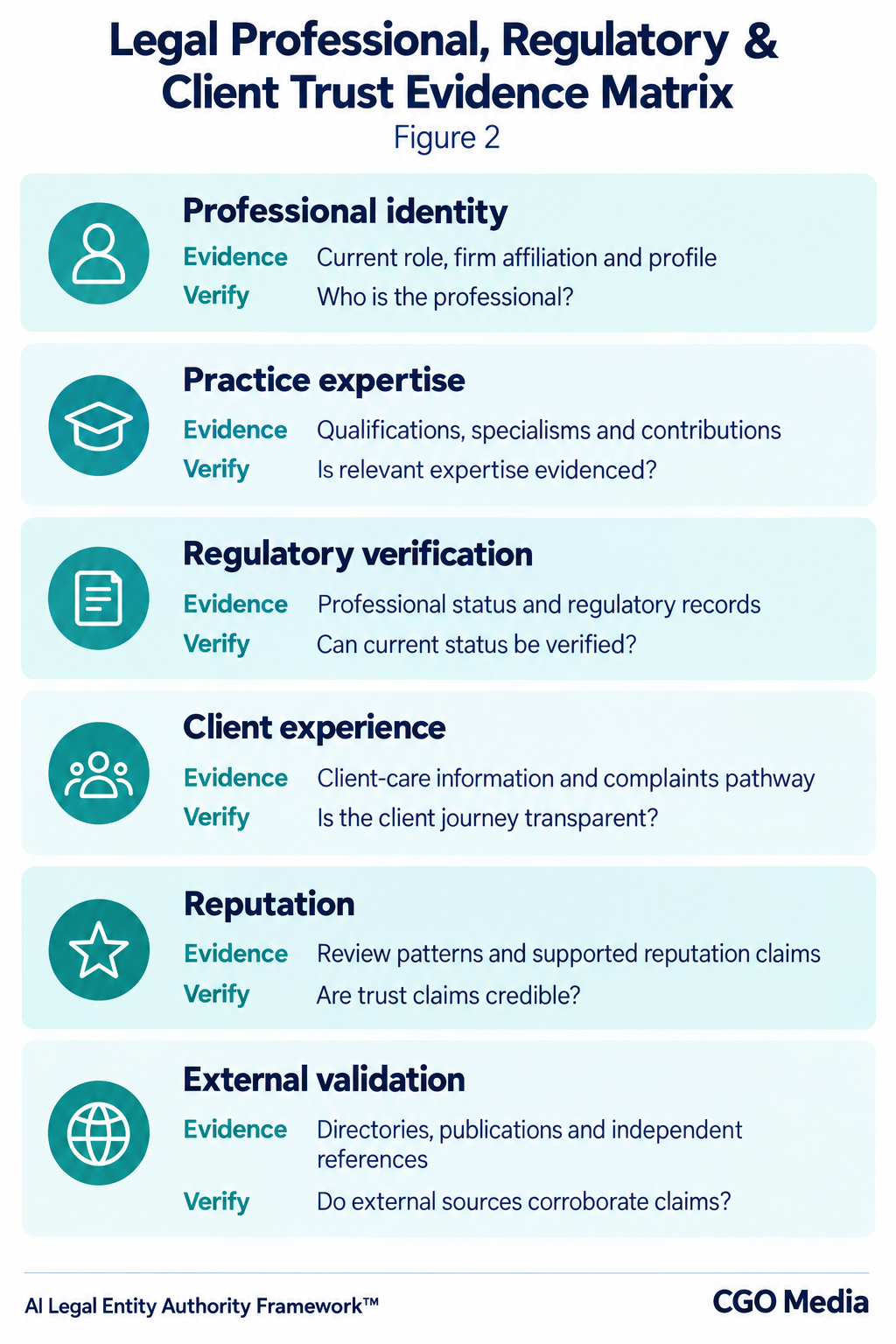
40. Avoid Linking Every Office to Every Practice Area
Office-level information should reflect genuine capability rather than national marketing coverage.
41. First-Party Entity Consistency
The organisation should compare material entity information across:
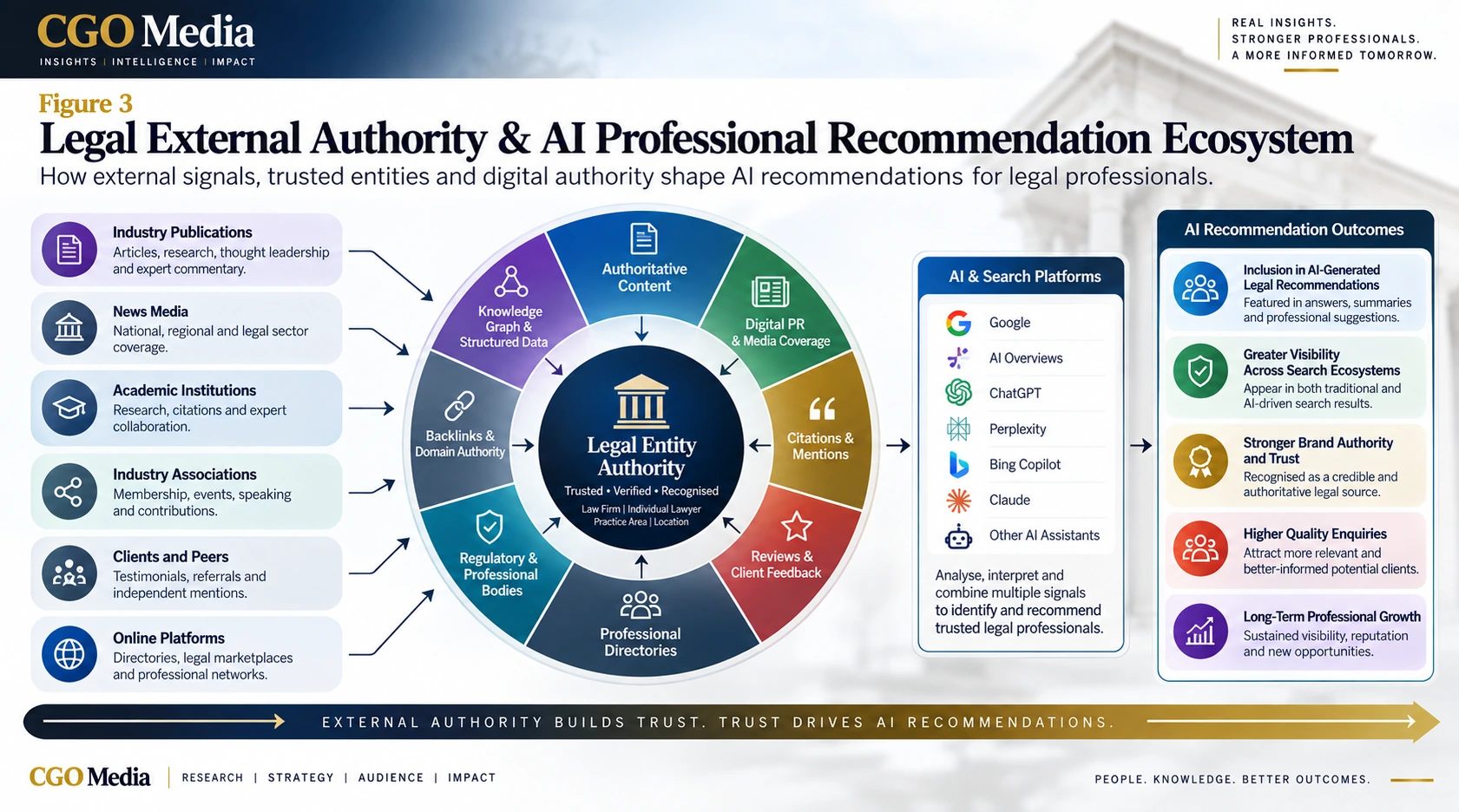
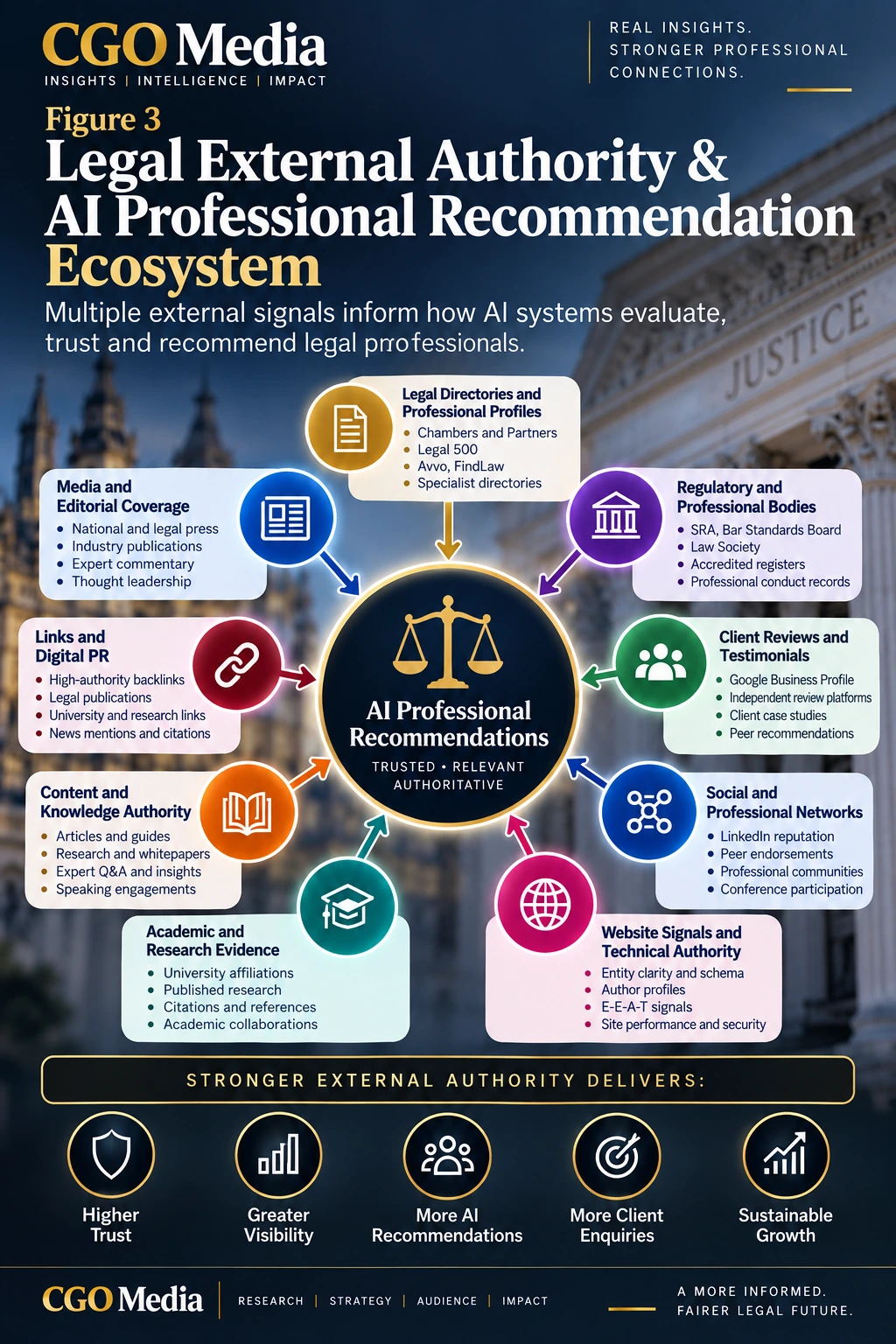
- Homepage
- About pages
- Office pages
- Professional profiles
- Practice-area pages
42. External Entity Consistency
Priority external sources should also be checked for current:
- Firm name
- Professional role
- Office location
- Practice areas
- Regulatory details
43. Material Entity Conflicts
Higher-priority inconsistencies may include:
- Incorrect firm affiliation
- Former office location
- Outdated professional status
- Wrong practice-area association
44. Structured Data and Entity Clarity
Where appropriate, structured data can reinforce organisation, professional, service and location relationships that are already visible and accurate.
45. Structured Data Should Not Create Unsupported Authority
Markup should not claim professional, regulatory or organisational relationships that are not supported by the visible information environment.
46. Entity Governance
Legal organisations should define who owns changes to:
- Firm identity
- Office information
- Professional data
- Practice-area architecture
- External profiles
47. Entity Change Triggers
Relevant triggers may include:
- Professional joining or leaving
- Partner promotion
- Office move
- Practice-area launch
- Merger
- Rebrand
48. Entity Clarity Assessment
A practical assessment may ask:
- Can the firm be identified consistently?
- Can each priority professional be identified accurately?
- Are office relationships current?
- Are practice-area relationships genuine?
- Is jurisdiction clear?
49. Dimension Two — Legal Information and Practice-Area Authority
The second dimension assesses whether legal information demonstrates sufficient relevance, accuracy, structure and professional connection to support the organisation’s claimed practice capabilities.
50. Legal Information Should Demonstrate Real Expertise
Strong legal information should reflect genuine practice rather than exist primarily as generic search-targeting content.
51. Practice-Area Authority
A strong practice-area environment may connect:
- Core service overview
- Specific legal services
- Common matter types
- Relevant professionals
- Applicable jurisdictions
52. Practice-Area Depth
Authority is generally stronger when a practice area is supported by meaningful information across the user decision journey.
53. Informational Coverage
Relevant content may answer:
- What the legal issue is
- What options may exist
- Which processes may apply
- When professional advice may be appropriate
54. Service Coverage
The firm should provide clear information about the legal services it genuinely offers.
55. Matter-Type Coverage
Common scenarios can help users recognise that a formal legal service is relevant to their situation.
56. Jurisdictional Coverage
Legal information should identify the jurisdiction in which it applies where this is material.
57. Professional Connection
Priority practice-area information should connect naturally with relevant professionals.
58. Content Review
Important legal information should be reviewed at intervals appropriate to the likelihood and consequence of change.
59. Content Freshness
Outdated content can weaken authority even when it continues to rank prominently.
60. Legal Source Quality
Where sources or references are used, they should be appropriate to the relevant legal context.
61. Avoid Unsupported Certainty
Legal information should not imply that a general rule automatically determines the result of an individual matter.
62. Avoid Outcome Guarantees
Past outcomes, case experience or strong authority should not be translated into guaranteed future results.
63. Legal Information Architecture
A practical information sequence may be:
Problem → Legal Issue → Practice Area → Service → Professional → Enquiry
64. Internal Linking Should Support Decision Progression
Informational pages should help users move toward relevant legal services and professional profiles without unnecessary friction.
65. Practice-Area Authority Is Entity-Dependent
A practice area becomes more credible when it is supported by clearly identified professionals, services, jurisdictions and external evidence.
66. The First Two Framework Dimensions
The foundation of legal entity authority can therefore be represented as:
Clear Legal Entities + Structured Practice-Area Information + Accurate Relationships + Jurisdictional Context + Professional Connection
67. Dimension Three — Professional and Practitioner Authority
The third dimension assesses whether the lawyers and legal professionals associated with the organisation are represented with sufficient depth, clarity and verifiable professional evidence.
68. Professional Authority Is Central to Legal Provider Selection
For many legal matters, users evaluate the individual professional as closely as the firm itself.
69. Professional Profiles Should Establish Identity
A strong profile should help users determine:
- Who the professional is
- What role they hold
- Which legal areas they work in
- Where they practise
70. Core Professional Profile Fields
Relevant information may include:
- Full name
- Professional title
- Current role
- Qualifications
- Practice areas
- Office locations
71. Professional Status
Where applicable, professional status should be represented accurately and consistently with authoritative external sources.
72. Practice-Area Expertise
Profiles should identify the areas of law in which the professional genuinely works.
73. Sub-Practice Expertise
Where useful, profiles may clarify more specific areas of expertise within a broader practice category.
74. Matter-Type Experience
Professionals may also demonstrate relevance through recurring types of legal matters they handle.
75. Sector Experience
For commercial legal services, sector knowledge may provide additional authority where it is genuine and relevant.
76. Jurisdictional Capability
Professional profiles should make clear the jurisdictions in which the lawyer is qualified or actively practising where this is material.
77. Office Relationships
Profiles should identify current practice locations accurately.
78. Service Relationships
The professional should connect naturally with the legal services they actually provide.
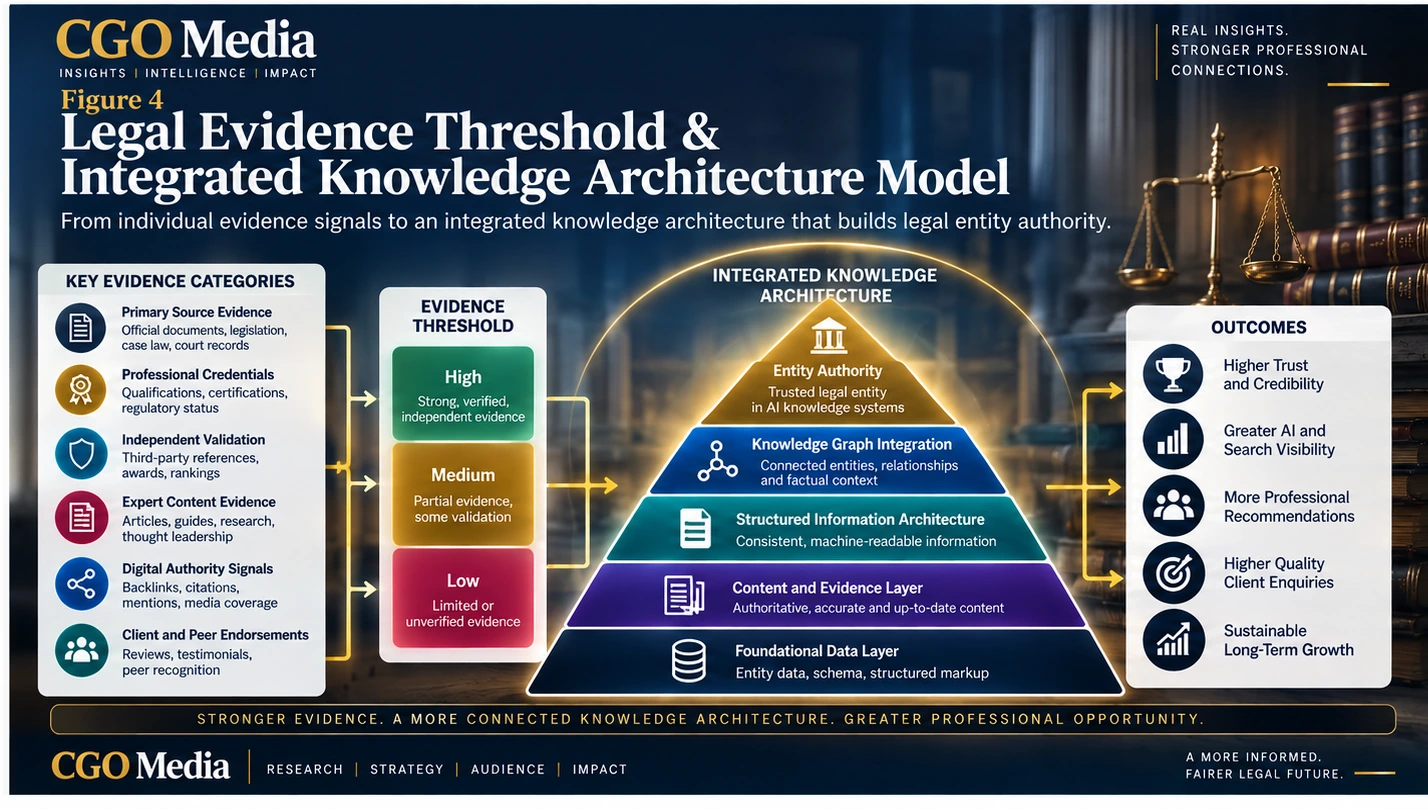
79. Practice-Area Relationships
Profiles should reinforce the wider practice-area architecture rather than exist as isolated biographies.
80. Content Relationships
Where relevant, lawyers may be connected with:
- Legal articles
- Research
- Commentary
- Guides
- Case analysis
81. Professional Authorship
Where a lawyer authors legal content, that relationship should be represented transparently.
82. Professional Review
Where a lawyer reviews rather than authors content, the distinction should be clear.
83. Qualifications
Qualifications can contribute to professional authority where they are relevant and represented accurately.
84. Professional Memberships
Current memberships of relevant legal or professional bodies may add useful context.
85. Leadership Roles
Internal or external leadership roles may support professional authority where they are current and meaningful.
86. Academic Roles
Teaching, lecturing or academic appointments may contribute additional evidence of subject expertise.
87. Research and Publication Activity
Relevant publications may include:
- Legal research
- Professional commentary
- Books
- Academic articles
- Practice guidance
88. Speaking Activity
Professional speaking may provide additional external evidence when it relates directly to the lawyer’s area of practice.
89. Media Commentary
Relevant expert commentary in reputable legal, business or trade media may reinforce subject authority.
90. Professional Recognition
Awards, rankings or directory recognition should be represented with appropriate context.
91. Recognition Should Be Specific
Where possible, identify:
- The awarding organisation
- The year
- The practice area
- The individual or team recognised
92. Avoid Unsupported Superlatives
Terms such as “best”, “top” or “leading” should not replace verifiable professional evidence.
93. Experience Claims Should Be Accurate
Statements involving years of experience, case volume or professional seniority should be supportable and current.
94. Representative Matters
Where appropriate, professional profiles may include representative work that helps users understand relevant experience.
95. Representative Matters Require Context
Past legal work should not be presented in a way that implies guaranteed outcomes for future clients.
96. Confidentiality Should Be Preserved
Case and client information should only be disclosed where appropriate and permitted.
97. External Professional Profiles
Important lawyer identities should be checked across relevant:
- Regulatory sources
- Legal directories
- Professional bodies
- Institutional profiles
98. External Profile Consistency
Priority external profiles should reflect current:
- Role
- Firm affiliation
- Practice areas
- Office location
99. Former-Firm Data Can Create Entity Confusion
Old biographies and directory listings may continue to associate professionals with previous organisations.
100. Professional Authority Requires Maintenance
Profiles should be treated as managed professional records rather than one-time marketing assets.
101. Professional Change Triggers
Updates may be required when a lawyer:
- Joins
- Leaves
- Changes title
- Changes office
- Changes practice focus
102. Professional Authority Assessment
A practical assessment may ask:
- Are profiles complete?
- Is practice expertise specific?
- Are professional relationships current?
- Is external evidence consistent?
- Are claims verifiable?
103. Dimension Four — Regulatory, Client and Reputational Trust
The fourth dimension assesses whether the legal provider presents sufficient trust evidence for users evaluating whether to make contact or instruct the organisation.
104. Regulatory Trust
Where regulation applies, users should be able to identify the relevant professional or organisational status clearly.
105. Firm-Level Regulation
Information should distinguish the regulatory position of the legal organisation from that of individual practitioners where these differ.
106. Individual Professional Regulation
Professional status should be associated with the correct individual rather than implied generically across an entire team.
107. Regulatory Information Should Be Current
Outdated regulatory statements may create significant trust and compliance risk.
108. Regulatory Information Should Be Verifiable
Where appropriate, users should be able to validate regulatory or professional status through authoritative sources.
109. Regulatory Claims Should Be Precise
The organisation should avoid wording that exaggerates the scope of regulation or authorisation.
110. Client-Care Information
Trust may be strengthened when users can understand important aspects of the client relationship before instruction.
111. Client-Care Topics
Relevant information may include:
- How the firm handles enquiries
- Who may handle the matter
- How complaints are managed
- How personal information is handled
112. Complaints Transparency
Users should be able to locate clear information about how concerns or complaints can be raised.
113. Complaints Information Should Be Practical
It may include:
- Contact route
- Responsible team
- Escalation process
- Relevant external route where applicable
114. Confidentiality and Privacy
Legal matters may involve commercially sensitive, personal or privileged information.
115. Privacy Information Supports Trust
The organisation should explain how relevant personal information is managed in language users can understand.
116. Conflict Processes
Where relevant, firms may explain at a high level how potential conflicts are handled without disclosing sensitive operational detail.
117. Fee Transparency
Where appropriate and permitted, clearer fee information may reduce uncertainty during provider evaluation.
118. Fee Information May Include
- Fixed fees
- Hourly charging
- Initial consultation arrangements
- Potential additional costs
119. Fee Clarity Should Avoid False Precision
Where final legal costs depend on complexity, users should not be given misleading certainty.
120. Client Reviews
Reviews may contribute to perceived trust by providing evidence of client experience.
121. Review Themes
Relevant themes may include:
- Communication
- Responsiveness
- Professionalism
- Process clarity
- Administration
122. Reviews Are Not Legal Competence Measures
Client feedback should not be interpreted as direct proof of technical legal quality.
123. Review Recency
More recent feedback may provide a better indication of current client experience than older reviews.
124. Review Volume Should Be Contextualised
Some legal services naturally generate more reviews than others, so raw volume should not be used mechanically as an authority score.
125. Review Distribution
Multi-office firms may assess whether feedback differs significantly between locations.
126. Review Response Standards
Responses should protect confidentiality and avoid disclosing information about legal matters publicly.
127. Reputation Evidence
Reputation may be supported by multiple sources rather than reviews alone.
128. Legal Directory Recognition
Relevant directory recognition may contribute evidence around:
- Firm reputation
- Practice-area strength
- Individual professionals
- Specific jurisdictions
129. Directory Recognition Requires Context
The firm should avoid presenting historic or narrow recognition as if it applies universally.
130. Awards and Rankings
Awards may contribute reputational evidence where their source, year and scope are made clear.
131. Media Reputation
Relevant media coverage may influence how users understand the firm’s expertise and standing.
132. Institutional Reputation
Professional, academic or industry relationships may add further contextual trust where they are genuine.
133. Case and Transaction Evidence
Past work may support reputation where it demonstrates relevant experience and is appropriate for public disclosure.
134. Past Outcomes Should Not Be Converted into Guarantees
Legal outcomes depend on the individual circumstances of each matter.
135. Client Logos and Testimonials
These should only be used where appropriate permissions and professional requirements allow.
136. Reputation Should Be Evidence-Led
The framework prioritises verifiable evidence over broad promotional claims.
137. Trust Should Appear Near Decision Points
Relevant trust information should be accessible from:
- Practice-area pages
- Service pages
- Professional profiles
- Office pages
138. Trust Should Not Be Isolated on Corporate Pages
A regulatory statement hidden in a footer may provide less decision support than contextual trust information available during provider evaluation.
139. Regulatory and Client Trust Assessment
A practical assessment may ask:
- Is regulatory status clear?
- Can users verify professional identities?
- Are complaints pathways accessible?
- Are review patterns understood?
- Are reputation claims appropriately evidenced?
140. Professional and Trust Evidence Should Reinforce Each Other
The legal authority system becomes stronger when professional expertise and trust evidence align rather than operate as separate information layers.
141. The Professional and Trust Evidence Stack
A simplified representation is:
Professional Identity → Practice Expertise → Regulatory Verification → Client Experience → Reputation → External Validation
142. Weak Professional Evidence Can Constrain Trust
Strong reviews may not compensate for incomplete lawyer profiles or unclear professional status.
143. Weak Trust Evidence Can Constrain Professional Authority
A highly experienced lawyer may still face provider-selection friction where regulatory, client-care or reputation information is difficult to verify.
144. These Dimensions Prepare the Framework for External Authority
Once entity clarity, legal information, professional expertise and trust have been established, the next stage is to evaluate how external, institutional and local evidence reinforces the wider legal authority environment.
145. Dimension Five — External, Institutional and Local Authority
The fifth dimension assesses whether the wider information environment supports the legal organisation’s own representation through relevant external, institutional, professional and local evidence.
146. External Authority Is Corroborating Evidence
The purpose of external authority is not simply to accumulate mentions.
It is to create a broader evidence environment in which the firm’s identity, expertise and reputation are supported by relevant third parties.
147. External Authority Should Reflect Genuine Capability
External evidence is strongest when it aligns with:
- Real practice areas
- Actual professionals
- Relevant jurisdictions
- Current office locations
148. Legal Directory Authority
Legal directories may provide external context around:
- Firms
- Practice areas
- Individual lawyers
- Jurisdictions
149. Directory Information Should Be Current
Priority directory profiles should reflect current:
- Firm name
- Professional roles
- Practice areas
- Office locations
150. Directory Recognition Should Be Specific
Where rankings or recognitions are used, the firm should identify the relevant:
- Year
- Practice area
- Jurisdiction
- Professional or team
151. Professional Body Authority
Relevant professional bodies may provide further evidence of:
- Professional identity
- Current membership
- Committee roles
- Subject expertise
152. Institutional Authority
Legal authority may also be supported by genuine relationships with:
- Universities
- Research organisations
- Industry bodies
- Professional institutes
153. Academic Authority
Where relevant, academic appointments, research contributions or teaching roles may strengthen professional evidence.
154. Publication Authority
Legal professionals may build external authority through:
- Academic journals
- Legal publications
- Professional guides
- Industry research
155. Editorial Authority
Relevant editorial coverage may help establish external recognition of genuine legal expertise.
156. Expert Commentary
Lawyers may contribute subject expertise to:
- Legal media
- Business publications
- Trade journals
- News organisations
157. Expert Commentary Should Be Relevant
Media appearances should align with the professional’s genuine practice area or subject knowledge.
158. Citation Authority
Where legal professionals or firms publish useful research or commentary, third-party citations can provide additional evidence of authority.
159. Citation Quality Matters More Than Raw Volume
Relevant citations from credible professional, academic or institutional sources may provide stronger authority context than large numbers of unrelated mentions.
160. Research Authority
Legal organisations producing original research may strengthen their evidence environment by making that work:
- Discoverable
- Citable
- Clearly authored
- Connected with relevant professionals
161. Case Commentary Authority
Where appropriate, legal professionals may provide analysis of public legal developments or cases within their areas of expertise.
162. External Evidence Should Not Be Manufactured
The framework does not treat artificial links, fabricated citations or misleading affiliations as legitimate authority evidence.
163. Local Authority
For many legal services, local authority remains important because users may prefer a provider with a relevant office or local professional presence.
164. Office Identity Should Be Distinct
Each important office should have a clear, current and verifiable identity.
165. Local Office Information
Relevant information may include:
- Address
- Telephone
- Opening information
- Relevant professionals
- Relevant practice areas
- Contact pathways
166. Local Listings
Important local discovery environments should reflect accurate office information.
167. Office-Professional Accuracy
Local sources should not continue to associate professionals with offices where they no longer practise.
168. Office-Practice-Area Accuracy
A local office should not be represented as offering a practice area that lacks genuine local capability.
169. Local Review Evidence
Office-level reviews may provide additional context around:
- Communication
- Administration
- Responsiveness
- Client experience
170. Local Reviews Remain Experience Evidence
They should not be treated automatically as proof of technical legal quality.
171. Local Data Consistency
Priority office information should remain aligned across:
- Firm website
- Maps environments
- Local profiles
- Legal directories
172. Local Data Conflict
Common weaknesses may include:
- Old addresses
- Wrong telephone numbers
- Former office names
- Outdated opening information
173. Local Authority Should Reflect Real Operations
The purpose is not to create synthetic geographic visibility.
It is to represent real offices, professionals and services accurately.
174. External Authority Assessment
A practical assessment may ask:
- Are priority directory profiles current?
- Are relevant professionals externally verifiable?
- Are institutional relationships genuine?
- Is editorial authority relevant?
- Are office profiles accurate?
175. Dimension Six — AI Search and Professional Recommendation Readiness
The sixth dimension assesses whether the legal organisation’s broader evidence environment is sufficiently clear and consistent to support accurate interpretation across AI-assisted discovery systems.
176. AI Readiness Builds on the Previous Five Dimensions
The framework does not treat AI readiness as an isolated technical optimisation category.
177. AI Readiness Depends on Entity Clarity
AI systems should be able to identify the correct:
- Firm
- Office
- Professional
- Practice area
178. AI Readiness Depends on Legal Information Authority
The organisation should provide sufficiently clear information about the legal services it genuinely offers.
179. AI Readiness Depends on Professional Authority
Relevant lawyers should have strong and verifiable professional identities.
180. AI Readiness Depends on Regulatory and Client Trust
Professional status and client-trust evidence should be sufficiently clear to support provider interpretation.
181. AI Readiness Depends on External Authority
External evidence should broadly support rather than contradict the firm’s own representation.
182. A Legal AI Readiness Equation
The sixth dimension can therefore be represented as:
Entity Clarity + Legal Authority + Professional Authority + Regulatory Trust + External Validation = Stronger AI Readiness
183. Branded AI Representation
The organisation should monitor whether AI systems describe the firm accurately.
184. Branded Representation Questions
Testing may ask whether generated systems understand:
- What the firm is
- Where it operates
- Which practice areas it handles
- Which professionals belong to it
185. Professional AI Representation
Priority professionals should be monitored for accurate:
- Firm affiliation
- Professional role
- Practice focus
- Office location
186. Practice-Area AI Representation
AI systems may be observed for whether they associate the firm with practice areas it genuinely supports.
187. Local AI Representation
Multi-office firms should assess whether AI-assisted local discovery reflects real office and professional availability.
188. Non-Branded Recommendation Readiness
A more advanced test examines whether the firm enters relevant provider-consideration scenarios before the user already knows the brand.
189. Recommendation Query Classes
These may involve:
- Practice-area provider searches
- Location-specific lawyer searches
- Commercial legal adviser searches
- Specialist matter searches
190. Recommendation Presence Should Be Qualified
A recommendation is only strategically meaningful where it matches:
- The correct practice area
- The relevant jurisdiction
- The appropriate location
- The actual provider capability
191. AI Provider Comparison
Users may ask AI systems to compare several legal providers within one conversation.
192. Comparison Context May Include
- Expertise
- Location
- Reputation
- Professional strength
- Sector relevance
193. Comparison Accuracy Matters
Generated comparisons should be monitored for material inaccuracies that could distort provider selection.
194. AI Source Visibility
Where sources are shown, the organisation may observe which evidence environments recur.
195. Potential AI Source Types
These may include:
- Firm website
- Legal directories
- Regulatory sources
- Professional profiles
- Editorial coverage
- Local profiles
196. Source Analysis Should Be Diagnostic
Repeated source visibility may help identify which parts of the external evidence environment deserve closer review.
197. Source Appearance Does Not Prove Causation
The appearance of a source in one generated answer does not establish that the source alone determined the recommendation.
198. AI Accuracy Should Be Prioritised Before AI Growth
A legal provider should first seek to reduce material representation errors before interpreting wider recommendation presence as success.
199. Material AI Representation Errors
Higher-priority issues may include:
- Wrong firm affiliation
- Incorrect professional status
- Wrong office location
- Incorrect practice-area association
- Misleading regulatory information
200. AI Errors Should Trigger Source Investigation
Where a material error appears, the organisation should examine the wider evidence environment rather than assume that the AI system can be corrected directly.
201. Correct First-Party Errors First
The firm’s own website and controlled information should be reviewed before external remediation begins.
202. Correct External Errors Where Legitimate
Where appropriate update mechanisms exist, important third-party inaccuracies should be corrected.
203. AI Readiness Requires Ongoing Observation
Generated representations can change as:
- Models change
- Retrieval systems change
- Sources change
- Firm information changes
204. Standardised AI Monitoring
A useful observation programme should use repeatable prompts rather than random ad hoc testing.
205. AI Observation Records
A monitoring record may include:
- Prompt
- Model
- Date
- Geography
- Provider presence
- Accuracy
- Visible sources
206. Recommendation Frequency Should Be Interpreted Carefully
Short-term fluctuations should not automatically be treated as meaningful changes in authority.
207. AI Recommendations Are Not Legal Endorsements
Generated provider suggestions should not be interpreted as a formal recommendation, professional accreditation or guarantee of suitability.
208. Legal AI Readiness Is Evidence-Led
The framework therefore treats AI readiness as the result of stronger:
- Identity
- Relevance
- Professional evidence
- Trust
- External corroboration
209. The External Authority and AI Readiness Relationship
The combined sequence can be represented as:
External Corroboration → Source Consistency → Entity Confidence → Professional Confidence → Recommendation Readiness
210. The Framework Has Now Connected All Six Dimensions
The complete Legal Entity Authority Framework can now be represented as:
Legal Organisation & Entity Clarity → Legal Information Authority → Professional Authority → Regulatory & Client Trust → External & Local Authority → AI Recommendation Readiness
211. AI Recommendation Readiness Requires Sufficient Evidence
A legal provider may have strong visibility yet still be poorly positioned for accurate AI-assisted recommendation if important evidence remains incomplete or inconsistent.
212. Recommendation Readiness Should Be Viewed as a Threshold System
A provider may need sufficient confidence across several dimensions before it can be interpreted reliably within a provider-comparison context.
213. Threshold One — Identity Confidence
Can the legal organisation and relevant professional be identified without material ambiguity?
214. Identity Confidence Depends on Consistency
Important identity signals should align across:
- Firm website
- Professional profiles
- Regulatory sources
- Legal directories
- Local listings
215. Identity Weaknesses
Potential weaknesses may include:
- Old firm names
- Former professional affiliations
- Duplicate office records
- Inconsistent titles
216. Threshold Two — Practice Relevance Confidence
Can the provider be associated confidently with the legal issue or practice area being considered?
217. Practice Relevance Should Be Supported by Multiple Evidence Types
Relevant evidence may include:
- Practice-area pages
- Specific service pages
- Professional profiles
- Publications
- External directory evidence
218. Generic Capability Claims Are Weaker Evidence
A broad statement that a firm handles many areas of law may provide less confidence than a connected evidence environment showing specific professionals, services and relevant external corroboration.
219. Threshold Three — Professional Confidence
Can the expertise of the relevant legal professional be verified sufficiently?
220. Professional Confidence May Draw from
- Qualifications
- Professional status
- Practice focus
- Experience
- Publications
- Relevant recognition
221. Professional Confidence Should Be Matter-Relevant
General professional seniority does not necessarily establish relevance to every legal issue.
222. Threshold Four — Regulatory and Trust Confidence
Can users and automated systems identify sufficient evidence that the provider is legitimate, professionally represented and trustworthy?
223. Trust Confidence May Include
- Regulatory information
- Professional verification
- Client-care information
- Reputation evidence
- Review patterns
224. Reviews Alone Should Not Satisfy the Trust Threshold
Client feedback can support reputation, but it should not replace professional or regulatory evidence.
225. Threshold Five — External Authority Confidence
Does relevant external evidence support the organisation’s claimed expertise and identity?
226. External Authority Confidence May Draw from
- Legal directories
- Professional organisations
- Research
- Editorial coverage
- Institutional references
227. External Authority Should Reinforce Rather Than Contradict
External sources are most useful when they align with the firm’s current professional and practice-area representation.
228. Threshold Six — Context and Jurisdiction Confidence
Can the provider be interpreted correctly for the relevant legal and geographic context?
229. Jurisdiction Confidence Matters
A provider may appear highly relevant in one legal system but inappropriate in another.
230. Local Context Confidence Matters
For location-sensitive services, users may need to verify that:
- The office is real
- The relevant lawyer practises there
- The service is available there
231. The Six Evidence Thresholds
The recommendation-readiness threshold can therefore be represented as:
Identity Confidence → Practice Relevance → Professional Confidence → Regulatory & Trust Confidence → External Authority → Context & Jurisdiction Confidence
232. Weakness at One Threshold Can Constrain the Whole System
A provider may have excellent external recognition but remain difficult to recommend accurately if professional affiliation or jurisdictional scope is unclear.
233. Strong Brand Awareness Does Not Remove Threshold Requirements
A recognised legal brand may still face interpretation problems around individual professionals, offices or specialised services.
234. Evidence Thresholds Should Be Tested by Use Case
Different legal queries may require different levels of confidence.
235. Consumer Legal Service Thresholds
A consumer journey may place greater weight on:
- Location
- Reviews
- Responsiveness
- Fee clarity
- Professional relevance
236. Commercial Legal Service Thresholds
A business or enterprise journey may place greater weight on:
- Specialist expertise
- Sector experience
- Professional seniority
- Transaction or dispute evidence
- International capability
237. High-Complexity Matter Thresholds
More complex legal matters may require stronger evidence across:
- Professional expertise
- Jurisdiction
- Relevant case or transaction experience
- External recognition
238. AI Source Consistency
AI systems may encounter multiple sources describing the same firm, professional or service.
239. Material Facts Should Be Consistent
Priority information includes:
- Firm name
- Professional role
- Practice area
- Office location
- Professional status
240. First-Party Source Consistency
The firm’s own website should not contain conflicting representations of important entities.
241. Regulatory Source Consistency
Where relevant, firm and professional information should align with authoritative regulatory records.
242. Directory Source Consistency
Priority legal and professional directory profiles should reflect current information.
243. Local Source Consistency
Office-level information should align across maps, local profiles and the firm’s own location pages.
244. Editorial Source Consistency
Older biographies and media coverage may continue to represent former roles or previous firms.
245. Source Conflict Is Not Always Equally Important
The framework distinguishes between minor descriptive differences and material factual inconsistencies.
246. High-Risk Source Conflicts
These may include:
- Wrong professional status
- Wrong firm affiliation
- Wrong office
- Wrong practice-area association
- Material regulatory discrepancy
247. Medium-Risk Source Conflicts
These may include:
- Old biography wording
- Outdated awards
- Previous job titles
- Incomplete service descriptions
248. Source Consistency Does Not Require Identical Wording
Different sources may describe a legal organisation differently while still agreeing on the material facts.
249. Entity Meaning Matters More Than Copy Duplication
The objective is semantic and factual consistency rather than identical text across multiple websites.
250. Recommendation Diagnostics
When a provider appears weak or inaccurate in AI-assisted discovery, the organisation should diagnose the underlying evidence environment systematically.
251. Diagnostic Stage One — Verify the Output
Confirm whether the generated representation is materially inaccurate or merely phrased differently.
252. Diagnostic Stage Two — Identify the Affected Entity
Determine whether the issue concerns:
- Firm
- Professional
- Office
- Practice area
- Service
- Jurisdiction
253. Diagnostic Stage Three — Check First-Party Evidence
Review whether the firm’s own information is:
- Correct
- Current
- Sufficiently clear
- Internally consistent
254. Diagnostic Stage Four — Check Authoritative External Evidence
Review relevant regulatory, professional and legal directory sources.
255. Diagnostic Stage Five — Check Broader External Sources
Where appropriate, review:
- Media
- Institutional profiles
- Local listings
- Research profiles
256. Diagnostic Stage Six — Correct Controlled Sources
Update inaccurate first-party information and any legitimate external profiles under the organisation’s control.
257. Diagnostic Stage Seven — Strengthen Missing Evidence
Where the issue results from evidence weakness rather than direct inaccuracy, the organisation may need stronger:
- Professional profiles
- Practice-area information
- Jurisdictional clarity
- External corroboration
258. Diagnostic Stage Eight — Retest
Repeat the original scenario after relevant evidence changes have been made.
259. The Recommendation Diagnostic Loop
A practical process is:
Observe → Verify → Identify Entity → Audit Sources → Correct → Strengthen → Retest
260. AI Provider Comparison Diagnostics
Legal organisations should also assess how they are represented relative to relevant competitors.
261. Comparison Should Use Appropriate Competitors
The competitor set should reflect:
- Practice area
- Jurisdiction
- Location
- Client type
262. Compare Entity Clarity
Assess whether competitors present clearer organisation, office and professional relationships.
263. Compare Practice-Area Evidence
Assess whether competitors demonstrate deeper or better-connected service evidence.
264. Compare Professional Authority
Review differences in:
- Profile depth
- Professional contributions
- External recognition
- Practice-area evidence
265. Compare Trust Evidence
Review whether competitors provide clearer:
- Regulatory information
- Client-care information
- Review evidence
- Reputation context
266. Compare External Authority
Assess differences in:
- Directory evidence
- Publications
- Media authority
- Institutional references
267. Compare Local Authority
For relevant queries, assess whether competing offices have stronger local information and professional mapping.
268. Comparison Should Identify Evidence Gaps
The purpose is to improve the organisation’s own authority system rather than imitate every competitor activity.
269. Avoid Copying Weak Competitor Practices
High visibility does not prove that a competitor’s claims, local architecture or authority tactics are appropriate.
270. Integrated Legal Knowledge Architecture
The six framework dimensions should ultimately operate through one connected knowledge architecture.
271. Core Knowledge Architecture
A practical model is:
Organisation → Office → Professional → Practice Area → Legal Service → Matter Type → Jurisdiction → Trust Evidence → External Evidence
272. Organisation Node
The organisation node should contain stable identity information and connect with all genuine offices and practice areas.
273. Office Node
Each office should connect with:
- Organisation
- Professionals
- Practice areas
- Local information
274. Professional Node
Each professional should connect with:
- Current organisation
- Office
- Practice areas
- Services
- Professional evidence
275. Practice-Area Node
Each practice area should connect with relevant:
- Legal services
- Professionals
- Matter types
- Jurisdictions
276. Service Node
Each legal service should connect with:
- Relevant practice area
- Appropriate professionals
- Common matter types
- Jurisdiction
277. Matter-Type Node
Matter types can connect user language with formal legal services.
278. Jurisdiction Node
Jurisdiction should clarify where information or professional capability applies.
279. Trust Evidence Node
Trust evidence may include:
- Regulatory verification
- Client-care information
- Reviews
- Recognitions
280. External Evidence Node
External evidence may include:
- Directories
- Professional bodies
- Publications
- Media
- Institutional references
281. Relationship Accuracy Is Essential
The architecture should not create relationships merely because they are technically possible.
282. Avoid Over-Connecting Professionals
A lawyer should only be connected with practice areas and services that reflect genuine professional activity.
283. Avoid Over-Connecting Offices
An office should not inherit every national practice capability automatically.
284. Avoid Over-Connecting Jurisdictions
Legal content and professional expertise should not be represented as universally applicable where jurisdiction matters.
285. Knowledge Architecture Should Support Users as Well as Machines
The same relationships that help automated interpretation should also make the website easier for prospective clients to understand.
286. Knowledge Architecture Should Support Provider Selection
A user should be able to move logically through:
Legal Problem → Practice Area → Service → Professional → Trust Evidence → Contact
287. Knowledge Architecture Should Support Professional Verification
Users should be able to move from a professional profile toward relevant:
- Practice areas
- Services
- Offices
- External evidence
288. Knowledge Architecture Should Support Local Discovery
Users should be able to understand which professionals and services are available from a particular office.
289. Knowledge Architecture Should Support AI Interpretation
Clear entity relationships may reduce ambiguity about who, what and where the organisation represents.
290. The Integrated Evidence Threshold Model
A mature legal authority system combines:
Connected Entities + Relevant Practice Evidence + Professional Verification + Regulatory Trust + External Corroboration + Jurisdictional Context
291. Framework Strength Comes from Integration
A provider with moderate strength across all six dimensions may be more resilient than one with exceptional performance in one area and major weaknesses elsewhere.
292. Critical Weaknesses Should Remain Visible
Aggregate authority scores should not hide serious deficiencies involving:
- Professional status
- Firm affiliation
- Regulatory accuracy
- Jurisdictional clarity
293. Recommendation Readiness Is Not a Guarantee
Even a strong integrated evidence environment cannot guarantee inclusion or recommendation by a particular AI system.
294. The Framework Measures Preparedness
Its purpose is to assess whether the organisation has built sufficiently strong conditions for accurate discovery, comparison and representation.
295. The Next Stage Is Measurement
Once the six dimensions and their relationships have been established, the framework can be converted into a structured legal authority scorecard for measurement, benchmarking and governance.
296. Measuring the Legal Entity Authority Framework
The six framework dimensions can be translated into a structured scorecard to help legal organisations assess current authority, identify critical gaps and track improvement over time.
297. Measurement Should Be Evidence-Based
Scores should be supported by observable evidence rather than subjective impressions.
298. Six-Dimension Scorecard
The framework measures:
- Legal Organisation and Entity Clarity
- Legal Information and Practice-Area Authority
- Professional and Practitioner Authority
- Regulatory, Client and Reputational Trust
- External, Institutional and Local Authority
- AI Search and Professional Recommendation Readiness
299. Dimension One — Legal Organisation and Entity Clarity Score
This dimension evaluates whether the organisation’s principal entities and relationships are represented accurately and consistently.
300. Organisation Identity Measures
Potential indicators may include:
- Current firm-name consistency
- Legal entity clarity
- Brand relationship clarity
- Organisation-type accuracy
301. Office Entity Measures
Potential indicators may include:
- Office identity completeness
- Address accuracy
- Telephone accuracy
- Office-to-organisation relationships
302. Professional Entity Measures
Potential indicators may include:
- Professional identity accuracy
- Current firm affiliation
- Office relationship accuracy
- Practice-area mapping
303. Practice-Area Entity Measures
Potential indicators may include:
- Consistent practice naming
- Service relationships
- Professional relationships
- Jurisdictional clarity
304. Entity Conflict Rate
The organisation may measure the proportion of priority entities with material inconsistencies across first-party and external sources.
305. Critical Entity Conflicts
These may include:
- Wrong professional affiliation
- Wrong professional status
- Incorrect office location
- Conflicting regulatory information
306. Dimension Two — Legal Information and Practice-Area Authority Score
This dimension evaluates the quality, depth, structure and governance of legal information supporting priority services and practice areas.
307. Practice-Area Coverage
Measure whether strategic practice areas have sufficiently complete supporting information.
308. Legal Service Coverage
Assess whether priority legal services have clear and useful standalone explanations.
309. Matter-Type Coverage
Measure whether users can identify common legal situations and connect them with relevant services.
310. Jurisdictional Clarity
Assess whether important legal content makes its applicable legal context sufficiently clear.
311. Professional Attribution
Measure whether strategically important legal information is linked appropriately with genuine professional expertise.
312. Content Review Coverage
Assess the proportion of priority legal content reviewed within the organisation’s required cycle.
313. Content Freshness
Measure whether important pages remain sufficiently current for their legal subject matter.
314. Source Quality
Where external sources are cited, assess whether they remain relevant, authoritative and current.
315. Content Relationship Quality
Assess whether legal information connects naturally with:
- Practice areas
- Services
- Professionals
- Jurisdictions
316. Dimension Three — Professional and Practitioner Authority Score
This dimension evaluates whether relevant legal professionals have sufficiently complete and verifiable authority evidence.
317. Professional Profile Completeness
Potential indicators may include coverage of:
- Current role
- Qualifications
- Practice areas
- Professional status
- Office locations
318. Professional-Practice Relationship Coverage
Measure whether priority lawyers are connected accurately with the practice areas in which they genuinely work.
319. Professional-Service Relationship Coverage
Assess whether important legal services identify relevant professionals clearly.
320. Professional-Office Relationship Coverage
Measure whether current practice locations are represented consistently.
321. Professional Contribution Evidence
Where relevant, assess evidence such as:
- Publications
- Research
- Speaking
- Professional body roles
- Expert commentary
322. External Professional Consistency
Measure whether important external profiles reflect current:
- Firm affiliation
- Role
- Office
- Practice focus
323. Professional Evidence Depth
A profile may score more strongly where expertise is demonstrated through several relevant evidence classes rather than biography length alone.
324. Dimension Four — Regulatory, Client and Reputational Trust Score
This dimension evaluates whether users can verify the legal provider and assess important client-trust evidence.
325. Regulatory Information Coverage
Measure whether relevant regulatory information is:
- Present
- Current
- Entity-specific
- Verifiable
326. Professional Verification Coverage
Assess whether priority legal professionals can be verified through appropriate authoritative sources where relevant.
327. Client-Care Information Coverage
Potential measures may include availability of:
- Complaints information
- Privacy information
- Confidentiality information
- Contact pathways
328. Fee Information Coverage
Where appropriate, assess whether users receive enough information to understand likely charging structures or initial consultation arrangements.
329. Review Coverage
Measure whether strategically important offices or client-facing services have current feedback where such evidence exists naturally.
330. Review Theme Trends
Track recurring themes involving:
- Communication
- Responsiveness
- Professionalism
- Process clarity
- Administration
331. Reputation Evidence Coverage
Potential evidence may include:
- Directory recognition
- Awards
- Professional recognition
- Relevant media coverage
332. Trust Evidence Quality Matters More Than Quantity
A large volume of weak or ambiguous trust signals should not automatically generate a high score.
333. Dimension Five — External, Institutional and Local Authority Score
This dimension evaluates whether relevant third-party and local evidence supports the organisation’s identity, expertise and office structure.
334. Legal Directory Accuracy
Assess whether priority directory entries remain current for:
- Firm
- Professionals
- Practice areas
- Offices
335. Institutional Evidence
Measure relevant and verifiable relationships with:
- Professional organisations
- Universities
- Industry bodies
- Research institutions
336. Publication and Citation Evidence
Where appropriate, assess the visibility of:
- Legal publications
- Research contributions
- Relevant third-party citations
- Professional commentary
337. Editorial Authority
Measure relevant coverage in credible legal, business or sector publications.
338. Local Office Accuracy
For multi-office firms, assess:
- Address consistency
- Telephone consistency
- Opening information
- Office identity consistency
339. Local Professional Mapping
Measure whether professionals are associated accurately with the offices where they currently practise.
340. Local Practice-Area Mapping
Assess whether each office is associated with legal capabilities genuinely available there.
341. External Evidence Relevance
External authority should score more strongly where evidence aligns closely with strategic practice areas and genuine professional capability.
342. Dimension Six — AI Search and Professional Recommendation Readiness Score
This dimension evaluates how accurately and consistently the legal provider is represented within selected AI-assisted discovery scenarios.
343. Branded Representation Accuracy
Measure whether AI systems represent correctly:
- Firm identity
- Practice areas
- Offices
- Provider type
344. Professional Representation Accuracy
Measure whether priority lawyers are described correctly for:
- Role
- Firm affiliation
- Practice area
- Location
345. Practice-Area Association Accuracy
Assess whether the firm is associated with legal services it genuinely provides.
346. Local AI Accuracy
Assess whether office-level AI representations reflect real professional and service availability.
347. Relevant Recommendation Presence
Measure whether the provider appears within appropriate non-branded discovery scenarios.
348. Provider Comparison Presence
Observe whether the organisation enters appropriate AI-generated comparison sets.
349. Source Visibility
Where sources are exposed, record which evidence environments recur.
350. Source Accuracy
Assess whether frequently surfaced external sources contain current and accurate information.
351. Material AI Error Rate
Measure significant inaccuracies involving:
- Professional identity
- Firm affiliation
- Practice relevance
- Office location
- Regulatory context
352. AI Score Should Reflect Accuracy Before Frequency
A firm appearing frequently but being represented incorrectly should not receive a strong AI-readiness score.
353. Use a Common Scoring Scale
A practical assessment may score each dimension from 1 to 5.
354. Score 1 — Critical Weakness
Evidence is highly fragmented, materially inaccurate or largely unmanaged.
355. Score 2 — Weak
Some foundations exist, but significant gaps remain across important entities or evidence classes.
356. Score 3 — Established
Core standards are broadly in place, though inconsistencies and governance gaps remain.
357. Score 4 — Strong
Evidence is generally accurate, integrated and governed across most strategic areas.
358. Score 5 — Leading
The organisation demonstrates high levels of consistency, integration, evidence quality, monitoring and continuous improvement.
359. Scores Should Be Evidence-Backed
Every score should be traceable to observable evidence or a defined audit finding.
360. Evidence Confidence
Each score should also have a confidence level.
361. High Confidence
Evidence is current, verifiable and supported across multiple relevant sources.
362. Medium Confidence
Evidence is reasonably current but incomplete or dependent on a narrower source set.
363. Low Confidence
Evidence is old, inconsistent, incomplete or based heavily on assumptions.
364. Confidence Should Affect Interpretation
A high score supported by low-confidence evidence should not be treated as equivalent to a high score supported by verified current data.
365. Weighted Assessment
Legal organisations may apply different weights according to:
- Practice strategy
- Jurisdiction
- Client type
- Risk
- Business model
366. Consumer-Facing Legal Firms
These may place greater weight on:
- Local authority
- Client trust
- Professional clarity
- Provider-selection experience
367. Commercial Legal Firms
These may place greater weight on:
- Professional authority
- Practice-area depth
- External recognition
- Sector expertise
368. International Legal Firms
These may place greater weight on:
- Jurisdictional clarity
- Multi-office architecture
- Professional qualification
- Cross-border authority
369. Critical Weaknesses Cannot Be Averaged Away
Regardless of weighting, serious issues involving professional status, regulation, firm affiliation or jurisdiction should remain visible separately.
370. Example Critical Override
A high aggregate score should not conceal a material error such as a departed lawyer still being represented publicly as a current partner.
371. Gap Analysis
The scorecard should be used to compare:
Current Authority → Target Authority → Required Evidence → Priority Actions
372. Entity Gap Analysis
Questions may include:
- Which entities are ambiguous?
- Which relationships are outdated?
- Where do external sources conflict?
373. Content Gap Analysis
Questions may include:
- Which strategic practice areas are underdeveloped?
- Where is legal information outdated?
- Where is jurisdiction unclear?
374. Professional Gap Analysis
Questions may include:
- Which priority lawyer profiles are incomplete?
- Which professional relationships are missing?
- Where is external identity inconsistent?
375. Trust Gap Analysis
Questions may include:
- Where is regulatory information unclear?
- Where are client-care pathways weak?
- Which reputation claims lack context?
376. External Authority Gap Analysis
Questions may include:
- Which important directories are outdated?
- Where is relevant external corroboration weak?
- Which offices lack accurate local evidence?
377. AI Readiness Gap Analysis
Questions may include:
- Which branded facts are represented inaccurately?
- Which professionals have persistent representation errors?
- Where is relevant recommendation presence weak?
378. Prioritise Gaps by Impact
Potential priority factors may include:
- Professional risk
- Regulatory risk
- Client impact
- Commercial importance
- Search opportunity
379. Priority One — Correct Material Errors
The highest priority is generally to correct inaccurate:
- Professional information
- Regulatory information
- Firm affiliation
- Office information
380. Priority Two — Strengthen Strategic Evidence Gaps
Once critical accuracy is stable, investment may move toward:
- Professional depth
- Practice-area authority
- External validation
- Local authority
381. Priority Three — Improve AI Recommendation Readiness
AI-readiness improvements should build on stronger underlying entity and authority evidence.
382. Executive Reporting
Senior leadership should receive a concise view of current authority strength, material risks and strategic opportunities.
383. Executive Scorecard Structure
| Dimension | Score | Confidence | Trend | Priority |
|---|---|---|---|---|
| Entity Clarity | 1–5 | Low / Medium / High | Improving / Stable / At Risk / Regressing | Critical / High / Medium / Low |
| Legal Information Authority | 1–5 | Low / Medium / High | Improving / Stable / At Risk / Regressing | Critical / High / Medium / Low |
| Professional Authority | 1–5 | Low / Medium / High | Improving / Stable / At Risk / Regressing | Critical / High / Medium / Low |
| Regulatory & Client Trust | 1–5 | Low / Medium / High | Improving / Stable / At Risk / Regressing | Critical / High / Medium / Low |
| External & Local Authority | 1–5 | Low / Medium / High | Improving / Stable / At Risk / Regressing | Critical / High / Medium / Low |
| AI Recommendation Readiness | 1–5 | Low / Medium / High | Improving / Stable / At Risk / Regressing | Critical / High / Medium / Low |
384. Trend Matters Alongside Score
A strong current score may still require attention if the trend indicates deteriorating evidence or governance.
385. Suggested Trend Labels
The framework may use:
- Improving
- Stable
- At Risk
- Regressing
386. Report Critical Issues Separately
Executives should see major professional, regulatory or entity risks outside the aggregate scorecard.
387. Report Strategic Opportunities Separately
Growth opportunities may include:
- Underdeveloped strategic practice areas
- High-authority professionals with weak digital representation
- Strong research with limited discoverability
- Priority offices with weak local authority
388. Reporting Should Lead to Ownership
Every high-priority gap should have:
- Named owner
- Required action
- Target completion
- Verification method
389. The AI Legal Entity Authority Scorecard
The overall measurement system can therefore be represented as:
Six Dimensions → Evidence Score → Confidence → Gap → Priority → Owner → Improvement → Reassessment
390. Measurement Should Support Governance, Not Become a Reporting Exercise
The purpose of the scorecard is to strengthen legal authority and reduce material evidence weaknesses rather than produce a large volume of disconnected metrics.
391. Continuous Improvement
The Legal Entity Authority Framework should be applied as an ongoing management system rather than a one-time audit.
392. Authority Can Decay
Legal authority may weaken over time as firms, professionals, offices, services, regulations and external sources change.
393. Organisation-Level Authority Decay
Firm information may become outdated because of:
- Rebrands
- Mergers
- Acquisitions
- Changes in legal structure
- Regional expansion
394. Professional Authority Decay
Professional evidence may deteriorate when:
- Lawyers join
- Lawyers leave
- Titles change
- Partnership status changes
- Practice focus changes
395. Office Authority Decay
Office information may become unreliable when:
- Locations move
- Offices close
- New offices open
- Telephone details change
- Service coverage changes
396. Practice-Area Authority Decay
Practice structures may weaken when:
- Services are launched
- Teams are restructured
- Specialisms evolve
- Terminology changes
397. Legal Information Decay
Content authority may deteriorate as:
- Law changes
- Procedure changes
- Guidance changes
- Sources become outdated
- Review cycles are missed
398. Regulatory Evidence Decay
Regulatory and professional information may weaken when public records and internal pages diverge.
399. External Authority Decay
Third-party sources may continue to display:
- Former firms
- Old job titles
- Previous offices
- Historic practice areas
400. Review Evidence Decay
Older reviews may become less representative of the current client experience as teams and processes change.
401. AI Representation Drift
AI-assisted systems may alter how they represent the organisation as models, retrieval systems and external sources evolve.
402. Drift Should Be Monitored Periodically
A representation that was accurate previously should not be assumed to remain accurate indefinitely.
403. Risk-Based Monitoring
The framework recommends more frequent review of higher-risk evidence classes.
404. High-Risk Evidence
Potential high-risk areas include:
- Professional status
- Firm affiliation
- Regulatory information
- Jurisdictional statements
- High-impact legal information
405. Medium-Risk Evidence
Potential medium-risk areas include:
- Professional biographies
- Office information
- Practice-area descriptions
- Recognition and awards
406. Strategic Monitoring Areas
These may include:
- Search visibility
- AI recommendation presence
- External citations
- Competitor authority
- Directory visibility
407. Change Triggers
Real-world organisational changes should trigger review of the related digital evidence environment.
408. Professional Joining Trigger
When a lawyer joins, review:
- Professional profile
- Practice-area pages
- Service pages
- Office pages
- External professional profiles
409. Professional Departure Trigger
When a lawyer leaves, remove or update relationships that would otherwise imply current affiliation.
410. Promotion Trigger
When a professional’s title or seniority changes, review all important first-party and external representations.
411. Practice-Area Change Trigger
When a practice launches, closes or changes significantly, review:
- Practice pages
- Professional relationships
- Service architecture
- Navigation
- External profiles
412. Office Change Trigger
When an office changes, review:
- Location pages
- Maps and local profiles
- Professional relationships
- Practice-area availability
- Contact data
413. Rebrand Trigger
A rebrand should initiate a broader entity-consistency review across first-party and external sources.
414. Merger Trigger
Mergers require particular attention to:
- Historic names
- Domains
- Professional affiliations
- Office identities
- Directory entries
415. Regulatory Change Trigger
Changes in firm or professional status should prompt immediate review of relevant public claims.
416. Legal Change Trigger
Material legal or procedural changes should trigger review of affected information and guidance.
417. AI Representation Trigger
Persistent material AI errors should trigger investigation of the wider entity and evidence environment.
418. Framework Failure Mode — Entity Clarity Treated as NAP Consistency Alone
Entity authority extends beyond basic name, address and telephone consistency.
419. Framework Failure Mode — Strong Firm, Weak Professionals
A powerful brand may still underperform in professional-selection contexts if lawyer identities are thin or unclear.
420. Framework Failure Mode — Strong Professionals, Weak Firm Architecture
Recognised lawyers may not compensate for unclear organisational, office or practice-area relationships.
421. Framework Failure Mode — Content Without Genuine Practice Depth
Large volumes of legal content may create little authority if relevant professionals and services do not support the claimed subject expertise.
422. Framework Failure Mode — Jurisdictional Ambiguity
Strong information can still become misleading when its legal scope is unclear.
423. Framework Failure Mode — Regulatory Information Used Generically
Firm-level and professional-level regulation should not be blurred into one broad trust statement.
424. Framework Failure Mode — Reviews Treated as Expertise Proof
Positive client experience should not be converted into claims of superior legal capability.
425. Framework Failure Mode — Awards Without Context
Historic, narrow or individual recognitions should not be presented as universal firm-level evidence.
426. Framework Failure Mode — Artificial External Authority
Manipulative link activity, false citations, invented affiliations or fabricated mentions are not legitimate authority evidence.
427. Framework Failure Mode — Over-Connecting Entities
Connecting every professional with every service or office can create an inaccurate knowledge architecture.
428. Framework Failure Mode — Local Pages Without Operational Reality
Local visibility should not be created around offices or services without genuine presence.
429. Framework Failure Mode — AI Visibility as the Primary Goal
AI recommendation activity should not be pursued ahead of foundational accuracy and authority.
430. Framework Failure Mode — Treating AI Presence as Endorsement
Generated provider inclusion does not establish legal quality or suitability.
431. Framework Failure Mode — Chasing Individual Prompts
Repeatedly changing content to influence isolated AI outputs can weaken consistency and governance.
432. Framework Failure Mode — No Evidence Confidence
Scores can become misleading where the underlying audit evidence is stale or incomplete.
433. Framework Failure Mode — Over-Averaging
Aggregate scores can hide serious weaknesses in:
- One office
- One professional group
- One practice area
- One jurisdiction
434. Framework Failure Mode — No Ownership
Authority deteriorates when no team is responsible for maintaining key evidence classes.
435. Framework Failure Mode — One-Time Cleanup
A single data-cleaning or profile-improvement project does not create long-term resilience without ongoing governance.
436. Framework Failure Mode — Automation Before Standards
Automating weak data or unclear relationships may spread errors more quickly.
437. Framework Failure Mode — Activity Reporting
Counting articles, profile edits, links or AI prompts does not demonstrate stronger authority by itself.
438. Framework Reassessment
The organisation should periodically reassess all six authority dimensions.
439. Reassess Entity Clarity
Review whether firm, office, professional and practice relationships remain accurate.
440. Reassess Legal Information Authority
Review whether strategic content remains:
- Current
- Relevant
- Jurisdictionally clear
- Professionally connected
441. Reassess Professional Authority
Review whether priority professionals have sufficient current evidence across first-party and external environments.
442. Reassess Trust
Review:
- Regulatory clarity
- Client-care information
- Review themes
- Reputation evidence
443. Reassess External Authority
Review whether third-party evidence still aligns with strategic practice areas and current professional capability.
444. Reassess Local Authority
Multi-office firms should verify office, professional and practice-area relationships periodically.
445. Reassess AI Readiness
Repeat branded, professional, local and non-branded AI observations to identify material changes.
446. Reassess Competitor Context
The relevant competitive set may change through:
- Firm mergers
- Market entry
- Practice-area expansion
- Regional changes
447. Reassess Evidence Thresholds
As the organisation becomes stronger, the internal threshold for sufficient authority evidence may also rise.
448. Reassess Strategic Priorities
Not every dimension or practice area requires equal investment at every point in time.
449. Continuous Improvement Should Be Evidence-Led
Roadmap changes should respond to verified weaknesses, emerging risks and strategic opportunity rather than isolated ranking or AI fluctuations.
450. Organisational Learning
Repeated framework assessment should generate insight into which evidence weaknesses create the greatest discovery or provider-selection friction.
451. Learn from Search Data
Search data may reveal:
- Emerging client questions
- Changing legal terminology
- New local demand
- Practice-area opportunities
452. Learn from Enquiry Data
Prospective-client enquiries may reveal:
- Service confusion
- Jurisdiction questions
- Professional-selection questions
- Fee concerns
453. Learn from Review Data
Review patterns may reveal recurring issues involving:
- Communication
- Responsiveness
- Administration
- Client-care expectations
454. Learn from Professional Feedback
Lawyers and practice leaders may identify:
- Outdated content
- Missing services
- Incorrect matter assumptions
- New areas of expertise
455. Learn from External Authority Data
Directory, publication and citation patterns may reveal where genuine professional authority is strengthening or weakening.
456. Learn from AI Observation
AI monitoring may reveal:
- Persistent entity ambiguity
- Source conflicts
- Unexpected competitor presence
- Practice-area misclassification
457. Learning Should Update Standards
Repeated findings should refine:
- Profile standards
- Practice-area templates
- Entity definitions
- Local data procedures
- AI monitoring rules
458. Learning Should Update Governance
Recurring failures may indicate that:
- Ownership is unclear
- Review frequency is too low
- Change triggers are incomplete
- Verification is insufficient
459. Learning Should Update Investment
Resources should be directed toward the areas capable of creating the greatest improvement in:
- Accuracy
- Authority
- Trust
- Qualified discovery
- AI representation
460. The Continuous Legal Entity Authority Cycle
A practical improvement cycle is:
Observe → Verify → Score → Prioritise → Improve → Measure → Govern → Learn → Reassess
461. Observe
Monitor the firm’s entity, professional, content, trust, external and AI evidence environment.
462. Verify
Confirm whether identified inconsistencies and weaknesses are genuine.
463. Score
Assess each framework dimension using current supporting evidence.
464. Prioritise
Rank weaknesses according to:
- Professional risk
- Regulatory risk
- Client impact
- Strategic importance
- Visibility opportunity
465. Improve
Strengthen the relevant:
- Entity relationships
- Legal information
- Professional profiles
- Trust evidence
- External sources
466. Measure
Determine whether the change improved:
- Accuracy
- Evidence coverage
- Authority score
- Provider-selection clarity
- AI representation
467. Govern
Maintain named owners, review cycles, change triggers and evidence records.
468. Learn
Use new findings to refine the framework and future priorities.
469. Reassess
Repeat the six-dimension assessment to determine whether the organisation is advancing, stable, at risk or regressing.
470. The Full Framework Operating System
The Legal Entity Authority Framework can therefore be represented as:
Entity Clarity → Legal Information Authority → Professional Authority → Regulatory & Client Trust → External & Local Authority → AI Readiness → Measurement → Governance → Continuous Improvement
471. Resilience Is the Long-Term Objective
The strongest legal authority system is not one that achieves a temporary score or short-term recommendation gain.
It is one capable of remaining accurate, professionally credible, externally corroborated and understandable as the organisation, legal market and AI-assisted discovery environment continue to change.
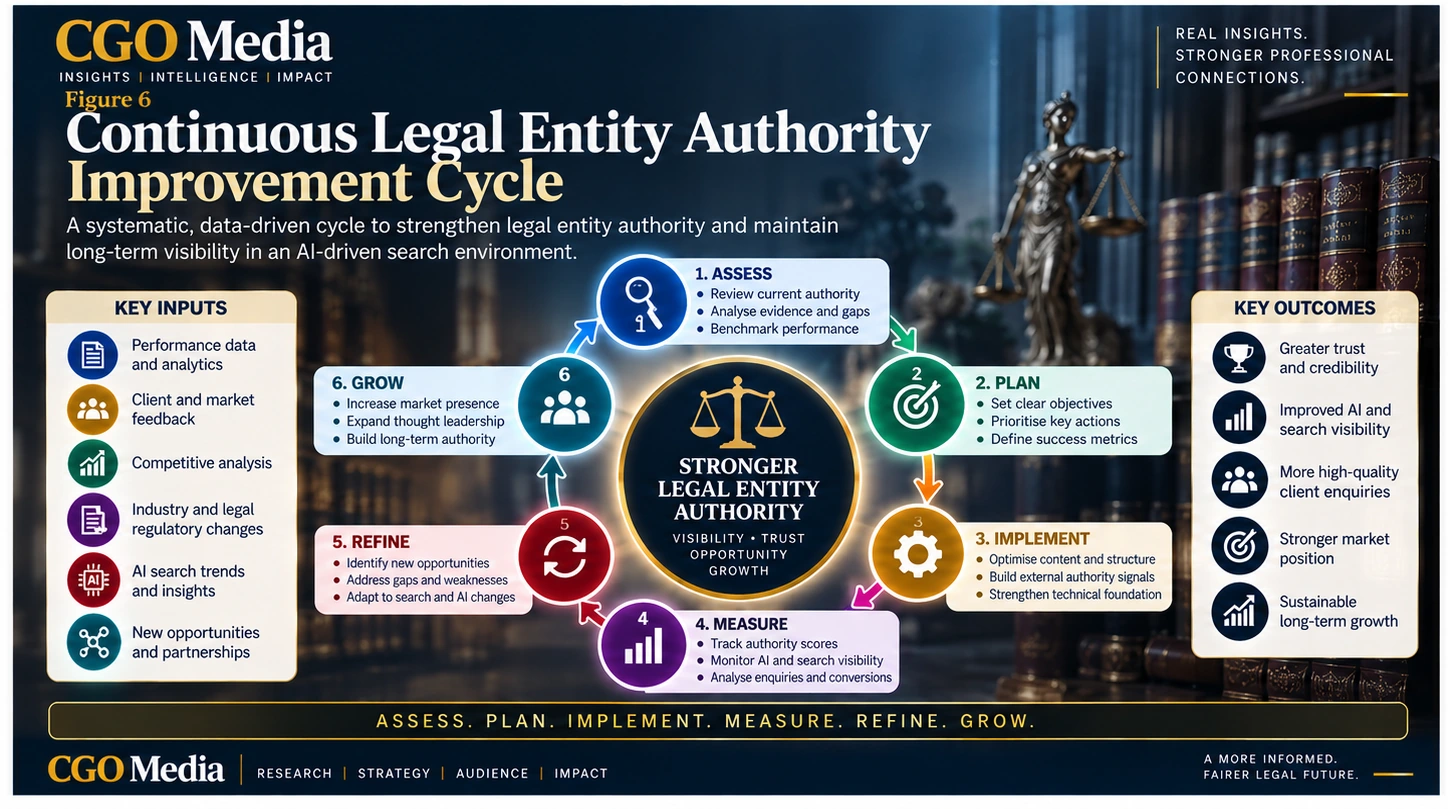
472. Strategic Implications
The Legal Entity Authority Framework provides a structured method for understanding legal search authority as a connected system rather than a collection of isolated SEO activities.
Its six dimensions combine organisational identity, legal information, professional evidence, regulatory trust, external corroboration and AI recommendation readiness into one broader authority model.
473. Entity Clarity Is the Starting Point
Legal organisations should first ensure that users and automated systems can identify accurately:
- The firm
- Its offices
- Its professionals
- Its practice areas
- Its jurisdictions
474. Legal Information Authority Builds Relevance
Practice-area and service information should demonstrate genuine capability and connect clearly with relevant professionals and jurisdictions.
475. Professional Authority Builds Confidence
Individual professionals should have sufficiently complete and verifiable evidence around:
- Role
- Qualifications
- Practice focus
- Office relationships
- Professional contributions
476. Regulatory and Client Trust Builds Verification
Legal providers should make important professional, regulatory and client-care information sufficiently clear for users evaluating whether to make contact.
477. External Authority Builds Corroboration
Relevant legal directories, professional organisations, publications, institutional references, editorial coverage and local profiles can strengthen the wider evidence environment where they reflect genuine capability.
478. AI Readiness Emerges from the Previous Five Dimensions
The framework does not treat AI visibility as a separate shortcut.
Instead, AI recommendation readiness develops from:
Entity Clarity + Legal Information Authority + Professional Authority + Regulatory Trust + External Authority
479. Recommendation Readiness Is Not Recommendation Guarantee
The framework measures whether the organisation has built stronger conditions for accurate interpretation and discovery. It cannot guarantee inclusion, citation or recommendation by a particular AI system.
480. Evidence Integration Matters
Strong performance in one dimension may not compensate for serious weakness in another.
481. Critical Weaknesses Should Remain Visible
Material problems involving professional status, regulatory information, firm affiliation or jurisdiction should not disappear inside aggregate scoring.
482. Legal Authority Should Be Governed
The framework becomes more valuable when it is supported by:
- Named ownership
- Review cycles
- Change triggers
- Evidence confidence
- Repeated reassessment
483. The Strategic Authority Model
The full model can be represented as:
Entity Clarity → Legal Information Authority → Professional Authority → Regulatory & Client Trust → External & Local Authority → AI Recommendation Readiness → Measurement → Governance → Continuous Improvement
484. Relationship with the Legal Research Family
The Legal Entity Authority Framework sits within the wider CGO Media Legal research architecture.
Legal SEO and Entity Authority | Legal Information and Professional Selection Process | Legal Entity Authority Maturity Model | Legal SEO and Entity Authority Implementation Roadmap
485. Relationship with Legal SEO and Entity Authority
The parent research paper Legal SEO and Entity Authority provides the broader research foundation for the framework.
486. Relationship with the Legal Information and Professional Selection Process
The Legal Information and Professional Selection Process explains how users progress from legal information need through provider discovery, professional verification, trust validation, comparison and selection.
487. Relationship with the Legal Entity Authority Maturity Model
The Legal Entity Authority Maturity Model provides a maturity structure for evaluating how consistently the six framework dimensions are governed and integrated.
488. Relationship with the Legal SEO and Entity Authority Implementation Roadmap
The Legal SEO and Entity Authority Implementation Roadmap translates the framework into a practical implementation sequence.
489. Methodology
The Legal Entity Authority Framework is a conceptual assessment methodology developed by CGO Media to structure evaluation of legal search authority and AI-assisted provider readiness.
490. Framework Dimensions
The methodology uses six primary dimensions:
- Legal Organisation and Entity Clarity
- Legal Information and Practice-Area Authority
- Professional and Practitioner Authority
- Regulatory, Client and Reputational Trust
- External, Institutional and Local Authority
- AI Search and Professional Recommendation Readiness
491. Entity Assessment
Entity assessment considers the clarity and consistency of relationships between:
Organisation → Office → Professional → Practice Area → Legal Service → Matter Type → Jurisdiction
492. Legal Information Assessment
Legal information is assessed conceptually according to:
- Practice relevance
- Accuracy
- Freshness
- Jurisdictional clarity
- Professional connection
493. Professional Authority Assessment
Professional evidence may include:
- Role
- Qualifications
- Practice focus
- Professional status
- Office relationships
- Relevant contributions
494. Trust Assessment
Trust assessment considers:
- Regulatory transparency
- Professional verification
- Client-care information
- Reviews
- Reputation evidence
495. External Authority Assessment
External evidence may include:
- Legal directories
- Professional organisations
- Institutions
- Publications
- Editorial coverage
- Local profiles
496. AI Readiness Assessment
AI readiness may be assessed through repeatable observation of:
- Branded representation
- Professional representation
- Practice-area association
- Local provider discovery
- Provider comparison
- Visible source patterns
497. Scoring Approach
Each dimension may be assessed on a 1–5 scale:
- 1 — Critical Weakness
- 2 — Weak
- 3 — Established
- 4 — Strong
- 5 — Leading
498. Evidence Confidence
Each score should also be supported by a confidence classification:
- Low
- Medium
- High
499. Weighted Assessment
Organisations may apply different weights according to:
- Client type
- Practice strategy
- Jurisdiction
- Geographic complexity
- Risk
500. Critical Overrides
Material weaknesses involving professional status, firm affiliation, regulatory accuracy or jurisdiction should remain separately visible even where overall weighted scores are strong.
501. Gap Analysis
Framework assessment can be converted into:
Current Score → Target Score → Evidence Gap → Priority Action → Owner
502. Longitudinal Use
The framework is designed for repeated assessment so organisations can distinguish between:
- Improving
- Stable
- At Risk
- Regressing
503. Limitations
The Legal Entity Authority Framework is a digital search and authority methodology rather than a legal or regulatory compliance standard.
504. Legal Markets Differ
Professional structures, terminology and regulatory systems differ considerably between jurisdictions.
505. Regulatory Requirements Differ
Legal organisations should apply the framework alongside relevant professional, regulatory, advertising and client-care requirements in the jurisdictions where they operate.
506. Professional Titles Differ
Terms such as solicitor, barrister, attorney, advocate and lawyer may have different meanings and professional implications across legal systems.
507. Provider Types Differ
The framework may require adaptation for:
- Law firms
- Chambers
- Individual practitioners
- In-house legal services
- Alternative legal-service providers
508. Consumer and Commercial Legal Markets Differ
Consumer legal selection may place greater emphasis on local presence, reviews and accessibility, while commercial legal procurement may place greater emphasis on specialist expertise, sector experience and professional reputation.
509. Search Demand Does Not Equal Legal Need
High search volume for a legal topic does not necessarily indicate that every searcher requires professional legal services.
510. Reviews Have Limitations
Client reviews may provide useful experience evidence, but they do not constitute a direct measure of technical legal competence.
511. Directory Recognition Has Limitations
Legal-directory results should be interpreted according to the methodology, category, geography and year of the relevant publication.
512. Past Matter Evidence Has Limitations
Previous case or transaction experience should not be interpreted as a guarantee of future results.
513. AI Outputs Are Dynamic
Generated outputs may vary according to:
- Model
- Prompt wording
- Geography
- Time
- Retrieval environment
- Available sources
514. Source Visibility May Be Partial
Not every AI-assisted system exposes all sources contributing to its response.
515. Recommendation Presence Does Not Establish Quality
Appearance within an AI-generated provider list should not be interpreted as a direct measurement of professional competence.
516. Strong Framework Scores Do Not Guarantee Search Performance
The framework does not guarantee:
- Organic rankings
- Local rankings
- Search traffic
517. Strong Framework Scores Do Not Guarantee AI Recommendation
No framework score can guarantee that a specific AI system will cite, include or recommend a legal provider.
518. Strong Framework Scores Do Not Guarantee Client Selection
Legal provider selection may also depend on:
- Matter suitability
- Availability
- Fees
- Conflict checks
- Location
- Personal preference
519. The Framework Does Not Provide Legal Advice
The Legal Entity Authority Framework concerns digital authority, search visibility and provider representation. It does not provide legal advice or determine the appropriate legal professional for an individual matter.
520. Conclusion
Legal search is moving toward a more interconnected authority environment in which firms, professionals, offices, practice areas, external sources and AI-assisted discovery increasingly influence one another.
The Legal Entity Authority Framework provides a structured way to evaluate that environment across six connected dimensions.
Its central principle is that authority should be grounded in real and verifiable relationships.
The strongest organisations will not merely publish more content or pursue more external mentions.
They will build clearer entity structures, stronger professional evidence, better legal information, more transparent trust signals, relevant external corroboration and disciplined governance.
Those foundations can then support more accurate and resilient interpretation across both traditional search and AI-assisted legal discovery.
References
External Academic, Technical and Search Sources
- Google Search Central. SEO Starter Guide.
- Google Search Central. Understand how structured data works.
- Schema.org. LegalService.
- Schema.org. Organization.
- Schema.org. Person.
- Hogan, A. et al. (2021). Knowledge Graphs. ACM Computing Surveys, 54(4).
- Metzger, M.J. (2007). Making Sense of Credibility on the Web: Models for Evaluating Online Information and Recommendations for Future Research. Journal of the American Society for Information Science and Technology, 58(13), 2078–2091.
- Ji, Z. et al. (2023). Survey of Hallucination in Natural Language Generation. ACM Computing Surveys, 55(12).
CGO Media Legal Research and Frameworks
- Wilkinson, R. (2026). Legal SEO and Entity Authority. CGO Media.
- Wilkinson, R. (2026). Legal Information and Professional Selection Process. CGO Media.
- Wilkinson, R. (2026). Legal Entity Authority Maturity Model. CGO Media.
- Wilkinson, R. (2026). Legal SEO and Entity Authority Implementation Roadmap. CGO Media.
CGO Media Research Ecosystem
CGO Media Research Library | CGO Media Framework Library | CGO Media Research Architecture
About Roger Wilkinson
Roger Wilkinson is an independent researcher, SEO practitioner and founder of CGO Media with more than 25 years of experience in search, online visibility and business growth.
His current research focuses on how artificial intelligence is changing search engines, recommendation systems, digital authority, entity representation and organisational visibility.
Roger is the creator of the CGO Framework Series, a collection of research-led methodologies designed to help organisations measure, strengthen and govern search visibility, AI visibility and digital authority.
His work examines the relationship between Technical SEO, Entity Authority, Content Authority, Citation Authority, Brand Signals, Knowledge Architecture and AI Search Readiness.
View Roger Wilkinson’s researcher profile →
Related Legal Research and Frameworks
Legal SEO and Entity Authority | Legal Information and Professional Selection Process | Legal Entity Authority Maturity Model | Legal SEO and Entity Authority Implementation Roadmap
Research Usage & Citation
CGO Media encourages researchers, journalists, legal organisations, professional-services firms, educators and industry professionals to reference this framework where it contributes to broader discussion and understanding of Legal SEO, Entity Authority, Professional Authority, AI Search and digital provider discovery.
Reasonable quotations, summaries, figures and excerpts may be used in articles, reports, presentations, academic work and other publications provided appropriate acknowledgement is given to Roger Wilkinson and CGO Media.
Cite This Framework / Embed Citation
The Legal Entity Authority Framework by Roger Wilkinson at CGO Media provides a six-dimension model for assessing legal organisation identity, practice-area authority, professional evidence, regulatory trust, external authority and AI recommendation readiness.
APA Citation
APA Citation: Wilkinson, R. (2026). Legal Entity Authority Framework. CGO Media. https://cgomedia.com/ai-legal-entity-authority-framework/
Author: Roger Wilkinson | Published by: CGO Media
For permissions relating to extensive reproduction, commercial licensing or republication of substantial portions of this framework, please contact CGO Media directly.