
Legal Entity Authority Maturity Model
 The Legal Entity Authority Maturity Model provides a structured method for assessing how effectively a legal organisation develops, governs and improves its entity authority across search, local discovery, professional verification and AI-assisted provider recommendation environments.
The model builds on Legal SEO and Entity Authority, the Legal Entity Authority Framework and the Legal Information and Professional Selection Process.
1. Purpose of the Maturity Model
The purpose of the model is to help legal organisations determine not only whether they possess authority signals, but how consistently those signals are structured, connected, verified, measured and governed.
2. Authority Maturity Is Different from Visibility
A legal provider may rank prominently or receive strong branded demand while still having weak entity structure, inconsistent professional information or poor governance.
3. The Model Measures Organisational Capability
Maturity reflects the organisation’s ability to manage authority deliberately rather than relying on isolated marketing activity or historic reputation.
4. Five Levels of Legal Entity Authority Maturity
- Foundation
- Developing
- Operational
- Advanced
- Leading
5. The Maturity Progression
The progression can be represented as:
Foundation → Developing → Operational → Advanced → Leading
6. Maturity Is Not Simply a Linear SEO Scale
Progression requires stronger capability across multiple dimensions simultaneously.
7. Six Core Maturity Dimensions
The model evaluates:
- Legal Organisation and Entity Clarity
- Legal Information and Practice-Area Authority
- Professional and Practitioner Authority
- Regulatory, Client and Reputational Trust
- External, Institutional and Local Authority
- AI Search and Professional Recommendation Readiness
8. Governance Is a Cross-Cutting Requirement
Governance affects every maturity level because authority can deteriorate quickly when ownership, review cycles and update triggers are unclear.
9. Evidence Quality Is a Cross-Cutting Requirement
The maturity model distinguishes between merely having information and having evidence that is:
- Accurate
- Current
- Relevant
- Verifiable
- Consistent
10. Integration Is a Cross-Cutting Requirement
Higher maturity depends increasingly on the strength of relationships between:
Organisation → Office → Professional → Practice Area → Legal Service → Jurisdiction → Trust Evidence → External Evidence
11. Measurement Is a Cross-Cutting Requirement
More mature organisations move from informal judgement toward structured measurement of authority strength, evidence confidence, risk and improvement.
12. Maturity Is Contextual
A national consumer law firm, specialist boutique and international commercial practice may require different maturity priorities while still using the same underlying model.
13. Critical Weaknesses Can Constrain Overall Maturity
A legal organisation should not be considered highly mature where material weaknesses remain in areas such as:
- Professional status
- Firm affiliation
- Regulatory accuracy
- Jurisdictional clarity
14. Maturity Should Be Assessed by Evidence
Progression between levels should be supported by observable evidence rather than broad claims that the organisation is sophisticated or advanced.
15. Level One — Foundation
At Foundation maturity, the organisation has basic digital visibility but entity authority is fragmented, inconsistent or only partially managed.
16. Foundation-Level Organisation Identity
Basic firm information exists, but consistency may vary across:
- Website
- Directories
- Local profiles
- Professional profiles
17. Foundation-Level Entity Structure
The organisation may have no formal model for connecting firms, offices, professionals, practice areas and services.
18. Foundation-Level Office Architecture
Office information may exist as standalone location pages without strong relationships to professionals or local service capability.
19. Foundation-Level Professional Architecture
Lawyer biographies may exist but often function as isolated profile pages.
20. Foundation-Level Professional Data
Profiles may contain only basic fields such as:
- Name
- Title
- Short biography
- Contact information
21. Foundation-Level Practice-Area Structure
Practice areas may be broad and inconsistently connected with individual services or professionals.
22. Foundation-Level Legal Content
Legal information may be published reactively without a defined content governance standard.
23. Foundation-Level Content Review
Review dates, professional reviewers and jurisdictional context may be absent or inconsistent.
24. Foundation-Level Jurisdictional Clarity
The legal system to which information applies may not always be stated clearly.
25. Foundation-Level Professional Authority
Professional expertise may be described using generic statements rather than structured evidence.
26. Foundation-Level External Professional Evidence
Directory and professional-body profiles may be unmanaged or outdated.
27. Foundation-Level Regulatory Trust
Regulatory information may exist, but users may need to search extensively to verify the firm or professional.
28. Foundation-Level Client Trust
Reviews may be present but are often monitored primarily for reputation rather than analysed as part of a wider trust system.
29. Foundation-Level Reputation Evidence
Awards, rankings and recognitions may be displayed without consistent:
- Date
- Practice context
- Professional attribution
- Jurisdiction
30. Foundation-Level Local Authority
Local profiles may be created independently rather than governed as part of the organisation’s entity architecture.
31. Foundation-Level External Authority
External authority may be measured mainly through links or mentions without assessing relevance, current accuracy or professional context.
32. Foundation-Level AI Awareness
The organisation may be aware of generative search but does not yet maintain a systematic AI representation programme.
33. Foundation-Level AI Monitoring
AI outputs may be checked occasionally through ad hoc prompts.
34. Foundation-Level AI Interpretation
Individual generated answers may be over-interpreted as evidence of ranking or recommendation strength.
35. Foundation-Level Measurement
Reporting may focus primarily on:
- Rankings
- Traffic
- Leads
- Links
36. Foundation-Level Governance
Responsibility for entity accuracy may be distributed informally across:
- Marketing
- HR
- Individual lawyers
- Office teams
37. Foundation-Level Change Management
Professional departures, promotions or office changes may be updated manually without a formal trigger process.
38. Foundation-Level Risk
The principal risk is fragmentation.
The organisation may possess substantial real-world expertise but represent it inconsistently across the digital environment.
39. Foundation-Level Typical Symptoms
- Old lawyer biographies remain live
- Practice-area naming differs across the site
- Office profiles conflict with local listings
- Directory information is outdated
- Legal content lacks review dates
40. Foundation-Level Search Consequence
Search systems may understand broad firm relevance while struggling with more specific relationships involving professionals, offices and services.
41. Foundation-Level AI Consequence
AI systems may produce incomplete, inconsistent or outdated representations because the underlying evidence environment lacks cohesion.
42. Foundation-Level User Consequence
Prospective clients may need to perform additional verification before feeling confident about:
- Professional relevance
- Office location
- Practice capability
- Current status
43. Foundation-Level Objective
The immediate objective is to create a dependable baseline of accurate entities and material facts.
44. Foundation-Level Priority One — Entity Inventory
Identify strategic:
- Organisations
- Offices
- Professionals
- Practice areas
- Services
45. Foundation-Level Priority Two — Critical Data Correction
Correct material errors involving:
- Firm identity
- Professional affiliation
- Office addresses
- Professional status
46. Foundation-Level Priority Three — Practice Mapping
Establish which professionals genuinely support each strategic practice area and service.
47. Foundation-Level Priority Four — Jurisdictional Clarity
Identify where legal information and professional capability require clearer jurisdictional context.
48. Foundation-Level Priority Five — Basic Governance
Assign ownership for high-risk information.
49. Foundation Exit Criteria
An organisation should begin moving beyond Foundation when:
- Priority entities are identified
- Critical inaccuracies are being corrected
- Core relationships are documented
- Ownership is beginning to emerge
50. Level Two — Developing
At Developing maturity, the organisation begins moving from fragmented authority toward defined standards and repeatable management.
51. Developing-Level Organisation Identity
Core firm information is becoming standardised across important first-party properties.
52. Developing-Level Entity Standards
The organisation begins defining required information for:
- Firm entities
- Office entities
- Professional entities
- Practice-area entities
53. Developing-Level Office Architecture
Office pages begin connecting more consistently with:
- Relevant professionals
- Practice areas
- Local contact information
54. Developing-Level Professional Architecture
Professional profile templates become more structured.
55. Developing-Level Professional Profile Standards
Required fields may include:
- Role
- Office
- Practice areas
- Qualifications
- Professional status
56. Developing-Level Practice-Area Architecture
Practice areas begin to connect systematically with services, professionals and supporting content.
57. Developing-Level Legal Content Standards
The organisation begins defining expectations around:
- Accuracy
- Professional review
- Freshness
- Jurisdiction
58. Developing-Level Content Ownership
Priority legal content begins to have identified owners or reviewers.
59. Developing-Level Review Cycles
Some important legal information is placed on scheduled review cycles.
60. Developing-Level Professional Authority
Professional profiles begin moving beyond generic biographies toward evidence of:
- Practice expertise
- Sector experience
- Publications
- Relevant recognition
61. Developing-Level Professional Consistency
Priority external professional profiles begin to be audited for accuracy.
62. Developing-Level Regulatory Trust
Firm and professional regulatory information becomes easier to locate and verify.
63. Developing-Level Client Trust
Review monitoring becomes more structured.
64. Developing-Level Review Analysis
The organisation may begin tracking themes such as:
- Communication
- Responsiveness
- Professionalism
- Administration
65. Developing-Level Reputation Governance
Awards and recognitions begin to be recorded with clearer date, practice and professional context.
66. Developing-Level External Authority
The organisation starts distinguishing relevant external authority from generic mention volume.
67. Developing-Level Directory Governance
Priority legal directory profiles are reviewed more systematically.
68. Developing-Level Local Authority
Office information begins to be standardised across major local discovery environments.
69. Developing-Level Local Professional Mapping
Relevant lawyers are connected more clearly with the offices where they genuinely practise.
70. Developing-Level AI Awareness
The organisation begins to recognise AI-assisted search as a distinct discovery and representation environment.
71. Developing-Level AI Monitoring
A small set of repeatable prompts may be introduced around:
- Firm identity
- Professional identity
- Practice-area relevance
- Local discovery
72. Developing-Level AI Accuracy Review
Material generated errors are recorded rather than treated as isolated anomalies.
73. Developing-Level Source Review
Where AI inaccuracies appear, the organisation begins examining first-party and external source consistency.
74. Developing-Level Measurement
Reporting starts to extend beyond traffic and rankings toward:
- Entity accuracy
- Profile completeness
- Content review coverage
- Local consistency
75. Developing-Level Governance
Named ownership begins to emerge for important evidence classes.
76. Developing-Level Change Triggers
The organisation may introduce update procedures for:
- Professional joins
- Professional departures
- Promotions
- Office moves
- Practice changes
77. Developing-Level Cross-Team Coordination
Marketing may begin coordinating more closely with:
- HR
- Compliance
- Practice leaders
- Office management
78. Developing-Level Risk
The main risk at this stage is inconsistency between emerging standards and actual execution.
79. Developing-Level Typical Symptoms
- Good templates exist but are not used everywhere
- Some practices are well governed while others remain weak
- Some professionals have strong profiles while others are thin
- External profiles are corrected inconsistently
80. Developing-Level Search Consequence
Search systems may interpret priority entities more reliably, but understanding remains uneven across offices, professionals and practice areas.
81. Developing-Level AI Consequence
AI representations may improve for major firm and professional entities while remaining unstable in long-tail or local scenarios.
82. Developing-Level User Consequence
Prospective clients encounter stronger information in priority areas but may still experience inconsistency elsewhere.
83. Developing-Level Objective
The objective is to move from individual fixes toward repeatable standards and consistent ownership.
84. Developing-Level Priority One — Standardise Entity Data
Create agreed standards for the most important organisation, office and professional fields.
85. Developing-Level Priority Two — Standardise Professional Profiles
Ensure priority lawyers meet a defined minimum evidence standard.
86. Developing-Level Priority Three — Build Practice Relationships
Connect strategic:
Practice Areas → Services → Professionals → Offices
87. Developing-Level Priority Four — Formalise Content Review
Introduce defined review ownership and update cycles for high-value legal information.
88. Developing-Level Priority Five — External Evidence Audit
Identify which directories, local profiles and professional sources require active maintenance.
89. Developing-Level Priority Six — Establish AI Baseline
Create a repeatable baseline for monitoring branded, professional, practice-area and local AI representation.
90. Developing Exit Criteria
An organisation should begin progressing toward Operational maturity when:
- Core entity standards are defined
- Priority professional profiles meet minimum standards
- Practice relationships are increasingly structured
- High-risk content has review ownership
- External evidence is being actively maintained
- AI representation is monitored systematically
91. The First Two Levels Establish the Authority Foundation
The progression from Foundation to Developing can be represented as:
Fragmented Evidence → Defined Standards → Repeatable Ownership → Structured Relationships
92. The Next Stage Is Operational Integration
At Operational maturity, the legal organisation begins connecting its entity, professional, trust, external and AI evidence into a more unified authority-management system.
93. Level Three — Operational
At Operational maturity, legal entity authority moves from emerging standards into a more coordinated operating system supported by repeatable processes, stronger ownership and more consistent integration across the organisation.
94. Operational-Level Organisation Identity
Core firm identity is managed consistently across major first-party and priority external environments.
95. Operational-Level Entity Architecture
The organisation maintains a clearer relationship model connecting:
Organisation → Office → Professional → Practice Area → Legal Service → Jurisdiction
96. Operational-Level Data Standards
Defined standards exist for important entity fields and relationships.
97. Operational-Level Entity Ownership
Named owners are responsible for maintaining high-risk organisation, office and professional information.
98. Operational-Level Office Governance
Office entities are managed using consistent standards for:
- Address
- Telephone
- Professional relationships
- Practice availability
- Local profile consistency
99. Operational-Level Professional Governance
Professional profiles are maintained according to defined evidence and update standards.
100. Operational-Level Professional Change Management
Joining, departure, promotion and role-change events trigger coordinated updates across relevant systems.
101. Operational-Level Practice-Area Architecture
Strategic practice areas are mapped consistently with:
- Services
- Professionals
- Offices
- Relevant jurisdictions
102. Operational-Level Service Architecture
Priority legal services are represented through clear entity and content relationships rather than isolated pages.
103. Operational-Level Legal Content Governance
Priority legal information operates under defined standards for:
- Professional ownership
- Review dates
- Jurisdictional context
- Source quality
- Update triggers
104. Operational-Level Content Review Coverage
High-value legal content is reviewed on a regular schedule rather than only when obvious problems appear.
105. Operational-Level Professional Attribution
Relevant legal information is connected with genuine professional expertise where appropriate.
106. Operational-Level Professional Authority
Priority professionals have more complete evidence across:
- Practice expertise
- Professional status
- Sector experience
- Publications
- External recognition
107. Operational-Level Professional Evidence Consistency
Major external professional profiles are reviewed against the firm’s own current records.
108. Operational-Level Regulatory Trust
Firm-level and professional-level regulatory information is clearly distinguished and more consistently maintained.
109. Operational-Level Client Trust
Review and client-experience evidence is monitored systematically across priority offices and services.
110. Operational-Level Reputation Governance
Awards, rankings and other recognitions are governed using clearer date, category, professional and jurisdictional context.
111. Operational-Level External Authority
The organisation maintains an inventory of priority external authority sources.
112. Operational-Level External Evidence Categories
These may include:
- Legal directories
- Professional bodies
- Publications
- Media
- Institutions
- Local profiles
113. Operational-Level External Source Prioritisation
External sources are prioritised according to relevance and authority rather than raw volume.
114. Operational-Level Local Authority
Local office data is managed as part of the broader entity architecture.
115. Operational-Level Local Professional Mapping
Professionals are connected with offices according to current operational reality.
116. Operational-Level Local Practice Mapping
Practice availability is represented more accurately at office level.
117. Operational-Level AI Monitoring
AI observation becomes a repeatable process using defined prompt classes.
118. Operational-Level AI Prompt Categories
Monitoring may include:
- Branded firm representation
- Professional representation
- Practice-area discovery
- Local discovery
- Provider comparison
119. Operational-Level AI Accuracy Tracking
Material errors are recorded and classified by affected entity and risk.
120. Operational-Level AI Source Review
Where sources are visible, the organisation begins recording which source environments recur.
121. Operational-Level AI Remediation
The organisation follows a repeatable process:
Observe → Verify → Diagnose → Correct → Retest
122. Operational-Level Measurement
The organisation begins measuring authority across the six dimensions rather than relying on traditional SEO metrics alone.
123. Operational-Level Entity Metrics
Potential measures include:
- Entity completeness
- Material conflict rate
- Relationship accuracy
- Office consistency
124. Operational-Level Professional Metrics
Potential measures include:
- Profile completeness
- Practice mapping
- External consistency
- Professional evidence depth
125. Operational-Level Trust Metrics
Potential measures include:
- Regulatory clarity
- Review coverage
- Client-care information coverage
- Reputation evidence accuracy
126. Operational-Level External Authority Metrics
Potential measures include:
- Priority directory accuracy
- Institutional evidence
- Relevant publication evidence
- Local consistency
127. Operational-Level AI Metrics
Potential measures include:
- Branded representation accuracy
- Professional representation accuracy
- Relevant recommendation presence
- Material error rate
128. Operational-Level Evidence Confidence
Scores increasingly distinguish between:
- Verified evidence
- Incomplete evidence
- Low-confidence assumptions
129. Operational-Level Reporting
Leadership begins receiving consolidated reporting covering:
- Authority strength
- Critical risks
- Strategic gaps
- Priority actions
130. Operational-Level Governance
Cross-functional ownership becomes more formal.
131. Operational-Level Governance Participants
Potential contributors may include:
- Marketing
- SEO
- HR
- Compliance
- Practice leaders
- Office management
132. Operational-Level Change Triggers
Formal trigger processes exist for:
- Professional changes
- Office changes
- Practice changes
- Regulatory changes
- High-risk content changes
133. Operational-Level Risk
The principal risk at Operational maturity is process inconsistency between teams, jurisdictions or business units.
134. Operational-Level Typical Symptoms
- Standards exist but adoption differs between practices
- Some offices operate stronger governance than others
- AI monitoring is systematic but not fully integrated with wider authority reporting
- External evidence management remains partially manual
135. Operational-Level Search Consequence
Search systems are more likely to encounter consistent relationships across important legal entities.
136. Operational-Level AI Consequence
AI representations may become more accurate across major branded, professional and practice-area scenarios.
137. Operational-Level User Consequence
Prospective clients encounter a more consistent path from legal information through professional verification and provider evaluation.
138. Operational-Level Objective
The objective is to convert repeatable processes into an integrated authority-management capability.
139. Operational-Level Priority One — Close Major Consistency Gaps
Reduce variation between:
- Practice groups
- Offices
- Professional profiles
- External sources
140. Operational-Level Priority Two — Improve Relationship Density
Strengthen accurate connections between entities without creating artificial relationships.
141. Operational-Level Priority Three — Integrate Authority Measurement
Bring entity, professional, trust, external and AI metrics into one reporting model.
142. Operational-Level Priority Four — Strengthen Change Governance
Ensure real-world organisational changes propagate reliably across the authority environment.
143. Operational Exit Criteria
An organisation begins progressing toward Advanced maturity when:
- Authority standards operate consistently across major practices
- Entity relationships are governed systematically
- Evidence quality is measured
- AI monitoring is integrated with wider authority analysis
- Executive reporting is established
144. Level Four — Advanced
At Advanced maturity, legal entity authority becomes a strategic organisational capability supported by integrated knowledge architecture, stronger data quality, evidence thresholds, governance and longitudinal measurement.
145. Advanced-Level Organisation Identity
Firm identity is managed as a governed entity system rather than a collection of web pages and external listings.
146. Advanced-Level Knowledge Architecture
The organisation maintains a well-defined relationship model connecting:
Organisation → Office → Professional → Practice Area → Service → Matter Type → Jurisdiction → Trust Evidence → External Evidence
147. Advanced-Level Entity Relationships
Entity relationships are intentional, documented and periodically verified.
148. Advanced-Level Entity Quality Controls
High-risk relationships may be subject to additional verification before publication or propagation.
149. Advanced-Level Identity Conflict Detection
The organisation actively identifies material conflicts across first-party and external sources.
150. Advanced-Level Conflict Classification
Conflicts may be classified as:
- Critical
- High
- Medium
- Low
151. Advanced-Level Professional Lifecycle Management
Professional authority is managed throughout:
Join → Develop → Promote → Change Role → Change Office → Depart
152. Advanced-Level Professional Evidence Architecture
Professional profiles draw from structured evidence classes including:
- Practice expertise
- Qualifications
- Sector expertise
- Representative matters
- Publications
- Recognition
153. Advanced-Level Expertise Mapping
Professional expertise is mapped with greater granularity across:
- Practice areas
- Sub-practices
- Matter types
- Sectors
- Jurisdictions
154. Advanced-Level Practice Architecture
Practice areas operate as connected knowledge structures rather than top-level marketing categories.
155. Advanced-Level Service Architecture
Service entities are connected with appropriate:
- Professionals
- Matter types
- Industries
- Jurisdictions
- Supporting information
156. Advanced-Level Matter-Type Architecture
The organisation increasingly maps real client problems to formal legal services.
157. Advanced-Level Jurisdiction Architecture
Jurisdiction becomes an explicit relationship within legal content and professional authority rather than a contextual afterthought.
158. Advanced-Level Legal Content Governance
Content governance is risk-based.
159. Advanced-Level High-Risk Content
Higher-risk information may receive:
- More frequent review
- Stronger professional oversight
- More explicit jurisdictional context
- More rigorous source standards
160. Advanced-Level Content Change Triggers
Legal or regulatory developments can trigger targeted review rather than waiting for scheduled audits.
161. Advanced-Level Content Evidence
Strategic content connects more clearly with:
- Professional authorship
- Professional review
- Source evidence
- Practice ownership
162. Advanced-Level Regulatory Trust
Regulatory data is treated as a high-priority authority layer with defined verification and escalation procedures.
163. Advanced-Level Client Trust
Review and client-experience analysis extends beyond raw ratings into recurring themes and operational insight.
164. Advanced-Level Reputation Evidence
External recognition is assessed according to:
- Relevance
- Recency
- Source quality
- Practice context
- Professional context
165. Advanced-Level External Authority Strategy
The organisation develops external authority deliberately around strategic expertise rather than pursuing generic mention volume.
166. Advanced-Level Citation Authority
Research, legal commentary and professional publications may generate more consistent external citation and reference patterns.
167. Advanced-Level Institutional Authority
Relevant relationships with professional, academic and sector institutions are represented more systematically.
168. Advanced-Level Local Authority
Multi-office authority is managed through a coherent local entity system.
169. Advanced-Level Office Differentiation
Each office reflects genuine differences in:
- Professionals
- Practice capability
- Local evidence
- Market context
170. Advanced-Level AI Monitoring
AI monitoring becomes longitudinal and segmented.
171. Advanced-Level AI Segmentation
Analysis may distinguish between:
- Brand prompts
- Professional prompts
- Practice prompts
- Local prompts
- Comparison prompts
- Jurisdiction prompts
172. Advanced-Level AI Source Analysis
Where available, source patterns are analysed to understand which evidence environments repeatedly support generated representations.
173. Advanced-Level AI Error Taxonomy
Errors are classified by:
- Entity type
- Materiality
- Frequency
- Potential client impact
174. Advanced-Level AI Recommendation Analysis
The organisation distinguishes between:
- Presence
- Accuracy
- Relevance
- Comparison context
- Source support
175. Advanced-Level AI Readiness Interpretation
Generated provider presence is treated as one observation within a wider evidence system rather than proof of superiority.
176. Advanced-Level Measurement
Measurement becomes longitudinal and multi-dimensional.
177. Advanced-Level Authority Scorecard
Each dimension may include:
- Current score
- Target score
- Evidence confidence
- Trend
- Priority
178. Advanced-Level Critical Overrides
Material professional, regulatory or jurisdictional weaknesses remain visible outside aggregate scores.
179. Advanced-Level Trend Analysis
The organisation distinguishes between authority that is:
- Improving
- Stable
- At Risk
- Regressing
180. Advanced-Level Benchmarking
Authority may be compared across:
- Practice areas
- Offices
- Professional groups
- Jurisdictions
181. Advanced-Level Competitor Context
Relevant competitor evidence may be analysed to identify genuine strategic gaps without blindly copying competitor activity.
182. Advanced-Level Governance
Authority management becomes embedded across multiple business functions.
183. Advanced-Level Governance Model
A mature governance structure may connect:
Marketing + SEO + Knowledge + HR + Compliance + Practice Leadership + Operations
184. Advanced-Level Decision Rights
Teams understand who can approve, change or verify high-risk entity and professional information.
185. Advanced-Level Audit Trails
Important authority changes may be documented sufficiently to understand:
- What changed
- Why it changed
- Who approved it
- When it was reviewed
186. Advanced-Level Change Management
Real-world business events increasingly propagate through the digital authority environment systematically.
187. Advanced-Level Risk Management
Authority risk is prioritised according to potential effect on:
- Professional accuracy
- Regulatory accuracy
- Client understanding
- Provider discovery
- AI representation
188. Advanced-Level Executive Reporting
Senior leadership receives a more strategic view of:
- Authority maturity
- Critical weaknesses
- Evidence confidence
- AI representation
- Improvement priorities
189. Advanced-Level Search Consequence
Search systems encounter a more coherent and resilient legal knowledge environment.
190. Advanced-Level AI Consequence
AI systems may have access to stronger and more consistent evidence supporting correct interpretation of firms, professionals, offices, practices and jurisdictions.
191. Advanced-Level User Consequence
Prospective clients experience lower verification friction across multiple stages of professional selection.
192. Advanced-Level Risk
The principal risk is complexity.
A sophisticated authority system can become difficult to maintain if governance, data ownership and operational standards do not scale with it.
193. Advanced-Level Typical Symptoms
- Strong systems exist but some manual dependencies remain
- Advanced practices outperform less mature internal teams
- AI monitoring is mature but not yet embedded fully into executive planning
- Evidence quality may vary across international jurisdictions
194. Advanced-Level Objective
The objective is to turn integrated authority management into a scalable, resilient and strategically governed capability.
195. Advanced-Level Priority One — Reduce Manual Dependency
Where appropriate, improve systems that maintain repetitive, low-risk authority data while preserving human verification for higher-risk information.
196. Advanced-Level Priority Two — Strengthen Evidence Confidence
Improve the proportion of authority scores supported by current, multi-source and verifiable evidence.
197. Advanced-Level Priority Three — Expand Longitudinal Measurement
Track authority change over time rather than relying primarily on point-in-time audits.
198. Advanced-Level Priority Four — Improve Cross-Jurisdiction Governance
Ensure international or multi-regional legal operations maintain appropriate local accuracy and professional context.
199. Advanced-Level Priority Five — Integrate AI Insights with Wider Governance
AI representation findings should inform entity, content, professional and external-authority priorities rather than remain a separate reporting exercise.
200. Advanced Exit Criteria
An organisation begins approaching Leading maturity when:
- Entity architecture is deeply integrated
- Evidence quality is governed systematically
- Authority measurement is longitudinal
- Critical changes propagate reliably
- AI representation is treated as part of enterprise authority governance
- Continuous improvement is embedded across major business functions
201. Operational to Advanced Progression
The movement from Level Three to Level Four can be represented as:
Repeatable Processes → Integrated Architecture → Evidence Confidence → Strategic Governance → Longitudinal Measurement
202. The Next Stage Is Leading Authority Maturity
At the highest maturity level, legal entity authority becomes a resilient organisational capability able to adapt continuously as professionals, practices, markets, search systems and AI-assisted discovery environments change.
203. Level Five — Leading
At Leading maturity, legal entity authority operates as a resilient organisational capability embedded across strategy, governance, knowledge management, professional development, digital systems and AI-assisted discovery monitoring.
204. Leading Maturity Is Not Defined by Visibility Alone
A leading legal organisation is not simply one with strong rankings, high traffic or frequent AI recommendation presence.
It is one that can maintain accurate, current and well-connected authority evidence despite ongoing organisational and market change.
205. Leading-Level Organisation Identity
The firm’s identity architecture is governed consistently across:
- Brand
- Legal entities
- Offices
- Professional teams
- Jurisdictions
- External authority environments
206. Leading-Level Knowledge Architecture
The organisation maintains a mature relationship model connecting:
Organisation → Legal Entity → Office → Professional → Practice Area → Service → Matter Type → Sector → Jurisdiction → Trust Evidence → External Evidence
207. Knowledge Architecture Is Operational Infrastructure
At Leading maturity, entity relationships are not treated as a website-only structure.
They support wider organisational information management.
208. Leading-Level Entity Definitions
Important entity classes have agreed internal definitions and ownership.
209. Leading-Level Entity Relationship Rules
The organisation defines which relationships are permitted, required or prohibited.
210. Leading-Level Relationship Accuracy
Professional, office and practice relationships reflect current operational reality rather than assumptions inherited from site architecture.
211. Leading-Level Critical Entity Controls
Higher-risk data receives stronger verification before publication or propagation.
212. Leading-Level Identity Conflict Detection
The organisation actively identifies material inconsistencies across:
- First-party websites
- Regulatory sources
- Professional profiles
- Directories
- Local profiles
- Institutional sources
213. Leading-Level Conflict Prioritisation
Conflicts are prioritised according to:
- Professional risk
- Regulatory risk
- Client impact
- Discovery impact
- Persistence
214. Leading-Level Professional Lifecycle Governance
The full professional lifecycle is connected with digital authority management.
215. Professional Join Workflow
When a lawyer joins, the organisation can coordinate:
- Profile creation
- Practice mapping
- Office mapping
- Qualification verification
- External profile correction
216. Professional Promotion Workflow
Changes in role or seniority trigger coordinated updates across relevant first-party and priority external sources.
217. Professional Practice-Change Workflow
Where a lawyer’s practice evolves, relationships with services, sectors and content are reviewed systematically.
218. Professional Office-Change Workflow
Office changes trigger updates to:
- Biography
- Office pages
- Local profiles
- Practice relationships
- Priority external sources
219. Professional Departure Workflow
Departures trigger rapid review of current affiliation claims and dependent entity relationships.
220. Leading-Level Professional Authority Architecture
Professional authority is supported by structured evidence rather than long-form biography alone.
221. Professional Evidence Classes
These may include:
- Current role
- Qualifications
- Practice expertise
- Sector expertise
- Matter experience
- Publications
- Speaking
- External recognition
222. Professional Evidence Has Provenance
Important claims can be traced to sufficiently reliable supporting evidence.
223. Professional Evidence Has Recency
The organisation distinguishes current authority evidence from historic professional information.
224. Professional Evidence Is Contextual
Recognition is connected with the correct:
- Professional
- Practice area
- Year
- Jurisdiction
225. Leading-Level Practice Architecture
Strategic practice areas function as governed knowledge structures.
226. Practice Areas Connect with Client Problems
The architecture connects formal legal categories with the language users employ when describing real-world legal needs.
227. Practice Areas Connect with Services
Users can move from broad practice categories toward specific legal support.
228. Practice Areas Connect with Professionals
Each strategic practice area identifies relevant professionals accurately.
229. Practice Areas Connect with Jurisdictions
Legal capability is represented within the appropriate legal context.
230. Practice Areas Connect with Sectors
Commercial practices may connect legal expertise with genuine sector capability.
231. Leading-Level Matter-Type Architecture
Real client problems are mapped more systematically to:
Matter Type → Practice Area → Service → Professional
232. Leading-Level Legal Information Governance
Legal content operates under differentiated risk and review standards.
233. High-Risk Information Governance
Information with greater potential client impact may receive:
- More frequent review
- Senior professional oversight
- Stronger source requirements
- Explicit jurisdictional context
234. Medium-Risk Information Governance
Stable explanatory information may operate under longer but still defined review cycles.
235. Event-Triggered Legal Content Review
Material legal or regulatory changes can trigger targeted content reassessment.
236. Leading-Level Source Governance
Important legal content uses source standards appropriate to the significance of the claim.
237. Source Quality Is Distinguished from Source Quantity
A smaller number of authoritative and relevant sources may provide stronger support than a large number of weak references.
238. Leading-Level Jurisdiction Governance
Jurisdiction is treated as a primary authority dimension rather than buried within page copy.
239. Multi-Jurisdiction Information Is Deliberately Separated
Where legal rules differ materially, the organisation avoids presenting one explanation as universally applicable.
240. Cross-Border Authority
International firms may document:
- Qualified professionals
- Local offices
- Jurisdictional capabilities
- Cross-border coordination
241. Leading-Level Regulatory Authority
Relevant regulatory information is managed as high-priority evidence.
242. Firm and Professional Regulation Remain Distinct
The organisation avoids collapsing separate regulatory relationships into ambiguous trust claims.
243. Leading-Level Client Trust Management
Client feedback is analysed as both reputation evidence and operational insight.
244. Review Analysis Becomes More Sophisticated
The organisation may monitor:
- Theme
- Recency
- Office
- Practice context
- Response quality
245. Review Evidence Is Not Used as a Competence Proxy
Strong ratings do not replace professional, regulatory or practice evidence.
246. Leading-Level Reputation Governance
Awards, rankings and recognitions are maintained with clear context.
247. Historic Recognition Remains Historic
Older recognition may still be useful background evidence but should not be represented as current where it is not.
248. Leading-Level External Authority Strategy
External authority development focuses on the organisation’s genuine expertise and strategic priorities.
249. External Authority Is Multi-Class
Relevant external evidence may include:
- Legal directories
- Professional organisations
- Academic institutions
- Research citations
- Editorial coverage
- Industry bodies
250. Leading-Level Citation Authority
Original legal analysis, research and professional commentary may attract citations that reinforce subject authority.
251. Citation Authority Is Evaluated Qualitatively
The organisation considers:
- Source relevance
- Source credibility
- Topical alignment
- Professional relationship
252. Leading-Level Institutional Authority
Institutional relationships are represented accurately and only where genuinely current.
253. Leading-Level Local Authority
Local authority is integrated with national and global entity architecture.
254. Office Entities Remain Independently Verifiable
Each office has sufficient information for users to understand:
- Where it is
- Who practises there
- Which services are genuinely available
- How to make contact
255. Leading-Level Local Evidence Consistency
Priority local environments are reviewed against internal office records.
256. Leading-Level Multi-Office Governance
Office expansion does not automatically result in duplication of all national practice claims.
257. Leading-Level AI Search Monitoring
AI observation becomes a governed intelligence programme rather than an experimental activity.
258. AI Monitoring Is Segmented by Decision Context
The organisation may maintain separate prompt sets for:
- Firm discovery
- Professional discovery
- Practice discovery
- Local discovery
- Comparison
- Jurisdiction
259. AI Monitoring Is Longitudinal
Results are compared across time rather than interpreted only as isolated outputs.
260. AI Monitoring Is Multi-Model
Where strategically relevant, the organisation may compare representation across more than one AI-assisted discovery environment.
261. AI Accuracy Is Prioritised Before Recommendation Frequency
Repeated inaccurate inclusion is not considered stronger maturity than less frequent but accurate representation.
262. Leading-Level AI Error Classification
Material errors may be classified by:
- Firm identity
- Professional identity
- Practice relevance
- Office
- Jurisdiction
- Regulatory context
263. Leading-Level AI Materiality Thresholds
The organisation distinguishes low-impact wording differences from errors capable of affecting professional or client understanding.
264. Leading-Level AI Source Diagnostics
Where a material error appears, teams investigate the supporting evidence environment systematically.
265. AI Diagnostic Workflow
A mature workflow may follow:
Observe → Verify → Identify Entity → Analyse Sources → Correct Controlled Evidence → Strengthen Gaps → Retest
266. Leading-Level AI Source Intelligence
Where visible, citation and source patterns are used diagnostically rather than treated as a complete explanation of model behaviour.
267. Source Appearance Does Not Establish Causation
A cited source should not automatically be assumed to be the sole reason a provider was included or described in a particular way.
268. Leading-Level Recommendation Analysis
The organisation may evaluate:
- Presence
- Accuracy
- Relevance
- Context
- Competitor set
- Source support
269. AI Recommendation Order Is Not Treated as a Fixed Ranking
The sequence of firms within one generated answer is not treated as a permanent league table.
270. Leading-Level Recommendation Resilience
The strategic objective is to build an evidence environment capable of supporting accurate representation across changing search and AI systems.
271. Recommendation Resilience Depends on Underlying Authority
A resilient system combines:
Entity Clarity + Practice Authority + Professional Evidence + Regulatory Trust + External Corroboration + Contextual Accuracy
272. Leading-Level Measurement Architecture
Authority measurement combines:
- Scores
- Evidence confidence
- Trend
- Risk
- Strategic priority
273. Current and Target State
Each authority dimension can be evaluated against both present capability and desired maturity.
274. Leading-Level Evidence Confidence
A large proportion of strategic decisions should be supported by current and verifiable evidence.
275. Leading-Level Trend Analysis
Leadership can identify whether authority is:
- Strengthening
- Stable
- At Risk
- Regressing
276. Leading-Level Practice Benchmarking
Maturity can be compared across strategic practice areas.
277. Leading-Level Office Benchmarking
Multi-office organisations can identify geographic differences in:
- Entity quality
- Professional authority
- Local evidence
- AI representation
278. Leading-Level Professional Cohort Benchmarking
Professional evidence can be assessed across defined groups without reducing individual authority to simplistic league tables.
279. Leading-Level Jurisdiction Benchmarking
International firms can identify markets where evidence governance remains weaker.
280. Leading-Level Executive Reporting
Leadership receives a concise view of:
- Authority maturity
- Critical entity risks
- Professional evidence gaps
- Trust weaknesses
- AI representation changes
- Strategic opportunities
281. Reporting Distinguishes Risk from Opportunity
A critical professional-status error should not sit in the same priority category as an opportunity to increase editorial authority.
282. Leading-Level Governance Architecture
Authority governance is embedded across relevant teams.
283. Governance Can Connect
A mature governance structure may involve:
Executive Leadership + Practice Leaders + Marketing + SEO + Knowledge + HR + Compliance + Operations + Data
284. Leading-Level Named Ownership
Strategic entity and evidence classes have clearly defined owners.
285. Leading-Level Decision Rights
Teams know who is authorised to:
- Create
- Approve
- Correct
- Remove
- Escalate
important authority information.
286. Leading-Level Verification Requirements
Higher-risk data may require approval from appropriate professional or compliance owners before publication.
287. Leading-Level Auditability
Material changes can be traced sufficiently to understand:
- What changed
- Who changed it
- Why it changed
- When it was verified
288. Leading-Level Change Triggers
Authority maintenance is integrated with real organisational events.
289. Organisational Change Triggers
These may include:
- Rebrand
- Merger
- Acquisition
- Office launch
- Office closure
290. Professional Change Triggers
These may include:
- Join
- Departure
- Promotion
- Office move
- Practice change
291. Legal and Regulatory Change Triggers
Material changes in law, guidance or professional requirements may trigger content and evidence review.
292. Reputation Change Triggers
Significant review patterns, public issues or inaccurate external coverage may trigger investigation.
293. AI Representation Change Triggers
Persistent high-impact AI errors may trigger cross-source analysis.
294. Leading-Level Predictive Governance
The organisation increasingly identifies likely authority risks before they become widespread public inconsistencies.
295. Predictive Professional Governance
Known future promotions, departures or office changes can be prepared for before public records diverge.
296. Predictive Content Governance
Known legal developments may be mapped to affected content before outdated information becomes widespread.
297. Predictive Office Governance
Office moves can be planned across:
- Website
- Local profiles
- Directories
- Professional biographies
- Structured data
298. Predictive AI Risk Management
Authority teams may identify areas where source inconsistency creates a higher risk of inaccurate machine synthesis.
299. Leading-Level Automation
Automation may support repetitive authority-maintenance tasks where appropriate.
300. Automation Should Not Replace Verification
High-risk legal and professional data should retain appropriate human oversight.
301. Suitable Automation Areas
Potential lower-risk uses may include:
- Change detection
- Profile completeness alerts
- Broken relationship detection
- Review reminders
- External source monitoring
302. Higher-Risk Automation Areas Require Caution
Organisations should be careful about automatically altering:
- Professional status
- Regulatory claims
- Jurisdictional claims
- Legal advice content
303. Leading-Level Continuous Evidence Management
Authority evidence is treated as an evolving organisational asset.
304. Evidence Has Owners
Important evidence classes are assigned to teams with clear maintenance responsibility.
305. Evidence Has Review Cycles
The organisation determines how frequently different evidence classes should be checked.
306. Evidence Has Quality Standards
Important authority signals are evaluated for:
- Accuracy
- Recency
- Relevance
- Verifiability
- Consistency
307. Evidence Has Confidence
Decision-makers can distinguish strong verified evidence from incomplete or lower-confidence evidence.
308. Evidence Has Strategic Value
Not every profile, citation or mention carries equal importance.
309. Evidence Has Risk
Incorrect professional or regulatory information may deserve much greater attention than a minor descriptive inconsistency.
310. Evidence Has Lifecycle
Authority evidence may move through:
Create → Verify → Publish → Monitor → Update → Retire
311. Leading-Level Continuous Improvement
The organisation operates an ongoing authority-improvement cycle.
312. Leading Improvement Cycle
A mature process may follow:
Observe → Verify → Measure → Prioritise → Improve → Govern → Learn → Reassess
313. Observe
Monitor the wider legal authority environment continuously or at appropriate intervals.
314. Verify
Confirm whether apparent gaps or conflicts are genuine and material.
315. Measure
Assess changes across the six authority dimensions and their supporting evidence.
316. Prioritise
Rank issues according to:
- Risk
- Client impact
- Strategic importance
- Evidence confidence
317. Improve
Strengthen the relevant:
- Entity relationship
- Professional evidence
- Legal information
- Trust signal
- External source
318. Govern
Ensure the change is assigned to the appropriate owner and incorporated into the wider authority system.
319. Learn
Use recurring findings to improve standards, data models and review procedures.
320. Reassess
Repeat the maturity assessment to determine whether improvements have strengthened the wider system.
321. Leading-Level Search Resilience
A mature authority environment may be better able to remain understandable as search interfaces and ranking systems evolve.
322. Leading-Level AI Resilience
AI resilience comes from maintaining strong underlying evidence rather than attempting to optimise for one model or prompt format.
323. Leading-Level Organisational Resilience
The authority system can absorb changes involving:
- People
- Offices
- Practices
- Markets
- Search platforms
without widespread evidence failure.
324. Leading-Level User Benefit
Prospective clients encounter clearer and more consistent information across the full provider-selection journey.
325. Leading-Level Professional Benefit
Lawyers’ genuine expertise is represented more accurately across relevant digital environments.
326. Leading-Level Governance Benefit
Critical authority risk is identified earlier and assigned more clearly.
327. Leading-Level Strategic Benefit
Search visibility, AI visibility and authority management can be connected more directly with organisational priorities.
328. Leading-Level Risk
The principal risk is complacency.
329. High Maturity Can Still Regress
Even sophisticated organisations may lose authority quality if:
- Ownership weakens
- Review cycles are missed
- Systems become fragmented
- Organisational change outpaces governance
330. Leading Maturity Requires Continuous Validation
A Level Five organisation should not assume that past maturity guarantees future accuracy.
331. Leading Maturity Is a Capability, Not a Permanent Badge
Maturity should therefore be reassessed against current evidence.
332. The Full Five-Level Progression
The complete maturity journey can be represented as:
Fragmented → Standardised → Operational → Integrated → Resilient
333. Foundation Is About Accuracy
The first level establishes basic entity and evidence correctness.
334. Developing Is About Standards
The second level establishes repeatable structure and ownership.
335. Operational Is About Integration
The third level connects entity, professional, trust, external and AI processes.
336. Advanced Is About Strategic Governance
The fourth level strengthens knowledge architecture, evidence confidence and longitudinal measurement.
337. Leading Is About Resilience
The fifth level enables continuous adaptation without losing authority integrity.
338. The Five-Level Maturity Equation
The maturity model can therefore be represented as:
Accuracy → Standards → Integration → Governance → Resilience
339. Maturity Should Be Assessed Across All Six Dimensions
No organisation should be classified as Leading solely because one practice area, office or professional group performs exceptionally well.
340. The Next Stage Is Maturity Diagnosis
The model now needs to determine how organisations identify their current level, expose uneven maturity and define the evidence required to progress from one level to the next.
341. Maturity Diagnosis
The five-level model becomes operational when the organisation can determine its current maturity using observable evidence rather than general perceptions of digital sophistication.
342. Diagnose by Dimension
Each of the six framework dimensions should be assessed separately before an overall maturity level is assigned.
343. The Six Diagnostic Dimensions
- Legal Organisation and Entity Clarity
- Legal Information and Practice-Area Authority
- Professional and Practitioner Authority
- Regulatory, Client and Reputational Trust
- External, Institutional and Local Authority
- AI Search and Professional Recommendation Readiness
344. Overall Maturity Should Not Hide Internal Variation
A legal organisation may be Advanced in professional authority while remaining Developing in local governance or AI readiness.
345. Uneven Maturity Is Normal
Different business units may mature at different speeds because of differences in:
- Leadership
- Resources
- Practice complexity
- Jurisdiction
- Legacy systems
346. Diagnose the Lowest Critical Dimension
Where one dimension contains a material professional, regulatory or jurisdictional weakness, that weakness should influence the interpretation of overall maturity strongly.
347. Dimension One Diagnosis — Legal Organisation and Entity Clarity
This dimension assesses how accurately the organisation represents its key entities and relationships.
348. Foundation Entity-Clarity Indicators
- Entity inventory incomplete
- Professional affiliations inconsistent
- Office relationships unclear
- Practice naming inconsistent
349. Developing Entity-Clarity Indicators
- Core entity standards defined
- Priority inaccuracies being corrected
- Professional and office templates emerging
- Basic relationship ownership established
350. Operational Entity-Clarity Indicators
- Priority entities governed consistently
- Relationship standards applied across major practices
- Change triggers operate for common events
- Material conflicts are measured
351. Advanced Entity-Clarity Indicators
- Integrated knowledge architecture
- Defined entity relationship rules
- Cross-source conflict detection
- Evidence confidence applied to critical data
352. Leading Entity-Clarity Indicators
- Enterprise-level entity governance
- Lifecycle management
- Predictive change workflows
- Continuous verification
353. Entity-Clarity Progression Question
The organisation should ask:
Are our legal entities merely present, or are they governed as an accurate and resilient relationship system?
354. Dimension Two Diagnosis — Legal Information and Practice-Area Authority
This dimension assesses whether the organisation’s legal information demonstrates current, structured and professionally connected authority.
355. Foundation Legal-Information Indicators
- Reactive publishing
- Inconsistent review
- Weak jurisdictional context
- Generic practice-area coverage
356. Developing Legal-Information Indicators
- Content standards emerging
- Priority review ownership established
- Practice-to-service relationships improving
- Basic freshness controls introduced
357. Operational Legal-Information Indicators
- Defined review cycles
- Professional attribution
- Structured practice architecture
- Source and jurisdiction standards
358. Advanced Legal-Information Indicators
- Risk-based governance
- Event-triggered review
- Matter-type architecture
- Strong professional-content relationships
359. Leading Legal-Information Indicators
- Continuous evidence governance
- Cross-jurisdiction controls
- Strong provenance and recency standards
- Integrated knowledge-management workflows
360. Legal-Information Progression Question
The organisation should ask:
Does our legal content simply exist, or is it managed as a current and governed authority asset?
361. Dimension Three Diagnosis — Professional and Practitioner Authority
This dimension assesses how reliably the organisation represents the expertise and current status of relevant legal professionals.
362. Foundation Professional-Authority Indicators
- Thin biographies
- Generic expertise claims
- Weak external consistency
- Unclear office relationships
363. Developing Professional-Authority Indicators
- Profile standards defined
- Priority biographies expanded
- Qualifications and roles structured
- Basic external audits introduced
364. Operational Professional-Authority Indicators
- Profiles managed systematically
- Practice and office mappings current
- Joiner, mover and leaver triggers active
- External consistency measured
365. Advanced Professional-Authority Indicators
- Granular expertise mapping
- Structured evidence classes
- Professional lifecycle governance
- Cross-source verification
366. Leading Professional-Authority Indicators
- Enterprise professional knowledge model
- Predictive profile governance
- Strong evidence provenance
- Continuous external reconciliation
367. Professional-Authority Progression Question
The organisation should ask:
Can genuine professional expertise be identified, verified and maintained consistently as people and roles change?
368. Dimension Four Diagnosis — Regulatory, Client and Reputational Trust
This dimension assesses how effectively the organisation presents and governs trust evidence.
369. Foundation Trust Indicators
- Regulatory information difficult to locate
- Reviews monitored informally
- Recognition lacks context
- Client-care information fragmented
370. Developing Trust Indicators
- Regulatory information becoming clearer
- Review monitoring formalised
- Recognition records improving
- Client-care ownership emerging
371. Operational Trust Indicators
- Firm and professional regulation distinguished clearly
- Review themes analysed
- Trust information governed systematically
- Recognition evidence contextualised
372. Advanced Trust Indicators
- Risk-based trust governance
- Operational insight from client feedback
- Cross-source trust verification
- Strategic reputation measurement
373. Leading Trust Indicators
- Integrated trust architecture
- Continuous evidence review
- Predictive risk identification
- Strong links between client experience and authority governance
374. Trust Progression Question
The organisation should ask:
Is trust presented as marketing evidence, or governed as an accurate and verifiable decision layer?
375. Dimension Five Diagnosis — External, Institutional and Local Authority
This dimension assesses how effectively external evidence supports the firm’s identity, expertise and market position.
376. Foundation External-Authority Indicators
- Directory profiles unmanaged
- External evidence measured mainly as links
- Local listings inconsistent
- Institutional evidence poorly connected
377. Developing External-Authority Indicators
- Priority directories identified
- Local profile standards emerging
- External relevance considered
- Professional evidence audited selectively
378. Operational External-Authority Indicators
- External evidence inventory maintained
- Directory profiles governed systematically
- Local authority integrated with office entities
- Relevant publications and institutional evidence tracked
379. Advanced External-Authority Indicators
- External evidence assessed by quality and context
- Citation authority measured strategically
- Office and professional corroboration managed coherently
- External-source conflicts identified
380. Leading External-Authority Indicators
- Continuous external evidence management
- Institutional and citation authority integrated with strategy
- Cross-market local governance
- External-source change detection
381. External-Authority Progression Question
The organisation should ask:
Are external mentions merely accumulated, or are they relevant, current and integrated with the legal authority model?
382. Dimension Six Diagnosis — AI Search and Professional Recommendation Readiness
This dimension assesses whether the organisation is prepared for accurate representation and provider discovery across AI-assisted environments.
383. Foundation AI-Readiness Indicators
- Ad hoc prompt testing
- No baseline
- No error taxonomy
- Single-output over-interpretation
384. Developing AI-Readiness Indicators
- Repeatable branded prompts introduced
- Professional prompts monitored
- Material errors recorded
- Source conflicts investigated occasionally
385. Operational AI-Readiness Indicators
- Defined prompt classes
- Accuracy tracking
- Basic source diagnostics
- Repeatable remediation workflow
386. Advanced AI-Readiness Indicators
- Longitudinal monitoring
- Multi-context segmentation
- AI error taxonomy
- Recommendation and source analysis
387. Leading AI-Readiness Indicators
- Governed multi-model intelligence programme
- AI findings integrated with enterprise authority governance
- Predictive source-risk analysis
- Continuous representation resilience
388. AI-Readiness Progression Question
The organisation should ask:
Are we checking AI outputs occasionally, or governing the evidence environment that shapes how we may be represented?
389. Maturity Evidence Thresholds
A maturity level should only be assigned where sufficient supporting evidence exists.
390. Presence Is Not the Same as Capability
Having one mature process does not establish organisational maturity if it depends heavily on one individual or isolated team.
391. Repeatability Threshold
A capability should operate consistently enough that similar situations produce similar governance outcomes.
392. Coverage Threshold
A process should apply across a meaningful proportion of strategic entities, practices or offices rather than one showcase area.
393. Evidence Threshold
The organisation should be able to demonstrate current evidence supporting the claimed maturity level.
394. Ownership Threshold
Responsibility for the capability should be sufficiently clear.
395. Governance Threshold
The organisation should have processes for:
- Review
- Correction
- Escalation
- Change management
396. Measurement Threshold
Higher maturity should include stronger measurement of both performance and evidence quality.
397. Resilience Threshold
Leading maturity requires the capability to withstand staff, office, practice, market and technology change without widespread degradation.
398. The Five Maturity Thresholds
A simplified progression is:
Exists → Repeatable → Integrated → Governed → Resilient
399. Evidence Confidence Should Accompany Maturity
Each maturity judgement should also carry a confidence assessment.
400. High-Confidence Maturity Assessment
A high-confidence classification is supported by current, verifiable and sufficiently broad evidence.
401. Medium-Confidence Maturity Assessment
The organisation appears to operate at the stated level, but some evidence remains incomplete or uneven.
402. Low-Confidence Maturity Assessment
The classification depends substantially on assumptions, limited sampling or outdated evidence.
403. Maturity Should Be Conservative Where Evidence Is Weak
It is generally more useful to identify an evidence gap than to assign an advanced maturity level unsupported by verification.
404. Uneven Maturity Across Practice Areas
A legal firm may operate sophisticated authority systems for strategic practices while leaving smaller practice groups comparatively unmanaged.
405. Uneven Maturity Across Offices
Multi-office firms may have strong entity governance at major locations while regional offices retain inconsistent local or professional information.
406. Uneven Maturity Across Jurisdictions
International organisations may have mature governance in established markets but weaker authority controls in newer jurisdictions.
407. Uneven Maturity Across Professional Cohorts
Senior or highly visible lawyers may have strong evidence environments while other relevant professionals remain thinly represented.
408. Uneven Maturity Across Evidence Classes
The organisation may be strong in first-party information but weak in external corroboration or AI monitoring.
409. Uneven Maturity Should Be Exposed
The purpose of the model is not to produce a flattering average.
It is to identify where authority remains operationally fragile.
410. Overall Maturity Should Use a Profile, Not One Number Alone
An executive maturity profile may show:
- Level by dimension
- Evidence confidence
- Critical risks
- Strategic gaps
411. Example Maturity Profile
| Dimension | Current Level | Confidence | Priority Gap |
|---|---|---|---|
| Entity Clarity | Foundation–Leading | Low / Medium / High | Evidence-defined |
| Legal Information Authority | Foundation–Leading | Low / Medium / High | Evidence-defined |
| Professional Authority | Foundation–Leading | Low / Medium / High | Evidence-defined |
| Regulatory & Client Trust | Foundation–Leading | Low / Medium / High | Evidence-defined |
| External & Local Authority | Foundation–Leading | Low / Medium / High | Evidence-defined |
| AI Recommendation Readiness | Foundation–Leading | Low / Medium / High | Evidence-defined |
412. Maturity Gap Analysis
Once the current level is established, the organisation can compare it with its desired capability.
413. Current-State Maturity
The current state should reflect what the organisation can demonstrate today.
414. Target-State Maturity
The target state should reflect strategic need rather than automatically assuming every dimension must reach Level Five.
415. Not Every Organisation Needs Leading Maturity Everywhere
A specialist regional practice may not require the same governance architecture as a large international legal organisation.
416. Target Maturity Should Reflect Risk
Higher-risk information may require stronger maturity even where the related practice is not the largest commercial priority.
417. Target Maturity Should Reflect Strategic Importance
Priority practices, jurisdictions and offices may justify stronger authority capability.
418. Target Maturity Should Reflect Organisational Complexity
More complex firms generally require stronger processes to maintain consistent authority.
419. Maturity Gap Equation
A practical model is:
Current Level → Target Level → Missing Capability → Required Evidence → Priority Action
420. Foundation-to-Developing Gap
The main transition is from fragmented evidence toward standards and ownership.
421. Developing-to-Operational Gap
The main transition is from standards toward repeatable integration.
422. Operational-to-Advanced Gap
The main transition is from process integration toward strategic governance and evidence confidence.
423. Advanced-to-Leading Gap
The main transition is from strong governance toward resilience, continuous evidence management and predictive control.
424. Capability Gaps Should Be Specific
Instead of stating “improve entity authority”, the organisation should identify the missing capability precisely.
425. Example Entity Capability Gap
A specific gap may be:
No reliable trigger exists to remove departed professionals from external priority sources.
426. Example Legal-Information Capability Gap
A specific gap may be:
High-risk legal content has no defined event-triggered review process.
427. Example Professional-Authority Capability Gap
A specific gap may be:
Professional expertise is described in biographies but not mapped consistently to services and jurisdictions.
428. Example Trust Capability Gap
A specific gap may be:
Regulatory information is present but not clearly separated between organisation-level and professional-level status.
429. Example External-Authority Capability Gap
A specific gap may be:
Priority legal directory profiles are not included in the professional departure workflow.
430. Example AI-Readiness Capability Gap
A specific gap may be:
AI provider monitoring exists but no longitudinal baseline is maintained.
431. Progression Should Be Capability-Led
Maturity should increase when the organisation can demonstrate stronger repeatability, integration, governance and resilience.
432. Progression Should Not Be Activity-Led
Publishing more articles, obtaining more links or running more AI prompts does not automatically indicate higher maturity.
433. Progression Should Not Be Tool-Led
Buying new software does not create maturity unless operating standards, ownership and governance improve with it.
434. Progression Should Not Be Headcount-Led
A larger digital team may still operate immature processes.
435. Progression Should Not Be Brand-Led
A famous legal brand may retain significant market authority despite weak underlying entity governance.
436. Mature Authority Should Survive Staff Change
A capability is stronger when it does not depend entirely on one employee remembering how the system works.
437. Mature Authority Should Survive Organisational Change
Systems should remain dependable through:
- Promotions
- Departures
- Office moves
- Practice restructuring
- Mergers
438. Mature Authority Should Survive Technology Change
The organisation should maintain robust evidence even as search engines and AI-assisted discovery interfaces evolve.
439. Maturity Progression Requires Verification
Before moving a dimension to a higher level, the organisation should confirm that the required capability is:
- Documented
- Operational
- Repeatable
- Measured
440. Level Advancement Should Be Conservative
A maturity model is more useful when it exposes weakness than when it rewards optimistic self-classification.
441. Critical Overrides
Some weaknesses should restrict maturity advancement regardless of broader strength.
442. Professional-Status Override
Material inaccuracies about current professional status should prevent high-maturity classification within the affected area.
443. Firm-Affiliation Override
Persistent incorrect professional affiliation indicates weak entity governance.
444. Regulatory-Accuracy Override
Material regulatory inaccuracies indicate a critical trust-governance weakness.
445. Jurisdictional-Accuracy Override
Materially misleading jurisdictional representation should constrain the maturity assessment.
446. Artificial-Evidence Override
Fabricated reviews, misleading affiliations or manufactured evidence are incompatible with high authority maturity.
447. Maturity Diagnosis Should Produce an Action Portfolio
The output of the assessment should include:
- Current maturity
- Target maturity
- Critical overrides
- Capability gaps
- Evidence gaps
- Priority actions
448. Priority One — Correct Critical Risks
Address issues capable of materially misleading users or systems.
449. Priority Two — Establish Missing Foundations
A dimension should not pursue Advanced techniques while basic entity accuracy remains unresolved.
450. Priority Three — Build Repeatability
Turn successful one-off practices into documented standards.
451. Priority Four — Integrate
Connect previously separate:
- Entity
- Professional
- Content
- Trust
- External
- AI
processes.
452. Priority Five — Strengthen Governance
Clarify ownership, decision rights, review cycles and escalation.
453. Priority Six — Build Resilience
Reduce dependence on manual memory and improve the organisation’s ability to absorb change.
454. Progression Roadmap
The maturity journey can therefore be summarised as:
Correct → Standardise → Integrate → Govern → Resiliently Improve
455. Maturity Is Best Viewed as a Portfolio
The organisation should understand where each strategic practice, office and authority dimension currently sits rather than relying on one headline maturity level.
456. The Next Stage Is Measurement and Executive Governance
Once maturity has been diagnosed, the organisation can convert the model into a scorecard for benchmarking, prioritisation, executive reporting and resource allocation.
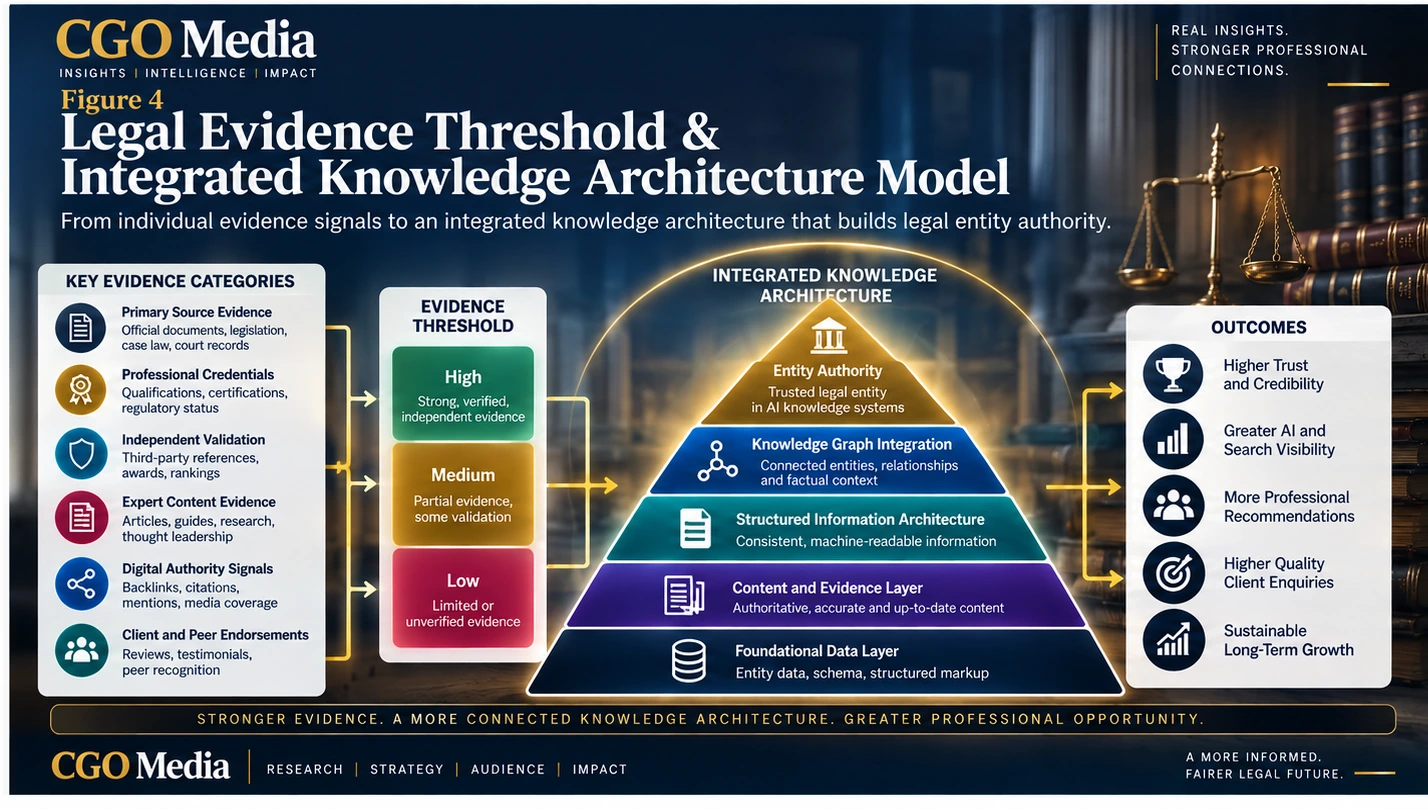
457. Measuring Legal Entity Authority Maturity
Once the organisation has diagnosed its current position, the maturity model can be converted into a structured measurement system for benchmarking, governance and progression.
458. Maturity Measurement Should Be Evidence-Led
Each maturity judgement should be supported by current and verifiable evidence rather than broad self-assessment.
459. Six-Dimension Maturity Scorecard
The model measures maturity across:
- Legal Organisation and Entity Clarity
- Legal Information and Practice-Area Authority
- Professional and Practitioner Authority
- Regulatory, Client and Reputational Trust
- External, Institutional and Local Authority
- AI Search and Professional Recommendation Readiness
460. Maturity Levels Can Be Converted into Scores
A practical scoring system may assign:
- 1 — Foundation
- 2 — Developing
- 3 — Operational
- 4 — Advanced
- 5 — Leading
461. Scores Should Reflect Capability, Not Activity
A high score should indicate stronger organisational capability rather than simply more content, more links, more profiles or more AI monitoring activity.
462. Dimension One Scoring — Entity Clarity
Entity maturity can be evaluated through:
- Entity inventory completeness
- Relationship accuracy
- Conflict rate
- Ownership
- Change governance
463. Foundation Entity Score
Priority entities remain fragmented or materially inconsistent.
464. Developing Entity Score
Core standards exist and major inaccuracies are being addressed.
465. Operational Entity Score
Entity standards are repeatable across major parts of the organisation.
466. Advanced Entity Score
Entity relationships are integrated into a governed knowledge architecture.
467. Leading Entity Score
Entity management is resilient, lifecycle-based and supported by proactive change governance.
468. Dimension Two Scoring — Legal Information Authority
Legal information maturity can be assessed through:
- Practice-area coverage
- Content review governance
- Professional connection
- Jurisdictional clarity
- Source quality
469. Foundation Legal-Information Score
Legal content is largely reactive, inconsistently reviewed and weakly connected with professionals or jurisdictions.
470. Developing Legal-Information Score
Basic standards and review ownership are emerging for strategic content.
471. Operational Legal-Information Score
Defined content governance operates across priority practice areas.
472. Advanced Legal-Information Score
Risk-based governance, matter-type architecture and event-triggered review are established.
473. Leading Legal-Information Score
Legal information operates as a continuously governed knowledge asset across strategic practices and jurisdictions.
474. Dimension Three Scoring — Professional Authority
Professional maturity can be assessed through:
- Profile completeness
- Expertise mapping
- Professional status clarity
- External consistency
- Lifecycle governance
475. Foundation Professional Score
Profiles are basic, inconsistently maintained or weakly connected with practice expertise.
476. Developing Professional Score
Profile standards and selected external audits are in place.
477. Operational Professional Score
Professional evidence and change workflows are managed systematically.
478. Advanced Professional Score
Expertise is mapped with greater granularity and professional evidence is integrated across multiple sources.
479. Leading Professional Score
Professional authority is governed through a mature lifecycle system with strong evidence provenance and cross-source reconciliation.
480. Dimension Four Scoring — Regulatory, Client and Reputational Trust
Trust maturity can be assessed through:
- Regulatory clarity
- Client-care information
- Review governance
- Reputation evidence
- Risk controls
481. Foundation Trust Score
Trust evidence is fragmented and primarily presented as marketing information.
482. Developing Trust Score
Regulatory and review information is beginning to be standardised.
483. Operational Trust Score
Trust evidence is governed and measured consistently across priority areas.
484. Advanced Trust Score
Trust data is integrated with operational insight, risk and reputation governance.
485. Leading Trust Score
Trust is managed as a continuously verified authority layer with proactive risk identification.
486. Dimension Five Scoring — External, Institutional and Local Authority
External maturity can be assessed through:
- Directory governance
- Institutional evidence
- Citation authority
- Local accuracy
- External-source conflict management
487. Foundation External-Authority Score
External evidence is unmanaged, inconsistent or measured mainly as link volume.
488. Developing External-Authority Score
Priority external sources are identified and selectively maintained.
489. Operational External-Authority Score
External evidence is inventoried and governed systematically.
490. Advanced External-Authority Score
External authority is assessed by quality, context and relationship to strategic expertise.
491. Leading External-Authority Score
External evidence is continuously managed across directories, institutions, citations, media and local environments.
492. Dimension Six Scoring — AI Recommendation Readiness
AI maturity can be assessed through:
- Monitoring structure
- Accuracy analysis
- Source diagnostics
- Error governance
- Integration with wider authority management
493. Foundation AI Score
AI outputs are checked occasionally without a defined baseline or methodology.
494. Developing AI Score
Repeatable prompts and basic error recording have been introduced.
495. Operational AI Score
Structured monitoring and repeatable remediation workflows are established.
496. Advanced AI Score
Monitoring is longitudinal, segmented and integrated with authority analysis.
497. Leading AI Score
AI representation is managed as part of a wider resilient authority-governance capability.
498. Evidence Confidence
Every dimension score should also carry an evidence-confidence rating.
499. High Confidence
The maturity judgement is supported by broad, current and verifiable evidence.
500. Medium Confidence
The maturity judgement is reasonably supported, but some important evidence remains incomplete.
501. Low Confidence
The maturity judgement depends heavily on limited sampling, assumptions or outdated information.
502. Confidence Should Affect Executive Interpretation
A Level Four score supported by low-confidence evidence should not be treated as equivalent to a Level Four score supported by robust verification.
503. Coverage Should Also Be Measured
Maturity may be high in one part of the organisation but poorly implemented elsewhere.
504. Practice Coverage
Assess what proportion of strategic practice areas meet the claimed maturity standard.
505. Office Coverage
Assess whether the maturity capability extends across strategically important locations.
506. Professional Coverage
Assess what proportion of priority professionals meet the required authority standard.
507. Jurisdiction Coverage
International organisations should assess whether maturity is consistent across important legal markets.
508. Evidence-Class Coverage
Assess whether maturity extends across:
- First-party evidence
- Regulatory evidence
- Professional evidence
- External evidence
- AI representation
509. A High Level with Low Coverage Is Fragile
One excellent practice or office should not define maturity for the entire organisation.
510. Weighted Maturity Assessment
Organisations may weight dimensions differently according to strategic need.
511. Weighting Should Reflect Risk
High-risk dimensions may deserve greater influence within the assessment.
512. Weighting Should Reflect Business Strategy
Priority practice areas, offices or jurisdictions may require stronger maturity than non-strategic areas.
513. Weighting Should Reflect Organisational Complexity
Large multi-office organisations may place more weight on entity, local and governance maturity.
514. Consumer Legal Weighting
Consumer-focused firms may place greater emphasis on:
- Local authority
- Client trust
- Professional clarity
- Practical provider selection
515. Commercial Legal Weighting
Commercial firms may place greater emphasis on:
- Professional authority
- Practice-area depth
- External recognition
- Sector expertise
516. International Legal Weighting
International firms may place greater emphasis on:
- Jurisdictional governance
- Office architecture
- Professional qualifications
- Cross-border evidence consistency
517. Critical Overrides Should Remain Separate
Weighted scoring should never conceal material professional, regulatory or jurisdictional inaccuracies.
518. Maturity Score Is Not the Entire Assessment
A useful maturity profile should include:
- Level
- Confidence
- Coverage
- Trend
- Critical risks
519. Trend Measurement
The organisation should understand whether each maturity dimension is:
- Improving
- Stable
- At Risk
- Regressing
520. Improving
Evidence shows that capability, coverage or governance is strengthening.
521. Stable
The maturity level remains consistent without material deterioration.
522. At Risk
Important dependencies or weaknesses threaten the current maturity level.
523. Regressing
Evidence shows that capability or authority quality is deteriorating.
524. Maturity Benchmarking
Benchmarking can help the organisation identify internal variation and priority gaps.
525. Practice-Area Benchmarking
Compare maturity across strategic legal practices.
526. Office Benchmarking
Compare entity, local and professional governance across locations.
527. Professional-Cohort Benchmarking
Compare evidence maturity across appropriate professional groups without turning the exercise into individual performance ranking.
528. Jurisdiction Benchmarking
International firms may compare governance strength across countries or legal systems.
529. Business-Unit Benchmarking
Larger legal organisations may compare maturity across divisions, brands or acquired entities.
530. Time-Based Benchmarking
The most important comparison may be the organisation against its own previous maturity state.
531. External Competitor Benchmarking
Competitor evidence can provide useful market context but should be interpreted cautiously because internal governance capability is rarely fully visible externally.
532. Do Not Infer Internal Maturity from Rankings Alone
A highly visible competitor may still operate weak authority governance.
533. Do Not Infer Maturity from Website Design Alone
A sophisticated website interface does not demonstrate underlying entity or evidence maturity.
534. Do Not Infer Maturity from AI Recommendation Frequency Alone
Repeated provider presence does not establish that the organisation operates a mature authority system.
535. Executive Maturity Scorecard
| Dimension | Current Level | Target Level | Confidence | Coverage | Trend |
|---|---|---|---|---|---|
| Entity Clarity | 1–5 | 1–5 | Low / Medium / High | % or Defined Scope | Improving / Stable / At Risk / Regressing |
| Legal Information Authority | 1–5 | 1–5 | Low / Medium / High | % or Defined Scope | Improving / Stable / At Risk / Regressing |
| Professional Authority | 1–5 | 1–5 | Low / Medium / High | % or Defined Scope | Improving / Stable / At Risk / Regressing |
| Regulatory & Client Trust | 1–5 | 1–5 | Low / Medium / High | % or Defined Scope | Improving / Stable / At Risk / Regressing |
| External & Local Authority | 1–5 | 1–5 | Low / Medium / High | % or Defined Scope | Improving / Stable / At Risk / Regressing |
| AI Recommendation Readiness | 1–5 | 1–5 | Low / Medium / High | % or Defined Scope | Improving / Stable / At Risk / Regressing |
536. Executive Reporting Should Separate Risk from Progression
Leadership should be able to distinguish between:
- Critical corrections
- Maturity-building actions
- Strategic growth opportunities
537. Critical Correction Portfolio
This may include:
- Professional-status errors
- Wrong firm affiliations
- Regulatory inconsistencies
- Jurisdictional inaccuracies
538. Maturity-Building Portfolio
This may include:
- Standardisation
- Process integration
- Governance improvement
- Evidence-confidence improvement
539. Strategic Growth Portfolio
This may include:
- Professional authority development
- Research and citation authority
- Priority local-market strengthening
- AI representation expansion
540. Executive Reporting Should Show the Lowest Critical Dimension
Leadership should understand where a serious weakness constrains wider authority maturity.
541. Executive Reporting Should Show Uneven Coverage
A headline Level Four score should not conceal that only a minority of offices or professionals meet Level Four standards.
542. Executive Reporting Should Show Evidence Confidence
Decision-makers need to know whether the maturity profile is strongly verified or based on incomplete evidence.
543. Executive Reporting Should Show Trend
A stable Level Three capability may represent lower immediate risk than a Level Four capability that is rapidly deteriorating.
544. Governance Ownership
Maturity progression requires named ownership across the six dimensions.
545. Entity Governance Owner
Responsibility may involve teams overseeing:
- Web architecture
- Data standards
- Office information
- Professional relationships
546. Legal Information Governance Owner
Responsibility may involve:
- Knowledge teams
- Practice leaders
- Content teams
- Professional reviewers
547. Professional Authority Governance Owner
Responsibility may involve:
- Marketing
- HR
- Practice management
- Individual professionals
548. Trust Governance Owner
Responsibility may involve:
- Compliance
- Risk
- Client care
- Marketing
549. External and Local Authority Governance Owner
Responsibility may involve:
- SEO
- Digital PR
- Office management
- Business development
550. AI Readiness Governance Owner
Responsibility may involve:
- SEO
- AI search strategy
- Data teams
- Risk and compliance
551. Cross-Functional Governance Is Essential
No single team controls every authority input.
552. Governance Council Model
Larger organisations may create a cross-functional authority group connecting:
Practice Leadership + Marketing + SEO + Knowledge + HR + Compliance + Operations + Data
553. Governance Council Purpose
The group may oversee:
- Authority standards
- Critical risks
- Cross-team changes
- Maturity progression
- AI representation issues
554. Decision Rights Should Be Explicit
Teams should understand who can:
- Create information
- Approve high-risk claims
- Correct inaccuracies
- Escalate conflicts
- Retire outdated evidence
555. Resource Prioritisation
The maturity model can help allocate limited authority-development resources according to strategic need.
556. Prioritise Critical Accuracy First
Correct material professional, regulatory, firm and jurisdictional errors before investing heavily in advanced optimisation.
557. Prioritise Foundational Capability Second
Where standards or ownership are missing, establish them before adding more complexity.
558. Prioritise Repeatability Third
Convert successful manual activity into documented and repeatable processes.
559. Prioritise Integration Fourth
Connect previously separate authority functions.
560. Prioritise Governance Fifth
Strengthen ownership, decision rights and evidence verification.
561. Prioritise Resilience Sixth
Reduce the risk that staff, system or market changes will degrade authority quality.
562. Resource Allocation Should Follow Maturity Gaps
An organisation should avoid investing disproportionate resources in Level Five AI monitoring while basic professional or entity information remains at Level One.
563. Maturity Investment Should Be Sequenced
A practical sequence is:
Correct → Standardise → Integrate → Govern → Automate Carefully → Build Resilience
564. Practice-Level Resource Allocation
Priority practices may receive greater investment where:
- Commercial importance is high
- Authority gaps are material
- Search opportunity is strong
- Professional expertise is genuine
565. Office-Level Resource Allocation
Priority locations may receive greater investment where:
- Local demand is significant
- Office data is weak
- Professional relationships are unclear
- Strategic expansion is planned
566. Professional-Level Resource Allocation
Priority professionals may justify stronger authority development where their genuine expertise is strategically important but poorly represented digitally.
567. Evidence-Class Resource Allocation
Resources should be directed toward evidence classes capable of improving:
- Accuracy
- Trust
- Discoverability
- Recommendation readiness
- Governance
568. AI Investment Should Follow Authority Foundations
The maturity model deliberately positions AI recommendation readiness after entity, information, professional, trust and external authority.
569. Resource Allocation Should Consider Evidence Confidence
Low-confidence maturity assessments may justify further verification before major investment decisions are made.
570. Resource Allocation Should Consider Change Velocity
Fast-changing practices, offices or professional groups may require stronger governance even where their current maturity appears adequate.
571. Resource Allocation Should Consider Risk
Higher-risk evidence may require stronger controls even where direct commercial return is difficult to measure.
572. Maturity Economics
Higher maturity usually requires greater investment in:
- Governance
- Data quality
- Professional involvement
- Monitoring
- Systems
573. Higher Maturity Should Reduce Rework
Better standards and change governance may reduce repeated manual correction of the same authority problems.
574. Higher Maturity Should Reduce Evidence Fragmentation
Integrated systems can reduce the number of disconnected sources requiring independent interpretation.
575. Higher Maturity Should Improve Risk Visibility
Leadership can identify material authority weaknesses before they spread across multiple public environments.
576. Higher Maturity Should Improve Strategic Coordination
Marketing, professional, compliance and operational teams can work against the same authority model.
577. Higher Maturity Does Not Eliminate Maintenance
Advanced systems still require ongoing verification and organisational ownership.
578. Maturity Measurement Should Avoid False Precision
A maturity score is a decision aid rather than an objectively exact scientific measurement.
579. Scores Should Be Interpreted with Evidence
The most useful question is not merely:
What is our maturity score?
It is:
What evidence supports the score, where are the critical weaknesses, and what capability should we build next?
580. The Executive Maturity Management Model
The complete measurement process can therefore be represented as:
Diagnose → Score → Validate Evidence → Benchmark → Identify Gaps → Assign Ownership → Prioritise Resources → Progress
581. The Next Stage Is Continuous Maturity Improvement
Once maturity is measured and governed, the organisation must protect that capability from authority decay, organisational change, evidence drift and evolving AI-assisted discovery environments.
582. Maturity Can Regress
Legal entity authority maturity is not permanent. An organisation can move backwards when its evidence, governance or operating processes fail to keep pace with organisational change.
583. Regression Is Often Gradual
Authority deterioration may begin with small inconsistencies that accumulate across:
- Professional profiles
- Office data
- Practice relationships
- Legal content
- External sources
584. Regression Can Also Be Sudden
Large organisational events may create immediate maturity pressure.
585. Merger-Driven Regression
A merger may introduce:
- Duplicate firm identities
- Overlapping office records
- Conflicting professional affiliations
- Legacy domains
- Inconsistent practice structures
586. Acquisition-Driven Regression
Acquired organisations may operate under different data, profile and governance standards.
587. Rapid Expansion Regression
Fast geographic growth can create inconsistency when new offices and professionals are added faster than governance processes can absorb them.
588. Professional Turnover Regression
Frequent lawyer movement can weaken professional authority if departure and onboarding workflows are incomplete.
589. Leadership Change Regression
Authority programmes can lose momentum when ownership depends heavily on one executive, marketing leader or technical specialist.
590. System Migration Regression
Website, CRM, directory-management or content-platform migrations may disrupt established entity relationships.
591. Governance Fatigue
Even mature organisations can experience deterioration when review processes become routine administrative tasks rather than active quality controls.
592. Legal Content Regression
A previously mature content system may weaken when:
- Review cycles slip
- Professional reviewers leave
- Jurisdictional changes are missed
- Source standards deteriorate
593. Professional Authority Regression
A strong professional evidence environment may decline when biographies, external profiles and practice mappings stop reflecting current activity.
594. Trust Regression
Trust maturity may weaken through:
- Outdated regulatory information
- Unmanaged review patterns
- Weak client-care information
- Poor reputation governance
595. External Authority Regression
Directory, editorial and institutional evidence may lose value when it becomes outdated or disconnected from current capability.
596. Local Authority Regression
Office-level maturity may deteriorate when:
- Addresses change
- Teams relocate
- Phone numbers change
- Services move between offices
597. AI Readiness Regression
AI monitoring maturity can decline when prompt sets, source diagnostics or governance processes stop being maintained.
598. AI Representation Can Drift Even Without Internal Change
Model updates, retrieval changes and evolving external sources can alter how a provider is represented.
599. Maturity Regression Triggers
The organisation should define events that trigger reassessment.
600. Organisational Regression Triggers
- Merger
- Acquisition
- Rebrand
- Office launch
- Office closure
601. Professional Regression Triggers
- Join
- Departure
- Promotion
- Change of practice
- Change of office
602. Legal and Regulatory Regression Triggers
- New legislation
- Material guidance changes
- Regulatory changes
- Professional-status changes
603. Technology Regression Triggers
- Website migration
- CMS replacement
- CRM change
- Schema changes
- Directory-management changes
604. Reputation Regression Triggers
- Significant negative review trend
- Major public complaint
- Incorrect media coverage
- Outdated external recognition
605. AI Regression Triggers
- Persistent professional misrepresentation
- Wrong jurisdictional association
- Material firm-identity errors
- Significant source-pattern changes
606. Reassessment Frequency Should Reflect Risk
Not every evidence class needs the same review cadence.
607. High-Frequency Review Areas
These may include:
- Professional changes
- Regulatory status
- Office data
- High-risk legal information
608. Medium-Frequency Review Areas
These may include:
- Professional biographies
- Practice relationships
- External directory profiles
- Review evidence
609. Strategic Periodic Review Areas
These may include:
- Overall maturity
- Competitor context
- AI representation trends
- Authority investment priorities
610. Continuous Reassessment Does Not Mean Constant Change
Mature governance distinguishes between monitoring and unnecessary intervention.
611. Stable Evidence Should Remain Stable
An organisation should not alter accurate information simply because short-term search or AI outputs fluctuate.
612. Failure Mode — Treating Maturity as Certification
The model should not be used as a permanent badge that suggests an organisation has completed authority development.
613. Failure Mode — Self-Scoring Without Evidence
Optimistic internal judgement can inflate maturity assessments where supporting evidence is weak.
614. Failure Mode — Averaging Away Critical Risk
A high overall score may conceal serious weaknesses involving professional status, regulation or jurisdiction.
615. Failure Mode — One Mature Practice Defines the Firm
Strong performance in one practice area should not be extrapolated automatically across the organisation.
616. Failure Mode — One Mature Office Defines the Network
A flagship location may operate at Advanced maturity while smaller offices remain Developing.
617. Failure Mode — Senior Lawyers Receive All Authority Investment
Focusing only on highly visible partners may leave important professional cohorts poorly represented.
618. Failure Mode — Brand Reputation Substitutes for Entity Governance
Historic brand strength can conceal weaknesses in current digital evidence.
619. Failure Mode — Rankings Substitute for Maturity
Strong organic visibility does not prove mature professional, trust or governance capability.
620. Failure Mode — Link Volume Substitutes for External Authority
External authority should be assessed according to relevance, context and evidence quality rather than raw quantity alone.
621. Failure Mode — Review Volume Substitutes for Trust Maturity
Large review numbers do not replace regulatory, professional and client-care evidence.
622. Failure Mode — AI Presence Substitutes for Readiness
Frequent inclusion within generated answers does not demonstrate a mature authority environment.
623. Failure Mode — Tool Acquisition Substitutes for Capability
Technology can support maturity but cannot replace:
- Standards
- Ownership
- Verification
- Governance
624. Failure Mode — Automation Before Data Quality
Automation can propagate weak or incorrect entity relationships at scale.
625. Failure Mode — Excessive Manual Dependency
Advanced-looking systems may remain fragile if they depend on one person remembering each update.
626. Failure Mode — No Professional Ownership
Marketing teams should not be expected to determine specialist legal expertise without appropriate professional input.
627. Failure Mode — No Compliance Involvement
Higher-risk professional and regulatory claims may require appropriate compliance oversight.
628. Failure Mode — No Cross-Team Governance
Entity authority can deteriorate when marketing, HR, compliance, knowledge and operations maintain conflicting records.
629. Failure Mode — Over-Engineering
A maturity programme can become inefficient if complex governance is applied to low-risk information unnecessarily.
630. Governance Should Be Proportionate
Controls should reflect the materiality and risk of the evidence being managed.
631. Failure Mode — No Measurement of Coverage
A process may appear mature even though it applies to only a small proportion of the organisation.
632. Failure Mode — No Evidence Confidence
Maturity decisions may be unreliable where audit evidence is old, incomplete or poorly sampled.
633. Failure Mode — No Trend Measurement
Point-in-time maturity scoring may fail to reveal steady deterioration.
634. Failure Mode — No Change Triggers
Scheduled reviews alone may be insufficient for rapidly changing professional and legal information.
635. Failure Mode — Improvement Without Reassessment
Completing actions does not prove that maturity has actually increased.
636. Reassessment Should Verify Outcomes
After an improvement programme, the organisation should confirm whether:
- Accuracy improved
- Coverage increased
- Governance strengthened
- Risk reduced
- Evidence confidence improved
637. Maturity Reassessment Should Begin with Critical Accuracy
Review whether material professional, regulatory, firm and jurisdictional information remains correct.
638. Reassess Entity Clarity
Verify:
- Entity inventory
- Relationships
- Conflict rates
- Lifecycle processes
639. Reassess Legal Information Authority
Verify:
- Review coverage
- Jurisdictional accuracy
- Professional connection
- Source quality
640. Reassess Professional Authority
Verify:
- Role
- Firm affiliation
- Expertise mapping
- External consistency
641. Reassess Regulatory and Client Trust
Verify:
- Regulatory clarity
- Client-care information
- Review patterns
- Recognition context
642. Reassess External and Local Authority
Verify:
- Priority directories
- Institutional evidence
- Office information
- Local professional relationships
643. Reassess AI Readiness
Verify:
- Branded representation accuracy
- Professional accuracy
- Local accuracy
- Relevant provider presence
- Source-pattern changes
644. Reassess Governance
Verify that:
- Owners remain current
- Decision rights are understood
- Escalation works
- Change triggers operate
645. Reassess Evidence Confidence
Determine whether each maturity judgement remains supported by current and sufficient evidence.
646. Reassess Coverage
Confirm whether maturity standards extend across enough:
- Practices
- Offices
- Professionals
- Jurisdictions
647. Reassess Trend
Determine whether each dimension is:
- Improving
- Stable
- At Risk
- Regressing
648. Reassess Target Maturity
Strategic priorities may change, making previous target levels inappropriate.
649. Reassess Resource Allocation
Investment should move as critical gaps are resolved and new risks emerge.
650. Continuous Maturity Improvement
The model should generate a repeating management cycle rather than a one-time transformation programme.
651. Step One — Observe
Monitor entity, content, professional, trust, external and AI evidence.
652. Step Two — Verify
Determine whether apparent gaps are:
- Real
- Current
- Material
- Within organisational control
653. Step Three — Diagnose
Identify the affected maturity dimension and underlying capability weakness.
654. Step Four — Score
Assess current level, confidence, coverage and trend.
655. Step Five — Prioritise
Rank improvement according to:
- Risk
- Client impact
- Strategic value
- Evidence confidence
- Resource requirement
656. Step Six — Improve
Strengthen the missing capability rather than addressing only the visible symptom.
657. Step Seven — Govern
Assign ownership, standards, review cycles and change triggers.
658. Step Eight — Measure
Determine whether the improvement increased:
- Accuracy
- Repeatability
- Integration
- Governance
- Resilience
659. Step Nine — Learn
Use recurring findings to improve the organisation’s authority standards.
660. Step Ten — Reassess
Repeat the maturity evaluation and update the improvement portfolio.
661. The Continuous Maturity Cycle
The complete operating cycle can be represented as:
Observe → Verify → Diagnose → Score → Prioritise → Improve → Govern → Measure → Learn → Reassess
662. The Cycle Should Operate at Multiple Levels
The same logic can be applied at:
- Firm level
- Practice level
- Office level
- Professional cohort level
- Jurisdiction level
663. Firm-Level Reassessment
Provides an executive view of overall authority capability.
664. Practice-Level Reassessment
Identifies where strategic legal services remain underdeveloped.
665. Office-Level Reassessment
Identifies differences in local and professional governance.
666. Professional-Level Reassessment
Ensures genuine expertise continues to be represented accurately.
667. Jurisdiction-Level Reassessment
Helps multi-market organisations maintain appropriate legal and professional context.
668. Mature Organisations Should Learn from Recurring Failure
Repeated inaccuracies usually indicate a system problem rather than a series of unrelated mistakes.
669. Repeated Professional Errors May Indicate Lifecycle Weakness
If departed lawyers repeatedly remain associated with the firm, the departure process itself requires improvement.
670. Repeated Office Errors May Indicate Data Ownership Weakness
If address conflicts recur, office information may lack a dependable authoritative record.
671. Repeated Content Errors May Indicate Review Weakness
If important legal information repeatedly becomes outdated, scheduled review alone may be insufficient.
672. Repeated AI Errors May Indicate Evidence Fragmentation
Persistent inaccurate synthesis may justify broader source and entity investigation.
673. Learning Converts Correction into Maturity
Correcting one error solves an incident.
Changing the system so that the same class of error is less likely to recur builds maturity.
674. Maturity Improvement Should Reduce Dependency
A stronger system should become less dependent on:
- Individual memory
- Informal workarounds
- Emergency clean-ups
- One-off audits
675. Maturity Improvement Should Increase Visibility of Risk
Leadership should be able to identify important authority weakness before it becomes widespread.
676. Maturity Improvement Should Increase Decision Quality
Better evidence should support more informed decisions about:
- Content
- Professional authority
- External evidence
- AI search
- Investment
677. Maturity Improvement Should Support User Confidence
Prospective clients should encounter clearer, more accurate and more consistent information during the provider-selection journey.
678. Maturity Improvement Should Support Professional Accuracy
Lawyers should be represented according to their genuine current expertise, role and jurisdictional context.
679. Maturity Improvement Should Support Search Resilience
A coherent evidence system may be more resilient to changing search interfaces than isolated optimisation tactics.
680. Maturity Improvement Should Support AI Resilience
The objective is not dependence on one AI model but stronger underlying evidence capable of supporting accurate interpretation across multiple environments.
681. The Five Maturity Levels Form One Continuous System
The complete development path can be represented as:
Foundation → Developing → Operational → Advanced → Leading → Continuous Reassessment
682. Foundation Builds Accuracy
The organisation identifies and corrects critical entity weaknesses.
683. Developing Builds Standards
Authority management becomes more repeatable.
684. Operational Builds Integration
Previously separate authority functions begin operating together.
685. Advanced Builds Governance
Evidence quality, measurement and decision rights become more sophisticated.
686. Leading Builds Resilience
The authority system becomes capable of adapting to ongoing organisational and technological change.
687. Continuous Reassessment Protects Maturity
The organisation repeatedly verifies that its claimed maturity still exists in practice.
688. The Complete Legal Entity Authority Maturity Model
The entire system can therefore be summarised as:
Accuracy → Standards → Integration → Governance → Resilience → Reassessment
689. The Long-Term Objective
The objective of legal entity authority maturity is not simply to become more visible.
It is to create a durable organisational capability for maintaining accurate legal identities, professional evidence, trust signals, external corroboration and AI-ready information as the organisation evolves.
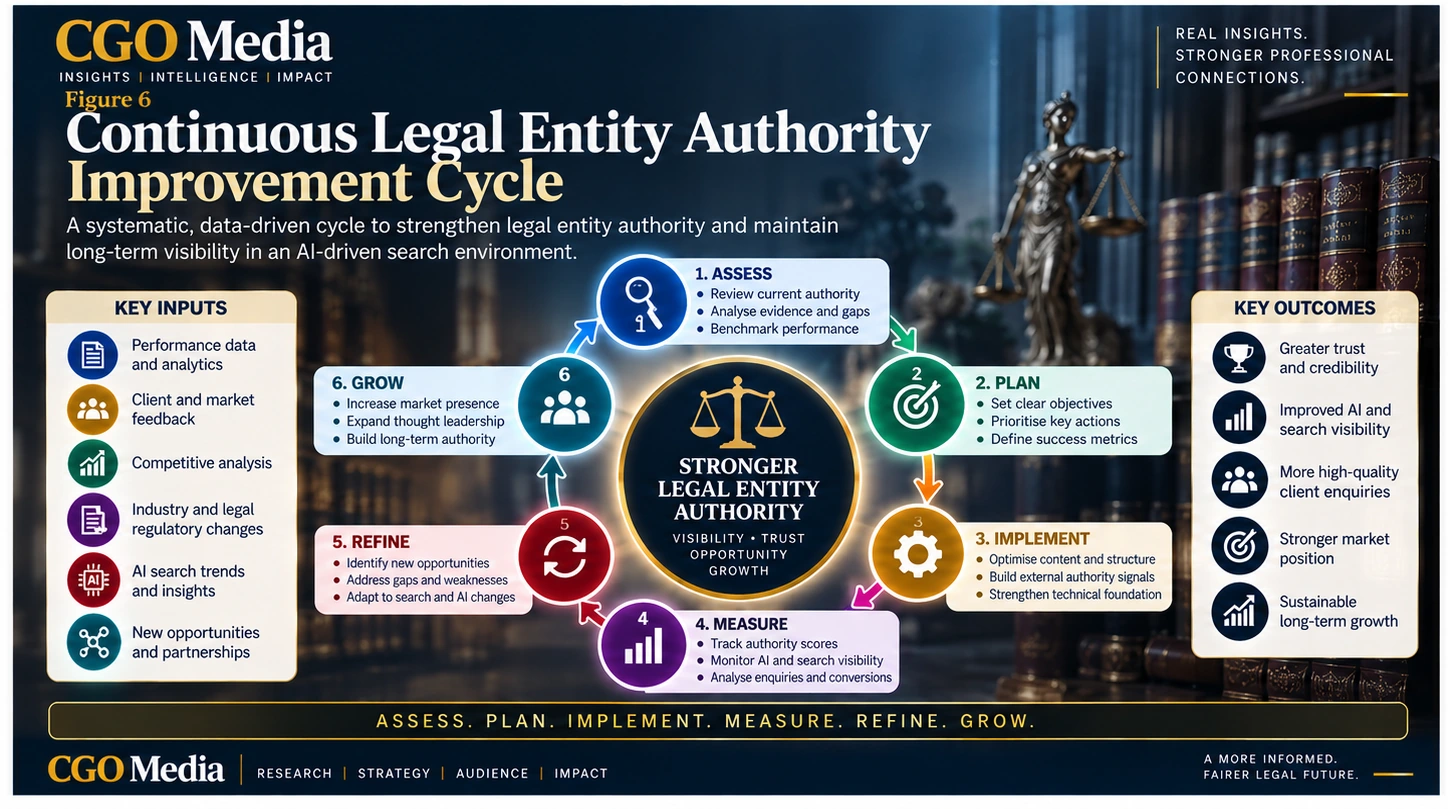
690. Strategic Implications
The Legal Entity Authority Maturity Model provides legal organisations with a structured way to understand how authority capability develops over time.
Its central purpose is to distinguish between organisations that merely possess authority signals and organisations that manage those signals consistently through standards, integration, governance and continuous reassessment.
691. Maturity Is an Organisational Capability
The model treats maturity as the ability to maintain accurate, current and well-connected evidence across:
- Legal organisation entities
- Offices
- Professionals
- Practice areas
- Legal information
- Regulatory and client trust
- External authority
- AI-assisted discovery
692. Visibility and Maturity Should Be Separated
A highly visible legal provider may still operate weak authority governance.
Conversely, a less visible organisation may possess strong maturity foundations but require further investment in discovery and external authority.
693. Foundation Maturity Prioritises Accuracy
The first maturity level focuses on identifying and correcting fragmented or materially inaccurate entity and professional information.
694. Developing Maturity Prioritises Standards
The second level introduces common data standards, professional-profile requirements, review processes and initial ownership.
695. Operational Maturity Prioritises Integration
The third level connects entity, professional, content, trust, local and AI processes into repeatable operating workflows.
696. Advanced Maturity Prioritises Governance
The fourth level introduces deeper knowledge architecture, evidence confidence, risk-based management, longitudinal measurement and stronger decision rights.
697. Leading Maturity Prioritises Resilience
The fifth level aims to create an authority system capable of adapting to professional changes, organisational restructuring, new jurisdictions and evolving search and AI environments without widespread evidence degradation.
698. Maturity Is Not a Permanent Status
A legal organisation may regress if governance, ownership or review processes fail to keep pace with change.
699. Continuous Reassessment Is Therefore Essential
The full maturity progression can be represented as:
Accuracy → Standards → Integration → Governance → Resilience → Reassessment
700. Critical Weaknesses Should Override Aggregate Scores
Material problems involving professional status, firm affiliation, regulatory accuracy or jurisdictional representation should remain visible even where other dimensions appear mature.
701. Maturity Should Be Assessed by Dimension
The six authority dimensions should be evaluated independently before an overall maturity profile is constructed.
702. Uneven Maturity Is Strategically Important
A firm may operate at different maturity levels across:
- Practice areas
- Offices
- Professional groups
- Jurisdictions
- Evidence classes
703. The Lowest Critical Dimension Can Constrain the Whole System
An organisation with advanced content and strong external recognition may still remain operationally fragile if professional lifecycle governance is weak.
704. Evidence Confidence Matters
A maturity score is only as useful as the evidence supporting it.
Assessments should therefore distinguish between:
- High-confidence evidence
- Medium-confidence evidence
- Low-confidence evidence
705. Coverage Matters
A mature process should apply across a meaningful proportion of the organisation rather than one showcase practice or office.
706. Trend Matters
Leadership should understand whether maturity is:
- Improving
- Stable
- At Risk
- Regressing
707. Maturity Should Inform Resource Allocation
Investment should generally prioritise:
Critical Accuracy → Missing Foundations → Repeatability → Integration → Governance → Resilience
708. AI Readiness Should Follow Authority Foundations
The model deliberately positions AI recommendation readiness after entity clarity, legal information, professional authority, trust and external corroboration.
709. AI Recommendation Presence Does Not Establish Maturity
Frequent appearance in generated answers should not be interpreted as proof that the organisation has strong governance or reliable authority evidence.
710. The Strategic Maturity Model
The complete Legal Entity Authority Maturity Model can therefore be represented as:
Foundation → Developing → Operational → Advanced → Leading → Continuous Reassessment
711. Relationship with the CGO Media Legal Research Family
The Legal Entity Authority Maturity Model forms part of the wider CGO Media Legal research architecture.
Legal SEO and Entity Authority | Legal Entity Authority Framework | Legal Information and Professional Selection Process | Legal SEO and Entity Authority Implementation Roadmap
712. Relationship with Legal SEO and Entity Authority
The parent research paper Legal SEO and Entity Authority provides the broader research foundation for the authority, trust and provider-discovery environment addressed by the maturity model.
713. Relationship with the Legal Entity Authority Framework
The Legal Entity Authority Framework defines the six authority dimensions that the maturity model evaluates across Foundation, Developing, Operational, Advanced and Leading capability.
714. Relationship with the Legal Information and Professional Selection Process
The Legal Information and Professional Selection Process explains how authority maturity influences the user's journey from legal need recognition through professional evaluation, trust validation, comparison and selection.
715. Relationship with the Legal SEO and Entity Authority Implementation Roadmap
The Legal SEO and Entity Authority Implementation Roadmap converts the maturity findings into a practical sequence of implementation priorities.
716. Methodology
The Legal Entity Authority Maturity Model is a conceptual maturity-assessment methodology developed by CGO Media to evaluate how systematically legal organisations manage entity clarity, professional authority, legal information, trust evidence, external corroboration and AI-assisted provider representation.
717. Five Maturity Levels
The model uses five maturity levels:
- Foundation
- Developing
- Operational
- Advanced
- Leading
718. Six Assessment Dimensions
The model applies the five levels across:
- Legal Organisation and Entity Clarity
- Legal Information and Practice-Area Authority
- Professional and Practitioner Authority
- Regulatory, Client and Reputational Trust
- External, Institutional and Local Authority
- AI Search and Professional Recommendation Readiness
719. Entity-Clarity Assessment
The methodology may evaluate:
- Entity inventory
- Relationship accuracy
- Conflict management
- Ownership
- Lifecycle governance
720. Legal-Information Assessment
The methodology may evaluate:
- Practice-area structure
- Content review standards
- Professional connection
- Jurisdictional clarity
- Source quality
721. Professional-Authority Assessment
The methodology may evaluate:
- Profile completeness
- Expertise mapping
- Professional status
- External consistency
- Lifecycle management
722. Trust Assessment
The methodology may evaluate:
- Regulatory transparency
- Client-care information
- Review governance
- Reputation evidence
- Risk controls
723. External-Authority Assessment
The methodology may evaluate:
- Legal directories
- Institutional evidence
- Publications
- Citation authority
- Local evidence
- External-source consistency
724. AI-Readiness Assessment
The methodology may evaluate:
- Monitoring structure
- Representation accuracy
- Source diagnostics
- Error classification
- Remediation workflow
- Governance integration
725. Scoring Method
Each dimension may be represented using a 1–5 maturity score:
- 1 — Foundation
- 2 — Developing
- 3 — Operational
- 4 — Advanced
- 5 — Leading
726. Evidence Confidence
Each maturity judgement should ideally include an evidence-confidence classification:
- Low
- Medium
- High
727. Coverage Assessment
The methodology can also assess the extent to which the claimed capability applies across relevant:
- Practices
- Professionals
- Offices
- Jurisdictions
728. Trend Assessment
Each maturity dimension may be classified as:
- Improving
- Stable
- At Risk
- Regressing
729. Critical Overrides
Material errors involving professional status, regulatory accuracy, firm affiliation or jurisdiction should remain separately visible and may constrain high-maturity classifications.
730. Current-State and Target-State Assessment
The model can compare:
Current Maturity → Target Maturity → Capability Gap → Evidence Requirement → Priority Action
731. Progression Logic
The maturity progression is based conceptually on the following transition:
Fragmented → Standardised → Repeatable → Integrated → Resilient
732. Reassessment Method
The framework is designed for repeated use so organisations can determine whether authority capability has improved, remained stable or regressed.
733. Limitations
The Legal Entity Authority Maturity Model is a conceptual digital-authority methodology. It is not a legal, regulatory, accreditation or professional-certification standard.
734. Maturity Levels Are Not Legal Quality Ratings
A high maturity score should not be interpreted as evidence that one legal organisation is professionally superior to another.
735. Maturity Levels Are Not Provider Rankings
The model does not rank law firms or individual legal professionals.
736. Maturity Scores Are Not Exact Scientific Measurements
The scoring structure is intended to support structured decision-making rather than imply mathematical certainty.
737. Evidence Quality Affects Results
An incomplete or poorly sampled audit may produce an inaccurate maturity classification.
738. Organisational Complexity Affects Results
A small specialist practice and a global legal organisation may require very different governance structures.
739. Practice Areas Differ
Different legal services may require different levels of authority, trust, local and jurisdictional governance.
740. Jurisdictions Differ
Professional titles, regulatory structures, legal systems and disclosure expectations vary across markets.
741. Maturity Targets Should Therefore Be Contextual
Not every organisation needs Level Five capability across every dimension.
742. Reviews Have Limitations
Client reviews may support service-experience assessment but do not establish technical legal competence.
743. External Recognition Has Limitations
Awards, directories and rankings should be interpreted according to their relevant category, geography, year and methodology.
744. AI Monitoring Has Limitations
Generated outputs may vary according to:
- Model
- Prompt
- Time
- Geography
- Retrieval environment
- Available sources
745. AI Source Visibility May Be Incomplete
Not every system exposes all information contributing to a generated answer.
746. AI Recommendation Presence Does Not Prove Professional Quality
Inclusion within an AI-generated provider set should not be interpreted as accreditation, endorsement or a guarantee of legal suitability.
747. Strong Maturity Does Not Guarantee Organic Rankings
The maturity model does not guarantee:
- Search rankings
- Local visibility
- Traffic
- Enquiries
748. Strong Maturity Does Not Guarantee AI Recommendation
No maturity level can guarantee citation or inclusion by a specific generative system.
749. Strong Maturity Does Not Guarantee Client Selection
Provider selection may also depend on:
- Matter suitability
- Availability
- Fees
- Conflict checks
- Personal or organisational preference
750. The Model Does Not Provide Legal Advice
The Legal Entity Authority Maturity Model concerns digital authority, information governance and search representation. It does not provide legal advice or determine which legal provider is suitable for a particular matter.
751. Conclusion
Legal authority is increasingly distributed across websites, professional profiles, offices, legal directories, regulatory sources, institutional references, reviews and AI-assisted discovery systems.
Managing that environment effectively requires more than isolated SEO activity.
The Legal Entity Authority Maturity Model provides a five-level structure for understanding how an organisation can progress from fragmented evidence toward a resilient authority system.
At Foundation maturity, the emphasis is accuracy. At Developing maturity, the emphasis shifts to standards. Operational maturity introduces integration. Advanced maturity strengthens governance and measurement. Leading maturity focuses on resilience and continuous evidence management.
The model's central principle is that maturity should be demonstrated through capability, coverage, evidence confidence and governance rather than through visibility claims alone.
As legal organisations operate across increasingly complex traditional and AI-assisted discovery environments, the ability to maintain accurate entity relationships, professional evidence, trust signals and external corroboration may become an increasingly important part of long-term search resilience.
References
External Academic, Technical and Search Sources
- Google Search Central. SEO Starter Guide.
- Google Search Central. Understand how structured data works.
- Schema.org. LegalService.
- Schema.org. Organization.
- Schema.org. Person.
- Hogan, A. et al. (2021). Knowledge Graphs. ACM Computing Surveys, 54(4).
- Metzger, M.J. (2007). Making Sense of Credibility on the Web: Models for Evaluating Online Information and Recommendations for Future Research. Journal of the American Society for Information Science and Technology, 58(13), 2078–2091.
- Ji, Z. et al. (2023). Survey of Hallucination in Natural Language Generation. ACM Computing Surveys, 55(12).
CGO Media Legal Research and Frameworks
- Wilkinson, R. (2026). Legal SEO and Entity Authority. CGO Media.
- Wilkinson, R. (2026). Legal Entity Authority Framework. CGO Media.
- Wilkinson, R. (2026). Legal Information and Professional Selection Process. CGO Media.
- Wilkinson, R. (2026). Legal SEO and Entity Authority Implementation Roadmap. CGO Media.
CGO Media Research Ecosystem
CGO Media Research Library | CGO Media Framework Library | CGO Media Research Architecture
About Roger Wilkinson
Roger Wilkinson is an independent researcher, SEO practitioner and founder of CGO Media with more than 25 years of experience in search, online visibility and business growth.
His current research focuses on how artificial intelligence is reshaping search engines, recommendation systems, digital authority, entity representation and organisational visibility.
Roger is the creator of the CGO Framework Series, a collection of research-led methodologies designed to help organisations measure, strengthen and govern Search Visibility, AI Visibility and Digital Authority.
His work examines the relationship between Technical SEO, Entity Authority, Content Authority, Citation Authority, Brand Signals, Knowledge Architecture and AI Search Readiness.
View Roger Wilkinson’s researcher profile →
Related Legal Research and Frameworks
Legal SEO and Entity Authority | Legal Entity Authority Framework | Legal Information and Professional Selection Process | Legal SEO and Entity Authority Implementation Roadmap
Research Usage & Citation
CGO Media encourages researchers, journalists, legal organisations, professional-services firms, educators and industry professionals to reference this framework where it contributes to wider discussion and understanding of Legal SEO, Entity Authority, Professional Authority, AI Search, digital governance and organisational search maturity.
Reasonable quotations, summaries, figures and excerpts may be used in articles, reports, presentations, academic work and other publications provided appropriate acknowledgement is given to Roger Wilkinson and CGO Media.
Cite This Framework / Embed Citation
The Legal Entity Authority Maturity Model by Roger Wilkinson at CGO Media provides a five-level framework for assessing how legal organisations progress from fragmented entity evidence through standardisation, operational integration, strategic governance and resilient authority management.
APA Citation
APA Citation: Wilkinson, R. (2026). Legal Entity Authority Maturity Model. CGO Media. https://cgomedia.com/ai-legal-entity-authority-maturity-model/
Author: Roger Wilkinson | Published by: CGO Media
For permissions relating to extensive reproduction, commercial licensing or republication of substantial portions of this framework, please contact CGO Media directly.