
Legal SEO and Entity Authority Implementation Roadmap™
The Legal SEO and Entity Authority Implementation Roadmap™ provides a structured implementation sequence for legal organisations seeking to strengthen search visibility, professional authority, trust, entity clarity and AI-assisted provider discovery.
The roadmap builds on Legal SEO and Entity Authority, the AI Legal Entity Authority Framework™, the AI Legal Information and Professional Selection Process™ and the AI Legal Entity Authority Maturity Model™.
1. Purpose of the Roadmap
The purpose of the roadmap is to convert the wider CGO Media Legal research framework into a practical sequence of implementation priorities.
2. Legal Authority Should Be Built in the Right Order
Legal organisations may be tempted to begin with content expansion, Digital PR, AI monitoring or local SEO.
The roadmap instead begins with foundational accuracy and entity clarity.
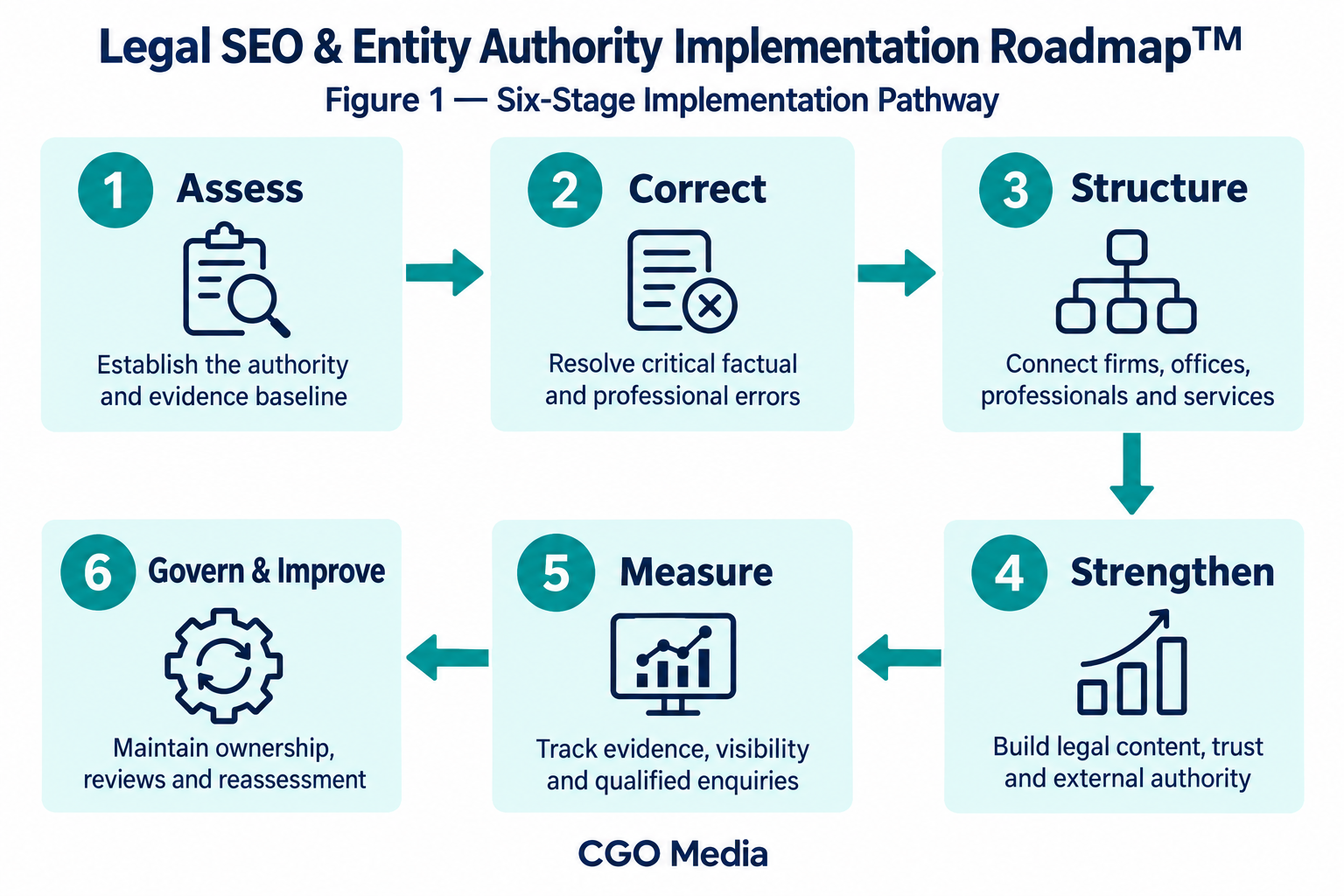
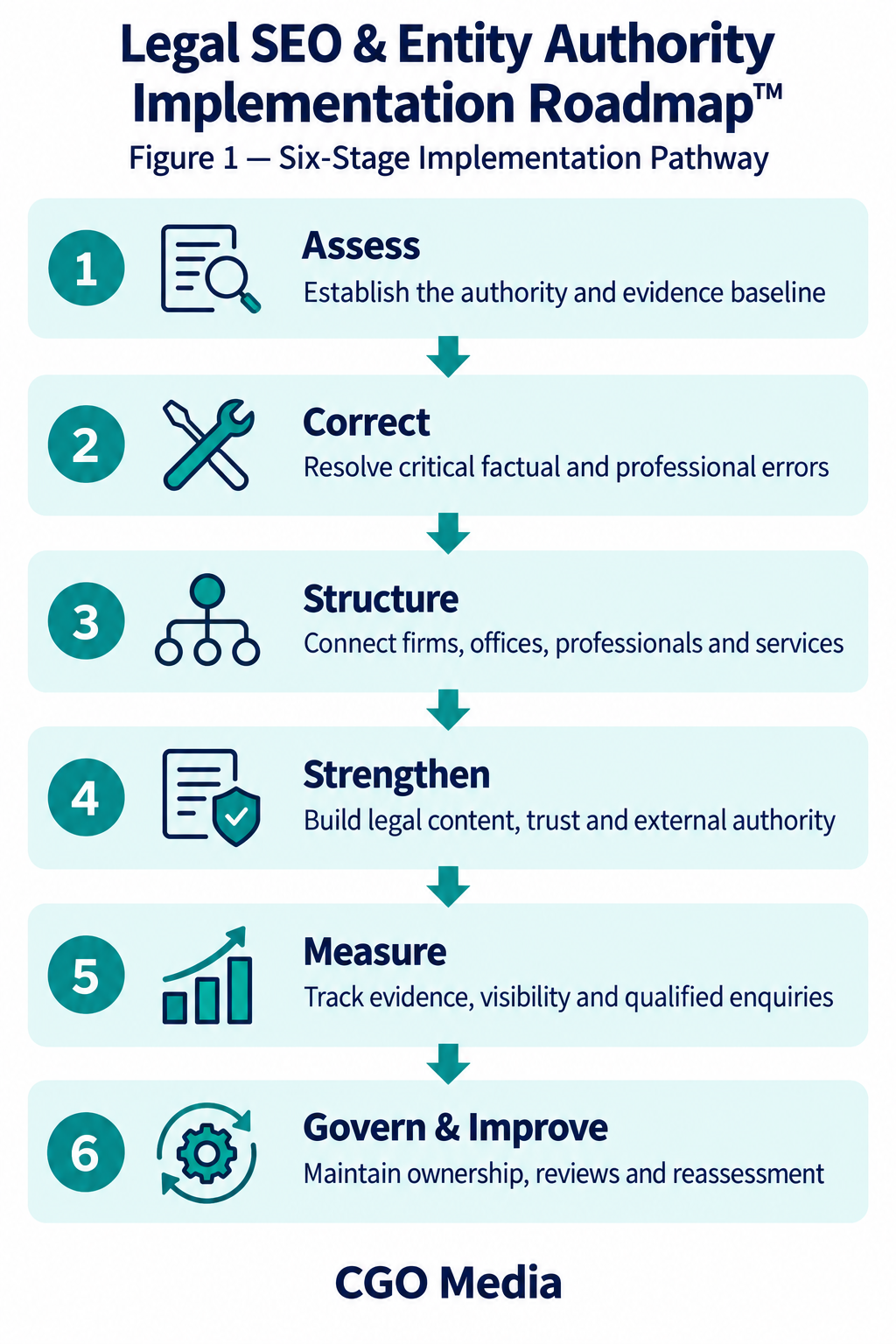
3. The Six-Stage Implementation Roadmap
- Assess
- Correct
- Structure
- Strengthen
- Measure
- Govern and Improve
4. The Full Implementation Sequence
The roadmap can be represented as:
Assess → Correct → Structure → Strengthen → Measure → Govern → Improve
5. Why Assessment Comes First
Implementation should begin with evidence rather than assumption.
6. Stage One — Assess the Existing Authority Environment
The first stage creates a baseline across entity clarity, legal information, professional authority, trust, external evidence and AI representation.
7. Establish the Scope
The organisation should determine whether the initial implementation covers:
- The entire firm
- Priority practice areas
- Priority offices
- Priority professionals
- Selected jurisdictions
8. Avoid Unnecessarily Broad Initial Scope
Large legal organisations may benefit from beginning with a strategically important but manageable implementation cohort before expanding the programme.
9. Define Strategic Practice Areas
Identify the legal practices most important to:
- Current revenue
- Future growth
- Market positioning
- Professional expertise
10. Define Strategic Offices
Multi-office organisations should identify locations requiring particular attention because of:
- Commercial importance
- Local search opportunity
- Recent expansion
- Data inconsistency
11. Define Priority Professionals
Initial professional assessment may focus on:
- Practice leaders
- Highly visible professionals
- Key specialists
- New partners
- Client-facing teams
12. Define Priority Jurisdictions
International or multi-jurisdiction firms should identify which legal markets require dedicated authority review.
13. Build an Entity Inventory
The first operational task is to identify strategic entities.
14. Organisation Entities
Record:
- Current firm name
- Legal entity names
- Brand relationships
- Historic names where relevant
15. Office Entities
Record:
- Office name
- Address
- Telephone
- Jurisdiction
- Operational status
16. Professional Entities
Record:
- Name
- Current role
- Firm affiliation
- Office
- Professional status
17. Practice-Area Entities
Record the firm’s strategic legal practice structure.
18. Service Entities
Identify the specific legal services sitting beneath broader practice categories.
19. Matter-Type Entities
Where appropriate, identify real-world legal problems that connect users with formal services.
20. Jurisdiction Entities
Document where legal information, professional qualifications and services apply.
21. Build the Core Legal Entity Map
The initial architecture should connect:
Organisation → Office → Professional → Practice Area → Legal Service → Matter Type → Jurisdiction
22. Audit Organisation Identity
Check whether major first-party and external sources agree on the current identity of the legal organisation.
23. Organisation Identity Audit Sources
These may include:
- Firm website
- Legal directories
- Regulatory records
- Professional profiles
- Local profiles
24. Audit Office Identity
Check each priority office for:
- Correct address
- Correct telephone
- Current operating status
- Accurate professional relationships
25. Audit Professional Identity
For priority lawyers, verify:
- Current firm
- Current role
- Office
- Practice areas
- Professional status
26. Audit Practice-Area Relationships
Determine whether strategic practices connect clearly with:
- Services
- Professionals
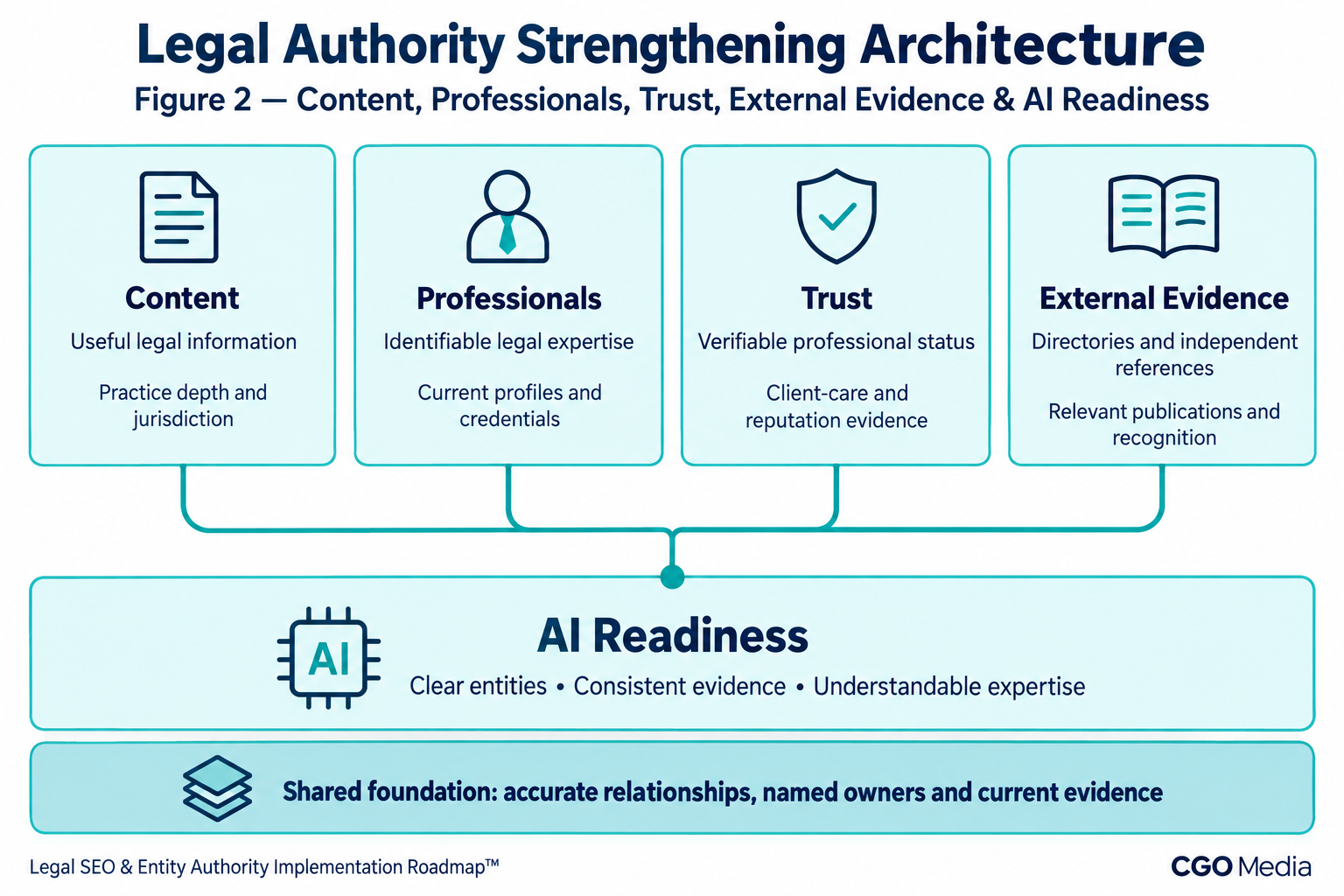
- Offices
- Jurisdictions
27. Audit Legal Information
Assess priority legal content for:
- Accuracy
- Freshness
- Professional ownership
- Jurisdictional clarity
- Source quality
28. Audit Professional Authority
Review whether priority professionals have sufficient evidence of genuine expertise.
29. Professional Authority Audit Areas
Potential evidence includes:
- Qualifications
- Practice focus
- Representative experience
- Publications
- Speaking
- Recognition
30. Audit Regulatory Trust
Review whether relevant firm and professional status information is:
- Current
- Specific
- Verifiable
- Clearly distinguished
31. Audit Client Trust
Review:
- Reviews
- Client-care information
- Complaints information
- Privacy and confidentiality information
32. Audit External Authority
Assess whether important external sources support the firm’s current identity and expertise.
33. External Authority Audit Sources
These may include:
- Legal directories
- Professional bodies
- Industry organisations
- Academic institutions
- Editorial coverage
- Research citations
34. Audit Local Authority
For relevant offices, assess:
- Local profile accuracy
- Office-professional relationships
- Office-practice relationships
- Review evidence
35. Audit AI Representation
Establish a baseline for how selected AI systems describe:
- The firm
- Priority professionals
- Practice areas
- Offices
36. Audit Branded AI Queries
Test whether the firm’s current identity and core capabilities are represented accurately.
37. Audit Professional AI Queries
Test whether priority lawyers are represented accurately for:
- Role
- Firm affiliation
- Practice focus
- Location
38. Audit Practice-Area AI Queries
Assess whether the firm is associated with services it genuinely provides.
39. Audit Local AI Queries
Assess whether office and professional availability is represented accurately.
40. Audit Non-Branded Provider Queries
Where appropriate, observe whether the organisation enters relevant provider-consideration scenarios.
41. Record Visible AI Sources
Where citations or sources are exposed, record the evidence environments that recur.
42. Do Not Treat AI Source Appearance as Causation
A visible citation does not prove that one source alone determined a generated recommendation.
43. Build an Authority Baseline
The assessment stage should produce a baseline across the six authority dimensions.
44. Baseline Dimension One — Entity Clarity
Assess current:
- Entity completeness
- Relationship accuracy
- Conflict rate
45. Baseline Dimension Two — Legal Information Authority
Assess current:
- Practice coverage
- Content freshness
- Jurisdictional clarity
- Professional connection
46. Baseline Dimension Three — Professional Authority
Assess current:
- Profile completeness
- Expertise evidence
- External consistency
47. Baseline Dimension Four — Regulatory and Client Trust
Assess current:
- Regulatory clarity
- Review evidence
- Client-care information
- Reputation evidence
48. Baseline Dimension Five — External and Local Authority
Assess current:
- Directory accuracy
- Institutional evidence
- Local consistency
- Relevant external validation
49. Baseline Dimension Six — AI Recommendation Readiness
Assess current:
- Representation accuracy
- Provider presence
- Source patterns
- Material error rate
50. Classify Findings by Severity
A practical classification may use:
- Critical
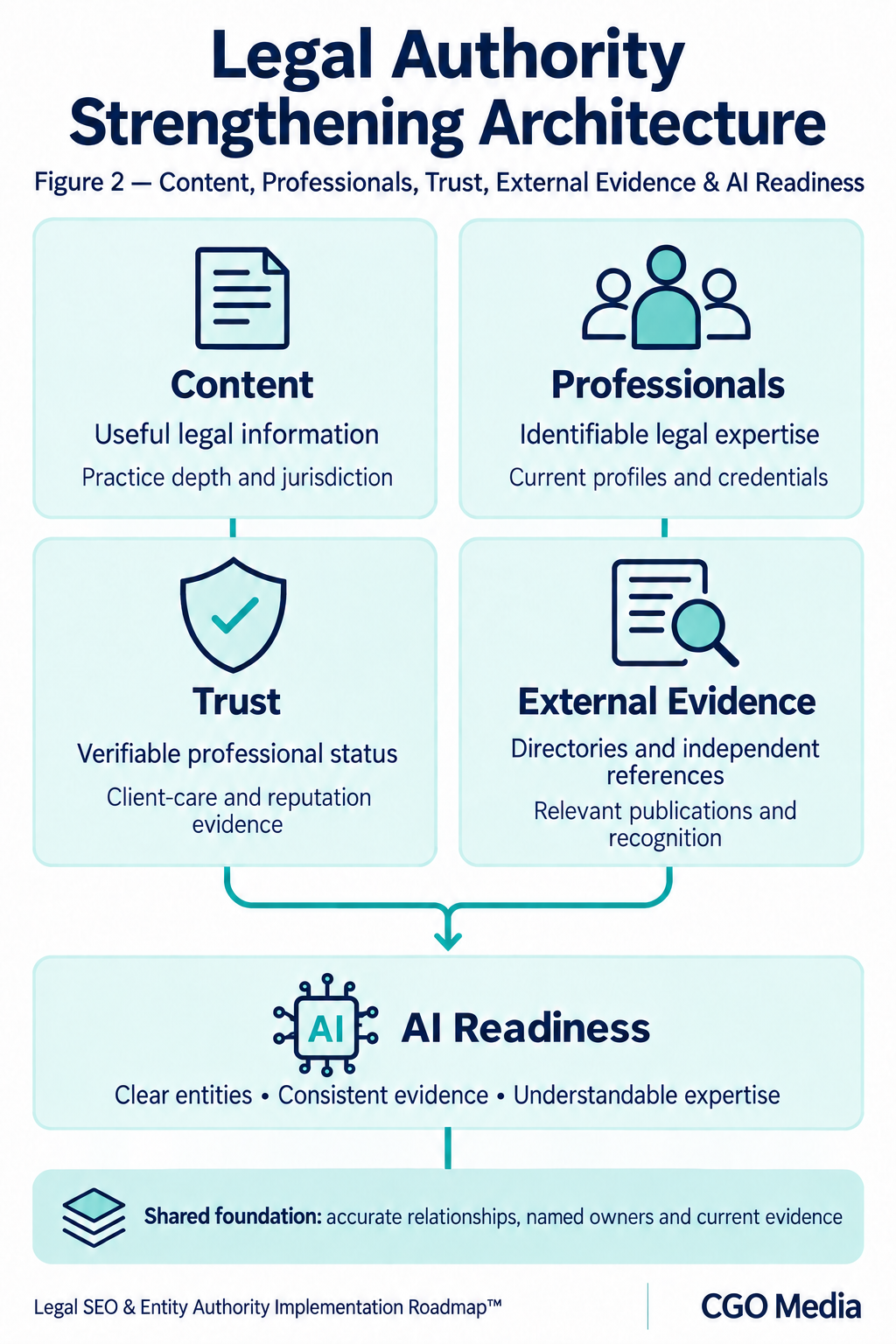
- High
- Medium
- Low
51. Critical Findings
These may include material errors involving:
- Professional status
- Firm affiliation
- Regulatory information
- Jurisdiction
52. High-Priority Findings
These may include:
- Wrong office relationships
- Major practice-area gaps
- Significant professional-profile weaknesses
- Persistent AI misrepresentation
53. Medium-Priority Findings
These may include:
- Outdated biographies
- Incomplete external profiles
- Weak local information
- Unclear review ownership
54. Lower-Priority Findings
These may include non-material descriptive inconsistencies or lower-value evidence improvements.
55. Assess Evidence Confidence
Each finding should indicate whether supporting evidence is:
- High confidence
- Medium confidence
- Low confidence
56. Avoid Acting on Weak Evidence
Where findings are uncertain, further verification should occur before major changes are made.
57. Stage One Output
The assessment stage should produce:
- Entity inventory
- Authority baseline
- Critical issue register
- Maturity profile
- Initial AI baseline
- Priority action list
58. Stage Two — Correct Critical Authority Errors
The second stage focuses on factual accuracy before authority expansion.
59. Accuracy Before Optimisation
An organisation should not invest heavily in advanced visibility while material entity, professional or regulatory inaccuracies remain unresolved.
60. Correction Priority One — Professional Status
Correct material inaccuracies involving:
- Professional role
- Qualification
- Current status
61. Correction Priority Two — Firm Affiliation
Ensure current professionals are associated with the correct legal organisation.
62. Departed Professionals
Former lawyers should not continue to appear as current members of the organisation where that representation is inaccurate.
63. Correction Priority Three — Office Data
Correct:
- Addresses
- Telephone numbers
- Office status
- Professional-office relationships
64. Correction Priority Four — Practice Relationships
Remove unsupported relationships between professionals, offices and legal services.
65. Correction Priority Five — Regulatory Information
Ensure regulatory and professional-status claims are current and correctly assigned.
66. Correction Priority Six — Jurisdictional Information
Correct legal information or professional claims that imply inappropriate jurisdictional coverage.
67. Correction Priority Seven — High-Risk Legal Content
Review information capable of materially misleading users because of legal, procedural or regulatory change.
68. Correction Priority Eight — External Profiles
Where legitimate update mechanisms exist, correct high-priority external sources.
69. External Correction Order
Priority may be given to:
- Authoritative professional or regulatory sources
- Major legal directories
- Important local profiles
- Strategically significant professional profiles
70. Correction Priority Nine — AI Representation Errors
Persistent AI inaccuracies should trigger investigation of the supporting source environment.
71. Correct First-Party Evidence Before Chasing AI Outputs
The firm should ensure that its own information is clear and current before attempting wider remediation.
72. Correct Controlled External Sources
Where the organisation can legitimately update external profiles, high-impact inaccuracies should be addressed.
73. Do Not Attempt to Manipulate AI Systems Directly
The roadmap focuses on strengthening the underlying evidence environment rather than trying to force a particular generated answer.
74. Correction Workflow
A practical process is:
Identify → Verify → Locate Source → Correct → Validate → Retest
75. Create a Critical Issue Register
Each high-priority correction should include:
- Affected entity
- Issue
- Severity
- Source
- Owner
- Status
76. Assign Named Owners
Critical issues should not remain within generic departmental responsibility.
77. Assign Verification Responsibility
Higher-risk professional or regulatory corrections may require appropriate professional or compliance verification.
78. Track Correction Completion
A correction should not be considered complete until the relevant public evidence has been verified where practical.
79. Retest AI Representation After Material Corrections
Repeated observation can determine whether material representation errors persist.
80. Do Not Expect Immediate AI Change
External systems may not reflect corrected evidence immediately.
81. Stage Two Output
The correction stage should produce:
- Reduced critical conflict rate
- Cleaner professional data
- More accurate office information
- Stronger regulatory clarity
- Improved jurisdictional accuracy
82. Stage Three — Structure the Legal Authority Architecture
Once critical factual weaknesses are controlled, the organisation can begin building a more coherent authority structure.
83. Structure Before Scale
Publishing significantly more content before the underlying entity architecture is clear can increase fragmentation.
84. Establish Entity Standards
Define required information for:
- Organisation
- Office
- Professional
- Practice area
- Service
85. Define Organisation Standards
Clarify:
- Canonical firm identity
- Legal entity relationships
- Historic names where relevant
- Brand architecture
86. Define Office Standards
Each strategic office should have clear standards for:
- Name
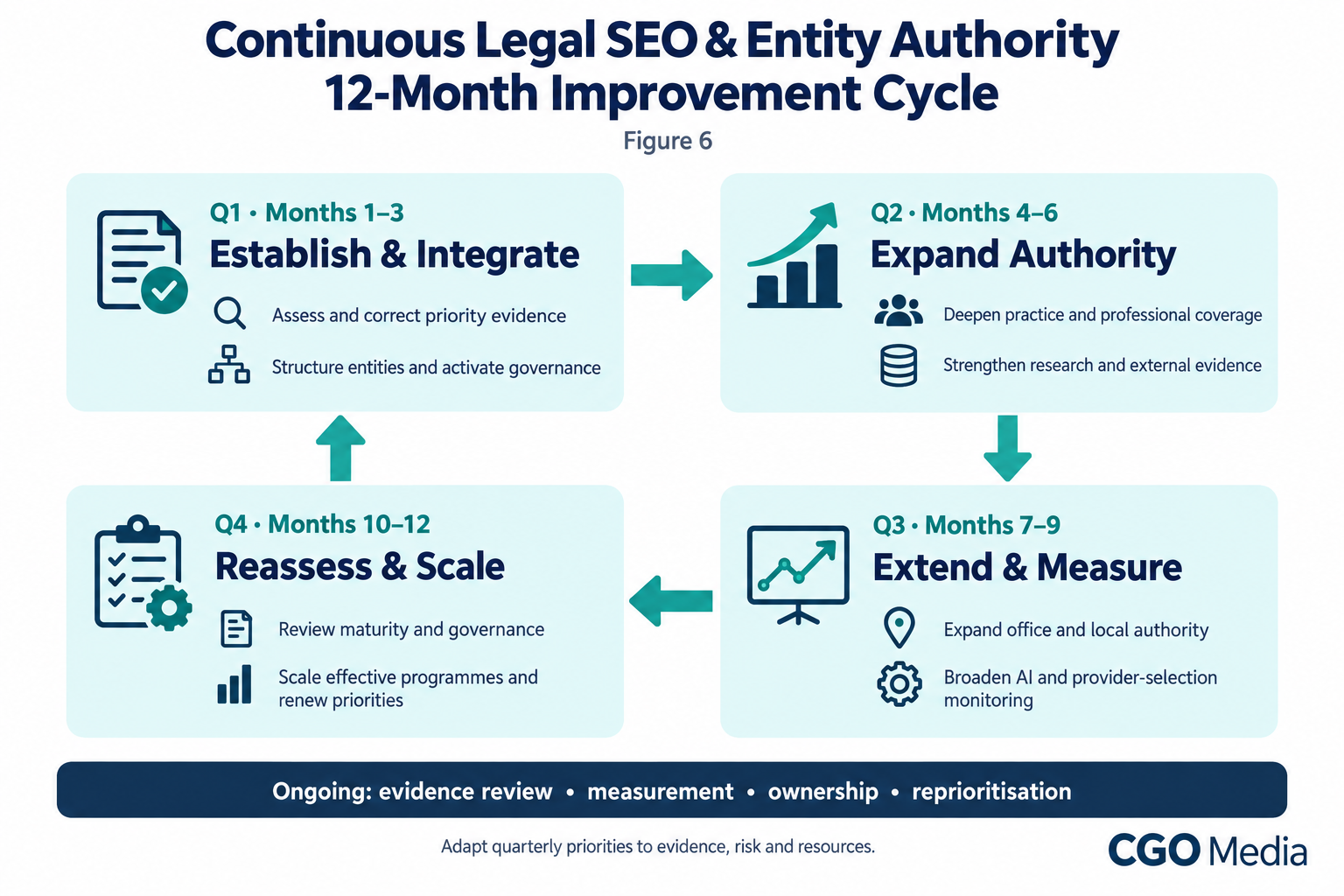
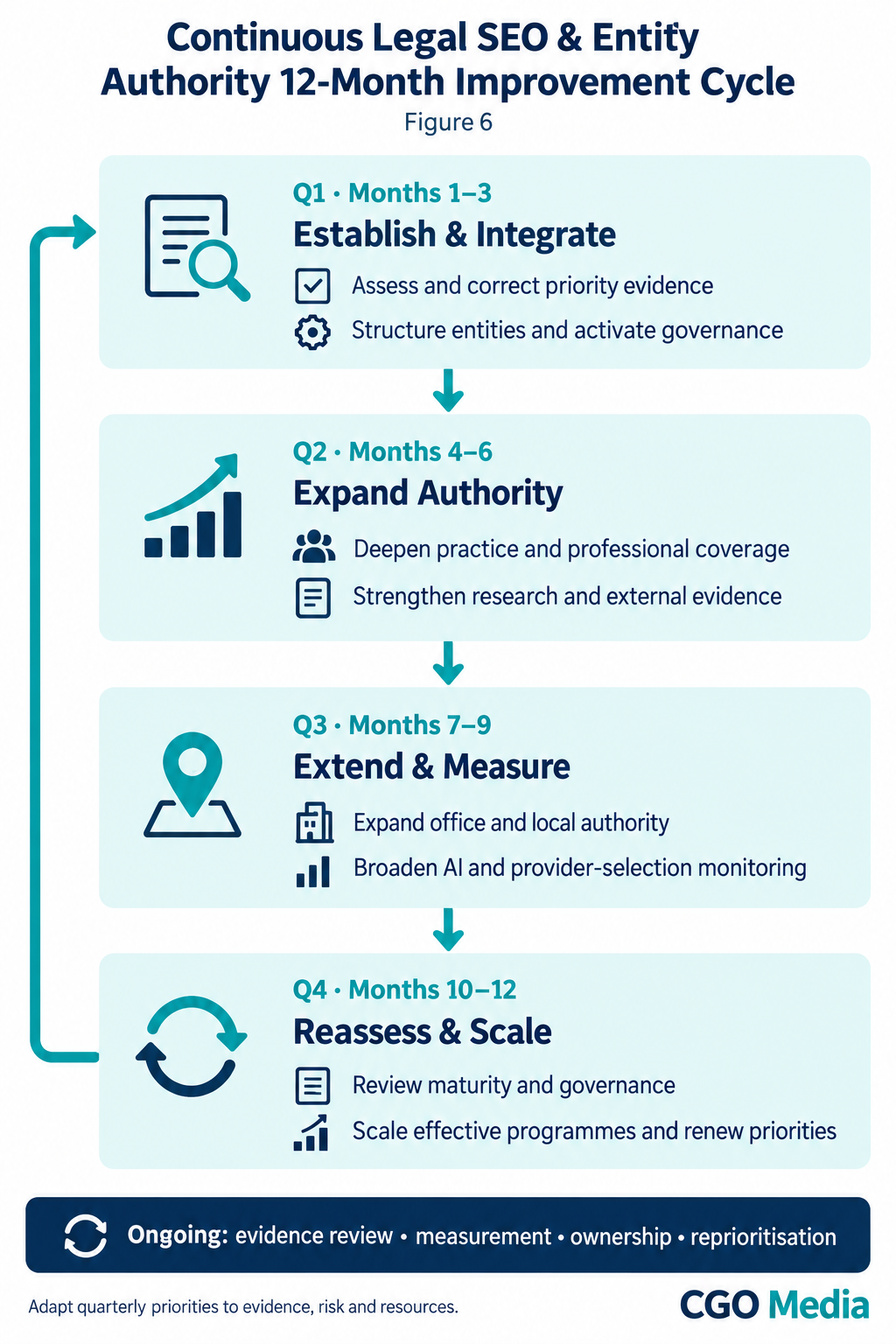
- Address
- Telephone
- Professionals
- Practice availability
- Local profiles
87. Define Professional Profile Standards
Priority professional profiles may require:
- Current role
- Office
- Qualifications
- Practice areas
- Professional status
- Relevant evidence
88. Define Practice-Area Standards
Each strategic practice area should connect with:
- Relevant services
- Professionals
- Offices
- Jurisdictions
89. Define Service Standards
Specific legal services should connect the user’s need with relevant professional capability.
90. Define Matter-Type Relationships
Where useful, connect real client problems with formal legal service categories.
91. Define Jurisdiction Relationships
Legal content and professional capability should be connected with the legal contexts to which they genuinely apply.
92. Build the Integrated Knowledge Architecture
The structured authority model can be represented as:
Organisation → Office → Professional → Practice Area → Service → Matter Type → Jurisdiction → Trust Evidence → External Evidence
93. Avoid Over-Connecting Entities
The roadmap does not recommend linking every professional with every practice area, service or office.
94. Relationship Accuracy Matters More Than Relationship Volume
Only genuine operational and professional relationships should be represented.
95. Structure Professional Expertise
Professional authority may be organised across:
- Practice areas
- Sub-practices
- Matter types
- Sectors
- Jurisdictions
96. Structure Legal Content
Legal information should support a clear user path:
Problem → Explanation → Practice Area → Service → Professional → Contact
97. Structure Trust Evidence
Relevant trust information should be connected with decision points rather than isolated in distant corporate pages.
98. Structure External Evidence
Legal directory, publication, institutional and local evidence should be mapped to relevant entities.
99. Structure Local Authority
Each office should represent genuine:
- Professional availability
- Practice capability
- Contact information
- Local evidence
100. Define Structured Data Strategy
Where appropriate, structured data can support explicit representation of organisations, professionals and legal-service relationships.
101. Structured Data Should Reflect Visible Reality
Markup should describe genuine visible information rather than create relationships unsupported by the site or organisation.
102. Establish Content Governance
Define how important legal information will be:
- Created
- Reviewed
- Updated
- Retired
103. Establish Professional Governance
Define processes for:
- New professional onboarding
- Promotion
- Practice changes
- Office moves
- Departures
104. Establish Office Governance
Office changes should trigger coordinated updates across first-party and priority external environments.
105. Establish Trust Governance
Clarify ownership of:
- Regulatory information
- Client-care information
- Reviews
- Recognition evidence
106. Establish External Profile Governance
Create an inventory of priority external sources and assign ownership.
107. Establish AI Monitoring Governance
Define:
- Prompt classes
- Monitoring frequency
- Error severity
- Escalation process
108. Stage Three Output
The structure stage should produce:
- Entity standards
- Professional standards
- Practice relationships
- Office relationships
- Content governance standards
- External-source ownership
- AI monitoring methodology
109. The First Three Stages Build the Foundation
The early implementation sequence can be summarised as:
Assess Reality → Correct Material Errors → Structure Reliable Authority
110. The Next Stage Is Authority Strengthening
Once the organisation has established sufficient accuracy and structure, it can begin increasing the depth of professional, legal-information, trust, external and AI-ready authority evidence.
111. Stage Four — Strengthen Legal Authority
Once the organisation has established sufficient accuracy, structure and governance foundations, the next stage is to strengthen the evidence that supports genuine legal expertise, professional authority, trust and provider relevance.
112. Strengthening Should Follow Structure
Authority development is more effective when new evidence is added to a coherent entity and practice architecture rather than layered onto a fragmented website.
113. Strengthen the Areas That Matter Most
Investment should prioritise:
- Strategic practice areas
- Priority professionals
- Important offices
- High-value jurisdictions
- Material authority gaps
114. Do Not Expand Authority Uniformly
Not every practice, lawyer or office requires the same level of investment.
115. Strengthen Legal Information Authority
Legal content should demonstrate deeper, more useful and more clearly governed expertise.
116. Expand Practice-Area Depth
Strategic practice areas may require stronger coverage of:
- Core legal issues
- Sub-practices
- Related services
- Common matter types
- Relevant jurisdictions
117. Expand Service-Level Depth
Broad practice pages should be supported by sufficiently useful explanations of the specific services the organisation genuinely provides.
118. Expand Matter-Type Coverage
Legal organisations should identify real-world problems that prospective clients are likely to describe before they understand formal legal terminology.
119. Connect Matter Types with Services
A useful relationship is:
Client Problem → Matter Type → Practice Area → Legal Service → Professional
120. Build Informational Coverage Around Decision Needs
Content should support questions involving:
- Rights
- Process
- Deadlines
- Potential risks
- Possible next steps
121. Avoid Publishing for Volume Alone
Large quantities of generic legal content may add limited authority where it lacks professional relevance, jurisdictional clarity or strategic purpose.
122. Develop Content Clusters Deliberately
A strategic practice may be supported by:
- Practice-area overview
- Service pages
- Legal guides
- Frequently asked questions
- Professional commentary
- Relevant research
123. Content Clusters Should Reflect Genuine Capability
The organisation should not create extensive topical coverage around services it does not genuinely provide.
124. Strengthen Jurisdictional Context
Where applicable, important legal information should make clear:
- Which legal system applies
- Which region applies
- Whether the information is general
- When professional advice may be necessary
125. Multi-Jurisdiction Content Requires Separation
Where laws or procedures differ materially, content should avoid collapsing several legal systems into one ambiguous explanation.
126. Strengthen Professional Authorship
Where appropriate, strategic content should connect clearly with professionals who possess genuine subject expertise.
127. Distinguish Authorship from Review
A legal professional may:
- Write the content
- Review the content
- Provide subject-matter input
These roles should be represented accurately.
128. Strengthen Professional Profiles
Professional biographies should help users understand:
- Who the lawyer is
- What they do
- Where they practise
- What evidence supports their expertise
129. Strengthen Practice Expertise Evidence
Profiles may be improved through clearer representation of:
- Practice areas
- Sub-practices
- Matter types
- Sectors
- Jurisdictions
130. Strengthen Qualification Evidence
Relevant qualifications and professional status should be represented accurately and in appropriate context.
131. Strengthen Experience Evidence
Where disclosure is appropriate, profiles may include:
- Representative matters
- Types of transactions
- Types of disputes
- Sector experience
- Cross-border experience
132. Protect Confidentiality
Experience evidence should not disclose confidential client or matter information improperly.
133. Avoid Outcome Guarantees
Past matters should not be presented in a way that implies equivalent future results.
134. Strengthen Publication Evidence
Relevant professional publications may reinforce subject expertise where they are substantive and accurately attributed.
135. Strengthen Research Authority
Original research may support:
- Professional authority
- Editorial authority
- Citation authority
- Institutional visibility
136. Strengthen Speaking Evidence
Relevant conference, webinar or professional speaking activity may provide additional corroboration of genuine expertise.
137. Strengthen Professional Body Evidence
Current and relevant professional memberships, committee roles or specialist affiliations may strengthen professional context.
138. Strengthen Recognition Evidence Carefully
Awards and rankings should identify the relevant:
- Year
- Practice area
- Professional or team
- Jurisdiction where relevant
139. Recognition Should Not Become a Blanket Claim
A narrow award should not be presented as proof of universal organisational superiority.
140. Strengthen Regulatory Trust
Relevant firm and professional regulatory information should be easy to locate and understand.
141. Keep Firm and Individual Regulation Distinct
Where regulatory status applies differently to organisations and professionals, those relationships should not be blurred.
142. Strengthen Client-Care Information
Users may benefit from clear information around:
- Complaints
- Privacy
- Confidentiality
- Initial contact
- Client onboarding
143. Strengthen Fee Transparency
Where appropriate, explain:
- Charging approach
- Initial consultation arrangements
- Factors affecting cost
- Potential additional charges
144. Avoid False Pricing Precision
Complex legal matters may not permit a reliable total cost before sufficient facts are known.
145. Strengthen Review Evidence
The organisation should monitor the quality, recency and context of client feedback.
146. Analyse Review Themes
Relevant themes may include:
- Communication
- Responsiveness
- Professionalism
- Process clarity
- Administration
147. Reviews Should Inform Operations
Recurring issues may indicate service-process problems rather than marketing problems alone.
148. Reviews Are Not Competence Scores
Positive client feedback should not be treated automatically as proof of technical legal quality.
149. Strengthen External Authority
Once first-party authority is sufficiently developed, external corroboration can be strengthened around genuine areas of expertise.
150. Prioritise Relevant External Sources
These may include:
- Legal directories
- Professional bodies
- Legal publications
- Industry publications
- Academic institutions
- Research platforms
151. External Authority Should Support Strategic Practices
The strongest external evidence is aligned with the legal areas the organisation genuinely wants to be known for.
152. Digital PR Should Be Expertise-Led
Digital PR activity should ideally expose genuine professional insight rather than manufacture superficial authority signals.
153. Legal Digital PR Opportunities
Potential activity may include:
- Expert commentary
- Legal trend analysis
- Original research
- Data-led studies
- Professional opinion on public developments
154. Media Commentary Should Match Expertise
Professionals should contribute to subjects genuinely connected with their knowledge and role.
155. Strengthen Editorial Authority
Relevant editorial coverage can reinforce professional or practice-area credibility.
156. Editorial Quality Matters
A small number of relevant, authoritative publications may provide more useful corroboration than large quantities of unrelated mentions.
157. Strengthen Citation Authority
Research, legal analysis and useful professional resources may earn citations from:
- Academic sources
- Professional publications
- Industry reports
- Journalists
- Other organisations
158. Citation Authority Should Be Earned
The roadmap does not recommend fabricated citations, misleading attribution or artificial references.
159. Create Citable Research Assets
Where appropriate, the organisation may publish:
- Research papers
- Data studies
- Industry analyses
- Legal trend reports
- Structured frameworks
160. Research Assets Should Have Clear Authorship
Users and external publishers should be able to identify:
- Author
- Organisation
- Publication date
- Methodology where relevant
161. Research Assets Should Be Easy to Reference
Useful citation formats may help journalists, researchers and publishers acknowledge the source accurately.
162. Strengthen Institutional Authority
Genuine relationships with professional, academic or sector organisations may reinforce expertise where relevant.
163. Institutional Authority Should Not Be Invented
Affiliations should be represented only where genuine and current.
164. Strengthen Legal Directory Presence
Priority directory profiles should contain accurate:
- Firm information
- Practice information
- Professional information
- Office information
165. Directory Consistency Matters
Old professional roles, office locations and practice descriptions should be corrected where legitimate update mechanisms exist.
166. Strengthen Local Authority
Local authority should support real office and professional presence.
167. Strengthen Office Pages
Priority location pages may include:
- Current office information
- Relevant professionals
- Available practice areas
- Contact pathways
- Useful local context
168. Strengthen Local Professional Relationships
Office pages should identify professionals who genuinely practise from that location.
169. Strengthen Local Practice Relationships
Locations should represent actual legal capability rather than automatically inheriting every service offered by the wider firm.
170. Strengthen Priority Local Profiles
Local discovery environments should align with current office reality.
171. Strengthen Local Review Understanding
Review patterns may differ by office and can provide useful operational insight.
172. Avoid Synthetic Local Expansion
The roadmap does not support creating artificial office or location evidence solely to increase geographic search coverage.
173. Strengthen Internal Authority Relationships
Internal linking should help users move naturally between relevant:
- Legal information
- Practice areas
- Services
- Professionals
- Offices
174. Internal Linking Should Reflect Meaning
Links should strengthen genuine entity and topic relationships rather than simply increase internal link volume.
175. Strengthen Technical Discoverability
Authority evidence must remain technically accessible to relevant search systems.
176. Technical Priority Areas
These may include:
- Crawlability
- Indexability
- Canonicalisation
- Internal architecture
- Page performance
- Structured data
177. Technical SEO Supports Authority Rather Than Replacing It
A technically excellent website cannot compensate for weak professional or trust evidence.
178. Strengthen Structured Data
Where appropriate, structured data may reinforce clear representation of:
- Organisation
- Legal service
- Person
- Office relationships
179. Structured Data Should Match Visible Content
Markup should not be used to create claims that users cannot verify on the page or through legitimate organisational evidence.
180. Strengthen Brand Consistency
Firm identity should remain consistent across:
- Website
- Professional profiles
- Directories
- Local environments
- Editorial references
181. Strengthen AI Search Readiness
AI recommendation readiness should now be developed on top of stronger entity and authority foundations.
182. Begin with Representation Accuracy
Assess whether selected AI systems describe:
- The firm correctly
- Professionals correctly
- Practice areas correctly
- Offices correctly
183. Strengthen Branded AI Evidence
Where branded descriptions remain incomplete, review whether important first-party and external information is sufficiently clear.
184. Strengthen Professional AI Evidence
Priority lawyers should have clear and consistent public evidence around:
- Role
- Firm
- Expertise
- Office
185. Strengthen Practice-Area AI Evidence
Strategic practice areas should have sufficient first-party and external evidence to support accurate provider relevance.
186. Strengthen Local AI Evidence
Office and local professional information should remain consistent enough to reduce geographic ambiguity.
187. Strengthen Non-Branded Recommendation Readiness
The organisation may assess whether it appears within appropriate provider-discovery scenarios before users already know the brand.
188. Non-Branded Presence Must Be Relevant
Provider inclusion is only meaningful where the firm genuinely matches the:
- Practice area
- Jurisdiction
- Location where relevant
- Client requirement
189. Strengthen Provider Comparison Readiness
AI systems may compare firms using public evidence around:
- Expertise
- Reputation
- Location
- Sector relevance
- Professional strength
190. Comparison Accuracy Should Be Monitored
Material inaccuracies should trigger investigation rather than being accepted as normal model variation.
191. Build an AI Source Map
Where visible, record which source categories recur in AI-assisted representations.
192. AI Source Categories
Potential sources may include:
- Firm website
- Legal directories
- Professional profiles
- Regulatory sources
- Editorial coverage
- Local profiles
193. Use Source Mapping Diagnostically
The purpose is to identify evidence gaps and conflicts rather than assume direct causal relationships.
194. Strengthen Source Consistency
Priority material facts should align across high-value evidence environments.
195. Source Consistency Does Not Mean Copy Duplication
Different sources may use different wording while agreeing on the important facts.
196. Strengthen Entity Confidence
AI readiness may improve when the organisation creates stronger consistency around:
- Identity
- Practice relevance
- Professional relationships
- Jurisdictional context
197. Strengthen Recommendation Evidence Thresholds
A practical readiness model may require sufficient:
- Identity confidence
- Practice confidence
- Professional confidence
- Trust confidence
- External corroboration
- Jurisdictional confidence
198. Do Not Attempt to Manufacture AI Trust
False reviews, fabricated citations, invented affiliations and misleading professional claims undermine the authority foundations the roadmap is designed to strengthen.
199. Do Not Treat AI Presence as Endorsement
AI-generated provider inclusion does not establish professional quality, suitability or accreditation.
200. Do Not Treat Recommendation Order as Ranking
The ordering of providers within one generated response should not be treated as a stable league table.
201. Build a Repeatable AI Observation Set
Monitoring should use defined prompt categories rather than random testing.
202. AI Observation Categories
These may include:
- Brand
- Professional
- Practice area
- Local
- Comparison
- Jurisdiction
203. Record AI Observations Consistently
A monitoring record may include:
- Date
- Prompt
- Model or environment
- Geographic context
- Provider presence
- Accuracy
- Visible sources
204. Strengthening Should Include User Experience
Authority improvement should also reduce unnecessary friction during legal provider selection.
205. Strengthen Information-to-Professional Progression
Users should be able to move from legal information toward relevant professionals naturally.
206. Strengthen Professional-to-Trust Progression
Professional profiles should connect users with appropriate trust evidence without forcing them to reconstruct the organisation’s credibility independently.
207. Strengthen Trust-to-Contact Progression
Once a user has established sufficient confidence, the route to contact should be clear.
208. Strengthen Contact Pathways
Review:
- Telephone routes
- Forms
- Email contact
- Consultation requests
209. Strengthen Intake Experience
The first operational interaction should reinforce rather than undermine the authority developed digitally.
210. Strengthen Response Processes
Appropriate prospective clients should receive clear acknowledgement and next-step information.
211. Strengthen Enquiry Qualification
Processes should help determine:
- Practice fit
- Jurisdiction
- Urgency
- Client type
- Potential conflict
212. Strengthen Appropriate Filtering
The objective is not to maximise every enquiry but to improve progression among suitable prospective clients.
213. Stage Four Should Produce an Authority Expansion Portfolio
The strengthening programme may contain:
- Content authority projects
- Professional authority projects
- Trust improvements
- External authority development
- Local improvements
- AI-readiness actions
214. Prioritise Strengthening by Gap
Investment should address the weakest strategically important authority dimensions rather than simply expanding whichever activities are easiest to execute.
215. Prioritise Strengthening by Evidence Confidence
Low-confidence findings may need further verification before substantial resources are committed.
216. Prioritise Strengthening by Risk
Accuracy and trust risks should generally take precedence over incremental visibility opportunities.
217. Prioritise Strengthening by Commercial Importance
Once critical foundations are secure, strategic practice areas and markets may receive greater investment.
218. Stage Four Output
The authority-strengthening stage should produce stronger:
- Legal information depth
- Professional evidence
- Trust architecture
- External corroboration
- Local authority
- AI representation readiness
219. The Strengthening Equation
Stage Four can be summarised as:
Legal Information + Professional Evidence + Trust + External Authority + Local Authority + AI Readiness
220. The Next Stage Is Measurement
Once authority has been strengthened, the organisation needs a repeatable system for determining whether those improvements have increased accuracy, visibility, professional confidence, provider-selection readiness and governance maturity.
221. Stage Five — Measure Performance and Authority
The fifth stage establishes a measurement system for determining whether improvements to entity clarity, legal information, professional authority, trust, external corroboration and AI readiness are producing stronger outcomes.
222. Measurement Should Follow the Authority Model
Traditional SEO metrics remain useful, but they should be interpreted alongside authority and provider-selection measures.
223. Build a Six-Dimension Measurement Framework
The measurement system should assess:
- Entity Clarity
- Legal Information Authority
- Professional Authority
- Regulatory and Client Trust
- External and Local Authority
- AI Recommendation Readiness
224. Measure Current State and Target State
Each dimension should have:
- Current score
- Target score
- Evidence confidence
- Trend
- Priority
225. Entity Clarity KPIs
Potential measures may include:
- Priority entity completeness
- Material conflict rate
- Office data accuracy
- Professional affiliation accuracy
- Relationship coverage
226. Material Entity Conflict Rate
Track the proportion of important entities with significant inconsistencies across first-party and priority external sources.
227. Professional Affiliation Accuracy
Measure whether priority lawyers are associated with the correct:
- Firm
- Role
- Office
- Practice areas
228. Office Accuracy
Measure whether priority office information remains correct across relevant discovery environments.
229. Relationship Coverage
Assess whether strategic relationships are represented sufficiently across:
Organisation → Office → Professional → Practice Area → Service → Jurisdiction
230. Legal Information Authority KPIs
Potential measures may include:
- Strategic practice coverage
- Service coverage
- Content freshness
- Review coverage
- Jurisdictional clarity
231. Practice-Area Coverage
Measure whether priority legal practices have sufficiently deep and structured supporting information.
232. Service-Level Coverage
Assess whether key services are represented clearly beneath broader practice categories.
233. Matter-Type Coverage
Measure whether real-world client problems are connected with relevant legal services.
234. Content Review Coverage
Track what proportion of priority legal information has been reviewed within the defined period.
235. Legal Content Freshness
Assess whether strategically important legal information remains current.
236. Jurisdictional Accuracy
Measure whether the legal context of priority information is represented sufficiently clearly.
237. Professional Attribution Coverage
Assess whether important legal content is connected appropriately with genuine professional expertise.
238. Professional Authority KPIs
Potential measures may include:
- Profile completeness
- Practice mapping
- External consistency
- Professional evidence depth
- Lifecycle accuracy
239. Professional Profile Completeness
Measure whether priority profiles contain the required fields and evidence classes defined by the organisation.
240. Practice Mapping Accuracy
Assess whether professionals are linked only with practice areas they genuinely support.
241. Office Mapping Accuracy
Measure whether lawyers are associated accurately with current offices.
242. Professional Evidence Depth
Potential evidence may include:
- Qualifications
- Practice expertise
- Representative matters
- Publications
- Speaking
- Recognition
243. External Professional Consistency
Track whether important third-party biographies and directory profiles align with current first-party information.
244. Regulatory and Client Trust KPIs
Potential measures may include:
- Regulatory information coverage
- Client-care information coverage
- Review recency
- Review themes
- Reputation evidence quality
245. Regulatory Accuracy
Measure whether relevant firm-level and professional-level status information remains current and correctly differentiated.
246. Client-Care Coverage
Assess whether users can access clear information around:
- Complaints
- Privacy
- Confidentiality
- Initial contact
247. Review Recency
Track whether public feedback reflects sufficiently recent client experience.
248. Review Theme Analysis
Monitor recurring themes involving:
- Communication
- Responsiveness
- Professionalism
- Administration
- Process clarity
249. Review Metrics Should Remain Contextual
Review ratings and volumes should not be converted into simplistic measures of legal competence.
250. Reputation Evidence Quality
Assess whether awards, rankings and recognitions remain:
- Current
- Relevant
- Specific
- Properly attributed
251. External and Local Authority KPIs
Potential measures may include:
- Priority directory accuracy
- Relevant citation growth
- Institutional evidence
- Editorial authority
- Local profile consistency
252. Legal Directory Accuracy
Measure whether priority directory profiles reflect current:
- Firm identity
- Professionals
- Practice areas
- Offices
253. Citation Authority Measures
Where appropriate, monitor:
- Relevant research citations
- Professional references
- Editorial citations
- Institutional references
254. Citation Relevance Matters More Than Volume
A relevant citation from a credible legal, academic or professional source may have greater strategic value than numerous unrelated mentions.
255. Editorial Authority Measures
Potential measures may include:
- Relevant expert commentary
- Practice-aligned media coverage
- Professional bylines
- Research references
256. Local Authority Measures
Potential measures may include:
- Office data consistency
- Professional-office accuracy
- Local review coverage
- Local discovery visibility
257. Local Visibility Should Be Qualified
Higher local visibility is only useful when it represents a genuine office and relevant legal capability.
258. AI Recommendation Readiness KPIs
Potential measures may include:
- Branded representation accuracy
- Professional representation accuracy
- Practice association accuracy
- Local accuracy
- Relevant provider presence
- Material error rate
259. Branded AI Accuracy
Measure whether selected AI systems identify correctly:
- The firm
- Its offices
- Its core practice areas
- Its provider type
260. Professional AI Accuracy
Measure whether priority lawyers are represented correctly for:
- Role
- Firm affiliation
- Practice focus
- Office
261. Practice-Area AI Accuracy
Assess whether AI systems associate the provider with legal services it genuinely offers.
262. Local AI Accuracy
Assess whether location-specific generated answers represent real offices, professionals and services correctly.
263. Relevant Provider Presence
Track whether the organisation appears in appropriate non-branded provider-selection scenarios.
264. Provider Presence Requires Context
Presence should be assessed against:
- Practice area
- Jurisdiction
- Location
- Client type
265. Material AI Error Rate
Track important inaccuracies involving:
- Professional identity
- Firm affiliation
- Practice area
- Office
- Jurisdiction
- Regulatory context
266. Accuracy Should Be Weighted Above Raw Frequency
Frequent but inaccurate appearance should not be interpreted as stronger AI readiness.
267. AI Comparison Visibility
Where strategically relevant, track whether the organisation appears in provider-comparison prompts.
268. Comparison Accuracy
Assess whether generated comparisons describe material differences accurately.
269. AI Source Visibility
Where sources are exposed, record which source categories appear repeatedly.
270. AI Source Categories
These may include:
- Firm website
- Legal directories
- Regulatory sources
- Professional profiles
- Editorial coverage
- Local profiles
271. Source Appearance Is a Diagnostic Signal
Visible sources may help the organisation identify where evidence is strong, weak or inconsistent.
272. Search Visibility KPIs
Traditional search metrics should remain part of the wider measurement system.
273. Organic Visibility Measures
Potential indicators may include:
- Relevant impressions
- Priority query visibility
- Non-branded traffic
- Branded traffic
274. Practice-Level Visibility
Measure performance by strategic practice rather than relying only on whole-site totals.
275. Service-Level Visibility
Assess whether important service pages are discoverable for appropriate user intent.
276. Professional Search Visibility
Measure branded and expertise-related visibility for priority lawyers.
277. Local Search Visibility
Measure local discovery by actual office and service context.
278. Search Visibility Should Be Qualified by Relevance
Visibility for unsuitable queries or jurisdictions should not automatically be considered success.
279. Provider-Selection KPIs
Measurement should extend beyond discovery to the stages that influence professional selection.
280. Information-to-Practice Progression
Measure whether users move from legal information toward relevant practice and service pages.
281. Practice-to-Professional Progression
Measure whether users evaluate relevant lawyer profiles after reviewing practice information.
282. Professional-to-Trust Progression
Assess whether users seek:
- Reviews
- Regulatory information
- Recognition
- Client-care information
283. Trust-to-Contact Progression
Measure whether high-intent users progress toward enquiry.
284. Contact-to-Consultation Progression
Measure whether suitable enquiries become consultations.
285. Consultation-to-Instruction Progression
Measure whether appropriate consultations become formal instructions.
286. Qualified Enquiry Rate
Distinguish total enquiries from matters that match:
- Practice area
- Jurisdiction
- Client type
- Service capability
287. Unsuitable Enquiry Rate
A high volume of irrelevant enquiries may indicate weak information architecture or targeting.
288. Conflict-Rejection Rate
Track how often otherwise appropriate enquiries cannot proceed because of conflicts.
289. Response-Time Metrics
Potential measures may include:
- Time to acknowledgement
- Time to substantive response
- Time to consultation availability
290. Form Completion Rate
Measure whether enquiry forms introduce avoidable friction.
291. Contact Channel Performance
Assess the effectiveness of:
- Telephone
- Forms
- Consultation booking
292. Provider-Selection Abandonment
Where practical, investigate where prospective clients cease progressing.
293. Early Abandonment
Potential causes may include:
- Irrelevant content
- Weak jurisdictional fit
- Poor information quality
294. Mid-Journey Abandonment
Potential causes may include:
- Thin professional profiles
- Weak trust evidence
- Inconsistent reputation information
295. Late-Journey Abandonment
Potential causes may include:
- Fees
- Availability
- Location
- Slow response
- Onboarding friction
296. Not All Abandonment Is Negative
Appropriate filtering may prevent unsuitable users from progressing into costly intake processes.
297. Measure Qualified Progression
The better objective is:
Appropriate Discovery → Relevant Evaluation → Qualified Enquiry → Suitable Instruction
298. Attribution Across the Legal Journey
A legal client may interact with several sources before making contact.
299. Potential Attribution Sources
These may include:
- Organic search
- Local search
- AI assistants
- Legal directories
- Media
- Professional referrals
- Direct navigation
300. First-Touch Attribution
This can help identify where the provider first entered the user’s awareness.
301. Last-Touch Attribution
This identifies the final measurable source before contact but may understate earlier influence.
302. Assisted Attribution
Where possible, identify important intermediate environments that contributed to provider confidence.
303. Example Multi-Source Journey
A prospective client might move through:
AI Answer → Legal Guide → Lawyer Profile → Legal Directory → Branded Search → Consultation
304. Example Referral-Led Journey
Another client might move through:
Professional Referral → Lawyer Search → Firm Website → Reviews → Contact
305. Attribution Will Remain Imperfect
Offline conversations, device switching and untracked AI influence can make exact attribution impossible.
306. Self-Reported Discovery
Intake teams may ask appropriately how users first heard about the firm.
307. Self-Reported Attribution Has Limitations
Users may remember only the most recent or most prominent source.
308. AI Attribution Requires Multiple Signals
Potential indicators may include:
- Identifiable AI referral traffic
- Self-reported AI discovery
- Branded search changes
- Repeated provider presence in monitored prompts
309. Measure Authority by Practice Area
Whole-site averages may conceal strong and weak legal practices.
310. Practice-Level Authority Dashboard
For each strategic practice, report:
- Search visibility
- Content authority
- Professional evidence
- External authority
- AI representation
- Qualified enquiries
311. Measure Authority by Office
Multi-office legal organisations should compare local authority across strategically important locations.
312. Office-Level Dashboard
Potential measures may include:
- Local entity accuracy
- Professional mapping
- Practice availability
- Reviews
- Local search visibility
- Local AI accuracy
313. Measure Authority by Professional Cohort
Relevant groups of lawyers may be assessed for profile completeness and evidence coverage without creating simplistic individual performance league tables.
314. Measure Authority by Jurisdiction
International organisations should compare:
- Legal content governance
- Professional representation
- External authority
- AI accuracy
across important markets.
315. Evidence Confidence
Every major authority score should indicate the confidence of the underlying evidence.
316. High-Confidence Evidence
Evidence is current, verifiable and sufficiently broad.
317. Medium-Confidence Evidence
Evidence is useful but incomplete or dependent on narrower sampling.
318. Low-Confidence Evidence
Evidence is outdated, inconsistent or based substantially on assumptions.
319. Avoid False Precision
A numerical dashboard should not imply that legal authority can be measured with absolute scientific certainty.
320. Use Scores as Decision Tools
Scores should help answer:
- Where are we weak?
- Where are we improving?
- Where is risk increasing?
- What should we prioritise next?
321. Suggested Authority Scale
A practical 1–5 scale may use:
- 1 — Critical Weakness
- 2 — Weak
- 3 — Established
- 4 — Strong
- 5 — Leading
322. Trend Should Accompany Score
Each dimension may also be classified as:
- Improving
- Stable
- At Risk
- Regressing
323. Executive Authority Scorecard
| Dimension | Current Score | Target | Confidence | Trend | Priority |
|---|---|---|---|---|---|
| Entity Clarity | 1–5 | 1–5 | Low / Medium / High | Improving / Stable / At Risk / Regressing | Critical / High / Medium / Low |
| Legal Information Authority | 1–5 | 1–5 | Low / Medium / High | Improving / Stable / At Risk / Regressing | Critical / High / Medium / Low |
| Professional Authority | 1–5 | 1–5 | Low / Medium / High | Improving / Stable / At Risk / Regressing | Critical / High / Medium / Low |
| Regulatory & Client Trust | 1–5 | 1–5 | Low / Medium / High | Improving / Stable / At Risk / Regressing | Critical / High / Medium / Low |
| External & Local Authority | 1–5 | 1–5 | Low / Medium / High | Improving / Stable / At Risk / Regressing | Critical / High / Medium / Low |
| AI Recommendation Readiness | 1–5 | 1–5 | Low / Medium / High | Improving / Stable / At Risk / Regressing | Critical / High / Medium / Low |
324. Critical Issues Should Sit Outside Aggregate Scores
Material professional, regulatory or jurisdictional errors should be reported separately.
325. Critical Authority Register
For each material issue, report:
- Affected entity
- Issue
- Risk
- Owner
- Action
- Status
326. Executive Reporting Should Separate Risk from Growth
Critical corrections and strategic opportunities should not compete within the same undifferentiated priority list.
327. Risk Reporting
Potential risk categories may include:
- Professional accuracy
- Regulatory accuracy
- Jurisdictional accuracy
- Client trust
- AI misrepresentation
328. Growth Reporting
Potential opportunity categories may include:
- Underdeveloped practice authority
- Strong professionals with weak digital visibility
- Research citation opportunities
- Priority local-market gaps
- Relevant AI discovery opportunities
329. Executive Reporting Should Show Progression
Leadership should understand:
- What changed
- Why it changed
- Whether authority improved
- What remains unresolved
330. Executive Reporting Should Be Periodic
The appropriate reporting cadence will depend on organisational scale, risk and rate of change.
331. Practice Leadership Reporting
Practice leaders may require a focused view of:
- Content authority
- Professional evidence
- External recognition
- Qualified discovery
332. Marketing Reporting
Marketing teams may require a broader view of:
- Search performance
- Content engagement
- External authority
- AI representation
- Lead progression
333. Compliance and Risk Reporting
Relevant teams may require visibility into:
- Professional-status accuracy
- Regulatory claims
- Jurisdictional issues
- High-risk content findings
334. Executive Reporting Should Lead to Decisions
A useful authority report should support:
- Prioritisation
- Resource allocation
- Ownership
- Risk escalation
- Roadmap adjustment
335. Measure Before and After Major Initiatives
For significant authority projects, compare the baseline with the post-implementation state.
336. Measure Professional Profile Projects
Assess whether improvements increased:
- Profile completeness
- Relationship coverage
- External consistency
- User progression
337. Measure Legal Content Projects
Assess whether improvements increased:
- Relevant search visibility
- Information depth
- Practice progression
- Professional connection
338. Measure Digital PR Projects
Assess whether activity produced relevant:
- Editorial coverage
- Professional citations
- Research references
- Practice-area authority
339. Measure Local Authority Projects
Assess whether improvements increased:
- Office accuracy
- Local visibility
- Professional-location clarity
- Qualified local enquiries
340. Measure AI-Readiness Projects
Assess whether improvements reduced:
- Material errors
- Entity ambiguity
- Wrong professional associations
- Wrong local associations
341. Avoid Declaring Causation Too Quickly
Search and AI environments contain multiple changing variables, making simple before-and-after conclusions unreliable in some cases.
342. Use Multiple Evidence Types
Stronger evaluation may combine:
- Search data
- Website behaviour
- Authority audit findings
- AI observations
- Intake data
- Client feedback
343. Use Longitudinal Measurement
Repeated observation provides a stronger basis for understanding whether improvement is sustained.
344. Measurement Should Expose Decay
The scorecard should reveal when previously strong authority begins to weaken.
345. Measurement Should Expose Uneven Performance
Whole-firm averages should not conceal:
- Weak offices
- Thin professional groups
- Underdeveloped practice areas
- Jurisdictional gaps
346. Measurement Should Support the Next Roadmap Cycle
The strongest metrics identify what should happen next rather than merely describing what has already happened.
347. Stage Five Output
The measurement stage should produce:
- Authority scorecard
- Critical issue register
- Practice-level dashboards
- Office-level diagnostics
- AI monitoring baseline
- Provider-selection metrics
- Executive priorities
348. The Measurement Equation
Stage Five can be represented as:
Measure → Compare → Diagnose → Prioritise → Decide
349. The Next Stage Is Governance and Continuous Improvement
Measurement has limited value unless findings are translated into named ownership, change triggers, review cycles and repeated improvement.
350. Stage Six — Govern and Improve
The sixth stage converts the authority programme from a sequence of projects into an ongoing operating system.
351. Governance Protects Previous Investment
Without ownership, review cycles and change triggers, gains made through entity correction, professional strengthening, content development and AI-readiness work can deteriorate over time.
352. Authority Governance Should Be Cross-Functional
Legal search authority depends on information controlled by several teams.
353. Potential Governance Participants
These may include:
- Marketing
- SEO
- Practice leaders
- Knowledge teams
- Human resources
- Compliance
- Risk
- Office management
- Operations
- Data teams
354. No Single Team Controls the Entire Authority Environment
Marketing may own the website, but it does not independently determine:
- Professional status
- Legal expertise
- Regulatory information
- Office operations
- Client-care requirements
355. Define Governance Ownership by Evidence Class
Each important evidence class should have a clear owner.
356. Organisation Identity Ownership
Responsibility may include maintaining:
- Firm name
- Legal entity relationships
- Brand architecture
- Historic-name context
357. Office Identity Ownership
Responsibility may include:
- Address
- Telephone
- Operational status
- Professional relationships
- Practice availability
358. Professional Identity Ownership
Responsibility may include:
- Current role
- Firm affiliation
- Office
- Practice areas
- Professional status
359. Legal Information Ownership
Strategic legal content should have clear responsibility for:
- Accuracy
- Review
- Jurisdictional context
- Retirement
360. Trust Evidence Ownership
Responsibility should be clear for:
- Regulatory information
- Client-care information
- Reviews
- Recognition evidence
361. External Authority Ownership
Priority external evidence should have assigned responsibility across:
- Directories
- Professional profiles
- Local listings
- Editorial relationships
- Institutional profiles
362. AI Monitoring Ownership
The organisation should identify who is responsible for:
- Prompt-set maintenance
- Observation logging
- Error classification
- Source diagnosis
- Escalation
363. Define Decision Rights
Governance should make clear who can:
- Create information
- Approve information
- Correct information
- Remove information
- Escalate high-risk issues
364. High-Risk Claims Need Stronger Controls
Professional status, regulatory claims and jurisdictional statements may require stronger verification than routine descriptive content.
365. Define Review Cycles
Different evidence classes should be reviewed according to their rate of change and potential risk.
366. High-Frequency Review Areas
These may include:
- Professional status
- Professional affiliation
- Office information
- High-risk legal content
367. Medium-Frequency Review Areas
These may include:
- Professional biographies
- Practice relationships
- Directory profiles
- Review patterns
368. Longer-Cycle Strategic Reviews
These may include:
- Authority maturity
- Competitor context
- Research strategy
- AI representation trends
369. Review Frequency Should Reflect Change Velocity
A rapidly changing professional group may require more frequent review than a stable practice area.
370. Review Frequency Should Reflect Risk
Information capable of materially misleading users should receive greater governance attention.
371. Scheduled Review Alone Is Not Enough
Real organisational events should trigger updates before the next routine review date.
372. Build Change Triggers
The organisation should define events that automatically initiate authority review.
373. Professional Join Trigger
When a lawyer joins, review:
- Professional profile
- Practice mapping
- Office mapping
- Qualifications
- External profiles
374. Professional Promotion Trigger
When a role changes, update first-party and priority external representations.
375. Professional Practice-Change Trigger
Where a professional’s expertise or focus changes materially, review their relationships with:
- Practice areas
- Services
- Content
- Sectors
376. Professional Office-Move Trigger
When a professional changes office, update:
- Biography
- Office page
- Local evidence
- Priority external profiles
377. Professional Departure Trigger
When a lawyer leaves, current affiliation claims should be reviewed promptly.
378. Departure Governance Should Extend Beyond the Website
Priority directory, professional and local profiles may also require correction.
379. Office Launch Trigger
A new office should prompt coordinated creation of:
- Office entity
- Professional mappings
- Practice mappings
- Local profiles
- Contact information
380. Office Move Trigger
An office move should initiate updates across:
- Website
- Structured data
- Maps environments
- Legal directories
- Professional profiles
381. Office Closure Trigger
Closed offices should not continue to create false local availability.
382. Practice Launch Trigger
A new legal practice should trigger creation or review of:
- Practice architecture
- Service pages
- Professional relationships
- External positioning
- AI monitoring scenarios
383. Practice Retirement Trigger
Where a service is no longer offered, outdated claims should be removed or revised.
384. Legal Change Trigger
Material changes in law or procedure should prompt review of affected legal information.
385. Regulatory Change Trigger
Changes in regulatory requirements or professional status should prompt immediate review where relevant.
386. Rebrand Trigger
A rebrand should initiate a broader entity-consistency programme.
387. Merger Trigger
A merger may require review of:
- Firm identities
- Historic brands
- Professional affiliations
- Office architecture
- External sources
388. Acquisition Trigger
Acquired practices or firms should be assessed against the organisation’s authority standards before being fully integrated.
389. Website Migration Trigger
Major technical changes should trigger checks for:
- Entity loss
- Broken internal relationships
- Canonical errors
- Structured data issues
- Content loss
390. AI Representation Trigger
Persistent material AI errors should trigger review of the relevant entity and source environment.
391. Review Material AI Errors First
Priority may be given to inaccuracies involving:
- Professional status
- Firm affiliation
- Practice area
- Jurisdiction
- Office location
392. Authority Decay
The roadmap assumes that authority evidence will deteriorate unless maintained.
393. Organisation Identity Decay
Rebrands, mergers and structural changes may leave conflicting historical identities across the web.
394. Professional Authority Decay
Profiles may become inaccurate as:
- Roles change
- Practices evolve
- Professionals move
- External biographies remain unchanged
395. Legal Information Decay
Content may become weaker as:
- Law changes
- Guidance changes
- Sources become outdated
- Review dates are missed
396. Trust Evidence Decay
Client-care, fee or regulatory information may stop reflecting current organisational practice.
397. Reputation Evidence Decay
Historic awards or rankings may be mistaken for current recognition if not governed carefully.
398. Local Authority Decay
Office information may become inconsistent across maps, directories and firm pages.
399. External Authority Decay
Third-party profiles may continue to associate professionals with former firms, roles or offices.
400. AI Representation Drift
AI systems may change how they describe a firm even where the organisation itself has not changed.
401. AI Drift Can Result from Source Change
New or updated external sources may alter the information available for machine synthesis.
402. AI Drift Can Result from System Change
Model, retrieval or ranking changes may produce different outputs from the same prompt over time.
403. Do Not React to Every AI Fluctuation
The organisation should distinguish between temporary variation and persistent material representation changes.
404. Use Longitudinal AI Monitoring
Repeated observations are generally more useful than isolated screenshots.
405. Continuous Improvement Begins with Observation
Authority governance should create a recurring feedback system.
406. Observe Entity Accuracy
Monitor:
- Firm identity
- Professional identity
- Office information
- Practice relationships
407. Observe Legal Information
Monitor:
- Freshness
- Legal accuracy
- Jurisdictional clarity
- Professional review
408. Observe Professional Evidence
Monitor:
- Profile completeness
- Role changes
- External consistency
- Practice mappings
409. Observe Trust Evidence
Monitor:
- Reviews
- Regulatory information
- Client-care information
- Recognition
410. Observe External Authority
Monitor:
- Directories
- Editorial references
- Institutional evidence
- Citations
- Local profiles
411. Observe AI Representation
Monitor:
- Branded accuracy
- Professional accuracy
- Practice relevance
- Local accuracy
- Provider comparisons
412. Diagnose Before Acting
When a weakness appears, determine whether it results from:
- Incorrect data
- Missing evidence
- Weak relationships
- External inconsistency
- Operational failure
413. Prioritise by Risk
Material professional, regulatory and jurisdictional errors should normally receive higher priority than incremental visibility opportunities.
414. Prioritise by User Impact
Issues that materially affect provider understanding or selection may require faster action.
415. Prioritise by Strategic Importance
Priority practice areas and offices may justify greater investment once critical risk is controlled.
416. Prioritise by Evidence Confidence
Low-confidence findings may require further verification before substantial change.
417. Improve the Underlying Capability
Recurring errors should trigger system improvement rather than repeated manual correction alone.
418. Example Professional Governance Improvement
If departed professionals repeatedly remain live, strengthen the departure workflow rather than simply removing profiles one by one.
419. Example Office Governance Improvement
If address conflicts recur, establish a clearer authoritative office-data source and propagation process.
420. Example Content Governance Improvement
If legal guides become outdated repeatedly, strengthen review triggers or professional ownership.
421. Example AI Governance Improvement
If the same representation error recurs across prompts, investigate the broader evidence environment rather than altering one page repeatedly.
422. Verify the Improvement
After changes are implemented, confirm whether the underlying authority weakness has genuinely been reduced.
423. Measure Post-Improvement State
Compare:
- Entity accuracy
- Professional evidence
- Trust signals
- External consistency
- AI representation
against the previous baseline.
424. Learn from Recurring Patterns
Repeated findings should refine:
- Data standards
- Profile templates
- Review cycles
- Change triggers
- Escalation rules
425. Governance Should Reduce Manual Dependency
Authority systems should become less dependent on individual memory.
426. Automation Can Support Governance
Appropriate automation may help with:
- Change detection
- Review reminders
- Profile completeness checks
- Broken relationship detection
- External-source monitoring
427. Automation Should Remain Proportionate
Not every authority task requires automation.
428. High-Risk Information Requires Human Oversight
Automated systems should not independently determine important professional, regulatory or jurisdictional claims without appropriate verification.
429. Governance Should Include Auditability
Material authority changes should be traceable where practical.
430. Useful Audit Information
This may include:
- What changed
- When it changed
- Who approved it
- Why it changed
- When it was verified
431. Governance Should Include Escalation
Teams should know how to handle issues that cannot be resolved through routine workflows.
432. Potential Escalation Issues
These may include:
- Professional-status uncertainty
- Regulatory conflicts
- Jurisdictional ambiguity
- Persistent external misinformation
- High-impact AI misrepresentation
433. Governance Should Be Proportionate to Organisational Complexity
A small specialist practice does not require the same governance architecture as a multi-jurisdiction international law firm.
434. Smaller Legal Organisations
A smaller firm may use:
- Named individual owners
- Simple review schedules
- Central authority registers
- Manual verification
435. Larger Legal Organisations
Larger firms may require:
- Cross-functional governance
- Central data standards
- Regional ownership
- Automated monitoring
- Executive reporting
436. International Legal Organisations
International governance may additionally require:
- Jurisdiction-specific standards
- Local professional verification
- Cross-border entity management
- Multi-language governance
437. Create an Authority Governance Calendar
The organisation may define recurring activities across the year.
438. Monthly Authority Activities
These may include:
- Critical issue review
- Professional changes
- AI representation sampling
- High-risk external corrections
439. Quarterly Authority Activities
These may include:
- Practice-level authority review
- Professional profile audits
- Local authority checks
- AI comparison analysis
440. Annual Authority Activities
These may include:
- Full maturity assessment
- Authority architecture review
- Strategic practice reprioritisation
- Governance review
441. Event-Driven Reviews Remain Necessary
A governance calendar should complement rather than replace change-triggered action.
442. Create a Continuous Authority Improvement Cycle
The roadmap should operate as a repeating system:
Observe → Verify → Diagnose → Prioritise → Improve → Measure → Govern → Learn → Reassess
443. Observe
Monitor the legal authority environment.
444. Verify
Confirm whether apparent issues are genuine and material.
445. Diagnose
Identify the underlying entity, professional, content, trust, external or AI weakness.
446. Prioritise
Rank action according to risk, strategic importance and user impact.
447. Improve
Correct the immediate weakness and strengthen the underlying capability.
448. Measure
Determine whether the change improved authority and decision confidence.
449. Govern
Embed the improved process into ownership, review and change-management systems.
450. Learn
Use recurring findings to strengthen future authority standards.
451. Reassess
Return to the authority baseline and identify the next priority.
452. Stage Six Output
The governance stage should produce:
- Named owners
- Decision rights
- Review cycles
- Change triggers
- Escalation rules
- Auditability
- Continuous improvement process
453. Governance Converts the Roadmap into an Operating System
Without Stage Six, earlier improvements remain vulnerable to authority decay.
454. The Complete Implementation Sequence
The six implementation stages can now be represented as:
Assess → Correct → Structure → Strengthen → Measure → Govern & Improve
455. The Roadmap Is Now Ready for Organisational Deployment
The next requirement is to translate these six stages into practical workstreams, ownership models and implementation horizons suitable for different legal organisations.
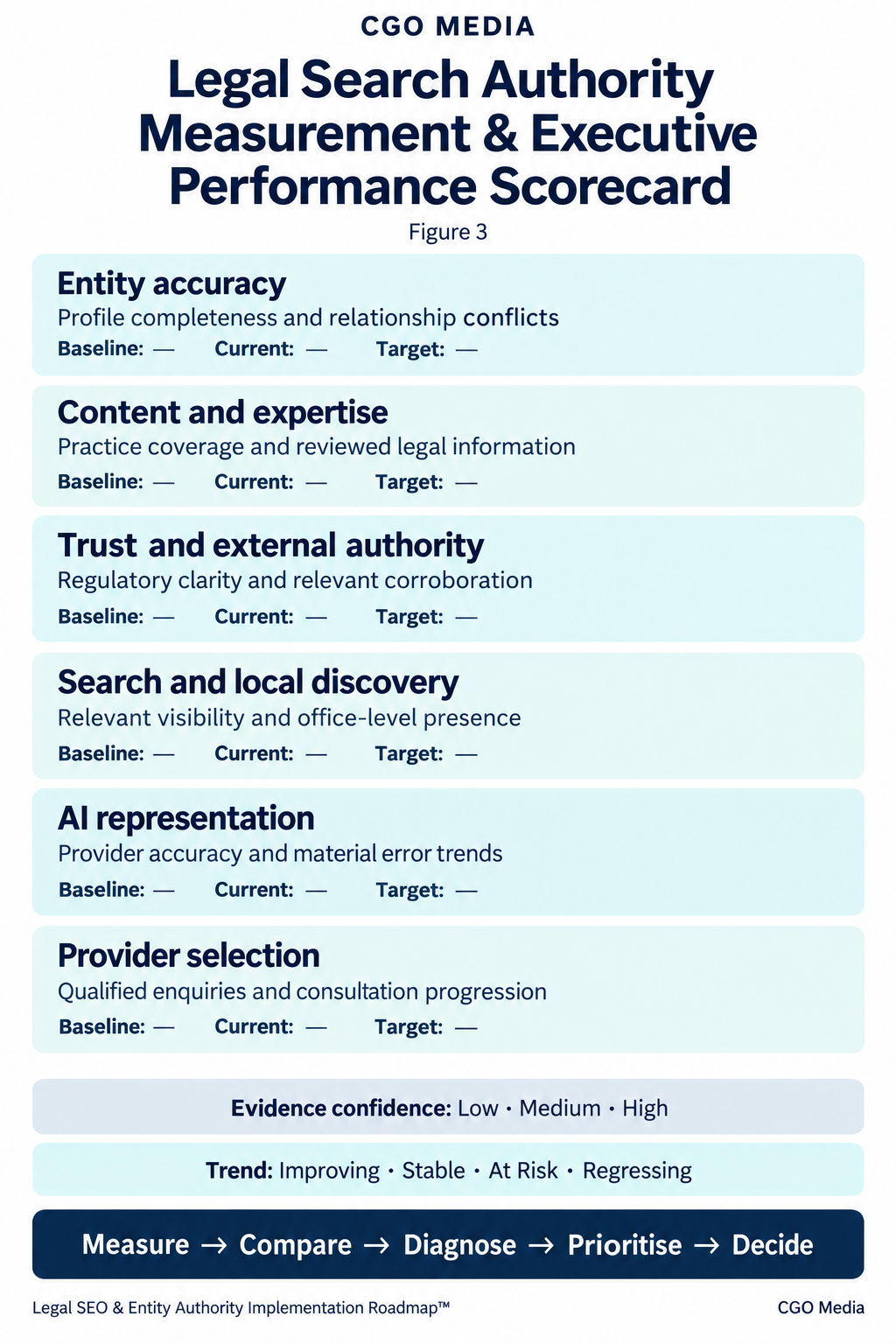
456. Practical Organisational Deployment
The six-stage roadmap becomes more useful when translated into a realistic programme of work with clear ownership, sequencing and implementation horizons.
457. Deployment Should Reflect Organisational Scale
A specialist legal practice may implement the roadmap through a compact central team, while a multi-office or international firm may require several coordinated workstreams.
458. Avoid Launching Every Workstream at Once
Attempting to correct data, rebuild content, strengthen professional authority, expand Digital PR and introduce AI monitoring simultaneously can create unnecessary operational complexity.
459. Sequence Work According to Dependency
A practical order is:
Critical Accuracy → Entity Structure → Professional & Content Authority → External Authority → Measurement → Governance
460. Establish a Programme Sponsor
Larger implementation programmes benefit from a senior sponsor capable of resolving cross-functional ownership issues.
461. Establish a Programme Lead
A named programme lead should coordinate:
- Scope
- Priorities
- Owners
- Dependencies
- Reporting
462. Create Core Implementation Workstreams
The roadmap can be deployed through six practical workstreams:
- Entity and Technical Architecture
- Legal Content and Practice Authority
- Professional Authority
- Trust, Reputation and Local Authority
- External Authority and Digital PR
- AI Search, Measurement and Governance
463. Workstream One — Entity and Technical Architecture
This workstream establishes the factual and structural foundation of the programme.
464. Entity Workstream Responsibilities
Potential responsibilities include:
- Entity inventory
- Organisation identity
- Office data
- Professional relationships
- Practice architecture
- Structured data
465. Technical Architecture Responsibilities
Potential responsibilities include:
- Crawlability
- Indexability
- Canonicalisation
- Internal linking
- Template architecture
- Structured-data implementation
466. Workstream Two — Legal Content and Practice Authority
This workstream strengthens the information environment supporting strategic legal expertise.
467. Legal Content Responsibilities
Potential responsibilities include:
- Practice-area architecture
- Service-page development
- Matter-type coverage
- Legal guides
- Jurisdictional clarity
- Review governance
468. Practice Leadership Should Participate
Practice leaders or appropriate professionals should help validate which services, topics and legal issues genuinely represent the firm’s capability.
469. Workstream Three — Professional Authority
This workstream strengthens the digital representation of relevant lawyers and professional teams.
470. Professional Authority Responsibilities
Potential responsibilities include:
- Profile standards
- Qualifications
- Practice mappings
- Office mappings
- Publications
- External professional profiles
471. Professional Authority Should Be Evidence-Led
The workstream should prioritise genuine expertise and current professional evidence rather than promotional language alone.
472. Workstream Four — Trust, Reputation and Local Authority
This workstream supports the evidence prospective clients may use when validating the organisation and its professionals.
473. Trust Workstream Responsibilities
Potential responsibilities include:
- Regulatory information
- Client-care content
- Review governance
- Reputation evidence
- Fee information where relevant
474. Local Authority Responsibilities
Potential responsibilities include:
- Office pages
- Local profile accuracy
- Professional-office relationships
- Practice availability
- Local reviews
475. Workstream Five — External Authority and Digital PR
This workstream develops relevant third-party corroboration around strategic legal expertise.
476. External Authority Responsibilities
Potential responsibilities include:
- Legal directories
- Institutional profiles
- Editorial coverage
- Research citations
- Professional commentary
477. Digital PR Responsibilities
Potential responsibilities include:
- Expert commentary
- Data-led research
- Legal trend studies
- Journalist relationships
- Practice-aligned media opportunities
478. Workstream Six — AI Search, Measurement and Governance
This workstream monitors representation, measures authority development and maintains the operating model.
479. AI Search Responsibilities
Potential responsibilities include:
- Prompt-set development
- Representation monitoring
- Error classification
- Source diagnostics
- Longitudinal tracking
480. Measurement Responsibilities
Potential responsibilities include:
- Authority scorecards
- Search visibility
- Provider-selection metrics
- Evidence confidence
- Trend reporting
481. Governance Responsibilities
Potential responsibilities include:
- Named ownership
- Review cycles
- Change triggers
- Escalation
- Reassessment
482. Workstreams Should Share One Authority Model
The six workstreams should not operate as independent marketing projects.
They should work against the same:
- Entity definitions
- Practice priorities
- Professional records
- Evidence standards
- Measurement framework
483. Establish a Single Priority Register
The implementation programme should maintain one central register of strategic actions.
484. Priority Register Fields
Each action may record:
- Workstream
- Affected entity
- Issue or opportunity
- Priority
- Owner
- Target date
- Status
485. Separate Critical Issues from Growth Initiatives
A professional-status error should not compete directly with a low-risk content expansion opportunity.
486. Build a 30-Day Foundation Phase
The first 30 days should focus primarily on assessment, critical accuracy and programme structure.
487. Days 1–10 — Scope and Baseline
Initial actions may include:
- Define priority practices
- Define priority offices
- Define priority professionals
- Create entity inventory
- Establish baseline metrics
488. Days 1–10 — Critical Accuracy Review
Identify material problems involving:
- Professional status
- Firm affiliation
- Office data
- Regulatory information
- Jurisdiction
489. Days 1–10 — AI Baseline
Run an initial controlled observation set covering:
- Brand
- Professionals
- Practice areas
- Locations
490. Days 11–20 — Critical Corrections
Begin correcting the highest-risk inaccuracies across controlled and priority external environments.
491. Days 11–20 — Professional Audit
Audit priority lawyer profiles for:
- Completeness
- Accuracy
- Practice relationships
- External consistency
492. Days 11–20 — Practice Architecture Audit
Identify missing or weak relationships across:
Practice Area → Service → Professional → Office → Jurisdiction
493. Days 11–20 — Legal Content Risk Audit
Identify priority content that is:
- Outdated
- Unreviewed
- Jurisdictionally unclear
- Poorly connected with professionals
494. Days 21–30 — Establish Standards
Create minimum standards for:
- Organisation entities
- Office entities
- Professional profiles
- Practice pages
- Legal content
495. Days 21–30 — Establish Ownership
Assign named owners for the most important evidence classes.
496. Days 21–30 — Establish Critical Change Triggers
At minimum, create processes for:
- Professional joins
- Professional departures
- Promotions
- Office changes
497. Days 21–30 — Create the First Executive Baseline
Leadership should receive an initial view of:
- Critical risks
- Authority maturity
- Strategic gaps
- Priority workstreams
498. 30-Day Deliverables
By the end of the initial phase, the organisation should aim to have:
- Defined scope
- Entity inventory
- Critical issue register
- Authority baseline
- Initial AI baseline
- Named owners
499. Build a 60-Day Structure and Strengthening Phase
Days 31–60 should begin moving from correction toward repeatable authority development.
500. Days 31–45 — Entity Architecture
Formalise the relationships between:
- Firm
- Offices
- Professionals
- Practices
- Services
- Jurisdictions
501. Days 31–45 — Professional Profile Programme
Upgrade priority professional profiles against the agreed standard.
502. Days 31–45 — Priority Legal Content Review
Review high-value content for:
- Accuracy
- Depth
- Freshness
- Jurisdiction
- Professional attribution
503. Days 31–45 — Local Authority Cleanup
Correct priority office and professional-location inconsistencies.
504. Days 31–45 — External Profile Cleanup
Begin improving the most strategically important third-party sources.
505. Days 46–60 — Practice Authority Expansion
Develop stronger content around priority:
- Practice areas
- Services
- Matter types
- Client questions
506. Days 46–60 — Professional Evidence Expansion
Strengthen relevant evidence such as:
- Publications
- Speaking
- Sector expertise
- Representative experience
- Recognition
507. Days 46–60 — Trust Architecture
Improve the placement and clarity of:
- Regulatory information
- Client-care information
- Review evidence
- Recognition
508. Days 46–60 — Initial External Authority Plan
Identify:
- Target publications
- Relevant legal directories
- Research opportunities
- Expert-commentary opportunities
509. Days 46–60 — AI Monitoring Expansion
Expand the observation set beyond branded prompts into:
- Professional discovery
- Practice discovery
- Local discovery
- Provider comparison
510. 60-Day Deliverables
By this stage, the organisation should aim to have:
- Core authority architecture
- Improved priority profiles
- Stronger strategic practice content
- Cleaner external evidence
- Defined trust improvements
- Expanded AI monitoring
511. Build a 90-Day Integration Phase
Days 61–90 should connect the separate workstreams into a more coherent operating system.
512. Days 61–75 — Integrate Content and Professional Authority
Ensure priority legal content connects naturally with relevant professionals and practices.
513. Days 61–75 — Integrate Office and Practice Authority
Ensure strategic offices represent the services and professionals genuinely available from those locations.
514. Days 61–75 — Integrate Trust Evidence
Connect trust information with the provider-selection journey.
515. Days 61–75 — Launch Priority External Authority Activity
Begin focused activity around:
- Research
- Digital PR
- Expert commentary
- Citations
- Professional publications
516. Days 61–75 — Build Initial Authority Scorecards
Measure:
- Entity clarity
- Legal information authority
- Professional authority
- Trust
- External authority
- AI readiness
517. Days 76–90 — Compare Against Baseline
Determine whether the first implementation cycle has improved:
- Accuracy
- Coverage
- Evidence quality
- Authority maturity
- Provider-selection readiness
518. Days 76–90 — Review AI Representation
Compare monitored AI outputs against the initial baseline.
519. Days 76–90 — Identify Persistent AI Errors
Investigate issues that remain materially inaccurate across repeated observations.
520. Days 76–90 — Review Governance Performance
Determine whether:
- Owners are active
- Change triggers function
- Review cycles are realistic
- Escalation works
521. Days 76–90 — Define the Next Quarter
Use evidence from the first cycle to set the next priority portfolio.
522. 90-Day Deliverables
The organisation should aim to have:
- An integrated authority baseline
- Improved entity consistency
- Stronger priority practice authority
- Stronger professional evidence
- Active external authority development
- Operational AI monitoring
- Initial executive scorecards
523. The 90-Day Roadmap Is a Starting Structure
The exact sequence should be adapted to the organisation’s size, maturity, regulatory environment and available resources.
524. Smaller Firm Deployment
A smaller legal practice may combine several workstreams under a small number of owners.
525. Smaller Firm Priority Sequence
A practical sequence may be:
Accuracy → Professional Profiles → Practice Content → Local Trust → External Authority → Measurement
526. Medium-Sized Firm Deployment
A medium-sized legal firm may assign separate owners for:
- Content
- Professionals
- Local authority
- External authority
- Measurement
527. Large Firm Deployment
Large organisations may require parallel workstreams with central standards and decentralised implementation.
528. International Firm Deployment
International organisations may require:
- Global standards
- Jurisdiction-specific implementation
- Local professional verification
- Regional governance
529. Central Standards with Local Validation
A useful international model is:
Central Framework → Local Verification → Local Implementation → Central Measurement
530. Avoid Global Standardisation That Removes Legal Context
Global templates should not erase meaningful jurisdictional differences.
531. Prioritise Practices by Strategic Value
Potential prioritisation criteria may include:
- Revenue importance
- Growth potential
- Competitive pressure
- Professional strength
- Authority weakness
532. Prioritise Offices by Strategic Value
Potential criteria may include:
- Local demand
- Commercial importance
- Expansion plans
- Current authority gaps
533. Prioritise Professionals by Strategic Need
Potential criteria may include:
- Practice leadership
- Specialist expertise
- Client-facing importance
- External visibility opportunity
- Current evidence weakness
534. Prioritise Content by User and Business Need
Priority content should support both genuine legal information demand and the organisation’s real service capability.
535. Prioritise External Authority by Relevance
Focus on external environments capable of providing meaningful corroboration.
536. Prioritise AI Monitoring by Decision Value
Prompt sets should focus on scenarios that matter to:
- Provider discovery
- Professional evaluation
- Local selection
- Practice relevance
537. Implementation Should Distinguish Dependencies
Some tasks should happen before others.
538. Entity Data Is a Dependency
Reliable professional and office data should exist before advanced relationship automation.
539. Professional Profiles Are a Dependency
Strong professional pages are often necessary before professional authority can be amplified externally.
540. Practice Architecture Is a Dependency
A firm should know which services and professionals belong to each practice before expanding topic coverage extensively.
541. Trust Clarity Is a Dependency
Provider visibility should not be expanded while important trust and regulatory information remains materially unclear.
542. Research Quality Is a Dependency
Research-led Digital PR requires credible methodology and useful findings before outreach begins.
543. Measurement Is a Dependency for Scaling
Large-scale expansion should ideally follow evidence that earlier phases are producing useful outcomes.
544. Build Implementation Gates
Each major stage may include an evidence gate before the organisation proceeds to greater complexity.
545. Gate One — Accuracy Gate
Before scaling authority activity, confirm that critical professional, office, regulatory and jurisdictional errors are under control.
546. Gate Two — Structure Gate
Before large-scale content expansion, confirm that practice, service, professional and office relationships are sufficiently clear.
547. Gate Three — Evidence Gate
Before major external amplification, confirm that the underlying professional and legal evidence is substantive.
548. Gate Four — Measurement Gate
Before large-scale investment, confirm that the organisation can evaluate whether activity is working.
549. Gate Five — Governance Gate
Before relying heavily on automation or decentralised execution, confirm that ownership and change controls are sufficiently mature.
550. Resource Planning
The roadmap should translate into specific resource requirements rather than remaining an abstract strategy document.
551. People Requirements
Potential contributors may include:
- SEO specialists
- Content strategists
- Legal professionals
- Editors
- Digital PR specialists
- Data analysts
- Compliance teams
552. Technology Requirements
Potential systems may support:
- Analytics
- Search monitoring
- Entity inventories
- Content review
- AI observations
- Project management
553. Technology Should Support the Operating Model
Tools should solve defined workflow problems rather than determine the strategy.
554. Professional Time Is a Critical Resource
Authority development depends on genuine subject expertise and cannot be delegated entirely to marketing teams.
555. Protect Professional Time Through Better Workflows
Professional involvement can be focused on:
- Verification
- Expert commentary
- Review
- Research insight
- High-value content
556. Editorial Teams Can Operationalise Expertise
Specialist editors may help convert professional knowledge into structured information while preserving appropriate review.
557. Build an Implementation RACI Where Needed
Larger programmes may benefit from defining who is:
- Responsible
- Accountable
- Consulted
- Informed
558. Example Entity Workstream Ownership
SEO or digital teams may be responsible, while operations or business leadership remain accountable for factual organisational data.
559. Example Legal Content Ownership
Content teams may manage production while practice leaders or designated professionals provide subject verification.
560. Example Professional Profile Ownership
Marketing may manage presentation while HR, practice leadership and professionals validate factual information.
561. Example Regulatory Trust Ownership
Compliance or risk teams may own relevant regulatory accuracy while digital teams manage presentation.
562. Example AI Monitoring Ownership
SEO or AI-search teams may operate monitoring while affected professional and governance owners validate material findings.
563. Implementation Cadence
A practical programme may combine:
- Weekly operational reviews
- Monthly authority reviews
- Quarterly strategic reviews
- Annual maturity reassessment
564. Weekly Operational Review
Focus on:
- Critical corrections
- Blockers
- Professional changes
- Immediate delivery priorities
565. Monthly Authority Review
Focus on:
- Workstream progress
- Authority metrics
- AI representation
- New risks
566. Quarterly Strategic Review
Focus on:
- Practice priorities
- Resource allocation
- External authority strategy
- Target maturity
567. Annual Maturity Reassessment
Review the organisation against the AI Legal Entity Authority Maturity Model™ and reset the improvement portfolio accordingly.
568. Define Programme Success Carefully
Implementation success should not be reduced to a single traffic or ranking target.
569. Foundational Success
Indicators may include:
- Fewer critical conflicts
- Higher entity accuracy
- Stronger ownership
- Clearer practice relationships
570. Authority Success
Indicators may include:
- Stronger professional evidence
- Better legal information coverage
- More relevant external corroboration
- Improved trust architecture
571. Discovery Success
Indicators may include:
- Stronger relevant organic visibility
- Stronger local discovery
- More accurate AI representation
- Greater provider consideration
572. Commercial Success
Indicators may include:
- More qualified enquiries
- Stronger practice-level enquiry quality
- Better consultation progression
- Reduced unsuitable enquiry volume
573. Governance Success
Indicators may include:
- Faster correction
- Fewer recurring errors
- Better change propagation
- Higher evidence confidence
574. AI Success Should Be Defined Conservatively
Useful improvement may include:
- Greater representation accuracy
- Fewer material entity errors
- More appropriate provider inclusion
- More consistent source support
575. Do Not Guarantee AI Recommendation Outcomes
No implementation roadmap can guarantee inclusion, citation or recommendation by a particular AI system.
576. Do Not Guarantee Search Rankings
Authority improvements may support stronger search performance but do not guarantee a particular ranking position.
577. Do Not Guarantee Client Acquisition
Qualified visibility is only one component of legal client acquisition.
578. Provider Selection Depends on Additional Factors
These may include:
- Availability
- Fees
- Conflicts
- Client preference
- Specific matter requirements
579. Build a Rolling 12-Month Roadmap
After the first 90 days, the programme should develop into a rolling improvement plan.
580. Quarter Two Priorities
Potential priorities may include:
- Expand practice coverage
- Strengthen professional cohorts
- Increase research output
- Improve external authority
581. Quarter Three Priorities
Potential priorities may include:
- Extend the programme to additional offices
- Strengthen local authority
- Expand AI monitoring
- Improve provider-selection measurement
582. Quarter Four Priorities
Potential priorities may include:
- Reassess maturity
- Review governance effectiveness
- Retire weak initiatives
- Scale successful authority programmes
583. The Roadmap Should Remain Adaptive
Search systems, legal markets, professional teams and organisational priorities will change during implementation.
584. Evidence Should Determine Reprioritisation
The roadmap should change where measured evidence shows that previous assumptions were wrong.
585. Do Not Protect Low-Value Activity
Initiatives that consume resources without strengthening authority, user understanding or qualified discovery should be reconsidered.
586. Scale What Produces Durable Authority
Priority should be given to improvements that strengthen both immediate visibility and the organisation’s long-term evidence environment.
587. Deployment Creates the Bridge Between Strategy and Execution
The implementation roadmap is successful when authority principles become repeatable operational behaviour rather than isolated recommendations.
588. The Practical Deployment Equation
Organisational deployment can therefore be represented as:
Scope → Assign → Correct → Build → Integrate → Measure → Review → Scale
589. The Next Stage Is the Executive Implementation Scorecard
The roadmap can now be translated into a practical executive view showing workstream status, current authority maturity, target state, risk, evidence confidence and implementation priority.
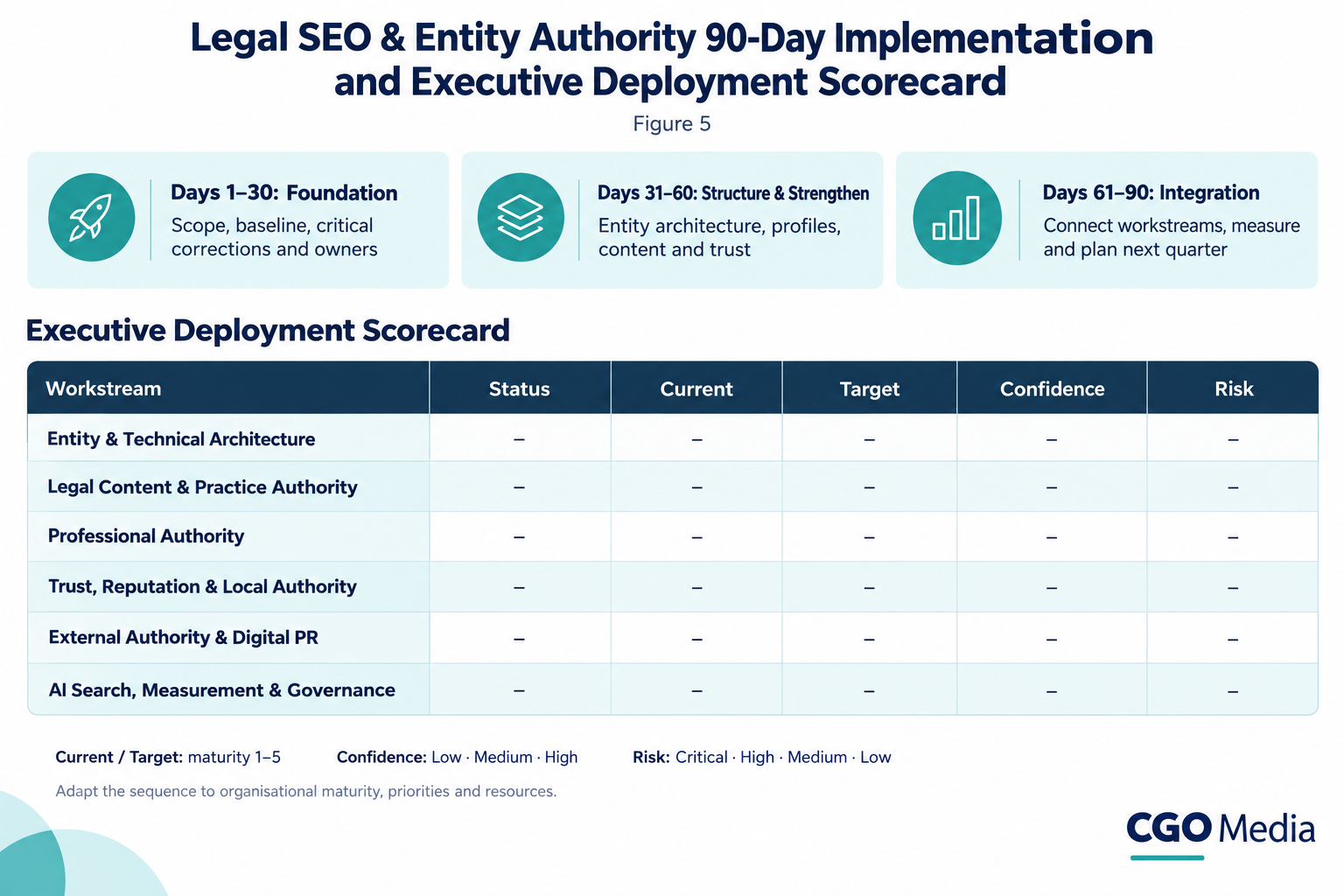
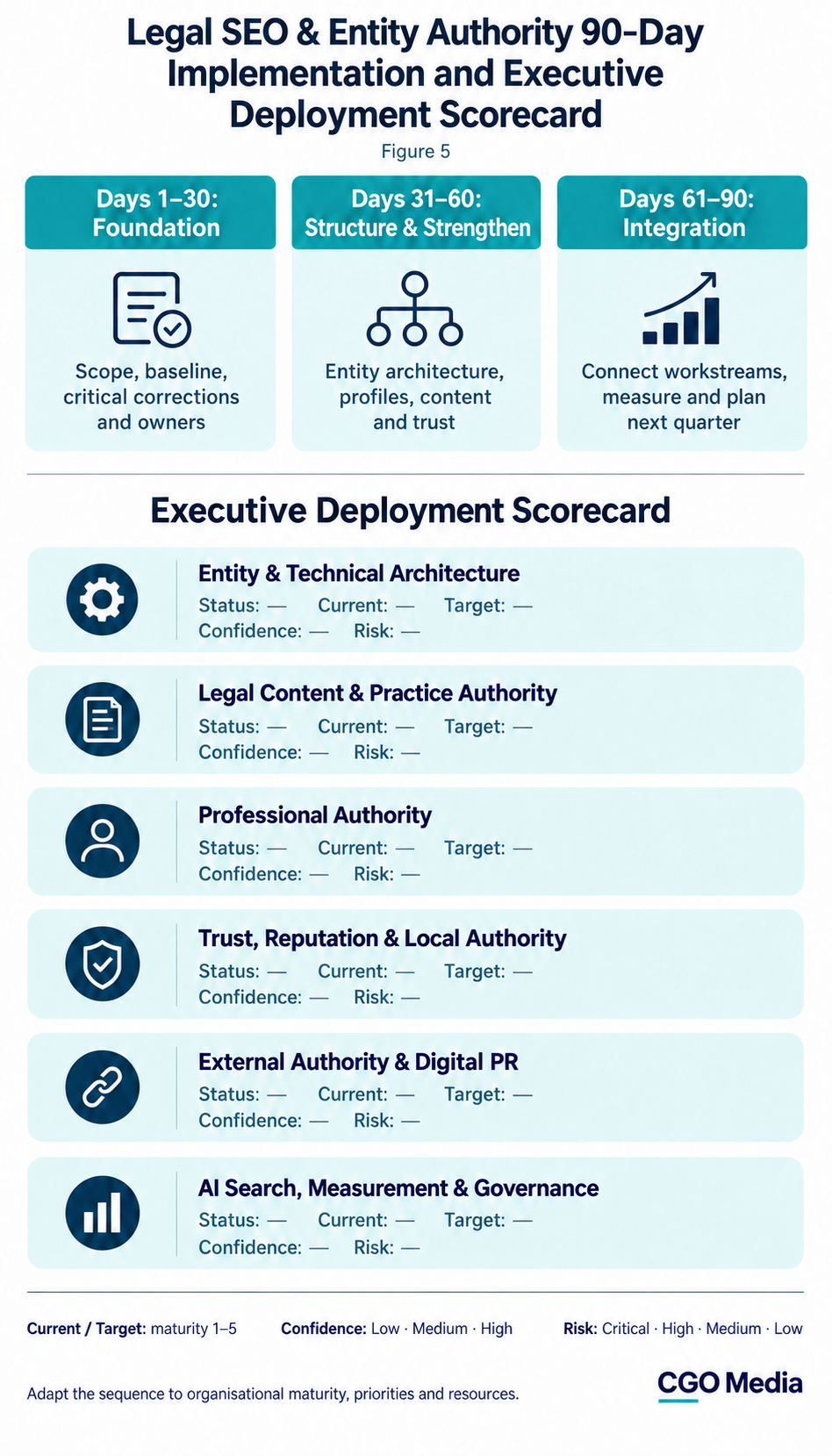
590. Executive Implementation Scorecard
The implementation programme should provide leadership with a concise view of progress across the major authority workstreams.
591. The Scorecard Should Combine Progress and Risk
A useful executive scorecard should not report completion alone.
It should show whether implementation is improving authority quality and reducing material risk.
592. Core Executive Scorecard Fields
Each workstream may include:
- Current status
- Current maturity
- Target maturity
- Evidence confidence
- Trend
- Risk
- Priority
593. Suggested Workstream Status
A practical implementation status may use:
- Not Started
- In Progress
- At Risk
- Blocked
- Operational
594. Entity and Technical Architecture Scorecard
Leadership should be able to see whether:
- Priority entities are defined
- Critical conflicts are falling
- Relationships are structured
- Technical implementation is reliable
595. Legal Content and Practice Authority Scorecard
Leadership should be able to see whether:
- Priority practices have adequate coverage
- High-risk content is reviewed
- Professional attribution is improving
- Jurisdictional clarity is strengthening
596. Professional Authority Scorecard
Leadership should be able to see whether:
- Priority profiles meet standards
- Professional relationships are accurate
- External profiles are consistent
- Lifecycle governance is functioning
597. Trust, Reputation and Local Authority Scorecard
Leadership should be able to see whether:
- Regulatory information is clear
- Client-care evidence is accessible
- Review governance is active
- Local profiles reflect operational reality
598. External Authority and Digital PR Scorecard
Leadership should be able to see whether:
- Priority directory profiles are accurate
- Relevant editorial authority is increasing
- Research is earning useful citations
- Digital PR aligns with genuine expertise
599. AI Search, Measurement and Governance Scorecard
Leadership should be able to see whether:
- AI monitoring is repeatable
- Material errors are declining
- Provider presence is relevant
- Governance and reporting are operational
600. Example Executive Implementation Scorecard
| Workstream | Status | Current Maturity | Target | Confidence | Risk |
|---|---|---|---|---|---|
| Entity & Technical Architecture | Not Started / In Progress / At Risk / Operational | 1–5 | 1–5 | Low / Medium / High | Critical / High / Medium / Low |
| Legal Content & Practice Authority | Not Started / In Progress / At Risk / Operational | 1–5 | 1–5 | Low / Medium / High | Critical / High / Medium / Low |
| Professional Authority | Not Started / In Progress / At Risk / Operational | 1–5 | 1–5 | Low / Medium / High | Critical / High / Medium / Low |
| Trust, Reputation & Local Authority | Not Started / In Progress / At Risk / Operational | 1–5 | 1–5 | Low / Medium / High | Critical / High / Medium / Low |
| External Authority & Digital PR | Not Started / In Progress / At Risk / Operational | 1–5 | 1–5 | Low / Medium / High | Critical / High / Medium / Low |
| AI Search, Measurement & Governance | Not Started / In Progress / At Risk / Operational | 1–5 | 1–5 | Low / Medium / High | Critical / High / Medium / Low |
601. Completion Percentage Should Be Interpreted Carefully
A workstream may be 80% complete while the remaining 20% contains the highest-risk unresolved issues.
602. Report Critical Open Issues Separately
Leadership should see material unresolved problems outside general progress percentages.
603. Report Blockers Explicitly
A blocked workstream should identify:
- The dependency
- The affected owner
- The consequence
- The required decision
604. Report Evidence Confidence
Implementation decisions should show whether the supporting evidence is high, medium or low confidence.
605. Report Trend
A programme should identify whether authority is:
- Improving
- Stable
- At Risk
- Regressing
606. Report Current Versus Target Maturity
This helps leadership distinguish activity completion from actual capability improvement.
607. Report Implementation Velocity
Where useful, measure the rate at which priority actions move from identification to verified completion.
608. Time to Correct Critical Errors
Track how quickly material professional, regulatory, office and jurisdictional problems are resolved.
609. Time to Update Professional Changes
Measure how long it takes significant professional changes to propagate across priority environments.
610. Time to Review High-Risk Content
Track whether material legal-information changes trigger sufficiently rapid review.
611. Time to Resolve Persistent AI Errors
Measure the period between identifying a material representation problem and completing the relevant evidence remediation.
612. Implementation Quality Matters More Than Speed Alone
Rapid deployment should not come at the cost of inaccurate professional or legal information.
613. Verify Workstream Completion
A task should not be marked complete merely because content has been published or a profile has been edited.
614. Entity Workstream Completion
Completion may require verification that:
- The relationship is correct
- Priority conflicts are resolved
- The update is visible where expected
615. Content Workstream Completion
Completion may require:
- Professional review
- Jurisdictional confirmation
- Internal relationship checks
- Publishing validation
616. Professional Workstream Completion
Completion may require checking relevant first-party and priority external profiles.
617. External Authority Workstream Completion
A PR campaign should not be judged solely by whether coverage was obtained.
618. External Authority Outcome Quality
Evaluate:
- Relevance
- Source quality
- Expert attribution
- Practice alignment
- Citation value
619. AI Workstream Completion
One favourable generated answer should not be treated as completion.
620. AI Improvement Requires Longitudinal Evidence
Repeated observations should indicate whether representation has become more accurate and resilient.
621. Implementation Risk Management
A structured roadmap should maintain a programme-level risk register.
622. Risk Category One — Accuracy Risk
The programme may inadvertently publish or propagate incorrect professional or organisational information.
623. Accuracy Risk Controls
Potential controls include:
- Verification
- Approval workflows
- Authoritative source records
- Audit trails
624. Risk Category Two — Regulatory Risk
Digital content or professional profiles may represent regulatory relationships inaccurately.
625. Regulatory Risk Controls
Higher-risk information should be verified by appropriate organisational owners.
626. Risk Category Three — Jurisdictional Risk
Legal information may be interpreted outside the jurisdiction for which it was intended.
627. Jurisdictional Risk Controls
Potential controls include:
- Explicit jurisdiction labels
- Professional review
- Separated market content
- Appropriate disclaimers
628. Risk Category Four — Professional Reputation Risk
Poorly governed profiles, inaccurate expertise claims or outdated affiliations may damage professional credibility.
629. Risk Category Five — Brand Authority Risk
Inconsistent firm identities or conflicting external information may weaken trust.
630. Risk Category Six — Local Authority Risk
Artificial, inaccurate or outdated office information may create misleading local discovery.
631. Risk Category Seven — Content Quality Risk
Scaling content too rapidly may produce generic, duplicative or weakly reviewed legal information.
632. Risk Category Eight — External Authority Risk
Low-quality outreach or irrelevant placements may consume resources without strengthening meaningful authority.
633. Risk Category Nine — AI Interpretation Risk
Teams may overreact to individual AI outputs or draw causal conclusions from incomplete source evidence.
634. Risk Category Ten — Measurement Risk
Weak attribution may lead the organisation to overvalue or undervalue particular workstreams.
635. Risk Category Eleven — Governance Risk
Implementation may depend too heavily on individual staff members or undocumented processes.
636. Risk Category Twelve — Over-Engineering
The organisation may introduce excessive process complexity for low-risk authority tasks.
637. Risk Controls Should Be Proportionate
Governance should increase with the potential impact of an error.
638. Implementation Failure Modes
Several recurring failure patterns can weaken the roadmap even where substantial activity is taking place.
639. Failure Mode — Starting with AI Instead of Foundations
Building complex generative-search tracking before resolving basic professional and entity inaccuracies reverses the intended roadmap sequence.
640. Failure Mode — Treating AI SEO as a Separate Silo
AI readiness should be integrated with:
- Entity clarity
- Content authority
- Professional evidence
- External corroboration
641. Failure Mode — Publishing Before Structuring
Large-scale content production may increase fragmentation if practice, service and professional relationships remain unclear.
642. Failure Mode — Over-Connecting Professionals
Associating every lawyer with every possible service may reduce rather than increase entity clarity.
643. Failure Mode — Generic Professional Profiles
Biography length does not compensate for weak evidence of genuine practice expertise.
644. Failure Mode — Confusing Firm Authority with Professional Authority
A strong brand does not automatically demonstrate that every professional has equivalent authority for every practice area.
645. Failure Mode — Confusing Professional Authority with Firm Authority
One highly recognised lawyer does not automatically establish strong authority across the entire organisation.
646. Failure Mode — Treating Reviews as Legal Competence Evidence
Client feedback may describe experience but should not be used as a substitute for professional evidence.
647. Failure Mode — Treating Awards as Universal Authority
Recognition should remain tied to its actual year, category, professional, practice or jurisdiction.
648. Failure Mode — Building Artificial Local Presence
Creating location signals unsupported by genuine operational presence undermines the roadmap’s evidence principles.
649. Failure Mode — Chasing Link Volume
Large numbers of weak or irrelevant links should not replace meaningful external authority.
650. Failure Mode — Digital PR Without Expertise
Media visibility may produce limited strategic value where commentary is disconnected from genuine professional capability.
651. Failure Mode — Research Without Methodology
Data-led authority assets should not present unsupported estimates or opaque methods as established research findings.
652. Failure Mode — No Citation Architecture
Useful research may receive less external reuse when authorship, publication details and citation guidance are unclear.
653. Failure Mode — Structured Data Without Visible Evidence
Schema should not be used to manufacture relationships or authority claims that the organisation cannot substantiate.
654. Failure Mode — Measuring Traffic Only
Traffic growth may conceal weak:
- Enquiry quality
- Professional evaluation
- Trust progression
- Provider fit
655. Failure Mode — Measuring Leads Only
Higher enquiry volume may be undesirable if unsuitable matters increase disproportionately.
656. Failure Mode — Last-Click Attribution Only
The final website visit may understate earlier influence from AI, directories, referrals or professional searches.
657. Failure Mode — Treating One AI Output as a KPI
A single favourable or unfavourable answer is too unstable to support strong conclusions.
658. Failure Mode — Treating Recommendation Order as Ranking
Provider sequence within a generated response should not be interpreted as a permanent market ranking.
659. Failure Mode — Automating Unverified Data
Automation can spread incorrect entity relationships quickly if the underlying records are weak.
660. Failure Mode — No Human Verification
Professional and regulatory evidence may require appropriate human confirmation before publication.
661. Failure Mode — No Named Owner
Tasks assigned only to broad departments are more likely to become delayed or forgotten.
662. Failure Mode — No Change Triggers
Quarterly audits cannot compensate fully for professional departures, office moves or material legal changes requiring faster action.
663. Failure Mode — No Reassessment
Implementation actions may be completed without proving that the underlying authority capability improved.
664. Failure Mode — Scaling Before Learning
Expanding a weak process across every office or practice can multiply inefficiency.
665. Pilot, Measure and Scale
A more resilient sequence is:
Pilot → Verify → Measure → Improve → Standardise → Scale
666. Select a Representative Pilot
A pilot should be strategically important enough to matter but sufficiently manageable to expose workflow problems.
667. Pilot One Practice Area
A practice-level pilot may test:
- Content architecture
- Professional mapping
- External authority
- AI monitoring
668. Pilot One Office
A location pilot may test:
- Office entity governance
- Local profiles
- Professional relationships
- Local AI accuracy
669. Pilot One Professional Cohort
A professional pilot may test profile standards and lifecycle governance before firm-wide deployment.
670. Learn Before Standardising
Pilot findings should inform the final operating standard.
671. Standardise Before Scaling
Once the organisation has a proven process, expand it to additional practices, offices or professionals.
672. Scale with Quality Controls
Expansion should include sampling and verification to confirm standards remain intact.
673. Build the Rolling 12-Month Improvement Cycle
The roadmap should evolve from the initial 90-day deployment into a continuous annual programme.
674. Months 1–3 — Foundation and Integration
Priority focus:
- Assessment
- Critical corrections
- Core entity architecture
- Professional standards
- Initial measurement
675. Months 4–6 — Authority Expansion
Priority focus:
- Practice-depth expansion
- Professional authority
- Research assets
- Digital PR
- External citations
676. Months 4–6 — Expand AI Observation
Move from baseline monitoring toward longitudinal comparison of:
- Brand
- Professionals
- Practices
- Locations
- Competitor sets
677. Months 7–9 — Scale Proven Workstreams
Extend successful processes to:
- Additional practices
- Additional professionals
- Additional offices
- Additional jurisdictions
678. Months 7–9 — Strengthen Measurement
Improve:
- Practice-level reporting
- Provider-selection metrics
- Authority scorecards
- AI trend analysis
679. Months 10–12 — Reassess Maturity
Use the AI Legal Entity Authority Maturity Model™ to compare current capability with the starting baseline.
680. Months 10–12 — Review Governance
Assess whether:
- Ownership remains effective
- Change triggers work
- Review cycles remain appropriate
- Critical issues are resolved promptly
681. Months 10–12 — Review Strategic Priorities
Practice and market priorities may have changed during the year.
682. Months 10–12 — Retire Weak Initiatives
Activities that consume resources without producing useful authority evidence should be reconsidered.
683. Months 10–12 — Expand Proven Initiatives
Successful authority programmes can be scaled where evidence supports further investment.
684. Annual Reassessment Should Reset the Roadmap
The next 12-month cycle should begin with updated:
- Authority baselines
- Maturity targets
- Risk priorities
- Practice priorities
- Resource allocations
685. The Roadmap Should Remain Evidence-Led
Implementation priorities should change when evidence changes.
686. Search Behaviour Will Change
Prospective clients may increasingly move between traditional search, local discovery, directories, recommendations and AI-generated answers.
687. AI Systems Will Change
Prompt behaviour, retrieval methods, citation patterns and provider descriptions may evolve.
688. Professional Teams Will Change
Lawyers will join, leave, specialise, relocate and develop new expertise.
689. Legal Markets Will Change
New legislation, economic conditions and client needs may change search behaviour and practice priorities.
690. Authority Governance Should Adapt Without Losing Foundations
The roadmap should remain flexible while preserving:
- Accuracy
- Evidence
- Professional verification
- Trust
- Governance
691. The Complete Annual Improvement Model
The operating cycle can be represented as:
Assess → Correct → Structure → Strengthen → Measure → Govern → Learn → Reassess → Scale
692. The Roadmap Connects Strategy, Execution and Learning
The programme should continually move between:
Research → Implementation → Measurement → Governance → Learning
693. The Roadmap Should Increase Organisational Capability
The ultimate objective is not to complete a list of SEO tasks.
It is to create stronger internal capability for maintaining legal authority across changing search and AI discovery environments.
694. The Long-Term Implementation Outcome
A successful programme should leave the organisation with:
- Clearer entities
- Stronger professional evidence
- Better governed legal information
- More credible external authority
- More accurate local representation
- Stronger AI readiness
- More effective measurement
- More resilient governance
695. The Final Roadmap Equation
The complete implementation logic can therefore be represented as:
Accuracy → Structure → Authority → Measurement → Governance → Resilience → Continuous Improvement
696. The Next Step Is Final Strategic Integration
The final section will consolidate the roadmap’s strategic implications, methodology, limitations and relationship with the wider CGO Media Legal research architecture.
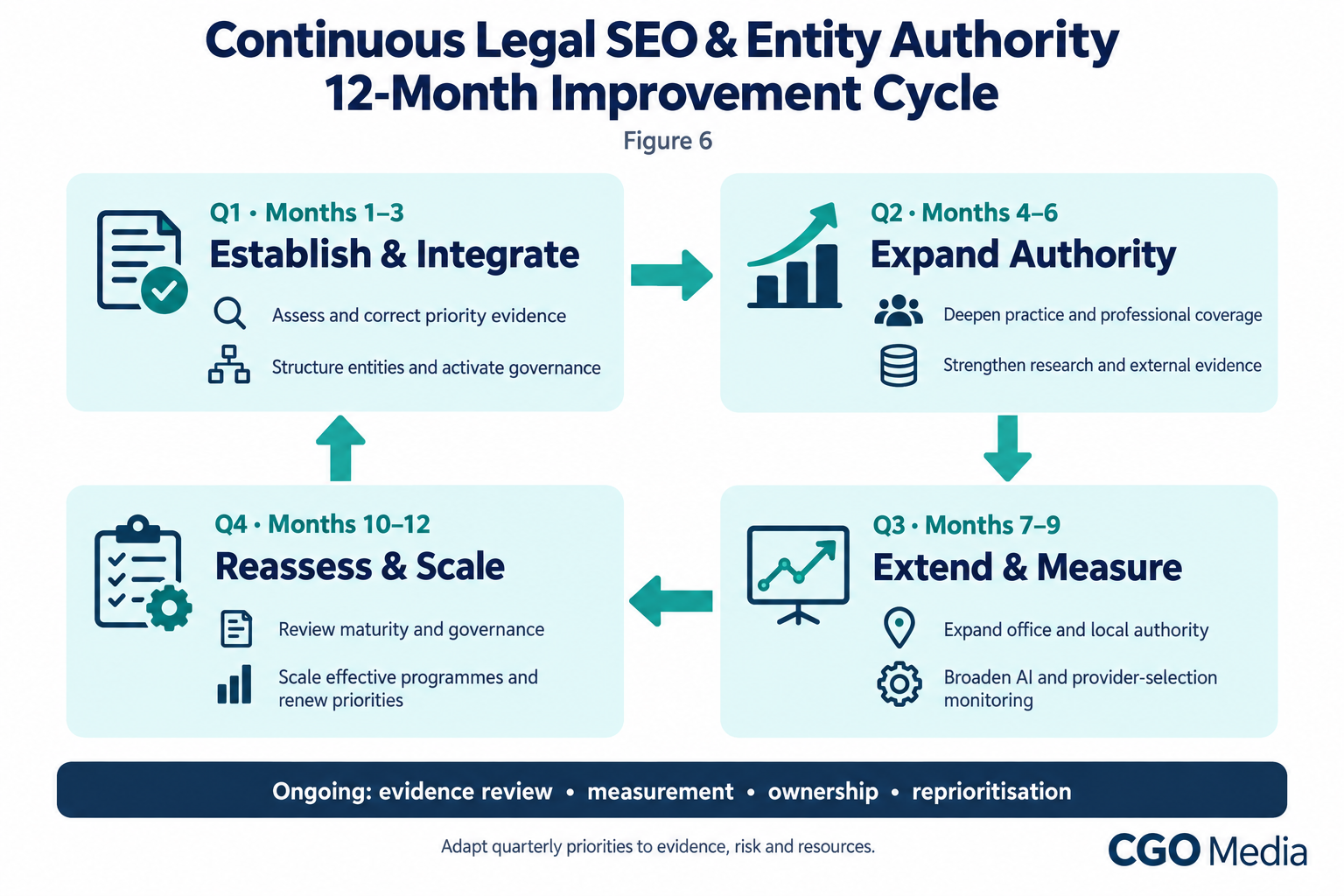
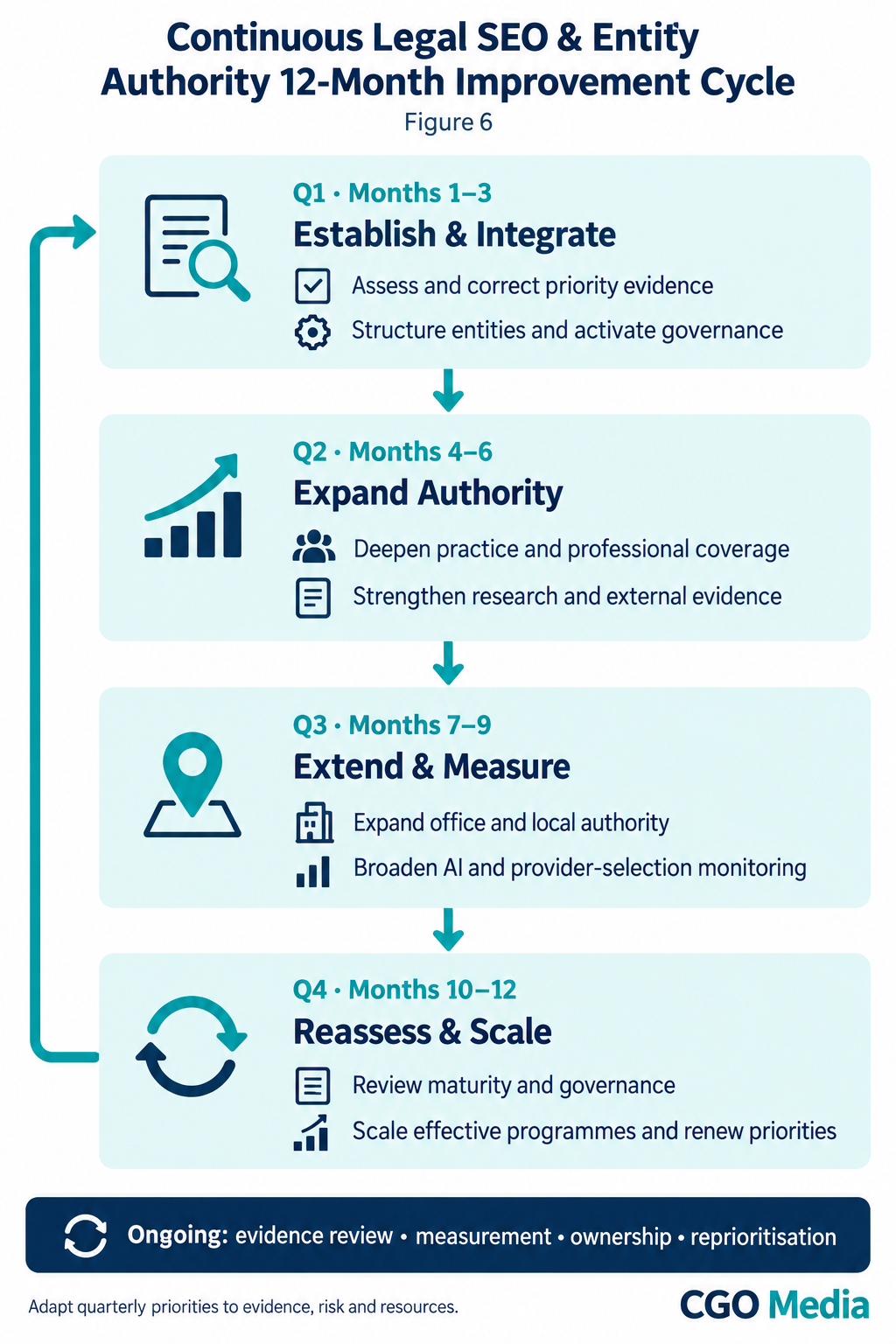
697. Strategic Implications
The Legal SEO and Entity Authority Implementation Roadmap™ provides a structured method for moving from research and diagnosis into practical organisational action.
Its central principle is that legal search authority should be built in sequence rather than through isolated activity.
698. Implementation Begins with Accuracy
The roadmap places factual accuracy ahead of optimisation because incorrect professional, office, regulatory or jurisdictional information can weaken both user trust and machine interpretation.
699. Structure Comes Before Scale
Legal organisations should establish clear relationships between firms, offices, professionals, practice areas, services and jurisdictions before expanding content or external authority aggressively.
700. Authority Strengthening Should Follow Structure
Once the underlying entity system is sufficiently reliable, the organisation can strengthen:
- Legal information
- Professional authority
- Regulatory and client trust
- External corroboration
- Local authority
- AI recommendation readiness
701. Measurement Converts Activity into Management
The roadmap does not treat traffic, rankings or AI presence as sufficient measures of success.
A stronger measurement system considers:
- Accuracy
- Authority
- Evidence confidence
- Provider-selection progression
- Qualified enquiries
- Governance maturity
702. Governance Protects Authority Investment
Search authority deteriorates when professional changes, office changes, legal developments and external-source changes are not reflected across the evidence environment.
703. Change Triggers Are Therefore Essential
The roadmap integrates authority maintenance with real organisational events including:
- Professional joins
- Departures
- Promotions
- Office moves
- Practice changes
- Rebrands
- Mergers
704. Legal Authority Should Be Cross-Functional
Search and AI representation cannot be governed effectively by SEO teams alone.
The operating model may require coordination between:
Marketing + SEO + Practice Leadership + Knowledge + HR + Compliance + Operations + Data
705. AI Search Should Not Become a Separate Silo
AI representation should be treated as an additional discovery and interpretation layer built on the same underlying authority system.
706. AI Readiness Depends on the Evidence Environment
A durable AI-readiness strategy should strengthen:
Entity Clarity + Practice Authority + Professional Evidence + Trust + External Corroboration + Jurisdictional Accuracy
707. AI Presence Is Not the Strategic End Point
The objective is not simply to appear in more generated answers.
The objective is to increase the likelihood that the organisation is represented accurately, relevantly and within the correct professional context.
708. Recommendation Presence Does Not Equal Endorsement
Inclusion within an AI-generated provider list should not be interpreted as accreditation, legal endorsement or a guarantee of suitability.
709. Legal Provider Selection Remains Multi-Factor
Even where digital authority is strong, professional selection may depend on:
- Matter fit
- Jurisdiction
- Availability
- Fees
- Conflicts
- Client preference
710. Implementation Should Reduce Verification Friction
A strong authority environment should help users move more efficiently from legal information to relevant professional evaluation, trust validation and contact.
711. Implementation Should Improve Qualified Discovery
Success is better defined as:
Relevant Discovery → Accurate Evaluation → Qualified Enquiry → Suitable Instruction
712. Implementation Should Reduce Recurring Errors
A mature roadmap should not merely correct isolated problems.
It should improve the underlying system so the same class of error becomes less likely to recur.
713. Implementation Should Increase Authority Resilience
A stronger legal authority system should remain understandable as:
- Professionals change
- Offices change
- Practices evolve
- Search systems change
- AI systems change
714. The Strategic Implementation Sequence
The full roadmap can therefore be represented as:
Assess → Correct → Structure → Strengthen → Measure → Govern → Improve
715. Relationship with the CGO Media Legal Research Family
The Legal SEO and Entity Authority Implementation Roadmap™ completes the CGO Media Legal framework family by converting the preceding research, authority framework, provider-selection process and maturity model into an implementation system.
Legal SEO and Entity Authority | AI Legal Entity Authority Framework™ | AI Legal Information and Professional Selection Process™ | AI Legal Entity Authority Maturity Model™
716. Relationship with Legal SEO and Entity Authority
The parent paper Legal SEO and Entity Authority establishes the broader research context for legal search, professional discovery, trust and AI-assisted provider selection.
717. Relationship with the AI Legal Entity Authority Framework™
The AI Legal Entity Authority Framework™ identifies the six authority dimensions that the roadmap seeks to strengthen operationally.
718. Relationship with the AI Legal Information and Professional Selection Process™
The AI Legal Information and Professional Selection Process™ explains how prospective clients may move from legal need recognition through information research, professional evaluation, trust validation, comparison and selection.
719. Relationship with the AI Legal Entity Authority Maturity Model™
The AI Legal Entity Authority Maturity Model™ provides the diagnostic structure for determining current capability, target maturity and progression priorities.
720. Methodology
The Legal SEO and Entity Authority Implementation Roadmap™ is a conceptual implementation methodology developed by CGO Media to translate legal search, entity authority and AI-readiness principles into a sequenced organisational programme.
721. Six Primary Implementation Stages
The roadmap uses six primary stages:
- Assess
- Correct
- Structure
- Strengthen
- Measure
- Govern and Improve
722. Stage One Method — Assess
The initial assessment may examine:
- Organisation entities
- Offices
- Professionals
- Practice areas
- Legal information
- Trust evidence
- External authority
- AI representation
723. Stage Two Method — Correct
The correction stage prioritises material factual issues involving:
- Professional status
- Firm affiliation
- Office data
- Regulatory information
- Jurisdiction
724. Stage Three Method — Structure
The structure stage establishes more explicit relationships across:
Organisation → Office → Professional → Practice Area → Service → Matter Type → Jurisdiction
725. Stage Four Method — Strengthen
The strengthening stage develops:
- Legal information depth
- Professional evidence
- Trust signals
- Digital PR
- Citation authority
- Local authority
- AI readiness
726. Stage Five Method — Measure
The measurement stage may evaluate:
- Authority scores
- Evidence confidence
- Search visibility
- AI representation
- Provider-selection progression
- Qualified enquiries
727. Stage Six Method — Govern and Improve
The governance stage introduces:
- Named ownership
- Review cycles
- Change triggers
- Escalation
- Reassessment
728. Deployment Method
The roadmap can be implemented through coordinated workstreams covering:
- Entity and technical architecture
- Legal content and practice authority
- Professional authority
- Trust, reputation and local authority
- External authority and Digital PR
- AI search, measurement and governance
729. Initial 90-Day Structure
The roadmap proposes a flexible 30/60/90-day implementation model to help organisations move from assessment toward integrated authority management.
730. 30-Day Method
The initial phase emphasises:
- Scope
- Baseline assessment
- Critical correction
- Standards
- Ownership
731. 60-Day Method
The second phase emphasises:
- Entity structure
- Professional authority
- Legal content
- Trust
- External evidence
- AI monitoring
732. 90-Day Method
The third phase emphasises:
- Integration
- Measurement
- Governance testing
- Baseline comparison
- Next-quarter planning
733. Rolling 12-Month Method
After the initial implementation cycle, the roadmap shifts toward continuous expansion, measurement, maturity reassessment and governance.
734. Evidence-Led Prioritisation
Actions may be prioritised according to:
- Risk
- Strategic importance
- User impact
- Evidence confidence
- Implementation dependency
735. Evidence Confidence
Findings may be classified as:
- Low confidence
- Medium confidence
- High confidence
736. Risk Classification
Issues may be classified as:
- Critical
- High
- Medium
- Low
737. Measurement Interpretation
The roadmap encourages organisations to evaluate both performance and capability rather than treating any single metric as determinative.
738. Limitations
The Legal SEO and Entity Authority Implementation Roadmap™ is a conceptual research and implementation framework. It is not a legal, regulatory or professional compliance standard.
739. Implementation Priorities Will Differ
Appropriate sequencing may vary according to:
- Firm size
- Practice mix
- Geography
- Jurisdiction
- Resources
- Current maturity
740. The 30/60/90-Day Model Is Not Prescriptive
The implementation horizons are intended as a practical planning structure rather than a mandatory timetable.
741. Legal Content Requires Professional Oversight
The roadmap does not suggest that marketing, SEO or AI teams should independently determine substantive legal accuracy.
742. Regulatory Requirements Vary
Professional and organisational regulatory structures differ between jurisdictions and should be verified appropriately.
743. Professional Titles Vary
Legal professional titles, qualification systems and permissible representations differ between markets.
744. Reviews Have Limitations
Client reviews may provide evidence about service experience but do not establish legal competence.
745. Awards and Rankings Have Limitations
Recognition should be interpreted according to the relevant category, date, methodology, professional and jurisdiction.
746. Digital PR Has Limitations
Editorial coverage alone does not prove legal expertise or professional suitability.
747. Search Data Has Limitations
Rankings, impressions and traffic may change because of factors outside the organisation’s direct control.
748. Attribution Has Limitations
Legal provider journeys may involve offline referrals, cross-device behaviour and untracked AI-assisted discovery.
749. AI Monitoring Has Limitations
Generated results may vary by:
- Model
- Prompt
- Time
- Location
- Retrieval process
- Available evidence
750. Visible AI Sources May Be Incomplete
A generated system may not expose every source or signal contributing to an answer.
751. AI Source Appearance Does Not Establish Causation
A visible citation should not automatically be interpreted as the sole reason a provider was selected or described.
752. AI Recommendation Order Is Not a Stable Ranking
Provider ordering within a generated response can vary and should not be treated as a permanent league table.
753. The Roadmap Cannot Guarantee Search Rankings
Implementation may strengthen authority and search readiness but does not guarantee a particular organic or local position.
754. The Roadmap Cannot Guarantee AI Inclusion
No authority programme can guarantee citation, recommendation or provider inclusion by a particular AI system.
755. The Roadmap Cannot Guarantee Client Acquisition
Digital authority is only one part of professional selection and business development.
756. The Roadmap Does Not Provide Legal Advice
This framework concerns digital authority, search visibility, information architecture, governance and AI-assisted discovery. It does not constitute legal advice or determine the suitability of any legal professional or provider.
757. Conclusion
Legal search is evolving from a primarily page-and-ranking environment into a broader discovery ecosystem involving search engines, maps, professional profiles, directories, institutional sources, editorial evidence and AI-generated answers.
In that environment, legal organisations need more than isolated SEO campaigns.
They need a structured system for maintaining accurate entities, useful legal information, credible professional evidence, clear trust signals, relevant external corroboration and dependable governance.
The Legal SEO and Entity Authority Implementation Roadmap™ provides a practical progression from assessment and correction through structure, authority strengthening, measurement and continuous governance.
Its central implementation principle is:
Accuracy Before Scale. Structure Before Amplification. Evidence Before Claims. Governance Before Automation.
The long-term objective is to create an authority environment that remains useful to prospective clients, understandable to search systems and resilient as AI-assisted discovery continues to evolve.
References
External Academic, Technical and Search Sources
- Google Search Central. SEO Starter Guide.
- Google Search Central. Understand how structured data works.
- Schema.org. LegalService.
- Schema.org. Organization.
- Schema.org. Person.
- Hogan, A. et al. (2021). Knowledge Graphs. ACM Computing Surveys, 54(4).
- Metzger, M.J. (2007). Making Sense of Credibility on the Web: Models for Evaluating Online Information and Recommendations for Future Research. Journal of the American Society for Information Science and Technology, 58(13), 2078–2091.
- Ji, Z. et al. (2023). Survey of Hallucination in Natural Language Generation. ACM Computing Surveys, 55(12).
CGO Media Legal Research and Frameworks
- Wilkinson, R. (2026). Legal SEO and Entity Authority. CGO Media.
- Wilkinson, R. (2026). AI Legal Entity Authority Framework™. CGO Media.
- Wilkinson, R. (2026). AI Legal Information and Professional Selection Process™. CGO Media.
- Wilkinson, R. (2026). AI Legal Entity Authority Maturity Model™. CGO Media.
CGO Media Research Ecosystem
CGO Media Research Library | CGO Media Framework Library™ | CGO Media Research Architecture
About Roger Wilkinson
Roger Wilkinson is an independent researcher, SEO practitioner and founder of CGO Media with more than 25 years of experience in search, online visibility and business growth.
His research focuses on how artificial intelligence is reshaping search engines, recommendation systems, entity representation, digital authority and organisational visibility.
Roger is the creator of the CGO Framework Series, a collection of research-led methodologies designed to help organisations measure, improve and govern Search Visibility, AI Visibility and Digital Authority.
His work examines the relationship between Technical SEO, Entity Authority, Content Authority, Professional Authority, Citation Authority, Brand Signals, Knowledge Architecture and AI Search Readiness.
View Roger Wilkinson’s researcher profile →
Related Legal Research and Frameworks
Legal SEO and Entity Authority | AI Legal Entity Authority Framework™ | AI Legal Information and Professional Selection Process™ | AI Legal Entity Authority Maturity Model™ | Legal GEO: Generative Engine Optimisation™
Research Usage & Citation
CGO Media encourages researchers, journalists, legal organisations, professional-services firms, educators and industry professionals to reference this framework where it contributes to wider discussion and understanding of Legal SEO, Entity Authority, Professional Authority, AI Search, provider discovery and digital governance.
Reasonable quotations, summaries, figures and excerpts may be used in articles, reports, presentations, academic work and other publications provided appropriate acknowledgement is given to Roger Wilkinson and CGO Media.
Cite This Framework / Embed Citation
The Legal SEO and Entity Authority Implementation Roadmap™ by Roger Wilkinson at CGO Media provides a staged implementation model for legal organisations seeking to strengthen entity clarity, professional authority, trust, external corroboration, search visibility and AI recommendation readiness.
APA Citation
APA Citation: Wilkinson, R. (2026). Legal SEO and Entity Authority Implementation Roadmap™. CGO Media. https://cgomedia.com/legal-seo-and-entity-authority-implementation-roadmap/
Author: Roger Wilkinson | Published by: CGO Media
For permissions relating to extensive reproduction, commercial licensing or republication of substantial portions of this framework, please contact CGO Media directly.