
Legal SEO in an AI Search Environment
 About This Research Paper
Legal SEO in an AI Search Environment is the principal research paper within the CGO Media Legal AI Search and GEO Research Collection. It establishes the foundational research, legal industry context and strategic principles underpinning five additional specialist research papers covering AI trust and visibility, legal client discovery and provider selection, search authority maturity, implementation planning and Generative Engine Optimisation (GEO).
Together, these six freely available educational resources provide a structured understanding of how AI-powered search is transforming legal services discovery, client research, professional evaluation, law firm visibility and client acquisition. The collection places particular emphasis on professional credibility, regulatory compliance, verifiable qualifications, legal expertise, independent authority signals and the trust considerations involved when individuals and organisations select legal representation.
The research is designed for legal practices and organisations of all sizes, from independent solicitors, barristers, specialist legal advisers and small regional firms to established national practices, international law firms and multidisciplinary legal services organisations.
Readers can access the complete collection through the CGO Media legal sector research library.
Legal search is increasingly shaped by a combination of traditional search engines, AI-assisted discovery, professional profiles, firm websites, regulatory information, legal directories, reviews, publications and external authority signals.
For law firms, barristers, solicitors and other legal professionals, visibility is no longer determined only by whether a page ranks for a target keyword. Users increasingly evaluate whether a legal provider appears relevant, credible, professionally verifiable and suitable for a particular matter.
This research examines how legal SEO, entity authority, professional credibility and AI-assisted discovery interact across the modern legal search environment.
1. The Changing Legal Search Environment
Legal discovery has moved beyond a simple sequence of keyword search followed by website visit.
Users may now encounter legal information across:
- Traditional organic search
- Local search
- AI-generated answers
- Legal directories
- Professional profiles
- Regulatory sources
- Reviews
- Editorial and research environments
2. Legal Search Is a High-Trust Category
Legal decisions can involve substantial financial, professional, commercial or personal consequences.
Users therefore often require stronger trust evidence before selecting a legal provider than they might require for a lower-risk service.
3. Legal Visibility Is Not Enough
A law firm may rank prominently and still fail to convert attention into genuine consideration if users cannot establish:
- Relevant expertise
- Professional identity
- Regulatory status
- Practice-area fit
- Location suitability
- Trustworthiness
4. Legal Search Should Be Viewed as an Authority System
A more complete model is:
Discoverability → Relevance → Professional Verification → Trust → Comparison → Contact
5. The Legal Decision Journey
A typical legal journey may involve:
Problem Recognition → Legal Information Research → Practice Area Discovery → Firm Discovery → Lawyer Verification → Trust Validation → Comparison → Enquiry
6. Legal Search Intent Is Diverse
Legal users may begin with very different levels of knowledge.
7. Problem-Led Search
A user may begin with a situation rather than a legal term.
Examples may involve:
- A dispute
- An employment issue
- A family matter
- A property problem
- A business conflict
8. Legal-Term Search
More informed users may search directly for:
- A legal process
- A legal remedy
- A specific area of law
- A procedural question
9. Practice-Area Search
Users may search for:
- Employment lawyer
- Family solicitor
- Commercial litigation firm
- Property solicitor
- Immigration lawyer
10. Professional-Led Search
Some users may already know the name of a solicitor, barrister, partner or legal professional and search specifically to verify them.
11. Firm-Led Search
Branded search may focus on:
- Firm reputation
- Practice areas
- Lawyer profiles
- Reviews
- Locations
12. Local Legal Search
Geography can remain important, particularly where users prefer a nearby office, local court experience or face-to-face consultation.
13. AI-Assisted Legal Discovery
Users may increasingly ask AI systems to explain:
- Legal concepts
- Possible next steps
- Types of lawyer
- Law firms
- Provider differences
14. AI Adds an Interpretation Layer
AI systems may synthesise information from multiple source environments into one response.
This creates a stronger requirement for consistent legal entity and professional information.
15. Legal Information and Legal Advice Should Be Distinguished
General legal information can help users understand concepts and possible processes, but it should not be represented automatically as advice appropriate to every individual situation.
16. The Legal Search Evidence Environment
Users and automated systems may encounter evidence from:
- Law firm websites
- Lawyer profiles
- Regulatory registers
- Legal directories
- Professional bodies
- Court or case references
- Research and publications
- Reviews
- Media coverage
17. Legal Authority Is Distributed
The authority of a legal provider is rarely represented in one place.
It is distributed across firm, professional, regulatory and external information environments.
18. Entity Authority Provides the Foundation
Legal SEO becomes more resilient when the organisation clearly represents the entities that make up the firm and their relationships.
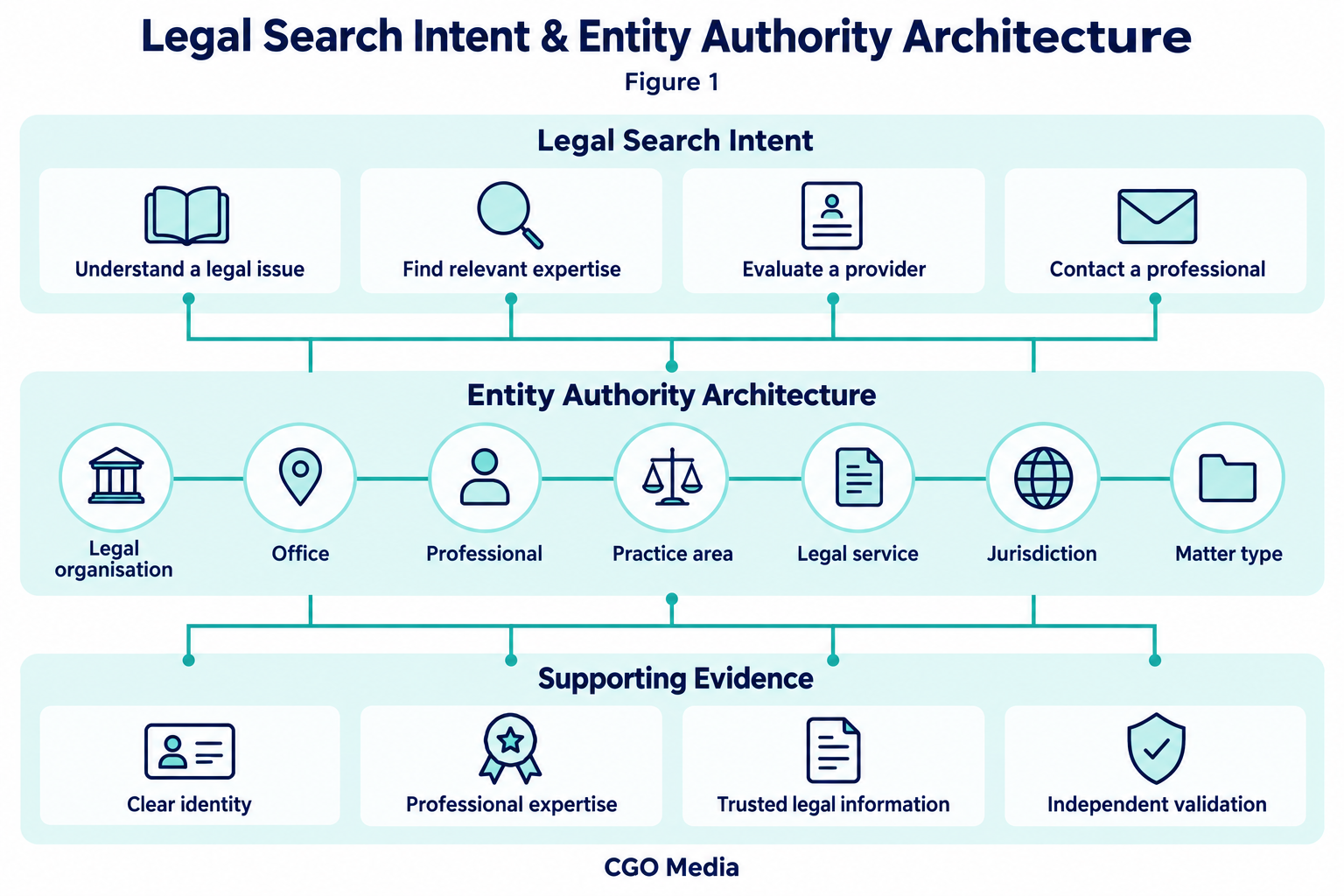
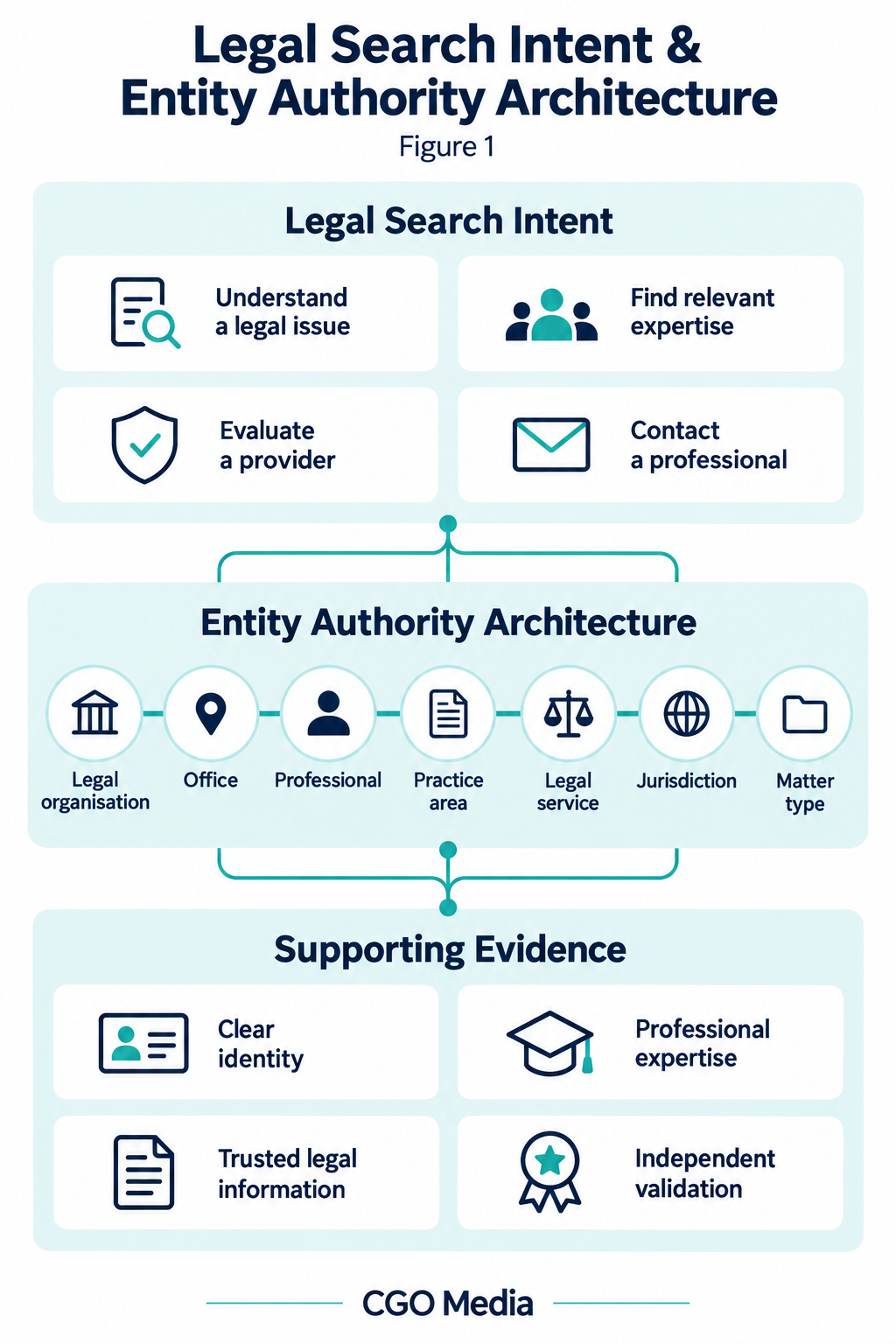
19. Core Legal Entity Types
A legal organisation may need to represent clearly:
- Law firm
- Office or location
- Solicitor
- Barrister
- Partner
- Practice area
- Legal service
- Jurisdiction
20. A Legal Entity Architecture
A practical model may be:
Legal Organisation → Office → Legal Professional → Practice Area → Service → Jurisdiction → Matter Type
21. Organisation Identity
Users should be able to determine clearly:
- The legal provider’s name
- Its organisational type
- Where it operates
- Which services it provides
22. Legal Organisation Type
The information environment should distinguish appropriately between different provider structures rather than presenting every legal entity as if it were identical.
23. Office Identity
Multi-office firms should maintain distinct and accurate information for each location.
24. Office-Level Information
Relevant information may include:
- Address
- Telephone
- Opening information
- Professionals
- Practice areas
- Contact pathways
25. Professional Identity
Lawyer and practitioner profiles should make clear who the professional is and how they relate to the legal organisation.
26. Professional Identity Information
A profile may include:
- Full name
- Professional title
- Current role
- Practice areas
- Qualifications
- Professional status where relevant
- Office locations
27. Practice Area Identity
Legal organisations should define practice areas consistently across the website.
28. Practice Areas and Legal Services Are Not Always the Same
A broad practice area may contain several distinct services, matter types or legal processes.
29. Example Practice Architecture
A commercial law firm may represent:
Commercial Law → Dispute Resolution → Contract Disputes → Relevant Lawyers → Relevant Office
30. Entity Relationships Matter
The meaning of an individual page becomes stronger when its relationship to other relevant legal entities is clear.
31. Organisation-to-Professional Relationships
Users should be able to verify which professionals currently belong to the firm or chambers.
32. Professional-to-Practice-Area Relationships
Profiles should identify the legal areas in which the professional genuinely works.
33. Professional-to-Office Relationships
Where lawyers work across several offices, those relationships should be represented accurately.
34. Practice-Area-to-Service Relationships
Broad legal categories should connect naturally with the specific services users are likely to need.
35. Service-to-Jurisdiction Relationships
Legal information may depend on the jurisdiction in which the advice or service applies.
36. Jurisdiction Clarity Is Important
Legal organisations should avoid presenting information so broadly that users cannot understand the geographic or legal context in which it applies.
37. Matter-Type Relationships
A legal service may support multiple common client situations or matter types.
38. Legal Entity Consistency Across External Sources
Important information should remain aligned across relevant:
- Regulatory profiles
- Professional directories
- Local listings
- Legal directories
- Institutional profiles
39. Entity Inconsistency Creates Ambiguity
Common inconsistencies may include:
- Old firm names
- Former offices
- Departed lawyers
- Outdated professional roles
- Legacy practice descriptions
40. Professional Change Is a Major Entity Risk
Legal organisations should update connected information when:
- A lawyer joins
- A lawyer leaves
- A partner changes role
- An office changes
- A practice area changes
41. Firm Mergers and Rebrands Can Create Entity Complexity
Mergers, acquisitions and rebrands may create overlapping names, historical profiles and conflicting external records.
42. Legal Entity Governance
The organisation should define responsibility for maintaining:
- Firm identity
- Professional data
- Office information
- Practice-area relationships
- External profiles
43. Structured Data Can Support Entity Interpretation
Where appropriate, structured data may help clarify organisation, professional and page relationships for search systems.
44. Structured Data Should Reflect Visible Reality
Markup should not be used to create professional, organisational or service relationships that are not accurately represented on the page.
45. Legal Professional Authority
Entity clarity alone is not enough.
Users also need evidence that the people associated with the legal service have relevant professional expertise.
46. Professional Authority Should Be Specific
Useful evidence may include:
- Role
- Qualifications
- Practice areas
- Years or depth of relevant experience where accurately stated
- Professional memberships
- Publications
47. Thin Professional Profiles Create a Trust Gap
A profile containing little more than a job title and photograph may provide insufficient information for users evaluating a significant legal matter.
48. Professional Expertise Should Connect with Legal Services
The user should be able to understand why a particular professional is relevant to a particular matter.
49. The Legal Authority Foundation
The first layer of modern legal visibility can therefore be represented as:
Clear Firm Identity + Accurate Professional Entities + Practice-Area Relevance + Jurisdiction Clarity + Consistent External Representation
50. Entity Authority Creates the Basis for Deeper Legal Trust
Once firm, office, professional and service relationships are represented clearly, the next stage is to assess legal content authority, professional evidence, regulation, reputation and the broader trust environment that influences provider selection.
51. Legal Content Authority
Legal content authority depends on whether information is accurate, relevant, jurisdictionally appropriate and connected clearly with genuine professional expertise.
52. Legal Content Volume Is Not Authority
Publishing large numbers of legal articles does not automatically create stronger authority.
53. Legal Content Should Reflect Real Practice
The strongest content environments usually concentrate on areas in which the organisation has genuine legal capability.
54. Practice-Area Content
Practice-area pages should help users understand:
- The type of legal matter
- Who the service is relevant to
- Common processes
- Possible next steps
- Relevant professionals
55. Legal Service Content
More specific service pages may explain:
- What the service covers
- Potential client situations
- Typical stages
- Relevant jurisdiction
- How the firm can assist
56. Problem-Led Legal Content
Users may search from the perspective of a problem rather than a formal practice area.
57. Problem-Led Content Should Lead Toward Relevant Services
A useful architecture may be:
Client Problem → Legal Issue → Practice Area → Service → Relevant Professional
58. Jurisdiction Should Be Clear
Legal information can become misleading when jurisdictional context is omitted.
59. National and Local Law May Differ
Where legal rules or procedures vary geographically, content should make the relevant scope sufficiently clear.
60. Legal Content Requires Appropriate Review
Important legal information should have a defined process for checking:
- Accuracy
- Current law
- Jurisdiction
- Terminology
- Professional relevance
61. Legal Authorship Transparency
Users should be able to understand who produced or reviewed significant legal information where professional attribution is relevant.
62. Professional Review and Editorial Review Are Different
A page may be well edited without having been reviewed by a legal professional.
63. Legal Review Dates
Priority legal content may benefit from clear internal review dates and update schedules.
64. Legal Information Freshness
Outdated legal information can create greater risk than merely outdated marketing copy.
65. High-Risk Legal Content Requires Greater Attention
Higher-risk areas may include content that could materially influence:
- Deadlines
- Procedural decisions
- Rights
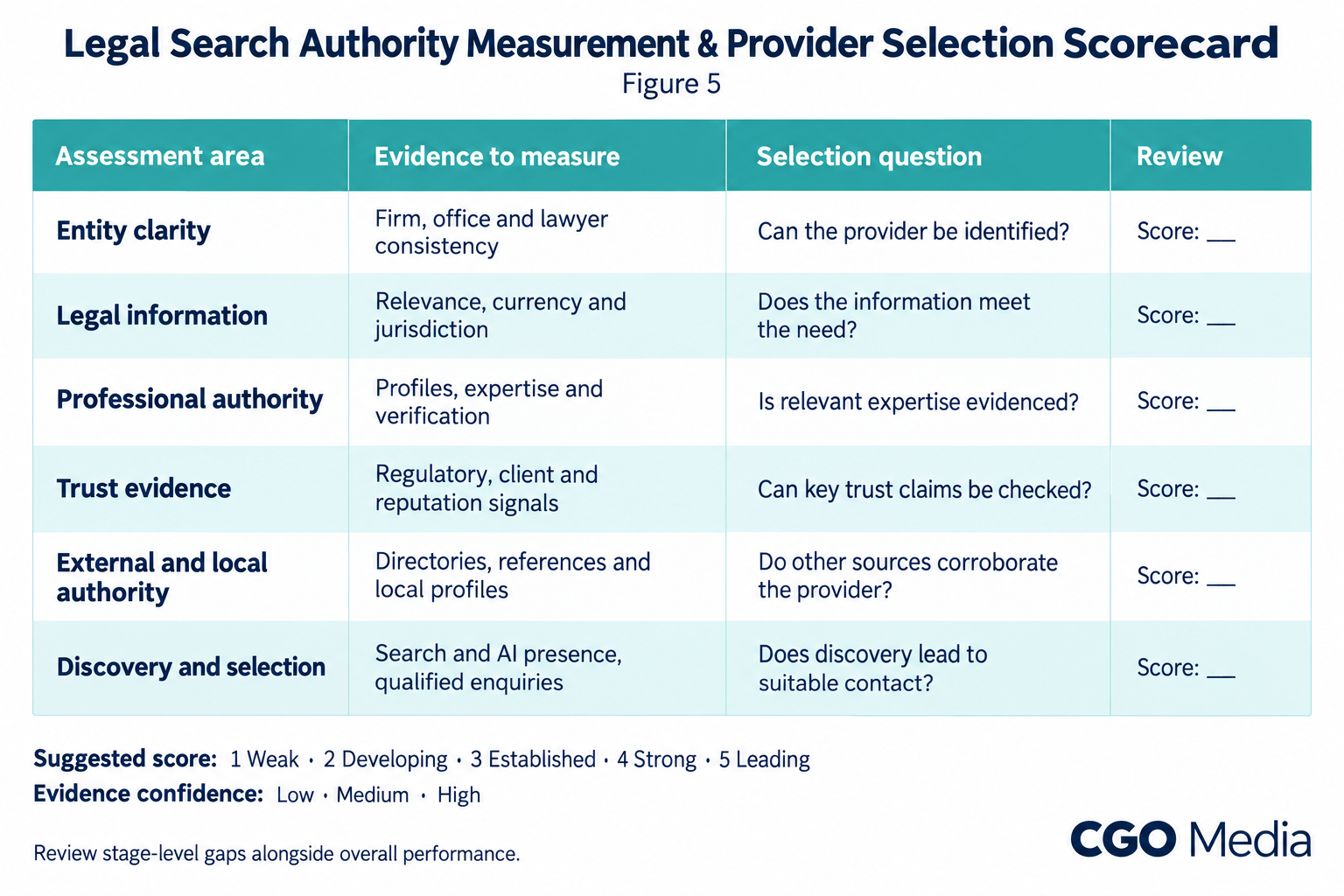
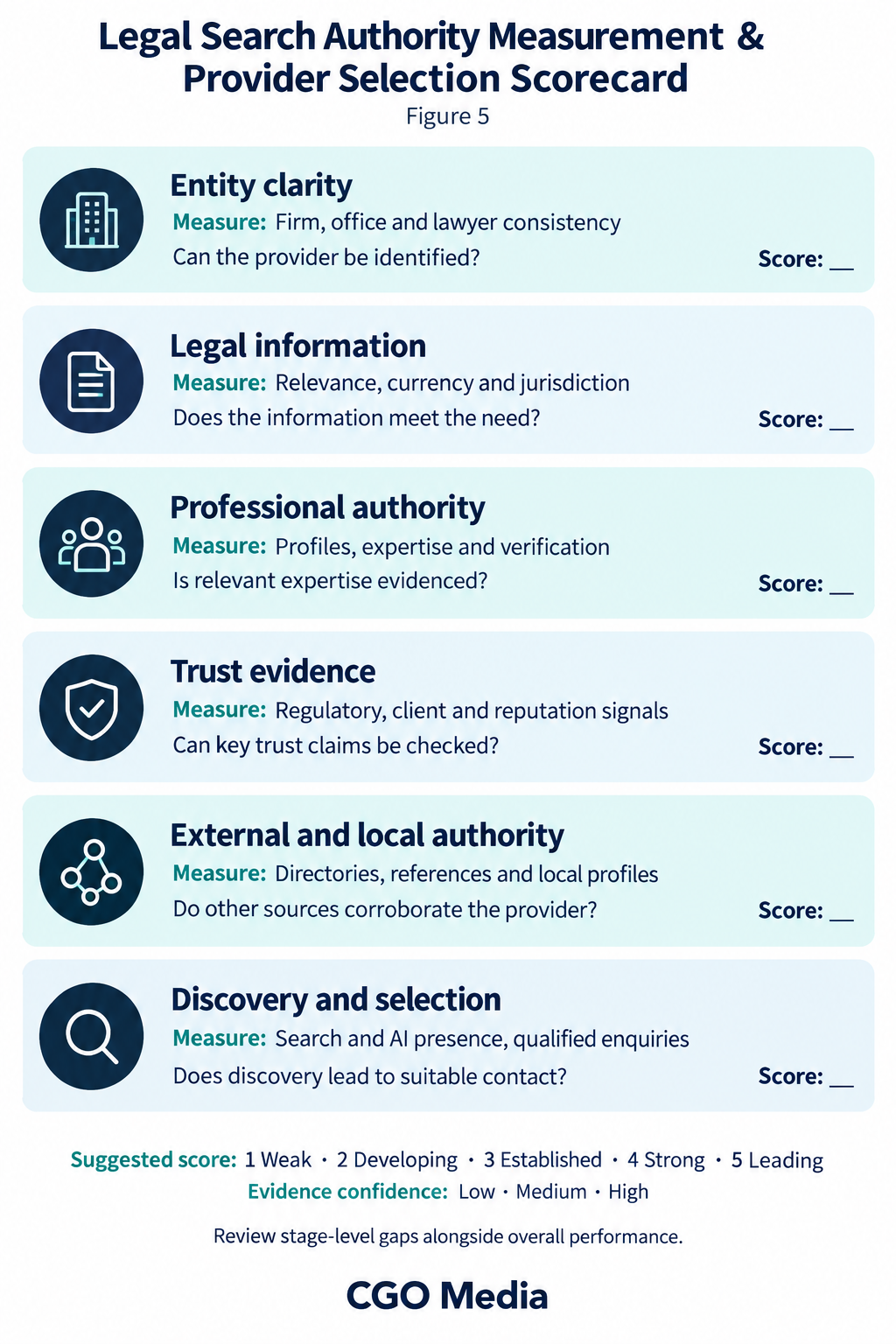
- Legal remedies
- Financial decisions
66. Avoid Overstating General Legal Information
General information should not be presented as if it automatically determines the outcome of an individual matter.
67. Avoid Outcome Guarantees
Legal organisations should avoid implying that a particular result is guaranteed where legal outcomes depend on facts, evidence, procedure and jurisdiction.
68. Legal Content Should Support the Decision Journey
Useful content can help users move from:
Problem Recognition → Legal Understanding → Service Relevance → Professional Evaluation → Contact
69. Content Authority Should Connect to Professional Authority
Where a lawyer contributes to or reviews legal content, that relationship may help users understand the professional expertise behind the information.
70. Content Authority Should Connect to Practice Areas
Legal information should sit within a clear topical architecture rather than exist as disconnected articles.
71. Content Authority Should Connect to Services
Users should be able to progress from educational information toward relevant legal services where appropriate.
72. Content Authority Should Connect to Jurisdiction
Important legal pages should make jurisdictional scope sufficiently clear.
73. Professional Authority
Legal users frequently evaluate the individual professionals associated with a matter before contacting a firm.
74. Professional Identity Evidence
A strong legal profile may include:
- Full name
- Professional role
- Qualifications
- Practice areas
- Professional status where relevant
- Office locations
75. Practice-Area Expertise
Professional profiles should clarify the legal areas in which the person genuinely works.
76. Matter-Type Expertise
Where appropriate, profiles may identify recurring types of matters handled by the professional.
77. Professional Experience
Relevant experience may be described through:
- Practice history
- Sector experience
- Transaction experience
- Dispute experience
- Leadership roles
78. Qualifications and Professional Status
Professional credentials should be represented accurately and should not imply a status the individual does not hold.
79. Professional Memberships
Relevant memberships may add context where they are genuine and current.
80. Academic and Teaching Activity
Teaching or academic roles may provide additional evidence of subject expertise where they are relevant and verifiable.
81. Legal Publications
Articles, books, commentary and legal research may strengthen professional authority where they demonstrate genuine subject contribution.
82. Speaking and Conference Activity
Relevant professional speaking activity can provide additional external evidence of expertise.
83. Professional Recognition Requires Care
Awards, rankings and recognitions should be represented accurately and should not be presented more broadly than the evidence supports.
84. Directory Rankings Should Be Contextualised
Legal directory recognition may relate to:
- A specific lawyer
- A specific practice area
- A specific office
- A specific year
85. Professional Profiles Should Avoid Promotional Overreach
Terms such as “leading,” “top” or “best” should not substitute for verifiable professional evidence.
86. Professional-Service Relationships
A user should be able to determine which legal services each professional actually provides.
87. Professional-Practice-Area Relationships
Profiles should connect naturally with the relevant practice-area architecture.
88. Professional-Office Relationships
Where legal professionals work from more than one office, that relationship should be current and clear.
89. Professional-Sector Relationships
For commercial law firms, sector experience may be important where it genuinely affects the professional’s legal expertise.
90. Professional-Content Relationships
Lawyers may be connected appropriately with:
- Legal commentary
- Research
- Practice guides
- News analysis
91. Thin Lawyer Profiles Create Decision Friction
Users comparing firms may leave the journey if they cannot establish why a particular lawyer is relevant to their matter.
92. Regulation and Professional Verification
Legal trust often depends on whether users can verify the professional and organisational status of the provider.
93. Regulatory Information Should Be Accurate
Where regulation applies, public claims should reflect current status and the correct legal entity.
94. Firm-Level and Individual-Level Regulation Are Different
Legal organisations should distinguish between regulation of:
- The firm
- The individual professional
- The relevant legal service
95. Regulatory Evidence Should Be Easy to Understand
Users should not have to interpret ambiguous language to determine whether the provider is appropriately regulated.
96. Complaints and Client-Care Information
Clear information around complaints and client care can contribute to legal trust.
97. Privacy and Confidentiality
Legal users may be particularly sensitive to how personal, commercial or privileged information is handled.
98. Professional Conduct Signals
Public-facing trust may also be influenced by:
- Professional transparency
- Conflict processes
- Client-care information
- Confidentiality practices
99. Reviews in Legal Provider Selection
Reviews may contribute evidence about the client experience.
100. Legal Reviews Are Experience Evidence
Reviews may reflect:
- Communication
- Responsiveness
- Professionalism
- Administration
- Clarity of process
101. Reviews Do Not Prove Legal Competence
Positive client feedback should not be treated automatically as proof that a legal professional is more technically competent than another.
102. Review Recency Matters
More recent review patterns may provide better context around the current client experience.
103. Review Patterns Matter More Than One Comment
Repeated themes may be more useful than isolated positive or negative experiences.
104. Review Response Governance
Legal organisations should respond to public feedback carefully to avoid disclosing confidential or sensitive client information.
105. Case Evidence
Past matters can sometimes help users understand the type of work a legal provider performs.
106. Case Evidence Requires Careful Presentation
Case studies should respect confidentiality, legal restrictions and appropriate professional standards.
107. Previous Outcomes Do Not Guarantee Future Outcomes
Past case results should not be presented in a way that implies the same outcome will occur in another matter.
108. Case Evidence Should Demonstrate Relevance
Where appropriate, case material may help users understand:
- Type of matter
- Practice-area experience
- Sector knowledge
- Complexity
109. Transaction Evidence
Commercial firms may use transaction experience to demonstrate work in relevant sectors, jurisdictions or deal types where disclosure is appropriate.
110. Litigation and Dispute Evidence
Dispute experience may provide useful professional context where information is public or appropriately disclosed.
111. Client Evidence
Client names, logos and testimonials should only be used where appropriate permission and professional requirements allow.
112. External Authority
A legal organisation’s authority may also be supported by relevant evidence beyond its own website.
113. Legal Directory Authority
Relevant legal directories can contribute external context around:
- Firms
- Professionals
- Practice areas
- Locations
114. Professional Body Authority
Professional body profiles or roles may reinforce professional identity where they are current and relevant.
115. Institutional Authority
Relevant evidence may come from:
- Universities
- Professional organisations
- Industry bodies
- Research institutions
116. Editorial Authority
Reputable legal and business media may provide external recognition where coverage reflects genuine expertise.
117. Expert Commentary
Legal professionals may contribute expert analysis to:
- Legal publications
- Business media
- Trade publications
- Research reports
118. Citation Authority
Legal research, commentary or guidance may develop stronger external authority when it is referenced by relevant third parties.
119. Citation Quality Matters
Relevant references from professional, academic, legal or institutional sources may provide stronger context than large volumes of unrelated mentions.
120. External Authority Should Reinforce Internal Expertise
The strongest external evidence aligns with the organisation’s genuine:
- Practice areas
- Professional expertise
- Sector experience
- Jurisdictional capability
121. External Authority Is Not Link Building Alone
Legal authority should not be reduced to backlink acquisition.
The broader objective is to build a consistent external evidence environment around real legal expertise.
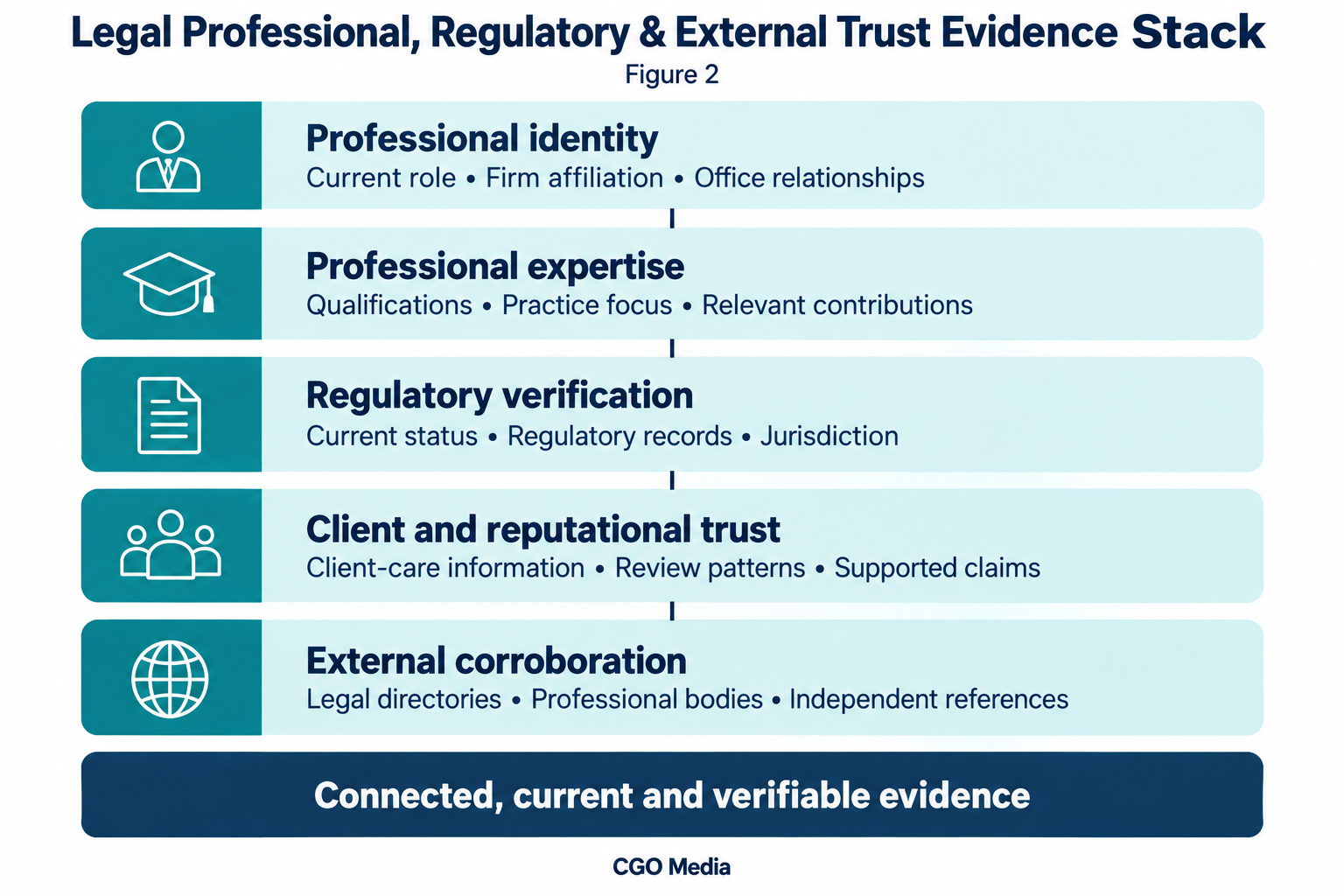
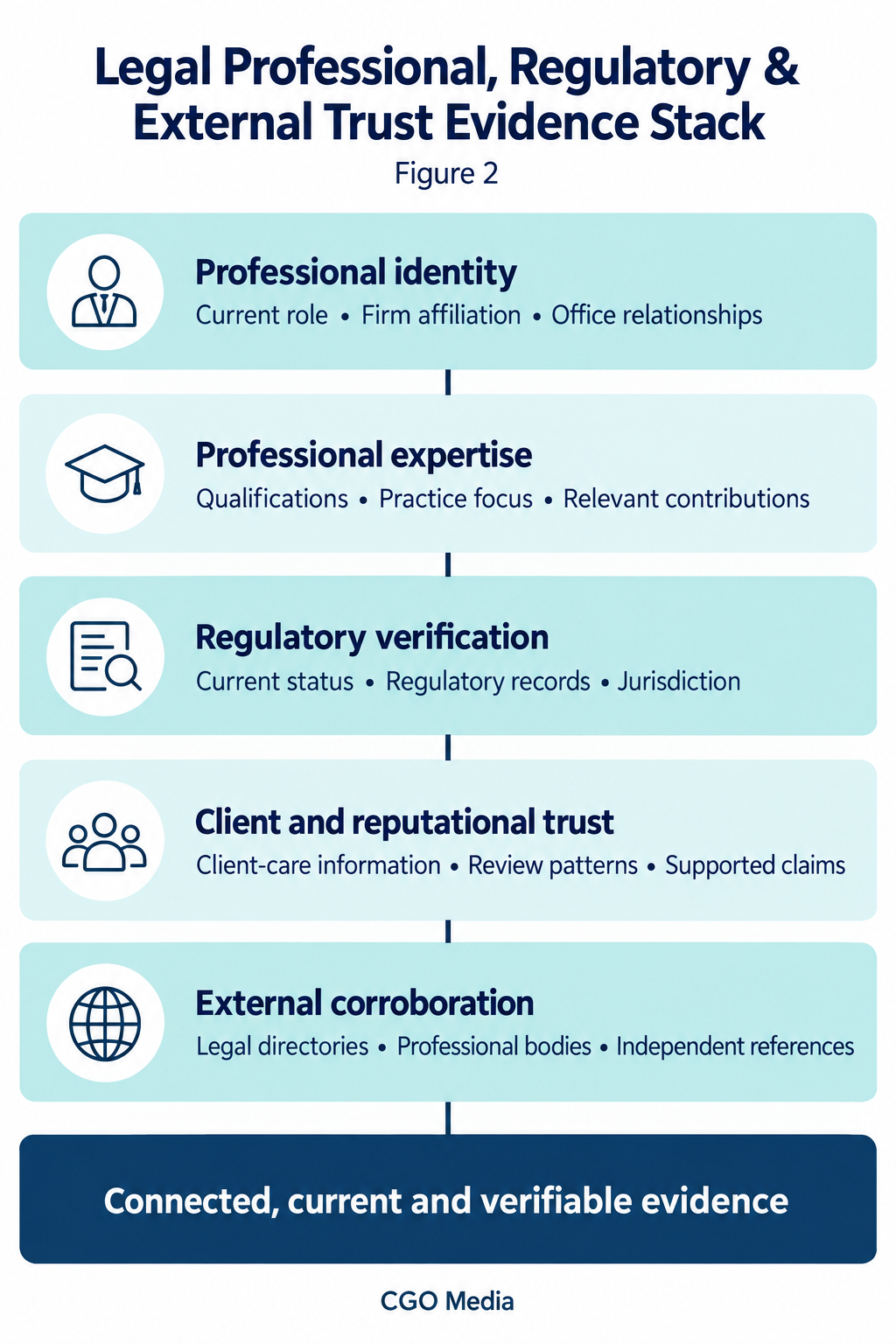
122. The Legal Trust Stack
A practical legal trust model can be represented as:
Legal Information → Professional Expertise → Regulatory Verification → Client Trust → Case Evidence → External Authority
123. Legal Trust Is Cumulative
No single trust signal is likely to explain provider selection in isolation.
124. Weakness in One Trust Layer Can Constrain the Whole System
For example, strong editorial visibility may not compensate for an outdated professional profile or unclear regulatory status.
125. Trust Evidence Should Be Available at the Point of Decision
Users should be able to access relevant professional and trust information while evaluating practice areas, services and individual lawyers.
126. The First Two Research Layers
The legal authority environment can now be represented as:
Entity Clarity + Legal Content Authority + Professional Expertise + Regulatory Trust + Client Evidence + External Validation
127. Local Legal Discovery
Local search remains important for many legal services because users may prefer a nearby office, local knowledge or easier access to face-to-face consultation.
128. Local Legal Search Is More Than Location
A strong local legal presence should communicate:
- Which office serves the area
- Which professionals work there
- Which practice areas are available
- How users can make contact
129. Office-Level Authority
Each significant office should have its own clear identity and relevant supporting information.
130. Office Information Should Be Specific
Relevant information may include:
- Address
- Telephone
- Opening information
- Professionals
- Practice areas
- Accessibility
- Contact pathways
131. Multi-Office Firms Need Strong Entity Separation
Large legal organisations should avoid presenting all locations as one generic entity where office-level differences are material.
132. Practice Areas May Vary by Office
A firm may offer a practice area nationally while only some offices provide the relevant lawyers or service depth.
133. Professional Availability May Vary by Office
Lawyer profiles should identify where each professional actually practises.
134. Office-Service Relationships
Users should be able to understand which services are available from each office.
135. Office-Professional Relationships
Local office pages should connect with the professionals currently associated with that location.
136. Local Listing Consistency
Important local information should remain aligned across:
- Firm website
- Local business profiles
- Maps environments
- Legal directories
137. Local Data Conflicts
Common inconsistencies may include:
- Old office addresses
- Incorrect telephone numbers
- Former office names
- Outdated opening information
138. Office Moves Require Coordinated Updates
A location change may require updates across:
- Office page
- Professional profiles
- Local listings
- Directory profiles
- Contact information
139. Local Legal Reviews
Office-specific reviews may contribute evidence about the client experience at a particular location.
140. Local Review Patterns
Repeated themes may reveal differences between offices involving:
- Responsiveness
- Communication
- Administration
- Client service
141. Local Reviews Remain Experience Evidence
Local reviews should not be interpreted as proof of legal competence or guaranteed outcomes.
142. Local Practice-Area Pages
Local practice-area pages may be useful where they reflect genuine office-level capability and avoid unnecessary duplication.
143. Avoid Artificial Local Expansion
Legal organisations should not create large numbers of thin local pages for locations where they have no meaningful presence or service capability.
144. Local Authority Should Reflect Real Operational Structure
The objective is accurate discoverability, not synthetic geographic coverage.
145. AI-Assisted Legal Search
AI systems are introducing a new layer into legal discovery by synthesising information, explaining legal concepts and, in some cases, surfacing possible legal providers.
146. AI Can Influence Early Legal Research
Users may ask AI systems questions involving:
- Rights
- Processes
- Legal terminology
- Possible next steps
- Types of lawyer
147. AI Can Influence Provider Discovery
Users may also ask for:
- Law firms in a location
- Lawyers for a particular matter
- Firms with a particular practice area
- Provider comparisons
148. AI Can Compress the Legal Search Journey
Several stages that previously required multiple searches may occur within one extended AI interaction.
149. AI Compression Increases the Importance of Accurate Source Information
If legal, professional or location information is inconsistent, a generated answer may reproduce or amplify that ambiguity.
150. Branded AI Queries
Legal organisations can monitor whether AI systems represent accurately:
- Firm identity
- Practice areas
- Office locations
- Professional relationships
151. Professional AI Queries
Testing may examine whether individual lawyers are represented accurately for:
- Role
- Practice area
- Firm affiliation
- Office location
152. Practice-Area AI Queries
Legal organisations may observe whether they appear appropriately in queries involving their genuine areas of expertise.
153. Local AI Queries
Testing may examine whether local recommendations reflect accurate:
- Office information
- Practice-area relevance
- Professional presence
154. Non-Branded Provider Recommendation Queries
Non-branded queries are particularly useful because they test whether the organisation enters consideration before the user already knows the firm.
155. Example Legal Provider Queries
Potential query classes may include:
- Lawyer for a specific legal matter
- Firm specialising in a particular practice area
- Legal adviser in a particular city
- Solicitor for a particular business issue
156. Provider Recommendation Presence
Legal organisations may observe whether they appear within relevant generated provider lists or recommendation contexts.
157. Recommendation Presence Is Not a Stable Ranking
Generated outputs may vary according to:
- Model
- Prompt wording
- Geography
- Source availability
- Time
158. Recommendation Presence Is Not Legal Endorsement
Appearance within an AI-generated recommendation should not be interpreted as proof that one firm or lawyer is objectively superior or appropriate for every matter.
159. AI Representation Accuracy
Important information to monitor may include:
- Firm identity
- Practice areas
- Professional roles
- Office locations
- Regulatory context
160. Incorrect Legal Representation Can Create Decision Risk
Material inaccuracies may mislead users about the expertise, status or availability of a legal provider.
161. AI Source Analysis
Where citations or source links are visible, legal organisations can observe which source environments recur in relevant generated answers.
162. Potential Legal AI Source Types
These may include:
- Law firm websites
- Legal directories
- Professional profiles
- Regulatory sources
- Local business profiles
- Media
- Research and publications
163. Source Analysis Should Be Diagnostic
The purpose is to understand the evidence environment rather than assume that appearing on one external platform will guarantee AI visibility.
164. First-Party Accuracy Comes First
When representation problems are identified, the organisation should first verify its own public information.
165. External Accuracy Matters
Where legitimate correction rights exist, material inaccuracies on relevant external profiles should also be updated.
166. Source Consistency Supports Machine Interpretation
Important facts should remain aligned across first-party and authoritative external environments.
167. Legal AI Readiness Is Not a Content Trick
AI readiness is better understood as the cumulative quality of the wider legal evidence environment.
168. A Legal AI Readiness Model
A useful representation is:
Entity Clarity → Legal Content Authority → Professional Authority → Regulatory Trust → External Validation → AI Readiness
169. Strong AI Readiness Does Not Guarantee Inclusion
The model describes conditions that may support clearer discovery and interpretation. It does not provide a guaranteed method for AI recommendation.
170. AI Readiness Should Be Evidence-Led
Legal organisations should focus on improving genuine:
- Entity clarity
- Professional evidence
- Practice-area relevance
- Regulatory transparency
- External authority
171. Avoid Artificial Evidence
Legal organisations should not create false reviews, fabricated professional relationships, artificial citations or misleading affiliations in an attempt to influence AI systems.
172. Source Diversity Matters
A stronger legal authority environment generally includes multiple relevant evidence classes rather than dependence on one source type.
173. A Broader Legal Evidence Ecosystem
This may include:
- Regulatory sources
- Professional directories
- Legal directories
- Firm websites
- Professional publications
- Relevant media
- Local profiles
- Client reviews
174. External Evidence Should Reinforce Real Expertise
The strongest signals are those that align with the organisation’s genuine practice areas, professional capabilities and jurisdictions.
175. AI Readiness Is a Higher-Order Authority Condition
It emerges from the combined strength of the legal evidence environment rather than from isolated optimisation activity.
176. The Legal Search and AI Authority System
The wider legal discovery model can now be represented as:
Firm Entity → Office → Professional → Practice Area → Legal Service → Trust Evidence → External Validation → AI Representation
177. Legal Search Authority Requires Consistency Across the System
Strong performance in one layer may be undermined by material inconsistency elsewhere.
178. Example — Strong Firm Brand, Weak Professional Profiles
A recognised legal organisation may still create uncertainty if users cannot verify the lawyers associated with a specific service.
179. Example — Strong Lawyers, Weak Office Information
Experienced professionals may remain difficult to discover locally if office and location relationships are unclear.
180. Example — Strong Content, Weak Jurisdiction Clarity
High-quality legal information may still create confusion if users cannot determine the legal context in which it applies.
181. Example — Strong Reviews, Weak Regulatory Clarity
Positive client feedback does not replace the need for clear professional and regulatory evidence.
182. Legal Authority Should Be Designed as a Connected Architecture
The next stage is therefore to examine how legal entities, professional authority, practice-area relevance, external sources and AI discovery operate together as one broader search ecosystem.
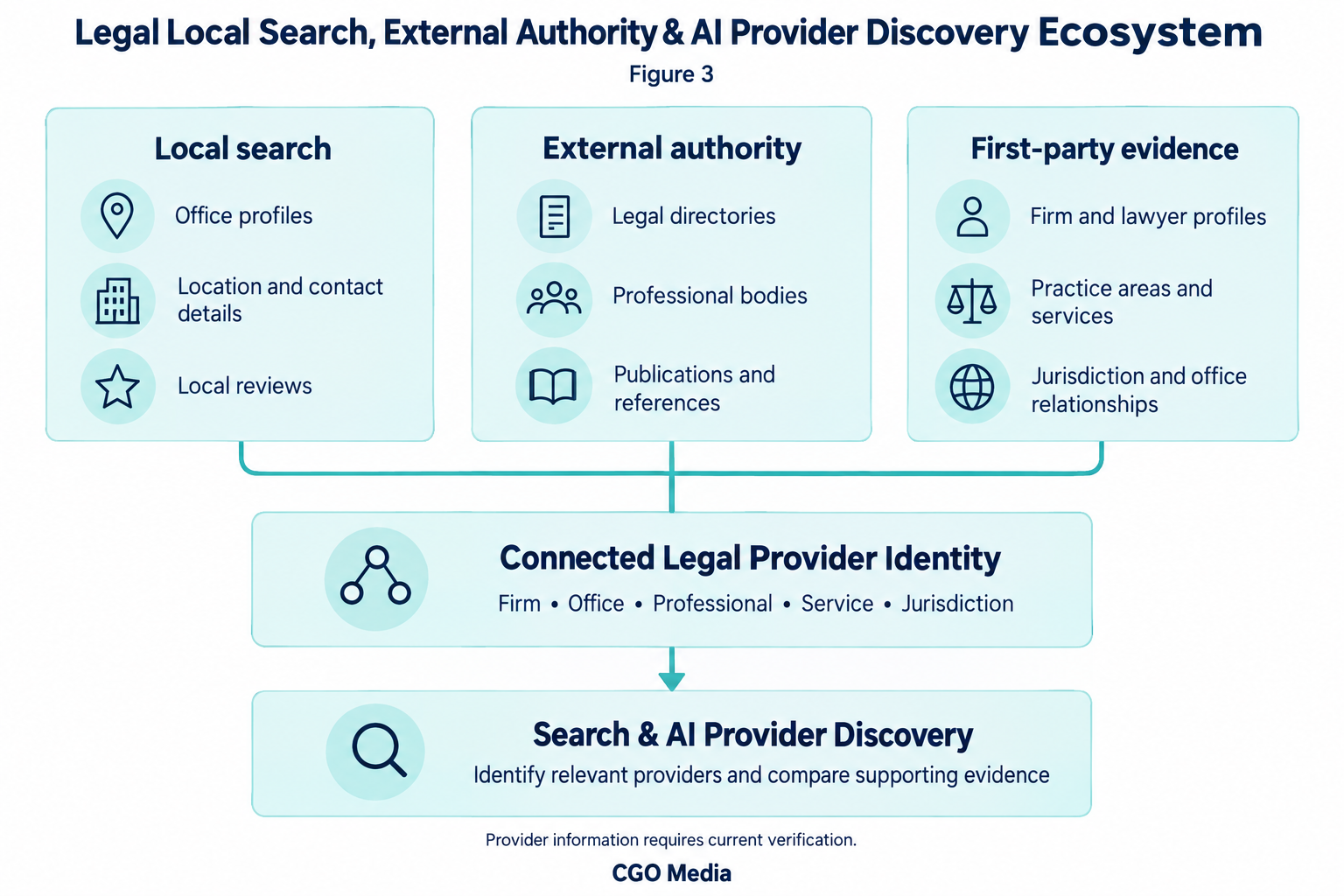
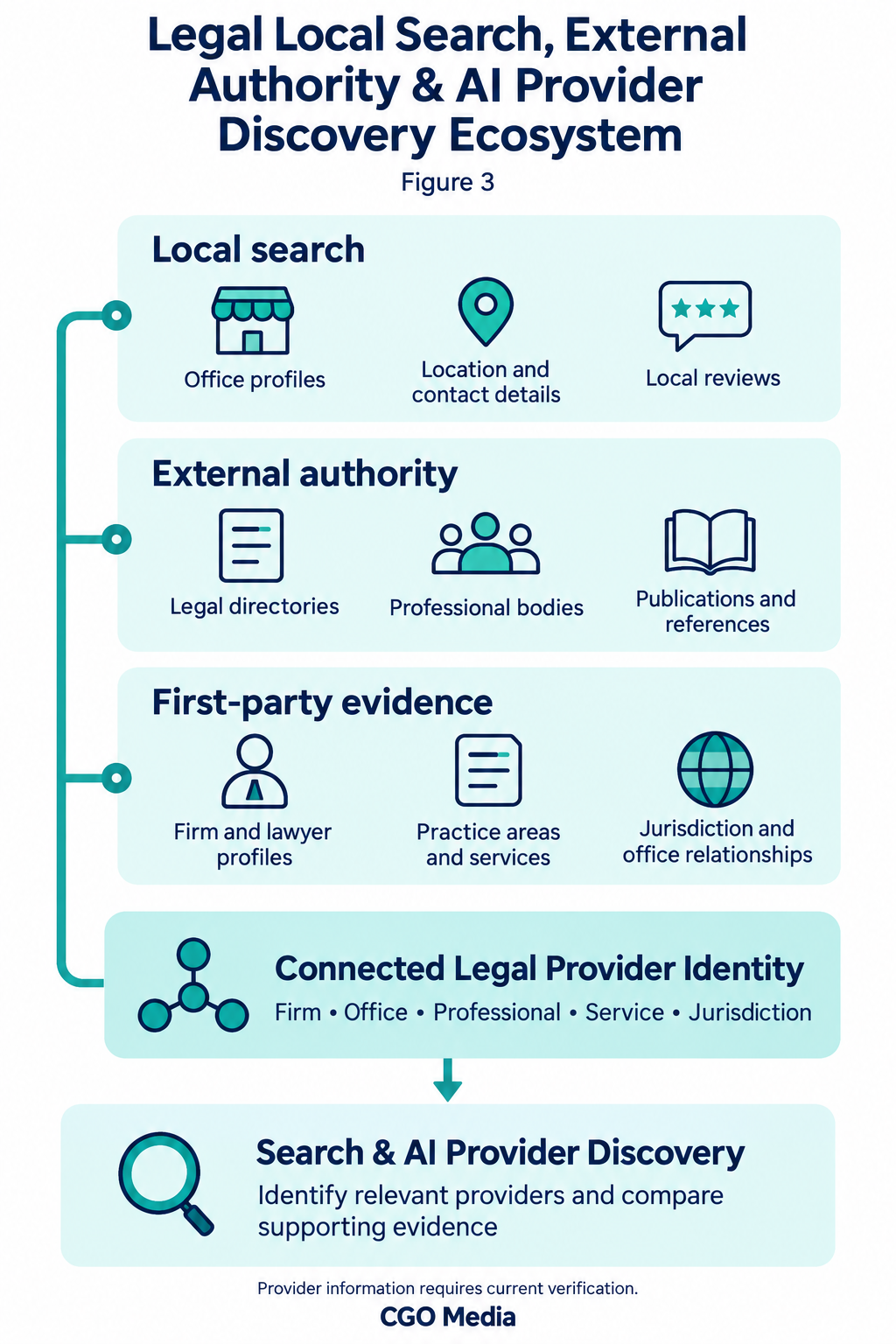
183. Integrated Legal Knowledge Architecture
Legal search authority becomes more resilient when the organisation represents its main entities, expertise and trust evidence as a connected information system.
184. The Core Legal Knowledge Model
A practical architecture may be represented as:
Legal Organisation → Office → Professional → Practice Area → Legal Service → Jurisdiction → Matter Type → Trust Evidence
185. Organisation-Level Knowledge
The organisation should provide a stable public representation of:
- Firm identity
- Provider type
- Office network
- Practice areas
- Regulatory context
186. Office-Level Knowledge
Each office should connect accurately with:
- Professionals
- Practice areas
- Services
- Local contact information
187. Professional-Level Knowledge
Each lawyer or relevant legal professional should connect clearly with:
- Current firm
- Office location
- Practice areas
- Legal services
- Professional evidence
188. Practice-Area Knowledge
Practice-area pages should act as structured hubs connecting broader legal themes with relevant services, professionals and jurisdictions.
189. Service-Level Knowledge
Legal service pages should clarify:
- What the service covers
- Relevant matter types
- Relevant professionals
- Applicable jurisdiction
- Possible client pathway
190. Matter-Type Knowledge
Common client situations can help bridge the gap between everyday language and formal legal service terminology.
191. Jurisdiction Knowledge
Jurisdiction should be treated as an important contextual relationship rather than a minor disclaimer.
192. Trust Evidence as a Knowledge Layer
Relevant trust evidence may connect with:
- Firm
- Individual lawyers
- Practice areas
- Specific offices
193. Internal Linking Should Reflect Knowledge Relationships
Internal linking becomes more useful when it mirrors genuine legal relationships rather than being added primarily for keyword purposes.
194. Professional-to-Practice-Area Linking
Profiles should connect with the areas of law in which the professional genuinely practises.
195. Practice-Area-to-Professional Linking
Practice-area pages should identify relevant professionals clearly.
196. Practice-Area-to-Service Linking
Broad legal categories should connect naturally with specific services users may require.
197. Service-to-Matter-Type Linking
Specific legal services may link with common situations users recognise from their own circumstances.
198. Service-to-Jurisdiction Linking
Where jurisdiction affects the advice or process, that relationship should be represented clearly.
199. Office-to-Professional Linking
Local office pages should identify current lawyers and practitioners associated with that location.
200. Office-to-Practice-Area Linking
Office pages should show which practice areas are genuinely supported locally.
201. Avoid False Relationship Density
Not every lawyer should be linked to every service, office or practice area simply to increase internal connections.
202. Relationship Accuracy Is More Important Than Link Volume
The value of the architecture depends on whether the relationships are true, current and useful.
203. AI Source Consistency
AI-assisted systems may encounter multiple representations of the same legal entity across different sources.
204. Source Consistency Should Focus on Material Facts
Important facts may include:
- Firm name
- Professional role
- Practice area
- Office location
- Regulatory status
205. First-Party and Regulatory Consistency
Where relevant, public firm information should not materially conflict with authoritative regulatory sources.
206. First-Party and Directory Consistency
Professional and legal directories should ideally reflect current roles, affiliations and locations.
207. First-Party and Local Consistency
Office information should remain aligned across the firm website and major local discovery environments.
208. First-Party and Editorial Consistency
Old media profiles or biographies can create confusion where they describe previous firms, roles or affiliations.
209. Source Conflict Creates Interpretation Risk
Where several credible sources disagree, users and automated systems may have difficulty identifying the most current representation.
210. Source Conflict Should Be Prioritised by Risk
Higher-priority conflicts may involve:
- Professional status
- Firm affiliation
- Office location
- Regulatory information
- Practice-area relevance
211. Legal Provider Comparison Behaviour
Users rarely select a legal provider based on one signal.
Comparison frequently involves several dimensions simultaneously.
212. Practice-Area Relevance
Users may first determine whether the firm appears genuinely relevant to the matter.
213. Professional Fit
Users may then evaluate which lawyer appears most suitable based on role, experience and practice focus.
214. Regulatory and Professional Verification
For higher-risk matters, users may seek stronger evidence that the firm or professional is appropriately authorised or recognised.
215. Reputation Comparison
Users may compare:
- Reviews
- Legal directory recognition
- Media coverage
- Professional reputation
216. Case and Transaction Evidence
Where available and appropriate, previous work may help users understand the firm’s relevant experience.
217. Location and Access
Users may compare:
- Office proximity
- Remote consultation availability
- International reach
- Language capability
218. Price and Fee Structure
Where fee information is available, it may influence shortlisting and enquiry decisions.
219. Responsiveness and Contact Experience
The quality of the initial interaction can influence whether a user proceeds with one provider rather than another.
220. Provider Comparison Is Multi-Dimensional
A simplified comparison model is:
Relevance + Professional Fit + Trust + Reputation + Access + Commercial Fit
221. AI May Influence Comparison Before Website Visit
A generated answer may summarise several legal providers before the user opens any individual firm website.
222. AI May Pre-Frame Provider Differences
Users may arrive at a website already holding impressions about:
- Practice expertise
- Reputation
- Location
- Professional strength
223. This Increases the Importance of Evidence Consistency
If AI-generated summaries are based on inconsistent source information, early provider comparison may be distorted.
224. Legal Recommendation Readiness
A legal provider is better positioned for accurate recommendation when its evidence environment is sufficiently clear across multiple dimensions.
225. Recommendation Readiness Dimension One — Entity Clarity
The organisation and its professionals should be identifiable without material ambiguity.
226. Recommendation Readiness Dimension Two — Practice Relevance
The firm should be associated with the legal services and practice areas it genuinely provides.
227. Recommendation Readiness Dimension Three — Professional Evidence
Relevant professionals should have sufficiently clear and verifiable expertise.
228. Recommendation Readiness Dimension Four — Regulatory Trust
Where relevant, professional and organisational status should be transparent and accurate.
229. Recommendation Readiness Dimension Five — External Authority
Relevant third-party evidence should support rather than contradict the firm’s own representation.
230. Recommendation Readiness Dimension Six — Local and Jurisdictional Fit
The provider should be represented appropriately for the relevant geography and legal context.
231. Recommendation Readiness Is Cumulative
The strongest condition may be represented as:
Entity Clarity + Practice Relevance + Professional Evidence + Regulatory Trust + External Authority + Jurisdictional Fit
232. Evidence Thresholds
Provider recommendation may require a sufficient threshold of supporting evidence rather than one strong signal in isolation.
233. Threshold One — Identity Confidence
Can the organisation and relevant professional be identified confidently?
234. Threshold Two — Relevance Confidence
Is there sufficient evidence that the provider handles the relevant type of matter?
235. Threshold Three — Professional Confidence
Can the professional’s role and legal expertise be verified?
236. Threshold Four — Trust Confidence
Is there sufficient professional, regulatory and reputational evidence to support consideration?
237. Threshold Five — Context Confidence
Does the provider appear appropriate for the relevant jurisdiction, location or client context?
238. Threshold Six — Source Consistency
Do important sources broadly agree about the material facts?
239. Recommendation Readiness Can Fail at Any Threshold
A provider may have strong reputation but weak jurisdictional fit, or strong professional expertise but inconsistent firm affiliation.
240. Strong Brand Authority Does Not Remove the Need for Relevance
A nationally recognised firm may still be unsuitable for a particular matter if the relevant practice capability is not evident.
241. Strong Professional Reputation Does Not Remove the Need for Current Identity
A highly recognised lawyer may still be represented incorrectly if previous firm or office information remains prominent externally.
242. Strong Reviews Do Not Remove the Need for Professional Evidence
Client experience signals should complement rather than replace legal expertise and professional verification.
243. Strong Content Does Not Remove the Need for Trust
Informative legal content alone may be insufficient where users cannot verify the firm or professionals behind it.
244. Strong SEO Does Not Remove the Need for Entity Authority
High organic visibility may create discovery, but sustained provider consideration requires a broader authority environment.
245. A Legal Recommendation Evidence Matrix
| Evidence Dimension | Key Question | Potential Weakness |
|---|---|---|
| Entity Clarity | Who is the provider? | Conflicting firm, professional or office information. |
| Practice Relevance | Does the provider handle this matter? | Generic service claims with weak supporting evidence. |
| Professional Evidence | Who will provide the legal service? | Thin or outdated lawyer profiles. |
| Regulatory Trust | Can status be verified? | Unclear or outdated professional information. |
| External Authority | Is expertise independently supported? | Weak or inconsistent third-party evidence. |
| Jurisdictional Fit | Is the provider relevant to this context? | Ambiguous legal or geographic scope. |
246. Recommendation Readiness Should Be Monitored, Not Claimed
Legal organisations should avoid describing themselves as “AI recommended” based on isolated generated outputs.
247. AI Recommendation Monitoring
A structured programme may record:
- Prompt
- Model
- Date
- Geography
- Provider presence
- Representation accuracy
- Visible sources
248. Branded Accuracy Monitoring
The first priority should be whether AI systems describe the organisation accurately.
249. Professional Accuracy Monitoring
The next priority should be whether important professionals are associated correctly with:
- Firm
- Role
- Practice area
- Office
250. Practice-Area Accuracy Monitoring
The firm should monitor whether generated systems associate it with legal services it genuinely provides.
251. Jurisdiction Accuracy Monitoring
Where legal scope is important, generated answers should be checked for jurisdictional ambiguity.
252. Local Accuracy Monitoring
Multi-office firms should assess whether local recommendations reflect real office capabilities.
253. Source Pattern Monitoring
Repeated source patterns can help identify which external environments require stronger accuracy or authority attention.
254. Competitor Recommendation Monitoring
Relevant competitors may be observed to understand broader provider-selection patterns.
255. Competitor Monitoring Should Remain Evidence-Led
The objective is to compare information environments, not to infer legal competence from frequency of AI appearance.
256. Potential Competitor Evidence Differences
These may include:
- Professional profile depth
- Directory recognition
- Editorial authority
- Local presence
- Practice-area coverage
257. Recommendation Analysis Should Lead to Evidence Improvement
Where the organisation appears weak, the response should focus on improving genuine underlying evidence.
258. AI Readiness Remediation Sequence
A practical process is:
Observe → Verify → Diagnose → Correct → Strengthen → Retest
259. Observe
Identify a representation or recommendation weakness.
260. Verify
Confirm whether the issue is genuine.
261. Diagnose
Identify which entity, professional, content, regulatory or external evidence may contribute to the problem.
262. Correct
Update inaccurate first-party or legitimately editable external information.
263. Strengthen
Improve missing or weak evidence where appropriate.
264. Retest
Repeat the relevant observation after sufficient evidence changes have been made.
265. Legal AI Readiness Is Ultimately an Evidence-Governance Problem
The strongest organisations will be those that can maintain accurate professional, organisational, practice-area and trust information across changing digital environments.
266. The Integrated Legal Authority Model
The combined system can be represented as:
Entity Architecture → Professional Evidence → Legal Content → Regulatory Trust → External Validation → Local & Jurisdictional Fit → AI Recommendation Readiness
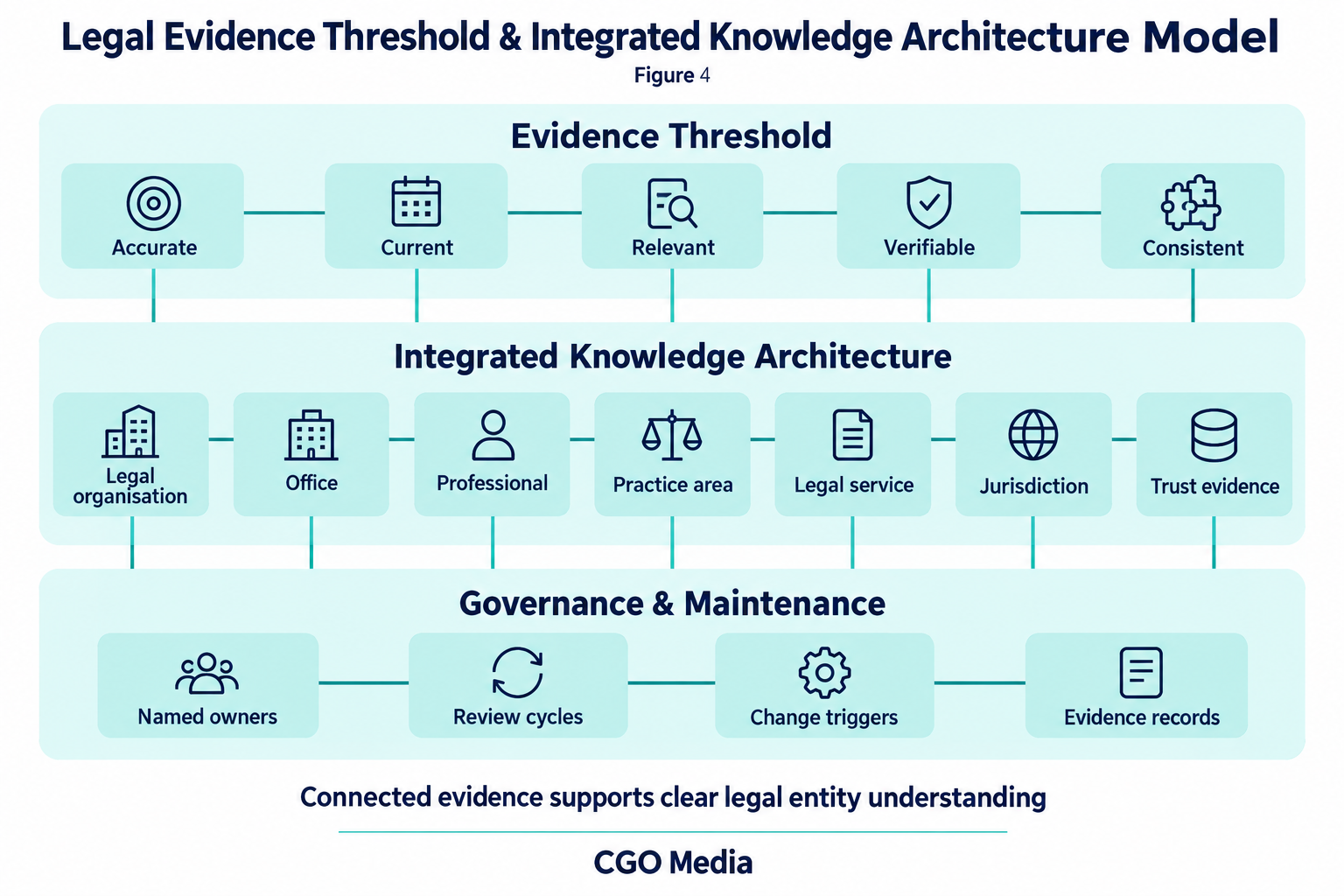
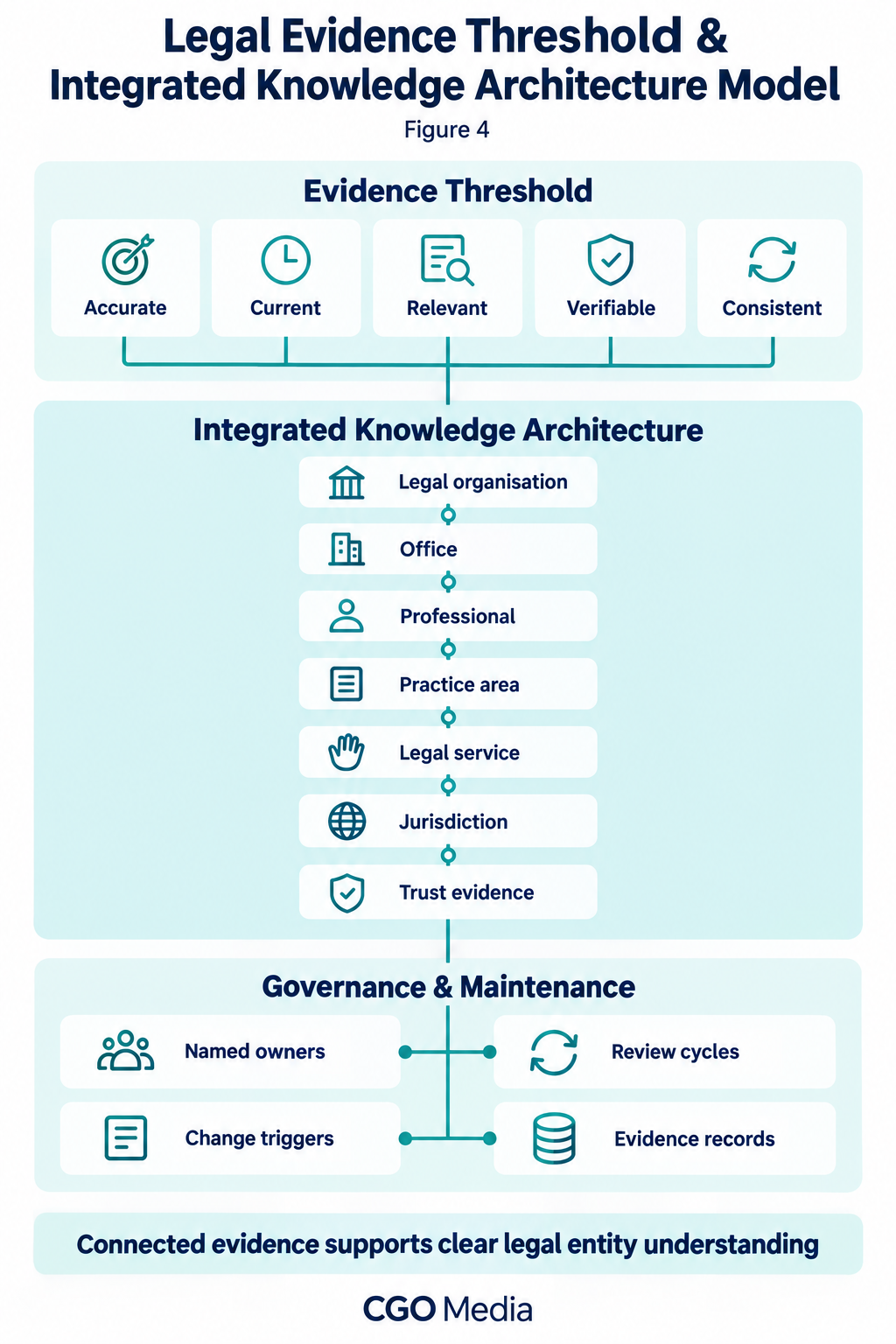
267. Measuring Legal Search Authority
Legal search authority should be measured as a combination of visibility, entity clarity, professional evidence, trust, external validation and provider-selection performance.
268. Rankings Alone Are Insufficient
Organic rankings may indicate discoverability, but they do not show whether users can verify the firm, identify a suitable professional or progress confidently toward enquiry.
269. A Multi-Dimensional Measurement Model
A practical legal authority scorecard may assess:
- Entity clarity
- Legal content authority
- Professional authority
- Regulatory and client trust
- External and local authority
- AI recommendation readiness
270. Dimension One — Entity Clarity
Measurement may examine whether important legal entities are represented accurately and consistently.
271. Organisation Identity Measures
Potential indicators may include:
- Firm-name consistency
- Provider-type clarity
- Practice-area clarity
- Office-network accuracy
272. Office Entity Measures
Potential indicators may include:
- Address accuracy
- Telephone accuracy
- Professional mapping
- Practice-area mapping
273. Professional Entity Measures
Potential indicators may include:
- Current role accuracy
- Firm affiliation accuracy
- Office relationship accuracy
- Practice-area relationship accuracy
274. Entity Conflict Rate
An organisation may monitor the percentage of priority entities with material inconsistencies across important first-party and external sources.
275. Dimension Two — Legal Content Authority
Legal content measurement should focus on whether the information environment is sufficiently accurate, useful and governed.
276. Content Coverage
The organisation may assess whether priority practice areas and services have sufficient supporting information.
277. Content Freshness
Review whether high-priority legal information has been checked within the organisation’s defined review cycle.
278. Jurisdictional Clarity
Measure whether important legal information clearly identifies the relevant geographic or legal scope.
279. Professional Attribution
Assess whether important legal information is connected appropriately with professional authorship or review.
280. Source Quality
Where sources are used, review whether they remain:
- Relevant
- Current
- Authoritative for the legal context
281. Content-to-Service Connectivity
Measure whether informational content connects users naturally with relevant practice areas and legal services.
282. Dimension Three — Professional Authority
Professional measurement should examine whether lawyers and legal practitioners have sufficiently complete, current and verifiable profiles.
283. Profile Completeness
Potential indicators may include coverage of:
- Role
- Qualifications
- Practice areas
- Office locations
- Professional status
284. Practice-Area Evidence Coverage
Measure the proportion of priority professionals with clear relationships to the areas of law in which they genuinely practise.
285. Professional-Service Relationship Coverage
Assess whether relevant professionals are connected with specific legal services.
286. External Professional Consistency
Review whether current roles, affiliations and locations are reflected accurately across relevant external environments.
287. Professional Contribution Evidence
Where relevant, measure coverage of:
- Publications
- Speaking
- Research
- Professional body involvement
288. Dimension Four — Regulatory and Client Trust
Trust measurement should examine whether users can verify the provider and understand important client-care information.
289. Regulatory Information Coverage
Measure whether relevant regulatory information is:
- Present
- Current
- Linked to the correct entity
290. Client-Care Information Coverage
Potential areas may include:
- Complaints
- Privacy
- Confidentiality
- Contact pathways
- Fee information where appropriate
291. Review Theme Trends
Review analysis may monitor whether recurring themes around communication, responsiveness or administration are improving or deteriorating.
292. Review Recency
The organisation may monitor whether recent feedback exists across strategically important offices or service areas.
293. Trust Evidence Should Be Interpreted Qualitatively
A high number of reviews or recognitions should not automatically be converted into a claim of superior legal competence.
294. Dimension Five — External and Local Authority
External authority measurement should examine whether the wider information environment supports the firm’s own representation.
295. Legal Directory Coverage
Where relevant, monitor whether important:
- Firm profiles
- Professional profiles
- Practice-area entries
- Office entries
remain current.
296. Institutional Evidence Coverage
Measure relevant relationships with:
- Professional bodies
- Universities
- Research institutions
- Industry organisations
297. Editorial Authority
Potential measures may include:
- Relevant expert commentary
- Legal publication coverage
- Business-media citations
- Trade-publication references
298. Citation Authority
Where the organisation publishes research or legal commentary, monitor relevant third-party citations and references.
299. Local Profile Accuracy
For multi-office firms, measure the proportion of priority locations with accurate:
- Address
- Telephone
- Opening information
- Website destination
300. Office-Practice-Area Accuracy
Assess whether each office is associated only with legal capabilities genuinely available there.
301. Office-Professional Accuracy
Assess whether current lawyers are mapped correctly to relevant offices.
302. Dimension Six — AI Recommendation Readiness
AI measurement should focus on accuracy, relevance and repeatable observation rather than a single recommendation result.
303. Branded AI Accuracy Rate
Measure the proportion of priority branded prompts where material firm information is represented accurately.
304. Professional AI Accuracy Rate
Measure whether selected legal professionals are represented accurately for:
- Role
- Firm
- Practice area
- Office
305. Practice-Area Recommendation Presence
Observe whether the firm appears in relevant non-branded practice-area discovery scenarios.
306. Local AI Presence
Observe whether appropriate offices appear within relevant local legal-provider queries.
307. Provider Comparison Presence
Monitor whether the firm enters generated comparison sets for legal matters it genuinely handles.
308. AI Source Consistency
Where sources are visible, assess whether frequently surfaced sources contain accurate and current information.
309. Material AI Error Rate
Track significant inaccuracies involving:
- Firm identity
- Professional affiliation
- Practice-area relevance
- Office location
- Regulatory context
310. AI Recommendation Presence Should Be Qualified
A recommendation should only be counted as strategically relevant where it aligns with:
- The actual service
- The correct jurisdiction
- The relevant geography
- The appropriate provider type
311. Legal Authority Scorecard
| Authority Dimension | Example Measures | Primary Risk |
|---|---|---|
| Entity Clarity | Identity accuracy, office mapping, professional mapping | Ambiguous or conflicting provider representation |
| Legal Content Authority | Freshness, jurisdiction clarity, professional review | Outdated or misleading legal information |
| Professional Authority | Profile completeness, external consistency, contribution evidence | Weak evidence of relevant legal expertise |
| Regulatory & Client Trust | Regulatory clarity, client-care information, review trends | Insufficient provider verification or client confidence |
| External & Local Authority | Directory accuracy, local accuracy, relevant citations | Weak or inconsistent corroborating evidence |
| AI Recommendation Readiness | Accuracy, relevant presence, source consistency | Incorrect or unstable machine representation |
312. Weighted Scoring
Organisations may apply different weights to authority dimensions according to strategic relevance and risk.
313. High-Risk Weaknesses Should Not Be Hidden by Averages
A strong overall score should not disguise material weaknesses involving:
- Professional status
- Regulatory information
- Jurisdictional accuracy
- Major legal-content errors
314. Use Evidence Confidence
Each score should indicate how reliable and current the underlying evidence is.
315. High-Confidence Evidence
Evidence may be considered stronger where it is:
- Current
- Directly verifiable
- Supported across multiple relevant sources
316. Medium-Confidence Evidence
Evidence may be incomplete or dependent on a smaller number of sources.
317. Low-Confidence Evidence
Scores should be treated cautiously where:
- Data is old
- Source ownership is unclear
- Evidence is inconsistent
- Manual verification is incomplete
318. Provider-Selection Measurement
Authority measurement should connect with how prospective clients move through provider selection.
319. Stage One — Legal Need Recognition
Measure whether the firm is visible around relevant legal questions and problems.
320. Stage Two — Legal Information Research
Assess whether users engage with useful legal information before reaching a service page.
321. Stage Three — Firm Discovery
Measure whether the firm enters relevant organic, local and AI-assisted consideration sets.
322. Stage Four — Practice Relevance
Assess whether users can identify clearly:
- The relevant practice area
- The appropriate legal service
- The applicable jurisdiction
323. Stage Five — Professional Evaluation
Measure whether users engage with relevant lawyer profiles and professional evidence.
324. Stage Six — Trust Validation
Assess whether users can verify:
- Professional status
- Regulatory context
- Reputation
- External evidence
325. Stage Seven — Provider Comparison
Measure whether the firm remains within consideration during:
- Branded searches
- Review searches
- Directory comparison
- AI provider comparison
326. Stage Eight — Enquiry
Potential outcome measures may include:
- Qualified enquiries
- Telephone enquiries
- Form completions
- Consultation requests
327. Measure Qualified Demand, Not Traffic Alone
Large increases in informational traffic may create little commercial value if visitors have no realistic relationship to the firm’s services or jurisdiction.
328. Search Visibility Should Be Segmented
Useful segmentation may include:
- Practice area
- Office
- Professional
- Jurisdiction
- Branded versus non-branded
329. Local Visibility Should Be Measured by Office
Multi-location reporting should avoid combining offices so heavily that local weaknesses disappear within national totals.
330. Professional Visibility Should Be Measured Separately
Individual lawyer discoverability may reveal authority opportunities not visible in firm-level reporting.
331. Practice-Area Performance Should Be Measured Separately
One strong practice area should not obscure weak visibility or evidence in another strategic service line.
332. AI Monitoring Should Be Longitudinal
Repeated testing over time is generally more informative than isolated snapshots.
333. Avoid False Precision in AI Measurement
AI outputs can fluctuate, so small movements in recommendation frequency should not automatically be treated as statistically meaningful.
334. Executive Legal Authority Reporting
Senior leadership should receive a concise view of:
- Current authority strengths
- Material trust risks
- Priority visibility gaps
- AI representation issues
- Strategic opportunities
335. Executive Reporting Should Show Trend
Each major dimension may be classified as:
- Improving
- Stable
- At risk
- Regressing
336. Executive Reporting Should Show Priority
Issues may be classified according to:
- Critical
- High
- Medium
- Low
337. Critical Legal Authority Issues
Potential examples may include:
- Incorrect professional status
- Wrong firm affiliation
- Material regulatory inconsistency
- Significant jurisdictional error
338. High-Priority Legal Authority Issues
Potential examples may include:
- Incomplete priority lawyer profiles
- Incorrect office information
- Weak practice-area evidence
- Persistent AI representation errors
339. Medium-Priority Legal Authority Issues
Potential examples may include:
- Weak internal relationships
- Incomplete external profiles
- Limited editorial authority
- Outdated lower-risk content
340. Priority Gap Analysis
A structured gap analysis can compare:
Current Evidence → Required Evidence → Priority Gap → Responsible Owner
341. Entity Gap Analysis
Questions may include:
- Are firm identities consistent?
- Are offices represented correctly?
- Are professional relationships current?
342. Content Gap Analysis
Questions may include:
- Are strategic practice areas sufficiently covered?
- Is jurisdiction clear?
- Is professional review adequate?
343. Professional Gap Analysis
Questions may include:
- Are priority lawyer profiles sufficiently complete?
- Is expertise demonstrated?
- Are external identities consistent?
344. Trust Gap Analysis
Questions may include:
- Is regulatory information clear?
- Are client-care pathways visible?
- Are repeated review concerns understood?
345. External Authority Gap Analysis
Questions may include:
- Are key directories accurate?
- Is relevant third-party validation visible?
- Are important professional contributions discoverable?
346. AI Readiness Gap Analysis
Questions may include:
- Are branded descriptions accurate?
- Are professional identities represented correctly?
- Does the firm appear for genuinely relevant recommendation scenarios?
347. Governance Ownership
Legal authority requires named ownership across the organisation.
348. Firm Entity Ownership
Potential owners may include:
- Marketing
- Digital
- Operations
- Corporate communications
349. Professional Data Ownership
Potential owners may include:
- HR
- Practice management
- Marketing
- Professional support teams
350. Legal Content Ownership
Content governance may involve:
- Practice-area lawyers
- Knowledge teams
- Editors
- Marketing
351. Regulatory and Client-Trust Ownership
Relevant responsibility may involve:
- Compliance
- Risk
- Client-care teams
- Senior management
352. Local Authority Ownership
Multi-office firms may require coordination between:
- Operations
- Office management
- Marketing
- SEO
353. External Authority Ownership
Potential contributors may include:
- PR
- Business development
- Marketing
- Research and knowledge teams
354. AI Monitoring Ownership
AI monitoring may involve:
- SEO
- Digital strategy
- Data
- Risk and compliance
355. Cross-Functional Governance Is Important
The legal evidence environment crosses departmental boundaries and should not be treated as the responsibility of SEO alone.
356. Governance Should Include Change Triggers
Relevant triggers may include:
- Lawyer joining or leaving
- Partner promotion
- Office opening or closure
- Practice-area launch
- Firm rebrand
- Regulatory change
357. Governance Should Include Review Cadence
A practical review rhythm may include:
- Monthly critical-data checks
- Quarterly authority scorecards
- Quarterly AI monitoring
- Annual strategic review
358. Governance Should Include Escalation
Material errors involving professional status, regulation or misleading legal information should have defined escalation pathways.
359. Governance Should Preserve Evidence
Important scoring and remediation decisions should retain enough evidence to support later review.
360. The Legal Authority Management System
A practical management loop is:
Measure → Identify Gaps → Prioritise → Assign Ownership → Improve → Verify → Report
361. Measurement Should Support Decisions
The objective is not to create the largest possible dashboard.
It is to identify where improved evidence, stronger governance or better user journeys can create meaningful authority gains.
362. Measurement Prepares the Organisation for Continuous Improvement
Once legal authority is measured systematically, the organisation can move from isolated optimisation toward an ongoing process of monitoring, remediation and strategic learning.
363. Continuous Legal Authority Improvement
Legal search authority should be maintained as an ongoing organisational capability rather than treated as a one-time SEO project.
364. Legal Evidence Decays Over Time
Even strong legal information environments can become inaccurate as firms, lawyers, offices, services and external profiles change.
365. Organisation Evidence Decay
Firm-level information may deteriorate because of:
- Rebrands
- Mergers
- Acquisitions
- Changes in legal structure
- Practice restructuring
366. Professional Evidence Decay
Lawyer and practitioner information may become outdated when:
- Professionals join
- Professionals leave
- Roles change
- Partnership status changes
- Office locations change
367. Practice-Area Evidence Decay
Practice-area architecture can become inaccurate when:
- Services are launched
- Teams merge
- Specialisms change
- Service terminology changes
368. Legal Content Decay
Legal information can become weaker when:
- Law changes
- Procedure changes
- Regulatory guidance changes
- Sources become outdated
- Review cycles are missed
369. Jurisdictional Evidence Decay
Changes in applicable law, regulatory context or geographic service scope may alter the relevance of existing content.
370. Local Evidence Decay
Office information may become inaccurate through:
- Office moves
- Closures
- New locations
- Telephone changes
- Changes in opening information
371. External Evidence Decay
Third-party profiles may continue to display:
- Former firms
- Old titles
- Previous offices
- Outdated practice areas
372. Review Evidence Decay
Historical reviews may no longer represent current client experience where teams, processes or service standards have changed.
373. AI Representation Drift
AI-assisted systems may change how they represent firms and lawyers as:
- Source environments change
- Retrieval systems change
- Models change
- External evidence changes
374. Drift Should Be Monitored, Not Assumed
A representation that was accurate previously should not be assumed to remain accurate indefinitely.
375. Risk-Based Monitoring
Legal organisations should monitor higher-risk evidence classes more frequently.
376. High-Risk Evidence Classes
These may include:
- Professional status
- Firm affiliation
- Regulatory information
- Jurisdictional claims
- High-impact legal information
377. Medium-Risk Evidence Classes
These may include:
- Professional biographies
- Office information
- Practice-area descriptions
- Fee information
378. Strategic Monitoring Areas
These may include:
- Search visibility
- AI provider presence
- Directory visibility
- Editorial authority
- Competitor representation
379. Maintain Professional Change Triggers
When a lawyer joins, leaves or changes role, review connected:
- Professional profile
- Practice-area pages
- Service pages
- Office pages
- External profiles
380. Maintain Office Change Triggers
When an office changes, review:
- Office page
- Local profiles
- Professional relationships
- Practice-area availability
- Contact information
381. Maintain Practice-Area Change Triggers
When legal services change, review:
- Practice-area pages
- Service pages
- Professional relationships
- Navigation
- Internal linking
382. Maintain Legal Content Change Triggers
Material legal or regulatory changes should trigger review of affected guidance and explanatory content.
383. Maintain Regulatory Change Triggers
Changes in professional or firm status should prompt rapid review of public regulatory representations.
384. Maintain Rebrand and Merger Triggers
Major organisational change should initiate a broader entity review across:
- Firm identity
- Offices
- Professionals
- External profiles
- Structured data
385. Failure Mode — Ranking Without Authority
A firm may achieve strong search positions while still presenting weak professional, trust or entity evidence.
386. Failure Mode — Content Volume Without Legal Governance
Publishing large quantities of legal content without sufficient professional review may create outdated or misleading information.
387. Failure Mode — Thin Professional Profiles
Weak lawyer profiles may reduce provider confidence even when firm-level branding is strong.
388. Failure Mode — Generic Practice-Area Claims
Claiming broad capability without sufficiently relevant professional or service evidence may weaken authority.
389. Failure Mode — Jurisdictional Ambiguity
Legal content may appear authoritative but still mislead if users cannot determine where it applies.
390. Failure Mode — Regulatory Information Hidden or Outdated
Weak regulatory transparency can undermine trust at the point of provider verification.
391. Failure Mode — Reviews Used as Competence Proof
Client feedback should not be presented as if it establishes technical legal superiority.
392. Failure Mode — Awards Without Context
Legal rankings and awards can become misleading where the relevant year, practice area, lawyer or office is not made clear.
393. Failure Mode — Case Results Overstated
Past outcomes should not be presented in a way that implies guaranteed future performance.
394. Failure Mode — External Authority Without Relevance
Large volumes of unrelated media or backlink activity may contribute little to legal provider authority if they do not align with genuine expertise.
395. Failure Mode — Local SEO Without Real Office Capability
Location pages should not imply professional or practice-area availability that does not exist operationally.
396. Failure Mode — AI Monitoring Without Remediation
Recording representation errors repeatedly creates limited value unless findings lead to diagnosis and correction.
397. Failure Mode — Treating AI Recommendation as Proof
AI-generated provider suggestions should not be treated as independent proof of legal quality or suitability.
398. Failure Mode — Chasing Prompt Results
Changing content primarily to influence isolated prompt outputs may weaken the wider evidence architecture.
399. Failure Mode — Artificial Authority Signals
Fabricated reviews, false affiliations, misleading awards or invented professional evidence create trust and governance risk.
400. Failure Mode — Siloed Professional Data
Where HR, marketing, practice management and external directories maintain different versions of professional information, inconsistency can increase rapidly.
401. Failure Mode — No Change Ownership
Even strong legal websites can deteriorate when no team owns updates following staff, office or service changes.
402. Failure Mode — One-Time Data Cleansing
Cleaning professional or local information once does not create resilience if no ongoing process exists.
403. Failure Mode — No Evidence Confidence
Authority scores may create false confidence if the underlying information has not been verified recently.
404. Failure Mode — Over-Averaging
A strong overall score may hide serious weaknesses in:
- One practice area
- One office
- One professional group
- One jurisdiction
405. Failure Mode — National Performance Hiding Local Weakness
Multi-office firms should not allow strong national visibility to obscure inaccurate or weak local entities.
406. Failure Mode — Strong Firm Brand Hiding Lawyer Weakness
Firm authority does not automatically establish individual professional relevance.
407. Failure Mode — Strong Lawyer Brand Hiding Firm Inconsistency
A recognised professional may not compensate for incorrect firm, office or regulatory information.
408. Failure Mode — Activity Metrics Without Outcomes
Counting pages, links, directory submissions or AI prompts does not demonstrate stronger legal authority by itself.
409. Continuous Improvement Requires Reassessment
The organisation should periodically reassess the entire legal authority environment.
410. Reassess Firm Entity Architecture
Confirm whether organisational relationships remain accurate after:
- Growth
- Restructuring
- Mergers
- Rebrands
411. Reassess Professional Architecture
Confirm whether current lawyers, roles and office relationships are represented correctly.
412. Reassess Practice-Area Architecture
Confirm whether digital practice structures still reflect the firm’s actual legal capabilities.
413. Reassess Content Priorities
Search behaviour and client questions may reveal new areas requiring deeper legal information.
414. Reassess Jurisdictional Coverage
Expansion into new regions or markets may create additional jurisdictional information requirements.
415. Reassess Local Priorities
Multi-office firms should review whether location priorities have changed through:
- Expansion
- Consolidation
- Demand changes
- Practice concentration
416. Reassess Professional Priorities
Authority development may shift toward professionals with:
- New leadership roles
- New specialist responsibilities
- Greater research activity
- Strategic practice importance
417. Reassess External Authority
Review whether the firm’s strongest external evidence still aligns with its strategic practice areas.
418. Reassess AI Monitoring Prompts
Prompt sets should evolve as client language and legal provider-discovery behaviour change.
419. Reassess Competitor Sets
Relevant competitors may change because of:
- Market entry
- Firm mergers
- Practice-area expansion
- Local competition
420. Reassess Evidence Thresholds
A stronger organisation may require a higher internal standard for what counts as sufficient authority evidence.
421. Organisational Learning
Each monitoring and improvement cycle should generate new understanding about which evidence gaps create the greatest provider-selection friction.
422. Use Search Data for Learning
Search data may reveal:
- New legal questions
- Changing terminology
- Emerging practice demand
- Local demand patterns
423. Use Enquiry Data for Learning
Initial client enquiries may reveal:
- Common misunderstandings
- Practice-area confusion
- Fee questions
- Jurisdiction questions
424. Use Client Feedback for Learning
Reviews and complaints may reveal recurring issues involving:
- Communication
- Responsiveness
- Process clarity
- Administration
425. Use Professional Feedback for Learning
Lawyers and practice leaders may identify:
- Incorrect matter assumptions
- Missing service information
- Outdated terminology
- New client needs
426. Use Business Development Data for Learning
Business development teams may reveal which content, directories, publications and reputation signals influence enquiries.
427. Use AI Observation for Learning
AI monitoring may reveal:
- Persistent entity ambiguity
- New source patterns
- Incorrect practice associations
- Changing competitor presence
428. Learning Should Update Standards
Repeated evidence should be used to refine:
- Professional profile standards
- Practice-area templates
- Office information standards
- Review procedures
- AI monitoring processes
429. Learning Should Update Governance
If the same issue repeatedly returns, ownership, review frequency or change triggers may need to be strengthened.
430. Learning Should Update Investment Priorities
Resources should move toward areas that create the greatest improvement in:
- Accuracy
- Professional authority
- Client trust
- Relevant discovery
- Provider-selection confidence
431. Legal Authority Should Become a Managed Organisational Asset
Professional information, practice-area evidence, legal content and external authority should be governed with the same discipline applied to other strategically important organisational information.
432. The Continuous Legal Authority Cycle
A practical continuous cycle is:
Observe → Verify → Prioritise → Improve → Measure → Govern → Learn → Reassess
433. Observe
Monitor changes across:
- Firm entities
- Professionals
- Practice areas
- Legal content
- External evidence
- Search and AI discovery
434. Verify
Confirm whether an identified weakness or inconsistency is genuine.
435. Prioritise
Rank issues according to:
- Professional risk
- Regulatory risk
- Client impact
- Commercial importance
- Visibility opportunity
436. Improve
Make appropriate changes across:
- Website
- Professional profiles
- Office information
- Practice architecture
- External sources
437. Measure
Assess whether changes improve:
- Entity accuracy
- Professional evidence
- Search visibility
- Provider-selection performance
- AI representation accuracy
438. Govern
Maintain:
- Named owners
- Review cadence
- Change triggers
- Escalation procedures
- Evidence records
439. Learn
Use new evidence from clients, professionals, search systems, external sources and AI systems to improve the model.
440. Reassess
Repeat authority measurement and gap analysis to identify the next set of priorities.
441. The Complete Legal Search Authority System
The research can therefore be summarised as:
Entity Clarity → Legal Content Authority → Professional Expertise → Regulatory & Client Trust → External & Local Validation → AI Readiness → Measurement → Governance → Continuous Improvement
442. Resilience Is the Long-Term Objective
The purpose of legal SEO should not be limited to achieving visibility at one point in time.
The stronger objective is to establish a legal authority system capable of remaining accurate, trusted and discoverable as professionals, firms, search systems and AI-assisted discovery continue to evolve.
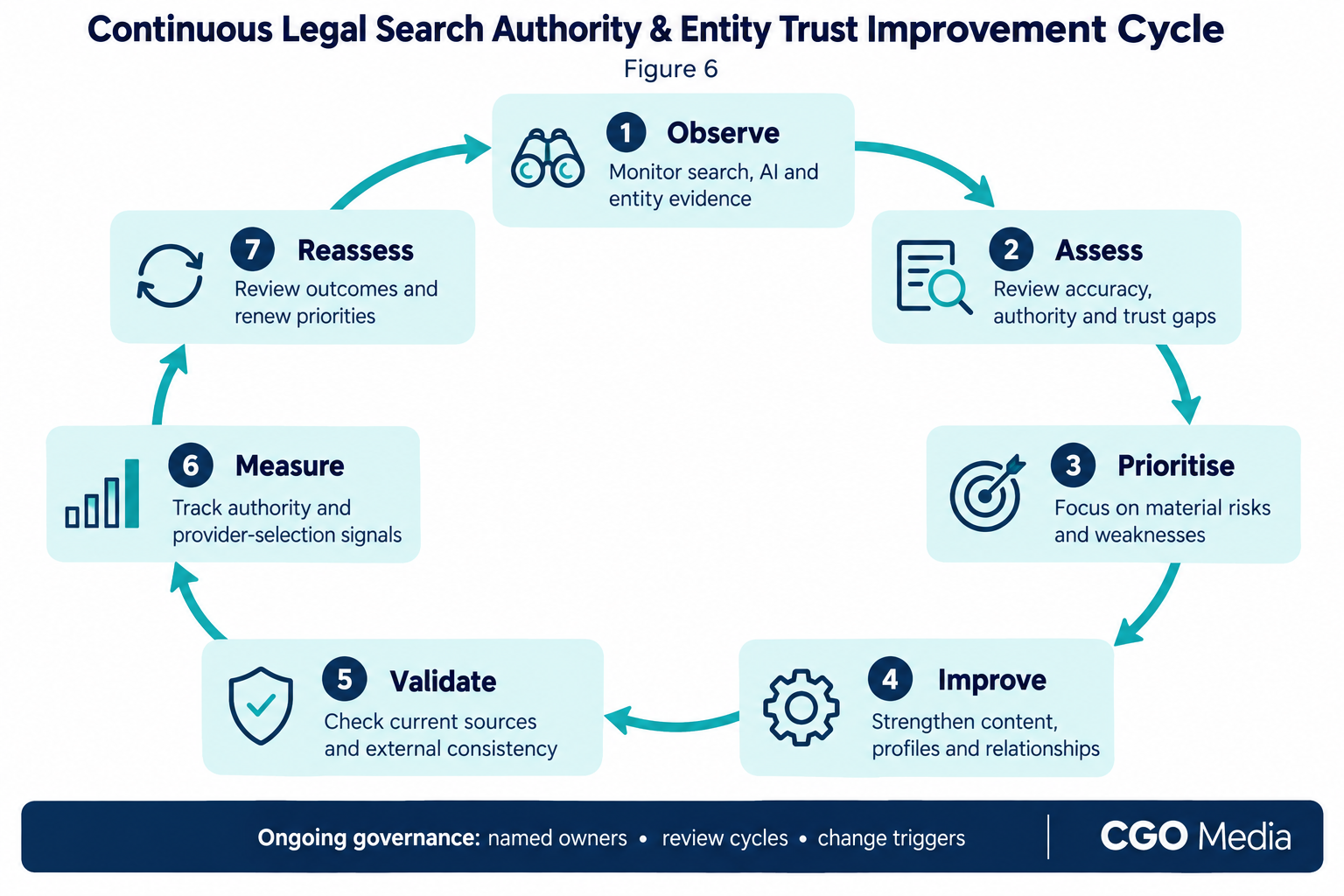
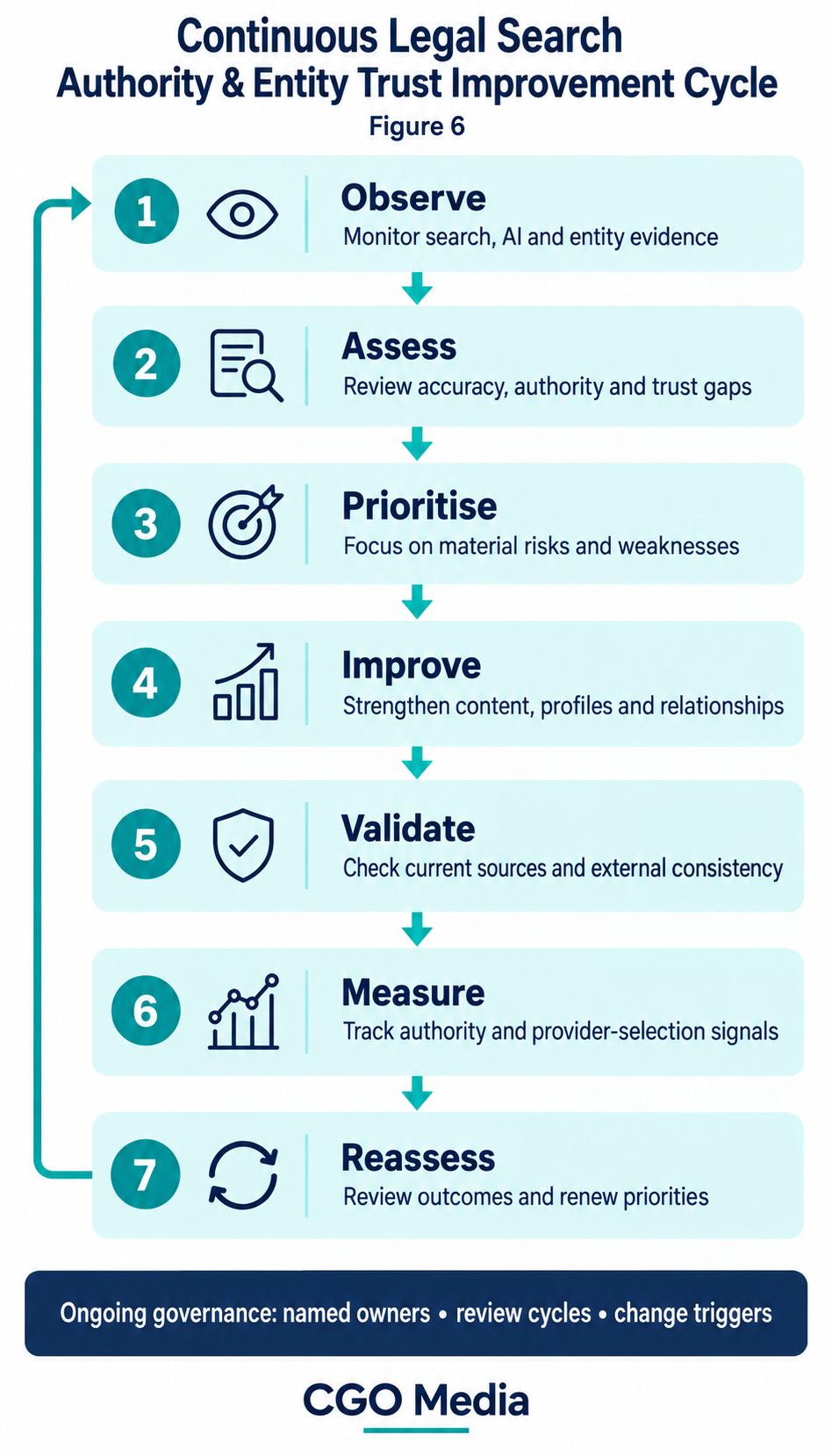
443. Strategic Implications
Legal search authority is increasingly shaped by the interaction between entity clarity, professional evidence, legal content, regulatory trust, local relevance, external validation and AI-assisted provider discovery.
This means that legal SEO should no longer be treated as a narrow exercise in rankings, keywords and links.
444. Legal Visibility Should Be Built on Verifiable Authority
A stronger legal search environment develops when users and automated systems can determine:
- Who the organisation is
- Who its professionals are
- Which legal services it genuinely provides
- Where those services are available
- Which jurisdiction applies
- What evidence supports its authority
445. Entity Clarity Is the Foundation
Firm, office, professional, practice-area and service relationships should be sufficiently clear before organisations attempt to scale more advanced authority activity.
446. Professional Authority Is Central to Legal Search
For many legal decisions, users evaluate not only the organisation but the individual professional likely to handle the matter.
447. Legal Content Should Support Professional Authority
The strongest legal information environments connect relevant educational content with genuine practice expertise.
448. Jurisdiction Must Remain Visible
Legal information can lose practical value or become misleading when users cannot determine the geographic or legal context in which it applies.
449. Regulatory Transparency Supports Trust
Relevant regulatory and professional information should help users verify the organisation and its professionals without unnecessary ambiguity.
450. Reviews Should Be Used Carefully
Client reviews may contribute evidence about service experience, communication and responsiveness, but they should not be treated as proof of superior legal competence.
451. Case Evidence Requires Context
Past transactions, disputes or case outcomes may help demonstrate relevant experience where disclosure is appropriate, but they should not be presented as guarantees of future outcomes.
452. External Authority Should Reflect Real Expertise
Legal directories, professional organisations, publications, editorial coverage and institutional references are most useful when they reinforce genuine practice capability.
453. Local Authority Matters for Multi-Office Firms
Each important office should be represented accurately for:
- Professionals
- Practice areas
- Services
- Contact information
- Local availability
454. AI Readiness Is a Higher-Order Condition
Legal AI readiness is better understood as the cumulative result of a strong underlying evidence environment.
Entity Clarity + Practice Relevance + Professional Evidence + Regulatory Trust + External Authority + Jurisdictional Fit
455. AI Recommendations Should Be Interpreted Cautiously
AI-generated provider suggestions can vary across systems, prompts, geography, source availability and time.
456. AI Presence Is Not Endorsement
Appearance within an AI-generated answer should not be treated as proof of professional superiority, legal competence or suitability for a particular matter.
457. Source Consistency Is Increasingly Important
As search and AI systems interpret information across multiple sources, material conflicts involving firm identity, professional roles, office locations or regulatory status can create ambiguity.
458. Authority Measurement Should Be Multi-Dimensional
A more complete legal authority measurement model should consider:
- Entity clarity
- Legal content authority
- Professional authority
- Regulatory and client trust
- External and local authority
- AI recommendation readiness
459. Critical Weaknesses Should Not Be Hidden by Aggregate Scores
A strong overall authority score should not disguise serious weaknesses involving professional status, regulation, jurisdiction or material legal information.
460. Legal Authority Requires Governance
Search authority can deteriorate quickly when no one owns:
- Professional changes
- Office changes
- Practice-area changes
- Legal content reviews
- External profile accuracy
461. Legal Authority Should Be Managed as an Organisational Asset
Firm identity, professional data, legal content and external evidence should be maintained with clear ownership, review cycles and change processes.
462. The Strategic Legal Authority Model
The full model can be represented as:
Entity Architecture → Legal Content Authority → Professional Expertise → Regulatory & Client Trust → External & Local Validation → AI Readiness → Measurement → Governance → Continuous Improvement
463. Relationship with the Legal Framework Family
This research paper provides the parent research architecture for four related CGO Media Legal frameworks.
Legal Entity Authority Framework | Legal Information and Professional Selection Process | Legal Entity Authority Maturity Model | Legal SEO and Entity Authority Implementation Roadmap
464. Legal Entity Authority Framework
The Legal Entity Authority Framework translates this research into a structured model for evaluating the main dimensions of legal entity clarity, professional authority, trust and AI-readiness.
465. Legal Information and Professional Selection Process
The Legal Information and Professional Selection Process examines how users move from legal information need through professional discovery, trust validation, provider comparison and final selection.
466. Legal Entity Authority Maturity Model
The Legal Entity Authority Maturity Model assesses how effectively legal organisations govern and integrate entity, professional, trust and AI-readiness capabilities.
467. Legal SEO and Entity Authority Implementation Roadmap
The Legal SEO and Entity Authority Implementation Roadmap provides the practical implementation sequence for strengthening the legal authority environment over time.
468. Methodology
Legal SEO in an AI Search Environment develops a conceptual model for legal search authority based on the interaction between search visibility, entity relationships, professional evidence, legal information, regulatory trust, local discovery, external validation and AI-assisted provider representation.
The methodology is designed to examine whether legal organisations and professionals are represented through sufficiently clear, accurate, jurisdictionally relevant and verifiable evidence across conventional search and AI-assisted discovery environments.
Core Research Question
The central research question is:
How can legal organisations create a sufficiently clear, accurate, jurisdictionally relevant and professionally verifiable evidence environment that supports qualified discovery, professional evaluation and appropriate consideration across conventional search and AI-assisted legal discovery?
Research Scope
The model focuses primarily on the digital discovery and provider-selection environment surrounding:
- Law firms
- Solicitors
- Barristers
- Individual legal professionals
- Multi-office legal organisations
- Specialist legal practices
- Commercial and corporate legal providers
- Consumer-facing legal providers
The model should be adapted to the terminology, professional structures and regulatory requirements of the jurisdiction in which it is applied.
Six Core Research Dimensions
The analysis is organised around six connected authority dimensions:
- Legal Entity and Organisational Clarity
- Legal Information and Content Authority
- Professional and Practitioner Authority
- Regulatory, Client and Reputational Trust
- External, Institutional and Local Authority
- AI Search and Professional Recommendation Readiness
These dimensions are assessed together because weakness in one area can reduce the value created by stronger evidence elsewhere.
Legal Entity Analysis
Legal entity analysis examines the relationships between:
Organisation → Office → Professional → Practice Area → Service → Jurisdiction → Matter Type
The objective is to determine whether users and digital systems can understand:
- which legal organisation is being represented;
- where it operates;
- which professionals are associated with it;
- which practice areas and services are genuinely offered;
- which jurisdiction or legal system is relevant;
- and which types of legal matter the organisation or professional handles.
Organisational Identity Method
Organisational analysis can examine:
- Firm or chambers identity
- Office relationships
- Trading names where relevant
- Regulatory information
- Practice-area structure
- Professional relationships
- Jurisdictional relationships
Organisational clarity is particularly important where legal groups operate through multiple offices, brands, entities or professional structures.
Professional Authority Analysis
Professional authority considers observable evidence including:
- Professional role
- Relevant qualifications
- Practice focus
- Professional status
- Regulatory or professional registration where applicable
- Publications
- Relevant cases or matters where legitimately publishable
- Institutional roles
- Relevant external evidence
The methodology does not infer legal competence from search visibility, directory prominence, advertising exposure or AI recommendation frequency.
It evaluates whether relevant professional claims can be understood and, where appropriate, independently verified.
Legal Information and Content Authority
Legal information is assessed conceptually according to:
- Accuracy
- Currency
- Jurisdictional clarity
- Professional attribution
- Practice relevance
- Source quality
- Material limitations
- Appropriate review
Legal information should not be assessed solely according to content volume, keyword coverage or search visibility.
The stronger information-quality model is:
Jurisdiction + Applicable Legal Context + Source Authority + Currency + Professional Attribution + Material Limitations
Jurisdictional Relevance Method
Legal information can be accurate in one jurisdiction while being irrelevant, incomplete or misleading in another.
Analysis should therefore consider:
- Country
- State, province or regional legal system where relevant
- Court or tribunal context
- Regulatory context
- Applicable professional regime
- Relevant date or legal period
Where jurisdiction materially affects the interpretation of legal information, that jurisdiction should be sufficiently clear.
Legal Source Hierarchy
Different legal sources perform different evidential roles and should not be treated as interchangeable.
Depending on jurisdiction and subject, relevant source categories can include:
- Legislation
- Case law
- Court and tribunal sources
- Regulatory sources
- Government guidance
- Professional-body guidance
- Academic legal research
- Law-firm or practitioner commentary
- Editorial and media sources
- Client reviews
The existence of a source does not automatically establish that it is the controlling or most authoritative source for the legal question being considered.
Primary and Secondary Legal Sources
Where a legal proposition depends on primary legal authority, secondary commentary should not automatically be treated as an equivalent substitute.
Professional commentary can help explain:
- Legal developments
- Procedural implications
- Commercial consequences
- Practical interpretation
but its evidential role should remain distinct from legislation, binding authority or other primary sources where those distinctions apply.
Legal Information Freshness
Legal information can become outdated following:
- Legislative change
- New case law
- Regulatory change
- Procedural amendment
- Updated professional guidance
- Changes to deadlines or thresholds
Information freshness should therefore be assessed according to the legal subject and potential consequences of relying on outdated information.
Professional Attribution Method
Where legal content is attributed to a professional, analysis can consider:
- Professional identity
- Role
- Relevant practice area
- Current firm or chambers relationship
- Jurisdictional relevance
- Review or publication date
Attribution should help users understand who is responsible for the information rather than functioning merely as a search optimisation signal.
Trust Analysis
Trust analysis considers:
- Professional verification
- Regulatory transparency
- Client-care information
- Complaints or redress information where relevant
- Reviews
- Reputation evidence
- Relevant professional recognition
Different evidence types should remain distinct.
Client experience evidence does not automatically establish technical legal competence, and professional recognition does not automatically establish suitability for every matter.
Regulatory Trust Method
Regulatory analysis can examine whether users can identify material information such as:
- Relevant regulator
- Professional status
- Regulated entity where applicable
- Professional title
- Applicable professional rules
- Required disclosures
The exact regulatory evidence required varies between jurisdictions, professional structures and legal-service models.
Client Experience Method
Client reviews and feedback can contribute evidence about areas such as:
- Communication
- Responsiveness
- Administration
- Accessibility
- Clarity of process
- Service experience
Reviews should not automatically be interpreted as proof of:
- Legal competence
- Case quality
- Professional superiority
- Likelihood of a particular legal outcome
External Authority Analysis
External authority considers evidence from:
- Legal directories
- Professional organisations
- Institutions
- Academic environments
- Editorial sources
- Research and publication environments
- Relevant professional commentary
External authority should be evaluated according to relevance, independence, methodology, currency and factual alignment rather than raw mention volume.
Legal Directories and Awards
Legal directories, rankings and awards can contribute external recognition.
However, their significance depends on factors including:
- Methodology
- Year
- Practice area
- Jurisdiction
- Professional category
- Scope of assessment
Directory inclusion or awards should therefore not automatically be interpreted as independent proof that a firm or professional is superior for a particular legal matter.
Local Authority Analysis
For multi-office providers, local authority can consider:
- Location accuracy
- Office-professional relationships
- Office-practice relationships
- Local profile consistency
- Contact information
- Office availability
The relevant relationship is:
Organisation → Office → Professional → Practice Area → Legal Service
Local visibility should reflect genuine operational relationships rather than artificial geographic association.
AI Readiness Analysis
AI readiness can be examined through repeatable observation of:
- Branded representation
- Professional representation
- Practice-area association
- Jurisdictional representation
- Local provider discovery
- Provider comparison
- Source patterns where visible
AI readiness should be evaluated through accuracy and relevance as well as presence.
Legal AI Scenario Testing
AI-assisted legal discovery can be examined using realistic scenario groups such as:
- General legal-information queries
- Practice-area queries
- Jurisdiction-specific queries
- Local legal-provider discovery
- Professional discovery
- Commercial legal-provider comparison
- Consumer legal-service comparison
Where practicable, observations can record:
- Platform or model
- Prompt
- Date
- Location
- Jurisdiction stated in the prompt
- Provider presence
- Professional presence
- Practice-area relevance
- Representation accuracy
- Visible citations where available
Evidence Threshold Approach
The model proposes that provider confidence may depend on sufficient evidence across several dimensions rather than one dominant signal.
Five core confidence questions are used.
Identity Confidence
Can the legal organisation and relevant professional be identified accurately?
Relevance Confidence
Is there clear evidence that the organisation or professional genuinely handles the relevant type of legal matter?
Professional Confidence
Can the relevant professional identity, status and practice expertise be verified sufficiently?
Trust Confidence
Is the organisation supported by appropriate professional, regulatory, reputational and client-care evidence?
Context Confidence
Does the provider appear relevant to the applicable jurisdiction, geography, matter type and professional context?
Source Consistency
The methodology also examines whether important first-party and external sources broadly agree on material facts.
A useful model is:
Firm Evidence + Professional Evidence + Regulatory Evidence + External Evidence + Jurisdictional Context
Convergence does not require identical wording.
It requires sufficient factual compatibility around information material to legal-provider understanding and evaluation.
Source Conflict
Material conflicts can include disagreement concerning:
- Professional role
- Firm affiliation
- Office location
- Practice area
- Regulatory status
- Service availability
- Jurisdiction
Material disagreement should trigger verification rather than automatic assumptions about which source is correct.
Qualified Legal Visibility
The methodology distinguishes maximum visibility from qualified visibility.
The strategic objective is not to surface every legal provider for every legal query.
Qualified visibility means appearing where the organisation or professional has genuine relevance to the:
- Matter type
- Practice area
- Jurisdiction
- Geographic context
- Client requirement
A conceptual progression is:
Discovery → Relevance → Professional Verification → Trust → Practical Evaluation → Appropriate Professional Consideration
Longitudinal Measurement
Search and AI observations are more useful when repeated over time rather than interpreted from isolated snapshots.
Longitudinal observation can identify whether:
- provider representation remains accurate;
- professional associations remain current;
- practice-area visibility changes;
- jurisdictional representation changes;
- source patterns change;
- or repeated recommendation patterns emerge.
Continuous Improvement Method
The operating cycle is:
Observe → Verify → Diagnose → Prioritise → Improve → Validate → Monitor → Learn
The methodology is therefore intended to support continuous legal search governance rather than one-time optimisation.
469. Limitations
Legal SEO in an AI Search Environment is a strategic search, entity-authority and provider-discovery framework.
It is not a legal, regulatory or professional compliance standard and does not replace advice from appropriately qualified legal or compliance professionals.
Legal Markets Differ
The structure of legal services varies significantly across:
- Jurisdictions
- Professional titles
- Regulatory systems
- Legal business models
- Court systems
- Professional structures
Terminology or professional relationships appropriate in one jurisdiction may not apply in another.
Regulatory Requirements Differ
Legal organisations should apply this research alongside all relevant rules governing:
- Advertising
- Professional conduct
- Client confidentiality
- Claims
- Testimonials
- Regulatory disclosure
- Professional titles
- Fee information where applicable
Professional Structures Differ
The relationships between firms, chambers, barristers, solicitors, attorneys and other legal professionals can vary substantially between legal systems.
The framework should therefore be adapted to the applicable professional environment.
Legal Information Is Jurisdiction-Specific
A legal proposition that is accurate in one jurisdiction may be irrelevant or incorrect in another.
Legal information should therefore be interpreted together with the applicable legal system, jurisdiction and date.
Legal Information Can Become Outdated
Legal information can change following:
- New legislation
- Case law
- Regulatory decisions
- Procedural amendments
- Updated guidance
Older legal information should not automatically be assumed to remain current.
Primary and Secondary Sources Are Not Interchangeable
Law-firm commentary, media reporting and other secondary material can help explain legal issues but should not automatically be treated as equivalent to controlling legislation, case law or authoritative regulatory material where those distinctions matter.
General Legal Information Is Not Individual Legal Advice
General online information cannot account fully for an individual legal matter’s:
- Facts
- Evidence
- Documents
- Jurisdiction
- Procedural position
- Deadlines
- Commercial objectives
- Risk tolerance
Users should not assume that general information provides the correct course of action for their individual circumstances.
Legal Deadlines Can Be Consequential
Legal time limits can depend on jurisdiction, matter type, procedural history and individual facts.
AI-generated or general website information concerning limitation periods, appeal deadlines, filing dates or other procedural time limits should not be relied upon without appropriate verification where the deadline is material.
Confidentiality and Privilege Require Care
Users should not assume that information entered into a public AI assistant, search engine or other third-party digital service is confidential, legally privileged or protected in the same way as communications within an established professional legal relationship.
Legal organisations should take care when encouraging users to disclose sensitive information through digital discovery environments.
Sensitive Client Information Should Not Be Used Casually for Visibility
Case studies, matter descriptions and outcome claims may be subject to:
- Confidentiality obligations
- Privilege
- Client consent
- Professional rules
- Privacy obligations
- Commercial sensitivity
Search or AI visibility objectives should never override those obligations.
Past Matters Do Not Predict Future Outcomes
Legal matters depend on:
- Facts
- Evidence
- Procedure
- Jurisdiction
- Opposing parties
- Decision-makers
- Legal developments
Past case results, settlements or outcomes should not be interpreted as guarantees or reliable predictions of future results.
Search Behaviour Differs by Practice Area
Provider-selection behaviour for a personal legal problem may differ substantially from procurement of complex corporate or specialist legal services.
Consumer and Commercial Legal Journeys Differ
Consumer legal services may involve greater emphasis on:
- Location
- Reviews
- Cost
- Availability
- Ease of contact
Commercial legal procurement may place greater emphasis on:
- Specialist expertise
- Sector experience
- Professional relationships
- Institutional reputation
- Cross-border capability
- Complex matter experience
AI Systems Are Only Partially Observable
External organisations cannot directly observe every internal:
- Retrieval decision
- Source-selection process
- Ranking process
- Entity-resolution process
- Recommendation calculation
Observed outputs therefore provide evidence of visible behaviour rather than complete access to underlying system mechanics.
AI Outputs Are Dynamic
AI-generated legal information and provider suggestions may vary according to:
- Model
- Prompt
- Conversation context
- Time
- Geography
- Jurisdiction specified
- Retrieval environment
- Available sources
Single AI Outputs Should Not Be Over-Interpreted
One generated answer should not be treated as permanent evidence of legal-provider visibility, source selection or professional recommendation behaviour.
AI Source Visibility Is Incomplete
Not every AI system exposes every source involved in generating a response.
A visible citation does not prove that the cited source alone caused a statement or recommendation.
Absence of a Visible Citation Does Not Prove Absence of Influence
A source may potentially contribute to retrieval, context or answer construction without appearing as a visible citation.
The absence of a visible citation should therefore not automatically be interpreted as proof that the source played no role.
AI Legal Information Can Contain Errors
Generated legal information can potentially contain:
- Outdated legal information
- Incorrect jurisdictional assumptions
- Misstated authorities
- Incomplete procedural information
- Incorrect professional information
Material legal information should be appropriately verified before consequential reliance.
AI Recommendation Presence Does Not Establish Legal Quality
Frequency of appearance in generated provider lists should not be interpreted as direct evidence of professional competence, service quality or legal expertise.
AI Recommendation Does Not Establish Professional Suitability
Appearance within an AI-generated list or comparison does not establish that a legal organisation or professional is appropriate for an individual matter.
Professional suitability can depend on factors that cannot be determined through digital visibility alone.
Search Visibility Does Not Establish Legal Quality
Organic or local ranking positions should not be treated as proof of superior legal advice, professional competence or legal outcomes.
Reviews Do Not Establish Technical Legal Competence
Reviews primarily reflect aspects of client experience.
They can provide useful evidence about communication, administration, responsiveness and service experience but should not automatically be treated as proof of technical legal ability.
Awards and Directories Have Their Own Methodologies
External recognition should be understood according to the:
- Source
- Year
- Practice area
- Jurisdiction
- Selection methodology
- Scope of assessment
Awards or rankings should not automatically be interpreted as proof of universal professional superiority.
Absence from a Directory Does Not Establish Lack of Expertise
A legal professional or organisation may possess substantial expertise without appearing in a particular commercial ranking or directory.
Directory visibility is one form of external evidence rather than a complete measure of professional quality.
Structured Data Does Not Guarantee Search or AI Recommendation
Structured data can help express organisations, people, services and relationships in machine-readable form where appropriate.
It does not guarantee:
- Search rankings
- AI citation
- AI comparison inclusion
- Professional recommendation
High Visibility Does Not Equal Qualified Visibility
A legal organisation can be highly visible while appearing for matters, jurisdictions or client contexts that it does not appropriately serve.
Qualified relevance is more useful than maximum exposure.
External Assessment Has Limits
Public digital evidence cannot reveal the complete quality of:
- Internal legal work
- Professional judgement
- Client relationships
- Confidential matters
- Internal risk controls
- Professional supervision
Digital authority should therefore not be treated as a complete measure of professional quality.
Direct Commercial Attribution Is Difficult
Legal clients may interact with:
- Search engines
- AI assistants
- Professional referrals
- Directories
- Industry contacts
- Offline recommendations
- Existing professional relationships
before selecting a legal provider.
Correlation Does Not Establish Causation
Improved rankings, AI visibility, enquiries or client acquisition following a digital intervention do not automatically prove that one specific change caused the outcome.
The Research Does Not Provide Legal Advice
This paper examines digital search, entity authority, professional evidence and provider-discovery systems.
It does not provide legal advice, determine the merits of any legal matter or recommend a particular legal course of action.
Appropriately qualified legal professionals should provide advice concerning individual legal circumstances.
470. Frequently Asked Questions
What is Legal SEO in an AI Search Environment?
Legal SEO in an AI Search Environment is a CGO Media research model examining how legal organisations and professionals can remain discoverable and accurately represented as legal search expands beyond conventional rankings into entity-based and AI-assisted discovery.
It considers legal entity clarity, legal information, professional authority, regulatory trust, external validation, local discovery and AI readiness.
Why is legal search a high-trust environment?
Legal information and provider selection can affect consequential personal, commercial, financial and procedural decisions.
Users may therefore need stronger evidence concerning:
- Jurisdiction
- Professional identity
- Practice relevance
- Regulatory status
- Information currency
- Provider suitability
Visibility alone is insufficient.
What are the six authority dimensions?
The six dimensions are:
- Legal Entity and Organisational Clarity
- Legal Information and Content Authority
- Professional and Practitioner Authority
- Regulatory, Client and Reputational Trust
- External, Institutional and Local Authority
- AI Search and Professional Recommendation Readiness
What is legal entity authority?
Legal entity authority concerns whether a legal organisation, its offices, professionals, practice areas, services and jurisdictional relationships are represented clearly and consistently.
A useful architecture is:
Organisation → Office → Professional → Practice Area → Service → Jurisdiction → Matter Type
Why does jurisdiction matter in Legal SEO?
Legal rules, professional structures and terminology can vary significantly by jurisdiction.
A page can appear relevant to a broad legal topic while being inappropriate for a user’s actual legal system.
Jurisdictional clarity therefore supports qualified rather than indiscriminate visibility.
What is legal information authority?
Legal information authority concerns whether legal content is sufficiently accurate, current, appropriately sourced, jurisdictionally clear and professionally attributable.
It should not be measured simply by content length or search rankings.
What is legal source authority?
Legal source authority concerns the relevance and evidential role of the sources supporting a legal proposition.
Depending on context, sources can include:
- Legislation
- Case law
- Courts and tribunals
- Regulators
- Government guidance
- Professional guidance
- Academic research
- Professional commentary
Should all legal sources be treated equally?
No.
Different sources perform different functions.
A law-firm article can provide useful professional explanation but should not automatically be treated as equivalent to controlling legislation or binding legal authority where those distinctions matter.
How should legislation and case law be treated?
Where legislation or case law materially supports a legal proposition, the relevant authority, jurisdiction and currency should be understood.
Legal organisations should avoid presenting old or superseded authority as though it necessarily reflects the current legal position.
Why does legal information freshness matter?
Legal rules can change through legislation, judgments, regulatory decisions and procedural amendments.
Content should therefore be reviewed according to the likelihood and consequences of legal change within the relevant subject.
Does every legal article need a lawyer named as author?
Not necessarily.
Authorship and review requirements should reflect the nature and potential consequences of the information.
Where professional attribution materially improves accountability or helps users verify relevant expertise, it can be particularly valuable.
What is professional authority in legal search?
Professional authority concerns whether relevant expertise can be connected with verifiable evidence such as:
- Professional identity
- Role
- Qualifications
- Practice focus
- Professional status
- Relevant publications
- Institutional relationships
How should solicitor, barrister, attorney or lawyer status be verified?
Professional titles and verification systems vary between jurisdictions.
Where professional status materially affects provider evaluation, appropriate current professional or regulatory sources should be used.
What role do legal regulators play in search authority?
Regulatory sources can provide external evidence concerning professional or organisational status.
The exact role of regulators varies between jurisdictions and legal-service models.
Regulatory evidence should therefore be interpreted according to the relevant professional system.
What role do client reviews play in Legal SEO?
Reviews can provide useful evidence about:
- Communication
- Responsiveness
- Administration
- Accessibility
- Client experience
They can contribute to provider evaluation but should not be treated as a complete measure of legal quality.
Do reviews prove legal competence?
No.
Client reviews primarily reflect experience and perception.
They should not automatically be treated as proof of technical legal ability, professional superiority or likely case outcome.
What role do legal directories and rankings play?
Directories and rankings can provide useful external recognition.
Their evidential value depends on factors such as:
- Methodology
- Practice area
- Jurisdiction
- Year
- Scope
They should be considered one part of a wider evidence environment.
Does a legal award prove that a firm is the best provider?
No.
Awards have their own selection methods and scopes.
An award may provide relevant external recognition but does not automatically establish that the recipient is the best provider for every matter or client.
Do previous case results predict future outcomes?
No.
Legal outcomes can depend on facts, evidence, procedure, jurisdiction, opposing parties, decision-makers and legal developments.
Previous results should not be presented as guarantees of future outcomes.
What is source consistency?
Source consistency concerns whether first-party, professional, regulatory and relevant external sources broadly agree on material facts.
For example, a professional’s:
- Firm affiliation
- Office
- Practice focus
- Professional status
should not be materially contradictory across important sources.
What is the evidence-threshold approach?
The model examines whether there is sufficient evidence across five confidence areas:
- Identity Confidence
- Relevance Confidence
- Professional Confidence
- Trust Confidence
- Context Confidence
The purpose is to avoid relying on one dominant visibility or reputation signal.
What is qualified legal visibility?
Qualified legal visibility means appearing for searches or discovery scenarios where the legal organisation or professional has genuine relevance to the:
- Matter
- Practice area
- Jurisdiction
- Location
- Client requirement
The objective is not maximum exposure.
What is AI legal visibility?
AI legal visibility concerns how legal organisations, professionals and sources are represented within AI-assisted legal-information and provider-discovery environments.
It can include:
- Provider presence
- Professional presence
- Practice-area association
- Jurisdictional accuracy
- Comparison visibility
- Visible citations
Can AI recommend a suitable lawyer or legal provider?
AI systems may surface or compare legal providers.
However, appearance within an AI-generated list does not establish that the provider is appropriate for an individual legal matter.
Suitability can depend on facts, jurisdiction, expertise, conflicts, capacity, cost and other information that may not be available to the AI system.
Does an AI recommendation equal professional endorsement?
No.
AI recommendation presence should not be treated as professional certification, regulatory endorsement or proof of legal competence.
Can AI-generated legal information be relied upon as legal advice?
General AI-generated legal information should not automatically be treated as individual legal advice.
AI systems may lack complete facts, documents, procedural information, jurisdictional context or current legal authority.
Individual legal advice should come from appropriately qualified professionals where required.
Why are legal deadlines particularly high risk?
Limitation periods, filing deadlines, appeal dates and other procedural time limits can have serious consequences.
They can also vary according to facts and jurisdiction.
Material deadlines should therefore be appropriately verified rather than relying solely on general website or AI-generated information.
Are conversations with public AI assistants legally privileged?
Users should not assume so.
Legal privilege and confidentiality depend on specific legal relationships and circumstances.
Information submitted to a public AI or digital service should not automatically be treated as equivalent to confidential communication with an appropriately retained legal professional.
Should users disclose confidential case details to an AI assistant?
Users should exercise caution when sharing confidential, privileged, commercially sensitive or personal information with third-party digital systems.
Legal organisations should avoid encouraging unnecessary disclosure of sensitive information within public discovery environments.
Does structured data guarantee Legal SEO or AI visibility?
No.
Structured data can help describe organisations, people and services in machine-readable form where appropriate.
It does not guarantee rankings, citations, comparisons or AI recommendations.
Does high Google visibility establish a firm’s legal quality?
No.
Search visibility is a discovery outcome.
It should not be treated as proof of professional competence, legal quality or likely matter outcome.
Can a legal organisation have too much unqualified visibility?
Yes.
A firm may appear for matters, jurisdictions or locations that it does not appropriately serve.
This can create unsuitable enquiries and inefficient provider matching.
Qualified visibility is therefore preferable to maximum visibility.
How should local Legal SEO be approached?
Local legal visibility should accurately connect:
Organisation → Office → Professional → Practice Area → Service
Local profiles should reflect genuine offices, services and professional relationships.
How should multi-office law firms manage entity clarity?
Multi-office firms should make clear:
- Which offices exist
- Which professionals work from or are associated with them
- Which services are available
- Which jurisdictions or markets are served
This reduces ambiguity across search and AI-assisted discovery.
How should Legal AI visibility be measured?
Measurement can include:
- Provider presence
- Professional presence
- Practice-area relevance
- Jurisdictional accuracy
- Representation accuracy
- Comparison visibility
- Visible citation patterns
- Qualified recommendation presence
Repeated observation is generally more useful than isolated outputs.
How does this paper connect with the AI Legal Entity Authority Framework?
The AI Legal Entity Authority Framework translates the parent research into a structured assessment of the evidence conditions supporting legal entity and professional authority.
How does this paper connect with the AI Legal Information and Professional Selection Process?
The AI Legal Information and Professional Selection Process examines how users progress from legal information needs through professional discovery, verification, comparison and selection.
How does this paper connect with the AI Legal Entity Authority Maturity Model?
The AI Legal Entity Authority Maturity Model assesses how advanced an organisation has become in managing the capabilities required for sustainable legal search authority.
How does this paper connect with the Legal SEO and Entity Authority Implementation Roadmap?
The Legal SEO and Entity Authority Implementation Roadmap translates the research into a staged programme for improving entity clarity, professional evidence, legal information, trust, external authority and AI readiness.
How does this paper connect with Legal GEO?
Legal GEO: Generative Engine Optimisation examines generative source visibility, citation behaviour, professional representation, comparison visibility and AI-assisted legal-provider discovery.
471. Conclusion
The evolution of search is changing how legal organisations and professionals are discovered, interpreted and compared.
Traditional SEO remains important, but legal-provider visibility increasingly operates within a broader authority environment involving:
- Firm and organisational entities
- Individual legal professionals
- Practice areas
- Legal information
- Jurisdiction
- Regulatory evidence
- Client experience
- External validation
- Local information
- AI-assisted discovery
Legal Search Authority Begins with Entity Clarity
Users and automated systems first need to understand:
- Who the provider is
- Which professionals are associated with it
- Which practice areas are genuinely supported
- Which services are provided
- Where those services are available
- Which jurisdiction applies
The foundational architecture is:
Organisation → Office → Professional → Practice Area → Service → Jurisdiction → Matter Type
Jurisdiction Is a Core Relevance Layer
Legal visibility without jurisdictional context can create false relevance.
The same terminology can carry different legal meaning across different systems.
A stronger legal discovery model therefore connects:
Legal Need → Matter Type → Applicable Jurisdiction → Relevant Practice Area → Appropriate Professional
before deeper provider comparison becomes meaningful.
Legal Information Authority Requires More Than Content Volume
The strongest legal information environments are not necessarily those publishing the greatest quantity of content.
Legal information becomes more useful when it is:
- Accurate
- Current
- Jurisdictionally clear
- Appropriately sourced
- Professionally attributable where relevant
- Transparent about material limitations
The stronger model is:
Jurisdiction → Authority → Accuracy → Currency → Professional Accountability → Discoverability
Professional Authority Must Be Verifiable
Legal-provider visibility should be supported by clear professional relationships and evidence.
Relevant evidence can include:
- Professional identity
- Role
- Qualifications
- Professional status
- Practice focus
- Institutional relationships
- Relevant publications
The objective is not to turn credentials into artificial ranking signals.
It is to make genuine professional authority sufficiently understandable and verifiable.
Trust Requires Different Evidence Types
Legal trust cannot be reduced to one review score, ranking or award.
Different evidence performs different functions.
Regulatory evidence can support professional verification.
Reviews can contribute client-experience evidence.
Directories and awards can provide forms of external recognition.
Publications can demonstrate professional participation and subject expertise.
None should automatically substitute for the others.
External Authority Should Reinforce Genuine Legal Relevance
External recognition has greater strategic value when it reinforces practice areas, jurisdictions and professional expertise that genuinely exist.
The objective should not be maximum mentions or directory badges.
It should be relevant independent evidence surrounding genuine professional capability.
Past Success Should Not Become Outcome Prediction
Legal organisations may legitimately explain experience, representative work or historic outcomes where permitted and appropriately disclosed.
However:
Past Matter → Evidence of Experience
should not become:
Past Matter → Guaranteed Future Outcome
Legal matters remain dependent on their individual facts, evidence, jurisdiction and procedure.
Qualified Visibility Is Better Than Maximum Visibility
A legal organisation does not benefit from appearing indiscriminately for matters it does not appropriately handle.
The stronger objective is:
Relevant Matter + Correct Jurisdiction + Relevant Practice Area + Verifiable Professional Evidence + Appropriate Provider Context
This creates qualified legal visibility.
AI Recommendation Is a Discovery Outcome, Not Professional Endorsement
AI-assisted systems may increasingly surface, compare or summarise legal providers.
But appearance within an AI-generated list does not prove:
- Professional competence
- Regulatory endorsement
- Legal quality
- Suitability for an individual matter
AI recommendation should therefore be evaluated through:
Relevant Presence + Accurate Representation + Jurisdictional Relevance + Verifiable Professional Evidence
rather than mention volume alone.
Legal Advice Remains Contextual and Professional
Search engines and AI systems can help users discover information and potential providers.
They cannot automatically account for every:
- Fact
- Document
- Deadline
- Procedural issue
- Jurisdictional rule
- Commercial objective
that may determine the correct approach to an individual legal matter.
Digital discovery should therefore support professional evaluation rather than replace professional legal judgement.
Confidentiality Must Remain Separate from Discovery
Conversational search can encourage users to disclose increasingly detailed information.
Legal organisations should maintain a clear distinction between:
Public Digital Discovery
and:
Confidential Professional Engagement
Search or AI interaction should not automatically be assumed to carry the confidentiality or privilege associated with an appropriate legal professional relationship.
Measurement Should Focus on Qualified Outcomes
Legal search performance should not be measured through rankings and traffic alone.
Useful measures can include:
- Entity accuracy
- Professional accuracy
- Practice-area relevance
- Jurisdictional relevance
- Qualified discovery
- Relevant enquiries
- AI representation accuracy
- Qualified provider comparison visibility
The objective is to improve relevant professional discovery rather than merely increase exposure.
Legal Authority Requires Continuous Governance
Legal authority is dynamic.
Professionals move.
Roles change.
Offices change.
Practice areas develop.
Laws change.
Regulatory requirements change.
External sources change.
Search systems change.
AI systems change.
The operating cycle should therefore be:
Observe → Verify → Diagnose → Prioritise → Improve → Validate → Monitor → Learn
The Complete Legal Search Authority Model
The wider strategic progression can be represented as:
Entity Clarity → Jurisdictional Relevance → Current Legal Information → Verifiable Professional Authority → Regulatory Trust → External Validation → Qualified Discovery → Appropriate Professional Consideration → Continuous Governance
The Strategic Objective
The long-term objective is not simply to rank for more legal keywords or maximise AI mentions.
It is to create a resilient legal authority environment in which users can:
- identify relevant legal organisations;
- understand applicable services;
- recognise the relevant jurisdiction;
- verify professional identity and expertise;
- evaluate appropriate trust evidence;
- and progress towards professional consideration with greater clarity.
The central objective is:
Qualified legal visibility in which the right legal organisation or professional is discoverable for the right matter, jurisdiction and client context with accurate information and verifiable professional evidence.
References
External Academic, Technical and Search Sources
- Google Search Central. SEO Starter Guide.
- Google Search Central. Understand How Structured Data Works.
- Schema.org. LegalService.
- Schema.org. Organization.
- Schema.org. Person.
- Hogan, A. et al. (2021). Knowledge Graphs. ACM Computing Surveys, 54(4).
- Metzger, M.J. (2007). Making Sense of Credibility on the Web: Models for Evaluating Online Information and Recommendations for Future Research. Journal of the American Society for Information Science and Technology, 58(13), 2078–2091.
- Ji, Z. et al. (2023). Survey of Hallucination in Natural Language Generation. ACM Computing Surveys, 55(12).
CGO Media Legal Research and Frameworks
- Wilkinson, R. (2026). AI Legal Entity Authority Framework. CGO Media.
- Wilkinson, R. (2026). AI Legal Information and Professional Selection Process. CGO Media.
- Wilkinson, R. (2026). AI Legal Entity Authority Maturity Model. CGO Media.
- Wilkinson, R. (2026). Legal SEO and Entity Authority Implementation Roadmap. CGO Media.
- Wilkinson, R. (2026). Legal GEO: Generative Engine Optimisation. CGO Media.
CGO Media Research Ecosystem
CGO Media Research Library | CGO Media Framework Library | CGO Media Research Architecture | CGO Media Research Observations Library | CGO Media Statistics Library
About Roger Wilkinson
Roger Wilkinson is an independent Search and AI researcher, SEO practitioner and founder of CGO Media with more than 25 years of experience in search, online visibility and digital strategy.
His research examines how artificial intelligence is reshaping search engines, recommendation systems, entity representation, digital authority, citation systems and organisational visibility.
Through the CGO Framework Series, Roger develops research-led methodologies covering Entity Authority, AI Search Readiness, Citation Authority, Brand Signals, Content Authority, Search Visibility, Generative Engine Optimisation and organisational maturity.
Related Legal Research and Frameworks
AI Legal Entity Authority Framework | AI Legal Information and Professional Selection Process | AI Legal Entity Authority Maturity Model | Legal SEO and Entity Authority Implementation Roadmap | Legal GEO: Generative Engine Optimisation
Together with Legal SEO in an AI Search Environment, these resources form the six-part CGO Media Legal research family covering Legal SEO, entity and professional authority, legal information and professional selection, organisational maturity, implementation and Generative Engine Optimisation.
Research Usage & Citation
CGO Media encourages researchers, journalists, legal organisations, professional-services firms, educators and industry professionals to reference this research where it contributes to broader understanding of Legal SEO, Entity Authority, Professional Authority, AI Search and digital legal-provider discovery.
Reasonable quotations, summaries, figures and excerpts may be used in articles, reports, presentations, academic work and other publications provided appropriate acknowledgement is given to Roger Wilkinson and CGO Media.
Cite This Research Paper / Embed Citation
Legal SEO in an AI Search Environment by Roger Wilkinson at CGO Media examines how legal organisations can develop stronger qualified search and AI visibility through entity clarity, jurisdictional relevance, professional evidence, regulatory trust, external authority and connected knowledge architecture.
APA Citation
Wilkinson, R. (2026). Legal SEO in an AI Search Environment. CGO Media. https://cgomedia.com/legal-seo-and-entity-authority/
Author: Roger Wilkinson | Published by: CGO Media
For permissions relating to extensive reproduction, commercial licensing or republication of substantial portions of this research, please contact CGO Media directly.