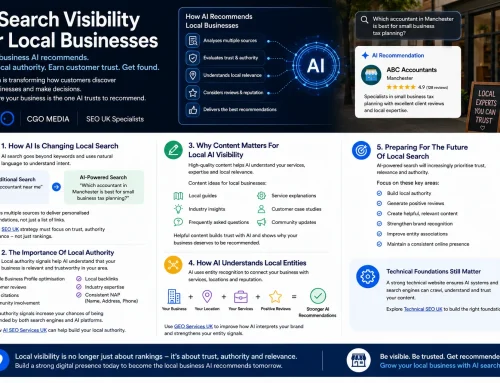


AI search delivers conversational answers based on authority and context, while traditional search focuses on ranking web pages. Businesses need strategies that optimise for both search environments.
1. What Is Traditional Search?
Traditional search is the search engine model most users are familiar with. A person enters a query into Google, Bing or another search engine, and the platform returns a list of relevant results. These results may include organic listings, paid adverts, local map results, featured snippets, images, videos, shopping results and news articles.
The user then decides which result to click. In most cases, businesses compete to appear as high as possible on the first page because higher rankings usually lead to greater visibility, more website traffic and more enquiries.
Traditional search engines crawl and index billions of pages. They then rank those pages using hundreds of signals designed to identify which results are most useful for the user’s query.
Traditional search ranking factors include:
- Keyword relevance
- Content quality
- Backlinks
- Website authority
- Technical SEO
- Page speed
- Mobile usability
- User experience
- Internal linking
- Structured data
- Topical relevance
- Location signals
- Freshness
For businesses, this created the modern SEO industry. Companies invested in better websites, stronger content, improved technical performance and authoritative backlinks in order to rank above competitors.
For example, a UK business may want to rank for search terms such as:
- SEO UK
- Local SEO UK
- Technical SEO UK
- Ecommerce SEO UK
- SEO Consultant UK
- SEO Audit UK
Ranking well for these keywords can produce valuable traffic because users searching them often have commercial intent. They are actively looking for a service, provider, solution or expert.
This is why traditional SEO still matters. It remains one of the most reliable ways for businesses to attract high-intent users who are already searching for what they offer.
However, traditional search has always required users to do some of the work themselves. They search, scan results, compare options, click websites, read information and decide which business seems most credible. AI search compresses much of that journey into a single conversational experience.
2. What Is AI Search?
AI search uses artificial intelligence to generate answers rather than simply listing websites. Instead of showing users a page of links, AI-powered systems can summarise information, compare options, recommend businesses and respond to follow-up questions.
A user might ask:
- What is the best SEO strategy for a UK business?
- How can I improve local search visibility?
- Which SEO services should I invest in first?
- What is the difference between SEO and GEO?
- How do I make my business appear in AI search results?
Rather than forcing the user to click through several websites, AI search may provide a direct response using information gathered from multiple sources. The answer may include definitions, recommendations, comparisons, summaries and practical next steps.
This creates a faster and more conversational search experience.
AI search is different because it can:
- Understand natural language questions
- Interpret intent more deeply
- Summarise complex topics
- Combine information from multiple sources
- Provide personalised recommendations
- Continue a conversation through follow-up questions
- Reduce the number of clicks required
This shift is significant for businesses because users may no longer visit as many websites before making a decision. If an AI platform provides a trusted recommendation, that recommendation may influence the customer before they ever reach a traditional search results page.
That means visibility is no longer only about ranking. It is also about being recognised, trusted and referenced by AI systems.
This is where AI SEO Services UK become increasingly important. AI SEO focuses on helping businesses improve their visibility within AI-generated answers, AI summaries, conversational search engines and generative discovery platforms.
AI search does not ignore traditional SEO signals. In fact, many of the same foundations still matter. Strong content, crawlable websites, brand authority, expert information and trusted citations all contribute to how AI understands and evaluates a business.
The key difference is that AI search evaluates more than individual web pages. It often looks at the wider digital footprint of a brand.
That includes:
- Website content
- Brand mentions
- Backlinks
- Online reviews
- Business profiles
- Industry citations
- Social proof
- Expert commentary
- News coverage
- Entity relationships
In traditional search, a strong individual page may rank well. In AI search, the wider authority of the brand becomes even more important.
3. Traditional Search Focuses on Rankings, AI Search Focuses on Answers
The biggest difference between traditional search and AI search is the format of the result.
Traditional search usually presents a ranked list. AI search usually presents an answer.
In traditional search, success often means appearing in position one, two or three for a valuable keyword. In AI search, success may mean being included as a recommended business, cited as a trusted source or referenced within an AI-generated answer.
Traditional search visibility usually depends on:
- Keyword rankings
- Organic traffic
- Click-through rates
- Search result snippets
- Page-level optimisation
- Backlink strength
- Domain authority
AI search visibility usually depends on:
- Brand authority
- Entity recognition
- Topical expertise
- Trusted citations
- Consistent information
- Clear service positioning
- Expert content
- Reputation signals
This does not mean rankings are no longer important. High-ranking pages are still more likely to be discovered, crawled, cited and used as source material. But AI platforms do not always behave like traditional search engines. They may generate an answer by blending information from several websites, databases and recognised sources.
For example, a traditional search for “best SEO agency for ecommerce UK” may show a list of agency pages, comparison articles and directories.
An AI search might instead respond with a summary of what to look for in an ecommerce SEO agency, the services that matter most and examples of agency types suitable for different business sizes.
If a business wants visibility in that answer, it needs more than a page targeting one keyword. It needs a strong digital presence that clearly demonstrates ecommerce SEO expertise.
This is why service pages such as Ecommerce SEO UK, Enterprise SEO UK and SEO Consultant UK need to be supported by wider content, internal links, case studies, technical optimisation and external authority signals.
AI search rewards clarity
AI systems need to understand exactly who a business is, what it does, where it operates and why it should be trusted. If that information is unclear, inconsistent or thin, the business is less likely to appear in AI-generated recommendations.
Clear service pages matter. Clear location signals matter. Clear expertise matters.
A business should make it easy for both users and AI systems to understand:
- The services it provides
- The locations it serves
- The industries it specialises in
- The problems it solves
- The evidence supporting its expertise
- The reasons customers should trust it
This is also why internal linking is so important. A website with strong internal links helps search engines and AI systems understand relationships between topics. For example, a page about AI search should naturally link to pages about GEO Services UK, Technical SEO UK, Content Marketing UK and Digital PR UK.
That creates a connected topical ecosystem rather than isolated pages.
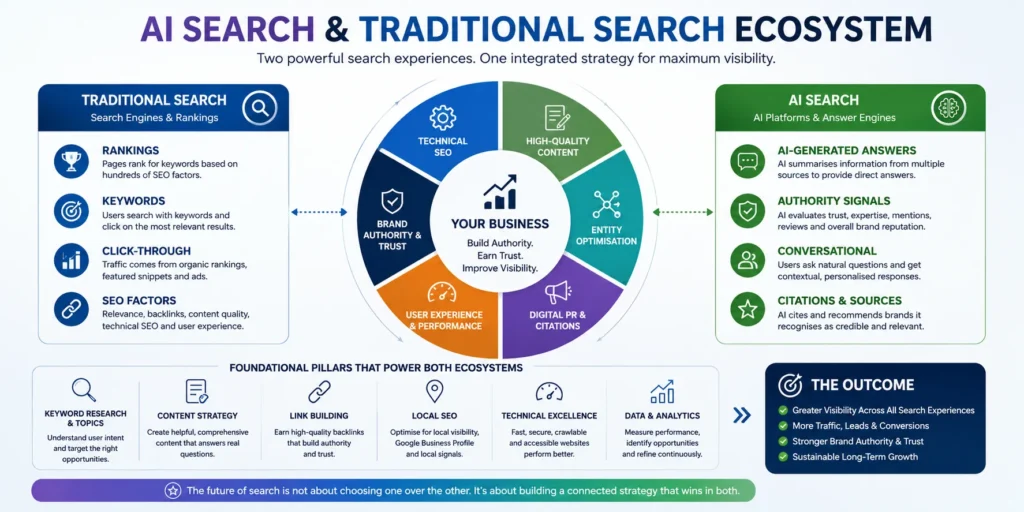
The most successful digital strategies combine traditional SEO, AI search optimisation, technical SEO, content marketing and digital PR to maximise visibility across both search engines and AI-powered platforms.
4. Content, Entities, Citations and Technical SEO in AI Search
Content remains critical in both traditional search and AI search. However, the kind of content that performs well is evolving.
Old SEO strategies often focused on publishing pages around individual keywords. Modern AI search requires deeper topical authority. Businesses must demonstrate expertise across a subject area rather than relying on one isolated article.
AI search favours content that is:
- Comprehensive
- Helpful
- Accurate
- Original
- Well-structured
- Expert-led
- Easy to understand
- Supported by evidence
- Connected to related topics
Thin content, generic AI-generated articles and duplicated information are becoming less effective. Businesses need content that answers real customer questions and provides genuine value.
For example, a business trying to build authority around SEO should not only publish one page called “SEO services”. It should build a broader content ecosystem covering:
- SEO strategy
- Technical SEO
- Local SEO
- Ecommerce SEO
- Enterprise SEO
- SEO audits
- AI SEO
- GEO
- Content marketing
- Digital PR
- Link building
This helps both traditional search engines and AI platforms understand that the business has depth, experience and authority across the subject.
The growing importance of entities
Entity optimisation is one of the most important differences between traditional SEO and AI SEO.
An entity is a recognised person, business, brand, product, location, organisation or concept. AI systems use entities to understand how information connects across the web.
For example, CGO Media may want strong associations with:
- SEO UK
- AI SEO Services UK
- GEO Services UK
- Technical SEO UK
- Local SEO UK
- Digital PR UK
- Content Marketing UK
The stronger and more consistent those associations become, the easier it is for AI systems to recognise the brand as relevant to those topics.
Entity signals can be strengthened through:
- Consistent branding
- Clear service pages
- Author profiles
- Structured data
- Business listings
- External mentions
- Industry citations
- Press coverage
- Knowledge Graph optimisation
This is a major reason why GEO Services UK are becoming important. GEO, or Generative Engine Optimisation, focuses on improving how brands appear within AI-generated search experiences, answer engines and conversational discovery platforms.
Citations and mentions matter more
Backlinks remain important in traditional SEO because they act as signals of authority. A high-quality backlink from a trusted website can still improve rankings, credibility and discoverability.
AI search introduces greater emphasis on broader citations and mentions. These may include linked or unlinked references to a brand across trusted sources.
AI systems may analyse:
- Industry publications
- News articles
- Expert blogs
- Business directories
- Review platforms
- Podcast appearances
- Social media discussions
- Conference listings
- Partner websites
The more frequently a brand is referenced in credible contexts, the stronger its perceived authority becomes.
This is why Digital PR UK and Link Building UK are becoming even more valuable. They help businesses earn the external authority signals that support both traditional search rankings and AI search recognition.
Technical SEO still matters
Some businesses mistakenly believe AI search will replace technical SEO. In reality, technical SEO remains essential.
AI systems still need access to reliable, crawlable, well-structured information. If a website has poor technical foundations, its content may be harder to discover, interpret and trust.
Technical SEO supports AI visibility by improving:
- Crawlability
- Indexability
- Website speed
- Mobile experience
- Schema markup
- Internal linking
- Content hierarchy
- Canonical structure
- URL clarity
- Accessibility
Structured data is especially useful because it helps search engines and AI systems understand the meaning of page content. Schema can identify organisations, services, locations, reviews, FAQs, authors, articles and products.
Businesses that invest in Technical SEO UK create stronger foundations for both traditional rankings and AI-powered discovery.
5. How Businesses Should Adapt Their SEO Strategy
The future of search will not belong exclusively to traditional search engines or AI platforms. It will belong to businesses capable of building visibility across both.
Traditional search and AI search are different, but they are connected. A strong SEO strategy can support AI visibility, while a strong AI visibility strategy can strengthen brand authority across the wider search ecosystem.
1. Create better content
Businesses should focus on publishing content that genuinely helps users. This means moving beyond short generic articles and creating detailed resources that answer real questions.
Strong content should be:
- Clear
- Useful
- Expert-led
- Relevant
- Original
- Easy to navigate
- Connected to commercial pages
Content should support the full customer journey, from early research through to decision-making.
2. Build brand authority
AI search places significant weight on authority. Businesses should therefore invest in brand visibility, thought leadership and trusted mentions.
This may include:
- Publishing expert articles
- Securing media coverage
- Appearing in industry publications
- Building local and national citations
- Improving review profiles
- Creating original research
- Sharing useful insights
The aim is to become a brand that AI systems can confidently associate with expertise.
3. Improve technical performance
A fast, accessible and well-structured website remains essential. Technical SEO should never be treated as optional.
Businesses should review:
- Site speed
- Mobile usability
- Indexation
- Broken links
- Redirect chains
- Duplicate content
- Schema markup
- Internal linking
- Sitemap quality
A detailed SEO Audit UK can identify the technical weaknesses that may be limiting both rankings and AI visibility.
4. Strengthen entity signals
Businesses should make sure their brand, services, locations and expertise are consistently represented across the web.
This includes:
- Consistent business information
- Clear organisation schema
- Strong About page content
- Service-specific landing pages
- Author bios
- External citations
- Social profile consistency
- Review platform consistency
The easier your business is to understand, the easier it becomes for AI systems to reference it accurately.
5. Combine SEO, GEO and digital PR
The strongest modern strategies combine multiple disciplines.
Businesses should no longer view SEO, content marketing, digital PR and AI visibility as separate activities. They now work together.
A future-proof strategy should include:
- Traditional SEO for rankings
- Technical SEO for crawlability
- Content marketing for expertise
- Digital PR for authority
- GEO for AI search visibility
- Entity optimisation for brand recognition
- Analytics for performance measurement
This combined approach gives businesses the best chance of appearing in search results, AI-generated answers, local recommendations and industry discussions.
Conclusion
AI search and traditional search share many foundations, but they are not identical.
Traditional search focuses heavily on rankings, clicks and page-level optimisation. AI search places greater emphasis on answers, authority, trust, entities and brand recognition.
Businesses that only focus on traditional rankings may miss opportunities in AI-generated discovery. Businesses that only chase AI visibility without strong SEO foundations may struggle to build sustainable authority.
The best approach is to optimise for both.
That means building a technically strong website, publishing expert content, earning trusted citations, strengthening entity signals and developing a recognisable brand across the wider web.
As AI continues to reshape online discovery, organisations that adapt early will be better positioned to attract traffic, enquiries and customers from both traditional search engines and AI-powered platforms.
If your business wants to improve visibility across Google, AI Overviews, ChatGPT-style search platforms and generative engines, CGO Media can help. Explore our AI SEO Services UK, GEO Services UK, SEO Audit UK and Content Marketing UK services to build a search strategy designed for the future.
The future of search will not belong exclusively to Google or AI. It will belong to businesses capable of building trust, authority and visibility across every search experience.
About Roger Wilkinson
Roger Wilkinson is an independent researcher, SEO practitioner and founder of CGO Media with more than 25 years of experience in search, online visibility and business growth. Having worked in search since the late 1990s, he has witnessed the evolution of the industry from traditional keyword optimisation through to today’s AI-driven search landscape.
His current research focuses on how artificial intelligence is reshaping search engines, recommendation systems and digital authority. Through independent research papers and strategic frameworks, Roger examines the relationship between Technical SEO, Entity Authority, Brand Signals, AI Visibility, Citation Authority, Knowledge Graphs and Search Visibility to help organisations prepare for the future of search.
Roger is the creator of the CGO Framework Series, a collection of executive-level methodologies designed to help organisations measure, improve and govern their digital visibility in an increasingly AI-centric environment. These frameworks are intended to bridge the gap between traditional SEO, semantic search, generative AI and long-term organisational authority.
His research combines practical industry experience with strategic analysis, focusing on enterprise governance, executive reporting, AI readiness and sustainable digital growth. Rather than relying on short-term optimisation tactics, his work promotes structured, measurable frameworks that enable organisations to build trusted, resilient and future-ready digital ecosystems.
The research published through CGO Media is intended to contribute to industry discussion and encourage organisations to adopt more integrated approaches to Search Visibility, AI Visibility and Digital Authority. Each framework and research paper is developed as part of an ongoing programme of independent analysis and is periodically reviewed to reflect changes in search technology, artificial intelligence and user behaviour.
Roger continues to work with organisations seeking to strengthen their digital presence while researching the long-term impact of AI on search, marketing and organisational competitiveness.
Research Usage & Citation
CGO Media encourages researchers, journalists, organisations, educators and industry professionals to reference and build upon our research where it contributes to broader discussion and understanding of AI Search, SEO, Digital Authority and Search Visibility.
Reasonable quotations, summaries, charts and excerpts from our research papers and frameworks may be used in articles, reports, presentations, academic work and other publications, provided appropriate acknowledgement is given.
When referencing our work, we kindly request that you include:
- A clear attribution to CGO Media.
- A hyperlink to either the CGO Media homepage or the relevant Framework & Research Library page where the original publication appears.
This acknowledgement helps readers access the complete research, methodology and future updates while supporting our ongoing programme of independent research into AI Search and Digital Visibility.
For permissions relating to extensive reproduction, commercial licensing or republication of substantial portions of our research, please contact CGO Media directly.
About Roger Wilkinson
Roger Wilkinson is an independent researcher, SEO practitioner and founder of CGO Media with more than 25 years of experience in search, online visibility and business growth. Having worked in search since the late 1990s, he has witnessed the evolution of the industry from traditional keyword optimisation through to today’s AI-driven search landscape.
His current research focuses on how artificial intelligence is reshaping search engines, recommendation systems and digital authority. Through independent research papers and strategic frameworks, Roger examines the relationship between Technical SEO, Entity Authority, Brand Signals, AI Visibility, Citation Authority, Knowledge Graphs and Search Visibility to help organisations prepare for the future of search.
Roger is the creator of the CGO Framework Series, a collection of executive-level methodologies designed to help organisations measure, improve and govern their digital visibility in an increasingly AI-centric environment. These frameworks are intended to bridge the gap between traditional SEO, semantic search, generative AI and long-term organisational authority.
His research combines practical industry experience with strategic analysis, focusing on enterprise governance, executive reporting, AI readiness and sustainable digital growth. Rather than relying on short-term optimisation tactics, his work promotes structured, measurable frameworks that enable organisations to build trusted, resilient and future-ready digital ecosystems.
The research published through CGO Media is intended to contribute to industry discussion and encourage organisations to adopt more integrated approaches to Search Visibility, AI Visibility and Digital Authority. Each framework and research paper is developed as part of an ongoing programme of independent analysis and is periodically reviewed to reflect changes in search technology, artificial intelligence and user behaviour.
Roger continues to work with organisations seeking to strengthen their digital presence while researching the long-term impact of AI on search, marketing and organisational competitiveness.
Research Usage & Citation
CGO Media encourages researchers, journalists, organisations, educators and industry professionals to reference and build upon our research where it contributes to broader discussion and understanding of AI Search, SEO, Digital Authority and Search Visibility.
Reasonable quotations, summaries, charts and excerpts from our research papers and frameworks may be used in articles, reports, presentations, academic work and other publications, provided appropriate acknowledgement is given.
When referencing our work, we kindly request that you include:
- A clear attribution to CGO Media.
- A hyperlink to either the CGO Media homepage or the relevant Framework & Research Library page where the original publication appears.
This acknowledgement helps readers access the complete research, methodology and future updates while supporting our ongoing programme of independent research into AI Search and Digital Visibility.
For permissions relating to extensive reproduction, commercial licensing or republication of substantial portions of our research, please contact CGO Media directly.