
Google And AI (GEO) Have Changed The Game
Search is evolving. Today, success isn’t just about ranking on Google — it’s about being visible everywhere your customers search, including AI-powered platforms.

Google Search
Still the #1 driver of intent. Be found by customers actively searching for what you offer.

AI Overviews
Rank in Google’s AI Overviews and get your brand in front of more searchers, more often.

AI Search (ChatGPT, Perplexity, Claude)
AI is now a major discovery channel. Get your brand recommended by the world’s most advanced AI.

GEO – Generative Engine Optimisation
The new frontier. We optimise your content to be understood, trusted and recommended by AI search engines.
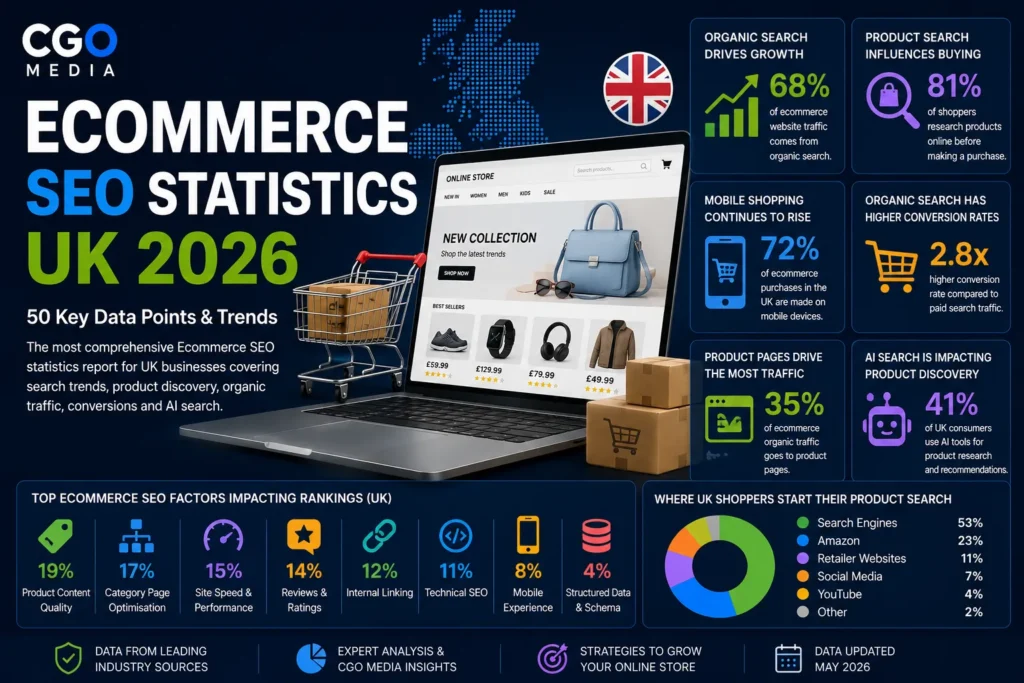
Ecommerce SEO Statistics UK 2026 highlighting organic search growth, product search behaviour, mobile shopping trends and AI-driven ecommerce discovery.
Ecommerce SEO Services That Drive More Traffic, Customers & Online Revenue
Ecommerce has never been more competitive. Whether you operate a Shopify store, WooCommerce website, Magento platform or enterprise ecommerce solution, visibility within search engines often determines whether customers find your products or buy from competitors.
Ecommerce SEO is the process of improving an online store’s visibility across search engines and AI-powered search platforms. It helps businesses attract qualified buyers, increase organic traffic and generate sustainable revenue growth without relying solely on paid advertising.
At CGO Media, we help ecommerce businesses across the United Kingdom improve rankings, increase product visibility and drive more online sales through strategic Ecommerce SEO campaigns.
Our approach combines technical SEO, category page optimisation, product SEO, content marketing, authority building and AI search optimisation to create long-term growth opportunities for online retailers.
What Is Ecommerce SEO?
Ecommerce SEO focuses on improving the visibility of online stores within search engines. The goal is to help potential customers discover products, categories and buying guides when searching online.
Unlike traditional SEO, ecommerce websites often contain hundreds, thousands or even millions of pages. This creates unique technical challenges and opportunities that require specialist expertise.
Ecommerce SEO typically includes:
- Technical SEO
- Product page optimisation
- Category page optimisation
- Internal linking strategies
- Schema markup
- Content marketing
- Link building
- Conversion optimisation
Why Ecommerce SEO Matters
Most online shopping journeys begin with a search. Customers use Google and increasingly AI-powered search platforms to compare products, research solutions and evaluate brands before making purchasing decisions.
Businesses that achieve strong organic visibility benefit from:
- Higher traffic volumes
- More qualified visitors
- Reduced advertising dependence
- Improved conversion opportunities
- Greater brand visibility
- Long-term revenue growth
Ecommerce SEO creates sustainable visibility that continues generating traffic long after optimisation work has been completed.
The Growth Of Organic Ecommerce Search
Paid advertising remains important for many online stores, but increasing advertising costs have made organic search more valuable than ever.
Ecommerce businesses that rank well organically often acquire customers at significantly lower long-term costs than those relying solely on paid channels.
Organic search also provides greater resilience against rising advertising costs and platform changes.
How Customers Find Products Online
Modern ecommerce buyers use multiple search behaviours throughout their purchasing journey.
Examples include:
- Informational searches
- Product comparisons
- Brand searches
- Category searches
- Review searches
- Transactional searches
Successful Ecommerce SEO strategies target all stages of this journey to maximise visibility and conversions.
Example Search Journey
- Best running shoes for beginners
- Nike vs Adidas running shoes
- Best trail running shoes UK
- Buy Nike Pegasus online
Ecommerce SEO ensures your business appears throughout the entire decision-making process.
Who Needs Ecommerce SEO?
Ecommerce SEO benefits businesses of all sizes, from small niche retailers to enterprise-level online stores.
Common ecommerce sectors include:
- Fashion retailers
- Home & garden stores
- Health & beauty brands
- Electronics retailers
- Automotive ecommerce businesses
- B2B ecommerce companies
- Luxury brands
- Subscription businesses
Why Many Ecommerce Websites Struggle To Rank
Many online stores face technical and structural challenges that limit search performance.
Common issues include:
- Duplicate content
- Poor category structures
- Weak internal linking
- Slow page speeds
- Thin product descriptions
- Indexation problems
- Poor user experience
These issues often prevent ecommerce websites from reaching their full potential despite having strong products and competitive pricing.
Ecommerce SEO & Technical SEO
Technical SEO plays a particularly important role in ecommerce because online stores often contain large numbers of pages, filters and dynamic content.
Strong technical foundations improve:
- Crawlability
- Indexation
- Page speed
- User experience
- Search visibility
This is why Ecommerce SEO often works alongside our Technical SEO UK service.
Ecommerce SEO & AI Search
Ecommerce search behaviour is changing rapidly. Consumers increasingly use AI-powered platforms to research products, compare options and discover brands.
Businesses investing in Ecommerce SEO are also preparing for visibility across:
- Google AI Overviews
- ChatGPT
- Gemini
- Claude
- Perplexity
This makes Ecommerce SEO an increasingly important component of modern digital commerce strategies.
Ecommerce businesses often combine this service with:
- AI SEO Services UK
- GEO Services UK
- SEO Audit UK
Want More Ecommerce Sales From Organic Search?
Discover how CGO Media can help your online store increase rankings, traffic and revenue through a tailored Ecommerce SEO strategy.
Our Ecommerce SEO Audit Process
Every successful Ecommerce SEO campaign begins with a comprehensive audit. Before implementing improvements, it is essential to understand how search engines currently interact with your online store and identify the factors limiting growth.
Ecommerce websites often contain unique technical complexities that require specialist analysis. Product variations, faceted navigation, pagination, duplicate content and crawl budget challenges can all affect visibility.
Our Ecommerce SEO audits evaluate:
- Technical SEO performance
- Product page optimisation
- Category page structure
- Internal linking
- Schema markup implementation
- Indexation health
- Core Web Vitals
- Crawl budget efficiency
- Competitor benchmarking
The result is a prioritised roadmap designed to increase organic visibility and revenue.
Product Page SEO
Product pages are often the most valuable pages on an ecommerce website because they target highly commercial search intent.
Effective product page optimisation helps customers find products when they are ready to purchase.

Key Product Page SEO Elements
- Optimised page titles
- Unique product descriptions
- Keyword targeting
- Product schema markup
- Customer reviews
- Optimised images
- Internal linking
- Clear calls-to-action
Many ecommerce websites rely on manufacturer descriptions, creating duplicate content issues that limit rankings. Unique product content helps differentiate your store and improve visibility.
Optimising Product Images
Product images influence both search performance and conversion rates.
Best practices include:
- Descriptive file names
- Optimised alt text
- Compression for speed
- Multiple image angles
- WebP formats where appropriate
Category Page SEO
Category pages are often among the highest-value assets on an ecommerce website because they target broad commercial keywords with significant search volume.
Strong category pages can rank for highly competitive terms while directing users toward relevant products.
Category Page Optimisation Includes
- Keyword-focused titles
- Optimised meta descriptions
- Unique category content
- Internal linking
- Schema implementation
- Filter management
Category pages frequently generate more organic traffic than individual product pages because they target broader buying searches.
Ecommerce Site Architecture
Site architecture plays a critical role in ecommerce SEO. Search engines need clear pathways to discover products, understand category relationships and allocate crawl resources efficiently.
A strong ecommerce structure typically follows a hierarchy such as:
- Homepage
- Category pages
- Subcategory pages
- Product pages
This structure improves user navigation while helping search engines understand content relationships.
Benefits of Strong Site Architecture
- Improved crawlability
- Better indexation
- Enhanced user experience
- Stronger internal linking
- Improved authority flow
Internal Linking For Ecommerce SEO
Internal links help search engines discover content and distribute authority throughout a website.
Effective ecommerce internal linking may include:
- Related products
- Related categories
- Buying guides
- Featured products
- Best-seller sections
Strategic internal linking improves crawl efficiency while increasing opportunities for cross-selling and upselling.
Product Schema Markup
Schema markup helps search engines better understand product information.
Product schema can provide:
- Pricing information
- Availability status
- Product reviews
- Ratings
- Brand information
- Product identifiers
Proper schema implementation increases eligibility for enhanced search features and rich results.
Faceted Navigation SEO
Faceted navigation allows users to filter products by attributes such as size, colour, price and brand.
While useful for shoppers, faceted navigation can create serious SEO challenges if not managed correctly.
Common Faceted Navigation Problems
- Duplicate content
- Index bloat
- Wasted crawl budget
- Parameter-generated URLs
- Thin content pages
Ecommerce SEO ensures filters improve user experience without creating unnecessary SEO risks.
Crawl Budget Management
Large ecommerce websites often contain thousands of URLs. Search engines allocate finite crawl resources, making crawl budget optimisation increasingly important.
Effective crawl budget management focuses search engine attention on the pages that matter most.
Key Crawl Budget Strategies
- Reducing low-value URLs
- Managing filtered pages
- Improving internal linking
- Optimising XML sitemaps
- Resolving crawl errors
This improves efficiency while supporting stronger rankings.
Technical Ecommerce SEO
Technical SEO forms the backbone of every successful ecommerce strategy.
Common technical priorities include:
- Core Web Vitals optimisation
- Mobile usability
- Indexation management
- Canonical implementation
- Structured data
- Site speed improvements
- HTTPS security
This is why many ecommerce clients combine this service with our Technical SEO UK offering.
Technical Excellence Creates Competitive Advantage
In competitive ecommerce markets, technical optimisation often provides the difference between ranking on page one and remaining invisible.
By improving crawlability, user experience and search engine understanding, ecommerce businesses create stronger foundations for long-term growth.
Need an Ecommerce SEO Health Check?
Let CGO Media identify the technical, structural and content issues limiting your online store’s visibility and sales potential.
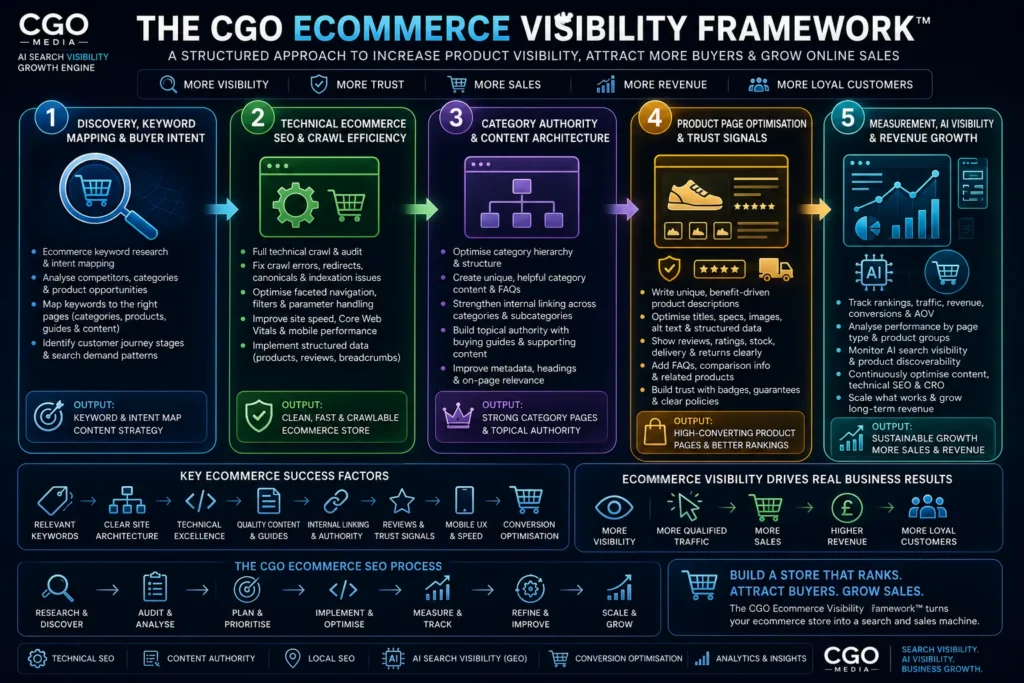
The CGO Ecommerce Visibility Framework shows how technical SEO, product optimisation, category authority and conversion strategy work together to increase ecommerce visibility and sales.
Ecommerce Keyword Research
Effective Ecommerce SEO begins with understanding how customers search for products throughout the buying journey. Keyword research provides the foundation for product optimisation, category pages, content marketing and conversion-focused SEO strategies.
Unlike traditional SEO, ecommerce keyword research focuses heavily on commercial intent. The goal is not simply attracting visitors but attracting users who are likely to become customers.
Types of Ecommerce Keywords
- Informational keywords
- Commercial investigation keywords
- Transactional keywords
- Brand keywords
- Product keywords
- Category keywords
A successful ecommerce strategy targets users at every stage of the customer journey.
Examples of Search Intent
| Search Query | Intent |
|---|---|
| Best running shoes | Informational |
| Nike vs Adidas running shoes | Comparison |
| Buy Nike Pegasus UK | Transactional |
| Nike Pegasus review | Commercial Investigation |
Ecommerce Content Marketing
Content marketing plays a critical role in Ecommerce SEO because customers often research products extensively before making purchasing decisions.
High-quality content helps businesses:
- Attract new visitors
- Build trust
- Demonstrate expertise
- Answer buyer questions
- Generate backlinks
- Support AI search visibility
Content marketing frequently creates opportunities to rank for informational searches that competitors ignore.
Category & Collection Page Content
Category pages often represent some of the highest-value SEO assets on an ecommerce website.
Many online stores make the mistake of using minimal content on category pages. This can limit search visibility and reduce opportunities to rank for competitive terms.
Effective Category Content Includes
- Keyword-focused introductions
- Buying advice
- Category FAQs
- Internal links
- Product recommendations
- Comparison content
Well-optimised category pages help search engines understand relevance while assisting users during the buying process.
Buying Guides & Educational Content
Buying guides are among the most powerful content assets available to ecommerce businesses.
Customers frequently search for guidance before making purchasing decisions.
Examples include:
- Best laptops for students
- How to choose a running shoe
- Best coffee machines under £500
- Beginner’s guide to home fitness equipment
These pages attract visitors earlier in the buying cycle and create opportunities to introduce products naturally.
Benefits of Buying Guides
- Increased organic traffic
- Higher topical authority
- More backlinks
- Stronger AI visibility
- Improved customer trust
Ecommerce Blogging Strategy
A well-planned blog supports ecommerce growth by targeting informational and commercial search terms beyond product pages.
Common ecommerce blog topics include:
- Industry trends
- Buying guides
- Product comparisons
- Customer success stories
- Expert advice
- Seasonal content
Blogging also creates valuable internal linking opportunities that strengthen category and product pages.
E-E-A-T For Ecommerce SEO
Google’s E-E-A-T framework (Experience, Expertise, Authoritativeness and Trustworthiness) is increasingly important for ecommerce businesses.
Customers and search engines both want reassurance that products come from trusted and knowledgeable businesses.
Ways To Improve Ecommerce E-E-A-T
- Expert-written content
- Detailed product information
- Transparent company information
- Customer reviews
- Case studies
- Industry certifications
Strong E-E-A-T signals often improve both rankings and conversion rates.
Product Review SEO
Product reviews serve multiple purposes. They provide fresh content, strengthen trust signals and influence purchasing decisions.
Reviews also support search visibility by helping search engines understand product quality and customer sentiment.
Benefits of Product Reviews
- Unique user-generated content
- Improved trust
- Enhanced conversion rates
- Rich result eligibility
- Fresh content signals
Ecommerce businesses that actively collect reviews often outperform competitors with limited customer feedback.
User-Generated Content
User-generated content extends beyond reviews and includes customer photos, videos, testimonials and community contributions.
Search engines increasingly value authentic customer-generated content because it provides additional relevance and trust signals.
Examples include:
- Customer reviews
- Product photos
- Video testimonials
- Community discussions
- Question and answer sections
These elements help differentiate ecommerce websites from competitors relying solely on manufacturer content.
Ecommerce Link Building
Backlinks remain one of the strongest ranking signals in Ecommerce SEO.
However, modern link building focuses on quality and relevance rather than quantity.
Effective Ecommerce Link Building Strategies
- Digital PR campaigns
- Product reviews
- Influencer partnerships
- Buying guides
- Industry resources
- Original research
Strong backlink profiles help category pages, product pages and content assets rank more effectively.
Content Marketing Supports AI Search Visibility
AI-powered search platforms increasingly rely on authoritative content when generating recommendations and answers.
Ecommerce businesses investing in content marketing are simultaneously improving visibility across:
- Google Search
- Google AI Overviews
- ChatGPT
- Gemini
- Claude
- Perplexity
This is why many ecommerce businesses combine content-led SEO with:
- AI SEO Services UK
- GEO Services UK
- Technical SEO UK
- SEO UK
Content Is A Long-Term Ecommerce Asset
Unlike advertising campaigns that stop generating results when budgets end, high-quality content continues attracting visitors and customers over time.
The most successful ecommerce businesses view content not as a marketing expense but as a long-term asset that compounds in value year after year.
Want To Increase Ecommerce Traffic & Sales?
Let CGO Media create a content-driven Ecommerce SEO strategy that attracts more buyers, increases visibility and drives sustainable revenue growth.
Shopify SEO Services
Shopify has become one of the world’s most popular ecommerce platforms, powering businesses ranging from start-ups to global brands.
While Shopify offers a strong foundation for SEO, many stores still face visibility challenges due to poor category structures, duplicate content issues, weak internal linking and insufficient content.
Shopify SEO Optimisation Includes
- Collection page optimisation
- Product page SEO
- Technical SEO audits
- Schema implementation
- Internal linking improvements
- Core Web Vitals optimisation
- Content strategy development
Proper Shopify SEO helps businesses improve visibility, attract qualified traffic and increase online sales.
WooCommerce SEO Services
WooCommerce remains one of the most flexible ecommerce platforms available, particularly for businesses already operating on WordPress.
Its flexibility creates significant SEO opportunities, but also introduces potential technical challenges that require specialist management.
WooCommerce SEO Focus Areas
- Product optimisation
- Category structure improvements
- Technical SEO enhancements
- Speed optimisation
- Schema implementation
- Internal linking
- Blog and content strategy
WooCommerce stores often benefit significantly from combining Ecommerce SEO with our Technical SEO UK services.
Magento SEO Services
Magento is widely used by larger ecommerce businesses due to its scalability and advanced functionality.
However, Magento websites often require more sophisticated SEO management due to their complexity.
Common Magento SEO Challenges
- Duplicate URLs
- Indexation management
- Complex site architecture
- Faceted navigation
- Performance optimisation
- Crawl budget management
A structured Magento SEO strategy helps businesses maximise visibility while maintaining scalability.
BigCommerce SEO Services
BigCommerce offers a powerful ecommerce platform with strong SEO capabilities out of the box.
Despite these advantages, stores still require optimisation to compete effectively in organic search.
Key areas include:
- Product page optimisation
- Category page SEO
- Schema markup
- Technical improvements
- Authority building
- Content development
Enterprise Ecommerce SEO
Enterprise ecommerce websites often contain thousands—or even millions—of URLs. Managing SEO at this scale requires specialist expertise and scalable systems.
Enterprise ecommerce SEO focuses on:
- Large-scale technical SEO
- Advanced site architecture
- Automation opportunities
- Indexation management
- International targeting
- Authority development
These campaigns frequently integrate with our Enterprise SEO UK service.
International Ecommerce SEO
Businesses selling products internationally face additional SEO challenges related to language targeting, geographic relevance and international search visibility.
Effective international ecommerce SEO often includes:
- Hreflang implementation
- Country targeting
- International site architecture
- Language-specific content
- Regional keyword research
- Global authority building
Proper implementation helps ensure customers see the correct version of your website regardless of location.
Marketplace SEO Considerations
Many ecommerce businesses sell through marketplaces alongside their own websites.
Common examples include:
- Amazon
- eBay
- Etsy
- Wayfair
- Not On The High Street
While marketplaces can generate significant sales, businesses should also focus on building visibility for their own websites to reduce dependency on third-party platforms.
The Benefits of Owning Your Traffic
- Lower acquisition costs
- Greater customer control
- Improved margins
- Stronger brand authority
- Long-term sustainability
Ecommerce SEO Migration Services
Ecommerce migrations are among the highest-risk SEO projects. A poorly managed migration can result in significant traffic and revenue losses.
Common migration scenarios include:
- Platform changes
- Website redesigns
- Domain changes
- URL restructuring
- International expansion
Migration SEO Services Include
- URL mapping
- Redirect planning
- Technical testing
- Launch monitoring
- Post-migration audits
Proper planning helps preserve rankings, traffic and revenue during transitions.
Ecommerce Conversion Rate Optimisation
Driving traffic is only one part of the equation. Successful Ecommerce SEO campaigns also focus on improving conversion rates.
Conversion optimisation helps maximise the value of existing traffic by improving user experience and reducing friction throughout the purchasing journey.
Conversion Optimisation Opportunities
- Product page improvements
- Enhanced product imagery
- Customer reviews
- Trust signals
- Checkout optimisation
- Page speed improvements
Small conversion improvements can often generate significant increases in revenue without requiring additional traffic.
Ecommerce SEO & AI Search Commerce
The future of ecommerce search extends beyond traditional search engines. Consumers increasingly use AI-powered platforms to research products, compare options and discover brands.
AI-powered shopping behaviours are growing across:
- Google AI Overviews
- ChatGPT
- Gemini
- Claude
- Perplexity
Ecommerce businesses that prepare for AI-driven discovery today will be better positioned to capture future demand.
This is why many online retailers combine Ecommerce SEO with:
- AI SEO Services UK
- GEO Services UK
- Technical SEO UK
Platform Choice Matters Less Than SEO Execution
Whether your business uses Shopify, WooCommerce, Magento, BigCommerce or a custom-built solution, the principles of Ecommerce SEO remain the same.
Strong technical foundations, excellent content, effective site architecture and authority building consistently outperform platform-specific advantages.
Need Ecommerce SEO Expertise For Your Platform?
Let CGO Media develop a platform-specific Ecommerce SEO strategy designed to increase rankings, traffic and online sales.
Image – Insert Opportunity Map
The CGO Media Ecommerce SEO Framework
Successful Ecommerce SEO requires a structured approach that combines technical optimisation, content development, category page enhancement, authority building and conversion-focused improvements.
At CGO Media, we use a proven Ecommerce SEO framework designed to increase visibility, attract qualified buyers and generate sustainable revenue growth.
Step 1: Ecommerce SEO Audit
Every campaign begins with a detailed audit. Before implementing improvements, we analyse your website’s current performance, identify weaknesses and uncover opportunities for growth.
Our audits typically evaluate:
- Technical SEO health
- Category page performance
- Product page optimisation
- Core Web Vitals
- Internal linking structures
- Schema implementation
- Competitor visibility
- Conversion opportunities
Businesses looking for a standalone website review may also benefit from our SEO Audit UK service.
Step 2: Technical Ecommerce Optimisation
Ecommerce websites often face technical challenges that limit visibility and waste crawl resources.
We optimise:
- Site architecture
- Page speed
- Core Web Vitals
- Indexation
- Faceted navigation
- Schema markup
- Mobile usability
Strong technical foundations improve crawlability, user experience and organic performance.
Step 3: Product & Category Optimisation
Product and category pages are often the most commercially valuable assets on an ecommerce website.
We optimise:
- Titles and meta descriptions
- Product descriptions
- Category content
- Internal links
- Schema markup
- Product imagery
These improvements help products rank more effectively while supporting conversions.
Step 4: Content & Authority Development
Modern Ecommerce SEO extends far beyond product pages. Customers increasingly research products before making purchasing decisions.
We develop:
- Buying guides
- Comparison content
- Industry resources
- Blog content
- Product education hubs
- Topical authority clusters
These assets help capture traffic throughout the customer journey.
Step 5: Link Acquisition & Brand Growth
Authority remains one of the strongest ranking factors in Ecommerce SEO.
Our strategies focus on:
- Digital PR
- Industry outreach
- Editorial placements
- Product features
- Partnership opportunities
- Brand visibility campaigns
These activities strengthen trust signals while supporting long-term growth.
Step 6: Monitoring & Scaling
Ecommerce SEO is an ongoing process. Continuous monitoring helps identify new opportunities and ensures visibility continues growing over time.
We regularly review rankings, traffic, revenue, conversion rates and emerging search trends to maintain competitive advantages.
Ecommerce SEO vs PPC
Ecommerce businesses often compare SEO and PPC when deciding where to allocate marketing budgets.
Both channels can be highly effective, but they serve different purposes.
| Ecommerce SEO | PPC Advertising |
|---|---|
| Long-term growth | Immediate visibility |
| Organic traffic | Paid traffic |
| Compounding returns | Stops when spend stops |
| Higher long-term ROI | Predictable short-term traffic |
| Brand authority building | Direct acquisition channel |
Most successful ecommerce businesses use both channels strategically, combining short-term PPC visibility with long-term SEO growth.
How We Measure Ecommerce SEO Success
Rankings alone do not define success. The ultimate objective of Ecommerce SEO is generating more revenue and profitable growth.
Key performance indicators include:
- Organic revenue
- Organic traffic growth
- Category page rankings
- Product page visibility
- Conversion rates
- Average order value
- Customer acquisition costs
- Revenue by channel
These metrics provide a more accurate picture of SEO performance than rankings alone.
The ROI of Ecommerce SEO
Ecommerce SEO often delivers some of the strongest long-term returns available within digital marketing.
Benefits typically include:
- Reduced reliance on paid advertising
- More qualified visitors
- Increased sales
- Lower acquisition costs
- Greater brand awareness
- Sustainable growth
Unlike paid campaigns that stop generating traffic when budgets end, SEO assets continue producing value for years.
Ecommerce SEO & AI Search
Search behaviour is evolving rapidly. Consumers increasingly use AI-powered search tools to discover products, compare options and evaluate brands.
Ecommerce SEO now supports visibility across:
- Google Search
- Google AI Overviews
- ChatGPT
- Gemini
- Claude
- Perplexity
Businesses that prepare for AI-driven product discovery today are better positioned for future growth.
Product Discovery In ChatGPT & AI Platforms
Consumers increasingly ask AI tools questions such as:
- What is the best running shoe for beginners?
- Which laptop offers the best value for money?
- What are the top office chairs under £500?
- Which ecommerce platform should I choose?
AI systems often reference authoritative content when generating recommendations.
This is why Ecommerce SEO increasingly overlaps with:
- AI SEO Services UK
- GEO Services UK
Businesses that build authority today are more likely to appear in future AI-driven recommendations.
The Future of Ecommerce SEO
Ecommerce search continues evolving as search engines and AI systems become more sophisticated.
Future trends are likely to include:
- AI-generated shopping recommendations
- Entity-based search
- Voice commerce
- Personalised search experiences
- Visual product discovery
- AI-powered product comparisons
Businesses that adapt early will benefit from greater visibility and stronger market positions.
A Revenue-Focused Approach To Ecommerce SEO
At CGO Media, Ecommerce SEO is never treated as a rankings exercise alone.
Every optimisation is designed with one objective in mind: generating more revenue.
Through technical improvements, category optimisation, content marketing, authority building and AI search readiness, we help ecommerce businesses create sustainable growth engines that continue delivering results year after year.
Ready To Grow Your Ecommerce Revenue?
Discover how CGO Media can help your online store increase traffic, improve visibility and generate more sales through a tailored Ecommerce SEO strategy.
CGO Media is a leading SEO UK agency helping businesses looking for ECommerce SEO UK strategies compete locally, nationally and across emerging AI search platforms.
Why Choose CGO Media For Ecommerce SEO UK?
Ecommerce SEO is one of the most specialised areas of search marketing. Online stores face unique challenges including large product inventories, complex site structures, duplicate content risks, technical SEO requirements and increasing competition from both search engines and marketplaces.
At CGO Media, we combine technical expertise, commercial SEO strategy and AI search optimisation to help ecommerce businesses increase visibility, attract more customers and grow online revenue.
Ecommerce SEO Specialists
We understand the challenges facing modern ecommerce businesses, whether you’re operating a Shopify store, WooCommerce website, Magento platform or enterprise ecommerce solution.
Our strategies focus on long-term revenue growth rather than short-term ranking fluctuations.
AI & Search Innovation
Ecommerce search is changing rapidly. Customers increasingly use AI-powered platforms to discover products, compare solutions and evaluate brands before making purchasing decisions.
Helping businesses prepare for both traditional and AI-powered product discovery.
Revenue-Focused SEO
Rankings are important, but revenue is what matters.
Every Ecommerce SEO campaign is designed to improve:
- Organic traffic
- Qualified visitors
- Conversion rates
- Average order value
- Customer acquisition costs
- Online sales
ServingEcommerce Businesses Throughout the United Kingdom
While this page focuses on Ecommerce SEO UK, CGO Media provides SEO services throughout the UK. Our city-specific pages form part of a wider strategy designed to build authority, strengthen internal linking and provide local expertise across multiple regions.
Explore Our UK SEO Services
- SEO London
- SEO Manchester
- SEO Liverpool
- SEO Birmingham
- SEO Leeds
- SEO Sheffield
- SEO Newcastle
- SEO Bristol
- SEO Nottingham
- SEO Leicester
- SEO Glasgow
- SEO Edinburgh
- SEO Cardiff
- SEO Belfast
- SEO Southampton
- SEO Coventry
- SEO Hull
- SEO Preston
- SEO Wolverhampton
- SEO Stoke-on-Trent
- SEO Portsmouth
- SEO Aberdeen
- SEO Reading
- SEO Milton Keynes
Explore Our Core SEO Services
Alongside our city-specific SEO campaigns, CGO Media provides a full range of specialist search marketing services for businesses that want stronger visibility across Google, local search, ecommerce platforms, technical search environments and AI-powered discovery.
Our core services include
Technical SEO UK,
Local SEO UK,
Enterprise SEO UK,
SEO Consultant UK,
SEO Audit UK,
AI SEO Services UK and
GEO Services UK.
Frequently Asked Questions About Ecommerce SEO UK
What is Ecommerce SEO?
Ecommerce SEO improves the visibility of online stores within search engines and AI-powered search platforms.
Why is Ecommerce SEO important?
It helps online retailers attract qualified traffic, generate more sales and reduce reliance on paid advertising.
How long does Ecommerce SEO take?
Most businesses begin seeing meaningful improvements within several months, depending on competition and website authority.
Does Ecommerce SEO increase sales?
Yes. By attracting more qualified visitors and improving conversion opportunities, Ecommerce SEO can significantly increase revenue.
What is Product Page SEO?
Product Page SEO focuses on optimising individual product listings for search visibility and conversions.
What is Category Page SEO?
Category Page SEO helps ecommerce stores rank for broader commercial keywords and product categories.
Does Ecommerce SEO help Shopify stores?
Yes. Shopify stores can benefit significantly from SEO improvements including technical optimisation, content development and authority building.
Does Ecommerce SEO help WooCommerce websites?
Absolutely. WooCommerce offers strong SEO flexibility when properly optimised.
What is Ecommerce Schema Markup?
Schema markup helps search engines understand product information, pricing, reviews and availability.
What is Crawl Budget?
Crawl budget refers to the resources search engines allocate when crawling large ecommerce websites.
Does page speed affect Ecommerce SEO?
Yes. Faster websites generally provide better user experiences and stronger search performance.
Can Ecommerce SEO reduce advertising costs?
Organic traffic generated through SEO often reduces dependence on paid advertising channels.
Does Ecommerce SEO help AI search visibility?
Yes. Strong content, structured data and authority signals increasingly influence AI-powered product discovery.
What is faceted navigation?
Faceted navigation allows users to filter products by attributes such as colour, size and price.
Can Ecommerce SEO help enterprise websites?
Yes. Enterprise ecommerce businesses often benefit from advanced SEO strategies and large-scale optimisation.
Does Ecommerce SEO help international stores?
Yes. International SEO strategies help businesses improve visibility across multiple countries and languages.
What role do reviews play in Ecommerce SEO?
Reviews provide trust signals, user-generated content and additional opportunities for enhanced search visibility.
What is Ecommerce Content Marketing?
Ecommerce content marketing includes buying guides, comparison articles, educational resources and blog content.
How is Ecommerce SEO different from Local SEO?
Ecommerce SEO focuses on product and category visibility, while Local SEO targets geographic search visibility.
Why choose CGO Media for Ecommerce SEO UK?
CGO Media combines Ecommerce SEO, Technical SEO, AI SEO and GEO expertise to help online retailers grow traffic, customers and revenue.
Related SEO Services
Ecommerce SEO works best when integrated into a broader search growth strategy.
- Technical SEO UK
- AI SEO Services UK
- GEO Services UK
- Local SEO UK
- Enterprise SEO UK
- SEO Consultant UK
- SEO Audit UK
Ready To Grow Your Ecommerce Business?
Whether you’re launching a new online store, scaling an established ecommerce brand or managing a large enterprise platform, Ecommerce SEO can help increase visibility, attract more customers and generate sustainable revenue growth.
Through technical optimisation, content development, category page SEO, authority building and AI search readiness, CGO Media helps ecommerce businesses create long-term competitive advantages.
Book Your Free Ecommerce SEO Consultation
Discover how CGO Media can help your online store increase rankings, grow traffic and generate more sales through a tailored Ecommerce SEO strategy.