
Healthcare GEO: Generative Engine Optimisation for AI Health Discovery, Provider Selection and Recommendation Systems
Healthcare GEO is a CGO Media research framework for understanding how healthcare organisations, clinicians, specialists and health information providers can improve visibility, entity clarity, source authority, citation eligibility and recommendation confidence across generative search and AI-assisted healthcare discovery environments.
The framework extends traditional healthcare SEO into a broader generative visibility system in which AI platforms may identify providers, interpret clinical expertise, select health information sources, compare services, cite evidence and recommend appropriate providers according to patient context.
1. Healthcare GEO Extends Traditional Healthcare SEO
Traditional healthcare SEO primarily focuses on visibility across searches relating to:
- Healthcare providers
- Clinicians
- Medical services
- Health conditions
- Local healthcare
2. Healthcare GEO Adds Generative Discovery
Generative systems can influence:
- Health information discovery
- Provider discovery
- Clinician discovery
- Service comparison
- Health citation
- Provider recommendation
3. Healthcare Search Is Increasingly Conversational
Users may ask:
- Which specialist treats this condition?
- Which clinic offers this procedure?
- What are the treatment options?
- Which provider is most suitable for me?
- Which source explains this condition clearly?
4. Healthcare GEO Should Be Patient and Clinical-Context Aware
A useful relationship is:
Patient Need → Health Issue → Clinical Need → Provider Need → Recommendation
5. Healthcare GEO Has Six Principal Visibility Layers
- Source visibility
- Citation visibility
- Entity accuracy
- Clinical expertise visibility
- Comparison visibility
- Recommendation visibility
6. Source Visibility Is the First Layer
A health source may contribute to an AI-generated answer even where it is not explicitly cited.
7. Citation Visibility Is the Second Layer
Citation visibility occurs where a healthcare provider, clinician, health authority, research source or professional organisation is explicitly referenced.
8. Entity Accuracy Is the Third Layer
Generative systems should represent correctly:
- Provider identity
- Clinician identity
- Speciality
- Service
- Location
- Professional status
9. Clinical Expertise Visibility Is the Fourth Layer
A clinician or provider should be associated with the correct clinical discipline, procedure or patient need.
10. Comparison Visibility Is the Fifth Layer
Healthcare providers, clinics and individual clinicians may enter active comparison sets.
11. Recommendation Visibility Is the Sixth Layer
The highest-value outcome occurs where a clinician or provider is appropriately recommended for a specific patient scenario.
12. Healthcare GEO Should Optimise for Qualified Visibility
A useful model is:
Relevant Presence + Accurate Clinical Representation + Strong Trust Evidence + Appropriate Recommendation
13. Qualified Visibility Is More Important Than Mention Volume
High AI visibility is not necessarily valuable if:
- The wrong speciality is attributed
- The wrong clinician is associated
- The service scope is inaccurate
- Professional status is unclear
- The provider is recommended for unsuitable care
14. Healthcare Entity Clarity Is Fundamental
AI systems need to understand relationships between:
- Healthcare organisation
- Clinician
- Speciality
- Service
- Condition
- Location
15. A Useful Healthcare Entity Relationship Is
Healthcare Organisation → Clinician → Speciality → Service → Condition → Patient Need
16. Provider Identity Should Be Explicit
Relevant information can include:
- Organisation name
- Locations
- Services
- Clinical teams
- Specialities
- Patient groups served
17. Clinician Identity Should Be Distinct from Provider Identity
Individual clinical expertise can influence trust independently of the wider organisation.
18. Clinical Roles Should Be Clear
Generative systems may need to distinguish:
- Consultant
- Specialist physician
- Surgeon
- General practitioner
- Therapist
- Allied health professional
19. Speciality Identity Should Be Explicit
Healthcare organisations may operate across multiple:
- Clinical disciplines
- Patient groups
- Procedures
- Locations
20. Healthcare Service Identity Should Be Specific
Broad language such as “specialist care” may be insufficient where the patient needs a specific diagnosis, treatment or procedure.
21. Healthcare Service Clarity Can Include
- Condition addressed
- Procedure or treatment
- Patient type
- Clinical team
- Location
- Referral requirements
22. Clinical Expertise Should Be Connected to Evidence
A medical specialism should be supported by observable professional and clinical information rather than promotional claims alone.
23. Clinical Expertise Evidence Can Include
- Professional qualifications
- Registration
- Clinical experience
- Research
- Publications
- Specialist training
24. Professional Registration Is a Core Healthcare GEO Variable
Healthcare recommendations can carry significant consequences, making professional status and regulatory evidence particularly important.
25. Registration Should Be Explicit Where Material
Patients and systems should be able to distinguish between regulated clinicians and other healthcare or wellness providers.
26. Healthcare GEO Should therefore Avoid Professional Ambiguity
A useful relationship is:
Clinical Role + Professional Status + Speciality + Service → Clinical Context
27. Healthcare GEO Should Include Regulatory Trust
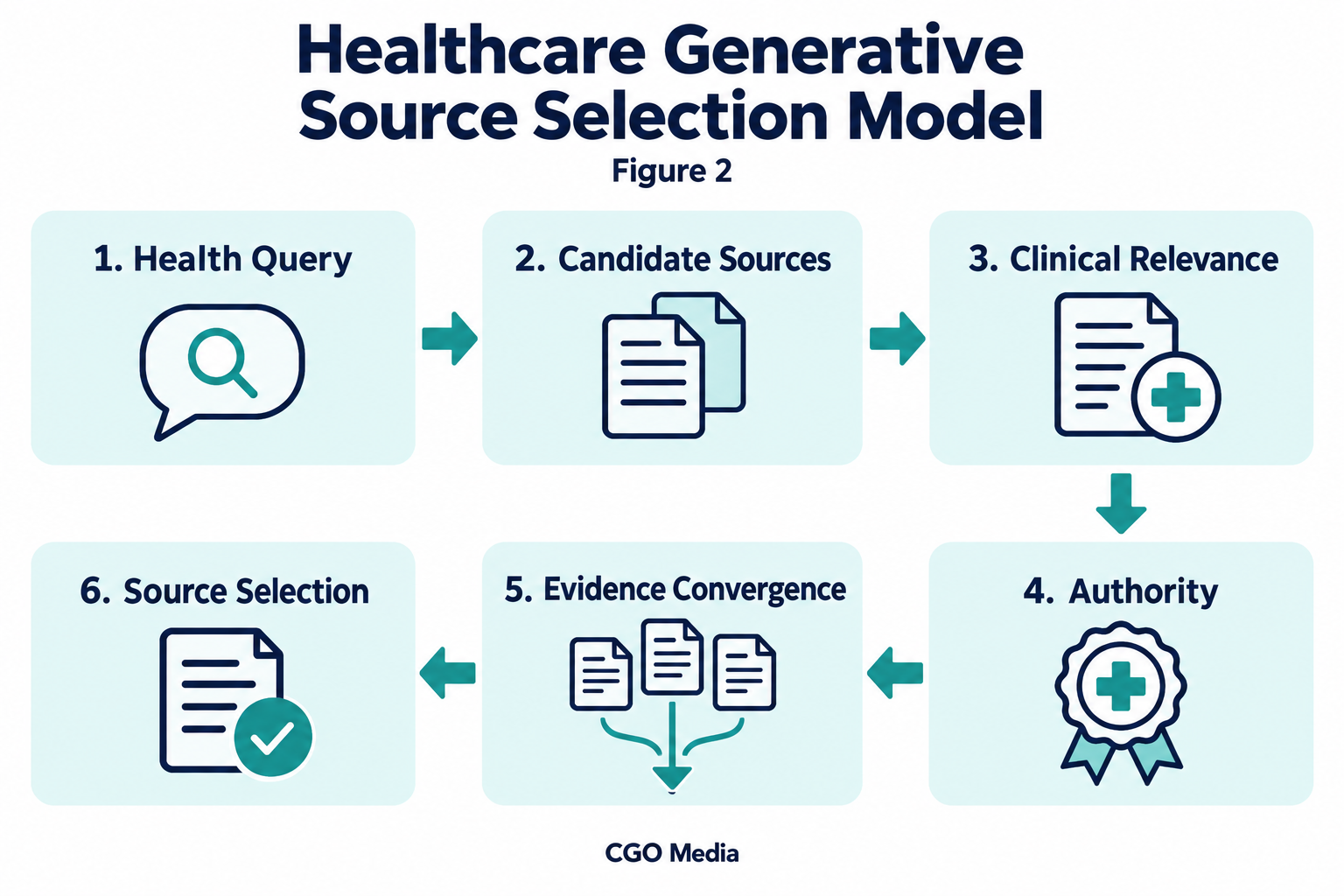
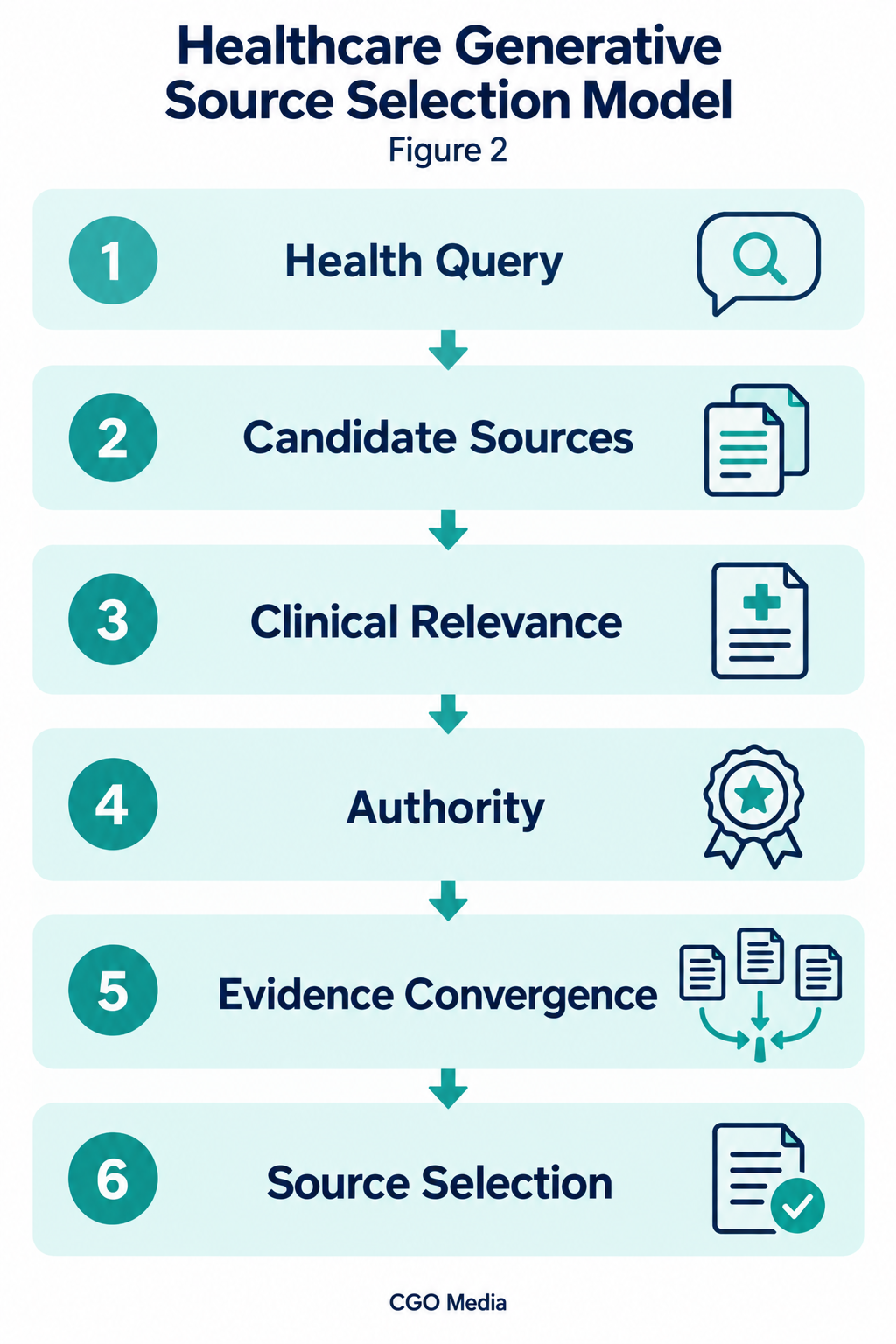
Healthcare is a high-trust environment in which professional standing can materially affect patient decisions.
28. Regulatory Trust Can Include
- Professional registration
- Licensing
- Specialist accreditation
- Current practising status
- Regulatory history
29. Regulatory Evidence Should Come from Appropriate Sources
Where available, official registers can provide stronger evidence than self-published professional claims.
30. Healthcare Source Authority Is Claim-Specific
Different health claims require different source types.
31. Healthcare Sources Can Include
- Government health authorities
- Regulators
- Hospitals
- Clinics
- Medical associations
- Peer-reviewed research
- Professional organisations
32. Clinical Guidelines Can Be Strong Sources
Guidelines can support understanding of:
- Diagnosis
- Treatment pathways
- Clinical standards
- Care recommendations
33. Government and Public Health Sources Can Be Highly Authoritative
They can provide evidence around:
- Public health guidance
- Screening
- Vaccination
- Disease prevention
- Healthcare access
34. Professional Medical Bodies Can Add Specialist Authority
These organisations may publish:
- Clinical standards
- Professional guidance
- Best-practice recommendations
- Specialist information
35. Peer-Reviewed Research Can Support Clinical Claims
Scientific literature can provide evidence relating to:
- Treatment effectiveness
- Risk
- Diagnosis
- Outcomes
- Clinical innovation
36. Provider Websites Can Be Strong Sources for Service Truth
They can provide direct information about:
- Services
- Clinicians
- Locations
- Referral processes
- Patient pathways
37. Clinician Profiles Can Be Strong Sources for Professional Detail
Useful information can include:
- Role
- Qualifications
- Speciality
- Experience
- Research interests
38. Clinical and Professional Sources Serve Different Roles
A clinical guideline can explain treatment standards while a provider website explains where and by whom a service is delivered.
39. Healthcare GEO Should Preserve This Distinction
Marketing content should not be treated as equivalent to clinical evidence.
40. Healthcare Source Selection Should Match the Claim
A useful model is:
Clinical Question + Patient Context + Evidence Type + Professional Interpretation → Source Confidence
41. Healthcare Information Can Change
Relevant changes can include:
- New clinical guidance
- New research
- Drug approvals
- Updated safety information
- New professional standards
42. Healthcare Freshness Is therefore Important
Outdated health information can materially mislead patients.
43. A Useful Healthcare Freshness Model Is
Clinical Volatility + Patient Impact + Claim Importance → Required Freshness
44. High-Volatility Healthcare Information Requires Frequent Review
Examples can include:
- Treatment guidelines
- Drug safety
- Infectious disease guidance
- Screening recommendations
- Regulatory advice
45. More Stable Healthcare Information May Require Lower Review Frequency
Some established clinical concepts, anatomy or long-standing professional qualifications may change less frequently.
46. Healthcare GEO Should Include Source Convergence
Confidence can increase where multiple relevant sources materially agree.
47. A Useful Healthcare Source Convergence Model Is
Clinical Evidence + Professional Evidence + Regulatory Evidence + Patient-Service Evidence → Source Confidence
48. Source Conflict Should Reduce Healthcare Confidence
Important conflicts can involve:
- Different clinical guidance
- Outdated research
- Conflicting professional profiles
- Different treatment claims
49. Healthcare GEO Should Diagnose Source Conflict
The organisation should identify whether the issue results from:
- Old clinical evidence
- Different populations
- Different professional interpretations
- Outdated provider information
50. Clinician Identity Can Become Fragmented
A clinician may appear across:
- Provider websites
- Professional registers
- Research publications
- Conference profiles
- Medical directories
51. Conflicting Clinician Profiles Can Create Entity Risk
Differences can occur in:
- Employer
- Role
- Speciality
- Professional status
- Location
52. Clinician Entity Resolution Is therefore Important
Generative systems should ideally recognise when multiple profiles describe the same healthcare professional.
53. Clinician Identifiers Can Support Entity Resolution
Useful identifiers can include:
- Full name
- Provider affiliation
- Registration details
- Professional profile
- Research identifiers where relevant
54. Provider Entity Resolution Is Also Important
Healthcare organisations can operate across:
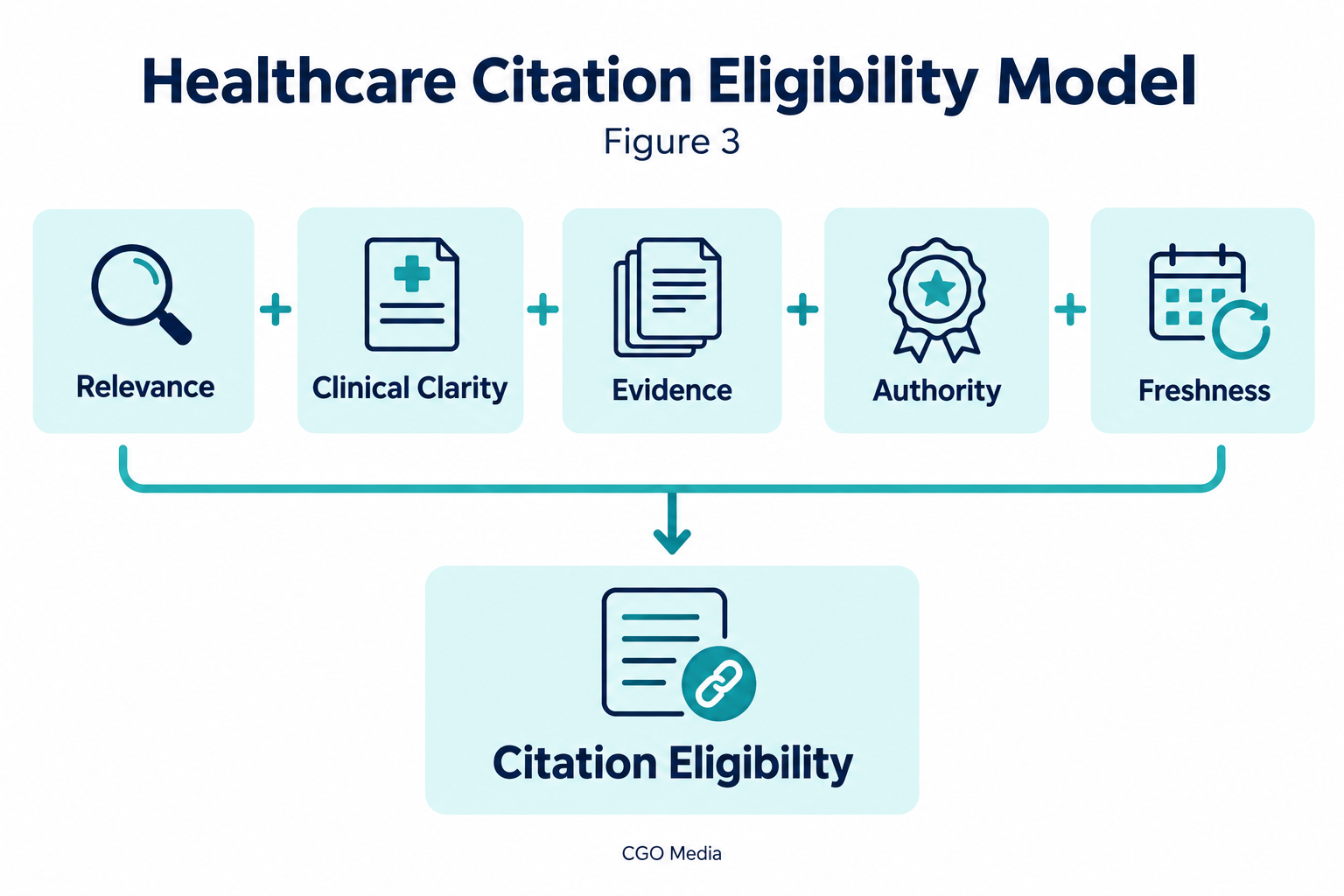
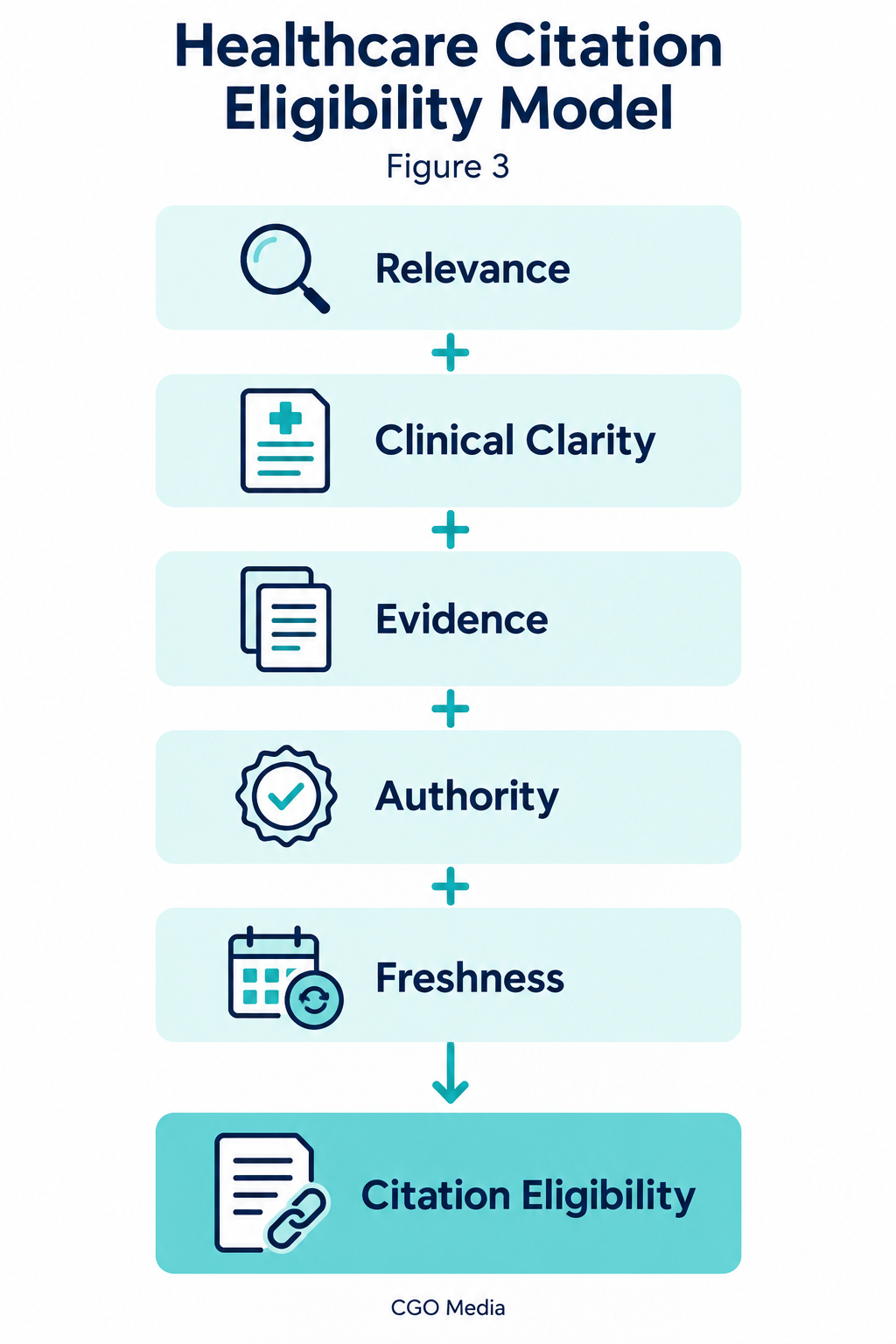
- Multiple clinics
- Multiple hospitals
- Different brands
- Different legal entities
- Different geographic markets
55. Healthcare GEO Should Include Professional Trust
Healthcare recommendations can carry significant health, financial and emotional consequences.
56. Clinician Trust Can Include
- Qualifications
- Registration
- Clinical experience
- Speciality expertise
- Professional reputation
57. Provider Trust Can Include
- Clinical governance
- Professional team
- Service quality
- Regulatory standing
- Independent recognition
58. Trust Should Be Evidenced Rather Than Asserted
Statements such as “leading clinic” or “top specialist” are stronger where supported by verifiable evidence.
59. Healthcare GEO Should Include Review Evidence Carefully
Reviews can influence perceptions of:
- Communication
- Accessibility
- Patient experience
- Responsiveness
- Service quality
60. Reviews Do Not Prove Clinical Competence
Patient satisfaction and clinical expertise are related but distinct.
61. Review Themes Can Still Provide Useful Trust Evidence
Repeated themes may reveal:
- Communication quality
- Patient care
- Accessibility
- Administrative quality
62. Healthcare GEO Should Include Citation Eligibility
Healthcare sources can become citation-eligible when they combine:
- Relevance
- Clinical clarity
- Evidence
- Authority
- Freshness
63. A Useful Healthcare Citation Model Is
Relevance + Clinical Clarity + Evidence + Authority + Freshness → Citation Eligibility
64. Clinical Guidelines Can Be Strong Citation Sources
Where treatment standards or care pathways are being discussed, authoritative clinical guidelines can provide strong evidence.
65. Government Health Sources Can Be Strong Citation Sources
They can support public-health and patient-information claims.
66. Peer-Reviewed Research Can Be Strong Citation Evidence
Research can support claims about:
- Treatment
- Risk
- Outcomes
- Prevention
- Clinical innovation
67. Provider Content Can Be a Strong Service Source
Healthcare organisations can explain:
- Service availability
- Clinician team
- Patient pathway
- Referral requirements
- Practical access
68. Healthcare Commentary Should Identify Its Evidence Basis
This helps users and systems distinguish professional interpretation from clinical evidence.
69. Original Healthcare Research Can Strengthen Citation Authority
Useful research can examine:
- Patient behaviour
- Healthcare access
- Clinical technology
- Provider selection
- Digital health adoption
70. Research Methodology Should Be Transparent
Useful healthcare research should state:
- Dataset
- Sample
- Population
- Period
- Definitions
- Limitations
71. Healthcare GEO Should Include Comparison Visibility
Hospitals, clinics, providers and clinicians can enter generative comparison sets.
72. Provider Comparison Sets Can Include
- Hospitals
- Private clinics
- Specialist centres
- Local practices
- Digital health providers
73. Clinician Comparison Sets Can Include
- Consultants
- Surgeons
- Specialists
- General practitioners
- Therapists
74. Service Comparison Sets Can Include
- Diagnostic services
- Procedures
- Treatment programmes
- Preventive services
- Rehabilitation
75. Comparison Visibility Can Reveal Effective Competitors
AI-generated comparison sets may reveal competitors that differ from traditional search competitors.
76. Provider Co-Occurrence Can Reveal Competitive Sets
Healthcare organisations repeatedly appearing together may compete for similar:
- Services
- Conditions
- Patient groups
- Locations
77. Clinician Co-Occurrence Can Reveal Specialist Competitive Sets
Individual clinicians repeatedly compared together may compete for similar patient needs.
78. Healthcare GEO Should Include Recommendation Confidence
Recommendation is a more selective outcome than simple visibility.
79. Provider Recommendation Confidence Can Depend on
- Clinical fit
- Service fit
- Professional trust
- Practical fit
- External validation
80. Clinician Recommendation Confidence Can Depend on
- Relevant expertise
- Qualifications
- Registration
- Clinical experience
- Professional standing
81. A Useful Healthcare Recommendation Model Is
Patient Scenario → Clinical Fit → Service Fit → Trust Evidence → Practical Fit → External Validation → Recommendation Confidence
82. Patient Fit Should Come Before Provider Popularity
A highly recognised provider may still be unsuitable for a particular patient.
83. Patient Fit Can Include
- Condition
- Severity
- Age
- Clinical history
- Location
- Access requirements
84. Clinical Fit Can Include
- Relevant speciality
- Condition-specific expertise
- Procedure experience
- Appropriate professional role
85. Service Fit Can Include
- Required treatment
- Diagnostic capability
- Referral pathway
- Follow-up support
- Patient accessibility
86. Practical Fit Can Also Matter
A provider may have excellent clinical expertise but remain unsuitable because of:
- Location
- Waiting time
- Cost
- Insurance compatibility
- Accessibility
87. Healthcare GEO Should Distinguish Relevant Inclusion from Irrelevant Inclusion
A provider or clinician should appear because genuine patient and clinical fit exists.
88. Relevant Inclusion Is a Positive Outcome
The provider appears where genuine suitability exists.
89. Irrelevant Inclusion Is a Poor Outcome
A provider appears despite weak clinical or practical fit.
90. Relevant Exclusion Is a Missed Opportunity
A suitable provider or clinician is absent.
91. Appropriate Exclusion Is a Correct Outcome
An unsuitable provider should be omitted.
92. Healthcare GEO Should Measure All Four Outcomes
- Relevant Inclusion
- Irrelevant Inclusion
- Relevant Exclusion
- Appropriate Exclusion
93. Healthcare GEO Should Use Scenario Libraries
Useful scenario groups can include:
- Health information discovery
- Clinician discovery
- Provider comparison
- Treatment discovery
- Specialist selection
- Healthcare research discovery
94. Health Information Discovery Scenarios Can Include
- Understanding symptoms
- Understanding conditions
- Understanding treatment options
- Finding authoritative health sources
95. Clinician Discovery Scenarios Can Include
- Specialist clinicians
- Local clinicians
- Procedure specialists
- Condition specialists
96. Provider Comparison Scenarios Can Include
- Hospital versus clinic
- Local versus specialist centre
- Public versus private provider
- In-person versus digital care
97. Treatment Discovery Scenarios Can Include
- Diagnostic pathways
- Treatment options
- Rehabilitation
- Preventive care
- Second opinions
98. Specialist Selection Scenarios Can Include
- Cardiology
- Oncology
- Orthopaedics
- Dermatology
- Mental health
- Neurology
99. Healthcare Research Discovery Scenarios Can Include
- Clinical guidelines
- Research studies
- Public health guidance
- Professional commentary
- Original provider research
100. Healthcare GEO Should Be Measured Longitudinally
Single AI outputs should not be treated as permanent evidence.
101. Longitudinal Monitoring Can Reveal
- Persistent visibility
- Persistent exclusion
- Clinical inaccuracies
- Clinician misinformation
- Changing recommendations
102. Healthcare GEO Should Include Risk Prioritisation
A useful relationship is:
Severity + Persistence + Patient Impact + Clinical Importance
103. High-Risk Healthcare GEO Errors Can Include
- Wrong clinician credentials
- Incorrect professional status
- Wrong speciality
- Outdated treatment information
- Inappropriate provider recommendation
104. Healthcare GEO Should Be Cross-Functional
Relevant functions can include:
- SEO
- Marketing
- Clinicians
- Clinical governance
- Research
- Patient services
- Digital PR
105. Clinical Governance Has a Particularly Important Role
Healthcare teams should maintain current, accurate and appropriately reviewed clinical and professional information.
106. Healthcare GEO Should Support Rather Than Replace Clinical Governance
Generative visibility depends on reliable underlying healthcare information.
107. Healthcare GEO Should Treat AI Outputs as Discovery Layers
Generated health information should not automatically be treated as diagnosis or personalised medical advice.
108. Healthcare GEO Should Preserve a Clear Boundary Between Health Information and Clinical Advice
General healthcare information may help users understand a condition or service, but individual diagnosis and treatment depend on clinical assessment.
109. Healthcare Recommendation Systems Should Respect This Distinction
A user seeking general information and a patient seeking treatment are at different stages of the healthcare journey.
110. Healthcare GEO Should therefore Distinguish Information Discovery from Provider Selection
A useful relationship is:
Health Information Discovery → Condition Understanding → Provider Evaluation → Clinician Selection
111. Health Information Visibility Can Precede Commercial Visibility
A healthcare organisation may first become visible because its clinical information is useful.
112. Health Source Authority Can therefore Support Provider Authority
Repeated use of reliable healthcare information can strengthen recognition of the provider or clinician behind it.
113. Professional Authority Can Also Support Health Source Authority
Recognised clinicians can increase confidence in clearly attributed clinical commentary.
114. This Creates a Reciprocal Healthcare Authority Relationship
A useful model is:
Clinical Expertise → Useful Health Evidence → Citation → Professional Recognition → Greater Future Source Utility
115. The First Healthcare GEO Principle
Healthcare GEO should optimise for qualified generative visibility rather than maximum mention frequency, ensuring that health information, providers and clinicians appear only where they are relevant, accurately represented and supported by appropriate clinical and professional evidence.
116. The Second Healthcare GEO Principle
Clinical expertise, professional identity and service scope should be treated as interconnected because a healthcare recommendation can become misleading if the right speciality is associated with the wrong clinician, provider, registration status or service.
117. The Third Healthcare GEO Principle
Healthcare source authority should be claim-specific, recognising the different roles of clinical guidelines, government health sources, regulators, peer-reviewed research, provider websites, professional bodies and clinician commentary.
118. The Fourth Healthcare GEO Principle
Healthcare recommendations should be evaluated through patient context, clinical fit, service fit, professional trust, practical fit and evidence confidence, while relevant inclusion, relevant exclusion, irrelevant inclusion and appropriate exclusion should be monitored separately.
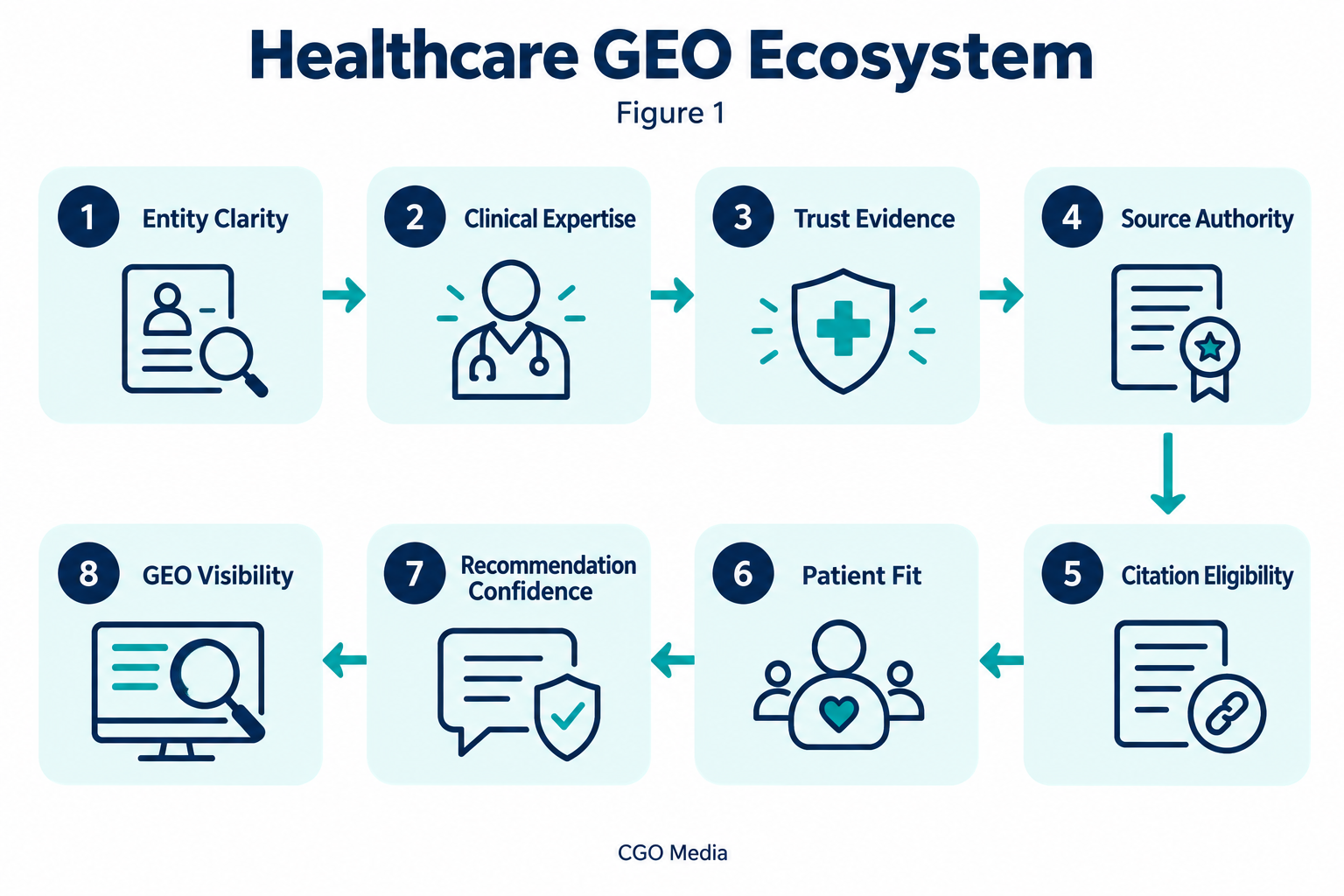
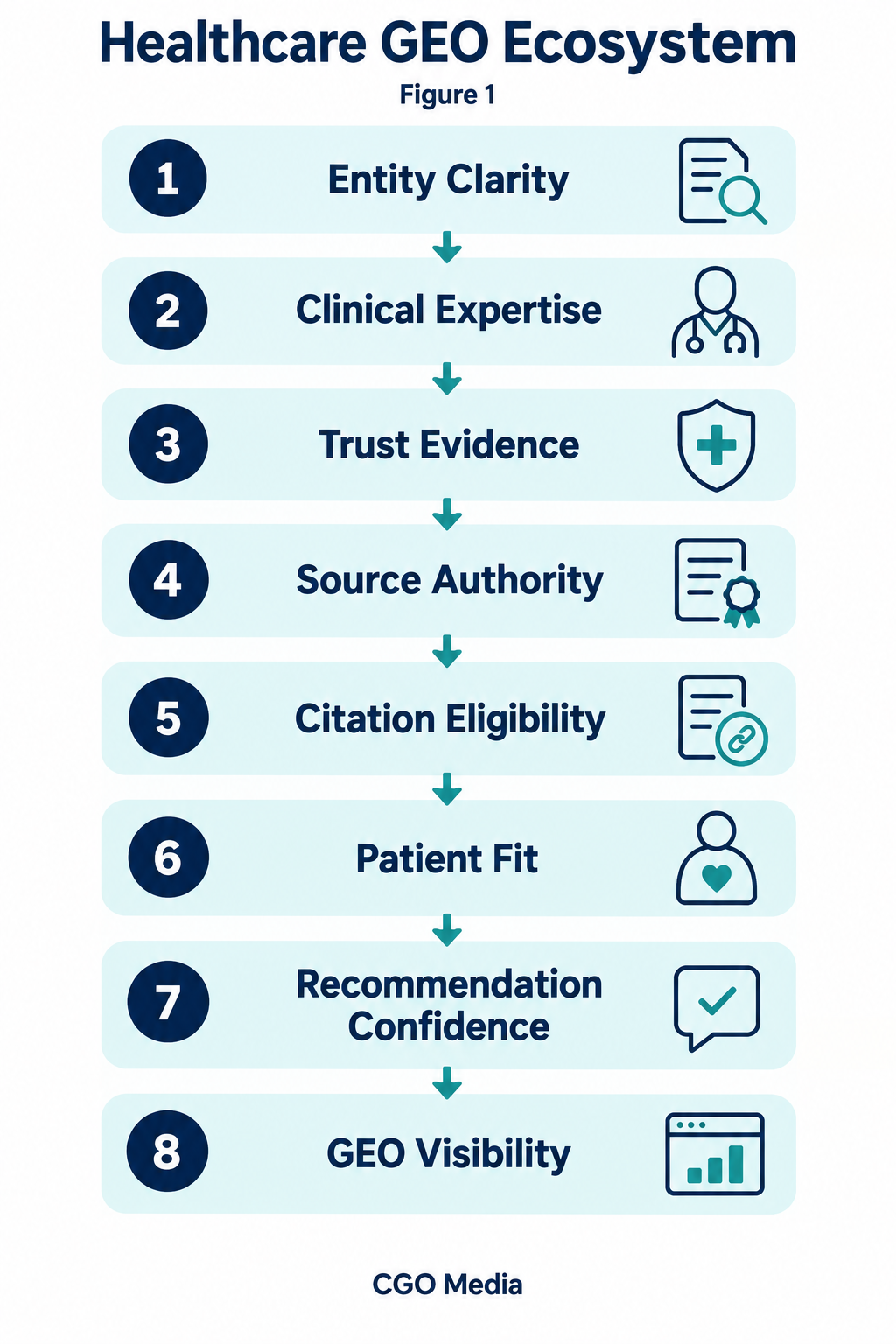
119. The Healthcare GEO Ecosystem
The core relationship can be summarised as:
Entity Clarity → Clinical Expertise → Trust Evidence → Source Authority → Citation Eligibility → Patient Fit → Recommendation Confidence → GEO Visibility
120. The Strategic Implication
Healthcare organisations should treat Generative Engine Optimisation as a structured health authority, entity and recommendation system, strengthening the relationships between providers, clinicians, specialities, services and patient needs while ensuring that clinical evidence, professional status, original research and external trust signals collectively support accurate citation, comparison and recommendation across AI-assisted healthcare discovery environments.
121. Healthcare Generative Source Selection Should Be Query-Specific
Different healthcare questions require different sources depending on whether the user is researching symptoms, conditions, treatment options, clinical evidence, providers, clinicians or access to care.
122. No Single Healthcare Source Should Support Every Claim
The strongest source for treatment evidence may not be the strongest source for:
- Clinician identity
- Service availability
- Patient experience
- Provider location
123. A Useful Healthcare Generative Source Selection Model Is
Health Query → Candidate Sources → Clinical Relevance → Authority → Evidence Convergence → Source Selection
124. Health Query Context Determines the Evidence Requirement
Different questions require different evidence standards and source types.
125. Symptom Questions Require Careful Source Selection
Useful sources can include:
- Government health authorities
- Major health systems
- Professional medical bodies
- Clinical reference sources
126. Condition Questions Require Clinically Relevant Sources
Useful evidence can include:
- Clinical guidelines
- Peer-reviewed research
- Specialist medical organisations
- Public health guidance
127. Treatment Questions Require Stronger Clinical Evidence
Treatment claims may depend on:
- Guidelines
- Clinical trials
- Systematic reviews
- Regulatory information
128. Provider Questions Require Service and Professional Evidence
These can include:
- Provider websites
- Clinician profiles
- Professional registers
- Independent provider information
129. Candidate Sources Can Be Public Health Sources
These can include:
- Government health departments
- National health systems
- Public health agencies
- Official screening programmes
130. Candidate Sources Can Be Clinical Guidelines
Guidelines can provide structured evidence around:
- Diagnosis
- Treatment pathways
- Clinical standards
- Monitoring
- Follow-up
131. Candidate Sources Can Be Peer-Reviewed Research
Research can support claims around:
- Effectiveness
- Safety
- Risk
- Outcomes
- Clinical innovation
132. Candidate Sources Can Be Professional Medical Bodies
These organisations may provide:
- Specialist guidance
- Professional standards
- Clinical consensus
- Patient information
133. Candidate Sources Can Be Provider Sources
These can include:
- Hospital websites
- Clinic websites
- Clinician profiles
- Service pages
- Patient pathways
134. Candidate Sources Can Be Regulatory Sources
These can support information around:
- Professional status
- Licensing
- Medicine approval
- Medical-device regulation
- Provider regulation
135. Clinical Relevance Should Be Evaluated Early
A highly authoritative health source may still be weak if it does not address the patient population, condition or intervention being discussed.
136. Clinical Relevance Can Include
- Condition relevance
- Patient population
- Treatment relevance
- Age group
- Severity
- Clinical setting
137. Population Relevance Matters
Evidence derived from one patient population may not apply equally to another.
138. Age Can Affect Clinical Relevance
Evidence for adults may not automatically apply to children, older adults or other age groups.
139. Disease Severity Can Affect Clinical Relevance
Treatment evidence may differ across:
- Mild disease
- Moderate disease
- Severe disease
- Advanced disease
140. Healthcare Source Selection Should Match the Stage of Care
Different evidence may be required for:
- Prevention
- Diagnosis
- Treatment
- Rehabilitation
- Long-term management
141. Clinical Authority Should Be Evaluated by Claim Type
Different sources are authoritative for different purposes.
142. Government Sources Can Be Strong for Public Health Guidance
They can be particularly useful for:
- Vaccination
- Screening
- Prevention
- Health-system access
- Population guidance
143. Clinical Guidelines Can Be Strong for Standard-of-Care Questions
They can support understanding of recommended:
- Diagnostic pathways
- Treatments
- Monitoring
- Referral criteria
144. Peer-Reviewed Research Can Be Strong for Emerging Evidence
Research may provide insight into new:
- Treatments
- Technologies
- Diagnostic approaches
- Risk factors
145. Systematic Reviews Can Strengthen Evidence Synthesis
They can help summarise findings across multiple studies.
146. Individual Studies Should Be Interpreted Carefully
A single study may be affected by:
- Sample size
- Study design
- Population differences
- Measurement limitations
147. Healthcare GEO Should Distinguish Evidence Hierarchies
Not every health claim should be supported by the same level of evidence.
148. Provider Websites Are Often Strongest for Service Truth
They can provide current information about:
- Services
- Locations
- Clinicians
- Referral routes
- Availability
149. Provider Websites Are Weaker for Independent Superlative Claims
Self-published statements such as “best hospital” or “leading specialist” require external evidence where they are used.
150. Clinician Profiles Can Be Strong Sources for Professional Detail
Useful information can include:
- Role
- Qualifications
- Speciality
- Experience
- Research activity
151. Clinician Profiles Should Distinguish Current and Historical Roles
Outdated affiliations can create entity confusion.
152. Professional Registers Can Strengthen Clinician Verification
They can support:
- Identity
- Current registration
- Professional status
- Specialist recognition where applicable
153. Provider Regulation Can Strengthen Organisation Verification
Official provider information can support confidence around:
- Registration
- Inspection
- Licensing
- Regulatory status
154. Healthcare Service Pages Should Be Specific
A service page should explain:
- Condition or need
- Treatment or procedure
- Relevant clinicians
- Location
- Referral pathway
155. Generic Healthcare Marketing Language Can Reduce Source Utility
Broad claims can make it harder to determine exactly which patients or conditions the service is designed for.
156. Patient Information Pages Can Be Strong Source Assets
Useful patient information can explain:
- Condition
- Symptoms
- Diagnosis
- Treatment pathway
- When to seek care
157. Patient Information Should Be Clinically Reviewed
Clinical oversight can strengthen accuracy and trust.
158. Clinical Authorship Should Be Clear Where Appropriate
Useful attribution can include:
- Clinician name
- Role
- Speciality
- Provider
- Review date
159. Healthcare Research Can Support Source Authority
Original research can address:
- Patient behaviour
- Access to care
- Digital health
- Provider selection
- Healthcare outcomes
160. Healthcare Research Methodology Should Be Transparent
Useful research should state:
- Population
- Sample
- Dataset
- Period
- Definitions
- Limitations
161. Healthcare Research Should Distinguish Clinical Evidence from Market Research
A patient survey should not be treated as equivalent to a clinical trial.
162. Healthcare Source Authority Is Multi-Dimensional
Useful dimensions can include:
- Clinical authority
- Professional authority
- Regulatory authority
- Research authority
- Freshness
163. Domain Strength Alone Is Not Sufficient
A large website can still provide weak evidence for a specific clinical claim.
164. Specialist Clinical Authority Can Be More Relevant Than General Authority
A specialist medical organisation may provide stronger evidence for a narrow condition than a broad health publisher.
165. Specialist Authority Can Be Demonstrated Through
- Clinical expertise
- Specialist guidelines
- Research
- Professional recognition
- Repeated external citation
166. Healthcare Source Selection Should Include Freshness
Health evidence and professional information can become outdated.
167. Freshness Requirements Should Vary by Information Type
A useful relationship is:
Clinical Volatility + Patient Impact + Claim Importance → Required Freshness
168. Clinical Guidelines Require Review as Recommendations Change
Updated evidence can alter standards of care.
169. Drug and Device Information Can Require High Freshness
Relevant changes can include:
- Approval
- Safety warnings
- Indication changes
- Withdrawal
170. Public Health Guidance Can Change Rapidly
This can be particularly important during emerging health events.
171. Clinician Status Also Requires Freshness
A healthcare professional’s:
- Employer
- Role
- Registration
- Speciality
can change over time.
172. Provider Service Availability Requires Freshness
Healthcare organisations can change:
- Services
- Locations
- Referral routes
- Clinical teams
173. Source Publication Date Should Be Visible
Date clarity supports evaluation of health information.
174. Clinical Review Date Can Also Be Useful
A page may remain valid while still requiring periodic professional review.
175. Healthcare Source Extractability Matters
Important clinical and professional facts should be clearly identifiable.
176. Critical Healthcare Facts Should Be Explicit
Useful details can include:
- Condition
- Treatment
- Population
- Professional role
- Service availability
- Review date
177. Health Content Should Avoid Ambiguous Clinical Claims
Statements about effectiveness, safety or suitability should reflect the evidence supporting them.
178. Healthcare Sources Should Distinguish General Information from Personalised Advice
General health content cannot account for an individual patient’s full medical history.
179. Source Convergence Can Strengthen Healthcare Confidence
A useful relationship is:
Clinical Evidence + Regulatory Evidence + Professional Evidence + Provider Evidence → Healthcare Confidence
180. Source Convergence Should Be Claim-Level
Different sources can converge around:
- Treatment evidence
- Clinician status
- Provider capability
- Safety information
181. Healthcare Source Conflict Should Be Logged
Material discrepancies should not be ignored.
182. Source Conflict Categories Can Include
- Clinical guidance conflict
- Professional-status conflict
- Treatment-claim conflict
- Provider-service conflict
- Research conflict
183. Clinical Guidance Conflict Can Arise for Legitimate Reasons
Different organisations may interpret evidence differently or update guidance at different times.
184. Treatment-Claim Conflict Can Be High-Risk
Conflicting information about effectiveness or safety deserves careful review.
185. Professional-Status Conflict Can Be High-Risk
Incorrect clinician registration or role should receive priority.
186. Provider-Service Conflict Can Mislead Patients
External sources may describe services that are no longer available.
187. Research Conflict Should Be Interpreted Methodologically
Different studies may reach different findings because of:
- Population
- Study design
- Outcome measure
- Follow-up period
188. Healthcare Organisations Should Maintain Canonical Clinician Facts
Useful canonical information can include:
- Name
- Role
- Provider
- Registration
- Speciality
- Location
189. Canonical Provider Facts Should Also Be Maintained
These can include:
- Organisation name
- Locations
- Services
- Clinical specialities
- Professional team
190. Canonical Service Facts Can Improve Clarity
Healthcare organisations should maintain consistent information about:
- Service name
- Condition
- Procedure
- Patient group
- Location
191. Healthcare GEO Should Build Source Maps
Source maps can identify the strongest evidence source for important healthcare facts.
192. A Healthcare Source Map Can Include
- Clinical guidance
- Treatment evidence
- Clinician registration
- Provider capability
- Patient-service information
193. Source Maps Can Reveal Evidence Gaps
A useful relationship is:
Health Question → Required Evidence → Best Source → Existing Source → Evidence Gap
194. Evidence Gaps Can Exist in Clinical Content
Examples can include:
- Outdated guidance
- Weak evidence references
- Unclear review dates
- Missing population context
195. Evidence Gaps Can Exist in Clinician Profiles
Examples can include:
- Missing registration details
- Unclear specialism
- Old employer information
- Weak expertise evidence
196. Evidence Gaps Can Exist Externally
A provider may lack:
- Independent clinical recognition
- Research citations
- Professional references
- External provider validation
197. Healthcare GEO Should Reduce Dependence on Directories Alone
Directories can support discovery but should not replace direct clinical and professional authority.
198. Strong Owned Sources Can Establish Direct Healthcare Authority
Useful owned assets can include:
- Clinically reviewed patient information
- Service pages
- Clinician profiles
- Research
- Patient pathways
199. External Sources Can Reinforce Owned Authority
A useful relationship is:
Owned Healthcare Evidence → External Validation → Source Convergence → Greater Source Confidence
200. Healthcare Guides Can Be Valuable Source Assets
High-quality guides can explain:
- Conditions
- Symptoms
- Diagnosis
- Treatment options
- Care pathways
201. Health Guides Should Be Written for Patient Understanding
Clinical accuracy and comprehensibility should support one another.
202. Clinical Commentary Can Strengthen Expert Authority
Clinicians can contribute interpretation of:
- New research
- Clinical guidelines
- Treatment innovation
- Public health issues
203. Clinical Commentary Should Be Clearly Attributed
Useful attribution can include:
- Clinician name
- Role
- Speciality
- Provider
- Review date
204. Author Transparency Can Improve Source Confidence
Clearly attributed clinical commentary can be easier to assess than anonymous health content.
205. Healthcare Source Selection Should Include Negative Evidence Where Relevant
Not all provider or professional information is positive.
206. Negative Professional Evidence Can Include
- Regulatory action
- Professional restrictions
- Provider sanctions
- Serious safety findings
207. Negative Evidence Can Affect Provider Recommendation
Where verified and relevant, it can materially reduce recommendation confidence.
208. Negative Evidence Should Be Current and Contextualised
Historic regulatory information should not automatically be treated as current professional status.
209. Healthcare Source Selection Should Include Source Diversity
Different evidence types can reinforce one another.
210. Useful Healthcare Source Diversity Can Include
- Clinical guidelines
- Government sources
- Peer-reviewed research
- Professional evidence
- Provider information
211. Source Diversity Should Not Mean Quantity for Its Own Sake
A smaller number of strong, clinically relevant sources can be more useful than many weak references.
212. Healthcare Source Quality Should Be Evaluated by Function
The strongest source depends on what needs to be established.
213. Healthcare Source Selection Should Support Patient Decision Quality
The objective is not simply to maximise source visibility.
214. Better Clinical Sources Should Improve Health Understanding
Patients should receive more reliable information about:
- Conditions
- Symptoms
- Care options
- When to seek help
215. Better Professional Sources Should Improve Clinician Evaluation
Patients should receive clearer evidence around:
- Qualifications
- Registration
- Speciality
- Experience
216. Better Source Selection Can Improve Provider Comparison
Hospitals, clinics and clinicians can be compared using a stronger evidence base.
217. Better Source Selection Can Improve Recommendation Quality
Recommendations become stronger when clinical, professional and practical evidence converge.
218. Healthcare GEO Should therefore Be Evidence-Led
A source should be useful because it contributes relevant, clinically appropriate, current and authoritative information.
219. Healthcare Source Selection Should Be Monitored Longitudinally
Source patterns can change as evidence, services and professional teams evolve.
220. Longitudinal Source Monitoring Can Reveal
- New authoritative sources
- Declining sources
- Updated clinical guidance
- Improved provider visibility
- New research authority
221. Source Movement Can Reflect Clinical Change
New evidence or updated guidelines can change which sources are most appropriate.
222. Source Movement Can Reflect Professional Change
Clinician moves, service changes and provider restructuring can alter professional evidence.
223. Source Movement Can Reflect Competitive Improvement
Competing providers may strengthen:
- Patient information
- Clinical research
- Clinician profiles
- External authority
224. Healthcare GEO Should Include Source Benchmarking
Useful benchmarks can include:
- Source visibility
- Source recurrence
- Source accuracy
- Source freshness
- Source authority
225. Source Visibility Should Be Measured Separately from Citation Visibility
A source can influence a generated health answer without explicit attribution.
226. Source Recurrence Can Indicate Persistent Utility
Repeated selection may indicate stronger recognition for a condition, speciality or health topic.
227. Source Accuracy Should Be Continuously Checked
Highly visible but inaccurate health information can create significant risk.
228. Source Freshness Should Be Monitored by Information Type
Fast-changing treatment and safety information may require more frequent review than stable professional history.
229. Healthcare Source Authority Should Be Mapped by Condition
A provider or research source may be strongly recognised for one condition and weak for another.
230. Healthcare Source Authority Should Be Mapped by Speciality
Authority in one clinical discipline does not automatically transfer elsewhere.
231. Healthcare Source Authority Should Be Mapped by Clinician
Individual professionals can develop distinct authority around specialist topics.
232. Healthcare Source Authority Should Be Mapped by Patient Need
A source may repeatedly appear for a specific type of health question or care pathway.
233. Healthcare GEO Can Use Source Gap Analysis Strategically
Important health questions with weak evidence coverage can reveal publishing and research opportunities.
234. A Healthcare Source Gap Model Is
Important Health Question → Existing Evidence → Source Weakness → Content or Research Opportunity
235. Source Gaps Can Support Patient-Content Strategy
They can identify opportunities for:
- Condition guides
- Treatment guides
- Patient FAQs
- Care pathways
236. Source Gaps Can Support Clinical Positioning
Specialists can contribute useful commentary where high-quality patient information is limited.
237. Source Gaps Can Support Research and Digital PR
Original healthcare data can create external citation opportunities.
238. Healthcare Source Utility Can Become Self-Reinforcing
A useful relationship is:
Useful Health Source → Citation → Recognition → Stronger Authority → Greater Future Source Utility
239. Healthcare Organisations Should Avoid Manufactured Source Signals
The objective should be genuine patient utility, clinical accuracy and verifiable professional expertise.
240. Strong Healthcare Source Authority Is Earned Through Usefulness
Useful health sources help patients, researchers, clinicians, journalists and AI systems understand healthcare more accurately.
241. Healthcare Source Utility Should therefore Be the Core Objective
A source should be worth using because it adds:
- Reliable clinical information
- Clear patient context
- Professional expertise
- Current evidence
- Practical care information
242. The Fifth Healthcare GEO Principle
Healthcare generative source selection should be query-specific and clinically relevant, recognising that guidelines, government health sources, peer-reviewed research, regulators, professional registers, provider websites and clinician commentary each serve different evidential roles.
243. The Sixth Healthcare GEO Principle
Healthcare organisations should strengthen source convergence by aligning current clinical information, clinician profiles, professional registration, service descriptions, research and external validation so generative systems encounter fewer conflicts when interpreting providers, professionals and care options.
244. The Seventh Healthcare GEO Principle
Healthcare source freshness should reflect clinical volatility and patient risk, with treatment guidance, safety information, current clinician status and fast-moving health topics reviewed more frequently than relatively stable professional history or established clinical concepts.
245. The Eighth Healthcare GEO Principle
Healthcare organisations should build direct source authority through clinically reviewed patient information, clear service pages, detailed clinician profiles and original research while using guidelines, regulators, professional bodies and independent evidence to reinforce rather than replace clinical authority.
246. The Healthcare Generative Source Selection Model
The core relationship can be summarised as:
Health Query → Candidate Sources → Clinical Relevance → Authority → Evidence Convergence → Source Selection
247. The Strategic Implication
Healthcare organisations should treat generative source selection as a structured clinical and professional evidence system, ensuring that health claims, clinician information and service information are supported by appropriate source types, that outdated or conflicting evidence is identified quickly and that owned healthcare content, clinical expertise and independent authority collectively support safer and more accurate AI-assisted healthcare discovery.
248. Healthcare Citation Eligibility Is Distinct from General Visibility
A healthcare source may influence a generated answer without being selected as an explicit citation.
249. Citation Eligibility Should Be Evaluated at Claim Level
The central question is:
Is this source sufficiently relevant, clinically appropriate, authoritative, evidenced and current to support this specific healthcare claim?
250. A Useful Healthcare Citation Eligibility Model Is
Relevance + Clinical Clarity + Evidence + Authority + Freshness → Citation Eligibility
251. Clinical Relevance Is the First Citation Requirement
A source should directly support the condition, treatment, population, service or professional fact being discussed.
252. Broad Health Relevance Is Not Always Sufficient
A general healthcare article may provide weak support for a narrow claim involving:
- A specific treatment
- A specialist condition
- A particular patient population
- A regulated clinical procedure
- A named clinician
253. Population Relevance Should Be Considered
Healthcare evidence may differ according to:
- Age
- Sex
- Disease severity
- Co-existing conditions
- Clinical setting
254. Clinical Clarity Is the Second Citation Requirement
The source should make clear what claim, population, treatment or healthcare service it actually supports.
255. Clinical Clarity Can Include
- Condition
- Treatment or intervention
- Patient population
- Outcome
- Professional role
- Evidence type
256. Citation Eligibility Requires a Clear Distinction Between Evidence and Interpretation
Users and systems should be able to distinguish:
- Clinical guideline
- Peer-reviewed research
- Regulatory guidance
- Professional commentary
- Provider marketing
257. Clinical Guidelines Can Carry Strong Citation Authority
Where recognised guidance exists, it can support:
- Diagnosis pathways
- Treatment pathways
- Monitoring
- Referral
- Follow-up
258. Government Health Sources Can Carry Strong Citation Authority
These can be particularly relevant for:
- Public health
- Screening
- Vaccination
- Prevention
- Healthcare access
259. Peer-Reviewed Research Can Support Clinical Claims
Research may be useful for claims concerning:
- Effectiveness
- Safety
- Risk
- Outcomes
- Clinical innovation
260. Systematic Reviews Can Strengthen Citation Confidence
They can provide synthesis across multiple studies rather than relying on one isolated result.
261. Individual Studies Should Be Cited with Appropriate Context
A single study should not necessarily be interpreted as universal clinical consensus.
262. Evidence Quality Is the Third Citation Requirement
Evidence quality can depend on:
- Study design
- Sample size
- Population relevance
- Methodology
- Replication
- Peer review
263. Evidence Quality Should Match the Claim
A strong treatment-effectiveness claim generally requires stronger evidence than a simple service-availability statement.
264. Provider Claims Require Different Evidence
Claims about a provider may be supported by:
- Service pages
- Clinician profiles
- Regulatory records
- Independent provider information
265. Clinician Claims Require Professional Evidence
Useful evidence can include:
- Registration
- Qualifications
- Speciality
- Clinical role
- Research activity
266. Citation Eligibility Should Distinguish Self-Declared from Verified Professional Claims
Official or independently verifiable evidence can provide stronger support than unsupported profile language.
267. Authority Is the Fourth Citation Requirement
Authority should be appropriate to the claim being supported.
268. Clinical Authority Can Be Institutional
Examples include:
- Government health agencies
- National health services
- Clinical guideline bodies
- Medical regulators
269. Clinical Authority Can Be Professional
Examples include:
- Experienced clinicians
- Specialist medical organisations
- Professional colleges
- Clinical societies
270. Clinical Authority Can Be Academic
Universities, research institutes and peer-reviewed journals can contribute scientific evidence.
271. Authority Should Be Claim-Specific
A source can be highly authoritative in one speciality and weak in another.
272. Specialist Healthcare Authority Can Outperform General Brand Authority
A specialist clinical body may provide stronger evidence for a narrow healthcare question than a broad publisher.
273. Freshness Is the Fifth Citation Requirement
Healthcare information can become outdated through:
- New clinical guidance
- New research
- Safety updates
- Professional changes
274. Citation Freshness Should Match Clinical Volatility
A useful relationship is:
Clinical Volatility + Patient Impact + Claim Importance → Required Freshness
275. Current Treatment Guidance Requires Clear Date Context
Healthcare content should make it clear whether recommendations remain current.
276. Publication Date and Evidence Currency Are Not Always the Same
An older foundational study may remain relevant while a newer article may rely on outdated evidence.
277. Healthcare Citation Evaluation Should therefore Include Substantive Freshness
The important question is whether the clinical claim remains supported by current evidence.
278. Clinician Affiliation Also Requires Freshness
A professional citation can become misleading if the clinician has changed:
- Employer
- Role
- Registration status
- Speciality
279. Service Availability Requires Freshness
Providers can change:
- Services
- Locations
- Clinical teams
- Referral routes
- Eligibility criteria
280. Healthcare Citation Eligibility Should Include Extractability
Important clinical and professional facts should be clearly identifiable within the source.
281. Citation-Ready Healthcare Content Should Use Clear Headings
Useful sections can separate:
- Condition
- Symptoms
- Diagnosis
- Treatment
- Evidence
- When to seek care
282. Citation-Ready Healthcare Content Should Use Explicit Statements
Critical clinical claims should not depend on vague or promotional wording.
283. Clinician Commentary Should Be Clearly Attributed
Useful attribution can include:
- Clinician name
- Role
- Speciality
- Provider
- Review date
284. Author Transparency Can Strengthen Citation Confidence
Clearly attributed professional analysis can be easier to evaluate than anonymous health content.
285. Healthcare Guides Can Become Citation Assets
Useful guides can explain:
- Conditions
- Symptoms
- Care pathways
- Treatment options
- Practical access
286. Healthcare Guides Should Preserve Clinical Boundaries
General information should not imply diagnosis or personalised treatment advice.
287. Treatment Commentary Can Become Citation-Ready
Useful treatment commentary can explain:
- Indications
- Potential benefits
- Risks
- Alternatives
- Evidence limitations
288. Treatment Commentary Should Identify the Evidence Basis
This helps distinguish clinical evidence from provider opinion.
289. Safety Information Can Require Strong Citation Standards
Claims involving:
- Adverse effects
- Contraindications
- Medicine safety
- Device safety
should rely on current authoritative evidence.
290. Original Healthcare Research Can Strengthen Citation Eligibility
Healthcare organisations can publish research around:
- Patient behaviour
- Healthcare access
- Service experience
- Digital health adoption
- Provider selection
291. Research Methodology Should Be Transparent
Useful healthcare research should define:
- Population
- Dataset
- Sample
- Measurement period
- Definitions
- Limitations
292. Healthcare Research Should Distinguish Clinical Research from Market Research
A patient-experience survey should not be represented as clinical evidence of treatment effectiveness.
293. Research Should Distinguish Observation from Interpretation
Findings should remain distinguishable from:
- Clinical opinion
- Strategic interpretation
- Forecasting
- Provider recommendation
294. Healthcare Citation Authority Can Build Through Repeated Use
A useful relationship is:
Citable Healthcare Source → Repeated Citation → Wider Recognition → Citation Authority
295. Citation Authority Can Be Condition-Specific
A source may become recognised around:
- Diabetes
- Cardiovascular disease
- Cancer
- Mental health
- Musculoskeletal conditions
296. Citation Authority Can Be Speciality-Specific
Authority in one clinical discipline does not automatically transfer to another.
297. Citation Authority Can Be Clinician-Specific
Individual clinicians can develop authority around specialist topics.
298. Citation Authority Should therefore Be Mapped at Multiple Levels
Useful levels can include:
- Provider
- Clinician
- Speciality
- Condition
- Research topic
299. Healthcare GEO Should Monitor Citation Recurrence
Repeated citation can indicate persistent source utility.
300. Citation Recurrence Should Be Evaluated by Context
A healthcare source may be cited for:
- Clinical evidence
- Professional status
- Research data
- Service information
- Public health guidance
301. Citation Quality Matters as Much as Citation Frequency
A frequently cited source can still be problematic if it is:
- Outdated
- Misinterpreted
- Applied to the wrong patient population
- Attributed incorrectly
302. Citation Context Should therefore Be Monitored
Teams should assess:
- What was cited
- Why it was cited
- Whether the patient context was correct
- Whether the interpretation was accurate
303. Healthcare Citation Accuracy Is a Risk Metric
Incorrect citation can reinforce inaccurate clinical or professional information.
304. High-Risk Citation Errors Can Include
- Wrong treatment claim
- Outdated safety information
- Wrong clinician
- Incorrect registration status
- Misapplied clinical evidence
305. Healthcare Citation Risk Should Be Prioritised
A useful model is:
Error Severity + Citation Persistence + Patient Impact + Clinical Importance
306. Citation Recovery Should Target the Source Environment
The strongest response is usually to correct or strengthen underlying clinical and professional evidence.
307. A Useful Healthcare Citation Recovery Cycle Is
Detect → Verify → Diagnose → Correct Source → Strengthen Evidence → Re-Test
308. Detect
Identify an inaccurate, weak or outdated citation pattern.
309. Verify
Confirm whether the citation is materially wrong, outdated or misapplied.
310. Diagnose
Identify whether the root cause is:
- Outdated clinical content
- Weak evidence references
- Third-party error
- Clinician-profile error
- Entity confusion
311. Correct Source
Improve the relevant healthcare, clinical or professional information.
312. Strengthen Evidence
Where appropriate, reinforce corrections through stronger clinical, regulatory or professional sources.
313. Re-Test
Monitor whether citation accuracy improves.
314. Digital PR Can Support Healthcare Citation Authority
Useful health research and expert commentary can create external reference opportunities.
315. Healthcare Digital PR Should Be Evidence-Led
Useful campaigns can be based on:
- Original healthcare research
- Patient surveys
- Digital health studies
- Access-to-care data
- Clinical commentary
316. Promotional Announcements Alone May Have Limited Citation Utility
Brand exposure and healthcare citation authority are related but distinct.
317. Data-Led Healthcare Research Can Create Reusable Citation Assets
Strong studies can be referenced repeatedly by:
- Journalists
- Researchers
- Professional bodies
- AI systems
318. Specialist Healthcare Data Can Be Particularly Valuable
Narrow condition, speciality or patient-access studies may fill gaps left by broader health reports.
319. Citation Gap Analysis Can Reveal Research Opportunities
A useful relationship is:
Important Health Question → Existing Evidence → Evidence Weakness → Research Opportunity → Citation Asset
320. Citation Gaps Can Support Editorial Strategy
They can identify opportunities for:
- Patient guides
- Clinical explainers
- Healthcare research
- Professional commentary
321. Citation Gaps Can Support Specialist Positioning
Clinicians can build authority around under-covered health topics.
322. Citation Competitors Can Differ from Search Competitors
Generative systems may frequently cite:
- Government health agencies
- Clinical guideline bodies
- Universities
- Research journals
- Professional medical organisations
rather than providers ranking highest in traditional search.
323. Citation Competitor Analysis Should Ask Why a Source Is Useful
Useful questions include:
- Is it more clinically authoritative?
- Is it more current?
- Is it more specific?
- Is the methodology stronger?
- Is the information easier to interpret?
324. Healthcare Citation Authority Should Be Built Systematically
A useful long-term sequence is:
Clinical Expertise → Citation-Ready Publication → External Reference → Repeated Citation → Greater Healthcare Authority
325. Citation Authority Can Reinforce Future Source Selection
Repeated recognition may increase the likelihood that useful healthcare sources are considered again in related discovery contexts.
326. Source Selection and Citation Authority Can Reinforce Each Other
A useful relationship is:
Useful Healthcare Source → Citation → External Recognition → Stronger Authority → Greater Future Source Utility
327. Healthcare GEO Should Avoid Manufactured Citation Signals
The objective should be useful clinical evidence and genuine external recognition rather than artificial mention generation.
328. Strong Healthcare Citation Authority Is Earned Through Utility
Useful health sources help patients, clinicians, researchers, journalists and AI systems understand healthcare more accurately.
329. Citation Utility Should therefore Be the Strategic Objective
A healthcare source should be worth citing because it adds:
- Reliable clinical information
- Clear evidence
- Professional expertise
- Patient relevance
- Current information
330. The Ninth Healthcare GEO Principle
Healthcare citation eligibility should depend on claim-specific clinical relevance, evidence quality, professional clarity, appropriate authority and substantive freshness rather than general website prominence or provider brand strength alone.
331. The Tenth Healthcare GEO Principle
Healthcare organisations should build citation authority through clinically reviewed patient information, clearly attributed clinician expertise, transparent research, evidence-led commentary and external validation while preserving the distinction between clinical evidence, professional interpretation and provider marketing.
332. The Eleventh Healthcare GEO Principle
Citation monitoring should evaluate frequency, context, accuracy, patient relevance and freshness separately, recognising that a citation can increase visibility while still creating risk if treatment information, professional status or clinical evidence is represented incorrectly.
333. The Twelfth Healthcare GEO Principle
The strongest Healthcare GEO citation systems should identify evidence gaps, create stable citation-ready assets, strengthen external recognition and correct outdated or conflicting source environments rather than attempting to optimise individual AI citations in isolation.
334. The Healthcare Citation Eligibility Model
The core relationship can be summarised as:
Relevance + Clinical Clarity + Evidence + Authority + Freshness → Citation Eligibility → Citation Visibility → Citation Authority
335. The Strategic Implication
Healthcare organisations should treat citation authority as a clinical evidence and publishing capability, ensuring that guidelines, research, professional status, provider information and expert commentary are clearly differentiated, accurately attributed and sufficiently current to support reliable AI-assisted healthcare discovery while citation quality, patient relevance, accuracy and recurrence are monitored over time.
336. Healthcare Recommendation Is More Selective Than Visibility
A healthcare provider or clinician may appear in generative discovery without being sufficiently suitable to justify recommendation.
337. Healthcare Recommendation Should Be Scenario-Specific
The central question is:
Does this provider or clinician genuinely fit the patient’s health need, clinical context, required service and practical circumstances?
338. A Useful AI Healthcare Provider Recommendation Model Is
Patient Scenario → Clinical Fit → Service Fit → Trust Evidence → Practical Fit → External Validation → Recommendation Confidence
339. Patient Scenario Is the Starting Point
Recommendation quality depends on understanding:
- Condition or health need
- Severity
- Age
- Clinical history
- Location
- Access requirements
340. Patient Context Can Affect Provider Suitability
Different providers may be better suited to:
- Children
- Adults
- Older adults
- Complex patients
- Patients requiring multidisciplinary care
341. Condition Complexity Can Affect Provider Fit
Routine care may require a very different provider from:
- Rare disease management
- Complex surgery
- Advanced oncology
- Multisystem conditions
342. Urgency Can Affect Recommendation
Some scenarios may require:
- Immediate care
- Urgent specialist assessment
- Routine consultation
- Long-term management
343. Clinical Fit Is the First Recommendation Layer
The provider or clinician should possess expertise directly relevant to the patient’s health need.
344. Clinical Fit Can Include
- Relevant speciality
- Condition-specific expertise
- Procedure experience
- Clinical role
- Relevant patient population
345. General Healthcare Capability Should Not Replace Specialist Fit
A large healthcare organisation may still be less appropriate than a specialist centre for a narrow clinical need.
346. Clinical Fit Should Be Evidence-Led
Useful evidence can include:
- Clinician profiles
- Specialist training
- Clinical research
- Service information
- Professional registration
347. Clinical Fit Should Distinguish Provider-Level from Clinician-Level Capability
A provider may offer a service broadly while only certain clinicians possess the required specialist expertise.
348. Clinician Availability Can Affect Clinical Fit
A suitable specialist may exist within the organisation but not be available within the required timeframe.
349. A Useful Clinical-Fit Relationship Is
Patient Need + Speciality Fit + Clinician Expertise + Appropriate Care Setting → Clinical Suitability
350. Service Fit Is the Second Recommendation Layer
The provider must also offer the appropriate service or care pathway.
351. Service Fit Can Include
- Diagnostic capability
- Treatment availability
- Procedure capability
- Rehabilitation
- Follow-up care
352. Service Fit Should Be Current
Healthcare organisations can change:
- Services
- Clinicians
- Referral criteria
- Locations
353. Service Fit Can Depend on Care Setting
Relevant settings can include:
- Primary care
- Outpatient clinic
- Hospital
- Specialist centre
- Digital care
354. Clinical Fit and Service Fit Should Be Evaluated Together
A useful relationship is:
Clinical Fit + Service Fit → Patient-Service Suitability
355. Trust Evidence Is the Third Recommendation Layer
Healthcare recommendations can carry significant health, financial and emotional consequences.
356. Clinician Trust Can Depend on
- Professional status
- Qualifications
- Specialist training
- Clinical experience
- Research activity
357. Provider Trust Can Depend on
- Clinical governance
- Regulatory status
- Specialist capability
- Patient safety
- Independent recognition
358. Trust Should Be Relevant to the Care Need
Strong general reputation does not automatically establish suitability for every condition or procedure.
359. Patient Experience Evidence Can Support Trust
Useful evidence can include:
- Patient reviews
- Experience surveys
- Communication feedback
- Service accessibility
360. Patient Experience Does Not Prove Clinical Quality
A highly rated experience should not be treated as equivalent to strong clinical outcomes.
361. Clinical Outcomes Require Careful Interpretation
Outcomes can depend on:
- Patient severity
- Age
- Co-existing conditions
- Case complexity
- Follow-up period
362. Raw Outcome Comparisons Can Be Misleading
Providers treating more complex patients may appear to perform differently from those treating lower-risk populations.
363. Risk Adjustment Can Be Important
Where outcome data is used, differences in patient populations should be considered.
364. Professional Registration Can Strengthen Trust
Current regulatory evidence can support clinician identity and professional eligibility.
365. Specialist Accreditation Can Strengthen Trust Where Relevant
Some services or professional roles may require additional certification or specialist recognition.
366. External Validation Can Strengthen Healthcare Recommendation Confidence
Useful external evidence can include:
- Regulators
- Professional medical bodies
- Research publications
- Independent quality information
- Recognised clinical accreditation
367. External Validation Should Match the Claim
An award or patient-review score should not be treated as equivalent to clinical evidence.
368. Practical Fit Is the Fourth Recommendation Layer
A clinically strong provider can still be impractical for a particular patient.
369. Practical Fit Can Include
- Location
- Waiting time
- Cost
- Insurance compatibility
- Accessibility
- Referral requirements
370. Location Can Be a Hard Constraint
Some patients may need nearby care because of:
- Mobility
- Repeated appointments
- Transport limitations
- Urgency
371. Waiting Time Can Affect Suitability
A highly suitable specialist may be less appropriate where care is needed urgently and access is significantly delayed.
372. Cost Can Affect Practical Fit
Private or specialist care may be inaccessible to some patients.
373. Insurance Compatibility Can Affect Practical Fit
Where relevant, provider-network participation can materially affect access.
374. Accessibility Can Affect Practical Fit
Relevant factors can include:
- Physical accessibility
- Language
- Digital accessibility
- Communication needs
375. Referral Requirements Can Affect Practical Fit
Some services require:
- Primary-care referral
- Specialist referral
- Insurance authorisation
- Clinical eligibility
376. Recommendation Should Include Practical Feasibility
A useful relationship is:
Clinical Suitability + Service Availability + Patient Access + Practical Fit → Feasible Recommendation
377. External Validation Is the Fifth Recommendation Layer
Independent evidence can strengthen confidence in both the healthcare organisation and clinician.
378. Provider-Level External Validation Can Include
- Regulatory inspection
- Accreditation
- Independent quality information
- Research participation
- Professional recognition
379. Clinician-Level External Validation Can Include
- Professional registration
- Specialist recognition
- Research authorship
- Professional society involvement
- Peer recognition
380. Recommendation Confidence Should Increase Where Evidence Converges
A useful relationship is:
Clinical Evidence + Service Evidence + Professional Trust + Practical Fit + External Validation → Recommendation Confidence
381. Recommendation Confidence Should Fall Where Evidence Conflicts
Important conflicts can include:
- Different clinician roles
- Different provider affiliations
- Conflicting registration information
- Conflicting service availability
- Conflicting clinical expertise
382. Missing Evidence Should Also Reduce Confidence
Relevant gaps can include:
- Unclear clinician status
- Weak speciality evidence
- Missing service detail
- Unclear referral pathway
- Weak external validation
383. Missing Evidence Does Not Automatically Mean Weak Clinical Capability
But recommendation confidence should remain lower where material professional or service facts cannot be verified.
384. Recommendation Confidence Should Include Freshness
Current information can be essential for:
- Registration
- Clinician affiliation
- Service availability
- Waiting time
- Referral criteria
385. Freshness Becomes More Important Near Provider Selection
Early-stage information discovery can tolerate broader information than final care selection.
386. Discovery-Stage Recommendations Can Be Broad
Examples include:
- Types of specialists to consider
- Relevant care settings
- Potential providers to explore
387. Comparison-Stage Recommendations Require Greater Precision
Patients may compare:
- Specific providers
- Specific clinicians
- Treatment pathways
- Access arrangements
388. Selection-Stage Recommendations Require the Highest Confidence
Current:
- Professional status
- Service availability
- Patient eligibility
- Waiting time
- Practical access
become especially important.
389. Higher-Risk Healthcare Scenarios Require Higher Confidence Thresholds
Examples can include:
- Major surgery
- Cancer treatment
- Complex neurological care
- High-risk pregnancy
- Specialist paediatric care
390. Lower-Risk Care Scenarios Can Use Lower Confidence Thresholds
Routine or low-complexity care may require less extensive provider validation.
391. Healthcare Recommendation Should Include Provider Limitations
A strong provider or clinician may still have practical limitations.
392. Specialist-Centre Limitations Can Include
- Distance
- Long waiting lists
- Referral restrictions
- Higher cost
393. Local-Provider Limitations Can Include
- Limited specialist expertise
- Limited technology
- Limited procedural capability
- Restricted multidisciplinary support
394. Digital-Care Limitations Can Include
- No physical examination
- Limited diagnostics
- Unsuitability for emergencies
- Technology access requirements
395. Honest Limitations Can Improve Recommendation Quality
The strongest recommendation is the provider whose capabilities and constraints best fit the patient.
396. Healthcare Recommendation Should Avoid Unsupported Superlatives
Claims such as:
- Best hospital
- Top doctor
- Leading clinic
- Most trusted specialist
should be defined and evidenced carefully.
397. “Best” Should Be Patient-Scenario Specific
A stronger formulation is:
Most suitable under the defined clinical, service, access and patient-context criteria.
398. Provider Selection and Clinician Selection Should Be Distinct
These are related but different decisions.
399. Provider Selection Answers
Which healthcare organisation is most suitable to deliver the required care?
400. Clinician Selection Answers
Which individual healthcare professional has the strongest relevant expertise?
401. Service Selection Answers
Which service or care pathway best addresses the patient need?
402. Provider and Clinician Selection Can Be Combined
A useful relationship is:
Qualified Provider + Qualified Clinician → Qualified Care Path
403. Healthcare Recommendation Can Be Clinician-Led
Some patients may prioritise access to a specific:
- Consultant
- Surgeon
- Specialist physician
- Therapist
- Other clinician
404. Healthcare Recommendation Can Also Be Team-Led
Complex care may require multidisciplinary capability.
405. Team Fit Can Include
- Lead specialist
- Nursing
- Diagnostics
- Rehabilitation
- Allied health professionals
406. Team Composition Should Match Care Complexity
A strong provider with the wrong clinical team can still be a weak recommendation.
407. Healthcare Recommendation Should Include Patient Type
Relevant distinctions can include:
- Paediatric
- Adult
- Older adult
- Pregnancy
- Complex chronic disease
408. Healthcare Recommendation Should Include Care Type
Different needs can require:
- Preventive care
- Diagnosis
- Medical treatment
- Surgery
- Rehabilitation
409. Recommendation Should Include Location and Access
Practical access can be a foundational suitability criterion.
410. Recommendation Should Include Care Delivery Requirements
Relevant options can include:
- In-person care
- Telehealth
- Home care
- Hospital-based care
- Outpatient care
411. Recommendation Confidence Should Be Measured Longitudinally
One generated recommendation should not be treated as permanent evidence.
412. Longitudinal Monitoring Can Reveal Recommendation Stability
Useful observations can include:
- Provider recurrence
- Clinician recurrence
- Service recurrence
- Recommendation reasoning
413. Stable Provider Recommendation Can Indicate Strong Scenario Association
A provider may repeatedly appear for:
- A condition
- A procedure
- A speciality
- A geographic market
414. Stable Clinician Recommendation Can Reveal Specialist Positioning
An individual may repeatedly be associated with a particular condition, procedure or speciality.
415. Stable Recommendation Should Not Be Confused with Accuracy
A system can repeatedly reproduce the same incorrect clinician or provider information.
416. Stable but Inaccurate Recommendation Is a High-Risk Outcome
Examples can include:
- Wrong clinician
- Wrong speciality
- Incorrect professional status
- Unavailable service
- Unsuitable patient fit
417. Recommendation Monitoring Should therefore Track Presence and Accuracy
The organisation should ask:
- Was the provider recommended?
- Was the clinician recommended?
- Why?
- Was the reasoning accurate?
- Was the recommendation appropriate?
418. Recommendation Monitoring Should Track Relevant Exclusion
A suitable provider or clinician repeatedly omitted may indicate weak authority or incomplete evidence.
419. Recommendation Monitoring Should Track Irrelevant Inclusion
A poorly matched healthcare provider repeatedly recommended can create patient confusion or wasted effort.
420. Recommendation Monitoring Should Track Appropriate Exclusion
An unsuitable provider should not be treated as a visibility failure because it is absent.
421. Qualified Recommendation Is the Better Objective
A useful relationship is:
Relevant Patient Scenario + Clinical Fit + Suitable Service + Qualified Clinician + Strong Trust Evidence + Practical Fit → Qualified Healthcare Recommendation
422. Qualified Recommendation Should Improve Patient Decision Quality
The objective should be stronger provider fit rather than maximum exposure.
423. Better Clinical Fit Can Reduce Poor-Fit Enquiries
Weak matching can generate:
- Wrong-speciality enquiries
- Inappropriate referrals
- Wasted appointments
- Delayed care
424. Better Service Fit Can Improve Care Navigation
Patients can reach the correct:
- Speciality
- Clinic
- Diagnostic pathway
- Treatment pathway
425. Better Clinician Fit Can Improve Patient Confidence
Appropriate clinician selection can strengthen:
- Trust
- Communication
- Clinical confidence
- Continuity of care
426. Recommendation Intelligence Can Support Patient Services
Repeated AI recommendations can reveal which services and clinicians have the strongest external association.
427. Recommendation Intelligence Can Support Service Strategy
Recurring low-confidence scenarios can reveal:
- Service gaps
- Evidence gaps
- Location gaps
- Positioning gaps
428. Recommendation Intelligence Can Support Clinician Positioning
Healthcare organisations can compare intended specialist positioning with observed AI-assisted recommendation patterns.
429. Recommendation Intelligence Can Support Content Strategy
Repeated patient questions can reveal missing:
- Condition guides
- Treatment guides
- Clinician profiles
- Service pages
- Patient pathways
430. Recommendation Intelligence Can Support Research Strategy
Evidence gaps can reveal opportunities for original healthcare research.
431. Recommendation Intelligence Can Support Digital PR
Useful health research and clinician commentary can strengthen external authority.
432. Recommendation Confidence Should Be Monitored by Speciality
Different clinical disciplines can produce very different provider environments.
433. Recommendation Confidence Should Be Monitored by Condition
A provider may be strongly associated with one condition and weakly with another.
434. Recommendation Confidence Should Be Monitored by Patient Type
Provider suitability can differ across age groups, clinical complexity and access needs.
435. Recommendation Confidence Should Be Monitored Across AI Environments
Different systems may select different:
- Providers
- Clinicians
- Sources
- Recommendation reasons
436. Cross-Environment Monitoring Can Reveal Platform Dependence
A healthcare organisation may have strong recommendation visibility in one environment and weak visibility in another.
437. Recommendation Monitoring Should therefore Be Portfolio-Based
Monitoring should not depend on one platform, one prompt or one single output.
438. Scenario Libraries Should Be Stable Enough for Comparison
Stable patient and clinical scenarios help reveal meaningful change over time.
439. Scenario Libraries Should Also Evolve
New:
- Treatments
- Services
- Clinical guidance
- Patient needs
may require new scenarios.
440. Recommendation Risk Should Be Prioritised
A useful model is:
Severity + Persistence + Patient Impact + Clinical Importance
441. High-Risk Recommendation Errors Can Include
- Wrong speciality
- Incorrect clinician status
- Unavailable service
- Unsuitable treatment pathway
- Inappropriate provider recommendation
442. Recommendation Recovery Should Focus on Root Causes
Healthcare organisations should strengthen the underlying clinical, professional and service evidence environment rather than target one generated answer.
443. A Useful Healthcare Recommendation Recovery Cycle Is
Detect → Verify → Diagnose → Correct → Strengthen Evidence → Re-Test
444. Healthcare Recommendation Can Be Compared with Enquiry and Referral Quality
Actual patient or referral patterns can reveal whether AI-assisted discovery is producing appropriate demand.
445. Poor-Fit Enquiries Can Reveal Positioning Problems
Repeated mismatch may indicate:
- Wrong speciality representation
- Weak service clarity
- Overly broad expertise claims
- Irrelevant recommendation
446. Commercial Attribution Should Remain Cautious
Patients can interact with multiple discovery, referral and access channels before selecting care.
447. Healthcare GEO Should therefore Measure Qualified Recommendation Quality
Useful dimensions can include:
- Patient relevance
- Clinical accuracy
- Service fit
- Clinician suitability
- Practical feasibility
448. Recommendation Frequency Alone Is Insufficient
A provider can be recommended frequently while being unsuitable or inaccurately represented.
449. Recommendation Quality Should Be the Strategic Objective
A useful relationship is:
Relevant Patient + Appropriate Clinical Need + Suitable Service + Suitable Provider + Qualified Clinician + Strong Evidence → Qualified Healthcare Recommendation
450. The Thirteenth Healthcare GEO Principle
Healthcare recommendation should begin with patient context and clinical need rather than provider prominence, because suitability depends on condition, speciality, service availability, clinician capability and practical access.
451. The Fourteenth Healthcare GEO Principle
Provider selection and clinician selection should remain separate but connected, recognising that a strong healthcare organisation may still require the right specialist and that a highly recognised clinician cannot make an unsuitable service, location or care pathway appropriate.
452. The Fifteenth Healthcare GEO Principle
Recommendation confidence should increase where clinical evidence, service evidence, professional trust, practical fit and external validation converge, while missing, conflicting or outdated evidence should reduce recommendation strength.
453. The Sixteenth Healthcare GEO Principle
Healthcare GEO should optimise for qualified recommendation rather than maximum inclusion, monitoring relevant inclusion, relevant exclusion, irrelevant inclusion and appropriate exclusion so providers and clinicians are recommended only where they materially fit the patient scenario.
454. The AI Healthcare Provider Recommendation Model
The complete relationship can be summarised as:
Patient Scenario → Clinical Fit → Service Fit → Trust Evidence → Practical Fit → External Validation → Recommendation Confidence → Qualified Healthcare Recommendation
455. The Strategic Implication
Healthcare organisations should treat AI-assisted provider recommendation as a high-confidence decision layer rather than a simple visibility outcome, ensuring that providers and clinicians are recommended only where clinical expertise, service suitability, professional status, patient access, trust evidence and external validation materially align with the patient scenario.
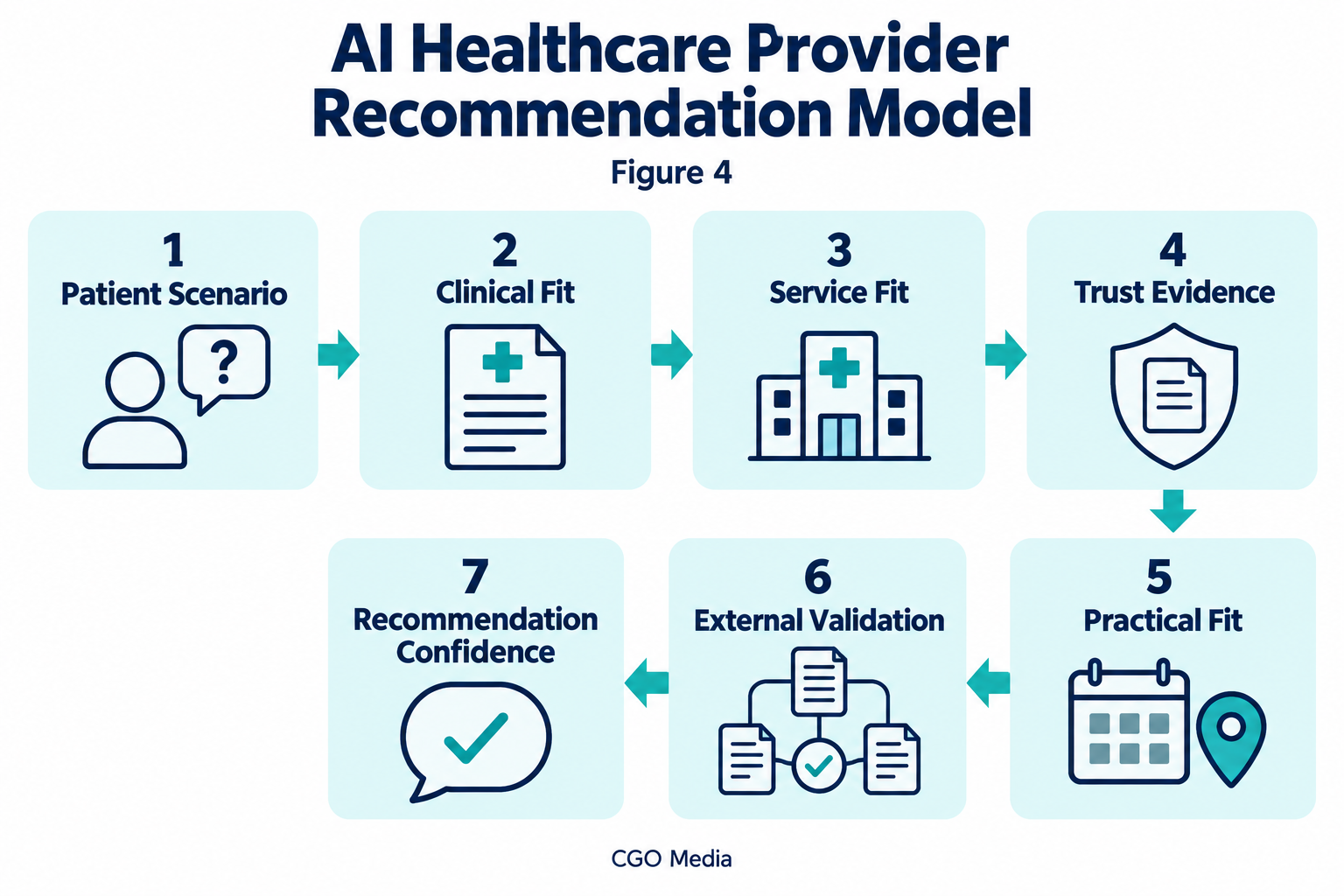
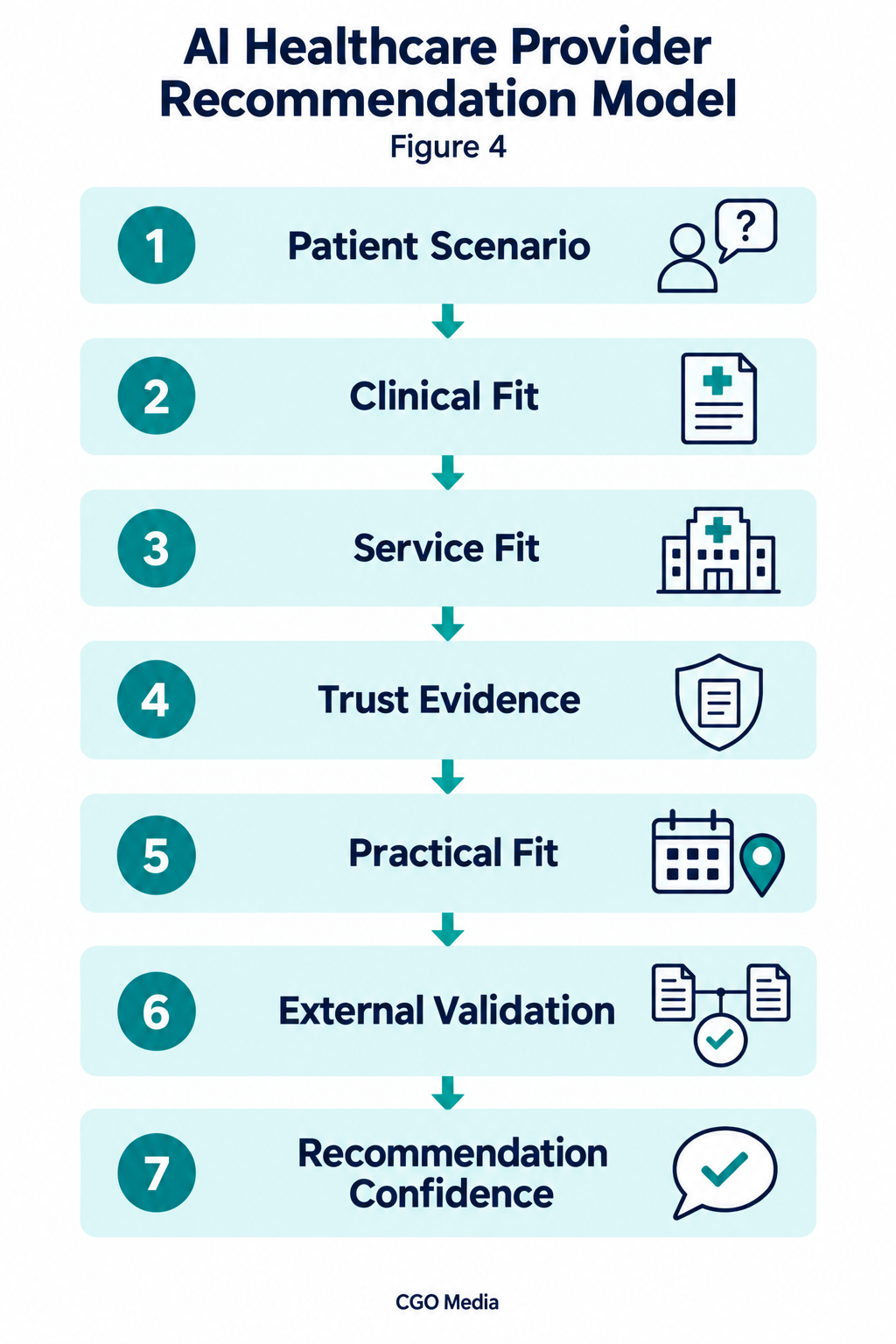
456. Healthcare GEO Requires a Distinct Measurement Framework
Traditional healthcare SEO metrics such as rankings, organic traffic, calls, appointments and enquiries remain important, but they do not fully capture how providers, clinicians, health sources and care recommendations are represented across generative discovery environments.
457. Healthcare GEO Measurement Should Separate Different Visibility Layers
The framework should distinguish:
- Source Visibility
- Citation Visibility
- Entity & Clinical Accuracy
- Comparison Visibility
- Recommendation Visibility
458. A Useful Healthcare GEO Measurement Progression Is
Source Visibility → Citation Visibility → Entity & Clinical Accuracy → Comparison Visibility → Recommendation Visibility → Qualified GEO Performance
459. Source Visibility Is the First Measurement Layer
Source visibility measures whether healthcare, clinical, regulatory or professional information contributes to generated answers.
460. Source Visibility Can Be Direct
Direct visibility can occur where a specific:
- Healthcare provider
- Clinician
- Health authority
- Research source
- Professional body
is clearly surfaced.
461. Source Visibility Can Also Be Indirect
A system may use healthcare information without displaying an explicit citation.
462. Direct and Indirect Source Visibility Should Be Distinguished
They represent different levels of observability and evidential certainty.
463. Source Visibility Should Be Segmented by Speciality
Useful groups can include:
- Cardiology
- Oncology
- Orthopaedics
- Dermatology
- Mental health
- Neurology
464. Source Visibility Should Be Segmented by Condition
A provider may be highly visible for one condition and weak for another.
465. Source Visibility Should Be Segmented by Clinician
Individual healthcare professionals can develop distinct visibility patterns.
466. Source Visibility Should Be Segmented by Patient Scenario
A source may perform differently for:
- Routine care
- Specialist diagnosis
- Complex treatment
- Preventive care
- Long-term management
467. Citation Visibility Is the Second Measurement Layer
Citation visibility measures whether a provider, clinician, healthcare organisation, research paper or official health source is explicitly referenced.
468. Citation Visibility Should Be Measured Separately from Source Visibility
A healthcare source can influence an answer without receiving explicit attribution.
469. A Simple Healthcare Citation Share Metric Can Be Used
Citation Share = Relevant Citation Appearances ÷ Relevant Healthcare Scenarios Tested
470. Citation Share Should Be Interpreted by Context
The same citation count can have different value depending on:
- Condition
- Speciality
- Evidence type
- Clinical authority
- Patient need
471. Citation Quality Should Be Monitored
A strong healthcare citation should be:
- Relevant
- Accurate
- Clinically appropriate
- Current
- Supported by suitable evidence
472. Citation Context Should Be Recorded
Useful information can include:
- What was cited
- Which clinical claim it supported
- Which patient context applied
- Whether the interpretation was accurate
473. Citation Diversity Should Also Be Considered
Healthcare citations can come from:
- Government health agencies
- Clinical guideline bodies
- Peer-reviewed research
- Healthcare providers
- Professional medical organisations
474. Entity & Clinical Accuracy Is the Third Measurement Layer
This evaluates whether providers, clinicians, services, conditions and clinical information are represented correctly.
475. Provider Accuracy Should Include
- Organisation name
- Locations
- Services
- Specialities
- Current care capability
476. Clinician Accuracy Should Include
- Name
- Role
- Provider affiliation
- Professional status
- Speciality
477. Clinical Accuracy Should Include
- Correct condition
- Correct treatment context
- Correct evidence interpretation
- Correct patient population
478. Regulatory Accuracy Should Include
- Applicable professional regulator
- Current registration
- Current licence or practising status
- Current provider status where relevant
479. Healthcare Accuracy Should Distinguish Clinical Accuracy from Professional Accuracy
A generated answer can describe a treatment correctly while identifying the wrong clinician or provider.
480. Accuracy Can Be Scored at Observation Level
Each observation can be classified as:
- Accurate
- Partially accurate
- Materially inaccurate
- Unverifiable
481. Partial Accuracy Should Not Be Treated as Full Accuracy
A response can identify the correct speciality but recommend a provider that does not actually offer the required service.
482. Material Healthcare Inaccuracy Should Be Prioritised
Examples can include:
- Wrong treatment claim
- Wrong clinician
- Incorrect professional status
- Unavailable service
- Outdated safety information
483. A Useful Healthcare Accuracy Framework Is
Provider Accuracy + Clinician Accuracy + Clinical Accuracy + Service Accuracy
484. Error Severity Should Be Weighted
Not every healthcare error has equal clinical or patient consequence.
485. A Useful Risk-Weighted Error Model Is
Severity + Persistence + Patient Impact + Clinical Importance
486. Severity Measures How Wrong the Information Is
A minor description error is less serious than an incorrect treatment claim or false professional status.
487. Persistence Measures Whether the Error Repeats
Persistent healthcare misinformation creates greater risk than an isolated anomaly.
488. Patient Impact Measures Decision Consequence
Errors deserve greater priority where they can materially alter:
- Health understanding
- Care-seeking behaviour
- Provider selection
- Clinician selection
489. Clinical Importance Measures Substantive Significance
Errors affecting:
- Diagnosis
- Treatment
- Safety
- Urgency
- Professional eligibility
should receive greater attention.
490. Healthcare GEO Should Maintain an Error Taxonomy
Useful categories can include:
- Provider error
- Clinician error
- Clinical error
- Service error
- Recommendation error
491. Provider Errors Can Include
- Wrong location
- Wrong service
- Outdated care capability
- Incorrect organisation identity
492. Clinician Errors Can Include
- Wrong role
- Wrong provider affiliation
- Incorrect professional status
- Wrong speciality
493. Clinical Errors Can Include
- Outdated guidance
- Misstated treatment evidence
- Wrong patient population
- Incorrect risk interpretation
494. Service Errors Can Include
- Unavailable treatment
- Incorrect referral route
- Wrong clinic location
- Outdated service eligibility
495. Recommendation Errors Can Include
- Irrelevant provider inclusion
- Relevant provider exclusion
- Wrong clinician recommendation
- Unsuitable care setting
496. Comparison Visibility Is the Fourth Measurement Layer
Comparison visibility measures whether relevant providers and clinicians enter active consideration sets.
497. Provider Comparison Share Can Be Measured
Provider Comparison Share = Relevant Provider Comparison Appearances ÷ Relevant Comparison Scenarios Tested
498. Clinician Comparison Share Can Also Be Measured
Clinician Comparison Share = Relevant Clinician Comparison Appearances ÷ Relevant Clinician Selection Scenarios Tested
499. Service Comparison Share Can Also Be Measured
Service Comparison Share = Relevant Service Comparison Appearances ÷ Relevant Service Selection Scenarios Tested
500. Comparison Share Should Not Be Treated as Recommendation Share
Entering the consideration set is different from being selected.
501. Comparison Visibility Can Reveal Effective Competitors
Frequently co-occurring providers or clinicians can reveal actual patient decision competitors.
502. Provider Co-Occurrence Should Be Monitored
It can reveal:
- Speciality competitors
- Condition competitors
- Location competitors
- Service competitors
503. Clinician Co-Occurrence Should Be Monitored
It can reveal which professionals compete for similar patient needs.
504. Comparison Reasoning Should Also Be Tracked
It is important to understand why providers and clinicians are compared together.
505. Provider Comparison Reasons Can Include
- Clinical capability
- Speciality depth
- Location
- Access
- Service range
506. Clinician Comparison Reasons Can Include
- Experience
- Speciality
- Professional status
- Research
- External recognition
507. Comparison Positioning Can Reveal Market Drift
A provider may be framed differently from its intended clinical or service position.
508. Recommendation Visibility Is the Fifth Measurement Layer
Recommendation visibility measures whether a provider or clinician is positively selected for a relevant patient scenario.
509. Recommendation Share Can Be Measured
Recommendation Share = Relevant Recommendation Appearances ÷ Relevant Healthcare Scenarios Tested
510. Recommendation Share Should Be Segmented
Useful segmentation can include:
- Speciality
- Condition
- Patient type
- Clinician
- AI environment
511. Recommendation Share Should Be Interpreted with Fit
A high recommendation share is not automatically positive if the recommendations are poorly matched.
512. The Four Recommendation Outcomes Should Be Tracked
- Relevant Inclusion
- Irrelevant Inclusion
- Relevant Exclusion
- Appropriate Exclusion
513. Relevant Inclusion Is the Strongest Positive Outcome
The provider or clinician appears where genuine suitability exists.
514. Irrelevant Inclusion Is a Quality Problem
It can create:
- Wrong-speciality enquiries
- Misallocated patient effort
- Wasted appointments
- Delayed care
515. Relevant Exclusion Is a Visibility Opportunity
A suitable provider or clinician is absent despite genuine fit.
516. Appropriate Exclusion Should Not Be Treated as Failure
An unsuitable healthcare provider should remain absent.
517. Qualified Recommendation Share Is More Useful Than Raw Recommendation Share
A useful relationship is:
Qualified Recommendation Share = Relevant and Accurate Healthcare Recommendations ÷ Relevant Scenarios Tested
518. Qualified Recommendation Requires More Than Appearance
A healthcare recommendation should be:
- Relevant
- Clinically appropriate
- Accurate
- Current
- Practically feasible
519. Healthcare GEO Measurement Should Include Patient-Fit Accuracy
The organisation should evaluate whether recommendations genuinely align with:
- Condition
- Severity
- Age
- Care need
- Access requirements
520. Clinical-Fit Accuracy Should Be Evaluated Separately
A provider may be generally suitable while lacking the required specialist capability.
521. Service-Fit Accuracy Should Be Measured
A provider should not be treated as suitable if it does not offer the required service or care pathway.
522. Clinician-Fit Accuracy Should Be Measured
The organisation should evaluate whether the recommended clinician matches:
- Speciality
- Condition
- Procedure
- Professional role
523. Recommendation Reasoning Should Be Audited
The organisation should record why a system recommends particular:
- Providers
- Clinicians
- Services
- Care pathways
524. Correct Recommendation with Incorrect Reasoning Still Creates Risk
The result may appear suitable while the underlying rationale contains clinical or professional errors.
525. Reason Accuracy Should therefore Be a Measurement Dimension
Useful classifications can include:
- Accurate reasoning
- Partially accurate reasoning
- Materially inaccurate reasoning
- Unclear reasoning
526. Healthcare GEO Should Measure Stability Over Time
Visibility that appears once and disappears immediately may have limited strategic significance.
527. A Useful Healthcare GEO Stability Model Is
Presence Frequency + Representation Consistency + Comparison Consistency + Recommendation Consistency
528. Presence Frequency Measures Recurrence
It asks how often a provider, clinician, health source or service appears across repeated testing.
529. Representation Consistency Measures Accuracy Stability
It asks whether clinical and professional information remains consistent.
530. Comparison Consistency Measures Competitive Stability
It asks whether similar provider and clinician sets recur.
531. Recommendation Consistency Measures Selection Stability
It asks whether similar patient scenarios produce similar qualified recommendations.
532. Stability Should Be Combined with Accuracy
Stable healthcare misinformation is not a positive result.
533. A Healthcare GEO Stability Matrix Can Use Four States
- Stable and accurate
- Stable but inaccurate
- Unstable but accurate
- Unstable and inaccurate
534. Stable and Accurate Is the Strongest State
The organisation has repeatable visibility with reliable clinical and professional representation.
535. Stable but Inaccurate Is a High-Priority Risk
Incorrect healthcare information is being reinforced repeatedly.
536. Unstable but Accurate Indicates Limited Persistence
Visibility is correct when it appears but may not be durable.
537. Unstable and Inaccurate Is the Weakest State
The organisation lacks both consistency and accuracy.
538. Healthcare GEO Should Include a Diagnostic Workflow
A useful relationship is:
Observe → Classify → Compare → Diagnose → Prioritise → Improve → Re-Test
539. Observe
Record the generated healthcare output, cited sources and provider environment.
540. Classify
Determine whether the issue relates to:
- Source
- Citation
- Clinical accuracy
- Professional accuracy
- Recommendation
541. Compare
Compare the output with current authoritative clinical, regulatory and professional information.
542. Diagnose
Identify the likely root cause.
543. Root Causes Can Exist in Owned Healthcare Content
Examples can include:
- Outdated patient guides
- Weak service descriptions
- Thin clinician profiles
- Unclear review dates
544. Root Causes Can Exist in External Sources
Examples can include:
- Old directories
- Historic biographies
- Outdated provider listings
- Incorrect third-party service information
545. Root Causes Can Exist in Professional Evidence
Examples can include:
- Weak registration evidence
- Unclear clinician status
- Thin specialist evidence
- Limited external recognition
546. Root Causes Can Exist in Clinical Evidence
Examples can include:
- Outdated guidelines
- Superseded research
- Misapplied evidence
- Wrong patient population
547. Prioritisation Should Be Risk-Based
A useful model remains:
Severity + Persistence + Patient Impact + Clinical Importance
548. Improvement Should Target the Root Cause
The organisation should strengthen the underlying clinical, professional and service information environment.
549. Re-Testing Should Use the Same Scenario Where Possible
This improves confidence when assessing whether an intervention produced change.
550. Healthcare GEO Measurement Should Include Competitive Movement
Competitor visibility can change even where the organisation itself has not changed.
551. Competitive Movement Can Include
- New providers
- New specialist clinicians
- New research authorities
- New health-information sources
552. Competitive Movement Should Be Tracked Longitudinally
This can reveal whether a visibility change is organisation-specific or market-wide.
553. Healthcare GEO Should Monitor Strength Attribution
Providers may repeatedly be associated with:
- Specialist expertise
- Clinical quality
- Access
- Research leadership
- Patient experience
554. Healthcare GEO Should Monitor Weakness Attribution
Providers may repeatedly be associated with:
- Long waiting times
- High cost
- Limited access
- Narrow service range
555. Clinician Strength Attribution Should Also Be Monitored
Individuals may repeatedly be associated with:
- Specialist expertise
- Research
- Communication
- Clinical experience
- Professional reputation
556. Attribution Patterns Can Reveal Positioning Drift
External AI-assisted perception may differ from intended clinical positioning.
557. Positioning Drift Can Be Positive
A provider may develop unexpected strength in a:
- Condition
- Procedure
- Speciality
- Patient group
558. Positioning Drift Can Also Be Problematic
The provider may become associated with care it does not prioritise or cannot appropriately deliver.
559. Healthcare GEO Measurement Should Connect with Traditional SEO
Useful comparative signals can include:
- Organic visibility
- Service-page traffic
- Clinician-profile traffic
- Local search visibility
560. Traditional SEO and GEO Metrics Should Remain Distinct
Strong rankings do not automatically produce strong AI citation or recommendation visibility.
561. Healthcare GEO Measurement Should Connect with Enquiry and Appointment Data
Where appropriate, teams can compare GEO patterns with:
- Enquiry volume
- Appointment requests
- Referral quality
- Service relevance
562. Patient Attribution Should Be Cautious
Patients can interact with multiple:
- Search engines
- AI assistants
- Referrals
- Directories
- Offline recommendations
563. Healthcare GEO Measurement Should Connect with CRM or Patient-Enquiry Intelligence
Appropriate operational data can reveal:
- Patient need
- Speciality
- Service
- Location
- Enquiry fit
564. Operational Evidence Can Help Validate Patient-Fit Assumptions
Repeated enquiry patterns can reveal whether AI-assisted positioning aligns with actual service demand.
565. Healthcare GEO Measurement Should Include Leading Indicators
Leading indicators can include:
- Source visibility
- Citation visibility
- Entity accuracy
- Comparison inclusion
- Recommendation inclusion
566. Healthcare GEO Measurement Should Also Include Lagging Indicators
Lagging indicators can include:
- Qualified enquiries
- Appointments
- Appropriate referrals
- Service fit
- Patient access outcomes
567. Leading and Lagging Indicators Should Not Be Confused
Improved AI visibility does not guarantee immediate patient acquisition or improved clinical outcomes.
568. Healthcare GEO Should Use Executive-Level Scorecards
A practical scorecard can include:
- Source Visibility
- Citation Share
- Entity & Clinical Accuracy
- Comparison Share
- Recommendation Share
- Critical GEO Risk
569. Executive Scorecards Should Highlight the Primary Constraint
Examples can include:
- Low source visibility
- High clinical error rate
- Weak clinician identity
- Low recommendation visibility
- Outdated service information
570. Healthcare GEO Measurement Should Avoid Vanity Metrics
High mention volume without patient relevance or clinical accuracy can be misleading.
571. Raw Citation Count Can Become a Vanity Metric
Citation quality and evidence relevance matter more than volume alone.
572. Raw Recommendation Count Can Become a Vanity Metric
Irrelevant provider recommendation can create poor patient fit and unnecessary care-navigation friction.
573. Qualified GEO Performance Is the Better Objective
A useful conceptual model is:
Relevant Patient Presence + Accurate Clinical Representation + Strong Professional Trust + Appropriate Recommendation
574. Qualified Performance Should Be Measured by Scenario
Performance can differ across:
- Conditions
- Specialities
- Patient types
- Clinicians
- Locations
575. Qualified Performance Should Be Measured Longitudinally
The objective is stable and accurate visibility rather than isolated success.
576. Measurement Processes Should Be Repeatable
Teams should document:
- Scenario
- AI environment
- Date
- Observed sources
- Observed output
577. Scenario Libraries Should Be Controlled
Changes should be documented so longitudinal comparison remains interpretable.
578. Clinical and Organisational Changes Should Be Recorded
Major changes can include:
- New guidelines
- New treatments
- Clinician moves
- New services
- Provider restructuring
579. AI Environment Changes Should Also Be Recorded
Significant model or platform changes can affect observed behaviour.
580. Healthcare GEO Measurement Should Produce Decisions
The purpose is not to create dashboards for their own sake.
581. Measurement Should Answer Practical Questions
Examples include:
- Which condition needs stronger authority?
- Which clinician is being misrepresented?
- Which service lacks recommendation visibility?
- Which health sources are being cited?
- Which scenarios show relevant exclusion?
582. Measurement Should Feed Directly into Improvement
A useful relationship is:
Measurement → Diagnosis → Prioritisation → Intervention → Re-Test
583. The Seventeenth Healthcare GEO Principle
Healthcare GEO measurement should separate source visibility, citation visibility, entity and clinical accuracy, comparison visibility and recommendation visibility because each represents a different stage of AI-assisted healthcare discovery and requires different diagnostic methods.
584. The Eighteenth Healthcare GEO Principle
Healthcare GEO performance should be evaluated through qualified outcomes rather than raw mention, citation or recommendation volume, incorporating patient relevance, clinical accuracy, service fit, clinician suitability and practical feasibility.
585. The Nineteenth Healthcare GEO Principle
Healthcare GEO measurement should be longitudinal and risk-weighted, distinguishing persistent high-impact clinical misinformation and recommendation errors from normal generative variability while tracking changes in competitor sets, citation patterns and professional representation over time.
586. The Twentieth Healthcare GEO Principle
Healthcare GEO measurement should connect AI-assisted discovery data with traditional SEO, enquiry quality, operational intelligence and clinical governance without overstating causal attribution, enabling healthcare organisations to use GEO intelligence as one component of a wider patient-discovery and professional-information system.
587. The Healthcare GEO Measurement Framework
The complete relationship can be summarised as:
Source Visibility → Citation Visibility → Entity & Clinical Accuracy → Comparison Visibility → Recommendation Visibility → Qualified GEO Performance
588. The Strategic Implication
Healthcare organisations should build repeatable Healthcare GEO measurement systems that distinguish source, citation, clinical accuracy, professional accuracy, comparison and recommendation outcomes, evaluate them by condition, speciality, clinician, patient type and AI environment and prioritise the highest-risk errors where incorrect clinical information, professional status or provider recommendation could materially affect patient decision quality.
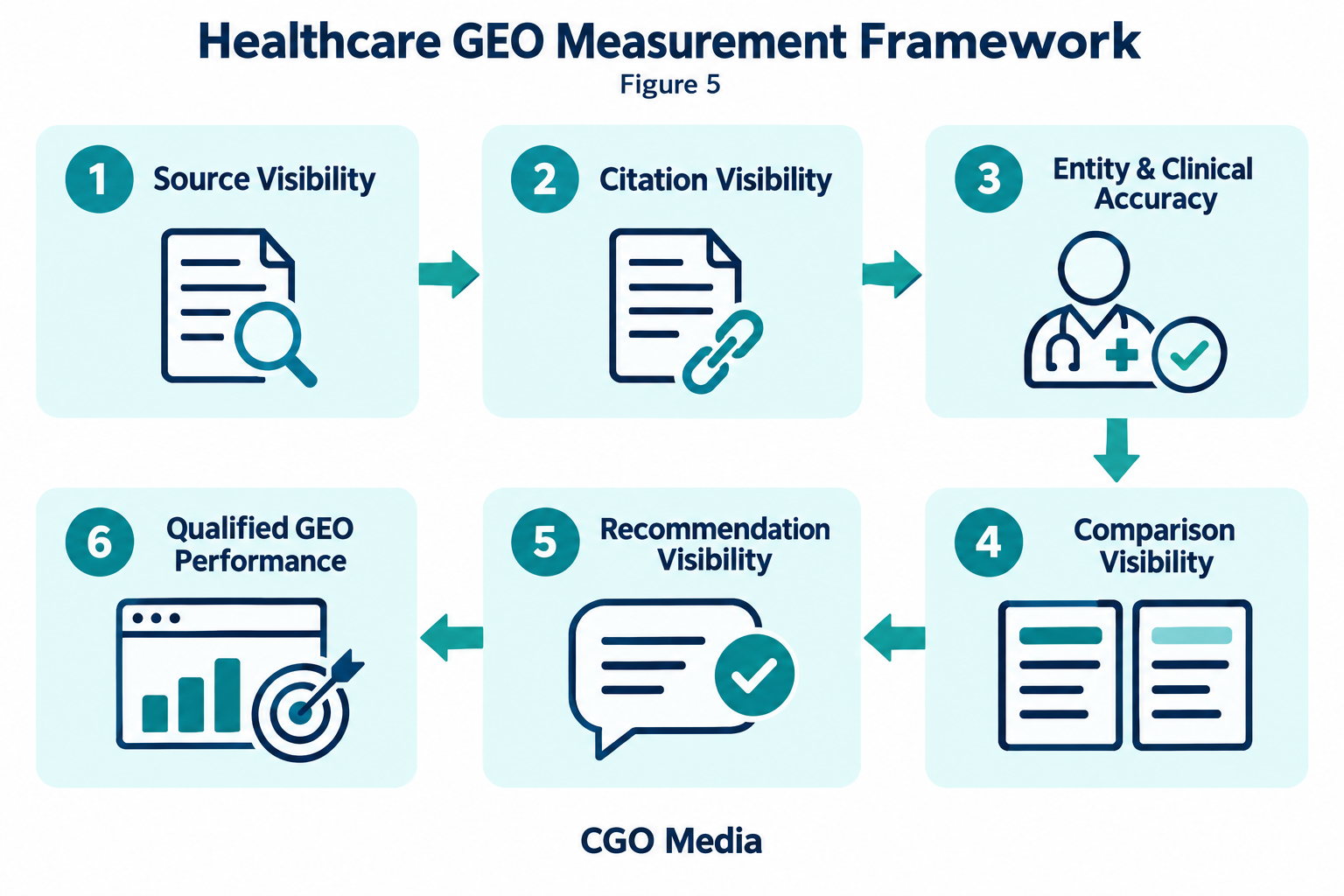
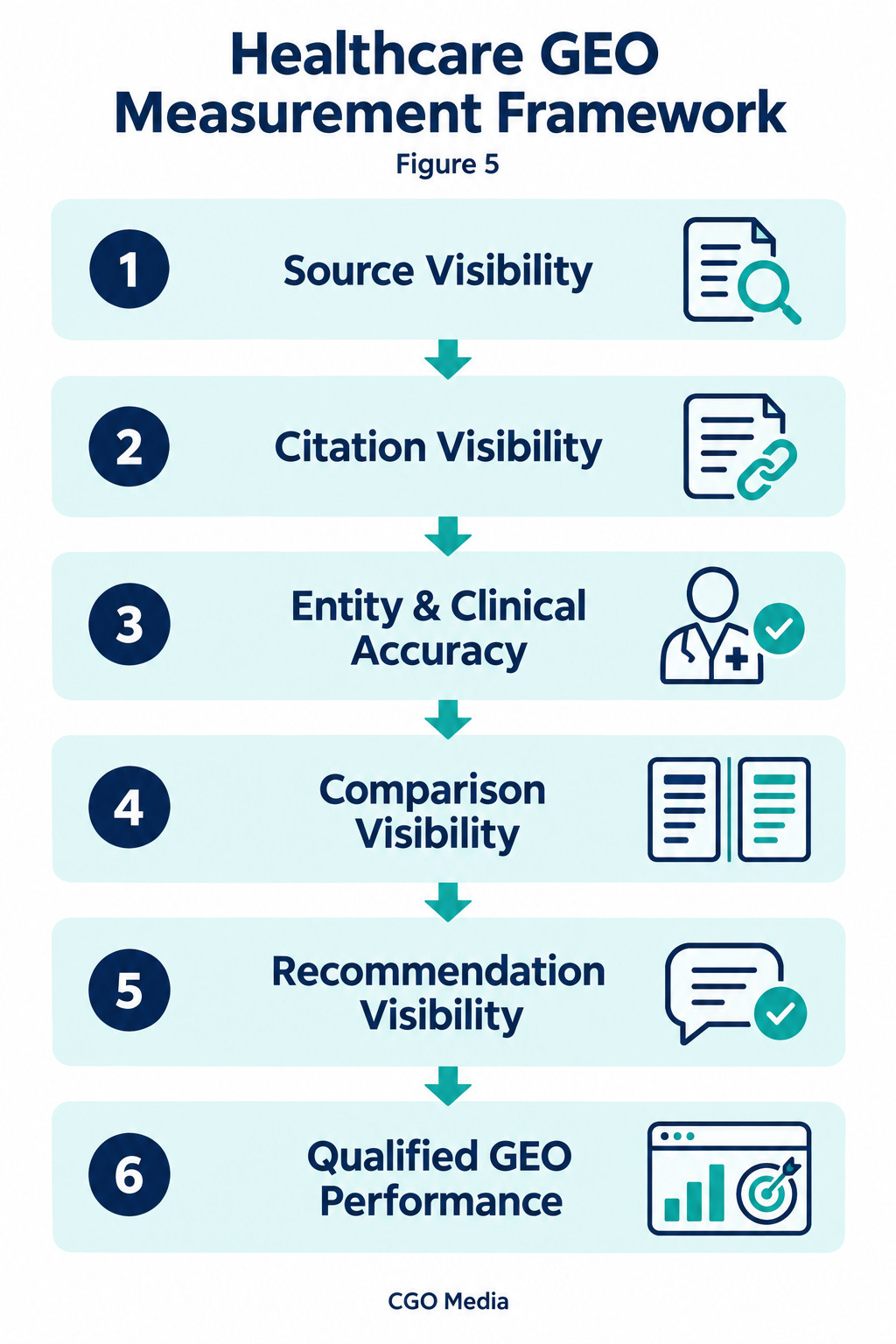
589. Healthcare GEO Should Operate as a Continuous Improvement System
Healthcare organisations, clinicians, services, clinical evidence and AI-assisted discovery environments all change over time, so Healthcare GEO should not be treated as a one-off optimisation project.
590. Clinical Information Changes Continuously
Important changes can include:
- New guidelines
- New research
- Updated safety information
- New treatments
- New regulatory guidance
591. Clinician Information Also Changes
Healthcare professionals can:
- Move organisations
- Change roles
- Change specialities
- Change registration status
- Change clinical focus
592. Provider Information Changes
Healthcare organisations can:
- Open locations
- Close locations
- Launch services
- Withdraw services
- Restructure clinical teams
593. AI-Assisted Healthcare Discovery Can Change Independently
Generative systems can alter:
- Source selection
- Citation patterns
- Provider comparison
- Clinician recommendation
594. Healthcare GEO Should therefore Begin with Continuous Observation
Healthcare organisations should repeatedly monitor:
- Source visibility
- Citation visibility
- Clinical accuracy
- Clinician accuracy
- Recommendation visibility
595. Observation Should Use Stable Scenario Libraries
Stable healthcare scenarios make longitudinal comparison more meaningful.
596. Healthcare Scenario Libraries Can Be Segmented by
- Condition
- Speciality
- Patient type
- Clinician
- Journey stage
597. Scenarios Should Reflect Real Patient Needs
Useful scenario variables can include:
- Condition
- Severity
- Age
- Clinical history
- Location
- Access requirements
598. Observation Should Distinguish Normal Variation from Structural Change
One unusual output does not necessarily indicate a persistent Healthcare GEO problem.
599. Persistent Change Can Indicate a Structural Issue
Examples can include:
- Repeated clinical inaccuracy
- Persistent clinician misinformation
- Loss of citation visibility
- Relevant provider exclusion
- Changing recommendation patterns
600. Healthcare GEO Should Diagnose Before Reacting
The organisation should identify the likely root cause before making material changes.
601. Diagnosis Can Begin with Classification
Issues can be classified as:
- Clinical source issue
- Clinician issue
- Provider issue
- Service issue
- Recommendation issue
602. Clinical Source Problems Can Be a Root Cause
Examples can include:
- Outdated guidance
- Superseded research
- Weak evidence references
- Unclear review dates
603. Clinician Information Problems Can Be a Root Cause
Examples can include:
- Wrong role
- Old provider affiliation
- Unclear registration status
- Outdated biography
604. Provider Information Problems Can Be a Root Cause
Examples can include:
- Wrong location
- Outdated services
- Weak speciality clarity
- Unclear care pathways
605. External Source Problems Can Be a Root Cause
Examples can include:
- Old directories
- Historic clinician profiles
- Outdated healthcare listings
- Incorrect third-party service information
606. Research Evidence Problems Can Be a Root Cause
Examples can include:
- Old research
- Weak methodology
- Unclear population
- Missing limitations
607. Healthcare GEO Prioritisation Should Be Risk-Based
A useful relationship is:
Severity + Persistence + Patient Impact + Clinical Importance
608. Severity Measures the Importance of the Error
A minor wording error is less serious than an incorrect treatment claim or false professional status.
609. Persistence Measures Whether the Error Repeats
Repeated healthcare misinformation creates greater risk than isolated variation.
610. Patient Impact Measures Decision Consequence
Priority should increase where the error can alter:
- Health understanding
- Provider selection
- Clinician selection
- Care-seeking behaviour
611. Clinical Importance Measures Substantive Significance
Issues involving:
- Diagnosis
- Treatment
- Safety
- Urgency
- Professional eligibility
should receive higher priority.
612. Healthcare GEO Improvement Should Target Root Causes
The objective should be to strengthen the underlying clinical, professional and service evidence environment.
613. Provider-Level Improvements Can Include
- Clear service architecture
- Current location information
- Speciality clarity
- Accurate patient pathways
614. Clinician-Level Improvements Can Include
- Detailed professional profiles
- Current provider affiliation
- Current registration status
- Clear specialist expertise
- Research activity
615. Service-Level Improvements Can Include
- Clear treatment descriptions
- Named relevant clinicians
- Eligibility criteria
- Referral pathways
- Access information
616. Research-Level Improvements Can Include
- Patient studies
- Digital health research
- Access-to-care research
- Provider-selection research
- Healthcare trend studies
617. External Authority Improvements Can Include Digital PR
Useful activity can support:
- Research citations
- Healthcare media coverage
- Expert commentary
- Professional recognition
618. Improvements Should Be Followed by Validation
The organisation should re-test the same or equivalent healthcare scenarios after intervention.
619. Validation Should Compare Like with Like
Where possible, teams should preserve:
- Scenario wording
- Patient context
- Condition
- Service criteria
620. Healthcare GEO Should Include a Continuous Operational Cycle
A useful relationship is:
Observe → Diagnose → Prioritise → Strengthen → Validate → Learn → Adapt
621. Observe
Monitor health sources, citations, provider entities, clinician entities, comparisons and recommendations.
622. Diagnose
Identify the root cause of significant clinical or professional representation changes.
623. Prioritise
Focus first on issues with the greatest patient, clinical and reputational significance.
624. Strengthen
Improve the relevant clinical, professional, provider, research or external evidence.
625. Validate
Re-test and compare against the previous observation.
626. Learn
Record what changed and whether the intervention produced a meaningful result.
627. Adapt
Update Healthcare GEO standards, monitoring procedures and future interventions.
628. Healthcare GEO Governance Should Be Cross-Functional
Generative healthcare visibility touches multiple functions within a provider organisation.
629. A Useful Healthcare GEO Governance Model Is
SEO + Marketing + Clinicians + Clinical Governance + Research + Patient Services + Digital PR
630. SEO Can Coordinate Discovery Intelligence
SEO can connect:
- Search demand
- Generative visibility
- Service architecture
- Competitive discovery
631. Marketing Can Coordinate Provider Positioning
Marketing can help maintain consistency across:
- Brand
- Services
- Clinician profiles
- Locations
- Patient information
632. Clinicians Should Validate Clinical Truth
Healthcare professionals should confirm:
- Clinical accuracy
- Speciality accuracy
- Treatment information
- Professional status
- Relevant expertise
633. Clinical Governance Has a Central Role
Clinical governance teams can help maintain:
- Current guidance
- Current safety information
- Professional standards
- Review processes
- Patient-information quality
634. Research Teams Can Validate Evidence
They can support:
- Original studies
- Methodology
- Healthcare datasets
- Research integrity
635. Patient Services Can Validate Patient Reality
They can contribute:
- Patient questions
- Access issues
- Referral friction
- Appointment demand
- Service confusion
636. Digital PR Can Strengthen External Healthcare Authority
It can distribute:
- Original research
- Clinician commentary
- Healthcare data
- Public health insight
637. Governance Should Define Ownership
The organisation should know who owns:
- Clinician profile accuracy
- Service content
- Patient information
- Research updates
- Clinical escalation
638. Healthcare GEO Governance Should Distinguish Stable and Volatile Information
Different healthcare and professional facts require different review frequencies.
639. Highly Volatile Healthcare Information Can Include
- New treatment guidance
- Safety updates
- Current clinician affiliation
- Current registration status
- Service availability
640. Moderately Volatile Information Can Include
- Speciality scope
- Service positioning
- Clinical team structure
- Patient pathways
641. More Stable Information Can Include
- Historic qualifications
- Long-term clinical experience
- Established professional history
- Stable clinical concepts
642. Review Frequency Should Match Volatility and Risk
A useful relationship is:
Information Volatility + Patient Impact + Clinical Importance → Review Frequency
643. Healthcare GEO Should Include Escalation Procedures
High-impact misinformation should move beyond routine content maintenance.
644. Critical Escalation Issues Can Include
- False professional status
- Incorrect treatment information
- Wrong clinician
- Unavailable service recommendation
- Misleading safety information
645. Healthcare GEO Should Include Recovery Capability
Not every healthcare misinformation event can be prevented.
646. A Useful Healthcare GEO Recovery Cycle Is
Detect → Verify → Diagnose → Correct → Re-Test → Learn
647. Detect
Identify a material clinical, professional, citation or recommendation problem.
648. Verify
Confirm whether the issue is genuine, persistent and materially important.
649. Diagnose
Identify whether the problem originates from:
- Owned healthcare content
- Clinician-profile data
- Third-party directories
- Clinical evidence
- Generative interpretation
650. Correct
Improve the underlying clinical, service or professional evidence.
651. Re-Test
Determine whether the observed issue improves.
652. Learn
Use the finding to improve future governance.
653. Recovery Speed Can Be Measured
Useful measures can include:
- Time to detect
- Time to verify
- Time to correct
- Time to validate
654. Healthcare GEO Should Include Experimentation
Some interventions should be tested rather than assumed to work.
655. Healthcare GEO Experiments Should Begin with a Hypothesis
For example:
Improving clinician profiles, clinical review, service clarity and original research should increase qualified healthcare visibility across relevant patient scenarios.
656. Experiments Should Establish a Baseline
Current visibility and accuracy should be recorded before material changes are introduced.
657. Experiments Should Define the Intervention
Examples can include:
- Expanded clinician profiles
- New service pages
- Updated patient guides
- Original healthcare research
- Digital PR
658. Experiments Should Define Success Criteria
Success can include:
- Improved source visibility
- Improved citation visibility
- Higher clinical accuracy
- More relevant comparison inclusion
- More qualified recommendations
659. Experiments Should Define Observation Windows
Generative visibility may not change immediately after improvements.
660. Confounding Factors Should Be Recorded
Examples can include:
- Clinical guideline changes
- Competitor activity
- Clinician moves
- Service changes
- Model updates
661. Negative Results Should Be Preserved
Failed interventions can prevent repeated ineffective work.
662. Successful Experiments Should Become Standards
Validated methods can be incorporated into:
- Clinician-profile templates
- Service-page standards
- Patient-information standards
- Research standards
- Healthcare GEO playbooks
663. Healthcare GEO Should Integrate with Traditional SEO
The two disciplines overlap substantially.
664. Traditional Healthcare SEO Supports GEO Through Technical Accessibility
Search engines and generative systems both benefit from accessible and well-structured healthcare information.
665. Healthcare SEO Supports GEO Through Service Architecture
Clear relationships between:
- Provider
- Clinician
- Speciality
- Service
- Condition
can improve interpretation.
666. Healthcare SEO Supports GEO Through Strong Clinician Profiles
Detailed and current professional profiles can strengthen both search and generative visibility.
667. GEO Extends Healthcare SEO Through Source and Recommendation Analysis
Healthcare GEO adds explicit focus on:
- Source selection
- Citation
- Clinical accuracy
- Comparison inclusion
- Recommendation quality
668. Healthcare GEO Should Integrate with Patient-Enquiry Intelligence
Patient interactions can provide useful evidence about real healthcare demand.
669. Patient-Enquiry Data Can Reveal Care Requirements
Useful information can include:
- Condition
- Speciality
- Service
- Location
- Access need
670. Patient-Enquiry Data Can Reveal Fit Problems
Repeated poor-fit enquiries can indicate:
- Wrong speciality positioning
- Service mismatch
- Location mismatch
- Overly broad healthcare claims
671. Patient Intelligence Can Improve Scenario Design
Real patient language can inform more realistic AI-assisted healthcare discovery testing.
672. Healthcare GEO Should Integrate with Service Planning
Operational teams can reveal which care characteristics genuinely influence patient access and provider choice.
673. Service Planning Can Reveal Common Access Barriers
Examples can include:
- Waiting time
- Location
- Referral criteria
- Cost
- Insurance compatibility
674. Service Planning Can Reveal Strong Selection Drivers
Examples can include:
- Specialist expertise
- Access
- Clinical reputation
- Patient experience
- Research strength
675. Healthcare GEO Can therefore Contribute to Service Strategy
AI-assisted discovery patterns can be compared with actual patient and referral behaviour.
676. Healthcare GEO Should Integrate with Research
Original research can strengthen both source authority and provider positioning.
677. Useful Healthcare Research Can Include
- Patient surveys
- Digital health studies
- Access-to-care research
- Provider-selection studies
- Healthcare trend analysis
678. Research Can Support Digital PR
Original findings can become external citation assets.
679. Healthcare GEO Should Integrate with Review Intelligence Carefully
Reviews can reveal:
- Communication quality
- Accessibility
- Administrative quality
- Patient experience
680. Review Intelligence Should Not Be Treated as a Proxy for Clinical Competence
Patient experience and technical clinical ability are related but distinct dimensions.
681. Healthcare GEO Should Integrate with Digital PR
Digital PR can support authority through:
- Original research
- Clinician commentary
- Healthcare data
- Public health insight
682. Healthcare GEO Scaling Should Be Strategic
Large providers may operate across many clinicians, services, locations and specialities.
683. Scaling Should Begin with Priority Services
Priority can reflect:
- Patient demand
- Strategic importance
- Clinical specialism
- Growth
- Competitive opportunity
684. Scaling Should Include Priority Locations
Provider discovery and recommendation patterns can differ significantly by market.
685. Scaling Should Include Priority Clinicians
Organisations can monitor key:
- Consultants
- Surgeons
- Specialists
- Research-active clinicians
- Public spokespeople
686. Scaling Should Include Priority Patient Segments
Useful segments can include:
- Children
- Adults
- Older adults
- Chronic-care patients
- Complex-care patients
687. International Healthcare GEO Requires Market-Specific Analysis
Healthcare discovery can differ significantly by country and healthcare system.
688. International Patient Needs Can Differ by Market
Relevant considerations can include:
- Language
- Regulation
- Referral systems
- Insurance
- Care pathways
689. International Healthcare GEO Should Preserve Clinician Identity Across Languages
The same:
- Provider
- Clinician
- Speciality
- Professional status
should remain clearly identifiable across language versions.
690. International Healthcare GEO Should Adapt Local Context
Different markets may require different:
- Patient information
- Regulatory context
- Service terminology
- Access information
691. Healthcare GEO Should Build Organisational Learning
Repeated observation should improve:
- Clinical content
- Clinician profiles
- Service architecture
- Research
- Patient access
692. Organisational Memory Reduces Repeated Healthcare GEO Failure
Teams should not repeatedly rediscover the same:
- Clinician identity problems
- Citation errors
- Service gaps
- Recommendation gaps
- Outdated clinical information
693. Healthcare GEO Learning Can Be Preserved Through
- Scenario libraries
- Error logs
- Source maps
- Clinician entity maps
- Experiment records
- Healthcare GEO playbooks
694. Clinician Entity Maps Can Be Particularly Valuable
They can document relationships between:
- Provider
- Clinician
- Role
- Speciality
- Location
- Professional status
695. Source Maps Can Document Healthcare Information Responsibility
They can identify the strongest source for:
- Clinical evidence
- Professional status
- Service capability
- Patient information
- Original research
696. Error Logs Can Reveal Systemic Weakness
Repeated error categories can identify where clinical governance or content architecture needs improvement.
697. Experiment Records Can Improve Future Decision-Making
They can show which interventions did and did not improve visibility, clinical accuracy or qualified recommendation.
698. Adaptive Healthcare GEO Is the Long-Term Goal
Healthcare organisations should be able to respond as:
- Clinical evidence changes
- Clinicians change
- Services change
- Patient needs change
- AI systems change
699. Adaptive GEO Does Not Mean Constant Tactical Reaction
Stable strategic principles should remain.
700. Stable Healthcare GEO Principles Can Include
- Clear provider identity
- Clear clinician identity
- Accurate clinical information
- Strong source authority
- Professional trust
- Patient fit
701. Tactics Can Change Around Stable Principles
This creates adaptability without strategic instability.
702. Adaptive Healthcare GEO Should Be Evidence-Led
Changes should respond to observed clinical and professional patterns rather than speculation.
703. Adaptive Healthcare GEO Should Be Risk-Aware
High-impact clinical misinformation should receive greater priority than minor visibility fluctuations.
704. Adaptive Healthcare GEO Should Be Strategically Relevant
Monitoring should focus on:
- Priority services
- Priority conditions
- Priority clinicians
- Important patient groups
705. Adaptive Healthcare GEO Should Be Integrated
A useful intelligence relationship is:
Search Intelligence + AI Discovery Intelligence + Clinical Knowledge + Professional Intelligence + Patient Intelligence + Research Intelligence
706. Combined Intelligence Improves Healthcare GEO Decisions
Teams can better determine:
- Which conditions need stronger authority
- Which clinicians need clearer profiles
- Which services need better evidence
- Which health topics offer citation potential
- Which patient scenarios deserve priority
707. Strategic Recommendation One — Build a Healthcare GEO Scenario Library
Use realistic patient, clinical and provider-selection scenarios.
708. Strategic Recommendation Two — Maintain Canonical Provider Records
Keep core:
- Provider identity
- Location information
- Services
- Speciality coverage
consistent.
709. Strategic Recommendation Three — Maintain Canonical Clinician Records
Keep:
- Name
- Role
- Provider affiliation
- Professional status
- Speciality
- Location
current.
710. Strategic Recommendation Four — Strengthen Service Clarity
Explain clearly which conditions, patients and care needs each service addresses.
711. Strategic Recommendation Five — Strengthen Clinical Review Processes
Ensure important patient-facing health information remains clinically current.
712. Strategic Recommendation Six — Build Original Healthcare Research
Create useful:
- Patient studies
- Digital health research
- Access-to-care studies
- Provider-selection research
713. Strategic Recommendation Seven — Build Citation-Ready Healthcare Assets
Use stable, clinically reviewed and well-attributed publications.
714. Strategic Recommendation Eight — Monitor Clinician Accuracy
Track:
- Role
- Provider affiliation
- Registration status
- Speciality
- Location
715. Strategic Recommendation Nine — Monitor Clinical Accuracy
Track:
- Treatment information
- Clinical evidence
- Patient population
- Safety information
- Guideline currency
716. Strategic Recommendation Ten — Monitor Comparison Sets
Understand which:
- Providers
- Clinicians
- Services
- Care pathways
are repeatedly considered together.
717. Strategic Recommendation Eleven — Monitor Recommendation Reasons
Understand why providers and clinicians are selected.
718. Strategic Recommendation Twelve — Monitor Relevant Exclusion
Investigate suitable providers or clinicians that are repeatedly absent.
719. Strategic Recommendation Thirteen — Monitor Irrelevant Inclusion
Identify recommendations likely to produce poor patient or clinical fit.
720. Strategic Recommendation Fourteen — Build Healthcare GEO Recovery Processes
Create clear detection, verification, correction and re-testing procedures.
721. Strategic Recommendation Fifteen — Connect GEO with Clinical Governance
Use professional review and clinical governance to keep healthcare information current.
722. Strategic Recommendation Sixteen — Connect GEO with Patient Services
Use real patient enquiries, access issues and care-navigation patterns to improve scenario design and fit assessment.
723. Strategic Recommendation Seventeen — Integrate GEO with Research and Digital PR
Build healthcare authority through useful original evidence and clinician commentary.
724. Strategic Recommendation Eighteen — Scale by Service, Condition and Location
Prioritise the parts of the healthcare organisation with the greatest strategic and patient importance.
725. Strategic Recommendation Nineteen — Build Adaptive Healthcare GEO
Treat Generative Engine Optimisation as a permanent healthcare-discovery, clinical-governance and professional-authority capability.
726. The Twenty-First Healthcare GEO Principle
Healthcare GEO should operate as a continuous improvement system because clinical evidence, professional status, provider services, patient needs and AI-assisted healthcare discovery patterns can all change over time.
727. The Twenty-Second Healthcare GEO Principle
Healthcare GEO governance should connect SEO, marketing, clinicians, clinical governance, research, patient services and Digital PR so clinical authority, clinician identity, service capability and external evidence remain coordinated.
728. The Twenty-Third Healthcare GEO Principle
Healthcare organisations should build recovery and experimentation capability so persistent clinical inaccuracies, clinician misinformation, citation errors, relevant exclusions and recommendation weaknesses can be diagnosed, corrected, re-tested and converted into organisational learning.
729. The Twenty-Fourth Healthcare GEO Principle
The highest Healthcare GEO capability is adaptive GEO, where stable principles around clinical accuracy, professional identity, source authority, citation quality, trust and patient fit remain constant while tactics evolve as healthcare evidence, services and generative systems change.
730. The Continuous Healthcare GEO Cycle
The complete operational cycle can be summarised as:
Observe → Diagnose → Prioritise → Strengthen → Validate → Learn → Adapt
731. The Long-Term Healthcare GEO System
The wider relationship can be summarised as:
Clear Provider Entity → Clear Clinician Identity → Accurate Clinical Evidence → Strong Professional Trust → Source Authority → Citation Visibility → Comparison Visibility → Recommendation Confidence → Qualified GEO Visibility → Organisational Learning
732. The Strategic Implication
Healthcare organisations should operate Generative Engine Optimisation as a continuous, evidence-led and cross-functional capability, repeatedly monitoring how health information, providers, clinicians, services and recommendations are represented, strengthening the underlying clinical and professional evidence environment, validating material changes and adapting as clinical guidance, professional teams, patient requirements and generative healthcare-discovery systems evolve.
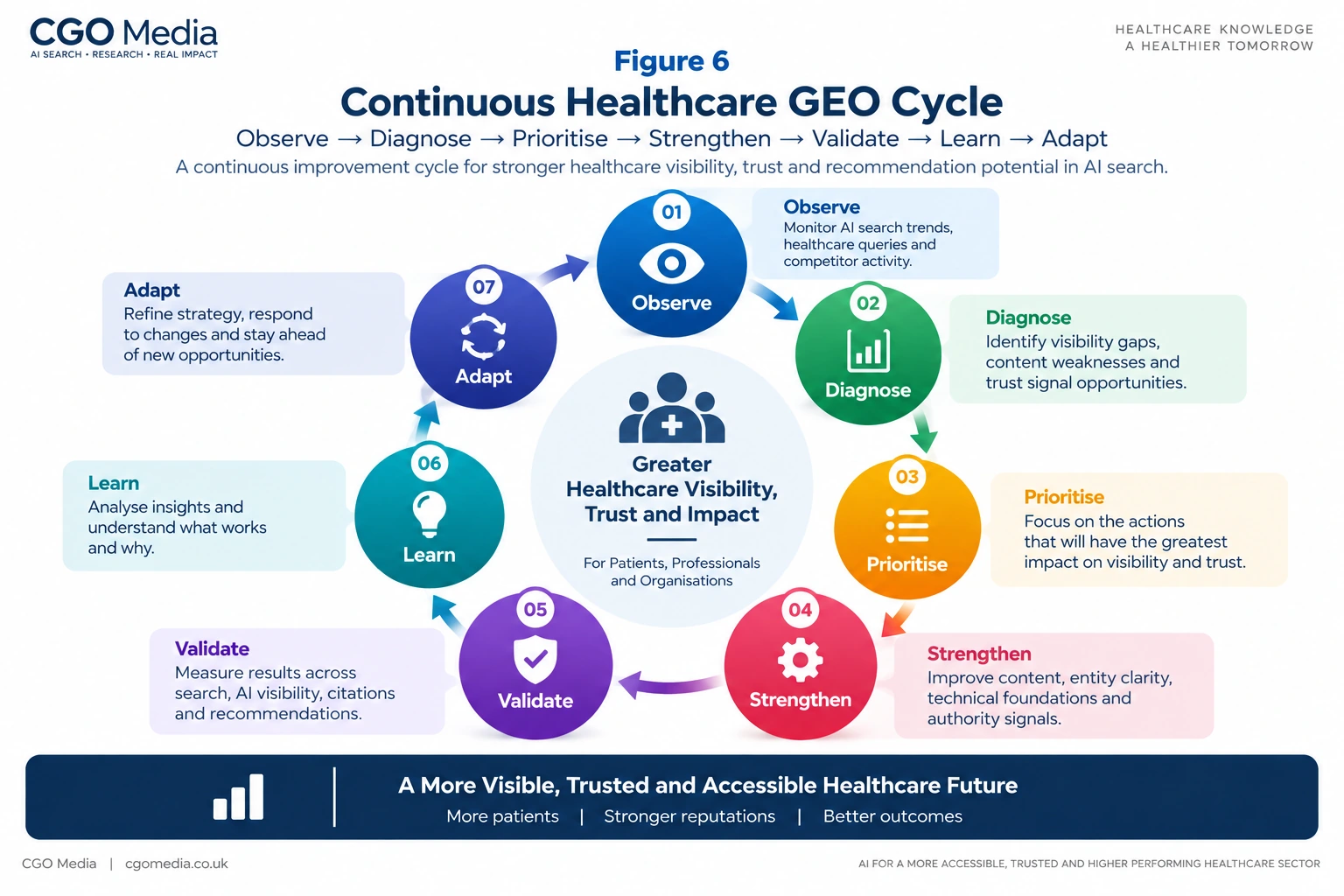
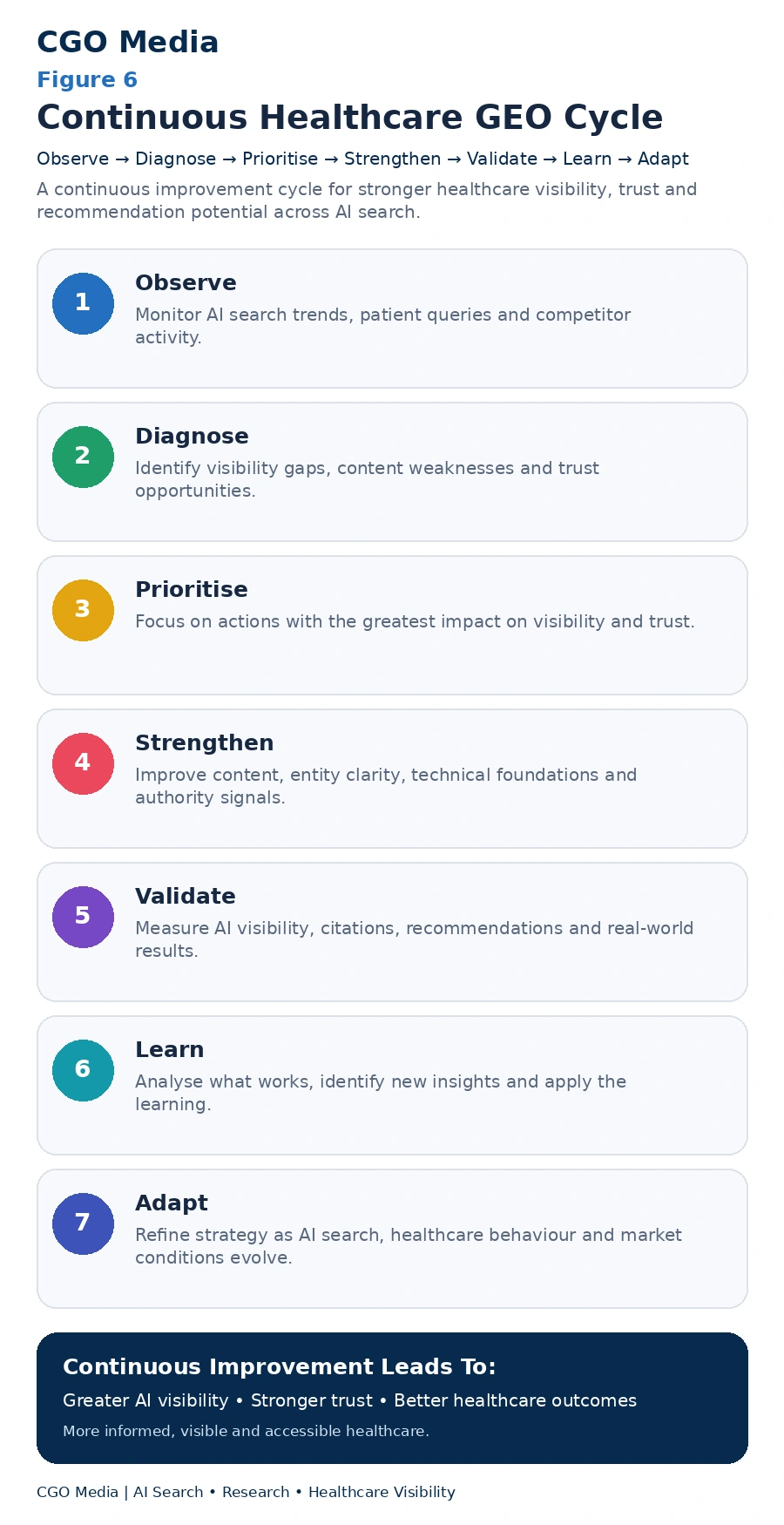
733. Methodology
Healthcare GEO: Generative Engine Optimisation for AI Health Discovery, Provider Selection and Recommendation Systems is a conceptual research framework developed by CGO Media to examine how healthcare organisations, clinicians and health-information providers can strengthen visibility, clinical accuracy, source authority, citation eligibility and recommendation confidence across generative search and AI-assisted healthcare discovery environments.
734. Research Purpose
The framework addresses a central question:
How can healthcare organisations improve the probability that their providers, clinicians, services, clinical expertise and research are accurately understood, appropriately cited, meaningfully compared and responsibly recommended across generative search environments?
735. Framework Scope
The framework can be applied to:
- Hospitals
- Private healthcare groups
- Clinics
- Specialist centres
- Primary-care providers
- Individual clinicians
- Digital healthcare providers
- Healthcare research and information organisations
736. Healthcare GEO Is Treated as a Discovery and Evidence System
The framework does not treat Generative Engine Optimisation as an attempt to influence individual AI-generated health answers. Instead, it treats generative visibility as an interaction between clinical evidence, professional identity, provider entities, source selection, patient needs and recommendation suitability.
737. The Core Healthcare GEO System Includes
- Provider clarity
- Clinician clarity
- Speciality clarity
- Service clarity
- Clinical evidence
- Professional trust
- Source authority
- Citation eligibility
- Comparison visibility
- Recommendation confidence
738. Core Healthcare GEO Progression
Entity Clarity → Clinical Expertise → Trust Evidence → Source Authority → Citation Eligibility → Patient Fit → Recommendation Confidence → GEO Visibility
739. Entity Method
Healthcare GEO analysis can begin by identifying the principal entities involved in healthcare discovery.
Healthcare Organisation → Clinician → Speciality → Service → Condition → Patient Need
740. Provider Identity Method
Provider analysis can examine whether public information clearly communicates:
- Organisation identity
- Locations
- Services
- Specialities
- Clinical teams
- Patient groups served
741. Clinician Identity Method
Individual professional analysis can examine:
- Name
- Current role
- Provider affiliation
- Professional registration
- Speciality
- Location
742. Clinical Expertise Method
Clinical expertise can be assessed through observable evidence including:
- Qualifications
- Professional registration
- Specialist training
- Clinical experience
- Research
- Professional publications
743. Service Method
Healthcare service analysis can examine the relationship between:
- Patient need
- Condition
- Speciality
- Procedure or treatment
- Relevant clinician
- Care setting
744. Regulatory Trust Method
Professional trust analysis can consider:
- Professional registration
- Licensing
- Specialist accreditation
- Current practising status
- Relevant regulatory information
745. Healthcare Source Method
Sources can be grouped according to their evidential role.
746. Clinical Evidence Sources
These can include:
- Clinical guidelines
- Systematic reviews
- Peer-reviewed research
- Clinical trials
747. Public and Regulatory Sources
These can include:
- Government health authorities
- Public health agencies
- Professional regulators
- Medicine and device regulators
748. Professional Sources
These can include:
- Clinician profiles
- Professional registers
- Medical societies
- Professional colleges
749. Provider Sources
These can include:
- Hospital websites
- Clinic websites
- Service pages
- Patient pathways
- Provider information
750. Generative Source Selection Method
The framework conceptualises source selection through:
Health Query → Candidate Sources → Clinical Relevance → Authority → Evidence Convergence → Source Selection
751. Healthcare Source Convergence Method
Confidence can increase where appropriate evidence materially agrees:
Clinical Evidence + Regulatory Evidence + Professional Evidence + Provider Evidence → Healthcare Confidence
752. Source Conflict Method
Material disagreement can be tracked across:
- Clinical guidance
- Treatment evidence
- Professional status
- Provider affiliation
- Service availability
753. Healthcare Source Gap Method
Health Question → Required Evidence → Best Source → Existing Source → Evidence Gap
754. Citation Eligibility Method
The framework conceptualises healthcare citation eligibility through:
Relevance + Clinical Clarity + Evidence + Authority + Freshness → Citation Eligibility
755. Citation Analysis Method
Citation monitoring can record:
- Source cited
- Claim supported
- Patient context
- Evidence type
- Accuracy
- Freshness
- Citation context
756. Citation Authority Method
Citable Healthcare Source → Repeated Citation → Wider Recognition → Citation Authority
757. Healthcare Research Method
Where healthcare organisations publish original research, methodology should define:
- Research question
- Population
- Dataset
- Sample
- Measurement period
- Definitions
- Limitations
758. Research Should Distinguish Different Evidence Types
Patient surveys, market research and observational datasets should remain distinct from:
- Clinical trials
- Clinical guidelines
- Systematic reviews
- Professional opinion
- Provider recommendation
759. Patient Scenario Method
Healthcare GEO monitoring should use realistic scenarios incorporating variables such as:
- Condition
- Severity
- Age
- Clinical history
- Location
- Access requirements
760. Clinical Fit Method
Patient Need + Speciality Fit + Clinician Expertise + Appropriate Care Setting → Clinical Suitability
761. Service Fit Method
Service suitability can include:
- Required diagnostic capability
- Treatment availability
- Procedure availability
- Referral eligibility
- Follow-up capability
762. Professional Trust Method
Clinician trust can be assessed through:
- Professional status
- Qualifications
- Specialist training
- Clinical experience
- Research and professional activity
763. Practical Fit Method
Healthcare recommendations can also consider:
- Location
- Waiting time
- Accessibility
- Cost
- Insurance compatibility
- Referral requirements
764. Recommendation Method
Patient Scenario → Clinical Fit → Service Fit → Trust Evidence → Practical Fit → External Validation → Recommendation Confidence
765. Qualified Healthcare Recommendation Method
Relevant Patient Scenario + Clinical Fit + Suitable Service + Qualified Clinician + Strong Trust Evidence + Practical Fit → Qualified Healthcare Recommendation
766. Recommendation Outcome Method
The framework distinguishes:
- Relevant Inclusion
- Irrelevant Inclusion
- Relevant Exclusion
- Appropriate Exclusion
767. Healthcare GEO Measurement Method
The framework separates:
- Source Visibility
- Citation Visibility
- Entity & Clinical Accuracy
- Comparison Visibility
- Recommendation Visibility
768. Citation Share Method
Citation Share = Relevant Citation Appearances ÷ Relevant Healthcare Scenarios Tested
769. Provider Comparison Share Method
Provider Comparison Share = Relevant Provider Comparison Appearances ÷ Relevant Comparison Scenarios Tested
770. Clinician Comparison Share Method
Clinician Comparison Share = Relevant Clinician Comparison Appearances ÷ Relevant Clinician Selection Scenarios Tested
771. Recommendation Share Method
Recommendation Share = Relevant Recommendation Appearances ÷ Relevant Healthcare Scenarios Tested
772. Qualified Recommendation Share Method
Qualified Recommendation Share = Relevant and Accurate Healthcare Recommendations ÷ Relevant Scenarios Tested
773. Healthcare Risk Method
Material problems can be prioritised through:
Severity + Persistence + Patient Impact + Clinical Importance
774. Stability Method
Presence Frequency + Representation Consistency + Comparison Consistency + Recommendation Consistency
775. Healthcare GEO Stability States
- Stable and accurate
- Stable but inaccurate
- Unstable but accurate
- Unstable and inaccurate
776. Continuous Improvement Method
Observe → Diagnose → Prioritise → Strengthen → Validate → Learn → Adapt
777. Recovery Method
Detect → Verify → Diagnose → Correct → Re-Test → Learn
778. Governance Method
SEO + Marketing + Clinicians + Clinical Governance + Research + Patient Services + Digital PR
779. Limitations
Healthcare GEO: Generative Engine Optimisation for AI Health Discovery, Provider Selection and Recommendation Systems is a conceptual research framework. It does not describe or reproduce proprietary retrieval, ranking, citation or recommendation systems operated by individual AI, search or technology providers.
780. Generative Systems Are Only Partially Observable
External researchers cannot directly observe every internal:
- Retrieval decision
- Source-selection decision
- Ranking process
- Entity-resolution process
- Recommendation calculation
781. Citation Does Not Establish Complete Causality
The presence of a cited source does not prove that every statement within a generated answer originated from that source.
782. AI Outputs Can Vary
Variation can occur according to:
- Model
- Prompt wording
- Conversation context
- Date
- Location
- User context
783. Single Outputs Should Not Be Over-Interpreted
One generated answer should not be treated as permanent evidence of healthcare visibility or recommendation behaviour.
784. Longitudinal Observation Reduces but Does Not Remove Uncertainty
Repeated testing can reveal useful patterns without revealing proprietary internal systems.
785. Clinical Evidence Changes
Healthcare information can become outdated through:
- New research
- Updated clinical guidance
- Safety information
- Regulatory change
- New treatment options
786. Clinical Evidence Can Be Context-Dependent
The applicability of evidence can differ according to:
- Patient population
- Age
- Severity
- Co-existing conditions
- Clinical setting
787. Clinician Status Changes
Healthcare professionals can:
- Move providers
- Change roles
- Change specialities
- Change registration status
- Change clinical focus
788. Professional Status Should Be Verified Where Material
Current professional or regulatory records may be required where registration, specialist status or professional eligibility materially affects provider selection.
789. Provider Services Change
Healthcare organisations can:
- Launch services
- Withdraw services
- Change locations
- Change clinical teams
- Alter referral pathways
790. Clinical Outcomes Require Careful Interpretation
Outcome comparisons can be affected by:
- Patient severity
- Age
- Case complexity
- Risk profile
- Follow-up period
791. Patient Reviews Are Imperfect Evidence
Reviews can be:
- Subjective
- Selective
- Unverified
- Outdated
- Unrepresentative
792. Patient Experience Does Not Equal Clinical Competence
Communication, convenience and satisfaction are important but should not be treated as direct substitutes for clinical quality.
793. Provider Marketing Is Not Equivalent to Independent Clinical Evidence
Self-published claims about treatment superiority, outcomes or professional leadership require appropriate evidential support.
794. Absence of Public Evidence Does Not Prove Absence of Expertise
However, limited observable evidence can reduce external confidence in professional or provider suitability.
795. Healthcare Recommendations Are Contextual
Provider suitability can depend on:
- Condition
- Severity
- Patient age
- Clinical history
- Location
- Access
- Cost
796. Emergency Healthcare Requires Different Decision Pathways
Generative provider discovery should not be treated as a substitute for emergency medical services or urgent professional assessment where immediate care is required.
797. High Visibility Does Not Equal High Healthcare GEO Quality
A provider can be mentioned frequently while being represented inaccurately or recommended for unsuitable patient scenarios.
798. High Citation Volume Does Not Equal High Citation Authority
Healthcare citation quality also depends on:
- Clinical relevance
- Evidence strength
- Accuracy
- Patient applicability
- Freshness
799. High Recommendation Volume Does Not Equal Strong Performance
Irrelevant provider recommendations can create poor patient fit, wasted appointments and care-navigation friction.
800. Direct Commercial Attribution Is Difficult
Patients may interact with:
- Search engines
- AI assistants
- Professional referrals
- Healthcare directories
- Insurers
- Offline recommendations
before selecting a provider.
801. GEO Should therefore Avoid Unsupported Revenue Attribution
Improved visibility should not automatically be claimed as the direct cause of appointments, treatments or revenue.
802. Health Information Is Not Individual Medical Advice
General healthcare information cannot account for an individual patient’s complete medical history, examination findings, diagnostic results or treatment requirements.
803. This Framework Does Not Provide Medical Advice
Appropriately qualified healthcare professionals should provide diagnosis, treatment and patient-specific medical advice.
804. Healthcare GEO Does Not Replace Healthcare SEO
Traditional search remains a major healthcare discovery environment.
805. Healthcare GEO Extends the Measurement Environment
It adds explicit analysis of:
- Generative source selection
- Citation visibility
- Clinical accuracy
- Professional representation
- Comparison visibility
- Recommendation quality
806. GEO Terminology and Techniques Will Continue to Evolve
Specific AI systems and discovery interfaces can change, while underlying principles of clinical accuracy, professional identity, source authority, evidence and patient fit remain more stable.
807. Conclusion
Healthcare GEO introduces a broader model of healthcare digital visibility in which providers and clinicians are not competing only for traditional search positions. They are also competing to become correctly understood professional entities, trusted healthcare sources, appropriate citations, relevant comparison candidates and qualified provider recommendations across generative discovery environments.
808. Provider Clarity Establishes Organisational Identity
Strong generative visibility begins with clear relationships between:
- Healthcare provider
- Clinician
- Speciality
- Service
- Condition
- Location
809. Clinician Clarity Establishes Professional Identity
Accurate information about role, affiliation, registration, speciality and professional expertise reduces ambiguity.
810. Clinical Expertise Establishes Professional Relevance
Providers should connect clinicians with the conditions, procedures, services and patient needs for which they have relevant expertise.
811. Clinical Evidence Establishes Information Confidence
The strongest healthcare information environments combine:
- Clinical guidance
- Peer-reviewed evidence
- Professional expertise
- Regulatory evidence
- Patient-service information
812. Source Authority Establishes Generative Utility
Healthcare sources become more useful where they provide clear, current and clinically relevant information that can be interpreted and verified.
813. Citation Eligibility Establishes Reference Potential
Healthcare sources become more citation-ready where they combine relevance, clinical clarity, evidence quality, appropriate authority and freshness.
814. Original Healthcare Research Can Strengthen Authority
Research can provide evidence around:
- Patient behaviour
- Healthcare access
- Digital health
- Provider selection
- Service experience
815. Patient Fit Establishes Recommendation Relevance
The strongest healthcare recommendation should reflect the individual care scenario rather than provider prominence alone.
816. Clinical Fit Establishes Medical Suitability
The provider or clinician should possess expertise directly relevant to the patient need.
817. Service Fit Establishes Delivery Suitability
The provider should actually offer the required care pathway, treatment, diagnostic capability or procedure.
818. Practical Fit Establishes Accessibility
Location, waiting time, referral requirements, cost and accessibility can all affect real-world provider suitability.
819. Qualified Recommendation Is Preferable to Maximum Visibility
The objective should not be to place every healthcare provider or clinician into every generated answer.
820. Relevant Inclusion Is a Positive Outcome
The right provider or clinician appears for a scenario they can appropriately serve.
821. Relevant Exclusion Is an Opportunity
A genuinely suitable provider or clinician is repeatedly absent.
822. Irrelevant Inclusion Is a Quality Problem
An unsuitable provider appears despite weak clinical, service or practical fit.
823. Appropriate Exclusion Is Correct
An unsuitable provider should not be treated as suffering a GEO failure merely because it is absent.
824. Healthcare GEO Measurement Should Preserve Layer Distinctions
Source, citation, clinical accuracy, comparison and recommendation visibility represent different outcomes and should be measured separately.
825. Qualified Healthcare GEO Performance Combines These Layers
Relevant Patient Presence + Accurate Clinical Representation + Strong Professional Trust + Appropriate Recommendation
826. Qualified Visibility Should Be Stable
The strongest Healthcare GEO performance is repeated, accurate and relevant visibility rather than isolated mention volume.
827. Healthcare GEO Should Be Continuously Monitored
Healthcare environments change because evidence, professional teams, services, patient needs and AI systems all change.
828. Continuous Healthcare GEO Should therefore Follow
Observe → Diagnose → Prioritise → Strengthen → Validate → Learn → Adapt
829. The Complete Healthcare GEO Model
Clear Provider Entity → Clear Clinician Identity → Accurate Clinical Evidence → Strong Professional Trust → Source Authority → Citation Eligibility → Comparison Visibility → Recommendation Confidence → Qualified GEO Visibility → Organisational Learning
830. Final Strategic Position
Healthcare organisations should treat Generative Engine Optimisation as a permanent extension of Healthcare SEO, clinical governance, clinician entity management, research, Digital PR and patient-discovery activity rather than as a short-term attempt to influence individual AI-generated healthcare answers.
The strongest Healthcare GEO programmes create an information environment in which providers, clinicians, specialities, services and clinical evidence are easier to identify, verify, interpret, cite, compare and recommend appropriately.
The strategic objective is not maximum AI visibility. It is to increase the probability that the right healthcare information, provider or clinician appears for the right patient and clinical context with accurate professional information, appropriate evidence and a suitable level of recommendation confidence.
References
External Technical, Search and Research Sources
- Google Search Central. SEO Starter Guide.
- Google Search Central. Organization Structured Data.
- Google Search Central. Local Business Structured Data.
- Schema.org. MedicalOrganization.
- Schema.org. MedicalClinic.
- Schema.org. Physician.
- Schema.org. Person.
- Hogan, A. et al. (2021). Knowledge Graphs. ACM Computing Surveys, 54(4).
- Metzger, M.J. (2007). Making Sense of Credibility on the Web: Models for Evaluating Online Information and Recommendations for Future Research. Journal of the American Society for Information Science and Technology, 58(13), 2078–2091.
- Ji, Z. et al. (2023). Survey of Hallucination in Natural Language Generation. ACM Computing Surveys, 55(12).
CGO Media Healthcare Research and Frameworks
- Wilkinson, R. (2026). Healthcare SEO and Trust Signals in AI Search. CGO Media.
- Wilkinson, R. (2026). AI Healthcare Trust & Visibility Framework™. CGO Media.
- Wilkinson, R. (2026). AI Healthcare Information & Provider Selection Process™. CGO Media.
- Wilkinson, R. (2026). AI Healthcare Trust & Visibility Maturity Model™. CGO Media.
- Wilkinson, R. (2026). Healthcare SEO & AI Trust Implementation Roadmap™. CGO Media.
CGO Media Research Ecosystem
CGO Media Research Library |
CGO Media Framework Library™ |
CGO Media Research Architecture |
CGO Media Research Observations Library |
CGO Media Statistics Library
About Roger Wilkinson
Roger Wilkinson is an independent researcher, SEO practitioner and founder of CGO Media with more than 25 years of experience in search, digital visibility and business growth.
His research focuses on how artificial intelligence is reshaping search engines, recommendation systems, entity representation, citation authority, digital trust and organisational visibility.
He is the creator of the CGO Framework Series, a research-led collection of methodologies designed to help organisations measure, improve and govern Search Visibility, AI Visibility, GEO and Digital Authority.
Within healthcare search, this research applies those concepts to provider discovery, clinician identity, clinical trust, healthcare source selection, citation behaviour and AI-assisted provider recommendation.
View Roger Wilkinson’s researcher profile →
Related Healthcare Research
Healthcare SEO and Trust Signals in AI Search |
AI Healthcare Trust & Visibility Framework™ |
AI Healthcare Information & Provider Selection Process™ |
AI Healthcare Trust & Visibility Maturity Model™ |
Healthcare SEO & AI Trust Implementation Roadmap™
Together with this Healthcare GEO paper, these assets form a six-part Healthcare research family covering Healthcare SEO and trust, AI healthcare visibility, healthcare information and provider selection, maturity, implementation and Generative Engine Optimisation.
Research Usage & Citation
CGO Media encourages healthcare organisations, clinicians, researchers, journalists, professional bodies, analysts and digital teams to reference this research where it contributes to analysis of Generative Engine Optimisation, AI healthcare discovery, provider selection, healthcare source authority, citation visibility or AI-assisted healthcare recommendation.
Reasonable quotations, summaries, figures and excerpts may be used in articles, reports, presentations, academic work and other publications provided appropriate acknowledgement is given to Roger Wilkinson and CGO Media.
Cite This Research / Embed Citation
Healthcare GEO: Generative Engine Optimisation for AI Health Discovery, Provider Selection and Recommendation Systems by Roger Wilkinson at CGO Media presents a research framework for understanding how healthcare organisations can improve provider clarity, clinician visibility, clinical source authority, citation eligibility, professional trust and qualified recommendation performance across generative healthcare-discovery environments.
APA Citation
APA Citation: Wilkinson, R. (2026). Healthcare GEO: Generative Engine Optimisation for AI Health Discovery, Provider Selection and Recommendation Systems. CGO Media. https://cgomedia.com/healthcare-geo-generative-engine-optimisation/
Author: Roger Wilkinson |
Published by: CGO Media
For permissions relating to substantial reproduction, commercial licensing or republication of significant portions of this research, please contact CGO Media directly.