
Enterprise SEO in the Age of Artificial Intelligence
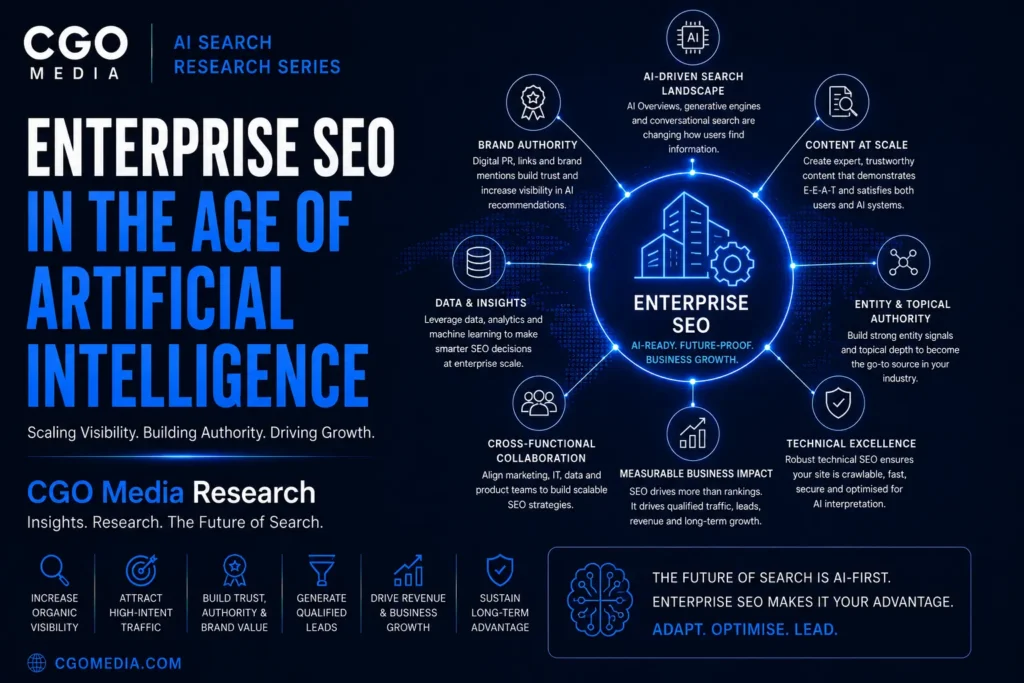
CGO Media AI Search Research Series – Paper 4: title – Enterprise SEO in the Age of Artificial Intelligence
An analysis of how large organisations must adapt their technical infrastructure, content operations, governance models and measurement systems for traditional and generative search.
Abstract
Artificial intelligence is changing the mechanisms through which information is discovered, evaluated, summarised and recommended online. For large organisations, this transformation has implications extending far beyond conventional search engine optimisation. Enterprise SEO must now support visibility across traditional search results, AI-generated answers, conversational assistants, recommendation systems, knowledge graphs and emerging agent-based discovery environments.
This paper examines how enterprise SEO is evolving in response to artificial intelligence and identifies the organisational, technical and strategic capabilities required for sustainable visibility. It argues that enterprise SEO should no longer be managed primarily as a collection of keyword, content and technical optimisation activities. Instead, it must operate as a coordinated system connecting website architecture, data governance, brand authority, content production, digital public relations, analytics and organisational decision-making.
The analysis introduces a proposed enterprise AI search maturity model and examines the importance of machine-readable information, entity consistency, content quality, technical accessibility and cross-departmental governance. It also considers the risks associated with uncontrolled generative content production, fragmented technology platforms, weak ownership structures and an excessive dependence on traditional ranking metrics.
The paper concludes that organisations most likely to succeed in AI-driven search will be those that treat SEO as enterprise infrastructure. Their advantage will not arise from isolated optimisation tactics, but from their ability to create reliable, interconnected and authoritative information ecosystems that both humans and machines can interpret with confidence.
Keywords
Enterprise SEO; artificial intelligence; AI search; generative engine optimisation; GEO; AI Overviews; technical SEO; SEO governance; content architecture; entity authority; knowledge graphs; digital transformation; search visibility; organisational maturity; machine-readable content.
1. Introduction
Enterprise search visibility has historically been associated with scale. Large organisations commonly operate websites containing thousands, hundreds of thousands or even millions of URLs. They may serve multiple countries, languages, products, business divisions and audience segments. Their websites are often supported by numerous content management systems, analytics platforms, development teams, legal departments and external agencies.
This scale creates opportunities but also introduces considerable complexity. A small business may be able to change a page title, publish a new article or correct an indexing problem within hours. In an enterprise organisation, an apparently simple technical or editorial change may require involvement from marketing, technology, legal, compliance, procurement, brand and regional management teams.
Enterprise SEO therefore differs fundamentally from small-site optimisation. Its main challenge is not simply identifying what should be improved. The challenge is creating an organisational system capable of implementing improvements consistently across a large and frequently decentralised digital environment.
Artificial intelligence intensifies this challenge. Search engines are no longer limited to matching keywords with ranked documents. Modern systems can interpret complex questions, identify relationships between entities, retrieve information from multiple sources, synthesise answers and support conversational follow-up questions.
Google has expanded AI Overviews and AI-driven search experiences internationally, while conversational platforms and answer engines have become increasingly important discovery channels. Search visibility is consequently becoming distributed across a wider ecosystem in which a brand may be found through a conventional result, mentioned within an AI-generated answer, cited as supporting evidence or recommended without the user visiting a traditional search results page.
For enterprise organisations, this creates a new strategic question:
How can a large and complex organisation make its information sufficiently accessible, reliable, authoritative and understandable to be selected by both conventional search algorithms and AI-powered discovery systems?
The answer requires more than adding structured data, producing additional articles or experimenting with generative AI. It requires a coordinated approach to technical architecture, content quality, entity management, digital authority, measurement and organisational governance.
Specialist enterprise SEO services increasingly need to address this full operational environment. The role of enterprise SEO is expanding from website optimisation into the management of machine-readable corporate knowledge and brand visibility across multiple search and AI platforms.
1.1 From Ranked Documents to Synthesised Answers
Traditional search engines generally presented users with a ranked list of documents. Although rich results, featured snippets and knowledge panels expanded this model, the central interaction remained recognisable: the user entered a query, reviewed a list of results and selected a website.
AI-powered search changes this interaction by creating a synthesis layer between the user and the underlying information sources. A system may retrieve information from several documents, compare competing explanations and generate a consolidated answer.
This does not eliminate the need for websites. AI systems still require accessible information sources from which facts, evidence, explanations and recommendations can be retrieved. However, it changes the conditions under which a website earns visibility.
A page may perform a number of different roles:
- It may rank as a conventional organic result.
- It may provide evidence used within an AI-generated response.
- It may establish an entity relationship within a knowledge system.
- It may reinforce a brand’s perceived authority on a topic.
- It may support a recommendation without receiving a visible citation.
- It may act as the destination for users who want further detail after reading an AI answer.
Enterprise search strategy must therefore consider visibility at the level of the organisation, entity, topic, passage and individual claim. Optimising only for page-level rankings provides an incomplete view of how modern discovery systems encounter and use information.
1.2 Why Enterprise Organisations Face Greater Exposure
Large organisations possess substantial information assets. They may publish research, product documentation, support materials, investor information, regulatory disclosures, case studies, policy documents, press releases and expert commentary.
Yet these assets are frequently distributed across disconnected platforms. Information may be duplicated, contradicted or presented using inconsistent terminology. Regional teams may describe the same service differently, while outdated pages remain indexed alongside current information.
These weaknesses were already problematic for conventional search engines. They become more serious when AI systems attempt to determine which statements are current, which sources represent the organisation officially and which version of a fact should be trusted.
The problem is not always a shortage of content. In many enterprises, the greater problem is information disorder.
AI search therefore makes information governance a visibility issue. Organisations must know:
- Which content represents the authoritative version of a subject.
- Who owns the accuracy and maintenance of that content.
- How equivalent content is connected across languages and markets.
- Which entities, products and services require consistent naming.
- How obsolete information is removed, redirected or archived.
- How factual claims are supported by reliable evidence.
Without this control, a large organisation may possess significant brand authority while still presenting search engines with a fragmented understanding of its expertise, products and market position.
2. Research Objectives and Questions
The primary objective of this paper is to examine how artificial intelligence is changing enterprise SEO and to define the organisational capabilities required for visibility in AI-driven search.
The analysis is guided by five research questions:
- How does AI-powered search alter the traditional enterprise SEO operating model?
- Which technical, semantic and content capabilities are becoming most important?
- How should enterprises organise governance across departments, platforms and international markets?
- Which risks emerge when generative AI is incorporated into large-scale content production?
- How should enterprise search performance be measured when visibility extends beyond conventional rankings and clicks?
The purpose is not to claim that traditional SEO practices have become obsolete. Google’s published guidance continues to emphasise core principles such as technical accessibility, useful content, internal linking and clear page experience.
Rather, the paper proposes that these foundations must now operate within a broader system. Search engines and AI platforms require information that is not merely crawlable, but also coherent, attributable, current and supported by sufficient authority.
3. Research Methodology
This paper uses a qualitative industry research methodology combining documentary analysis, comparative framework development and enterprise search observations.
The research draws upon four principal evidence categories:
3.1 Search Engine Documentation
Official search engine documentation was reviewed to identify publicly stated requirements relating to crawling, indexing, structured data, AI-generated content and participation in generative search features.
Particular attention was given to Google Search Central guidance. Google has stated that the established technical and content requirements for search remain relevant to AI features and that no special AI-specific schema is required for inclusion. This is an important distinction because it suggests that AI search optimisation should be built upon sound search fundamentals rather than treated as an entirely separate technical discipline.
3.2 Academic and Industry Literature
Research concerning information retrieval, large language models, retrieval-augmented generation, knowledge representation, generative engine optimisation and organisational digital governance was considered.
The literature indicates a transition from document retrieval towards systems capable of semantic interpretation and answer synthesis. It also highlights continuing concerns around source attribution, bias, factual accuracy, manipulation and information quality.
3.3 Enterprise SEO Practice
The paper incorporates observations from enterprise website environments, including recurring challenges involving platform fragmentation, internationalisation, content duplication, development backlogs, governance gaps and inconsistent measurement.
These observations are used to assess how AI search changes existing enterprise weaknesses rather than assuming that all organisations begin from a technically mature position.
3.4 Conceptual Framework Development
Based on the evidence reviewed, the paper proposes a conceptual enterprise AI search maturity model. The model evaluates organisational readiness across six areas:
- Governance and ownership
- Technical architecture
- Content and knowledge management
- Entity and authority development
- AI-assisted operations
- Measurement and organisational learning
The model is intended as a practical strategic framework rather than a definitive ranking formula. Search and AI systems remain partly opaque, and their selection mechanisms can vary by platform, query type, location, language and user context.
4. Literature Review
4.1 The Development of Enterprise SEO
Early SEO practice concentrated heavily on document-level optimisation. Common activities included keyword placement, metadata optimisation, internal linking and link acquisition. As websites became larger and search algorithms more sophisticated, enterprise SEO developed into a broader operational discipline.
Large websites required systems for managing crawl allocation, duplicate content, canonicalisation, faceted navigation, international targeting, JavaScript rendering, migrations and template-level optimisation. The focus shifted from editing individual pages to improving the systems that generated and connected them.
This distinction remains fundamental. On a website containing one million URLs, a template improvement affecting 100,000 pages may have considerably greater impact than manually editing a small collection of priority pages.
Enterprise SEO consequently became associated with:
- Scalable technical controls
- Reusable page templates
- Automated quality assurance
- International and multilingual architecture
- Cross-functional implementation
- Prioritisation based on commercial impact
- Executive reporting and organisational governance
Artificial intelligence does not remove these requirements. It increases their importance by placing greater emphasis on the consistency and interpretability of information across the entire enterprise ecosystem.
4.2 Search as an Information Retrieval System
Search engines have always attempted to determine which documents are relevant and useful for a query. Earlier systems relied heavily on lexical matching, link analysis and document-level signals. Modern systems incorporate machine learning, semantic representations, contextual understanding and entity relationships.
This evolution reduces the dependence on exact keyword matching. A search engine can often recognise that different phrases represent similar intentions, distinguish between meanings of the same word and understand relationships between people, organisations, products, places and concepts.
For enterprise organisations, semantic interpretation has two major consequences.
First, content must be built around complete topics and user needs rather than repetitive keyword variations. Publishing separate pages for every minor phrasing difference may create duplication without materially improving coverage.
Second, organisations must communicate entity relationships consistently. Search systems should be able to understand:
- Which brands belong to the organisation.
- Which products are associated with each brand.
- Which markets and industries the organisation serves.
- Which experts are connected to specific areas of knowledge.
- Which corporate sources provide authoritative information.
These relationships are often expressed through content, internal links, structured data, external references, organisational profiles and consistent naming conventions. No single element establishes authority independently. Their combined consistency creates a stronger machine-readable representation of the enterprise.
4.3 Large Language Models and Retrieval-Augmented Search
Large language models generate text by predicting likely sequences based on patterns learned from substantial datasets. On their own, these models may produce responses that are fluent but outdated, incomplete or factually inaccurate.
Retrieval-augmented systems address part of this limitation by finding relevant external information before generating an answer. The retrieved documents provide context that can be used to produce a more current and evidence-based response.
This process has significant implications for enterprise SEO. A corporate website must first be discoverable within the retrieval environment. Its information must then be suitable for extraction, interpretation and synthesis.
A document that ranks well in conventional search is not automatically the easiest source for an AI system to use. Important information may be obscured by:
- Complex client-side rendering
- Unclear page structure
- Long introductory passages without direct answers
- Ambiguous or unsupported claims
- Inconsistent terminology
- Missing publication or update dates
- Poor connections between related entities
- Content hidden within inaccessible interactive components
This does not mean that pages should be reduced to short machine-oriented fragments. Comprehensive, original and well-supported content remains valuable. The requirement is to combine depth with structural clarity.
4.4 Generative Engine Optimisation
Generative engine optimisation describes efforts to improve the likelihood that content, organisations or brands will be represented within AI-generated search responses.
The discipline remains developing, and claims concerning precise AI ranking factors should be treated cautiously. Different platforms use different data sources, retrieval systems, models and citation mechanisms. Their behaviour may also change rapidly.
However, several principles appear consistent with both established information retrieval practice and published search engine guidance:
- Content must be technically accessible to relevant crawlers.
- Information should answer genuine user needs.
- Claims should be clear, specific and supportable.
- Sources should demonstrate experience, expertise and accountability.
- Important entities and relationships should be unambiguous.
- Original information creates greater value than generic repetition.
- External recognition can reinforce authority and trust.
- Content should remain accurate and sufficiently current.
These principles demonstrate why enterprise GEO should not operate as an isolated campaign. It is closely connected to technical SEO, content strategy, digital PR, brand management and data governance.
4.5 AI-Generated Content and Scaled Production
Generative AI allows enterprises to research, draft, classify, translate and update information at unprecedented speed. It may reduce production costs and help organisations manage extensive content libraries.
However, speed introduces substantial risks. When automated production is not supported by editorial controls, organisations may publish inaccurate, repetitive or undifferentiated material at scale.
Google’s guidance does not prohibit the responsible use of generative AI. It does, however, warn that producing large quantities of pages without meaningful value may violate policies concerning scaled content abuse.
For enterprise organisations, the principal risk is therefore not the use of AI itself. The risk is the use of AI without governance.
A large organisation may generate thousands of pages before quality problems become visible. Errors can be reproduced across countries, languages and product categories. In regulated sectors, inaccurate content may also create legal, reputational or consumer risks.
Enterprise AI content systems should consequently include:
- Documented editorial standards
- Human subject-matter review
- Source verification procedures
- Legal and compliance checks where necessary
- Duplicate-content controls
- Brand and terminology guidelines
- Publication and update ownership
- Automated and manual quality assurance
AI can increase the productive capacity of a mature content operation. It cannot compensate for the absence of strategic ownership or reliable source information.
5. The Transformation of Enterprise SEO
5.1 From Optimisation Programme to Information Infrastructure
Enterprise SEO has often been positioned as a marketing acquisition programme. Its performance is measured through rankings, organic sessions, leads and revenue. These outcomes remain important, but the framing is becoming incomplete.
In AI-driven discovery, enterprise SEO also determines whether an organisation’s information can be accessed, understood and trusted by machines. This makes SEO part of the organisation’s information infrastructure.
The difference can be illustrated through two operating models.
The AI-ready model does not replace traditional SEO. It expands it. Pages must still be crawlable, indexable and useful. However, these pages now contribute to a broader information environment through which machines evaluate the organisation.
5.2 The Enterprise Search Visibility Layer
A modern enterprise requires a visibility layer connecting its digital assets to external discovery systems.
This layer includes:
- Technical accessibility
- Information architecture
- Entity definitions
- Structured and unstructured content
- Internal relationships
- External authority signals
- Measurement and feedback systems
The purpose of this layer is to make the organisation’s knowledge discoverable and interpretable regardless of the specific interface used by the audience.
A customer may begin with a Google search, ask an AI assistant for recommendations, consult a comparison website, read a news article and then visit the company directly. Enterprise SEO must support the organisation throughout this fragmented journey.
This broader approach aligns SEO with the organisation’s overall digital presence. It also explains why enterprise success requires cooperation among teams that may historically have operated independently.
5.3 The Six Components of AI-Ready Enterprise SEO
This paper proposes six interconnected components of an AI-ready enterprise SEO system:
- Governance: clear ownership, decision rights, standards and accountability.
- Architecture: technically accessible, scalable and logically connected digital platforms.
- Knowledge: accurate, useful and maintained content representing organisational expertise.
- Entities: consistent definitions of organisations, people, products, services and concepts.
- Authority: credible internal evidence and independent external recognition.
- Measurement: systems capable of evaluating visibility across conventional and AI-driven discovery.
Weakness in one component can reduce the effectiveness of the others. For example, high-quality content may remain invisible if technical architecture prevents reliable crawling. Strong technical infrastructure may produce limited value if the organisation publishes generic or contradictory information.
Organisations seeking to build this capability should begin with a structured audit of their current platforms, content operations and governance processes. A mature SEO and AI search strategy should identify not only individual optimisation opportunities, but also the systemic barriers preventing consistent implementation across the enterprise.
6. Governance for Enterprise SEO and AI Search
Governance is one of the most important and frequently underestimated elements of enterprise SEO. Large organisations rarely fail because they lack optimisation opportunities. They fail because responsibility is fragmented, implementation is slow and no single operating model connects search strategy with technology, content, legal review, brand management and regional execution.
Artificial intelligence increases the need for formal governance. Search visibility now depends on information published across corporate websites, support centres, product databases, executive profiles, press rooms, research libraries, investor relations platforms and external media sources. Inconsistent ownership across these systems can create contradictory or outdated representations of the organisation.
6.1 Why Enterprise SEO Governance Matters
A strong governance model determines how decisions are made, which standards apply and who is accountable for implementation. Without governance, SEO recommendations may remain advisory documents that are never integrated into development roadmaps or editorial workflows.
The most common governance problems include:
- No executive sponsor with sufficient authority to remove organisational barriers.
- SEO teams being consulted only after websites or campaigns are launched.
- Regional teams publishing independently without shared technical or editorial standards.
- Developers prioritising SEO work below product or commercial projects.
- Legal and compliance reviews occurring too late in the publication process.
- No formal ownership for outdated or low-performing content.
- Multiple agencies working without a unified measurement framework.
- Search data remaining isolated from wider business intelligence systems.
These problems can produce a technically fragmented website even when the organisation employs experienced specialists. Enterprise success therefore depends not only on expertise, but on the capacity to translate expertise into repeatable organisational action.
6.2 A Federated Governance Model
For many large organisations, a federated model provides the best balance between central control and regional flexibility.
Under this model, a central enterprise SEO function defines:
- Technical standards
- Measurement principles
- Structured data requirements
- Content quality expectations
- Entity and terminology guidelines
- International SEO rules
- AI content governance
- Escalation and approval processes
Regional or departmental teams retain responsibility for local execution, market knowledge and commercial priorities. They may adapt content to local audiences, regulations and languages, provided that implementation remains consistent with the central framework.
This structure avoids two common extremes. Excessive centralisation can slow production and weaken local relevance, while excessive decentralisation can produce duplication, inconsistent branding and technical disorder.
6.3 Search Standards as Enterprise Policy
SEO standards should be formalised as part of enterprise digital policy rather than distributed as optional guidance.
These standards may cover:
- Required metadata fields
- Canonical URL rules
- Internal linking expectations
- Heading and page structure
- Structured data implementation
- JavaScript rendering requirements
- Image optimisation
- Accessibility
- Content review dates
- Author attribution
- Translation and localisation
- URL retirement procedures
The policy should be embedded within design systems, content management systems, development documentation and procurement requirements. This makes compliance easier and reduces dependence on individual employees remembering specialist instructions.
For example, a content management system may prevent publication until a page includes an approved title, description, canonical reference, review date and responsible owner. A design system may include search-friendly navigation and heading structures by default.
The strongest enterprise SEO systems reduce the number of decisions that must be made manually.
6.4 Decision Rights and Escalation
Enterprise governance should also define who has authority to resolve conflicts.
Common conflicts include:
- A regional team wanting to create a separate domain rather than use the approved international structure.
- A design team removing crawlable text for visual reasons.
- A product team launching a JavaScript interface without server-rendered content.
- A legal team requesting removal of useful detail without offering an alternative.
- A marketing team generating thousands of AI-written pages to meet aggressive publishing targets.
Without defined decision rights, these disputes may remain unresolved or be decided by the department with the greatest short-term influence.
An effective governance process should specify:
- Who proposes the change.
- Which teams must review it.
- Which evidence should support the decision.
- Who gives final approval.
- How exceptions are recorded.
- When the outcome will be reviewed.
This creates transparency and prevents SEO from depending entirely on informal relationships.
7. Building an AI-Ready Technical Architecture
Technical SEO has traditionally focused on ensuring that search engines can crawl, render, index and understand website content. These objectives remain essential, but AI-driven discovery places additional emphasis on extraction, context and information consistency.
An AI-ready architecture does not require an entirely separate website or special AI-only version of existing content. It requires a technically reliable environment in which important information is accessible, clearly structured and connected to relevant entities and supporting evidence.
7.1 Crawlability and Indexation Remain Fundamental
AI systems cannot reliably use information they cannot access. Enterprise websites must therefore maintain strong control over:
- Robots directives
- XML sitemaps
- Canonical tags
- Redirects
- Status codes
- JavaScript rendering
- Duplicate URLs
- Pagination
- Faceted navigation
- Internal link depth
At enterprise scale, minor configuration problems can affect very large numbers of pages. A single incorrect template rule may generate millions of duplicate URLs or prevent strategic content from being indexed.
The objective should not be to maximise the number of indexed pages. It should be to ensure that search engines can identify and prioritise the organisation’s most useful and authoritative content.
7.2 Rendering and JavaScript
Modern enterprise websites frequently rely on JavaScript frameworks for navigation, personalisation, product configuration and application-like functionality. These technologies can improve user experience, but they may also make content more difficult to access or interpret.
Important information should not depend entirely on user interaction before it becomes available. Core content, headings, links and structured data should be present in a form that relevant crawlers can reliably process.
Recommended practices include:
- Using server-side rendering or static generation where appropriate.
- Ensuring meaningful HTML is available in the initial response.
- Testing rendered output rather than relying only on browser appearance.
- Avoiding links that exist only as JavaScript event handlers.
- Ensuring structured data accurately reflects visible page content.
- Monitoring rendering failures across templates and devices.
The technical objective is not to avoid JavaScript. It is to prevent JavaScript from becoming a barrier between the organisation’s knowledge and the systems attempting to retrieve it.
7.3 Information Architecture
Information architecture determines how content is organised, named and connected. In AI-driven search, it also contributes to how machines interpret topical relationships.
A strong enterprise architecture should make it clear:
- Which pages represent primary topics.
- Which pages support those topics.
- How products relate to categories and use cases.
- How expertise is distributed across departments and authors.
- How local and international content relates to global information.
- Which pages are current, authoritative and commercially important.
Topic clusters can be useful when they reflect genuine information relationships rather than artificial linking patterns. A central enterprise page may introduce a major subject, while supporting documents provide technical detail, case studies, research, FAQs and sector-specific guidance.
Internal links should connect these resources using descriptive language that helps users and machines understand the relationship.
7.4 Semantic HTML and Document Structure
Clear document structure improves accessibility, usability and machine interpretation.
Enterprise templates should support:
- One clear primary heading.
- Logical secondary and tertiary headings.
- Descriptive lists and tables.
- Accessible captions and labels.
- Meaningful navigation elements.
- Proper use of article, section, header and footer elements.
- Descriptive anchor text.
This structure can make important passages easier to identify and reduce ambiguity about the purpose of each section.
A page should ideally communicate its central subject within the title, heading, introductory paragraph and surrounding internal link context. This does not require repetitive keyword placement. It requires conceptual clarity.
7.5 Structured Data
Structured data provides explicit machine-readable information about a page and the entities it describes. Relevant types may include:
- Organisation
- Person
- Product
- Service
- Article
- FAQ
- Breadcrumb
- Event
- Job posting
- Local business
- Review
Structured data should not be treated as a substitute for clear visible content. It should accurately represent information already available to users.
At enterprise scale, structured data should be generated through controlled templates and validated automatically. Manual implementation on individual pages is difficult to maintain and can lead to inconsistencies.
The organisation should also maintain stable entity identifiers wherever possible. These may connect brand, author, product and organisational information across different pages and systems.
7.6 Content APIs and Headless Platforms
Many enterprises now use headless content management systems and APIs to distribute information across websites, applications and digital products.
This approach can improve consistency if the underlying content model is well designed. A single approved product description, for example, may be reused across multiple channels while maintaining controlled terminology and update history.
However, headless architecture can also create search problems when implementation focuses only on front-end delivery. Enterprises should ensure that:
- Every important content item has an indexable public URL where appropriate.
- Metadata is available through the content model.
- Canonical relationships are maintained across channels.
- Rendered pages contain complete and meaningful HTML.
- Content updates propagate accurately.
- Preview and staging environments remain protected from indexation.
AI-readiness depends less on whether an organisation uses a traditional or headless CMS than on whether its information model is coherent and its public output is accessible.
7.7 Performance, Accessibility and User Experience
Enterprise websites should also maintain high standards of performance and accessibility.
Slow or unstable pages can reduce user satisfaction and interfere with efficient crawling. Inaccessible content may exclude users and signal weak digital governance.
Technical optimisation should therefore include:
- Efficient asset delivery
- Image compression
- Code reduction
- Server response optimisation
- Core Web Vitals monitoring
- Mobile usability
- Keyboard navigation
- Accessible forms
- Alternative text
- Readable contrast and typography
These improvements support both search performance and the broader quality of the digital experience.
8. International and Multilingual Enterprise SEO
International organisations face additional complexity because search behaviour, language, regulation and competitive conditions vary across markets.
AI systems may also produce different answers depending on the user’s location, language and cultural context. An organisation that is clearly represented in one market may be poorly understood in another.
8.1 International Architecture
Enterprises commonly choose among country-code domains, subdomains and subdirectories.
No architecture is universally correct. The decision should consider:
- Existing domain authority
- Local legal requirements
- Operational independence
- Brand recognition
- Technical capacity
- Content overlap
- Regional search behaviour
The most important requirement is consistency. International structures should not emerge through uncoordinated regional decisions.
An organisation may use:
- Country-code domains: example.co.uk, example.es and example.de.
- Subdomains: uk.example.com, es.example.com and de.example.com.
- Subdirectories: example.com/uk/, example.com/es/ and example.com/de/.
Each model can succeed when implemented carefully. Problems arise when equivalent pages are not connected, canonical signals conflict or users are redirected automatically without being given a choice.
8.2 Hreflang and Language Relationships
Hreflang annotations help search engines understand equivalent regional or language versions of a page.
At enterprise scale, hreflang should be generated systematically rather than maintained manually. Common problems include:
- Missing return references
- Incorrect language or country codes
- Links to redirected or non-canonical pages
- Incomplete clusters
- Mixing language and country targeting incorrectly
- Annotations that do not match the visible content
Hreflang should form part of the international content model and deployment process.
8.3 Translation Versus Localisation
Direct translation may preserve basic meaning but fail to address local search intent, terminology, regulation or cultural expectations.
Localisation should consider:
- Market-specific terminology
- Local examples and case studies
- Regional regulations
- Currency and measurement conventions
- Local competitors
- Different stages of customer awareness
- Local product availability
AI-assisted translation can support scale, but expert review remains necessary for commercially important or regulated material.
8.4 Global Entity Consistency
International organisations must balance local adaptation with global entity consistency.
Core facts such as the official company name, founding information, product ownership and executive roles should remain consistent across markets. Local teams may adapt descriptions, but they should not unintentionally create conflicting versions of the same entity.
This requires shared source data for:
- Corporate profiles
- Executive biographies
- Product names
- Service definitions
- Office locations
- Accreditations
- Regulatory information
A central entity registry can help organisations control this information and distribute approved facts across websites and platforms.
9. Entity Management and Organisational Knowledge
Entity management is becoming central to enterprise search visibility. An entity may be an organisation, person, product, service, location, event or concept that can be distinguished from other objects.
Search and AI systems attempt to understand not only the words on a page, but what those words refer to and how the underlying entities relate.
9.1 The Enterprise Entity Graph
Every large organisation has an implicit network of entities.
For example:
- The parent organisation owns several brands.
- Each brand offers multiple products.
- Products serve particular sectors or customer groups.
- Executives and specialists possess expertise in specific topics.
- Offices operate in defined locations.
- Research papers support particular claims.
- Media coverage connects the brand to external recognition.
When these relationships are represented consistently across the website and external sources, machines can develop a clearer understanding of the organisation.
9.2 Entity Consistency
Entity inconsistency can arise when:
- Products use different names across departments.
- Executive job titles are outdated.
- Office addresses conflict across websites and directories.
- Subsidiaries are presented without clear relationships to the parent organisation.
- Brand descriptions vary significantly between markets.
- Company biographies are copied from obsolete sources.
The organisation should identify its priority entities and create approved definitions for each one.
A central entity record may include:
- Official name
- Alternative names
- Description
- Entity type
- Parent and child relationships
- Official URL
- Logo
- Founding date
- Location
- Relevant experts
- Supporting sources
- Review owner
9.3 Authors and Expert Entities
Expert attribution can strengthen transparency and accountability. Enterprise content should identify appropriate authors or reviewers where this information benefits the reader.
Author pages may include:
- Professional biography
- Relevant experience
- Areas of expertise
- Qualifications
- Published research
- Media contributions
- Links to related content
The objective is not to manufacture superficial expertise signals. The objective is to make genuine organisational knowledge visible and attributable.
9.4 Products and Services as Knowledge Entities
Product and service pages should not exist as isolated sales documents. They should be connected to supporting information such as:
- Use cases
- Technical documentation
- Implementation guidance
- Case studies
- Pricing information
- FAQs
- Research
- Expert commentary
This creates a richer information environment around the entity and helps users evaluate the offering in context.
9.5 External Corroboration
Organisations cannot establish authority entirely through their own websites. Independent sources contribute to the wider understanding of a brand.
Relevant external evidence may include:
- News coverage
- Industry publications
- Professional associations
- Academic citations
- Conference participation
- Regulatory listings
- Customer reviews
- Partner profiles
- Public datasets
This demonstrates the relationship between enterprise SEO, digital PR and reputation management. Search visibility is influenced by the broader information environment in which the organisation appears.
10. Enterprise Content Operations in the AI Era
Enterprise content strategy must move beyond publishing volume. AI search increases the value of clear, original and well-supported information while reducing the strategic value of generic content that merely repeats widely available material.
10.1 From Content Production to Knowledge Operations
Traditional content programmes often focus on editorial calendars, keyword targets and publication frequency.
Knowledge operations take a broader view. They manage the full lifecycle of organisational information:
- Identifying information needs.
- Locating reliable internal and external sources.
- Creating or updating the content.
- Reviewing factual and legal accuracy.
- Publishing through approved templates.
- Connecting the content to relevant topics and entities.
- Measuring performance.
- Reviewing, consolidating or retiring the content.
This lifecycle reduces content decay and helps the organisation maintain a reliable source of truth.
10.2 Content Inventory and Classification
Large organisations should maintain a content inventory containing more than URLs and traffic data.
Useful fields may include:
- Page title
- Content type
- Primary topic
- Associated entity
- Target audience
- Market and language
- Author or owner
- Publication date
- Last review date
- Legal status
- Traffic and conversion performance
- Backlinks and citations
- Recommended action
Pages may then be classified as:
- Keep
- Improve
- Consolidate
- Redirect
- Archive
- Remove
This process is especially important before introducing AI-assisted publishing. Organisations should not add large volumes of new material to an already disorganised content library.
10.3 Evidence-Led Content
AI-generated answers frequently combine information from multiple sources. Content that includes clear evidence, original data and transparent methodology may therefore offer greater value than unsupported commentary.
Enterprise content teams should consider publishing:
- Original research
- Benchmarks
- Industry surveys
- Technical documentation
- Case studies
- Expert analysis
- Methodologies
- Definitions
- Data visualisations
Originality does not require every page to introduce a new academic discovery. It may involve publishing operational knowledge, practical data or specialist explanations that are not already available in the same form elsewhere.
10.4 Passage-Level Clarity
Long-form content can remain valuable, but important ideas should be expressed clearly within individual sections and passages.
Each major section should ideally:
- Address a defined question or concept.
- Use a descriptive heading.
- Provide a direct explanation early.
- Support important claims with evidence.
- Connect the topic to related resources.
This structure benefits readers who scan content and systems that retrieve only the most relevant section of a page.
10.5 Content Freshness and Review Cycles
Not all content requires constant updating, but every important page should have a defined review expectation.
Review frequency may depend on:
- Regulatory change
- Product updates
- Market volatility
- Search demand
- Commercial importance
- Historical accuracy
- Legal risk
A rapidly changing pricing page may require frequent review, while a historical case study may remain accurate for years.
The organisation should avoid changing publication dates without making meaningful updates. Transparency is more valuable than superficial freshness.
10.6 AI-Assisted Content Workflows
Generative AI can support many stages of enterprise content operations.
Potential uses include:
- Topic classification
- Content gap analysis
- Initial drafting
- Summarisation
- Metadata suggestions
- Translation support
- Internal linking recommendations
- Quality checks
- Content update detection
However, automation should be proportionate to risk.
10.7 Avoiding Scaled Content Failure
Scaled AI content programmes can fail when success is measured by the number of pages published rather than the value created.
Warning signs include:
- Thousands of pages targeting minor keyword variations.
- Content produced without a defined audience.
- Repeated claims without original evidence.
- Pages published without responsible owners.
- Unreviewed translations.
- Contradictory information across templates.
- Rapid index growth without commercial improvement.
A responsible enterprise programme should set limits, test quality and measure user outcomes before expanding production.
11. Enterprise AI Search Maturity Model
Enterprise readiness for AI-driven search varies considerably. Some organisations still struggle with basic crawling and ownership, while others are beginning to connect SEO, knowledge management and AI-assisted operations.
This paper proposes a five-stage maturity model.
11.1 Stage One: Fragmented
At the fragmented stage, SEO is reactive and decentralised.
Typical characteristics include:
- No central strategy
- Multiple unmanaged websites
- Inconsistent analytics
- Large volumes of duplicate or outdated content
- Weak technical control
- No AI content policy
- Limited executive awareness
The organisation may achieve occasional rankings through brand strength, but performance is unstable and difficult to reproduce.
11.2 Stage Two: Controlled
At the controlled stage, the organisation begins establishing technical and editorial standards.
Characteristics include:
- Basic SEO ownership
- Regular technical audits
- Shared reporting
- Priority content optimisation
- Initial structured data
- Documented publishing guidance
- Limited cross-functional cooperation
Implementation may still depend heavily on individual teams and manual processes.
11.3 Stage Three: Integrated
At the integrated stage, SEO becomes part of wider digital operations.
Characteristics include:
- SEO requirements integrated into development.
- Shared international standards.
- Content inventories and lifecycle management.
- Defined entity and author structures.
- Cooperation with digital PR and brand teams.
- Controlled use of generative AI.
- Search data connected to commercial reporting.
The organisation can implement improvements across multiple markets with increasing consistency.
11.4 Stage Four: Predictive
At the predictive stage, data and automation help identify risks and opportunities before they become visible through manual analysis.
Characteristics include:
- Automated technical monitoring
- Content decay alerts
- Search demand forecasting
- Entity consistency checks
- AI visibility tracking
- Automated internal linking recommendations
- Scenario modelling
Human specialists remain responsible for strategic decisions, but automation improves speed and coverage.
11.5 Stage Five: Adaptive
At the adaptive stage, enterprise search visibility operates as a continuously improving organisational system.
Characteristics include:
- Real-time or near-real-time monitoring
- Integrated search, brand and commercial intelligence
- Dynamic content maintenance
- Strong entity and knowledge governance
- Cross-platform visibility measurement
- Rapid response to search and market change
- Executive-level ownership of search visibility
The organisation treats SEO, GEO and information quality as strategic infrastructure rather than isolated marketing activities.
11.6 Using the Maturity Model
The maturity model should be applied separately across the six components introduced earlier:
- Governance
- Architecture
- Knowledge
- Entities
- Authority
- Measurement
An organisation may be technically advanced but weak in content governance. Another may possess strong brand authority but limited international architecture.
The purpose is not to assign a single superficial score. It is to identify where the organisation’s weakest capability limits the performance of the overall system.
12. Enterprise SEO Case Studies and Applied Scenarios
The practical implications of AI-driven search become clearer when examined through enterprise scenarios. The following case studies are illustrative rather than representations of one specific organisation. They combine recurring challenges observed across large websites, international brands and complex digital environments.
12.1 Growth Analysis One: A Multinational Financial Services Organisation
A multinational financial services organisation operated more than thirty regional websites. Each market had developed its own content structure, product terminology and publication processes. Several countries used separate content management systems, and equivalent services were described differently across languages.
The organisation possessed substantial brand authority, but its digital information environment was fragmented. Search engines encountered duplicated pages, inconsistent corporate descriptions, outdated executive biographies and conflicting product claims.
The main challenges included:
- Separate regional websites with inconsistent URL structures.
- Incomplete or incorrect hreflang implementation.
- Different names for the same financial products.
- Numerous outdated regulatory pages remaining indexed.
- Product information hidden within JavaScript interfaces.
- No central owner for content accuracy.
- Limited connection between SEO, compliance and product teams.
The organisation established a federated enterprise SEO model. A central search team defined technical, semantic and editorial standards, while regional teams retained responsibility for local market adaptation.
The transformation programme included:
- Creating an enterprise-wide content and URL inventory.
- Identifying canonical product and service entities.
- Standardising corporate and executive information.
- Rebuilding international page relationships.
- Introducing central structured data templates.
- Establishing compliance-led content review cycles.
- Creating a shared performance dashboard.
The primary benefit was not simply improved rankings. The organisation developed a more consistent information environment across search engines, AI assistants and regional websites.
Product definitions became easier to retrieve, regional duplication was reduced and outdated claims were removed. The search programme also exposed wider data-governance weaknesses that had previously been treated as isolated website issues.
12.2 Growth Analysis Two: An International E-Commerce Platform
An international e-commerce platform operated millions of product, category and filter URLs. Its organic traffic was substantial, but technical complexity reduced efficiency.
Search engines spent significant resources crawling low-value faceted URLs, while important product categories were several clicks from the homepage. Product descriptions were frequently copied from manufacturers, and many pages provided little information beyond specifications and price.
The company also wanted its products to appear in AI-assisted shopping recommendations. However, its information was difficult to interpret consistently because product attributes, category labels and structured data differed between markets.
The programme focused on four areas:
- Crawl control and indexation quality.
- Product entity standardisation.
- Category-level information architecture.
- Original commercial and editorial content.
The organisation consolidated duplicate filters, improved canonical rules and created stronger internal links to strategic categories. Product data was standardised through a central catalogue, and structured data was generated directly from approved source fields.
Category pages were expanded to include:
- Buying guidance
- Product comparisons
- Common use cases
- Expert recommendations
- Frequently asked questions
- Links to supporting research and guides
The resulting architecture provided clearer context around products and categories. It also reduced the organisation’s dependence on generic manufacturer information.
This case demonstrates that AI search visibility in e-commerce depends on more than adding product schema. The wider product knowledge environment must be reliable, differentiated and commercially useful.
12.3 Growth Analysis Three: A Global Software Company
A global software company had expanded rapidly through acquisitions. Each acquired business retained its own website, documentation platform and product terminology.
The company’s search presence was divided across multiple domains. Users often encountered old brand names, obsolete support documents and overlapping product pages.
AI assistants sometimes described acquired products as separate companies because the relationship between the parent organisation, acquired brands and current products was not communicated consistently.
The company created an enterprise entity framework mapping:
- The parent company
- Acquired brands
- Legacy product names
- Current product names
- Software categories
- Executive and technical experts
- Documentation resources
- Partner integrations
Legacy pages were reviewed and either redirected, updated or clearly marked as historical. Documentation was connected to current product pages, and author profiles were introduced for technical specialists.
The company also published comparison pages explaining how its products had evolved after acquisition. These pages reduced confusion for existing customers and provided search engines with a clearer interpretation of entity relationships.
The case illustrates why mergers and acquisitions should include search and entity migration planning. Corporate integration is incomplete when the digital information environment continues to represent outdated organisational structures.
12.4 Growth Analysis Four: A Regulated Healthcare Group
A healthcare group managed hospitals, clinics, specialist centres and digital health services across multiple regions.
Its content included treatment descriptions, doctor profiles, location pages, patient guidance and medical articles. Because the subject matter could influence health decisions, accuracy and accountability were critical.
The organisation had previously allowed general marketing teams to publish medical content using inconsistent approval processes. Some articles lacked named reviewers, while doctor credentials were not updated systematically.
The group introduced a high-governance content model requiring:
- Qualified medical review.
- Named authors or clinical reviewers.
- Documented evidence sources.
- Formal review and expiry dates.
- Clear separation between general guidance and medical advice.
- Central management of doctor and clinic entities.
- Regional legal and regulatory review.
Generative AI was permitted for research assistance, classification and initial drafting, but no medical content could be published without specialist review.
The organisation also connected treatment pages with relevant specialists, locations, research and patient information. This created a more complete and accountable knowledge environment.
The case shows that AI-assisted enterprise content must be governed according to potential harm. The greater the impact of inaccurate information, the stronger the required review process.
12.5 Lessons Across the Case Studies
Several recurring principles emerge:
- Technical scale amplifies both good and bad decisions.
- Strong brands can still suffer from weak information governance.
- Entity consistency becomes more important as organisations expand.
- AI content programmes require controls before they require volume.
- International success depends on shared standards and local expertise.
- SEO often exposes broader organisational data and governance problems.
- Search visibility improves when the entire knowledge ecosystem becomes more coherent.
13. Measuring Enterprise SEO in AI-Driven Search
Measurement is becoming more complex because search visibility now extends beyond conventional rankings and website sessions.
Traditional metrics remain valuable, but they do not capture every stage of AI-assisted discovery.
13.1 The Limitations of Ranking-Only Measurement
Rankings provide useful evidence of search performance, but they can be misleading when used in isolation.
A keyword may rank highly while generating limited commercial value. Conversely, a page may contribute to an AI-generated answer, support brand recognition or influence a later direct visit without receiving a measurable click.
Enterprise reporting should therefore distinguish between:
- Visibility
- Engagement
- Influence
- Conversion
- Commercial value
13.2 A Multi-Layer Measurement Framework
This paper proposes a five-layer measurement model.
13.3 Measuring AI Visibility
AI visibility measurement remains an emerging field. Platforms may not provide complete referral or citation data, and answers can vary according to query wording, location, model version and user context.
Enterprises can nevertheless monitor representative query sets.
A structured AI visibility programme may include:
- Priority commercial questions.
- Brand and product comparison queries.
- Informational questions related to organisational expertise.
- Local and regional recommendation queries.
- Problem-based conversational searches.
- Competitor and category questions.
For each query, the organisation can record:
- Whether the brand appears.
- How the brand is described.
- Whether a corporate page is cited.
- Which competitors are recommended.
- Whether the answer is factually accurate.
- Which external sources influence the response.
The objective is not to treat one AI answer as a stable ranking position. The objective is to identify patterns across a controlled sample of relevant queries.
13.4 Share of Search and Branded Demand
Share of search can provide an indication of relative brand demand within a category. Rising branded search may reflect growing awareness created through organic search, digital PR, advertising, social media and offline activity.
This metric is particularly useful because AI recommendations may influence users to search for a brand later rather than click immediately.
Enterprises should therefore monitor:
- Brand name searches
- Brand plus product searches
- Brand plus review searches
- Brand versus competitor searches
- Direct traffic trends
- New-user and returning-user behaviour
13.5 Attribution Challenges
AI-assisted journeys may involve several platforms before conversion. A user may discover a brand through an AI answer, verify it through Google, visit a comparison website and later convert through a direct visit.
Last-click attribution may assign the full value to the final interaction and ignore the role of search discovery.
Enterprises should use a combination of:
- Multi-touch attribution
- Assisted conversion analysis
- Customer surveys
- Brand-lift studies
- Incrementality testing
- Market-level comparisons
- Sales-team feedback
No individual method provides complete certainty. The strongest measurement system combines quantitative and qualitative evidence.
13.6 Executive Reporting
Executive reports should translate technical and search metrics into business implications.
Instead of reporting only that organic traffic increased, the report should explain:
- Which products or markets created the growth.
- How search contributed to revenue or pipeline.
- Which technical risks could reduce future performance.
- How the organisation compares with competitors.
- Which AI search themes are becoming commercially important.
- What investment is required next.
Enterprise SEO gains organisational influence when leaders can understand its relationship to growth, risk and market visibility.
14. Enterprise Implementation Roadmap
Transforming enterprise SEO into AI-ready information infrastructure requires staged implementation. Organisations should avoid attempting to solve every issue simultaneously.
14.1 Phase One: Establish the Baseline
The first phase should document the current environment.
Key activities include:
- Inventorying websites, subdomains and digital platforms.
- Mapping content management systems.
- Identifying major technical issues.
- Auditing indexation and crawl behaviour.
- Reviewing international architecture.
- Documenting ownership and workflows.
- Assessing current AI use.
- Establishing baseline performance metrics.
The result should be a clear view of the enterprise search ecosystem, including organisational as well as technical barriers.
14.2 Phase Two: Define Governance and Standards
The second phase creates the rules and accountability required for improvement.
Activities include:
- Appointing an executive sponsor.
- Defining central and regional responsibilities.
- Creating technical and editorial policies.
- Establishing AI content guidelines.
- Defining decision rights.
- Creating review and escalation procedures.
- Agreeing shared measurement principles.
14.3 Phase Three: Correct Critical Architecture
The organisation should then address issues that restrict access to strategic information.
Priorities may include:
- Resolving indexation problems.
- Improving rendering.
- Consolidating duplicate URLs.
- Correcting canonical and hreflang signals.
- Improving internal linking.
- Reducing crawl waste.
- Strengthening page templates.
- Implementing reliable structured data.
These changes should be prioritised according to business value, technical risk and scale of impact.
14.4 Phase Four: Build the Enterprise Knowledge Model
Once the technical foundation is stable, the organisation can improve how its knowledge is represented.
Activities include:
- Defining priority topics.
- Identifying key corporate, product and expert entities.
- Creating approved entity records.
- Building content hubs and topic relationships.
- Improving author and reviewer attribution.
- Connecting products with supporting evidence.
- Introducing content review cycles.
14.5 Phase Five: Strengthen External Authority
The organisation should then expand the external evidence supporting its expertise and market relevance.
This may include:
- Original research
- Digital PR campaigns
- Expert commentary
- Industry partnerships
- Professional association involvement
- Conference participation
- High-quality editorial links
- Independent reviews and case studies
External authority should be based on real expertise and useful contributions rather than manufactured signals.
14.6 Phase Six: Introduce Controlled Automation
Automation should be introduced after standards and source data are sufficiently reliable.
Appropriate applications may include:
- Technical monitoring
- Metadata quality checks
- Internal linking suggestions
- Content classification
- Translation assistance
- Content decay detection
- AI visibility monitoring
- Reporting automation
Each automated process should have defined ownership, error controls and review procedures.
14.7 Phase Seven: Create an Adaptive Operating Model
The final stage connects search intelligence with wider organisational decision-making.
Search data may inform:
- Product development
- Customer service
- Market expansion
- Brand positioning
- Content investment
- Public relations
- Sales enablement
- Executive strategy
At this stage, enterprise SEO becomes both a visibility function and a source of market intelligence.
15. Risks and Limitations
Enterprise AI search strategy involves uncertainty. Search engines and generative platforms do not disclose every factor influencing retrieval, ranking or citation.
15.1 Platform Dependence
Organisations remain dependent on external platforms whose interfaces, algorithms and commercial models may change.
An enterprise should therefore avoid building its entire strategy around one feature or platform. The stronger approach is to create high-quality information infrastructure that can support visibility across multiple systems.
15.2 Measurement Incompleteness
AI platforms may not provide full referral, citation or impression data. Measurement will therefore include estimation and sampling.
Organisations should clearly distinguish observed data from inferred impact.
15.3 Generative Inaccuracy
AI systems may misinterpret or incorrectly summarise corporate information even when the original source is accurate.
Enterprises should monitor high-risk brand and product questions and correct inaccurate information within their own digital ecosystem where possible.
15.4 Over-Optimisation
Attempts to manipulate AI systems may lead organisations to publish unnatural, repetitive or low-value content.
The objective should remain useful communication rather than designing content exclusively for machine extraction.
15.5 Data and Privacy Risks
AI-assisted workflows may expose confidential information if employees use unapproved systems or submit sensitive data to external tools.
Enterprise policy should define:
- Approved platforms
- Permitted data types
- Retention requirements
- Human review obligations
- Security and privacy standards
15.6 Organisational Resistance
Enterprise change may be slowed by competing priorities, unclear budgets and established departmental boundaries.
Technical recommendations alone cannot resolve organisational resistance. Leadership, education and clear evidence of business value are required.
15.7 Limits of the Proposed Maturity Model
The maturity model presented in this paper is conceptual. Organisations differ considerably by sector, regulation, size, technology and operating structure.
The model should therefore be adapted rather than applied mechanically. It is intended to support diagnosis and strategic planning, not to function as a universal scoring system.
16. Areas for Future Research
AI-driven search is evolving rapidly, and several areas require continued investigation.
Future research should examine:
- The relationship between conventional rankings and AI citations.
- The effect of independent media coverage on AI recommendations.
- Differences in source selection between generative platforms.
- The role of entity consistency in brand recommendation.
- How multilingual AI systems evaluate local authority.
- The commercial impact of zero-click and AI-assisted journeys.
- Methods for measuring citation stability over time.
- The influence of original research and first-party data.
- The role of structured data in retrieval and answer generation.
- The governance models most effective for regulated industries.
Longitudinal studies will be particularly valuable because individual AI outputs can vary. Research should examine patterns over extended periods rather than relying on isolated tests.
17. Practical Recommendations for Enterprise Leaders
Based on the analysis in this paper, enterprise leaders should consider the following priorities.
- Treat SEO as organisational infrastructure.
Search visibility depends on technology, information quality, authority and governance rather than the SEO team alone. - Establish executive ownership.
Enterprise change requires leadership capable of coordinating departments and resolving implementation barriers. - Correct information disorder before scaling content.
Publishing additional pages will not solve inconsistent, duplicated or outdated knowledge. - Build around entities and topics.
Organisational knowledge should clearly represent brands, products, experts, services and their relationships. - Maintain strong technical foundations.
Crawling, rendering, indexation, architecture and internal linking remain fundamental to AI visibility. - Use generative AI selectively.
Automation should operate within documented standards, source verification and appropriate human review. - Strengthen independent authority.
Digital PR, original research, expert recognition and credible external references support wider brand understanding. - Measure beyond rankings.
Enterprise reporting should include AI visibility, brand demand, assisted discovery and commercial contribution. - Integrate global and local strategy.
Central standards should support, rather than eliminate, local market expertise. - Invest in continuous learning.
Search systems, platforms and user behaviours will continue to change. Enterprise capability must remain adaptive.
18. Conclusion
Artificial intelligence is transforming search from a document-ranking environment into a broader system of retrieval, synthesis and recommendation.
For enterprise organisations, this shift does not make established SEO practices irrelevant. Technical accessibility, useful content, internal linking, clear architecture and external authority remain essential.
What changes is the scale of the objective.
Enterprise SEO can no longer focus exclusively on improving the ranking of individual webpages. It must help the organisation create an information ecosystem that search engines and AI systems can access, interpret and trust.
This ecosystem depends on six connected capabilities:
- Governance
- Architecture
- Knowledge
- Entities
- Authority
- Measurement
The organisations most likely to succeed will not necessarily be those that publish the greatest volume of AI-generated content. They will be those that control their information most effectively.
They will maintain accurate entity definitions, reliable technical systems, original evidence, strong external recognition and clear organisational ownership.
Enterprise SEO in the age of artificial intelligence is therefore not simply a marketing specialism. It is a form of digital governance connecting corporate knowledge with the systems through which modern audiences discover, compare and evaluate organisations.
As AI search develops, enterprises must move from fragmented optimisation activities towards adaptive search visibility systems. Those that achieve this transition will be better positioned to earn rankings, citations, recommendations and sustained trust across the next generation of digital discovery.
References
The following academic publications, technical standards, official documentation and industry research support the analysis of enterprise SEO, artificial intelligence, search architecture, organisational governance and AI-driven discovery presented in this paper. External references link directly to the relevant publication or official source. CGO Media references connect this research with the wider CGO Media framework and knowledge ecosystem.
External Research and Technical Sources
CGO Media Research Frameworks
The following proprietary CGO Media frameworks provide additional strategic context for enterprise search governance, technical architecture, entity management, organisational knowledge, AI search readiness, citation authority, content authority and visibility across conventional and generative search environments.
CGO Media Research Ecosystem
This research paper forms part of the CGO Media Framework Library™ and the wider CGO Media research programme examining Enterprise SEO, AI Search, Generative Engine Optimisation, Entity Authority, Content Authority, Citation Authority, Knowledge Architecture, Search Governance and Digital Visibility. Further research, strategic frameworks and analysis are published by CGO Media.
About Roger Wilkinson
Roger Wilkinson is an independent researcher, SEO practitioner and founder of CGO Media with more than 25 years of experience in search, online visibility and business growth. Having worked in search since the late 1990s, he has witnessed the evolution of the industry from traditional keyword optimisation through to today’s AI-driven search landscape.
His current research focuses on how artificial intelligence is reshaping search engines, recommendation systems and digital authority. Through independent research papers and strategic frameworks, Roger examines the relationship between Technical SEO, Entity Authority, Brand Signals, AI Visibility, Citation Authority, Knowledge Graphs and Search Visibility to help organisations prepare for the future of search.
Roger is the creator of the CGO Framework Series, a collection of executive-level methodologies designed to help organisations measure, improve and govern their digital visibility in an increasingly AI-centric environment. These frameworks are intended to bridge the gap between traditional SEO, semantic search, generative AI and long-term organisational authority.
His research combines practical industry experience with strategic analysis, focusing on enterprise governance, executive reporting, AI readiness and sustainable digital growth. Rather than relying on short-term optimisation tactics, his work promotes structured, measurable frameworks that enable organisations to build trusted, resilient and future-ready digital ecosystems.
The research published through CGO Media is intended to contribute to industry discussion and encourage organisations to adopt more integrated approaches to Search Visibility, AI Visibility and Digital Authority. Each framework and research paper is developed as part of an ongoing programme of independent analysis and is periodically reviewed to reflect changes in search technology, artificial intelligence and user behaviour.
Roger continues to work with organisations seeking to strengthen their digital presence while researching the long-term impact of AI on search, marketing and organisational competitiveness.
Research Usage & Citation
CGO Media encourages researchers, journalists, organisations, educators and industry professionals to reference and build upon our research where it contributes to broader discussion and understanding of AI Search, SEO, Digital Authority and Search Visibility.
Reasonable quotations, summaries, charts and excerpts from our research papers and frameworks may be used in articles, reports, presentations, academic work and other publications, provided appropriate acknowledgement is given.
When referencing our work, we kindly request that you include one of the citations:
Cite This Research Paper / Embed Citation
Researchers, journalists, organisations and publishers may reference this research paper with attribution to Roger Wilkinson and CGO Media.
APA Citation:
Wilkinson, R. (2026).
Enterprise SEO in the Age of Artificial Intelligence: Governance, Architecture and Visibility in AI-Driven Search.
CGO Media AI Search Research Series, Paper 4.
Enterprise SEO in the Age of Artificial Intelligence
Research Paper:
Enterprise SEO in the Age of Artificial Intelligence
Author: Roger Wilkinson
Published by:
CGO Media
This acknowledgement helps readers access the complete research, methodology and future updates while supporting our ongoing programme of independent research into AI Search and Digital Visibility.
For permissions relating to extensive reproduction, commercial licensing or republication of substantial portions of our research, please contact CGO Media directly.