
How CGO Media Research Is Developed
CGO Media develops research into how search, artificial intelligence, generative search systems, digital authority, trust signals, entity recognition and information discovery are changing the way organisations are found, evaluated, cited and recommended online.
The purpose of the CGO Media Research Programme is not simply to comment on developments in search technology. It is to create a structured body of research that examines recurring patterns across search engines, generative AI systems, digital platforms, organisations, information sources and sectors.
Research is developed through a combination of literature review, source analysis, structured observation, comparative analysis, conceptual modelling and, where appropriate, original data collection. The precise methodology varies according to the research question and the type of publication being produced.
Some CGO Media publications are evidence-led analytical papers. Others are observational studies, conceptual frameworks, provider-selection models, maturity models or implementation roadmaps derived from the wider research programme. Where original datasets are available, these are identified separately from research observations or conceptual analysis.
This methodology page explains how topics are selected, how research questions are formed, how evidence is assessed, how observations and statistics are distinguished, how frameworks are developed, and how CGO Media approaches limitations, versioning, authorship, citation and disclosure.
It is intended to provide journalists, researchers, businesses, technology professionals and other readers with a transparent explanation of how CGO Media research is produced.
Research Scope
CGO Media research focuses on the changing relationship between search technology, artificial intelligence, digital information and organisational visibility.
The research programme examines how traditional search engines, AI-powered search systems, large language models and generative answer systems discover information, interpret entities, evaluate evidence, select sources and construct answers or recommendations.
Particular areas of investigation include AI search visibility, Generative Engine Optimisation (GEO), search authority, entity authority, citation selection, source selection, trust signals, information retrieval, recommendation processes, digital evidence ecosystems and the evolution of search behaviour.
The programme also studies how these mechanisms operate within specific industries where trust, evidence, authority or provider selection may be especially important. These include financial services, healthcare, legal services, travel and hospitality, professional services, property and real estate, ecommerce and retail, international organisations, manufacturing, education and EdTech, technology and SaaS.
Research topics are generally selected when they satisfy one or more of the following conditions:
- They represent an important structural change in how information is discovered or evaluated online.
- They address an area where existing SEO or digital marketing models do not adequately explain behaviour in AI-mediated search environments.
- They reveal recurring patterns across multiple search platforms, AI systems, organisations or sectors.
- They have practical implications for organisations seeking to improve discoverability, credibility, authority or recommendation potential.
- They provide a foundation for further research, measurement or comparative analysis.
- They help distinguish established evidence from emerging observations, assumptions or industry commentary.
CGO Media does not assume that every development in artificial intelligence requires a new framework or research paper. Topics are selected where there is a sufficiently distinct research question, observable mechanism or conceptual problem to justify further investigation.
This approach is intended to create a coherent research architecture rather than a collection of disconnected articles.
Research Questions
Each research project begins by defining the question or mechanism that is being investigated.
Research questions are designed to move beyond broad statements such as “AI is changing search” and instead examine specific processes that can be observed, compared, documented or modelled.
Examples of the types of questions explored within the CGO Media Research Programme include:
- How do generative systems identify potential sources when constructing an answer?
- What characteristics appear to influence whether a source is cited or omitted?
- How might entity recognition affect the ability of an organisation to appear in AI-generated responses?
- What forms of independent evidence may contribute to digital trust or recommendation authority?
- How does AI-mediated provider selection differ from traditional search ranking?
- What information signals may help a system distinguish between several apparently suitable providers?
- How should organisations measure visibility when discovery occurs across search engines, AI assistants and generative interfaces?
- How do these processes differ between sectors with different trust, regulatory or evidential requirements?
Research questions may evolve during an investigation. An initial question concerning search visibility, for example, may reveal a separate problem relating to citation selection, entity resolution or independent authority. Where this occurs, CGO Media may separate those mechanisms into additional research papers or frameworks rather than attempting to incorporate multiple independent questions into a single publication.
This has resulted in a layered research architecture in which individual studies can inform broader frameworks, models and implementation methodologies.
From Research Question to Published Research
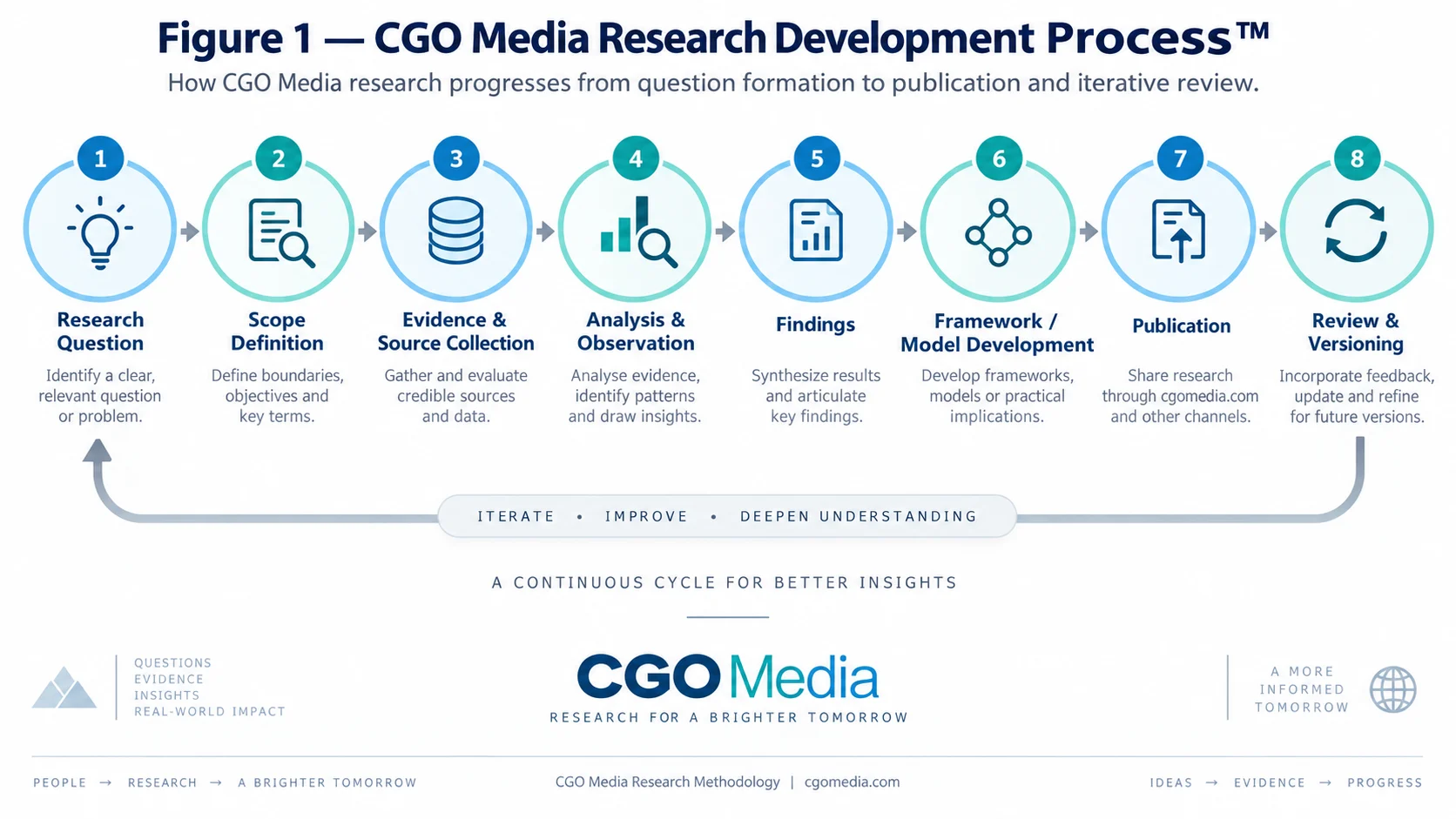
The CGO Media research process is designed as a continuous cycle rather than a fixed publishing sequence. A research question may begin with an observed change in search behaviour, technology or information discovery and develop through evidence collection, analysis, comparison and conceptual modelling.
Where the evidence supports a repeatable structure, findings may subsequently contribute to a framework, selection model, maturity model or implementation roadmap. Published working papers may then be revised as additional observations, evidence or technological developments become available.
The process therefore separates the initial research question from the later interpretation and application of findings.
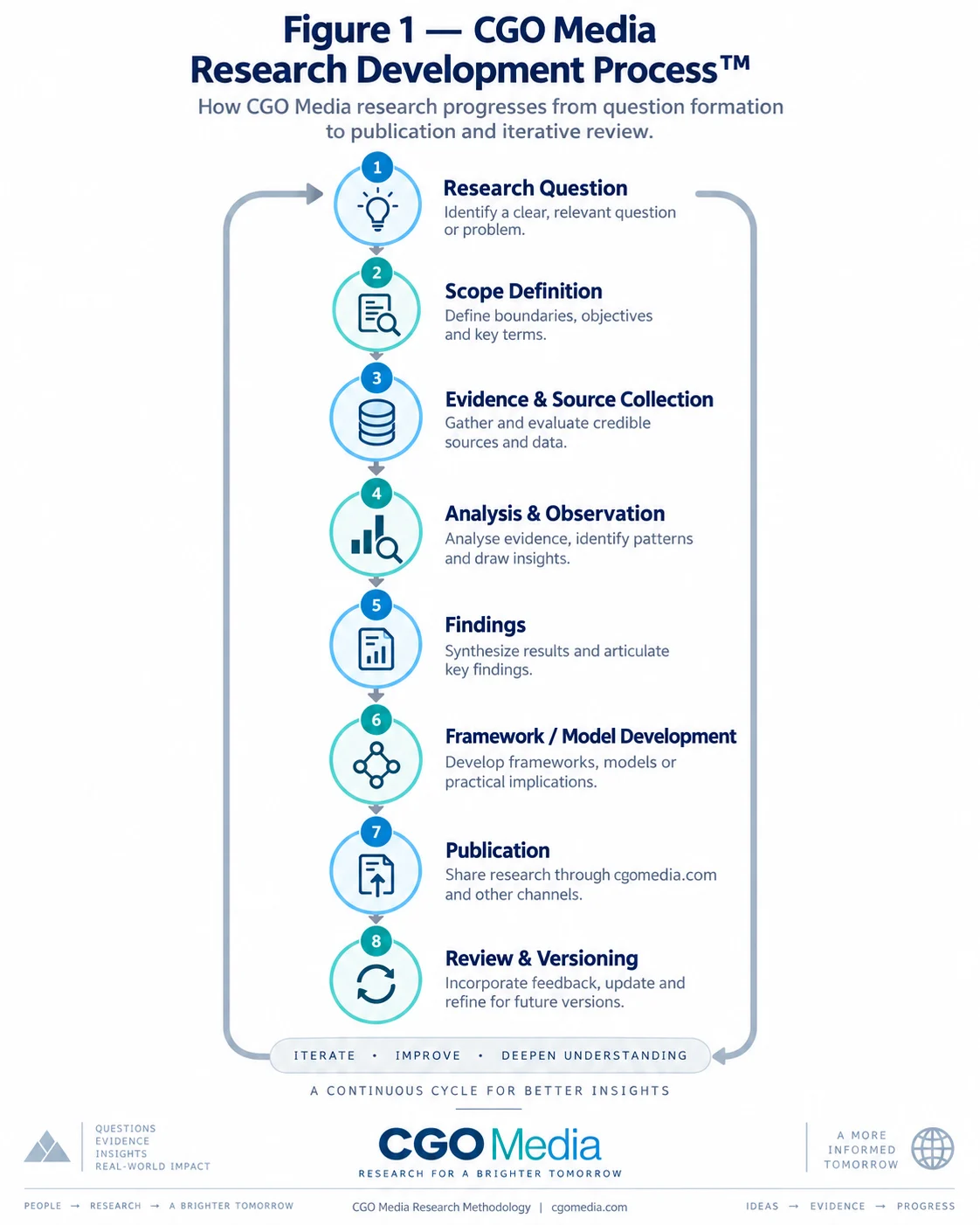
Figure 1 — CGO Media Research Development Process™
The CGO Media Research Development Process™ illustrates the principal stages through which a research topic progresses from an initial question to evidence assessment, analysis, publication and subsequent methodological development.

Evidence & Source Selection
Evidence selection is a central part of the CGO Media research process. Research into search engines, artificial intelligence and generative information systems often involves technologies that develop rapidly and for which complete technical documentation may not be publicly available.
For this reason, CGO Media distinguishes between documented evidence, externally published research, direct observation, platform documentation, experimental findings, industry reporting and interpretation.
Sources are assessed according to their relevance to the research question, proximity to the underlying technology or phenomenon, methodological transparency, independence, recency and ability to support the specific claim being made.
Where possible, greater evidential weight is given to primary and authoritative sources. These may include:
- Research papers and academic publications.
- Official documentation published by search engines, AI companies and technology providers.
- Technical documentation and developer resources.
- Patents, standards and publicly available technical specifications.
- Government, regulatory and institutional publications.
- Original datasets and structured empirical studies.
- Directly observable search or generative-system behaviour.
- Established research organisations and recognised industry datasets.
Secondary sources may also be used where they provide relevant context, document industry developments or identify issues that warrant further investigation. These sources can include specialist publications, professional analysis, technical commentary and reputable journalism.
The presence of a published source does not automatically mean that its conclusions are treated as established fact. CGO Media considers the methodology, evidence and context behind individual claims rather than relying solely on the reputation or visibility of the publisher.
Evidence Hierarchy
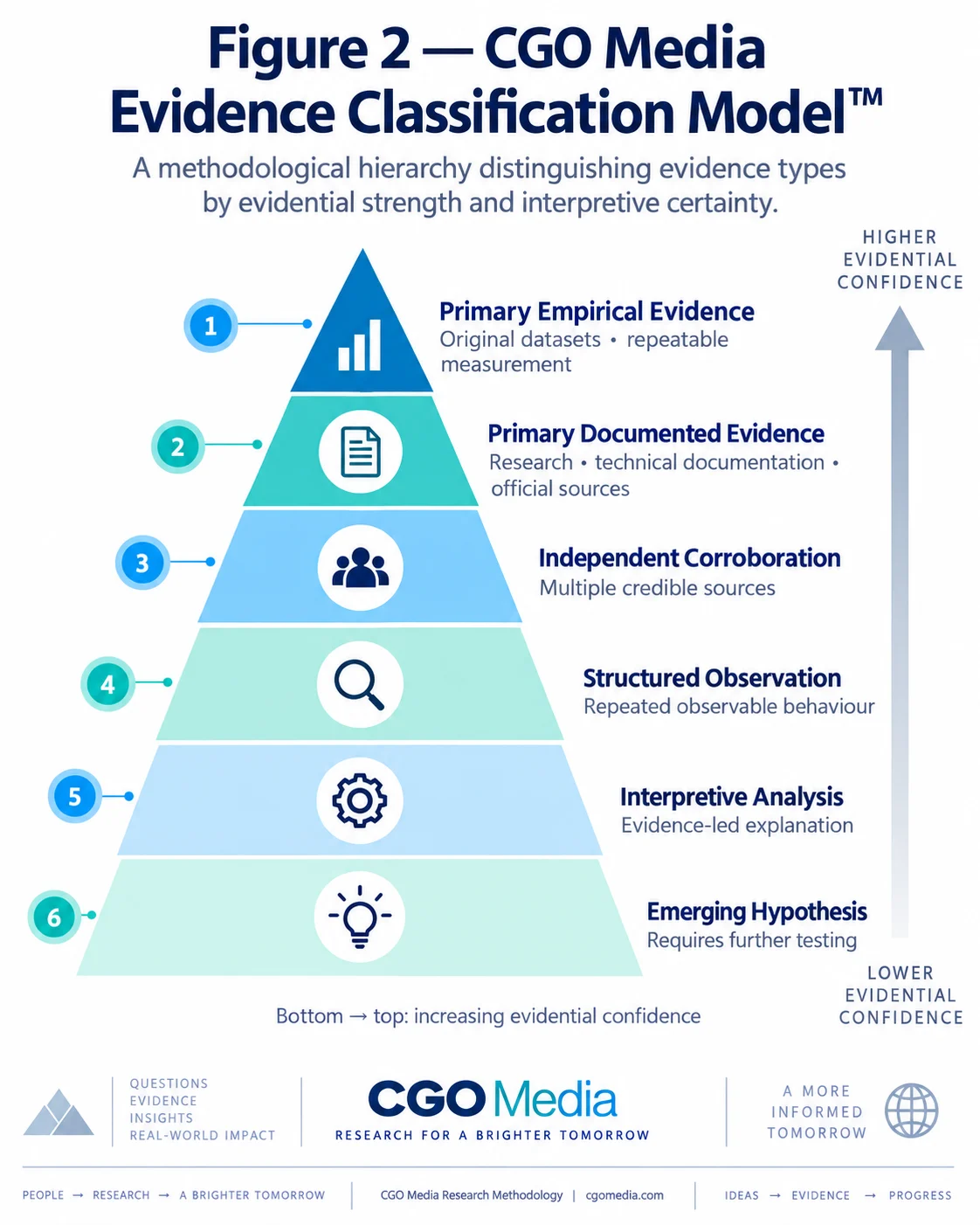
Different forms of evidence provide different levels of support for research conclusions. A technical statement documented directly by a platform, for example, may carry a different evidential status from a behavioural pattern repeatedly observed during generative-search testing.
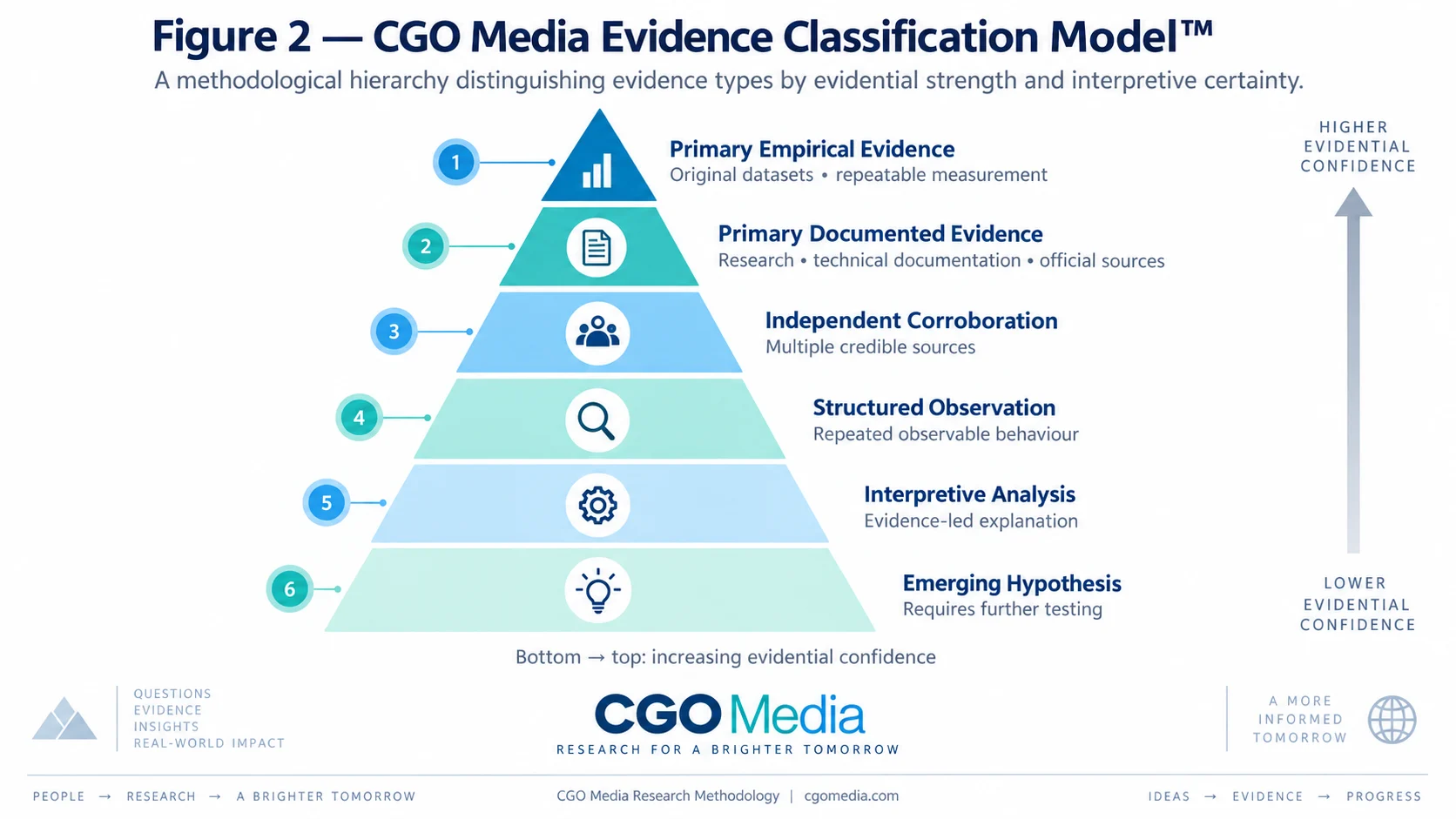
CGO Media therefore applies an informal evidence hierarchy when interpreting research findings.
At the strongest end of this hierarchy are findings that can be supported by reproducible data, primary documentation or multiple independent sources. At the emerging end are observations that appear repeatedly but cannot yet be conclusively attributed to a documented technical mechanism.
A simplified evidence hierarchy used within the research programme includes:
- Primary empirical evidence: original datasets, measurements or repeatable testing produced through a defined methodology.
- Primary documentary evidence: official technical documentation, research papers, patents, regulatory material or direct statements concerning a system or process.
- Independent corroborating evidence: findings supported by multiple credible and independent sources.
- Structured observation: behaviours repeatedly observed through search, AI or information-discovery environments using documented procedures.
- Comparative evidence: recurring patterns identified by comparing organisations, queries, sectors, platforms or information sources.
- Interpretive analysis: reasoned explanations developed from available evidence where the underlying system cannot be directly inspected.
- Emerging hypothesis: a potential explanation or relationship that requires additional testing or evidence.
This hierarchy is not intended to imply that every research question can be reduced to a single evidence category. Many investigations combine several forms of evidence.
The purpose is instead to avoid presenting an emerging observation with the same certainty as a directly measured or independently documented finding.
Source Evaluation
Individual sources are assessed in relation to the claim they are being used to support.
Factors considered during source evaluation can include:
- Primary versus secondary status: whether the source directly produced the underlying information or is reporting information produced elsewhere.
- Methodological transparency: whether the data collection or analytical process is explained sufficiently to evaluate the finding.
- Independence: whether the source has commercial, institutional or other interests that may influence interpretation.
- Recency: whether the evidence remains relevant to rapidly changing search or AI systems.
- Reproducibility: whether an observation or result can reasonably be repeated or independently tested.
- Specificity: whether the source directly supports the claim rather than merely discussing a related topic.
- Corroboration: whether comparable findings have been identified elsewhere.
- Scope: whether the evidence applies broadly or only to a particular platform, query type, geographic market, sector or period.
No single source-evaluation factor is treated as universally decisive. An official platform statement may provide authoritative evidence about documented functionality while offering limited insight into how that functionality behaves across every search environment. Conversely, repeated external observation may reveal consistent behaviour without establishing the precise internal mechanism responsible for it.
CGO Media therefore seeks to separate what can be directly supported from what can reasonably be inferred.
Triangulation of Evidence
Where the internal operation of a search or generative system is not publicly visible, CGO Media may use evidence triangulation.
Triangulation involves examining the same research question through several independent forms of evidence rather than relying on a single observation or source.
For example, an investigation into AI citation selection might combine published research on information retrieval, official platform documentation, repeated citation observations, comparisons between cited and non-cited sources and evidence from related studies.
If several forms of evidence point towards a similar pattern, confidence in the observation may increase. However, correlation between observable factors is not automatically presented as proof of the internal ranking, retrieval or recommendation mechanism used by a proprietary AI system.
This distinction is particularly important because many contemporary search and generative technologies operate as complex proprietary systems whose complete retrieval, ranking and answer-construction processes are not publicly disclosed.
Research Into Proprietary AI and Search Systems
Research involving commercial search engines, large language models and generative AI systems presents a particular methodological challenge because external researchers generally do not have access to the complete internal architecture, model weights, training data, retrieval pipelines or ranking systems of proprietary platforms.
CGO Media does not treat observable output as direct evidence of an undisclosed internal algorithm unless supporting documentation exists.
Instead, research may examine externally observable relationships such as:
- Which sources appear in responses.
- Which organisations are mentioned or recommended.
- Which sources receive citations.
- How answers change across related queries.
- Whether recurring source characteristics can be identified.
- How information differs across platforms or repeated observations.
- Whether particular forms of evidence appear consistently alongside visibility or citation outcomes.
These observations can provide useful evidence about system behaviour while remaining distinct from claims about precisely how the underlying algorithm operates.
Observational Research
A significant part of the CGO Media Research Programme involves observational research.
Observational research examines behaviours, relationships or patterns that can be observed without claiming direct control over the systems producing those outcomes.
This approach is particularly relevant to AI search because search engines and generative systems can change frequently, personalise or vary responses, operate through proprietary infrastructure and incorporate mechanisms that external researchers cannot directly inspect.
Observations may include patterns involving citations, sources, brand mentions, recommendations, entity recognition, domain visibility, evidence signals and differences between traditional and generative search environments.
Where appropriate, observations are repeated across multiple queries, organisations, sectors, systems or time periods to determine whether the pattern persists.
Research Observations Are Not Automatically Statistics
CGO Media makes an explicit distinction between a research observation and a statistical finding.
An observation documents a pattern, behaviour or relationship identified during research. It may be important and repeatable without representing a statistically generalisable finding.
A statistic, by contrast, should be supported by a defined dataset, measurable variables and a sufficiently transparent methodology explaining how the number was produced.
For example, repeatedly observing that independently referenced organisations appear frequently within a set of AI recommendations may provide the basis for a research observation. It would not, by itself, justify a claim that a particular percentage of all AI recommendations globally are determined by independent authority.
This distinction is particularly important within AI-search research because apparently precise percentages can imply a level of methodological certainty that the available evidence may not support.
For this reason, the CGO Media research ecosystem separates its Research Observations Library from its Statistics Library.
The Research Observations Library records recurring behaviours, emerging patterns and analytical findings that may contribute to future research. The Statistics Library is intended for quantitative findings where a clearly defined dataset and measurement methodology exist.
Observation, Association and Causation
CGO Media also distinguishes between observation, association and causation.
If two characteristics frequently appear together, this may demonstrate an association worthy of further investigation. It does not necessarily demonstrate that one characteristic caused the other.
For example, highly cited organisations may also possess strong brand recognition, extensive third-party coverage, structured entity information and authoritative websites. Observing these characteristics together does not automatically establish which individual factor caused a particular AI system to select that organisation.
Research therefore attempts to describe observed relationships at the level supported by the available evidence.
Where causal mechanisms cannot be established, findings should be expressed as associations, patterns, potential contributing factors or hypotheses rather than deterministic ranking factors.
Figure 2 — CGO Media Evidence Classification Model™
The CGO Media Evidence Classification Model™ illustrates how different forms of evidence are separated according to their methodological status, from empirical measurement and documented evidence through structured observation, interpretation and emerging hypotheses.
The model is intended to help prevent observational findings from being represented with greater certainty than the underlying evidence supports.

Framework Development
CGO Media frameworks are developed to organise recurring research findings into structures that can be examined, compared and applied consistently.
A framework is not created simply because a topic is commercially important or because a new term has emerged within the search industry. Framework development normally begins when research identifies several related factors or mechanisms that appear repeatedly across observations, evidence sources, organisations, sectors or search environments.
The purpose of framework development is to convert a collection of individual findings into a structured representation of how those findings may relate to one another.
For example, research into AI visibility may identify recurring relationships involving technical accessibility, entity recognition, topical relevance, independent authority, evidence quality and external validation. Rather than treating each factor as an isolated observation, a framework may be developed to examine how these components interact as part of a broader system.
Frameworks are therefore analytical tools. They help organise research findings and provide a common structure through which related organisations, sectors, systems or processes can be examined.
They should not automatically be interpreted as descriptions of the internal algorithms used by search engines or generative AI platforms.
From Evidence to Conceptual Structure
The development of a CGO Media framework generally begins with the identification of recurring research themes.
These themes may emerge from primary research, structured observations, published literature, technical documentation, comparative analysis or previous studies within the wider CGO Media research programme.
Potential components are then examined to determine whether they represent genuinely distinct concepts or whether several observations describe different aspects of the same underlying mechanism.
This stage is important because overly complex frameworks can create artificial distinctions between closely related factors, while excessively simplified frameworks can obscure meaningful differences.
Framework development therefore involves a process of consolidation and separation.
Related findings may be consolidated into broader dimensions, while findings representing materially different mechanisms may remain separate.
The resulting structure is intended to be sufficiently detailed to describe the research problem while remaining clear enough to support comparison and practical application.
Core Framework Development Process
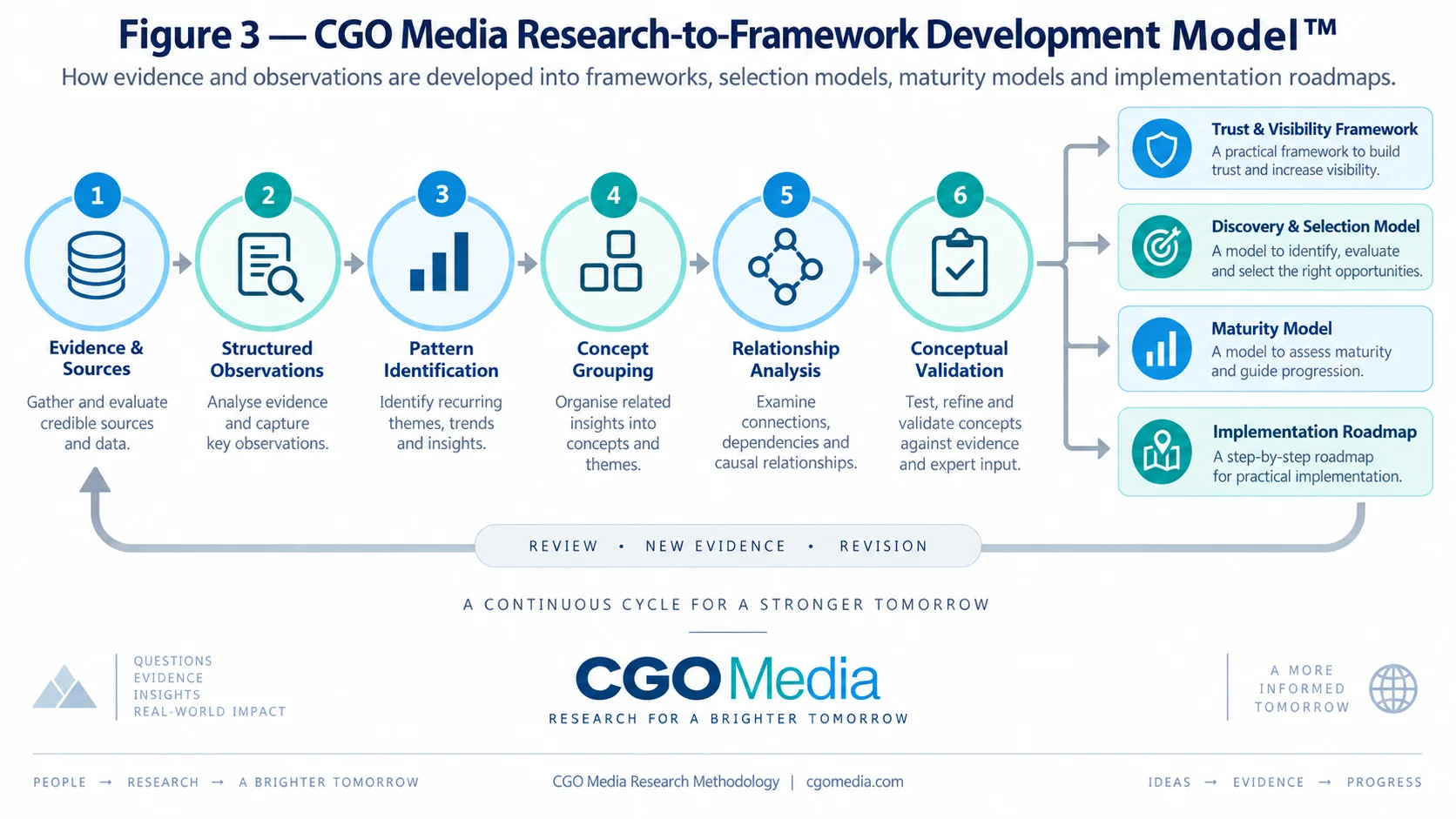
Although individual studies may require different methods, the development of a CGO Media research framework will typically involve several stages.
- Evidence identification: relevant findings, observations, external research and documented mechanisms are collected.
- Pattern recognition: recurring relationships or themes are identified across the available evidence.
- Concept grouping: related findings are grouped into broader concepts or dimensions.
- Boundary definition: the scope of each dimension is defined to reduce unnecessary conceptual overlap.
- Relationship analysis: potential relationships between dimensions are examined.
- Comparative testing: the proposed structure may be considered across different organisations, queries, sectors or use cases.
- Framework construction: the concepts are organised into a coherent analytical structure.
- Practical interpretation: the framework is examined for its potential usefulness in research, measurement or implementation.
- Review and revision: the structure may be modified as additional evidence becomes available.
Not every framework progresses through these stages in exactly the same sequence. Research frequently develops iteratively, with new evidence causing earlier assumptions or category boundaries to be reconsidered.
Frameworks Are Analytical Models, Not Algorithm Blueprints
CGO Media frameworks should not be interpreted as reverse-engineered representations of proprietary search or artificial-intelligence algorithms.
A framework may describe factors that appear relevant to discoverability, authority, citation, trust or recommendation without claiming that an AI system explicitly calculates those factors in the same form.
For example, a CGO Media framework may identify independent authority as an important analytical dimension because organisations frequently associated with strong third-party evidence also appear prominently within certain discovery environments.
This does not mean that a specific AI platform necessarily contains an internal variable labelled “independent authority” or assigns it a predetermined numerical weighting.
The framework instead provides a structured way of examining observable evidence and potential relationships.
This distinction allows research models to remain useful without making unsupported claims about proprietary systems whose internal operation is not publicly available.
Framework Families
CGO Media research frequently develops as a family of related analytical models rather than as a single standalone framework.
This reflects the fact that different research questions require different conceptual tools.
A framework describing the factors associated with visibility, for example, answers a different question from a model explaining how a provider may be discovered and selected. Similarly, a maturity model evaluates organisational development over time, while an implementation roadmap considers how identified principles may be translated into operational activity.
CGO Media therefore commonly separates research into several related model types.
Trust and Visibility Frameworks
Trust and Visibility Frameworks organise the principal dimensions that may contribute to an organisation’s ability to be discovered, understood, trusted, cited or recommended within search and AI-mediated information environments.
These frameworks typically examine areas such as:
- Technical accessibility and information availability.
- Entity recognition and organisational clarity.
- Topical relevance and subject authority.
- First-party information quality.
- Independent evidence and external authority.
- Trust, credibility and validation signals.
- Search visibility and generative-search presence.
The precise dimensions vary by sector because different industries may require different forms of evidence.
Healthcare research, for example, may place greater emphasis on professional authority, clinical evidence and institutional trust, while ecommerce research may place greater emphasis on product data, retailer credibility, reviews, availability and transactional evidence.
Discovery and Provider Selection Models
Discovery and Provider Selection Models examine the process through which a search or AI-mediated system may move from understanding a user requirement to identifying, comparing and potentially recommending relevant organisations or providers.
These models are intended to examine a different research problem from general visibility.
An organisation may be technically discoverable without ultimately being considered suitable for a specific recommendation.
Provider-selection research may therefore examine several stages, including:
- Interpretation of the user’s requirement or intent.
- Identification of potential providers or information sources.
- Assessment of relevance and eligibility.
- Evaluation of evidence and trust.
- Comparison between possible alternatives.
- Matching of provider characteristics to the specific requirement.
- Selection, citation or recommendation.
These models do not claim that every AI platform follows an identical linear process. They provide an analytical structure for examining the observable stages involved in discovery and recommendation.
Search Authority Maturity Models
Search Authority Maturity Models examine organisational capability rather than the operation of a search system.
They are designed to describe how an organisation’s search and AI visibility capabilities may develop over time.
A maturity model may distinguish between organisations with limited or fragmented digital evidence and organisations that have developed coordinated systems for technical search accessibility, entity management, authoritative content, external validation, measurement and continuous improvement.
The purpose of a maturity model is not to assign universal rankings to organisations.
Instead, it provides a structured method for identifying capability gaps, comparing current practices with a more developed state and establishing potential priorities for further improvement.
Implementation Roadmaps
Implementation Roadmaps translate research findings and conceptual frameworks into a sequence of operational considerations.
They address the question of how an organisation might begin applying the findings identified within the associated research.
Implementation roadmaps may include areas such as technical foundations, entity clarification, information architecture, content development, evidence building, digital PR, authority development, measurement and ongoing review.
These roadmaps represent practical interpretations of the research rather than evidence that a particular sequence guarantees visibility or recommendation within any search or generative platform.
The appropriate implementation sequence may differ according to an organisation’s existing capabilities, sector, resources, geographic markets, competitive environment and research objectives.
Sector-Specific Adaptation
CGO Media does not assume that a framework developed for one industry can be transferred unchanged to every other sector.
Different sectors contain different forms of risk, regulation, evidence, professional authority, transactional behaviour and user expectation.
Sector-specific frameworks are therefore adapted according to the environment being investigated.
Examples of potentially significant differences include:
- Clinical and professional evidence within healthcare.
- Regulatory and financial credibility within financial services.
- Professional qualifications and jurisdiction within legal services.
- Property data, location and transactional evidence within real estate.
- Product information, reviews and merchant credibility within ecommerce.
- Technical expertise and product capability within technology and SaaS.
- Institutional legitimacy within international organisations.
- Supplier capability and operational evidence within manufacturing.
The underlying research architecture may remain comparable across sectors, but individual dimensions, evidence thresholds and practical implications may change.
Conceptual Validation
Where possible, proposed frameworks are reviewed against additional examples before publication.
This may involve examining whether the same conceptual structure remains meaningful across different organisations, search queries, platforms, sectors or information environments.
The objective is not necessarily to prove that a framework represents a universal law.
Instead, conceptual validation asks whether the framework continues to provide a coherent explanation of the research problem when applied beyond the observations from which it was initially developed.
If a proposed dimension repeatedly overlaps with another dimension, fails to explain meaningful differences or cannot be clearly defined, the structure may be revised.
Likewise, additional dimensions may be introduced when new evidence identifies a material factor that the original structure did not adequately represent.
Frameworks as Working Research Assets
CGO Media frameworks should be understood as working research assets rather than permanently fixed classifications.
Search technologies, AI systems, retrieval architectures, user interfaces and digital evidence environments continue to evolve.
A framework that adequately describes an observed environment at one point in time may require modification as new technologies or evidence emerge.
CGO Media may therefore revise framework terminology, dimensions, relationships or implementation guidance where subsequent research provides a stronger explanation.
When substantial revisions occur, publication dates, update information or versioning may be used to distinguish the revised work from earlier forms.
This iterative approach is particularly important in generative-search research because the technologies being studied can change significantly over relatively short periods.
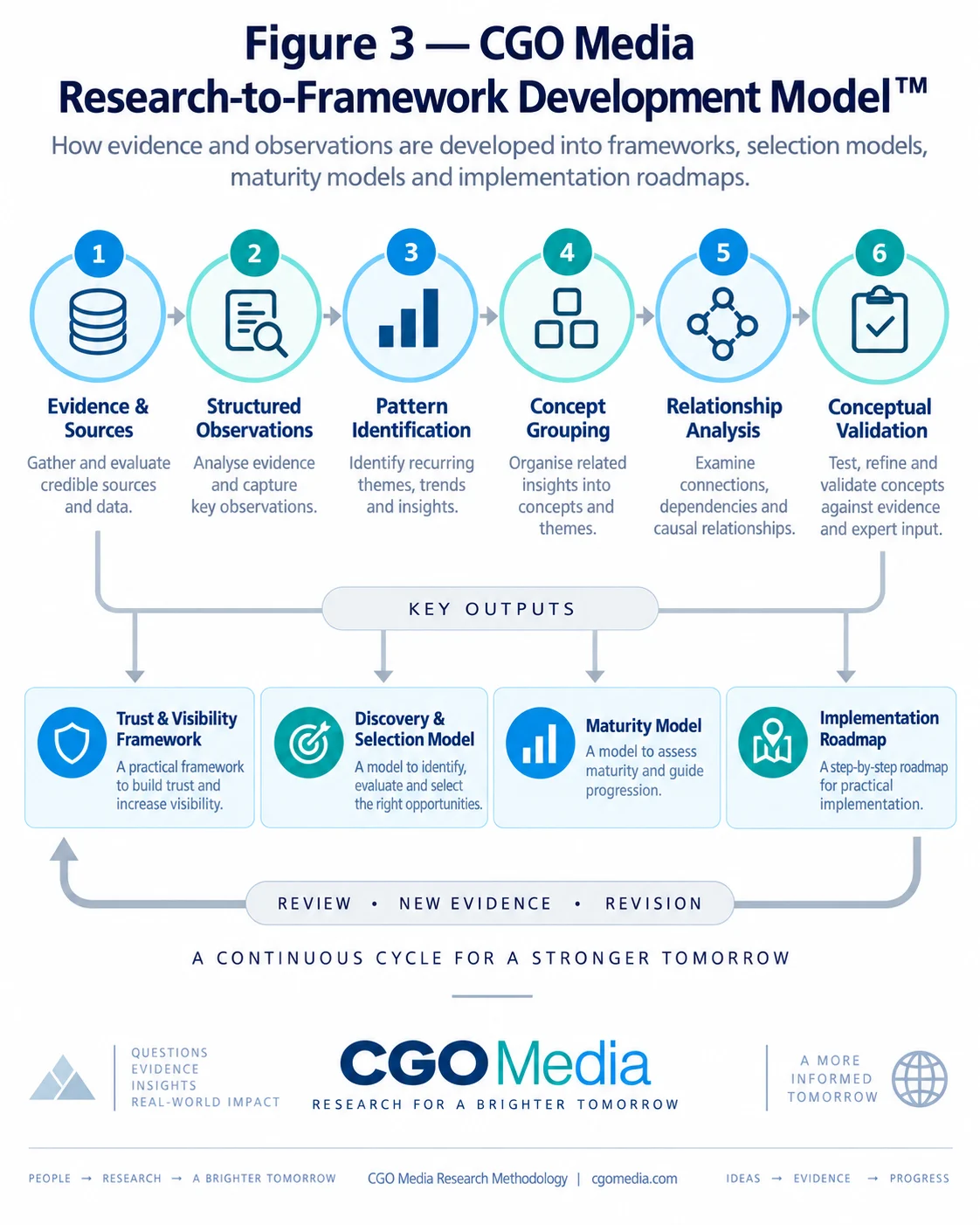
Figure 3 — CGO Media Research-to-Framework Development Model™
The CGO Media Research-to-Framework Development Model™ illustrates how individual evidence sources and research observations are consolidated into recurring themes, conceptual dimensions and ultimately structured research assets.
The model also shows how different outputs can emerge from a shared research foundation, including Trust and Visibility Frameworks, Discovery and Provider Selection Models, Search Authority Maturity Models and Implementation Roadmaps.

Data Collection & Analysis
CGO Media research may use primary data where the research question can be investigated through structured collection, measurement or comparison.
Primary data is distinguished from general observation by the existence of a defined collection process. This normally requires the research to specify what is being measured, which units are included, how observations are recorded and the period during which the data was collected.
Not every CGO Media research paper contains a primary dataset. Some publications are conceptual, observational or analytical and draw primarily on external research, documented evidence and structured observation.
Where original datasets are used, the research should identify the relevant methodology sufficiently clearly for readers to understand how the findings were produced.
The objective is to avoid presenting numerical precision where the underlying collection process does not justify it.
What CGO Media Treats as a Dataset
A dataset is treated as more than a collection of examples.
For research purposes, CGO Media generally considers a body of information to constitute a dataset where observations have been collected according to predefined criteria and recorded in a structured format that allows comparison or measurement.
A dataset may contain information such as:
- Search queries.
- AI prompts or question formulations.
- Search-engine results.
- Generative responses.
- Source citations.
- Domain appearances.
- Organisation mentions.
- Recommendation outcomes.
- Entity references.
- Content characteristics.
- Source types.
- Geographic variables.
- Sector classifications.
- Observation dates.
- Platform or model information.
The precise fields depend on the research question.
A smaller structured dataset can be methodologically stronger than a much larger collection assembled without consistent inclusion criteria.
Defining the Unit of Analysis
Before quantitative analysis begins, the unit of analysis should be defined.
The unit of analysis describes what an individual observation represents within the dataset.
Depending on the research project, an observation might represent:
- A single search query.
- A single generative response.
- A citation appearing within one response.
- An individual domain.
- An organisation.
- A product or provider.
- A search-result position.
- A recommendation event.
- A repeated observation of the same query at a different time.
This distinction is important because percentages can change significantly depending on what is counted.
For example, the percentage of responses containing citations is different from the percentage of individual citations attributed to a particular source type.
Research therefore aims to specify the denominator underlying quantitative findings wherever this is necessary for correct interpretation.
Sample Definition
Where research is based on a sample, CGO Media defines the population being examined as precisely as practical.
A sample might consist of a defined set of organisations, domains, search queries, AI responses, sectors, geographic markets or platforms.
Sample construction may be influenced by the specific research objective.
For example, a study examining financial-services AI recommendations may intentionally sample financial providers rather than attempting to represent the entire internet.
Likewise, research into UK search behaviour should not automatically be assumed to describe search behaviour in every geographic market.
Research should therefore avoid extending conclusions beyond the population that was actually examined.
Sampling Strategies
Different research questions may require different sampling approaches.
Sampling approaches used or considered within CGO Media research may include:
- Defined-population sampling: examining all organisations or entities within a predefined research population where the population is sufficiently bounded.
- Purposive sampling: selecting organisations, queries or examples because they are specifically relevant to the research question.
- Category sampling: constructing samples across predefined sectors, organisation types or query categories.
- Repeated-query sampling: running the same or comparable queries across multiple observations or time periods.
- Platform comparison: applying comparable prompts or research questions across more than one search or generative platform.
- Temporal sampling: collecting observations at defined points in time to identify whether outcomes change.
These approaches do not necessarily produce statistically representative samples of all search or AI behaviour.
Where probabilistic sampling is not used, CGO Media should not describe the resulting findings as representative of a wider population without additional evidence.
Query and Prompt Construction
Research involving search engines or generative AI systems frequently depends on the construction of queries or prompts.
Query design can materially influence the responses produced by a system and is therefore part of the research methodology rather than an incidental detail.
Depending on the study, queries may be developed around:
- Informational search intent.
- Provider discovery.
- Product discovery.
- Professional selection.
- Comparative evaluation.
- Local or geographic intent.
- Recommendation intent.
- Problem-solving intent.
- Transactional intent.
Where a study compares organisations or sectors, equivalent query structures should be used where possible to reduce unnecessary variation.
Prompt wording should also be considered carefully when studying generative systems because small changes in language can produce different outputs.
Where prompt variation is itself part of the research question, those variations may be recorded and analysed separately.
Recording Search and AI Outputs
Search and generative outputs can change over time. For this reason, observations should be associated with the context in which they were collected.
Relevant contextual information may include:
- Date of observation.
- Platform or system used.
- Model or interface where identifiable.
- Query or prompt wording.
- Geographic market where relevant.
- Language.
- Device or interface where this materially affects results.
- Whether the observation represents a repeated test.
The availability of platform metadata varies considerably, and not every system exposes the same level of technical detail.
Where model versions or system configurations cannot be independently verified, CGO Media avoids implying a level of technical specificity that was not observable during the research.
Temporal Variability
Search engines and generative AI systems are dynamic environments.
Results can change because of index updates, model changes, retrieval processes, system experimentation, newly published information, changes in source availability or other factors outside the researcher’s control.
A result observed on one date should therefore not automatically be interpreted as a permanent characteristic of a platform.
Where temporal stability is relevant, repeated observations may be used to determine whether a pattern persists.
Research may distinguish between:
- A one-time observation.
- A repeated observation.
- A recurring pattern across multiple dates.
- A persistent pattern across multiple systems or datasets.
The strength of the resulting claim should reflect the extent of the evidence available.
Repeated Testing
Generative systems may return different answers to identical or near-identical prompts.
Repeated testing can therefore be useful where the research question concerns citation frequency, recommendation consistency, source visibility or answer variation.
Repeating observations does not eliminate system variability, but it can help distinguish isolated outcomes from recurring behaviour.
Where repeated tests are used, findings may be analysed in terms of frequency rather than assuming that any individual answer represents the system as a whole.
For example, a provider appearing in one response from a set of repeated tests should be interpreted differently from a provider appearing consistently across most observations.
Data Cleaning
Where primary datasets are created, data may require cleaning before analysis.
Data cleaning can involve:
- Removing duplicate observations.
- Standardising organisation or domain names.
- Normalising URL formats.
- Resolving obvious classification inconsistencies.
- Separating missing values from genuine zero values.
- Checking malformed records.
- Verifying that observations fall within the defined collection period.
- Reviewing obvious recording errors.
Cleaning procedures should not be used to remove valid observations simply because they do not support the anticipated research outcome.
Unexpected findings may be particularly important when evaluating an emerging research hypothesis.
Classification and Coding
Some studies require observations to be placed into categories before analysis.
For example, cited sources might be classified as:
- Official organisational websites.
- Government or regulatory sources.
- Academic or research sources.
- News publications.
- Industry publications.
- Directories.
- Review platforms.
- Social platforms.
- Commercial comparison services.
- Other third-party sources.
Classification systems should be defined consistently enough that similar observations are treated in comparable ways.
Where category boundaries are subjective, the research should acknowledge that classification introduces an interpretive element.
Quantitative Analysis
Where numerical datasets exist, CGO Media may use descriptive quantitative analysis to summarise observed patterns.
This can include measurements such as:
- Counts.
- Percentages.
- Frequencies.
- Proportions.
- Average values.
- Distribution across categories.
- Cross-sector comparisons.
- Platform comparisons.
- Change over time.
The analytical method should remain proportionate to the dataset.
A relatively small exploratory sample should not be presented with the same statistical certainty as a large representative study.
Where advanced statistical testing is not justified by the sample design, descriptive analysis may provide a more appropriate representation of the evidence.
Percentages and Denominators
Percentages can create an impression of methodological precision and therefore require particular care.
Where quantitative percentages are reported, the underlying denominator should be identifiable from the research methodology or accompanying dataset.
For example:
- “42% of analysed responses” identifies responses as the denominator.
- “42% of citations” identifies individual citations as the denominator.
- “42% of organisations” identifies organisations as the denominator.
These statements may describe very different phenomena even when the numerical percentage is identical.
CGO Media therefore aims to avoid isolated percentages whose measurement basis cannot be understood by the reader.
Qualitative and Comparative Analysis
Not every important research finding can be reduced to a numerical variable.
Qualitative analysis may be used where the research question concerns differences in answer construction, source characteristics, evidence quality, provider descriptions, citation context or recurring conceptual patterns.
Comparative analysis may examine differences between:
- Cited and non-cited sources.
- Recommended and non-recommended providers.
- High-visibility and low-visibility organisations.
- Different AI platforms.
- Traditional search and generative search.
- Different sectors.
- Different query categories.
- Different periods of observation.
These comparisons may help identify relationships that warrant additional quantitative investigation.
Reproducibility and Replication
CGO Media aims to document research methods sufficiently clearly that the logic of a study can be understood and, where technically practical, repeated.
Complete replication may not always produce identical results when the subject of research is a dynamic search engine or generative AI platform.
A researcher repeating the same prompt several months later may encounter a different model, index, retrieval system or information environment.
Reproducibility in this context therefore refers not only to reproducing an identical output, but also to providing sufficient methodological information for another researcher to repeat the underlying collection procedure.
This may include:
- The research population.
- The query methodology.
- The observation period.
- The measurement criteria.
- The classification approach.
- The analytical definitions.
Exploratory Research
Some CGO Media studies are exploratory by design.
Exploratory research is appropriate where the technology or behaviour being investigated is relatively new and the objective is to identify possible patterns, variables or research questions for subsequent investigation.
Exploratory findings may help generate hypotheses, identify useful measurement approaches or establish whether a larger study is warranted.
Such findings should not automatically be interpreted as population-wide estimates.
The publication should therefore distinguish exploratory findings from conclusions derived from more comprehensive datasets.
Separation of Data, Finding and Interpretation
Where possible, CGO Media distinguishes between the underlying observation, the analytical finding and the interpretation applied to that finding.
For example:
- Observation: a particular domain appeared in a defined proportion of collected responses.
- Finding: that domain appeared more frequently than other domains within the same sample.
- Interpretation: characteristics associated with that domain may warrant investigation as potential contributors to visibility.
The interpretation should not be presented as proven causation unless the research design supports that conclusion.
This separation is intended to make clear where measurement ends and analytical reasoning begins.
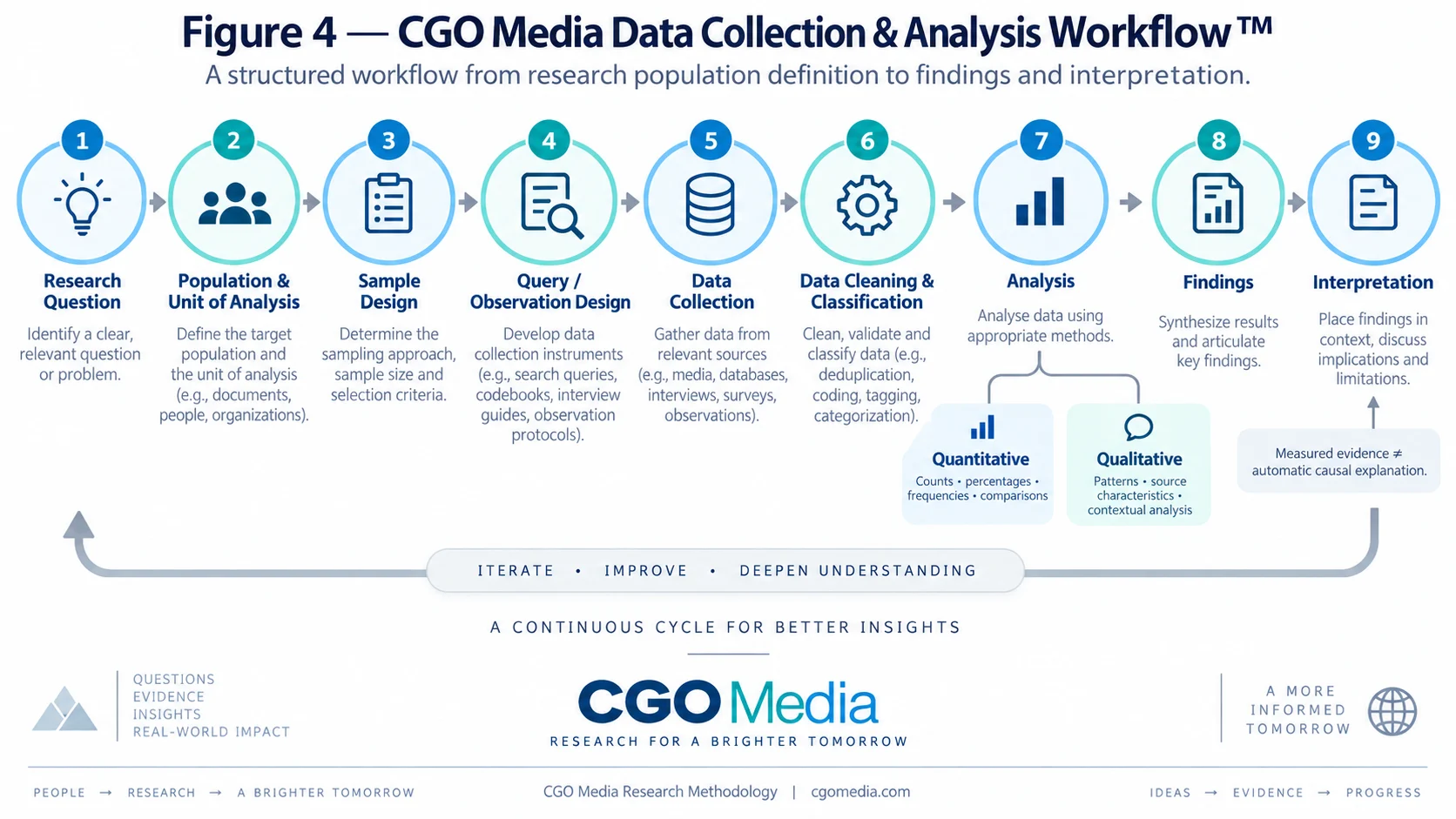
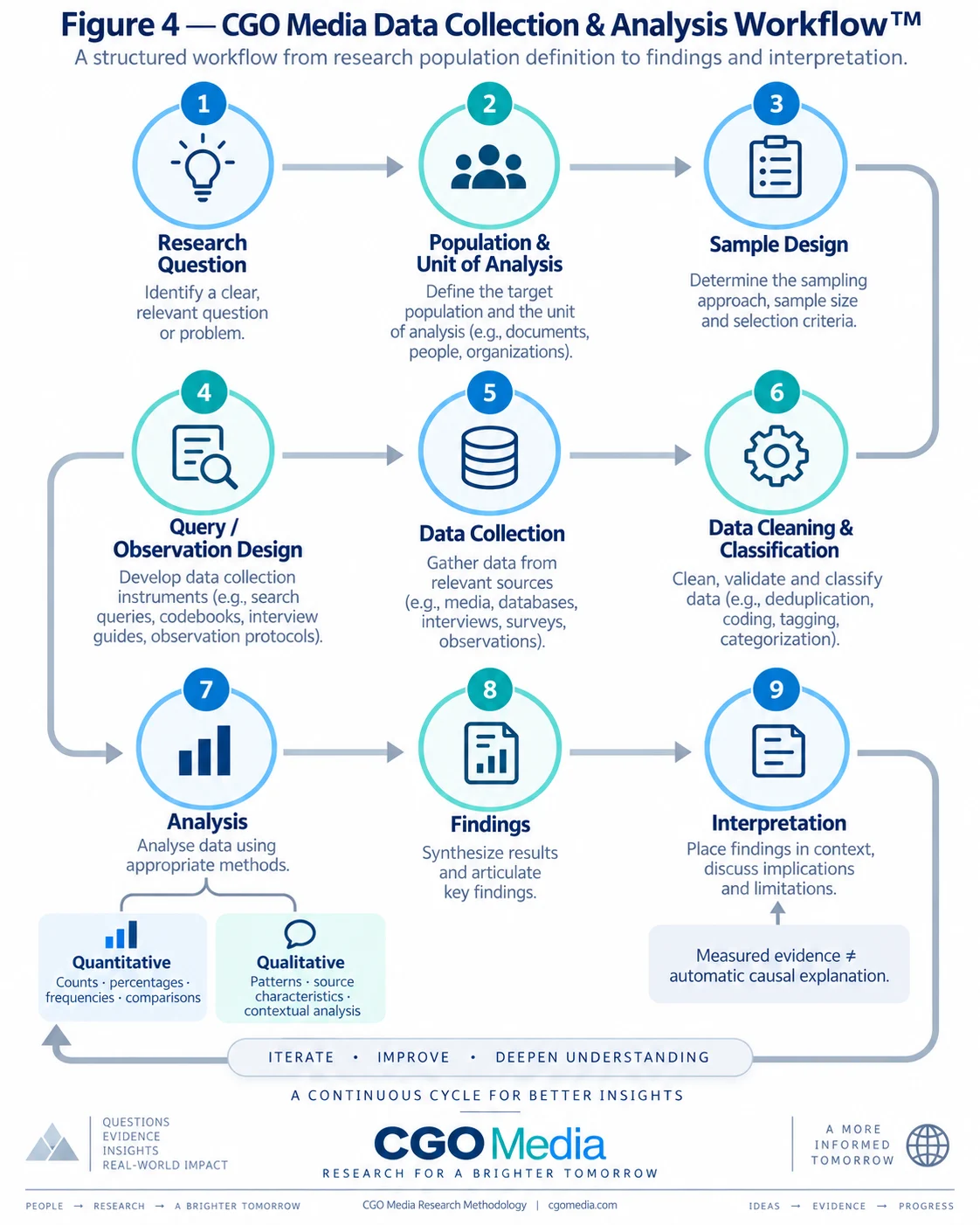
Figure 4 — CGO Media Data Collection & Analysis Workflow™
The CGO Media Data Collection & Analysis Workflow™ illustrates how a primary research project progresses from defining the research population and unit of analysis through sampling, query or observation design, structured data collection, cleaning, classification, analysis and interpretation.
The workflow emphasises the separation between collected data, analytical findings and subsequent interpretation.

Limitations & Research Uncertainty
All research has limitations, and research into search engines, large language models and generative AI systems presents several additional challenges because the technologies being studied are dynamic, proprietary and only partially observable from outside the organisations that operate them.
CGO Media therefore treats methodological limitations as part of the research itself rather than as a disclosure added only after conclusions have been reached.
The objective is to distinguish clearly between what has been measured, what has been observed, what can reasonably be inferred and what remains uncertain.
A limitation does not necessarily invalidate a finding. It defines the conditions within which that finding should be interpreted.
Proprietary System Limitations
Many of the search and generative systems examined within CGO Media research are proprietary technologies.
External researchers generally do not have complete access to:
- Model weights.
- Training datasets.
- Retrieval pipelines.
- Ranking systems.
- Internal scoring functions.
- System prompts.
- Safety and filtering mechanisms.
- Personalisation layers.
- Experimentation infrastructure.
- Complete model-routing logic.
This means that externally observable behaviour cannot automatically reveal the precise internal mechanism responsible for that behaviour.
CGO Media may identify recurring relationships between particular forms of digital evidence and particular search or AI outcomes, but those relationships should not be interpreted as direct proof of an undisclosed ranking factor unless independent documentation supports such a conclusion.
Model and Platform Volatility
Search engines and generative AI platforms can change rapidly.
A system observed during one research period may subsequently change because of:
- Model updates.
- Retrieval changes.
- Index updates.
- Ranking modifications.
- New source integrations.
- User-interface changes.
- Safety or policy changes.
- Changes in citation behaviour.
- Changes in web content or source availability.
Findings should therefore be interpreted in relation to the period during which the research was conducted.
CGO Media does not assume that an observed behaviour will remain unchanged indefinitely.
Where appropriate, important studies may be repeated or updated to determine whether previously identified patterns continue to exist.
Non-Deterministic Outputs
Generative AI systems may produce different responses to identical or highly similar prompts.
This variability may occur even when the user, query and interface appear unchanged.
As a result, a single output should not necessarily be treated as a definitive representation of how a platform responds to a particular question.
Where consistency is important to the research question, repeated observations may be required.
Even repeated testing cannot guarantee that every possible response has been captured.
Research findings therefore describe the behaviour observed within the defined research conditions rather than every response that a system could potentially produce.
Geographic Limitations
Search and generative outputs can vary by geographic market.
Differences may arise because of:
- Local search indexes.
- Regional information sources.
- Language.
- Local businesses or organisations.
- Regulatory environments.
- Platform availability.
- Regional model deployment.
- User-location signals.
A study conducted primarily within the United Kingdom, for example, should not automatically be interpreted as representative of search or AI behaviour in the United States, Spain or other markets.
Where geography forms part of the methodology, the relevant market should be identified within the research.
Language Limitations
Research conducted in one language may not generalise directly to another.
Language can affect query interpretation, available sources, entity recognition, citation behaviour and the information retrieved by search or generative systems.
The English-language information environment is also substantially larger in some research areas than information environments available in other languages.
Where research has been conducted predominantly in English, conclusions should not automatically be interpreted as language-independent.
Sample Limitations
Research findings are constrained by the population and sample used to produce them.
A sample of organisations selected from a particular industry may provide meaningful insight into that industry without representing all organisations.
Likewise, a sample of high-intent provider-selection queries may reveal different behaviours from a sample of general informational queries.
Relevant limitations may include:
- Sample size.
- Sector concentration.
- Geographic concentration.
- Query selection.
- Platform selection.
- Time period.
- Organisation size.
- Availability of public information.
The significance of each limitation depends on the research question.
Where a sample is exploratory, purposive or non-random, conclusions should not be presented as statistically representative of a wider population unless the research design supports such an inference.
Query Selection Bias
Search and AI research frequently depends on the selection of queries or prompts.
The queries chosen by a researcher influence which aspects of a system are observed.
A research design focused heavily on recommendation queries, for example, may identify provider-selection patterns that would not be visible within purely informational searches.
CGO Media therefore considers query selection part of the research design.
Where possible, queries are grouped into defined categories or constructed according to consistent criteria.
However, no practical query set can represent every possible way in which users may interact with a search or generative system.
Personalisation and Context
Some search and AI systems may alter outputs according to contextual signals.
These may include previous interactions, account status, geographic location, language, device, interface configuration or other system-level factors.
Not all personalisation mechanisms are visible to an external researcher.
This can make it difficult to determine whether two different outputs result from random system variation, different retrieval conditions, personalisation or another undocumented factor.
Where practical, research aims to minimise unnecessary contextual differences between observations.
Complete elimination of all contextual variation may not be possible.
Index and Information Availability
Search and generative systems can only work with information available to them through their relevant indexes, retrieval systems, training processes or connected data sources.
The absence of an organisation or source from a response does not necessarily demonstrate that the system evaluated that organisation and rejected it.
Alternative explanations may include:
- The information was not indexed.
- The source was inaccessible.
- The system did not retrieve it.
- The entity was not recognised correctly.
- The query did not activate the relevant information.
- The source was outside the system’s current retrieval environment.
This distinction is particularly important when interpreting non-appearance within AI-generated recommendations.
Absence of Evidence vs Evidence of Absence
CGO Media distinguishes between an absence of evidence and evidence that something is absent.
If a research project does not identify evidence that a particular factor influences an AI response, this does not automatically prove that the factor has no influence.
Likewise, if an organisation does not appear within a defined set of observed responses, this does not prove that the organisation can never appear for the same or related queries.
A stronger conclusion requires evidence specifically capable of testing the absence being claimed.
This principle helps prevent limited observations from being converted into universal conclusions.
Correlation and Causation
Observational research is particularly vulnerable to confusion between correlation and causation.
If organisations receiving frequent AI visibility also possess high levels of third-party authority, the relationship may be significant.
However, several explanations may exist.
Independent authority may contribute to visibility, both factors may arise from a separate underlying characteristic, or multiple variables may interact.
Unless the research design can isolate causal effects, CGO Media describes these relationships as associations, correlations, recurring patterns or potential contributing factors.
Conceptual frameworks may propose mechanisms worthy of investigation without representing those mechanisms as conclusively established causal relationships.
Confounding Variables
Digital visibility is rarely produced by a single factor.
An organisation may simultaneously possess:
- A strong brand.
- Extensive media coverage.
- High-quality content.
- Long-established domain authority.
- Structured entity information.
- Large numbers of third-party references.
- Strong technical search accessibility.
- Significant offline reputation.
These characteristics may interact.
When several factors are present together, observational research may not be able to determine the independent effect of each variable.
This is one reason CGO Media generally avoids describing individual observations as universal AI ranking factors.
External Evidence Limitations
Published research and third-party datasets also have limitations.
A source may be methodologically strong while addressing a different population, period, platform or research question.
External evidence is therefore assessed according to how directly it supports the claim being examined.
Common limitations may include:
- Outdated data.
- Undisclosed methodology.
- Commercial conflicts of interest.
- Small or non-representative samples.
- Different geographic markets.
- Platform-specific findings.
- Use of proxy measures.
- Unclear definitions.
Referencing an external source does not eliminate the need to evaluate whether that source is appropriate for the specific conclusion being drawn.
Measurement Limitations
Some concepts studied within search and AI research cannot be measured directly.
Concepts such as authority, trust, recommendation potential or entity clarity may require the use of observable indicators.
These indicators should not automatically be treated as identical to the underlying concept.
For example, the number of independent references to an organisation may provide evidence relevant to external authority, but reference volume alone cannot fully represent authority, credibility or trust.
CGO Media frameworks may therefore use multiple dimensions or indicators rather than relying on a single metric for complex concepts.
Researcher Interpretation
Some stages of qualitative and conceptual research require researcher judgement.
This may include classifying sources, grouping observations, identifying themes or determining whether two findings represent the same conceptual category.
CGO Media aims to make these interpretive stages transparent where they materially affect the conclusions.
Interpretation should remain distinguishable from direct measurement.
The presence of researcher judgement does not necessarily make a finding invalid, but it should be acknowledged where readers could reasonably interpret the evidence differently.
Commercial Context
CGO Media conducts research within a commercial organisation that also provides SEO, GEO, AI-search and related consulting services.
This creates a potential source of bias that should be acknowledged.
Research findings may inform CGO Media methodologies, consulting models, strategic recommendations and commercial services.
However, commercial usefulness does not by itself constitute evidence that a research proposition is correct.
Research claims should therefore be supported by their methodology, evidence and analysis rather than by their relevance to CGO Media services.
Where a commercial relationship, sponsorship or external funding materially affects a specific research project, that relationship should be disclosed.
Negative and Contradictory Findings
Research credibility depends partly on the treatment of evidence that does not support an initial hypothesis.
CGO Media does not assume that every proposed relationship will be supported by subsequent observation.
Contradictory findings may indicate that:
- The original hypothesis was incorrect.
- The proposed relationship was weaker than expected.
- An important confounding variable was overlooked.
- The relationship applies only under specific conditions.
- The underlying platform changed.
- The research design requires modification.
Where evidence meaningfully contradicts an existing framework or interpretation, the appropriate response may be to revise the model rather than disregard the evidence.
Uncertainty in Emerging Research Areas
Generative search remains an emerging research area.
Some mechanisms that are well established within traditional information retrieval may operate differently when retrieval systems, large language models, knowledge systems and generative interfaces are combined.
Early research may therefore identify important patterns before the underlying mechanisms can be conclusively established.
CGO Media uses terms such as observation, association, hypothesis, potential contributor and conceptual model where these descriptions more accurately represent the available evidence.
The purpose is not to weaken useful findings, but to communicate their evidential status accurately.
Communicating Confidence
Research conclusions should reflect the strength of the underlying evidence.
CGO Media therefore considers confidence as a continuum rather than treating every finding as either proven or unproven.
A finding supported by primary data, repeated observation and independent corroboration may justify stronger language than a pattern identified within a small exploratory sample.
A simplified interpretation may include:
- High confidence: supported by strong direct evidence, repeated findings or authoritative documentation.
- Moderate confidence: supported by multiple observations or evidence sources but with meaningful limitations.
- Emerging evidence: a recurring pattern exists but requires further investigation.
- Hypothesis: a plausible explanation proposed for future testing.
These categories are interpretive research descriptors rather than statistical confidence intervals unless a study explicitly uses formal statistical methods.
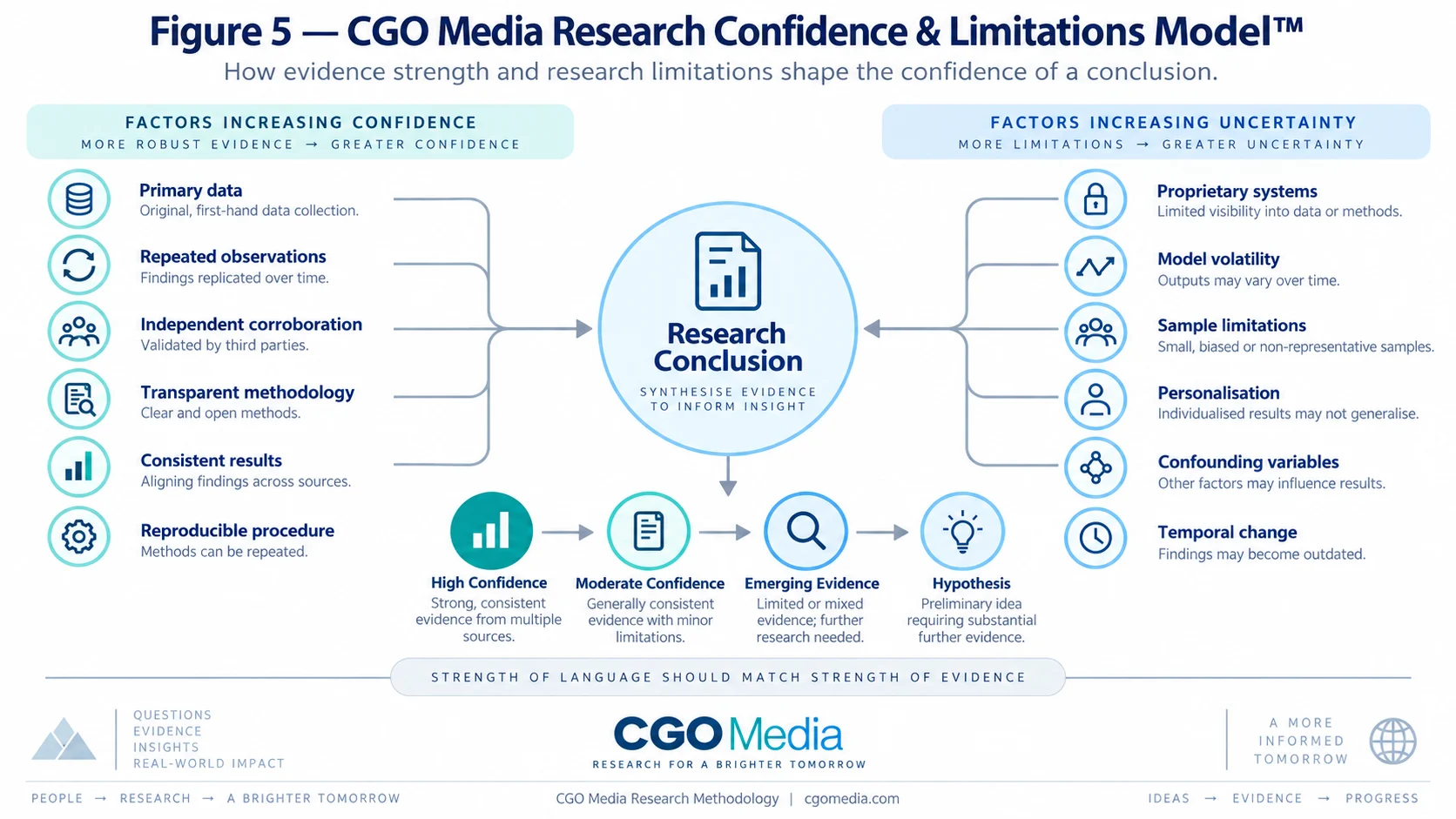
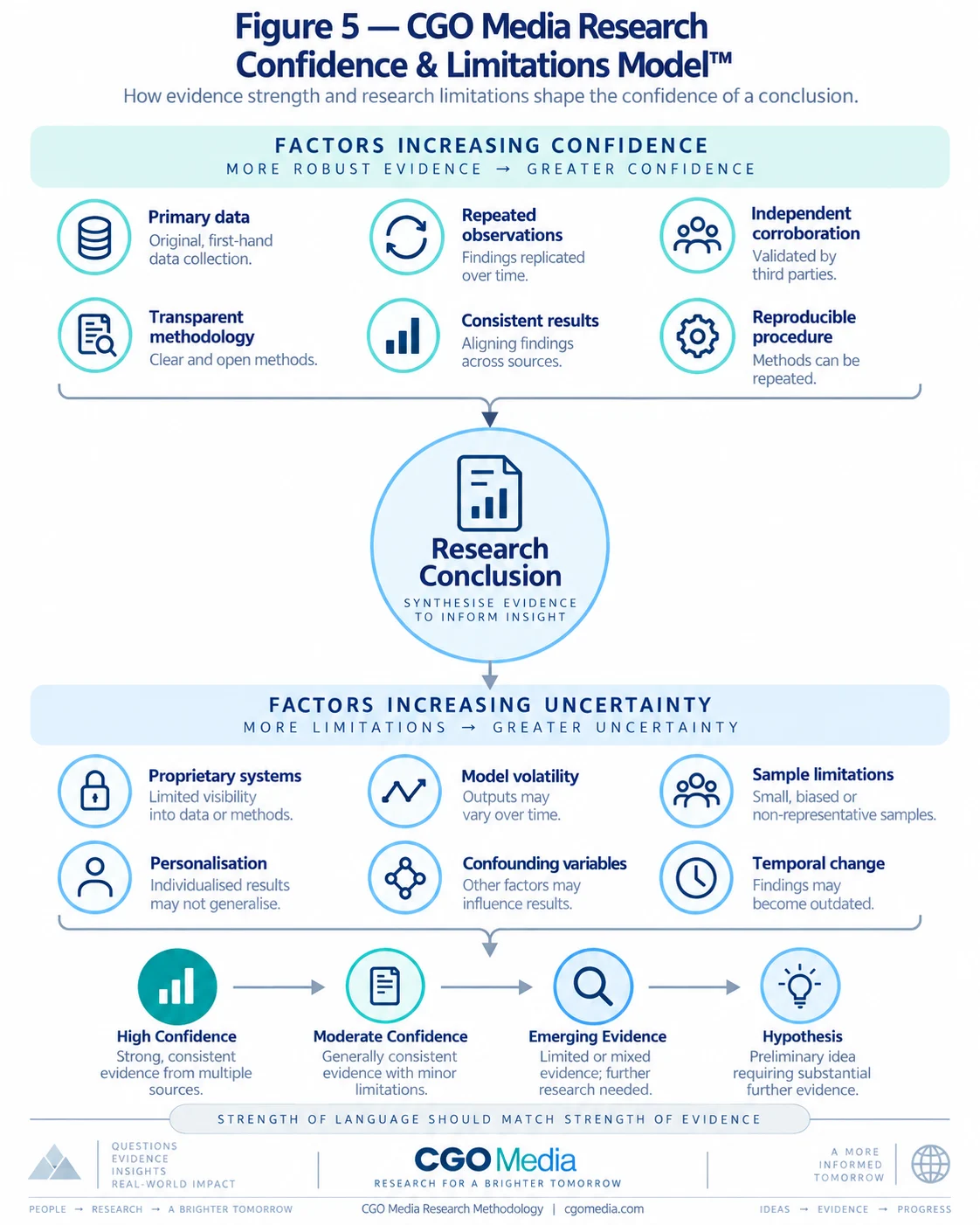
Figure 5 — CGO Media Research Confidence & Limitations Model™
The CGO Media Research Confidence & Limitations Model™ illustrates how the strength of a research conclusion depends not only on the amount of supporting evidence, but also on the limitations associated with the research environment.
The model emphasises that conclusions should become more cautious as uncertainty increases and stronger only when evidence is sufficiently robust, repeated and corroborated.

Versioning & Updates
CGO Media research is developed within a rapidly changing technological environment. Search engines, generative AI systems, retrieval architectures, citation mechanisms and information-discovery interfaces may change substantially after a paper is first published.
For this reason, many CGO Media publications should be understood as working research documents rather than permanently fixed descriptions of a technological environment.
Research may be updated when:
- New evidence materially changes an existing interpretation.
- Additional data becomes available.
- A search or generative platform changes significantly.
- An existing framework requires refinement.
- A new methodological limitation is identified.
- Terminology becomes outdated or ambiguous.
- A substantial error or omission is discovered.
- Related research provides a stronger conceptual explanation.
Minor editorial changes may be incorporated without altering the central research proposition.
Material revisions that affect methodology, interpretation, framework structure or principal conclusions should be distinguishable from minor corrections wherever practical.
Working Papers
Some CGO Media research is published as a working paper.
A working paper represents research made publicly available before it is considered methodologically or conceptually final.
This format allows developing research to be documented, cited, discussed and subsequently improved as additional evidence becomes available.
Working-paper status should not be interpreted as equivalent to formal academic peer review.
Where a publication has not undergone independent peer review, CGO Media does not describe it as peer-reviewed research.
Instead, readers should evaluate the work according to the evidence, methodology, sources and reasoning presented within the publication.
Publication Dates and Research Context
The publication or revision date of a research paper is important when interpreting findings concerning rapidly evolving technologies.
A study of generative-search behaviour conducted during one period may not describe the behaviour of the same platform after substantial model or retrieval changes.
Where possible, research therefore identifies the relevant study period or publication context.
Readers citing CGO Media research should consider whether they are referring to the original publication or a subsequently revised version.
Version Control
Where substantial updates are made, CGO Media may use version identifiers, revision dates or repository records to distinguish different forms of the same research.
Version information is particularly useful when:
- A methodology changes.
- A dataset is expanded.
- A framework receives significant structural revision.
- A conclusion is materially modified.
- A paper is republished in an external research repository.
Earlier versions may remain relevant for historical comparison, particularly when the objective is to understand how search or AI behaviour has changed over time.
Research Updates as New Evidence Emerges
CGO Media does not treat an existing publication as evidence that a research question has been permanently resolved.
New evidence may strengthen, weaken or contradict an earlier interpretation.
Where subsequent research provides a materially better explanation, the preferred approach is to revise the relevant model or publication rather than preserve an earlier conclusion solely for consistency.
This iterative approach is intended to make the research programme cumulative: later work can build upon earlier findings while also correcting or refining them.
Authorship & Attribution
Research authorship identifies responsibility for the intellectual development, analysis and written presentation of a publication.
CGO Media research may be attributed to Roger Wilkinson, CGO Media, or additional named contributors where appropriate.
Authorship should reflect substantive contribution rather than organisational association alone.
Relevant contributions may include:
- Research conceptualisation.
- Research-question development.
- Methodology design.
- Investigation.
- Data collection.
- Data analysis.
- Framework development.
- Original drafting.
- Critical review and editing.
- Research supervision.
Where external researchers or collaborators make substantive contributions, appropriate attribution should be provided according to the nature of their involvement.
Research Programme Authorship
The CGO Media Research Programme is developed under the research direction of Roger Wilkinson.
Individual papers may identify authorship and contribution information separately according to the work undertaken for that publication.
CGO Media may also publish research as an organisational research output where the work represents a broader company research programme rather than the contribution of a single individual.
Organisational publication does not remove the need to identify individual authors or contributors where this is necessary for transparent attribution.
Contributor Roles
Where appropriate, CGO Media may describe research contributions using recognised contributor-role terminology.
These roles can include:
- Conceptualization.
- Investigation.
- Methodology.
- Data curation.
- Formal analysis.
- Visualization.
- Writing – original draft.
- Writing – review & editing.
The purpose of contribution statements is to distinguish intellectual and methodological responsibility from administrative, technical or organisational support.
Use of Artificial Intelligence in Research Production
Artificial intelligence tools may be used within aspects of research production, including language refinement, structural assistance, coding support, data-processing support or exploratory analysis.
AI-generated output is not treated as an independent authoritative source merely because it has been produced by a generative model.
Substantive research claims should be supported by identifiable evidence, data, observation or external sources capable of independent assessment.
Responsibility for published CGO Media research remains with the identified human author or organisational research team.
Where the use of AI materially affects the methodology or analytical process of a particular study, that use should be disclosed within the relevant publication.
Citation Policy
CGO Media research aims to distinguish clearly between original analysis and information derived from external sources.
External sources should be cited where they materially support factual claims, methodological context, previous research or theoretical foundations.
Citations are selected according to relevance rather than simply to increase the apparent number of references associated with a publication.
Where possible, CGO Media gives preference to original or primary sources over secondary reporting of the same information.
References should provide sufficient information for readers to identify and review the underlying source.
Citing CGO Media Research
Readers, journalists, researchers and organisations may cite CGO Media research where appropriate.
Citations should identify the relevant author or organisational author, research title, publication year and publication location or persistent repository record where available.
Where a paper has multiple versions, readers should cite the version used for their analysis whenever the distinction is material.
Quotations and interpretations should preserve the methodological context of the original finding.
Observational findings should not be converted into universal statistical claims when the original research does not support that interpretation.
Repository Policy
Selected CGO Media research may be deposited in external research repositories and scholarly-profile systems to improve discoverability, preservation and citation.
These external records complement the primary publication hosted within the CGO Media Research Library.
Repositories and research-profile services may include platforms such as:
- ORCID.
- Academia.edu.
- Zenodo.
- SSRN.
- Other suitable research or institutional repositories.
Not every research paper will necessarily be deposited in every repository.
Repository selection may depend on subject area, document format, publication status, licensing requirements and the relevance of the platform to the intended research audience.
Persistent Research Identification
Persistent research identifiers can help distinguish authors, publications and versions across different systems.
Where available, CGO Media may use recognised researcher identifiers and repository identifiers to support accurate attribution and discovery.
Roger Wilkinson’s ORCID record may be used to connect relevant research outputs to a persistent researcher identity.
Where a repository assigns a persistent publication identifier, that record may be included within the relevant research page or citation information.
The presence of a repository identifier confirms the existence of a deposited research record; it should not, by itself, be interpreted as evidence that the work has undergone independent peer review.
Research Preservation
External repository publication can also provide a historical record of research as it existed at a particular point in time.
This is useful when web-based publications continue to evolve.
A repository record may therefore provide a stable reference for a specific working-paper version while the main CGO Media publication continues to be updated.
Where differences exist between versions, the most recent publication should not automatically be substituted for an earlier version when historical comparison is important.
Funding & Disclosure
Research funding and relevant commercial relationships should be disclosed where they could reasonably affect the interpretation of a study.
Unless otherwise stated within an individual publication, CGO Media research may be internally developed and funded as part of the organisation’s wider research activities.
A specific paper may include a separate funding statement where external financial support, commissioned research or sponsorship is involved.
Readers should be able to distinguish between:
- Independently initiated CGO Media research.
- Internally funded research.
- Externally commissioned research.
- Sponsored research.
- Commercial consulting analysis.
Where a third party funds or commissions research, the relationship should be disclosed where relevant to interpretation of the findings.
Commercial Research Disclosure
CGO Media is both a research organisation and a commercial provider of SEO, GEO, AI-search and digital-strategy services.
Research conducted by CGO Media may therefore contribute to the development of commercial methodologies, consulting services, measurement approaches and strategic recommendations.
This commercial relationship is acknowledged as a potential source of institutional bias.
Commercial applicability does not independently validate a research finding.
The credibility of a research conclusion should instead depend on the evidence, methodology, transparency and reasoning supporting it.
Research Independence
CGO Media aims to separate the evaluation of research evidence from the commercial attractiveness of a particular conclusion.
A finding should not be strengthened because it supports a CGO Media service, and contradictory evidence should not be excluded merely because it creates commercial inconvenience.
Where research challenges an existing CGO Media framework or assumption, that evidence should be considered within subsequent revisions.
This principle is important because a research-led commercial organisation must distinguish between evidence that supports a methodology and a methodology designed primarily to support a commercial proposition.
Client and Commercial Data
Commercial consulting activity may generate observations relevant to broader research questions.
However, confidential client information should not be disclosed within public research without appropriate authorisation.
Where aggregated or anonymised commercial observations contribute to research, care should be taken to avoid exposing confidential organisational information.
Client experience may help identify questions for further research, but an isolated client outcome should not automatically be treated as generalisable research evidence.
Corrections Policy
Research publications may occasionally contain factual, methodological, numerical or editorial errors.
Where a material error is identified, CGO Media aims to correct the publication rather than preserve an inaccurate statement.
The appropriate response depends on the significance of the error.
Possible actions may include:
- Correcting a typographical or formatting error.
- Replacing an incorrect citation.
- Clarifying ambiguous wording.
- Correcting a numerical calculation.
- Revising a methodological description.
- Updating a framework or model.
- Adding a correction or revision note.
- Publishing a revised version of the paper.
Where an error materially changes the interpretation or central findings of a study, the correction should be made sufficiently visible for readers to understand that a substantive revision has occurred.
Challenges, Criticism and Methodological Review
Research should remain open to challenge.
Reasoned criticism may identify missing evidence, alternative interpretations, classification problems, statistical weaknesses or assumptions that require further examination.
CGO Media may use substantive criticism as part of the continuing review process for working papers, frameworks and research methodologies.
The existence of disagreement does not automatically invalidate a study, but meaningful counter-evidence should be evaluated rather than dismissed solely because it conflicts with an existing model.
Research Integrity
The overarching objective of the CGO Media research methodology is to ensure that the strength of a published claim remains proportionate to the strength of the available evidence.
This requires a distinction between measurement and interpretation, between observation and causation, between exploratory research and representative statistics, and between conceptual models and documented technical mechanisms.
CGO Media research is intended to contribute structured evidence and analytical models to the developing study of search, generative AI, entity authority, digital trust and information discovery.
The methodology will continue to evolve as the research programme expands and as the technologies being studied change.
Figure 6 — CGO Media Research Lifecycle & Governance Model™
The CGO Media Research Lifecycle & Governance Model™ brings together the complete methodology described on this page, from the initial research question through evidence collection, analysis, framework development, publication, repository distribution, review, correction and subsequent revision.
The model emphasises that publication is not the end of the research process. Published work remains subject to new evidence, methodological review, technological change and versioned improvement.

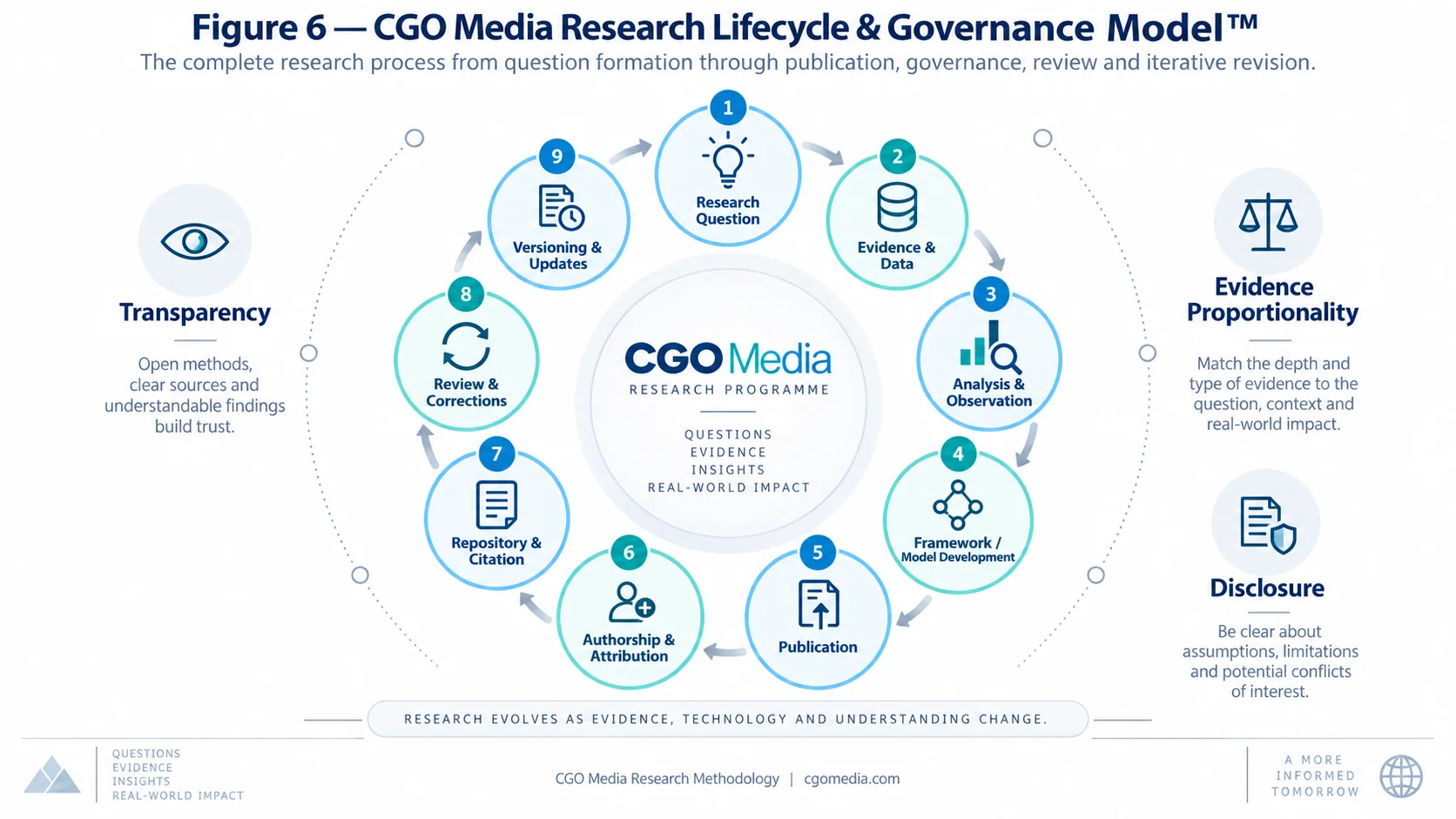
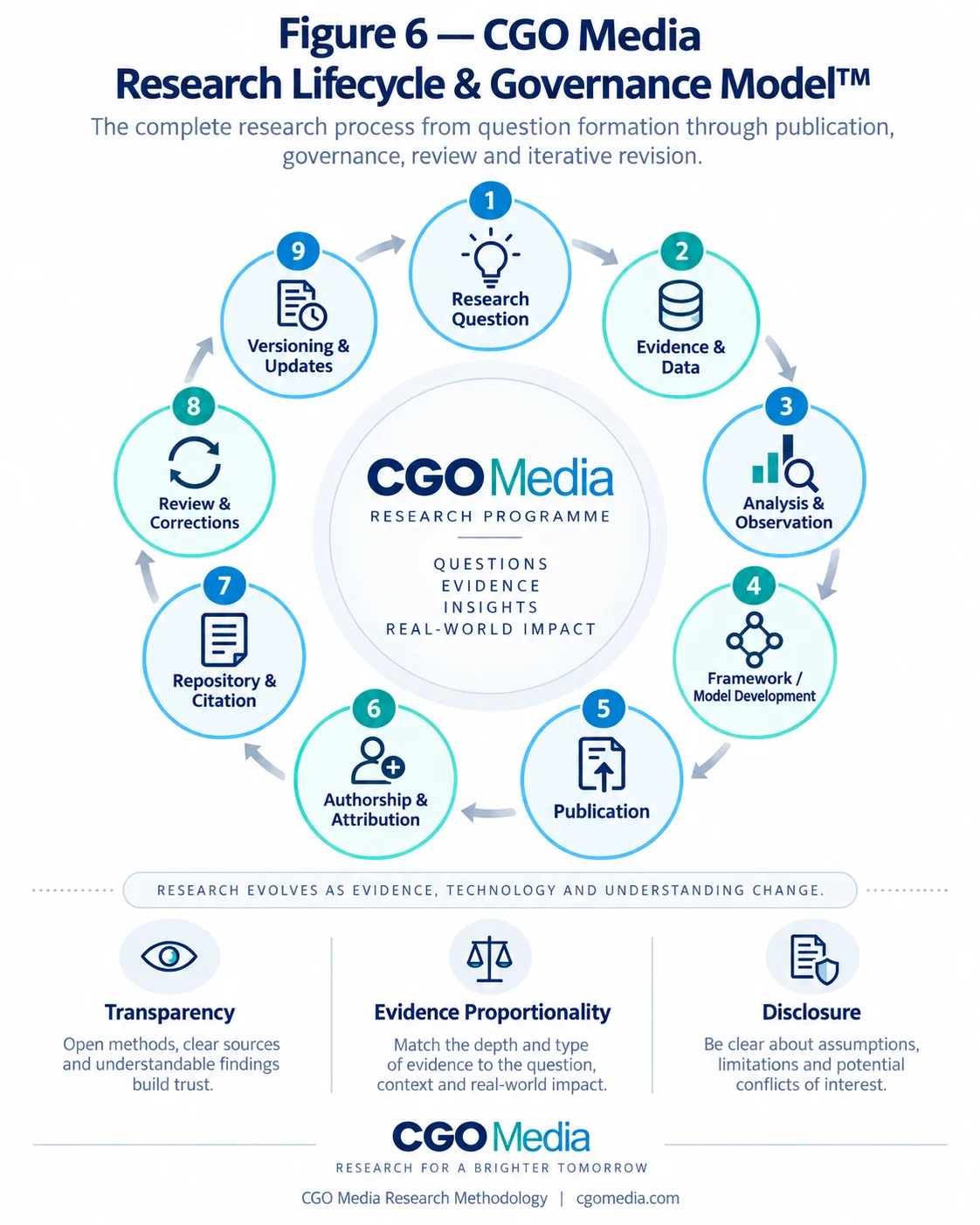
How to Interpret CGO Media Research
CGO Media publishes several different types of research output. These publications should be interpreted according to the methodology used to produce them rather than treated as methodologically identical.
A quantitative study based on a defined primary dataset provides a different form of evidence from an observational research paper, while a conceptual framework serves a different purpose from either.
Readers should therefore consider the publication type, evidence base, research population, collection period and stated limitations when evaluating an individual finding.
In particular, CGO Media distinguishes between:
- Empirical findings: conclusions derived from structured measurement or defined datasets.
- Research observations: recurring patterns identified through structured observation or comparative analysis.
- Analytical findings: interpretations developed through examination of multiple forms of evidence.
- Conceptual frameworks: structured representations used to organise related research findings.
- Selection models: analytical models examining discovery, evaluation and recommendation processes.
- Maturity models: structures used to examine organisational capability and development.
- Implementation roadmaps: practical interpretations of research findings for organisational application.
- Research hypotheses: proposed relationships or explanations requiring additional investigation.
The existence of a CGO Media framework or model should not, by itself, be interpreted as proof that a search engine or AI platform uses the same categories internally.
Likewise, an observed relationship should not be converted into a causal claim unless the underlying research supports that interpretation.
Methodology by Publication Type
The precise methodology applied within the CGO Media Research Programme varies according to the research output being developed.
The following distinctions provide a general guide.
Research Papers
Research papers investigate a defined question through evidence review, structured observation, comparative analysis, primary data or a combination of these methods.
The methodology used should be described within the publication where it materially affects interpretation of the findings.
Research Observations
Research Observations document recurring patterns or behaviours identified during the wider research programme.
They may highlight findings that warrant further investigation without claiming that the observation represents a statistically generalisable result.
Statistics Publications
Statistics publications should be supported by an identifiable quantitative basis, including a defined dataset, population, sample or measurement methodology.
Where a numerical claim cannot be supported by an appropriate quantitative process, it should not be presented within the Statistics Library merely because a percentage can be calculated from a small collection of examples.
Frameworks
Frameworks organise multiple research findings into coherent analytical dimensions.
They are intended to support structured investigation and application rather than to represent undocumented internal platform architecture.
Discovery and Selection Models
Discovery and Selection Models examine the stages through which information, organisations, providers or products may become discoverable, evaluated and potentially selected or recommended.
These models are conceptual analytical structures informed by the broader research programme.
Maturity Models
Maturity Models examine organisational capability across defined areas of search, authority, trust, evidence or AI-search readiness.
They provide a comparative developmental structure rather than a universal ranking of organisations.
Implementation Roadmaps
Implementation Roadmaps translate research findings into practical sequences of activity.
They are intended to support strategic planning and should not be interpreted as guarantees of search ranking, AI citation or recommendation outcomes.
What CGO Media Research Does Not Claim
Methodological transparency also requires clarity about what the research programme does not claim.
Unless explicitly supported by the methodology and evidence of a particular study, CGO Media research does not claim:
- Complete knowledge of proprietary search-engine algorithms.
- Complete knowledge of proprietary generative AI systems.
- Access to undisclosed model weights, system prompts or internal ranking mechanisms.
- That correlation automatically demonstrates causation.
- That every observed behaviour is permanent.
- That findings from one platform automatically apply to all platforms.
- That findings from one country automatically apply globally.
- That findings from one sector automatically apply to every sector.
- That a conceptual framework represents an official platform architecture.
- That implementation of a framework guarantees inclusion, citation, ranking or recommendation.
These boundaries are particularly important in AI-search research, where definitive claims about proprietary systems can exceed what external evidence is capable of demonstrating.
Methodological Transparency
CGO Media aims to make the methodological status of its research understandable without requiring readers to assume that every publication has been produced using the same research design.
Where relevant, individual publications may therefore identify:
- The research objective.
- The research question.
- The publication type.
- The study period.
- The research population.
- The sample.
- The platforms examined.
- The query or prompt methodology.
- The data-collection process.
- The analytical approach.
- Important limitations.
- The publication or revision date.
- Authorship and contribution information.
- Funding or relevant disclosures.
The amount of methodological detail required depends on the nature of the publication. A large original dataset may require substantially more documentation than a conceptual working paper based primarily on literature review and structured analysis.
Research Standards Will Continue to Evolve
The CGO Media Research Methodology is itself subject to review.
Research into generative search and AI-mediated information discovery is developing quickly, and methodological practices that are appropriate today may require refinement as systems, interfaces, datasets and research techniques evolve.
Future revisions may introduce additional standards relating to areas such as:
- Longitudinal AI-search measurement.
- Cross-platform reproducibility.
- Prompt-set standardisation.
- AI citation measurement.
- Recommendation-frequency analysis.
- Entity-resolution testing.
- Source-classification standards.
- Dataset publication.
- Research replication.
- Automated data-collection procedures.
Where methodological improvements materially affect the interpretation of earlier research, relevant papers or models may be revisited.
Research Corrections and Methodology Queries
CGO Media welcomes substantive questions concerning the methodology, evidence, interpretation or attribution of its published research.
Readers who identify a potential factual error, methodological problem, incorrect citation or significant contradictory source are encouraged to raise the issue for review.
Useful correction submissions should, where possible, identify:
- The publication concerned.
- The specific statement, figure or methodology in question.
- The reason a correction or clarification may be required.
- Supporting evidence or source material.
Substantive challenges may contribute to future revisions where the additional evidence materially improves the accuracy of the research.
Related CGO Media Research Resources
This Research Methodology forms part of the wider CGO Media research infrastructure. Readers can use the following resources to understand how individual papers, observations, statistics and frameworks relate to the broader programme.
Research Library
The central index of CGO Media research papers, studies and working publications.
Explore the CGO Media Research Library.
Framework Library
A structured collection of CGO Media frameworks, discovery models, maturity models and implementation roadmaps.
Explore the CGO Media Framework Library.
Research Observations Library
Recurring patterns and emerging findings identified through the wider research programme that should not automatically be interpreted as statistical findings.
Explore Research Observations.
Statistics Library
Quantitative research findings supported by defined datasets or measurement methodologies.
Explore the Statistics Library.
Research Architecture
An explanation of how CGO Media papers, frameworks, observations, statistics and sector research are organised into a connected research system.
Explore the CGO Media Research Architecture.
State of Search
Research examining broader changes across search engines, AI-powered discovery, generative search and digital information behaviour.
Research Methodology Summary
The CGO Media Research Programme is designed around a simple principle: the strength of a research claim should remain proportionate to the strength of the evidence supporting it.
Research begins with a defined question and may progress through external evidence review, structured observation, primary data collection, comparative analysis and conceptual development.
Where recurring findings justify broader interpretation, those findings may contribute to frameworks, discovery models, maturity models or implementation roadmaps.
Throughout that process, CGO Media aims to distinguish empirical measurement from observation, observation from interpretation, association from causation and conceptual modelling from documented platform mechanisms.
Limitations are treated as part of the methodology rather than as an afterthought. Search engines and generative AI systems are dynamic, proprietary and frequently non-deterministic, and research conclusions must be interpreted within those constraints.
Published work may continue to evolve through versioning, corrections, additional evidence and methodological review.
The objective is not to present emerging search research with greater certainty than the evidence allows. It is to build an increasingly structured, transparent and testable body of research into how search, artificial intelligence, digital authority, trust and information discovery are changing.
About the CGO Media Research Programme
CGO Media conducts research into SEO, Generative Engine Optimisation (GEO), AI search, entity authority, citation selection, source selection, digital trust and the changing mechanisms through which organisations and information are discovered online.
The research programme includes cross-sector research covering financial services, healthcare, legal services, travel and hospitality, professional services, property and real estate, ecommerce and retail, international organisations, manufacturing, education and EdTech, technology and SaaS.
Research is published through the CGO Media Research Library and selected external research repositories and researcher-profile systems.