
AI SEO Pricing UK 2026: What Do GEO, AEO and AI Search Services Cost?
Executive Summary
The commercial market for AI search optimisation in the United Kingdom is developing rapidly. Pricing remains fragmented, terminology is inconsistent, and services carrying apparently similar labels can represent fundamentally different levels of work.
Terms including AI SEO, Generative Engine Optimisation (GEO), Answer Engine Optimisation (AEO), AI Search Optimisation, LLM Optimisation and AI Visibility are increasingly used by agencies, consultants and software providers. However, there is no standard commercial definition establishing what must be included within any of these services.
This creates an unusually wide pricing spectrum.
At one end of the market are relatively inexpensive software platforms, visibility monitoring tools, audits and narrowly defined optimisation tasks. At the other are complex enterprise programmes involving technical SEO, content strategy, entity development, structured data, original research, Digital PR, external authority development, AI citation analysis, recommendation monitoring, international implementation and organisational governance.
These services should not be treated as commercially equivalent simply because both may be described as GEO or AI SEO.
The central finding of this study is therefore simple:
The price of AI SEO or GEO cannot be meaningfully evaluated without first understanding the capability, implementation workload and authority development included within the programme.
CGO Media’s review of publicly available UK market evidence indicates that individual AI-search tasks and monitoring services can begin below £500, while professional managed programmes commonly move into several thousand pounds per month.
More advanced national, regulated and highly competitive programmes can require substantially greater investment. Published enterprise GEO and AEO guidance now extends into approximately the £10,000–£20,000+ per month range in some areas of the UK market.
Above this sits another category that should be considered separately: the integrated enterprise search-authority programme.
At this level, an organisation is not simply purchasing GEO.
It may be funding a coordinated programme incorporating:
- traditional SEO;
- technical SEO;
- AI Search optimisation;
- Generative Engine Optimisation;
- Answer Engine Optimisation;
- entity and knowledge architecture;
- structured data;
- content authority;
- original research;
- Digital PR;
- media outreach;
- external citations and mentions;
- link and authority development;
- AI visibility measurement;
- competitive intelligence;
- international search strategy;
- analytics;
- executive reporting;
- cross-functional governance.
For substantial enterprise organisations, programmes combining these capabilities can reasonably move into approximately £20,000–£35,000+ per month, with global, multi-brand or particularly complex programmes potentially requiring greater investment.
This does not mean that GEO itself should automatically cost £20,000 per month.
It means that the market increasingly needs to distinguish between a discrete AI-search service and a broader organisational search-authority capability.
AI Search Pricing Principle
A £2,000 GEO service, a £10,000 enterprise GEO programme and a £25,000 integrated search-authority engagement may all be legitimate propositions. The important question is whether their scope, resources, implementation responsibilities and expected commercial role are understood.
This 2026 study examines those differences and proposes a more useful framework for understanding what UK organisations may actually be purchasing at different levels of investment.
1. AI Search Optimisation Has Developed a Pricing Problem
Traditional SEO has had more than two decades to establish recognisable commercial structures.
Prices still vary significantly between freelancers, consultants, boutique agencies, specialist agencies and enterprise providers, but businesses generally understand concepts such as technical SEO audits, monthly retainers, content programmes, link acquisition, Digital PR and enterprise SEO.
AI-search optimisation has not yet reached the same level of commercial maturity.
The same broad objective — improving the ability of an organisation to be discovered, understood, cited or recommended within AI-assisted search environments — may currently be marketed under several overlapping labels.
- AI SEO
- Generative Engine Optimisation (GEO)
- Answer Engine Optimisation (AEO)
- Large Language Model Optimisation (LLMO)
- AI Search Optimisation
- AI Visibility Optimisation
- AI Citation Optimisation
- Search Authority
The terminology itself is not the principal commercial problem.
The more important problem is that providers can use the same terminology to describe very different services.
One GEO service might consist primarily of tracking several hundred prompts and producing a monthly visibility report.
Another might restructure existing content to make information easier for search and AI systems to interpret.
Another may concentrate on structured data, entity relationships and technical accessibility.
Another may focus heavily on third-party mentions, citations, research, media coverage and external authority.
A larger programme may combine every one of these areas with conventional SEO, Digital PR, content production, competitive intelligence, analytics and strategic implementation.
All may legitimately use the term GEO.
They are nevertheless very different commercial products.
This is why headline comparisons such as “Agency A charges £2,000 for GEO while Agency B charges £15,000” provide limited information unless the underlying scope is also examined.
The appropriate comparison is not simply:
How much does GEO cost?
It is:
What organisational capability is being provided for that investment?
2. How Much Does AI SEO and GEO Cost in the UK in 2026?
There is no single UK market price for AI SEO, GEO or AEO in 2026.
CGO Media’s review of publicly available pricing and service information identifies several broad investment environments.
Task, Tool and Monitoring Level
At the lowest commercial level, organisations can purchase software access, individual optimisation tasks, limited monitoring or narrowly defined consultancy for less than £500.
These services can be useful where the organisation already possesses internal SEO, content and technical capability and primarily requires measurement or specialist guidance.
Foundation Programmes
Approximately £500–£1,500 per month can support a more structured service incorporating monitoring, reporting, consultancy, selected content improvements and limited implementation.
This remains a relatively constrained budget once specialist labour, software, strategy and implementation time are considered.
Managed SME AI Search
Approximately £1,500–£3,500 per month represents an emerging range for managed specialist programmes aimed at smaller and medium-sized organisations.
Depending on scope, these engagements may begin combining technical work, content optimisation, entity improvements, structured data, prompt monitoring and strategic implementation.
Competitive Growth Programmes
Approximately £3,500–£8,000 per month allows substantially greater implementation depth.
Programmes at this level can begin combining ongoing SEO, AI-search measurement, technical implementation, content production, entity optimisation, external authority development, Digital PR and more extensive competitive analysis.
Advanced and Enterprise AI Search
Approximately £8,000–£15,000 per month may be appropriate where competitive intensity, organisational complexity, regulatory requirements, content scale or external authority requirements become substantial.
At this level, the client should expect significantly more than prompt tracking and reporting.
Enterprise GEO and AI Search
Approximately £10,000–£20,000+ per month represents a developing enterprise range for complex AI-search programmes involving multiple business units, markets, entities, product groups or regulatory environments.
Published UK market guidance reviewed by CGO Media demonstrates that enterprise GEO and AEO pricing can now extend into this range.
Integrated Enterprise Search Authority
Approximately £20,000–£35,000+ per month should be treated as a different commercial category rather than simply a more expensive GEO package.
An integrated enterprise programme may combine:
- enterprise SEO;
- technical SEO;
- AI Search;
- GEO and AEO;
- large-scale content strategy;
- content production;
- entity and knowledge architecture;
- structured data;
- original research;
- Digital PR;
- journalist and media outreach;
- external citation development;
- link and authority acquisition;
- AI recommendation analysis;
- AI citation analysis;
- competitive intelligence;
- international implementation;
- analytics and measurement;
- executive reporting;
- governance.
For international organisations operating across multiple brands, languages, domains or jurisdictions, investment can move beyond this level.
The important distinction is that the organisation is no longer buying an isolated optimisation service.
It is building and operating a search, discovery and authority capability.
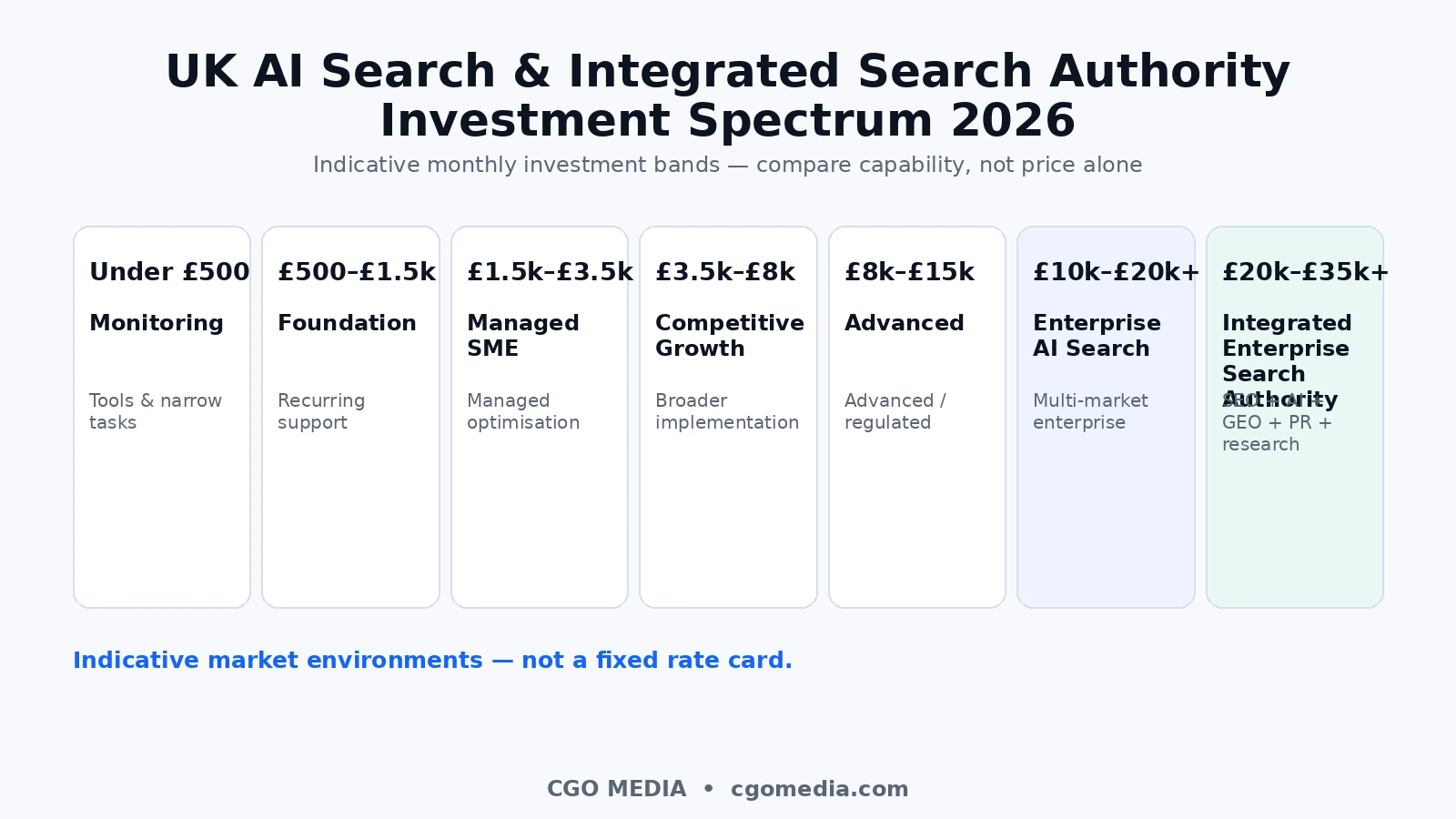
3. Revised UK AI Search Pricing Snapshot 2026
| Commercial Level | Indicative Monthly Investment | Typical Character |
|---|---|---|
| Task / Monitoring | Under £500 | Software, individual tasks, monitoring and narrow interventions. |
| Foundation | £500–£1,500 | Monitoring, reporting, consultancy and selected optimisation. |
| SME Managed Programme | £1,500–£3,500 | Technical, content, entity, structured data and measurement work. |
| Competitive Growth | £3,500–£8,000 | Broader implementation, content, AI visibility and authority development. |
| Advanced / Regulated | £8,000–£15,000 | High-competition or regulated markets requiring deeper implementation and authority. |
| Enterprise AI Search / GEO | £10,000–£20,000+ | Multi-market, multi-entity, complex or governed enterprise AI-search programmes. |
| Integrated Enterprise Search Authority | £20,000–£35,000+ | Integrated SEO, AI Search, GEO, content authority, Digital PR, research, external authority, measurement and governance. |
| Global / Complex Enterprise | Bespoke — potentially £30,000+ | Multiple brands, domains, countries, languages, media markets and organisational stakeholders. |
These ranges should be interpreted as indicative commercial environments rather than fixed market rates.
There is substantial overlap between levels because organisational requirements differ considerably.
A technically complex regulated business may require significantly greater resources than another organisation of similar turnover. Conversely, a large company with mature internal technical, content and communications teams may require primarily specialist strategy, AI-search measurement and coordination.
Pricing should therefore follow required capability rather than organisation size alone.
4. Why the Enterprise Ceiling Needs to Be Higher
Early commercial discussion around GEO frequently positioned approximately £8,000–£10,000 per month as the upper end of the emerging market.
That range is increasingly inadequate as a description of the complete enterprise market.
There are two reasons.
Enterprise GEO Itself Is Expanding
Publicly published 2026 UK pricing guidance now demonstrates enterprise GEO and AEO programmes extending beyond £10,000 per month and, in some cases, toward or beyond £20,000.
This reflects the increasing complexity of programmes involving multiple markets, extensive prompt environments, regulatory requirements, large content estates, entity architecture and continuous measurement.
Integrated Search Programmes Contain Much More Than GEO
The second issue is even more important.
A substantial organisation may not require separate agencies for SEO, GEO, content authority, Digital PR, AI visibility and external authority development.
These activities can increasingly form part of one coordinated search-authority strategy.
This changes the economics considerably.
Digital PR alone can represent a significant monthly agency investment for major organisations, particularly where campaigns involve specialist research, senior strategy, creative development, national media outreach or multiple markets.
When this capability is combined with enterprise SEO, technical implementation, content production, AI-search strategy, research, entity development and measurement, a £20,000+ monthly programme should not be interpreted as a £20,000 GEO retainer.
Important distinction:
£20,000 per month for GEO alone and £20,000 per month for an integrated enterprise programme containing SEO, AI Search, GEO, content authority, Digital PR, research and measurement are fundamentally different propositions.
This distinction becomes increasingly important as organisations attempt to compare agency proposals.
5. Research Methodology
The CGO Media UK AI SEO, GEO & AEO Pricing Study 2026 is an observational analysis of the emerging commercial market for AI-search services in the United Kingdom.
The research examines publicly accessible commercial information rather than confidential agency contracts or a controlled survey of providers.
Sources reviewed include:
- public agency pricing pages;
- GEO service descriptions;
- AEO service descriptions;
- AI SEO packages;
- AI visibility monitoring services;
- published starting prices;
- audit pricing;
- monthly retainers;
- enterprise service guidance;
- published UK market pricing studies;
- Digital PR pricing benchmarks;
- provider descriptions of included deliverables.
Where a provider does not disclose a price publicly, CGO Media treats the price as undisclosed.
No unpublished price has been estimated and attributed to an individual provider.
The ranges used throughout this research are therefore intended to illustrate observable commercial environments rather than establish a mandatory industry rate card.
Important Research Limitation
Published agency prices do not necessarily represent the final amount paid by every client.
Enterprise contracts are frequently negotiated according to scale, markets, implementation requirements, staffing, complexity and duration.
The same provider may therefore deliver materially different programmes to different organisations.
Furthermore, rapidly developing terminology means that two providers using the same service label may define the underlying scope differently.
These limitations reinforce the central methodological principle of this study:
price should be interpreted alongside scope.
6. Why a £2,000 GEO Service Is Not Necessarily Competing With a £20,000 Programme
One of the most important findings from the research is that price comparisons become misleading when services are compared only by their marketing terminology.
Consider two hypothetical providers.
Provider A — £2,000 per Month
The service includes:
- AI visibility monitoring;
- 100 tracked prompts;
- competitor visibility reporting;
- citation monitoring;
- monthly recommendations;
- limited content optimisation.
This could be a completely legitimate and valuable service.
Provider B — £20,000 per Month
The service includes:
- enterprise technical SEO;
- continuous AI visibility measurement;
- large-scale prompt research;
- GEO and AEO strategy;
- structured data implementation;
- entity and knowledge architecture;
- content strategy;
- ongoing content production;
- original research programmes;
- Digital PR campaigns;
- media and journalist outreach;
- external authority development;
- citation development;
- link acquisition;
- competitive intelligence;
- AI recommendation analysis;
- international search strategy;
- executive reporting;
- cross-functional governance.
Provider A and Provider B may both advertise GEO.
They are not delivering equivalent services.
It would therefore be incorrect to conclude that Provider B is ten times more expensive for the same product.
The organisation is purchasing a different level of capability.
This principle becomes especially important for procurement teams attempting to compare multiple proposals.
A capability matrix is generally more informative than a simple monthly-price comparison.
7. The Emerging UK AI Search Investment Spectrum
The evidence examined for this study suggests that the UK market should not be represented by one average GEO price.
Instead, it is more useful to view the market as a progression from measurement through managed optimisation, competitive implementation, enterprise AI Search and ultimately Integrated Search Authority.
As investment increases, the principal change should not simply be a greater quantity of the same deliverables.
The programme should gain additional organisational capabilities.
At lower levels, the emphasis may be diagnosis and measurement.
At intermediate levels, regular implementation becomes increasingly important.
At enterprise levels, technical, content, entity, authority and measurement functions increasingly need to operate together.
At the highest integrated level, AI Search and GEO become part of a broader system connecting:
- SEO;
- technical infrastructure;
- content;
- entities;
- research;
- Digital PR;
- external authority;
- AI discovery;
- measurement;
- governance.
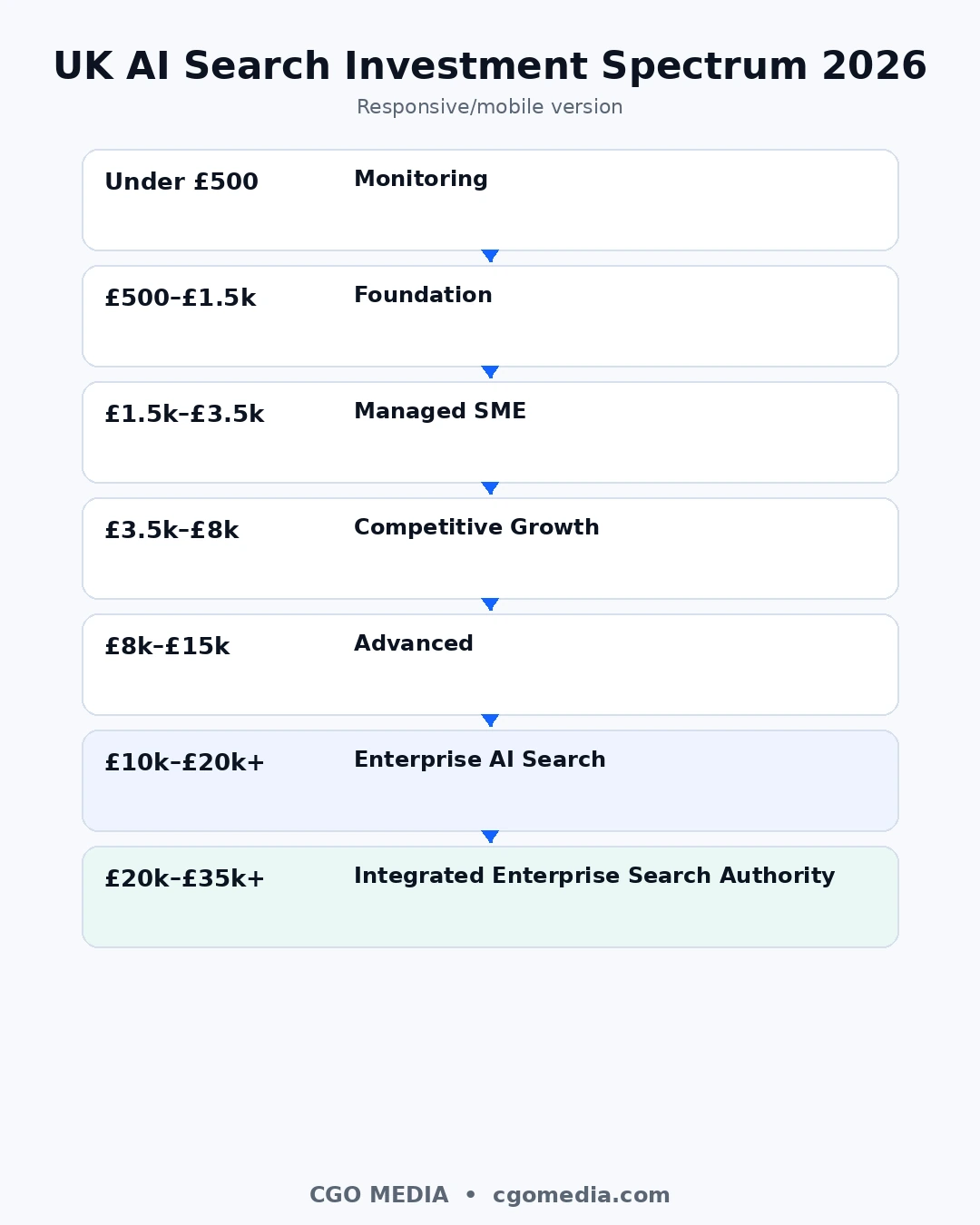
The resulting commercial progression is illustrated in Figure 1.
8. What Should Increasing AI Search Investment Actually Buy?
A fundamental problem with agency pricing comparisons is the assumption that a higher monthly fee should simply produce a larger quantity of the same activity.
For example:
- more tracked prompts;
- more reports;
- more articles;
- more keywords;
- more dashboards;
- more optimisation recommendations.
These quantities matter, but they provide an incomplete explanation of why one programme might cost £2,000 per month while another costs £20,000 or more.
The more important difference should be capability depth.
As investment rises, responsibility should increasingly move from observation toward implementation and ultimately toward coordinated organisational search authority.
This can be considered across several stages.
Stage 1 — Measurement
The provider identifies what is happening.
This may include:
- AI visibility monitoring;
- prompt tracking;
- citation monitoring;
- competitor comparisons;
- AI Overview monitoring;
- brand mention analysis;
- basic reporting.
Stage 2 — Diagnosis
The provider begins explaining why visibility, citations or recommendations may be occurring.
This can involve:
- content-gap analysis;
- technical assessment;
- entity analysis;
- citation-source analysis;
- competitor evidence analysis;
- structured data assessment;
- authority-gap identification.
Stage 3 — Optimisation
The provider actively modifies the organisation’s search environment.
Activities may include:
- content optimisation;
- technical SEO;
- structured data implementation;
- entity clarification;
- content restructuring;
- internal linking;
- knowledge architecture;
- AI-oriented information design.
Stage 4 — Authority Development
The programme begins working beyond the organisation’s own website.
This can include:
- Digital PR;
- journalist outreach;
- research publication;
- expert commentary;
- industry citations;
- relevant backlinks;
- third-party mentions;
- independent validation;
- external entity reinforcement.
Stage 5 — Integrated Search Authority
The organisation coordinates technical SEO, content, entities, research, Digital PR, AI-search visibility, external authority and measurement as parts of one search and discovery system.
This final stage is materially different from purchasing an isolated GEO service.
It requires broader skills, more senior strategic input, greater production capability, stronger cross-functional coordination and substantially greater implementation capacity.
9. Under £500 Per Month: Tools, Monitoring and Narrow Interventions
The lowest level of the market can provide genuine value, particularly for organisations with significant internal capability.
Investment below approximately £500 per month may include:
- self-service AI visibility software;
- limited prompt monitoring;
- AI citation tracking;
- small audits;
- one-off consultations;
- individual optimisation tasks;
- basic reporting.
The principal distinction is that the client normally retains responsibility for implementation.
A software platform may identify that competitors appear more frequently in AI-generated responses.
It does not necessarily explain every underlying cause or implement the changes required to improve the client’s position.
Similarly, a limited audit may identify weaknesses in entity signals, content architecture or structured data without providing the resources required to correct them across a substantial website.
This does not make inexpensive services inherently poor.
For organisations with experienced internal SEO, content, technical and communications teams, specialist monitoring can be highly efficient.
The mistake is expecting a monitoring budget to fund a fully implemented search-authority programme.
10. £500–£1,500 Per Month: Foundation AI Search Programmes
At approximately £500–£1,500 per month, an organisation can begin moving beyond software access into recurring specialist support.
A foundation programme might reasonably include:
- regular AI visibility monitoring;
- defined prompt sets;
- competitor benchmarking;
- monthly reporting;
- basic citation analysis;
- selected page optimisation;
- content recommendations;
- structured data recommendations;
- periodic consultancy.
The economic constraint at this level remains significant.
A monthly fee must cover specialist labour, account management, software, analysis, reporting and agency overhead.
Once those costs are considered, the amount of implementation time available can be limited.
Businesses purchasing within this range should therefore establish whether the service is primarily:
- measurement;
- consultancy;
- implementation;
- or a combination of all three.
A clearly defined narrow programme can provide greater value than a broad package promising extensive activity that cannot realistically be delivered within the available budget.
11. £1,500–£3,500 Per Month: Managed SME AI Search
The £1,500–£3,500 monthly range allows a provider to assume greater implementation responsibility.
For many small and medium-sized organisations, this may represent the point at which AI-search activity develops from monitoring into a managed optimisation programme.
Depending on the organisation, the programme could include:
- AI-search strategy;
- prompt and question research;
- AI visibility tracking;
- traditional SEO integration;
- technical improvements;
- structured data;
- entity optimisation;
- content optimisation;
- new content creation;
- internal linking;
- citation-source analysis;
- competitor analysis;
- monthly implementation;
- performance reporting.
At this stage, traditional SEO and AI-search optimisation increasingly overlap.
A page that is technically inaccessible, poorly structured, factually weak, commercially vague or unsupported by wider authority signals may face problems across both conventional and generative discovery environments.
It therefore becomes increasingly inefficient to treat SEO and GEO as completely separate disciplines.
Commercial principle:
As implementation responsibility increases, the distinction between “SEO work” and “GEO work” becomes less important than whether the organisation is improving the information, technical and authority signals used across modern search environments.
12. £3,500–£8,000 Per Month: Competitive Growth Programmes
The £3,500–£8,000 monthly range creates room for substantially greater strategic and production depth.
Organisations operating within competitive commercial markets may require simultaneous work across multiple areas.
A programme at this level may include:
- technical SEO;
- site architecture;
- large-scale content optimisation;
- ongoing editorial production;
- AI visibility measurement;
- prompt-set development;
- citation analysis;
- entity development;
- structured data;
- competitive intelligence;
- authority development;
- Digital PR support;
- link acquisition;
- commercial landing-page development;
- continuous testing and improvement.
Importantly, the programme should now be capable of producing change rather than merely recommending change.
This distinction is critical.
An audit may recommend restructuring 500 pages.
An enterprise content analysis may identify hundreds of weak entity relationships.
A citation study may reveal that competitors are repeatedly referenced by publications, organisations and datasets in which the client is absent.
Identifying those issues is considerably easier than correcting them.
Implementation requires people.
It requires technical specialists, researchers, strategists, writers, editors, Digital PR professionals and account leadership.
This is one reason monthly investment can increase rapidly as organisations move from advisory programmes into implementation programmes.
13. £8,000–£15,000 Per Month: Advanced, Competitive and Regulated Search
Once monthly investment reaches approximately £8,000–£15,000, the programme should begin supporting a materially broader operating model.
This level can become relevant where an organisation faces one or more of the following conditions:
- high commercial competition;
- large websites;
- complex product or service portfolios;
- regulated information environments;
- multiple target audiences;
- substantial content requirements;
- significant technical debt;
- strong incumbent competitors;
- high external-authority requirements;
- multiple internal stakeholders.
Financial services, healthcare, legal services, technology, SaaS, ecommerce and other highly competitive sectors can create particularly demanding search environments.
In these markets, an organisation may need to demonstrate more than topical relevance.
It may also require strong evidence of:
- expertise;
- entity clarity;
- independent recognition;
- source quality;
- editorial credibility;
- business legitimacy;
- technical reliability;
- external authority.
At this level, Digital PR and wider authority development can become increasingly important.
AI-search optimisation cannot be reduced to rewriting pages for language models.
If external information environments contain limited evidence about an organisation, improving its own website alone may not solve the complete visibility problem.
14. £10,000–£20,000+ Per Month: Enterprise AI Search and GEO
Enterprise programmes introduce another level of complexity.
A large organisation may operate:
- several websites;
- multiple brands;
- hundreds of products or services;
- thousands or millions of URLs;
- multiple countries;
- multiple languages;
- large internal content teams;
- separate PR and communications departments;
- legal and compliance functions;
- complex analytics systems;
- several external agencies.
In this environment, GEO cannot realistically operate as a small isolated marketing activity.
The search partner may need to provide both specialist capability and organisational coordination.
An enterprise AI-search programme could therefore encompass:
- enterprise technical SEO;
- large-scale AI visibility measurement;
- thousands of monitored questions or prompt variants;
- segmentation by product, audience and market;
- AI citation-source analysis;
- competitive recommendation analysis;
- entity architecture;
- knowledge-graph strategy;
- structured data governance;
- content governance;
- editorial standards;
- international SEO and GEO;
- stakeholder training;
- measurement frameworks;
- executive reporting.
The provider may also need to work alongside:
- internal SEO teams;
- developers;
- product teams;
- legal teams;
- compliance departments;
- brand teams;
- communications professionals;
- external PR agencies;
- senior management.
The commercial value at this level therefore comes partly from specialist execution and partly from coordinating how search authority is built across the organisation.
15. £20,000–£35,000+ Per Month: Integrated Enterprise Search Authority
At approximately £20,000–£35,000+ per month, it becomes increasingly useful to stop describing the programme simply as GEO.
The organisation may instead be purchasing an integrated search-authority capability.
The central objective becomes broader:
to strengthen how the organisation is discovered, interpreted, trusted, cited and recommended across traditional search, AI-assisted search and the wider digital information environment.
A programme at this level may combine five major operating systems.
1. Search Infrastructure
- enterprise technical SEO;
- crawlability and indexation;
- site architecture;
- international architecture;
- performance;
- structured data;
- technical governance.
2. AI Search & GEO
- AI visibility monitoring;
- prompt and query research;
- citation analysis;
- recommendation analysis;
- answer-engine optimisation;
- generative search optimisation;
- AI Overview analysis;
- LLM discovery research.
3. Content & Knowledge Authority
- content strategy;
- editorial development;
- expert content;
- original research;
- statistics;
- frameworks;
- knowledge architecture;
- entity development.
4. External Authority & Digital PR
- Digital PR strategy;
- journalist outreach;
- expert commentary;
- research-led campaigns;
- media relations;
- industry citations;
- relevant links;
- third-party validation;
- external entity reinforcement.
5. Measurement & Governance
- AI visibility measurement;
- traditional search performance;
- authority measurement;
- citation monitoring;
- competitive intelligence;
- executive reporting;
- cross-functional coordination;
- continuous improvement.
This is why comparing a £20,000 integrated programme with a £3,000 GEO package based purely on monthly price is commercially misleading.
The first may contain several specialist disciplines that an enterprise would otherwise purchase separately.
16. A £20,000 Programme May Replace Several Separate Agency Budgets
The cost of an integrated programme should also be considered against the alternative operating model.
A substantial organisation might otherwise employ separate suppliers for:
- enterprise SEO;
- technical SEO;
- content strategy;
- content production;
- Digital PR;
- link development;
- AI visibility monitoring;
- GEO consultancy;
- research production;
- analytics and reporting.
Each supplier introduces its own:
- retainer;
- account-management structure;
- strategy;
- reporting process;
- meetings;
- measurement methodology;
- commercial objectives.
Fragmentation can create significant duplication.
The SEO agency may request content changes.
The Digital PR agency may produce campaigns with limited connection to the organisation’s priority search entities.
The content agency may create articles without understanding the citation gaps identified by AI-search analysis.
The GEO consultancy may recommend authority improvements but have no capability to create the research, media coverage or external evidence required to build that authority.
An integrated model attempts to connect those activities.
This does not mean every organisation should consolidate all activity into one supplier.
Large companies may reasonably prefer specialist agencies for different functions.
However, commercial comparisons should account for the total capability being purchased rather than comparing the integrated programme with only one component of the alternative model.
17. Why Digital PR Changes the Economics of Enterprise AI Search
Digital PR is particularly important when considering enterprise pricing because it changes both the cost structure and the nature of the work.
Traditional on-site optimisation primarily operates within digital properties controlled by the organisation.
Digital PR operates within environments the organisation does not control.
The objective may include earning:
- editorial coverage;
- journalist citations;
- expert mentions;
- research references;
- industry links;
- independent validation;
- third-party discussion.
This requires different resources from conventional SEO.
A sophisticated Digital PR campaign may involve:
- research;
- data analysis;
- campaign ideation;
- editorial production;
- visual assets;
- press materials;
- media databases;
- journalist outreach;
- follow-up;
- expert availability;
- coverage analysis.
When this capability operates alongside SEO and GEO, it can address an important limitation of purely on-site optimisation.
An organisation cannot independently manufacture genuine third-party authority simply by declaring itself authoritative on its own website.
Integrated authority principle:
Owned content can explain an organisation’s expertise. Independent sources can provide external evidence that the organisation is recognised beyond its own digital properties.
This distinction has particular relevance as search and AI systems increasingly operate across broad information environments rather than relying solely on signals located on one website.
18. Why Enterprise Pricing Does Not Increase Linearly
A £20,000 programme should not be interpreted as simply delivering twice as much work as a £10,000 programme.
Enterprise complexity does not increase in a perfectly linear manner.
Several factors can multiply the workload.
More Markets
A programme operating in one country and one language is fundamentally different from a programme operating across the United Kingdom, United States, European Union and additional international markets.
More Entities
A single-service company may require authority development around a relatively narrow group of commercial entities.
A diversified enterprise may have hundreds of products, services, executives, business units and specialist topics.
More Internal Stakeholders
Implementation may require agreement across marketing, SEO, communications, legal, compliance, product, technology and executive teams.
More External Competition
Enterprise organisations frequently compete against brands possessing decades of accumulated authority, media coverage, citations, research and backlinks.
Greater Reputational Risk
Large and regulated organisations require stronger editorial control, fact checking, legal oversight and governance.
Greater Measurement Requirements
Reporting may need to distinguish:
- markets;
- brands;
- business units;
- product groups;
- audiences;
- search engines;
- AI platforms;
- prompt categories;
- commercial journeys.
Consequently, higher enterprise fees are often driven by organisational complexity rather than simply a greater volume of SEO deliverables.
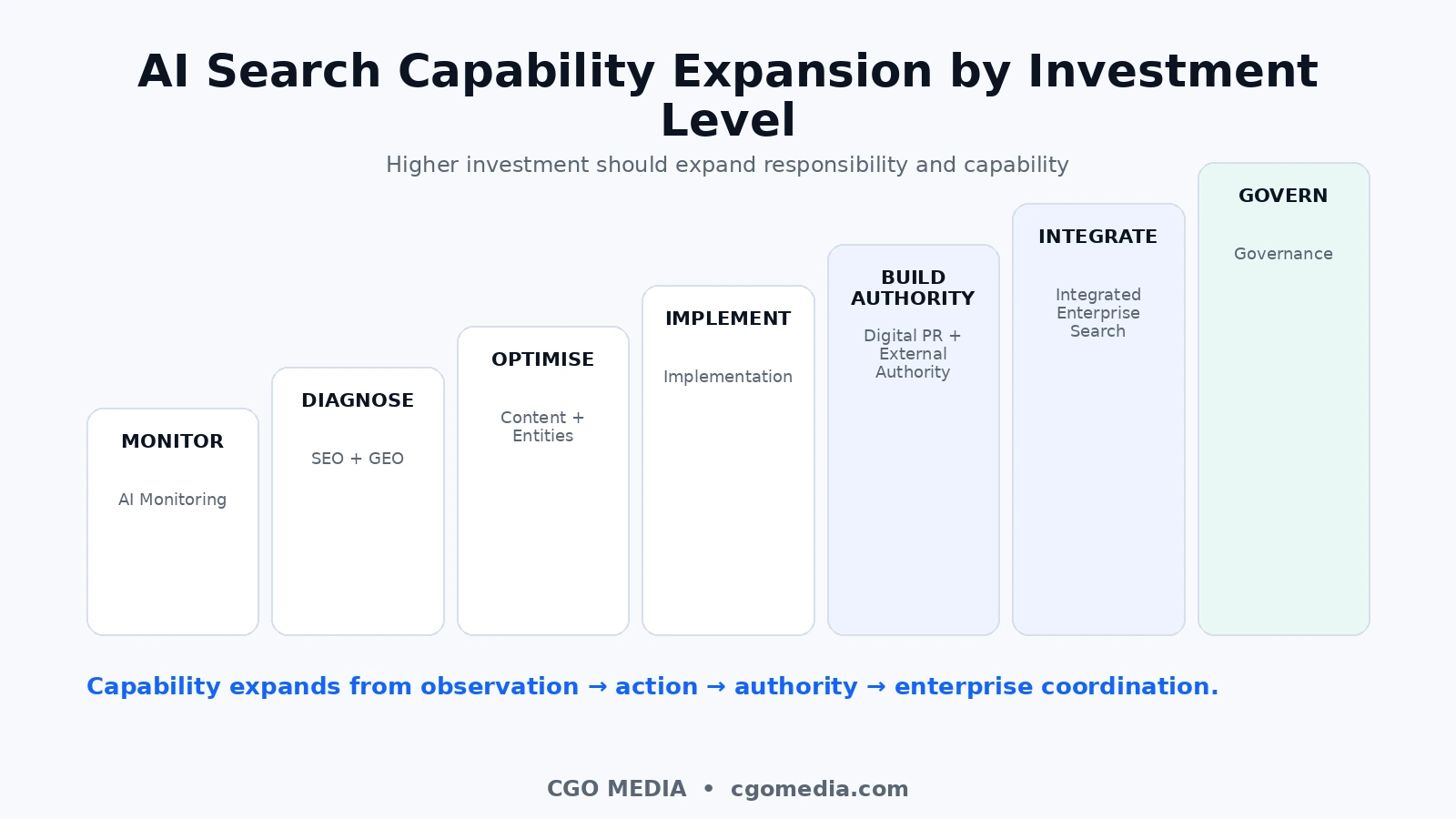
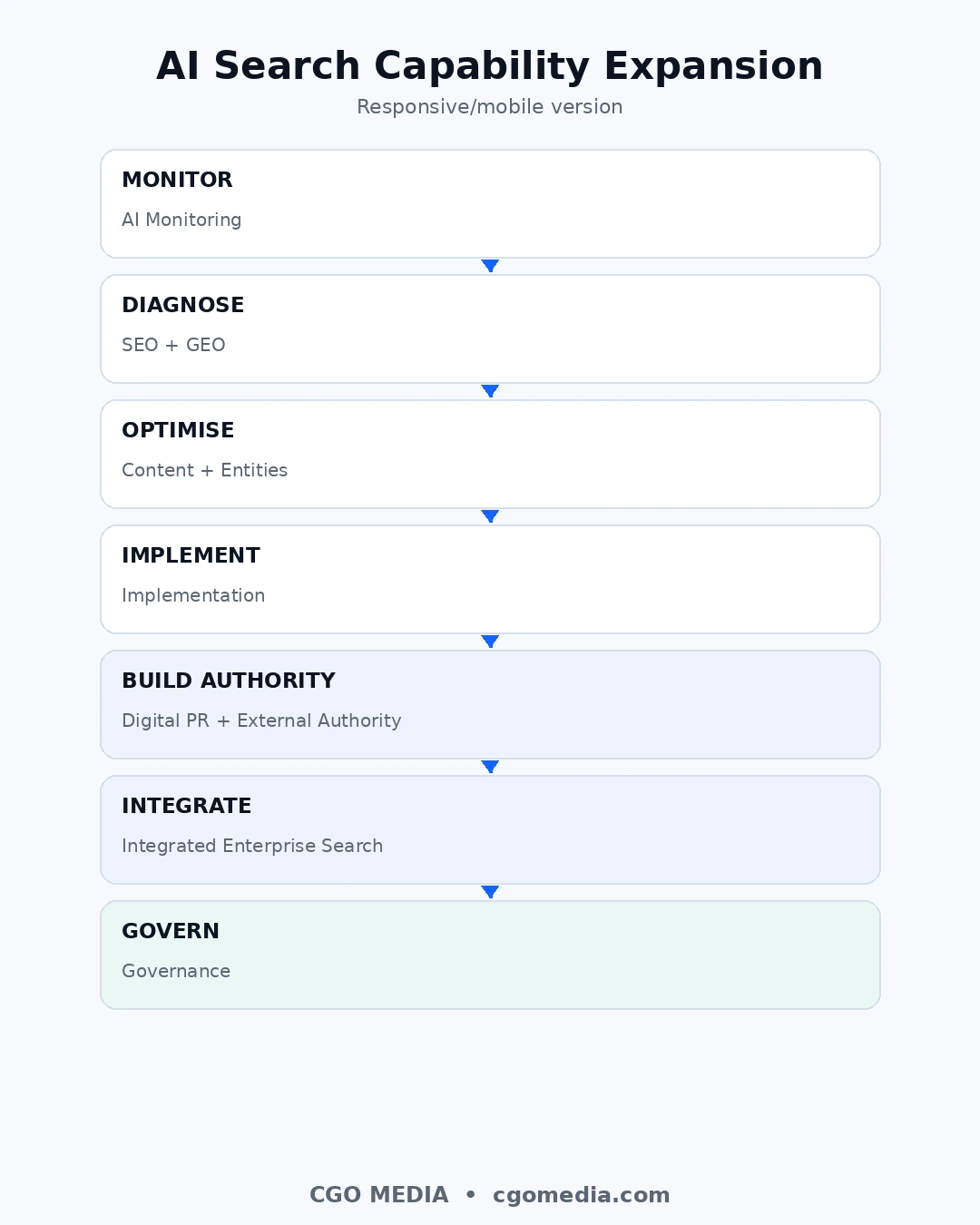
19. The Capability Expansion Model
The relationship between price and service scope can therefore be represented as a capability-expansion model.
At the lowest investment level, the organisation predominantly purchases visibility into the problem.
As investment increases, the provider becomes progressively more responsible for solving the problem.
The progression can be summarised as:
Monitor → Diagnose → Optimise → Implement → Build Authority → Integrate → Govern
This progression provides a more useful way of comparing AI-search proposals than monthly price alone.
An organisation assessing two proposals should determine which of these functions each supplier is actually providing.
For example, a service may include excellent monitoring but limited implementation.
Another may provide strong content optimisation but no external authority development.
Another may offer Digital PR without AI visibility measurement.
An integrated enterprise programme attempts to connect all of these capabilities into one operating system.
Figure 2 illustrates how those capabilities expand as monthly investment and organisational complexity increase.
20. How Should Businesses Compare AI SEO and GEO Proposals?
Comparing AI-search agencies purely by monthly retainer is unlikely to produce a reliable assessment of value.
Instead, organisations should compare the capabilities contained within each proposal.
A useful evaluation should examine at least the following areas:
- AI visibility measurement;
- prompt and question research;
- technical SEO;
- content strategy;
- content production;
- entity optimisation;
- structured data;
- citation analysis;
- competitive intelligence;
- external authority development;
- Digital PR;
- research capability;
- implementation responsibility;
- reporting;
- senior strategic involvement;
- governance.
Two agencies quoting the same monthly fee may provide very different combinations of these capabilities.
Similarly, two agencies quoting materially different fees may not actually be competing for the same brief.
Procurement teams should therefore move beyond the question:
“What is your GEO price?”
and ask:
“What capabilities, resources and implementation responsibilities are included within the proposed programme?”
21. The Difference Between Reporting and Implementation
One of the most important distinctions in AI-search pricing is the difference between identifying an opportunity and implementing the work required to capture it.
A reporting programme may reveal that:
- a competitor is cited more frequently;
- a brand is absent from important recommendation queries;
- specific pages are rarely referenced;
- external sources favour competing organisations;
- entity relationships are unclear;
- important questions are not adequately answered.
This information can be strategically valuable.
But it does not automatically change the organisation’s visibility.
Implementation may subsequently require:
- developer time;
- technical SEO;
- content rewriting;
- new landing pages;
- research production;
- structured data;
- entity development;
- Digital PR;
- media outreach;
- link acquisition;
- new external references;
- internal stakeholder approval.
The cost of discovering a weakness and the cost of correcting it can therefore be materially different.
Buyer principle:
A dashboard shows the organisation where it stands. An implementation programme attempts to change where it stands.
Businesses should establish which of those outcomes they are purchasing before comparing prices.
22. What Team Is Actually Behind the Monthly Retainer?
Agency pricing is fundamentally influenced by people.
AI software can improve efficiency, automate monitoring and accelerate certain forms of analysis, but complex search programmes continue to require specialist human expertise.
Depending on programme scope, an enterprise engagement may require contributions from:
- AI Search strategists;
- senior SEO strategists;
- technical SEO consultants;
- data analysts;
- research analysts;
- content strategists;
- editors;
- specialist writers;
- entity and knowledge-graph specialists;
- Digital PR strategists;
- media relations professionals;
- developers;
- automation specialists;
- account leadership;
- project management.
A lower-cost programme may provide access to only a small subset of these disciplines.
An integrated enterprise programme may require several of them simultaneously.
This creates a simple but frequently overlooked procurement question:
Who will actually be working on the account?
Businesses should understand:
- the seniority of the team;
- which specialists are included;
- whether delivery is internal or outsourced;
- how much implementation capacity exists;
- how senior strategy is accessed;
- whether PR and research capability genuinely exists;
- whether technical recommendations can be implemented.
A proposal containing fifteen service labels but only limited specialist resource may provide less practical capability than a more focused programme with an experienced multidisciplinary team.
23. Why Content Volume Alone Is a Poor Pricing Metric
Some search retainers continue to be explained primarily through quantities of content.
For example:
- four articles per month;
- eight articles per month;
- twenty pages optimised;
- fifty pages refreshed.
These metrics are easy to understand and therefore commercially attractive.
However, they reveal little about whether the work improves search authority.
Ten generic articles are not necessarily more valuable than one substantial research asset capable of:
- earning media coverage;
- attracting citations;
- supporting journalist requests;
- generating backlinks;
- strengthening entity relationships;
- supporting commercial pages;
- providing evidence for AI-search environments.
The same principle applies to page optimisation.
Changing headings or adding FAQ sections across hundreds of pages may create considerable output volume while producing limited strategic improvement.
Enterprise AI-search pricing should therefore increasingly reflect:
quality, authority, implementation complexity and strategic purpose rather than content quantity alone.
24. Why Original Research Can Increase Programme Cost
Original research represents another important distinction between basic content production and advanced authority development.
Research-led programmes may require:
- research question development;
- methodology design;
- data collection;
- dataset analysis;
- source validation;
- editorial review;
- figure production;
- publication;
- Digital PR distribution;
- media outreach;
- ongoing citation monitoring.
This is considerably more resource-intensive than producing a conventional SEO article.
However, research can serve several functions simultaneously.
It can create:
- original information;
- citation opportunities;
- journalist interest;
- Digital PR assets;
- internal linking opportunities;
- expert positioning;
- industry references;
- supporting evidence for commercial content.
For this reason, research should not necessarily be evaluated using the same cost-per-word logic traditionally applied to commodity content production.
Its purpose may be to create evidence and authority rather than simply additional indexed pages.
25. Why Digital PR Should Not Be Treated as an Optional Extra at Enterprise Level
Not every AI-search programme requires a major Digital PR component.
However, external authority becomes increasingly difficult to ignore as competitive intensity rises.
An organisation may optimise:
- its website;
- its content;
- its structured data;
- its entities;
- its technical architecture.
Yet competitors may continue to possess stronger independent evidence across:
- national publications;
- trade media;
- industry bodies;
- research sources;
- professional directories;
- academic material;
- comparison resources;
- specialist websites;
- authoritative third-party platforms.
This creates an external authority gap.
Digital PR can form one mechanism for reducing that gap.
The objective is not simply to obtain links.
A well-designed programme may attempt to create broader independent evidence that:
- the organisation exists;
- its experts are recognised;
- its research is referenced;
- its views are quoted;
- its products or services are discussed;
- other authoritative entities associate with the organisation.
For an enterprise organisation, this can require meaningful investment.
Published UK pricing guidance for comprehensive specialist PR retainers reaches approximately £10,000–£15,000+ per month, while multi-market enterprise PR programmes can move beyond £20,000 per month.
This provides important context when evaluating an integrated search programme containing substantial Digital PR capability.
The comparison is not necessarily between a £20,000 integrated programme and a £5,000 SEO retainer.
The alternative may involve purchasing several specialist programmes separately.
26. What Does a £20,000 Enterprise Search Programme Need to Contain?
A £20,000 monthly fee is substantial.
It should therefore fund substantial capability.
An enterprise should not pay this level of investment merely for:
- a dashboard;
- monthly reporting;
- a small prompt set;
- several blog articles;
- generic recommendations;
- occasional consultancy.
Depending on the organisation’s needs, a programme at approximately this level should be capable of integrating several major workstreams.
Strategic Direction
- enterprise search strategy;
- AI Search strategy;
- GEO and AEO planning;
- competitive intelligence;
- commercial prioritisation;
- executive guidance.
Technical Search
- technical SEO;
- site architecture;
- indexation;
- structured data;
- entity architecture;
- international architecture;
- technical implementation planning.
Content & Research
- content strategy;
- commercial page development;
- expert content;
- research programmes;
- statistics;
- frameworks;
- editorial review.
Authority Development
- Digital PR;
- journalist relations;
- media outreach;
- expert commentary;
- research promotion;
- relevant authority links;
- independent citations.
AI Search Measurement
- prompt monitoring;
- AI recommendation monitoring;
- citation tracking;
- competitor benchmarking;
- platform comparison;
- visibility trend analysis.
Enterprise Governance
- stakeholder coordination;
- prioritisation;
- implementation roadmaps;
- executive reporting;
- cross-functional working;
- continuous optimisation.
The precise allocation should vary by organisation.
A company with a strong internal content department may require less external production and greater strategic, technical and Digital PR support.
Another organisation may possess strong PR capability but require substantial SEO, AI-search and research resources.
The defining characteristic should therefore be integrated capability rather than a rigid package of deliverables.
27. What Can Make an Enterprise Programme Cost More Than £20,000?
£20,000 should not be interpreted as a universal ceiling.
Several factors can increase the resources required substantially.
Multiple International Markets
Each additional country can introduce new search behaviour, competitors, publishers, languages, regulatory conditions and authority environments.
Multiple Brands
Organisations operating several brands may require separate entity, content, measurement and authority strategies.
Very Large Websites
Major ecommerce, marketplace, publishing and enterprise websites can contain hundreds of thousands or millions of URLs.
Regulated Industries
Financial services, healthcare, legal services and other regulated sectors may require additional review, governance and evidence standards.
Extensive Digital PR
Large-scale research and media campaigns can require dedicated teams and substantial production resources.
High Content Production Requirements
International or product-led organisations may require continuous specialist editorial output across numerous commercial areas.
Data & Automation
Large-scale prompt monitoring, competitive intelligence and reporting can require bespoke automation, APIs, data infrastructure and analyst time.
Senior Strategic Involvement
Complex organisations may require substantial involvement from senior strategists working with executives and departmental leaders.
A global integrated search-authority programme can therefore exceed £30,000 per month without representing an unusual commercial structure where the scope justifies the resources involved.
28. In-House Capability Changes What an Agency Should Cost
The appropriate agency budget cannot be determined without understanding what capability already exists inside the organisation.
Consider two companies of similar size.
Organisation A
Already employs:
- an SEO director;
- technical SEO specialists;
- content editors;
- developers;
- a communications team;
- an internal PR department.
This organisation may primarily require:
- AI-search expertise;
- research methodology;
- measurement infrastructure;
- specialist GEO strategy;
- external validation;
- strategic oversight.
Organisation B
Has a small digital marketing team and limited internal specialist capability.
It may need the agency to provide:
- SEO strategy;
- technical support;
- content;
- research;
- Digital PR;
- AI-search expertise;
- measurement;
- project management.
Organisation B may therefore require a larger external budget even if the two businesses have similar revenues.
This is why company turnover alone is an unreliable method for estimating an appropriate GEO or AI-search retainer.
29. The Enterprise Search Authority Operating Model
At the highest level of investment, the commercial question changes.
The organisation is no longer determining how many SEO tasks an agency can complete.
It is determining which capabilities should exist internally, which should be provided externally and how those capabilities should operate together.
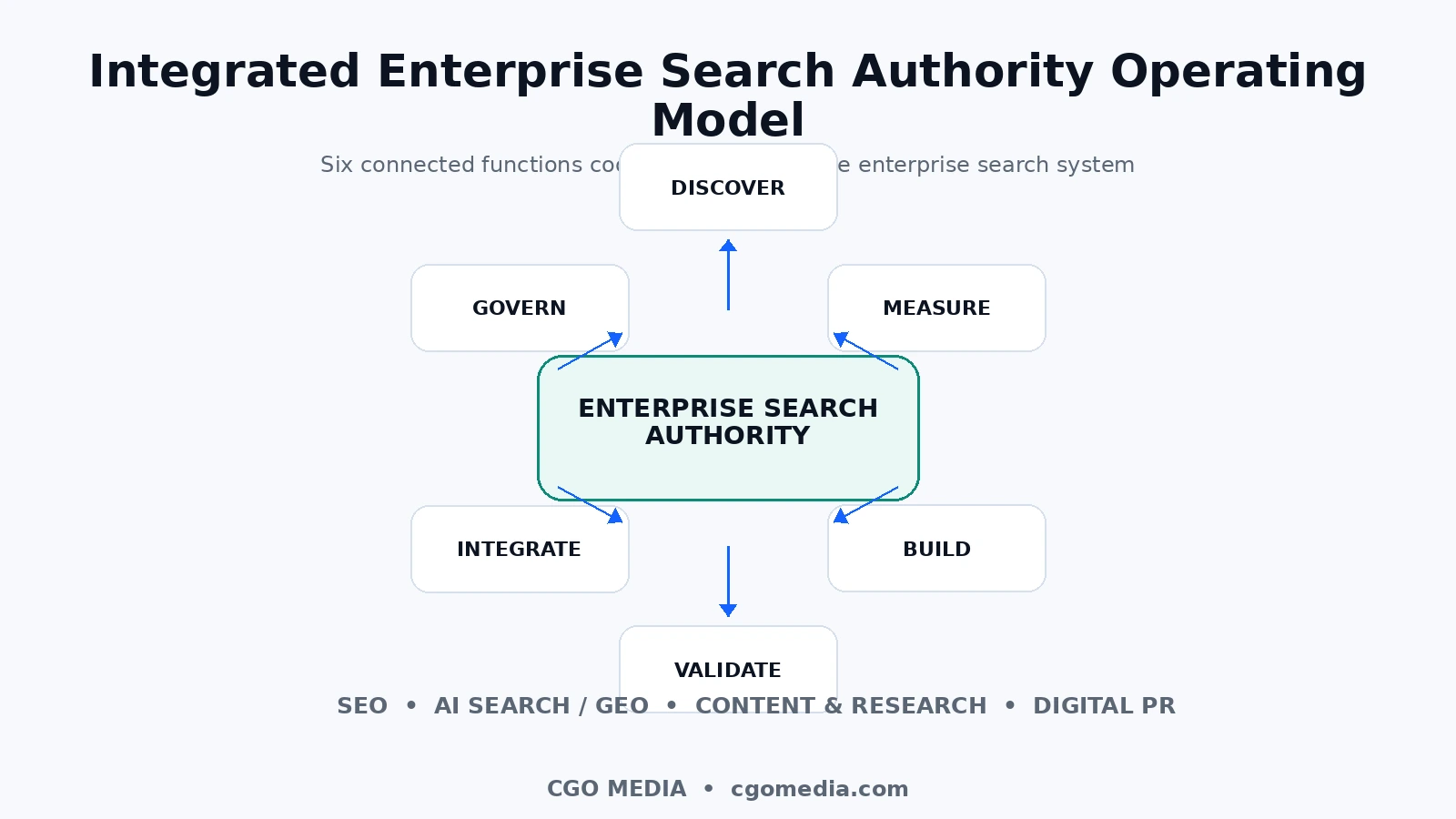
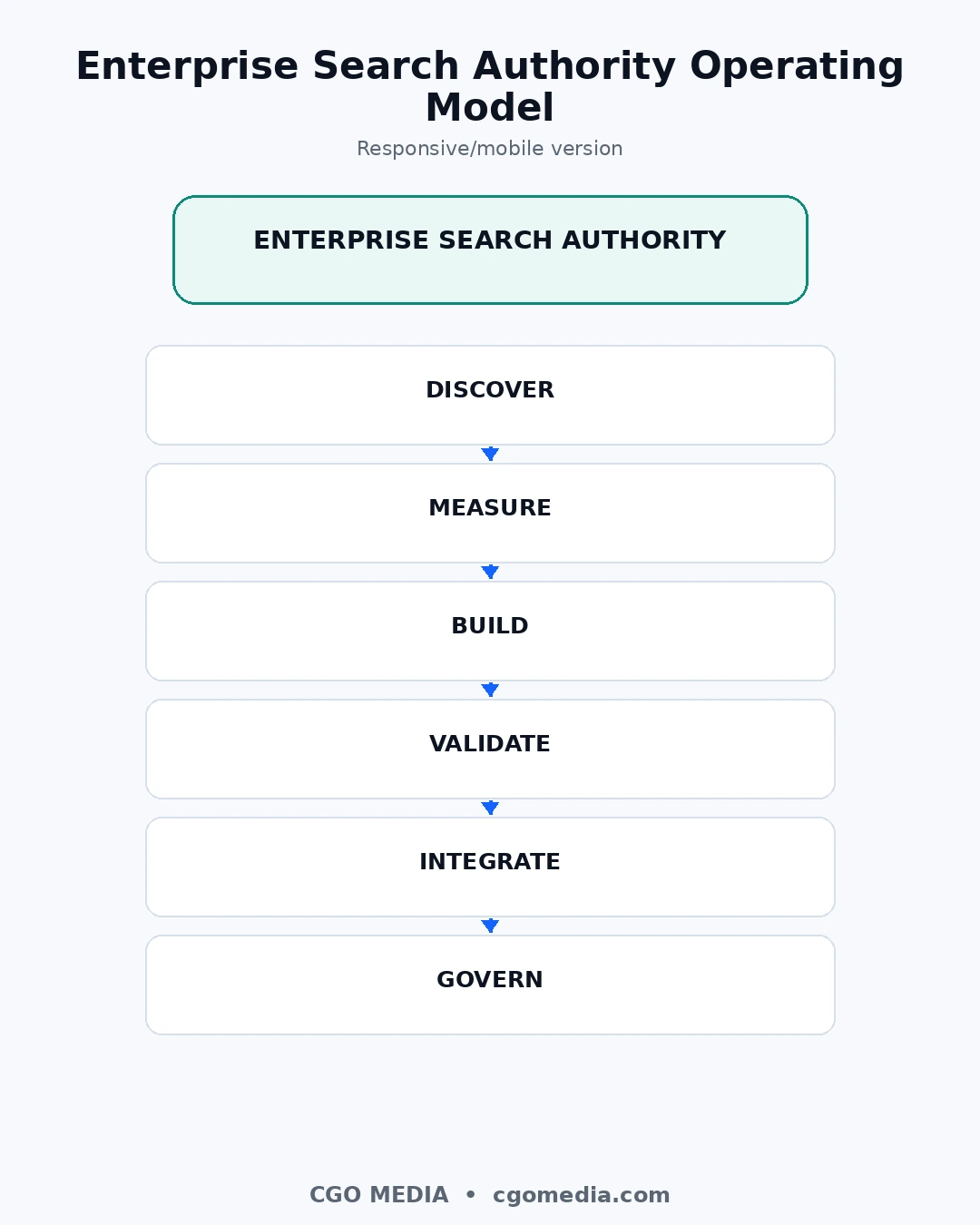
A mature enterprise search-authority model can be organised around six connected functions:
1. Discover
Understand how audiences search, ask questions, compare providers and interact with AI-assisted discovery systems.
2. Measure
Track conventional search visibility, AI visibility, citations, recommendations, competitors and authority indicators.
3. Build
Improve technical infrastructure, content, structured data, entities and knowledge architecture.
4. Validate
Create stronger external evidence through research, Digital PR, media coverage, citations, links and third-party recognition.
5. Integrate
Connect SEO, GEO, content, research, communications, PR and analytics instead of operating them as isolated activities.
6. Govern
Coordinate stakeholders, priorities, standards, measurement and continuous improvement across the organisation.
This operating model helps explain why enterprise pricing can differ substantially from conventional SEO retainers.
The provider is increasingly contributing to an organisational system rather than delivering a list of disconnected marketing tasks.
Figure 3 illustrates this integrated enterprise search-authority operating model.
30. Monthly Retainer, Project or Hybrid Model?
AI-search services can be purchased through several commercial structures.
The most appropriate model depends on whether the organisation requires diagnosis, implementation, continuous measurement or long-term authority development.
One-Off Project
A defined project can work well for:
- AI-search audits;
- technical reviews;
- entity audits;
- structured data reviews;
- AI visibility benchmarking;
- competitor analysis;
- content architecture reviews;
- research projects;
- strategic roadmaps.
The advantage is commercial clarity.
The organisation purchases a defined output within a defined period.
The limitation is that search environments continue to change after the project ends.
An audit can identify what should happen next, but it does not automatically provide the resources required for ongoing implementation.
Monthly Retainer
A monthly retainer becomes more appropriate where the organisation requires continuous activity across areas such as:
- technical SEO;
- content development;
- AI-search monitoring;
- competitive analysis;
- entity development;
- Digital PR;
- research;
- authority development;
- reporting;
- continuous optimisation.
This model provides greater continuity and allows the programme to respond as search systems, competitors and organisational priorities change.
Hybrid Model
Many larger organisations may benefit from a hybrid structure.
This can involve an initial discovery and implementation phase followed by a recurring retainer.
For example:
Phase 1: enterprise audit, research, benchmarking and strategy.
Phase 2: technical and content implementation.
Phase 3: ongoing SEO, GEO, AI Search, Digital PR, authority development and measurement.
This structure can be particularly appropriate where significant foundational work is required before the recurring programme reaches normal operating rhythm.
31. Why Enterprise Programmes May Have an Initial Setup or Discovery Fee
A large enterprise programme may require substantial work before normal monthly delivery begins.
This can include:
- website crawling;
- technical analysis;
- content inventory;
- entity mapping;
- competitor mapping;
- prompt research;
- AI visibility benchmarking;
- citation-source analysis;
- Digital PR opportunity analysis;
- market research;
- stakeholder interviews;
- analytics configuration;
- measurement framework design;
- implementation planning.
For a substantial enterprise, this can represent hundreds of hours of specialist work.
An initial project or discovery fee should therefore not automatically be interpreted as duplication of the monthly retainer.
It may fund the infrastructure required for the recurring programme to operate effectively.
The important question is whether the setup phase produces clear deliverables.
These might include:
- baseline visibility measurements;
- technical priorities;
- entity maps;
- content opportunity maps;
- competitive intelligence;
- AI-search opportunity analysis;
- authority-gap analysis;
- implementation roadmap;
- measurement framework.
A setup fee without defined outputs should be examined carefully.
A substantial discovery phase with clear strategic and technical deliverables can be entirely appropriate.
32. What Does an AI Search Audit Cost?
AI-search audits represent one of the most accessible ways for organisations to begin evaluating GEO and AI-search readiness.
Prices can vary considerably because the term audit can describe very different levels of analysis.
Basic AI Visibility Review
A limited review may examine:
- brand visibility;
- a small number of prompts;
- competitor mentions;
- citation sources;
- basic recommendations.
This may be relatively inexpensive.
Strategic GEO Audit
A deeper audit may examine:
- hundreds of prompts or questions;
- multiple competitors;
- AI citation sources;
- content architecture;
- entity signals;
- structured data;
- technical accessibility;
- external authority;
- recommendation patterns.
Enterprise AI Search Audit
An enterprise audit may additionally require:
- multiple markets;
- multiple business units;
- multiple websites;
- thousands of queries or prompts;
- large-scale data analysis;
- international comparison;
- executive recommendations;
- technical implementation roadmaps;
- cross-functional workshops.
Consequently, the commercial range for an audit can extend from a relatively small diagnostic exercise to a substantial consulting project.
Audit principle:
The price of an AI-search audit should be assessed according to the breadth of evidence examined, the depth of analysis performed and the usefulness of the implementation roadmap — not simply the number of pages in the final report.
33. Why Enterprise AI Search Should Not Be Sold as a Fixed Package
Fixed packages are commercially convenient.
They are easy to explain and easy to compare.
For smaller organisations, this can be useful.
An enterprise programme is more difficult to standardise.
Consider the difference between:
- a UK professional-services company operating one website;
- a multinational SaaS company operating across 20 markets;
- a financial institution with strict regulatory oversight;
- an ecommerce business with one million product URLs;
- a healthcare group containing multiple brands and locations.
Each organisation may require AI Search and GEO support.
However, their technical, content, authority, regulatory and organisational requirements are fundamentally different.
A package offering:
- 200 prompts;
- four articles;
- one report;
- two Digital PR campaigns;
- monthly optimisation;
may be commercially neat but strategically inappropriate for many enterprises.
At enterprise level, pricing should increasingly follow:
- scope;
- complexity;
- markets;
- implementation requirements;
- internal capability;
- authority requirements;
- competitive intensity;
- governance requirements.
This is why bespoke enterprise pricing is common across SEO, Digital PR, consulting and increasingly AI-search services.
34. What Should a UK Business Get for £1,000, £3,000, £7,500, £15,000 and £20,000+ Per Month?
One useful way to understand AI-search pricing is to reverse the normal question.
Instead of asking how much GEO costs, organisations can ask what level of capability should reasonably be expected at different levels of investment.
Approximately £1,000 Per Month
A programme around this level may reasonably focus on:
- monitoring;
- basic competitive intelligence;
- limited consultancy;
- selected optimisation;
- monthly reporting.
Extensive technical work, ongoing content production and meaningful Digital PR are unlikely to be sustainable within the same budget unless the scope is unusually narrow.
Approximately £3,000 Per Month
A programme at this level can begin combining:
- AI visibility monitoring;
- SEO strategy;
- content optimisation;
- technical improvements;
- structured data;
- entity work;
- regular implementation.
This can provide a credible managed programme for many smaller or medium-sized organisations.
Approximately £7,500 Per Month
This level should create room for a substantially broader programme involving several workstreams simultaneously.
Depending on requirements, this could include:
- advanced technical SEO;
- ongoing AI-search analysis;
- content strategy;
- content production;
- entity development;
- structured data;
- competitive intelligence;
- authority development;
- Digital PR activity.
Approximately £15,000 Per Month
At this level, a client should expect meaningful enterprise capability rather than simply a larger quantity of standard SEO deliverables.
The programme may include:
- enterprise technical SEO;
- advanced AI-search measurement;
- large prompt environments;
- senior strategy;
- content and research;
- Digital PR;
- external authority development;
- entity architecture;
- multi-team coordination;
- executive reporting.
Approximately £20,000+ Per Month
At approximately £20,000 per month and above, the organisation should expect a genuinely integrated programme if that is what has been commissioned.
This can include:
- SEO;
- technical SEO;
- AI Search;
- GEO;
- AEO;
- content strategy;
- content production;
- entity and knowledge architecture;
- original research;
- Digital PR;
- journalist outreach;
- external citation development;
- link and authority development;
- competitive intelligence;
- AI citation monitoring;
- AI recommendation analysis;
- analytics;
- executive reporting;
- organisational governance.
The central expectation should be integration.
A £20,000 enterprise engagement should not merely contain more isolated activities.
Those activities should support a coherent search-authority strategy.
35. The Hidden Cost of Cheap Enterprise GEO
Low pricing is not automatically poor value.
Efficient specialists, strong internal client teams and narrow scopes can all produce excellent results at relatively modest cost.
However, enterprise organisations should examine whether an unusually inexpensive proposal has excluded important work.
A low headline price may depend on the client separately providing:
- developers;
- writers;
- editors;
- designers;
- Digital PR;
- research;
- data analysts;
- implementation;
- project management.
The agency retainer may therefore represent only one component of the actual programme cost.
For example, a £4,000 monthly GEO consultancy could be economically appropriate if the client already employs a large internal SEO, content, PR and development team.
The same £4,000 proposal could be inadequate for another enterprise expecting the external provider to perform all implementation.
This creates the concept of total programme cost.
The relevant comparison is not always:
Agency A = £4,000 versus Agency B = £20,000.
It may be:
Agency A = £4,000 plus internal implementation teams plus PR agency plus content agency plus research support versus Agency B = £20,000 integrated delivery.
Neither model is inherently superior.
But they should be compared on equivalent scope.
36. Total Programme Cost Is More Important Than Headline Retainer
The total economic cost of AI-search activity may involve considerably more than the specialist agency invoice.
Potential costs include:
- agency retainers;
- AI visibility software;
- SEO platforms;
- data providers;
- content production;
- development time;
- design;
- Digital PR;
- research;
- media databases;
- internal employee time;
- legal review;
- compliance review;
- analytics infrastructure.
A lower external agency fee can therefore coexist with a higher total programme cost.
Conversely, a larger integrated retainer may consolidate several previously separate budgets.
This becomes particularly important when comparing enterprise proposals.
Fragmented Model
An organisation may separately purchase:
- SEO agency support;
- Digital PR;
- content production;
- AI visibility software;
- GEO consultancy;
- research;
- analytics support.
Integrated Model
An alternative provider may combine several of those capabilities within one programme.
The headline retainer may therefore be higher while the total operating model is more consolidated.
The commercial evaluation should consider both approaches.
37. Enterprise Pricing Should Follow Complexity, Not Company Size Alone
It can be tempting to assume that larger companies should automatically pay larger retainers.
Organisation size is relevant, but it is not sufficient.
A relatively large company may operate:
- one website;
- one language;
- one country;
- a narrow service portfolio;
- a strong internal marketing team.
Another organisation with lower turnover may operate:
- several ecommerce websites;
- thousands of products;
- multiple languages;
- highly competitive search categories;
- limited internal technical capability.
The second organisation could require greater external search resources despite being smaller by revenue.
More reliable pricing factors include:
- number of domains;
- number of markets;
- number of languages;
- website size;
- technical complexity;
- competitive intensity;
- content volume;
- authority gap;
- regulatory requirements;
- AI-search measurement requirements;
- internal implementation capability;
- Digital PR requirements.
These variables provide a better basis for enterprise pricing than company turnover alone.
38. A More Useful Enterprise Pricing Formula
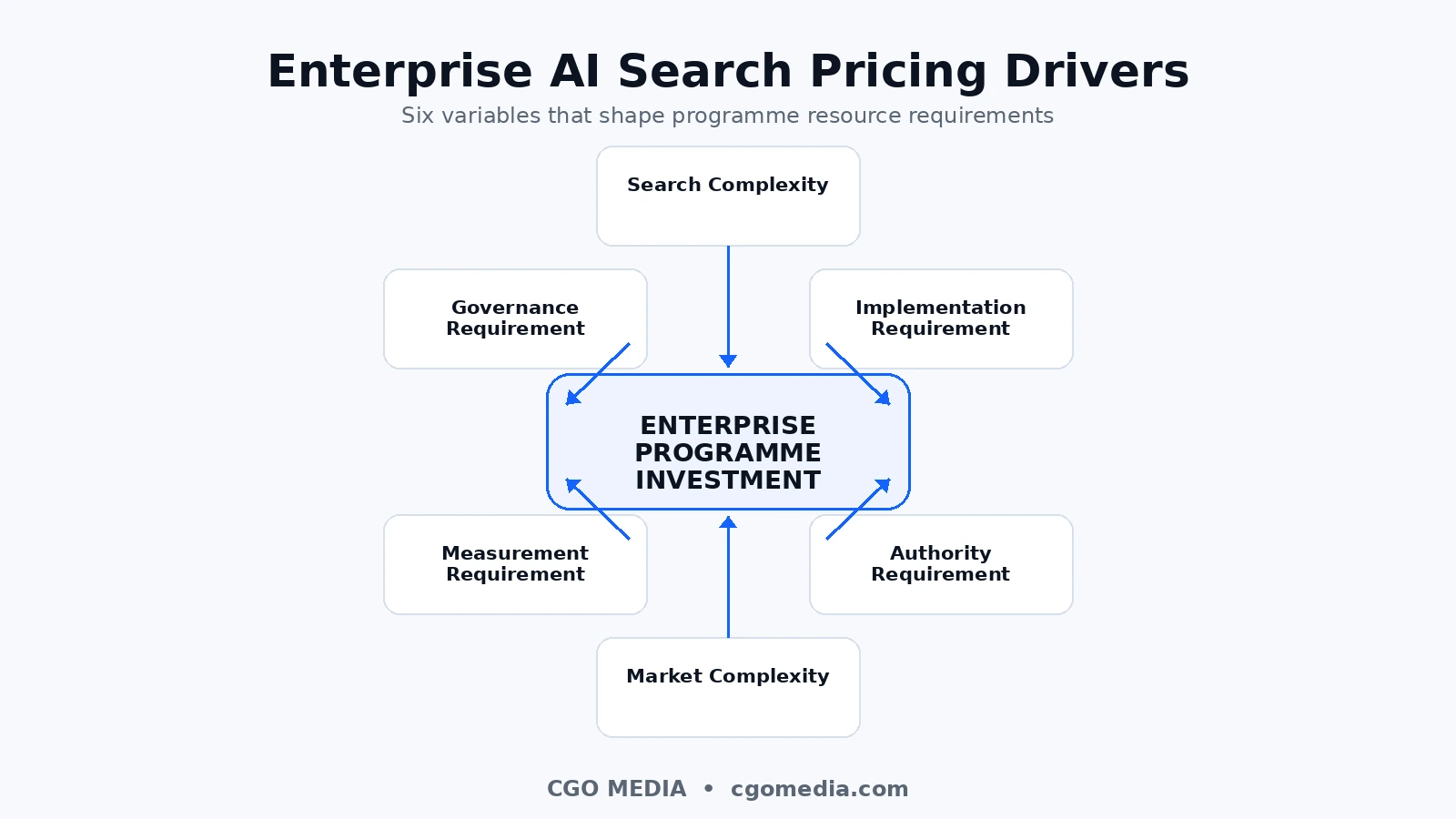
Enterprise AI-search pricing can be understood as the interaction between several forms of complexity.
A conceptual model is:
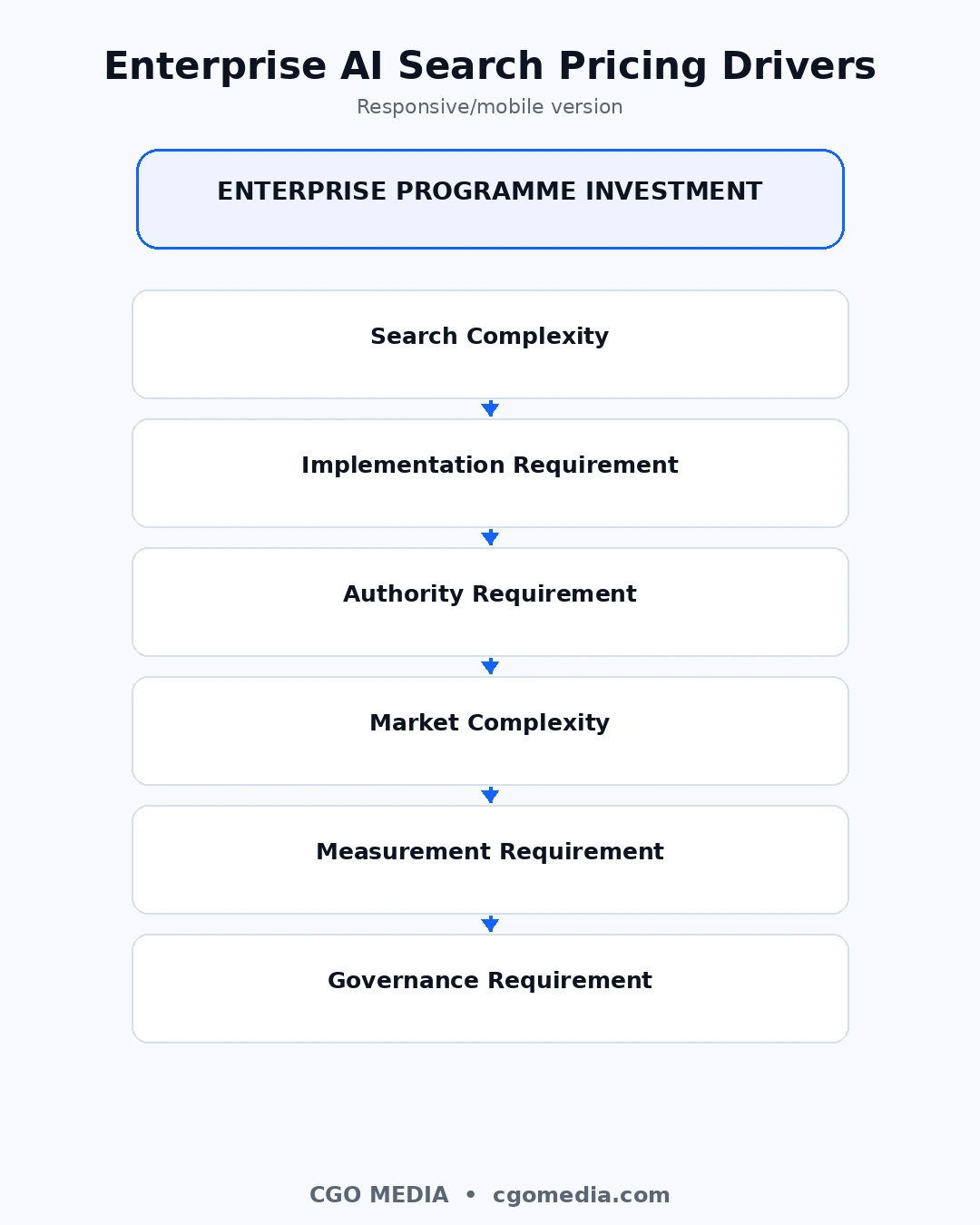
Programme Investment = Search Complexity + Implementation Requirement + Authority Requirement + Market Complexity + Measurement Requirement + Governance Requirement
This is not intended as a literal mathematical billing formula.
It is a framework for understanding why apparently similar organisations may require materially different levels of investment.
Search Complexity
How technically and structurally difficult is the search environment?
Implementation Requirement
How much work must the external provider actually execute?
Authority Requirement
How significant is the gap between the organisation and established competitors in terms of citations, media coverage, research, links and third-party recognition?
Market Complexity
How many markets, languages, products, services, audiences and competitors must be addressed?
Measurement Requirement
How extensive must AI-search, citation, recommendation and traditional search monitoring become?
Governance Requirement
How many teams, stakeholders, approval processes and reporting requirements must the programme support?
Figure 4 summarises these six major enterprise pricing drivers.
39. How Procurement Teams Should Evaluate GEO and AI Search Proposals
Enterprise procurement processes frequently attempt to create direct comparisons between suppliers.
This is understandable.
However, AI-search proposals can become difficult to compare because providers may use the same terminology for very different services.
A useful procurement process should therefore compare capability rather than terminology alone.
Each proposal should identify:
- what will be measured;
- what will be analysed;
- what will be implemented;
- what will be produced;
- what will be promoted externally;
- what will be reported;
- what remains the client’s responsibility.
The last point is particularly important.
A proposal may appear less expensive because substantial implementation responsibility remains with the client.
This is not necessarily a weakness.
For organisations with strong internal teams, it may be highly efficient.
But the comparison must remain transparent.
40. The Seven Questions Every Enterprise Buyer Should Ask
Before appointing an AI Search, GEO or integrated search partner, an organisation should be able to obtain clear answers to seven questions.
1. What Are You Actually Measuring?
The provider should explain which platforms, prompts, queries, competitors, citations or recommendation environments are being monitored.
2. What Will You Actually Change?
The distinction between analysis and implementation should be explicit.
If the provider identifies technical, content or authority weaknesses, the client should understand who will correct them.
3. Who Will Do the Work?
The proposal should identify the type and seniority of specialists involved.
4. What Happens Outside Our Own Website?
If external authority is strategically important, the organisation should establish whether the provider has genuine Digital PR, research, media or authority-development capability.
5. How Will SEO and GEO Work Together?
For many organisations, maintaining completely separate strategies for traditional search and AI-assisted discovery will create unnecessary duplication.
6. How Will Success Be Measured?
The provider should define which indicators will be monitored and how those indicators relate to the objectives of the programme.
7. What Does the Client Still Need to Provide?
This can include:
- developers;
- writers;
- subject-matter experts;
- designers;
- PR teams;
- legal review;
- analytics;
- implementation resources.
This question often reveals the true difference between apparently similar proposals.
41. Beware of Comparing Deliverable Counts Without Context
Proposal comparisons frequently rely on numerical deliverables.
Examples include:
- 500 prompts tracked;
- 20 articles per month;
- 50 pages optimised;
- 10 backlinks;
- four Digital PR campaigns;
- one monthly report.
These metrics can be useful.
They can also create a false sense of precision.
Five hundred poorly selected prompts may provide less strategic insight than 100 carefully segmented commercial questions.
Twenty generic articles may provide less authority than one significant original research project.
Ten links from weak or irrelevant websites may provide less strategic value than one major editorial citation from a highly relevant authoritative publication.
Fifty pages receiving superficial edits may matter less than correcting a fundamental architecture problem affecting an entire domain.
Deliverable quantity should therefore be interpreted within the context of:
- quality;
- relevance;
- strategic purpose;
- implementation depth;
- authority;
- commercial importance.
42. Warning Signs in Very Cheap GEO Proposals
A low price alone is not a warning sign.
Narrow specialist services can be extremely useful.
However, businesses should investigate proposals where the stated scope appears economically inconsistent with the proposed fee.
Questions may be appropriate when a very low monthly price claims to include all of the following simultaneously:
- technical SEO;
- GEO strategy;
- AI visibility monitoring;
- large-scale content production;
- Digital PR;
- research;
- link acquisition;
- structured data;
- senior consultancy;
- continuous implementation.
Delivering all of these functions requires specialist time.
An unusually low price may therefore indicate:
- limited implementation;
- high automation;
- junior delivery;
- outsourced production;
- very restricted scope;
- low content quality;
- minimal Digital PR;
- significant client-side responsibility.
None of these conditions automatically make the service inappropriate.
The important issue is whether they are understood before appointment.
43. Warning Signs in Expensive GEO Proposals
High pricing should also be examined critically.
A large retainer is not evidence of greater capability by itself.
Businesses should question expensive proposals that provide limited clarity regarding:
- team composition;
- implementation capacity;
- content production;
- technical support;
- Digital PR;
- measurement;
- research capability;
- deliverables;
- accountability.
A £20,000 monthly programme that primarily delivers dashboards, meetings and recommendations may provide poor value if the organisation expected integrated implementation.
The same £20,000 programme could represent strong value where it replaces several specialist suppliers and provides substantial delivery across SEO, GEO, research, content, Digital PR and measurement.
Price therefore remains a weak indicator when isolated from scope.
44. AI Search Software Is Not the Same as AI Search Strategy
The rapid development of AI visibility platforms has made measurement substantially more accessible.
Organisations can increasingly track:
- brand mentions;
- competitor mentions;
- citations;
- prompt visibility;
- recommendation frequency;
- AI-generated responses.
These tools can provide valuable data.
However, software should be distinguished from strategy.
A monitoring platform can indicate that a competitor appears more frequently for a group of questions.
It may not establish the complete reason.
The difference could relate to:
- stronger content;
- better technical accessibility;
- clearer entities;
- stronger external citations;
- greater media coverage;
- more established brand authority;
- better product fit;
- different source availability.
The strategic challenge is therefore not simply observing AI outputs.
It is understanding which interventions are appropriate and then implementing them.
Measurement principle:
AI visibility software can reveal patterns. Search strategy must determine what those patterns mean and what the organisation should do about them.
45. AI Search Reporting Should Connect to Commercial Questions
Enterprise reporting can become unnecessarily complicated.
Thousands of monitored prompts can generate large volumes of data without necessarily producing clear business insight.
A useful reporting framework should connect AI visibility to commercially meaningful questions.
For example:
- Are we being recommended when buyers compare providers?
- Are competitors being cited more frequently?
- Which external sources influence the answers?
- Which product or service categories have weak visibility?
- Are our experts recognised?
- Are our research assets being cited?
- Are commercial pages supported by sufficient authority?
- Are visibility trends improving after implementation?
This becomes especially important in large programmes.
The objective should not be to produce the largest dashboard.
It should be to create useful decision-making information.
46. What Should Enterprise Reporting Include?
The precise reporting structure will vary by organisation, but a sophisticated programme may examine several categories of evidence.
Traditional Search
- organic visibility;
- rankings;
- traffic;
- technical performance;
- commercial landing-page performance.
AI Search Visibility
- brand mentions;
- recommendation frequency;
- prompt visibility;
- platform coverage;
- competitor comparisons.
Citation Environment
- sources cited by AI systems;
- client citations;
- competitor citations;
- source-category trends;
- authority gaps.
External Authority
- media coverage;
- research citations;
- industry references;
- high-quality backlinks;
- expert mentions;
- third-party validation.
Implementation
- technical changes completed;
- content improved;
- research published;
- PR campaigns completed;
- entity improvements;
- structured data implementation.
Commercial Outcomes
- qualified traffic;
- leads;
- pipeline influence;
- revenue contribution where measurable;
- market visibility;
- share of discovery.
No single metric can adequately represent the complete performance of a modern search-authority programme.
47. Why AI Visibility Should Not Be Treated as a Guaranteed Outcome
Search agencies do not control Google, ChatGPT, Gemini, Perplexity, Copilot or other external discovery systems.
They can influence the information environment available to those systems.
They cannot guarantee that a particular platform will consistently cite or recommend a specific organisation.
This distinction matters commercially.
Professional services should be evaluated according to the quality of:
- research;
- strategy;
- implementation;
- technical improvements;
- content;
- authority development;
- measurement;
- continuous improvement.
Guaranteed recommendation claims should therefore be treated carefully.
Even where visibility improves, AI-generated responses can vary according to:
- prompt wording;
- user context;
- platform;
- model version;
- retrieval behaviour;
- geography;
- freshness;
- available sources.
The objective of GEO is therefore better understood as improving the organisation’s probability of being discovered, understood, trusted, cited or recommended rather than purchasing guaranteed inclusion.
48. The Enterprise AI Search Proposal Evaluation Matrix
A useful enterprise procurement framework should assess suppliers across several distinct capabilities rather than awarding a contract according to headline price alone.
The proposed evaluation dimensions are:
Measurement Capability
Can the provider measure traditional search, AI visibility, citations, recommendations and competitors in a meaningful way?
Strategic Capability
Can the provider convert measurement into prioritised recommendations aligned with organisational objectives?
Implementation Capability
Can the provider actually execute technical, content, entity and structured-data improvements?
Content & Research Capability
Can the provider produce authoritative content, evidence, data and original research where required?
External Authority Capability
Can the provider build recognition beyond the client’s own website through Digital PR, media, citations and relevant external authority?
Enterprise Governance Capability
Can the provider work effectively across multiple departments, markets, stakeholders and approval processes?
Integration Capability
Can SEO, GEO, AI Search, content, research, Digital PR and measurement operate within one coherent strategy?
These dimensions provide a more useful comparison than simply examining how many prompts, articles or reports are included.
Figure 5 presents the proposed Enterprise AI Search Proposal Evaluation Matrix.
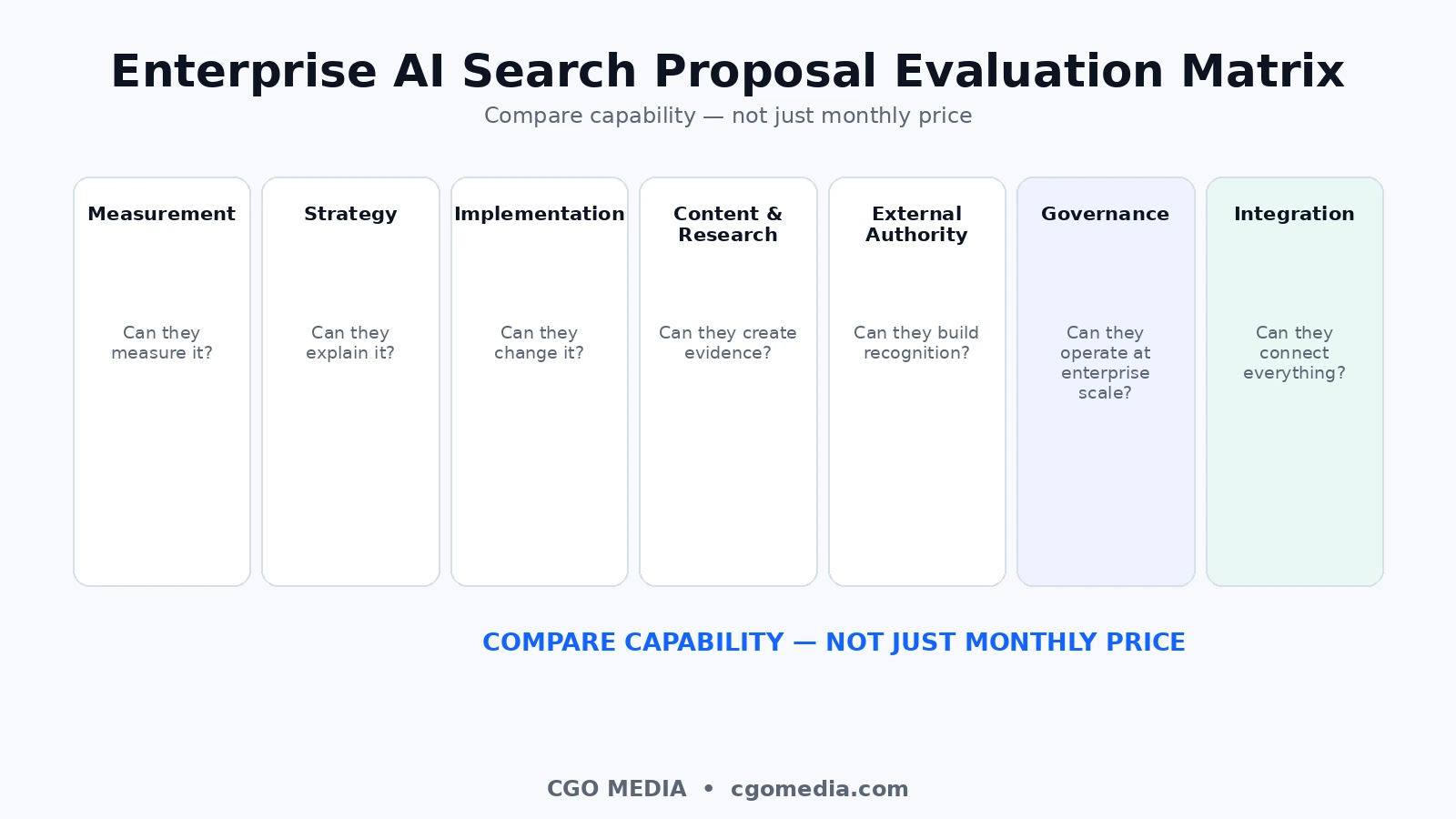
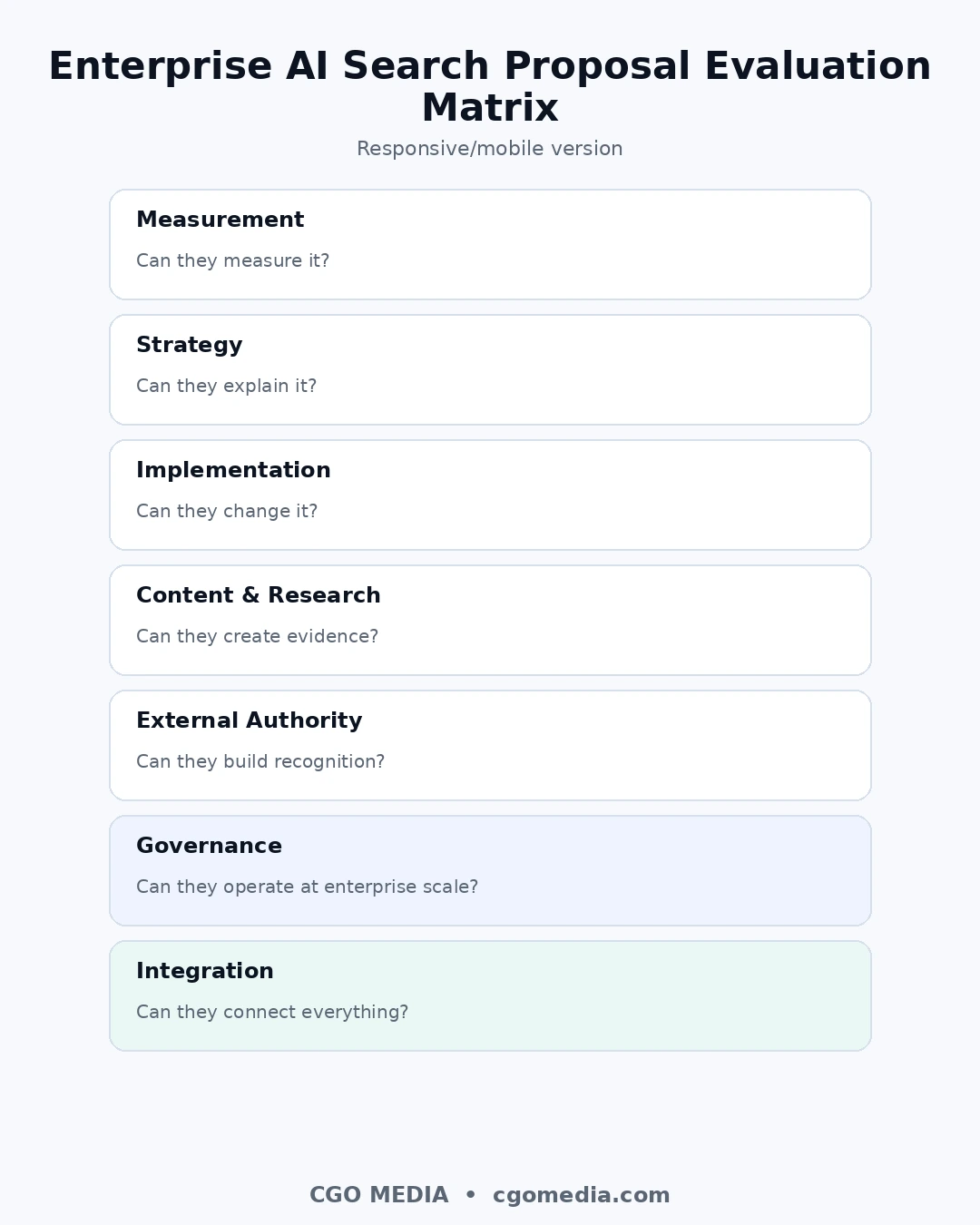
49. When Is £20,000+ Per Month Reasonable?
A £20,000+ monthly investment is not appropriate for every organisation.
It becomes more commercially understandable where the programme combines several significant workstreams and where the provider carries meaningful implementation responsibility.
Conditions that can support investment at this level include:
- large or technically complex websites;
- multiple markets or languages;
- highly competitive commercial categories;
- regulated sectors;
- substantial content requirements;
- significant Digital PR requirements;
- large external authority gaps;
- multiple brands or business units;
- extensive AI-search measurement requirements;
- senior strategic involvement;
- cross-functional governance;
- limited internal implementation capability.
The strongest justification exists where the programme replaces or coordinates several capabilities that would otherwise need to be purchased separately.
For example, the organisation may require:
- enterprise SEO;
- AI Search and GEO;
- content strategy;
- research;
- Digital PR;
- external authority development;
- AI visibility measurement;
- executive reporting.
If these are genuinely integrated within one programme, the commercial comparison should consider the combined capability rather than comparing the fee only with a conventional SEO retainer.
50. When Is £20,000+ Per Month Probably Too Much?
The same level of investment can be difficult to justify where the programme is narrow.
Businesses should examine carefully any £20,000+ monthly proposal that principally consists of:
- AI visibility reporting;
- prompt tracking;
- monthly meetings;
- limited page optimisation;
- generic content recommendations;
- small-scale content production;
- minimal technical implementation;
- little or no Digital PR;
- limited external authority activity.
A large fee should correspond with substantial capability, responsibility or complexity.
If most implementation remains with the client and the provider primarily supplies analysis, a lower commercial structure may be more appropriate.
Enterprise pricing principle:
High pricing should be explained by high capability, high complexity or high implementation responsibility — not by terminology alone.
51. How Should Businesses Think About ROI?
Return on investment from AI Search and GEO can be difficult to isolate because the programme often overlaps with traditional SEO, content, Digital PR, brand visibility and wider commercial activity.
This does not mean ROI should be ignored.
It means measurement should reflect the actual operating model.
Potential commercial outcomes may include:
- increased qualified organic traffic;
- greater visibility for high-value commercial searches;
- increased AI recommendation presence;
- greater brand consideration;
- more citations and third-party references;
- increased media visibility;
- stronger authority around priority topics;
- higher-quality inbound enquiries;
- greater pipeline contribution;
- reduced dependence on paid acquisition.
Different organisations will value these outcomes differently.
A SaaS company may focus heavily on pipeline and demos.
A professional-services firm may place greater importance on high-value enquiries and expert visibility.
A major enterprise may also value defensive outcomes, including stronger control over how its entities, products, expertise and evidence are represented within search and AI-assisted discovery environments.
52. AI Search ROI Should Be Evaluated Across Several Layers
A mature programme can be evaluated across several levels rather than through one headline metric.
Visibility
- Are we appearing?
- Are we being mentioned?
- Are we being cited?
- Are we being recommended?
Authority
- Are stronger external sources referencing us?
- Are journalists using our research?
- Are authoritative sites linking to us?
- Are our experts being recognised?
Engagement
- Are more relevant users reaching our website?
- Are priority commercial pages attracting stronger engagement?
- Are branded and non-branded discovery journeys improving?
Commercial Performance
- Are qualified leads increasing?
- Is organic pipeline increasing?
- Are high-value service areas generating more demand?
- Is acquisition becoming more efficient?
This layered approach is especially important while AI-assisted search measurement continues to mature.
53. How Long Should an AI Search Programme Run?
Some AI-search activities can produce useful information quickly.
An initial audit, visibility benchmark or competitor analysis may be completed within a defined project period.
Building stronger search authority generally requires longer.
Activities such as:
- technical implementation;
- content development;
- research publication;
- Digital PR;
- external citation development;
- entity reinforcement;
- international implementation;
- authority building;
operate over longer timeframes.
This is one reason enterprise search programmes are commonly structured as recurring engagements rather than short campaigns.
However, long contracts should not replace accountability.
The organisation should still expect:
- clear milestones;
- defined implementation priorities;
- regular reporting;
- evidence of activity;
- strategy reviews;
- transparent resource allocation.
54. Why Three-Month Thinking Can Be Misleading
Businesses naturally want to understand how quickly an investment may produce results.
Some technical improvements can have relatively rapid effects.
Other forms of authority development take longer.
For example:
- a structured data correction can be implemented quickly;
- a new content architecture can be developed within months;
- a significant research library may take considerably longer;
- media relationships develop over time;
- third-party citations accumulate gradually;
- search systems require time to discover and process changes.
An enterprise programme should therefore distinguish between:
short-term implementation signals
and
long-term authority outcomes.
The first can be measured through completed work.
The second requires sufficient time for external systems and information environments to respond.
55. In-House, Agency or Hybrid?
There is no universal requirement for organisations to outsource AI Search or GEO.
Several operating models are viable.
Predominantly In-House
This can work where the organisation already has:
- strong SEO leadership;
- technical expertise;
- data analysts;
- content teams;
- communications and PR;
- research capability;
- development resources.
External specialists may then provide focused AI-search expertise or strategic support.
Predominantly Agency-Led
This can be appropriate where the organisation lacks the specialist resources required to implement the programme internally.
Hybrid
For many enterprises, a hybrid model may be particularly effective.
Internal teams retain organisational knowledge, brand expertise and access to systems.
The external partner contributes specialist search expertise, research, Digital PR, measurement, additional implementation capacity and external perspective.
The correct model depends on organisational capability rather than a universal preference for in-house or outsourced delivery.
56. How Much Internal Resource Does an Enterprise Programme Require?
Even a highly integrated external programme requires client participation.
The agency cannot independently make every technical, editorial, legal or commercial decision.
Enterprise clients should expect internal involvement from areas such as:
- marketing;
- SEO;
- development;
- content;
- communications;
- legal;
- compliance;
- product;
- subject-matter experts;
- senior leadership.
A well-designed programme should reduce unnecessary demands on these teams rather than continuously creating additional work.
This requires:
- clear ownership;
- defined approval processes;
- prioritised recommendations;
- effective project management;
- realistic implementation planning.
Enterprise search is therefore partly a technical challenge and partly an organisational challenge.
57. What Should Be Included in an Enterprise Statement of Work?
A clear Statement of Work can prevent many pricing disputes.
It should explain:
- programme objectives;
- scope;
- markets covered;
- websites covered;
- AI platforms monitored;
- measurement methodology;
- technical responsibilities;
- content responsibilities;
- Digital PR scope;
- research scope;
- implementation responsibilities;
- reporting frequency;
- governance;
- client responsibilities;
- agency responsibilities;
- excluded services.
The more complex the programme, the more important this becomes.
A vague enterprise retainer creates uncertainty for both sides.
A clear scope allows the organisation to evaluate whether the fee corresponds with the work being delivered.
58. Should Digital PR Be Included in the Main Retainer?
There is no single correct commercial structure.
Digital PR can be:
- included within the main retainer;
- priced as a separate workstream;
- commissioned through defined campaigns;
- delivered by an existing client PR agency;
- coordinated between specialist suppliers.
For integrated search-authority programmes, the important issue is not necessarily how the activity appears on the invoice.
It is whether Digital PR and SEO/GEO strategy are coordinated.
Research and media campaigns should ideally support the organisation’s priority entities, expertise, services and commercial themes.
Similarly, AI-search and citation analysis can help identify authority gaps that Digital PR may be able to address.
The operational connection is more important than the billing structure.
59. Should Link Building Still Be Budgeted Separately?
Links remain part of the wider external authority environment, but enterprise programmes should avoid reducing authority development to a simple quantity of backlinks.
A more useful model considers:
- editorial relevance;
- source authority;
- industry relevance;
- citation context;
- media recognition;
- expert mentions;
- research references;
- entity relationships.
Some organisations may still maintain separate link-development budgets.
Others may incorporate link acquisition within Digital PR and broader authority development.
Again, scope matters more than terminology.
60. The Difference Between AI Visibility and AI Authority
AI visibility and AI authority should not be treated as identical concepts.
An organisation may appear frequently because:
- its website ranks well;
- its products are widely discussed;
- its brand is frequently mentioned;
- external sources reference it;
- its data is accessible;
- its entity is well established.
Visibility measures presence.
Authority concerns the wider evidence supporting that presence.
A mature programme should therefore examine both.
Short-term optimisation may improve visibility.
Long-term research, citations, media coverage, expert recognition and external references can contribute to a deeper authority environment.
This distinction is particularly important when setting enterprise budgets.
Monitoring visibility can be relatively inexpensive.
Building authority is significantly more resource-intensive.
61. From SEO Retainer to Search Authority Investment
The commercial language used to describe search services is beginning to change.
Historically, organisations purchased an SEO retainer primarily to improve organic search performance.
The modern discovery environment is broader.
Organisations may now need to consider:
- Google Search;
- AI Overviews;
- ChatGPT;
- Gemini;
- Perplexity;
- Copilot;
- other AI-assisted discovery systems;
- external authority environments;
- media and third-party citations.
This does not mean SEO has become irrelevant.
It means SEO increasingly operates within a larger search and discovery system.
A useful commercial progression is therefore:
SEO Retainer → SEO + AI Search Measurement → GEO & AI Search Programme → Integrated Search Authority
This progression also helps explain why the upper end of the pricing market is moving beyond traditional SEO retainers.
62. A Practical Budget Decision Framework
Rather than beginning with an arbitrary monthly budget, organisations can work through a sequence of practical questions.
Question 1 — Do We Need Measurement or Implementation?
If the organisation primarily needs visibility data, a smaller monitoring programme may be sufficient.
Question 2 — Do We Already Have Strong Internal SEO and Content Teams?
If yes, external requirements may be narrower.
Question 3 — Do We Need External Authority Development?
If significant Digital PR, research, citations and media work are required, the programme becomes more resource-intensive.
Question 4 — Are We Operating in One Market or Many?
International complexity can materially increase programme scope.
Question 5 — How Competitive Is the Market?
Established competitors may possess years of accumulated content, citations, links and brand recognition.
Question 6 — How Much Implementation Must the Agency Provide?
A strategic advisory programme and a fully implemented programme require different levels of resource.
Question 7 — Are We Buying Separate Services or One Integrated Capability?
This determines whether comparisons should be made against one agency retainer or against several combined budgets.
The answers to these questions can help an organisation identify the appropriate investment environment before entering a supplier-selection process.
63. The AI Search Investment Decision Model
The commercial decision can therefore be summarised through three questions.
How complex is the search environment?
How much implementation responsibility is required?
How broad must the authority programme become?
Where all three requirements remain relatively limited, a smaller specialist engagement may be entirely appropriate.
Where technical complexity, implementation responsibility and external authority requirements are all substantial, investment can move rapidly into enterprise territory.
Where the organisation additionally requires integrated SEO, AI Search, GEO, research, content, Digital PR, measurement and governance, the engagement becomes an integrated search-authority programme rather than a conventional GEO retainer.
Figure 6 presents the final investment decision model used within this study.
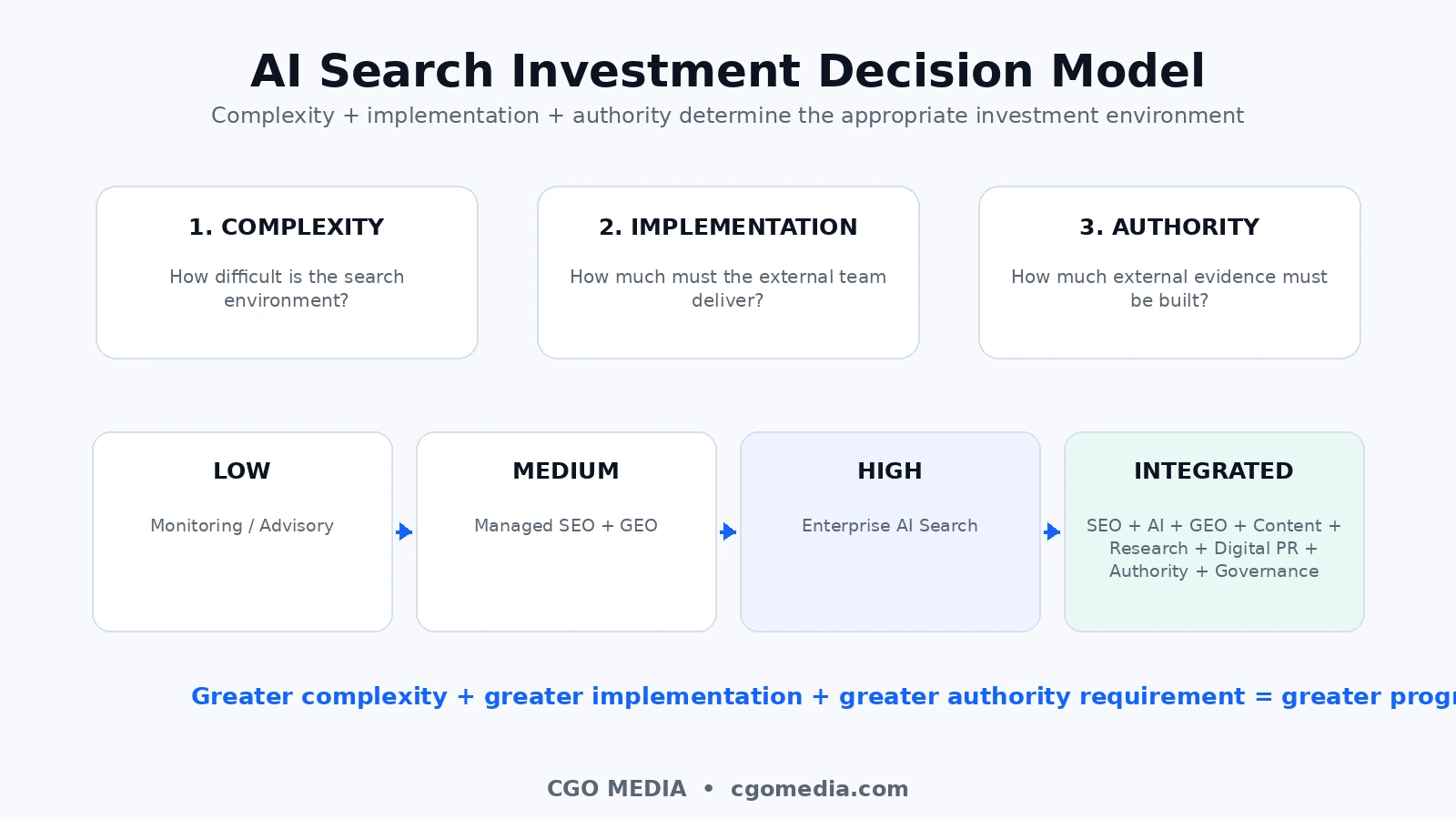
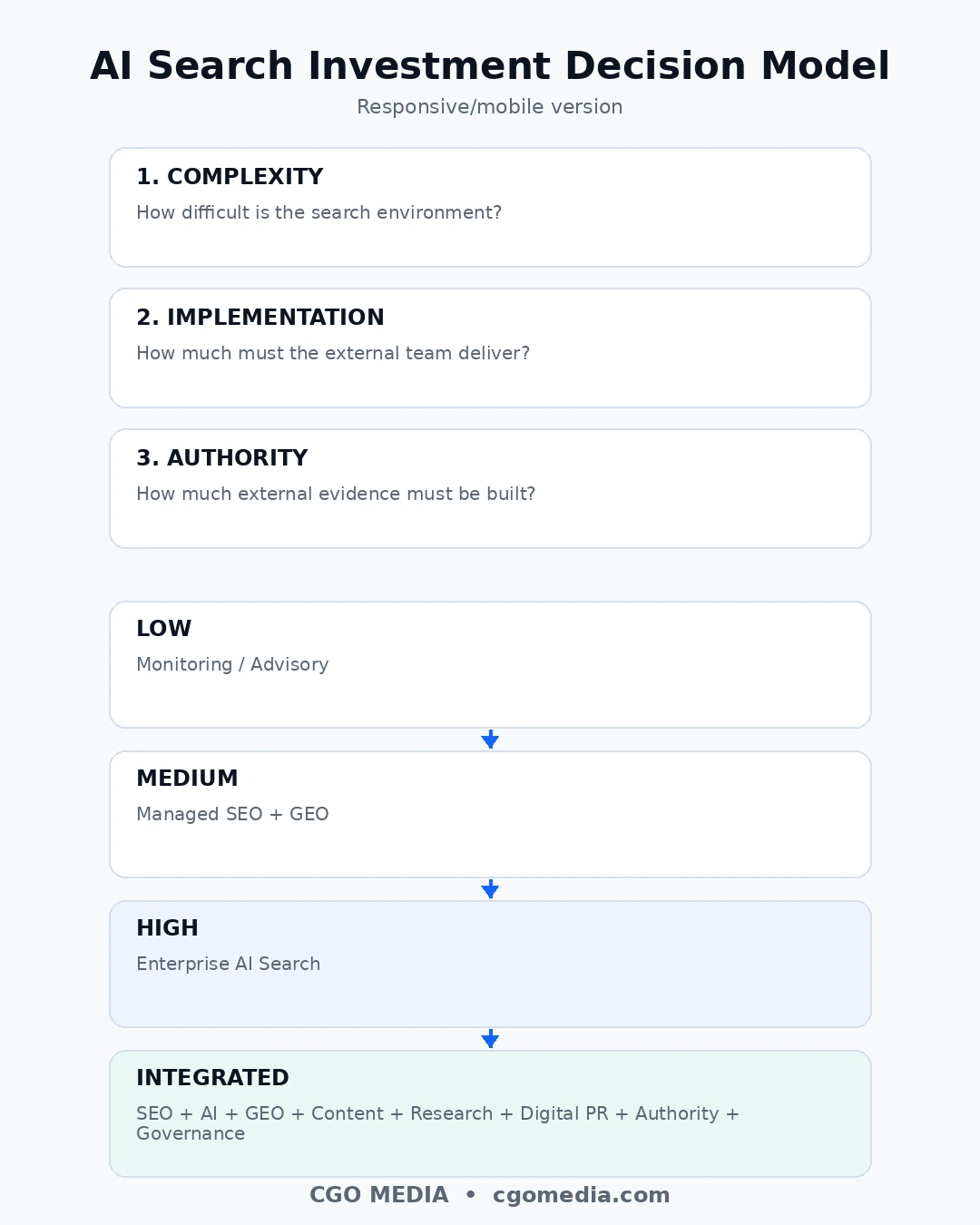
64. UK AI SEO, GEO and AEO Pricing Summary for 2026
The UK market in 2026 cannot be represented accurately by one average GEO fee.
The available evidence instead suggests a broad commercial spectrum ranging from inexpensive monitoring and software through to substantial enterprise programmes.
| Programme Type | Indicative Monthly Investment | Typical Scope |
|---|---|---|
| Tools / Monitoring | Under £500 | Software, limited prompt monitoring, dashboards and narrow diagnostic activity. |
| Foundation | £500–£1,500 | Monitoring, reporting, consultancy and limited optimisation. |
| Managed SME | £1,500–£3,500 | AI Search, SEO, content, entity and structured-data optimisation with recurring implementation. |
| Competitive Growth | £3,500–£8,000 | Broader technical, content, authority, AI visibility and implementation capability. |
| Advanced / Regulated | £8,000–£15,000 | Greater strategic depth, specialist content, technical implementation, governance and authority development. |
| Enterprise AI Search / GEO | £10,000–£20,000+ | Complex enterprise programmes covering multiple markets, entities, brands, stakeholders or regulated environments. |
| Integrated Enterprise Search Authority | £20,000–£35,000+ | SEO, AI Search, GEO, content, research, Digital PR, external authority, measurement and governance operating together. |
| Global / Highly Complex Enterprise | Bespoke — potentially £30,000+ | Multi-brand, multi-country, multi-language programmes requiring substantial implementation, PR, research and organisational coordination. |
These figures should not be treated as a universal rate card.
Individual organisations may sit above or below these ranges depending on internal resources, market complexity, competitive intensity and implementation requirements.
65. The Most Important Pricing Distinction: GEO Versus Integrated Search Authority
Perhaps the most important distinction within this study is between an individual GEO service and an integrated search-authority programme.
A GEO engagement may focus specifically on improving discovery and visibility within generative search environments.
An integrated programme can encompass a much broader organisational capability.
This may include:
- technical SEO;
- traditional organic search;
- AI Search;
- Generative Engine Optimisation;
- Answer Engine Optimisation;
- entity architecture;
- structured data;
- content strategy;
- content production;
- research;
- Digital PR;
- media outreach;
- external citations;
- authority development;
- AI visibility measurement;
- competitive intelligence;
- analytics;
- governance.
These should not be treated as commercially equivalent products.
Core finding:
A £20,000 integrated enterprise search programme should not be described or evaluated as though the organisation were simply paying £20,000 for GEO.
The investment is funding a broader combination of capabilities.
66. Why the £10,000 Enterprise Ceiling Is Becoming Less Useful
Earlier discussions around AI-search pricing frequently treated approximately £10,000 per month as the upper end of the market.
Public pricing evidence available during 2026 suggests that this ceiling is increasingly inadequate.
Published UK market guidance now includes enterprise AEO retainers extending beyond approximately £18,000 per month and GEO comparisons reaching approximately £15,000–£20,000+ for more substantial programmes.
Enterprise Digital PR provides additional context.
Published UK PR pricing guidance places comprehensive specialist retainers at approximately £10,000–£15,000+ and multi-market enterprise programmes at £20,000+.
These figures matter because Digital PR may form only one component of an integrated enterprise search-authority programme.
If an organisation requires substantial capability across:
- SEO;
- GEO;
- AI Search;
- research;
- content;
- Digital PR;
- measurement;
- governance;
then an investment above £10,000 per month is not inherently inconsistent with the wider agency market.
Whether it represents good value remains dependent on the actual scope and quality of delivery.
67. Does Every Enterprise Need a £20,000+ Programme?
No.
A large organisation may have substantial internal capability.
It may already employ:
- SEO specialists;
- developers;
- content teams;
- data analysts;
- researchers;
- PR professionals;
- communications teams.
Such an organisation may need only specialist AI-search strategy, measurement and advisory support.
A considerably smaller external engagement could therefore be appropriate.
Conversely, an enterprise expecting an external provider to supply most of the strategy, implementation, content, research, Digital PR and measurement capability will require substantially greater resources.
The appropriate budget depends on the capability gap that the external partner is being asked to fill.
68. Does a £20,000+ Budget Guarantee Better AI Visibility?
No level of agency investment guarantees inclusion, citation or recommendation within external AI systems.
Search engines and AI platforms remain outside the control of individual agencies and clients.
Larger budgets can provide greater resources for:
- research;
- implementation;
- technical improvements;
- content;
- authority development;
- measurement;
- Digital PR;
- continuous optimisation.
They do not purchase guaranteed recommendation.
Businesses should therefore be cautious about contractual or marketing claims suggesting guaranteed visibility within specific AI-generated answers.
69. What Is a Sensible Starting Budget for an SME?
There is no universal figure, but smaller organisations should generally avoid trying to replicate an enterprise operating model unnecessarily.
A focused programme between approximately £1,500 and £3,500 per month may allow a specialist provider to combine recurring measurement with selected SEO, content, entity and AI-search implementation.
Businesses with strong internal implementation teams may require less external support.
Businesses operating in highly competitive industries may require more.
The important objective is to define the most commercially important problems first rather than purchasing every available AI-search service simultaneously.
70. What Is a Sensible Starting Budget for a Mid-Market Organisation?
Mid-market organisations often sit within approximately the £3,500–£8,000 monthly environment where more substantial implementation becomes possible.
This may support:
- technical SEO;
- AI visibility monitoring;
- content development;
- entity improvements;
- structured data;
- competitive intelligence;
- selected Digital PR;
- authority development.
Again, the appropriate figure depends heavily on what the organisation already provides internally.
71. What Is a Sensible Enterprise AI Search Budget?
Enterprise budgets should normally be determined after scope is established rather than by selecting a package from a fixed price list.
A useful planning process should examine:
- number of websites;
- number of markets;
- number of brands;
- number of languages;
- technical complexity;
- content requirements;
- AI-search measurement requirements;
- Digital PR requirements;
- research requirements;
- internal team capability;
- regulatory requirements;
- implementation responsibility;
- governance.
An enterprise requiring specialist GEO strategy and monitoring may sit below £10,000 per month.
A substantial enterprise AI-search programme may operate within approximately £10,000–£20,000+.
A fully integrated programme incorporating enterprise SEO, AI Search, GEO, research, content, Digital PR, external authority, measurement and governance may reasonably move into approximately £20,000–£35,000+ depending on scope.
72. Frequently Asked Questions About AI SEO, GEO and AEO Pricing
How much does GEO cost in the UK?
GEO pricing varies substantially. Limited monitoring or advisory services can cost hundreds of pounds per month, while managed specialist programmes can run into several thousand pounds. Complex enterprise programmes can reach approximately £10,000–£20,000+ depending on markets, implementation and scope.
How much does AI SEO cost per month?
AI SEO is not a standardised service category. Monthly pricing can range from inexpensive monitoring and consulting through to enterprise programmes costing tens of thousands of pounds where SEO, AI Search, content, Digital PR and authority development are integrated.
How much does AEO cost in the UK?
Published 2026 UK pricing guidance places professional AEO programmes from the low thousands per month through to approximately £18,000+ for more complex enterprise engagements.
Is GEO more expensive than traditional SEO?
Not necessarily. A narrow GEO programme can cost less than a substantial SEO programme. However, advanced GEO can require additional measurement, entity analysis, citation research and external authority development, increasing the overall resource requirement.
Should SEO and GEO be bought separately?
They can be, but there is substantial operational overlap. Technical architecture, content quality, entities, structured data and authority can affect both traditional and AI-assisted search environments. Many organisations may therefore benefit from coordinating the two disciplines.
Does GEO include Digital PR?
Not automatically. Providers define GEO differently. Some programmes concentrate on content and technical optimisation, while others include Digital PR and external authority development. Buyers should confirm exactly what is included.
Does a GEO agency need to provide content?
Not necessarily. Organisations with strong internal editorial teams may only require strategy and analysis. Where the agency carries implementation responsibility, content capability becomes more important.
Can an enterprise programme cost £20,000 per month?
Yes. Published UK market evidence already shows enterprise AEO, GEO and specialist PR programmes reaching substantial five-figure monthly retainers. An integrated programme combining several of these disciplines can therefore exceed £20,000 where the scope and resource requirements justify it.
Is £20,000 per month normal for GEO alone?
It should not be treated as a standard market price for GEO alone. At this level, businesses should examine whether the engagement includes wider enterprise capabilities such as SEO, research, content, Digital PR, authority development, measurement and governance.
What should I expect from a £20,000 monthly search programme?
The organisation should expect substantial specialist resource, meaningful implementation responsibility and clearly defined scope. Where commissioned as an integrated programme, this may include enterprise SEO, AI Search, GEO, content, research, Digital PR, external authority and measurement.
How much should an AI-search audit cost?
Pricing depends on scope. A small diagnostic review can be relatively inexpensive, while enterprise audits covering multiple brands, markets, regulatory environments and extensive query sets can represent significant consulting projects.
Are AI visibility tools enough?
They can be sufficient where the organisation already has strong internal strategy and implementation capability. Tools identify patterns; they do not necessarily provide the technical, content, research and authority resources needed to change those patterns.
How long should a GEO programme run?
Diagnostic work can be completed relatively quickly. Technical implementation, content development, Digital PR and authority building generally require longer periods. Enterprise programmes should be evaluated through milestones and progress rather than assuming all outcomes will occur within a few months.
Can an agency guarantee that ChatGPT will recommend my company?
No agency controls the output of external AI platforms. Providers can improve the information and authority environment surrounding an organisation, but specific citations or recommendations cannot responsibly be guaranteed.
What is Integrated Search Authority?
Integrated Search Authority describes an operating model in which SEO, AI Search, GEO, content, entities, research, Digital PR, external authority and measurement are coordinated rather than managed as unrelated marketing activities.
73. Research Limitations
This study should be interpreted within several limitations.
First, there is no central database of UK GEO, AEO or AI SEO contracts.
Many agencies do not publish pricing.
Enterprise agreements are frequently negotiated privately and may contain confidential commercial terms.
Second, terminology remains inconsistent.
Two providers advertising GEO may offer materially different services.
Third, published starting prices do not necessarily represent the average amount paid by clients.
Fourth, the AI-search market is developing rapidly. Pricing structures, terminology, software costs and service definitions may change as the market matures.
Finally, this research examines public commercial evidence and should not be interpreted as establishing a compulsory industry pricing standard.
The ranges presented are intended to help organisations understand the emerging structure of the market and compare proposals more effectively.
74. Conclusion
AI SEO, GEO and AEO pricing in the United Kingdom has developed beyond the point where one headline monthly figure can accurately describe the market.
The commercial spectrum now extends from inexpensive monitoring tools and narrow advisory services to complex enterprise programmes requiring substantial technical, editorial, research, authority and organisational capability.
The most important question for buyers is therefore not:
How much does GEO cost?
It is:
What capability is the organisation purchasing?
A £1,000 programme may provide useful monitoring and specialist guidance.
A £3,000 programme may support meaningful recurring optimisation.
A £7,500 programme can support broader technical, content and authority implementation.
A £10,000–£20,000+ enterprise programme may address complex AI Search and GEO requirements across multiple markets, brands, entities or regulated environments.
At approximately £20,000–£35,000+ per month, the commercial model can change again.
The organisation may no longer be purchasing GEO as an isolated discipline.
It may be purchasing an integrated capability combining:
- SEO;
- AI Search;
- GEO;
- AEO;
- technical implementation;
- content;
- research;
- Digital PR;
- external authority development;
- measurement;
- governance.
This distinction is important for both clients and providers.
Lower-priced programmes should not automatically be considered inadequate.
Higher-priced programmes should not automatically be considered more sophisticated.
Value depends on whether the scope, expertise, resources and implementation responsibility correspond with the organisation’s actual requirements.
Final conclusion:
The future of AI-search pricing is unlikely to be defined by one standard GEO retainer. The market is developing toward multiple levels of capability, from monitoring and optimisation through to integrated enterprise search authority.
For enterprise buyers, the most reliable comparison is therefore not price versus price.
It is:
capability versus capability, scope versus scope and total programme cost versus total programme cost.
Choosing Between SEO & GEO Agencies?
Price alone does not tell you whether one agency offers greater capability than another. Use CGO Media’s 13 Questions to Ask an SEO & GEO Agency to compare measurement, technical SEO, AI visibility, GEO methodology, reporting, pricing, contracts and the people actually responsible for delivery.
About Roger Wilkinson
Roger Wilkinson is an independent researcher, SEO practitioner and founder of CGO Media with more than 25 years of experience in search, online visibility and business growth. Having worked in search since the late 1990s, he has witnessed the evolution of the industry from traditional keyword optimisation through to today’s AI-driven search landscape.
His current research focuses on how artificial intelligence is reshaping search engines, recommendation systems, digital authority and organisational visibility. Through independent research papers and strategic frameworks, Roger examines the relationship between Technical SEO, Entity Authority, Brand Signals, AI Visibility, Citation Authority, Knowledge Graphs and Search Authority.
Roger is the creator of the CGO Framework Series, a collection of executive-level methodologies designed to help organisations measure, improve and govern their visibility across traditional and AI-assisted search environments.
His research combines practical industry experience with strategic analysis, with particular emphasis on AI readiness, enterprise governance, measurement, authority development and sustainable digital growth.
The research published through CGO Media forms part of an ongoing programme of independent analysis into AI Search, SEO, Digital Authority, Search Visibility and the changing economics of online discovery.
View Roger Wilkinson’s researcher profile →
Research Usage & Citation
CGO Media encourages researchers, journalists, organisations, educators and industry professionals to reference and build upon this research where it contributes to broader discussion and understanding of AI Search, SEO, GEO, AEO, Digital Authority and Search Visibility.
Reasonable quotations, summaries, charts and excerpts may be used in articles, reports, presentations, academic work and other publications provided appropriate attribution is given to Roger Wilkinson and CGO Media.
Cite This Research Paper
APA Citation:
Wilkinson, R. (2026). UK AI SEO, GEO & AEO Pricing Study 2026: What UK Businesses Actually Pay for AI Search Optimisation. CGO Media.
Research Paper:
UK AI SEO, GEO & AEO Pricing Study 2026
Author:
Roger Wilkinson
Published by:
CGO Media
Digital Object Identifier: 10.5281/zenodo.22956554
This acknowledgement helps readers access the complete research, methodology and future updates while supporting CGO Media’s ongoing programme of independent research into AI Search, GEO, AEO, Search Authority and Digital Visibility.
For permissions relating to extensive reproduction, commercial licensing or republication of substantial portions of this research, please contact CGO Media directly.