Brand Authority Signals in AI Search
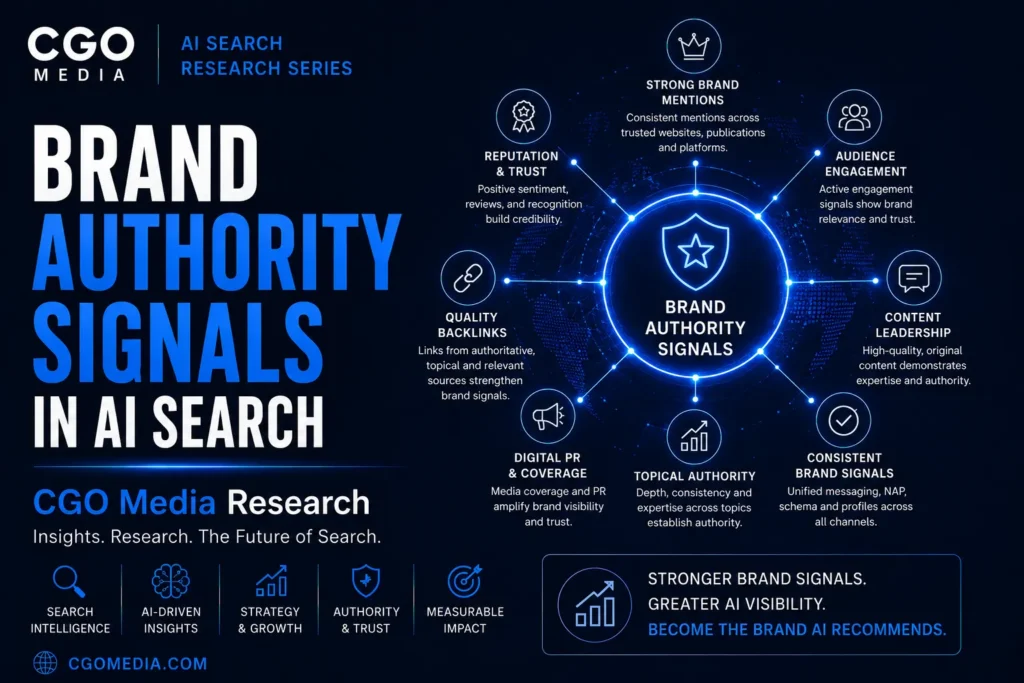
CGO Media AI Search Research Series – Paper 8: title – Brand Authority Signals in AI Search.
An analysis of how branded search demand, media references, entity consistency, reviews, digital reputation and independent recognition influence visibility across traditional search engines and AI-generated answers.
Abstract
Search visibility is increasingly influenced by the strength, consistency and recognisability of the organisation behind the website. Traditional SEO has often concentrated on page-level relevance, technical performance and backlinks. These factors remain important, but they do not fully explain why some brands receive greater visibility, trust and recommendation across modern search environments.
Search engines and artificial intelligence systems operate across a distributed information ecosystem. They encounter brands through websites, news coverage, professional profiles, reviews, directories, social platforms, public records, research citations and user behaviour. These sources collectively contribute to the representation of a brand as an identifiable entity.
This paper examines the concept of brand authority in AI search. It explores how external recognition, branded search demand, entity consistency, reputation, expert association, customer evidence and topical relevance may influence both conventional organic visibility and generative recommendations.
The paper proposes a Brand Authority Signal Framework containing six interconnected dimensions: entity clarity, market recognition, topical association, reputation and sentiment, external validation and behavioural demand.
It distinguishes brand popularity from brand authority. A widely recognised brand may not be considered authoritative in every subject, while a smaller specialist organisation may possess strong authority within a defined market.
The central argument is that brand authority develops through repeated and consistent evidence across owned and independent sources. Organisations seeking greater visibility in AI search must therefore manage not only their webpages but also the broader digital representation through which machines understand who they are, what they do and why they should be trusted.
Keywords
Brand authority; AI search; artificial intelligence; entity SEO; Generative Engine Optimisation; GEO; brand signals; branded search; online reputation; knowledge graphs; digital PR; AI citations; E-E-A-T; external validation; search visibility.
1. Introduction
Search engines do not evaluate webpages in complete isolation. They also interpret the wider organisation, person or product associated with the content.
A website may contain technically optimised pages and relevant keywords, yet struggle to achieve strong visibility when the brand behind it has limited recognition, inconsistent information or weak external validation.
Conversely, a well-established organisation may achieve greater search prominence because its name, services, experts and market position are recognised across many independent sources.
This does not mean that brand size automatically determines search rankings. It means that search and AI systems encounter evidence beyond the individual webpage.
A brand may be represented through:
- Its official website.
- News articles.
- Professional directories.
- Government or regulatory records.
- Customer reviews.
- Social profiles.
- Research citations.
- Industry awards.
- Executive interviews.
- Partner websites.
- Public datasets.
Together, these references form a distributed brand identity.
Artificial intelligence increases the importance of this environment because generative systems may answer questions concerning organisations directly.
Users may ask:
- Which company is best for a particular service?
- Which brands are trusted in a market?
- Who are the leading specialists in a field?
- Is a company reputable?
- What does a brand offer?
- Which provider operates in a specific location?
- How does one company compare with another?
To answer these questions, an AI system may retrieve and synthesise information from several sources rather than relying only on the company’s own claims.
This creates a significant strategic shift.
Organisations must manage not only what they publish but also how they are represented, confirmed and discussed elsewhere.
A professional AI SEO strategy must therefore address brand recognition, entity consistency and external authority alongside technical and content optimisation.
1.1 What Is Brand Authority?
Brand authority describes the degree to which an organisation is recognised as credible, relevant and knowledgeable within a specific market or subject.
It may be supported by:
- Consistent brand information.
- Independent media coverage.
- Customer trust.
- Professional recognition.
- Expert visibility.
- Original research.
- Branded search demand.
- Relevant backlinks and citations.
Brand authority is not simply awareness.
A brand may be famous but lack specialist credibility. Another may be relatively unknown to the general public but highly respected within a narrow professional field.
Authority is therefore contextual.
1.2 Brand Popularity Versus Brand Authority
Brand popularity concerns the scale of awareness or attention surrounding a brand.
Brand authority concerns whether that recognition is connected to trust, expertise and relevance.
A company may become widely discussed because of controversy, entertainment or viral publicity. This creates visibility but not necessarily authority.
A specialist organisation may receive fewer mentions overall, yet those mentions may come from:
- Industry media.
- Professional bodies.
- Academic sources.
- Government reports.
- Recognised experts.
These references may create stronger authority within the relevant topic.
1.3 Brand as an Entity
An entity is a distinct object that can be identified independently, such as a person, organisation, product, place or concept.
For a brand to function clearly as an entity, systems need to understand:
- Its name.
- Its legal or trading identity.
- Its website.
- Its services or products.
- Its locations.
- Its leadership.
- Its market category.
- Its relationships with other entities.
Conflicting or incomplete information can create ambiguity.
For example, inconsistent company names, old addresses, conflicting founding dates and outdated executive information may make it harder to interpret the organisation accurately.
1.4 Brand Authority in AI Recommendations
AI-generated recommendations often require stronger evidence than simple informational answers.
A system recommending a company may consider signals such as:
- Market reputation.
- Independent reviews.
- Relevant expertise.
- Media recognition.
- Customer experience.
- Geographic relevance.
- Consistency of public information.
- Comparison with competitors.
The system may avoid or underrepresent brands when it cannot verify their identity, services or reputation confidently.
1.5 The Relationship Between Brand and SEO
Brand development and SEO have often been treated as separate disciplines.
Brand teams focus on awareness, identity and reputation. SEO teams focus on rankings, traffic and technical performance.
In modern search, these areas increasingly overlap.
Brand activity can influence:
- Branded search demand.
- Click behaviour.
- Link acquisition.
- Media coverage.
- User trust.
- Direct traffic.
- Repeat visits.
- External citations.
SEO can also strengthen brand visibility by making the organisation easier to discover for non-branded topics.
The relationship is therefore circular. Search builds brand recognition, while brand recognition can strengthen search performance.
1.6 The Problem of Self-Declared Authority
Organisations frequently describe themselves as:
- Leading.
- Trusted.
- Award-winning.
- Innovative.
- Expert.
- Market-leading.
These statements may be accurate, but self-declaration alone provides weak evidence.
Authority becomes stronger when claims are supported by:
- Independent rankings.
- Recognised awards.
- Customer reviews.
- Media references.
- Case studies.
- Professional qualifications.
- Research citations.
AI systems may compare first-party claims with external sources before repeating or recommending them.
1.7 Distributed Brand Evidence
A brand’s digital identity does not exist in one location.
It is distributed across many sources and platforms.
This creates both opportunity and risk.
The opportunity is that independent references can strengthen recognition and trust.
The risk is that incorrect, outdated or negative information can also become part of the brand’s machine-readable identity.
2. Research Objectives and Questions
The primary objective of this paper is to examine how brand authority is created, distributed and interpreted across traditional search engines and AI-powered discovery systems.
The study is guided by seven research questions:
- Which signals contribute to brand authority in modern search?
- How does entity consistency affect the interpretation of an organisation?
- What role do branded search demand and user behaviour play in brand visibility?
- How do reviews, media coverage and professional recognition contribute to external validation?
- How does topical association influence AI recommendations?
- How should organisations monitor inaccurate or negative brand representation?
- How should brand authority be measured across search, reputation and commercial outcomes?
The paper does not claim that every mention, review or branded query functions as a direct ranking factor.
Search systems do not reveal all weighting and source-selection processes.
The research instead examines how these signals create a broader evidence environment through which brands become more recognisable and credible.
3. Research Methodology
This paper applies a qualitative research methodology combining search documentation, entity analysis, reputation theory, brand-signal observation and conceptual framework development.
3.1 Search Engine Documentation
Official guidance concerning site reputation, structured data, organisation markup, local business information, reviews, spam policies and AI search features was considered.
Particular attention was given to:
- Accurate business representation.
- Clear organisational identity.
- Structured entity information.
- Review integrity.
- Source transparency.
- Helpful and reliable content.
3.2 Entity and Knowledge Graph Research
Research concerning entities, knowledge graphs, semantic search and information extraction was reviewed.
These fields help explain how systems connect:
- Brands with products.
- Companies with locations.
- Executives with organisations.
- Experts with topics.
- Services with customer needs.
3.3 Reputation and Brand Literature
Established concepts from branding, communications and reputation management were considered.
These include:
- Brand awareness.
- Brand associations.
- Perceived quality.
- Customer trust.
- Third-party endorsement.
- Reputation recovery.
3.4 Search Behaviour Analysis
The paper considers behavioural indicators including:
- Branded search volume.
- Direct navigation.
- Brand-plus-service searches.
- Brand comparison searches.
- Repeat visits.
- Customer review activity.
These behaviours do not all function as confirmed ranking signals. They nevertheless provide evidence of market recognition and user demand.
3.5 Brand Representation Analysis
Common brand-information environments were evaluated, including:
- Corporate websites.
- Knowledge panels.
- Business profiles.
- Media coverage.
- Professional directories.
- Review platforms.
- Social profiles.
- Public records.
3.6 Conceptual Framework Development
The paper proposes a Brand Authority Signal Framework containing six dimensions:
- Entity clarity.
- Market recognition.
- Topical association.
- Reputation and sentiment.
- External validation.
- Behavioural demand.
The framework is intended as a strategic model rather than a confirmed search-engine formula.
3.7 Research Limitations
The precise relationship between brand signals and rankings remains difficult to isolate.
Brand authority may overlap with:
- Backlink authority.
- Content quality.
- Technical performance.
- Advertising.
- Offline marketing.
- Public relations.
- Customer experience.
AI answers also vary according to platform, model, prompt, location and time.
The paper therefore focuses on strategic patterns and observable relationships rather than claiming precise algorithmic causation.
4. Literature Review and Theoretical Background
4.1 Brand Equity
Brand equity describes the additional value associated with a recognised brand name.
It may include:
- Awareness.
- Perceived quality.
- Customer loyalty.
- Positive associations.
- Market differentiation.
In search environments, strong brand equity can influence how users evaluate results before visiting a page.
A recognised brand may receive greater attention because users already understand or trust the organisation.
4.2 Brand Awareness
Brand awareness concerns whether users can recognise or recall a brand.
It may develop through:
- Advertising.
- Search visibility.
- Media coverage.
- Customer experience.
- Word of mouth.
- Social platforms.
- Offline presence.
Brand awareness alone does not establish authority, but it increases the likelihood that the organisation will be searched, discussed and referenced.
4.3 Brand Associations
Brand associations are the concepts, products, locations, qualities and emotions connected with a brand.
For search and AI systems, strategically useful associations may include:
- A company and its main service.
- A brand and a target location.
- An expert and a specialist subject.
- A product and a market category.
- An organisation and a recognised methodology.
Strong associations require repetition and consistency across sources.
4.4 Entity Recognition
Entity recognition allows systems to identify distinct people, organisations, products and places within text and structured data.
Entity resolution attempts to determine whether different references describe the same object.
For example:
- CGO Media.
- CGO Media Ltd.
- CGO Media UK.
- The CGO Media agency.
These references may all describe the same organisation, but inconsistent use can create ambiguity when not supported by clear contextual evidence.
4.5 Knowledge Graphs
Knowledge graphs represent entities and their relationships.
A brand may be connected to:
- Founders.
- Executives.
- Locations.
- Products.
- Services.
- Subsidiaries.
- Partners.
- Industry categories.
- Research publications.
Clear and consistent relationships can improve machine understanding.
4.6 Reputation Theory
Reputation reflects how stakeholders perceive an organisation over time.
It develops through:
- Performance.
- Communication.
- Customer experience.
- Media reporting.
- Leadership behaviour.
- Social impact.
- Response to crises.
Search results and AI summaries increasingly act as public reputation interfaces.
Users may encounter a generated description of a company before visiting the official website.
4.7 Third-Party Endorsement
Third-party endorsement occurs when an independent source recognises, recommends or validates an organisation.
Examples include:
- Editorial coverage.
- Professional awards.
- Industry accreditation.
- Research citations.
- Customer reviews.
- Partner references.
Independent endorsement can carry greater credibility than self-published promotional claims.
4.8 Branded Search Demand
Branded search demand occurs when users search directly for a company, product or person.
Examples include:
- A company name.
- A company name plus service.
- A company name plus reviews.
- A company name versus a competitor.
- A named expert.
- A branded product.
Branded demand indicates recognition and active market interest.
It can arise from advertising, public relations, customer recommendation, offline activity and previous search exposure.
4.9 Reviews and Social Proof
Reviews provide public evidence of customer experience.
They may influence:
- Consumer trust.
- Local search visibility.
- Conversion rates.
- Reputation.
- AI-generated summaries.
Review quality depends on authenticity, recency, volume, diversity and relevance.
4.10 Source Consensus
Source consensus occurs when several independent sources provide broadly consistent information about an organisation.
For example, multiple sources may confirm:
- The company’s services.
- Its headquarters.
- Its leadership.
- Its market focus.
- Its professional expertise.
Consensus can strengthen machine confidence, while conflicting information may create uncertainty.
5. The Evolution of Brand Signals in Search
5.1 Website-Centred Identity
The earliest search strategies focused mainly on information contained within the organisation’s own website.
Identity was communicated through:
- Page titles.
- Company descriptions.
- Contact pages.
- On-page keywords.
- Basic metadata.
External brand evidence received less strategic attention.
5.2 Link-Based Authority
As link analysis became central to search rankings, brands were evaluated partly through the websites referencing them.
This encouraged:
- Link acquisition.
- Directory listings.
- Partnership pages.
- Media outreach.
- Content promotion.
External links helped demonstrate recognition but were frequently manipulated.
5.3 Reputation and Review Signals
The growth of local search, review platforms and social media expanded the brand evidence environment.
Users and systems could evaluate:
- Customer ratings.
- Review volume.
- Review content.
- Business responses.
- Social discussion.
- Local prominence.
5.4 Entity-Based Brand Understanding
Semantic search and knowledge graphs introduced a stronger focus on identifiable entities and their relationships.
Brands increasingly needed consistent information across:
- Websites.
- Business profiles.
- Structured data.
- Professional directories.
- News sources.
- Social profiles.
5.5 Authority and Topic Association
Modern search increasingly evaluates the context in which a brand appears.
A mention is more strategically valuable when it reinforces a relevant relationship between the organisation and its expertise.
For example:
- A payment company cited in research about card acceptance.
- An SEO agency quoted about AI search.
- A healthcare provider referenced in clinical guidance.
- A law firm recognised for a specific legal practice.
5.6 AI Recommendation Readiness
AI search introduces a further stage in which brands may be selected, compared and recommended within generated answers.
This requires a strong evidence environment containing:
- Clear identity.
- Relevant expertise.
- Independent validation.
- Positive and credible reputation.
- Accurate service information.
- Current market recognition.
7. Entity Clarity and Brand Consistency
Entity clarity is the foundation of brand authority because search engines and AI systems must first determine which organisation is being referenced.
A company may operate across several markets, use multiple brand names, maintain regional offices and publish content through different websites. Without consistent identity information, these references may be interpreted as separate or conflicting entities.
7.1 Official Brand Identity
The organisation should define its primary public identity clearly.
This includes:
- Official trading name.
- Legal company name.
- Primary website domain.
- Brand logo.
- Business category.
- Primary services.
- Headquarters.
- Regional locations.
The same core identity should be reflected across owned and trusted external profiles.
7.2 Legal Name Versus Trading Name
Many organisations trade under a brand name that differs from the registered legal entity.
This does not create a problem when the relationship is explained clearly.
The website may state that the brand is operated by a named legal company and include relevant registration information within the footer, contact page or legal notices.
Confusion can arise when external profiles use different names without explaining the relationship.
7.3 Name Consistency
Minor variations may be understood correctly, but excessive inconsistency increases ambiguity.
Common variations include:
- Use or omission of “Ltd,” “Limited” or another legal suffix.
- Regional additions such as “UK” or “Spain.”
- Old brand names.
- Abbreviations.
- Misspellings.
- Different spacing or punctuation.
Organisations should identify acceptable name variants and use them consistently.
7.4 Address and Location Consistency
Location data may include:
- Registered office.
- Operational headquarters.
- Regional offices.
- Retail branches.
- Service areas.
These locations should be described accurately rather than presented as interchangeable.
A registered office should not automatically be described as a customer-facing branch. Similarly, a service area should not be represented as a physical office when no location exists.
7.5 Contact Information
Consistent contact information helps confirm organisational identity.
Relevant information includes:
- Telephone numbers.
- Email domains.
- Contact pages.
- Business hours.
- Departmental contact details.
Old numbers and abandoned email addresses should be removed from external profiles where possible.
7.6 Leadership and Expert Entities
Brand authority may be strengthened when named leaders and experts are connected clearly with the organisation.
The website should identify:
- Founders.
- Senior executives.
- Technical leaders.
- Research authors.
- Public spokespeople.
Job titles should remain consistent across corporate biographies, media coverage, conference pages and professional profiles.
7.7 Products, Services and Categories
Search systems need to understand what the organisation actually provides.
Service descriptions should use consistent terminology across:
- Homepage content.
- Service pages.
- Business profiles.
- Industry directories.
- Press releases.
- Structured data.
Constantly changing category descriptions may weaken the brand’s association with its core market.
7.8 Structured Entity Data
Structured data can clarify important organisational relationships.
Relevant properties may include:
- Name.
- Alternate name.
- URL.
- Logo.
- Address.
- Contact point.
- Founder.
- Employee.
- Parent organisation.
- Sub-organisation.
- SameAs references.
The markup should reflect information visible on the website and should not include unsupported associations.
7.9 Official Profile Management
Organisations should maintain accurate profiles on relevant platforms, including:
- Business listings.
- Professional networks.
- Industry directories.
- Review platforms.
- Social channels.
- Regulatory databases.
Not every available directory deserves a listing. Priority should be given to sources that are credible, relevant and actively maintained.
7.10 Entity Conflict Resolution
Conflicting identity information should be corrected systematically.
A brand audit may identify:
- Duplicate business listings.
- Outdated addresses.
- Incorrect leadership information.
- Old logos.
- Abandoned websites.
- Conflicting descriptions.
The organisation should prioritise corrections on high-authority and highly visible sources first.
8. Market Recognition and Brand Visibility
Market recognition concerns the degree to which the organisation is known within its intended audience and industry.
Recognition may develop through search visibility, advertising, public relations, customer experience, partnerships and offline activity.
8.1 Branded Search Volume
Branded search volume indicates how often users search directly for the organisation, its products or its experts.
Examples include:
- Brand name.
- Brand name plus service.
- Brand name plus location.
- Brand name plus reviews.
- Brand name plus pricing.
- Brand name versus competitor.
Growth in branded search can reflect stronger awareness, but interpretation requires context.
A sudden increase may result from:
- A successful campaign.
- A product launch.
- Negative publicity.
- A viral event.
- Advertising activity.
8.2 Direct Traffic
Direct traffic may indicate that users already know the brand or have saved the website.
However, analytics classification is imperfect. Some visits may appear as direct because referral information is unavailable.
Direct traffic should therefore be treated as a supporting indicator rather than a precise measure of brand awareness.
8.3 Media Visibility
Media coverage can strengthen market recognition by introducing the organisation to new audiences.
Coverage may include:
- Company news.
- Expert commentary.
- Research findings.
- Product analysis.
- Industry rankings.
- Interviews.
Repeated coverage in relevant publications may create stronger recognition than one isolated national mention.
8.4 Social Visibility
Social platforms can contribute to recognition through:
- Audience growth.
- Content sharing.
- Professional discussion.
- Customer interaction.
- Event participation.
- Executive visibility.
Follower counts alone provide limited evidence. Engagement quality and audience relevance are more informative.
8.5 Offline Recognition
Offline activity may influence online demand.
Examples include:
- Television or radio appearances.
- Events.
- Outdoor advertising.
- Retail presence.
- Print media.
- Sponsorship.
- Word of mouth.
These activities may lead users to search for the brand later.
8.6 Share of Search
Share of search compares branded search demand across competing organisations.
It can help indicate relative market attention, particularly when measured consistently over time.
However, it may favour large consumer brands and may not represent commercial quality or customer satisfaction.
8.7 Recognition Within Specialist Markets
A smaller organisation may have limited national awareness but strong recognition within a particular professional or regional market.
Specialist recognition may be supported by:
- Trade-media coverage.
- Professional events.
- Industry partnerships.
- Technical publications.
- Expert referrals.
- Relevant branded search demand.
8.8 Market Recognition Versus Market Leadership
Recognition does not prove leadership.
Claims such as “market leader” should be supported by evidence including:
- Market share.
- Revenue.
- Customer numbers.
- Independent rankings.
- Geographic coverage.
Where evidence is unavailable, more precise descriptions should be used.
9. Building Strong Topical Association
Brand authority is topic-specific. An organisation may be authoritative in one area while having little credibility in another.
Topical association develops when the brand is repeatedly connected with a subject through credible content, expertise and independent references.
9.1 Defining Strategic Topics
The organisation should identify a limited set of topics that align with:
- Core services.
- Internal expertise.
- Customer demand.
- Commercial priorities.
- Research capability.
- Long-term market positioning.
These topics should guide content, public relations, expert commentary and partnership activity.
9.2 Owned Content
The official website should demonstrate consistent knowledge across the priority subject.
This may include:
- Pillar pages.
- Research papers.
- Service pages.
- Case studies.
- Technical guides.
- Frequently asked questions.
Owned content establishes the brand’s own explanation of its expertise.
9.3 Expert Association
Named experts strengthen the relationship between a brand and a specialist topic.
This may be supported through:
- Author profiles.
- Media quotations.
- Conference appearances.
- Research authorship.
- Professional commentary.
- Interviews.
9.4 Relevant Media Coverage
Media references contribute more strongly to topical association when the publication and story are closely related to the organisation’s expertise.
A mention in an unrelated entertainment article may create awareness but little specialist authority.
9.5 Original Research
Original research can create strong topic ownership because other publishers may cite the organisation as a source of evidence.
Recurring research can reinforce the association over time.
9.6 Professional Participation
Participation in specialist environments may include:
- Industry bodies.
- Standards groups.
- Professional panels.
- Technical conferences.
- Academic collaborations.
- Regulatory consultations.
These activities create evidence that the organisation participates meaningfully within the field.
9.7 Partnerships
Relevant partnerships can strengthen topic association when they are genuine and publicly documented.
Examples include:
- Technology integrations.
- Research collaborations.
- Distribution agreements.
- Training partnerships.
- Professional alliances.
9.8 Avoiding Topic Dilution
Brands can weaken their authority by pursuing unrelated subjects for publicity or traffic.
Topic dilution may occur when:
- Content expands far beyond commercial expertise.
- Experts comment on unrelated news.
- Digital PR campaigns lack relevance.
- Partnerships create conflicting market associations.
Strategic consistency is more valuable than broad but disconnected visibility.
10. Reputation, Sentiment and Trust
Reputation reflects the cumulative evaluation of a brand by customers, media, employees, regulators and other stakeholders.
Search results and AI systems may surface this evaluation directly.
10.1 Customer Reviews
Customer reviews provide public evidence of experience.
Important characteristics include:
- Review volume.
- Average rating.
- Recency.
- Platform diversity.
- Detail.
- Business responses.
- Authenticity.
A smaller number of detailed and credible reviews may be more informative than a large volume of generic ratings.
10.2 Review Sentiment
Review sentiment concerns the subjects and emotions contained within customer feedback.
Recurring themes may include:
- Service quality.
- Price.
- Reliability.
- Support.
- Delivery.
- Ease of use.
- Complaint resolution.
AI systems may summarise these themes rather than presenting only an average rating.
10.3 Review Responses
Business responses demonstrate how the organisation handles feedback.
Strong responses should be:
- Professional.
- Specific.
- Respectful.
- Solution-oriented.
- Consistent with privacy obligations.
Defensive or generic responses may worsen public perception.
10.4 Media Sentiment
Media coverage may be positive, neutral or negative.
The importance of a story depends on:
- Source credibility.
- Story prominence.
- Recency.
- Factual accuracy.
- Independent repetition.
- Relationship to the brand’s core market.
10.5 Regulatory and Legal Reputation
Regulatory actions, legal disputes and public sanctions can influence trust significantly.
Organisations should not attempt to conceal legitimate public information.
They should provide accurate context, corrective action and current status where appropriate.
10.6 Employee Reputation
Employee reviews and workplace discussion may contribute to wider brand perception.
They can influence:
- Recruitment.
- Leadership reputation.
- Customer confidence.
- Media narratives.
- AI-generated brand summaries.
10.7 Reputation Consistency Across Platforms
A brand may have strong reviews on one platform and weak reviews on another.
This difference may reflect:
- Audience type.
- Market location.
- Product category.
- Review solicitation practices.
- Customer support differences.
The organisation should examine the underlying operational causes rather than focus only on improving scores.
10.8 Crisis Response
A crisis can alter brand sentiment rapidly.
Effective response requires:
- Factual clarity.
- Timely communication.
- Named responsibility.
- Customer guidance.
- Correction of misinformation.
- Documented remedial action.
Search and AI systems may continue surfacing crisis coverage after the immediate event, making long-term reputation repair important.
10.9 Fake Reviews and Manipulation
Manipulated reviews create legal, ethical and platform risks.
Organisations should avoid:
- Purchasing positive reviews.
- Creating fake customer accounts.
- Suppressing legitimate negative feedback improperly.
- Offering undisclosed incentives.
- Using review-gating systems that exclude dissatisfied users.
Authentic reputation is more sustainable than artificially controlled sentiment.
11. External Validation and Independent Corroboration
External validation confirms that the brand’s identity, expertise or reputation is recognised beyond its own website.
11.1 Editorial Media Coverage
Independent editorial coverage can validate:
- Company activity.
- Expertise.
- Research.
- Market position.
- Leadership.
- Innovation.
The strength of the validation depends on source quality, context and editorial independence.
11.2 Professional Accreditations
Accreditations can support trust where they are:
- Relevant.
- Current.
- Issued by a credible body.
- Verifiable.
Expired or irrelevant badges should not be used to imply current professional status.
11.3 Industry Awards
Awards may support external recognition, but their value varies significantly.
A credible award should have:
- Transparent criteria.
- Independent judging.
- Recognised organisers.
- Relevant categories.
- Verifiable winners.
Commercial awards available primarily through payment provide weaker validation.
11.4 Research Citations
Citations of the organisation’s research can strengthen its authority as a source of evidence.
High-value citations may appear in:
- Academic papers.
- Government reports.
- Industry publications.
- National media.
- Professional guidance.
11.5 Partner and Client References
Public references from genuine partners and clients can confirm commercial relationships.
These may include:
- Case studies.
- Partner directories.
- Integration pages.
- Testimonials.
- Joint announcements.
Claims should be used only with appropriate permission and should remain factually current.
11.6 Government and Public Records
Public records may confirm:
- Legal existence.
- Company registration.
- Regulatory status.
- Professional licences.
- Charity status.
- Public contracts.
These records provide strong identity evidence but do not automatically prove service quality.
11.7 Conference and Event Participation
Speaker profiles and event participation can validate expert relationships and professional recognition.
Repeated invitations may indicate established authority within a field.
11.8 Source Diversity
Validation is stronger when it comes from several independent source types.
A diverse authority environment may include:
- Media.
- Professional bodies.
- Academic sources.
- Government records.
- Customers.
- Partners.
- Industry events.
Repeated mentions across one controlled network should not be treated as diverse independent validation.
12. Behavioural Demand and User Recognition
Behavioural demand reflects the ways users actively seek, compare and return to a brand.
These behaviours provide evidence of awareness and market interest, although they should not automatically be interpreted as direct ranking factors.
12.1 Brand-Only Searches
Brand-only searches indicate direct recognition.
Growth may result from:
- Advertising.
- Word of mouth.
- Media coverage.
- Offline exposure.
- Previous customer experience.
- Search visibility.
12.2 Brand-Plus-Service Searches
Brand-plus-service searches are strategically important because they connect the organisation with a commercial category.
Examples include:
- Brand plus SEO services.
- Brand plus payment terminals.
- Brand plus legal advice.
- Brand plus health insurance.
These queries provide stronger topic association than the brand name alone.
12.3 Brand Review Searches
Users frequently search for:
- Brand reviews.
- Brand complaints.
- Brand reputation.
- Brand trustworthiness.
- Brand scam.
These queries indicate purchase evaluation and can influence the information surfaced by search and AI systems.
12.4 Comparison Searches
Comparison queries connect a brand with competitors and market categories.
Examples include:
- Brand A versus Brand B.
- Best alternatives to Brand A.
- Brand A pricing compared with Brand B.
The quality and fairness of comparison content can influence public perception.
12.5 Repeat Visits
Repeat visits may indicate that users find the website useful or maintain an ongoing relationship with the organisation.
However, repeat behaviour varies by business model. A news publisher and a professional-services company should not expect the same frequency.
12.6 Navigational Behaviour
Users may search for:
- Brand login.
- Brand contact.
- Brand support.
- Brand address.
- Brand opening hours.
These queries confirm active use but may also reveal customer-service problems when support searches become unusually prominent.
12.7 Demand Quality
Not all branded demand is positive.
A rise in searches involving complaints, cancellation or fraud may indicate reputation risk.
Brand-demand analysis should therefore examine query composition, not volume alone.
12.8 Creating Branded Demand
Branded demand may be strengthened ethically through:
- High-quality customer experience.
- Distinctive research.
- Digital PR.
- Useful tools.
- Advertising.
- Events.
- Partnerships.
- Consistent search visibility.
14. Brand Authority and AI Recommendation Readiness
AI recommendation readiness concerns whether a brand has sufficient credible evidence to be included confidently in generated comparisons and recommendations.
14.1 Clear Commercial Category
The AI system should be able to identify what the organisation provides.
Unclear or overly broad positioning may weaken recommendation relevance.
14.2 Evidence of Suitability
Recommendations often depend on specific user requirements.
A brand should publish clear information concerning:
- Target customer.
- Use cases.
- Locations served.
- Pricing structure.
- Key features.
- Limitations.
- Support.
14.3 Independent Reviews and Comparisons
Third-party reviews and comparisons can help confirm how the brand performs relative to alternatives.
The strongest evidence is transparent, current and based on clear criteria.
14.4 Reputation Balance
AI systems may encounter both positive and negative sources.
A brand does not require universally positive coverage, but it benefits from:
- Consistent customer satisfaction.
- Transparent complaint handling.
- Accurate public information.
- Evidence of corrective action.
14.5 Topic and Location Relevance
A brand may be recommended for one service or location but not another.
Recommendation readiness should therefore be evaluated at the level of:
- Product.
- Service.
- Audience.
- Location.
- Use case.
14.6 Current Information
Outdated pricing, discontinued products and old locations can reduce recommendation accuracy.
Important commercial information should be reviewed regularly.
14.7 Machine-Readable Brand Relationships
Structured and visible information should connect:
- The brand with its services.
- The company with its locations.
- Experts with their topics.
- Products with relevant categories.
- Research with its authors.
14.8 AI Citation Monitoring
Organisations should test representative prompts such as:
- Best providers for a service.
- Trusted companies in a location.
- Leading specialists in a field.
- Alternatives to a named competitor.
- Companies suitable for a particular use case.
Monitoring should record:
- Whether the brand appears.
- How it is described.
- Which sources are cited.
- Whether facts are accurate.
- Which competitors receive stronger representation.
19. Strategic Risks and Limitations
19.1 Confusing Awareness With Authority
High visibility does not automatically establish credibility or expertise.
Campaigns should be evaluated according to the quality and relevance of the recognition they create.
19.2 Self-Declared Leadership
Unsupported claims such as “number one,” “leading” or “most trusted” may reduce credibility.
Comparative claims should be supported by clear evidence.
19.3 Entity Fragmentation
Multiple websites, regional brands and inconsistent profiles can divide the organisation’s identity.
Relationships between entities should be documented and communicated clearly.
19.4 Fake Reviews
Artificial reviews create legal, platform and reputation risks.
Review generation should prioritise authenticity and equal access for satisfied and dissatisfied customers.
19.5 Paid or Weak Awards
Low-quality awards may create the appearance of recognition without meaningful independent validation.
Organisations should assess the credibility of award providers before promoting them.
19.6 Irrelevant Publicity
Media attention disconnected from the organisation’s expertise may create awareness while diluting topical association.
19.7 Reputation Suppression
Attempting to conceal valid criticism without correcting the underlying issue can intensify reputational damage.
19.8 Inaccurate AI Summaries
AI systems may use old or incorrect information.
Brands cannot control every generated answer, but they can strengthen the availability of accurate and corroborated evidence.
19.9 Negative Demand Growth
Increasing branded search volume may reflect complaints, controversy or legal problems rather than positive awareness.
Query composition should always be examined.
19.10 International Inconsistency
Different markets may present conflicting company descriptions, services and contact information.
International governance should preserve global identity while allowing accurate local adaptation.
19.11 Privacy and Personal Data
Leadership and expert visibility must respect privacy, security and data-protection requirements.
Only professionally relevant and consented information should be published.
19.12 Measurement Uncertainty
The relationship between brand signals, rankings and AI recommendations cannot be isolated precisely.
Organisations should avoid presenting internal authority models as confirmed algorithmic formulas.
20. Areas for Future Research
Brand authority in AI search remains an emerging research area.
Future studies should examine:
- The relationship between branded search demand and AI recommendations.
- How source consensus affects entity confidence.
- The relative value of linked and unlinked brand mentions.
- How AI systems evaluate review authenticity.
- The impact of negative sentiment on recommendation frequency.
- How expert entities strengthen corporate authority.
- The role of local reviews in regional AI recommendations.
- How international brands transfer authority between markets.
- Whether original research strengthens brand-topic associations.
- The influence of structured organisation data on entity resolution.
- How quickly corrected information appears in AI answers.
- The effect of crisis communications on long-term search representation.
- Whether brand authority differs by industry and risk category.
- How offline awareness influences online branded demand.
- The relationship between brand authority and zero-click search behaviour.
Longitudinal studies will be particularly valuable because brand authority develops cumulatively and may change following major campaigns, crises or market expansion.
21. Practical Recommendations
Based on the analysis in this paper, organisations should consider the following priorities.
- Define the official brand entity.
Document the approved name, legal identity, website, services, locations and leadership. - Correct inconsistent public information.
Prioritise high-visibility profiles, public records, directories and business listings. - Select focused authority topics.
Build recognition in subjects directly connected to the organisation’s expertise and commercial goals. - Support claims with independent evidence.
Use credible media coverage, research citations, reviews, accreditations and verifiable awards. - Connect named experts with the brand.
Create consistent biographies and link experts to their research, commentary and professional work. - Manage reviews as operational evidence.
Analyse recurring themes and improve the underlying customer experience. - Build branded demand ethically.
Use customer value, distinctive research, advertising, public relations and professional participation. - Strengthen local authority separately.
Maintain accurate location information, local reviews and genuine regional evidence. - Localise international expansion properly.
Add market-specific content, experts, partnerships and legal information rather than relying on translation alone. - Use structured data accurately.
Represent visible and verifiable relationships between the organisation, its locations, leaders, products and services. - Monitor branded search results.
Identify inaccurate information, negative patterns and competitor comparison content. - Monitor AI descriptions and recommendations.
Record how the brand is described, which sources are used and whether facts remain accurate. - Establish cross-functional governance.
Assign responsibility for identity, reputation, reviews, media, structured data and crisis response.
22. Conclusion
Brand authority is becoming an increasingly important component of visibility across conventional search engines and AI-generated discovery.
Modern search systems encounter organisations through a distributed evidence environment extending far beyond the official website.
This environment includes:
- Media coverage.
- Reviews.
- Business profiles.
- Professional directories.
- Research citations.
- Public records.
- Expert profiles.
- User search behaviour.
Together, these sources help systems determine who the organisation is, what it does, where it operates and whether it appears credible within a particular subject.
The first requirement is entity clarity.
A brand with conflicting names, old locations, unclear ownership and inconsistent service descriptions creates uncertainty for users and machines.
The second requirement is relevant recognition.
General awareness may produce traffic, but authority becomes stronger when independent sources connect the organisation with its actual expertise.
The third requirement is credible reputation.
Reviews, media sentiment, complaint handling and regulatory history contribute to the public evaluation of the brand.
The fourth requirement is external validation.
Search and AI systems are more likely to understand a brand confidently when several independent and credible sources confirm its identity, market role and specialist knowledge.
The Brand Authority Signal Framework proposed in this paper combines six dimensions:
- Entity clarity.
- Market recognition.
- Topical association.
- Reputation and sentiment.
- External validation.
- Behavioural demand.
No single dimension is sufficient alone.
A company may have strong awareness but poor reputation. It may have excellent reviews but weak specialist recognition. It may publish authoritative content while maintaining inconsistent external profiles.
Sustainable brand authority develops when these dimensions reinforce one another.
AI search increases the importance of this alignment because generated answers may describe, compare and recommend organisations directly.
Brands seeking greater generative visibility must therefore create a reliable evidence environment containing:
- Accurate identity information.
- Clear topic relevance.
- Independent recognition.
- Current commercial details.
- Credible customer evidence.
- Consistent expert relationships.
The objective is not to manipulate how machines describe the organisation.
The objective is to make accurate, credible and corroborated information sufficiently clear that systems can understand and represent the brand with confidence.
In the age of AI search, brand authority is not simply what an organisation says about itself. It is the cumulative result of what customers, experts, publishers, partners and public sources are able to confirm.
References
The following academic publications, official search documentation, technical standards and industry research support the analysis of brand authority, entity recognition, reputation, external validation, branded demand and AI search visibility presented in this paper. External references link directly to the relevant publication or original source. CGO Media references connect this research with the wider CGO Media framework and knowledge ecosystem.
External Research and Technical Sources
CGO Media Research Frameworks
The following proprietary CGO Media frameworks provide additional strategic context for brand authority, entity recognition, market reputation, external validation, branded demand, AI citations, knowledge architecture and visibility across conventional and generative search environments.
CGO Media Research Ecosystem
This research paper forms part of the CGO Media Framework Library™ and the wider CGO Media research programme examining Brand Authority, Entity Authority, AI Search, Generative Engine Optimisation, Citation Authority, Content Authority, Knowledge Architecture, Digital Reputation and Search Visibility. Further research, strategic frameworks and analysis are published by CGO Media.
About Roger Wilkinson
Roger Wilkinson is an independent researcher, SEO practitioner and founder of CGO Media with more than 25 years of experience in search, online visibility and business growth. Having worked in search since the late 1990s, he has witnessed the evolution of the industry from traditional keyword optimisation through to today’s AI-driven search landscape.
His current research focuses on how artificial intelligence is reshaping search engines, recommendation systems and digital authority. Through independent research papers and strategic frameworks, Roger examines the relationship between Technical SEO, Entity Authority, Brand Signals, AI Visibility, Citation Authority, Knowledge Graphs and Search Visibility to help organisations prepare for the future of search.
Roger is the creator of the CGO Framework Series, a collection of executive-level methodologies designed to help organisations measure, improve and govern their digital visibility in an increasingly AI-centric environment. These frameworks are intended to bridge the gap between traditional SEO, semantic search, generative AI and long-term organisational authority.
His research combines practical industry experience with strategic analysis, focusing on enterprise governance, executive reporting, AI readiness and sustainable digital growth. Rather than relying on short-term optimisation tactics, his work promotes structured, measurable frameworks that enable organisations to build trusted, resilient and future-ready digital ecosystems.
The research published through CGO Media is intended to contribute to industry discussion and encourage organisations to adopt more integrated approaches to Search Visibility, AI Visibility and Digital Authority. Each framework and research paper is developed as part of an ongoing programme of independent analysis and is periodically reviewed to reflect changes in search technology, artificial intelligence and user behaviour.
Roger continues to work with organisations seeking to strengthen their digital presence while researching the long-term impact of AI on search, marketing and organisational competitiveness.
Research Usage & Citation
CGO Media encourages researchers, journalists, organisations, educators and industry professionals to reference and build upon our research where it contributes to broader discussion and understanding of AI Search, SEO, Digital Authority and Search Visibility.
Reasonable quotations, summaries, charts and excerpts from our research papers and frameworks may be used in articles, reports, presentations, academic work and other publications, provided appropriate acknowledgement is given.
When referencing our work, we kindly request that you include one of the citations:
Cite This Research Paper / Embed Citation
Researchers, journalists, organisations and publishers may reference this research paper with attribution to Roger Wilkinson and CGO Media.
APA Citation:
Wilkinson, R. (2026).
Brand Authority Signals in AI Search: How Entity Recognition, Reputation and External Validation Influence Generative Visibility.
CGO Media AI Search Research Series, Paper 8.
Brand Authority Signals in AI Search
Research Paper:
Brand Authority Signals in AI Search
Author: Roger Wilkinson
Published by:
CGO Media
This acknowledgement helps readers access the complete research, methodology and future updates while supporting our ongoing programme of independent research into AI Search and Digital Visibility.
For permissions relating to extensive reproduction, commercial licensing or republication of substantial portions of our research, please contact CGO Media directly.
About Roger Wilkinson
Roger Wilkinson is an independent researcher, SEO practitioner and founder of CGO Media with more than 25 years of experience in search, online visibility and business growth. Having worked in search since the late 1990s, he has witnessed the evolution of the industry from traditional keyword optimisation through to today’s AI-driven search landscape.
His current research focuses on how artificial intelligence is reshaping search engines, recommendation systems and digital authority. Through independent research papers and strategic frameworks, Roger examines the relationship between Technical SEO, Entity Authority, Brand Signals, AI Visibility, Citation Authority, Knowledge Graphs and Search Visibility to help organisations prepare for the future of search.
Roger is the creator of the CGO Framework Series, a collection of executive-level methodologies designed to help organisations measure, improve and govern their digital visibility in an increasingly AI-centric environment. These frameworks are intended to bridge the gap between traditional SEO, semantic search, generative AI and long-term organisational authority.
His research combines practical industry experience with strategic analysis, focusing on enterprise governance, executive reporting, AI readiness and sustainable digital growth. Rather than relying on short-term optimisation tactics, his work promotes structured, measurable frameworks that enable organisations to build trusted, resilient and future-ready digital ecosystems.
The research published through CGO Media is intended to contribute to industry discussion and encourage organisations to adopt more integrated approaches to Search Visibility, AI Visibility and Digital Authority. Each framework and research paper is developed as part of an ongoing programme of independent analysis and is periodically reviewed to reflect changes in search technology, artificial intelligence and user behaviour.
Roger continues to work with organisations seeking to strengthen their digital presence while researching the long-term impact of AI on search, marketing and organisational competitiveness.
Research Usage & Citation
CGO Media encourages researchers, journalists, organisations, educators and industry professionals to reference and build upon our research where it contributes to broader discussion and understanding of AI Search, SEO, Digital Authority and Search Visibility.
Reasonable quotations, summaries, charts and excerpts from our research papers and frameworks may be used in articles, reports, presentations, academic work and other publications, provided appropriate acknowledgement is given.
When referencing our work, we kindly request that you include:
- A clear attribution to CGO Media.
- A hyperlink to either the CGO Media homepage or the relevant Framework & Research Library page where the original publication appears.
This acknowledgement helps readers access the complete research, methodology and future updates while supporting our ongoing programme of independent research into AI Search and Digital Visibility.
For permissions relating to extensive reproduction, commercial licensing or republication of substantial portions of our research, please contact CGO Media directly.