
Digital PR as a Ranking Signal in Modern Search
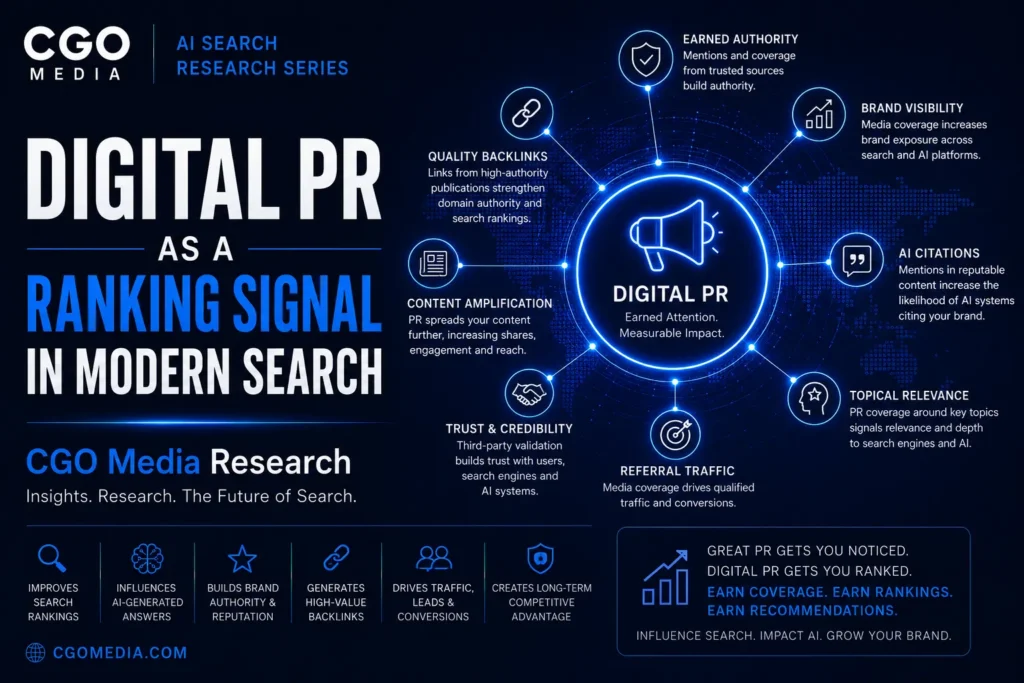
CGO Media AI Search Research Series – Paper 6: title – Digital PR as a Ranking Signal in Modern Search.
Digital PR as a Ranking Signal in Modern Search: Authority, Citations and Brand Trust in the Age of Artificial Intelligence
An analysis of how media coverage, editorial links, expert recognition, brand mentions and independent corroboration influence visibility across traditional search engines and AI-generated answers.
Abstract
Digital public relations has become increasingly important to search visibility as search engines and artificial intelligence systems rely on external evidence to evaluate organisations, brands, people and claims. Traditional SEO often treated public relations activity primarily as a method of acquiring backlinks. This interpretation is now too narrow.
Modern Digital PR contributes to a wider authority environment that includes editorial links, unlinked brand mentions, expert commentary, media citations, original research, professional recognition and consistent third-party descriptions of an organisation. These signals can strengthen the relationship between a brand, a topic and a market, while also providing independent sources that search and AI systems may retrieve when generating answers.
This paper examines how Digital PR functions as an indirect and direct search visibility signal. It considers the continuing importance of editorial links while exploring how entity recognition, source diversity, brand prominence, factual corroboration and citation environments influence traditional and generative discovery.
The paper proposes a Digital PR Search Authority Framework and distinguishes between link acquisition, brand authority development and AI citation readiness. It also evaluates risks including low-quality campaigns, manufactured news, irrelevant links, misleading research and excessive dependence on short-term media coverage.
The central argument is that Digital PR should no longer be managed as an isolated promotional activity. It should operate as part of an integrated search authority system connecting communications, SEO, content, research, executive expertise and reputation management.
Keywords
Digital PR; search engine optimisation; artificial intelligence; AI search; brand authority; editorial links; media coverage; generative engine optimisation; GEO; AI citations; entity SEO; public relations; online reputation; E-E-A-T; search visibility.
1. Introduction
Search visibility has always been influenced by relationships between websites. Early search engines relied heavily on links to help determine which documents appeared important, useful and trustworthy. A link from one page to another functioned as a form of recommendation, helping search systems discover content and evaluate its relative authority.
This principle contributed to the growth of link building as a central SEO discipline. Businesses attempted to acquire links through directories, partnerships, guest articles, sponsorships, content promotion and direct outreach.
As search algorithms became more sophisticated, the value of links became increasingly dependent on context, quality, relevance and editorial independence. Search engines introduced stronger measures against manipulative link schemes, paid placements and artificial networks.
At the same time, public relations became more digital. Journalists, publishers, companies and audiences increasingly interacted through online newsrooms, social platforms, email outreach, data-led campaigns and specialist publications.
Digital PR developed at the intersection of these changes.
It combined traditional public relations objectives such as awareness, reputation and media coverage with digital outcomes such as editorial links, referral traffic, branded search demand and online authority.
For many organisations, however, Digital PR remained narrowly measured through the number and authority of links acquired. Campaign success was often reduced to a list of publications, domain metrics and estimated link value.
This approach captures only part of the strategic impact.
Modern search engines evaluate brands, entities, topics and sources across a much wider information environment. AI-powered search systems may retrieve information from news websites, research papers, corporate sources, public datasets, professional profiles and independent commentary before generating a response.
A brand can therefore gain visibility through several forms of external recognition:
- An editorial link from a trusted publication.
- An unlinked mention of the organisation.
- A quotation from a recognised company expert.
- A citation of original research.
- A profile in a professional directory.
- Coverage of a business event, appointment or expansion.
- Independent confirmation of a product, service or claim.
- Repeated association with a specialist topic.
These signals do not all function identically. A followed editorial link may directly influence conventional search authority, while an unlinked mention may contribute to brand recognition, entity understanding or user trust. A cited research study may support both website authority and inclusion within an AI-generated answer.
The strategic question is therefore no longer simply:
How many backlinks did the campaign generate?
A more complete question is:
How did the campaign strengthen the organisation’s authority, recognition, credibility and representation across search and AI discovery systems?
Professional Digital PR services increasingly need to address this broader objective. Effective campaigns must create genuine editorial value while reinforcing the organisation’s relationship with strategically important topics, audiences and markets.
1.1 From Link Building to Authority Building
Link building and Digital PR overlap, but they are not identical.
Link building focuses primarily on securing hyperlinks from external websites. Digital PR focuses on earning attention, coverage and recognition through newsworthy or useful material.
A strong Digital PR campaign may generate links, but it may also produce:
- Brand mentions
- Executive visibility
- Research citations
- Journalist relationships
- Referral traffic
- Social discussion
- Branded search demand
- Industry recognition
These outcomes contribute to a broader authority system.
The distinction becomes especially important in AI search. A generative system may cite a publication that mentions a brand without linking to it. It may identify an executive as an expert because that person has been quoted repeatedly across authoritative sources. It may associate a company with a topic because its research has been discussed independently.
Authority building therefore concerns the organisation’s position within an external information network, not merely the number of links pointing to its website.
1.2 Why Independent Sources Matter
Every organisation can describe itself positively on its own website. It can claim expertise, innovation, quality and market leadership.
Independent sources provide external verification.
A journalist citing a company’s research, a professional body recognising its expertise or a respected publication profiling its work offers evidence that does not originate entirely from the organisation itself.
This independent corroboration can help search and AI systems answer questions such as:
- Is this organisation genuinely associated with the topic?
- Do credible sources recognise its expertise?
- Are its claims repeated or supported elsewhere?
- Is the brand significant within the market?
- Can its research be used as reliable evidence?
External recognition does not guarantee rankings or AI citations. However, it contributes to the wider information environment through which systems evaluate credibility and relevance.
1.3 Digital PR in the AI Search Environment
AI-generated search introduces an important change in how information is presented. Rather than displaying only a ranked list of documents, a system may synthesise an answer from several sources.
This creates additional opportunities for organisations whose information is present within credible external publications.
A Digital PR campaign may influence AI visibility by:
- Creating sources that can be retrieved and cited.
- Increasing the number of independent references to the brand.
- Connecting the organisation with relevant topics and entities.
- Providing original data or expert commentary.
- Strengthening brand familiarity and search demand.
- Improving the authority of pages receiving editorial links.
The role of Digital PR is therefore expanding from traffic and link acquisition into citation readiness and entity authority.
1.4 The Problem of Simplified Metrics
Digital PR performance is frequently evaluated through metrics such as:
- Number of links.
- Domain authority or domain rating.
- Estimated reach.
- Number of media placements.
- Referral traffic.
These measures can be useful, but each has limitations.
A high-authority link may be topically irrelevant. A large publication may provide little commercial value if its audience has no relationship with the organisation’s market. A widely syndicated press release may generate many mentions without creating meaningful authority.
A stronger evaluation should also consider:
- Editorial relevance.
- Source independence.
- Topical alignment.
- Brand positioning.
- Expert recognition.
- Citation longevity.
- Search visibility impact.
- Commercial influence.
2. Research Objectives and Questions
The primary objective of this paper is to examine how Digital PR influences search visibility in an environment shaped by both traditional search engines and artificial intelligence.
The study is guided by six research questions:
- How does Digital PR contribute to traditional organic search performance?
- What is the relationship between editorial links, brand mentions, citations and entity authority?
- How can media coverage influence AI-generated answers and recommendations?
- Which types of Digital PR campaigns produce the strongest long-term search value?
- How should organisations measure Digital PR beyond link volume and publication metrics?
- How should SEO, communications, content and research teams work together to build sustainable authority?
The paper does not claim that every brand mention or media article functions as a direct algorithmic ranking factor. Search systems remain partly opaque, and the significance of individual signals may vary by context.
Instead, the research examines how Digital PR contributes to a wider authority environment through which organisations become more discoverable, recognisable and credible.
3. Research Methodology
This paper applies a qualitative industry research methodology combining documentary analysis, conceptual framework development, campaign interpretation and search visibility analysis.
3.1 Search Engine Documentation
Official search engine guidance relating to links, spam policies, helpful content, authority, structured data and AI search features was considered.
Particular attention was given to the distinction between editorially earned links and manipulative link schemes. Search engines consistently discourage attempts to manufacture authority through paid, automated or irrelevant linking practices.
3.2 Public Relations and Communications Literature
The research considers established public relations concepts including media relations, reputation management, agenda setting, source credibility and third-party endorsement.
These concepts are relevant because search visibility does not develop entirely through technical optimisation. It is also influenced by how organisations are represented within public information environments.
3.3 Information Retrieval and AI Search Research
Research concerning information retrieval, knowledge graphs, large language models and retrieval-augmented generation was reviewed to understand how external sources may contribute to generated answers.
These systems commonly depend on accessible and credible documents that can support a response. Digital PR can create such documents when campaigns produce original research, expert analysis or independently reported information.
3.4 Campaign Pattern Analysis
The paper considers recurring Digital PR campaign formats, including:
- Original research and surveys.
- Data-led news campaigns.
- Expert commentary.
- Reactive media responses.
- Corporate announcements.
- Executive thought leadership.
- Industry reports.
- Creative consumer campaigns.
- Regional and local PR.
These formats are assessed according to their potential to create links, mentions, citations, topic association and long-term authority.
3.5 Conceptual Framework Development
The paper proposes a Digital PR Search Authority Framework containing six components:
- Editorial links
- Brand mentions
- Expert recognition
- Original evidence
- Entity and topic association
- Reputation and trust
The framework is intended as a strategic model rather than a confirmed search algorithm.
3.6 Research Limitations
It is difficult to isolate the exact ranking impact of one Digital PR campaign because search performance is affected by many variables, including technical changes, content updates, competitor activity, algorithm changes and wider brand marketing.
AI-generated answers may also vary between platforms, locations, prompts and model versions. A source cited in one response may not appear in another.
The analysis therefore focuses on patterns, strategic contribution and evidence relationships rather than claiming precise causation in every case.
4. Literature Review and Theoretical Background
4.1 The Historical Role of Links in Search
Links became central to web search because they helped systems evaluate relationships between documents.
The PageRank model treated a link as a form of citation. A page receiving links from other important pages could be considered more significant within the wider web graph.
This principle transformed search quality because it provided a measure beyond on-page keyword usage.
However, once links became commercially valuable, businesses attempted to manipulate them through:
- Paid link networks.
- Automated directory submissions.
- Article spinning.
- Link exchanges.
- Private blog networks.
- Low-quality guest publishing.
- Comment and forum spam.
Search engines responded by improving their ability to identify unnatural patterns and reduce the value of manipulative links.
The result was a gradual shift from link quantity towards editorial quality, relevance and trust.
4.2 Editorial Links as Independent Endorsement
An editorial link is placed because a publisher, journalist or author considers the destination useful to the audience.
Such a link may:
- Support a factual claim.
- Provide further evidence.
- Credit original research.
- Identify the source of data.
- Recommend a useful resource.
- Reference an organisation involved in the story.
Editorial independence matters because it reduces the likelihood that the link exists only for manipulation.
The most valuable links are generally those that make sense within the content even when SEO is not considered.
They help the reader understand the topic, verify information or access the original source.
4.3 Public Relations and Third-Party Endorsement
Public relations theory has long recognised the value of third-party endorsement. Audiences may view independent media coverage as more credible than advertising because the organisation does not fully control the message.
This distinction also applies to search authority.
A company describing itself as a market leader provides a first-party claim. A respected publication describing the company as influential or citing its research provides external evidence.
Third-party endorsement can influence:
- Brand awareness.
- Perceived expertise.
- Consumer confidence.
- Investor interest.
- Journalist relationships.
- Search demand.
- Online authority.
4.4 Brand Mentions and Entity Recognition
Not all media references contain a hyperlink. Publications may mention a company, person, report or product in plain text.
These unlinked mentions still contribute to the public representation of the entity.
Repeated and consistent references can help establish relationships between:
- A brand and an industry.
- An executive and an area of expertise.
- A company and a location.
- A product and a customer need.
- A research report and a market trend.
It would be inaccurate to assume that every unlinked mention provides the same value as an editorial backlink. However, mentions can contribute to brand discovery, entity understanding, user trust and future linking opportunities.
4.5 Citation Environments
A citation environment is the network of sources that reference, discuss or support a piece of information.
For example, a company may publish an original industry report. That report may then be:
- Covered by journalists.
- Cited by trade publications.
- Referenced in academic work.
- Discussed in professional forums.
- Quoted by conference speakers.
- Summarised by AI systems.
The authority of the original report is strengthened by the diversity and independence of the sources using it.
This demonstrates why original research can be particularly valuable within Digital PR. It gives other publishers a reason to cite the organisation as a source.
4.6 AI Search and Retrieval-Augmented Generation
Generative search systems may retrieve information from external documents before producing an answer.
The retrieval process attempts to identify sources relevant to the user’s question. The generation process then synthesises information from those sources.
Digital PR can influence this environment by increasing the availability of credible documents containing:
- Brand information.
- Expert commentary.
- Research findings.
- Product facts.
- Market analysis.
- Independent verification.
A brand mentioned across several credible sources may be easier to identify and contextualise than a brand represented only on its own website.
4.7 E-E-A-T and External Evidence
Experience, expertise, authoritativeness and trustworthiness are often discussed in relation to content quality.
Digital PR can support these qualities by making real expertise visible externally.
For example:
- An experienced specialist may contribute commentary to industry media.
- A company may publish original data demonstrating practical knowledge.
- A recognised professional body may list the organisation as a member.
- Independent reviews may confirm customer experience.
- Journalists may repeatedly consult the same expert.
These signals do not replace strong website content. They reinforce it through external evidence.
4.8 Reputation and Search Visibility
Reputation can affect search performance indirectly through user behaviour, branded demand, media interest and link acquisition.
A respected brand may attract more searches, links and citations because publishers and users already recognise it.
A damaged reputation can create the opposite effect. Negative news, poor reviews or public disputes may dominate search results and influence AI-generated summaries.
Digital PR must therefore consider both authority development and reputation risk.
5. The Evolution of Digital PR
5.1 Traditional Public Relations
Traditional public relations focused on managing relationships between organisations, journalists, stakeholders and the public.
Common activities included:
- Press releases.
- Media briefings.
- Executive interviews.
- Corporate events.
- Crisis communications.
- Product launches.
- Community relations.
Success was typically measured through media coverage, message delivery and reputation outcomes.
5.2 Online Public Relations
As news and publishing moved online, PR campaigns began generating measurable digital outcomes.
Coverage could produce:
- Direct website traffic.
- Search visibility.
- Social sharing.
- Backlinks.
- Online discussion.
- Persistent searchable references.
The long-term availability of online articles also changed the value of coverage. A printed newspaper story may disappear from public view, while an online article can remain searchable and influential for years.
5.3 SEO-Led Digital PR
Digital PR became increasingly connected to SEO as agencies and in-house teams recognised that media coverage could generate high-quality editorial links.
Campaigns were often designed around linkable assets such as:
- Interactive tools.
- Data studies.
- Maps.
- Rankings.
- Surveys.
- Visualisations.
- Newsworthy reports.
The success of these campaigns demonstrated that link acquisition could be based on editorial value rather than direct link requests.
5.4 Brand-Led Digital PR
A more mature approach connects Digital PR with brand positioning.
The campaign is designed not only to earn coverage, but to reinforce a specific association.
For example, a cybersecurity company may publish research about online fraud. A property platform may release housing-market data. A financial organisation may analyse small-business payment trends.
The subject of the campaign supports the organisation’s strategic expertise rather than generating attention through an unrelated topic.
5.5 AI-Ready Digital PR
AI-ready Digital PR expands the objective further.
Campaigns are designed to create information that can be:
- Discovered by search engines.
- Cited by journalists.
- Linked by publishers.
- Associated with relevant entities.
- Retrieved by AI systems.
- Used to support generated answers.
The campaign therefore contributes to a machine-readable evidence environment.
5.6 From Campaigns to Authority Systems
A single successful campaign may generate valuable coverage, but sustainable authority requires consistency over time.
An authority system includes:
- A defined set of strategic topics.
- Recognised internal experts.
- Original research capability.
- Relationships with relevant journalists.
- High-quality website resources.
- Ongoing media monitoring.
- Clear measurement.
This system allows the organisation to contribute repeatedly to the public conversation surrounding its market.
A mature SEO and AI search strategy should therefore integrate Digital PR with content development, technical SEO, expert positioning and entity management.
7. Digital PR Campaign Types and Their Search Value
Digital PR campaigns vary considerably in their ability to generate links, mentions, authority and long-term citation value. A campaign that performs well in one dimension may contribute little in another.
For example, a creative consumer campaign may generate widespread coverage but limited topical authority. A technical research report may attract fewer publications but strengthen the organisation’s relationship with a commercially important subject.
Campaign selection should therefore begin with the strategic outcome rather than the campaign format.
7.1 Original Research and Survey Campaigns
Original research is among the strongest Digital PR formats because it creates information that did not previously exist in the same form.
Research campaigns may use:
- Consumer surveys.
- Business surveys.
- Internal customer data.
- Market transactions.
- Platform usage data.
- Public datasets.
- Experimental testing.
- Longitudinal trend analysis.
The value of the campaign depends on the quality of the methodology and the relevance of the findings.
Strong research should include:
- A clear research question.
- A sufficiently robust sample.
- Transparent data sources.
- Defined limitations.
- Accurate interpretation.
- Accessible tables or visualisations.
- A publication page containing the complete evidence.
Research campaigns can generate substantial long-term value because journalists, analysts and other publishers may continue citing the findings after the initial campaign period.
They also create assets that can be retrieved by AI systems when users ask questions related to the study.
7.2 Data-Led News Campaigns
Data-led campaigns interpret existing datasets to identify trends, comparisons or regional differences.
Potential data sources include:
- Government statistics.
- Public health data.
- Transport records.
- Property-market information.
- Company filings.
- Environmental data.
- Employment statistics.
- Consumer-price information.
The organisation may combine several sources or create a new index based on published criteria.
These campaigns can attract coverage because they transform complex datasets into an accessible story.
However, they also involve risk. An index based on arbitrary weightings may produce a headline without representing a meaningful real-world conclusion.
The methodology should therefore be explained clearly enough for readers and journalists to understand how the result was produced.
7.3 Expert Commentary
Expert commentary allows an organisation to contribute knowledge to developing stories.
Relevant experts may include:
- Executives.
- Technical specialists.
- Economists.
- Researchers.
- Legal or compliance professionals.
- Sector consultants.
- Operational leaders.
The strongest commentary explains the significance of an event rather than repeating information already available.
Useful expert responses may include:
- Interpretation of new regulations.
- Analysis of market changes.
- Technical explanation.
- Practical implications for businesses or consumers.
- Forecasts supported by evidence.
- Clarification of common misconceptions.
Repeated expert coverage can strengthen the relationship between a named individual, the organisation and a specialist topic.
7.4 Reactive Digital PR
Reactive Digital PR responds quickly to breaking news, reports, policy announcements and cultural developments.
Its main advantage is relevance. Journalists often require immediate commentary, data or explanation.
A successful reactive system requires:
- Active media monitoring.
- Pre-approved experts.
- Fast internal approval.
- Clear areas of expertise.
- Reliable supporting evidence.
- Established journalist relationships.
Reactive activity should not encourage experts to comment outside their competence. Speed is valuable only when combined with accuracy and genuine relevance.
7.5 Corporate News
Corporate announcements may include:
- Business expansion.
- New leadership appointments.
- Product launches.
- Funding events.
- Partnerships.
- Acquisitions.
- Research investment.
- Employment growth.
These stories help define the organisation’s current status and relationships.
However, not every corporate update is newsworthy to an external audience. A press release should explain why the development matters beyond the company itself.
7.6 Executive Thought Leadership
Thought leadership positions senior individuals as informed contributors to industry discussion.
It may include:
- Opinion articles.
- Interviews.
- Conference contributions.
- Professional commentary.
- Research authorship.
- Podcasts.
- Strategic forecasts.
Effective thought leadership combines personal perspective with evidence and practical experience.
Weak thought leadership often relies on generic claims, trend repetition and promotional language. This may generate content volume without creating genuine recognition.
7.7 Regional and Local Digital PR
Regional Digital PR connects an organisation to a specific place or local market.
Campaigns may involve:
- Regional economic research.
- Local employment trends.
- Community initiatives.
- Branch openings.
- Regional partnerships.
- Local case studies.
- Commentary on city or regional developments.
This form of PR can strengthen geographic authority and support local search visibility.
7.8 Product and Service-Led Campaigns
Product-led Digital PR seeks to generate attention around a commercial offering.
Coverage may be based on:
- Innovation.
- Independent testing.
- New features.
- Customer outcomes.
- Market disruption.
- Design or sustainability.
The campaign should avoid presenting routine product features as major news.
Product coverage is most valuable when independent sources explain the problem solved and the significance of the product within its category.
7.9 Creative Consumer Campaigns
Creative campaigns use entertainment, cultural relevance or visual appeal to attract broad media attention.
They may include:
- Interactive tools.
- Rankings.
- Maps.
- Visual comparisons.
- Seasonal stories.
- Popular culture analysis.
These campaigns can generate large volumes of coverage, but topical alignment should be considered carefully.
A campaign that has no relationship with the organisation’s market may increase awareness without strengthening relevant authority.
8. Evaluating Editorial Link Quality
Digital PR should not treat every acquired link as equally valuable.
The significance of an editorial link depends on the relationship between the source, the story, the destination page and the organisation’s strategic objectives.
8.1 Editorial Independence
A strong link is placed because the publisher considers the destination useful.
Evidence of editorial independence may include:
- The publisher selected the anchor text.
- The link supports a claim or source attribution.
- The article contains independent reporting.
- The placement was not purchased.
- The link would remain useful without search-engine value.
8.2 Topical Relevance
A link from a specialist publication closely aligned with the organisation’s subject may provide greater strategic value than a link from a larger but unrelated publication.
Topical relevance should be assessed at several levels:
- The publication’s general subject.
- The specific article topic.
- The surrounding paragraph.
- The destination page.
- The organisation’s commercial expertise.
8.3 Source Authority
Source authority concerns the credibility, editorial standards and recognition of the publication.
Useful indicators include:
- Editorial reputation.
- Original reporting.
- Named authors.
- Transparent ownership.
- Relevant readership.
- Consistent publication history.
- Independent references from other sources.
Third-party domain metrics may support initial evaluation but should not replace editorial judgement.
8.4 Link Context
The context surrounding a link helps determine its meaning.
A link used to credit original research carries a different relationship from a generic link in an author biography or commercial directory.
Context may indicate that the organisation is:
- The original source.
- A recognised expert.
- A relevant commercial provider.
- A partner in an initiative.
- The subject of independent reporting.
8.5 Destination Page Quality
Digital PR coverage often links to a campaign landing page. That page should provide lasting value.
A strong destination page should include:
- The complete research or asset.
- Methodology.
- Key findings.
- Tables or visualisations.
- Downloadable resources where appropriate.
- Author or expert information.
- Publication and update dates.
- Relevant internal links.
Removing the page after the campaign can destroy accumulated authority and create broken links.
8.6 Followed and Nofollow Links
A followed editorial link may transfer conventional search value, while a nofollow, sponsored or similarly qualified link may not function in the same way.
However, a qualified link can still provide:
- Referral traffic.
- Brand visibility.
- Entity recognition.
- Journalist exposure.
- Commercial credibility.
Campaign evaluation should therefore consider the full value of the placement while remaining clear about the link attribute.
8.7 Syndication and Duplicate Coverage
One story may be syndicated across multiple websites.
This can create broad visibility, but the placements may not represent independent editorial decisions.
Reports should distinguish between:
- Original coverage.
- Independent follow-up coverage.
- Wire-service syndication.
- Automated duplication.
- Scraped or low-quality copies.
Counting every duplicated article as an equal placement can substantially exaggerate campaign performance.
8.8 Link Longevity
A link’s value may continue for years if the article remains accessible, indexed and relevant.
Campaign teams should monitor:
- Whether the article remains live.
- Whether the link is retained.
- Whether the destination still works.
- Whether the article is still indexed.
- Whether the content remains factually current.
9. Brand Mentions, Citations and External Recognition
A modern Digital PR programme should measure more than hyperlinks.
Brand mentions and citations create a distributed record of how an organisation is described by external sources.
9.1 Linked Brand Mentions
A linked brand mention identifies the organisation and provides a direct path to an owned source.
It can support:
- Referral traffic.
- Website authority.
- Entity confirmation.
- Brand discovery.
- Source attribution.
9.2 Unlinked Brand Mentions
An unlinked mention may still have strategic value, especially when it appears within a credible and relevant source.
It can contribute to:
- Recognition of the brand name.
- Association with a topic.
- Executive or product visibility.
- Future branded searches.
- External corroboration.
However, unlinked mentions should not automatically be treated as equivalent to backlinks.
9.3 Research Citations
A research citation occurs when another source references an organisation’s data, report, methodology or finding.
Research citations are particularly valuable because they position the organisation as an evidence provider.
They may appear in:
- News articles.
- Academic papers.
- Industry reports.
- Government publications.
- Conference presentations.
- Professional guidance.
- AI-generated answers.
9.4 Expert Citations
Expert citations connect a named individual with a topic.
They may include:
- Direct quotations.
- Paraphrased commentary.
- References to previous analysis.
- Descriptions of professional expertise.
- Invitations to speak or contribute.
Consistent expert attribution can strengthen both the individual and the organisation.
9.5 Citation Diversity
Citation diversity concerns the range of independent sources referencing the organisation.
A brand mentioned by many genuinely independent publications may develop stronger recognition than a brand appearing repeatedly within one controlled or syndicated network.
Useful diversity may include:
- National media.
- Trade media.
- Regional publications.
- Academic sources.
- Professional organisations.
- Public institutions.
- Relevant international publishers.
9.6 Citation Consistency
External sources should ideally describe the organisation consistently.
Common inconsistencies include:
- Old company names.
- Outdated executive titles.
- Incorrect headquarters.
- Obsolete product descriptions.
- Conflicting founding dates.
- Incorrect market positioning.
Digital PR teams should maintain accurate corporate facts and make them easy for journalists to verify.
11. Original Research as a Search Authority Asset
Original research can become one of the most durable assets within a Digital PR programme.
It provides a reason for external sources to reference the organisation and can strengthen topic authority over time.
11.1 Research Selection
The research topic should satisfy three conditions:
- It should matter to the intended audience.
- It should relate to the organisation’s genuine expertise.
- It should produce evidence not already widely available.
A campaign chosen only because it appears likely to attract headlines may create limited strategic value.
11.2 Methodological Transparency
The methodology should explain:
- How the data was collected.
- When the research was conducted.
- The sample size.
- The geographic scope.
- The questions asked.
- The analytical method.
- Known limitations.
Transparent methodology increases trust and enables journalists to report the findings accurately.
11.3 Research Landing Pages
The research should be published on a stable, indexable page.
The page may contain:
- Executive summary.
- Full methodology.
- Key findings.
- Charts and tables.
- Downloadable report.
- Author information.
- Media contact details.
- Publication date.
- Update history.
11.4 Data Accessibility
Important findings should not exist only within an image or downloadable PDF.
HTML summaries, data tables and explanatory text improve accessibility for users and search systems.
11.5 Research Updating
Recurring annual or quarterly research can develop stronger authority than a one-off campaign.
Repeated studies allow the organisation to:
- Track trends.
- Build historical datasets.
- Develop journalist expectations.
- Create recurring citations.
- Strengthen ownership of a topic.
11.6 Responsible Interpretation
Research should not claim more than the evidence supports.
Common problems include:
- Confusing correlation with causation.
- Generalising from small samples.
- Using misleading percentages.
- Ignoring contradictory results.
- Selecting only sensational findings.
- Creating rankings from arbitrary assumptions.
Short-term coverage obtained through exaggerated conclusions can damage long-term trust.
12. Digital PR and AI Citation Readiness
AI citation readiness concerns whether information produced or distributed through Digital PR can be retrieved, understood and used within generated answers.
12.1 Accessible Source Pages
Campaign assets should be:
- Indexable.
- Accessible without login.
- Available in clear HTML.
- Supported by stable URLs.
- Mobile friendly.
- Internally linked.
- Accurately titled.
12.2 Clear Claims and Evidence
AI systems are more likely to interpret research correctly when claims and supporting evidence are clearly presented.
A research page should distinguish between:
- Observed data.
- Interpretation.
- Forecasts.
- Expert opinion.
- Methodological limitations.
12.3 Consistent Brand and Expert Entities
The organisation, report and authors should be named consistently across the original research, media materials and external coverage.
This helps reduce ambiguity when multiple sources refer to the same study.
12.4 Independent Corroboration
AI citation readiness improves when credible external sources discuss or verify the work.
The objective should not be artificial repetition. It should be genuine independent use of the research.
12.5 Source Diversity
A campaign covered by national, sector, regional and specialist sources creates a broader evidence environment.
Different source types may become relevant to different user questions.
12.6 Citation Stability
AI citations may change over time. Organisations should monitor whether their sources continue appearing for representative questions.
Declining citation visibility may result from:
- Newer competing research.
- Outdated information.
- Broken pages.
- Reduced indexation.
- Changes in source selection.
- Stronger competitor authority.
13. Digital PR Governance
Digital PR increasingly requires coordination between communications, SEO, research, legal, data and executive teams.
Without clear governance, campaigns may create factual, regulatory or reputational risk.
13.1 Roles and Responsibilities
A mature programme should define responsibility for:
- Campaign strategy.
- Data collection.
- Research approval.
- Media outreach.
- Expert selection.
- Legal review.
- SEO implementation.
- Performance reporting.
- Asset maintenance.
13.2 Research Approval
Research-led campaigns should be reviewed before publication.
The approval process may include:
- Data validation.
- Methodology review.
- Legal and compliance assessment.
- Claim verification.
- Expert sign-off.
- Privacy review.
13.3 Media Claim Standards
Press materials should distinguish clearly between facts, estimates and opinions.
Headlines should not exaggerate findings beyond the underlying evidence.
13.4 Link Policy
Digital PR teams should understand applicable search-engine policies concerning paid and sponsored links.
The organisation should avoid:
- Purchasing editorial coverage solely for followed links.
- Requiring keyword-rich anchor text.
- Using hidden commercial arrangements.
- Distributing low-quality articles at scale.
- Treating advertorials as independent journalism.
13.5 Expert Approval
Named experts should approve quotations attributed to them where practical.
They should also understand how their commentary may be reused across media and AI-generated summaries.
13.6 Crisis Escalation
Campaigns may attract criticism, methodological challenge or negative media attention.
The governance process should define:
- Who evaluates the issue.
- Who responds publicly.
- When research should be corrected.
- How updates are documented.
- When legal advice is required.
13.7 Asset Ownership and Maintenance
Campaign pages often remain live long after the original PR team has moved to another project.
Each asset should have:
- A named owner.
- A stable URL.
- A review schedule.
- A process for correcting data.
- A redirect plan if consolidation is necessary.
14. Digital PR Search Authority Maturity Model
Organisations differ considerably in their ability to connect public relations with search authority.
This paper proposes a five-stage maturity model.
14.1 Stage One: Promotional
At the promotional stage, PR activity focuses primarily on company announcements and brand exposure.
Characteristics include:
- Press releases with limited external value.
- No SEO involvement.
- No link or citation strategy.
- Little expert positioning.
- Basic coverage reporting.
14.2 Stage Two: Link-Focused
At the link-focused stage, campaigns are designed to earn editorial backlinks.
Characteristics include:
- Data or creative campaigns.
- Link-count reporting.
- Use of authority metrics.
- Limited brand or topic strategy.
- Short campaign cycles.
14.3 Stage Three: Integrated
At the integrated stage, PR, SEO and content teams collaborate.
Characteristics include:
- Campaigns aligned with strategic topics.
- Strong landing pages.
- Expert profiles.
- Measurement of links, mentions and referral traffic.
- Internal linking from campaign assets.
14.4 Stage Four: Authoritative
At the authoritative stage, the organisation becomes a recognised source within its market.
Characteristics include:
- Recurring research programmes.
- Established media experts.
- Strong citation diversity.
- Independent industry recognition.
- Consistent topic ownership.
- Long-term authority measurement.
14.5 Stage Five: Adaptive
At the adaptive stage, Digital PR operates as a continuous search intelligence and authority system.
Characteristics include:
- Real-time media monitoring.
- AI citation tracking.
- Integrated brand and entity measurement.
- Automated coverage classification.
- Research updating.
- Campaign selection based on strategic authority gaps.
15. Digital PR Case Studies and Applied Scenarios
The strategic value of Digital PR varies according to sector, source quality, campaign design and the relationship between the story and the organisation’s expertise. The following illustrative case studies demonstrate how the Digital PR Search Authority Framework can be applied in different commercial environments.
15.1 Growth Analysis One: A Financial Technology Research Programme
A financial technology company wanted to strengthen its authority around small-business payments. Previous PR activity had focused on product launches, executive appointments and company milestones.
These announcements generated occasional coverage but created limited long-term topic association.
The organisation possessed anonymised transaction data showing changes in payment behaviour across industries, regions and business sizes. A recurring research programme was developed around this first-party information.
The programme included:
- Quarterly payment-trend reports.
- Regional comparisons.
- Sector-level transaction analysis.
- Commentary from internal payments experts.
- Methodology and data limitations.
- Accessible tables and downloadable reports.
Each report was published on a stable HTML page and supported by focused media outreach.
Coverage came from:
- Financial trade publications.
- Small-business media.
- Regional business newspapers.
- Retail and hospitality publications.
- Technology commentators.
The company gained editorial links, unlinked brand mentions and repeated references to its research. Its experts also became recurring sources for journalists covering business payments.
The campaign’s strongest value was not the link count from one report. It was the creation of a durable relationship between the company, payment data and small-business commerce.
The case demonstrates how recurring original research can transform a product-led company into a recognised evidence source.
15.2 Growth Analysis Two: A Cybersecurity Company and Reactive Expert Commentary
A cybersecurity provider operated in a highly competitive market. Its website contained technically strong content but had limited recognition outside owned channels.
The organisation introduced a reactive media programme focused on cyber incidents, regulatory changes and emerging threats.
The programme established:
- A defined group of approved technical experts.
- Clear commentary themes.
- A rapid legal and communications approval process.
- Media monitoring for relevant events.
- Supporting technical resources on the website.
Experts were instructed to explain the implications of incidents rather than speculate about causes without evidence.
Over time, the company’s specialists were quoted in national news, technology publications and sector media.
The external coverage created:
- Named expert citations.
- Brand mentions.
- Links to technical guidance.
- Stronger topical association.
- Increased branded search demand.
The case illustrates how expert authority develops through repetition, speed and consistency rather than one large campaign.
15.3 Growth Analysis Three: A Property Platform Using Regional Data
A property platform wanted to strengthen visibility across local and regional markets in the United Kingdom.
The company had extensive data concerning listing prices, buyer demand, rental activity and time on market.
Instead of publishing only national reports, it created city and regional analyses for locations including Manchester, Birmingham, Bristol, Glasgow, Edinburgh and Cardiff.
Each report included:
- Local price trends.
- Regional comparisons.
- Methodological explanation.
- Commentary from property experts.
- Historical context.
- Clear limitations.
Regional journalists used the reports as sources for local housing stories. The platform gained links and citations from publications with strong geographic relevance.
The campaign strengthened both topical and local authority. It also created useful resources for the organisation’s own city and regional search pages.
The case demonstrates how national data can be transformed into locally relevant evidence without producing superficial location content.
15.4 Growth Analysis Four: A Healthcare Provider Publishing Patient Research
A private healthcare provider sought greater recognition for its specialist services. The organisation considered publishing patient outcome research based on internal records.
Because the data involved sensitive health information, the project required strong governance.
The research process included:
- Data anonymisation.
- Clinical review.
- Legal and privacy approval.
- Methodological documentation.
- Clear distinction between correlation and causation.
- Named clinical authorship.
The resulting report addressed a genuine information gap and was covered by specialist healthcare media.
The campaign generated fewer placements than a broad consumer story, but the coverage was highly relevant and authoritative.
The provider gained:
- Professional citations.
- Links from specialist publications.
- Greater visibility for named clinicians.
- Stronger association with the treatment area.
The case shows that a smaller number of credible specialist references may create greater strategic value than widespread but weakly related coverage.
15.5 Growth Analysis Five: A Consumer Brand With an Irrelevant Creative Campaign
A consumer brand commissioned a highly creative campaign involving entertainment and celebrity data. The story generated significant media attention and hundreds of links.
However, the campaign had almost no relationship with the company’s products, customers or market expertise.
The immediate results appeared strong:
- High coverage volume.
- National publication links.
- Social sharing.
- Short-term referral traffic.
The long-term strategic effect was weaker.
The campaign did not strengthen the brand’s association with its commercial category. Journalists did not return to the company for future expert commentary, and the asset attracted limited ongoing citations.
The case demonstrates the difference between attention and authority.
Creative campaigns can produce useful results, but campaign relevance should be evaluated alongside link volume.
15.6 Growth Analysis Six: Crisis Communications and Search Reputation
A professional-services organisation faced negative media attention following a customer-data incident.
Initial communications were delayed and inconsistent. Different sources reported conflicting figures and outdated executive statements.
The organisation introduced a coordinated response involving:
- A central incident-information page.
- Regular factual updates.
- Named executive accountability.
- Clear customer guidance.
- Correction of inaccurate external information.
- Direct engagement with affected stakeholders.
The response did not remove negative coverage, but it created a reliable first-party source that journalists and search systems could reference.
The organisation also published a detailed post-incident review explaining the actions taken.
The case demonstrates that Digital PR authority is not limited to positive promotion. Accurate and transparent crisis communication can reduce uncertainty and improve the quality of the wider information environment.
15.7 Lessons Across the Case Studies
The case studies reveal several recurring principles:
- Recurring authority programmes usually create more value than isolated campaigns.
- Topical relevance is essential for long-term positioning.
- Original data can support links, media coverage and AI citations.
- Named experts strengthen human and organisational authority.
- Specialist coverage may be more valuable than high-volume general coverage.
- Methodological transparency protects long-term trust.
- Creative attention should not be confused with strategic authority.
- Crisis communication contributes to search reputation and factual clarity.
16. Measuring Digital PR Search Authority
Digital PR measurement should reflect the full range of outcomes created by a campaign.
No single metric can explain the combined impact on links, brand recognition, expert authority, citations, search performance and reputation.
16.1 Coverage Metrics
Basic coverage indicators include:
- Number of original articles.
- Number of independent publications.
- Publication type.
- Geographic reach.
- Estimated audience.
- Prominence of the brand within the article.
Reports should separate original coverage from syndication and automated duplication.
16.2 Link Metrics
Link reporting may include:
- Total editorial links.
- Unique linking domains.
- Followed and qualified links.
- Topical relevance.
- Anchor-text context.
- Destination page.
- Link longevity.
- Referral traffic.
Domain-level authority metrics may be included as secondary indicators, but they should not be treated as direct representations of search-engine evaluation.
16.3 Brand Mention Metrics
Brand mention reporting may consider:
- Linked mentions.
- Unlinked mentions.
- Named product mentions.
- Executive mentions.
- Topic association.
- Sentiment.
- Message accuracy.
16.4 Expert Authority Metrics
Named expert performance may be measured through:
- Media quotations.
- Interview requests.
- Conference invitations.
- Research citations.
- Professional profile visibility.
- Branded searches for the individual.
- Repeated journalist engagement.
16.5 Research Citation Metrics
Research assets may be evaluated through:
- Number of citations.
- Diversity of citing sources.
- Academic or professional references.
- Media use of the data.
- Backlinks to the methodology or report.
- Continued citation over time.
- AI-generated references.
16.6 Organic Search Metrics
Digital PR may influence organic performance through stronger authority, discovery and branded demand.
Relevant measures include:
- Organic traffic to campaign pages.
- Ranking changes for related topics.
- Growth in referring domains.
- Improved visibility of linked commercial pages.
- Branded search growth.
- Search impressions for the organisation and its experts.
Causal claims should be made cautiously because rankings may change for many reasons.
16.7 AI Visibility Metrics
AI visibility can be monitored through a representative set of questions related to:
- Industry recommendations.
- Market trends.
- Research findings.
- Expert commentary.
- Brand comparisons.
- Topic definitions.
For each query, organisations may record:
- Whether the brand is mentioned.
- Whether its research is cited.
- Whether a named expert appears.
- How the organisation is described.
- Which source URLs are used.
- Whether the information is accurate.
- Which competitors receive greater visibility.
16.8 Commercial Metrics
Commercial indicators may include:
- Referral leads.
- Branded enquiries.
- Sales influenced by media coverage.
- Partnership opportunities.
- Recruitment interest.
- Investor or stakeholder engagement.
- Reduced customer acquisition cost.
16.9 Digital PR Authority Scorecard
16.10 Measurement Timeframes
Digital PR should be evaluated over several timeframes.
Immediate measurement may focus on:
- Coverage.
- Links.
- Referral traffic.
- Social discussion.
Medium-term measurement may focus on:
- Ranking changes.
- Branded demand.
- Expert recognition.
- Additional media enquiries.
Long-term measurement may focus on:
- Topic authority.
- Recurring citations.
- AI visibility.
- Commercial reputation.
- Search resilience.
17. Digital PR Search Authority Implementation Roadmap
Organisations should develop Digital PR authority through a staged programme connecting strategy, evidence, content, media relationships and measurement.
17.1 Phase One: Define Strategic Authority Topics
The organisation should identify the subjects for which it genuinely wants to become recognised.
These topics should align with:
- Commercial priorities.
- Internal expertise.
- Customer needs.
- Market developments.
- Search demand.
- Research capability.
A narrow and credible authority position is often stronger than attempting to comment on every popular subject.
17.2 Phase Two: Audit Existing Authority
The audit should examine:
- Current backlinks.
- Brand mentions.
- Media coverage.
- Expert visibility.
- Research assets.
- Topic associations.
- Reputation risks.
- AI-generated descriptions.
The objective is to identify authority strengths, gaps and inconsistencies.
17.3 Phase Three: Build Expert and Research Infrastructure
The organisation should prepare the assets required to support media activity.
These may include:
- Expert profiles.
- Author pages.
- Research templates.
- Methodology standards.
- Media contact information.
- Stable campaign-page architecture.
- Approval workflows.
17.4 Phase Four: Develop Campaign Portfolios
A balanced programme may combine:
- Recurring original research.
- Reactive commentary.
- Corporate news.
- Regional campaigns.
- Thought leadership.
- Product or service stories.
This reduces dependence on one campaign format and creates authority through different source environments.
17.5 Phase Five: Execute Relevant Media Outreach
Outreach should be targeted according to journalist interest and publication relevance.
Strong outreach usually includes:
- A clear and accurate story.
- Immediate access to supporting evidence.
- Named experts.
- Relevant local or sector angles.
- Concise communication.
- Responsive follow-up.
17.6 Phase Six: Strengthen Owned Assets
Campaign pages should be maintained after the outreach period.
The organisation should:
- Preserve stable URLs.
- Update outdated data.
- Add new citations.
- Improve internal links.
- Connect related research.
- Maintain author information.
17.7 Phase Seven: Measure Search and AI Authority
Performance should be evaluated across coverage, links, mentions, citations, rankings, AI visibility and commercial outcomes.
Campaign findings should inform future topic and source selection.
17.8 Phase Eight: Create a Continuous Authority System
The final stage integrates Digital PR into wider organisational intelligence.
Media, search and customer data can be used to identify:
- Emerging topics.
- New research opportunities.
- Reputation risks.
- Competitor authority gaps.
- Journalist demand.
- AI citation opportunities.
18. Strategic Risks and Limitations
18.1 Link-First Campaign Design
Campaigns created solely to acquire links may neglect brand relevance, audience value and factual quality.
A campaign can achieve a high link count while contributing little to long-term authority.
18.2 Manipulative Link Practices
Paid placements, hidden commercial arrangements, keyword-controlled anchor text and scaled low-quality publishing can create search risk.
Digital PR should prioritise editorially earned coverage and comply with relevant disclosure and link-qualification requirements.
18.3 Weak Research Methodology
Poorly designed surveys, arbitrary rankings and exaggerated claims can damage trust.
Journalists, competitors and subject specialists may challenge the methodology publicly.
18.4 Irrelevant Attention
Broad coverage is not always strategically useful.
Campaigns unrelated to the organisation’s expertise may generate awareness without strengthening topical authority or commercial trust.
18.5 Overdependence on Domain Metrics
Third-party authority scores are estimates rather than search-engine metrics.
A high score does not guarantee editorial quality, topical relevance or commercial value.
18.6 Expert Reputation Risk
Named experts may become associated with inaccurate, controversial or poorly supported commentary.
Organisations need clear standards for subject competence and approval.
18.7 AI Misquotation and Misrepresentation
AI systems may summarise research incorrectly, omit limitations or combine sources in misleading ways.
Clear source pages and repeated factual consistency can reduce, but not eliminate, this risk.
18.8 Privacy and Data Protection
Research based on customer or employee data must comply with privacy, confidentiality and regulatory requirements.
Anonymisation should be assessed carefully, particularly where small samples may allow individuals to be identified indirectly.
18.9 Reputation Volatility
Positive coverage does not permanently protect a brand.
Reputation can change rapidly following operational failures, public criticism, regulatory action or inaccurate claims.
18.10 Attribution Uncertainty
It is rarely possible to isolate the exact commercial or ranking contribution of one placement.
Measurement should therefore use a combination of evidence rather than claiming false precision.
19. Areas for Future Research
The relationship between Digital PR, search authority and AI visibility requires continued study.
Future research should examine:
- The relative value of linked and unlinked brand mentions.
- How AI systems select media sources for generated answers.
- The influence of citation diversity on brand recommendation.
- Whether recurring research programmes produce stronger visibility than one-off campaigns.
- The role of named expert entities in AI search.
- How quickly Digital PR campaigns influence organic rankings.
- The long-term value of specialist versus national media coverage.
- The relationship between branded search demand and editorial exposure.
- How AI systems interpret sponsored, syndicated and independent content.
- The effect of methodological transparency on research citations.
- How negative coverage influences AI-generated brand summaries.
- Whether authority signals differ across regulated and non-regulated sectors.
Longitudinal studies will be particularly valuable because Digital PR authority often develops over months or years rather than during a single campaign cycle.
20. Practical Recommendations
Based on the analysis in this paper, organisations should consider the following priorities.
- Define the topics for which the organisation should be recognised.
Campaigns should reinforce real commercial expertise rather than pursue unrelated attention. - Treat original research as a long-term asset.
Research should be methodologically transparent, accessible and maintained after the initial campaign. - Measure links in context.
Editorial relevance, independence, destination quality and longevity matter more than raw volume. - Track mentions and citations as well as backlinks.
External recognition can strengthen brand, expert and topic associations even when no link is present. - Develop identifiable experts.
Named individuals should have consistent profiles, genuine qualifications and clearly defined commentary areas. - Integrate Digital PR with SEO and content.
Campaign assets should support internal linking, topic clusters and long-term organic visibility. - Create stable and accessible source pages.
Important research should be available in clear HTML on persistent URLs. - Prioritise source relevance over authority scores.
A specialist publication may contribute more strategic value than a larger unrelated site. - Distinguish original coverage from syndication.
Performance reporting should not treat duplicate articles as independent endorsements. - Build recurring authority programmes.
Regular research and commentary are more effective than isolated promotional activity. - Monitor AI-generated representation.
Organisations should evaluate whether their brand, research and experts are described accurately. - Maintain strong governance.
Claims, data, legal considerations and expert commentary should be reviewed before publication.
21. Conclusion
Digital PR has evolved from an online extension of traditional media relations into a central component of modern search authority.
Editorial links remain important because they connect websites, support discovery and provide independent recommendations. However, the strategic contribution of Digital PR now extends beyond hyperlinks.
Media coverage can create:
- Brand recognition.
- Expert visibility.
- Research citations.
- Entity and topic associations.
- Independent corroboration.
- Reputation signals.
- AI retrieval opportunities.
These elements form a distributed evidence environment through which search engines and artificial intelligence systems encounter and interpret an organisation.
The central objective is therefore not simply to place links on high-authority websites. It is to create credible external evidence that connects the organisation with strategically important topics, people, places and markets.
Original research is particularly valuable because it gives journalists, analysts and AI systems a reason to cite the organisation as a source.
Named experts strengthen the human dimension of authority. Relevant editorial coverage confirms that the organisation’s expertise is recognised outside its own website.
The strongest Digital PR programmes combine:
- Strategic topic selection.
- Original evidence.
- Editorially valuable stories.
- Named expertise.
- Accessible source pages.
- Media relationships.
- Transparent measurement.
- Long-term asset maintenance.
Digital PR should therefore be understood as an authority-building system rather than a sequence of isolated campaigns.
When integrated with SEO, content, research, technical infrastructure and reputation management, it can strengthen visibility across traditional organic search, news environments and AI-generated discovery.
The organisations most likely to benefit will be those that contribute genuinely useful information to public knowledge and make that contribution easy to verify.
In the age of artificial intelligence, authority is not created by self-description alone. It is built when credible independent sources repeatedly confirm what an organisation knows, does and represents.
References
The following academic publications, official search documentation and industry sources support the analysis of Digital PR, backlinks, media coverage, brand authority, entity recognition, citations and modern search visibility presented in this paper. External references link directly to the relevant publication or original source. CGO Media references connect this research with the wider CGO Media framework and knowledge ecosystem.
External Research and Technical Sources
CGO Media Research Frameworks
The following proprietary CGO Media frameworks provide additional strategic context for Digital PR, brand recognition, external authority, media mentions, entity corroboration, link authority, AI citations and visibility across conventional and generative search environments.
CGO Media Research Ecosystem
This research paper forms part of the CGO Media Framework Library™ and the wider CGO Media research programme examining Digital PR, Brand Authority, Entity Authority, Link Authority, AI Citations, Generative Engine Optimisation, Knowledge Architecture and Digital Visibility. Further research, strategic frameworks and analysis are published by
CGO Media.
About Roger Wilkinson
Roger Wilkinson is an independent researcher, SEO practitioner and founder of CGO Media with more than 25 years of experience in search, online visibility and business growth. Having worked in search since the late 1990s, he has witnessed the evolution of the industry from traditional keyword optimisation through to today’s AI-driven search landscape.
His current research focuses on how artificial intelligence is reshaping search engines, recommendation systems and digital authority. Through independent research papers and strategic frameworks, Roger examines the relationship between Technical SEO, Entity Authority, Brand Signals, AI Visibility, Citation Authority, Knowledge Graphs and Search Visibility to help organisations prepare for the future of search.
Roger is the creator of the CGO Framework Series, a collection of executive-level methodologies designed to help organisations measure, improve and govern their digital visibility in an increasingly AI-centric environment. These frameworks are intended to bridge the gap between traditional SEO, semantic search, generative AI and long-term organisational authority.
His research combines practical industry experience with strategic analysis, focusing on enterprise governance, executive reporting, AI readiness and sustainable digital growth. Rather than relying on short-term optimisation tactics, his work promotes structured, measurable frameworks that enable organisations to build trusted, resilient and future-ready digital ecosystems.
The research published through CGO Media is intended to contribute to industry discussion and encourage organisations to adopt more integrated approaches to Search Visibility, AI Visibility and Digital Authority. Each framework and research paper is developed as part of an ongoing programme of independent analysis and is periodically reviewed to reflect changes in search technology, artificial intelligence and user behaviour.
Roger continues to work with organisations seeking to strengthen their digital presence while researching the long-term impact of AI on search, marketing and organisational competitiveness.
Research Usage & Citation
CGO Media encourages researchers, journalists, organisations, educators and industry professionals to reference and build upon our research where it contributes to broader discussion and understanding of AI Search, SEO, Digital Authority and Search Visibility.
Reasonable quotations, summaries, charts and excerpts from our research papers and frameworks may be used in articles, reports, presentations, academic work and other publications, provided appropriate acknowledgement is given.
When referencing our work, we kindly request that you include one of the citations:
Cite This Research Paper / Embed Citation
Researchers, journalists, organisations and publishers may reference this research paper with attribution to Roger Wilkinson and CGO Media.
APA Citation:
Wilkinson, R. (2026).
Digital PR as a Ranking Signal in Modern Search: Authority, Citations and Brand Trust in the Age of Artificial Intelligence.
CGO Media AI Search Research Series, Paper 6.
Digital PR as a Ranking Signal in Modern Search
Research Paper:
Digital PR as a Ranking Signal in Modern Search
Author: Roger Wilkinson
Published by:
CGO Media
This acknowledgement helps readers access the complete research, methodology and future updates while supporting our ongoing programme of independent research into AI Search and Digital Visibility.
For permissions relating to extensive reproduction, commercial licensing or republication of substantial portions of our research, please contact CGO Media directly.