
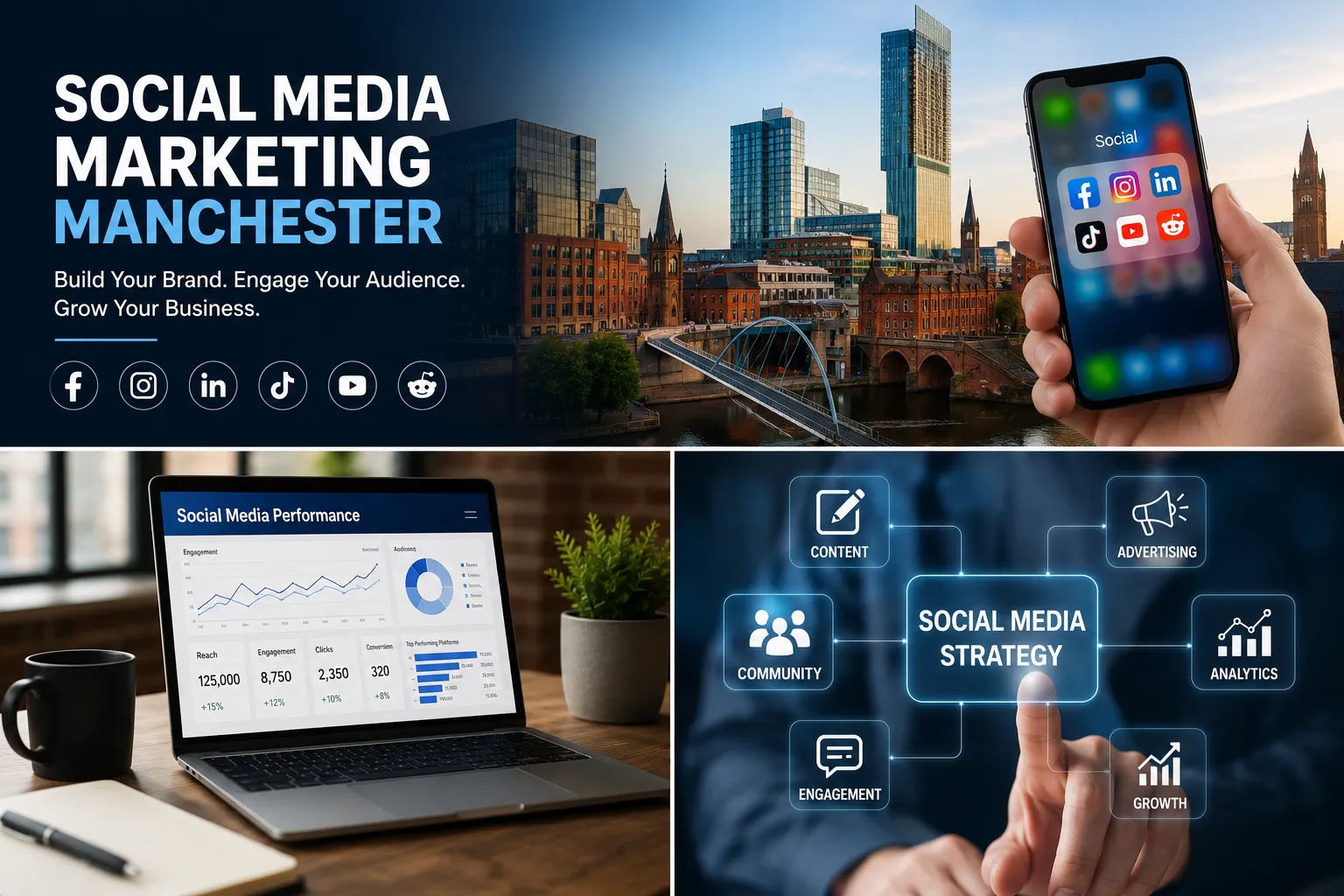
Social Media Marketing Manchester
CGO Media provides strategic social media marketing in Manchester for businesses that want to increase brand awareness, reach relevant audiences, generate qualified enquiries and turn social activity into measurable commercial growth.
Our Manchester social media marketing services combine campaign strategy, content creation, account management, paid social advertising, audience engagement and performance analysis. Every campaign is developed around the needs of your organisation rather than generic posting schedules or superficial engagement metrics.
We help Manchester businesses create a consistent, credible and commercially valuable presence across platforms including Facebook, Instagram, LinkedIn, TikTok, YouTube, Reddit and other channels relevant to their customers.
Executive Summary
Social media marketing helps Manchester businesses increase awareness, communicate expertise, reach new customers and strengthen relationships with existing audiences. CGO Media develops integrated organic and paid social campaigns based on commercial objectives, audience research, platform behaviour and measurable performance. Our services cover strategy, content production, account management, community engagement, advertising and reporting across leading social networks.
Request a Social Media Consultation
A Social Media Marketing Agency for Manchester Businesses
Social platforms have become central to how people discover businesses, research products, compare services, evaluate expertise and communicate with brands. For many organisations, a potential customer’s first meaningful interaction now takes place through a social post, video, company profile, advertisement or recommendation.
However, maintaining social media accounts is not the same as delivering an effective social media marketing strategy.
Successful campaigns require a clear understanding of:
- The audiences the business needs to reach
- The platforms those audiences actively use
- The type of content that earns their attention
- The questions and objections influencing their decisions
- The commercial action the campaign should encourage
- The relationship between organic content and paid advertising
- The metrics that indicate meaningful progress
CGO Media helps businesses move beyond occasional posting and disconnected campaigns. We develop structured social media programmes that support wider marketing, sales, recruitment and brand-development objectives.
Depending on the organisation, our Manchester social media marketing campaigns can be designed to:
- Increase awareness across Manchester and Greater Manchester
- Reach national or international target audiences
- Generate qualified website traffic
- Create sales enquiries and leads
- Support ecommerce revenue
- Promote products, services and events
- Develop executive and organisational thought leadership
- Build an engaged online community
- Improve customer communication
- Support recruitment and employer branding
- Amplify content marketing and Digital PR campaigns
- Strengthen branded search and digital authority
What Is Social Media Marketing?
Social media marketing is the strategic use of social platforms to communicate with target audiences and achieve defined business objectives.
It can include organic publishing, short-form video, paid advertising, community management, influencer activity, audience research, social listening, remarketing and campaign analysis.
A professional social media strategy connects these activities rather than treating them as separate tasks. It establishes who the organisation wants to reach, what it needs to communicate, which platforms are most appropriate and how results will be measured.
For example, a Manchester professional services company may use LinkedIn to distribute expert insight and reach corporate decision-makers. A hospitality business may focus on Instagram, Facebook and TikTok to showcase experiences and drive bookings. An ecommerce brand may combine creator-led content, product videos and paid remarketing to generate sales.
The correct approach depends on the audience, business model, buying journey and available creative resources.
Why Social Media Marketing Matters
Customers rarely make decisions after encountering a business once. They may first see an advertisement, later visit the company website, read customer reviews, watch a video, follow the organisation and eventually make an enquiry or purchase.
Social media helps businesses remain visible throughout this decision-making process.
A strong presence can support:
| Social Media Objective | Potential Business Benefit |
|---|---|
| 📣 Brand awareness | Introduces the organisation to new and relevant audiences. |
| 💬 Audience engagement | Builds familiarity, trust and ongoing customer relationships. |
| 🌐 Website traffic | Directs interested users towards services, products and resources. |
| 🎯 Lead generation | Encourages consultations, enquiries, registrations and downloads. |
| 🛍️ Ecommerce promotion | Supports product discovery, remarketing and online sales. |
| 🎙️ Thought leadership | Positions companies and executives as trusted industry voices. |
| 👥 Recruitment | Communicates company culture and attracts suitable candidates. |
| 🤝 Customer retention | Maintains communication with existing customers and communities. |
| ⭐ Digital authority | Strengthens branded discovery and supports wider online visibility. |
Our Social Media Marketing Services in Manchester
CGO Media can manage an individual platform, support an internal marketing team or deliver an integrated social media programme across multiple channels.
The service is structured around the organisation’s objectives, resources, audience and growth priorities.
Social Media Strategy
Every effective campaign begins with a clear strategy.
We assess the organisation’s current social presence, business objectives, customer groups, competitors, brand positioning and existing content. This allows us to determine which platforms, formats and campaign themes are most likely to create value.
A social media strategy may define:
- Primary and secondary audiences
- Priority platforms
- Brand voice and communication style
- Core content themes
- Organic publishing frequency
- Video and visual content requirements
- Paid media opportunities
- Community management procedures
- Campaign objectives and conversion actions
- Performance indicators and reporting methods
The result is a practical campaign framework rather than a generic collection of content ideas.
Social Media Management
Our social media management service gives businesses a consistent and professional presence without placing unnecessary pressure on internal teams.
Depending on the agreed scope, management can include:
- Profile reviews and optimisation
- Content calendar development
- Post preparation and scheduling
- Platform-specific copywriting
- Creative asset coordination
- Hashtag and topic research
- Comment and message monitoring
- Campaign performance reviews
- Monthly reporting
- Ongoing strategic recommendations
Content is planned in advance while retaining enough flexibility to respond to company news, industry developments, customer questions and time-sensitive opportunities.
Social Media Content Creation
Effective social content needs to be useful, recognisable and appropriate for the platform on which it appears.
Simply duplicating an identical post across every network often produces weak results because users behave differently on LinkedIn, Instagram, Facebook, TikTok and YouTube.
CGO Media develops platform-specific content that can include:
- Branded static graphics
- Carousel posts
- Short-form video concepts
- Reels and TikTok content
- Executive thought-leadership posts
- Educational guides and explainers
- Customer success stories
- Company and team updates
- Product and service demonstrations
- Research and industry commentary
- Promotional campaigns
- Event-related content
- Frequently asked questions
Each content type should serve a clear purpose, whether that is attracting attention, demonstrating expertise, answering a question or encouraging an enquiry.
Paid Social Media Advertising
Paid social advertising allows Manchester businesses to reach precisely defined audiences beyond their existing followers.
Campaigns may be targeted according to location, interests, online behaviour, job role, industry, demographics, previous website activity or earlier interaction with the organisation.
Paid social campaigns can be used to support:
- Lead generation
- Ecommerce sales
- Local business awareness
- Product and service launches
- Event registrations
- Recruitment
- Content promotion
- Video campaigns
- App downloads
- Website remarketing
- Customer re-engagement
We consider the audience, advertisement, creative asset, landing page and conversion tracking as parts of one campaign. This reduces the risk of generating clicks that do not contribute to a meaningful business outcome.
Community Management
Social media is a two-way communication channel. Customers may use it to ask questions, share experiences, request support or publicly evaluate a business.
Community management helps organisations respond consistently and professionally.
The service can include monitoring comments and messages, identifying recurring customer questions, escalating sensitive issues and encouraging constructive audience interaction.
Effective community management can improve customer confidence, protect brand reputation and provide valuable insight into how audiences perceive the organisation.
Social Media Analytics and Reporting
Social media reporting should explain whether activity is contributing to the objectives established at the beginning of the campaign.
We do not judge success purely by follower numbers or isolated engagement totals. Reporting is connected to the outcomes the organisation is attempting to achieve.
Depending on the campaign, we may measure:
- Relevant audience growth
- Organic and paid reach
- Engagement rate and engagement quality
- Video views and completion rates
- Website visits from social platforms
- Enquiries and lead generation
- Advertising expenditure
- Cost per click
- Cost per lead or acquisition
- Conversion rate
- Return on advertising expenditure
- Top-performing content themes
Reports include practical commentary explaining what happened, why it happened and how the next stage of the campaign will be improved.
Organic Social Media and Paid Social Advertising
Organic and paid social media serve different but complementary purposes.
| Organic Social Media | Paid Social Advertising |
|---|---|
| 🌱 Builds long-term audience relationships | 🚀 Creates immediate targeted reach |
| 🎙️ Communicates expertise and brand personality | 🎯 Promotes specific offers and conversion actions |
| 💬 Supports customer engagement | 🌍 Reaches audiences beyond existing followers |
| 🤝 Strengthens trust over time | 📈 Enables controlled campaign scaling |
| 📢 Distributes company content and updates | 🎯 Supports lead generation and remarketing |
| ⭐ Provides continuing brand visibility | 📊 Produces faster campaign data and testing opportunities |
Organic activity helps build credibility, familiarity and an owned audience. Paid activity expands reach, accelerates testing and directs suitable users towards specific commercial actions.
The strongest strategies often use both. Organic content establishes the brand’s expertise and communication style, while paid campaigns amplify the best-performing messages and reach carefully selected audiences.
Social Media Platforms We Manage
Businesses do not need to maintain an active presence on every available social network. They need to prioritise the platforms most relevant to their customers, industry and commercial objectives.
CGO Media assesses each platform according to audience suitability, content requirements, advertising potential and likely business value.
Facebook Marketing
Facebook remains useful for local companies, community-focused organisations, consumer brands, hospitality businesses, event promotion and targeted advertising.
Campaigns can combine organic publishing, community engagement, local awareness advertising, lead-generation forms and website remarketing.
Instagram Marketing
Instagram is particularly effective for businesses with visual products, services, locations, teams or customer experiences.
It can support hospitality, property, retail, ecommerce, lifestyle, fitness, beauty, travel and professional brands that can translate their expertise into strong visual communication.
Campaigns may include feed posts, Stories, Reels, carousels, creator content and paid advertising.
LinkedIn Marketing
LinkedIn gives B2B organisations access to professionals, business owners, managers, investors, executives and corporate decision-makers.
We use company-page content, executive profiles, thought leadership, research distribution and paid targeting to support business development and organisational authority.
TikTok Marketing
TikTok allows brands to reach highly engaged audiences through useful, authentic and entertaining short-form video.
Successful TikTok strategies usually depend on repeatable content formats rather than occasional highly produced advertisements. We help businesses identify themes that can be communicated consistently while remaining natural to the platform.
YouTube Marketing
YouTube supports brand awareness, education, product discovery, customer confidence and long-term search visibility.
Businesses can use video to explain complex services, answer customer questions, demonstrate products, publish interviews and build a searchable library of expertise.
Reddit Marketing
Reddit gives organisations access to highly focused communities and detailed conversations around industries, products, problems and customer experiences.
Successful participation requires transparency, relevance and a community-first approach. Conventional promotional messaging can damage trust when it does not respect the expectations of individual communities.
Choosing the Right Social Media Platforms
The most popular platform is not automatically the best platform for every organisation.
Platform selection should be based on:
- Where the target audience spends time
- How customers research and evaluate the service
- Whether the organisation sells to consumers or businesses
- The type of content the business can produce consistently
- The complexity and duration of the buying journey
- The available organic and advertising budget
- The organisation’s internal expertise and resources
- The commercial objective of the campaign
A Manchester B2B consultancy may receive greater value from LinkedIn and YouTube than from maintaining several consumer-focused accounts. A restaurant or leisure venue may prioritise Instagram, TikTok and Facebook. An ecommerce company may use a broader mix incorporating creator content, paid social and remarketing.
CGO Media recommends a focused platform strategy that can be managed effectively and expanded when evidence supports further investment.
Social Media Marketing Strategy for Manchester Businesses
A successful social media campaign requires more than frequent posting. It needs a clear relationship between audience behaviour, brand positioning, content quality, platform selection and commercial objectives.
CGO Media develops social media strategies that are designed around the realities of each business. We assess how the organisation currently communicates, how competitors are using social platforms and where genuine opportunities exist to improve reach, engagement and conversion performance.
Our approach focuses on creating a repeatable marketing system rather than isolated campaigns that produce temporary attention.
Audience Research and Segmentation
Understanding the audience is one of the most important stages of social media planning.
Businesses often describe their target customer too broadly. A campaign aimed at “Manchester businesses” or “UK consumers” is unlikely to produce consistently relevant content because those groups include people with very different priorities, levels of awareness and buying intentions.
Audience research helps identify:
- Who is most likely to need the product or service
- Which challenges or ambitions influence their decisions
- What information they require before taking action
- Which social platforms they use
- What type of content they respond to
- Which objections may prevent conversion
- How long the purchasing process normally takes
- Which professional roles or demographic groups should be prioritised
These findings shape campaign messaging, platform targeting, content formats and paid advertising audiences.
Competitor Social Media Analysis
Competitor analysis provides useful insight into the communication standards within an industry and the areas where a business may be able to differentiate itself.
We review how relevant competitors use social media, including:
- Platforms they prioritise
- Frequency of publishing
- Content themes
- Use of video and visual assets
- Audience engagement
- Promotional messaging
- Thought-leadership activity
- Paid advertising activity where visible
- Customer questions and recurring complaints
- Content gaps and missed opportunities
The objective is not to copy competitor activity. It is to understand the market and develop a more useful, credible and distinctive presence.
Brand Positioning and Social Media Messaging
Social media should communicate a consistent understanding of who the organisation is, what it offers and why customers should trust it.
Inconsistent messaging can weaken recognition and make it difficult for audiences to understand the value of the business.
We help define:
- Core brand messages
- Primary customer benefits
- Areas of expertise
- Communication tone
- Visual consistency
- Preferred terminology
- Proof points and trust signals
- Appropriate calls to action
These principles guide content creation across company accounts, paid campaigns and executive profiles.
Social Media Content Strategy
A content strategy defines what the organisation will communicate and how those messages will support wider business objectives.
Without a clear content structure, social media accounts often become repetitive, overly promotional or disconnected from what customers actually want to know.
CGO Media builds content strategies around a series of defined themes that can be developed consistently over time.
Educational Content
Educational content helps audiences understand a subject, solve a problem or make a more informed decision.
Examples include:
- Practical tips
- Step-by-step explanations
- Industry definitions
- Frequently asked questions
- Common mistakes
- Product or service comparisons
- Myth-versus-reality posts
- Short expert videos
- Guides and checklists
This type of content is particularly useful for businesses offering complex, high-value or considered-purchase services.
Authority and Thought-Leadership Content
Thought leadership gives companies and senior professionals an opportunity to demonstrate expertise and contribute meaningfully to industry discussions.
It can include:
- Commentary on industry developments
- Original research
- Professional opinions
- Market analysis
- Predictions and emerging trends
- Lessons from client work
- Conference and event insight
- Executive interviews
- Long-form LinkedIn posts
Effective thought leadership should offer a clear perspective rather than simply repeating information already available elsewhere.
Commercial Content
Commercial content promotes products, services and specific offers. It is necessary, but it should form part of a balanced content programme.
Examples include:
- Service explanations
- Product features
- Promotional offers
- Event invitations
- Consultation campaigns
- New product launches
- Demonstrations
- Booking reminders
- Lead-generation resources
The strongest commercial content clearly connects the offer to a customer need rather than relying on generic promotional language.
Trust-Building Content
Customers often use social media to determine whether a business appears credible, active and dependable.
Trust-building content can include:
- Customer testimonials
- Case studies
- Client results
- Team introductions
- Behind-the-scenes content
- Accreditations and partnerships
- Company milestones
- Media coverage
- Community involvement
- Transparent process explanations
This content helps reduce uncertainty and gives potential customers greater confidence before they enquire.
Engagement and Community Content
Engagement-focused content encourages audiences to respond, share an opinion or participate in a discussion.
Examples include:
- Questions
- Polls
- Industry debates
- Audience challenges
- Interactive Stories
- Live question-and-answer sessions
- Customer spotlights
- User-generated content
Engagement should be relevant to the brand and audience. Artificially provocative posts may produce comments without creating any meaningful commercial value.
Social Media Content Formats
Different formats serve different communication purposes. A strong campaign uses the formats most appropriate to the platform, message and audience.
| Content Format | Primary Purpose |
|---|---|
| 🖼️ Static graphics | Communicate concise messages, statistics, offers and announcements. |
| 📑 Carousel posts | Explain multi-stage ideas, frameworks, processes and comparisons. |
| 🎬 Short-form video | Increase attention, reach and rapid information delivery. |
| 🎥 Long-form video | Provide detailed education, demonstrations and expert insight. |
| 📲 Stories | Share timely updates, informal content and interactive messages. |
| 🔴 Live video | Support real-time discussion, events and audience questions. |
| ✍️ Text-led posts | Communicate professional insight and thought leadership. |
| 📈 Case studies | Demonstrate experience, process and measurable outcomes. |
| 🤝 User-generated content | Provide social proof and authentic customer perspectives. |
| 📊 Infographics | Present complex information in a clear visual structure. |
Short-Form Video Marketing
Short-form video has become one of the most influential formats across Instagram, TikTok, Facebook, LinkedIn and YouTube.
It allows businesses to communicate quickly, show personality and reach audiences that may not engage with traditional text-based posts.
Short-form video content can include:
- Expert tips
- Product demonstrations
- Before-and-after examples
- Customer questions
- Industry commentary
- Team introductions
- Behind-the-scenes footage
- Event highlights
- Short case studies
- Myth-busting content
Successful video does not always require expensive production. Clear communication, strong opening lines and relevant subject matter are often more important than highly polished visuals.
CGO Media helps businesses develop repeatable video concepts that can be produced consistently and adapted across multiple platforms.
Paid Social Media Campaign Management
Paid social media can create rapid reach and measurable campaign data, but performance depends on more than the advertising platform itself.
Successful campaigns require alignment between:
- The target audience
- The campaign objective
- The advertisement
- The creative format
- The offer
- The landing page
- The conversion process
- The tracking setup
If any of these elements are weak, advertising costs may increase without producing a satisfactory return.
Lead-Generation Campaigns
Lead-generation campaigns are designed to encourage potential customers to submit their details, request information, arrange a consultation or access a resource.
They may use:
- Platform-native lead forms
- Dedicated landing pages
- Consultation offers
- Downloadable guides
- Webinars
- Quotation requests
- Product demonstrations
- Event registrations
Campaign performance should be evaluated based on lead quality as well as lead volume. A high number of unsuitable enquiries can create unnecessary pressure on sales teams without improving revenue.
Ecommerce Social Advertising
Ecommerce businesses can use paid social media to promote products, recover abandoned purchasing journeys and encourage repeat sales.
Campaign types can include:
- Product catalogue advertising
- New-customer acquisition
- Dynamic remarketing
- Abandoned-cart campaigns
- Product launch campaigns
- Seasonal promotions
- Customer retention campaigns
- Creator-led advertising
Product margins, average order values, repeat-purchase rates and fulfilment costs should all be considered when evaluating performance.
Local Social Media Advertising
Manchester businesses serving defined locations can use paid social campaigns to reach potential customers within specific areas.
Campaigns may target:
- Manchester city centre
- Greater Manchester
- Selected boroughs
- Defined postcode areas
- People living near a venue or store
- Visitors attending local events
- Audiences with relevant interests or behaviours
Local targeting can support hospitality, healthcare, professional services, property, education, leisure, retail and other location-dependent organisations.
B2B Social Advertising
B2B campaigns often require more precise targeting because the audience may consist of a relatively small number of decision-makers.
LinkedIn and other social platforms can be used to reach audiences according to:
- Job title
- Seniority
- Company size
- Industry
- Business function
- Professional interests
- Location
- Previous website activity
B2B campaigns usually perform best when they provide useful information and build credibility before asking for a major commitment.
Social Media Remarketing
Remarketing allows businesses to communicate with people who have already interacted with the brand.
These audiences may include:
- Website visitors
- Product-page viewers
- Users who watched a video
- People who engaged with a social post
- Previous customers
- Newsletter subscribers
- Users who began but did not complete an enquiry
Because remarketing audiences are already familiar with the organisation, campaigns can often use more specific messaging than initial awareness advertising.
Remarketing may promote case studies, testimonials, consultations, product reminders, limited-time offers or additional information that helps the customer make a decision.
Social Media Conversion Tracking
Accurate tracking is essential for understanding whether paid and organic social activity contributes to business outcomes.
Depending on the platform and campaign, tracking may involve:
- Advertising pixels
- Conversion APIs
- Google Analytics
- Campaign tracking parameters
- Lead-form integrations
- Ecommerce transaction tracking
- Call tracking
- CRM integration
Tracking allows businesses to identify which platforms, campaigns, audiences and creative assets are producing meaningful results.
It also reduces the risk of increasing advertising budgets based on incomplete or misleading performance data.
Social Media Marketing and SEO
Social media activity is not a direct replacement for professional search engine optimisation. However, the two channels can support one another.
Social media can increase the reach of useful website content, expose research to journalists and industry professionals, encourage branded searches and strengthen awareness of an organisation.
SEO can help social campaigns by providing:
- Useful landing pages
- Search-informed content themes
- Customer-question research
- Evergreen guides
- Structured service and product information
- High-quality website destinations
When both channels are coordinated, businesses can create content once and adapt it for search, social media, email, Digital PR and sales enablement.
Social Media Marketing and Digital PR
Digital PR campaigns often generate stronger results when they are supported by social distribution.
Media coverage, research findings, expert commentary and original data can be adapted into:
- LinkedIn thought-leadership posts
- Infographics
- Video explanations
- Short statistics posts
- Executive commentary
- Carousel summaries
- Press-coverage announcements
This extends the life of Digital PR activity and increases the number of people who encounter the campaign.
Social engagement may also provide journalists, publishers and industry professionals with additional evidence that a subject is attracting attention.
Social Media and AI Search Visibility
Artificial intelligence is changing how information is discovered, summarised and recommended.
AI-powered search platforms assess information from many sources when attempting to understand organisations, products, people and areas of expertise.
Social media alone does not guarantee visibility within AI-generated answers. However, a consistent and authoritative social presence can contribute to the wider digital signals surrounding a brand.
Social media can support AI search readiness by helping businesses:
- Communicate consistent brand and entity information
- Distribute expert content
- Increase recognition of key people and services
- Generate discussion and external mentions
- Strengthen associations between the brand and its subject areas
- Amplify research and Digital PR
- Encourage branded discovery
- Build visible evidence of organisational activity
The strongest approach combines social media with AI SEO Manchester, structured website content, Digital PR and entity optimisation.
Executive and Personal Brand Social Media
In many industries, audiences are more likely to engage with an identifiable expert than a corporate account.
Senior professionals can use social media to communicate experience, share opinions and create direct relationships with customers, partners and peers.
Executive social media activity may support:
- Thought leadership
- Business development
- Recruitment
- Media opportunities
- Conference invitations
- Partnerships
- Investor communication
- Employer branding
CGO Media can help executives develop content themes, improve profile positioning and maintain a consistent publishing schedule without losing their individual voice.
Influencer and Creator Marketing
Influencer marketing can help businesses reach established communities through trusted creators.
However, follower numbers alone do not indicate whether a partnership will produce value.
Creator selection should consider:
- Audience relevance
- Engagement quality
- Geographic reach
- Content style
- Brand compatibility
- Past commercial partnerships
- Audience authenticity
- Expected campaign outcome
Smaller creators with a highly relevant audience may deliver stronger results than larger accounts with weak alignment to the product or service.
Campaigns should also include clear agreements covering deliverables, disclosure requirements, usage rights and performance reporting.
Social Media Marketing for Different Industries
Social media strategy should reflect how customers behave within a specific sector.
Professional Services
Professional services companies can use social media to demonstrate expertise, answer client questions, publish commentary and strengthen trust.
LinkedIn, YouTube and carefully targeted paid campaigns are often particularly valuable.
Ecommerce and Retail
Ecommerce brands can combine product-led content, creator partnerships, short-form video, catalogue advertising and remarketing.
Campaigns should be connected to product margins, stock levels, customer acquisition costs and repeat purchasing behaviour.
Hospitality and Leisure
Restaurants, hotels, venues, attractions and leisure companies can use visual content to showcase experiences and encourage bookings.
Instagram, TikTok, Facebook and creator partnerships may form important parts of the strategy.
Property and Real Estate
Property businesses can use video tours, local market commentary, area guides, customer stories and paid lead-generation campaigns.
Content can target buyers, sellers, landlords, tenants, investors and commercial property decision-makers.
Healthcare and Wellbeing
Healthcare organisations need a carefully controlled approach that prioritises accuracy, trust, patient privacy and platform advertising requirements.
Educational content, team profiles, service explanations and patient guidance can support visibility and confidence.
Technology and SaaS
Technology businesses can use social media to explain product capabilities, distribute research, share customer results and reach decision-makers.
LinkedIn, YouTube, webinars and product demonstration content are often important.
Recruitment and Employer Branding
Organisations can use social media to communicate workplace culture, career opportunities, employee development and company values.
Employer-branding content can improve the quality of applications and help candidates understand the organisation before applying.
Social Media Marketing for Manchester’s Business Community
Manchester has a diverse commercial economy that includes technology, ecommerce, professional services, finance, property, healthcare, education, hospitality, retail, manufacturing and creative industries.
This creates significant opportunities for organisations to use social media for local awareness, national growth and international brand development.
Manchester-based campaigns may be designed to reach:
- Local consumers
- Greater Manchester businesses
- UK-wide decision-makers
- International customers
- Students and graduates
- Investors and professional partners
- Industry communities
- Potential employees
CGO Media combines local understanding with a wider strategic approach. Campaigns are not restricted to Manchester unless the organisation’s market is genuinely local.
Measuring Social Media Marketing Performance
Measurement should reflect the objective of the campaign.
A brand-awareness campaign should not be assessed in the same way as an ecommerce campaign or a B2B lead-generation programme.
| Campaign Objective | Relevant Performance Indicators |
|---|---|
| 📣 Brand awareness | Reach, impressions, video views, audience growth and branded engagement. |
| 💬 Audience engagement | Comments, shares, saves, replies and engagement quality. |
| 🌐 Website traffic | Social visits, landing-page engagement and assisted conversions. |
| 🎯 Lead generation | Lead volume, lead quality, cost per lead and sales conversion. |
| 🛒 Ecommerce revenue | Purchases, revenue, return on advertising expenditure (ROAS) and customer acquisition cost. |
| 🎙️ Thought leadership | Relevant engagement, profile views, speaking opportunities and media interest. |
| 👥 Recruitment | Career-page visits, application volume and applicant quality. |
| 🤝 Community growth | Active participation, recurring engagement and customer retention signals. |
Reporting should help decision-makers understand both immediate performance and longer-term trends.
Common Social Media Marketing Mistakes
Many organisations invest time in social media without establishing a clear strategy or measurement framework.
Common mistakes include:
- Publishing without defined business objectives
- Using every platform regardless of audience relevance
- Posting identical content across all networks
- Relying entirely on promotional messages
- Failing to respond to comments and messages
- Judging success only by follower numbers
- Running paid campaigns without conversion tracking
- Sending users to weak landing pages
- Changing strategy before sufficient data is available
- Ignoring negative customer feedback
- Using inconsistent branding and messaging
- Failing to review audience and campaign performance
A structured strategy reduces wasted activity and gives the organisation a clearer basis for investment decisions.
Our Social Media Marketing Process
Effective social media marketing requires a repeatable process that connects strategy, creative production, publishing, audience engagement, advertising and measurement.
CGO Media uses a structured methodology designed to reduce wasted activity and ensure every campaign remains aligned with the organisation’s commercial objectives.
| Campaign Stage | Primary Objective |
|---|---|
| 🔍 Discovery | Understand the business, target audience, commercial objectives, available resources and current performance. |
| 📊 Social Media Audit | Review existing profiles, content performance, competitors, advertising activity and tracking capabilities. |
| 🎯 Strategy Development | Define priority platforms, target audiences, content themes, campaign objectives and measurable KPIs. |
| 📅 Content Planning | Create an organised content calendar covering organic posts, paid campaigns and seasonal activity. |
| 🎨 Creative Production | Develop platform-specific copy, graphics, videos, carousels and campaign assets. |
| 📲 Publishing & Management | Schedule content, manage social channels and respond to audience engagement. |
| 🚀 Paid Campaign Delivery | Launch, monitor and optimise targeted social advertising to maximise campaign performance. |
| 📈 Reporting & Optimisation | Measure outcomes, identify opportunities and continuously improve future content, advertising and audience growth. |
Stage One: Business and Campaign Discovery
The process begins with a detailed understanding of the organisation and what social media needs to achieve.
We review:
- Business goals
- Priority services and products
- Target customers
- Sales process
- Geographic markets
- Existing marketing channels
- Internal resources
- Brand guidelines
- Previous campaign performance
- Available content and creative assets
This stage ensures that social media activity is built around genuine business priorities rather than assumptions about what the company should publish.
Stage Two: Social Media Audit
We assess the organisation’s existing profiles, content and performance to identify strengths, weaknesses and immediate opportunities.
The audit can include:
- Profile completeness and branding
- Platform suitability
- Publishing frequency
- Content quality and consistency
- Audience growth
- Engagement patterns
- Video performance
- Competitor activity
- Paid campaign history
- Conversion tracking
- Community management
- Reputation risks
The findings provide a practical starting point for the strategy.
Stage Three: Strategy and Platform Selection
We determine which platforms should be prioritised and how each channel will support the wider campaign.
The strategy establishes:
- Primary and secondary audiences
- Priority platforms
- Content pillars
- Publishing frequency
- Organic and paid activity
- Brand tone and messaging
- Campaign objectives
- Conversion actions
- Reporting requirements
- Approval procedures
Where several platforms are involved, each one receives a defined role rather than becoming another account that must be maintained without a clear purpose.
Stage Four: Content Calendar Development
A content calendar provides structure and ensures the organisation publishes a balanced mix of educational, commercial, authority-building and engagement-focused material.
The calendar may include:
- Planned publishing dates
- Platform allocation
- Content themes
- Post formats
- Draft captions
- Creative requirements
- Campaign links
- Calls to action
- Approval status
- Associated paid promotion
Advance planning creates consistency while leaving room for company announcements, industry news and reactive opportunities.
Stage Five: Content Production
Content is created according to the agreed strategy and adapted for the behaviour of each platform.
Production can include:
- Social media copywriting
- Branded graphics
- Carousel design
- Short-form video planning
- Video scripts
- Infographics
- Case-study content
- Executive thought leadership
- Paid advertising creative
- Landing-page recommendations
Creative quality is important, but every asset must also communicate a useful message and support a defined campaign objective.
Stage Six: Publishing and Community Management
Once approved, content is scheduled and published according to the campaign calendar.
Ongoing management may include:
- Post scheduling
- Platform monitoring
- Responding to comments
- Reviewing direct messages
- Escalating customer-service issues
- Identifying engagement opportunities
- Monitoring brand mentions
- Maintaining profile information
Community interaction is managed in accordance with the organisation’s brand tone, customer-service procedures and internal approval requirements.
Stage Seven: Campaign Measurement and Optimisation
Performance is reviewed regularly to determine which content, audiences, platforms and advertisements are producing the strongest results.
Optimisation may involve:
- Adjusting content themes
- Changing publishing frequency
- Testing new formats
- Improving calls to action
- Refining advertising audiences
- Updating creative assets
- Reallocating campaign budget
- Improving landing pages
- Strengthening conversion tracking
- Expanding successful campaigns
Social media strategy should evolve as new evidence becomes available.
Why Choose CGO Media for Social Media Marketing in Manchester?
CGO Media approaches social media as part of a wider digital growth strategy rather than an isolated publishing service.
Our work can connect social media with SEO, AI Search Optimisation, content marketing, Digital PR, paid media and conversion strategy.
Commercially Focused Campaigns
Every campaign begins with a clear understanding of what the organisation wants to achieve.
We focus on relevant outcomes such as qualified enquiries, ecommerce revenue, audience growth, customer engagement, recruitment or brand authority.
Integrated Digital Expertise
Social media often performs more effectively when coordinated with other channels.
Our wider capabilities include:
- SEO Manchester
- AI SEO Manchester
- GEO Services Manchester
- Content Marketing Manchester
- Digital PR Manchester
- Link Building Manchester
This integrated approach helps businesses create consistent messages across social platforms, search engines, websites and media coverage.
Platform-Specific Strategy
We do not use identical content and tactics across every social platform.
Campaigns are adapted according to the expectations, formats and audience behaviour associated with each network.
Transparent Reporting
Reports explain what activity has been delivered, how audiences have responded and what changes are recommended.
We avoid presenting large volumes of engagement data without connecting it to the campaign’s original objectives.
Scalable Support
CGO Media can provide complete account management or work alongside internal marketing teams.
The service can expand as the organisation develops, new platforms are introduced or paid advertising budgets increase.
Manchester and UK Market Experience
Our campaigns can focus on Manchester and Greater Manchester while also supporting wider UK or international growth.
This is particularly valuable for businesses that have a local commercial base but serve customers across multiple regions.
Social Media Management Packages
The appropriate level of support depends on the number of platforms, content requirements, publishing frequency, advertising activity and internal resources available.
A social media marketing package may include:
- Initial strategy development
- Social media audit
- Profile optimisation
- Monthly content planning
- Copywriting
- Graphic design
- Video planning
- Post scheduling
- Community management
- Paid campaign management
- Performance reporting
- Monthly strategy meetings
Some businesses require a complete outsourced service. Others need specialist support for content, paid advertising, executive profiles or campaign strategy.
CGO Media develops the scope according to the organisation’s objectives rather than forcing every client into the same package.
How Long Does Social Media Marketing Take to Work?
The timeframe depends on the campaign objective, platform, audience, budget and starting position.
Paid social advertising can begin generating traffic and campaign data shortly after launch. However, building organic reach, community trust and brand authority usually requires consistent activity over a longer period.
| Timeframe | Typical Campaign Development |
|---|---|
| 📅 First month | Research, audit, strategy development, profile optimisation and initial content production. |
| 🚀 Months two to three | Content testing, audience growth, community engagement and paid campaign refinement. |
| 📈 Months three to six | Clearer performance trends, stronger engagement, improved advertising efficiency and consistent content delivery. |
| 🏆 Six months and beyond | Established content formats, stronger brand recognition, scalable campaigns and sustained business growth. |
Social media should generally be treated as an ongoing marketing channel rather than a short campaign that is expected to transform business performance immediately.
Frequently Asked Questions About Social Media Marketing Manchester
What is included in social media marketing?
Social media marketing can include strategy, profile optimisation, content creation, post scheduling, account management, community engagement, paid advertising, influencer activity and performance reporting. The exact service depends on the business’s objectives and platforms.
Which social media platforms should my business use?
The correct platforms depend on your audience, industry, content resources and commercial goals. LinkedIn may be suitable for B2B businesses, while Instagram, TikTok and Facebook may be more appropriate for consumer, hospitality, retail and lifestyle brands.
Do you manage social media accounts for Manchester businesses?
Yes. CGO Media provides social media management for businesses in Manchester and Greater Manchester, including content planning, publishing, creative production, community management and reporting.
Can you manage both organic and paid social media?
Yes. We can manage organic content and paid advertising as part of one coordinated strategy. Organic activity builds credibility and relationships, while paid campaigns expand reach and support lead generation, ecommerce sales and remarketing.
How much does social media marketing cost?
Costs depend on the number of platforms, publishing frequency, creative requirements, community management, video production and advertising activity. CGO Media develops a tailored proposal after assessing the campaign requirements.
Is paid social media advertising included in the management fee?
Paid campaign management and advertising expenditure are normally treated separately. The management fee covers strategy, setup, monitoring and optimisation, while the advertising budget is paid directly to the relevant platform.
How often should a business post on social media?
There is no universal publishing frequency. The right schedule depends on the platform, audience and available content quality. Consistent, useful publishing is generally more effective than frequent low-value posts.
Can social media generate leads for my business?
Yes. Social media can generate enquiries through organic content, paid lead forms, landing pages, consultations, webinars, downloads and remarketing. Performance depends on the offer, targeting, creative quality and conversion process.
Can social media marketing help SEO?
Social media is not a direct substitute for SEO, but it can support content distribution, branded search, Digital PR, website traffic and wider brand recognition. Coordinating both channels often increases the value of the content being produced.
Can you create social media videos?
CGO Media can support short-form video strategy, scripts, content concepts and campaign planning. The production scope can be adapted according to whether filming is completed internally, on location or through a specialist creative team.
Do you work with internal marketing teams?
Yes. We can operate as a complete outsourced social media team or provide specialist support to an internal department. This may include strategy, content production, advertising, reporting or executive account support.
How do you measure social media success?
Measurement depends on the campaign objective. Relevant KPIs may include reach, engagement quality, website traffic, leads, customer acquisition cost, ecommerce revenue, return on advertising expenditure and audience growth.
Can you target customers specifically in Manchester?
Yes. Paid campaigns can target Manchester, Greater Manchester, individual boroughs, postcode areas or defined distances around a location. Organic content can also be developed around local audiences, events and customer interests.
Do you provide LinkedIn marketing for B2B businesses?
Yes. Our LinkedIn services can include company-page management, executive thought leadership, B2B content, lead-generation advertising and campaigns targeting decision-makers by industry, job role and seniority.
Can you help improve an existing social media strategy?
Yes. We can audit current profiles, content, advertising and reporting before recommending changes. This is useful for businesses that already publish regularly but are not achieving clear commercial results.
How quickly can a social media campaign begin?
The initial stage normally includes discovery, auditing, strategy and content planning. The exact launch timeframe depends on the number of platforms, approval process, creative requirements and whether paid advertising is included.
Explore Our Other Manchester Digital Marketing Services
- SEO Manchester
- SEO Agency Manchester
- SEO Company Manchester
- SEO Services Manchester
- SEO Consultant Manchester
- Technical SEO Manchester
- Local SEO Manchester
- SEO Audit Manchester
- AI SEO Manchester
- GEO Services Manchester
- Link Building Manchester
- Digital PR Manchester
- Ecommerce SEO Manchester
- Enterprise SEO Manchester
Explore Our UK Digital Marketing Services
Build a Stronger Social Media Presence
CGO Media helps Manchester businesses develop social media strategies that increase visibility, strengthen brand authority, engage relevant audiences and support measurable commercial growth.
Whether you need complete social media management, paid advertising, executive thought leadership or support for an internal marketing team, we can build a campaign around your objectives.
Social Media Marketing Manchester: Conclusion
Social media has become an important part of how customers discover, evaluate and communicate with businesses.
However, meaningful results depend on more than maintaining active profiles. Businesses need a clear strategy, relevant content, suitable platform selection, consistent management and accurate performance measurement.
CGO Media provides strategic social media marketing in Manchester for organisations that want to move beyond disconnected posting and create a commercially focused digital presence.
By combining audience research, content creation, paid advertising, community management, analytics and wider digital expertise, we help businesses build stronger relationships with customers and create long-term brand value.
Contact CGO Media to discuss a social media marketing strategy for your Manchester business.